Article

First-Principles Study of Two-Dimensional A2SnI4 (A = MA, DMA, GUA) Ruddlesden–Popper Perovskites


1
School of Physics and Astronomy, Yunnan University, Kunming 650091, China
2
State Key Laboratory of Fine Chemicals, Department of Pharmaceutical Engineering, School of Chemical Engineering, Dalian University of Technology, Dalian 116024, China
3
EIT Data Science and Communication College, Zhejiang Yuexiu University, Shaoxing 312000, China
4
Faculty of Computing, Quality Assurance Higher Education, Ulster University, Manchester M1 6FQ, UK
*
Author to whom correspondence should be addressed.
Inorganics 2026, 14(3), 73; https://doi.org/10.3390/inorganics14030073
Submission received: 4 January 2026 / Revised: 12 February 2026 / Accepted: 13 February 2026 / Published: 28 February 2026
(This article belongs to the Section Inorganic Materials)

Abstract

Two-dimensional (2D) Ruddlesden–Popper (RP) tin halide perovskites have attracted considerable attention as lead-free photovoltaic absorbers; however, the impact of organic A-site cations on their structure and pressure-dependent optoelectronic behavior remains underexplored. In this study, density functional theory (DFT) is used to investigate the structural, electronic, and optical properties of A2SnI4 (A = GUA+, DMA+, MA+) under ambient conditions and under hydrostatic pressure. All three compounds adopt layered frameworks in which the organic cations occupy the interlayer region, while SnI6 octahedra form the inorganic slabs. Band-gap calculations are performed using HSE06 for ambient pressure, known for its accuracy in electronic structure predictions, and PBE for pressure simulations, due to its computational efficiency in large-scale systems. At ambient pressure, Hybrid-functional (HSE06) calculations indicate that all three materials are direct-gap semiconductors, with band gaps of 2.25 eV for MA2SnI4, 2.98 eV for DMA2SnI4, and 2.85 eV for GUA2SnI4. Under hydrostatic compression, DMA2SnI4 shows comparatively modest band-gap variation and saturates near 1.7 eV. In contrast, GUA2SnI4 and MA2SnI4 exhibit pronounced band-gap narrowing, including a pressure-induced direct-to-indirect transition near 2 GPa, with band gaps decreasing to 0.59 eV (GUA2SnI4) and 0.34 eV (MA2SnI4) at elevated pressures. Overall, these findings highlight that A-site chemistry, combined with hydrostatic pressure, enables tuning the electronic and optical responses in tin-based 2D RP perovskites, demonstrating their promise as tunable, lead-free photovoltaic absorbers.

1. Introduction

Halide perovskites have emerged as highly promising materials for photovoltaic and optoelectronic applications due to their strong light absorption, tunable band gaps, and excellent charge-transport properties [1,2,3]. Lead-based perovskite solar cells (PSCs) have achieved power conversion efficiencies (PCEs) exceeding 26% [4,5], with benchmark materials like MAPbBr3 and MAPbI3 [6,7,8]. However, concerns over Pb toxicity have intensified efforts to develop lead-free or low-lead alternatives [9,10]. A prominent strategy involves B-site (Pb2+) substitution with less toxic divalent cations such as Sn2+ or Ge2+, which preserve favorable valence-band features and visible-light absorption. A-site substitution with alkali metal cations (e.g., Cs+, Rb+, K+) plays a pivotal role in these lead-free systems, effectively modulating structural distortions and electronic properties [11,12,13,14]. Investigations of alternative halide perovskites, including those with Ca-, Sr-, Ba-, RbSnX3 or CsGeX3 (X = Cl, Br, I), have further demonstrated the strong light absorption, high optical conductivity, and substantial band-gap tunability in lead-free perovskite [15,16,17,18,19].
Within this broad landscape of A-site engineering for lead-free halide perovskites, guanidinium (GUA+) has emerged as a highly promising organic spacer due to its planar, highly symmetric structure and multiple NH2 groups, which facilitate strong hydrogen bonding and exert significant geometric influences on the inorganic layers [20]. Mixed-cation perovskites compositions incorporating GUA+ with MA+, FA+, or inorganic cations have demonstrated enhanced optical absorption, extended carrier lifetimes, and optimized band-edge alignments [21,22]. GUA-based perovskites have also achieved competitive PCEs above 19%, with pronounced excitonic characteristics and reduced nonradiative recombination [23]. Furthermore, experimental studies further reveal that GUA-containing precursors preferentially form layered 2D perovskite phases of GUA2BX4, underscoring its role in engineering Sn–I frameworks, particularly through strong interactions with under-coordinated anions and interfaces [24]. 2D metal halide perovskites provide a rich compositional and structural phase space owing to their alternate organic–inorganic layering, allowing precise control over their optical and electronic properties. Among these, the [100]-oriented RP family, A′2An−1BnX3n+1, features inorganic perovskite slabs separated by organic spacer cations (A′), offering a versatile platform where the selection of A′ and A cations profoundly influence band-gap behavior, lattice geometry, and interlayer coupling [25,26]. These materials are particularly attractive for lead-free optoelectronic applications, benefiting from extensive chemical flexibility and low-temperature processability [27].
First-principles investigations on related oxide Ruddlesden–Popper (RP) compounds, such as monolayer Sr2TiO4 and Ba2TiO4, have demonstrated that dimensional reduction enhances quantum confinement and enables highly tunable structural, electronic, and optical properties, highlighting the broader potential of layered perovskite architectures [28]. Recent research on halide RP perovskites such as (DMA)2PbBr4, (MHy)2PbBr4, and (EA)2PbBr4 has revealed that lower dimensionality relaxes traditional Goldschmidt tolerance-factor constraints, accommodating larger organic A-site cations and yielding distinct structural and electronic behavior compared to their three-dimensional counterparts [29]. Complementary first-principles studies on BA2MAn−1BnX3n+1 (B = Ge or Sn; X = Br or I; n = 1–5) RP perovskites and their 3D (MA)BX3 analogs have revealed that smaller B-site cations cause anisotropic distortions and systematic band-gap variations across the series, and have identified the n = 1 iodide BA2SnI4 as a particularly favorable lead-free RP compound with promising electronic characteristics [30]. Despite these advances, a systematic first-principles comparison of different organic A-site cations in Sn-based 2D RP perovskites of the form A2SnI4 remains absent. GUA+, DMA+, and MA+ represent three chemically distinct organic cations capable of generating markedly different inorganic environments around the SnI6 octahedra, and their relative influence on lattice structure, band-edge alignment, dielectric screening, and optical response has not yet been elucidated.
In addition to compositional and structural tuning via A-site engineering, hydrostatic pressure offers a complementary, reversible strategy for modulating halide perovskite properties. Compression reduces lattice parameters and crystal volume displacing cations and anions while inducing tilts and rotations in the BX6 octahedra [31,32,33]. Previous high-pressure studies on inorganic halide perovskites, such as CsGeCl3, CsGeI3, KCaCl3, and RbYbF3, have shown that such distortions drive significant band-gap narrowing and improved conductivity, establishing pressure as a powerful tool for optoelectronic optimization [34,35,36,37]. This pressure-dependent tunability further enhances the potential of lead-free perovskites as versatile absorber materials for high-performance, environmentally sustainable solar cells.
In this study, a comprehensive first-principles investigation is carried out on layered, tin-based RP perovskites: A2SnI4, in which A = GUA+, DMA+, and MA+, with a primary focus on the critical role of organic A-site cation engineering in dictating lattice geometry, electronic structure, and optical properties within these two-dimensional Sn–I frameworks. By systematically comparing these chemically distinct A-site cations, we elucidate their influence on the structural stability, band-edge characteristics, and dielectric response of these lead-free materials, evaluating their potential as tunable light absorbers for photovoltaic applications. Furthermore, we explore the effects of hydrostatic pressure on these systems, examining pressure-induced structural distortions, octahedral tilting, and band-edge evolution. Through detailed analysis of structural, electronic, and optical properties under ambient and high-pressure conditions, this work uncovers how A-site chemistry interacts with external compression to enable precise, reversible tuning of optoelectronic performance. These findings establish key design guidelines for lead-free 2D RP perovskites (A2SnI4) and provide deeper insights into their promise as environmentally sustainable, high-performance absorbers for next-generation solar cells.

2. Results and Discussion

2.1. Structure Properties of 2D Perovskites

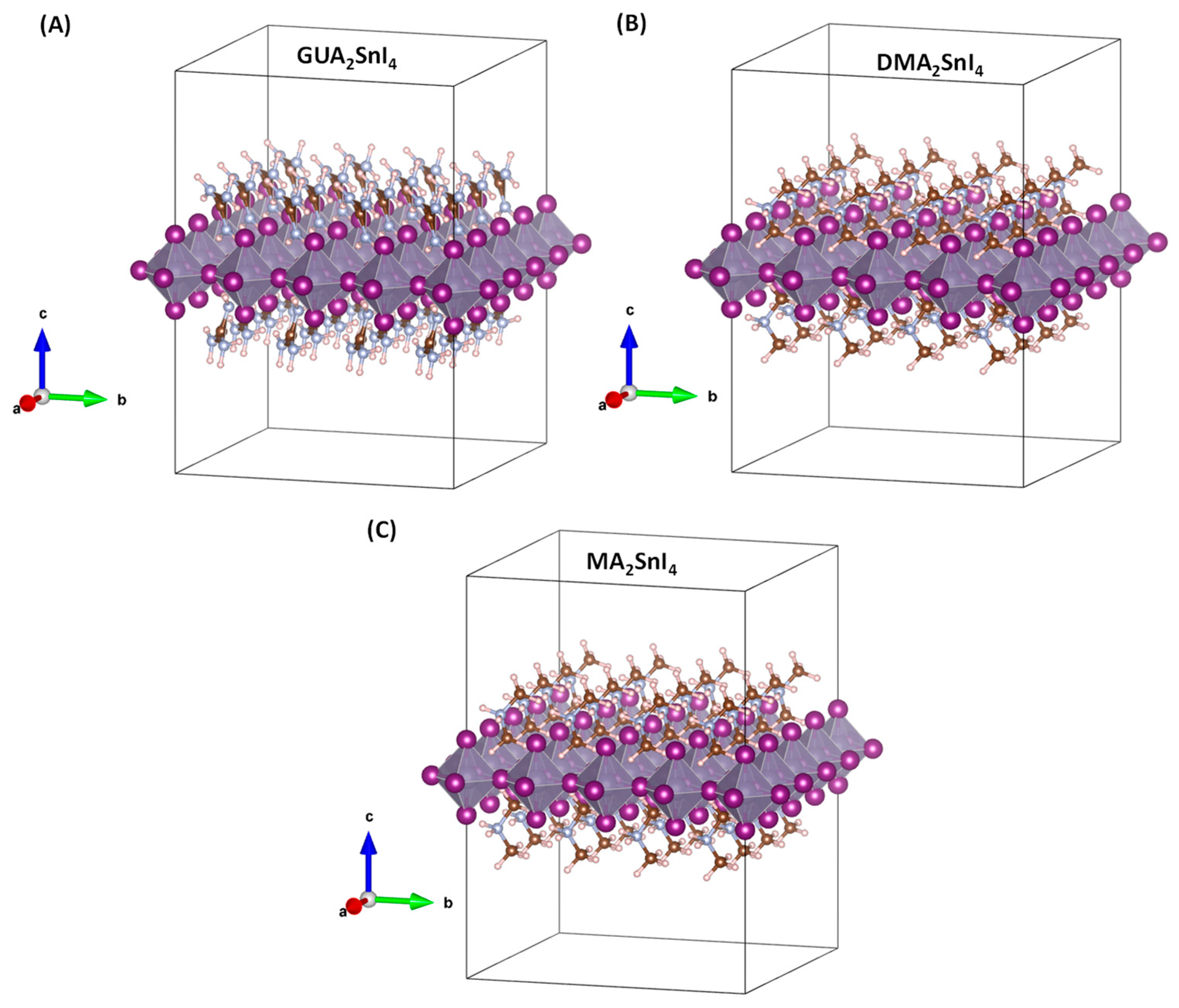
Figure 1A–C illustrates the optimized crystal structures of three layered tin-based Ruddlesden–Popper perovskites. Despite sharing the same inorganic Sn–I backbone, the three systems exhibit noticeable differences in the orientation, size, and packing of the organic A-site cations. In GUA2SnI4, the larger guanidinium cations induce a more expanded interlayer spacing and stronger hydrogen-bonding interactions with the surrounding iodide ions. In contrast, DMA2SnI4 and MA2SnI4 feature progressively smaller organic cations, leading to a more compact lattice and reduced organic–inorganic separation. These variations in A-site chemistry are expected to influence lattice distortions, octahedral tilting, and interlayer coupling.

2.2. Electronic Band Structure

The electronic behavior of a material can be understood effectively through its band structure and density of states (DOS). The total and partial DOS (TDOS and PDOS) enable the identification of contributions from different atomic orbitals and provide insight into the nature of the electronic states near the Fermi level. Optical absorption was evaluated using Fermi’s Golden Rule, which determines the probability of electronic transitions from occupied to unoccupied states. Electrical conductivity, on the other hand, is governed by the concentration and mobility of charge carriers, primarily electrons and holes. These properties depend on the carrier density and their effective masses, where a lower effective mass typically enhances carrier mobility and thus conductivity.
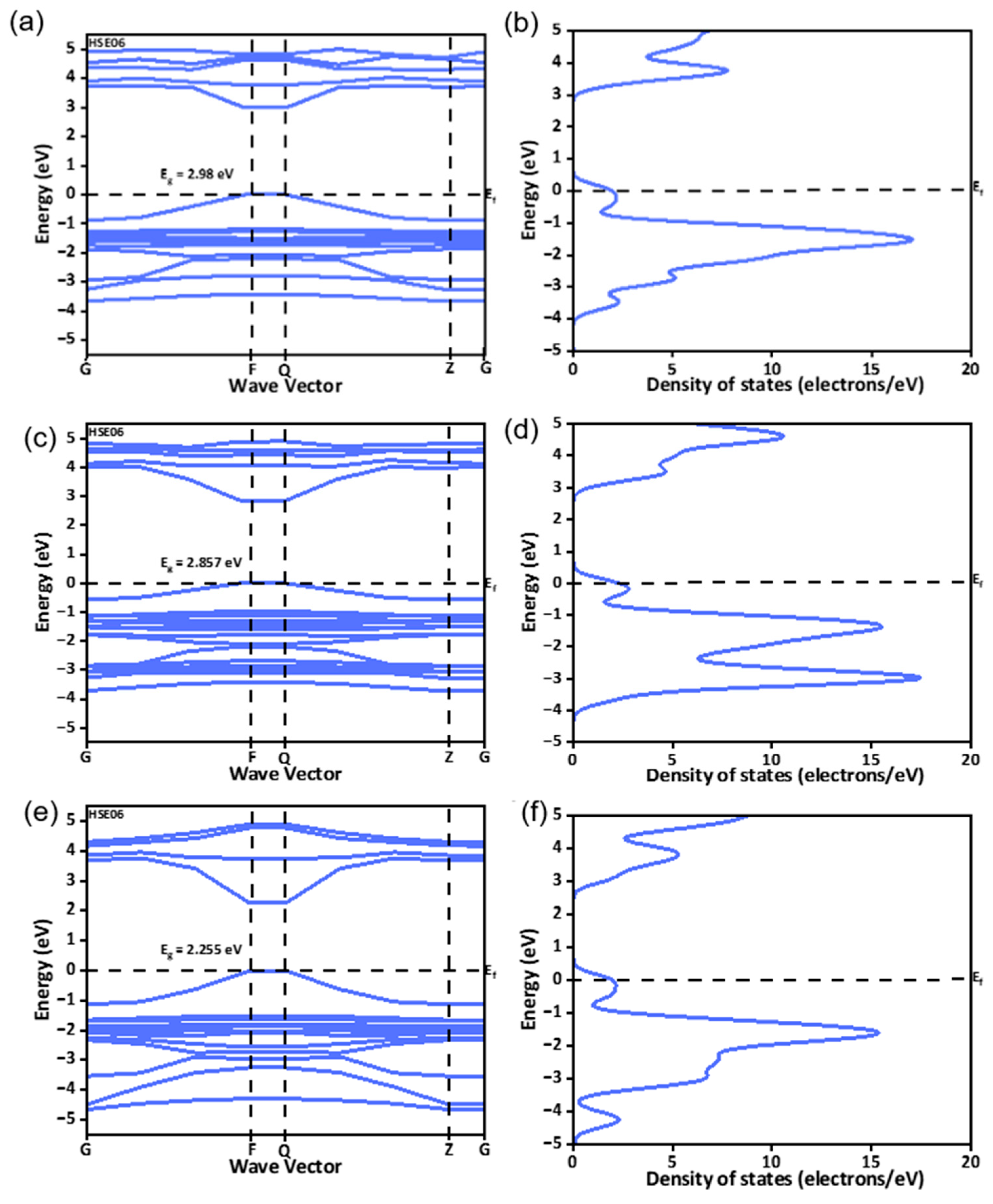
Figure 2 displays the HSE06 band structures of the DMA2SnI4, GUA2SnI4, and MA2SnI4 monolayers, respectively, illustrating the dominant orbital contributions to the valence and conduction bands. The band structures further clarify the distribution of occupied and unoccupied electronic states and enable classification of the band gap. A direct band gap occurs when the valence-band maximum (VBM) and conduction band minimum (CBM) lie at the same k-point in the Brillouin zone; otherwise, the band gap is indirect. The HSE06 calculations reveal that all three materials exhibit direct band gaps, with values of 2.85 eV for GUA2SnI4, 2.98 eV for DMA2SnI4, and 2.25 eV for MA2SnI4, highlighting their potential for optoelectronic applications.
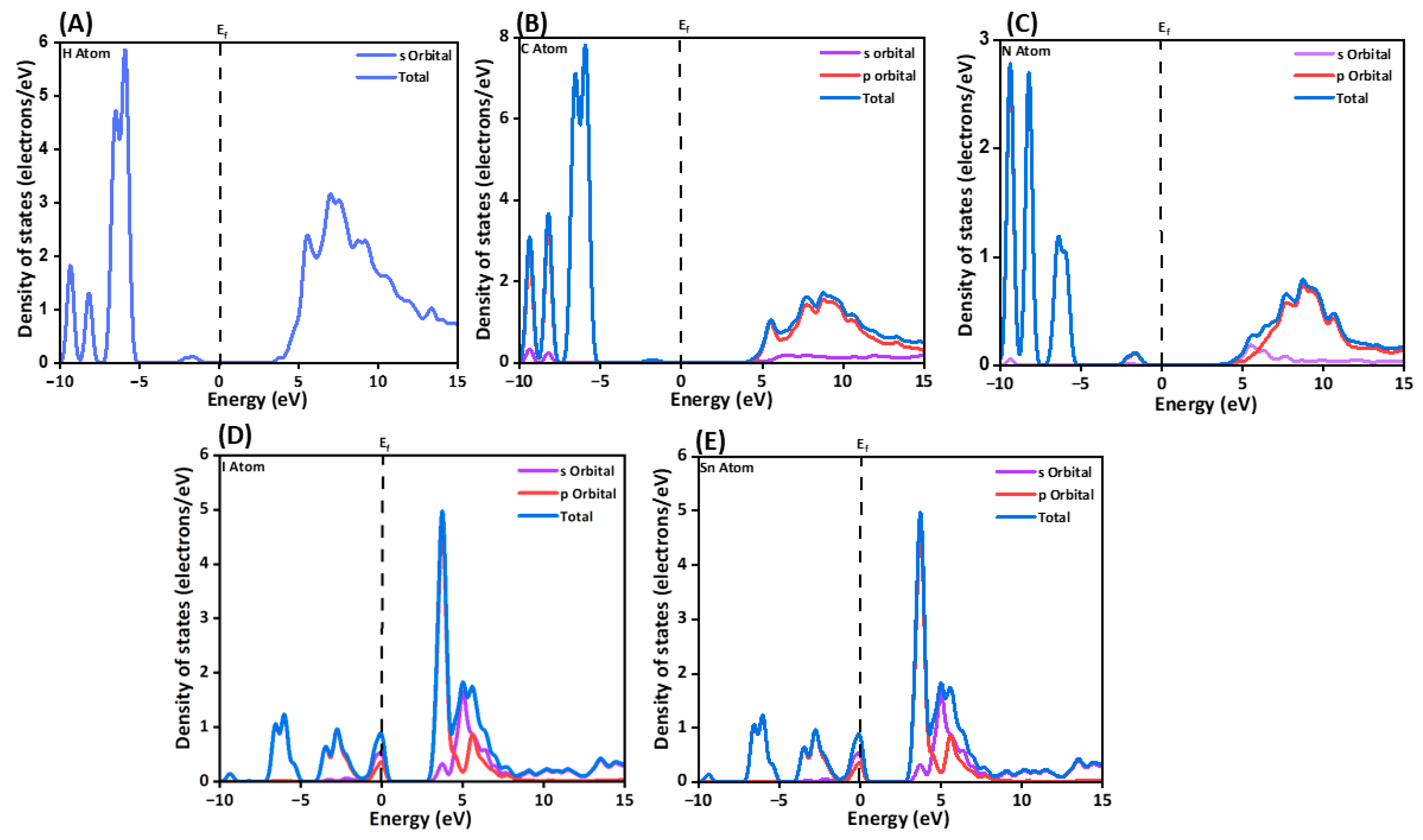
Figure 3, Figure S1 and Figure S2 display the HSE06 projected density of states (PDOS) of the DMA2SnI4, GUA2SnI4, and MA2SnI4 monolayers. The PDOS of the 2D DMA2SnI4 monolayer reveals that the VBM is predominantly composed of I-5p states with a minor contribution from Sn-5s orbitals, indicating strong Sn–I hybridization. In contrast, the CBM is mainly derived from Sn-5p states, with negligible contributions from the organic DMA cation. This confirms that the electronic states near the band edges are governed primarily by the inorganic Sn–I framework, while the organic cation plays a structural and electrostatic role rather than directly participating in charge transport. Such orbital characteristics are favorable for efficient carrier transport and optoelectronic performance.
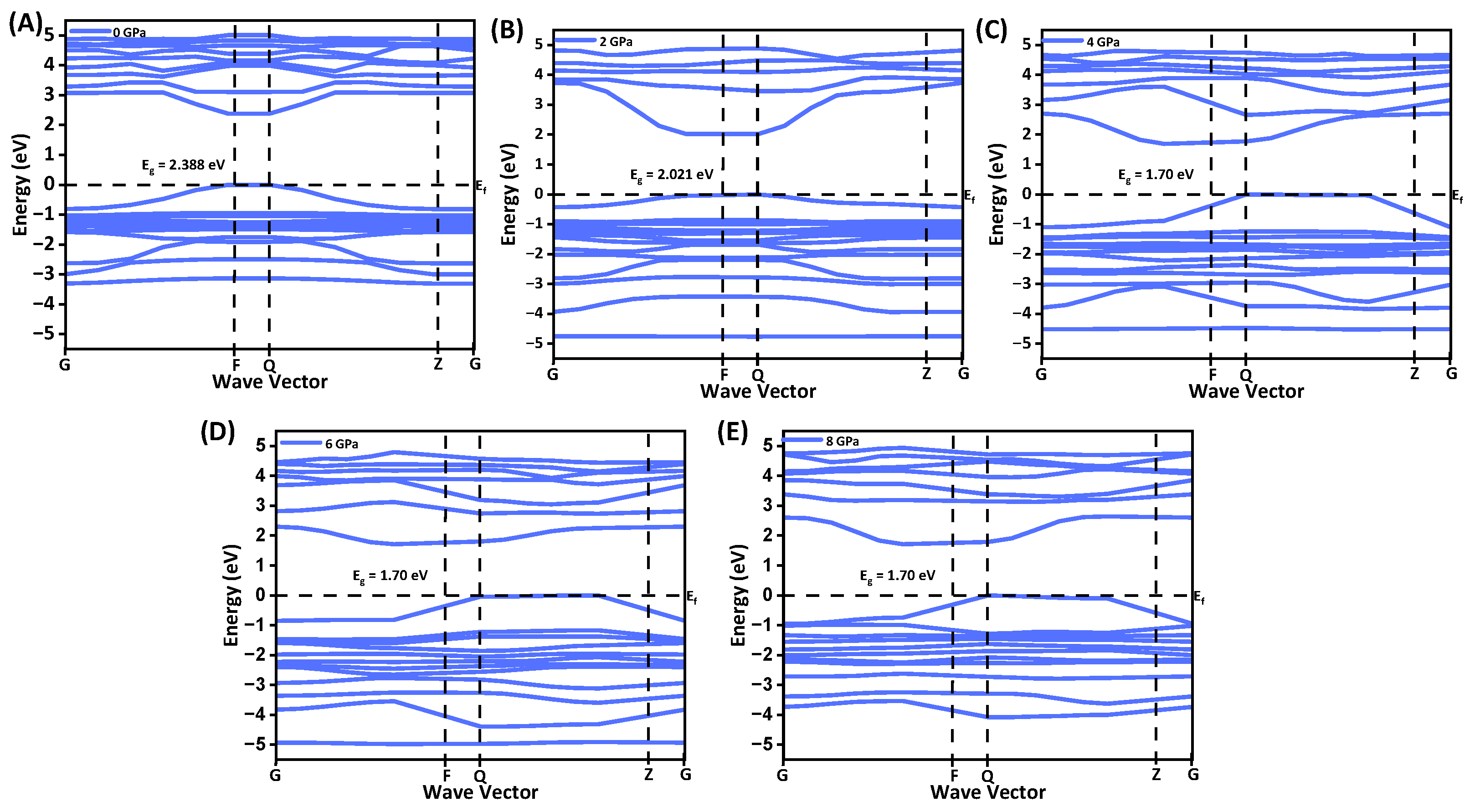
The band gaps were further evaluated using the PBE-GGA functional under varying hydrostatic pressures. The results show that the fundamental features of the electronic structure in X2SnI4 (X = GUA, DMA, MA) remain largely preserved for DMA2SnI4 and MA2SnI4 at 4 and 6 GPa. In general, the band gap decreases as pressure increases, driven by the downward shift in the CBM toward the Fermi level. Table 1 and Figure 4, Figure S3 and Figure S4 show the effect of hydrostatic pressure on the GGA-PBE band gaps of MA2SnI4, GUA2SnI4, and DMA2SnI4 perovskite materials, respectively. At ambient pressure (0 GPa), the materials exhibit direct band gaps of 2.31 eV (GUA2SnI4), 2.38 eV (DMA2SnI4), and 1.88 eV (MA2SnI4). With increasing pressure, all compounds show a continuous band-gap reduction, with GUA2SnI4 experiencing a more pronounced decrease, reaching 1.70 eV.
For DMA2SnI4, the gap remains unchanged at 1.70 eV at 4–8 GPa, while MA2SnI4 shows a similar stability at 4 and 6 GPa below 8 GPa. For DMA2SnI4 and MA2SnI4, the band-gap evolution in the 4–6 GPa range is primarily controlled by lattice compression, beyond which further pressure induces only minor modifications in the electronic structure, reflecting a saturation of pressure-driven electronic adjustments [38]. At 8 GPa, however, the structural effects become more pronounced. GUA2SnI4 and MA2SnI4 undergo more significant lattice compression, leading to stronger orbital overlap between the Sn and I atoms. This increased overlap leads to a substantial narrowing of the band gap and results in a transition from direct to indirect band gap for both materials. On the other hand, DMA2SnI4 exhibits less lattice compression at 8 GPa due to its longer Sn–I bond length and more flexible organic cation structure, maintaining a stable electronic structure and no significant reduction in the band gap. At high pressure, the calculated stabilized gaps are 0.59/1.70/0.34 eV for GUA2SnI4, DMA2SnI4, and MA2SnI4, respectively. Notably, at 2 GPa, the band-gap character transitions from direct to indirect. Between 4 and 8 GPa, the gap further decreases from 1.02 to 0.59 eV for GUA2SnI4 and from 0.55 to 0.34 eV for MA2SnI4. This trend reflects the lattice compression induced by hydrostatic pressure, which enhances orbital overlap and consequently narrows the band gap.
The lattice’s structural characteristics primarily determine the pressure-induced changes in electronic properties. Table 2 represents bond distance (Å) for Sn–I, C–N, and H–N bonds in GUA2SnI4, DMA2SnI4, and MA2SnI4. At 0 GPa, the Sn–I bond lengths in GUA2SnI4 and MA2SnI4 shorten significantly to 2.91 Å and 2.90 Å, respectively, enhancing orbital overlap and contributing to band-gap reduction and reduced pressure sensitivity. However, DMA2SnI4 shows a less pronounced compression, with a Sn–I bond length of 3.01 Å, resulting in a more stable band gap under high pressure. Differences in C–N and H–N bond lengths indicate variations in organic cation rigidity, influencing interlayer packing and pressure-induced lattice compressibility.

2.3. Optical Properties

It is important to note that the CBM and VBM occur at the same k-point in the Brillouin zone, confirming the direct band-gap nature of these materials. This direct gap, combined with their favorable electronic characteristics, supports their suitability for optoelectronic device applications. The optical and dielectric responses of the X2SnI4 (X = GUA, DMA, MA) monolayers were examined to assess their performance under photon excitation, focusing on their absorption characteristics across various photon energies and pressures. The interaction between electrons and incident photons plays a central role in determining the optical response of the synthesized materials [39]. From these components, the absorption coefficient and refractive index can be extracted, providing insight into light–matter interactions. Materials that interact strongly with electromagnetic radiation often exhibit non-linearities or variations in energy exchange [40].

2.3.1. Absorption Spectrum

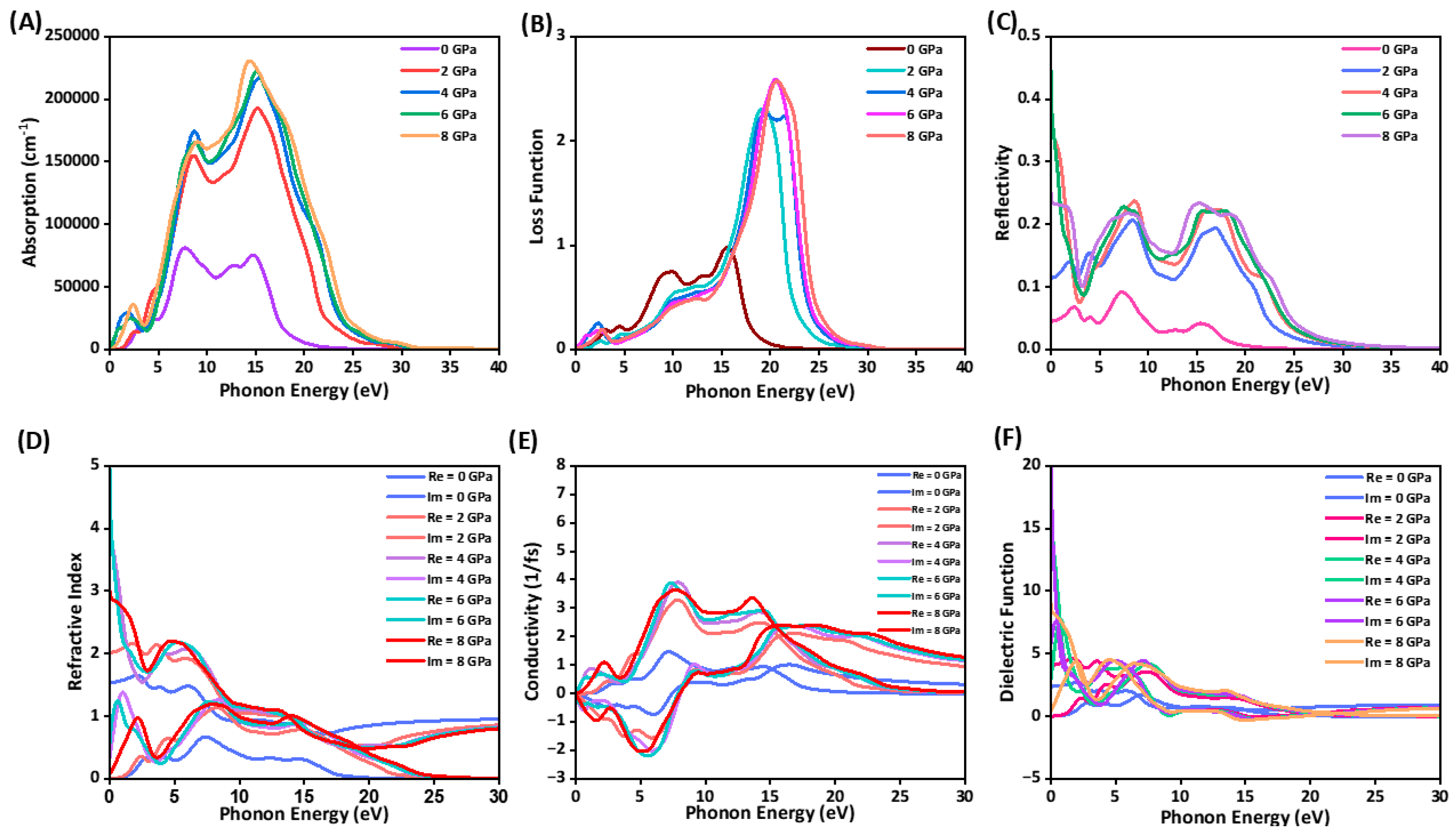
The lead-free perovskites X2SnI4 (X = GUA, DMA, MA) exhibit favorable optical absorption and moderate optical conductivity [41], making them promising candidates for photovoltaic applications. Analysis of Figure 5A, Figure S5a and Figure S6a indicates that absorption in X2SnI4 (X = GUA, DMA, MA) begins at energies above 0 eV, reflecting the intrinsic band gap of each compound. At ambient pressure, absorption in GAU2SnI4 initiates in the visible region (~2–3 eV) and progressively increases with applied hydrostatic pressure. Notably, significant absorption peaks are observed between 8 and 15 eV, with initial peaks occurring in the visible range and the most prominent peaks in the ultraviolet region (7–18 eV). These features suggest that the materials can efficiently absorb both visible and UV photons, which is critical for photovoltaic applications, as UV absorption enhances the utilization of high-energy photons and contributes to improved energy conversion efficiency.
In X2SnI4 (X = DMA, MA), the optical absorption steadily increases, with prominent peaks observed between 8 and 20 eV. Two major peaks appear in the high ultraviolet region, approximately at 8–10 eV and 12–20 eV. Notably, pressure induces a shift in the onset of absorption, with more intense peaks occurring at higher energies (7–18 eV for DMA2SnI4 and 7–16 eV for MA2SnI4). This behavior highlights their capability to absorb a broad spectrum of photon energies relevant for photovoltaic and optoelectronic applications.

2.3.2. Loss Function

Figure 5B, Figure S5b and Figure S6b present the energy loss spectra (L) of X2SnI4 (X = GUA, DMA, MA), which represent the energy dissipated by electrons during collisions while traversing the material. The plasma frequency (ωp) corresponds to the peak of the loss function and is indicative of plasma resonance [42]. At ambient pressure (0 GPa), the first prominent peak in the loss spectrum appears at 9.9 eV, 9.82 eV, and 9.77 eV for X = GUA, DMA, and MA, respectively. Upon increasing pressure to 8 GPa, these peaks shift to higher energies, reflecting an increase in the plasma frequency. This trend suggests that the largest energy loss occurs in the ultraviolet region, where photon energy exceeds the band gap.

2.3.3. Reflectivity

The surface optical properties of X2SnI4 (X = GUA, DMA, MA) were evaluated through their reflectivity spectra, which characterize the interaction of incident light with the material [43]. At ambient pressure (0 GPa), GAU2SnI4 exhibits a static reflectance peak R (0) of 0.048 at 0 eV, corresponding to 4.8% of reflected light, indicating minimal reflectivity. Similarly, DMA2SnI4 and MA2SnI4 show peak reflectance values of 0.049 and 0.051 at 0 eV, reflecting 4.9% and 5.2% of the incident light, respectively. These results indicate that GAU2SnI4 has slightly lower reflectivity compared to the other compounds under identical pressure conditions. Upon increasing hydrostatic pressure to 8 GPa, notable shifts in peak reflectance are observed. GAU2SnI4 shows a maximum reflectance of 0.291 at 9.87 eV, while DMA2SnI4 and MA2SnI4 exhibit peak values of 0.22 at 7.25 eV, as shown in Figure 5C, Figure S5c and Figure S6c. These changes indicate that pressure modifies the optical response of X2SnI4, enhancing reflectivity at higher photon energies and altering the material’s interaction with light across different energies and angles.

2.3.4. Refractive Index

The refractive index spectra of DMA2SnI4, GUA2SnI4, and MA2SnI4 exhibit similar dispersion behavior while showing clear material- and pressure-dependent differences. According to Figure 5D, Figure S5d and Figure S6d, the real part of the refractive index is relatively high in the low-energy region, where pronounced peaks and shoulders appear due to strong optical transitions, and then gradually decreases with increasing photon energy, approaching nearly constant values at higher energies. External pressure from 0 to 8 GPa systematically enhances the refractive index in the low-energy region and modifies the intensity and position of the main spectral features, indicating increased electronic polarizability under compression. Among the materials, MA2SnI4 displays the strongest pressure-induced enhancement and the most prominent low-energy dispersion, while GUA2SnI4 shows intermediate behavior with closely spaced features in the low-energy range. In contrast, DMA2SnI4 presents comparatively weaker dispersion and a more gradual response to pressure. These results highlight the significant role of both pressure and organic cation choice in tuning the refractive index and optical properties of layered tin iodide perovskites.

2.3.5. Conductivity

The optical conductivity spectra of DMA2SnI4, GUA2SnI4, and MA2SnI4 exhibit comparable overall behavior, with clear differences in magnitude and pressure response. According to Figure 5E, Figure S5e and Figure S6e, the real part of the optical conductivity remains low at low photon energies, increases with pronounced peaks in the low-to-mid-energy region arising from allowed optical transitions, and then gradually decreases at higher energies. With increasing pressure from 0 to 8 GPa, the intensity of the main conductivity peaks is systematically enhanced, and their positions are slightly shifted, indicating an increase in charge carrier response and stronger optical transitions under compression. Among the compounds, MA2SnI4 shows the highest conductivity values and the most pronounced pressure-induced enhancement, reflecting its stronger sensitivity to structural compression. GUA2SnI4 displays intermediate conductivity with multiple overlapping features in the low-energy region, whereas DMA2SnI4 exhibits comparatively lower conductivity and a more gradual evolution with pressure. These results demonstrate that external pressure effectively tunes the optical conductivity of these layered tin iodide perovskites, with the extent of enhancement strongly dependent on the nature of the organic cation.

2.3.6. Dielectric Function

The dielectric function, ε(ω), is expressed as a combination of its real ε1(ω) and imaginary ε2(ω) components [44], as defined in Equation (1).
ε(ω) = ε1(ω) + ε2(ω)
The imaginary component of the dielectric function, ε2(ω), is directly related to interband electronic transitions and therefore reflects the underlying band structure and density of states of the material. In contrast, the real component, ε1(ω), describes the material’s polarizability and its response to an external electromagnetic field. The Kramers–Kronig relations [45], formulated as quantum integrals, are commonly employed to obtain the real part of the dielectric function from its imaginary counterpart [46,47], as presented in Equations (2) and (3).
ε 1 ω = P 2 π 0 ω ε 2 ω ω 2 ω 2 d ω + 1
ε 2 ω = 4 π ω 2 n n p n n k 2 d S k n n k s
Figure 5F displays the real component ε1(ω) of the dielectric function, showing that the static dielectric values at 8 GPa remain high for all studied materials. The maximum peak appears at zero photon energy, with ε1(0) reaching 8.110 eV for GUA2SnI4 and 2.924 eV for DMA2SnI4 and MA2SnI4. A noticeable decrease in ε1(ω) is observed between 8 and 10 eV across pressures from 0 to 8 GPa. The elevated ε1(ω) values suggest strong polarization capability, indicating the suitability of these perovskites for optoelectronic and photovoltaic applications. The combined behavior of large ε1(ω) and ε2(ω) at lower photon energies, followed by reduced values at higher energies, further highlights their potential use in microelectronic and integrated-circuit technologies [48].
The imaginary part of the dielectric function, ε2(ω), reflects the material’s absorption characteristics associated with electronic transitions from the valence band to the conduction band. The ε2(ω) spectra for X2SnI4 (X = GUA, DMA, MA) at 0 and 8 GPa are presented in Figure 5F, Figure S5f and Figure S6f. At ambient pressure, the maximum ε2(ω) peaks occur at 2.67 eV, 2.57 eV, and 2.11 eV for GUA2SnI4, DMA2SnI4, and MA2SnI4, respectively. With increasing hydrostatic pressure, these peaks intensify and shift toward higher photon energies, indicating enhanced optical absorption due to pressure-induced modifications in the electronic structure.

3. Simulation Details

The simulation uses a fully unconstrained 3D triclinic lattice with lattice parameters a = 6.242549 Å, b = 6.09115 Å, and c = 27.519767 Å, and lattice angles α = 89.89209°, β = 91.97904°, and γ = 91.65721°. A CASTEP geometry optimization calculation was performed with medium-quality settings using the GGA-PBE exchange–correlation functional without TS dispersion correction. Spin polarization was enabled with the formal spin used as the initial configuration. The calculation employed a 500 eV plane-wave energy cutoff, medium SCF tolerance and convergence settings, a 2 × 2 × 1 Monkhorst–Pack k-point mesh, and norm-conserving pseudopotentials with Koelling–Harmon relativistic treatment. SCF settings included a tolerance of 2.0 × 10⁻⁶ eV/atom, a maximum of 100 SCF cycles, a convergence window of 3, an all-bands/EDFT minimizer, density mixing with a charge of 0.5 and spin of 2.0, and fixed orbital occupancy; no dipole correction was applied. For accurate electronic structure analysis, the band gap at zero pressure was calculated using the hybrid functional HSE06, while the band-gap variation under applied pressure was evaluated using the GGA-PBE functional. HSE06 was chosen for ambient pressure due to its higher accuracy in predicting band gaps, while PBE-GGA was used for pressure-dependent calculations because it is computationally more efficient, especially for large-scale simulations [28,49].

4. Conclusions

First-principles calculations on the 2D Ruddlesden–Popper iodide perovskites A2SnI4 (A = GUA+, DMA+, MA+) show that all three compositions are direct-gap semiconductors at ambient conditions, with HSE06 band gaps of 2.85 eV, 2.98 eV, and 2.25 eV, respectively. Although they share the same layered SnI6 framework, their electronic responses to hydrostatic pressure differ significantly. GUA2SnI4 shows the strongest pressure tunability, with its band gap decreasing from 2.31 eV at 0 GPa to 0.59 eV at 8 GPa and experiencing a direct–indirect transition near 2 GPa. MA2SnI4 follows a similar trend, narrowing from 1.88 eV to 0.34 eV over the same pressure range, while DMA2SnI4 remains comparatively insensitive, stabilizing near 1.70 eV above 4 GPa. Corresponding shifts in dielectric, loss, and absorption spectra reflect these contrasting behaviors, with GUA2SnI4 showing the most noticeable optical changes under increasing hydrostatic pressure. Collectively, these results indicate that GUA2SnI4, DMA2SnI4, and MA2SnI4 define three distinct regimes of optoelectronic tunability, ranging from strongly pressure-responsive to nearly pressure-invariant, providing a versatile materials platform for designing lead-free absorber layers. The clear distinction among the three perovskite materials guides the selection of specific A-site cations to optimize the spectral response and operational characteristics of tin-based 2D RP perovskites for photovoltaic applications.

Supplementary Materials

The following supporting information can be downloaded at: https://www.mdpi.com/article/10.3390/inorganics14030073/s1, Figure S1: HSE06-calculated projected density of states (PDOS) of the 2D GUA2SnI4 monolayer with the Fermi level set at 0 eV: (A) C atom, (B) H atom, (C) N atom, (D) I atom, and (E) Sn atom. Figure S2: HSE06-calculated PDOS of the 2D MA2SnI4 monolayer with the Fermi level set at 0 eV: (A) C atom, (B) H atom, (C) N atom, (D) I atom, and (E) Sn atom. Figure S3: GGA-PBE band gap of GUA2SnI4 under hydrostatic pressure: (A) 0 GPa, (B) 2 GPa, (C) 4 GPa, (D) 6 GPa, and (E) 8 GPa. Figure S4: GGA-PBE band gap of MA2SnI4 under hydrostatic pressure: (A) 0 GPa, (B) 2 GPa, (C) 4 GPa, (D) 6 GPa, and (E) 8 GPa. Figure S5: The calculated (A) absorption; (B) loss function; (C) reflectivity; (D) refractive index; (E) conductivity; and (F) dielectric function for 2D GUA2SnI4 under hydrostatic pressure. Figure S6: The calculated (A) absorption; (B) loss function; (C) reflectivity; (D) refractive index; (E) conductivity; and (F) dielectric function for 2D MA2SnI4 under hydrostatic pressure.

Author Contributions

Conceptualization, B.B., L.G., J.Z., J.L. and Z.L.; methodology, B.B., Z.K., L.G., J.Z., J.L. and Z.L.; software, B.B., Z.K., N.U.S., L.G. and Z.L.; validation, B.B., Z.K., L.G., J.Z. and Z.L.; formal analysis, B.B., S.H.S., N.U.S., L.G. and J.Z.; investigation, B.B., Z.K., S.H.S., F.S., L.G., J.Z. and J.L.; resources, B.B., Z.K., S.H.S., L.G. and J.L.; data curation, B.B., S.H.S., N.U.S., J.Z. and J.L.; writing—original draft, B.B., F.S., N.U.S., J.Z. and J.L.; writing—review & editing, B.B., F.S., N.U.S. and J.L.; visualization, B.B., F.S. and J.L.; supervision, Z.L.; project administration, B.B. and Z.L.; funding acquisition, Z.L. All authors have read and agreed to the published version of the manuscript.

Funding

This work was financially supported by the General & Key Project of Applied Basic Research of Yunnan Science and Technology Department (Grant Number 202401AS070130).

Data Availability Statement

The original contributions presented in this study are included in the article/Supplementary Material. Further inquiries can be directed to the corresponding author.

Conflicts of Interest

The authors declare no conflicts of interest.

References

  1. Wang, H.; Zhang, C.; Huang, W.; Zou, X.; Chen, Z.; Sun, S.; Zhang, L.; Li, J.; Cheng, J.; Huang, S. Research progress of ABX 3-type lead-free perovskites for optoelectronic applications: Materials and devices. Phys. Chem. Chem. Phys. 2022, 24, 27585–27605. [Google Scholar] [CrossRef]
  2. Qian, J.; Xu, B.; Tian, W. A comprehensive theoretical study of halide perovskites ABX3. Org. Electron. 2016, 37, 61–73. [Google Scholar] [CrossRef]
  3. Nguyen, L.T.; Cava, R.J. Hexagonal perovskites as quantum materials. Chem. Rev. 2020, 121, 2935–2965. [Google Scholar] [CrossRef]
  4. Zhang, X.; Turiansky, M.E.; Van de Walle, C.G. All-inorganic halide perovskites as candidates for efficient solar cells. Cell Rep. Phys. Sci. 2021, 2, 100604. [Google Scholar] [CrossRef]
  5. Snaith, H.J. Present status and future prospects of perovskite photovoltaics. Nat. Mater. 2018, 17, 372–376. [Google Scholar] [CrossRef] [PubMed]
  6. Idrissi, S.; Ziti, S.; Labrim, H.; Bahmad, L. Band gaps of the solar perovskites photovoltaic CsXCl3 (X = Sn, Pb or Ge). Mater. Sci. Semicond. Process. 2021, 122, 105484. [Google Scholar] [CrossRef]
  7. Sakhatskyi, K.; Bhardwaj, A.; Matt, G.J.; Yakunin, S.; Kovalenko, M.V. A Decade of Lead Halide Perovskites for Direct-Conversion X-ray and Gamma Detection: Technology Readiness Level and Challenges. Adv. Mater. 2025, 37, 2418465. [Google Scholar]
  8. Hasan, N.; Arifuzzaman, M.; Kabir, A. Structural, elastic and optoelectronic properties of inorganic cubic FrBX3 (B= Ge, Sn; X= Cl, Br, I) perovskite: The density functional theory approach. RSC Adv. 2022, 12, 7961–7972. [Google Scholar] [CrossRef]
  9. Ikram, M.; Malik, R.; Raees, R.; Imran, M.; Wang, F.; Ali, S.; Khan, M.; Khan, Q.; Maqbool, M. Recent advancements and future insight of lead-free non-toxic perovskite solar cells for sustainable and clean energy production: A review. Sustain. Energy Technol. Assess. 2022, 53, 102433. [Google Scholar] [CrossRef]
  10. Miah, M.H.; Khandaker, M.U.; Hossen, M.J.; Jahan, I.; Shahinuzzaman, M.; Nur-E-Alam, M.; Hanfi, M.Y.; Ullah, M.H.; Islam, M.A. Lead-free alternatives and toxicity mitigation strategies for sustainable perovskite solar cells: A critical review. Mater. Adv. 2025, 6, 2718–2752. [Google Scholar] [CrossRef]
  11. Diguna, L.J.; Lim, A.; Firdaus, Y.; Widiapradja, L.J.; Sidiq, D.H.S.; Melnychenko, A.; Utomo, S.T.; Arramel, A.; Birowosuto, M.D. The role of perovskite composition, dimensionality, and additives in lead-free perovskite solar cells longevity: A review. Sustain. Energy Fuels 2025, 9, 6413–6438. [Google Scholar] [CrossRef]
  12. Jodlowski, A.D.; Roldán-Carmona, C.; Grancini, G.; Salado, M.; Ralaiarisoa, M.; Ahmad, S.; Koch, N.; Camacho, L.; De Miguel, G.; Nazeeruddin, M.K. Large guanidinium cation mixed with methylammonium in lead iodide perovskites for 19% efficient solar cells. Nat. Energy 2017, 2, 972–979. [Google Scholar] [CrossRef]
  13. Li, C.; Wang, A.; Xie, L.; Deng, X.; Liao, K.; Yang, J.-a.; Li, T.; Hao, F. Emerging alkali metal ion (Li+, Na+, K+ and Rb+) doped perovskite films for efficient solar cells: Recent advances and prospects. J. Mater. Chem. A 2019, 7, 24150–24163. [Google Scholar] [CrossRef]
  14. Noel, N.K.; Stranks, S.D.; Abate, A.; Wehrenfennig, C.; Guarnera, S.; Haghighirad, A.-A.; Sadhanala, A.; Eperon, G.E.; Pathak, S.K.; Johnston, M.B. Lead-free organic–inorganic tin halide perovskites for photovoltaic applications. Energy Environ. Sci. 2014, 7, 3061–3068. [Google Scholar]
  15. Wu, P.; Li, D.; Wang, S.; Zhang, F. Magic guanidinium cations in perovskite solar cells: From bulk to interface. Mater. Chem. Front. 2023, 7, 2507–2527. [Google Scholar] [CrossRef]
  16. Gandhi, M.B.; Oli, A.V.; Nicholson, S.; Adelt, M.; Martin, R.; Chen, Y.; Sridharan, M.B.; Ivaturi, A. Investigation on guanidinium bromide incorporation in methylammonium lead iodide for enhanced efficiency and stability of perovskite solar cells. Sol. Energy 2023, 253, 1–8. [Google Scholar] [CrossRef]
  17. Vega, E.; Mollar, M.; Marí, B. Effect of guanidinium on the optical properties and structure of the methylammonium lead halide perovskite. J. Alloys Compd. 2018, 739, 1059–1064. [Google Scholar]
  18. Sarker, M.A.; Hasan, M.M.; Al Momin, M.; Irfan, A.; Islam, M.R.; Sharif, A. Band gap engineering in lead free halide cubic perovskites GaGeX3 (X = Cl, Br, and I) based on first-principles calculations. RSC Adv. 2024, 14, 9805–9818. [Google Scholar]
  19. Rahman, M.H.; Jubair, M.; Rahaman, M.Z.; Ahasan, M.S.; Ostrikov, K.K.; Roknuzzaman, M. RbSnX3 (X = Cl, Br, I): Promising lead-free metal halide perovskites for photovoltaics and optoelectronics. RSC Adv. 2022, 12, 7497–7505. [Google Scholar]
  20. Xiao, X.; Chu, Y.; Zhang, C.; Zhang, Z.; Qiu, Z.; Qiu, C.; Wang, H.; Mei, A.; Rong, Y.; Xu, G. Enhanced perovskite electronic properties via A-site cation engineering. Fundam. Res. 2021, 1, 385–392. [Google Scholar] [CrossRef]
  21. Farhadi, B.; Bibi, B.; Zhang, J.; Pourzandi, M.A.; Seyed-Talebi, S.M. Computational design of GUA0.5X0.5SrI3 (X = Cs, K) perovskites: Exploring the potential for optoelectronic applications. J. Mater. Chem. C 2025, 13, 17849–17861. [Google Scholar] [CrossRef]
  22. Aloysius, D.; Gupta, S. Impact of potassium doping on the optoelectronic properties over inorganic and hybrid bismuth bromide perovskite thin films (A3Bi2Br9, A = Cs+, MA). New J. Chem. 2025, 49, 4438–4445. [Google Scholar] [CrossRef]
  23. Wu, X.; Li, B.; Zhu, Z.; Chueh, C.-C.; Jen, A.K.-Y. Designs from single junctions, heterojunctions to multijunctions for high-performance perovskite solar cells. Chem. Soc. Rev. 2021, 50, 13090–13128. [Google Scholar] [CrossRef]
  24. Chen, B.; Chen, H.; Hou, Y.; Xu, J.; Teale, S.; Bertens, K.; Chen, H.; Proppe, A.; Zhou, Q.; Yu, D. Passivation of the buried interface via preferential crystallization of 2D perovskite on metal oxide transport layers. Adv. Mater. 2021, 33, 2103394. [Google Scholar] [CrossRef]
  25. Stoumpos, C.C.; Cao, D.H.; Clark, D.J.; Young, J.; Rondinelli, J.M.; Jang, J.I.; Hupp, J.T.; Kanatzidis, M.G. Ruddlesden–Popper hybrid lead iodide perovskite 2D homologous semiconductors. Chem. Mater. 2016, 28, 2852–2867. [Google Scholar] [CrossRef]
  26. Qin, Z.; Dai, S.; Gajjela, C.C.; Wang, C.; Hadjiev, V.G.; Yang, G.; Li, J.; Zhong, X.; Tang, Z.; Yao, Y. Spontaneous formation of 2D/3D heterostructures on the edges of 2D Ruddlesden–Popper hybrid perovskite crystals. Chem. Mater. 2020, 32, 5009–5015. [Google Scholar] [CrossRef]
  27. Blancon, J.C.; Even, J.; Stoumpos, C.C.; Kanatzidis, M.G.; Mohite, A.D. Semiconductor physics of organic-inorganic 2D halide perovskites. Nat. Nanotechnol. 2020, 15, 969–985. [Google Scholar] [CrossRef]
  28. Farhadi, B.; Shahmohamadi, H.; Xu, Z.; Zhang, J.; Tang, T.; Naseri, M.; Gusarov, S.; Salahub, D.R. Monolayer Ba2TiO4 and Sr2TiO4 perovskenes: A first-principles study. Mater. Today Commun. 2025, 48, 113581. [Google Scholar] [CrossRef]
  29. Li, X.; Cuthriell, S.A.; Bergonzoni, A.; Dong, H.; Traore, B.; Stoumpos, C.C.; Guo, P.; Even, J.; Katan, C.; Schaller, R.D. Expanding the cage of 2D bromide perovskites by large A-site cations. Chem. Mater. 2022, 34, 1132–1142. [Google Scholar] [CrossRef]
  30. Dalmedico, J.; Silveira, D.; O. de Araujo, L.; Wenzel, W.; Rêgo, C.; Dias, A.; Guedes-Sobrinho, D.; Piotrowski, M.J. Tuning Electronic and Structural Properties of Lead-Free Metal Halide Perovskites: A Comparative Study of 2D Ruddlesden-Popper and 3D Compositions. ChemPhysChem 2024, 25, e202400118. [Google Scholar] [CrossRef]
  31. King, G.; Woodward, P.M. Cation ordering in perovskites. J. Mater. Chem. 2010, 20, 5785–5796. [Google Scholar] [CrossRef]
  32. Talanov, M.; Shirokov, V.; Talanov, V. Anion order in perovskites: A group-theoretical analysis. Found. Crystallogr. 2016, 72, 222–235. [Google Scholar] [CrossRef]
  33. Yuan, G.; Qin, S.; Wu, X.; Ding, H.; Lu, A. Pressure-induced phase transformation of CsPbI3 by X-ray diffraction and Raman spectroscopy. Phase Transit. 2018, 91, 38–47. [Google Scholar] [CrossRef]
  34. Islam, M.; Islam, J.; Islam, M.N.; Sen, S.K.; Hossain, A. Enhanced ductility and optoelectronic properties of environment-friendly CsGeCl3 under pressure. AIP Adv. 2021, 11, 045014. [Google Scholar] [CrossRef]
  35. Haq, M.A.; Saiduzzaman, M.; Asif, T.I.; Shuvo, I.K.; Hossain, K.M. Ultra-violet to visible band gap engineering of cubic halide KCaCl3 perovskite under pressure for optoelectronic applications: Insights from DFT. RSC Adv. 2021, 11, 36367–36378. [Google Scholar] [CrossRef]
  36. Liu, D.; Li, Q.; Jing, H.; Wu, K. Pressure-induced effects in the inorganic halide perovskite CsGeI3. RSC Adv. 2019, 9, 3279–3284. [Google Scholar] [CrossRef] [PubMed]
  37. McDowell, C.; Abdelsamie, M.; Toney, M.F.; Bazan, G.C. Solvent additives: Key morphology-directing agents for solution-processed organic solar cells. Adv. Mater. 2018, 30, 1707114. [Google Scholar] [CrossRef] [PubMed]
  38. Nisha, N.J.; Saiduzzaman, M.; Parosh, M.B.H.; Ovi, I.A. Pressure-Tailored Band Gap Reduction of Sr3NBr3 Compound for Optoelectronic Application: A First-Principles Investigation. Results Eng. 2025, 26, 105094. [Google Scholar] [CrossRef]
  39. El Kurdi, M.; Fishman, G.; Sauvage, S.; Boucaud, P. Band structure and optical gain of tensile-strained germanium based on a 30 band k·p formalism. J. Appl. Phys. 2010, 107, 013710. [Google Scholar] [CrossRef]
  40. Chung, I.; Kanatzidis, M.G. Metal chalcogenides: A rich source of nonlinear optical materials. Chem. Mater. 2014, 26, 849–869. [Google Scholar] [CrossRef]
  41. Roknuzzaman, M.; Ostrikov, K.; Wang, H.; Du, A.; Tesfamichael, T. Towards lead-free perovskite photovoltaics and optoelectronics by ab-initio simulations. Sci. Rep. 2017, 7, 14025. [Google Scholar] [CrossRef]
  42. Fox, M. Optical Properties of Solids-AAPT; Cambridge University Press: New York, NY, USA, 2002. [Google Scholar]
  43. Garcia, J.C.; Scolfaro, L.M.R.; Lino, A.T.; Freire, V.; Farias, G.; Silva, C.; Alves, H.; Rodrigues, S.; Da Silva, E. Structural, electronic, and optical properties of ZrO2 from ab initio calculations. J. Appl. Phys. 2006, 100, 104103. [Google Scholar] [CrossRef]
  44. Mubarak, A. The first-principle study of the electronic, optical and thermoelectric properties of XTiO3 (X = Ca, Sr and Ba) compounds. Int. J. Mod. Phys. B 2016, 30, 1650141. [Google Scholar]
  45. Lucarini, V.; Peiponen, K.-E.; Saarinen, J.J.; Vartiainen, E.M. Kramers-Kronig Relations in Optical Materials Research; Springer: Berlin/Heidelberg, Germany, 2005. [Google Scholar]
  46. Babu, K.E.; Veeraiah, A.; Swamy, D.T.; Veeraiah, V. First-principles study of electronic structure and optical properties of cubic perovskite CsCaF3. Chin. Phys. Lett. 2012, 29, 117102. [Google Scholar] [CrossRef]
  47. Green, M.A.; Jiang, Y.; Soufiani, A.M.; Ho-Baillie, A. Optical properties of photovoltaic organic–inorganic lead halide perovskites. J. Phys. Chem. Lett. 2015, 6, 4774–4785. [Google Scholar] [CrossRef] [PubMed]
  48. Hossain, K.M.; Hasan, M.Z.; Ali, M.L. Narrowing bandgap and enhanced mechanical and optoelectronic properties of perovskite halides: Effects of metal doping. AIP Adv. 2021, 11, 015052. [Google Scholar] [CrossRef]
  49. Hasan, M.M.; Sarker, M.A.; Mansur, M.B.; Islam, M.R.; Ahmad, S. Pressure-induced structural, electronic, optical, and mechanical properties of lead-free GaGeX3 (X = Cl, Br and, I) perovskites: First-principles calculation. Heliyon 2024, 10, e34824. [Google Scholar] [CrossRef]
Figure 1. Crystal structures of the X2SnI4 materials: (A) GUA2SnI4, (B) DMA2SnI4, and (C) MA2SnI4.
Inorganics 14 00073 g001
Figure 2. HSE06 band structures and DOS of (a,b) DMA2SnI4; (c,d) GUA2SnI4; and (e,f) MA2SnI4.
Inorganics 14 00073 g002
Figure 3. HSE06-calculated projected density of states (PDOS) of the 2D DMA2SnI4 monolayer with the Fermi level set at 0 eV: (A) H atom, (B) C atom, (C) N atom, (D) I atom, and (E) Sn atom.
Inorganics 14 00073 g003
Figure 4. GGA-PBE band gap of DMA2SnI4 under hydrostatic pressure: (A) 0 GPa, (B) 2 GPa, (C) 4 GPa, (D) 6 GPa, and (E) 8 GPa.
Inorganics 14 00073 g004
Figure 5. The calculated (A) absorption; (B) loss function; (C) reflectivity; (D) refractive index; (E) conductivity; and (F) dielectric function for 2D DMA2SnI4 under hydrostatic pressure.
Inorganics 14 00073 g005
Table 1. The effect of pressure on the band gaps of MA2SnI4, DMA2SnI4, and GUA2SnI4 perovskites.
Pressure (GPa)MA2SnI4DMA2SnI4GUA2SnI4
0 GPa1.8862.3882.314
2 GPa0.6792.0211.814
4 GPa0.551.701.028
6 GPa0.551.701.015
8 GPa0.341.700.59
Table 2. Calculated bond lengths (Å) for GUA2SnI4, DMA2SnI4, and MA2SnI4.
StructureI-Sn (Å)C-N (Å)H-N (Å)
GUA2SnI42.911.331.01
DMA2SnI42.901.491.09
MA2SnI43.011.521.09
Disclaimer/Publisher’s Note: The statements, opinions and data contained in all publications are solely those of the individual author(s) and contributor(s) and not of MDPI and/or the editor(s). MDPI and/or the editor(s) disclaim responsibility for any injury to people or property resulting from any ideas, methods, instructions or products referred to in the content.