Review

Research Progress on Cathode Materials for Sodium-Ion Batteries

1
School of Electrical and Electronic Engineering, Harbin University of Science and Technology, Harbin 150080, China
2
Engineering Research Center of Ministry of Education for Automotive Electronics Drive Control and System Integration, Harbin 150080, China
*
Author to whom correspondence should be addressed.
Inorganics 2026, 14(3), 72; https://doi.org/10.3390/inorganics14030072
Submission received: 24 January 2026 / Revised: 10 February 2026 / Accepted: 11 February 2026 / Published: 27 February 2026

Abstract

Sodium-ion batteries (SIBs) are regarded as an important complementary technology to lithium-ion batteries due to their abundant resources and low cost, demonstrating broad application prospects, especially in large-scale energy storage. As a core component of SIBs, the cathode material directly determines key performance indicators such as energy density, cycling stability, and rate capability. Currently, the main cathode material systems under extensive research include transition metal oxides, polyanionic compounds, and Prussian blue analogues (PBAs), each exhibiting distinct characteristics in terms of crystal structure and electrochemical performance. Transition metal oxides have attracted significant research interest owing to their high specific capacity, while polyanionic compounds are known for their excellent structural stability and operating voltage. PBAs, on the other hand, have gained considerable attention due to their open framework structure and simple synthesis process. In recent years, modification strategies such as nanostructure engineering, surface coating, and elemental doping have significantly enhanced the electrochemical performance of these cathode materials. Future research should focus on addressing critical scientific challenges, including low intrinsic electronic conductivity and poor interfacial stability, while also exploring novel composite cathode material systems to facilitate the practical application of sodium-ion batteries.

1. Introduction

In the global transition to low-carbon energy [1], the intermittent nature of wind and solar power challenges grid stability [2], making efficient large-scale energy storage a key research priority. Amid the global transition towards a low-carbon energy system, efficient and reliable electrochemical energy storage technologies have become a critical pillar for grid balancing and accommodating [3] the intermittent output of renewable energy sources, such as wind and solar power. Currently, lithium-ion batteries dominate the consumer electronics, electric vehicle, and high-end energy storage sectors due to their high energy density and well-established industry chain [4]. However, their prospects for large-scale application face dual constraints: on the one hand, the geopolitical concentration and finite reserves of lithium resources raise profound concerns regarding long-term supply chain security and cost stability [5]; on the other hand, in the pursuit of higher energy density and safety through technological evolution, novel electrolyte systems have attracted significant attention for their potential in constructing flexible devices, suppressing lithium dendrite growth, and enabling all-solid-state batteries [6], yet these explorations are confronted with common challenges such as ionic conductivity and interfacial stability. Against this backdrop [7], the development of complementary energy storage technologies that leverage abundant resources and offer low cost has become a pressing strategic imperative. Conventional lead-acid batteries suffer from a short lifespan and low energy density, while lithium-ion batteries face constraints due to limited lithium resources. These limitations have accelerated the development of novel battery technologies, among which electrode materials play a decisive role in commercialization.
Sodium-ion batteries (SIBs) demonstrate significant advantages for large-scale energy storage. Abundant and evenly distributed sodium resources lead to lower manufacturing costs, and SIB production is compatible with existing lithium-ion battery manufacturing processes [8]. Moreover, SIBs exhibit enhanced safety and a wider operating temperature range. Although their energy density is somewhat lower than that of lithium-ion batteries [9], SIBs align well with the critical requirements of grid energy storage—stability, cost-effectiveness, and safety—making them highly suitable for applications such as smart grids. The commercialization of SIBs largely depends on electrode materials. Hard carbon is considered the preferred anode material, while research on cathodes primarily focuses on three major types. Among them, iron–manganese-based cathodes offer low cost and high capacity but still face challenges such as capacity degradation [10]. Existing modification strategies have shown promise in improving their cyclic stability. From an industrial perspective, this article analyzes the characteristics, mechanisms, recent advances, and optimization strategies of these three cathode materials, aiming to provide guidance for promoting the large-scale commercialization of sodium-ion batteries.

2. Transition Metal Oxides

The structural evolution of sodium-ion battery cathode materials NaxMO2 (where M = transition metals such as Co, Mn, Fe, Ni, etc.) exhibits a strong correlation with their sodium content (0 < x ≤ 1) [11]. This relationship fundamentally arises from the complex balance of electrostatic interactions under varying sodium concentrations. At high sodium contents (x > 0.5), the material tends to form a layered structure with two-dimensional ion diffusion pathways, whereas under low sodium content conditions (x ≤ 0.5), the system is more prone to adopting a tunnel structure with three-dimensional ion transport paths [12]. This structural transition directly influences the ionic transport kinetics and electrochemical activity of the material [13]. Regulating synthesis conditions and chemical composition can optimize sodium storage performance: the layered structure facilitates ion transport, while the tunnel structure offers enhanced stability [14]. This unique structural tunability renders the NaxMO2 system an ideal model for elucidating sodium-ion transport mechanisms, while also offering valuable insights for designing and developing novel high-performance electrode materials [15].

2.1. Layered Oxides

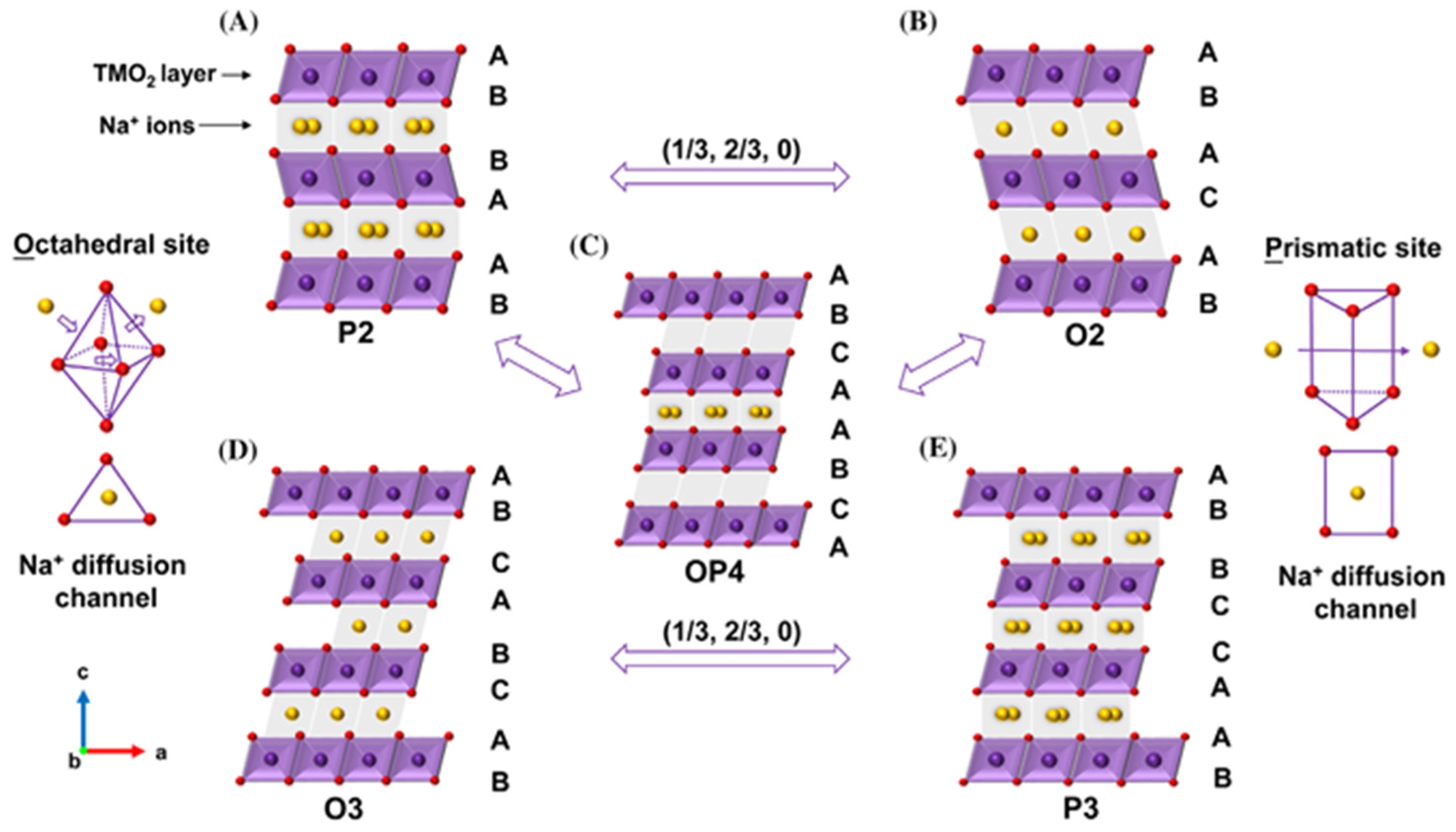
Owing to their unique crystal structures, transition metal layered oxides are regarded as promising cathode materials for sodium-ion batteries [16]. Their structural characteristics are defined by the diversity of oxygen stacking sequences (ABBA or ABCABC) and the coordination environment of sodium ions (either octahedral, O, or prismatic, P). Among the common polymorphs, the P2-type phase features an ABBA stacking sequence with prismatic sodium coordination [17], while the O3-type phase exhibits an ABCABC arrangement with octahedral sodium coordination. This layered architecture facilitates sodium ion diffusion with lower energy barriers compared to lithium [18], owing to the rigid framework of transition metal octahedra and well-defined two-dimensional diffusion pathways. The structure is stabilized by edge-sharing octahedra, which enable reversible sodium (de)intercalation.
Sodium-based layered oxides NaxTMO2 (0 < x < 1) are constructed by stacking edge-sharing TMO6 octahedral layers with Na+ ions intercalated between them. Based on Na+ coordination and oxygen layer stacking, they are primarily classified into P2-type (0.3 < x < 0.7) and O3-type (0.7 < x < 1), where “P” and “O” denote Na+ occupancy at prismatic and octahedral sites, respectively, and the numbers indicate the number of TM layers per unit cell.
The P2-type features an ABBA oxygen stacking sequence (space group P63/mmc). Upon desodiation, it can reversibly transform via TMO6 layer gliding into an O2-type structure (ABAC stacking, with reduced interlayer spacing) or an OP4-type structure (alternating octahedral and prismatic layers). It possesses more open diffusion channels and a lower Na+ migration energy barrier.
The O3-type exhibits an ABCABC oxygen stacking sequence (space group R3m). During desodiation, it reversibly transforms into a P3-type structure (ABBCCA stacking) via TMO2 slab gliding. This process stabilizes prismatic sites through vacancy formation without breaking TM-O bonds (Figure 1) [19].

2.1.1. The Fundamental Properties of Single-Metal Oxides

Transition metal oxide cathode materials exhibit unique structure-property relationships in sodium-ion batteries. The NaCoO2 structure is analogous to the layered structure LiCrO2 in lithium-ion cathodes, yet the larger ionic radius of Na+ leads to distinct performance differences. Microsphere architectures can enhance rate capability and cycling stability, whereas conventional microplate structures perform poorly, highlighting the critical role of morphological engineering. In manganese-based oxides, the NaxMnO2 structure undergoes a transformation dependent on sodium content (tunnel structure at x < 0.45, layered structure at x ≥ 0.45). The Na0.44MnO2 material delivers an initial capacity of 190 mAh/g but suffers from capacity fading due to manganese’s Jahn–Teller effect. Nanosheet architectures such as the NSG-Na0.44MnO2 developed by He et al. [20] significantly improve electrochemical performance. The O3-NaxMnO2 phase offers a capacity of 185 mAh/g [21], yet it exhibits poor capacity retention due to structural collapse during cycling—a problem also observed in P2-Na0.7MnO2 and O2-NaMnO2 systems [22]. Among iron-based oxides NaxFeO2, the P2-type demonstrates good cycling stability but limited capacity, while the O3-type delivers higher capacity but undergoes severe structural degradation. Moreover, these materials are often susceptible to moisture. In the NaxCoO2 system, the O3 phase exhibits higher ionic diffusion coefficients than its P2 counterpart, though both remain lower than those of lithium in LixCoO2.
Chromium-based oxide NaCrO2 provides a reversible capacity of 110 mAh/g at 3 V, though deep desodiation limits its practical use [23]. The NaNiO2 material shows a capacity of 120 mAh/g at 3.75 V, which declines upon overcharging to 4.5 V.
In summary, although single-metal oxides can be tuned to improve certain properties, inherent limitations remain. These shortcomings have prompted a shift toward polyanionic and multi-metal oxide systems. Future material design must integrate multi-dimensional optimization strategies to develop next-generation cathode materials.

2.1.2. The Basic Properties of Polymetallic Oxides

Cathode materials based on polymetallic oxides have become a research focus in sodium-ion batteries due to their structural tunability and rich redox chemistry. In nickel–manganese-based oxides, the O3-Na[Ni0.5Mn0.5]O2 system exhibits a multi-metal synergistic effect, while Ni2+/Ni4+ provides electrochemical activity and structural stability, delivering a reversible capacity of 125 mAh/g within 2.2–3.8 V with 75% capacity retention after 50 cycles. When the charging cutoff voltage is increased to 4.5 V, the capacity reaches 185 mAh/g; however, interlayer expansion leads to solvent co-intercalation, resulting in a rapid decline in capacity retention to 60% after 20 cycles, highlighting challenges in structural stability at high voltages. Element substitution strategies have been employed to improve performance. Iron substitution, as in Na[Ni0.4Mn0.4Fe0.2]O2, yields an initial capacity of 131 mAh/g within 2.0–4.0 V with 95% retention after 30 cycles. The Na[Ni0.4Mn0.4Fe0.2]O2 material exhibits a reversible capacity of 140 mAh/g at 0.1 C, maintaining 85 mAh/g even at 10 C, with 90.4% retention over 50 cycles. Cobalt incorporation shows more pronounced effects: Na[Ni1/3Mn0.25Fe0.50]O2 delivers a stable capacity of 120 mAh/g between 2.0 and 3.75 V with almost no decay over 50 cycles, attributed to the synergistic effects of Ni3+/Ni2+, Ni4+/Ni3+, and Co4+/Co3+.
In this system, exemplified by Na2/3Ni1/3Mn2/3O2 as a representative cathode, it has long been believed that the capacity contribution around the 4.2 V plateau primarily originates from the Ni3+/Ni4+ redox couple. However, during the initial discharge process, the material undergoes significant irreversible capacity loss. Numerous studies on Na2/3Ni1/3Mn2/3O2 propose that the capacity within the voltage range of 2.2–4.1 V is associated with the Ni2+/Ni3+ redox couple, while the plateau capacity near 4.2 V is linked to the Ni3+/Ni4+ redox couple. However, this viewpoint has recently been challenged. Na0.78Ni0.23Mn0.69O2 [24] compound with transition metal defects, demonstrating that when charged to 4.1 V, Ni2+ is oxidized to Ni4+, and the plateau above 4.2 V mainly stems from the O2−/O2n− redox reaction induced by transition metal migration.
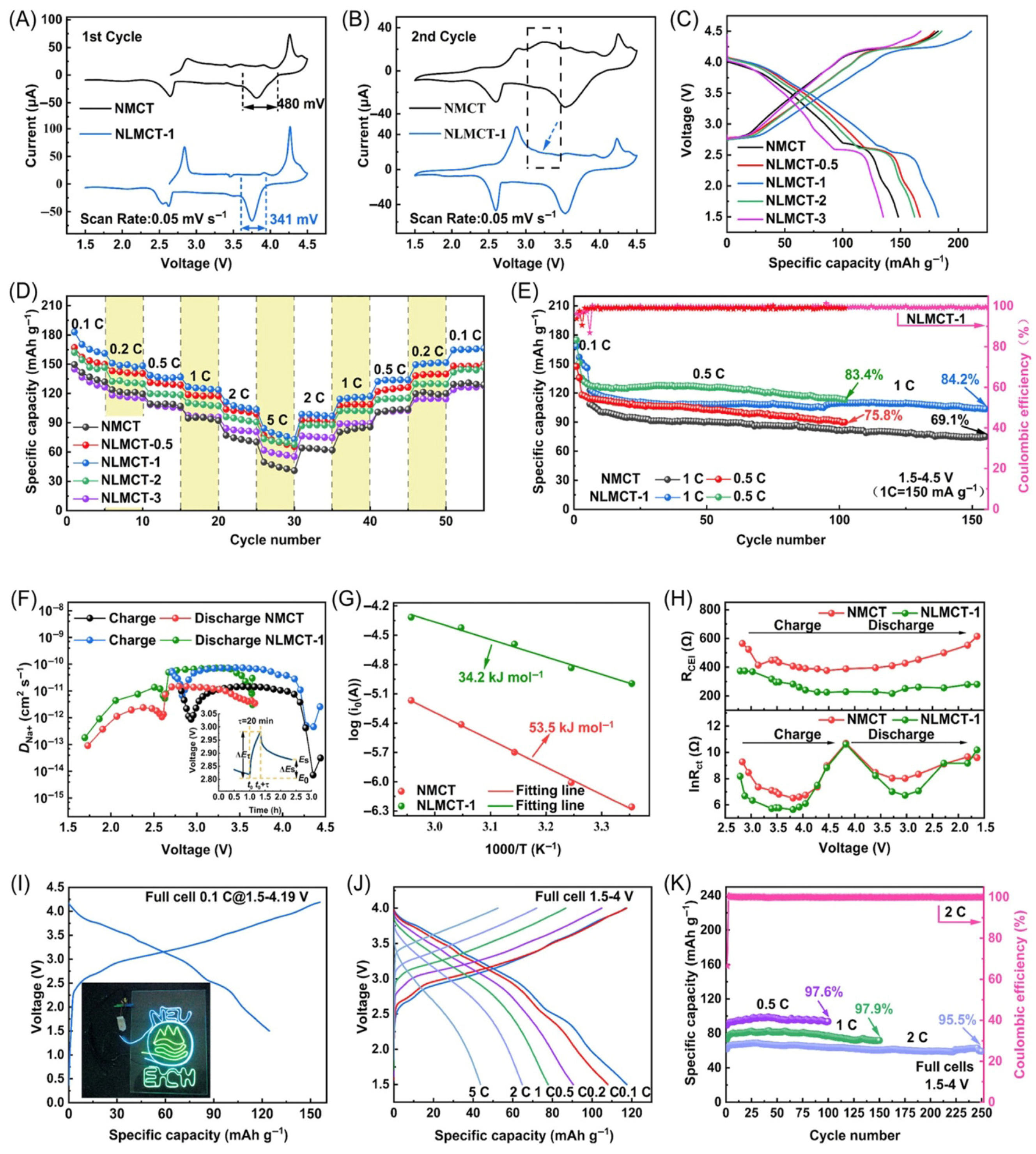
The electrochemical test results of the Na[LaxNi0.3Mn0.55−xCu0.1Ti0.05]O2 material in sodium half-cells are as follows: The initial CV curves (Figure 2A) show two pairs of redox peaks (~2.9/2.64 V and ~4.24/3.7 V), corresponding to P3→O3 and P3→monoclinic phase transitions, respectively. The reduction peak of NLMCT-1 at 3.7 V is sharper, indicating that La doping enhances the reduction kinetics. In the second CV cycle, a new oxidation peak appears in NMCT within 3–3.5 V (likely due to the P3→P3′ phase transition). This peak is gradually suppressed with increasing La content and completely disappears in NLMCT-1 (Figure 2B). Charge/discharge tests (Figure 2C,D) show that NLMCT-1 delivers an initial discharge capacity of 183 mAh g−1 at 0.1 C. It exhibits excellent rate performance: a reversible capacity of 84.2 mAh g−1 at 5 C, which recovers to 170 mAh g−1 when the rate is returned to 0.1 C. Outstanding cycling stability is observed: capacity retention of 84.2% after 150 cycles at 1 C (Figure 2E). Kinetic studies (Figure 2F,G) reveal that the Na+ diffusion coefficient (DNa+) of NLMCT-1 ranges from 10−13 to 10−11 cm2 s−1, higher than that of NMCT (10−15 to 10−11 cm2 s−1). The DNa+ of NMCT drops by four orders of magnitude during charging at ~4.25 V, while this phenomenon is absent in NLMCT-1. The apparent activation energy of NLMCT-1 (34.2 kJ mol−1) is lower than that of NMCT (53.5 kJ mol−1), indicating a lower energy barrier for interfacial charge transfer. In situ EIS (Figure 2H) shows that the interfacial resistance of NLMCT-1 remains consistently low, and the charge transfer impedance is stable at low voltages, suggesting effective suppression of structural transitions. Full-cell tests (cathode: NLMCT-1; anode: hard carbon) demonstrate an initial Coulombic efficiency of 80% within 1.5–4.19 V. Good rate performance is achieved with capacities of 118 to 44 mAh g−1 at rates from 0.1 to 5 C. Excellent long-term cycling stability is observed, with a capacity retention of 95.5% after 250 cycles at 2 C (Figure 2I–K). The results indicate that this material holds great promise for practical applications [25].
The iron–manganese-based oxide P2-Na2/3[Fe1/2Mn1/2]O2 offers a high capacity of 190 mAh/g but suffers from a 20% capacity loss over 30 cycles due to phase transitions, which can be mitigated by limiting the voltage window to 2.0–4.0 V. This material is also highly air-sensitive; exposure to CO2 and moisture leads to carbonate insertion and oxidation of Mn3+ to Mn4+, increasing polarization and reducing capacity, underscoring the importance of controlled storage conditions.
Lithium doping also demonstrates unique advantages. The P2-Na1.0Li0.2Ni0.25Mn0.75Oδ material provides a stable capacity of 100 mAh/g within 2.0–4.2 V [26] with no degradation over 50 cycles, while the electrochemically exchanged O3-Na0.95[Li0.15Mn0.55Co0.10Ni0.15]O2 exhibits a high capacity of 200 mAh/g. Recently developed P2/O3 biphasic material [27] Na0.66Li0.18Mn0.71Ni0.21Co0.08O2+d successfully combines the advantages of both phases, delivering a high capacity of 200 mAh/g at 0.1 C and retaining 134 mAh/g at 1 C, with 84% capacity retention after 50 cycles.
In terms of modification strategies, various elemental dopants play distinct roles [28] in enhancing performance. Notably, significant progress has been made in developing environmentally friendly variants [29]. The performance data of these materials are specifically shown in Table 1.

2.2. Tunnel Oxide

The tunnel-type NaxMO2 cathode material, characterized by its three-dimensional open framework structure, provides excellent ion transport pathways for sodium-ion batteries. Its representative material, Na0.44MnO2, offers a theoretical capacity of 121 mAh/g. Structurally, M4+ ions and a portion of M3+ occupy octahedral sites (MO6), while the remaining M3+ reside in square-pyramidal positions (MO5). These are interconnected via MO5 units and share vertices with triple/double octahedral chains, forming an S-shaped tunnel that facilitates highly efficient sodium-ion diffusion along the c-axis [30].
The synthesis method significantly influences electrochemical performance. Materials prepared via conventional solid-state reaction exhibit severe polarization, delivering a reversible capacity of only 80 mAh/g with poor cycling stability [31]. In contrast, single-crystalline nanowires synthesized through hydrothermal methods achieve capacities of 115 mAh/g at 0.42 C and 103 mAh/g at 8.3 C. Submicron plates obtained via sol–gel methods retain over 120 mAh/g after 100 cycles. Recently developed tunnel-type material Na0.61Ti0.48Mn0.52O2 demonstrates an average operating potential of 2.9 V and a discharge capacity of 86 mAh/g, offering new insights for structural design [32].
Studies indicate that rational control of morphology and crystallinity can substantially enhance material performance, providing a promising strategy to address the kinetic limitations of sodium-ion batteries [33].

2.3. Problems of Transition Metal Oxides

Layered transition metal oxides, as promising cathode materials for sodium-ion batteries, exhibit a strong correlation between their crystalline structural features and electrochemical performance. From a structural chemistry perspective, these materials primarily adopt three typical polymorphs: P2, P3, and O3 [34], which differ mainly in the coordination environment of sodium ions [35] (prismatic or octahedral sites) and the stacking sequences of oxygen layers (ABBA, ABBC, or ABCA) [36].
It is noteworthy that although the O3-type structure possesses a higher initial sodium content (Na0.98Ca0.01[Ni0.5Mn0.5]O2) [37], enabling a greater reversible capacity, it often undergoes complex phase transitions upon deep desodiation, leading to structural degradation [38]. Particularly, P2-type materials (Na0.67Ni0.33Mn0.67O2) suffer from insufficient initial sodium content [39], which can cause abnormally high Coulombic efficiency in half-cell tests [40]—a phenomenon that may lead to capacity loss in practical full-cell applications. Although pre-sodiation strategies can mitigate this issue, their cost-effectiveness and scalability remain limited [41].
Meanwhile, the P3-type phase can be obtained as a thermodynamically stable compound at moderate synthesis temperatures (<800 °C), yet its electrochemical performance is often unsatisfactory [42]. From a thermodynamic perspective, the electrochemical interconversion between P3/O3 and P2 [43] phases is generally hindered due to the high bond energy of transition metal–oxygen bonds [44].
These structural evolution characteristics underscore that developing high-performance layered cathode materials requires a holistic approach addressing critical factors such as sodium content regulation [45], phase transition management, and structural stability optimization [46]. This remains a major challenge in current research efforts [47].
In summary, the core challenge of layered transition metal oxides stems from the inherent contradiction between their structural type and sodium stoichiometry. The O3-type structure, despite its high initial sodium content which provides a foundation for achieving high specific capacity, suffers from complex multiphase transitions during deep charge–discharge cycles that severely compromise its cycling stability. Conversely, the P2-type structure, due to its open prismatic site coordination and lower initial sodium content, typically exhibits smoother electrochemical behaviour and better structural reversibility. However, its inherent sodium deficiency directly limits its reversible capacity. This “capacity-stability” trade-off fundamentally constrains the performance ceiling of single-phase, homogeneous P2 or O3 materials from a thermodynamic perspective. Consequently, strategies to break through this bottleneck are no longer confined to modifying a single phase. Instead, they are shifting toward more complex design paradigms, such as tuning intrinsic stability through elemental doping or constructing multiphase composite structures to achieve complementary properties.

2.4. Methods to Improve the Performance of Transition Metal Oxide Batteries

2.4.1. Element Optimization

Iron–manganese-based layered oxide cathode materials [48] have attracted significant attention due to their elemental abundance and low cost, yet they suffer from challenges such as metal dissolution, structural distortion, and irreversible phase transitions. To address these issues, researchers have proposed an alkaline-site substitution strategy. The introduction of large-radius alkali metal ions (K+) into P2-Na0.612K0.056MnO2 [49] facilitates the formation of stable Na+ vacancies, enabling a specific capacity of 240.5 mAh/g. This performance enhancement is attributed to the reinforced MnO6 octahedral framework, reduced vacancy formation energy, and reversible phase transitions in the low-voltage region.
A more breakthrough approach involves transition metal pinning effects [50]. For instance, in material Na0.67Mn0.5Co0.4Fe0.1O2 [51], the occupation of Fe3+ at Na+ sites—as confirmed by STEM-EDS and in situ XRD—results in a “zero-strain” characteristic with only 0.6% volume variation, delivering 71% capacity retention after 1000 cycles. Similar stabilizing effects have been achieved through divalent ion substitutions at alkaline sites, such as in systems Mg2+, Zn2+, and Ca2+.
High-entropy design has emerged as a promising direction. The O3-type material [52] NaNi0.12Cu0.12Mg0.12Fe0.12Co0.15Mn0.1Ti0.1Sn0.1Sb0.04O2 utilizes entropy stabilization to enable reversible O3–P3 phase transitions, retaining 83% capacity over 500 cycles [53]. Meanwhile, the P2-type compound Na0.62Mn0.67Ni0.23Cu0.05Mg0.07Ti0.01O2 exhibits exceptional longevity, maintaining 75.4% capacity after 2000 cycles [54]. High-sodium design has also been employed to mitigate the inherent sodium deficiency in P2-type materials [55]. The composition Na45/54Li4/54Ni46/54Mn34/54O2, stabilized in a single P2 phase, achieves 68% capacity retention after 3000 cycles [56].
These advances represent significant progress in overcoming the fundamental limitations of iron–manganese-based cathodes, accelerating the commercialization of sodium-ion batteries.

2.4.2. Structural Design

The commercialization of sodium-ion batteries is currently constrained by performance bottlenecks in cathode materials, with multiphase composite design and nanostructure engineering emerging as promising strategies for breakthrough. Constructing P2–O3 [57]or layered–tunnel composite phases enables synergistic complementarity [58]: the P2 phase ensures structural stability [59], the O3 phase provides high sodium content [60], and the tunnel phase enhances environmental tolerance. For instance, material Na0.76Ni0.33Mn0.5Fe0.1Ti0.07O2, comprising 58.91 wt% P2 [61]and 41.09 wt% O3 phases, exhibits 75.4% capacity retention after 500 cycles. Similarly, the layered–tunnel composite material Na0.60Mn0.90Ti0.10O2 demonstrates 87.9% capacity retention [62], validating the synergistic effect of combined 3D and 2D ion transport pathways [63].
The introduction of lithium enables structural modulation: in material [NA0.396Li0.044][Mn0.97Li0.03]O2, the “pillar effect” of Li+ suppresses phase transitions and constructs a 3D ion transport network [64], enabling a full cell to deliver 71.5 mAh/g after 900 cycles. In nanostructure engineering, hollow P2-Na2/3Ni1/3Mn2/3O2 nanofibers prepared via electrospinning achieve 80.8% capacity retention over 500 cycles [65], while pearl-necklet-like Na0.76Cu0.22Fe0.30Mn0.48O2 nanostructures deliver 56.5 mAh/g even at 20 C. The shale-like S-NMO material synthesized via a water-mediated method exhibits a “zero-strain” characteristic with only 1.96% volume variation [66], achieved through interlayer spacing regulation. It retains 83% capacity after 3000 cycles [67], a performance validated in Zn/Fe-doped systems, demonstrating broad applicability [68]. This study [69] provides critical insights [70] for developing high-performance cathode materials [71] for sodium-ion batteries [72].

2.4.3. Surface Engineering

Surface modification strategies for layered cathode materials in sodium-ion batteries have demonstrated remarkable effectiveness in enhancing electrode cycling stability through the construction of functional protective interfaces [73]. For instance, the AlPO4 coated Na[Li0.05Mn0.50Ni0.30Cu0.10Mg0.05]O2 material achieves dual protection via interfacial [74] engineering [75]: it not only mitigates electrolyte corrosion and transition metal dissolution but also maintains efficient ion transport, resulting in a capacity retention of 95% after 400 cycles [76]. The modified surface layer effectively [77] suppresses HF attack and inhibits the formation of side reaction products (Na2CO3), while significantly improving environmental tolerance [78].
Current research focus has shifted from ex situ coating techniques [79] such as atomic layer deposition toward in situ interfacial [80] engineering, which offers greater potential for industrial scalability [81]. By optimizing coating composition and structural design [82], in situ strategies simultaneously address interfacial stability and challenges related to uniformity and cost in large-scale production [83]. Future efforts should prioritize the development of self-healing coatings, gradient interfacial structures [84], and hybrid protective layers with simultaneous ionic and electronic conductivity [85]. These innovations are expected to provide critical technical support for the commercial application of high-performance sodium-ion batteries [86].
The effectiveness of the carbon coating is closely correlated with its micro-morphology and thickness. Though commonly referred to as a “carbon layer”, it mostly presents as a discontinuous coating of amorphous carbon in terms of microstructural characteristics. From the perspective of functional thin films, its thickness is tailorable via rational process regulation. Literature reports indicate that the thickness of carbon coatings prepared by liquid-phase impregnation combined with pyrolysis mostly falls in the range of 5–20 nm, which is sufficient to construct a conductive percolation network. In contrast, an ultrathin modified layer with a thickness of 1–5 nm can be obtained through vapour deposition or precise control of precursor dosage. When compounded with carbon nanomaterials, the carbon “layer” at the interface may be thicker or exhibit an irregular morphology. The goal of optimizing carbon coating thickness is to strike a balance between ensuring sufficient electronic conductivity and avoiding the impediment of ion diffusion.

3. Polyanionic Compounds

Polyanionic compounds have emerged as a prominent class of cathode materials for sodium-ion batteries due to their tunable structures, exceptional stability, and high operating voltages [87]. Through the strong electron-withdrawing effect of anionic groups (such as PO43−, P2O74−, and SO42−), these materials not only elevate the electrode reaction potential but also effectively suppress structural degradation during cycling.
Widely studied systems include phosphates, pyrophosphates, fluorophosphates, and sulfates. These compounds possess well-defined crystalline frameworks that provide stable pathways for reversible sodium ion (de)intercalation, demonstrating significant potential for practical applications.
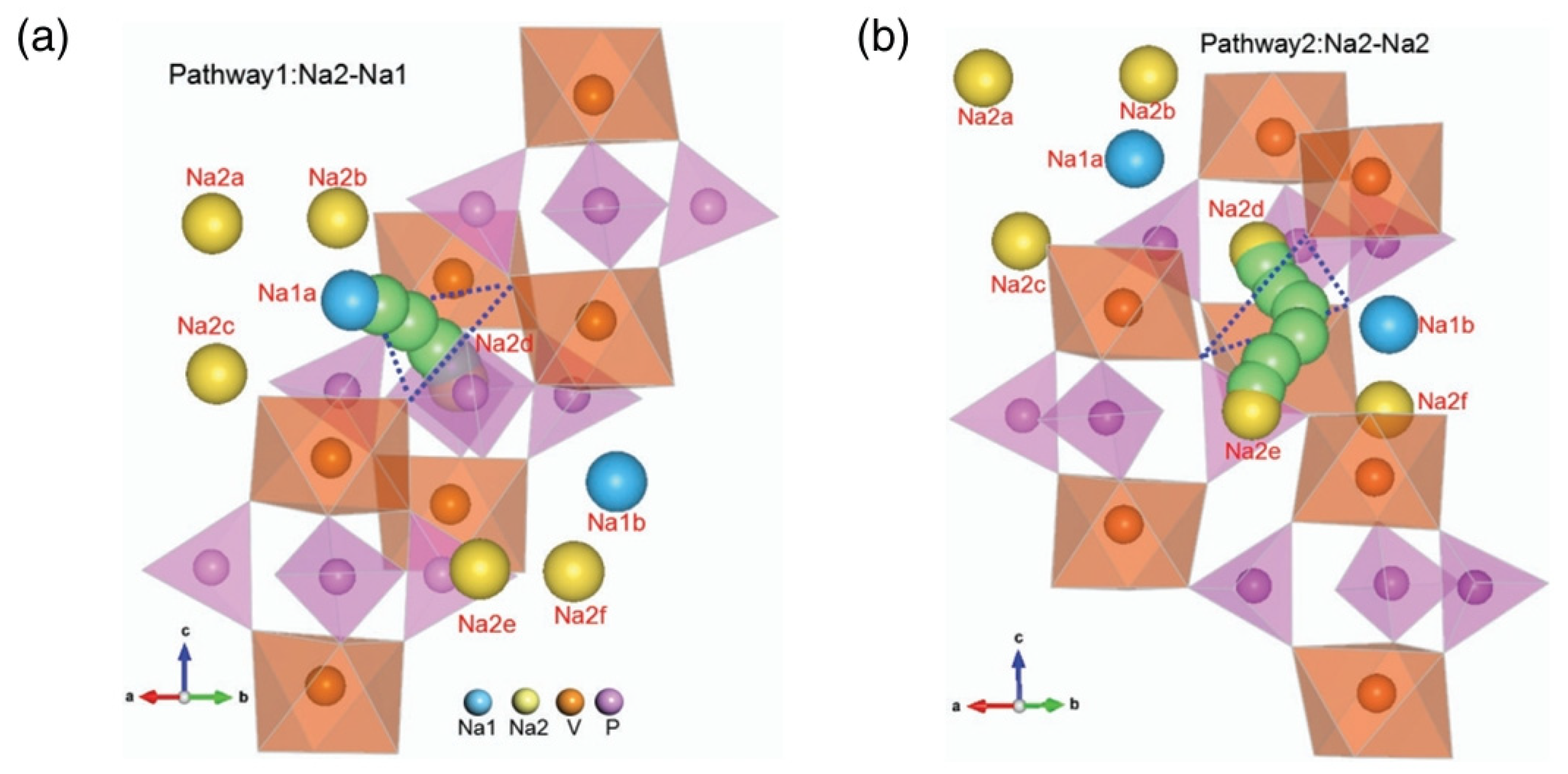
In the pursuit of high-stability, high-operating-voltage cathode materials for sodium-ion batteries, phosphorus occupies a strategic and central role due to its ability to form a variety of strongly covalent-bonded anionic groups [88]. These phosphorus-based frameworks represent its key application form in advanced electrochemical energy storage. The rigid polyhedra formed by phosphorus and oxygen serve not only as structural units for constructing stable crystal frameworks but also effectively elevate the reaction voltage of transition metal redox couples through a strong effect [89]. Consequently, phosphorus-based polyanionic compounds such as phosphates, pyrophosphates, and fluorophosphates have emerged as a crucial branch of materials for achieving low-cost, long-life energy storage systems. This chapter will systematically review the structural characteristics, electrochemical performance, and optimization strategies of these representative phosphorus-based polyanionic materials (Figure 3).
Polyanionic compounds are a typical class of inorganic cathode materials for sodium-ion batteries, featuring a stable crystalline framework constructed by covalent-bonded polyanionic groups and transition metal cations. Different from polyelectrolytes, PACs exhibit excellent structural stability during Na+ intercalation due to the strong inductive effect of polyanionic groups, which is the core characteristic making them promising cathode candidates for SIBs.

3.1. Phosphates

3.1.1. Sodium Superionic Conductor (NASICON)Na3V2(PO4)3

The NASICON-structured Na3V2(PO4)3 (NVP) material has attracted significant attention in the field of sodium-ion battery cathode materials due to its unique crystal structure and exceptional sodium ion conduction properties [89]. This material consists of VO6 octahedra [91] and PO4 tetrahedra interconnected through corner-sharing, forming a three-dimensional open framework that provides ideal diffusion pathways for sodium ions. Studies have shown that NVP exhibits a high theoretical energy density of up to 400 Wh kg−1 and favourable thermal stability [92], making it a highly promising cathode material candidate. However, its intrinsically low electronic conductivity (approximately 10−9 S cm−1) severely limits its electrochemical performance [93]. To address this, researchers have developed various modification strategies. Morphological engineering, such as the hollow microsphere composite (Na3MnTi(PO4)3) prepared via spray drying, delivers a specific capacity of 160 mAh·g−1 with 92% capacity retention, and maintains 75.9 mAh·g−1 even at 200 C [94]. The rGO-composited NVP retains 70% capacity after 15,000 cycles at 50 C. Elemental doping, exemplified by Ni-doped material (Na3.03V1.97Ni0.03(PO4)3/C), achieves 84% capacity retention at 5 C [95].
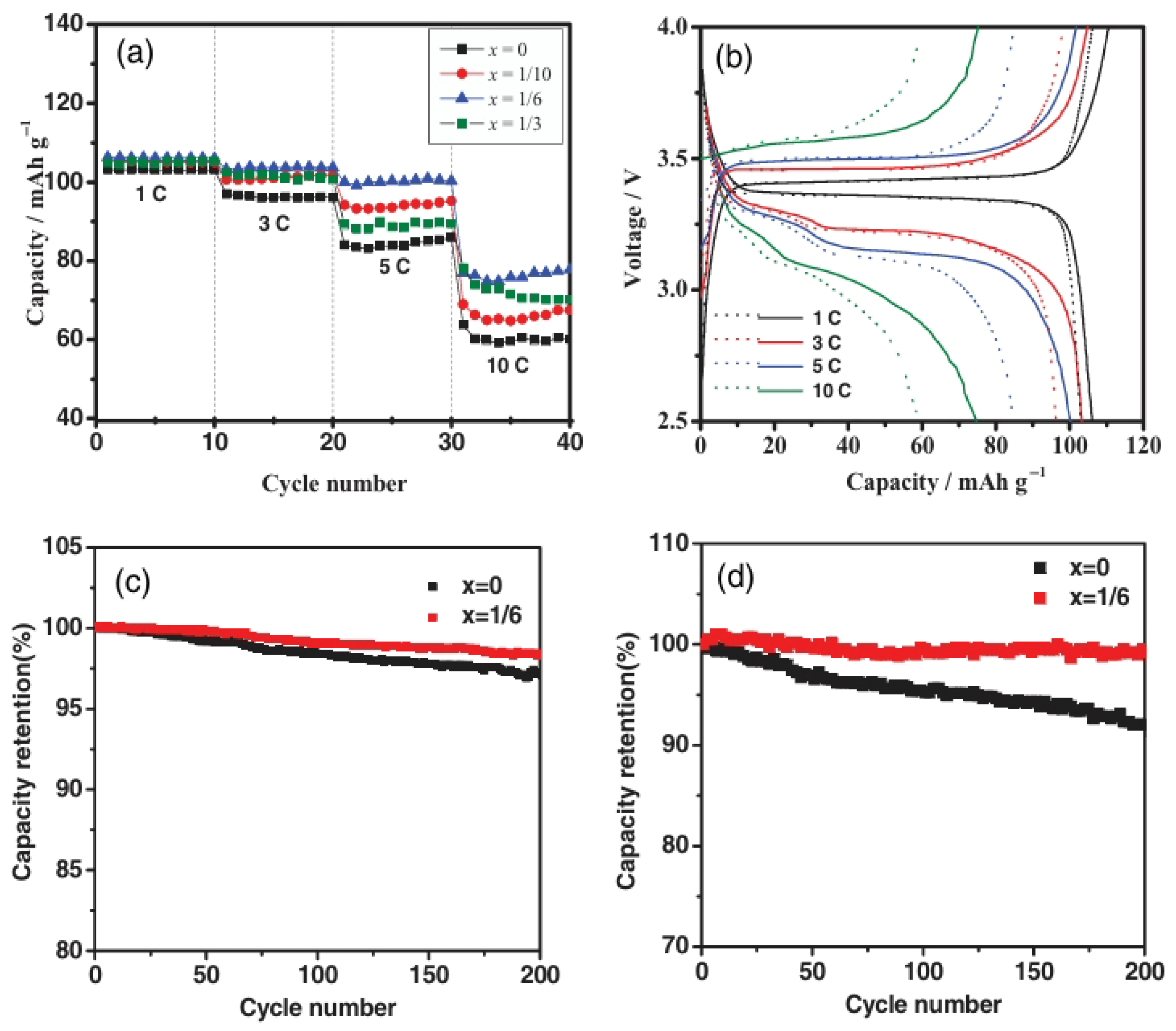
To investigate the effect of boron (B) substitution on battery performance, half-cells were tested at various rates within the voltage range of 2.5–4.0 V. Figure 4a shows that the Na3V2P3−xBxO12 (x = 0, 1/10, 1/6, 1/3) electrodes all delivered a similar capacity of approximately 105 mAh g−1 at 1 C, regardless of boron content. However, significant differences in high-rate performance emerged at rates above 3 C. The sample with x = 1/6 exhibited the best rate capability, achieving capacities of 100 mAh g−1 and 70 mAh g−1 at 5 C and 10 C, respectively.
As shown in Figure 4b, a flat voltage plateau around 3.4 V was observed at 1 C, corresponding to the theoretical capacity of two sodium ion (de)intercalation events, with minimal polarization. As the rate increased, the unmodified Na3V2(PO4)3 showed a more pronounced capacity drop and a larger potential gap compared to the x = 1/6 sample, indicating that boron substitution alleviated kinetic limitations at high rates.
In terms of cycling performance (Figure 4c), the x = 1/6 sample retained 98.4% of its initial discharge capacity after 200 cycles, slightly higher than the 97.2% retention of the pristine material. However, under high-rate cycling at 5 C (Figure 4d), the difference became more pronounced: the boron-substituted sample maintained 98.7% capacity retention, significantly outperforming the pristine material at 91.8%. These results demonstrate that boron substitution effectively enhances the cycling stability of the battery, particularly under high-rate conditions [90].

3.1.2. Triphylite-Type Structure and Olivine-Type Structure

Sodium iron phosphate NaFePO4 has emerged as a promising cathode candidate for sodium-ion batteries due to its excellent thermal stability, high operating voltage, and environmental friendliness. It primarily crystallizes in two polymorphs: the thermodynamically stable triphylite phase and the electrochemically active olivine phase.
The triphylite-type NaFePO4 is usually prepared by electrochemical sodiation of the delithiated LiFePO4, which undergoes a phase-transition during the charging process and obvious voltage drop during the discharging process, finally leading to undesirable electrochemical performance and low energy density. However, when composited with acid-etched carbon cloth, it delivers a reversible capacity of 142 mAh/g. A hybrid material consisting of the triphylite phase and an amorphous phase, prepared via high-energy ball milling, shows a low capacity decay rate of only 0.0109% per cycle at 1 C.
The olivine phase NaFePO4, isostructural to the lithium cathode analogue LiFePO4, holds great potential but tends to transform into the triphylite phase at elevated temperatures. An olivine-phase NaFePO4/C composite synthesized via electrochemical replacement in an aqueous LiFePO4/C [96] solution demonstrates 90% capacity retention after 240 cycles. Similarly, a polythiophene-coated NaFePO4 composite achieves an initial discharge capacity of 142 mAh·g−1 with 93% retention over 100 cycles.
Current challenges include enhancing the intrinsic activity of the triphylite phase, improving the synthetic stability of the olivine phase, and boosting the overall electronic conductivity. Future efforts should focus on developing mild-condition synthesis routes for high-purity olivine phases and designing efficient composite modification strategies to facilitate practical applications.

3.2. Pyrophosphate

The pyrophosphate system Na2MP2O7 (M = Fe, Co, Mn, Cu) represents a class of high-quality cathode materials for sodium-ion batteries, characterized by their polymorphic crystal structures. The triclinic phase of Na2FeP2O7 consists of Fe2O11 dimers and P2O7 groups, forming three-dimensional Na+ migration pathways with five distinct sodium storage sites. It operates at a stable voltage around 3.0 V and delivers a reversible specific capacity of 82 mAh/g.
First-principles calculations have revealed complex phase transitions in Na2FeP2O7 within the voltage window of 2.0–4.5 V [97]. To enhance performance, researchers developed Mn-substituted solid solutions Na4-αFe2+α/2(P2O7)7 (2/3 ≤ α ≤ 7/8) by modulating the ratio between transition metals and Na+. Carbon-coated Na3.32Fe2.34(P2O7)7/C exhibits a specific capacity of 100 mAh/g at 0.1 C and retains 92.3 mAh/g after 300 cycles at 0.5 C.
Among other transition metal-based pyrophosphates, Na2MnP2O7 allows structural modulation via the Jahn–Teller effect. When modified with graphene, it demonstrates an initial Coulombic efficiency of 90%. Significant progress has also been made in the study of the three polymorphs of Na2CoP2O7 [98]. A novel hybrid phosphate–pyrophosphate Na4Fe3(PO4)2P2O7 (NFPP), was composited with multi-walled carbon nanotubes, delivering a discharge capacity of 115.7 mAh/g at 0.1 C and maintaining 109.9 mAh/g after 1200 cycles. This provides valuable insights for the development of high-performance cathode materials.

3.3. Fluorophosphates

Fluorophosphates represent an important class of cathode materials for sodium-ion batteries, leveraging the strong electronegativity of fluorine to elevate redox potentials. Major systems include Fe-, Mn-, and V-based compounds.
The Fe-based Na2FePO4F offers a theoretical capacity of 135 mAh/g and features 2D Na+ diffusion channels, undergoing a two-phase transition involving Na2FePO4F, Na1.5FePO4F, and NaFePO4F during cycling. A carbon-coated porous hollow Na2FePO4F retains 80% capacity after 750 cycles. The Mn-based Na2MnPO4F exhibits high theoretical capacity and thermal stability but suffers from poor conductivity. A hollow spherical Na2MnPO4F prepared by spray drying delivers a reversible capacity of 122.4 mAh/g at an operating voltage of 3.6 V.
V-based systems display diverse structures, including NaVPO4F, Na3V2(PO4)2F3, and Na3(VO1-xPO4)2F1+2x, most featuring open 3D frameworks. Na3V2(PO4)2F3 [99] provides a theoretical capacity of 192 mAh/g with charge/discharge plateaus at 3.7 V and 4.2 V, corresponding to two-step Na+ (de)intercalation. A sol–gel derived Na3V2(PO4)2F3/C achieves a discharge capacity of 119.2 mAh/g at 0.1C, while Na3(VOPO4)2F nanoparticles synthesized via a solvothermal method at low temperature retain 90% capacity after 1200 cycles [100].
Despite their promise, these materials suffer from intrinsically low electronic conductivity, necessitating nano-engineering and carbon compositing for performance enhancement. Future efforts should focus on developing novel synthesis methods, precise structural control, and interface optimization. The electrochemical performance of specific polyanion-type cathode materials is shown in Table 2.

3.4. Sulfates

Sulfate-based cathode materials have attracted interest in sodium-ion batteries due to their high operating voltage and Earth-abundant constituents, primarily adopting structures such as the alluaudite-type (Na2Fe(SO4)2).
However, their practical application faces severe challenges: these materials tend to decompose below 450 °C, releasing toxic gases (SO2), which complicates synthesis and manufacturing processes. Moreover, their intrinsic electronic conductivity is poor. Although performance improvements have been achieved through graphene/carbon layer compositing and leveraging the structural stability of the alluaudite framework [101], conventional carbon coating remains insufficient to fully address these issues.
Polyanionic sulfates possess open frameworks, high energy density, and good thermal stability, yet their poor electrical conductivity continues to limit practical use. Existing strategies such as compositing with carbon materials (reduced graphene oxide) and cationic substitution (Mn or Ni) still fall short of commercial requirements. Future efforts must focus on developing more effective material designs and synthesis strategies to overcome these bottlenecks [102].

3.5. Problems of Polyanionic Compounds

The root cause of the extremely low intrinsic electronic conductivity of polyanionic compounds can be explained from the perspective of their crystal and electronic structures. First, the highly electronegative anionic groups exert a significant “inductive effect”, which lowers the energy level of the 3d orbitals of transition metals (TM), resulting in minimal overlap of d-d orbitals between TM ions, high electron localization, wide-bandgap semiconductor characteristics, and extremely low intrinsic carrier concentration. Second, in the crystal structure, anionic groups act as “insulating spacers” that separate the redox-active TM-O octahedra from each other, hindering the hopping conduction of electrons through the TM-O-TM pathway. Finally, such materials lack delocalized electronic energy bands, and charge transport relies heavily on discrete TM ion sites. These physical essences determine that their electronic conductivity is usually lower than 10−9 S cm−1, which becomes a key bottleneck restricting their rate performance. Therefore, subsequent performance improvement strategies mainly focus on constructing external conductive networks, shortening internal transport pathways, and regulating intrinsic electronic structures.
Polyanionic compounds (PACs) have demonstrated significant potential as cathode materials for sodium-ion batteries (SIBs) owing to their structural stability and tunable electrochemical performance [103]. Their general formula is typically NaxMy(XO4)m (where X = S/P), and their crystal structures consist of XO4n− and their derivatives, forming open frameworks that facilitate Na+ diffusion. The rigid polyanionic framework also ensures minimal volume variation during cycling. For instance, Na4Fe7(PO4)6 exhibits a volume strain of only 0.24%, enabling stable operation for over 1000 cycles without significant capacity decay.
The strong inductive effect of anionic groups (PO4, SO4) contributes to high operating voltages. The introduction of highly electronegative groups (e.g., in fluorophosphates) can further elevate the voltage above 4.2 V, though this remains limited by the availability of compatible high-voltage electrolytes. Despite these advantages, the practical application of PACs faces challenges such as low theoretical capacity (118 mAh/g for Na3V2(PO4)3 and 120 mAh/g for Na2Fe2(SO4)3 and poor intrinsic electronic conductivity [104]. Current modification strategies include carbon compositing, nanostructuring, and elemental substitution. Future research should focus on exploring multi-electron reaction mechanisms and optimizing molecular structures to synergistically enhance their performance.

3.6. Methods to Improve the Performance of Polyanionic Compound Batteries

3.6.1. Forming Composite Materials

Carbon composite modification is an effective strategy to enhance the electrochemical performance of polyanionic compounds (PACs) by constructing conductive carbon layers on their surfaces, which improves electronic conductivity, provides structural protection, and stabilizes interfaces. This can be achieved through in situ pyrolysis of carbon-containing precursors or mechanical mixing with carbon nanotubes, reduced graphene oxide (rGO), etc. [105]. Among these, the in situ carbonization method holds greater potential for industrialization due to its simple process and low cost.
The carbon layer effectively suppresses side reactions between the material and air/electrolyte, prevents transition metal oxidation, and inhibits particle agglomeration. For example, an rGO-modified Na3Fe2(PO4)(P2O7) composite exhibits 89.7% capacity retention after 6400 cycles, compared to only 62% for the unmodified sample. Dual-carbon synergy strategies demonstrate even better performance: a dual-carbon-coated Na3Mn2(P2O7)(PO4) material [106] prepared via freeze-drying establishes a 3D conductive network, retaining 73% capacity after 500 cycles with a volume strain of only 0.87%. Furthermore, porous carbon matrix designs enhance environmental stability. For instance, a sodium alginate-derived Na3.12Fe2.44(P2O7)2/rGO aerogel maintains structural integrity after 100 days of air exposure and shows less than 12% capacity decay over 5000 cycles. Carbon composite engineering provides critical technical support for the application of PACs in sodium-ion batteries.
The core of carbon composite modification lies in constructing a continuous electronic percolation network on the exterior of active material particles. Whether via in situ polymerization carbonization or mechanical compounding with carbon nanotubes/graphene, the technological basis of both approaches involves establishing a stable colloidal dispersion system of active particles-carbon sources or carbon materials in the liquid phase. The stability of this system, along with the interfacial compatibility between carbon components and the surfaces of active particles, directly determines the homogeneity of biphasic distribution and the interfacial compactness in the final composite material. An optimized and stable interface not only provides rapid electron transport pathways but also acts as a physical barrier to mitigate electrolyte corrosion of active materials, thereby synergistically improving the rate capability and cycle life of the material.

3.6.2. Composition Tailoring

Element substitution has been demonstrated as an effective strategy to significantly enhance the intrinsic electronic conductivity of polyanionic compounds (PACs), while simultaneously suppressing lattice strain and improving structural stability. The original Na4VMn(PO4)3 electrode [107] exhibited only 47% capacity retention after 1000 cycles, whereas samples doped with Mg2+, Al3+ and Ti4+ achieved significantly improved retention rates of 86.6%, 92%, and 87.2%, respectively. Doping with Al3+ forms strong Al–O bonds that effectively suppress the Jahn–Teller distortion. The Na4V0.8Al0.2Mn(PO4)3 cathode undergoes a solid-solution reaction below 3.5 V and a two-phase reaction between 3.5 and 3.8 V, exhibiting a low volume change of 8% and excellent cycling stability.
In pyrophosphate systems, the introduction of Na3.12Fe2.44(P2O7)2 into Mg2+ not only enhances electrical conductivity but also promotes the formation of a stable cathode-electrolyte interphase (CEI). The Mg-doped sample retains 79.1% capacity after 3000 cycles and 95.3% after 400 cycles at 60 °C. Under elevated temperatures, it further forms a protective surface reconstruction layer with self-healing capabilities. The Na4Fe3(PO4)2P2O7 material, which combines the advantages of phosphates and pyrophosphates, features 3D Na+ channels conducive to Na+ migration, yet suffers from low conductivity. While traditional doping with inactive metal ions (Al3+, Mg2+) improves performance, it often sacrifices specific capacity.
In contrast, doping with electrochemically active Mn2+ in the Na4Fe3-xMnx(PO4)2P2O7/rGO composite [108] reduces ion migration barriers and narrows the bandgap, resulting in 97.2% capacity retention after 2000 cycles. This material exhibits continuous optimization of both crystal structure and interface properties during cycling, demonstrating a “better-with-cycling” behaviour. In NASICON-type materials, increasing the Mn content in the Na3+2xMn1+xTi1−x(PO4)3 system elevates the average operating voltage and enables more than three-electron redox reactions. The Na3.3Mn1.15Ti0.85(PO4)3 material delivers a specific capacity [109] of 180.6 mAh/g (corresponding to 3.17 Na+ per formula unit), retaining 76.5% of its initial energy density after 1000 cycles.
Precise element substitution provides a powerful pathway for developing high-performance cathode materials for sodium-ion batteries.

3.6.3. Structure and Surface Design

Surface coating and nanostructure engineering are critical strategies for enhancing the performance of polyanionic compound electrodes. For instance, material Na3.12Fe2.44(P2O7)2 [110] modified with an ultrathin AlF3 coating (1.2 nm) utilizes strong F-C3 bonding with the carbon layer [111] to maintain open ion diffusion pathways while suppressing electrolyte corrosion, retaining 70% capacity after 6000 cycles at 50 °C.
In terms of nanostructural design, 150 nm platelet-like Na4Fe3(PO4)2P2O7 (NFPP-E) [112] prepared via sol–gel method exhibits significant nano-size effects, demonstrating 69.1% capacity retention after 4400 cycles. An electrospun carbon nanobelt composite forms an interconnected conductive network that facilitates rapid electron transport [113]. This 200 nm-structured material achieves 72% capacity retention after 5000 cycles at 50 C, and delivers a reversible capacity of 84.5 mAh/g even at −15 °C [114].
Precise control of interfaces and nanostructures provides a synergistic approach to addressing the performance limitations of polyanionic compounds (PACs) [115].

4. Prussian Blue Analogues

Prussian blue analogues (PBAs, AxM1[M2(CN)6]·nH2O) represent an important class of cathode materials for sodium-ion batteries. Their crystal structure contains alkali metal ions (A), transition metal ions (M1/M2), water of crystallization, and vacancies [116]. Based on sodium content, they are classified into sodium-poor (Na ≤ 1) and sodium-rich (Na > 1) types, with the latter being more advantageous due to the absence of an external sodium source.
PBAs adopt a face-centred cubic structure, where Na+ ions reside in three-dimensional channels formed by transition metal ions and coordinate with C and N atoms in the ferrocyanide framework, forming an open framework conducive to ion diffusion.
Prussian blue analogues (AxM1[M2(CN)6]·nH2O), where M = Fe, Mn, etc. [70]) offer advantages such as high operating voltage and long cycle life. However, they also suffer from drawbacks including low initial Coulombic efficiency, inferior rate capability, and insufficient cycling stability. These limitations primarily stem from crystalline water and vacancy defects [117]. Precise control of crystal structure and composition to optimize electrochemical performance is currently a major research focus.
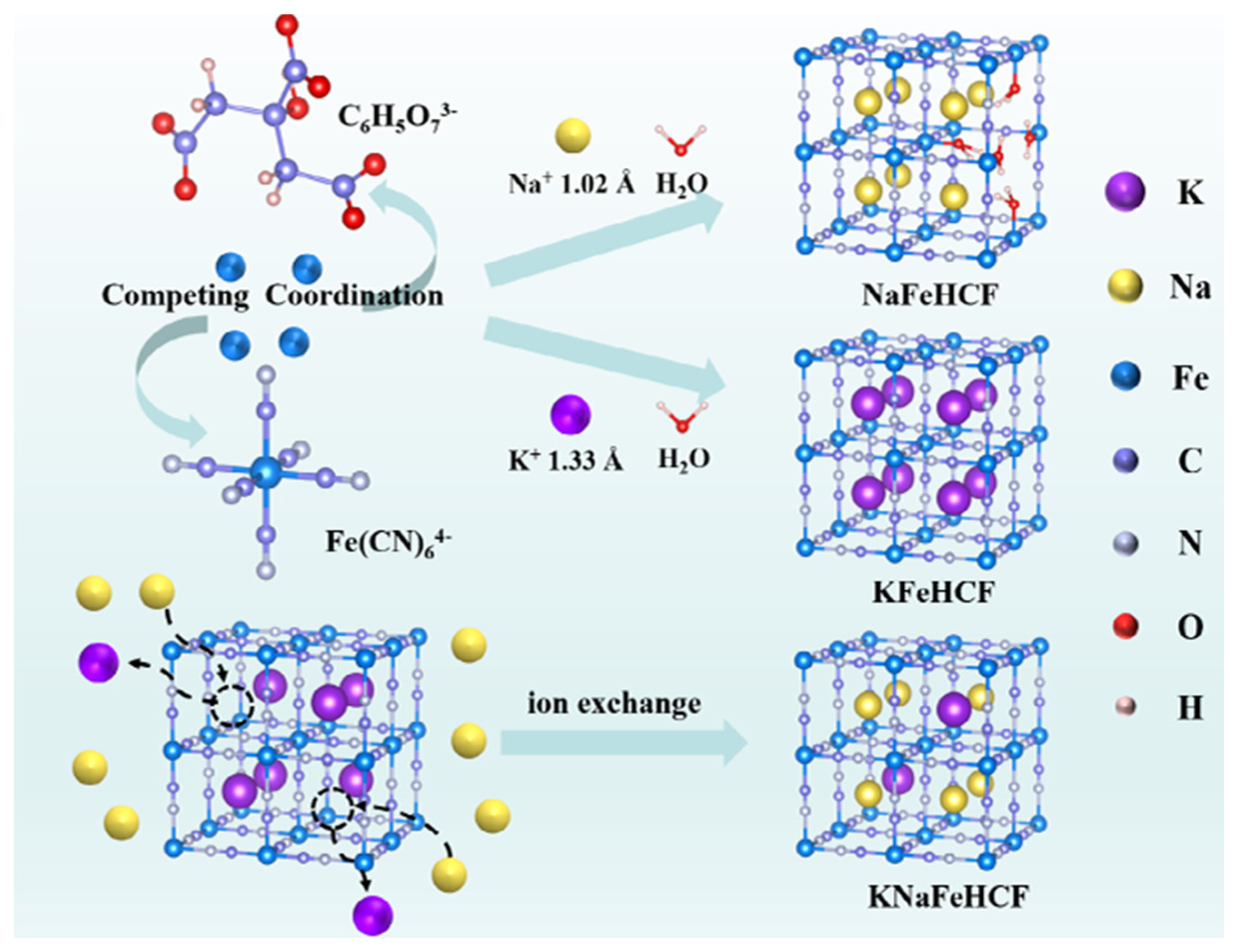
In this study, we synthesized a potassium-based Prussian blue cathode material (KFeHCF) with low water content and used it as the precursor for ion exchange. By precisely controlling the duration of the ion-exchange process, we successfully prepared a series of potassium-sodium mixed iron-based Prussian blue cathode materials (KNaFeHCF). This strategy aims to utilize the larger ionic radius of potassium ions (K+) to pre-stabilize the crystal framework, reduce lattice vacancies and water occupancy, thereby enhancing the intrinsic ionic conductivity and structural stability of the material. Subsequently, through a mild ion-exchange process, part of the K+ was replaced by Na+ without damaging the original high-crystallinity framework. Ultimately, a sodium-ion battery cathode material with low water content, high structural integrity, and excellent electrochemical performance was obtained. As illustrated in Figure 5 [118], low-water-content, high-crystallinity K-based Prussian blue was employed as the precursor framework, and K+ in the framework was substituted with Na+ via ion exchange to produce KNaFeHCF materials.

4.1. Prussian Blue Derivatives

Prussian blue analogues AxFe[Fe(CN)6], AxM1[M2(CN)6]·nH2O) have garnered significant attention due to their cost-effectiveness and high theoretical specific capacity. Recent advancements in material design and synthesis optimization have led to remarkable progress in their electrochemical performance. Crystallinity and defect control are key to enhancing their properties.
Yan et al. [119] prepared low-defect Na1.81Fe[Fe(CN)6]0.83·2.04H2O crystalline material, which delivers a reversible capacity of 140 mAh/g and retains 78% capacity after 3700 cycles, demonstrating exceptional long-term cycling stability. Qin’s team [120] developed a highly crystalline Na2Fe4[Fe(CN)6]3 material via an innovative chemical inhibition strategy. It maintains a capacity of 78 mAh/g even at an ultra-high rate of 100 C, with 62% retention over 2000 cycles, setting a new performance record for this class of materials.
Precise regulation of crystallinity [121], defect concentration, and crystal structure [17] can significantly improve the sodium storage performance [122] and cycling stability of PBAs.

4.2. Manganese-Based Prussian Blue Analogues

Researchers such as Liu et al. [123] prepared a Na2Mn0.8Fe0.2Fe(CN)6 material through Fe2+ doping, which demonstrated a capacity retention rate of 70% after 100 cycles at 0.2 C, along with excellent rate capability stability across a wide current density range from 0.1 C to 5 C [124]. These research efforts have not only advanced the performance optimization of manganese-based Prussian blue materials [125], but have also provided new insights for a deeper understanding of the interaction mechanisms among transition metals [126].

4.3. Cobalt-Based Prussian Blue Analogues

Cobalt-based Prussian blue analogues AxCo[Fe(CN)6] [127] occupy an important position in the research of sodium-ion battery cathode materials [128] due to their unique high-voltage characteristics and reversible two-sodium-ion (de)intercalation mechanism. In these materials, iron and cobalt elements exhibit mixed valence states and demonstrate differentiated coordination capabilities toward O and CN ligands, which provides a structural basis for tuning their electrochemical performance [129]. Numerous research advances have also provided critical scientific insights and technical pathways for developing high-performance cobalt-based Prussian blue cathode materials.

4.4. Nickel-Based and Copper-Based Prussian Blue Analogues

Current research on nickel-based and copper-based Prussian blue analogues AxNi[Fe(CN)6] and AxCu[Fe(CN)6] is primarily focused on aqueous battery systems [130]. Their application in sodium-ion batteries remains exploratory but demonstrates unique scientific value. Future studies should emphasize elucidating the transition metal valence change mechanisms and their influence on material crystal structure [131]. Additionally, developing safer and more environmentally friendly synthesis methods is essential to address the adverse effects of crystalline water and vacancy defects on ion/electron transport [132], thereby further improving specific capacity and Coulombic efficiency. These efforts will provide important theoretical guidance and technical support for developing a new generation of high-performance cathode materials for sodium-ion batteries [133].

4.5. Problems of Prussian Blue Analogue Compounds

Prussian blue analogues (PBAs) have emerged as promising cathode materials for sodium-ion batteries due to their open framework and rapid alkali metal ion migration capabilities. Their three-dimensional channels provide abundant active sites and pathways for Na+ insertion/extraction. While commonly synthesized via coprecipitation [134], this method often introduces numerous defects and vacancies. An innovative “one-stone-two-birds” technique has been developed to convert rusted iron products into PBAs, delivering a specific capacity of 145 mAh/g and retaining 59% capacity after 3500 cycles, simultaneously enabling resource recycling.
The traditional view that crystalline water is solely detrimental requires revision; an appropriate amount of water can actually support the structure and facilitate ion transport. It is recommended to develop “water molecule engineering” strategies to construct efficient hydrogen bond-assisted ion channels.
PBAs face challenges such as defects hindering ion transport and triggering side reactions. Dehydration must be carefully balanced, as excessive removal leads to structural collapse [135]. Phase transitions during charge/discharge and irreversible changes in sodium sites affect stability. Although rapid charge transfer involving low-spin iron above 4 V and high-spin iron around 3.35 V benefits kinetics, it may compromise cycling performance. A sufficient amount of sodium at the cubic 24d sites is crucial for maintaining structural stability [136]. Balancing phase transition reversibility and volume changes remains a central issue, providing critical theoretical guidance for developing high-performance PBA materials.

4.6. Methods to Improve the Performance of Prussian Blue Analogue-Based Batteries

4.6.1. Redox Component Regulation

Transition metal substitution is a key strategy for optimizing the electrochemical performance of Prussian blue analogues (PBAs). Iron-based and manganese-based PBAs have become research priorities due to their excellent cycling stability, yet they suffer from inherent capacity limitations. Precise control of the nitrogen-coordinated metal composition can modify the material’s lattice and redox behaviour [137]; however, high-content substitution with electrochemically inactive elements (Ni, Co) may reduce specific capacity or increase costs.
Chen’s team synthesized copper-doped FeHCF via a co-precipitation method. Although the inactive Cu2+ does not participate in redox reactions, it stabilizes the monoclinic structure and enhances low-spin Fe activity, maintaining high capacity with a decay rate of only 0.047% per cycle [138]. Zinc doping introduced Zn2+ to form FeZn-PB, which increased the content of electrochemically active components, reduced defects and crystalline water, and enhanced high-/low-spin discharge capabilities [139]. This resulted in an increased sodium diffusion coefficient and a cycle decay rate of 0.05% over 500 cycles. Embedding alkali metal ions such as K+ and Li+ can elevate the redox potential. Zhao et al. regulated K+ concentration to prepare K-doped PBAs ([K0.444(1)Na1.414(1)][Mn3/4Fe5/4](CN)6), which exhibited a capacity retention > 78% after 1800 cycles at 3.65 V [124].

4.6.2. Architecture and Interface Engineering

The structural and surface engineering of Prussian blue analogue (PBA) electrode materials play a decisive role in their redox kinetics and cycling stability [140]. In terms of structural regulation, Wang’s team developed uniform micro-cubic particles through a controlled precipitation method [141], achieving tailored growth from nanoparticles to sub-microcubes and finally to well-defined micro-cubes. This highly crystalline material not only improves electrode coating quality but also significantly suppresses side reactions. PBA materials produced via this scalable technology [142], when assembled into pouch cells with hard carbon anodes, demonstrate 78% capacity retention after 1000 cycles.
Core–shell structural design offers an innovative solution to balance the trade-off between high capacity and stability in PBAs [143]. Gebert et al. [144] employed a one-pot method to prepare a Mn-rich core/Ni-rich shell structure. By precisely controlling elemental distribution, the material maintained a reversible capacity of 93 mAh g−1 while achieving 96% capacity retention over 500 cycles. Zhao’s team utilized the kinetic exchange properties of Cu2+ and Mn2+ to construct a gradient Cu-functionalized layer on the surface of Mn-based PBAs, nearly tripling the cycling stability.
These research breakthroughs demonstrate that precise control over crystal morphology—equally critical as crystallinity—along with the construction of multi-scale composite structures can synergistically address key challenges in the electrochemical performance and structural stability of PBA materials.

4.6.3. Lattice Water Control

Prussian blue analogues (PBAs) possess crystallization water that is critical to their electrochemical performance. Although reducing water content can mitigate side reactions, PBAs typically contain over 10 wt% water due to their crystal structure, which exists as adsorbed water, interstitial water, and coordinated water. Currently, the core objective of controlling crystal water in PBAs has shifted from “complete elimination” to “precise optimization.” This requires innovative synthesis and post-treatment methods to achieve fine-tuned regulation of water content, its existing forms, and distribution. The ideal goal is to maximally remove unstable free water and excess interstitial water that may trigger side reactions, while deliberately retaining essential structural water to leverage its positive role in stabilizing the framework, thereby achieving an optimal balance among the material’s capacity, cycling stability, and rate performance.
Adsorbed water is prone to decomposition under high voltage. The roles of interstitial and coordinated water remain debated: Hu et al. [145] found that interstitial water can act as a structural pillar, suppressing volume changes during desodiation/sodiation, enabling the material to retain 91% capacity after 1300 cycles. However, pouch cell swelling suggests that side reactions between water and the electrolyte may produce gas.
Beyond thermal treatment, innovative synthesis methods also help control water content: Geng et al. [146] used microwave-assisted solvothermal synthesis with anhydrous ethanol to obtain PBAs free of interstitial water, which demonstrated superior performance over 500 cycles. Peng’s group developed an “ice-assisted” strategy to fabricate spherical PBAs with few defects and low water content, achieving a high capacity of 123 mAh g−1 and excellent stability over 3000 cycles [147], providing valuable insights for balancing water content and structural stability in PBAs.

5. Conclusion and Prospect

5.1. Conclusion

Sodium-ion batteries have emerged as a potential solution for grid-scale energy storage due to their material cost advantages and sustainability. Iron/manganese-based cathode materials have become a research focus owing to their abundant resources and environmental friendliness. These materials exhibit promising electrochemical activity through multi-valent redox reactions, such as Fe2+/Fe3+ and Mn2+/Mn3+/Mn4+.
Layered transition metal oxides deliver a reversible specific capacity of up to 200 mAh g−1, offering high energy density. Polyanionic compounds and Prussian blue analogues (PBAs) provide capacities between 100 and 150 mAh g−1 but demonstrate superior cycling stability, with some systems exhibiting less than 0.5% capacity decay per 100 cycles over 5000 cycles. However, a gap remains between laboratory performance and practical application, necessitating collaboration between academia and industry to address engineering challenges.
The cycling stability of Fe/Mn-based cathodes remains a bottleneck for commercialization. Capacity degradation originates from structural evolution, interfacial side reactions, and environmental sensitivity. For instance, when exposed to H2O and CO2, the material surface readily forms inert layers such as carbonates (Na2CO3). Researchers are developing modification strategies including elemental doping and surface coating. Future efforts should focus on clarifying the synergistic effects of degradation mechanisms.
Among layered transition metal oxides, P2-type structures exhibit good cycling stability but suffer from sodium deficiency, while O3-types possess sufficient initial sodium content yet are prone to phase transitions. Both issues stem from structural instability and may be mitigated through approaches such as elemental doping. Polyanionic compounds offer excellent thermal stability but suffer from poor electronic conductivity, whereas PBAs facilitate sodium ion transport but face challenges related to lattice water. Moving forward, a deeper understanding of material properties and the development of scalable synthesis technologies are essential to advance the commercialization of sodium-ion batteries. Summary of Morphology and Synthesis Methods for Different Cathode Materials in Table 3.

5.2. Prospect

Looking ahead, the relationship between sodium-ion batteries and lithium-ion batteries will evolve from a complementary dynamic based on resource and cost to one characterized by both competition and synergy across next-generation technological frontiers. The emergence of solid/quasi-solid electrolytes, particularly phosphorus-containing polymers, represents a pivotal avenue for overcoming the inherent energy density and safety limitations of conventional liquid systems, owing to their superior safety profiles and processability. This underscores the profound significance of conducting direct, parallel comparisons of Li/Na systems utilizing these advanced electrolytes. While both systems confront shared fundamental challenges—such as enhancing ionic conductivity and stabilizing interfaces—their divergent opportunities are paramount. The distinct physicochemical properties of sodium ions may engender unique coupling interactions with polymer matrices and ion transport mechanisms, thereby unlocking a novel molecular design space for crafting sodium-specific, high-performance electrolytes. Furthermore, the intrinsic electrode material cost advantage of SIBs necessitates a comprehensive re-evaluation of the full-cell’s economic equilibrium when integrated with potentially higher-cost polymer electrolyte systems. This reassessment could crystallize SIBs’ unique value proposition for specific, cost-sensitive, large-scale energy storage applications. Consequently, future research must actively probe the compatibility of SIBs with novel electrolyte chemistries, especially functionalized polymers. The ultimate objective is not for SIBs to universally surpass LIBs, but to achieve a precisely defined technological niche by leveraging their distinct chemical affinities and cost structures, thereby co-creating a more diversified and sustainable energy storage ecosystem.
This review posits that for SIBs to transition into a mainstream solution for grid-scale storage, future endeavours must forge a synergistic, multi-dimensional innovation chain spanning from atomic-scale mechanisms to macroscopic systems. Material innovation serves as the cornerstone, encompassing the exploration of ultra-high-sodium-content cathodes, novel multi-electron-transfer polyanionic/organic systems, and the application of machine learning for rational material design. A deeper fundamental understanding of processes such as anionic redox is equally critical. Performance breakthroughs are contingent upon atomic-level mechanistic insights. The deployment of advanced in situ/operando characterization techniques is imperative to resolve real-time Na+ (de)intercalation kinetics, phase transition pathways, and solid-electrolyte interphase evolution, enabling the establishment of quantitative structure-property-performance relationships. Concurrently, industrially oriented engineering is indispensable. Efforts must concentrate on developing scalable, low-energy manufacturing processes and overcoming mass/charge transport limitations in high-areal-loading thick electrodes. The development of novel, highly compatible electrolyte systems is also essential for ensuring robust full-cell integration and cycle life. Finally, the research scope must extend beyond the single cell. This entails constructing multi-scale safety and simulation models, formulating application-relevant testing and lifetime evaluation protocols, and pioneering green recycling routes to realize a closed-loop, low-environmental-impact lifecycle. In essence, the advancement of SIB technology hinges on interdisciplinary convergence across materials science, electrochemistry, and engineering, elevating its role from a capable complement to LIBs to an indispensable pillar within future low-carbon energy infrastructure.
Notwithstanding significant laboratory-scale advancements in SIB cathode materials, their path to commercialization is fraught with formidable engineering and system-level integration hurdles. Practical deployment necessitates bridging the critical gap from gram-scale synthesis to ton-scale production and from coin cells to kilowatt-hour-level battery packs—a transition often overlooked in fundamental research. Commercial-grade, high-loading thick electrodes impose severe constraints on ion and electron transport, rendering the exceptional rate performance metrics obtained from laboratory thin electrodes difficult to replicate. This gap underscores the urgent need for developing large-scale, high-uniformity electrode manufacturing processes tailored to specific material systems. Moreover, the practical assembly of “sodium-deficient” full-cells demands meticulous balancing of the irreversible capacity loss at the cathode, the insufficient initial Coulombic efficiency of hard carbon anodes, and limited electrolyte volume. Any mismatch in the negative-to-positive capacity ratio (N/P ratio) or electrolyte-to-capacity ratio can precipitate irreversible sodium loss and rapid capacity fade.
The environmental robustness and long-term reliability of materials—including their stability in ambient air, gassing behaviour, and performance across wide temperature ranges—must be rigorously assessed over extended periods within full-cell configurations employing commercial electrolytes. These characteristics serve as the ultimate litmus test for a material’s practical viability. Ultimately, market competitiveness will be dictated by cost control and supply chain maturity across the entire value chain, encompassing factors from the purity and cost of industrial-grade raw materials and the energy consumption/yield of thousand-ton-scale synthesis processes, to stringent quality consistency control during mass production.
Therefore, propelling industrialization forward mandates not only the continued exploration of novel high-performance materials but, more pressingly, a deepened symbiotic integration between academia and industry. Collaborative efforts must focus on application-oriented material and electrode design, establish testing and failure analysis standards that mirror real-world operating conditions, and jointly tackle the core process challenges inherent in scale-up manufacturing.

Author Contributions

Conceptualization, R.L. and H.P.; methodology, H.P.; software, R.L. and M.Z.; validation, R.L. and H.P.; formal analysis, Y.L.; investigation, R.L.; resources, Y.L.; data curation, H.P.; writing—original draft preparation, H.P.; writing—review and editing, R.L.; visualization, M.Z.; supervision, R.L.; project administration, H.P.; funding acquisition, R.L. All authors have read and agreed to the published version of the manuscript.

Funding

This research is supported by the Key Research and Development Program of Heilongjiang Province under Grant 2024ZXDXC32.

Institutional Review Board Statement

Not applicable.

Informed Consent Statement

Not applicable.

Data Availability Statement

This article is a review and does not contain any new original data. All data discussed and cited in this review are sourced from the published literature referenced herein. Readers can access the data through the corresponding references.

Conflicts of Interest

The authors declare no conflicts of interest.

References

  1. Cai, X.; Yue, Y.; Yi, Z.; Liu, J.; Sheng, Y.; Lu, Y. Challenges and industrial perspectives on the development of sodium ion batteries. Nano Energy 2024, 129, 110052. [Google Scholar] [CrossRef]
  2. Wang, Y.; Ou, R.; Yang, J.; Xin, Y.; Singh, P.; Wu, F.; Qian, Y.; Gao, H. The safety aspect of sodium ion batteries for practical applications. J. Energy Chem. 2024, 95, 407–427. [Google Scholar] [CrossRef]
  3. Nasajpour-Esfahani, N.; Garmestani, H.; Bagheritabar, M.; Jasim, D.J.; Toghraie, D.; Dadkhah, S.; Firoozeh, H. Hooman Firoozeh, Comprehensive review of lithium-ion battery materials and development challenges. Renew. Sustain. Energy Rev. 2024, 203, 114783. [Google Scholar] [CrossRef]
  4. Wang, C.; Chen, Y. Unsupervised dynamic prognostics for abnormal degradation of lithium-ion battery. Appl. Energy 2024, 365, 123280. [Google Scholar] [CrossRef]
  5. Chen, C.; Li, Z.; Du, X.; Zhou, Q.; Han, P.; Cui, G. Sulfonylimide based single lithium-ion con-ducting polymer electrolytes boosting high-safety and high-energy-density lithium batteries. eTransportation 2024, 20, 100318. [Google Scholar] [CrossRef]
  6. Yi, F.; Li, Z.; Guo, Q.; Luo, F.; Wu, J.; Hu, P.; Liu, Z. In situ preparation of nonflammable phosphorus-containing gel polymer electrolyte for lithium metal battery with enhanced interfacial stability and safety. Chem. Eng. J. 2025, 506, 160011. [Google Scholar] [CrossRef]
  7. Luo, Y.; Zhou, D.; Yang, W.; Li, C.; Liu, H.; Qiang, W.; Yang, X.; Zhao, G.; Bi, C.; Wang, T.; et al. Phosphorus-nitrogen based flame retardant polyurethane composite phase change materials for battery thermal safety system. Appl. Therm. Eng. 2024, 258, 124763. [Google Scholar] [CrossRef]
  8. Usiskin, R.; Lu, Y.; Popovic, J.; Law, M.; Balaya, P.; Hu, Y.-S.; Maier, J. Fundamentals, status and promise of sodium-based batteries. Nat. Rev. Mater. 2021, 6, 1020–1035. [Google Scholar] [CrossRef]
  9. Xu, J.; Xu, Y.; Lai, C.; Xia, T.; Zhang, B.; Zhou, X. Challenges and perspectives of covalent organic frameworks for advanced alkali-metal ion batteries. Sci. China Chem. 2021, 64, 1267–1282. [Google Scholar] [CrossRef]
  10. Xie, F.; Xu, Z.; Guo, Z.; Lu, Y.; Chen, L.; Titirici, M.-M.; Hu, Y.-S. Disordered carbon anodes for Na-ion batteries—quo vadis? Sci. China Chem. 2021, 64, 1679–1692. [Google Scholar] [CrossRef]
  11. Jin, J.; Liu, Y.; Pang, X.; Wang, Y.; Xing, X.; Chen, J. A comprehensive understanding of the anionic redox chemistry in layered oxide cathodes for sodium-ion batteries. Sci. China Chem. 2021, 64, 385–402. [Google Scholar] [CrossRef]
  12. Wang, Y.-H.; Li, X.-T.; Wang, W.-P.; Yan, H.-J.; Xin, S.; Guo, Y.-G. Chalcogen cathode and its conversion electrochemistry in rechargeable Li/Na batteries. Sci. China Chem. 2020, 63, 1402–1415. [Google Scholar] [CrossRef]
  13. Abraham, J.J.; Arro, C.R.A.; Tariq, H.A.; Kahraman, R.; Al-Qaradawi, S.; Al Tahtamouni, T.M.; Shakoor, R.A. Sodium and lithium incorporated cathode materials for energy storage applications—A focused review. J. Power Sources 2021, 506, 230098. [Google Scholar] [CrossRef]
  14. Min, K.; Park, K. Computational screening of dopants for mitigating degradation behaviors in sodium-ion layered oxide cathode material. J. Alloys Compd. 2021, 859, 157785. [Google Scholar] [CrossRef]
  15. Seong, W.M.; Kim, Y.; Manthiram, A. Impact of Residual Lithium on the Adoption of High-Nickel Layered Oxide Cathodes for Lithium-Ion Batteries. Chem. Mater. 2020, 32, 9479–9489. [Google Scholar] [CrossRef]
  16. Konarov, A.; Kim, H.J.; Jo, J.; Voronina, N.; Lee, Y.; Bakenov, Z.; Kim, J.; Myung, S.-T. High-voltage oxygen-redox-based cathode for rechargeable sodium-ion batteries. Adv. Energy Mater. 2020, 10, 2001111. [Google Scholar] [CrossRef]
  17. Xiao, J.; Xiao, L.; Tang, K.K.; Wang, D.D.; Long, M.Q.; Gao, H.; Chen, W.H.; Liu, C.T.; Liu, H.; Wang, G.X. Recent progress of emerging cathode materials for sodium ion batteries. Mater. Chem. Front. 2021, 5, 3735. [Google Scholar] [CrossRef]
  18. Sommerville, R.; Shaw-Stewart, J.; Goodship, V.; Rowson, N.; Kendrick, E. A review of physical processes used in the safe recycling of lithium ion batteries. Sustain. Mater. Technol. 2020, 25, e00197. [Google Scholar] [CrossRef]
  19. Liu, Y.; Han, K.; Peng, D.; Kong, L.; Su, Y.; Li, H.; Hu, H.; Li, J.; Wang, H.; Fu, Z.; et al. Layered oxide cathodes for sodium-ion batteries: From air stability, interface chemistry to phase transition. InfoMat 2023, 5, e12422. [Google Scholar] [CrossRef]
  20. Beda, A.; Le Meins, J.-M.; Taberna, P.-L.; Simon, P.; Ghimbeu, C.M. Impact of biomass inorganic impurities on hard carbon properties and performance in Na-ion batteries. Sustain. Mater. Technol. 2020, 26, e00227. [Google Scholar] [CrossRef]
  21. Choi, J.U.; Jo, J.H.; Park, Y.J.; Lee, K.S.; Myung, S.T. Mn-Rich P′2-Na0.67[Ni0.1Fe0.1Mn0.8]O2 as High-Energy-Density and Long-Life Cathode Material for Sodium-Ion Batteries. Adv. Energy Mater. 2020, 10, 2001346. [Google Scholar] [CrossRef]
  22. Li, C.; Zhao, C.; Hu, B.; Tong, W.; Shen, M.; Hu, B. Unraveling the critical role of Ti substitution in P2-NaxLiyMn1yO2 cathodes for highly reversible oxygen redox chemistry. Chem. Mater. 2020, 32, 1054–1063. [Google Scholar] [CrossRef]
  23. Zhang, Y.; Wu, M.; Ma, J.; Wei, G.; Ling, Y.; Zhang, R.; Huang, Y. Revisiting the Na2/3Ni1/3Mn2/3O2 cathode: Oxygen redox chemistry and oxygen release suppression. ACS Cent. Sci. 2020, 6, 232–240. [Google Scholar] [CrossRef] [PubMed]
  24. Ma, C.; Alvarado, J.; Xu, J.; Clément, R.J.; Kodur, M.; Tong, W.; Grey, C.P.; Meng, Y.S. Exploring oxygen activity in the high energy P2-type Na0.78Ni0.23Mn0.69O2 cathode material for Na-ion batteries. J. Am. Chem. Soc. 2017, 139, 4835–4845. [Google Scholar] [CrossRef]
  25. Yang, D.; Gao, X.; Gao, G.; Lai, Q.; Ren, T.; Gu, Q.; Liu, Z.; Luo, W. Local electronic structure constructing of layer-structured oxide cathode material for high-voltage sodium-ion batteries. Carbon Energy 2024, 6, e574. [Google Scholar] [CrossRef]
  26. Dai, K.; Wu, J.; Zhuo, Z.; Li, Q.; Sallis, S.; Mao, J.; Ai, G.; Sun, C.; Li, Z.; Gent, W.E.; et al. High Reversibility of Lattice Oxygen Redox Quantified by Direct Bulk Probes of Both Anionic and Cationic Redox Reactions. Joule 2018, 3, 518–541. [Google Scholar] [CrossRef]
  27. Maitra, U.; House, R.A.; Somerville, J.W.; Tapia-Ruiz, N.; Lozano, J.G.; Guerrini, N.; Hao, R.; Luo, K.; Jin, L.; Pérez-Osorio, M.A.; et al. Oxygen redox chemistry without excess alkali-metal ions in Na2/3[Mg0.28Mn0.72]O2. Nat. Chem. 2018, 10, 288–295. [Google Scholar] [CrossRef]
  28. Song, B.; Hu, E.; Liu, J.; Zhang, Y.; Yang, X.-Q.; Nanda, J.; Huq, A.; Page, K. A novel P3-type Na2/3Mg1/3Mn2/3O2 as high capacity sodium-ion cathode using reversible oxygen redox. J. Mater. Chem. A 2019, 7, 1491–1498. [Google Scholar] [CrossRef]
  29. Zuo, W.; Qiu, J.; Liu, X.; Zheng, B.; Zhao, Y.; Li, J.; He, H.; Zhou, K.; Xiao, Z.; Li, Q.; et al. Highly-stable P2-Na0.67MnO2 electrode enabled by lattice tailoring and surface engineering. Energy Storage Mater. 2020, 26, 503–512. [Google Scholar] [CrossRef]
  30. Peng, B.; Wan, G.; Ahmad, N.; Yu, L.; Ma, X.; Zhang, G. Recent Progress in the Emerging Modification Strategies for Layered Oxide Cathodes toward Practicable Sodium Ion Batteries. Adv. Energy Mater. 2023, 13, 2300334. [Google Scholar] [CrossRef]
  31. Stansby, J.H.; Sharma, N.; Goonetilleke, D. Probing the charged state of layered positive electrodes in sodium-ion batteries: Reaction pathways, stability and opportunities. J. Mater. Chem. A 2020, 8, 24833–24867. [Google Scholar] [CrossRef]
  32. Cai, C.; Li, X.; Hu, P.; Zhu, T.; Li, J.; Fan, H.; Yu, R.; Zhang, T.; Lee, S.; Zhou, L.; et al. Comprehensively Strengthened Metal-Oxygen Bonds for Reversible Anionic Redox Reaction. Adv. Funct. Mater. 2023, 33, 2215155. [Google Scholar] [CrossRef]
  33. Wei, T.-T.; Li, Y.; Chen, Y.-H.; Wang, P.-F.; Xie, Y.; Yi, T.-F. Synergistic activation of anionic redox through substitution strategy to design low-cost Co/Ni-free layered oxide cathode materials for high-performance Na-ion batteries. Chem. Eng. J. 2023, 474, 145844. [Google Scholar] [CrossRef]
  34. Liu, H.; Hong, N.; Bugday, N.; Yasar, S.; Altin, S.; Deng, W.; Deng, W.; Zou, G.; Hou, H.; Long, Z. High Voltage Ga-Doped P2-Type Na2/3Ni0.2Mn0.8O2 Cathode for Sodium-Ion Batteries. Small 2023, 20, 2307225. [Google Scholar] [CrossRef] [PubMed]
  35. Li, X.; Wang, T.; Yuan, Y.; Yue, X.; Wang, Q.; Wang, J.; Zhong, J.; Lin, R.; Yao, Y.; Wu, X.; et al. Whole-Voltage-Range Oxygen Redox in P2-Layered Cathode Materials for Sodium-Ion Batteries. Adv. Mater. 2021, 33, 2008194. [Google Scholar] [CrossRef]
  36. Zhao, L.F.; Hu, Z.; Lai, W.H.; Tao, Y.; Peng, J.; Miao, Z.C.; Wang, Y.X.; Chou, S.L.; Liu, H.K.; Dou, S.X. Hard carbon anodes: Fundamental understanding and commercial perspectives for Na-ion batteries beyond Li-ion and K-ion counterparts. Adv. Energy Mater. 2021, 11, 2002704. [Google Scholar] [CrossRef]
  37. Zhang, X.; Zhou, Y.-N.; Yu, L.; Zhang, S.-Y.; Xing, X.-X.; Wang, W.; Xu, S. Suppressing multiphase transitions of an O3-NaNi0.5Mn0.5O2 cathode by iron and magnesium co-doping towards sodium-ion batteries. Mater. Chem. Front. 2021, 5, 5344–5350. [Google Scholar] [CrossRef]
  38. Zhao, C.; Wang, Q.; Yao, Z.; Wang, J.; Sánchez-Lengeling, B.; Ding, F.; Qi, X.; Lu, Y.; Bai, X.; Li, B.; et al. Rational design of layered oxide materials for sodium-ion batteries. Science 2020, 370, 708–711. [Google Scholar] [CrossRef]
  39. Paidi, A.K.; Park, W.B.; Ramakrishnan, P.; Lee, S.; Lee, J.; Lee, K.; Ahn, H.; Liu, T.; Gim, J.; Avdeev, M.; et al. Unravelling the Nature of the Intrinsic Complex Structure of Binary-Phase Na-Layered Oxides. Adv. Mater. 2022, 34, e2202137. [Google Scholar] [CrossRef]
  40. Liang, X.; Sun, Y. A Novel Pentanary Metal Oxide Cathode with P2/O3 Biphasic Structure for High-Performance Sodium-Ion Batteries. Adv. Funct. Mater. 2022, 32, 2206154. [Google Scholar] [CrossRef]
  41. Li, R.; Gao, J.; Li, J.; Huang, H.; Li, X.; Wang, W.; Zheng, L.; Hao, S.; Qiu, J.; Zhou, W. An Undoped Tri-Phase Coexistent Cathode Material for Sodium-Ion Batteries. Adv. Funct. Mater. 2022, 32, 202205661. [Google Scholar] [CrossRef]
  42. Zhang, Y.; Tang, D.; Liu, Y.; Wang, J.; Li, Z.; Li, X.; Han, G.; Wei, Q.; Qu, B. Sodium Stoichiometry Tuning of the Biphasic-NaxMnO2 Cathode for High-Performance Sodium-Ion Batteries. Small 2023, 19, e2301141. [Google Scholar] [CrossRef]
  43. Yang, Y.; Feng, Y.; Chen, Z.; Feng, Y.; Huang, Q.; Ma, C.; Xia, Q.; Liang, C.; Zhou, L.; Islam, M.S.; et al. Strain engineering by atomic lattice locking in P2-type layered oxide cathode for high-voltage sodium-ion batteries. Nano Energy 2020, 76, 105061. [Google Scholar] [CrossRef]
  44. Yuan, T.; Sun, Y.; Li, S.; Che, H.; Zheng, Q.; Ni, Y.; Zhang, Y.; Zou, J.; Zang, X.; Wei, S.-H.; et al. Moisture stable and ultrahigh-rate Ni/Mn-based sodium-ion battery cathodes via K+ decoration. Nano Res. 2023, 16, 6890–6902. [Google Scholar] [CrossRef]
  45. Cai, Z.; Wang, S.; Tao, M.; Li, Q.; Mei, H.; Ahsan, Z.; Ma, Y.; Yu, Z.; Song, G.; Yang, W.; et al. Construction of environmental-stable and high-rate layered oxide cathodes for sodium-ion batteries. J. Energy Storage 2023, 74, 109391. [Google Scholar] [CrossRef]
  46. Tang, K.; Huang, Y.; Xie, X.; Cao, S.; Liu, L.; Liu, H.; Luo, Z.; Wang, Y.; Chang, B.; Shu, H.; et al. Electrochemical performance and structural stability of air-stable Na0.67Ni0.33Mn0.67-xTixO2 cathode materials for high-performance sodium-ion batteries. Chem. Eng. J. 2020, 399, 125725. [Google Scholar] [CrossRef]
  47. Zhang, Y.; Qiu, Y.; Fan, L.; Sun, X.; Jiang, B.; Wang, M.; Wu, X.; Tian, D.; Song, X.; Yin, X.; et al. Dual-atoms iron sites boost the kinetics of reversible conversion of polysulfide for high-performance lithium-sulfur batteries. Energy Storage Mater. 2023, 63, 103026. [Google Scholar] [CrossRef]
  48. Darbar, D.; Muralidharan, N.; Hermann, R.P.; Nanda, J.; Bhattacharya, I. Evaluation of electrochemical performance and redox activity of Fe in Ti doped layered P2-Na0.67Mn0.5Fe0.5O2 cathode for sodium ion batteries. Electrochim. Acta 2021, 380, 138156. [Google Scholar] [CrossRef]
  49. Shen, Q.; Zhao, X.; Liu, Y.; Li, Y.; Zhang, J.; Zhang, N.; Yang, C.; Chen, J. Dual-Strategy of Cation-Doping and Nanoengineering Enables Fast and Stable Sodium-Ion Storage in a Novel Fe/Mn-Based Layered Oxide Cathode. Adv. Sci. 2020, 7, 2002199. [Google Scholar] [CrossRef]
  50. Hou, Y.; Jin, J.; Huo, C.; Liu, Y.; Deng, S.; Chen, J. New insights into the critical role of inactive element substitution in improving the rate performance of sodium oxide cathode material. Energy Storage Mater. 2023, 56, 87–95. [Google Scholar] [CrossRef]
  51. Shao, G.; Kong, W.; Yu, Y.; Zhang, J.; Yang, W.; Yang, J.; Li, Y.; Liu, X. Stabilizing Lattice Oxygen in a P2-Na0.67Mn0.5Fe0.5O2 Cathode via an Integrated Strategy for High-Performance Na-Ion Batteries. Inorg. Chem. 2023, 62, 9314–9323. [Google Scholar] [CrossRef]
  52. Ren, H.; Li, Y.; Li, Q.; Zhang, K.; Zhao, Y.; Wu, C.; Bai, Y. Unveiling the role of multifunctional framework for high-energy P2-Na0.8Li0.12Ni0.22Mn0.66O2 cathode materials. Energy Storage Mater. 2023, 57, 59–68. [Google Scholar] [CrossRef]
  53. Huang, Q.; Wang, M.; Zhang, L.; Qi, S.; Feng, Y.; He, P.; Ji, X.; Wang, P.; Zhou, L.; Chen, S.; et al. Shear-resistant interface of layered oxide cathodes for sodium ion batteries. Energy Storage Mater. 2022, 45, 389–398. [Google Scholar] [CrossRef]
  54. Yang, L.; Luo, S.-H.; Wang, Y.; Zhan, Y.; Wang, Q.; Zhang, Y.; Liu, X.; Mu, W.; Teng, F. Cu-doped layered P2-type Na0.67Ni0.33-xCuxMn0.67O2 cathode electrode material with enhanced electrochemical performance for sodium-ion batteries. Chem. Eng. J. 2021, 404, 126578. [Google Scholar] [CrossRef]
  55. Tian, H.Q.; Dai, L.; Wang, L.; Liu, S. Interface stability control by an electron-blocking interlayer for dendrite-free and long-cycle solid sodium-ion batteries. ACS Sustain. Chem. Eng. 2022, 10, 7500. [Google Scholar] [CrossRef]
  56. Zhang, G.; Li, J.; Fan, Y.; Liu, Y.; Zhang, P.; Shi, X.; Ma, J.; Zhang, R.; Huang, Y. Suppressed P2–P2′ phase transition of Fe/Mn-based layered oxide cathode for high-performance sodium-ion batteries. Energy Storage Mater. 2022, 51, 559–567. [Google Scholar] [CrossRef]
  57. Ling, Y.; Zhou, J.; Guo, S.; Fu, H.; Zhou, Y.; Fang, G.; Wang, L.; Lu, B.; Cao, X.; Liang, S. Copper-Stabilized P′2-Type Layered Manganese Oxide Cathodes for High-Performance Sodium-Ion Batteries. ACS Appl. Mater. Interfaces 2021, 13, 58665–58673. [Google Scholar] [CrossRef]
  58. Yang, L.; Liu, Z.; Shen, X.; Li, S.; Hu, Z.; Kong, Q.; Ma, J.; Li, J.; Lin, H.-J.; Chen, C.-T.; et al. Effect of vacancy-tailored Mn3+ spinning on enhancing structural stability. Energy Storage Mater. 2022, 44, 231–238. [Google Scholar] [CrossRef]
  59. Xiao, B.; Wang, Y.; Tan, S.; Song, M.; Li, X.; Zhang, Y.; Lin, F.; Han, K.S.; Omenya, F.; Amine, K.; et al. Vacancy-Enabled O3 Phase Stabilization for Manganese-Rich Layered Sodium Cathodes. Angew. Chem. 2021, 133, 8339–8348. [Google Scholar] [CrossRef]
  60. Voronina, N.; Kim, H.J.; Shin, M.; Myung, S.-T. Rational design of Co-free layered cathode material for sodium-ion batteries. J. Power Sources 2021, 514, 230581. [Google Scholar] [CrossRef]
  61. Huang, X.; Li, D.; Huang, H.; Jiang, X.; Yang, Z.; Zhang, W. Fast and highly reversible Na+ intercalation/extraction in Zn/Mg dual-doped P2-Na0.67MnO2 cathode material for high-performance Na-ion batteries. Nano Res. 2021, 14, 3531–3537. [Google Scholar] [CrossRef]
  62. Zhao, Q.; Butt, F.K.; Yang, M.; Guo, Z.; Yao, X.; Zapata, M.J.M.; Zhu, Y.; Ma, X.; Cao, C. Tuning oxygen redox chemistry of P2-type manganese-based oxide cathode via dual Cu and Co substitution for sodium-ion batteries. Energy Storage Mater. 2021, 41, 581–587. [Google Scholar] [CrossRef]
  63. Wang, C.; Liu, L.; Zhao, S.; Liu, Y.; Yang, Y.; Yu, H.; Lee, S.; Lee, G.-H.; Kang, Y.-M.; Liu, R.; et al. Tuning local chemistry of P2 layered-oxide cathode for high energy and long cycles of sodium-ion battery. Nat. Commun. 2021, 12, 2256. [Google Scholar] [CrossRef]
  64. Voronina, N.; Shin, M.; Kim, H.; Yaqoob, N.; Guillon, O.; Song, S.H.; Kim, H.; Lim, H.; Jung, H.; Kim, Y.; et al. Hysteresis-Suppressed Reversible Oxygen-Redox Cathodes for Sodium-Ion Batteries. Adv. Energy Mater. 2022, 12, 2103939. [Google Scholar] [CrossRef]
  65. Chu, S.; Zhang, C.; Xu, H.; Guo, S.; Wang, P.; Zhou, H. Pinning Effect Enhanced Structural Stability toward a Zero-Strain Layered Cathode for Sodium-Ion Batteries. Angew. Chem. 2021, 133, 13478–13483. [Google Scholar] [CrossRef]
  66. Peng, B.; Chen, Y.; Wang, F.; Sun, Z.; Zhao, L.; Zhang, X.; Wang, W.; Zhang, G. Unusual Site-Selective Doping in Layered Cathode Strengthens Electrostatic Cohesion of Alkali-Metal Layer for Practicable Sodium-Ion Full Cell. Adv. Mater. 2022, 34, 2103210. [Google Scholar] [CrossRef] [PubMed]
  67. Jin, J.; Liu, Y.; Shen, Q.; Zhao, X.; Zhang, J.; Song, Y.; Li, T.; Xing, X.; Chen, J. Unveiling the Complementary Manganese and Oxygen Redox Chemistry for Stabilizing the Sodium-Ion Storage Behaviors of Layered Oxide Cathodes. Adv. Funct. Mater. 2022, 32, 2203424. [Google Scholar] [CrossRef]
  68. Zhao, C.; Ding, F.; Lu, Y.; Chen, L.; Hu, Y. High-Entropy Layered Oxide Cathodes for Sodium-Ion Batteries. Angew. Chem. Int. Ed. 2020, 59, 264–269. [Google Scholar] [CrossRef]
  69. Fu, F.; Liu, X.; Fu, X.; Chen, H.; Huang, L.; Fan, J.; Le, J.; Wang, Q.; Yang, W.; Ren, Y.; et al. Entropy and crystal-facet modulation of P2-type layered cathodes for long-lasting sodium-based batteries. Nat. Commun. 2022, 13, 2826. [Google Scholar] [CrossRef]
  70. Zhao, G.F.; Xu, L.F.; Jiang, J.W.; Mei, Z.Y.; An, Q.; Lv, P.P.; Yang, X.F.; Guo, H.; Sun, X.L. COFs-based electrolyte accelerates the Na? diffusion and restrains dendrite growth in quasi-solid-state organic batteries. Nano Energy 2022, 92, 106756. [Google Scholar] [CrossRef]
  71. Vanaphuti, P.; Yao, Z.; Liu, Y.; Lin, Y.; Wen, J.; Yang, Z.; Feng, Z.; Ma, X.; Zauha, A.C.; Wang, Y. Achieving High Stability and Performance in P2-Type Mn-Based Layered Oxides with Tetravalent Cations for Sodium-Ion Batteries. Small 2022, 18, e2201086. [Google Scholar] [CrossRef]
  72. Niu, Y.; Guo, Y.; Yin, Y.; Zhang, S.; Wang, T.; Wang, P.; Xin, S.; Guo, Y. High-Efficiency Cathode Sodium Compensation for Sodium-Ion Batteries. Adv. Mater. 2020, 32, e2001419. [Google Scholar] [CrossRef]
  73. Sathiya, M.; Thomas, J.; Batuk, D.; Pimenta, V.; Gopalan, R.; Tarascon, J.-M. Dual Stabilization and Sacrificial Effect of Na2CO3 for Increasing Capacities of Na-Ion Cells Based on P2-NaxMO2 Electrodes. Chem. Mater. 2017, 29, 5948–5956. [Google Scholar] [CrossRef]
  74. Zhao, C.; Yao, Z.; Wang, Q.; Li, H.; Wang, J.; Liu, M.; Ganapathy, S.; Lu, Y.; Cabana, J.; Li, B.; et al. Revealing High Na-Content P2-Type Layered Oxides as Advanced Sodium-Ion Cathodes. J. Am. Chem. Soc. 2020, 142, 5742–5750. [Google Scholar] [CrossRef]
  75. Jin, T.; Wang, P.; Wang, Q.; Zhu, K.; Deng, T.; Zhang, J.; Zhang, W.; Yang, X.; Jiao, L.; Wang, C. Realizing Complete Solid-Solution Reaction in High Sodium Content P2-Type Cathode for High-Performance Sodium-Ion Batteries. Angew. Chem. 2020, 132, 14619–14624. [Google Scholar] [CrossRef]
  76. Ding, F.; Meng, Q.; Yu, P.; Wang, H.; Niu, Y.; Li, Y.; Yang, Y.; Rong, X.; Liu, X.; Lu, Y.; et al. Additive-Free Self-Presodiation Strategy for High-Performance Na-Ion Batteries. Adv. Funct. Mater. 2021, 31, 2101475. [Google Scholar] [CrossRef]
  77. Li, W.; Yao, Z.; Zhang, S.; Wang, X.; Xia, X.; Gu, C.; Tu, J. Building superior layered oxide cathode via rational surface engineering for both liquid & solid-state sodium ion batteries. Chem. Eng. J. 2021, 421, 127788. [Google Scholar] [CrossRef]
  78. Li, N.; Wang, S.; Zhao, E.; Yin, W.; Zhang, Z.; Wu, K.; Xu, J.; Kuroiwa, Y.; Hu, Z.; Wang, F.; et al. Tailoring interphase structure to enable high-rate, durable sodium-ion battery cathode. J. Energy Chem. 2022, 68, 564–571. [Google Scholar] [CrossRef]
  79. Shi, Q.; Qi, R.; Feng, X.; Wang, J.; Li, Y.; Yao, Z.; Wang, X.; Li, Q.; Lu, X.; Zhang, J.; et al. Niobium-doped layered cathode material for high-power and low-temperature sodium-ion batteries. Nat. Commun. 2022, 13, 3205. [Google Scholar] [CrossRef]
  80. Li, S.; Xiao, Y.; Zhu, Y.-F.; Li, Y.-C.; Chen, T.; Wang, D.; Liu, Y.-H.; Liu, H.; Li, Y.; Li, C.; et al. A Li-substituted hydrostable layered oxide cathode material with oriented stacking nanoplate structure for high-performance sodium-ion battery. Chem. Eng. J. 2021, 412, 128719. [Google Scholar] [CrossRef]
  81. Zhou, P.; Zhang, J.; Che, Z.; Quan, Z.; Duan, J.; Wu, X.; Weng, J.; Zhao, J.; Zhou, J. Insights into the enhanced structure stability and electrochemical performance of Ti4+/F co-doped P2-Na0.67Ni0.33Mn0.67O2 cathodes for sodium ion batteries at high voltage. J. Energy Chem. 2022, 67, 655–662. [Google Scholar] [CrossRef]
  82. Liu, K.; Tan, S.; Moon, J.; Jafta, C.J.; Li, C.; Kobayashi, T.; Lyu, H.; Bridges, C.A.; Men, S.; Guo, W.; et al. Insights into the Enhanced Cycle and Rate Performances of the F-Substituted P2-Type Oxide Cathodes for Sodium-Ion Batteries. Adv. Energy Mater. 2020, 10, 2000135. [Google Scholar] [CrossRef]
  83. Guo, Y.-J.; Wang, P.-F.; Niu, Y.-B.; Zhang, X.-D.; Li, Q.; Yu, X.; Fan, M.; Chen, W.-P.; Yu, Y.; Liu, X.; et al. Boron-doped sodium layered oxide for reversible oxygen redox reaction in Na-ion battery cathodes. Nat. Commun. 2021, 12, 5267. [Google Scholar] [CrossRef]
  84. Zhang, Y.; Liu, G.; Su, C.; Liu, G.; Sun, H.; Qiao, D.; Wen, L. Study on the influence of Cu/F dual-doping on the Fe–Mn based compound as cathode material for sodium ion batteries. J. Power Sources 2022, 536, 231511. [Google Scholar] [CrossRef]
  85. Sun, Z.; Peng, B.; Zhao, L.; Li, J.; Shi, L.; Zhang, G. Constructing layer/tunnel biphasic Na0.6Fe0.04Mn0.96O2 enables simultaneous kinetics enhancement and phase transition suppression for high power/energy density sodium-ion full cell. Energy Storage Mater. 2021, 40, 320–328. [Google Scholar] [CrossRef]
  86. Wang, D.; Liu, Y.; Wu, Z.; Liu, X.; Qu, J.; Liu, H.; Ming, Y.; Zhong, Y.; Zhong, B.; Guo, X. A novel Mn-based P2/tunnel/O3′ tri-phase composite cathode with enhanced sodium storage properties. Chem. Commun. 2020, 56, 2921–2924. [Google Scholar] [CrossRef] [PubMed]
  87. Tang, S.; Zhang, X.; Sui, Y.; Wang, B.; Li, J.; Wu, L. A comparative study on Na2Fe0.6Mn0.4PO4F/C cathode materials synthe sized with various carbon sources for Na-ion batteries. Front. Chem. 2021, 8, 633949. [Google Scholar] [CrossRef] [PubMed]
  88. Xu, C.; Zhao, J.; Yang, C.; Hu, Y.-S. Yong-Sheng Hu, Polyanionic Cathode Materials for Practical Na-Ion Batteries toward High Energy Density and Long Cycle Life. ACS Cent. Sci. 2023, 9, 1721–1736. [Google Scholar] [CrossRef] [PubMed]
  89. Gao, X.; Jiang, F.; Yang, Y.; Zhang, Y.; Zou, G.; Hou, H.; Hu, Y.; Sun, W.; Ji, X. Chalcopyrite-Derived NaxMO2 (M = Cu, Fe, Mn) Cathode: Tuning Impurities for Self-Doping. ACS Appl. Mater. Interfaces 2019, 12, 2432–2444. [Google Scholar] [CrossRef]
  90. Hu, P.; Wang, X.; Wang, T.; Chen, L.; Ma, J.; Kong, Q.; Shi, S.; Cui, G. Boron Substituted Na3V2(P1−xBxO4)3 Cathode Materials with Enhanced Performance for Sodium-Ion Batteries. Adv. Sci. 2016, 3, 1600112. [Google Scholar] [CrossRef]
  91. Lv, Z.; Ling, M.; Yi, H.; Zhang, H.; Zheng, Q.; Li, X. Electrode design for high-performance sodium ion batteries: Coupling nanorod-assembled Na3V2(PO4)3@C microspheres with a 3D conductive charge transport network. ACS Appl. Mater. Interfaces 2020, 12, 13869–13877. [Google Scholar] [CrossRef] [PubMed]
  92. An, Z.; Gong, Y.; Fang, W.; Zhao, K.; Ye, D.; Zhao, H.; Xu, J.; Zhang, L.; Zhang, J. Biomineralization-inspired synthesis of Na3V2(PO4)3 nanoparticles wrapped with 3D porous carbon as high-performance cathode for sodium-ion batteries. Ionics 2021, 27, 1165–1175. [Google Scholar] [CrossRef]
  93. Xu, J.; Gu, E.; Zhang, Z.; Xu, Z.; Xu, Y.; Du, Y.; Zhu, X.; Zhou, X. Fabrication of porous Na3V2(PO4)3/reduced graphene oxide hollow spheres with enhanced sodiums to rage performance. J. Colloid Interface Sci. 2020, 567, 84–91. [Google Scholar] [CrossRef] [PubMed]
  94. Zhou, W.; Xue, L.; Lu, X.; Gao, H.; Li, Y.; Xin, S.; Fu, G.; Cui, Z.; Zhu, Y.; Goodenough, J.B. NaxMV(PO4)3 (M = Mn, Fe, Ni) Structure and Properties for Sodium Extraction. Nano Lett. 2016, 16, 7836–7841. [Google Scholar] [CrossRef]
  95. Liu, J.; Lin, K.; Zhao, Y.; Zhou, Y.; Hou, X.; Liu, X.; Lou, H.; Lam, K.-H.; Chen, F. Exceeding three-electron reactions in Na3+2xMn1+xTi1−x(PO4)3 NASICON cathodes with high energy density for sodium-ion batteries. J. Mater. Chem. A 2021, 9, 10437–10446. [Google Scholar] [CrossRef]
  96. Yao, G.; Zhang, X.; Yan, Y.; Zhang, J.; Song, K.; Shi, J.; Mi, L.; Zheng, J.; Feng, X.; Chen, W. Facile synthesis of hierarchical Na2Fe(SO4)2@rGO/C as high-voltage cathode for energy density-enhanced sodium-ion batteries. J. Energy Chem. 2020, 50, 387–394. [Google Scholar] [CrossRef]
  97. Zhan, W.X.; Fan, C.L.; Zhang, W.H.; Yi, G.D.; Chen, H.; Han, S.C.; Liu, J.S. Ultra-long cycle life and high rate performance subglobose Na3V2(PO4)2F3@C cathode and its regulation. Int. J. Energy Res. 2020, 44, 6608–6622. [Google Scholar] [CrossRef]
  98. Zhu, L.; Zhang, Q.; Sun, D.; Wang, Q.; Weng, N.; Tang, Y.; Wang, H. Engineering the crystal orientation of Na3V2(PO4)2F3@rGO mi-crocuboids for advanced sodium-ion batteries. Mater. Chem. Front. 2020, 4, 2932–2942. [Google Scholar] [CrossRef]
  99. Yi, H.; Lin, L.; Ling, M.; Lv, Z.; Li, R.; Fu, Q.; Zhang, H.; Zheng, Q.; Li, X. Scalable and Economic Synthesis of High-Performance Na3V2(PO4)2F3 by a Solvothermal–Ball-Milling Method. ACS Energy Lett. 2019, 4, 1565–1571. [Google Scholar] [CrossRef]
  100. Zhang, L.-L.; Liu, J.; Wei, C.; Sun, P.-P.; Gao, L.; Ding, X.-K.; Liang, G.; Yang, X.-L.; Huang, Y.-H. N/P-Dual-Dopedcarbon-coatedNa3V2(PO4)2O2F microspheresasa-high-performancecathodematerialforsodium-ionbatteries. ACS Appl. Mater. Interfaces 2020, 12, 3670–3680. [Google Scholar] [CrossRef]
  101. Shen, X.; Zhou, Q.; Han, M.; Qi, X.; Li, B.; Zhang, Q.; Zhao, J.; Yang, C.; Liu, H.; Hu, Y.-S. Rapid mechanochemical synthesis of polyan ionic cathode with improved electrochemical performance for Na-ion batteries. Nat. Commun. 2021, 12, 2848. [Google Scholar] [CrossRef]
  102. Zhang, L.-M.; He, X.-D.; Wang, S.; Ren, N.-Q.; Wang, J.-R.; Dong, J.-M.; Chen, F.; Li, Y.-X.; Wen, Z.-Y.; Chen, C.-H. Hollow-sphere-structuredNa4Fe3(PO4)2P2O7/C as acathode material forsodium-ion batteries. ACS Appl. Mater. Interfaces 2021, 13, 25972–25980. [Google Scholar] [CrossRef]
  103. Huang, H.J.; Wei, L.; Tian, T.; Cao, T.D.; Cheng, F.; Chen, Z.X.; Yang, Z.H.; Ge, B.H.; Tian, M.L.; Zhang, W.X.; et al. Beyond conventional sodium-ion storage mechanisms: A combinational intercalation/conversion reaction mechanism in Ni-ion modified hydrated vanadate for high-rate sodium-ion storage. Energy Storage Mater. 2022, 47, 579. [Google Scholar] [CrossRef]
  104. Zhao, Y.; Gao, X.; Gao, H.; Dolocan, A.; Goodenough, J.B. Elevating Energy Density for Sodium-Ion Batteries through Multielectron Reactions. Nano Lett. 2021, 21, 2281–2287. [Google Scholar] [CrossRef] [PubMed]
  105. Bai, Y.; Zhang, X.; Shu, H.; Luo, Z.; Hu, H.; Zhao, Q.; Wang, Y.; Wang, X. Superior Na-Storage Properties of Nickel-Substituted Na2FeSiO4@C Microspheres Encapsulated with the In Situ-Synthesized Alveolation-like Carbon Matrix. ACS Appl. Mater. Interfaces 2020, 12, 34858–34872. [Google Scholar] [CrossRef] [PubMed]
  106. Li, H.; Zhang, W.; Han, Z.; Sun, K.; Gao, C.; Cheng, K.; Liu, Z.; Chen, Q.; Zhang, J.; Lai, Y.; et al. Pseudocapacitance enhanced by N-defects in Na3MnTi(PO4)3/N-doped carbon composite for symmetric full sodium-ion batteries. Mater. Today Energy 2021, 21, 100754. [Google Scholar] [CrossRef]
  107. Cao, Y.; Xia, X.; Liu, Y.; Wang, N.; Zhang, J.; Zhao, D.; Xia, Y. Scalable synthesizing nanospherical Na4Fe3(PO4)2(P2O7) growing on MCNTs as a high-performance cathode material for sodium-ion batteries. J. Power Sources 2020, 461, 228130. [Google Scholar] [CrossRef]
  108. Li, H.; Wang, T.; Wang, X.; Li, G.; Shen, J.; Chai, J. MOF-derived Al-doped Na2FePO4F/mesoporous carbon nanonetwork composites as high-performance cathode material for sodium-ion batteries. Electrochim. Acta 2021, 373, 137905. [Google Scholar] [CrossRef]
  109. Wang, H.; Pan, Z.; Zhang, H.; Dong, C.; Ding, Y.; Cao, Y.; Chen, Z. A Green and Scalable Synthesis of Na3Fe2(PO4)P2O7/rGO Cathode for High-Rate and Long-Life Sodium-Ion Batteries. Small Methods 2021, 5, 2100372. [Google Scholar] [CrossRef]
  110. Li, J.; Kuang, Q.; Wen, N.; Yao, H.; Wu, J.; Fan, Q.; Dong, Y.; Zhao, Y. Dual-carbon decorated Na3Mn2(P2O7)(PO4) nanocomposite via freeze drying: A zero-strain cathode material for sodium ion batteries. J. Power Sources 2022, 521, 230927. [Google Scholar] [CrossRef]
  111. Hou, J.; Hadouchi, M.; Sui, L.; Liu, J.; Tang, M.; Kan, W.H.; Avdeev, M.; Zhong, G.; Liao, Y.-K.; Lai, Y.-H.; et al. Unlocking fast and reversible sodium intercalation in NASICON Na4MnV(PO4)3 by fluorine substitution. Energy Storage Mater. 2021, 42, 307–316. [Google Scholar] [CrossRef]
  112. Klee, R.; Lavela, P.; Tirado, J. Effect of the Mn/V ratio to optimize the kinetic properties of Na3+xMnxV1−xCr(PO4)3 positive electrode for sodium-ion batteries. Electrochim. Acta 2021, 375, 137982. [Google Scholar] [CrossRef]
  113. Chen, M.; Hua, W.; Xiao, J.; Cortie, D.; Guo, X.; Wang, E.; Gu, Q.; Hu, Z.; Indris, S.; Wang, X.; et al. Development and Investigation of a NASICON-Type High-Voltage Cathode Material for High-Power Sodium-Ion Batteries. Angew. Chem. 2020, 132, 2470–2477. [Google Scholar] [CrossRef]
  114. Song, T.; Yao, W.; Kiadkhunthod, P.; Zheng, Y.; Wu, N.; Zhou, X.; Tunmee, S.; Sattayaporn, S.; Tang, Y. A Low-Cost and Environmentally Friendly Mixed Polyanionic Cathode for Sodium-Ion Storage. Angew. Chem. 2020, 132, 750–755. [Google Scholar] [CrossRef]
  115. Li, H.; Xu, M.; Gao, C.; Zhang, W.; Zhang, Z.; Lai, Y.; Jiao, L. Highly efficient, fast and reversible multi-electron reaction of Na3MnTi(PO4)3 cathode for sodium-ion batteries. Energy Storage Mater. 2020, 26, 325–333. [Google Scholar] [CrossRef]
  116. Wu, X.; Wu, C.; Wei, C.; Hu, L.; Qian, J.; Cao, Y.; Ai, X.; Wang, J.; Yang, H. Highly Crystallized Na2CoFe(CN)6 with Suppressed Lattice Defects as Superior Cathode Material for Sodium-Ion Batteries. ACS Appl. Mater. Interfaces 2016, 8, 5393–5399. [Google Scholar] [CrossRef]
  117. Wang, M.; Wang, C.; Fan, Z.; Wu, G.; Liu, L.; Huang, Y. Aramid nanofiber-based porous membrane for suppressing dendrite growth of metal-ion batteries with enhanced electro chemistry performance. Chem. Eng. J. 2021, 426, 131924. [Google Scholar] [CrossRef]
  118. Li, J.; Liu, L.; Gao, Y.; Zhou, X.; Fang, M.; Guo, J.; Zhou, X.; Zhang, B.; Jia, C.; Bin Xu, B.; et al. Ion-Exchange Synthesis of Low-Water Prussian Blue Analogs for Enhanced Sodium Storage. EcoMat 2025, 7, e70000. [Google Scholar] [CrossRef]
  119. Zhou, Z. Journal of materials chemistry a and materials advances editor’s choice web collection: “Machine learning for materials innovation”. J. Mater. Chem. A. 2021, 9, 1295. [Google Scholar] [CrossRef]
  120. Dave, A.; Mitchell, J.; Kandasamy, K.; Wang, H.; Burke, S.; Paria, B.; Po’czos, B.; Whitacre, J.; Viswanathan, V. Autonomous discovery of battery electrolytes with robotic experimentation and machine learning. Cell Rep. Phys. Sci. 2020, 1, 100264. [Google Scholar] [CrossRef]
  121. Lu, Z.; Yang, H.; Guo, Y.; He, P.; Wu, S.; Yang, Q.; Zhou, H. Electrolyte sieving chemistry in suppressing gas evolution of sodium-metal batteries. Angew. Chem. Int. Ed. Engl. 2022, 61, e202206340. [Google Scholar] [CrossRef]
  122. Jin, T.; Li, H.; Zhu, K.; Wang, P.-F.; Liu, P.; Jiao, L. Polyanion-type cathode materials for sodium-ion batteries. Chem. Soc. Rev. 2020, 49, 2342–2377. [Google Scholar] [CrossRef]
  123. Liu, Z.; Zhang, W.; Jiang, Y. Synthesis of Na2Mn0.8Fe0.2Fe(CN)6 and its application as cathode material of sodium ion battery. IOP Conf. Ser. Earth Environ. Sci. 2021, 621, 012061. [Google Scholar] [CrossRef]
  124. Li, L.Y.; Huang, F.B.; Deng, J.; Liu, P.; Wang, F.; Yao, Q.R.; Wang, Z.M.; Zhou, H.Y.; Deng, J.Q. Realizing remarkable sodium storage per formance of a Sn-based anode material with an oxide-alloy intergrowth structure. Rare Met. 2022, 41, 1512. [Google Scholar] [CrossRef]
  125. Su, H.; Zhang, S.; Liu, Y.; Yang, C.; Zhang, L.; Xin, S.; You, Y. Na3Zr2Si2PO12 solid-state electrolyte with glass-like morphology for enhanced dendrite suppression. Rare Met. 2022, 41, 4086–4093. [Google Scholar] [CrossRef]
  126. Jin, Q.; Wang, K.; Feng, P.; Zhang, Z.; Cheng, S.; Jiang, K. Surface-dominated storage of heteroatoms-doping hard carbon for sodium-ion batteries. Energy Storage Mater. 2020, 27, 43–50. [Google Scholar] [CrossRef]
  127. Simonov, A.; De Baerdemaeker, T.; Boström, H.L.; Rios Gomez, M.L.; Gray, H.J.; Chernyshov, D.; Bosak, A.; Bürgi, H.B.; Goodwin, A.L. Hidden diversity of vacancy network sin Prussian blue analogues. Nature 2020, 578, 256–260. [Google Scholar] [CrossRef]
  128. Zhou, Y.; Jiang, Y.; Zhang, Y.; Chen, Y.; Wang, Z.; Liu, A.; Lv, Z.; Xie, M. Fluffy-like cation-exchanged prussian blue analogues for sodium-ion battery cathodes. ACS Appl. Mater. Interfaces 2022, 14, 32149–32156. [Google Scholar] [CrossRef]
  129. Peng, J.; Zhang, W.; Hu, Z.; Zhao, L.; Wu, C.; Peleckis, G.; Gu, Q.; Wang, J.-Z.; Liu, H.K.; Dou, S.X.; et al. Ice-assisted synthesis of highly crystallized prussian blue analogues for all-climate and long-calendar-life sodium ion batteries. Nano Lett. 2022, 22, 1302–1310. [Google Scholar] [CrossRef] [PubMed]
  130. Guo, X.N.; Guo, S.; Wu, C.W.; Li, J.Y.; Liu, C.T.; Chen, W.H. Intelligent monitoring for safety-enhanced lithium-ion/sodium-ion batteries. Adv. Energy Mater. 2023, 13, 2203903. [Google Scholar] [CrossRef]
  131. Jiang, Y.; Zhou, Y.; Chu, D.; Ye, Z.; Wang, Z.; Chen, Y.; Liu, A.; Lv, Z.; Sun, W.; Xie, M. Ionic liquid-assisted prussian blue for stable sodium-ion battery cathodes. ACS Appl. Energy Mater. 2022, 5, 7822–7829. [Google Scholar] [CrossRef]
  132. Feng, Y.F.; Shen, J.N.; Ma, Z.F.; He, Y.J. Equivalent circuit modeling of sodium-ion batteries. J. Energy Storage 2021, 43, 103233. [Google Scholar] [CrossRef]
  133. Jiang, M.; Hou, Z.; Wang, J.; Ren, L.; Zhang, Y.; Wang, J.-G. Balanced coordination enables low-defect Prussian blue for superfast and ultrastable sodium energy storage. Nano Energy 2022, 102, 107708. [Google Scholar] [CrossRef]
  134. Shen, L.; Jiang, Y.; Jiang, Y.; Ma, J.; Yang, K.; Ma, H.; Liu, Q.; Zhu, N. Monoclinic bimetallic prussian blue analog cathode with high capacity and long life for advanced sodium storage. ACS Appl. Mater. Interfaces 2022, 14, 24332–24340. [Google Scholar] [CrossRef]
  135. Yang, Z.; He, J.; Lai, W.H.; Peng, J.; Liu, X.H.; He, X.X.; Guo, X.F.; Li, L.; Qiao, Y.; Ma, J.M.; et al. Fire-retardant, stable-cy cling and high-safety sodium ion battery. Angew. Chem. Int. Ed. 2021, 60, 27086. [Google Scholar] [CrossRef]
  136. Qin, M.; Ren, W.; Jiang, R.; Li, Q.; Yao, X.; Wang, S.; You, Y.; Mai, L. Highly crystallized prussian blue with enhanced ki netics for highly efficient sodium storage. ACS Appl. Mater. Interfaces 2021, 13, 3999–4007. [Google Scholar] [CrossRef] [PubMed]
  137. Yan, C.; Zhao, A.; Zhong, F.; Feng, X.; Chen, W.; Qian, J.; Ai, X.; Yang, H.; Cao, Y. A low-defect and Na-enriched Prussian blue lattice with ultralong cycle life for sodium-ion battery cathode. Electrochim. Acta 2020, 332, 135533. [Google Scholar] [CrossRef]
  138. Ye, M.; You, S.; Xiong, J.; Yang, Y.; Zhang, Y.; Li, C.C. In-situ construction of a NaF-rich cathode–electrolyte interface on Prussian blue toward a 3000-cycle-life sodium-ion battery. Mater. Today Energy 2022, 23, 100898. [Google Scholar] [CrossRef]
  139. Chen, Z.-Y.; Fu, X.-Y.; Zhang, L.-L.; Yan, B.; Yang, X.-L. High-Performance Fe-Based Prussian Blue Cathode Material for Enhancing the Activity of Low-Spin Fe by Cu Doping. ACS Appl. Mater. Interfaces 2022, 14, 5506–5513. [Google Scholar] [CrossRef]
  140. Zhang, L.-L.; Chen, Z.-Y.; Fu, X.-Y.; Yan, B.; Tao, H.-C.; Yang, X.-L. Effect of Zn-substitution induced structural regulation on sodium storage performance of Fe-based Prussian blue. Chem. Eng. J. 2022, 433, 133739. [Google Scholar] [CrossRef]
  141. Zhao, C.; Yao, Z.; Zhou, D.; Jiang, L.; Wang, J.; Murzin, V.; Lu, Y.; Bai, X.; Aspuru-Guzik, A.; Chen, L.; et al. Constructing Na-Ion Cathodes via Alkali-Site Substitution. Adv. Funct. Mater. 2020, 30, 1910840. [Google Scholar] [CrossRef]
  142. Ma, Y.; Hu, Y.; Pramudya, Y.; Diemant, T.; Wang, Q.; Goonetilleke, D.; Tang, Y.; Zhou, B.; Hahn, H.; Wenzel, W.; et al. Resolving the Role of Configurational Entropy in Improving Cycling Performance of Multicomponent Hexacyanoferrate Cathodes for Sodium-Ion Batteries. Adv. Funct. Mater. 2022, 32, 2202372. [Google Scholar] [CrossRef]
  143. Feng, F.; Chen, S.; Zhao, S.; Zhang, W.; Miao, Y.; Che, H.; Liao, X.-Z.; Ma, Z.-F. Enhanced electrochemical performance of MnFe@NiFe Prussian blue analogue benefited from the inhibition of Mn ions dissolution for sodium-ion batteries. Chem. Eng. J. 2021, 411, 128518. [Google Scholar] [CrossRef]
  144. Gebert, F.; Cortie, D.L.; Bouwer, J.C.; Wang, W.; Yan, Z.; Dou, S.; Chou, S. Epitaxial Nickel Ferrocyanide Stabilizes Jahn–Teller Distortions of Manganese Ferrocyanide for Sodium-Ion Batteries. Angew. Chem. 2021, 133, 18667–18674. [Google Scholar] [CrossRef]
  145. Hu, J.; Tao, H.; Chen, M.; Zhang, Z.; Cao, S.; Shen, Y.; Jiang, K.; Zhou, M. Interstitial Water Improves Structural Stability of Iron Hexacyanoferrate for High-Performance Sodium-Ion Batteries. ACS Appl. Mater. Interfaces 2022, 14, 12234–12242. [Google Scholar] [CrossRef] [PubMed]
  146. Geng, W.; Zhang, Z.; Yang, Z.; Tang, H.; He, G. Non-aqueous synthesis of high-quality Prussian blue analogues for Na-ion batteries. Chem. Commun. 2022, 58, 4472–4475. [Google Scholar] [CrossRef] [PubMed]
  147. Liu, Y.; He, D.; Cheng, Y.; Li, L.; Lu, Z.; Liang, R.; Fan, Y.; Qiao, Y.; Chou, S. A Heterostructure Coupling of Bioinspired, Adhesive Polydopamine, and Porous Prussian Blue Nanocubics as Cathode for High-Performance Sodium-Ion Battery. Small 2020, 16, 1906946. [Google Scholar] [CrossRef]
Figure 1. Schematic illustration of typical crystal structures of NaxTMO2 for (A) P2, (B) O2, (C) OP4, (D) O3, (E) P3 phase. The purple, yellow, and red spheres represent transition metals, Na+, and O2, respectively [19].
Inorganics 14 00072 g001
Figure 2. (A) The first and (B) the second CV curves of NMCT and NLMCT-1 at 0.05 mVs−1 between 1.5 and 4.5 V. (C) The initial charge–discharge profiles of Na[LaxNi0.3Mn0.55−xCu0.1Ti0.05]O2 (x = 0, 0.005, 0.01, 0.2, and 0.3, named as NMCT and NLMCT-y, y = 0.5, 1, 2, and 3, respectively). (D) Rate performance of NMCT and NLMCT-y. (E) Cycle performance of NMCT and NLMCT-1 at 0.5 and 1 C between 1.5 and 4.5 V. (F) Na+ diffusivity in NMCT and NLMCT-1 as a function of charge and discharge states calculated by GITT; demonstration of a single titration during GITT measurement as inset image. (G) Arrhenius plots of logi0 versus T − 1 for the NMCT and NLMCT-1 electrodes at a potential of 2.65 V. The lines are the linear fitting results. (H) The RCEI and the Rct values of the NMCT and NLMCT-1. (I) The initial charge–discharge profile of Na ion full cell of NLMCT-1//hard carbon at 0.1 C (the inset is a digital photograph of LED strips lit by the full cell). (J) Charge–discharge profile of Na ion full cell of NLMCT-1//hard carbon. (K) Cycling performance of NLMCT-1//hard carbon at 0.5, 1, and 2 C [25].
Inorganics 14 00072 g002
Figure 3. The calculated diffusion trajectory of Na ion along (a) pathway 1 and (b) pathway 2 in Na3V2(PO4)3, and the corresponding diffusion energy barriersalong conduction path [90].
Inorganics 14 00072 g003
Figure 4. (a) Rate capability of the Na3V2P3−xBxO12 (x = 0, 1/10, 1/6, 1/3) electrodes at various current density, and charge–discharge profile of the Na3V2P3−xBxO12 (b) (dotted lines for x = 0, solid lines for x = 1/6), cycling stability of the samples at (c) 1 C and (d) 5 C [90].
Inorganics 14 00072 g004
Figure 5. Schematic diagram of the synthesis process [118].
Inorganics 14 00072 g005
Table 1. Representative Manganese-Based Layered Oxide Cathode Materials Utilizing Anionic Redox Reactions.
MaterialsOperating Voltage (V)Initial Capacity ( m A g 1 )Reversible Capacity
( m A h g 1 )@Cycles
References
P2-Na2/3Ni1/3Mn2/3O22.6–4.3140~80@100[23]
P3-Na0.78Ni0.23Mn0.69O22.0–4.5140~120@20[24]
P2-Na0.72Li0.24Mn0.7O21.5–4.5271~210@30[25]
P2-Na2/3Mg1/3Mn2/3O21.5–4.5210~150@50[26]
P2-Na0.67Mg0.28Mn0.72O22.0–4.5170~160@50[27]
P3-Na0.67Mg1/3Mn2/3O21.5–4.4224~150@30[28]
P2-Na0.67Zn0.1Mn0.9O21.5–4.4203~163@50[29]
Table 2. Electrochemical Performance of Polyanion Cathodes.
MaterialsMorphologyMethodRate Performance
(mAg−1)
Capacity
Retention
References
Na3V2(PO4)2F3 cubesSolid state method12286.4% (300 cycles)[99]
Na3V2(PO4)3 platesModified sol–gel75.592.5% (500 cycles)[91]
Na3V2(PO4)3embedded in carbon nanofibersElectrospinning88.993% (300 cycles)[92]
Na3V2(PO4)3rGO-CNTElectrostatic spray deposition8296% (2000 cycles)[93]
Na3V2(PO4)3carbon
nanofibers
Electrospinning6388.6% (150 cycles)[95]
NaFePO4etched
carbon cloth
Sol–gel64 100% (5000 cycles)[98]
Table 3. Summary of Morphology and Synthesis Methods for Different Cathode Materials.
Material MorphologyAverage Voltage (V)Capacity RetentionReference
Layered oxidesNaMnO2Zig-zag layer2.773.7% (100 cycles)[22]
C-NaCrO2Plate3.071.4% (50 cycles)[25]
Tunnel oxidesNa0.44MnO2Nanofiber2.867.8% (140 cycles)[30]
PhosphatesNaFePO4Etched carbon cloth2.5100% (5000 cycles)[98]
FluorophosphatesNa3V2(PO4)3Plate3.492.5% (500 cycles)[91]
Na3V2(PO4)2F3cubes3.586.4% (300 cycles)[100]
Prussian Blue
Analogues
Na2Fe[Fe(CN)6Highly crystalline
Microcubes
370% (100 cycles)[119]
Disclaimer/Publisher’s Note: The statements, opinions and data contained in all publications are solely those of the individual author(s) and contributor(s) and not of MDPI and/or the editor(s). MDPI and/or the editor(s) disclaim responsibility for any injury to people or property resulting from any ideas, methods, instructions or products referred to in the content.