Article

Pt Single-Atom Doping in Ag29 Nanoclusters for Enhanced Band Bending and Z-Scheme Charge Separation in TiO2 Heterojunction Photocatalysts


1
Department of Environmental Engineering, College of Geology and Environment, Xi’an University of Science and Technology, Xi’an 710054, China
2
Shaanxi Coal Selling and Transportation Group Yulin Sales Co., Ltd., Yulin 719300, China
3
Shaanxi Environmental Protection Co., Ltd., Xi’an 710065, China
*
Author to whom correspondence should be addressed.
Inorganics 2026, 14(2), 35; https://doi.org/10.3390/inorganics14020035
Submission received: 8 January 2026 / Revised: 22 January 2026 / Accepted: 23 January 2026 / Published: 26 January 2026

Abstract

In recent years, metal nanoclusters (NCs) with atomic-scale precision have emerged as novel photosensitizers for light energy conversion in metal cluster-sensitized semiconductor (MCSS) systems. However, conventional NCs often suffer from photodegradation after binding with semiconductors, limiting their long-term catalytic stability. Modifying NCs via single-atom doping provides an effective strategy to tailor their interfacial charge transfer behavior. In this study, PtAg28 NCs were synthesized by doping Pt single atoms into Ag29 NCs and subsequently loaded onto TiO2 via electrostatic adsorption to construct composite photocatalysts. Systematic investigations revealed that Pt doping significantly enhances light absorption and promotes the formation of a direct Z-scheme heterojunction. The optimized PtAg28/TiO2 composite exhibits effective suppression of charge recombination. This enhanced charge separation efficiency, driven by pronounced band bending at the interface, leads to a remarkable hydrogen evolution rate of 14,564 μmol g−1 h−1. This work demonstrates the critical role of single-atom doping in regulating the photophysical properties of metal NCs and offers a feasible approach for designing highly efficient and stable metal-cluster-based photocatalytic systems.

1. Introduction

The conversion of solar energy into chemical energy represents a sustainable and promising strategy to address global energy challenges and environmental concerns [1,2]. Among various approaches, solar-driven photocatalytic water splitting has attracted significant interest due to its potential to produce clean hydrogen fuel using abundant solar energy [3,4]. In recent years, atomically precise metal nanoclusters (NCs) have emerged as promising materials for solar energy conversion owing to their unique molecular-like electronic structures, quantum confinement effects, and abundant active sites [5,6]. These properties, coupled with their tunable optical characteristics, make metal NCs ideal candidates for photocatalytic applications, particularly in hydrogen evolution reactions [7,8,9]. According to metal synergistic effects, doping foreign atom(s) as an effective strategy opens up immense opportunities for engineering the chirality, catalytic activity, luminescence, stability, and other properties of metal nanoclusters at the atom level [10,11,12]. Bimetallic metal nanoclusters are a class of versatile catalysts due to the synergistic effects of different metal components, allowing for enhanced catalytic activity, selectivity, and stability compared to their monometallic counterparts [13,14,15]. The synergistic effect in bimetallic nanoclusters is generally attributed to modifications in the electronic structure or the formation of collaborative sites due to the presence of multiple metal components [16,17,18]. Therefore, understanding the distribution of individual metal components is crucial for revealing the nature of these synergetic effects [19,20].
Moreover, unlike conventional photosensitizers, the catalytic capability of the metallic core of NCs allows them to act as active catalytic centers in reactions. The significant energy gap between the lowest unoccupied molecular orbital (LUMO) and the highest occupied molecular orbital (HOMO) of metallic nanoclusters enables these nanoclusters to function as narrow-bandgap semiconductors [21]. Metal NCs function as emerging photosensitizers due to their distinct, molecule-like HOMO-LUMO energy levels, which enable efficient electron transfer to semiconductor substrates. For instance, integration of metal NCs with metal oxides to form heterostructures presents a significant potential for photocatalytic applications [22,23]. This combination extends the photoresponse range of wide-bandgap semiconductors and enhances the carrier intensity in composite photosystems, thus enabling the various forms of photoredox catalysis including photocatalytic pollution control, CO2 reduction, water splitting, and selective organic transformation under visible light. Despite recent progress, several key obstacles remain, such as the scarcity of metal NC–semiconductor pairs with suitably aligned energy levels, extremely short-lived charge carriers, and difficulties in precisely regulating interfacial charge transfer pathways [24,25,26,27,28,29,30,31]. These factors collectively hinder the further development of metal NC-based photocatalysts. Therefore, synthesizing novel load-bearing materials with metallic NC-semiconductors is of significant importance.
Titanium dioxide (TiO2) is one of the most widely investigated semiconductor materials for solar energy conversion and photocatalysis owing to its excellent chemical stability, low cost, non-toxicity, and suitable band alignment. In addition to TiO2, various binary oxide ceramics such as ZnO, Al2O3, SiO2, CeO2, Fe2O3, and WO3 have also been explored for applications in solar cells and photocatalytic systems; however, TiO2 remains particularly attractive due to its robustness and versatility under diverse reaction conditions. Nevertheless, the wide bandgap and rapid charge recombination of pristine TiO2 significantly limit its solar utilization efficiency, motivating extensive efforts to enhance its visible-light response and charge separation performance [32,33].
In this report, Pt single atoms were successfully introduced into the well-known Ag29 NCs. Then, they were deposited onto TiO2 to study the correlation of core structure, interface interaction behaviors, and photocatalytic properties. PtAg28 NCs were thus obtained, which represent a new type of bimetallic nanocluster with a precisely controlled atomic composition. The introduction of Pt single atoms into Ag29 NCs not only modifies the electronic structure of the nanoclusters but also creates new active sites for photocatalytic reactions. The deposition of these PtAg28 NCs onto TiO2 further enhances their photocatalytic performance by facilitating efficient charge separation and transfer at the interface. Through a series of characterization techniques, such as X-ray photoelectron spectroscopy (XPS), transmission electron microscopy (TEM), and UV-Vis absorption spectroscopy, we confirmed the successful doping of Pt atoms and the formation of a strong interaction between PtAg28 NCs and TiO2. Moreover, the photocatalytic activity of the composite photocatalysts was evaluated by measuring hydrogen production rates under simulated solar irradiation. The results demonstrate that the PtAg28/TiO2 composite exhibits significantly improved photocatalytic performance compared to pure TiO2 and Ag29/TiO2, highlighting the importance of interfacial interactions and atomic-level engineering in designing efficient photocatalysts.

2. Results

2.1. The Synthesis and Efficient Loading of Metal Nanoclusters

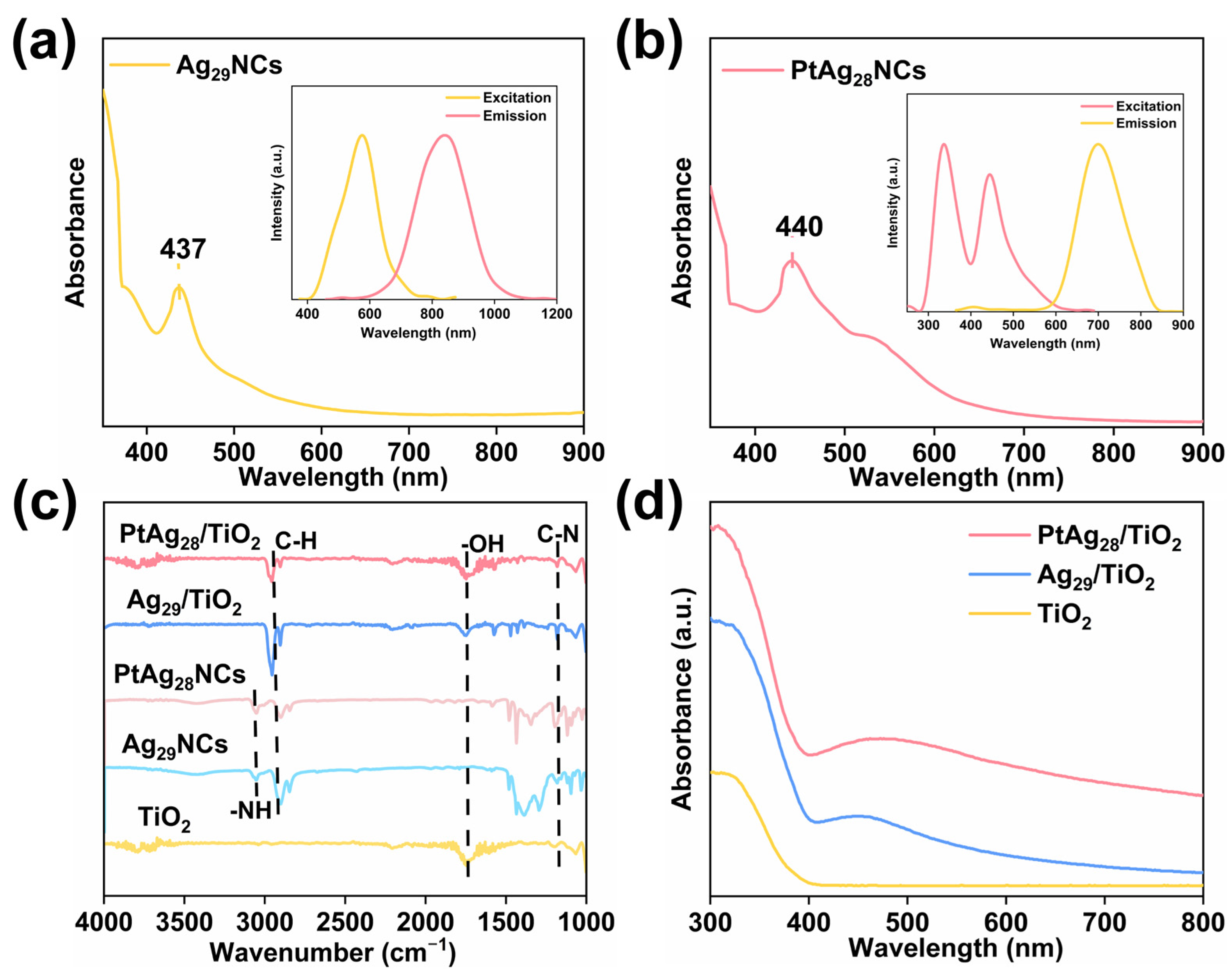
Thiolate-protected Ag29(S-Adm)18 and PtAg28(S-Adm)18 NCs were synthesized using the previously reported method [34,35]. The synthetic process involved precise control over reaction conditions to ensure the formation of nanoclusters with desired atomic compositions and structures. To confirm the atomic precision of Ag29 NCs and the successful incorporation of a single Pt atom into the cluster framework, their optical absorption properties were examined by ultraviolet–visible (UV–vis) spectroscopy and their purity was assessed via electrospray ionization mass spectrometry (ESI-MS). The as-synthesized Ag29 nanocluster exhibits a strong absorption signal at 437 nm in the UV–vis spectrum consistent with previous reports, making it an ideal platform for subsequent modifications (Figure 1a). By introducing a controlled amount of Pt precursor during the synthesis, PtAg28 NCs were successfully obtained. Compared with Ag29, PtAg28 NCs display characteristic absorption peaks at 440 nm and 540 nm, which agree well with previously reported PtAg28 NCs, confirming the successful preparation of bimetallic nanoclusters and their unique optical absorption properties (Figure 1b). And as illustrated in the diagram, we studied the fluorescence of an alloy nanocluster. The fluorescence emission spectrum of the Ag29 and PtAg28 nanoclusters exhibits high fluorescence intensity at 841 nm and 700 nm. Compared to Ag29 NCs, the excitation spectrum of PtAg28 nanoclusters exhibits two main peaks at 336 nm and 445 nm. Meanwhile, the emission peak has a 141 nm blueshift. This blueshift suggests that Pt doping alters the electronic transition pathways and effectively tunes the emission energy levels of the nanoclusters. The chemical compositions of Ag29 and PtAg28 were confirmed by electrospray ionization mass spectrometry (ESI-MS) in positive ion mode. In the ESI-MS spectrum of Ag29, a strong signal was observed at m/z 2396.8352 (Figure S1), corresponding to the [Ag29(S-Adm)18(PPh3)4]3+ species. Similarly, the ESI-MS spectrum of PtAg28 exhibited a prominent peak at m/z 3637.6377, which was assigned to [PtAg28(S-Adm)18(PPh3)4]2+ (Figure S2). The experimental and simulated isotopic distributions for both species exhibited an exact match, and the peak spacing corresponds precisely to the +3 and +2 charge states, further confirming the successful atom-level substitution of Ag by Pt and the high purity of the nanoclusters.
Efficient loading of these nanoclusters onto the TiO2 surfaces was achieved via an electrostatic adsorption method. The interaction between the nanoclusters and TiO2 was optimized by adjusting the deposition parameters, to ensure uniform distribution and strong adhesion [21]. To verify the adhesion of the clusters to TiO2, we performed Fourier transform infrared (FTIR) spectroscopy (Figure 1c). Compared to TiO2, the loaded photocatalytic materials exhibited new characteristic peaks centered at 2851 cm−1, which were attributed to C–H stretching vibrations corresponding to the C–H bonds of the S–Adm ligands in Ag29 and PtAg28 NCs. An enhanced peak centered at 2106 cm−1 was attributed to Ag-S stretching vibrations, which correspond to the C-S bonds of S-Adm in NCs as well as the Ag-S bonds formed with Ag. In the UV–vis DRS spectra (Figure 1d), Ag29/TiO2 and PtAg28/TiO2 exhibit enhanced visible-light absorption and retain absorption bands consistent with the free nanoclusters, confirming that the nanocluster structure is preserved on the TiO2 surface and contributes to noticeable sensitization.
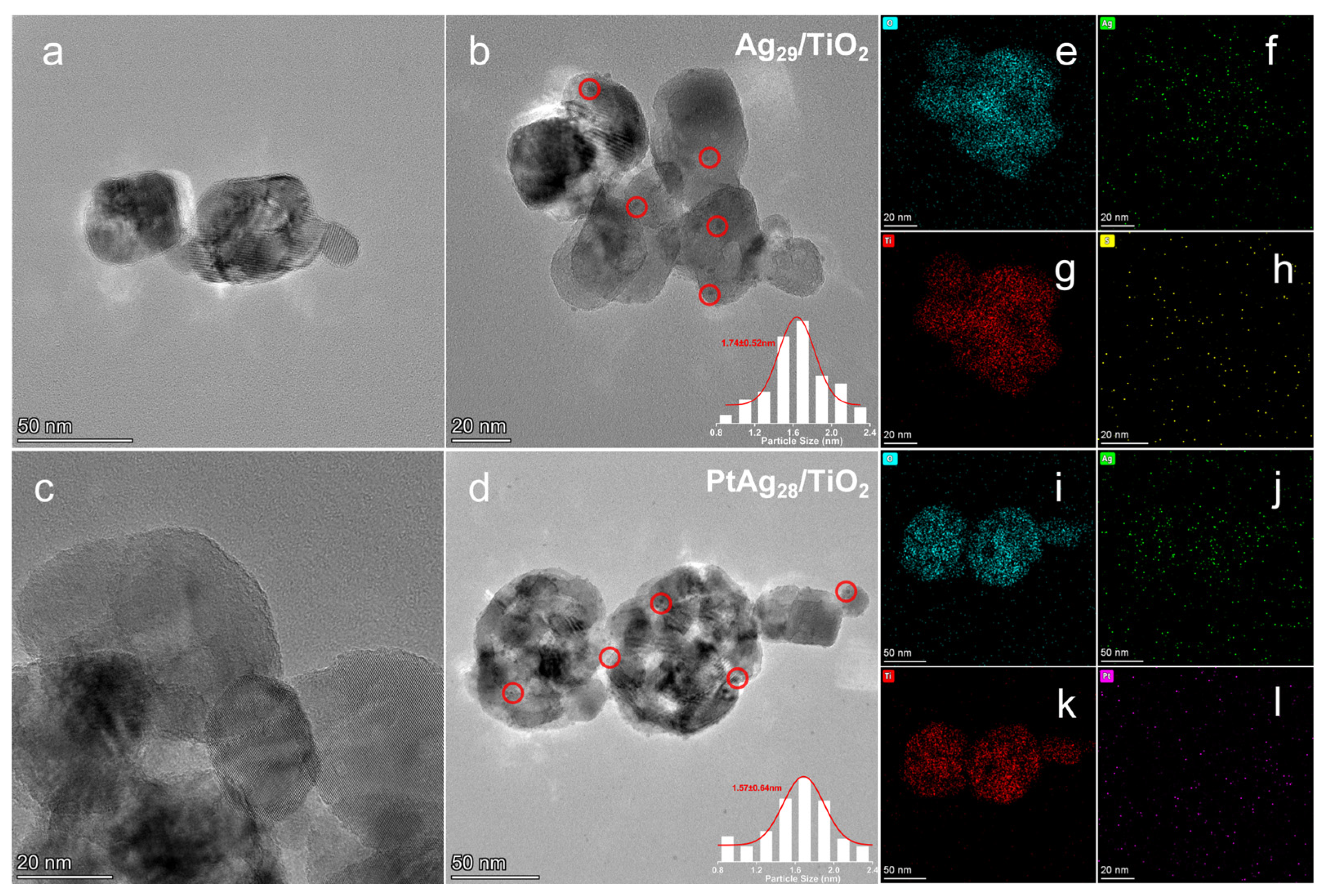
To further demonstrate the successful loading of metal nanoclusters, we analyzed the morphology of the photocatalyst using transmission electron microscopy (TEM). It can be observed that TiO2 exhibits a disc-like morphology within the 20–50 nm range (Figure 2a,c). By directly comparing the TEM images, it is evident that Ag29 and PtAg28 NCs are incorporated onto and supported on the external surface of the TiO2. In addition, no apparent aggregation and size change for metal NCs in Ag29/TiO2 and PtAg28/TiO2 can be observed (Figure 2b,d). The metal nanoclusters are nearly indistinguishable because of their tiny size and low loading. Analysis of the particle size distribution indicated that the diameters of Ag29 NCs and PtAg28 NCs were 1.61 nm and 1.57 nm, respectively. This finding is consistent with the lack of characteristic metal nanocluster peaks in the XRD pattern of the composite (Figure S3). Elemental mapping (Figure 2e–l) demonstrates homogeneous distribution of Ti, O, Ag, and S across the composite, while Pt is detected in trace amounts, supporting the retention of the single Pt atom within the nanocluster framework. Collectively, these results confirm that the nanoclusters are efficiently and stably immobilized on the TiO2 surface while preserving their atomically precise structures.

2.2. Charge Transfer in Z-Scheme Heterojunctions

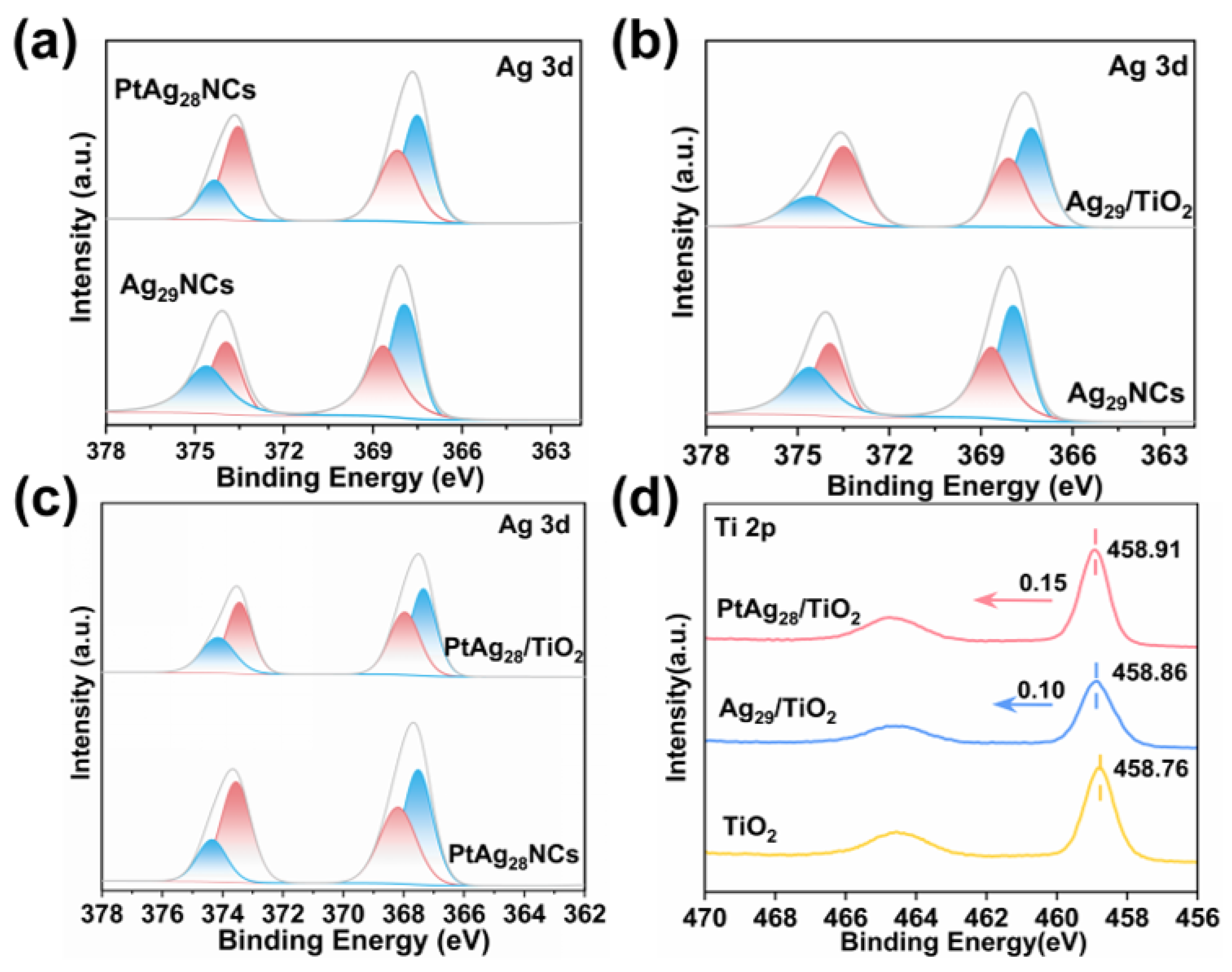
To further elucidate the chemical state of Ag29/TiO2 and the effect of Pt single-atom introduction on it, X-ray photoelectron spectroscopy (XPS) analysis was conducted. The full spectrum of the photocatalysts verifies the presence of Ag, O, and Ti in the samples (Figure S4a), with no detectable impurity peaks. The absence of Pt signal in the full spectrum can be attributed to its low content. Inductively coupled plasma (ICP) analysis of the optimal PtAg28/TiO2 photocatalyst reveals that the contents of Ag and Pt are 0.92 wt.% and 0.06 wt.%, respectively (Figure S4b). XPS fine spectra were used to investigate the charge transfer dynamics between Ti, Ag, and Pt. First, we investigated the effect of Pt single atoms on Ag in the metal NCs. Compared to the parent Ag29, PtAg28 NCs exhibit a negative shift in the Ag 3d XPS binding energy (Figure 3a). This is primarily attributed to Pt single atoms acting as doping sites, enabling more efficient electron capture from ligands or interfaces. Through Pt-Ag interactions, a portion of the electron density is delocalized onto surrounding Ag atoms [36,37,38]. A negative binding energy shift is observed in the Ag 3d signal for the Ag29/TiO2 composite relative to the Ag29 NCs, indicative of electron donation from TiO2 to the nanoclusters (Figure 3b). More importantly, this phenomenon is also confirmed in the PtAg28/TiO2 system, where a similar shift is detected compared to the pristine PtAg28 NCs (Figure 3c). When TiO2 comes into contact with NCs, the Ti 2p XPS signal of Ag29/TiO2 and PtAg28/TiO2 exhibits a shift to a higher binding energy than that of TiO2 (Figure 3d). These parallel results from the Ag29/TiO2 and PtAg28/TiO2 systems collectively demonstrate that electron transfer from TiO2 to the nanoclusters is a general interfacial interaction. This charge transfer pathway signifies the formation of downward band bending at the heterojunction interface in both composites, which provides the driving force for carrier separation [39]. The shift of these peaks is well proven in the Pt-Ag system; the perfect contact between Ag NCs and TiO2, and the probable formation of Z-scheme heterojunction, may be significant for the movement of photogenerated carriers [40,41,42].
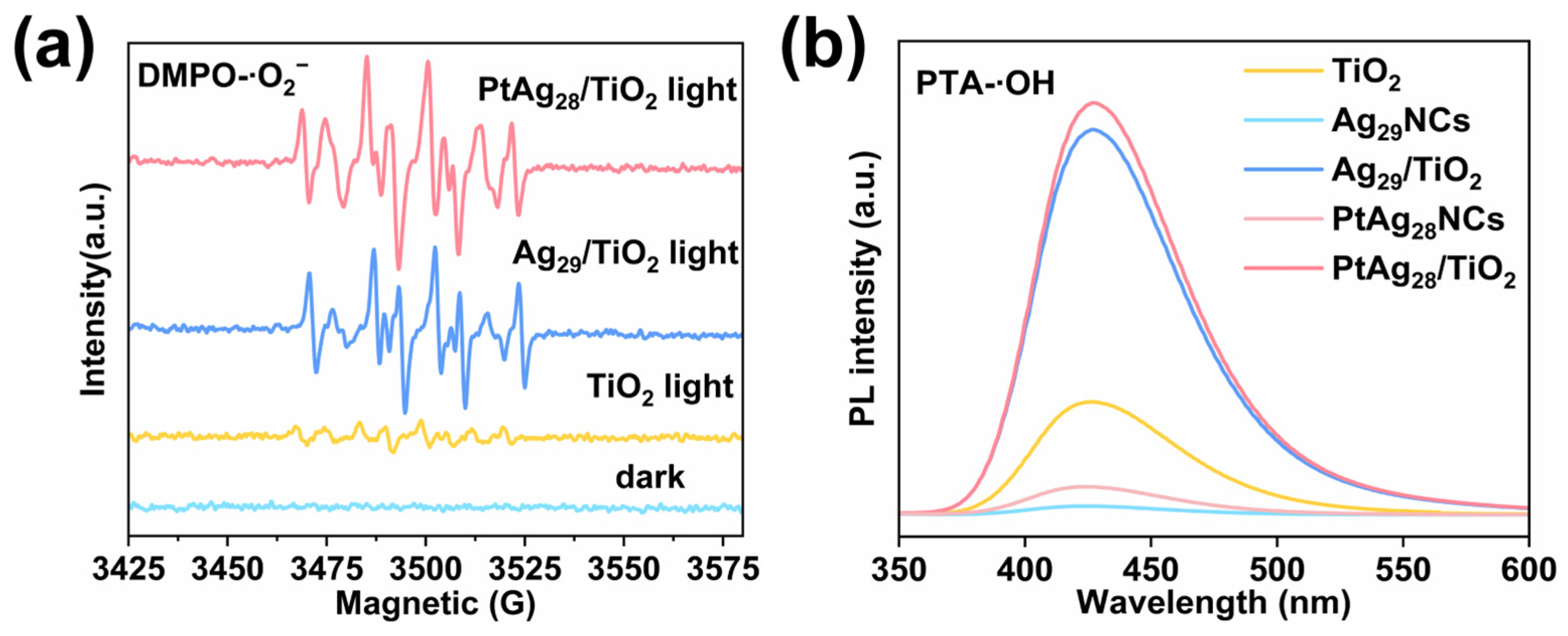
Furthermore, to further confirm the formation of the Z-scheme Ag/TiO2 composite heterojunction, in situ electron spin resonance (EPR) techniques were employed to monitor the capture of superoxide radicals (·O2) by 5,5′-dimethyl-1-pyrroline -N-oxide (DMPO) capturing ·O2 and in situ photoluminescence (PL) of terephthalic acid (PTA) capturing hydroxyl radicals (·OH). These were employed to investigate the radical generation behavior of the photocatalyst. Essentially, no DMPO-·O2 signal was detected under dark conditions, while the DMPO-·O2 signals of all samples were enhanced under irradiation (Figure 4a). The intensity of the ·O2-DMPO signal is obviously stronger for the PtAg28/TiO2 sample than for TiO2 and Ag29/TiO2, implying that more ·O2 radicals are generated in PtAg28 NCs. This indicates that the more negative LUMO position of PtAg28 NCs is conducive to reduction reactions. In the PL experiment, the PtAg28/TiO2 sample exhibited the highest PL intensity, indicating that this sample generated the most ·OH radicals during the photocatalytic process (Figure 4b). The ·OH signal detected in TiO2 is higher than that in the two Ag NCs. This indicates that the VB position of TiO2 is more suitable for oxidation reactions to occur. Both results occurred because more electrons were transferred to the metal NCs in the composites, which were then captured by O2 to produce ·O2, while more holes oxidized H2O on TiO2 to produce ·OH. Such coexistence is characteristic of a Z-scheme mechanism, where interfacial recombination eliminates low-energy charge carriers while retaining high-energy electrons and holes at their respective components. In contrast, a type-Il heterojunction would weaken either the oxidation or reduction capability due to charge migration to energetically less reactive band edges. Therefore, the electron–hole separation mode of the photocatalyst is inferred to the Z-scheme mechanism [43,44,45,46,47]. After doping with Pt atoms, there is an accumulation of electrons due to larger band bending. Meanwhile, the results of EPR and PL demonstrate that PtAg28/TiO2 exhibits enhanced separation of photo-excited charge carriers.
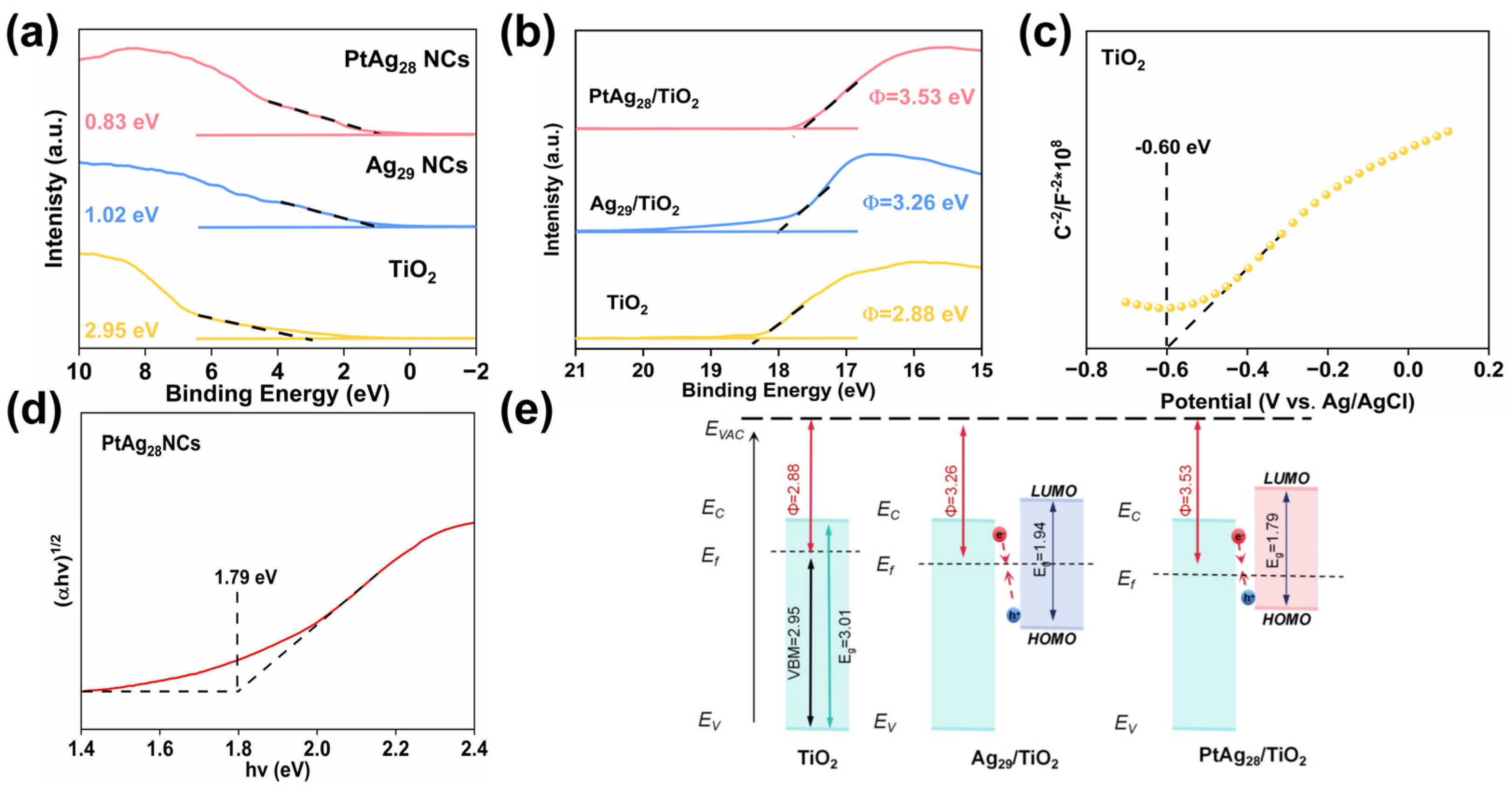
When NCs contact a semiconductor, the interaction between the two leads to charge redistribution at the interface due to the difference in their Fermi levels. So ultraviolet photoelectron spectroscopy (UPS) analysis was employed to determine the valence band maximum (VBM) and work function (Φ) variation in the heterojunction material. The valence band maxima for TiO2, Ag29/TiO2, and PtAg28/TiO2 were measured at 2.95 eV, 1.11 eV, and 0.83 eV, respectively (Figure 5a). The work functions of TiO2, Ag29/TiO2, and PtAg28/TiO2 were determined using the equation Φ = hν − Ecutoff (where Ecutoff is the secondary electron cutoff (SECO) position and hν is 21.2 eV), yielding values of 3.06, 3.26, and 3.53 eV, respectively (Figure 5b) [48]. The difference in work function (ΔΦ) between TiO2 and PtAg28/TiO2 (0.47 eV) is greater than the difference with Ag29/TiO2 (0.20 eV), indicating that Pt single-atom doping in PtAg28 NCs alters the energy level structure of Ag, reducing electron binding energy and conferring a stronger electron storage capacity than Ag29 NCs. This process is consistent with our XPS and EPR test results, increasing the electron density on the Ag surface and inducing downward bending of the energy bands in Ag29/TiO2 (Φ = 0.05 eV) and PtAg28/TiO2 (Φ = 0.15 eV). The conduction band position (CB) of TiO2 was determined via Mott–Schottky measurements conducted using a standard three-electrode system (Figure 5c). Additionally, the HOMO–LUMO gaps of TiO2, Ag29 NCs, and PtAg28 NCs were calculated from Tauc plots (Figure 5d, Figures S5 and S6) to be 3.0 eV, 1.95 eV, and 1.79 eV, respectively. The absolute vacuum energy is translated to redox potential versus the normal hydrogen electrode (NHE) [49]. The energy level alignment and charge transfer pathways within the heterojunction were further elucidated, as illustrated in Figure 5e.

2.3. Optical Performance and H2 Yield

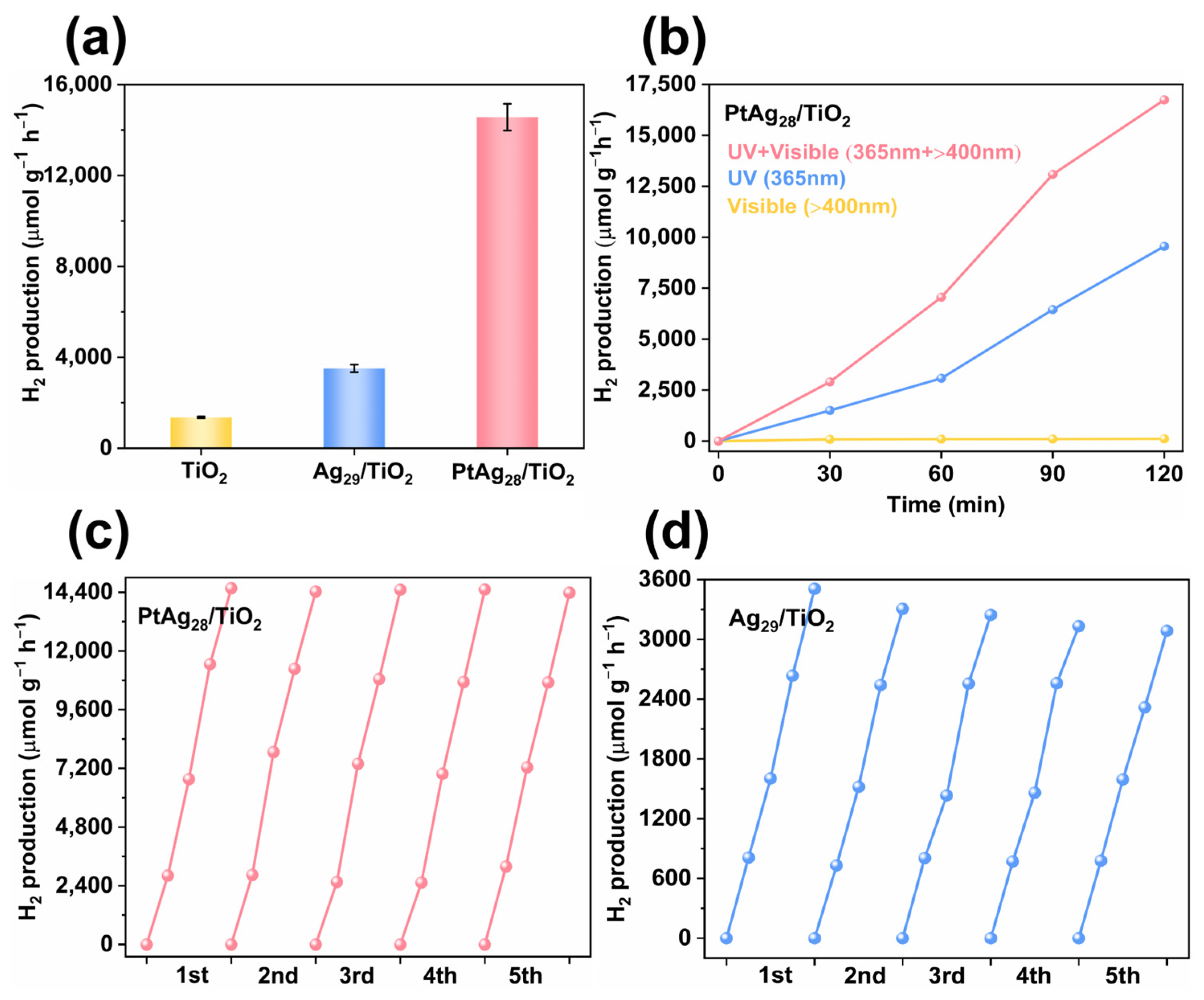
To evaluate the performance of the photocatalyst in water-splitting reactions, triethanolamine served as a sacrificial agent, and the H2 evolution rate was monitored across the full spectral range. Upon loading and increasing the nanoclusters amount, the activity gradually improves and reaches a maximum at a loading amount of 1 wt.% (Figure S7). The investigation into the effect of triethanolamine (TEA) concentration revealed that a value of 10 vol.% was optimal for maximizing the photocatalytic activity (Figure S8). As shown in Figure 6a, pristine TiO2 generates H2 of 1365 μmol g−1 h−1, while Ag29/TiO2 exhibits a roughly threefold enhancement in hydrogen production rate (3511 μmol g−1 h−1). Furthermore, the Pt-doping modification of Ag29 NCs yielded a PtAg28/TiO2 photocatalyst with an enhanced H2 evolution rate of 14,564 μmol g−1 h−1, which can be attributed to the high intrinsic activity of Pt cocatalysts and the electron transfer effect between Pt-Ag within the heterojunction material for HER. To verify the full-spectrum-driven photocatalytic reaction, we tested the effect of different wavelengths of light irradiation on the hydrogen evolution activity of the photocatalyst PtAg28/TiO2 (Figure 6b). First, no noticeable hydrogen evolution was observed when PtAg28 NCs were selectively excited with light of wavelengths longer than 400 nm, indicating that photo-excitation of the nanoclusters alone does not provide sufficient driving force for proton reduction. In contrast, pronounced hydrogen production was achieved under 365 nm irradiation, where TiO2 is effectively excited and abundant photogenerated holes are generated in its valence band. Notably, if a conventional Type-Il heterojunction were operative, visible-light excitation of the nanoclusters would be expected to drive electron transfer to the conduction band of TiO2 and thus enable hydrogen evolution; however, this behavior was not observed. Instead, the clear wavelength-dependent response demonstrates that hydrogen evolution requires simultaneous participation of both components, thereby supporting a direct Z-scheme heterojunction in which photogenerated electrons in the LUMO of the nanoclusters and holes in the valence band of TiO2 are retained as the active redox species. The reaction results are consistent with the ·OH species capture phenomenon observed in the in situ PL experiment described on the previous page, as well as the findings of greater band bending. To further compare the redox capabilities of different photocatalysts, we employed a COD (chemical oxygen demand) analyzer and chromatography-mass spectrometry (GC-MS) to determine their COD degradation rates in reaction solutions and analyze the oxidation product species, respectively. Notwithstanding a progressively accelerating TEA degradation rate over time, the PtAg28/TiO2 catalyst consistently delivered the highest COD removal and H2 yield among all samples after two hours of reaction (Figure S9). GC-MS results reveal a suite of TEA degradation intermediates, tracking the pathway from triethylamine to diethylamine, methyldiethylamine, dimethylethanolamine, and ethylene glycol (Figure S11a,b). This succession of products demonstrates the stepwise breakdown of the TEA carbon skeleton via oxidation, yielding simpler organic acids, CO2, and H2O [50,51]. Subsequently, stability tests were carried out for photocatalysts and the results are shown in Figure 6c,d. Notably, the H2 evolution rate of PtAg28/TiO2 remained stable without noticeable decrease during a 10 h continuous operation or after five successive cycles. This performance stands in sharp contrast to the Ag29/TiO2 catalyst, which suffered a 12% activity loss under the same testing conditions, thereby highlighting the exceptional stability imparted by the Pt-doped structure. The stability of PtAg28/TiO2 stems from Pt atoms occupying the core center of nanoclusters, forming more stable bond lengths with surrounding Ag atoms. This prevents decomposition or agglomeration of the photocatalyst during light cycles caused by core structural distortion.
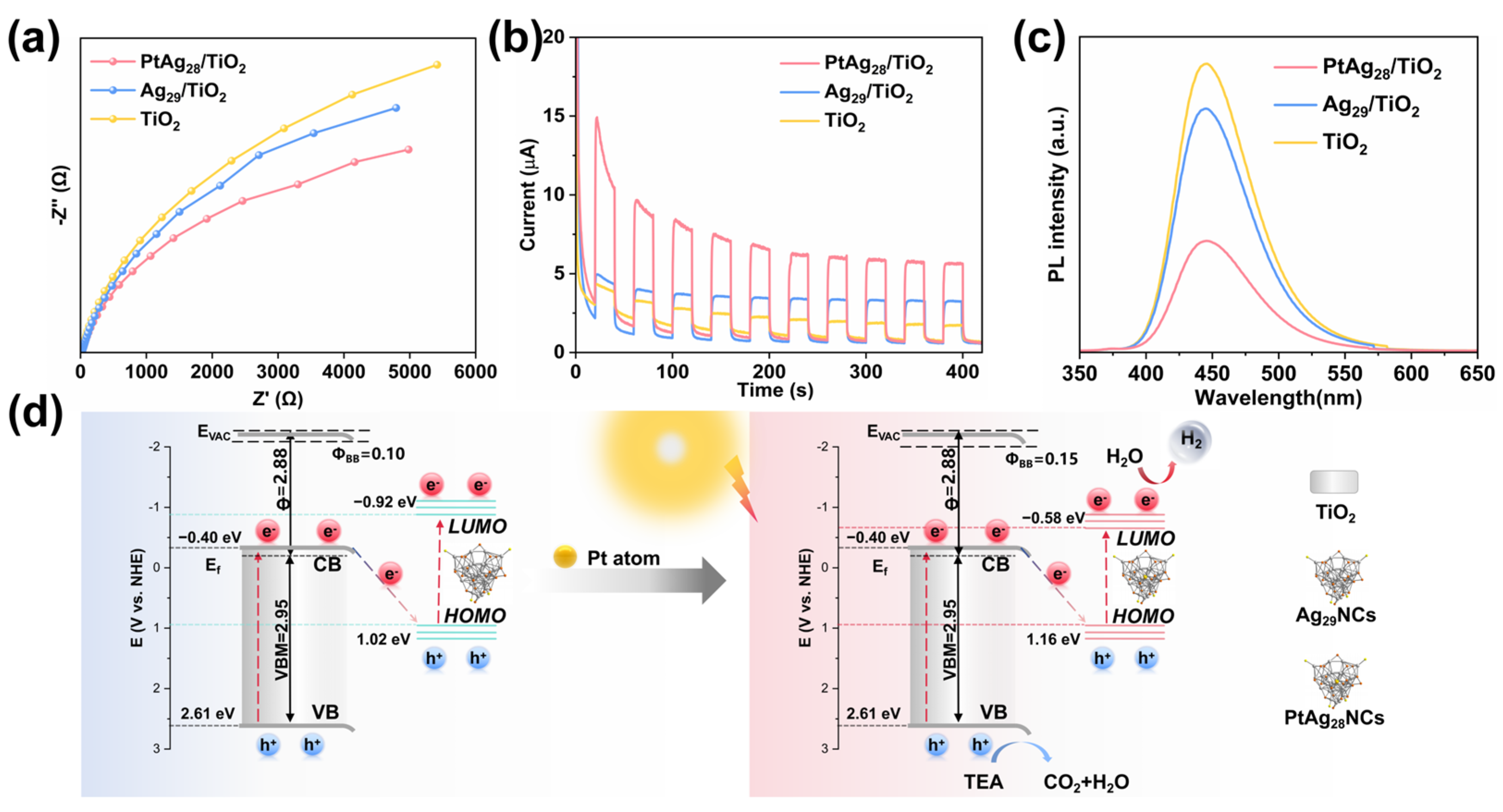
Based on the above results, the exceptional structural stability of PtAg28/TiO2, which originates from the rigid Pt-centered kernel, effectively mitigates structural distortion during photocatalysis. This remarkable enhancement stems from the synergistic combination of two factors: the intrinsic structural stability provided by the Pt-centered kernel and the facilitated interfacial charge separation [52]. The robust structure and greater band bending of PtAg28 NCs suppress charge recombination at the NCs/TiO2 interface, enabling separated charges to be sustained for longer periods [11,53]. To further substantiate this conclusion, we evaluated the photoelectrochemical properties of the catalysts. The transient photocurrent response and electrochemical impedance spectroscopy (EIS) Nyquist plots were measured. As anticipated, the PtAg28/TiO2 electrode generated the strongest and most stable photocurrent density under simulated sunlight irradiation, demonstrating the most efficient generation and separation of charge carriers (Figure 7a). Consistently, its EIS Nyquist plot displayed the smallest arc radius, indicating the lowest charge transfer resistance at the electrode–electrolyte interface and the most rapid interfacial reaction kinetics (Figure 7b). Furthermore, steady-state photoluminescence (PL) spectroscopy provided complementary evidence. The PtAg28/TiO2 composite exhibited the weakest PL emission intensity among the three samples (Figure 7c). The quenching of the PL signal unequivocally confirms the suppression of radiative recombination, as the photogenerated carriers are more effectively separated and utilized in photocatalytic reactions rather than recombining to emit light. Time-resolved photoluminescence (TRPL) spectroscopy provides direct kinetic evidence for the enhanced charge separation (Figure S12). The average fluorescence lifetime of the Ag29/TiO2 composite (0.707 ns) is significantly shorter than that of pristine TiO2 (1.434 ns), indicating effective interfacial charge transfer that quenches the TiO2 emission, consistent with the formation of a charge-transfer pathway. Crucially, the PtAg28/TiO2 exhibits a markedly recovered and prolonged lifetime of 1.191 ns. This demonstrates that the Pt-doped interface establishes a more efficient charge separation channel. Within the framework of a direct Z-scheme mechanism, the optimized interface facilitates rapid recombination of useless charges, thereby effectively suppressing the radiative recombination of the useful high-energy carriers and leading to the observed longer apparent PL lifetime. This result correlates directly with its superior photocatalytic hydrogen evolution performance.
The photocatalytic mechanism for H2 evolution over the PtAg28/TiO2 composite is illustrated in Figure 7d. The incorporation of a single Pt atom into the Ag29 framework induces profound electronic and structural optimizations. Crucially, Pt doping narrows the HOMO-LUMO gap from 1.94 eV (Ag29 NCs) to 1.79 eV (PtAg28 NCs), thereby enhancing visible-light harvesting. More importantly, it causes a significant negative shift of the LUMO from −0.83 eV to −0.96 eV (vs. NHE), endowing the nanocluster with substantially stronger reducing power for proton reduction. This intrinsic property ensures that photogenerated electrons persist long enough to engage in surface reactions. At the interface, the PtAg28 NCs induce a larger downward band bending (ΦBB = 0.15) on the TiO2 surface compared to their Ag29 counterpart, creating a stronger driving force for charge separation. These synergistic advantages collectively promote a direct Z-scheme charge transfer pathway. The electrons in the CB band of TiO2 efficiently recombine with the holes in the HOMO of the PtAg28 NCs. This process preserves the high-energy electrons in the negatively shifted LUMO of the PtAg28 NCs for H2 evolution, while the powerful holes in TiO2 oxidize the sacrificial agent. Moreover, the introduction of the Pt core has reinforced the structure of Ag29 NCs. The stable core, enhanced recovery capability, and excellent interfacial charge separation collectively contribute to the exceptional photocatalytic hydrogen production activity of the PtAg28/TiO2 catalyst.

3. Discussion

This study demonstrates that the superior hydrogen evolution performance of PtAg28/TiO2 arises from the synergistic effects of Pt single-atom doping. Pt doping narrows the HOMO-LUMO gap and enhances the reducing power of the nanocluster. More importantly, it strengthens the interfacial band bending with TiO2, establishing a direct Z-scheme charge transfer pathway. This mechanism effectively separates photogenerated carriers: high-energy electrons in PtAg28 drive proton reduction, while holes in TiO2 oxidize the sacrificial agent. Consequently, the composite achieves a high H2 evolution rate of 14,564 μmol g−1 h−1 and excellent stability, demonstrating the critical role of atomic-level engineering in photocatalyst design.

4. Materials and Methods

4.1. Chemicals and Reagents

Titanium dioxide (TiO2, P25), silver nitrate (AgNO3), 1-Adamantanethiol (C10H16S), triphenylphosphine (C18H15P), tetraphenylphosphonium bromide (C24H20BrP), dichloromethane (CH2Cl2), methanol (CH3OH), ethanol (CH3CH2OH), triethanolamine (C6HNO3), anhydrous sodium sulfate (Na2SO4), and Nafion reagent (C7HF13O5S·C2F4). The purity of all chemicals was chemical grade.

4.2. Synthesis of Photocatalysts

4.2.1. Synthesis of Ag29 NCs

In a 20 mL amber glass vial, 94 mg of silver nitrate (AgNO3) was dissolved in a mixture of 5 mL methanol and 10 mL ethanol under stirring. Then, 50 mg of 1-adamantanethiol (S-Adm) was added under vigorous stirring at 1200 rpm, resulting in a color change from colorless and transparent to milky white. After stirring vigorously for 20 min, 100 mg of triphenylphosphine (PPh3) was introduced and stirring was continued for another 15 min, during which the solution turned from milky white back to colorless and transparent. Next, 10 mg of sodium borohydride (dissolved in 1 mL of ice-cold water) was added. The colorless transparent solution immediately turned yellow and gradually deepened to a dark brown over time. The reaction mixture was aged at ambient conditions for 6 h. The supernatant was then subjected to rotary evaporation to obtain a solid product, which was washed multiple times with n-hexane to ensure complete removal of any unreacted compounds. Finally, the purified cluster was dried under vacuum overnight to afford the target product, Ag29(S-Adm)18.

4.2.2. Synthesis of PtAg28 NCs

In a 20 mL amber glass vial, dissolve 22 mg of AgNO3 and 8 mg of potassium tetrachloroplatinate (K2PtCl4) in 2 mL of methanol under vigorous stirring at 1200 rpm. After complete dissolution, introduce 33 mg of 1-adamantanethiol (S-Adm) dissolved in 1 mL of methanol. Continue stirring vigorously at 1200 rpm for 30 min. Then, add 150 mg of triphenylphosphine (PPh3) dissolved in 2 mL of dichloromethane (CH2Cl2) and stir for an additional 10 min. Subsequently, add 10 mL of CH2Cl2 and stir for another 10 min. Next, add 4 mg of tetraphenylphosphonium bromide (PPh4Br) dissolved in 0.5 mL of methanol. After 5 min, introduce 9 mg of sodium borohydride (NaBH4) dissolved in 1 mL of ice-cold water. Allow the reaction mixture to age at room temperature for 6 h. The supernatant is then rotary evaporated to obtain a solid product, which is washed multiple times with n-hexane to remove any unreacted compounds completely. The purified cluster is dried under vacuum overnight to afford the final product, PtAg28(S-Adm)18.

4.2.3. Synthesis of Ag NCs/TiO2

Ag NCs/TiO2 was prepared via electrostatic adsorption. First, 2.5 mg of the cluster powder was dissolved in 1 mL of methanol and then vigorously stirred into a TiO2 dispersion (50 mg of TiO2 in 25 mL of methanol). The mixture was sealed and stirred overnight. During this period, the light brown color of the solution faded, and the originally colorless titanium dioxide turned dark brown, indicating complete adsorption of the clusters onto the TiO2 support. The solid was collected by centrifugation, washed several times with ethanol, and dried under vacuum.

4.3. Characterization

The samples’ crystal phase structures were analyzed by XRD-2000 X-ray diffraction (XRD, XRD-2000, Dandong Tongda Science & Technology Co., Ltd., Dandong, Liaoning, China). The structure of the catalyst was observed by transmission electron microscopy (TEM, Talos F200X, Thermo Fisher Scientific, Waltham, MA, USA). Analysis of valence and surface elements of samples was conducted by X-ray photoelectron spectroscopy, which was mainly used to analyze the degree of energy band bending and electron flow direction (XPS, PHI5400, Physical Electronics Inc., Chanhassen, MN, USA). UV–vis diffuse reflectance spectroscopy (DRS) was performed by a UV–vis spectrophotometer using Ba2SO4 particles as a reference sample, which was mainly for analyzing the characteristic peaks of the sample and verifying whether the sample was prepared successfully (UV–vis, Shimadzu UV-2600, Shimadzu Corporation, Kyoto, Japan). Electrospray ionization (ESI) time-of-flight mass spectra were obtained from an AB Sciex Triple TOF 5600+ system. Photoluminescence spectra were obtained by fluorescence spectrometry, which was mainly for the analysis of electron–hole complexes in samples (PL, Shimadzu-RF-6000, Shimadzu Corporation, Kyoto, Japan). Ultraviolet photoelectron spectroscopy was performed using the He I UV source, which was mainly used for sample energy band structure analysis (UPS, Thermo Fisher Scientific, East Grinstead, UK). Analysis of the surface structure of samples was conducted by electron scanning electron microscopy (SEM, JEOL Ltd., Tokyo, jSM-6460, Japan).
The electrochemical workstation was used to test the photoelectrochemical properties of catalysts, and was mainly used to analyze the carrier transport efficiency of the samples (CHI660, CH Instruments Inc., Shanghai, China). The FTO glass coated with catalyst was used as the working electrode. First, 1 mL of ethanol, 80 μL of Nafion reagent, and 5 mg of TiO2 (p25) were mixed and sonicated for 30 min, then dispersed on 0.25 cm2 of FTO glass by spin-coating method. The sensitization process was conducted by immersing a TiO2 film electrode in Ag NC aqueous solution for 24 h. The photoelectrochemical test took place in a three-electrode system with 0.5 M aqueous Na2SO4 solution as electrolyte, and the Ag/AgCl electrode and Pt plate as the reference electrode and counter electrode, respectively.

4.4. Free Radical Capture and Identification

The generation of hydroxyl radicals was indirectly confirmed by measuring the fluorescence spectrum of 2-hydroxy terephthalic acid at an emission wavelength of 435 nm using a fluorescence spectrophotometer (Shimadzu-RF-6000, Shimadzu Corporation, Kyoto, Japan). Specifically, 10 mg of catalyst was added to a solution containing 2 × 10⁻³ mol NaOH and 5 × 10⁻⁴ mol terephthalic acid. The mixture was irradiated under simulated sunlight for 20, 40, 60, 80, and 100 min, respectively. After irradiation, the solution was filtered through a 0.2 μm membrane, and the concentration of 2-hydroxy terephthalic acid was quantified by fluorescence measurement at an excitation wavelength of 315 nm.
For electron spin resonance (EPR) analysis, a 5 mg sample was dispersed in 0.5 mL methanol, mixed with 10 μL of 5,5-dimethyl-1-pyrroline N-oxide (DMPO) as a spin-trapping agent, irradiated for 5 min, and then measured. The generation of superoxide radicals (·O2−) was investigated by performing full-spectrum excitation EPR measurements on TiO2, Ag29/TiO2, and PtAg28/TiO2 under both dark and illuminated conditions.

4.5. Photocatalytic H2 Generation Tests

A total of 10 mg of the chemical powder was suspended in a mixture of 73 mL of distilled water and 7 mL of triethanolamine. The air was evacuated by passing N2 gas and stirring continuously for 15 min prior to the reaction. During the reaction, the hydrogen production vial was maintained at 25 °C using a circulating water bath throughout the entire irradiation period. The reaction vial was irradiated with a 100 mW-cm−1 xenon lamp (CHFXM500, Beijing Porphyry Technology Co., Ltd., Beijing, China) and a 500 μL volume of gas in the reaction vial was extracted using a microsyringe, and the amount of hydrogen production was tested in gas chromatography. The photocatalytic hydrogen evolution was carried out under continuous irradiation for a total duration of 2 h. Hydrogen yield in the conversion gas chromatography measurement (GC-9890B, for Shanghai Linghua Instrument Co., Ltd., Shanghai, China) was measured by hydrogen production under the conditions of a TCD, thermal conductivity detector, column with a 5 A molecular sieve, column chamber temperature of 50 °C, inlet temperature of 100 °C, detector temperature set to 80 °C, and carrier gas flow rate of 20 mL-min−1 during the collection period, using N2 gas as the carrier gas yield measures the reduction performance and activity of the catalyst in photocatalytic engineering.

4.6. Determination of COD

Samples were collected from the photocatalytic reaction at 0, 30, 60, and 120 min. Each sample was filtered three times through a 0.2 μm membrane. Then, 2.5 mL of the filtrate was transferred to a digestion tube, mixed with digestion solution, and digested at 165 °C for 10 min. After digestion, the tube was removed and cooled in air for 2 min. Next, 2.5 mL of deionized water was added, and the mixture was shaken thoroughly, followed by cooling in water for another 2 min. The absorbance of the solution was measured using a portable COD analyzer with deionized water as the blank. The COD value of the wastewater was determined based on a pre-established calibration curve.
COD   degradation   rate = COD before COD after COD before
where CODbefore is the COD content prior to reaction, and CODafter is the COD content after reaction.

5. Conclusions

In summary, both Ag29 and Pt-doped PtAg28 NCs were successfully immobilized onto TiO2 via electrostatic adsorption, forming a Z-scheme heterojunction system that effectively suppresses charge recombination. XPS and UPS studies reveal the band structures and charge transfer pathways of the different materials. Pt single-atom doping increases the electron density on the Ag surface in PtAg28/TiO2. Bonding with TiO2 induces greater band bending, providing a higher driving force for carrier separation and effectively suppressing charge recombination. Photoelectrochemical and PL tests confirm that the PtAg28/TiO2 composite exhibits superior charge separation efficiency and excellent stability, demonstrating optimal activity, with an H2 yield of 14,564 μmol g−1 h−1. This represents a 4.1-fold increase over Ag29/TiO2 and a 10.7-fold increase over pure TiO2. The composite’s exceptional stability underscores the pivotal role of the central Pt single atoms in the photocatalysis of metallic nanocrystals. This advancement is significant in the preparation of structurally precise and customizable heterogeneous photocatalysts.

Supplementary Materials

The following supporting information can be downloaded at: https://www.mdpi.com/article/10.3390/inorganics14020035/s1, Figure S1. ESI-MS spectrum of [Ag29(S-Adm)18(PPh3)4]2+. Insets show the experimental (pink) and theoretical (yellow) isotopic patterns; Figure S2. ESI-MS spectrum of [PtAg28(S-Adm)18(PPh3)4]2+. Insets show the experimental (yellow) and theoretical (pink) isotopic patterns; Figure S3. Powder XRD patterns of TiO2, Ag29/TiO2 and PtAg28/TiO2; Figure S4. (a) Comprehensive XPS spectrum of TiO2, Ag29/TiO2 and PtAg28/TiO2; (b) ICP test results of PtAg28/TiO2; Figure S5. Tauc plot of TiO2; Figure S6. Tauc plot of Ag29 NCs; Figure S7. Energy level alignment and charge transfer mechanism of (a) Ag29/TiO2 and (b) PtAg28/TiO2 heterojunctions; Figure S8. Photocatalytic hydrogen production rates of PtAg28/TiO2 at different platinum contents; Figure S9. Photocatalytic hydrogen production rates of TiO2, Ag29/TiO2 and PtAg28/TiO2 under different TEA to water ratios; Figure S10. Plot of COD degradation rate and hydrogen production rate of TEA by Ag29/TiO2 and PtAg28/TiO2; Figure S11. a chromatograms and b mass spectra of the reaction products by gas chromatography-mass spectrometry (GC-MS), Figure S12. Time-resolved PL spectra (λex = 460 nm) for TiO2, Ag29/TiO2 and PtAg28/TiO2.

Author Contributions

Conceptualization, X.-H.L. and R.Y.; methodology, X.-H.L. and Z.L.; software, R.Y. and Z.R.; validation, X.-H.L., R.Y., and Z.L.; formal analysis, X.-H.L.; investigation, X.-H.L. and Z.R.; resources, N.Z. and J.W.; data curation, R.Y., Z.L., and J.W.; writing—original draft preparation, X.-H.L.; writing—review and editing, X.-H.L., J.W., and N.Z.; visualization, X.-H.L. and Z.R.; supervision, X.-H.L., J.W., and N.Z.; project administration, X.-H.L., Z.L., and N.Z.; funding acquisition, Z.L. and Z.R. All authors have read and agreed to the published version of the manuscript.

Funding

The National Natural Science Foundation of China (52206277), the China Postdoctoral Science Foundation (2022MD723821), and the Yulin Science and Technology Project of China (2025-CXY-019).

Data Availability Statement

The original contributions presented in this study are included in the article. Further inquiries can be directed to the corresponding author.

Conflicts of Interest

Author Zhi Li was employed by the Shaanxi Coal Selling and Transportation Group Yulin Sales Co., Ltd. Authors Nailong Zhao and Zhilli Ren were employed by the company Shaanxi Environmental Protection Co., Ltd. The remaining authors declare that the research was conducted in the absence of any commercial or financial relationships that could be construed as a potential conflict of interest.

Abbreviations

The following abbreviations are used in this manuscript:
NCsnanoclusters
LUMOthe lowest unoccupied molecular orbital
HOMOthe highest occupied molecular orbital
CODchemical oxygen demand

References

  1. Lv, J.; Xie, J.; Mohamed, A.G.A.; Zhang, X.; Feng, Y.; Jiao, L.; Zhou, E.; Yuan, D.; Wang, Y. Solar Utilization beyond Photosynthesis. Nat. Rev. Chem. 2023, 7, 91–105. [Google Scholar] [CrossRef]
  2. Hu, Q.; Chen, S.; Wågberg, T.; Zhou, H.; Li, S.; Li, Y.; Tan, Y.; Hu, W.; Ding, Y.; Han, X. Developing Insoluble Polyoxometalate Clusters to Bridge Homogeneous and Heterogeneous Water Oxidation Photocatalysis. Angew. Chem. Int. Ed. 2023, 62, e202303290. [Google Scholar] [CrossRef] [PubMed]
  3. Kamat, P.V.; Sivula, K. Celebrating 50 Years of Photocatalytic Hydrogen Generation. ACS Energy Lett. 2022, 7, 3149–3150. [Google Scholar] [CrossRef]
  4. Li, R.; Luan, J.; Zhang, Y.; Jiang, L.; Yan, H.; Chi, Q.; Yan, Z. A Review of Efficient Photocatalytic Water Splitting for Hydrogen Production. Renew. Sustain. Energy Rev. 2024, 206, 114863. [Google Scholar] [CrossRef]
  5. Liang, H.; Liu, B.-J.; Tang, B.; Zhu, S.-C.; Li, S.; Ge, X.-Z.; Li, J.-L.; Zhu, J.-R.; Xiao, F.-X. Atomically Precise Metal Nanocluster-Mediated Photocatalysis. ACS Catal. 2022, 12, 4216–4226. [Google Scholar] [CrossRef]
  6. Yang, D.; Wang, J.; Wang, Q.; Yuan, Z.; Dai, Y.; Zhou, C.; Wan, X.; Zhang, Q.; Yang, Y. Electrocatalytic CO2 Reduction over Atomically Precise Metal Nanoclusters Protected by Organic Ligands. ACS Nano 2022, 16, 15681–15704. Available online: https://pubs.acs.org/doi/full/10.1021/acsnano.2c06059 (accessed on 31 August 2025). [CrossRef]
  7. Bodiuzzaman, M.; Murugesan, K.; Yuan, P.; Maity, B.; Sagadevan, A.; Malenahalli H, N.; Wang, S.; Maity, P.; Alotaibi, M.F.; Jiang, D.; et al. Modulating Decarboxylative Oxidation Photocatalysis by Ligand Engineering of Atomically Precise Copper Nanoclusters. J. Am. Chem. Soc. 2024, 146, 26994–27005. [Google Scholar] [CrossRef]
  8. Bera, D.; Mahata, S.; Biswas, M.; Kumari, K.; Rakshit, S.; Nonappa; Ghosh, S.; Goswami, N. Efficient Photocatalytic Hydrogen Production Using In-Situ Polymerized Gold Nanocluster Assemblies. Small 2024, 21, e2406551. [Google Scholar] [CrossRef]
  9. Zheng, Z.-H.; Xiao, F.-X.; Xu, Y.-J. Atomically Precise Alloy Nanoclusters Steering Photocatalysis. Small 2025, 21, e2505282. [Google Scholar] [CrossRef] [PubMed]
  10. Liu, L.; Corma, A. Bimetallic Sites for Catalysis: From Binuclear Metal Sites to Bimetallic Nanoclusters and Nanoparticles. Chem. Rev. 2023, 123, 4855–4933. [Google Scholar] [CrossRef] [PubMed]
  11. Wang, H.; Zhang, X.; Zhang, W.; Zhou, M.; Jiang, H. Heteroatom-doped Ag25 Nanoclusters Encapsulated in Metal–Organic Frameworks for Photocatalytic Hydrogen Production. Angew. Chem. Int. Ed. 2024, 63, e202401443. [Google Scholar] [CrossRef] [PubMed]
  12. Liu, X.; Cai, X.; Zhu, Y. Catalysis Synergism by Atomically Precise Bimetallic Nanoclusters Doped with Heteroatoms. Acc. Chem. Res. 2023, 56, 1528–1538. [Google Scholar] [CrossRef]
  13. Bootharaju, M.S.; Lee, C.W.; Deng, G.; Kim, H.; Lee, K.; Lee, S.; Chang, H.; Lee, S.; Sung, Y.-E.; Yoo, J.S.; et al. Atom-Precise Heteroatom Core-Tailoring of Nanoclusters for Enhanced Solar Hydrogen Generation. Adv. Mater. 2023, 35, e2207765. [Google Scholar] [CrossRef]
  14. van der Linden, M.; van Bunningen, A.J.; Amidani, L.; Bransen, M.; Elnaggar, H.; Glatzel, P.; Meijerink, A.; de Groot, F.M.F. Single Au Atom Doping of Silver Nanoclusters. ACS Nano 2018, 12, 12751–12760. [Google Scholar] [CrossRef]
  15. Pniakowska, A.; Ramankutty, K.K.; Obstarczyk, P.; Bakulić, M.P.; Maršić, Ž.S.; Bonačić-Koutecký, V.; Bürgi, T.; Olesiak-Bańska, J. Gold-Doping Effect on Two-Photon Absorption and Luminescence of Atomically Precise Silver Ligated Nanoclusters. Angew. Chem. Int. Ed. 2022, 61, e202209645. [Google Scholar] [CrossRef]
  16. Han, M.; Guo, M.; Yun, Y.; Xu, Y.; Sheng, H.; Chen, Y.; Du, Y.; Ni, K.; Zhu, Y.; Zhu, M. Effect of Heteroatom and Charge Reconstruction in Atomically Precise Metal Nanoclusters on Electrochemical Synthesis of Ammonia. Adv. Funct. Mater. 2022, 32, 2202820. [Google Scholar] [CrossRef]
  17. Nawaz, T.; Ahmad, M.; Ansari, M.Z.; Hussain, I.; Chen, X.; Liu, L.-J.; Walia, R.; Low, K.H.; Zhuang, S.; Zhang, K.; et al. Structural Study of Atomically Precise Doped Au38−xAgx NCs@ZIF-8 Electrode Material for Energy Storage Application. Chem. Eng. J. 2023, 468, 143575. [Google Scholar] [CrossRef]
  18. Yoo, S.; Kim, D.; Deng, G.; Chen, Y.; Lee, K.; Yoo, S.; Liu, X.; Tang, Q.; Hwang, Y.J.; Hyeon, T.; et al. Impact of Heterocore Atoms on CO2 Electroreduction in Atomically Precise Silver Nanoclusters. J. Am. Chem. Soc. 2025, 147, 12546–12554. [Google Scholar] [CrossRef]
  19. Du, W.; Jiang, L.; Jin, S.; Zhu, M. Chiral Assembly of Atomically Precise Metal Nanoclusters. Coord. Chem. Rev. 2026, 548, 217232. [Google Scholar] [CrossRef]
  20. Alhilaly, M.J.; Huang, R.-W.; Naphade, R.; Alamer, B.; Hedhili, M.N.; Emwas, A.-H.; Maity, P.; Yin, J.; Shkurenko, A.; Mohammed, O.F.; et al. Assembly of Atomically Precise Silver Nanoclusters into Nanocluster-Based Frameworks. J. Am. Chem. Soc. 2019, 141, 9585–9592. [Google Scholar] [CrossRef] [PubMed]
  21. Liu, X.-H.; He, Y.; Li, Z.; Cheng, A.-H.; Song, Z.; Yu, Z.-X.; Chai, S.; Cheng, C.; He, C. Size Transformation of Au Nanoclusters for Enhanced Photocatalytic Hydrogen Generation: Interaction Behavior at Nanocluster/Semiconductor Interface. J. Colloid Interface Sci. 2023, 651, 368–375. [Google Scholar] [CrossRef]
  22. Yan, X.; Fu, X.; Xiao, F. Filling the Gap: Atomically Precise Metal Nanoclusters-induced Z-scheme Photosystem toward Robust and Stable Solar Hydrogen Generation. Adv. Funct. Mater. 2023, 33, 2303737. [Google Scholar] [CrossRef]
  23. Wei, Z.-Q.; Hou, S.; Lin, X.; Xu, S.; Dai, X.-C.; Li, Y.-H.; Li, J.-Y.; Xiao, F.-X.; Xu, Y.-J. Unexpected Boosted Solar Water Oxidation by Nonconjugated Polymer-Mediated Tandem Charge Transfer. J. Am. Chem. Soc. 2020, 142, 21899–21912. [Google Scholar] [CrossRef] [PubMed]
  24. Liu, Y.; Zheng, X.; Liu, X.; Gao, T.; Pinna, N.; Wang, Y. Copper Doping Enhances the Activity and Selectivity of Atomically Precise Ag44 Nanoclusters for Photocatalytic CO2 Reduction. Adv. Funct. Mater. 2025, e03708. [Google Scholar] [CrossRef]
  25. Xu, H.; Liu, X.; Zhou, G.; Bi, C.; Liu, Q.; Jiang, W.; Wang, B.; Zhu, X.; Chu, P.K.; Wang, X. Controlled Photocatalytic Reduction of CO2 by Precise Atomic-level Interface Modification and Engineering of Silver Nanoclusters. Adv. Sci. 2025, 13, e16096. [Google Scholar] [CrossRef]
  26. Chen, H.; Peng, L.; Bian, Y.; Shen, X.; Li, J.; Yao, H.-C.; Zang, S.-Q.; Li, Z. Exerting Charge Transfer to Stabilize Au Nanoclusters for Enhanced Photocatalytic Performance toward Selective Oxidation of Amines. Appl. Catal. B Environ. Energy 2021, 284, 119704. [Google Scholar] [CrossRef]
  27. Jiang, Y.; Yu, Y.; Zhang, X.; Weinert, M.; Song, X.; Ai, J.; Han, L.; Fei, H. N-Heterocyclic Carbene-Stabilized Ultrasmall Gold Nanoclusters in a Metal-Organic Framework for Photocatalytic CO2 Reduction. Angew. Chem. Int. Ed. 2021, 60, 17388–17393. [Google Scholar] [CrossRef]
  28. Irie, T.; Sasaki, K.; Das, S.; Negishi, Y. Materials Innovation and the Changing Face of Photocatalytic and Electrocatalytic Carbon Dioxide Reduction Research: From Metal Nanoclusters to Extended Frameworks. Angew. Chem. Int. Ed. 2025, 64, e202515667. [Google Scholar] [CrossRef]
  29. Lv, T.; Xiao, B.; Xia, F.; Chen, M.; Zhao, J.; Ma, Y.; Wu, J.; Zhang, J.; Zhang, Y.; Liu, Q. Insights into Synergistic Effect of Pd Single Atoms and Sub-Nanoclusters on TiO2 for Enhanced Photocatalytic H2 Evolution. Chem. Eng. J. 2022, 450, 137873. [Google Scholar] [CrossRef]
  30. Duan, Y.; Luo, J.; Zhou, S.; Mao, X.; Shah, M.W.; Wang, F.; Chen, Z.; Wang, C. TiO2-Supported Ag Nanoclusters with Enhanced Visible Light Activity for the Photocatalytic Removal of NO. Appl. Catal. B Environ. Energy 2018, 234, 206–212. [Google Scholar] [CrossRef]
  31. Bo, Y.; Du, P.; Li, H.; Liu, R.; Wang, C.; Liu, H.; Liu, D.; Kong, T.; Lu, Z.; Gao, C.; et al. Bridging Au Nanoclusters with Ultrathin LDH Nanosheets via Ligands for Enhanced Charge Transfer in Photocatalytic CO2 Reduction. Appl. Catal. B Environ. Energy 2023, 330, 122667. [Google Scholar] [CrossRef]
  32. Suchikova, Y.; Nazarovets, S.; Konuhova, M.; Popov, A.I. Binary Oxide Ceramics (TiO2, ZnO, Al2O3, SiO2, CeO2, Fe2O3, and WO3) for Solar Cell Applications: A Comparative and Bibliometric Analysis. Ceramics 2025, 8, 119. [Google Scholar] [CrossRef]
  33. Munien, C.; Rathilal, S.; Tetteh, E.K. Challenges and Prospects of TiO2-Based Photocatalysis for Wastewater Treatment: Keyword Analysis. Catalysts 2025, 15, 801. [Google Scholar] [CrossRef]
  34. Lin, X.; Liu, C.; Sun, K.; Wu, R.; Fu, X.; Huang, J. Structural Isomer and High-Yield of Pt1Ag28 Nanocluster via One-Pot Chemical Wet Method. Nano Res. 2019, 12, 309–314. [Google Scholar] [CrossRef]
  35. Xu, C.; Yuan, Q.; Wei, X.; Li, H.; Shen, H.; Kang, X.; Zhu, M. Surface Environment Complication Makes Ag29 Nanoclusters More Robust and Leads to Their Unique Packing in the Supracrystal Lattice. Chem. Sci. 2022, 13, 1382–1389. [Google Scholar] [CrossRef]
  36. Bootharaju, M.S.; Kozlov, S.M.; Cao, Z.; Harb, M.; Maity, N.; Shkurenko, A.; Parida, M.R.; Hedhili, M.N.; Eddaoudi, M.; Mohammed, O.F.; et al. Doping-Induced Anisotropic Self-Assembly of Silver Icosahedra in [Pt2Ag23Cl7(PPh3)10] Nanoclusters. J. Am. Chem. Soc. 2017, 139, 1053–1056. [Google Scholar] [CrossRef]
  37. Kwak, K.; Choi, W.; Tang, Q.; Kim, M.; Lee, Y.; Jiang, D.; Lee, D. A Molecule-like PtAu24(SC6H13)18 Nanocluster as an Electrocatalyst for Hydrogen Production. Nat. Commun. 2017, 8, 14723. [Google Scholar] [CrossRef] [PubMed]
  38. Guo, M.; Meng, Q.; Gao, M.-L.; Zheng, L.; Li, Q.; Jiao, L.; Jiang, H.-L. Single-Atom Pt Loaded on MOF-Derived Porous TiO2 with Maxim-Ized Pt Atom Utilization for Selective Hydrogenation of Halonitro-Benzene. Angew. Chem. Int. Ed. 2024, 64, e202418964. [Google Scholar] [CrossRef]
  39. Li, B.; Zheng, H.; Zhou, T.; Lu, Q.; Chen, M.; Sun, H.; Zhang, Y.; Zhang, Y.; Li, D.; Zi, B.; et al. Asymmetric Coordination Enhances the Synergy of Pt Species Dual Active Sites for Efficient Photocatalytic H2 Evolution. Nat. Commun. 2025, 16, 8276. [Google Scholar] [CrossRef]
  40. Zhao, W.; Feng, Y.; Huang, H.; Zhou, P.; Li, J.; Zhang, L.; Dai, B.; Xu, J.; Zhu, F.; Sheng, N.; et al. A Novel Z-Scheme Ag3VO4/BiVO4 Heterojunction Photocatalyst: Study on the Excellent Photocatalytic Performance and Photocatalytic Mechanism. Appl. Catal. B Environ. Energy 2019, 245, 448–458. [Google Scholar] [CrossRef]
  41. Ran, M.-J.; Wang, M.; Hu, Z.-Y.; Huang, Y.-F.; Wang, L.-D.; Wu, L.; Yuan, M.-M.; Zhang, J.; Li, B.; Van Tendeloo, G.; et al. A Hollow Core-Shell TiO2/NiCo2S4 Z-Scheme Heterojunction Photocatalyst for Efficient Hydrogen Evolution. J. Mater. Sci. Technol. 2025, 212, 182–191. [Google Scholar] [CrossRef]
  42. Wang, J.; Wang, G.; Wang, X.; Wu, Y.; Su, Y.; Tang, H. 3D/2D Direct Z-Scheme Heterojunctions of Hierarchical TiO2 Microflowers/g-C3N4 Nanosheets with Enhanced Charge Carrier Separation for Photocatalytic H2 Evolution. Carbon 2019, 149, 618–626. [Google Scholar] [CrossRef]
  43. Gao, H.; Zhang, P.; Zhao, J.; Zhang, Y.; Hu, J.; Shao, G. Plasmon Enhancement on Photocatalytic Hydrogen Production over the Z-Scheme Photosynthetic Heterojunction System. Appl. Catal. B Environ. Energy 2017, 210, 297–305. [Google Scholar] [CrossRef]
  44. Wu, X.; Wang, X.; Xie, Y.; Ren, N.; Ma, J.; Ning, P. Facile In-Situ Construction of Highly Dispersed Nano Zero-Valent Iron Modified Black TiO2 Z-Scheme Recyclable Heterojunction with Highly Efficient Visible-Light-Driven Photocatalytic Activity. Appl. Catal. B Environ. Energy 2022, 310, 121325. [Google Scholar] [CrossRef]
  45. Zhao, F.; Law, Y.L.; Zhang, N.; Wang, X.; Wu, W.; Luo, Z.; Wang, Y. Constructing Spatially Separated Cage-like Z-Scheme Heterojunction Photocatalyst for Enhancing Photocatalytic H2 Evolution. Small 2023, 19, e2208266. [Google Scholar] [CrossRef]
  46. Ahmadi, S.; Yaah, V.B.K.; Sliz, R.; de Oliveira, S.B.; Leyva-Pérez, A.; Heponiemi, A.; Ojala, S. 2D/1D Z-Scheme Heterojunction of Bi3O4Br and TiO2 Nanobelt for Photocatalytic Degradation of Pharmaceuticals. Chem. Eng. J. 2025, 522, 167496. [Google Scholar] [CrossRef]
  47. Wu, W.; Bi, H.; Zhang, Z.; Sun, L.; Wei, R.; Gao, L.; Pan, X.; Zhang, J.; Xiao, G. Z-Scheme π-π Stacking MXene/GO/PDI Composite Aerogels to Construct Interface Electron Transport Network for Photocatalytic CO2 Reduction. Colloids Surf. A Physicochem. Eng. Asp. 2023, 657, 130486. [Google Scholar] [CrossRef]
  48. Khan, R.; Naveen, M.H.; Bang, J.H. Similar Looks, Different Photoelectrochemical Behavior: Unique Aspects of Metal-Nanocluster-Sensitized Electrodes. ACS Energy Lett. 2021, 6, 2713–2725. [Google Scholar] [CrossRef]
  49. Wang, Y.; Liu, X.-H.; Wang, Q.; Quick, M.; Kovalenko, S.A.; Chen, Q.-Y.; Koch, N.; Pinna, N. Insights into Charge Transfer at an Atomically Precise Nanocluster/Semiconductor Interface. Angew. Chem. Int. Ed. 2020, 59, 7748–7754. [Google Scholar] [CrossRef] [PubMed]
  50. Liu, G.; Han, K.; Ye, H.; Zhu, C.; Gao, Y.; Liu, Y.; Zhou, Y. Graphene Oxide/Triethanolamine Modified Titanate Nanowires as Photocatalytic Membrane for Water Treatment. Chem. Eng. J. 2017, 320, 74–80. [Google Scholar] [CrossRef]
  51. Kinastowska, K.; Liu, J.; Tobin, J.M.; Rakovich, Y.; Vilela, F.; Xu, Z.; Bartkowiak, W.; Grzelczak, M. Photocatalytic Cofactor Regeneration Involving Triethanolamine Revisited: The Critical Role of Glycolaldehyde. Appl. Catal. B Environ. Energy 2019, 243, 686–692. [Google Scholar] [CrossRef]
  52. Li, D.; Zhou, C.; Shi, X.; Zhang, Q.; Song, Q.; Zhou, Y.; Jiang, D. PtAg Alloys as an Efficient Co-Catalyst for CO2 Deep Photoreduction with H2O: Synergistic Effects of Pt and Ag. Appl. Surf. Sci. 2022, 598, 153843. [Google Scholar] [CrossRef]
  53. Feng, Y.; Gong, S.; Wang, Y.; Ban, C.; Qu, X.; Ma, J.; Duan, Y.; Lin, C.; Yu, D.; Xia, L.; et al. Noble-metal-free Cocatalysts Reinforcing Hole Consumption for Photocatalytic Hydrogen Evolution with Ultrahigh Apparent Quantum Efficiency. Adv. Mater. 2025, 37, 2412965. [Google Scholar] [CrossRef] [PubMed]
Figure 1. (a) UV-Vis absorption spectra of Ag29 NCs and (b) PtAg28 NCs in CH2Cl2 solution (insets show NCs fluorescence spectra), (c) FTIR spectra of TiO2, Ag29 NCs, PtAg28 NCs, TiO2, Ag29/TiO2, and PtAg28/TiO2, and (d) UV–vis absorption spectra of TiO2, Ag29/TiO2, and PtAg28/TiO2.
Inorganics 14 00035 g001
Figure 2. (a,c) TEM images of TiO2, (b) Ag29/TiO2 (the red circles indicate the positions of Ag29 NCs), and (d) PtAg28/TiO2 (the red circles indicate the positions of PtAg28 NCs); (eh) and (il) are the elemental mapping results of Ag29/TiO2 and PtAg28/TiO2.
Inorganics 14 00035 g002
Figure 3. (a) XPS spectra of Ag 3d signals for PtAg28 NCs and Ag29 NCs, (b) XPS spectra of Ag 3d signals for Ag29 NCs and Ag29/TiO2, (c) XPS spectra of Ag 3d signals for PtAg28 NCs and PtAg28/TiO2, and (d) XPS spectra of Ti 2p signals of TiO2, Ag29/TiO2, and PtAg28/TiO2.
Inorganics 14 00035 g003
Figure 4. (a) EPR spectroscopy of DMPO-·O2 of TiO2, Ag29/TiO2, and PtAg28/TiO2; (b) fluorescence spectrograms of ·OH production after 1 h of light irradiation for PtAg28 NCs, Ag29 NCs, TiO2, Ag29/TiO2, and PtAg28/TiO2.
Inorganics 14 00035 g004
Figure 5. (a) UPS spectra of TiO2, Ag29 NCs, and PtAg28 NCs at the HOMO/VBM position secondary electron cutoff edge position, (b) UPS spectra of TiO2, Ag29/TiO2, and PtAg28/TiO2 at the secondary electron cutoff (SECO) region, (c) Mott–Schottky diagram for TiO2, (d) Tauc plot of PtAg28 NCs; and (e) schematic illustration of energy level alignment in eV at the interface between TiO2, Ag29, and PtAg28. EVAC is the vacuum level; EV and EC are the valence band and conduction band levels, respectively; and Ef is the Fermi level. Φ represents the work function. Eg represents the EHOMO-LUMO gap.
Inorganics 14 00035 g005
Figure 6. (a) Hydrogen production rates by TiO2, Ag29/TiO2, and PtAg28/TiO2 under simulated solar light irradiation; the error bars are defined as standard deviation, and the center of each error bar represents the mean of three independent measurements (n = 3). (b) Hydrogen production rates by PtAg28/TiO2 under illumination of different wavelengths. Cyclic stability of (c) PtAg28/TiO2 and (d) Ag29/TiO2 for photocatalytic hydrogen production.
Inorganics 14 00035 g006
Figure 7. (a) Electrochemical impedance spectra (EIS) of TiO2, Ag29/TiO2, and PtAg28/TiO2, (b) transient photocurrent of TiO2, Ag29/TiO2, and PtAg28/TiO2, and (c) photoluminescence mapping of TiO2, Ag29/TiO2, and PtAg28/TiO2, and (d) mechanism diagram of photocatalytic H2 production by Ag29/TiO2 and PtAg28/TiO2.
Inorganics 14 00035 g007
Disclaimer/Publisher’s Note: The statements, opinions and data contained in all publications are solely those of the individual author(s) and contributor(s) and not of MDPI and/or the editor(s). MDPI and/or the editor(s) disclaim responsibility for any injury to people or property resulting from any ideas, methods, instructions or products referred to in the content.