
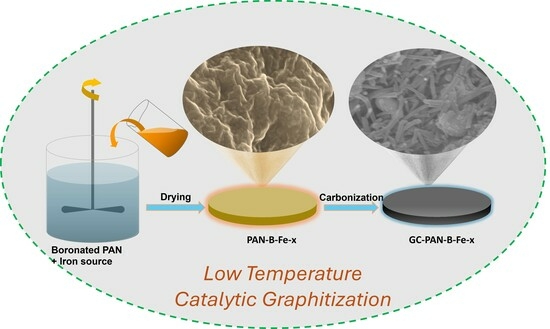
Effect of Boron and Iron at Various Concentrations on the Catalytic Graphitization of the Polyacrylonitrile Derived from the Polymerization of Acrylonitrile





Abstract
Share and Cite
Kim, T.; Kim, B.-S.; Ko, T.H.; Kim, H.Y. Effect of Boron and Iron at Various Concentrations on the Catalytic Graphitization of the Polyacrylonitrile Derived from the Polymerization of Acrylonitrile. Inorganics 2025, 13, 52. https://doi.org/10.3390/inorganics13020052
Kim T, Kim B-S, Ko TH, Kim HY. Effect of Boron and Iron at Various Concentrations on the Catalytic Graphitization of the Polyacrylonitrile Derived from the Polymerization of Acrylonitrile. Inorganics. 2025; 13(2):52. https://doi.org/10.3390/inorganics13020052
Chicago/Turabian StyleKim, Taewoo, Byoung-Suhk Kim, Tae Hoon Ko, and Hak Yong Kim. 2025. "Effect of Boron and Iron at Various Concentrations on the Catalytic Graphitization of the Polyacrylonitrile Derived from the Polymerization of Acrylonitrile" Inorganics 13, no. 2: 52. https://doi.org/10.3390/inorganics13020052
APA StyleKim, T., Kim, B.-S., Ko, T. H., & Kim, H. Y. (2025). Effect of Boron and Iron at Various Concentrations on the Catalytic Graphitization of the Polyacrylonitrile Derived from the Polymerization of Acrylonitrile. Inorganics, 13(2), 52. https://doi.org/10.3390/inorganics13020052