Article

Preliminary Study of the Cytotoxic Activity of Pd(II) and Pt(II) Complexes Bearing P-N ligands Derived from Aminoalcohols

by
Jair Isai Ortega-Gaxiola
1,
Juan S. Serrano-García
1,
Andrés Amaya-Flórez
1,
Jordi R. Galindo
1,
Antonino Arenaza-Corona
1,
Simón Hernández-Ortega
1,
Teresa Ramírez-Apan
1,
Jorge Alí-Torres
2,
Adrián L. Orjuela
3,
Viviana Reyes-Márquez
4,
Michelle Acosta-Encinas
5,
Raúl Colorado-Peralta
6 and
David Morales-Morales
1,*
1
Instituto de Química, Universidad Nacional Autónoma de México, Circuito Exterior S/N, Ciudad de México 04510, Coyoacán, Mexico
2
Departamento de Química, Universidad Nacional de Colombia-Sede Bogotá, Bogotá 111321, Colombia
3
Instituto de Investigaciones Científicas y Servicios de Alta Tecnología (INDICASAT AIP), Panama City 0843-01103, Panama
4
Departamento de Ciencias Químico-Biológicas, Universidad de Sonora, Luis Encinas y Rosales S/N, Hermosillo 83000, Sonora, Mexico
5
Departamento de Investigación en Polímeros y Materiales, Universidad de Sonora, Luis Encinas y Rosales S/N, Hermosillo 83000, Sonora, Mexico
6
Facultad de Ciencias Químicas, Universidad Veracruzana, Prolongación de Oriente 6, No. 1009, Orizaba 94340, Veracruz, Mexico
*
Author to whom correspondence should be addressed.
Inorganics 2025, 13(12), 398; https://doi.org/10.3390/inorganics13120398
Submission received: 20 October 2025 / Revised: 27 November 2025 / Accepted: 27 November 2025 / Published: 2 December 2025

Abstract

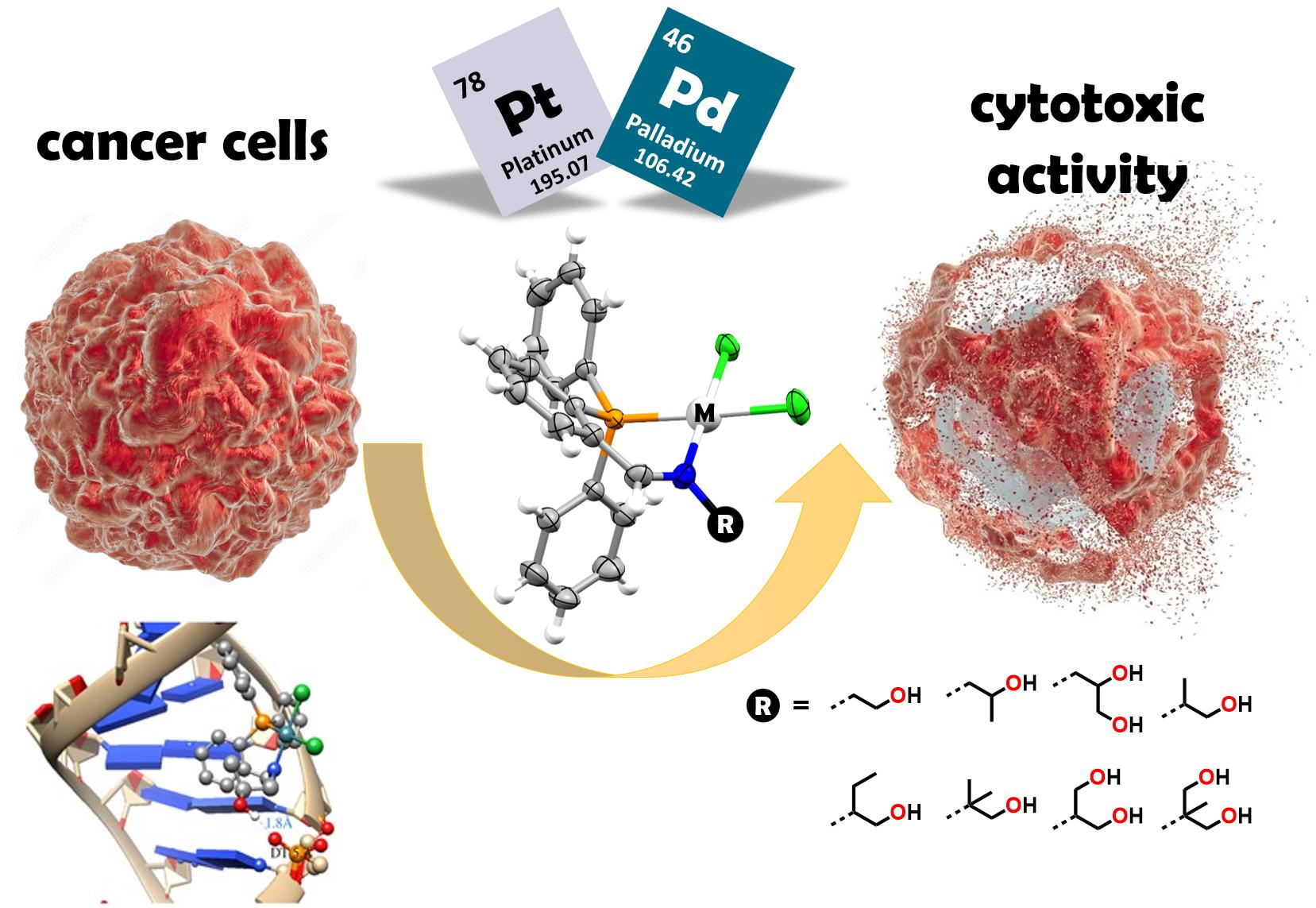
Iminophosphine ligands find extensive applications in homogeneous catalysis; however, their potential antitumor activity is currently being explored. Including biologically active moieties, such as aminoalcohols, could enhance this activity further. Therefore, we have synthesised a novel series of Pd(II) and Pt(II) iminophosphine complexes incorporating aminoalcohols as biologically active moieties to explore the potential of enhancing this activity. The series of Pd(II) complexes includes complexes 2a, 2f, and 2h, which were previously reported by our research group as catalysts in Suzuki–Miyaura cross-coupling reaction in aqueous media. Besides their complete characterisation, some structures have been unequivocally corroborated by single-crystal X-ray diffraction (SC-XRD). To evaluate the cytotoxic potential of the complexes, a preliminary in vitro study was conducted on different cancerous cell lines, including using COS-7 cells as a healthy cell line. Notably, complexes 2e, 2f, and 3b exhibited selectivity towards human chronic myelogenous leukaemia (K562), demonstrating IC50 values of 7.73 ± 1.4 µM, 8.53 ± 1.9 µM, and 8.83 ± 1.5 µM, respectively. Remarkably, the selectivity of these complexes surpassed that of cisplatin. Furthermore, in silico analysis indicated a higher binding energy of these complexes to DNA when compared to cisplatin.

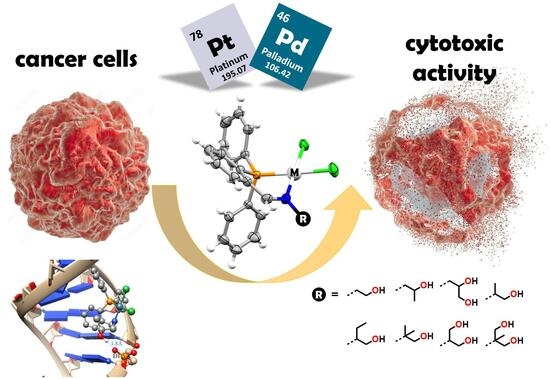
Graphical Abstract

1. Introduction

Cancer encompasses a wide range of diseases characterised by the uncontrolled and continuous division of abnormal cells that proliferate in the bloodstream, leading to the development of tumours [1]. Based on the specific tissue it impacts, cancer can be categorised into four primary groups—leukaemia, lymphoma, sarcoma, and carcinoma [2].
According to the WHO, there were a total of 18.1 million cancer cases worldwide in 2020. Breast carcinoma represented 2.26 million cases, followed by lung carcinoma with 2.20 million, and colorectal carcinoma accounted for 1.93 million [3]. Notably, cancer-related mortality has globally declined by 16% between 2000 and 2019. This decline can be attributed to the advancements in treatments, such as chemotherapy [4], which extensively employ platinum-based complexes as primary anticancer agents [5,6]. These compounds work as cross-link agents, inhibiting DNA replication, leading to apoptosis [7,8,9]; however, side effects like hepatotoxicity, nephrotoxicity, neurotoxicity, and ototoxicity have been identified due to the lack of selectivity against the cancerous cells [10]. Moreover, resistance may arise due to enhanced DNA repair mechanisms, reduced intracellular drug bioavailability, epigenetic modifications, and other factors [11,12,13]. Therefore, in recent decades, efforts have been made to synthesise new platinum-based metallodrugs with better selectivity and the ability to overcome resistance. In addition, other strategies have focused on non-platinum metal complexes like palladium, which possess structural similarity with Pt complexes and high cytotoxicity against cancerous cells [14,15,16]. In this respect, modification and design of ligands could also be employed to enhance cytotoxic activity and selectivity. Following this approach, investigation has led to ligand bearing nitrogen donor atoms, mainly imines, which have shown cytotoxicity against cancerous cell lines [17,18,19,20,21,22,23].
Iminophosphines are remarkable ligands used in homogeneous catalysis due to their electronic and steric properties, which can be easily tuned to yield specific products [24,25,26]. Their biological activity has recently been explored with metals like gold, iridium, palladium and platinum, affording promising results [27,28,29,30,31,32,33]. For example, Chiririwa and co-workers evaluated the cytotoxicity of a series of Pt(II) iminophosphine complexes against human oesophageal cancer cell lines WHCO1 and KYSE450, with IC50 values between 5.29 and 9.47 µM [31]. Likewise, Motswainyana group obtained Pd(II) complexes with IC50 values of 28.5 ± 0.21 and 29 ± 0.15 µM towards human breast (MCF-7) and colon (HT-29) cancer cell lines [33].
Conversely, cytotoxicity may be enhanced by functionalised ligands with biologically active fragments like amino alcohols. This moiety is found in serine and sphingosine compounds, playing a critical role in metabolomics and signalling pathways [34,35,36]. Inspired by the previous studies related to the use of iminophosphines and considering the biological activity of aminoalcohols, we decided to evaluate the preliminary cytotoxic activity of a novel series of Pd(II) and Pt(II) iminophosphine complexes bearing aminoalcohols against several cancerous cells.

2. Results and Discussion

2.1. Synthesis of Pd(II) and Pt(II) Complexes with PN Ligands

The iminophosphine (PN) ligands (1ah) were synthesised in exceptional yields (91 to 99%) by the reaction of 2-(diphenylphosphanyl)benzaldehyde with the corresponding aminoalcohol. After purification, these ligands were subjected to reaction with dichloro(1,5-cyclooctadiene)palladium(II) [Pd(COD)2Cl2] or dichlorobis(dimethyl sulfide)platinum(II) [Pt(SMe2)2Cl2], resulting in the formation of the Pd(II) complexes (2ah) and the Pt(II) complexes (3ah), according to Scheme 1. These compounds were characterised by 1H, 13C{1H} and 31P{1H} NMR; FAB+ MS, ATR-IR, and elemental analysis. It is worth noting that the catalytic activity of the Pd(II) complexes (2a, 2f, 2h) has been previously reported in studies conducted by our research group [36]. The ν(C=N) stretching was identified using IR spectroscopy ranging from 1614 to 1639 cm−1, with small shifts between Pd and Pt complexes. NMR signals exhibited successful correlations with the proposed structures of the ligands and their complexes, Figures S1–S16. Specifically, imine signals were observed in the 8.60 to 9.18 ppm range in 1H NMR and 154.9 to 166.2 ppm in 13C{1H} NMR, with a slight upfield shift upon metal coordination. In 31P{1H} NMR, a more pronounced shift was observed, as the signals of the free ligands (from −14.79 to −11.95 ppm) shifted from 32.58 to 39.77 ppm for the Pd(II) complexes and from 2.90 to 5.77 ppm for the Pt(II) complexes.
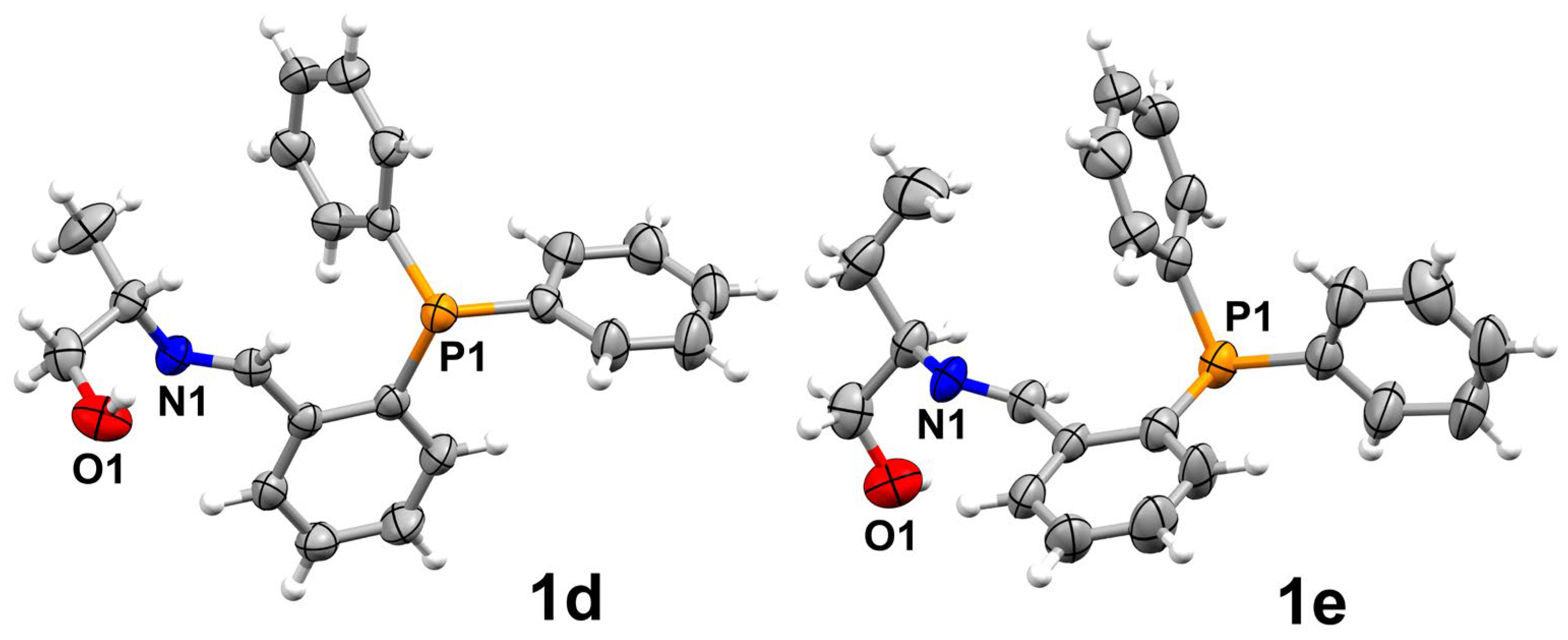
The structures of ligands 1d and 1e and complexes 2d, 3d, and 3e were unequivocally determined by single-crystal X-ray diffraction (SC-XRD); crystal data and other details are shown in Table 1. Ligands 1d and 1e crystallised in an orthorhombic system (Pbca) with one molecule per asymmetric unit, displaying an E-configuration about the imine group in both cases, Figure 1. The supramolecular arrangements were mainly stabilised by a polymeric hydrogen bond along the a-axis with an N(1)-O(1) distance of 2.883 Å [−1/2 + x, y, 1/2 − z] and 2.909(5) Å [−1/2 + x, y, 1/2 − z], respectively, having in both cases a graph set descriptor C(5), Figure S17.
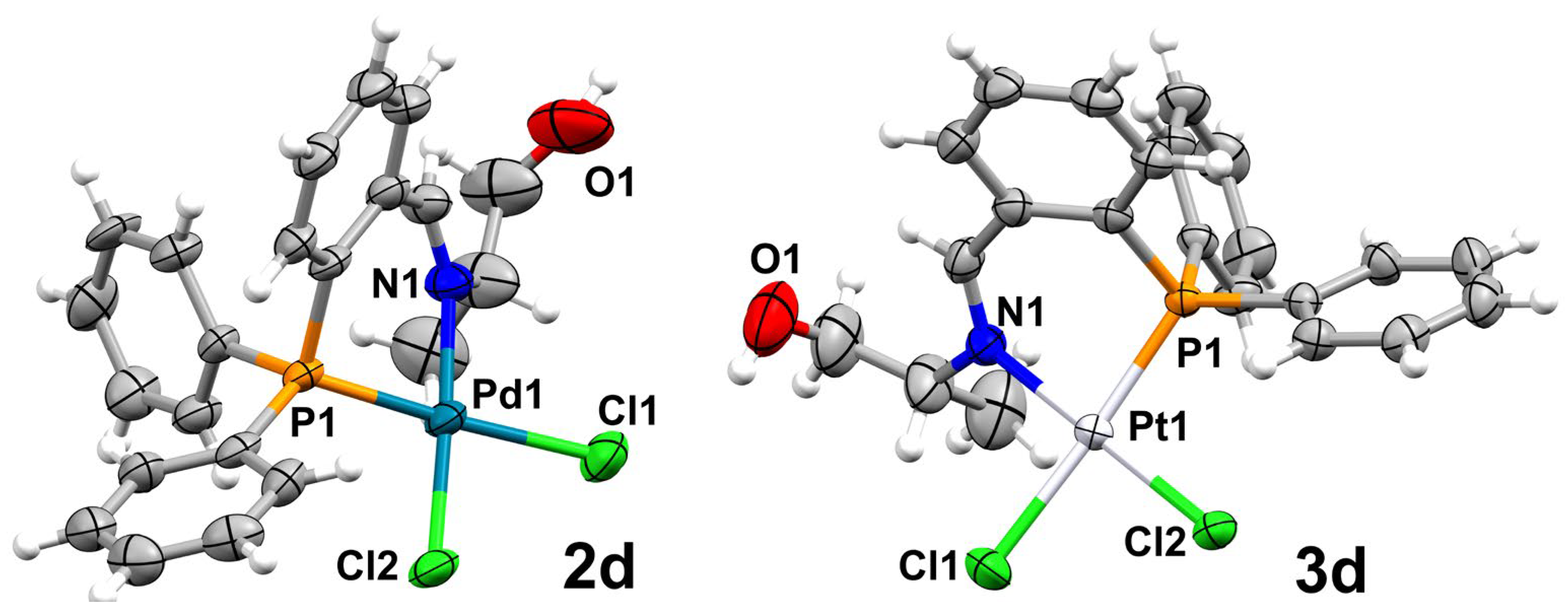
Complexes 2d and 3d were crystallised in dimethyl sulfoxide and are isostructural. Both complexes crystallised in a triclinic system (P-1), including a free solvent molecule in the asymmetric unit, exhibiting a distorted square-planar geometry around the metal atom bearing the bidentate PN ligand, Figure 2. The average M-N(1) and M-P(1) bond lengths were 2.041(7) and 2.202(3) Å, respectively, which is in agreement with similar complexes previously reported [26,31,33]. Moreover, a trans-influence could also be identified since the M-Cl bond distance trans to the phosphine is ca. 0.1 Å longer than that M-Cl bond distance trans to the imine [25]. Both crystalline arrangements are supported by the interaction of one or two molecules of solvent between two molecules of 3d and 2d, which gives rise to the propagation in a chain and 2D array, respectively, as shown in Figures S18 and S19.
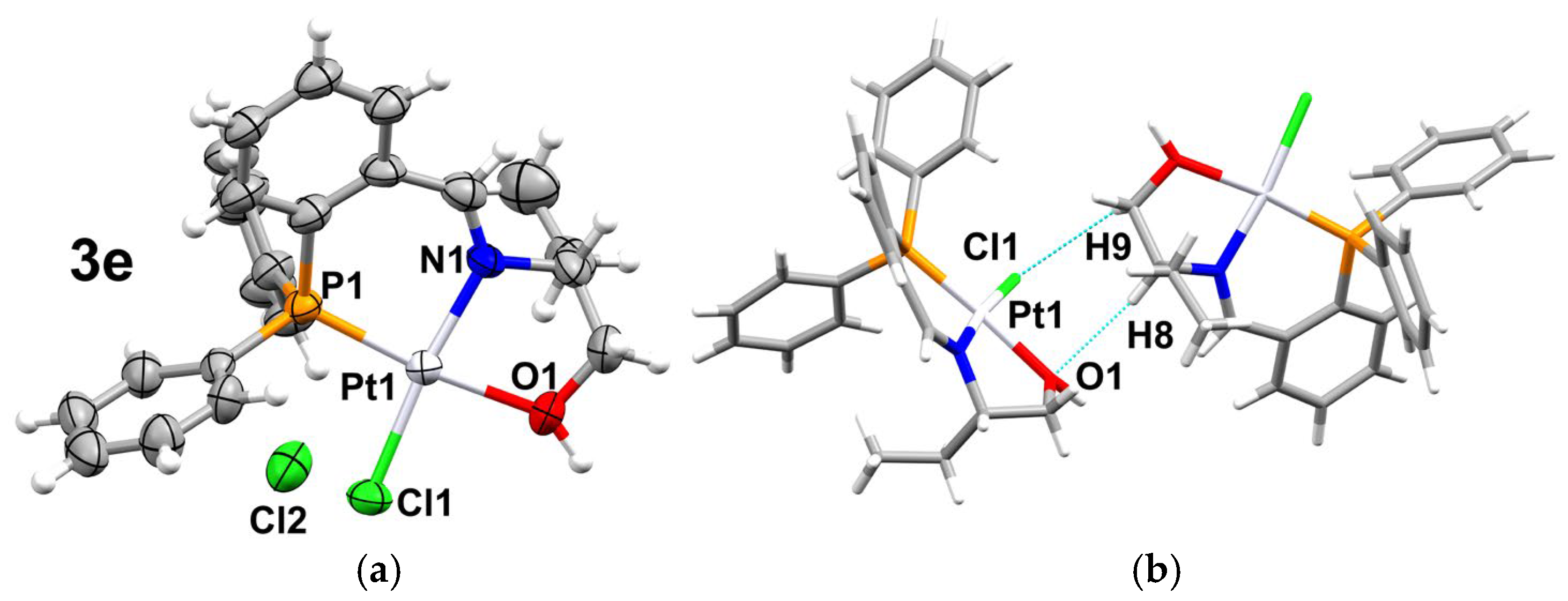
On the other hand, complex 3e crystallised in an orthorhombic system (Pna21), where a tridentate PNO ligand coordinated the Pt(II) atom, Figure 3. The hapticity change in 3e compared to 3d would be related to a chloride ligand displacement by the –OH group. The angles and distances of 3e are similar to those of the 3d complex. However, a trans-influence was observed because the Pt(1)-P(2) bond distance is smaller in 3e (2.178(2) Å) than that in 3d (2.205(1) Å). This influence could be associated with a better back bonding in the M-P bond due to the oxygen donor ligand. The crystal packing in 3e was mainly established by a hydrogen bond interaction between the –OH group and the outer Cl, with an O(1)-H(1)∙∙∙Cl(2) distance of 1.882 Å [1 − x, −y, −1/2 + z]. Principal interaction parameters found for the three complexes are summarised in Table 2.

2.2. Supramolecular Analysis

Supramolecular interactions analyses are very important to describe noncovalent interactions in a quantitative and/or qualitative manner. These analyses provide valuable insight into intermolecular forces, that could be determining to biological activity. These interactions are derived from solid-state packing, where the crystallisation solvent may play a role; therefore, direct extrapolation of such interactions from solid state to solution should be made with caution [37,38,39].
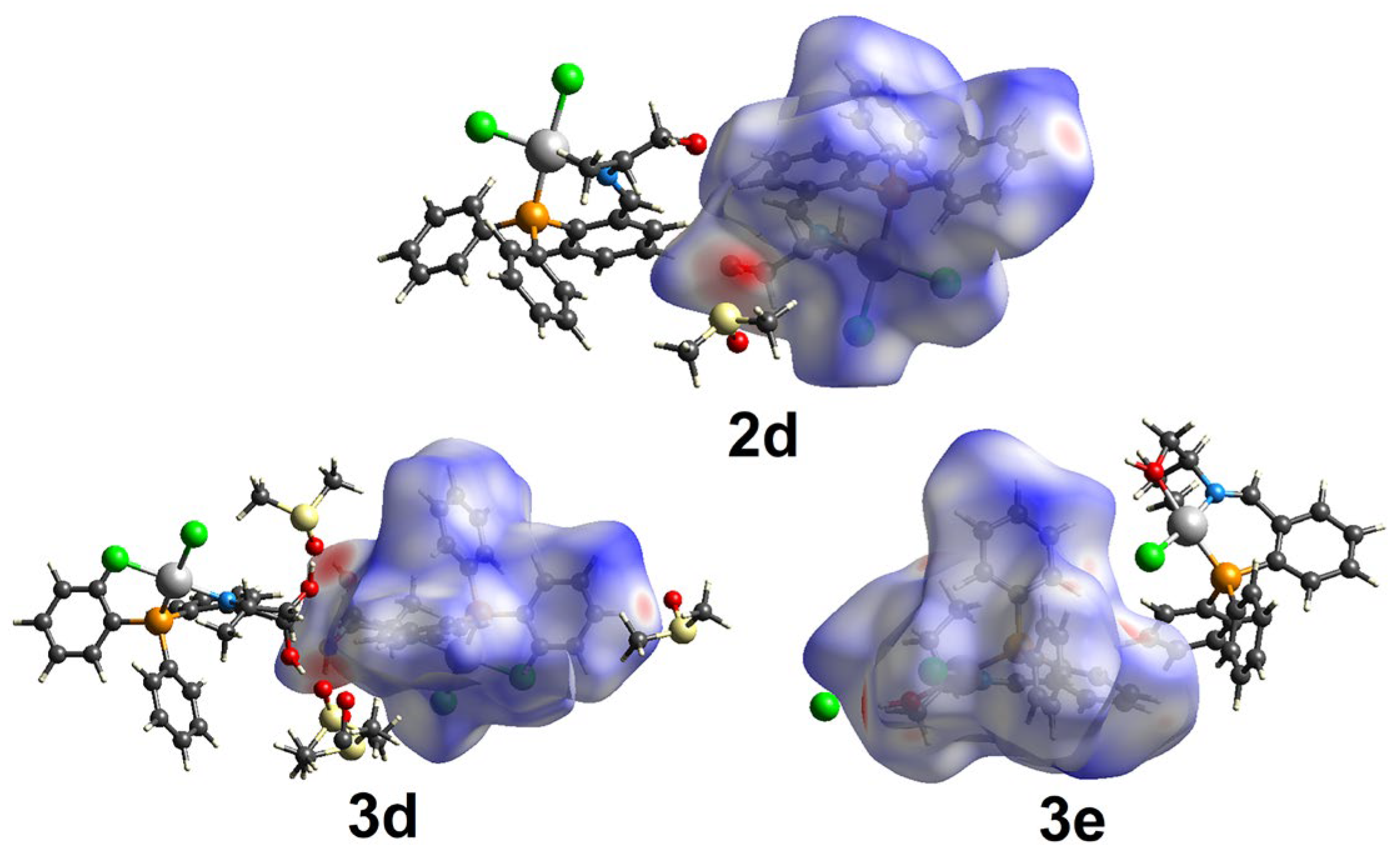
To analyse these supramolecular interactions related to close contact in molecular packing, Hirshfeld surfaces were mapped using Crystal Explorer software [40,41], which helps to distinguish between strong and weak interactions. The Hirshfeld surfaces mapped on dnorm for complexes 2d and 3d indicated strong interactions by the red dots on the hydroxyl moiety, which has close contact with the dimethyl sulfoxide solvent. In contrast, for complex 3e, the red dots are due to contacts of the hydroxyl group with the chloride anion, Figure 4 and Figure S20.
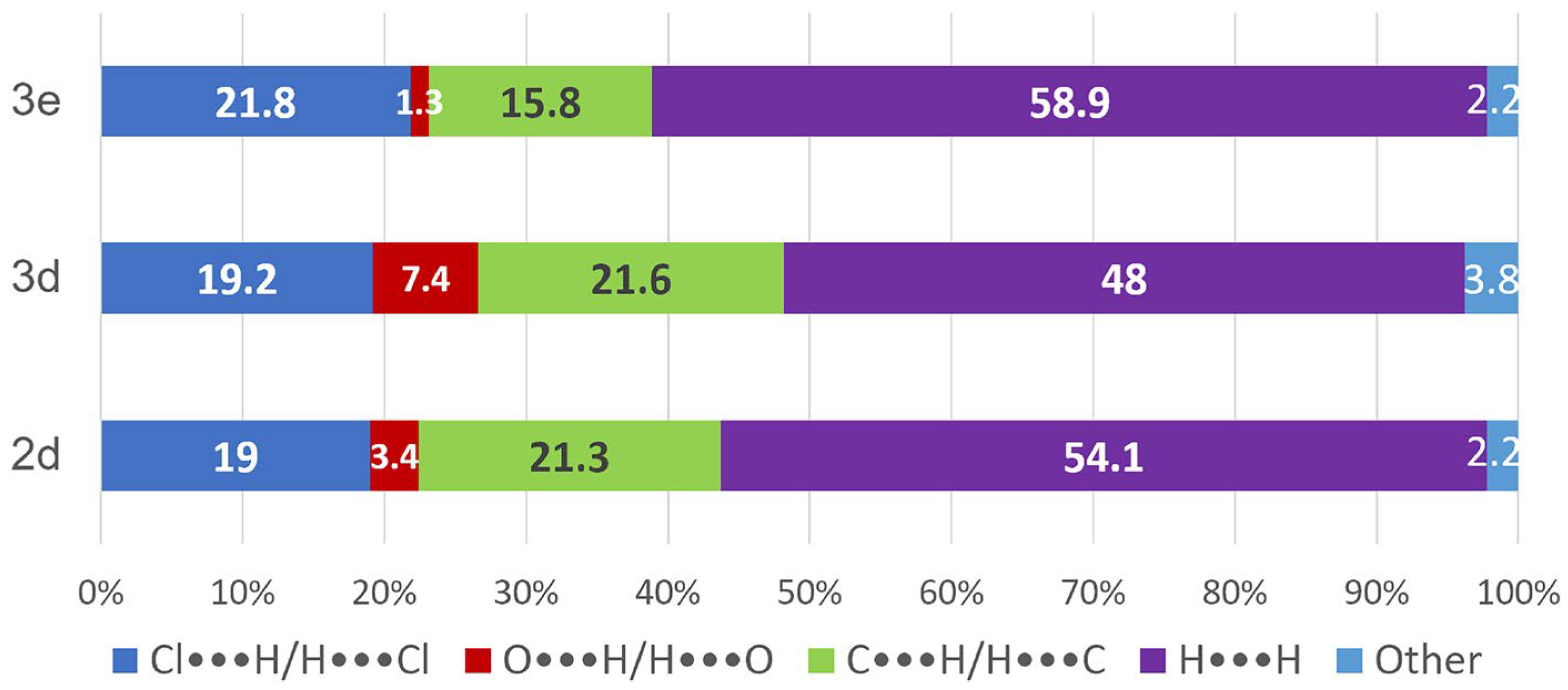
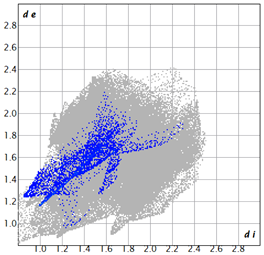
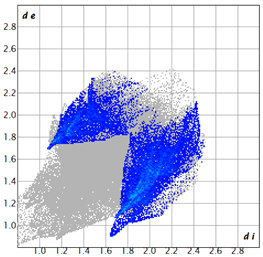
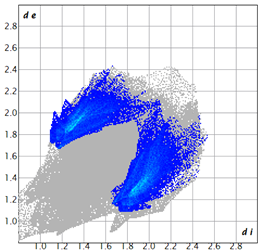
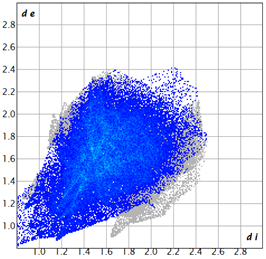
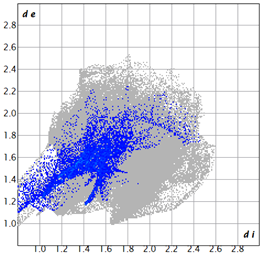
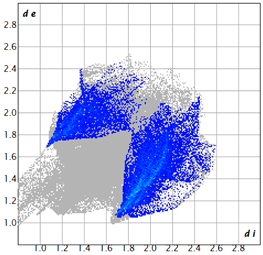
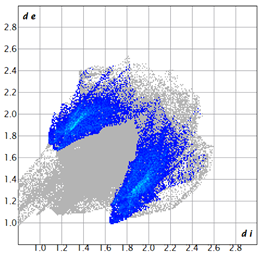
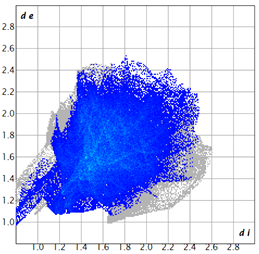
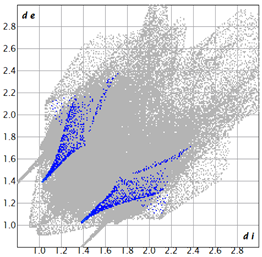
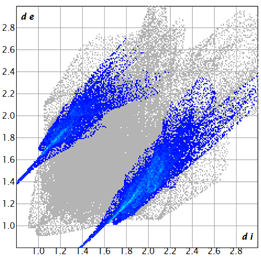
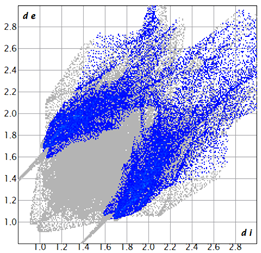
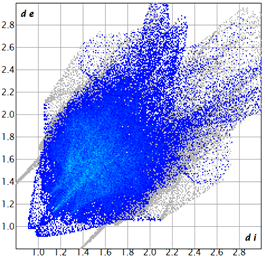
The 2D fingerprint plots of the Hirshfeld surfaces of complexes 2d, 3d, and 3e are shown in Table 3, while those of ligands 1d and 1e are shown in Table S1. Peaks originated by Cl∙∙∙H/H∙∙∙Cl contacts were evident, as demonstrated by the two symmetric peaks of the decomposed fingerprint of complexes 2d, 3d, and 3e. Similarly, the C∙∙∙H/H∙∙∙C contacts were close to 20% in complexes 2d and 3d. The O∙∙∙H/H∙∙∙O contacts in complex 3e were found as two classical symmetric peaks. Most peaks were found for H∙∙∙H contacts at more than 50% in all three complexes, as seen in Chart 1.

2.3. Cytotoxic Evaluation

The complexes 2ad and 3ad were tested on different cancer cell lines using the sulforhodamine B (SRB) protocol during a 48 h incubation period at a concentration of 25 µM and using DMSO as the solvent. Six cancer cell lines were used: U251 (human glioblastoma), PC-3 (human prostate adenocarcinoma), K562 (human chronic myelogenous leukaemia), HCT-15 (human colorectal adenocarcinoma), MCF-7 (human mammary adenocarcinoma), SKLU-1 (human lung adenocarcinoma). The National Cancer Institute, USA, provided the first five cell lines, while the National Cancer Institute, Mexico, donated the last one. A healthy monkey kidney cell line (COS-7) was included for comparative purposes. The Pd(II) complexes 2a, 2b, and 2df showed the highest inhibition percentages against the K562 (34.5–94.2 µM) and MCF-7 (29.1–85.3 µM) cell lines, Table 4. Pd(II) complexes with a single hydroxyl group in the PN ligand exhibit greater cytotoxicity towards cancer cell lines than complexes with two hydroxyl groups in the PN ligand.
Conversely, the Pt(II) complexes (3ah) exhibited higher cytotoxicity against the studied cancer cell lines, closely resembling the activity of the widely used metallodrug (cisplatin), Table 5. However, 3b was the only one that showed selectivity against the K562 and SKLU-1 cell lines (98.7% and 87.7%) and low inhibition on COS-7 cells (25.6%).
The previous preliminary studies determined that the complexes 2a, 2b, 2df, and 3b were the best candidates for IC50 studies on the K562 and COS-7 cell lines, Table 6. Compounds 2b, 2f, and 3b demonstrated a higher SI than cisplatin (SI = 1.1), with compound 3b being the most active in this study. This analysis emphasises that compound 3b proved to be the most selective, encouraging future studies to understand the mechanism of action of this compound. The stability of these compounds was explored using the most active compounds 2e and 3b by 1H NMR spectroscopy for 24 h in DMSO-d6 (Figures S21 and S22). No significant changes were observed over time, suggesting that the complexes were stable under the assay conditions.

2.4. Computational Results

2.4.1. Electronic Structure Optimisation

The geometrical comparison between the crystal and optimised structure for the complex 2d is reported in Table S2. As can be seen, the calculated Pd-X bonds (X = heteroatom) are similar to those obtained by the SC-XRD experiments. In addition, the angles reported for P-Pd-Cl(1) and P-Pd-N are close, with a variation of four degrees. This is expected due to the relaxation of the geometry when the implicit solvent is considered, in contrast to the solid state in the SC-XRD experiments. In the same way, the comparison between the reported crystal structure and optimised geometry for complex 3d is presented in Table S3. As in complex 2d, the electronic structure method used to describe the Pt(II) complex showed that the structural parameters remain unchanged even when implicit solvent effects are considered.

2.4.2. Molecular Docking Results

The binding energies obtained from the docking simulations are presented in Table 7. Complexes 2e, 2f, and 3b exhibited the highest binding energies in the DNA model with values down to −6.60 Kcal/mol. These interaction energies surpassed that of cisplatin (−6.25 Kcal/mol), used as a reference. Interestingly, the same complexes (2e, 2f, and 3b) were as well the most cytotoxic complexes with IC50 ranging from 7.73 to 8.83 µM and selectivity indexes equal or higher than that of cisplatin (vide supra). Therefore, a correlation can be stablished between calculated DNA binding energy and the observed cytotoxic activity.
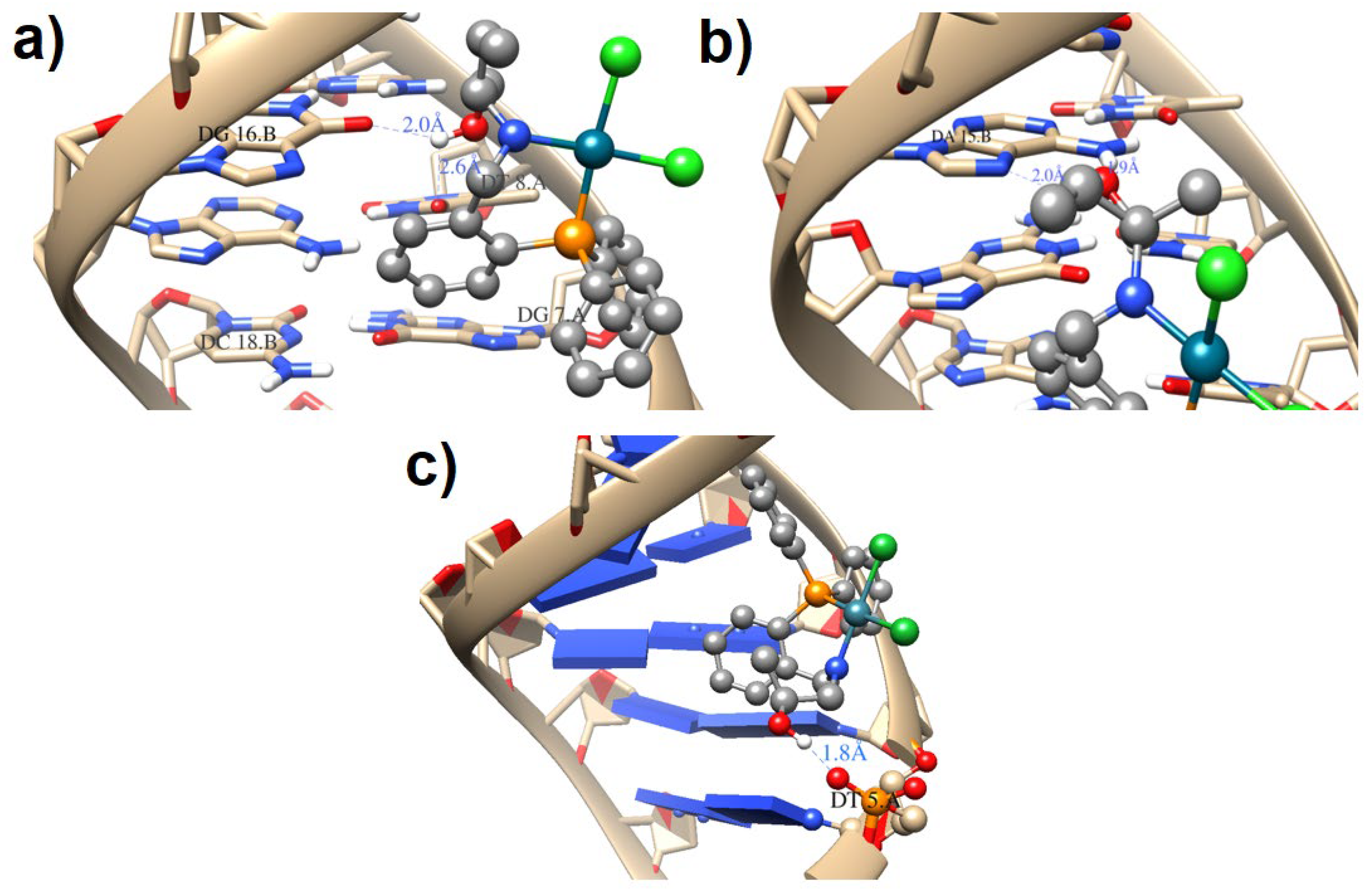
Figure 5 illustrates the interactions between molecules 2e, 2f, and 3b, which exhibited selectivity against the K562 cell line. Notably, substituent variations in the amino group lead to changes in hydrophilic interactions due to significant modifications in the coupling position, as depicted in complexes 2e and 2f. In the case of molecule 2e, the formation of hydrogen bonds with guanine 16B and thiamine 8A results in an inter-catenary crosslink. Conversely, molecule 2f forms an intra-catenary crosslink with adenine 15, exhibiting a distinct bonding mode and mechanism of action. On the other hand, molecule 3b demonstrated a 180° shift in the binding mode compared to the previous cases; this was attributed to a change in the metal moiety. This shift leads to hydrophobic interactions with the DNA strand’s skeleton and hydrophobic interactions with the phosphate group of thymine 15A.

3. Materials and Methods

All reagents were commercially obtained from Sigma-Aldrich (USA)and used without further purification (PdCl2 > 99.9%, PtCl2 > 99.9%). The 1H, 13C{1H}, 31P{1H} NMR spectra were obtained on a Bruker Ascend 300 MHz NMR spectrometer and a Varian Unity Inova 500 MHz NMR spectrometer.
Chemical shifts were reported in ppm relative to TMS employing the residual signals in the solvent (DMSO-d6) as an internal standard. ATR-IR measurements were performed on a Thermo Fisher Scientific Nicolet iS50 FTIR Spectrometer (USA). Elemental analyses were made on a Thermo Scientific Flash 2000 elemental analyser (USA), using a Mettler Toledo XP6 Automated-S Microbalance (USA) and sulfanilamide as standard (Thermo Scientific BN 217826, attained values N = 16.40%, C = 41.91%, H = 4.65%, and S = 18.63%; certified values N = 16.26%, C = 41.81%, H = 4.71%, and S = 18.62%). MS-FAB+ determinations were recorded in a Jeol JMS-SX102A Mass spectrometer.

3.1. General Procedure for the Synthesis of Ligands (1ah)

A mixture containing 2-(diphenylphosphine)benzaldehyde (58 mg, 0.2 mmol) and the corresponding aminoalcohol in methanol (30 mL) was stirred for 4 h. In most cases, the yield was quantitative; therefore, further purification was unnecessary. Subsequently, the solution was evaporated under vacuum, yielding the product as a colourless oil.
For 1a: Yield: 66.1 mg (>99%). 1H NMR (300 MHz, DMSO-d6) δ 8.82 (m, 1H, -CH=N), 7.96 (dd, 1H, CHAr, 3JH-H = 7.74 Hz, 4JH-H = 3.98 Hz), 7.47–7.16 (m, 8H, CHAr), 7.21 (m, 4H, CHAr), 6.83 (dd, 1H, CHAr, 3JH-H = 7.61 Hz, 3JH-P = 4.56 Hz), 3.40–3.54 (m, 4H, -CH2). 13C{1H} NMR (75 MHz, DMSO-d6) δ 159.5 (d, -CH=N, 3JC-P = 20.1 Hz), 139.0 (d, C-H, 2JC-P = 17.0 Hz), 136.8 (d, C-P, 1JC-P = 20.7 Hz), 136.4 (d, C-P, 1JC-P = 10.1 Hz), 133.4 (d, C-H, 2JC-P = 19.8 Hz), 133.3 (s, C-H), 130.0 (s, C-H), 129.0–128.6 (m, C-H), 127.8 (d, C-H, 3JC-P = 4.32 Hz), 63.3 (s, -CH2), 60.6 (s, -CH2). 31P{1H} NMR (121.5 MHz, DMSO-d6): δ -14.72. Elem. Anal. Calcd. for C21H20NOP: C, 75.66; H, 6.05; N, 4.20. Found: C, 74.62; H, 5.99; N, 4.12.
For 1b: Yield: 68.2 mg (>98%). 1H NMR (300 MHz, DMSO-d6) δ 8.76 (m, 1H, -CH=N), 7.96 (dd, 1H, CHAr, 3JH-H = 7.72 Hz, 4JH-H = 3.93 Hz), 7.47–7.27 (m, 8H, CHAr), 7.19 (m, 4H, CHAr), 6.81 (dd, 1H, CHAr, 3JH-H = 7.64 Hz, 3JH-P = 4.53 Hz), 3.70 (m, 1H, -CH), 3.43 (m, 1H, -CHH), 3.31 (m, 1H, -CHH), 0.89 (d, 3H, -CH3, 3JH-H = 6.10 Hz). 13C{1H} NMR (75 MHz, DMSO-d6) δ 159.5 (s, -CH=N, 3JC-P = 20.1 Hz), 139.0 (d, C-H, 2JC-P = 17.0 Hz), 136.8 (d, C-P, 1JC-P = 20.9 Hz), 136.5 (d, C-P, 1JC-P = 10.2 Hz), 136.4 (d, C-P, 1JC-P = 9.8 Hz), 133.54 (d, C-H, 2JC-P = 20.08 Hz), 133.5 (d, C-H, 2JC-P = 19.96 Hz), 130.3 (s, C-H), 133.0 (s, C-H), 129.1–128.6 (m, C-H), 128.2 (d, C-H, 3JC-P = 4.1 Hz), 68.87 (s, -CH2), 65.97 (s,-CH), 21.27 (s, -CH3). 31P{1H} NMR (121.5 MHz, DMSO-d6): δ -14.18. Elem. Anal. Calcd. for C22H22NOP: C, 76.06; H, 6.38; N, 4.03. Found: C, 74.68; H, 6.33; N, 3.96.
For 1c: Yield: 72.0 mg (>99%). 1H NMR (300 MHz, DMSO-d6) δ 8.81 (m, 1H, -CH=N), 7.96 (dd, 1H, CHAr, 3JH-H = 7.75 Hz, 4JH-H = 3.97 Hz), 7.50–7.30 (m, 8H, CHAr), 7.20 (m, 4H, CHAr), 6.84 (dd, 1H, CHAr, 3JH-H = 7.72 Hz, 3JH-P = 4.55 Hz), 3.62 (m, 1H, -CH), 3.61 (m, 1H, -CHH), 3.40–3.28 (m, 2H, -CH2), 3.34 (m, 1H, -CHH). 13C{1H} NMR (75 MHz, DMSO-d6) δ 159.7 (s, -CH=N, 3JC-P = 19.79 Hz), 139.1 (d, C-H, 2JC-P = 17.3 Hz), 136.5 (d, C-P, 1JC-P = 10.1 Hz), 136.4 (d, C-P, 1JC-P = 10.1 Hz), 133.51 (d, C-H, 2JC-P = 19.9 Hz), 133.5 (d, C-H, 2JC-P = 20.6 Hz), 133.1 (s, C-H), 130.3 (s, C-H), 129.1–128.7 (m, C-H), 128.2 (d, C-H, 3JC-P = 4.2 Hz), 71.18 (s,-CH), 64.17 (s, -CH2), 64.01 (s, -CH2). 31P{1H} NMR (121.5 MHz, DMSO-d6): δ -14.79. Elem. Anal. Calcd. for C22H22NO2P: C, 72.71; H, 6.10; N, 3.85. Found: C, 73.40; H, 6.00; N, 3.83.
For 1d: Yield: 68.9 mg (>99%). 1H NMR (300 MHz, DMSO-d6) δ 8.77 (m, 1H, -CH=N), 7.93 (dd, 1H, CHAr, 3JH-H = 7.68 Hz, 4JH-H = 3.92 Hz), 7.46–7.27 (m, 8H, CHAr), 7.20 (m, 4H, CHAr), 6.81 (dd, 1H, CHAr, 3JH-H = 7.71 Hz, 3JH-P = 4.58 Hz), 3.32–3.17 (m, 1H, -CH), 3.32–3.17 (m, 2H, -CH2), 0.89 (d, 3H, -CH3, 3JH-H = 5.59 Hz). 13C{1H} NMR (75 MHz, DMSO-d6) δ 159.6 (s, -CH=N, 3JC-P = 18.13 Hz), 139.0 (d, C-H, 2JC-P = 16.5 Hz), 136.8 (d, C-P, 1JC-P = 21.4 Hz), 136.7 (d, C-P, 1JC-P = 9.70 Hz), 136.5 (d, C-P, 1JC-P = 9.8 Hz), 133.56 (d, C-H, 2JC-P = 19.9 Hz), 133.5 (d, C-H, 2JC-P = 19.9 Hz), 132.9 (s, C-H), 130.1 (s, C-H), 129.0–128.5 (m, C-H), 128.2 (d, C-H, 3JC-P = 4.0 Hz), 67.5 (s, -CH), 65.9 (s, -CH2), 18.5 (s, -CH3). 31P{1H} NMR (121.5 MHz, DMSO-d6): δ -13.57. Elem. Anal. Calcd. for C22H22NOP: C, 76.06; H, 6.38; N, 4.03. Found: C, 75.27; H, 6.45; N, 4.05.
For 1e: Yield: 71.6 mg (>99%). 1H NMR (300 MHz, DMSO-d6) δ 8.71 (m, 1H, -CH=N), 7.94 (ddd, 1H, CHAr, 3JH-H = 7.75 Hz, 4JH-H = 3.94 Hz, 5JH-H = 1.40 Hz), 7.50–7.28 (m, 8H, CHAr), 7.20 (m, 4H, CHAr), 6.79 (dd, 1H, CHAr, 3JH-H = 7.63 Hz, 3JH-P = 4.47 Hz), 3.42 (m, 1H, -CHH), 3.15 (m, 1H, -CHH), 2.92 (m, 1H, -CH), 1.47 (m, 1H, -CHH), 1.21 (m, 1H, -CHH), 0.46 (t, 3H, -CH3, 3JH-H = 7.64 Hz). 13C{1H} NMR (75 MHz, DMSO-d6) δ 158.1 (s, -CH=N, 3JC-P = 17.7 Hz), 139.0 (d, C-H, 2JC-P = 16.5 Hz), 136.8 (d, C-P, 1JC-P = 20.9 Hz), 136.7 (d, C-P, 1JC-P = 10.0 Hz), 136.5 (d, C-P, 1JC-P = 9.8 Hz), 133.52 (d, C-H, 2JC-P = 20.03 Hz), 132.8 (s, C-H), 130.1 (s, C-H), 129.0–128.5 (m, C-H), 128.3 (d, C-H, 3JC-P = 4.0 Hz), 74.58 (s, -CH), 64.76 (s, -CH2), 24.61 (s, -CH2), 10.25 (s, -CH3). 31P{1H} NMR (121.5 MHz, DMSO-d6): δ -13.39. Elem. Anal. Calcd. for C23H24NOP: C, 76.43; H, 6.69; N, 3.88. Found: C, 77.11; H, 6.74; N, 3.92.
For 1f: Yield: 65.8 mg (91%). 1H NMR (300 MHz, DMSO-d6) δ 8.68 (m, 1H, -CH=N), 7.91 (dd, 1H, CHAr, 3JH-H = 7.74 Hz, 4JH-H = 4.70 Hz), 7.46–7.36 (m, 8H, CHAr), 7.21 (m, 4H, CHAr), 6.76 (dd, 1H, CHAr, 3JH-H = 7.96 Hz, 3JH-P = 4.70 Hz), 3.15 (s, 2H, -CH2), 0.90 (s, 6H, -CH3). 13C{1H} NMR (75 MHz, DMSO-d6) δ 154.9 (s, -CH=N, 3JC-P = 16.1 Hz), 139.1 (d, C-H, 2JC-P = 15.1 Hz), 136.9 (d, C-P, 1JC-P = 19.7 Hz), 136.8 (d, C-P, 1JC-P = 10.0 Hz), 133.65 (d, C-H, 2JC-P = 20.0 Hz), 132.7 (s, C-H), 129.93 (s, C-H), 129.0 -128.5 (m, C-H), 128.2 (d, C-H, 3JC-P = 3.7 Hz), 69.47 (s,-CH2), 61.73 (s, -CC3), 23.75 (s, -CH3). 31P{1H} NMR (121.5 MHz, DMSO-d6): δ -12.03. Elem. Anal. Calcd. for C23H24NOP: C, 76.43; H, 6.69; N, 3.88. Found: C, 75.23; H, 6.68; N, 3.86.
For 1g: Yield: 72.0 mg (99%). 1H NMR (300 MHz, DMSO-d6) δ 8.80 (m, 1H, -CH=N), 7.96 (ddd, 1H, CHAr, 3JH-H = 7.82 Hz, 4JH-H = 4.03 Hz, 5JH-H = 1.39 Hz), 7.48–7.30 (m, 8H, CHAr), 7.19 (m, 4H, CHAr), 6.82 (dd, 1H, CHAr, 3JH-H = 7.70 Hz, 3JH-P = 4.50 Hz), 3.49 (m, 2H, -CHH), 3.22 (m, 2H, -CHH), 3.19 (m, 1H, -CH). 13C{1H} NMR (75 MHz, DMSO-d6) δ 159.0 (s, -CH=N, 3JC-P = 18.5 Hz), 139.2 (d, C-H, 2JC-P = 16.9 Hz), 136.9–136.6 (m, C-P), 136.7 (d, C-P, 1JC-P = 9.8 Hz), 133.50 (d, C-H, 2JC-P = 19.9 Hz), 133.1 (s, C-H), 130.3 (s, C-H), 129.0–128.6 (m, C-H), 128.4 (d, C-H, 3JC-P = 4.3 Hz), 74.75 (s, -CH), 62.28 (s, -CH2). 31P{1H} NMR (121.5 MHz, DMSO-d6): δ -14.18. Elem. Anal. Calcd. for C22H22NO2P: C, 72.71; H, 6.10; N, 3.85. Found: C, 71.80; H, 6.19; N, 3.78.
For 1h: Yield: 74.7 mg (99%). 1H NMR (300 MHz, DMSO-d6) δ 8.75 (m, 1H, -CH=N), 7.96 (dd, 1H, CHAr, 3JH-H = 7.64 Hz, 4JH-H = 3.91 Hz), 7.48–7.28 (m, 8H, CHAr), 7.20 (m, 4H, CHAr), 6.77 (dd, 1H, CHAr, 3JH-H = 7.65 Hz, 3JH-P = 4.61 Hz), 3.32 (d, 2H, -CHH, 3JH-H = 10.44 Hz), 3.16 (d, 2H, -CHH, 3JH-H = 10.47 Hz), 0.88 (s, 3H, -CH3). 13C{1H} NMR (75 MHz, DMSO-d6) δ 156.5 (s, -CH=N, 3JC-P = 20.1 Hz), 139.3 (d, C-H, 2JC-P = 15.3 Hz), 137.0–136.6 (m, C-P), 136.9 (d, C-P, 1JC-P = 9.6 Hz), 133.58 (d, C-H, 2JC-P = 20.1 Hz), 132.8 (s, C-H), 129.8 (s, C-H), 128.9–128.4 (m, C-H), 128.8–128.4 (m, C-H), 65.58 (s, -CC3), 65.31 (s, -CH2), 17.97 (s, -CH3). 31P{1H} NMR (121.5 MHz, DMSO-d6): δ -11.95. Elem. Anal. Calcd. for C23H24NO2P: C, 73.19; H, 6.41; N, 3.71. Found: C, 72.94; H, 6.39; N, 3.70.

3.2. General Procedure for Synthesis of Pd(II)-Complexes (2ah)

The corresponding iminophosphine ligand (1ah, 0.2 mmol) and [Pd(COD)Cl2] (0.2 mmol) were dissolved in 25 mL of THF. The mixture was refluxed for 12 h, and the product was obtained as a yellow precipitate. After that, the product (2ah) was collected by filtration and washed with THF and cold ethyl ether.
For 2a: Yield: 101.2 mg (>99%). M. p. 220 °C. 1H NMR (300 MHz, DMSO-d6) δ 8.60 (s, 1H, -CH=N), 8.04 (dd, 1H, CHAr, 3JH-H = 7.86 Hz, 4.16 Hz), 7.91 (t, 1H, CHAr, 3JH-H = 7.53 Hz), 7.77 (t, 1H, CHAr, 3JH-H = 7.63 Hz), 7.65 (m, 2H, CHAr), 7.55 (dd, 4H, CHAr, 3JH-H = 7.76 Hz, 3.02 Hz), 7.44 (dd, 4H, CHAr, 3JH-H = 12.96 Hz, 7.58 Hz), 7.07 (dd, 1H, CHAr, 3JH-H = 9.08 Hz, 9.08 Hz), 4.32 (t, 2H, -CH2, 3JH-H = 5.73 Hz), 3.56 (t, 2H, -CH2, 3JH-H = 5.33 Hz). 13C{1H} NMR (75 MHz, DMSO-d6) δ 166.2 (d, -CH=N, 3JC-P = 8.5 Hz), 136.8 (d, C-H, 3JC-P = 8.8 Hz), 136.5 (d, C-H, 1JC-P = 50.7 Hz), 134.4 (d, C-H, 3JC-P = 7.8 Hz), 133.66 (d, C-H, 2JC-P = 2.2 Hz), 133.6 (d, C-H, 2JC-P = 16.2 Hz), 133.6 (d, C-H, 2JC-P = 11.1 Hz), 133.4 (d, C-H, 4JC-P = 2.54 Hz), 132.3 (d, C-H, 4JC-P = 3.05 Hz), 129.0 (d, C-H, 3JC-P = 11.9 Hz), 125.7 (d, C-P, 1JC-P = 60.9 Hz), 67.2 (s, -CH2), 60.1 (s, -CH2). 31P{1H} NMR (121.5 MHz, DMSO-d6): δ 32.06. MS (FAB+): 476 m/z [M-Cl]+. IR (ATR, cm−1): 1628 (s, C=N). Elem. Anal. Calcd. for C21H20Cl2NOPPd: C, 49.39; H, 3.95; N, 2.74. Found: C, 49.29; H, 4.01; N, 2.70.
For 2b: Yield: 82.8 mg (78.87%). M. p. 224 °C. 1H NMR (300 MHz, DMSO-d6) δ 8.68 (s, 1H, -CH=N), 7.94 (dd, 1H, CHAr, 3JH-H = 7.80 Hz, 4JH-H = 4.29 Hz), 7.92 (t, 1H, CHAr, 3JH-H = 7.54 Hz), 7.79 (t, 1H, CHAr, 3JH-H = 7.61 Hz), 7.63 (m, 1H, CHAr), 7.53–7.41 (m, 8H, CHAr), 7.14 (dd, 1H, CHAr, 3JH-H = 10.52 Hz, 3JH-P = 7.69 Hz), 4.35 (dd, 1H, -CHH, 2JH-H = 11.48 Hz, 3JH-H = 3.99 Hz), 4.15 (m, 2H, -CH2), 4.06 (dd, 1H, -CHH, 2JH-H = 11.25 Hz, 3JH-H = 7.23 Hz), 0.91 (d, 3H, -CH3, 3JH-H = 5.83 Hz). 13C{1H} NMR (75 MHz, DMSO-d6) δ 166.0 (s, -CH=N, 3JC-P = 7.95 Hz), 137.4 (d, C-H, 3JC-P = 8.9 Hz), 136.3 (d, C-H, 2JC-P = 16.4 Hz), 134.6 (d, C-H, 3JC-P = 7.8 Hz), 133.6 (d, C-H, 2JC-P = 11.2 Hz), 133.58 (d, C-H, 2JC-P = 10.8 Hz), 133.5 (d, C-H, 4JC-P = 2.5 Hz), 133.0 (s, C-H, 3JC-P = 3.0 Hz), 132.4 (d, C-H, 4JC-P = 2.7 Hz), 132.3 (d, C-H, 4JC-P = 2.8 Hz), 129.1 (d, C-H, 3JC-P = 11.9 Hz), 129.0 (d, C-H, 3JC-P = 11.9 Hz), 126.6 (d, C-P, 1JC-P = 62.3 Hz), 126.0 (d, C-P, 1JC-P = 61.2 Hz), 119.1 (d, C-P, 1JC-P = 51.3 Hz), 72.0 (s, -CH2), 66.3 (s,-CH), 19.8 (s, -CH3). 31P{1H} NMR (121.5 MHz, DMSO-d6): δ 32.58. MS (FAB+): 490 m/z [M-Cl]+. IR (ATR, cm−1): 1629 (s, C=N). Elem. Anal. Calcd. for C22H22Cl2NOPPd: C, 50.36; H, 4.23; N, 2.67. Found: C, 50.25; H, 4.25; N, 2.66.
For 2c: Yield: 85.6 mg (79.20%). M. p. 240 °C. 1H NMR (300 MHz, DMSO-d6) δ 8.66 (s, 1H, -CH=N), 8.06 (dd, 1H, CHAr, 3JH-H = 6.90 Hz, 4JH-H = 4.32 Hz), 7.92 (t, 1H, CHAr, 3JH-H = 7.54 Hz), 7.79 (t, 1H, CHAr, 3JH-H = 7.61 Hz), 7.65 (m, 1H, CHAr), 7.60–7.40 (m, 8H, CHAr), 7.15 (dd, 1H, CHAr, 3JH-H = 10.52 Hz, 3JH-P = 7.64 Hz), 4.63 (m, 1H, -CHH), 4.02 (m, 1H, -CHH), 3.28 (m, 2H, -CH2), 3.20 (m, 1H, -CH). 13C{1H} NMR (75 MHz, DMSO-d6) δ 166.2 (s, -CH=N, 3JC-P = 8.0 Hz), 137.4 (d, C-H, 3JC-P = 9.2 Hz), 136.4 (d, C-H, 2JC-P = 16.7 Hz), 134.6 (s, C-H, 3JC-P = 7.7 Hz), 134.1 (d, C-H, 3JC-P = 2.1 Hz), 133.7 (d, C-H, 2JC-P = 11.2 Hz), 133.6–133.5 (m, C-H), 132.5 (d, C-H, 4JC-P = 2.8 Hz), 132.3 (d, C-H, 4JC-P = 2.7 Hz), 129.1 (d, C-H, 3JC-P = 12.4 Hz), 129.0 (d, C-H3JC-P = 12.5 Hz), 126.6 (d, C-P, 1JC-P = 63.3 Hz), 126.0 (d, C-P, 1JC-P = 60.7 Hz), 119.2 (d, C-P, 1JC-P = 51.0 Hz), 71.0 (s, -CH), 67.9 (s, -CH2), 62.2 (s, -CH2). 31P{1H} NMR (121.5 MHz, DMSO-d6): δ 37.42. MS (FAB+): 506 m/z [M-Cl]+. IR (ATR, cm−1): 1634 (s, C=N). Elem. Anal. Calcd. for C22H22Cl2NO2PPd: C, 48.87; H, 4.10; N, 2.59. Found: C, 48.07; H, 4.05; N, 2.50.
For 2d: Yield: 86.5 mg (82.43%). M. p. 217 °C. 1H NMR (300 MHz, DMSO-d6) δ 8.84 (s, 1H, -CH=N), 8.14 (dd, 1H, CHAr, 3JH-H = 7.77 Hz, 4JH-H = 4.34 Hz), 7.92 (t, 1H, CHAr, 3JH-H = 7.51 Hz), 7.82 (t, 1H, CHAr, 3JH-H = 7.59 Hz), 7.64–7.42 (m, 10H, CHAr), 7.20 (dd, 1H, CHAr, 3JH-H = 10.83 Hz, 3JH-P = 7.51 Hz), 4.67 (m, 1H, -CH), 3.55 (m, 2H, -CH2), 1.27 (d, 3H, -CH3, 3JH-H = 7.20 Hz). 13C{1H} NMR (75 MHz, DMSO-d6) δ 164.2 (s, -CH=N, 3JC-P = 6.9 Hz), 137.7 (d, C-H, 3JC-P = 9.0 Hz), 136.3 (d, C-H, 2JC-P = 16.5 Hz), 134.9 (s, C-H, 3JC-P = 8.0 Hz), 133.9 (d, C-H, 3JC-P = 3.0 Hz), 133.8–133.4 (m, C-H), 133.7 (d, C-H, 2JC-P = 11.3 Hz), 132.8 (d, C-H4JC-P = 2.4 Hz), 132.5 (d, C-H, 4JC-P = 3.2 Hz), 129.5 (d, C-H, 3JC-P = 11.8 Hz), 129.0 (d, C-H, 3JC-P = 12.2 Hz), 126.4 (d, C-P, 1JC-P = 60.67 Hz), 126.2 (d, C-P, 1JC-P = 64.9 Hz), 118.5 (d, C-P, 1JC-P = 53.0 Hz), 70.4 (s, -CH), 64.2 (s,-CH2), 18.57 (s, -CH3). 31P{1H} NMR (121.5 MHz, DMSO-d6): δ 36.05. MS (FAB+): 490 m/z [M-Cl]+. IR (ATR, cm−1): 1639 (s, C=N). Elem. Anal. Calcd. for C22H22Cl2NOPPd: C, 51.07; H, 4.53; N, 2.55. Found: C, 50.13; H, 4.42; N, 2.50.
For 2e: Yield: 83.7 mg (77.71%). M. p. 215 °C. 1H NMR (300 MHz, DMSO-d6) δ 8.98 (s, 1H, -CH=N), 8.17 (dd, 1H, CHAr, 3JH-H = 7.65 Hz, 4JH-H = 4.29 Hz), 7.98 (t, 1H, CHAr, 3JH-H = 7.58 Hz), 7.87 (t, 1H, CHAr, 3JH-H = 7.60 Hz), 7.75–7.40 (m, 10H, CHAr), 7.23 (dd, 1H, CHAr, 3JH-H = 11.16 Hz, 3JH-P = 7.62 Hz), 4.22 (m, 1H, -CH), 1.76 (m, 2H, -CH2), 1.70 (m, 2H, -CH2), 0.46 (t, 3H, -CH3, 3JH-P = 7.29 Hz). 13C{1H} NMR (75 MHz, DMSO-d6) δ 164.3 (s, -CH=N, 3JC-P = 7.95 Hz), 138.0 (d, C-H, 3JC-P = 9.0 Hz), 135.9 (d, C-H, 2JC-P = 16.6 Hz), 135.1 (s, C-H, 3JC-P = 8.3 Hz), 134.1 (d, C-H, 3JC-P = 3.7 Hz), 133.8–133.3 (m, C-H), 133.6 (d, C-H, 2JC-P = 12.3 Hz), 133.5 (d, C-H, 2JC-P = 12.1 Hz), 132.95 (d, C-H4JC-P = 3.0 Hz), 132.5 (d, C-H4JC-P = 3.2 Hz), 129.6 (d, C-H, 3JC-P = 11.8 Hz), 128.9 (d, C-H, 3JC-P = 12.6 Hz), 125.9 (d, C-P, 1JC-P = 66.1 Hz), 125.4 (d, C-P, 1JC-P = 60.4 Hz), 118.3 (d, C-P, 1JC-P = 54.2 Hz), 76.7 (s, -CH), 63.2 (s,-CH2), 24.9 (s,-CH2), 9.47 (s, -CH3). 31P{1H} NMR (121.5 MHz, DMSO-d6): δ 37.45. MS (FAB+): 504 m/z [M-Cl]+. IR (ATR, cm−1): 1635 (s, C=N). Elem. Anal. Calcd. For C23H24Cl2NOPPd: C, 51.27; H, 4.49; N, 2.59. Found: C, 50.33; H, 4.68; N, 2.51.
For 2f: Yield: 77.0 mg (71.42%). M. p. 207 °C. 1H NMR (300 MHz, DMSO-d6) δ 8.68 (s, 1H, -CH=N), 8.19 (dd, 1H, CHAr, 3JH-H = 7.73 Hz, 4JH-H = 4.45 Hz), 7.95 (t, 1H, CHAr, 3JH-H = 7.57 Hz), 7.86 (t, 1H, CHAr, 3JH-H = 7.57 Hz), 7.70–7.53 (m, 10H, CHAr), 7.39 (dd, 1H, CHAr, 3JH-H = 10.98 Hz, 3JH-P = 7.64 Hz), 3.64 (s, 2H, -CH2), 1.49 (s, 3H, -CH3). 13C{1H} NMR (75 MHz, DMSO-d6) δ 161.3 (s, -CH=N, 3JC-P = 6.0 Hz), 139.2 (d, C-H, 3JC-P = 9.3 Hz), 136.1 (d, C-H, 2JC-P = 17.1 Hz), 135.3 (d, C-H, 3JC-P = 8.4 Hz), 134.1 (s, C-H, 3JC-P = 3.3 Hz), 133.9–133.5 (m, C-H), 133.6 (d, C-H, 2JC-P = 11.8 Hz), 132.8 (d, C-H4JC-P = 3.1 Hz), 129.3 (d, C-H3JC-P = 12.3 Hz), 126.1 (d, C-P, 1JC-P = 64.9 Hz), 117.6 (d, C-P, 1JC-P = 54.8 Hz), 74.7 (s, -CC3), 70.3 (s,-CH2), 23.18 (s, -CH3). 31P{1H} NMR (121.5 MHz, DMSO-d6): δ 39.77. MS (FAB+): 504 m/z [M-Cl]+. IR (ATR, cm−1): 1620 (s, C=N). Elem. Anal. Calcd. for C23H24Cl2NOPPd: C, 51.93; H, 4.77; N, 2.48. Found: C, 51.60; H, 4.86; N, 2.53.
For 2g: Yield: 78.1 mg (72.22%). M. p. 215 °C. 1H NMR (300 MHz, DMSO-d6) δ 8.93 (s, 1H, -CH=N), 8.19 (dd, 1H, CHAr, 3JH-H = 7.73 Hz, 4JH-H = 4.45 Hz), 7.95 (t, 1H, CHAr, 3JH-H = 7.57 Hz), 7.86 (t, 1H, CHAr, 3JH-H = 7.54 Hz), 7.70–7.53 (m, 10H, CHAr), 7.39 (dd, 1H, CHAr, 3JH-H = 10.99 Hz, 3JH-P = 7.68 Hz), 4.35 (m, 1H, -CH), 3.74 (m, 2H, -CH2). 13C{1H} NMR (75 MHz, DMSO-d6) δ 165.4 (s, -CH=N, 3JC-P = 6.7 Hz), 138.3 (d, C-H, 3JC-P = 9.3 Hz), 135.8 (d, C-H, 2JC-P = 16.4 Hz), 135.2 (d, C-H, 3JC-P = 8.0 Hz), 134.3 (s, C-H, 3JC-P = 3.3 Hz), 133.9–133.5 (m, C-H), 133.7 (d, C-H, 2JC-P = 11.65 Hz), 132.6 (d, C-H, 4JC-P = 3.1 Hz), 129.2 (d, C-H3JC-P = 12.2 Hz), 126.4 (d, C-P, 1JC-P = 64.3 Hz), 118.2 (d, C-P, 1JC-P = 55.5 Hz), 76.1 (s, -CH), 61.3 (s, -CH2). 31P{1H} NMR (121.5 MHz, DMSO-d6): δ 37.73. MS (FAB+): 506 m/z [M-Cl]+. IR (ATR, cm−1): 1637 (s, C=N). Elem. Anal. Calcd. for C22H22Cl2NO2PPd: C, 49.62; H, 4.40; N, 2.48. Found: C, 49.01; H, 4.39; N, 2.46.
For 2h: Yield: 54.6 mg (49.24%). M. p. 215 °C. 1H NMR (300 MHz, DMSO-d6) δ 8.71 (s, 1H, -CH=N), 8.45 (dd, 1H, CHAr, 3JH-H = 7.68 Hz, 4JH-H = 4.47 Hz), 7.97 (t, 1H, CHAr, 3JH-H = 7.61 Hz), 7.88 (t, 1H, CHAr, 3JH-H = 7.61 Hz), 7.75–7.50 (m, 10H, CHAr), 7.41 (dd, 1H, CHAr, 3JH-H = 10.99 Hz, 3JH-P = 7.68 Hz), 3.77 (s, 1H, -CH2), 1.45 (s, 3H, -CH3). 13C{1H} NMR (75 MHz, DMSO-d6) δ 162.9 (s, -CH=N, 3JC-P = 6.2 Hz), 139.3 (d, C-H, 3JC-P = 9.5 Hz), 136.0 (d, C-H, 2JC-P = 17.4 Hz), 135.3 (d, C-H, 3JC-P = 8.0 Hz), 134.2 (s, C-H, 3JC-P = 3.5 Hz), 133.9–133.5 (m, C-H), 133.7 (d, C-H, 2JC-P = 11.5 Hz), 132.6 (d, C-H, 4JC-P = 3.0 Hz), 129.2 (d, C-H, 3JC-P = 12.2 Hz), 126.5 (d, C-P, 1JC-P = 65.2 Hz), 117.4 (d, C-P, 1JC-P = 54.7 Hz), 78.3 (s, -CC3), 65.4 (s,-CH2), 17.6 (s, -CH3). 31P{1H} NMR (121.5 MHz, DMSO-d6): δ 39.16. MS (FAB+): 520 m/z [M-Cl]+. IR (ATR, cm−1): 1635 (s, C=N). Elem. Anal. Calcd. for C23H24Cl2NO2PPd: C, 49.80; H, 4.36; N, 2.52. Found: C, 49.82; H, 4.34; N, 2.52.

3.3. General Procedure for Synthesis of Pt(II)-Complexes (3ah)

The corresponding iminophosphine ligand (1ah, 0.2 mmol) and [Pt(SMe2)2Cl2] (0.2 mmol) were dissolved in 25 mL of THF. The mixture was refluxed for 12 h, and the product was obtained as a yellow-green precipitate. After that, the product (3ah) was collected by filtration and washed with THF and cold ethyl ether.
For 3a: Yield: 79.7 mg (66.53%). M. p. 260 °C. 1H NMR (500 MHz, DMSO-d6) δ 8.73 (s, 1H, -CH=N), 7.99 (dd, 1H, CHAr, 3JH-H = 7.73 Hz, 4JH-H = 4.05 Hz), 7.86 (t, 1H, CHAr, 3JH-H = 7.57 Hz), 7.80 (t, 1H, CHAr, 3JH-H = 7.61 Hz), 7.61 (m, 2H, CHAr), 7.53 (dd, 4H, CHAr, 3JH-H = 7.58 Hz, 3JH-H = 2.78 Hz), 7.41 (dd, 4H, CHAr, 3JH-H = 12.81 Hz, 3JH-P = 7.60 Hz), 7.08 (d, 1H, CHAr, 3JH-H = 9.07 Hz), 4.55 (m, 2H, -CH2), 3.59 (m, 2H, -CH2). 13C{1H} NMR (125.76 MHz, DMSO-d6) δ 166.0 (s, -CH=N), 136.7 (d, C-H, 2JC-P = 13.8 Hz), 136.2 (d, C-H, 3JC-P = 9.0 Hz), 134.3 (d, C-H, 3JC-P = 8.13 Hz), 133.5 (d, C-H, 2JC-P = 11.0 Hz), 132.9 (s, C-H), 131.9 (d, C-H4JC-P = 2.8 Hz), 132.8 (s, C-H), 128.7 (d, C-H3JC-P = 11.7 Hz), 125.5 (d, C-P, 1JC-P = 68.0 Hz), 120.3 (d, C-P, 1JC-P = 59.1 Hz), 68.1 (s, -CH2), 60.1 (s, -CH2). 31P{1H} NMR (202.45 MHz, DMSO-d6): δ 4.54 (d, P-Pt, 1JP-Pt = 1876.77 Hz). MS (FAB+): 564 m/z [M-Cl]+. IR (ATR, cm−1): 1632 (s, C=N). Elem. Anal. Calcd. for C21H20Cl2NOPPt: C, 42.08; H, 3.36; N, 2.33. Found: C, 41.67; H, 3.30; N, 2.39.
For 3b: Yield: 74.8 mg (60.96%). M. p. 259 °C. 1H NMR (500 MHz, DMSO-d6) δ 8.78 (s, 1H, -CH=N), 8.01 (dd, 1H, CHAr, 3JH-H = 6.52 Hz, 4JH-H = 3.98 Hz), 7.87 (t, 1H, CHAr, 3JH-H = 7.55 Hz), 7.81 (t, 1H, CHAr, 3JH-H = 7.40 Hz), 7.78 (dd, 2H, CHAr, 3JH-H = 12.44 Hz, 3JH-P = 7.71 Hz), 7.61 (m, 2H, CHAr), 7.53 (dd, 4H, CHAr, 3JH-H = 7.63 Hz, 3JH-H = 2.44 Hz), 7.38 (dd, 2H, CHAr, 3JH-H = 12.51 Hz, 3JH-P = 7.46 Hz), 7.13 (s, 1H, CHAr), 4.60 (m, 1H, -CH2), 4.27 (m, 1H, -CH2), 4.18 (m, 1H, -CH2), 0.81 (s, 3H, -CH3). 13C{1H} NMR (125.76 MHz, DMSO-d6) δ 164.9 (s, -CH=N), 136.8–136.5 (m, C-H), 134.3 (d, C-H, 3JC-P = 8.2 Hz), 133.5 (d, C-H, 2JC-P = 11.1 Hz), 133.4 (d, C-H, 2JC-P = 10.9 Hz), 133.2 (s, C-H), 133.1 (s, C-H), 132.0 (d, C-H4JC-P = 2.8 Hz), 131.9 (d, C-H4JC-P = 2.8 Hz), 128.6 (d, C-H3JC-P = 11.8 Hz), 126.3 (d, C-P, 1JC-P = 68.1 Hz), 125.7 (d, C-P, 1JC-P = 66.1 Hz), 119.0 (d, C-P, 1JC-P = 62.9 Hz), 72.9 (s, -CH2), 65.7 (s,-CH), 19.9 (s, -CH3). 31P{1H} NMR (202.45 MHz, DMSO-d6): δ 3.73 (d, P-Pt, 1JP-Pt = 1890.94 Hz). MS (FAB+): 578 m/z [M-Cl]+. IR (ATR, cm−1): 1622 (s, C=N). Elem. Anal. Calcd. for C22H22Cl2NOPPt: C, 43.07; H, 3.61; N, 2.28. Found: C, 43.06; H, 3.59; N, 2.21.
For 3c: Yield: 98.4 mg (78.19%). M. p. 265 °C. 1H NMR (500 MHz, DMSO-d6) δ 8.74 (s, 1H, -CH=N), 8.01 (dd, 1H, CHAr, 3JH-H = 7.06 Hz, 4JH-H = 4.21 Hz), 7.86 (t, 1H, CHAr, 3JH-H = 7.50 Hz), 7.80 (t, 1H, CHAr, 3JH-H = 7.76 Hz), 7.61 (m, 2H, CHAr), 7.70–7.45 (m, 4H, CHAr), 7.13 (d, 1H, CHAr, 3JH-H = 9.07 Hz), 4.98 (s, 1H, -CHH), 4.10 (dd, 1H, -CHH, 3JH-H = 11.62 Hz, 3JH-H = 7.68 Hz), 3.98 (m, 1H, -CH), 3.23 (d, 1H, -CHH, 3JH-H = 7.95 Hz), 3.11 (s, 1H, -CHH). 13C{1H} NMR (125.76 MHz, DMSO-d6) δ 165.1 (s, -CH=N), 136.7–136.5 (m, C-H), 134.2 (d, C-H, 3JC-P = 8.0 Hz), 133.5 (d, C-H, 2JC-P = 11.1 Hz), 133.5 (d, C-H, 2JC-P = 11.0 Hz), 133.1 (s, C-H), 133.0 (s, C-H), 132.0 (s, C-H), 131.8 (s, C-H), 128.8 (d, C-H, 3JC-P = 11.8 Hz), 128.6 (d, C-H, 3JC-P = 11.7 Hz), 126.2 (d, C-P, 1JC-P = 66.9 Hz), 125.9 (d, C-P, 1JC-P = 69.8 Hz), 119.9 (d, C-P, 1JC-P = 59.2 Hz), 70.5 (s, -CH), 68.8 (s, -CH2), 62.0 (s, -CH2). 31P{1H} NMR (202.45 MHz, DMSO-d6): δ 3.90 (d, P-Pt, 1JP-Pt = 1894.99 Hz). MS (FAB+): 594 m/z [M-Cl]+. IR (ATR, cm−1): 1634 (s, C=N). Elem. Anal. Calcd. for C22H22Cl2NO2PPt: C, 41.98; H, 3.52; N, 2.22. Found: C, 41.57; H, 3.46; N, 2.20.
For 3d: Yield: 89.8 mg (73.21%). M. p. 256 °C. 1H NMR (500 MHz, DMSO-d6) δ 8.77 (s, 1H, -CH=N), 8.10 (m, 1H, CHAr), 7.86 (t, 1H, CHAr, 3JH-H = 6.78 Hz), 7.81 (m, 1H, CHAr), 7.70–7.29 (m, 6H, CHAr), 7.07 (m, 1H, CHAr), 5.20 (s, 1H, -CH), 3.50–3.30 (m, 2H, -CH2), 1.28 (s 3H, -CH3). 13C{1H} NMR (125.76 MHz, DMSO-d6) δ 163.1 (s, -CH=N), 137.4–136.0 (m, C-H), 134.2 (d, C-H, 3JC-P = 8.0 Hz), 134.0–132.0 (m, C-H), 133.5 (d, C-H, 2JC-P = 13.6 Hz), 133.5 (d, C-H, 2JC-P = 11.7 Hz), 132.4 (s, C-H), 132.1 (s, C-H), 129.0 (d, C-H3JC-P = 12.2 Hz), 128.7 (d, C-H3JC-P = 11.3 Hz), 125.1 (d, C-P, 1JC-P = 58.7 Hz), 120.1 (s, C-P), 133.0 (s, C-H), 69.6 (s, -CH), 63.8 (s, -CH2), 18.5 (s, -CH3). 31P{1H} NMR (202.45 MHz, DMSO-d6): δ 5.77 (d, P-Pt, 1JP-Pt = 1864.66 Hz). MS (FAB+): 578 m/z [M-Cl]+. IR (ATR, cm−1): 1614 (s, C=N). Elem. Anal. Calcd. for C22H22Cl2NOPPt: C, 43.07; H, 3.61; N, 2.28. Found: C, 42.98; H, 3.55; N, 2.17.
For 3e: Yield: 104.8 mg (83.54%). M. p. 256–259 °C. 1H NMR (500 MHz, DMSO-d6) δ 9.18 (s, 1H, -CH=N), 8.20–8.06 (m, 1H, CHAr), 7.98–7.82 (m, 2H, CHAr), 7.70–7.40 (m, 6H, CHAr), 7.36 (m, 1H, CHAr), 4.20–3.60 (m, 3H, -CH, -CH2), 1.80 (m, 2H, -CH2), 0.60 (t, 3H, -CH3, 3JH-H = 7.36 Hz). 13C{1H} NMR (125.76 MHz, DMSO-d6) δ 163.0 (s, -CH=N), 138.2 (s, C-H), 135.3 (s, C-H), 133.8 (d, C-H, 2JC-P = 11.1 Hz), 133.6 (d, C-H, 2JC-P = 11.3 Hz), 132.8 (s, C-H), 132.5 (s, C-H), 129.5 (d, C-H, 4JC-P = 7.6 Hz), 129.0 (d, C-H, 3JC-P = 12.2 Hz), 125.7 (d, C-P, 1JC-P = 73.8 Hz), 118.3 (s, C-P), 79.1 (s, -CH), 65.9 (s, -CH2), 25.6 (s, -CH2), 9.6 (s, -CH3). 31P{1H} NMR (202.45 MHz, DMSO-d6): δ 4.33 (d, P-Pt, 1JP-Pt = 2040.80 Hz). MS (FAB+): 592 m/z [M-Cl]+. IR (ATR, cm−1): 1614 (s, C=N). Elem. Anal. Calcd. for C23H24Cl2NOPPt: C, 44.03; H, 3.85; N, 2.23. Found: C, 44.13; H, 3.94; N, 2.11.
For 3f: Yield: 82.2 mg (65.54%). M. p. 263–264 °C. 1H NMR (500 MHz, DMSO-d6) δ 9.02 (s, 1H, -CH=N), 8.40 (m, 1H, CHAr), 8.04–7.85 (m, 2H, CHAr), 7.70–7.62 (m, 4H, CHAr), 7.61–7.52 (m, 2H, CHAr), 7.48 (m, 1H, CHAr), 3.72 (s, 2H, -CH2), 1.58 (m, 6H, -CH3). 13C{1H} NMR (125.76 MHz, DMSO-d6) δ 160.1 (s, -CH=N, 3JC-P = 4.6 Hz), 138.9 (d, C-H, 3JC-P = 9.3 Hz), 136.3 (d, C-H, 2JC-P = 14.2 Hz), 135.2 (d, C-H, 3JC-P = 8.7 Hz), 133.6 (s, C-H), 133.5 (d, C-H, 2JC-P = 11.5 Hz), 132.4 (d, C-H, 4JC-P = 3.0 Hz), 129.1 (d, C-H, 3JC-P = 12.1 Hz), 126.4 (d, C-P, 1JC-P = 72.3 Hz), 116.9 (d, C-P, 1JC-P = 64.2 Hz), 76.3 (s, -CH2), 71.9 (s, -CC), 23.3 (s, -CH3). 31P{1H} NMR (202.45 MHz, DMSO-d6): δ 4.22 (d, P-Pt, 1JP-Pt = 2034.69 Hz). MS (FAB+): 592 m/z [M-Cl]+. IR (ATR, cm−1): 1620 (s, C=N). Elem. Anal. Calcd. for C23H24Cl2NOPPt: C, 44.03; H, 3.86; N, 2.23. Found: C, 43.95; H, 3.87; N, 2.23.
For 3g: Yield: 80.9 mg (64.30%). M. p. 232–234 °C. 1H NMR (500 MHz, DMSO-d6) δ 8.83 (s, 1H, -CH=N), 8.33 (m, 1H, CHAr), 7.87–7.84 (m, 2H, CHAr), 7.60–7.40 (m, 7H, CHAr), 3.90–3.70 (m, 2H, -CH2), 3.69 (dd, 1H, -CH, 2JH-H = 11.29 Hz, 3JH-H = 5.05 Hz), 3.53 (dd, 1H, -CH, 2JH-H = 11.35 Hz, 3JH-H = 6.06 Hz), 3.07 (tt, 1H, -CH, 3JH-H = 5.56 Hz, 3JH-H = 5.46 Hz). 13C{1H} NMR (125.76 MHz, DMSO-d6) δ 162.4 (s, -CH=N), 137.8 (s, C-H), 136.7 (d, C-H, 2JC-P = 11.6 Hz), 134.8 (s, C-H), 134.1 (s, C-H), 133.3 (s, C-H), 133.6 (d, C-H, 2JC-P = 11.2 Hz), 131.9 (s, C-H), 128.9 (d, C-H3JC-P = 11.7 Hz), 118.5 (d, C-P, 1JC-P = 58.8 Hz), 58.5 (s, -CH2), 54.2 (s, -CH). 31P{1H} NMR (202.45 MHz, DMSO-d6): δ 2.90 (d, P-Pt, 1JP-Pt = 1876.80 Hz). MS (FAB+): 594 m/z [M-Cl]+. IR (ATR, cm−1): 1628 (s, C=N). Elem. Anal. Calcd. for C22H22Cl2NO2PPt: C, 41.98; H, 3.52; N, 2.23. Found: C, 42.18; H, 3.54; N, 2.24.
For 3h: Yield: 47.7 mg (37.05%). M. p. 172–176 °C. 1H NMR (500 MHz, DMSO-d6) δ 9.08 (s, 1H, -CH=N), 8.15 (m, 1H, CHAr), 7.91–7.87 (m, 2H, CHAr), 7.70–7.30 (m, 7H, CHAr), 3.84 (d, 1H, -CH, 2JH-H = 10.00 Hz), 3.76 (d, 1H, -CH, 2JH-H = 10.99 Hz), 3.47 (d, 1H, -CH, 2JH-H = 11.26 Hz), 3.41 (d, 1H, -CH, 2JH-H = 11.21 Hz), 1.49 (s, 3H, -CH3). 13C{1H} NMR (125.76 MHz, DMSO-d6) δ 160.3 (s, -CH=N, 3JC-P = 4.2 Hz), 138.5 (d, C-H, 3JC-P = 9.2 Hz), 136.8 (d, C-H, 2JC-P = 15.2 Hz), 134.5 (d, C-H, 3JC-P = 8.0 Hz), 133.7 (s, C-H), 133.5 (d, C-H, 2JC-P = 11.2 Hz), 133.0 (m, C-H), 131.6 (s, C-H), 128.6 (d, C-H, 3JC-P = 11.7 Hz), 128.0 (d, C-P, 1JC-P = 69.2 Hz), 117.6 (d, C-P, 1JC-P = 60.4 Hz), 62.7 (s, -CH2), 57.9 (s, -CH), 17.4 (s, -CH3). 31P{1H} NMR (202.45 MHz, DMSO-d6): δ 3.52 (d, P-Pt, 1JP-Pt = 1878.80 Hz). MS (FAB+): 608 m/z [M-Cl]+. IR (ATR, cm−1): 1635 (s, C=N). Elem. Anal. Calcd. for C23H24Cl2NO2PPt: C, 42.93; H, 3.75; N, 2.17. Found: C, 43.77; H, 4.07; N, 2.12.

3.4. Cytotoxic Evaluation

The compounds were screened in vitro against human cell lines: HCT-15 (human colorectal adenocarcinoma), MCF-7 (human mammary adenocarcinoma), K562 (human chronic myelogenous leukaemia), U251 (human glioblastoma), PC-3 (human prostatic adenocarcinoma), SKLU-1 (human lung adenocarcinoma), and COS-7 (cell line monkey African green kidney). The cell lines were supplied by the National Cancer Institute (USA) and were donated by the Cancer Institute of Mexico. The cell lines were cultured in RPMI-1640 medium supplemented with 10% foetal bovine serum, 2 mM L-glutamine, 25 μg/mL amphotericin B (Gibco) and 1% non-essential amino acids (Gibco). They were maintained at 37 °C in a humidified atmosphere with 5% CO2.
Cytotoxic activity was determined using the protein-binding dye sulforhodamine B (SRB) in a microculture assay to measure cell growth [33]. The cultures were exposed for 48 h to the compound at concentrations of 25 μM. DMSO was employed as the solvent. After incubation, cells were fixed to the plastic substratum by adding 50 μL of cold 50% aqueous trichloroacetic acid. The plates were incubated at 4 °C for 1 h, washed with tap H2O, and air-dried. The trichloroacetic acid fixed cells were stained by adding 0.4% SRB. The free SRB solution was removed by washing with 1% aqueous acetic acid. The plates were then air-dried, and the bound dye was solubilised by adding 10 mM unbuffered Tris-base (100 μL). The plates were placed on and shaken for 10 min, and the absorption was determined at 515 nm using an ELISA plate reader (Bio-Tex Instruments). The inhibitory concentration 50 (IC50) values were calculated on extrapolated fit curves based on doses/response data analysed in triplicate for each compound through linear regression analysis [42].

3.5. Data Collection and Refinement for Crystalline Compounds

1d, 1e, 2d, and 3d crystals were grown by slow evaporation in DMSO, and 3e in MeOH. Suitable monocrystals were analysed on a Bruker Smart Apex II diffractometer with a Mo-target X-ray source (λ = 0.71073 Å). The detector was placed 5.0 cm from the crystals, and frames were collected with a scan width of 0.5 cm in ω and an exposure time of 10 s/frame. Frames were integrated with the Bruker SAINT software package using a narrow-frame integration algorithm [43]. Systematic absences and intensity statistics were used in orthorhombic space group determination for 1d, 1e, and 3e and the triclinic space group for 2d and 3d. The structures were solved using Patterson methods using the SHELXS-2014/7 programme [44]. The remaining atoms were located via a few cycles of least-squares refinements and difference Fourier maps. Hydrogen atoms were input at calculated positions and allowed to ride on the atoms to which they were attached. Thermal parameters were refined for hydrogen atoms on the phenyl groups using a Ueq = 1.2 Å to precedent atom [45]. The final refinement cycles were carried out on all non-zero data using SHELXL-2014/7 [44]. Absorption corrections were applied using the SADABS programme [46]. The Hirshfeld surfaces were calculated considering the disordered parts; however, the major occupancy of disordered atoms was considered when analysing non-covalent interactions.

3.6. Computational Details

Before molecular docking simulations, electronic structure calculations were performed using the crystal geometrical data of complexes 2d and 3d as a starting point for modelling the other complexes without a crystal structure. The geometry optimisation of all platinum and palladium complexes was carried out utilising the B3LYP functional and the Pople 6-31 + g (d,p) basis set, which accounted for light atoms such as N, O, P, H, Cl, and C. For the metal centres of palladium and platinum, the LanL2DZ pseudo-potential was employed [46]. Hessian matrix calculations were performed to verify the presence of stationary points and ensure the validity of the geometrical structure obtained from the electronic structure calculation. The resulting geometrical data were then compared to those reported by X-ray experiments. Furthermore, single-point calculations were conducted to evaluate the impact of water as a solvent, utilising the SMD implicit solvent method [47]. The NPA3 natural atomic population scheme determined the atomic charges, which proved valuable for subsequent molecular docking studies [48]. All calculations were performed using the Gaussian 16 suite of programmes [49].
Autodock Tools was employed as the interface for the molecular docking simulations to generate the necessary input files. Subsequently, Autodock 4 was utilised to execute the docking simulations between the DNA model and the platinum and palladium complexes [50]. The hydrogen atoms, except the polar ones, were systematically removed to facilitate the molecular docking simulations. Additionally, the NPA charges obtained from the electronic structure calculations were incorporated to further enhance the precision and validity of the simulations.
The DNA model used in this study was obtained from the Protein Data Bank (PDB) with the code 1AIO [51], as it is co-crystallised with cisplatin. This choice served as a reliable reference for our research. For this model, all polar hydrogens were added and the Gasteiger charges were calculated [52]. To explore all the possible binding sites of the complexes to DNA, blind molecular docking simulations were performed over the entire DNA space using the Lamarkian genetic algorithm. Chimera, Pymol, and Maestro Schrödinger programmes were employed to describe the interactions between palladium-platinum complexes and DNA [53,54,55].

4. Conclusions

New Pd(II) and Pt(II) complexes have been synthesised bearing PN ligands derived from aminoalcohols. Additionally, previously reported Pd(II) complexes 2a, 2f, and 2h were also synthesised, but changing their application from cross-coupling catalysis to cytotoxic activity. Molecular structures of 1b, 1d, 2d, 3d, and 3e compounds were unequivocally determined by single-crystal X-ray diffraction (SC-DRX). Pd(II) and Pt(II) complexes (2d, 3d, and 3e) were obtained with a distorted square-planar geometry. Supramolecular analysis of close contacts revealed hydrogen-halogen bonds due to Cl∙∙∙H/H∙∙∙Cl contacts in Hirshfeld surfaces in about 20 per cent. These interactions were slightly less than those generated by C∙∙∙H/H∙∙∙C contacts, indicating that they play an essential role in the stabilisation of crystalline packing.
The best antiproliferative activity was obtained for complexes 2e, 2f and 3b, being selective against the K562 cancer cell line with IC50 values of 7.73 ± 1.4, 8.53 ± 1.9 and 8.83 ± 1.5 µM, respectively. Although those values are higher than those of cisplatin, further studies should be made to increase the cytotoxic activity of these selective complexes. This study’s DNA model and computational methods corroborate the experimental findings, revealing a consistent trend like the cisplatin standard. Furthermore, the investigation of interactions involving molecules 2e, 2f, and 3b highlighted the substantial impact of altering the metal or amino group on the binding modes.

Supplementary Materials

The following supporting information can be downloaded at: https://www.mdpi.com/article/10.3390/inorganics13120398/s1, Figure S1. 1H NMR spectrum of 1a (300 MHz, DMSO-d6); Figure S2. 13C{1H} NMR spectrum of 1a (75 MHz, DMSO-d6); Figure S3. 31P{1H} NMR spectrum of 1a (121.5 MHz, DMSO-d6); Figure S4. 1H NMR spectra of 1ah (300 MHz, DMSO-d6); Figure S5. 13C{1H} NMR spectra of 1ah (75 MHz, DMSO-d6); Figure S6. 31P{1H} NMR spectra of 1ah (121.5 MHz, DMSO-d6); Figure S7. 1H NMR spectrum of 2a (300 MHz, DMSO-d6); Figure S8. 13C{1H} NMR spectrum of 2a (75 MHz, DMSO-d6); Figure S9. 31P{1H} NMR spectrum of 2a (121.5 MHz, DMSO-d6); Figure S10. 1H NMR spectra of 2ah (300 MHz, DMSO-d6); Figure S11. 13C{1H} NMR spectra of 2ah (75 MHz, DMSO-d6); Figure S12. 1H NMR spectrum of 3a (300 MHz, DMSO-d6); Figure S13. 13C{1H} NMR spectrum of 3a (75 MHz, DMSO-d6); Figure S14. 31P{1H} NMR spectrum of 3a (121.5 MHz, DMSO-d6); Figure S15. 1H NMR spectra of 3ah (300 MHz, DMSO-d6); Figure S16. 13C{1H} NMR spectra of 3ah (75 MHz, DMSO-d6); Figure S17. N1∙∙∙H1 interactions obtained from the C(5) graph set descriptor for 1d (left) and 1e (right); Figure S18. A portion of the supramolecular arrangement in the crystal lattice of 3d with the DMSO solvent; Figure S19. A portion of the supramolecular arrangement in the crystal lattice of 2d with the DMSO solvent; Figure S20. Hirshfeld surfaces calculated for 1d and 1e; Chart S1. Plot of percentages of contacts observed in the ligands; Table S1. Representative fingerprints of non-covalent interactions of 1d and 1e; Table S2. Comparison of the coordination sphere of complex 2d between the calculated electronic structure and that obtained by SC-XRD. Geometrical parameters, 1 distance in Å, 2 angles in °; Table S3. Comparison of the coordination sphere of complex 3d between the calculated electronic structure and that obtained by SC-XRD. Geometrical parameters, 1 distance in Å, 2 angles in °. The following data are available online. CCDC 2401054 (1d), 2401053 (1e), 2401055 (2d), 2401056 (3d), and 2401052 (3e) contain the supplementary crystallographic data for this paper. These data can be obtained free of charge at https://ccdc.cam.ac.uk/structures/. The Cambridge Crystallographic Data Centre, 12 Union Road, Cambridge CB2 1EZ, United Kingdom, P: +44(0)-1223-336033.

Author Contributions

Conceptualisation, investigation, and formal analysis, D.M.-M., J.I.O.-G., J.S.S.-G., J.R.G., T.R.-A., M.A.-E. and A.A.-F.; visualisation, supervision, and validation, D.M.-M., J.R.G., A.A.-C., V.R.-M. and S.H.-O.; methodology, software, and data curation, D.M.-M., J.I.O.-G., T.R.-A., J.A.-T. and A.L.O.; resources, project administration, and funding acquisition, D.M.-M. and V.R.-M.; writing—original draft preparation, and writing—review and editing, R.C.-P., V.R.-M. and D.M.-M. All authors have read and agreed to the published version of the manuscript.

Funding

This research was funded by PAPIIT-DGAPA-UNAM (grant number IN223323) and CONAHCyT (grant number A1-S-033933).

Institutional Review Board Statement

Not applicable.

Informed Consent Statement

Not applicable.

Data Availability Statement

The data can be found in the Article and Supplementary Material. If you have any additional questions, please contact the corresponding author.

Acknowledgments

A.A.C. thanks CONAHCyT for the Postdoctoral Fellowship granted under the “Estancias Posdoctorales por México 2022(1)”. J.S.S.-G, A.A.-F., and J.R.-G. are grateful for the Doctoral Fellowships awarded under CVU numbers 997800, 1032866, and 1099979, respectively. D.M.-M. and V.R.-M. gratefully acknowledge the generous financial support provided by the “Programa de Movilidad Académica Nacional e Internacional” for the “Subsistema de la Investigación Científica”, through the academic exchange activity, official document: COIC/STIA/10040/2024 y COIC/STIA/10327/2025.

Conflicts of Interest

The authors declare no conflicts of interest.

References

  1. Alfonso-Herrera, L.A.; Rosete-Luna, S.; Hernández-Romero, D.; Rivera-Villanueva, J.M.; Olivares-Romero, J.L.; Cruz-Navarro, J.A.; Soto-Contreras, A.; Arenaza-Corona, A.; Morales-Morales, D.; Colorado-Peralta, R. Transition Metal Complexes with Tridentate Schiff Bases (ONO and ONN) Derived from Salicylaldehyde: An Analysis of Their Potential Anticancer Activity. ChemMedChem 2022, 17, e202200367. [Google Scholar] [CrossRef] [PubMed]
  2. Wang, F.; Cai, X.; Su, Y.; Hu, J.; Wu, Q.; Zhang, H.; Xiao, J.; Cheng, Y. Reducing cytotoxicity while improving anti-cancer drug loading capacity of polypropylenimine dendrimers by surface acetylation. Acta Biomater. 2012, 8, 4304–4313. [Google Scholar] [CrossRef] [PubMed]
  3. World Health Organization (WHO). Global Health Estimates: Leading Causes of Death, Cause-Specific Mortality, 2000–2021. Available online: https://www.who.int/data/gho/data/themes/mortality-and-global-health-estimates/ghe-leading-causes-of-death (accessed on 1 September 2025).
  4. World Health Organization. World Health Statistics 2022: Monitoring Health for the SDGs, Sustainable Development Goals. Available online: https://www.who.int/publications/i/item/9789240051157 (accessed on 1 September 2025).
  5. Rottenberg, S.; Disler, C.; Perego, P. The rediscovery of platinum-based cancer therapy. Nat. Rev. Cancer 2021, 21, 37–50. [Google Scholar] [CrossRef] [PubMed]
  6. Romani, A.M.P. Cisplatin in cancer treatment. Biochem. Pharmacol. 2022, 206, 115323. [Google Scholar] [CrossRef] [PubMed]
  7. Dasari, S.; Tchounwou, P.B. Cisplatin in cancer therapy: Molecular mechanisms of action. Eur. J. Pharmacol. 2014, 740, 364–378. [Google Scholar] [CrossRef] [PubMed]
  8. Lynce, F.; Nunes, R. Role of Platinums in Triple-Negative Breast Cancer. Curr. Oncol. Rep. 2021, 23, 50. [Google Scholar] [CrossRef]
  9. Sarkisyan, Z.M.; Shkutina, I.V.; Srago, I.A.; Kabanov, A.V. Relevance of Using Platinum-Containing Antitumor Compounds (A Review). Pharm. Chem. J. 2022, 56, 729–735. [Google Scholar] [CrossRef]
  10. Hernández-Romero, D.; Rosete-Luna, S.; López-Monteon, A.; Chávez-Piña, A.; Pérez-Hernández, N.; Marroquín-Flores, J.; Cruz-Navarro, A.; Pesado-Gómez, G.; Morales-Morales, D.; Colorado-Peralta, R. First-row transition metal compounds containing benzimidazole ligands: An overview of their anticancer and antitumor activity. Coord. Chem. Rev. 2021, 439, 213930. [Google Scholar] [CrossRef]
  11. Schwarzenbach, H.; Gahan, P.B. Resistance to cis- and carboplatin initiated by epigenetic changes in ovarian cancer patients. Cancer Drug Resist. 2019, 2, 271–296. [Google Scholar] [CrossRef]
  12. Zhou, J.; Kang, Y.; Chen, L.; Wang, H.; Liu, J.; Zeng, S.; Yu, L. The Drug-Resistance Mechanisms of Five Platinum-Based Antitumor Agents. Front. Pharmacol. 2020, 11, 343. [Google Scholar] [CrossRef]
  13. Oun, R.; Moussa, Y.E.; Wheate, N.J. The side effects of platinum-based chemotherapy drugs: A review for chemists. Dalton Trans. 2018, 47, 6645–6653. [Google Scholar] [CrossRef]
  14. Fanelli, M.; Formica, M.; Fusi, V.; Giorgi, L.; Micheloni, M.; Paoli, P. New trends in platinum and palladium complexes as antineoplastic agents. Coord. Chem. Rev. 2016, 310, 41–79. [Google Scholar] [CrossRef]
  15. Czarnomysy, R.; Radomska, D.; Szewczyk, O.K.; Roszczenko, P.; Bielawski, K. Platinum and Palladium Complexes as Promising Sources for Antitumor Treatments. Int. J. Mol. Sci. 2021, 22, 8271. [Google Scholar] [CrossRef]
  16. Jahromi, E.Z.; Divsalar, A.; Saboury, A.A.; Khaleghizadeh, S.; Mansouri-Torshizi, H.; Kostova, I.J. Palladium complexes: New candidates for anti-cancer drugs. Iran Chem. Soc. 2016, 13, 967–989. [Google Scholar] [CrossRef]
  17. Zafar, M.N.; Masood, S.; Chaudhry, G.; Muhammad, T.S.T.; Dalebrook, A.F.; Nazar, M.F.; Malik, F.P.; Mughal, E.U.; Wright, L.J. Synthesis, characterization and anti-cancer properties of water-soluble bis(PYE) pro-ligands and derived palladium(ii) complexes. Dalton Trans. 2019, 48, 15408–15418. [Google Scholar] [CrossRef]
  18. Zafar, M.N.; Butt, A.M.; Chaudhry, G.; Perveen, F.; Nazar, M.F.; Masood, S.; Dalebrook, A.F.; Mughal, E.U.; Sumrra, S.H.; Sung, Y.Y.; et al. Pd(II) complexes with chelating N-(1-alkylpyridin-4(1H)-ylidene)amide (PYA) ligands: Synthesis, characterization and evaluation of anticancer activity. J. Inorg. Biochem. 2021, 224, 111590. [Google Scholar] [CrossRef] [PubMed]
  19. Hussain, S.; Hussain, S.; Zafar, M.N.; Hussain, I.; Khan, F.; Mughal, E.U.; Tahir, M.N. Preliminary anticancer evaluation of new Pd(II) complexes bearing NNO donor ligands. Saudi Pharm. J. 2024, 32, 101915. [Google Scholar] [CrossRef] [PubMed]
  20. Jiang, M.; Li, W.; Liang, J.; Pang., M.; Li., S.; Xu, G.; Zhu, M.; Liang, H.; Zhang, Z.; Yang, F.J. Developing a Palladium(II) Agent to Overcome Multidrug Resistance and Metastasis of Liver Tumor by Targeted Multiacting on Tumor Cell, Inactivating Cancer-Associated Fibroblast and Activating Immune Response. Med. Chem. 2024, 67, 16296–16310. [Google Scholar] [CrossRef]
  21. Xu, S.; Luo, W.; Zhu, M.; Zhao, L.; Gao, L.; Liang, H.; Zhang, Z.; Yang, F. Human Serum Albumin-Platinum(II) Agent Nanoparticles Inhibit Tumor Growth Through Multimodal Action Against the Tumor Microenvironment. Mol. Pharm. 2024, 21, 346–357. [Google Scholar] [CrossRef]
  22. Man, X.-Y.; Sun, Z.-W.; Li, S.-H.; Xu, G.; Li, W.-J.; Zhang, Z.-L.; Liang, H.; Yang, F. Development of a Pt(II) compound based on indocyanine green@human serum albumin nanoparticles: Integrating phototherapy, chemotherapy and immunotherapy to overcome tumor cisplatin resistance. Rare Met. 2024, 43, 6006–6022. [Google Scholar] [CrossRef]
  23. Li, W.; Li, S.; Zhang, Z.; Xu, G.; Man, X.; Yang, F.; Liang, H.J. Developing a Multitargeted Anticancer Palladium(II) Agent Based on the His-242 Residue in the IIA Subdomain of Human Serum Albumin. Med. Chem. 2023, 66, 8564–8579. [Google Scholar] [CrossRef] [PubMed]
  24. Rülke, R.E.; Kaasjager, V.E.; Wehman, P.; Elsevier, C.J.; van Leeuwen, P.W.N.M.; Vrieze, K.; Fraanje, J.; Goubitz, K.; Spek, A.L. Stable Palladium(0), Palladium(II), and Platinum(II) Complexes Containing a New, Multifunctional and Hemilabile Phosphino−Imino−Pyridyl Ligand:  Synthesis, Characterization, and Reactivity. Organometallics 1996, 15, 3022–3031. [Google Scholar] [CrossRef]
  25. Doherty, S.; Knight, J.G.; Scanlan, T.H.; Elsegood, M.R.J.; Clegg, W.J. Iminophosphines: Synthesis, formation of 2,3-dihydro-1H-benzo[1,3]azaphosphol-3-ium salts and N-(pyridin-2-yl)-2-diphenylphosphinoylaniline, coordination chemistry and applications in platinum group catalyzed Suzuki coupling reactions and hydrosilylations. Organomet. Chem. 2002, 650, 231–248. [Google Scholar] [CrossRef]
  26. Ortega-Gaxiola, J.I.; Valdés, H.; Rufino-Felipe, E.; Toscano, R.A.; Morales-Morales, D. Synthesis of Pd(II) complexes with P-N-OH ligands derived from 2-(diphenylphosphine)-benzaldehyde and various aminoalcohols and their catalytic evaluation on Suzuki-Miyaura couplings in aqueous media. Inorg. Chim. Acta 2020, 504, 119460. [Google Scholar] [CrossRef]
  27. González-Barcia, L.M.; Fernández-Fariña, S.; Rodríguez-Silva, L.; Bermejo, M.R.; González-Noya, A.M.; Pedrido, R.J. Comparative study of the antitumoral activity of phosphine-thiosemicarbazone gold(I) complexes obtained by different methodologies. Inorg. Biochem. 2020, 203, 110931. [Google Scholar] [CrossRef]
  28. Traut-Johnstone, T.; Kanyanda, S.; Kriel, F.H.; Viljoen, T.; Kotze, P.D.R.; van Zyl, W.E.; Coates, J.; Rees, D.J.G.; Meyer, M.; Hewer, R.; et al. Heteroditopic P,N ligands in gold(I) complexes: Synthesis, structure and cytotoxicity. J. Inorg. Biochem. 2015, 145, 108–120. [Google Scholar] [CrossRef]
  29. Yang, Y.; Guo, L.; Tian, Z.; Ge, X.; Gong, Y.; Zheng, H.; Shi, S.; Liu, Z. Lysosome-Targeted Phosphine-Imine Half-Sandwich Iridium(III) Anticancer Complexes: Synthesis, Characterization, and Biological Activity. Organometallics 2019, 38, 1761–1769. [Google Scholar] [CrossRef]
  30. Đorđević, M.M.; Jeremić, D.A.; Rodić, M.V.; Simić, V.S.; Brčeski, I.D.; Leovac, V.M. Synthesis, structure and biological activities of Pd(II) and Pt(II) complexes with 2-(diphenylphosphino)benzaldehyde 1-adamantoylhydrazone. Polyhedron 2014, 68, 234–240. [Google Scholar] [CrossRef]
  31. Chiririwa, H.; Moss, J.R.; Hendricks, D.; Smith, G.S.; Meijboom, R. Synthesis, characterisation and in vitro evaluation of platinum(II) and gold(I) iminophosphine complexes for anticancer activity. Polyhedron 2013, 49, 29–35. [Google Scholar] [CrossRef]
  32. Chiririwa, H.; Moss, J.R.; Hendricks, D.; Meijboom, R.; Muller, A. Synthesis, characterisation and in vitro evaluation of palladium(II) iminophosphine complexes for anticancer activity. Transit. Met. Chem. 2013, 38, 165–172. [Google Scholar] [CrossRef]
  33. Motswainyana, W.M.; Onani, M.O.; Madiehe, A.M.; Saibu, M.; Thovhogi, N.; Lalancette, R.A. Imino-phosphine palladium(II) and platinum(II) complexes: Synthesis, molecular structures and evaluation as antitumor agents. J. Inorg. Biochem. 2013, 129, 112–118. [Google Scholar] [CrossRef]
  34. Kalhan, S.C.; Hanson, R.W. Resurgence of Serine: An Often Neglected but Indispensable Amino Acid. J. Biol. Chem. 2012, 287, 19786–19791. [Google Scholar] [CrossRef] [PubMed]
  35. Spiegel, S.; Milstien, S. Sphingosine-1-phosphate: An enigmatic signalling lipid. Nat. Rev. Mol. Cell Biol. 2003, 4, 397–407. [Google Scholar] [CrossRef] [PubMed]
  36. Lima, S.; Milstien, S.; Spiegel, S.J. Sphingosine and Sphingosine Kinase 1 Involvement in Endocytic Membrane Trafficking. Biol. Chem. 2017, 292, 3074–3088. [Google Scholar] [CrossRef]
  37. Małecka, M.; Budzisz, E. A structural framework of biologically active coumarin derivatives: Crystal structure and Hirshfeld surface analysis. CrystEngComm 2014, 16, 6654–6663. [Google Scholar] [CrossRef]
  38. Małecka, M.; Kusz, J.; Eriksson, L.; Adamus-Grabicka, A.; Budzisz, E. The relationship between Hirshfeld potential and cytotoxic activity: A study along a series of flavonoid and chromanone derivatives. Acta Crystallogr. C Struct. Chem. 2020, C76, 723–733. [Google Scholar] [CrossRef] [PubMed]
  39. Kupcewicz, B.; Małecka, M.; Zapadka, M.; Krajewska, U.; Rozalski, M.; Budzisz, E. Quantitative relationships between structure and cytotoxic activity of flavonoid derivatives. An application of Hirshfeld surface derived descriptors. Bioorg. Med. Chem. Lett. 2016, 26, 3336–3341. [Google Scholar] [CrossRef]
  40. McKinnon, J.J.; Jayatilaka, D.; Spackman, M.A. Towards quantitative analysis of intermolecular interactions with Hirshfeld surfaces. Chem. Commun. 2007, 2007, 3814–3816. [Google Scholar] [CrossRef]
  41. Spackman, M.A.; McKinnon, J.J. Fingerprinting intermolecular interactions in molecular crystals. CrystEngComm 2002, 4, 378–392. [Google Scholar] [CrossRef]
  42. Monks, A.; Scudiero, D.; Skehan, P.; Shoemaker, R.; Paull, K.; Vistica, D.; Hose, C.; Langley, J.; Cronise, P.; Vaigro-Wolff, A.; et al. Feasibility of a High-Flux Anticancer Drug Screen Using a Diverse Panel of Cultured Human Tumor Cell Lines. Natl. Cancer Inst. 1991, 83, 757–766. [Google Scholar] [CrossRef]
  43. Bruker. Apex3, Saint; Bruker AXS Inc.: Madison, WI, USA, 2018. [Google Scholar]
  44. Sheldrick, G.M. Crystal structure refinement with SHELXL. Acta Crystallogr. Sect. C Struct. Chem. 2015, 71, 3–8. [Google Scholar] [CrossRef] [PubMed]
  45. Krause, L.; Herbst-Irmer, R.; Sheldrick, G.M.; Stalke, D.J. Comparison of silver and molybdenum microfocus X-ray sources for single-crystal structure determination. Appl. Crystallogr. 2015, 48, 3–10. [Google Scholar] [CrossRef] [PubMed]
  46. Roy, L.E.; Hay, P.J.; Martin, R.L. Revised Basis Sets for the LANL Effective Core Potentials. J. Chem. Theory Comput. 2008, 4, 1029–1031. [Google Scholar] [CrossRef]
  47. Marenich, A.V.; Cramer, C.J.; Truhlar, D.G. Universal Solvation Model Based on Solute Electron Density and on a Continuum Model of the Solvent Defined by the Bulk Dielectric Constant and Atomic Surface Tensions. J. Phys. Chem. B 2009, 113, 6378–6396. [Google Scholar] [CrossRef] [PubMed]
  48. Reed, A.E.; Weinstock, R.B.; Weinhold, F.J. Natural population analysis. Chem. Phys. 1985, 83, 735–746. [Google Scholar] [CrossRef]
  49. Frisch, M.J.; Trucks, G.W.; Schlegel, H.B.; Scuseria, G.E.; Robb, M.A.; Cheeseman, J.R.; Scalmani, G.; Barone, V.; Petersson, G.A.; Nakatsuji, H.; et al. Gaussian 16, Revision C.01; Gaussian, Inc.: Wallingford, CT, USA, 2016. [Google Scholar]
  50. Morris, G.M.; Huey, R.; Lindstrom, W.; Sanner, M.F.; Belew, R.K.; Goodsell, D.S.; Olson, A.J. AutoDock4 and AutoDockTools4: Automated docking with selective receptor flexibility. J. Comput. Chem. 2009, 30, 2785–2791. [Google Scholar] [CrossRef]
  51. Takahara, P.M.; Rosenzweig, A.C.; Frederick, C.A.; Lippard, S.J. Crystal structure of double-stranded DNA containing the major adduct of the anticancer drug cisplatin. Nature 1995, 377, 649–652. [Google Scholar] [CrossRef]
  52. Gasteiger, J.; Marsili, M. Iterative partial equalization of orbital electronegativity—A rapid access to atomic charges. Tetrahedron 1980, 36, 3219–3228. [Google Scholar] [CrossRef]
  53. Pettersen, E.F.; Goddard, T.D.; Huang, C.C.; Couch, G.S.; Greenblatt, D.M.; Meng, E.C.; Ferrin, T.E. UCSF Chimera—A visualization system for exploratory research and analysis. J. Comput. Chem. 2004, 25, 1605–1612. [Google Scholar] [CrossRef]
  54. Schrödinger. Schrödinger 2015 (Version 2.3.0): The PyMOL Molecular Graphics System; Schrödinger, LLC: New York, NY, USA, 2015. [Google Scholar]
  55. Schrödinger. Schrödinger Release 2020-1: Maestro; Schrödinger, LLC: New York, NY, USA.
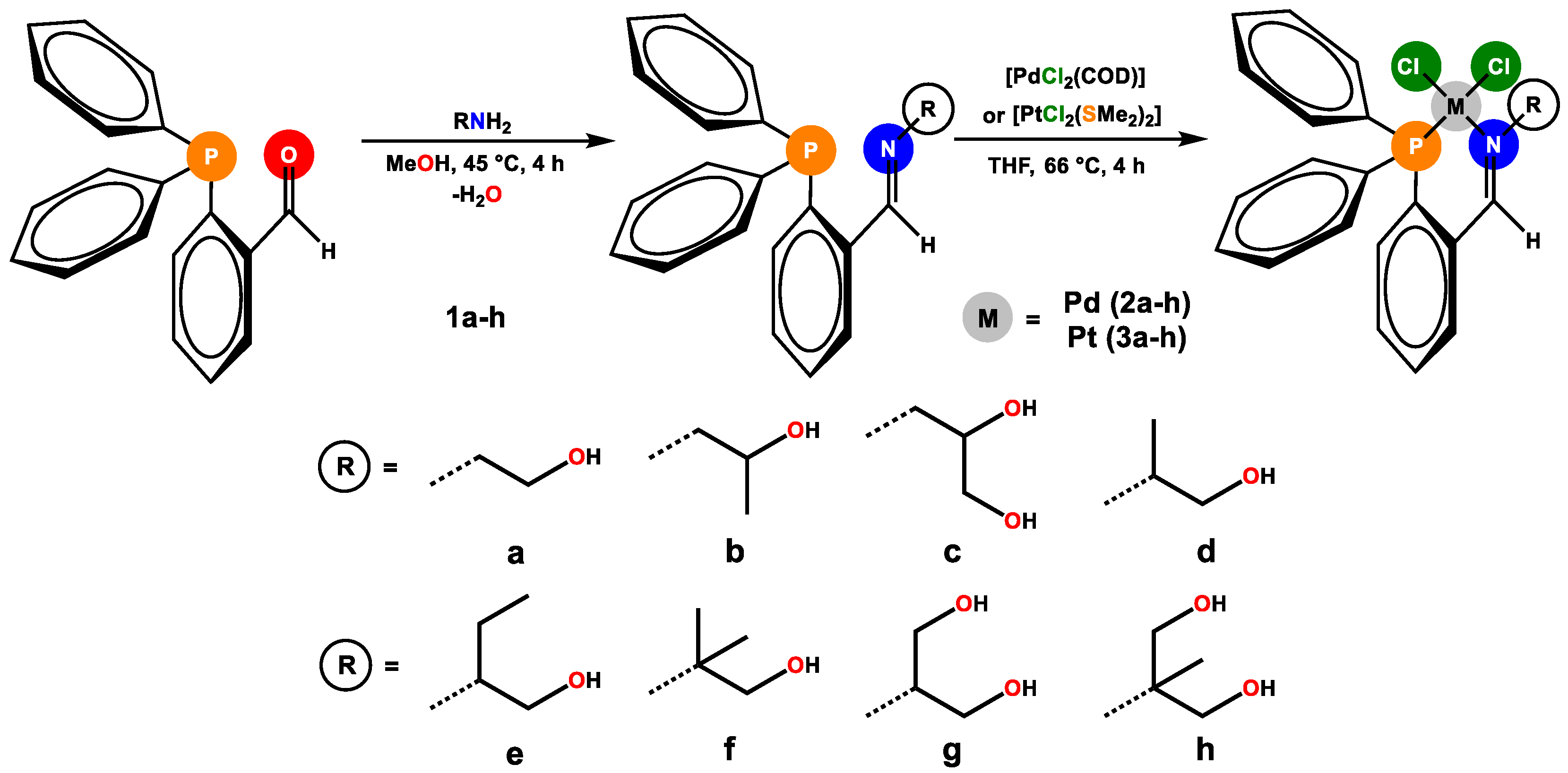
Scheme 1. Synthesis of the Pd(II) complexes (2ah) and the Pt(II) complexes (3ah) bearing a PN ligand derived from an aminoalcohol.
Inorganics 13 00398 sch001
Figure 1. Molecular structures for (1d) and (1e). The ellipsoids are shown at a 50% probability level. Selected bond distances (Å) and angles (°) for (1d): P(1)-C(2) 1.839(2), C(7)-C(1) 1.475(3), C(9)-O(1) 1.406(3), N(1)-C(7) 1.260(3), N(1)-C(7)-C(1) 123.3(2), C(8)-C(9)-O(1) 113.0(2), C(11)-P(1)-C(2) 102.64(9). Selected bond distances (Å) and angles (°) for (1e): P(1)-C(2) 1.831(4), C(7)-C(1) 1.464(6), C(9)-O(1) 1.404(6), N(1)-C(7) 1.280(5), N(1)-C(7)-C(1) 123.3(4), C(8)-C(9)-O(1) 113.5(4), C(12)-P(1)-C(2) 102.3(2).
Inorganics 13 00398 g001
Figure 2. Molecular structures for (2d) and (3d). The ellipsoids are shown at a 50% probability level. Solvent molecules and disorder parts are omitted for clarity. Selected bond distances (Å) and angles (°) for (2d): Pd(1)-N(1) 2.079(5), Pd(1)-P(1) 2.222(2), Pd(1)-Cl(1) 2.386(2), Pd(1)-Cl(2) 2.276(2), C(7)-N(1) 1.267(9), N(1)-Pd(7)-Cl(2) 177.1(2), P(1)-Pd(1)-Cl(1) 170.4(6), P(1)-Pd(1)-N(1) 86.2(2), Cl(2)-Pd(1)-Cl(1) 90.13(6). Selected bond distances (Å) and angles (°) for (3d): Pt(1)-N(1) 2.048(3), Pt(1)-P(1) 2.205(1), Pt(1)-Cl(1) 2.379(1), Pt(1)-Cl(2) 2.287(1), C(7)-N(1) 1.286(5), N(1)-Pt(7)-Cl(2) 178.99(9), P(1)-Pt(1)-Cl(1) 175.10(4), P(1)-Pt(1)-N(1) 86.62(9), Cl(2)-Pt(1)-Cl(1) 88.68(4).
Inorganics 13 00398 g002
Figure 3. (a) Molecular structure for 3e. The ellipsoids are shown at a 50% probability level. Disorder parts are omitted for clarity. Selected bond distances (Å) and angles (°) for 3e: Pt(1)-N(2) 1.995(7), Pt(1)-P(2) 2.178(2), Pt(1)-Cl(1) 2.275(3), Pt(1)-O(1) 2.106(6), C(7)-N(2) 1.27(1), N(2)-Pt(7)-Cl(1) 172.9(2), P(1)-Pt(1)-O(1) 173.2(2), P(2)-Pt(1)-N(2) 92.7(2), O(1)-N(2)-P(2) 97.6(2); (b) Main intermolecular interactions, O(1)∙∙∙H(8) 2.512 Å and H(9)∙∙∙Cl(1) 2.942 Å [1 − x, −y, −1/2 + z].
Inorganics 13 00398 g003
Figure 4. Hirshfeld surfaces calculated over the dnorm function for 2d, 3d, and 3e.
Inorganics 13 00398 g004
Chart 1. Plot of percentages of contacts observed in the complexes.
Inorganics 13 00398 ch001
Figure 5. Interaction between DNA model and (a) complex 2e, (b) complex 2f, and (c) complex 3b.
Inorganics 13 00398 g005
Table 1. Crystal data and details of structure determination of compounds 1d, 1e, 2d, 3d and 3e.
Compound1d1e2d3d3e
Empirical formulaC22H22NOPC23H24NOPC22H22Cl2NOPPd(DMSO)C22H22Cl2NOPPt(DMSO)C23H24Cl2NOPPt
Formula weight347.58361.40602.80705.07627.39
Temperature (K)298(2)298(2)298(2)298(2)278(2)
Wavelength (Å)0.710730.710730.710730.710730.71073
Crystal systemOrthorhombicOrthorhombicTriclinicTriclinicOrthorhombic
Space groupPbcaPbcaP-1P-1Pna21
Unit cell dimensionsa = 9.4896(8) Å
b = 18.4909(16) Å
c = 21.8278(18) Å
α = 90°
β = 90°
γ = 90°
a = 9.9814(10) Å
b = 18.6026(17) Å
c = 21.742(2) Å
α = 90°
β = 90°
γ = 90°
a = 9.1743(9) Å
b = 10.0623(9) Å
c = 14.0908(14) Å
α = 92.699(3)°
β = 99.021(3)°
γ = 96.608(3)°
a = 9.1506(4) Å
b = 10.0932(4) Å
c = 14.1360(5) Å
α = 92.7657(9)°
β = 99.0621(8)°
γ = 95.9741(8)°
a = 19.2035(11) Å
b = 13.0441(8) Å
c = 9.6781(6) Å
α = 90°
β = 90°
γ = 90°
Volume (Å3)3830.2(6)4037.1(7)1273.3(2)1279.51(9)2424.3(3)
Z88224
Density (calc.) (Mg/m3)1.2051.1891.5721.8311.719
Absorption coefficient0.152 mm−10.147 mm−11.105 mm−15.861 mm−16.088 mm−1
F (0 0 0)1472.01536.0612.0690.01216.0
Crystal size (mm3)0.333 × 0.254 × 0.2220.6 × 0.19 × 0.10.274 × 0.101 × 0.0880.419 × 0.329 × 0.2010.31 × 0.077 × 0.041
Theta range for data collection (°)4.406 to 50.706°3.746 to 50.816°4.53 to 50.874°4.536 to 50.62°5.242 to 50.508°
Index ranges−11 ≤ h ≤ 11,
−16 ≤ k ≤ 22,
−17 ≤ l ≤ 26
−12 ≤ h ≤ 12,
−17 ≤ k ≤ 22,
−26 ≤ l ≤ 26
−11 ≤ h ≤ 11,
−11 ≤ k ≤ 12,
−16 ≤ l ≤ 16
−10 ≤ h ≤ 10,
−12 ≤ k ≤ 12,
−16 ≤ l ≤ 16
−22 ≤ h ≤ 22,
−14 ≤ k ≤ 15,
−4 ≤ l ≤ 11
Reflections collected11,88521,28827,89622,8126987
Independent reflections3502
[R(int) = 0.0841, R(sigma) =0.0708]
3698
[R(int) = 0.1135, R(sigma) = 0.0943]
4464
[R(int) = 0.0697, R(sigma) = 0.0456]
4634
[R(int) = 0.0266, R(sigma) = 0.0185]
2766
[R(int) = 0.0277, R(sigma) = 0.0374]
Data/restraints/parameters3502/1/2303698/1/2394464/180/3564634/214/3652766/331/361
Goodness-of-fit on F20.9461.0301.1200.9911.074
Final R indices [I > 2sigma(I)]R1 = 0.0521,
wR2 = 0.1057
R1 = 0.0793,
wR2 = 0.1776
R1 = 0.0695,
wR2 = 0.1843
R1 = 0.0214,
wR2 = 0.0618
R1 = 0.0238,
wR2 = 0.0520
R indices (all data)R1 = 0.0835,
wR2 = 0.1226
R1 = 0.1663,
wR2 = 0.2340
R1 = 0.0779,
wR2 = 0.1955
R1 = 0.0223,
wR2 = 0.0623
R1 = 0.0301,
wR2 = 0.0556
Largest diff. peak and hole (e.Å−3)0.47 and −0.370.53 and −0.281.24 and −1.831.01 and −0.800.70 and −0.41
Table 2. Intermolecular interaction parameters of complexes 2d, 3d and 3e.
CompoundInteractionLength (Å)
D–X···A
Length (Å)
D···A
Angle (°)
D–X···A
Symmetry Operation
2dC5H5···Cl1
C23H23A···Cl1
C23H23B···S1
2.902
2.936
2.727
3.723
3.886
3.405
147.97
172.39
127.96
x, −1 + y, z
−x, 1 − y, 2 − z
−x, 2 − y, 2 − z
3dC5H5···Cl1
C14H14···O2
C23H23A···Cl1
O1H1···O2
2.895
2.399
2.860
1.885
3.727
3.311
3.608
2.673
149.53
166.37
135.66
152.33
x, −1 + y, z
x, y, 1 + z
1 − x, 1 − y, −z
x, y, z
3eC9H9B···Cl1
C8H8···O1
C6H6···Cl2
C7H7···Cl2
O1H1···Cl2
C16H16···Cl2
C20H20···Cl1
2.942
2.512
2.835
2.800
1.882
2.842
2.912
3.638
3.456
3.706
3.690
2.849
3.760
3.563
129.58
102.23
156.66
160.54
171.19
169.55
127.99
1 − x, −y, 1/2 + z
1 − x, −y, 1/2 + z
x, y, 1 + z
x, y, 1 + z
1 − x, −y, 1/2 + z
1/2 + x, 1/2 − y, z
1/2−x, −1/2 + y, 1.5 + z
Table 3. Representative fingerprints of non-covalent interactions of 2d, 3d, and 3e.
CompoundO∙∙∙H/H∙∙∙O (%)Cl∙∙∙H/H∙∙∙Cl (%)C∙∙∙H/H∙∙∙C (%)H∙∙∙H (%)
2dInorganics 13 00398 i001
3.4
Inorganics 13 00398 i002
19.0
Inorganics 13 00398 i003
21.3
Inorganics 13 00398 i004
54.1
3dInorganics 13 00398 i005
7.4
Inorganics 13 00398 i006
19.2
Inorganics 13 00398 i007
21.6
Inorganics 13 00398 i008
48.0
3eInorganics 13 00398 i009
1.3
Inorganics 13 00398 i010
21.8
Inorganics 13 00398 i011
15.8
Inorganics 13 00398 i012
58.9
Table 4. Growth inhibition percentages of cancerous and non-cancerous cell lines caused by Pd(II) complexes (25 µM, 48 h).
Compound% Inhibition
U251PC-3K562HCT-15MCF-7SKLU-1COS-7
2a11.825.334.59.244.318.726.2
2b013.059.1029.112.918.6
2c10.710.919.317.121.311.318.2
2d4.020.764.72.843.514.020.0
2e21.131.689.733.585.315.630.7
2f4.629.594.213.463.326.124.4
2g10.0612.534.66.015.317.116.2
2h23.05.9100025.8062.5
cisplatin97.996.781.854.266.5100100
Table 5. Growth inhibition percentages of cancerous and non-cancerous cell lines caused by Pt(II) complexes (25 µM, 48 h).
Compound% Inhibition
U251PC-3K562HCT-15MCF-7SKLU-1COS-7
3a009.92.45.43.07.4
3b77.630.098.718.542.2687.725.6
3c0012.603.626.20
3d95.993.410074.685.5100100
3e100100100100100100100
3f100100100100100100100
3g1001.810092.310097.9100
3h73.253.997.288.589.296.6100
cisplatin97.996.781.854.266.5100100
Table 6. IC50 values (µM) of Pd(II) and Pt(II) complexes a.
CompoundIC50 (µM)
K562COS-7SI b
2a30.00 ± 3.0--------
2b20.17 ± 0.656.1 ± 9.32.8
2d14.96 ± 1.2--------
2e7.73 ± 1.411.2 ± 2.51.4
2f8.53 ± 1.926.4 ± 1.73.1
3b8.83 ± 1.577.9 ± 7.58.8
cisplatin5.30 ± 1.35.8 ± 0.71.1
a Cell viability determined by SRB assay after treatment for 48 h; b SI (Selectivity Index) = IC50 (COS-7)/IC50 (K562).
Table 7. Molecular docking between the 1AIO model and Pt(II) (2ah) and Pd(II) (3ah) complexes. Binding energies in Kcal/mol.
CompoundBinding EnergyCompoundBinding Energy
2a−5.583a−5.61
2b−5.563b−6.49
2c−5.073c−6.26
2d−5.573d−5.51
2e−6.603e−5.78
2f−6.553f−5.76
2g−6.083g−5.64
2h−6.253h−5.55
cisplatin−6.25
Disclaimer/Publisher’s Note: The statements, opinions and data contained in all publications are solely those of the individual author(s) and contributor(s) and not of MDPI and/or the editor(s). MDPI and/or the editor(s) disclaim responsibility for any injury to people or property resulting from any ideas, methods, instructions or products referred to in the content.