


Abstract
This study presents the synthesis of Cu-doped Li4Ti5O12 (LTO) and Cu-doped Li4Ti5O12@reduced graphene oxide (rGO) anode materials via a simple wet chemical approach combined with freeze-drying. The LTO-0.1Cu@rGO anode delivers an ideal rate capacity of 376, 350, 327, 297 and 259 mAh g−1 at 0.2, 0.5, 1.0, 2.0 and 5.0 A g−1, respectively, and exhibits stable, long-life cyclic performance of 223.0 mAh g−1 at 5.0 A g−1 after 1000 cycles with 94.8% retention. This superior electrochemical performance is attributed to the unique structure of Cu-doped LTO particles that are uniformly embedded within a conductive, interconnected rGO network. Therefore, these results indicate that combined doping and coating strategies have great potential for enhancing the electrochemical properties of LTO anodes for LIBs.
1. Introduction
Lithium-ion batteries (LIBs) have been used a lot in consumer electronics and electric vehicles because they have a long cycle life, are environmentally friendly and have high energy density [1,2,3,4]. Currently, graphite is widely used as an anode material in commercial LIBs, but it also has some inherent limitations. The first issue is that the potential for lithiation is relatively low. This means that the solid electrolyte interphase (SEI) film is formed, which results in serious kinetic issues for the electrode reaction. Moreover, the possibility of a graphite plateau reaching a similar level to that of lithium has been identified. This has the potential to result in the formation of lithium dendrites, which could pose a safety concern [5,6,7].
In the world of alternative electrode materials, spinel Li4Ti5O12 (LTO) has been a frontrunner as an anode material because of its unique “zero-strain” structure. This leads to almost no change in volume during the charge/discharge process, making it ideal for achieving long-term cycle life in LIBs. Furthermore, the flat voltage plateau at around 1.55 V (vs. Li+/Li) guarantees the safety of lithium-ion batteries by effectively reducing the formation of the SEI layer [8,9,10,11]. The LTO’s rate performance is poor for two main reasons. Firstly, its lithium ions diffusion coefficient is poor. Secondly, its electronic conductivity is low. These issues seriously limit the further application of the LTO anode in LIBs [12,13,14].
So far, different methods have been used to solve this problem, like making very small structures, changing the shape, using materials that are good conductors of electricity, and adding other substances to change the way the material works [15,16,17,18,19,20,21,22,23,24]. Element doping has been shown to be the best way to deal with the problems of the LTO anode’s poor performance rate. The phase structure of the LTO lattice would not be affected by element doping. On the other hand, it significantly influences the lattice environment and the valence state of Li+ and Ti4+, enhancing electronic conductivity and lithium-ion diffusion. The site environment of Ti can be affected by Cu doping, as revealed by Chen et al. [25]. This effect is due to the charge-compensating effect, which reduces Ti4+ to Ti3+. The electrochemical performance of the as-prepared Cu-doped Li4Ti5O12 nanosheet was found to be enhanced, with capacities of 190 mAhg−1 and 144 mAhg−1 at 1 C and 30 C achieved after 100 cycles, respectively.
At the same time, adding LTO particles with a carbon-based material that can conduct electricity very well, such as graphite and reduced graphene oxide, is also seen as a good way to solve the problem of poor electrical conductivity and lithium-ion diffusion of LTO. In addition, the surface area of the graphite and graphene nanosheets is large. The diffusion lengths of the lithium ions (Li+) are shortened. The structural flexibility of the nanosheets provides extra active sites to store the Li ions. This means that the movement of ions can be made more efficient in the material used in the electrode [23,26,27,28,29,30,31]. Unlike most studies employing separate doping and coating processes or physical mixing, this work simultaneously achieves atomic-level Cu doping and intimate coating of a three-dimensional rGO network via a one-step hydrothermal method. This unique architecture ensures more efficient electron/ion transport and exceptional structural stability. It is established that Cu doping primarily enhances the intrinsic electronic conductivity of LTO (via Ti3+ introduction) while generating oxygen vacancies to provide additional lithium storage sites. Concurrently, the rGO network predominantly furnishes three-dimensional high-speed conductive pathways whilst suppressing active material agglomeration and side reactions. Their synergistic effect significantly surpasses the simple sum of their individual contributions.
In this work, the development of a facile wet chemical method with freeze-drying for the preparation of a Cu-doped LTO sample and Cu-doped LTO@rGO composite was achieved through the combination of the advantages of the aforementioned strategies. In this mix, the Cu-doped LTO particles are spread evenly in the rGO nanosheet. Excellent electrochemical properties and remarkable cyclic stability are exhibited by the as-synthesized samples. The LTO-0.1Cu@rGO material’s performance metrics are impressive, with a specific capacity of 376 mAhg−1 at 0.2 Ag−1, 350 mAhg−1 at 0.5 Ag−1, 327 mAhg−1 at 1.0 Ag−1, 297 mAhg−1 at 2.0 Ag−1, and 259 mAhg−1 at 5.0 Ag−1. These results are even more impressive when you consider the material’s cycling performance, which is 223 mAhg−1 at 5.0 Ag−1 after 1000 cycles.
2. Results and Discussion
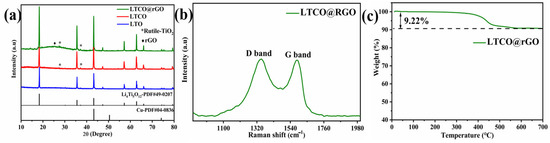
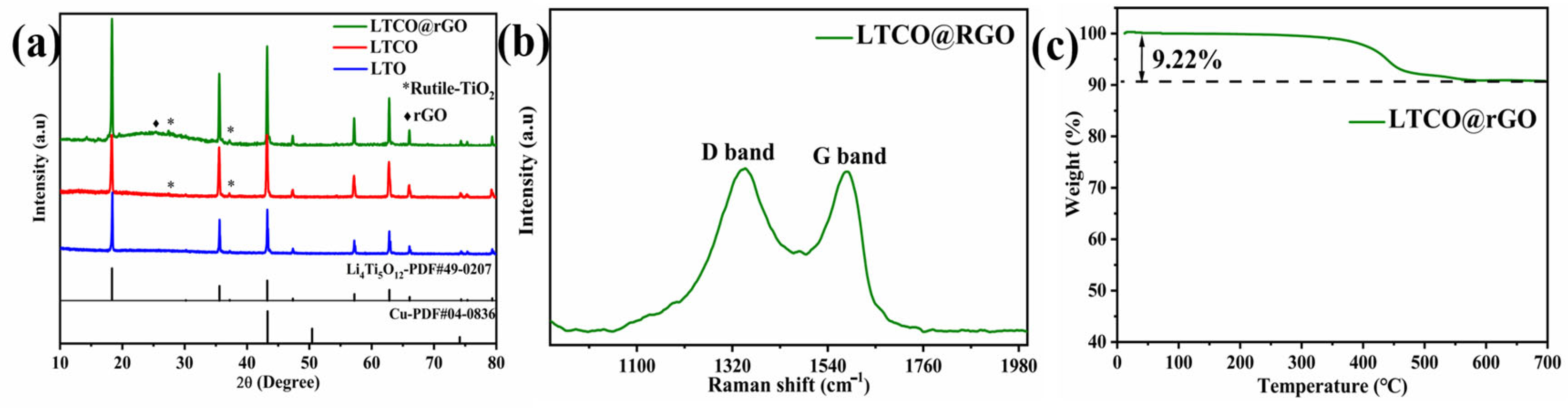
The XRD patterns of the as-obtained samples were obtained to study their crystallographic structure (Figure 1a). These samples were LTO, Li4Ti4.9Cu0.1O12 (LTCO) and LTCO@rGO. Evidently, the three samples under scrutiny demonstrate commendable crystallinity, with the predominant diffraction peaks at 18.3°, 35.5°, and 43.2° corresponding to (1 1 1), (2 2 2), and (4 0 0) crystal planes of the cubic spinel structure of Li4Ti5O12 (JCPDS No. 49-0207) [32,33].
Figure 1.
(a) XRD patterns of the LTO, LTCO and LTCO@rGO materials. (b) Raman spectrums of the LTCO@rGO sample. (c) Thermogravimetric analysis of the LTCO@rGO material.
Additionally, the diffraction peaks of Cu were not clearly distinguishable. However, a weak peak appeared at 27.5° (corresponding to Rutile-TiO2) in the LTCO and LTCO@rGO patterns [22,34]. The phase structure of lithium titanate would not be affected by the low level of Cu-doping, but the formation environment of lithium titanate would be significantly impacted. In addition, the existence of rutile TiO2 prevents the development of impurity phases, such as Li2O and Li2CO3. These would lead to reduced electronic conductivity and a diminished lithium-ion diffusion coefficient [25,35,36]. After adding rGO, a weak diffraction peak emerges at around 24.6° in the XRD pattern of the LTCO@rGO sample (see Figure 1a), which is related to the (002) plane of the few-layer rGO nanosheets. This indicates that the GO has been fully reduced to rGO [37].
We further analyzed the carbon composition and content in the LTCO@rGO composite through Raman spectroscopy and thermogravimetric analysis (TGA). As shown in Figure 1b, the Raman spectrum displays two distinct peaks. The D-band peak at 1351 cm−1 and the G-band peak at 1587 cm−1 correspond to different carbon types. Specifically, the D-band peak relates to disordered carbon, while the G-band peak is associated with ordered graphitic carbon. It is broadly acknowledged that a multitude of flaws could be produced because of the disarray carbon, delivering a wealth of active locations for lithium storage, consequently boosting the specific capacity of LTCO@rGO electrode [21,38]. In addition, as shown in Figure 1c, the TGA curve reveals that the mass reduction is around 9.2% during the heating process from 200 °C to 600 °C, which can be attributed to the carbon composition of the LTCO@rGO composite.
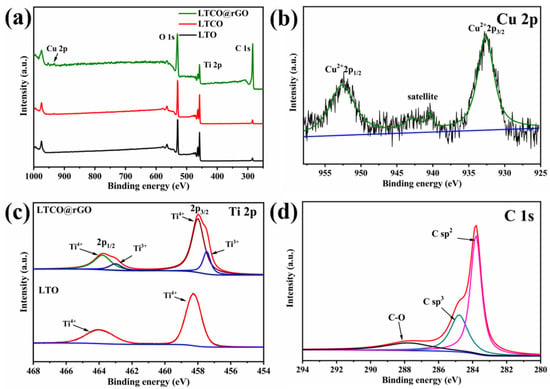
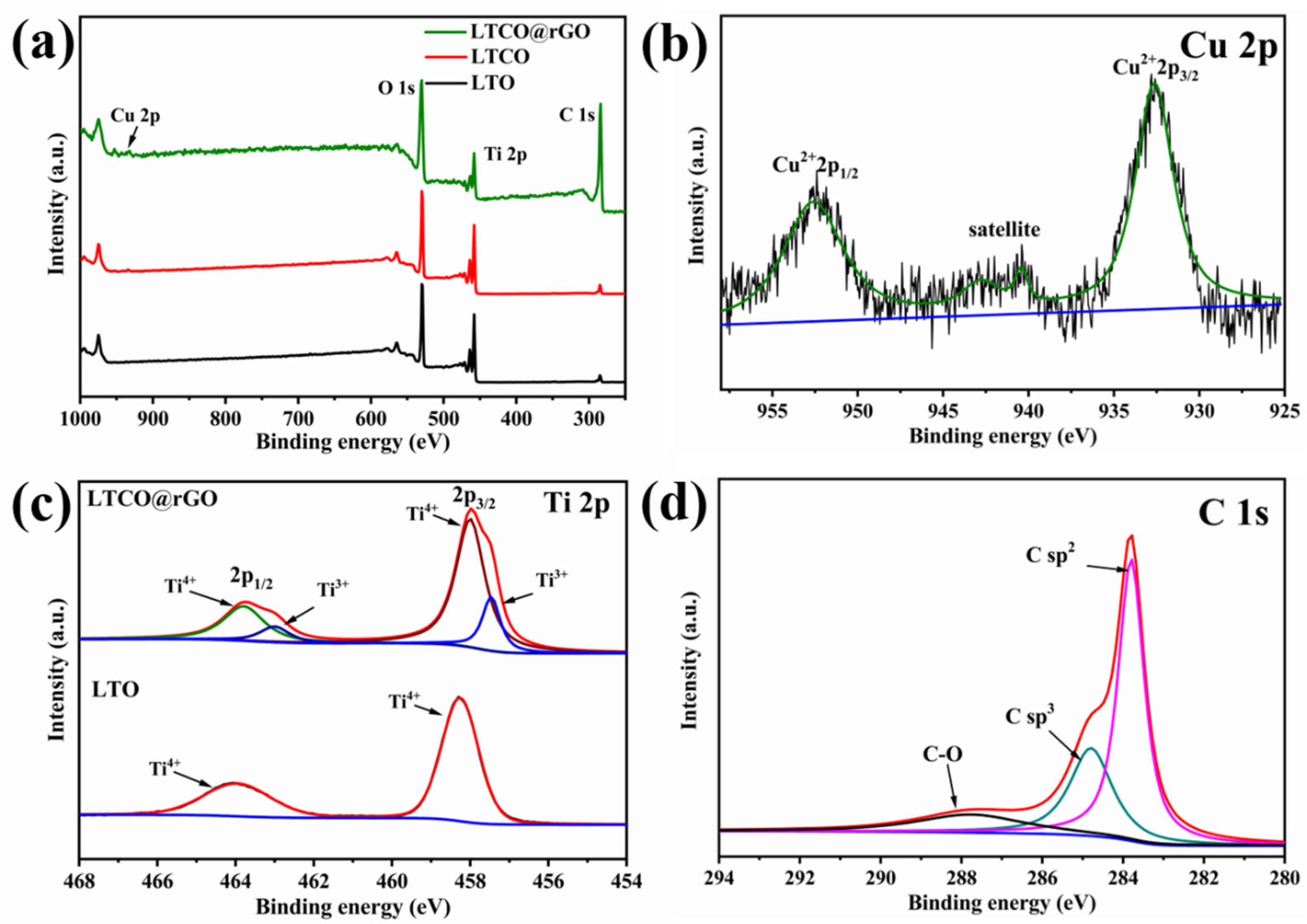
The elemental composition and phase structure of the resulting materials were characterized by means of X-ray photoelectron spectroscopy (XPS) analysis. Figure 2a provides the necessary context by demonstrating a comparison between the LTCO@rGO composite’s XPS spectrum and that of the LTO and LTCO spectra. The aforementioned composite was found to consist of the following elements: The elements Li, Ti, O, Cu, and C were analyzed. Concurrently, the XPS spectrum of Cu 2p was examined, as illustrated in Figure 2b. This revealed the valence state of Cu. Two peaks of characteristic occurrence, located at 952.38 eV and 932.84 eV, respectively, have been identified and correspond to the binding energies of Cu2+ 2p1/2 and Cu2+ 2p3/2, as determined from the experimental findings. The confirmation of the presence of Cu2+ in the composite is a key result of the study and further supports the hypothesis put forward. Furthermore, Figure 2c presents the XPS spectra for the Ti 2p of the LTO and LTCO@rGO. Furthermore, the LTO and LTCO@rGO samples exhibit two peaks of Ti 2p3/2 (457.99 eV) and Ti 2p1/2 (463.82 eV), which are in accordance with the Ti4+ oxidation state. Nevertheless, two additional peaks are discernible in the Ti 2p spectrum of LTCO@rGO at 462.98 and 457.47 eV. These peaks can be assigned to Ti3+ 2p3/2 and Ti3+ 2p1/2 states, respectively [16,39]. This result indicates that partial reduction of Ti4+ to Ti3+ within the LTCO@rGO may occur, thereby inducing charge compensation and the formation of oxygen vacancies. Consequently, this phenomenon is predicted to lead to a substantial enhancement in the electronic conductivity and rate properties of the electrode [40]. In order to provide further confirmation of the reduction of graphene oxide during thermal treatment, high-resolution XPS elemental fitting of the C 1s of the LTCO@rGO sample was also measured. The results are displayed in Figure 2d. The XPS spectrum of C 1s can be subdivided into three distinct peaks. Firstly, a sharp peak at 283.8 eV is indicative of C sp2; secondly, a peak located at 284.7 eV corresponds to C sp3; and finally, a weak and broad peak around 288.1 eV is attributed to oxidized functional groups (C-O and C=O). Consequently, the reduced content of oxidized functional groups indicates that GO undergoes significant reduction to rGO during the thermal treatment process.
Figure 2.
(a) XPS result for the LTO, LTCO and LTCO@rGO materials and (c) high-resolution XPS elemental fittings of Ti 2p for LTO and LTCO@rGO samples. High-resolution XPS elemental fittings of Cu 2p (b) and C 1s (d) for LTCO@rGO.
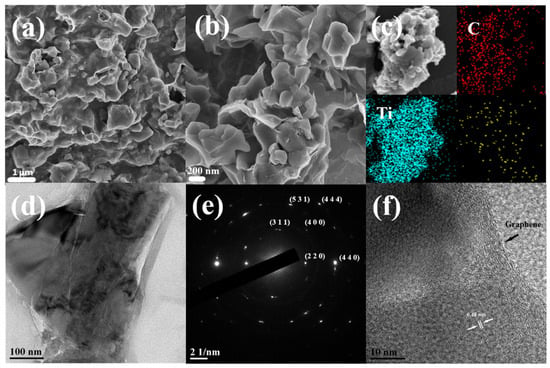
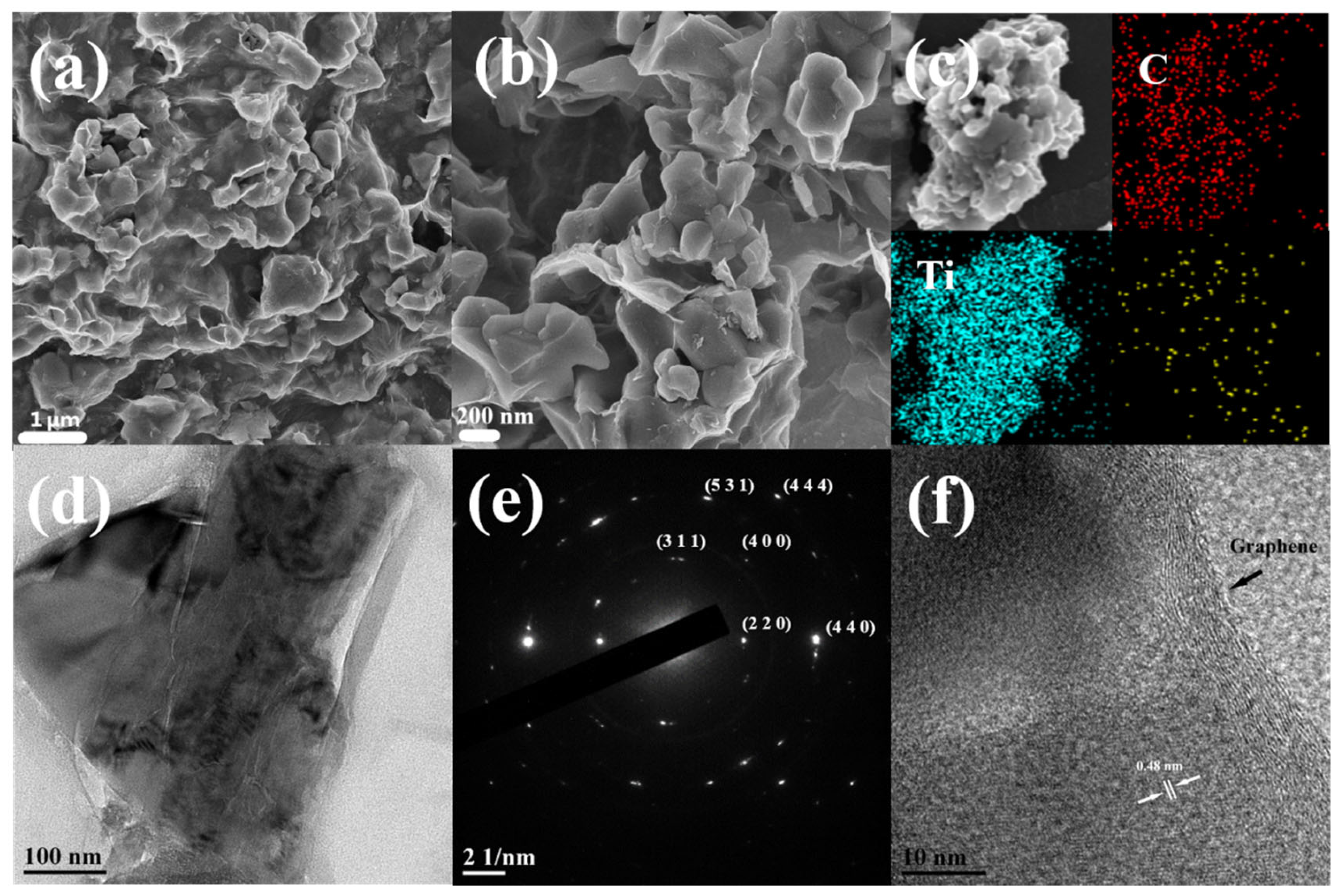
A combination of scanning electron microscopy (SEM) and high-resolution transmission electron microscopy (HRTEM) was employed to thoroughly examine the morphology and microstructure of the LTCO@rGO material. As can be seen in Figure 3a,b, the LTCO particles are clearly visible in the rGO sheets, which are known for their excellent electron conductivity, thus enhancing the electronic conductivity of the sample. Meanwhile, the absence of any obvious agglomeration in the LTCO@rGO sample can be explained by the abundant functional groups possessed by the rGO sheets. These groups have an inclination to interact with the LTO on the interface, leading to the formation of an expanding structure and the reduction in particle agglomeration. Consequently, the reaction area of the particles is considerably augmented, thus affording supplementary storage capacity for Li+ ions on the LTCO@rGO electrode.
Figure 3.
(a,b) SEM images of the LTCO@rGO material. (c) EDS elemental mappings of C, Ti and Cu of the LTCO@rGO material. TEM (d) and SEAD (e), HRTEM (f) images of the LTCO@rGO material.
EDS mapping was employed to examine the elemental distribution in the LTCO@rGO sample, with results displayed in Figure 3c. The analysis revealed a uniform distribution of carbon (C), titanium (Ti), and copper (Cu) elements across the sample, aligning with the findings from XPS analysis. TEM images of the LTCO@rGO sample are presented in Figure 3d–f. Figure 3e shows that the diffraction rings obtained from the Selected Area Electron Diffraction (SEAD) analysis of the LTCO@rGO composite match the standard LTO phase, which is also supported by the XRD results. Furthermore, Figure 3f indicates that the crystal structure of the flat surface has a calculated spacing of 0.48 nm, corresponding to the (1 1 1) plane of LTO [41]. Meanwhile, the LTCO particles have been confirmed to be wrapped by the sheet-like rGO by the high-resolution TEM images.
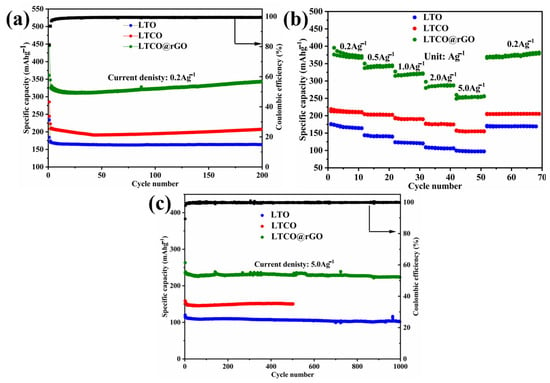
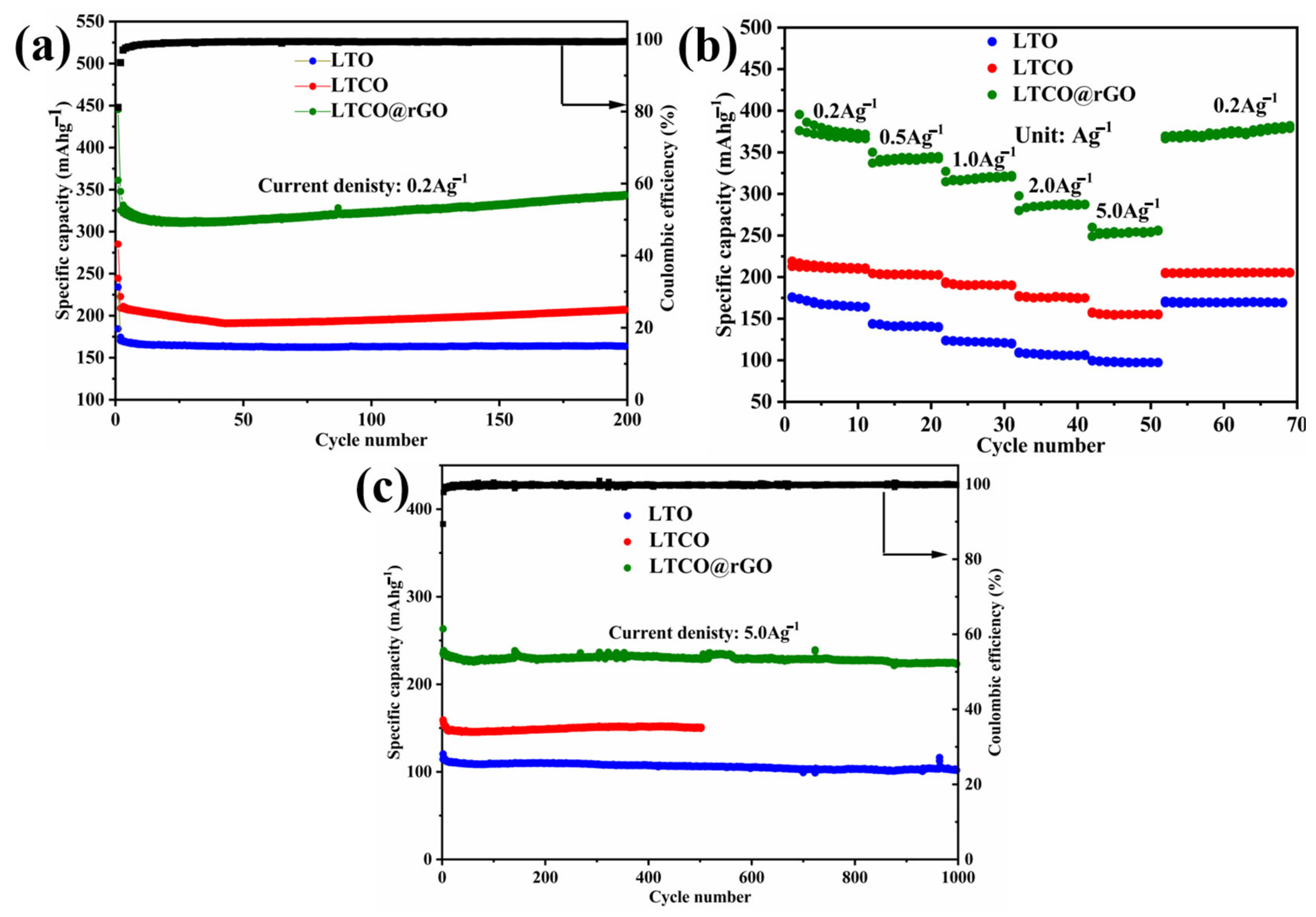
To explore how Cu doping and rGO coating affect electrochemical performance, we first tested the cyclic stability of pure LTO, LTCO, and LTCO@rGO at a current density of 0.2 A g−1 within a voltage range of 0.01 to 3.0 V, with results shown in Figure 4a. The synthesized LTCO@rGO composite showed an initial charge/discharge capacity of 361 and 445 mAh g−1, respectively, with an initial coulombic efficiency (ICE) of 81.1%.
Figure 4.
(a) Cycling property under 0.2 Ag−1 and (b) rate capability at 0.2–5.0 Ag−1 of the LTCO@rGO, LTCO, and pristine LTO electrodes. (c) Long-term performance of the LTCO@rGO electrode under 1.0 Ag−1 after 1000 cycles.
It is noteworthy that the observed exceptionally high reversible capacity (~361 mAh g−1) far exceeds the theoretical value for LTO (175 mAh g−1). This is primarily attributed to the lithium storage capacity inherent to the rGO matrix itself, coupled with significant pseudocapacitive contributions arising from Cu doping and the abundant interfaces introduced by rGO. Its coulombic efficiency improved from 81.1% in the first cycle to 99% by the fifth cycle and remained above 99.5% after 200 cycles. The LTCO@rGO electrode also demonstrated excellent long-term cycling stability, retaining a capacity of 344 mAh g−1 after 200 cycles at 0.2 A g−1. In contrast, LTCO and pure LTO electrodes showed lower capacities of 207 and 163 mAh g−1 after 200 cycles, respectively. To further assess the long-term cycling performance of the LTCO@rGO electrode, we increased the current density to 5 A g−1 and tested it over 1000 cycles, as shown in Figure 4c. The LTCO@rGO sample maintained a capacity of 223 mAh g−1 at 5 A g−1, with a capacity retention rate of 94.8% after 1000 cycles. In comparison, the LTCO electrode delivered a capacity of 150 mAh g−1 (94.4% retention) after 500 cycles, while the LTO electrode only achieved 101 mAh g−1 (84.6% retention) after 1000 cycles. According to the results obtained, the LTCO@rGO composite exhibits a high reversible capacity. It also has prominent long-life cyclic property. This can be correlated with the synergistic effect of Cu2+ doping and the graphene network. On the one hand, additional charge storage could be offered by abundant oxygen vacancies, which are induced by Cu-doping. On the other hand, extra active sites for storing excess Li+ ions are provided by the large specific surface area of the rGO structure. The electrochemical performance is greatly improved through copper doping and rGO coating; after carbon coating modification, the cycling performance and rate capability are improved, and the capacity is increased by at least 30% [25,40,42,43,44].
Figure 4b shows the rate capabilities of the three aforementioned electrodes at different current densities, increasing from 0.2 to 5.0 A g−1. Through Cu doping and combination with rGO, both the LTCO and LTCO@rGO compounds exhibit superior rate performance to pristine LTO. Among the three specimens, the LTCO@rGO composite demonstrated the highest rate capacities of 376, 350, 327, 297, 259, and 369 mAh g−1 at 0.2, 0.5, 1.0, 2.0, and 5.0, and at 0.2 A g−1 once more with a preservation of 69.1%, correspondingly. Therefore, it makes sense to think that the better electrical conductivity and lithium-ion diffusion of the LTCO@rGO composite are connected to its improved structure. Firstly, the reduction of Ti4+ to Ti3+ caused by Cu doping leads to charge compensation, which greatly increases the electron hole concentration and enhances intrinsic conductivity. At the same time, the combination of graphene with LTO-Cu creates a stable structure and helps Li+ to diffuse and transfer electrons more quickly.
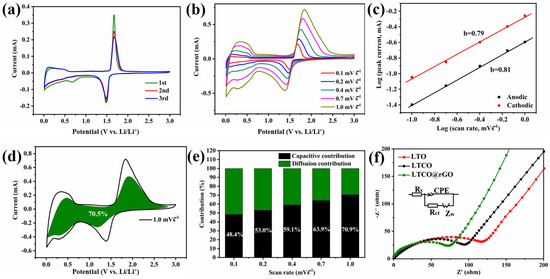
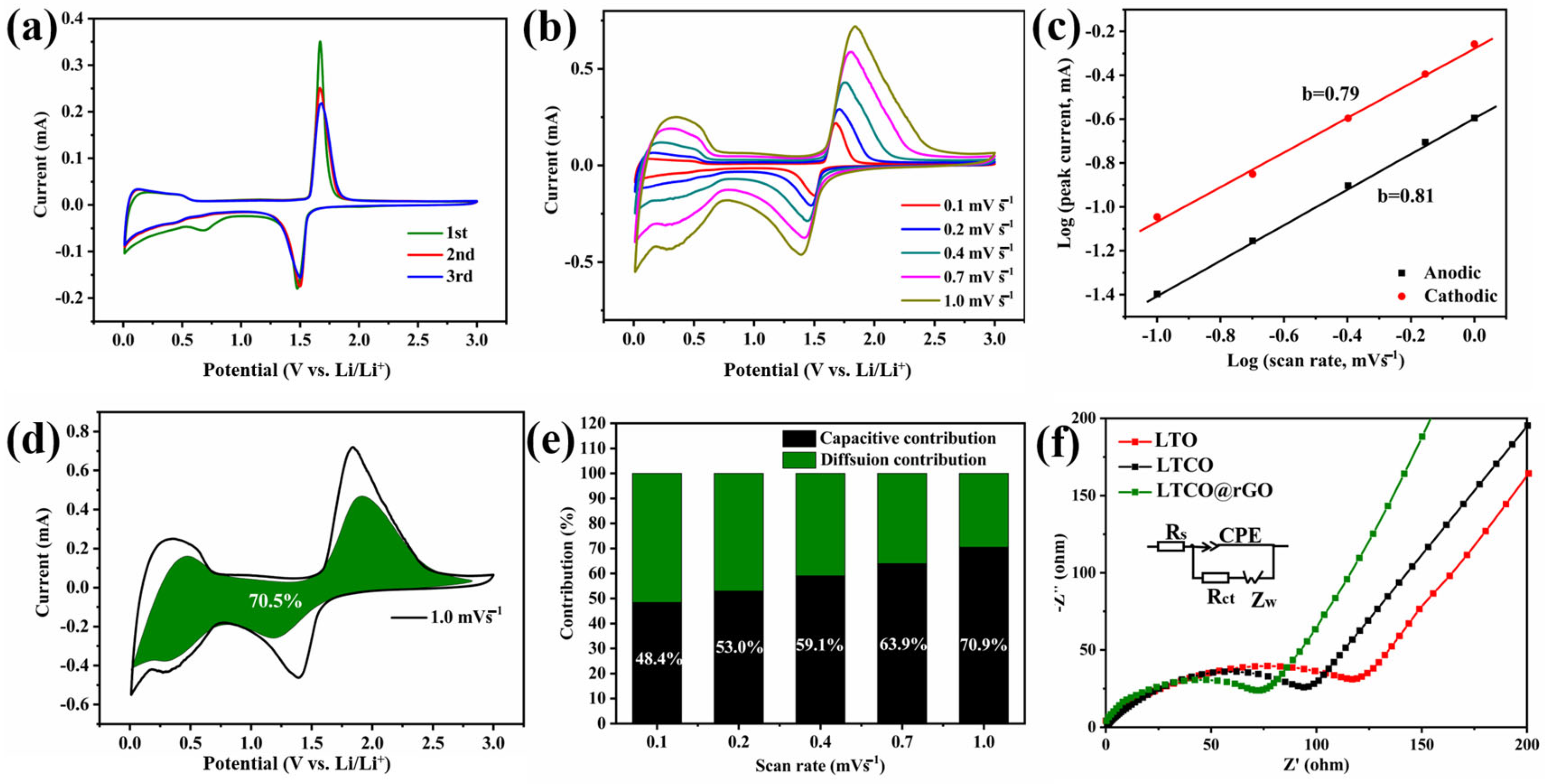
To explore the kinetics of the insertion and extraction of lithium into electrode materials, the cyclic voltammetry (CV) curve of the as-obtained LTCO@rGO electrode was examined over the first three cycles at a scan rate of 0.1 mV s−1, with a potential range of 0.01–3.0 V. As illustrated in Figure 5a, during the initial cathodic cycle, a discernible peak emerged at 0.68 V, subsequently dissipating in the subsequent cycles, indicative of the formation of the SEI film. Additionally, the cathodic-anodic peak pairs at 1.48/1.67 V and 0.01/0.11 V in all three curves can be attributed to Li+ insertion/extraction from spinel LTO and rGO, respectively. What’s more, the initial three cycles of the CV curve are very similar, showing that the LTCO@rGO electrode is very reversible.
Figure 5.
CV curves of LTCO@rGO electrode (a) for the initial three cycles and (b) at different scan rates. (c) The slope of logarithm scan rate versus logarithm current for cathode and anode. (d) Capacitive behaviour at 1.0 mVs−1. (e) Percentage of capacitive contribution at scan rates ranging from 0.1–1.0 mVs−1. (f) EIS of the LTCO@rGO and LTCO electrodes and pure LTO.
Then, the measurement of CV was performed for the purpose of investigation of the further electrochemical kinetic characteristic of the as-fabricated LTO and LTCO@rGO electrodes at voltages ranging from 0.01 to 3.0 V with scan rates between 0.1–1.0 mVs−1. A comparison of the CV profiles for the LTO and LTCO@rGO electrodes revealed that the LTCO@rGO electrode exhibited a more stable shape, sharper peaks and a smaller potential difference. This indicates fast lithium-ion transport and low polarization. Additionally, an additional cathodic peak was observed around 0.3 V in the CV profile of the LTCO@rGO sample as the scanning rate increased. This phenomenon may be related to the pseudocapacitive effect due to the composite’s elevated specific surface area and abundant interfaces. The pseudocapacitive behaviour-dominated charge storage process relies on rapid surface/near-surface reactions rather than slow bulk diffusion-controlled phase transitions. This significantly reduces internal stresses induced by lattice volume changes during Li+ insertion/extraction, thereby mitigating mechanical fatigue and particle fracture in the material. This is crucial for maintaining the long cycle life of ‘zero-strain’ LTO materials. The rapid pseudocapacitive response ensures high charge storage efficiency even at high rates, minimizing polarization and preventing capacity decay and structural damage caused by side reactions such as lithium metal plating. This dynamically safeguards the electrode’s structural integrity. The rGO network provides a vast electrochemically active surface area, significantly enhancing this pseudocapacitive behaviour. Together, they form a highly optimized kinetic and mechanically stable composite system, jointly supporting exceptional long-term cycling stability. The complete charge storage process is well known to be divisible into diffusion and capacitive contributions, the value of which can be determined according to the formula [45], where i represents the peak current and v signifies the scan rate. A value of 0.5 indicates a process fully governed by diffusion, while a value of 1.0 indicates one that is entirely capacitance-controlled. Accordingly, we determined the value of b for the prepared electrode via the specified equation, as illustrated in Figure 5c. The b values measured were 0.79 for the cathode and 0.81 for the anode, confirming that the charge storage mechanism of the LTCO@rGO electrode involves a hybrid process of both diffusion and capacitive contributions, thereby enhancing its high-rate performance. From the aforementioned results, we can utilize the relationship between current (i) and scan rate (v) at a specific potential (V) to quantitatively assess the overall charge storage contribution. This relationship is expressed by the following equation: [46,47,48], where the term k1v corresponds to the capacitive contribution while signifies the diffusion-controlled aspect. As illustrated in Figure 5d, the percentage of capacitance contribution has been calculated to be 70.5% at 1.0 mVs−1 according to the above formula. Furthermore, the results depicted in Figure 5e highlight the measured capacitance contributions of 48.4%, 53.0%, 59.1%, 63.9% and 70.5% at scan rates of 0.1, 0.2, 0.4, 0.7 and 1.0 mV s−1, respectively.
Electrical impedance spectroscopy (EIS) measurements were also conducted for the LTO, LTCO, and LTCO@rGO composites, as illustrated in Figure 5f. As observed in Figure 5f, the semicircle in the middle frequency region is linked to the charge transfer resistance between the electrode interface (Rct). In the low-frequency region, a sloping line is observed that corresponds to the Warburg impedance (Zw), reflecting the diffusion rate of Li+ within the electrode. Additionally, the LTCO@rGO sample shows the smallest semicircle when compared to the other two composites, signifying efficient transport of Li+ ions and electrons, which aligns with the previous electrochemical measurement results.
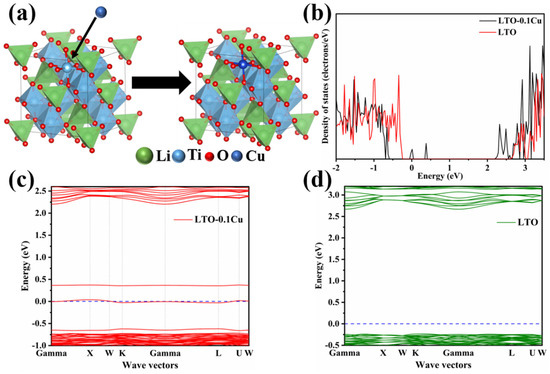
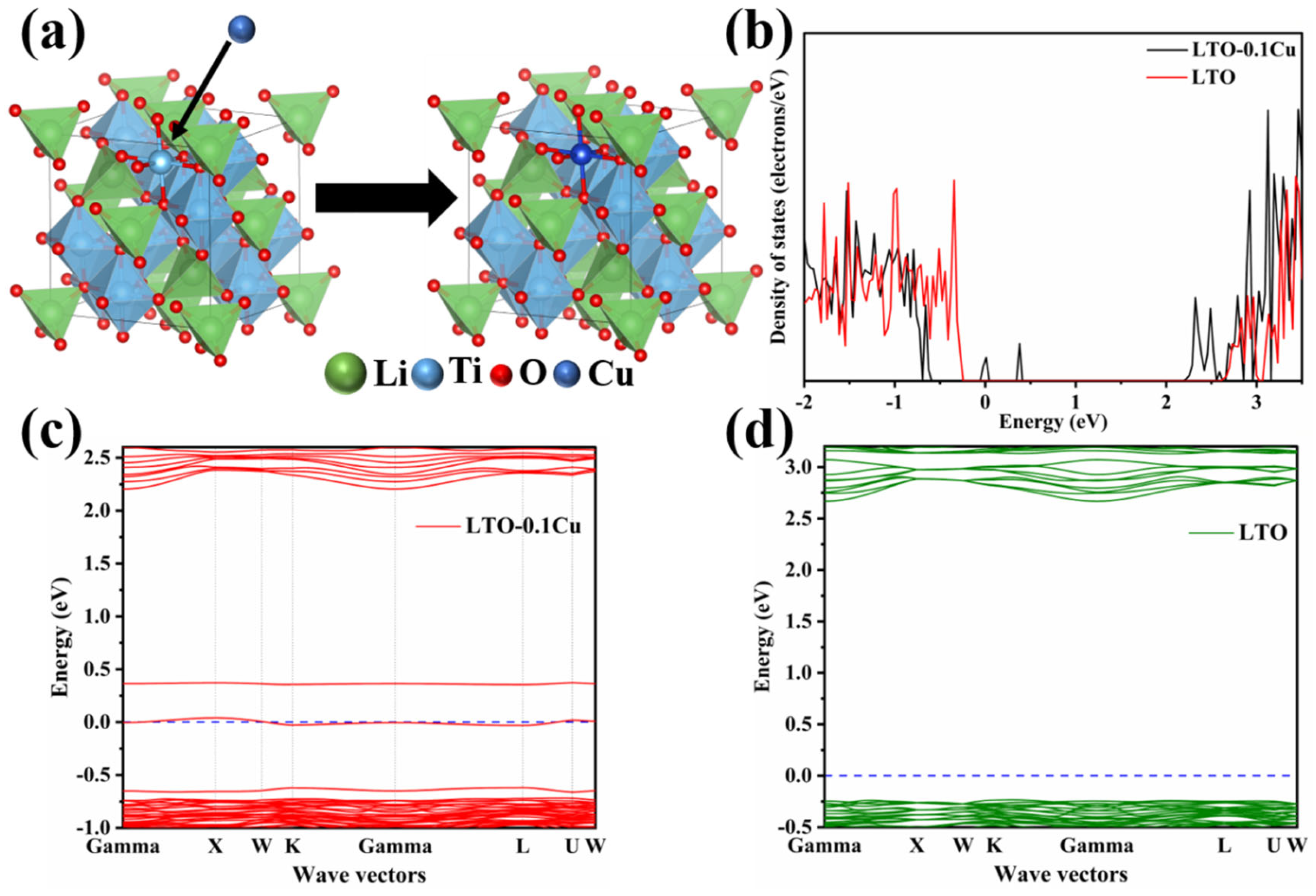
The effect of Cu2+ doping on the electrochemical properties of LTO was analyzed using density functional theory. The model structure for the calculation of LTO doping with copper was first established, as depicted in Figure 6a. According to the XRD and XPS results, a small amount of Cu doping could partially reduce Ti4+ to Ti3+, indicating that some of the Cu2+ would occupy the 16d octahedral sites of Ti4+. The density of states and band structures of LTO and LTCO are displayed in Figure 6b–d. The calculation results reveal that undoped LTO is a semiconductor with a band gap of 2.92 eV, leading to limited electronic conductivity. Substituting Cu for Ti generates a defect state in the forbidden band, which mainly emerges near the Fermi level. And the band-gap of the Cu-doped LTO is about 2.18 eV. This results in a narrower band gap, thereby enhancing electron transmission and rate performance.
Figure 6.
(a) Model structure of LTCO. (b) DOS images of LTCO and LTO. (c) Band structures of LTCO and (d) LTO.
In summary, the as-obtained LTCO@rGO composite electrode exhibited remarkable electrochemical performance, which can be attributed to the following advantages: (1) Cu doping can partially reduce Ti4+ to Ti3+ by displacing some of the Ti4+ ions with Cu2+ ions in the octahedral 16d sites, creating oxygen vacancies and increasing the concentration of electron holes. This provides additional charge storage and enhances the electronic conductivity of the material. (2) The rGO can act as a conductive network structure that provides a fast channel for the transport of Li+ ions and electrons. It also possesses a large specific surface area, resulting in an abundance of active sites for storing lithium ions. (3) The pseudocapacitive effect of the LTCO@rGO material can provide additional storage of Li+ ions. (4) The LTCO particles are uniformly embedded in the folded rGO sheets, which effectively alleviates agglomeration of the LTO particles and maintains structural stability during the charge/discharge process.
3. Experiment
3.1. Material Synthesis
LTO and Li4Ti4.9Cu0.1O12 (LTO-0.1Cu) samples were synthesized via a facile wet chemical approach combined with freeze-drying. Typically, solution A was obtained by dissolving 0.27 g Lithium nitrate (LiNO3) and 0.1 mmol Cu(CH3COO)2·H2O in 30 mL of deionized water. Then, 1.7 mL tetrabutyl titanate was dissolved in 50 mL absolute ethyl alcohol followed by the addition of 30 mL deionized water. White precipitation was formed in the solution due to the hydrolysis of tetrabutyl titanate. Solution B was prepared by adding dropwise 4 mL Hydrogen nitrate (HNO3) into the above solution with continuous magnetic stirring at 80 °C till a transparent solution was obtained. Subsequently, solution A was added dropwise into solution B with a quick stirring under 80 °C for 30 min. The obtained milky suspension was placed into freezer dryer for freezing at −70 °C and drying for 48 h. The freeze dryer utilizes the standard DGJ-10C model, featuring a cold trap temperature of −65 °C, ultimate vacuum of 1 Pa, four shelf layers, and a single-batch freeze-drying capacity of 1 litre. The as-obtained powders were calcined at 800 °C for 12 h in a muffle furnace in air. In addition, the pristine LTO was prepared in the same condition except adding Cu(CH3COO)2·H2O.
Graphene oxide (GO) was synthesized via the modified Hummer’s method. The LTO-0.1Cu@rGO sample was obtained using freeze-drying and heat treatment. Briefly, a certain amount of LTO-0.1Cu materials were firstly dispersed mixed solution consisted of absolute ethyl alcohol and deionized water by ultrasonic processing for 3 h. Then, 2 mg polyvinyl alcohol and 5%wt GO were added into the above solution under continuous magnetic stirring for 24 h. After that, the obtained suspension was transferred to freezer-dryer for completely dried. The final product of LTO-0.1Cu@rGO was prepared by calcining the precursor powders at 500 °C for 2 h under Ar atmosphere.
3.2. Materials Characterization
The crystallographic structure of obtained materials was measured by X-ray diffraction (XRD, Rigaku D/max 2500, Tokyo, Japan) with the Cu Kα radiation. Information on XRD pattern alignment: The 2θ range spans angles from 0 to 90 degrees, with a step width of 0.02 degrees and an acquisition time of 10 min. Raman spectroscopy (LabRAM Hr-800, Jobin Yvon, Longjumeau, France) was employed to analyze the materials’ properties. Thermogravimetric analysis (TGA) was performed using an SDRQ600 TG-DGA (TA Instruments, New Castle, DE, USA) system to measure the carbon content ratio within the temperature range of 25–700 °C, with a heating rate of 5 °C/min in an air atmosphere. X-ray photoelectron spectroscopy (XPS) on a Phi X-Tool was used to determine the elemental states and compositions of the materials. Their morphology was examined using a Field Emission Scanning Electron Microscope (SEM, Quanta 200FEG, FEI, Morgan Hill, CA, USA) equipped with an Energy Dispersive X-ray Spectrometer (EDS), as well as a Transmission Electron Microscope (TEM, JEOL 2011, Tokyo, Japan).
3.3. Electrochemical Tests
To investigate the electrochemical performance of the samples, CR2032 coin cells were assembled in a glove box filled with argon. For the preparation of the working electrode, the sample material was mixed with carbon black (Super P LI Conductive Carbon Black) and polyvinylidene fluoride (SOLEF-PVDF5130 PVDF) binder in N-methyl pyrrolidinone, following a weight ratio of 70:15:15, to form a slurry. This slurry was then spread onto a copper foil with a thickness of 50 μm and dried at 80 °C. Lithium foil was used as both the counter and reference electrodes. The electrolyte was prepared by dissolving 1 M LiPF6 in a mixture of EC and DMC (1:1 by volume), and Celgard 2200 was used as the separator. Galvanostatic charge/discharge tests were conducted on the LAND test system (BT2013A) within a voltage range of 1.0 to 2.5 V (vs. Li+/Li). The cyclic voltammetry (CV) and electrochemical impedance spectroscopy (EIS) were measured on a CHI660E workstation at voltage of 0.01 to 3.0 V (vs. Li+/Li) and frequency range from 0.01 Hz to 100 kHz with the AC amplitude of 5 mV, respectively. All calculations were performed using the VASP software (VASP 4.6) package, employing the Perdew-Burke-Ernzerhof (GGA-PBE) functional under the generalized gradient approximation to describe the exchange-correlation energy. A 4 × 4 × 4 k-space grid sampling was employed for both LTO and LTCO supercells using the Monkhorst-Pack method. Projected augmented wave (PAW) pseudopotentials were utilized to describe nuclear-electron interactions. These detailed parameters will ensure the reproducibility of our DFT calculations.
4. Conclusions
In short, the LTCO@rGO composite was successfully produced using an easy wet chemical method. In this composite structure, LTCO particles are evenly wrapped in numerous folded rGO sheets. Thanks to the synergistic effect of rGO and Cu-doping, the resulting electrode exhibited high reversibility, with a capacity of 361 mAh g−1 and an ICE of 81.1%. Additionally, the LTCO@rGO electrode exhibited a rate capability of 259.9 mAh g−1 under 5.0 Ag−1 and a cyclic property of 223 mAh g−1 at 5.0 Ag−1 with a capacity retention rate of 94.8% after 1000 cycles. Through a one-step hydrothermal process, atomic-level Cu doping and the tight encapsulation of a three-dimensional rGO network were simultaneously achieved. This synergistic structure, constructed via the one-step method, exhibits unique advantages in delivering ultra-high specific capacity (259 mAh g−1 at 5 A g−1) and exceptionally long cycle life (94.8% capacity retention after 1000 cycles). This robustly underscores the innovative nature of this study relative to prior reports. This work therefore validates a method for enhancing the electrochemical performance of lithium-ion batteries, which can be applied to high-rate lithium-ion batteries, thereby providing insights for the preparation of high-performance lithium-ion batteries.
Author Contributions
Methodology, X.D. and M.Z.; Software, X.D., M.H. and Z.F.; Data curation, X.D. and M.Z.; Writing—original draft, M.H. and Z.F.; Writing—review & editing, B.Z.; Visualization, X.D. and M.Z. All authors have read and agreed to the published version of the manuscript.
Funding
This research was funded by 2025 Ministry of Industry and Information Technology Equipment Division I Special Project (Task No. 64, Tender No.ZC25T310038-64).
Data Availability Statement
The data presented in this study are available on request from the corresponding author due to privacy.
Acknowledgments
The authors are grateful for the financial support from the Innovation and Entrepreneurship Leading Team Project in Zengcheng District, Guangzhou City, Guangdong Province, China (202102003), National Key R&D Programme of China: Research on Extreme Parameter Testing and Evaluation Technologies for Primary Standards and Core Components in Precision Machining (2022YFF0606000), and 2025 Ministry of Industry and Information Technology Equipment Division I Special Project (Task No. 64, Tender No.ZC25T310038-64).
Conflicts of Interest
The authors declare no conflict of interest.
References
- Li, M.; Lu, J.; Chen, Z.; Amine, K. 30 Years of Lithium-Ion Batteries. Adv. Mater. 2018, 30, e1800561. [Google Scholar] [CrossRef] [Scilit] [PubMed]
- Goodenough, J.B.; Park, K.S. The Li-ion rechargeable battery: A perspective. J. Am. Chem. Soc. 2013, 135, 1167–1176. [Google Scholar] [CrossRef] [Scilit] [PubMed]
- Zeng, X.; Li, M.; El-Hady, D.A.; Alshitari, W.; Al-Bogami, A.S.; Lu, J.; Amine, K. Commercialization of Lithium Battery Technologies for Electric Vehicles. Adv. Energy Mater. 2019, 9, 1900161. [Google Scholar] [CrossRef] [Scilit]
- Etacheri, V.; Marom, R.; Elazari, R.; Salitra, G.; Aurbach, D. Challenges in the development of advanced Li-ion batteries: A review. Energy Environ. Sci. 2011, 4, 3243–3262. [Google Scholar] [CrossRef] [Scilit]
- Aravindan, V.; Lee, Y.S.; Madhavi, S. Research Progress on Negative Electrodes for Practical Li-Ion Batteries: Beyond Carbonaceous Anodes. Adv. Energy Mater. 2015, 5, 1402225. [Google Scholar] [CrossRef] [Scilit]
- Huang, B.; Li, X.; Pei, Y.; Li, S.; Cao, X.; Masse, R.C.; Cao, G. Novel Carbon-Encapsulated Porous SnO2 Anode for Lithium-Ion Batteries with Much Improved Cyclic Stability. Small 2016, 12, 1945–1955. [Google Scholar] [CrossRef] [Scilit]
- Yoo, H.; Lee, G.; Choi, J. Binder-free SnO2–TiO2 composite anode with high durability for lithium-ion batteries. RSC Adv. 2019, 9, 6589–6595. [Google Scholar] [CrossRef] [Scilit]
- Yi, T.-F.; Xie, Y.; Zhu, Y.-R.; Zhu, R.-S.; Shen, H. Structural and thermodynamic stability of Li4Ti5O12 anode material for lithium-ion battery. J. Power Sources 2013, 222, 448–454. [Google Scholar] [CrossRef] [Scilit]
- Zhao, B.; Ran, R.; Liu, M.; Shao, Z. A comprehensive review of Li4Ti5O12—Based electrodes for lithium-ion batteries: The latest advancements and future perspectives. Mater. Sci. Eng. R Rep. 2015, 98, 1–71. [Google Scholar] [CrossRef] [Scilit]
- Zhang, E.; Zhang, H. Hydrothermal synthesis of Li4Ti5O12-TiO2 composites and Li4Ti5O12 and their applications in lithium-ion batteries. Ceram. Int. 2019, 45, 7419–7426. [Google Scholar] [CrossRef] [Scilit]
- Liu, H.; Zhu, Z.; Huang, J.; He, X.; Chen, Y.; Zhang, R.; Lin, R.; Li, Y.; Yu, S.; Xing, X.; et al. Elucidating the Limit of Li Insertion into the Spinel Li4Ti5O12. ACS Mater. Lett. 2019, 1, 96–102. [Google Scholar] [CrossRef] [Scilit]
- Yan, B.; Li, M.S.; Li, X.F.; Bai, Z.M.; Yang, J.W.; Xiong, D.B.; Li, D.J. Novel understanding of carbothermal reduction enhancing electronic and ionic conductivity of Li4Ti5O12 anode. J. Mater. Chem. A 2015, 3, 11773–11781. [Google Scholar] [CrossRef] [Scilit]
- Zhang, Q.Y.; Lu, H.S.; Zhong, H.X.; Yan, X.D.; Ouyang, C.Y.; Zhang, L.Z. W6+ & Br- codoped Li4Ti5O12 anode with super rate performance for Li-ion batteries. J. Mater. Chem. A 2015, 3, 13706–13716. [Google Scholar]
- Yi, T.-F.; Wei, T.-T.; Li, Y.; He, Y.-B.; Wang, Z.-B. Efforts on enhancing the Li-ion diffusion coefficient and electronic conductivity of titanate-based anode materials for advanced Li-ion batteries. Energy Storage Mater. 2020, 26, 165–197. [Google Scholar] [CrossRef] [Scilit]
- Xue, X.; Yan, H.; Fu, Y. Preparation of pure and metal-doped Li4Ti5O12 composites and their lithium-storage performances for lithium-ion batteries. Solid State Ion. 2019, 335, 1–6. [Google Scholar] [CrossRef] [Scilit]
- Meng, W.-W.; Yan, B.-L.; Xu, Y.-J. Scalable synthesis of Ti3+ self-doped Li4Ti5O12 microparticles as an improved performance anode material for Li-ion batteries. J. Alloys Compd. 2019, 788, 21–29. [Google Scholar] [CrossRef] [Scilit]
- Zhang, Q.; Liu, Y.; Lu, H.; Tang, D.; Ouyang, C.; Zhang, L. Ce 3+ -doped Li4Ti5O12 with CeO2 surface modification by a sol-gel method for high-performance lithium-ion batteries. Electrochim. Acta 2016, 189, 147–157. [Google Scholar] [CrossRef] [Scilit]
- Liu, M.; Gao, H.; Hu, G.; Zhu, K.; Huang, H. Facile preparation of core-shell Si@Li4Ti5O12 nanocomposite as large-capacity lithium-ion battery anode. J. Energy Chem. 2020, 40, 89–98. [Google Scholar] [CrossRef] [Scilit]
- Zhu, W.; Wang, Y.; Yu, Y.; Hu, Y.; Chen, Y. Core-shell structured α-Fe2O3@Li4Ti5O12 composite as anode materials for high-performance lithium-ion batteries. J. Alloys Compd. 2020, 813, 152175. [Google Scholar] [CrossRef] [Scilit]
- Hong, H.-J.; Ban, G.; Lee, S.-M.; Park, I.-S.; Lee, Y.-J. Synthesis of 3D-structured Li4Ti5O12 from titanium(IV) oxysulfate (TiOSO4) solution as a highly sustainable anode material for lithium-ion batteries. J. Alloys Compd. 2020, 844, 156203. [Google Scholar] [CrossRef] [Scilit]
- Feng, Y.; Wu, K.; Deng, X.; Ke, J.; Yang, B.; Dong, H.; Xiong, D.; He, M. Exfoliated Graphite Nanosheets Coating on Nano-grained SnO2/Li4Ti5O12 as a High-Performance Anode Material for Lithium-Ion Batteries. Langmuir 2020, 36, 14666–14675. [Google Scholar] [CrossRef] [Scilit] [PubMed]
- Gangaja, B.; Nair, S.; Santhanagopalan, D. Surface-engineered Li4Ti5O12 nanoparticles by TiO2 coating for superior rate capability and electrochemical stability at elevated temperature. Appl. Surf. Sci. 2019, 480, 817–821. [Google Scholar] [CrossRef] [Scilit]
- Xu, H.; Chen, J.; Wang, D.; Xiao, L.; Guo, X.; Zhang, Y.; Wang, Z. Carbon-coated Li4Ti5O12–TiO2 microspheres as anode materials for lithium ion batteries. Surf. Eng. 2017, 33, 559–566. [Google Scholar] [CrossRef] [Scilit]
- Gangaja, B.; Nair, S.V.; Santhanagopalan, D. Interface-engineered Li4Ti5O12-TiO2 dual-phase nanoparticles and CNT additive for supercapacitor-like high-power Li-ion battery applications. Nanotechnology 2018, 29, 095402. [Google Scholar] [CrossRef] [Scilit]
- Chen, C.; Huang, Y.; An, C.; Zhang, H.; Wang, Y.; Jiao, L.; Yuan, H. Copper-doped dual phase Li4Ti5O12-TiO2 nanosheets as high-rate and long cycle life anodes for high-power lithium-ion batteries. ChemSusChem 2015, 8, 114–122. [Google Scholar] [CrossRef] [Scilit]
- Sun, J.; Teng, D.; Liu, Y.; Chi, C.; Yu, Y.; Lan, J.-L.; Yang, X. Enhanced lithium storage capability of a dual-phase Li4Ti5O12–TiO2–carbon nanofiber anode with interfacial pseudocapacitive effect. RSC Adv. 2014, 4, 48632–48638. [Google Scholar] [CrossRef] [Scilit]
- Liang, K.; Huang, X.; Hong, X.; Liao, Y.; Ren, Y.; Wang, H. Sulfur and nitrogen-doped Li4Ti5O12/rGO as an anode material for advanced sodium-ion batteries. J. Alloys Compd. 2021, 857, 158190. [Google Scholar] [CrossRef] [Scilit]
- Uceda, M.; Chiu, H.-C.; Gauvin, R.; Zaghib, K.; Demopoulos, G.P. Electrophoretically co-deposited Li4Ti5O12/reduced graphene oxide nanolayered composites for high-performance battery application. Energy Storage Mater. 2020, 26, 560–569. [Google Scholar] [CrossRef] [Scilit]
- Feng, Y.; Liu, H.; Zhao, X. In-situ constructing of mesoporous Li4Ti5O12@rGO hybrid spheres as anode materials for lithium-ion batteries. Ionics 2020, 26, 2791–2801. [Google Scholar] [CrossRef] [Scilit]
- Zhu, K.; Gao, H.; Hu, G. A flexible mesoporous Li4Ti5O12-rGO nanocomposite film as free-standing anode for high rate lithium ion batteries. J. Power Sources 2018, 375, 59–67. [Google Scholar] [CrossRef] [Scilit]
- Ge, H.; Hao, T.; Osgood, H.; Zhang, B.; Chen, L.; Cui, L.; Song, X.M.; Ogoke, O.; Wu, G. Advanced Mesoporous Spinel Li4Ti5O12/rGO Composites with Increased Surface Lithium Storage Capability for High-Power Lithium-Ion Batteries. ACS Appl. Mater. Interfaces 2016, 8, 9162–9169. [Google Scholar] [CrossRef] [Scilit] [PubMed]
- Wang, R.; Cao, X.; Zhao, D.; Zhu, L.; Xie, L.; Li, J.; Miao, Y. Enhancing Lithium Storage Performances of the Li4Ti5O12 Anode by Introducing the CuV2O6 Phase. ACS Appl. Mater. Interfaces 2020, 12, 39170–39180. [Google Scholar] [CrossRef] [Scilit] [PubMed]
- Bai, X.; Li, T.; Bai, Y.J. Capacity degradation of Li4Ti5O12 during long-term cycling in terms of composition and structure. Dalton Trans. 2020, 49, 10003–10010. [Google Scholar] [CrossRef] [Scilit]
- Ho, C.-K.; Li, C.-Y.V.; Chan, K.-Y.; Yung, H.; Tay, Y.-Y. Interfacing TiO2(B) Nanofibers with Li4Ti5O12 Towards Highly Reversible and Durable TiO2-based Anode for Li−Ion Batteries. Energy Technol. 2019, 7, 107–112. [Google Scholar] [CrossRef] [Scilit]
- Hsieh, C.-T.; Chen, I.L.; Jiang, Y.-R.; Lin, J.-Y. Synthesis of spinel lithium titanate anodes incorporated with rutile titania nanocrystallites by spray drying followed by calcination. Solid State Ion. 2011, 201, 60–67. [Google Scholar] [CrossRef] [Scilit]
- Qian, D.; Gu, Y.; Guo, S.; Liu, H.; Chen, Y.; Wang, J.; Ma, G.; Wu, C. Effect of rich R-TiO2 on the rate and cycle properties of Li4Ti5O12 as anode for lithium ion batteries. J. Energy Chem. 2019, 32, 182–188. [Google Scholar] [CrossRef] [Scilit]
- Stobinski, L.; Lesiak, B.; Malolepszy, A.; Mazurkiewicz, M.; Mierzwa, B.; Zemek, J.; Jiricek, P.; Bieloshapka, I. Graphene oxide and reduced graphene oxide studied by the XRD, TEM and electron spectroscopy methods. J. Electron Spectrosc. Relat. Phenom. 2014, 195, 145–154. [Google Scholar] [CrossRef] [Scilit]
- Feng, Y.; Wu, K.; Ke, J.; Dong, H.; Huang, X.; Bai, C.; Xiong, D.; He, M. Exfoliated graphite nanosheets wrapping on MoO2–SnO2 nanoparticles as a high performance anode material for lithium ion batteries. J. Power Sources 2020, 467, 228357. [Google Scholar] [CrossRef] [Scilit]
- Liang, Q.; Cao, N.; Song, Z.; Gao, X.; Hou, L.; Guo, T.; Qin, X. Co-doped Li4Ti5O12 nanosheets with enhanced rate performance for lithium-ion batteries. Electrochim. Acta 2017, 251, 407–414. [Google Scholar] [CrossRef] [Scilit]
- Liu, Y.; Zhao, M.; Xu, H.; Chen, J. Fabrication of continuous conductive network for Li4Ti5O12 anode by Cu-doping and graphene wrapping to boost lithium storage. J. Alloys Compd. 2019, 780, 1–7. [Google Scholar] [CrossRef] [Scilit]
- Xing, L.-L.; Huang, K.-J.; Cao, S.-X.; Pang, H. Chestnut shell-like Li4Ti5O12 hollow spheres for high-performance aqueous asymmetric supercapacitors. Chem. Eng. J. 2018, 332, 253–259. [Google Scholar] [CrossRef] [Scilit]
- Kahrizi, M.; Kashani, H.; Ghaffarinejad, A. Improving the Cyclability and Rate Capability of Li4Ti5O12 Anode Material by Cu2+ and F− co-Doping. ChemistrySelect 2023, 8, e202204198. [Google Scholar] [CrossRef] [Scilit]
- Wang, J.; Zhao, H.; Wang, J.; Yang, Q. Electrochemical Characteristics of Cu-Doping Li4Ti5O12 as Anode for Lithium-Ion Batteries. ECS Meet. Abstr. 2010, MA2010-03, 282. [Google Scholar] [CrossRef] [Scilit]
- Deng, X.-Q.; Li, W.-R.; Zhu, M.-H.; Xiong, D.-P.; He, M. Synthesis of Cu-doped Li4Ti5O12 anode materials with a porous structure for advanced electrochemical energy storage: Lithium-ion batteries. Solid State Ion. 2021, 364, 115614. [Google Scholar] [CrossRef] [Scilit]
- Feng, Y.; Bai, C.; Wu, K.; Dong, H.; Ke, J.; Huang, X.; Xiong, D.; He, M. Fluorine-doped porous SnO2@C nanosheets as a high performance anode material for lithium ion batteries. J. Alloys Compd. 2020, 843, 156085. [Google Scholar] [CrossRef] [Scilit]
- Jiang, Y.; Liu, J. Definitions of Pseudocapacitive Materials: A Brief Review. Energy Environ. Mater. 2019, 2, 30–37. [Google Scholar] [CrossRef] [Scilit]
- Wang, H.; Xie, S.; Yao, T.; Wang, J.; She, Y.; Shi, J.-W.; Shan, G.; Zhang, Q.; Han, X.; Leung, M.K.H. Casting amorphorized SnO2/MoO3 hybrid into foam-like carbon nanoflakes towards high-performance pseudocapacitive lithium storage. J. Colloid Interface Sci. 2019, 547, 299–308. [Google Scholar] [CrossRef] [Scilit]
- Augustyn, V.; Simon, P.; Dunn, B. Pseudocapacitive oxide materials for high-rate electrochemical energy storage. Energy Environ. Sci. 2014, 7, 1597–1614. [Google Scholar]
Disclaimer/Publisher’s Note: The statements, opinions and data contained in all publications are solely those of the individual author(s) and contributor(s) and not of MDPI and/or the editor(s). MDPI and/or the editor(s) disclaim responsibility for any injury to people or property resulting from any ideas, methods, instructions or products referred to in the content. |
© 2025 by the authors. Licensee MDPI, Basel, Switzerland. This article is an open access article distributed under the terms and conditions of the Creative Commons Attribution (CC BY) license (https://creativecommons.org/licenses/by/4.0/).