
Article

Texturing (Na0.5Bi0.5)TiO3-KNbO3-SrTiO3 Electrostrictive Ceramics by Templated Grain Growth Using (Na0.5Bi0.5)TiO3 Platelets


1
Department of Materials Science and Engineering, Chonnam National University, 77 Yongbong-ro, Buk-gu, Gwangju 61186, Republic of Korea
2
School of Materials Science and Engineering, Ulsan National Institute of Science and Technology, Unist-gil 50, Eonyang-eup, Ulju-gun, Ulsan 44919, Republic of Korea
*
Authors to whom correspondence should be addressed.
Inorganics 2025, 13(12), 387; https://doi.org/10.3390/inorganics13120387
Submission received: 25 September 2025 / Revised: 14 November 2025 / Accepted: 24 November 2025 / Published: 26 November 2025
(This article belongs to the Special Issue Recent Progress in Perovskites)

Abstract

Electrostriction is an intriguing behaviour of dielectric materials, characterized by stable electrostrain with minimal hysteresis. (Na0.5Bi0.5)TiO3-based ceramics show promising electrostrictive behaviour, particularly the 0.90(Na0.5Bi0.5)TiO3-0.08KNbO3-0.02SrTiO3 composition located near the morphotropic phase boundary between ferroelectric rhombohedral and relaxor pseudocubic phases. The templated grain growth method has been effectively used to control the grain orientation of NBT-based systems, thereby enhancing their electrical properties. In this study, texturing was introduced to 0.90(Na0.5Bi0.5)TiO3-0.08KNbO3-0.02SrTiO3 ceramics through homoepitaxial NBT platelets prepared via a three-step molten salt/topochemical microcrystal conversion method. By adding 4 wt% of NBT platelets combined with optimized sintering conditions, textured ceramics were prepared exhibiting a high Lotgering factor of 83% with enhancement of strain (0.02%) and polarization (3 µC/cm2) at an electric field of 40 kV/cm, as well as stable dielectric permittivity between 130 and 300 °C. Moreover, the electrostrictive coefficient of textured ceramics increased by ~0.004 C2m−4 compared to that of untextured ceramics, confirming the improvement of the electrostrictive response. These results demonstrate that homoepitaxial templating effectively improves the electrical properties of NBT-KN-ST ceramics while preserving their electrostrictive nature, which offers a viable route for designing lead-free electrostrictive materials.

1. Introduction

The development of advanced motion technology has always been related to high-precision motion systems, especially in modern manufacturing or scientific equipment [1]. In materials engineering, development trends are focused on sensor or actuator materials, which play a significant role in sensing and responding to stimuli in motion technology. Additionally, actuator materials play a crucial role in motion technology, converting electronic signals into physical actions. Piezoelectric and electrostrictive materials are popular for their excellent motion performance, particularly in high-precision actuators [2,3,4,5,6,7]. Electrostrictive materials, such as Pb(Mg1/3Nb2/3)O3 (PMN)-based multilayer actuators, are already in commercial use in optical applications. According to Pan et al., when comparing commercial high-precision actuator materials, the types of piezoelectric and electrostrictive materials were mostly lead-based materials such as PMN, Pb(Mg1/3Nb2/3)O3-PbTiO3 (PMN-PT), Pb(Zn1/3Nb2/3)O3 (PZN), or Pb(Zn1/3Nb2/3)O3-PbTiO3 (PZN-PT) [6]. These lead-based materials have high electrostrain, e.g., Nd-doped PMN-PT has a strain of 0.231% at an electric field of 50 kV/cm [8], and PZT-based materials have strain > 0.35% at electric fields of under 20 kV/cm [9,10]. They concluded that electrostrictive and piezoelectric materials can be applied as high-precision actuators, with the piezoelectric materials giving the best performance among other materials by achieving higher strain in actuator applications. However, piezoelectric materials also show a high strain hysteresis and temperature sensitivity, affecting the precision of movement [11]. On the other hand, electrostrictive actuators exhibit small hysteresis, making them more stable and providing better performance under specific conditions. In electrostrictive materials, the strain occurs as a quadratic response to the electric field. Particularly in centrosymmetric crystal structures, where electrostriction appears more dominantly and no spontaneous polarization is present, ion shifting of cations and anions almost cancel each other out, and the difference in shifts due to the potential anharmonicity in the lattice induces only a small strain [7,12,13]. The trend in manufacturing, which requires actuators capable of fine alignment that can be used for an extended period and are more efficient, indicates that stable actuators with low ageing rates are preferred. As explained above, most of the commercial electrostrictive materials were lead-based. They are mature technologies with excellent properties and performance. However, due to the toxicity of lead-containing substances, which are dangerous to health and the environment, specific regulations controlling the utilization of hazardous substances in electrical and electronic equipment restrict the use of lead-containing materials, e.g., RoHS [7,14,15]. These restrictions are prompting research into developing electrostrictive lead-free materials as alternative materials for actuators.
One of the lead-free materials that has great potential is (Na0.5Bi0.5)TiO3 (NBT), which exhibits excellent electromechanical performance. NBT-based materials have a high electric field-induced strain compared to other lead-free materials [16,17]. NBT also shows a large remnant polarization of 38μC/cm2 and a high coercivity of 73 kV/cm [18,19,20]. At room temperature, NBT has a rhombohedral structure with a relative permittivity maximum around 320 °C and a depolarization temperature (Td) at 190 °C [21,22,23]. As Td approaches room temperature, a giant electrostrain will be formed due to the low coercive field, as the material will require only a low electric field for switching polarization. However, depolarization may also easily occur, and potentially the strain hysteresis will be higher, which increases the energy loss [14,24]. This can limit the efficiency of the actuator because the power consumption will increase. NBT has a phase transition from a nonergodic relaxor rhombohedral (R3c) phase to an ergodic relaxor tetragonal (P4bm) phase at 200–320 °C, and to a paraelectric cubic (Pm 3 ¯ m) phase at 320–540 °C [23,25]. Shifting Td to near room temperature will promote the ergodic relaxor phase, associated with unstable ferroelectric domains, and increase the electrostrictive strain [26].
To improve the mobility of the domains and the electrostrain of NBT, several approaches can be employed, such as chemical modification and microstructure control. Chemical modification can be achieved by adding a metal dopant ion [27], an ABO3 perovskite component [28,29,30,31,32,33], or co-addition of a metal ion and an ABO3 perovskite component [34]. Incorporating ABO3 perovskite components into NBT can induce a morphotropic phase boundary (MPB), which enhances the electroactive response due to the coexistence of two different phases [12]. Phase coexistence facilitates the polarization rotation near this region, and the change in electrical properties emerges. The addition of ABO3 perovskite components in NBT can produce two typical types of MPB, the first of which is between the rhombohedral and tetragonal phases in binary systems such as (Na0.5Bi0.5)TiO3-BaTiO3 and (Na0.5Bi0.5)TiO3-(K0.5Bi0.5)TiO3 [32,33,35]. The other is between rhombohedral and pseudo-cubic (tetragonal) phases, such as in NBT-SrTiO3 and NBT- KNbO3 [24,28,29,36,37,38].
The inclusion of KNbO3 (KN) or SrTiO3 (ST) in the NBT system can expand the unit cell volume and decrease the rhombohedral distortion. This reduction in distortion will reduce the stability of the ferroelectric domains, leading to the shifting of Td toward room temperature [24,29,36]. Both NBT-KN and NBT-ST binary systems exhibited improvements in the reversible electrostrain, which were around 0.22% at 90 kV/cm and 0.20% at 70 kV/cm, respectively [39,40]. According to the phase diagram of the NBT-KN-ST ternary system, a critical composition of 0.90NBT-0.05KN-0.5ST revealed a large strain of around 0.34% at 70 kV/cm with an MPB phase transition from ferroelectric rhombohedral to relaxor pseudocubic. However, the strain hysteresis was very large. The strain response, which can also be influenced by the tolerance factor, is maximized near the MPB and shifts concomitantly with the increased ST content [41,42]. Concerning the effect of the tolerance factor on the system, the inclusion of a high tolerance factor perovskite will increase the strain [42]. Also, increasing the KN content can shift the Td to room temperature [28]. Strain hysteresis can be reduced by shifting the composition away from the MPB, at a cost of a reduction in electrostrain. For the 0.90(Na0.5Bi0.5)TiO3-0.08KNbO3-0.02SrTiO3 (0.90NBT-0.08KN-0.02ST) composition, the applied electric field was reduced to 60 kV/cm with an electrostrain around 0.148% and the shape of the strain hysteresis loop indicated partially electrostrictive behaviour with low strain hysteresis [43]. The electrostrictive coefficient Q11 had a value of 0.0236 m4C−2, which is comparable to that of other NBT-based electrostrictive materials and PMN [44,45,46,47,48,49]. However, the available electrostrain is low compared to conventional lead-based and lead-free piezoelectric materials [23,50]. To increase the performance of this composition further, it is necessary to increase the electrostrain without increasing strain hysteresis.
The other approach of controlling microstructure has also been applied to achieve high electrostriction behaviour and high strain [41,48,51]. Based on the type of material, textured ceramics were the prospective choice between expensive single crystals and low-performance polycrystals. Because of their improved properties, textured ceramics are better than polycrystals and are even similar to single crystals. On the other hand, the synthesis process is inexpensive compared to single-crystal growth [16,52,53]. In texture engineering, the templates will promote grain alignment in a preferred orientation [41]. Thereby, electrostrictive deformation will be uniform, leading to the increased electrostrictive response. This study aims to enhance the electrostrictive properties of 0.90NBT-0.08KN-0.02ST ceramics by texturing techniques using NBT platelets as the template. By optimizing the texturing degree, high electrostrain and low hysteresis are expected to be obtained, making the material more viable for high-precision actuator applications. The difference in electrical behaviour between random and textured ceramics will be observed through the measurement of dielectric, ferroelectric, and piezoelectric properties.

2. Results and Discussion

2.1. (Na0.5Bi0.5)TiO3 Platelet Preparation

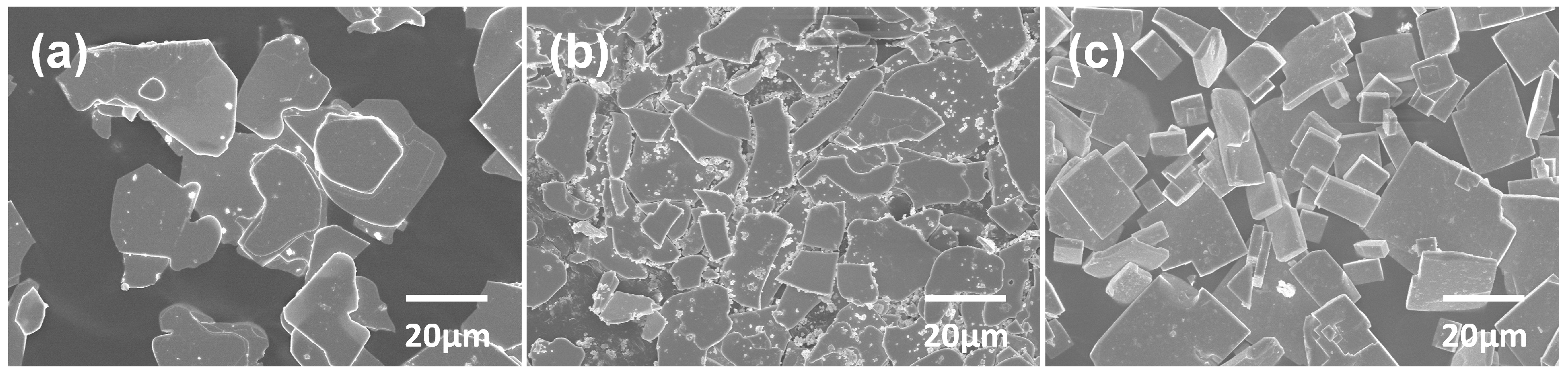
In the XRD diffraction patterns in Figure 1, it can be seen that NBT platelets were successfully formed via BiT and NBiT precursors. The BiT precursor exhibits anisotropic growth, as confirmed in Figure 1a. The XRD pattern of BiT obtained is similar to that of the Crystallography Open Database (COD) pattern # 96-152-8446 for Bi4Ti3O12 (orthorhombic, space group Aba2), although some of the peaks have shifted position. There are also peaks (marked *) that belong to a BiNaO3 secondary phase (COD pattern # 96-152-6789). Most of the intense peaks are (00l) peaks, i.e., (008) and (0016), which indicate that the BiT precursors are highly oriented [54,55]. It is also evident from the SEM micrograph in Figure 2a that the morphology of BiT is plate-like. The particle size of BiT appears uniform, with particles of size up to ~30 μm.
The XRD pattern in Figure 1b shows the NBiT platelets and was indexed using COD pattern #96-153-8361 for Na0.5Bi4.5Ti4O15 (tetragonal, space group I4/mmm). Small peaks (marked +) belonging to an unknown secondary phase are present. The NBiT platelets also exhibit a high degree of orientation by showing high intensity (00l) peaks around 2θ = 13°, 17°, 21°, 26°, 35°, and 44°, which have (006), (008), (0010), (0012), (0016), and (0020) Miller indices, respectively. The morphology of the NBiT platelets in Figure 2b retains the plate-like shape of the BiT precursor. However, it showed that the particle size of the NBiT platelets is smaller than that of the BiT precursor.
According to the XRD results, the NBT platelets have a rhombohedral structure (space group R3c), which can be indexed using COD pattern #96-210-3296 for (Na0.5Bi0.5)TiO3, as shown in Figure 1c and the stick pattern. The plate-like morphology of NBiT is still retained in the NBT platelets, as shown in Figure 2c. The NBT platelets have a clean lateral morphology, regular rectangular shapes, and smooth surfaces. The NBT platelets are of similar size to the NBiT platelets. Based on the microstructure of the obtained NBT platelets, their high aspect ratio and plate-like morphology make them suitable as a template for texturing ceramics.
The Aurivillius structure of BiT is a layered perovskite-type structure with the general formula Bi2O2(Am−1BmO3m+1) [56,57]. The Bi2O2 layers in the structure can hinder the epitaxial growth and promote anisotropic growth, which produces plate-like shapes with a high aspect ratio [56]. Moreover, the Bi2O2 layers are also flexible in that they can be extracted by the exfoliation process at high temperature during the topochemical conversion process [58]. Through the exfoliation process, the transformation of the perovskite block in the Aurivillius structure occurs while maintaining the morphology and macroscopic form of the crystal [59]. Therefore, in NBT platelet preparation, Aurivillius-structured precursors are suitable for obtaining NBT platelets of high aspect ratio.
In addition, the thickness of the perovskite block in the Aurivillius structure, which is determined by the type of A and B-site cations, significantly influences particle characteristics such as the morphology, aspect ratio, etc. Consequently, selecting the type of Aurivillius precursor for NBT platelet preparation is important. In the present work, two types of Aurivillius structures were used for NBT template preparation, Bi4Ti3O12 (BiT, m = 3) and Na0.5Bi4.5Ti4O15 (NBiT, m = 4).
BiT and NBiT exhibit highly anisotropic growth and a high aspect ratio, as the Bi2O2 layer suppresses c-axis growth, resulting in a significantly higher growth rate along the a (b) axis [54,60]. As a result, these compounds can easily form plate-like particles. Jiang et al. [61] also confirmed that NBT platelets retained their plate-like morphology when prepared directly from BiT or NBiT, making them suitable for texturing. However, preparing NBT templates directly from NBiT has several challenges, primarily attributed to the high volatility of Na at high temperatures, which complicates the determination of the ratio of starting materials [56,62]. To address this challenge, previous research reported that the growth of NBiT could be precisely controlled using BiT as the first precursor, which produced a more uniform shape and smooth surface with a high aspect ratio and well-defined morphology of NBiT particles [56,63]. Therefore, in this study, BiT was employed as the primary precursor to serve as a nucleation framework to overcome the limitations associated with direct NBT platelet synthesis from the NBiT precursor.
In the previous research, due to the high thermodynamic stability of NBiT, Na2CO3-rich conditions were used to avoid incomplete conversion reactions from NBiT to NBT [57]. Excess Na2CO3 was added to make use of the eutectic formed between the molten NaCl salt and the Na2CO3 reactant, which decreased the melting point of the system to approximately 636 °C [62]. The total evaporation rate of the salt also increases with temperature, rising from 9.9% at 800 °C to nearly 60% at 1000 °C [64]. In this case, using the excess carbonate compensates for the loss of evaporated carbonate and maintains the stoichiometric ratio of reactants, leading to complete conversion in the reaction [62,63]. Additionally, Dursun et al. [63] reported that applying excessive carbonate during the transformation of NBiT to NBT can improve the morphology of NBT platelets. Therefore, in this study, NBT platelets were synthesized using a 1.875:1 molar ratio of Na2CO3 and NBiT.

2.2. Textured Ceramic Development

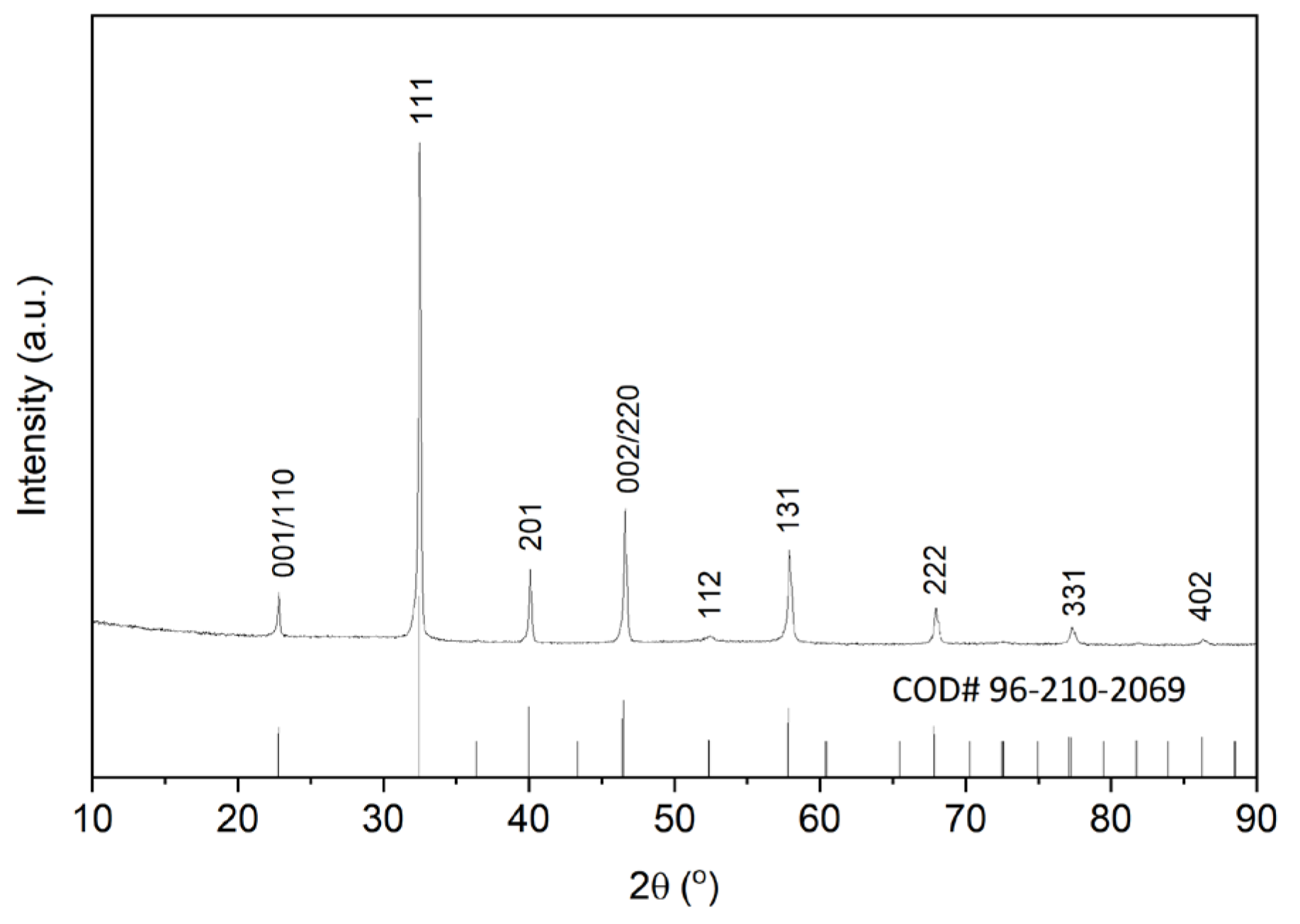
The 0.90NBT-0.08KN-0.02ST powder was prepared by conventional solid-state reaction. The phase purity and crystal structure of the matrix powder were confirmed by X-ray diffraction analysis, as shown in Figure 3. The diffraction pattern reveals no impurities and is indexed as a single phase of (Na0.5Bi0.5)TiO3 with a tetragonal phase and P4bm space group (COD# 96-210-2069). As the peaks are sharp and well-defined, the matrix powder has good crystallinity.
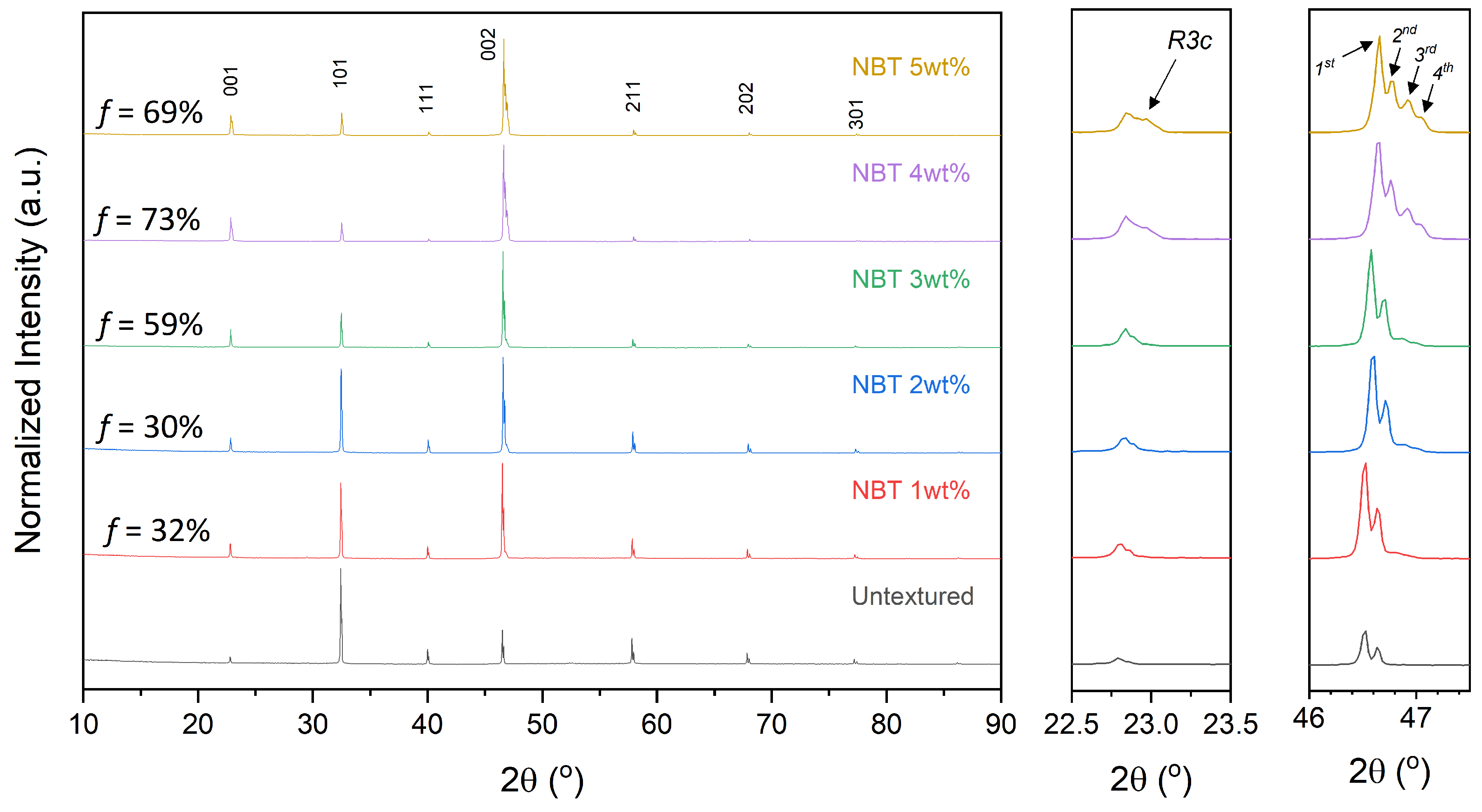
Initially, the textured and untextured NBT-KN-ST ceramics were sintered at 1175 °C for 4 h with varying NBT platelet compositions, i.e., 0, 1, 2, 3, 4, and 5 wt%. Figure 4 shows that all the samples have the NBT perovskite structure. Some of the patterns have a small secondary phase peak at ~29.5° 2θ, but the identity of this peak could not be determined. The pattern of the untextured sample could be indexed with COD # 96-210-2069 as above. However, for the purpose of calculating the Lotgering factor, the patterns were indexed using a pseudo-cubic unit cell, as shown in Figure 4. The XRD diffraction patterns exhibit intense (00l) peaks at 2θ ≈ 22° for (001) and ≈ 46° for (002), while the intensity of the other peaks decreases with an increase in NBT platelet amount. These results indicate that the NBT-KN-ST ceramics were textured in a specific orientation, the (00l) planes, as the NBT platelets were added. Notably, the (001) peak at 2θ ≈ 22° begins to broaden into a hump in samples with ≥ 4 wt% NBT platelets, while extra peaks (marked 3rd and 4th in Figure 4) appear on the high-angle side of the peak at 2θ ≈ 46.5° (marked 1st and 2nd in Figure 4) in all samples with NBT platelet addition. These extra peaks become more intense as the amount of NBT templates increases. The position of these extra peaks matches the position of the (204) peaks of the NBT templates (Figure 1), indicating that they may be caused by the NBT templates. The peaks at 2θ ≈ 46.5° are labelled as follows: tetragonal P4bm phase (1st peak) with its Kα2 radiation peak (2nd peak), and rhombohedral R3c phase (3rd peak) with its Kα2 radiation peak (4th peak). The peak positions of the 1st and 2nd peaks also shift to slightly higher 2θ values as more NBT templates are added. This indicates that the lattice parameters of the NBT-KN-ST ceramics were changed as more templates were added.
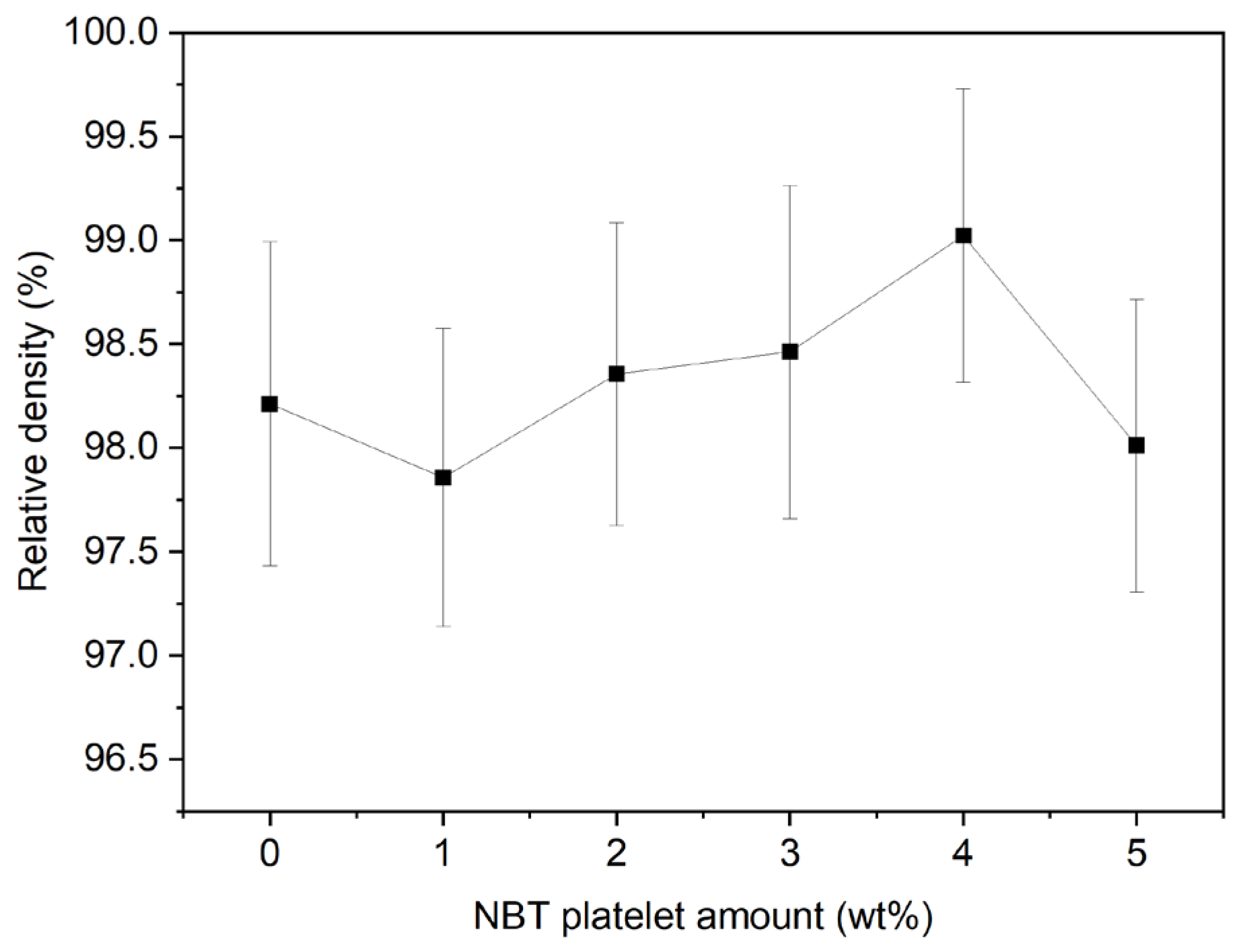
The degree of texture was determined as the result of NBT platelet amount, which formed an optimum trend, with the highest textured degree observed at 4 wt% addition of NBT platelets. The decline in texture degree with the addition of 5 wt% NBT platelets can be attributed to agglomeration and impingement of platelets [65]. It was also demonstrated that the relative density of the textured samples followed a similar trend to the degree of texture (Figure 5). The reduction in relative density of 0.5% at the addition of 5 wt% of NBT platelets is due to platelet impingement, which can hinder oriented growth and lead to the trapping of pores inside the material, decreasing the relative density [66].
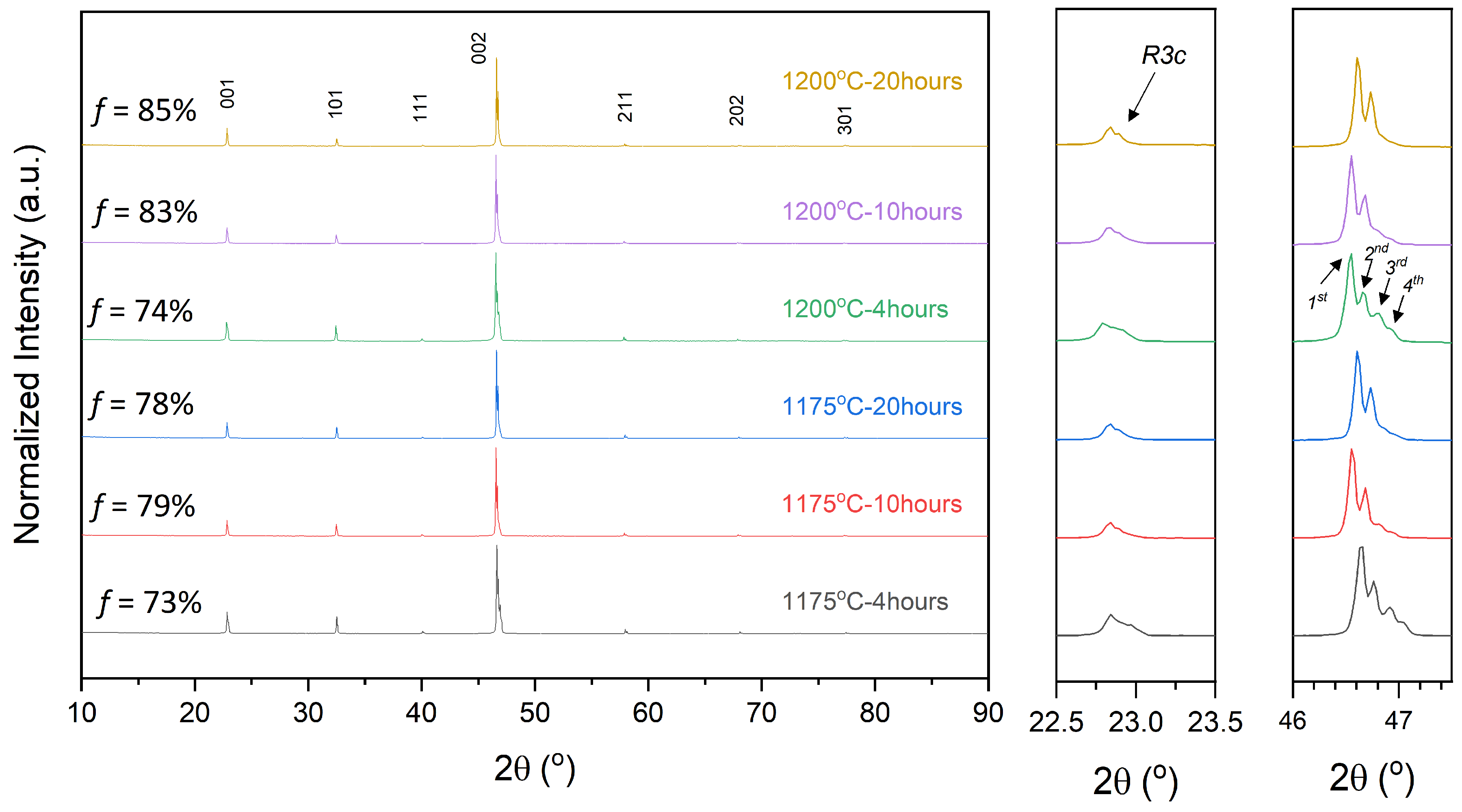
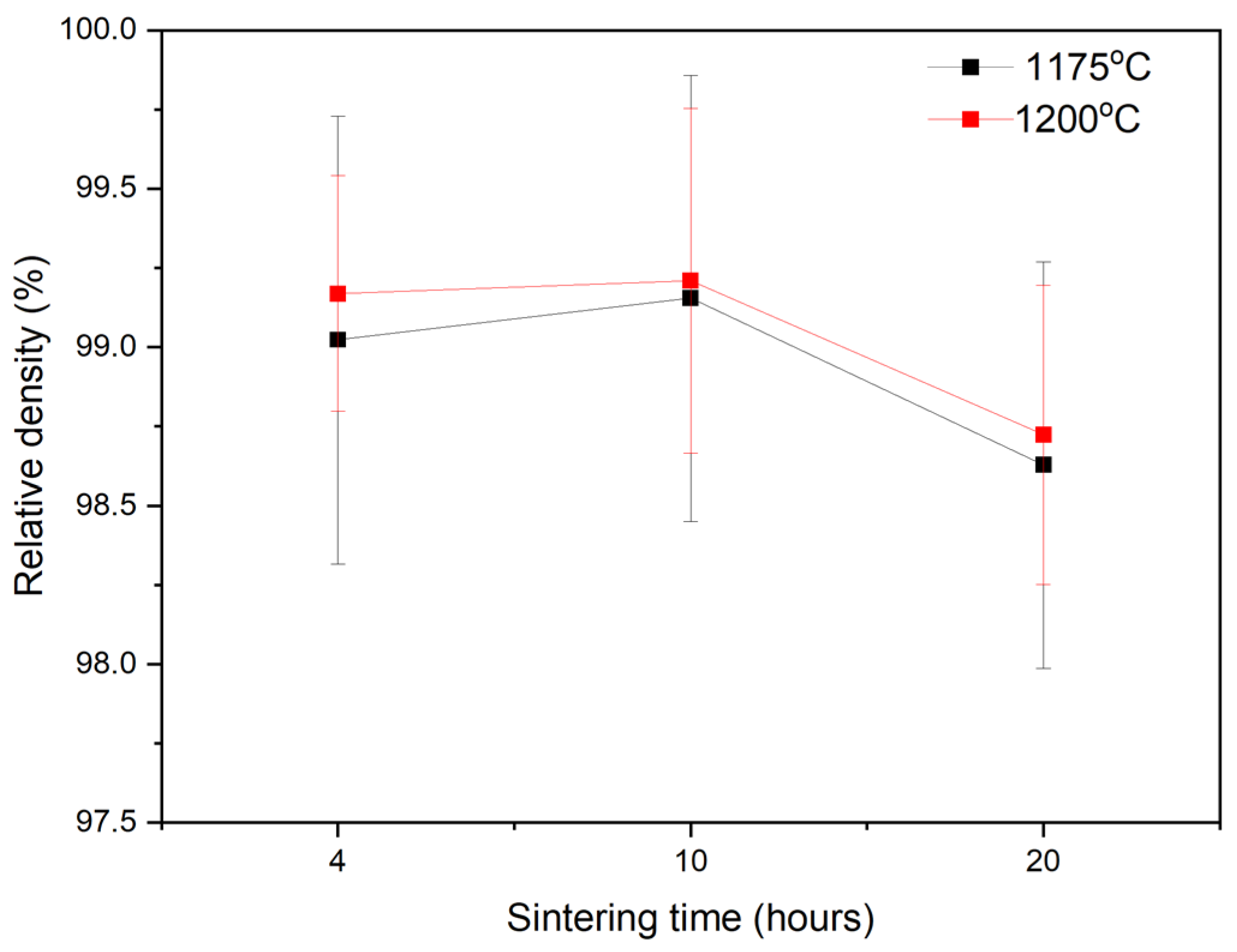
Based on the optimal degree of texturing at 4 wt% NBT platelet addition, further optimization involved increasing the sintering temperature to 1200 °C and extending the sintering time to 20 h. The results in Figure 6 confirm that all the sintered samples remain as a perovskite phase regardless of the sintering conditions. As before, some of the patterns contain a small peak at ~29.5°. Increasing the sintering time at 1175 °C from 4 h to 20 h results in only a slight increase in the Lotgering factor from 73% to 78.2%. However, as the sintering temperature increases to 1200 °C, the texture degree improves to 85% after 20 h of sintering. At both 1175 and 1200 °C, the intensity of the extra 3rd and 4th peaks at ~46.7° 2θ decreases as sintering time increases. This suggests that the NBT platelets are forming a solid solution with the surrounding matrix grains. These changes indicate that the grain growth process is accompanied by solid solution formation, indicating that the NBT templates have been incorporated into the surrounding matrix. The relative density also slightly increases with sintering temperature and follows an optimal trend with time, peaking at 10 h (Figure 7). This trend suggests that both grain growth and pore elimination are most effectively promoted at around 10 h of sintering time. These results align with previous studies [67,68], which reported that increased sintering temperature and time can enhance the texture degree by promoting abnormal grain growth and platelet alignment.
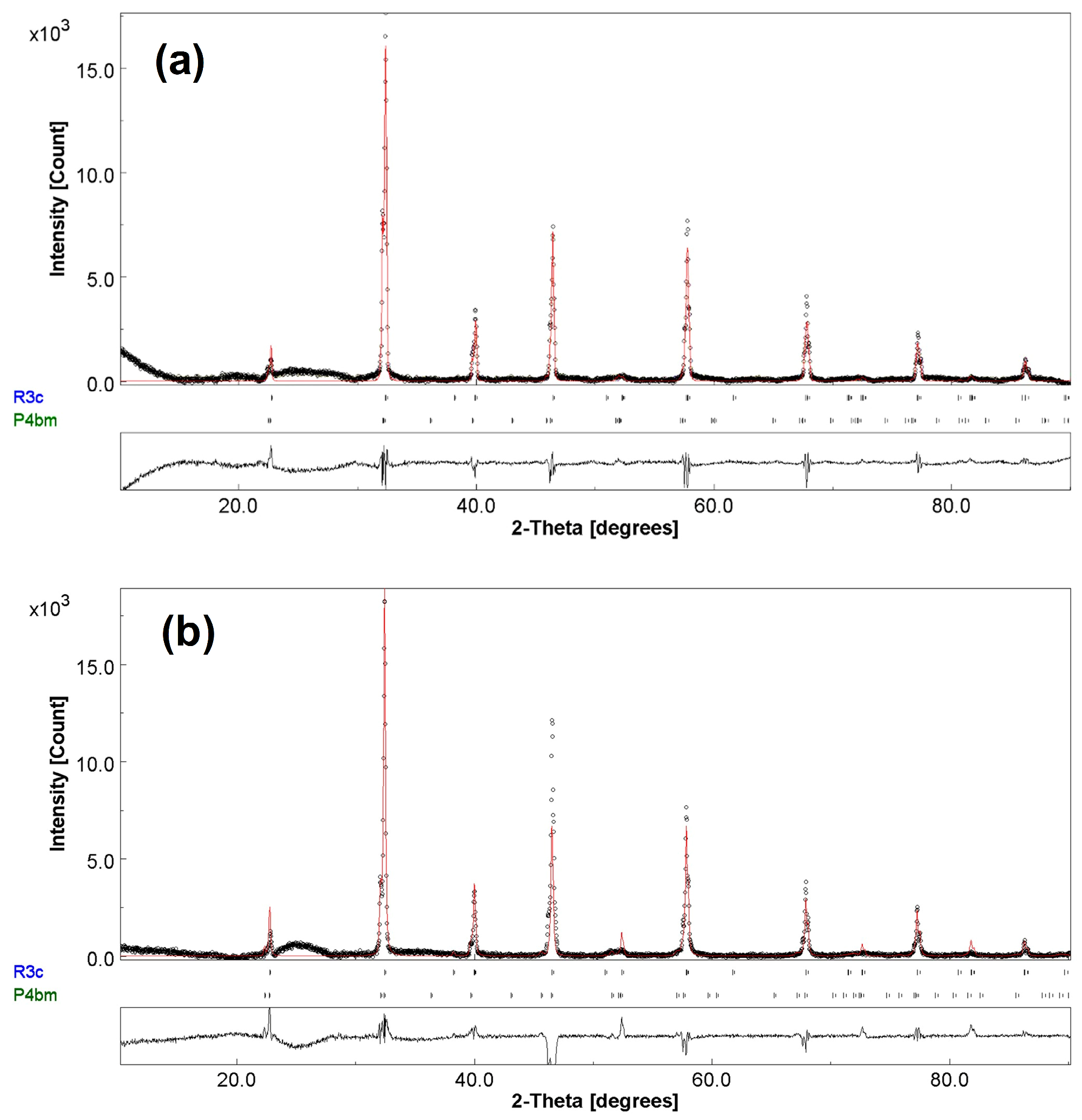
X-ray diffraction patterns of the untextured and textured samples after Rietveld refinement are shown in Figure 8. Refinement results are shown in Table 1. Both samples contain coexisting tetragonal (P4bm) and rhombohedral (R3c) phases, with the rhombohedral (R3c) phase dominant. The fraction of the rhombohedral phase increases by ~28% in the textured sample. The increase in the amount of rhombohedral phase in the textured sample is due to two reasons: (1) rhombohedral NBT platelets were added to the textured sample, thus increasing the amount of rhombohedral phase; (2) the grains that grow on the NBT platelets are more likely to have a rhombohedral structure following the structure of the platelets. The lattice parameters of the two phases in the textured sample showed changes for the tetragonal phase and a decrease for the rhombohedral phase. The XRD pattern for the NBT templates was fitted using Rietveld refinement with an R3c phase and was found to have lattice parameters a = 5.4850Å and c = 13. 5127 Å (Rwp = 16.20%, Rp = 12.34%). The lattice parameters of the rhombohedral phase in the textured sample may decrease because this phase is growing on NBT platelets with smaller lattice parameters [69]. Changes in lattice parameter can also happen due to the alignment of grains in the textured sample. In the untextured sample, the grains are randomly oriented, leading to local lattice distortion because of the misorientation of crystallographic planes between differently oriented grains. As texturing develops, more uniform grain orientation is formed, reducing intergranular misorientation and leading to relaxation of the lattice.

2.3. Microstructure

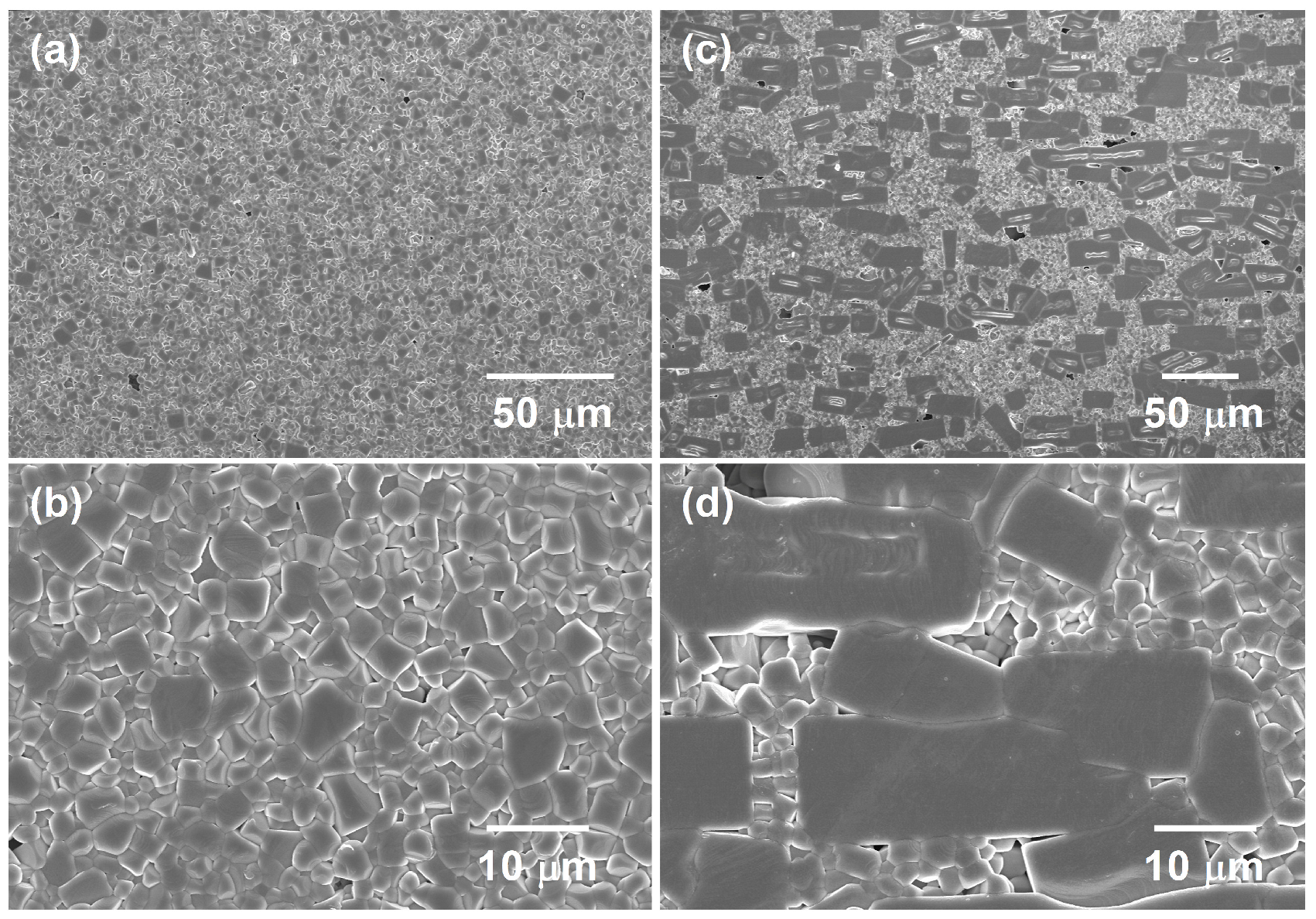
The cross-sectional micrographs of the untextured ceramic in Figure 9a,b show that the grains are randomly oriented, indicating a typical polycrystalline microstructure. The grains are cubic in shape, with rounded edges and corners. Abnormal grain growth appears to be just beginning, as there are many grains ~2–3 times larger than the surrounding matrix grains [70]. There is no evidence of preferential grain alignment, and the structure appears densely packed with minimal visible porosity, indicating that densification through the sintering process was successful. In contrast, large, plate-like grains are elongated in the same direction in the textured sample, as observed in Figure 9c,d. The preferential alignment of large rectangular grains shows that the highly oriented NBT platelets effectively enhance the development of crystallographic texture through templated grain growth. At higher magnification, the plate-like grains display rectangular shapes with well-defined facets, characterized by flat surfaces and rounded edges. The small grains surrounding the larger aligned ones appear to be randomly oriented. This condition provides evidence that homoepitaxial growth with the Ostwald ripening process occurred, where the large particles (NBT platelets) consumed the finer 0.90NBT-0.08KN-0.02ST grains in order to grow [71,72]. Also, it confirms that the abnormal grain growth mechanism occurred with the NBT platelets acting as sites for rapid grain growth. According to Kimura et al. [67], the abnormal grain growth mechanism forms a bi-modal grain size distribution where the large grains coexist with the fine grains and cause an abrupt increase in the orientation. The sharp difference in grain size between the grains growing on NBT platelets and the surrounding matrix grains was due to interface reaction-controlled growth; rapid growth on the NBT platelets occurred with the activation of abnormal grain growth [73,74]. Large pores are visible in the textured ceramic, often adjacent to the large textured grains. When the large grains impinge upon each other, they tend to form pores that are very difficult to remove. In some of the textured grains, elongated depressions are visible. These correspond to the position of the NBT templates. The disappearance of distinct templates indicate that the grain growth process is accompanied by solid solution formation. It is not clear if the NBT templates diffused into the surrounding grain, leaving an elongated pore behind, or if they were pulled out of the sample during polishing.
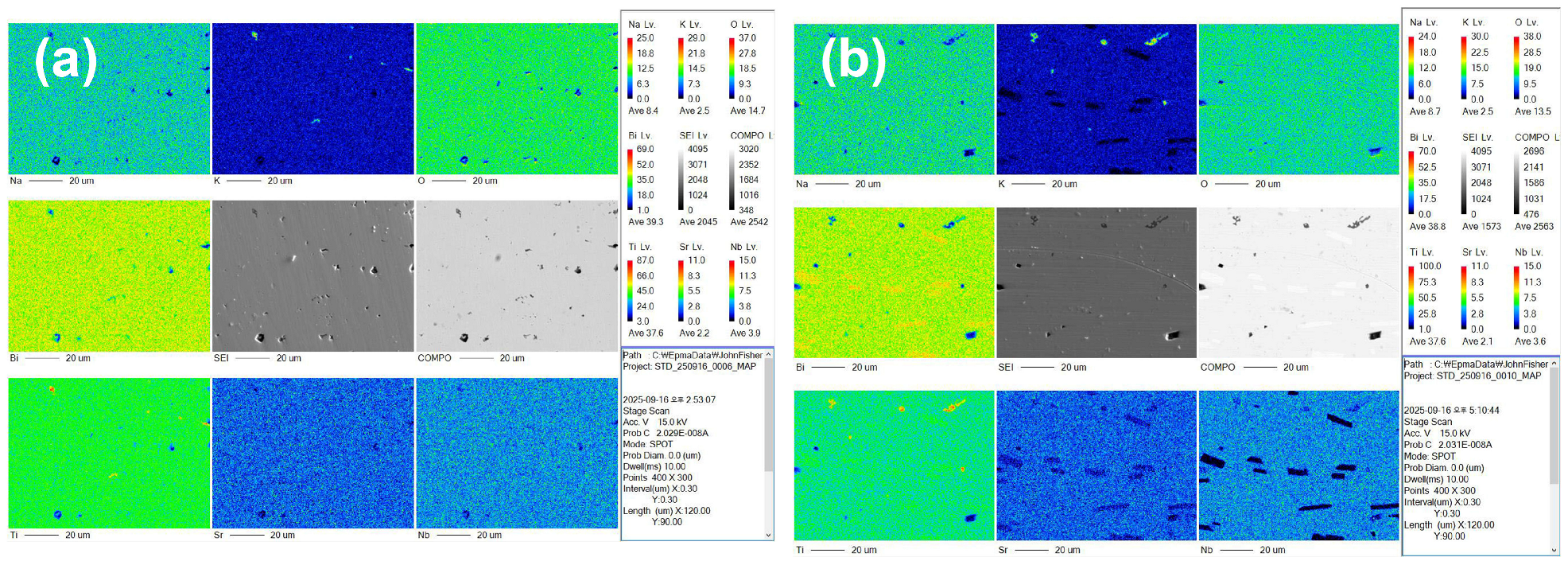
To gain more insight, EPMA analysis was conducted to investigate the elemental distribution and quantitative composition of both samples, as presented in Figure 10 and Table 2. The elemental mapping in Figure 10a shows that the elements in the untextured sample are generally uniformly distributed. Some local variations for Na, Bi, K, and Ti indicate a K- and Ti-rich second phase. In the textured sample, although the NBT platelets as templates share a similar composition with the matrix powder (0.90NBT-0.08KN-0.02ST), their presence can be distinguished through the distribution of the minor constituents. As shown in Figure 10b, the textured sample exhibits regions lacking K, Sr, and Nb signals, while having increased Bi (and possibly Ti) signals. Additionally, these regions show a distinct rectangular shape and orientation. These regions are most likely associated with the NBT platelets. The K- and Ti-rich second phase that appeared in the untextured sample also appears in the textured sample.
Quantitative compositional analysis was performed using point analysis, in which 10 representative points were selected from each sample. For the textured sample, 10 points were measured away from the templates, and an additional 5 points were measured on the templates. The results are given as the amount in mol% of each constituent oxide. The results indicate that the untextured sample exhibits relatively homogeneous composition with low deviations across all elements (Table 2). In contrast, the textured sample shows larger deviations, particularly for K, Sr, and Nb. The untextured sample has a composition close to the nominal 0.90NBT-0.08KN-0.02ST composition. It appears Na-deficient and Bi-excess. Na is likely lost by evaporation during sintering. Bi may replace Na in the lattice to maintain charge balance [75]. Similar behaviour occurs in the textured sample. The compositions of the untextured and textured samples are very close to each other. EPMA of the NBT templates indicates that some K, Sr, and Nb have diffused into the templates. The amounts of Na, Bi, and Ti in the templates are also lower than the nominal amounts, indicating that interdiffusion between the templates and surrounding grains has taken place. This explains why the XRD peaks associated with the NBT templates become weaker with increased sintering time.

2.4. Polarization and Strain Behaviour

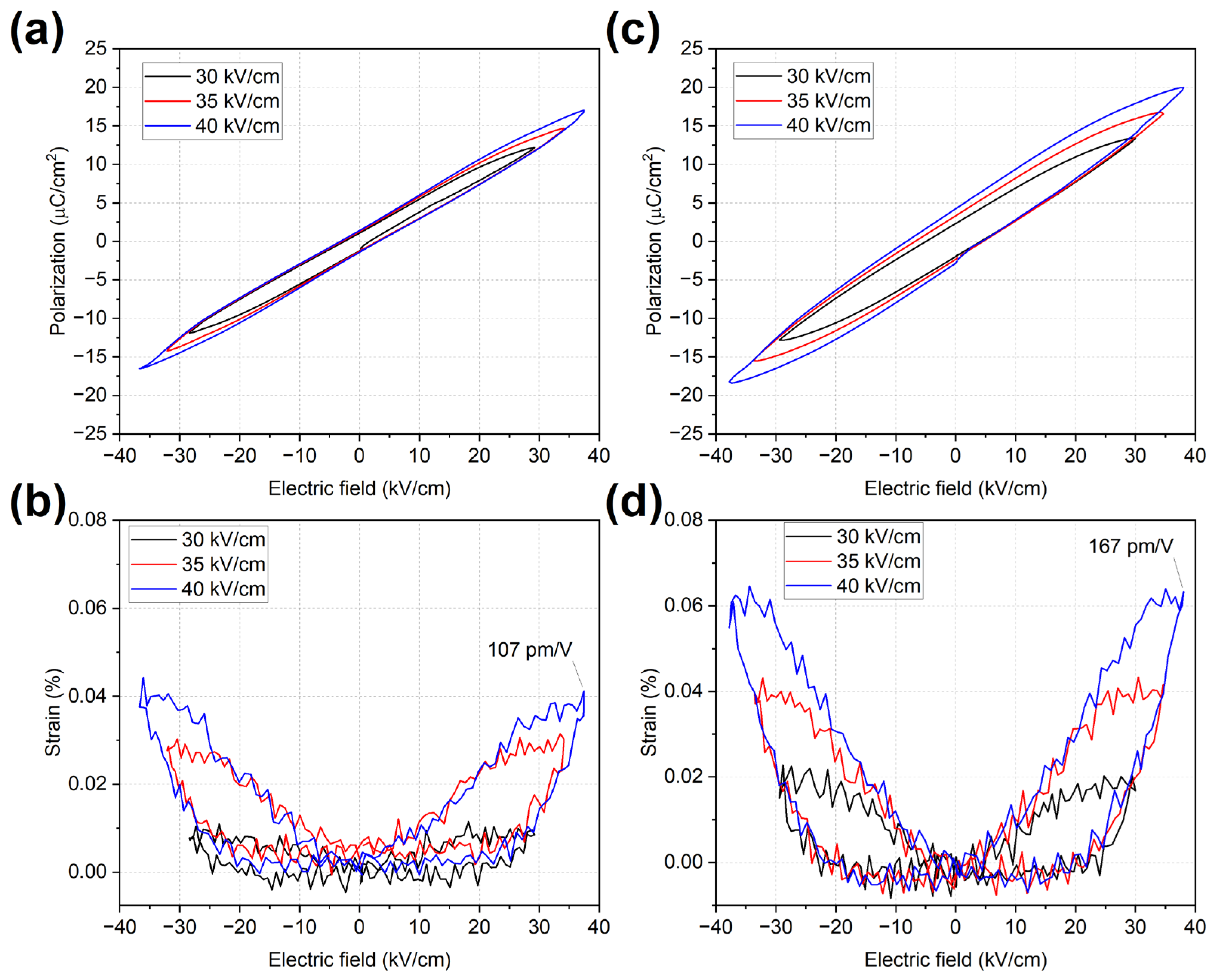
Each measurement consisted of three cycles. The second cycle of each measurement is shown. The polarization hysteresis loops of the untextured sample in Figure 11a exhibit behaviour typical of a lossy linear dielectric or an ergodic relaxor phase, which is a slim and linear loop with a minimal remanent polarization ≈1.5 μC/cm2. Increasing the electric field can gradually elevate the maximum polarization value to ≈17 μC/cm2, as indicated by the height of the loops. At the same time, the textured sample in Figure 11c exhibited an enhancement in maximum polarization to ≈20 μC/cm2 and remanent polarization to ≈4.5 μC/cm2 as the electric field increased. The increases in maximum and remanent polarization may be due to an increased amount of nonergodic rhombohedral phase (Table 1). The increasing polarization in the different electric fields without any saturation exhibited that both materials have relaxor behaviour in the ergodic phase, with dynamic polar nanoregions with no stable ferroelectric domains [43].
The strain response in the bipolar measurements also confirmed the polarization result, where the sprout-shaped loops emerge as seen in Figure 11b,d. This is the typical electric field-induced electrostrictive response in an ergodic relaxor phase, characterized by a quadratic dependence on the electric field (Figure 12c) [12,38,41]. Both untextured and textured samples showed symmetric and reversible strain centred at zero field. This behaviour matches that of ergodic NBT-based relaxor systems [37,43,51]. Hysteresis in the loops is caused by reorientation of polar nanoregions [49]. Similarly to polarization, the increase in the electric field also induces strain enhancement for both samples. However, the textured sample has a higher strain than the untextured sample, showing that texturing in the [001] direction can improve the inverse piezoelectric properties. The addition of NBT templates to the textured ceramic may also improve the inverse piezoelectric properties, with the templates acting as a nonergodic relaxor phase in a nonergodic/ergodic relaxor composite [76,77]. On the other hand, the decrease in the amount of the tetragonal phase (Table 1) may decrease the inverse piezoelectric properties as the electric field-induced phase transition from the tetragonal to rhombohedral phase is known to cause a large strain [78]. The increasing electric field enhanced the magnitude of the polarization and strain without altering the shape of the loops, indicating that the ergodic relaxor and electrostrictive behaviour remained consistent. The loops are quite broad, indicating that the strain behaviour is not entirely electrostrictive, i.e., ferroelectric domains may form and disappear under the influence of the electric field. The actual electric field is lower than the nominal electric field, particularly at 40 kV/cm. This may be caused by the low resistivity of the samples. A leakage current may allow charge flow across the sample, leading to a lower measured voltage. Hysteresis loop measurements were not carried out at higher electric fields due to concerns about sample electrical breakdown.
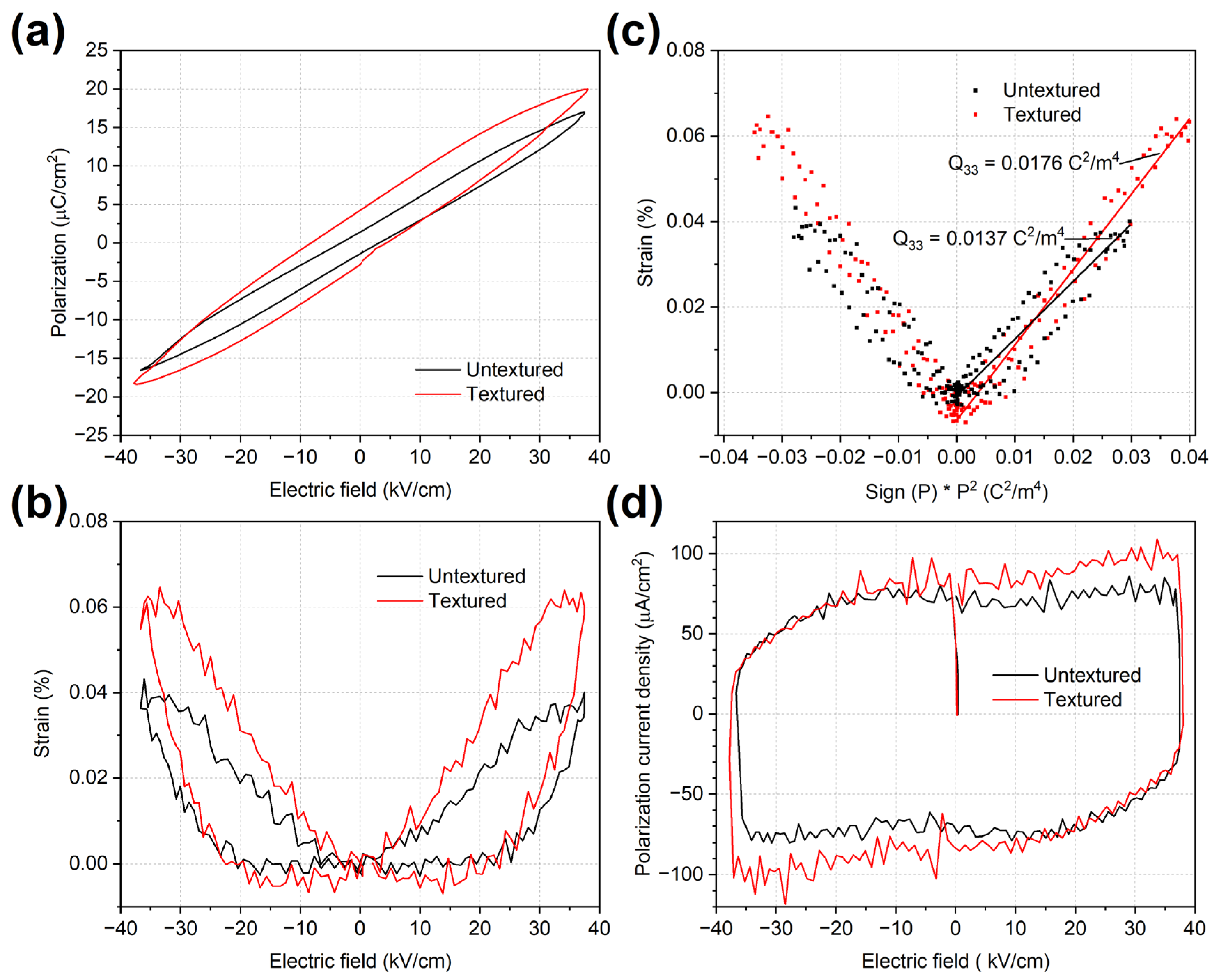
To observe the impact of texturing, the polarization, strain, and polarization current density loops at an electric field of 40 kV/cm are compared. Figure 12a shows that texturing slightly expanded the polarization hysteresis loop, resulting in the enhancement of the remanent polarization and maximum polarization. Although the hysteresis loop becomes slightly wider, both polarization loops maintain a slim, linear shape without saturation at high electric fields. This suggests that both materials still retain their ergodic relaxor phase and do not undergo the complete domain switching characteristic of classical ferroelectrics.
Both samples exhibit symmetric, sprout-like strain hysteresis loops, characterized by rounded and reversible shapes centred at the origin, as illustrated in Figure 12b. It confirmed that electrostrictive behaviour emerged with no remanent strain, and that irreversible domain wall motion did not contribute significantly to the strain response [79]. The S-E loops also showed that texturing enhances the strain from 0.04% in the untextured sample to ~0.06% in the textured sample. Figure 12c exhibits the relation between strain and Sign(P) × P2 (C2/m4) to evaluate the electrostrictive behaviour by observing the linear correlation between both parameters. (Sign (P) is set to positive or negative to correspond to a positive or negative electric field.) As the slope of the regression line represents the longitudinal electrostrictive coefficient (Q33), the textured sample shows a steeper slope than the untextured sample. This indicates a stronger electrostrictive response in the textured sample with an electrostrictive coefficient = 0.0176 C2/m4 compared to the untextured sample with Q33 = 0.0137 C2/m4. This increase in Q33 is due to the increased {001} orientation of the textured ceramics. Crystallographic orientation is known to have an effect on the electrostrictive properties of relaxor ferroelectric single crystals [49]. There is scatter between the data points and the linear fit, indicating that the samples have mixed electrostrictive and relaxor behaviour [49].
To understand the rate of polarization change, the polarization current density–electric field (J-E) curves were examined, as shown in Figure 12d. The untextured and textured samples have broad and smooth loops, indicating that both samples exhibit relaxor/electrostrictive or lossy dielectric behaviour [80,81]. This refers to the presence of dynamic polar nanoregions that continuously reorient in response to a changing electric field and exhibit reversible ergodic behaviour. The absence of sharp peaks in the J-E diagram also shows that there are no remanent ferroelectric domains, with no sharp rise or fall in polarization [82]. Thus, both materials exhibit characteristics of ergodic relaxor ferroelectrics, dominated by field-induced polarization through dynamic PNR activity rather than classical domain switching. The homoepitaxial TGG process uses templates with a similar structure and elemental composition. In this situation, compositional deviation may occur due to the interdiffusion of elements between the templates and the matrix. This can lead to a compositional shift and change the electrical behaviour of the textured sample [71,83,84].
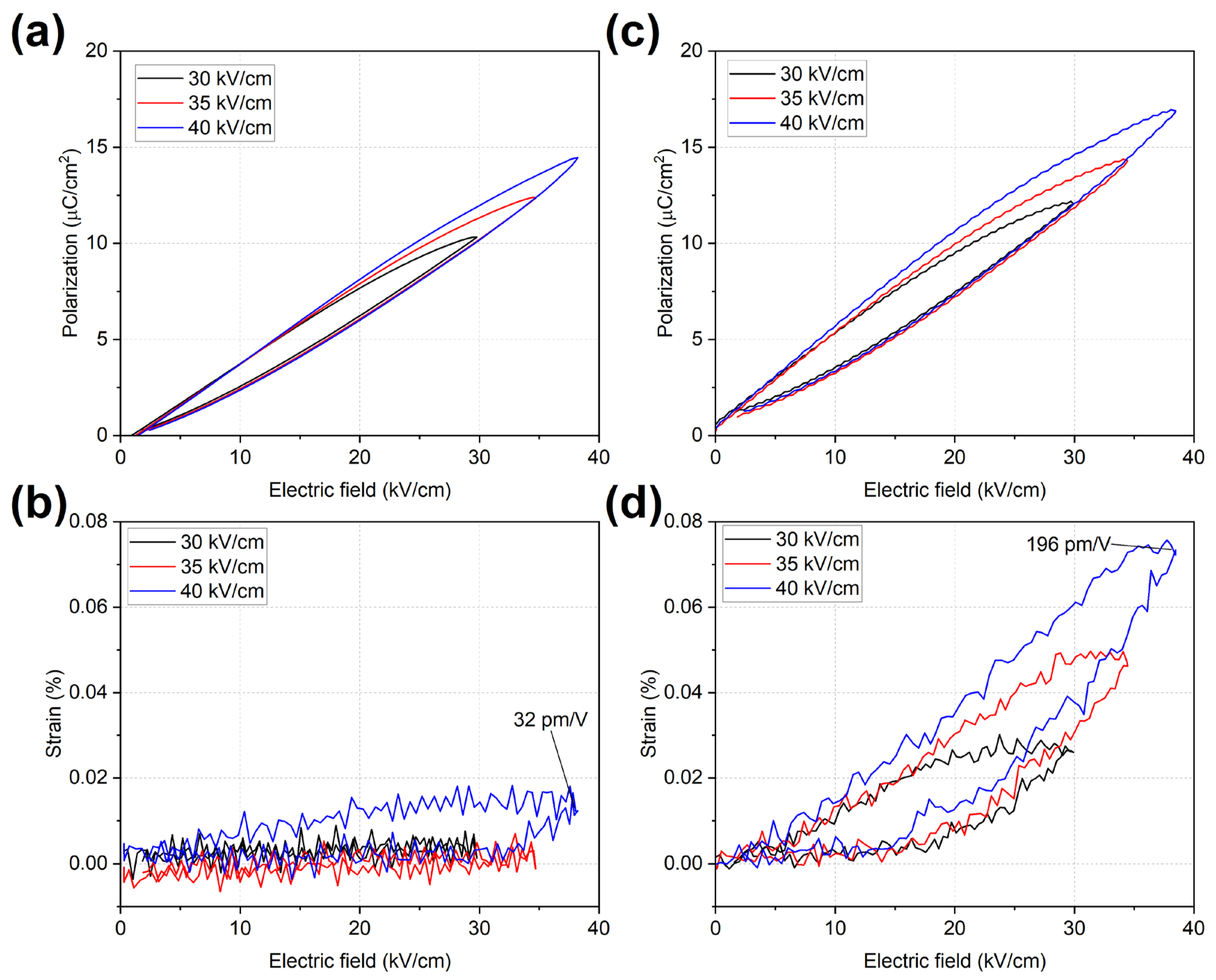
The unipolar hysteresis measurements also exhibit similar behaviour to the bipolar measurements, as shown in Figure 13. The polarization of the textured sample is slightly larger than that of the untextured sample, with larger hysteresis (Figure 13a,c). The slim unipolar hysteresis loop confirms that the untextured sample has mostly electrostrictive behaviour. The addition of NBT platelets as templates resulted in a larger polarization hysteresis of the textured sample, shifting the behaviour from electrostrictive to more ferroelectric behaviour. The unipolar strain also shows a half-sprout shape without any saturated strain. Figure 13b shows that the untextured sample exhibits poor strain under various electric fields, with the maximum strain <0.02% at an electric field of 40 kV/cm. Figure 13d shows that the enhancement of strain occurred with the addition of NBT platelets as a template; the maximum strain at an electric field of 30 kV/cm started around 0.03%, which is higher than that of the untextured sample at an electric field of 40 kV/cm. The maximum strain of the textured sample continued to increase with the electric field, reaching a corresponding strain value of ~0.07% at an electric field of ~40 kV/cm.
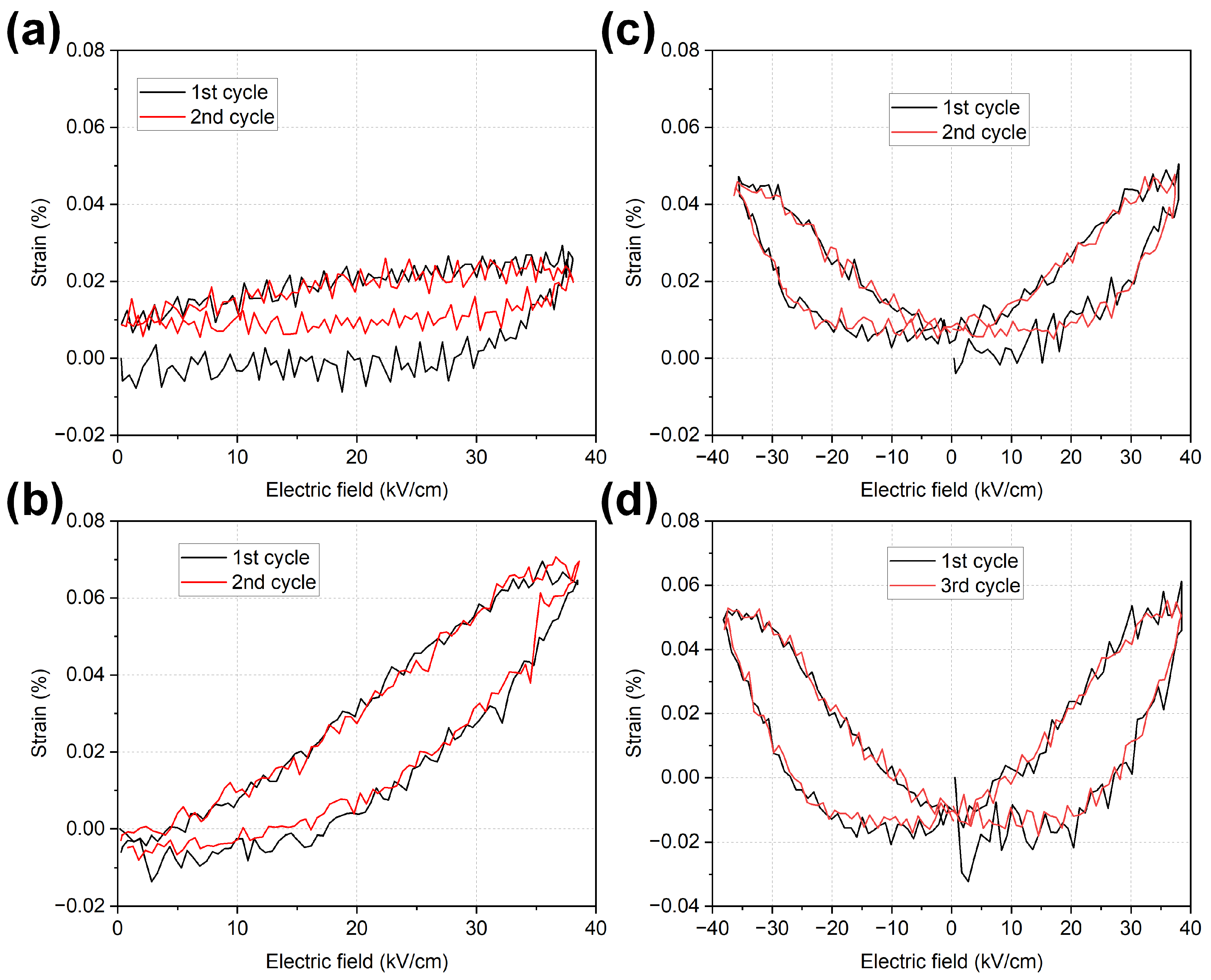
Figure 14 shows the first and second cycles of unipolar and bipolar strain hysteresis loops for the untextured and textured samples. The unipolar strain hysteresis loop of the untextured sample shows a remnant strain of ~0.01% after the first cycle (Figure 14a), while the textured sample does not show any remnant strain (Figure 14b). The remnant strain in the untextured sample indicates that ferroelectric domains are forming during application of the electric field and that some of them remain stable after the field is removed. It is noteworthy that if the unipolar hysteresis loops are measured again on the same sample after a pause of a few seconds, the remnant strain disappears, and the behaviour seen in Figure 14a repeats itself. This implies that any remanent ferroelectric domains are unstable and quickly disappear. The poor unipolar strain vs. electric field behaviour of the untextured sample is due to the remnant strain. The bipolar hysteresis loops of the untextured (Figure 14c) and textured (Figure 14d) samples are both noisy in the first cycle, but they both appear to show a remnant strain which then disappears in subsequent cycles (for the textured sample, the 1st and 3rd cycles are shown as the second cycle was distorted). The difference in unipolar strain behaviour between the untextured and textured samples is due to the crystallographic orientation of the textured sample in the [001] direction. Previous work on NBT-based single crystals has shown that their strain–electric field behaviour can change with sample orientation between electrostrictive and incipient ferroelectric [85].

2.5. Dielectric Property Measurements

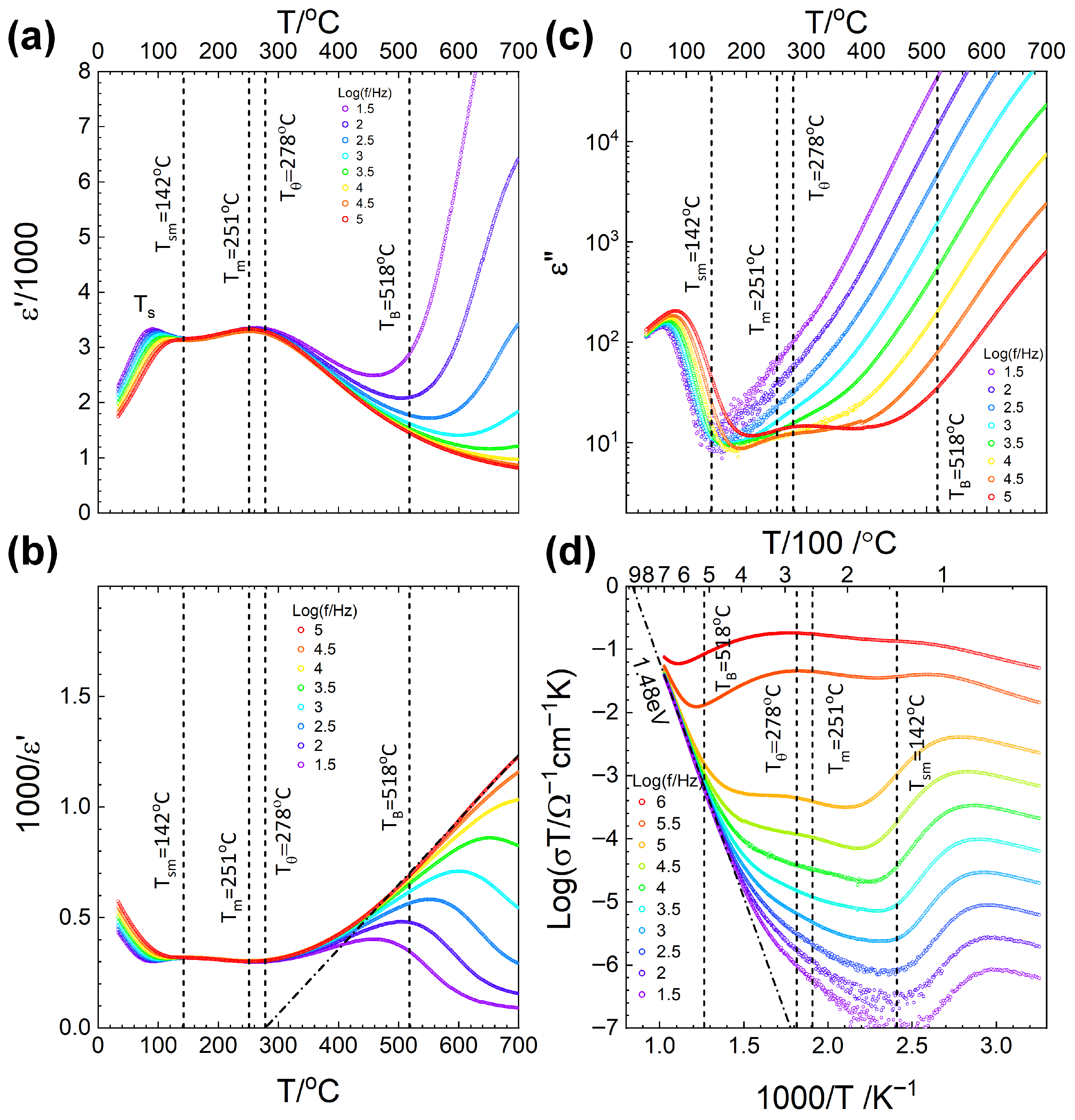
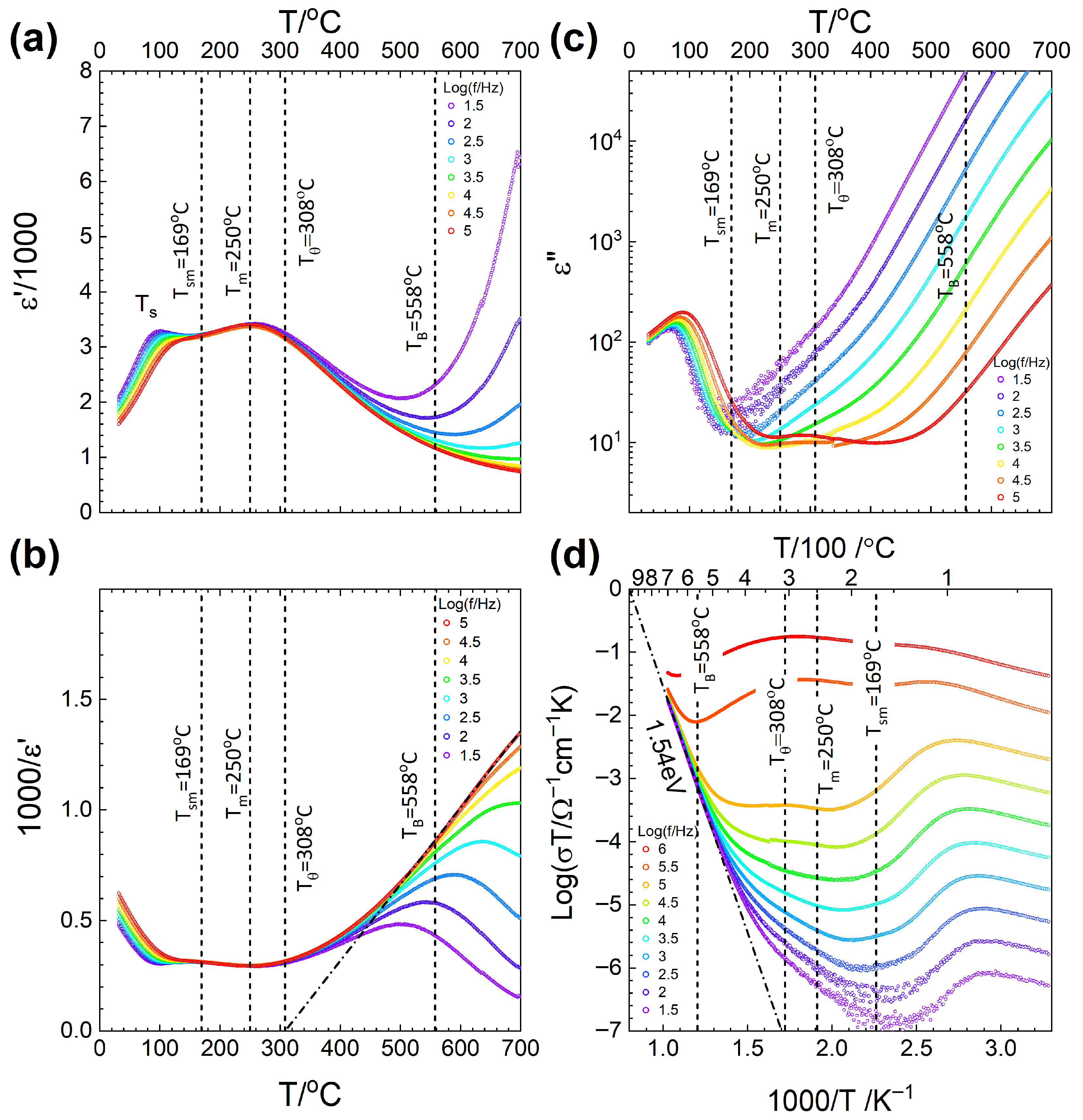
The temperature dependence of dielectric properties on cooling is presented in Figure 15 and Figure 16 for untextured and textured samples sintered at 1200 °C for 10 h, as a function of temperature and frequency. The values of characteristic parameters of the untextured and textured ceramics are given in Table 3. Comparing the real part of the permittivity plot between the untextured and textured samples in Figure 15a and Figure 16a, it is seen that the dielectric behaviour of the samples is typical of NBT-based materials [65,86]. The temperature-induced relaxation of the polar nanoregions (PNR) can be observed as a shoulder peak marked as Ts in the real-permittivity plot, which exhibits a slight increase in temperature from untextured to textured samples. Ts varies with measurement frequency, so Tsm, the temperature at which frequency dispersion reaches a minimum value, is measured instead. Tsm increases in the textured sample, while the temperature of maximum relative permittivity Tm is almost the same in both samples. The depolarization temperature Td is not observed, as it falls below the measurement range. Both untextured and textured samples exhibit typical relaxor behaviour with broad and stable permittivity over 130~300 °C, driven by polar nanoregion (PNR) dynamics [87,88]. The increase of Tsm from untextured to textured samples indicates modified PNR relaxation due to the increase in the fraction of rhombohedral phase caused by the addition of NBT templates (Figure 4 and Figure 8 and Table 1). NBT has a Tsm between 230~250 °C [39,86,89].
Beyond Tsm and Tm, the dielectric response of relaxor ferroelectrics can be further interpreted in terms of two additional characteristic temperatures: the Curie–Weiss temperature (Tθ) and the Burns temperature (TB). Tθ is obtained by fitting the Curie–Weiss law to the inverse permittivity plot at temperatures above the Curie temperature, according to the equation below (Figure 15b and Figure 16b) [90]:
ε = C T T θ
where C is the Curie-Weiss constant. The extrapolation of the Curie–Weiss fit (the dot-dash line) to the temperature axis provides Tθ, which in normal ferroelectrics would be equal to or be less than the actual paraelectric-ferroelectric transition temperature [91,92]. In relaxors, however, long-range ferroelectric order does not develop, and instead Tθ marks the stage when PNRs begin to interact more strongly and influence dielectric behaviour [93,94]. At the same time, a deviation of the relative permittivity from the linear fit is observed at a much higher temperature, defined as the Burns temperature (TB), where the formation of PNRs begins from the paraelectric matrix [95]. Above TB, the material is purely paraelectric, while below TB, local polar clusters form and gradually grow upon cooling toward Tθ. TB increases in the textured sample, again due to the presence of the NBT templates and the increase in the fraction of rhombohedral phase [86,93].
To support the presence of dielectric relaxation processes and distinguish the dielectric contribution from thermally activated conduction, the imaginary permittivity (ε″, Figure 15c and Figure 16c) data were plotted. The plots reveal clear frequency-dispersive peaks at Ts, which shift toward higher temperatures with increasing frequency, indicating thermally activated relaxation behaviour. This frequency dispersion is strongly associated with the diffusion of charge carriers that becomes prominent during the rhombohedral–tetragonal phase transition [96]. Consequently, the dielectric response of the system is governed not only by dipole polarization but also by diffusional dynamics triggered by structural transformation [89]. The observed frequency-dependent behaviour originates from a combination of the dynamic response of polar nanoregions and charge migration, while the continuous increase in ε″ at higher temperatures reflects thermally activated conduction.
The AC conductivity was plotted as log (σT) versus 1000/T (Figure 15d and Figure 16d), following the Arrhenius relation [97]:
σ T = σ 0 e x p ( E a k T )
where k is the Boltzmann constant and σ 0 is the pre-exponential factor. In this way, the conduction mechanism can be quantitatively distinguished by determining the activation energy (Ea) from the slope of the Arrhenius plot. Figure 15d and Figure 16d show that at high temperatures between 600 °C and 700 °C, the slopes of the conductivity plots are steep, which also confirms the previous explanation about thermally activated conduction in the imaginary permittivity plots (ε″, Figure 15c and Figure 16c). The increase in conductivity with increasing frequency shows that higher-frequency AC fields promote charge carrier hopping and enhance conduction [98]. The activation energies were also at high values of above 1.2 eV, indicating that conduction may be controlled by oxygen vacancies or hole conduction at high temperature [26,65,98].
EPMA analysis confirms that alkali loss occurs during sintering, generating A-site vacancies ( V A ) and accompanying oxygen vacancies ( V O ) for charge compensation. The volatilization of alkali oxides and their associated charge-compensating process to preserve charge neutrality can be represented in a combined form as:
2 A A x + O O x 2 V A + V O + A 2 O ( g )
where A denotes the alkali cations (Na+ or K+) occupying their A-site.
The EPMA data further reveal the presence of a K- and Ti-rich secondary phase, implying that not all of the K entered solid solution, as also found for NBT-KN single crystals [89]. At the B-site, Nb5+ substitutes Ti4+ according to [99,100]:
N b 2 O 5 + 2 T i T i x + V O 2 N b T i + T i O 2 + O O x
Hence, an oxygen vacancy formed by alkali evaporation can be filled. The positively charged donor N b T i can compensate for the negatively charged alkali vacancies generated during alkali loss [99,101]. The oxygen vacancies serve as charge-compensating defects to stabilize the donor substitution of Nb5+ at the B-site, representing an indirect stabilization between A-site and B-site defect chemistry.
EPMA analysis also shows that the samples are slightly Bi-excess. Excess Bi2O3 is possibly supplied by the packing powder. Bi can substitute for Na as follows:
B i 2 O 3 + 2 V O 2 B i N a + 3 O O x
Consequently, the population of oxygen vacancies decreases, reducing the number of mobile ionic carriers and suppressing oxide-ion conduction.
On the other hand, hole-type defects ( h ) are produced due to oxygen incorporation during sintering in the oxidizing atmosphere (air) according to:
1 2 O 2 ( g ) + V O O O x + 2 h
These holes are not free but are localized on Bi–O hybrid orbitals (Bi 6s–O 2p), forming deep acceptor states that conduct via thermally activated small-polaron hopping:
h + ( B i O ) ( B i O )
This localization can also be associated with the second-order Jahn–Teller distortion due to the presence of the Bi3+ (6s2) lone-pair electrons. The coupling between the filled Bi-6s and empty Bi-6p orbitals through O-2p states induces off-centring of Bi and creates asymmetric Bi–O bonds [102]. When a hole is introduced, the hybrid orbital (Bi 6s–O 2p) relaxes further, deepening the local potential well and trapping the hole more strongly.
This trapping of holes by the Bi–O hybrid orbital might be enhanced, since the alkali loss in the A-site increases the polarity of the Bi–O bonds and makes them more effective in trapping holes. Also, the higher tolerance factor introduced by KNbO3 smooths out long-range lattice distortions but strengthens local bonding asymmetry around Bi–O due to the reduced structural relaxation [99]. Therefore, the effect of alkali loss, Nb donor substitution, and oxidizing atmosphere was a reduction in defect-assisted ionic conduction and would push the system toward a deep p-type regime, where a mechanism of holes trapped on Bi–O bonds requires a large lattice relaxation energy and gives rise to a high activation energy, such as that (~1.9 eV) reported by Abbas et al. for NBT-KN [89].
However, in the present work, NBT-KN-ST showed lower activation energies (~1.5 eV), indicating that SrTiO3 decreased the activation energy. The addition of SrTiO3 can shift the tolerance factor toward 1, making the structure more stable due to the large cationic size of Sr [41]. As Sr2+ possesses a non-polarizable character and lacks a lone pair of electrons, it suppresses the local polarization fluctuations induced by the stereochemically active Bi3+ 6s2 lone pair, thereby flattening the local potential landscape [101]. Consequently, these structural relaxations reduce the localization of hole carriers on Bi–O bonds, facilitating their migration and lowering the activation energy required for hole migration in the NBT–KN–ST system.
A slight increase in the activation energy in the textured sample could be attributed to its microstructural characteristics. Conductivity varies with crystallographic orientation for an anisotropic material such as a single crystal, whereas for a polycrystalline ceramic, the random orientation of the grains makes conductivity isotropic [103]. Examples of such behaviour include LiCoO2 and olivine phosphates, which show a two- and one-dimensional Li ion conductivity, respectively [104,105]. The textured NBT–KN–ST sample is more oriented in the [001] direction than the untextured sample and is expected to behave more like a single crystal, hence the difference in activation energy.

3. Materials and Methods

3.1. (Na0.5Bi0.5)TiO3 Platelet Preparation

(Na0.5Bi0.5)TiO3 platelets were prepared using a three-stage molten salt and topochemical microcrystal conversion method. The process is based on the reactions below [63,106]:
2 B i 2 O 3 + 3 T i O 2 B i 4 T i 3 O 12
4.5 B i 4 T i 3 O 12 + N a 2 C O 3 + 2.5 T i O 2 4 N a 0.5 B i 4.5 T i 4 O 15 + C O 2
4 N a 0.5 B i 4.5 T i 4 O 15 + 3 N a 2 C O 3 16 N a 0.5 B i 0.5 T i O 3 + 5 B i 2 O 3 + 3 C O 2
To remove adsorbed moisture, all materials were dried before use at 250 °C for 5 h. The Bi4Ti3O12 (BiT) precursor was fabricated by the molten salt method using NaCl (Sigma-Aldrich, Burlington, MA, USA, ≥99.5%) as the salt. Dried Bi2O3 (Alfa Aesar, Ward Hill, MA, USA, 99.9%) and TiO2 (Thermo Fisher Scientific, Waltham, MA, USA, 99.8%) are mixed according to the stoichiometric reaction (1) with a NaCl/oxide weight ratio of 1.25:1 in a planetary mill (Pulverisette 7, Fritsch GmbH, Idar-Oberstein, Germany) in ethanol (Daejung Chemicals, Siheung, Republic of Korea, 99.9%) with zirconia balls as the milling media. The materials were milled at 500 rpm using 36 alternating 5 min milling and 1 min rest cycles, for a total milling time of 3 h. The ethanol in the slurry was removed using a hotplate/magnetic stirrer. Then the slurry was dried in an oven at 70 °C. The dried slurry was ground using an agate mortar and pestle and sieved through a 180 μm sieve. The powder was heat-treated in an alumina crucible with a lid at 1100 °C for 2 h with heating and cooling rates of 5 °C/min. The NaCl was removed from the BiT precursor by stirring it in 500 mL of hot deionized water at 100 rpm and 80 °C for 1.5 h. The presence of Cl in the BiT sample was checked using a 0.1 M AgNO3 solution. After the BiT sample was found to be free from Cl, it was filtered and dried in an oven at 70 °C.
In the second step, by using the same procedure as for BiT precursor preparation, BiT precursors were transformed into Na0.5Bi4.5Ti4O15 (NBiT) precursors according to reaction (2) with a NaCl/(oxide + carbonate) weight ratio of 1:1. NaCl, Na2CO3 (Acros Organics, Geel, Belgium, 99.5%), and TiO2 were dried and mixed in ethanol in a planetary mill as before. After that, the Bi4Ti3O12 precursor was added to the mixture and stirred at 100 rpm and room temperature for 5 h using a magnetic stirrer. The slurry mixture was dried at 70 °C as before and heat-treated in an alumina crucible with a lid at 1060 °C for 3.5 h with a heating rate of 5 °C/min, a cooling rate of 3 °C/min down to 700 °C, and a cooling rate of 5 °C/min from 700 °C to room temperature. NaCl was removed as before.
The topochemical microcrystal conversion method was used to obtain the (Na0.5Bi0.5)TiO3 (NBT) platelets from the NBiT precursor. A molar ratio of Na2CO3 and NBiT of 1.875:1 was used, with a NaCl/(oxide + carbonate) weight ratio of 1.5:1. NaCl and Na2CO3 were mixed in ethanol using a planetary mill as before. The NBiT precursor was added to the mixture and stirred at 100 rpm and room temperature for 5 h using a magnetic stirrer. The mixture was dried and heat-treated in an alumina crucible with a lid at 950 °C for 6 h with a heating rate of 5 °C/min and a cooling rate of 3 °C/min down to 700 °C, then 5 °C/min from 700 °C to room temperature. The molten NaCl was removed in hot deionized water as before, and the NBT templates were then soaked in 50 mL of 3 M HCl (Samchun, Seoul, Republic of Korea) for 1 h at room temperature to remove the Bi2O3 by-product. After that, the remaining Cl is removed from the NBT templates by stirring in hot deionized water at 80 °C and 100 rpm for 1.5 h. The presence of Cl in the NBT sample was checked using a 0.1 M AgNO3 solution. Finally, the NBT templates are filtered and dried.

3.2. Preparation of 0.90(Na0.5Bi0.5)TiO3-0.08KNbO3-0.02SrTiO3 Powder

A conventional solid-state reaction was applied to obtain 0.90(Na0.5Bi0.5)TiO3-0.08KNbO3-0.02SrTiO3 (0.90NBT-0.08KN-0.02ST) powder. Bi2O3, TiO2, Na2CO3, K2CO3 (Daejung Chemicals, Siheung, Republic of Korea, 99.5%), Nb2O5 (Daejung Chemicals, Siheung, Republic of Korea, >99.9%), and SrCO3 (Sigma-Aldrich, Burlington, MA, USA, 99.9%) were ball-milled in a polypropylene bottle in ethanol using zirconia balls for 24 h. The ethanol was evaporated using a hot plate/magnetic stirrer, and the slurry was dried in an oven at 70 °C. The dried slurry was ground using an agate mortar and pestle and sieved through a 180 μm sieve. The powder was calcined in an alumina crucible with a lid at 850 °C for 4 h at a heating/cooling rate of 5 °C/min. The phase purity of the calcined powder was examined using X-ray diffraction (XRD, Empyrean, Malvern Panalytical, Malvern, UK) with CuKα radiation set at 2θ = 10–90°, a scan rate of 3°/minute, and a 0.026° scan step.

3.3. Textured Ceramic Development

The Templated Grain Growth (TGG) method was employed using the tape-casting technique and NBT platelets as template seeds to obtain the textured 0.90NBT-0.08KN-0.02ST ceramics. The composition of the tape-casting slurry (in wt% of the final slurry, not taking excess solvent into account) is given in Table 4. The tape-casting slurry is prepared in three steps. First, the ethanol (Daejung Chemicals, Siheung, Republic of Korea, 99.9%) and methyl-ethyl-ketone (Daejung Chemicals, Siheung, Republic of Korea, >99.5%) were stirred for 10 min to prepare the solvent (methyl-ethyl-ketone:ethanol weight ratio of 66:34). The solvent and the components for the organic binder (PVB, PEG 400, and BBP) were then mixed to prepare the organic binder solution. Finally, the 0.90NBT-0.08KN-0.02ST powder and organic binder solution were ball-milled using a polypropylene bottle with zirconia balls for 24 h. During this final milling stage, 6.6 wt% excess solvent was added. Various additions of NBT templates (0, 1, 2, 3, 4, and 5 wt%) were added to the mixture, which was then stirred using a magnetic stirrer at 80 rpm for 3 h in a closed beaker at room temperature. The 6.6 wt% excess solvent was then allowed to evaporate, and the slurry was cast on mylar-coated PET film using a doctor blade with a blade gap of ~180 μm at a 13 mm/s casting rate. The green tape was cut, laminated in a 1 cm × 1 cm die, and pressed in a uniaxial press with a pressure of 2 MPa. The organic binder was removed by heating at 300 °C and 600 °C for 1 h each with a heating/cooling rate of 1 °C/min. The ceramic was embedded in 0.90NBT-0.08KN-0.02ST powder inside a double alumina crucible and lid arrangement to reduce volatilization losses for the sintering process. Samples were sintered at 1175 °C and 1200 °C for various sintering times of 4, 10, and 20 h and a heating/cooling rate of 5 °C/min.

3.4. Characterization

The phase purity of the BiT, NBiT, and NBT platelets was examined using X-ray diffraction (XRD; SmartLab SE, Rigaku, Tokyo, Japan) with a scan range of 10–90° 2θ, a scan speed of 10°/min, and a beam voltage and current of 40 kV and 50 mA. The BiT, NBiT, and NBT platelets were coated using Pt, and their morphology was observed by scanning electron microscopy (SEM; S-4700, Hitachi, Tokyo, Japan).
The densities of the sintered samples were determined by Archimedes’ method using deionized water. Based on the tetragonal unit cell parameters calculated from the XRD pattern of the untextured sample, the theoretical density was calculated to be 5.92 g/cm3. The crystal phase and the degree of texture of bulk samples were investigated using X-ray diffraction (XRD, Empyrean, Malvern PANalytical, Malvern, UK) with CuKα radiation set at 2θ = 10–90°, a scan rate of 3°/minute, and a 0.026° scan step. The degree of texture was calculated using the Lotgering factor (f) formulae as below [60,61,107,108]:
f ( 00 l ) = P P 0 1 P 0
P 0 = I 0 ( 00 l ) I 0 ( h k l )
P = I ( 00 l ) I ( h k l )
P and P0 are the fractions of orientation for a textured sample and a randomly oriented sample, and I is the integrated intensity of the diffraction peak. To determine the structure of the samples in more detail, an untextured and a textured sample (sintered at 1200 °C for 10 h) were crushed into powder, annealed at 550 °C for 1 h, and cooled to room temperature at a rate of 1 °C/min to remove strains induced by crushing. XRD was carried out as before, but with a scan speed of 1°/min. Rietveld refinement was conducted using MAUD (version 2.99993 build 1147). Since NBT-KN-ST can form a morphotropic phase boundary between ferroelectric rhombohedral and relaxor pseudocubic phases, rhombohedral (R3c) and tetragonal (P4bm) unit cells were applied as a model for the fitting process [44].
Analysis of the microstructure was carried out on cross-sections of untextured and textured samples that were sintered at 1200 °C for 10 h. The samples were polished to a 1 μm finish using diamond paste and thermally etched. Samples were Pt-coated, and microstructure was observed by scanning electron microscopy (SEM; Hitachi model S-4700, Tokyo, Japan). Electron probe microanalysis (EPMA, JEOL JXA-8530F PLUS, Tokyo, Japan) was carried out on cross-sections of untextured and textured samples that were sintered at 1200 °C for 10 h. The samples were polished to a 1 μm finish using diamond paste but not thermally etched. Wavelength-dispersive spectroscopy (WDS) analysis was carried out using an accelerating voltage of 15 kV. NaAlSi2O6, Bi4Ge3O12, KNbO3 and SrTiO3 were used as standards. The samples were carbon-coated.
To examine the electrical behaviour, samples (sintered at 1200 °C for 10 h) were parallel polished on both sides by using grade #2000 and #4000 SiC papers. For dielectric measurement, samples were coated with silver paste electrodes (16032 PELCO, Ted Pella, Redding, CA, USA) on both major surfaces and loaded in a high-temperature heating stage (TS1500, Linkam Scientific Instruments Ltd., Salfords, UK). The impedance was measured using an impedance analyzer (Agilent/HP4284A Precision LCR Meter, Agilent Technologies, Santa Clara, CA, USA) in the frequency range 106 Hz to 101.4 Hz (25.1 Hz) at 0.1 intervals in logarithmic frequencies from 30 °C to 700 °C in flowing air (100 sccm) and a heating/cooling rate of 1 °C/min. For the measurement of the ferroelectric and inverse piezoelectric properties, the polished samples were coated on both major surfaces with silver electrodes, which were fired at 600 °C for 1 h and the properties measured using an aixPES hysteresis loop testing machine (aixACCT system GmbH, Aachen, Germany) at 1 Hz under electric fields up to 40 kV/cm for three cycles in each measurement. The thickness of the samples for ferroelectric and inverse piezoelectric property measurement was between 0.97~1 mm.
ChatGPT (version 5.0) was used to identify relevant keywords for searching references, to search for references, to summarize some references about the dielectric and electrical properties of NBT, to explain the equations used to analyze the impedance spectroscopy data, and to improve the writing in the discussion about hole conduction.

4. Conclusions

Texturing of 0.90(Na0.5Bi0.5)TiO3-0.08KNbO3-0.02SrTiO3 using homoepitaxial NBT platelets induced grain alignment and abnormal grain growth, resulting in a Lotgering factor of 83% and a relative density of 99% at the addition of 4 wt% NBT platelets and optimum sintering conditions. The improvement in the electrical properties, such as electrostrain, polarization, electrostrictive coefficient, and activation energy for conduction, proved that the microstructural changes have influenced the performance of the materials. Notably, the use of homoepitaxial NBT platelets preserved the intrinsic ergodic relaxor behaviour and electrostrictive nature of NBT-KN-ST, evidenced by the stable permittivity (130~300 °C), small polarization hysteresis, and sprout-shaped bipolar strain vs. electric field profiles. This confirms that homoepitaxial templating is a reliable route to tailor both the microstructure and electrostrictive properties of NBT-KN-ST ceramics. Further investigation into sintering parameters, such as sintering atmosphere, may further improve the texturing behaviour and electrical properties.

Author Contributions

Conceptualization, J.G.F.; methodology, J.G.F. and J.-S.L.; formal analysis, A.A.; investigation, A.A., N.E., T.T.H.T. and W.-J.C.; resources, J.G.F., J.-S.L. and W.J.; data curation, A.A. and J.G.F.; writing—original draft preparation, A.A.; writing—review and editing, J.G.F., N.E., T.T.H.T., J.-S.L., W.-J.C. and W.J.; visualization, A.A., J.G.F. and J.-S.L.; supervision, J.G.F., J.-S.L. and W.J.; project administration, J.G.F. and J.-S.L.; funding acquisition, J.G.F. and J.-S.L. All authors have read and agreed to the published version of the manuscript.

Funding

This study was financially supported by Chonnam National University (Grant number: 2024-1096-01). This work was supported by a National Research Foundation of Korea (NRF) grant funded by the Korean Government (MSIT) (No. 2021R1F1A1046778). Jong-Sook Lee was supported by a National Research Foundation of Korea (NRF) grant funded by the Ministry of Science and ICT (MSIT) (Grant No. NRF-2018R1A5A1025224).

Institutional Review Board Statement

Not applicable.

Informed Consent Statement

Not applicable.

Data Availability Statement

The original contributions presented in the study are included in the article; further inquiries can be directed to the corresponding authors.

Acknowledgments

The authors would like to thank Kyeong-Kap Jeong and Jung-Yeol Park (Centre for Research Facilities, Chonnam National University) for operating the Empyrean XRD and EPMA, respectively, and Hye-Jeong Kim (Centre for Development of Fine Chemicals, Chonnam National University) for operating the SmartLab SE XRD and SEM. During the preparation of this manuscript, the authors used ChatGPT (version 5.0) to identify relevant keywords for searching for references, to search for references, to summarize some references about the dielectric and electrical properties of NBT, to explain the equations used to analyze the impedance spectroscopy data and to improve the writing in the discussion about hole conduction. The authors have reviewed and edited the output and take full responsibility for the content of this publication.

Conflicts of Interest

The authors declare no conflicts of interest. The funders had no role in the design of the study; in the collection, analyses, or interpretation of data; in the writing of the manuscript; or in the decision to publish the results.

References

  1. Taniguchi, N. Current Status in, and Future Trends of, Ultraprecision Machining and Ultrafine Materials Processing. CIRP Ann. 1983, 32, 573–582. [Google Scholar] [CrossRef]
  2. Coutte, J.; Debus, J.C.; Dubus, B.; Bossut, R.; Granger, C.; Haw, G. Finite Element Modeling of PMN electrostrictive Materials and Application to the Design of Transducers. In Proceedings of the 1998 IEEE International Frequency Control Symposium (Cat. No.98CH36165), Pasadena, CA, USA, 29 May 1998; pp. 703–708. [Google Scholar]
  3. Uchino, K.; Tsuchiya, Y.; Nomura, S.; Sato, T.; Ishikawa, H.; Ikeda, O. Deformable Mirror Using The PMN Electrostrictor. Appl. Opt. 1981, 20, 3077–3080. [Google Scholar] [CrossRef] [PubMed]
  4. Nomura, L.S.; Gomi, M.; Uchino, K. Bistable Optical Device with a PMN-Based Ceramic Electrostrictor. Ferroelectrics 1985, 63, 209–216. [Google Scholar] [CrossRef]
  5. Nomura, S.; Uchino, K. Recent Applications of PMN-based Electrostrictors. Ferroelectrics 1983, 50, 197–202. [Google Scholar] [CrossRef]
  6. Pan, M.-J.; Rehrig, P.W.; Kucera, J.P.; Park, S.-E.; Hackenberger, W.S. Comparison of Actuator Properties for Piezoelectric and Electrostrictive Materials. In Proceedings of the SPIE 3992, Smart Structures and Materials 2000: Active Materials: Behavior and Mechanics, Newport Beach, CA, USA, 6–9 March 2000; pp. 80–90. [Google Scholar] [CrossRef]
  7. John, S.; Sirohi, J.; Wang, G.; Wereley, N.M. Comparison of Piezoelectric, Magnetostrictive, and Electrostrictive Hybrid Hydraulic Actuators. J. Intell. Mater. Syst. Struct. 2007, 18, 1035–1048. [Google Scholar] [CrossRef]
  8. Guo, Q.; Meng, X.; Li, D.; Yao, Z.; Sun, H.; Hao, H.; Liu, H.; Zhang, S. Ultrahigh Electrostrictive Strain and Its Response to Mechanical Loading in Nd-doped PMN-PT Ceramics. Acta Mater. 2024, 266, 119695. [Google Scholar] [CrossRef]
  9. Wang, Q.; Li, F. A Low-Working-Field (2 kV/mm), Large-Strain (>0.5%) Piezoelectric Multilayer Actuator Based On Periodically Orthogonal Poled PZT Ceramics. Sens. Actuators A Phys. 2018, 272, 212–216. [Google Scholar] [CrossRef]
  10. Fu, J.; Zuo, R. Giant Electrostrains Accompanying The Evolution of A Relaxor Behavior in Bi(Mg,Ti)O3-PbZrO3-PbTiO3 Ferroelectric Ceramics. Acta Mater. 2013, 61, 3687–3694. [Google Scholar] [CrossRef]
  11. Uchino, K.; Nomura, S.; Cross, L.E.; Newnham, R.E.; Jang, S.J. Review Electrostrictive Effect in Perovskites and Its Transducer Applications. J. Mater. Sci. 1981, 16, 569–578. [Google Scholar] [CrossRef]
  12. Li, F.; Jin, L.; Xu, Z.; Zhang, S. Electrostrictive Effect in Ferroelectrics: An Alternative Approach to Improve Piezoelectricity. Appl. Phys. Rev. 2014, 1, 011103. [Google Scholar] [CrossRef]
  13. Santucci, S.; Esposito, V. Electrostrictive Ceramics and Their Applications. In Encyclopedia of Materials: Technical Ceramics and Glasses: Volume 1–3; Elsevier: Amsterdam, The Netherlands, 2021; Volume 3, pp. 369–374. [Google Scholar]
  14. Hao, J.; Li, W.; Zhai, J.; Chen, H. Progress in High-Strain Perovskite Piezoelectric Ceramics. Mater. Sci. Eng. R Rep. 2019, 135, 1–57. [Google Scholar]
  15. Rödel, J.; Webber, K.G.; Dittmer, R.; Jo, W.; Kimura, M.; Damjanovic, D. Transferring Lead-Free Piezoelectric Ceramics into Application. J. Eur. Ceram. Soc. 2015, 35, 1659–1681. [Google Scholar] [CrossRef]
  16. Fan, P.; Liu, K.; Ma, W.; Tan, H.; Zhang, Q.; Zhang, L.; Zhou, C.; Salamon, D.; Zhang, S.T.; Zhang, Y.; et al. Progress and Perspective of High Strain NBT-based Lead-free Piezoceramics and Multilayer Actuators. J. Mater. 2021, 7, 508–544. [Google Scholar] [CrossRef]
  17. Yin, J.; Liu, G.; Zhao, C.; Huang, Y.; Li, Z.; Zhang, X.; Wang, K.; Wu, J. Perovskite Na0.5Bi0.5TiO3: A Potential Family of Peculiar Lead-free Electrostrictors. J. Mater. Chem. A Mater. 2019, 7, 13658–13670. [Google Scholar]
  18. Dunce, M.; Birks, E.; Antonova, M.; Bikse, L.; Dutkevica, S.; Freimanis, O.; Livins, M.; Eglite, L.; Smits, K.; Sternberg, A. Influence of Sintering Temperature on Microstructure of Na0.5Bi0.5TiO3 Ceramics. J. Alloys Compd. 2021, 884, 160955. [Google Scholar]
  19. Hiruma, Y.; Nagata, H.; Takenaka, T. Thermal Depoling Process and Piezoelectric Properties of Bismuth Sodium Titanate Ceramics. J. Appl. Phys. 2009, 105, 084112. [Google Scholar] [CrossRef]
  20. Wang, F.; Zhu, C.; Zhao, S. Good Energy Storage Properties of Na0.5Bi0.5TiO3 Thin Films. J. Alloys Compd. 2021, 869, 159366. [Google Scholar]
  21. Suchanicz, J.; Nowakowska-Malczyk, M.; Kania, A.; Budziak, A.; Kluczewska-Chmielarz, K.; Czaja, P.; Sitko, D.; Sokolowski, M.; Niewiadomski, A.; Kruzina, T.V. Effects of Electric Field Poling on Structural, Thermal, Vibrational, Dielectric and Ferroelectric Properties of Na0.5Bi0.5TiO3 Single Crystals. J. Alloys Compd. 2021, 854, 157227. [Google Scholar]
  22. Ramesh Babu, P.; Selvamani, R.; Singh, G.; Kalainathan, S.; Babu, R.; Tiwari, V.S. Growth, Mechanical and Domain Structure Studies of Na0.5Bi0.5TiO3 Single Crystal Grown by Flux Growth Method. J. Alloys Compd. 2017, 721, 199–204. [Google Scholar]
  23. Rödel, J.; Jo, W.; Seifert, K.T.P.; Anton, E.M.; Granzow, T.; Damjanovic, D. Perspective on the development of lead-free piezoceramics. J. Am. Ceram. Soc. 2009, 92, 1153–1177. [Google Scholar]
  24. Duong, T.A.; Han, H.-S.; Hong, Y.-H.; Park, Y.-S.; Nguyen, H.T.K.; Dinh, T.H. Dielectric and Piezoelectric Properties of Bi1/2Na1/2TiO3–SrTiO3 Lead–free Ceramics. J. Electroceram. 2018, 41, 73–79. [Google Scholar] [CrossRef]
  25. Jones, G.O.; Thomas, P.A. Investigation of the structure and phase transitions in the novel A-site substituted distorted perovskite compound Na0.5Bi0.5TiO3. Acta Crystallogr. B. 2002, 58, 168–178. [Google Scholar] [CrossRef] [PubMed]
  26. Kruzina, T.V.; Sidak, V.M.; Trubitsyn, M.P.; Popov, S.A.; Tuluk, A.Y.; Suchanicz, J. Impedance Spectra of As-Grown and Heat Treated Na0.5Bi0.5TiO3 Crystals. Acta Phys. Pol. A 2018, 133, 816–818. [Google Scholar] [CrossRef]
  27. Aksel, E.; Forrester, J.S.; Kowalski, B.; Deluca, M.; Damjanovic, D.; Jones, J.L. Structure and Properties of Fe-modified Na0.5Bi0.5TiO3 at Ambient and Elevated Temperature. Phys. Rev. B Condens. Matter Mater. Phys. 2012, 85, 024121. [Google Scholar] [CrossRef]
  28. Fan, G.; Lu, W.; Wang, X.; Liang, F.; Xiao, J. Phase Transition Behaviour and Electromechanical Properties of (Na1/2Bi1/2)TiO3-KNbO3 Lead-free Piezoelectric Ceramics. J. Phys. D Appl. Phys. 2008, 41, 035403. [Google Scholar] [CrossRef]
  29. Wang, G.; Hall, D.A.; Li, Y.; Murray, C.A.; Tang, C.C. Structural Characterization of The Electric Field-induced Ferroelectric Phase in Na0.5Bi0.5TiO3 -KNbO3 Ceramics. J. Eur. Ceram. Soc. 2016, 36, 4015–4021. [Google Scholar] [CrossRef]
  30. Tong, X.; Li, H.; Zhou, J.; Liu, H.; Fang, J. Giant Electrostrain under Low Driving Field in Bi1/2Na1/2TiO3-SrTiO3 Ceramics for Actuator Applications. Ceram. Int. 2016, 42, 16153–16159. [Google Scholar] [CrossRef]
  31. Kashif, M.; Bashir, R.; Ullah, S.; Wang, J.; Hu, W. Enhanced Energy Storage Properties of 0.7Bi0.5Na0.5TiO3 -0.3SrTiO3 Ceramic through The Addition of NaNbO3. Ceram. Int. 2021, 47, 30922–30928. [Google Scholar]
  32. Ünal, M.A.; Karakaya, M.; Irmak, T.; Yıldırım-Özarslan, G.; Murat Avcı, A.; Fulanovic, L.; Suvacı, E.; Adem, U. Electrocaloric Behaviour of Tape Cast Grain Oriented NBT-KBT Ceramics. J. Eur. Ceram. Soc. 2024, 44, 2128–2134. [Google Scholar] [CrossRef]
  33. Zhao, W.; Ya, J.; Xin, Y.; E, L.; Zhao, D.; Zhou, H. Fabrication of Na0.5Bi0.5TiO3-BaTiO3-Textured Ceramics Templated by Plate-like Na0.5Bi0.5TiO3 Particles. J. Am. Ceram. Soc. 2009, 92, 1607–1609. [Google Scholar]
  34. Wu, Y.; Wang, X.; Zhong, C.; Li, L. Enhancement of Piezoelectric and Ferroelectric Performances in (Na0.85K0.15)0.5Bi0.5TiO3 Films with BaTiO3 interlayers. J. Eur. Ceram. Soc. 2018, 38, 1434–1441. [Google Scholar] [CrossRef]
  35. Jiang, C.; Zhou, X.; Zhou, K.; Chen, C.; Luo, H.; Yuan, X.; Zhang, D. Grain Oriented Na0.5Bi0.5TiO3-BaTiO3 Ceramics with Giant Strain Response Derived from Single-Crystalline Na0.5Bi0.5TiO3-BaTiO3 Templates. J. Eur. Ceram. Soc. 2016, 36, 1377–1383. [Google Scholar] [CrossRef]
  36. Wang, G.; Li, Y.; Murray, C.A.; Tang, C.C.; Hall, D.A. Thermally-induced phase transformations in Na0.5Bi0.5TiO3–KNbO3 ceramics. J. Am. Ceram. Soc. 2017, 100, 3293–3304. [Google Scholar] [CrossRef]
  37. Berksoy-Yavuz, A.; Kaya, M.Y.; Yalcin, E.; Gozuacik, N.K.; Mensur, E. Effect of Texture on Ultra-high Strain Behavior in Eco-friendly NBT-0.25ST Ceramics using NBT Template. J. Am. Ceram. Soc. 2024, 107, 5502–5511. [Google Scholar] [CrossRef]
  38. Wang, F.; Jin, C.; Yao, Q.; Shi, W. Large Electrostrictive Effect in Ternary Bi0.5Na0.5TiO3-based Solid Solutions. J. Appl. Phys. 2013, 114, 027004. [Google Scholar] [CrossRef]
  39. He, H.; Lu, X.; Li, M.; Wang, Y.; Li, Z.; Lu, Z.; Lu, L. Thermal and Compositional Driven Relaxor Ferroelectric Behaviours of Lead-free Bi0.5Na0.5TiO3-SrTiO3 Ceramics. J. Mater. Chem. C Mater. 2020, 8, 2411–2418. [Google Scholar] [CrossRef]
  40. Hiruma, Y.; Nagata, H.; Takenaka, T. Phase Diagrams and Electrical Properties of (Bi1/2Na1/2)TiO3-based Solid Solutions. J. Appl. Phys. 2008, 104, 124106. [Google Scholar] [CrossRef]
  41. Bai, W.; Chen, D.; Zheng, P.; Zhang, J.; Wen, F.; Shen, B.; Zhai, J.; Ji, Z. Phase transition, switching characteristics of MPB compositions and large strain in lead-free (Bi0.5Na0.5)TiO3-based piezoceramics. J. Alloys Compd. 2017, 709, 646–657. [Google Scholar] [CrossRef]
  42. Bai, W.; Li, L.; Li, W.; Shen, B.; Zhai, J.; Chen, H. Phase Diagrams and Electromechanical Strains in Lead-Free BNT-Based Ternary Perovskite Compounds. J. Am. Ceram. Soc. 2014, 97, 3510–3518. [Google Scholar] [CrossRef]
  43. Bai, W.; Li, L.; Wang, W.; Shen, B.; Zhai, J. Phase Diagram and Electrostrictive Effect in BNT-based Ceramics. Solid. State Commun. 2015, 206, 22–25. [Google Scholar] [CrossRef]
  44. Han, H.S.; Jo, W.; Kang, J.K.; Ahn, C.W.; Kim, I.W.; Ahn, K.K.; Lee, J.S. Incipient piezoelectrics and electrostriction behavior in Sn-doped Bi1/2(Na0.82K0.18)1/2TiO3 lead-free ceramics. J. Appl. Phys. 2013, 113, 154102. [Google Scholar] [CrossRef]
  45. Bai, W.; Li, L.; Li, W.; Shen, B.; Zhai, J.; Chen, H. Effect of SrTiO3 template on electric properties of textured BNT-BKT ceramics prepared by templated grain growth process. J. Alloys Compd. 2014, 603, 149–157. [Google Scholar] [CrossRef]
  46. Ahn, C.W.; Choi, G.; Kim, I.W.; Lee, J.S.; Wang, K.; Hwang, Y.; Jo, W. Forced electrostriction by constraining polarization switching enhances the electromechanical strain properties of incipient piezoceramics. NPG Asia Mater. 2017, 9, e346. [Google Scholar] [CrossRef]
  47. Wang, Y.; Zhao, Y.; Shi, J.; Liu, X. Strain performance and thickness-induced asymmetry in SrTiO3 doped BNT-based lead-free ferroelectrics from nonergodic to ergodic phase. J. Phys. Chem. Solids 2024, 193, 112188. [Google Scholar] [CrossRef]
  48. Bai, W.; Chen, D.; Zheng, P.; Zhang, J.; Shen, B.; Zhai, J.; Ji, Z. Grain-orientated lead-free BNT-based piezoceramics with giant electrostrictive effect. Ceram. Int. 2017, 43, 3339–3345. [Google Scholar] [CrossRef]
  49. Li, F.; Jin, L.; Xu, Z.; Wang, D.; Zhang, S. Electrostrictive effect in Pb(Mg1/3Nb2/3)O3-xPbTiO3 crystals. Appl. Phys. Lett. 2013, 102, 152910. [Google Scholar] [CrossRef]
  50. Hong, C.H.; Kim, H.P.; Choi, B.Y.; Han, H.S.; Son, J.S.; Ahn, C.W.; Jo, W. Lead-free piezoceramics—Where to move on? J. Mater. 2016, 2, 1–24. [Google Scholar] [CrossRef]
  51. Bai, W.; Li, H.; Xi, J.; Zhang, J.; Shen, B.; Zhai, J. Effect of different templates and texture on structure evolution and strain behavior of <001>-textured lead-free piezoelectric BNT-based ceramics. J. Alloys Compd. 2016, 656, 13–23. [Google Scholar]
  52. Wu, J.; Zhang, S.; Li, F. Prospect of Texture Engineered Ferroelectric Ceramics. Appl. Phys. Lett. 2022, 121, 120501. [Google Scholar] [CrossRef]
  53. Moriana, A.D.; Zhang, S. Lead-free Textured Piezoceramics using Tape Casting: A Review. J. Mater. 2018, 4, 277–303. [Google Scholar] [CrossRef]
  54. Wu, M.; Li, Y. Topochemical Synthesis of Plate-like Na0.5Bi0.5TiO3 Templates from Bi4Ti3O12. Mater. Lett. 2010, 64, 1157–1159. [Google Scholar] [CrossRef]
  55. Li, H.; Huang, R.; Lin, H.T.; Du, Z.; Dai, Y. Effect of the Template Particles Size on Structure and Piezoelectric Properties of <001>-textured BNT-Based Ceramics. J. Am. Ceram. Soc. 2024, 107, 3219–3229. [Google Scholar] [CrossRef]
  56. Zhao, W.; Zhou, H.; Yan, Y.; Liu, D. Topochemical Synthesis of Plate-like Na0.5Bi0.5TiO3 from Aurivillius Precursor. J. Am. Ceram. Soc. 2008, 91, 1322–1325. [Google Scholar] [CrossRef]
  57. Saito, Y.; Takao, H. Synthesis of Plate-Like (Bi0.5Na0.5)TiO3 Particles by Using a Topochemical Microcrystal Conversion Method and Grain-Oriented Ceramics. J. Korean Phys. Soc. 2007, 51, 790–797. [Google Scholar] [CrossRef]
  58. Sanjaya Ranmohotti, K.G.; Josepha, E.; Choi, J.; Zhang, J.; Wiley, J.B. Topochemical Manipulation of Perovskites: Low-temperature Reaction Strategies for Directing Structure and Properties. Adv. Mater. 2011, 23, 442–460. [Google Scholar] [CrossRef]
  59. Poterala, S.F.; Chang, Y.; Clark, T.; Meyer, R.J.; Messinge, G.L. Mechanistic Interpretation of the Aurivillius to Perovskite Topochemical Microcrystal Conversion Process. Chem. Mater. 2010, 22, 2061–2068. [Google Scholar] [CrossRef]
  60. Zeng, J.T.; Kwok, K.W.; Tam, W.K.; Tian, H.Y.; Jiang, X.P.; Chan, H.L.W. Plate-like Na0.5Bi0.5TiO3 Template Synthesized by a Topochemical Method. J. Am. Ceram. Soc. 2006, 89, 3850–3853. [Google Scholar] [CrossRef]
  61. Jiang, C.; Zhou, K.; Zhou, X.; Li, Z.; Zhang, D. Synthesis and Characterization of Na0.5Bi0.5TiO3 Platelets with Preferred Orientation using Aurivillius Precursors. Ceram. Int. 2015, 41, 6858–6862. [Google Scholar] [CrossRef]
  62. Li, J.; Huang, R.; Peng, C.; Dai, Y.; Xiong, S.; Cai, C.; Lin, H.T. Low Temperature Synthesis of Plate-like Na0.5Bi0.5TiO3 via Molten Salt Method. Ceram. Int. 2020, 46, 19752–19757. [Google Scholar] [CrossRef]
  63. Dursun, S.; Mensur-Alkoy, E.; Sabuncu, A.; Berksoy-Yavuz, A.; Gülgün, M.A.; Alkoy, S. Growth of NBT Template Particles through Topochemical Microcrystal Conversion and Their Structural Characterization. J. Am. Ceram. Soc. 2017, 100, 937–944. [Google Scholar] [CrossRef]
  64. Ye, L.; Tang, C.; Chen, Y.; Yang, S.; Tang, M. The Thermal Physical Properties and Stability of the Eutectic Composition in a Na2CO3-NaCl Binary System. Thermochim. Acta 2014, 596, 14–20. [Google Scholar] [CrossRef]
  65. Andleeb, K.; Trung, D.T.; Fisher, J.G.; Tran, T.T.H.; Lee, J.S.; Choi, W.J.; Jo, W. Fabrication of Textured 0.685(Na0.5Bi0.5)TiO3-0.065BaTiO3-0.25SrTiO3 Electrostrictive Ceramics by Templated Grain Growth Using NaNbO3 Templates and Characterization of Their Electrical Properties. Crystals 2024, 14, 861. [Google Scholar] [CrossRef]
  66. Bai, W.; Hao, J.; Shen, B.; Fu, F.; Zhai, J. Processing optimization and piezoelectric properties of textured Ba(Zr,Ti)O3 ceramics. J. Alloys Compd. 2012, 536, 189–197. [Google Scholar] [CrossRef]
  67. Kimura, T.; Yi, Y.; Sakurai, F. Mechanisms of texture development in lead-free piezoelectric ceramics with perovskite structure made by the templated grain growth process. Materials 2010, 3, 4965–4978. [Google Scholar] [CrossRef] [PubMed]
  68. Kimura, T.; Yoshida, Y. Origin of Texture Development in Barium Bismuth Titanate Prepared by the Templated Grain Growth Method. J. Am. Ceram. Soc. 2006, 89, 869–874. [Google Scholar] [CrossRef]
  69. Liu, K.; Liu, F.; Zhang, W.; Dou, Z.; Ma, W.; Samart, C.; Takesue, N.; Tan, H.; Fan, F.; Ye, Z.G.; et al. Design and development of outstanding strain properties in NBT-based lead-free piezoelectric multilayer actuators by grain-orientation engineering. Acta Mater. 2023, 246, 118696. [Google Scholar] [CrossRef]
  70. Moon, K.S.; Kang, S.J.L. Coarsening behavior of round-edged cubic grains in the Na1/2Bi1/2TiO3-BaTiO3 system. J. Am. Ceram. Soc. 2008, 91, 3191–3196. [Google Scholar] [CrossRef]
  71. Messing, G.L.; Trolier-McKinstry, S.; Sabolsky, E.M.; Duran, C.; Kwon, S.; Brahmaroutu, P.; Park, P.; Yilmaz, H.; Rehrig, P.W.; Eitel, K.B.; et al. Templated Grain Growth of Textured Piezoelectric Ceramics. Crit. Rev. Solid State Mater. Sci. 2004, 29, 45–96. [Google Scholar] [CrossRef]
  72. Ma, Y.; Liu, L.; Xie, H.; Zhang, Z.; Kou, Q.; Lv, R.; Yang, B.; Chang, Y.; Li, F. Enhanced Piezoelectric Properties and Depolarization Temperature in Textured (Bi0.5Na0.5)TiO3-based Ceramics via Homoepitaxial Templated Grain Growth. J. Mater. Sci. Technol. 2024, 176, 91–98. [Google Scholar] [CrossRef]
  73. Fisher, J.G.; Kang, S.J.L. Strategies and Practices for Suppressing Abnormal Grain Growth during Liquid Phase Sintering. J. Am. Ceram. Soc. 2018, 102, 717–735. [Google Scholar] [CrossRef]
  74. Kang, S.J.L.; Lee, M.G.; An, S.M. Microstructural Evolution during Sintering with Control of the Interface Structure. J. Am. Ceram. Soc. 2009, 92, 1464–1471. [Google Scholar] [CrossRef]
  75. Zhang, A.; Jing, R.; Zhuang, M.; Hou, H.; Zhang, L.; Zhang, J.; Lu, X.; Yan, Y.; Du, H.; Jin, L. Nonstoichiometric Effect of A-site Complex Ions on Structural, Dielectric, Ferroelectric, and Electrostrain Properties of Bismuth Sodium Titanate Ceramics. Ceram. Int. 2021, 47, 32747–32755. [Google Scholar] [CrossRef]
  76. Fan, P.; Zhang, Y.; Zhu, Y.; Ma, W.; Liu, K.; He, X.; Marwat, M.A.; Xie, B.; Li, M.; Zhang, H. Large strain under low driving field in lead-free relaxor/ferroelectric composite ceramics. J. Am. Ceram. Soc. 2019, 102, 4113–4126. [Google Scholar] [CrossRef]
  77. Zhang, H.; Groh, C.; Zhang, Q.; Jo, W.; Webber, K.G.; Rödel, J. Large Strain in Relaxor/Ferroelectric Composite Lead-Free Piezoceramics. Adv. Electron. Mater. 2015, 1, 1500018. [Google Scholar] [CrossRef]
  78. Hinterstein, M.; Knapp, M.; Hölzel, M.; Jo, W.; Cervellino, A.; Ehrenberg, H.; Fuess, H. Field-induced phase transition in Bi1/2Na1/2TiO3-based lead-free piezoelectric ceramics. J. Appl. Crystallogr. 2010, 43, 1314–1321. [Google Scholar] [CrossRef]
  79. Song, M.; Sun, X.; Li, Q.; Qian, H.; Liu, Y.; Lyu, Y. Enhanced electrostrictive coefficient and suppressive hysteresis in lead-free Ba(1−x)SrxTiO3 piezoelectric ceramics with high strain. Crystals 2021, 11, 555. [Google Scholar] [CrossRef]
  80. Viola, G.; Saunders, T.; Wei, X.; Chong, K.B.; Luo, H.; Reece, M.J.; Yan, H. Contribution of piezoelectric effect, electrostriction and ferroelectric/ferroelastic switching to strain-electric field response of dielectrics. J. Adv. Dielectr. 2013, 3, 1350007. [Google Scholar] [CrossRef]
  81. Jin, L.; Li, F.; Zhang, S. Decoding the fingerprint of ferroelectric loops: Comprehension of the material properties and structures. J. Am. Ceram. Soc. 2014, 97, 1–27. [Google Scholar] [CrossRef]
  82. Shi, J.; Fan, H.; Liu, X.; Li, Q. Ferroelectric Hysteresis Loop Scaling and Electric Field-induced Strain of Bi0.5Na0.5TiO3-BaTiO3 Ceramics. Phys. Status Solidi (A) Appl. Mater. Sci. 2014, 211, 2388–2393. [Google Scholar] [CrossRef]
  83. Thi, M.P.; March, G.; Colomban, P. Phase Diagram and Raman Imaging of Grain Growth Mechanisms in Highly Textured Pb(Mg1/3Nb2/3)O3–PbTiO3 Piezoelectric Ceramics. J. Eur. Ceram. Soc. 2005, 25, 3335–3346. [Google Scholar] [CrossRef]
  84. Motohashi, T.; Kimura, T. Formation of Homotemplate Grains in Bi0.5Na0.5TiO3 Prepared by The Reactive-Templated Grain Growth Process. J. Am. Ceram. Soc. 2008, 91, 3889–3895. [Google Scholar] [CrossRef]
  85. Le, P.G.; Tran, T.L.; Kim, H.P.; Jo, W.; Lee, J.S.; Fisher, J.G. Growth of Single Crystals of 0.75(Na0.5Bi0.5)TiO3-0.25(Sr0.7Ca0.3)TiO3 and Characterisation of Their Electrical Properties. Open Ceram. 2021, 6, 100099. [Google Scholar] [CrossRef]
  86. Liu, G.; Dong, J.; Zhang, L.; Yan, Y.; Jing, R.; Jin, L. Phase Evolution in (1−x)(Na0.5Bi0.5)TiO3-xSrTiO3 Solid Solutions: A Study Focusing on Dielectric and Ferroelectric Characteristics. J. Mater. 2020, 6, 677–691. [Google Scholar] [CrossRef]
  87. Thawong, P.; Prasertpalichat, S.; Suriwong, T.; Pinitsoontorn, S.; Jantaratana, P.; Chootin, S.; Sriondee, M.; Charoonsuk, T.; Vittayakorn, N.; Rittidech, A.; et al. Optimal Bi0.8Ba0.2FeO3 Doping in Bi0.5(Na0.77K0.20Li0.03)0.5TiO3 Multiferroic Ceramics Synthesized by The Solid-State Combustion Technique. Sci. Rep. 2025, 15, 23340. [Google Scholar] [CrossRef] [PubMed]
  88. Zeb, A.; Jan, S.U.; Bamiduro, F.; Hall, D.A.; Milne, S.J. Temperature-stable Dielectric Ceramics Based on Na0.5Bi0.5TiO3. J. Eur. Ceram. Soc. 2018, 38, 1548–1555. [Google Scholar] [CrossRef]
  89. Abbas, A.; Jung, W.-G.; Moon, W.-J.; Uwiragiye, E.; Pham, T.L.; Lee, J.-S.; Fisher, J.G.; Ge, W.; Naqvi, F.U.H. Growth of (1−x)(Na1/2Bi1/2)TiO3–xKNbO3 Single Crystals by The Self-Flux Method and Their Characterisation. J. Korean Ceram. Soc. 2024, 61, 342–365. [Google Scholar] [CrossRef]
  90. Wu, C.C.; Yang, C.F. Effects of NaNbO3 concentration on the relaxor and dielectric properties of the lead-free (Na0.5Bi0.5)TiO3 ceramics. CrystEngComm 2013, 15, 9097–9103. [Google Scholar] [CrossRef]
  91. M’peko, J.-C.; Peixoto, A.G.; Jiménez, E.; Jiménez, J.; Gaggero-Sager, L.M. Electrical Properties of Nb-Doped PZT 65/35 Ceramics: Influence of Nb and Excess PbO. J. Electroceram. 2005, 15, 167–176. [Google Scholar] [CrossRef]
  92. Strukov, B.A.; Levanyuk, A.P. Ferroelectric Phenomena in Crystals; Physical Foundations Springer: Berlin/Heidelberg, Germany, 1998. [Google Scholar] [CrossRef]
  93. Qiao, X.; Wu, D.; Zhang, F.; Niu, M.; Chen, B.; Zhao, X.; Liang, P.; Wei, L.; Chao, X.; Yang, Z. Enhanced Energy Density and Thermal Stability in Relaxor Ferroelectric Bi0.5Na0.5TiO3-Sr0.7Bi0.2TiO3 Ceramics. J. Eur. Ceram. Soc. 2019, 39, 4778–4784. [Google Scholar] [CrossRef]
  94. Cheng, Z.-Y.; Katiyar, R.S.; Yao, X.; Bhalla, A.S. Temperature Dependence of The Ferroelectrics. Phys. Rev. B 1998, 57, 8166–8177. [Google Scholar] [CrossRef]
  95. Sundari, S.S.; Kumar, B.; Dhanasekaran, R. Structural, Dielectric, Piezoelectric and Ferroelectric Characterization of NBT-BT Lead-free Piezoelectric Ceramics. IOP Conf. Ser. Mater. Sci. Eng. 2013, 43, 012010. [Google Scholar] [CrossRef]
  96. Suchanicz, J.; Roleder, K.; Kwapuliński, J.; Jankowska-Sumara, I. Dielectric and Structural Relaxation Phenomena in Na0.5Bi0.5TiO3 Single Crystal. Phase Transit. 1996, 57, 173–182. [Google Scholar] [CrossRef]
  97. Selvamani, R.; Singh, G.; Tiwari, V.S.; Gupta, P.K. Oxygen vacancy related relaxation and conduction behavior in (1−x)NBT-xBiCrO3 solid solution. Phys. Status Solidi (A) Appl. Mater. Sci. 2012, 209, 118–125. [Google Scholar] [CrossRef]
  98. Suchanicz, J.; Kluczewska-Chmielarz, K.; Sitko, D.; Jagło, G. Electrical Transport in Lead-free Na0.5Bi0.5TiO3 Ceramics. J. Adv. Ceram. 2021, 10, 152–165. [Google Scholar] [CrossRef]
  99. Yang, F.; Li, M.; Li, L.; Wu, P.; Pradal-Velázquez, E.; Sinclair, D.C. Defect chemistry and electrical properties of sodium bismuth titanate perovskite. J. Mater. Chem. A 2018, 6, 5243–5254. [Google Scholar] [CrossRef]
  100. Li, M.; Li, L.; Zang, J.; Sinclair, D.C. Donor-doping and reduced leakage current in Nb-doped (Na0.5Bi0.5)TiO3. Appl. Phys. Lett. 2015, 106, 102904. [Google Scholar] [CrossRef]
  101. Koch, L. First-Principle Study of The Defect Chemistry and Conductivity in Sodium Bismuth Titanate; Technische Universität Darmstadt: Darmstadt, Germany, 2021. [Google Scholar]
  102. Bersuker, I.B. Pseudo-Jahn-teller effect—A two-state paradigm in formation, deformation, and transformation of molecular systems and solids. Chem. Rev. 2013, 113, 1351–1390. [Google Scholar] [CrossRef] [PubMed]
  103. Nye, J.F. Physical Properties of Crystals: Their Representation by Tensors and Matrices; Oxford University Press: Oxford, UK, 1985. [Google Scholar]
  104. Fisher, C.A.J.; Islam, M.S.; Moriwake, H. Atomic Level Investigations of Lithium Ion Battery Cathode Materials. J. Phys. Soc. Jpn. 2010, 79, 59–64. [Google Scholar] [CrossRef]
  105. Nishimura, S.I.; Kobayashi, G.; Ohoyama, K.; Kanno, R.; Yashima, M.; Yamada, A. Experimental visualization of lithium diffusion in LiₓFePO4. Nat. Mater. 2008, 7, 707–711. [Google Scholar] [CrossRef] [PubMed]
  106. Zhao, W.; Liu, N.; Gao, K.; Wang, Z.; Zhang, S. Synthesis of Anisotropic Na0.5Bi0.5TiO3 Crystals Using Different Topochemical Microcrystal Conversion Methods. Int. J. Appl. Ceram. Technol. 2016, 13, 871–875. [Google Scholar] [CrossRef]
  107. Lotgering, F.K. Topotactical Reactions with Ferrimagnetic Oxides Having Hexagonal Crystal Structures-I. J. Inorg. Nucl. Chem. 1959, 9, 113–123. [Google Scholar] [CrossRef]
  108. Jones, J.L.; Slamovich, E.B.; Bowman, K.J. Critical Evaluation of the Lotgering Degree of Orientation Texture Indicator. J. Mater. Res. 2004, 19, 3414–3422. [Google Scholar] [CrossRef]
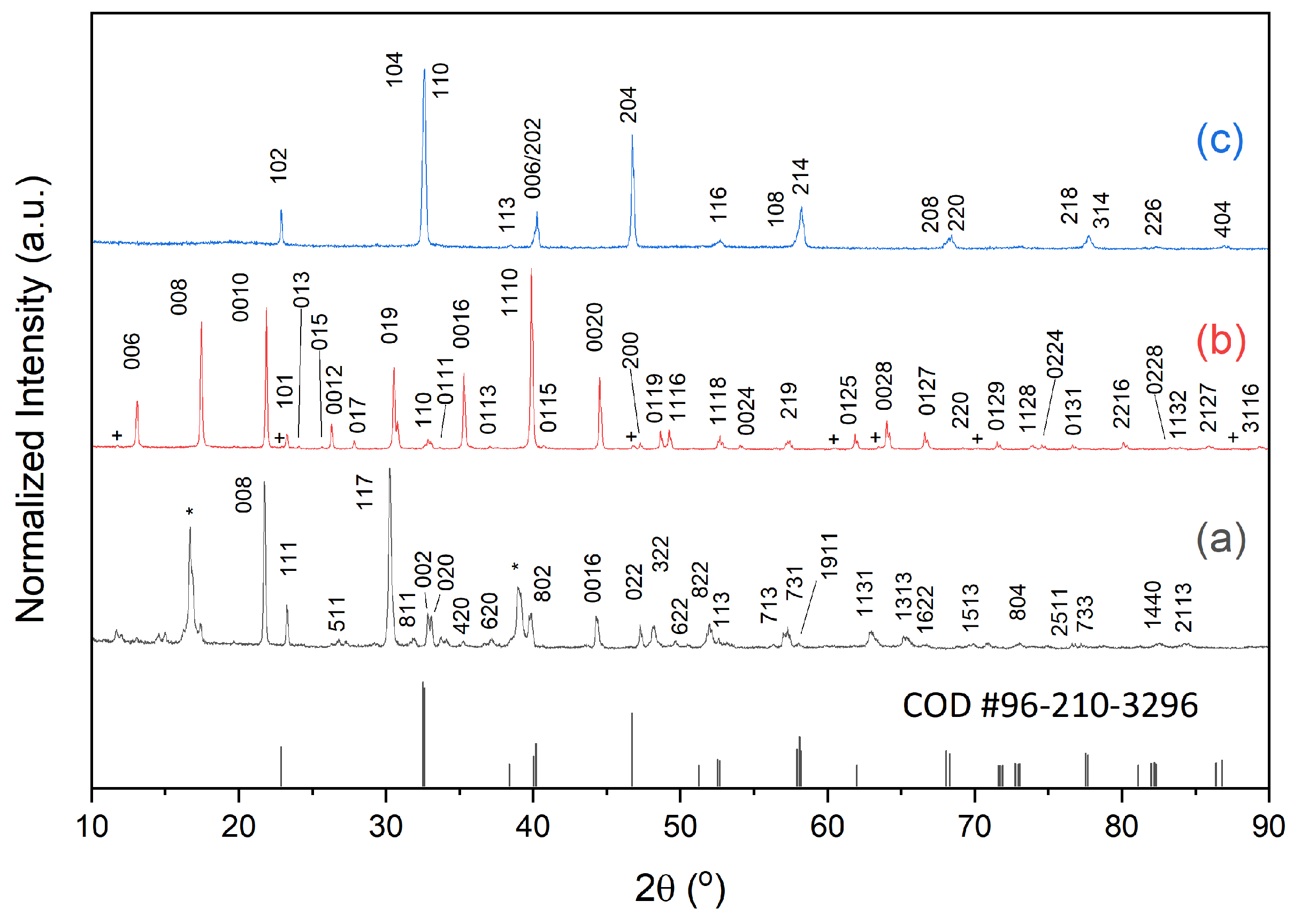
Figure 1. X-ray diffraction patterns of: (a) Bi4Ti3O12 precursors; (b) Na0.5Bi4.5Ti4O15 precursors; (c) (Na0.5Bi0.5)TiO3 platelets. * = BiNaO3 secondary phase; + = unknown secondary phase.
Inorganics 13 00387 g001
Figure 2. SEM Micrographs of: (a) Bi4Ti3O12 precursors; (b) Na0.5Bi4.5Ti4O15 precursors; (c) (Na0.5Bi0.5)TiO3 platelets.
Inorganics 13 00387 g002
Figure 3. X-ray diffraction pattern of 0.90(Na0.5Bi0.5)TiO3-0.08KNbO3-0.02SrTiO3 powder.
Inorganics 13 00387 g003
Figure 4. X-ray diffraction patterns of 0.90(Na0.5Bi0.5)TiO3-0.08KNbO3-0.02SrTiO3 ceramics sintered at 1175 °C for 4 h with different additions of NBT platelets.
Inorganics 13 00387 g004
Figure 5. Relative density plots of 0.90(Na0.5Bi0.5)TiO3-0.08KNbO3-0.02SrTiO3 ceramics sintered at 1175 °C for 4 h with different additions of NBT platelets.
Inorganics 13 00387 g005
Figure 6. X-ray diffraction patterns of 0.90(Na0.5Bi0.5)TiO3-0.08KNbO3-0.02SrTiO3 textured ceramics with 4 wt% NBT platelet addition and different sintering conditions.
Inorganics 13 00387 g006
Figure 7. Relative density plots of 0.90(Na0.5Bi0.5)TiO3-0.08KNbO3-0.02SrTiO3 textured ceramics with 4 wt% NBT platelet addition and different sintering conditions.
Inorganics 13 00387 g007
Figure 8. X-ray diffraction patterns of (a) untextured and (b) textured 0.90(Na0.5Bi0.5)TiO3-0.08KNbO3-0.02SrTiO3 ceramics (sintered at 1200 °C for 10 h) after Rietveld refinement. The circles are the raw data points, the red lines are the fitted patterns, the vertical lines are peak positions for the R3c and P4bm phases and the subfigures are difference plots between the raw data and fitted pattern.
Inorganics 13 00387 g008
Figure 9. Micrograph of (a,b) untextured; (c,d) textured (4 wt% NBT platelets) 0.90(Na0.5Bi0.5)TiO3-0.08KNbO3-0.02SrTiO3 ceramics sintered at 1200 °C for 10 h.
Inorganics 13 00387 g009
Figure 10. Elemental distribution map by EPMA analysis of (a) untextured; (b) textured (4 wt% NBT platelets) 0.90(Na0.5Bi0.5)TiO3-0.08KNbO3-0.02SrTiO3 ceramics sintered at 1200 °C for 10 h. Scale bar = 20 μm.
Inorganics 13 00387 g010
Figure 11. Polarization hysteresis loops and bipolar strain curves of (a,b) untextured; (c,d) textured (4 wt% NBT platelets) 0.90(Na0.5Bi0.5)TiO3-0.08KNbO3-0.02SrTiO3 ceramics sintered at 1200 °C for 10 h.
Inorganics 13 00387 g011
Figure 12. (a) Polarization hysteresis loops; (b) bipolar strain curves; (c) S-P2 plots; (d) polarization current density of untextured and textured (4 wt% NBT platelets) 0.90(Na0.5Bi0.5)TiO3-0.08KNbO3-0.02SrTiO3 ceramics sintered at 1200 °C for 10 h.
Inorganics 13 00387 g012
Figure 13. Unipolar polarization hysteresis loops and strain curves of (a,b) untextured; (c,d) textured (4 wt% NBT platelets) 0.90(Na0.5Bi0.5)TiO3-0.08KNbO3-0.02SrTiO3 ceramics sintered at 1200 °C for 10 h.
Inorganics 13 00387 g013
Figure 14. First and second cycles of unipolar strain hysteresis loops of (a) untextured; (b) textured (4 wt% NBT platelets) 0.90(Na0.5Bi0.5)TiO3-0.08KNbO3-0.02SrTiO3 ceramics sintered at 1200 °C for 10 h. First and second cycles of bipolar hysteresis loops of (c) untextured; (d) textured (4 wt% NBT platelets) 0.90(Na0.5Bi0.5)TiO3-0.08KNbO3-0.02SrTiO3 ceramics sintered at 1200 °C for 10 h (for the textured sample, the 1st and 3rd cycles are shown as the second cycle was distorted).
Inorganics 13 00387 g014
Figure 15. Dielectric properties and AC conductivity of the untextured sample at certain frequencies with a temperature range of 30 °C to 700 °C: (a) plot of the real part of the relative permittivity; (b) the inverse permittivity; (c) the imaginary part of the relative permittivity; (d) the Arrhenius plots of the AC conductivity.
Inorganics 13 00387 g015
Figure 16. Dielectric properties and AC conductivity of the textured sample with certain frequencies at a temperature range of 30 °C to 700 °C: (a) plot of relative permittivity; (b) the inverse permittivity; (c) the imaginary permittivity; (d) the Arrhenius plots of the AC conductivity.
Inorganics 13 00387 g016
Table 1. Rietveld refinement results for untextured and textured 0.90(Na0.5Bi0.5)TiO3-0.08KNbO3-0.02SrTiO3 ceramics.
UntexturedTextured
Crystal systemTetragonalRhombohedralTetragonalRhombohedral
Space groupP4bmR3cP4bmR3c
a (Å)5.55015.52055.52455.5160
b (Å)5.55015.52055.52455.5160
c (Å)3.952613.56243.975113.5183
α (°)90909090
β (°)90909090
γ (°)9012090120
Weight fraction%46.153.917.982.1
R (weighted profile)%9.54968.7159
R profile%7.79095.4665
Table 2. The elemental composition by EPMA analysis of untextured and textured (4 wt% NBT platelets) 0.90(Na0.5Bi0.5)TiO3-0.08KNbO3-0.02SrTiO3 ceramics sintered at 1200 °C for 10 h.
Oxide (mol%)UntexturedTexturedNominal 0.90(Na0.5Bi0.5)TiO3-0.08KNbO3-0.02SrTiO3TemplatesNominal (Na0.5Bi0.5)TiO3
Na2O13.39 ± 0.6413.89 ± 0.4115.3114.05 ± 0.5116.67
K2O2.33 ± 0.122.38 ± 0.102.721.83 ± 0.590
TiO264.28 ± 0.3364.12 ± 0.3562.5965.36 ± 1.1366.67
SrO1.15 ± 0.051.07 ± 0.071.360.68 ± 0.480
Bi2O316.06 ± 0.2515.79 ± 0.2215.3116.17 ± 0.5116.67
Nb2O52.80 ± 0.082.75 ± 0.142.721.91 ± 1.050
Table 3. Comparison of the dielectric property parameters of untextured and textured 0.90(Na0.5Bi0.5)TiO3-0.08KNbO3-0.02SrTiO3 samples.
ParameterUntexturedTextured
Td (°C)--
Tsm (°C)142169
Tm (°C)251250
Tθ (°C)278308
TB (°C)518558
Ea (eV)1.481.54
Table 4. Batch formulation of tape-casting slurry.
ComponentComposition wt%Function
Matrix powder:
0.90NBT-0.08KN-0.02ST
51.61
Organic Binder:
Polyvinyl-Butyral PVB (Butvar B79, Eastman, Kingsport, TN, USA)
4.65Binder
Polyethylene-Glycol PEG 400 (Daejung Chemicals, CP grade)0.33Plasticizer
n-Butyl Benzyl Phthalate BBP (Alfa Aesar, 98%)1.59Plasticizer
Methyl-ethyl ketone
(Daejung Chemicals, >99.5%)
27.60Solvent
Ethanol (Daejung Chemicals, 99.9%)14.22Solvent
Disclaimer/Publisher’s Note: The statements, opinions and data contained in all publications are solely those of the individual author(s) and contributor(s) and not of MDPI and/or the editor(s). MDPI and/or the editor(s) disclaim responsibility for any injury to people or property resulting from any ideas, methods, instructions or products referred to in the content.