

An IoT-Enabled Deep Learning-Based MIMO-OFDM Scheme for Optical Camera Communication in Mobile Environments


Abstract
1. Introduction
2. Technical Contributions
- •
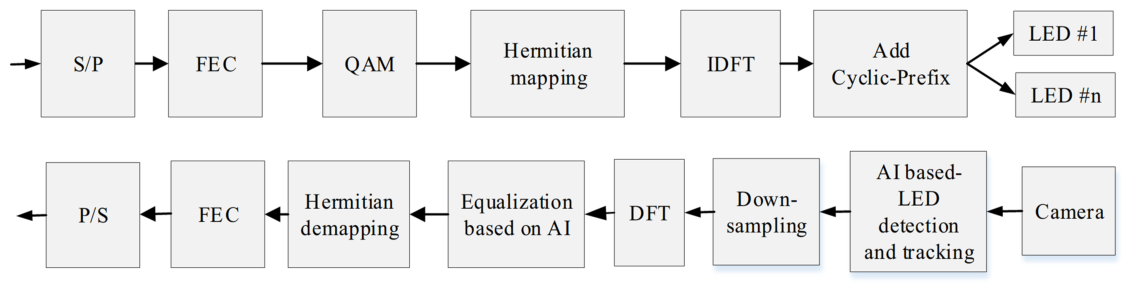
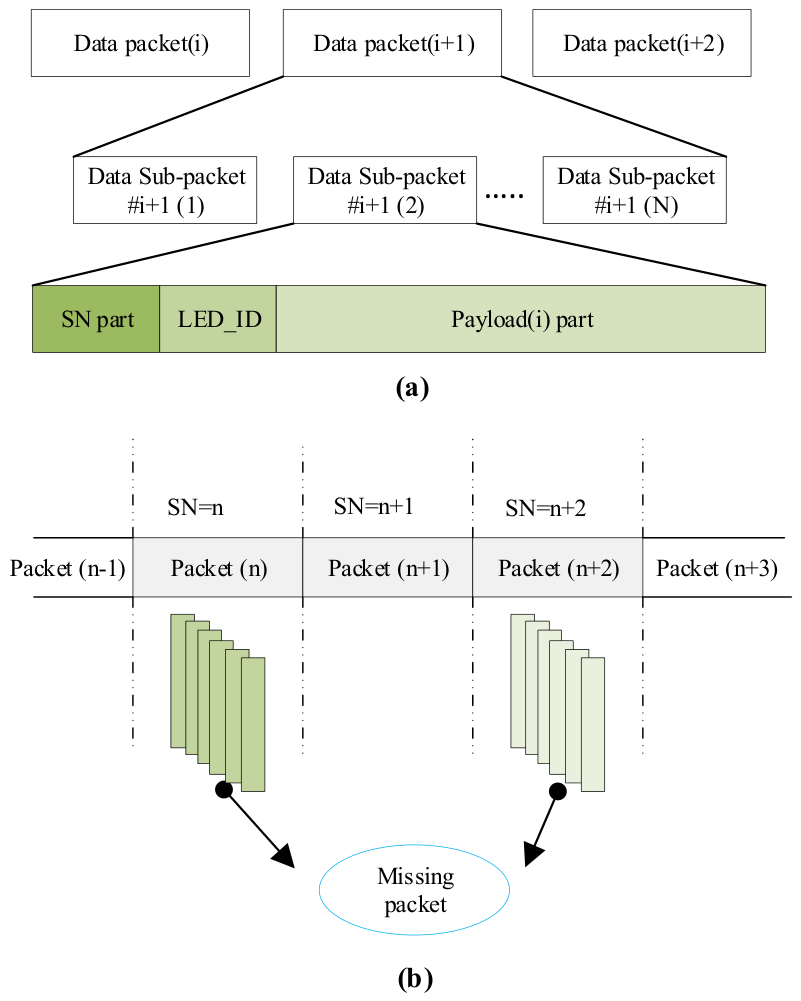
- Robustness to frame-rate variations: Variations in camera frame rate represent a challenge in OCC systems. Although frame rates are often assumed to be fixed (e.g., 60 fps or 500 fps), they may fluctuate in real time due to internal camera settings, resulting in synchronization mismatches between the transmitter and receiver. The proposed approach makes data decoding reliable by using sequence numbers (SNs).
- •
- Robustness to complex noise: OCC systems are affected by various complex noise sources, including motion blur, inter-symbol interference, and optical attenuation, which are difficult to mitigate in the time domain. By applying OFDM scheme, we can mitigate these noises in the frequency domain by removing the DC component, which is difficult to eliminate in the time domain.
- •
- Mobility support: Since MIMO-OFDM systems rely on the rolling shutter effect, they are highly sensitive to mobile environments. Under the rolling shutter effect, LEDs are captured as bright and dark stripes, which limits the effectiveness of conventional region-of-interest (RoI) detection techniques in the IEEE 802.15.7-2018 standard. To address these challenges, a YOLOv11-based LED tracking algorithm is proposed to enhance robustness in mobile environments considering multiple LEDs.
- •
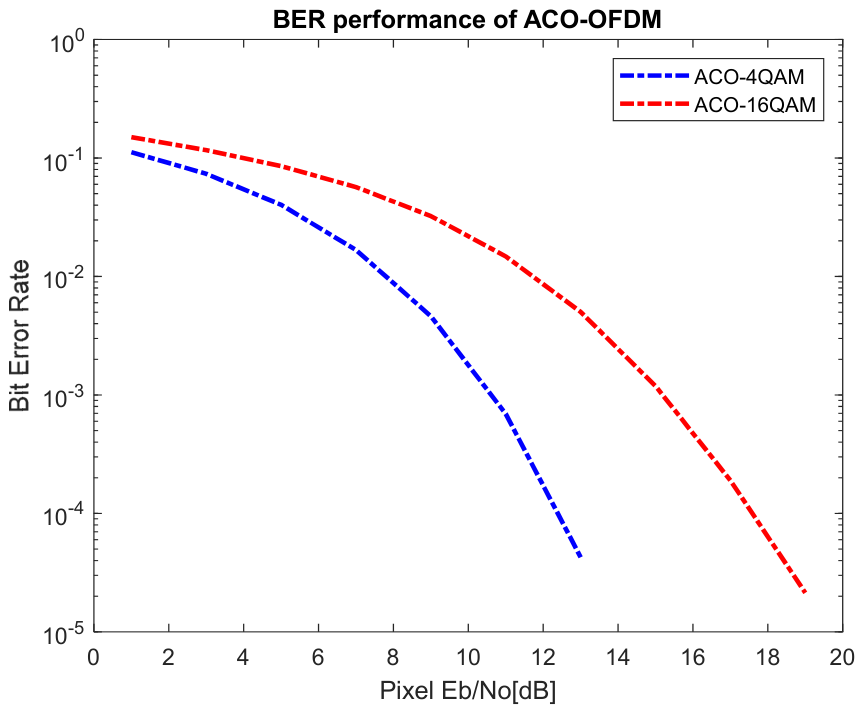
- Lower bit error rate: By applying MIMO technology, we can improve the bit error rate multiple times compared to the conventional OFDM scheme.
- •
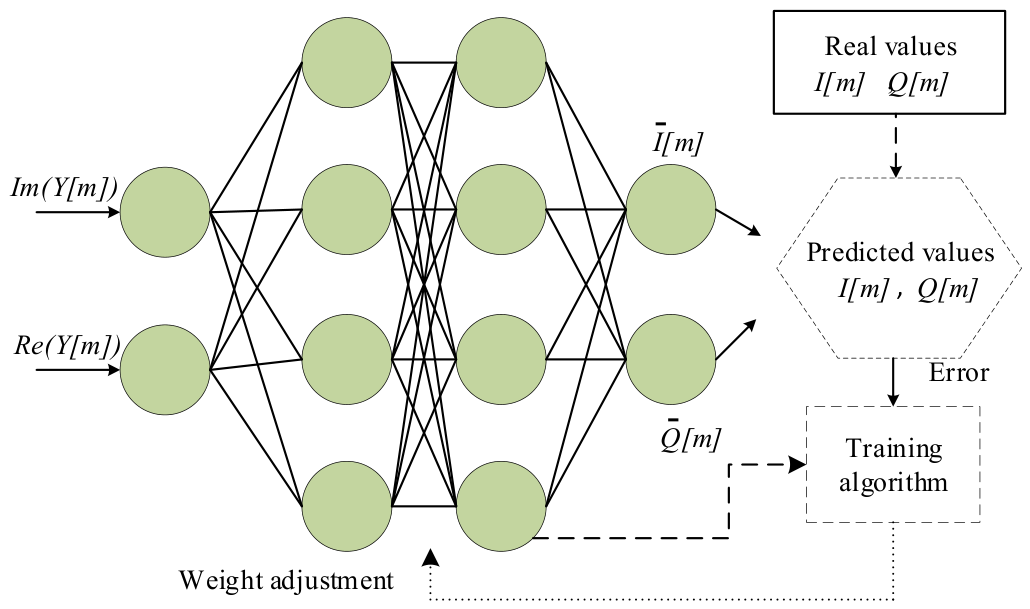
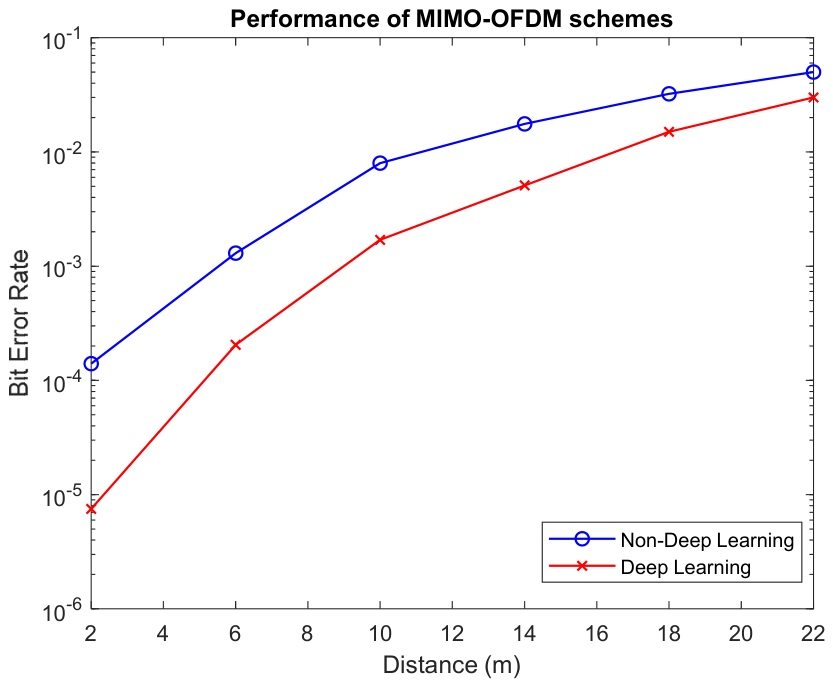
- Deep learning-based decoder: Deploying a DL-based MIMO-OFDM decoder reduces the error rates under mobility conditions instead of the normal linear equalizer in [13]. In real-time optical channels, by training the proposed model on datasets collected under multiple channel conditions, multiple communication distances, multiple velocities, and multiple camera exposure times, the proposed approach achieves good performance compared to conventional methods. The details of the DL model are also explained to highlight our approach.
3. System Architecture
3.1. Cyclic Prefix (CP)
3.2. DL for LED Detection
3.3. OFDM Decoder Based on Deep Learning
4. Simulation and Implementation Results
4.1. BER Estimation for O-OFDM Technologies
4.2. Implementation
5. Discussion
6. Conclusions
Supplementary Materials
Author Contributions
Funding
Data Availability Statement
Conflicts of Interest
References
- Pan, Z.; Xu, Z.; Miao, R.; Zhao, T.; Wang, J. Prospects of 6G Technology Framework: A Big-Lite Multi-RATs Concept. IEEE Commun. Mag. 2025, 63, 174–180. [Google Scholar] [CrossRef] [Scilit]
- Khoshafa, M.H.; Maraqa, O.; Moualeu, J.M.; Aboagye, S.; Ngatched, T.M.; Ahmed, M.H.; Gadallah, Y.; Di Renzo, M. RIS-Assisted Physical Layer Security in Emerging RF and Optical Wireless Communications Systems: A Comprehensive Survey. IEEE Commun. Surv. Tutor. 2025, 27, 2156–2203. [Google Scholar] [CrossRef] [Scilit]
- Chia, L.W.; Motani, M. High-Performance OCC with Edge Processing on SPAD and Event-Based Cameras. IEEE Commun. Mag. 2024, 62, 62–67. [Google Scholar] [CrossRef] [Scilit]
- Bhutani, M.; Lall, B.; Agrawal, M. Optical Wireless Communications: Research Challenges for MAC Layer. IEEE Access 2022, 10, 126969–126989. [Google Scholar] [CrossRef] [Scilit]
- Thai, P.Q. Soft-Information LLM Fusion for LDPC-Coded Text Over Visible-Light Links. IEEE Commun. Lett. 2026, 30, 1885–1889. [Google Scholar] [CrossRef] [Scilit]
- Lyu, Z.; Xiao, M.; Xu, J.; Skoglund, M.; Di Renzo, M. The Larger the Merrier? Efficient Large AI Model Inference in Wireless Edge Networks. IEEE J. Sel. Areas Commun. 2026, 44, 2839–2853. [Google Scholar] [CrossRef] [Scilit]
- Sridhar, R.; Richard, D.; Kyu, L.S. IEEE 802.15.7 Visible Light Communication: Modulation and Dimming Support. IEEE Commun. Mag. 2012, 50, 72–82. [Google Scholar] [CrossRef] [Scilit]
- Nikola, S.; Volker, J.; Min, J.Y.; John, L.Q. An Overview on High-Speed Optical Wireless/Light Communications. 2017. Available online: https://mentor.ieee.org/802.11/dcn/17/11-17-0962-02-00lc-an-overview-on-high-speed-optical-wireless-light-communications.pdf (accessed on 13 January 2026).
- IEEE-SA. IEEE Standard for Local and Metropolitan Area Networks—Part 15.7: Short-Range Optical Wireless Communications Amendment 1: Higher Rate, Longer Range Optical Camera Communication (OCC); IEEE-SA: Piscataway, NJ, USA, 2024. [Google Scholar]
- Nguyen, H.; Al-Imran; Jang, Y.M. Survey of next-generation optical wireless communication technologies for 6G and Beyond 6G. ICT Express 2025, 11, 576–589. [Google Scholar] [CrossRef] [Scilit]
- Dong, K.; Kong, M.; Wang, M. Error performance analysis for OOK modulated optical camera communication systems. Opt. Commun. 2025, 574, 131121. [Google Scholar] [CrossRef] [Scilit]
- Std 802.15.7-2018; IEEE Standard for Local and Metropolitan Area Networks—Part 15.7: Short-Range Optical Wireless Communications. IEEE-SA: Piscataway, NJ, USA, 2018.
- Nguyen, D.T.; Nguyen, T.; Thieu, M.D.; Nguyen, H. A Deep Learning-Enhanced MIMO C-OOK Scheme for Optical Camera Communication in Internet of Things Networks. Photonics 2026, 13, 163. [Google Scholar] [CrossRef] [Scilit]
- Nguyen, H.; Thieu, M.D.; Nguyen, T.; Jang, Y.M. Rolling OFDM for Image Sensor Based Optical Wireless Communication. IEEE Photonics J. 2019, 11, 6500817. [Google Scholar] [CrossRef] [Scilit]
- Yu, Q.; Wang, B.; Su, Y. Object Detection-Tracking Algorithm for Unmanned Surface Vehicles Based on a Radar-Photoelectric System. IEEE Access 2021, 9, 57529–57541. [Google Scholar] [CrossRef] [Scilit]
- Lin, H.; Si, J.; Abousleman, G.P. Region-of-interest detection and its application to image segmentation and compression. In Proceedings of the 2007 International Conference on Integration of Knowledge Intensive Multi-Agent Systems, Waltham, MA, USA, 30 April–3 May 2007. [Google Scholar]
- Yan, C.; Chen, W.; Chen, P.C.Y.; Kendrick, A.S.; Wu, X. A new two-stage object detection network without RoI-Pooling. In Proceedings of the 2018 Chinese Control and Decision Conference (CCDC), Shenyang, China, 9–11 June 2018; pp. 1680–1685. [Google Scholar]
- Zhang, H.; Gao, L.; Gong, Y.; Liu, H.; Zhu, Y.; Yang, Y. RTF-SAW-YOLOv11: A Bolt Defect Detection Model for Power Transmission Lines Under Low-Light Conditions. IEEE Access 2025, 13, 138640–138659. [Google Scholar] [CrossRef] [Scilit]
- Luo, C.; Tang, H.; Li, S.; Wan, G.; Chen, W.; Guan, J. YOLOv11s-CD: An Improved YOLOv11s Method for Catenary Dropper Fault Detection. IEEE Trans. Instrum. Meas. 2025, 74, 5043410. [Google Scholar] [CrossRef] [Scilit]
- Xue, Z.; Kong, L.; Wu, H.; Chen, J. Fire and Smoke Detection Based on Improved YOLOV11. IEEE Access 2025, 13, 73022–73040. [Google Scholar] [CrossRef] [Scilit]
- Zhang, L.; Zheng, A.; Sun, X.; Sun, Z. Enhanced YOLOv11-Based River Aerial Image Detection Research. IEEE Geosci. Remote Sens. Lett. 2025, 22, 8002405. [Google Scholar] [CrossRef] [Scilit]
- Ghassemlooy, Z.; Alves, L.N.; Zvanovec, S.; Khalighi, M.A. Visible Light Communications: Theory and Applications, 1st ed.; CRC Press: Boca Raton, FL, USA, 2016. [Google Scholar]
- Aziz, M.A.; Rahman, M.H.; Sejan, M.A.S.; Tabassum, R.; Hwang, D.D.; Song, H.K. Deep Recurrent Neural Network Based Detector for OFDM With Index Modulation. IEEE Access 2024, 12, 89538–89547. [Google Scholar] [CrossRef] [Scilit]
- Lee, H.; Lee, S.H.; Quek, T.Q.S.; Lee, I. Deep Learning Framework for Wireless Systems: Applications to Optical 384 Wireless Communications. IEEE Commun. Mag. 2019, 57, 35–41. [Google Scholar] [CrossRef] [Scilit]
- Wu, H.; Chen, Z.; Liu, Z.; Geng, X.; Zhao, Y.; Liu, Z. CRS-Based Joint CFO and Channel Estimation Using Deep Learning in OFDM-Based Vehicular Communication Systems. IEEE Trans. Wirel. Commun. 2025, 24, 3882–3893. [Google Scholar] [CrossRef] [Scilit]
- Kong, M.; Pan, Y.; Zhou, H.; Yu, R.; Le, X.; Yuan, H.; Wang, R.; Yang, Q. Deep Learning-Based Acquisition Pointing and Tracking for Underwater Wireless Optical Communication. IEEE Photonics Technol. Lett. 2025, 37, 555–558. [Google Scholar] [CrossRef] [Scilit]
- Jia, B.; Ge, W.; Cheng, J.; Du, Z.; Wang, R.; Song, G.; Zhang, Y.; Cai, C.; Qin, S.; Xu, J. Deep Learning-Based Cascaded Light Source Detection for Link Alignment in Underwater Wireless Optical Communication. IEEE Photonics J. 2024, 16, 7801512. [Google Scholar] [CrossRef] [Scilit]
- El Jbari, M.; Ettehamy, Z.; Moussaoui, M.; Menhaj, A.R.; de Figueiredo, F.A.; Ouameur, M.A. Deep learning-assisted intelligent VLC for IoT applications: A systematic review towards digital and autonomous 6G wireless networks. Sci. Afr. 2026, 33, e03556. [Google Scholar] [CrossRef] [Scilit]
- Palitharathna, K.W.S.; Suraweera, H.A.; Godaliyadda, R.I.; Herath, V.R.; Thompson, J.S. Neural Network-Based Channel Estimation and Detection in Spatial Modulation VLC Systems. IEEE Commun. Lett. 2022, 26, 1598–1602. [Google Scholar] [CrossRef] [Scilit]
- Randel, S.; Breyer, F.; Lee, S.C.; Walewski, J.W. Advanced modulation schemes for short-range optical communications. IEEE J. Sel. Top. Quantum Electron. 2010, 16, 1280–1289. [Google Scholar] [CrossRef] [Scilit]
- Zhou, J.; Wang, Q.; Cheng, Q.; Guo, M.; Lu, Y.; Yang, A.; Qiao, Y. Low-PAPR Layered/ Enhanced ACO-SCFDM for Optical Wireless Communications. IEEE Photonics Technol. Lett. 2018, 30, 165–168. [Google Scholar] [CrossRef] [Scilit]
- Dimitrov, S.; Sinanovic, S.; Haas, H. Clipping noise in OFDM based Optical Wireless Communication Systems. IEEE Trans. Commun. 2012, 60, 1072–1081. [Google Scholar] [CrossRef] [Scilit]
Disclaimer/Publisher’s Note: The statements, opinions and data contained in all publications are solely those of the individual author(s) and contributor(s) and not of MDPI and/or the editor(s). MDPI and/or the editor(s) disclaim responsibility for any injury to people or property resulting from any ideas, methods, instructions or products referred to in the content. |
© 2026 by the authors. Licensee MDPI, Basel, Switzerland. This article is an open access article distributed under the terms and conditions of the Creative Commons Attribution (CC BY) license.
Share and Cite
Pham, V.K.; Nguyen, H. An IoT-Enabled Deep Learning-Based MIMO-OFDM Scheme for Optical Camera Communication in Mobile Environments. Photonics 2026, 13, 872. https://doi.org/10.3390/photonics13090872
Pham VK, Nguyen H. An IoT-Enabled Deep Learning-Based MIMO-OFDM Scheme for Optical Camera Communication in Mobile Environments. Photonics. 2026; 13(9):872. https://doi.org/10.3390/photonics13090872
Chicago/Turabian StylePham, Van Khoa, and Huy Nguyen. 2026. "An IoT-Enabled Deep Learning-Based MIMO-OFDM Scheme for Optical Camera Communication in Mobile Environments" Photonics 13, no. 9: 872. https://doi.org/10.3390/photonics13090872
APA StylePham, V. K., & Nguyen, H. (2026). An IoT-Enabled Deep Learning-Based MIMO-OFDM Scheme for Optical Camera Communication in Mobile Environments. Photonics, 13(9), 872. https://doi.org/10.3390/photonics13090872

