1. Introduction
Optical and photonic interferometric sensors provide wavelength-referenced, non-contact, and high-sensitivity displacement readout, making them attractive for precision positioning, micro-vibration characterization, and optical inertial sensing [
1,
2,
3]. Compared with conventional electrical sensing and imaging-based approaches, optical interferometric readout offers strong immunity to electromagnetic interference and enables phase-sensitive displacement retrieval with sub-wavelength resolution [
4,
5,
6,
7]. These features are particularly important for low-frequency nanoscale displacement sensing, where environmental disturbances and technical noise often limit the achievable readout stability. Recent advances in optical-field manipulation and structured optical fields have further expanded the available degrees of freedom in photonic systems, including high-fidelity frequency conversion in high-dimensional spaces and trans-spectral transfer of spatio-temporal structured beams [
8,
9].
Among interferometric readout techniques, optical heterodyne interferometry is especially suitable for robust nanoscale displacement sensing. By mixing two coherent frequency-shifted beams on a photodetector, the displacement-induced phase variation is transferred to a heterodyne beat signal, allowing phase and frequency information to be extracted with high sensitivity and a large dynamic range [
10,
11]. The frequency-shifted readout also helps move the measurement signal away from low-frequency technical noise. Recent studies have further investigated key noise mechanisms in heterodyne interferometers, including stray-light-induced frequency mixing, laser relative intensity noise (RIN) coupling, and optoelectronic detection-chain optimization for sub-nanometer interferometric readout [
12,
13,
14].
In practical optical heterodyne sensing systems, signal demodulation is a critical factor determining the final displacement resolution and dynamic range. Fringe-counting methods are limited by the optical wavelength and are mainly suitable for micrometer-scale displacement measurement. Phase-demodulation methods, in contrast, can achieve much higher spatial resolution and are therefore more appropriate for nanoscale displacement sensing [
7,
10,
15]. For small-amplitude periodic displacement, Bessel-function-based frequency-domain sideband extraction provides a robust approach because the displacement information is encoded in narrowband spectral components [
16,
17]. However, when the displacement amplitude increases, the small-modulation approximation gradually breaks down, and phase-tracking methods such as IQ quadrature demodulation become necessary to avoid nonlinear distortion and ambiguity [
18,
19,
20].
Optical heterodyne interferometric readout is also highly relevant to optical accelerometers and pendulum-based inertial sensing systems, where the displacement response of the inertial element directly determines acceleration sensitivity [
21,
22,
23]. Heterodyne up-conversion has been shown to be effective for suppressing low-frequency 1/f-type noise and improving readout stability in interferometric sensing [
24]. However, for low-frequency nanoscale displacement sensing over a multi-order amplitude range, the optimal demodulation strategy depends strongly on both modulation depth and signal-to-noise ratio (SNR). A practical criterion for selecting between frequency-domain sideband extraction and IQ phase tracking under specific SNR and displacement-amplitude conditions remains insufficiently clarified.
Motivated by this need, this work develops a free-space optical heterodyne interferometric readout system for low-frequency nanoscale displacement sensing and establishes an SNR-guided adaptive demodulation framework. Instead of treating frequency-domain sideband extraction and IQ phase tracking as independent demodulation approaches, the proposed framework experimentally maps their applicability regimes and provides a practical selection criterion.
The main contributions of this work are as follows:
A free-space optical heterodyne interferometric readout system is developed for low-frequency nanoscale displacement sensing;
An experimentally demonstrated SNR-guided adaptive demodulation framework is established by combining frequency-domain sideband extraction and IQ phase tracking;
Wavelength-referenced displacement readout over a range from sub-nanometer narrowband detection to 250 nm is demonstrated with a repeatability of 0.40 nm;
The readout system is applied to a quartz pendulum inertial structure to demonstrate its potential for optical inertial sensor characterization.
2. Materials and Methods
2.1. Principle of Free-Space Optical Heterodyne Displacement Readout
In a free-space optical heterodyne interferometric readout system, the displacement of the target surface is encoded into the phase of the measurement beam. The measurement beam interferes with a frequency-shifted reference beam on a photodetector (PD), producing a heterodyne beat signal. The target displacement can then be retrieved by demodulating the phase variation in the beat signal.
Let the optical fields of the measurement beam and the reference beam be expressed as:
where
and
denote the amplitudes of the object light and reference light signals,
is the angular frequency of the light,
and
are the corresponding phases of the object light and reference light signals, and
is the change in angular frequency brought by the acousto-optic modulator with the modulation frequency
.
After photodetection and AC coupling, the DC components are removed, and only the heterodyne beat term is retained. The detected AC signal can therefore be written as:
The target displacement introduces an additional time-varying phase
in the measurement arm, which leads to Equation (5). Assuming a sinusoidal displacement
in Equation (6), the corresponding phase modulation can be written as Equation (7) for a reflective (double-pass) configuration, where
is the laser wavelength.
is the displacement of the target surface, is the amplitude of the displacement signal, is the angular frequency of the displacement signal, and is the phase of the displacement signal.
Accordingly, the detected heterodyne beat signal including displacement-induced phase modulation is expressed as:
Based on this phase-modulated signal, the following sections introduce two complementary demodulation strategies for displacement retrieval.
2.2. Frequency-Domain Sideband Extraction Based on Bessel Approximation
When the displacement amplitude
is much smaller than the optical wavelength
, the phase modulation index remains small. The detailed derivation of the Bessel-function approximation is provided in
Appendix A. Under the small-modulation condition, the interference signal can be approximated by retaining the dominant carrier and first-order sideband components, as expressed in the following equation:
Let the amplitude of the carrier component
and that of the first-order sideband component
be denoted as shown in Equation (9). The displacement amplitude can then be retrieved from their amplitude ratio:
This expression forms the basis of the frequency-domain sideband extraction method. In this approach, the displacement amplitude is obtained from the ratio between the carrier and first-order sideband amplitudes. By performing fast Fourier transform (FFT) analysis and extracting the spectral component associated with the displacement modulation frequency, the displacement can be estimated without explicit phase tracking or phase unwrapping.
This method is particularly suitable for small-amplitude periodic displacement under low-SNR conditions because narrowband spectral extraction can improve the robustness of amplitude estimation. However, its usable dynamic range is limited by the validity of the first-order Bessel approximation, which breaks down as the displacement amplitude approaches a significant fraction of the optical wavelength [
20], as further analyzed in
Appendix A. For larger displacement amplitudes, higher-order Bessel components become significant, and the first-order sideband amplitude is no longer linearly related to the displacement amplitude, leading to nonlinear distortion and possible ambiguity in amplitude-based demodulation.
2.3. IQ Quadrature Phase Tracking
To overcome the limitations of amplitude-based sideband extraction at larger displacement amplitudes, IQ quadrature demodulation is employed to directly recover the instantaneous phase of the heterodyne signal without relying on the Bessel approximation [
22]. In IQ demodulation, the heterodyne signal is mixed with two orthogonal carriers to generate the in-phase (I) and quadrature (Q) components. The instantaneous phase is then obtained from the I/Q components and subsequently unwrapped to produce a continuous phase signal. Because IQ demodulation does not rely on the small-modulation assumption, it can track displacements well beyond one optical wavelength, provided that phase unwrapping remains reliable and that the quadrature channels are properly balanced. In optimized systems, this method can achieve nanometer- or even picometer-level readout accuracy [
23,
24].
In practice, the performance of IQ phase tracking is mainly limited by the signal-to-noise ratio (SNR), especially at very small displacement amplitudes where the instantaneous phase is more susceptible to random noise [
22]. In addition, carrier-frequency drift caused by acousto-optic modulator (AOM) instability, thermal effects, or electronic imperfections may degrade the demodulation accuracy.
The practical accuracy of IQ phase tracking can be affected by quadrature imbalance, phase-unwrapping errors, and residual carrier-frequency drift. Quadrature amplitude imbalance and phase mismatch introduce periodic phase ripple in the recovered phase, which can appear as residual displacement error after phase-to-displacement conversion. Phase-unwrapping errors may occur when noise-induced phase fluctuations cause an apparent phase jump close to or larger than the unwrap threshold. In the present experiments, the sampling frequency was 60 kHz, and the tested displacement frequency was mainly 10 Hz. For the maximum tested displacement amplitude of 250 nm, the phase modulation amplitude is approximately 5.9 rad, and the maximum deterministic inter-sample phase increment is approximately 6 × 10⁻³ rad, which is far below the π-radian unwrap threshold. Phase-unwrapping errors are thus more likely to occur under low-SNR conditions, transient noise spikes, signal fading, or environmental disturbances rather than from the nominal displacement velocity.
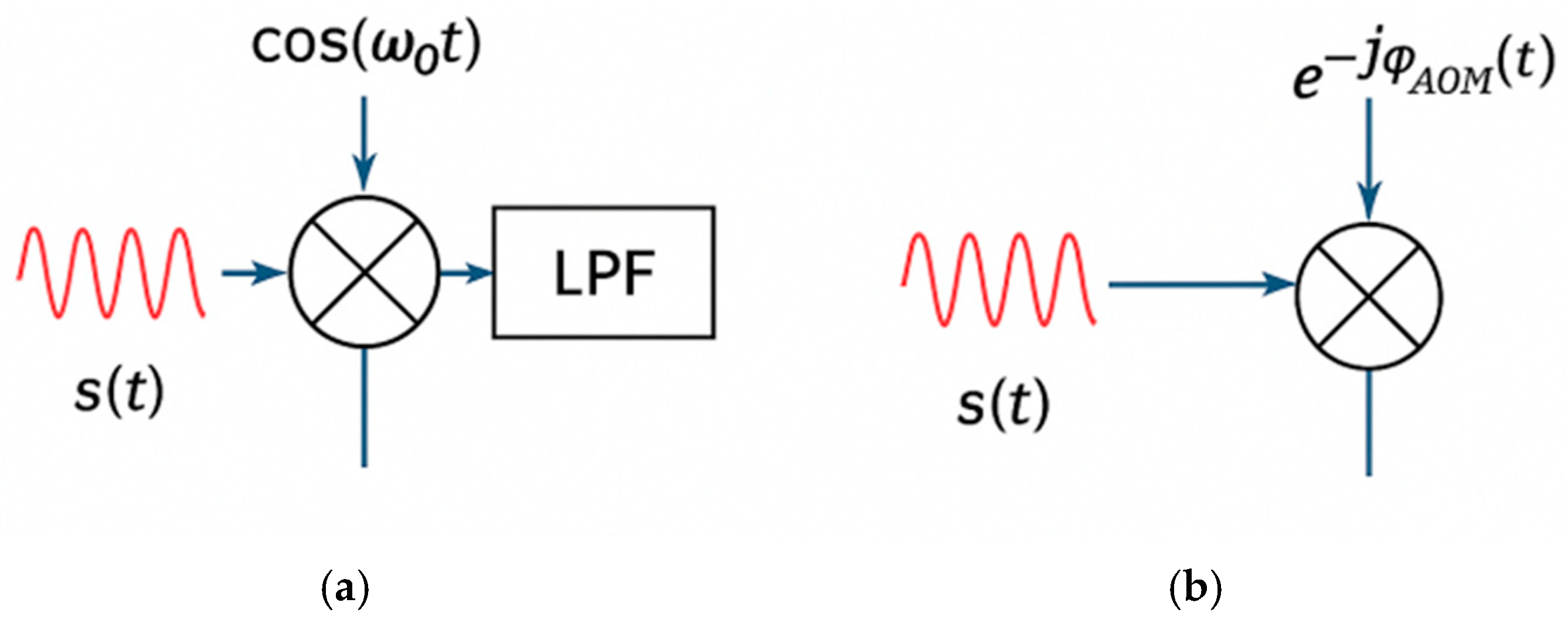
Residual carrier-frequency mismatch between the heterodyne beat signal and the demodulation reference can accumulate as a slow phase drift and lead to apparent displacement drift. To reduce this effect, the AOM-derived reference signal was synchronously acquired and used for adaptive IQ demodulation, which is shown in
Figure 1. The remaining low-frequency drift and environmental perturbations are included in the repeated-measurement repeatability rather than in the single-frequency spectral SNR estimate.
To address these practical issues, a synchronous phase-tracking compensation strategy is incorporated. By synchronously acquiring the heterodyne beat signal, the AOM drive signal, and the PZT control signal, the system performs adaptive IQ demodulation referenced to the actual AOM frequency [
21,
25]. Specifically, the beat signal is down-converted to baseband, low-pass filtered to retain the displacement-related components, and then phase-unwrapped to avoid ±π discontinuities. Finally, the target displacement is retrieved from the baseband phase by using the PZT drive signal as a synchronous reference and applying a narrowband envelope filter.
In the small-displacement regime, frequency-domain sideband extraction provides superior robustness and SNR performance because the displacement is encoded approximately linearly in the first-order sideband amplitude, without requiring phase unwrapping or strict quadrature balance. This makes it particularly advantageous for narrowband micro-vibration measurements. The achievable resolution of this method can be improved by increasing the sampling time and thus the spectral resolution; however, the ultimate measurement performance is still limited by the intrinsic system noise and environmental noise. Therefore, in the free-space optical heterodyne interferometric readout system developed in this work, the displacement demodulation strategy is selected according to the target displacement range and the spectral SNR. Frequency-domain sideband extraction is preferred for low-SNR small-amplitude signals, whereas IQ quadrature phase tracking is used for larger-amplitude displacement. This combined framework supports wavelength-referenced displacement readout over a wide range, from sub-nanometer narrowband detection to hundreds-of-nanometer levels.
For interferometric phase-based displacement measurement, the displacement resolution is fundamentally related to phase uncertainty through Equation (11), where
denotes the phase standard deviation.
Under additive Gaussian noise conditions, the phase uncertainty can be approximated as inversely proportional to the signal-to-noise ratio (SNR), indicating that the achievable displacement resolution is ultimately limited by the SNR rather than by the demodulation algorithm itself.
2.4. Experimental Setup and Displacement Excitation
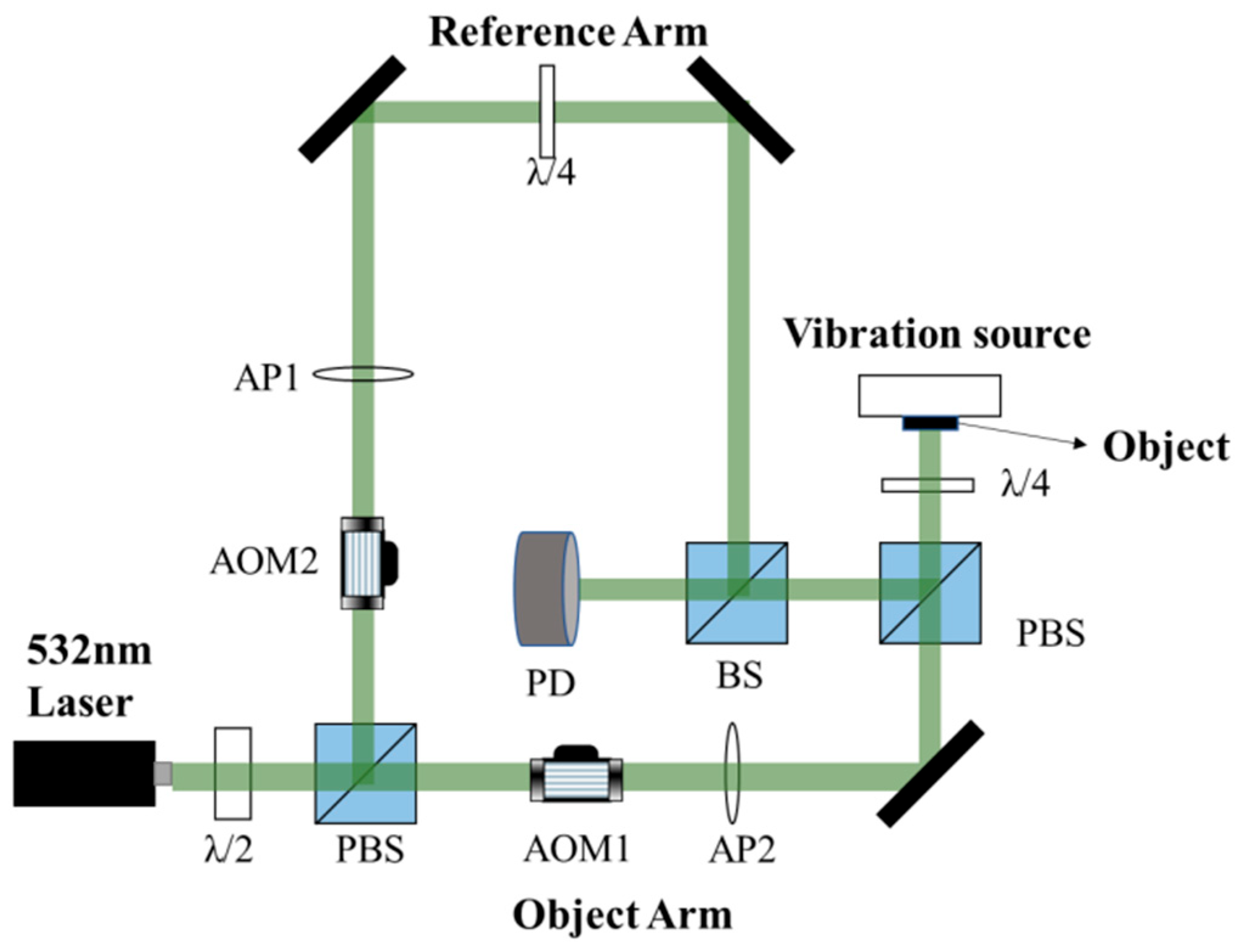
The optical layout of the free-space optical heterodyne interferometric readout system is shown in
Figure 2. A frequency-stabilized 532 nm laser is used as the light source. The beam first passes through a half-wave plate (HWP) and a polarizing beam splitter (PBS), which divide the laser into a measurement beam and a reference beam. The HWP is used to adjust the optical power ratio between the two arms to optimize the interference contrast.
Each arm enters an acousto-optic modulator (AOM; Gooch & Housego 3080–125; Ilminster Somerset, UK), which generates zeroth- and first-order diffracted beams. The unshifted zeroth-order beams are blocked by apertures (AP1 and AP2), while the first-order beams with frequency shifts of 80.00 MHz and 80.01 MHz are used as the measurement and reference beams, respectively. This frequency offset produces a heterodyne beat frequency of 10 kHz at the photodetector. The beat frequency was selected as a compromise among environmental noise, detector bandwidth, and data-acquisition efficiency. The relatively low beat frequency reduces the required sampling rate and bandwidth of the acquisition system, thereby reducing system complexity and noise sensitivity. For Bessel-function-based frequency-domain demodulation, increasing the acquisition time improves the frequency resolution and enhances narrowband amplitude estimation [
20,
26].
The measurement beam passes through a quarter-wave plate (QWP), is focused onto the target surface, and is then retro-reflected. After passing through the QWP a second time, its polarization is rotated by 90°, enabling recombination with the reference beam at a beam splitter (BS). The resulting interference signal is detected by a photodetector (Thorlabs PDA100A2, Newton, NJ, USA) and subsequently processed for displacement demodulation.
A QWP is placed in the reference arm for fine polarization adjustment to maximize the fringe contrast. In principle, this element can be omitted once a stable polarization state and sufficient interference visibility are ensured, for example, by long-term visibility monitoring after alignment. All measurements were conducted on a vibration-isolated optical table under laboratory ambient conditions. The laboratory temperature was maintained at 24 ± 0.5 °C using air conditioning. Each record lasted 60 s and was acquired after a 30 min warm-up to ensure thermal stabilization.
A piezoelectric actuator (PZT; Thorlabs PA25FEW) was used as a controllable displacement excitation source for system characterization. According to the manufacturer’s datasheet, the actuator provides a full-scale stroke of 2.8 μm, with a nominal displacement sensitivity of approximately 20 nm/V and a resonance frequency of 350 kHz.
It should be emphasized that the PZT was not used as an external calibrated displacement reference in this work. Instead, it was used only to introduce controllable sinusoidal phase modulation into the interferometric readout system. All reported displacement values were retrieved from the interferometric phase based on the known laser wavelength of 532 nm, rather than from the nominal voltage-to-displacement coefficient of the PZT.
The manufacturer-provided displacement sensitivity of the PZT actuator should be regarded as a nominal value specified under particular operating conditions. In practice, the actual voltage-to-displacement response can be affected by hysteresis, creep, driving frequency, load condition, mounting configuration, and high-voltage amplifier characteristics. Therefore, the datasheet value was used only to confirm the approximate excitation capability of the actuator and was not used for absolute displacement calibration.
The PZT was mounted with a flat glass reflector and driven by a signal generator and a high-voltage amplifier to generate sinusoidal displacement modulation from the sub-nanometer to hundreds-of-nanometers range. To describe the excitation level in displacement units, an effective voltage-to-displacement coefficient was estimated from the interferometrically retrieved displacement in the small-signal regime:
This coefficient was used only to label the nominal excitation level and to facilitate comparison among different drive voltages. It was not used as an independent displacement reference or as an input to the displacement demodulation algorithm. All displacement results reported in this work are derived from interferometric phase measurement and are traceable to the laser wavelength.
2.5. Signal Acquisition and Processing
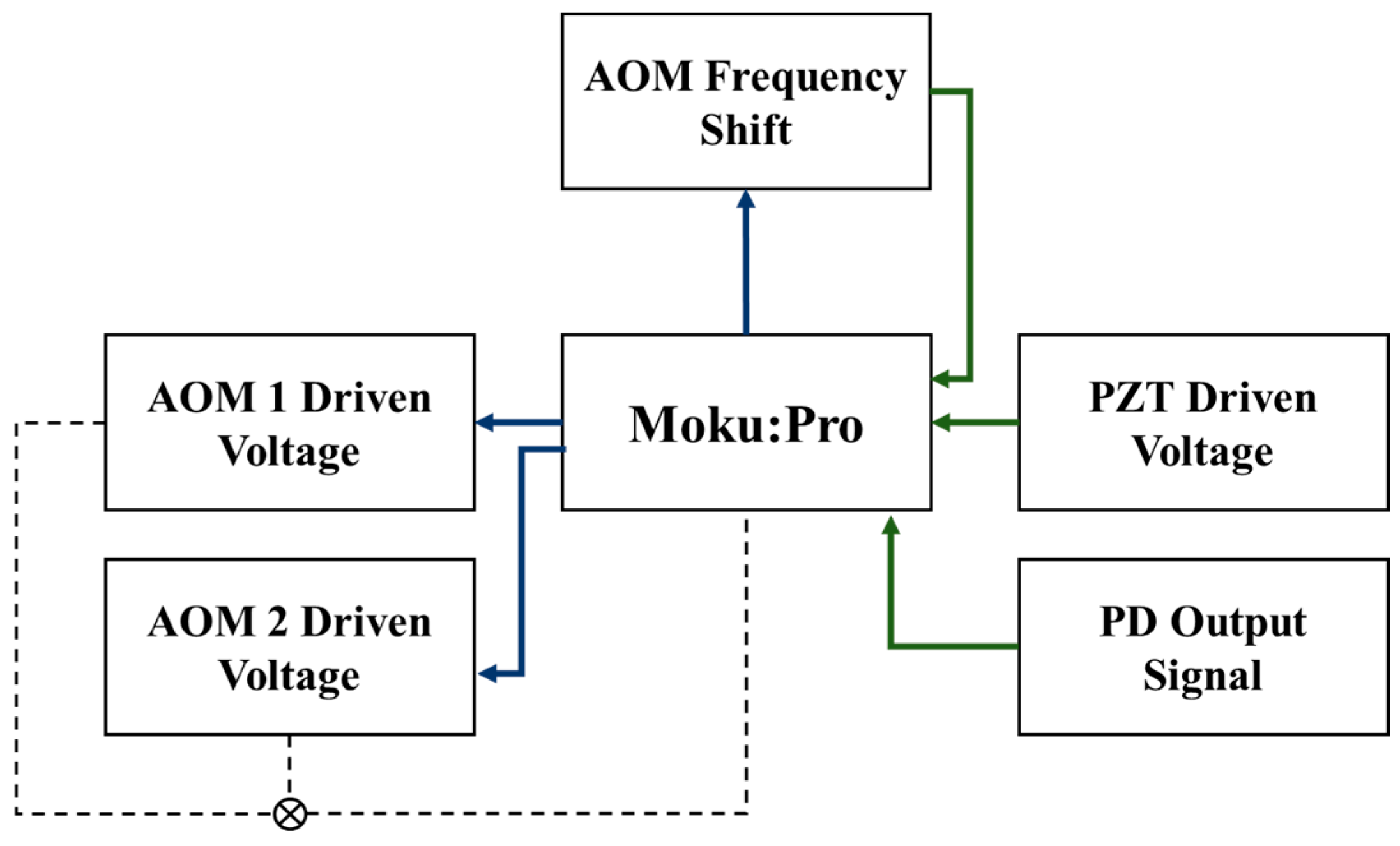
Signal generation and data acquisition were implemented using a Moku:Pro precision measurement platform (Liquid Instruments, Zurich, Switzerland) [
27], as shown in
Figure 3. The device generated two sinusoidal radio-frequency drive signals at 80.00 MHz and 80.01 MHz for the two AOMs. The corresponding 10 kHz heterodyne reference signal was obtained from the frequency difference between the two AOM drive signals using the built-in lock-in amplifier module.
Three signals were acquired synchronously: the heterodyne beat reference generated from the AOM drive signals, the PZT drive voltage, and the photodetector output signal. Synchronous acquisition ensures phase coherence among the reference, excitation, and optical readout signals, which is essential for carrier-frequency drift compensation and adaptive IQ demodulation.
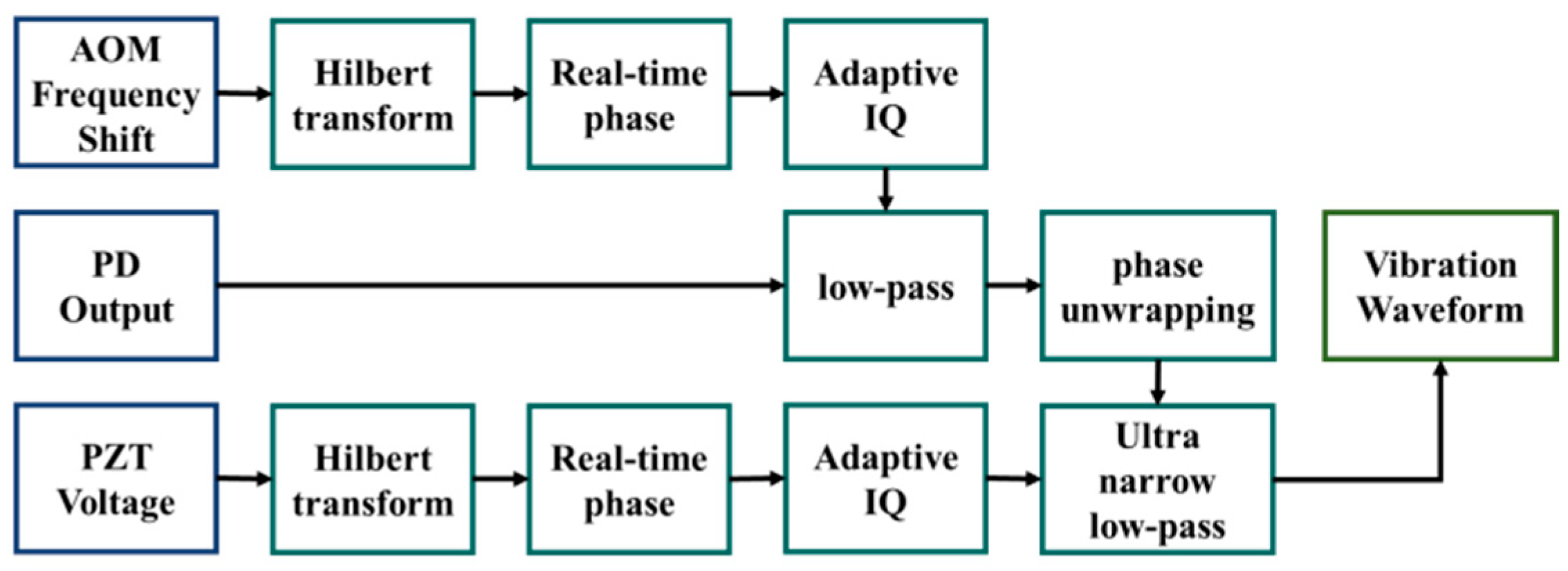
The acquired data were processed in MATLAB (R2023b). The AOM-derived reference signal was used to generate an orthogonal quadrature pair through Hilbert transformation, enabling adaptive IQ demodulation of the heterodyne signal. The photodetector output was down-converted to baseband, low-pass filtered to retain the displacement-related components, and subsequently phase-unwrapped to obtain a continuous phase signal. Finally, the PZT drive signal was used only as a synchronous frequency and phase reference for narrowband envelope extraction. It was not used as an amplitude calibration input. The displacement amplitude was retrieved from the interferometric phase-to-displacement conversion based on the laser wavelength. The overall processing workflow is shown in
Figure 4.
For spectral analysis, the amplitude spectral density (ASD) was calculated using Welch’s method. Each record lasted 60 s, and the sampling frequency was 60 kHz. The FFT length was 1,048,576 points, with a Hanning window and 50% overlap, corresponding to an equivalent resolution bandwidth of 0.057 Hz. These parameters were used for SNR evaluation and frequency-domain sideband extraction.
2.6. SNR Evaluation and Uncertainty Estimation
The signal-to-noise ratio (SNR) was evaluated from the amplitude spectral density (ASD) of the demodulated signal. Since the analysis was based on amplitude spectra rather than power spectra, the SNR in decibels was calculated using the amplitude ratio between the displacement-related spectral peak and the adjacent noise floor:
where
denotes the amplitude of the displacement-related spectral peak and
denotes the amplitude of the adjacent noise floor. The noise floor was evaluated from a nearby frequency region without obvious spectral peaks under the same spectral-estimation conditions. The equivalent resolution bandwidth (RBW) was determined by the Welch spectral-estimation parameters described in
Section 2.5.
The spectral SNR was used for two purposes in this work. First, it provided a quantitative criterion for identifying whether a displacement-related spectral component could be reliably detected. Second, it was used as the basis for selecting between frequency-domain sideband extraction and IQ quadrature phase tracking. Frequency-domain sideband extraction was preferred for small-amplitude low-SNR signals because of its narrowband integration advantage, whereas IQ phase tracking was used when the SNR was sufficiently high and the displacement amplitude exceeded the reliable linear range of the first-order Bessel approximation.
In the reflective heterodyne interferometric configuration, the displacement is derived from the interferometric phase variation according to:
This equation constitutes the measurement model of the optical heterodyne displacement readout system. Since the displacement is obtained from the interferometric phase and the laser wavelength, the displacement scale factor is intrinsically referenced to the optical wavelength. The 532 nm laser was operated under stabilized conditions. The sampling clock and signal generation were provided by the Moku:Pro instrument with an internal reference oscillator. These electronic and timing contributions were treated as secondary uncertainty sources relative to the statistical repeatability of the implemented system.
The displacement uncertainty was evaluated following the general principles of the Guide to the Expression of Uncertainty in Measurement (GUM). The main uncertainty sources were classified into Type A and Type B components. Type A uncertainty was evaluated from repeated measurements under identical experimental conditions. For each repeated record, the displacement amplitude was retrieved using the same demodulation procedure, and the standard deviation of the repeated estimates was used to characterize the repeatability of the readout system.
Type B uncertainty sources included laser wavelength stability, sampling-clock stability, residual electronic gain drift, laser intensity fluctuations, and possible detector nonlinearity. The optical power incident on the photodetector was maintained within the linear operating range of the detector, so nonlinear detection effects were considered negligible. Laser-induced intensity fluctuations and wavelength-related scale-factor uncertainty were evaluated from the manufacturer specifications and experimental operating conditions.
The combined standard uncertainty was obtained by combining the Type A and Type B components in quadrature:
where
denotes the Type A standard uncertainty and
denotes the Type B uncertainty component. In addition, the SNR-derived phase uncertainty was used as an internal consistency check. Under additive Gaussian noise conditions, the phase uncertainty is approximately inversely proportional to the amplitude SNR. The corresponding equivalent displacement noise can then be estimated using the interferometric phase-to-displacement conversion. This spectral estimate was used only for consistency verification and not as the primary uncertainty value.
3. Results
3.1. Small-Amplitude Displacement Readout Using Frequency-Domain Sideband Extraction
To evaluate the performance of the optical heterodyne interferometric readout system, sinusoidal voltages with different amplitudes were applied to the PZT actuator at 10 Hz. For each excitation condition, a 1 min time-domain signal was recorded and processed using the demodulation methods described above.
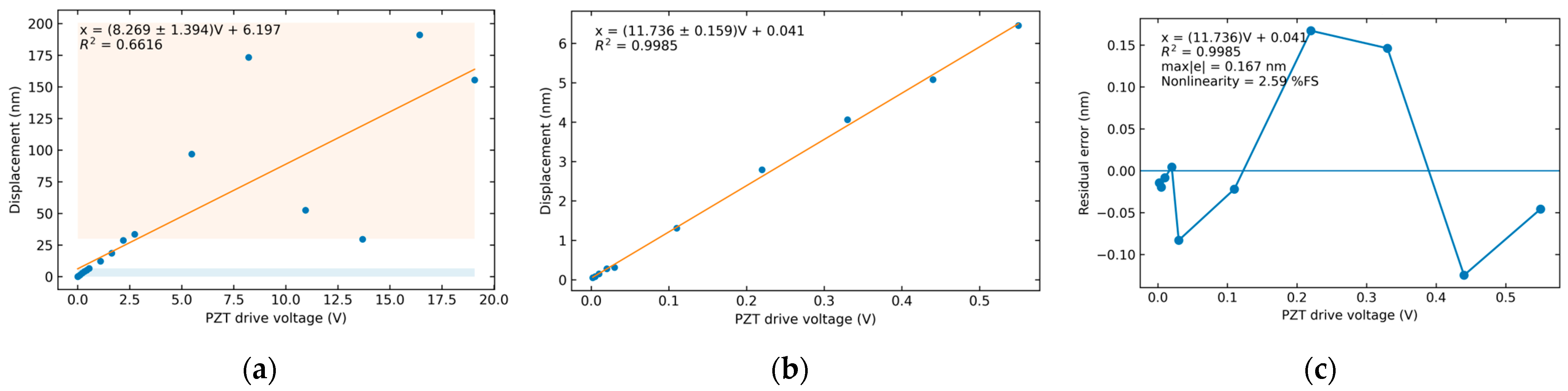
Figure 5a shows the displacement response obtained using the frequency-domain sideband extraction method over the tested excitation range. Deviations at larger amplitudes are consistent with the reduced validity of the first-order Bessel approximation, although the measured residuals may also include contributions from the PZT excitation and environmental perturbations. In the small-displacement regime, a clear linear relationship is observed, as shown in
Figure 5b.
To quantitatively evaluate the linearity of the frequency-domain sideband extraction method in the small-displacement regime, linear regression of the form
was performed for the data shown in
Figure 5b. The corresponding residual error curve,
, is shown in
Figure 5c. The maximum absolute residual and the corresponding nonlinearity are also indicated in
Figure 5c.
The residual trend in
Figure 5 should be interpreted as a combined response of the sideband-extraction model, the PZT excitation, and the experimental environment. At larger excitation amplitudes, the dominant contribution is attributed to the breakdown of the first-order Bessel approximation and the emergence of higher-order sidebands, as discussed in
Appendix A. Within the small-amplitude fitting range, the residuals may additionally include PZT hysteresis, voltage-to-displacement nonlinearity, amplifier gain variation, and residual environmental drift. Since the PZT was not used as an independent calibrated displacement reference, the residual curve is used here as an internal consistency check of the interferometric response rather than as an absolute calibration-error curve.
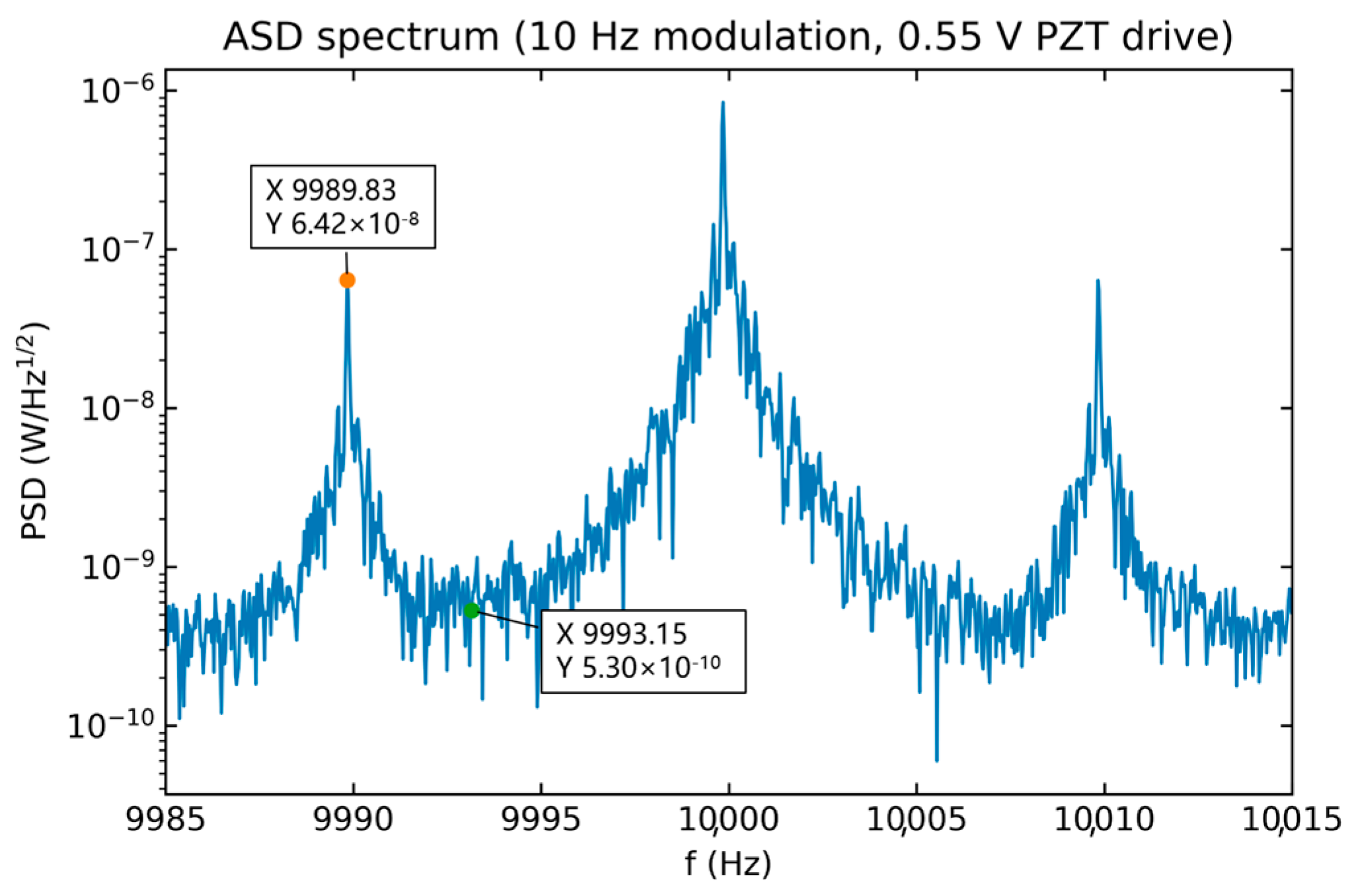
The low-amplitude detection capability of the frequency-domain sideband extraction method was further evaluated using ASD spectra. The SNR was calculated from the amplitude ratio between the displacement-related spectral peak and the adjacent noise floor, as defined in
Section 2.6.
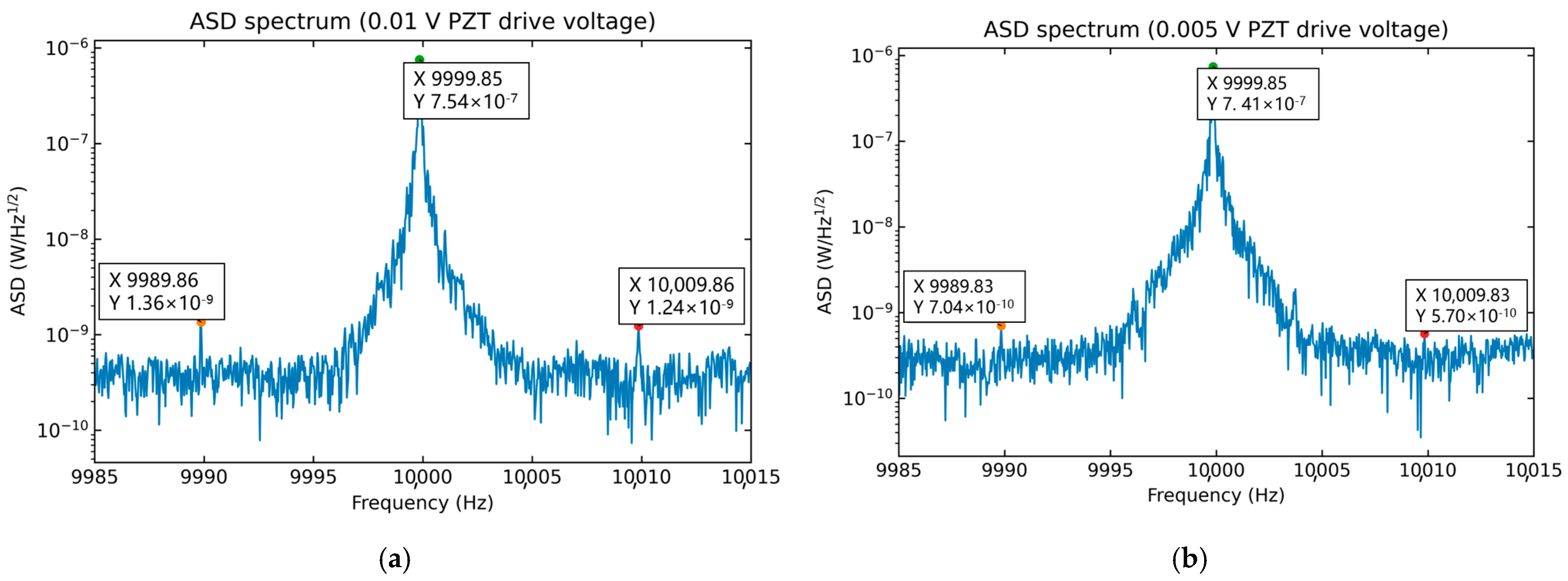
Figure 6a shows the ASD spectrum corresponding to a 0.01 V PZT drive voltage. A distinct spectral peak at the modulation frequency remains visible, with an SNR of approximately 10 dB.
When the drive voltage is further reduced, as shown in
Figure 6b, the retrieved displacement amplitude is approximately 0.08 nm, and the spectral peak becomes less reliable. In this case, the nearby noise floor provides an estimate of the single-frequency detectable amplitude under the specified spectral-estimation conditions. The estimated spectral amplitude of approximately 0.05 nm reflects the single-frequency noise floor within the RBW of 0.057 Hz, rather than the overall time-domain measurement uncertainty.
Therefore, the frequency-domain sideband extraction method achieves a narrowband detectable displacement of approximately 0.1 nm under the present experimental conditions, provided that the RBW is 0.057 Hz and the amplitude-based SNR exceeds 6 dB. This value should be interpreted as a frequency-domain detection capability rather than as the absolute displacement accuracy of the system.
3.2. Wide-Range Displacement Readout Using IQ Phase Tracking
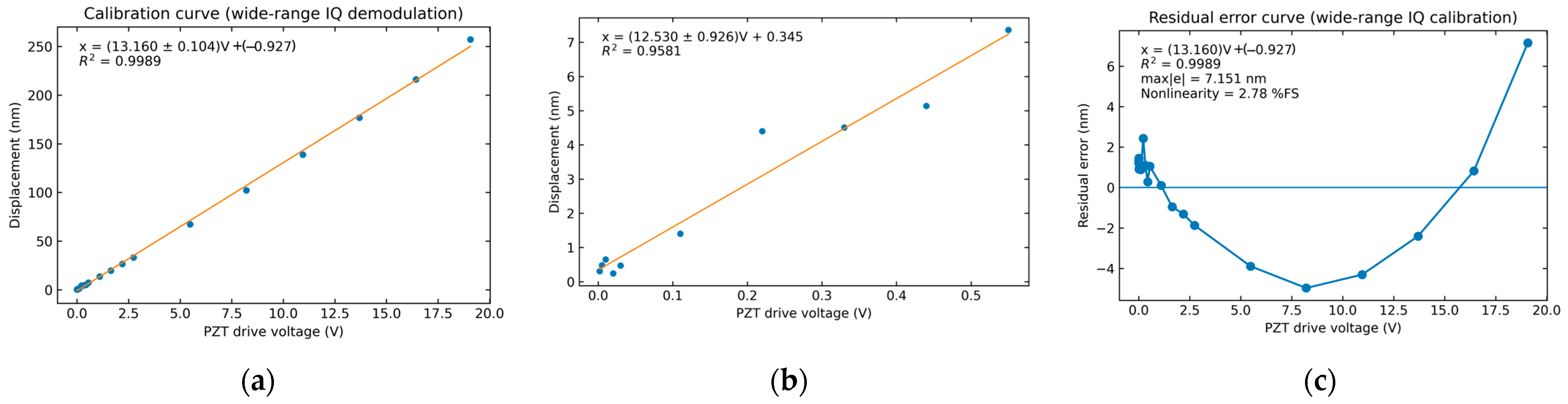
Figure 7a shows the displacement response obtained using the IQ quadrature phase-tracking method. Compared with the frequency-domain sideband extraction method, IQ phase tracking shows an approximately linear response over a much wider tested displacement range of 0.05–250 nm because it does not rely on the small-modulation approximation. However, as shown in
Figure 7b, its performance deteriorates at amplitudes below approximately 0.3 nm, where the demodulated phase becomes increasingly sensitive to noise during baseband processing, envelope extraction, and filtering.
To quantitatively evaluate the linearity of the IQ phase-tracking method over the wide displacement range, linear regression and residual analysis were performed for the data shown in
Figure 7a. The regression yielded R
2 = 0.9989. The corresponding residual curve is shown in
Figure 7c, where the maximum residual and the corresponding nonlinearity over the full tested range are indicated.
These results indicate that IQ phase tracking provides stable scale-factor consistency and bounded residuals over the experimentally demonstrated range of 0.05–250 nm. At the same time, the degradation observed in the sub-0.3 nm regime is consistent with the SNR-limited behavior discussed in
Section 2.3, indicating that IQ phase tracking is more suitable for larger-amplitude displacement, whereas frequency-domain sideband extraction is preferable for small-amplitude low-SNR signals.
The residuals in
Figure 7 originate from several mechanisms in different amplitude regimes. At sub-nanometer amplitudes, the deviation is mainly associated with SNR-limited phase retrieval, baseband filtering, and envelope extraction. In the larger-amplitude range, IQ phase tracking itself is not limited by the first-order Bessel approximation; therefore, the remaining residuals are more likely associated with PZT nonlinearity, high-voltage amplifier gain variation, thermal drift, and environmental perturbations. Consequently, the residual curve should be regarded as the combined system-level response of the excitation and readout chain, rather than the intrinsic nonlinearity of IQ phase tracking alone.
A rough order-of-magnitude estimate of the non-narrowband contribution can be obtained by comparing the repeated-measurement repeatability with the SNR-derived equivalent displacement noise. The measured repeatability was 0.40 nm, whereas the SNR-derived equivalent displacement noise was approximately 0.25 nm. If these contributions are assumed to be statistically independent, the additional contribution not captured by the single-frequency spectral SNR estimate can be estimated as 0.31 nm (
). This value should not be interpreted as an isolated measurement of environmental drift. Instead, it provides an approximate upper-bound estimate of the combined contribution from environmental drift, low-frequency perturbations, slow electronic drift, and excitation-chain fluctuations under the present ambient laboratory conditions. This estimate also applies to the interpretation of the residual trends in
Figure 5 and
Figure 7, because both residual curves include contributions from the readout chain, excitation chain, and ambient laboratory environment.
3.3. SNR-Guided Adaptive Demodulation Regime
Based on the low-amplitude spectral analysis in
Section 3.1 and the wide-range IQ phase-tracking results in
Section 3.2, an SNR-guided adaptive demodulation regime was established for the proposed optical heterodyne readout system. The results show that the optimal demodulation strategy depends on both the displacement amplitude and the amplitude-based SNR. The regime boundaries were determined by comparing the retrieved displacement consistency, residual trends, and spectral SNR levels of the two demodulation methods under different excitation amplitudes. Therefore, these boundaries should be regarded as experimentally identified operating criteria for the present system rather than universal physical constants.
To further examine the dependence of the SNR criterion on spectral-estimation parameters, the same representative low-amplitude displacement record obtained under a 0.01 V PZT drive voltage was reprocessed using different FFT lengths. The result obtained with an FFT length of 1,048,576 corresponds to the spectral condition shown in
Figure 6a. As summarized in
Table 1, reducing the RBW from 0.4578 Hz to 0.0577 Hz increased the measured spectral SNR from 3.6 dB to 10.0 dB. The 6 dB detectability criterion was reached when the RBW was reduced to approximately 0.1145 Hz. This result confirms that the lower SNR boundary is strongly dependent on the RBW and the spectral-estimation parameters. Therefore, the reported 6 dB threshold should be interpreted as a practical narrowband detectability condition under the specified spectral-estimation procedure, rather than as a universal physical limit.
Further increasing the FFT length to 2,097,152, corresponding to an RBW of 0.0288 Hz, did not further improve the measured SNR. This saturation suggests that, beyond a certain spectral resolution, the measured SNR is limited by residual spectral-peak broadening, low-frequency drift, environmental perturbations, and system noise rather than by the RBW alone. Consequently, increasing the effective spectral-analysis window length or reducing the RBW can improve narrowband detectability, but the improvement is not unlimited.
Based on
Table 1, we recommend selecting the shortest FFT length that provides both sufficient SNR and stable spectral-peak identification. For the representative low-amplitude signal tested here, an FFT length of 524,288 points, corresponding to an RBW of approximately 0.115 Hz, was sufficient to exceed the 6 dB detectability criterion. However, an FFT length of 1,048,576 points, corresponding to an RBW of approximately 0.057 Hz, provided a more robust SNR of approximately 10 dB and was therefore used as the default setting for low-amplitude narrowband detection in this work. Further increasing the FFT length to 2,097,152 points did not improve the SNR, indicating that unnecessarily small RBW values may increase computational cost and acquisition requirements without improving detectability when residual drift, spectral broadening, or environmental perturbations dominate.
For practical use under different experimental conditions, the SNR thresholds should be recalibrated using the same spectral-estimation procedure intended for the final measurement. A recommended procedure is as follows. First, a representative low-amplitude displacement record should be acquired under the target optical power, detector gain, acquisition time, sampling rate, and environmental condition. Second, the ASD should be calculated using the selected window function, FFT length, overlap ratio, and RBW, and the displacement-related spectral peak should be compared with the adjacent noise floor. Third, the lower detectability boundary can be identified as the smallest displacement level that maintains an amplitude-based SNR above the selected criterion, such as 6 dB in the present work, under the chosen RBW. Finally, the transition between frequency-domain sideband extraction and IQ phase tracking should be determined by comparing the displacement amplitudes retrieved by the two methods over an amplitude sweep and identifying the range in which their difference is smaller than the acceptable repeatability or application-specific tolerance. This recalibration should be repeated when the optical power, detector gain, acquisition time, FFT length, RBW, or environmental noise condition is changed.
Under the present optical power, acquisition time, RBW, and laboratory conditions, frequency-domain sideband extraction was preferred when the amplitude-based SNR was approximately in the range of 6–40 dB. In this regime, the displacement amplitude is small, and the spectral peak remains close to the noise floor. The narrowband integration advantage of frequency-domain extraction improves the robustness of amplitude estimation and avoids the noise-sensitive instantaneous phase retrieval required in IQ phase tracking. The lower boundary of approximately 6 dB corresponds to practical narrowband detectability of the displacement-related spectral peak under the specified spectral-estimation conditions.
The SNR range of 40–56 dB should be regarded as a transition regime rather than a sharp switching boundary. In this region, the two demodulation methods yielded comparable displacement estimates within the experimental scatter. In practical measurements, either method may be used depending on the target displacement amplitude, the degree of Bessel-approximation nonlinearity, the required dynamic range, and the robustness required against phase-tracking errors.
When the SNR exceeded approximately 56 dB, IQ quadrature phase tracking became preferable in the present system. In this regime, the instantaneous phase estimate was sufficiently stable, while frequency-domain sideband extraction became increasingly limited by the breakdown of the first-order Bessel approximation and the increasing contribution of higher-order sidebands at larger modulation depths. Therefore, IQ phase tracking is more suitable for higher-SNR and larger-amplitude displacement readout.
Although the present sensitivity analysis only varied the FFT length and RBW in post-processing, the optical power is also expected to affect the numerical SNR boundaries. Changing the optical power modifies the heterodyne beat amplitude and the displacement-related sideband amplitude relative to detector noise, electronic noise, and laser-intensity noise. Therefore, the practical SNR boundaries would shift when the optical power or detection-chain noise condition is changed.
Overall, the experimentally identified SNR-guided regime can be summarized as follows: frequency-domain sideband extraction is preferred for low-SNR small-amplitude displacement readout, both methods are comparable in the transition regime, and IQ quadrature phase tracking is preferred for higher-SNR or larger-amplitude displacement readout. The thresholds reported here should be interpreted as system-dependent operating criteria for the implemented system and should be recalibrated when the optical power, acquisition time, FFT length, RBW, or noise environment is changed.
3.4. Repeatability and Uncertainty Evaluation
To evaluate the repeatability of the optical heterodyne readout system, ten 1 min records were acquired at a 10 Hz excitation frequency with a fixed PZT drive voltage of 0.55 V. The displacement amplitude of each record was retrieved using the IQ quadrature phase-tracking method. The results are summarized in
Table 2.
The mean retrieved displacement was 6.48 nm, and the standard deviation of the ten repeated measurements was 0.40 nm. This value was taken as the Type A standard uncertainty of the implemented readout system under the present experimental conditions. The statistical repeatability includes the combined effects of phase-demodulation noise, electronic noise, and short-term environmental perturbations. The result demonstrates that the system can achieve nanometer-level repeatability for low-frequency displacement readout.
The displacement scale factor is referenced to the interferometric phase and the laser wavelength according to the measurement model described in
Section 2.6. The 532 nm laser was operated under stabilized conditions, and the sampling clock and signal generation were provided by the Moku:Pro internal reference oscillator. According to the manufacturer’s specification, the onboard clock stability is 0.3 ppm, which introduces negligible scale-factor uncertainty compared with the experimentally observed repeatability.
The Type B uncertainty contributions include laser wavelength stability, sampling-clock stability, residual electronic gain drift, laser intensity fluctuations, and detector nonlinearity. During the experiment, the optical power incident on the photodetector was approximately 15 μW, corresponding to a photocurrent of about 5 μA, which is within the linear operating range of the detector. Therefore, nonlinear detection effects were considered negligible. According to the laser characterization results, the relative power stability was 0.26% RMS, and the relative intensity noise (RIN) was below 0.015% in the relevant frequency range. The relative wavelength stability was below 10−6, resulting in a scale-factor uncertainty well below 0.01 nm over the present displacement range. Even at the maximum tested displacement of 250 nm, the wavelength-related scale-factor contribution is on the order of 10−4 nm, which is negligible compared with the 0.40 nm repeatability.
Therefore, the Type B uncertainty contributions were much smaller than the observed statistical repeatability, and the combined standard uncertainty was conservatively taken as 0.40 nm. This value represents the experimentally evaluated repeatability and the repeatability-dominated uncertainty level of the implemented system configuration, rather than the fundamental limit of optical heterodyne interferometry.
For consistency verification, the spectral SNR was also evaluated from the ASD using the method described in
Section 2.6. The measured amplitude ratio between the modulation peak and the adjacent noise floor was 121, corresponding to an SNR of 41.7 dB within an RBW of 0.057 Hz. Under additive Gaussian noise conditions, this SNR corresponds to an equivalent phase standard deviation of approximately 0.006 rad. Using the interferometric phase-to-displacement conversion, the corresponding equivalent displacement noise is approximately 0.25 nm.
The spectrally estimated displacement noise is consistent with the experimentally observed repeatability of 0.40 nm. The slightly larger time-domain repeatability is expected because repeated measurements additionally include residual environmental disturbances and electronic drift that are not fully captured by single-frequency spectral analysis. Therefore, the spectral SNR analysis is used as an internal consistency verification rather than as the primary source of uncertainty estimation.
Overall, the implemented optical heterodyne readout system demonstrated wavelength-referenced displacement readout over a range from sub-nanometer narrowband detection to 250 nm under the present experimental conditions. Under the repeated-measurement condition of a 10 Hz excitation and a mean retrieved displacement of 6.48 nm, the system achieved a repeatability of 0.40 nm. The SNR-derived equivalent displacement noise of approximately 0.25 nm is consistent with the repeated-measurement statistics, confirming the internal consistency of the measurement model and uncertainty evaluation.
To avoid ambiguity, the displacement-related performance metrics used in this work are explicitly distinguished in
Table 3. The narrowband detectable displacement of approximately 0.1 nm refers to the minimum single-frequency displacement component that can be identified under the specified spectral-estimation conditions. It should not be interpreted as the absolute displacement accuracy of the system. The repeatability of 0.40 nm is obtained from repeated time-domain measurements and is therefore used as the primary Type A uncertainty under the present experimental conditions. The SNR-derived equivalent displacement noise of approximately 0.25 nm is used only as an internal consistency check between the spectral-domain and time-domain evaluations.
3.5. Frequency-Dependent Response
The frequency-dependent response of the optical heterodyne readout system was further evaluated by applying nominally identical excitation conditions while varying the actuation frequency. The retrieved displacement amplitudes are summarized in
Table 4. Generally stable displacement readout was observed over the 10–150 Hz range, whereas larger deviations appeared near 1 Hz and 200 Hz.
The deviation near 1 Hz is attributed to low-frequency noise and broadening of the heterodyne beat peak, which reduces the reliability of narrowband displacement extraction. At 200 Hz, the deviation may be associated with environmental disturbances, frequency-dependent PZT response, amplifier behavior, or possible heating during actuation, which were not separately isolated in the present setup. These effects indicate that reliable displacement readout below 1 Hz is restricted by low-frequency noise sources such as laser frequency drift, linewidth-related phase noise, and environmental perturbations.
3.6. Application Demonstration on a Quartz Pendulum Inertial Structure
To demonstrate the applicability of the optical heterodyne readout system to inertial sensing, the PZT-mounted glass reflector used in the previous experiments was replaced with the quartz pendulum element of a prototype optical accelerometer. Compared with the PZT-driven reflector, the mechanical response of the quartz pendulum is more complex and is significantly more sensitive to environmental perturbations.
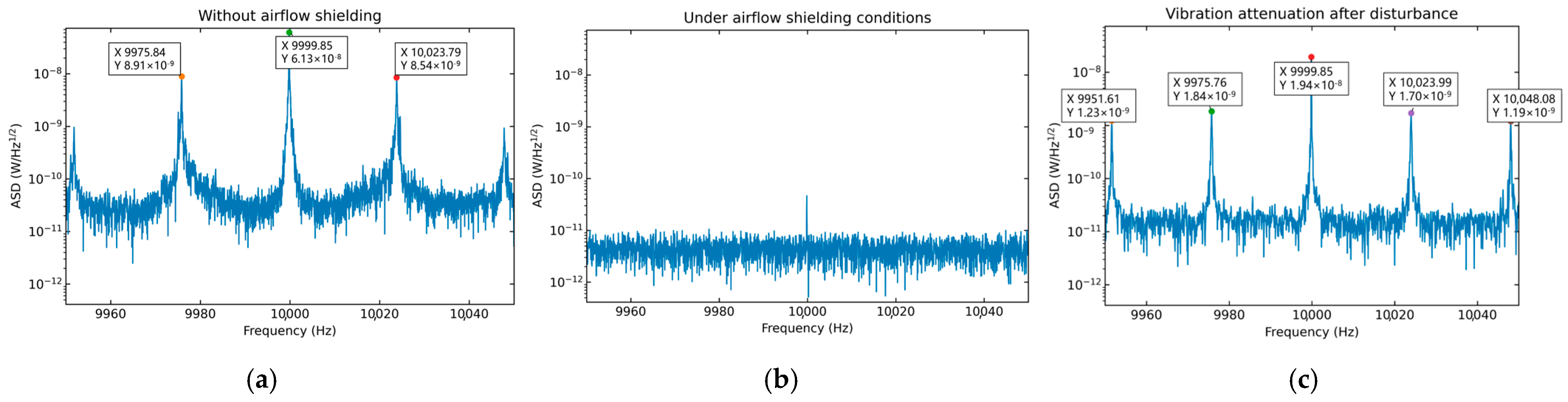
Without airflow shielding, a distinct low-frequency displacement peak appears near 24 Hz, as shown in
Figure 8a. This peak is attributed to persistent oscillations excited by small air-current fluctuations in the laboratory environment. After the pendulum was enclosed with an airflow-shielding structure, the resonant peak was largely suppressed, as shown in
Figure 8b. When an impulsive disturbance was applied to the optical table, free-decay oscillations reappeared at approximately the same frequency, as shown in
Figure 8c, confirming that 24 Hz corresponds to the natural resonance frequency of the quartz pendulum in the present assembly and test environment.
To further evaluate the pendulum response to external excitation, sinusoidal excitations were applied using the PZT actuator. Here, the acceleration is treated as an equivalent input estimated from the interferometrically inferred excitation amplitude and the small-signal pendulum model, rather than as an independently calibrated acceleration standard. According to the mechanical model of a flexure-supported pendulum accelerometer, the displacement at the pendulum tip is given by [
28]:
where
is the pendulum tip displacement,
is the distance from the flexure pivot to the pendulum tip,
is the distance from the pivot to the center of mass,
is the mass of the pendulum,
is the flexure stiffness, and
is the equivalent input acceleration. For sufficiently small accelerations, the displacement is approximately proportional to the input acceleration.
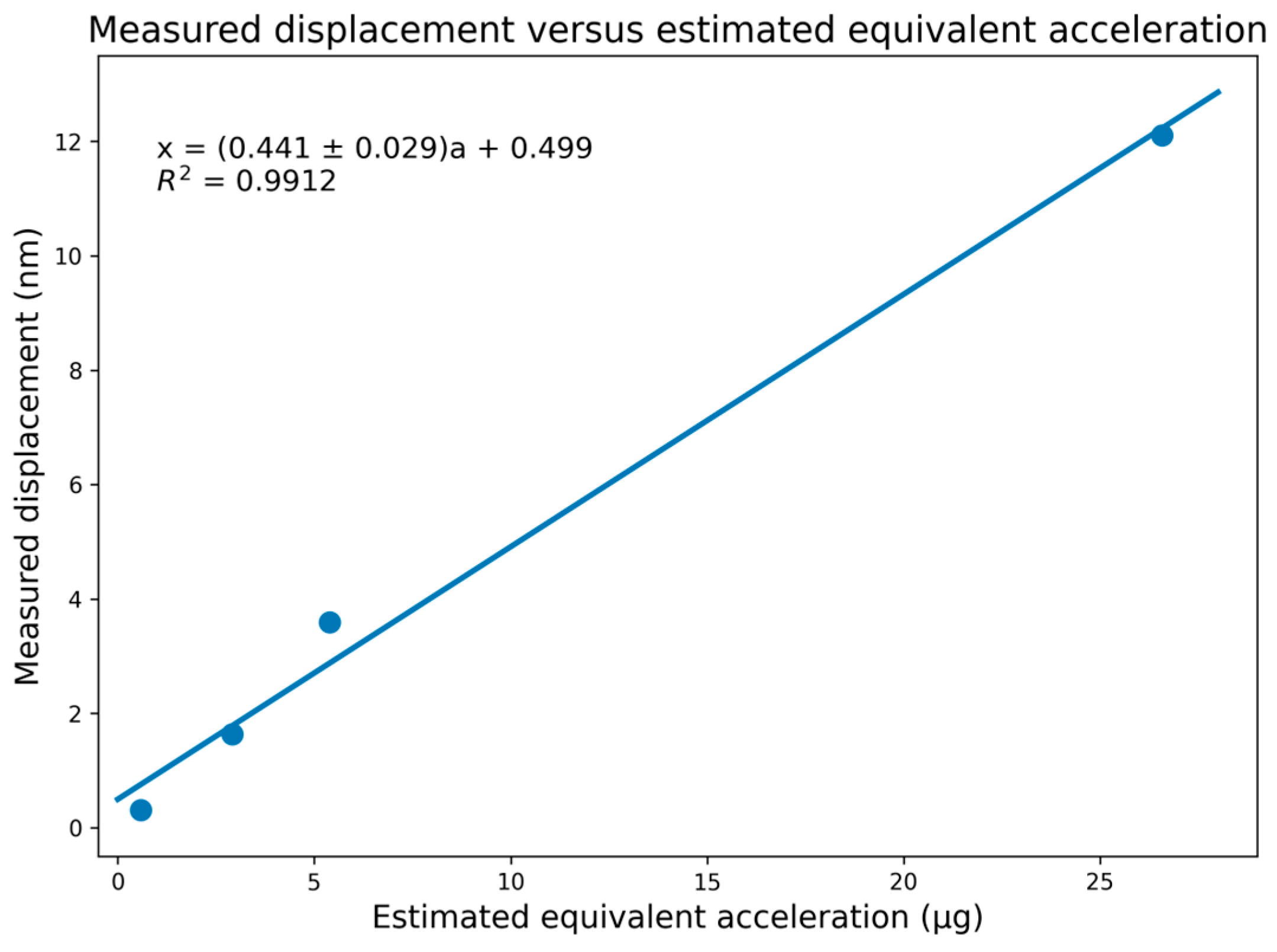
Figure 9 shows the measured pendulum displacement for estimated equivalent input accelerations ranging from 0.6 μg to approximately 30 μg. An approximately linear response trend is observed over this range, in agreement with the expected small-signal behavior of the pendulum model. Larger excitation amplitudes were not investigated in the present study because quartz pendulum accelerometers are typically operated under vacuum or reduced-pressure conditions. Under atmospheric conditions, nonlinear damping and environmental disturbances become more significant and may degrade the measurement accuracy at higher amplitudes.
These results demonstrate that the proposed optical heterodyne readout system can detect nanometer-scale displacement responses associated with micro-g-level equivalent inertial excitation. This application study supports the suitability of the system for quartz pendulum displacement characterization and indicates its potential for optical inertial sensor characterization.
It should be emphasized that the quartz pendulum experiment was designed to demonstrate the applicability of the optical heterodyne readout to an inertial structure, rather than to provide a full accelerometer calibration. The equivalent input acceleration was estimated from the small-signal pendulum model and the excitation condition and was not independently calibrated using an acceleration standard. Therefore,
Figure 9 should be interpreted as a linear response demonstration of the pendulum-readout system under laboratory conditions.
4. Discussion
The experimental results demonstrate that the optimal demodulation strategy for free-space optical heterodyne displacement readout depends strongly on both displacement amplitude and SNR. Frequency-domain sideband extraction is advantageous in the small-amplitude low-SNR regime because the displacement information is concentrated in narrowband spectral components. This allows amplitude estimation to benefit from spectral integration and avoids the need for instantaneous phase retrieval, phase unwrapping, and strict quadrature balance. In contrast, IQ quadrature phase tracking becomes more suitable when the SNR is sufficiently high and the displacement amplitude increases beyond the reliable linear range of the first-order Bessel approximation.
The experimentally identified SNR-guided demodulation regime provides a practical criterion for selecting between these two methods. In the 6–40 dB SNR range, frequency-domain sideband extraction provides more reliable displacement estimates. In the 40–56 dB transition range, both methods yield comparable results. When the SNR exceeds 56 dB, IQ phase tracking becomes preferable because the instantaneous phase estimate becomes stable and the method avoids the nonlinear distortion associated with amplitude-based demodulation. These results show that the two methods should not be regarded as competing alternatives, but as complementary approaches within an adaptive optical readout framework.
It should be emphasized that the reported narrowband detectable displacement of approximately 0.1 nm and the repeatability of 0.40 nm describe different performance metrics. The 0.1 nm value is obtained from frequency-domain spectral analysis under a specified RBW of 0.057 Hz and an amplitude-based SNR criterion. It therefore represents the detectable displacement capability under favorable narrowband conditions rather than the absolute displacement accuracy of the system. By contrast, the 0.40 nm repeatability is obtained from repeated time-domain measurements and includes residual environmental disturbances, electronic noise, and short-term system drift. The consistency between the SNR-derived equivalent displacement noise and the repeated-measurement statistics supports the validity of the measurement model and uncertainty evaluation.
Compared with implementations that use either frequency-domain sideband extraction or IQ phase tracking independently, the present work experimentally maps their applicability regimes within a unified optical heterodyne readout system. This is useful for low-frequency nanoscale displacement sensing, where the signal amplitude and SNR can vary over several orders of magnitude. The proposed framework is especially relevant to optical inertial sensing systems, in which the displacement response of a pendulum or proof mass must be read out accurately under different excitation levels and environmental conditions.
The proposed adaptive framework can also be interpreted in the context of representative displacement demodulation strategies in interferometric sensing. Classical fringe-counting and phase-measurement methods are widely used for interferometric displacement readout, but their direct extension to nanoscale low-frequency motion requires careful treatment of phase wrapping, low-frequency drift, and noise robustness [
10,
15]. Frequency-domain amplitude or sideband extraction is effective for small-amplitude narrowband vibration because it benefits from spectral averaging and provides robust amplitude estimation at low SNR [
13,
17]. However, its usable range is restricted by the validity of the small-modulation approximation. IQ quadrature phase tracking, by contrast, provides wide-range phase retrieval and is widely used in heterodyne interferometry and phasemeter systems [
14,
15,
25]. Its performance, however, depends on SNR, quadrature balance, phase-unwrapping reliability, and low-frequency stability [
12,
19]. A broader overview of interferometric signal-processing techniques can be found in [
20].
Table 5 summarizes this distinction and clarifies the role of the proposed SNR-guided adaptive framework relative to representative demodulation strategies.
The quartz pendulum experiment further demonstrates the applicability of the proposed readout system to inertial-structure characterization. The observed resonance near 24 Hz and its suppression after airflow shielding indicate that the optical readout is sensitive to both intrinsic mechanical response and environmental perturbations. The approximately linear relationship between equivalent input acceleration and measured pendulum displacement in the micro-g range suggests the potential of the system for quartz pendulum displacement characterization. However, this experiment should be regarded as an application demonstration rather than a complete accelerometer calibration.
The frequency-dependent and quartz pendulum experiments indicate that the present free-space implementation is sensitive to environmental perturbations. The larger deviation near 1 Hz is consistent with low-frequency drift, laser phase noise, and environmental vibration, which broaden the displacement-related spectral component and reduce the reliability of narrowband extraction. The airflow-shielding experiment further confirms that air-current-induced mechanical excitation can produce observable low-frequency displacement peaks in the quartz pendulum. Therefore, the reported repeatability should be understood as the performance of the implemented laboratory system under ambient conditions, rather than the fundamental limit of optical heterodyne interferometry.
In the present low-frequency experiments, deterministic phase wrapping is not the dominant limitation because the inter-sample phase increment is much smaller than π. However, under lower SNR, stronger environmental disturbance, or temporary signal fading, noise-induced phase jumps may still trigger incorrect unwrapping and introduce 2π-phase errors. This is one reason why frequency-domain sideband extraction is preferred in the low-SNR small-amplitude regime.
Several limitations remain. First, reliable displacement readout below 1 Hz is restricted by low-frequency noise, including laser frequency drift, linewidth-related phase noise, and environmental perturbations. Second, the experiments were conducted under atmospheric laboratory conditions, whereas quartz pendulum accelerometers are typically operated under vacuum or reduced-pressure conditions to reduce damping and airflow-induced noise. Third, a comparison with an independent calibrated displacement reference, such as a calibrated nanopositioning stage, a capacitive displacement sensor, or a laser Doppler vibrometer, would further strengthen the absolute validation of the displacement readout scale factor and will be considered in future work. Fourth, the SNR thresholds reported in this work were obtained under the present optical power, acquisition time, RBW, and laboratory conditions. The RBW-dependence analysis confirms that these thresholds are not universal constants. For the same low-amplitude displacement signal, the measured SNR changed from 3.6 dB to 10.0 dB when the RBW was reduced from 0.4578 Hz to 0.0577 Hz.
The optical power can also affect the practical SNR boundaries. In a heterodyne interferometer, the beat-signal amplitude depends on the optical powers in the measurement and reference arms. Increasing optical power can increase the displacement-related spectral peak relative to electronic noise or detector noise. However, the improvement depends on the dominant noise source. If the measurement is mainly limited by electronic noise, increasing optical power can noticeably improve the amplitude SNR. If the system is limited by shot noise, the improvement is weaker. If laser-intensity noise, low-frequency drift, airflow-induced vibration, or environmental perturbations dominate, increasing optical power may provide only limited improvement. Therefore, changing the optical power would shift the practical SNR boundaries, but the magnitude of the shift depends on the noise mechanism of the implemented system.
Consequently, the adaptive demodulation thresholds should be recalibrated when the optical power, acquisition time, FFT length, RBW, or noise environment is changed. The thresholds reported here should be interpreted as experimentally identified operating criteria for the present system rather than universal physical constants.
5. Conclusions
A free-space optical heterodyne interferometric readout system was developed for low-frequency nanoscale displacement sensing. Under the present experimental conditions, the system demonstrated wavelength-referenced displacement readout from sub-nanometer narrowband detection to 250 nm, with a narrowband detectable displacement of approximately 0.1 nm at an RBW of 0.057 Hz.
An SNR-guided adaptive demodulation framework was established by integrating frequency-domain sideband extraction and IQ quadrature phase tracking. The linearity limit of the first-order Bessel approximation was analyzed and experimentally supported, and the demodulation strategy was selected according to the spectral SNR and displacement amplitude. Frequency-domain sideband extraction was found to be preferable for low-SNR small-amplitude displacement, whereas IQ phase tracking was more suitable for higher-SNR and larger-amplitude displacement readout.
The repeatability of the implemented system was evaluated as 0.40 nm. The spectral SNR-derived displacement noise was consistent with the time-domain repeatability, confirming the internal consistency of the interferometric measurement model and uncertainty evaluation. The reported SNR thresholds and detectable displacement are specific to the present optical power, RBW, acquisition time, and laboratory environment, and should be recalibrated when these conditions are changed.
It should also be noted that an independent calibrated displacement reference was not used in the present experiments. Therefore, the reported displacement scale-factor consistency is based on wavelength-referenced interferometric phase retrieval and internal consistency checks, rather than on direct comparison with an external displacement standard. Future comparison with a calibrated nanopositioning stage, capacitive displacement sensor, or laser Doppler vibrometer would further strengthen the absolute validation of the displacement readout scale factor.
The main contribution of this work is the experimentally identified SNR-guided demodulation regime mapping and uncertainty-aware adaptive readout framework across a multi-order displacement range. The quartz pendulum demonstration further indicates the potential of the proposed optical heterodyne readout system for photonic displacement sensing and optical inertial sensor characterization.



 ,
,