1. Introduction
UV lasers operating at 355 nm have established themselves as indispensable tools across a broad spectrum of advanced manufacturing and materials processing applications [
1,
2]. The combination of short wavelength—which enables diffraction-limited focusing to sub-micron spot sizes—and high photon energy (3.5 eV) permits efficient material removal in transparent dielectrics, polymers, and compound semiconductors while minimizing thermal damage to surrounding regions [
3,
4]. Industrial applications including FPC laser cutting, laser direct imaging (LDI) for printed circuit board fabrication, and semiconductor wafer scribing and dicing increasingly demand UV sources with average powers exceeding 100 W and near-diffraction-limited beam quality to achieve throughput-compatible processing speeds [
5,
6].
The generation of high-power 355 nm radiation is predominantly realized through cascaded nonlinear optical frequency conversion of near-infrared lasers. The standard approach involves SHG of a 1064 nm fundamental to produce 532 nm green light, followed by SFG between the residual fundamental and the generated second harmonic to yield 355 nm UV output. LBO has emerged as the crystal of choice for high-power UV generation owing to its unique combination of properties: a high laser-induced damage threshold (~25 GW/cm
2 at 1064 nm), wide temperature acceptance bandwidth (~4 °C·cm), large nonlinear optical coefficients, and non-hygroscopic nature. LBO supports both type-I non-critical phase matching (NCPM, temperature-tuned) for efficient 532 nm generation and type-II critical phase matching (angle-tuned) for 355 nm sum-frequency mixing, making it ideally suited for cascaded frequency conversion architectures [
7].
Historically, solid-state lasers based on Nd:YAG and Nd:YVO
4 have dominated high-power 355 nm source development. Through successive improvements in pumping geometries—including end-pumping, side-pumping, and polarization beam combining—these systems achieved remarkable power scaling from the tens of watts to the hundreds of watts [
8,
9,
10,
11]. More recently, Liu et al. demonstrated 121 W at 355 nm using a three-stage Nd:YVO
4 MOPA with active spherical aberration compensation, achieving a beam quality factor of M
2 < 1.3 with 12 ps pulses at 555 kHz repetition rate [
12]. However, such architectures inherently require complex multi-stage bulk amplifiers, sophisticated thermal management systems, and active wavefront correction elements to maintain beam quality at elevated powers. The resulting system complexity, alignment sensitivity, and maintenance costs increase substantially with power scaling, limiting their widespread deployment in industrial manufacturing environments.
Fiber lasers offer a compelling alternative platform for high-power UV generation. The large surface-area-to-volume ratio of the fiber enables highly efficient heat dissipation, while the waveguide structure ensures inherent single-mode operation and excellent beam quality stability independent of power level [
13,
14]. The compact, modular architecture of fiber laser systems further enhances their attractiveness for industrial integration. Early demonstrations of fiber-based UV generation employed hybrid architectures combining fiber amplifiers with solid-state frequency conversion stages. Yan et al. reported 35.1 W at 355 nm using a fiber MOPA seed amplified by solid-state Nd:YVO
4 rods [
15]. Subsequently, Avdokhin et al. at IPG Photonics achieved a significant milestone with 160 W of single-mode 355 nm output using a quasi-continuous-wave (QCW) single-mode fiber laser with ~20 GHz linewidth broadening as the fundamental source [
16]. This result, achieved through single-pass cascaded third-harmonic generation, demonstrated the potential of fiber-based platforms for high-power UV generation and established a foundation for subsequent power scaling efforts.
In this paper, we report a fiber-laser-driven 355 nm source delivering 227.1 W average power—representing, to our knowledge, the highest average power for a fiber-based architecture at this wavelength. The system employs an 899.6 W, 8 MHz, 4.6 ns polarization-maintaining Yb-doped fiber MOPA cascaded with two LBO crystals for frequency conversion. During experiments, the frequency-doubling crystal was positioned in the divergence region behind the focused beam waist to reduce power density, and a V-shaped cavity structure was utilized to enable independent control of beam waist and beam profile matching during both frequency doubling and sum frequency generation. The system ultimately delivered a 227.1 W 355 nm ultraviolet output with beam quality parameters M2x = 1.24 and M2y = 1.09, and long-term stability measured at an RMS deviation of less than 1.5%.
2. Experimental Setup
The experimental setup is depicted schematically in
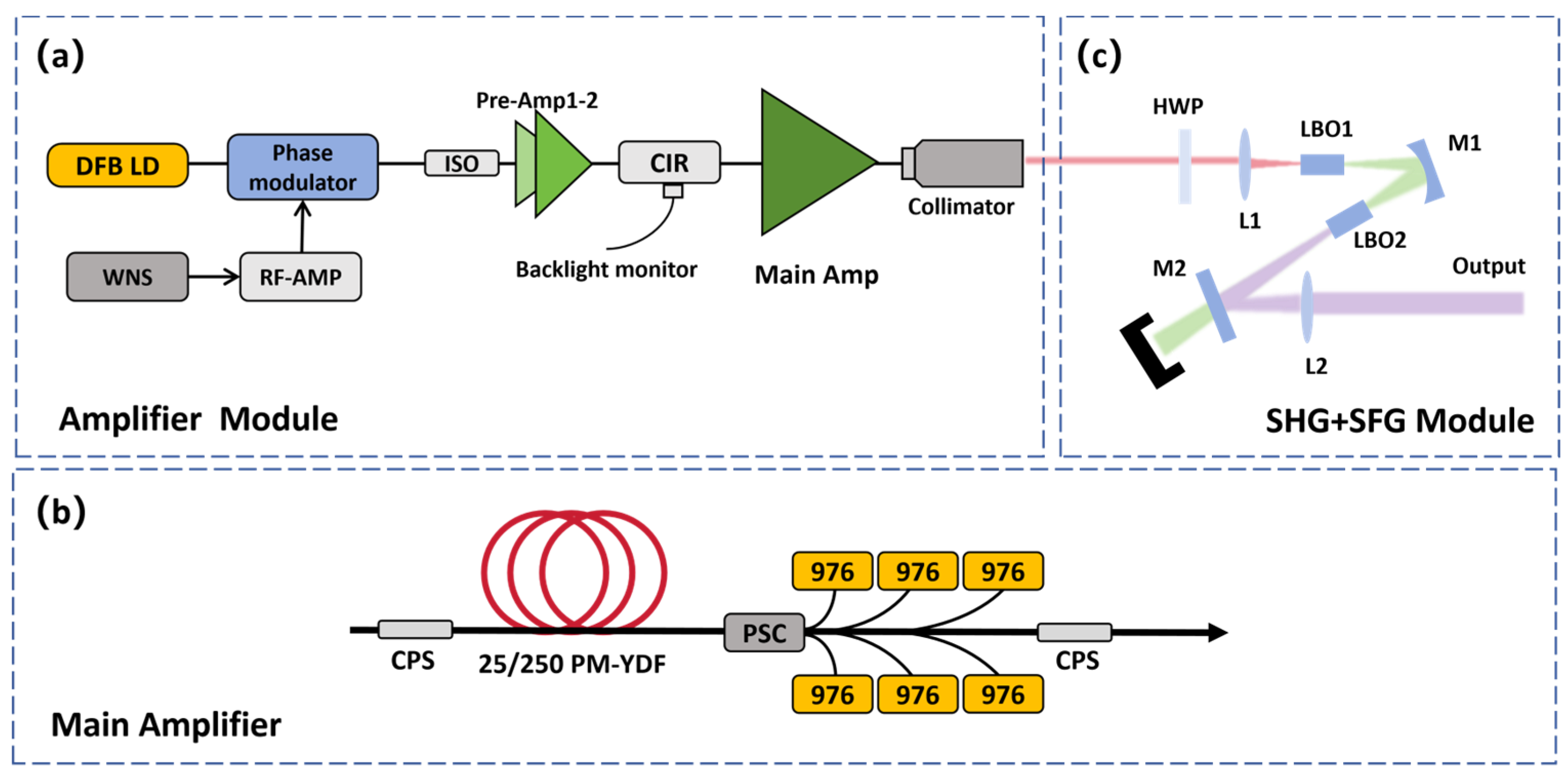
Figure 1. The fundamental source is a PM Yb-doped fiber MOPA, as shown in
Figure 1a,b. The seed laser is a distributed-feedback (DFB) semiconductor laser with a center wavelength of 1064.2 nm. The seed output is electro-optically modulated to produce pulses with a repetition rate of 8 MHz and a duration of 4 ns. To suppress stimulated Brillouin scattering (SBS) in the subsequent high-power fiber amplification stages, the seed light is spectrally broadened using a LiNbO
3 phase modulator driven at 20 MHz with a modulation depth of approximately 1 rad, yielding a full-width-at-half-maximum (FWHM) linewidth of 0.32 nm.
Figure 1. The broadened seed light passes through an optical isolator and enters the all-PM MOPA chain for staged power amplification. The pre-amplification stage employs PM Yb-doped fiber with a core/cladding diameter of 10/125 μm, amplifying the signal to approximately 2 W. A second pre-amplification stage of the same fiber type boosts the output to approximately 30 W. A fiber circulator is inserted in the amplification chain to monitor the backreflected power as a function of pump power, providing real-time diagnostic of SBS onset.
The main amplification stage, shown in
Figure 1b, employs a large-mode-area (LMA) PM double-clad Yb-doped fiber with a core/cladding diameter of 25/250 μm, and an active length of 3.5 m. The gain fiber is pumped by a multimode semiconductor laser diode centered at 976 nm with a maximum output power of 200 W, coupled through a (6 + 1) × 1 pump combiner in a backward-pumping geometry. To improve heat dissipation and suppress transverse mode instability, the gain fiber is coiled on a water-cooled copper heat sink with a minimum coil diameter of approximately 8 cm. Cladding power strippers (CPS) are installed at both the input and output ends of the main amplifier to remove residual pump light and any cladding-mode leakage.
The frequency conversion section employs an extracavity cascaded SHG-SFG scheme, as illustrated in
Figure 1c. A fundamental limitation of conventional cascaded configurations is that the SHG and SFG crystals typically share the same focused beam, forcing a compromise in beam waist placement: positioning the waist at the doubling crystal optimizes SHG efficiency but results in an excessively large spot size in the SFG crystal with increased walk-off accumulation; conversely, placing the waist at the SFG crystal leaves insufficient power density in the SHG crystal for efficient frequency doubling. This spot-size coupling severely constrains the achievable total conversion efficiency.
To overcome this limitation, we employ a V-cavity architecture that utilizes a plano-concave mirror to independently configure the beam waists for the two frequency conversion processes. The fundamental beam is first focused by a fused-silica plano-convex lens with a focal length of 150 mm. The frequency-doubling crystal (LBO1) is positioned approximately 20 mm behind the first beam waist in the divergent region. This defocused-beam configuration reduces the peak intensity by approximately 70% compared to placement at the beam waist, effectively suppressing back-conversion (532 nm → 1064 nm) and thermally induced phase mismatch while maintaining sufficient nonlinear drive for efficient SHG.
LBO1 has dimensions of 3 mm × 3 mm × 20 mm and is cut for type-I non-critical phase matching (θ = 90°, φ = 0°) with a phase-matching temperature of approximately 148 °C. Both end faces are dual-wavelength antireflection (AR) coated for 1064 nm and 532 nm with reflectivities R < 0.3%. The 532 nm green light generated in LBO1 and the residual 1064 nm fundamental light propagate collinearly and are incident on a plano-concave mirror with a radius of curvature R = 110 mm. The mirror is positioned at a small angle to minimize astigmatic separation of the beam waists in the tangential and sagittal planes, and is coated for high reflection (R > 99.5%) at both 1064 nm and 532 nm. The reflected beams are refocused to form an independent, tighter second waist within the sum-frequency crystal.
The sum-frequency crystal (LBO2) has dimensions of 4 mm × 4 mm × 20 mm and is cut for type-II critical phase matching (θ = 42.2°, φ = 90°) with a phase-matching temperature of approximately 53.2 °C. Both end faces are triple-wavelength AR coated for 1064 nm, 532 nm, and 355 nm with reflectivities R < 0.5%. Both LBO crystals are mounted in oxygen-free high-conductivity (OFHC) copper heat sinks with thermoelectric cooler (TEC) temperature control to a precision of ±0.01 °C, preventing thermally induced phase mismatch. The generated 355 nm UV light is separated from the residual fundamental and second-harmonic beams by a dichroic mirror and directed to power and beam quality diagnostics.
3. Results and Discussion
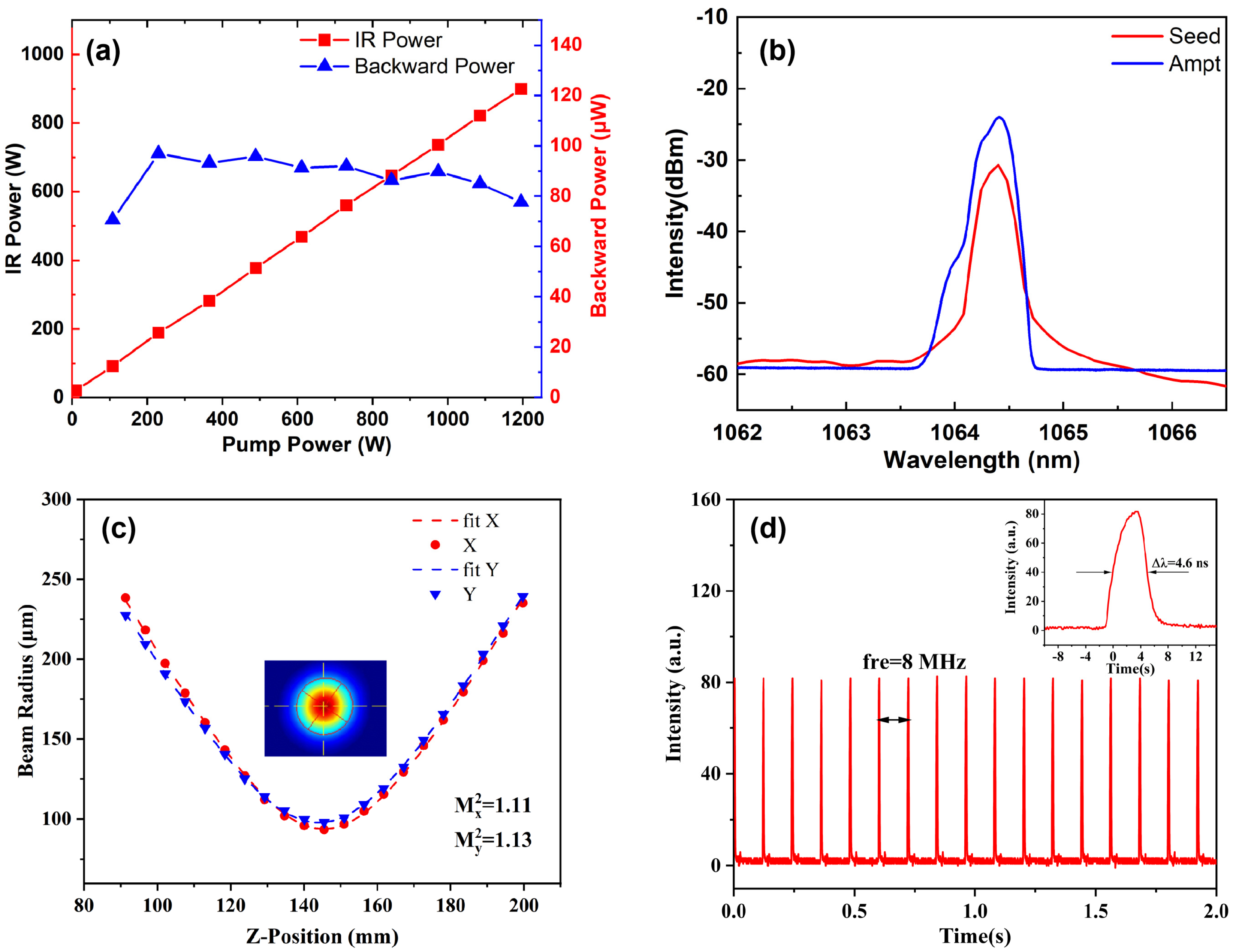
Figure 2 illustrates the fundamental frequency output characteristics of the fiber MOPA.
Figure 2a shows the relationship between the fundamental frequency output power and the pump current. As the pump power increases, the 1064 nm output power exhibits nearly linear growth, reaching 899 W at a total pump power of approximately 1197 W at 976 nm, with an optical-to-optical conversion efficiency of about 75.1%. The backward power remains low throughout the pump power range, without exhibiting the SBS threshold characteristic associated with abrupt pump power increases, indicating that phase modulation effectively suppresses stimulated Brillouin scattering. The fundamental frequency spectral characteristics are shown in
Figure 2b: the phase-modulated line width is approximately 0.32 nm, with a central wavelength of 1064.2 nm. The spectral shape approximates a flat-top distribution, facilitating broadband phase matching in nonlinear crystals. No distinct stimulated Raman scattering sidebands were observed, demonstrating effective suppression of Raman gain. The fundamental beam quality remains stable during amplification.
Figure 2c presents M
2 measurements for the main amplified output beam: M
2x = 1.11 and M
2y = 1.13, with a beam ellipticity of 98%, ensuring high beam quality for subsequent high-efficiency frequency conversion.
Figure 2d displays the pulse waveform at maximum power, featuring a smooth, symmetric shape without significant distortion, with a pulse width of 4.6 ns and a repetition frequency of 8 MHz. Across the entire power range, the polarization extinction ratio remains below 19.5 dB, guaranteeing high efficiency in subsequent nonlinear frequency conversion processes.
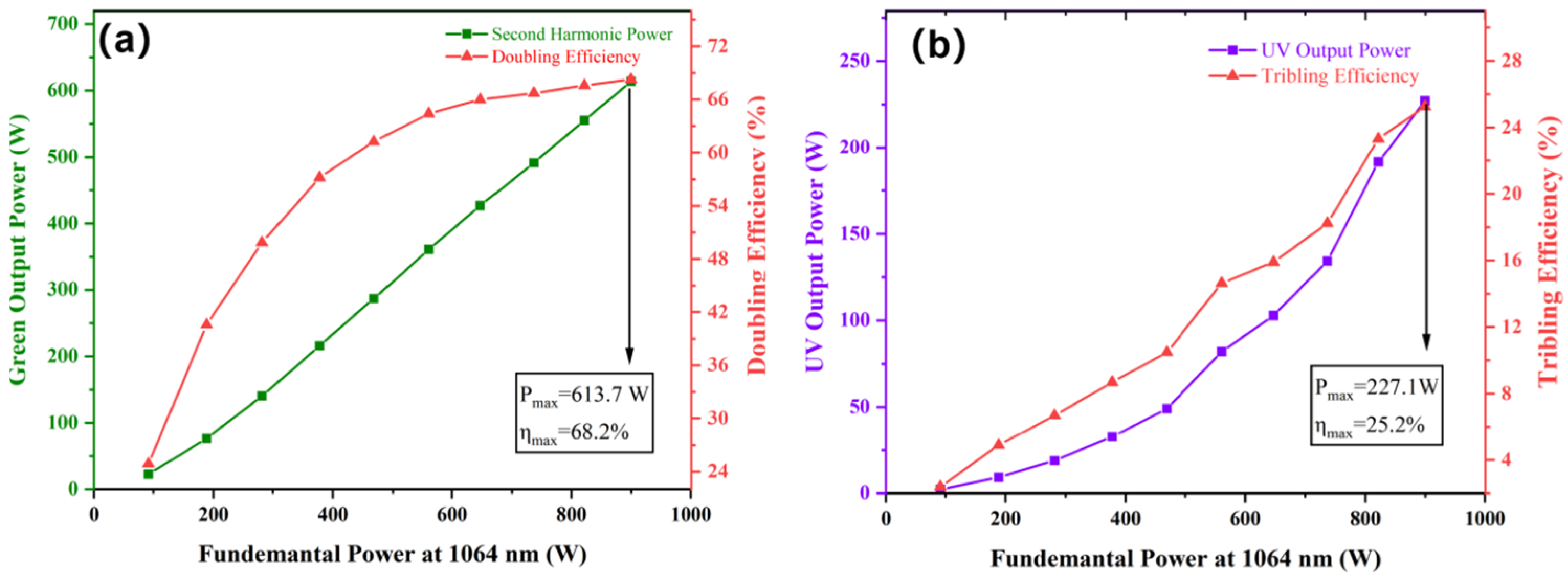
Figure 3 presents the power scaling characteristics of the cascaded frequency conversion. As the fundamental power is increased from 0 to 899.6 W, the 532 nm output power grows approximately linearly, reaching 613.7 W at the maximum pump power with the LBO1 temperature set to 148.6 °C. This corresponds to a SHG conversion efficiency of 68.2%, with no evidence of saturation even at the highest power levels. The linear scaling and absence of rollover indicate that the defocused-beam configuration successfully suppresses intensity-dependent loss mechanisms—specifically back-conversion and thermal dephasing—that typically limit SHG efficiency in high-power operation.
The SFG stage output exhibits a similar near-linear dependence on input power. Under combined injection of the generated green light and the residual fundamental light, and with careful optimization of both the doubling and sum-frequency crystal temperatures, a maximum UV output of 227.1 W at 355 nm is achieved at an LBO1 temperature of 148.3 °C and an LBO2 temperature of 53.2 °C. This corresponds to a total conversion efficiency from 1064 nm to 355 nm of 25.2%. Examination of the total conversion efficiency as a function of fundamental power reveals that the UV efficiency does not exhibit obvious saturation under the highest power injection. This behavior is attributed to two factors: first, the defocused placement of the doubling crystal reduces the power density to a level that suppresses back-conversion and thermally induced beam distortion; second, the independent tight focusing achieved in the SFG crystal through the V-cavity design enhances the nonlinear driving intensity while reducing the effective accumulated walk-off length.
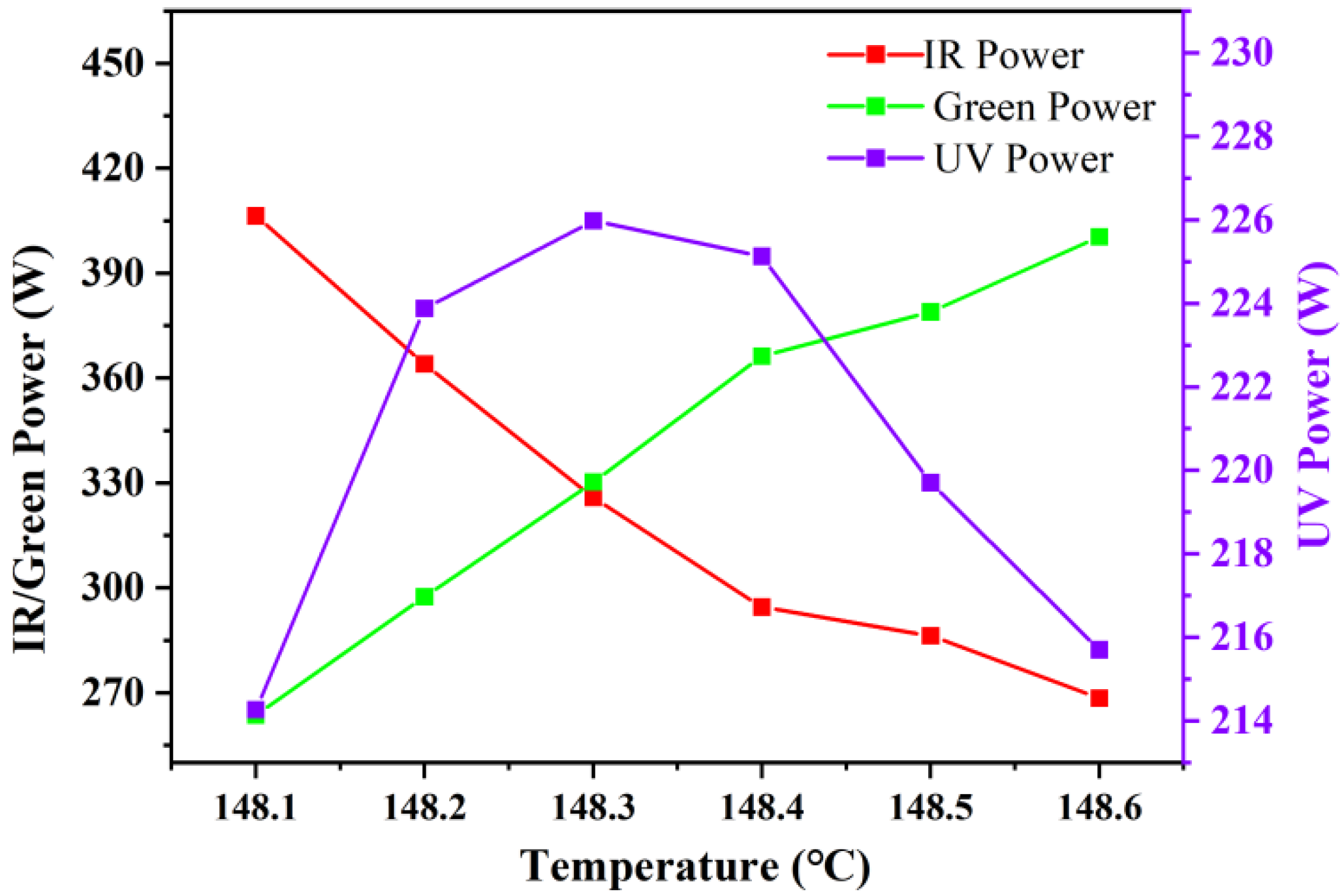
To investigate the interplay between SHG and SFG optimization, we performed a fine temperature scan of LBO1 while monitoring the infrared residual power, green residual power, and UV output power. The results are presented in
Figure 4. As the LBO1 temperature is increased from 148.1 °C to 148.6 °C, the infrared residual power decreases monotonically, indicating continuous enhancement of the SHG conversion efficiency. However, the UV output power reaches a maximum of 227 W at 148.3 °C and subsequently decreases, while the green residual power continues to increase. At the temperature of maximum SHG efficiency (148.6 °C), the UV power drops to 216 W—a reduction of nearly 5% compared to the optimum.
This detuning effect—where the optimal UV output temperature deviates from the peak SHG efficiency temperature—is highly reproducible. This detuning is likely attributable to improved green beam quality at 148.3 °C. When LBO1 is tuned precisely to its phase-matching peak, the generated green power is maximized; however, the associated thermal lensing and residual back-conversion can degrade the spatial quality of the 532 nm beam. Because the SFG process depends critically on both the power and the beam quality of the green light—particularly the spatial overlap between the 532 nm and 1064 nm beams in the type-II interaction—this beam quality degradation reduces the and frequency conversion efficiency despite the higher green power. By operating at a temperature slightly detuned from the SHG peak (148.3 °C versus 148.6 °C), the green beam quality is improved and the power distribution is shifted into a more favorable regime for the SFG stage, resulting in a higher net UV yield. This observation underscores an important principle in cascaded nonlinear frequency conversion: system-level optimization of the total conversion efficiency requires balancing the individual stage efficiencies, and the maximum single-stage efficiency does not necessarily correspond to the optimal system performance.
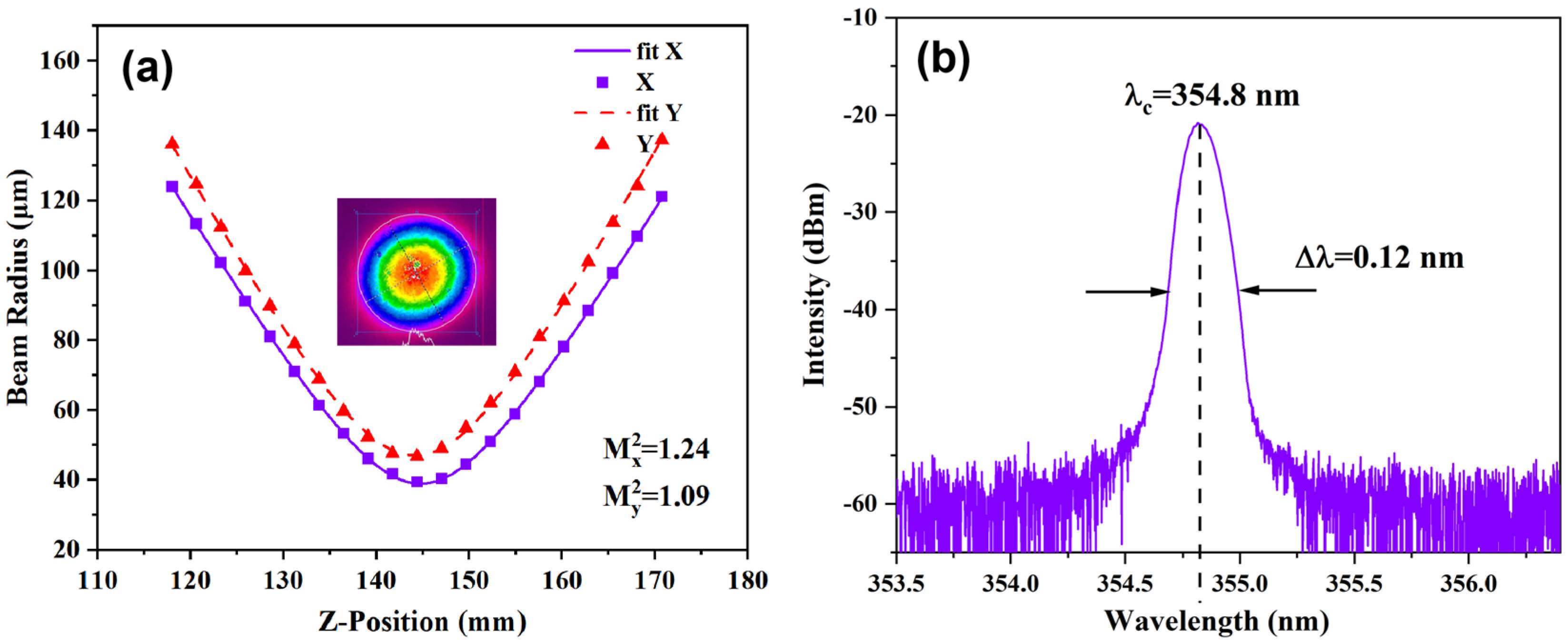
The spatial and spectral characteristics of the UV output are presented in
Figure 5. Following cascaded frequency doubling and sum-frequency generation, the 355 nm output maintains near-diffraction-limited beam quality with measured values of M
2 = 1.16 (M
2x = 1.24 and M
2y = 1.09), as illustrated in
Figure 5a. The beam profile exhibits a near-Gaussian distribution with a circularity exceeding 92%, with no observable distortion induced by thermal lensing or walk-off effects. This confirms that the defocused-beam configuration successfully mitigates thermal effects without introducing significant wavefront aberration. The optical spectrum of the 355 nm output shown in
Figure 5b is centered at 354.8 nm with a linewidth of approximately 0.12 nm (FWHM) and a signal-to-noise ratio exceeding 35 dB. The spectral purity is sufficient for applications requiring minimal out-of-band radiation.
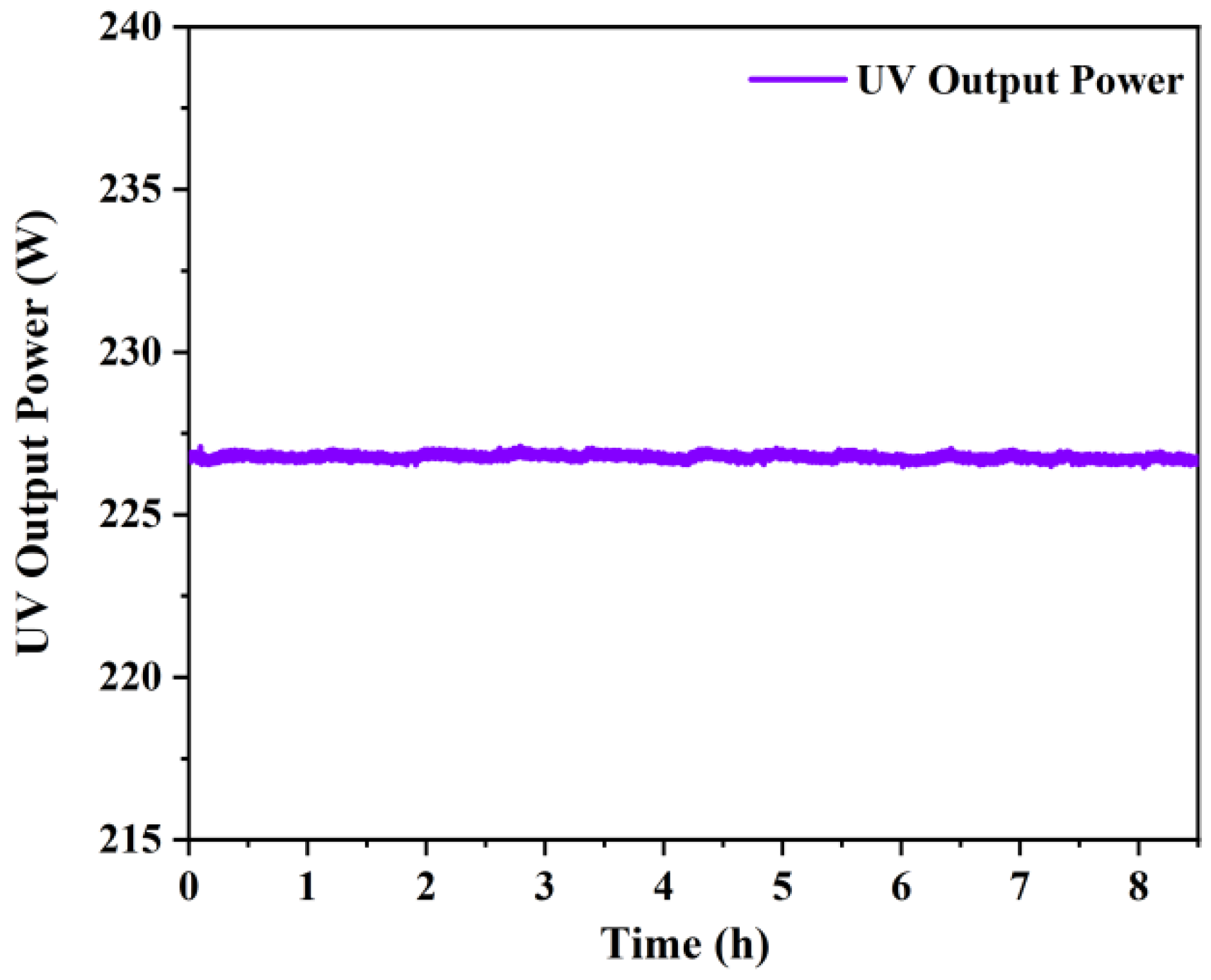
Figure 6 presents the long-term power stability of the 355 nm output measured over 8 h of continuous operation under laboratory ambient conditions (25 ± 1 °C). The average output power is 227.1 W, with a maximum of 227.9 W, a minimum of 226.3 W, and a standard deviation of 1.6 W, corresponding to an RMS stability < ±1.5%. At the hundred-watt level of ultraviolet output, even minor thermal disturbances were amplified through the nonlinear conversion process, resulting in relatively greater fluctuations in ultraviolet output power compared to green light.