Article

Design of a Thin-Film Lithium Niobate Electro-Optic Modulator with Three-Dimensional L-Shaped Traveling-Wave Electrodes


1
Guangxi Key Laboratory of Precision Navigation Technology and Application, Guilin University of Electronic Technology, Guilin 541004, China
2
The 34th Research Institute of China Electronics Technology Group Corporation, Guilin 541004, China
*
Authors to whom correspondence should be addressed.
Photonics 2026, 13(5), 502; https://doi.org/10.3390/photonics13050502
Submission received: 26 March 2026 / Revised: 8 May 2026 / Accepted: 11 May 2026 / Published: 19 May 2026

Abstract

The systematic influence of signal electrode width on electro-optic bandwidth and insertion loss in L-type traveling-wave lithium niobate modulators has not yet been comprehensively quantified, limiting the parametric engineering design of this device configuration. This study presents a full-band systematic simulation sweep of signal electrode width and three auxiliary geometric parameters in an L-type traveling-wave lithium niobate Mach–Zehnder modulator, combined with optical mode simulation to establish joint microwave–optical optimization constraints. The study reveals the coupled modulating effect of signal electrode width on characteristic impedance, velocity mismatch, and transmission loss; it elucidates the competition mechanism underlying non-monotonic high-frequency loss behavior; and it identifies the complete impedance-neutral characteristic of the electrode–waveguide contact width as an independent loss-tuning degree of freedom decoupled from the impedance constraint. Full-system validation confirms that the final design simultaneously satisfies broadband impedance matching, low insertion loss, and high electro-optic bandwidth. The results are distilled into four quantitative design rules that provide simulation-driven guidance directly applicable to the engineering design of L-type thin-film lithium niobate modulators, advancing the systematic establishment of a parametric design methodology for this device configuration.

1. Introduction

Thin-film lithium niobate (TFLN) electro-optic modulators have become vital active devices in high-speed optical communication systems and microwave photonic signal processing systems, owing to their broad transparency window, high linearity, and strong Pockels nonlinearity. The significance of TFLN modulators will only increase as data center interconnect speeds reach the Tbit/s range and wireless communication carrier frequencies the millimeter-wave range [1,2]. Unlike conventional lithium niobate modulators, TFLN modulators utilize submicrometer dimensions of the optical confinement structure to achieve a modulation efficiency on the order of 1   V · c m , thus overcoming the modulation efficiency bottleneck of conventional lithium niobate modulators [3], leading to the engineering maturity of TFLN integrated photonics [1]. Hybrid silicon–lithium niobate Mach–Zehnder modulators have already achieved electro-optic bandwidths of 100   G H z and beyond [4], and TFLN in-phase quadrature modulators have achieved a single-wavelength net data rate of 1.96   T b i t / s [5], thereby establishing TFLN traveling-wave modulators as the mainstay for next-generation high-speed optoelectronic integration. There are three main traveling-wave electrode (TWE) parameters: characteristic impedance Z 0 , microwave refractive index n , and transmission loss α . The width of the signal electrode, W s i g , simultaneously controls the current cross-section, fringing field, and velocity matching and plays a central role in the bandwidth–loss–impedance tradeoff triangle, the quantification of which has direct engineering value [2].
Significant advancements have been achieved in TWE design for TFLN modulators on various fronts. Periodically capacitively loaded electrodes have been used to eliminate the effective refractive index of microwaves via microstructures, thereby achieving velocity matching and low-voltage drive simultaneously [6]. Low-dielectric-constant BCB underfill has also been used to minimize high-frequency losses [7]. On the parameter engineering side, co-optimization of buffer layer thickness and electrode width has shown significant coupling effects on impedance tuning [8]. Silicon substrate slow-wave electrodes have also been used to demonstrate the effect of contact region geometry on impedance matching [9]. Simulations of hybrid integration platforms have been used to quantitatively explore the design space for achieving high bandwidth and low loss simultaneously [10]. Research on Si3N4-LN hybrid platforms has shown that the effect of electrode dimensions on microwave characteristics is significantly greater than expected [11]. Insertion loss in electrodes has been correlated with system link margin constraints in ultrahigh-speed interconnect analysis [12]; high-speed TFLN modulator demonstrations at the 2   μ m wavelength have extended TWE design principles to new device scenarios [13]; and simulation of mid-infrared modulators with multiple constraints has verified that globally optimum solutions are unobtainable by single-parameter optimization [14]. Slotted coplanar waveguide electrodes have been found to have significant dispersion as well as high-frequency tunability [15]. Slow-light waveguides have verified the significant influence of signal electrodes on microwave dispersion [16], while differential phase diversity modulator design has verified the decisive influence of impedance and velocity matching on microwave photonics links [17].
Despite the abovementioned progress, an important research gap remains to be bridged. In recent years, novel substrate processing schemes [18], wideband high-power designs [19], and high-linearity multi-parameter co-optimization studies [20] have explored the physical limits of the bandwidth efficiency compromise from different angles. However, in all of these studies, the signal electrode width W s i g was universally treated as a constant design factor, not a design variable to be systematically researched. The full-band effects of W s i g on electro-optic bandwidth and insertion loss in the L-type TWE structure have not yet been comprehensively quantified [2], and more research needs to be conducted on methods for transforming simulation results into design rules directly applicable to engineering practice [21].
To address these gaps, we undertook a systematic parametric sweep of W s i g from 11 to 19   μ m over 1 to 60   G H z , quantitatively characterizing the coupled effects of insertion loss, characteristic impedance, and microwave refractive index on the non-monotonic high-frequency loss phenomenon, along with the underlying physical mechanism. As opposed to earlier research carried out with L-type electrodes, in which W s i g was normally kept constant while only selected auxiliary variables were considered, this study considers all four dimensions of geometric freedom within a consistent approach and translates the results from the generated parameter sweeps into actual design rules rather than descriptive guidelines. Building on this unified framework, the independent influence of the auxiliary parameters d 0 , d s i o 2 u p , and w 1 is quantitatively characterized, revealing the impedance neutrality of the latter. Finally, the design parameters are constrained by the V π L –optical loss tradeoff boundary, computed using COMSOL6.1 optical mode simulation, and the entire system is verified, confirming the electro-optic frequency response at 60   G H z to be 2.337   d B , with S11 below 19   d B over the entire frequency range. These findings are quantitatively captured in the form of four design rules, applicable to the design of L-type traveling-wave lithium niobate modulators.

2. Device Structure and Simulation Methodology

2.1. L-Type TWE-MZM Configuration and Parameter Definition

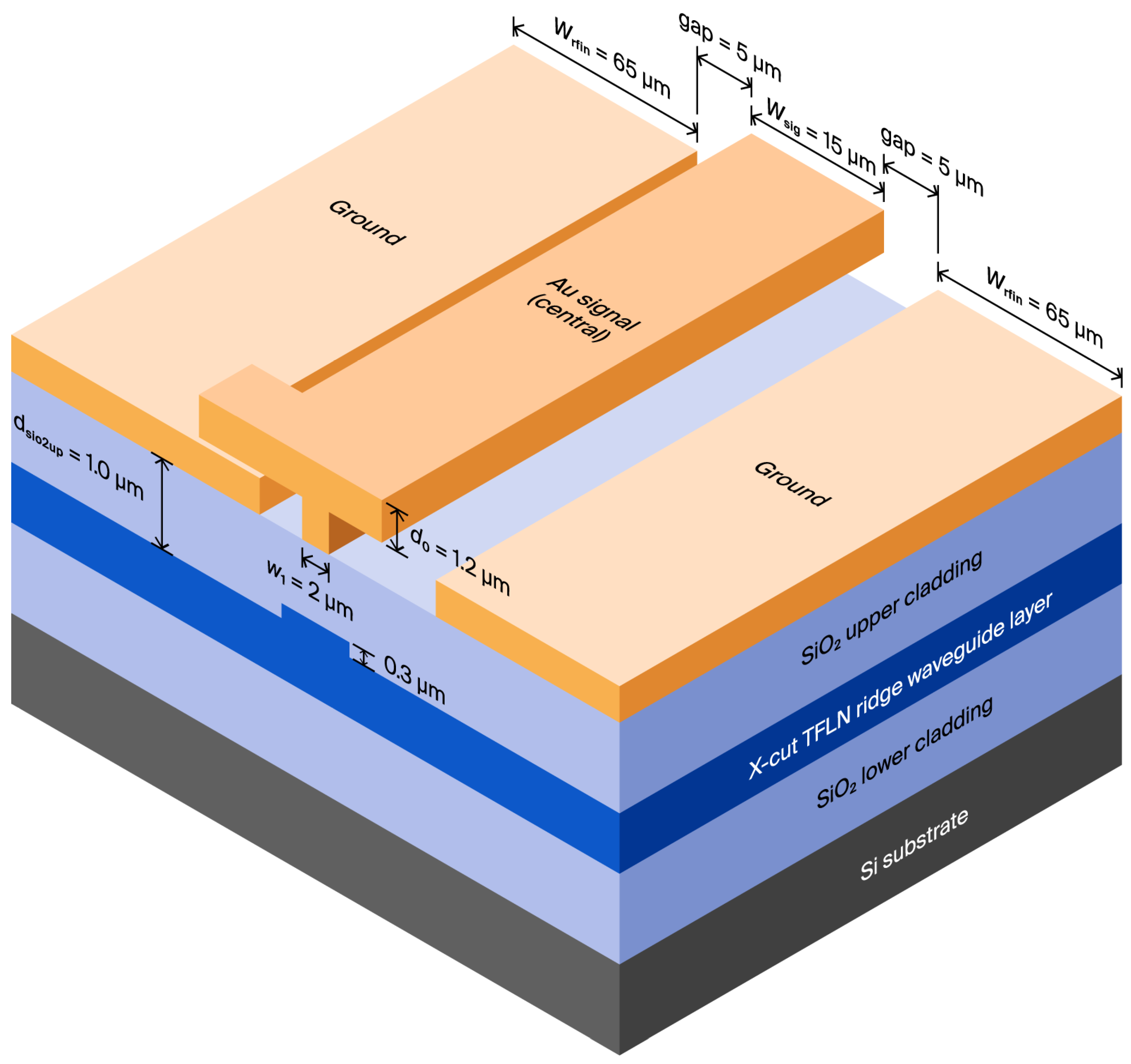
The L-type traveling-wave lithium niobate Mach–Zehnder modulator (TWE-MZM) used in this study comprises an X-cut TFLN ridge waveguide, an L-type gold (Au) traveling-wave electrode, and a multilayer SiO2 cladding. Unlike the conventional coplanar waveguide (CPW) C-type electrode, whose signal electrode is symmetrical with respect to the waveguide structure, the CPW-L type structure exhibits an asymmetric vertical extension of the signal electrode. This leads to a change in the fringing field pattern and increases the vertical electric field intensity within the lithium niobate modulating layer. The optimized field pattern is expected to mitigate the trade-off between the efficiency of modulation and optical loss while sustaining a similar electro-optic overlap, albeit with a relatively wider separation gap compared with the symmetric CPW, and while retaining the impedance near 50 Ω. Figure 1 shows a schematic view of the cross-sectional geometry. The structure is composed of a gold electrode layer, a SiO2 upper cladding layer, a TFLN ridge waveguide layer, a SiO2 lower cladding layer, and a silicon substrate. Five geometric parameters are defined: the width of the signal electrode W s i g , the thickness of the traveling-wave electrode d 0 , the thickness of the upper cladding layer d s i o 2 u p , the width of the electrode–waveguide contact region w 1 , and the gap.
Figure 1 shows that for the L-type Au signal electrode, the width W s i g is 15 μm, and it lies symmetrically between two ground electrodes, each having a width W r f i n = 65   μ m . A g a p of 5 μm exists between the signal electrode and each ground electrode. However, the most distinctive property that characterizes this arrangement is the unilateral vertical extension of the signal electrode on its left side. This extension becomes w 1 = 2   μ m wide at the point of contact and reaches the upper SiO2 cladding layer of thickness d s i o 2 u p = 1.0   μ m to make contact with the lithium niobate surface, resulting in an L-type cross-section and an overall electrode thickness d 0 = 1.2   μ m . The X-cut TFLN ridge waveguide having an etching depth of 0.3 μm is located in the space between the signal and ground electrodes and is coated with SiO2 lower cladding material on top of the Si substrate. For comparison, all non-target variables are fixed at their baseline values. The baseline values and sweep ranges are listed in Table 1.
The baseline values listed in Table 1 are selected based on physical considerations prior to experimentation to define a physically consistent reference frame, rather than being derived from initial device optimization. The baselines are positioned at approximately the mid-point of their sweep ranges to allow for symmetrical evaluation of both smaller and larger deviations from the reference, which would otherwise introduce a systematic error. The dimensional constraints are simultaneously limited to fit into the regular production windows for gold electroplating, plasma-enhanced deposition of SiO2, and ridge etching on the X-cut TFLN substrate, ensuring that the studied parameter space represents physically feasible designs rather than an abstract mathematical optimum. This geometry provides a straightforward interpretation of each subsequent single-variable sweep, since at any one time only one variable is deviated from the common starting point, whereas the rest retain their physical significance.

2.2. HFSS Microwave Simulation Setup

The microwave characterization process utilizes the ANSYS HFSS2024 finite element method electromagnetic simulator. The process runs from 1 to 60   G H z . Wave port excitation is used for both terminals, and radiation boundary conditions are used to avoid parasitic reflections on the edges of the cross-sections. Mesh refinement is used adaptively, and the convergence of S-parameters is verified at each step to confirm that the microwave parameters presented are not dependent on the grid resolution. In this case, a parametric single-variable sweep method was used in all the simulations. In this method, only the parameter of interest is varied while the rest of the parameters are kept constant and unchanged from the values listed in Table 1. This has been shown to be a reliable method of attributing the independent effects of the parameters in the optimization of the electrode parameters of the TFLN modulators [22]. Three important microwave performance characteristics are derived from simulated S-parameters. The characteristic impedance Z 0 is derived from S11 and S21 by inverting a transfer matrix. The microwave refractive index is derived from the ratio of the phase constant β to the free-space wave vector k 0 . The transmission loss is derived from the absolute value of S21 normalized by the effective length of the modulator, expressed in d B / c m .
These three parameters are not independent but are linked together through the electro-optic transfer function of the traveling-wave modulator. Under the matching condition of the terminals with a 50   Ω load, the normalized frequency response of the electro-optic effect is given by [23]:
H ( f ) = 2 Z L Z 0 f + Z L e α L 2 s i n h α L 2 + j π f Δ n L c α L 2 + j π f Δ n L c
where Δ n = n m ( f ) n o p t denotes the frequency-dependent difference between the microwave refractive index and the optical group refractive index, L is the effective modulator length, and c is the speed of light in a vacuum. Z L = 50   Ω denotes the load impedance, and Z 0 f is the frequency-dependent characteristic impedance extracted from the HFSS simulation. The prefactor 2 Z L / Z 0 f + Z L accounts for the impedance mismatch between the electrode characteristic impedance and the termination, reducing to unity under perfect 50   Ω matching. This transfer function reveals that α governs the rate of high-frequency energy attenuation while Δ n controls the sinc-type bandwidth compression induced by phase mismatch; both contributions are simultaneously modulated by W s i g and superimpose on each other, constituting the core physical rationale for conducting a systematic investigation of W s i g . Based on this expression, the electro-optic 3   d B bandwidth under each W s i g condition is estimated analytically by substituting the swept α ( f ) and n m ( f ) profiles, and the resulting predictions are validated against the full-system HFSS-simulated HF curve at W s i g = 15   μ m , establishing a clear quantitative link from parametric sweep data to electro-optic bandwidth prediction.

2.3. COMSOL Optical Mode Simulation

Optical simulation of the device was carried out in COMSOL Multiphysics. A two-dimensional cross-sectional eigenmode solver was used to determine the fundamental TE mode of the TFLN ridge waveguide. The lithium niobate material properties were set according to the X-cut anisotropic dielectric tensor to take into account the directional dependence of the Pockels effect. Perfect matched layers (PMLs) were used to prevent reflections from the boundaries of the simulation domain. Mesh refinement technique is used to model the interaction of electrodes and waveguides while capturing the evanescent wave components. Convergence of eigenvalues is ensured by verifying the stability of the calculated effective refractive index during the mesh refinement process. This process has been shown to be a reliable method for the co-optimization of loss and modulation efficiency in TFLN modulators [24]. Optical absorption loss was obtained from the imaginary part of the complex effective refractive index, and the half-wave voltage–length product V π L was found from the spatial overlap integral Γ between the optical field and the microwave electric field, with both quantities representing the fundamental tradeoff between optical loss and modulation efficiency.
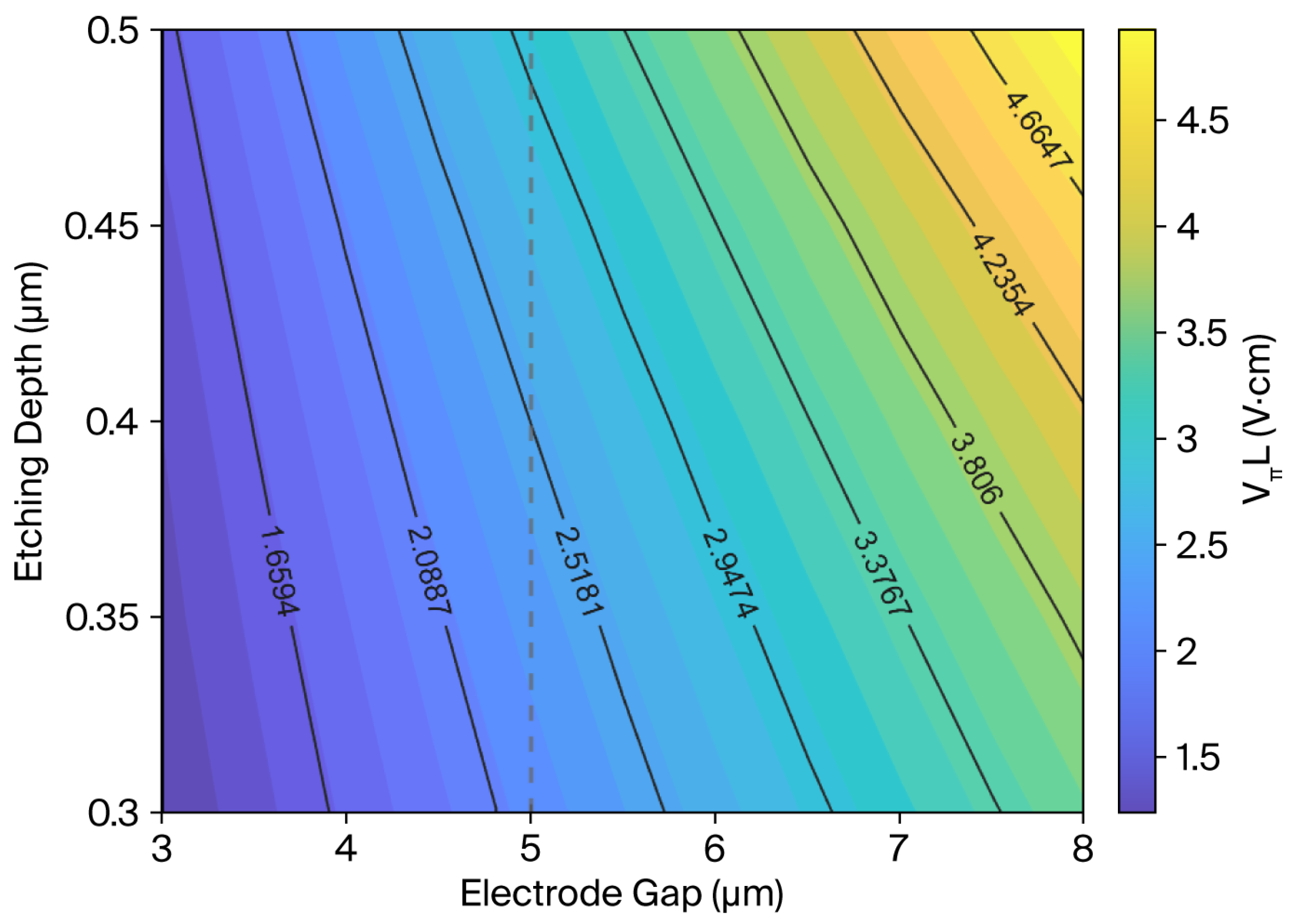
To create a quantitative constraint map for the relationship between the etching depth and the electrode gap with respect to modulation efficiency, we carried out a systematic two-dimensional parametric sweep of the etching depth (ranging from 0.3 to 0.5 μ m in increments of 0.05 μ m ) and gap (ranging from 3 to 8 μ m ), with the corresponding V π L contour distribution shown in Figure 2.
Figure 2 shows that V π L monotonically increases with increasing gap for the entire etching depth range, reinforcing the intrinsic tradeoff between modulation efficiency and gap. At a reference gap of 5   μ m , as depicted by a dashed line, V π L varies from 2.173   V · c m at an etching depth of 0.3 μ m to 3.028 V · c m at 0.5 μ m . This is a direct consequence of the decrease in the electro-optic overlap integral with increasing etching depths. Similarly, as shown by the COMSOL simulation results, optical loss at a gap of 5 μ m decreases from 0.013 d B / c m at an etching depth of 0.3   μ m to 0 at an etching depth of 0.5 μ m . This validates our choice of gap, as it meets both criteria. This two-dimensional tradeoff boundary is a quantitative optical constraint for choosing the final design parameters.

3. Results

3.1. Systematic Effect of Signal Electrode Width

Signal electrode width W s i g had a coupled impact on the three fundamental microwave performance parameters, namely, transmission loss α , characteristic impedance Z 0 , and microwave refractive index n m , through the simultaneous modulation of current density distribution, fringing field coverage, and equivalent transmission line parameters. It is therefore the most important geometrical parameter in determining the electro-optic bandwidth of the L-type traveling-wave modulator. We carried out a systematic analysis of the full-band (1–60 G H z ) microwave characteristics of W s i g in the range from 11 to 19 μ m with a 1 μ m step size and a total of nine sampling points, using the HFSS simulation results. The analytical conclusions based on the three microwave performance parameters are finally translated into the electro-optic bandwidth using the transfer function in Section 2.2, with the analytical results verified using a full-system simulation HF curve at W s i g   =   15   μ m .

3.1.1. Insertion Loss Characteristics

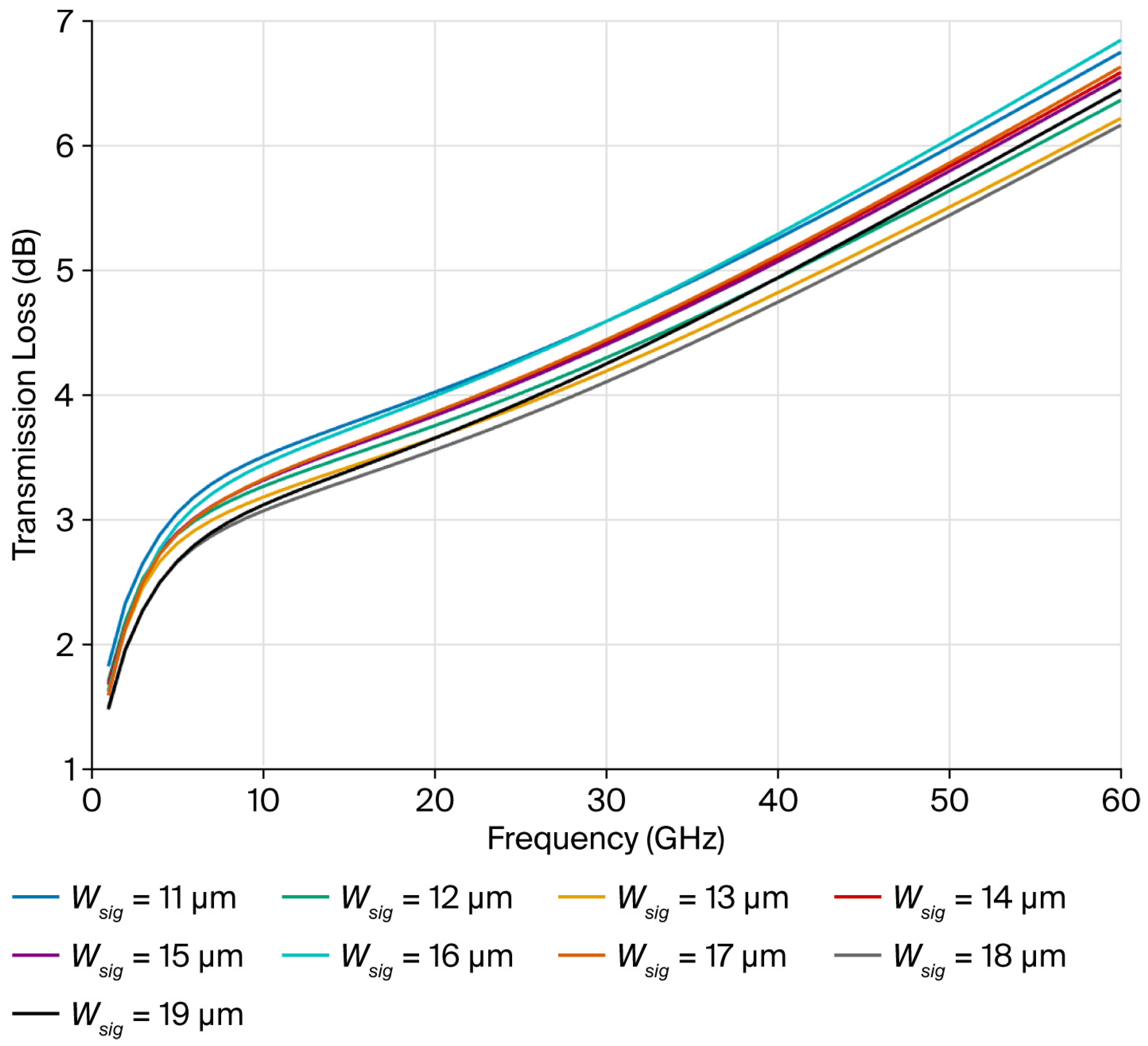
The loss of frequency-dependent transmission is a key parameter for evaluating the broadband operational capability of traveling-wave modulators. For the L-type traveling-wave electrode, the main loss mechanism varies with increasing frequency. At low frequencies, the ohmic conductor loss is the main loss and is controlled by the cross-sectional area of the traveling-wave electrode. As the frequency increases, the skin effect restricts current penetration to a narrow surface region, rendering the effective current-carrying cross-sectional area almost constant relative to the electrode thickness. Hence, the ohmic losses reach saturation, whereas the radiative effects of fringing fields and the dielectric polarization of the surrounding cladding dominate. Since the responses of the two loss components to the variation of W s i g differ fundamentally, the loss modulation effect of W s i g is expected to differ qualitatively in the low-frequency and high-frequency regimes. Figure 3 shows the entire set of loss curves for W s i g from 11 to 19 μ m over a 1 to 60 G H z range.
This is clearly illustrated in Figure 3, where it is evident that below 8 G H z , the loss reduces in a strictly monotonic manner with increasing W s i g , from 1.829   d B at 1   G H z and 11   μ m to 1.483   d B at 1   G H z and 19   μ m . However, above 10   G H z , the curves continue to cross each other, and the order is reversed, leading to a marked non-monotonic behavior at 60   G H z , where W s i g at 16   μ m reaches a local maximum of 6.850   d B , and W s i g at 13 μ m gives the minimum at 6.223   d B .

3.1.2. Characteristic Impedance and 50   Ω Matching Window

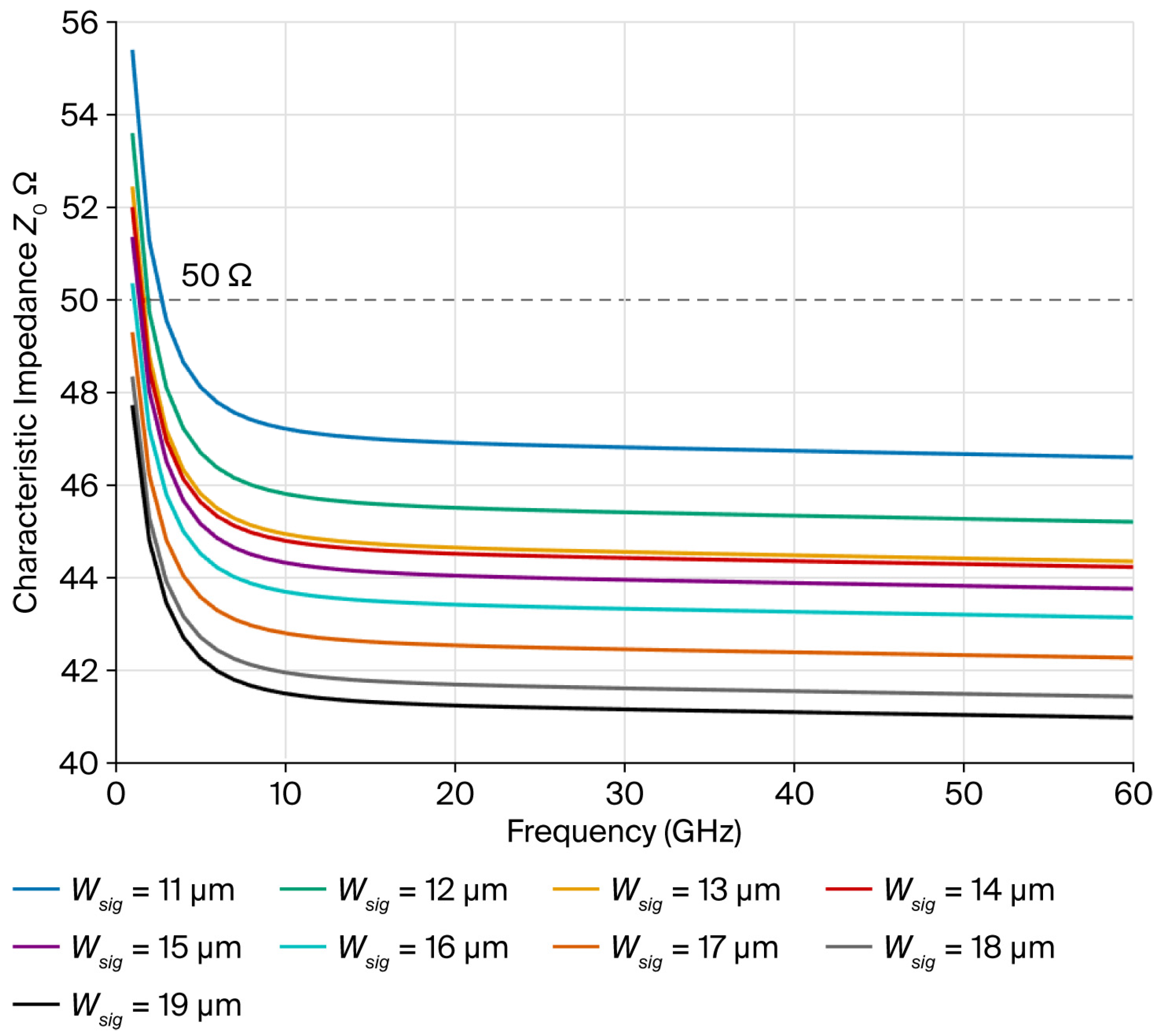
Having established the W s i g dependence of signal attenuation through transmission loss analysis, it is necessary to further investigate the effect of W s i g on impedance matching, as any deviation of characteristic impedance Z 0 from 50   Ω results in microwave reflections at the interface between the signal source and the modulator, leading to a decrease in the applied voltage amplitude to the modulation region and a corresponding compression of the electro-optic bandwidth. For the L-type electrode structure, increasing W s i g will increase the equivalent capacitance between the signal and ground electrodes, while keeping the inductance constant. The characteristic impedance Z 0 is therefore expected to decrease with increasing W s i g according to transmission line theory. This indicates that there is an optimum W s i g window within which Z 0 is within the 50   Ω window. To quantitatively determine this window, Figure 4 displays the Z 0 curves as a function of frequency for all W s i g values along with a reference line at 50   Ω .
Figure 4 shows that at a frequency of 1   G H z , Z 0 decreases monotonically with an increase in W s i g . The decrease is from 55.40   Ω at W s i g = 11   μ m to 47.73   Ω at W s i g = 19   μ m . The tolerance for impedance matching is taken as ± 1.5   Ω . The effective impedance matching window for W s i g = 15 to 17   μ m is found to have a corresponding Z 0 in the range of 49.31 to 51.36 Ω , with a port reflection coefficient | Γ | less than 0.015. At a frequency of 60   G H z , Z 0 decreases uniformly with a decrease in W s i g by 7 to 8 Ω . The W s i g   =   15 to 17   μ m group is found to have relatively optimal impedance matching characteristics.

3.1.3. Microwave–Optical Velocity Mismatch

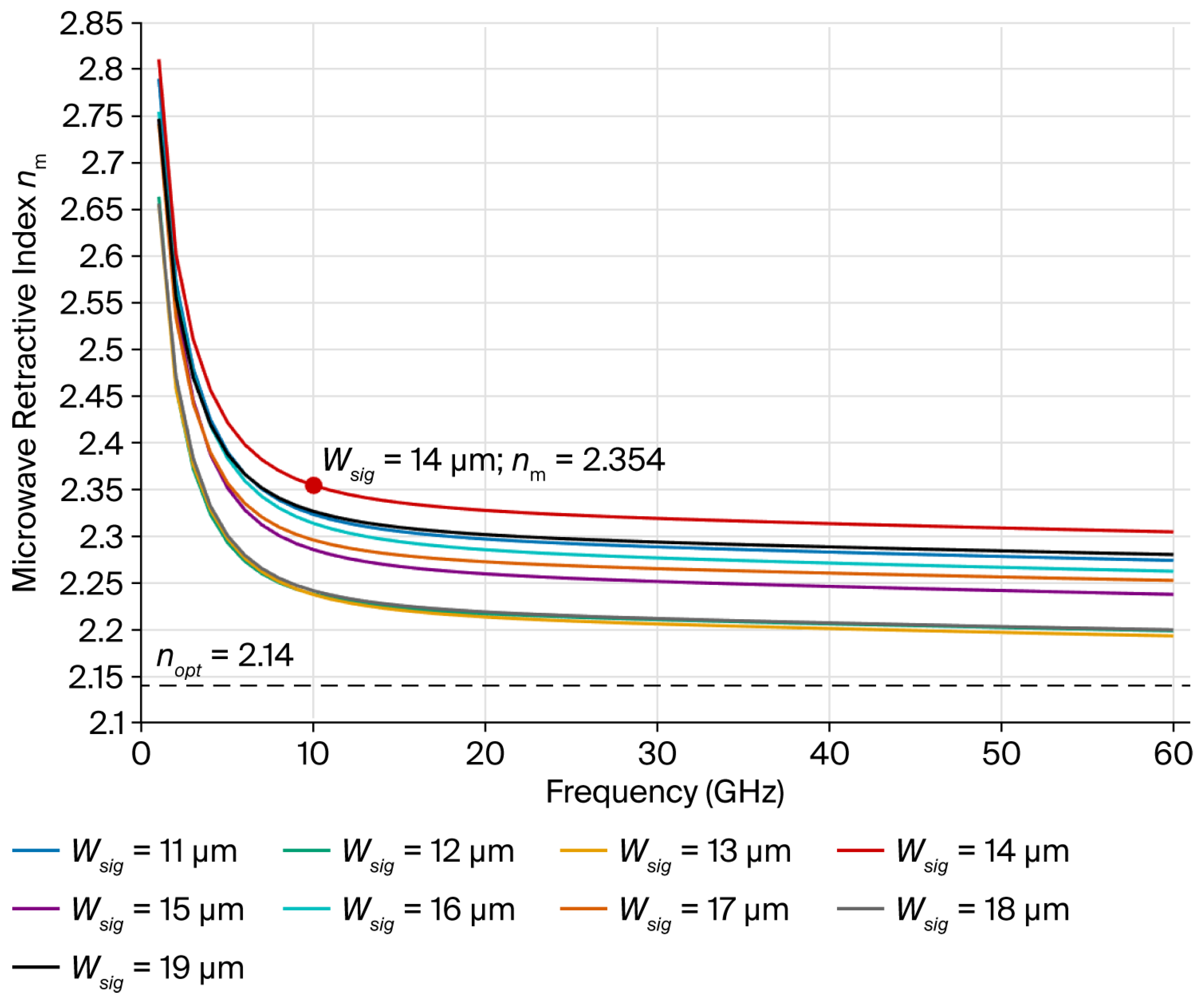
Impedance analysis has already identified the window of W s i g = 15 to 17   μ m , but impedance matching merely provides a necessary criterion for broadband electro-optic modulation, with velocity matching being equally important. The difference Δ n = n m n o p t between the microwave refractive index and the optical group refractive index directly affects the compression of the electro-optic bandwidth through the sinc-type phase mismatch factor in the transfer function of Section 2.2, with this compression becoming increasingly critical with increasing device length and frequency. The optical group refractive index of the X-cut TFLN waveguide for a 1550 nm wavelength is approximately n o p t 2.14 , as obtained from the COMSOL eigenmode simulation of Section 2.3. A smaller Δn implies a reduced penalty in the bandwidth arising from the effects of velocity mismatch. To further clarify the location of the optimum for the velocity matching criterion within the window of impedance matching, Figure 5 plots the frequency dependence of the n curves for all W s i g values, with particular emphasis on the n distributions for the 10 G H z reference frequency.
As Figure 5 demonstrates, at a frequency of 10 G H z , within all W s i g conditions, the range of n is between 2.22 and 2.35, which is always well above n o p t = 2.14 , reinforcing the observation of the ubiquity of velocity mismatch within the L-type traveling-wave electrode configuration. An interesting anomaly is noted at W s i g = 14   μ m , where n m @ 10   G H z is as high as 2.354 ( Δ n   =   0.214 ), significantly higher than neighboring values, a situation physically correlated with the anomalous high-frequency loss rebound at this condition as noted in Section 3.1.1. The situation here is indicative of an enhanced effect of microwave mode dispersion. Within the impedance-matched window of 15 to 17 μ m , at W s i g = 15   μ m , it is found that n m @ 10   G H z = 2.285 , a situation where the velocity mismatch is minimized among all conditions. The conclusions drawn in Section 3.1.2 are reinforced, confirming W s i g = 15   μ m as the optimum condition for both impedance matching and velocity matching.

3.1.4. Analytical Estimation of EO Bandwidth and Its Dependence on the Width of the Signal Electrode

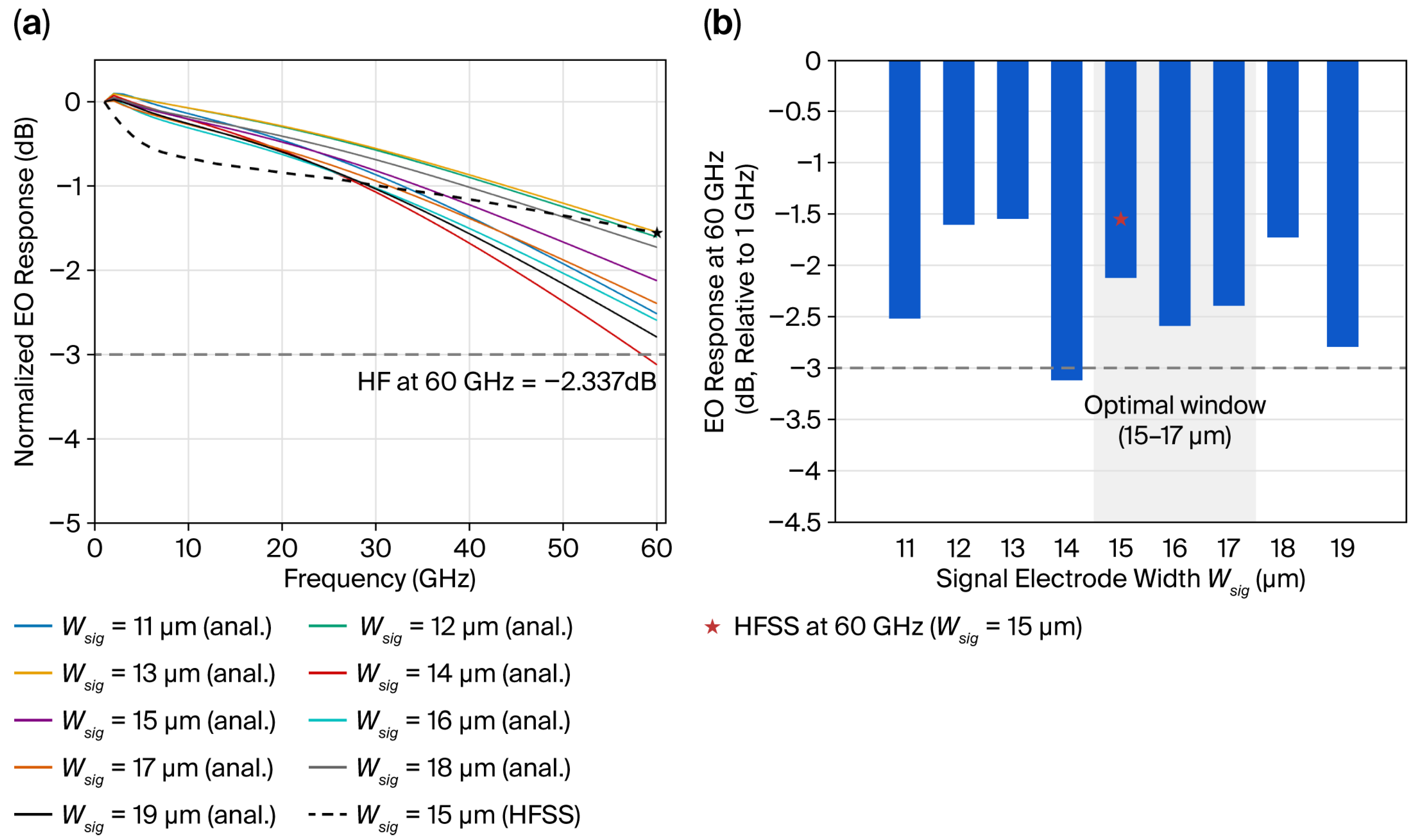
The above three subsections have characterized the W s i g dependence of the transmission loss, characteristic impedance, and microwave refractive index, respectively. These parameters do not have independent influences on device performance; rather, they jointly determine the electro-optic bandwidth by the transfer function defined in Section 2.2. To consolidate the above analytical results into a quantification of the bandwidth and, in the end, confirm the optimal W s i g , α ( f ) , n m ( f ) , and Z 0 ( f ) profiles derived from the HFSS simulations for each W s i g case were plugged into the transfer function defined in Section 2.2 to estimate the electro-optic −3 dB bandwidth for each W s i g case, along with the results of the whole system HF curve validation for W s i g = 15   μ m (Figure 6).
Figure 6a illustrates the analytically estimated normalized EO frequency response curves for all nine values of W s i g , as well as the full-system HFSS result (dashed black curve) for the case where W s i g = 15   μ m , with the −3 dB bandwidth threshold also indicated. Although Equation (1) incorporates the frequency-dependent impedance mismatch through the prefactor 2 Z L / Z 0 f + Z L , the analytical prediction slightly overestimates the bandwidth degradation relative to the full-system HFSS result in the mid-frequency band. The deviation is attributed to the uniform transmission line assumption that treats α, nm, and Z0 as position-independent along the modulator length, whereas the full-system simulation captures longitudinal non-uniformities arising from port discontinuities and fringing-field end effects. At the critical design frequency of 60 GHz, the two plots meet at HF@60 GHz = −2.337 dB, confirming that the transfer function provides a quantitatively reliable bandwidth prediction at the target operating frequency. In addition, Figure 6b illustrates the EO result at 60 G H z for all values of W s i g as a bar chart, where the gray shaded region indicates the optimal impedance matching window between 15 and 17 μ m , and the red star indicates the HFSS-validated result at W s i g = 15   μ m . The bar chart confirms that the 15–17 μ m window always corresponds to the minimum bandwidth degradation, thereby making W s i g = 15   μ m the optimum value for the four criteria of insertion loss, impedance matching, velocity matching, and electro-optic bandwidth.

3.2. Influence of Auxiliary Electrode Parameters

Having determined W s i g = 15   μ m as the optimum for insertion loss, impedance matching, velocity matching, and electro-optic bandwidth for the four dimensions in Section 3.1, the independent modulation rules for three auxiliary geometric parameters—electrode thickness d 0 , SiO2 upper cladding thickness d s i o 2 u p , and electrode–waveguide contact width w 1 —on transmission loss and characteristic impedance need to be quantitatively determined to provide a complete set of boundary conditions for the final design parameter selection. All three parametric sweeps were performed with W s i g = 15   μ m fixed and all other parameters locked to their baseline values given in Table 1. Following Section 3.1, 1 and 60  GHz were used as two-frequency evaluation references for the low-frequency ohmic loss-dominated and high-frequency skin effect-dominated regimes, respectively. The three parameters play different roles in different performance dimensions and together provide a complete set of independent degrees of freedom.

3.2.1. Traveling-Wave Electrode Thickness

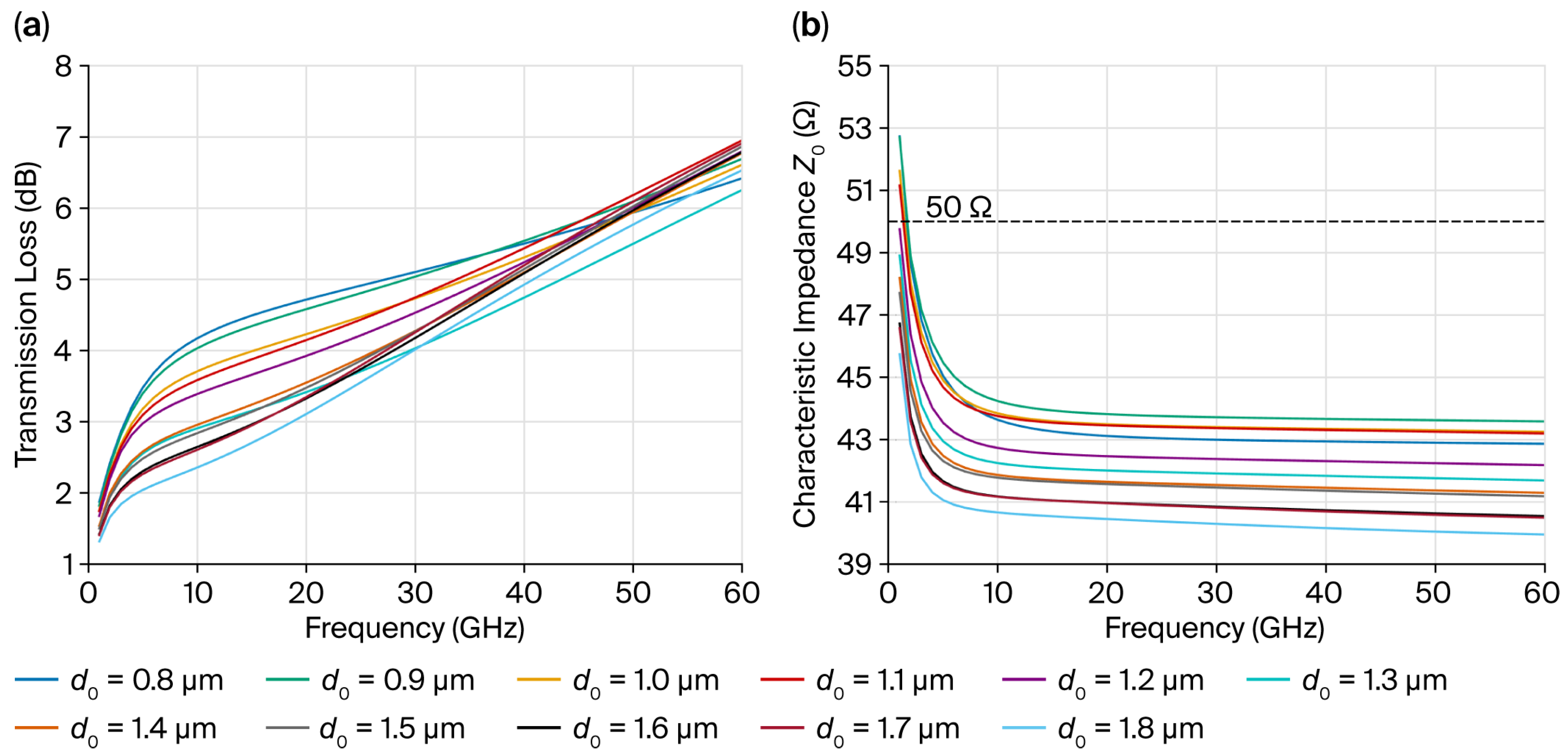
The traveling-wave electrode thickness d 0 affects both transmission loss and characteristic impedance, although the frequency dependence differs between the two characteristics. At low frequencies, the loss is related to the ohmic resistance of the conductor, which is a decreasing function of d 0 , while at high frequencies, the skin effect leads to a saturation of the conductor cross-section, which, in turn, leads to a significant radiation loss in the fringing field, resulting in a local minimum in the high-frequency loss as a function of d 0 . According to the transmission line theory, an increase in d 0 results in a decrease in sheet resistance in the conductor layer, which in turn affects the parameters of the transmission line, resulting in a decrease in Z 0 . This indicates the existence of an optimal d 0 interval in which Z 0 is in the 50 Ω window. To verify these results, a parametric sweep was performed over d 0 , from 0.8 to 1.8 μ m in 0.1 μ m steps. The results are presented in Figure 7.
As depicted in Figure 7a, at a frequency of 1 GHz, the transmission loss is seen to decrease strictly monotonically with increasing d 0 , whereas at a frequency of 60 G H z , the trend is non-monotonic with a minimum high-frequency loss for d 0 = 1.3   μ m . Figure 7b indicates that Z 0 decreases strictly monotonically with increasing d 0 for the entire frequency band, with only a subset of d 0 values corresponding to a 50 Ω matching window as indicated by the dashed reference line. The intersection of the impedance matching constraint and the minimum high-frequency loss identifies d 0 = 1.2 1.3   μ m as the optimal design interval.

3.2.2. SiO2 Upper Cladding Thickness

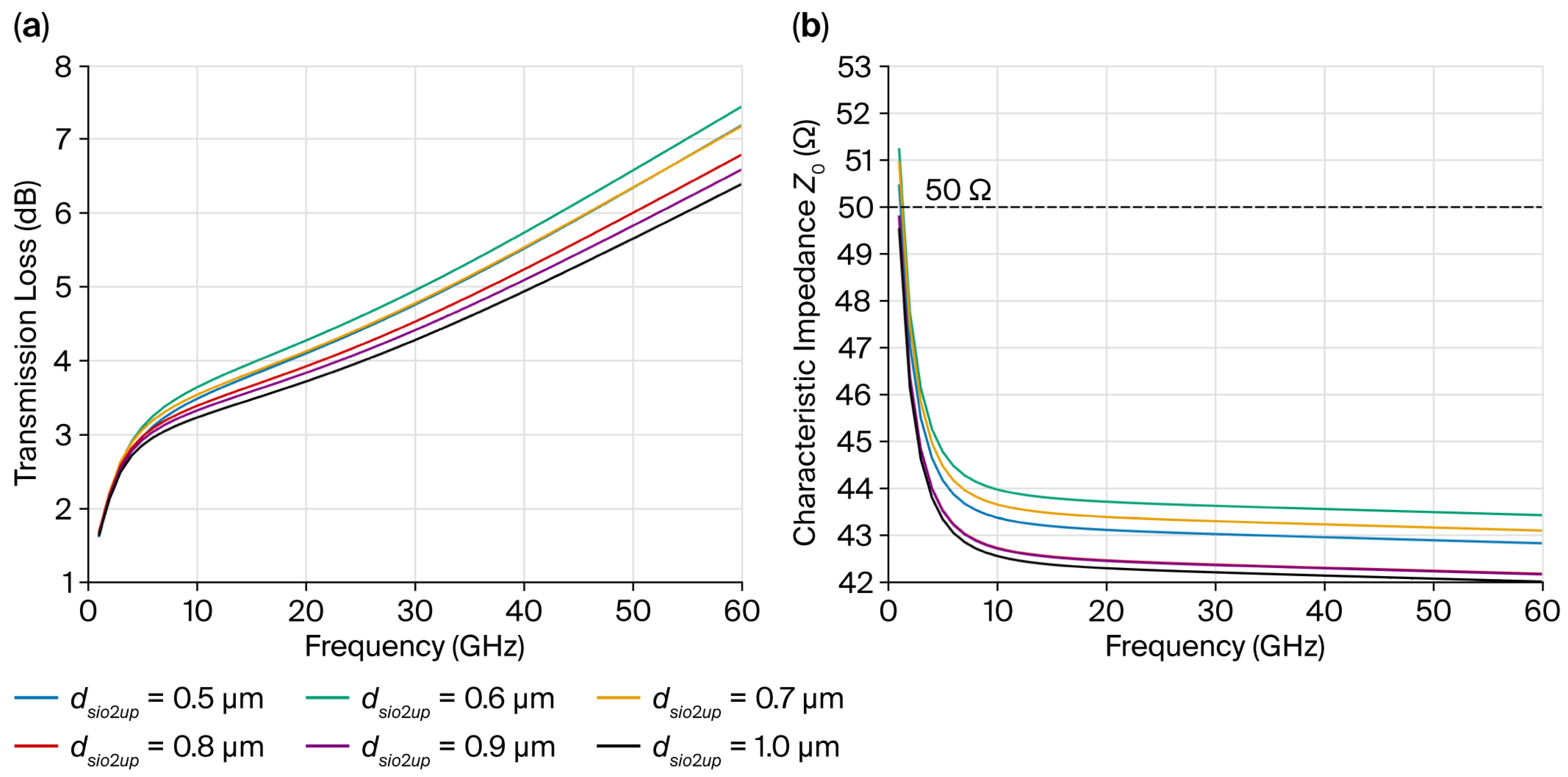
After the establishment of the optimal interval of d 0 , the ability of the upper cladding layer of SiO2 thickness d s i o 2 u p to independently modulate high-frequency loss is an important factor in further loss suppression, with its impedance modulation effect being a key issue for verification in this subsection. By adjusting the degree of dielectric insulation between the signal electrode and the silicon substrate, d s i o 2 u p can control the intensity of high-frequency electromagnetic field leakage into the substrate. Meanwhile, it is expected that changes in equivalent transmission-line capacitance and inductance caused by d s i o 2 u p will be relatively symmetrical, and therefore, the variation in Z 0 with d s i o 2 u p is expected to be much less sensitive than with d 0 . Figure 8a,b show the results of a full-band parametric sweep of transmission loss and characteristic impedance as they are modulated by d s i o 2 u p with a range of 0.1 μ m , for each step within a range of 0.5–1.0 μ m .
The non-monotonicity in the dependence of the 60 GHz signal transmission loss on d s i o 2 u p is evident in Figure 8a, where a local maximum is obtained at 0.6 μ m before decreasing monotonically with increasing d s i o 2 u p , with the lowest high-frequency loss obtained at d s i o 2 u p = 1.0   μ m . Figure 8b indicates that the Z 0 value at 1 G H z remains confined to a narrow band under all d s i o 2 u p conditions, with a modulation amplitude much lower than that of W s i g and d 0 , thus confirming that d s i o 2 u p causes negligible disturbance to the impedance matching. This parameter can thus be used as a dedicated high-frequency loss-tuning parameter without compromising the established 50 Ω matching condition.

3.2.3. Electrode–Waveguide Contact Width

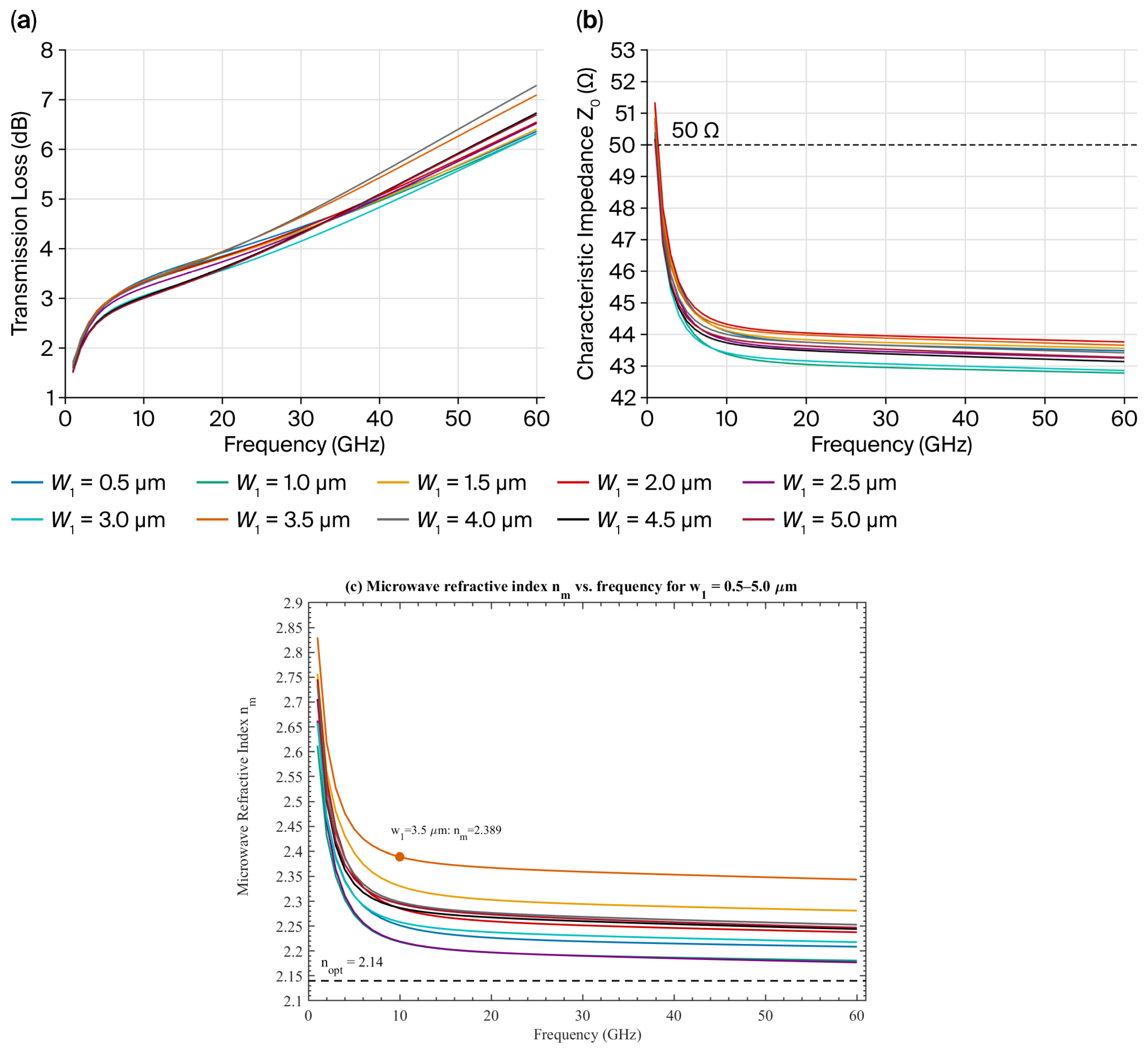
After the modulation dimensions d 0 and d s i o 2 u p are characterized, the final element of the auxiliary parameter analysis is the width w 1 of the contact. The issue at hand is whether w 1 also possesses an impedance-neutral characteristic necessary for it to be an independent loss-tuning degree of freedom unconstrained by the impedance constraint. The width w 1 of the contact controls the direct-contact area between the bottom of the signal electrode and the lithium niobate waveguide layer. The modification of w 1 affects the electric field distribution, fringing field coverage, and microwave refractive index, but verification is necessary to ensure that changes in transmission-line capacitance and inductance are mutually canceling. Figure 9a–c show the results of the parametric sweep describing the effect of w 1 on all three metrics across the full band for w 1 = 0.5 to 5.0   μ m with a step size of 0.5 μ m .
As can be seen from Figure 9a, transmission loss has a strong non-monotonic response to w 1 at 60 G H z , with w 1 = 1.0   μ m corresponding to minimum loss and w 1 = 4.0   μ m corresponding to maximum loss. This clearly indicates that w 1 is an effective tuning parameter for minimizing high-frequency loss without affecting the 50 Ω matching condition. Figure 9b indicates a strong and stable concentration of Z 0 at 1 G H z within 50.2 to 51.4 Ω for all w 1 cases with no response to changes in w 1 . This strongly indicates that w 1 is a fully impedance-neutral parameter; this is one of the more important results of this study. Figure 9c indicates an anomalous peak in n at w 1 = 3.5   μ m , which is physically correlated with increased high-frequency loss in the w 1 = 3.5 4.0   μ m range.

3.3. Optical Mode Analysis and Electro-Optical Co-Design

The parametric sweep in Section 3.1 and Section 3.2 determined the optimal range for each of the electrodes’ geometrical parameters from the point of view of the microwave transmission characteristics, but the electro-optic bandwidth of the modulator is determined not only by the microwave characteristics but also by the spatial overlap efficiency between the optical mode and the electric field. The product V π L is the primary figure of merit characterizing the modulation efficiency and is a measure of the strength of the interaction between the electric field and the phase of the optical field, and the optical absorption loss is a restriction on the quality and usability of the transmission through the waveguide. Both figures of merit are extremely sensitive to the gap between the electrodes and the etched depth of the lithium niobate ridge waveguide, and therefore, a 2D parametric sweep over these two optical domain parameters is needed after the optimization in the microwave domain to find the gap satisfying the optical constraints and complete the loop in the joint optimization problem. The simulation setup and the extraction procedure follow exactly those in Section 2.3, and their description is not repeated here.
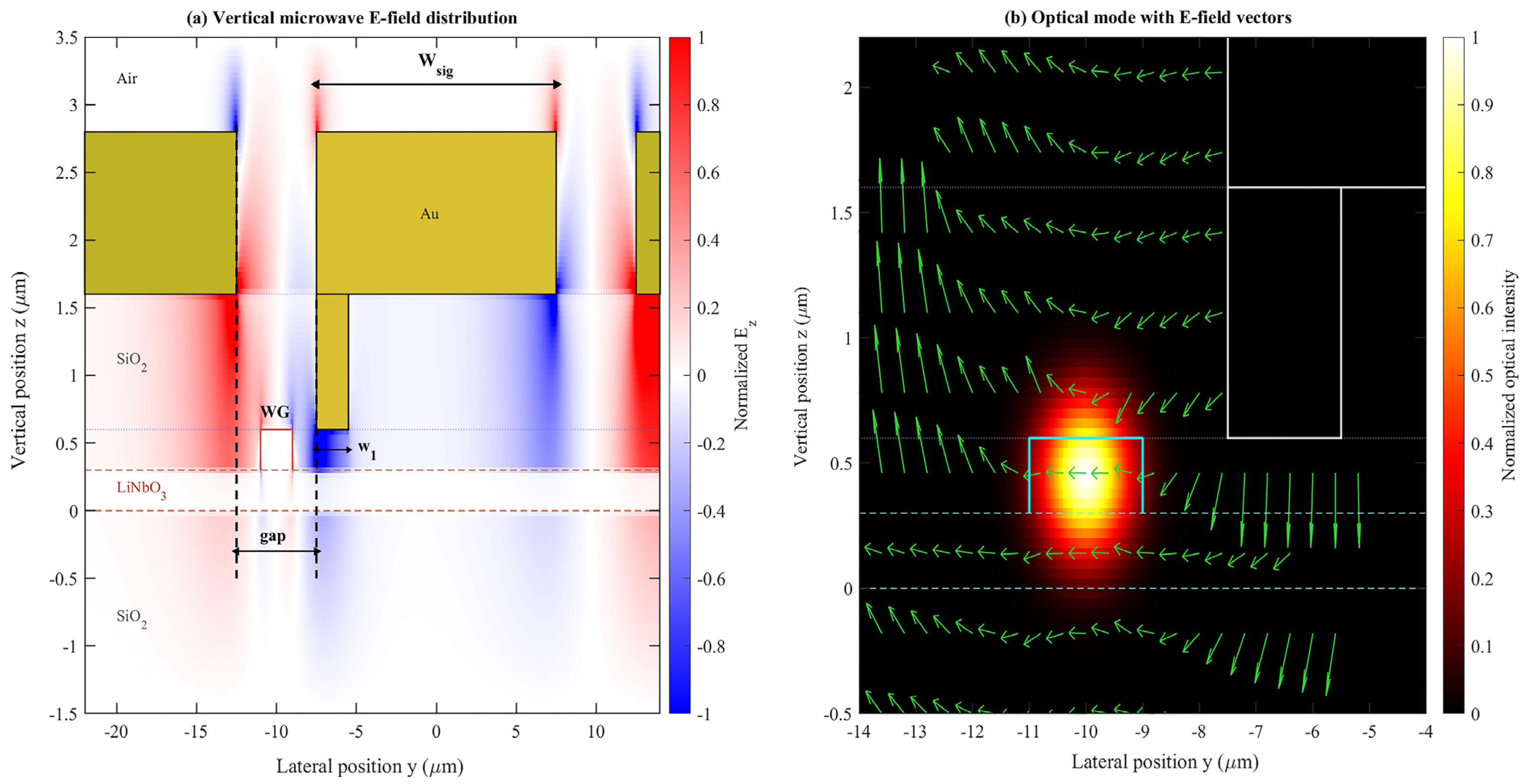
For a direct physical interpretation of the electro-optic interaction overlap analysis performed subsequently, Figure 10 shows the microwave electric field distribution and the optical mode distribution within the modulation region, where the standard geometrical dimensions are Wsig = 15 μm, d0 = 1.2 μm, dsio2up = 1.0 μm, w1 = 2.0 μm, and gap = 5 μm. These values are derived from full-wave simulations carried out by HFSS and COMSOL at frequencies 10 GHz and 1550 nm, respectively.
Figure 10a indicates that the vertical component of the electric field is strongly focused at the interface region of the signal electrode, with an asymmetric concentration toward the left side where the L-type extension contacts the lithium niobate surface. The lateral extension of the electric field penetrates the gap where the ridge waveguide lies. The simulation results in Figure 10b show that the optical mode propagating inside the ridge waveguide is spatially coincident with this high-density microwave field region, which directly proves the electro-optic interaction responsible for the modulation process.
The two-dimensional sweep results indicate that V π L increases linearly with increasing gap, whereas the optical absorption loss decreases exponentially. The gap is set to 5   μ m , and an etching depth of 0.3   μ m results in a V π L of 2.173   V · c m with an optical absorption loss of 0.013   d B / c m . An increase in the etching depth to 0.5   μ m results in a V π L of 3.028   V · c m with an optical absorption loss of approximately 1.7 × 10 5   d B / c m , which is close to 0. For a gap of 5 μ m , the two parameters are within the acceptable engineering limits, i.e., less than 0.3 μ m , V π L remains below 2.2   V · c m , whereas the optical absorption loss remains below 0.02   d B / c m , thus satisfying the modulation efficiency and optical absorption loss constraints. However, if the gap exceeds 6 μ m , though the loss becomes smaller, the increase in V π L results in a degradation of modulation efficiency beyond the acceptable engineering limits. The gap of 5 μ m is thus identified as the optimized point, where the tradeoff between driving efficiency and optical absorption loss occurs, with an etching depth of 0.3 μ m being chosen to achieve a high modulation efficiency with near-zero optical absorption loss.
Combining the impedance–velocity dual optimum defined in Section 3.1; the auxiliary parameter optimum values defined in Section 3.2 as d 0 = 1.2   μ m , d s i o 2 u p = 1.0   μ m , and w 1 = 1.0   μ m ; and the optical constraint defined in this section as g a p = 5   μ m , the optimized system parameters converge to the following values: W s i g = 15   μ m , d 0 = 1.2   μ m , d s i o 2 u p = 1.0   μ m , w 1 = 2.0   μ m , g a p = 5   μ m , and etching depth =   0.3   μ m . The validation parameters for the full system use w 1 = 2.0   μ m , as defined in the baseline system configuration and utilized for the parametric sweep optimization defined in Section 3.1, allowing direct comparison between the validated system performance and the reference defined in the parametric sweep. These parameters yield the optimized performance at the point of intersection between the constraint boundaries defined in four physical parameters: impedance matching, velocity, high-frequency loss, and optical modulation.

3.4. Full-System Performance Validation

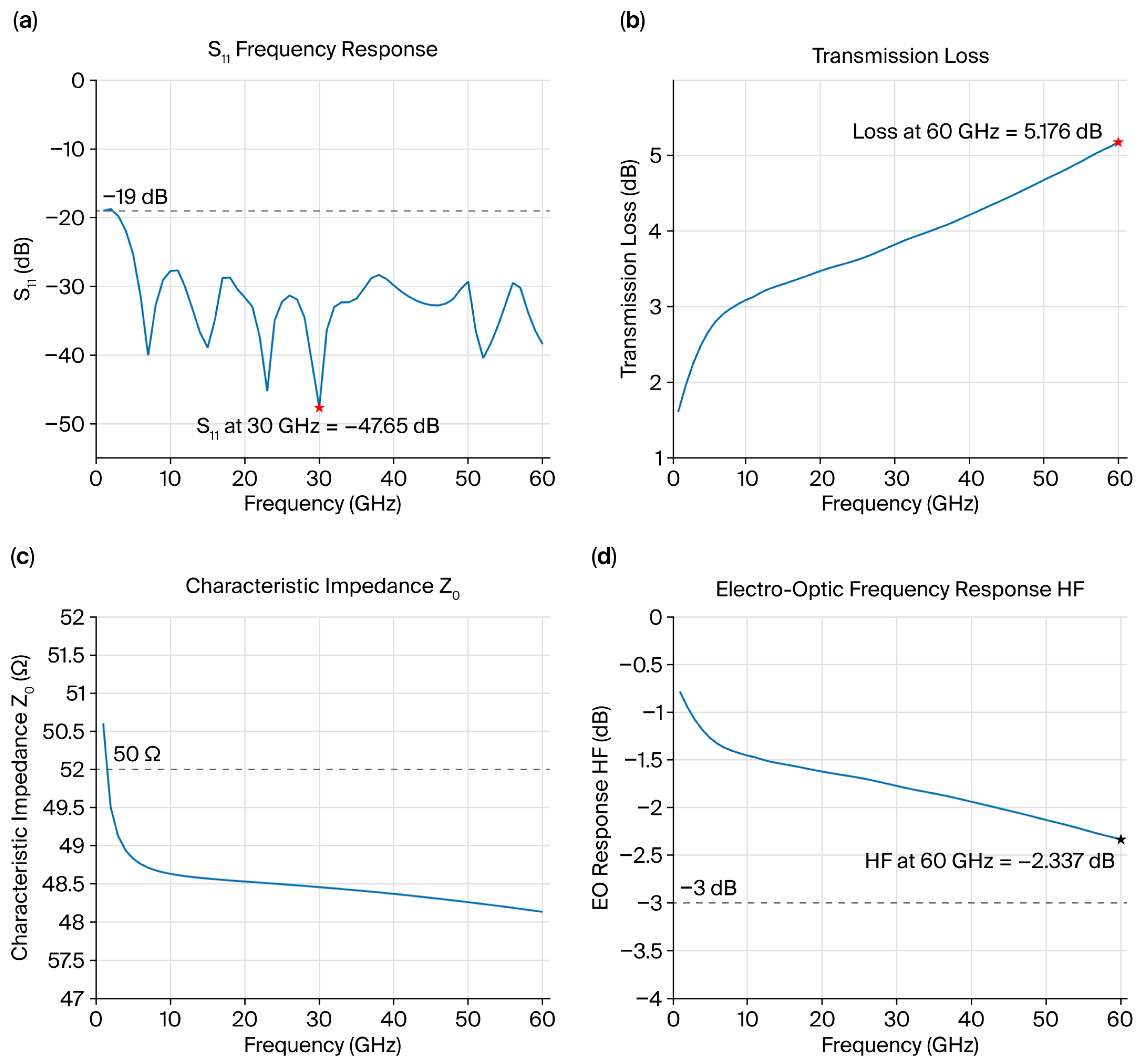
While single-parameter sweeps provide insight into the independent influence of each of the geometric parameters on the performance of each of the microwave parameters, the actual performance obtained from the combined influence of all parameters needs to be verified through a full-system simulation. The optimized design parameters, i.e., W s i g = 15   μ m , w 1 = 2.0   μ m , d 0 = 1.2   μ m , d s i o 2 u p = 1.0   μ m , g a p =   5.0   μ m , and L d = 10   m m , were used as inputs to create a full-system electromagnetic model of the L-type traveling-wave Mach–Zehnder modulator in HFSS, and broadband microwave performance simulation was performed over a frequency range of 1 to 60 G H z , with an excitation scheme and boundary conditions identical to those used in Section 2.2. The full-system simulation will simultaneously extract the performance of the microwave device, with Figure 11a–d depicting the simulation results for each of the performance parameters.
Figure 11a clearly shows that S11 decreases to below −19 d B at 3 G H z and reaches the optimal level at 30 G H z , where S11 is −47.65 d B . This further confirms the effective suppression of port reflection over the entire range. Figure 11b clearly shows the monotonic increase in transmission loss, reaching 5.176 d B at 60 G H z , as shown in the figure. This is lower than the minimum transmission loss obtained in the entire range, due to the synergy effect in which all the geometrical parameters reach the optimal level in the entire system configuration. Figure 11c clearly shows the sharp decrease in Z 0 at low frequencies, followed by a stable range of 48.1–50.6 Ω over the entire range, close to the 50 Ω standard. Figure 11d clearly shows the monotonic decrease in the electro-optical frequency response HF, reaching −2.337 d B at 60 G H z , which is well above the −3 d B level, confirming the electro-optical bandwidth of no less than 60 G H z . The full-system validation outcomes presented above demonstrate that the optimal L-type structure meets the required impedance match and velocity loss balance for wideband electro-optic behavior beyond 60 GHz when using the conventional unloaded traveling-wave electrode structure. This further validates the efficacy of the multi-parametric design approach formulated in Section 3.1, Section 3.2 and Section 3.3.
To make the parametric analysis more succinct and useful for engineering, Table 2 provides a summary of all six optimized geometric parameters along with their respective performance criteria, sensitivity coefficients, functionality, and design rule assignment.
Table 2 combines all six factors into one table, which allows easy determination of the ideal geometry and clarification of the order of precedence for the four design guidelines. In particular, guideline R1 sets the impedance base using W s i g , guideline R2 tunes the loss with respect to this base using d 0 , while guidelines R3 and R4 together affect the high-frequency loss margin without changing the impedance match.
In addition to the internal consolidation reflected in the parameter summary in Table 2, the relevance of the developed design rules from an engineering perspective is best understood through comparison with other recently reported TFLN traveling-wave modulators. Table 3 shows the key performance parameters for this study, together with typical values reported in the literature. These include the conventional coplanar waveguide structure and the silicon–lithium niobate hybrid system with enhanced buffer structures, as well as the slow-light traveling-wave system.
As illustrated in Table 3, the current L-type configuration achieves an electro-optic bandwidth of at least 60 GHz without loading and a modulation efficiency of 2.173 V·cm over a length of 10 mm. Such performance is consistent with the envelope behavior of traditional TFLN traveling-wave configurations. On the other hand, the low modulation efficiency of below 0.3 V·cm V π L together with the bandwidths above 100 GHz, characterizes the regime of structural acceleration that is different from the typical L-type operation rules defined herein.

4. Discussion

The systematic simulations in Section 3 validate four design rules, which are physically independent and follow a clear priority order in the design process: W s i g establishes the impedance; d 0 refines the loss within the impedance constraint; and d s i o 2 u p and w 1 act as impedance-neutral parameters. This hierarchy of decoupled design parameters is a novel methodological contribution to the parametric design of L-type TFLN modulators. R1 specifies the dominant tuning parameter for Z 0 as W s i g , and the effective range of 15 to 17 μ m as an effective 50 Ω window. The unilateral topology of the L-type electrode makes the impedance more sensitive to the signal electrode width than in the symmetric CPW structures. In fact, while the use of signal electrode width as a first-order impedance tuning parameter has cross-structural generality [27], the sensitivity of the impedance to variations in the signal electrode width in the L-type electrode structure makes the dimensional accuracy more critical. According to rule R2, d0 is in the interval 1.2–1.3 μ m , which simultaneously meets the constraints on impedance matching and minimizing high-frequency loss. Increasing d 0 reduces the sheet resistance of the conductor layer, thus minimizing low-frequency ohmic loss, but at high frequency, the skin effect causes this to saturate, and the increase in fringing field radiation loss with increasing d 0 results in a local minimum in loss at 60 G H z ; the existence of an optimal window in electrode thickness was observed in TFLN modulator structures of different substrates [28], and the interval 1.2–1.3 μ m , which was obtained in this work, is derived directly from simulation data of the L-type structure. These values are of engineering guidance value.
Both rules R3 and R4 have the property of impedance neutrality, but the mechanisms and engineering significance of these rules are quite different, with R4 being especially unique. d s i o 2 u p modulates due to dielectric isolation, in which the increase in the upper cladding thickness reduces the leakage of high-frequency electromagnetic fields into the substrate, and the symmetric changes in the equivalent transmission-line capacitance and inductance ensure the stability of the impedance. This is in agreement with the experimental results showing an improvement in high-frequency performance when the buffer layer is optimized in broadband TFLN modulators [25], whose nature is naturally impedance-neutral due to symmetry. In contrast, the impedance neutrality of w 1 is a consequence of the effects of changes in contact width on the equivalent capacitance and inductance being roughly equal but opposite so that Z 0 is largely insensitive to w 1 , although the high-frequency loss is seen to have a strongly non-monotonic dependence on w 1 , with w 1 = 1.0   μ m giving the lowest high-frequency loss, although impedance is still fully neutral—a feature that is not a necessary consequence of symmetry but is a non-obvious consequence of the coupling relationship between the equivalent parameters under particular circumstances at the L-type electrode base. Verification of the impedance neutrality of the contact width in L-type electrodes is still lacking in the literature [29]; rule R4 is therefore the most novel of the four rules described above, providing a fully decoupled high-frequency loss-tuning degree of freedom after impedance optimization is complete.
The phenomenon of non-monotonic behavior at high frequencies discussed in Section 3.1 and Section 3.2 is due to the interaction between ohmic losses in the conducting wire, radiation losses from fringing fields, and polarization losses in the surrounding SiO2 cladding. The weight of these loss factors depends on frequency and electrode shape, such that the benefit of having a large cross-sectional area at lower frequencies, in terms of reduced ohmic losses, gradually becomes less favorable than radiation and polarization losses with increasing frequencies. Similar features regarding loss competition have been described in different substrate geometries for TFLN modulators [30]; the current study provides deeper insight into this competition scheme with respect to the parameters involved in the L-type electrode structure. An anomalous increase in the refractive index due to microwaves, coupled with a loss peak occurring at w 1 = 3.5 μm with its corresponding deviation at W s i g = 14 μm, offers three potential explanations for this phenomenon. Each explanation requires clear differentiation from the others, rather than a general classification of dispersion. Coupling to the parasitic substrate mode cannot be ruled out, since resonances on the substrate have fixed frequencies based on the silicon handle structure; however, the anomalies change their positions as w 1 and W s i g , indicating that they are related to the electrode geometry rather than any substrate eigenfrequency. The activation of high-order modes of traveling waves does not occur because wave-port excitation only couples to the fundamental quasi-TEM mode in the simulation band. In addition, the transmission plots do not exhibit any spectral discontinuity over the entire parameter range, which would indicate mode mixing. Numerical resonance associated with the full-wave solver can be ruled out because of the uniformity of the S-parameter tolerance in each pass during adaptive mesh refinement, and the peculiarities manifest at certain geometric positions rather than isolated frequencies where mesh artifacts occur. The residual and self-consistent interpretation represents a perturbation of the mode field distribution within the confines of geometry, which results in a higher microwave refractive index and increased high-frequency radiation losses. This is similar to the dispersion effects that occur in contact geometry in slow-wave electrodes [31].
The structural superiority of the L-type design compared to the classical symmetric CPW arrangement is evident from the compromise between the gap and the modulation efficiency. With the symmetric CPW structure, the overlap between the electric field and the optic field is mainly dependent on the lateral gap between the signal and the ground electrodes; therefore, for high modulation efficiency, the gap needs to be reduced, resulting in high optical absorption losses. L-type topology addresses this problem by using a portion of the electric field in the vertical direction through the one-sided extension. This is justified by the value of V π L = 2.173 V·cm at a gap of 5 μm, with an optical absorption loss of just 0.013 dB/cm. This study utilizes a physical-mechanics model wherein the absence of vertical height would limit the modulation area to lateral fringe fields only, thus decreasing the electro-optic interaction for the same separation while boosting the V π L ratio above 2.173 V·cm. Both the impedance and RF loss properties are of similar magnitudes due to the constant major current flow channel in the signal electrode. However, a separate side-by-side simulation using the same material structure is required to support this assertion, as explained in the limitations section below.
Regarding the performance positioning, the current design has H F   =   2.337   d B at 60 G H z , verifying the electro-optic bandwidth of no less than 60 G H z , which is competitive with the recently reported TFLN modulators using optimized electrode topologies [32]. The transmission loss of 5.176 d B at 60 G H z for the 10 m m device length is within the reasonable range for L-type structures and corresponds to the optimized insertion loss. V π L = 2.173   V · c m provides high modulation efficiency while meeting the optical loss constraint, outperforming the design with the sacrifice of modulation efficiency by increasing the gap to reduce optical absorption loss [33]. Some recently conducted experiments have managed to expand the electro-optic bandwidth by using low-dielectric-constant filler materials [26,34]. Nonetheless, considering the higher degree of difficulty involved, this is a different type of technique compared with the rules set up using the L-type electrodes discussed here and hence cannot be directly compared based on similar measures of performance. The most significant limitation associated with this analysis is its reliance on full-wave electromagnetic and finite-element optical simulations, lacking any experimental fabrication or testing. The validity of the quantified results depends on three factors: (i) convergence of adaptive meshes for the provided S-parameters and eigenmodes; (ii) consistency of convergent design parameters within two different simulation regimes, where optimization of the 5 µm gap not only fulfills the impedance matching requirement at the optical frequency but also achieves microwave efficiency without further adjustment; and (iii) compatibility of the claimed performance envelope with fabrication results for traditional TFLN traveling-wave architectures reported in the literature. Scope limitations include the absence of an internal CPW full-wave analysis for the same material stack, where the structural behavior of the L-type network can only be described using physical phenomena but not through side-by-side benchmarking. The logical progression of the study through simulations would be as follows: fabrication of the device and testing of the convergence structure; introduction of thermal loads and variation effects into an enhanced model; and direct comparison of CPW and L-type structures on the same TFLN technology.
Concerning experimental viability, the optimized parameters W s i g = 15   μ m , d 0 = 1.2   μ m , d s i o 2 u p = 1.0   μ m , w 1 = 2   μ m , g a p = 5   μ m , and ridge etching depth is 0.3 μm, falling well within the process parameter space that is readily achievable using current TFLN device manufacturing facilities. The optimized parameters only require routine photolithographic patterning processes for micrometer-sized electrode widths, gold electroplating for submicrometer electrode thicknesses, and ridge etching depths within those typically used in fabricated TFLN devices. There is another engineering consequence of the above parameter hierarchy. The impedance-neutralizing auxiliary parameters compensate for any dimensional errors arising from etching or deposition by leveraging high-frequency loss tolerance, rather than compensating for them in the initial 50 Ω matching state. This brings the process tolerance within an acceptable range. The logical progression includes the optimization of the existing model by incorporating thermal stress, variation statistics, and manufacturing- and testing-related issues. This will help unify the design rules formulated in this study.

5. Conclusions

This study presents a systematic parametric investigation of signal electrode width W s i g and three auxiliary geometric parameters in an L-type traveling-wave lithium niobate Mach–Zehnder modulator, combining HFSS microwave simulation over 1 to 60 G H z with COMSOL optical mode analysis to establish a comprehensive simulation-to-design-rules pathway. The parametric sweep of W s i g across 11 to 19 μ m reveals that W s i g simultaneously governs characteristic impedance, microwave refractive index, and transmission loss in a coupled manner, with W s i g = 15   μ m identified as the dual optimum, satisfying both the 50 Ω impedance matching window and the minimum velocity mismatch condition within the impedance-matched interval. Systematic characterization of the auxiliary parameters yields three complementary design rules: d 0 = 1.2 1.3   μ m simultaneously minimizes high-frequency loss and satisfies the impedance constraint; d s i o 2 u p = 1.0   μ m suppresses substrate-leakage loss without perturbing impedance; and w 1 = 1.0   μ m achieves the lowest high-frequency loss while maintaining complete impedance neutrality, constituting one of the key findings of this work. The optical co-design analysis establishes g a p   =   5   μ m as the optimal tradeoff between modulation efficiency ( V π L   =   2.173   V · c m ) and optical absorption loss ( 0.013   d B /cm at 0.3   μ m etching depth).
Full-system validation under the converged design parameters confirms S11 below −19 d B from 3 G H z onward, with an optimal value of −47.65 d B at 30 G H z , characteristic impedance stabilized within 48.1–50.6 Ω , a transmission loss of 5.176 d B at 60 G H z , and an electro-optic frequency response of −2.337 d B at 60 G H z , verifying an electro-optic bandwidth of no less than 60 G H z . The four quantitative design rules distilled from these results, namely, W s i g for impedance baseline determination, d 0 for loss–impedance co-optimization, and d s i o 2 u p together with w 1 for independent fine-grained loss tuning, are directly applicable to the engineering design of L-type TFLN modulators without iterative full-system re-simulation. Extending the existing design technique from 60 GHz to beyond 100 GHz involves accounting for losses associated with substrate leakage and surface roughness of conductors because these effects dominate the behavior of high-frequency designs. In addition, the substrate should be replaced with one that does not have appreciable losses, as dielectric absorption becomes significant when the frequency exceeds 60 GHz. Combining the extended loss modeling with driver co-design represents the logical extension of the study presented here.

Author Contributions

Conceptualization, Y.L. (Yingbo Liu); methodology, Y.L. (Yingbo Liu); software, Y.H.; validation, Y.L. (Yingbo Liu) and H.L.; formal analysis, Y.L. (Yingbo Liu); investigation, Y.H.; resources, H.L.; data curation, L.Q.; writing—original draft preparation, Y.L. (Yingbo Liu); writing—review and editing, Y.L. (Yingbo Liu); visualization, Y.L. (Yue Li); supervision, Y.L. (Yue Li); project administration, Y.H.; funding acquisition, H.L. All authors have read and agreed to the published version of the manuscript.

Funding

This research was funded by the National Natural Science Foundation of China (No. 62174041), the Guangxi Science and Technology Plan Project (AD24010060), and the Guangxi Science and Technology Base and Talent Special Project (Guike AD24010060).

Data Availability Statement

The data presented in this study are available upon request from the corresponding author.

Acknowledgments

We thank the National Natural Science Foundation of China, the Guangxi Natural Science Foundation, the GUET Graduate Education Innovation Project for partial funding, and the National Key R&D Program of China.

Conflicts of Interest

Authors Yue Li and Liangpeng Qin were employed by the 34th Research Institute of China Electronics Technology Group Corporation. The remaining authors declare that the research was conducted in the absence of any commercial or financial relationships that could be construed as a potential conflict of interest.

References

  1. Zhu, D.; Shao, L.; Yu, M.; Cheng, R.; Desiatov, B.; Xin, C.; Hu, Y.; Holzgrafe, J.; Ghosh, S.; Shams-Ansari, A. Integrated photonics on thin-film lithium niobate. Adv. Opt. Photonics 2021, 13, 242–352. [Google Scholar] [CrossRef]
  2. Hu, Y.; Zhu, D.; Lu, S.; Zhu, X.; Song, Y.; Renaud, D.; Assumpcao, D.; Cheng, R.; Xin, C.; Yeh, M. Integrated electro-optics on thin-film lithium niobate. Nat. Rev. Phys. 2025, 7, 237–254. [Google Scholar] [CrossRef]
  3. Wang, C.; Zhang, M.; Chen, X.; Bertrand, M.; Shams-Ansari, A.; Chandrasekhar, S.; Winzer, P.; Lončar, M. Integrated lithium niobate electro-optic modulators operating at CMOS-compatible voltages. Nature 2018, 562, 101–104. [Google Scholar] [CrossRef] [PubMed]
  4. He, M.; Xu, M.; Ren, Y.; Jian, J.; Ruan, Z.; Xu, Y.; Gao, S.; Sun, S.; Wen, X.; Zhou, L. High-performance hybrid silicon and lithium niobate Mach–Zehnder modulators for 100 Gbit s−1 and beyond. Nat. Photonics 2019, 13, 359–364. [Google Scholar] [CrossRef]
  5. Xu, M.; Zhu, Y.; Pittalà, F.; Tang, J.; He, M.; Ng, W.C.; Wang, J.; Ruan, Z.; Tang, X.; Kuschnerov, M. Dual-polarization thin-film lithium niobate in-phase quadrature modulators for terabit-per-second transmission. Optica 2022, 9, 61–62. [Google Scholar] [CrossRef]
  6. Wang, Z.; Chen, G.; Ruan, Z.; Gan, R.; Huang, P.; Zheng, Z.; Lu, L.; Li, J.; Guo, C.; Chen, K. Silicon–lithium niobate hybrid intensity and coherent modulators using a periodic capacitively loaded traveling-wave electrode. Acs Photonics 2022, 9, 2668–2675. [Google Scholar] [CrossRef]
  7. Jin, M.; Chen, J.; Sua, Y.; Kumar, P.; Huang, Y. Efficient electro-optical modulation on thin-film lithium niobate. Opt. Lett. 2021, 46, 1884–1887. [Google Scholar] [CrossRef]
  8. Liu, L.; Liu, N.; Zhang, J.; Zhu, Z.; Liu, K. High performance electro-optic modulator based on thin-film lithium niobate. Optoelectron. Lett. 2022, 18, 583–587. [Google Scholar] [CrossRef]
  9. Nelan, S.P.; Mercante, A.; Shi, S.; Yao, P.; Shahid, E.; Shopp, B.; Prather, D.W. Integrated lithium niobate intensity modulator on a silicon handle with slow-wave electrodes. IEEE Photonics Technol. Lett. 2022, 34, 981–984. [Google Scholar] [CrossRef]
  10. Sun, S.; He, M.; Xu, M.; Gao, S.; Yu, S.; Cai, X. Hybrid silicon and lithium niobate modulator. IEEE J. Sel. Top. Quantum Electron. 2020, 27, 3300112. [Google Scholar] [CrossRef]
  11. Han, H.; Yang, F.; Liu, C.; Wang, Z.; Jiang, Y.; Chai, G.; Ruan, S.; Xiang, B. High-performance electro-optical Mach–Zehnder modulators in a silicon nitride–lithium niobate thin-film hybrid platform. Photonics 2022, 9, 500. [Google Scholar] [CrossRef]
  12. Fang, X.; Yang, F.; Chen, X.; Li, Y.; Zhang, F. Ultrahigh-speed optical interconnects with thin film lithium niobate modulator. J. Light. Technol. 2022, 41, 1207–1215. [Google Scholar] [CrossRef]
  13. Pan, B.; Hu, J.; Huang, Y.; Song, L.; Wang, J.; Chen, P.; Yu, Z.; Liu, L.; Dai, D. Demonstration of high-speed thin-film lithium-niobate-on-insulator optical modulators at the 2-µm wavelength. Opt. Express 2021, 29, 17710–17717. [Google Scholar] [CrossRef]
  14. Yu, L.; Shang, J.; Luo, K.; Lin, Q.; Chen, H.; Qiu, W.; Guan, H.; Lu, H. Design of high-speed mid-infrared electro-optic modulator based on thin film lithium niobate. IEEE Photonics J. 2022, 14, 6621506. [Google Scholar] [CrossRef]
  15. Li, H.; Tang, Y.; Chen, Q.; Dai, X.; Li, X.; Lu, M.; Lu, Q.; Guo, W. Compact thin-film lithium niobate modulators using slotted coplanar waveguide electrode suitable for high-volume fabrication. J. Phys. D Appl. Phys. 2023, 56, 154001. [Google Scholar] [CrossRef]
  16. Chen, G.; Wang, H.; Chen, B.; Ruan, Z.; Guo, C.; Chen, K.; Liu, L. Compact slow-light waveguide and modulator on thin-film lithium niobate platform. Nanophotonics 2023, 12, 3603–3611. [Google Scholar] [CrossRef] [PubMed]
  17. Ordouie, E.; Jiang, T.; Zhou, T.; Juneghani, F.A.; Eshaghi, M.; Vazimali, M.G.; Fathpour, S.; Jalali, B. Differential phase-diversity electrooptic modulator for cancellation of fiber dispersion and laser noise. Nat. Commun. 2023, 14, 6065. [Google Scholar] [CrossRef]
  18. Wang, M.; Qi, L.; Wang, H.; Ruan, Z.; Chen, G.; Chen, B.; Gong, S.; Chen, K.; Liu, L. Robust thin-film lithium niobate modulator on a silicon substrate with backside holes. Chin. Opt. Lett. 2024, 22, 050601. [Google Scholar] [CrossRef]
  19. Luo, X.; Gu, Z.; Wang, C.; Fan, C.; Zhang, W. Large-Bandwidth Lithium Niobate Electro-Optic Modulator for Frequency-Division Multiplexing RFID Systems. Electronics 2024, 13, 5054. [Google Scholar] [CrossRef]
  20. Yang, T.; Cai, L.; Huang, Z.; Zhang, L. High-Linearity Dual-Parallel Mach–Zehnder Modulators in Thin-Film Lithium Niobate. Photonics 2024, 11, 987. [Google Scholar] [CrossRef]
  21. Liu, H.; Zhu, M.; Liu, L.; Dai, D. Photonics Breakthroughs 2024: Lithium-niobate photonics for dense wavelength-division multiplexing. IEEE Photonics J. 2025, 17, 6600907. [Google Scholar] [CrossRef]
  22. Weigel, P.O.; Valdez, F.; Zhao, J.; Li, H.; Mookherjea, S. Design of high-bandwidth, low-voltage and low-loss hybrid lithium niobate electro-optic modulators. J. Phys. Photonics 2021, 3, 012001. [Google Scholar] [CrossRef]
  23. Kharel, P.; Reimer, C.; Luke, K.; He, L.; Zhang, M. Breaking voltage–bandwidth limits in integrated lithium niobate modulators using micro-structured electrodes. Optica 2021, 8, 357–363. [Google Scholar] [CrossRef]
  24. Deng, C.; Zhu, L.; Lu, M.; Sun, Y.; Huang, L.; Wang, D.; Hu, G.; Yun, B.; Cui, Y. Design and simulation of high modulation efficiency, low group velocity dispersion lithium niobate slow-wave electro-optic modulator based on a fishbone-like grating. Opt. Laser Technol. 2023, 158, 108769. [Google Scholar] [CrossRef]
  25. Valdez, F.; Mere, V.; Wang, X.; Boynton, N.; Friedmann, T.A.; Arterburn, S.; Dallo, C.; Pomerene, A.T.; Starbuck, A.L.; Trotter, D.C. 110 GHz, 110 mW hybrid silicon-lithium niobate Mach–Zehnder modulator. Sci. Rep. 2022, 12, 18611. [Google Scholar] [CrossRef] [PubMed]
  26. Shen, J.; Zhang, Y.; Zhang, L.; Li, J.; Feng, C.; Jiang, Y.; Wang, H.; Li, X.; He, Y.; Ji, X. Highly Efficient Slow-Light Mach–Zehnder Modulator Achieving 0.21 V cm Efficiency with Bandwidth Surpassing 110 GHz. Laser Photonics Rev. 2025, 19, 2401092. [Google Scholar] [CrossRef]
  27. Chen, G.; Chen, K.; Gan, R.; Ruan, Z.; Wang, Z.; Huang, P.; Lu, C.; Lau, A.P.T.; Dai, D.; Guo, C. High performance thin-film lithium niobate modulator on a silicon substrate using periodic capacitively loaded traveling-wave electrode. APL Photonics 2022, 7, 026103. [Google Scholar] [CrossRef]
  28. Liu, X.; Xiong, B.; Sun, C.; Hao, Z.; Wang, L.; Wang, J.; Han, Y.; Li, H.; Luo, Y. Capacitively-loaded thin-film lithium niobate modulator with ultra-flat frequency response. IEEE Photonics Technol. Lett. 2022, 34, 854–857. [Google Scholar] [CrossRef]
  29. Arab Juneghani, F.; Gholipour Vazimali, M.; Zhao, J.; Chen, X.; Le, S.T.; Chen, H.; Ordouie, E.; Fontaine, N.K.; Fathpour, S. Thin-film lithium niobate optical modulators with an extrapolated bandwidth of 170 GHz. Adv. Photonics Res. 2023, 4, 2200216. [Google Scholar] [CrossRef]
  30. Valdez, F.; Mere, V.; Wang, X.; Mookherjea, S. Integrated O-and C-band silicon-lithium niobate Mach–Zehnder modulators with 100 GHz bandwidth, low voltage, and low loss. Opt. Express 2023, 31, 5273–5289. [Google Scholar] [CrossRef]
  31. Du, Y.; Zou, X.; Zou, F.; Pan, W.; Yan, L.; Zhao, Q.; Liu, N. Novel Folded Structure TFLN Recycling Phase Modulator Enabling Large Low-Vπ Bandwidth and Efficient Microwave–Optical Velocity Matching. Laser Photonics Rev. 2024, 18, 2400787. [Google Scholar] [CrossRef]
  32. Yang, P.; Sun, S.; Zhang, Y.; Cao, R.; He, H.; Xue, H.; Liu, F. High-bandwidth lumped Mach–Zehnder modulators based on thin-film lithium niobate. Photonics 2024, 11, 399. [Google Scholar] [CrossRef]
  33. Liu, Y.; Li, H.; Li, Y.; Li, H.; Hao, Y.; Qin, L.; Yang, J. High-speed electro-optic modulator with group velocity matching on silicon substrate. Front. Bioeng. Biotechnol. 2025, 13, 1626017. [Google Scholar] [CrossRef]
  34. Yin, Y.; Yang, M.; Ju, T.; Yang, W.; Li, Y.; Li, H. High-Speed Thin-Film Lithium Niobate Modulator Based on Novel Dual-Capacitor Electrode Design. Electronics 2025, 15, 89. [Google Scholar] [CrossRef]
Figure 1. Schematic cross-section of the L-type TWE-MZM signal modulation region, indicating the unidirectional vertical expansion of the signal electrode along with the five key geometric parameters.
Photonics 13 00502 g001
Figure 2. Two-dimensional contour map of V π L as a function of etching depth and electrode gap.
Photonics 13 00502 g002
Figure 3. Transmission loss as a function of frequency for W s i g   =   11 to 19   μ m .
Photonics 13 00502 g003
Figure 4. Characteristic impedance Z 0 as a function of frequency for W s i g   =   11 to 19   μ m , with a 50   Ω reference line.
Photonics 13 00502 g004
Figure 5. Microwave refractive index n as a function of frequency for W s i g = 11 to 19   μ m , with an n o p t = 2.14 reference line.
Photonics 13 00502 g005
Figure 6. Analytically (anal.) estimated EO frequency response across W s i g = 11 19   μ m and full-system HFSS validation at W s i g = 15   μ m . (a) Normalized EO frequency response vs. frequency for W s i g = 11 19   μ m . (b) EO response at 60 GHz vs. signal electrode width W s i g .
Photonics 13 00502 g006
Figure 7. Transmission loss and characteristic impedance Z 0 as functions of frequency for d 0   =   0.8 1.8   μ m . (a) Transmission loss vs. frequency for d 0   =   0.8 1.8   μ m . (b) Characteristic impedance Z 0 vs. frequency for d 0   =   0.8 1.8   μ m .
Photonics 13 00502 g007
Figure 8. Transmission loss and characteristic impedance Z 0 as functions of frequency for d s i o 2 u p = 0.5 1.0   μ m . (a) Transmission loss vs. frequency for d s i o 2 u p = 0.5 1.0   μ m . (b) Characteristic impedance Z 0 vs. frequency for d s i o 2 u p = 0.5 1.0   μ m .
Photonics 13 00502 g008
Figure 9. Transmission loss, characteristic impedance Z 0 , and microwave refractive index n as functions of frequency for w 1 = 0.5 5.0   μ m . (a) Transmission loss vs. frequency for w 1 = 0.5 5.0   μ m . (b) Characteristic impedance Z 0 vs. frequency for w 1 = 0.5 5.0   μ m . (c) Microwave refractive index nm vs. frequency for w 1 = 0.5 5.0   μ m .
Photonics 13 00502 g009
Figure 10. Normalized vertical microwave electric field distribution across the L-type TWE-MZM modulation region and fundamental TE optical mode intensity profile with superimposed microwave electric field vectors at the baseline design parameters.
Photonics 13 00502 g010
Figure 11. Full-system simulation results for the final design parameters. (a) S11 vs. frequency; (b) Transmission loss vs. frequency; (c) Characteristic impedance Z0 vs. frequency; (d) Electro-optical frequency response HF vs. frequency.
Photonics 13 00502 g011
Table 1. Baseline values and sweep ranges of the geometric parameters of the L-type TWE-MZM.
ParameterSymbolSweep RangeBaseline Value
Signal electrode width W s i g 11 19   μ m 15   μ m
Electrode–waveguide contact width w 1 0.5 5.0   μ m 2   μ m
Traveling-wave electrode thickness d 0 0.8 1.8   μ m 1.2   μ m
SiO2 upper cladding thickness d s i o 2 u p 0.5 1.0   μ m 1.0   μ m
Electrode gap g a p 3 8   μ m 5   μ m
Etching depth- 0.3 0.5   μ m 0.3   μ m
Ground electrode width W r f i n - 65   μ m
Modulator length L d -10,000 μm
Table 2. Summary of optimal geometric parameters and their governing performance metrics, impedance sensitivity, physical roles, and associated design rules for the L-type traveling-wave TFLN Mach–Zehnder modulator.
ParameterOptimal ValueDominant Performance Metric Z 0 SensitivityPhysical RoleDesign Rule
W s i g 15 μm (window 15–17 μm) Z 0 matching and velocity matching Strong   ( Z 0 = 55.40 Ω at 11 μm to 47.73 Ω at 19 μm, 1 GHz)Controls current cross-section, fringing-field coverage, and velocity balance.R1
d 0 1.2–1.3 μm α   at   60   GHz   under   Z 0 constraintModerate and monotonic with d0Modulates sheet resistance and fringing-radiation saturationR2
d s i o 2 u p 1.0 μmα at 60 GHz, impedance-neutral Negligible   relative   to   W s i g   and   d 0 Provides dielectric isolation from the silicon substrate.R3
w 1 1.0 μm for loss minimum, 2.0 μm in full-system validationα at 60 GHz, fully impedance-neutral None   ( Z 0   within   50.2 51.4   Ω   at   1   GHz   for   all   w 1 )Tunes contact-interface field distribution with opposing L–C variations.R4
gap5 μm V π L and optical absorption loss-Governs electro-optic overlap and optical absorptionOptical constraint
Etching depth0.3 μm V π L -Sets electro-optic overlap with the applied field.Optical constraint
Table 3. Performance comparison of the optimized L-type TFLN MZM with representative TFLN traveling-wave modulators reported in the literature.
ReferenceElectrode TopologyEO BandwidthVπLDevice LengthValidation
Wang et al. [3]Standard CPW on TFLN-≈1 V·cm class-Fabrication
He et al. [4]Hybrid Si–LN MZM≥100 GHz--Fabrication
Valdez et al. [25]Hybrid Si–LN with optimized buffer layer110 GHz--Fabrication
Shen et al. [26]Slow-light MZM>110 GHz0.21 V·cm-Fabrication
This workL-type standard traveling-wave≥60 GHz
(HF@60 GHz = −2.337 dB)
2.173 V·cm10 mmSimulation
Disclaimer/Publisher’s Note: The statements, opinions and data contained in all publications are solely those of the individual author(s) and contributor(s) and not of MDPI and/or the editor(s). MDPI and/or the editor(s) disclaim responsibility for any injury to people or property resulting from any ideas, methods, instructions or products referred to in the content.