


Abstract
Multi-photoelectric tracking systems (MPTSs) provide high-precision line-of-sight (LOS) angles for long-range passive tracking, with each photoelectric tracking system (PTS) delivering bearing-only measurements. In practice, image-based target extraction and optical–mechanical pointing may suffer from intermittent errors when highly maneuverable targets are observed, thereby degrading tracking accuracy. To address this issue, we consider a time-varying uncertain dynamics model with a lumped uncertainty and its temporal difference. A centralized twice-extended state Kalman filter (CTESKF) is proposed to augment the kinematic state with the lumped uncertainty and its temporal difference, yielding a Kalman-type recursion with a computable covariance upper bound. Building on this, a diffusion-based twice-extended state Kalman filter (DTESKF), which combines local updates with single-round covariance-intersection diffusion fusion, is proposed to achieve distributed filtering with limited communication cost. Simulation results show that CTESKF and DTESKF achieve competitive accuracy–efficiency trade-offs in a weakly nonlinear setting and a 3D bearing-only MPTS scenario.
1. Introduction
Photoelectric tracking systems (PTSs) are passive imaging sensors that provide high-precision line-of-sight (LOS) information and are widely used in target tracking, long-range surveillance, space object observation, and optical communication terminals [1,2,3,4,5]. After image processing and LOS extraction, a typical PTS outputs bearing-only measurements, usually azimuth and elevation angles. Because direct range information is unavailable or unreliable at long distances, especially for dim targets or under adverse atmospheric conditions, bearing-only tracking is inherently nonlinear and strongly dependent on the sensor–target geometry. As a result, a single PTS may suffer from poor observability, slow convergence, and biased state estimates under unfavorable motion configurations. In particular, it is well known that a single observer moving at constant velocity cannot determine the target range without additional maneuvers.
A natural way to alleviate this observability bottleneck is to deploy multiple spatially separated PTS nodes to observe the same target. By introducing geometric diversity, a multi-photoelectric tracking system (MPTS) can recover information that is inaccessible to an individual sensor and thereby improve localization accuracy and tracking robustness [6,7,8]. However, converting this geometric advantage into reliable network-level estimation requires an effective fusion architecture. Although centralized fusion can, in principle, process all measurements directly, it usually imposes a heavy communication burden and creates a single point of failure. For this reason, distributed filtering is particularly attractive for MPTSs operating over sensor networks.
Designing a distributed filter for bearing-only MPTSs is nevertheless challenging for three main reasons. First, the measurement model is strongly nonlinear: the mapping from Cartesian coordinates to azimuth and elevation involves arctangent and square-root operations, and it may become ill-conditioned when the target is close to the sensor boresight or when the relative geometry is degenerate. Second, practical target motion often contains time-varying nonlinear uncertainty, such as target maneuvers, unmodeled dynamics, and environmental disturbances. If such uncertainty is not adequately represented, the filter may become overconfident or even diverge; this problem is especially severe in bearing-only tracking because the measurements provide only weak constraints on range and velocity. Third, sensor networks usually operate under communication constraints. Although consensus-based schemes can approach centralized performance through multiple rounds of information exchange within each sampling period [9,10,11], such multi-round protocols are often impractical for MPTS with limited bandwidth, non-negligible latency, or strict duty-cycle constraints.
Against this background, distributed Kalman filtering has been extensively studied for sensor networks, with consensus and diffusion representing two major paradigms [9,10,11,12,13]. Compared with consensus strategies, diffusion methods perform a local update followed by a single fusion step and are therefore better suited to real-time operation under limited communication [12]. A central difficulty, however, is that local estimates are generally correlated, whereas the corresponding cross-correlation terms are rarely available. Covariance intersection (CI) provides a consistent way to fuse correlated Gaussian estimates without requiring those cross-correlations explicitly, albeit at the price of some conservativeness [13]. Building on this idea, representative distributed nonlinear filters such as the distributed extended Kalman filter (DEKF), distributed unscented Kalman filter (DUKF), and distributed cubature Kalman filter (DCKF) combine local nonlinear updates with diffusion or consensus fusion. Nevertheless, these methods still rely mainly on a nominal motion model to capture the dominant target dynamics. When the target is subject to rapidly varying or poorly modeled uncertainty, their estimation accuracy can degrade substantially.
A complementary line of research is extended state estimation. The extended state observer (ESO) regards unknown dynamics as an augmented state and estimates the state online [14]. In stochastic settings, extended state Kalman filters (ESKFs) augment the state vector with a lumped uncertainty term and have shown improved robustness for uncertain nonlinear systems [15,16,17]. Distributed ESKF methods have also been investigated for networked estimation problems. He et al. proposed a distributed ESKF for stochastic uncertain systems under quantized data flows over switching sensor networks [18], and Peng et al. developed a distributed ESKF for complex networks with nonlinear uncertainty [19]. Liang et al. further analyzed the consistency and stability of distributed ESKF under uncertain dynamics [20]. More recently, Lin et al. studied distributed state estimation for nonlinear uncertain systems under estimate-based round-robin communication protocols and cyber attacks [21]. These distributed ESKF methods usually augment the original system with a single lumped uncertainty state. Such a structure is effective when the unknown dynamics vary slowly or can be locally approximated as constant. However, for rapidly time-varying uncertainty, a single augmented uncertainty state may not adequately capture the temporal evolution of the unknown dynamics, which can lead to model mismatch and overconfident covariance estimates. This limitation becomes particularly restrictive in bearing-only MPTSs, where weak range observability makes the estimators highly sensitive to dynamic uncertainty.
Motivated by the above observations, this paper studies distributed filtering for bearing-only MPTSs with time-varying dynamic uncertainty. We propose a centralized twice-extended state Kalman filter (CTESKF) and its distributed counterpart, the diffusion-based twice-extended state Kalman filter (DTESKF). The main idea is to augment the kinematic state not only with a lumped uncertainty term but also with its first-order temporal difference, while treating the second-order temporal difference as an injected uncertainty. In this way, the proposed framework can track time-varying nonlinear uncertainty more explicitly than existing extended state formulations while retaining a Kalman-type recursive structure with consistency guarantees.
The main contributions are:
- We develop a twice-extended state model that estimates an unknown time-varying nonlinear uncertainty together with its first-order temporal difference online, thereby improving the representation of rapidly varying dynamics.
- For centralized estimation, we derive a computable covariance upper-bound recursion under bounded second-order temporal differences of the uncertainty. The resulting CTESKF preserves a Kalman-type predictor–corrector structure while maintaining consistency.
- For distributed estimation, we construct the DTESKF by combining local twice-extended state filtering with a single-round CI-based diffusion fusion rule. The fusion is implemented in information form and does not require knowledge of inter-node cross-correlations, which makes it suitable for bandwidth-limited MPTSs.
- Numerical simulations, including a nonlinear uncertain benchmark, a parameter-sensitivity study, and a 3D bearing-only MPTS scenario, demonstrate that the proposed filters improve estimation accuracy and robustness under time-varying uncertainties while retaining competitive computational efficiency.
The remainder of this paper is organized as follows. Section 2 formulates the uncertain dynamics and the MPTS bearing-only measurement model. Section 3 presents the CTESKF and its covariance upper bound. Section 4 develops the DTESKF with CI-based diffusion fusion. Section 5 analyzes consistency properties of the DTESKF. Section 6 provides numerical simulations for multi-photoelectric tracking. Section 7 concludes the paper.
- Notation
denotes the n-dimensional real vector space. I denotes an identity matrix with appropriate dimension. For a vector x, is the Euclidean norm; for a matrix X, is the induced 2-norm. For symmetric matrices , means is positive semidefinite. A connected undirected graph has node set ; the local fusion set of node i is denoted by when introduced. For an angle , denotes wrapping to ; for an angle vector, the wrapping is applied element-wise.
2. Problem Formulation
2.1. Nonlinear Uncertain Discrete-Time Dynamics
We consider a discrete-time nonlinear uncertain system over ,
where is the state and is zero-mean Gaussian process noise with covariance . We assume that admits the affine-in-uncertainty structure
where is a lumped nonlinear uncertainty capturing unmodeled dynamics, parametric drift, and residual nonlinearities. This structure is natural in kinematic tracking: denotes a nominal linear model, while represents unknown accelerations or maneuvering inputs.
2.2. MPTS Bearing-Only Measurement Model
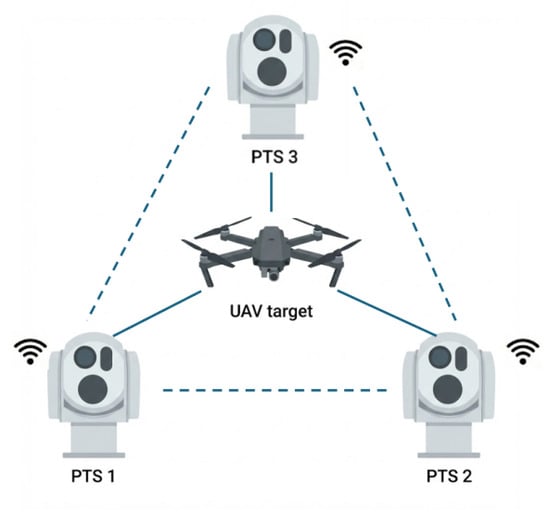
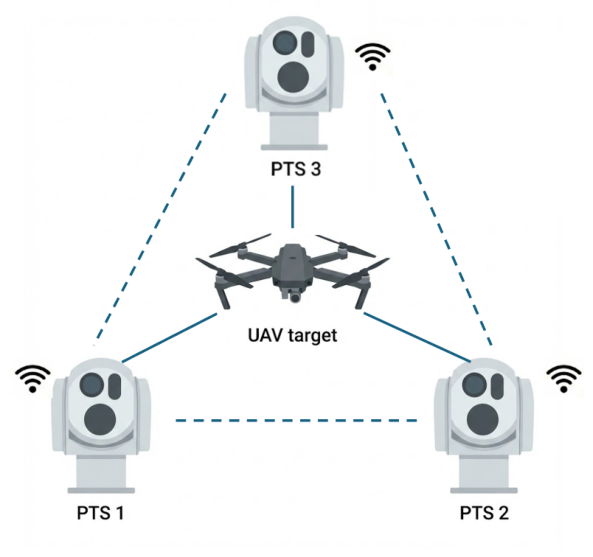
The MPTS consists of M PTS devices and is shown in Figure 1. Each PTS measures the direction of the target relative to its own location. Let PTS i be located at a known position . For 3D tracking, we adopt a 6D kinematic state
where and denote position and velocity.
Figure 1.
Schematic of an MPTS with 3 PTS devices. The dotted lines indicate the communication links, and the solid lines indicate bearing measurements between the PTS devices and the target.
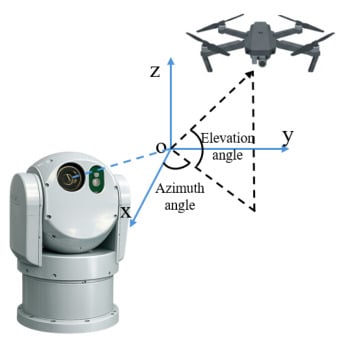
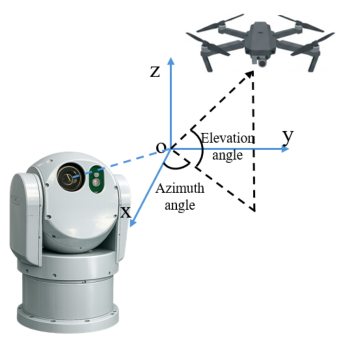
Each PTS i first extracts the target from its camera image and then outputs azimuth and elevation angles using the optical–mechanical pointing/encoder information, as illustrated in Figure 2.
where , and is the measurement noise. Define the relative vector and . The PTS bearing observation function is defined as
Figure 2.
Bearing -only measurement geometry of a single PTS device.
Because angles are periodic, the innovation should be computed with wrapping:
where wraps each component to .
2.3. Local Linearization for Bearing-Only Measurements
To keep the core filter structure and analysis tractable, we let
denote the Jacobian. For the bearing-only model in Equation (5), has nonzero entries only in the position components and admits a closed form as
Using a first-order Taylor approximation,
Based on the above primary model, we will develop the CTESKF and DTESKF in the next sections.
3. Centralized Twice-Extended State Kalman Filter Formulation
3.1. Twice-Extended State Augmentation
Define the augmented state
where and . Using and , the augmented dynamics become
where . Based on the local linearization in Equation (8), the augmented measurement equation is approximated as
In implementation, the update uses the Jacobian together with the wrapped innovation in Equation (6). For the covariance analysis, we consider the corresponding linearized measurement model and write it compactly as . Therefore, the augmented system is
Let , , and . The measurements can then be stacked as
Define the stacked innovation . For bearing-only measurements, each is computed by angle wrapping in Equation (6); for a linear measurement model, .
Define the lifted process noise covariance for the augmented system as
We make the following assumptions concerning the initial state and the uncertainty variation.
Assumption 1.
where , , and is known.
Assumption 2.
where is known and uniformly bounded. Moreover, for the covariance analysis, is measurable with respect to the information available up to time k, and is treated as an exogenous uncertainty sequence that is uncorrelated with and .
Assumption 3.
The augmented pair is uniformly observable.
Remark 1.
The theoretical development of the CTESKF and DTESKF relies on mild boundedness and observability assumptions, which are stated in Assumptions 1–3 after the augmented model is fully specified. Here we briefly interpret them for MPTS tracking. Assumption 2 only bounds the second-order temporal difference , rather than requiring the lumped uncertainty itself to be small. This matches the twice-extended design: and are estimated as augmented states, while is treated as the remaining bounded injection. In MPTS tracking, may represent target maneuver acceleration, residual atmospheric disturbance, or image-extraction modeling error. Qualitatively, the bound characterizes how rapidly the variation trend of this lumped uncertainty can change between adjacent sampling instants. More aggressive target maneuvers, stronger disturbance fluctuations, or intermittent image-extraction errors generally require a larger bound. For the same continuous-time uncertainty, a larger sampling interval also leads to a larger discrete second-order difference because more variation is accumulated between samples, whereas smoother motion or faster sampling allows a smaller bound. Assumption 3 requires the augmented pair to be uniformly observable. In bearing-only tracking, observability is a collective property: a single station provides only LOS angles, but multiple stations with non-collinear baselines, together with informative target motion, can render the overall system observable. In practice, geometry degeneracy (e.g., nearly collinear stations or near-stationary LOS) should be avoided through sensor placement and scheduling.
3.2. Centralized Twice-Extended State Kalman Filter
We implement the CTESKF in a Kalman predictor–corrector form, which aligns with the distributed algorithm in Section 4 and avoids sign ambiguities in observer-form gains.
- Saturation-based uncertainty injection:
Define the element-wise saturation function for as
applied componentwise for vectors. The bounded second-difference injection is
where is a nominal second-difference estimate of , computed componentwise for .
- Measurement update:
Introduce an effective measurement covariance
which will be used in the upper-bound recursion. Given the prior pair , compute
- Time update:
Define the uncertainty-induced covariance inflation terms
and
Then the predicted estimate and covariance upper bound are
Theorem 1 (Computable covariance upper bound).
Under Assumptions 1 and 2, the recursion in Equations (24)–(28) yields a consistent covariance upper bound in the sense that
Proof.
Let denote the prior error and denote the injection mismatch. For the linearized measurement model used in the analysis, . Hence, from Equation (23), the posterior error is
Using Equations (13) and (27), the one-step prediction error becomes
Taking second moments and using the independence of from yields
First, by Assumption 2 and the saturation bound in Equation (20),
For any , . Hence,
Moreover, the componentwise saturation in Equation (20) gives
Therefore,
Second, for the cross terms, apply the matrix Young inequality: for any ,
Let and . Taking expectations gives
Combining Equations (32)–(37), using the inductive hypothesis (true at by Assumption 1), and noting , we obtain
which proves Equation (29). □
Remark 2.
Unlike the standard Riccati recursion, Equation (28) includes an inflation factor and an additional term for the bounded injection mismatch. This is necessary because is not modeled as Gaussian noise but only bounded in mean square. The parameter θ is therefore a free positive tuning parameter introduced by the Young-inequality split. Although the covariance upper-bound inequality holds for any , different choices redistribute conservativeness between the state-propagation inflation and the uncertainty-injection term. In the simulations, we choose a nominal initial value by a trace-balance heuristic. At , this heuristic balances the two θ-dependent contributions as
which gives
Hence, we summarize the CTESKF as follows in Algorithm 1.
| Algorithm 1 CTESKF algorithm (predictor–corrector form) |
| 1: Inputs: 2: Initialization: 3: for do 4: Compute bounded injection via Equation (20) 5: Set 6: Compute innovation using Equation (6) for bearing-only measurements; for linear measurements, . 7: Measurement update: 8: Time update: 9: end for |
The CTESKF requires aggregating all measurements at a fusion center, incurring heavy communication cost and creating a single point of failure. Prior distributed Kalman designs embed consensus on observation or information pairs, but often need many exchanges within one sampling period. Since communication is typically more energy-intensive than computation, excessive rounds are impractical. Hence, it is necessary to design a distributed filter that can operate with limited communication resources.
4. Diffusion-Based Twice-Extended State Kalman Filter
We consider distributed measurements over a connected graph with a row-stochastic mixing matrix . Each node runs a local filter step and then performs a single-round fusion with neighbors via a CI-type diffusion rule.
4.1. Network Model and Diffusion Weights
The communication graph is with . Let denote the weight node i assigns to neighbor j. Define the neighbor set . We use standard diffusion weight conditions, which imply primitivity when combined with connectivity for undirected graphs.
Assumption 4.
The undirected graph is connected. The weight matrix satisfies
Moreover, W is primitive, i.e., there exists such that has all entries strictly positive.
Remark 3.
For a connected undirected graph, common choices such as Metropolis weights yield a primitive row-stochastic matrix W. Primitivity is essential to ensure that information from any node diffuses to the entire network in finite steps.
Remark 4.
We intentionally use fixed row-stochastic diffusion weights rather than optimizing CI weights at every sampling instant [22]. Fixed weights keep the fusion rule simple, avoid solving an online constrained optimization problem, and preserve a deterministic single-round communication schedule and computation load, which facilitates deployment on embedded PTS nodes. Optimized CI weighting can reduce conservativeness by minimizing objectives such as or , but it introduces additional local optimization at each sampling instant. For the nearly symmetric ring topology considered here, where neighboring PTS nodes have comparable sensing quality, fixed weights are expected to offer a favorable accuracy–complexity trade-off. We therefore adopt fixed weights in the main DTESKF design and regard adaptive CI weighting as an important extension.
4.2. Local Filter Structure
Node i observes , where comes from the local linearization in Equation (8). To streamline analysis, we rewrite the local TESKF in a predictor–corrector form with an effective measurement covariance , consistent with Section 3.
Let denote node i’s prior estimate and its associated covariance upper bound at time k after diffusion fusion at time k. Define the local innovation
which reduces to for a linear measurement model.
- Measurement update (local correction):
- Time update (local prediction with uncertainty injection):
Define the bounded injection using Equation (20). Let
Then the local predicted estimate is
and the corresponding covariance upper bound is propagated as
Remark 5.
The pair is computed locally using only and then shared once with neighbors for diffusion fusion. No inner-loop consensus iterations are required.
4.3. Diffusion Fusion via Covariance Intersection
After the local prediction, each node i broadcasts its information pair to neighbors and then fuses the received pairs together with its own pair in the CI form:
The fused pair becomes the prior for the next sampling time and the whole DTESKF algorithm is summarized in Algorithm 2.
| Algorithm 2 DTESKF algorithm |
| 1: Inputs: , mixing weights 2: Initialization (each node i): , 3: for do 4: Compute local bounded injection componentwise using Equation (20) 5: Set 6: Compute local innovation using Equation (6) for bearing-only measurements; for linear measurements, . 7: Local measurement update: 8: Local time update: 9: Broadcast: Send to neighbors 10: CI diffusion fusion: 11: end for |
Remark 6.
After local corrections, the estimation errors across nodes become correlated due to common process noise and repeated information exchange. CI fusion guarantees a conservative but consistent covariance bound without requiring any knowledge of cross-correlations. This makes it suitable for diffusion with a single communication per step.
4.4. Communication Cost of One-Round Diffusion
Table 1 summarizes the per-step communication cost of different fusion strategies. Let denote the augmented-state dimension and let be the number of neighbors of node i. If symmetry of the information matrix is exploited, then node i transmits
real scalars per sampling instant, because it broadcasts one symmetric information matrix and one information vector to each neighbor. Thus the communication cost scales linearly with node degree and remains independent of any inner-loop iteration count. By contrast, an L-round consensus strategy operating on the same information pair would require scalars per step. For the 3D MPTS experiment, and each node has two neighbors in the ring graph, so DTESKF sends 180 scalars per node per step, whereas a five-round consensus protocol would require 900 scalars. Therefore, we adopt the one-round CI diffusion as the main fusion strategy in DTESKF to achieve a favorable accuracy–communication trade-off.
Table 1.
Per-step communication cost of different fusion strategies in Experiment 2.
5. Consistency Analysis of DTESKF
We analyze DTESKF in terms of consistency. The propagated matrices are designed as upper bounds for the true error covariance, accounting for uncertainty injection and unknown inter-sensor correlations.
5.1. Consistency Definition
Definition 1 (Consistency).
Let be an estimate of ξ and be an associated covariance matrix. The pair is consistent if
5.2. Local Filter Consistency
Theorem 2.
Under Assumptions 1–2, for each node i and each time k,
Proof.
The local update steps (Lines 6 and 7 in Algorithm 2) for each node i are mathematically identical to the CTESKF recursion (Algorithm 1) acting on the local measurement pair with noise covariance . Since Assumptions 1 and 2 hold, the derivation in Theorem 1 applies directly to the local filter at each node. Specifically, the local predicted covariance is constructed using the same scaling factors and injection bounds as in Equation (28). Therefore, by Theorem 1, the local prediction satisfies the consistency condition in Equation (53). □
5.3. CI Diffusion Fusion Preserves Consistency
We now prove that the CI diffusion rule in Equations (49) and (50) preserves consistency even when cross-correlations between local predictors are unknown.
Lemma 1 (Two-estimate CI consistency).
Let be two estimates of ξ with errors and . Assume and for some , while the cross-correlation is unknown. For any , define the CI fusion
Then is consistent: .
Proof.
Let , , and . From Equation (55), the fused error is
Hence,
Because the joint covariance of is positive semidefinite, for any scalar we have
which implies the matrix inequality
Choose . Substituting Equation (59) into Equation (58) yields
which completes the proof. □
Theorem 3 (Multi-estimate CI consistency).
Fix time . Suppose that for each neighbor , the local predicted pair is consistent: Then the CI fused pair defined by Equations (49) and (50) is also consistent:
Proof.
Suppress the time index and fix node i. Enumerate the positive-weight set and denote weights , so that and . Define and , so that and .
We prove consistency by induction using Lemma 1. Let , which is consistent by assumption. For , let and define the normalized weights . Fuse the consistent pair with via Lemma 1 using weight , i.e.,
Lemma 1 guarantees that is consistent.
It remains to show that equals the one-shot CI fusion in Equations (49) and (50). By construction, ; hence
Similarly, the recursion for yields . Therefore, , which is consistent. □
Remark 7.
Theorems 2 and 3 together imply that all DTESKF pairs remain consistent for all values of k, provided Assumptions 1 and 2 and the graph condition in Assumption 4 hold.
6. Numerical Simulation
This section validates the proposed CTESKF and DTESKF framework through two experiments. Experiment 1 uses a low-dimensional nonlinear uncertain system with linear measurements to isolate the effect of the proposed algorithms. Experiment 2 considers the target application: a 3D MPTS, where each PTS device provides bearing-only measurements and the target experiences velocity-dependent maneuver accelerations. Unless otherwise stated, all algorithms were implemented on a laptop equipped with an AMD Ryzen 9 8945HX CPU (2.50 GHz).
6.1. Experiment 1: Nonlinear Uncertain System with Linear Measurements
We consider the nonlinear discrete-time system
where , s, and with . The nominal nonlinear model used by the filters is . To test robustness against model mismatch, the true plant further includes a smooth unmodeled input in the nonlinear channel. This term is not provided to the filters and is treated as part of the lumped model uncertainty. The initial state is and the running time is set to .
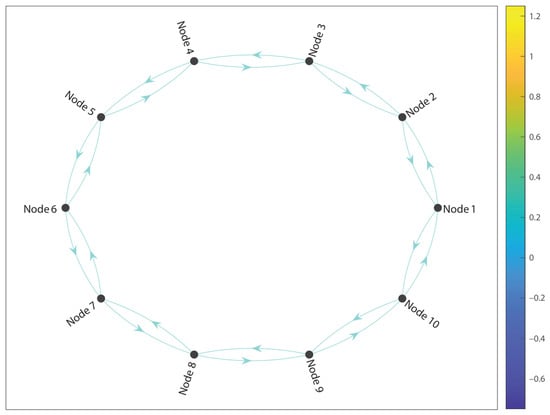
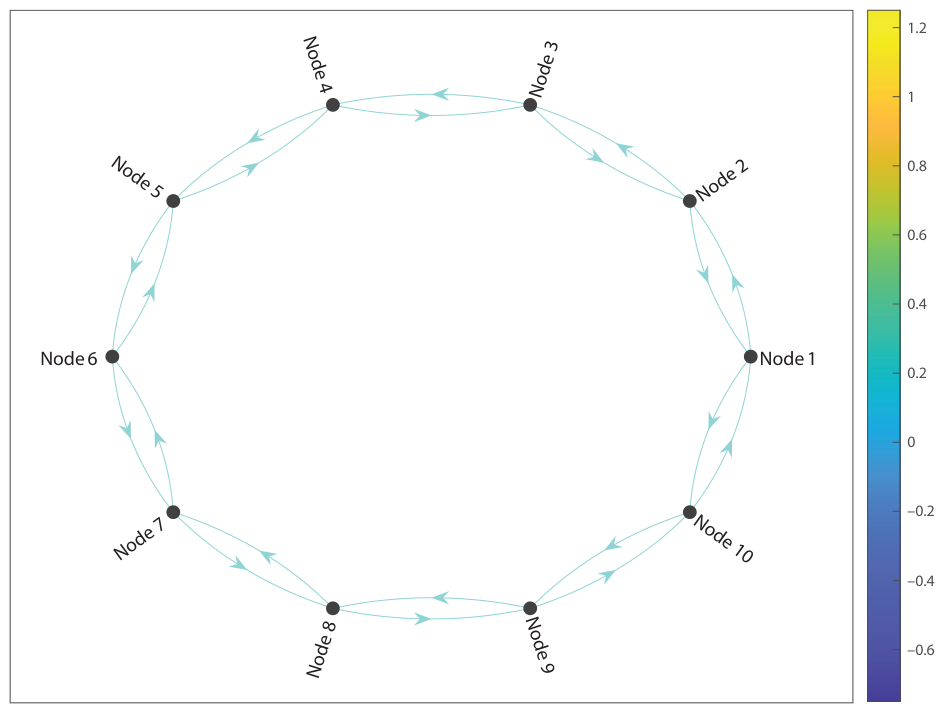
The sensor network has nodes arranged in the ring topology of Figure 3. Each node i observes the first state component,
with and for all i. The communication graph is undirected and connected, with diffusion weights and for the two neighbors of node i. The CTESKF and DTESKF are implemented with the same uncertainty bound .
Figure 3.
Network topology structure (ring graph with nodes).
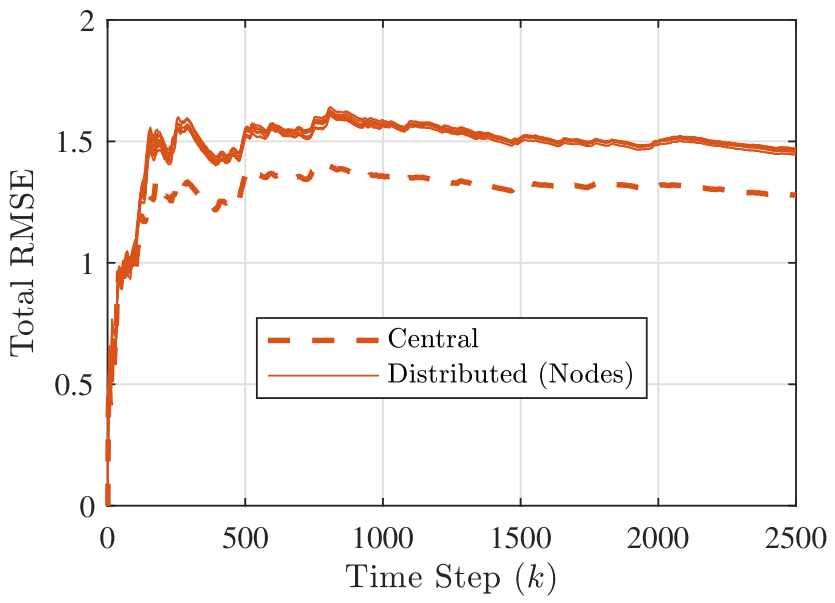
Let denote the estimate produced by node i at time k. For centralized algorithms, we treat the estimator as a single node (). The reported running root mean square error (RMSE) is the node-averaged metric
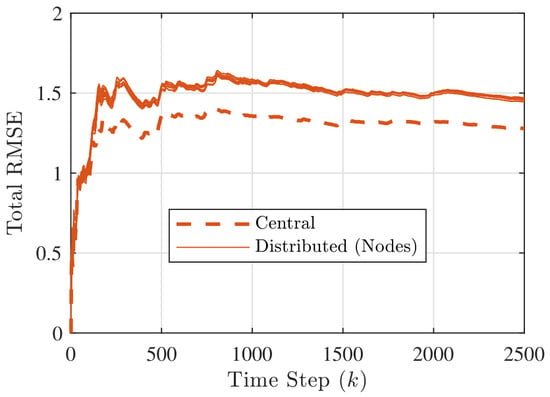
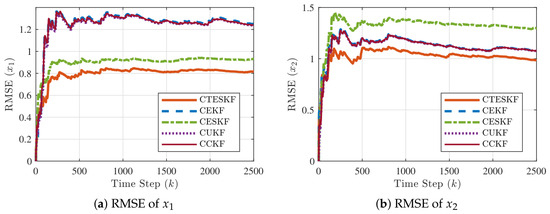
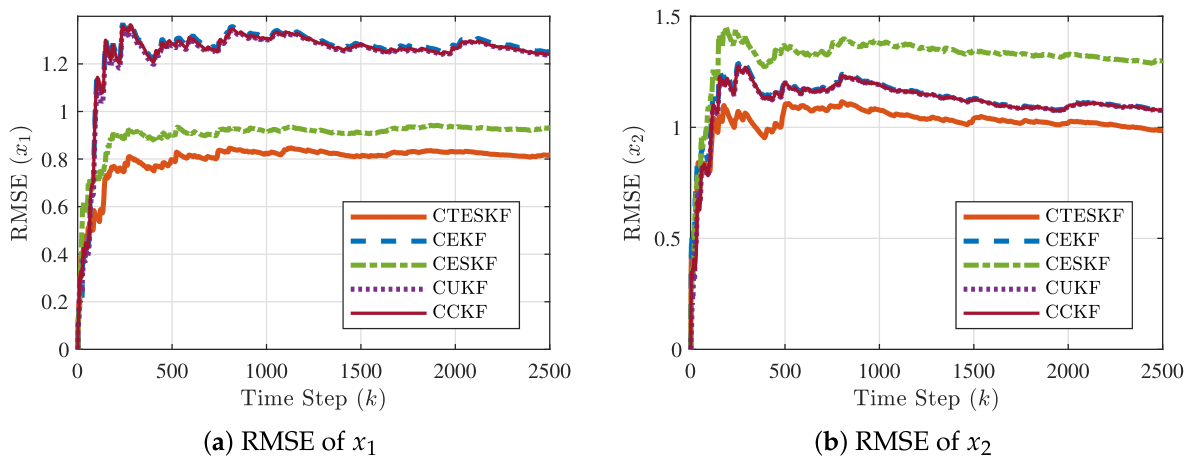
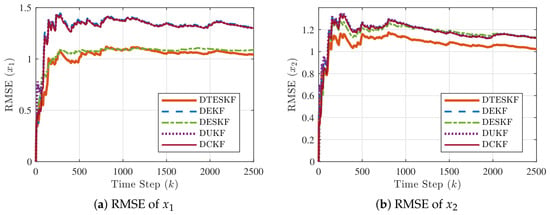
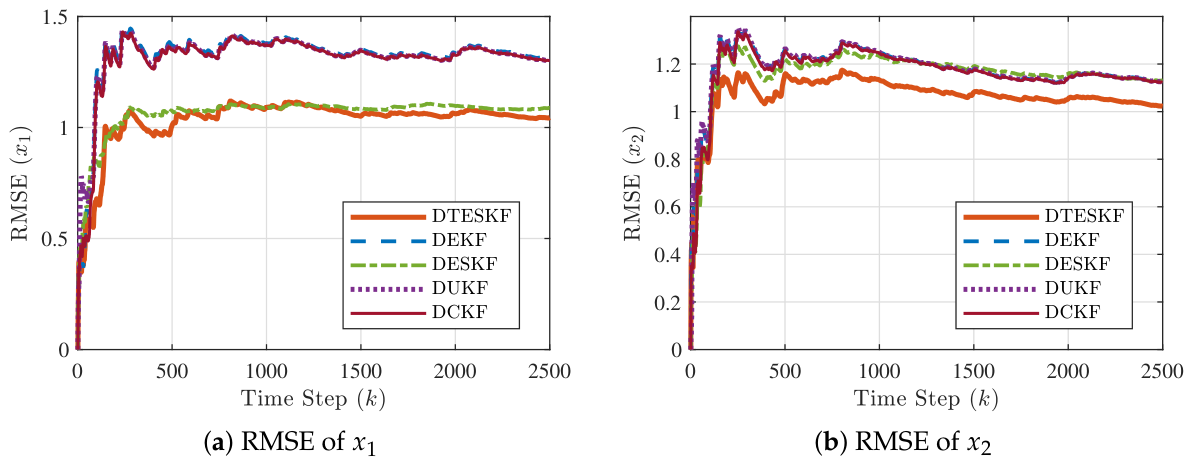
Figure 4 compares the CTESKF and DTESKF using the metric in Equation (64). The DTESKF attains an RMSE close to that of the CTESKF, with a modest performance loss that is expected from the diffusion strategy. Figure 5 and Figure 6 further compare the proposed methods with centralized and distributed nonlinear Kalman filters. The running RMSE and time cost are shown in Table 2. Overall, the CTESKF achieves accuracy close to CKF while being computationally lighter, and the DTESKF provides a competitive accuracy–runtime trade-off relative to the DUKF and DCKF under the same diffusion strategy. Overall, the proposed methods achieve a better balance between accuracy and efficiency, which makes them more practical for real-time applications.
Figure 4.
Running RMSE comparison of CTESKF and DTESKF in Experiment 1.
Figure 5.
RMSE comparison of centralized algorithms in Experiment 1.
Figure 6.
RMSE comparison of distributed algorithms in Experiment 1.
Table 2.
RMSE and time cost comparison of different algorithms in Experiment 1.
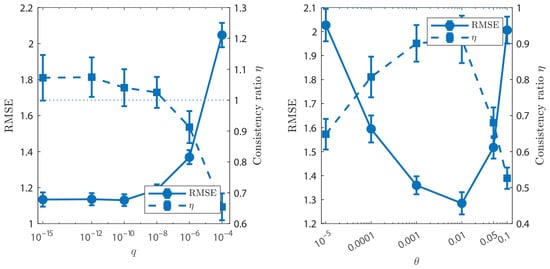
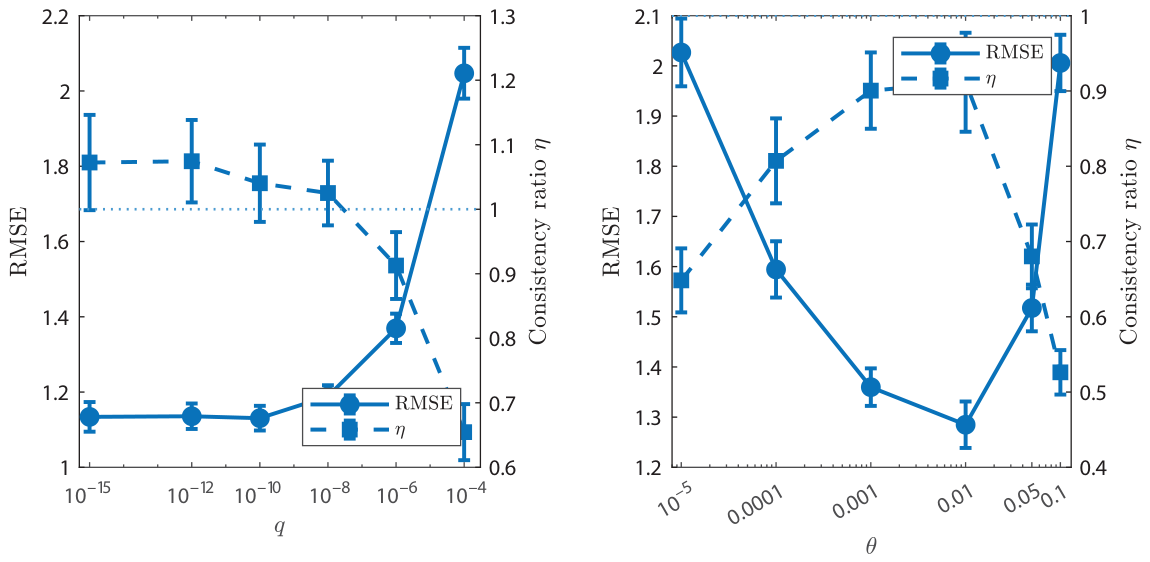
We further evaluate the influence of the uncertainty-injection bound and the covariance-inflation parameter on estimation accuracy and covariance consistency. A 40-run Monte Carlo sensitivity study is conducted for the CTESKF on the same benchmark by varying non-negligible common scalar values q with and different values of . Figure 7 reports the kinematic RMSE together with an empirical consistency ratio
where is the propagated covariance upper bound and indicates that the empirical error covariance exceeds the assumed bound. The results show that smaller values of q may reduce the RMSE in this weakly nonlinear case, but they can also lead to an optimistic covariance bound (). Increasing q improves consistency, and makes close to one with only moderate loss of accuracy. Thus, choosing q too small can be interpreted as underestimating the uncertainty-injection bound. In practical deployment, q should be initialized conservatively according to the expected maneuver intensity and sampling interval, and then increased when consistency indicators, such as on validation data, reveal optimistic covariance. For fixed , choosing in the range – provides the best balance between accuracy and conservativeness, which is consistent with Remark 2. These observations are consistent with Assumption 2: stronger or faster-varying uncertainty requires a larger bound , represented by a larger scalar q in this sensitivity study. The role of is instead governed by the covariance upper-bound recursion in Remark 2; in this benchmark, a moderate balances accuracy and conservativeness.
Figure 7.
Sensitivity of the CTESKF to the uncertainty-injection bound q and the covariance-inflation parameter in Experiment 1. The dashed curve is the empirical consistency ratio defined in (65); values above one indicate that the assumed bound is too optimistic.
6.2. Experiment 2: 3D Photoelectric Bearing-Only Tracking with Nonlinear Velocity-Dependent Uncertainty
We consider a 6D kinematic state . The nominal motion model is constant velocity, while the true dynamics include a nonlinear uncertainty term that depends on velocity:
where and s. The nonlinear uncertainty term is applied element-wise as with and . The process noise covariance is set to with . The initial true state is . The running time is set to .
We consider PTS devices and they are placed on a horizontal ring with small altitude variations as
Each PTS device measures azimuth and elevation angle according to Equation (5) with additive Gaussian noise. The angular noise standard deviation is 1 deg for both angles—i.e., with . Angle wrapping is applied to compute innovations on . PTS devices communicate over a ring graph with the same communication topology as in Experiment 1.
The CTESKF and DTESKF are implemented with the same uncertainty bound . The initial covariance matrices are set to for the CTESKF and DTESKF.
Let and denote the position and velocity estimates at node i. Define the instantaneous errors and . The reported running RMSEs are node-averaged over the network:
We also define for comparison.
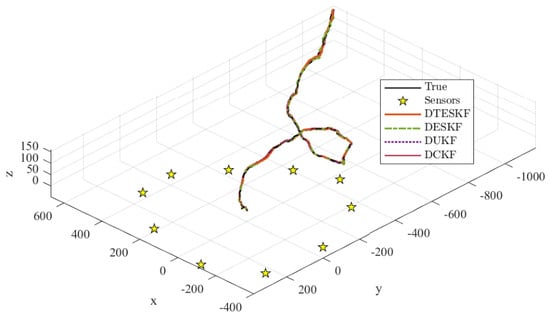
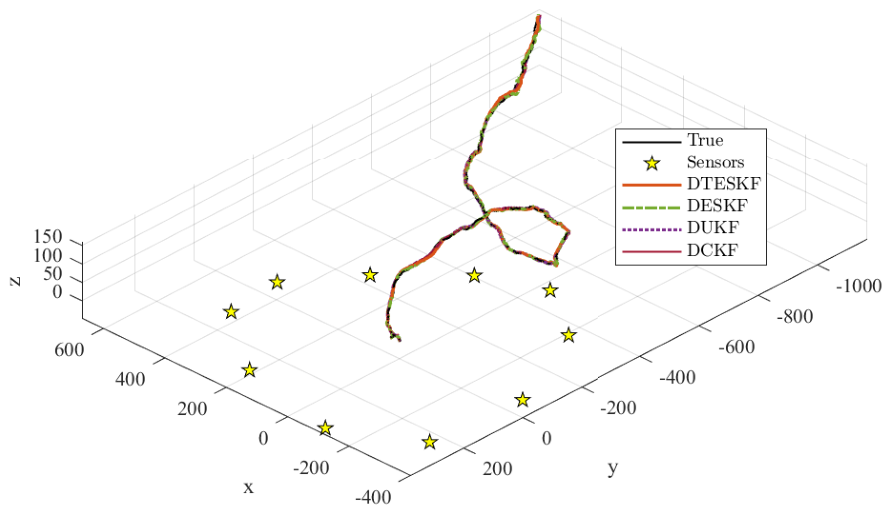
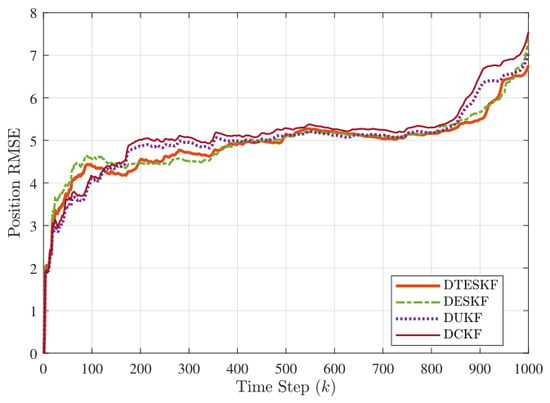
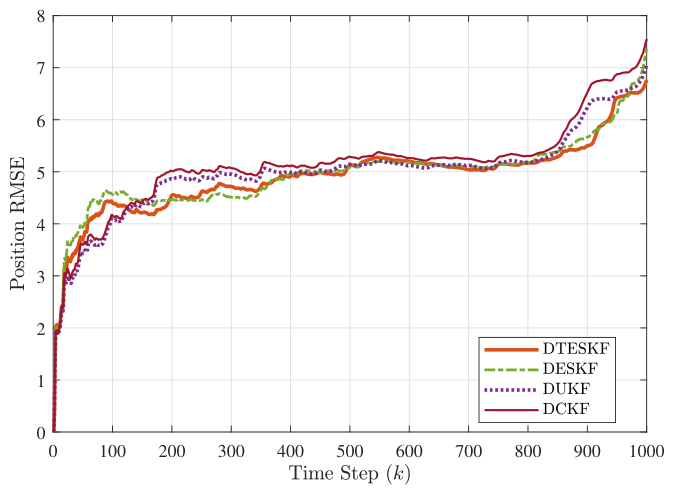
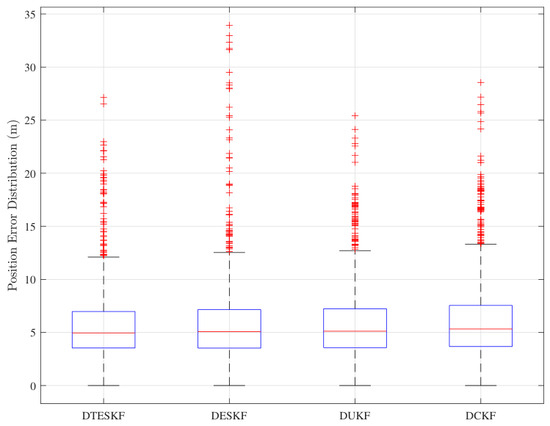
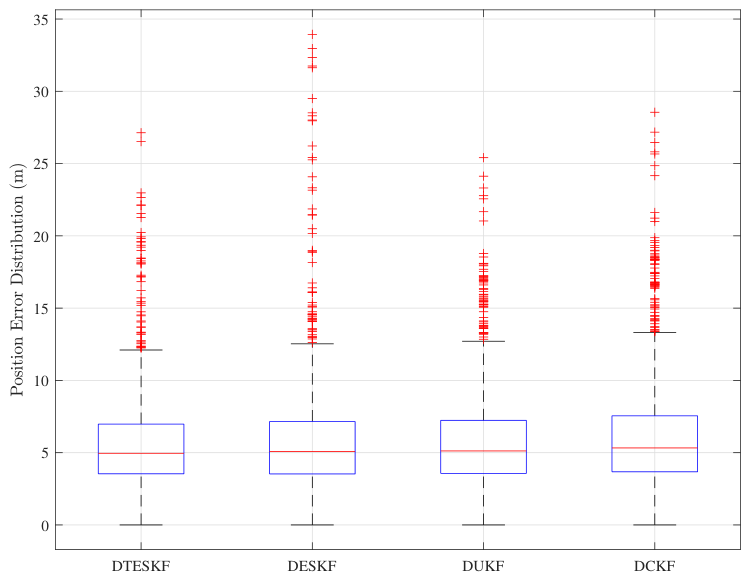
Figure 8 shows the true 3D target trajectory and the deployment of the PTS devices. Even though each device provides only bearing information, the network can reconstruct the 3D trajectory through geometric diversity and diffusion fusion. The DTESKF tracks the trajectory smoothly and remains stable throughout the horizon. Figure 9 and Figure 10 show the RMSE curves and boxplots of the DTESKF, DESKF, DUKF, and DCKF in this highly nonlinear setting. The DEKF exhibits severe error growth, whereas the other four methods maintain substantially lower RMSE levels; therefore, we report the DEKF only in Table 3 to avoid compressing the RMSE plots. The poor performance of the DEKF is mainly attributed to linearization-induced inconsistency in this strongly nonlinear bearing-only scenario. Although the nonlinear acceleration is included in the DEKF prediction model, the term has pronounced curvature with respect to velocity, and each PTS provides only azimuth and elevation measurements. As a result, when the predicted state deviates from the true trajectory, the process and measurement Jacobians evaluated at the local estimate may no longer represent the nonlinear transformations over the actual uncertainty region. This can lead to underestimated covariance, inappropriate gains, and accumulated tracking errors. DESKF alleviates this problem by augmenting the lumped dynamic component, while DTESKF further augments its temporal difference and propagates a covariance upper bound with CI diffusion. Therefore, the remaining second-order uncertainty is handled conservatively and the distributed fusion remains consistent. The comparison in Table 3 shows that DTESKF achieves the lowest position RMSE and requires less runtime than the sigma-point diffusion filters, although DUKF and DCKF obtain slightly lower total RMSE. Since position accuracy is often the primary concern in practical MPTS applications, these results indicate that DTESKF offers a favorable robustness–accuracy–runtime trade-off rather than uniform dominance across all metrics.
Figure 8.
3D target trajectory, estimation results and PTS deployment for the MPTS.
Figure 9.
Distributed running position RMSE for the photoelectric bearing-only tracking scenario.
Figure 10.
The boxplot of running position RMSE for the distributed state estimation in the MPTS. The black boxes represent the interquartile ranges (IQRs), spanning from the 25th to the 75th percentile, indicating the central spread of the error. The solid blue lines inside the boxes mark the median values, while the dashed red lines indicate the mean values of the RMSE. The whiskers (black dashed lines) extend to the most extreme data points not considered outliers, and the red circles represent outliers.
Table 3.
Tracking performance of DTESKF, DUKF, DCKF, DESKF, and DEKF in the MPTS.
7. Conclusions
This work develops a centralized twice-extended state Kalman filter (CTESKF) and a diffusion-based twice-extended state Kalman filter (DTESKF) for nonlinear uncertain systems over MPTSs. The nonlinear uncertainty and its temporal difference are incorporated as augmented states, enabling online estimation of both the system state and the dominant uncertainty trend. We derive a computable upper bound for the estimation error covariance under bounded second-order uncertainty injection. Building on the CTESKF, the DTESKF is obtained via a one-round covariance-intersection (CI) diffusion strategy, and its covariance consistency is established. Simulation studies confirm that the proposed algorithms improve robustness against unmodeled maneuvering dynamics and provide a favorable balance between computational efficiency and tracking precision compared with representative distributed filters. A limitation of the current study is that the validation remains numerical. Future work will extend the evaluation to a semi-physical or real MPTS platform, where practical factors such as image-extraction errors, encoder noise, communication delay, packet loss, and hardware timing constraints can be explicitly examined.
Author Contributions
Conceptualization, Y.L. and Y.M.; methodology, Y.L., C.Q. and Y.M.; software, Y.L., C.Q. and Z.X.; validation, Y.L., J.K. and T.G.; formal analysis, Y.L. and C.Q.; investigation, Y.L., Z.X. and X.Z.; writing—original draft preparation, Y.L. and C.Q.; writing—review and editing, Y.M., J.K., J.L. and X.Z.; supervision, Y.M. All authors have read and agreed to the published version of the manuscript.
Funding
This research received no external funding.
Data Availability Statement
Data are contained within the article.
Conflicts of Interest
The authors declare no conflict of interest.
References
- Xia, H.; Xia, Y.; Yuan, L.; Wen, P.; Zhang, W.; Ding, K.; Fan, Y.; Ma, H.; Li, J. Fast and high-precision tracking technology for image-based closed-loop cascaded control system with a Risley prism and fast steering mirror. Opt. Express 2024, 32, 8555–8571. [Google Scholar] [CrossRef] [Scilit] [PubMed]
- Zhao, T.; Tong, W.; Mao, Y. Hybrid nonsingleton fuzzy strong tracking Kalman filtering for high precision photoelectric tracking system. IEEE Trans. Ind. Inform. 2023, 19, 2395–2408. [Google Scholar] [CrossRef] [Scilit]
- Chang, S.; Cao, J.; Pang, J.; Zhou, F.; Chen, W. Compensation control strategy for photoelectric stabilized platform based on disturbance observation. Aerosp. Sci. Technol. 2024, 145, 108909. [Google Scholar] [CrossRef] [Scilit]
- Hu, K.; Gu, C.; Chen, J. LTrack: A LoRa-based indoor tracking system for mobile robots. IEEE Trans. Veh. Technol. 2022, 71, 4264–4276. [Google Scholar] [CrossRef] [Scilit]
- Xu, Z.; Tang, X.; Li, Z.; Cui, N.; Zhao, Y.; Xu, K.; Xi, L.; Zhang, X. Robust two-stage Kalman filter scheme for compensating abrupt and gradual Doppler shifts in establishment and maintenance of LEO-LEO laser inter-satellite links. Opt. Express 2025, 33, 22666–22675. [Google Scholar] [CrossRef] [Scilit]
- Zeng, D.; Wu, D.; Huang, H.; Peng, B.; Wei, Y.; Du, H.; Zhang, P.; Shi, H.; Lu, Q.; Cai, X. Online identification of laser welding penetration through multi-photoelectric decomposition-reconstruction and shifted-windows-based transformer deep learning framework. Measurement 2025, 247, 116872. [Google Scholar] [CrossRef] [Scilit]
- Hussain, K.F.; Thangavel, K.; Gardi, A.; Sabatini, R. Passive electro-optical tracking of resident space objects for distributed satellite systems autonomous navigation. Remote Sens. 2023, 15, 1714. [Google Scholar] [CrossRef] [Scilit]
- Li, H.; Pan, D. Multi-photoelectric detection sensor target information recognition method based on D-S data fusion. Sens. Actuators A Phys. 2017, 264, 117–122. [Google Scholar] [CrossRef] [Scilit]
- Nasiri, S.; Seifi, H.; Delkhosh, H. A secure power system distributed state estimation via a consensus-based mechanism and a cooperative trust management strategy. IEEE Trans. Ind. Inform. 2024, 20, 3002–3014. [Google Scholar] [CrossRef] [Scilit]
- Lian, B.; Wan, Y.; Zhang, Y.; Liu, M.; Lewis, F.L.; Chai, T. Distributed Kalman consensus filter for estimation with moving targets. IEEE Trans. Cybern. 2022, 52, 5242–5254. [Google Scholar] [CrossRef] [Scilit]
- Kar, S.; Hug, G.; Mohammadi, J.; Moura, J.M.F. Distributed state estimation and energy management in smart grids: A consensus + innovations approach. IEEE J. Sel. Top. Signal Process. 2014, 8, 1022–1038. [Google Scholar] [CrossRef] [Scilit]
- Vahidpour, V.; Rastegarnia, A.; Khalili, A.; Sanei, S. Partial diffusion Kalman filtering for distributed state estimation in multiagent networks. IEEE Trans. Neural Netw. Learn. Syst. 2019, 30, 3839–3846. [Google Scholar] [CrossRef] [Scilit]
- Hu, J.; Xie, L.; Zhang, C. Diffusion Kalman filtering based on covariance intersection. IEEE Trans. Signal Process. 2012, 60, 891–902. [Google Scholar] [CrossRef] [Scilit]
- Han, J. A class of extended state observers for uncertain systems. Control Decis. 1995, 10, 85–88. [Google Scholar]
- Bai, W.; Xue, W.; Huang, Y.; Fang, H. On extended state based Kalman filter design for a class of nonlinear time-varying uncertain systems. Sci. China Inf. Sci. 2018, 61, 042201. [Google Scholar] [CrossRef] [Scilit]
- Li, Y.; Kang, J.; Guo, T.; Xia, W.; Mao, Y. On extended state-based maximum correntropy Kalman filter. IEEE Control Syst. Lett. 2025, 9, 2357–2362. [Google Scholar] [CrossRef] [Scilit]
- Xu, Y.; Lv, W.; Lin, W.; Lu, R.; Quevedo, D.E. On extended state estimation for nonlinear uncertain systems with round-robin protocol. Automatica 2022, 138, 110154. [Google Scholar] [CrossRef] [Scilit]
- He, X.; Xue, W.; Zhang, X.; Fang, H. Distributed filtering for uncertain systems under switching sensor networks and quantized communications. Automatica 2020, 114, 108842. [Google Scholar] [CrossRef] [Scilit]
- Peng, H.; Zeng, B.; Yang, L.; Xu, Y.; Lu, R. Distributed extended state estimation for complex networks with nonlinear uncertainty. IEEE Trans. Neural Netw. Learn. Syst. 2023, 34, 5952–5960. [Google Scholar] [CrossRef] [Scilit]
- Liang, C.; Xue, W.; Fang, H.; He, X.; Gupta, V. On consistency and stability of distributed Kalman filter under mismatched noise covariance and uncertain dynamics. Automatica 2023, 153, 111022. [Google Scholar] [CrossRef] [Scilit]
- Lin, X.; Hu, Y.; Li, Q.; Zhang, X. Distributed state estimation for nonlinear uncertain systems under estimate-based round-robin protocols subject to DoS attacks. IEEE Sens. J. 2025, 25, 36785–36799. [Google Scholar] [CrossRef] [Scilit]
- Hu, Z.; Chen, B.; Zhang, W.A.; Yu, L. Enhanced hierarchical and sequential covariance intersection fusion. IEEE Trans. Syst. Man. Cybern. Syst. 2023, 53, 7888–7893. [Google Scholar] [CrossRef] [Scilit]

Disclaimer/Publisher’s Note: The statements, opinions and data contained in all publications are solely those of the individual author(s) and contributor(s) and not of MDPI and/or the editor(s). MDPI and/or the editor(s) disclaim responsibility for any injury to people or property resulting from any ideas, methods, instructions or products referred to in the content. |
© 2026 by the authors. Licensee MDPI, Basel, Switzerland. This article is an open access article distributed under the terms and conditions of the Creative Commons Attribution (CC BY) license.