Research on Space-Time Data Prediction Model of Quantum Long Short-Term Memory Network Fusion

Abstract
1. Introduction
2. Related Work
2.1. Classical Neural Network Approaches
2.2. Hybrid Classical Models
2.3. Quantum Approaches
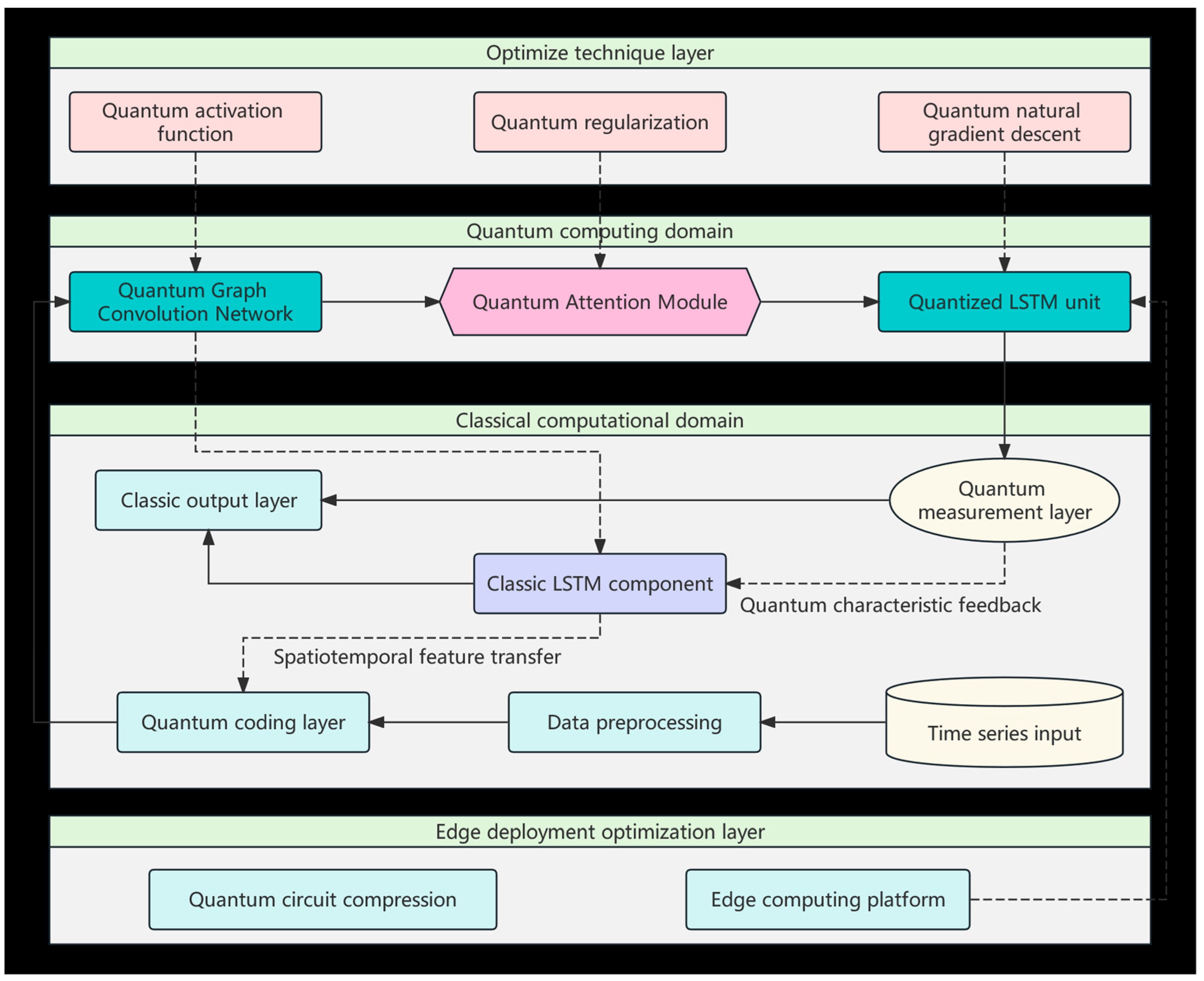
3. Design of Quantum LSTM Fusion Model
3.1. Quantum Encoding and Hybrid Computing Layer
3.1.1. Quantum Graph Convolution (QGCN)
| Algorithm 1. Construction of one QGCN layer |
| Input: latent quantum register learnable parameters ordered edge list Output: convolution unitary Step 1: for i = 1 to d do apply end for Step 2: for m = 1 to do apply CNOT with control and target end for Return: |
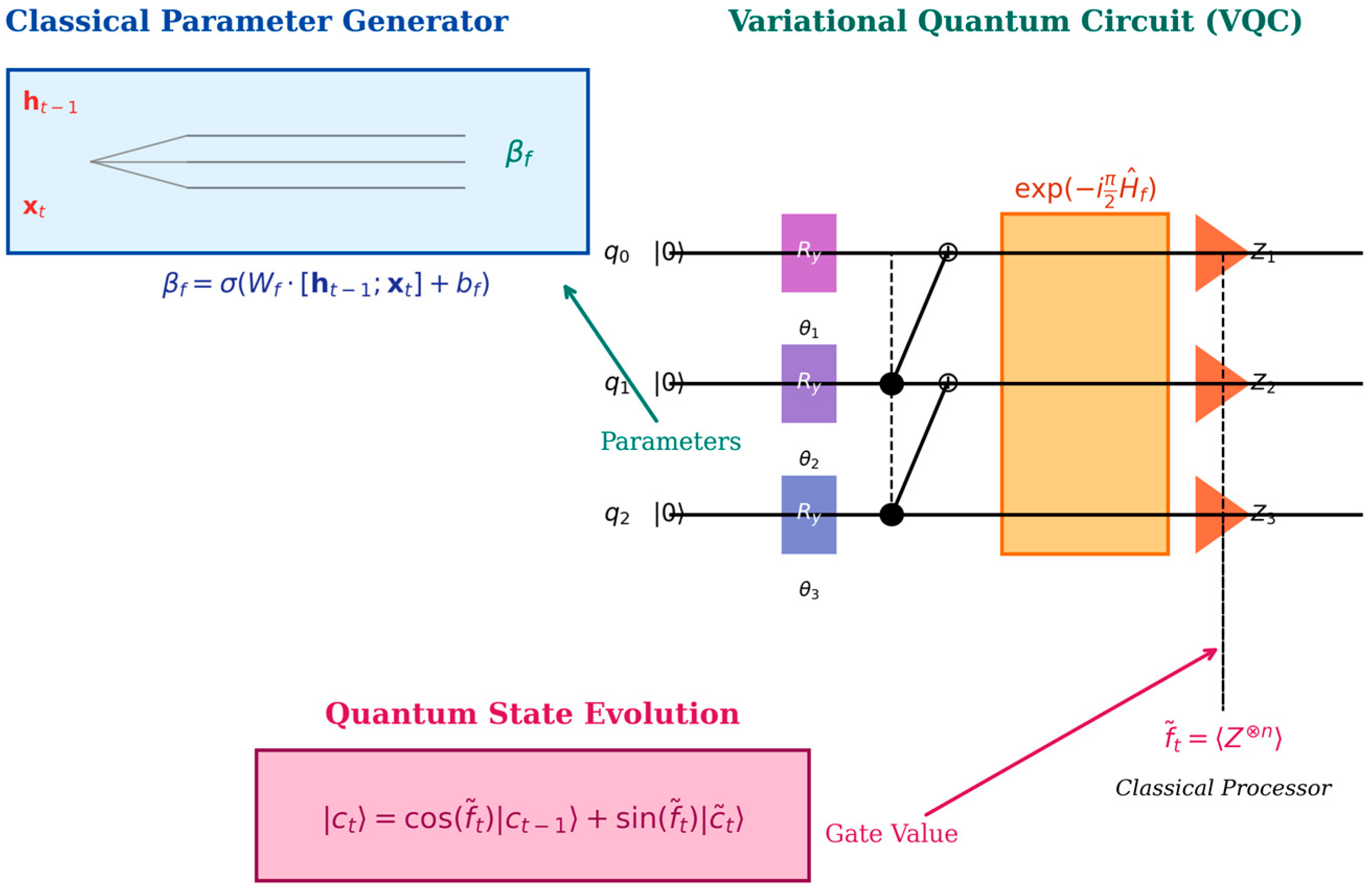
3.1.2. Quantify LSTM Unit
- 1.
- Parameter generation mechanism
- 2.
- Nonlinear function mapping
- 3.
- Quantum state evolution
- (a)
- Quantum parallelism
- (b)
- High dimensional representation

- (c)
- Differential continuity
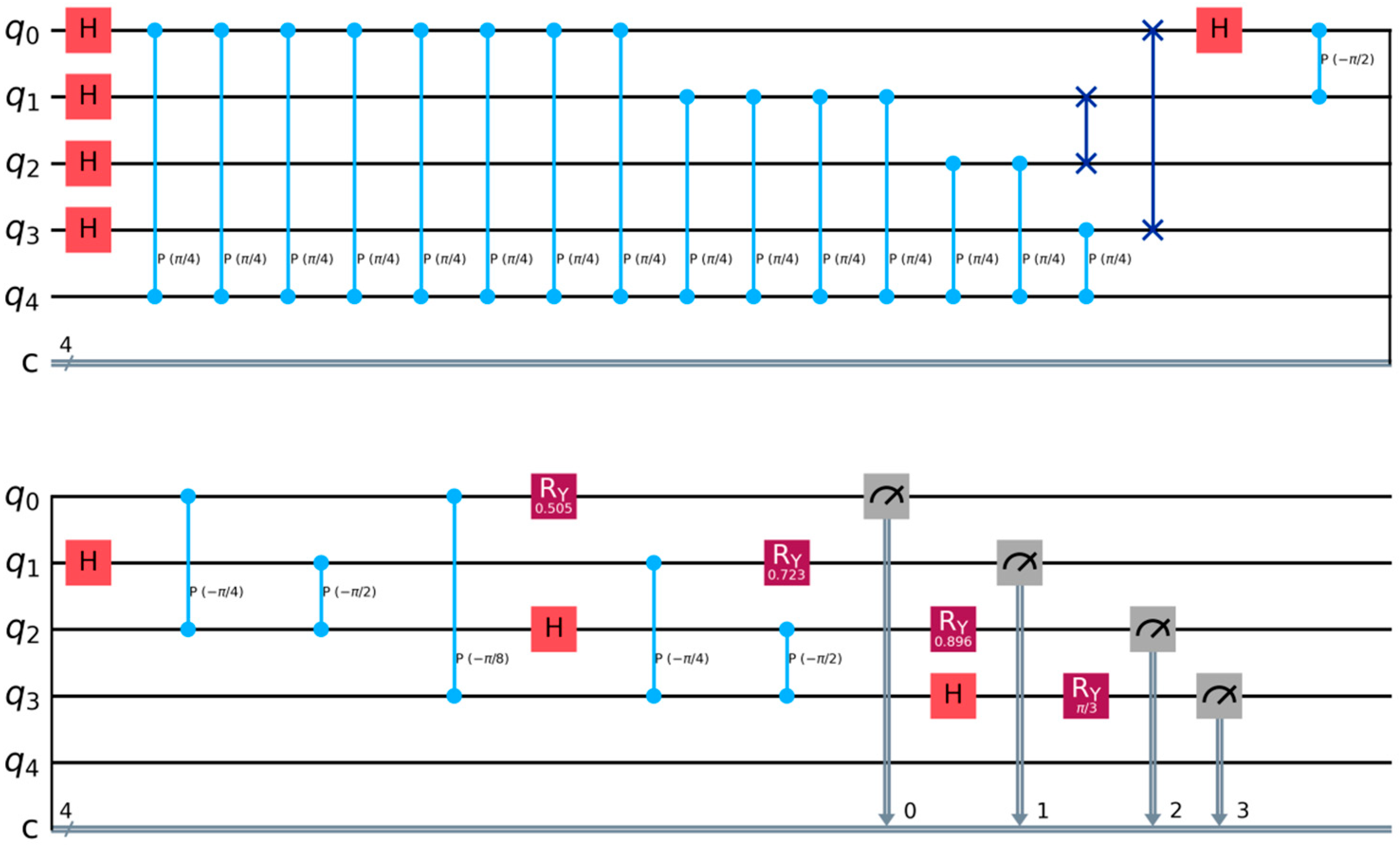
3.1.3. Quantum Attention Module
3.2. Key Technology Implementation
3.2.1. Quantum Activation Function
- Mathematical Definition
- 2.
- Physical implementation process
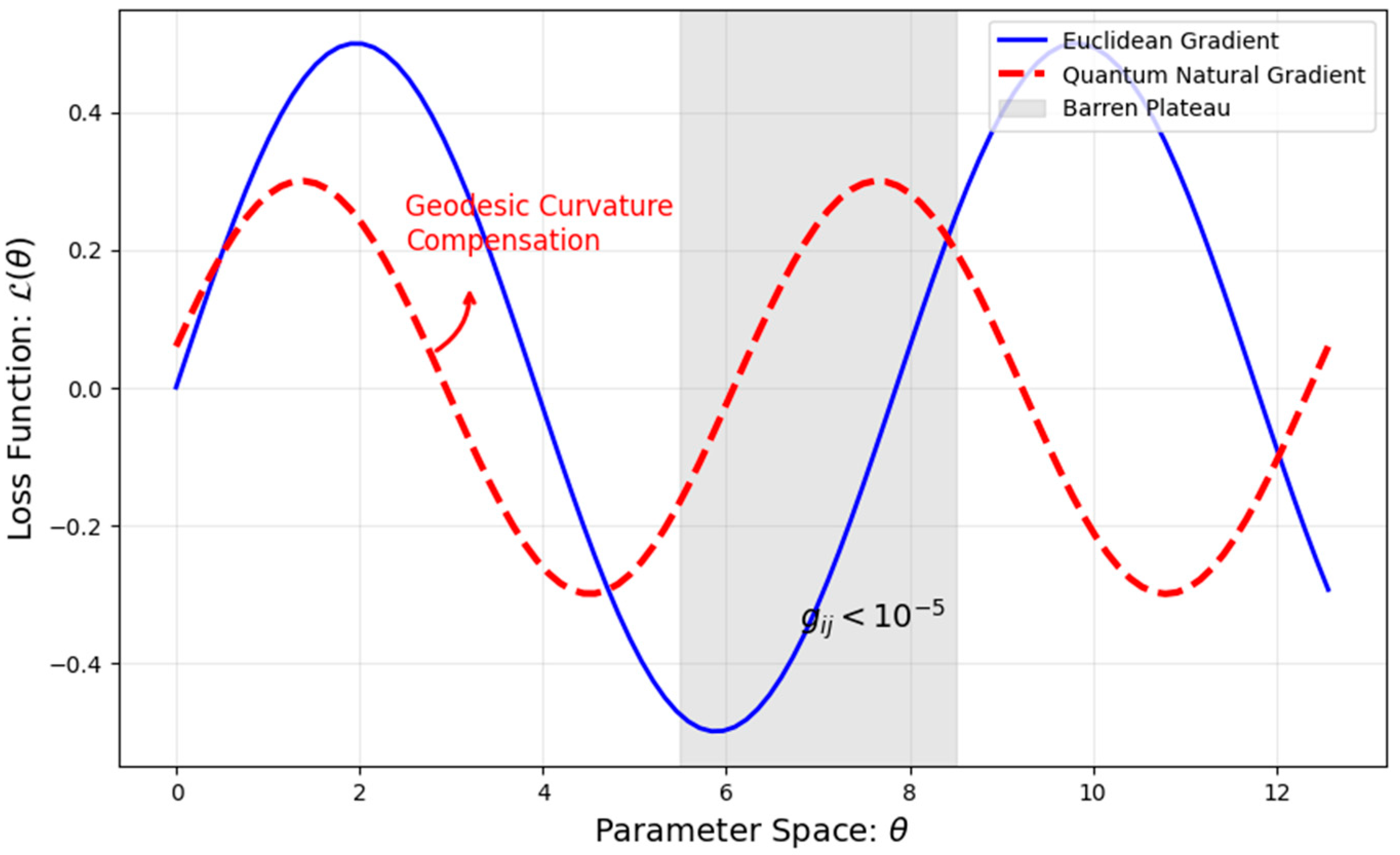
3.2.2. Parameter Optimization Strategy
- Fundamentals of Riemannian Geometry
- 2.
- Quantum Fisher Information Matrix
- 3.
- Optimization mechanism and alleviation of barren plateau
3.2.3. Regularization Mechanism
- Quantum Dropout Implementation
- Quantum convolutional layer: Randomly skip 30% of CNOT entanglement gates.
- Quantum LSTM: Dropout is applied to the rotation gates of the forget gate and input gate.
- Quantum Attention: Controlled Phase Gates in Fidelity Computing.
- 2.
- Fidelity impact and control
- 3.
- Dynamic route pruning
- 4.
- Collaborative regularization effect
4. Experiments and Results
4.1. Experimental Setup
4.2. Spatiotemporal Prediction
4.2.1. Performance Comparison of Various Models
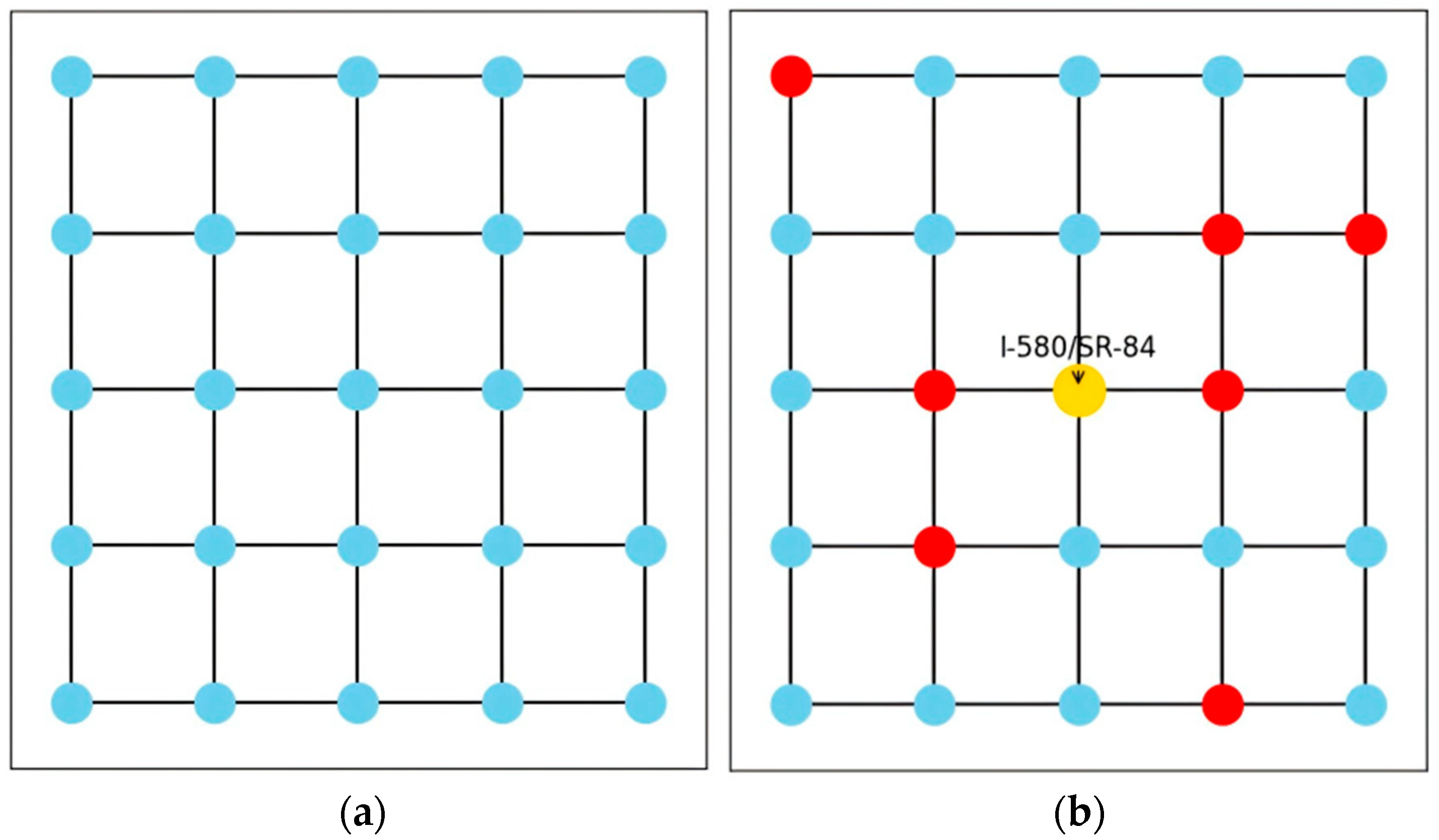
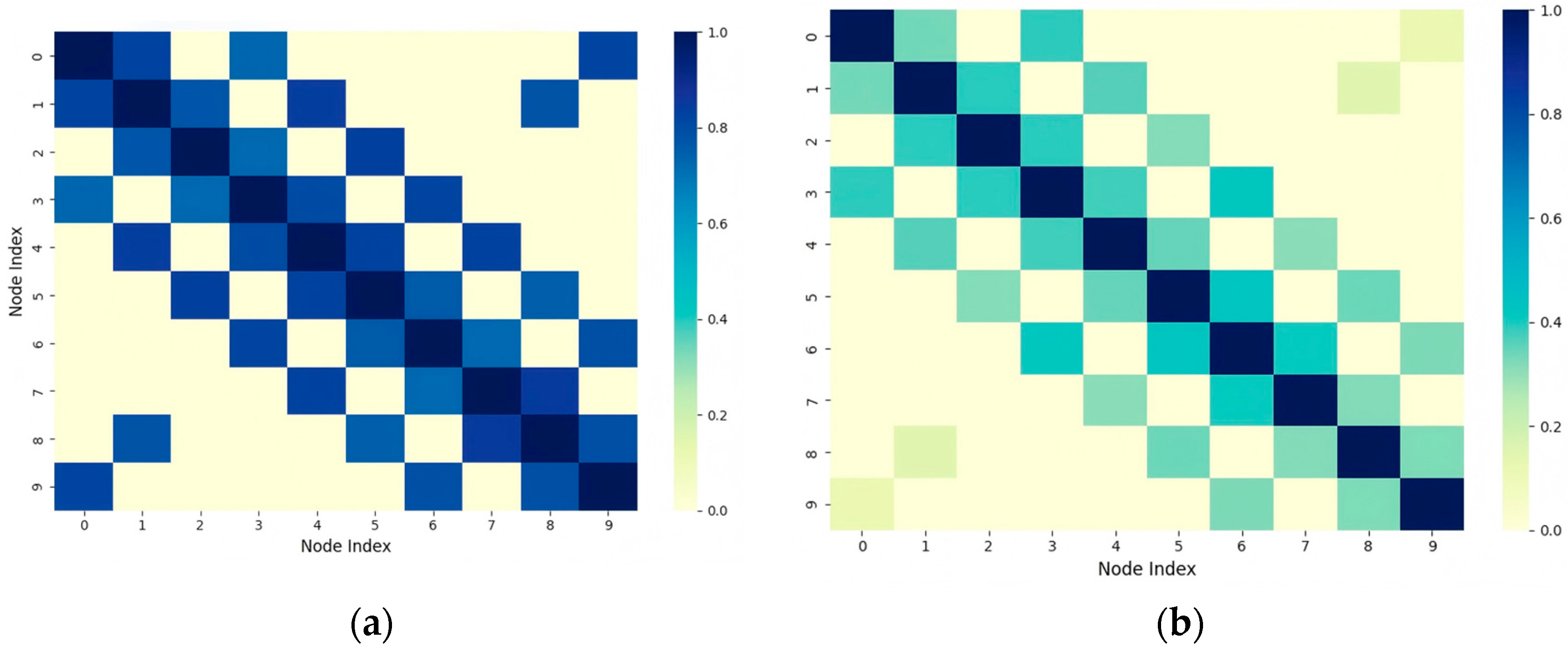
- Quantum entanglement space inference
- Establishing entanglement between nodes through CNOT gates:
- When node A fails, the quantum state of its associated node B still contains information about A:
- Experimental measured information retention rate:
- Quantum attention compensation
- 3.
- Global correlation of quantum states
4.2.2. Robustness Under Multiple Random Masking Patterns
4.2.3. Statistical Significance Analysis
- Data split: The exact same chronological train/validation/test partition (70%/15%/15%) was strictly maintained across all runs and all models to ensure valid paired comparisons.
- Initialization & Runs: Each model was independently trained 5 times. To ensure exact reproducibility, these 5 runs were governed by globally fixed random seeds (2023, 2024, 2025, 2026, and 2027) which controlled data shuffling, classical weight initialization (Xavier), and quantum parameter initialization (Uniform ).
- Metrics: At every run, we recorded MAE, sMAPE, and SCI on the morning-rush subset (7500 detectors, 138 nodes).
- Statistical Tests: Given the small sample size (n = 5 paired observations per model pair), we first evaluated the normality of the error differences using the Shapiro-Wilk test. While no severe violations of normality were detected (p > 0.05 for most pairs), relying solely on a t-test for n = 5 can be precarious. Therefore, alongside the paired-samples t-test (two-tailed, ), we also conducted the Wilcoxon signed-rank test (a non-parametric alternative that does not assume normality) to ensure maximum statistical rigor.
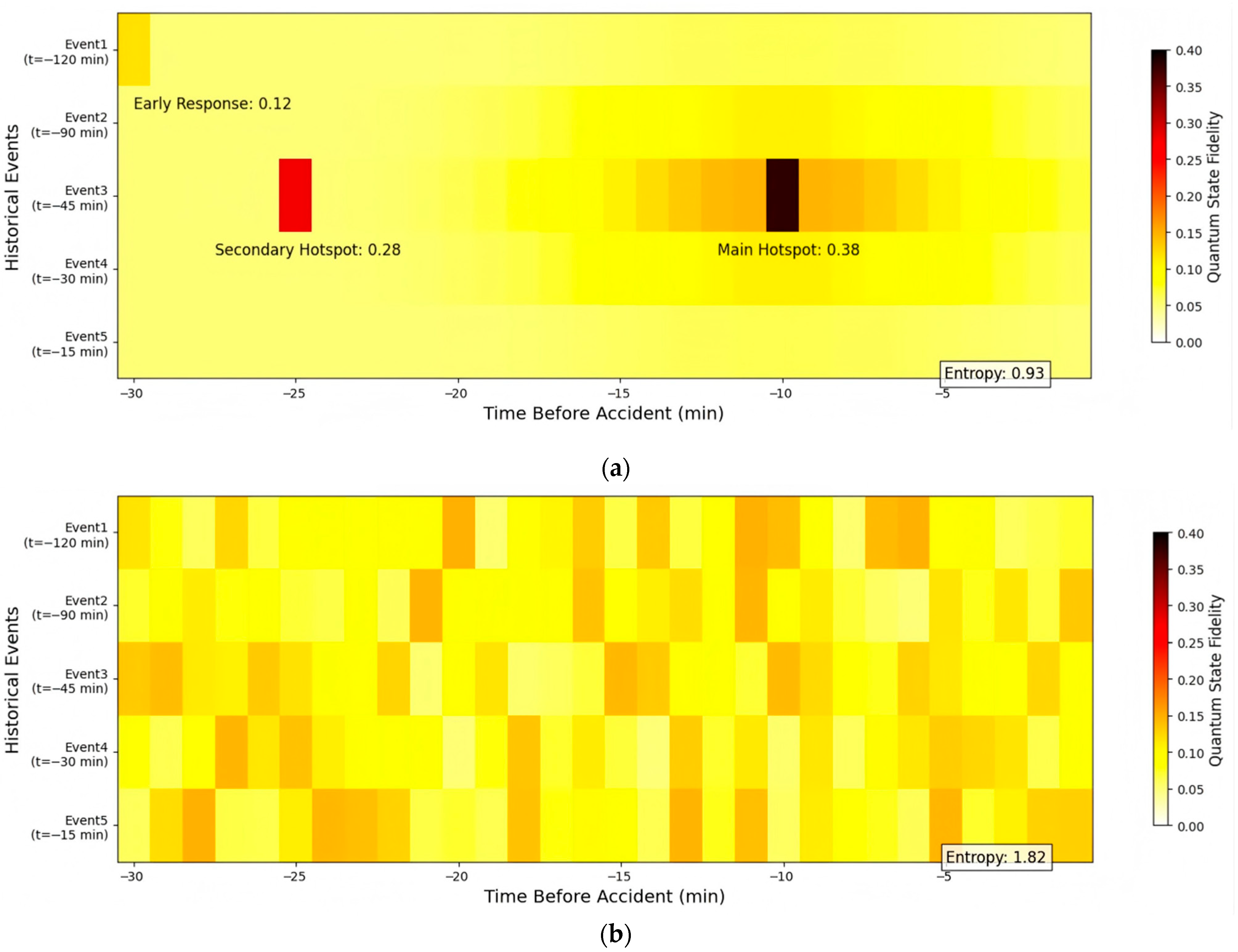
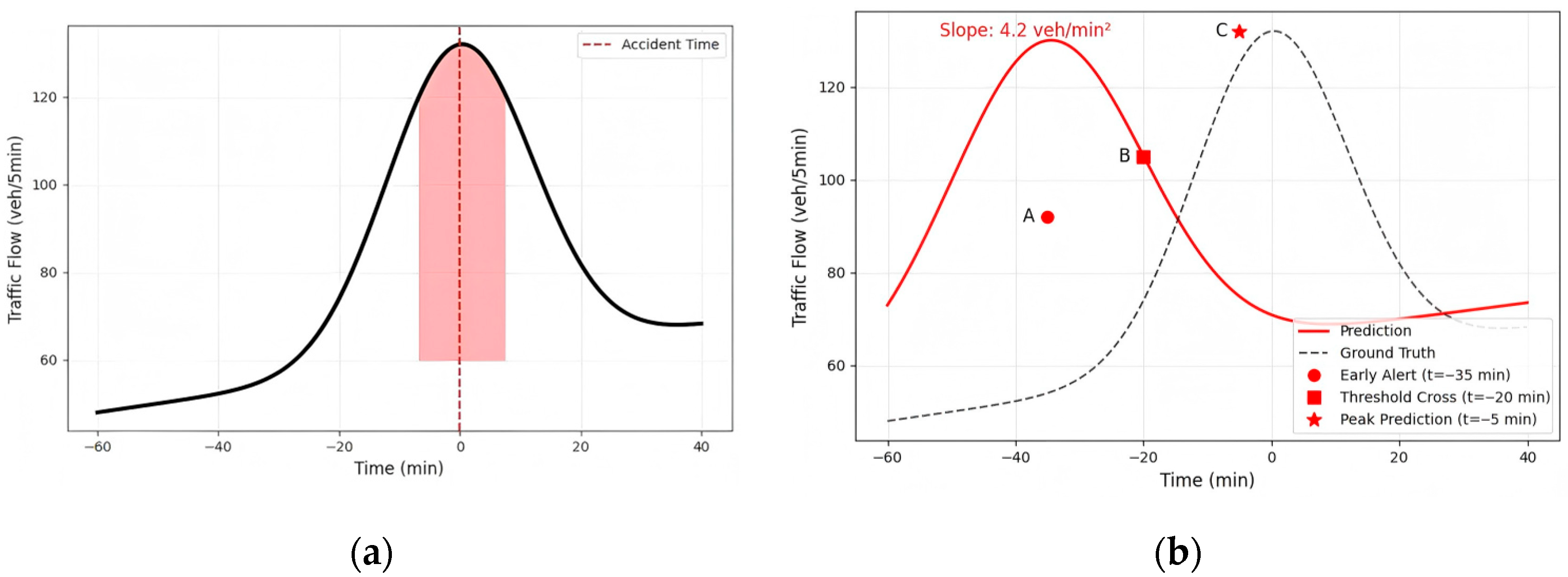
4.3. Dynamic Response Analysis of Sudden Congestion Events
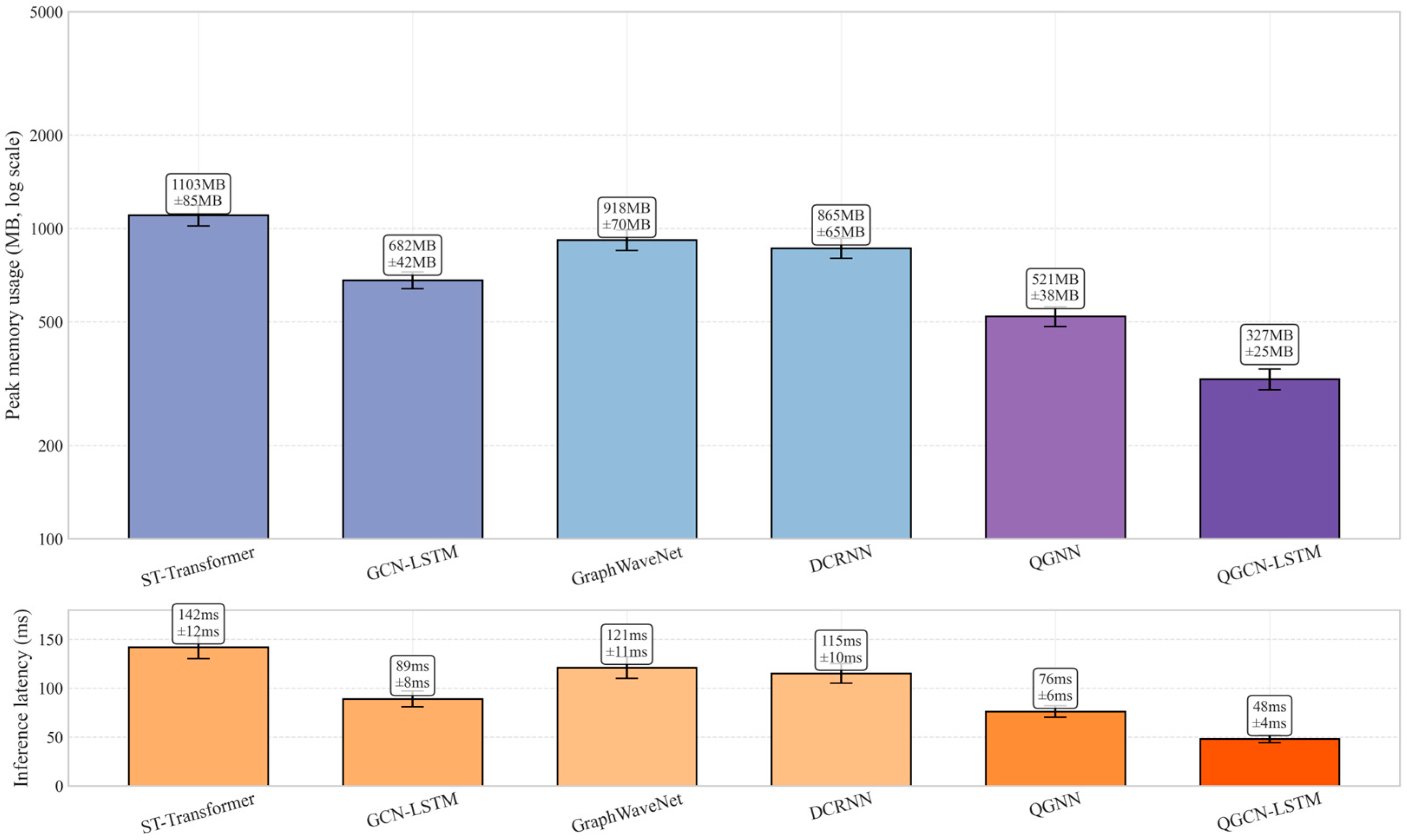
4.4. Edge Computing Efficiency Analysis
4.5. Ablation Experiment and Attribution
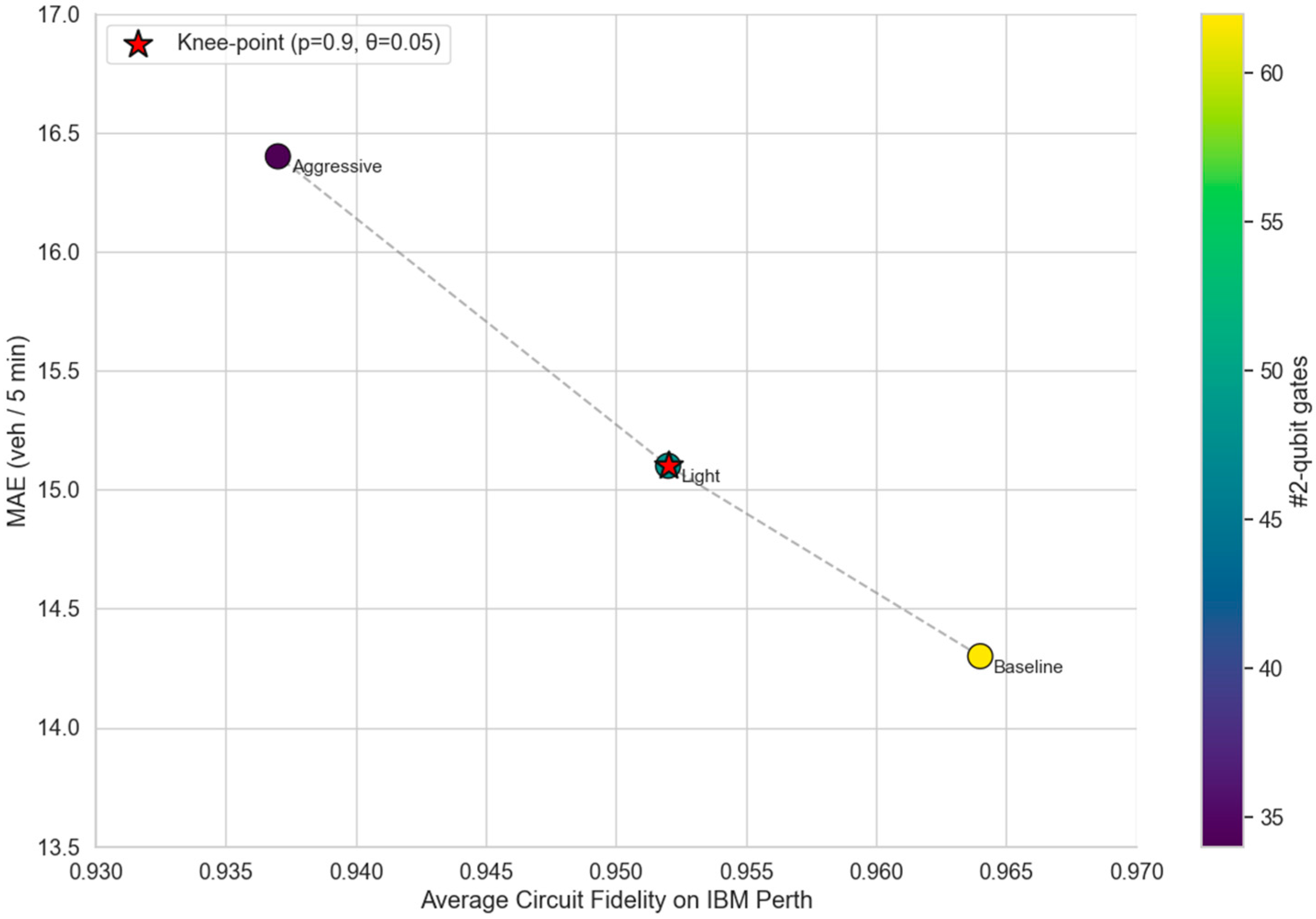
4.6. Sensitivity Analysis of Quantum Hyper-Parameters
- n-qubits ∈ {6, 8, 10}
- QGCN depth K ∈ {2, 3, 4}
- Quantum-Dropout retain probability p ∈ {0.7, 0.8, 0.9, 1.0}
5. Conclusions and Future Work
5.1. Conclusions
5.2. Future Work
Supplementary Materials
Author Contributions
Funding
Institutional Review Board Statement
Informed Consent Statement
Data Availability Statement
Conflicts of Interest
Abbreviations
| QGCN | Quantum Graph Convolutional Networks |
| QNGD | Quantum Natural Gradient Descent |
| QNNs | Quantum Neural Networks |
| FNN | Feedforward Neural Network |
| RNN | Recurrent neural networks |
| LSTM | Long Short-Term Memory |
| SCI | Spatial Correlation Index |
| VQC | Variational Quantum Circuits |
| GRUs | Gated Recurrent Units |
| NISQ | Noisy Intermediate-Scale Quantum |
References
- Wang, X.H.; Zhang, S.; Chen, Y.; He, L.Y.; Ren, Y.M.; Zhang, Z.; Li, J.; Zhang, S.Q. Air quality forecasting using a spatiotemporal hybrid deep learning model based on VMD–GAT–BiLSTM. Sci. Rep. 2024, 14, 17841. [Google Scholar] [CrossRef]
- Barra, S.; Carta, S.M.; Corriga, A.; Podda, A.S.; Recupero, D.R. Deep learning and time series-to-image encoding for financial forecasting. IEEE/CAA J. Autom. Sin. 2020, 7, 683–692. [Google Scholar] [CrossRef]
- ALijoyo, F.A.; Gongada, T.N.; Kaur, C.; Mageswari, N.; Sekhar, J.C.; Ramesh, J.V.N.; El-Ebiary, Y.A.B.; Ulmas, Z. Advanced hybrid CNN-Bi-LSTM model augmented with GA and FFO for enhanced cyclone intensity forecasting. Alex. Eng. J. 2024, 92, 346–357. [Google Scholar] [CrossRef]
- Li, J.Y.; Wang, X.D.; He, Q.X. Application and performance optimization of CNN enhanced Informer model in industrial time series prediction. J. Comput. Appl. 2024, 44, 79–83. [Google Scholar] [CrossRef]
- Seabe, P.L.; Moutsinga, C.R.B.; Pindza, E. Sentiment-driven cryptocurrency forecasting: Analyzing LSTM, GRU, Bi-LSTM, and temporal attention model (TAM). Soc. Netw. Anal. Min. 2025, 15, 52. [Google Scholar] [CrossRef]
- Ito, K.; YAmamoto, N.; Morino, K. Sequential prediction of hall thruster performance using echo state network models. Trans. Jpn. Soc. Aeronaut. Space Sci. 2024, 67, 1. [Google Scholar] [CrossRef]
- Sherstinsky, A. Fundamentals of recurrent neural network (RNN) and long short-term memory (LSTM) network. Phys. D Nonlinear Phenom. 2020, 404, 132306. [Google Scholar] [CrossRef]
- Krishna, M.V.; Swaroopa, K.; SwarnaLatha, G.; Yasaswani, V. Crop yield prediction in India based on mayfly optimization empowered attention-bi-directional long short-term memory (LSTM). Multimed. Tools Appl. 2024, 83, 29841. [Google Scholar] [CrossRef]
- Yang, G.; Chao, S.Y.; Nie, M.; Liu, Y.H.; Zhang, M.L. Construction method of hybrid quantum long-short term memory neural network for image classification. Acta Phys. Sin. 2023, 72, 058901. [Google Scholar] [CrossRef]
- Zhang, H.; Wang, W.G. Neural network ensemble models for financial time series forecasting. J. Beijing Univ. Posts Telecommun. 2025, 48, 127–132. [Google Scholar] [CrossRef]
- Zhu, X.G.; Zou, F.F.; Li, S.H. Enhancing air quality prediction with an adaptive PSO-Optimized CNN-Bi-LSTM model. Appl. Sci. 2024, 14, 5787. [Google Scholar] [CrossRef]
- Caro, M.C.; Huang, H.Y.; Cerezo, M.; Sharma, K.; Sornborger, A.; Cincio, L.; Coles, P.J. Generalization in quantum machine learning from few training data. Nat. Commun. 2022, 13, 4919. [Google Scholar] [CrossRef]
- Sharma, K.; Cerezo, M.; Cincio, L.; Coles, P.J. Trainability of dissipative perceptron-based quantum neural networks. Phys. Rev. Lett. 2022, 128, 180505. [Google Scholar] [CrossRef]
- Maxwell, T.W.; Martin, S.; Muhammad, U. Reflection equivariant quantum neural networks for enhanced image classification. Mach. Learn. Sci. Technol. 2023, 4, 035027. [Google Scholar] [CrossRef]
- Kulkarni, V.; Pawale, S.; Kharat, A. A classical-quantum convolutional neural network for detecting pneumonia from chest radiographs. Neural Comput. Appl. 2023, 35, 15503–15510. [Google Scholar] [CrossRef]
- Xin, J.; Wei, Z.Y.; Dong, Y.J.; Ni, W. LSTM-RNN-FNN model for load forecasting based on deleuze’s assemblage perspective. Front. Energy Res. 2022, 10, 905359. [Google Scholar] [CrossRef]
- Chumakova, E.V.; Korneev, D.G.; Chernova, T.A.; Gasparian, M.S.; Ponomarev, A.A. Comparison of the application of FNN and LSTM based on the use of modules of artificial neural networks in generating an individual knowledge testing trajectory. J. Eur. Systèmes Autom. 2023, 56, 213–220. [Google Scholar] [CrossRef]
- Zhang, F.Y.; Yin, J.L.; Wu, N.; Hu, X.Y.; Sun, S.K.; Wang, Y.B. A dual-path model merging CNN and RNN with attention mechanism for crop classification. Eur. J. Agron. 2024, 159, 127273. [Google Scholar] [CrossRef]
- Ghatage, N.B.; Patil, P.D.; Shinde, S. Lightweight RNN-Based Model for Adaptive Time Series Forecasting with Concept Drift Detection in Smart Homes. J. Eur. Systèmes Autom. 2023, 56, 981–991. [Google Scholar] [CrossRef]
- Hanen, B.; Ali, B.A.; Riadh, F.I. A Bi-GRU-based encoder–decoder framework for multivariate time series forecasting. Soft Comput. 2024, 28, 6775–6786. [Google Scholar] [CrossRef]
- Agarwal, H.; Mahajan, G.; Shrotriya, A.; Shekhawat, D. Predictive data analysis: Leveraging RNN and LSTM techniques for time series dataset. Procedia Comput. Sci. 2024, 235, 979–989. [Google Scholar] [CrossRef]
- Tian, G.; Zhao, J.; Qu, H.B. A novel CNN-LSTM model with attention mechanism for online monitoring of moisture content in fluidized bed granulation process based on near-infrared spectroscopy. Spectrochim. Acta Part A Mol. Biomol. Spectrosc. 2025, 340, 126361. [Google Scholar] [CrossRef]
- Das, P.P.; Wiese, L.; Mast, M.; Böhnke, J.; Wulff, A.; Marschollek, M.; Bode, L.; Rathert, H.; Jack, T.; Schamer, S.; et al. An attention-based bidirectional LSTM-CNN architecture for the early prediction of sepsis. Int. J. Data Sci. Anal. 2024, 20, 1841–1855. [Google Scholar] [CrossRef]
- Piperno, S.; Ceschini, A.; Chang, S.Y.; Grossi, M.; Vallecorsa, S.; Panella, M. A study on quantum graph neural networks applied to molecular physics. Phys. Scr. 2025, 100, 065126. [Google Scholar] [CrossRef]
- Ghorpade, S.V.S.; Pardeshi, S.A. LSTM-QDCNN: Long short-term memory and quantum dilated convolutional neural network enabled occlusion percentage prediction. Aust. J. Electr. Electron. Eng. 2025, 22, 1–14. [Google Scholar] [CrossRef]
- Li, Y.N.; Wang, Z.M.; Xing, R.P.; Shao, C.H.; Shi, S.S.; Li, J.X.; Zhong, G.Q.; Gu, Y.J. Quantum gated recurrent neural networks. IEEE Trans. Pattern Anal. Mach. Intell. 2025, 47, 2493–2504. [Google Scholar] [CrossRef] [PubMed]
- Pesah, A.; Cerezo, M.; Wang, S.; Volkoff, T.; Sornborger, A.T.; Coles, P.J. Absence of barren plateaus in quantum convolutional neural networks. Phys. Rev. X 2021, 11, 041011. [Google Scholar] [CrossRef]
- Havlíček, V.; Córcoles, A.D.; Temme, K.; Harrow, A.W.; Kandala, A.; Chow, J.M.; Gambetta, J.M. Supervised learning with quantum-enhanced feature spaces. Nature 2019, 567, 209–212. [Google Scholar] [CrossRef] [PubMed]
- Schuld, M.; Killoran, N. Quantum Machine Learning in Feature Hilbert Spaces. Phys. Rev. Lett. 2019, 122, 040504. [Google Scholar] [CrossRef]
- Purohit, K.; Vyas, A.K. Quantum key distribution through quantum machine learning: A research review. Front. Quantum Sci. Technol. 2025, 4, 1575498. [Google Scholar] [CrossRef]
- Liu, H.W.; Liu, Z.P.; Yin, H.L.; Chen, Z.B. Quantum-enhanced blockchain federated learning via quantum Byzantine agreement. Sci. China Inf. Sci. 2025, 68, 180503. [Google Scholar] [CrossRef]
- Chehimi, M.; Chen, S.Y.C.; Saad, W.; Yoo, S. Federated quantum long short-term memory (FedQLSTM). Quantum Mach. Intell. 2024, 6, 43. [Google Scholar] [CrossRef]
- Li, J.F.; Xin, Z.X.; Hu, J.R.; He, D.S. Quantum optimal control for Pauli operators based on spin-1/2 system. Int. J. Theor. Phys. 2022, 61, 268. [Google Scholar] [CrossRef]
- Marco, M. Fubini-Study metrics and Levi-Civita connections on quantum projective spaces. Adv. Math. 2021, 393, 108101. [Google Scholar] [CrossRef]
- Naikoo, J.; Chhajlany, R.W.; Miranowicz, A. Enhanced quantum sensing with hybrid exceptional-diabolic singularities. New J. Phys. 2025, 27, 064505. [Google Scholar] [CrossRef]
- Stokes, J.; Izaac, J.; Killoran, N.; Carleo, G. Quantum Natural Gradient. Quantum 2020, 4, 269. [Google Scholar] [CrossRef]
- McClean, J.R.; Boixo, S.; Smelyanskiy, V.N.; Babbush, R.; Neven, H. Barren plateaus in quantum neural network training landscapes. Nat. Commun. 2018, 9, 4812. [Google Scholar] [CrossRef]
- Yuan, X.; Endo, S.; Zhao, Q.; Li, Y.; Benjamin, S.C. Theory of variational quantum simulation. Quantum 2019, 3, 191. [Google Scholar] [CrossRef]
- Cerezo, M.; Sone, A.; Volkoff, T.; Cincio, L.; Coles, P.J. Cost function dependent barren plateaus in shallow parametrized quantum circuits. Nat. Commun. 2021, 12, 1791. [Google Scholar] [CrossRef]
- Aghaei Saem, R.; Tafreshi, B.; Holmes, Z.; Thanasilp, S. Pitfalls when tackling the exponential concentration of parameterized quantum models. Quantum Sci. Technol. 2026, 11, 015049. [Google Scholar] [CrossRef]
- Lou, X.; Wang, Z. A novel quantum-based mutual authentication and key agreement scheme for smart grid. IEEE Trans. Inf. Forensics Secur. 2026, 21, 2061–2075. [Google Scholar] [CrossRef]









| Configuration | Avg. CNOT Gates Per Circuit | CNOT Gate Error | Single-Qubit Gate Error | Readout Error |
|---|---|---|---|---|
| Baseline (p = 1.0, θ = 0) | 62 | 1.2 × 10⁻² | 4.1 × 10⁻⁴ | 2.5 × 10⁻² |
| Light compression (p = 0.9, θ = 0.05) | 48 | 1.1 × 10⁻² | 3.9 × 10⁻⁴ | 2.4 × 10⁻² |
| Aggressive compression (p = 0.7, θ = 0.10) | 34 | 1.3 × 10⁻² | 4.3 × 10⁻⁴ | 2.6 × 10⁻² |
| Model | Learning Rate (η) | Batch Size | Optimizer | Number of Layers | Hidden Units |
|---|---|---|---|---|---|
| HA | N/A | N/A | N/A | N/A | N/A |
| GCN-LSTM | 0.001–0.01 | 32, 64, 128 | Adam | 2–4 | 64, 128 |
| GraphWaveNet | 0.001–0.01 | 32, 64, 128 | Adam | 2–4 (GCN blocks) | 64, 128 |
| DCRNN | 0.001–0.01 | 32, 64, 128 | Adam | Encoder-Decoder (2–4 layers each) | 64, 128 |
| ST-Transformer | 0.0005–0.005 | 32, 64, 128 | Adam | 2–4 | 64, 128 |
| QSTMixer | 0.005–0.02 | 32, 64, 128 | Adam | 2–3 | 64, 128 |
| QG-TCN | 0.005–0.02 | 32, 64, 128 | Adam | 2–3 | 64, 128 |
| Model | MAE | sMAPE (%) | SCI | Fault Robustness (ΔMAE) |
|---|---|---|---|---|
| HA | 32.5 ± 0.28 | 24.7 ± 0.19 | 0.38 ± 0.02 | +9.8 ± 0.35 |
| GCN-LSTM | 21.7 ± 0.21 | 18.3 ± 0.15 | 0.72 ± 0.03 | +6.2 ± 0.28 |
| GraphWaveNet | 18.6 ± 0.18 | 16.1 ± 0.13 | 0.79 ± 0.02 | +5.9 ± 0.24 |
| DCRNN | 17.9 ± 0.19 | 15.8 ± 0.14 | 0.80 ± 0.02 | +5.5 ± 0.22 |
| ST-Transformer | 18.1 ± 0.17 | 15.6 ± 0.12 | 0.81 ± 0.02 | +5.4 ± 0.20 |
| QSTMixer | 17.2 ± 0.15 | 14.9 ± 0.11 | 0.83 ± 0.01 | +4.1 ± 0.18 |
| QG-TCN | 16.5 ± 0.14 | 14.2 ± 0.10 | 0.85 ± 0.01 | +3.3 ± 0.15 |
| QGCN-LSTM | 14.3 ± 0.12 | 12.1 ± 0.08 | 0.89 ± 0.01 | +2.7 ± 0.11 |
| Mask Ratio | Model | MAE | ΔMAE | SCI | Information Retention (%) |
|---|---|---|---|---|---|
| 10% | GCN-LSTM | 23.1 ± 0.34 | +1.4 ± 0.22 | 0.68 ± 0.03 | 51.2 ± 3.8 |
| 10% | QSTMixer | 18.3 ± 0.27 | +1.1 ± 0.19 | 0.80 ± 0.02 | 60.5 ± 3.3 |
| 10% | QG-TCN | 17.4 ± 0.25 | +0.9 ± 0.17 | 0.82 ± 0.02 | 63.9 ± 2.9 |
| 10% | QGCN-LSTM | 15.1 ± 0.21 | +0.8 ± 0.14 | 0.87 ± 0.01 | 75.6 ± 2.4 |
| 30% | GCN-LSTM | 27.8 ± 0.41 | +6.1 ± 0.31 | 0.61 ± 0.04 | 43.8 ± 4.1 |
| 30% | QSTMixer | 21.4 ± 0.33 | +4.2 ± 0.24 | 0.75 ± 0.03 | 58.9 ± 3.5 |
| 30% | QG-TCN | 19.8 ± 0.29 | +3.3 ± 0.20 | 0.79 ± 0.02 | 61.7 ± 3.4 |
| 30% | QGCN-LSTM | 17.0 ± 0.25 | +2.7 ± 0.16 | 0.84 ± 0.02 | 68.3 ± 3.1 |
| 50% | GCN-LSTM | 32.6 ± 0.53 | +10.9 ± 0.39 | 0.49 ± 0.05 | 31.4 ± 4.7 |
| 50% | QSTMixer | 25.9 ± 0.38 | +8.7 ± 0.29 | 0.68 ± 0.03 | 47.6 ± 3.9 |
| 50% | QG-TCN | 24.2 ± 0.35 | +7.7 ± 0.26 | 0.71 ± 0.03 | 50.1 ± 3.6 |
| 50% | QGCN-LSTM | 21.8 ± 0.31 | +7.5 ± 0.22 | 0.77 ± 0.02 | 55.4 ± 3.3 |
| Model | ΔMAE (Mean ± SD) | t(4) | p-Value | 95% CI ΔsMAPE | ΔMAE (Mean ± SD) | t(4) | p-Value | 95% CI ΔsMAPE |
|---|---|---|---|---|---|---|---|---|
| HA | −18.2 ± 0.31 | −131.4 | <0.001 | [−18.6,−17.8] | −12.6 ± 0.22 | −128.2 | <0.001 | [−13.1,−12.1] |
| GCN-LSTM | −7.4 ± 0.18 | −92.0 | <0.001 | [−7.7,−7.1] | −6.2 ± 0.16 | −87.0 | <0.001 | [−6.6,−5.8] |
| GraphWaveNet | −3.8 ± 0.15 | −56.7 | <0.001 | [−4.0,−3.6] | −3.5 ± 0.13 | −60.3 | <0.001 | [−3.8,−3.2] |
| DCRNN | −4.3 ± 0.17 | −56.6 | <0.001 | [−4.6,−4.0] | −4.0 ± 0.14 | −64.0 | <0.001 | [−4.3,−3.7] |
| ST-Transformer | −3.6 ± 0.16 | −50.0 | <0.001 | [−3.9,−3.3] | −3.7 ± 0.15 | −55.3 | <0.001 | [−4.0,−3.4] |
| QSTMixer | −2.9 ± 0.13 | −50 | <0.001 | [−3.1,−2.7] | −2.8 ± 0.12 | −52.3 | <0.001 | [−3.0,−2.6] |
| QG-TCN | −2.2 ± 0.12 | −41.0 | <0.001 | [−2.4,−2.0] | −2.1 ± 0.11 | −43.0 | <0.001 | [−2.4,−1.8] |
| Incident Type | n | Mean Lead-Time (min) | 95%CI (min) | Median (min) | Range (min) |
|---|---|---|---|---|---|
| Accident | 5 | 33.8 | [30.1, 37.5] | 34 | 29–38 |
| Weather | 4 | 31.2 | [27.4, 35.0] | 31 | 27–36 |
| Event | 3 | 35.7 | [32.8, 38.6] | 36 | 33–39 |
| Overall | 12 | 33.5 | [31.8, 35.2] | 34 | 27–39 |
| Model | Inference Latency (ms) | Peak Memory (MB) | Training Energy Consumption (W·h) | Avg. Power (W) | Energy/Inference (J) |
|---|---|---|---|---|---|
| ST-Transformer | 142 ± 12 | 1103 ± 85 | 5.4 | 18.6 | 2.6 |
| GCN-LSTM | 89 ± 8 | 682 ± 42 | 3.9 | 15.7 | 1.4 |
| GraphWaveNet | 121 ± 11 | 918 ± 70 | 4.9 | 17.2 | 2.1 |
| DCRNN | 115 ± 10 | 865 ± 65 | 4.7 | 16.5 | 1.9 |
| QGNN | 76 ± 6 | 521 ± 38 | 2.4 | 13.9 | 1.3 |
| QGCN-LSTM | 48 ± 4 | 327 ± 25 | 1.8 | 12.8 | 1.1 |
| Config | Dropout p | Prune θ | Avg. Fidelity | ΔMAE | #2-q Gates |
|---|---|---|---|---|---|
| Baseline | 1.0 (off) | 0.00 (off) | 0.964 ± 0.004 | - | 62 |
| Light | 0.9 | 0.05 | 0.952 ± 0.006 | +0.8 veh/5 min | 48(−23%) |
| Aggressive | 0.7 | 0.10 | 0.937 ± 0.009 | +2.1 veh/5 min | 34(−45%) |
| Variant Model | MAE | sMAPE (%) | SCI | Congestion Warning Lead Time (min) | ΔMAE vs. Full | t(4) | p-Value |
|---|---|---|---|---|---|---|---|
| QGCN-LSTM (complete) | 14.3 ± 0.12 | 12.1 ± 0.08 | 0.89 ± 0.01 | 35 | -- | -- | -- |
| w/o QGCN (remove quantum graph convolution) | 18.6 ± 0.16 | 16.9 ± 0.10 | 0.71 ± 0.01 | 28 | +3.8 ± 0.07 | 121.3 | <0.001 |
| w/o QA (remove quantum attention) | 16.2 ± 0.14 | 14.3 ± 0.09 | 0.85 ± 0.01 | 18 | +1.9 ± 0.09 | 47.2 | <0.001 |
| w/o VQC (classic gate control) | 19.4 ± 0.15 | 17.8 ± 0.10 | 0.83 ± 0.01 | 22 | +5.2 ± 0.11 | 105.7 | <0.001 |
| n | K | p | MAE | SCI | #2-q Gates | Fidelity |
|---|---|---|---|---|---|---|
| 6 | 2 | 0.9 | 16.1 | 0.84 | 32 | 0.973 |
| 6 | 3 | 0.9 | 15.4 | 0.86 | 48 | 0.965 |
| 8 | 2 | 0.9 | 15.0 | 0.87 | 42 | 0.968 |
| 8 | 3 | 0.9 | 14.3 | 0.89 | 62 | 0.964 |
| 8 | 4 | 0.9 | 14.1 | 0.90 | 82 | 0.952 |
| 8 | 3 | 0.7 | 14.9 | 0.88 | 62 | 0.962 |
| 10 | 3 | 0.9 | 14.0 | 0.90 | 74 | 0.949 |
Disclaimer/Publisher’s Note: The statements, opinions and data contained in all publications are solely those of the individual author(s) and contributor(s) and not of MDPI and/or the editor(s). MDPI and/or the editor(s) disclaim responsibility for any injury to people or property resulting from any ideas, methods, instructions or products referred to in the content. |
© 2026 by the authors. Licensee MDPI, Basel, Switzerland. This article is an open access article distributed under the terms and conditions of the Creative Commons Attribution (CC BY) license.
Share and Cite
Han, B.; Kang, J.; Zhang, M.; Wu, Q. Research on Space-Time Data Prediction Model of Quantum Long Short-Term Memory Network Fusion. Photonics 2026, 13, 477. https://doi.org/10.3390/photonics13050477
Han B, Kang J, Zhang M, Wu Q. Research on Space-Time Data Prediction Model of Quantum Long Short-Term Memory Network Fusion. Photonics. 2026; 13(5):477. https://doi.org/10.3390/photonics13050477
Chicago/Turabian StyleHan, Bing, Jian Kang, Meng Zhang, and Qian Wu. 2026. "Research on Space-Time Data Prediction Model of Quantum Long Short-Term Memory Network Fusion" Photonics 13, no. 5: 477. https://doi.org/10.3390/photonics13050477
APA StyleHan, B., Kang, J., Zhang, M., & Wu, Q. (2026). Research on Space-Time Data Prediction Model of Quantum Long Short-Term Memory Network Fusion. Photonics, 13(5), 477. https://doi.org/10.3390/photonics13050477