Article

Characterizing Optical Absorption in Fiber-Structured Media: Integrating Sphere Experiments Coupled with Anisotropic Light-Propagation Monte Carlo Models


1
Institute for Laser Technologies in Medicine and Metrology, 89081 Ulm, Germany
2
Department of Physics, Ulm University, 89081 Ulm, Germany
*
Author to whom correspondence should be addressed.
Photonics 2026, 13(5), 435; https://doi.org/10.3390/photonics13050435
Submission received: 10 March 2026 / Revised: 10 April 2026 / Accepted: 24 April 2026 / Published: 28 April 2026

Abstract

Accurate determination of the optical absorption coefficient, μ a , in turbid media is fundamental to biomedical optics and material characterization. Integrating sphere techniques, which measure total transmittance and reflectance, are a standard method for this purpose. However, the inverse models typically employed rely on the assumption of isotropic light propagation. In fiber-structured materials—a common geometry in biological tissue–this assumption often breaks down, leading to significant quantification errors. In this study, we investigated this effect using Monte Carlo simulations and proof-of-concept experiments on mechanically stretched PTFE tape. The medium was modeled as a slab of aligned dielectric cylinders embedded in an isotropic matrix, and the performance of an isotropic inverse model was compared with that of an anisotropic inverse model. The isotropic model showed substantial systematic errors in μ a , with a mean absolute error (MAE) of 19.3%, typical errors between approximately 40 % and 50%, and outliers reaching up to 300%. In contrast, the matched anisotropic model achieved a MAE of 1.2%. Even when the structural parameters of the anisotropic model were perturbed, the MAE remained low at 1.8% for moderate perturbations and 3.9% for severe perturbations. The simulation results therefore indicate that, for the integrating sphere framework considered here, incorporating anisotropic light propagation can improve absorption retrieval more strongly than precise knowledge of all geometric details. Measurements on stretched PTFE tape showed the same qualitative trend and provide proof-of-concept experimental support for the simulation-based findings.

1. Introduction

Accurate determination of the optical absorption coefficient μ a in turbid media is fundamental for quantitative biomedical optics, ranging from phototherapy planning and dosimetry to tissue diagnostics and material characterization. Integrating sphere techniques, which provide measurements of total diffuse reflectance and transmittance, are among the most widely used approaches for separating absorption and scattering in bulk samples because they sample a large solid angle and can be implemented in relatively simple experimental geometries [1]. Inverse models based on diffusion theory, Kubelka–Munk theory, or Monte Carlo (MC) simulations [2] are then used to retrieve absorption and scattering parameters, almost invariably under the assumption that light propagation in the medium is macroscopically isotropic [3,4,5,6,7,8].
However, many biological tissues and fibrous materials exhibit pronounced structural anisotropy at the microscopic scale [9,10]. Examples include the preferential orientation of collagen fibers in dermis, tendon, and articular cartilage [4,11], the highly aligned fibers in muscle [12], the tracheid structure of wood [13], the cylindrical dentinal tubules in teeth [14,15] and the aligned axons in brain white matter and spinal cord [16,17]. These studies have demonstrated that such fiber-like microstructures lead to direction-dependent light propagation at the millimeter to centimeter scale. For instance, modeling dentin as a composite of aligned cylindrical tubules embedded in an isotropic matrix reproduces highly anisotropic light propagation, leading to reflectance and transmittance that depend strongly on the relative orientation of the tubules and the illumination/detection geometry [18]. Throughout this work, we use the phrase isotropic matrix to denote a background material exhibiting inherently isotropic light propagation.
The microscopic structural anisotropy itself can be modeled in a physically rigorous way and linked to macroscopic light transport. In dentin, for example, the main scatterers are the water-filled tubules, which can be approximated as cylinders embedded in a matrix [14]. By solving Maxwell’s equations for electromagnetic waves incident on infinitely long cylinders and using the resulting angle-dependent scattering parameters in a Monte Carlo model, Kienle et al. [18] showed that the strongly anisotropic scattering patterns and characteristic intensity peaks measured from dentin slabs can be quantitatively reproduced and explained by the underlying tubule microstructure.
More broadly, Monte Carlo modeling has become a central tool for describing light transport in complex biological media. At the same time, light propagation in biological and scattering media has been studied not only through transport modeling but also through optical imaging, adaptive focusing, and wavefront-control approaches aimed at mitigating the effects of scattering and improving optical access in turbid media [19,20,21]. In contrast to these approaches, the present work focuses on the inverse retrieval of absorption from integrating sphere measurements in the presence of macroscopic anisotropic light propagation.
However, most practical integrating sphere-based protocols for retrieving bulk optical properties employ inverse adding–doubling, look-up-table, or related methods that assume macroscopically isotropic light propagation [1,7,22,23,24,25,26]. For structurally anisotropic media, this gap motivates the development of hybrid approaches that couple detailed Monte Carlo simulations of anisotropic microstructure, such as cylindrical scatterers, with realistic models of the integrating sphere geometry. Such a framework may reduce systematic errors and non-uniqueness in μ a estimation and thereby improve the optical characterization of complex anisotropic materials, including fibrous technical media and biologically relevant model systems.
The present study addresses this gap by systematically investigating the impact of anisotropic light propagation on absorption retrieval in fiber-structured media characterized by integrating sphere measurements. We model the medium as a slab of aligned dielectric cylinders embedded within an isotropic matrix, representing a generic fiber architecture relevant to many biological tissues and technical materials. Using Monte Carlo simulations, total reflectance and transmittance are computed for a wide range of cylinder radii, volume fractions, and orientations relative to the illumination and detection geometry. These data are analyzed with two inverse models: a conventional isotropic model and an anisotropic radiative-transfer model that explicitly accounts for directional light propagation in the fibrous microstructure.
The main contributions of this work are to quantify the bias introduced by the isotropic inverse approximation, to evaluate the robustness of anisotropic inverse modeling under geometric parameter mismatch, and to provide proof-of-concept experimental support using mechanically stretched PTFE tape. The remainder of the work is organized as follows. Section 2 presents the methods and experimental setups, Section 3 reports the simulation and experimental results, Section 4 discusses the implications and limitations of the findings, and Section 5 concludes the research.

2. Materials and Methods

2.1. Monte Carlo Modeling of Light Transport

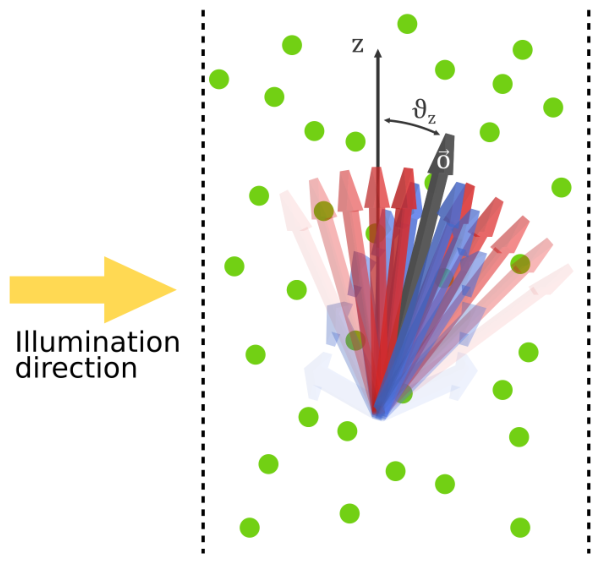
Light propagation was simulated using a Monte Carlo framework that solves the radiative transfer equation. Isotropic light propagation is described by the absorption coefficient μ a , scattering coefficient μ s , scattering phase function P ( ϑ ) , and refractive index n m . Throughout this work, we used the Henyey–Greenstein phase function with anisotropy factor g [27]. It is important to note that the factor g characterizes the angular asymmetry of single scattering events, and does not imply macroscopic anisotropic light propagation. For anisotropic light propagation, the sample is represented as a composite medium consisting of an isotropic matrix and an anisotropic component formed by infinitely extended cylinders. The matrix is described by the optical parameters above. Cylinders have a refractive index n c , are embedded with a volume fraction ϕ and have a radius r. Cylinders are aligned along a mean orientation vector o , with an angular deviation given by a two-dimensional Gaussian distribution characterized by the standard deviation σ o (Figure 1).
Due to the cylindrical geometry, scattering depends on the angle between the photon propagation direction v and the cylinder axis. Angle-dependent scattering coefficients and phase functions were obtained from the analytical solution of Maxwell’s equations for the scattering of a plane wave by an infinitely long dielectric cylinder [28,29] and stored in lookup tables (LUTs). Photon propagation due to scattering by the matrix follows the standard MC approach. For the anisotropic component, the photon’s incident angle with a randomly perturbed cylinder orientation is used to interpolate the corresponding scattering coefficient μ s , aniso and scattering phase function from the LUT. The sample is modeled as a composite medium consisting of an isotropic matrix and an anisotropic cylindrical component, which contribute independently to the total interaction probability. Accordingly, the photon path length is sampled from the total interaction coefficient as
p = ln ( ζ ) μ t , where μ t = μ a + μ s , iso + μ s , aniso ,
with ζ a uniform random number in ( 0 , 1 ) and μ s , iso as the scattering coefficient of the isotropic matrix. If scattering occurs, the event is probabilistically assigned to either the anisotropic component, with probability
P aniso = μ s , aniso μ s , iso + μ s , aniso ,
or the isotropic matrix. The photon’s direction is updated accordingly, using the respective phase function.
To characterize the relative contribution of anisotropic and isotropic scattering within the simulations, we further introduced the derived diagnostic parameter Q, defined as the ratio of scattering events attributed to the anisotropic cylinders, N s , aniso , to those attributed to the isotropic matrix, N s , iso :
Q = N s , aniso N s , iso .
In the present study, Q is used as a simulation-based quantity to distinguish transport regimes dominated by anisotropic cylinder scattering from those dominated by isotropic matrix scattering.

2.2. Integrating Sphere: Setup

Diffuse reflectance and transmittance measurements were performed using an integrating sphere system originally developed by Foschum et al. [24]. The setup enables accurate separation of total transmittance and reflectance using an analytical model of the integrating sphere.
The integrating sphere has an inner diameter of 150 m m and is coated with barium sulfate (Gigahertz-Optik, 82299 Türkenfeld, Germany) to achieve a high and spectrally flat reflectance. Illumination was provided by a halogen light source, whose output was split into reflection, transmission, and normalization beams. The normalization channel was used to compensate for changes in the effective sphere throughput caused by variations in surface reflectivity when alternating between sample and calibration measurements. Prior to each measurement series, calibration measurements were performed using an empty sample port and a calibrated mirror to determine the incident radiant power and to account for the wavelength-dependent response of the sphere and detector system.

2.3. Integrating Sphere: Inverse Parameter Estimation Using Levenberg–Marquardt Algorithm

Optical properties were retrieved using an inverse Monte Carlo framework based on the Levenberg–Marquardt optimization algorithm. Crucially, this identical inverse scheme was applied in two distinct contexts within this study. Synthetic data, generated by forward simulations, were fitted to quantify systematic errors under controlled conditions. Experimental characterization of stretched PTFE tape (see Section 2.4) was performed using physical measurements obtained from the integrating sphere setup.
For both applications, the core forward model predicts the detector signal based on the sample’s optical properties. The Monte Carlo framework computes total transmitted and reflected light by the sample. This is then coupled to an analytical integrating sphere theory [24] to calculate the effective signal at the detector port, accounting for multiple diffuse reflections within the sphere and the baffle geometry.
We employed two distinct model definitions for the inverse procedure. In the isotropic evaluation, the sample is modeled as an isotropic homogeneous medium, described by the absorption coefficient μ a and the effective scattering coefficient μ s , with μ s = μ s , iso ( 1 g ) . The Henyey–Greenstein phase function is used with fixed g = 0.8 . For the anisotropic evaluation, the cylindrical microstructure parameters were set to fixed values, while only the matrix parameters μ a and μ s , iso are fitted (with g = 0.8 ). Anisotropic light propagation is explicitly included in the simulation. For both strategies, the MC model computes the spatial and angular distribution of light reflected and transmitted from the sample into the sphere ports.
For the sufficiently scattering samples considered here, where light transport approaches the diffuse regime, the exact single-scattering phase function of the isotropic matrix is expected to have a smaller influence on total reflectance and transmittance than the presence or absence of macroscopic anisotropic light propagation.
Parameter estimation minimizes the difference between measured and simulated signals using a Levenberg–Marquardt optimization algorithm. The Jacobian matrix is efficiently computed via perturbation Monte Carlo scaling relations, allowing derivatives with respect to μ a and μ s to be obtained from a single simulation. This follows the perturbation-based inverse modeling approach described in [30], which was adapted here for integrating-sphere data.

2.4. Stretched PTFE Tape Sample

The sample consisted of commercially available yellow PTFE thread seal tape that had been mechanically stretched. The stretching process generates a microstructure of aligned fibrils, which induces pronounced anisotropic light propagation [31,32]. In the optical model, these aligned structures were approximated as cylindrical scatterers. For measurements, a sample with an effective scattering coefficient of μ s 15 mm−1 (using the isotropic light propagation approximation) and a thickness of 0.1 mm was prepared. To facilitate handling, the thin film was placed between two JGS1 glass slides.

2.5. Goniometric Light Scattering: Setup

Angular-resolved measurements of scattered light were performed using an optical goniometer. The setup and general measurement procedure follow [30] and are summarized here.
A quasi-monochromatic light source illuminated the sample at normal incidence, producing a spot approximately 1.35 mm in diameter. Scattered and transmitted light were detected by a CMOS camera mounted on a motorized rotation stage, enabling angular sampling over 0° to 360° in the plane of incidence. The detector entrance pupil had a diameter of 5 mm and was positioned 120.8 mm from the rotation center.
To capture anisotropic light propagation, the PTFE tape sample was measured in two orthogonal orientations relative to the goniometer plane. The orientation parallel to the goniometer plane is defined as horizontal and the perpendicular orientation as vertical. Alignment was achieved by illuminating the sample at normal incidence and observing the transmitted and scattered light pattern on a flat screen behind the sample. Anisotropic light propagation in the sample produced an elongated, elliptical scattering pattern. To a first order approximation, the aligned structures in the sample are oriented perpendicular to the ellipse’s major axis. The specimen was rotated until the major axis was aligned either horizontally or vertically, corresponding to horizontal or vertical fibril orientation.

2.6. Goniometric Light Scattering: Inverse Parameter Estimation Using Particle Swarm Optimization

The optical and structural parameters governing isotropic and anisotropic light propagation were determined by fitting the Monte Carlo simulations to the goniometric scattering data using particle swarm optimization (PSO). The swarm consisted of 60 particles evolved over 50 iterations, with each particle interacting with a local neighborhood of the 12 nearest particles in parameter space. In each iteration, two forward MC simulations were performed per particle, corresponding to the two orthogonal sample orientations. Both orientations were fitted simultaneously.
The fitted parameters included the absorption coefficient μ a , the refractive index n m , the isotropic scattering coefficient μ s , iso , and the Henyey–Greenstein anisotropy factor g of the matrix. We also fitted the anisotropic microstructure. It was described by the cylinder radius r, the cylinder refractive index n c , the volume fill factor of the cylinders ϕ , the z-component of the orientation vector o , and the angular spread parameters σ o . The goniometric data were fitted for each wavelength independently. Since the geometric parameters of the cylindrical structure are not expected to vary with wavelength, consistency across wavelengths was used as an internal validation criterion.

3. Results

3.1. Comparison of Isotropic and Anisotropic Inversion Models

The first three subsections of this section, namely Section 3.1, Section 3.2 and Section 3.3, report results obtained from Monte Carlo simulation data. Experimental results are presented separately in Section 3.4, which provides the proof-of-concept validation using the stretched PTFE sample.
To investigate the impact of anisotropic light propagation on absorption coefficient measurements in an integrating sphere setup, a comprehensive forward simulation study was conducted. A total of N 9200 simulations were performed to calculate the total transmittance and reflectance from a single slab with a thickness of d = 0.5 mm.
The sample model consisted of aligned cylinders embedded within an isotropic matrix. The matrix material was characterized by isotropic light propagation with an isotropic scattering coefficient μ s and a Henyey–Greenstein phase function with anisotropy factor g = 0.8 . The matrix refractive index was set to n m = 1.50 to match the isotropic matrix of human dentin. All optical properties of the matrix were independent of the angle of incidence. In addition, the matrix was assigned an absorption coefficient μ a .
The cylinders were modeled with a radius r, a volume fill factor ϕ , and a refractive index n c = 1.33 . The cylinder orientation was defined by a mean orientation vector o = ( 0 , cos ϑ z , sin ϑ z ) , where ϑ z represents the tilt in the z-direction. The angular deviation of this orientation was described by a two-dimensional Gaussian distribution with standard deviation σ o . Unlike the matrix, the scattering properties of the cylinders were dependent on the angle between the cylinder axis and the direction of the incident light. Phase functions and scattering coefficients were derived from the analytical solution of Maxwell’s equations for an infinitely long dielectric cylinder [28,29] and stored in a lookup table covering incident angles (relative to the cylinder axis) from 0° to 90° in 0.5° increments.
For each simulation, optical and geometric parameters were randomly sampled from predefined ranges. The absorption coefficient μ a was sampled logarithmically between 0.01 mm−1 and 10 mm−1 and the matrix scattering coefficient μ s logarithmically between 0.2 mm−1 and 150 mm−1. The cylinder radius r was sampled logarithmically from 0.5 μm to 8 μm, the orientation spread σ o logarithmically from 0.01° to 200° and the fill factor ϕ logarithmically from 0.01 to 0.9. The tilt angle ϑ z was sampled linearly between 0° to 90°. To fit optical properties to the simulated transmittance and reflectance data, four distinct inverse models were applied:
  • Mode A (Isotropic): Assumes only isotropic light propagation. The fitted parameters were μ a and μ s , iso , with the anisotropy factor fixed at g = 0.8 .
  • Mode B (Anisotropic): Incorporates anisotropic light propagation with perfectly matched properties for the cylinders.
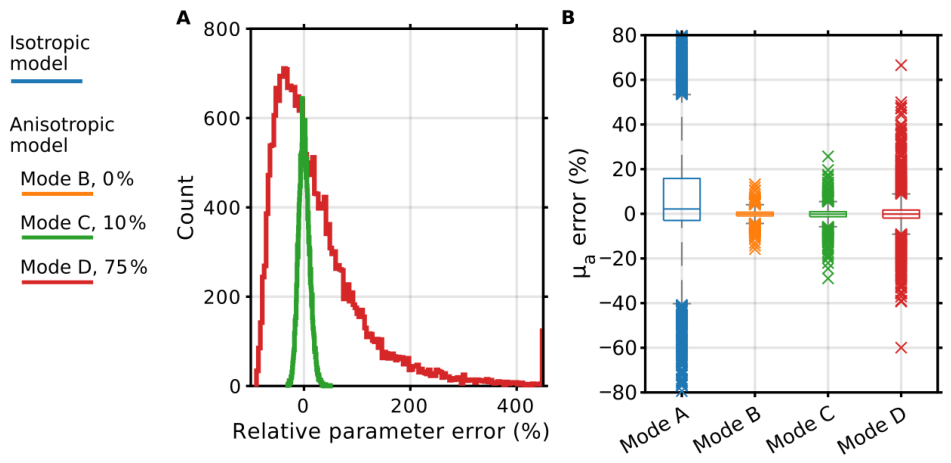
  • Modes C and D (Perturbed Anisotropic): Incorporate anisotropic light propagation but introduce errors to the cylinder parameters to test the model robustness. The radius r, orientation σ o , and fill factor ϕ were perturbed by a log-normal distribution, while ϑ z was perturbed by a normal distribution. These perturbations corresponded to standard deviations of 10% (Mode C) and 75% (Mode D) of the original values.
Simulations were filtered using two criteria. First, only cases for which the inverse fit reproduced the simulated total transmittance and reflectance within 1% were retained, in order to exclude non-convergent fits. Second, we excluded cases for which the fitted isotropic transport scattering depth of Model A, τ = d μ s , iso ( 1 g ) , satisfied τ 1.0 . Such cases correspond to optically very thin samples with too few scattering events to establish the diffuse light regime relevant for integrating sphere analysis [24]. In total, these filtering criteria excluded approximately 25% of the simulated cases. Including the excluded optically thin cases worsened the performance of all inverse approaches, but did not alter the main comparative conclusion of this study, namely that the anisotropic inverse model remained substantially more accurate and more robust than the isotropic formulation.
Figure 2A shows the distributions of the geometric parameter perturbations introduced in Modes C and D. Figure 2B presents box plots of the distribution of the relative error in the retrieved absorption coefficient across all four inverse models. In this representation, the bottom and top edges correspond to the 25th and 75th percentiles (the interquartile range), respectively. The whiskers extend to the data points that are not considered outliers.
As expected, the conventional isotropic assumption (Mode A) yielded the lowest accuracy. It exhibited a mean absolute error of 19.3%, with a broad error distribution where 85% of the simulations fell between −40% and 50%. Outliers for Mode A reached up to 300% (omitted from the plot for visual clarity). In stark contrast, the exactly matched anisotropic model (Mode B) demonstrated high accuracy, achieving a MAE of 1.2%, with 90% of the simulations showing errors within 4%. This minor residual variance is consistent with Monte Carlo noise, and we found no systematic dependence of the error in μ a on the underlying model parameters.
Notably, the anisotropic approach maintained superior performance even when substantial geometric uncertainties were introduced. The moderately perturbed Mode C yielded a MAE of 1.8%. Even under the severe parameter perturbations of Mode D, the model remained remarkably robust, demonstrating a MAE of 3.9% and maintaining a relative absorption error within 9% for 85% of the simulations.
It is important to note that the overall MAE values reported above include cases where anisotropic light propagation by the cylinders is negligible compared to the isotropic matrix. When isolating anisotropic cases by excluding simulations where Q < 10 , the MAE of the isotropic Mode A rises to 29.4%, while the MAE of the severely perturbed Mode D increases only to 6.2%. The strong influence of Q on retrieval error is explored in detail in the following section.
To assess which geometric and optical parameters were most strongly associated with the observed errors in μ a , we trained a random forest regressor on the simulation data for both the solely isotropic case (Mode A) and the perturbed anisotropic model (Mode D).

3.2. Sensitivity and Error Drivers of the Isotropic Approximation (Mode A)

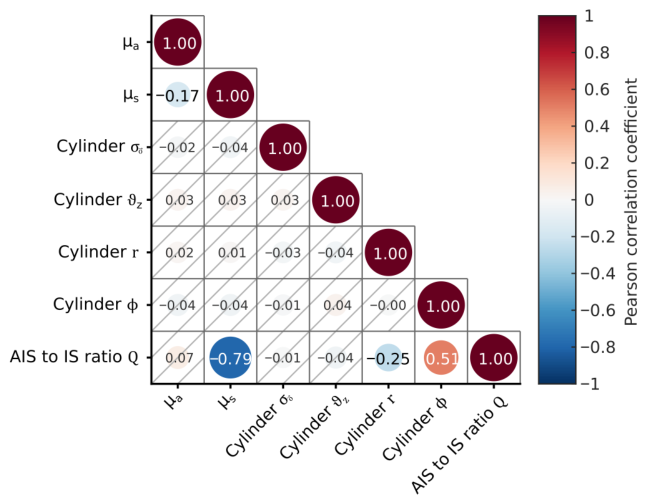
Prior to the feature importance analysis, we assessed the dataset for multicollinearity to identify potentially redundant features. Figure 3 presents the Pearson correlation coefficients between all feature pairs. We observed a slight correlation between μ a and μ s . This is an artifact of the data filtering process described in the previous section. Simulations combining high absorption and high scattering result in low total transmittance, which frequently leads to poor model convergence and subsequent exclusion from the dataset. Furthermore, the derived parameter Q (see Section 2.1) exhibits distinct correlations with the matrix scattering coefficient μ s , the cylinder radius r, and the fill factor ϕ . These correlations are physically consistent with the model definition: a lower μ s directly reduces the number of isotropic scattering events ( N s , iso ), whereas a higher fill factor ϕ or a smaller radius r (associated with higher scattering efficiency) increases the number of anisotropic scattering events ( N s , aniso ). The remaining minor correlations are attributed to spurious noise inherent to the finite sample size of the random parameter sampling. Due to the observed multicollinearity of these features, we excluded the μ s , r and ϕ from the random forest regression.
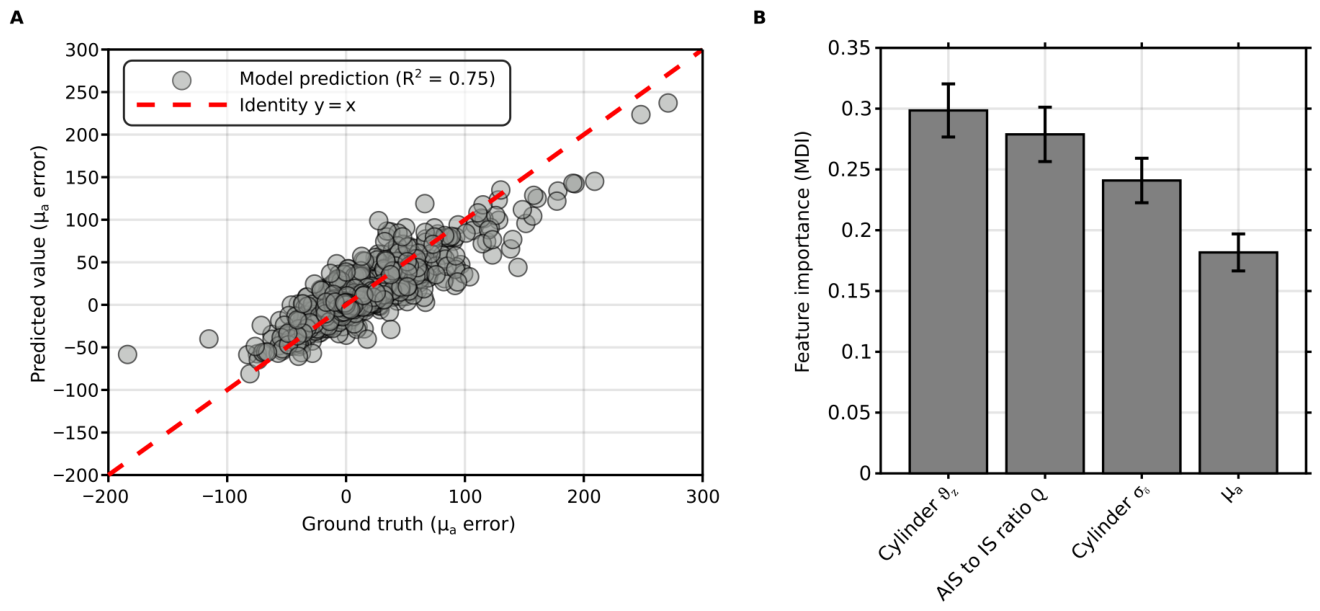
To quantify the impact of individual parameters on the absorption retrieval error in Mode A, a random forest regression model was trained. The model aimed to predict the relative error in the fitted absorption coefficient based on the geometric and optical input features. Figure 4A shows the model performance for Mode A, plotting the predicted relative error against the true relative error from the validation set. The model achieves a coefficient of determination of R 2 = 0.75 , indicating that the selected features (see Figure 4B) capture the majority of the variance in the absorption error. This predictive capability indicates that the retrieval error in the isotropic model is structured rather than purely random.
The resulting feature importance permutation scores are presented in Figure 4B. We identified four variables with the highest predictive importance: the cylinder tilt angle ϑ z , the anisotropic-to-isotropic scattering ratio Q, the orientation spread σ o and the absorption coefficient μ a itself. The cylinder tilt angle ϑ z emerged as the most significant determinant (importance 0.30). The scattering ratio Q and orientation spread σ o followed closely in importance. Notably, while there is a hierarchy, the importance scores are relatively balanced, ranging from 0.18 for μ a to 0.30 for ϑ z . This suggests that the isotropic-model error is associated with a combination of geometric and optical factors rather than with a single dominant predictor.
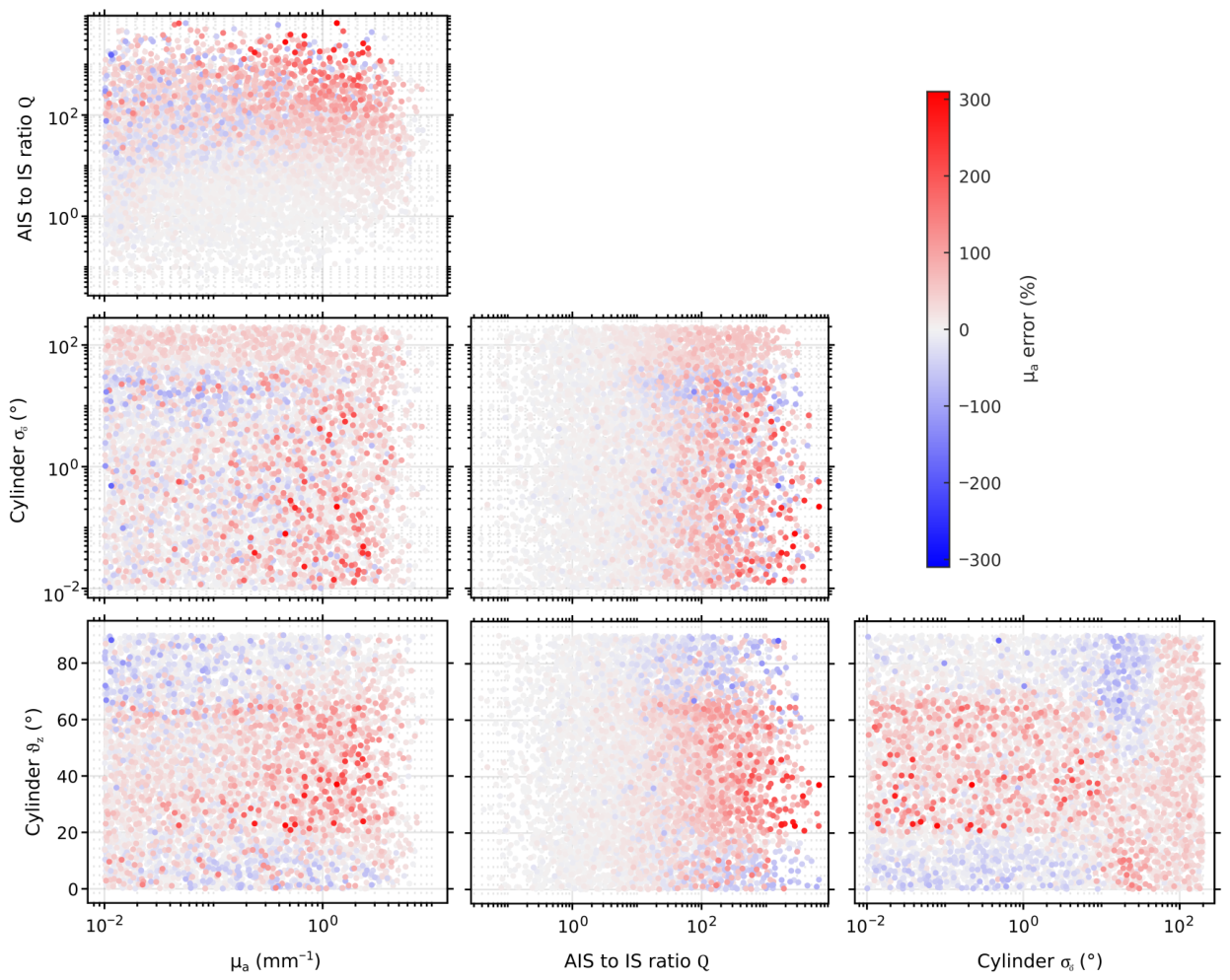
To disentangle the dependencies between fiber geometry, optical properties, and retrieval error, we analyzed feature pair plots mapping the relative absorption error against all feature combinations (Figure 5). These visualizations reveal distinct error regimes.
First, the derived scattering ratio Q acts as a clear indicator of model validity. A regime of high accuracy is observed for Q < 2 , where the mean relative error is restricted to 3.3 % with a maximum outlier of 27.5 % . Physically, a low Q indicates that scattering events are dominated by the isotropic matrix material. In this regime, the effective bulk light propagation approaches the isotropic approximation used in Mode A, resulting in successful parameter retrieval.
Second, we observe a dependency on the absorption magnitude itself. Higher μ a values generally lead to increased error variance. In highly absorbing media, photons with long path lengths are preferentially attenuated, meaning the detected signal is dominated by photons that have undergone fewer scattering events. These photons retain a stronger memory of the specific, angle-dependent scattering phase function of the cylinders. In Mode A, the model fails to capture these specific directional scattering traits, leading to larger errors compared to low-absorption regimes where diffusive mixing is more complete.
Finally, the fiber orientation parameters ϑ z and σ o exhibit a strong interaction. For aligned fibers (low σ o ), the error displays a distinct, step-like dependence on the tilt angle ϑ z . The model underestimates μ a at low (0° to 20°) and high (60° to 90°) inclinations, while overestimating it in the intermediate range (20° to 60°). This systematic angular bias is progressively washed out by the orientation spread σ o . As disorder increases toward σ o 100°, the cylinders approach a random orientation, causing these distinct error regimes to disappear.

3.3. Robustness of Anisotropic Model (Mode D)

To evaluate the stability of the anisotropic inversion model under geometric uncertainty, we employed for Mode D the same random forest regression framework as used for Mode A. The feature space was expanded to include all optical and geometric parameters as well as specific perturbation metrics. We quantified the mismatch between the inverse model assumptions ( x ˜ ) and the forward simulation ground truth (x) using the relative deviations x ˜ / x for the radius r, fill factor ϕ , orientation spread σ o , and scattering ratio Q. Additionally, we included the absolute tilt deviation ϑ ˜ z ϑ z .
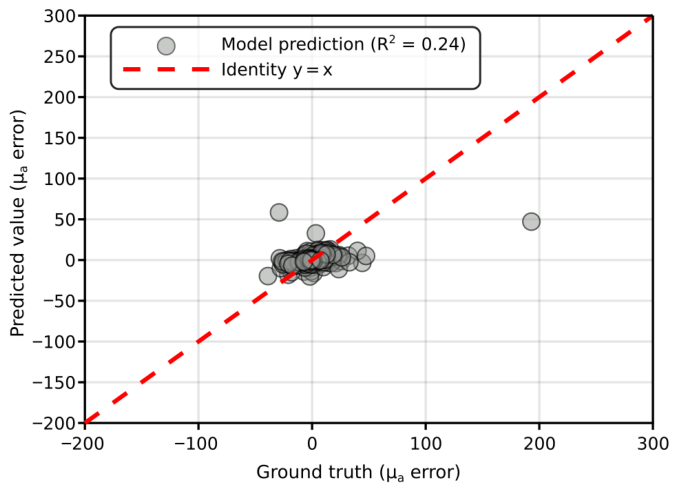
In contrast to the isotropic case, the random forest model failed to capture significant variance in the absorption error, achieving a coefficient of determination of only R 2 = 0.24 (Figure 6). This low predictability indicates that the residual errors in Mode D are not strongly driven by systematic dependencies on specific geometric mismatches. Instead, the error profile appears largely stochastic, suggesting that the anisotropic model successfully decouples the absorption retrieval from the specific details of the fiber geometry, even when those details are imperfectly known. Consequently, a feature importance analysis was not performed.
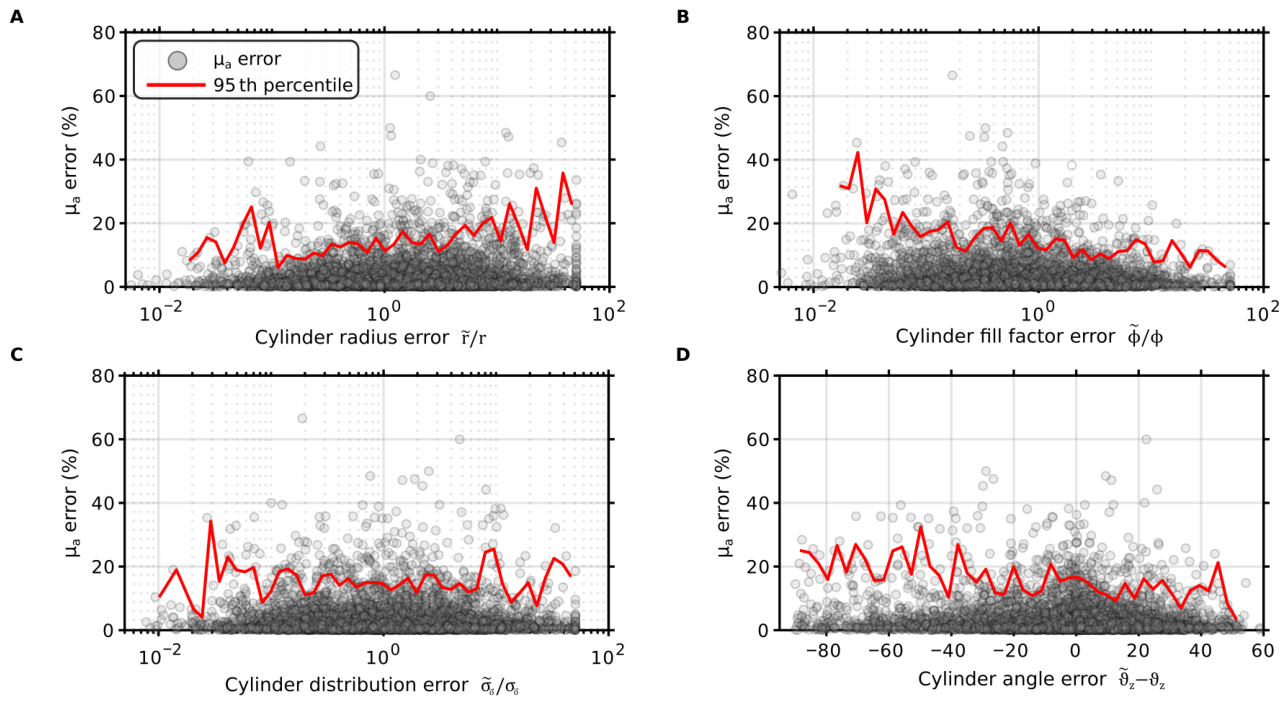
To further investigate the specific impact of geometric mismatches, we analyzed the direct relationship between the absorption error and the introduced assumption mismatch in cylinder radius ( r ˜ / r ), fill factor ( ϕ ˜ / ϕ ), orientation spread ( σ ˜ o / σ o ), and tilt angle ( ϑ ˜ z ϑ z ). Figure 7 displays these trends along with the 95th percentile of the absolute relative error to visualize the upper bound of the uncertainty. We observed three distinct behaviors regarding parameter sensitivity. First, the cylinder radius error shows a slight upward trend in the 95th percentile curve, indicating a weak sensitivity where larger deviations in the perturbed radius r ˜ marginally increase the retrieval uncertainty. Second, the fill factor ϕ exhibits a notable asymmetry where the 95th percentile curve trends downward as the perturbation ratio ϕ ˜ / ϕ increases. This indicates that the model is significantly more robust to overestimation ( ϕ ˜ > ϕ ) than underestimation. Physically, this stems from the nature of the isotropic approximation: underestimating ϕ forces the inverse model to weight the isotropic matrix properties more heavily, effectively shifting the solution toward the isotropic baseline (Mode A) where large systematic errors are known to occur. In contrast, overestimating ϕ preserves the dominance of the anisotropic cylinder scattering, maintaining the necessary directional corrections. In practical terms, assuming a higher density of fibers is therefore preferable to assuming a lower density when the exact fill factor is unknown. Finally, the model demonstrates high robustness to orientation errors. The error distributions for both the orientation spread σ ˜ o and the tilt angle ϑ ˜ z remain roughly constant across the perturbation range, implying that precise knowledge of the fiber alignment is less critical for accurate absorption retrieval than the volume fraction or fiber size.
The slight decrease in the 95th percentile curve for larger positive values of ϑ ˜ z ϑ z should not be interpreted as a strong monotonic physical trend. Rather, it likely reflects the combination of the relative perturbation model for ϑ z , clipping of perturbed angles to the interval [0°, 90°], and the generally weak sensitivity of the retrieval error to tilt mismatch, such that finite-bin and sampling effects become visible in the upper percentile.

3.4. Application to Stretched PTFE Tape

To validate the simulation findings in a physical system, we characterized a sample of mechanically stretched yellow PTFE thread seal tape. As detailed in Section 2, the stretching process generates aligned fibrils that induce pronounced anisotropic light propagation. These fibrils were modeled as infinite dielectric cylinders.
Prior to the integrating sphere measurements, the sample was characterized using a goniometric setup to independently derive its geometric and optical properties. While this method yields a baseline rather than an absolute ground truth, it provides a robust reference for evaluating the retrieval accuracy of the integrating sphere models.
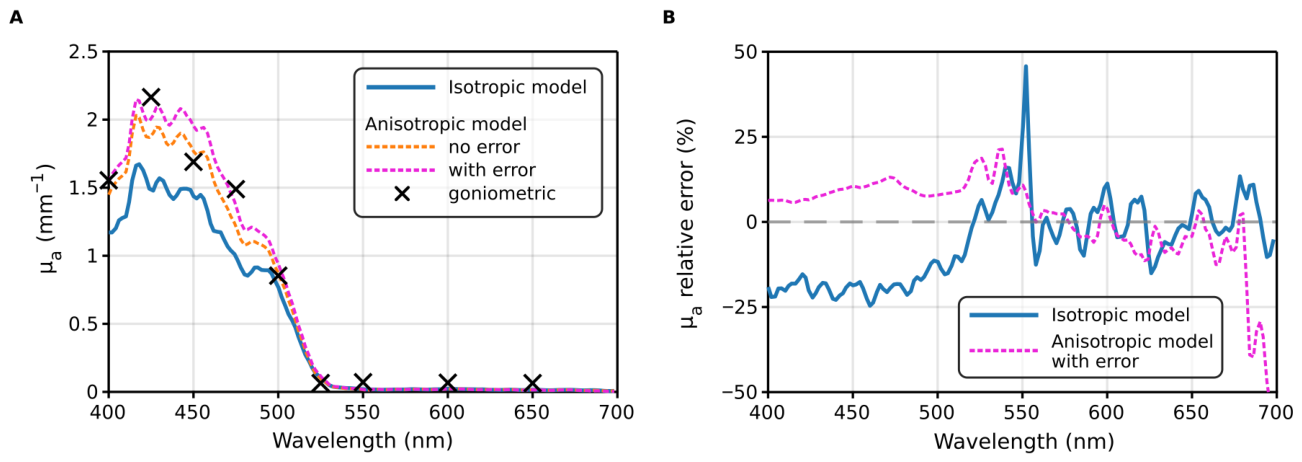
Figure 8A compares the absorption coefficients retrieved from the integrating sphere data using three different inverse approaches: the standard isotropic model, the anisotropic model initialized with the goniometrically determined geometric parameters, and a perturbed anisotropic model in which geometric errors of 100% to 300% relative to the goniometrically determined values were intentionally introduced.
Consistent with the simulation results, the isotropic model significantly underestimated the absorption coefficient. For wavelengths below 525 nm, the isotropic retrieval exhibited a mean deviation of 31% relative to the goniometric baseline and a systematic offset of approximately −25% compared to the unperturbed anisotropic model (Figure 8B). In contrast, accounting for anisotropy significantly improves accuracy. The unperturbed and perturbed anisotropic models yielded mean deviations from the goniometric baseline of 16% and 20%, respectively. Notably, the two anisotropic retrievals agreed with each other within 11%. This experimental evidence supports the sensitivity analysis (Mode D): even with substantial geometric uncertainties (e.g., in radius or fill factor), the anisotropic radiative transfer model provides a more accurate and robust estimate of μ a than the isotropic approximation.

4. Discussion

The present study shows that, within the model class and parameter ranges considered here, neglecting macroscopic anisotropic light propagation can introduce substantial bias into absorption retrieval from integrating-sphere measurements of fiber-structured media.
The comparison between the inverse models should be interpreted carefully. The present results do not establish that all isotropic inverse approaches are universally inadequate. Rather, they demonstrate the limitations of the specific isotropic inverse formulation used here when it is applied to media in which anisotropic light propagation makes a major contribution to the measured signal. Conversely, Mode B represents a matched-model benchmark, whereas Modes C and D probe the robustness of the anisotropic framework under deliberate mismatch in the assumed geometric parameters. In this sense, the main practical conclusion is comparative: for the class of fiber-structured model systems investigated here, incorporating an anisotropic inverse description that is not perfectly matched into the inverse model yields more reliable absorption estimates than retaining an isotropic approximation [32].
The derived parameter Q proved useful for organizing the simulation space and for identifying when the isotropic approximation begins to break down. However, Q should be regarded primarily as a simulation-based diagnostic quantity. Because it is defined from the relative numbers of anisotropic and isotropic scattering events within the model, it is not directly measurable in the present experimental implementation.
The random-forest analysis serves as a predictive tool. The fact that the relative error in μ a can be predicted reasonably well for the isotropic model indicates that the error is structured rather than purely random. By contrast, the low predictive power obtained for Mode D supports the conclusion that the residual error in the anisotropic reconstruction is less strongly tied to any one parameter mismatch and is comparatively stochastic.
An important practical implication of these results is that accurate absorption retrieval in anisotropic media may not require exact knowledge of every microstructural detail. In the perturbed anisotropic modes, even substantial deviations in radius, fill factor, and orientation spread still led to noticeably better performance than the isotropic baseline. This suggests that it can be more beneficial to adopt a physically appropriate anisotropic model with approximate structural priors than to apply an isotropic model that is formally simple but physically mismatched to the sample. At the same time, this conclusion should not be overstated: the robustness observed here was established within the chosen perturbation model, sample geometry, and parameter ranges, and it does not diminish the value of independent structural information where such information is available.
The experimental PTFE measurements provide proof-of-concept support for the simulation results. The stretched PTFE tape is a useful model system because it exhibits pronounced anisotropic light propagation and can be characterized independently by goniometric measurements. The experimental findings should be interpreted as supportive evidence that the main simulation trend persists in a real sample, namely that anisotropic inversion is less biased than the isotropic approximation even when geometric parameters are imperfectly specified.
Several limitations of the present study should be emphasized. First, the simulations employ an idealized composite model of aligned, infinitely long cylinders embedded in an isotropic matrix. While this captures an important mechanism of fibrous anisotropy, real tissues may exhibit finite fiber lengths, hierarchical organization, refractive-index heterogeneity, and additional wavelength-dependent complexity. Second, the use of a fixed Henyey–Greenstein phase function for the isotropic matrix is a simplifying assumption. In the diffuse regime relevant to the sufficiently scattering samples considered here, we expect the main comparative conclusions to be governed more strongly by the presence of macroscopic anisotropic light propagation than by the exact choice of the isotropic phase function. Nevertheless, phase-function approximation can influence optical-property estimation from integrating sphere data [33,34], so this remains a limitation of the present analysis. Finally, the experimental validation remains limited in scope and should be extended to additional phantoms and biological tissues before strong generalizations are made.
Future validation should be expanded to additional fibrous phantoms and ex vivo biological tissues with independently characterized structure. Such studies will help determine how much structural prior information is needed in practice and under which conditions anisotropic inverse modeling becomes necessary for reliable absorption retrieval.

5. Conclusions

In this study, we investigated the impact of anisotropic light propagation on the retrieval of the absorption coefficient in fiber-structured media using Monte Carlo simulations and proof-of-concept integrating-sphere measurements on mechanically stretched PTFE tape. Within the specific inverse formulations considered here, the isotropic model can produce large and systematic errors in μ a when light propagation is strongly influenced by structural anisotropy, whereas the anisotropic framework remains substantially more accurate and comparatively robust even when the assumed geometric parameters are perturbed.
The experimental results support the same qualitative trend. Overall, the present results indicate that, for the integrating sphere framework and model systems studied here, accounting for anisotropic light propagation can substantially improve absorption retrieval in fiber-structured media, although broader validation in additional phantoms and biological tissues is still required.

Author Contributions

Conceptualization, L.S.; methodology, F.F. and L.S.; software, F.F. and L.S.; validation, L.S.; formal analysis, L.S.; investigation, L.S.; resources, F.F.; data curation, L.S.; writing—original draft preparation, L.S.; writing—review and editing, A.K., F.F. and L.S.; visualization, L.S.; supervision, A.K. and F.F.; project administration, A.K. and F.F.; funding acquisition, F.F. All authors have read and agreed to the published version of the manuscript.

Funding

The research is part of the Zentrum für optische Eigenschaften (ZOE) at the ILM Ulm. This publication was supported by the Open Access Fund of Universität Ulm, with additional support from central funds of the Deutsche Forschungsgemeinschaft.

Data Availability Statement

The data that support the findings of this study are available from the corresponding author, L.S., upon reasonable request.

Conflicts of Interest

The authors declare no conflicts of interest. The funders had no role in the design of the study; in the collection, analyses, or interpretation of data; in the writing of the manuscript; or in the decision to publish the results.

References

  1. Rehman, A.U.; Ahmad, I.; Qureshi, S.A. Biomedical Applications of Integrating Sphere: A Review. Photodiagn. Photodyn. Ther. 2020, 31, 101712. [Google Scholar] [CrossRef] [PubMed]
  2. Zhu, C.; Liu, Q. Review of Monte Carlo modeling of light transport in tissues. J. Biomed. Opt. 2013, 18, 050902. [Google Scholar] [CrossRef]
  3. Descalle, M.A.; Jacques, S.L.; Prahl, S.A.; Laing, T.J.; Martin, W.R. Measurements of ligament and cartilage optical properties at 351 nm, 365 nm, and in the visible range (440 to 800 nm). In Proceedings of the BiOS Europe; Delacretaz, G.P., Godlewski, G., Pini, R., Steiner, R.W., Svaasand, L.O., Eds.; SPIE: San Remo, Italy, 1998; pp. 280–286. [Google Scholar] [CrossRef]
  4. Ebert, D.W. Articular Cartilage Optical Properties in the Spectral Range 300–850 nm. J. Biomed. Opt. 1998, 3, 326. [Google Scholar] [CrossRef]
  5. Kafian-Attari, I.; Nippolainen, E.; Bergmann, F.; George, A.; Paakkari, P.; Mirhashemi, A.; Foschum, F.; Kienle, A.; Töyräs, J.; Afara, I.O. Broadband scattering properties of articular cartilage zones and their relationship with the heterogenous structure of articular cartilage extracellular matrix. J. Biomed. Opt. 2023, 28, 125003. [Google Scholar] [CrossRef] [PubMed]
  6. Zijp, J.R. Optical Properties of Dental Hard Tissues. Ph.D. Thesis, University of Groningen, Groningen, The Netherlands, 2001. [Google Scholar]
  7. Eisel, M.; Ströbl, S.; Pongratz, T.; Stepp, H.; Rühm, A.; Sroka, R. Investigation of optical properties of dissected and homogenized biological tissue. J. Biomed. Opt. 2018, 23, 1. [Google Scholar] [CrossRef]
  8. Bashkatov, A.N.; Berezin, K.V.; Dvoretskiy, K.N.; Chernavina, M.L.; Genina, E.A.; Genin, V.D.; Kochubey, V.I. Measurement of tissue optical properties in the context of tissue optical clearing. J. Biomed. Opt. 2018, 23, 1. [Google Scholar] [CrossRef] [PubMed]
  9. Kienle, A.; Forster, F.K.; Hibst, R. Anisotropy of light propagation in biological tissue. Opt. Lett. 2004, 29, 2617. [Google Scholar] [CrossRef]
  10. Tuchin, V.V. Polarized light interaction with tissues. J. Biomed. Opt. 2016, 21, 071114. [Google Scholar] [CrossRef]
  11. Schroeder, A.B.; Karim, A.; Ocotl, E.; Dones, J.M.; Chacko, J.V.; Liu, A.; Raines, R.T.; Gibson, A.L.F.; Eliceiri, K.W. Optical imaging of collagen fiber damage to assess thermally injured human skin. Wound Repair Regen. 2020, 28, 848–855. [Google Scholar] [CrossRef]
  12. Marquez, G.; Wang, L.V.; Lin, S.P.; Schwartz, J.A.; Thomsen, S.L. Anisotropy in the absorption and scattering spectra of chicken breast tissue. Appl. Opt. 1998, 37, 798. [Google Scholar] [CrossRef]
  13. Kienle, A.; D’Andrea, C.; Foschum, F.; Taroni, P.; Pifferi, A. Light propagation in dry and wet softwood. Opt. Express 2008, 16, 9895. [Google Scholar] [CrossRef] [PubMed]
  14. Zijp, J.R.; ten Bosch, J.J. Theoretical model for the scattering of light by dentin and comparison with measurements. Appl. Opt. 1993, 32, 411. [Google Scholar] [CrossRef] [PubMed]
  15. Fried, D.; Glena, R.E.; Featherstone, J.D.B.; Seka, W. Nature of light scattering in dental enamel and dentin at visible and near-infrared wavelengths. Appl. Opt. 1995, 34, 1278. [Google Scholar] [CrossRef] [PubMed]
  16. Yaroslavsky, A.N.; Schulze, P.C.; Yaroslavsky, I.V.; Schober, R.; Ulrich, F.; Schwarzmaier, H.J. Optical properties of selected native and coagulated human brain tissues in vitro in the visible and near infrared spectral range. Phys. Med. Biol. 2002, 47, 2059–2073. [Google Scholar] [CrossRef]
  17. DePaoli, D.; Gasecka, A.; Bahdine, M.; Deschenes, J.M.; Goetz, L.; Perez-Sanchez, J.; Bonin, R.P.; De Koninck, Y.; Parent, M.; Côté, D.C. Anisotropic light scattering from myelinated axons in the spinal cord. Neurophotonics 2020, 7, 015011. [Google Scholar] [CrossRef]
  18. Kienle, A.; Forster, F.K.; Diebolder, R.; Hibst, R. Light propagation in dentin: Influence of microstructure on anisotropy. Phys. Med. Biol. 2003, 48, N7–N14. [Google Scholar] [CrossRef]
  19. Galaktionov, I.; Sheldakova, J.; Nikitin, A.; Samarkin, V.; Parfenov, V.; Kudryashov, A. Laser beam focusing through a moderately scattering medium using a bimorph mirror. Opt. Express 2020, 28, 38061. [Google Scholar] [CrossRef]
  20. Paudel, H.P.; Stockbridge, C.; Mertz, J.; Bifano, T. Focusing polychromatic light through scattering media. In Proceedings of the SPIE MOEMS-MEMS; Olivier, S.S., Bifano, T.G., Kubby, J., Eds.; SPIE: San Francisco, CA, USA, 2013; p. 86170D. [Google Scholar] [CrossRef]
  21. Mosk, A.P.; Lagendijk, A.; Lerosey, G.; Fink, M. Controlling waves in space and time for imaging and focusing in complex media. Nat. Photonics 2012, 6, 283–292. [Google Scholar] [CrossRef]
  22. Pickering, J.W.; Prahl, S.A.; van Wieringen, N.; Beek, J.F.; Sterenborg, H.J.C.M.; van Gemert, M.J.C. Double-integrating-sphere system for measuring the optical properties of tissue. Appl. Opt. 1993, 32, 399. [Google Scholar] [CrossRef] [PubMed]
  23. Prahl, S.A.; van Gemert, M.J.C.; Welch, A.J. Determining the optical properties of turbid media by using the adding–doubling method. Appl. Opt. 1993, 32, 559. [Google Scholar] [CrossRef]
  24. Foschum, F.; Bergmann, F.; Kienle, A. Precise determination of the optical properties of turbid media using an optimized integrating sphere and advanced Monte Carlo simulations. Part 1: Theory. Appl. Opt. 2020, 59, 3203. [Google Scholar] [CrossRef]
  25. Nelson, N.B.; Prézelin, B.B. Calibration of an integrating sphere for determining the absorption coefficient of scattering suspensions. Appl. Opt. 1993, 32, 6710. [Google Scholar] [CrossRef]
  26. Yaroslavsky, I.V.; Yaroslavsky, A.N.; Goldbach, T.; Schwarzmaier, H.J. Inverse hybrid technique for determining the optical properties of turbid media from integrating-sphere measurements. Appl. Opt. 1996, 35, 6797. [Google Scholar] [CrossRef]
  27. Henyey, L.C.; Greenstein, J.L. Diffuse radiation in the Galaxy. Astrophys. J. 1941, 93, 70. [Google Scholar] [CrossRef]
  28. Bohren, C.F.; Huffman, D.R. Absorption and Scattering of Light by Small Particles; Wiley-VCH: Weinheim, Germany, 2004. [Google Scholar]
  29. Yousif, H.A.; Boutros, E. A FORTRAN code for the scattering of EM plane waves by an infinitely long cylinder at oblique incidence. Comput. Phys. Commun. 1992, 69, 406–414. [Google Scholar] [CrossRef]
  30. Stolz, L.; Beutel, B.; Kienle, A.; Foschum, F. Optical Goniometer Paired with Digital Monte Carlo Twin to Determine the Optical Properties of Turbid Media. Sensors 2024, 24, 3525. [Google Scholar] [CrossRef]
  31. Johnson, P.M.; Lagendijk, A. Optical anisotropic diffusion: New model systems and theoretical modeling. J. Biomed. Opt. 2009, 14, 054036. [Google Scholar] [CrossRef] [PubMed]
  32. Pini, E.; Naglič, P.; Bürmen, M.; Gatto, A.; Schäfer, H.; Wiersma, D.S.; Pattelli, L. Experimental determination of effective light transport properties in fully anisotropic media. Adv. Photonics Nexus 2024, 3, 056017. [Google Scholar] [CrossRef]
  33. Yaroslavsky, A.N.; Yaroslavsky, I.V.; Goldbach, T.; Schwarzmaier, H.J. Influence of the Scattering Phase Function Approximation on the Optical Properties of Blood Determined from the Integrating Sphere Measurements. J. Biomed. Opt. 1999, 4, 47. [Google Scholar] [CrossRef]
  34. Milandri, A.; Asllanaj, F.; Jeandel, G. Determination of radiative properties of fibrous media by an inverse method—Comparison with the Mie theory. J. Quant. Spectrosc. Radiat. Transf. 2002, 74, 637–653. [Google Scholar] [CrossRef]
Figure 1. Schematic representation of the sample model used for the anisotropic light-propagation simulations. The isotropic matrix is indicated by green dots, while the cylinders are aligned along the mean orientation vector o . Deviations from the mean cylinder orientation are illustrated by colored arrows and are described by a two-dimensional Gaussian distribution with standard deviation σ o . The angle ϑ z denotes the tilt of the cylinders.
Photonics 13 00435 g001
Figure 2. (A) Distributions of the geometric parameter perturbations for the anisotropic inverse models Mode C and Mode D. Only these two traces are shown: Mode B is unperturbed and therefore has no distribution, and Mode A is an isotropic model for which geometric perturbation parameters are not defined. (B) Box plots of the relative error in the fitted absorption coefficient for the isotropic model (Mode A) and the anisotropic models (Modes B, C, and D). For each box plot, the box spans the interquartile range (25th to 75th percentiles), the central horizontal line indicates the median, and the whiskers extend to the most extreme data points that are not classified as outliers. Individual outliers are shown as crosses. Compared with Mode A, the anisotropic models exhibit narrower error distributions and smaller deviations, indicating improved accuracy and robustness against geometric parameter mismatches.
Photonics 13 00435 g002
Figure 3. Pearson correlation coefficients are shown for the geometric parameters, optical properties, and the derived scattering ratio Q. While most input parameters are uncorrelated due to random sampling, the derived parameter Q shows expected dependencies on μ s , r, and ϕ . A weak correlation between μ a and μ s arises from the exclusion of non-converging simulations.
Photonics 13 00435 g003
Figure 4. (A) Predicted versus true relative error in μ a for Mode A, showing a strong correlation ( R 2 = 0.75 ). The red dashed line represents the identity. (B) Feature importance ranking. All retained features contribute to the prediction of the error.
Photonics 13 00435 g004
Figure 5. Feature pair analysis of the absorption retrieval error for the isotropic model (Mode A). Scatter plots show the relationship between pairs of input parameters, with the color scale indicating the relative error in the fitted μ a (red: positive error, blue: negative error). The figure visualizes the parameter regimes in which the isotropic approximation performs well or breaks down. In particular, the error in μ a remains low largely independent of the other input parameters when Q < 2 , indicating that the isotropic model is mainly reliable when scattering is dominated by the isotropic matrix contribution.
Photonics 13 00435 g005
Figure 6. Predicted versus true relative error in μ a . The low coefficient of determination ( R 2 = 0.24 ) indicates that the error is largely dominated by random noise rather than systematic dependencies on the model features.
Photonics 13 00435 g006
Figure 7. The absolute relative error in μ a is plotted against the relative or absolute errors in the cylinder parameters: (A) radius r ˜ , (B) fill factor ϕ ˜ , orientation spread (C) σ ˜ o , and tilt angle (D) ϑ ˜ z . The inverse model assumption is denoted as x ˜ and the forward simulation ground truth as x. The red line represents the 95th percentile of the error magnitude.
Photonics 13 00435 g007
Figure 8. (A) Retrieved absorption coefficient μ a as a function of wavelength. (B) Relative deviation of the isotropic retrieval and the perturbed anisotropic retrieval with respect to the unperturbed anisotropic reference. While the isotropic assumption leads to systematic errors of −25%, the perturbed anisotropic model remains closer to the reference within 11%, demonstrating robustness against geometric uncertainties.
Photonics 13 00435 g008
Disclaimer/Publisher’s Note: The statements, opinions and data contained in all publications are solely those of the individual author(s) and contributor(s) and not of MDPI and/or the editor(s). MDPI and/or the editor(s) disclaim responsibility for any injury to people or property resulting from any ideas, methods, instructions or products referred to in the content.