Article

Detection of Trace N2O with Picowatt Excitation Power Based on High-Efficiency Mid-Infrared Upconversion


1
State Key Laboratory of Quantum Optics Technologies and Devices, Shanxi University, Taiyuan 030006, China
2
Collaborative Innovation Center of Extreme Optics, Shanxi University, Taiyuan 030006, China
3
College of Medical Imaging, Shanxi Medical University, Taiyuan 030001, China
4
Department of Physics and Optoelectronics, Taiyuan University of Technology, Taiyuan 030024, China
*
Authors to whom correspondence should be addressed.
These authors contributed equally to this work.
Photonics 2026, 13(4), 395; https://doi.org/10.3390/photonics13040395
Submission received: 25 March 2026 / Revised: 17 April 2026 / Accepted: 17 April 2026 / Published: 21 April 2026

Abstract

Detection of trace gases with high sensitivity and weak excitation power is highly desired for long-range remote sensing. Here, we report the detection of the greenhouse gas nitrous oxide (N2O) with the power of excitation light down to picowatts, by converting the mid-infrared laser to near-infrared photons through an intra-cavity-enhanced sum-frequency upconversion system. The intra-cavity-enhanced pumping power of 1064.0 nm reaches about 200.0 W, resulting in the conversion of the 4514.6 nm mid-infrared laser to 861.1 nm with an efficiency up to 73.4% under optimal conditions. The upconverted light is then detected by a single-photon avalanche detector, followed by a time-correlated single-photon counting module, which can measure the arrival time of each upconverted photon. By performing discrete Fourier transformations of the arrival time of the detected photons, the frequency spectrum can be determined. By using frequency modulation, this method can suppress background noise significantly. Consequently, the excitation power can be brought down to about 100 pW with the concentration of N2O being 10 ppm. As a demonstration of application, the presented system is also used for N2O sensing in an open-path geometry, highlighting the potential for stand-off leak detection. Our proposal offers promising applications to monitor trace gases over long distances with weak excitation powers.

1. Introduction

Today, environmental pollution issues are becoming increasingly severe, with rising concentrations of greenhouse gases intensifying global warming and drawing widespread societal attention. N2O, also known as laughing gas, is one of the three primary greenhouse gases responsible for climate change and ozone depletion [1,2]. Although the atmospheric abundance of N2O is relatively low, its global warming potential (GWP) is more than 200 times higher than that of carbon dioxide, and it is currently the dominant contributor to stratospheric ozone depletion [3]. In addition to natural sources, anthropogenic emissions of N2O cannot be overlooked, including fossil fuel combustion, chemical production (such as nitric acid plants), leaks of medical anesthetics, and localized environmental pollution from recreational inhalation of “laughing gas”. Overall, the global average atmospheric N2O concentration continues to rise, reaching unprecedented levels (336 ppb), and, due to its stability and long atmospheric lifetime, a decrease is improbable [4]. The spatial distribution of N2O is influenced mainly by regional climate and human activities. China is a hotspot of global N2O pollution [5,6]; therefore, it is crucial to monitor global atmospheric N2O concentrations using remote sensing methods, enabling the identification of N2O sources and a better understanding of their impact on climate change [7]. Gas remote sensing serves as the “eyes in the sky” and the “data foundation” supporting the “dual carbon” goals, providing critical data for climate change research, pollution prevention and control, as well as public health protection. During remote sensing detection, the power of the excitation light sources (typically mid-infrared lasers) after long-distance transmission and the returned signal are both extremely weak, resulting in higher demands on the sensitivity of weak-light detection.
Since both N2O and most other greenhouse gases exhibit absorption peaks in the mid-infrared band (3000.0–5000.0 nm), numerous methods have been developed to measure gas concentrations by monitoring the reduction in infrared light intensity after absorption [8,9,10,11,12]. Based on the principle of direct absorption, various gas detection techniques such as tunable diode laser absorption spectroscopy (TDLAS), quartz-enhanced photoacoustic spectroscopy (QEPAS), and differential absorption Lidar (DIAL) have been further developed [13,14,15,16]. Very recently, newly developed cavity-enhanced optical frequency comb spectroscopy and photo-counting dual-comb spectroscopy offer new possibilities for open-path gas sensing with high sensitivity [17,18,19]. In active remote gas sensing, the power of the excitation laser undergoes significant attenuation over long-distance transmission due to effects such as atmospheric scattering, absorption, and geometric spreading. To ensure the detector receives a sufficiently strong signal for analyzing the features of gas absorption, the initial power of the light source must be high enough to compensate for energy losses during propagation [20]. On the other hand, most of these technologies employ infrared photodetectors, such as thermal detectors and HgCdTe (MCT) [21]. However, the sensitivity of the most common infrared thermal detectors is typically in the microwatt or nanowatt range. Only a small subset of infrared detectors (such as MCT) can achieve picowatt-level sensitivity, and these tend to be very costly and typically require cryogenic cooling. Given the limited availability of high-power mid-infrared lasers and the insufficient sensitivity of mid-infrared photodetectors, developing highly sensitive remote gas-sensing technologies is of great significance for reducing the power requirements of mid-infrared lasers and lowering the cost of detection systems.
Compared with mid-infrared photodetectors, visible-to-near-infrared single-photon detectors offer advantages such as higher sensitivity, faster response times, and lower cost [22,23,24]. The nonlinear interactions, such as sum-frequency upconversion, can convert mid-infrared lasers into visible and near-infrared light, thereby enabling highly sensitive detection of extremely weak mid-infrared light using single-photon detectors [25]. Accordingly, over the past decade, significant efforts have been devoted to exploring low-noise infrared detection methods, among which upconversion has demonstrated both feasibility and great potential [26,27,28]. In both the imaging and the gas detection areas, particular accomplishments have been achieved. For example, the Zeng group achieved mid-infrared high-frame-rate, wide-field-of-view imaging using sum-frequency upconversion technology [29]. Sebastian Wolf and coworkers reported an upconversion system for detecting CH4 gas, achieving a sensitivity of 1.5 ppm for gas leakage detection [30]. Huang et al. demonstrated real-time CO2 gas monitoring using a mid-infrared laser via an upconversion system [31]. Although exciting developments have been achieved in mid-infrared upconversion, the power of these mid-infrared lasers is typically in the milliwatt to microwatt range, and excitation with extremely weak power or limited laser intensity for gas tracing has not been explored.
Here, we present a sensitive detection method for N2O gas under extremely weak excitation conditions, based on a sum-frequency upconversion technique. A quantum cascade laser (QCL) operating around 4515.0 nm is used as the excitation source, targeting the N2O absorption line at 2215.1 cm−1 (4514.6 nm). The infrared beam is directed through a 20.0 cm long single-pass gas cell filled with N2O and then introduced into the upconversion system, where it is combined with a 1064.0 nm pumping laser via sum-frequency generation, producing upconversion light at 861.1 nm. A highly sensitive silicon-based single-photon avalanche detector (SPAD) finally detects this upconverted signal, and demodulation techniques are applied to recover the optical signal, enabling highly sensitive gas detection with the power of the excitation laser at the level of hundreds of picowatts. This work provides a promising approach for gas tracing with extremely low excitation powers, enabling extremely long-range remote sensing.

2. Result and Discussion

2.1. Experimental Scheme for Mid-Infrared Upconversion

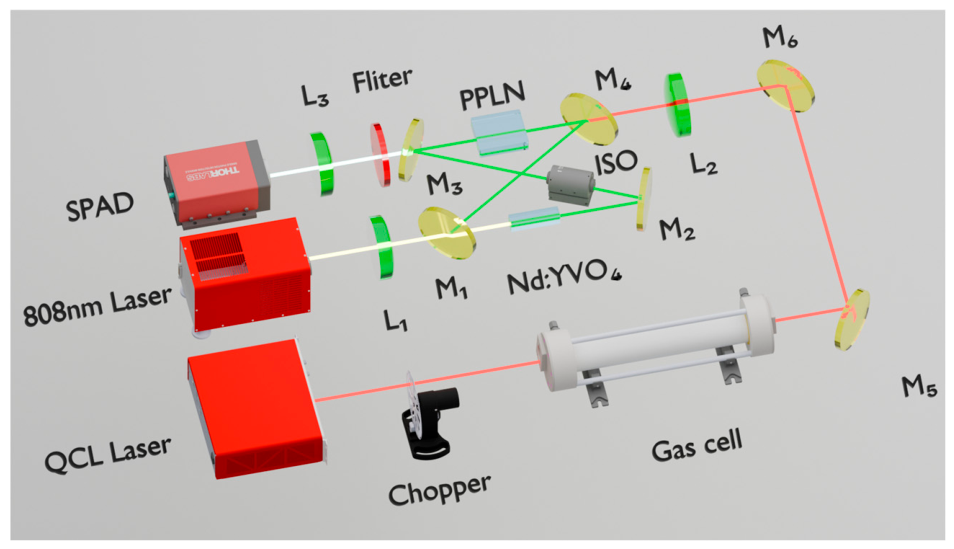
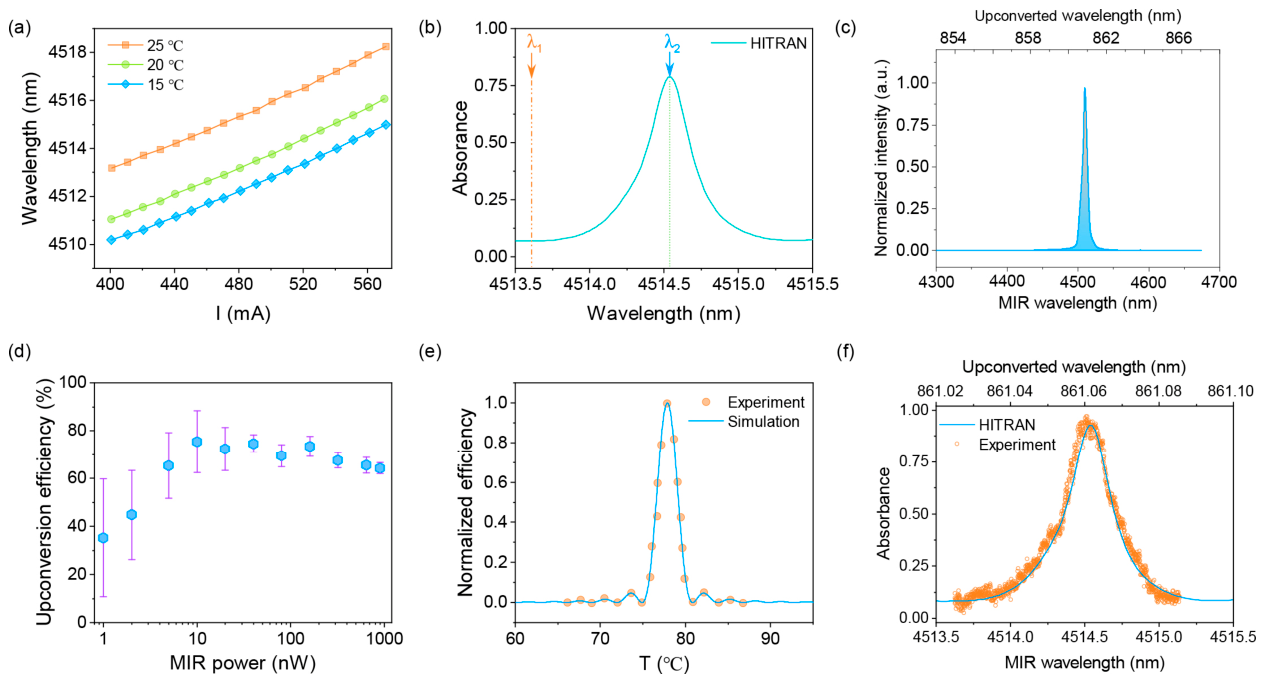
Figure 1 shows the schematic diagram of the experimental optical setup. The excitation light source is a QCL (AdTech, ATP4514-H) with an output wavelength range of 4510.0–4518.0 nm, as shown in Figure 2a. The operating temperature and injection current of the QCL can be precisely controlled by its driver system. A 20.0 cm long single-pass gas cell is used to retain N2O. After passing through the gas cell and being partially absorbed by N2O, the residual infrared light enters the upconversion system.
The upconversion system employs a compact 808.0 nm continuous-wave (CW) laser diode (Changchun New Industries, with a maximum output power of 20 W) to generate 1064.0 nm pump light via a Nd:YVO4 crystal (MT optics, with a doping concentration of 5%), and a ring cavity is used to enhance the pump power while simultaneously reducing the overall system size and power consumption (these features are critical for outdoor applications). The 808.0 nm CW laser is delivered via an optical fiber and irradiates the Nd:YVO4 crystal. This crystal, with an end-face size of 3.0 mm and a length of 12.0 mm, serves as the laser gain medium, converting the 808.0 nm laser to 1064.0 nm and amplifying it within a ring cavity to generate high-power output. The ring cavity consists of four primary mirrors: M1, M2, M3, and M4. The features of these mirrors are described in the Supporting Information (Section S2). This four-mirror ring cavity not only effectively reduces the overall footprint of the upconversion system but also significantly mitigates astigmatism-induced degradation of the output beam quality by optimizing the incident angle on the concave mirror. The designed upconversion system utilizes cavity-enhanced technology to obtain a high-power pumping laser while overcoming issues such as bulky equipment and high power consumption typically associated with high-power pulsed sources. Subsequently, a chirped, periodically poled lithium niobate (PPLN, Yun Lin Optoelectronic Technology, doped with 5% MgO, 20.0 × 11.8 × 2.0 mm3) crystal with periods of 20.9 μm to 23.3 μm is selected as the sum-frequency crystal, enabling highly efficient frequency upconversion within the 3000.0–5000.0 nm band (Figure S5). The polarization period of 23.0 μm is used for this work. Without the temperature tuning, the bandwidth of the upconversion is about 700 nm, as illustrated in Figure S6. The incident mid-infrared light and the high-power 1064.0 nm laser undergo sum-frequency generation in the PPLN crystal, producing upconversion light around 860.0 nm.
The upconversion light is focused by a lens onto the SPAD (Excelitas Technologies, Montreal, QC, Canada) and then transmitted via a data-acquisition card to a computer for real-time collection and detection. To minimize noise, all optical components are housed within a sealed black aluminum alloy casing to block ambient stray light. Furthermore, a set of spectral filters is placed in front of the SPAD to suppress background noise rather than the 860.0 nm upconversion signal. Experimental characterization reveals that the primary background noise included the environmental stray light, the light around 808.0 nm emitted by the laser diode, 532.0 nm light generated by second-harmonic generation, and the residual 1064.0 nm pump laser. By employing this series of spectral filters, the background noise can be significantly reduced, thereby effectively eliminating interference from background radiation. The features of these spectral filters are described in the Supporting Information (Figure S2).

2.2. Performance of the Upconversion System

Based on the HITRAN database, the absorption spectra of N2O from 4513.5 nm to 4515.5 nm are selected for gas detection (Figure 2b), under conditions of 101.0 kPa and 300.0 K. By consulting the HITRAN database, we found that, except for N2O, the absorption effects of all gases in this wavelength range were extremely weak and could be disregarded. The QCL used in this study can be tuned from 4510.0 nm to 4518.0 nm by adjusting its operating temperature and injection current, thereby fully covering the N2O absorption peak. Based on the absorption peak of N2O and the scanning wavelength range of the laser, two wavelengths—λ1 (4513.6 nm) in the weak absorption region and λ2 (4514.6 nm) at the absorption peak center—are selected for subsequent experiments, as presented in Figure 2b.
The upconversion system employed in this work is based on the mechanism of three-wave mixing (also known as sum-frequency generation) in a nonlinear optical crystal driven by a pumping laser [32,33], which can be expressed as ℏω3 = ℏω2 + ℏω1, where ω1, ω2, and ω3 denote the frequency of the mid-infrared light, the pumping laser, and the upconverted light, respectively. Since the SPAD presents high efficiency around 860.0 nm, the pump wavelength of 1064.0 nm is selected. Figure 2c presents the mid-infrared light (4500.0 nm) and the corresponding upconverted light (860.5 nm). The upconversion efficiency, η, defined as the ratio of the photon flux of the generated sum-frequency light to that of the input mid-infrared laser, is a key performance metric. It can be calculated as follows:
η = P 2 P 1 = 8 π 2 L 2 d e f f 2 n 1 n 2 n 3 λ 1 λ 2 c ε 0 P 2 sin c 2 Δ k 2 L
Note that the upconversion efficiency is generally determined by the effective nonlinear coefficient (deff) of the medium, the length (L) of the nonlinear crystal, the power of the pumping laser (P2), and the phase mismatch (Δk) among the interacting waves. Since upconversion efficiency is proportional to the pumping power, we can increase it by increasing the pumping power. To achieve high upconversion efficiency, cavity enhancement technology is employed to obtain a maximum power of 200 W at 1064.0 nm (as illustrated in Figure S3). The output power is relatively stable, with a stability of about 5% (Figure S4). Figure 2d shows the measured upconversion efficiency for different weak mid-infrared input lasers when the pumping laser power is set at approximately 200 W. Note that the upconversion efficiency reaches as high as 73.4% under the power of mid-infrared light within the power of tens of nanowatts. For extremely weak mid-infrared inputs, the upconverted signal shows reduced efficiency and inevitable fluctuations due to the instability of the input laser and the influence of the surrounding thermal background radiation. Furthermore, the upconversion efficiency is strongly dependent on the temperature of the nonlinear crystal; thus, the temperature of PPLN should be carefully optimized, as presented in Figure 2e. The result agrees well with the theoretical simulation under the assumption of plane-wave interaction (see Figure S5 for details) [34].
As we mentioned above, the wavelength of the QCL can be tuned by the driver system to scan the wavelength range from 4513.6 nm to 4515.2 nm, which contains an absorption peak of N2O gas. To verify the spectra, the mid-infrared light, after passing through and being absorbed by a 20.0 cm long gas cell filled with 1000.0 ppm N2O, is directed into the upconversion system. The SPAD then detects the upconversion light. As shown in Figure 2f, the measured spectrum agrees reasonably well with the simulated N2O spectrum (based on HITRAN data), confirming the feasibility of our system.

2.3. Gas Detection with Different Excitation Powers

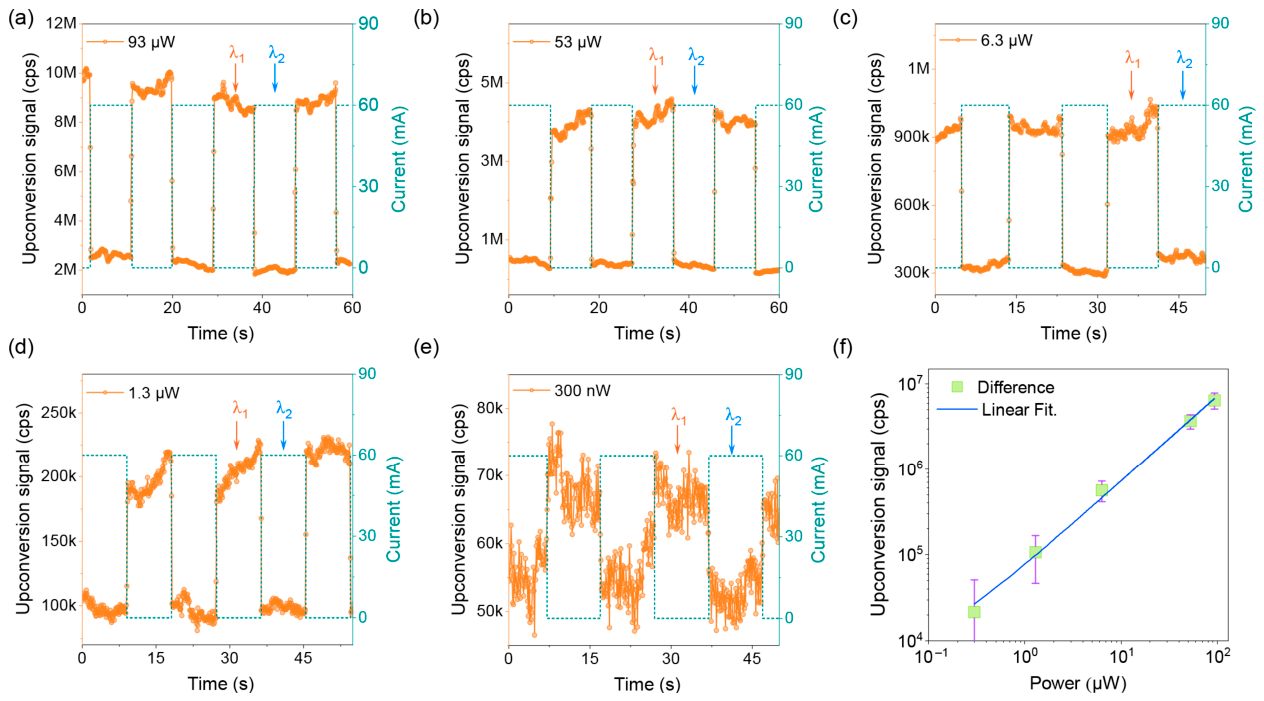
To evaluate system sensitivity, two wavelengths (λ1 and λ2) are alternated by controlling the QCL injection current. Gas absorption can be determined by comparing the intensity of the upconversion light after transmission through the gas cell. Figure 3a–e present a comparison of upconversion intensities at different wavelengths and excitation powers after passing through the gas cell filled with 1000.0 ppm N2O (which simulates the natural concentration with an absorption length of about 600.0 m and a pressure of 1 atm). It can be observed that, due to the difference in absorbance of N2O at wavelengths λ1 and λ2, the upconverted signal of the two wavelengths at the same excitation intensities exhibits a significant difference after being absorbed by N2O. The difference in these upconverted signals between λ1 and λ2 is plotted in Figure 3f, showing an approximately linear relationship with excitation power, consistent with theoretical expectations. Note that, when the excitation power is lower than 300.0 nW, the difference between these two wavelengths almost becomes indistinguishable. That is to say, for conventional single-photon detection, the limited excitation power is close to the level of about 100.0 nW, which is far below the sensitivity of the state-of-the-art infrared detectors. The main reason is the significant background noise from stray light and the upconversion system as well as dark counts from the single-photon detectors.

2.4. Improving Sensitivity Through the Modulation–Demodulation Technique

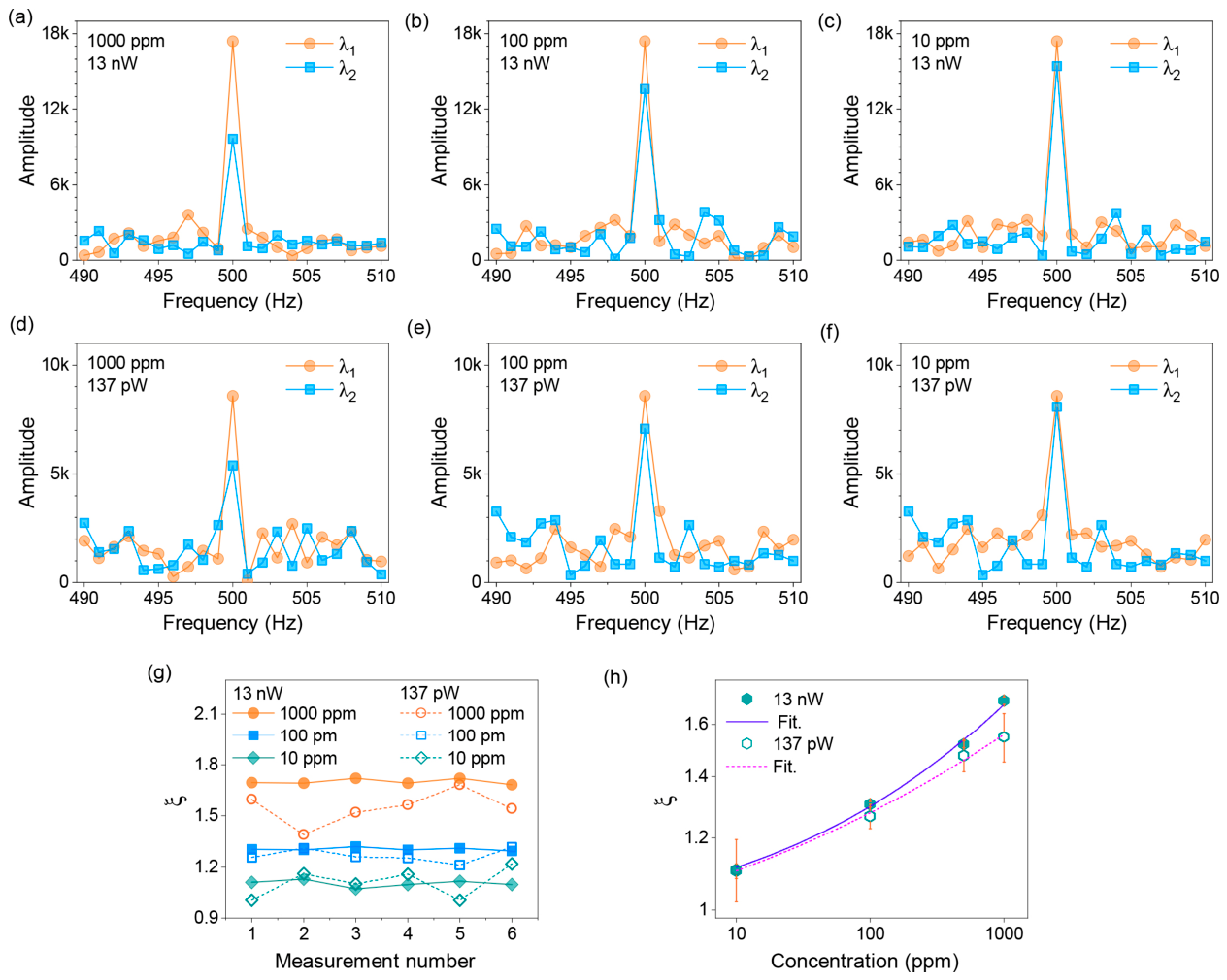
To further improve the detection sensitivity, the modulation–demodulation technique is employed to eliminate background noise. An optical chopper (Thorlabs MC1F10HP, frequency range: 20.0 Hz–10.0 kHz) is placed in the path of the excitation beam to modulate the excitation light at a frequency of 500.0 Hz. The excitation power is attenuated from 13.1 nW to 137.0 pW during the measurement. After passing through the gas cell, the upconversion light is detected by the SPAD, and the arrival time of each upconverted photon is recorded by the time-correlated single-photon counting (TCSPC) system. The frequency spectrum of the target signal, F(ω), can be obtained by applying the discrete Fourier transform (DFT) to the time sequences of these single photons. A brief introduction about noise suppression through frequency-domain detection at the single-photon level has been provided in the Supporting Information (Section S1), and the details can also be found in our recent works [35,36]. By globally calculating the amplitude of each frequency, the corresponding modulation frequency with a large amplitude can be found, as shown in Figure 4a. In contrast, the noisy photons from the background or dark current of the detectors are generally randomly distributed in the frequency domain (see Figure S4 for details). Note that the amplitude at 500.0 Hz for the weak absorption at λ1 is stronger than that at λ2 with strong absorption. This phenomenon can be attributed to the fact that the transmitted mid-infrared light at λ1 is much stronger than that at λ2, thereby generating many more upconverted photons. In this case, we can determine the presence of N2O gas by the ratio of amplitude at 500.0 Hz between λ1 and λ2, analogous to colorimetric temperature sensing [37,38]. This ratio, ξ, can be calculated by
ξ = A λ 1 A λ 2
where Aλ1 and Aλ2 are the amplitudes of the frequency spectrum at 500.0 Hz. As shown in Figure 4a, the value of ξ is about 1.7 when the excitation power is 13.0 nW with the concentration of N2O at 1000.0 ppm. To confirm reproducibility, we performed multiple measurements, and the results show slight fluctuations (Figure 4g), possibly due to fluctuations in upconversion efficiency and shot noise in photon detection. We further perform the experiments with different N2O concentrations while holding the excitation power, as shown in Figure 4b and Figure 4c, respectively. As expected, with the decrease in concentration, the ratio also gradually decreases and becomes insignificant at a concentration of 10 ppm (Figure 4c). This phenomenon also proves that the amplitudes between different wavelengths originate from the absorption rather than from another effect. Furthermore, this tendency presents a power-law behavior, as shown in Figure 4h. One should note that this analysis is an empirical formula. The comparison between the exponential and power-law fits has been discussed in the Supporting Information (Section S7) [39,40,41]. The underlying mechanism should be further investigated. Consequently, at a certain excitation power and sensing distance, the concentration of gas might be retrieved by this ratio. On the other hand, when we reduce the excitation power, ξ also decreases, as shown in Figure 4d. One should emphasize that, when the power declines to 100 pW, the fluctuations of this ratio become pronounced (Figure 4g), resulting in a somewhat unreliable performance for even-lower excitation powers. That is, this result approaches the detection limit of the existing system; further improvement may be achieved by enhancing the upconversion efficiency under extremely weak mid-infrared light intensities (such as tens of picowatts and even sub-picowatts) and by reducing background noise. Nonetheless, the ratio as a function of N2O concentration still exhibits power-law behavior, enabling the detection of N2O at 10 ppm with a power of about 100 pW. Furthermore, when the mid-infrared light is absorbed fully at the wavelength of λ2, and the background noise can be suppressed, the amplitude at the wavelength of λ2 should be close to zero in principle. Consequently, the detection limitations can be further improved and might be up to the ppb level.

2.5. Detection of N2O Leakage in Outdoor Environments

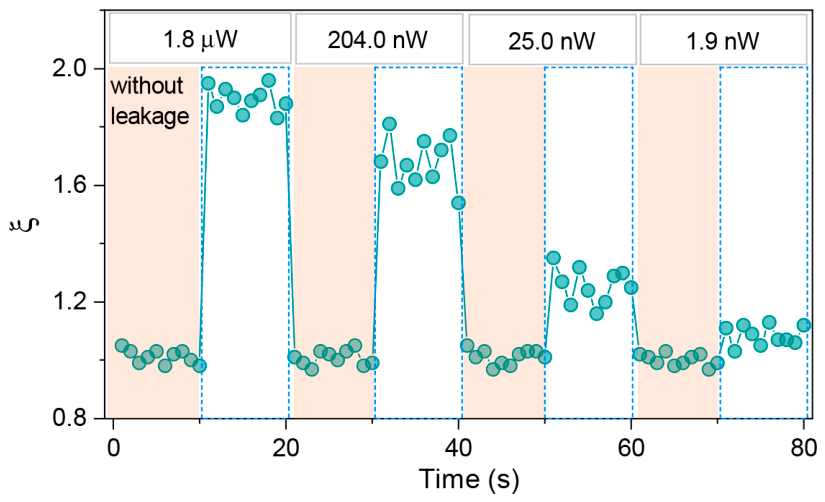
Finally, to demonstrate the practical application of the proposed system, a gas leakage scenario is simulated. A stainless-steel pipe with a small hole is connected to a gas cylinder containing N2O with a standard concentration of 1000.0 ppm. A pressure-reducing valve is used to release the gas at a fixed flow rate, simulating a leakage condition. The distance between the proposed system and the stainless-steel pipe is about 10.0 m. The output wavelengths of the infrared laser are switched between λ1 and λ2, and the echo scattering mid-infrared laser is collected by a home-made mid-infrared telescope system (see Figure S5 for details). The upconversion signal is collected in real time using a data acquisition card. The corresponding frequency spectra and the amplitude ratio between λ1 and λ2 are determined by a personal computer. The excitation powers are attenuated to different levels for separate measurements. The results are shown in Figure 5. Note that, when the excitation power is fixed, the ratio shows a significant increase when N2O leakage occurs. With a decrease in excitation power, the ratio shows an apparent decline; however, the variation with and without leakage can still be clearly distinguished down to the nanowatt level. This result confirms the promising application of our system for remote gas leakage detection over long distances and with extremely low excitation power. One should note that, although the repeated experiments prove the ability, more rigorous evaluations of the repeatability and accuracy of this system should be performed to promote practical applications.
According to the indoor and outdoor experiments, we can conclude that our scheme provides a new route for remote sensing trace gases (such as N2O) without the requirement of high-sensitivity infrared photodetectors. However, compared with the state-of-the-art measurements (such as wavelength-modulation spectroscopy and QEPAS) [42,43], the sensitivity of N2O, limited to about 10 ppm, is still insufficient. In the future, several methods may significantly improve the detection sensitivity. First, when this method is adopted for remote sensing, the optical path is far beyond 20 cm. In this case, the detection limit can be significantly improved. Second, for indoor use, replacing the 20 cm single-pass cell with a long-path multi-pass cell can significantly improve the detection sensitivity. Third, the efficiency of the upconversion system is positively correlated with the pump power; therefore, replacing the laser and optimizing the optical path can further increase the pump power and thus enhance the conversion efficiency. Moreover, although spectral filtering has already been employed to suppress background noise, some residual noise still exists. Replacing the current filters with better-performing ones could further reduce noise and improve the signal-to-noise ratio. On the other hand, the simultaneous trace detection of N2O with other atmospheric pollutants is also important, as Ren and other groups have recently developed [44,45,46]. Our scheme also has the potential to achieve multiple gas detection by tuning the excitation laser in a broad region or using multi-wavelength lasers. The high upconversion coefficient of the PPLN can be held in a broad wavelength region by adopting its temperature, enabling the feasibility of simultaneous trace detection.
Although the success of outdoor detection presents the proof-of-concept function of our system, there are still some limitations that need to be overcome. For example, the stability of the overall system, including the optical path, the temperature of the nonlinear crystal, and the possible dust pollution. Integration of the total system through an all-fiberization design and fully closed optical paths may reduce the volume further and improve stability. Furthermore, we can enhance the outdoor performance by utilizing a shock-proof isolation layer beneath the optical paths. Furthermore, the calibration of the gas concentration should also be considered, which is a challenge when the return signal is too weak. Understanding the relationship between the power of the excitation laser, gas concentration, and the return signal may provide potential solutions. Of course, with the assistance of recently developed deep learning and massive data, the concentration may be determined directly from the measurement data. These issues are our future goals.

3. Conclusions

In conclusion, we present a mid-infrared sum-frequency upconversion gas detection system with low excitation power and high detection sensitivity. By employing cavity enhancement technology, a structurally compact, miniaturized, highly stable, efficient, and long-life Nd:YVO4 folded-cavity laser has been developed, achieving an output power of 200.0 W at 1064.0 nm, while reducing the overall system footprint, making it suitable for portable applications. In this case, the 4514.6 nm infrared laser used to monitor N2O is upconverted to 861.1 nm with high efficiency, enabling detection with a silicon-based SPAD that offers high sensitivity, fast response, and low cost. To suppress background noise from stray light and the upconversion system, we modulate the infrared laser and perform discrete Fourier transforms on the upconverted photons. Consequently, the presence of N2O at a concentration of 10.0 ppm has been confirmed at an infrared power of about 100.0 pW by comparing the amplitude of the frequency spectrum with and without absorption. To further reduce the excitation power and improve sensitivity, single-pass absorption can be enhanced by employing multi-pass cells. On the other hand, the key optical components can be mounted on temperature-stabilized mounts to suppress fluctuations in pumping power and wavelength drift due to temperature variations, ensuring long-term measurement stability. Overall, our proposed system offers promising applications for trace gases with weak excitation intensities, reducing the power requirements of mid-infrared lasers and lowering the costs of detection systems.

Supplementary Materials

The following supporting information can be downloaded at: https://www.mdpi.com/article/10.3390/photonics13040395/s1.

Author Contributions

Conceptualization, C.Q. and H.W.; methodology, Z.S.; software, C.F. and S.D.; validation, S.D., Z.Q. and Y.X.; formal analysis, Z.S. and S.D.; investigation, C.F.; resources, C.Q., L.X. and S.J.; data curation, J.H.; writing—original draft preparation, C.Q. and H.W.; visualization, R.C. and G.Z.; supervision, C.Q. and L.X.; project administration, S.J. All authors have read and agreed to the published version of the manuscript.

Funding

National Natural Science Foundation of China (Nos. 62127817, U25D8006, U22A2091, U23A20380, 62127817, 62575164, and 62575162), Changjiang Scholars and Innovative Research Team in University of Ministry of Education of China (Grant No. IRT_17R70), Fundamental Research Program of Shanxi Province (202403021212018), and 111 projects (Grant No. D18001).

Institutional Review Board Statement

Not applicable.

Informed Consent Statement

Not applicable.

Data Availability Statement

Data underlying the results presented in this paper are not publicly available at this time but may be obtained from the authors upon reasonable request.

Conflicts of Interest

The authors declare no conflicts of interest.

Abbreviations

The following abbreviations are used in this manuscript:
N2ONitrous oxide
GWPGlobal warming potential
TDLASTunable diode laser absorption spectroscopy
QEPASQuartz-enhanced photoacoustic spectroscopy
DIALDifferential absorption Lidar
QCLQuantum cascade laser
CWContinuous wave
PPLNPeriodically poled lithium niobate
TCSPCTime-correlated single-photon counting
DFTDiscrete Fourier transform

References

  1. Ravishankara, A.R.; Daniel, J.S.; Portmann, R.W. Nitrous oxide (N2O): The dominant ozone-depleting substance emitted in the 21st century. Science 2009, 326, 123–125. [Google Scholar] [CrossRef]
  2. Wuebbles, D.J. Nitrous oxide: No laughing matter. Science 2009, 326, 56–57. [Google Scholar] [CrossRef] [PubMed]
  3. Pachauri, R.K.; Allen, M.R.; Barros, V.R.; Broome, J.; Cramer, W.; Christ, R.; Church, J.A.; Clarke, L.; Dahe, Q.; Dasgupta, P.; et al. Climate Change 2014: Synthesis Report. Contribution of Working Groups I, II and III to the Fifth Assessment Report of the Intergovernmental Panel on Climate Change; IPCC: Geneva, Switzerland, 2014. [Google Scholar]
  4. Rodhe, H. A comparison of the contribution of various gases to the greenhouse effect. Science 1990, 248, 1217–1219. [Google Scholar] [CrossRef] [PubMed]
  5. Richter, A.; Burrows, J.P.; Nüß, H.; Granier, C.; Niemeier, U. Increase in tropospheric nitrogen dioxide over China observed from space. Nat. Commun. 2005, 437, 129–132. [Google Scholar] [CrossRef] [PubMed]
  6. Van Der A, R.; Eskes, H.; Boersma, K.; Van Noije, T.; Van Roozendael, M.; De Smedt, I.; Peters, D.; Meijer, E. Trends, seasonal variability and dominant NOx source derived from a ten year record of NO2 measured from space. J. Geophys. Res. Atmos. 2008, 113, D04302. [Google Scholar] [CrossRef]
  7. Rapson, T.D.; Dacres, H. Analytical techniques for measuring nitrous oxide. TrAC Trends Anal. Chem. 2014, 54, 65–74. [Google Scholar] [CrossRef]
  8. Hermes, M.; Morrish, R.B.; Huot, L.; Meng, L.; Junaid, S.; Tomko, J.; Lloyd, G.R.; Masselink, W.T.; Tidemand-Lichtenberg, P.; Pedersen, C.; et al. Mid-IR hyperspectral imaging for label-free histopathology and cytology. J. Opt. 2018, 20, 023002. [Google Scholar] [CrossRef]
  9. Wang, D.D.; Liang, S.L.; He, T.; Shi, Q.Q. Estimating clear-sky all-wave net radiation from combined visible and shortwave infrared (VSWIR) and thermal infrared (TIR) remote sensing data. Remote Sens. Environ. 2015, 167, 31–39. [Google Scholar] [CrossRef]
  10. Li, J.S.; Parchatka, U.; Königstedt, R.; Fischer, H. Real-time measurements of atmospheric CO using a continuous-wave room temperature quantum cascade laser based spectrometer. Opt. Express 2012, 20, 7590–7601. [Google Scholar] [CrossRef]
  11. Qiao, F.; Williams, J. Topic Modelling and Sentiment Analysis of Global Warming Tweets: Evidence From Big Data Analysis. J. Organ. End User Comput. 2022, 34, 1–18. [Google Scholar] [CrossRef]
  12. Sun, H.; Qiao, S.; He, Y.; Sun, X.; Ma, Y. Parts-per-quadrillion level gas molecule detection: CO-LITES sensing. Light Sci. Appl. 2025, 14, 180. [Google Scholar] [CrossRef] [PubMed]
  13. Yang, M.; Wang, Z.; Nie, Q.; Ni, K.; Ren, W. Mid-infrared cavity-enhanced absorption sensor for ppb-level N2O detection using an injection-current-modulated quantum cascade laser. Opt. Express 2021, 29, 41634–41642. [Google Scholar] [CrossRef]
  14. Nadeem, F.; Mandon, J.; Cristescu, S.M.; Khodabakhsh, A.; Harren, F.J. Experimental-based comparison between off-axis integrated cavity output spectroscopy and multipass-assisted wavelength modulation spectroscopy at 7.7 µm. OSA Contin. 2019, 2, 2667–2682. [Google Scholar] [CrossRef]
  15. Browell, E.V.; Ismail, S.; Grant, W.B. Differential absorption lidar (DIAL) measurements from air and space. Appl. Phys. B 1998, 67, 399–410. [Google Scholar] [CrossRef]
  16. Wang, J.; Wu, H.; Sampaolo, A.; Patimisco, P.; Spagnolo, V.; Jia, S.; Dong, L. Quartz-enhanced multiheterodyne resonant photoacoustic spectroscopy. Light Sci. Appl. 2024, 13, 77. [Google Scholar] [CrossRef]
  17. Zhong, W.; Liu, Y.; Yin, Q.; Zhao, R.; Wang, C.; Ren, W.; Dou, X.; Xue, X. Broadband photon-counting dual-comb spectroscopy with attowatt sensitivity over turbulent optical paths. Light Sci. Appl. 2025, 14, 293. [Google Scholar] [CrossRef]
  18. Guan, G.; Liu, A.; Wu, X.; Zheng, C.; Liu, Z.; Zheng, K.; Pi, M.; Yan, G.; Zheng, J.; Wang, Y. Near-infrared off-axis cavity-enhanced optical frequency comb spectroscopy for CO2/CO dual-gas detection assisted by machine learning. ACS Sens. 2024, 9, 820–829. [Google Scholar] [CrossRef] [PubMed]
  19. Rieker, G.B.; Giorgetta, F.R.; Swann, W.C.; Kofler, J.; Zolot, A.M.; Sinclair, L.C.; Baumann, E.; Cromer, C.; Petron, G.; Sweeney, C.; et al. Frequency-comb-based remote sensing of greenhouse gases over kilometer air paths. Optica 2014, 1, 290–298. [Google Scholar] [CrossRef]
  20. Baetz, W.; Kroll, A.; Bonow, G. Mobile robots with active IR-optical sensing for remote gas detection and source localization. In 2009 IEEE International Conference on Robotics and Automation; IEEE: Piscataway, NJ, USA, 2009; pp. 2773–2778. [Google Scholar]
  21. Baidar, S.; Volkamer, R.; Alvarez, R.; Brewer, A.; Davies, F.; Langford, A.; Oetjen, H.; Pearson, G.; Senff, C.; Hardesty, R.M. Combining active and passive airborne remote sensing to quantify NO2 and Ox production near Bakersfield, CA. Br. J. Environ. Clim. Change 2013, 3, 566–586. [Google Scholar] [CrossRef]
  22. Rogalski, A. Infrared Detectors; CRC Press: Boca Raton, FL, USA, 2000. [Google Scholar]
  23. Hogstedt, L.; Dam, J.S.; Sahlberg, A.L.; Li, Z.S.; Aldén, M.; Pedersen, C.; Tidemand-Lichtenberg, P. Low-noise mid-IR upconversion detector for improved IR-degenerate four-wave mixing gas sensing. Opt. Lett. 2014, 39, 5321–5324. [Google Scholar] [CrossRef]
  24. Villa, F.; Severini, F.; Madonini, F.; Zappa, F. SPADs and SiPMs arrays for long-range high-speed light detection and ranging (LiDAR). Sensors 2021, 21, 3839. [Google Scholar] [CrossRef] [PubMed]
  25. Kleinman, D.A.; Boyd, G.D. Infrared detection by optical mixing. J. Appl. Phys. 1969, 40, 546–566. [Google Scholar] [CrossRef]
  26. Darré, P.; Baudoin, R.; Gomes, J.-T.; Scott, N.; Delage, L.; Grossard, L.; Sturmann, J.; Farrington, C.; Reynaud, F.; Brummelaar, T.T.; et al. First on-sky fringes with an up-conversion interferometer tested on a telescope array. Phys. Rev. Lett. 2016, 117, 233902. [Google Scholar] [CrossRef] [PubMed]
  27. Dam, J.S.; Tidemand-Lichtenberg, P.; Pedersen, C. Room-temperature mid-infrared single-photon spectral imaging. Nat. Photonics 2012, 6, 788–793. [Google Scholar] [CrossRef]
  28. Armstrong, J.A.; Bloembergen, N.; Ducuing, J.; Pershan, P.S. Interactions between light waves in a nonlinear dielectric. Phys. Rev. 1962, 127, 1918. [Google Scholar] [CrossRef]
  29. Huang, K.; Fang, J.; Yan, M.; Wu, E.; Zeng, H. Wide-field mid-infrared single-photon upconversion imaging. Nat. Commun. 2022, 13, 1077. [Google Scholar] [CrossRef] [PubMed]
  30. Wolf, S.; Trendle, T.; Kiessling, J.; Herbst, J.; Buse, K.; Kühnemann, F. Self-gated mid-infrared short pulse upconversion detection for gas sensing. Opt. Express 2017, 25, 24459–24468. [Google Scholar] [CrossRef]
  31. Song, Y.; Fang, J.n.; Zhang, W.; Li, Y.; Sun, B.; Jia, Z.; Huang, K.; Zeng, H. Wide-field mid-infrared cavity-enhanced upconversion imaging. Adv. Photonics Nexus 2025, 4, 056003. [Google Scholar] [CrossRef]
  32. Fejer, M.M.; Magel, G.; Jundt, D.H.; Byer, R.L. Quasi-phase-matched second harmonic generation: Tuning and tolerances. IEEE J. Quantum Electron. 2002, 28, 2631–2654. [Google Scholar] [CrossRef]
  33. Dong, S.; Qiao, Z.; Hu, J.; Liang, X.; Shi, Z.; Xu, Y.; Zhang, G.; Chen, R.; Yang, Z.; Liu, X.; et al. Noise-tolerance detection of high-frequency dynamic targets with mid-infrared thermal radiation via intra-cavity enhanced upconversion. Opt. Express 2025, 33, 21092–21104. [Google Scholar] [CrossRef]
  34. Liu, X.; Huang, K.; Zhang, W.; Sun, B.; Fang, J.; Liang, Y.; Zeng, H. Highly sensitive mid-infrared upconversion detection based on external-cavity pump enhancement. Adv. Photonics Nexus 2024, 3, 046002. [Google Scholar] [CrossRef]
  35. Bai, H.; Wu, S.; Qiao, Z.; Hu, J.; Chen, R.; Qin, C.; Zhang, G.; Xiao, L.; Jia, S. High frequency near-infrared up-conversion single-photon imaging based on the quantum compressed sensing. Opt. Express 2023, 31, 7564–7571. [Google Scholar] [CrossRef] [PubMed]
  36. Yang, L.; Hu, J.; Niu, H.; Wu, S.; Qiao, Z.; Feng, G.; Yang, C.; Zhang, G.; Qin, C.; Chen, R. Three-dimensional quantum imaging of dynamic targets using quantum compressed sensing. Opt. Express 2024, 32, 6025–6036. [Google Scholar] [CrossRef]
  37. Mazur, F.; Han, Z.; Tjandra, A.D.; Chandrawati, R. Digitalization of Colorimetric Sensor Technologies for Food Safety. Adv. Mater. 2024, 36, 2404274. [Google Scholar] [CrossRef]
  38. Jin, Z.; Yim, W.; Retout, M.; Housel, E.; Zhong, W.; Zhou, J.; Strano, M.S.; Jokerst, J.V. Colorimetric sensing for translational applications: From colorants to mechanisms. Chem. Soc. Rev. 2024, 53, 7681–7741. [Google Scholar] [CrossRef]
  39. Hu, J.; Liu, Y.; Liu, L.; Yu, B.; Zhang, G.; Xiao, L.; Jia, S. Quantum description and measurement for single photon modulation. Photon. Res. 2015, 3, 24–27. [Google Scholar] [CrossRef]
  40. Zhou, H.; Qin, C.; Chen, R.; Liu, Y.; Zhou, W.; Zhang, G.; Gao, Y.; Xiao, L.; Jia, S. Quantum coherent modulation-enhanced single-molecule imaging microscopy. J. Phys. Chem. Lett. 2019, 10, 223–228. [Google Scholar] [CrossRef]
  41. Bhargava, R. Infrared spectroscopic imaging: The next generation. Appl. Spectrosc. 2012, 66, 1091–1120. [Google Scholar] [CrossRef]
  42. Yang, M.; Wang, Z.; Sun, H.; Hu, M.; Yeung, P.T.; Nie, Q.; Liu, S.; Akikusa, N.; Ren, W. Highly sensitive QEPAS sensor for sub-ppb N2O detection using a compact butterfly-packaged quantum cascade laser. Appl. Phys. B 2024, 130, 6. [Google Scholar] [CrossRef]
  43. Zhang, Y.; Ding, J.; Zhang, X.; Fang, J.; Zhao, Y. Open-path sensor based on QCL for atmospheric N2O measurement. Results Phys. 2021, 31, 104909. [Google Scholar] [CrossRef]
  44. Ren, W.; Jiang, W.; Tittel, F.K. Single-QCL-based absorption sensor for simultaneous trace-gas detection of CH4 and N2O. Appl. Phys. B 2014, 117, 245–251. [Google Scholar] [CrossRef]
  45. Li, G.; Zhang, Z.; Zhang, X.; Wu, Y.; Ma, K.; Jiao, Y.; Zhao, H.; Song, Y.; Liu, Y.; Zhai, S. Performance of a mid-infrared sensor for simultaneous trace detection of atmospheric CO and N2O based on PSO-KELM. Front. Chem. 2022, 10, 930766. [Google Scholar] [CrossRef] [PubMed]
  46. Li, J.; Deng, H.; Sun, J.; Yu, B.; Fischer, H. Simultaneous atmospheric CO, N2O and H2O detection using a single quantum cascade laser sensor based on dual-spectroscopy techniques. Sens. Actuators B Chem. 2016, 231, 723–732. [Google Scholar] [CrossRef]
Figure 1. Schematic diagram of the experimental setup. Red: infrared beam path; green: upconversion beam path; white: detection beam path. L1–L3: plano-convex lenses; M1–M6: mirrors; chopper: optical chopper; SPAD: single-photon avalanche detector; ISO: optical isolator; PPLN: periodically poled lithium niobate. See Supporting Information for more details.
Photonics 13 00395 g001
Figure 2. Characterization of the intra-cavity-enhanced upconversion system. (a) Wavelength region of the mid-infrared laser by tuning the temperature and injection current. (b) HITRAN database for N2O gas at atmospheric conditions. λ1 and λ2 are selected and compared for monitoring the presence of N2O. (c) Upconverted spectrum of 4500.0 nm mid-infrared laser. (d) Upconversion efficiency as a function of the power of the 4500.0 nm mid-infrared laser. The power of the intra-cavity is fixed at about 200 W. (e) Normalized upconversion efficiency of 4500.0 nm infrared laser as a function of the crystal temperature. The solid line represents the simulation result. (f) Comparison between the measured N2O absorption through the upconversion system and the HITRAN database.
Photonics 13 00395 g002
Figure 3. Upconversion signal as a function of excitation power. (ae) Measurement of the upconversion signal at two different wavelengths (λ1 and λ2) through SPAD under the power of the infrared laser of (a) 93 μW, (b) 53 μW, (c) 6.3 μW, (d) 1.3 μW, and (e) 300 nW, respectively. The two wavelengths are determined by switching the injection current. (f) The difference in the upconversion signal between the two wavelengths as a function of the excitation power. The solid line is a linear fit.
Photonics 13 00395 g003
Figure 4. Frequency spectra of the upconversion signal under different excitation powers and gas concentrations. (ac) Frequency spectra of the two wavelengths (λ1 and λ2) under the N2O concentration of (a) 1000.0 ppm, (b) 100.0 ppm, and (c) 10.0 ppm, respectively. The excitation power of the mid-infrared laser is fixed at 13 nW. Pronounced peaks are observed at 500.0 Hz due to modulation processing. (df) Frequency spectra of the two wavelengths under the N2O concentration of (d) 1000.0 ppm, (e) 100.0 ppm, and (f) 10.0 ppm, respectively. The excitation power of the mid-infrared laser is fixed at 137 pW. (g) The ratio of the amplitude in the frequency spectrum at 500.0 Hz between the two wavelengths, ξ, under multiple measurements. (h) The ratio ξ as a function of N2O concentration. The solid lines are the power-law fits (y = a × bc).
Photonics 13 00395 g004
Figure 5. Monitoring the gas leakage by the upconversion system. The ratios ξ under four excitation powers (1.8 μW, 204.0 nW, 25.0 nW, and 1.9 nW) with and without N2O leakage are presented. The N2O concentration is 1000.0 ppm, and the detection distance is about 10.0 m.
Photonics 13 00395 g005
Disclaimer/Publisher’s Note: The statements, opinions and data contained in all publications are solely those of the individual author(s) and contributor(s) and not of MDPI and/or the editor(s). MDPI and/or the editor(s) disclaim responsibility for any injury to people or property resulting from any ideas, methods, instructions or products referred to in the content.