Article

Optical Power Budget Analysis of WDM-PON Traffic Protection Schemes


by
Filip Fuňák
and
Rastislav Róka
*
Faculty of Electrical Engineering and Information Technology, Slovak University of Technology, Ilkovičova 3, 84104 Bratislava, Slovakia
*
Author to whom correspondence should be addressed.
Photonics 2026, 13(4), 387; https://doi.org/10.3390/photonics13040387
Submission received: 17 March 2026 / Revised: 3 April 2026 / Accepted: 10 April 2026 / Published: 17 April 2026

Abstract

To ensure high-quality and reliable service provision for customers, advanced optical networks without active elements have been developed to increase operating reliability, network scalability, and resource efficiency. To this end, wavelength division multiplexing-based passive optical networks (WDM-PON) now have a markedly enhanced role. An important aspect of the WDM-PON design is represented by traffic protection schemes, which play a key role in network reliability. Managing the power budget for optical links allows us to achieve a practically sustainable and realizable infrastructure of advanced passive optical networks. In this work, we focused on simulation model development for the power budget calculation for the WDM-PON optical link and the subsequent optical power budget evaluation of presumptive WDM-PON traffic protection schemes.

1. Introduction

In recent years, research on traffic protection in advanced passive optical networks (PONs) has focused on combining high-capacity wavelength division multiplexing (WDM) and ultra-dense WDM (UDWDM) architectures with the stringent availability requirements of fifth- and sixth-generation (5G/6G) fronthaul and backhaul networks. In Ref. [1], a reliable and cost-efficient protection scheme for UDWDM-based PON transport is proposed, demonstrating that “four nines” (99.99%) availability can be achieved with only a modest increase in capital expenditures (CAPEXs) while explicitly quantifying the tradeoffs between protection level, CAPEX, and operational expenditures (OPEXs). Similarly, Ref. [2] develops a probabilistic model for fault-tolerant traffic grooming in an optical transport network (OTN) over dense WDM (DWDM) systems, where the required degree of survivability is translated into multi-layer route and redundancy optimization, which is conceptually applicable to the design of resilient WDM-PON access infrastructures.
Beyond purely fiber-based solutions, hybrid architectures that use a combination of optical fiber and wireless links have attracted significant attention as a means to embed self-protection directly into the network topology. Ref. [3] presents a hybrid self-protected WDM-PON system in which a free-space optic (FSO) backup path is added to the optical distribution network and a dedicated control mechanism automatically switches traffic upon fiber breaks, with the experimental results confirming acceptable bit-error rate (BER) performance under degraded propagation conditions. Extending this concept, Ref. [4] proposes a high-capacity FSO-based PON architecture for a 5G fronthaul and analyzes transmission capacity, energy efficiency, and robustness in dense metropolitan deployment scenarios that combine WDM, orthogonal frequency division multiplexing (OFDM), and FSO links.
A further research direction aims to integrate protection mechanisms directly into WDM-PON and hybrid PON (HPON) structures. In Ref. [5], a protection scheme for WDM-PON based on reconfigurable optical amplifiers is proposed that enables the dynamic rerouting of optical paths in cases of fiber or node failures and evaluates the impacts on network availability and signal quality. Ref. [6] investigates protection schemes in HPONs using the priority-based wavelength and flow bandwidth assignment (PWFBA) algorithm, considering different traffic classes and service level agreement (SLA) requirements, and showing how intelligent wavelength and bandwidth assignment can reduce the amount of required physical redundancy. Ref. [7] introduces a WDM-PON architecture that can tolerate any double-link failure by employing bypass/backup switchable paths and bidirectional wavelength pre-assignment, thus achieving high survivability with relatively efficient spectrum utilization.
In parallel with protection scheme designs, significant research effort has been devoted to link and power budget analyses in next-generation PON (NG-PON) and WDM-PON systems, with the goal of supporting extremely high data rates while maintaining the required reach and power budget class limits (PRx, E1, E2). Ref. [8] demonstrates a 100 Gb/s per wavelength (100 Gb/s/λ) pulse amplitude modulation with four levels (PAM-4) in a time division multiplexing-based PON (TDM-PON) configuration amplified by a semiconductor optical amplifier (SOA) that supports the PR30 power budget class (31 dB) with a more than 18 dB dynamic range, providing a detailed analysis of receiver sensitivity and conditions for meeting International Telecommunication Union–Telecommunication Standardization Sector (ITU-T) specifications. Ref. [9] focuses on power budget calculation and sensitivity enhancement for N × 25 Gb/s TDM-PON, developing an analytical framework that achieves an approximately 31 dB power budget for various numbers of users and optical distribution network (ODN) lengths without resorting to coherent receivers. For second-generation NG-PON2 systems, Ref. [10] proposes an impairment-aware analytical model including chromatic dispersion, nonlinear effects, and inter-channel crosstalk, from which limits on attenuation, reach, and split ratio are derived for extended class E1 operation under multi-service coexistence.
For WDM-PON architectures, experimental demonstrations of high-bit-rate transmission with extended power budgets are particularly relevant. Ref. [11] reports a 4 × 75 Gb/s optically amplified WDM-PON link employing PAM-4 and a recurrent neural network for nonlinearity compensation, achieving a power budget beyond 31 dB for a 25 km feeder and 1 km distribution fiber. Building on this, Ref. [12] analyses the mitigation of SOA-induced nonlinearities in 75 Gb/s/λ WDM-PON systems using recurrent neural networks, showing that advanced digital signal processing (DSP) techniques can effectively extend the usable power budget without major changes to the underlying physical architecture. Ref. [13] demonstrates a dispersion-tolerant 200 Gb/s dual wavelength intensity modulation/direct detection (IM/DD) transmission with a 33 dB power budget for next-generation PON, confirming that extremely high bit rates can be supported with relatively large decreases in power budgets, even without coherent detection.
Ref. [14] summarizes the key technologies for beyond 100G NG-PON, including the choice of modulation formats, spectral plans, power budget classes, and multi-service architectural requirements, thereby providing a high-level framework for evaluation of prospective WDM-PON and NG-PON designs. In the context of coherent and secure access networks, Ref. [15] presents a 400 Gb/s WDM coherent PON (CPON) architecture with coherent detection and chaotic physical layer encryption, demonstrating an 80 km reach with a generous system loss budget and highlighting the potential of combining coherent optics and advanced physical layer security for future access deployments. The presented studies indicate that the power budget in access optical networks is increasingly determined not only by passive losses and splitting ratios, but also by the selected modulation, detection, and DSP strategies.
In other works, the focus is oriented towards recent developments in next-generation high-speed passive optical networks. An overview on the standardization of 25, 50, and 100G Ethernet PON (EPON) is summarized in Ref. [16], where a power budget analysis in the common point-to-multipoint (P2MP) architecture is introduced for considered time-division multiplexed PON systems. Here, standard requirements from Refs. [17,18] are in the running for typical power budget values. In Ref. [19], system requirements for the 50G WDM-PON system are presented in the simplest reference point-to-point (P2P) architecture [20]. As one of the key technical items, the technical feasibility of the higher optical power budget is discussed and brought under consideration. An outline of standards for the latest generation of multigigabit PON systems is provided in Ref. [21]. For the considered WDM-PON variant, the P2P architecture is used for point-to-point communication on assigned wavelengths [22].
Based on the reviewed literature, current research on optical power budget analysis can be divided into several main directions:
  • The development of protection schemes for WDM/UDWDM-PON in 5G/6G fronthaul and backhaul scenarios, with explicit power budget tradeoff analysis;
  • The design of hybrid and self-protected architectures exploiting combined fiber and FSO paths, reconfigurable amplifiers, and algorithmic resource allocation [3,4,5,6,7];
  • Detailed analytical and experimental power budget studies in NG-PON and WDM-PON at 25–400 Gb/s, focusing on attainable attenuation, power budget classes, and the impact of advanced DSP [8,9,10,11,12,13];
  • The integration of these insights into beyond 100G PON and coherent access architectures that jointly target high capacity, security, and robust traffic protection [14,15];
  • And finally, other state-of-the-art contributions are compared to further clarify positions in the field of research [16,17,18,19,20,21,22].
Our research activities are focused on advanced WDM-PON developments, with the intention of providing reliable and secure services for end customers. As they are an inevitable component of real implementations, we predict and expect that traffic protection schemes must be utilized. For full understanding of the different realized performance analyses, presumptive WDM-PON architectures together with a set of traffic protection schemes are presented in detail (Section 3). The technical novelty of this work is represented by its integration of the optical power budget considerations of advanced WDM-PON traffic protection schemes. The following paragraphs introduce the main contributions of previous submissions.
Our current research activities continue the work of previous contribution [23], which investigated only passive optical components in remote nodes of various WDM-PON designs, without traffic protection considerations. This work provides a unified, design-oriented evaluation of presumptive WDM-PON traffic protection architectures (Type B, dual-parented Type B, Type C, ring access, and combined metro-access) using a dedicated Microsoft Excel/Visual Basic for Applications (Excel/VBA) power budget model with realistic component parameters. Unlike the existing works, which either optimize the survivability of traffic protection schemes or focus on achieving specific power budget classes in individual NG-PON configurations, the proposed model systematically identifies which traffic protection schemes are technically feasible for the given reach and splitting ratio scenarios. Simultaneously, it quantifies their power margins, delivering concrete engineering guidelines for selecting appropriate traffic protection schemes in advanced passive optical networks utilizing WDM techniques.
Recent research increasingly focuses on improving survivability and operational reliability in next-generation optical access networks, particularly wavelength division multiplexing-based passive optical networks (WDM-PON). Hybrid protection concepts and adaptive architectures capable of maintaining service continuity under physical-layer failures have gained significant attention. In article [24], a self-healing WDM access architecture combining optical fiber and FSO protection paths demonstrates that automatic protection switching can sustain operation during feeder fiber failures while maintaining acceptable BER and power margins, highlighting the potential of hybrid resilience mechanisms.
A parallel research direction addresses techno-economic evaluation of protection strategies. In contribution [25], the proposed framework analyzes WDM-PON traffic protection schemes using reliability block diagram (RBD) modeling combined with CAPEX and OPEX assessment, showing how increased equipment redundancy improves network availability at the cost of higher deployment expenses. However, the study does not evaluate physical-layer feasibility through optical power budget constraints.
The present work extends previous work by integrating detailed optical link power budget analysis into the previously developed techno-economic framework. While contribution [25] evaluates network availability and the economic viability of WDM-PON traffic protection schemes, this article assesses whether protected architectures remain physically deployable under realistic attenuation conditions, thereby linking economic network planning with physical feasibility.
Recent developments in high-capacity optical access systems further emphasize this need. Study [26] explores advanced multiplexing techniques for hybrid optical systems, underscoring the growing impacts of spectral efficiency and network scalability on power-budget limitations in WDM-PON deployments.
Building on the identified research gap, this paper provides a unified evaluation framework combining architecture modeling, traffic protection analysis, and physical-layer feasibility assessment for advanced WDM-PON deployments. Unlike previous studies focusing solely on the network availability or economic aspects, this work jointly analyzes traffic protection resilience, deployment feasibility, and optical power budget constraints, and thereby provides a more comprehensive decision framework for network planning and physical feasibility for next-generation optical networks utilizing wavelength division multiplexing techniques without optical amplification.
The next sections are organized as follows: The use of Artificial Intelligence (AI) in this paper is declared in Section 2. Section 3 introduces presumptive WDM-PON architectures and a related set of traffic protection schemes. Section 4 presents components of WDM-PON networks entered in power budgets, together with relevant parameters. A basis for the power budget calculation for the WDM-PON optical link is contained in Section 5. For analyzing optical power budgets of various potential traffic protection schemes, a new simulation tool called the WDM-PON Network Power Budget Evaluator is created (Section 6). In Section 7, WDM-PON traffic protection schemes are evaluated from the viewpoints of power margins and feasibility across multiple splitting ratios and protection types. The eventual results are discussed in Section 8 and operational limits of traffic-protected WDM-PON architectures are identified. Finally, Section 9 contains conclusions relating to the findings, together with future challenges and research directions for our work.

2. Materials and Methods

First, we present the presumptive architectures of advanced WDM-PON designs in Section 3. Subsequently, a set of traffic protection schemes utilized for the optical power budget analysis are presented for appropriate WDN-PON architectures. The functionality and reliability of RBDs for wavelength- and time-division multiplexing-based passive optical networks have been proved and verified in previously published works [26,27].
Second, the novelty of this paper is represented by its integration of optical power budget considerations of traffic protection schemes for advanced WDM-PONs. For this integration, the network components introduced in Section 4 for presumptive traffic protection schemes are necessary, together with their reference power budget parameters. This integration is realized by a newly created simulation tool (Section 6), the WDM-PON Network Power Budget Evaluator, which has been designed and developed for the calculation and evaluation of power budget conditions for WDM-PON optical links in these future networks.
This research, including all analytical procedures, figures, and programming environments, was developed in Microsoft Excel, and all of the source code was entirely written and created by authors. Generative Artificial Intelligence (GenAI) tools were employed only to assist in language-related tasks—specifically, in translation and stylistic refinement of the manuscript to improve clarity, consistency, and readability.
In addition, GenAI was used in the preliminary research phase to support the review and comparison of the relevant scientific literature and publicly available sources. However, the authors alone performed the selection, interpretation, and synthesis of these materials.

3. Presumptive WDM-PON Architectures

This section establishes a compact architectural and methodological baseline for advanced WDM-PON deployments and outlines the predefined set of conventional traffic-protection schemes analyzed in this work. Detailed architectural descriptions, traffic protection rationales, and extended technical discussion are provided in Ref. [25], to which this paper directly refers for a comprehensive background. Advanced WDM-PON systems scale network capacity by multiplexing multiple wavelength channels over a single optical fiber, ensuring high throughput and wavelength-level transparency. The baseline configuration assumes a DWDM spectral grid compliant with the ITU-T G.694.1 [28].

3.1. The P2MP Architecture of the WDM-PON Access Network

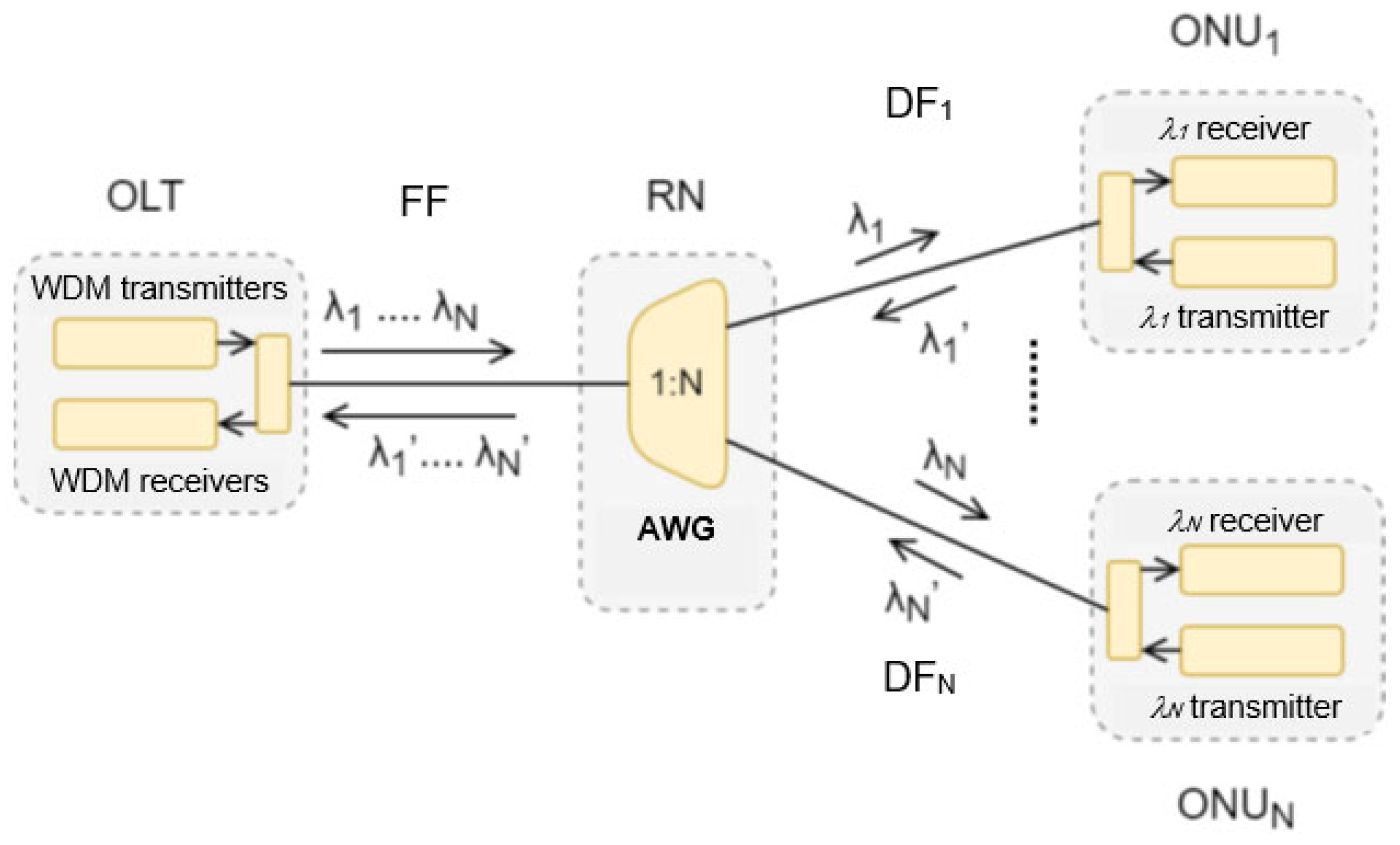
The point-to-multipoint (P2MP) architecture (Figure 1) consists of an OLT connected via a feeder fiber (FF) to a remote node (RN), which further distributes signals to ONUs through distribution fibers (DF). Each ONU is assigned a dedicated wavelength in both upstream and downstream directions, forming a logical point-to-point connection between the OLT and the respective ONU. This enables service differentiation (e.g., variable bit rates per channel) and wavelength granularity in resource allocation [3,24,29]. Further structural details are provided in works [25,26].

3.2. The Ring Architecture of the WDM-PON Access Network

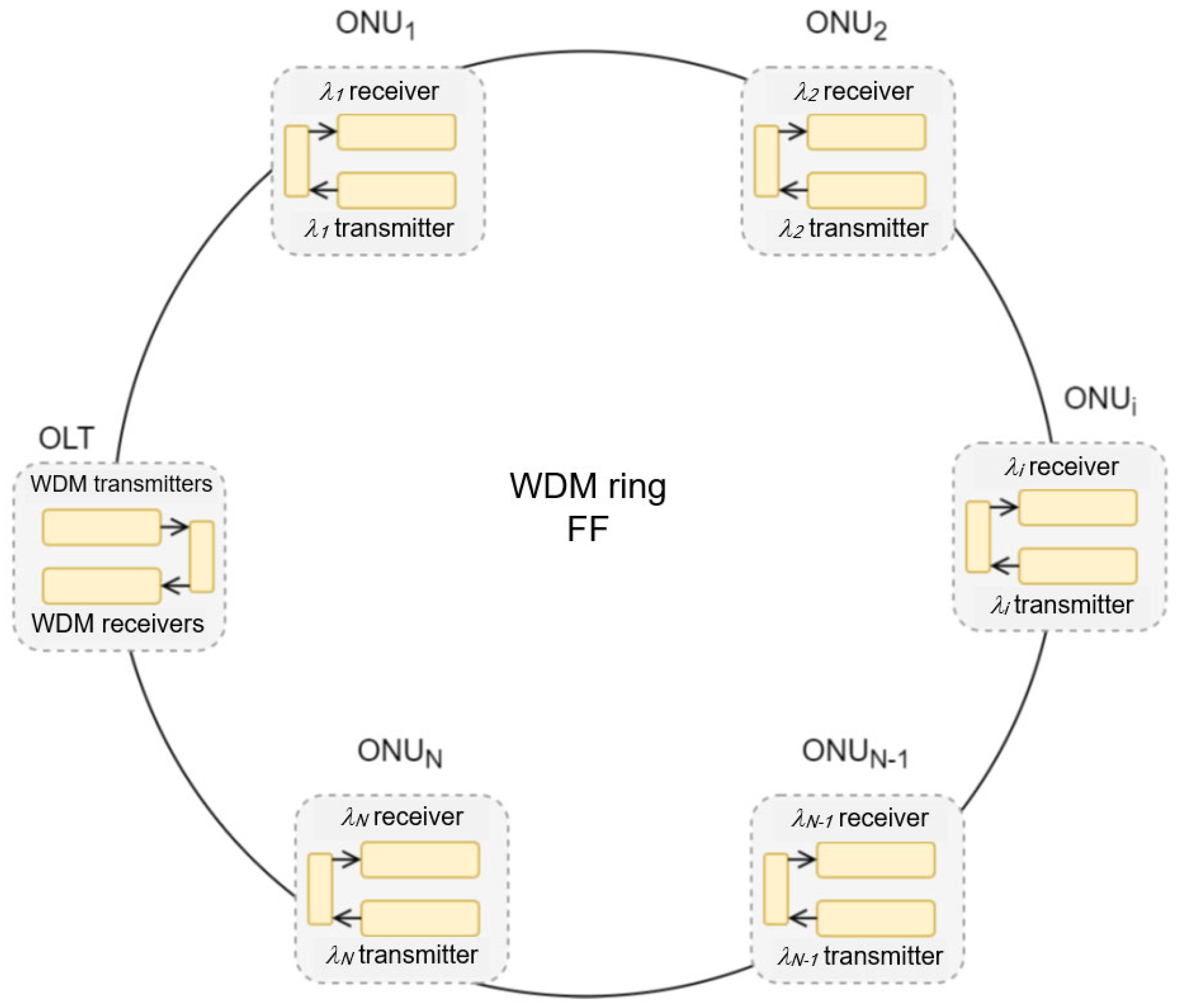
In the ring topology (Figure 2), ONUs are interconnected in a bidirectional optical ring with connectivity to a central OLT. The architecture supports optical signal re-modulation and flexible wavelength assignment, enhancing scalability and spectral efficiency. The ring structure inherently enables alternative routing in case of failure, which is relevant for traffic protection strategies [3,30]. Expanded discussion is available in works [25,26].

3.3. The Combined Architecture of the WDM-PON Metropolitan-Access Network

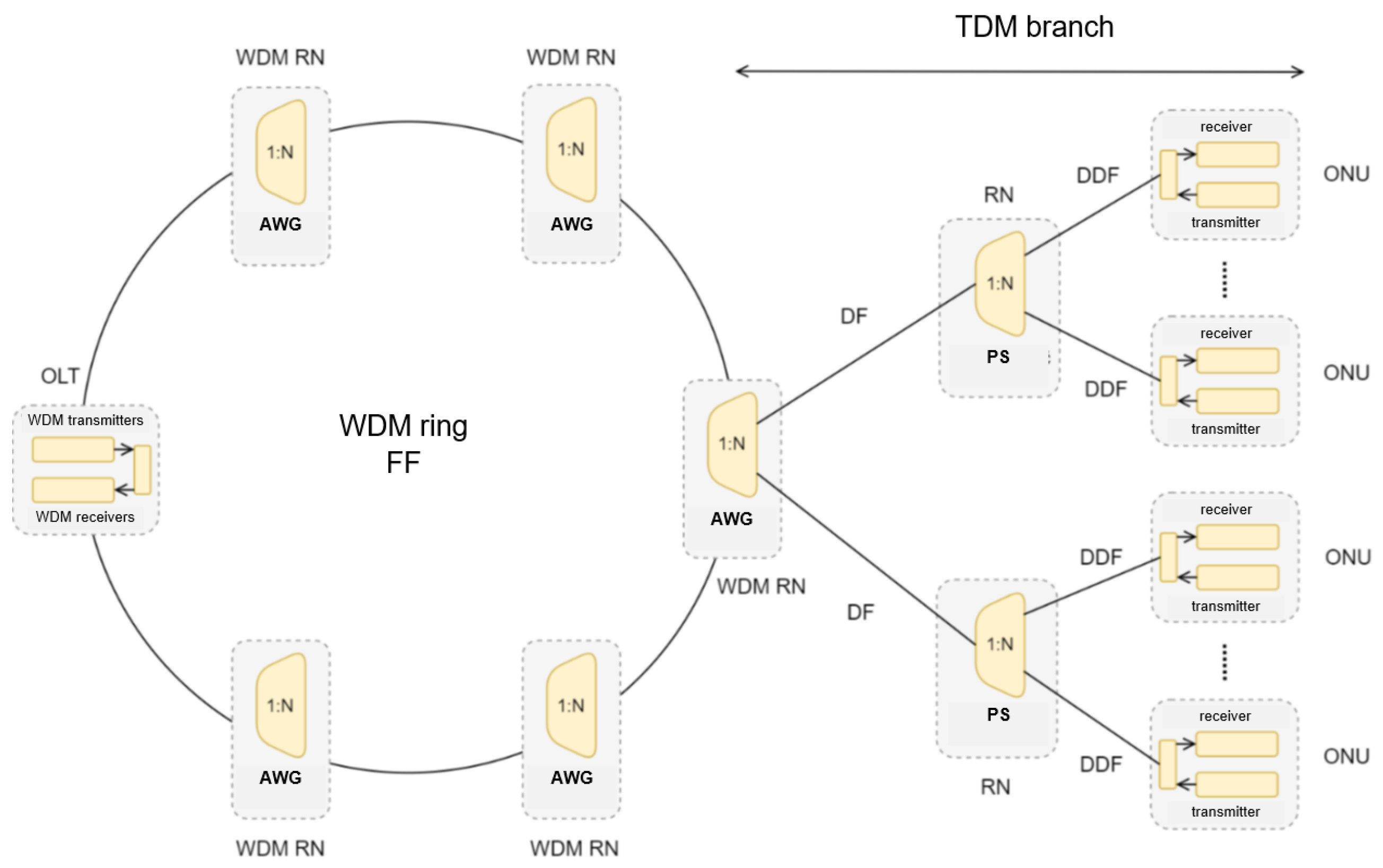
The metro-access concept integrates a WDM feeder ring (typically incorporating AWG elements) with a TDM-based access branch using passive optical power splitters (PS), distribution fibers (DF), and drop distribution fibers (DDF) (Figure 3). The architecture is modular and suitable for high user density. Optical amplification (e.g., EDFA operation in C and L bands) may be employed to extend reach while maintaining acceptable attenuation levels through proper optical power budgeting [3,30]. Implementation-oriented considerations are further elaborated in Ref. [25].

3.4. Set of Traffic Protection Schemes

Given the increasing emphasis on service resilience in next-generation passive optical networks, a fixed portfolio of presumptive traffic protection schemes is defined for evaluation. The set includes
  • P2MP architectures—Unprotected, Type B, dual-parented Type B, Type C;
  • Ring architectures—Unprotected, protected;
  • Combined architectures—Unprotected, protected.
These schemes were selected to represent typical resilience levels and architectural tradeoffs in WDM-PON environments [3,30]. The full selection rationale and comparative motivation are presented in works [25,26]. Each protection scheme is modeled using a reliability block diagram (RBD). This modeling approach enables an analytical derivation of the overall network availability for each candidate scenario and a consistent comparative evaluation, supporting a quantitative comparison across architectures and protection levels. Extended methodological details are available in Ref. [25].

4. WDM-PON Components and Their Power Budget Parameters

To construct a comprehensive power budget model for WDM-PON access networks, the specific operational characteristics and attenuation parameters of all active and passive network elements must be defined. The optical path between the central office (CO) and the subscriber is bound by the capabilities of the optical transmitters and receivers, while the physical infrastructure—including fiber segments, remote nodes (RN), and connectors—determines the total signal loss [3,24,25]. The optical power budget test is a basic type of test used to verify the installation, the fiber efficiency and the fault conditions in the PON technologies [31,32]. The optical power budget calculation is analyzed for the downstream direction (DS) in P2MP and the combined architectures of traffic protection schemes where the third optical transmission window, with relatively low attenuation levels and more favorable performance margins, is under consideration. In the upstream direction (US), there is a simple P2P topology with no optical splitting between ONU and OLT terminals, in contrast with the downstream signal transmission. So, significant insertion losses of remote nodes are missing in the upstream signal transmission. Therefore, the upstream channels allocated to the second optical window, and experiencing significantly higher propagation losses, are reliably accommodated within the feasibility margins determined for the downstream channels. For both directions—clockwise and counterclockwise—in the ring architectures of traffic protection schemes, the optical power budget calculation is performed without modifications.

4.1. Optical Transmitters

Optical radiation sources in WDM-PONs can be categorized by their wavelength generation method. To establish stable communication, transmitters at the optical line terminal (OLT) and the optical network unit (ONU) typically rely on distributed-feedback (DFB) lasers, a ’distributed Bragg reflector (DBR), vertical-cavity surface-emitting lasers (VCSEL), or tunable laser diodes (TLD). When multiple preconfigured wavelength channels are required simultaneously, particularly at the OLT, a multi-frequency laser (MFL) is often employed.
Alternatively, shared-source architecture enables the reuse of a single-wavelength channel for both the downstream and the upstream directions. In such configurations, the downstream continuous-wave (CW) signal is re-modulated at the ONU using an external modulator or a semiconductor optical amplifier (SOA), such as a reflective-SOA (R-SOA), which is specifically designed to compensate for return-signal losses. The choice of transmitter defines the initial optical power injected into the network, directly influencing the maximum permissible power budget (Table 1) [25,26,33].

4.2. Optical Receivers

The optical receiver detects the incoming optical radiation and recovers the data signal. The receiver module incorporates a photodetector, typically either a positive–intrinsic–negative (PIN) photodiode or an avalanche photodiode (APD).
The receiver’s sensitivity establishes the minimum optical power required to maintain an acceptable bit-error rate (BER). For the presented power budget calculations, the back-to-back receiver sensitivity at a BER of 10−3 is set up for transmitting at a 10 Gbit/s data rate and in non-return-to-zero (NRZ) line code optical signal formats. Typical receiver sensitivity parameters considered for the evaluated WDM-PON scenarios are summarized in Table 2 [25,30,33].

4.3. Remote Nodes

The remote node is a passive aggregation/distribution point, implemented by using either a broadband optical power splitter (PS) or a wavelength-selective router (AWG), depending on the architecture. From a power budget perspective, the RN contributes deterministic insertion losses, which must be included alongside fiber attenuation and connector/splice losses in the end-to-end attenuation sum [3].

4.3.1. Power Splitter PS

A power splitter is a wavelength-independent passive element that splits (or combines) optical power, treating the WDM spectrum as a single aggregate optical signal. For a symmetric 1:N splitting ratio, where N typically corresponds to powers of two (e.g., 1:2, 1:4, 1:8, 1:16, etc.), the ideal output power POUT at each port follows the standard power-division relation. This is demonstrated in Equation (1).
P O U T = P I N N   [ W ]
Using the same power ratio, the theoretical splitting attenuation atheor (in dB) can be written in a logarithmic form according to Equation (2).
a t h e o r = 10 . log ( P O U T P I N )   [ d B ]
In real deployments, the PS insertion loss is higher than the theoretical attenuation value due to additional interfaces (e.g., connectors). Therefore, the power budget should use practical (measured/worst-case) values of the PS insertion loss, as summarized below in Table 3 [3,33,34,35,36]. The selected values of splitters’ insertion losses accurately reflect the real behavior of commercially available splitters. In this way, the loss model used in the power budget calculations ensures that the total attenuation introduced by these components is not subject to underestimation.

4.3.2. Arrayed Waveguide Grating AWG

An arrayed waveguide grating is used primarily as a passive multiplexer/demultiplexer (and can also operate as an add–drop element), routing each wavelength to a dedicated output port rather than splitting total power across all outputs. AWG devices are cyclic, enabling bidirectional operation using a single port when upstream/downstream wavelengths differ by multiples of the free spectral range (FSR), which is defined by the AWG design. If the downstream and a shared upstream source use the same wavelength, the model assumes the use of two dedicated ports per ONU side (i.e., an RN AWG configuration of 2 × N).
Because the AWG insertion loss depends on the number of output channels/ports, the wavelength plan, and whether CWDM or DWDM is used, a power budget evaluation typically applies average (or minimum) values representative of the deployed wavelength band. The average AWG insertion loss values used for parameterization are given in Table 4 [3,33,37]. The selected values of AWG insertion losses accurately reflect the real behavior of commercially available devices. In this way, the total attenuation introduced by these components is not subject to underestimation in the loss model.

4.4. Other Relevant Components

In addition to the architectural and protection parameters defined earlier, the component insertion loss values listed in Table 5 are consistently applied in the power budget calculations, as they represent intrinsic contributions to the total optical loss of the WDM-PON system. These values—covering optical splices, connectors, optical fiber, MUX/DEMUX units, and optical circulators—are incorporated into the overall power budget model used in Section 6 within the WDM-PON Network Power Budget Evaluator. Their inclusion ensures that the computed power margins and feasibility assessments accurately reflect realistic deployment conditions and cumulative physical-layer losses [33]. Selected values from the commercial catalog are complemented by the use of standard values for the insertion loss parameters to justify the worst case for each passive optical component.

5. Power Budget Calculation for the WDM-PON Optical Link

The power budget calculations for different WDM-PON traffic protection schemes are used to verify whether the optical link between the OLT transmitter and the ONU receiver is feasible in terms of the total signal attenuation. During network design, the total link loss (in dB) must not exceed the difference between the transmitter output power and the receiver sensitivity, so that a sufficient power margin is preserved. The basic principle can be expressed by the link margin MLINK.
M L I N K = P T X a T O T A L + P R X   [ d B ]
where PTX [dBm] is the transmitter output power, PRX [dBm] is the receiver sensitivity, and aTOTAL [dB] denotes the total path attenuation obtained as the sum of all individual loss contributions along the OLT–ONU path. A positive margin MLINK indicates that the considered optical link in the WDM-PON traffic protection scheme can be technically realized, while a negative margin means that the available power budget is insufficient [3,8,9].
The total path attenuation aTOTAL is given by
a T O T A L = a f i b e r + a c o n n e c t o r s + a s p l i c e s + a P S / A W G + a M U X / D E M U X   [ d B ]
where afiber represents the loss due to an optical fiber, aconnectors are the optical connectors’ losses, asplices is the loss of fiber splices, aPS/AWG is the insertion loss of PS or AWG devices, and aMUX/DEMUX is the loss introduced by multiplexing and demultiplexing. In the calculation model, these equations are adapted for each scenario (unprotected/protected P2MP, ring and combined variants) according to the corresponding RBD graphs and the specific insertion loss values of passive optical components given in Table 5 for the considered WDM-PON traffic protection schemes [25,43,44].

6. The WDM-PON Network Power Budget Evaluator

The WDM-PON Network Power Budget Evaluator was developed as a technical extension of the previously introduced WDM-PON Network Cost Evaluator concept (i.e., the evaluator-style tool presented in Ref. [25]), and enables feasibility to be checked, not only from an economic perspective but also at the physical layer, via a power budget validation of optical links. In line with the earlier evaluator approach, it is implemented in Microsoft Excel using ActiveX control elements, with the computation logic written in Visual Basic for Applications (VBA) and simple macros to execute the calculations from the user interface.
The WDM-PON Network Power Budget Evaluator allows the user to modify the main input parameters, including TX output power, RX sensitivity, number of ONUs, number of PS and/or AWGs, DF and FF fiber lengths, and the number of connected participants. Using these inputs, it computes the total path attenuation of the WDM-PON optical link in the downstream direction, the power budget, and the resulting power margin (reserve), and it also provides an informative output stating whether the considered configuration is realizable (yes/no). To keep the loss accounting consistent, the tool uses the reference insertion loss values found in Table 3 and Table 4 (insertion losses for PS and/or AWG) and Table 5 (insertion losses for various passive optical components used in power budget calculations), while still allowing the user to adapt the scenario by changing the route- and topology-related inputs. Because the key parameters can be edited directly by the user, the WDM-PON Network Power Budget Evaluator is applicable to a wide range of WDM-PON routes and planning variants with different fiber lengths and component counts.

6.1. Power Budget Evaluation of WDM-PON Traffic Protection Schemes

Power budget calculations for all WDM-PON protection architectures were computed using the WDM-PON Network Power Budget Evaluator, employing the link margin MLINK using Equation (3), with transmitter output powers PTX and receiver sensitivities PRX sourced from Table 1 and Table 2. The total path attenuation aTOTAL was determined by Equation (4), aggregating insertion losses from Table 3, Table 4 and Table 5 (insertion losses of power splitters, AWG devices, and passive optical components). For each architecture (P2MP unprotected/Type B/dual-parented Type B/Type C; unprotected/protected ring access; and unprotected/protected combined metro-access), Equation (4) was customized based on component counts and redundancies from the respective RBD diagrams.

6.2. The Simulation Interface of the WDM-PON Network Power Budget Tool

The WDM-PON Network Power Budget Evaluator is an Excel-based simulation tool used to verify whether a selected WDM-PON optical link is technically feasible in terms of optical power budget. It is implemented in Microsoft Excel, while the calculation logic and automation are built using Visual Basic for Applications (VBA) and macros, and the user interaction is supported through ActiveX interface elements.
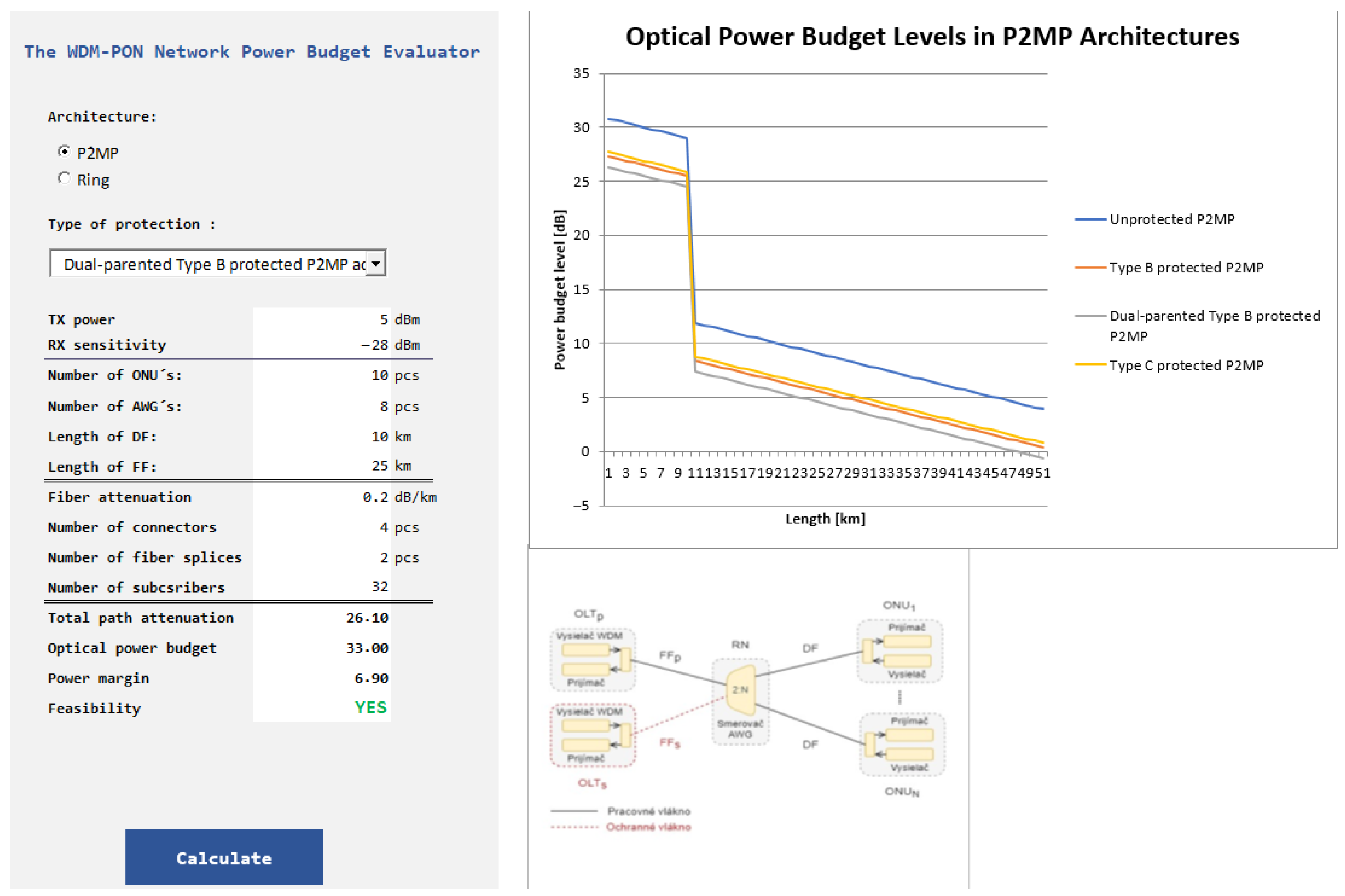
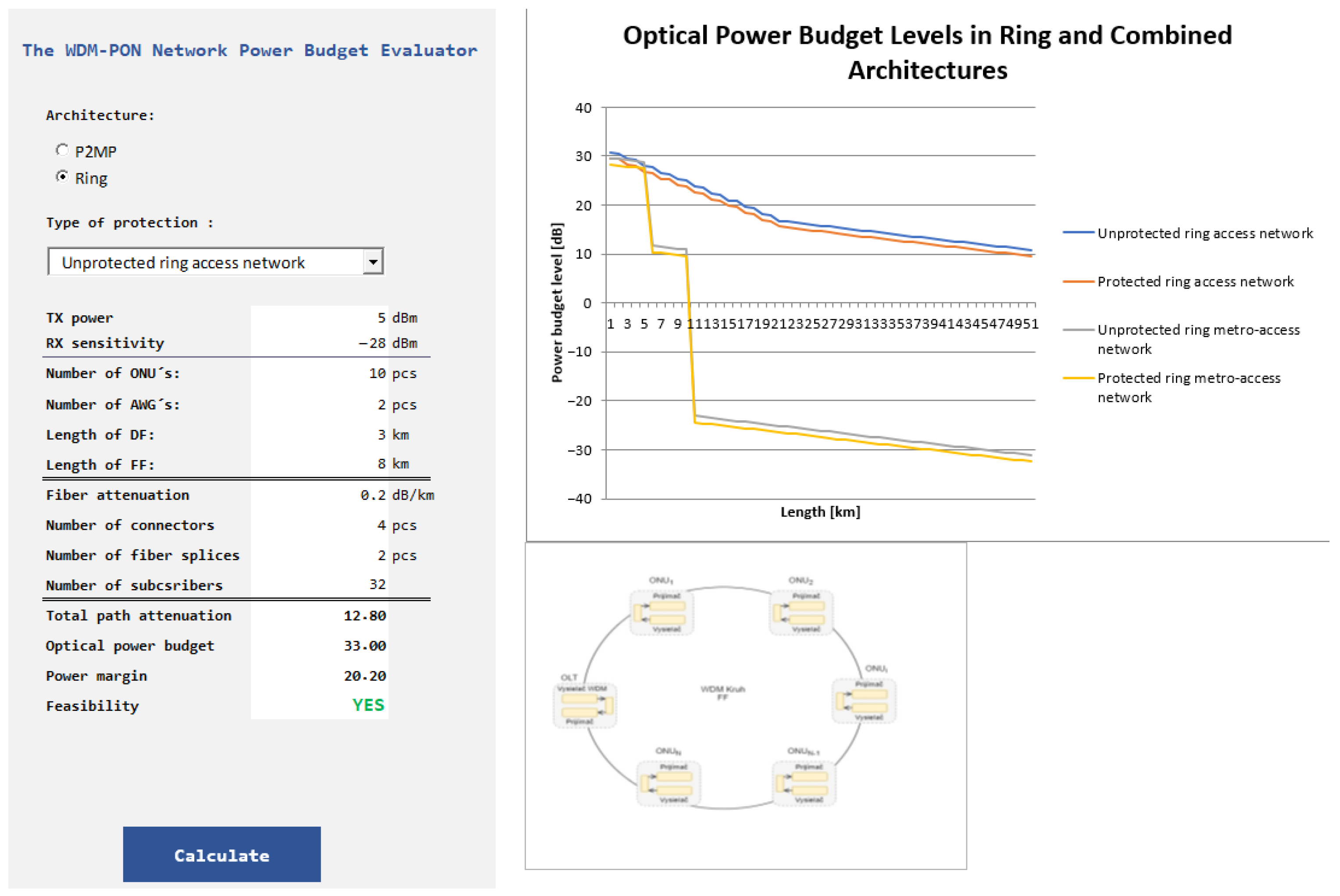
The user interface is organized into three main blocks. On the left side, a main control panel allows the user to select the network architecture (P2MP or ring) and the protection type from a drop-down menu, and to set the main technical parameters such as TX power, RX sensitivity, number of ONU units, number of PS/AWG nodes, DF/FF fiber lengths, fiber attenuation, number of connectors, number of optical splices, and the total number of participants. After pressing the ActiveX button (“Calculate”), the tool computes the total path attenuation and displays the resulting power budget, power margin (reserve), and an informative statement indicating whether the physical feasibility is realizable (yes/no).
On the right side, the lower block shows a simplified schematic of the selected architecture and functions as a type of protection, helping the user to visually confirm the chosen architecture. Another block provides a graphical comparison of optical power budget levels for the selected architecture across the considered traffic protection variants, and the plot is updated after the user changes parameters and presses the calculation button. When the architecture is changed, the tool automatically re-computes the architecture-dependent values and updates the graph title/legend accordingly. Figure 4 shows the WDM-PON Network Power Budget Evaluator in the P2MP case of optical power budget calculations within dual-parented Type B protection. Figure 5 shows the same evaluator configured for optical power budget calculations within the unprotected ring access.

7. Evaluation of WDM-PON Traffic Protection Schemes

7.1. P2MP Architectures of the WDM-PON Traffic Protection Schemes

For the P2MP and combined architectures of the traffic protection schemes, the optical power budget calculation is analyzed for the DS direction only. In the US direction, there is a simple P2P topology present and the upstream channels are reliably accommodated within the feasibility margins determined for the downstream channels.
For the P2MP architecture, the WDM-PON Network Power Budget Evaluator was applied to four variants (unprotected, Type B, dual-parented Type B, and Type C) for increasing numbers of participants under a fixed power budget. At the lowest load, all variants operate with clearly positive power margins, showing that traffic protection can be introduced without violating the budget. The unprotected network has the smallest attenuation and thus the largest margin, while the protected variants incur additional losses but still retain comfortable reserves. Detailed OLT and ONU transmitter/receiver values and the resulting power margins are presented in Table 6 [3].
The sensitivity analysis is realized based on the prior works [45,46,47], in which a scale of 3–10 dB comprises the feasibility margins. This margin scale is not explicitly defined, but it can easily be derived from appropriate source materials. For precision, the simulation power budget results in Table 7 and Table 8 are evaluated according to considered predefined outcomes: comfortably feasible (over 3 dB), marginally feasible—fails to satisfy standards with necessary re-arrangement (between 0 and 3 dB), and infeasible (under 0 dB).
When the number of participants is increased to a medium level, total attenuation rises for all variants and the margins decrease accordingly, yet all four architectures remain feasible. In this regime, the more heavily protected dual-parented Type B already operates with only a small remaining margin, whereas Type C still maintains a moderately comfortable reserve and thus a better balance between redundancy and power budget [26].
At the highest number of participants, the available power budget becomes the limiting factor. As shown in Table 7, the unprotected network remains feasible but with a significantly reduced margin, while Type C operates close to the power budget limit and therefore only marginally satisfies the constraint. In contrast, Type B and dual-parented Type B exceed the allowed power budget and become infeasible under the assumed component parameters. Overall, the results indicate that for large P2MP deployments, only the unprotected configuration and Type C can be maintained without changing the power budget or component characteristics.

7.2. Ring Architectures of the WDM-PON Traffic Protection Schemes

For ring architectures of traffic protection schemes, the optical power budget calculation is analyzed for the clockwise direction only. In the counterclockwise direction, the corresponding optical power budget calculation results in the same simulation results for the same input parameters.
For ring-based architectures, two variants were evaluated, namely, unprotected and protected ring access networks, again under the same power budget. In the access segment, both variants exhibit relatively low attenuation and clearly positive power margins, with the protected access ring showing only a modest reduction in margins compared to the unprotected case. This confirms that introducing protection at the access level is feasible and does not approach the budget limit, as indicated by results in Table 8 [26,48,49].

7.3. Combined Architectures of the WDM-PON Traffic Protection Schemes

For combined architectures, two variants were also evaluated: unprotected and protected combined metro-access networks. The metropolitan-access networks behave differently. Here, much longer paths and additional components result in substantially higher attenuation. Even without traffic protection, the combined metro-access exceeds the available budget and therefore operates with a negative margin; adding traffic protection further increases losses and pushes the configuration even farther beyond the limit. As shown in Table 8, under the assumed parameters, the combined metro-access architectures thus require optical amplification or lower-loss components before they can be considered technically viable.

8. Discussion

The simulation results obtained using the WDM-PON Network Power Budget Evaluator demonstrate that traffic protection schemes in WDM-PON access networks remain physically feasible under standard power budget considerations, but introduce quantifiable tradeoffs in power margin that scale with subscriber density and architectural complexity. For P2MP architectures, all analyzed protection variants (Type B, dual-parented Type B, and Type C) preserve positive margins up to 32 participants, supporting their practical deployments in fiber to the home (FTTH) scenarios. However, scaling 64 participants reveals a clear limit: only the unprotected configuration and Type C protection stay within power budget limits. Type B/dual-parented Type B protections exceed them due to compounded AWG nodes and redundancy losses. This validates the claim that traffic protection consideration incurs a power penalty (evident as 2–4.5 dB higher attenuation), making the Type C protection the optimal compromise for resilient dense P2MP WDM-PON deployments—offering a full path protection without fully eroding the reserve needed for operational degradations like aging or bends.
For ring and combined architectures, the results reinforce architecture-specific insights: ring access accommodates traffic protection with comfortable power margins, affirming the suitability of this approach for resilient short-haul access networks, while combined metropolitan-access architectures universally overrun the power budget, even unprotected, due to extended paths and multi-AWG traversals. So, optical amplification must be required in these cases. These outcomes align with the model design intent as an extension of prior CAPEX/OPEX and RBD availability frameworks [25], now incorporating an optical physical-layer validation to identify deployable traffic protection schemes holistically.

9. Conclusions

In this paper, our focus is oriented towards a topical developing area of presumptive WDM-PON architectures, which are analyzed together with a set of potential traffic protection schemes in detail. For the optical power budget analysis of each possible traffic protection scheme, previously proved and verified RBDs were used [26,27]. The uniqueness of this contribution is represented by integrating optical power budget considerations with RBDs of traffic protection schemes for advanced WDM-PON architectures. The integration is realized by a newly created simulation tool, the WDM-PON Network Power Budget Evaluator, which has been designed and developed for the power budget calculation for and evaluation of future developed WDM-PON traffic protection schemes. The tool is implemented in the VBA environment and allows power budget calculation for WDM-PON optical links for various deployment scenarios using traffic protection schemes, including both point-to-multipoint, ring and combined options. By using real network component parameters, the WDM-PON Network Power Budget Evaluator tool provides significant simulation results that can be directly applied by network operators in network planning and in determining the physical feasibility of next-generation optical infrastructure deployments. Due to the highlighted novelties in this approach, there are presently no other studies or research work in this direction available for a close comparison.
Findings of the realized optical power budget analysis show that incorporating an optical physical-layer validation allows for the identification of deployable traffic protection schemes. Also, the key role of the subscriber scalability is confirmed by the analytical conclusions. Overall, the presented framework and the developed WDM-PON Network Power Budget Evaluator tool provide network operators with a clear and practical method with which to compare different traffic protection schemes. Our work contributes to better network planning and the accurate determination of the physical feasibility of next-generation passive optical networks utilizing the wavelength division multiplexing technique, supporting decisions involving traffic protection schemes with a maximum available optical power budget for reliable service delivery.
In the broader context of a next-generation passive optical network evolution toward the F5G concept, the findings highlight that unprotected or Type C P2MP architectures and the ring access architecture of WDM-PON traffic protection schemes dominate network planning and the array of feasible designs, as heavier redundancy quickly violates PR30-like power budgets without optical amplification. Unlike purely economic analyses, this work provides engineering-grade granularity on when/why traffic protection schemes fail, directly informing network planners.

Research Directions and Future Challenges

This paper presents an optical power budget analysis as an important aspect of designing advanced WDM-PONs with traffic protection schemes involved. The paper’s novelty results in some new findings that can determine future research directions.
First, the WDM-PON Network Power Budget Evaluator tool can be considered as a prototype that can be easily modularized for another subsequent research purposes. For the purpose of the optical power budget analysis of presumptive WDM-PON traffic protection schemes, the created tool is satisfactory and applicable with simplicity and modularity.
Second, a focus on the WDM-PONs developed in the future would not allow verification on a real data set, comparative validation using field data, an industrial case study, or a comparison with previously published optical power budget models and/or with empirical measurements realized on current TDM-based passive optical networks. There are no known papers suitable for a close comparison in terms of the optical power budget analysis in WDM-based passive optical networks. By contrast, a fundamental and elementary basis is introduced for a possible alternative analysis of WDM-PONs constructed in the future and utilizing traffic protection schemes.
Our analytical models of WDM-PON traffic protection schemes depend on numerous parameters (Table 1, Table 2, Table 3, Table 4 and Table 5) in the actual state of use. For the purpose of possible comparisons with different tools and the related results of the WDM-PON optical power budget analysis, certain considered values of input parameters (Table 6) are determined for the purposes of example in this paper.
Simulation results for the power budget analysis and comparisons of traffic protection scenarios in various WDM-PON traffic protection scenarios can be especially useful and important in future F5G and Advanced F6G network planning. Network operators who want to apply the network slicing concept in future F5G architectures will utilize WDM-PONs in access and aggregation segments of the Underlay Plane (UP). Consequently, future extensions of the WDM-PON Network Power Budget Evaluator tool can be verified and validated by experiments on actually deployed WDM-PONs. Within this context, future extensions could incorporate 50G-PON FEC gains, nonlinear effects for longer reaches, or AI-optimized wavelength plans to push metropolitan-access viability—ultimately enabling multi-criteria (power budget, availability, and cost) tools for smart-city/edge deployments.

Author Contributions

Conceptualization, F.F. and R.R.; methodology, R.R.; software, F.F.; validation, F.F. and R.R.; formal analysis, F.F.; investigation, F.F.; resources, F.F. and R.R.; data curation, F.F.; writing—original draft preparation, F.F.; writing—review and editing, R.R.; visualization, F.F.; supervision, R.R.; project administration, R.R.; funding acquisition, R.R. All authors have read and agreed to the published version of the manuscript.

Funding

This work is a part of research activities conducted at the Slovak University of Technology Bratislava, Faculty of Electrical Engineering and Information Technology, Institute of Multimedia Information and Communications Technologies, within the scope of the project VEGA No. 1/0322/24 “Advanced algorithms for multichannel optical networks in the F5G architecture for implementing access wireless technologies in the NG-PON converged infrastructure” and the project SmartEdge-NextGen 5G/6G “Research, development, testing and validation of the AI-driven 5G/6G integration with edge computing for ultra-low latency, reliable and secure communication systems with potentially utilization in industry, transport and health service”.

Institutional Review Board Statement

Not applicable.

Informed Consent Statement

Not applicable.

Data Availability Statement

The original contributions presented in this study are included in the article. Further inquiries can be directed to the corresponding author.

Acknowledgments

During the preparation of this manuscript, the authors did not use any GenAI tool for the purposes of generating text, data, or graphics, or study design, data collection, analysis, or interpretation of data. GenAI tools were employed only in translation and stylistic refinement of the manuscript and in the preliminary research phase to support the review of sources. The authors have reviewed and edited the output and take full responsibility for the content of this publication.

Conflicts of Interest

The authors declare no conflicts of interest. The funders had no role in the design of the study, in the collection, analyses, or interpretation of data, in the writing of the manuscript, or in the decision to publish the results.

Abbreviations

The following abbreviations are used in this manuscript:
AIArtificial Intelligence
APDAvalanche Photodiode
AWGArrayed Waveguide Grating
BERBit-Error Rate
CAPEXCapital Expenditures
COCentral Office
C-RANCloud Radio Access Network
CWContinuous Wave
CWDMCoarse Wavelength Division Multiplexing
DBRDistributed Bragg Reflector
DDFDrop Distribution Fiber
DFDistribution Fiber
DFBDistributed Feedback
DSDownstream
DSPDigital Signal Processing
DWDMDense Wavelength Division Multiplexing
EDFAErbium-Doped Fiber Amplifier
EPONEthernet Passive Optical Network
F5GFifth Generation Fixed Network
FECForward Error Correction
FFFeeder Fiber
FSOFree Space Optics
FSRFree Spectral Range
FTTHFiber to the Home
GenAIGenerative Artificial Intelligence
HPONHybrid Passive Optical Network
IM/DDIntensity Modulation/Direct Detection
ITU-TInternational Telecommunication Union–Telecommunication
LDPCLow-Density Parity-Check
MFLMulti-Frequency Laser
NG-PONNext-Generation Passive Optical Network
NRZNon-Return-to-Zero
ODNOptical Distribution Network
OFDMOrthogonal Frequency Division Multiplexing
OLTOptical Line Terminal
ONTOptical Network Terminal
ONUOptical Network Unit
OPEXOperational Expenditures
OSOptical Splitter
OTNOptical Transport Network
P2MPPoint-to-Multipoint
P2PPoint-to-Point
PAM-4Pulse Amplitude Modulation with Four Levels
PINPositive–Intrinsic–Negative Photodiode
PONPassive Optical Network
PON-FSOPassive Optical Network–Free Space Optics
PR/EPower Budget/Reach Class
PSPower Splitter
RBDReliability Block Diagram
RNRemote Node
R-SOAReflective Semiconductor Optical Amplifier
RXReceiver
SLAService Level Agreement
SOASemiconductor Optical Amplifier
TCOTotal Cost of Ownership
TDMTime Division Multiplexing
TXTransmitter
UDWDMUltra Dense Wavelength Division Multiplexing
UPUnderlay Plane
USUpstream
VBAVisual Basic for Applications
VCSELVertical-Cavity Surface-Emitting Laser

References

  1. Jaffer, S.S.; Hussain, A.; Qureshi, M.A.; Khan, Y.; Mirza, J.; Qureshi, K.K.; Ali, M.M. Reliable and Cost-Efficient Protection Scheme for 5G Fronthaul/Backhaul Network. Heliyon 2023, 9, e14215. [Google Scholar] [CrossRef] [Scilit]
  2. Manias, D.M.; Naoum-Sawaya, J.; Javadtalab, A.; Shami, A. Probabilistic Fault-Tolerant Robust Traffic Grooming in OTN-over-DWDM Networks. In 20th International Conference on the Design of Reliable Communication Networks (DRCN), Montreal, Canada, 6–9 May 2024; IEEE: Piscataway, NJ, USA, 2024; pp. 76–83. [Google Scholar] [CrossRef] [Scilit]
  3. Hsu, C.-H.; Jiang, S.-Y.; Hsieh, S.-E.; Yeh, C.-H.; Lai, Y.-T.; Chen, L.-Y.; Liaw, S.-K.; Chow, C.-W. Hybrid Self-Protected Fiber-FSO WDM-PON System with Fiber Breakage Prevention. Photonics 2022, 9, 822. [Google Scholar] [CrossRef] [Scilit]
  4. Ullah, R.; Ullah, S.; Imtiaz, W.A.; Khan, J.; Shah, P.M.A.; Kamran, M.; Ren, J.; Chen, S. High-Capacity Free Space Optics-Based Passive Optical Network for 5G Front-Haul Deployment. Photonics 2023, 10, 1073. [Google Scholar] [CrossRef] [Scilit]
  5. Lee, H.-S.; Yang, C.-L.; Chou, C.-H. Protection Scheme for a Wavelength-Division-Multiplexed Passive Optical Network Based on Reconfigurable Optical Amplifiers. Appl. Sci. 2022, 12, 365. [Google Scholar] [CrossRef] [Scilit]
  6. Róka, R.; Fujdiak, R.; Holasova, E.; Kuchar, K.; Orgon, M.; Misurec, J. Protection Schemes in HPON Networks Based on the PWFBA Algorithm. Sensors 2022, 22, 9885. [Google Scholar] [CrossRef] [Scilit] [PubMed]
  7. Kodama, T.; Nakagawa, T.; Matsumoto, R. Any-Double-Link Failure Tolerant Bypass/Backup Switchable WDM-PON Employing Path-Pair Shared Protection and Bidirectional Wavelength Pre-assignment. In Optical Fiber Communications Conference and Exhibition (OFC), San Diego, CA, USA, 6–10 March 2022; Optica Publishing: Washington, DC, USA, 2022; pp. 1–3. [Google Scholar] [CrossRef] [Scilit]
  8. Li, Z.; Li, Y.; Luo, S.; Yin, F.; Wang, Y.; Song, Y. SOA Amplified 100 Gb/s/λ PAM-4 TDM-PON Supporting PR-30 Power Budget with >18 dB Dynamic Range. Micromachines 2022, 13, 342. [Google Scholar] [CrossRef] [Scilit]
  9. Feituri, A.B.; Abdullah, M.F.L.; Swedan, A.A.; Suliman, H.A. Power Budget Calculation and Sensitivity Enhancement for N × 25 Gbps TDM-PON Configuration. In IEEE 3rd International Maghreb Meeting of the Conference on Sciences and Techniques of Automatic Control and Computer Engineering (MI-STA), Benghazi, Libya, 21–23 May 2023; IEEE: Piscataway, NJ, USA, 2023; pp. 558–563. [Google Scholar] [CrossRef] [Scilit]
  10. Pagare, R.A.; Mishra, A.; Kumar, S. Impairment Strained Analytical Modeling Evaluation and Cross-talk Analysis of Symmetric and Coexistent Channels for Extended Class-1 NG-PON2 Access Network. Opt. Quantum Electron. 2022, 54, 762. [Google Scholar] [CrossRef] [Scilit]
  11. Reza, A.G.; Troncoso-Costas, M.; Barry, L.P.; Browning, C. 4x75-Gbit/s Optically Amplified WDM-PON with Beyond 31-dB Power Budget Employing PAM-4 Transmission and a Recurrent Neural Network. In European Conference on Optical Communication (ECOC), Basel, Switzerland, 18–22 September 2022; Optica Publishing: Washington, DC, USA, 2022; pp. 1–4. [Google Scholar]
  12. Reza, A.G.; Troncoso-Costas, M.; Browning, C.; O’Duill, S.; Barry, L.P. Mitigation of SOA-Induced Nonlinearities with Recurrent Neural Networks in 75 Gbit/s/λ PAM-4 IM/DD WDM-PON Transmission Systems. J. Light. Technol. 2023, 41, 3967–3975975. [Google Scholar] [CrossRef] [Scilit]
  13. Rosales, R.; Bluemm, C.; Atra, K.; Lin, Y.; Huang, R.; Talli, G.; Chen, X.; Wang, H.; Pate, M.; Aivaliotis, P. Dispersion Tolerant 200 Gb/s Dual-Wavelength IM/DD Transmission with 33dB Power Budget for Next Generation PON. In 49th European Conference on Optical Communications (ECOC 2023), Glasgow, UK, 1–5 October 2023; IET: Hertfordshire, UK, 2023; pp. 1091–1094. [Google Scholar] [CrossRef] [Scilit]
  14. Feng, N.; Ma, M.; Zhang, Y.; Tan, X.; Li, Z.; Li, S. Key Technologies for a Beyond-100G Next-Generation Passive Optical Network. Photonics 2023, 10, 1128. [Google Scholar] [CrossRef] [Scilit]
  15. Wei, Z.; Zhang, J.; Li, W.; Plant, D.V. 400-Gbps/80-km Rate-Flexible PCS-64-QAM WDM-CPON with Pseudo-m-QAM Chaotic Physical Layer Encryption. J. Light Technol. 2023, 41, 2413–2424. [Google Scholar] [CrossRef] [Scilit]
  16. Houtsma, V.; van Veen, D.; Harstead, E. Recent Progress on Standardization of Next-Generation 25, 50, and 100G EPON. J. Light. Technol. 2017, 35, 1228–1234. [Google Scholar] [CrossRef] [Scilit]
  17. Recommendation G.989.1; 40-Gigabit-Capable Passive Optical Networks (NG-PON2): General Requirements. International Telecommunication Union: Geneva, Switzerland, 2013.
  18. P802.3ca; Physical Layer Specifications and Management Parameters for 25 Gb/s and 50 Gb/s Passive Optical Networks. Institute of Electrical and Electronics Engineers: Piscataway, NJ, USA, 2015.
  19. Zhang, D.; Liu, D.; Wu, X.; Nesset, D. Progress of ITU-T Higher Speed Passive Optical Network (50G-PON) Standardization. J. Opt. Commun. Netw. 2020, 12, D99–D108. [Google Scholar] [CrossRef] [Scilit]
  20. Recommendation G.9804.1; Higher Speed Passive Optical Networks: Requirements. International Telecommunication Union: Geneva, Switzerland, 2019.
  21. Horvath, T.; Munster, P.; Oujezsky, V.; Bao, N.-H. Passive Optical Networks Progress: A Tutorial. Electronics 2020, 9, 1081. [Google Scholar] [CrossRef] [Scilit]
  22. Recommendation G.989.2; 40-Gigabit-Capable Passive Optical Networks 2 (NG-PON2): Physical Media Dependent (PMD) Layer Specifications. International Telecommunication Union: Geneva, Switzerland, 2019.
  23. Róka, R. Optimization of the Optical Power Budget for Various WDM-PON Network Designs with Traffic Protection Securing. In 26th International Conference on Software, Telecommunications and Computer Networks (SoftCOM), Split, Croatia, 13–15 September 2018; IEEE: Piscataway, NJ, USA; pp. 1–6. [CrossRef] [Scilit]
  24. Wu, T.-H.; Liao, C.-Y.; Yeh, C.-H.; Chen, Y.-W.; Kao, Y.-H.; Lin, S.-Y.; Lin, Y.-H.; Liaw, S.-K. A Self-Healing WDM Access Network with Protected Fiber and FSO Link Paths Effective Against Fiber Breaks. Photonics 2025, 12, 323. [Google Scholar] [CrossRef] [Scilit]
  25. Fuňák, F.; Róka, R. Cost–Benefit Analysis of WDM-PON Traffic Protection Schemes. Appl. Sci. 2025, 15, 12120. [Google Scholar] [CrossRef] [Scilit]
  26. Róka, R. Performance Analysis of Wavelength Division Multiplexing-Based Passive Optical Network Protection Schemes by Means of the Network Availability Evaluator. Appl. Sci. 2022, 12, 7911. [Google Scholar] [CrossRef] [Scilit]
  27. Róka, R. Performance Analysis of TDM-PON Protection Schemes by Means of the PON Network Availability Evaluator. In 7th International Congress on Information and Communication Technology (ICICT), London, UK, 26 July 2022; Springer: Berlin/Heidelberg, Germany; pp. 21–24. [CrossRef] [Scilit]
  28. Recommendation G.694.1; Spectral Grids for WDM Applications: DWDM Frequency Grid. International Telecommunication Union: Geneva, Switzerland, 2012.
  29. Ghanbarisabagh, M.; Vetharatnam, G.; Giacoumidis, E.; Rouzegar, H.; Mallouki, N. A Survey on High-Capacity OFDM-based Passive Optical Networks. arXiv 2018, arXiv:1812.04692. [Google Scholar] [CrossRef] [Scilit]
  30. ITU-T. Series G-Supplement 51: Passive Optical Network Protection Considerations; International Telecommunication Union: Geneva, Switzerland, 2016. [Google Scholar]
  31. Anritsu. Application Note: Necessity of Testing in PON Installation. 2024. Available online: https://www.anritsu.com (accessed on 30 March 2026).
  32. Fierce Network. Maximizing Fiber Efficiency in FTTH Networks; Denver, USA. 2026. Available online: https://www.fierce-network.com (accessed on 30 March 2026).
  33. FS EUROPE. Neufahrn, Germany, 2009–2025. Available online: https://www.fs.com/de-en (accessed on 3 January 2026).
  34. Hegazy, G.; Jones, R. White Paper: The FTTH Architectures and Evolution of PON and Point-to-Point; FTTH Council MENA, Technology & Training Committee, September 2015. Available online: https://fiberconnectmena.org (accessed on 27 March 2026).
  35. Hello Signal. PLC Optical Splitter 1 × 64 Single Mode PLC Fiber Optic Splitter ABS Box Type with SC Connector; Zhejiang, China, 2025. Available online: https://www.hello-signal.com (accessed on 27 March 2026).
  36. FiberCheap. PLC Splitter/FBT Fiber Splitter Loss Chart; Guangzhou, China, 2026. Available online: https://fibercheap.com (accessed on 27 March 2026).
  37. TP-Link. Omada Access Managed Switch Installation Guide; Shenzhen, China, 2025. Available online: https://support.omadanetworks.com (accessed on 27 March 2026).
  38. ITU-T. Recommendation ITU-T G.671: Transmission Characteristics of Optical Components and Subsystems; International Telecommunication Union: Geneva, Switzerland, 2025. [Google Scholar]
  39. IEC 61755-2-2; Fibre Optic Interconnecting Devices and Passive Components—Connector Optical Interfaces for Single-Mode Fibres—Part 2-2: Connection Parameters of Dispersion Unshifted Physically Contacting Fibres—Angled. International Electrotechnical Commission: Geneva, Switzerland, 2022.
  40. Recommendation ITU-T G.652; Characteristics of a Single-Mode Optical Fibre and Cable. International Telecommunication Union: Geneva, Switzerland, 2024.
  41. Gigalight. Datasheet Dense Wavelength Division Multiplexer & DeMultiplexer (DWDM Mux DeMux); Shenzhen, China, 2025. Available online: https://www.gigalight.com (accessed on 27 March 2026).
  42. Laser Components GmbH. Datasheet 1310/1550 nm Three Stage Optical Circulator; Olching, Germany, 2021. Available online: https://www.lasercomponents.com (accessed on 27 March 2026).
  43. Udalcovs, A.; Salgals, T.; Zhang, L.; Pang, X.; Djupsjöbacka, A.; Spolitis, S.; Bobrovs, V.; Popov, S.; Ozolins, O. Optical Power Budget of 25+ Gbps IM/DD PON with Digital Signal Post-Equalization. Appl. Sci. 2020, 10, 6106. [Google Scholar] [CrossRef] [Scilit]
  44. Abbas, H.; Gregory, M. The Next Generation of Passive Optical Networks: A review. J. Netw. Comput. Appl. 2016, 67, 53–74. [Google Scholar] [CrossRef] [Scilit]
  45. ITU-T. Series G-Supplement 39: Optical System Desing and Engineering Considerations; International Telecommunication Union: Geneva, Switzerland, 2025. [Google Scholar]
  46. Recommendation ITU-T G.984.2; Gigabit-Capable Passive Optical Networks (GPON): Physical Media Dependent (PMD) Layer Specification. International Telecommunication Union: Geneva, Switzerland, 2003.
  47. Septima, U.; Yolanda, A.; Chandra, D.; Uzhelia, V.A. Designing Fiber Optic Network Infrastructure with FTTX Configuration Using Network Development Life Cycle (NDLC) Method in Solok Regency. Brill. Res. Artif. Intell. 2025, 5, 108–114. [Google Scholar] [CrossRef] [Scilit]
  48. Alatwi, A.M.; Rashed, A.N.; Aziz, I.A. High Speed Modulated Wavelength Division Optical Fiber Transmission Systems Performance Signature. Telkomnika 2021, 19, 380–389. [Google Scholar] [CrossRef] [Scilit]
  49. Manchay, N.; Tipantuña, C.; Arévalo, G.V.; Arguero, B.; Parra, C. Analysis of Ultra-Dense Wavelength Division Multiplexing (UDWDM) in a Passive Optical Network (PON). Enfoque UTE 2024, 15, 1–17. [Google Scholar] [CrossRef] [Scilit]
Figure 1. The graphical presentation of the P2MP WDM-PON architecture. (Adapted from Ref. [25]).
Photonics 13 00387 g001
Figure 2. The graphical presentation of the ring WDM-PON architecture. (Adapted from Ref. [25]).
Photonics 13 00387 g002
Figure 3. The graphical presentation of the combined WDM-PON architecture. (Adapted from Ref. [25]).
Photonics 13 00387 g003
Figure 4. The simulation interface for optical power budget calculations in the dual-parented Type B-protected P2MP network architecture.
Photonics 13 00387 g004
Figure 5. The simulation interface for optical power budget calculations in the unprotected ring access network architecture.
Photonics 13 00387 g005
Table 1. OLT/ONU transmitted output power levels and maximum power budgets [33].
Transmitted Output Power (TX)Max. Power Budget [dB]
3 to 7 dBm (OLT TX)33
0.5 to 5 dBm (ONU TX)33
Table 2. ONU/OLT receiver sensitivity and maximum power budget [33].
Receiver Sensitivity (RX)Max. Power Budget [dB]
−28 dBm (ONU RX)29
−28 dBm (OLT RX)29
Table 3. Insertion losses for symmetrical power splitters with various splitting ratios.
Splitting RatioMax. Insertion Loss [dB]
1:23.4
1:47.5
1:810.7
1:1613.7
1:3216.9
1:6420.4
1:12823.6
Table 4. Insertion losses for AWG devices with regard to the number of wavelength channels.
Number of Output ChannelsAverage Insertion Loss [dB]
43.0
84.0
164.6
405.0
966.5
Table 5. Insertion losses for passive optical components involved in the WDM-PON optical link.
ComponentInsertion Loss [dB]
Optical splice0.1 [38]
Optical connector0.5 [38,39]
Optical fiber0.2 dB/km at λ = 1550 nm [40]
Optical MUX/DEMUX2.0 [41]
Optical circulator1.2 [39,42]
Table 6. Input parameters for the potential WDM-PON traffic protection schemes.
Input ParametersDefault Values
P2MP Architectures
OLT TX power5 dBm
ONU RX sensitivity−28 dBm
Number of subscribers16,32,64
FF Length25 km
DF Length10 km
Ring and combined architectures
OLT TX power5 dBm
ONU RX sensitivity−28 dBm
FF Length8 km
DF Length3 km
Number of ONU’s10 pcs
Number of AWG’s10 pcs
Table 7. Simulation power budget results for P2MP architectures.
Number of SubscribersP2MP
Architecture
Total Attenuation [dB]Margin [dB]Physical Feasibility
16Unprotected22.910.10Comfortable
16Type B26.46.60Comfortable
16Dual-parented Type B27.45.60Comfortable
16Type C26.07.00Comfortable
32Unprotected26.16.90Comfortable
32Type B29.43.60Comfortable
32Dual-parented Type B30,62.40Marginally
32Type C29.23.80Comfortable
64Unprotected29.63.40Comfortable
64Type B33.1−0.10Infeasible
64Dual-parented Type B34.1−1.10Infeasible
64Type C32.70.30Marginally
Table 8. Simulation power budget results for the ring and combined architectures.
Ring and Combined
Architecture
Total Attenuation [dB]Margin [dB]Physical Feasibility
Unprotected
ring access
21.811.20Comfortable
Protected
ring access
23.010.00Comfortable
Unprotected
combined metro-access
34.4−1.40Infeasible
Protected
combined metro-access
36.9−3.90Infeasible
Disclaimer/Publisher’s Note: The statements, opinions and data contained in all publications are solely those of the individual author(s) and contributor(s) and not of MDPI and/or the editor(s). MDPI and/or the editor(s) disclaim responsibility for any injury to people or property resulting from any ideas, methods, instructions or products referred to in the content.