1. Introduction
Accurate measurement of absolute pressure plays an irreplaceably important role in industry, environmental monitoring, and aerospace. For instance, subtle barometric fluctuations of less than 10 Pa in the atmospheric boundary layer can alter the diffusion rates of greenhouse gases (CO
2, CH
4, N
2O) via the barometric pumping effect. Capturing such minor pressure variations is not only the core mechanism for accurately quantifying greenhouse gas fluxes but also a critical step in analyzing the dynamics of the climate system [
1,
2].
Compared with traditional electrical sensors, fiber-optic pressure sensors exhibit advantages such as anti-electromagnetic interference, wide frequency response, and large dynamic range. Among them, fiber-optic F-P pressure sensors have shown great application potential in pressure measurement scenarios due to their compact size and high sensitivity [
3,
4,
5,
6,
7,
8,
9]. Such typical fiber-optic F-P pressure sensors take a miniature fiber cavity as their core structure. Their working principle is that a thin film on the cavity end face perceives pressure variations, modulates the pressure signal into a change in the F-P cavity length, and finally retrieves the pressure information by demodulating the cavity length variation. The structural design, geometric dimensions, and material selection of the thin film largely determine the core performance of the sensor. For example, Liu et al. [
10] fabricated a fiber-tip diaphragm-sealed cavity using arc discharge technology. The cavity consists of a silica capillary and an ultrathin silica diaphragm with a thickness of 170 nm, achieving a pressure sensitivity of 12.22 nm/kPa. In addition to silica, materials such as silk fibroin [
11], polymer diaphragms [
12], and metals [
13] have also been widely explored for thin-film preparation.
Although rapid progress has been made in the structural design and material selection of fiber-optic F-P pressure sensors, their performance still rely highly on high-resolution demodulation techniques for cavity length measurement [
4,
14,
15,
16]. Current mainstream demodulation methods can be divided into two categories. One is intensity demodulation [
17,
18,
19], which features fast response and simple system configuration, but has significant drawbacks such as limited dynamic range and high susceptibility to light source fluctuations and environmental interference. The other is spectral peak tracking demodulation [
14,
15,
20,
21], which is immune to light source intensity variations and offers high stability and high resolution, yet suffers from phase ambiguity and a dynamic range limited to a single free spectral range. Moreover, the spectrometer required for demodulation greatly increases the system cost.
Capsule-type pressure sensors are another widely used category of pressure monitoring devices in industry. Their working mechanism relies on the deformation of the capsule induced by air pressure, which further drives the deflection of a pointer via a mechanical linkage structure to realize visual indication of pressure. However, the inherent characteristics of the mechanical linkage structure greatly limit the sensitivity and resolution of such sensors. Therefore, it is urgent to develop novel sensing structures to fully exploit the excellent pressure-sensitive properties of the capsule.
FMCW interferometry originated from radar. Its core principle is to transmit a continuous wave signal with linearly modulated frequency over time, and realize detection by coherently mixing the echo signal with a local reference signal [
22,
23,
24,
25,
26,
27]. As a highly sensitive detection technique, FMCW interferometry features distinct advantages including high measurement accuracy, wide dynamic range, easy multiplexing, and strong environmental adaptability. It has been gradually introduced into the field of optical fiber sensing [
28,
29,
30,
31,
32,
33], becoming an important technical approach to precision measurement of physical quantities.
Based on the above analysis, this paper presents an innovative scheme: a low-finesse F-P interferometer is constructed by employing a capsule as one end face of the F-P cavity. The optical interference mechanism replaces the mechanical linkage structure used in conventional capsule-type pressure sensors, which not only simplifies the overall sensor design but also enables high-sensitivity and high-resolution pressure measurement. Meanwhile, the FMCW interferometric phase demodulation technique is adopted instead of traditional spectral demodulation methods, which eliminates the dependence on spectrometers and effectively reduces the system cost.
2. Materials and Methods
2.1. Experimental Setup
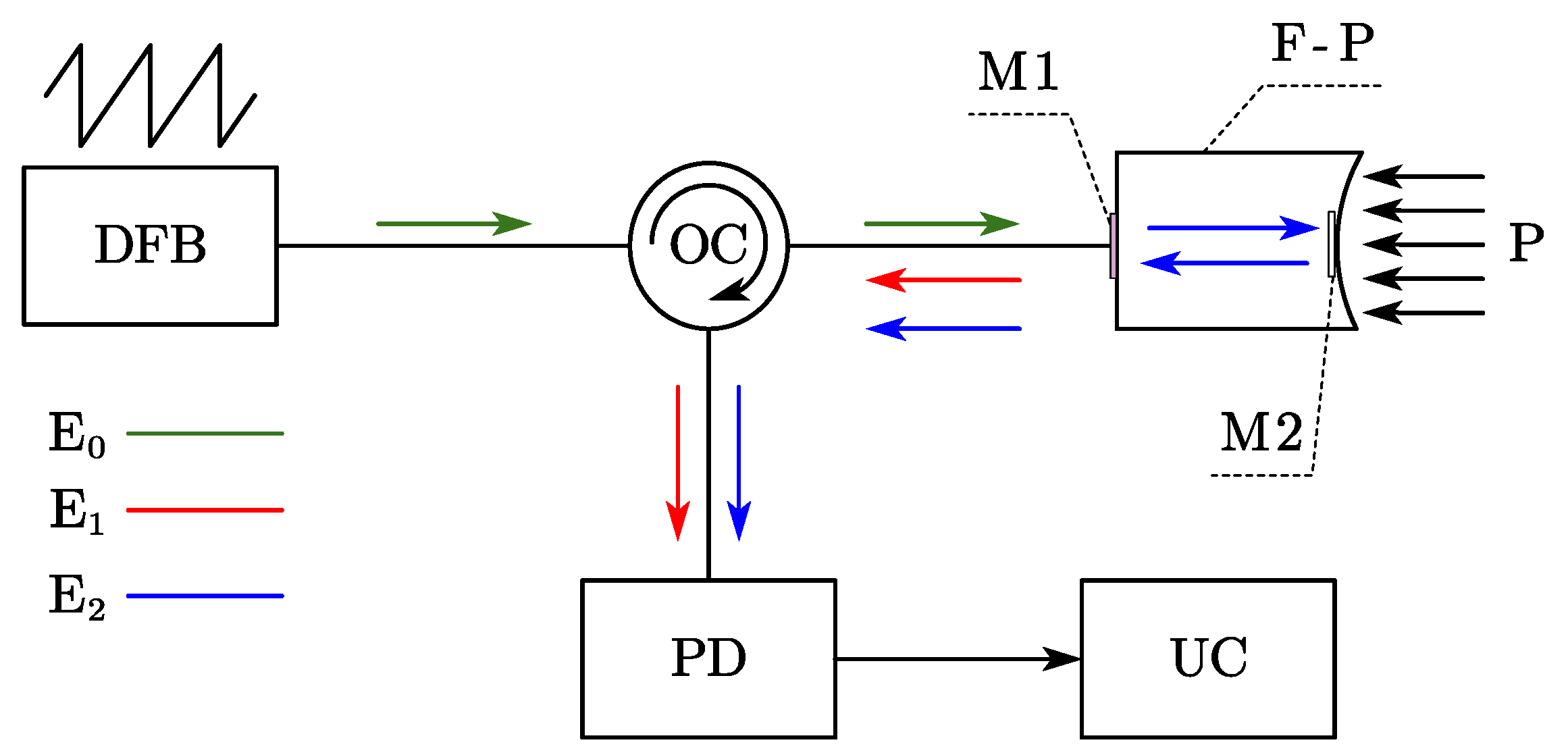
The experimental setup for pressure sensing based on FMCW interferometry is shown in
Figure 1. The main components include: a distributed feedback (DFB) laser, an 3-port optical circulator (OC), a photodetector (PD), an industrial control computer (UC; FPGA or MCU can also be used), and the low-finesse F-P absolute pressure sensor as the core sensing element.
One end of the proposed fiber-optic F-P pressure sensor is a fiber collimator coated with a partial reflective film, and the other end is a reflector fixed on the pressure-sensitive element, i.e., a vacuum capsule. Deformation of the vacuum capsule induced by variations in absolute pressure drives the displacement of the reflector, which further changes the cavity length of the F-P interferometer, thus realizing the modulation of pressure signals into optical phase signals. Notably, the existence of the partial reflection film degenerates the F-P cavity into a two-beam interferometer structure. The detailed design and fabrication process are presented in
Section 2.2.
In the experiment, a DFB laser (INXUNTECH: TL-2) is used to output laser light with a linearly varying frequency, with a central wavelength of 1550 nm. This laser can be configured to perform linear frequency sweeps at a rate of 1 kHz and a range of 20 GHz, with a sweep linearity of >99.9999%. The linearly frequency-modulated laser is transmitted through an optical fiber to the partial reflector M1, where it is split into the reflected light and the transmitted light . The transmitted light is reflected by the total reflector M2 to reverse its propagation direction. The core function of the OC is to isolate the reflected lights and and prevent them from returning to the laser along the original path, which could cause device damage. The lights and interfere with each other, and their interference phase is directly determined by the distance between M1 and M2 (i.e., the F-P cavity length). The beat signal generated by the interference is detected by the PD (Beijing Kangguan Shiji Optoelectronic Technology Co., Ltd., Beijing, China: PR-10M, with a response range of 1000~1650 nm and a 3 dB bandwidth of DC–10 MHz) and then sent to the UC for subsequent cavity length demodulation. The built-in ADC conversion module of the UC (Beijing ART Technology Development Co., Ltd., Beijing, China: PCIe8914, 14-bit resolution with a sampling rate set to 1 MHz) converts the electrical signals into digital signals for subsequent digital signal processing.
2.2. Low-Finesse Fabry–Perot Absolute Pressure Sensor
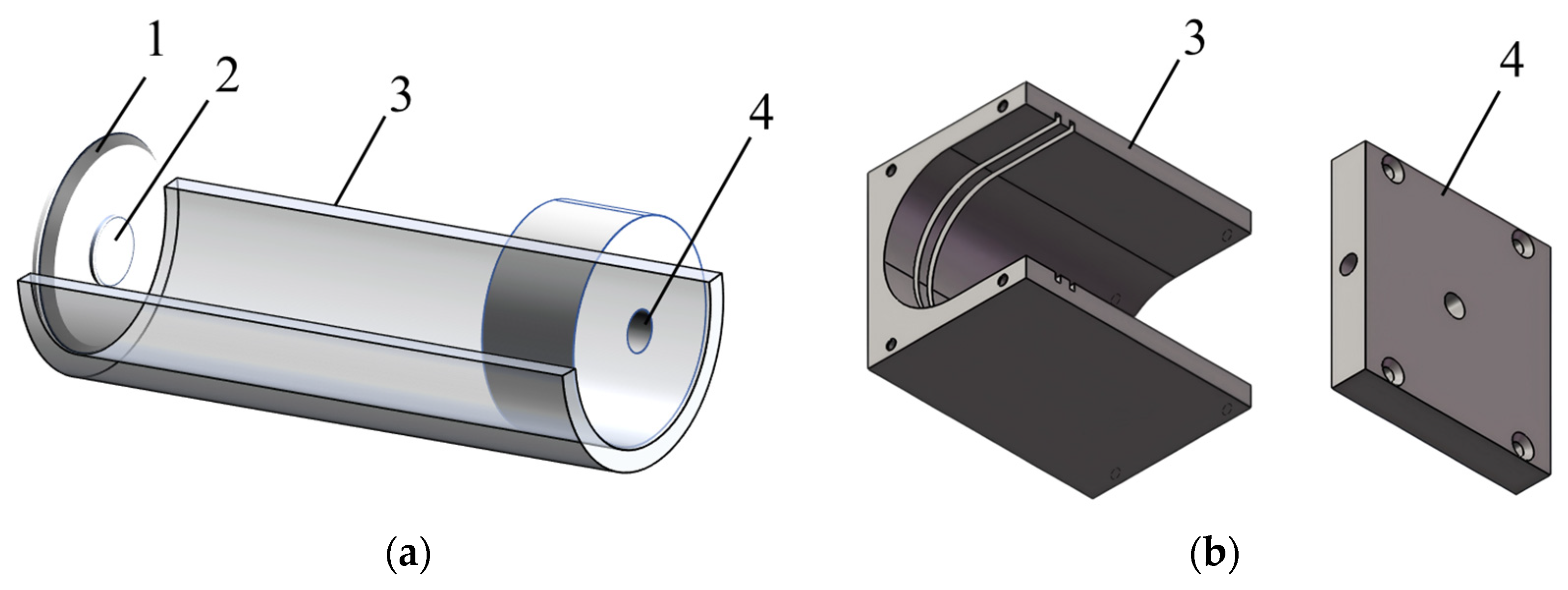
The schematic diagram of the low-finesse F-P absolute pressure sensor is shown in
Figure 2. It consists of a base, a vacuum capsule, a collimator mount, a collimator, and a reflector. Among them, the vacuum capsule acts as the pressure-sensitive element, which undergoes elastic deformation under air pressure and drives the high-reflectivity reflector bonded on it to displace. The exit surface of the collimator is coated with a partial reflection film, forming a low-finesse F-P cavity together with the reflector. Variations in pressure modulate the F-P cavity length, thereby encoding pressure information into the phase of the interference signal. The pressure value can be retrieved by demodulating the interference phase. After completing the optical alignment between the collimator and the reflector, the collimator and the capsule are fixed with epoxy AB adhesive.
The vacuum capsule is fabricated by fixing two corrugated diaphragms along their circumferences with a maintained internal vacuum, and it is sensitive to absolute pressure. The deformation-pressure characteristic relationship of the shallow corrugated diaphragm can be expressed by Equation (1) [
34].
where
where
,
,
,
,
,
are the Young’s modulus, the Poisson’s ratio, the center deflection, the radius, the thickness and the corrugation profile factor of the diaphragm, respectively, and
is the uniform pressure load.
By tailoring the corrugated structure of the diaphragm to increase the value of
, the value of
rises while that of
decreases (the linear component increases and the nonlinear component decreases), thus an excellent linear deformation-barometric pressure relationship under low pressure can be achieved [
35].
Thus, for an F-P pressure cavity such as the one shown in
Figure 2a, its cavity length
:
where
is the cavity length of the F-P cavity at zero pressure, and
is the sensitivity. Therefore, the pressure value
is uniquely determined when the cavity length
of the F–P cavity is known. In fact, the coefficients
and
can be obtained by linear fitting of the cavity length-pressure calibration results.
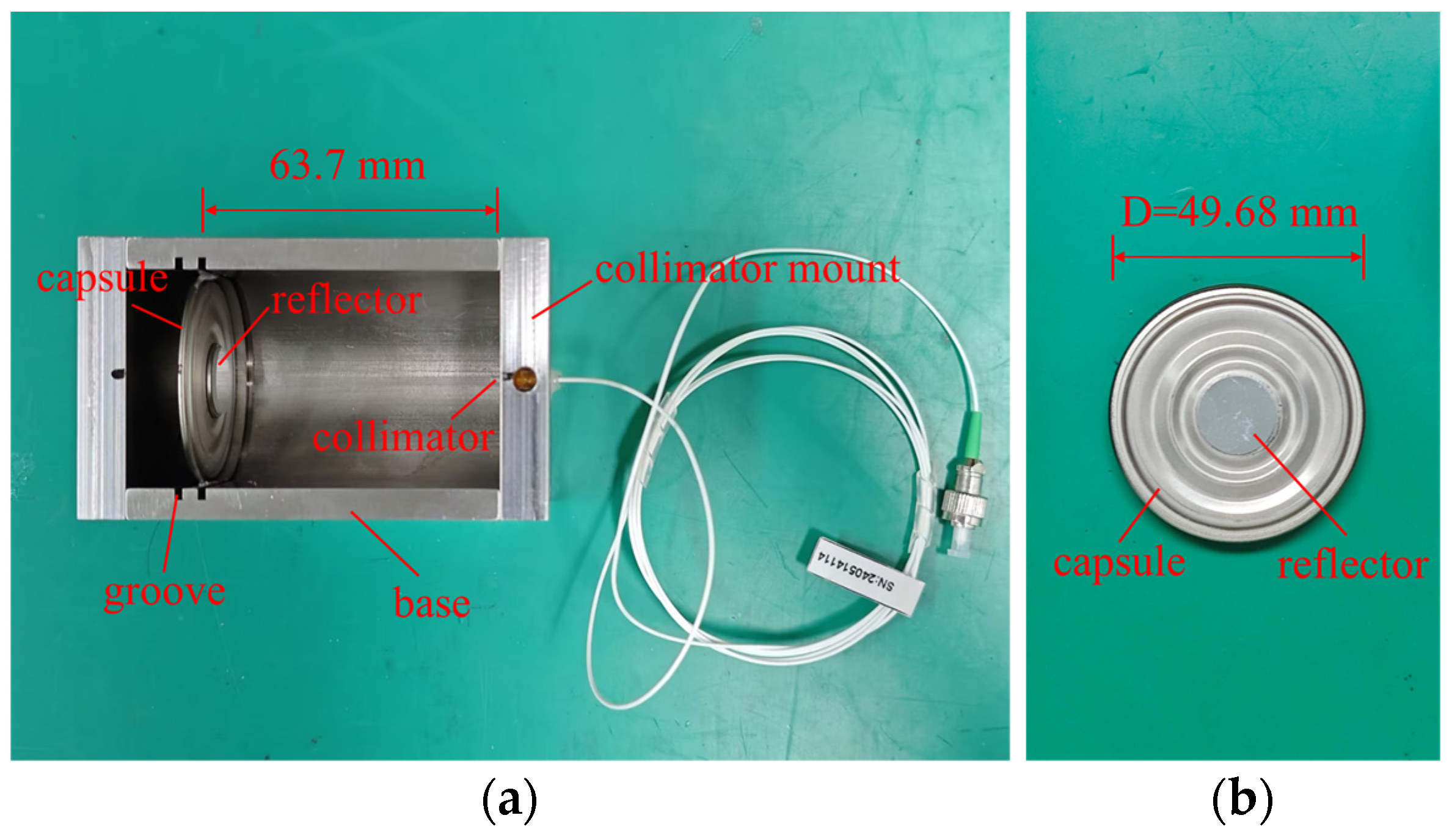
Figure 3 shows the packaged sensor main body and optical fiber pigtails with a compact overall structure, facilitating integration into test systems. The collimator (Cofiber: single-fiber collimator 6563) features a G-lens structure with a diameter of 1.8 mm and a length of 12 mm; it operates at a wavelength of 1550 ± 30 nm with a working distance of 65 mm, and its end face is coated with a reflective film with a reflectivity of R = 30%. A commercial linear vacuum capsule was adopted in the experiment, which is maintained in a vacuum state internally and capable of sensing absolute pressure. The factory calibration results of the capsule are as follows: it has a diameter of 49.68 mm and a height of 4.83 mm, and a total working displacement of 1.315 mm with a linearity error of ≤±2% when the pressure increases from 100 mmHg to 800 mmHg (13.3 kPa to 106.6 kPa). A reflector (R > 99%) with a diameter of 15 mm and a thickness of 3 mm is fixed on the central pressure-bearing surface of the capsule using an instant adhesive (Kafuter: K-4401).
The collimator mount is a cover plate with a central hole on the side (the cover plate is 10 mm thick with a 6 mm aperture to ensure the collimator can be placed stably), made of AISI 304, and a glue injection hole is drilled directly above the cover plate. Another perforated cover plate in
Figure 3a serves as a protective component. The base is also fabricated from AISI 304, and a groove is machined at a specific position for fixing the vacuum capsule. Groove 1 and Groove 2 are 66.7 mm and 63.7 mm away from the inner end face of the cover plate, respectively, and these distances are adapted to the working distance of the collimator. The optical path between the collimator and the reflector was precisely calibrated to maximize the optical power reflected back to the collimator, after which the capsule, base and collimator were fixed together using an epoxy AB adhesive (Kafuter: K-8818).
2.3. Cavity Length Demodulation Based on FMCW
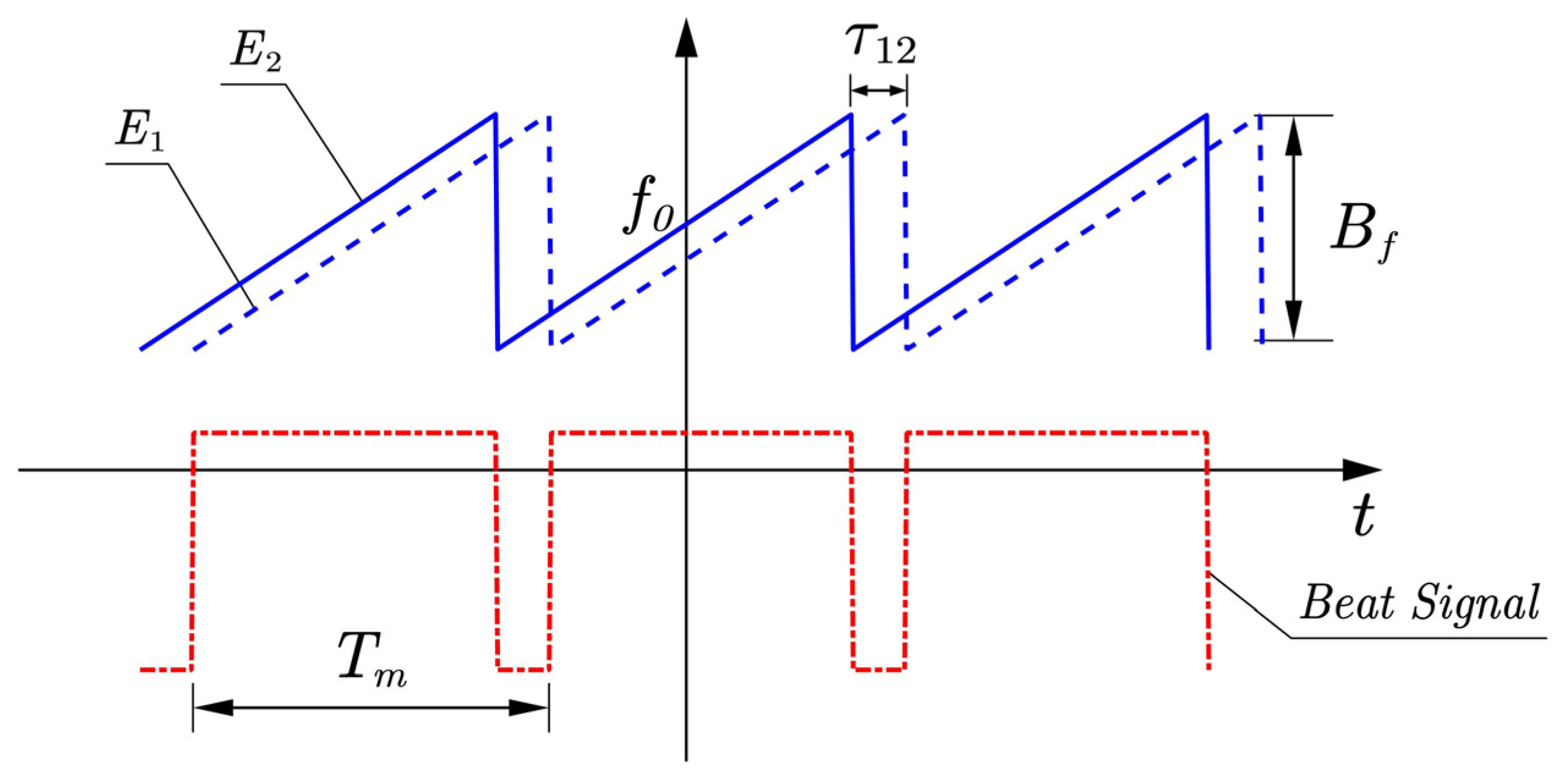
The optical frequency of the DFB laser, modulated by a sawtooth wave, can be expressed as
where
is the modulation rate in Hz/s;
is the central frequency of the laser in Hz;
is the modulation period in s; and
is the modulation bandwidth in Hz, as shown in
Figure 4.
Lights
and
interfere with each other, generating a beat signal
after interference.
where
and
are the intensities of beams
and
, respectively, and
and
are the phases of beams
and
, respectively.
Under the frequency modulation described in Equation (6), the phase difference is given by
where
is the time delay between the two optical beams. For the F-P interference structure shown in
Figure 1, the relationship between the cavity length
and the time delay is
, where
is the refractive index of the propagation medium. Combining Equations (7) and (8) yields
Both the frequency term (10) and the phase term (11) of the beat signal contain cavity length information. However, the demodulation accuracy of the phase is generally higher than that of the frequency term, so phase demodulation is mainly adopted in this work.
When the cavity length variation
is much smaller than the initial cavity length
, the frequency
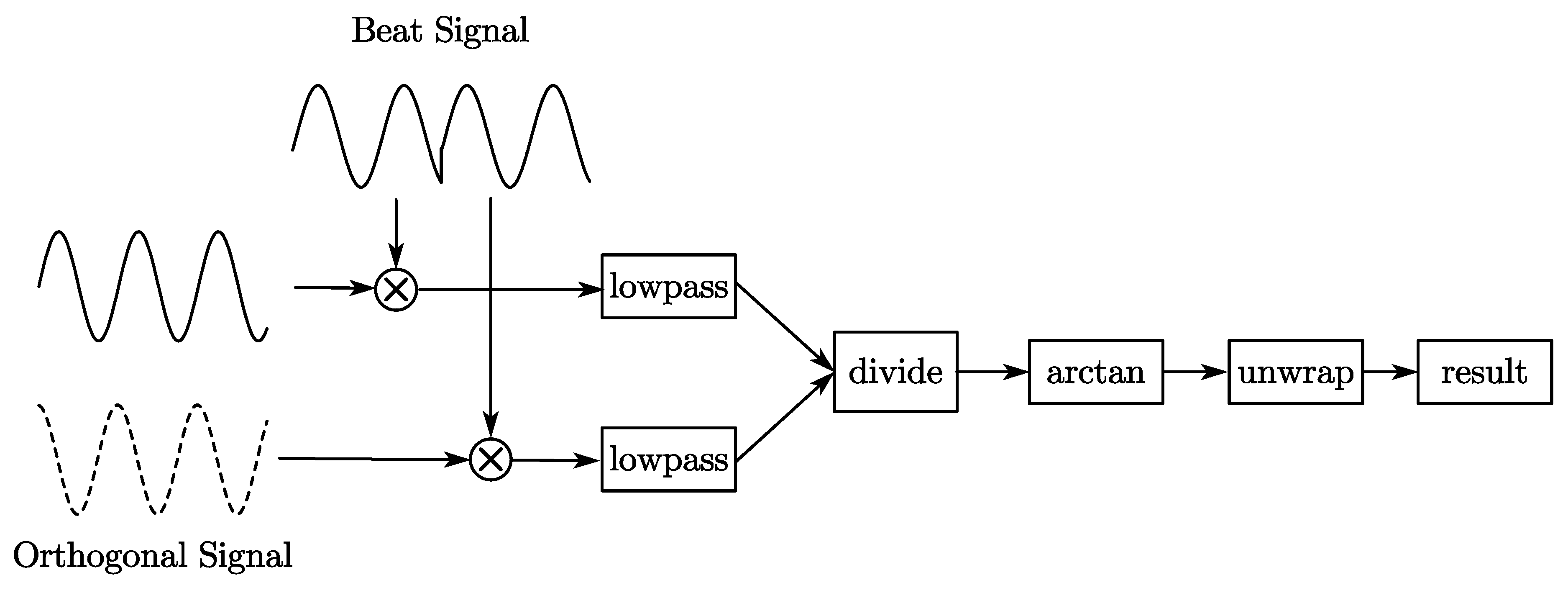
can be approximated as a constant. Then, the phase of the beat signal can be extracted using IQ demodulation analogous to heterodyne interferometry. The demodulation process is shown in
Figure 5, with details as follows:
The beat signal in the static state is acquired in advance, and the frequency corresponding to the maximum spectral value is obtained through Fast Fourier Transform (FFT). Taking this frequency as the approximate value of the beat signal frequency
, the initial cavity length
can be approximately calculated by Equation (10). Meanwhile, a set of quadrature signals with frequency
is generated.
The digital beat signal is multiplied and mixed with the quadrature cosine and sine signals, respectively, to realize spectrum shifting, and down-convert the desired phase term component to the baseband zero frequency.
Low-pass filtering is applied to each of the two mixed signals separately (in this experiment, an elliptic low-pass filter with a sampling rate of 1 MHz, a passband frequency of 500 Hz, and a cutoff frequency of 2000 Hz is employed). This removes high-frequency noise and retains the baseband component carrying phase information. The filtered signals are given by
The arctangent operation is performed on the two filtered baseband components to extract the phase value
:
The periodicity of the arctan(·) function restricts the result of Equation (15) to the interval
. A phase unwrapping operation can be adopted to continuously expand the phase and obtain the continuous phase variation
:
where
and
are two adjacent time instants (
), respectively. The initial values of
and
are set to 0. After obtaining the phase variation
,
can be derived through the transformation relation in Equation (11). Therefore,
2.4. Test Method
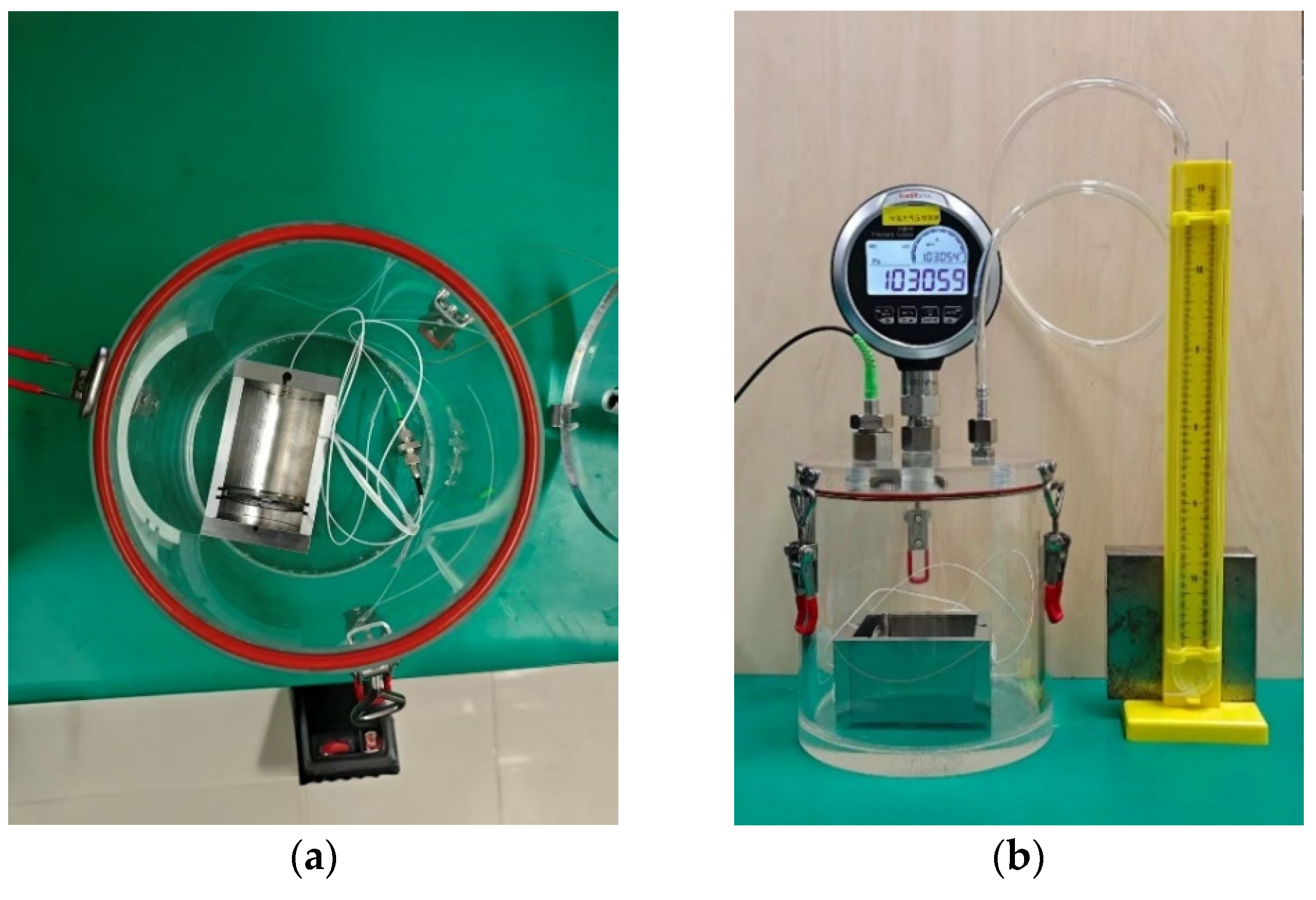
The test environment for characterizing the sensor performance used in the experiment is shown in
Figure 6. It mainly consists of core components such as a pressure chamber, a sealed optical fiber feedthrough, a reference barometer, and a pressure regulating device. The sealed optical fiber feedthrough is used to realize the optical path connection between the sensor and the external laser and demodulation equipment, as well as the hermetic isolation of the chamber. A reference barometer (ConST: 211A, measuring range 0~120 kPa, accuracy 0.02%FS) was used as the pressure reference in the experiment. During the experiment, the air pressure inside the chamber is precisely adjusted by a pressure-regulating device. The reading of the reference barometer is recorded, while the beat signal is demodulated to obtain the cavity length.
In the calibration experiments, we selected ten standard pressure points within the range of 10~110 kPa (limited by the available pressure-regulating device in the laboratory, accurate pressure control below 10 kPa cannot be achieved) with an interval of 10 kPa. Based on the readings of the high-precision reference barometer, we recorded the cavity-length output data of the sensor during multiple pressure increasing and decreasing cycles.
Considering that the accuracy of the reference barometer is 24 Pa, we judged that the pressure inside the chamber meets the calibration condition when the reading of the reference barometer is stable within ±24 Pa of the target standard pressure point.
3. Results
3.1. Sensitivity and Linearity
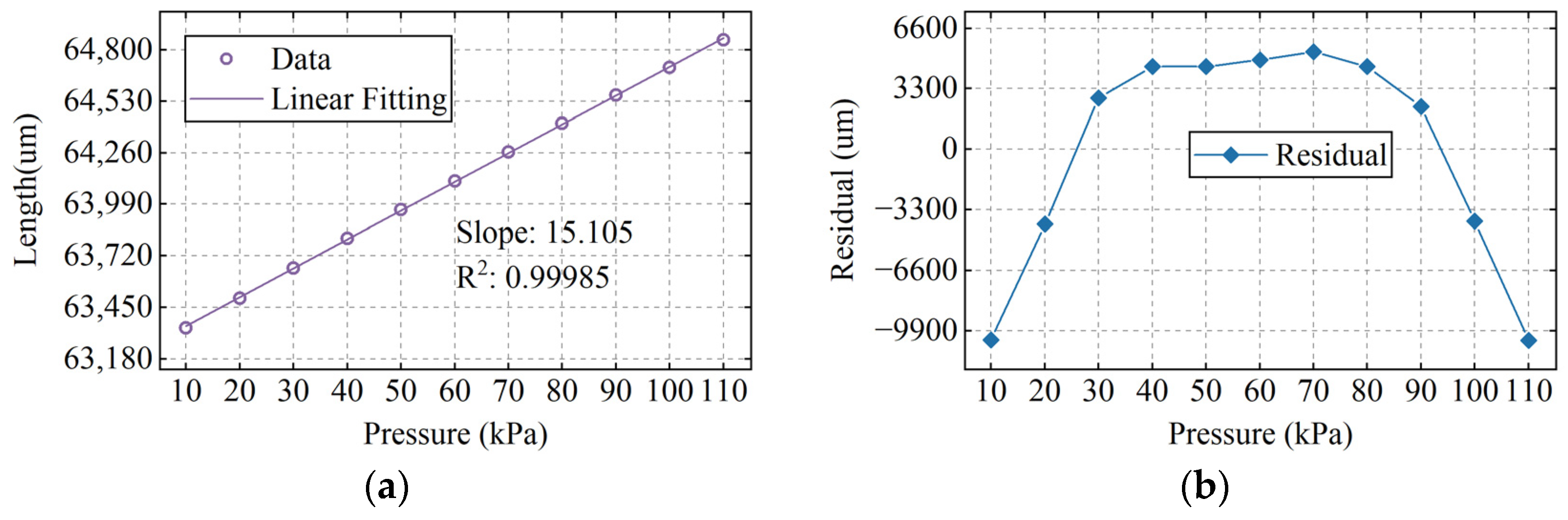
The sensor was tested for three forward and reverse stroke cycles. The average values of the cavity length output at each pressure test point were used for linear fitting, and the fitting result is shown in
Figure 7a. The discrete points represent the measured cavity length data, and the straight line is the corresponding linear fitting result, with a coefficient of determination R
2 = 0.99985. The pressure sensitivity of the sensor obtained from the slope of the fitted line is 15,105 nm/kPa. The residual distribution between the measured values and the fitted results at each test point is shown in
Figure 7b. The maximum absolute residual is 10,405 nm.
The linearity of the sensor is defined using the maximum residual method, and the calculation formula is as follows:
where
is the maximum nonlinear error (i.e., the absolute value of the maximum residual), and
is the full-scale output (taken as the total variation range of cavity length with pressure).
In this experiment, the full-scale cavity length variation = 1510 μm. Substituting the maximum residual 10,405 nm (i.e., 10.405 μm) into the calculation yields a linearity error of the sensor of 0.689%FS.
3.2. Hysteresis
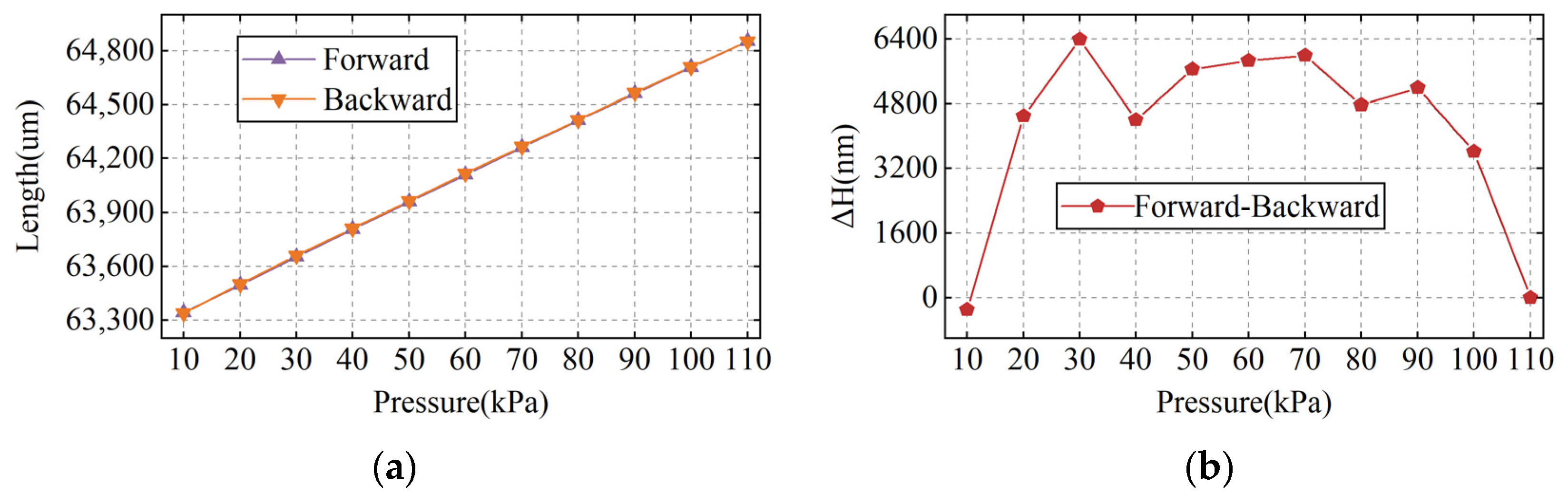
Hysteresis tests under forward and reverse strokes were performed on the sensor, and the results are shown in
Figure 8.
Figure 8a shows the cavity length response curves of the sensor during forward and reverse strokes in the pressure range of 10~110 kPa: the purple curve represents the pressure-increasing (forward) process, and the orange curve represents the pressure-decreasing (reverse) process. The two curves are highly overlapped, which intuitively reflects that the sensor exhibits good hysteresis characteristics during pressure loading and unloading.
Figure 8b shows the distribution of the cavity length output difference (ΔH) between the forward and reverse strokes at the same pressure test points. It can be seen from the figure that the differences at each test point are generally at a low level, with the maximum difference being 6392 nm.
Hysteresis error is defined using the maximum difference method, and the calculation formula is:
where
is the maximum difference in cavity length output between the forward and reverse strokes. The calculated hysteresis error is 0.423%FS.
3.3. Repeatability
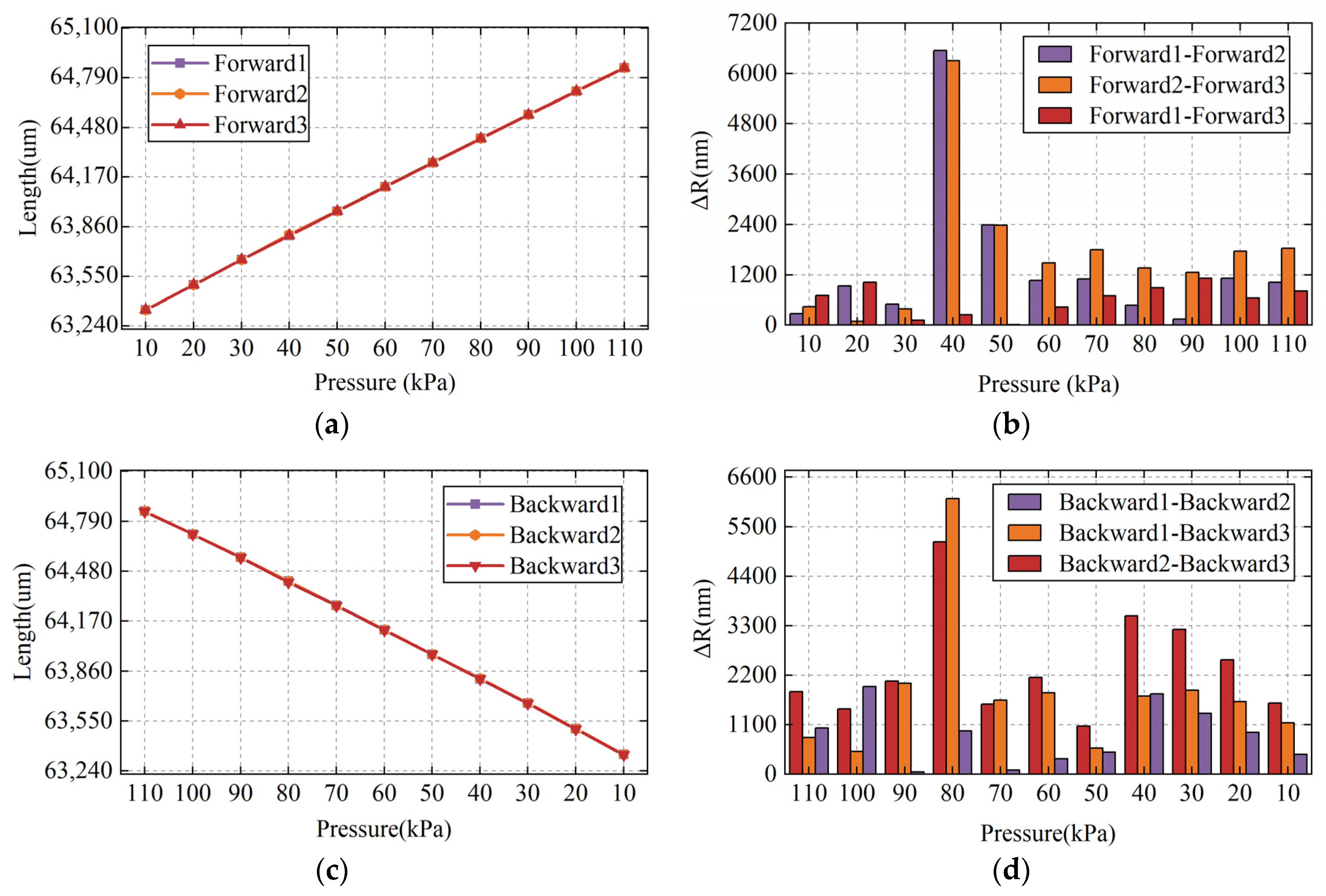
The repeatability error of the sensor was tested, and the results are shown in
Figure 9.
Figure 9a shows the cavity length response curves of three forward (pressure-increasing) repeated tests. The three curves are highly overlapping, which intuitively reflects the consistency of the cavity length output during the forward stroke.
Figure 9b shows the cavity length difference (ΔR) among the three forward tests at each test point, where the maximum forward repeatability error is
= 6544 nm.
Figure 9c shows the cavity length response curves of three reverse (pressure-decreasing) repeated tests. The three curves are also highly overlapping, reflecting the output stability during the reverse stroke.
Figure 9d shows the cavity length difference among the three reverse tests at each test point, where the maximum reverse repeatability error is
= 6124 nm.
Repeatability error is defined using the maximum difference method, and the calculation formula is:
where
is the maximum repeatability error (taken as the larger one between the forward and reverse maximum repeatability errors, i.e., 6544 nm). Substituting into the calculation, the repeatability error is 0.433%FS.
3.4. Resolution
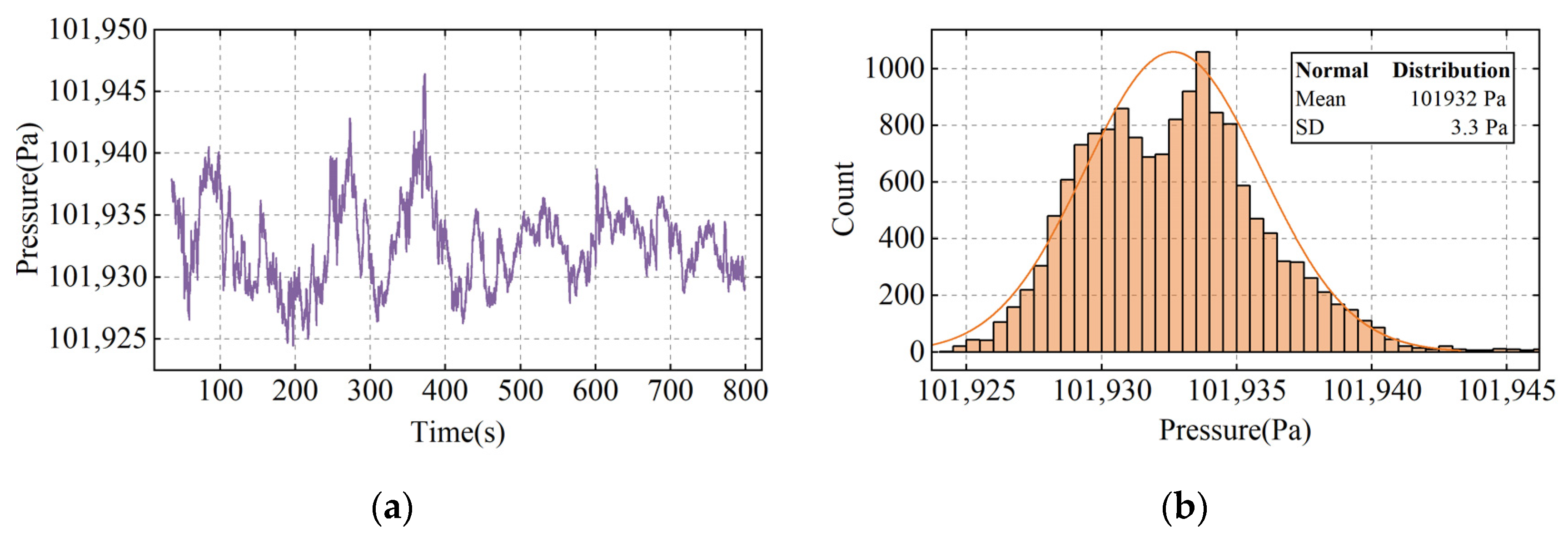
To evaluate the resolution of the sensor, it was placed in the positive/negative pressure chamber with stable pressure and left stationary. The cavity length output was continuously recorded and converted into pressure values. The test results are shown in
Figure 10.
Figure 10a shows the static drift curve of the sensor under stable pressure, where the horizontal axis represents the test time and the vertical axis represents the equivalent pressure value. The curve exhibits small random fluctuations around the mean value, which intuitively reflects the output stability of the sensor under static conditions.
Figure 10b shows the statistical distribution histogram and normal distribution fitting result of the static drift data. The fitted mean value is 101,932 Pa, and the standard deviation (SD) is 3.3 Pa.
In this study, the standard deviation of the static output is used as the evaluation index of the sensor resolution. Therefore, the resolution of the sensor is 3.3 Pa.
3.5. Temperature Characteristic Tests
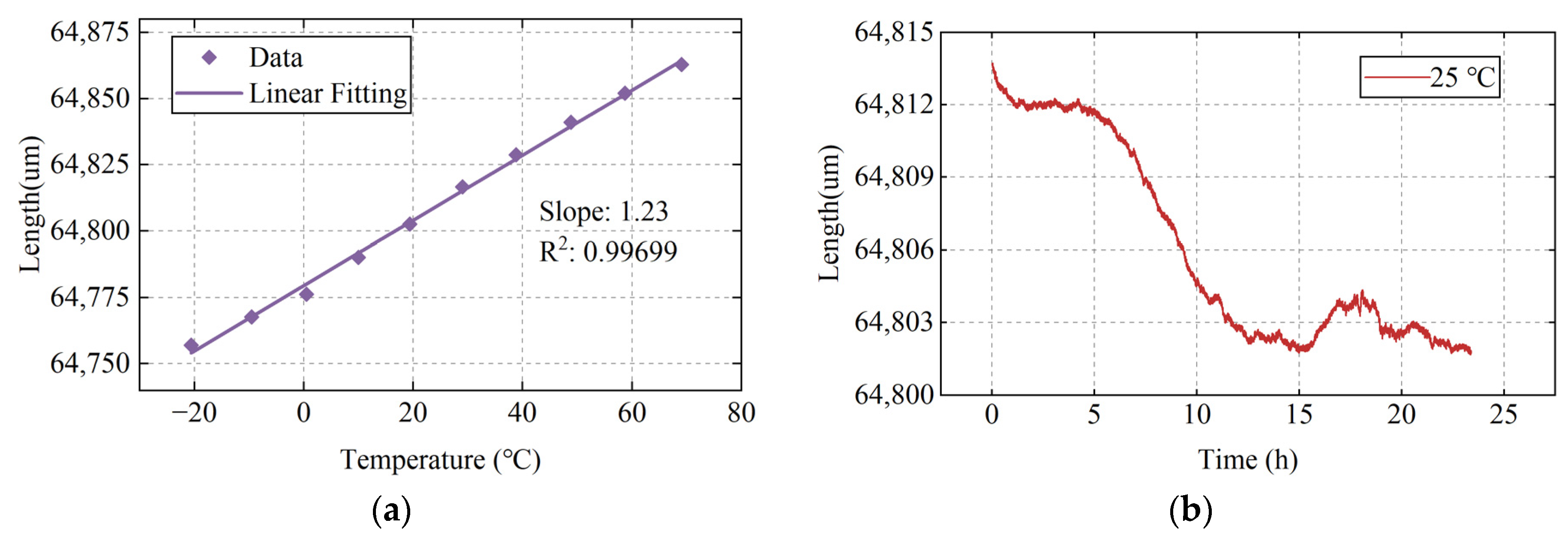
The F-P pressure sensor is fabricated from metallic materials, whose thermal expansion and contraction are induced by temperature variations. To investigate the effect of temperature on the sensor performance, the sensor was placed in an environmental test chamber (DHT: DHTH-500-40-P-SD, with a temperature fluctuation within ±0.5 °C). The cavity length variations were tested over the temperature range of −20 °C to 70 °C, with a measurement point set every 10 °C. Each temperature was maintained for 30 min, and the average cavity length within this period was taken as the responsive value.
Figure 11a presents the test results. The linear fitting result shows a goodness of fit of 0.99699, and the cavity length-temperature sensitivity is calculated to be 1230 nm/°C from the slope of the fitting curve.
Define the pressure-temperature cross-sensitivity
:
where
is the cavity length-temperature sensitivity of the sensor, with a value of 1230 nm/°C;
is the cavity length-pressure sensitivity of the sensor, with a value of 15,105 nm/kPa. The calculated pressure-temperature cross-sensitivity is 0.081 kPa/°C.
3.6. Long-Term Stability
The sensor was placed in the environmental test chamber and continuously tested for 24 h at a constant temperature of 25 °C, with the cavity length variation monitored and recorded in real time. The results are shown in
Figure 11b. In addition, a standard barometer was used to monitor the pressure inside the environmental test chamber. The measurements indicated that the chamber pressure fluctuated within 101 ± 0.2 kPa over the 24 h period.
As can be seen from the curve, the cavity length of the sensor exhibited an obvious rapid decreasing trend in the initial stage of the test (0~10 h), dropping gradually from an initial value of approximately 64,813 μm to about 64,804 μm. After 10 h, the variation in cavity length tended to be stable, fluctuating slightly in the range of 64,802~64,804 μm overall, and finally stabilized at approximately 64,802 μm at the 24 h mark. The total drift within 24 h was about −11,908 nm, with a drift rate of 496 nm/h.
4. Discussion
Most existing F-P cavities are fabricated using micro-machining processes to form miniature fiber-optic cavities, with thin films of different materials bonded at the cavity end as sensing elements. The material and structure of the thin film directly determine the performance of the F-P cavity, whose dimensions are on the micrometer scale, as reported in [
12,
36,
37]. The advantages of such fiber-optic F-P absolute pressure sensors include small size, compact structure, and stable cavity structure ensured by precision techniques such as femtosecond laser processing, fusion splicing, and MEMS technology. However, they also have obvious drawbacks: limited room for improving the sensitivity of thin films, complicated fabrication processes, and sensor resolution restricted by the performance of optical spectrum analyzers.
In contrast to conventional schemes dependent on lab-fabricated thin films and micro-machining processes, this work used mature commercial components combined with FMCW interferometric phase demodulation to achieve high-resolution and high-sensitivity pressure measurement. Within the pressure range of 10~110 kPa, the sensor achieves a sensitivity of 15,105 nm/kPa and a resolution of 3.3 Pa. To demonstrate its performance advantages intuitively, we compare it with several existing high-sensitivity and high-resolution F-P pressure sensors, and the results are presented in
Table 1. The comparison results demonstrate that the F-P pressure sensor proposed in this work achieves an excellent balance in terms of measurement range, sensitivity and resolution.
Temperature variations alter the intrinsic material properties (e.g., Young’s modulus and dimensions), which exert an inevitable influence on F-P pressure sensors: pressure detection is essentially achieved by measuring the cavity length, a parameter that is also susceptible to temperature fluctuations. Fortunately, the superior fabrication technology of the commercial vacuum capsule adopted in this work endows the proposed pressure sensor with excellent temperature resistance performance, yielding a cross-sensitivity of 0.081 kPa/°C. The sensor can operate stably over a temperature range of −20 °C to 70 °C, thus meeting the requirements for absolute pressure detection in conventional environments. However, the epoxy AB adhesive used in fabricating the F-P cavity and the protective coating of the standard pigtail fiber tend to soften and delaminate at high temperatures, which restricts the sensor’s applicability in high-temperature conditions. In future work, the packaging process can be further optimized to enhance the sensor’s performance at elevated temperatures. Moreover, temperature compensation schemes can be developed based on the cross-sensitivity analysis to further improve measurement accuracy under varying thermal conditions.
Long-term cavity length drift is one of the key indicators for evaluating the performance of F-P sensors. The cavity length drift of this sensor within 24 h is 11,908 nm, which is equivalent to a daily pressure drift of 0.79 kPa, a value significantly larger than the 0.2 kPa pressure fluctuation inside the environmental test chamber. The main reasons for the relatively large drift include, in addition to the stress creep and slow deformation of the sensor’s own structural components (substrate, adhesive layer and packaging stress) under constant temperature conditions, the inherent drift of the FMCW phase demodulation algorithm, indicating that there is still room for further optimization of the demodulation algorithm.
Compared with the traditional spectral demodulation method for cavity length measurement, the hardware system required for FMCW interference demodulation features a significant cost reduction. A cost comparison is presented herein: the ADC board adopted in this work costs 25,000 RMB, the industrial control computer 10,000 RMB, and the laser 25,000 RMB. Together with other essential components such as the photodetector (PD), the total cost of the entire system is approximately 70,000 RMB. This represents a substantial cost reduction in comparison with the currently widely used MOI demodulators, which are priced at 200,000 to 300,000 RMB. Meanwhile, the sensor has a simple structure, and by selecting commercial vacuum capsules with different specifications, it can be flexibly adapted to pressure measurement requirements in various application scenarios. Nevertheless, it should be noted that the mechanical coupling between the capsule and the F-P cavity leads to moderate structural stability, imposing certain limitations on applications in harsh environments such as strong vibration and high loads.
5. Conclusions
This paper proposes a novel optical fiber F-P absolute pressure sensor based on FMCW interferometry. Its core structure consists of a low-finesse F-P interference cavity, with a vacuum capsule serving as one end face and acting as the pressure-sensitive element. By utilizing the pressure-sensitive characteristic of the vacuum capsule, the sensor converts the variation in external absolute pressure into elastic deformation of the capsule, thereby realizing precise modulation of the F-P cavity length. The cavity length variation is then demodulated via FMCW interferometric phase detection, and high-precision measurement of absolute pressure is finally achieved.
The experimental results demonstrate that the sensor exhibits excellent static sensing performance within the pressure range of 10~110 kPa. It achieves a pressure sensitivity of up to 15,105 nm/kPa and a pressure resolution as low as 3.3 Pa, indicating its capability for high-precision pressure detection. Furthermore, the sensor can operate normally over a temperature range of −20 °C to 70 °C, with a cross-sensitivity of 0.081 kPa/°C and a cavity length drift of 496 nm/h, demonstrating good environmental adaptability. Compared with traditional capsule-type pressure sensors, this sensor uses optical interference instead of mechanical linkage structures, fundamentally breaking through the limitations of mechanical structures on measurement sensitivity and resolution. Compared with conventional optical fiber F-P pressure sensors, it features a simple structural design without requiring complex microfabrication processes for sensing films. By selecting commercial vacuum capsules of different specifications, it can be flexibly adapted to pressure measurement requirements in various scenarios. Meanwhile, the FMCW-based cavity length demodulation does not rely on optical spectrum analyzers, effectively simplifying the system architecture and significantly reducing hardware cost.