Article

The Design of a Superchiral-Sensitive MCT Photodetector Based on Silicon Metasurfaces with Truncated Corners


1
Sichuan Provincial Engineering Research Center of Thermoelectric Materials and Devices, Chengdu Polytechnic, Chengdu 610041, China
2
Institute of Semiconductors, Chinese Academy of Sciences, Beijing 100083, China
3
Kunming Institute of Physics, Kunming 650223, China
4
National Key Laboratory of Infrared Detection Technologies, Kunming Institute of Physics, Kunming 650223, China
5
Institute of Intelligent Photonics, Nankai University, Tianjin 300071, China
*
Authors to whom correspondence should be addressed.
These authors contributed equally to this work.
Photonics 2026, 13(4), 322; https://doi.org/10.3390/photonics13040322
Submission received: 21 February 2026 / Revised: 20 March 2026 / Accepted: 23 March 2026 / Published: 26 March 2026
(This article belongs to the Special Issue Photonics Metamaterials: Processing and Applications, 2nd Edition)

Abstract

The on-chip detection of circularly polarized light is pivotal for advancing applications in quantum optics, information processing, and spectroscopic sensing. However, conventional chiral metasurfaces often suffer from complex multilayer fabrication, material incompatibility, or modest performance, hindering their integration with photonic circuits. Here, we introduce a monolithic all-silicon metasurface that overcomes these limitations through a singular structural innovation. By strategically truncating four corners of a conventional Z-shaped meta-atom, we induce a hybridization of optical modes that profoundly enhances chiral light–matter interaction. This deliberately engineered perturbation yields a colossal circular dichroism with an extinction ratio exceeding 66 dB, a performance that surpasses existing state-of-the-art designs by approximately three orders of magnitude. Furthermore, the proposed metasurface exhibits remarkable fabrication robustness, owing to its single-layer architecture and CMOS-compatible material. We demonstrate that this exceptional metasurface can be directly integrated with a Mercury Cadmium Telluride (MCT) photodetector to form a highly efficient, compact circular polarization detector. Our work provides a simple yet powerful paradigm for creating high-performance chiral photonic devices, paving the way for their widespread adoption in integrated optoelectronics.

1. Introduction

Infrared detection technology plays an indispensable role in a wide range of fields, from thermal imaging and meteorological monitoring to spectral analysis [1]. However, traditional infrared detectors based on light intensity are facing inherent performance bottlenecks. They can only sense the total energy (i.e., intensity) of the incident light but lose another valuable dimension of information in the light wave—polarization [2,3,4]. In complex real-world scenarios, such as in thick fog or under strong background radiation interference, the infrared radiation intensity information of the target object may be severely submerged, but the polarization state of the reflected or self-emitted light often remains stable, thereby providing a key criterion for target identification and differentiation [5]. Among them, circular polarization state [6], due to its sensitivity to the microscopic chiral structure and surface rotational characteristics of the object, is particularly valuable. However, traditional circular polarization detection systems rely heavily on discrete optical components composed of linear polarizers and quarter-wave plates [7]. This approach not only leads to a large system volume and difficulty in integration but also limits the final detection sensitivity and polarization purity due to inherent optical losses and inevitable alignment errors. Therefore, developing a compact, efficient, and high-performance on-chip circular polarization detection technology has become the key to breaking through the current bottleneck and unlocking the wide application of infrared polarization information.
The emergence of metasurfaces [8,9,10,11,12,13,14] offers a highly promising solution to the above-mentioned challenges. These two-dimensional planar optical components composed of subwavelength artificial atoms can precisely manipulate the wavefront, polarization, and resonant modes of light with a volume far smaller than that of traditional optical systems. In the field of chiral optics, researchers have successfully constructed chiral metasurfaces by designing asymmetric structures such as “Z”-shaped, cross-shaped [15], or twisted nanoantennas [16,17,18,19,20], which can generate differential optical responses to left- and right circularly polarized light (LCP and RCP). Based on this, a series of miniature circularly polarized photodetectors integrated with chiral metasurfaces have been reported [21,22], demonstrating the potential to directly embed polarization sensing functions into focal plane arrays. However, despite these advancements, there remains a core bottleneck that hinders the practical application of this field. The circular polarization extinction ratio (CPER) of existing chiral metasurfaces is generally not high, with the highest values reported to date typically not exceeding 40 dB [23,24,25,26]. This performance limitation has serious consequences. Firstly, it restricts the fidelity of the detector in distinguishing between the two circular polarization states, resulting in high signal crosstalk and misjudgment rates in applications with extremely high requirements for polarization purity, such as high-precision chiral molecular structure analysis or quantum state discrimination detection. Secondly, the low CPER directly translates to a low signal-to-noise ratio of the detector, making it difficult to detect the extremely weak characteristic circularly polarized signals that have been weakened by strong background noise or complex scattering media. Imagine if the CPER could be increased by an order of magnitude to an unprecedented level, we would be able to detect previously noise-drowned weak spectral signals from extremely low-concentration chiral molecules, or achieve ultra-high contrast polarization imaging at extremely long distances and in harsh weather conditions. This would undoubtedly open up new chapters in quantum optics, biomedical sensing, and precision spectroscopy.
In response to this core challenge, this paper reports a high-performance circularly polarized detector based on a breakthrough chiral metasurface, which has achieved a qualitative leap in CPER. We abandoned the traditional approach of enhancing chiral response through complex three-dimensional structures or multi-layer stacking, and returned to the most basic single-layer “Z”-shaped silicon-based microstructure. On this basis, we introduced a key structural innovation, namely, precise “cutting” of four specific corners. This seemingly minor modification ingeniously induced resonance of different optical modes in the structure, greatly enhancing the chiral asymmetry of the local light field. Ultimately, we successfully designed a single-layer silicon-based metasurface with simple process characteristics and full compatibility with CMOS processes. Verified by commercial simulation software COMSOL 5.6, this structure achieved a CPER of up to 66 dB in the target band, which is nearly three orders of magnitude higher than the current technical level. In addition, this design also shows good process tolerance, laying the foundation for its large-scale manufacturing and application. We integrated this outstanding metasurface structure with MCT photodetectors on a single chip to build a high-performance circularly polarized detector. This device not only verified the correctness of our design concept, but also paved the way for the application of next-generation integrated polarization photonic systems in ultra-sensitive sensing, high-capacity communication and quantum information processing and other fields with its unprecedented high performance.

2. Materials and Methods

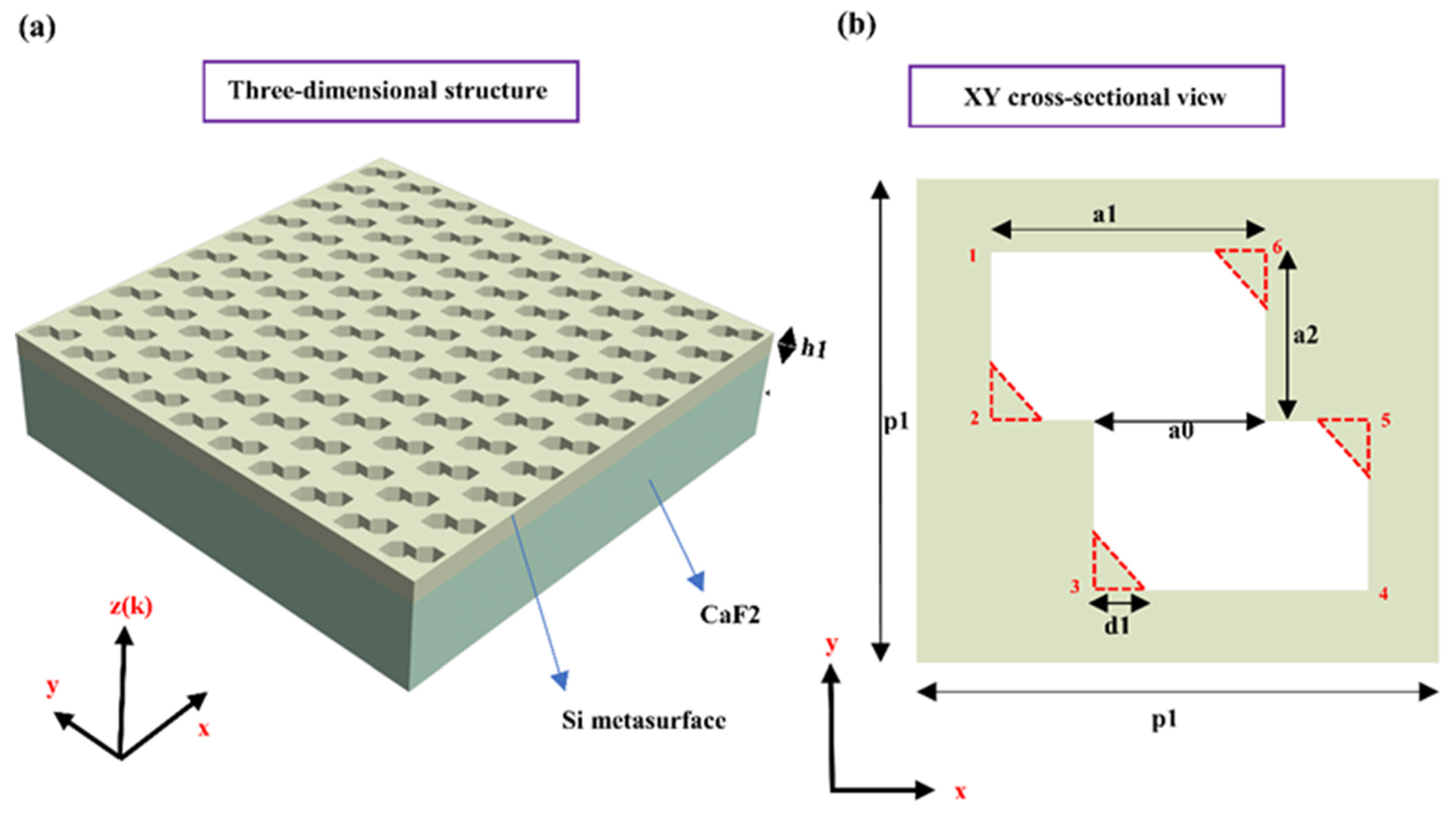
Figure 1a shows the three-dimensional structure of Chiral metasurfaces with truncated corners, which consists of a CaF2 substrate approximately 500 μm thick and an array of air holes on top. The incident light is in the positive z-axis direction, pointing from the substrate to the metasurface. Figure 1b shows the unit cell of the metasurface, which is a 740 nm-thick silicon film with a special chiral symmetry structure of air holes obtained through photolithography and etching processes. The air holes are composed of two rectangular holes with horizontal dislocations a0, and then the triangles near the endpoints 2, 3, 5, and 6 are truncated. The optical refractive indices of silicon and CaF2 are taken from references [27,28], respectively. The transmission parameters are obtained based on the finite element calculation platform COMSOL. The model has periodic boundary conditions at the end faces in the X and Y directions and a perfect matching layer at the end face in the z-axis direction. The characteristics of the incident and transmitted light are monitored by the incident port and the transmission port, respectively. The mesh sizes of silicon and CaF2 are 100 nm and 50 nm, respectively. The mesh size of the air holes is 80 nm. The number of layers of the perfect matching layer is 15. The transmission of the metasurface is the area integral of the Poynting vector at the transmission port.

3. Results

3.1. Parameter Scanning

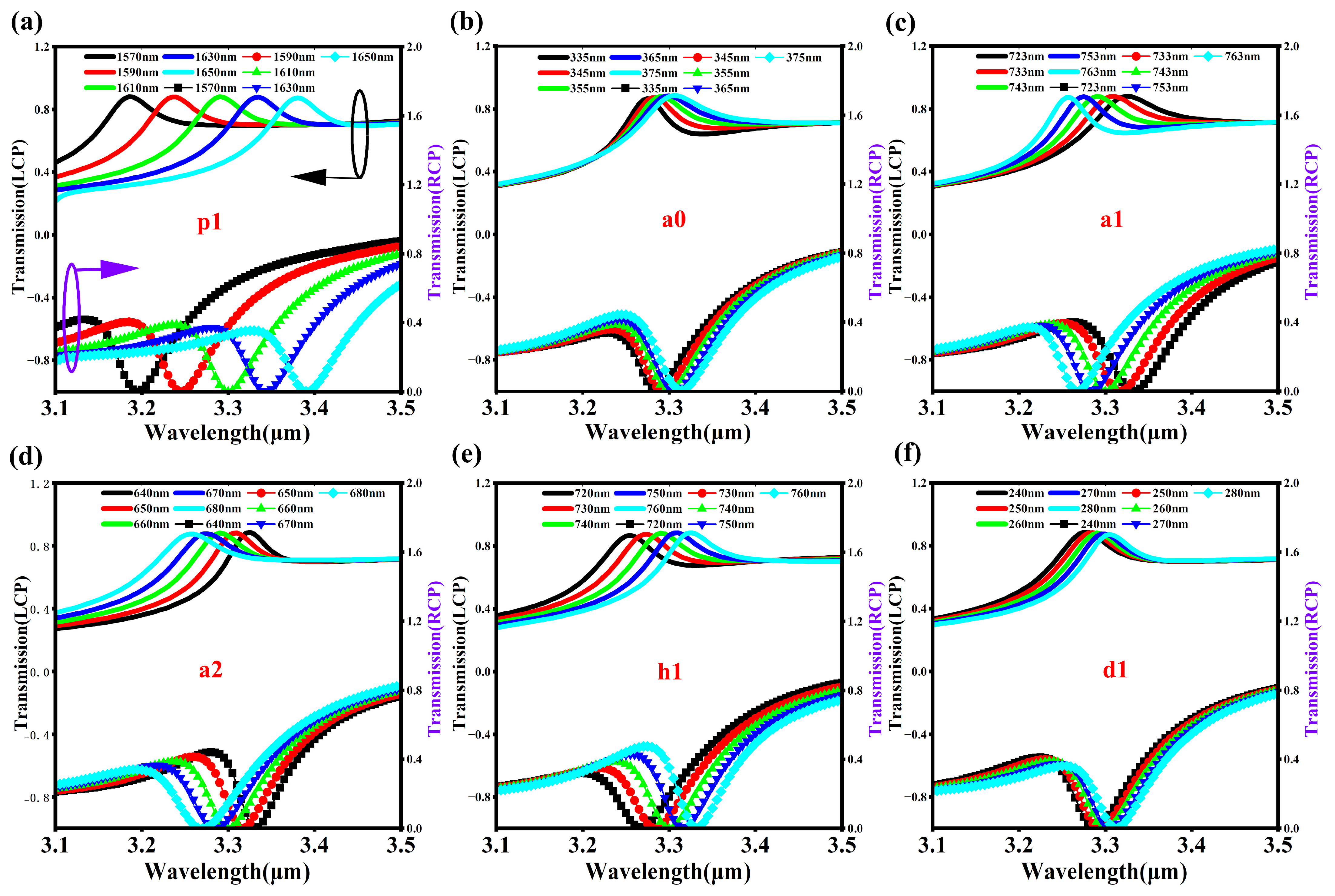
Parameter scanning can facilitate a systematic exploration of the dependency between the structural dimensions of metasurface units and their electromagnetic responses, thereby determining the optimal combination of size parameters for achieving the desired optical functions and understanding the rules and tolerances of performance changes with size variations. Figure 2 illustrates the impact of the geometric line variations in Chiral metasurfaces with truncated corners, with solid lines and dashed lines corresponding to LCP and RCP incident cases, respectively. As shown in Figure 2a, as the period p1 increases, the transmission spectra of both LCP and RCP undergo equidistant redshifts, presenting the typical characteristics of guided-mode resonance modes. A period change range of 80 nanometers corresponds to an effective modulation bandwidth of approximately 200 nm, indicating that p1 can also be a key for manipulating broadband signals. Figure 2b investigates the influence of line a0 on the transmission spectrum, which also shows significant redshift characteristics. However, the modulation bandwidth corresponding to a0 seems to be limited. As shown in Figure 2c, a1 corresponds to a blue shift in the spectrum, which is contrary to the above two cases. This anomalous phenomenon can be explained as follows. When the period p1 remains unchanged, a larger a1 means a narrower air gap in the Y direction. The air gap and the silicon materials at both ends can form a ternary optical resonance system of high refractive index—low refractive index—high refractive index. In this system, a smaller ∆l corresponds to a smaller resonant wavelength. Additionally, Figure 2d shows the influence of line a2, which is also a typical blue shift phenomenon. Figure 2e,f, respectively, demonstrate the influence of lines h1 and d1, which have a weak redshift effect on Chiral metasurfaces with truncated corners. It can be found that a1 and a2 belong to the blue shift phenomenon category, while other parameters exhibit redshift phenomena. p1 has the greatest impact on the movement of the central wavelength. Therefore, when processing samples for manipulating specific wavelengths, the line error of p1 must be given additional attention.

3.2. Analysis of Ultra-High CPER

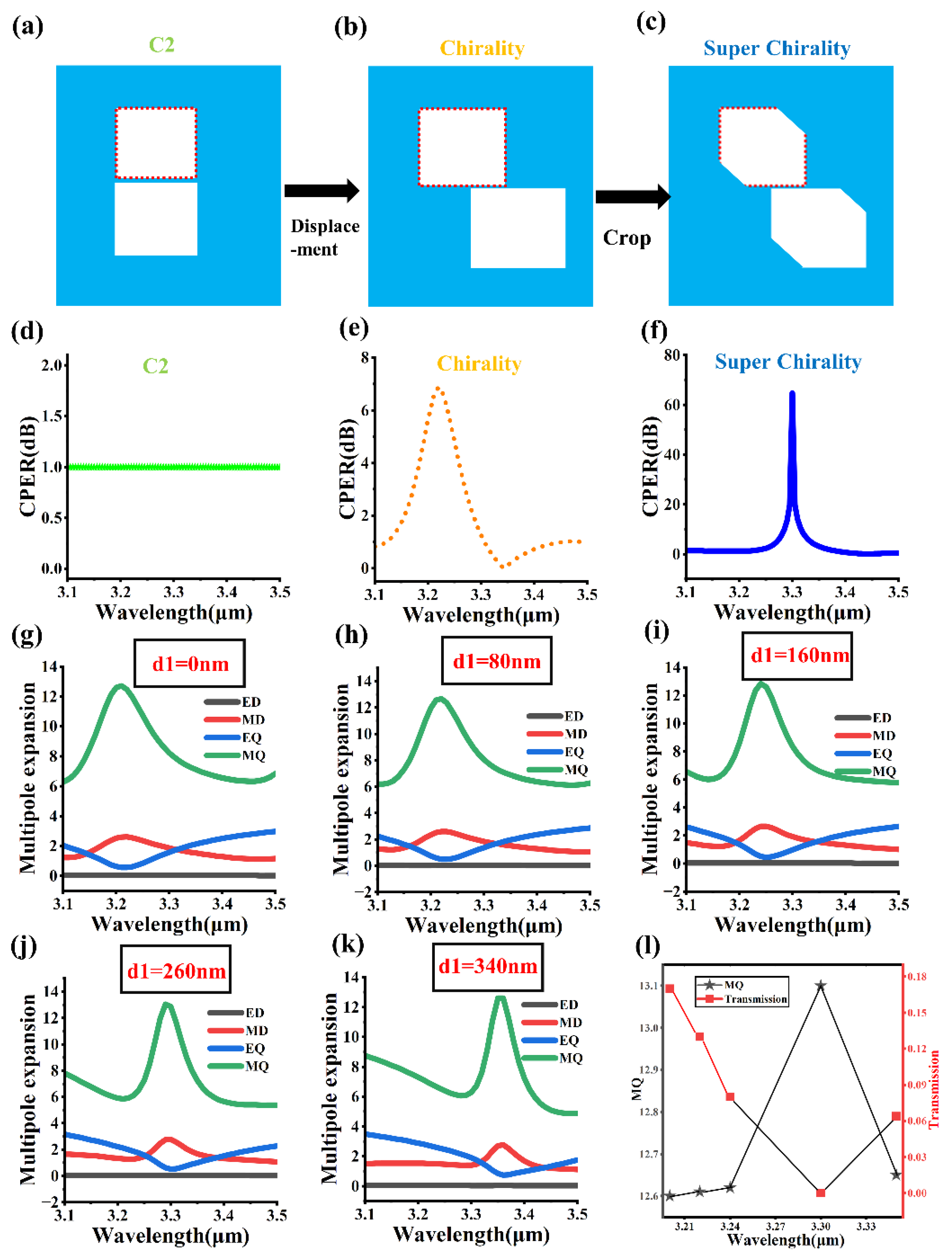
Chiral symmetry structure is the basis for generating intrinsic circular dichroism, which can have differential electromagnetic coupling with LCP and RCP. Therefore, the study of symmetry breaking is one of the necessary means to further control chiral response. Figure 3a–c shows three unit cell structures, which correspond to the gradually increasing chiral symmetry in sequence. Light blue represents silicon material, and white represents air. The unit cell in Figure 3a consists of two identical air rectangular holes in a silicon film, and the two rectangles are aligned horizontally. This phenomenon indicates that the unit cell is a C2 symmetric structure, meaning that the structure after a 180-degree rotation can overlap with itself. Different from Figure 3a, in Figure 3b, the upper rectangular hole is shifted to the left and the lower rectangular hole is shifted to the right. A typical horizontal dislocation caused by the shift operation converts the unit cell from a C2 symmetric structure to a chiral symmetric structure. On this basis, cutting off some corners of the rectangle will generate a new unit cell named super chirality, which enhances chirality by increasing the complexity of the geometric structure, as shown in Figure 3c. Figure 3d–f shows the CPER spectra corresponding to the three unit cells, where C P E R = T L C P / T R C P , and T L C P and T R C P are the transmittances of the metasurface under LCP and RCP incident conditions, respectively. Obviously, the CPER in Figure 3d is 1, corresponding to the rectangular hole without chiral symmetry in Figure 3a. The CPER spectrum in Figure 3e has a peak at 3.25 μ m , with a peak value of approximately 7 dB, which is caused by the symmetry breaking due to the horizontal dislocation dl. Figure 3f is the CPER spectrum of the superchiral structure, which has an extremely high CPER peak (~70 dB) caused by the cutting operation. Such a significant CPER peak can be explained by the multipole expansion method, an effective tool. The multipole expansion method [29] is a classical electromagnetic theory method that decomposes the response of localized electromagnetic sources or scatterers into a superposition of basic multipole radiation modes (such as electric dipoles (ED), magnetic dipoles (MD), electric quadrupoles (EQ), Magnetic quadrupole (MQ), etc.). Figure 3g–k shows the multipole expansion spectra under RCP incident conditions when the side length of the cropped triangle (dl) is 0 nm, 80 nm, 160 nm, 260 nm, and 340 nm, respectively. It can be found that MQ always dominates. Figure 3i is a scatter plot with two y-axes, where the x-axis corresponds to the wavelength of the peaks in Figure 3g–k, the left y-axis represents the intensity of MQ, and the right y-axis represents the transmittance at the corresponding characteristic wavelength. Clearly, the intensity of MQ is inversely proportional to the transmittance, which means that when the structure is superchiral, a very high MQ peak will occur, and the electromagnetic far field it radiates will undergo extremely strong coherent interference with the RCP incident light, resulting in a near-zero transmission valley.

3.3. Analysis of Circular Dichroism

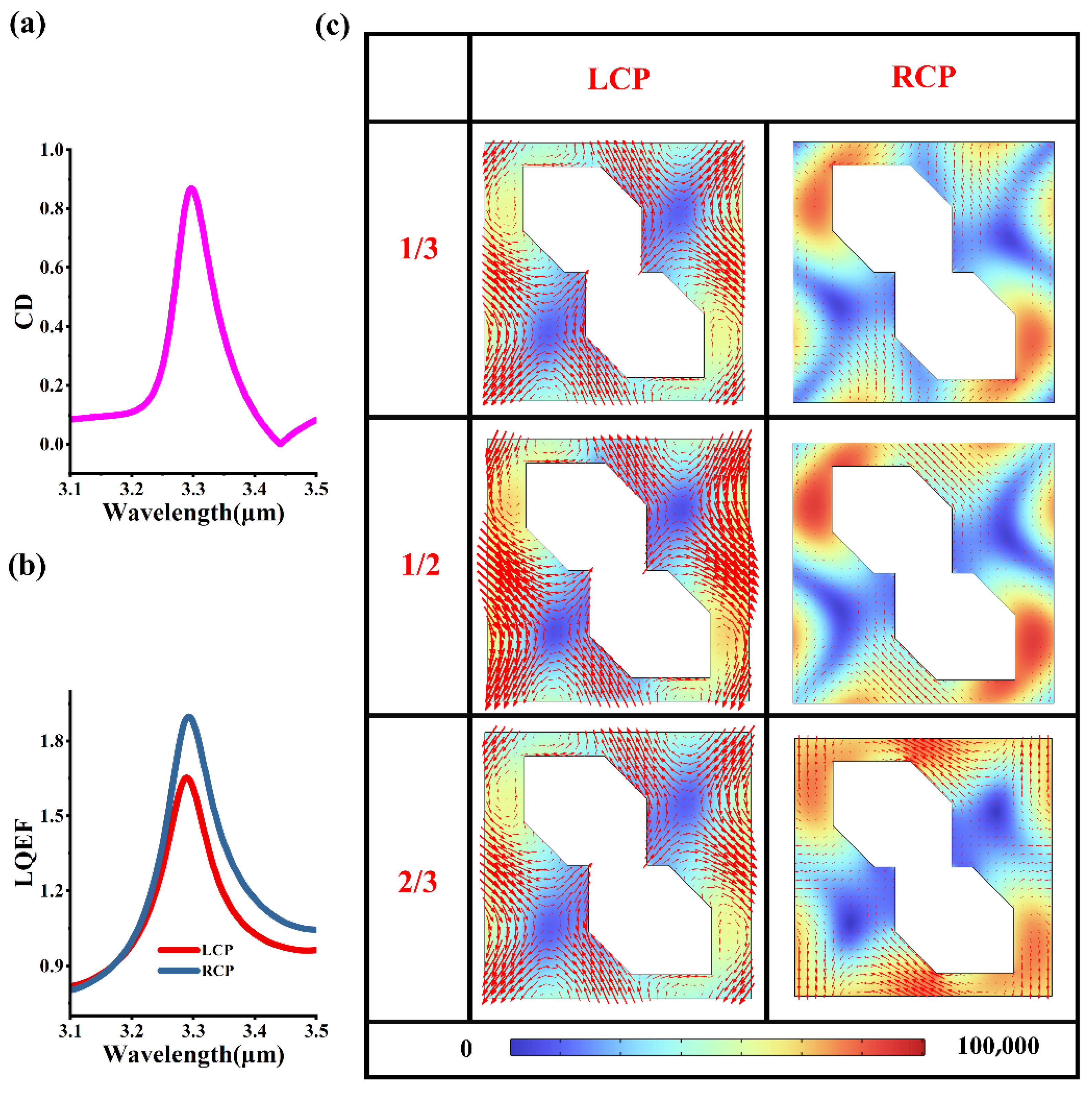
Figure 4a shows the CD spectrum of chiral metasurfaces with truncated corners, where C P = T L C P T R C P , and T L C P and T R C P are the transmittance of the metasurface under LCP and RCP incidence, respectively. It can be observed that there is an extremely typical CD peak at the operating wavelength of 3.3 μ m , with a peak value of approximately 0.9. Figure 4b presents the LQEF spectrum of Chiral metasurfaces with truncated corners, where L Q E F = | E m | d V / | E 0 | d V , a parameter that quantitatively assesses the local enhancement effect of the electric field. Here, E m and E 0 represent the electric field intensity within the metasurface and the incident light’s electric field intensity, respectively, and the integration domain is the volume occupied by the Chiral metasurfaces with truncated corners. It is evident that the spectral shape of the LQEF is consistent with that of the CD spectrum in Figure 4a. More importantly, the wavelength corresponding to the maximum difference in LQEF between LCP and RCP coincides with the CD peak. Additionally, the visualization of the electric field intensity distribution is a direct means to analyze the resonance mode characteristics and the local mechanism of the electromagnetic field of the metasurface, providing a key basis for correlating structural design with optical response [30]. Figure 4c shows the electric field intensity distribution and equivalent current distribution on the xy cross-section of Chiral metasurfaces with truncated corners. The “1/3”, “1/2”, and “2/3” in the figure correspond to the positions of the xy cross-section at 1/3, 1/2, and 2/3 of the thickness of the metasurface, respectively. It can be observed that the equivalent current intensity under LCP incidence is significantly greater than that under RCP incidence. We boldly speculate that under LCP incidence, the electromagnetic far field radiated by the high-intensity equivalent current interferes with the incident light, resulting in a significant transmission peak, which directly leads to a favorable CD value. Table 1 presents a comparison of the performance of some recent chiral metasurfaces, mainly showing the number of layers, CD and CPER. It can be found that the metasurface we designed not only has the advantage of being single-layered, but also has excellent CD and CPER. Especially the CPER of up to 66 dB, which is a three-order-of-magnitude improvement over the concurrent works.

3.4. The Influence of Errors

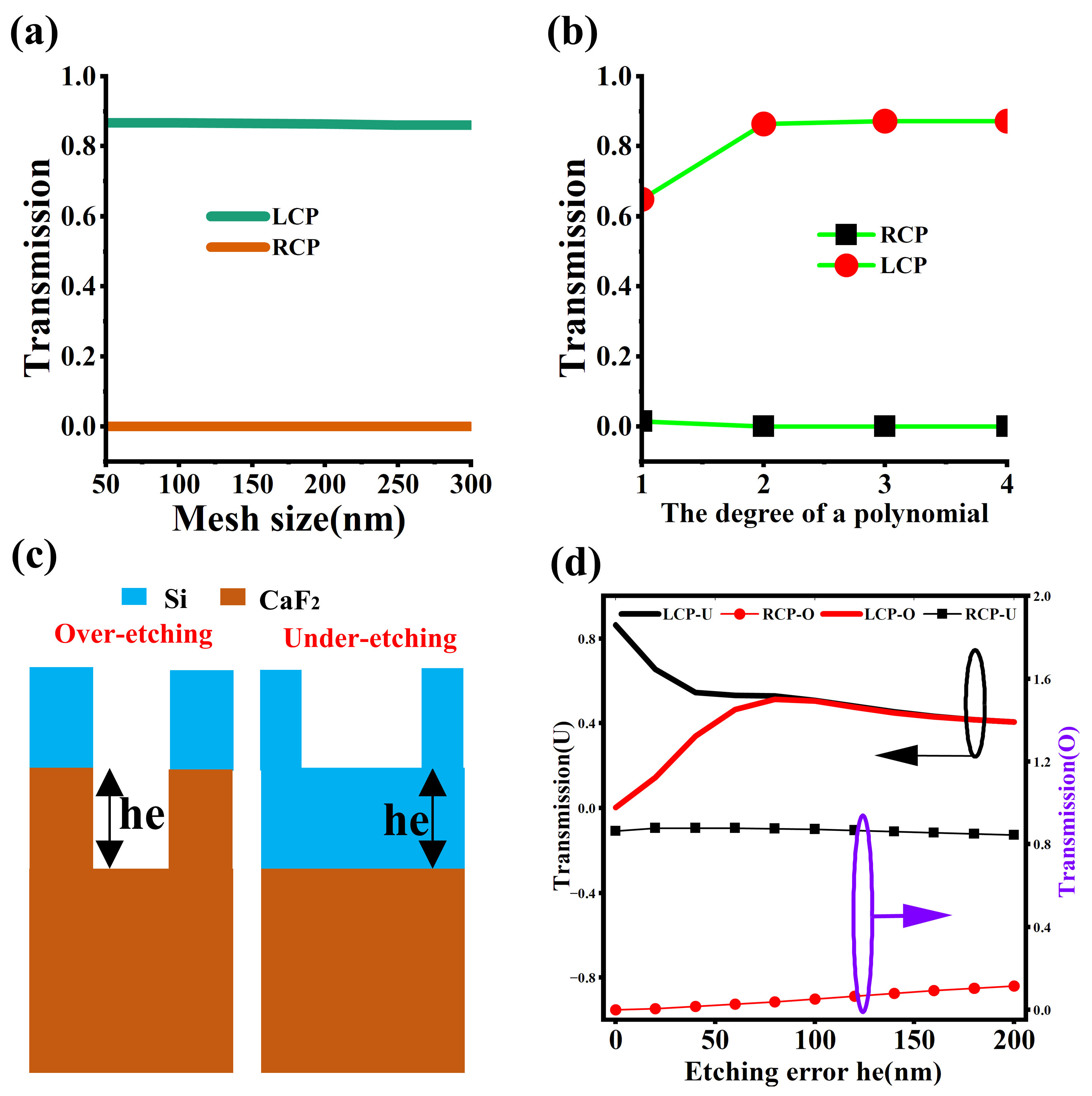
In the previous sections, we introduced the structural composition of Chiral metasurfaces with truncated corners and analyzed the source of the huge CPER. In this subsection, we mainly discuss the influence of some possible errors. The analysis of the mesh size and the FEM polynomial order aims to ensure the convergence and accuracy of the numerical simulation, thereby reliably extracting the intrinsic electromagnetic response of the metasurface. Figure 5a shows the influence of the mesh size of the silicon material in the simulation model. It can be found that within the range of 50 to 300 nm, the transmission rates of the metasurface under LCP and RCP incidence are a standard straight line.
Figure 5b shows the influence of the FEM polynomial order in the simulation model. It can be found that the order of 2 is a dividing point, and when the order is greater than or equal to 2, all the calculation results remain stable. In addition, the evaluation of the etching depth error is related to the manufacturing process tolerance, which is used to predict the structural robustness and performance deviation in actual processing. Figure 5c shows the geometric schematic diagram of the metasurface in the over-etching or under-etching state. When in the over-etching state, since the etching time is greater than the etching threshold time of the silicon material, some CaF2 material will also be etched through. When in the under-etching state, the shorter etching time causes the air holes to still be covered by the silicon film. Figure 5d shows the influence of the etching depth error on the transmission rate of the metasurface. When the Chiral metasurfaces with truncated corners are in the under-etching state, the influence of the etching depth error is very obvious. As long as he is greater than or equal to 80 nm, all chirality is lost. However, the over-etching state seems to be more lenient to the chiral effect. Even when the etching error is 200 nm, the metasurface still has a CD of about 0.7. It can be found that when truly processing this metasurface, we need to etch for a few more seconds to ensure that the metasurface is in an over-etched state.

3.5. The Design of Circular Polarization Detector

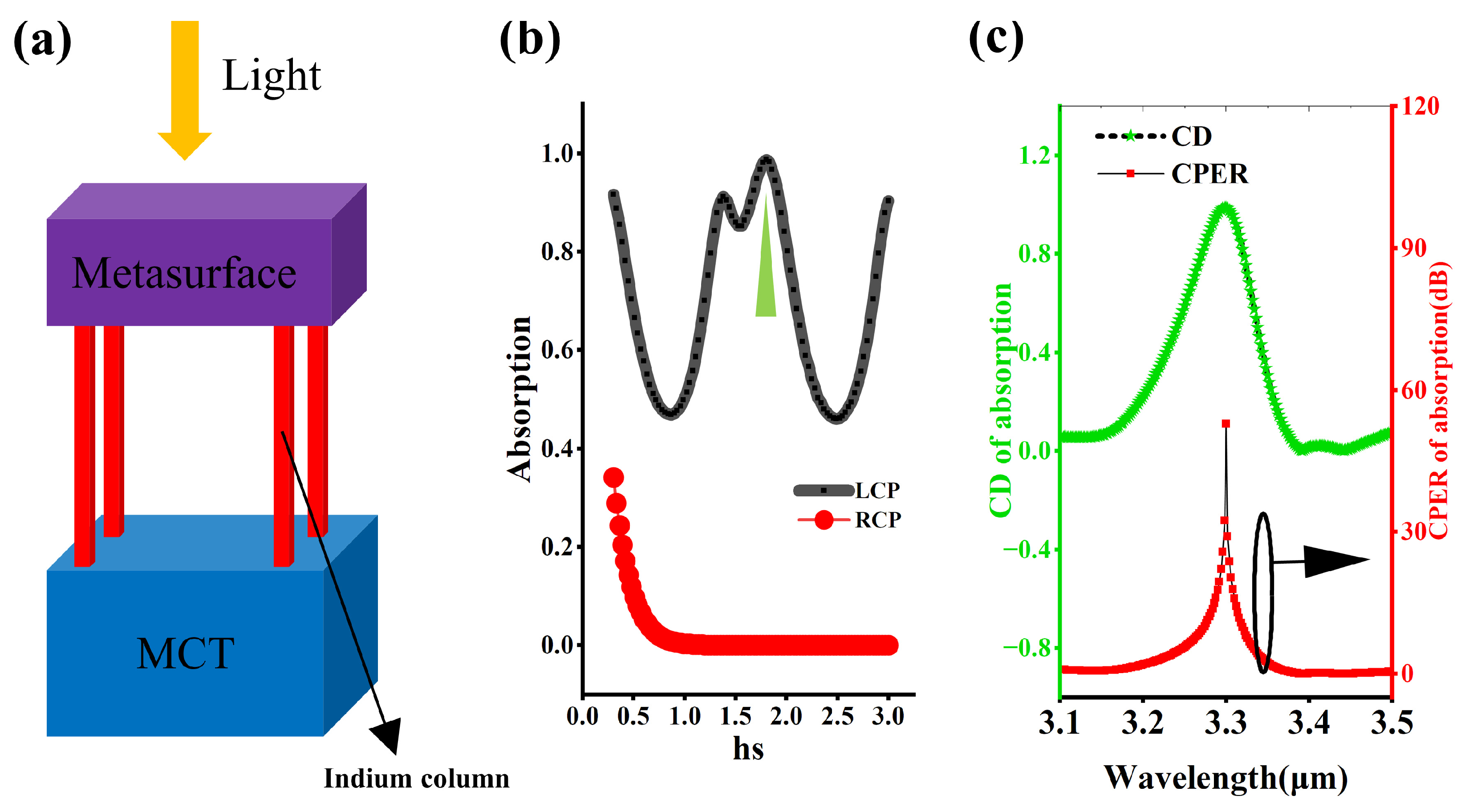
Figure 6a shows the schematic diagram of the circularly polarized MCT photodetector based on Chiral metasurfaces with truncated corners. Its specific process steps are as follows. First, indium columns are evaporated and patterned in the edge area of the metasurface structure. Meanwhile, the MCT detector chip prepared on the readout integrated circuit (ROIC) is passivated and electrode windows are opened. Then, it is precisely aligned with the metasurface and bonded under vacuum and thermal pressure conditions through indium column bonding, forming a sealed air gap. Finally, dicing and packaging are carried out to achieve monolithic integration of the chiral metasurface polarizer and the MCT detector. In addition, the process flow chart of the device can be seen in the Supplementary Materials. When the incident light is LCP, free photons can pass through the upper chiral metasurface and be absorbed by the MCT to generate a photoresponse. However, when the incident light is RCP, due to the complete reflection property of the metasurface at this time, almost no photons can enter the absorption region of the MCT. Figure 6b shows the influence of the indium column height hs on the circularly polarized MCT. The absorption spectrum of LCP shows an oscillating characteristic, while the absorption rate of RCP first decreases and then remains unchanged. Finally, hs = 1.8 μm is selected, which is a trade-off between performance and processing difficulty. Figure 6c shows the CD spectrum and CPER spectrum of the circularly polarized MCT, which correspond to the difference and the logarithm of the ratio of the absorption rates of LCP and RCP, respectively. At the working wavelength of 3.3 μm, CD is approximately 0.97 and CPER is approximately 60 dB.

4. Discussion

The metasurface–MCT detector integration scheme proposed in this work not only achieves a circular dichroism of up to 66 dB, but more importantly, it provides a new paradigm for chiral light detection in the infrared band that is structurally simple, process-compatible, and has excellent performance and scalability. Compared with traditional chiral detection schemes, this integrated architecture has several significant advantages: First, compactness and potential for monolithic integration. Traditional circular polarization detection usually requires the combination of independent polarization optical elements (such as waveplates, polarizing beam splitters) with detectors, resulting in a large system volume and difficult alignment. In our scheme, the chiral metasurface is directly integrated with the MCT detector through flip-chip bonding, forming a compact chip-level circular polarization detector. This “optical function layer + detection function layer” vertical stacking structure provides a feasible path for the future development of on-chip polarization imaging and polarization spectrometers, as well as a CMOS-compatible manufacturing process. The fabrication of the silicon metasurfaces in this work is all done using CMOS-compatible processes (including PECVD deposition, lithography, ICP etching, etc.), and the MCT detector, as a mature infrared detection platform, already has large-scale production capabilities. The two are integrated through indium pillar flip-chip bonding without the need to introduce complex heteroepitaxy or wafer bonding processes. This feature makes the scheme have good scalability and industrialization prospects. Third, the extensibility of multi-functional integration. It is worth noting that the silicon metasurface in this scheme itself has the potential for multi-functional reconfigurability. By introducing phase change materials (such as VO2, GST) or MEMS tuning structures, functions such as dynamic polarization state control and tunable spectral detection can be achieved on the same integrated platform in the future. Combined with the high sensitivity of the MCT detector, this platform is expected to play an important role in fields such as infrared communication, quantum information processing, and chiral sensing of biomolecules.
In summary, we have shattered the performance–complexity trade-off in chiral metasurfaces by introducing a minimalist structural perturbation—truncating four corners of a Z-shaped meta-atom—that triggers a profound resonance of optical modes. This singular innovation enables a monolithic silicon metasurface to achieve a record-high circular dichroism extinction ratio of over 60 dB, outperforming the state of the art by three orders of magnitude. This breakthrough stems from a pivotal insight: extreme chiroptical response can be engineered not through structural complexity, but through intelligent interference. Our all-silicon, single-layer design guarantees robust fabrication and seamless compatibility with CMOS platforms, addressing a critical barrier to integration.
When directly coupled with a photodetector, this metasurface forms a highly compact and efficient circular polarization detector, immediately applicable in quantum information processing, chiral sensing, and secure communications. Our paradigm of “minimalist maximalism” opens a new design avenue for metaphotonic devices, where targeted morphological edits can unlock unprecedented functionality. Future work will focus on dynamic tuning and broadening the operational bandwidth, paving the way for sophisticated on-chip polarization management.

Supplementary Materials

The following supporting information can be downloaded at: https://www.mdpi.com/article/10.3390/photonics13040322/s1.

Author Contributions

Conceptualization, X.W. and L.L.; methodology, B.C. and Y.Z.; software, L.L.; validation, G.S., X.W. and Y.Z.; formal analysis, X.W.; investigation, Y.Z. and G.S.; resources, L.L.; data curation, X.W.; writing—original draft preparation, X.W. and L.L.; writing—review and editing, K.Z. and H.S.; visualization, K.Z.; supervision, H.S.; project administration, H.S.; funding acquisition, K.Z. and H.S. All authors have read and agreed to the published version of the manuscript.

Funding

This research was funded by the National Key Research and Development Program of China, grant number No. 2024YFB2807803. This research was funded by the Natural Science Foundation of Tianjin, grant number No. 24JCQNJC01880; This research was funded by the Research on Optoelectronic Fusion Technology, ZB253015; This research was funded by the Young Elite Scientists Sponsorship Program of Cast, grant number No. YESS20240775; This research was funded by the Strategic Priority Research Program of the Chinese Academy of Sciences (grant No. XDB0980000).

Institutional Review Board Statement

Not applicable.

Informed Consent Statement

Not applicable.

Data Availability Statement

Data underlying the results presented in this paper are not publicly available at this time but maybe obtained from the authors upon reasonable request.

Conflicts of Interest

The authors declare no conflicts of interest.

References

  1. Holst, G.C. Infrared Imaging Systems: Design, Analysis, Modeling, and Testing XIV; SPIE: Bellingham, WA, USA, 2003. [Google Scholar]
  2. Ibbetson, J.P.; Fini, P.T.; Ness, K.D.; Denbaars, S.P.; Mishra, U.K. Polarization effects, surface states, and the source of electrons in AlGaN/GaN heterostructure field effect transistors. Appl. Phys. Lett. 2000, 77, 250–252. [Google Scholar] [CrossRef]
  3. Fu, H.; Cohen, R.E. Polarization Rotation Mechanism for Ultra-High Electromechanical Response in Single-Crystal Piezoelectrics. Nature 2000, 403, 281–283. [Google Scholar] [CrossRef]
  4. Lee, H.N.; Christen, H.M.; Chisholm, M.F.; Rouleau, C.M.; Lowndes, D.H. Strong polarization enhancement in asymmetric three-component ferroelectric superlattices. Nature 2005, 433, 395–399. [Google Scholar] [CrossRef]
  5. Demos, S.G.; Alfano, R.R. Optical polarization imaging. Appl. Opt. 1997, 36, 150–155. [Google Scholar] [CrossRef]
  6. Hansen, J.E. Circular Polarization of Sunlight Reflected by Clouds. J. Atmos. Sci. 1971, 28, 1515–1516. [Google Scholar] [CrossRef]
  7. Chen, H.; Chen, H.; Yang, Y.; Shao, Y. Short-Range Detection System with Polarized Laser and Polarization Characteristics of Typical Targets. In Proceedings of the International Conference on Materials Science and Information Technology, Nanjing, China, 14–15 September 2013. [Google Scholar]
  8. Zhou, Y.; Liu, T.; Dai, C.; Wang, D.; Zhou, L. Functionality multiplexing in high-efficiency metasurfaces based on coherent wave interferences. Opto-Electron. Adv. 2024, 7, 5–17. [Google Scholar] [CrossRef]
  9. Iyer, P.P.; Nicholas, K.; Sadhvikas, A.; Gennaro, S.D.; Sinclair, M.B.; Igal, B. Sub-picosecond steering of ultrafast incoherent emission from semiconductor metasurfaces. Nat. Photonics 2023, 17, 588–593. [Google Scholar] [CrossRef]
  10. Yuan, H.; Tang, W.; Zhong, Z.; Zhang, B. Crosstalk-avoided 3D full-color holographic displays enabled by single-cell metasurfaces. Photonics Res. 2025, 13, 235–248. [Google Scholar] [CrossRef]
  11. Overvig, A.; Mann, S.A.; Alù, A. Spatio-temporal coupled mode theory for nonlocal metasurfaces. Light Sci. Appl. 2024, 13, 267–282. [Google Scholar] [CrossRef] [PubMed]
  12. Hu, Z.; Su, W.; Hu, K.; Tang, B. A deep learning-driven forward and inverse cooperative network for circular dichroism in chiral metasurfaces. J. Mater. Chem. C 2025, 13, 9717–9723. [Google Scholar] [CrossRef]
  13. Hu, K.; Yao, Y.; Ye, L.; Hu, Z.; Tang, B.; Su, W. Design of a graphene-based chiral trifunctional tunable terahertz metasurface. Phys. Chem. Chem. Phys. 2025, 27, 2615–2622. [Google Scholar] [CrossRef]
  14. Hu, Z.; Su, W.; Shi, J.; Tang, B. High-Q chiral metasurface with quasi-BIC for tunable circular dichroism and refractive index sensing. J. Mater. Chem. C 2026, 14, 3540–3546. [Google Scholar] [CrossRef]
  15. Bai, J.; Wang, C.; Chen, X.; Basiri, A.; Wang, C.; Yao, Y.U. Chip-integrated plasmonic flat optics for mid-infrared full-Stokes polarization detection. Photonics Res. 2019, 7, 1051–1060. [Google Scholar] [CrossRef]
  16. Afshinmanesh, F.; White, J.S.; Cai, W.; Brongersma, M.L. Measurement of the polarization state of light using an integrated plasmonic polarimeter. Nanophotonics 2012, 1, 125–129. [Google Scholar] [CrossRef]
  17. Li, W.; Coppens, Z.J.; Besteiro, L.V.; Wang, W.; Govorov, A.O.; Valentine, J. Circularly polarized light detection with hot electrons in chiral plasmonic metamaterials. Nat. Commun. 2015, 6, 8379. [Google Scholar] [CrossRef]
  18. Gansel, J.K.; Thiel, M.; Rill, M.S.; Decker, M.; Bade, K.; Saile, V.; Freymann, G.V.; Linden, S.; Wegener, M. Gold Helix Photonic Metamaterial as Broadband Circular Polarizer. Science 2009, 325, 1513–1515. [Google Scholar] [CrossRef] [PubMed]
  19. Ji, R.; Wang, S.W.; Liu, X.; Guo, H.; Lu, W. Hybrid Helix Metamaterials for Giant and Ultrawide Circular Dichroism. Acs Photonics 2016, 3, 2368–2374. [Google Scholar] [CrossRef]
  20. Dietrich, K.; Menzel, C.; Lehr, D.; Puffky, O.; Huebner, U.; Pertsch, T.; Tuennermann, A.; Kley, E.B. Elevating optical activity: Efficient on-edge lithography of three-dimensional starfish metamaterial. Appl. Phys. Lett. 2014, 104, 2517–2534. [Google Scholar] [CrossRef]
  21. Liu, Z.; Liu, M.; Qi, L.; Zhang, N.; Wang, B.; Sun, X.; Zhang, R.; Li, D.; Li, S. Versatile on-chip polarization-sensitive detection system for optical communication and artificial vision. Light Sci. Appl. 2025, 14, 68. [Google Scholar] [CrossRef] [PubMed]
  22. Dai, M.; Wang, C.; Qiang, B.; Jin, Y.; Ye, M.; Wang, F.; Sun, F.; Zhang, X.; Luo, Y.; Wang, Q.J. Long-wave infrared photothermoelectric detectors with ultrahigh polarization sensitivity. Nat. Commun. 2022, 14, 3421. [Google Scholar] [CrossRef]
  23. Hu, J.; Zhang, C.; Dong, Y.; Zeng, A.; Wang, C. High efficiency all-dielectric pixelated metasurface for near-infrared full-Stokes polarization detection. Photonics Res. 2021, 9, 583–589. [Google Scholar]
  24. Basiri, A.; Chen, X.; Bai, J.; Amrollahi, P.; Carpenter, J.; Holman, Z.; Wang, C.; Yao, Y. Nature-inspired chiral metasurfaces for circular polarization detection and full-Stokes polarimetric measurements. Light Sci. Appl. 2019, 8, 78. [Google Scholar] [CrossRef] [PubMed]
  25. Zuo, J.; Bai, J.; Choi, S.; Basiri, A.; Chen, X.; Wang, C.; Yao, Y. Chip-integrated metasurface full-Stokes polarimetric imaging sensor. Light Sci. Appl. 2023, 12, 218. [Google Scholar] [CrossRef] [PubMed]
  26. Cheng, B.; Zou, Y.; Song, G. Full-stokes polarization photodetector based on the chiral metasurface with the dislocated double gold rod configurations. Opt. Laser Technol. 2024, 174, 7. [Google Scholar] [CrossRef]
  27. Li, H.H. Refractive index of alkaline earth halides and its wavelength and temperature derivatives. J. Phys. Chem. Ref. Data 1980, 9, 161–290. [Google Scholar] [CrossRef]
  28. Shkondin, E.; Takayama, O.; Panah, M.E.A.; Liu, P.; Lavrinenko, A.V. Large-scale high aspect ratio Al-doped ZnO nanopillars arrays as anisotropic metamaterials. Opt. Mater. Express 2017, 7, 1606. [Google Scholar]
  29. Johnson, B.R. Calculation of light scattering from a spherical particle on a surface by the multipole expansion method. J. Opt. Soc. Am. A 1996, 13, 326–337. [Google Scholar] [CrossRef]
  30. Amin, M.; Siddiqui, O.; Almoneef, T.S. An infrared energy harvester based on radar cross-section reduction of chiral metasurfaces through phase cancellation approach. Sci. Rep. 2021, 11, 11492. [Google Scholar] [CrossRef]
  31. Cheng, B.; Song, G. Full-Stokes polarization photodetector based on the hexagonal lattice chiral metasurface. Opt. Express 2023, 31, 12. [Google Scholar] [CrossRef] [PubMed]
Figure 1. (a) Three-dimensional structure diagram of chiral metasurfaces with truncated corners. (b) xy cross-sectional view of the unit cell of the metasurface. The p1 = 1610 nm, a0 = 355 nm, a1 = 743 nm, a2 = 660 nm, h1 = 740 nm, d1 = 260 nm. The red borders indicate the edges of the truncated triangles. The red numbers 1–6 denote the naming sequence of the endpoints.
Photonics 13 00322 g001
Figure 2. Influence of geometric parameters of chiral metasurfaces. (a) p1. (b) a0. (c) a1. (d) a2. (e) h1. (f) d1. The solid line represented by the black arrow corresponds to the left y-axis in the dual y-axis, and the dotted line represented by the purple arrow corresponds to the right y-axis in the dual y-axis.
Photonics 13 00322 g002
Figure 3. Structural evolution of the unit cell of the metasurface, CPER spectra, and multipole expansion method. (a) C2 symmetric structure. (b) Chiral symmetric structure. (c) Super chiral symmetric structure. (d) CPER spectrum of the metasurface corresponding to the unit cell structure in Figure 3a. (e) CPER spectrum of the metasurface corresponding to the unit cell structure in Figure 3b. (f) CPER spectrum of the metasurface corresponding to the unit cell structure in Figure 3c. (gk) Multipole expansion spectra under different triangular. The d1 is the side length of the triangle. (l) MQ intensity values and transmittance corresponding to the peak wavelengths of the MQ spectra in Figure 3g–k.
Photonics 13 00322 g003
Figure 4. (a) CD spectrum. (b) LQEF spectrum. (c) Equivalent current distribution at the operating wavelength. “1/3”, “1/2” and “2/3” correspond, respectively, to the positions where the cross-sectional height is 1/3, 1/2 and 2/3 of the thickness of the metasurface. The red arrows correspond to the equivalent current. The size of the arrows represents the magnitude of the current, and the direction of the arrows indicates the direction of the current.
Photonics 13 00322 g004
Figure 5. Influence of errors. (a) Mesh size. (b) Number of terms of the polynomial. (c) Schematic diagram of over-etching and under-etching phenomena. (d) Influence of etching depth error.
Photonics 13 00322 g005
Figure 6. (a) Schematic diagram of the circularly polarized MCT photodetector based on Chiral metasurfaces with truncated corners. The metasurface contains the CaF2 substrate. The thickness of the substrate is much greater than the wavelength. (b) The influence of indium pillar length. The arrow indicates the optimal hs. (c) CD spectra and CPER spectra of the circularly polarized detector.
Photonics 13 00322 g006
Table 1. A comparison of some recent chiral metasurfaces.
StructureThe Number of LayersWavelength (nm)CDCPER
Z-shaped silicon [23]one1600~0.88~15 dB
Hybrid meta [24]two14700.826 dB
Double-layer metasurface [25]two6500.628 dB
Metallic metasurface [15]two38000.125 dB
Double-bar type [26]one15500.435 dB
Hexagonal meta [31]one15500.7829 dB
This workone33000.966 dB
Disclaimer/Publisher’s Note: The statements, opinions and data contained in all publications are solely those of the individual author(s) and contributor(s) and not of MDPI and/or the editor(s). MDPI and/or the editor(s) disclaim responsibility for any injury to people or property resulting from any ideas, methods, instructions or products referred to in the content.