Article

Photonic Crystal Fiber–Based Surface Plasmon Resonance Sensor for Precise Biochemical Refractive Index Sensing


1
Department of Electronics and Communication Engineering, Bipin Tripathi Kumaon Institute of Technology, Dwarahat 263653, Uttarakhand, India
2
Department of Electronics and Communication Engineering, Graphic Era (Deemed to be University), Dehradun 248001, Uttarakhand, India
3
Department of Computer Engineering, Dongseo University, 47 Jurye-ro, Sasang-gu, Busan 47011, Republic of Korea
4
Division of Computer & Information Engineering, Regional Innovation Center, Dongseo University, Busan 47011, Republic of Korea
*
Authors to whom correspondence should be addressed.
Photonics 2026, 13(3), 259; https://doi.org/10.3390/photonics13030259
Submission received: 7 January 2026 / Revised: 24 February 2026 / Accepted: 4 March 2026 / Published: 6 March 2026
(This article belongs to the Special Issue Plasmonic Sensors: Advances and Applications)

Abstract

In this work, a D-shaped Photonic Crystal Fiber (PCF) sensor with a detection range of 1.30–1.35 is proposed, including Gold (Au), Titanium Dioxide (TiO2), graphene, and a functionalized sensing region. Instead of filling or coating inside the PCF’s air holes, the Gold (Au) layer is applied to the polished surface. The effects of the larger air holes’ diameter and the thickness of the Au layer are examined. To achieve effective RI sensing, the proposed design leverages the strong coupling between the core mode and the Surface Plasmon (SP) excitation mode. Modal dispersion, confinement loss, and electric field distributions are analyzed for analyte RI values ranging from 1.30 to 1.35 using the Finite Element Method (FEM). The sensor demonstrates improved plasmonic excitation with a maximum Wavelength Sensitivity (WS) of 3000 nm/RIU (Au = 45 nm), strong confinement loss of more than 788.39 dB/cm (at Au = 40 nm), and a highest Figure of Merit (FoM) of 62.5/RIU (at Au = 40 nm with RI = 1.32). The TiO2 layer enhances mode coupling and resonance sharpness, while the optimized Au thickness boosts sensitivity and spectral resolution. Additionally, the blood components reach the WS of 5000 nm/RIU for plasma and 3000 nm/RIU for Krypton. Because of its high tunability and repeatable performance, the PCF–SPR biosensor is a promising choice for precise biochemical and biomedical sensing applications.

1. Introduction

The advancement of fiber-optic technology was mainly concentrated on its use in telecommunications. Nevertheless, advancements in manufacturing techniques have also contributed to the growth of guided-wave technology for sensing. The innovation of crystal fibers (PCFs) and their wide range of potential uses have demonstrated the benefits of optical fibers in chemical and biological detection [1,2,3,4]. The exceptional features of these fibers, including their compact dimensions, immunity to electrical noise in continuous and remote sensing, and general compatibility with fiber-optic telecommunications systems, distinguish them for sensing applications. Traditional step-index fibers require compliance with design criteria, such as a modal cutoff wavelength, a maximum core diameter for single-mode performance, and constraints on material choices to match the thermal properties of the cladding and core materials. Additionally, geometric constraints limit the flexibility to achieve fiber properties such as dispersion, nonlinearity, and birefringence, enabling better performance and more specialized applications. PCF−based Surface Plasmon Resonance (SPR) sensors/biosensors are a cutting-edge optical sensing platform offering high sensitivity and accurate detection across various applications such as environmental monitoring, chemical detection, biosensing, and biomedical analysis [1,2,3,4]. An unprecedented level of performance is made possible by the combination of PCF using SPR techniques, especially in applications such as food quality, medical diagnosis, and pollutant detection, which measure the performance like sensitivity to minute changes in the refractive index (RI) of the analyte (biological markers) at very low concentration [3,5,6,7]. In order to achieve more advanced and sensitive features, the PCF structure can be further altered as needed. The properties of the PCF can vary significantly by varying its size, shape, and air-hole arrangement. Because of their structural flexibility, PCFs are superior to conventional fibers in many optical applications such as sensors [4,8]. The numerous optical sensing areas that have been designed recently include micro-ring resonators [9], fiber Bragg gratings [10], fiber-based lasers [11], multimode interference-based sensors [12], and SPR sensors [13]. SPR sensors have emerged as among the most promising of these due to their remarkable performance parameters, such as sensitivity and adaptability across a range of sensing environments. The SPR mechanisms in the PCF structure have enabled strong plasmon-light coupling [1]. This is due to the flexible structure of PCFs, which facilitates optimal single-mode light guidance and efficient evanescent-field distribution. By utilizing the SPs excitation phenomenon, which occurs when electromagnetic waves are present at a metal-dielectric interface, the SPR technique generates a resonance condition that is extremely sensitive to variations in the RI of metal [14,15]. The small variations in the RI of the analyte, which result from interactions at the sensor’s surface, are frequently detected by SPR sensors. The SPR sensor is used in biosensing applications, where even a tiny change in biomolecule concentration can cause a shift in the resonance wavelength, because it is sensitive to RI at the sensor surface [16,17]. The integration of PCF into sensing offers a powerful, highly sensitive method for detecting molecular and environmental changes. The SPR method excels at recognizing RI variations at the metal–dielectric boundary and is enhanced by PCFs’ benefits, including better light confinement, increased sensitivity, and adjustable features. In PCF sensors, the guided–core mode couples to the SP’s excitation at a specific resonance wavelength, which occurs when the real parts of their effective RIs are equal (phase-matching condition) [18,19]. Numerous plasmonic materials have been studied in order to enhance PCF sensor performance. The materials consist of metal oxides such as titanium dioxide (TiO2) [20] metals like Au, silver (Ag) and copper (Cu) two-dimensional (2D) substances like graphene along, with various transparent conducting oxides (TCOs) [21] including aluminum-doped zinc oxide (AZO) [22]. Indium tin oxide (ITO) [23]. Every material possesses optical characteristics that influence the SPR sensors sensitivity, reliability and spectral behavior. Because of its strong plasmonic resonance in the visible and near-infrared regions, long-term stability in harsh environments, and excellent chemical inertness, Au continues to be the most widely used plasmonic material [24,25]. Recent developments in terahertz (THz) SPR sensing have produced a number of notable designs that demonstrate the variety and changing capabilities of SPR structures. Improved measurement reliability across a refractive index range typical for biomolecular detection is made possible by a dual-resonance peak THz SPR biosensor based on a dual-core, dual-microgroove microstructured fiber that integrates coatings like MoS2 and polyvinylidene fluoride (PVDF) to support two independently tunable SPRs with high figures of merit and enhanced robustness against environmental noise [26]. In contrast, the strong coupling provided by two-dimensional material excitation layers that bring the plasmonic medium closer to the guided mode allows MoS2-based D-shaped THz SPR fiber sensors to exhibit high wavelength sensitivity and resolution [27]. Due to PVDF’s plasma-like behavior in the THz range, polymer-based schemes employing PVDF on D-shaped photonic crystal fiber have also demonstrated exceptional sensing performance, attaining high resolution and notable wavelength and amplitude sensitivities while providing a compact, label-free THz biosensing platform [28]. In developing THz SPR biosensors, sensitivity, resolution, and operational flexibility can be customized using fiber geometry, and multi-resonance techniques [29,30].
The novelty of the current work lies in the optimized incorporation of a D-shaped PCF with a tri-layer Au–TiO2–graphene structure, specifically engineered for improved phase matching and field confinement within the visible wavelength range (500–800 nm). By avoiding complex air-hole infiltration, the configuration maintains strong plasmonic interactions while improving fabrication practicality. For analyte RIs between 1.30 and 1.35, the coupling between the SP modes is examined using the FEM. A thorough evaluation of the main performance metrics, such as WS, confinement loss, FoM, modal dispersion, and resolution, has been conducted. Since the graphene overlayer and the TiO2 intermediate layer work together, the optimized structure exhibits sharp resonance characteristics, high WS, and improved field localization. Due to its enhanced stability, tunable response, and compatibility with biochemical functionalization, the proposed sensor offers a promising platform for precise and repeatable biomedical RI measurements. The proposed structure systematically investigates the combined effect of a graphene overlayer and a high-index TiO2 interlayer to simultaneously improve mode coupling efficiency, resonance stability, and wavelength sensitivity, in contrast to conventional designs that primarily rely on variations in Au thickness. This work goes beyond mere parameter adjustment by demonstrating controlled redistribution of the electromagnetic field at the metal–dielectric–analyte interface, resulting in stronger surface plasmon excitation and enhanced analyte interaction. While the TiO2 layer enhances phase matching by changing the effective index dispersion, the graphene layer improves surface conductivity and the light-matter interaction. This synergistic mechanism improves wavelength sensitivity without unduly degrading resonance sharpness. Additionally, a comprehensive parametric study is presented to evaluate the effects of metal thickness and structural parameters on sensitivity, confinement loss, and full FWHM rather than presenting a single performance point. As a result, the design framework is optimized. Compared with recently published PCF–SPR configurations, the proposed sensor shows competitive sensitivity over the RI range of 1.30–1.35 while maintaining structural simplicity and fabrication viability.

2. Proposed PCF Sensor, Fabrication Feasibility, Refractive Index, and Performance Parameters

2.1. Proposed PCF Sensor and Fabrication Feasibility

The Biosensor setup for evaluating the suggested PCF-based biosensor is depicted in Figure 1a. In order to effectively excite the plasmonic or guided modes, a controlled light source is first directed through a polarization controller, which ensures that the input light entering the sensor has the appropriate polarization state. The polarized light then enters the PCF sensor, where the microstructure’s air-hole region interacts with the surrounding analyte introduced onto the fiber surface. The analyte sample is delivered to the sensor in a precise and continuous manner using a syringe pump connected to the sensor through a fluidic channel. Into the PCF sensor, coupling optics, such as fiber couplers or microscope objectives, effectively couple light. The transmission spectrum of the guided light shows minute variations in the analyte’s RI as it travels through the PCF’s sensing region. After the output light from the PCF is collected and directed to a spectrometer, wavelength shifts or intensity variations caused by analyte interactions are recorded. A computer receives the spectrometer’s output for data processing and real-time monitoring. All things considered, this configuration maintains accurate spectral detection and controlled analyte delivery while enabling precise optical interrogation of the PCF sensor.
Figure 1b shows the front view of the proposed PCF sensor. A circular arrangement of air holes embedded in the silica background forms the PCF’s microstructure region. The central circle contains an analyte-filled core where the RI changes due to biomolecular interactions are sensed. The diameter of the inner air holes in the proposed structure is represented by d1 = 0.2 µm, whereas the diameter of the surrounding air holes, which aid in controlling light confinement and improving plasmonic coupling, is indicated by d2 = 0.4 µm. The value of pitch (Ʌ), which represents the separation of two adjacent air holes, is 0.2 μm from the d1 circle. The upper inner boundary of the core region is coated with a thin Au layer of 40 or 45 nm, which serves as the plasmonic material required to generate an SPR signal. Above the Au layer, a 5 nm TiO2 layer is incorporated to improve field confinement, enhance SP excitation, and reduce propagation loss. A monolayer of graphene (thickness = 0.34 nm) is used above the TiO2 layer to further increase the WS due to its strong adsorption capacity, high carrier mobility, and excellent interaction with biomolecules [31]. The analyte region, which surrounds these layers, is where any minute change in RI directly affects the sensor’s resonance condition. The outermost yellow region represents the perfectly matched layer (PML), which is used in numerical simulation to prevent reflections and absorb outgoing radiation. Figure 1c displays the front meshing view of the proposed structure. Selected physics-controlled meshing, consisting of a fine, optimized triangular mesh, is applied over the entire cross-sectional area. The mesh is especially fine-tuned in regions such as the analyte core, the Au–TiO2–graphene interface layer, and other areas where strong electromagnetic-field interactions occur. For the high-density meshing, exact calculations are made for the evanescent field, plasmonic behavior, and resonance wavelength shifts. Confinement loss, effective index, resonance wavelength, and sensitivity are among the sensor performance parameters that are reliably predicted by such mesh refinement, which also improves the simulation stability and calculation accuracy [32]. The long-term use of Au is constrained by its susceptibility to oxidation and degradation in aqueous or biological sensing conditions, despite providing a more defined and stronger plasmonic resonance that can enhance sensitivity [33]. Graphene layers possess several advantageous properties, such as adjustable conductivity, elevated carrier mobility, a large surface-to-volume ratio, and biocompatibility [34,35]. When layered over conventional metals or incorporated into hybrid structures, the graphene layer increases sensor sensitivity and enables functionalization for specific biochemical targets [36].
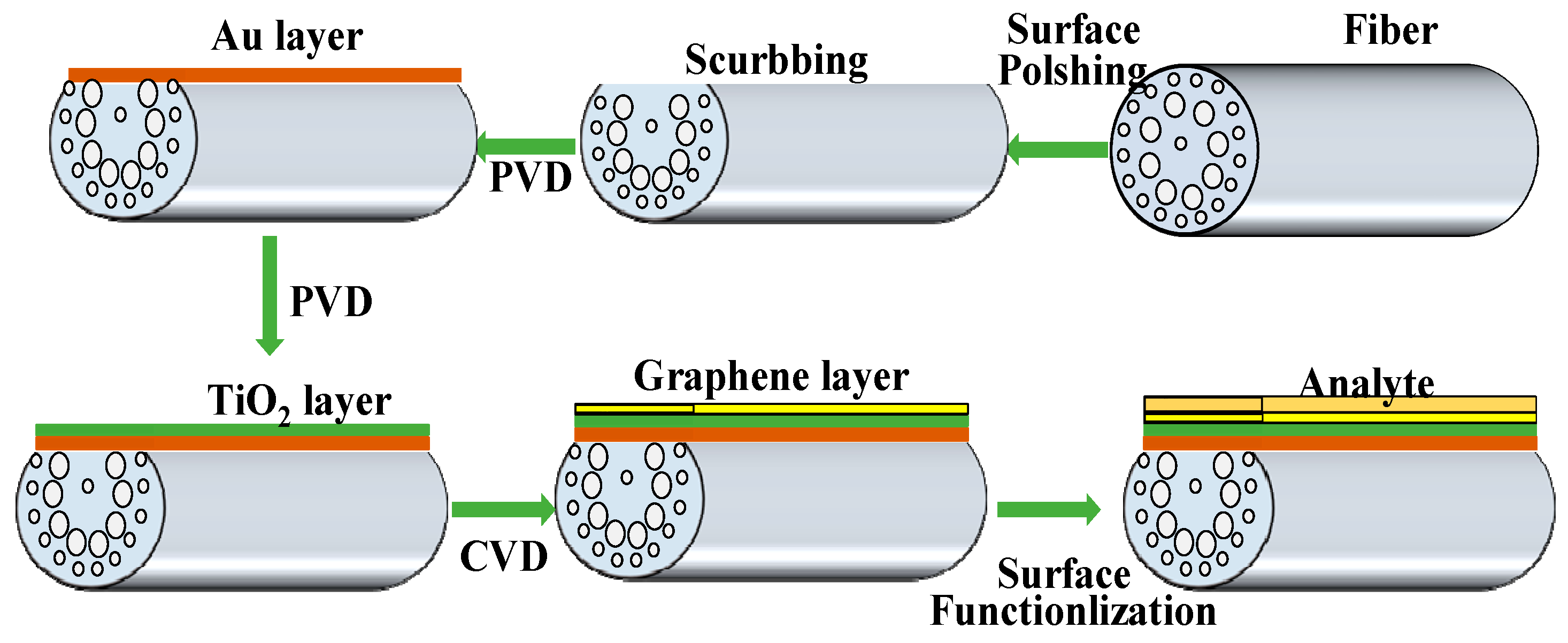
Strong layer adhesion, excellent structural stability, and exceptional sensing repeatability are ensured by the carefully thought-out process used to create the suggested PCF sensor [37,38]. The fabrication feasibility of the proposed PCF sensor is shown in Figure 2. Firstly, to remove dust, mechanical contaminants, and fabrication residues, the PCF is first polished and scrubbed. This step is essential because any surface roughness or contamination can reduce adhesion of the thin layers and introduce optical scattering losses, ultimately affecting sensor performance [39]. A thin layer of Au is deposited using Physical Vapor Deposition (PVD) once the surface is clean and smooth [40,41]. The formation of a stable plasmonic layer necessary for strong SPR excitation is made possible by this technique, which offers accurate thickness control, high purity, and uniform coverage across the curved fiber surface [42]. The second step is used to coat a TiO2 layer on top of the Au layer following Au PVD [43]. The TiO2 layer protects the Au layer from oxidation and long-term environmental deterioration while simultaneously enhancing the coupling efficiency between the guided core mode and the plasmonic mode by raising RI contrast. The TiO2 layer provides a chemically and mechanically stable intermediate, increasing overall durability. Next, the graphene layer is grown using Chemical Vapor Deposition (CVD) on top of the TiO2 layer [44,45]. Graphene produced by CVD has outstanding chemical resistance, strong molecular interaction capabilities, high electrical conductivity, and surface homogeneity [44]. Following graphene deposition, appropriate linker molecules (such as thiol-PEG, biotin, aptamers, or antibodies) that bind specifically to the active sites of graphene are used to functionalize the surface [46,47]. This stage ensures binding between the target analyte and the sensor surface, enabling sensitive and selective detection. Biomolecular binding causes a change in the RI of the analyte when the analyte solution is finally applied to the functionalized graphene surface. The plasmonic resonance conditions are then determined by shifts in the transmission spectrum, which are influenced by these modifications. When taken as a whole, these properties ensure that the manufactured PCF sensor performs consistently and reliably, which makes it appropriate for real-world and long-term biosensing applications. Variations in structural parameters and thin-film thickness may affect resonance properties in real-world fabrication. While moderate deviations in TiO2 and graphene thickness mainly affect coupling strength rather than suppressing SPR excitation, a small variation (±2–5 nm) in Au thickness can shift the resonance wavelength and slightly alter confinement loss. Similarly, slight changes in pitch and air-hole diameter cause gradual spectral shifts without destabilizing the sensing mechanism. These findings support the practical viability of the suggested structure by showing a respectable tolerance against fabrication flaws.

2.2. Refractive Index and Performance Parameters

The fused silica RI is determined by the third-order Sellmeier Equation (1), where λ is the free-space wavelength. X1, X2, X3, Y1, Y2, and Y3 are the Sellmeier Coefficients shown in Table 1 [48].
n ( λ ) = 1 + X 1 λ 2 λ 2 Y 1 + X 2 λ 2 λ 2 Y 2 + X 3 λ 2 λ 2 Y 3
The permittivity of Au is calculated using the Drude–Lorentz model, as expressed in Equation (2). The parameter values for Au are provided in Table 2 [20].
ε A u = ε ω D 2 ω ( ω + j γ D ) Δ ε   Ω L 2 ( ω 2 Ω L 2 ) + j τ ω
Where ΓL = frequency spectrum, ΩL = oscillator strength, ωD = plasma frequency, γD = damping frequency, ω = angular frequency, ε = high frequency permittivity, and ∆ε = weighted coefficient are shown in Table 2.
The RI of an adhesive material TiO2 is measured from Equation (3) [20]:
n T = 5.91 + 2.441 × 10 7 λ 2 0.803 × 10 7
The RI of a graphene layer is calculated using Equation (4), assuming a thickness of 0.34 nm.
n g = 3 + i × ( 5.446 × 10 6 ) 3 × λ
Lastly, the attachment of biomolecules on graphene surfaces through carbon–carbon interaction forces is simulated using RI of the SM ns = 1.30–1.35. The RI of blood components is 1.330 (Water), 1.340 (Krypton), and 1.350 (Plasma) [49]. The numerical evaluation of the proposed sensor’s performance is conducted using the following parameters, with the help of a standard SPR characteristic curve.
Confinement loss ( C L ) —The confinement loss is calculated by Equation (5), where the SPs’ excitation is generated [20].
C L = 8.686 × k 0 × I m ( N e f f ) × 10 4   ( dB / cm )
Here, λ represents the wavelength, Im( N e f f ) denots the imaginary component of the effective mode index, and the propagation constant in free space is k0 = 2 × π/λ.
Wavelength sensitivity ( S λ )—The wavelength sensitivity ( S λ ) is defined as the ratio of the change in wavelength to the change in RI of the analyte of the sensor. This is measured using Equation (6).
S λ = λ p e a k   n k ( n m / R I U )
Here,   λ p e a k   is the maximum confinement loss at a particular wavelength of two different analytes, and   n k is the difference between the two nearby RIs.
Resolution (R)—This can be measured by using Equation (7).
R R I U = n k × λ m i n   n p e a k  
Here,   λ m i n   = 0.01 refers to the spectral resolution.   n k = 0.01 is the analyte RI variation.
Figure of merit (FoM)—This is defined as the multiplication of the wavelength sensitivity and detection accuracy (DA), as expressed in Equation (8). The DA is inversely proportional to the full width at half maximum (FWHM). The FWHM represents the difference between the wavelength corresponding t the half maximum points of the wavelength curve [20].
F O M = W S   ( n m / R I U ) D A   ( 1 / n m )

3. Results and Discussion

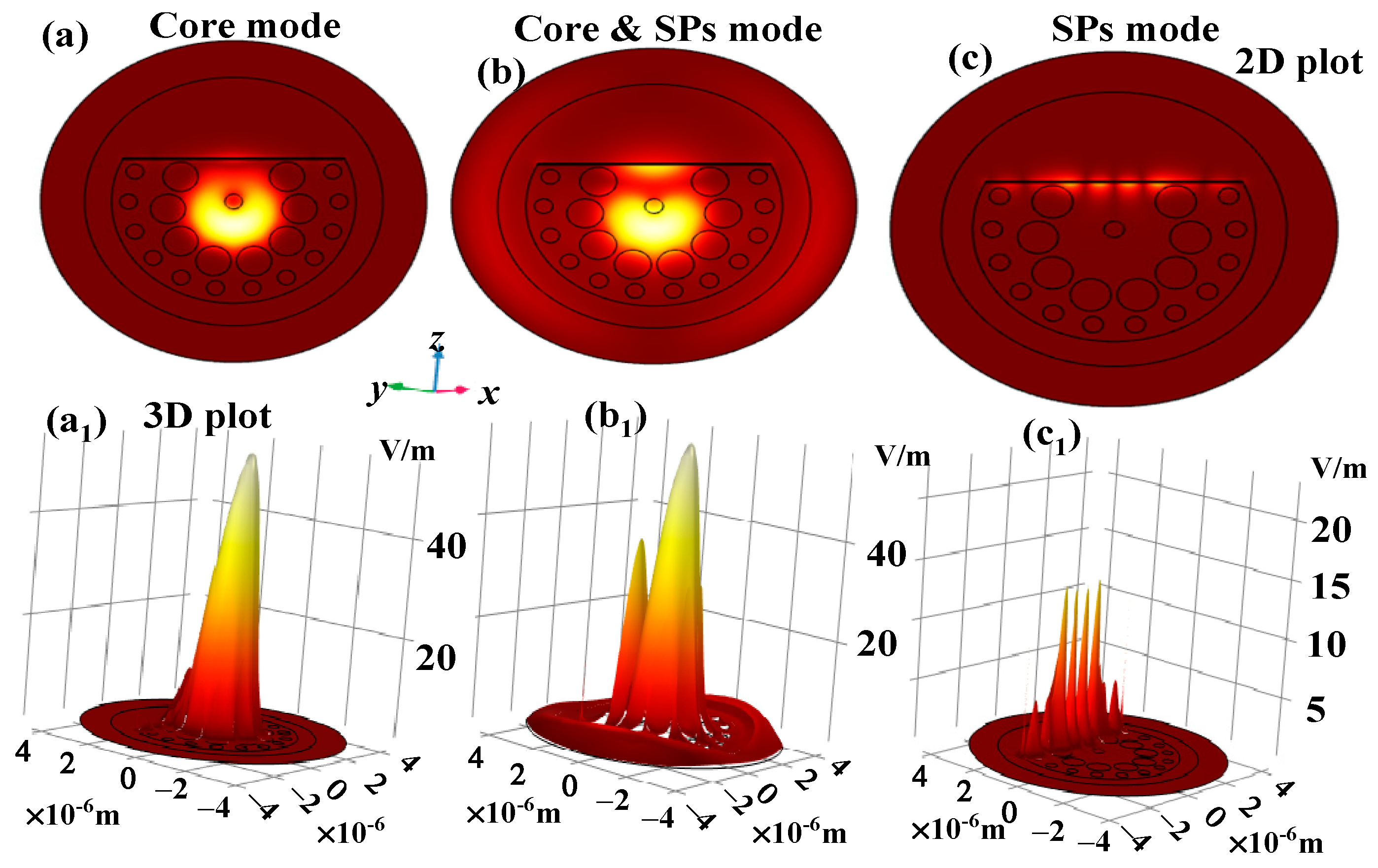
The electric field distribution of the suggested PCF–SPR biosensor for an analyte RI of 1.35 with 40 nm Au and 5 nm TiO2 layers is shown in the 2D plots (Figure 3a–c) and the 3D plot (Figure 3(a1–c1)), which demonstrate how the guided light interacts with the plasmonic interface at various wavelengths. The field in Figure 3a is mostly contained inside the fiber core, signifying the core mode where there is very little interaction between the guided light and the plasmonic metal layer. The coupling or phase-matching condition where energy transfer takes place between the core mode and the SPP mode is depicted in Figure 3b, where the electromagnetic field starts to extend toward the metal-analyte interface. The strong concentration of the field close to the metal surface in Figure 3c confirms the strong plasmonic interaction at the metal-analyte interface and indicates the excitation of the SPP mode. When the wavelength is far from resonance condition, the core mode exhibits minimal interaction with the metal layer because the optical field remains strongly confined within the fiber core. Around 680 nm, strong energy transfer from the core to the metal–analyte interface occurs, indicating the coupling or phase-matching condition. This results in a hybrid field distribution that generates maximum confinement loss and signifies the excitation of SPR. At longer wavelengths, the field gradually shifts into the SPP mode, confirming complete plasmonic excitation as the electromagnetic energy becomes concentrated at the metal surface. The energy shift is further demonstrated by the corresponding 3D plots, which validate the sensor’s working principle by demonstrating how the field progressively shifts from core confinement to strong localization at the metal boundary. The 3D electric field distributions for the coupling region, SPP mode, and core mode are shown in Figure 3(a1–c1). Weak interaction with the plasmonic layer is indicated by the field’s strong confinement within the fiber core in Figure 3a1. The phase-matching condition and hybrid mode formation are demonstrated in Figure 3b1, where electromagnetic energy starts to move toward the metal-analyte interface. Strong surface plasmon excitation and energy confinement at the metal-analyte interface are confirmed by the field becoming highly localized close to the metal surface in Figure 3c1.
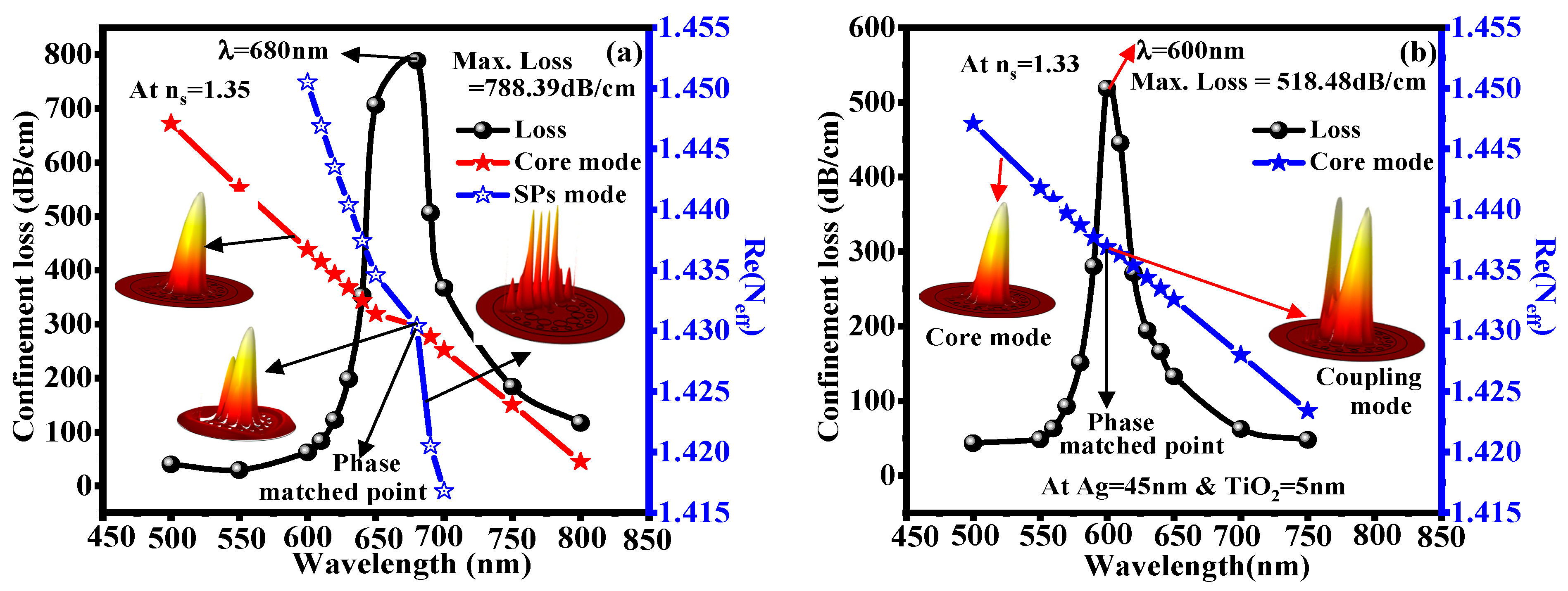
The confinement loss spectrum and the effective RI curves of both modes are plotted simultaneously in Figure 4a to show the coupling interaction between the guided-core mode and the SPP mode in the suggested PCF–SPR sensor at an RI of 1.35. The phase-matching point at which the core mode transfers the most energy to the SPP mode at the metal–dielectric interface is indicated by a sharp peak that appears around λ = 680 nm in the gray curve representing the confinement loss. The maximum loss of 788.39 dB/cm is obtained. The blue and red curves, which show the effective RIs of the core mode and SPP mode, respectively, further support this resonance condition. Their intersection exactly coincides with the loss peak, indicating ideal plasmonic excitation. This behavior is visually supported by the inset field distributions: at shorter wavelengths, the field is primarily contained within the core, indicating weak plasmonic interaction; at the resonance wavelength, the field strongly penetrates toward the plasmonic layer, indicating maximum coupling; and at longer wavelengths, the coupling weakens as the modes diverge. Sensitive SPR detection is analyzed using dispersion curves and mode profiles, which clearly illustrate the sensor’s resonance characteristics and confirm that any analyte-induced RI change shifts the phase-matching point. Next, when the Au thickness is increased to 45 nm, the results show the dispersion and modal-coupling behavior of the proposed PCF-SPR sensor. These results are obtained for a metal-dielectric stack consisting of Au = 45 nm and TiO2 = 5 nm at an analyte RI of 1.33 and 1.34, as illustrated in Figure 4b. While the thin TiO2 improves adhesion and protects the metal without preventing field penetration, the selected 45 nm Au and thin 5 nm TiO2 layer create a balance between strong plasmonic excitation (a sizable loss peak for reasonable sensitivity) and a reasonably narrow linewidth. Practically, the device’s working principle is demonstrated by the distinct, RI-dependent shift of the confinement loss. Slight variations in analyte index change the coupling condition and, consequently, the resonance wavelength (or loss magnitude), allowing for quantitative refractometric sensing.
Sensitive SPR detection is analyzed using dispersion curves and mode profiles, which clearly illustrate the sensor’s resonance characteristics and confirm that any analyte-induced RI change shifts the phase-matching point. Next, when the Au thickness is increased to 45 nm, the results show the dispersion and modal-coupling behavior of the proposed PCF-SPR sensor. These results are obtained for a metal-dielectric stack consisting of Au = 45 nm and TiO2 = 5 nm at an analyte RI of 1.33 and 1.34, as illustrated in Figure 4b.
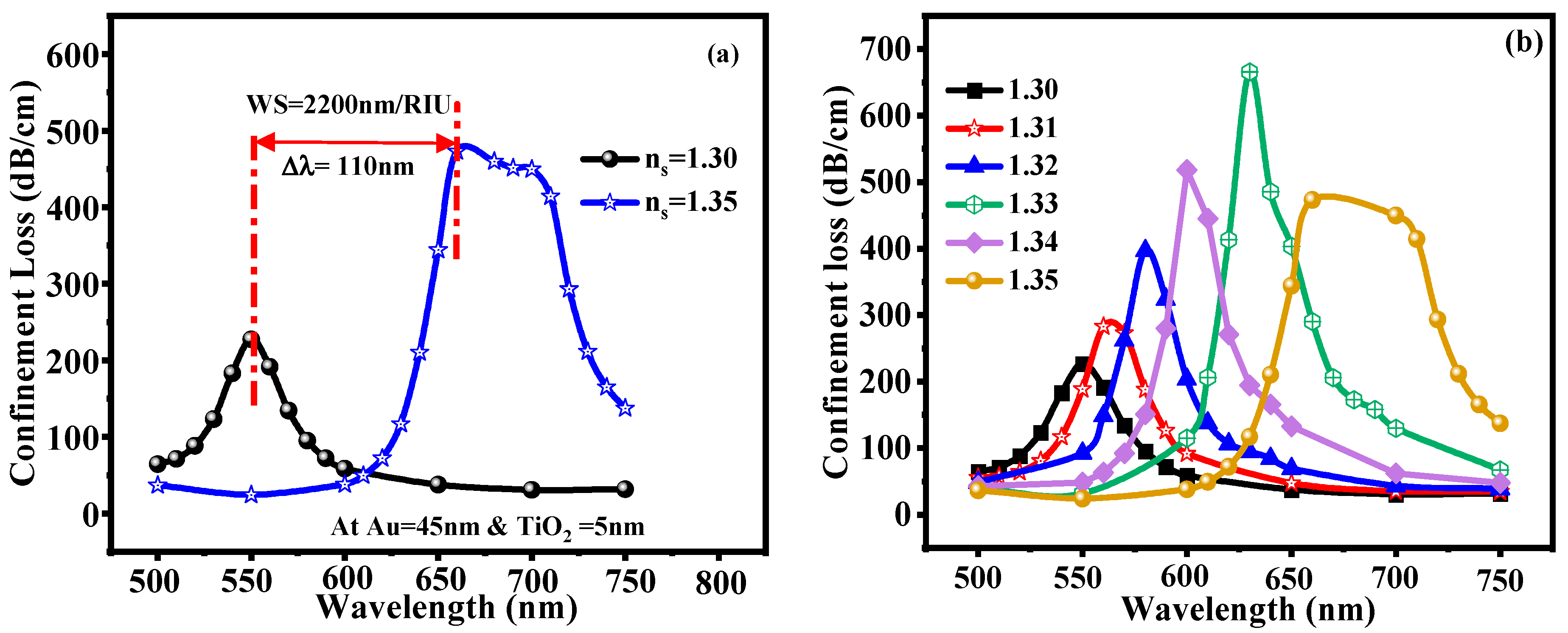
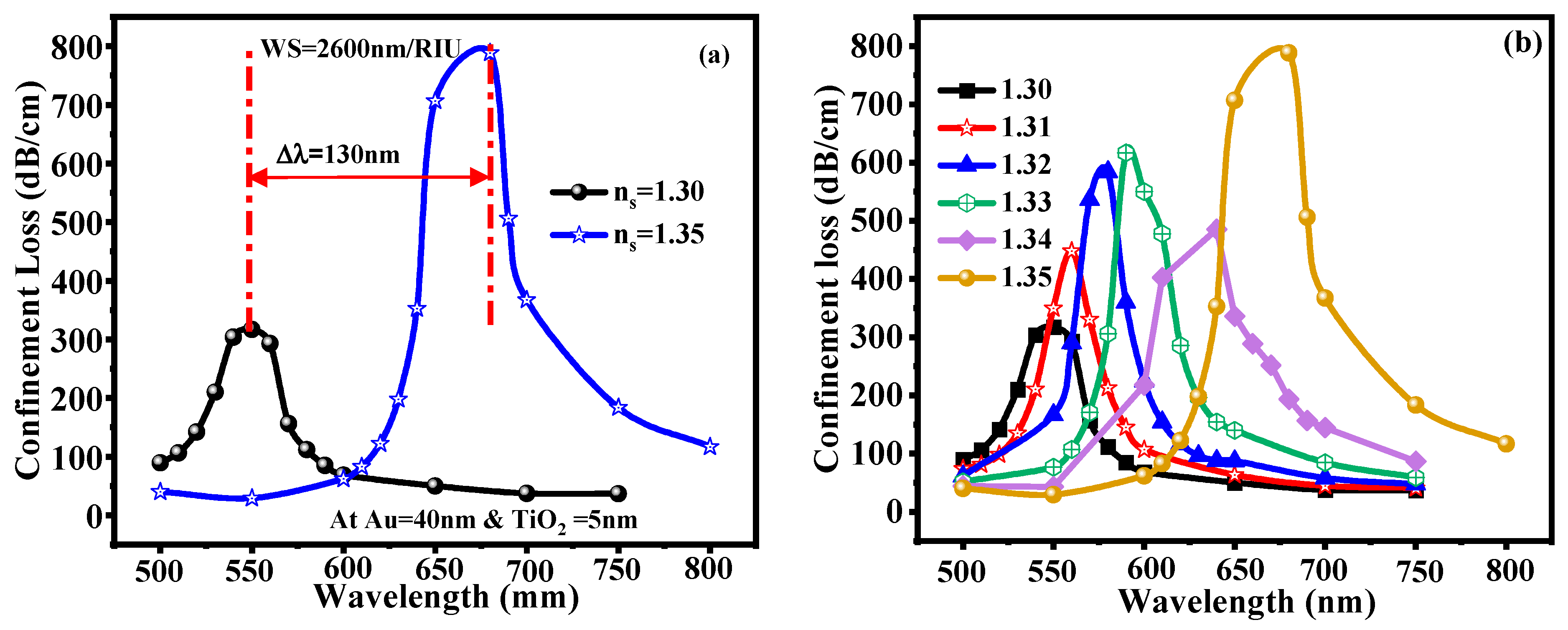
When the plasmonic metal thickness is fixed at Au = 40 nm along with a 5 nm TiO2 layer, Figure 5 shows a detailed comparison of how the confinement loss changes with wavelength for various analyte RIs (1.30–1.35). In Figure 5a, where Au = 40 nm, the SPR occurs at ~600–630 nm wavelength. A sharp but comparatively narrow resonance peak results from the moderate interaction between the guided core mode and the SP mode at this thickness. The effective index of the SP mode rises as the analyte RI rises from 1.30 to 1.35, shifting the resonance dip (or peak in confinement loss) to a longer wavelength. Strong RI sensitivity is evident from this redshift. The wavelength shift between two RI values (RI = 1.30 and 1.31) is represented by the Δλ, highlighted by the red dashed measurement lines, indicating a significant resonance displacement that directly contributes to high WS. Moreover, the peak confinement loss increases with RI, suggesting a greater overlap between the plasmonic field and the analyte layer. The resonance peaks for different RI analytes (1.30–1.35) are clearly differentiated, and their shifting pattern shows an even higher shift when compared to Figure 5a. This suggests increased sensitivity and improved mode coupling efficiency. Furthermore, increased the electromagnetic interaction at the Au–TiO2–graphene-analyte boundary causes the confinement-loss curves to become broader and occasionally multilobed. Figure 5b depicts how the confinement loss changes with wavelength for analyte RIs ranging from 1.30 to 1.35 with the Au layer thickness fixed at 40 nm and TiO2 thickness at 5 nm. Due to the interaction between the guided core mode and the SP mode, at the Au–TiO2–graphene-analyte boundary, every curve features a unique resonance peak associated with a specific RI value. The resonance peak consistently shifts to longer wavelengths as the RI increases from 1.30 to 1.35, demonstrating a shift pattern that underpins the wavelength-interrogated sensing mechanism. When the analyte RI increases, the peak confinement loss becomes more pronounced, indicating stronger plasmonic field interaction with the analyte region. By stabilizing the response and improving mode matching, the TiO2 layer generates clear, well-separated loss peaks that enable accurate differentiation between closely spaced RI values. This behavior indicates that the Au (40 nm) and TiO2 (5 nm) setup provides plasmonic excitation, outstanding sensitivity, and improved resolution. The key performance parameters of the suggested sensor at the peak loss for different sample RIs ranging from 1.30 to 1.35 are summarized in Table 3. The strong RI-dependent SPR response of the sensor is confirmed by a discernible shift in the resonance wavelength as the RI rises, from 550 nm at RI = 1.30 to 680 nm (680 nm) at RI = 1.35. The confinement loss typically rises with RI, peaking at 788.39 dB/cm at RI = 1.35, suggesting improved plasmonic coupling and a more robust interaction between the analyte and the evanescent field. The sensor’s high capacity to detect minute changes in RI is demonstrated by the WS, which likewise greatly increases with RI variation, reaching a maximum sensitivity of 2600 nm/RIU. The FWHM values fall between 32 nm and 60 nm; a narrower FWHM increases the DA. The DA and FoM values also show this, with the highest FoM of 62.5 nm/RIU attained at RI = 1.32 as a result of the combination of high sensitivity and narrow FWHM. The TiO2 interlayer and graphene overlayer must be added in order to change the plasmonic coupling properties of the proposed sensor. With a relatively high RI, the thin TiO2 layer improves phase matching between the guided core mode and the SPP mode at the metal–dielectric interface. This enhanced index contrast increases the efficiency of mode coupling and stabilizes the resonance behavior by permitting greater penetration of the evanescent field into the analyte region. Additionally, by serving as an intermediary dielectric spacer, the TiO2 layer improves impedance matching and removes damping-related resonance peak broadening. The high surface conductivity and carrier mobility of the graphene monolayer enhance light–matter interaction and lead to stronger electromagnetic field confinement near the sensing interface. Thus, the Au–TiO2–graphene combination improves WS while preserving an appropriate resonance sharpness. However, stronger plasmonic interaction may widen the FWHM, indicating a trade-off between sensitivity and DA. Thus, the optimized layer thicknesses balance improved spectral resolution and field localization.
When the thickness of the Au layer is fixed at 45 nm, Figure 6 shows how confinement loss varies with wavelength for analyte RIs between 1.30 and 1.35, with a focus on the impact of the TiO2 dielectric layer. In Figure 6a, strong coupling between the guided core mode and the SP mode at the metal–dielectric–analyte interface is indicated by the confinement loss curve’s clear and sharp resonance peak. High wavelength sensitivity is demonstrated by the marked wavelength shift (Δλ), which shows that even a slight change in RI causes a discernible redshift in the resonance wavelength. Because of the optimized Au thickness, which offers better field penetration into the analyte region, the increased peak height indicates enhanced plasmonic interaction. Each RI produces a clear resonance peak as illustrated in Figure 6b, where the effect of varying RIs (1.30–1.35) is shown in detail for Au = 45 nm with a 5 nm TiO2 coating. The resonance progressively shifts to longer wavelengths as the index increases, and initially, the enhanced mode coupling results in a rise in the magnitude of the confinement loss. By improving impedance matching between the core and plasmonic modes, the TiO2 layer is essential for generating resonance curves and improving spectral resolution. For analyte RIs ranging from 1.30 to 1.35, Table 4 presents the performance indicators of the proposed PCF–SPR sensor evaluated at the maxima of confinement loss. The resonance wavelength shifts with an increase in the RI, changing from 550 nm at RI = 1.30 to 700 nm (0.70 µm) at RI = 1.35. This indicates that the plasmonic resonance is highly influenced by the SM. Due to enhanced coupling between the guided core mode and the SP mode, the confinement loss increases substantially from 227.11 dB/cm to a maximum of 665.62 dB/cm at RI = 1.34. Although the loss decreases slightly, the resonance wavelength shift is more pronounced at RI = 1.35. This leads to a WS of 3000 nm/RIU, emphasizing the sensor’s capability to detect very minute RI variations. Excellent sensing performance is shown by the WS, which increases steadily with increasing RI from 1000 nm/RIU (at RI = 1.31) to 3000 nm/RIU (at RI = 1.35). The FWHM ranges from 30 to 90 nm. The FoM of 55.55/RIU and a higher DA of 0.033/nm are both influenced by the narrowest FWHM of 30 nm at RI = 1.33. On the other hand, despite increased sensitivity, the wider FWHM at higher RI values marginally decreases DA. Overall, the figure demonstrates that the Au (45 nm)–TiO2 (5 nm) configuration offers high repeatability in wavelength shift, enhanced plasmonic excitation, and improved resonance sharpness, making it ideal for accurate RI-based biosensing applications.
A comparison of the existing published designs and the suggested PCF-SPR sensor is shown in Table 5. As shown, previously reported sensors exhibit high wavelength sensitivities, typically above 4500 nm/RIU, but often operate over relatively broad RI ranges (1.35–1.46) or more expansive wavelength bands that extend into the near-infrared. On the other hand, the suggested sensor works in the visible wavelength range (500–800 nm) and is especially tailored for the RI interval of 1.330–1.350, which is important for biochemical and aqueous analytes. Sensitivity, structural simplicity, spectral stability, and practical fabrication feasibility are all balanced in the suggested design, despite the maximum wavelength sensitivity of 5000 nm/RIU being moderate in comparison to some reported peak values. Thus, this work’s contribution is not just to attain a high sensitivity value; it is also to offer a physically optimized multilayer configuration that performs reliably within a practically significant RI range.

4. Conclusions

In conclusion, a SPR-based D-shaped PCF sensor is proposed, and its performance is examined using FEM. The D-shaped PCF has the advantage of making it easier to coat the Au, TiO2, and graphene layers and of allowing them to be applied uniformly to the polished surface. According to the simulation results, the proposed PCF sensor demonstrates strong sensing capabilities. The RI detection range is 1.30 to 1.35, and the maximum WS is 3000 nm/RIU. By varying the structural parameter or the thickness of the Au layer (40 nm), the performance can be further optimized. According to the performance evaluation, the sensor achieves a maximum confinement loss of 788.39 dB/cm (at 700 nm wavelength), an exceptionally WS of up to 2600 nm/RIU. While careful optimization of the Au thickness (40 and 45 nm) results in improved resonance sharpness and repeatability, the TiO2 layer protects the Au layer, enhances field penetration towards the sensing region, and improves optical stability. Additionally, the WS of 5000 nm/RIU for plasma and 3000 nm/RIU for Krypton are reached in blood components. Overall, the proposed PCF–SPR biosensor demonstrates excellent sensitivity, tunability, and reliability, making it a strong candidate for high-precision refractive index sensing in biochemical and biomedical applications.

Author Contributions

Conceptualization, R.K., L.G. and M.S.; methodology, R.K. and L.G., software, L.G. and C.-W.Y.; validation, R.K. and M.S.; formal analysis, R.K.; investigation, C.-W.Y.; resources, C.-W.Y. and M.S.; data curation and visualization, R.K. and L.G.; writing—original draft preparation, R.K. and L.G.; writing—review and editing, M.S. and C.-W.Y.; supervision, M.S.; project administration, C.-W.Y. and M.S.; funding acquisition, C.-W.Y. and M.S. All authors have read and agreed to the published version of the manuscript.

Funding

This work was supported by Dongseo University’s “Dongseo Frontier Project” Research Fund of 2025.

Institutional Review Board Statement

Not applicable.

Informed Consent Statement

Not applicable.

Data Availability Statement

The original contributions presented in this study are included in the article. Further inquiries can be directed to the corresponding authors.

Conflicts of Interest

The authors declare no conflicts of interest.

References

  1. Wu, J.; Li, S.; Wang, X.; Shi, M.; Feng, X.; Liu, Y. Ultrahigh Sensitivity Refractive Index Sensor of a D-Shaped PCF Based on Surface Plasmon Resonance. Appl. Opt. 2018, 57, 4002. [Google Scholar] [CrossRef]
  2. Shakya, A.K.; Singh, S. Design of Novel Penta Core PCF SPR RI Sensor Based on Fusion of IMD and EMD Techniques for Analysis of Water and Transformer Oil. Measurement 2022, 188, 110513. [Google Scholar] [CrossRef]
  3. Divya, J.; Selvendran, S.; Itapu, S.; Borra, V. A Novel Dual-Channel SPR-Based PCF Biosensor for Simultaneous Tuberculosis and Urinary Tract Infection Diagnosis Toward SDG3. IEEE Access 2024, 12, 85484–85498. [Google Scholar] [CrossRef]
  4. Singh, S.; Prajapati, Y.K. Highly Sensitive Refractive Index Sensor Based on D-Shaped PCF with Gold-Graphene Layers on the Polished Surface. Appl. Phys. A 2019, 125, 437. [Google Scholar] [CrossRef]
  5. Dogan, Y.; Katirci, R.; Erdogan, I. Machine Learning-Based Optimization for D-Shaped PCF SPR Refractive Index Sensor. Opt. Commun. 2025, 575, 131304. [Google Scholar] [CrossRef]
  6. Mim, M.A.; Khatun, M.R.; Hossain, M.M.; Rahman, W. Advanced PCF-SPR Biosensor Design and Performance Optimization Using Machine Learning Techniques. Optik 2025, 333, 172391. [Google Scholar] [CrossRef]
  7. Jabin, M.A.; Ahmed, K.; Rana, M.J.; Paul, B.K.; Luo, Y.; Vigneswaran, D. Titanium-Coated Dual-Core D-Shaped SPR-Based PCF for Hemoglobin Sensing. Plasmonics 2019, 14, 1601–1610. [Google Scholar] [CrossRef]
  8. Dash, J.N.; Jha, R. SPR Biosensor Based on Polymer PCF Coated with Conducting Metal Oxide. IEEE Photonics Technol. Lett. 2014, 26, 595–598. [Google Scholar] [CrossRef]
  9. Ali, L.; Mohammed, M.U.; Khan, M.; Yousuf, A.H.B.; Chowdhury, M.H. High-Quality Optical Ring Resonator-Based Biosensor for Cancer Detection. IEEE Sens. J. 2020, 20, 1867–1875. [Google Scholar] [CrossRef]
  10. Bialiayeu, A.; Bottomley, A.; Prezgot, D.; Ianoul, A.; Albert, J. Plasmon-Enhanced Refractometry Using Silver Nanowire Coatings on Tilted Fibre Bragg Gratings. Nanotechnology 2012, 23, 444012. [Google Scholar] [CrossRef]
  11. Liu, M.; Liu, W.; Liu, X.; Ouyang, Y.; Wei, Z. 164 Fs Mode-Locked Erbium-Doped Fiber Laser Based on Tungsten Ditelluride. Nanophotonics 2020, 9, 2763–2769. [Google Scholar] [CrossRef]
  12. Anuradha, N.; Sivabalan, S. Low-Level Concentration Measurement of Mercury Ions Using CLF-GIMF-Based Multimode Interference Sensing in a Fiber Optic Ring Cavity Laser. IEEE Sens. J. 2024, 24, 1555–1563. [Google Scholar] [CrossRef]
  13. Kumar, R.; Singh, S.; Pundir, Y.P.; Garia, L.; Bouandas, H. A Theoretical Approach for Sensitivity Enhancement Using Refractive Index-Based Surface Plasmon Resonance Sensor. Plasmonics 2025, 20, 9913–9923. [Google Scholar] [CrossRef]
  14. Mishra, A.C.; Dwivedi, D.K.; Sharma, A.K.; Lohia, P.; Kaur, B. Modeling of High-Performance Fiber Optic SPR Sensor for Colorectal Cancer Detection Designed Using Amorphous Silicon and TiO2 Layers under Optimum Radiation Damping. IEEE Sens. J. 2024, 24, 27570–27577. [Google Scholar] [CrossRef]
  15. Unjie, J.L.U.; An, Y.L.I.; An, Y.A.H.; Iu, Y.I.L.; Ao, J.I.G. D-Shaped Photonic Crystal Fiber Plasmonic Refractive Index Sensor Based on Gold Grating. Appl. Opt. 2018, 57, 5268–5272. [Google Scholar] [CrossRef] [PubMed]
  16. Patnaik, A.; Senthilnathan, K.; Jha, R. Graphene-Based Conducting Metal Oxide Coated D-Shaped Optical Fiber SPR Sensor. IEEE Photonics Technol. Lett. 2015, 27, 2437–2440. [Google Scholar] [CrossRef]
  17. Kadhim, R.A.; Yuan, L.; Xu, H.; Wu, J.; Wang, Z. Highly Sensitive D-Shaped Optical Fiber Surface Plasmon Resonance Refractive Index Sensor Based on Ag-α-Fe2O3Grating. IEEE Sens. J. 2020, 20, 9816–9824. [Google Scholar] [CrossRef]
  18. Olyaee, S.; Mohebzadeh-Bahabady, A. Designing a Novel Photonic Crystal Nano-Ring Resonator for Biosensor Application. Opt. Quantum Electron. 2015, 47, 1881–1888. [Google Scholar] [CrossRef]
  19. Hasan, R.; Member, S.; Akter, S.; Rifat, A.A.; Rana, S.; Ahmed, K.; Ahmed, R.; Subbaraman, H.; Abbott, D. Spiral Photonic Crystal Fiber-Based Dual-Polarized. IEEE Sens. J. 2018, 18, 133–140. [Google Scholar] [CrossRef]
  20. Singh, S.; Chaudhary, B.; Kumar, R.; Upadhyay, A.; Kumar, S. A Numerical Analysis of Rectangular Open Channel Embedded TiO2-Au-MXene Employed PCF Biosensor for Brain Tumor Diagnosis. IEEE Sens. J. 2024, 24, 16047–16054. [Google Scholar] [CrossRef]
  21. Paniagua, S.A.; Giordano, A.J.; Smith, O.L.; Barlow, S.; Li, H.; Armstrong, N.R.; Pemberton, J.E.; Bredas, J.-L.; Ginger, D.; Marder, S.R. Phosphonic Acids for Interfacial Engineering of Transparent Conductive Oxides. Chem. Rev. 2016, 116, 7117–7158. [Google Scholar] [CrossRef]
  22. Zhou, H.; Yi, D.; Yu, Z.; Xiao, L.; Li, J. Preparation of Aluminum Doped Zinc Oxide Films and the Study of Their Microstructure, Electrical and Optical Properties. Thin Solid Films 2007, 515, 6909–6914. [Google Scholar] [CrossRef]
  23. Aydın, E.B.; Sezgintürk, M.K. Indium Tin Oxide (ITO): A Promising Material in Biosensing Technology. TrAC Trends Anal. Chem. 2017, 97, 309–315. [Google Scholar] [CrossRef]
  24. Rifat, A.A.; Ahmed, R.; Mahdiraji, G.A.; Adikan, F.R.M. Highly Sensitive D-Shaped Photonic Crystal Fiber-Based Plasmonic Biosensor in Visible to near-IR. IEEE Sens. J. 2017, 17, 2776–2783. [Google Scholar] [CrossRef]
  25. Singh, S.; Prajapati, Y.K. Antimonene-Gold Based Twin-Core SPR Sensor with a Side-Polished Semi-Arc Groove Dual Sensing Channel: An Investigation with 2D Material. Opt. Quantum Electron. 2022, 54, 114. [Google Scholar] [CrossRef]
  26. Wang, P.; Zhang, Y.; Guang, Z.; Rahaman, A.; Liu, F. A Dual-Resonance Peak Biosensor Based on Surface Plasmon Resonance in the Terahertz Region. Phys. Scr. 2025, 100, 105524. [Google Scholar] [CrossRef]
  27. Liu, S.; Ma, R.; Li, Y.; Zhao, L.; Xia, Y.; Dong, X.; Pang, Y. D-Shaped Surface Plasmon Resonance Biosensor Based on MoS2 in Terahertz Band. Opt. Fiber Technol. 2021, 66, 102631. [Google Scholar] [CrossRef]
  28. Xue, J.; Zhang, Y.; Guang, Z.; Hu, J.; Zhao, F.; Liu, Y.; Shao, L. MoS2 Surface Plasmon Resonance Based High-Resolution THz Biosensor Using a Dual D-Shaped Channel Micro-Structured Fiber. Opt. Laser Technol. 2025, 180, 111387. [Google Scholar] [CrossRef]
  29. Guan, M.; Sun, X.; Wei, J.; Jia, X.; Cheng, X.; Cheng, R. High-Sensitivity Terahertz Biosensor Based on Plasmon-Induced Transparency Metamaterials. Photonics 2023, 10, 1258. [Google Scholar] [CrossRef]
  30. Zhang, Y.; Yao, Y.; Guang, Z.; Xue, J.; Wang, Q.; Gong, J.; Ali, Z.; Yang, Z. A High-Sensitivity Fiber Biosensor Based on PVDF-Excited Surface Plasmon Resonance in the Terahertz Band. Photonics 2023, 10, 1159. [Google Scholar] [CrossRef]
  31. Suvarnaphaet, P.; Pechprasarn, S. Graphene-Based Materials for Biosensors: A Review. Sensors 2017, 17, 2161. [Google Scholar] [CrossRef] [PubMed]
  32. Jacobs, C.R.; Davis, B.R.; Rieger, C.J.; Francis, J.J.; Saad, M.; Fyhrie, D.P. The Impact of Boundary Conditions and Mesh Size on the Accuracy of Cancellous Bone Tissue Modulus Determination Using Large-Scale Finite-Element Modeling. J. Biomech. 1999, 32, 1159–1164. [Google Scholar] [CrossRef]
  33. Li, G.; Li, X.; Yang, M.; Chen, M.M.; Chen, L.C.; Xiong, X.L. A Gold Nanoparticles Enhanced Surface Plasmon Resonance Immunosensor for Highly Sensitive Detection of Ischemia-Modified Albumin. Sensors 2013, 13, 12794–12803. [Google Scholar] [CrossRef] [PubMed]
  34. Muheki, J.; Wekalao, J.; Albargi, H.B.; Jalalah, M.; Almawgani, A.H.M.; Patel, S.K. A Graphene Gold Metasurface Inspired Surface Plasmon Resonance Sensor Designed for Terahertz Applications in Sensing and Detection of Heavy Metals in Water. Plasmonics 2024, 20, 289–303. [Google Scholar] [CrossRef]
  35. Wang, Q.; Wang, B.-T. Surface Plasmon Resonance Biosensor Based on Graphene Oxide/Silver Coated Polymer Cladding Silica Fiber. Sens. Actuators B Chem. 2018, 275, 332–338. [Google Scholar] [CrossRef]
  36. Zeng, S.; Hu, S.; Xia, J.; Anderson, T.; Dinh, X.-Q.; Meng, X.-M.; Coquet, P.; Yong, K.-T. Graphene–MoS2 Hybrid Nanostructures Enhanced Surface Plasmon Resonance Biosensors. Sens. Actuators B Chem. 2015, 207, 801–810. [Google Scholar] [CrossRef]
  37. Tong, Z.-R.; Li, J.-X.; Zhang, W.-H.; Liu, J.-W. Research on Repeatability and Stability of Sensors Based on Alcohol-Filled Photonic Crystal Fiber. J. Mod. Opt. 2021, 68, 276–283. [Google Scholar] [CrossRef]
  38. Das, A.; Huraiya, M.A.; Rahman, M.I.; Chakrabarti, K.; Tabata, H.; Ramaraj, S.G.; Eid, M.M.A.; Zaki Rashed, A.N.; Razzak, S.M.A. Advanced Low Loss PCF-Based SPR Sensor for Enhanced Sensor Length Configurations Flexibility with Exceptional Superior Sensing Performance Capability. Appl. Phys. A 2025, 131, 472. [Google Scholar] [CrossRef]
  39. Manickam, P.; Senthil, R. Numerical Investigation of Side-Polished SPR PCF Sensor for Urine Analysis. Plasmonics 2022, 17, 2023–2030. [Google Scholar] [CrossRef]
  40. Hu, D.J.J.; Ho, H.P. Recent Advances in Plasmonic Photonic Crystal Fibers: Design, Fabrication and Applications. Adv. Opt. Photonics 2017, 9, 257–314. [Google Scholar] [CrossRef]
  41. Yan, X.; Guo, Z.; Cheng, T.; Li, S. A Novel Gold-Coated PCF Polarization Filter Based on Surface Plasmon Resonance. Opt. Laser Technol. 2020, 126, 106125. [Google Scholar] [CrossRef]
  42. Praveena, S.; Senthilnathan, K. Performance Enhancement of Gold Coated D-Shaped PCF Sensor Using Monolayer MoS2. Plasmonics 2025, 20, 1003–1014. [Google Scholar] [CrossRef]
  43. Ding, X.; Lin, Q.; Wang, M.; Liu, S.; Zhang, W.; Chen, N.; Wang, Y. Design and Simulation of High-Performance D-Type Dual-Mode PCF-SPR Refractive Index Sensor Coated with Au-TiO2 Layer. Sensors 2024, 24, 6118. [Google Scholar] [CrossRef] [PubMed]
  44. Zhou, X.; Deng, Q.; Yu, W.; Liu, K.; Liu, Z. The Rise of Graphene Photonic Crystal Fibers. Adv. Funct. Mater. 2022, 32, 2202282. [Google Scholar] [CrossRef]
  45. Liu, R.; Yuan, H.; Li, J.; Huang, K.; Wang, K.; Cheng, Y.; Cheng, S.; Li, W.; Jiang, J.; Tu, C. Complementary Chemical Vapor Deposition Fabrication for Large-area Uniform Graphene Glass Fiber Fabric. Small Methods 2022, 6, 2200499. [Google Scholar] [CrossRef]
  46. Díez-Pascual, A.M. Surface Engineering of Nanomaterials with Polymers, Biomolecules, and Small Ligands for Nanomedicine. Materials 2022, 15, 3251. [Google Scholar] [CrossRef]
  47. Karawdeniya, B.I.; Damry, A.M.; Murugappan, K.; Manjunath, S.; Bandara, Y.M.N.D.Y.; Jackson, C.J.; Tricoli, A.; Neshev, D. Surface Functionalization and Texturing of Optical Metasurfaces for Sensing Applications. Chem. Rev. 2022, 122, 14990–15030. [Google Scholar] [CrossRef] [PubMed]
  48. Bhandari, V.; Singh, J. Design and Investigation of a Multi-Layer Hybrid Plasmonic Sensor Using Franckeite Material. Appl. Opt. 2025, 64, F23–F31. [Google Scholar] [CrossRef]
  49. Ramola, A.; Shakya, A.K.; Droby, A.; Bergman, A. Numerical Study of a Novel Kagome-Inspired Photonic Crystal Fiber-Based Surface Plasmon Resonance Biosensor for Detection of Blood Components and Analytical Targets. Biosensors 2025, 15, 539. [Google Scholar] [CrossRef]
  50. Zhang, J.; Yuan, J.; Qu, Y.; Qiu, S.; Mei, C.; Zhou, X.; Yan, B.; Wu, Q.; Wang, K.; Sang, X. A Surface Plasmon Resonance-Based Photonic Crystal Fiber Sensor for Simultaneously Measuring the Refractive Index and Temperature. Polymers 2022, 14, 3893. [Google Scholar] [CrossRef]
  51. Danlard, I.; Akowuah, E.K. Design and Theoretical Analysis of a Dual-Polarized Quasi D-Shaped Plasmonic PCF Microsensor for Back-to-Back Measurement of Refractive Index and Temperature. IEEE Sens. J. 2021, 21, 9860–9868. [Google Scholar] [CrossRef]
  52. Zhang, Y.; Chen, H.; Wang, M.; Liu, Y.; Fan, X.; Chen, Q.; Wu, B. Simultaneous Measurement of Refractive Index and Temperature of Seawater Based on Surface Plasmon Resonance in a Dual D-Type Photonic Crystal Fiber. Mater. Res. Express 2021, 8, 85201. [Google Scholar] [CrossRef]
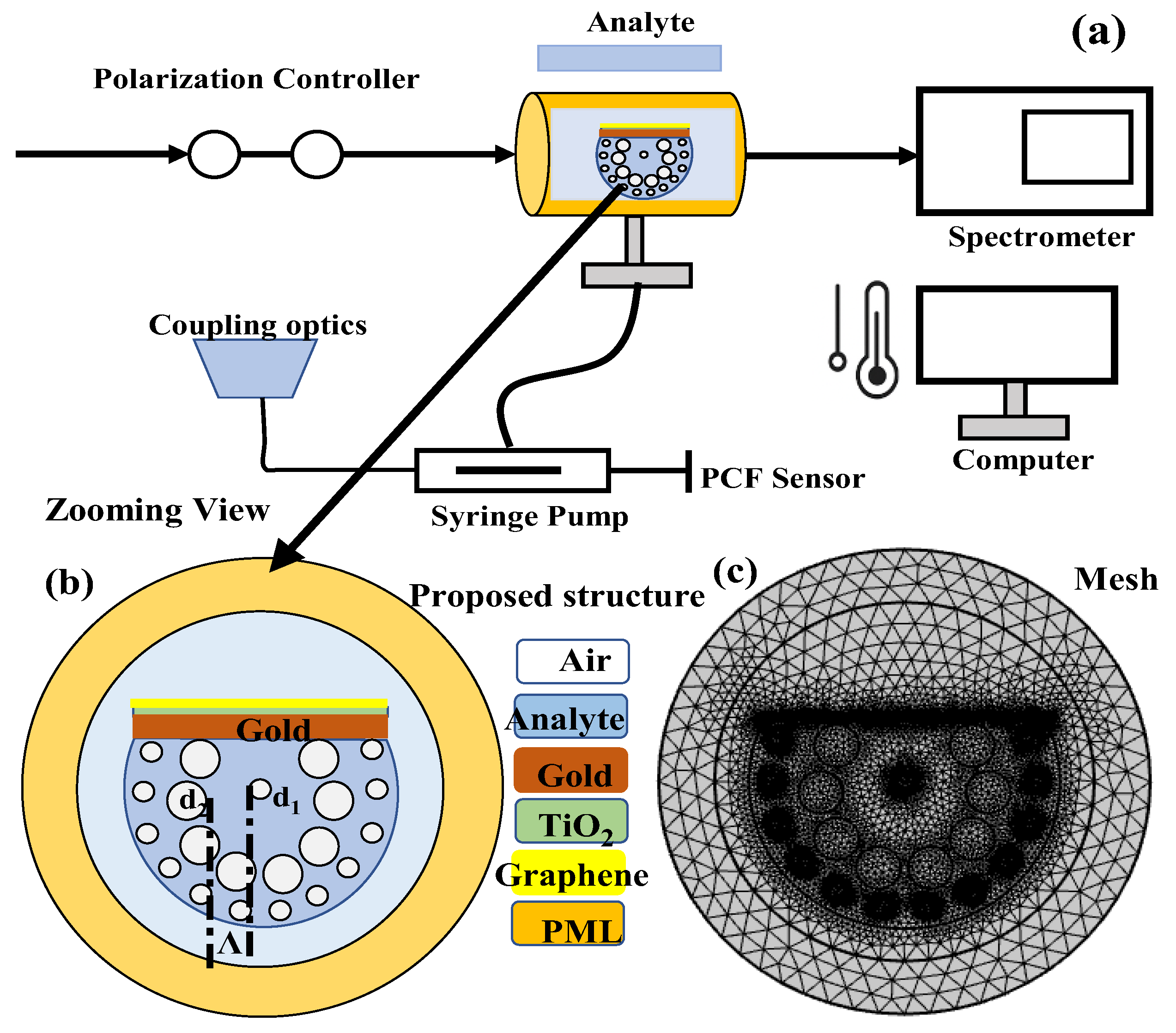
Figure 1. (a) Proposed PCF-Based Biosensing System. (b) Zooming View of PCF Structure. (c) Front View of the Mesh.
Photonics 13 00259 g001
Figure 2. Fabrication feasibility.
Photonics 13 00259 g002
Figure 3. Dispersion of the electric field for ns = 1.35 at Au = 40 nm and TiO2 = 5 nm thickness in three distinct modes: (a) core mode, (b) coupling mode at λ = 680 nm, and (c) SP mode. The color scale represents the electric field intensity, where red indicates higher intensity.
Photonics 13 00259 g003
Figure 4. Core, coupling, SPP mode, and dispersion relations for the RI of 1.30–1.35, with TiO2 = 5 nm thickness, at (a) Au = 40 nm and (b) Au = 45 nm.
Photonics 13 00259 g004
Figure 5. (a) Variations in confinement losses with wavelengths at RI of 1.30–1.35 at Au = 40 nm. (b) Confinement losses at various RIs.
Photonics 13 00259 g005
Figure 6. Variation in confinement loss with wavelength at RI of 1.30–1.35 at (a) Au = 45 nm and (b) Au = 45 nm with TiO2 = 5 nm thicknesses.
Photonics 13 00259 g006
Table 1. Sellmeier Coefficient for SiO2.
X1X2X3Y1 (µm)Y2 (µm)Y3 (µm)
0.696163000.4079426000.897794000.06840430.11624149.896161
Table 2. Drude–Lorentz model’s parameter values.
ΓL/2π
(THz)
ΩL/2π
(THz)
ωD/2π
(THz)
γD/2π
(THz)
εε
104.86650.072113.615.921.095.9673
Table 3. Performance parameters of the proposed PCF-SPR sensor at maximum confinement loss for different analyte RI values.
RI of Sampleλ
(nm)
Loss
(dB/cm)
WS
(nm/RIU)
FWHM
(nm)
DA
(1/nm)
FoM
(1/RIU)
1.3550316.96-450.022-
1.31560447.91000400.02525
1.32590616.722000320.03162.5
1.33580583.971000400.02525
1.34640485.762250600.01637.5
1.35680788.392600500.0252
Table 4. Calculated sensing performance parameters of the proposed PCF-SPR sensor at maximum confinement loss for analyte RI values from 1.30 to 1.35.
RI of Sampleλ (nm)Loss
(dB/cm)
WS
(nm/RIU)
FWHM
(nm)
DA
(1/nm)
FoM
(1/RIU)
1.3550227.11-420.023-
1.31560282.821000430.02323.25
1.32580396.81500350.02842.85
1.33600518.471666.66300.03355.55
1.34630665.622000400.02550
1.35700449.543000900.01133.33
Table 5. Comparison of the proposed PCF–SPR sensor with recently reported PCF–SPR designs.
ReferencesOperating Wavelength (nm)RI RangeWS
(nm/RIU)
Zhang et al. [50]500–18001.35–1.404520
Danlard et al. [51]1250–16501.35 to 1.465000
Zhang et al. [52]600–9501.33–1.344520
Proposed work500–8001.330–1.3505000 (Krypton)/3000 (Plasma)
Disclaimer/Publisher’s Note: The statements, opinions and data contained in all publications are solely those of the individual author(s) and contributor(s) and not of MDPI and/or the editor(s). MDPI and/or the editor(s) disclaim responsibility for any injury to people or property resulting from any ideas, methods, instructions or products referred to in the content.