


Abstract
This paper proposes a method to generate a low-noise 10.23 MHz time-frequency reference signal based on high-order harmonic locking of the repetition rate (fr) of an optical frequency comb (OFC). An all-polarization-maintaining (PM) Erbium-doped fiber laser with a 122.76 MHz fr is constructed using the nonlinear amplifying loop mirror (NALM) principle. By applying a feedback control to the intracavity piezoelectric actuator (PZT) and electro-optic modulator (EOM), the 10th harmonic of fr is phase-locked to a high-performance rubidium atomic clock (Rb clock), achieving low-noise conversion from the Rb clock to the target signal. Experimental results show that the generated 10.23 MHz signal exhibits residual phase noise of −123.4 dBc/Hz at 1 Hz offset and −158 dBc/Hz at 1 MHz offset, and achieves a residual frequency stability of 3.52 × 10⁻¹³ @ 1 s and 3.65 × 10⁻¹⁵ @ 10,000 s. This harmonic locking scheme validates the advantages of photonic microwave generation in achieving ultra-low phase noise while preserving the long-term stability of atomic clocks, providing a strategic solution for next-generation BeiDou Navigation Satellite System (BDS) time-frequency payloads.
1. Introduction
The stability and precision of onboard time-frequency reference signals are fundamental to the Positioning, Navigation, and Timing (PNT) performance of Global Navigation Satellite Systems (GNSSs). Currently, major global constellations—exemplified by the U.S. Global Positioning System (GPS), the European Union’s Galileo, and China’s BeiDou Navigation Satellite System (BDS)—standardize their time-frequency references at a fundamental frequency of 10.23 MHz [1]. As a pivotal national strategic space infrastructure, the BDS has successfully transitioned from regional to global service, with the third-generation constellation (BDS-3) reaching state-of-the-art international benchmarks in orbital precision and clock stability [2,3]. Given the evolution of subsequent BDS missions, the development of satellite-borne time-frequency generation technologies with ultra-low phase noise has become increasingly critical. Such advancements are essential to enable high-precision inter-satellite time transfer and bolster the system’s long-term autonomous operation. Consequently, investigating the high-performance generation of 10.23 MHz signals is of profound significance for the advancement of next-generation navigation satellite systems [4,5].
In prevailing satellite navigation systems, 10.23 MHz reference signals are conventionally generated via electronic frequency synthesis architectures. This methodology leverages the 10 MHz output from an onboard atomic clock as the primary source, which subsequently undergoes a sophisticated sequence of electronic processing—including fine-grained frequency and phase adjustments, precision filtering, high-performance digital phase-locked loop (PLL), and Direct Digital Synthesis (DDS)—integrated with relevant compensation algorithms. This processing chain is engineered to synthesize the target 10.23 MHz signal while optimizing critical parameters such as frequency stability and phase noise, to satisfy the stringent requirements of spaceborne payloads. Taking the Galileo system as an example [6], satellites employ a Clock Monitoring and Control Unit (CMCU) to select references from onboard atomic clocks, utilizing a hybrid frequency synthesis architecture that combines PLL with DDS to derive the navigation time-frequency reference [7,8]. A similar electronic architecture is also adopted by China’s BDS. However, such schemes exhibit inherent drawbacks in phase noise performance. Specifically, the in-band phase noise of the phase-locked signal is constrained by the atomic clock, while the close-to-carrier performance is primarily degraded by additive noise from the electronic PLL and frequency multiplication stages. Furthermore, the implementation of DDS or fractional-N synthesis inevitably introduces quantization noise and non-harmonic spurs, whereas the far-offset phase noise remains limited by the intrinsic characteristics of the voltage-controlled crystal oscillator (VCXO) [9]. Additionally, these conventional methods are susceptible to temperature fluctuations and electromagnetic interference, necessitating complex compensation circuitry. Under the trend of payload miniaturization, the potential for optimizing size, weight, and power while simultaneously enhancing performance is approaching its physical limits. This indicates that the technical pathway based on traditional electronics may be approaching its performance ceiling, underscoring the urgent need for a fundamental breakthrough.
To overcome the fundamental physical bottlenecks of traditional electronic methods, photonic microwave generation based on optical frequency combs (OFCs) has emerged as a compelling alternative, providing a versatile platform that leverages the intrinsic ultra-low phase noise of the optical domain. Among various optical-based technologies, Direct Optical Frequency Division achieves record-breaking phase noise levels but relies on bulky ultra-stable cavities that are difficult to adapt to stringent spaceborne constraints [10]. Alternatively, micro-resonator-based combs offer significant advantages in miniaturization [11,12]; however, their characteristically high repetition rates (typically in the GHz range) necessitate complex multi-stage electronic division to generate low-frequency signals like 10.23 MHz, which inevitably introduces additional electronic noise and system complexity. In contrast, the NALM-based fiber laser scheme proposed in this work, combined with high-order harmonic locking, strikes an optimal balance between low phase noise, technical maturity, and system simplicity. This approach provides a more robust and straightforward pathway for synthesizing navigation-specific references in spaceborne environments.
In this paper, we propose and experimentally demonstrate a universal frequency synthesis architecture based on the high-order harmonic phase-locking of an OFC’s repetition rate, specifically tailored for the 10.23 MHz reference signal of the BDS. An all-polarization-maintaining (PM) Erbium-doped fiber laser with a fr of 122.76 MHz was developed based on the nonlinear amplifying loop mirror (NALM) principle. By applying phase-locked feedback to an intracavity piezoelectric actuator (PZT) and an electro-optic modulator (EOM), the 10th harmonic of the fr was synchronized to a high-performance rubidium atomic clock (Rb clock), achieving high-fidelity frequency conversion from the reference to the target navigation signal. Experimental results reveal that the synthesized 10.23 MHz signal achieves a residual phase noise of −123.4 dBc/Hz at 1 Hz offset and −158 dBc/Hz at 1 MHz offset. This approach not only circumvents the additive noise degradation inherent in conventional electronic synthesis but also underscores the potential of OFCs as a universal tool for high-performance time-frequency generation. This work provides critical technical validation and a strategic solution for next-generation spaceborne time-frequency payloads, exhibiting significant scientific value and engineering prospects.
2. System Design and Theoretical Analysis
2.1. OFC Oscillator
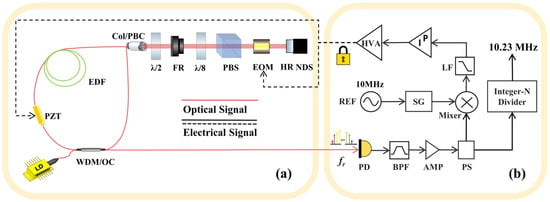
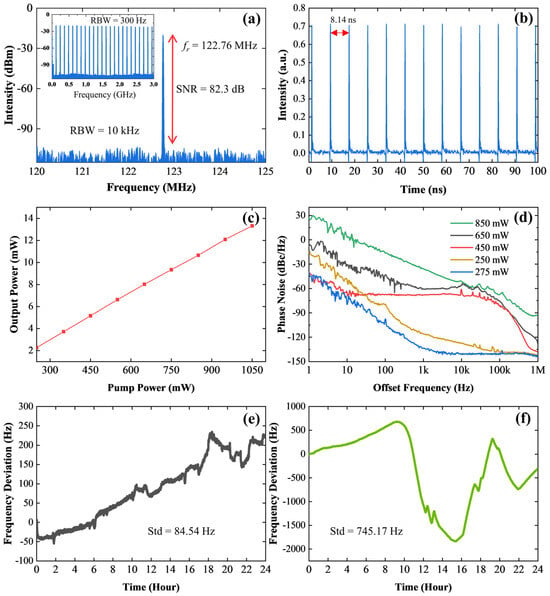
The experimental architecture for generating the low-noise 10.23 MHz reference is illustrated in Figure 1, comprising an OFC oscillator (Figure 1a) and an electronic control unit (Figure 1b). The oscillator is based on an all-polarization-maintaining (PM) Erbium-doped fiber laser configured with a nonlinear amplifying loop mirror (NALM) [13]. This architecture has become a preferred choice for high-reliability fiber comb systems due to its intrinsic low noise, self-starting capability, and robust environmental stability [14]. The core gain is provided by a 0.6 m length of Erbium-doped fiber (EDF), featuring a core diameter of 4 μm and an absorption coefficient of 80 dB/m at 1530 nm. The pump light is efficiently coupled into the gain fiber via a 980 nm/1550 nm wavelength division multiplexer (WDM). A Faraday rotator (FR) and a waveplate are incorporated within the cavity to introduce a fixed phase shift between counter-propagating pulses, enabling nonlinear amplitude modulation and facilitating self-starting mode-locking [15,16]. In the linear arm, a polarization beam splitter (PBS) was used to interfere the two pulse beams. To achieve high-bandwidth and large-dynamic-range servo locking of the repetition rate, an electro-optic modulator (EOM) and a piezoelectric actuator (PZT) are integrated into the cavity as high-frequency and low-frequency actuators, respectively [17,18]. Furthermore, a nano displacement stage is installed at the end mirror to precisely adjust the fr to 122.76 MHz. The oscillator is designed to deliver stable femtosecond pulses at an fr of 122.76 MHz, providing a reliable source for subsequent high-harmonic locking and microwave generation. To suppress fr drift induced by thermal fluctuations, the laser is enclosed in a housing with closed-loop temperature control, maintaining stability within 2 mK.
Figure 1.
Block diagram of the low-noise 10.23 MHz signal generation system based on high-harmonic phase-locking of a NALM fiber laser: (a) OFC oscillator: LD, laser diode; PBC, polarization beam combiner; WDM, 980 nm/1550 nm wavelength division multiplexer; PZT, piezoelectric actuator; EDF, Er-doped fiber; Col, fiber collimator; λ/2, half-wave plate; PBS, polarizing beam splitter; FR, Faraday rotator; λ/8, eighth-wave plate; EOM, electro-optical modulator; HR, high reflector; NDS, nano displacement stage. (b) Electronic control unit: PD, photoelectric detector; BPF, band-pass filter; AMP, amplifier; PS, power splitter; LF, low pass filter; PI, proportional–integral controller; HVA, high-voltage amplifier; SG: Signal Generator; Integer-N Divider: Integer divider.
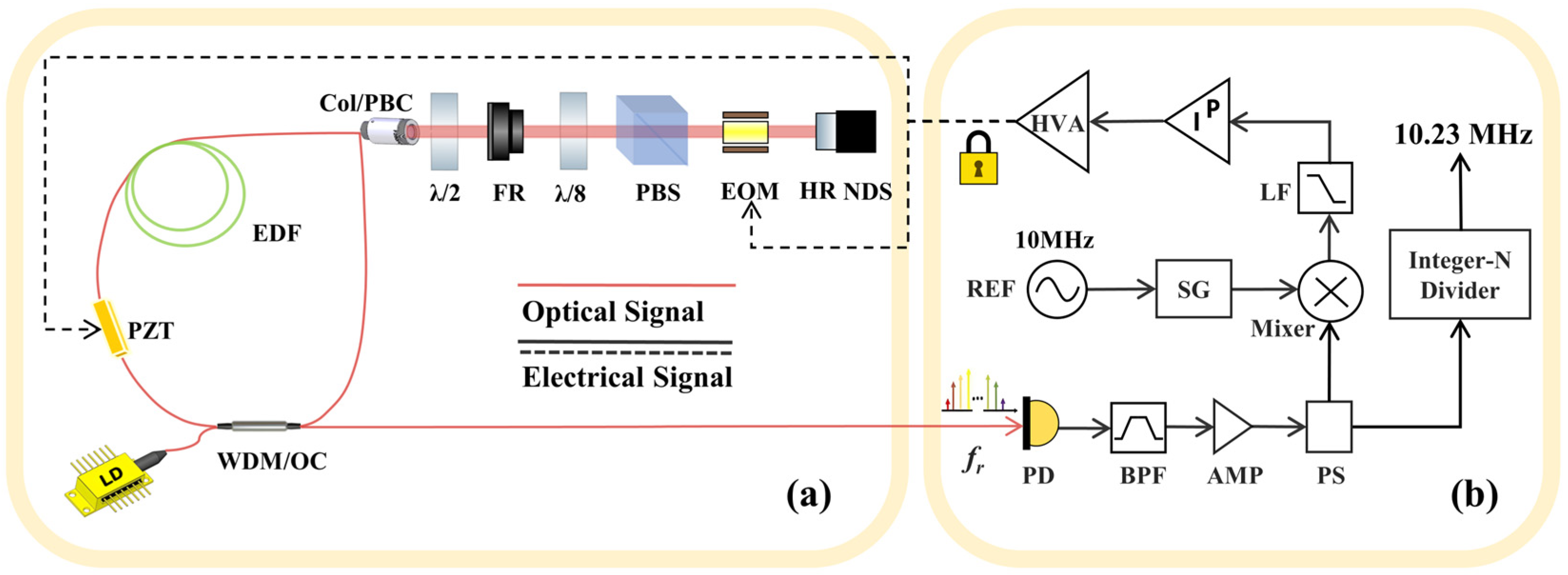
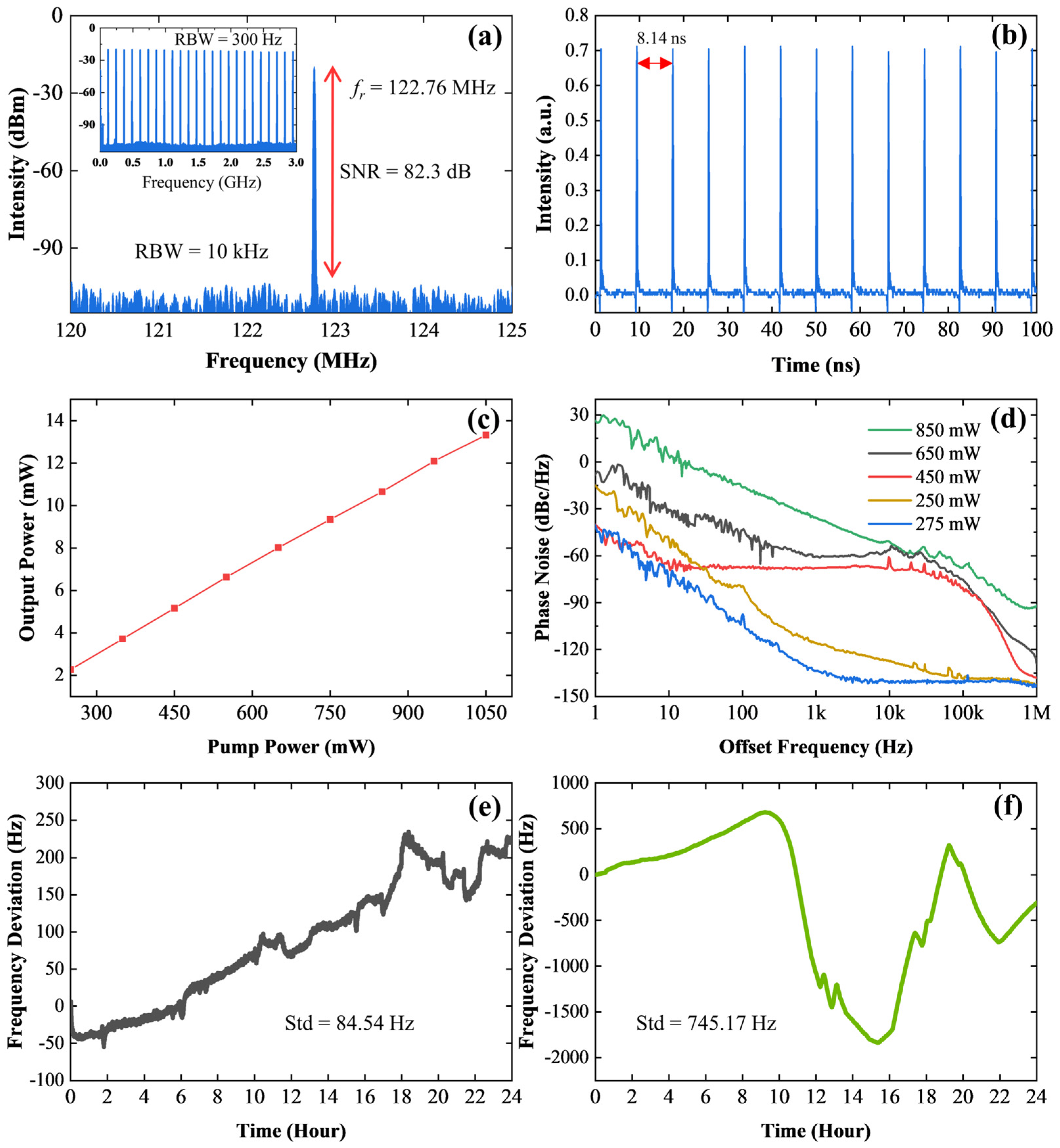
In the experimental implementation, stable mode-locking was initiated by increasing the pump power to 850 mW. Once established, the mode-locked state could be sustained with a reduced pump power down to 250 mW. However, the emergence of a continuous-wave (CW) component was observed as the pump power exceeded 310 mW. The performance of the OFC oscillator was characterized at an ambient room temperature of approximately 25 °C. A broadband InGaAs photodetector (DX25HA, Thorlabs, Newton, NJ, USA) was utilized to detect the repetition rate signal. As shown in Figure 2a, the radio frequency (RF) spectrum across a 3 GHz span was measured using a signal analyzer (FSW-13, Rohde & Schwarz, Munich, Germany), yielding a high signal-to-noise ratio (SNR) of 82.3 dB at a resolution bandwidth (RBW) of 10 kHz. The corresponding time-domain trace, captured by a 2 GHz oscilloscope (RTO1020, Rohde & Schwarz, Munich, Germany), is presented in Figure 2b. The observed pulse interval of 8.14 ns is strictly consistent with the 122.76 MHz fr defined by the cavity length.
Figure 2.
Output Characteristics of the Optical Comb Oscillator: (a) Harmonic and RF spectrum within the 3 GHz range. (b) Time-domain pulse sequence diagram. (c) Variation in average output power under different pump powers. (d) Phase noise distribution under different laser pump drive conditions. (e) The free drift of the repetition frequency of the laser under temperature control changes over time. (f) The free drift of the repetition frequency of the laser without temperature control changes over time.
The output power dependence on the pump power is plotted in Figure 2c, exhibiting a characteristic linear response. To further investigate the noise properties, Figure 2d illustrates the phase noise spectral density under various pump levels. It should be noted that all measurements in Figure 2d were conducted under identical environmental conditions, with the laboratory temperature stabilized at ~25 °C and the mechanical setup remaining fixed, ensuring that the variations observed are intrinsic to the laser dynamics. It is well-documented that pump-induced relative intensity noise (RIN) contributes to phase noise through thermal and nonlinear effects, which is highly correlated with the intracavity optical power density [19,20]. Our findings confirm that the phase noise profile is significantly sensitive to pump power variations. Specifically, the dominant noise mechanism at low offset frequencies (<100 Hz) evolves with the pump intensity. At relatively low pump levels (e.g., 250 mW and 275 mW), the laser maintains a stable single-pulse mode-locking state, where the low-frequency noise is primarily limited by environmental perturbations and pump-induced RIN coupling. However, as the pump power increases and exceeds the stable single-pulse threshold (e.g., 450 mW to 850 mW), the excess gain induces multi-pulse instabilities. Increasing the pump power exacerbates the intracavity nonlinear accumulation; as it approaches the CW threshold, the system stability is compromised, resulting in a pronounced deterioration of phase noise [21]. The significant elevation of the noise floor at low offsets observed in Figure 2d serves as a sensitive indicator of this transition, where increased thermal load and nonlinearities render the cavity more susceptible to minute disturbances. Conversely, insufficiently low pump power leads to an inherently fragile mode-locked state. These results underscore that optimizing the pump power is a critical degree of freedom to minimize phase noise, with 275 mW identified as the optimal operating point for this system.
To characterize the system’s intrinsic stability before locking, the free-running repetition rate drift was monitored over 24 h under both temperature-controlled and uncontrolled conditions, as illustrated in Figure 2. With active temperature control, the repetition rate exhibited a standard deviation of only 84.54 Hz (Figure 2e). In contrast, the uncontrolled state showed a significantly larger jitter of 745.17 Hz (Figure 2f), underscoring the critical role of the integrated thermal management module in maintaining cavity stability.
2.2. High-Order Harmonic Locked fr and Loop Design
The fr of an OFC is inherently determined by the optical path length of its resonator. In a free-running state, the fr is susceptible to cavity length variations induced by environmental mechanical perturbations and thermal drifts. Additionally, pump power fluctuations cause refractive index changes via the Kerr effect and thermal loads, collectively resulting in significant frequency drift and elevated low-frequency phase noise. These factors impose a fundamental limit on the spectral purity of the generated microwave signals. To enhance the stability of the fr an active feedback control system is essential for noise suppression [22].
High-order harmonic phase-locking has been demonstrated as an effective strategy for phase noise reduction [23]. Synchronizing the comb to its Nth harmonic is functionally equivalent to implementing a frequency division system with a factor of N to derive the fundamental signal. Ideally, when the Nth harmonic is phase-locked to a stable reference, the phase noise of the fundamental signal is suppressed by a factor of approximately (dB) [24]. In practical implementation, however, the achievable noise reduction is constrained by the additive noise floor of the detection and division electronics. Despite these limits, high-order harmonic locking significantly lowers the phase noise floor of the fundamental frequency, thereby enhancing the overall spectral purity.
In contrast, traditional electronic methods require multi-state frequency multiplication chains—which inevitably introduce residual phase noise and non-harmonic spurs due to nonlinearities—OFCs possess an intrinsic capability for high-order harmonic generation. In the frequency domain, an OFC consists of a series of coherent, equally spaced longitudinal modes. Direct photodetection of these modes yields a series of high-order beat notes at the photo-receiver, manifesting as harmonics of the fr in the radio frequency (RF) domain. This photonic approach facilitates the direct extraction of high-frequency components without the phase noise degradation inherent in electronic frequency multipliers, providing a superior pathway for high-performance microwave synthesis.
Through experimental comparison, the 10th harmonic of the repetition rate at 1227.6 MHz was selected as the phase-locking point to achieve an optimal balance between the RF signal amplitude and the signal-to-noise ratio (SNR). Notably, an exact integer ratio of 120 exists between the 1227.6 MHz harmonic and the target 10.23 MHz reference frequency. This specific frequency configuration significantly simplifies the complexity of the frequency division and synthesis chains, effectively suppressing the additive phase noise typically introduced during these processes and ensuring the realization of ultra-low noise performance. The electronic control unit developed in this work is depicted in Figure 1b, which employs an analog PLL scheme based on a dual-actuator architecture consisting of a PZT and an EOM. Specifically, the PZT is utilized to compensate for cavity length drifts and low-frequency perturbations induced by environmental temperature variations, mechanical stress relaxation, and refractive index fluctuations. This PZT features a length of approximately 4 cm, a driving voltage range of 0–75 V, and a maximum displacement of 44.8 μm. Complementarily, the EOM suppresses high-frequency fluctuations of the repetition rate through rapid electro-optic modulation of the intracavity optical path length.
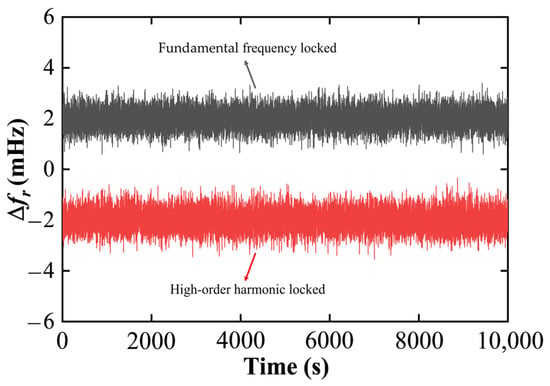
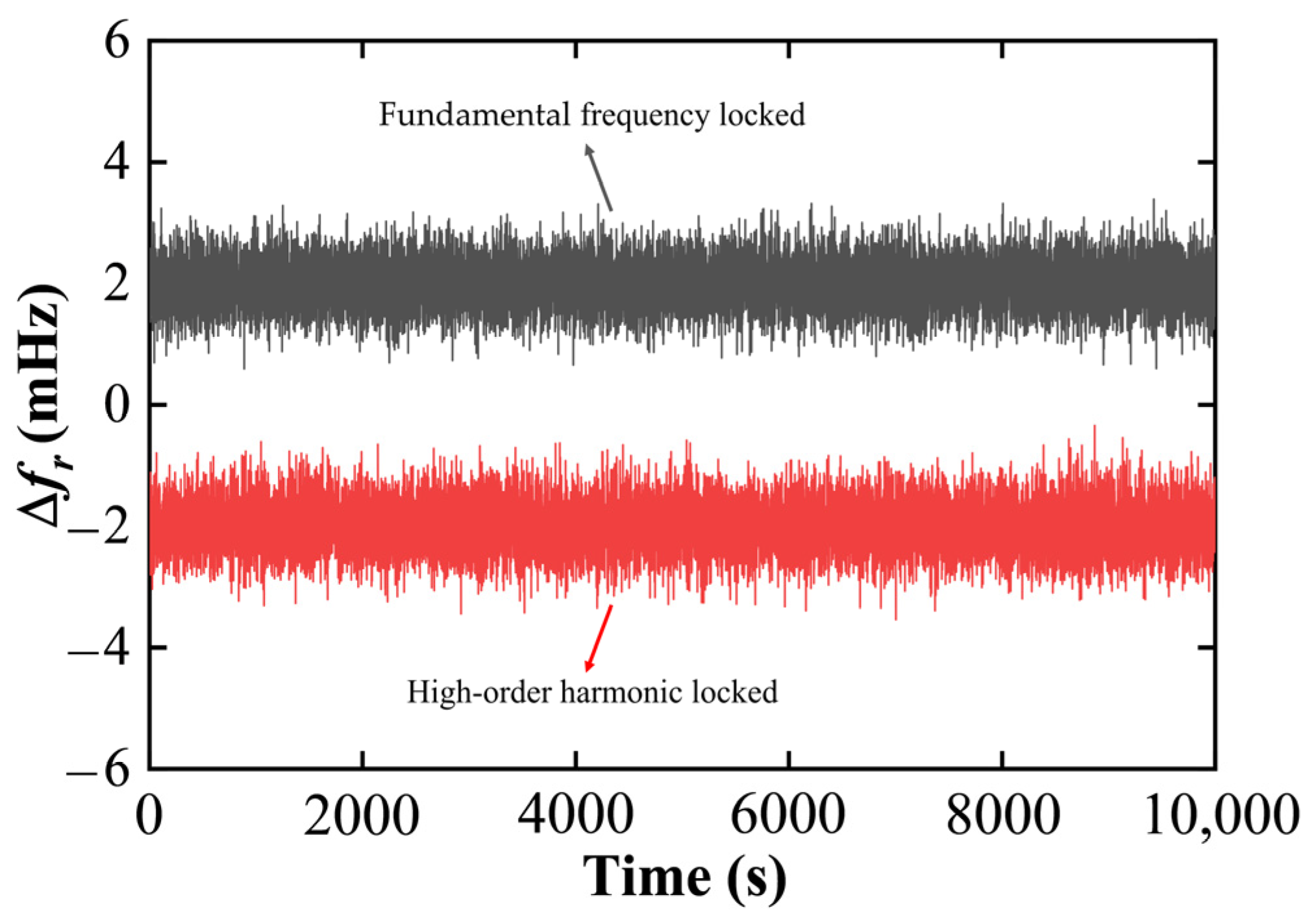
The error signal is generated by mixing the fr signal from the photodetector with a reference signal derived from an Rb clock. After low-pass filtering and low-noise amplification, the resulting error voltage is processed by an analog proportional–integral (PI) control circuit, which simultaneously drives the PZT and EOM to achieve closed-loop feedback regulation. This locking scheme effectively suppresses the fr drift observed in the free-running state and demonstrates exceptional anti-interference capability, thereby tracing the long-term stability of the fr to the Rb clock. As shown in Figure 3, the fr fluctuations for both fundamental-frequency locking and 10th harmonic locking were recorded using a frequency counter. To facilitate the display, we have made an offset adjustment to the data, but this does not affect the final result. Over a 10,000 s sampling period, the calculated standard deviations of the fr were 435.37 μHz and 464.29 μHz for the fundamental and harmonic locking modes, respectively. These results indicate that both methods successfully transfer the long-term stability of the Rb clock to the OFC. Furthermore, subsequent phase noise analysis explicitly confirms that the 10th harmonic locking configuration provides superior short-term phase noise suppression.
Figure 3.
Frequency counting results under fundamental frequency lock and 10th harmonic lock.
2.3. Noise Characterization of the Frequency Synthesis Link
In the proposed system, the ultimate phase noise performance of the generated 10.23 MHz reference signal is primarily governed by the reference source and the additive residual phase noise introduced by the electronic components within the frequency synthesis chain. To quantify the impact of individual modules on the overall system, we independently characterized the noise contributions of the integer-division down-conversion chain and the reference multiplication link.
Following high-order harmonic locking, a dedicated down-conversion chain based on integer division was developed to translate the stabilized 10th harmonic to the target 10.23 MHz frequency. To minimize additive phase noise, the chain utilizes a two-stage ultra-low-noise integer divider to achieve a total division factor of N = 120. Compared to fractional-N synthesis or DDS architectures, integer division fundamentally eliminates quantization noise and non-harmonic spurs associated with division ratio quantization. In this configuration, the additive noise is predominantly limited by the intrinsic residual phase noise of the divider components.
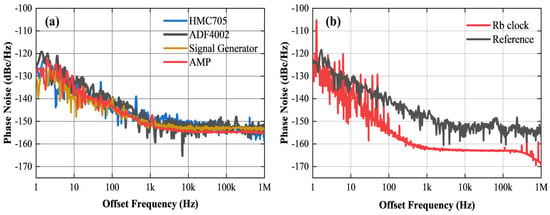
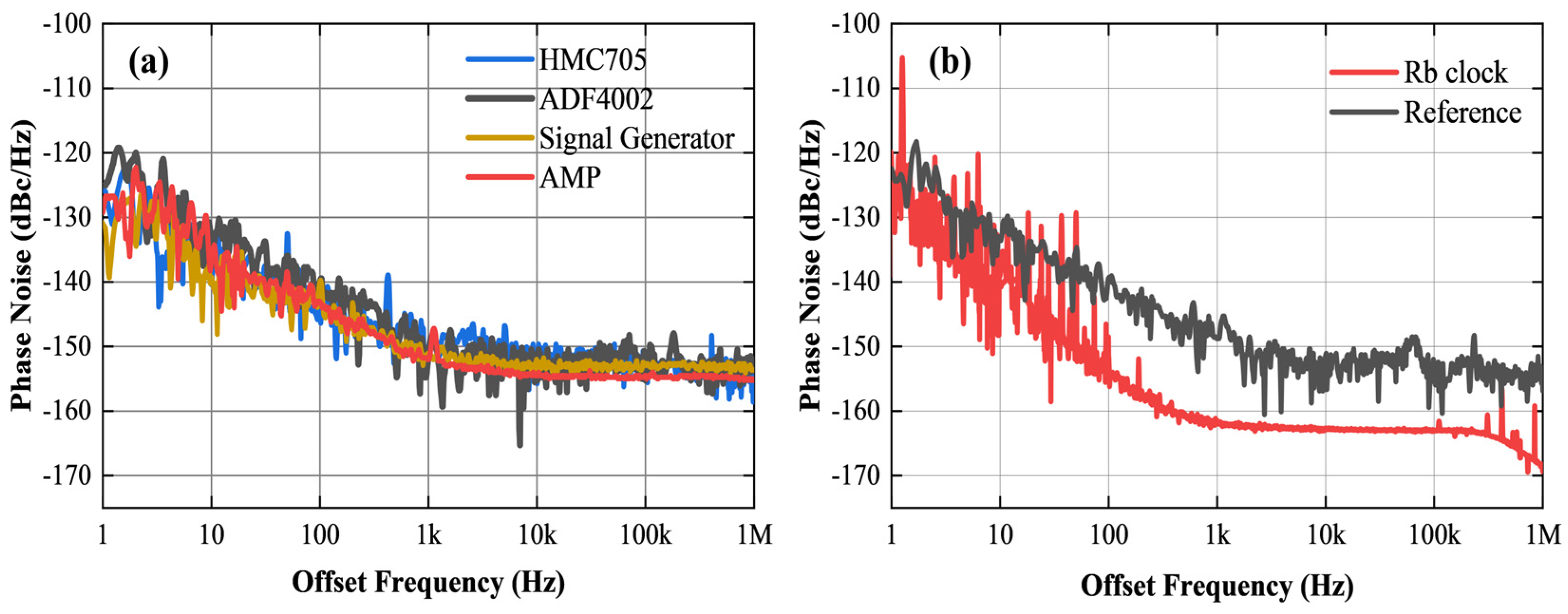
According to the ideal frequency division theory (), a division factor of 120 provides a theoretical noise improvement of approximately 41.6 dB for the fundamental signal. However, the practical suppression is constrained by the residual phase noise floor of the dividers. As illustrated in Figure 4a, the residual phase noise of the implemented divider chain was experimentally characterized. The results show that the residual phase noise of the divider module was −124.2 dBc/Hz at a 1 Hz offset, which is consistent with the noise floor of the high-performance Rb clock reference. At the same time, we also conducted residual phase noise tests on the reference source signal generator and the RF amplifier module in the link. By testing the residual phase noise of these key performance indicators in the link, it was shown that the down-conversion link does not cause significant noise attenuation in the vicinity of the carrier, thus being able to maintain the low-noise characteristic of the final 10.23 MHz output.
Figure 4.
Noise characterization diagram of key links: (a) The additional phase noise generated by the frequency divider, as well as the additional phase noise from the amplifier and the signal generator. (b) Comparison of the absolute phase noise of the rubidium clock and the additional phase noise of the frequency multiplier link.
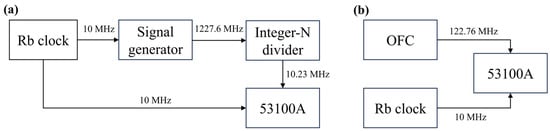
The absolute phase noise of the high-performance Rb clock reference and the residual phase noise of its frequency multiplication chain were characterized, as illustrated by the red and black curves in Figure 4b, respectively. The Rb clock reference signal (red curve) exhibits a phase noise of −122.98 dBc/Hz at a 1 Hz offset, dropping to −168.43 dBc/Hz at a 1 MHz offset, which confirms its suitability for ultra-low phase noise applications. Furthermore, to evaluate the additive noise introduced during the synthesis of the 1227.6 MHz high-harmonic reference from the 10 MHz source, the residual phase noise of the multiplication chain was measured (black curve). The test block diagram is shown in Figure 5a. At a 1 Hz offset, the residual noise of the chain is −124.2 dBc/Hz, which is on par with the Rb clock noise floor, indicating that the multiplication process does not induce significant noise degradation in the close-to-carrier region. However, at a 1 MHz offset, the residual noise reaches −158.6 dBc/Hz, primarily limited by the elevation of the electronic noise floor. Within the PLL bandwidth, this noise floor becomes a dominant factor constraining the far-offset performance of the overall system. Overall, the multiplied signal preserves the superior low-phase-noise characteristics of the reference source in the near-carrier region, providing a high-purity local oscillator (LO) for subsequent high-harmonic locking.
Figure 5.
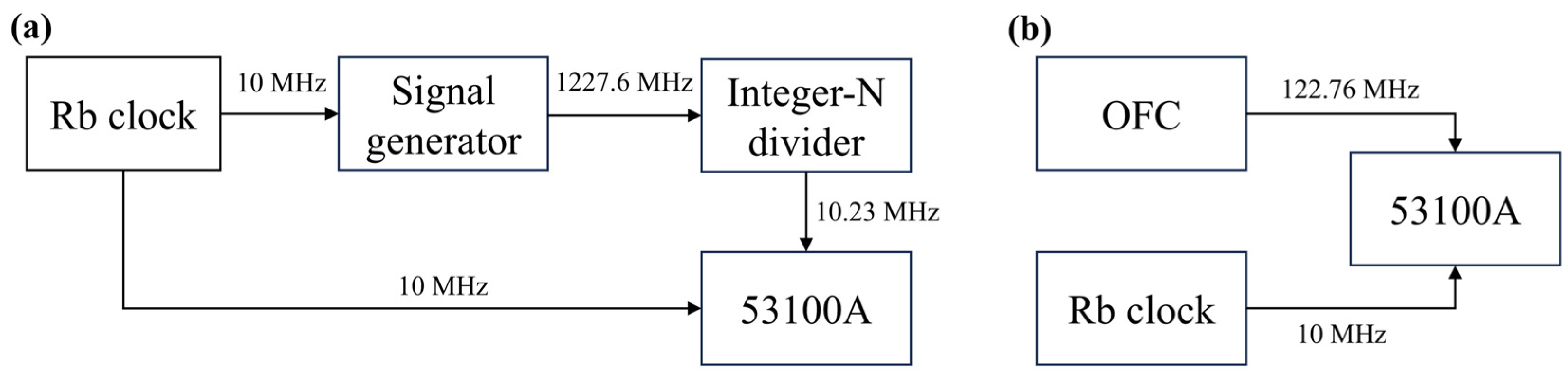
(a) Residual phase noise measurement diagram of the 1227.6 MHz reference. (b) Phase noise test block diagram.
3. Results and Discussion
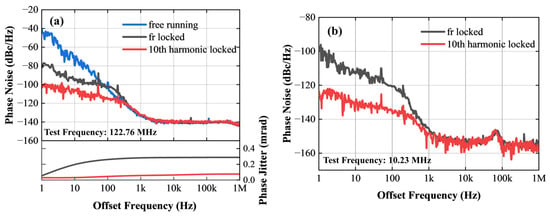
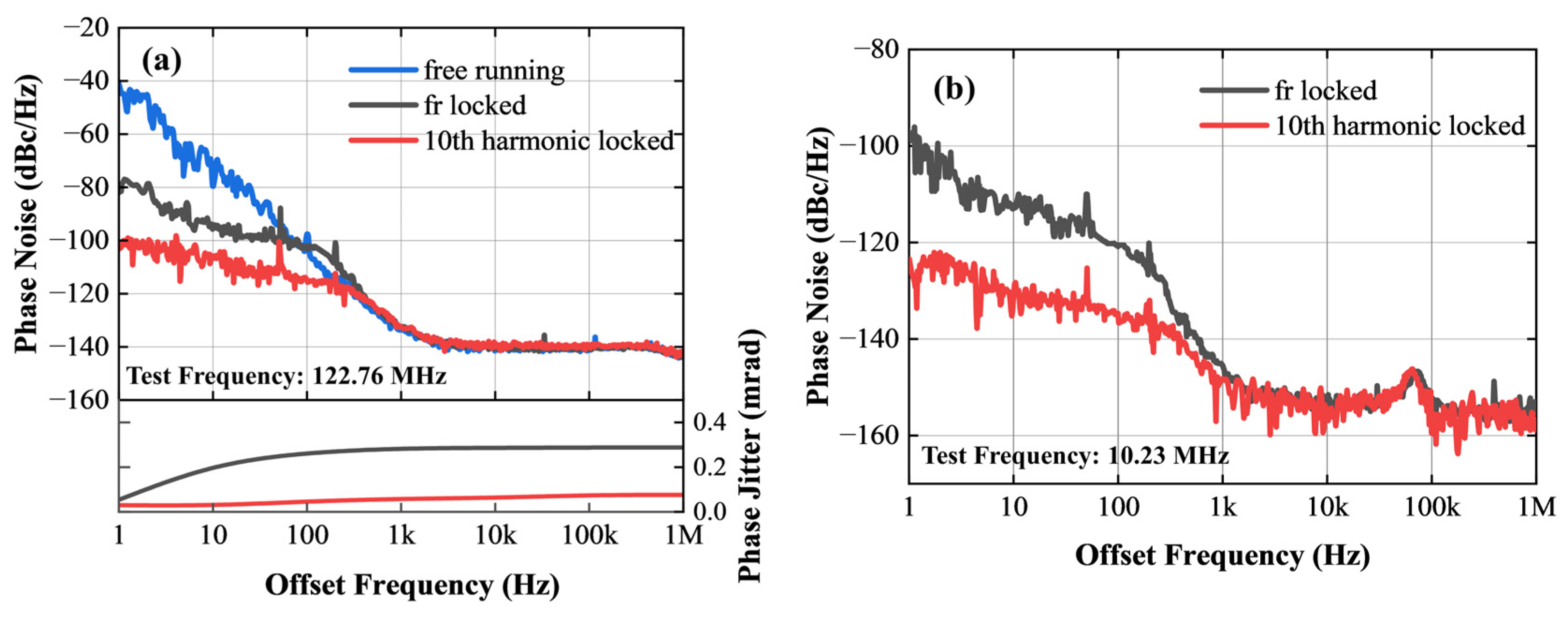
A comparative phase noise analysis was performed for the system under three operating conditions: free-running, fundamental-frequency (fr = 122.76 MHz) locking, and high-order harmonic (10th harmonic = 1227.6 MHz) locking. The experimental measurement configuration is illustrated in Figure 5b. Figure 6a presents the phase noise spectra measured using a phase noise analyzer (53100A, Microchip Technology Inc., Chandler, AZ, USA), revealing distinct performance variations across the different states.
Figure 6.
Phase noise performance characterization diagram: (a) Phase noise comparison under free-running, fundamental frequency locking, and harmonic locking modes. (b) Phase noise comparison for 10.23 MHz output.
Under free-running conditions (blue curve in Figure 7a), the system exhibited typical open-loop noise characteristics. While the far-offset phase noise (>100 kHz) remained superior to −140 dBc/Hz, the close-to-carrier noise was significantly elevated due to the absence of a phase reference and susceptibility to environmental perturbations. Upon engaging the feedback loop, the low-frequency noise was effectively suppressed. Specifically, with fundamental-frequency locking (black curve), the phase noise at a 1 Hz offset was decreased to −80.9 dBc/Hz. Employing the high-harmonic locking scheme yielded further suppression; for the 10th-harmonic lock (red curve), the phase noise at 1 Hz dropped to −102.7 dBc/Hz, highlighting the inherent advantage of harmonic locking for close-to-carrier noise reduction. Furthermore, the integrated phase jitter was evaluated. The cumulative jitter curves in the lower panel of Figure 6a demonstrate that the 10th harmonic lock (red) achieved a total integrated jitter of approximately 0.15 mrad (1 Hz to 1 MHz bandwidth). This is significantly lower than that of the fundamental lock (black), indicating superior timing stability.
Figure 7.
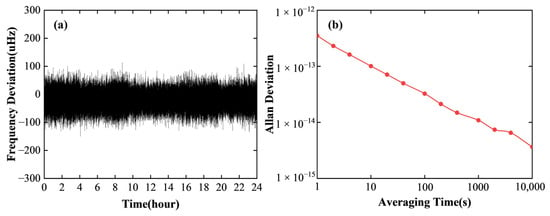
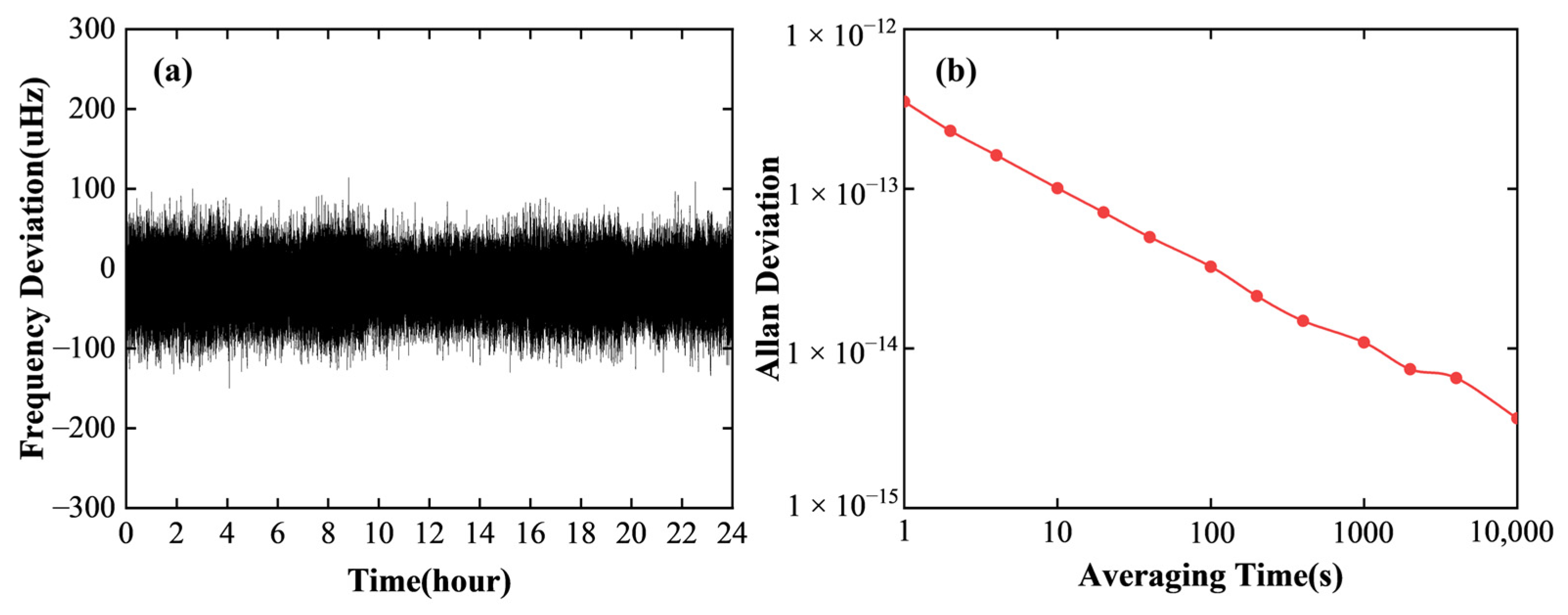
Frequency stability of 10.23 MHz output signal: (a) Output frequency count results. (b) Allan Deviation.
It is noteworthy that in the far-offset region (>10 kHz), the phase noise for all three states remained below −140 dBc/Hz and appeared nearly identical. This behavior originates from the finite servo bandwidth of the PLL. Beyond this bandwidth (>10 kHz), the phase noise is dominated by the intrinsic noise of the mode-locked laser oscillator, whereas the additive phase noise from the feedback electronics and frequency synthesis chain primarily defines the noise floor within the loop bandwidth [25].
The phase noise characteristics of the synthesized 10.23 MHz output are presented in Figure 6b, providing a definitive evaluation of the overall system performance. Building upon the noise analysis of the three laser operating states, we further characterized the final 10.23 MHz reference signals. These signals were derived by frequency-dividing the stabilized comb outputs—locked either to the fundamental frequency (fr) or the harmonic (10 fr)—using the dedicated integer-division chain described in Section 2.3.
In Figure 6b, the black curve represents the 10.23 MHz output derived from fundamental locking, while the red curve denotes the output obtained via 10th harmonic locking. Under the 10th harmonic locking configuration, the synthesized 10.23 MHz signal achieved a residual phase noise of −123.4 dBc/Hz at a 1 Hz offset, decreasing to a floor of −158 dBc/Hz at a 1 MHz offset. In contrast, the fundamental-locked output exhibited a residual phase noise of −97.3 dBc/Hz at 1 Hz. This comparison clearly demonstrates that high-order harmonic locking, combined with frequency division, significantly enhances near-carrier noise suppression. Specifically, the residual noise reduction at 1 Hz exceeds 26 dB (from −97.3 to −123.4 dBc/Hz), ensuring superior spectral purity across the entire 1 Hz to 1 MHz integration bandwidth.
A detailed analysis reveals a phase noise spur near 100 kHz, which is highly consistent with the noise signature of the reference synthesis chain (Figure 5b). Experimental characterization of individual components shows that this spur aligns with the intrinsic spurious response of the ADF4002 divider at this frequency offset. Furthermore, the spur is exacerbated by the coupling of switching power supply noise into the electronic control modules. Due to the high-order harmonic extraction, this micro-volt-level ripple is magnified by the phase noise scaling law, making it a dominant noise source in the final 10.23 MHz output. To suppress such interference for high-precision navigation, future engineering implementations will focus on isolating power supply ripples via ultra-low-noise linear regulators, employing electromagnetic shielding for the divider and first-stage amplifier, and incorporating notch filters or optimizing PLL bandwidth to provide at least 20 dB of additional rejection at the 100 kHz offset. This correlation implies that the residual phase noise of the final output is ultimately limited by the electronics used for reference frequency synthesis. Consequently, optimizing the noise performance of the frequency multiplication chain holds the potential to further improve the system’s phase noise toward its theoretical limits. These findings substantiate that the proposed high-order harmonic-locked OFC architecture provides a robust and effective pathway for synthesizing ultra-low-noise time-frequency references.
The fractional frequency stability of the system was evaluated using Allan deviation under three conditions: free-running, fundamental-frequency locking, and 10th harmonic locking. The results indicate short-term stabilities (1 s gate time) of 1.0110−9, 4.7210−12, and 4.6310−13 for the respective states, demonstrating that the implementation of the locking mechanism significantly enhances the frequency stability.
To assess the long-term performance, the synthesized 10.23 MHz output derived from 10th harmonic locking was continuously monitored over a 24 h period. As illustrated in Figure 7, the frequency fluctuations and the corresponding Allan deviation were recorded. The experimental results reveal that the standard deviation of the frequency jitter for the 10.23 MHz signal remains within 29.9 μHz over the 24 h duration. The residual frequency stability reached 3.5210−13 @ 1 s and 3.6510−15 @ 10,000 s. It should be noted that since the jitter data were collected using a frequency counter (532302, KEYSIGHT), the measured stability is currently limited by the precision of the counter itself. Nonetheless, these findings confirm that the system possesses exceptional frequency stability in both the short-term and long-term regimes, successfully inheriting the precision of the Rb clock reference.
4. Conclusions
In summary, this study proposes and experimentally validates a novel scheme for generating a 10.23 MHz time-frequency reference by locking the repetition frequency of an optical frequency comb (OFC) via high-order harmonics. The research utilizes an in-house developed, all-polarization-maintaining erbium-doped fiber laser with a repetition frequency of 122.76 MHz. By precisely locking its 10th harmonic to a high-performance Rb clock reference and subsequently performing frequency division, the target reference frequency signal is successfully obtained. Experimental results demonstrate that high-order harmonic locking significantly enhances the system’s suppression capability against phase noise. The synthesized 10.23 MHz reference signal achieves a residual phase noise of −123.4 dBc/Hz at 1 Hz offset and declines to about −158 dBc/Hz at the far end. Simultaneously, the system exhibits excellent frequency stability, with its additional frequency instability reaching 3.5210−13 @ 1 s and 3.6510−15 @ 10,000 s. Compared to conventional electronic schemes, this work physically circumvents the additive noise degradation introduced by multi-stage frequency multiplication chains and complex electronic components, realizing a low phase noise and high frequency stability transfer of the reference source performance to the target frequency.
Addressing the SWaP (Size, Weight, and Power) constraints for spaceborne applications, our current benchtop breadboard model consumes a total electrical power of 20.9 W, primarily driven by the pump laser and high-precision thermal control unit. While the reported 24 h frequency jitter (29.9 μHz) establishes a performance baseline under controlled laboratory conditions, it marks the first step toward a space-qualified payload. To transition from this principle verification to an engineering model, future research will focus on optimizing the optoelectronic conversion efficiency and implementing a modular, vibration-insensitive optomechanical assembly. Furthermore, to ensure long-term reliability in the complex space environment, radiation-hardened Er-doped fibers and aerospace-grade electronic components will be employed to mitigate radiation-induced attenuation and single-event effects.
Looking forward, to further meet the demands of spaceborne platforms for lightweight and miniaturized designs, maturing micro-nanofabrication technologies can be leveraged to develop on-chip integrated optical combs, thereby constructing photonic microwave systems with even higher integration and smaller volumes. This research will actively explore the evolution path from fiber-based architectures to fully on-chip integrated Kerr combs, providing key technical support for the development of high-performance, low-noise time-frequency payloads for China’s next-generation BeiDou Global Navigation Satellite System.
Author Contributions
Conceptualization, methodology, software, validation, N.X.; resources, P.Y., Z.L., L.X., H.H., X.X., Q.W. and R.S.; writing—original draft preparation, N.X. and P.Y.; project administration, W.X. All authors have read and agreed to the published version of the manuscript.
Funding
This research was funded by the National Key R&D Program of China, grant number 2024YFC2207600.
Institutional Review Board Statement
Not applicable.
Informed Consent Statement
Not applicable.
Data Availability Statement
The original contributions presented in this study are included in the article. Further inquiries can be directed to the corresponding authors.
Conflicts of Interest
The funders had no role in the design of the study; in the collection, analyses, or interpretation of data; in the writing of the manuscript; or in the decision to publish the results.
Abbreviations
The following abbreviations are used in this manuscript:
| OFC | Optical frequency comb |
| NALM | Nonlinear amplifying loop mirror |
| PZT | Piezoelectric actuator |
| EOM | Electro-optic modulator |
| Rb clock | Rubidium atomic clock |
| BDS | BeiDou Navigation Satellite System |
| PNT | Positioning, Navigation, and Timing |
| GNSS | Global Navigation Satellite Systems |
| GPS | Global Positioning System |
| CMCU | Clock Monitoring and Control Unit |
| VCXO | Voltage-controlled crystal oscillator |
| WDM | Wavelength division multiplexer |
| EDF | Erbium-doped fiber |
References
- Yang, Y.; Mao, Y.; Sun, B. Basic performance and future developments of BeiDou global navigation satellite system. Satell. Navig. 2020, 1, 1. [Google Scholar] [CrossRef] [Scilit]
- Kazmierski, K.; Zajdel, R.; Sośnica, K. Evolution of orbit and clock quality for real-time multi-GNSS solutions. GPS Solut. 2020, 24, 111. [Google Scholar] [CrossRef] [Scilit]
- Zhang, D.; Zheng, F.; Shi, C.; Wang, Z.; Ren, F.; Fan, L.; Hu, Z. On a deep analysis of the reference time of multi-GNSS final and real-time precise clock products with respect to UTC. Meas. Sci. Technol. 2025, 36, 026315. [Google Scholar] [CrossRef] [Scilit]
- Schuldt, T.; Gohlke, M.; Oswald, M.; Wüst, J.; Blomberg, T.; Döringshoff, K.; Bawamia, A.; Wicht, A.; Lezius, M.; Voss, K.; et al. Optical clock technologies for global navigation satellite systems. GPS Solut. 2021, 25, 83. [Google Scholar] [CrossRef] [Scilit]
- Yang, Y.; Yao, Z.; Mao, Y.; Xu, T.; Wang, D. Resilient satellite-based PNT system design and key technologies. Sci. China Earth Sci. 2025, 68, 669–682. [Google Scholar] [CrossRef] [Scilit]
- Felbach, D.; Heimbuerger, D.; Herre, P.; Rastetter, P. Galileo payload 10.23 MHz master clock generation with a clock monitoring and control unit (CMCU). In Proceedings of the 2003 IEEE International Frequency Control Symposium and PDA Exhibition, Tampa, FL, USA, 4–8 May 2003; pp. 583–586. [Google Scholar]
- Alexander, F. Clock monitoring and control units for navigation satellites. In Proceedings of the 2010 IEEE International Frequency Control Symposium, Newport Beach, CA, USA, 1–4 June 2010; pp. 49–54. [Google Scholar]
- Alexander, F. Future concepts for on-board timing subsystems for navigation satellites. In Proceedings of the 24th European Frequency and Time Forum, Noordwijk, The Netherlands, 13–16 April 2010. [Google Scholar]
- Liu, X.; Lu, H.; He, Y.; Wu, F.; Zhang, C.; Wang, X. Analysis on the Effect of Phase Noise on the Performance of Satellite Communication and Measurement System. Symmetry 2023, 15, 2053. [Google Scholar] [CrossRef] [Scilit]
- Sun, S.; Wang, B.; Liu, K.; Harrington, M.W.; Tabatabaei, F.; Liu, R.; Wang, J.; Hanifi, S.; Morgan, J.S.; Jahanbozorgi, M.; et al. Integrated optical frequency division for microwave and mmWave generation. Nature 2024, 627, 540–545. [Google Scholar] [CrossRef] [Scilit]
- Lucas, E.; Brochard, P.; Bouchand, R.; Schilt, S.; Südmeyer, T.; Kippenberg, T.J. Ultralow-noise photonic microwave synthesis using a soliton microcomb-based transfer oscillator. Nat. Commun. 2020, 11, 374. [Google Scholar] [CrossRef] [Scilit]
- Kudelin, I.; Groman, W.; Ji, Q.X.; Guo, J.; Kelleher, M.L.; Lee, D.; Nakamura, T.; McLemore, C.A.; Shirmohammadi, P.; Hanifi, S.; et al. Photonic chip-based low-noise microwave oscillator. Nature 2024, 627, 534–539. [Google Scholar] [CrossRef] [Scilit]
- Zhang, X.; Chang, K.; Zheng, H.; Zhou, Y.; Shen, Y.; Zou, H. In-situ aligned all-polarization-maintaining Er-doped fiber laser mode-locked by a nonlinear amplifying loop mirror. arXiv 2024. [Google Scholar] [CrossRef] [Scilit]
- Kuse, N.; Jiang, J.; Lee, C.-C.; Schibli, T.R.; Fermann, M.E. All polarization-maintaining Er fiber-based optical frequency combs with nonlinear amplifying loop mirror. Opt. Express 2016, 24, 3095–3102. [Google Scholar] [CrossRef] [Scilit] [PubMed]
- Lu, S.; Hao, Q.; Liu, T.; Chen, F.; Ren, X.; Shen, X.; Yan, M.; Zeng, H. All Polarization Maintaining Fiber-Based Optical Comb System withNonlinear Loop Mirror Mode-Locking. Chin. J. Lasers 2021, 48, 2101002. [Google Scholar] [CrossRef] [Scilit]
- Zhang, H.; Xia, H.; Fan, M.; Zheng, J.; Li, J.; Tian, X.; Zhou, D.; Huang, Z.; Zhang, F.; Zhang, R.; et al. Observation of Wavelength Tuning in a Mode-Locked Figure-9 Fiber Laser. Photonics 2023, 10, 184. [Google Scholar] [CrossRef] [Scilit]
- Hudson, D.D.; Holman, K.W.; Ye, J.; Jones, D.J. Mode-locked fiber laser frequency-controlled with an intracavity electro-optic modulator. Opt. Lett. 2005, 30, 2948–2950. [Google Scholar] [CrossRef] [Scilit]
- Pan, R.; Jia, J.; Hu, X.; Zhang, T.; Zhang, W.; Yang, Y.; Feng, Y.; Wang, Y.; Si, J. Compact all-polarization-maintaining dual femtosecond fiber laser system with large repetition rate tuning ranges based on self-made fiber actuators. Opt. Express 2025, 33, 18866–18890. [Google Scholar] [CrossRef] [Scilit]
- Ma, Y.; Wang, Y.; Zhou, X.; Liu, W.; Shang, J. Fiber laser-pumped Ti:sapphire laser with ultra-low-intensity noise and frequency stabilization for quantum precision measurement applications. Opt. Express 2025, 33, 38589–38602. [Google Scholar] [CrossRef] [Scilit]
- Zhang, Q.; Hou, Y.; Song, W.; Wang, X.; Blair, C.; Chen, X.; Li, J.; Zhao, C.; Wang, P. Pump RIN coupling to frequency noise of a polarization-maintaining 2 µm single frequency fiber laser. Opt. Express 2021, 29, 3221–3229. [Google Scholar] [CrossRef] [Scilit]
- Kwon, D. Excess Intensity Noise in a Nonlinear Amplifying Loop-Mirror-Based Mode-Locked Laser from a Non-Reciprocal Phase Bias. Photonics 2024, 11, 1186. [Google Scholar] [CrossRef] [Scilit]
- Cutrona, A.; Rowley, M.; Bendahmane, A.; Cecconi, V.; Peters, L.; Olivieri, L.; Little, B.E.; Chu, S.T.; Stivala, S.; Morandotti, R.; et al. Stability of laser cavity-solitons for metrological applications. Appl. Phys. Lett. 2023, 122, 121104. [Google Scholar] [CrossRef] [Scilit]
- Yan, P.; Gong, H.; Ye, F.; Cheng, C.; Wang, Q.; Lu, S.; Chen, F.; Wang, T.; Liu, T.; Guo, Z.; et al. All Polarization-Maintaining Erbium-Doped Fiber Based Optical Comb. Chin. J. Lasers 2020, 47, 0115001. [Google Scholar]
- Egan, W.F. Modeling phase noise in frequency dividers. IEEE Trans. Ultrason. Ferroelectr. Freq. Control 1990, 37, 307–315. [Google Scholar] [CrossRef] [Scilit] [PubMed]
- Bai, H.; Zhong, Y.; Ren, C.; Huang, J.; Tian, J.; Xiong, D.; Sun, J. Noise of high-order harmonic mode-locked femtosecond Yb fiber laser. Infrared Laser Eng. 2022, 51, 20210779. [Google Scholar] [CrossRef] [Scilit]
Disclaimer/Publisher’s Note: The statements, opinions and data contained in all publications are solely those of the individual author(s) and contributor(s) and not of MDPI and/or the editor(s). MDPI and/or the editor(s) disclaim responsibility for any injury to people or property resulting from any ideas, methods, instructions or products referred to in the content. |
© 2026 by the authors. Licensee MDPI, Basel, Switzerland. This article is an open access article distributed under the terms and conditions of the Creative Commons Attribution (CC BY) license.