


Abstract
A pixelated instantaneous phase-shifting interferometry (PSI) using a phase-only liquid crystal spatial light modulator (LC-SLM) is developed and experimentally validated. The LC-SLM generates high-frequency spatial phase modulation and introduces pixelated instantaneous phase-shifting between two incident orthogonal linearly polarized beams propagating along the same optical path. A single-frame pixelated phase-shifted interferogram is captured in one exposure, and the wavefront phase is reconstructed subsequently by using the proposed loop retrieval algorithm. In the experimental investigation, an interference region segmentation method based on wavefront-modulated sequential images is firstly developed to realize precise alignment between LC-SLM pixels and CCD pixels. Secondly, based on the PSI setup established, wavefront measurement experiments for system aberration, tilted wavefront and defocused wavefront are performed. Experimental results show that the root-mean-square (RMS) value of the residual wavefront between the retrieved tilted wavefront and its fitting plane is 0.046 λ. Furthermore, the RMS value of the residual wavefront between the defocused wavefront retrieved by the proposed method and the eight-step phase-shifting method is 0.075 λ, which verifies the effectiveness of the proposed approach. This work provides a simple and rapidly deployable solution for single-shot interferometric measurement.
1. Introduction
Optical interferometry, capable of measuring various physical quantities that induce phase changes in light beams, is widely utilized in applications such as macroscopic surface shape and microscopic roughness testing, full-field deformation measurement [1,2,3], semiconductor wafer flatness and thickness detection [4], density field measurement in flow fields [5], and displacement measurement [6]. Among the numerous methods for extracting wavefront phase from interferograms, phase-shifting interferometry (PSI) is recognized as a high-precision reconstruction technique. Temporal PSI requires stable light source intensity and environmental conditions during phase-shifting operation, limiting its application to static or quasi-static phase measurements [7]. In contrast, simultaneous phase-shifting techniques employ beam-splitting elements to divide the beam into multiple channels, introducing different phase shifts in each channel to achieve simultaneous shifting. All phase-shifted interferograms are captured in a single shot, and the measured wavefront can be extracted accordingly, thus having significant application advantages in dynamic wavefront measurement [8].
Currently, there are three common simultaneous phase-shifting techniques: Firstly, using amplitude or polarization beam splitters to divide the incident beam into multiple channels, introducing different phase shifts via appropriate waveplates in each channel, and capturing multiple phase-shifted interferograms with multiple detectors at different spatial locations [9]. This method requires detectors with identical photoelectric response characteristics and high-quality optical coatings to ensure sufficient and uniform intensity in multiple channels. Consequently, by using optical components such as quarter-wave plates and beam splitters, the phase-shifted interferograms from different spatial locations are arranged spatially and imaged onto a single camera, ensuring simultaneous acquisition while reducing costs. Secondly, by utilizing one-dimensional grating for beam splitting [10] combined with polarization elements to achieve simultaneous phase-shifting, three frames of interferograms with phase shifts of −90°, 0°, and 90° can be generated simultaneously. In addition, 2-D orthogonal gratings (including 2-D phase gratings) combined with polarization elements can also achieve simultaneous phase-shifting [11,12]. The technical challenge of grating-based methods lies in the precise fabrication required to ensure consistent intensity distribution among diffracted beams. Non-uniform splitting can lead to varying intensities and contrasts among interferograms, significantly affecting measurement accuracy. Furthermore, a specially designed 2-D orthogonal holographic element [13] is used to split the incident beam into four beams, and the required phase shifts are introduced via polarizers with specific fast-axis orientations. Four frames of phase-shifted interferograms are captured by one camera. This method offers a compact optical structure but involves high fabrication difficulty.
The aforementioned three simultaneous phase-shifting techniques suffer from issues such as non-uniform beam splitting, the need for accurate spatial registration of multiple interferograms [14,15], high manufacturing difficulty and cost for key components, and complexity in introducing phase shifts within the common-path interferometer. Subsequently, a micropolarizer array (also called a pixelated polarization mask) [16,17] mapped onto CCD pixel units is used to generate simultaneous phase shifts between incident orthogonal circularly or linearly polarized beams, enabling wavefront retrieval from a single interferogram. Polarization cameras [18,19] used in instantaneous interferometries employ the technique of a micropolarizer array. This technology eliminates the need for beam splitters and associated non-uniformity issues, features a compact optical structure, is compatible with various interferometer types, and offers good generality. Its main challenge lies in the precise control of the size and polarization orientation of micro-units during fabrication and installation of micropolarizer array.
The liquid crystal spatial light modulator (LC-SLM) has become well established and is easy to obtain. In addition, the phase-only LC-SLM can achieve flexible and stable wavefront control after precise calibration of phase modulation characteristics [20]; thus, it can be effectively applied to the PSI to achieve phase-shifting operation. Moreover, the LC-SLM, with a large target area and high resolution, can provide a large number of independent phase-shifting units, which provides a hardware foundation for pixelated phase-shifting. In this case, this paper develops the application of a phase-only LC-SLM for PSI for realizing simultaneous phase-shifting, investigates a high-resolution phase retrieval algorithm, establishes an experimental system, and conducts systematic experimental research on key techniques and the feasibility of the method.
2. Pixelated Phase-Shifting Interferometry Principles and Algorithm
2.1. The Principle of Pixelated PSI Based on LC-SLM
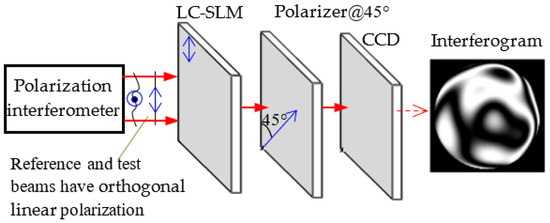
A phase-only LC-SLM can serve as a phase-shifting device [21,22] to construct temporal PSI systems, and its basic principle is illustrated in Figure 1. Two linearly polarized reference and test beams with equal amplitudes and orthogonal vibration directions from a polarization interferometer are incident on the LC-SLM target surface along the same path. The vibration direction of the test beam is perpendicular to the fast axis of liquid crystal molecules; thus, its phase remains unmodulated. In contrast, the vibration direction of the reference beam is parallel to the fast axis of the liquid crystal molecules. When a driving image with uniform grayscale is loaded onto the LC-SLM, the phase of the reference beam is modulated, thereby introducing a controllable phase shift between the reference and test beams. After passing through the LC-SLM, the two beams still remain in an orthogonal linearly polarized state and then interfere after passing through a polarizer whose fast axis is at 45° relative to the vibration directions of the incident beams. While the LC-SLM generates sequentially phase shifts of 0°, 90°, 180°, and 270°, four frames of phase-shifted interferograms are captured:
where A(x,y) and B(x,y) are the background and modulation intensity of the interferogram, respectively; φ(x,y) represents the wavefront phase of the test beam if the reference beam is a plane wave; and δi (i = 1–4) denotes the phase shift amount. The wavefront phase is then retrieved using a four-step phase-shifting method as follows:
Figure 1.
Schematic diagram of temporal PSI based on LC-SLM.
This is the classical four-step temporal phase-shifting technique. In this case, all pixels of the LC-SLM generate the same magnitude of phase modulation during each phase-shifting operation.
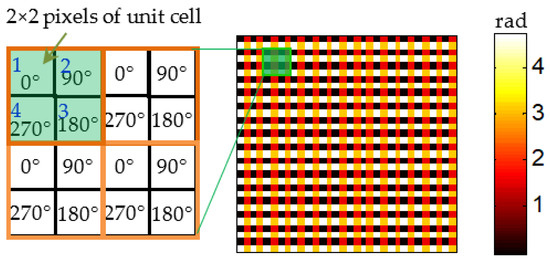
To improve the real-time performance of phase-shifting wavefront measurement, the above four-step shifting operation can be integrated into 2 × 2 pixel units of an LC-SLM, thus developing a pixelated simultaneous phase-shifting technology. A high-frequency spatial phase pattern as shown in Figure 2 is generated by loading a driving grayscale image onto the LC-SLM as shown in Figure 1. Consequently, four spatial phase shifts of 0°, 90°, 180°, and 270° are simultaneously introduced to each 2 × 2 pixels unit in the reference beam. Only a single frame of the pixelated phase-shifted interferogram is recorded by the CCD camera. The wavefront phase can then be directly calculated from this single interferogram according to the known phase shift distribution pattern.
Figure 2.
High-frequency phase pattern introduced by LC-SLM to realize pixelated phase-shifting.
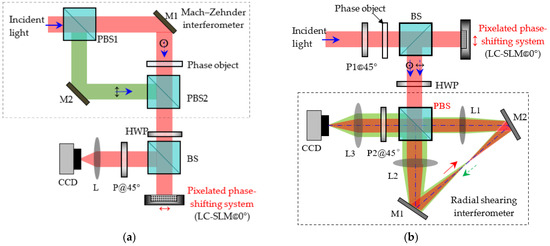
Figure 3 illustrates two representative optical configurations for pixelated PSI based on the LC-SLM, where the technique is applied respectively to non-common-path and common-path interferometers. In the Mach–Zehnder interferometer shown in Figure 3a, the beam passing through the phase object serves as the test beam, and the other acts as the reference beam. The orthogonally linearly polarized reference and test beams exiting from the Mach–Zehnder structure propagate along the same path into the pixelated phase-shifting system. By adjusting the half-wave plate (HWP), the vibration direction of the reference beam is adjusted parallel to the fast axis of liquid crystal molecules, while that of the test beam is perpendicular to the fast axis. The LC-SLM performs phase modulation on the reference beam and introduces the high-frequency phase pattern as shown in Figure 2. The test and reference beams reflected by the LC-SLM interfere with each other after passing through a polarizer (P), whose fast axis is at 45° relative to the vibration direction of linearly polarized light, and are imaged onto the CCD camera. It should be noted that pixelated phase-shifting can also be achieved by placing the LC-SLM in the reference arm of the Mach–Zehnder structure. However, as the test beam does not pass through the LC-SLM in this arrangement, the LC-SLM’s static aberration will be directly introduced into the measurement system.
Figure 3.
Schematic diagram of two representative pixelated PSI configurations: (a) combined with a non-common-path Mach–Zehnder interferometer; (b) combined with a common-path radial shearing interferometer.
Figure 3b presents the application of the pixelated phase-shifting technique to a common-path radial shearing interferometer for single-shot wavefront sensing. A linearly polarized beam containing the measured phase is incident on the LC-SLM, with its vibration direction at 45° to the fast axis of liquid crystal molecules. In this case, the LC-SLM emits two orthogonally linearly polarized beams [23]. They travel into the radial shearing interferometer along the same path and then are separated by a polarizing beam splitter (PBS) into a reflected and a transmitted beam. The reflected beam travels through lenses L1 and L2 in a clockwise direction and thus is expanded, with the focal length of L1 assumed to be smaller than that of L2; the transmitted beam travels through L2 and L1 in a counterclockwise direction and is contracted. The expanded and contracted beams pass through the PBS again, then interfere after passing through P2, and are imaged onto the CCD camera. After retrieving the phase difference between the contracted and expanded beams, the measured wavefront phase can be obtained by further applying the radial shearing wavefront reconstruction algorithm [5].
2.2. Phase Retrieval Algorithm
The interferogram recorded in the pixelated PSI system as shown in Figure 3 spatially corresponds to the phase shift pattern introduced by the LC-SLM. Therefore, the intensity at each pixel within a 2 × 2 unit cell can be expressed as
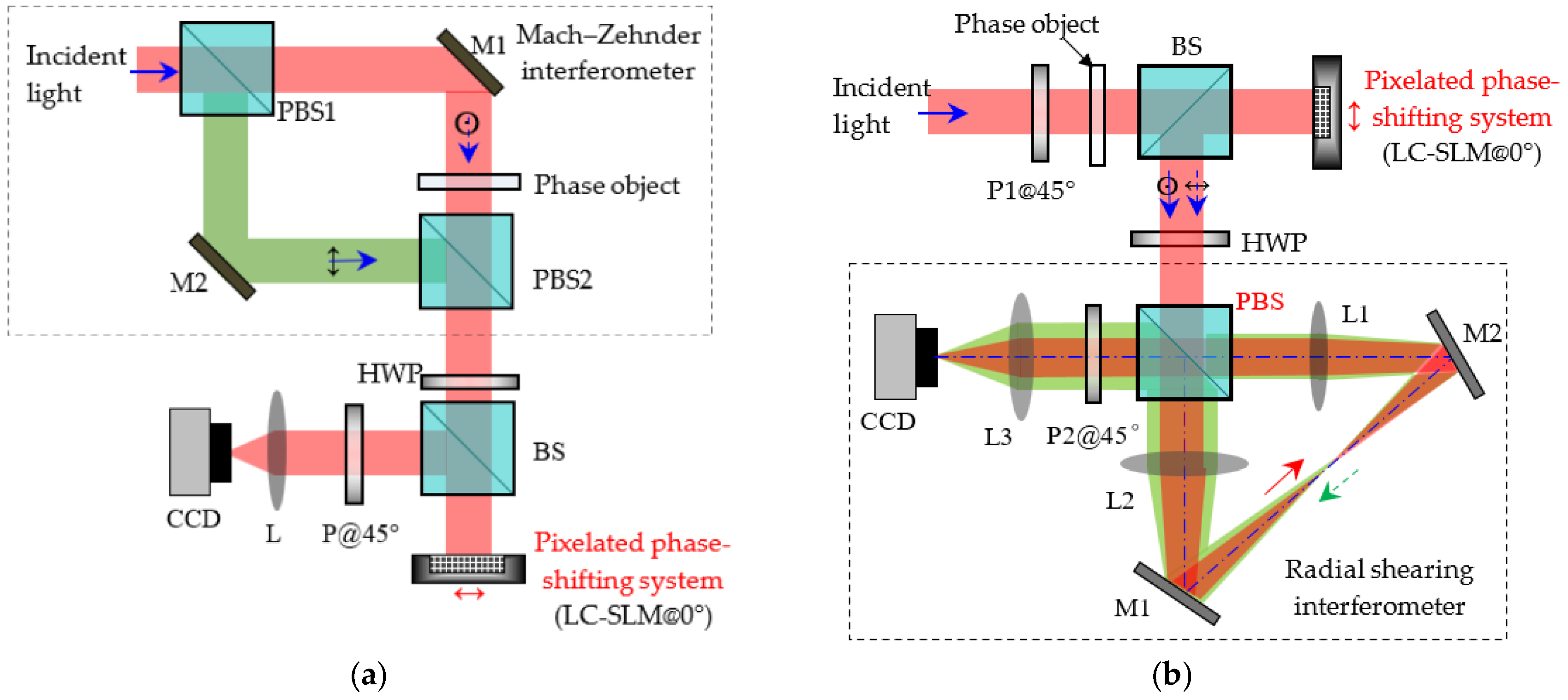
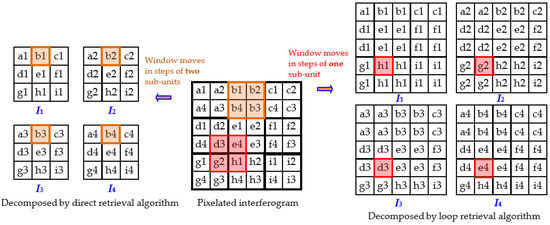
The phase at that unit cell can be retrieved using the four-step phase-shifting method expressed in Equation (2). By traversing the entire interferogram and calculating the wavefront phase corresponding to each unit in sequence, the measured phase distribution within the whole aperture is obtained. It is seen that a retrieved result with a resolution of M/2 pixel × N/2 pixel is obtained from a pixelated interferogram with M pixel × N pixel. This technical scheme is defined as the direct retrieval algorithm. For computational convenience, four frames of separate interferograms can be decomposed from a pixelated interferogram with the direct retrieval algorithm, and the steps are included as follows: (1) Extract the pixel units corresponding to the LC-SLM phase-shifting pattern from the pixelated interferogram. (2) Extract the sub-unit from the first quadrant of each unit and assemble them into the first phase-shifted interferogram (I1) based on their original relative position relationships. (3) Form the second phase-shifted interferogram (I2) from the second quadrant sub-unit. Similarly, obtain another two phase-shifted interferograms (i.e., I3 and I4). For example, four frames of 3 pixel × 3 pixel phase-shifted interferograms are decomposed from a 6 pixel × 6 pixel pixelated interferogram through using the direct retrieval algorithm, which is shown in the left sub-figure of Figure 4.
Figure 4.
Schematic diagram of direct and loop phase retrieval algorithms applied to a 6 pixel × 6 pixel pixelated interferogram.
To obtain the higher spatial resolution wavefront phase, a loop retrieval algorithm is developed. At first, a sliding window is set with the same size as the phase shift unit, which contains 2 × 2 sub-units. Then, the entire pixelated interferogram is scanned using a sliding window that moves in steps of one sub-unit. Each time the window slides to a position, the four sub-units within the window are placed into the corresponding positions of the respective phase-shifted interferograms (I1, I2, I3, and I4) according to their corresponding phase shift values. Taking the extraction process of I1 (its phase shift being 0°) as an example, the loop retrieval algorithm is described as follows: (1) Construct and initialize a matrix I1 with the size of (M − 1) × (N − 1). (2) Extract the sub-unit data in the pixelated interferogram which correspond to the phase shift of 0° and place them in the corresponding positions of I1. The column indices of these data positions are (1:2:M − 1). (3) Copy the data from columns indexed as (3:2:M − 1) in I1 to their left adjacent columns, i.e., the even columns indexed as (2:2:M − 2). (4) Copy the data from rows indexed as (3:2:N − 1) in I1 to their upper adjacent rows, i.e., the even rows indexed as (2:2:N − 2). Similarly, another three interferograms can be extracted successively.
Taking a 6 pixel × 6 pixel pixelated interferogram as an example, four frames of phase-shifted interferograms with 5 pixel × 5 pixel can be obtained through using the loop retrieval algorithm, as illustrated in the right sub-figure of Figure 4. Compared to the original interferogram, data is missing only the rightmost column and bottommost row. The key distinction between the loop and direction retrieval algorithms lies in the moving step of their sliding windows: the loop retrieval algorithm moves in steps of one sub-unit, while the direct retrieval algorithm advances by two sub-units. This difference enables the spatial resolution of loop retrieval algorithm to be significantly improved.
3. Key Experimental Techniques
3.1. Experimental System
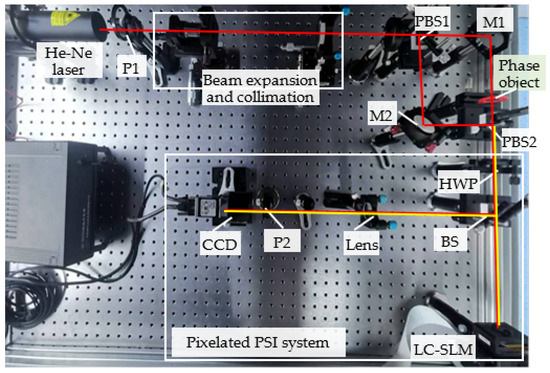
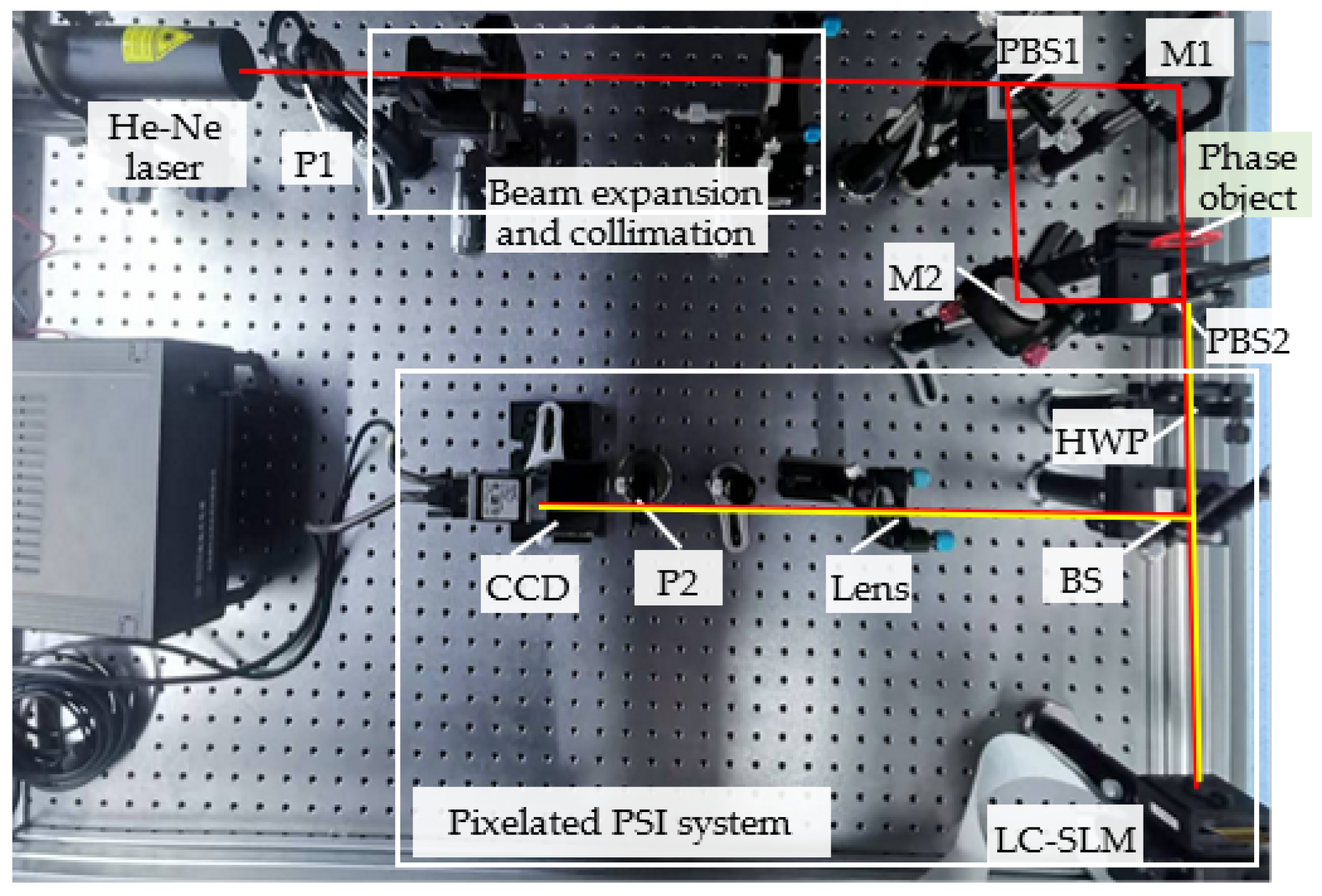
The experimental system for pixelated PSI based on the optical setup shown in Figure 3a is presented in Figure 5. A laser beam with a wavelength of 633 nm emitted by a He-Ne laser is expanded, collimated, and then incident on the Mach–Zehnder structure. The incident linearly polarized light, whose vibration direction is at an angle of 45° to the fast axis of the polarization beam splitter (PBS1), is split into two orthogonally linearly polarized beams with equal amplitude after passing through PBS1. These two beams are reflected by mirrors M1 and M2 respectively, then pass through PBS2 without loss, and finally enter the pixelated phase-shifting system along the same optical path. The phase object under test is placed in the test arm of the Mach–Zehnder structure, and both the phase object plane and the LC-SLM target plane serve as the object planes of the imaging system.
Figure 5.
Experimental system.
In the pixelated phase-shifting system, a reflective phase-only LC-SLM (P512-0635) manufactured by BNS (Boulder, CO, USA) is used, which features a spatial resolution of 512 pixel × 512 pixel, 16-bit grayscale (65,536 levels), and a target area of 7.68 mm × 7.68 mm. The CCD camera is a Basler Aca1600-20gm (Basler AG, Ahrensburg, Germany), with a spatial resolution of 1626 pixel × 1236 pixel, a target area of 7.2 mm × 5.4 mm and wavelength range of 615 nm to 700 nm. According to the target area of the CCD and LC-SLM and spatial layout, an imaging lens with a focal length of 150 mm is selected. Under this condition, the imaging size of the LC-SLM target area is 4.95 mm × 4.95 mm, which can be fully imaged on the CCD camera.
3.2. Phase Modulation Characteristics Calibration of LC-SLM
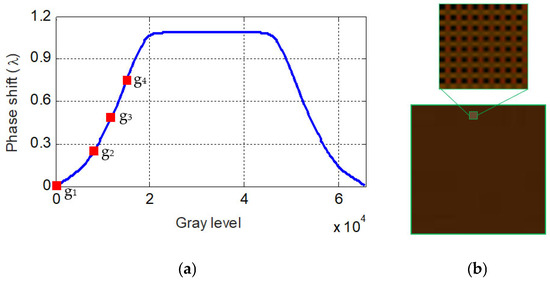
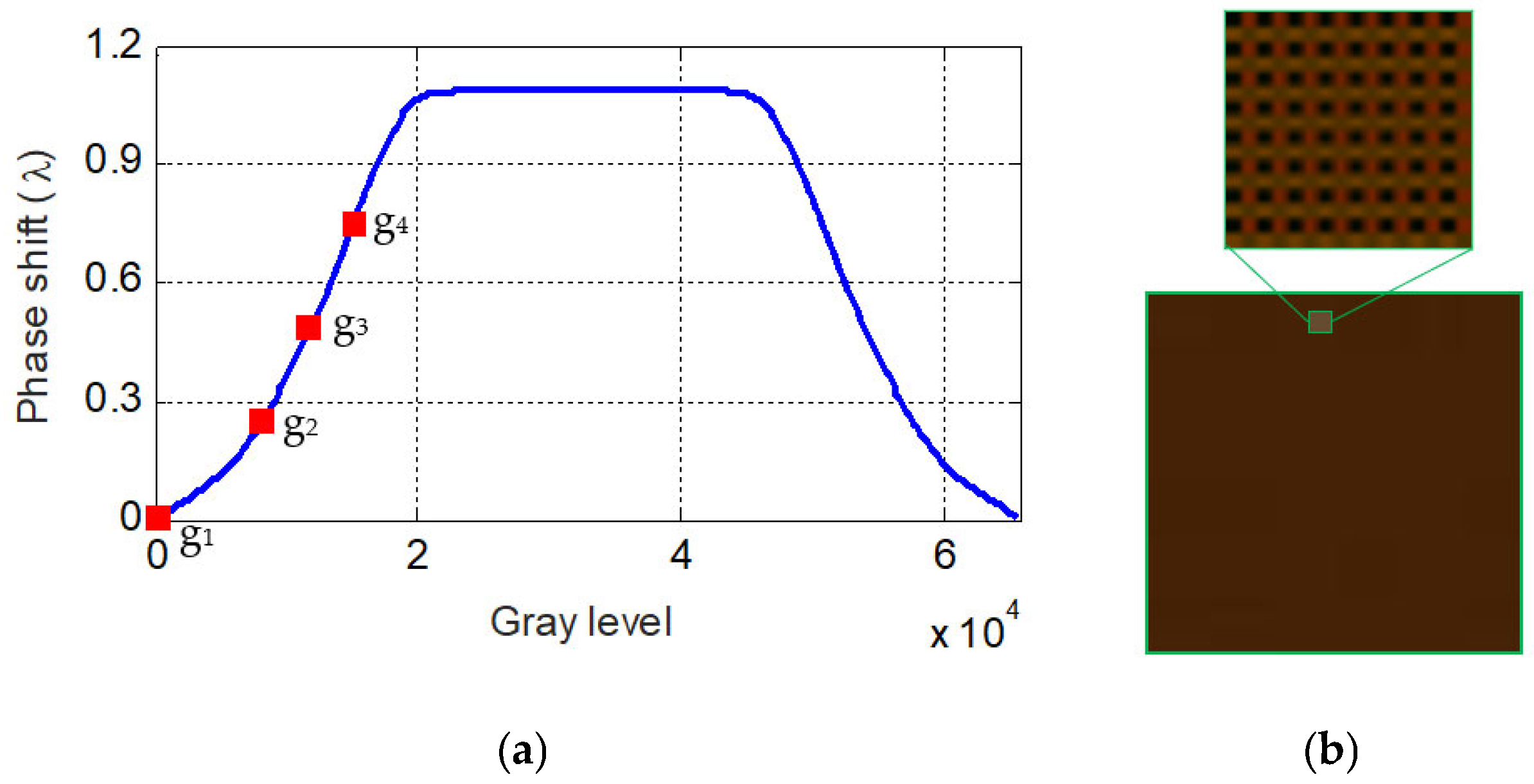
We built a Twyman–Green interferometer [24] to calibrate the phase-to-gray relationship of the LC-SLM used in the system. At first, a series of phase-shifted interference fringes are recorded as the gray level loaded to the LC-SLM incrementally increases. Then these fringe patterns are analyzed using a modified Fourier transform method [25] to determine the phase shifts. The resulting phase modulation curve is shown in Figure 6a. It is seen that a maximum modulation depth greater than one wavelength (λ = 633 nm) is achieved. According to the calibration data, the required control grayscale values for four phase shifts (0°, 90°, 180°, and 270°) are obtained with the help of adjacent point interpolation, which correspond respectively to four points labeled g1 to g4 in Figure 6a. Consequently, the designed driving grayscale image as shown in Figure 6b is loaded onto the LC-SLM, and the required high-frequency spatial phase as shown in Figure 2 is introduced between both coherent beams.
Figure 6.
Calibration result of the LC-SLM and driving grayscale image: (a) phase modulation characteristics curve of the used LC-SLM; (b) driving grayscale image loaded to LC-SLM.
3.3. Interference Region Segmentation
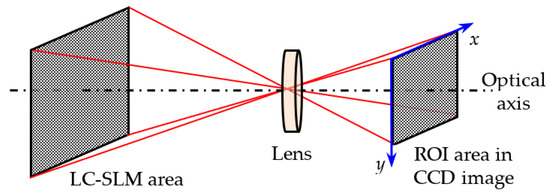
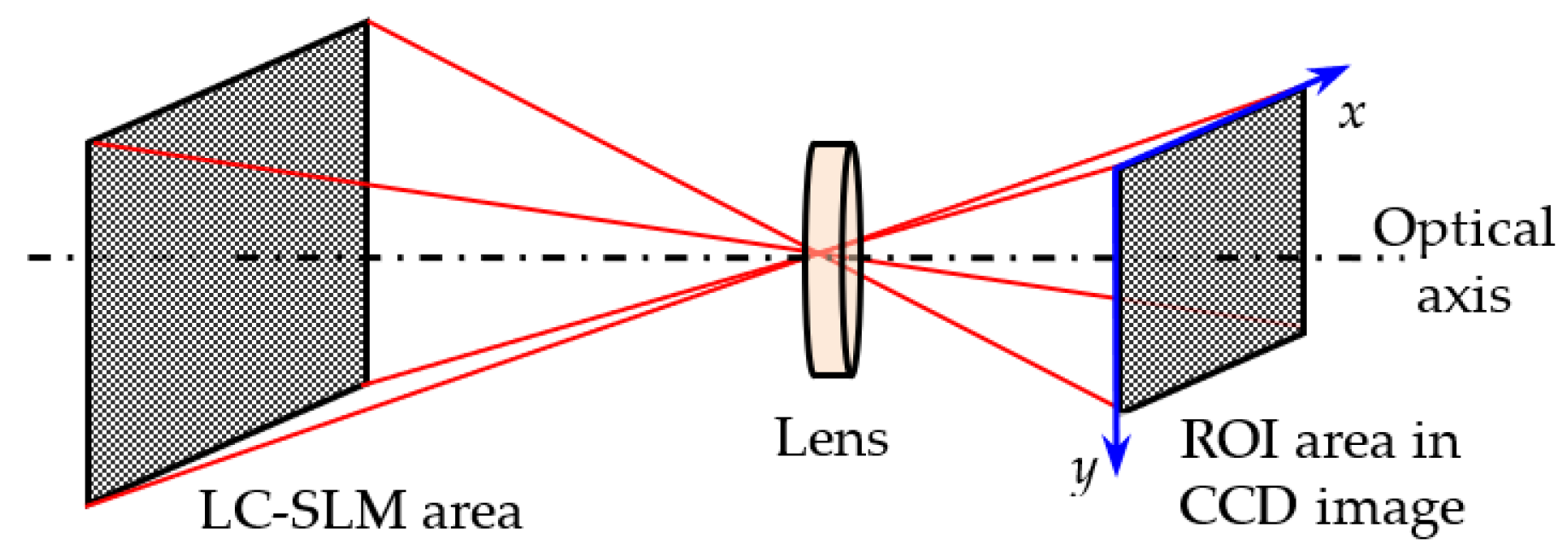
Before actual measurement of the wavefront phase, it is necessary to perform a precise alignment operation on the LC-SLM and CCD, so as to ensure that the planes of the two devices’ target surfaces are both perpendicular to the optical axis and parallel to each other. Under such conditions, the square target area of the LC-SLM will also be imaged as a square area. Moreover, the horizontal and vertical boundaries of the interferogram region should also be strictly parallel to the pixel coordinate axes of the CCD surface. The alignment relationship between both surfaces is presented in Figure 7.
Figure 7.
Alignment relationship between target area of LC-SLM and CCD image.
Here, we propose an interference region segmentation method based on wavefront-modulated sequential images, which extracts the region of interest (i.e., ROI) from the CCD image, thereby realizing the pixel matching and alignment operation between the LC-SLM and CCD. In the experimental system, multiple different wavefront phases are randomly introduced by the LC-SLM, and m frames of interferograms are captured and expressed as follows:
In the experiment, m = 16 and the image size is 1626 pixel × 1236 pixel, among which four frames are displayed in Figure 8.
Figure 8.
The sequential interferograms after introducing random wavefront modulation to the LC-SLM.
Due to the differences in phase distribution among the sequential interferograms, for a certain pixel within the ROI area, its grayscale value varies randomly across different frames with a large grayscale dynamic range; in contrast, for a certain pixel within the background region, its grayscale value shows little to almost no variation across different frames. To this end, the following variance measure is introduced to characterize the variation degree of the grayscale value of a certain pixel:
where is the coordinate of a certain pixel, represent the mean intensity, and m is the number of frames.
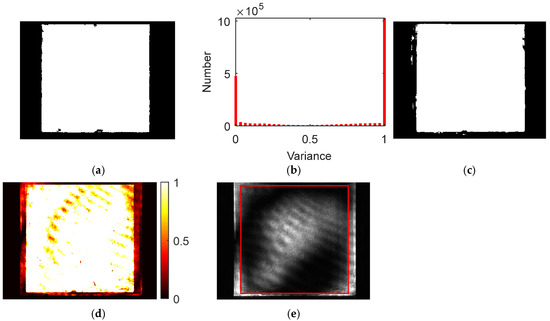
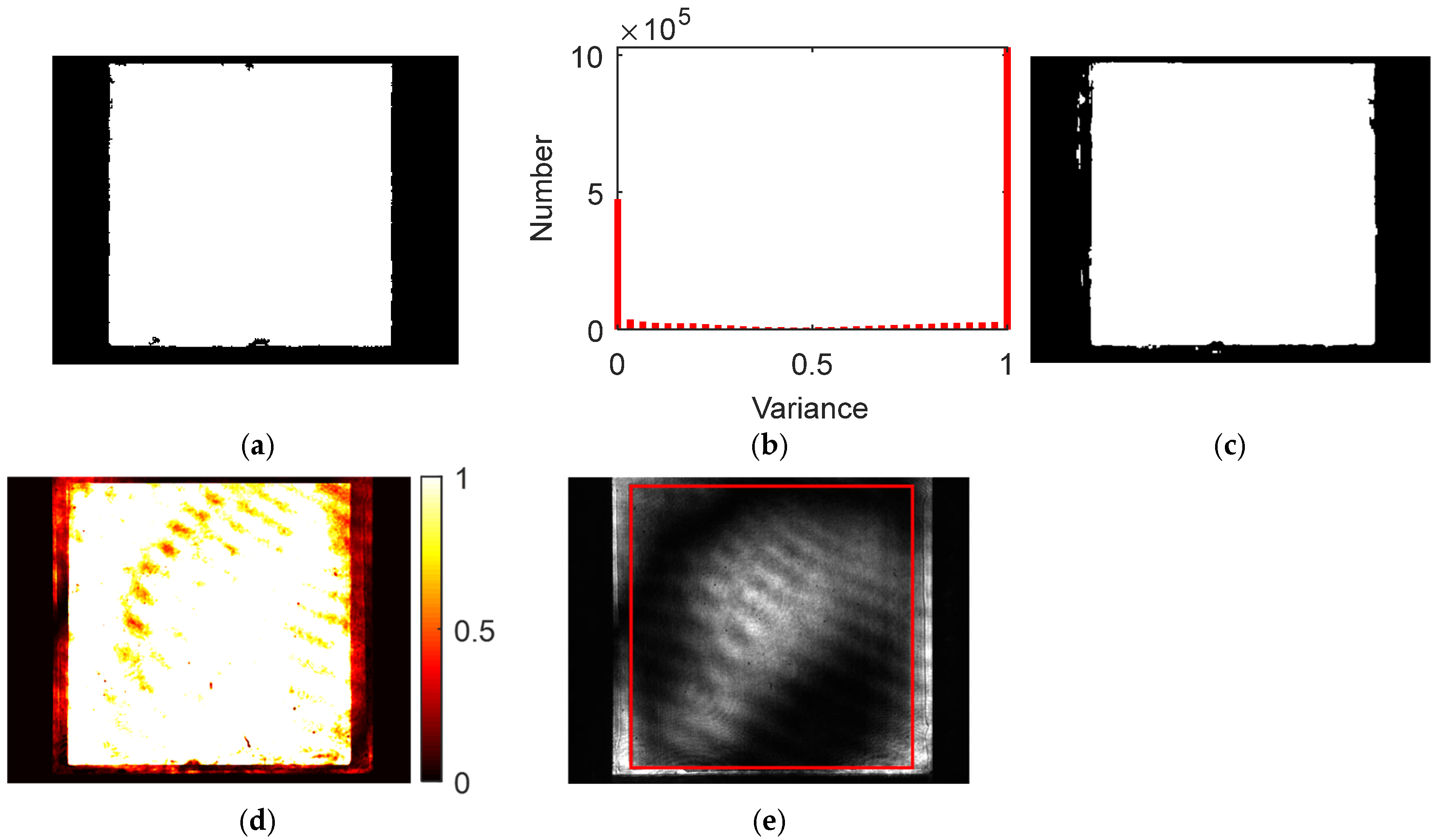
The grayscale variances of all pixels in the sequential interferograms are calculated according to Equation (5) and subjected to normalization processing, with the results shown in Figure 9a. It can be seen from the variance statistical histogram shown in Figure 9b that the variance values mainly fall into two classes (i.e., near 0 and 1), among which the variances within the ROI area exhibit the maximum value and those in the background area exhibit the minimum value. Furthermore, threshold segmentation is performed on the variance image based on Otsu’s method, and the results are shown in Figure 9c. The binary image obtained after threshold segmentation exhibits minor defects including small holes, isolated pixels, and unsmooth region edges. Further mathematical morphology processing is performed, including region filling and opening and closing operations, with the results shown in Figure 9d. Finally, Canny edge detection and Hough line detection are employed to derive the linear equations corresponding to the four edges; thus, four corner-point coordinates representing the rectangular ROI area are calculated as (255, 35) pixel, (1390, 35) pixel, (255, 1170) pixel, and (1390, 1170) pixel, respectively. The size of the extracted ROI is 1136 pixel × 1136 pixel. The rectangular box in Figure 9e is the ROI area of one frame in sequential interferograms.
Figure 9.
ROI extraction of experimental interferograms: (a) normalized variance, (b) variance statistical histogram, (c) threshold segmentation, (d) morphological processing, (e) ROI area of one frame in sequential interferograms.
In the alignment of optical elements, if the target surfaces of the LC-SLM or CCD are not perpendicular to the optical axis, the square ROI area will appear trapezoidal due to perspective distortion; if the planes of the two target surfaces are parallel to each other but there is an included angle between their horizontal coordinate axes, the upper and lower edges of the ROI area will form an angle with the horizontal direction. These spatial pose deviations will cause misalignment in the interferograms decomposed by the loop retrieval algorithm. Based on the method proposed in this paper, the spatial pose relationship between the planes of the object and image can be assessed according to the corner-point coordinates of the square ROI area. Furthermore, with the help of the tilting stage under the CCD camera support and the fine-tuning mechanism of the LC-SLM, the precise alignment between the LC-SLM and CCD camera is realized.
4. Experiments of Phase Measurement
4.1. Measurement of System Aberration and Tilted Wavefront
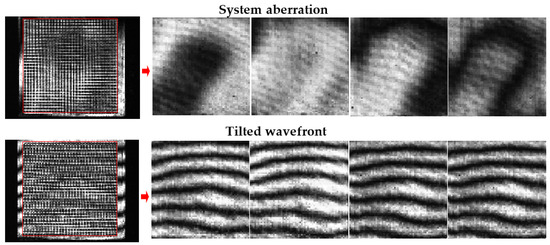
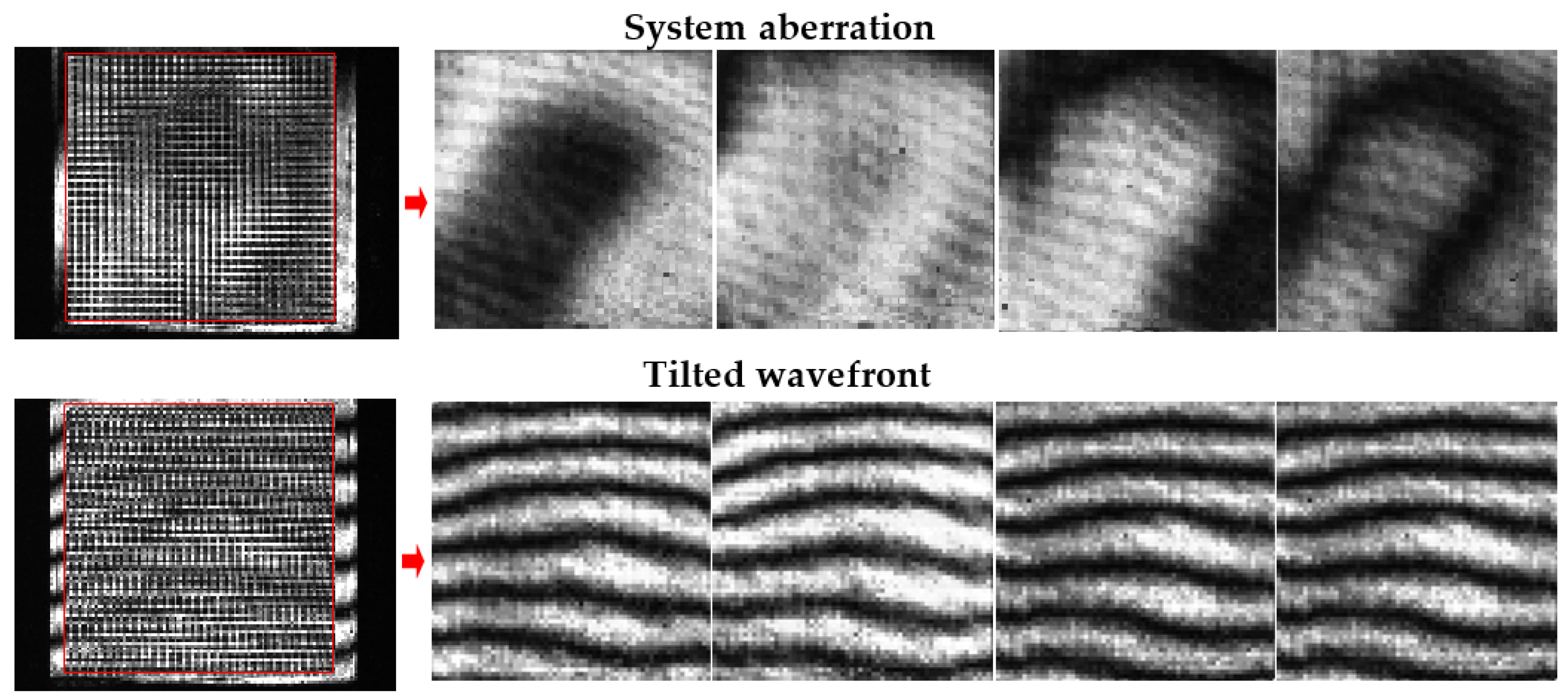
Based on the experimental system, the proposed pixelated PSI is employed to measure the system aberration and a tilted wavefront is introduced by appropriately tilting the mirror M1. The acquired pixelated phase-shifted interferograms are shown in the left sub-figure of Figure 10, respectively, with the ROI area of interferograms marked by solid-line boxes. Within the ROI of 1136 pixel × 1136 pixel, the region is uniformly subdivided into 512 × 512 cells. This subdivision corresponds to the spatial resolution of the LC-SLM. Consequently, each cell contains 2.219 pixel × 2.219 pixel, which is rounded down to 2 pixel × 2 pixel. The average grayscale value within the 2 pixel × 2 pixel in each cell is calculated and taken as the intensity of this cell, thereby constructing a new intensity matrix whose dimensions match the spatial resolution of the LC-SLM. Subsequently, the loop retrieval algorithm is applied to decompose the pixelated pattern into four phase-shifted interferograms with a phase step of 90°, as respectively displayed in the right sub-figure of Figure 10. The pixelated interferogram itself is difficult to interpret directly, while the decomposed four-step phase-shifted interferograms exhibit the conventional fringe structure of standard interferograms.
Figure 10.
Pixelated interferograms for system aberration and tilted wavefront, and decomposed phase-shifted interferograms.
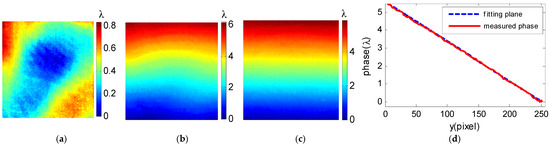
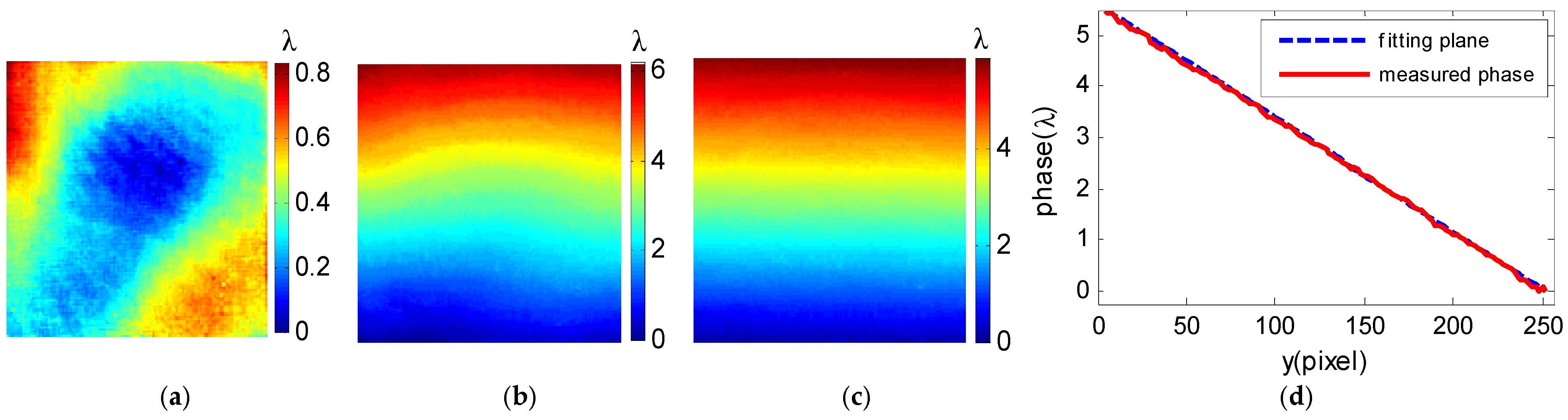
The system aberration from the optical setup and tilted wavefront retrieved by the pixelated PSI are shown in Figure 11a and Figure 11b, respectively. It can be seen that the experimental system contains a system aberration of approximately 0.8 λ, which causes the tilted wavefront to deviate slightly from the ideal inclined plane. By removing the system aberration from the retrieved tilted wavefront, the tilted wavefront free of system aberration is obtained, as shown in Figure 11c. To visually assess the retrieval quality, Figure 11d presents a cross-sectional profile at the central column of the measured tilted wavefront and the fitting plane. It can be observed that the tilted wavefront free of system aberration is very close to the ideal plane.
Figure 11.
Wavefront retrieval results of pixelated phase-shifting interferometry: (a) retrieved system aberration, (b) retrieved tilted wavefront, (c) tilted wavefront free of system aberration, (d) cross-sectional profile at the central column of the measured and the fitting phases.
4.2. Defocused Wavefront Measurements Using Two Interferometers
A defocused phase plate is placed in the experimental system, and comparative measurements are conducted using two methods, namely the proposed pixelated phase-shifting method and conventional eight-step phase-shifting method. Figure 12 shows the interferogram obtained by the proposed method and four-step phase-shifted interferograms decomposed from it.
Figure 12.
Pixelated interferograms for defocused wavefront and decomposed phase-shifted interferograms.
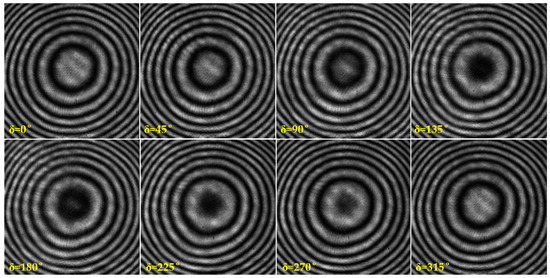
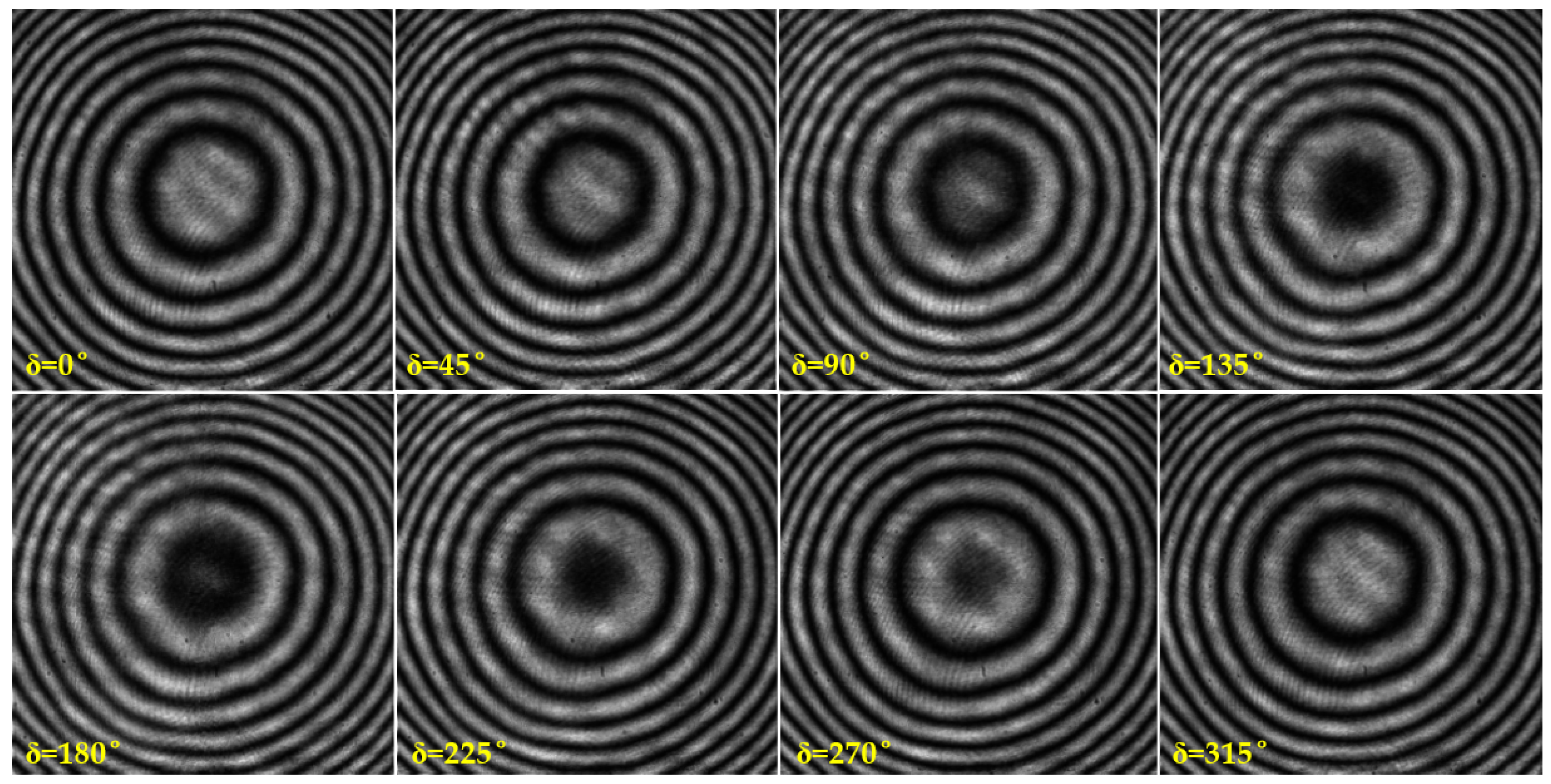
To construct the experimental system for eight-step PSI, the following adjustments are made on the basis of the setup in Figure 5: the LC-SLM is loaded with a frame of driving image at the zero grayscale level, and a quarter-wave plate (QWP) is inserted in front of P2, with its fast axis oriented at 45° relative to the vibration direction of the incident linearly polarized light. By rotating P2 eight times with a step angle of 22.5°, eight frames of phase-shifted interferograms are acquired sequentially, as presented in Figure 13.
Figure 13.
Eight frames of phase-shifted interferograms recorded in eight-step PSI experiment.
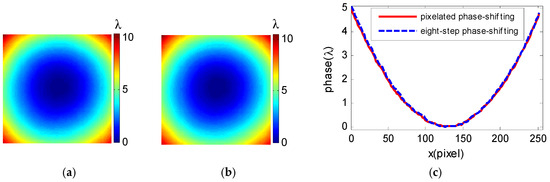
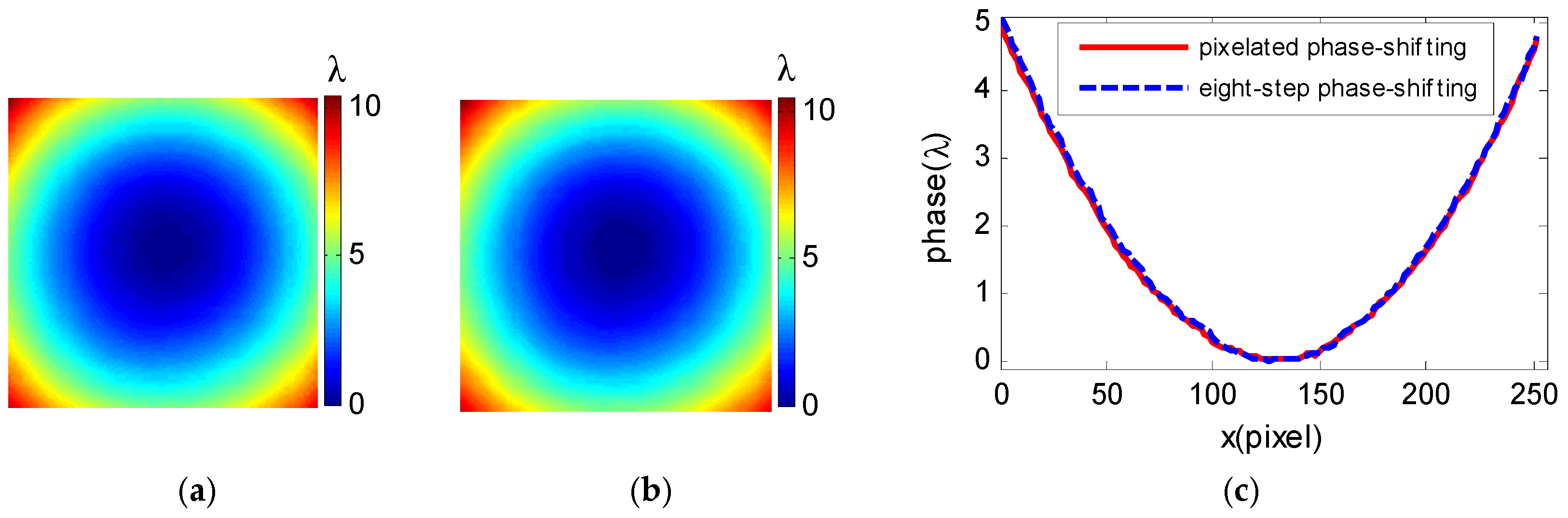
The defocused wavefronts retrieved by the two methods are shown in Figure 14. Figure 14c further presents cross-sectional data at the central row of the retrieved wavefronts. The results indicate that the retrieval results of the two methods are in excellent agreement with minimal deviation.
Figure 14.
Defocused wavefronts retrieved by two methods: (a) retrieved by the proposed method, (b) retrieved by eight-step PSI, (c) cross-sectional profile at the central row of the retrieved wavefronts.
5. Discussion
5.1. Analysis of Wavefront Retrieval Accuracy
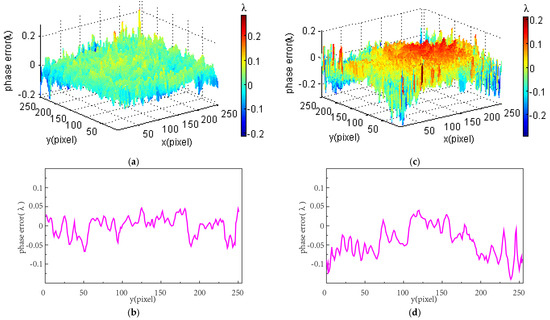
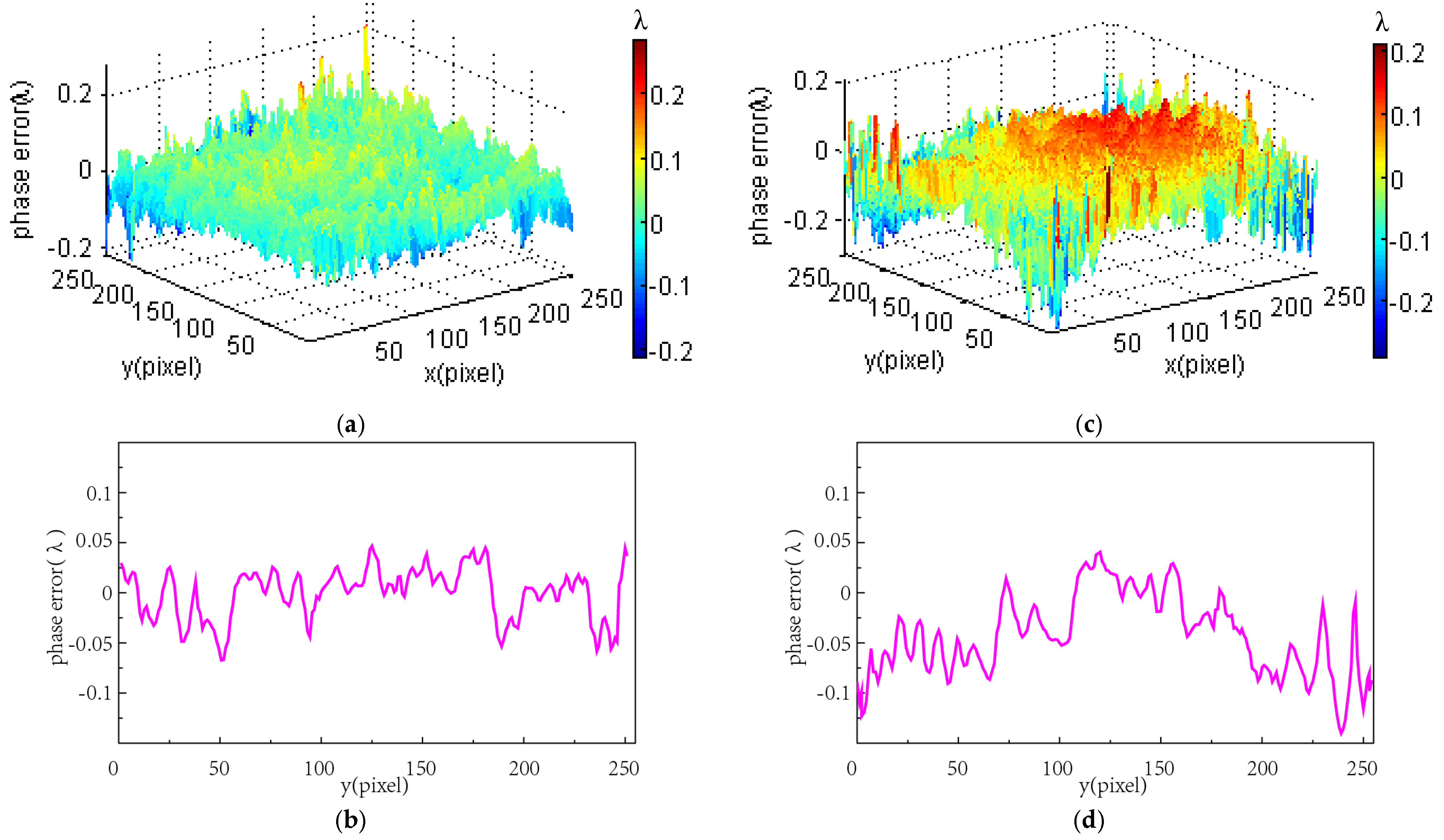
To quantitatively evaluate the retrieval accuracy, the residual wavefront for both tilted and defocused wavefronts are calculated and visualized. For the retrieved tilted wavefront shown in Figure 11c, the residual wavefront distribution between the retrieved phase and its least-squares fitting plane is presented in Figure 15a, with root-mean-square (RMS) and peak-to-valley (PV) values of 0.046 λ and 0.6083 λ, respectively. Figure 15b shows a cross-sectional profile of this residual wavefront along the y-axis at its central column.
Figure 15.
Residual wavefronts: (a) residual wavefront distribution between the retrieved tilted wavefront and its fitting plane, (b) cross-sectional profile at the central column in (a), (c) residual wavefront distribution between the phases shown in Figure 14a,b, (d) cross-sectional profile at the central row in (c).
For the defocused wavefront retrieved by the two methods (Figure 14a,b), the residual wavefront distribution between them is presented in Figure 15c. The RMS value and PV value are 0.075 λ and 0.5183 λ, respectively. A cross-sectional profile along the x-axis at the central row is further provided in Figure 15d. In the comparative measurement of the defocused phase plate, both methods are applied to the same phase object under an identical beam aperture. Except for the insertion of the QWP in the eight-step PSI configuration, the two systems shared exactly the same light source, optical components and layout. This design minimized additional aberrations that might be induced by differences in measurement conditions or optics. Considering the inherent high accuracy of eight-step PSI, this experimental scheme provides a reliable evaluation for the effectiveness of the proposed method.
It can be seen from the distribution characteristics of residual wavefronts that the retrieval errors are relatively large in the four corner regions of the square aperture. This is mainly related to the phase modulation non-uniformity of the LC-SLM, especially in its edge regions. Therefore, the retrieval accuracy of the LC-SLM-based pixelated PSI can be further improved by adopting a circular beam aperture, together with precise calibration and compensation for the local phase modulation non-uniformity of the LC-SLM.
In the proposed single-shot pixelated PSI method, the LC-SLM is only required to generate a static, high-frequency pattern with four specific phase shifts. The four corresponding control grayscale values are directly obtained from the calibrated phase curve using adjacent-point interpolation. A global correction of its non-linear phase modulation response is unnecessary. In addition, the inter-pixel crosstalk from LC-SLM may degrade the accuracy of the generated high-frequency phase pattern, and a closed-loop compensation strategy involving direct measurement and pre-distortion of the LC-SLM input could be implemented to further mitigate this effect. This aspect will be thoroughly investigated in future work.
5.2. Performance Comparisons with Other Methods
A qualitative comparison of the proposed LC-SLM-based method with two existing instantaneous PSI techniques, namely the grating-based method and micropolarizer array-based method, is summarized in Table 1.
Table 1.
Performance comparison of three simultaneous PSI techniques.
6. Conclusions
This paper presents an in-depth study on the method principle, optical structure, wavefront retrieval algorithm, key techniques and experimental measurement of pixelated PSI using a phase-only LC-SLM. The experimental systems based on the Mach–Zehnder interferometer are established to conduct experimental investigation. A critical technical contribution is the development of an interferogram region segmentation method based on wavefront-modulated sequential images, which achieves precise pixel-level alignment between the LC-SLM and CCD sensor, thereby laying a technical foundation for the reliable implementation of the method. The proposed method is rigorously validated through wavefront measurement experiments for system aberration, tilted wavefront and defocused wavefront. The results verify the feasibility and effectiveness of applying a phase-only LC-SLM to single-shot, pixelated PSI. This technical solution eliminates the need for complex beam-splitting optics and features single-frame retrieval, single-shot exposure, instantaneous measurement and compact structure. Consequently, the method shows particular promise for measuring relatively low-frequency wavefronts and expands the application scope of LC-SLMs in PSI.
Nevertheless, the ongoing challenges of this method are also evident. The current performance is constrained by the LC-SLM’s intrinsic properties, including its wavelength-dependent response, finite refresh rate (which limits dynamic measurement temporal resolution), and spatial non-uniformity in phase modulation. These limitations are expected to be addressed with ongoing advancements in LC-SLM technology. From a practical standpoint, future work will focus on the precise calibration of local phase modulation characteristics and the compensation of modulation non-uniformity and inter-pixel crosstalk. Enhancing the control over pixelated phase-shifting accuracy is expected to further improve measurement fidelity, paving the way for more demanding practical applications of this technique.
Author Contributions
Conceptualization and methodology, F.B. and Z.Z.; investigation, Z.Z., J.C. (Jiayi Chen) and Y.C.; writing—original draft preparation, F.B. and J.C. (Jiayi Chen); writing—review and editing, X.G. and J.W.; validation, J.C. (Jixiang Cai); funding acquisition, F.B. All authors have read and agreed to the published version of the manuscript.
Funding
This research was funded by the Adaptive Optics National Key Laboratory of China (No. FNLAO-24-MS-O06) and the National Natural Science Foundation of China (No. 62165011).
Data Availability Statement
The original contributions presented in this study are included in the article. Further inquiries can be directed to the first author.
Acknowledgments
The authors would like to express their gratitude to the Joint Laboratory for Extreme Conditions Matter Properties, Southwest University of Science and Technology, for providing the necessary equipment for this research.
Conflicts of Interest
The authors declare no conflicts of interest.
References
- Chen, L.C.; Yeh, S.L.; Tapilouw, A.M.; Chang, J.C. 3-D surface profilometry using simultaneous phase-shifting interferometry. Opt. Commun. 2010, 283, 3376–3382. [Google Scholar] [CrossRef] [Scilit]
- Hou, X.; Zhang, S.; Hu, X.; Quan, H.; Wu, G.; Jiao, X.; He, Y.; Qiang, C.; Wu, F. The research progress of surface interferometric measurement with higher accuracy. Opto-Electron. Eng. 2020, 47, 200209. [Google Scholar]
- Zhao, L.; Zang, Z.; Zhang, S.; Chen, Y.; Zheng, Y.; Niu, Z.; Yu, J.; Luo, W.; Li, Z.; Kong, M. Accuracy analysis of measuring cylindrical surfaces with complex parameters using two-dimensional pseudo lateral shearing interferometry. Photonics 2025, 12, 1059. [Google Scholar] [CrossRef] [Scilit]
- Cheng, W.; Li, Z.; Wu, X.; Yin, S.; Zhang, B.; Zhang, X. Semiconductor wafer flatness and thickness measurement using frequency scanning interferometry technology. Photonics 2025, 12, 663. [Google Scholar] [CrossRef] [Scilit]
- Pu, H.; Li, D.; Luo, P.; Chen, Z. Measurement of flow density field by cyclic radial shearing interferometer. Opto-Electron. Eng. 2020, 47, 190390. [Google Scholar]
- Wu, T.; Li, H.; Zhang, C.; Yu, J.; Liu, J.; Zheng, Z.; Duan, B.; Sun, A.; Ju, B. Multi-channel wide spectrum high-resolution spectrometer for thin-film thickness measurement. Optics 2025, 6, 55. [Google Scholar] [CrossRef] [Scilit]
- Zhang, L.; Chen, H.; Sun, W.; Wang, J.; Wu, Q. Review of anti-vibration technology in phase-shifting interferometry. Laser Optoelectron. Prog. 2023, 60, 1900005. [Google Scholar]
- Bai, F.; Lang, J.; Gao, X.; Zhang, Y.; Cai, J.; Wang, J. Phase shifting approaches and multi-channel interferograms position registration for simultaneous phase-shifting interferometry: A review. Photonics 2023, 10, 946. [Google Scholar] [CrossRef] [Scilit]
- Zhao, J.; Liu, L.; Wang, T. Synchronous phase-shifting interference for high precision phase imaging of objects using common optics. Sensors 2023, 23, 4339. [Google Scholar] [CrossRef] [Scilit]
- Hettwer, A.; Kranz, J.; Schwider, J. Three channel phase-shifting interferometer using polarization-optics and a diffraction grating. Opt. Eng. 2000, 39, 960–966. [Google Scholar] [CrossRef] [Scilit]
- Zheng, D.H.; Chen, L.; Li, J.P.; Gu, C.; Zhu, W.; Han, Z. Simultaneous phase-shifting interferometry: Immune to azimuth error of fast-axes in retarder array. Appl. Opt. 2015, 54, 9803–9808. [Google Scholar] [CrossRef] [Scilit]
- Jiang, J.; Guo, R.; Qian, Y.; Liu, Y.; Xue, L.; Li, J. Synchronous phase-shifting shearing interferometry based on polarization grating. Acta Opt. Sin. 2024, 44, 0312001. [Google Scholar]
- Millerd, J.; Brock, N.; Hayes, J.; Kimbrough, B.; Wyant, J.C. Modern approaches in phase measuring metrology. In Proceedings of the SPIE—The International Society for Optical Engineering, Dublin, Ireland, 4–6 April 2005; SPIE: Bellingham, WA, USA, 2005; Volume 5856, p. 14. [Google Scholar]
- Tian, F.; Bai, F.; Wu, Y.; Xu, Y.; Mei, X. Position registration for simultaneous phase-shifting interferograms based on statistical analysis method. Acta Opt. Sin. 2014, 34, 0626001. [Google Scholar] [CrossRef] [Scilit]
- Zheng, D.; Chen, L.; Li, J.; Zhu, W.; Li, J.; Han, Z. Position registration for interferograms and phase-shifting error calibration in dynamic interferometer. Acta Opt. Sin. 2016, 36, 220–228. [Google Scholar] [CrossRef] [Scilit]
- Novak, M.; Millerd, J.; Brock, N.; North-Morris, M.; Wyant, J. Analysis of a micropolarizer array-based simultaneous phase-shifting interferometer. Appl. Opt. 2005, 44, 6861–6868. [Google Scholar] [CrossRef] [Scilit]
- Zhang, Z.; Dong, F.; Qian, K.; Zhang, Q.; Chu, W.; Zhang, Y.; Man, X.; Wu, X. Real-time phase measurement of optical vortices based on pixelated micropolarizer array. Opt. Express 2015, 23, 20521–20528. [Google Scholar] [CrossRef] [Scilit]
- Peng, X.; Ri, S.; Inoue, T.; Awatsuji, Y.; Matoba, O. Dynamic phase measurement of a transparent object by parallel phase-shifting digital holography with dual polarization imaging cameras. Opt. Lasers Eng. 2021, 141, 106583. [Google Scholar] [CrossRef] [Scilit]
- Jin, L.; Wang, J.; Zeng, D.; Zhang, Y.; Pu, W.; Luo, M.; Bian, Y.; Kuang, C.; Liu, X. Design of point diffraction transient interferometer for surface profile measurement of large aperture optical components. Acta Opt. Sin. 2025, 45, 0322002. [Google Scholar]
- Keskin, A.; Kaya, G.; Kaya, N.; Strohaber, J.; Kolomenskii, A.A.; Schuessler, H.A. Dynamic control of Airy beams using real-time phase-amplitude encoding on a spatial light modulator. Optics 2024, 5, 581–594. [Google Scholar] [CrossRef] [Scilit]
- Qian, X.; Tian, A.; Liu, B.; Wang, H.; Niu, R.; Zhu, X.; Wei, X. Precision analysis of phase shifting digital holography micromeasurement system based on LCSLM. Acta Photonica Sin. 2022, 51, 0409003. [Google Scholar]
- Song, Z.; Xu, L.; Wang, J.; Liang, X.; Dai, J. Development of an Automated Phase-Shifting Interferometer Using a Homemade Liquid-Crystal Phase Shifter. Photonics 2025, 12, 722. [Google Scholar] [CrossRef] [Scilit]
- Bai, F.; Miao, Y.; Xu, Y.; Wang, G.; An, P. Absolute measurement of the generated aberrations from liquid crystal spatial light modulator using a common-path interferometry. J. Mod. Opt. 2017, 64, 1257–1262. [Google Scholar] [CrossRef] [Scilit]
- Chen, J.; Wang, J.; Bai, F.; Xu, Y. Phase modulation characteristics measurement of high gray-level LC-SLM by using phase grating diffraction method. China Meas. Test. Technol. 2022, 48, 35–40. [Google Scholar]
- Bai, F.; Han, F.; Xu, Y.; Bao, X.; Gan, S. Modified Fourier-transform method for phase-shift calibration. Opt. Lasers Eng. 2011, 49, 932–936. [Google Scholar] [CrossRef] [Scilit]





Disclaimer/Publisher’s Note: The statements, opinions and data contained in all publications are solely those of the individual author(s) and contributor(s) and not of MDPI and/or the editor(s). MDPI and/or the editor(s) disclaim responsibility for any injury to people or property resulting from any ideas, methods, instructions or products referred to in the content. |
© 2026 by the authors. Licensee MDPI, Basel, Switzerland. This article is an open access article distributed under the terms and conditions of the Creative Commons Attribution (CC BY) license.