Article

Analysis and Design of a Hybrid Graphene/Vanadium-Dioxide Terahertz Metasurface with Independently Reconfigurable Reflection Phase and Magnitude


by
Eric Amoateng
1,2,
Ellis Mubarak Sani
2,
Kingsford Sarkodie Obeng Kwakye
2 and
Alexandros Pitilakis
3,*
1
Department of Electrical and Electronics Engineering, Ghana Communication Technology University, Accra GA-167-2979, Ghana
2
Department of Telecommunication Engineering, Kwame Nkrumah University of Science and Technology, Kumasi AK-448-4944, Ghana
3
School of Electrical and Computer Engineering, Aristotle University of Thessaloniki, 54124 Thessaloniki, Greece
*
Author to whom correspondence should be addressed.
Photonics 2026, 13(2), 195; https://doi.org/10.3390/photonics13020195
Submission received: 30 December 2025 / Revised: 6 February 2026 / Accepted: 12 February 2026 / Published: 15 February 2026
(This article belongs to the Special Issue Photonics Metamaterials: Processing and Applications)

Abstract

A reconfigurable THz metasurface (MS) capable of independent reflection amplitude and phase modulation is designed and analyzed. The tunability is achieved in a simple few-layer structure by control over the chemical potential of a graphene monolayer patterned in square patches and over the bulk conductivity of an overlying vanadium dioxide (VO2) patch array; these impart control over the reflection phase and magnitude, respectively. To design and analyze the MS unit cell, we employ intuitive equivalent circuit and transmission line modeling, which is validated against full-wave simulations, showing good agreement in the regime of interest, i.e., on the first resonance for normal plane wave incidence. The simulated phase modulation approaches 250 ° , enabling binary-encoded digital metasurface designs, while the magnitude modulation spans more than 20 dB, from 3 dB almost down to perfect absorption. The flexibility of dynamic phase and amplitude control can unlock the full potential of such THz MS hybrid designs for future wireless communications (6G and beyond) and for sensing applications. Finally, the analytical modeling can be extended to polarization-dependent, anisotropic, or non-local EM responses and/or to include aspects of the multiphysical control mechanisms.

1. Introduction

Metasurfaces (MS) are artificially engineered ultra-thin planar structures arranged in periodic configurations, enabling precise control of the scattered electromagnetic (EM) wavefront direction/shape, amplitude, and/or polarization [1,2,3,4,5,6]. Through tailored geometric design and material composition, MS can realize a wide range of functionalities, including wavefront shaping (e.g., beam steering or splitting), absorption, and transmission control [7,8]. Being the two-dimensional counterpart of bulk/3D metamaterials, MS offer distinct advantages such as low profile, reduced loss, ease of fabrication, and seamless integration with existing systems, while maintaining high efficiency and versatile EM wave manipulation capabilities [9,10]. By reconfigurability [5], we refer to the ability to non-negligibly adjust their EM response after deployment, in real time and without moving parts, which makes reconfigurable MS (RMS) particularly attractive for modern adaptive applications, as opposed to conventional passive metasurfaces.
The ongoing work related to RMS can be broadly categorized based on their capability to modulate the phase, amplitude, and/or polarization of scattered EM waves; theoretical and numerical techniques for modeling, analysis, and inverse design of such RMS are particularly interesting. Phase-modulating RMS shapes the phase of an incident wavefront and has been extensively investigated for applications such as dynamic beam steering [11], beam focusing [12], holography [13], and polarization control [6,14,15,16]. Amplitude-modulating RMS regulate the magnitude of the scattered EM wave within specific frequency bands and have been widely explored for functionalities including tunable perfect absorbers and transmission or backscatter control [3,4,7,8,17,18]. However, for more sophisticated and performance-critical applications—such as high-fidelity holography, multi-beamforming, high-resolution imaging, and sidelobe suppression—the ability of RMS to simultaneously control both the phase and amplitude of the reflected wavefront is highly desirable. The independent and continuous modulation of these two degrees of freedom enables precise wavefront shaping and significantly improves system performance in ‘smart’ EM environments. Nevertheless, most reported RMS capable of amplitude and phase tuning operate at microwave and/or millimeter-wave frequencies, employing PIN diodes or varactors [19]. Unfortunately, extending such designs to the THz band, even the sub-THz (e.g., 300 GHz), remains challenging due to increased material losses, fabrication constraints, and the reduced effectiveness of conventional tuning mechanisms at shorter wavelengths [1,2]. This gap highlights the need for simple, compact, low-loss, and efficient RMS platforms suitable for emerging THz or hybrid applications [20].
To address this demand, focus has shifted to advanced materials that exhibit strong THz light-matter interaction and offer additional degrees of freedom for realizing complex and dynamic EM functionalities. This has driven the development of smart materials and nanostructures capable of achieving efficient and versatile tunability in the THz band [10,21]. Atomically thin 2D materials, such as graphene [22], and phase-change materials, such as vanadium dioxide (VO2) [5], are two emerging and promising material platforms for achieving dynamic and reconfigurable THz wavefront scattering. In the THz, graphene exhibits superior carrier mobility, which allows for efficient electrical control of its reactive surface conductivity, making it particularly attractive for dynamic phase control. VO2, on the other hand, exhibits a reversible insulator-metal transition (I-M-T) near 340 K, during which its bulk electrical conductivity changes by several orders of magnitude; this enables strong and controllable amplitude modulation, which cannot be achieved with graphene alone or other phase-change materials [23,24], which require more complicated resonant structures, reducing fabrication feasibility. Therefore, using this hybrid MS design, independent control of the amplitude and phase is realized, which is difficult to achieve using a single material platform [25].
In this work, we employ a hybrid unit cell that integrates graphene and VO2 in a single THz RMS design to exploit their combined strong points: Electrically tuning graphene’s chemical potential ( μ c ) primarily alters the reactive component of its surface impedance, leading to a smooth and broadband phase modulation; as a result, graphene is suitable for phase control but is intrinsically limited in amplitude modulation due to its relatively weak absorption in the THz range [26,27]. The I-M-T of VO2 [28] largely modifies its resistive impedance through its bulk conductivity ( σ VO 2 ) which can be exploited to modulatethe reflection magnitude in resonant MS structures. We choose a hybrid but decoupled MS architecture where varying graphene μ c minimally perturbs the absorption (governed by the VO2 state) and, conversely, changing σ VO 2 has limited impact on the reflection phase. This architecture enables flexible and independent modulation of the complex (amplitude and phase) EM wave scattering, which is not readily achievable with either material alone. The graphene–VO2 hybrid MS therefore provides a practical pathway toward multifunctional, reconfigurable THz metasurfaces capable of dynamic and independent reflection phase and magnitude modulation, which is highly desirable for emerging 6G communication and sensing applications [25]. Normal incidence is considered in all theoretical studies, for the sake of simplicity, but polarization-dependent performance under oblique illumination is also numerically evaluated.
The remainder of this paper is organized as follows: Section 2 presents a systematic design methodology of the proposed RMS, highlighting the unit cell architecture, material dispersion models, equivalent circuit/transmission line model (ECM/TLM), and full-wave EM simulations. Section 3 reports and compares the results obtained from three investigated configurations. Section 4 provides a detailed discussion and comparison of the results to the current state-of-the-art. Finally, Section 5 concludes the paper by summarizing the main findings.

2. Design of the Unit Cell

2.1. Unit Cell Architecture

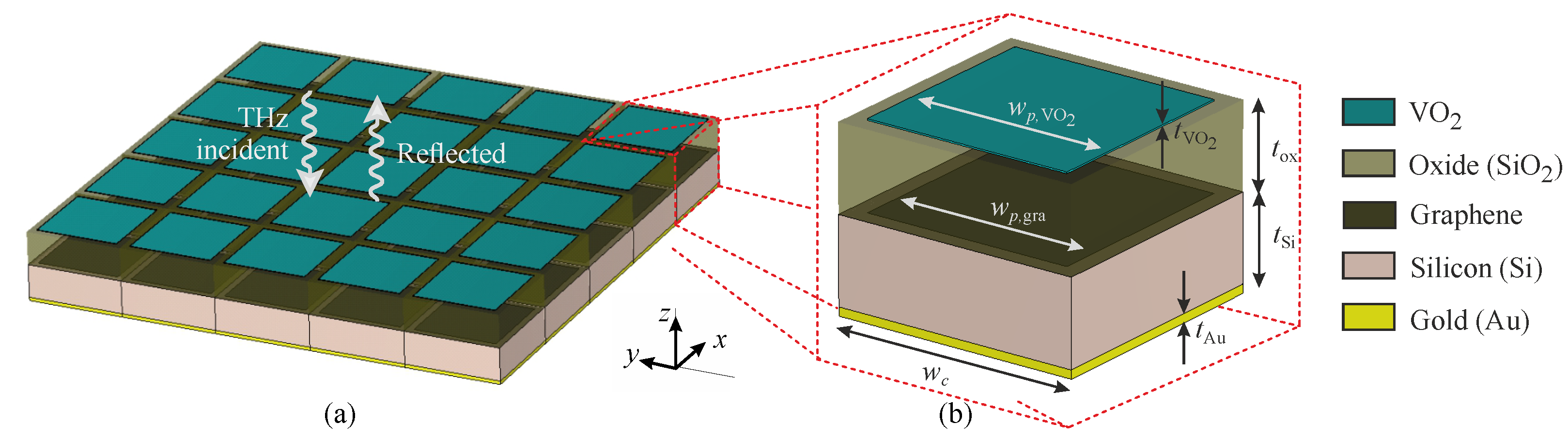
A three-dimensional schematic of the proposed MS array and the unit cell structure are shown in Figure 1a and Figure 1b, respectively, with periodic extension along the x and y directions. This unit cell adopts a multilayer architecture consisting of five stacked layers arranged sequentially from top to bottom: The top layer is VO2 which is investigated in two configurations, as a uniform bulk slab and as a patterned square patch occupying a large fraction of the unit cell area [29,30]. VO2 (PCM) is toggled between transparent and metallic state. Thus, without being highly absorptive itself, metallic VO2 can form an absorption resonance inside the unit cell (where the low losses of graphene can be exploited) which eventually controls the magnitude of the reflected wave; this control is effectuated by tuning the σ VO 2 via heating. Next, an oxide (SiO2) dielectric layer is introduced beneath the VO2 layer, to provide electrical isolation and reduce the coupling between the reconfigurable materials; in the THz, SiO2 is described by a relative permittivity ε r = 3.88 (refractive index is 1.97), assumed dispersionless. A graphene monolayer is incorporated below the dielectric oxide spacer; graphene is modeled either as an infinite sheet or in square-patterned patches, with zero thickness in both cases.High-quality graphene predominantly controls the phase of the impinging THz wave, owing to its largely reactive surface impedance. Graphene also has some losses (resistive impedance) which can be considered as parasitic for the phase-manipulation, i.e., they are not strong enough to create an absorption resonance by themselves.Consequently, by electrically tuning graphene’s μ c , we control only the phase of the reflected wave. The graphene layer is supported by a silicon substrate with a relative permittivity ε r = 11.8 (dispersionless), which enhances field confinement and mechanical robustness in the multilayer structure [31]. Finally, the back of the cell is terminated with a continuous gold mirror, modeled as a perfect electric conductor, to suppress transmission and enable reflective mode operation [32,33]. The combination of these two qualities, brought by graphene and VO2, highlight the potential of this hybrid unit cell design in achieving independent modulation in phase and magnitude.

2.2. Material Dispersion Models

Graphene is modeled as a zero-thickness transparent impedance sheet, e.g., with a custom “tabulated surface impedance” (TSI) material in CST Microwave Studio; its corresponding complex surface conductivity σ s is given by Kubo formulas [34]. Graphene’s surface conductivity generally has intraband and interband contributions, but the intraband term is dominant in the THz regime; so, the interband term (which is dominant in the near-infrared and visible spectrum) can be neglected [35,36]. According to the Kubo formulas, the complex σ s depends on the interacting EM wave frequency ( ω ) , lattice temperature (T), chemical potential ( μ c ) , and relaxation time ( τ ) , i.e., σ s = σ s ( ω , T , μ c , τ ) . In this work, we exploit the dependence on μ c by assuming it can be externally controlled, e.g., by electrical gating or biasing. The relaxation time is related to the carrier mobility ( μ mob ), which quantifies the purity of the graphene sample [37], i.e., its losses. With these assumptions, the graphene THz surface conductivity is expressed as
σ s σ intra = j 2 q 2 K B T π 2 ( ω + j τ 1 ) ln 2 cosh E F 2 K B T ,
where = h / ( 2 π ) is the reduced Planck constant, K B is the Boltzmann constant, and τ = ( μ c μ mob ) / ( q v f 2 ) , i.e., it depends on the chemical potential. We consider a fixed Fermi velocity v f = 10 6 m/s and a fixed μ mob = 20,000 cm 2 V 1 s 1 ; q is the electron charge. For μ c K B T , i.e., for highly doped graphene at room temperature T = 300 K, it holds that μ c E F and that the surface conductivity can be further simplified into the Drude-like spectra as
σ s ( ω ; μ c , τ ) = j q 2 μ c π ( ω + j τ 1 ) ,
which highlights its μ c -dependent dispersive properties.
For the VO2 THz dispersion, we used the Drude formula
ε r ( ω ; σ VO 2 , γ ) = ε ω p 2 ( σ VO 2 ) ω 2 + j γ ω ,
where ω is the EM wave frequency, ϵ is the high-frequency relative dielectric permittivity, ω p is the plasma frequency, and γ = 5.75 × 10 13 rad/s is the collision frequency that dictates the losses. As implied by Equation (3), the plasma frequency depends on its heat-tunable bulk conductivity and can be approximated as ω p 2 = ω p 2 ( σ VO 2 ) = ( σ VO 2 / σ ref ) ω p , ref 2 with reference bulk conductivity σ ref = 3 × 10 5 S/m and reference plasma frequency ω p , ref = 1.4 × 10 15 rad/s. Importantly, the bulk conductivity of VO2 in the metallic state is four orders of magnitude higher than its conductivity in the insulator (dielectric) state. In this work, we set the two σ VO 2 extremes, for dielectric and metallic states, as 20 S/m and 200,000 S/m, respectively. Furthermore, we assume this bulk conductivity can be continuously varied between the insulator and metallic states, e.g., by temperature control, to consider its behavior in the intermediate states.
Note that the heating-mediated phase transition in VO2 is non-volatile and is intended to be used at slow rates (not in fully dynamic scenarios), i.e., as a ‘toggle’ switch between absorptive and wavefront-shaping RMS functionalities; the former can be used in wireless sensing (e.g., if graphene patches are seen as planar integrated plasmonic antennas or photodiodes), while the latter is used in wireless communications (beam steering to extend non-line-of-sight coverage).

2.3. Transmission Line Modeling

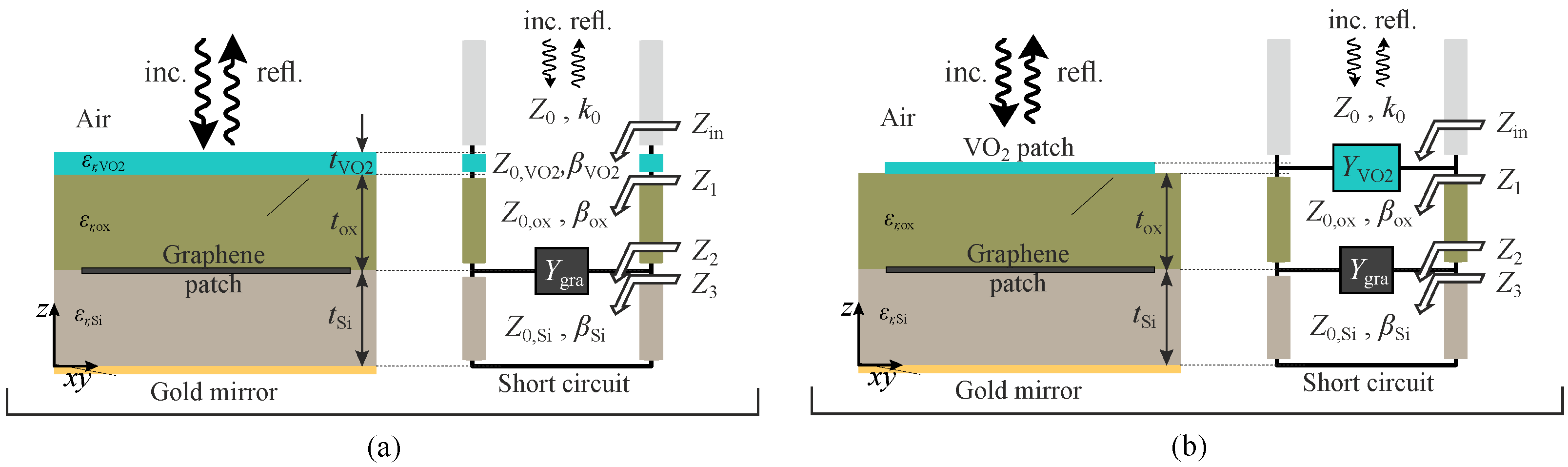
A transmission line model (TLM) is be used to approximately quantify the reflection coefficient spectra when the MS cell of Figure 1b is illuminated by a plane wave. The unit cell cross-section side view and the corresponding TLM are shown in Figure 2 for two configurations of the VO2 layer. The purpose is to calculate the input impedance Z in at the top side, i.e., at the exposed surface where THz light impinges normally on the surface. Importantly, the model must use only the wave frequency, geometric dimensions, and material properties of the unit cell, in closed-form expressions, so that we can compute the spectra without conducting full-wave simulations. To compute Z in , we can start from the bottom of the TLM, i.e., from the reflective mirror, and move to the top, using transmission line theory [37,38,39].
Starting from the bottom, the gold ground plane is considered a short circuit. Then, the silicon substrate slab with thickness t Si is modeled as a transmission line (TL) segment of that same length, of characteristic impedance Z 0 , Si and of phase constant β Si . For normal incidence, it holds that Z 0 , Si = η 0 / ε r , Si and β Si = k 0 ε r , Si , where η 0 377 Ω is the vacuum wave impedance and k 0 = 2 π / λ 0 is the vacuum wavenumber. The input impedance of this TL segment, marked as Z 3 in Figure 2, is given by the grounded TL equation
Z 3 = j Z 0 , Si tan ( β Si t Si ) .
Continuing, the impedance Z 2 is the parallel combination of the surface impedance of the graphene layer ( Z gra = 1 / Y gra ) and the input impedance of the previous layer, Z 3 , computed as
Z 2 = Z gra Z 3 Z gra + Z 3 .
When the graphene sheet is infinite, then Z gra = 1 / σ s , i.e., its surface conductivity suffices. When the sheet is patterned, e.g., in wide patches with narrow gaps, the surface impedance of this array has an extra a capacitive (reactive) term which can be computed by an equivalent circuit model (ECM), presented in the following subsection.
Then, since the top SiO2 substrate is also a uniform slab, it can be similarly modeled as a TL segment of length t SiO 2 ‘loaded’ by Z 2 ; the input impedance at the slab’s top port, marked as Z 1 in Figure 2, is given by the impedance transformation equation (ITE)
Z 1 = Z 0 , ox Z 2 + j Z 0 , ox tan ( β ox t ox ) Z 0 , ox + j Z 2 tan ( β ox t ox ) .
Note that for a short-circuit load, i.e., Z 2 = 0 , the ITE is equivalent to Equation (4).
Finally, on the top of the cell, the VO2 slab of thickness t VO 2 depicted in Figure 2a is modeled as a thin TL segment, similar to the modeling of the two dielectric substrates; the difference here is that the characteristic impedance and phase constant of the transmission line are Drude-dispersive as the relative permittivity of the VO2 slab depends on ω according to Equation (3). The total input impedance Z in of the MS unit cell is computed by an ITE, now using Z 1 as the ’load’,
Z in = Z VO 2 Z 1 + j Z VO 2 tan ( β VO 2 t VO 2 ) Z VO 2 + j Z 1 tan ( β VO 2 t VO 2 ) ,
where tan ( β VO 2 t VO 2 ) β VO 2 t VO 2 for very thin layers. Alternatively, if the VO2 layer is patterned in deeply subwavelength-thickness square patches, i.e., similar to the graphene sheet, an ECM can be used to compute the equivalent surface impedance of this VO2 patch array which shunts Z 1 to compute Z in , instead of using the ITE; see the following subsection.
Having computed Z in and assuming normal THz wave incidence from the air-exposed side of the unit cell ( Z 0 = η 0 ), the co-polarized complex-valued reflection coefficient ( Γ ) at the input port where the THz light impinges is given by
Γ = Z in Z 0 Z in + Z 0 .

2.4. Equivalent Circuit Model for Surface Impedance of Capacitive Patch Arrays

The ultra-thin graphene wide-patch array sandwiched between two dielectric substrates with permittivities ε r 1 and ε r 2 can be approximated with a surface impedance Z gra given by [29,30]. The surface impedance consists of two parts in series, Z gra = Z s c + Z grid : The first term mainly depends on the surface conductivity of the graphene patch material, and the second term represents the equivalent surface impedance of the periodic capacitive patch array, which can be computed analytically as [30]
Z grid = j n eff 2 α ,
where α is the so-called ‘grid parameter’, which relates the tangential electric field at the MS plane to the induced surface current density on the periodic patch array. Physically, it quantifies the strength of electric coupling between adjacent metallic elements and therefore governs the capacitive behavior of the grid when the inter-element gaps are much smaller than the unit-cell period [30,40]. According to the classical Kontorovich–Tretyakov grid theory, for an electrically dense periodic array of metallic patches or strips, the grid parameter α is given in this case as [30,41],
α = k eff w p π ln csc π ( w c w p ) 2 w p .
In this manner, the final ECM-computed surface impedance of the graphene capacitive patch array is
Z gra = Z s c + Z grid = 1 σ s w c w p j η eff 2 π k eff w p ln 1 csc π ( w c w p ) 2 w p .
where σ s is the dispersive surface conductivity according to Equation (2) above, η eff is the wave impedance in the equivalent bulk medium in which the graphene patch is embedded [with relative effective permittivity ε r , eff = ( ε r 1 + ε r 2 ) / 2 ], w p is the width of the graphene patch, and w c is the period of the unit cell. Furthermore, k eff = k 0 ε r , eff is the wave number of the incident wave in the equivalent medium. In the case of the graphene patch array in the unit cell of Figure 1b, it holds ε r , eff = ( ε r , Si + ε r , ox ) / 2 .
Now, concerning VO2 when patterned in wide patches: We can model it as a shunt load equivalent to how graphene is modeled in Equation (11). In this case, the complex surface complex conductivity is expressed according to [42,43] as
σ VO 2 = j ε r ( ω ) 1 ω ε 0 t VO 2
in units of Siemens. The surface impedance of the capacitive VO2 patch array is given by Equation (11) after replacing σ s σ VO 2 and computing k eff and η eff with the corresponding ε r , eff = ( 1 + ε r , ox ) / 2 , as the VO2 patches are between air and silicon dioxide. Obviously, the width of the VO2 patches can be different from the width of the graphene patches, but both must be small in all cases. The cell side view and the corresponding TLM for this case are shown in Figure 2b, and the reflection coefficient at the input port at the top is determined in the same way as outlined earlier.

2.5. Full-Wave Simulation

We employ the CST Microwave Studio simulation software [44] to numerically investigate the EM response of the proposed MS unit cell, assuming infinite periodic repetition. The simulation is carried out using the frequency domain solver with tetrahedron mesh, which provides high accuracy for steady-state spectral, phase and absorption analyses [44,45]. The optimized geometric dimensions of the unit cell are shown in Table 1, which are the same throughout the following sections, unless otherwise stated. The unit cell periodic boundary conditions are applied along the x- and y-directions. We excite the structure at the upper Floquet port under normal plane wave incidence along the z-axis. An open boundary condition is assigned at the excitation top boundary ( z max ), where the reflection is to be computed, and the bottom boundary ( z min ) is modeled as a perfect electric conductor (PEC) to emulate the gold backplane [44,46]; use of realistic materials (such as gold) has a minimal impact on the response. The temperature-dependent phase transition behavior of VO2 is incorporated in the simulation by varying its bulk electric conductivity σ from 20 S/m to 200,000 S/m, which transitions from the insulator to metallic state [5]; this change affects the plasma frequency, and the final dispersive permittivity used in the simulations is implemented by a Drude model. Also, the graphene layer is modeled with a TSI with surface conductivity values taken by the Kubo formula (intraband); such a zero-thickness impedance sheet properly captures its two-dimensional nature without introducing artificial thickness, which is negligible compared to THz wavelengths, that should be meshed, increasing computational burden. The graphene surface impedance, which is highly reactive at THz wavelengths (imaginary part of σ s is non-negligible), is tuned simply by varying the chemical potential μ c , typically between 0.1 (near-pristine graphene) and 1 eV. This approach reduces the computational cost while preserving the essential electromagnetic behavior of the graphene-wave interaction [22,47,48].

3. Results

In this section, we present and compare the unit cell response results by ECM/TLM modeling and by full-wave simulations. The analytical ECM/TLM provides a good starting tool for pre-selecting the geometric dimensions before an optimization with full-wave simulations at the unit cell is performed. We consider normal illumination; however, the ECM and TLM can both be extended to oblique incidence, according to [29,30], to study the polarization sensitivity of the device.

3.1. VO2-Only Configuration for Reflection Amplitude Modulation

We first investigate the EM response of the MS when graphene is absent, considering the unit cell consisting of VO2 on top of the oxide/Si substrate backed by the gold ground plane. We assume the bulk conductivity of VO2 can be continuously tuned between the dielectric and metallic phases, e.g., by heating.
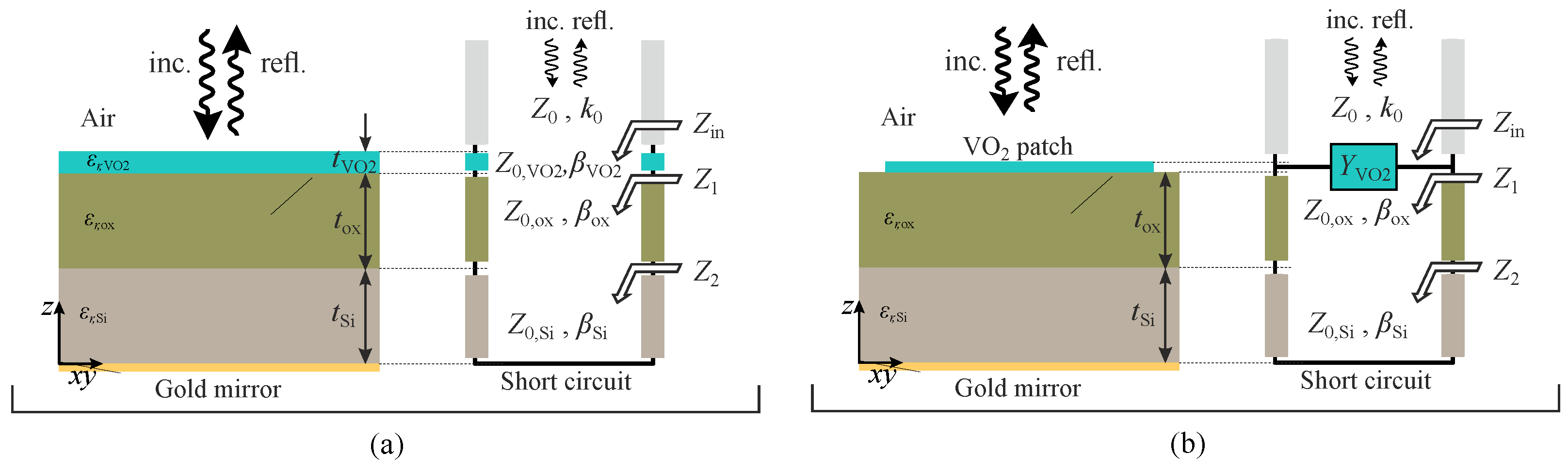
We start with the unpatterned VO2 slab case, which can be modeled by a simple TLM. The slab thicknesses are varied to 0.1 µm, 1 µm, 2 µm, and 5 µm to investigate its influence on THz reflection [49]. The input impedance Z in and the reflection coefficient Γ are subsequently computed as discussed in the methodology section by setting σ s = 0 . The equivalent circuit is shown in Figure 3a, where the unpatterned VO2, oxide, and Si slabs are cascaded as TL segments, while the gold mirror corresponds to a short-circuit termination [29,30,43].
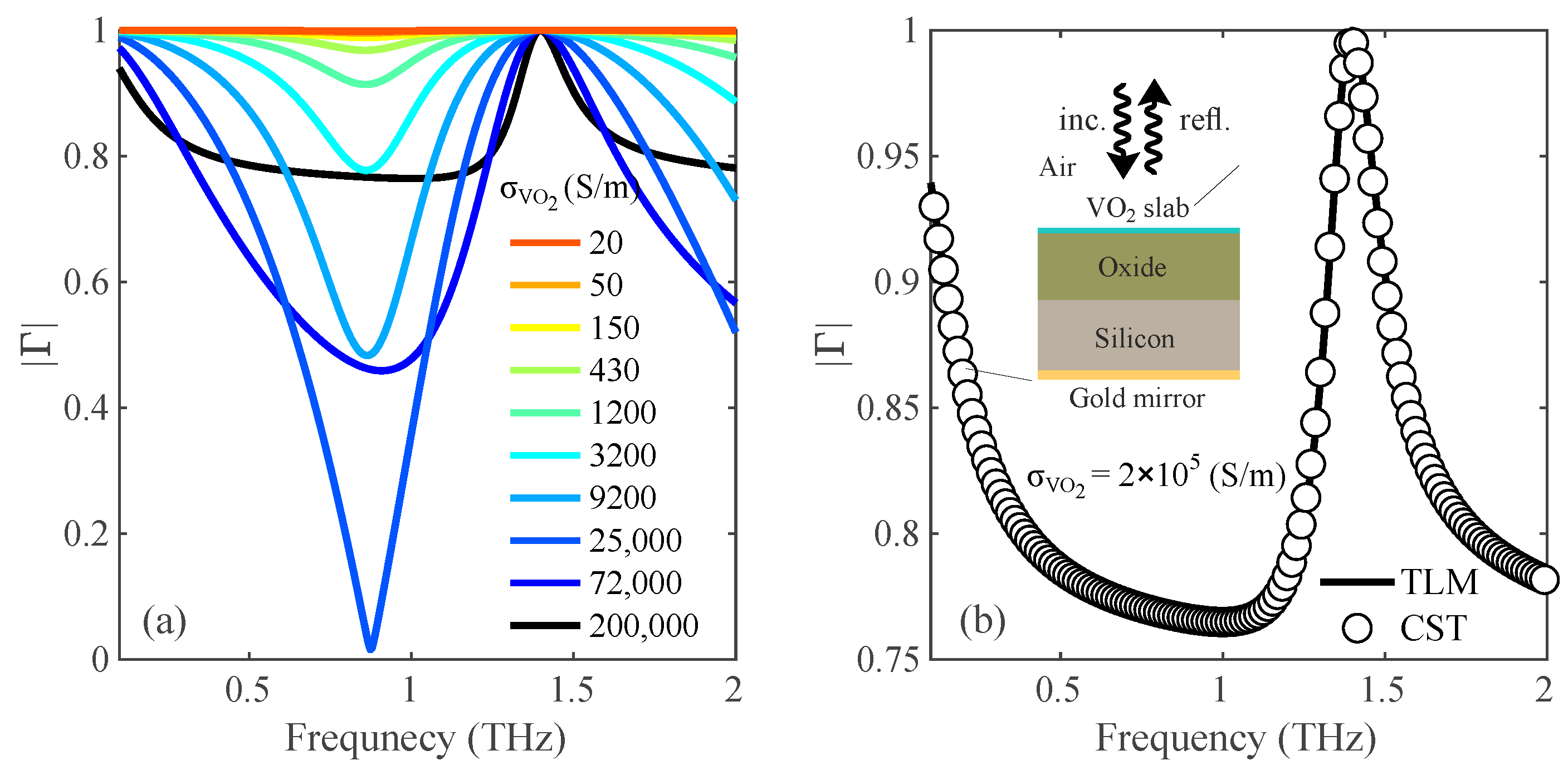
The corresponding reflection amplitude spectra are presented in Figure 4a, where we vary the VO2 bulk conductivity. These spectra clearly show the Fabry–Pérot resonant behavior of the stratified medium backed by a PEC ground. For low σ VO 2 , below 200 S/m, the structure behaves as a loss-low dielectric slab, exhibiting minimal resonance with a reflection coefficient close to unity, indicating weak electromagnetic coupling. This is consistent with the insulator phase of VO2, where the interaction with incident THz radiation is dominated by dielectric reflections [5,50]. As the conductivity increases towards the intermediate and metallic phases, deeper and sharper resonance dips appear at nearly 1 THz periodicity (free-spectral range, FSR), which is consistent with Fabry–Pérot standing-wave resonances [50,51]. Figure 4b presents a comparison between the analytical ECM/TLM and the full-wave CST simulation for the metallic VO2 state; as expected, for the unpatterned slab unit cell configuration, the agreement is exact.
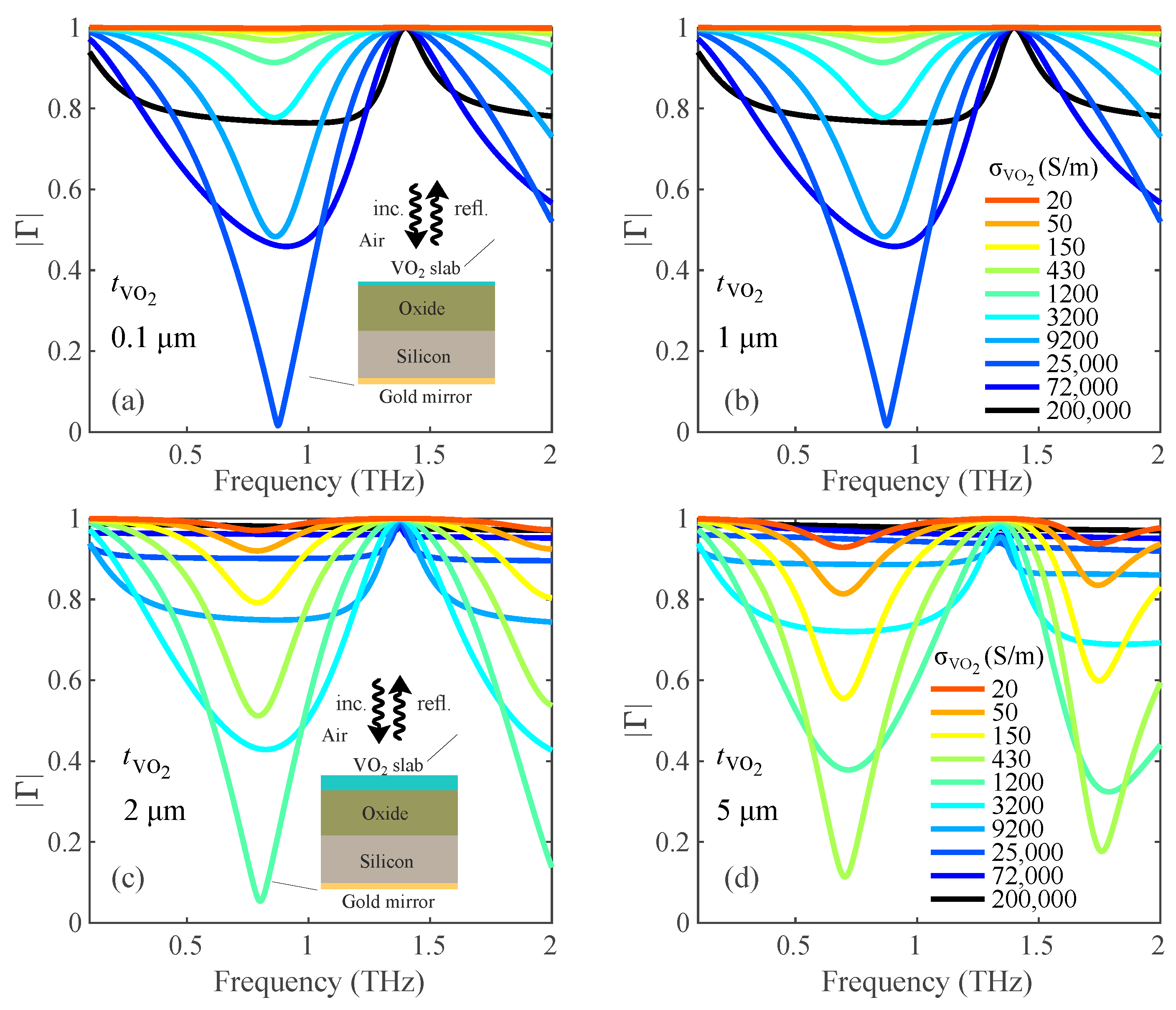
Figure 5 studies the effect of the thickness of the unpatterned VO2 slab on the reflection spectra as it is increased from 0.1 µm to 5 µm. For small thickness (0.1 µm), the structure supports discrete resonance frequencies, with relatively broad absorption minima within each frequency band. In this thin-film regime, the effective optical path length is short, leading to weak multiple reflections and reduced field confinement within the cavity. As a result, the supported resonances are fewer in number less sharply and weakly defined in frequency. As the VO2 thickness increases progressively up to 5 µm, the optical thickness of the multilayer stack increases substantially, enhancing internal reflections between the VO2 layer and the metallic ground plane. This enhances field confinement and the excitation of higher-order longitudinal cavity modes, leading to multiple sharp absorption dips and a decrease in the spacing between adjacent resonances. This behavior is typical of Fabry–Pérot cavity dynamics, where the resonance condition is governed by the round-trip phase condition imposed by the geometry of the cavity. Specifically, the free spectral range (FSR) of a Fabry–Pérot cavity is inversely proportional to the effective optical length, such that increasing the VO2 thickness reduces the FSR. As a result, a larger number of resonant modes can be accommodated within the same spectral window. Moreover, the increased thickness enhances impedance modulation and loss accumulation within the VO2 layer, further deepening the absorption minima. These combined effects explain the transition from sparse, broadband absorption features at small thicknesses to more dense and higher Q-factor resonances at larger thicknesses [52].
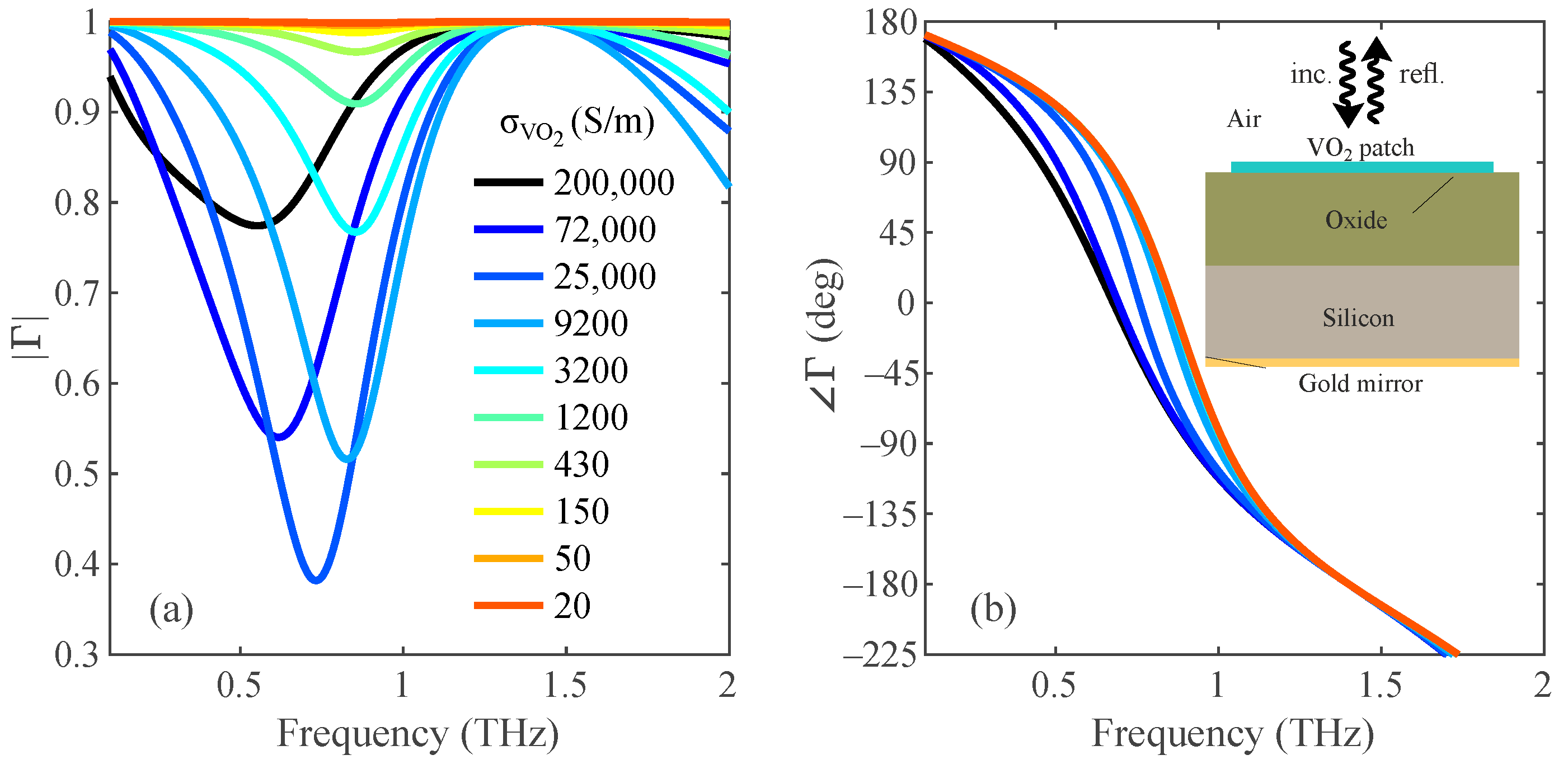
Next, we examine the unit cell configuration shown in Figure 3b, in which the VO2 layer is now patterned in patches with a width equal to 90% of the unit-cell width (period). In this case, the VO2 is represented by a parallel admittance, whose value is given by the ECM. The resulting reflection amplitude and phase spectra are presented in Figure 6a and Figure 6b, respectively [29,30,53,54]. Compared with the unpatterned slab configuration, the VO2 patch configuration generally exhibits higher reflection levels, which are seen as shallower resonance dips in the reflection spectrum. This behavior arises due to the fact that patterning reduces the effective volume of the lossy material participating in the light-matter interaction. As a result, both ohmic dissipation and plasmonic losses associated with induced surface currents are reduced, which alters the surface impedance, so less incident power is absorbed and more is reflected. In addition, the edge capacitance from the patch gaps also modify the resonant condition compared with the uniform slab case. These effects shift the resonance condition and weaken absorption by reducing current continuity. This further contributes to the shallower reflection minima which is observed in the patch configuration. The corresponding reflection phase unveils that the VO2 patch configuration produces minimal phase change when the conductivity is swept from dielectric to metallic state. This combination makes the patch geometry particularly suitable for applications where a high reflected amplitude is desired, with comparatively less emphasis on wide phase tunability. The decoupling of amplitude and phase responses makes the patch geometry particularly attractive for applications requiring large reflection amplitude combined with wide phase tunability, such as reconfigurable reflect-arrays, beam steering, and wavefront shaping metasurfaces [54,55,56].
Comparison between the ECM/TLM and full-wave simulations also reveals excellent agreement as shown in Figure 7. The ECM/TLM accurately reproduces the resonance frequencies as well as the overall dispersion trends of both the reflection magnitude and phase across the considered spectral range. Only minor discrepancies are observed in the depth of the amplitude minima as frequency increases, which can be attributed to higher-order modes and edge-induced fringing fields that are inherently captured in the full-wave simulations but approximated in the analytical formulation. Nevertheless, the very good agreement near the first resonance validates the proposed ECM/TLM approach and confirms its robustness and reliability for accurately estimating the resonance frequency and Q-factor of the VO2-patch unit cell.

3.2. Graphene-Only Configuration for Reflection Phase Modulation

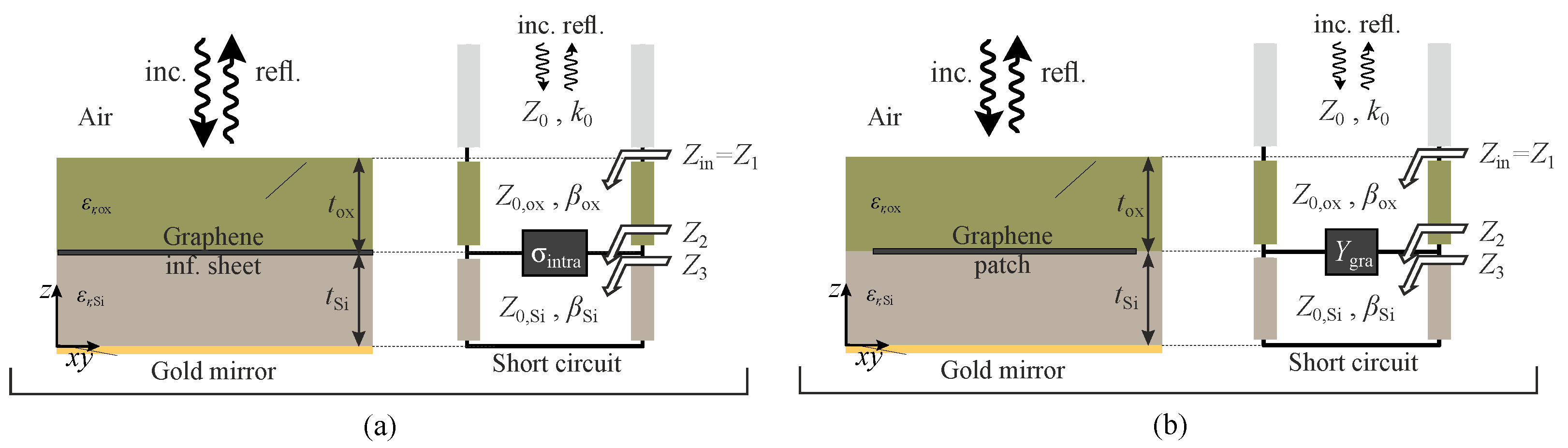
In this subsection we consider the unit cell configuration of Figure 8 in which the graphene is present, sandwiched between the Si and SiO2 layers, while the top VO2 layer is removed. For this more well-studied configuration, e.g., [37,54], we examine both the reflection magnitude and phase responses obtained from our analytical ECM/TLM and full-wave simulations.
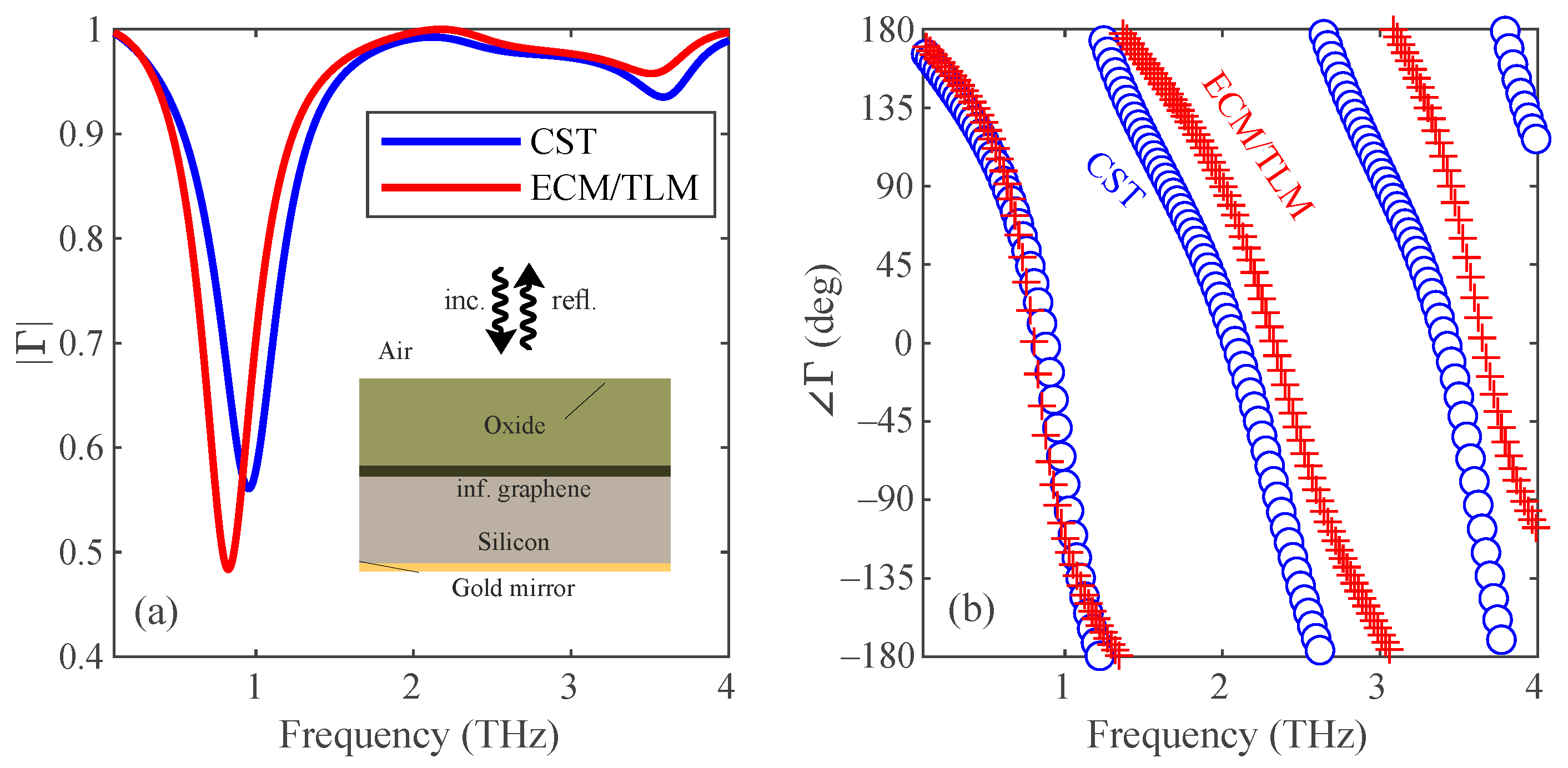
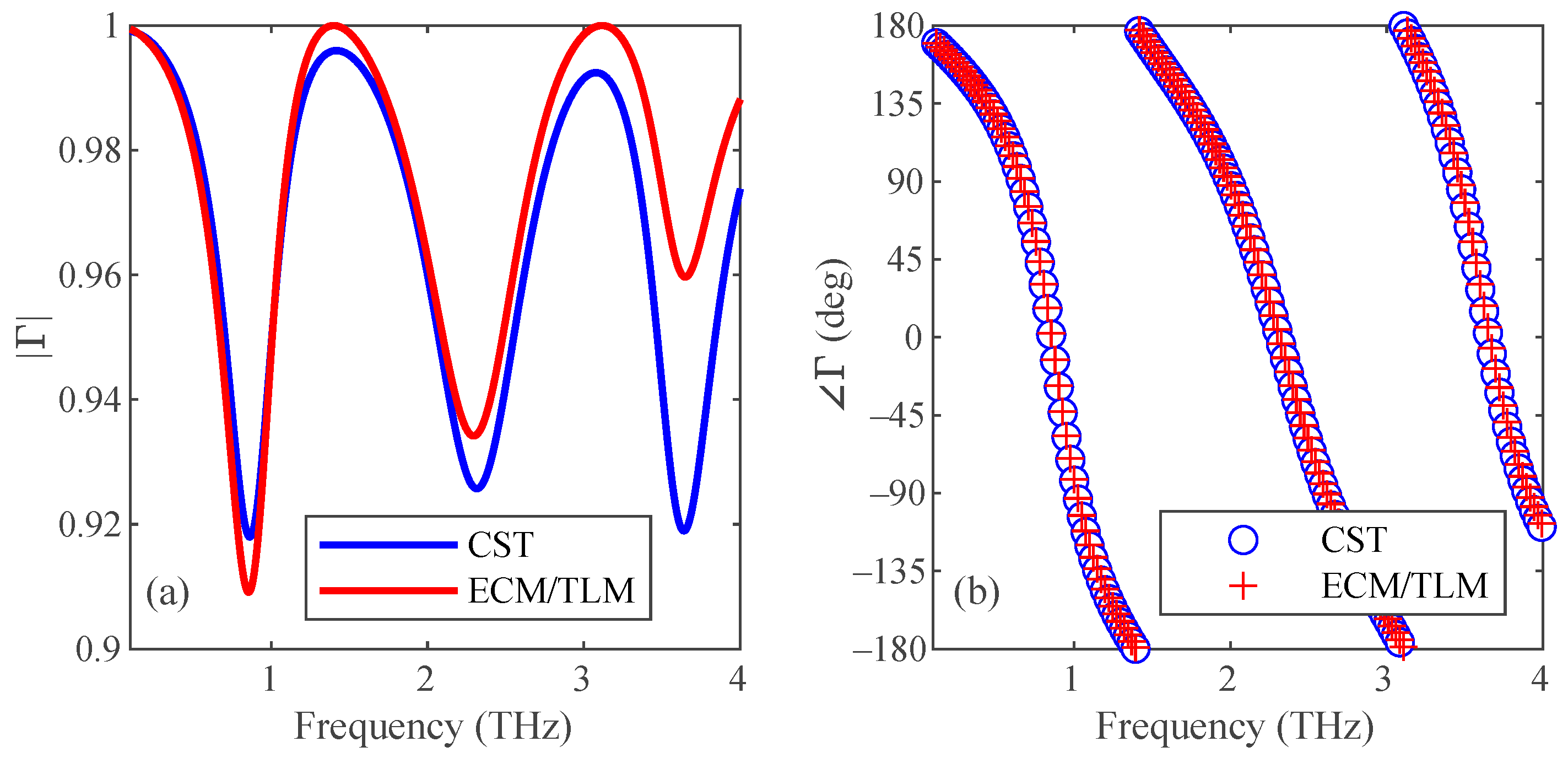
Starting from the unpatterned graphene sheet configuration, the results are presented in Figure 9. The reflection amplitude spectra obtained from the analytical ECM/TCM and the CST full-wave simulations show very good overall agreement near the first resonance, around 1 THz, confirming the validity of the analytical approach in this region. Both approaches capture the main resonance frequency and the high-frequency reflective behavior of the structure. The small discrepancies in the magnitude and the progressive mismatch of the phase can be attributed to material dispersion (difference in CST and our own version of the Kubo formula), and the more realistic treatment of graphene and dielectric interfaces, which are not fully captured by the simplified assumptions of the analytical model [9,35]. Overall, the comparison demonstrates that the analytical model reliably predicts the qualitative first-resonance electromagnetic response of the multilayer structure, while CST provides further accuracy. The reflection-phase results also show the same resonant dispersive behavior with phase flips at the resonance frequencies. The slight difference is expected because the CST includes realistic losses and full wave interactions.
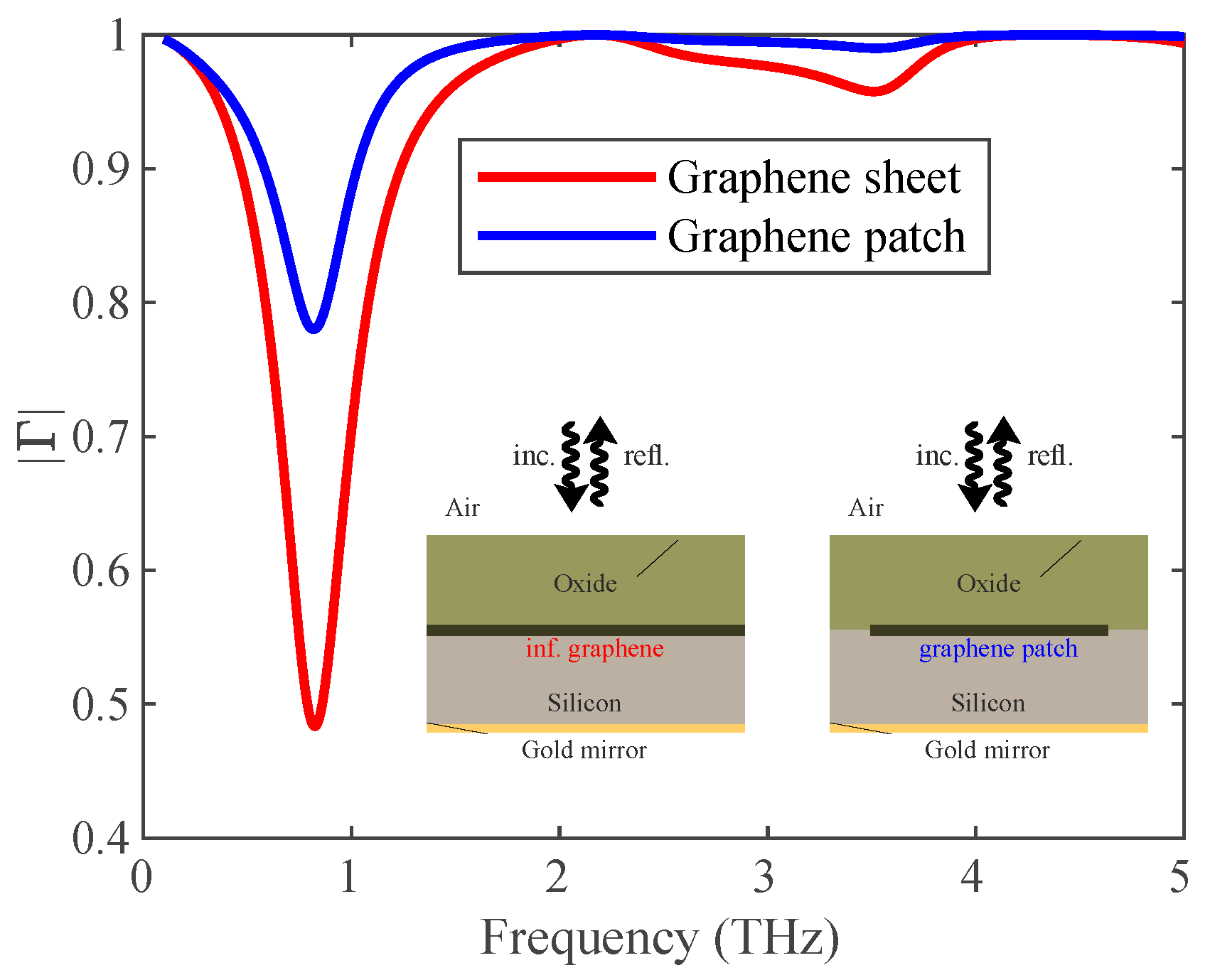
Next, the graphene layer is assumed to be patterned in square patches of width 90% that of the unit cell. The reflection amplitude spectra from the sheet and patch case are compared in Figure 10 and one can observe that the graphene patch gives higher reflection amplitude [36,57]. That is because reducing the graphene coverage decreases the interaction between the incident wave and the conductive surface. The continuous sheet supports stronger surface currents and higher ohmic and plasmonic dissipation, producing a deeper resonance and lower | Γ | . In contrast, the patch introduces current confinement and additional capacitive discontinuities, which weaken the effective coupling to the incident field and increase the surface-impedance mismatch. As a result, the patch absorbs less energy and reflects more, leading to a shallower reflection dip compared with the uniform sheet.
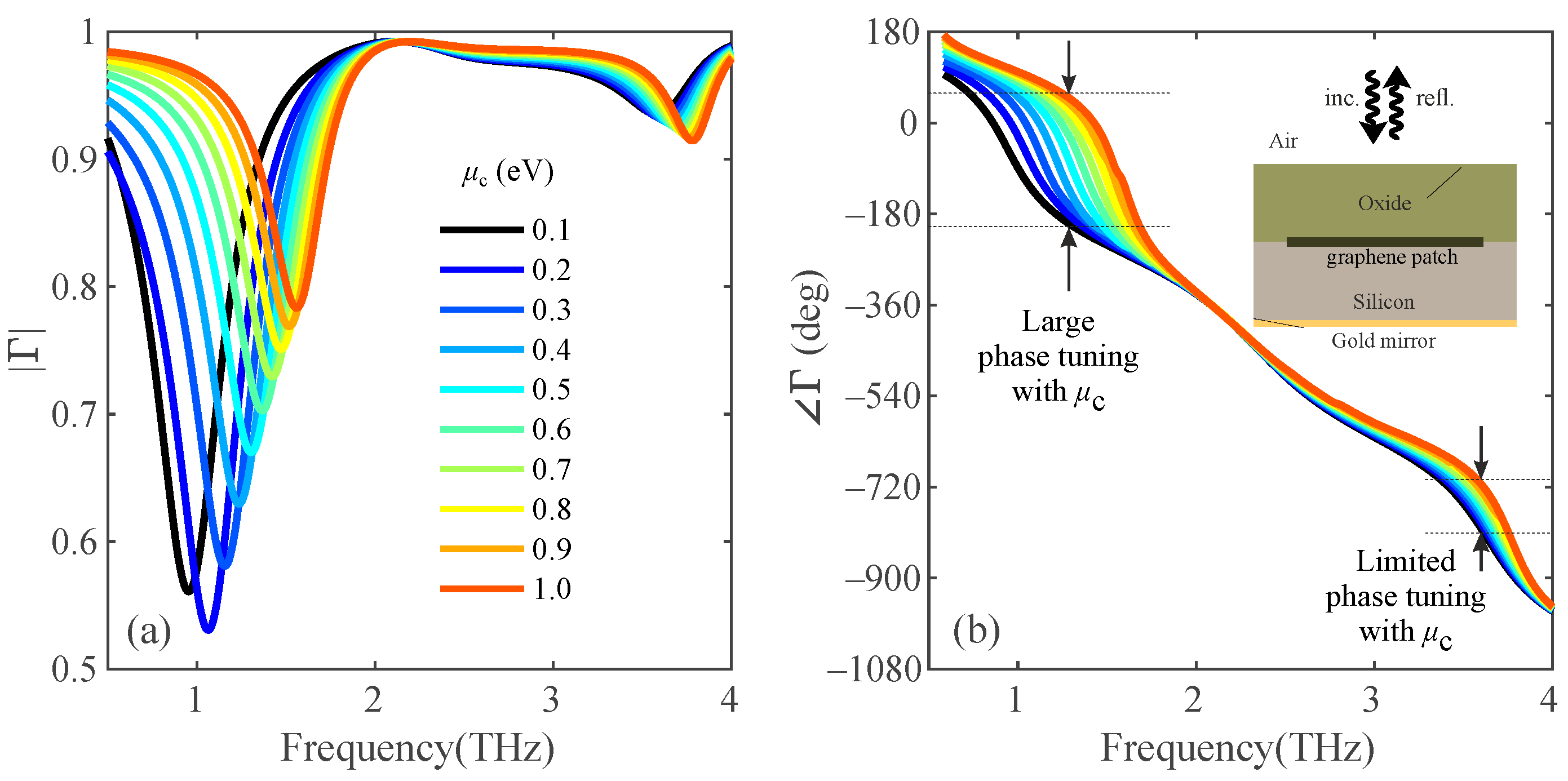
The reconfigurable reflection-phase results shown in Figure 11 demonstrate strong and broadband tunability as the graphene chemical potential is varied from 0.1 eV to 1.0 eV. The maximum phase tuning is achieved near 1.2 THz and exceeds 240 ° . Increasing μ c shifts the resonance features to higher frequencies. This behavior arises from the change in graphene’s complex-valued surface conductivity and its impact on the effective impedance of the multilayer structure can be understood through the ECM. The smooth phase evolution and relatively large reflection magnitude confirm the suitability of the design for THz wave phase-modulated metasurfaces, even without the contribution of VO2. More meticulous optimization of the dimensions (dielectric material and/or thickness) and graphene patch shape and placement might further improve the performance.

3.3. Hybrid Graphene/VO2 Configuration for Independent Reflection Phase and Amplitude Modulation

In this section, graphene and VO2 patches are simultaneously present to investigate the potential of such hybrid configurations for the independent control of the reflection amplitude and phase, enabled by the combined tuning mechanisms: changing graphene μ c (phase tunability) and/or VO2 bulk conductivity (amplitude modulation).
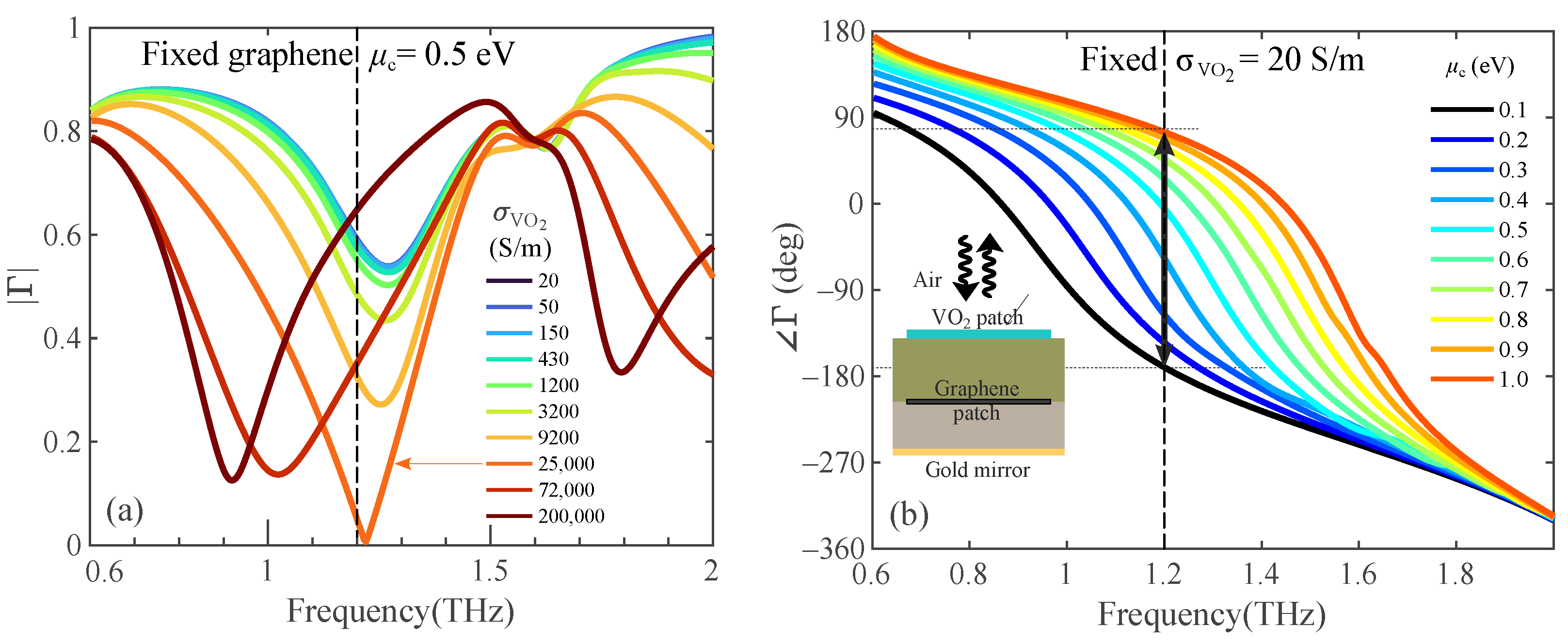
In Figure 12a we present the reflection magnitude spectra when the VO2 conductivity is varied from its insulating state to the metallic state, while the graphene chemical potential is fixed at 0.5 eV. We observe the reflection amplitude modulation particularly around the resonance near 1.2 THz. As the conductivity of VO2 increases, both the depth and the spectral position of the reflection minima vary significantly, demonstrating strong amplitude tunability of the MS. At the resonance position, the reflection magnitude is almost 30 dB, indicating near-perfect impedance matching and high absorption induced by the metallic state of VO2. In contrast, when VO2 is in the insulating state, the reflection magnitude is considerably higher, corresponding to a weakly lossy and predominantly reflective regime. This wide dynamic range in | Γ | highlights the effectiveness of VO2 as an active amplitude-modulation element in the proposed metasurface design. Also, maintaining the graphene chemical potential at 0.5 eV results in only marginal changes in the reflection amplitude, confirming that graphene has a minimal impact on amplitude modulation under these conditions. One can observe that there exists a critical σ VO 2 at which full absorption is achieved, in this case 2.5 × 10 4 S/m. Further increasing σ VO 2 reduces the absorption and induces a shift of the resonance frequency. This behavior highlights an intrinsic limitation of the present design: that the tuning of graphene and VO2 on the EM response—namely the amplitude and phase—are not fully decoupled for one frequency. In particular, variations of σ VO 2 could lead to more complete coverage of the magnitude and phase, as shown below, but possibly not at the same frequency. This behavior is consistent with the predominantly reactive response of graphene in the THz regime, where it primarily influences the phase rather than introducing significant dissipative losses.
In Figure 12b, we present the reflection phase spectra of the hybrid MS unit cell as graphene μ c is varied from 0.1 eV to 1.0 eV while the VO2 patch array (thickness 0.1 µm) is fixed in its insulating state, i.e., at σ VO 2 = 20 S/m. As μ c increases, the resonance frequency blue-shifts, as indicated by the Γ = 0 crossing. This behavior originates from the tunable surface conductivity of graphene, which alters the effective surface impedance of the metasurface and, consequently, the phase of the reflected wave. The wide and continuous phase evolution across the considered range of μ c confirms the strong capability of graphene to enable dynamic phase modulation in the proposed unit cell. The maximal reflection phase coverage of 245 ° at 1.2 THz, when μ c = 0.1 1 eV, is almost enough to create a 2-bit (4-state) digital holographic metasurface.
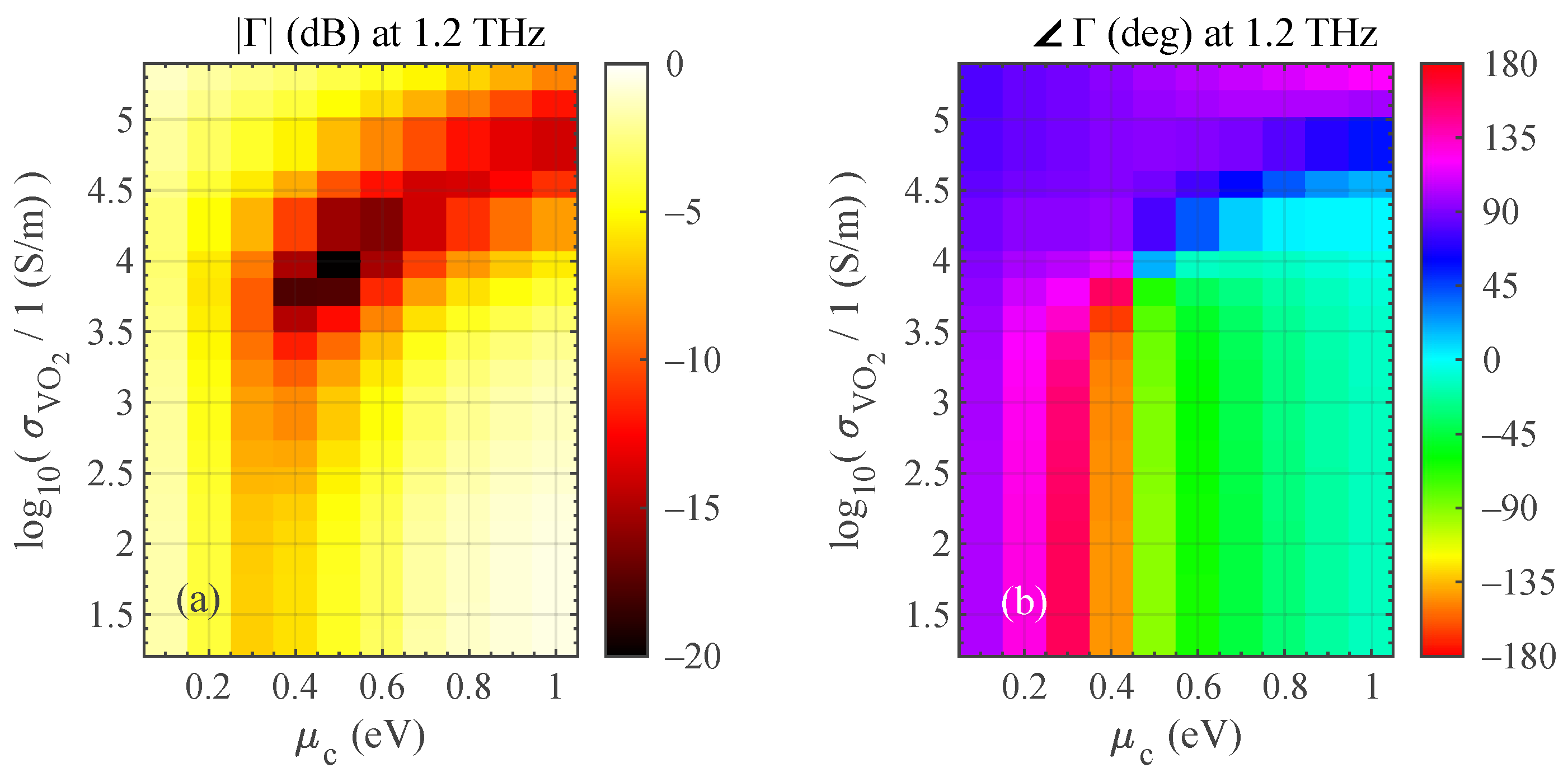
To showcase the full tunability map of the complex reflection coefficient at the hybrid unit–cell, in Figure 13 we present | Γ | and Γ as a function of both μ c tuning (horizontal axis) and σ VO 2 tuning (vertical axis) at a fixed operating frequency of 1.2 THz. The magnitude heatmap in panel Figure 13a shows that there exists one specific combination of control parameters μ c and σ VO 2 that leads to perfect absorption ( | Γ | < 20 dB). On the bright side, tuning any of the two control parameters can lead to absorption modulation of over 15 dB. For instance, for a | Γ | = 20 5 dB modulation, one could either toggle μ c = 0.1 0.5 eV (at fixed σ VO 2 10 4 S/m) or toggle σ VO 2 = 10 4 10 5 S/m (at fixed μ c = 0.5 eV).
The phase heatmap in Figure 13b clearly reveals a monotonic and nearly uniform phase variation covering 245 ° along the μ c axis for σ VO 2 up to 3500 S/m; low σ VO 2 values are preferable for holographic phase control as | Γ | does not fluctuate much as μ c is swept. Now, the absence of noticeable phase variation along the σ VO 2 axis indicates that, in its insulating state, VO2 has a negligible influence on the phase response at this frequency. This demonstrates that the phase modulation mechanism is effectively decoupled from VO2 and is predominantly governed by graphene. Consequently, graphene serves as the phase-tuning element, while VO2 is reserved for independent amplitude (i.e., absorption) control in the hybrid metasurface designs. This decoupled behavior is highly advantageous as it enables independent and flexible control of phase and magnitude within a single MS.
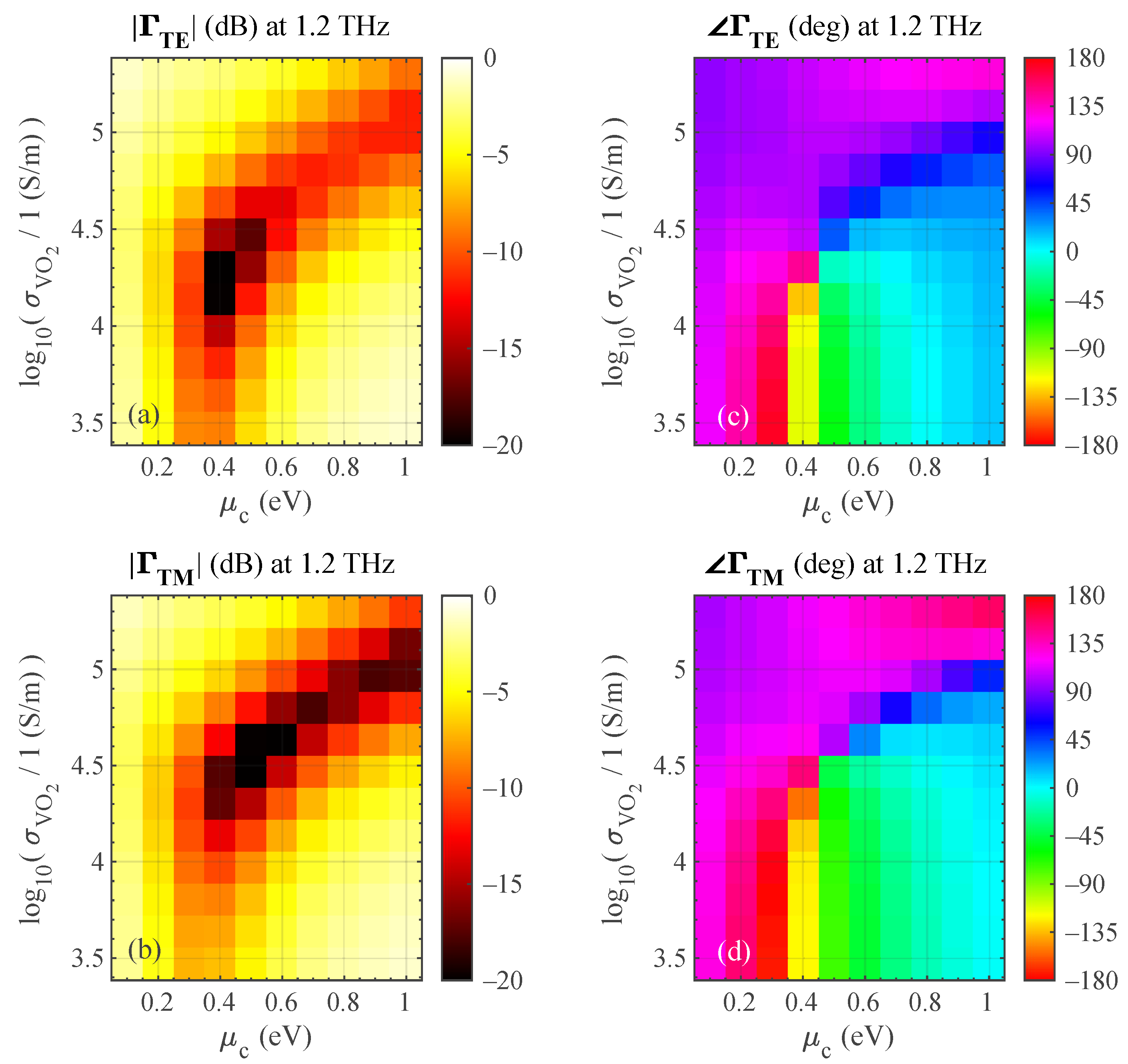
Concluding the hybrid graphene/VO2 unit cell performance analysis, in Figure 14 we evaluate the { σ VO 2 , μ c } -reconfigurable reflection at 1.2 THz under oblique 30 ° incidence, in both TE and TM planes. The CST simulated results show only slight degradation in performance, i.e., higher overall absorption (more evident in TM polarization) and a small reduction in Γ -coverage. These indicate that the proposed RMS unit cell performance is robust under oblique illumination in both polarization planes.

4. Discussion and Comparison

As presented in the Introduction, the independent control of the phase and the magnitude of the scattered THz wave is desired to implement high-performing multifunctional and reconfigurable metasurfaces (RMS), enabling wavefront shaping and sensing applications within a single platform. In this section, we present similar RMS designs and associated functionalities, with a special emphasis on the material platforms employed here, i.e., graphene and VO2, and the involved technological complexity.
In [58], the authors used VO2 to achieve near-perfect absorption and reflection by switching conductivity between metallic and dielectric states. In [59], VO2 is used to exhibit dual functionalities of broadband absorption and reflective beam steering by switching from metallic state to insulator state. In [60], the authors used VO2 together with patterned metallic resonators to achieve both broadband and triple narrowband absorption in a simple 3-layer configuration by switching between the metal state and insulator state, respectively [61]. In [62], graphene is used to achieve the same effect as in [60] by controlling the chemical potential of graphene in a 4-layer design consisting of metal-dielectric-graphene-dielectric architecture from bottom to top. In [37], graphene was employed to achieve nearly 100% reflection and absorption by reconfiguring the MS response via the chemical potential of graphene; the 3-layer structure of graphene and silicon over a mirror was analyzed using both equivalent circuits and simulation; the Authors also achieved both anomalous reflection and wavefront modulation by controlling a group of unit cells. Phase-modulated RMS was studied in [63], where a graphene-based MS gave rise to more than 330 ° phase modulation in the mid-infrared spectrum. Also, in [64], the authors achieved efficiently tunable reflective MS consisting of a dielectric substrate sandwiched between a hollow Z-shaped graphene structure and a ground plane. The phase tuning was achieved by adjusting the rotation angle of the graphene. In [65], the authors achieved phase shift of 180 ° by changing the Fermi level based on a graphene hybrid MS. In 2018 [66], the authors achieved an efficient control of both amplitude (>50 dB) and phase control (>90°) in the microwave frequencies at 11.8 GHz using a hybrid combination of graphene capacitively coupled with a split ring resonator (SRR) for radar absorbing materials. In [64], the authors used multi-layer varactor diodes loaded on metallic patches to achieve full control of phase and amplitude response. The metasurface operated at 6 GHz. In 2023 [67], the dual amplitude and phase tuning was achieved similarly by an arrangement of two varactor diodes on the top and a lumped resistor on the bottom layer at a frequency band of 4 to 9 GHz. In 2024 [43], the authors proposed an equivalent circuit approach for independent phase and amplitude control based on a Floquet modal expansion method [68,69] in the mmWave frequency band. The amplitude control layer consisted of two monolayer graphene and an electrolyte layer between them, and the phase control layer consisted of two metallic patches connected by an ideal varactor diode and a ground dielectric slab.
Both graphene and VO2 are used in [70,71] for polarization conversion, triple band, and dual band absorption. Also, in [72], the authors used integration of a metal patch, graphene, and VO2 to design a programmable coding MS in the THz band capable of switching between dynamic beam steering and dual-band absorber. In [25], a multifunctional absorber based on graphene and VO2 with band selection capability was designed and analyzed. Broadband absorption exceeding 90% was achieved when VO2 was set as metal and graphene chemical potential was tuned. Similarly, the authors achieved double narrowband absorption with VO2 in insulator mode and setting graphene μ c at specific values. Similarly, broadband and narrowband near-perfect absorption and transmission tuning using both graphene and VO2 was studied in [56,73,74].
Having reviewed the existing literature, it is evident that substantial potential remains in the use of hybrid graphene–VO2 metasurfaces. Most reported studies employ graphene and VO2 either individually or in hybrid forms, but primarily for amplitude-modulated applications. Thus, relatively limited investigation was devoted to phase modulation and independent control, which are essential for enabling more advanced smart radio environments [75,76]. In Table 2, we compare the unit cell design and methodology outlined in the present work to some of the similar papers found in the literature to showcase its comparative advantage in independent and wide control of reflection phase and magnitude.

5. Summary and Outlook

In this work, we incorporated graphene and VO2 materials in a simple multi-layer hybrid metasurface unit cell to achieve independent (decoupled) reflection amplitude and phase modulation of incident THz beams. The tuning of the phase, spanning over 245 ° , was achieved by changing the chemical potential of graphene patches sandwiched between an oxide and a silicon layer; the tuning of the amplitude, from approximately 3 dB to near-perfect absorption, was achieved by changing the bulk conductivity of an overlying array of VO2 patches.
The proposed configuration resulted in a hybrid unit cell with minimal technological complexity, which was initially designed using intuitive and efficient all-analytical methods. The designs were validated and subsequently optimized using full-wave numerical simulations at the unit-cell level, showing good agreement with the model in the target zone, around 1.2 THz. The tuning range and performance can possibly be enhanced, or translated in central frequency, by further optimization.
As future research steps, we envision the study of non-local response (accounting for inter-cell coupling in heterogeneous RMS configurations), finite-aperture diffraction, and the multiphysical aspects of the required electro-thermo-optic controls.

Author Contributions

Conceptualization, E.A. and A.P.; methodology, A.P. and E.A.; software, E.A.; validation, E.A., A.P., E.M.S., and K.S.O.K.; formal analysis, A.P. and E.M.S.; investigation, E.A. and A.P.; resources, E.A.; data curation, E.A.; writing—original draft preparation, E.A.; writing—review and editing, A.P., E.M.S., and K.S.O.K.; visualization, E.A. and A.P.; supervision, A.P., E.M.S. and K.S.O.K. All authors have read and agreed to the published version of the manuscript.

Funding

This research received no external funding.

Institutional Review Board Statement

Not applicable.

Informed Consent Statement

Not applicable.

Data Availability Statement

Data supporting the findings of this study are available from the corresponding author upon reasonable request.

Conflicts of Interest

The authors declare no conflicts of interest.

Abbreviations

The following abbreviations are used in this manuscript:
MSMetasurface
RMSReconfigurable Metasurface
TSITabulated Surface Impedance
ECMEquivalent Circuit Model
TLTransmission Line
TLMTransmission Line Model
ITEImpedance Transformation Equation
FSRFree Spectral Range

References

  1. Liu, L.; Zhang, X.; Kenney, M.; Su, X.; Xu, N.; Ouyang, C.; Shi, Y.; Han, J.; Zhang, W.; Zhang, S. Broadband metasurfaces with simultaneous control of phase and amplitude. Adv. Mater. 2014, 26, 5031–5036. [Google Scholar] [CrossRef]
  2. Lee, G.Y.; Yoon, G.; Lee, S.Y.; Yun, H.; Cho, J.; Lee, K.; Kim, H.; Rho, J.; Lee, B. Complete amplitude and phase control of light using broadband holographic metasurfaces. Nanoscale 2018, 10, 4237–4245. [Google Scholar] [CrossRef]
  3. Ding, F.; Cui, Y.; Ge, X.; Jin, Y.; He, S. Ultra-broadband microwave metamaterial absorber. Appl. Phys. Lett. 2012, 100, 103506. [Google Scholar] [CrossRef]
  4. Song, Q.; Zhang, W.; Wu, P.C.; Zhu, W.; Shen, Z.X.; Chong, P.H.J.; Liang, Q.X.; Yang, Z.C.; Hao, Y.L.; Cai, H.; et al. Water-resonator-based metasurface: An ultrabroadband and near-unity absorption. Adv. Opt. Mater. 2017, 5, 1601103. [Google Scholar] [CrossRef]
  5. Zhang, Z.; Shi, H.; Wang, L.; Chen, J.; Chen, X.; Yi, J.; Zhang, A.; Liu, H. Recent advances in reconfigurable metasurfaces: Principle and applications. Nanomaterials 2023, 13, 534. [Google Scholar] [CrossRef]
  6. Dong, T.; Zhang, Y.; Li, Y.; Tang, Y.; He, X. Development of a terahertz metamaterial polarization converter with multiple tuning modes based on graphene and vanadium dioxide. Diam. Relat. Mater. 2023, 139, 110373. [Google Scholar] [CrossRef]
  7. Luo, H.; Liu, H.; Chen, C.; Feng, Y.; Gao, P.; Ren, Z.Y.; Qiao, Y.J. Dual-broadband terahertz absorber based on phase transition characteristics of VO2. Results Phys. 2022, 34, 105270. [Google Scholar] [CrossRef]
  8. Zhuang, L.; Zhang, W.; Liu, J.; Chao, M.; Liu, Q.; Cheng, B.; Xu, Y.; Song, G. Switchable trifunctional terahertz absorber for both broadband and narrowband operations. Opt. Express 2022, 30, 45848–45861. [Google Scholar] [CrossRef] [PubMed]
  9. Holloway, C.L.; Kuester, E.F.; Gordon, J.A.; O’Hara, J.; Booth, J.; Smith, D.R. An overview of the theory and applications of metasurfaces: The two-dimensional equivalents of metamaterials. IEEE Antennas Propag. Mag. 2012, 54, 10–35. [Google Scholar] [CrossRef]
  10. Chen, H.T.; Taylor, A.J.; Yu, N. A review of metasurfaces: Physics and applications. Rep. Prog. Phys. 2016, 79, 076401. [Google Scholar] [CrossRef]
  11. Yu, S.; Kim, Y.; Shin, E.; Kwon, S.H. Dynamic beam steering and focusing graphene metasurface mirror based on fermi energy control. Micromachines 2023, 14, 715. [Google Scholar] [CrossRef]
  12. Pors, A.; Nielsen, M.G.; Eriksen, R.L.; Bozhevolnyi, S.I. Broadband focusing flat mirrors based on plasmonic gradient metasurfaces. Nano Lett. 2013, 13, 829–834. [Google Scholar] [CrossRef]
  13. Venkatesh, S.; Lu, X.; Saeidi, H.; Sengupta, K. A high-speed programmable and scalable terahertz holographic metasurface based on tiled CMOS chips. Nat. Electron. 2020, 3, 785–793. [Google Scholar] [CrossRef]
  14. Ding, X.; Monticone, F.; Zhang, K.; Zhang, L.; Gao, D.; Burokur, S.N.; De Lustrac, A.; Wu, Q.; Qiu, C.W.; Alù, A. Ultrathin Pancharatnam–Berry metasurface with maximal cross-polarization efficiency. Adv. Mater. 2015, 27, 1195–1200. [Google Scholar] [CrossRef]
  15. He, X.; Wu, M.; Lu, G.; Zhang, Y.; Geng, Z. High-efficiency multi-channel focusing and imaging enabled by polarization-frequency multiplexing non-interleaved metasurfaces. Photon. Res. 2025, 13, 976–986. [Google Scholar] [CrossRef]
  16. Wu, M.; He, X.; Lu, G.; Zhang, Y.; Geng, Z.; Liu, H.; Zhang, K. On-Chip Multi-Channel Wavefront Manipulation of Spoof Surface Waves with Structural Heterogeneous Metasurfaces. Laser Photon. Rev. 2025, e01634. [Google Scholar] [CrossRef]
  17. Qi, L.; Liu, C.; Shah, S.M.A. A broad dual-band switchable graphene-based terahertz metamaterial absorber. Carbon 2019, 153, 179–188. [Google Scholar] [CrossRef]
  18. Dong, T.; Zhang, Y.; Li, Y.; Tang, Y.; He, X. Dual-function switchable terahertz metamaterial device with dynamic tuning characteristics. Results Phys. 2023, 45, 106246. [Google Scholar] [CrossRef]
  19. Pitilakis, A.; Seckel, M.; Tasolamprou, A.; Liu, F.; Deltsidis, A.; Manessis, D.; Ostmann, A.; Kantartzis, N.; Liaskos, C.; Soukoulis, C.; et al. Multifunctional Metasurface Architecture for Amplitude, Polarization and Wave-Front Control. Phys. Rev. Appl. 2022, 17, 064060. [Google Scholar] [CrossRef]
  20. Taghvaee, H.; Pitilakis, A.; Khodadadi, M.; Tsilipakos, O.; Boulogeorgos, A.A.A.; Khalily, M. Holographic mmWave Metasurface Integrating THz Sensing for 6G Wireless Networks. IEEE Wirel. Commun. 2025, 32, 54–62. [Google Scholar] [CrossRef]
  21. Wang, J.; Yang, R.; Ma, R.; Tian, J.; Zhang, W. Reconfigurable multifunctional metasurface for broadband polarization conversion and perfect absorption. IEEE Access 2020, 8, 105815–105823. [Google Scholar] [CrossRef]
  22. Balci, O.; Polat, E.O.; Kakenov, N.; Kocabas, C. Graphene-enabled electrically switchable radar-absorbing surfaces. Nat. Commun. 2015, 6, 6628. [Google Scholar] [CrossRef]
  23. Zou, W.; Zhong, C.; Hong, L.; Lei, J.; Shen, Y.; Deng, X.; Chen, J.; Guo, T. Switchable Vanadium Dioxide Metasurface for Terahertz Applications. Micromachines 2024, 15, 967. [Google Scholar] [CrossRef]
  24. Liu, M.; Hwang, H.Y.; Tao, H.; Strikwerda, A.C.; Fan, K.; Keiser, G.R.; Sternbach, A.J.; West, K.G.; Kittiwatanakul, S.; Lu, J.; et al. Terahertz-field-induced insulator-to-metal transition in vanadium dioxide metamaterial. Nature 2012, 487, 345–348. [Google Scholar] [CrossRef] [PubMed]
  25. Liu, Y.; Hu, L.; Liu, M. Graphene and vanadium dioxide-based terahertz absorber with switchable multifunctionality for band selection applications. Nanomaterials 2024, 14, 1200. [Google Scholar] [CrossRef]
  26. Low, T.; Chaves, A.; Caldwell, J.D.; Kumar, A.; Fang, N.X.; Avouris, P.; Heinz, T.F.; Guinea, F.; Martin-Moreno, L.; Koppens, F. Polaritons in layered two-dimensional materials. Nat. Mater. 2017, 16, 182–194. [Google Scholar] [CrossRef]
  27. Farzin, P.; Soleimani, M. Graphene-based metasurface for real-time control of three electromagnetic wave modes and polarization state. Diam. Relat. Mater. 2023, 139, 110279. [Google Scholar] [CrossRef]
  28. Wang, L.; Gao, F.; Teng, S.; Tan, Z.; Zhang, X.; Lou, J. Terahertz tunable vanadium dioxide metasurface for dynamic illusion and cloaking. iScience 2024, 27, 108609. [Google Scholar] [CrossRef]
  29. Luukkonen, O.; Simovski, C.R.; Raisanen, A.V.; Tretyakov, S.A. An efficient and simple analytical model for analysis of propagation properties in impedance waveguides. IEEE Trans. Microw. Theory Tech. 2008, 56, 1624–1632. [Google Scholar] [CrossRef]
  30. Luukkonen, O.; Simovski, C.; Granet, G.; Goussetis, G.; Lioubtchenko, D.; Raisanen, A.V.; Tretyakov, S.A. Simple and accurate analytical model of planar grids and high-impedance surfaces comprising metal strips or patches. IEEE Trans. Antennas Propag. 2008, 56, 1624–1632. [Google Scholar] [CrossRef]
  31. Chen, J.; Hong, L.; Lei, J.; Shen, Y.; Deng, X.; Chen, J.; Guo, T. High-Performance Terahertz Coherent Perfect Absorption with Asymmetric Graphene Metasurface. Photonics 2024, 11, 544. [Google Scholar] [CrossRef]
  32. Landy, N.I.; Sajuyigbe, S.; Mock, J.J.; Smith, D.R.; Padilla, W.J. Perfect metamaterial absorber. Phys. Rev. Lett. 2008, 100, 207402. [Google Scholar] [CrossRef]
  33. Jiao, X.F.; Zhang, Z.H.; Li, T.; Xu, Y.; Song, G.F. Tunable dual broadband terahertz metamaterial absorber based on vanadium dioxide. Appl. Sci. 2020, 10, 7259. [Google Scholar] [CrossRef]
  34. Tang, X.; Jia, H.; Liu, L.; Li, M.; Wu, D.; Zhou, K.; Li, P.; Tian, L.; Yang, D.; Wang, W. A tunable terahertz absorber based on double-layer patterned graphene metamaterials. Materials 2023, 16, 4166. [Google Scholar] [CrossRef]
  35. Hanson, G.W. Dyadic Green’s functions for an anisotropic, non-local model of biased graphene. IEEE Trans. Antennas Propag. 2008, 56, 747–757. [Google Scholar] [CrossRef]
  36. Hanson, G.W. Dyadic Green’s functions and guided surface waves for a surface conductivity model of graphene. J. Appl. Phys. 2008, 103. [Google Scholar] [CrossRef]
  37. Dash, S.; Psomas, C.; Krikidis, I.; Akyildiz, I.F.; Pitsillides, A. Active control of THz waves in wireless environments using graphene-based RIS. IEEE Trans. Antennas Propag. 2022, 70, 8785–8797. [Google Scholar] [CrossRef]
  38. Barzegar-Parizi, S.; Ebrahimi, A.; Ghorbani, K. Two bits dual-band switchable terahertz absorber enabled by composite graphene and vanadium dioxide metamaterials. Sci. Rep. 2024, 14, 5818. [Google Scholar] [CrossRef]
  39. Wang, X.C.; Tretyakov, S.A. Graphene-based tunable metasurface for all-angle perfect absorption. In 2018 12th International Congress on Artificial Materials for Novel Wave Phenomena (Metamaterials); IEEE: Espoo, Finland, 2018; pp. 430–432. [Google Scholar][Green Version]
  40. Pasdari-Kia, M.; Memarian, M.; Khavasi, A. Generalized equivalent circuit model for analysis of graphene/metal-based plasmonic metasurfaces using floquet expansion. Opt. Express 2022, 30, 35486–35499. [Google Scholar] [CrossRef] [PubMed]
  41. Tretyakov, S. Analytical Modeling in Applied Electromagnetics; Artech House: Norwood, MA, USA, 2003. [Google Scholar]
  42. Chatzidimitriou, D.; Pitilakis, A.; Kriezis, E.E. Rigorous calculation of nonlinear parameters in graphene-comprising waveguides. J. Appl. Phys. 2015, 118. [Google Scholar] [CrossRef]
  43. You, X.; Kosmas, P. Equivalent Circuit Modeling of a Novel Reconfigurable Metasurface With Independent Control of Amplitude and Phase Based on Floquet Modal Expansion. IEEE J. Microwaves 2024, 4, 428–439. [Google Scholar] [CrossRef]
  44. Dassault Systèmes. CST Studio Suite—Electromagnetic Field Simulation Software; Dassault Systèmes: Waltham, DC, USA, 2024. [Google Scholar]
  45. Jin, J.M. The Finite Element Method in Electromagnetics, 3rd ed.; Wiley: New York, NY, USA, 2014. [Google Scholar]
  46. Pozar, D.M. Microwave Engineering, 4th ed.; Wiley: Hoboken, NJ, USA, 2012. [Google Scholar]
  47. Vakil, A.; Engheta, N. Transformation Optics Using Graphene. Science 2011, 332, 1291–1294. [Google Scholar] [CrossRef] [PubMed]
  48. Gong, Y.; Liu, N. Advanced numerical methods for graphene simulation with equivalent boundary conditions: A review. Photonics 2023, 10, 712. [Google Scholar] [CrossRef]
  49. Albooyeh, M.; Ra’Di, Y.; Adil, M.; Simovski, C. Revised transmission line model for electromagnetic characterization of metasurfaces. Phys. Rev. B Condens. Matter Mater. Phys. 2013, 88, 085435. [Google Scholar] [CrossRef]
  50. Zhang, J.; Yan, H.; Yang, X.; Lyu, H. Dual-Function Metasurface for Tunable Selective Absorption. Micromachines 2022, 13, 2087. [Google Scholar] [CrossRef]
  51. Yang, D.; Liu, X.; Wang, Y.; Zhang, Y. Programmable VO2 Metasurface for Terahertz Wave Beam Manipulation. Materials 2022, 15, 104824. [Google Scholar]
  52. Mou, N.; Tang, B.; Li, J.; Dong, H.; Zhang, L. Switchable ultra-broadband terahertz wave absorption with VO2-based metasurface. Sci. Rep. 2022, 12, 2501. [Google Scholar] [CrossRef]
  53. Simovski, C.R.; Tretyakov, S.A. Modeling and Analysis of Metasurfaces as Two-Dimensional Electromagnetic Structures. IEEE Trans. Antennas Propag. 2012, 60, 2587–2595. [Google Scholar]
  54. Wang, X.; Tretyakov, S.A. Toward ultimate control of terahertz wave absorption in graphene. IEEE Trans. Antennas Propag. 2018, 67, 2452–2461. [Google Scholar] [CrossRef]
  55. Yu, N.; Genevet, P.; Kats, M.A.; Aieta, F.; Tetienne, J.P.; Capasso, F.; Gaburro, Z. Light propagation with phase discontinuities: Generalized laws of reflection and refraction. Science 2011, 334, 333–337. [Google Scholar] [CrossRef]
  56. Chen, K.; Wang, Z.; Guan, M.; Cheng, S.; Ma, H.; Yi, Z.; Li, B. Tunable ultra-wideband VO2–graphene hybrid metasurface terahertz absorption devices based on dual regulation. Photonics 2025, 12, 987. [Google Scholar] [CrossRef]
  57. Gómez-Díaz, J.S.; Perruisseau-Carrier, J. Graphene-Based Plasmonic Switches at Terahertz Frequencies. Opt. Express 2013, 21, 15490–15504. [Google Scholar] [CrossRef] [PubMed]
  58. Afra, T.; Fuscaldo, W.; Zografopoulos, D.C.; Natale, T.; Dell’Olio, F. Tunable wide band near-perfect absorber for terahertz waves based on a vanadium dioxide metasurface. Opt. Quantum Electron. 2025, 57, 272. [Google Scholar] [CrossRef]
  59. Zhang, Y.; Ma, S.; Fu, W.; Huang, S.; Zhu, Y.; Luo, X. Vanadium dioxide-based terahertz metasurface device with switchable broadband absorption and beam steering functions. Opt. Commun. 2024, 560, 130486. [Google Scholar] [CrossRef]
  60. Zou, Y.; Lin, H.; Tian, G.; Zhou, H.; Zhu, H.; Xiong, H.; Wang, B.X. Triple-Band and Ultra-Broadband Switchable Terahertz Meta-Material Absorbers Based on the Hybrid Structures of Vanadium Dioxide and Metallic Patterned Resonators. Materials 2023, 16, 4719. [Google Scholar] [CrossRef]
  61. Liu, C.; Xu, Y.; Huang, R.; Zha, S. Terahertz metamaterials for broadband, high modulation depth modulator, and tunable dual-band absorber based on metal-vanadium dioxide hybrid structure. Aip Adv. 2023, 13, 095204. [Google Scholar] [CrossRef]
  62. Chen, Z.; Chen, J.; Tang, H.; Shen, T.; Zhang, H. Dynamically switchable broadband and triple-band terahertz absorber based on a metamaterial structure with graphene. Opt. Express 2022, 30, 6778–6785. [Google Scholar] [CrossRef]
  63. Sun, Z.; Huang, F.; Fu, Y. Graphene-based active metasurface with more than 330° phase tunability operating at mid-infrared spectrum. Carbon 2021, 173, 512–520. [Google Scholar] [CrossRef]
  64. Zheng, B.; Ren, H.; An, S.; Tang, H.; Li, H.; Haerinia, M.; Dong, Y.; Fowler, C.; Zhang, H. Tunable metasurface with dynamic amplitude and phase control. IEEE Access 2021, 9, 104522–104529. [Google Scholar] [CrossRef]
  65. Zhou, S.; Hu, F.; Wang, H.; Su, A.; Jiang, M.; Zhang, L.; Gao, Z.; Luo, W. Large dynamic range terahertz phase shifter based on a graphene–metal hybrid metasurface. Appl. Opt. 2025, 64, 5188–5194. [Google Scholar] [CrossRef]
  66. Balci, O.; Kakenov, N.; Karademir, E.; Balci, S.; Cakmakyapan, S.; Polat, E.O.; Caglayan, H.; Özbay, E.; Kocabas, C. Electrically switchable metadevices via graphene. Sci. Adv. 2018, 4, eaao1749. [Google Scholar] [CrossRef]
  67. Phon, R.; Lee, M.; Lor, C.; Lim, S. Multifunctional reflective metasurface to independently and simultaneously control amplitude and phase with frequency tunability. Adv. Opt. Mater. 2023, 11, 2202943. [Google Scholar]
  68. Bhattacharyya, A.K. Phased Array Antennas: Floquet Analysis, Synthesis, BFNs and Active Array Systems; John Wiley & Sons: Hoboken, NJ, USA, 2006. [Google Scholar]
  69. Rodriguez-Berral, R.; Mesa, F.; Medina, F. Analytical multimodal network approach for 2-D arrays of planar patches/apertures embedded in a layered medium. IEEE Trans. Antennas Propag. 2015, 63, 1969–1984. [Google Scholar] [CrossRef]
  70. Mistri, H.; Ghosh, A.; Sardar, A.R.; Roy, P. Multifunctional voltage and temperature controlled metasurface using graphene and vanadium dioxide for terahertz applications. Opt. Quantum Electron. 2025, 57, 332. [Google Scholar] [CrossRef]
  71. Fang, J.; Zhu, W.; Cao, L.; Huang, X.; Zhang, B.; He, D.; Wang, S. Hybrid dual-mode tunable polarization conversion metasurface based on graphene and vanadium dioxide. Opt. Express 2023, 31, 23095–23105. [Google Scholar] [CrossRef]
  72. Naghshpour, N.; Pakizeh, T. Hybrid VO2-graphene bi-functional digital metasurface for beam steering and dual-band absorption. J. Appl. Phys. 2025, 138, 203103. [Google Scholar] [CrossRef]
  73. Li, J.; Liu, Y.; Chen, Y.; Chen, W.; Guo, H.; Wu, Q.; Li, M. Tunable broadband-narrowband and dual-broadband terahertz absorber based on a hybrid metamaterial vanadium dioxide and graphene. Micromachines 2023, 14, 201. [Google Scholar]
  74. Zhuo, S. Switchable dual ultra-broadband perfect absorber based on graphene and vanadium dioxide hybrid metamaterials. J. Opt. Soc. Am. B 2024, 41, 1483–1489. [Google Scholar] [CrossRef]
  75. Di Renzo, M.; Zappone, A.; Debbah, M.; Alouini, M.S.; Yuen, C.; De Rosny, J.; Tretyakov, S. Smart radio environments empowered by reconfigurable intelligent surfaces: How it works, state of research, and the road ahead. IEEE J. Sel. Areas Commun. 2020, 38, 2450–2525. [Google Scholar] [CrossRef]
  76. Renzo, M.D.; Debbah, M.; Phan-Huy, D.T.; Zappone, A.; Alouini, M.S.; Yuen, C.; Sciancalepore, V.; Alexandropoulos, G.C.; Hoydis, J.; Gacanin, H.; et al. Smart radio environments empowered by reconfigurable AI meta-surfaces: An idea whose time has come. Eurasip J. Wirel. Commun. Netw. 2019, 2019, 1–20. [Google Scholar] [CrossRef]
Figure 1. The reconfigurable hybrid MS architecture. (a) Example of a 5 × 5 cell array. (b) Unit cell schematic with material and dimension annotations.
Photonics 13 00195 g001
Figure 2. Unit–cell cross section and corresponding transmission line model (TLM) for the case where the VO2 material is (a) unpatterned, i.e., a slab, or (b) patterned into wide patches. The shunt admittances Y gra and Y VO 2 of the patch arrays can be computed by equivalent circuit models (ECM).
Photonics 13 00195 g002
Figure 3. Unit–cell cross section and transmission line model (TLM) for the case where the VO2 material is (a) unpatterned, i.e., a slab, or (b) patterned into wide patches. Graphene has been removed in both cases.
Photonics 13 00195 g003
Figure 4. (a) Reflection amplitude tuning by changing the top VO2 slab bulk conductivity, in S/m, in the unit cell. (b) Comparison between full-wave simulation and transmission line model, for the fully metallic case, σ VO 2 = 200,000 S/m.
Photonics 13 00195 g004
Figure 5. Analytical TLM reflection amplitude spectra for four different VO2 slab thicknesses as the bulk conductivity is changed; in all four panels, the different colored curves correspond to different σ VO 2 values, given in the legends of panels b and d. (a) t VO 2 = 0.1 µm, (b) t VO 2 = 1 µm, (c) t VO 2 = 2 µm, (d) t VO 2 = 5 µm.
Photonics 13 00195 g005
Figure 6. Analytical ECM/TLM reflection (a) magnitude and (b) unwrapped phase spectra for MS cell with VO2 patterned in square patches. Different colors correspond to different VO2 bulk conductivity; the color-coding is given in the legend of panel a.
Photonics 13 00195 g006
Figure 7. Comparison of reflection spectra, (a) magnitude and (b) phase, between full-wave CST simulation and the ECM/TLM, for the unit cell of Figure 3b, where VO2 is patterned in patches and σ VO 2 = 200 S/m.
Photonics 13 00195 g007
Figure 8. Unit-cell cross section and transmission line model for the case where the graphene monolayer is (a) unpatterned, i.e., an infinite sheet, or (b) patterned in square patches. VO2 has been removed in both cases.
Photonics 13 00195 g008
Figure 9. Reflection (a) magnitude and (b) phase spectra in the infinite graphene monolayer unit cell configuration; comparison between ECM/TLM and full-wave simulation for graphene chemical potential at 0.1 eV.
Photonics 13 00195 g009
Figure 10. Reflection amplitude for graphene sheet and patch configurations, both assumed at low chemical potential, μ c = 0.1 eV.
Photonics 13 00195 g010
Figure 11. Full-wave simulated reflection (a) magnitude and (b) unwrapped phase spectra as the chemical potential is varied from 0.1 eV to 1 eV, in the graphene-patch configuration without VO2.
Photonics 13 00195 g011
Figure 12. Hybrid graphene/VO2 unit cell simulated reflection (a) magnitude spectra as σ VO 2 is varied with fixed μ c = 0.5 eV and (b) phase spectra as μ c is varied with fixed σ VO 2 = 20 S/m.
Photonics 13 00195 g012
Figure 13. Hybrid graphene/VO2 unit cell simulated reflection (a) magnitude and (b) phase heatmaps at 1.2 THz as both σ VO 2 and μ c are varied.
Photonics 13 00195 g013
Figure 14. Hybrid graphene/VO2 unit cell simulated reflection (a,b) magnitude and (c,d) phase heatmaps at 1.2 THz as both σ VO 2 and μ c are varied, under oblique 30 ° incidence in both (a,c) TE and (b,d) TM planes.
Photonics 13 00195 g014
Table 1. Geometric parameters of the metasurface unit cell (in µm).
w c t Au t Si t SiO 2 t VO 2 w p , gra w p , VO 2
301.220150.12727
Table 2. Performance comparison of this work with previously reported graphene- and/or VO2-based MS unit cell designs.
Ref.MaterialNumber ofOperatingModelingFunctionalityFunctionality
Used Layers Frequency Method (Amplitude/Phase) Description
[60]VO2–Metal3THzSimulationAmplitudeTriple Band/ Broadband Absorption
[37]Graphene3THzSimulation/ECMAmplitude/PhaseReflection/Absorption
Phase Gradient MS.
[64]Metal Patches5GHzSimulation/ECMAmplitude/PhaseSimultaneous
Phase/Amplitude at GHz
[65]Graphene–Metal3THzSimulationPhaseMaximum phase
shift 170 °
[72]Metal-Graphene-VO23THzSimulation/ECMAmplitude/PhasePhase gradient Coded MS
Absorption/Beam steering
[18]VO2-Photosensitive Silicon7THzSimulationAmplitude/PhaseBroadband Absorption/Polarization
Conversion
This workVO2–Graphene5THzSimulation/ECMAmplitude/PhaseReflection/Absorption
Independent control
28  dB, 245 ° at 1.2 THz
Disclaimer/Publisher’s Note: The statements, opinions and data contained in all publications are solely those of the individual author(s) and contributor(s) and not of MDPI and/or the editor(s). MDPI and/or the editor(s) disclaim responsibility for any injury to people or property resulting from any ideas, methods, instructions or products referred to in the content.