1. Introduction
Bound states in the continuum (BICs) and their leaky counterparts, quasi-bound states in the continuum (quasi-BICs), have emerged as a powerful route to trap and manipulate light in compact photonic structures [
1,
2,
3]. In contrast to conventional cavity modes that are isolated from the radiation continuum by a bandgap or total internal reflection, BICs reside inside the continuum of propagating modes yet remain perfectly confined due to symmetry mismatch or destructive interference, ideally exhibiting infinite radiative lifetimes [
1,
2,
4]. In realistic structures, fabrication imperfections or intentional perturbations relax this perfect confinement and give rise to quasi-BICs with finite but very large quality factors and ultra-narrow spectral linewidths, which are more relevant for experiments and devices [
5,
6]. The ability of BICs and quasi-BICs to support strong field enhancement in subwavelength volumes has motivated extensive work in photonic crystal slabs, resonant metasurfaces, and polaritonic nanoresonators [
2,
3,
7,
8].
Because of these properties, BIC-based platforms have been exploited across a broad range of applications. In passive systems, quasi-BIC resonances underpin narrow-band absorbers and thermal emitters [
9], highly sensitive refractive index and biochemical sensors [
10], and waveguides or beam-shaping elements that use the topological nature of BIC polarization vortices [
2]. In plasmonic and phonon polaritonic systems, mirror-coupled and polariton-based BIC or quasi-BIC metasurfaces have enabled tunable perfect absorption and compact, narrow-band mid-infrared thermal emitters with significantly enhanced Q-factors compared to earlier metasurface designs [
11,
12]. More broadly, recent reviews have emphasized that BIC-enabled light confinement, sharp Fano resonances, and far-field polarization control are now core tools for lasing, nonlinear frequency conversion, sensing, and wavefront engineering [
4,
7,
10].
Most of these demonstrations, however, rely on rigid substrates such as quartz, silicon-on-insulator, sapphire, or CaF
2 [
13,
14,
15,
16]. Such platforms are ideal for maintaining the delicate geometric and symmetry conditions required for high-Q quasi-BICs, but they inherently yield static devices that cannot easily conform to curved surfaces or undergo large mechanical deformations. Even in active or reconfigurable implementations—using electro-optic modulation in BaTiO
3 [
5], thermo-optic tuning, or mirror-coupled plasmonic absorbers with engineered loss and gap sizes—the underlying substrates remain mechanically rigid. As a result, the tuning mechanisms are typically based on refractive index modulation, carrier injection, or local phase-change materials rather than large-amplitude elastic deformation.
In parallel, there has been rapidly growing interest in tunable metasurfaces, particularly for terahertz and infrared sensing. These platforms are often realized by patterning metallic resonators on reconfigurable polymer or elastomer substrates, taking advantage of their low refractive index, mechanical compliance, and low cost [
17,
18,
19,
20,
21,
22]. However, many of these flexible metasurfaces rely on conventional resonances with moderate Q-factors because radiation loss and material absorption limit the achievable linewidths. The recent demonstration of bending sensing based on quasi-BIC resonances in a flexible terahertz metallic metasurface shows that BIC physics can indeed be combined with mechanical deformation, but it also highlights that most BIC-enabled flexible sensors to date operate in the THz regime and employ lossy metallic elements [
17,
23]. At the same time, recent reviews stress that tunability and integration with novel materials remain major challenges and opportunities for next-generation BIC photonics [
4,
24].
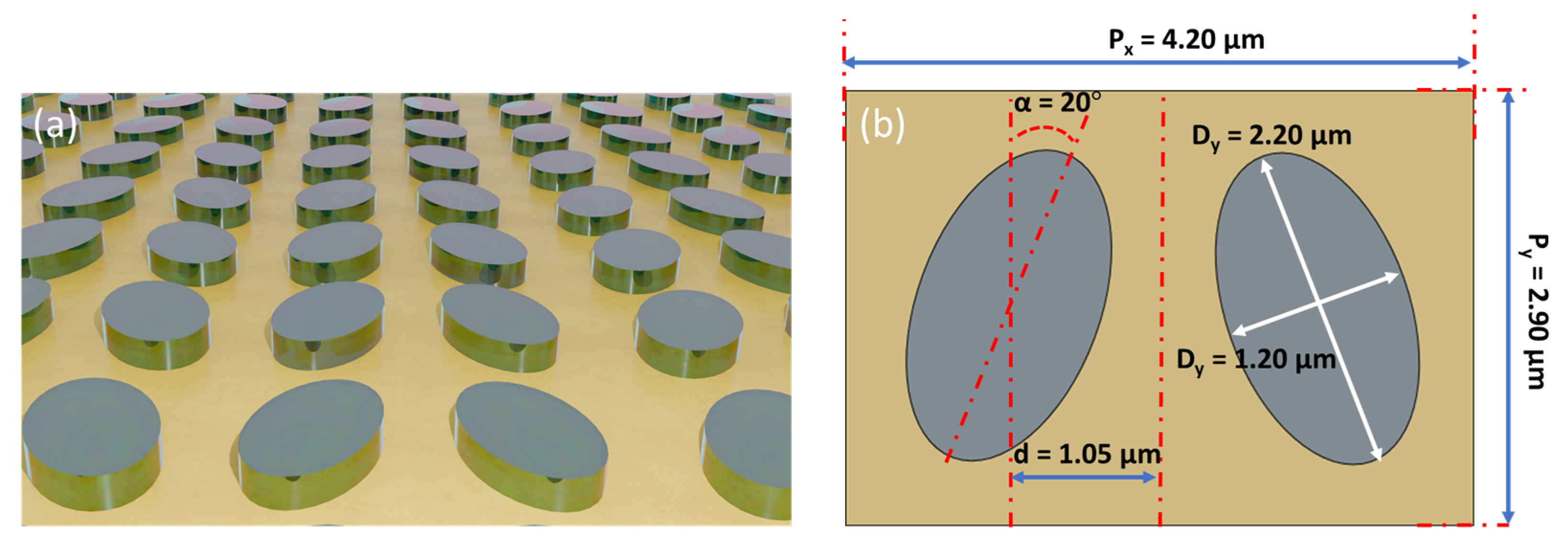
Motivated by these developments, it is natural to ask how high-Q quasi-BIC metasurfaces behave when they are placed on such low-index polymer substrates, and to what extent the substrate properties themselves can shape their resonant response. Building on this concept, we numerically investigate a silicon double-ellipse metasurface on a PDMS substrate in the mid-infrared (3–6 µm) spectral range, where both silicon and PDMS exhibit relatively low absorption for thin structure. Our results show that PDMS-supported silicon nanodimer metasurfaces can sustain quasi-BICs with Q-factors on the order of 103 while exhibiting sensitivity to angle and substrate thickness. We hope these results can provide design guidelines for future mechanically or chemically reconfigurable infrared devices based on polymer substrate platforms suitable for next-generation optical sensing and wearable devices.
3. Results and Discussion
We first examine how the in-plane symmetry of the silicon nanodimer controls the appearance of the high-Q resonance at normal incidence.
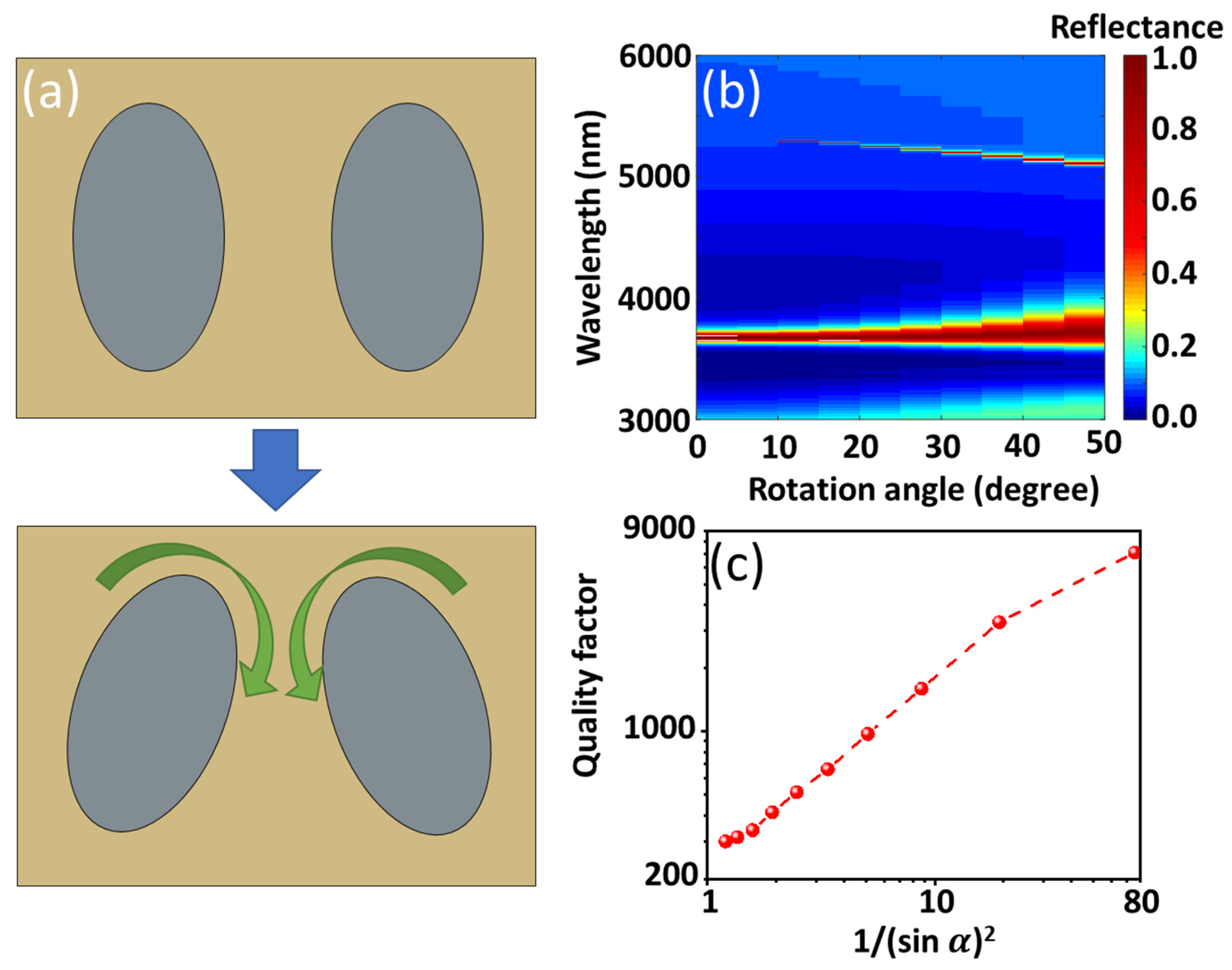
Figure 2a shows the symmetric configuration in which the two ellipses are parallel to each other and aligned with the vertical axis (α = 0°) so that the unit cell possesses a mirror plane perpendicular to the incident electric field. In this case, the reflectance spectrum axis (α = 0° trace in
Figure 2b) exhibited a resonance centered at λ = 3.68 μm. This feature originated from a bright mode lattice-guided resonance supported by the periodic Si metasurface and PDMS slab. The mode coupled efficiently to the external radiation field and was therefore observed in the reflectance spectrum. No additional narrow resonances were observed in this configuration, indicating that any BICs present in the structure are completely decoupled from the normally incident plane wave in this limit.
When the in-plane mirror symmetry was broken by rotating the two ellipses by a finite angle α with respect to the vertical axis, a new narrow spectral feature emerges in the 5.1–5.3 µm range, as seen in the reflectance map of
Figure 2b. The lattice-guided resonance at λ = 3.68 μm remains almost dispersionless with respect to
. This behavior indicates that this lattice-guided resonance is governed by vertical waveguiding and lattice periodicity rather than by the dimer orientation. In contrast, the high-Q resonance is absent at α = 0°, and appears for any nonzero rotation angle, with its linewidth increasing as
grows. This resonance is completely absent in the symmetric configuration and appears only after the in-plane symmetry is perturbed, strongly suggesting that it originates from a symmetry-protected BIC that is dark at α = 0° and becomes radiative when α ≠ 0°. In other words, the rotation of the ellipses lifts the symmetry mismatch between the bound mode and the outgoing plane wave, converting the ideal BIC into a high-Q quasi-BIC whose radiative coupling can be controlled by the degree of asymmetry.
To quantify this dependence, we extracted the quality factor of the high-Q resonance from one-dimensional cuts of the reflectance spectrum at each rotation angle and plotted it as a function of 1/(sin
)
2 in
Figure 2c. The data points follow an approximately linear trend over the explored range, consistent with the theoretical scaling Q ∝ 1/(sin
)
2 predicted for symmetry-protected quasi-BICs in perturbed periodic structures [
27]. This scaling confirms that the narrow resonance indeed originates from a symmetry-protected BIC of the α = 0° metasurface whose radiative leakage is controlled by the dimer rotation angle. From now on, unless otherwise noted, we fix the rotation angle to α = 20° as a representative asymmetry value that yields a high-Q quasi-BIC with a less sensitive linewidth to fabrication imperfections.
To clarify the nature of the two resonances identified in
Figure 2, we decomposed the multipole contributions of the Si dimer to analyze the physical mechanism of the two resonance modes. The induced electric current density in the Si dimer were calculated, from which the multipole moments were obtained following the formulation in Ref. [
28]:
where
are the electric dipole, magnetic dipole, electric quadrupole, and magnetic quadrupole, respectively.
are the Cartesian component indices,
is position vector inside the dimer,
is the induced current density at angular frequency
,
is the Kronecker delta, k is the wave number in the surrounding medium, and
is the spherical Bessel function with order 1. For the multipole decomposition, we integrate induced current density over the combined volume of two silicon ellipses. The origin of the coordinate system is placed at the geometric center of the dimer (midpoint between the ellipse centers and at the mid-height of the silicon layer); z is normal to the substrate, x lies along the dimer axis (center-to-center line), and y is the in-plane transverse direction.
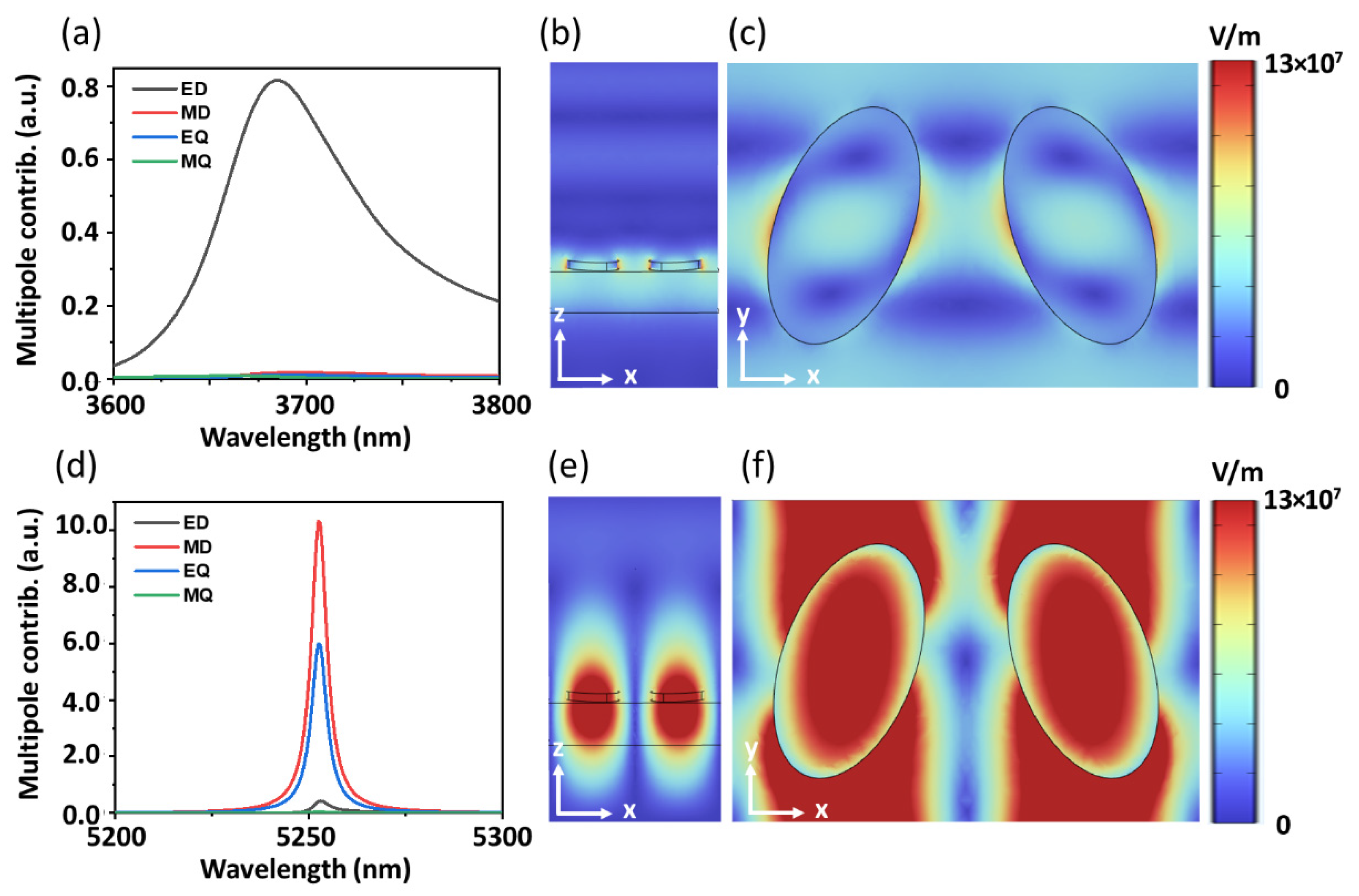
The multipole spectra in
Figure 3a show that, for the resonance at
, the response is overwhelmingly dominated by the electric dipole (ED) contribution, while the magnetic dipole (MD), electric quadrupole (EQ), and magnetic quadrupole (MQ) terms remain an order of magnitude smaller across the entire linewidth. The ED dominance directly implies that the radiation into the far field is governed by a bright dipolar channel.
The field maps in
Figure 3b,c are consistent with this interpretation. In the
xz plane (
Figure 3b), the electric field intensity is only moderately enhanced near the dimer and decays gradually into the PDMS substrate, forming a standing-wave pattern characteristic of a leaky guided mode of the Si–PDMS slab. The field is not tightly confined to the resonators, which explains the relatively strong radiation leakage inferred from the dominant ED contribution. In the
yz plane (
Figure 3c), the in-plane electric field distribution shows that the electric field is concentrated near the edges of the Si ellipses and extends laterally along the x direction across the unit cell. Altogether, these features identify the
resonance as a conventional electric-dipole-type lattice-guided resonance with relatively low Q.
In contrast, the high-Q resonance at
exhibited a different multipolar signature, as shown in
Figure 3d. Here the MD and EQ contributions are strongly enhanced and exhibit very sharp, high-amplitude peaks, whereas the ED contribution is strongly suppressed and remains comparatively small. This redistribution of scattering power from the ED channel into magnetic and higher-order multipoles indicates that the electric dipole radiation of the unit cell is largely canceled by destructive interference between different current distributions inside the dimer. As a result, the mode couples only weakly to the external radiation continuum and attains a much higher Q-factor.
The field profiles in
Figure 3e,f further support this picture. In the
xz plane cross-section (
Figure 3e), the electric field is strongly localized around the Si ellipses, with intense lobes that decay rapidly away from the resonators, indicating that most of the energy is confined within a subwavelength volume near the high-index inclusions. In the
yz plane (
Figure 3f), there is a highly symmetric field distribution across the dimer geometry. While intense “hotspots” exceeding
V/m are localized within the high-index material, the field also extends into the surrounding medium as evanescent “tails”.
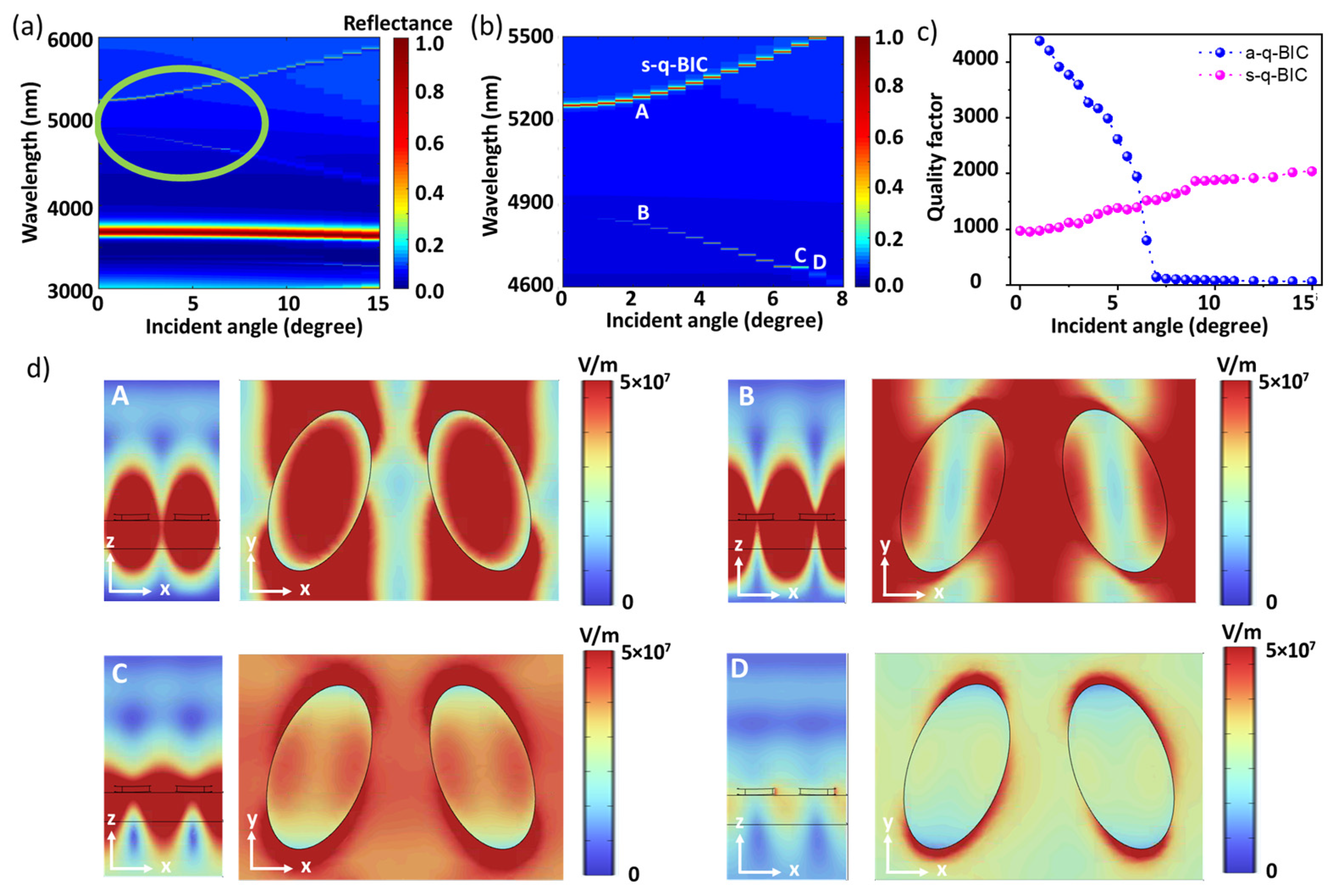
To examine the angular dependence of the q-BIC supported by the metasurface, we investigated its evolution as a function of the incident angle.
Figure 4a showed the reflectance as a function of wavelength and incident angle for the rotated dimer configuration (±α = 20°) at fixed PDMS thickness
. The bright, nearly horizontal band around
corresponds to the lattice-guided resonance already discussed previously; its resonance position is almost insensitive to the incident angle because it is mainly governed by lattice periodicity and vertical waveguiding. In contrast, the high-Q features in the 4.7–5.4 µm range form a set of dispersive branches, indicating the presence of angularly dispersive modes whose coupling to free space is strongly angle dependent.
To analyze these high-Q modes more clearly,
Figure 4b presents a magnified view of the circled region. Two distinct branches can be identified. The upper branch, labeled s-q-BIC, originates at normal incidence and shifts with the change in incident angle. This branch is the angular continuation of the symmetry-protected quasi-BIC discussed in
Figure 2 and
Figure 3: at incident angle 0° the mode is weakly coupled to the radiation continuum due to the quasi-BIC symmetry, and as the angle increases it remains predominantly localized in the nanodimer. The lower branch, which we refer to as a high-Q resonance branch, emerges at a smaller wavelength and exhibits a strong angular dispersion. Its trajectory suggests hybridization between the nanodimer resonance and a guided mode of the Si–PDMS stack: as the incident angle increases, the in-plane wavevector component matches with the guided spectrum, leading to a pronounced variation in radiative loss.
The corresponding quality factors, extracted from one-dimensional cuts of the reflectance spectrum, are plotted in
Figure 4c for both branches. For the symmetry-protected quasi-BIC (magenta curve), the Q factor starts at Q = 973 at normal incidence and gradually increases to Q = 2041 as the angle approaches 15°. This trend indicates that oblique incidence further reduces the mode overlap with the available radiation channels in the surrounding media, leading to slightly lower radiative leakage. In contrast, the high-Q resonance branch (blue curve) exhibits a non-monotonic behavior: the Q factor starts at Q = 4383 at the angle 1°, and then drops rapidly as the angle is increased further. Beyond the angle 6°, the mode becomes strongly leaky, and its Q factor falls to much lower values,
at 6.5° and Q = 142 at 7°. We interpret this lower branch as a guided-resonance-assisted high-Q mode whose radiation loss is minimized only in a finite angular window.
The near-field distributions at representative points A–D along the two branches are shown in
Figure 4d. Point A lies on the s-q-BIC branch at incident angle 2°. Both the
xz- and
yz-plane cross-sections reveal intense, nearly uniform fields around the Si ellipses, consistent with the dimer-localized mode we interpreted in
Figure 3d–f. Point B is chosen on the high-Q resonance branch at incident angle 2°. Here the field remains strongly concentrated around the ellipses but develops additional lobes, but still maintains high destructive interference in the far field. At point C, taken at incident angle 6.5° along the same branch, the guided mode contribution in the resonance become more dominant: the field becomes more delocalized in the vertical direction, and the contrast between the ellipses and the background is reduced, reflecting the increased radiative leakage and reduced Q factor. Finally, point D (at incident angle 7°) samples the vicinity where the high-Q branch approaches a nearby guided mode; the field pattern shows strong energy in the background and only moderate enhancement in the ellipses, characteristic of a leaky guided resonance.
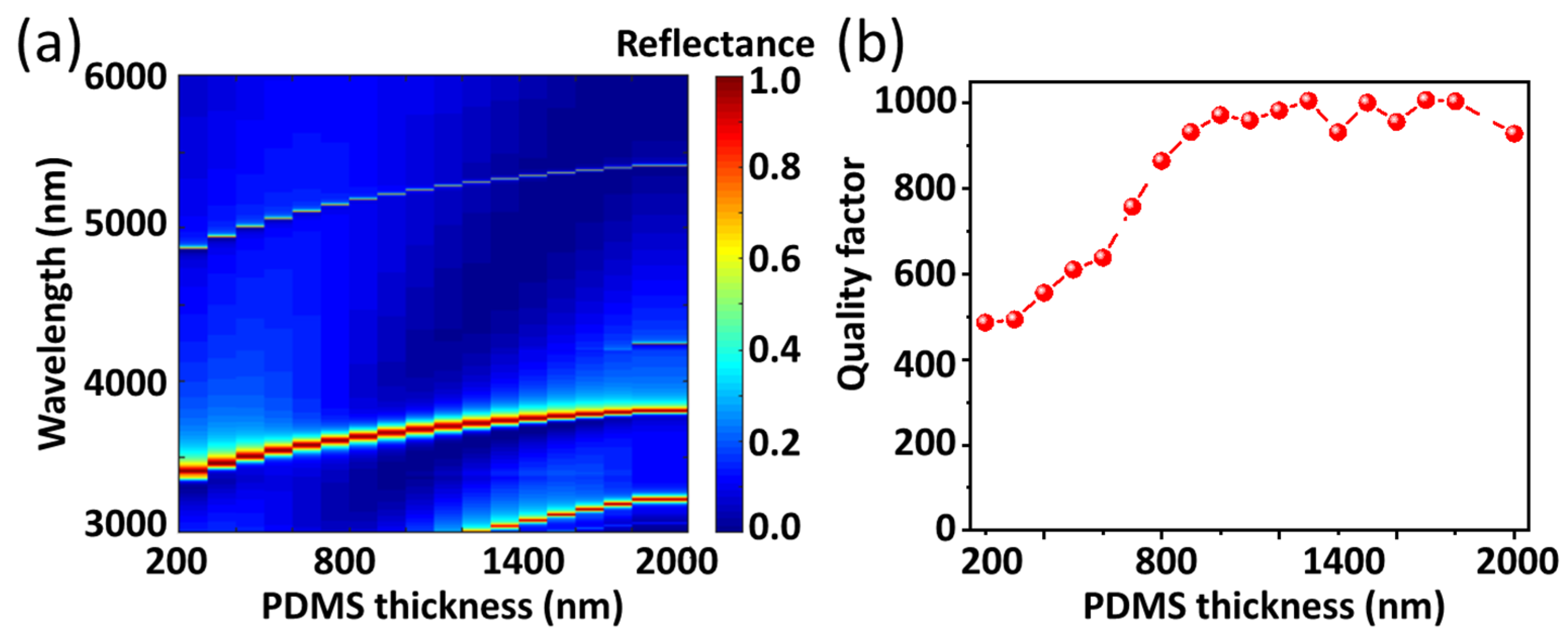
To gain further insight into how the polymer substrate influences both the spectral position and radiation loss of the resonances, we investigate the dependence on PDMS thickness
, shown in
Figure 5, in more detail. The reflectance map in
Figure 5a contains two clearly distinguishable bands. The lower, tilted band around
λ ≈ 3.4–3.8 µm corresponds to a leaky guided-mode lattice resonance of the Si–PDMS slab. Its wavelength increases almost linearly with PDMS thickness. As the PDMS layer becomes thicker, the optical path length grows and the resonance condition is satisfied at longer wavelengths. The field of this mode, as seen in
Figure 3b,c, spans the entire slab thickness and extends into the surrounding media; the Si metasurface provides the lateral periodicity required to couple this guided mode to free-space radiation.
In contrast, the upper band in
Figure 5a, located in the range 4.8–5.4 µm, is associated with the symmetry-protected quasi-BIC. In the absence of the PDMS slab (or for an infinitely thick, homogeneous background), the eigenfrequency of this mode would be governed almost exclusively by the in-plane geometry of the nanodimer and the incident angle. Introducing a finite-thickness PDMS layer, however, creates a vertically asymmetric environment consisting of air/Si/PDMS interfaces. As PDMS thickness varies, the vertical standing-wave pattern in the substrate shifts relative to the dimer array, which modifies both the effective index experienced by the quasi-BIC and its phase relation to the continuum of radiating slab modes. This leads to a slightly more pronounced dispersion of the quasi-BIC branch with thickness: the mode frequency tracks not only the intrinsic dimer resonance but also its hybridization with the continuum spectrum of slab-guided modes supported by the Si–PDMS stack.
The thickness dependence of the quality factor in
Figure 5b provides a direct view of how this hybridization controls radiative loss. For very thin PDMS layers (200–500 nm), the field associated with the quasi-BIC has a substantial overlap with the lower interface and leaks efficiently into the continuum of substrate modes, resulting in moderate Q values of 487 to 610. As the PDMS thickness increases into the 800–1300 nm range, a larger fraction of the energy is concentrated around the high-index Si regions, while the field at the bottom interface is reduced. In this regime the coupling coefficient between the quasi-BIC and the radiative channels in the substrate decreases, and out-of-plane leakage is suppressed. Consequently, the quality factor increases and reaches values up to Q = 1003, indicating that the system approaches an optimal compromise between strong field confinement in the dimer and limited access to radiation continua. For even thicker substrates (≥1500 nm), the Q factor saturates and even exhibits a slight decline. Physically, further increasing PDMS thickness can introduce additional guided modes that approach the quasi-BIC frequency from below. Once these modes become nearly phase-matched, the quasi-BIC can hybridize with them and acquire additional leakage channels. The existence of a broad thickness window over which the Q factor is high therefore reflects a balance between vertical confinement (which improves with thickness) and avoided crossings or hybridization with leaky slab modes (which become more prominent at large PDMS thickness).
Taken together, these results show that the quasi-BIC is sensitive to the PDMS thickness change. The polymer layer does not simply act as a passive support; its thickness directly controls the vertical modal structure and, through that, the interference between quasi-BIC radiation and guided mode channels. This sensitivity suggests that modest changes in effective thickness—whether from fabrication tolerances, mechanical deformation, or index changes that alter the vertical mode profile—can be used to tune both the resonance wavelength and Q factor of quasi-BIC modes in dielectric metasurfaces.