Review

Perovskite Quantum Dots-Based Blue Light-Emitting Diodes: Advantages, Strategies, and Prospects


Xiamen Key Laboratory of Optoelectronic Materials and Advanced Manufacturing, Institute of Lu-Mi-Nescent Materials and Information Displays, College of Materials Science and Engineering, Huaqiao University, Xiamen 361021, China
*
Author to whom correspondence should be addressed.
Photonics 2026, 13(2), 151; https://doi.org/10.3390/photonics13020151

Submission received: 16 January 2026 / Revised: 30 January 2026 / Accepted: 3 February 2026 / Published: 4 February 2026

Abstract

Perovskite quantum dots (PeQDs) are highly promising luminescent materials for next-generation displays owing to their excellent optoelectronic properties, such as narrow emission linewidth, high photoluminescence quantum yield, tunable bandgap, and solution processability. Blue-emitting PeQDs are particularly crucial for realizing full-color displays with high color purity. This review systematically summarizes synthesis strategies for blue-emitting PeQDs and their recent advances in perovskite light-emitting diodes (PeLEDs). We first introduce the working principles of PeLEDs and detail three primary approaches to achieving blue emission through mixed-halide engineering, quasi-two-dimensional structure construction via A-site cation substitution, and quantum size effect utilization. We then review mainstream synthesis methods, including hot-injection, ligand-assisted reprecipitation, and post-synthetic anion exchange, discussing their respective advantages and limitations. Key device optimization strategies are also outlined, covering surface passivation, core–shell structures, interface engineering, and light outcoupling enhancement. Finally, we address current challenges in material stability, efficiency roll-off, and charge imbalance and provide an overview of future research directions for high-performance blue PeLEDs based on PeQDs.

1. Introduction

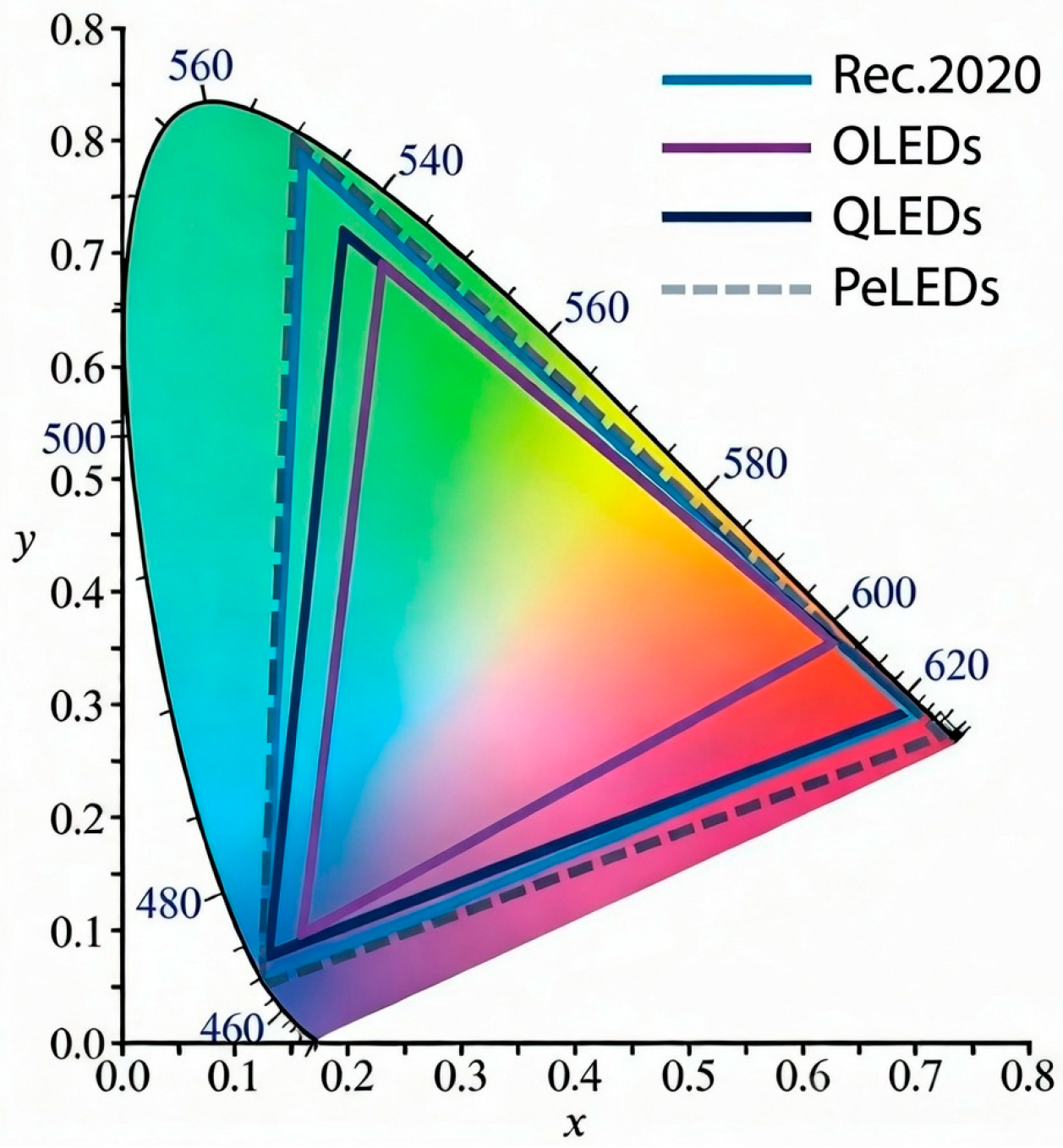
The past two decades have witnessed significant transformations in display technology. The current display market is dominated by organic light-emitting diodes (OLEDs), known for their high efficiency and long lifetime [1]. However, the broad emission spectral full-width at half-maximum (FWHM) of OLEDs (>45 nm) results in low color purity, and they cover only about 65% of the Rec.2020 color gamut (Figure 1), which is insufficient for high-color-purity displays [2]. With advancements in nanotechnology, the dominance of OLEDs in displays is being challenged, particularly by the rapid development of quantum dots (QDs). QDs, regarded as artificial atoms, possess unique size-dependent quantum confinement effects, making them one of the most promising candidate materials for next-generation displays [3]. Specifically, CdSe/S and InP QDs have emerged as viable competitors to OLEDs, exhibiting relatively narrow FWHM values of approximately 20–40 nm and a wide color gamut when used as backlight sources for liquid crystal displays [4]. Unfortunately, the luminescent materials in QLEDs primarily focus on Group II-VI (e.g., CdS, CdSe) and Group III-V (InP) QDs [3,5]. These QD materials face challenges such as stringent preparation conditions, and to enhance their photoluminescence quantum yield (PLQY), surface passivation processes are inevitable, leading to increased manufacturing costs and extended preparation cycles [6]. This necessitates the search for new, high-color-purity and more economical display materials.
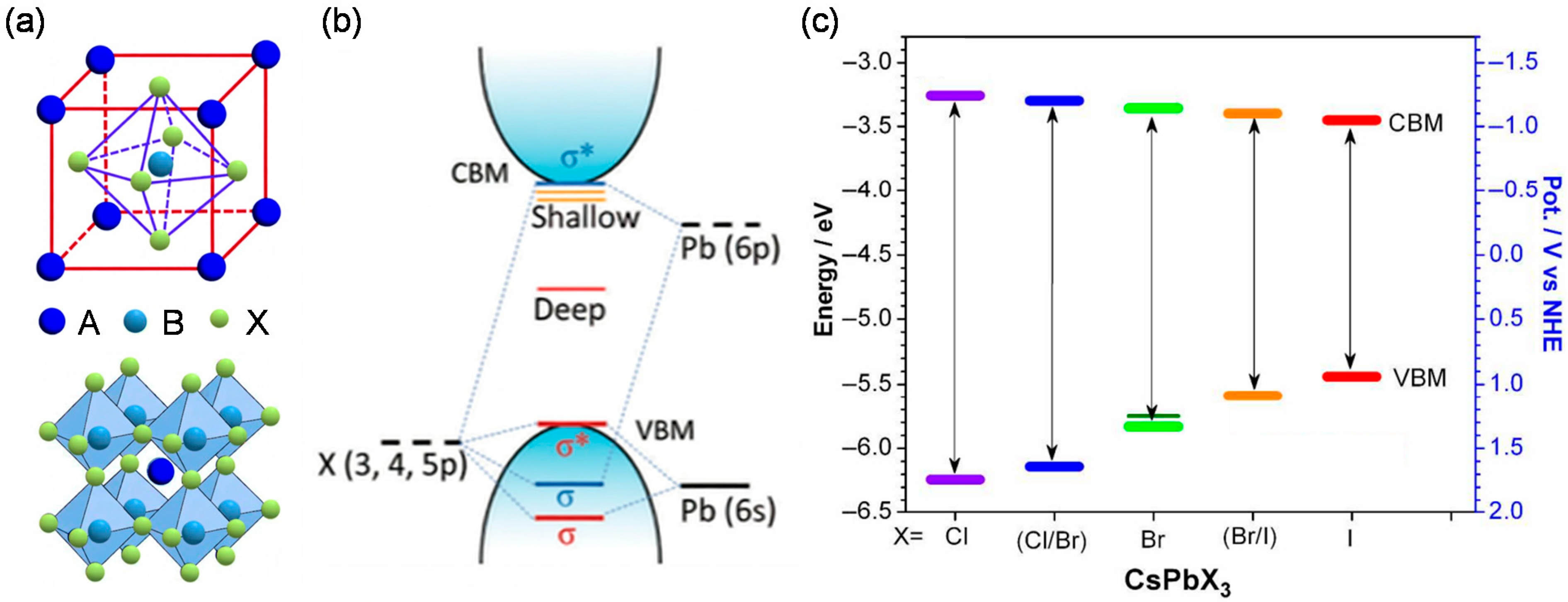
As shown in Figure 2a, metal halide perovskites (MHPs) are a novel class of functional materials with an ABX3 crystal structure, where the A-site is occupied by alkali metal cations (e.g., Cs+, Rb+) or organic ammonium cations (e.g., methylammonium MA+, formamidinium FA+), the B-site by transition metal cations (primarily Pb2+, which can also be substituted by Sn2+, Cd2+, etc.), and the X-site by halide anions (Cl, Br, I) [7]. These materials possess the following unique optoelectronic properties, making them extremely ideal alternative materials for LEDs. First, they exhibit high defect tolerance. The electronic structure of perovskites is conventionally determined by the orbital states of their constituent elements (Figure 2b). Taking CsPbBr3 as an example, the band edges are formed from the atomic orbitals of Pb 6s, Pb 6p, and Br 4p. Specifically, the conduction band minimum (CBM) is composed of the Pb 6p–Br 4p hybrid antibonding orbital, while the valence band maximum (VBM) arises from the Pb 6s–Br 4p bonding orbital, together defining the bandgap [8]. Moreover, the presence of heavy elements in CsPbX3 gives rise to strong spin–orbit coupling, which reduces the bandgap and favors the formation of shallow rather than deep trap states. Additionally, the high polarizability of the Pb2+ ion leads to a large dielectric constant, contributing to a lower capture cross-section of charged defects [9]. The combination of shallow trap energy levels and small capture cross-sections results in low trap-assisted recombination rates, even in the presence of high defect densities. In addition, some surface defects of CsPbX3 can be repaired through simple ligand passivation, reducing the difficulty of synthesis processes. Second, they exhibit a narrow emission spectral FWHM of only 12–25 nm, far superior to OLEDs and traditional QDs, endowing devices with ultra-high color purity. Meanwhile, their PLQY can approach 100%, providing a foundation for highly efficient emission [2]. Third, their bandgap can be continuously tuned across the spectrum (approximately 1.8 to 3.0 eV) through compositional engineering (e.g., adjusting halide ratios, cation doping) and size control (quantum confinement effect), enabling precise matching of the blue, green, and red primary color requirements of the Rec.2020 standard (Figure 1 and Figure 2c) [10]. Fourth, they exhibit good compatibility with solution-processing techniques, allowing for large-scale, low-cost preparation via methods like inkjet printing and transfer printing, which offer potential for flexible displays and large-area fabrication.
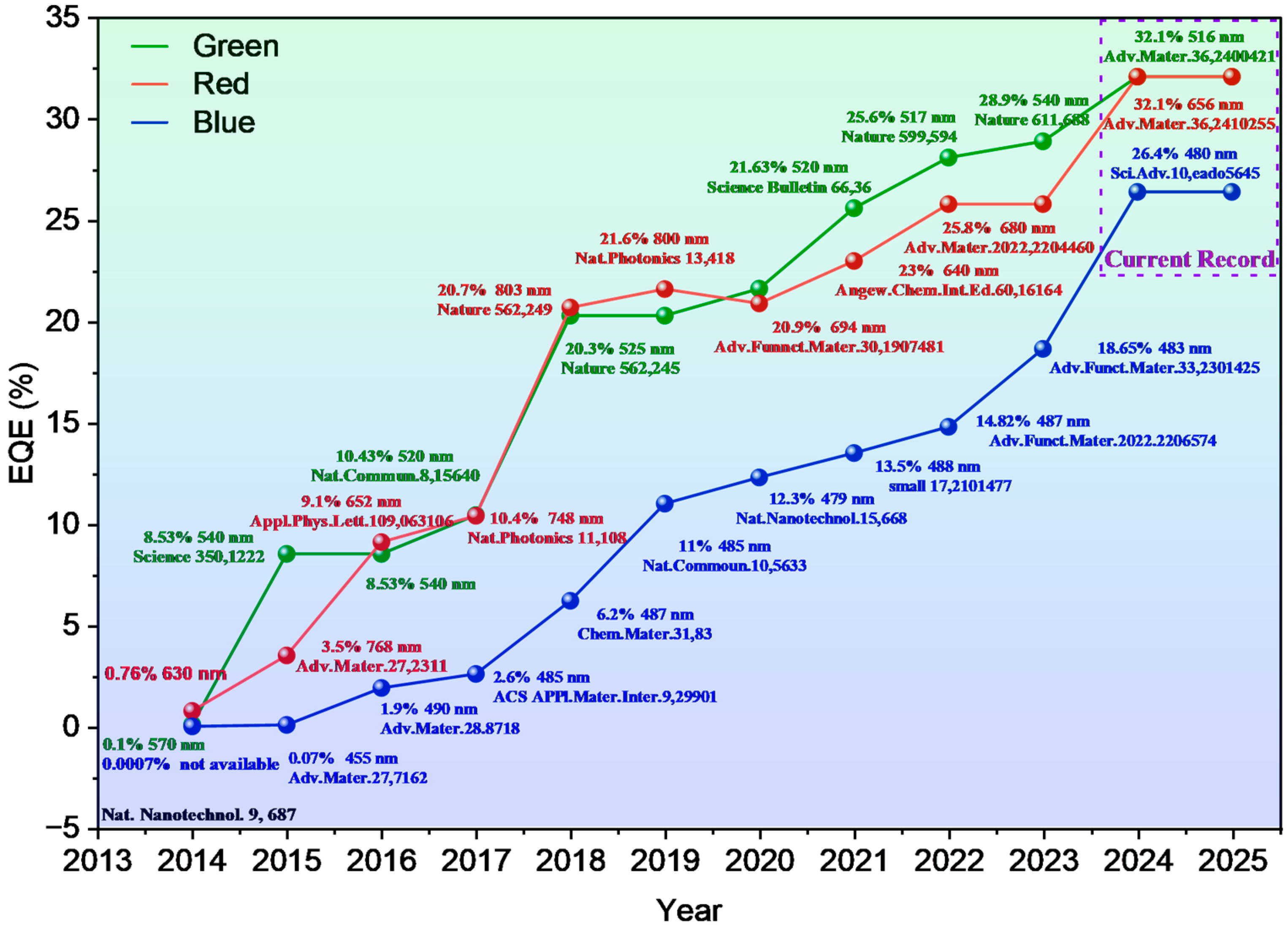
Since the first report of a PeLEDs based on MAPbBr3 nanocrystals by Tan et al. in 2014, this field has experienced rapid development [11]. Through optimization of material synthesis, device structure design, and interface engineering, the performance of PeLEDs has continuously broken records (Figure 3). The external quantum efficiency (EQE) of green and red PeLEDs has reached 32.1% with lifetimes comparable to commercial OLEDs at a brightness of 100 cd·m−2 [12,13]. In contrast, the development of blue PeLEDs has lagged behind. Although the highest reported EQE has reached 26.4% [14], challenges remain, including poor stability, significant efficiency roll-off, and the difficulty of simultaneously achieving high color purity and efficiency [8].
The core reasons for the lag in blue PeLED development can be attributed to both intrinsic material properties and device fabrication challenges. From a materials perspective, blue emission requires a wider bandgap, typically achieved through high Cl doping or by reducing QD size. However, perovskite materials with high Cl content are prone to forming deep-level defects such as chlorine vacancies, which act as non-radiative recombination centers, trapping charge carriers and reducing PLQY [15,16]. Simultaneously, the wide-bandgap nature makes blue-emitting perovskites more sensitive to environmental factors like oxygen, moisture, and heat [17]. High Cl content can exacerbate ion migration and ligand detachment, leading to material degradation [18]. From a device perspective, the VBM of blue PeQDs typically lies between −5.5 and −6.0 eV, and the CBM between −2.5 and −3.0 eV, making energy level alignment with conventional charge transport layers challenging and often resulting in imbalanced charge injection [2]. Furthermore, Auger recombination effects under high current density are more pronounced in blue devices, leading to severe efficiency roll-off [19].
Therefore, breaking through the performance bottleneck of blue PeLEDs requires collaborative efforts at both the material and device levels. The key roadblocks lie in several interconnected areas. First, material instability remains a major concern, as blue-emitting perovskites, especially those with high Cl content or small QDs, are highly sensitive to moisture, oxygen, heat, and light, leading to rapid degradation. To address this, robust surface passivation through ligand engineering, metal ion doping, or core–shell structures, along with hermetic encapsulation, are essential. Second, efficiency roll-off under high current densities, largely due to severe Auger recombination, limits high-brightness performance. This can be mitigated by balancing charge injection through optimized transport layers, employing interface engineering, and utilizing core–shell structures to suppress non-radiative losses. Third, charge injection imbalance often arises from the wide bandgap of blue PeQDs, which results in mismatched energy levels with common charge transport materials. Strategies such as energy-level engineering with tailored ETL/HTL materials, interface modification using buffer layers, and the adoption of dual charge transport layers help alleviate this issue. Finally, in mixed-halide systems, halide phase separation induced by ion migration leads to spectral instability. Possible solutions include using pure-bromide QDs via quantum confinement, incorporating halide-fixing ligands, and constructing core–shell or 2D/3D heterostructures to suppress ion migration. These challenges and corresponding strategies are further elaborated in the relevant sections of this review.
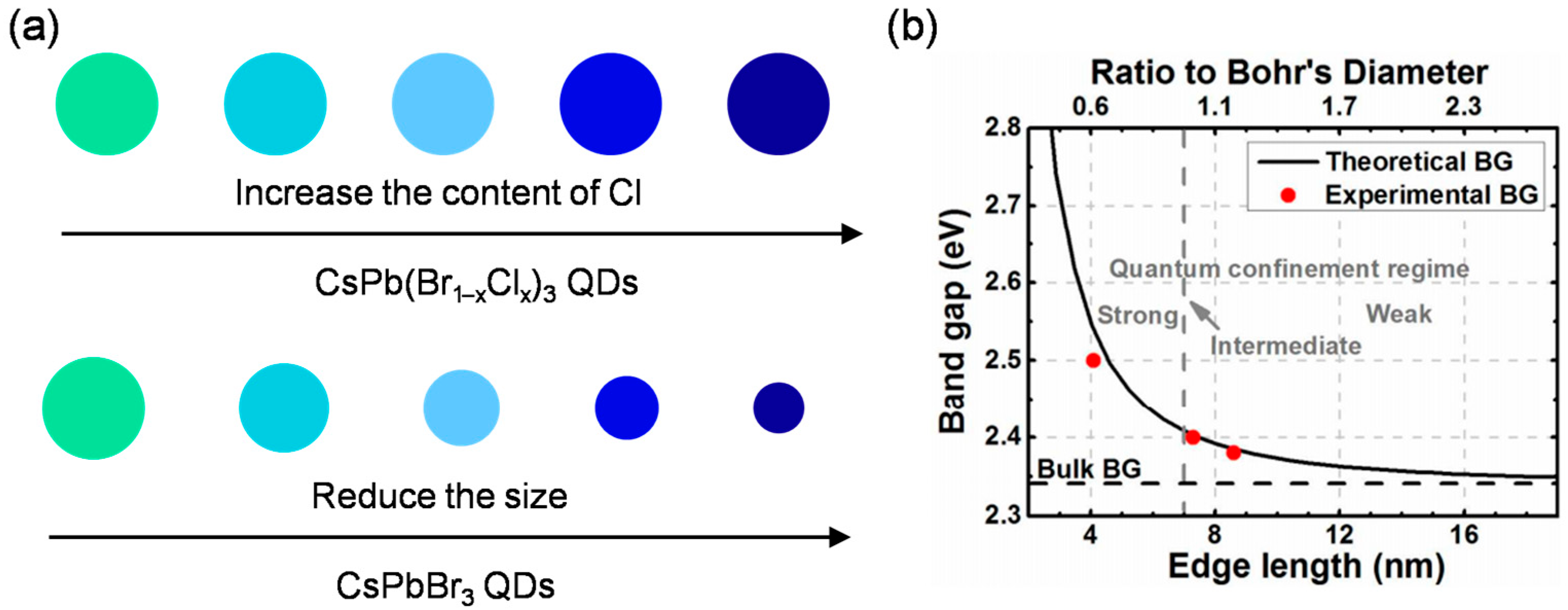
To overcome the performance bottlenecks of blue PeLEDs, researchers have proposed various strategies. Among these, the technology route based on perovskite quantum dots (PeQDs) shows unique advantages. Compared to bulk perovskites, PeQDs crystallize before film formation, which is more conducive to defect passivation and large-scale fabrication [20]. Additionally, PeQDs can easily achieve band gap regulation both through doping with Cl element content and through size adjustment (Figure 4a) [21,22]. In particular, reducing the size of PeQDs (below the Bohr radius) avoids doping with high levels of Cl and effectively solves the problem of ionic halogen ion migration (Figure 4b) [23]. These advantages make PeQDs ideal luminescent materials for blue PeLEDs.
This review focuses on the core research progress of blue PeLEDs based on PeQDs, structured logically according to “advantages, strategies, and prospects.” First, the working mechanism of PeLEDs and the key requirements for blue emission are explained. Subsequently, the synthesis methods for blue-emitting PeQDs are detailed. Then, device performance optimization strategies are systematically summarized. Core challenges such as material stability, device reliability, charge injection balance, and lead-free development are analyzed in depth. Finally, prospects for high-performance PeQDs material exploration and commercial application are discussed, providing a comprehensive reference for further research in this field.

2. Working Principles of Blue-Emitting PeLEDs

2.1. Working Principles

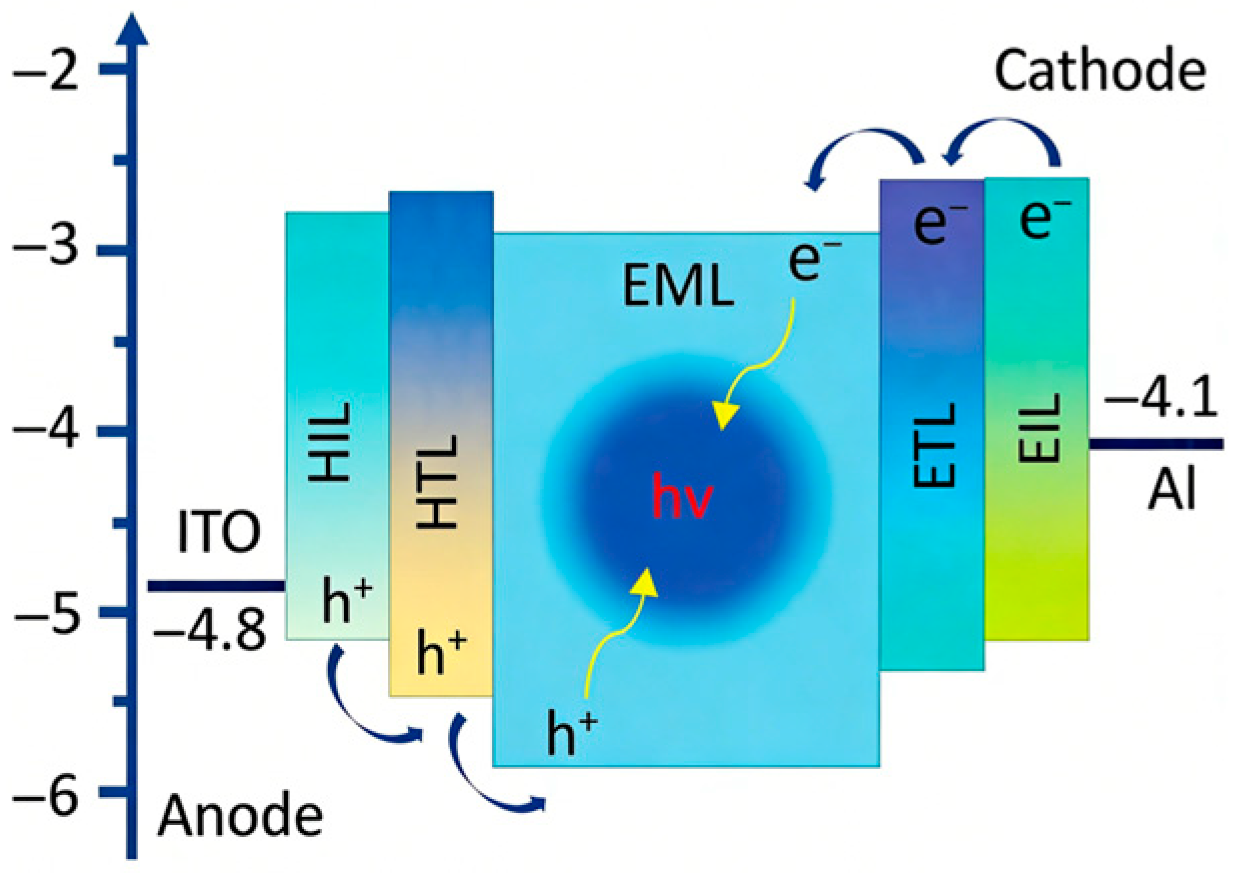
A typical PeLED employs a multilayer heterojunction structure, which sequentially comprises—from top to bottom—the cathode, electron injection layer (EIL), electron transport layer (ETL), perovskite quantum dot emission layer (EML), hole transport layer (HTL), hole injection layer (HIL), and anode (Figure 5) [24]. Depending on performance requirements, some devices may adopt inverted (with the anode at the bottom and cathode at the top) or tandem configurations to optimize charge injection efficiency and operational stability [25,26]. The primary role of this layered architecture is to facilitate efficient charge injection, transport, and recombination while suppressing non-radiative losses. The operation of a PeLED can be described in three fundamental steps. Under forward bias, holes are injected from the ITO anode through the HIL into the HTL and subsequently transported to the EML interface, whereas electrons are injected from the cathode via the EIL into the ETL and similarly directed toward the EML. Within the EML, electrons and holes meet to form excitons, which then undergo radiative recombination, emitting photons and thereby producing electroluminescence.
The EQE serves as a key metric for evaluating the luminescence performance of PeLEDs and is expressed as [27]
EQE (%) = ηinj × η rad × ηout
where ηinj denotes the charge injection efficiency, governed by the energy-level alignment between electrodes and charge transport layers as well as between the transport layers and the emission layer; ηrad represents the radiative recombination efficiency, which correlates directly with the PLQY and is influenced by material defect density and exciton dynamics [28]; and ηout is the light outcoupling efficiency, limited by factors such as refractive-index matching among device layers and the overall optical design of the device. Therefore, achieving high EQE requires the simultaneous optimization of all three factors: precise energy-level engineering to enhance charge injection, suppression of defects and non-radiative pathways to maximize radiative efficiency, and tailored optical design to improve photon extraction from the device.

2.2. Approaches to Realizing Blue Electroluminescence

Compared to green and red light, blue light has a shorter wavelength, requiring the perovskite luminescent material itself to possess a wider bandgap. Current strategies for realizing blue PeLEDs can be summarized into three categories. (1) Mixed-halide composition engineering. The core principle of this strategy is to leverage the dependence of the bandgap of halide perovskites on halide ion composition. By precisely adjusting the molar ratio of Cl to Br, the energy band structure can be tuned. The introduction of Cl lowers the energy level of the halide p-orbitals, widening the bandgap and shifting the emission wavelength into the blue region [29]. However, this approach is inherently limited by phase separation due to halide ion migration, which compromises the spectral stability of the device, and by the tendency of Cl-related defects to form deep-level traps that markedly reduce the PLQY of perovskite crystals, thereby degrading overall device performance. (2) A-site cation substitution (construction of quasi-2D structures). This strategy involves partially or completely substituting Cs+ in CsPbX3 with long-chain organic cations (e.g., phenethylammonium, n-butylammonium), promoting lattice cleavage along the vertices of the [PbBr6]4− octahedra to form quasi-two-dimensional structures [30]. Since the dimension perpendicular to the crystal planes in quasi-2D perovskites is on the same order as the exciton Bohr radius, the quantum confinement effect is significantly enhanced, ultimately enabling blue emission. The key technology here is ligand engineering; introducing amphiphilic ionic ligands, for instance, can suppress the formation of high-dimensional (n > 4) and low-dimensional (n = 1) phases, improving phase purity [31]. However, this approach faces challenges in precisely controlling phase composition, often leading to multi-peak emission and emission peak red-shift. Moreover, the poor conductivity of the introduced organic cations can affect device carrier transport efficiency, limiting practical applications. (3) Quantum size effect (preparation of low-dimensional perovskite nanocrystals or QDs, collectively referred to as PeQDs). This strategy involves preparing low-dimensional structures of pure bromide perovskites (0D QDs, 1D nanowires/nanorods, 2D nanosheets) with sizes smaller than the exciton Bohr radius [8]. Utilizing the strong quantum confinement effect widens the bandgap, shifting the emission wavelength into the blue region. Key preparation methods include hot-injection and ligand-assisted reprecipitation (LARP). By controlling reaction kinetics combined with surface ligand passivation, PeQDs with uniform size and low defect density can be prepared. This approach effectively avoids the phase separation issues of mixed-halide systems and the conductivity defects of quasi-2D structures, making it the most promising technical route for achieving blue electroluminescence currently [32,33]. To date, the record values for major performance metrics of blue PeLEDs, such as maximum EQE [14] and longest lifetime [34], have been achieved based on PeQDs.

3. Synthesis Strategies for Blue-Emitting PeQDs

The core of synthesizing blue-emitting PeQDs lies in achieving the target bandgap through composition engineering and size control, while ensuring high crystallinity, low defect density, and good colloidal stability. Although the primary basis for realizing blue PeLEDs with PeQDs is the quantum size effect, strategies commonly used for bulk perovskites, such as halide mixing and A-site doping, are also applicable to PeQDs systems and will not be elaborated here. Current mainstream synthesis methods for blue PeQDs include hot-injection synthesis, LARP, and post-synthetic modification.

3.1. Hot-Injection Method

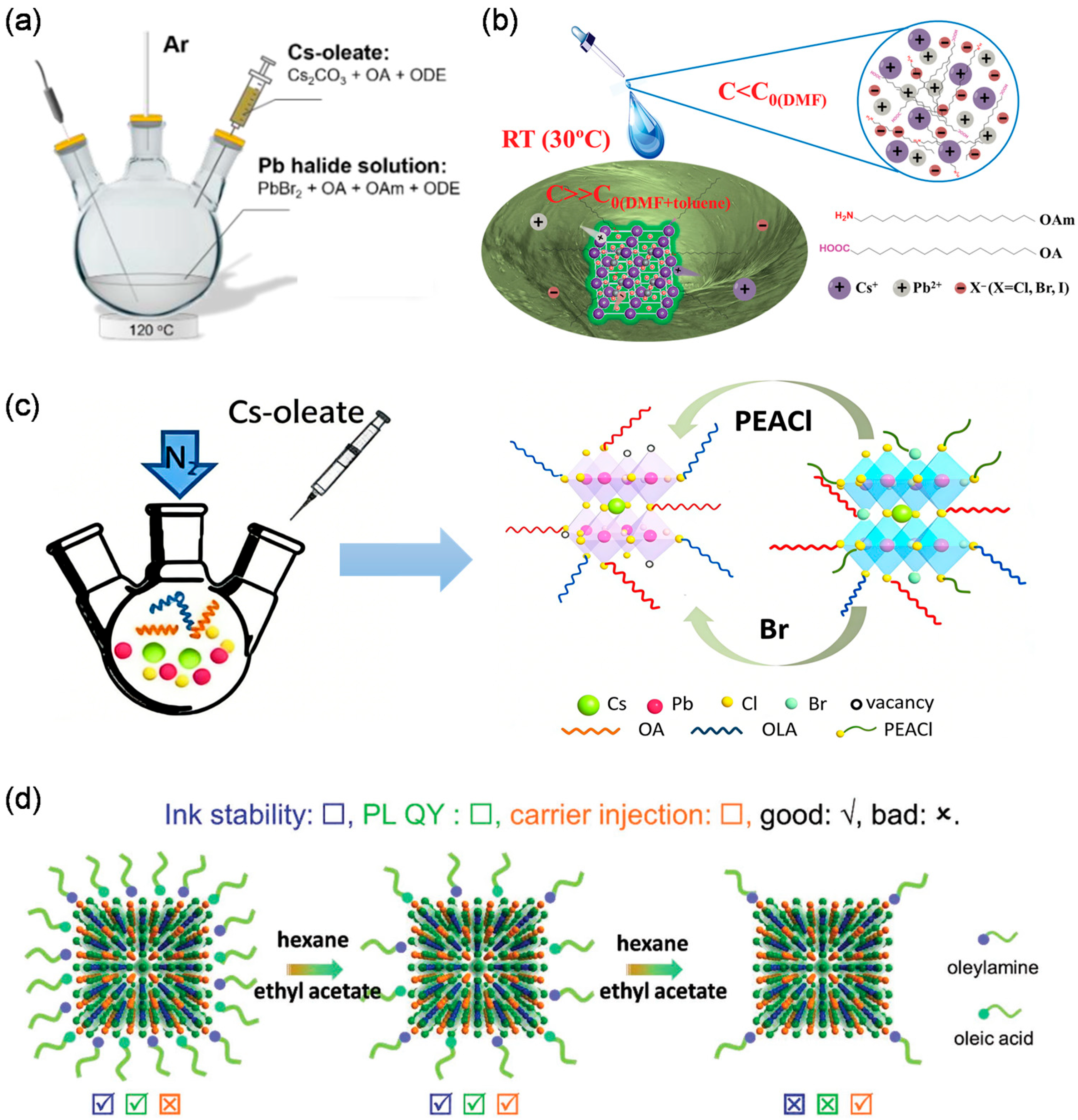
The hot-injection method is a classical approach for preparing high-quality PeQDs, offering significant advantages in terms of uniform size distribution and high crystallinity. Its basic principle involves dissolving a lead source (e.g., PbBr2) in a non-polar solvent (e.g., 1-octadecene, ODE) with oleic acid (OA) and oleylamine (OAm) as ligands, followed by dehydration under vacuum at 120 °C (Figure 6a) [35]. A cesium source (e.g., cesium oleate solution prepared by dissolving Cs2CO3 in ODE and OA) is then swiftly injected into the above system. The reaction proceeds at 80–180 °C and is subsequently quenched using an ice-water bath to terminate the process, yielding the target PeQDs [36]. Precise tuning of blue emission is accomplished through the adjustment of reaction parameters. Reaction temperature serves as a critical factor, where conditions at 80–120 °C tend to form small-sized PeQDs (3–5 nm), enabling blue emission via the quantum confinement effect [37,38]. By contrast, temperatures of 140–200 °C typically yield larger nanocubes, which subsequently require a mixed-halide strategy to achieve blue emission. Furthermore, ligand chain length regulates crystal growth, with long-chain ligands such as OA and OAm inhibiting crystal growth and thereby promoting the formation of small-sized QDs [39]. Short-chain ligands (e.g., octylamine, hexanoic acid) promote crystal growth, being more suitable for mixed-halide systems. The precursor ratio also controls crystal morphology [40]. A low Cs/Pb ratio favors the formation of 2D nanosheets, while a high Cs/Pb ratio favors 3D nanocubes [41]. The core advantages of the hot-injection method are the narrow size distribution and high crystallinity of the resulting PeQDs. However, this method is clearly limited by its relatively stringent reaction conditions, which require both inert gas protection and precise temperature control, and by the challenges associated with scaling up production.

3.2. LARP Method

The LARP method offers significant advantages including simple operation, low preparation cost, and potential for large-scale production. The core principle of this method involves dissolving perovskite precursors (e.g., CsX, PbX2) in a good polar solvent (e.g., N,N-dimethylformamide, DMF or dimethyl sulfoxide, DMSO) with added ligands (e.g., OA, OAm) (Figure 6b) [42]. The resulting precursor solution is then rapidly injected into an excess of a poor solvent (e.g., toluene, hexane), inducing rapid nucleation and crystallization under vigorous stirring to finally obtain colloidal PeQDs. The key process parameters of LARP can be summarized into three aspects. The volume ratio between the good and poor solvents is crucial for controlling PeQDs size through its direct effect on system supersaturation, with typical ratios ranging from 1:10 to 1:50 [43,44]. The type and concentration of ligands are vital for achieving optimal PeQDs dispersibility and surface quality, where commonly employed ligands include OA and OAm. Excessively low ligand concentration can induce PeQDs aggregation, whereas an excessively high concentration may elevate surface defect density. This method can be performed at room temperature without requiring elevated temperatures. In contrast, moderately increasing the temperature below 60 °C can result in larger PeQDs sizes and a correspondingly attenuated quantum confinement effect [45].
The main limitation of the LARP method is that the prepared QDs tend to have relatively high surface defect density, and their PLQY is usually lower than that of PeQDs prepared by the hot-injection method. Therefore, subsequent purification processes or surface passivation treatments are often necessary to further improve the optical properties. Related studies have shown that strategies such as short-chain ligand modification, halide source supplementation, or ionic liquid passivation can effectively reduce surface defect state density and significantly enhance the luminescence efficiency and stability of the PeQDs.
Figure 6. Schematic diagram of PeQDs preparation by hot-injection method (a) [35], LARP method [42] (b), and post-synthetic anion exchange method (c) [46]. (d) Purification and post-treatment of PeQDs [47].
Photonics 13 00151 g006

3.3. Post-Synthetic Anion Exchange and Purification Method

The anion exchange method is an efficient approach for preparing mixed-halide blue-emitting PeQDs, particularly suitable for precisely tuning the Cl/Br ratio [14]. Its principle relies on the diffusion and exchange of halide ions on the PeQDs surface, altering the X-site anion composition to adjust the bandgap and emission wavelength. This method typically uses well-established CsPbBr3 QDs as precursors, dispersing them in a solution containing a Cl precursor (e.g., CsCl, tetrabutylammonium chloride). The reaction proceeds at room temperature or under mild heating, with the Cl/Br ratio controlled by reaction time and Cl concentration. For example, Shao et al. prepared a series of CsPb(BrxCl1−x)3 QDs via post-synthetic anion exchange by reacting CsPbBr3 QDs with a Cl precursor, shifting the emission wavelength at 470 nm while maintaining a PLQY above 80% (Figure 6c) [46]. The advantages of this method are its simplicity, rapid reaction, and ability to achieve continuous wavelength tuning. Its drawback is the tendency towards halide phase separation, which can affect PeQDs stability and emission uniformity.
Synthesized PeQDs require purification to remove excess ligands, unreacted precursors, and by-products from the system, thereby improving colloidal dispersion stability and optical properties [48]. The most widely used purification method currently is centrifugal precipitation. The specific procedure involves thoroughly mixing the PeQDs colloidal solution with a purification solvent (e.g., ethyl acetate, ethanol), followed by centrifugation to collect the bottom precipitate. The precipitate is then redispersed in a non-polar solvent (e.g., toluene, hexane). Repeating this process 2–3 times yields high-purity PeQD products (Figure 6d) [47]. During purification, high-polarity solvents should be avoided to prevent structural decomposition of the PeQDs and degradation of their luminescence properties. Optimization of centrifugation parameters is also important; a suitable rotation speed is typically 8000–12,000 rpm for 5–10 min [49,50]. Excessive centrifugation can lead to PeQD agglomeration, compromising their dispersibility and optical performance.
Surface ligand exchange is an effective means to further optimize PeQD performance. Replacing original long-chain ligands with short-chain ligands (e.g., butylamine, phenethylamine) can reduce the insulating effect of ligands, significantly enhancing charge transport efficiency. Treating the PeQD surface with halide salts (e.g., NH4Br, CsCl) can effectively passivate surface defect states, reducing non-radiative recombination and thus improving PLQY.

4. Device Optimization Strategies for Blue PeLEDs Based on PeQDs

Blue-emitting PeQDs exhibit immense application potential in full-color displays due to their intrinsic excellent luminescent properties, including narrow emission linewidth, high PLQY, and wide color gamut. However, at the device level, key issues such as imbalanced charge injection, severe non-radiative recombination, and low light outcoupling efficiency persist, directly limiting the improvement of EQE and long-term stability. Systematic optimization approaches including surface passivation, device structure design, interface engineering, and lead-free modification can effectively address these bottlenecks, advancing device performance towards commercial application.

4.1. Surface Passivation

Blue-emitting PeQDs, due to their high surface-to-volume ratio, commonly possess surface defect states such as halide vacancies and uncoordinated Pb2+ [51]. These defects act as non-radiative recombination centers, significantly reducing PLQY and device luminescence efficiency. Surface passivation techniques, which saturate surface dangling bonds and fill defect sites through chemical or physical means, are core strategies for enhancing material optical performance and device stability. Surface passivation can be divided into ligand passivation, metal ion doping passivation, and core–shell structure passivation according to the passivation methods.
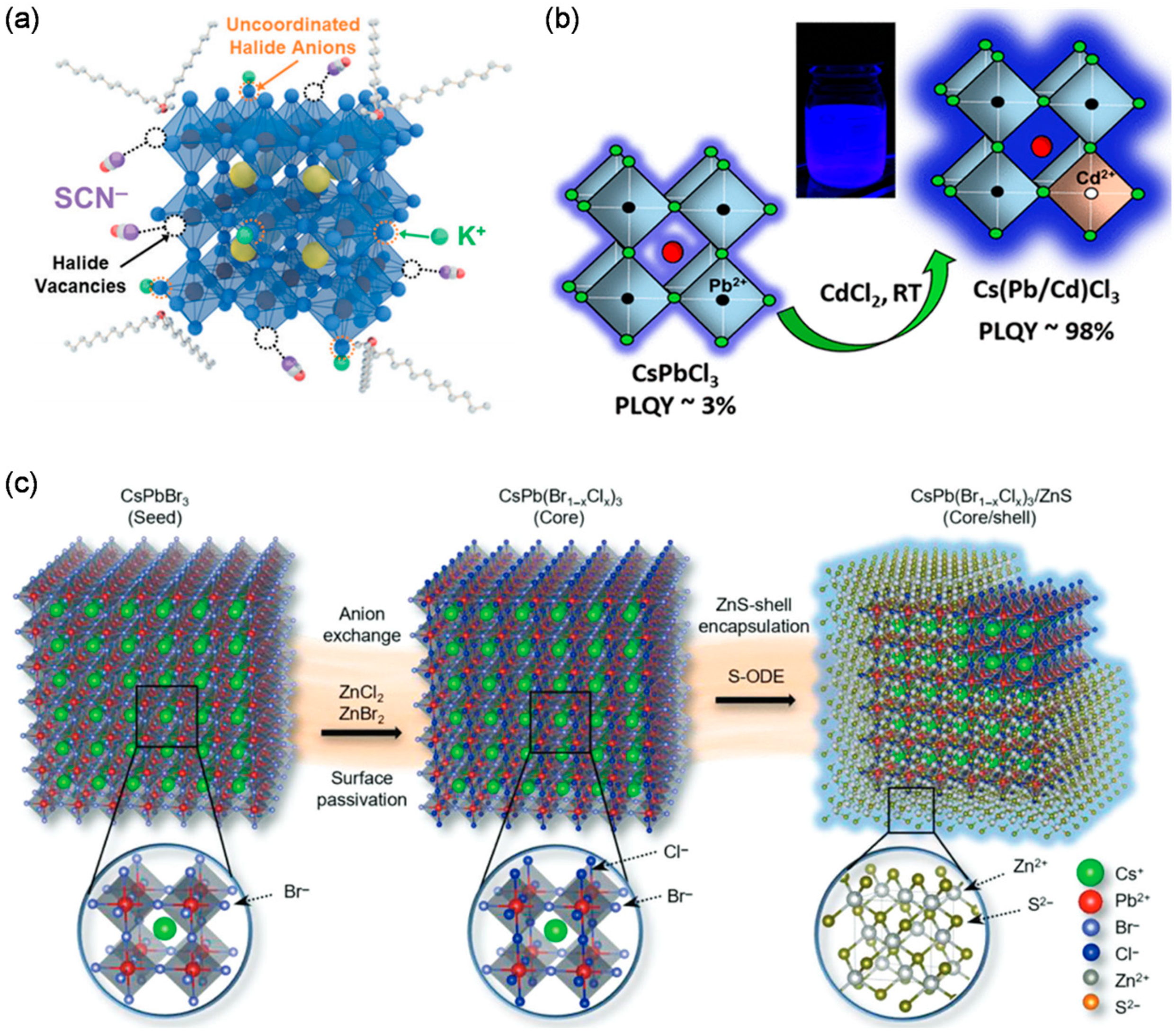
Ligand passivation saturates defect states and modulates surface electronic structure by forming specific interactions with defect sites on the PeQDs surface. Commonly used ligands can be categorized into organic ligands, halide ligands, and halide-like ligands. Organic ligands such as OAm, OA, and phenethylamine form coordinate bonds with surface Pb2+ via amino or carboxyl groups, saturating dangling bonds to passivate uncoordinated sites. Long-chain organic ligands can also form a steric hindrance layer on the PeQDs surface, inhibiting particle aggregation. Short-chain organic ligands like butylamine and phenethylamine can reduce the insulating effect of ligands, improving charge transport efficiency. Halide ligands such as NH4Br and CsCl fill defects via strong interactions between halide ions and surface halide vacancies, reducing defect state density, while also supplementing the halide ion content in the system, suppressing phase separation induced by ion migration [52]. Halide-like ligands such as thiocyanate (SCN) (Figure 7a) and tetrafluoroborate (BF4−) exhibit stronger binding energy with Pb2+ than traditional halide ions, forming a stable surface protective layer [53,54]. Additionally, amphiphilic ionic ligands like 3-aminopropylphosphonic acid (APPA) and 3-aminopropanesulfonic acid (APSA) can coordinate with surface Pb2+ and Br via their cationic and anionic groups, respectively, simultaneously suppressing the formation of both low-dimensional and high-dimensional phases, thereby improving phase purity and luminescence stability [55].
Metal ion doping achieves dual effects of defect passivation and electronic structure modulation through lattice site substitution or interstitial doping. The introduced metal ions can fill lattice vacancies, adjust the energy band structure, or enhance chemical bond strength, thereby reducing non-radiative recombination and improving material stability. For example, Mondol et al. treated CsPbCl3 QDs with Cd2+. Cd2+ filled lattice vacancies by substituting Pb2+ sites while forming stable chemical bonds with Cl, increasing PLQY from 3% to 98% [56]. Devices based on these PeQDs achieved an EQE of 14.6% and a maximum luminance of 465 cd·m−2. Pan et al. co-doped Rb+ and Ni2+ into CsPb(BrxCl1−x)3. Rb+, with an ionic radius similar to Cs+, seamlessly incorporated into the lattice, passivated Cl vacancies and precisely tuned the emission wavelength; Ni2+ lowered the hole injection barrier by modulating the band structure, significantly increasing PLQY to 86.7% [57]. Furthermore, K+ doping can passivate non-coordinated halide ions on the surface of CsPb(Br/Cl)3 QDs, inhibiting halide ion migration; no emission peak shift at 477 nm was observed after 24 h of storage [58]. Zn2+ doping enhances the ionic character of Pb-X bonds, lowering defect formation energy and improving the air stability and optical performance of the material [59].
Core–shell structures achieve dual functions of physical isolation and defect passivation by coating the PeQD core with a shell material that has a wider bandgap and good lattice matching. The shell material must meet requirements such as a bandgap wider than the core material, low lattice mismatch, and high chemical stability [60]. Commonly used materials include Cs4PbBr6, FAPbBr3, ZnS, SiO2, etc. [61]. For instance, Kim et al. prepared CsPb(BrxCl1−x)3@Cs4PbBr6 core–shell QDs. The shell not only passivated the surface defects of the core but also suppressed halide ion migration, achieving a PLQY of >90%. Blue LEDs fabricated from CsPbBr3 QDs with reconstructed surfaces exhibit a maximum external quantum efficiency of 4.65% at 480 nm and excellent spectral stability [62]. Hong and coworkers proposed a highly effective strategy for enhancing deep-blue perovskite LEDs through the hermetic sealing of PeQDs with epitaxial ZnS shells, which significantly suppresses ion migration and environmental degradation (Figure 7c). The core–shell structure not only improves the optical and photophysical performance but also extends the operational lifetime, achieving exceptional brightness (2916 cd m−2) and high EQE (1.32%) at 451 nm [35]. These findings underscore the potential of robust inorganic encapsulation as a viable solution for practical deep-blue PeLED devices. Kshirsagar et al. prepared CsPbBr3/FAPbBr3 core/crown nanoplatelets. FA+ ions coordinated with uncoordinated Br ions on the core surface, and excess Br passivated surface Br vacancy defects, increasing the PLQY. The emission peak position remained stable after 6 months of storage at room temperature [63]. Encapsulating CsPbBr3 QDs within a SiO2 shell effectively protects them against moisture and oxygen erosion, preventing PeQDs structural degradation, while the high refractive index of the SiO2 matrix helps improve light outcoupling efficiency. Core–shell structures can also suppress Auger recombination. Particularly for small-sized blue PeQDs, the electron confinement effect of the shell can enhance the probability of exciton radiative recombination, reducing efficiency roll-off [64].

4.2. Device Structure Optimization

Device structure design directly affects charge injection, transport, recombination, and photon extraction efficiency. Through optimization of charge transport layer selection, interface engineering, and light outcoupling enhancement, synergistic optimization of balanced charge injection, suppressed non-radiative recombination, and improved photon escape efficiency can be achieved.
The energy level structure and charge mobility of charge transport layers are key factors determining charge injection efficiency. It is necessary to achieve energy level matching between the highest occupied molecular orbital (HOMO) of the HTL and the VBM of the PeQDs, and between the lowest unoccupied molecular orbital (LUMO) of the ETL and the CBM of the PeQDs, to reduce charge injection barriers. The VBM of blue PeQDs typically lies between −5.4 and −5.8 eV, requiring HTL materials with high work functions and matching HOMO levels [2]. Commonly used HTL materials include organic materials such as poly[(9,9-dioctylfluoren-2,7-diyl)-alt-(4,4′-(N-(4-sec-butylphenyl)diphenylamine) biphenyl)] (Poly-TPD, HOMO = −5.4 eV), poly(triarylamine) (PTAA, HOMO = −5.2 eV), and inorganic materials such as NiOx (HOMO = −5.3 eV) [24]. When NiOx is used as the HTL, it can also promote the formation of Cs4PbBr6 [65], limit excessive growth of CsPbBr3 crystals, and modulate the valence band energy level of the emission layer to facilitate hole injection.
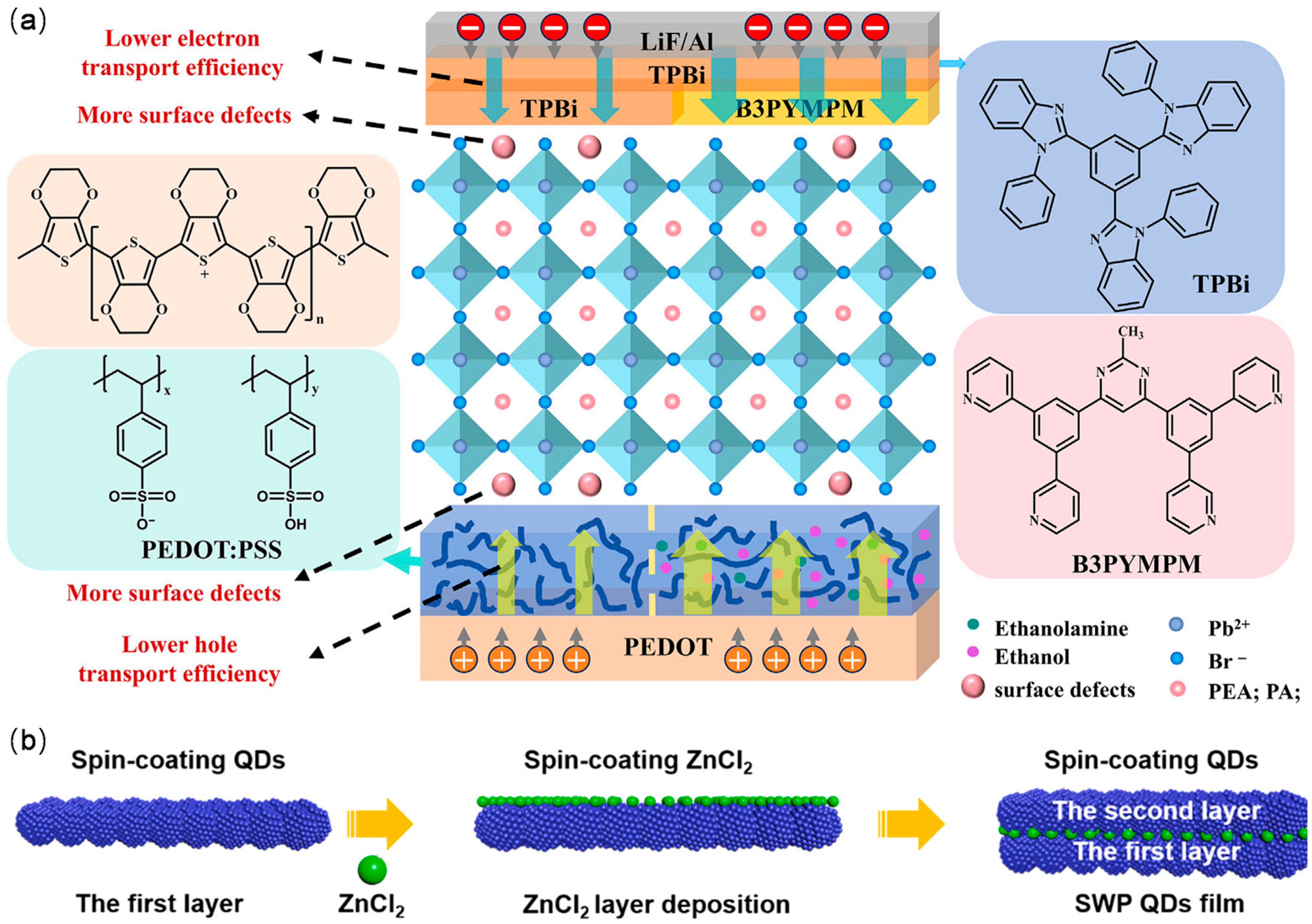
The ETL should have a LUMO level matching the CBM of the PeQDs and high electron mobility. Commonly used organic ETLs include 1,3,5-tris(1-phenyl-1H-benzimidazol-2-yl)benzene (TPBi, LUMO = −2.7 eV) and 4,6-bis(3,5-dipyrid-3-ylphenyl)-2-methylpyrimidine (B3PymPm, LUMO = −2.9 eV). Inorganic ETLs include zinc oxide (ZnO, LUMO = −4.0 eV) [66]. ETL modification can further optimize electron transport performance. For example, in modifying ZnO with phenethylammonium bromide (PEABr) (D-ZnO), the bromine in PEABr can fill the oxygen vacancies in ZnO nanocrystals and passivate the surface defects of the perovskite layer while reducing electron mobility to balance electron and hole concentrations, increasing device EQE from 4.7% to 8.7% and achieving a T50 of 35 h [67]. Yuan et al. employed a customized small-molecule ETL material B2 with an electron mobility of 2.7 × 10⁻⁴ cm2·V−1·s−1, which is 20 times that of conventional TPBi. A blue PeLED based on this ETL achieved an EQE of 13.17% with a turn-on voltage of only 2.2 V [68]. Additionally, employing a dual-ETL structure like B3PymPm/TPBi enables precise regulation of electron transport rate (Figure 8a), promoting charge transport balance and efficient recombination within the perovskite layer, ultimately yielding a pure blue device with an EQE of 7.6% [69].
Interface defects and energy level mismatch are the primary causes of non-radiative recombination and charge injection loss. Interface modification can optimize interface properties, improving charge injection and recombination efficiency. Inserting a buffer layer is an effective means of adjusting energy level alignment. Inserting an ultrathin buffer layer such as perfluorinated ionomer (PFI) or polyetherimide (PEI) at the HTL/EML or ETL/EML interface can reduce interfacial energy barriers and minimize charge injection obstacles. For example, inserting a ZnCl2 blocking layer between the PeQDs emission layer and the ETL, forming a sandwich structure, can confine the recombination zone within the emission layer (Figure 8b), minimizing the exciton quenching and Auger recombination caused by interfacial charge accumulation, balancing electron and hole transport, and achieving a device EQE of 5.0% [70].
Interface passivation saturates interface defect sites by introducing functional molecules. Modifying the PEDOT:PSS/emission layer interface with ionic liquids like 1-butyl-3-methylimidazolium tetrafluoroborate, the imidazolium ring and BF4 anion can simultaneously eliminate halogen vacancies and lead-related defects, improving film compactness and charge transport efficiency, resulting in a device EQE of 8.3% [71]. Two-dimensional/three-dimensional (2D/3D) heterostructure design can further enhance interface stability. Introducing 2D perovskites like PEA2PbBr4 into the PeQDs emission layer to form a heterostructure utilizes the high stability of 2D perovskites to suppress ion migration and interfacial carrier quenching [31]. In addition to structural modifications, controlled electrical post-treatments, such as dark electro-treatment, have also been demonstrated to effectively suppress detrimental ion migration by redistributing residual halide anions to defect sites, thereby passivating interfaces and enhancing device stability [72].
The light outcoupling efficiency of blue PeLEDs is typically only 20–30%, primarily due to refractive index mismatch between the PeQDs, charge transport layers, and air, causing some photons to be trapped inside the device via total internal reflection [73]. Refractive index adjustment is the foundation for improving outcoupling efficiency. Selecting charge transport layer materials with refractive indices matching that of the PeQDs (~2.5) can reduce interfacial reflection losses [74]. For example, choosing electron transport materials with low refractive indices reduces the refractive index difference within the device, promoting photon escape. Introducing high-refractive-index nanoparticles into the emission layer can modulate the local optical field distribution, enhancing photon extraction.
Nanostructure design promotes photon escape by breaking total internal reflection conditions. Introducing micro-nanostructures such as nanopillars or nanopits into the device converts guided waves into radiated light. Employing periodic grating structures utilizes grating diffraction to couple trapped light into free space, potentially increasing light outcoupling efficiency by over 30% [73]. Controlling the transition dipole moment (TDM) orientation is an innovative strategy to enhance outcoupling efficiency. Through ligand engineering or film fabrication processes, the TDM of PeQDs can be oriented horizontally, reducing light trapping in the vertical direction. For example, devices based on horizontally oriented PeQDs achieved an outcoupling efficiency of 31%, significantly higher than that of isotropic emitters. By controlling the alignment direction of PeQDs in the film via spin-coating processes, achieving 84% of PeQDs with horizontal TDMs, the light outcoupling efficiency was further increased to 31% [75].

4.3. Lead-Free Optimization

The toxicity of lead restricts the commercial application of perovskite materials. Developing environmentally friendly lead-free blue PeQDs has become an important research direction in this field. Currently developed lead-free systems mainly include Sn-based perovskites, double perovskites, rare-earth-doped systems, and Sb-based/Bi-based systems. Through material design and device optimization, pure blue emission has been achieved in some systems.
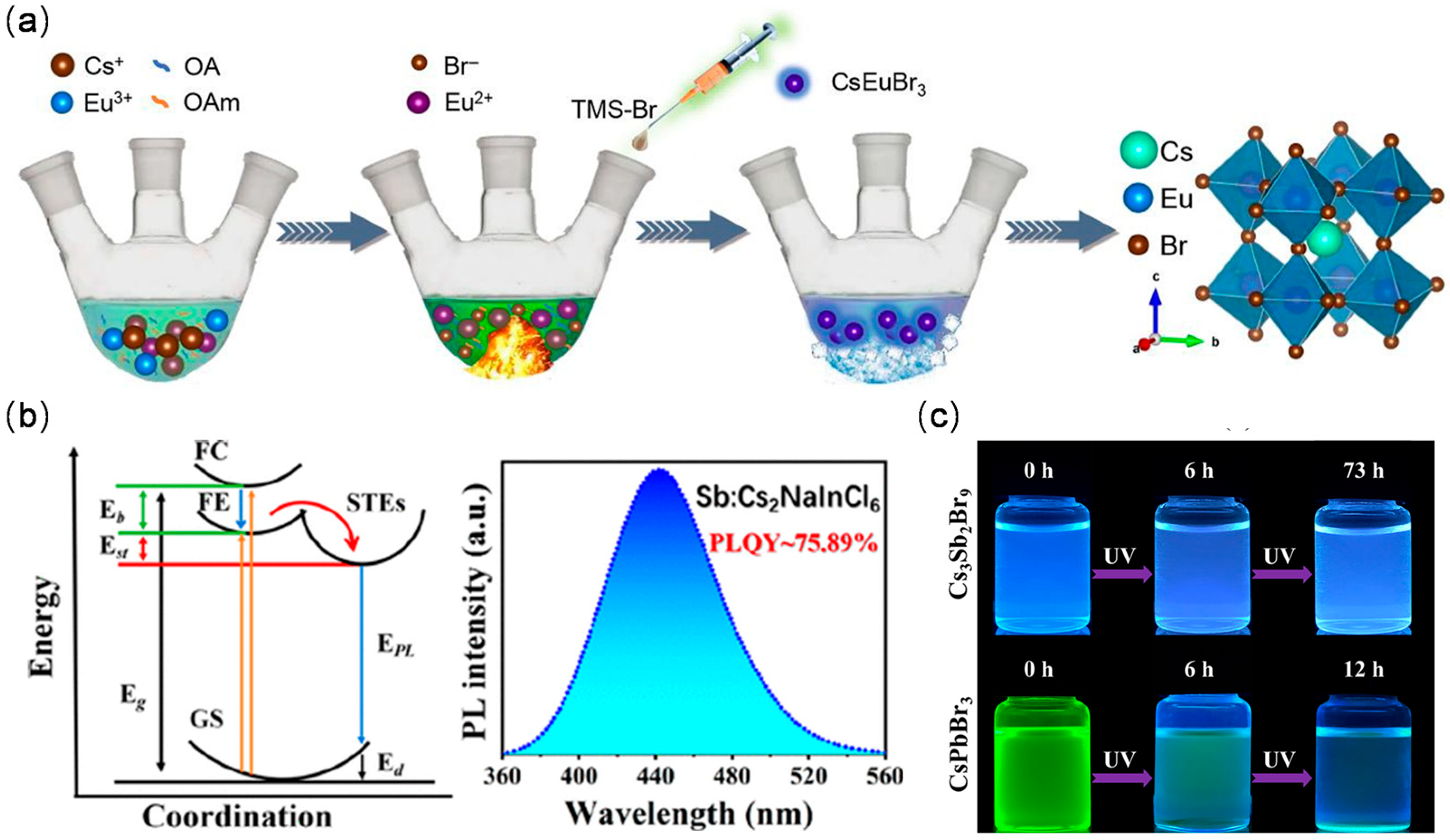
Sn-based perovskites like CsSnX3 are direct substitutes for lead-based perovskites. Their bandgap can be tuned into the blue region via halide composition engineering [76]. However, Sn2+ is easily oxidized to Sn4+, resulting in extremely poor material stability. Strategies such as introducing reducing additives like SnF2 and controlling the synthesis environment can partially suppress Sn2+ oxidation [77], but long-term stability remains to be improved. Double perovskite systems have attracted wide attention due to their structural stability and low toxicity. Among them, Cs3Cu2I5 QDs emit at 445 nm with a PLQY of 87%, and devices based on this material achieved an EQE of 1.12% [78]. Rare-earth-doped systems like CsEuBr3 QDs emit at 443 nm with a PLQY of 93.5% (Figure 9a) [79]. Cs2NaInCl6 QDs, doped with Sb3+ (Figure 9b), can have blue emission wavelength with a PLQY of 75.89% [80]. Their narrow-linewidth emission is suitable for high-color-purity displays, but high electron injection barriers lead to low device efficiency. Sb-based/Bi-based systems like Cs3Sb2Br9 and Cs3Bi2Br9 have emission wavelengths between 408 and 437 nm with high PLQY, exhibiting good air stability (Figure 9c) and serving as potential lead-free candidate materials for blue emission [81].
Device optimization for lead-free QDs requires precise adjustment according to their charge transport characteristics. Cs3Cu2I5 has low hole mobility, necessitating the selection of high-conductivity HTLs like Spiro-OMeTAD and the introduction of hole transport assistant molecules via interface modification to improve hole injection efficiency [82,83]. CsEuBr3 has a high electron injection barrier, requiring doping of ions like Li+ into the ETL to lower the electron injection barrier and increase electron mobility [79]. Sb-based PeQDs have relatively high surface defect density, requiring ligand passivation and core–shell structure design to reduce non-radiative recombination. Although the EQE of lead-free blue PeLEDs currently remains lower than that of lead-based systems, synergistic efforts in composition engineering, defect passivation, and device structure optimization hold promise for future breakthroughs in both efficiency and stability, advancing the commercialization of lead-free perovskite LEDs.

5. Summary and Prospects

This review systematically outlines the synthesis strategies of blue-emitting PeQDs and key advancements in their application for PeLEDs. Through composition engineering, size control, and surface engineering, researchers have successfully prepared blue PeQDs with high color purity and high PLQY. Synthesis methods such as hot-injection and LARP have become increasingly mature, laying the foundation for controllable material synthesis. At the device level, comprehensive strategies, including surface passivation, core–shell structure design, energy level engineering, interface modification, and light outcoupling optimization, have significantly improved the efficiency and stability of blue PeLEDs based on PeQDs. Furthermore, the exploration of environmentally friendly lead-free systems points the way toward addressing lead toxicity concerns.
Despite remarkable progress, blue PeQDs and their devices still face numerous challenges. The intrinsic stability of the materials, particularly their sensitivity to moisture, oxygen, and light, remains a major bottleneck hindering commercialization. At the device level, issues such as severe efficiency roll-off, insufficient operational lifetime at high brightness, and imbalanced charge injection urgently require solutions. The efficiency of lead-free systems currently lags significantly behind their lead-based counterparts, and their stability and optoelectronic performance need synergistic optimization.
Future research should focus on the following directions. First, developing more efficient and stable passivation strategies and encapsulation technologies is essential to fundamentally improve the environmental, optical, and thermal stability of blue PeQDs. Second, a deeper understanding of the internal physical processes within devices, such as exciton dynamics, charge transport, and recombination mechanisms, is necessary to guide innovations in device architecture for suppressing efficiency roll-off and extending device lifetime. Third, continued exploration of high-performance lead-free blue perovskite materials through composition design, defect control, and novel structure development is crucial to achieving breakthroughs in both efficiency and stability. Fourth, advancing the research and development of low-cost, large-area fabrication processes, such as inkjet printing and roll-to-roll techniques, is needed to meet the demands of commercial display production. With the deepening integration of materials science, device physics, and process engineering, blue PeLEDs based on PeQDs are poised to play a significant role in future display technologies.
Looking ahead, the realization of high-performance blue PeLEDs based on PeQDs is ultimately aimed at enabling their integration into full-color displays. Achieving displays that meet the Rec.2020 color gamut standard hinges on the successful integration of blue devices with efficient and stable red and green PeLEDs. A central challenge in this integration is attaining comparable performance and stability across all three primary colors. While green and red PeLEDs have demonstrated higher external quantum efficiencies and improved stability, blue devices still lag behind. Therefore, successful integration demands progress in several areas. First, the efficiency and operational lifetime of blue PeLEDs must be further improved to match those of their green and red counterparts. Second, scalable and solution-processable techniques—such as inkjet printing and transfer printing—need to be developed to enable precise patterning and uniform integration of RGB sub-pixels. Third, effective encapsulation strategies must ensure that devices of all colors possess sufficient environmental stability under common operating conditions. Beyond high-end displays like ultra-high-definition TVs and augmented/virtual reality devices, the solution processability and potential for large-area fabrication of PeQDs also open up applications in solid-state lighting, wearable electronics, and flexible displays. Ultimately, the commercial viability of this technology depends on overcoming the distinct stability and efficiency roll-off challenges associated with blue emission, which remains a central focus of ongoing research.

Author Contributions

Conceptualization, Z.L. and Y.S.; writing—original draft preparation, Z.L., J.Y. and Y.S.; writing—review and editing, Z.L. and Y.S.; funding acquisition, Z.L. All authors have read and agreed to the published version of the manuscript.

Funding

The research was supported by the National Natural Science Foundation of China (NSFC) (52402186), the China Postdoctoral Science Foundation (2023M731164), and Scientific Research Funds of Huaqiao University (22BS132).

Data Availability Statement

No new data were created or analyzed in this study. Data sharing is not applicable to this article.

Conflicts of Interest

The authors declare no conflicts of interest.

References

  1. Banerjee, S.; Singh, P.; Purkayastha, P.; Kumar Ghosh, S. Evolution of Organic Light Emitting Diode (OLED) Materials and their Impact on Display Technology. Chem.–Asian J. 2025, 20, e202401291. [Google Scholar] [CrossRef] [PubMed]
  2. Aftabuzzaman, M.; Hong, Y.; Jeong, S.; Levan, R.; Lee, S.J.; Choi, D.H.; Lee, K. Colloidal Perovskite Nanocrystals for Blue-Light-Emitting Diodes and Displays. Adv. Sci. 2025, 12, e2409736. [Google Scholar] [CrossRef]
  3. Fan, J.; Han, C.; Yang, G.; Song, B.; Xu, R.; Xiang, C.; Zhang, T.; Qian, L. Recent Progress of Quantum Dots Light-Emitting Diodes: Materials, Device Structures, and Display Applications. Adv. Mater. 2024, 36, 2312948. [Google Scholar] [CrossRef]
  4. Chen, J.; Zhao, Q.; Yu, B.; Lemmer, U. A review on quantum dot-based color conversion layers for mini/micro-LED displays: Packaging, light management, and pixelation. Adv. Opt. Mater. 2024, 12, 2300873. [Google Scholar] [CrossRef]
  5. Chen, B.; Li, D.; Wang, F. InP quantum dots: Synthesis and lighting applications. Small 2020, 16, 2002454. [Google Scholar] [CrossRef]
  6. Jang, E.; Jang, H. Quantum dot light-emitting diodes. Chem. Rev. 2023, 123, 4663–4692. [Google Scholar] [CrossRef]
  7. Hao, H.; Zhou, X.; Liang, J.; Shen, W. A comprehensive review for Blue Photoemission Perovskites: Controlling of Structure, Electronics, and Light Emitting Diodes. J. Mater. Chem. C 2026. [Google Scholar] [CrossRef]
  8. Chu, Z.; You, J. Blue Light-Emitting Diodes Based on Pure Bromide Perovskites. Adv. Mater. 2024, 37, e2409867. [Google Scholar] [CrossRef]
  9. Ye, J.; Byranvand, M.M.; Martínez, C.O.; Hoye, R.L.Z.; Saliba, M.; Polavarapu, L. Defect Passivation in Lead-Halide Perovskite Nanocrystals and Thin Films: Toward Efficient LEDs and Solar Cells. Angew. Chem. Int. Ed. 2021, 60, 21636–21660. [Google Scholar] [CrossRef] [PubMed]
  10. Ravi, V.K.; Markad, G.B.; Nag, A. Band Edge Energies and Excitonic Transition Probabilities of Colloidal CsPbX3 (X = Cl, Br, I) Perovskite Nanocrystals. ACS Energy Lett. 2016, 1, 665–671. [Google Scholar] [CrossRef]
  11. Tan, Z.-K.; Moghaddam, R.S.; Lai, M.L.; Docampo, P.; Higler, R.; Deschler, F.; Price, M.; Sadhanala, A.; Pazos, L.M.; Credgington, D.; et al. Bright light-emitting diodes based on organometal halide perovskite. Nat. Nanotechnol. 2014, 9, 687–692. [Google Scholar] [CrossRef]
  12. Sun, S.-Q.; Tai, J.-W.; He, W.; Yu, Y.-J.; Feng, Z.-Q.; Sun, Q.; Tong, K.-N.; Shi, K.; Liu, B.-C.; Zhu, M.; et al. Enhancing Light Outcoupling Efficiency via Anisotropic Low Refractive Index Electron Transporting Materials for Efficient Perovskite Light-Emitting Diodes. Adv. Mater. 2024, 36, 2400421. [Google Scholar] [CrossRef] [PubMed]
  13. Feng, S.C.; Shen, Y.; Hu, X.M.; Su, Z.H.; Zhang, K.; Wang, B.F.; Cao, L.X.; Xie, F.M.; Li, H.Z.; Gao, X. Efficient and stable red perovskite light-emitting diodes via thermodynamic crystallization control. Adv. Mater. 2024, 36, 2410255. [Google Scholar] [CrossRef] [PubMed]
  14. Gao, Y.; Cai, Q.; He, Y.; Zhang, D.; Cao, Q.; Zhu, M.; Ma, Z.; Zhao, B.; He, H.; Di, D. Highly efficient blue light-emitting diodes based on mixed-halide perovskites with reduced chlorine defects. Sci. Adv. 2024, 10, eado5645. [Google Scholar] [CrossRef] [PubMed]
  15. Lu, Z.; Li, Y.; Wei, L.; Jiang, Y.; Yu, F.; Fan, H.; Yang, J.; Xing, J.; Wei, Z. Spectral ultra-stable perovskite quantum dots for pure-blue light-emitting diodes. Chem. Eng. J. 2025, 519, 165202. [Google Scholar] [CrossRef]
  16. Zhang, J.; Yan, C.; Zhao, H.; Yin, C.; Bai, S. Modulations of Quasi-Two-Dimensional Metal Halide Perovskites toward High-Performance Blue Light-Emitting Diodes. Adv. Funct. Mater. 2025, 2509226. [Google Scholar] [CrossRef]
  17. Ko, P.K.; Ge, J.; Ding, P.; Chen, D.; Tsang, H.L.T.; Kumar, N.; Halpert, J.E. The Deepest Blue: Major Advances and Challenges in Deep Blue Emitting Quasi-2D and Nanocrystalline Perovskite LEDs. Adv. Mater. 2025, 37, 2407764. [Google Scholar] [CrossRef]
  18. Li, N.; Jia, Y.; Guo, Y.; Zhao, N. Ion migration in perovskite light-emitting diodes: Mechanism, characterizations, and material and device engineering. Adv. Mater. 2022, 34, 2108102. [Google Scholar] [CrossRef]
  19. Li, Z.; Wei, Q.; Wang, Y.; Tao, C.; Zou, Y.; Liu, X.; Li, Z.; Wu, Z.; Li, M.; Guo, W. Highly bright perovskite light-emitting diodes enabled by retarded Auger recombination. Nat. Commun. 2025, 16, 927. [Google Scholar] [CrossRef]
  20. Huang, H.; Zhou, J.; Cai, Q.; Zhou, C.; Li, N.; Dai, X.; Ye, Z.; He, H.; Fan, C. Industrial-Scale Fabrication of Mixed-Halide Perovskite Quantum Dots with High Comprehensive Performances for Red-Emitting Modules. Nano Lett. 2025, 25, 9863–9871. [Google Scholar] [CrossRef]
  21. Song, J.; Li, J.; Li, X.; Xu, L.; Dong, Y.; Zeng, H. Quantum Dot Light-Emitting Diodes Based on Inorganic Perovskite Cesium Lead Halides (CsPbX3). Adv. Mater. 2015, 27, 7162–7167. [Google Scholar] [CrossRef] [PubMed]
  22. Chen, J.; Zidek, K.; Chabera, P.; Liu, D.; Cheng, P.; Nuuttila, L.; Al-Marri, M.J.; Lehtivuori, H.; Messing, M.E.; Han, K. Size-and wavelength-dependent two-photon absorption cross-section of CsPbBr3 perovskite quantum dots. J. Phys. Chem. Lett. 2017, 8, 2316–2321. [Google Scholar] [CrossRef]
  23. Butkus, J.; Vashishtha, P.; Chen, K.; Gallaher, J.K.; Prasad, S.K.K.; Metin, D.Z.; Laufersky, G.; Gaston, N.; Halpert, J.E.; Hodgkiss, J.M. The Evolution of Quantum Confinement in CsPbBr3 Perovskite Nanocrystals. Chem. Mater. 2017, 29, 3644–3652. [Google Scholar] [CrossRef]
  24. Li, Y.; Guan, X.; Zhao, Y.; Zhang, Q.; Chen, X.; Zhang, S.; Lu, J.; Wei, Z. Modulation of Charge Transport Layer for Perovskite Light-Emitting Diodes. Adv. Mater. 2025, 37, 2410535. [Google Scholar] [CrossRef]
  25. Zhang, Q.; Zhang, D.; Fu, Y.; Poddar, S.; Shu, L.; Mo, X.; Fan, Z. Light out-coupling management in perovskite LEDs—What can we learn from the past? Adv. Funct. Mater. 2020, 30, 2002570. [Google Scholar] [CrossRef]
  26. Chen, W.; Tang, X.; Wangyang, P.; Yao, Z.; Zhou, D.; Chen, F.; Li, S.; Lin, H.; Zeng, F.; Wu, D. Surface-passivated cesium lead halide perovskite quantum dots: Toward efficient light-emitting diodes with an inverted sandwich structure. Adv. Opt. Mater. 2018, 6, 1800007. [Google Scholar] [CrossRef]
  27. Ma, C.; Ni, M.; Liu, X.; Zhan, K.; Chen, M.; Li, S.; Li, F.; Wang, H.; Dang, Y. Recent progress in perovskite light-emitting diodes with high external quantum efficiency and stability. CrystEngComm 2025, 27, 3853–3876. [Google Scholar] [CrossRef]
  28. Baek, S.D.; Yang, S.J.; Yang, H.; Shao, W.; Yang, Y.T.; Dou, L. Exciton Dynamics in Layered Halide Perovskite Light-Emitting Diodes. Adv. Mater. 2025, 37, 2411998. [Google Scholar] [CrossRef]
  29. Hu, Y.H.; Wang, J.J.; Yang, J.N. Lead halide perovskites for blue light-emitting diodes: Advances, challenges, and prospects. Adv. Opt. Mater. 2025, 13, e02381. [Google Scholar] [CrossRef]
  30. Qin, X.; Li, M.; Zhao, Y.; Li, Z.; Zhang, H.; Luo, J.; Liu, C.; Li, J.; Li, Z.; Wei, Z. Exploring Coupling-Derived A′-Site Cations for Crystallization Delay and Defect Passivation in Quasi-2D Perovskite Light-Emitting Diodes. Angew. Chem. 2025, 137, e202513755. [Google Scholar] [CrossRef]
  31. Ren, Z.; Yu, J.; Qin, Z.; Wang, J.; Sun, J.; Chan, C.C.S.; Ding, S.; Wang, K.; Chen, R.; Wong, K.S.; et al. High-Performance Blue Perovskite Light-Emitting Diodes Enabled by Efficient Energy Transfer between Coupled Quasi-2D Perovskite Layers. Adv. Mater. 2021, 33, 2005570. [Google Scholar] [CrossRef]
  32. Jang, K.Y.; Chang, S.E.; Kim, D.H.; Yoon, E.; Lee, T.W. Nanocrystalline Perovskites for Bright and Efficient Light-Emitting Diodes. Adv. Mater. 2025, 37, e2415648. [Google Scholar] [CrossRef]
  33. Li, W.; Hu, Q.; Xu, Y.; Wu, H.; Tang, J.; Wang, L.; Jiang, F.; Feng, G.; Liu, J.; Wang, L.; et al. Pure Blue Emissive Lead Halide Perovskite Materials for Light-Emitting Diodes: Preparation, Progress, and Challenges. ACS Appl. Mater. Interfaces 2025, 17, 55666–55688. [Google Scholar] [CrossRef]
  34. Yao, Z.; Bi, C.; Xu, R.; Zhang, X.; Qian, L.; Xiang, C. Decoupling the Exciton-Carrier Interaction for Highly Efficient Pure Blue Perovskite Light-Emitting Diodes Exceeding 20%. Adv. Mater. 2025, 37, e20131. [Google Scholar] [CrossRef]
  35. Hong, Y.; Yu, C.; Je, H.; Park, J.Y.; Kim, T.; Baik, H.; Tomboc, G.M.; Kim, Y.; Ha, J.M.; Joo, J.; et al. Perovskite Nanocrystals Protected by Hermetically Sealing for Highly Bright and Stable Deep-Blue Light-Emitting Diodes. Adv. Sci. 2023, 10, e2302906. [Google Scholar] [CrossRef]
  36. Zhang, X.; Huang, H.; Zhao, C.; Yuan, J. Surface chemistry-engineered perovskite quantum dot photovoltaics. Chem. Soc. Rev. 2025, 54, 3017–3060. [Google Scholar] [CrossRef]
  37. Shi, W.; Zhang, X.; Xie, C.; Chen, H.S.; Yang, P. Blue emitting CsPbBr3: High quantum confinement effect and well-adjusted shapes (nanorods, nanoplates, and cubes) toward white light emitting diodes. Adv. Opt. Mater. 2024, 12, 2302129. [Google Scholar] [CrossRef]
  38. Liu, Y.; Ma, Z.; Zhang, J.; He, Y.; Dai, J.; Li, X.; Shi, Z.; Manna, L. Light-Emitting Diodes Based on Metal Halide Perovskite and Perovskite Related Nanocrystals. Adv. Mater. 2025, 37, e2415606. [Google Scholar] [CrossRef] [PubMed]
  39. Deng, C.; Huang, Q.; Fu, Z.; Lu, Y. Ligand Engineering of Inorganic Lead Halide Perovskite Quantum Dots toward High and Stable Photoluminescence. Nanomaterials 2024, 14, 1201. [Google Scholar] [CrossRef] [PubMed]
  40. Sun, W.; Yun, R.; Liu, Y.; Zhang, X.; Yuan, M.; Zhang, L.; Li, X. Ligands in Lead Halide perovskite nanocrystals: From synthesis to optoelectronic applications. Small 2023, 19, 2205950. [Google Scholar] [CrossRef] [PubMed]
  41. Peng, M.; Ma, Y.; Zhang, L.; Cong, S.; Hong, X.; Gu, Y.; Kuang, Y.; Liu, Y.; Wen, Z.; Sun, X. All-Inorganic CsPbBr3 perovskite nanocrystals/2D non-layered cadmium sulfide selenide for high-performance photodetectors by energy band alignment engineering. Adv. Funct. Mater. 2021, 31, 2105051. [Google Scholar] [CrossRef]
  42. Li, X.; Wu, Y.; Zhang, S.; Cai, B.; Gu, Y.; Song, J.; Zeng, H. CsPbX3 Quantum Dots for Lighting and Displays: Room-Temperature Synthesis, Photoluminescence Superiorities, Underlying Origins and White Light-Emitting Diodes. Adv. Funct. Mater. 2016, 26, 2435–2445. [Google Scholar] [CrossRef]
  43. Wang, L.; Fu, Z.; Wu, X.; Li, D.; Peng, H.S. Green Synthesis of Luminescent Perovskite Quantum Dots. ChemNanoMat 2025, 11, e202500243. [Google Scholar] [CrossRef]
  44. Mejia Vazquez, M.C.; Bernal, W.; Gómez Téllez, A.C.; Camacho Cáceres, J.; Montoya Montoya, D.M.; Pacio, M.; Hu, H. Synthesis, Fabrication, and Characterization of MAPbBr3 Quantum Dots for LED Applications: An Easy Laboratory Practice. J. Chem. Educ. 2024, 101, 5413–5421. [Google Scholar] [CrossRef]
  45. Zang, S.; Chen, J.; Yu, Y.; Qin, X.; Liu, H. Ligand-Assisted Reprecipitation of Highly Luminescent Perovskite Nanocrystals. ACS Appl. Nano Mater. 2025, 8, 3680–3687. [Google Scholar] [CrossRef]
  46. Shao, H.; Zhai, Y.; Wu, X.; Xu, W.; Xu, L.; Dong, B.; Bai, X.; Cui, H.; Song, H. High brightness blue light-emitting diodes based on CsPb(Cl/Br)3 perovskite QDs with phenethylammonium chloride passivation. Nanoscale 2020, 12, 11728–11734. [Google Scholar] [CrossRef]
  47. Li, J.; Xu, L.; Wang, T.; Song, J.; Chen, J.; Xue, J.; Dong, Y.; Cai, B.; Shan, Q.; Han, B.; et al. 50-Fold EQE Improvement up to 6.27% of Solution-Processed All-Inorganic Perovskite CsPbBr3 QLEDs via Surface Ligand Density Control. Adv. Mater. 2016, 29, 1603885. [Google Scholar] [CrossRef]
  48. Lee, A.; Son, D.; Moon, B.J.; Kang, M.; Bae, S.; Lee, S.H.; Kim, T.-W.; Lee, S.-K. Purification of Perovskite Quantum Dots Using the Drop Casting of a Polar Solvent for Memory Devices with Improved Performance and Stability. Appl. Sci. Converg. Technol. 2024, 33, 62–66. [Google Scholar] [CrossRef]
  49. Zhou, S. Rapid separation and purification of lead halide perovskite quantum dots through differential centrifugation in nonpolar solvent. RSC Adv. 2021, 11, 28410–28419. [Google Scholar] [CrossRef] [PubMed]
  50. Zhang, H.; Sun, C.; Han, J.; Tao, J.; Fan, C.; Liu, X.; Bi, W. Efficient purification method for CsPbX3 perovskite quantum dots. J. Lumin. 2022, 250, 119060. [Google Scholar] [CrossRef]
  51. Weng, S.; Yu, G.; Zhou, C.; Lin, F.; Han, Y.; Wang, H.; Huang, X.; Liu, X.; Hu, H.; Liu, W. Challenges and opportunities for the blue perovskite quantum dot light-emitting diodes. Crystals 2022, 12, 929. [Google Scholar] [CrossRef]
  52. Peng, X.; Yan, C.; Chun, F.; Li, W.; Zeng, X.; Fu, X.; Gao, Y.; Chu, X.; Tian, G.; Yang, W. Liquid Nitrogen Passivation for Deep-Blue Perovskite Quantum Dots with Nearly Unit Quantum Yield. J. Phys. Chem. C 2022, 126, 1017–1025. [Google Scholar] [CrossRef]
  53. Park, C.B.; Shin, Y.S.; Yoon, Y.J.; Jang, H.; Son, J.G.; Kim, S.; An, N.G.; Kim, J.W.; Jun, Y.C.; Kim, G.-H.; et al. Suppression of halide migration and immobile ionic surface passivation for blue perovskite light-emitting diodes. J. Mater. Chem. C 2022, 10, 2060–2066. [Google Scholar] [CrossRef]
  54. Chen, T.; Ru, X.-C.; Ma, Z.-Y.; Feng, L.-Z.; Song, K.-H.; Ge, J.; Zhu, B.-S.; Yang, J.-N.; Yao, H.-B. Tetrafluoroborate-Passivated CsPbBrxCl3–x Nanocrystals for Spectrally Stable Pure Blue Perovskite Light-Emitting Diodes. ACS Appl. Nano Mater. 2024, 7, 4474–4480. [Google Scholar] [CrossRef]
  55. Liu, S.; Guo, Z.; Wu, X.; Liu, X.; Huang, Z.; Li, L.; Zhang, J.; Zhou, H.; Sun, L.-D.; Yan, C.-H. Zwitterions Narrow Distribution of Perovskite Quantum Wells for Blue Light-Emitting Diodes with Efficiency Exceeding 15%. Adv. Mater. 2023, 35, 2208078. [Google Scholar] [CrossRef]
  56. Mondal, N.; De, A.; Samanta, A. Achieving near-unity photoluminescence efficiency for blue-violet-emitting perovskite nanocrystals. ACS Energy Lett. 2018, 4, 32–39. [Google Scholar] [CrossRef]
  57. Pan, J.; Zhao, Z.; Fang, F.; Wang, L.; Wang, G.; Liu, C.; Chen, J.; Xie, J.; Sun, J.; Wang, K. Multiple cations enhanced defect passivation of blue perovskite quantum dots enabling efficient light-emitting diodes. Adv. Opt. Mater. 2020, 8, 2001494. [Google Scholar] [CrossRef]
  58. Yang, F.; Chen, H.; Zhang, R.; Liu, X.; Zhang, W.; Zhang, J.; Gao, F.; Wang, L. Efficient and Spectrally Stable Blue Perovskite Light-Emitting Diodes Based on Potassium Passivated Nanocrystals. Adv. Funct. Mater. 2020, 30, 1908760. [Google Scholar] [CrossRef]
  59. Zheng, X.; Luo, J.; Li, Z.; Jiang, C.; Liu, M.; Qi, R.; Lin, H.; Luo, C.; Peng, H. Enhanced luminescence efficiency and stability in deep-blue perovskite quantum dots through synergistic Zn2+/Ni2+ co-doping. Nanoscale 2026, 18, 960–973. [Google Scholar] [CrossRef] [PubMed]
  60. Xu, B.; Yuan, S.; Wang, L.; Li, X.; Hu, Z.; Zeng, H. Highly Efficient Blue Light-Emitting Diodes Enabled by Gradient Core/Shell-Structured Perovskite Quantum Dots. ACS Nano 2025, 19, 3694–3704. [Google Scholar] [CrossRef]
  61. Zhang, C.; Chen, J.; Kong, L.; Wang, L.; Wang, S.; Chen, W.; Mao, R.; Turyanska, L.; Jia, G.; Yang, X. Core/shell metal halide perovskite nanocrystals for optoelectronic applications. Adv. Funct. Mater. 2021, 31, 2100438. [Google Scholar] [CrossRef]
  62. Kim, H.; Park, J.H.; Kim, K.; Lee, D.; Song, M.H.; Park, J. Highly Emissive Blue Quantum Dots with Superior Thermal Stability via In Situ Surface Reconstruction of Mixed CsPbBr3–Cs4PbBr6 Nanocrystals. Adv. Sci. 2022, 9, 2104660. [Google Scholar] [CrossRef] [PubMed]
  63. Kshirsagar, A.S.; Gangishetty, M.K. In Situ Controlled Growth of Strongly Quantum Confined CsPbBr3/FAPbBr3 Core/Crown Nanoplatelets for Blue Light Emitting Diodes. Adv. Opt. Mater. 2023, 11, 2301343. [Google Scholar] [CrossRef]
  64. Shao, H.; Bai, X.; Pan, G.; Cui, H.; Zhu, J.; Zhai, Y.; Liu, J.; Dong, B.; Xu, L.; Song, H. Highly efficient and stable blue-emitting CsPbBr3@SiO2 nanospheres through low temperature synthesis for nanoprinting and WLED. Nanotechnology 2018, 29, 285706. [Google Scholar] [CrossRef]
  65. Wang, S.; Wei, S.; Yang, H.; Zhang, L.; Sun, C.; Jiang, Y.; Yuan, M. Function Nickel Oxide for Perovskite LEDs: Energy Level Modulation and Hole Injection Optimization. Small Methods 2025, 9, 2402195. [Google Scholar] [CrossRef]
  66. Fang, T.; Zhang, F.; Yuan, S.; Zeng, H.; Song, J. Recent advances and prospects toward blue perovskite materials and light-emitting diodes. InfoMat 2019, 1, 211–233. [Google Scholar] [CrossRef]
  67. Liu, A.; Bi, C.; Tian, J. All Solution-Processed High Performance Pure-Blue Perovskite Quantum-Dot Light-Emitting Diodes. Adv. Funct. Mater. 2022, 32, 2207069. [Google Scholar] [CrossRef]
  68. Yuan, S.; Fang, T.; Huang, J.; Li, X.; Wei, C.; Zhou, Y.; Li, Y.; Zheng, X.; Huang, J.; Su, J.; et al. Balancing Charge Injection via a Tailor-Made Electron-Transporting Material for High Performance Blue Perovskite QLEDs. ACS Energy Lett. 2023, 8, 818–826. [Google Scholar] [CrossRef]
  69. Guo, K.; Ren, L.; Chen, C.; Tang, Z.; Niu, X.; Kong, L.; Xue, T.; Ding, L.; Wang, S.; Zhang, F.; et al. High-Brightness Blue Perovskite Light-Emitting Diodes with Low Efficiency Roll-Off Enabled by Dual-ETL and Hole Transport Regulation. Adv. Opt. Mater. 2025, 13, 2403483. [Google Scholar] [CrossRef]
  70. Yao, Z.; Bi, C.; Liu, A.; Zhang, M.; Tian, J. High brightness and stability pure-blue perovskite light-emitting diodes based on a novel structural quantum-dot film. Nano Energy 2022, 95, 106974. [Google Scholar] [CrossRef]
  71. Kim, M.-S.; Sadhukhan, P.; Myoung, J.-M. High-Performance Blue Perovskite Films and Micro-Arrays for Light-Emitting Diodes with Ionic Liquid Interlayer. Adv. Funct. Mater. 2024, 34, 2309436. [Google Scholar] [CrossRef]
  72. Pylnev, M.; Nishikubo, R.; Ishiwari, F.; Wakamiya, A.; Saeki, A. Performance Boost by Dark Electro Treatment in MACl-Added FAPbI3 Perovskite Solar Cells. Adv. Opt. Mater. 2024, 12, 2401902. [Google Scholar] [CrossRef]
  73. Zhao, B.; Vasilopoulou, M.; Fakharuddin, A.; Gao, F.; Mohd Yusoff, A.R.b.; Friend, R.H.; Di, D. Light management for perovskite light-emitting diodes. Nat. Nanotechnol. 2023, 18, 981–992. [Google Scholar] [CrossRef]
  74. Zhao, B.; Bai, S.; Kim, V.; Lamboll, R.; Shivanna, R.; Auras, F.; Richter, J.M.; Yang, L.; Dai, L.; Alsari, M.; et al. High-efficiency perovskite–polymer bulk heterostructure light-emitting diodes. Nat. Photonics 2018, 12, 783–789. [Google Scholar] [CrossRef]
  75. Cui, J.Y.; Liu, Y.; Deng, Y.Z.; Lin, C.; Fang, Z.S.; Xiang, C.S.; Bai, P.; Du, K.; Zuo, X.B.; Wen, K.C.; et al. Efficient light-emitting diodes based on oriented perovskite nanoplatelets. Sci. Adv. 2021, 7, eabg8458. [Google Scholar] [CrossRef] [PubMed]
  76. Wang, H.; Zhang, C.; Huang, W.; Zou, X.; Chen, Z.; Sun, S.; Zhang, L.; Li, J.; Cheng, J.; Huang, S. Research progress of ABX3-type lead-free perovskites for optoelectronic applications: Materials and devices. Phys. Chem. Chem. Phys. 2022, 24, 27585–27605. [Google Scholar] [CrossRef]
  77. Gupta, S.; Cahen, D.; Hodes, G. How SnF2 impacts the material properties of lead-free tin perovskites. J. Phys. Chem. C 2018, 122, 13926–13936. [Google Scholar] [CrossRef]
  78. Wang, L.; Shi, Z.; Ma, Z.; Yang, D.; Zhang, F.; Ji, X.; Wang, M.; Chen, X.; Na, G.; Chen, S.; et al. Colloidal Synthesis of Ternary Copper Halide Nanocrystals for High-Efficiency Deep-Blue Light-Emitting Diodes with a Half-Lifetime above 100 h. Nano Lett. 2020, 20, 3568–3576. [Google Scholar] [CrossRef]
  79. Li, X.; Lou, B.; Chen, X.; Wang, M.; Jiang, H.; Lin, S.; Ma, Z.; Jia, M.; Han, Y.; Tian, Y.; et al. Deep-blue narrow-band emissive cesium europium bromide perovskite nanocrystals with record high emission efficiency for wide-color-gamut backlight displays. Mater. Horiz. 2024, 11, 1294–1304. [Google Scholar] [CrossRef]
  80. Zeng, R.; Zhang, L.; Xue, Y.; Ke, B.; Zhao, Z.; Huang, D.; Wei, Q.; Zhou, W.; Zou, B. Highly Efficient Blue Emission from Self-Trapped Excitons in Stable Sb3+-Doped Cs2NaInCl6 Double Perovskites. J. Phys. Chem. Lett. 2020, 11, 2053–2061. [Google Scholar] [CrossRef]
  81. Ma, Z.; Shi, Z.; Yang, D.; Zhang, F.; Li, S.; Wang, L.; Wu, D.; Zhang, Y.; Na, G.; Zhang, L.; et al. Electrically-Driven Violet Light-Emitting Devices Based on Highly Stable Lead-Free Perovskite Cs3Sb2Br9 Quantum Dots. ACS Energy Lett. 2020, 5, 385–394. [Google Scholar] [CrossRef]
  82. Liu, S.; Liu, H.; Zhou, G.; Li, X.; Wang, S. Water-induced crystal phase transformation of stable lead-free Cu-based perovskite nanocrystals prepared by one-pot method. Chem. Eng. J. 2022, 427, 131430. [Google Scholar] [CrossRef]
  83. Meng, W.; Wang, C.; Xu, G.; Luo, G.; Deng, Z. Alkylammonium Halides for Phase Regulation and Luminescence Modulation of Cesium Copper Iodide Nanocrystals for Light-Emitting Diodes. Molecules 2024, 29, 1162. [Google Scholar] [CrossRef] [PubMed]
Figure 1. The CIE chromaticity diagram and the color gamut coverage of OLEDs, conventional QLEDs, and PeLEDs [2].
Photonics 13 00151 g001
Figure 2. (a) Perovskite crystal ABX3 structure. (b) Schematic representation of energy band orbitals of CsPbBX3 perovskites [9]. (c) Band edge energies of CsPbX3 perovskites [10].
Photonics 13 00151 g002
Figure 3. EQE of green, red, and blue PeLEDs device record lines.
Photonics 13 00151 g003
Figure 4. (a) Schematic diagrams of two strategies for achieving blue PeLEDs based on PeQDs. (b) Comparison of experimental and theoretical (effective mass approximation) size-dependent bandgap energy, annotated with quantum confinement regimes relative to the Bohr diameter [23].
Photonics 13 00151 g004
Figure 5. Working principles of PeLEDs.
Photonics 13 00151 g005
Figure 7. (a) A schematic illustration of PeQDs passivated by thiocyanate ligand [53]. (b) The enhanced luminescence performance of PeQDs by doping Cd2+ passivation defects [56]. (c) Schematic illustration of the core–shell structured passivated PeQDs [35].
Photonics 13 00151 g007
Figure 8. (a) Schematic diagram illustrating the enhancement of PeLEDs through functional layer modifications [69]. (b) Schematic illustration of preparing a novel structure sandwich panel (SWP) PeQDs film [70].
Photonics 13 00151 g008
Figure 9. (a) Schematic illustration of the synthesis of CsEuBr3 PeQDs [79]. (b) Mechanism of luminous performance improvement of Sb3+-doped Cs2NaInCl6 PeQDs [80]. (c) Photographs of the Cs3Sb2Br9 and CsPbBr3 PeQDs solutions before and after UV lamp irradiation [81].
Photonics 13 00151 g009
Disclaimer/Publisher’s Note: The statements, opinions and data contained in all publications are solely those of the individual author(s) and contributor(s) and not of MDPI and/or the editor(s). MDPI and/or the editor(s) disclaim responsibility for any injury to people or property resulting from any ideas, methods, instructions or products referred to in the content.