Article

A Transmissive Metasurface Producing Wideband Higher-Order Vortex Modes to Increase the the Information-Carrying Capacity of Wireless Systems


1
School of Automation and Electrical Engineering, Lanzhou University of Technology, Lanzhou 730050, China
2
Department of Information and Communication Engineering, The Islamia University of Bahawalpur, Bahawalpur 63100, Pakistan
3
School of Automation, Beijing Institute of Technology, Beijing 100081, China
4
Zhengzhou Research Institute, Beijing Institute of Technology, Zhengzhou 450000, China
5
School of Electronic Engineering, Beijing University of Posts and Telecommunications, Beijing 100876, China
6
State Key Laboratory of Information Photonics and Optical Communications, Beijing 100876, China
7
Key Laboratory of Universal Wireless Communications of Ministry of Education, Beijing 100876, China
8
Beijing Key Laboratory of Work Safety Intelligent Monitoring, Beijing 100876, China
*
Author to whom correspondence should be addressed.
Photonics 2026, 13(2), 152; https://doi.org/10.3390/photonics13020152
Submission received: 27 December 2025 / Revised: 29 January 2026 / Accepted: 2 February 2026 / Published: 4 February 2026

Abstract

High-order, broadband OAM-vortex beams have great potential to increase the information-carrying capacity of wireless systems, but their practical application is constrained by issues with low gain, limited bandwidth, and low mode purity in higher-order modes. To address these requirements, in this paper, we propose a symmetric transmit unit cell that achieves full 360-degree phase coverage with acceptable transmission loss and a uniform configuration suitable for dual-polarized applications, which consists of four conductive layers interleaved with substrate layers. Experimental testing of higher-order modes on the manufactured transmissive prototype verifies broadband vortex-beam formation, which is consistent with the simulation results. Across the 26.5 to 40.5 GHz frequency span, the proposed design demonstrates a consistently high OAM-vortex mode purity exceeding 86% and covering 46.6% of the OAM bandwidth. It is also observed that the fabricated prototype achieves a peak realized gain of 21.7 dBi for the +2 mode, resulting in an aperture efficiency of 13.6%. With the implementation of the proposed transmitarray prototype, future wireless systems can attain significantly improved information-carrying capacity.

1. Introduction

With the rapid growth of wireless communication technologies and their associated sectors, the available radio spectrum is being used more intensively than ever before, raising serious concerns about spectrum congestion and the efficient utilization of resources [1,2]. In response to the growing pressure on spectral resources, OAM vortex beams have emerged as a promising physical dimension for wireless systems, enabling the simultaneous transmission of multiple mutually orthogonal modes within the same frequency band and offering a potential route to alleviating spectrum congestion [3,4,5,6]. The effective use of OAM modes has demonstrated considerable potential to increase spectral efficiency and to improve performance in advanced applications such as high-resolution radar imaging and multifunctional communication systems [7,8]. The conception of angular momentum associated with light was first proposed in the early twentieth century, and its theoretical basis was formulated in 1909 [9]. Then the orbital angular momentum phenomenon was experimentally verified by generating Laguerre–Gaussian optical beams in the early 1990s, followed by its extension to the radio-frequency region in 2007, where a clearly defined ring-shaped pattern was observed [10,11]. Additionally, the first demonstration of optical vortex beams was reported in [12]. OAM beams are explored for multi-channel transmission, with studies [13,14] showing that their capacity increase in millimeter-wave systems. AI-assisted metasurface design [15] improves vortex-beam efficiency and bandwidth. Moreover, works on OAM metasurfaces explore propagation and geometric phases [16], as well as geometric and chirality phases [17], advancing multi-vortex-beam generation.
As a consequence of this, a wide variety of methods for generating radio-frequency (RF) vortex waves have been developed in response to the growing research focus on orbital angular momentum (OAM). These methodologies encompass many antenna and device combinations, including planar waveguide-based structures [18], uniform circular arrays [19,20,21], spiral phase plates [22,23], reflector-based solutions [24], patch antenna implementations [25,26,27], and parabolic antenna systems [28]. Each of these solutions presents unique advantages in terms of bandwidth, complexity, and radiation performance. Despite the fact that many of the OAM generation systems now in use continue to be constrained by large physical dimensions, complex feed networks, and expensive manufacturing requirements, the aggregate effect of these constraints makes it difficult to implement them in practical settings. The growing number of end users seeking OAM vortex sources with high mode purity, compactness, and efficiency represents a significant advancement. The capacity of these sources has increased, enabling the fulfillment of the need to develop wireless communication systems. This is a situation in which MSs (metasurfaces), which are engineered two-dimensional periodic metamaterials, have emerged as a practical platform for OAM manipulation, offering a viable solution to overcome the challenges of traditional, bulky, and complex generation methods. Recently, research has introduced advanced metasurface concepts that enable improved phase modulation and precise wavefront control, providing valuable insights and design guidance for the development of highly efficient OAM-based MS (metasurface) architectures [29,30].
As we know, multiple experimental investigations have confirmed the accuracy of wideband vortex wavefronts, especially for the basic OAM mode with topological charge l = + 1 . However, the experimental description and validation of higher-order OAM modes have been the subject of very few investigations to date. For instance, a 10 GHz HMS (Huygens metasurface) reported in [31] with multiple unit-cell configurations was demonstrated to realize the higher-order l = + 2 OAM mode, achieving a small bandwidth of approximately 12%, a gain with a determined value of 15.8 dBi, an aperture efficiency with a value of 3.1%, and a measured mode purity exceeding 0.87.In another experimental demonstration, a single higher-order OAM mode with l = + 2 was generated at 18 GHz using a dimension-extension-based design, demonstrating a measured gain of 18.46 dBi and an aperture efficiency of 4.38% [32]. Moreover, a high-profile transmit-type unit cell presented in [33] demonstrated the generation of the fundamental OAM mode with l = + 1 , achieving a relatively wide fractional bandwidth of 33.3%, a peak gain of 20.9 dBi, and a measured mode purity of approximately 70%. In [34], a four-layer transmissive metasurface employing unit cells with variable geometric dimensions was proposed to generate the l = + 1 vortex mode at an operating frequency of 10 GHz, achieving a realized gain of 14.49 dBi and an overall radiation efficiency of 10.3%. At 30 GHz, a polarization-conversion-based metasurface design reported in [35] realized the l = + 1 OAM mode, delivering a high gain of 22 dBi together with a wide operational bandwidth of 57% and a mode purity reaching 83%. A thin transmitarray architecture reported in [36] demonstrated broadband OAM performance for the fundamental l = + 1 mode; however, the generation of higher-order OAM modes was confirmed only through numerical simulations at 30 GHz, without corresponding experimental validation. In [37], a low-profile multilayer arrangement that was operating at 33.5 GHz was experimentally demonstrated to generate the l = 1 OAM mode. The prototype element, comprising six conductive layers and four dielectric substrates, achieved a wideband bandwidth of 28.4%, a maximum gain of 21.8 dBi, and a high mode purity of greater than or equal to 93%. Folded antenna (FA) configurations have also demonstrated notable performance improvements. For example, a design operating at 30 GHz obtained a wideband bandwidth of 23%, a realized gain of 20.5 dBi, and an OAM mode purity of 81.6% [38]. Furthermore, an SP (separate folded) [39] structure working at 10 GHz attained a bandwidth of around 5%, with a gain of 17.6 dBi and mode purity greater than 80%. Recent research has advanced considerably, yet creating wideband, higher-order OAM vortex modes that combine high gain, high aperture efficiency, and excellent mode purity remains a key challenge for practical wireless communication applications. Additionally, earlier studies of higher-order OAM modes often face limitations such as narrow bandwidths and lower mode purity. This study introduces a transmissive metasurface (TMS) design to overcome these issues, enabling the production of higher-order OAM vortex modes with greater mode purity and overall performance.
In response to these issues, this research introduces a wideband, transmissive metasurface that generates higher-order OAM vortex beams for cellular communication systems, offering high gain, increased mode purity, broad frequency coverage, and improved aperture efficiency. To achieve complete phase control with minimal transmission loss and polarization flexibility, the proposed design employs a symmetric, multi-layer transmitarray unit cell. Both simulation and experimental validation are conducted to demonstrate the capability of the proposed approach and highlight its effectiveness in enhancing the information-carrying capacity of wireless systems.

2. Proposed Transmissive Unit Cell

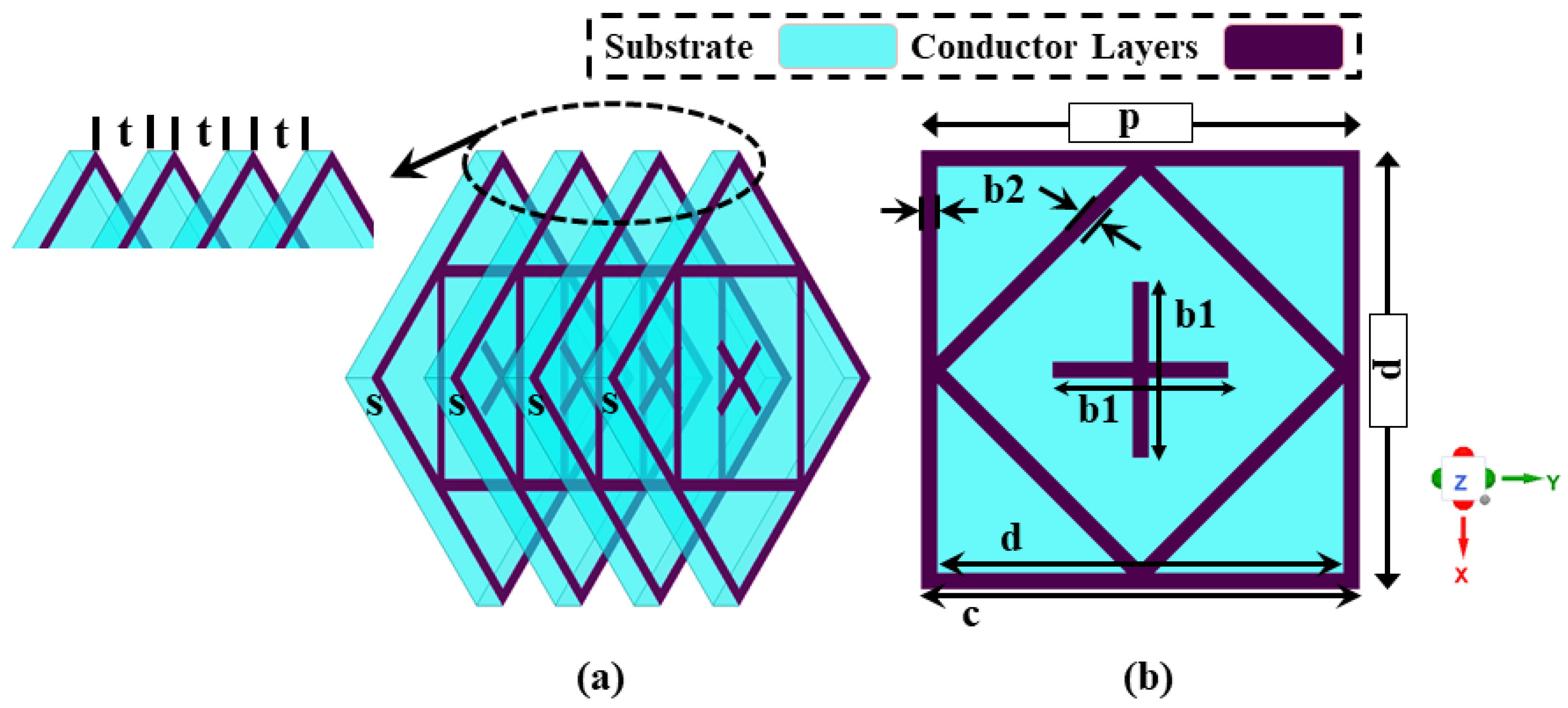
Figure 1 illustrates the proposed transmissive unit cell, which consists of four dielectric layers. These layers are arranged with uniformly spaced, symmetric metallic sheets placed between them, forming a balanced multilayer structure. A detailed list of the geometrical parameters and dimensions of the proposed design is provided in Table 1. The proposed structure employs an F4B265 substrate material, selected for its stable dielectric properties. This substrate exhibits a relative permittivity of ε r = 2.65 along with a very low loss tangent of tan δ = 0.001 , making it well suited for high-frequency transmission applications. The proposed transmissive unit cell is designed with a periodic (p) spacing of 5.0 mm at an operating frequency of 30.0 GHz. All the dielectric substrates have a consistent thickness (s) of 0.5 mm, and in between them is an air layer (t) with a thickness of 1.0 mm.
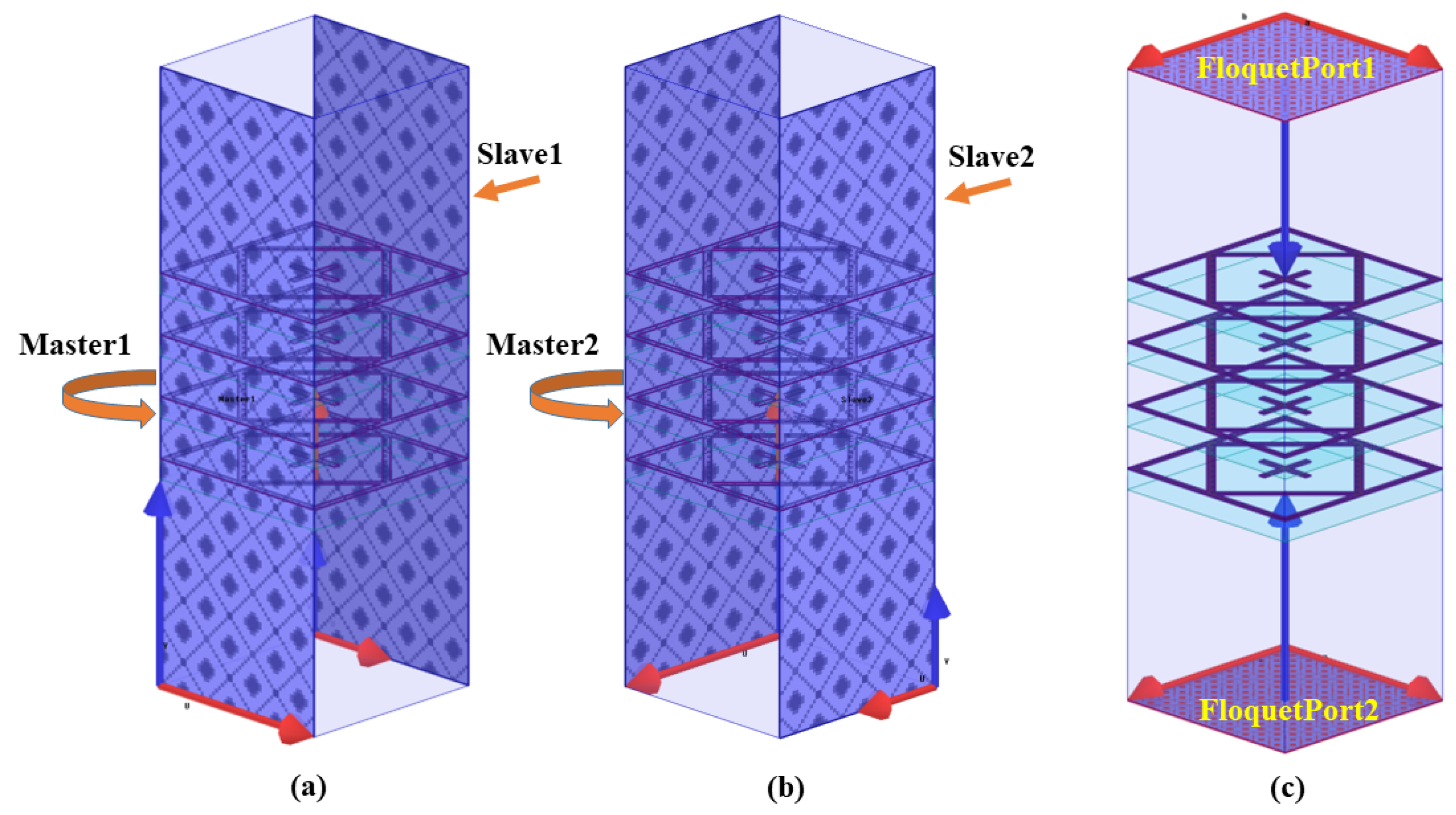
To fulfill the necessary electromagnetic phase and magnitude requirements, the configuration of dimensions was meticulously selected. The E-field performance of the proposed transmit unit cell was analyzed using full-wave electromagnetic simulations (FWESs) in ANSYS HFSS (2021R1). To accurately characterize the proposed transmissive unit cell, a simulation was performed as illustrated in Figure 2. The simulation domain consists of a multi-layer element enclosed within an air box. Periodic boundary conditions (Primary and Secondary) were applied to the x and y planes to simulate the behavior of the unit cell within an infinite array (Figure 2a,b), thereby accounting for the mutual coupling between adjacent cells. Excitation was provided by two Floquet ports (Figure 2c), which enabled analysis of the structure under uniform plane-wave incidence. This setup enables the characterization of the transmission phase and magnitude for the proposed symmetrical unit cell.
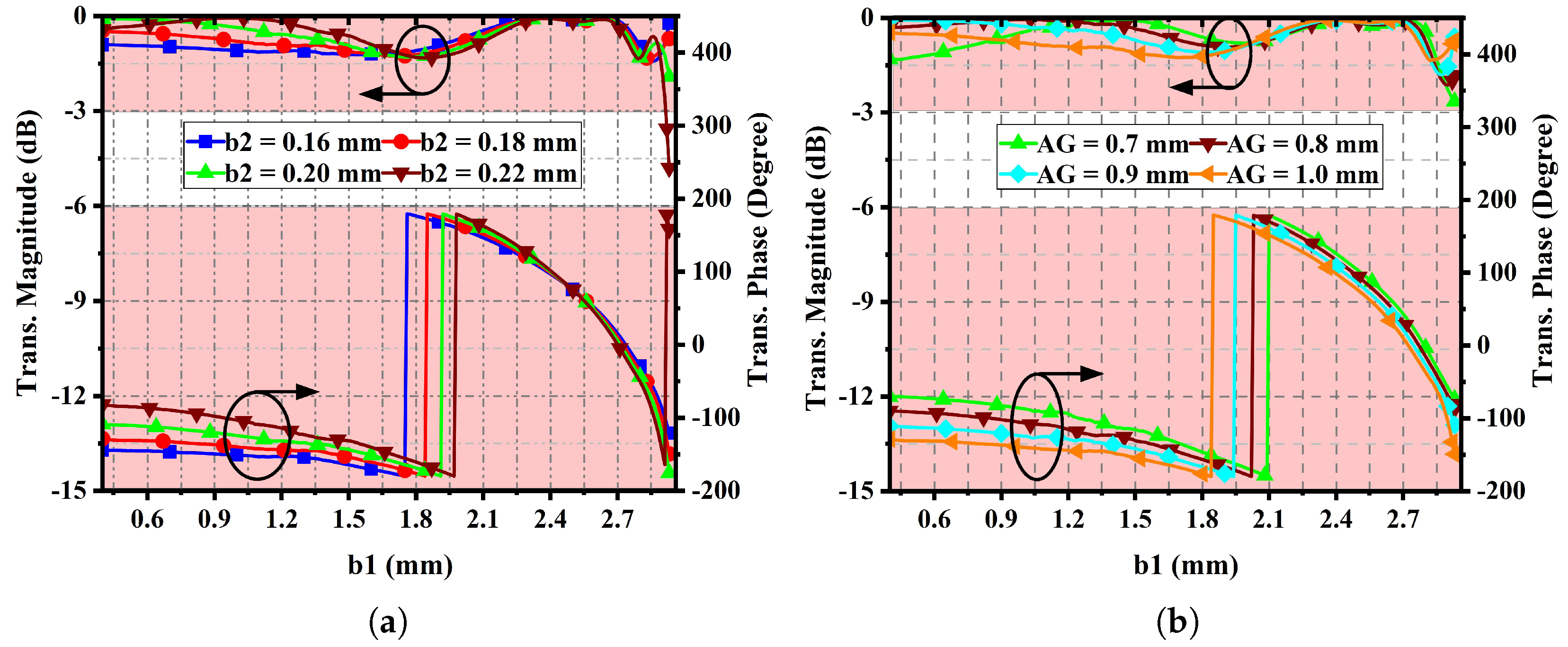
During the analysis, the geometrical parameter b 1 was systematically varied from 0.40 mm to 2.92 mm to investigate its impact on the element’s transmission behavior. Figure 3 shows the simulated co-pol transmission magnitude and phase responses for different geometric parameter configurations. To be more precise, the effects of modifying the unit cell width ( b 2 = 0.16 , 0.18, 0.20, and 0.22 mm) are presented in Figure 3a, and the effects of regulating the air-gap (AG) height ( t = 0.7 , 0.8, 0.9, and 1.0 mm), which were examined to highlight their impact on the overall transmission behavior, are presented in Figure 3b. Throughout the design optimization process, the practical fabrication tolerances were carefully considered. The most favorable performance was achieved with geometric parameters of b 2 = 0.18 mm and t = 1.0 mm, resulting in improved co-pol transmission magnitude and phase capabilities relative to traditional design approaches.
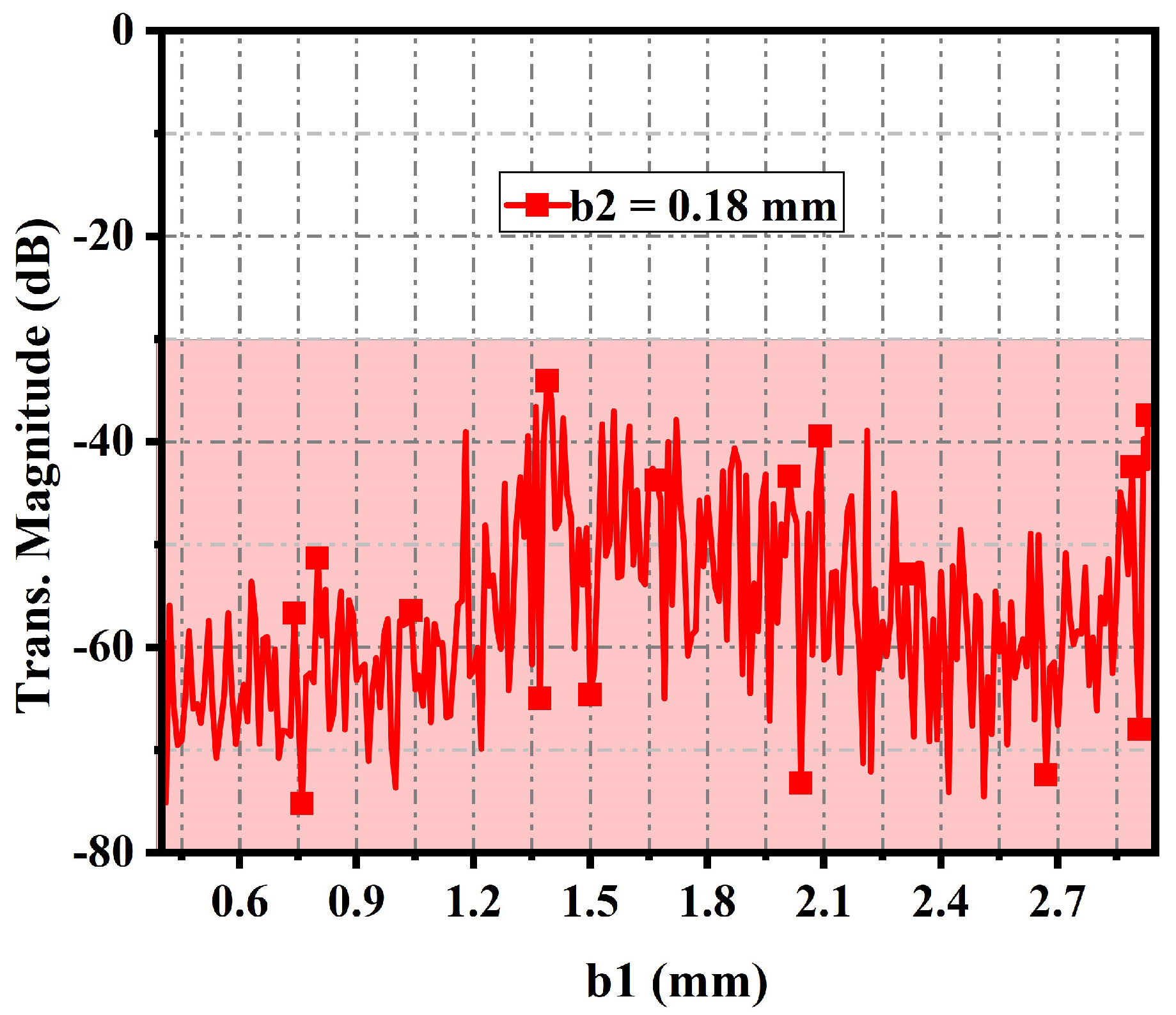
Moreover, the cross-polarized transmission magnitude response of the proposed unit cell with variable sizes remains consistently below −30 dB, as shown in Figure 4. This indicates that the cross-polarization is strongly suppressed across the entire parameter range, without affecting the intended co-polarized phase and magnitude control of the proposed transmissive unit cell.
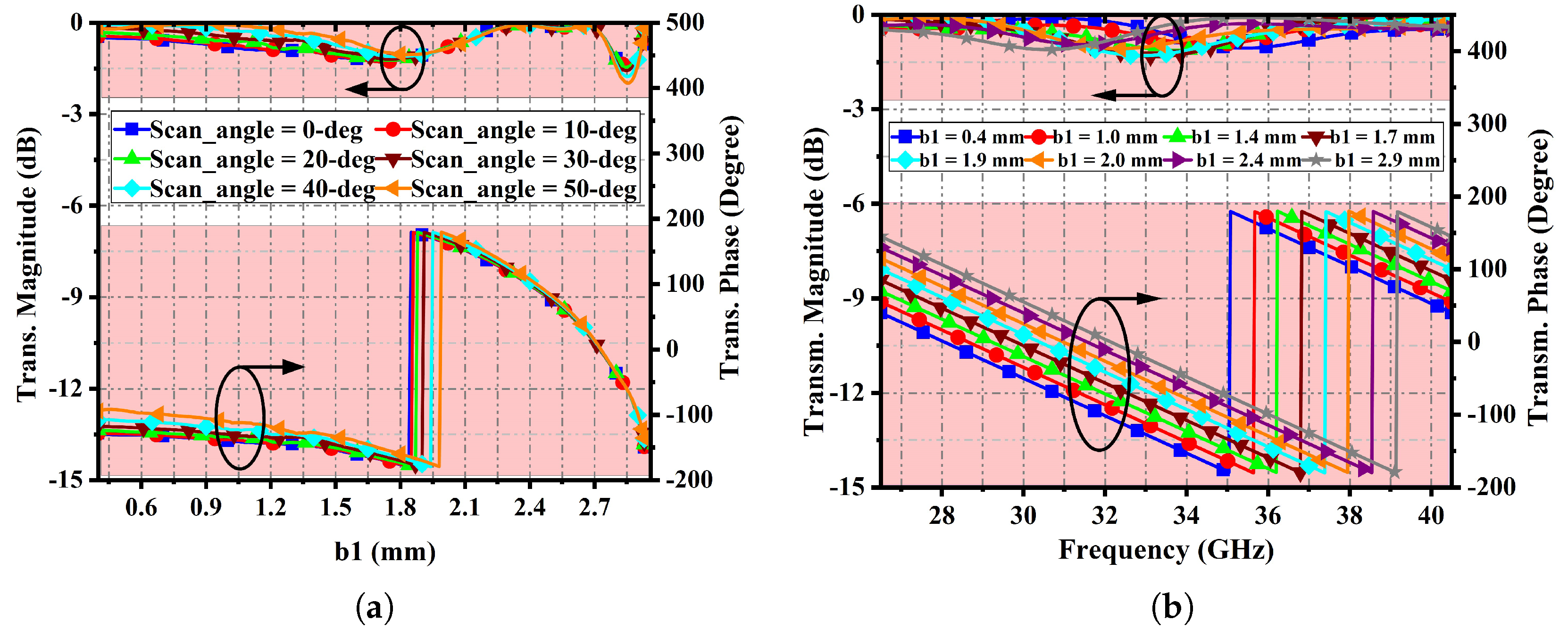
As illustrated in Figure 5a, the proposed transmissive unit cell design maintains stable co-pol transmission magnitude (dB) and phase (degrees) performance for oblique incident angles of up to 50 degrees. The co-pol transmission amplitude fluctuates by no more than 1.5 dB throughout this range. The wideband outcomes of the transmissive unit cell are assessed in Figure 5b. These outcomes determine the structural reliability of the proposed design and confirm its capability to operate effectively under off-axis illumination. It is important to note that this performance is accomplished without the need for any extra phase correction, which demonstrates the design’s importance in real-world applications.
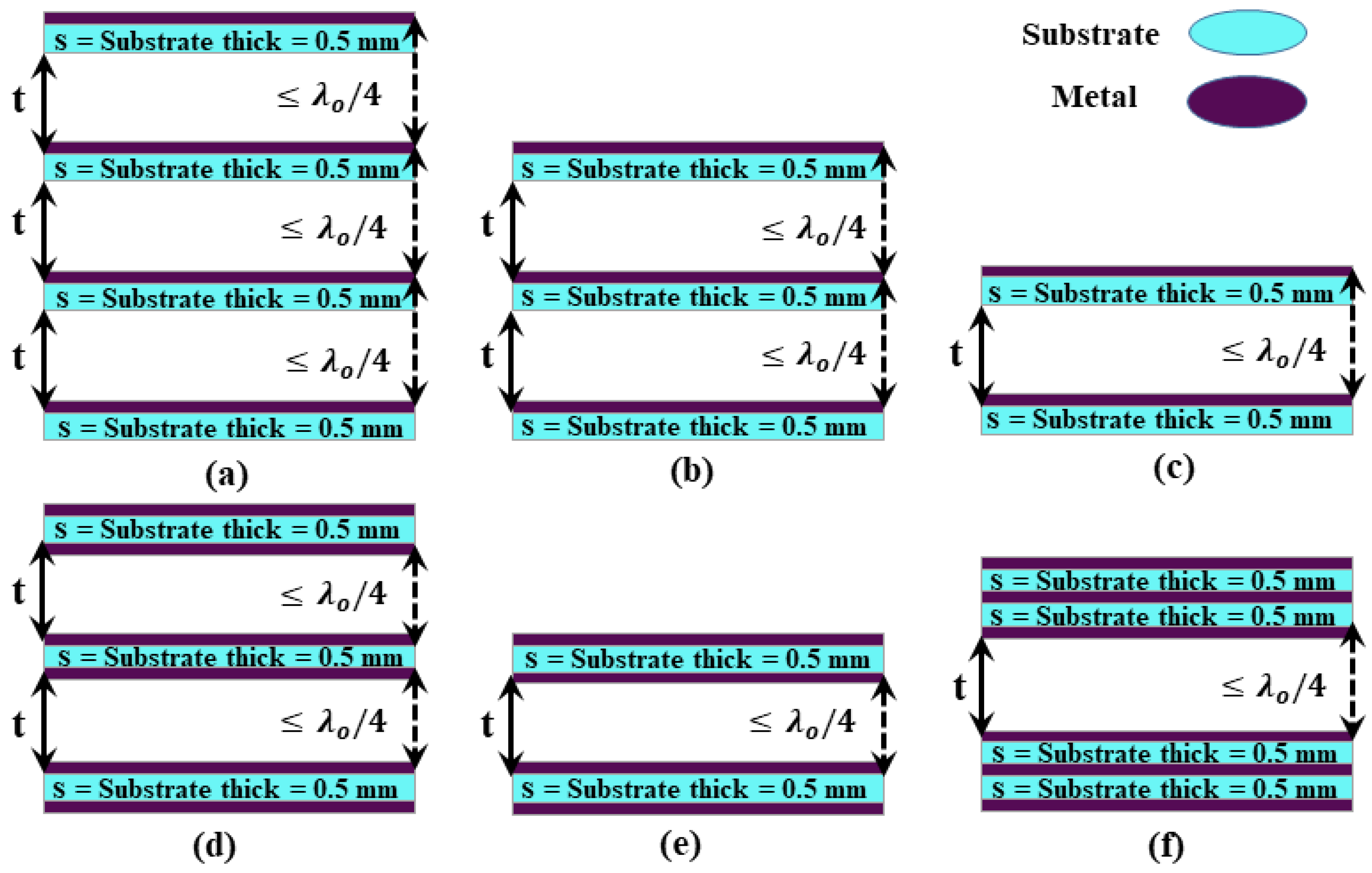
Figure 6 presents the different configurations of dielectric and conductor layers of the proposed unit cell. The corresponding responses, in terms of transmission phase and magnitude, are summarized in Table 2. As observed, the number of dielectric and conductor layers plays a crucial role in determining the transmission phase and magnitude. A reduction in the number of layers and the air-gap height leads to high-gain performance. Moreover, the combination of structures is specifically chosen to achieve multi-resonance, a crucial factor for achieving wideband performance.

3. A Transmitarray for Producing a High-Order Beam

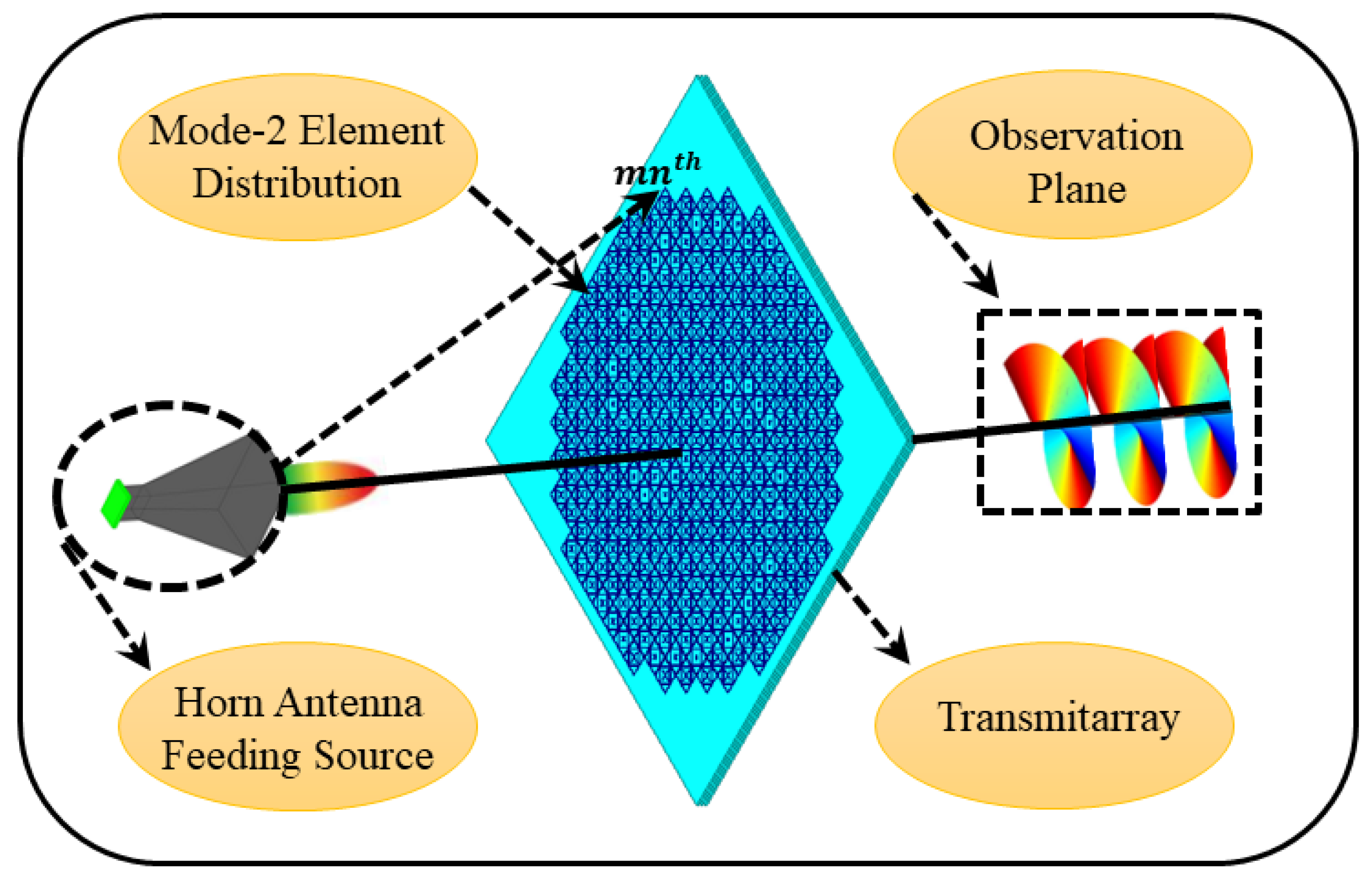
The Figure 7 is a demonstration of the transmitarray arrangement that was meant to generate an orbital angular momentum (OAM) mode with a topological charge of l = + 2 . The configuration comprises a circular transmitarray aperture with a radius of 52.5 mm, designed for the synthesis of vortex beams that carry orbital angular momentum (OAM) modes. A horn antenna (HA) operates as the excitation source and is positioned in a fixed place (100 mm) represented by the vector, providing uniform illumination across the aperture. Each transmitarray element that is located at the ( m , n ) position is given a phase value that combines a focusing term with an azimuthal phase component that is related to OAM beam generation. This is done in order to impose the phase distribution that is necessary. The total phase compensation applied to the ( m , n ) -th element can be expressed as
Φ m n = k 0 r m n r f r m n · s ^ + l arctan Y m n / X m n
where the first component is responsible for phase correction as a result of feed displacement and beam steering, and the second term is responsible for introducing the helical phase variation that is necessary for the creation of the OAM mode. Through the application of the following transformation, the transverse coordinates of every element in the beam-normal coordinate system can be obtained:
X m n = x m n cos θ cos ϕ + y m n cos θ sin ϕ Y m n = x m n sin ϕ + y m n cos ϕ
where ( x m n , y m n ) denote the element coordinates in the aperture plane, and θ , ϕ define the beam pointing direction. For clarity, the parameters used in the above formulations are summarized as follows:
  • k 0 = 2 π / λ 0 is the wavenumber in free space.
  • r m n represents the position vector of the ( m , n ) -th transmitarray element.
  • r f denotes the feed antenna spatial coordinates.
  • s ^ represents the unit vector in the desired radiation direction.
  • l is the OAM mode index, ranging from l = + 1 to l = + 4 .
High aperture efficiency combined with relatively low spillover loss is achievable only through careful selection of the ratio of focal length to aperture diameter ( f / D ). In the proposed configuration, the transmissive aperture is excited by a linearly polarized (LP) horn antenna characterized by a pattern shaping parameter. A wide-range parametric investigation was also conducted by changing the f / D ratio to evaluate its effect on aperture efficiency and spillover radiations. Based on this theoretical analysis, an f / D value of 1 was selected as the optimal choice to keep a balanced compromise between effective aperture utilization and minimum spillover loss, resulting in excellent radiation performance.
The feed antenna (FA) is now positioned at a distance of 100 mm from the transmitarray to ensure effective illumination of the aperture. The spherical wave excited by the horn feed can be considered to be a local plane wave for each element due to its electrically small size relative to the feed distance. This configuration results in an edge taper of approximately −9.6 dB (detailed discussion in [40]), which is essential for maintaining a balanced amplitude distribution across the active aperture. Furthermore, this setup helps in minimizing undesirable spillover radiation, ensuring more efficient energy utilization and overall enhanced performance.
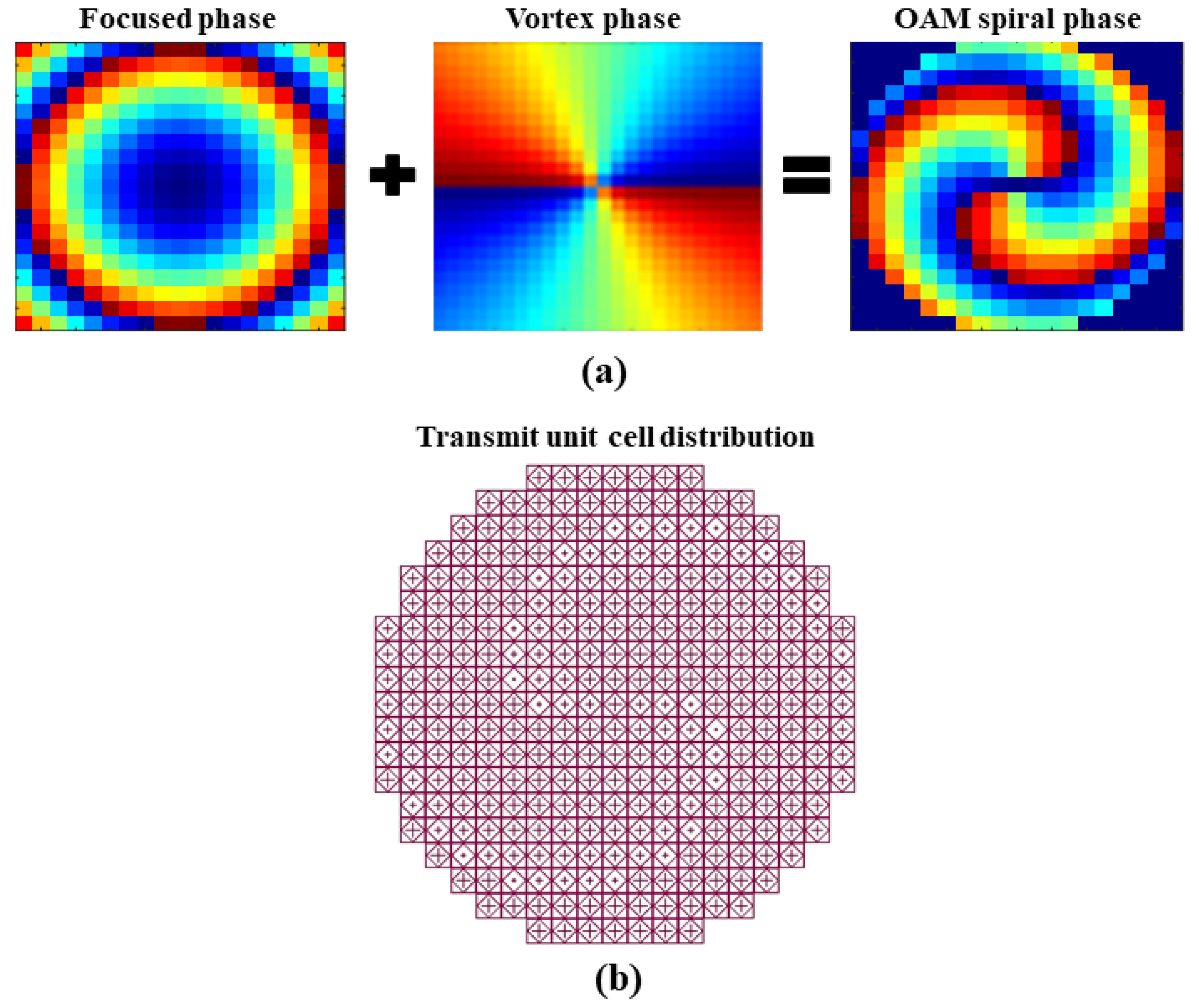
Figure 8 illustrates the phase compensation process for the desired OAM +2 mode generator, achieved by applying Equation (1), which utilizes the principle of aperture field superposition, as discussed in references [31,40]. In this method, the focused phase and the vortex phase are superimposed to generate the final OAM spiral phase. The focused phase, represents the phase distribution responsible for converting the spherical wavefront into a plane wavefront. On the other hand, the vortex phase distribution, which introduces a topological phase singularity, imparts orbital angular momentum (OAM) to the beam. When these two phases (the focused and vortex phases) are combined, they generate the final OAM spiral phase distribution, as depicted in Figure 8a. According to the phase compensation, the transmitarray unit cell distribution is illustrated in Figure 8b. This design allows for precise control over the phase distribution, providing a highly effective method for generating the OAM +2 mode while maintaining beam quality and performance.

4. Simulated and Measured Results of High-Order Mode

A comprehensive examination of the OAM-vortex-beam generation characteristics of the transmitarray was carried out with the help of full-wave simulations in ANSYS HFSS. The results of this investigation provided an in-depth understanding of the electromagnetic response and beam-forming capabilities of the transmitarray.

4.1. Stability Analysis of Long-Distance Systems

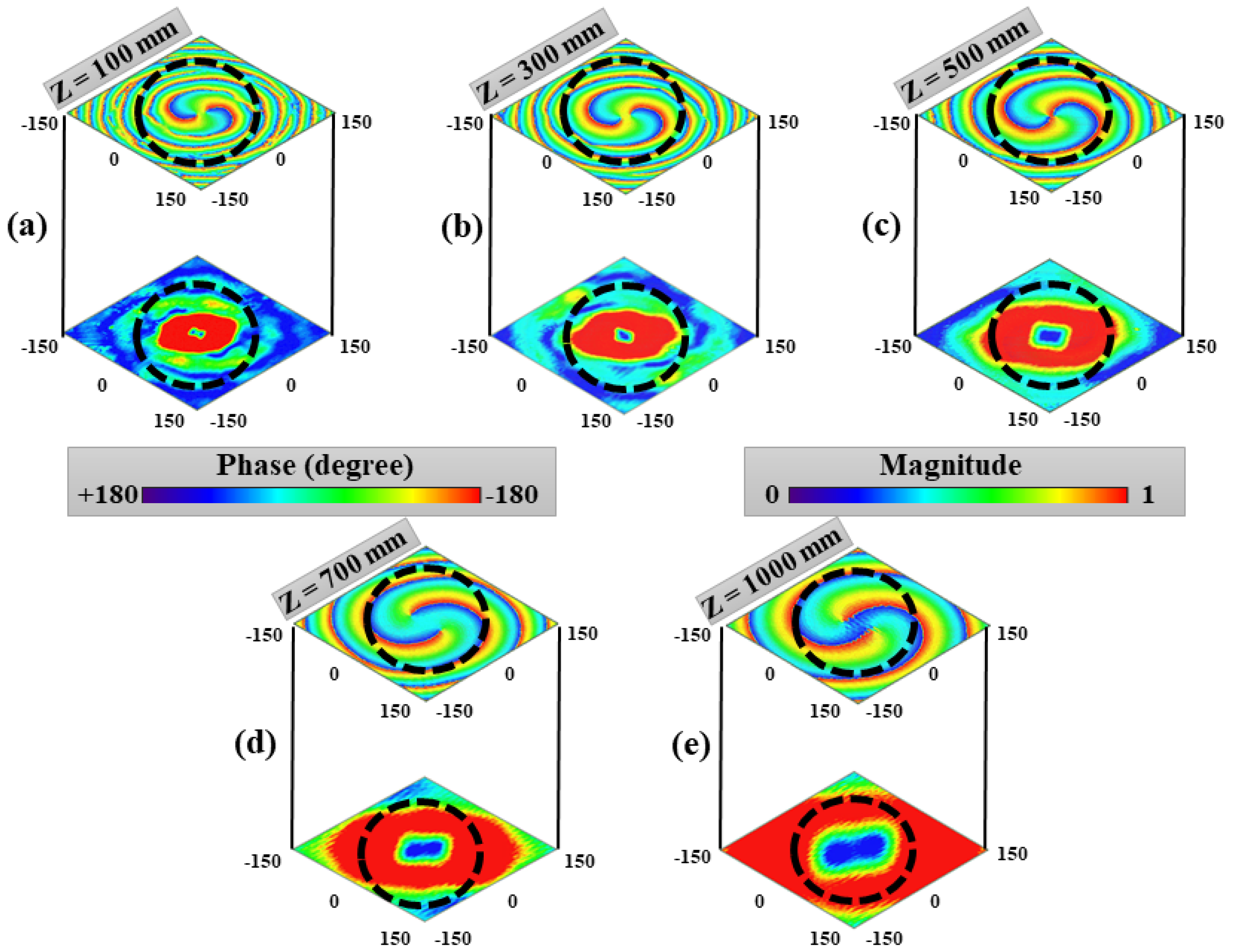
The stability analysis of long-distance communication systems is presented in Figure 9. The simulated propagation evolution of the OAM vortex beam generating the +2 mode were obtained by observing the field distributions at several planes located along the z-axis, to verify the consistency of the generated vortex beams. The simulations were performed using a 30 λ 0 × 30 λ 0 mm2 observation plane, with its distance from the metasurface aperture systematically varied. The observation planes were positioned at distances of 200 mm, 300 mm, 500 mm, 700 mm, and 1000 mm, corresponding to normalized distances of 20 λ 0 , 30 λ 0 , 50 λ 0 , 70 λ 0 , and 100 λ 0 at an operating frequency 30 GHz.
The circular ring is marked on each phase and magnitude distribution to emphasize the center of the l = + 2 spiral phase and the null point of the magnitude, further confirming the vortex nature and the evolution of the beam. Such consistency confirms that the proposed metasurface can support reliable OAM-waves over long ranges. At increased propagation distances, the l = + 2 OAM vortex mode continues to exhibit an intensity profile at the null center and well-defined phase (spiral arm) characteristics.

4.2. Assessment of OAM Mode Purity

The assessment of the angular behavior of the electric field was the primary focus of this study, which aimed to evaluate how effectively the proposed design excites OAM (orbital angular momentum) modes. By converting these angular samples into the modal domain using a Fourier-based approach [41], the OAM spectrum was obtained, and the contribution of individual modes was quantified following the equation
A n = 1 2 π 0 2 π Ψ ( ϕ ) exp j n ϕ d ϕ
Within this context, the symbol n represents the OAM mode index, while the symbol Ψ ( ϕ ) stands for the sampled angular (E-field) electric field. After that, the angular (E-field) electric field can be described as a superposition of OAM modes, which are as follows:
Ψ ( ϕ ) = n = + A n exp j n ϕ
The MP (mode purity) of the specified OAM vortex mode is defined as the normalized contribution of the target mode in relation to all excited modes:
MP n = | A n | k = + | A k |
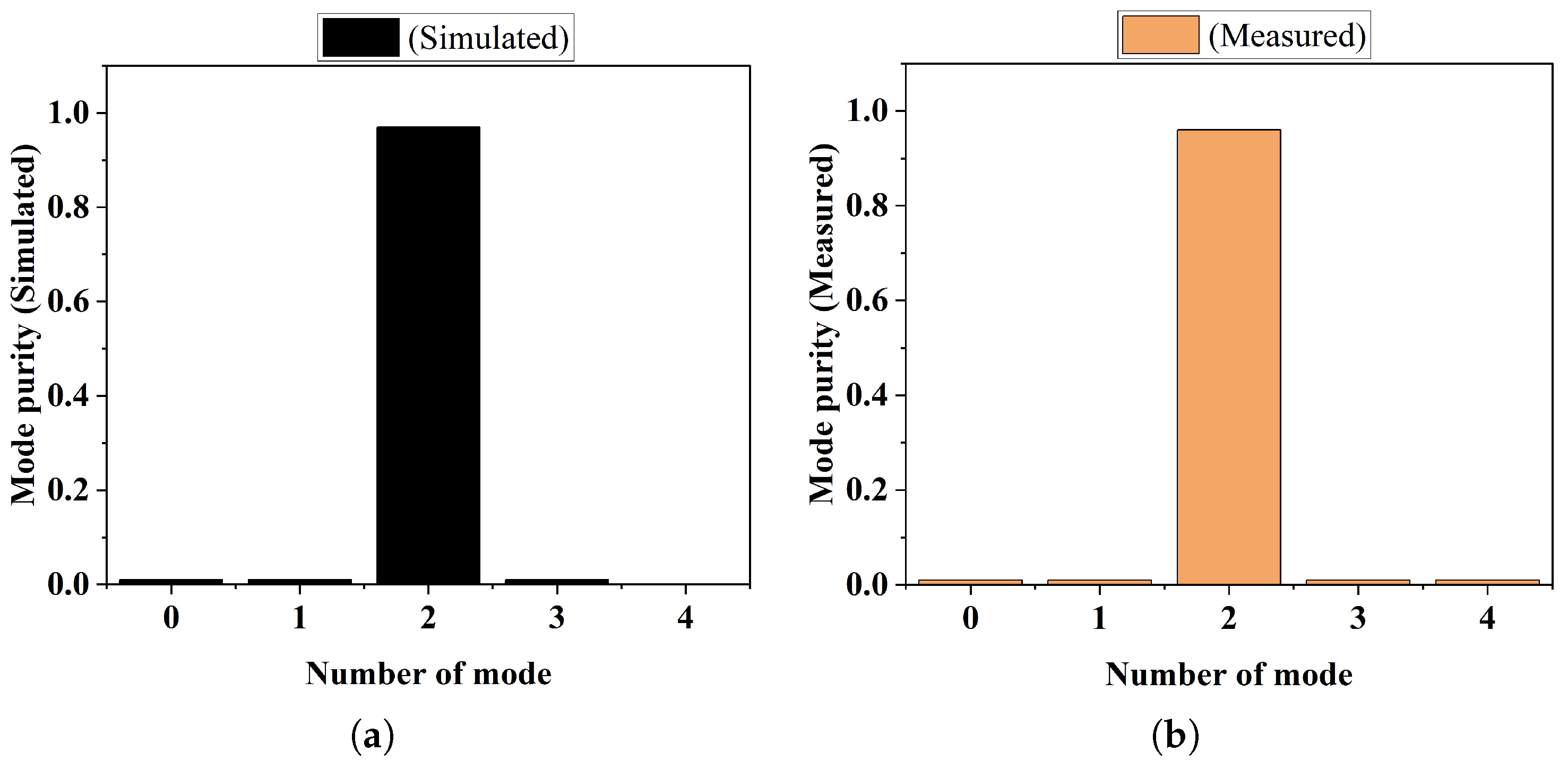
The simulated and experimental evaluation results indicate that the fabricated prototype design achieves significant OAM-mode quality. According to the mode purity formulation, the mode-2 state attains a purity of 97% in the simulation and 96% in the measurement at the operational frequency, as shown in Figure 10.
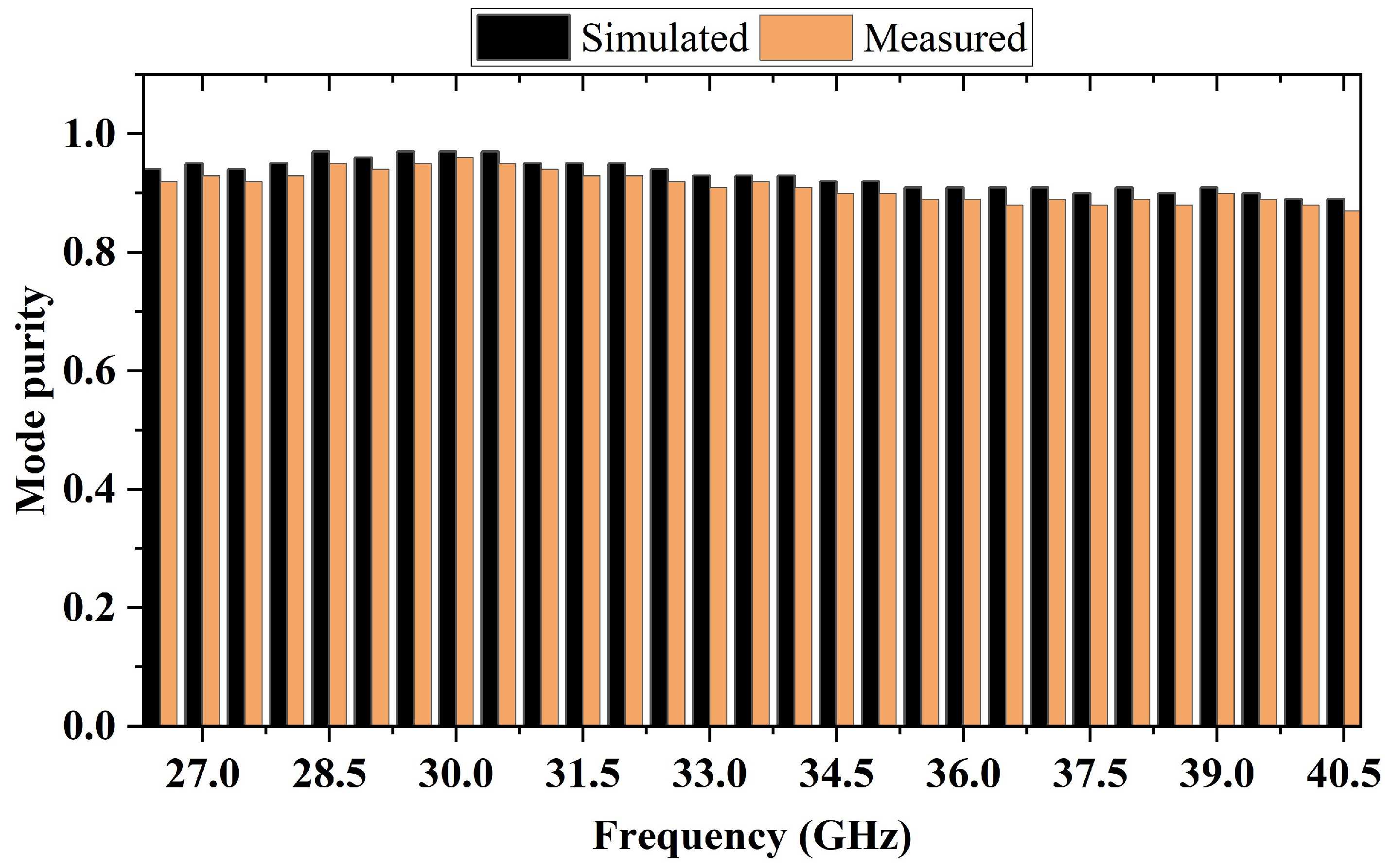
Figure 11 shows a comparison of the simulated and measured results for broadband OAM mode purity corresponding to the l = + 2 vortex mode. It is observed that mode purity constantly exceeds 86% over the complete broadband frequency range, from 26.5 to 40.5 GHz, demonstrating stable performance. These results show that the proposed design achieves an MP (mode purity) bandwidth of 46.6%, highlighting its favorable broadband performance and effective OAM mode generation over the frequency spectrum.

4.3. Experimental Validation Setup

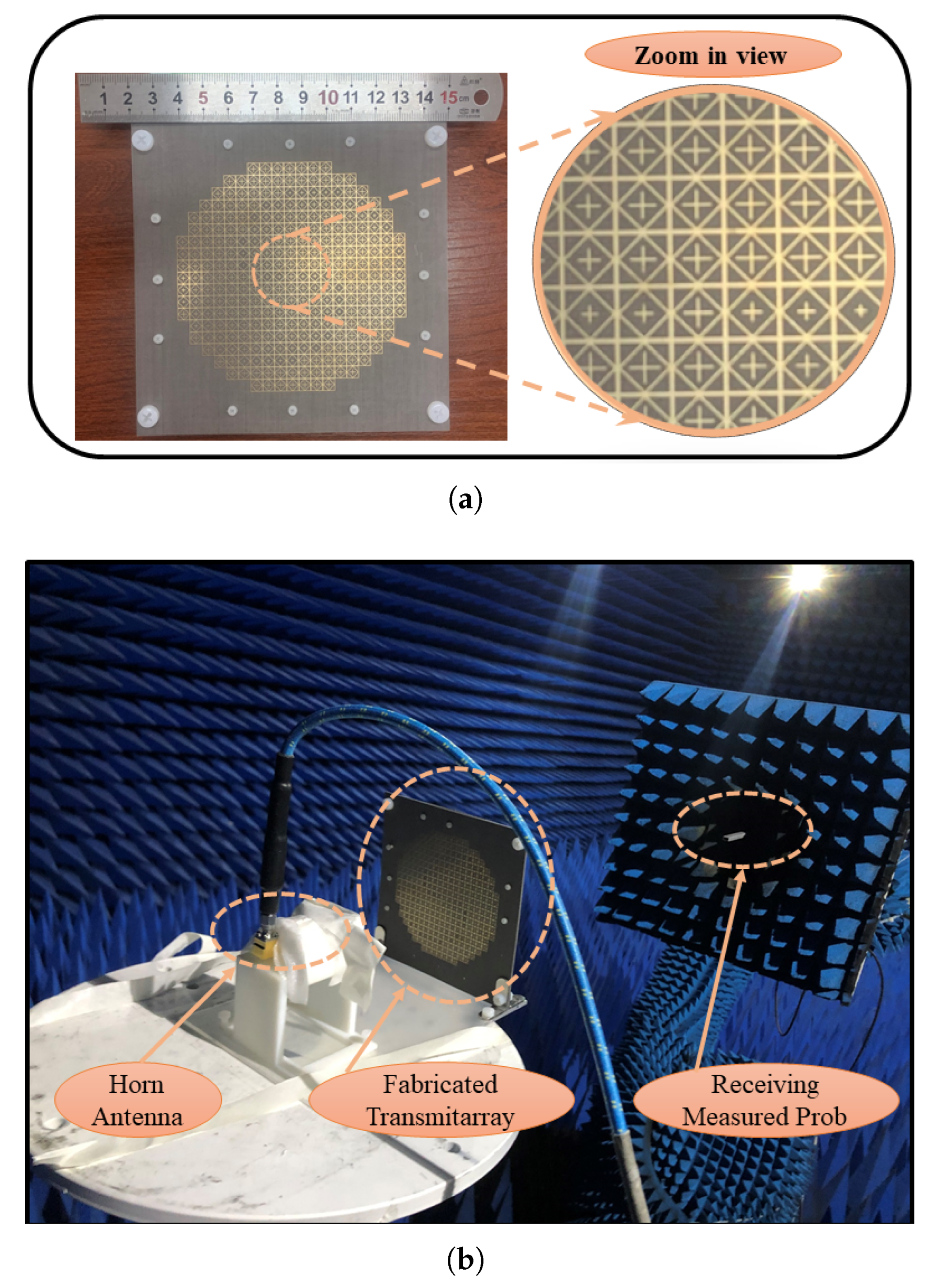
Figure 12 shows a visual representation of the measurement setup, which encompasses both the experimental environment and the designed prototype that was manufactured. The fabricated transmitarray has overall physical dimensions of 130 mm × 130 mm. The active region of the array corresponds to a circular aperture with a radius of 52.5 mm, which is fully occupied by the transmissive metasurface (MS) elements. To characterize the electromagnetic performance of the prototype, a near-field scanning technique is employed to measure the electric-field distribution. The measurements are performed over a planar scanning area of 300 mm × 300 mm, with the field sampled on a grid of 61 × 61 measurement points. Such a configuration ensure an appropriate spatial resolution for near-field measurements, thereby supporting accurate electromagnetic field reconstruction and robust verification of the generated orbital angular momentum modes for l = + 2 .
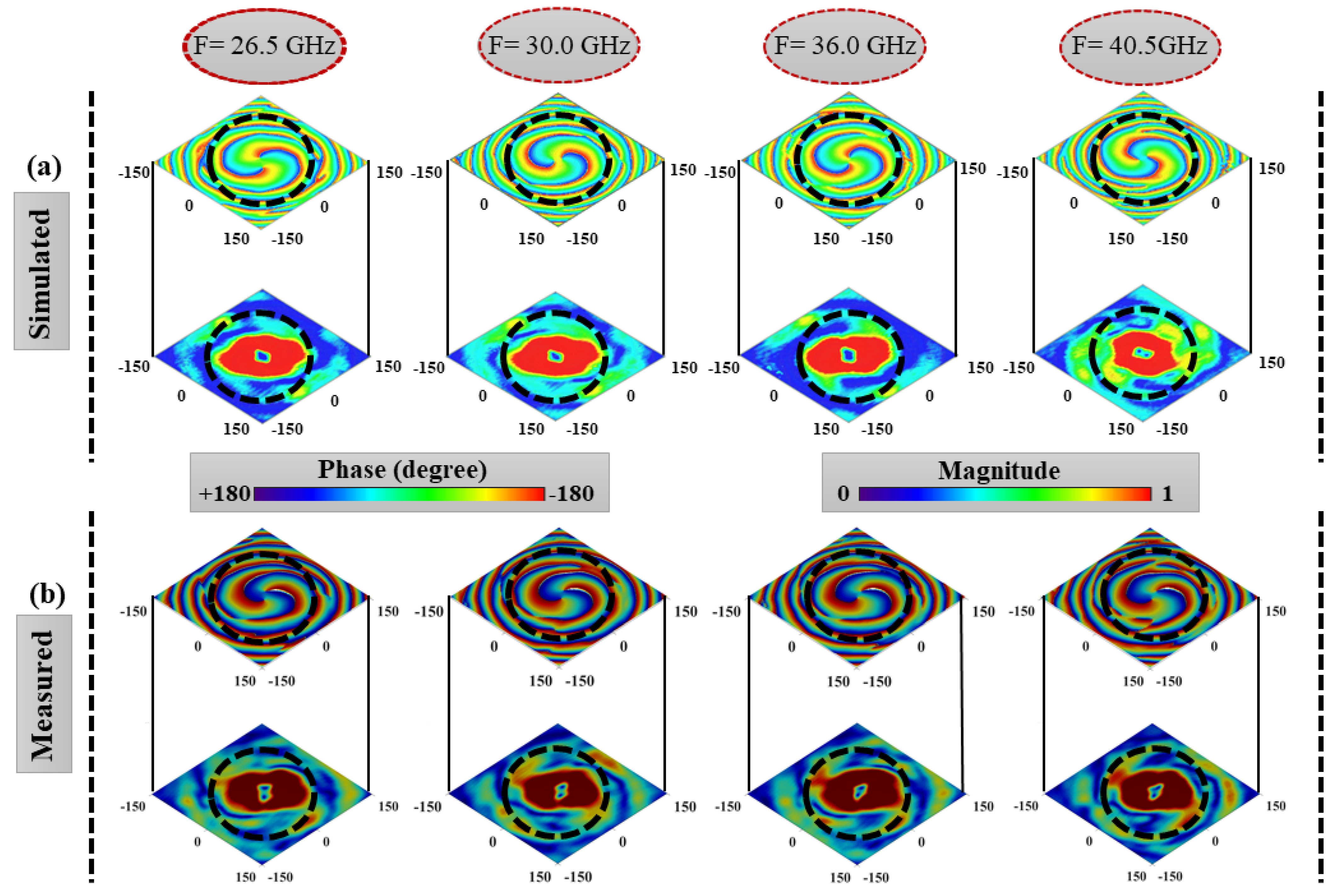
Figure 13 compares the simulated and experimentally measured near-field phase and amplitude distributions across the frequency band from 26.5 to 40.5 GHz. As observed, the phase exhibits a clear spiral evolution, while the amplitude forms a ring-shaped pattern, confirming the generation of the OAM mode with topological charge +2. The observed features are well maintained across the entire frequency band, indicating stable vortex-beam generation. The continuous phase rotation and distinct central null support the validity of the proposed design.
The minor differences between the experimental results and the simulations are due to various factors. Initially, fabrication imperfections, such as pattern-printing errors or variations in dielectric constant and material thickness, could have affected the prototype’s performance. Additionally, minor discrepancies might have resulted from alignment inaccuracies during setup, such as slight misalignments in positioning the transmitarray and measurement equipment. Another contributing factor is the feed antenna, which might exhibit higher spillover than the simulation prediction, possibly due to inaccuracies in the horn antenna model and alignment tolerances. Finally, environmental factors such as temperature changes or nearby electronic devices may have caused measurement errors.
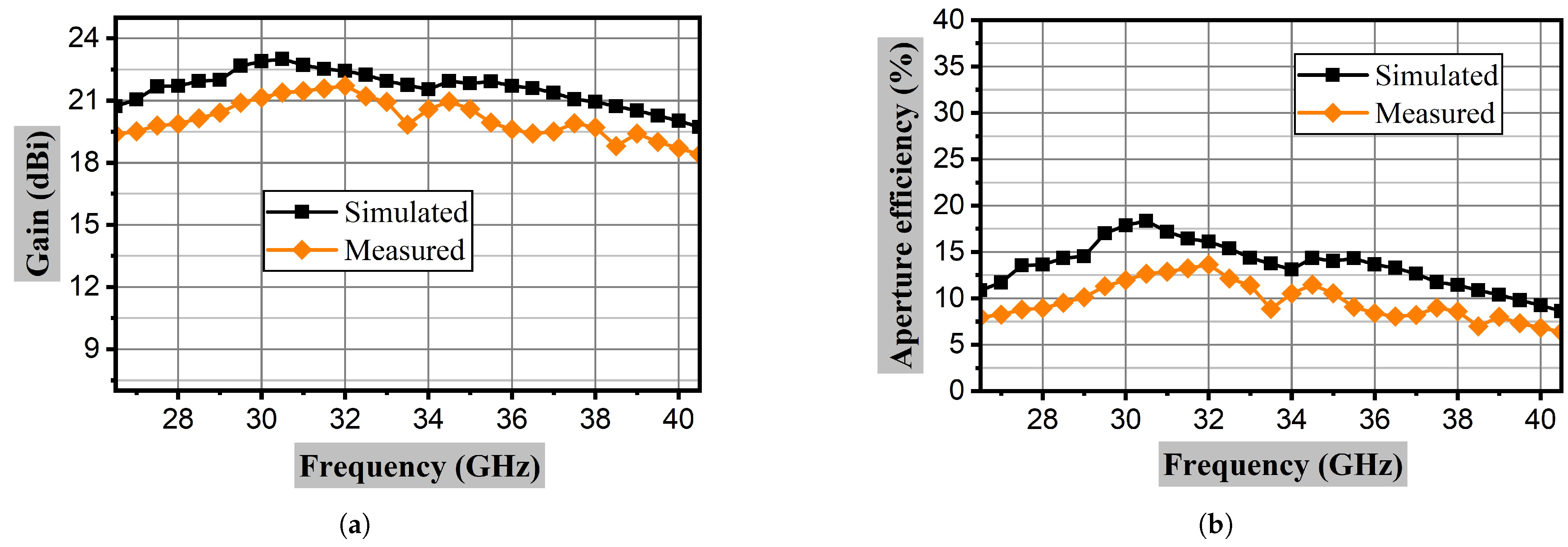
A comparison of the simulated and measured results for gain and aperture efficiency over the operating frequency range are shown in Figure 14a and Figure 14b respectively. The simulated peak gain at 30.5 GHz, reaches 22.99 dBi, while measurements indicate a peak gain of 21.7 dBi at 32 GHz. The associated simulated and measured aperture efficiencies are 18.35% and 13.6%, respectively, demonstrating good agreement between simulation and measurement. Both results exhibit similar trends across the operating band, with minor deviations because of fabrication and measurement setup tolerances. Overall, these results confirm stable radiation performance and efficient utilization of the aperture over a wide frequency range.

5. Discussion

The proposed transmissive fabricated prototype for higher-order vortex modes demonstrates broadband bandwidth, gain, and aperture efficiency while preserving high mode purity in the millimeter-wave (mmW) frequency range. Its performance is assessed by comparing the proposed metasurface antenna with published high-order OAM metasurface antennas, as summarized in Table 3. In comparison, the design presented in [42] validates improved bandwidth performance in the lower-frequency region, owing to the larger physical aperture employed in its configuration.
The study in [36] confirms the realization of higher-order OAM modes through simulation at 30 GHz, demonstrating excellent mode purity, while limited to a single-frequency operation. The results reported in [31] achieve high OAM-mode purity with a limited operational bandwidth. The improved bandwidth and efficiency of our proposed transmitarray system are primarily due to its multi-resonance structure and the significant air gap between layers. This design improves wave propagation, radiated power focusing, and interlayer coupling. These factors lead to higher gain and efficiency. Compared with earlier works, which primarily focused on lower-order OAM modes, our design employs a higher-order +2 mode while maintaining high efficiency and a broad bandwidth. This approach also aligns with recent studies showing that increasing the number of layers and the air gap between them enhances the antenna’s performance.
Accordingly, the proposed transmissive prototype achieves a well-balanced combination of structural simplicity, enhanced gain, high aperture efficiency, and wideband bandwidth for high-order vortex modes. These outcomes are validated through the experimental results, confirming their suitability for high-capacity wireless communication applications.

6. Conclusions

The outcome of this work is a fabricated TMS (transmissive metasurface) prototype that produces higher-order OAM vortex beams with broadband operational characteristics, high gain, aperture efficiency, and mode purity in the millimeter-wave regime. By utilizing a symmetric, multi-layer transmit unit cell equipped with complete 360-degree phase control and minimal transmission loss (dB), the developed design addresses common challenges associated with higher-order OAM mode production, such as restricted bandwidth and mode purity. Consistent with the simulation results, experimental validation of the manufactured prototype confirms the generation of broadband higher-order vortex beams. The proposed model utilizes a significant part of the available OAM bandwidth, maintaining an OAM-mode purity exceeding 86% across the frequency range of 26.5–40.5 GHz. Furthermore, the prototype demonstrates an ability to efficiently radiate higher-order vortex modes, achieving a competitive aperture efficiency of 13.6% and a high measured gain of 21.7 dBi. The prototype’s performance indicates that the suggested transmissive metasurface is a viable and scalable approach for enhancing the information-carrying capacity of wireless systems. Overall, the prototype’s broadband behavior, polarization flexibility, and structural simplicity make it a promising choice for future OAM-enabled wireless architectures and advanced spectral-efficiency-enhancement technologies.

Author Contributions

Conceptualization, M.I., W.T. and A.A.; methodology, M.I., W.T., H.M.B. and A.A.; software, M.I., W.T., Z.I. and M.A.; validation, M.I., W.T., A.A., H.M.B., Z.I. and M.A.; formal analysis, M.I., W.T., Z.I. and M.A.; investigation, M.I., W.T., A.A., H.M.B. and Z.I.; resources, M.I., W.T. and A.A.; data curation, M.I. and W.T.; writing—original draft preparation, M.I., W.T., A.A., H.M.B., Z.I. and M.A.; writing—review and editing, M.I., W.T., A.A., H.M.B., Z.I. and M.A.; visualization, M.I., W.T. and A.A.; supervision, W.T.; project administration, W.T. and M.I.; funding acquisition, W.T. All authors have read and agreed to the published version of the manuscript.

Funding

This work was supported by the National Natural Science Foundation of China (NSFC) under Grant 62463017, as well as the Science and Technology Program of Gansu Province under Grant 24CXGA039.

Institutional Review Board Statement

Not applicable.

Informed Consent Statement

Not applicable.

Data Availability Statement

The data are contained within the article.

Conflicts of Interest

The authors declare no conflicts of interest.

References

  1. Agiwal, M.; Roy, A.; Saxena, N. Next generation 5G wireless networks: A comprehensive survey. IEEE Commun. Surv. Tutorials 2016, 18, 1617–1655. [Google Scholar] [CrossRef]
  2. Wu, Q.; Zhang, S.; Zheng, B.; You, C.; Zhang, R. Intelligent reflecting surface-aided wireless communications: A tutorial. IEEE Trans. Commun. 2021, 69, 3313–3351. [Google Scholar] [CrossRef]
  3. Mohammadi, S.M.; Daldorff, L.K.S.; Bergman, J.E.S.; Karlsson, R.L.; Thidé, B.; Forozesh, K.; Carozzi, T.D.; Isham, B. Orbital angular momentum in radio: A system study. IEEE Trans. Antennas Propag. 2009, 58, 565–572. [Google Scholar] [CrossRef]
  4. Edfors, O.; Johansson, A.J. Is orbital angular momentum (OAM) based radio communication an unexploited area? IEEE Trans. Antennas Propag. 2012, 60, 1126–1131. [Google Scholar] [CrossRef]
  5. Liu, K.; Cheng, Y.; Yang, Z.; Wang, H.; Qin, Y.; Li, X. Orbital-angular-momentum-based electromagnetic vortex imaging. IEEE Antennas Wirel. Propag. Lett. 2014, 14, 711–714. [Google Scholar] [CrossRef]
  6. Chen, R.; Zhou, H.; Moretti, M.; Wang, X.; Li, J. Orbital angular momentum waves: Generation, detection, and emerging applications. IEEE Commun. Surv. Tutor. 2019, 22, 840–868. [Google Scholar] [CrossRef]
  7. Thidé, B.; Then, H.; Sjöholm, J.; Palmer, K.; Bergman, J.; Carozzi, T.D.; Istomin, Y.N.; Ibragimov, N.H.; Khamitova, R. Utilization of photon orbital angular momentum in the low-frequency radio domain. Phys. Rev. Lett. 2007, 99, 087701. [Google Scholar] [CrossRef] [PubMed]
  8. Long, W.-X.; Chen, R.; Moretti, M.; Zhang, W.; Li, J. Joint OAM radar–communication systems: Target recognition and beam optimization. IEEE Trans. Wirel. Commun. 2023, 22, 4327–4341. [Google Scholar] [CrossRef]
  9. Poynting, J.H. The wave motion of a revolving shaft, and a suggestion as to the angular momentum in a beam of circularly polarised light. Proc. R. Soc. Lond. Ser. A 1909, 82, 560–567. [Google Scholar] [CrossRef]
  10. Allen, L.; Beijersbergen, M.W.; Spreeuw, R.J.C.; Woerdman, J.P. Orbital angular momentum of light and the transformation of Laguerre–Gaussian laser modes. Phys. Rev. A 1992, 45, 8185–8189. [Google Scholar] [CrossRef]
  11. Tamburini, F.; Mari, E.; Sponselli, A.; Thidé, B.; Bianchini, A.; Romanato, F. Encoding many channels on the same frequency through radio vorticity: First experimental test. New J. Phys. 2012, 14, 033001. [Google Scholar] [CrossRef]
  12. Coullet, P.; Gil, L.; Rocca, F. Optical vortices. Opt. Commun. 1989, 73, 403–408. [Google Scholar] [CrossRef]
  13. Yan, Y.; Xie, G.; Lavery, M.P.J.; Huang, H.; Ahmed, N.; Bao, C.; Ren, Y.; Cao, Y.; Li, L.; Zhao, Z.; et al. High-capacity millimetre-wave communications with orbital angular momentum multiplexing. Nat. Commun. 2014, 5, 4876. [Google Scholar] [CrossRef]
  14. Liang, Y.; Cao, S.; Liu, L.; Liu, F.; Yin, X.; Lv, P.; Zhang, Y.; Zou, Y.; Fang, L.; Zheng, S.; et al. Coherent detector for the non-separability measurement of vectorial structured light. Light Sci. Appl. 2025, 14, 343. [Google Scholar] [CrossRef]
  15. Cao, S.; Ruan, Z.; Ren, W.; Qin, S.; Yin, X.; Liu, L.; Liang, Y.; Xu, H. Tailoring Perfect Optical Vortex Combs Based on Diffractive Neural Networks. Laser Photonics Rev. 2025, e02383. [Google Scholar] [CrossRef]
  16. Yuan, Y.; Zhang, K.; Ratni, B.; Song, Q.; Ding, X.; Wu, Q.; Burokur, S.N.; Genevet, P. Independent phase modulation for quadruplex polarization channels enabled by chirality-assisted geometric-phase metasurfaces. Nat. Commun. 2020, 11, 4186. [Google Scholar] [CrossRef]
  17. Zhang, K.; Yuan, Y.; Ding, X.; Li, H.; Ratni, B.; Wu, Q.; Liu, J.; Burokur, S.N.; Tan, J. Polarization-engineered noninterleaved metasurface for integer and fractional orbital angular momentum multiplexing. Laser Photonics Rev. 2021, 15, 2000351. [Google Scholar] [CrossRef]
  18. Chen, Y.; Zheng, S.; Chi, H.; Jin, X.; Zhang, X. Half-mode substrate integrated waveguide antenna for generating multiple orbital angular momentum modes. Electron. Lett. 2016, 52, 684–686. [Google Scholar] [CrossRef]
  19. Yang, H.; Zheng, S.; Zhang, H.; Li, N.; Shen, D.; He, T.; Yang, Z.; Lyu, Z.; Yu, X. A THz–OAM wireless communication system based on transmissive metasurface. IEEE Trans. Antennas Propag. 2023, 71, 4194–4203. [Google Scholar] [CrossRef]
  20. Jiang, T.; Hu, J.; Luo, S.; Wang, Y.; Wu, W. A fast and super-resolution method of vortex-based imaging. IEEE Antennas Wirel. Propag. Lett. 2023, 22, 2225–2229. [Google Scholar] [CrossRef]
  21. Yang, H.; Zheng, S.; Zhang, H.; He, T.; Li, N.; Yang, Z.; Lyu, Z.; He, Y.; Zhang, L.; Yu, X. A reflective metasurface for OAM and polarization multiplexing communication in the W-band. IEEE Antennas Wirel. Propag. Lett. 2024, 23, 1124–1128. [Google Scholar] [CrossRef]
  22. Uchida, M.; Tonomura, A. Generation of electron beams carrying orbital angular momentum. Nature 2010, 464, 737–739. [Google Scholar] [CrossRef]
  23. Hui, X.; Zheng, S.; Hu, Y.; Xu, C.; Jin, X.; Chi, H.; Zhang, X. Ultralow reflectivity spiral phase plate for generation of millimeter-wave OAM beam. IEEE Antennas Wirel. Propag. Lett. 2015, 14, 966–969. [Google Scholar] [CrossRef]
  24. Feng, P.-Y.; Hou, L.-L.; Xue, J.-Y. Phased array fed reflector antenna for OAM-generating and beam-scanning applications. In Proceedings of the 2023 IEEE MTT-S International Wireless Symposium (IWS), Qingdao, China, 14–17 May 2023; pp. 1–3. [Google Scholar]
  25. Naseri, H.; PourMohammadi, P.; Melouki, N.; Iqbal, A.; Denidni, T.A. A low-profile antenna system for generating reconfigurable OAM-carrying beams. IEEE Antennas Wirel. Propag. Lett. 2022, 22, 402–406. [Google Scholar] [CrossRef]
  26. Wang, C.; Yu, H.; Wu, J.; Xu, G.; Sun, Q.-A.; Li, M.; Yang, L.; Huang, Z. Transmission continuous meta-grating for generating wide-band low-to-high order OAM with extremely high mode purity. IEEE Trans. Antennas Propag. 2024, 72, 5767–5781. [Google Scholar] [CrossRef]
  27. Wu, J.; Fan, M.; Lu, X.; Hu, J.; Xie, G.; Huang, Z. Circularly polarized and linearly polarized mode multiplexing OAM antenna using sequentially rotated technique. IEEE Antennas Wirel. Propag. Lett. 2024, 23, 1261–1265. [Google Scholar] [CrossRef]
  28. Qin, F.; Cao, X.; Gu, C.; Bi, J.; Gao, S.; Cheng, W. Mode conversion of multi-mode OAM waves based on transmitted metasurface. IEEE Antennas Wirel. Propag. Lett. 2024, 23, 4373–4377. [Google Scholar] [CrossRef]
  29. Yuan, Y.; Zhou, W.; Wang, R.; Wang, Y.; Dong, Y.; Burokur, S.N.; Zhang, K. Non-orthogonal metasurfaces for channel-locked spin–orbital transitions. Adv. Photonics 2025, 7, 056009. [Google Scholar] [CrossRef]
  30. Li, J.; Jana, A.; Yuan, Y.; Zhang, K.; Burokur, S.N.; Genevet, P. Exploiting hidden singularity on the surface of the Poincaré sphere. Nat. Commun. 2025, 16, 5953. [Google Scholar] [CrossRef]
  31. Yan, N.; Zhang, J.; Yang, F.; Luo, Y.; Ma, K. High-purity OAM generator using low-profile Huygens’ metasurface with stable response. IEEE Antennas Wirel. Propag. Lett. 2024, 23, 4857–4861. [Google Scholar] [CrossRef]
  32. Lv, H.-H.; Huang, Q.-L.; Yi, X.-J.; Hou, J.-Q.; Shi, X.-W. Low-profile transmitting metasurface using single dielectric substrate for OAM generation. IEEE Antennas Wirel. Propag. Lett. 2020, 19, 881–885. [Google Scholar] [CrossRef]
  33. Ishfaq, M.; Li, X.; Qi, Z.; Zhao, W.; Aziz, A.; Qiu, L.; Memon, S. A transmissive metasurface generating wideband OAM vortex beam in the Ka–band. IEEE Antennas Wirel. Propag. Lett. 2023, 22, 2007–2011. [Google Scholar] [CrossRef]
  34. Qin, F.; Wan, L.; Li, L.; Zhang, H.; Wei, G.; Gao, S. A Transmission Metasurface for Generating OAM Beams. IEEE Antennas Wirel. Propag. Lett. 2018, 17, 1793–1796. [Google Scholar] [CrossRef]
  35. Yan, N.; Zhang, J.; Yang, F.; Luo, Y.; Ma, K. Ultrawideband high-purity OAM generator using polarization conversion metasurface. IEEE Antennas Wirel. Propag. Lett. 2025, 24, 4272–4276. [Google Scholar] [CrossRef]
  36. Ishfaq, M.; Li, X.; Qi, Z.; Zhao, W.; Aziz, A.; Qiu, L. Wideband OAM vortex beam generation through a thin transmitarray in the Ka–band. IEEE Antennas Wirel. Propag. Lett. 2024, 23, 688–692. [Google Scholar] [CrossRef]
  37. Qiu, L.; Li, X.; Qi, Z.; Zhao, W.; Huang, Y. Wideband circularly polarized transmitarray for generating a high-purity vortex beam. Front. Inf. Technol. Electron. Eng. 2023, 24, 927–934. [Google Scholar] [CrossRef]
  38. Liu, W.; Deng, L.; Chen, L.; Zhang, C.; Li, S. A broadband high–gain low–profile folded transmitarray antenna for OAM generation. IEEE Antennas Wirel. Propag. Lett. 2024, 23, 4348–4352. [Google Scholar] [CrossRef]
  39. Yang, D.; Yuan, Y.; Wu, Q.; Zhang, K. High-gain OAM antenna with low-profile utilizing integrated reflective metasurface. IEEE Antennas Wirel. Propag. Lett. 2024, 23, 294–298. [Google Scholar] [CrossRef]
  40. Abdelrahman, A.H.; Yang, F.; Elsherbeni, A.Z.; Nayeri, P.; Balanis, C.A. Analysis and Design of Transmitarray Antennas; Springer: Berlin, Germany, 2017. [Google Scholar]
  41. Yao, E.; Franke-Arnold, S.; Courtial, J.; Barnett, S.; Padgett, M. Fourier relationship between angular position and optical orbital angular momentum. Opt. Express 2006, 14, 9071–9076. [Google Scholar] [CrossRef]
  42. Akram, Z.; Li, X.; Qi, Z.; Aziz, A.; Yu, L.; Zhu, H.; Jiang, X.; Li, X. Wideband vortex beam reflectarray design using quarter–wavelength element. IEEE Antennas Wirel. Propag. Lett. 2019, 18, 1458–1462. [Google Scholar] [CrossRef]
  43. Wang, J.; Ding, H.; Cai, Y.; Guo, N.; Song, W.; Li, S.; Luo, Y.; Xue, Q. Design of orbital angular momentum antennas with low sidelobes. IEEE Antennas Wirel. Propag. Lett. 2024, 23, 1256–1260. [Google Scholar] [CrossRef]
Figure 1. An overview of the proposed transmissive unit cell configuration. (a) Elevation illustration. (b) Overhead illustration.
Photonics 13 00152 g001
Figure 2. Proposed transmissive unit cell in the simulation process. (a) Primary1 and Secondary1. (b) Primary2 and Secondary2. (c) Floquet Port.
Photonics 13 00152 g002
Figure 3. The co-pol transmission magnitude and phase response of the transmissive unit cell at 30 GHz: (a) effect of the width parameter ( b 2 ) and (b) influence of the air-gap (AG) height t.
Photonics 13 00152 g003
Figure 4. The cross-pol transmission magnitude of the proposed transmissive unit cell at 30 GHz.
Photonics 13 00152 g004
Figure 5. The co-pol transmission magnitude and phase response of the proposed unit cell: (a) behavior under oblique incidence angles and (b) wideband response.
Photonics 13 00152 g005
Figure 6. Types of dielectric and conductor layers of the proposed unit cell with respect to identical and symmetrical configurations: (a) Type-1; (b) Type-2; (c) Type-3; (d) Type-4; (e) Type-5; (f) Type-6.
Photonics 13 00152 g006
Figure 7. The layout of the transmitarray for a producing high-order beam.
Photonics 13 00152 g007
Figure 8. The phase distribution of the desired OAM phase: (a) process for total compensation phase for +2 mode; (b) transmitarray structure.
Photonics 13 00152 g008
Figure 9. The performance of vortex +2 mode for long-distance communication systems at 30.0 GHz: (a) z = 20 λ 0 [200 mm]; (b) z = 30 λ 0 [300 mm]; (c) z = 50 λ 0 [500 mm]; (d) z = 70 λ 0 [700 mm]; and (e) z = 100 λ 0 [1000 mm].
Photonics 13 00152 g009
Figure 10. The OAM mode purity at 30.0 GHz: (a) simulated; (b) measured.
Photonics 13 00152 g010
Figure 11. The mode purity of the simulated and measured wideband OAM vortex-beam +2 mode.
Photonics 13 00152 g011
Figure 12. Validation configuration and procedure for the +2 mode design. (a) Fabricated transmitarray. (b) During testing.
Photonics 13 00152 g012
Figure 13. The electric field distribution for the +2 mode on the reference plane at z = 300 mm at different frequency points. (a) Simulated. (b) Measured.
Photonics 13 00152 g013
Figure 14. The outcomes of the simulated and measured OAM +2 mode: (a) gain; (b) aperture efficiency.
Photonics 13 00152 g014
Table 1. The geometric configuration of the proposed transmissive unit cell.
Unit Cell Parameterspsb2cdb1t (AG)
Values (mm)5.01.50.185.0c-2*b2variable1.0
Table 2. Correlation of the number of dielectric layers and conductor layers with transmission phase and magnitude of the transmissive unit cell.
TypesSingle or Both SidesSubstrate LayersConductor LayersSubstrate Thickness (s)Air Gap (t)Separation Between LayersTransm. Phase (degree)Transm. Magnitude (dB)
Type-1Single440.5 mm2.0 mm λ 0 / 2 360−0.9
Type-1Single440.5 mm1.0 mm < λ 0 / 2 360−1.5
Type-2Single330.5 mm2.0 mm λ 0 / 2 360−3.6
Type-2Single330.5 mm1.0 mm < λ 0 / 2 360−5.2
Type-3Single220.5 mm2.0 mm λ 0 / 2 <360−6.0
Type-4Both360.5 mm2.0 mm λ 0 / 2 360−2.9
Type-4Both360.5 mm1.0 mm < λ 0 / 2 360−3.8
Type-5Both240.5 mm2.0 mm λ 0 / 2 <360−4.9
Type-6Both240.5 mm2.0 mm λ 0 / 2 360−4.7
Table 3. Performance is evaluated by comparing the proposed metasurface with published high-order OAM metasurfaces.
Ref.Freq. (GHz)Array TypeFeed BlockageElement PeriodicityUnit Cell TypesSize of ApertureHigher ModesGain (dBi)Aperture EfficiencyMode BandwidthPurity of Mode
[42]5.0–7.0Refl.Yes0.25 λ 0 1 100 λ 0 2 l = + 2 18.986.3%40.0%≥72 *
[43]15.0Trans.No0.25 λ 0 3 50 λ 0 2 l = + 2 N/AN/AN/AN/A
[36]30.0Trans.No0.5 λ 0 1 100 λ 0 2 l = +2 *N/AN/AN/A96 *
[32]18.0Trans.No0.54 λ 0 4 127 λ 0 2 l = + 2 18.454.4%N/AN/A
[31]9.3–10.5Trans.No0.4 λ 0 7 100 λ 0 2 l = + 2 17.86.9%12.0%≥87
This work26.5–40.5Trans.No 0.5 λ 0 1 100 λ 0 2 l = + 2 21.713.6%46.6%≥86
Note: N/A, not available; Refl, Reflectarray; Trans, Transmitarray. * The simulated result.
Disclaimer/Publisher’s Note: The statements, opinions and data contained in all publications are solely those of the individual author(s) and contributor(s) and not of MDPI and/or the editor(s). MDPI and/or the editor(s) disclaim responsibility for any injury to people or property resulting from any ideas, methods, instructions or products referred to in the content.