Article

Optical Multi-Frequency Discrimination and Phase Identification System Based on On-Chip Dual MZM


1
Institute of Semiconductors, Chinese Academy of Sciences, Beijing 100083, China
2
School of Electronic, Electrical and Communication Engineering, University of Chinese Academy of Sciences, Beijing 100049, China
*
Author to whom correspondence should be addressed.
These authors contributed equally to this paper.
Photonics 2026, 13(2), 145; https://doi.org/10.3390/photonics13020145
Submission received: 4 January 2026 / Revised: 24 January 2026 / Accepted: 27 January 2026 / Published: 2 February 2026
(This article belongs to the Special Issue Microwave Photonics: Challenges and Applications)

Abstract

A photonic frequency discrimination and phase identification system based on an on-chip dual Mach–Zehnder modulator (MZM) is proposed. By utilizing the power cancellation (PCD) condition, the system achieves high-precision frequency discrimination and phase identification of multi-frequency radio frequency (RF) signals. The system adopts an on-chip dual-MZM architecture, effectively reducing phase interference in signal transmission caused by environmental factors. This is achieved through precise bias control and the adjustment of the local oscillator (LO) signal’s optical path delay using a tunable optical delay line (TODL), ensuring that the dual MZM operates in the phase inversion condition. When the LO frequency matches that of an RF signal, a significant power attenuation is observed at the system output. The phase of the RF signal is extracted from the corresponding PCD. Experimental results demonstrate that the system achieves a bandwidth of 30 GHz, a frequency resolution of 700 kHz, and a frequency resolution error of less than 498 kHz, with a phase identification range from 0° to 65°. With high integration, the system demonstrates excellent accuracy in multi-frequency signal measurement and phase identification, offering a reliable solution for complex RF scenarios.

1. Introduction

With the extensive deployment of 5G/6G mobile communication networks [1], high-resolution civilian millimetre-wave radars [2,3], and massive Internet of Things (IoT) terminals [4], the modern broadband radio frequency environment is undergoing an unprecedented evolution [5]. The current electromagnetic spectrum exhibits complex characteristics, characterized by extreme spectral congestion [6,7], high concurrency of multi-standard signals, and rapid transient variations in the time-frequency domain [8]. Against this backdrop, achieving high-precision frequency resolution for broadband, multi-channel concurrent microwave signals, while synchronously identifying multi-parameter—including frequency, phase, and amplitude [9]—has become a critical technical bottleneck. Addressing this challenge is essential for the implementation of efficient spectrum management, precise interference source localization, and cognitive radio spectrum sharing mechanisms. Traditionally, electronic reception and signal processing solutions have faced severe physical limitations when addressing these challenges. Constrained by the bandwidth bottlenecks and sampling rate limits of electronic devices [10], traditional electronic systems often compromise compactness to extend instantaneous bandwidth, improve frequency resolution, or enhance immunity to electromagnetic interference (EMI) [11,12]. These solutions typically feature complex architectures and struggle to optimize Size, Weight, and Power (SWaP) [13]. Consequently, they fail to meet the stringent requirements for compact structures and multi-parameter cognitive capabilities demanded by portable devices, unmanned aerial vehicle (UAV) payloads, or embedded monitoring platforms.
Microwave photonic technology, with its inherent advantages of wide bandwidth, low loss, and strong resistance to electromagnetic interference, has demonstrated significant potential in the field of RF measurement. Discrete device solutions, owing to their flexible structure and adjustable performance, have become an important technological approach. Reference [14] presents a discrete scheme based on polarization modulation and PM-FBG, achieving a frequency measurement bandwidth of 0–17.2 GHz with an average resolution of ±0.12 GHz. While the scheme offers strong noise immunity, it relies on external optical path calibration and supports only single-frequency serial detection. Additionally, its stability is susceptible to environmental disturbances. Reference [15] proposes a discrete architecture combining digital optical frequency combs with stimulated Brillouin scattering, covering a wide frequency range of 50.8 GHz, a frequency resolution of 20 MHz, and a resolution accuracy of 1.1 MHz. It supports instantaneous multi-frequency processing and breaks through the bottleneck of single-frequency measurement. However, it requires six core discrete devices, resulting in a large volume and high power consumption, which makes miniaturized deployment challenging. To address the limitations of large size, high power consumption, and weak stability in discrete solutions, integrated photonic schemes provide an effective pathway for engineering and portability through chip-level high-density integration, combining optical components with signal processing units. Reference [16] presents a hybrid integrated MWP instantaneous frequency measurement system based on indium phosphide (InP), silicon photonics, and CMOS platforms. The frequency measurement range is 2–34 GHz, with an estimated error of 10.85 MHz. The system operates with a power consumption of 884.2 mW and exhibits good stability. However, its wideband multi-frequency processing performance still requires further verification. Reference [17] develops a frequency measurement system based on an integrated chip of MZM and micro-ring resonators on a silicon-on-insulator (SOI) platform. The frequency measurement range is 0.5–35 GHz, with a frequency resolution error of less than 600 MHz at RF input power levels of 10 dBm to 4 dBm. The system offers high integration but has a large resolution error and limited parallel processing capability. Reference [18] proposes an instantaneous microwave frequency measurement method based on Ti: LiNbO3 integrated optical waveguide Y-branches, with a working bandwidth up to 300 GHz. The measurement resolution is controllable, but dimensional deviations caused by process accuracy significantly degrade the accuracy. For instance, for every 0.0001 deviation in the waveguide refractive index, the maximum measurable frequency deviation is 337.5 MHz, and for every 1 μm deviation in the waveguide length, the maximum measurable frequency deviation is 496 MHz, which severely affects the measurement reliability. Therefore, the issues associated with these approaches limit their applicability in practical scenarios.
In this paper, a photonic frequency–phase synchronous measurement system based on an on-chip dual MZM is proposed. Experimental results demonstrate that the proposed system overcomes the bandwidth limitation imposed by the built-in electrical amplifier of the photodetector. As a result, stable frequency discrimination and phase identification of multi-frequency microwave signals are simultaneously achieved. Specifically, the effective operating bandwidth of the system extends up to 30 GHz. The frequency resolution is better than 700 kHz, and the frequency resolution error is maintained below 498 kHz. In addition, the linear range of phase identification covers 0–65°. These results confirm that the proposed system exhibits strong potential in a complex RF scenario. For instance, in electronic warfare scenarios, the system enables accurate measurement and discrimination of signals across multiple frequency bands. This capability contributes to enhanced interference detection and mitigation, which is critical for maintaining communication integrity in contested environments. Moreover, in multiband communication systems, the ability to simultaneously identify and process signals from different frequency ranges facilitates more efficient spectrum management. Stable system performance can thus be ensured even under highly congested RF conditions. Collectively, these features highlight the practical significance of the proposed solution for modern high-demand RF applications.

2. Principle and Fabrication

2.1. Principle

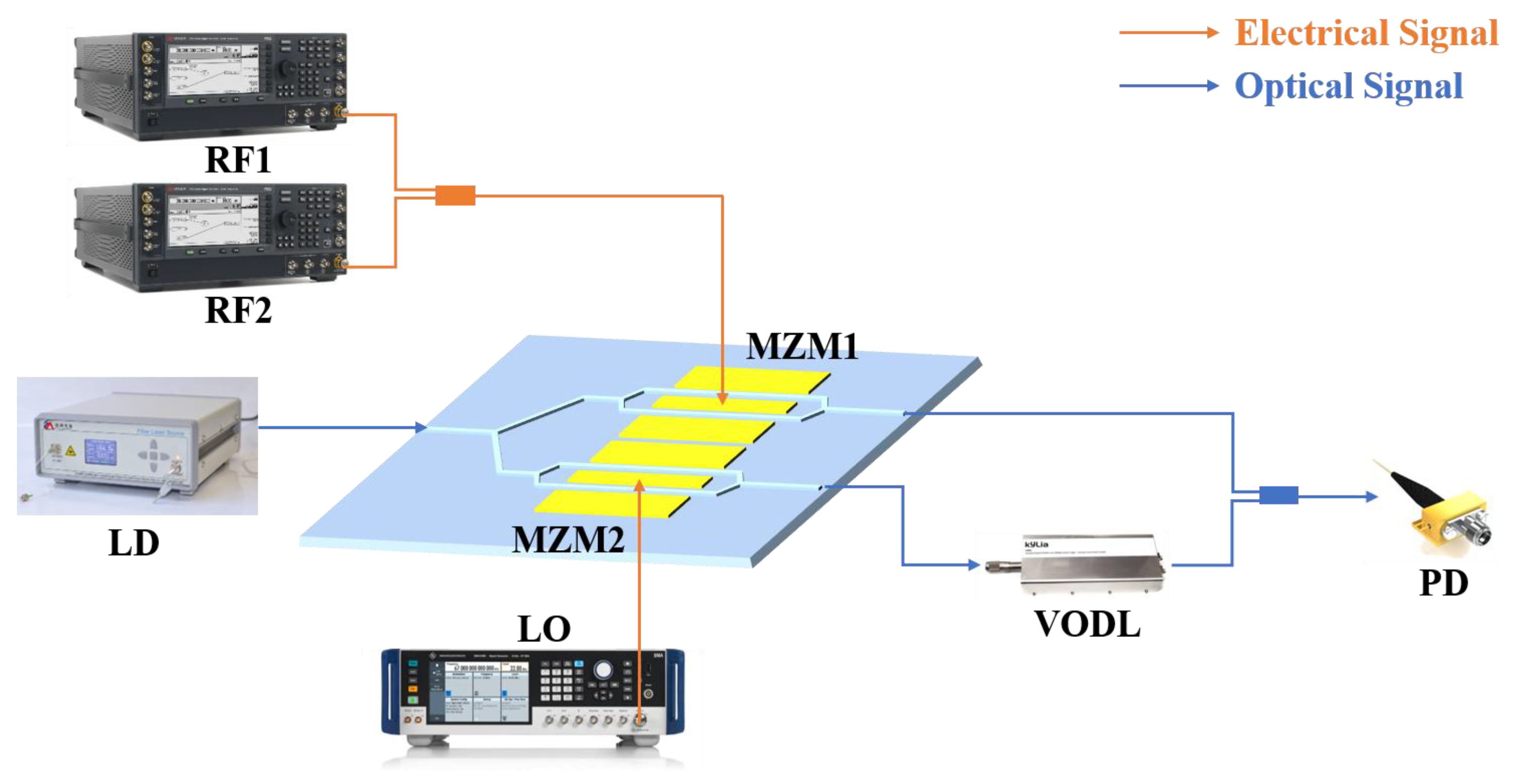
The architecture of the proposed photonic system for multi-frequency signal discrimination is illustrated in Figure 1. The proposed system exploits the frequency dependence and phase sensitivity of the PCD to construct an optoelectronic detection link that integrates frequency measurement and phase identification. The core architecture adopts a parallel on-chip dual-MZM configuration. After phase regulation, the optical outputs from the two MZM branches exhibit a pronounced power cancellation effect with a strong frequency-dependent response. Specifically, frequency differences directly alter the intensity distribution of the cancellation interference. By demodulating the amplitude variation in the PCD, high-precision discrimination of multi-frequency RF signals can be achieved. Meanwhile, phase offsets modify the phase-matching condition of the cancellation interference. Owing to the intrinsic phase sensitivity of the PCD, the phase information of the target signal can be accurately extracted.
In this system, the optical carrier generated by the laser diode (LD) is directly injected into the on-chip dual MZM to perform signal modulation. On the RF side, the multi-frequency RF signals under test are generated by microwave signal sources. After phase alignment, these signals are combined using an electrical power combiner and then applied to the RF port of MZM1. Meanwhile, the local oscillator (LO) signal is generated by a vector signal generator and delivered to the RF port of MZM2 via RF cables. The DC bias voltages of both MZMs are set to their half-wave voltage points, ensuring stable operation in the carrier-suppressed double-sideband (CS-DSB) regime. Considering that intrinsic device mismatches between the two MZM branches may induce phase deviations and degrade phase estimation accuracy, a tunable optical delay line (TODL) is introduced. Together with the DC bias voltage applied to the MZM2 branch, phase compensation is implemented to ensure that the RF-modulated optical output from MZM2 is phase-inverted with respect to that from MZM1. The two modulated optical signals are then combined using a 50:50 optical coupler and subsequently fed into a photodetector (PD) with an integrated electrical amplifier, where optical-to-electrical conversion is performed.
Under operating conditions, the optical field generated by the LD is denoted as E 0 ( t ) . The MZM operates in a push–pull configuration, and the corresponding output optical field can be expressed as follows:
E o u t ( t ) = E 0 ( t ) c o s ( θ t )
where θ t denotes the phase modulation induced by the applied RF signal. For simplicity, RF1 and RF2 are selected as representative unknown signals. Accordingly, the RF and LO signals applied to the RF input ports of the dual MZM can be expressed as follows:
V R F 1 t = V R F 1 c o s ω R F 1 t + ϕ R F 1
V R F 2 t = V R F 2 c o s ω R F 2 t + ϕ R F 2
V L O t = V L O c o s ω L O t + ϕ L O
where V R F 1 , V R F 2 and V L O   denote the amplitudes of the RF two-tone signals and the LO signal, respectively; ω R F 1 , ω R F 2 and ω L O are the corresponding angular frequencies, while ϕ R F 1 , ϕ R F 2 and ϕ L O represent the phases. The DC bias voltage V D C 1 is set to V π 1 to bias the modulator at the minimum transmission point (MITP), where V π 1 is the half-wave voltage of MZM1. Substituting the expressions for RF1 and RF2 signals, the output signal of MZM1 is obtained as follows:
E o u t ( t ) = E 0 ( t ) 2 c o s m R F 1 c o s ω R F 1 t + ϕ R F 1 + m R F 2 c o s ω R F 2 t + ϕ R F 2
where m R F 1 = π V R F 1 V π 1 and m RF 2 = π V RF 2 V π 1 represent the modulation depths of the corresponding signals. By applying the Jacobi–Anger expansion c o s ( θ ) = n = ( 1 ) n J n ( θ ) to Equation (1), where J n ( θ ) denotes the n -th order Bessel function of the first kind, and assuming that RF1, RF2, and the LO signal operate in the small-signal regime, higher-order sidebands and higher-order mixing beat terms can be neglected. Since the contributions of higher-order Bessel functions with n > 1 are negligible, only the first-order terms are retained. Accordingly, the output optical field of MZM1 can be derived as follows:
E 1 , out t E 0 ( t ) 2 J 0 m R F 1 J 0 m R F 2 + J 0 m R F 2 J 1 m R F 1 c o s θ R F 1 + J 0 m R F 1 J 1 m R F 2 c o s θ R F 2
where θ R F 1 = ω R F 1 t + ϕ R F 1 , θ R F 2 = ω R F 2 t + ϕ R F 2 . Since the DC component of the output signal is not affected by the modulated signal frequency, the portion that is cancelled due to power cancellation is only related to the AC components. Therefore, only the AC component is analyzed. Similarly, the output optical field expression for MZM2, which modulates the LO signal, is as follows:
E 2 , out t E 0 ( t ) 2 J 1 m L O c o s θ L O
where m L O = π V L O V π 2 represents the modulation depth, V π 2 is the half-wave voltage of MZM2, and θ L O = ω L O t + ϕ L O . The output optical phase of MZM2 is adjusted by controlling TODL and DC3, ensuring phase inversion relative to MZM1. As a result, the total output optical field is E t o t a l t = E 1 , o u t t + E 2 , o u t t . The corresponding photocurrent is subsequently measured using a photodetector, which yields the following:
i ( t ) = R E t o t a l t 2 2 Z 0 R E 0 2 t 8 Z 0 J 0 2 ( m R F 2 ) J 1 2 ( m R F 1 ) c o s 2 θ R F 1 + J 0 2 ( m R F 1 ) J 1 2 ( m R F 2 ) c o s 2 θ R F 2 + J 1 2 ( m L O ) c o s 2 θ L O + J 0 ( m R F 1 ) J 0 ( m R F 2 ) J 1 ( m R F 1 ) J 1 ( m R F 2 ) c o s θ R F 1 + θ R F 2 + J 0 ( m R F 1 ) J 0 ( m R F 2 ) J 1 ( m R F 1 ) J 1 ( m R F 2 ) c o s θ R F 1 θ R F 2 J 0 ( m R F 2 ) J 1 ( m R F 1 ) J 1 ( m L O ) c o s θ R F 1 + θ L O J 0 ( m R F 2 ) J 1 ( m R F 1 ) J 1 ( m L O ) c o s θ R F 1 θ L O J 0 ( m R F 1 ) J 1 ( m R F 2 ) J 1 ( m L O ) c o s θ R F 2 + θ L O J 0 ( m R F 1 ) J 1 ( m R F 2 ) J 1 ( m L O ) c o s θ R F 2 θ L O
where R represents the responsivity of PD, and Z 0 is the characteristic impedance. It can be observed that the output electrical signal from the PD contains cross terms corresponding to the second harmonic and beat frequencies of the signals. The output power from the PD is as follows:
P o u t ( t ) R 2 R L E 0 4 ( t ) 64 Z 0 2 J 0 4 ( m R F 2 ) J 1 4 ( m R F 1 ) c o s 4 θ R F 1 + J 0 4 ( m R F 1 ) J 1 4 ( m R F 2 ) c o s 4 θ R F 2 + J 1 4 ( m L O ) c o s 4 θ L O + J 0 2 ( m R F 1 ) J 0 2 ( m R F 2 ) J 1 2 ( m R F 1 ) J 1 2 ( m R F 2 ) c o s 2 ( θ R F 1 + θ R F 2 ) + J 0 2 ( m R F 1 ) J 0 2 ( m R F 2 ) J 1 2 ( m R F 1 ) J 1 2 ( m R F 2 ) c o s 2 ( θ R F 1 θ R F 2 ) + J 0 2 ( m R F 2 ) J 1 2 ( m R F 1 ) J 1 2 ( m L O ) c o s 2 ( θ R F 1 + θ L O ) + J 0 2 ( m R F 2 ) J 1 2 ( m R F 1 ) J 1 2 ( m L O ) c o s 2 ( θ R F 1 θ L O ) + J 0 2 ( m R F 1 ) J 1 2 ( m R F 2 ) J 1 2 ( m L O ) c o s 2 ( θ R F 2 + θ L O ) + J 0 2 ( m R F 1 ) J 1 2 ( m R F 2 ) J 1 2 ( m L O ) c o s 2 ( θ R F 2 θ L O )
When the frequency of the LO signal is tuned to match the frequency of the RF signal, the corresponding optical sidebands undergo power cancellation, resulting in a significant reduction in the system’s output power, thus creating a “power notch.” The components of the spectrum with matching frequencies experience a decrease in power, leaving only the second harmonic of the non-cancelled frequencies. At this point, the output power of the PD is as follows:
P out ( t ) f L O = f R F 1 R 2 R L E 0 4 ( t ) 64 Z 0 2 J 1 2 ( m R F 1 ) J 0 2 ( m R F 2 ) + 1 c o s 2 θ RF 1 + J 0 4 ( m R F 1 ) J 1 4 ( m R F 2 ) c o s 2 θ RF 2 + J 0 2 ( m R F 1 ) J 0 2 ( m R F 2 ) J 1 2 ( m R F 1 ) J 1 2 ( m R F 2 ) J 0 2 ( m R F 2 ) + 1 c o s θ RF 1 + θ RF 2 + J 0 2 ( m R F 1 ) J 0 2 ( m R F 2 ) J 1 2 ( m R F 1 ) J 1 2 ( m R F 2 ) J 0 2 ( m R F 2 ) + 1 c o s θ RF 1 θ RF 2
P o u t ( t ) f L O = f R F 2 R 2 R L E 0 4 ( t ) 64 Z 0 2 J 0 4 ( m R F 2 ) J 1 4 ( m R F 1 ) c o s 2 θ R F 1 + J 1 2 ( m R F 2 ) J 0 2 ( m R F 1 ) + 1 c o s 2 θ R F 2 + J 0 2 ( m R F 1 ) J 0 2 ( m R F 2 ) J 1 2 ( m R F 1 ) J 1 2 ( m R F 2 ) J 0 2 ( m R F 1 ) + 1 c o s ( θ R F 1 + θ R F 2 ) + J 0 2 ( m R F 1 ) J 0 2 ( m R F 2 ) J 1 2 ( m R F 1 ) J 1 2 ( m R F 2 ) J 0 2 ( m R F 1 ) + 1 c o s ( θ R F 1 θ R F 2 )
Under the small-signal approximation where J 0 ( m ) 1 , J 1 ( m ) m 2 , a deterministic mapping is established between the power cancellation depth (PCD) and the phase of the RF signal, denoted as ϕ R F . The RF signal power can be directly measured using a power metre. Subsequently, the RF power is amplified to match the LO power. Under this condition, the phase of the RF signal can be inversely extracted from the measured cancellation depth, thereby enabling phase identification.

2.2. Fabrication

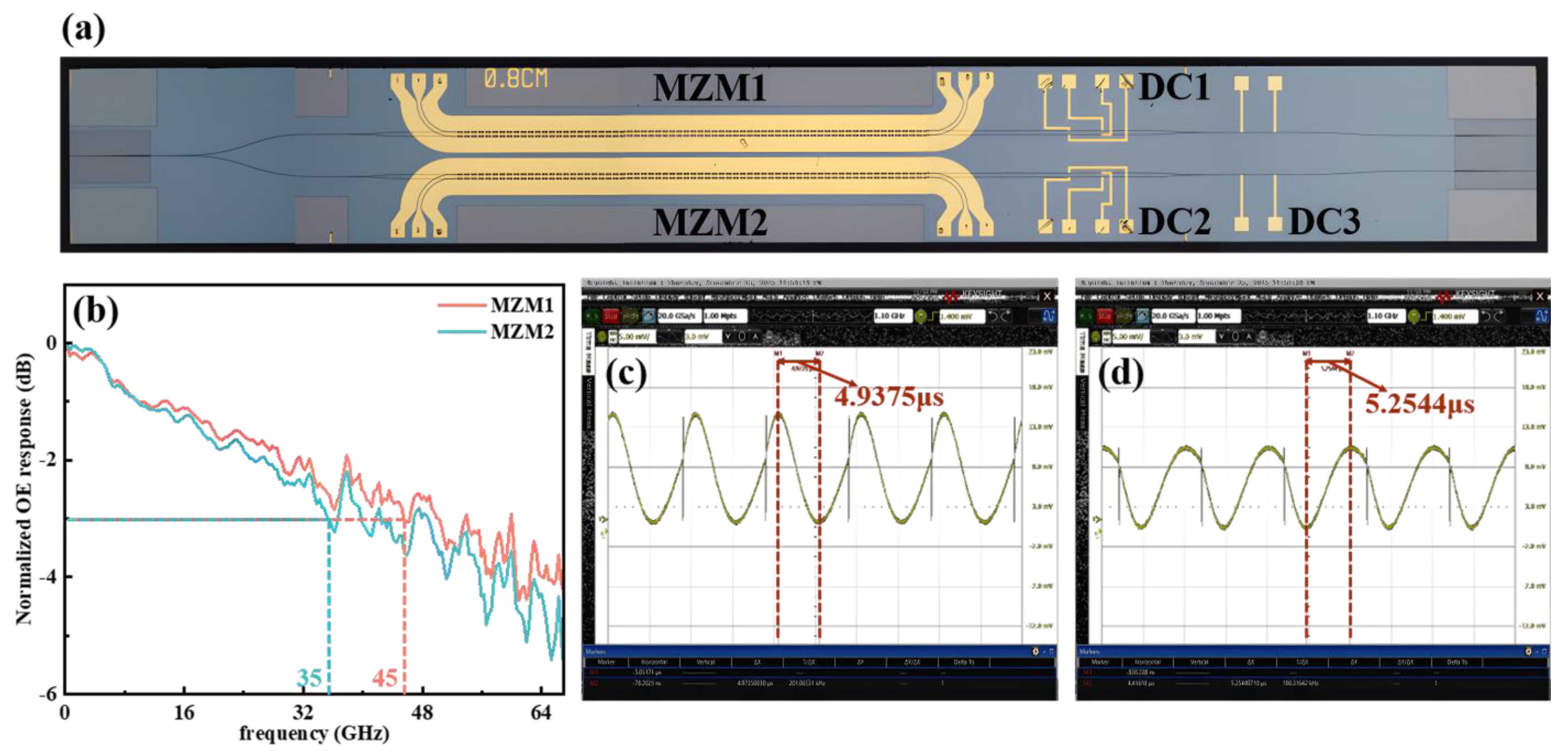
To realize the second function of the proposed system, an on-chip dual-MZM chip was fabricated in our laboratory. A lithium niobate on insulator (LNOI) wafer was employed, featuring a 600 nm LN device layer and a 2 μm SiO2 buried oxide layer. First, the substrate was thoroughly cleaned to remove organic contaminants, inorganic residues, and metal impurities. Owing to the dense crystal structure of lithium niobate, conventional etching techniques are inefficient. Therefore, a chromium (Cr) hard mask was deposited by sputtering and used for LN etching. This approach provides high mask hardness and strong tolerance to process variations, thereby ensuring a high fabrication yield. After etching 300 nm-deep LN waveguides, a SiO2 cladding layer was deposited using plasma-enhanced chemical vapour deposition (PECVD). This cladding layer protects the waveguides and simultaneously ensures optical confinement and isolation. Finally, a 150 nm-thick NiCr alloy and an 800 nm-thick Au layer were deposited as the microheater and electrode metal, respectively, enabling bias point control and high-speed modulation. The fabricated on-chip dual-MZM chip is shown in Figure 2a.
The performance of the dual MZM was characterized through a series of measurements. The frequency responses of the dual MZMs were measured using a PNA network analyzer (Keysight N5227B, 10 MHz–67 GHz, Santa Rosa, CA, USA), as shown in Figure 2b. The results indicate that the 3 dB bandwidths of MZM1 and MZM2 are 35 GHz and 45 GHz, respectively. In addition, the insertion losses of MZM1 and MZM2 are measured to be 9.8 dB and 10.4 dB, respectively. The half-wave voltages of the dual MZMs were also measured, as illustrated in Figure 2c,d. A 10 Vpp, 100 kHz triangular waveform generated by an arbitrary waveform generator (Uni-Trend Technology UTG2025A, Dongguan, China) was applied to the DC electrodes of the MZMs. The measured half-wave voltages of MZM1 and MZM2 are 4.97 V and 5.25 V, respectively, which satisfy the operational requirements of the frequency resolution system.

3. Results

3.1. Simulation

To preliminarily validate the feasibility of the theoretical analysis, a multi-frequency measurement link was constructed on the OptiSystem 15 platform to simulate the frequency discrimination performance. The optical carrier was provided by a laser diode (LD) with a wavelength of 1550.12 nm and an output power of 10 dBm. The half-wave voltages of MZM1 and MZM2 were set to 4.97 V and 5.25 V, respectively, based on the measured values. To observe the frequency response of different components during power cancellation, MZM1 was simultaneously driven by a 6 GHz RF1 signal and a 10 GHz RF2 signal, while MZM2 was driven by the LO signal. The power of all signals was set to 10 dBm. Both modulators were biassed at the minimum transmission point (MITP). An optical delay line was inserted at the output of MZM2 to invert the phase of its output relative to MZM1. The resulting optical signals were converted to electrical signals using a photodetector (PD) with a 40 GHz bandwidth and a responsivity of 0.8 A/W. Finally, the output electrical signals were monitored using a spectrum analyzer.
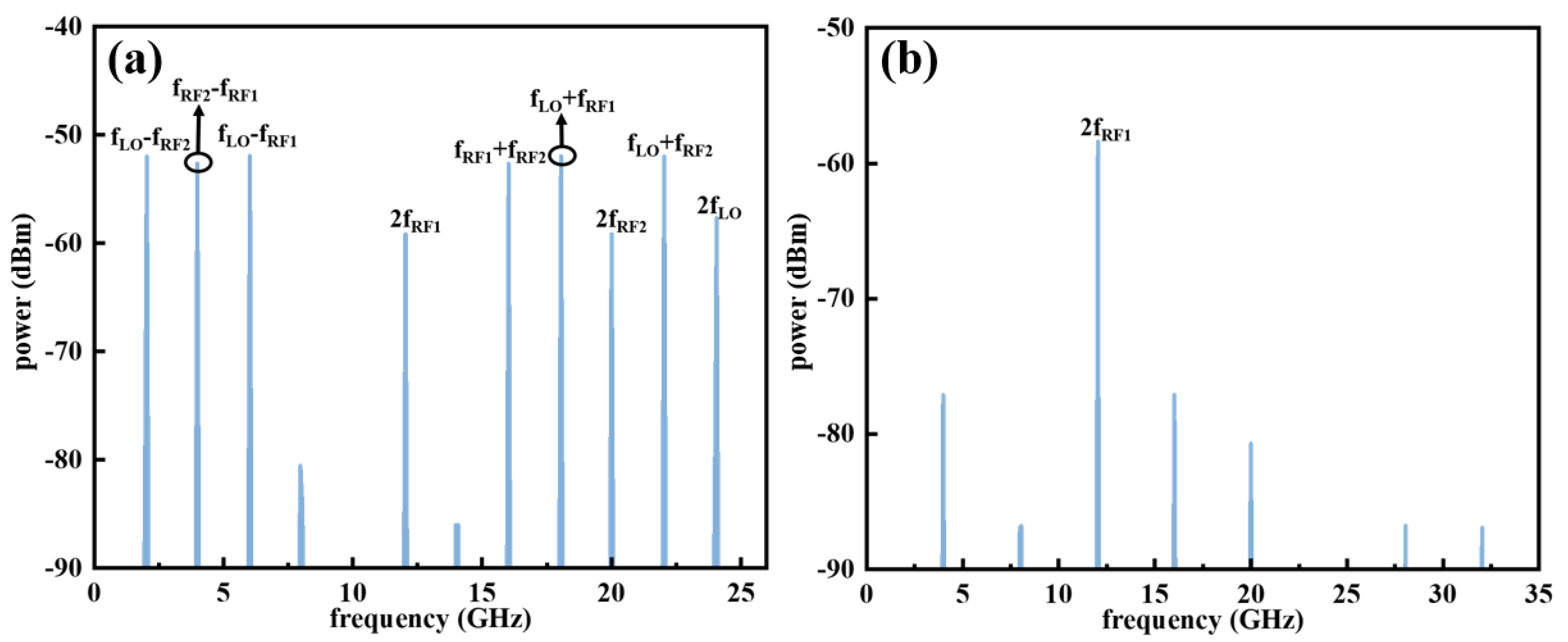
The simulated spectrum results are shown in Figure 3a. When f L O f R F 1 and f L O f R F 2 , the spectrum analyzer clearly detects the second harmonics and intermodulation components of the LO signal and the two RF signals (RF1 and RF2). Next, the LO signal is swept from 0 to 15 GHz with a step size of 0.05 GHz. When f L O = f R F 2 , power cancellation occurs in the system. After optical-to-electrical conversion by the PD, the resulting electrical spectrum is shown in Figure 3b. Compared with the spectrum in Figure 3a, the spectral components in Figure 3b are significantly simplified, particularly the intermodulation spurs associated with RF2, which are markedly attenuated. At this point, the system output power is noticeably reduced. In other words, when the LO frequency matches that of an unknown RF signal, a distinct power notch is formed. The LO frequency corresponding to this notch directly indicates the frequency of the unknown RF signal, thereby enabling accurate frequency discrimination of the RF signal.

3.2. Experiment

To validate the proposed frequency discrimination and phase identification system, an experimental link was constructed based on the architecture shown in Figure 1. A tunable laser source (REAL PHOTON, TFL-C-20-B, Anshan, China) provided an optical carrier with a central wavelength of 1550 nm and an output power of 13 dBm, which was directly fed into the on-chip dual MZM for signal modulation. The multi-frequency RF signals under test were generated by two microwave signal generators (Keysight E8267D, Santa Rosa, CA, USA), with bandwidths of 40 GHz and 44 GHz). After phase matching, the RF signals were combined using an RF combiner (Gwave, GPD-2-005180-E, Beijing, China) and applied to the RF port of MZM1. The LO signal was generated by a vector signal generator (Rohde & Schwarz SMA100B, 40 GHz bandwidth, Munich, Germany) and fed to the RF port of MZM2. To ensure phase coherence among the three signals, all signal generators shared a 10 MHz external reference clock via RF cables.
Based on the device characterization results described in Section 2, the DC bias voltages of the dual MZMs were initially set to their half-wave voltages, operating in the carrier-suppressed double-sideband (CS-DSB) mode. Considering inherent branch mismatches in the dual MZM that could induce phase offsets and affect phase estimation accuracy, a tunable optical delay line (TODL_Kylia, Suzhou, China) and the DC3 bias voltage of MZM2 were jointly adjusted to compensate the phase. This ensured that the optical RF signal output from MZM2 was in phase opposition to the signal from MZM1. The two modulated optical RF signals from the dual MZM were then combined through a 50:50 optical coupler and fed into a compact PD with an integrated amplifier. The integrated amplifier not only boosted the output electrical signal but also enhanced the power cancellation depth, thereby expanding the phase identification range under identical test conditions. Additionally, the optical signals were continuously monitored by an optical spectrum analyzer (YOKOGAWA AQ6370D, 600–1700 nm, Musashino, Japan), while the beat-frequency electrical signals from the PD were measured and recorded using a spectrum analyzer (Rohde & Schwarz FSV, Munich, Germany).
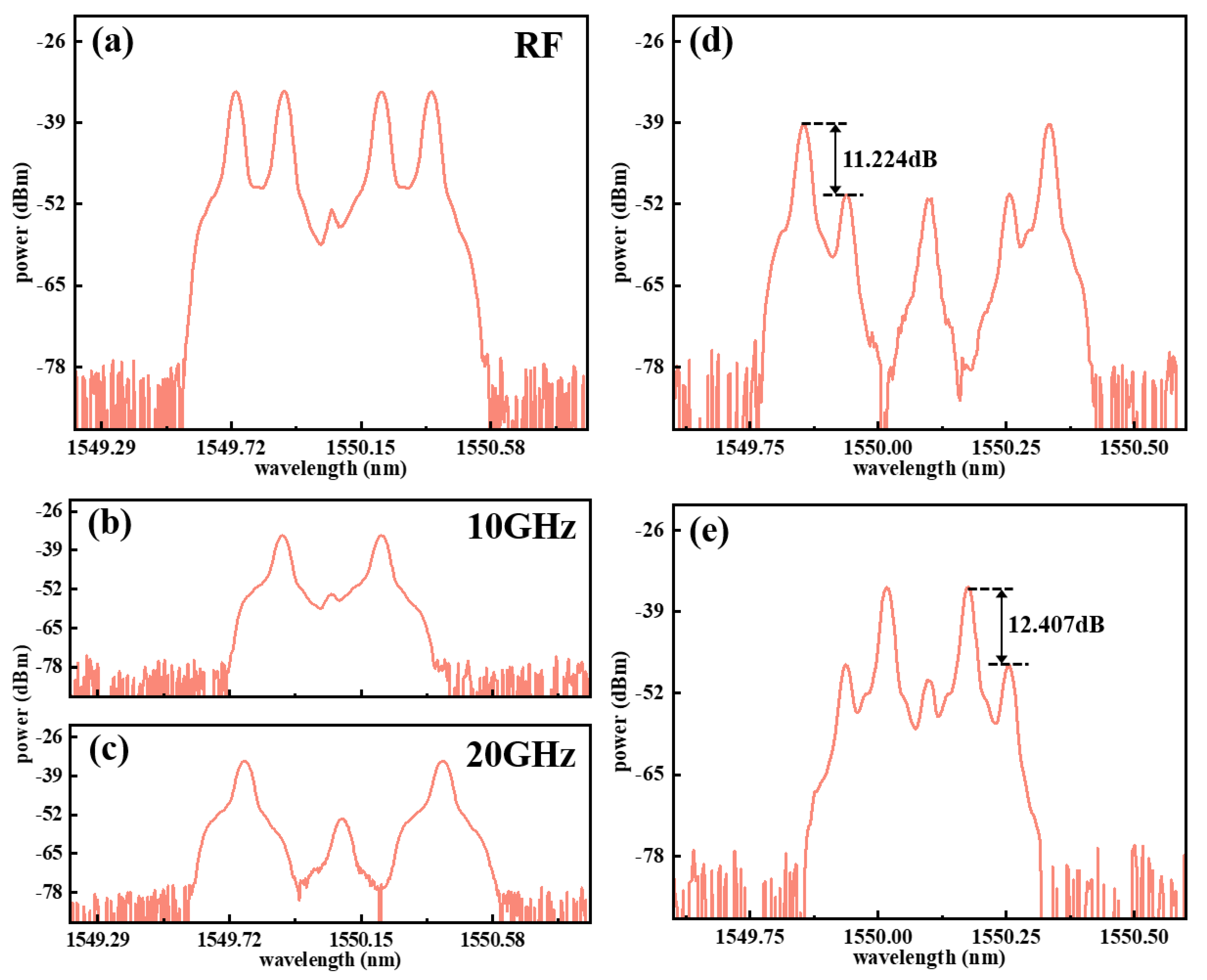
To ensure the accuracy and consistency of the experimental results, all subsequent measurements were performed with the input RF and LO powers fixed at 5 dBm. First, the output optical spectra of the dual MZMs were examined. As shown in Figure 4, clear power cancellation is observed when the LO frequency coincides with the RF. To clearly resolve the optical sidebands, the RF signals were set to 10 GHz and 20 GHz. After modulation by MZM1, the resulting optical spectrum is shown in Figure 4a. Both RF components are clearly excited, and the modulator operates in the carrier-suppressed double-sideband (CS-DSB) regime. The LO signal was applied to MZM2. When the LO frequency was set to 10 GHz and 20 GHz, the corresponding output spectra of MZM2 are shown in Figure 4b and Figure 4c, respectively. After the optical outputs from MZM1 and MZM2 were combined, the power cancellation spectra are shown in Figure 4d,e. Compared with the spectrum in Figure 4a, the optical sidebands at identical frequencies are significantly suppressed. Specifically, the lower sidebands at 10 GHz and 20 GHz are attenuated by 11.224 dB and 12.407 dB, respectively.
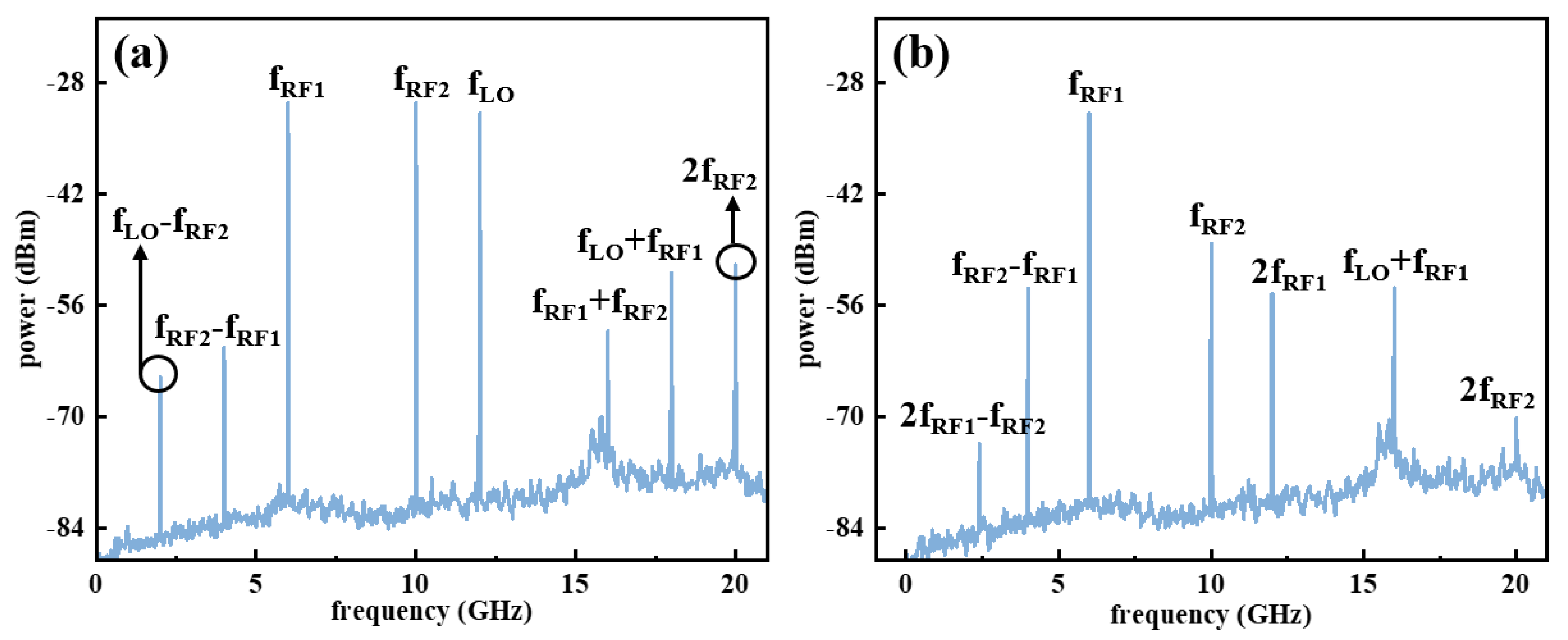
To clearly present all relevant frequency components within the considered frequency range, f R F 1 = 6   G H z and f R F 2 = 10 GHz were selected as the unknown RF signals under test. When f L O f R F 1 and f L O f R F 2 , the corresponding electrical spectrum is shown in Figure 5a. In this case, the fundamental components, second-order harmonics, and intermodulation products of the LO signal and the two RF signals can be clearly observed, which is consistent with the simulation results. By contrast, when f L O = f R F 2 , power cancellation occurs, as shown in Figure 5b. Under this condition, the spurious components associated with RF2 are suppressed to different extents.
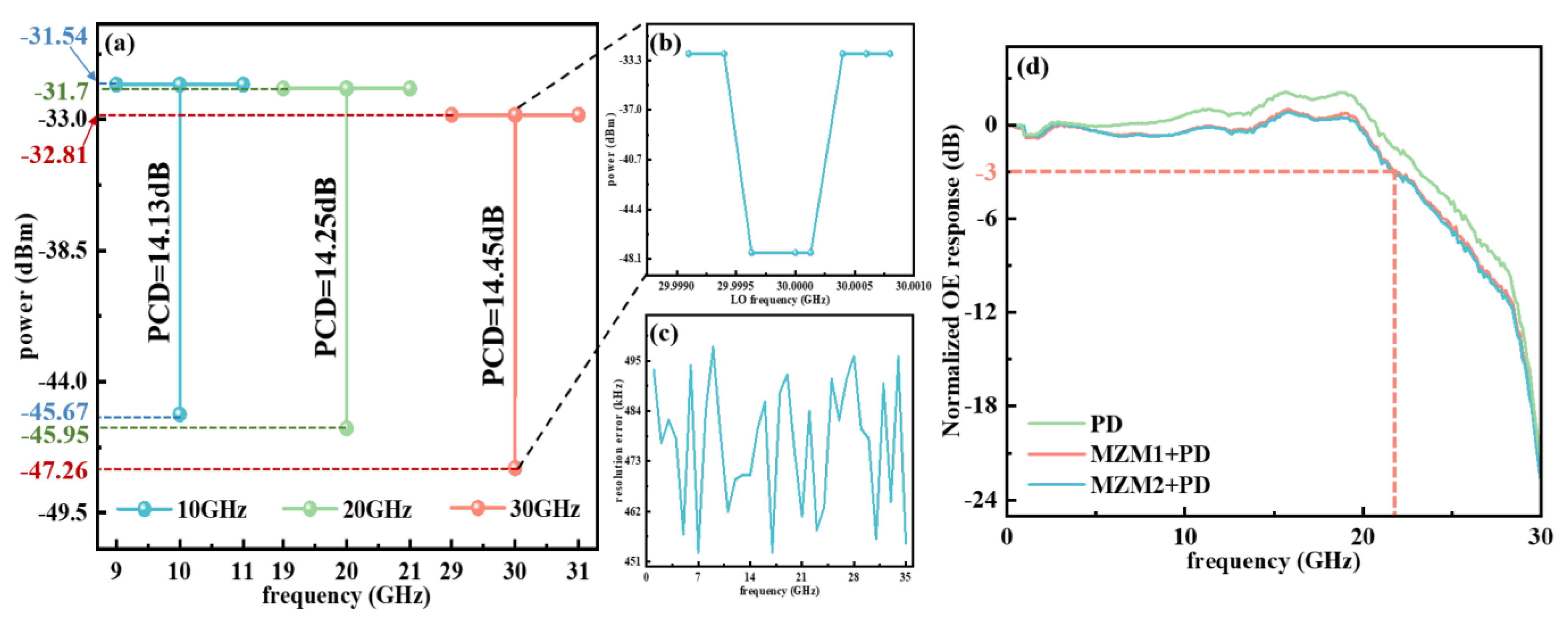
Building on the above experimental validation, the frequency measurement performance of the proposed system was further investigated. To examine the power cancellation behaviour at different RF frequencies, RF signals at three representative frequencies—10 GHz, 20 GHz, and 30 GHz—were selected. The LO frequency was swept from 0 to 35 GHz with a step size of 1 GHz. The resulting frequency–power response is shown in Figure 6a. The results indicate that the output power around 30 GHz is noticeably lower than that at 10 GHz and 20 GHz. This degradation is mainly attributed to the limited bandwidth of the electrical amplifier integrated within the photodetector. As shown in Figure 6d, the green curve represents the normalized bandwidth response of the PD module. By superimposing this response with the measured S21 characteristics of MZM1 and MZM2, the red and blue curves in Figure 6d are obtained. The results indicate that the aggregated 3 dB bandwidth is 22 GHz, which accounts for the observed power roll-off in the 30 GHz band shown in Figure 6a. Meanwhile, the PCDs at 10 GHz, 20 GHz, and 30 GHz are 14.13 dB, 14.25 dB and 14.45 dB, respectively, and are not affected by the PD bandwidth. This is because the PCD is defined as the relative power difference between the cancellation and non-cancellation states. Therefore, it is determined by the frequency matching accuracy between the LO and RF signals, their phase relationship, and the modulation parameters, rather than by the absolute signal power level. As a result, the effective operational bandwidth of the system exceeds the aggregated device bandwidth and reaches 30 GHz. It can be reasonably predicted, based on the established analysis, that no significant performance degradation will be observed within the frequency range up to 35 GHz, provided that the PD bandwidth is sufficiently large.
On this basis, the resolution accuracy was first evaluated. The LO frequency scanning step was reduced to 50 kHz, and the system performance was analyzed by monitoring variations in the output power. The measured power variation is not confined to a single frequency point. Instead, it spans a continuous interval around the target RF. The width of this interval corresponds to the system resolution error. As shown in Figure 6b, the resolution error around 30 GHz is measured to be 478 kHz. To further verify the performance consistency across the operating bandwidth, additional tests were conducted at multiple frequency points from 1 to 35 GHz. The corresponding results are presented in Figure 6c. The absolute error remains within 498 kHz over the entire band, demonstrating high frequency resolution accuracy and excellent performance consistency.
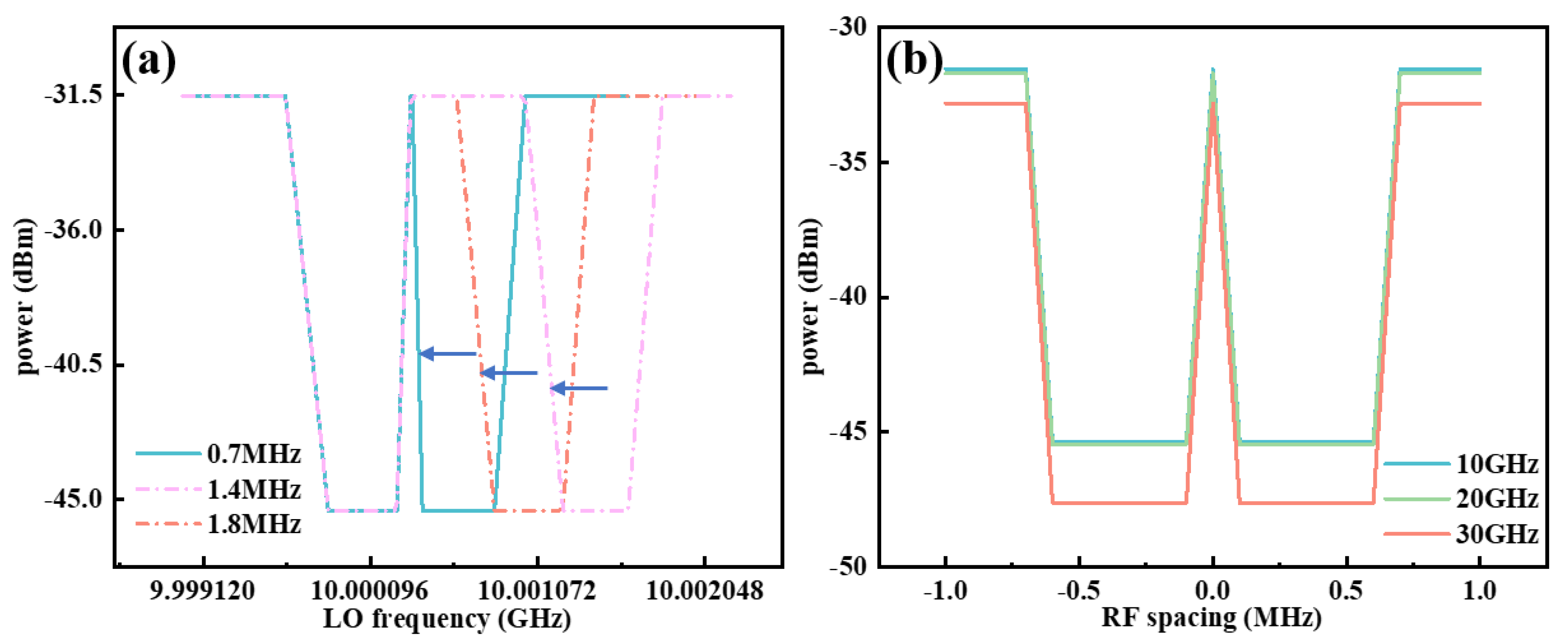
In multi-signal coexistence scenarios, excessively narrow frequency spacing may lead to frequency ambiguity, resulting in erroneous determination of the number of signals and inaccuracies in frequency measurement. Therefore, high resolution is essential for accurate discrimination of multi-frequency signals. To reliably capture subtle power variations between closely spaced signals, the LO frequency scanning step was set to 100 kHz. Under this condition, the system resolution was evaluated around 10 GHz, 20 GHz, and 30 GHz. As shown in Figure 7a, when one RF component is fixed at 10 GHz, the frequency spacing between the two RF signals was gradually reduced. Even when the spacing decreased to 700 kHz, two distinct power notches remained clearly observable in the spectrum. Similarly, as shown in Figure 7b, two RF signals with a spacing of 700 kHz can also be accurately resolved at 20 GHz and 30 GHz. These results demonstrate that the proposed system achieves a frequency resolution better than 700 kHz. Consequently, it is well suited for precise discrimination of closely spaced multi-frequency signals and provides reliable performance for multi-signal monitoring in complex RF environments.
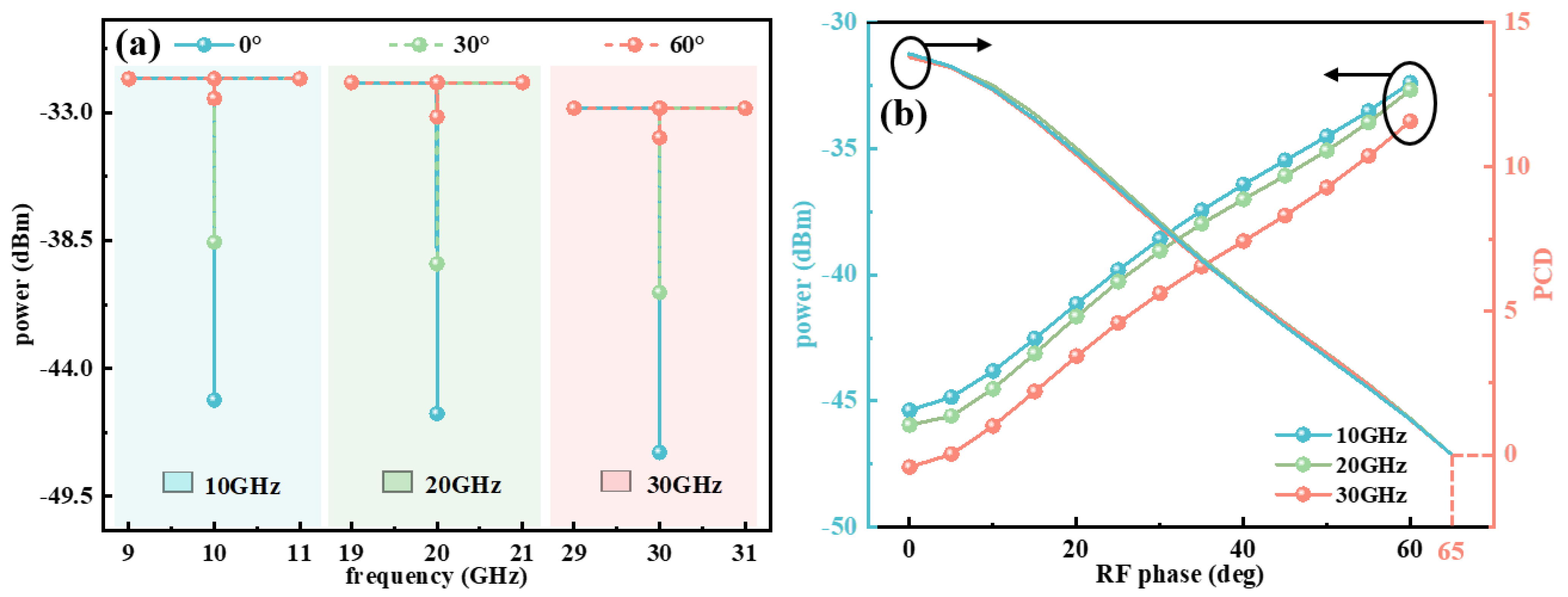
For a frequency measurement system, the phase detection range is also a critical performance metric. As shown in Figure 8a, the power cancellation depth decreases as the initial phase of the RF signal increases. Based on this relationship, the phase difference between the RF and LO signals can be determined from the measured PCD when all other test parameters are fixed. In the experiments, the LO signal initial phase was set to 0°. The phase–power response curves of RF signals at three representative frequencies—10 GHz, 20 GHz, and 30 GHz—were measured over a phase range of 0–65°, as shown on the left axis of Figure 8b. The corresponding phase–PCD response curves for the three frequencies are shown on the right axis of Figure 8b. The PCD curves exhibit excellent consistency across all frequencies, indicating a stable phase response of the system. Based on these results, the phase difference between the RF and LO signals can be calculated from the PCD values, enabling reliable phase detection in practical applications. The measurements show that, with the LO initial phase set to 0° and the RF signal phase at 65°, the PCD remains greater than 0 dB. Therefore, the system provides a phase identification range covering 0–65°.

4. Discussion

The proposed on-chip dual-MZM-based frequency measurement scheme exhibits favourable performance in high-precision frequency analysis. However, several factors still constrain further improvement in measurement accuracy and resolution. These limitations mainly originate from the intrinsic characteristics of the MZM, the stability of the optical source, and system-level noise. Bias drift in the MZM induces variations in modulation depth. While this effect has a negligible impact on frequency discrimination, it degrades phase identification accuracy. This issue can be mitigated by incorporating automatic bias control techniques [19], which enable closed-loop stabilization of the operating point. In addition, the polarization sensitivity of the MZM causes fluctuations in modulation efficiency when the input polarization state varies, thereby affecting measurement accuracy. The use of polarization-maintaining fibres or on-chip polarization control schemes [20] can effectively suppress polarization-induced impairments. The stability of the laser source also plays a critical role, as power fluctuations directly affect modulation depth consistency and overall system performance. High-stability laser sources, combined with real-time power monitoring and laser frequency locking techniques [21], can reduce the influence of source instability. Moreover, the combined effects of electronic noise, optical noise, and environmental perturbations further limit system performance. Optimized noise filtering algorithms [22] provide an effective means to suppress these noise contributions and enable a joint improvement in measurement accuracy and resolution.
Beyond accuracy-related constraints, the phase identification range of the proposed scheme is currently limited to 0–65°, which restricts its applicability in scenarios requiring wide phase coverage. To extend the measurable phase range, the phase detection capability can be enhanced by increasing the modulation depth or by employing higher-order modulation strategies [23]. Alternatively, cascading multiple modulators or adopting parallel-channel architectures allows the input signal to be decomposed into multiple frequency components. This segmented measurement strategy enables accurate phase extraction over a wide range and improves the adaptability of the system to complex RF environments.
In addition, the real-time performance of the system remains a challenge, particularly when processing rapidly time-varying signals. The scanning speed, stability, and phase noise of the swept local oscillator (LO) directly determine the system response capability. Insufficient sweep speed leads to delayed instantaneous frequency acquisition, which limits applicability in high-speed signal scenarios such as wireless communications. Frequency drift and phase noise further degrade measurement accuracy under highly dynamic conditions. To improve real-time performance, broadband optical spectrum analysis techniques can be employed [24]. By leveraging the joint effect of photonic sampling and dispersive delay, these techniques enable a direct time mapping of the short-time Fourier transform (STFT) without requiring actual temporal segmentation of the signal. As a result, the dependence on a swept LO can be significantly reduced. In parallel, the use of high-speed, low-phase-noise LOs or the integration of phase-locking techniques can further enhance system response speed and stability, thereby strengthening real-time measurement capability.

5. Conclusions

In conclusion, we have demonstrated an on-chip dual-MZM-based photonic link for simultaneous high-precision frequency discrimination and wide-range phase identification of multi-frequency RF signals. By leveraging the frequency-dependent and phase-sensitive properties of the PCD effect, the proposed scheme overcomes the limitations of conventional photonic frequency measurement systems, including single-function operation and poor environmental adaptability. The fabricated dual MZM devices were fully characterized, providing reliable parameters for stable PCD control and ensuring accurate theoretical and experimental analysis. Experimental results show an operational bandwidth of 30 GHz, a frequency resolution of 700 kHz, a frequency discrimination error below 498 kHz, and a phase identification range of 0–65°, demonstrating the system’s capability for broadband multi-frequency RF measurement. Compared with traditional fibre-based architectures, the on-chip dual MZM integration significantly reduces power loss, suppresses environmental phase disturbances, and enhances demodulation accuracy. Overall, the combination of PCD-based detection and chip-level integration offers a high-performance, low-power, and environmentally robust solution for multi-parameter identification in complex broadband RF environments, highlighting its potential for advanced RF measurement and communication applications.

Author Contributions

Conceptualization, X.L. and H.W.; methodology, X.L.; validation, X.L., X.Z. and H.W.; resources, M.L.; data curation, X.L., X.Z. and H.W.; writing—original draft preparation, X.L.; writing—review and editing, Z.Z.; visualization, X.L.; supervision, Z.Z.; project administration, J.L. All authors have read and agreed to the published version of the manuscript.

Funding

This work is supported by the National Natural Science Foundation of China (62405308).

Data Availability Statement

Data underlying the results presented in this paper are not publicly available at this time but may be obtained from the authors upon reasonable request.

Acknowledgments

The authors are grateful to Institute of Semiconductors, University of Chinese Academy of Sciences and College of Materials Science and Opto-Electronic Technology, University of Chinese Academy of Sciences.

Conflicts of Interest

The authors declare no conflicts of interest.

References

  1. Wang, L.; Wang, X.; Pan, S. Microwave photonics empowered integrated sensing and communication for 6G. IEEE Trans. Microw. Theory Tech. 2025, 73, 5295–5315. [Google Scholar] [CrossRef]
  2. Zhong, N.; Li, P.; Bai, W.; Pan, W.; Yan, L.; Zou, X. Spectral-efficient frequency-division photonic millimeter-wave integrated sensing and communication system using improved sparse LFM sub-bands fusion. J. Light. Technol. 2023, 41, 7105–7114. [Google Scholar] [CrossRef]
  3. Zhu, S.; Zhang, Y.; Feng, J.; Wang, Y.; Zhai, K.; Feng, H.; Pun, E.Y.B.; Zhu, N.H.; Wang, C. Integrated lithium niobate photonic millimetre-wave radar. Nat. Photonics 2025, 19, 204–211. [Google Scholar] [CrossRef]
  4. Qadir, Z.; Le, K.N.; Saeed, N.; Munawar, H.S. Towards 6G Internet of Things: Recent advances, use cases, and open challenges. ICT Express 2023, 9, 296–312. [Google Scholar] [CrossRef]
  5. Jornet, J.M.; Knightly, E.W.; Mittleman, D.M. Wireless communications sensing and security above 100 GHz. Nat. Commun. 2023, 14, 841. [Google Scholar] [CrossRef]
  6. Zhang, W.; Tait, A.; Huang, C.; de Lima, T.F.; Bilodeau, S.; Blow, E.C.; Jha, A.; Shastri, B.J.; Prucnal, P. Broadband physical layer cognitive radio with an integrated photonic processor for blind source separation. Nat. Commun. 2023, 14, 1107. [Google Scholar] [CrossRef]
  7. Lu, S.; Liu, F.; Li, Y.; Zhang, K.; Huang, H.; Zou, J.; Li, X.; Dong, Y.; Dong, F.; Zhu, J.; et al. Integrated sensing and communications: Recent advances and ten open challenges. IEEE Internet Things J. 2024, 11, 19094–19120. [Google Scholar] [CrossRef]
  8. Chen, S.; Liang, Y.-C.; Sun, S.; Kang, S.; Cheng, W.; Peng, M. Vision, requirements, and technology trend of 6G: How to tackle the challenges of system coverage, capacity, user data-rate and movement speed. IEEE Wirel. Commun. 2020, 27, 218–228. [Google Scholar] [CrossRef]
  9. Shi, J.; Zhang, F.; Ben, D.; Pan, S. Photonics-based broadband microwave instantaneous frequency measurement by frequency-to-phase-slope mapping. IEEE Trans. Microw. Theory Tech. 2019, 67, 544–552. [Google Scholar] [CrossRef]
  10. Ma, Y.; Gao, Y.; Cavallaro, A.; Parini, C.G.; Zhang, W.; Liang, Y.-C. Sparsity independent sub-Nyquist rate wideband spectrum sensing on real-time TV white space. IEEE Trans. Veh. Technol. 2017, 66, 8784–8794. [Google Scholar] [CrossRef]
  11. Zhong, L.; Abbasi, M.; Uddin, S.M.A.; Lee, W. Broadband frequency-domain analog processor for spectrum sensing with 20 GHz scan range. IEEE Trans. Circuits Syst. II Express Briefs 2023, 70, 1759–1763. [Google Scholar]
  12. Sun, Y.; Wu, J.; Tan, M.; Xu, X.; Li, Y.; Morandotti, R.; Mitchell, A.; Moss, D.J. Applications of optical microcombs. Adv. Opt. Photonics 2023, 15, 86–175. [Google Scholar] [CrossRef]
  13. Wang, Z.; Du, Y.; Wei, K.; Han, K.; Xu, X.; Wei, G.; Tong, W.; Zhu, P.; Ma, J.; Wang, J.; et al. Vision, application scenarios, and key technology trends for 6G mobile communications. Sci. China Inf. Sci. 2022, 65, 151301. [Google Scholar] [CrossRef]
  14. Li, Y.; Pei, L.; Li, J.; Wang, Y.; Yuan, J.; Ning, T. Photonic Instantaneous Frequency Measurement of Wideband Microwave Signals. PLoS ONE 2017, 12, e0182231. [Google Scholar] [CrossRef]
  15. He, H.; Wang, J.; Zhao, Z.; Huang, D.; Lau, A.P.T.; Lu, C.; Tang, M. Ultrawideband Dynamic Microwave Frequency–Amplitude Measurement. Sci. Adv. 2025, 11, eadu5130. [Google Scholar] [CrossRef]
  16. Tao, Y.; Yang, F.; Tao, Z.; Chang, L.; Shu, H.; Jin, M.; Zhou, Y.; Ge, Z.; Wang, X. Fully on-chip microwave photonic instantaneous frequency measurement system. Laser Photonics Rev. 2022, 16, 2200158. [Google Scholar] [CrossRef]
  17. Shao, H.; Yu, H.; Jiang, X.; Yang, J.; Roelkens, G. Large bandwidth and high accuracy photonic-assisted instantaneous microwave frequency estimation system based on an integrated silicon micro-resonator. In Proceedings of the 11th International Conference on Group IV Photonics (GFP) (2014), Paris, France, 27–29 August 2014; pp. 47–48. [Google Scholar]
  18. Zhang, C.; Zhang, J.; Zhao, Z. Microwave Instantaneous Frequency Measurement (IFM) Approach Based on an Integrated Photonic Ti:LiNbO3 Y Branch. Curr. Opt. Photonics 2020, 4, 361–367. [Google Scholar]
  19. Peng, M.; Yan, S.; Tang, J.; Li, Q.-X.; Yan, E.; Huang, J.; Lei, X.; Zhu, L.; Wang, G. Ultralow-dither automatic bias control on IQ modulators for optical single-sideband modulation via adaptive extended Kalman filtering-enhanced correlation detection. Opt. Express 2025, 33, 43221–43233. [Google Scholar] [CrossRef]
  20. Chen, M.; Chen, H.; Zhang, H.; Li, Z.; Zhang, S.; Wang, J.; Feng, L.; Lu, H.; Chen, D.; Jin, J. Multifunctional reconfigurable microwave photonic arbitrary waveform generator based on DP-MZM and polarization control. Results Phys. 2025, 81, 108549. [Google Scholar] [CrossRef]
  21. Guo, X.; Zhang, L.; Chen, L.; Liu, J.; Liu, T.; Zhang, S. Ultra-narrow linewidth laser system based on intra-cavity electro-optic crystal frequency stabilization of external-cavity diode laser. Opt. Commun. 2023, 545, 129635. [Google Scholar] [CrossRef]
  22. Wang, S.; Li, J.; Li, X.; Xu, J. An Improved Wavelet Thresholding Approach for Random Noise Suppression in CSEM Signals. In Frontier Academic Forum of Electrical Engineering; Springer: Singapore, 2025; pp. 164–171. [Google Scholar]
  23. Jing, M.; Hu, Y.; Ma, J.; Zhang, H.; Zhang, L.; Xiao, L.; Jia, S. Atomic superheterodyne receiver based on microwave-dressed Rydberg spectroscopy. Nat. Phys. 2020, 16, 911–915. [Google Scholar] [CrossRef]
  24. Konatham, S.R.; Maram, R.; Cortés, L.R.; Chang, J.H.; Rusch, L.; LaRochelle, S.; de Chatellus, H.G.; Azaña, J. Real-time gap-free dynamic waveform spectral analysis with nanosecond resolutions through analog signal processing. Nat. Commun. 2020, 11, 3309. [Google Scholar] [CrossRef]
Figure 1. Schematic diagram of the multi-frequency measurement model.
Photonics 13 00145 g001
Figure 2. (a) Photograph and optical microscope image of the fabricated dual MZM; (b) The measured electro-optic response of the dual MZM. The devices have a 3-dB bandwidth of 35 GHz and 45 GHz; (c) The half-wave voltage of MZM1; (d) The half-wave voltage of MZM2.
Photonics 13 00145 g002
Figure 3. The electrical spectrum of the simulation results when (a) fLO ≠ fRF1, fLO ≠ fRF2; (b) fLO = fRF2.
Photonics 13 00145 g003
Figure 4. The optical spectrum when (a) fRF1 = 10 GHz, fRF2 = 20 GHz; (b) fLO = 10 GHz; (c) fLO = 20 GHz; (d) fLO = fRF1 and (e) fLO = fRF2.
Photonics 13 00145 g004
Figure 5. The electrical spectrum of the detected results when (a) fLO ≠ fRF1, fLO ≠ fRF2; (b) fLO = fRF2.
Photonics 13 00145 g005
Figure 6. The detected results of (a) power cancellation; (b) resolution error at 30 GHz; (c) resolution error within 35 GHz and (d) the normalized bandwidth of PD, MZM1+PD and MZM2+PD.
Photonics 13 00145 g006
Figure 7. (a) The resolution results at RF spacing of 1.8 MHz, 1.4 MHz and 700 kHz; (b) 700 kHz resolution performance at 10 GHz, 20 GHz and 30 GHz.
Photonics 13 00145 g007
Figure 8. (a) The power cancellation of RF signals with frequencies of 10 GHz, 20 GHz, 30 GHz and phases of 0°, 30°, 60°; (b) The phase–power response and the PCD results of 10 GHz, 20 GHz and 30 GHz in the range of 0–65°.
Photonics 13 00145 g008
Disclaimer/Publisher’s Note: The statements, opinions and data contained in all publications are solely those of the individual author(s) and contributor(s) and not of MDPI and/or the editor(s). MDPI and/or the editor(s) disclaim responsibility for any injury to people or property resulting from any ideas, methods, instructions or products referred to in the content.