Communication

Deep-Subwavelength Negative Refraction of Hyperbolic Plasmon Polariton at Visible Frequencies

1
School of Physics, University of Electronic Science and Technology of China, Chengdu 611731, China
2
Tianfu Jiangxi Laboratory, Chengdu 641419, China
*
Author to whom correspondence should be addressed.
Photonics 2026, 13(2), 146; https://doi.org/10.3390/photonics13020146
Submission received: 10 December 2025 / Revised: 14 January 2026 / Accepted: 26 January 2026 / Published: 3 February 2026

Abstract

Negative refraction of nanolight (e.g., polaritons, hybrid light, and matter excitation) provides a promising building block for nanophotonics, as it paves the way for developing cutting-edge nanoscale applications, such as super-resolution and subwavelength imaging. In the visible regime, negative refraction of surface plasmon polaritons has been extensively studied in conventional plasmonic and metamaterial systems; however, the inherent metallic losses remain a challenge that hinders their practical applications. Herein, we demonstrate negative refraction of low-loss and highly confined hyperbolic plasmon polaritons (HPPs) in a lateral heterojunction of a natural hyperbolic van der Waals material, molybdenum dioxide chloride (MoOCl2). Owing to the exotic and ray-like propagating properties of HPPs, the negative refraction-inspired superlens can easily reach into the deep subwavelength scale, with spatial confinement of 800 nm near-infrared light wavelengths to below 150 nm focal spots. By elaborately adjusting the orientation directions of two-sided MoOCl2, the mirror-symmetric superlensing effect can be tilted, and therefore, the focal spots are tuned and steered to deviate from the vertical interfacial lines. Our results applying the concepts of in-plane negative refraction with vdW materials achieve deep subwavelength light confinement and manipulation, offering new possibilities for constructing efficient and compact nanophotonic and opto-electronic devices.

1. Introduction

Negative refraction [1,2,3,4,5,6], an extraordinary optical phenomenon, occurs when refracted light and incident light reside on the same side of the normal at the interface between two media. In recent decades, negative refraction and superlensing have been predicted and demonstrated in a variety of metamaterial [7,8] and photonic crystal [9,10] systems, across the electromagnetic and optical spectrum. However, owing to the limits of lithography and patterning, such artificial nanostructures are hard to fabricate, especially in the visible frequency range. Recently, the realization of negative refraction of highly compressed polaritons—particularly those excited by two-dimensional van der Waals (vdW) materials such as graphene plasmon polaritons—marks a crucial step in nanophotonics. On the one hand, the confinement factors (λ0/λp), (defined as the ratio of polariton wavelength to free space photon propagation wavelength), of over 50 have been achieved for both graphene plasmons [11,12] and h-BN or α-MoO3 phonon polaritons [13,14], which means that infrared light (5–20 um) can be squeezed with wavelength down to a few hundred nanometers. This ability to localize light is of great technological significance as it allows super-resolution within deep-subwavelength scale devices. On the other hand, such negative reflections rely on the extreme anisotropic properties of layered vdW materials, which largely reduce the fabrication difficulties. In addition, the vdW materials allow them to be stacked arbitrarily, and the atomically thin nature makes them amenable to being easily tuned by electric fields and environmental dielectrics. These technological innovations open new horizons for numerous applications in photonics and optoelectronics [15,16,17,18,19,20,21].
In 2018, Lin et al. first predicted the broadband and all-angle negative refraction of vdW polaritons in a lateral heterojunction of graphene and h-BN in the infrared regime [3], and later demonstrated negative refraction in hyperbolic metasurfaces constructed from natural or nanostructured hyperbolic 2D materials. These hyperbolic metasurfaces were created using anisotropic 2D materials (e.g., black phosphorus) or engineered nanostructured 2D materials (e.g., graphene nanoribbon arrays) and meta-gratings [22]. In such systems, the iso-frequency contours of graphene plasmons supported by the left/right metasurface regions satisfy wavevector conservation, allowing polaritons incident from the left region at arbitrary angles to undergo negative refraction at the boundary. Despite these advancements in polaritonic negative refraction research, the majority of studies remain focused on the mid-infrared spectrum [2]. By contrast, investigations into visible-light-spectrum polariton negative refraction are relatively scarce, partially limiting the applicability of this field. In fact, two decades ago, in-plane negative refraction of surface plasmon polaritons (SPPs) had already been predicted [23] and experimentally demonstrated [24] in metal structures in the visible frequency range. However, the damping by optical losses in plasmonic modes and the complexity of fabrication for the metamaterial structures have saturated progress in those systems.
More recently, new types of vdW polaritons have been reported in thin films of molybdenum dioxide chloride (MoOCl2) [25,26,27,28,29,30,31], a natural vdW crystal in the visible and near-infrared frequencies. Compared with existing nanostructured metal-dielectric hybrid materials [7,32,33] that respond in the visible light band, natural hyperbolic materials can avoid the drawback of only being able to operate in the long-wavelength limit [7]. Recently, CrSBr thin films have been reported to support hyperbolic polaritons, but only at extremely low temperatures. In contrast, MoOCl2 allows for the propagation of low-loss and highly confined ray-like hyperbolic surface plasmon polaritons (HPPs). Therefore, MoOCl2 provides an ideal material platform for visible range applications, such as hyperlensing and super-resolution imaging, without the drawbacks of metamaterials. Within this context, here we study and unveil the counterintuitive negative refraction phenomena in such natural vdWs material-based heterojunctions in the visible and near-infrared frequency. Our results show that HPPs not only surpass the optical diffraction limit in the visible spectrum but also enable nanoscale light information transmission and processing, thereby further advancing the application of in-plane negative reflection in nanophotonics. Furthermore, conventional negative refraction is often confined to focusing effects along the vertical interfacial direction. In our study, we ingeniously rotated the crystal orientation of MoOCl2 in the right heterojunction region, achieving tunable focal point steering [34] of hyperbolic polaritons across the 2D plane. This approach not only breaks traditional limitations but also allows free adjustment of the focusing position over a wide range. This discovery leverages the unique properties of polaritons in van der Waals (vdW) materials, opening the door to a range of applications, such as nanoscale light guiding, enhanced quantum emission, sub-diffraction imaging, optical cloaking, and the design of novel optical devices that are smaller yet more powerful in function.
In the future, the designed structures can be further fabricated and experimentally tested by using electron-beam lithography (EBL) cutting and AFM nanomechanical pushing techniques [35,36].

2. The Principle and Design of Heterojunctions

To elucidate the physical mechanism regarding negative refraction in such MoOCl2-based heterojunctions, we begin by analyzing the dispersion of hyperbolic polaritons. MoOCl2, as a layered van der Waals material, belongs to the oxychloride subclass, with its crystal structure exhibiting monoclinic characteristics. The single-layer structure of this crystal is centered around a central plane composed of Mo-O chains, with each side of the plane sandwiched by a layer of chlorine (Cl) atoms. Due to the significantly stronger lattice binding force of the Mo-O atoms in a specific crystal direction compared to other directions, its microstructure manifests as one-dimensional isolated chain-like units. This structural characteristic results in strong coupling along the direction in which the Mo-O chains extend, while the interchain interactions significantly diminish in the orthogonal direction perpendicular to the chains. This anisotropic structural feature directly shapes its unique band structure, leading to a pronounced optical anisotropic response in the visible light band. The anisotropy of MoOCl2 serves as the primary driving force for its hyperbolic nature. The high degree of anisotropy in MoOCl2 is manifested by its metallic behavior (εx < 0) and dielectric behavior (εy > 0) in two orthogonal in-plane directions, respectively, while exhibiting dielectric behavior (εz > 0) in the out-of-plane direction. This unique set of dielectric constants endows polaritons with hyperbolic wavefronts, namely, hyperbolic polaritons, as schematically shown in Figure 1a. This deep subwavelength on-chip light focusing originates from the wavelength-squeezing nature of hyperbolic polaritons, as illustrated by the dispersion diagram shown in Figure 1b. Here, the dispersion was calculated for a 10-nm-thick MoOCl2 layer on a SiO2 substrate, describing the frequency-wavevector relationship of HPPs. In the coordinate system, the x and y axes correspond to the crystalline directions [100] and [001] of MoOCl2, respectively. A three-layer transfer matrix formalism is derived to trace the dispersions of HPPs [37,38]. The positive q-axis indicates the wavevector (qx) along the [100] crystal direction of MoOCl2, and the negative q-axis corresponds to the wavevector (qy) along the [001] crystal direction. It’s clear that, at visible frequency, HPP modes are supported along the [100] crystal direction (Figure 1b), whereas forbidden along the orthogonal [001] direction due to the in-plane hyperbolicity. As the ratio of k/k0 increases, the FWHM decreases, and the wavelength squeezing factor extends to 5. By interpreting this dispersion diagram, researchers can understand the ray-like propagating mechanisms of HPPs in MoOCl2, which provide a theoretical foundation for designing novel hyperbolic devices, for example, in-plane hyperbolic superlens as we detailed following. Figure 1c illustrates the quality factor of MoOCl2, highlighting its low-loss characteristics. As shown in the figure, within the wavelength range of 700 nm to 900 nm, the quality factor (Q factor) of MoOCl2 is higher than 15 and can even exceed 30 at 900 nm, indicating extremely low losses.
Figure 1d illustrates the schematic of the assembled heterojunction. The heterojunction is constructed by two MoOCl2 layers with different oriented dielectric constants, initially differing by 90 degrees in their principal axis orientations. The crystal directions are marked by arrows in Figure 1d. We place a dipole 50 nm above the left MoOCl2 region to excite HPPs; the dipole is located 800 nm away from the heterojunction interface. Once the HPP is triggered at the lift side, it propagates to the boundary, undergoes negative refraction, and finally focuses on the right side.
The mechanism of negative refraction is explained in Figure 1e. The left and right panels in Figure 1e present the iso-frequency contours of hyperbolic MoOCl2 polaritons supported by the left/right side MoOCl2 layers, respectively. The left panel shows a hyperbolic dispersion opening along the y-axis. The right panel displays the contour for the right MoOCl2 layer under identical thickness and wavelength conditions but with a rotated dielectric tensor orientation. Here, the hyperbolic dispersion opens along the x-axis. As a quintessential example, negative refraction—one of the most counterintuitive optical phenomena that bends light in the opposite direction to conventional refraction—requires opposite group velocities of two side HPPs. Through meticulous design (maintaining a 90-degree orientation difference between the two independent MoOCl2 materials), we achieved an opposite group velocity for the incident and transmitted polaritons in the direction parallel to the interface. Since the direction of power flow is determined by the group velocity, the power flow components of the incident and transmitted polaritons exhibit opposite orientations in the direction parallel to the interface. In this configuration, when the hyperbolic polariton excited on the left side reaches the interface, it satisfies the wavevector matching condition, causing the polariton on the right side to focus on a single point, thereby realizing ray-like negative refraction.
By leveraging the wavevector matching conditions in our proposed MoOCl2 heterojunction, we next demonstrate the realization of negative refraction and its angular deflection through the tilted orientation of two MoOCl2 layers. Finite-Difference Time-Domain (FDTD) methods were employed for numerical simulations. In the FDTD model, all boundary conditions are set as Perfectly Matched Layers (PMLs), specifically the stretched-coordinate PML type. The heterojunction was constructed by joining two MoOCl2 materials with different oriented dielectric constants. Each piece of molybdenum oxychloride (MoOCl2) material has a length of 2400 nm in the x-direction and 4800 nm in the y-direction, with an initial thickness of 20 nm. In FDTD simulations, the dielectric constants of the two materials were initially oriented 90° apart. To ensure computational accuracy, a grid step size of 0.25 nm was adopted. Field monitors were positioned at the top surface of the MoOCl2 material. The dipole source was fixed at a location 800 nm away from the interface on the left side of the heterojunction.

3. The Results and Analysis of the Numerical Simulation

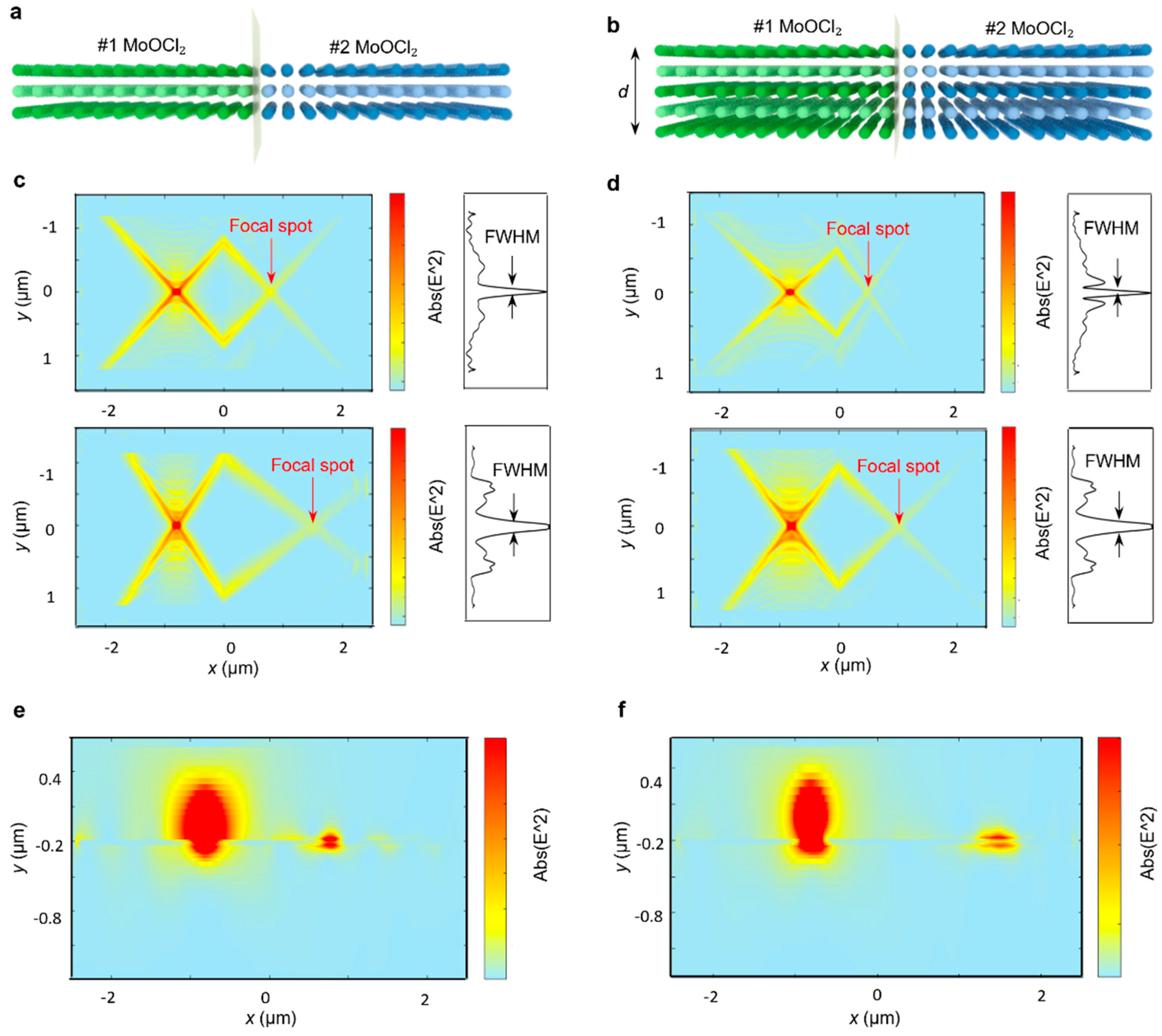
We examined two pairs of negative refraction cases with different thicknesses, as shown in Figure 2c,d. Due to the satisfaction of the wavevector matching condition, the left-side HPPs undergo negative refraction at the interface and converge at a focal point on the right. For Figure 2c, both electric field distributions were simulated with a MoOCl2 thickness of 20 nm but under different dipole wavelengths. The upper electric field pattern was excited by an 800 nm dipole source, yielding a focal length of 670 nm and a FWHM of 180 nm. The lower electric field pattern was excited by a 950 nm dipole source, resulting in a longer focal length of 1270 nm and a broader FWHM of 311 nm. Comparing the two field patterns in Figure 2c, despite identical dipole positions, the lowercase with a longer wavelength (950 nm) exhibits both a larger focal length and FWHM than the uppercase (800 nm). In Figure 2d, both field patterns were simulated with a MoOCl2 thickness of 30 nm. The upper panel, excited by an 800 nm dipole, shows a focal length of 630 nm and a FWHM of 190 nm. The lower panel, excited by a 950 nm dipole, demonstrates a focal length of 1001 nm and a FWHM of 217 nm. Similar to the results in Figure 2c, the lower case in Figure 2d with a longer wavelength (950 nm) produces a larger focal length and FWHM compared to the shorter wavelength case (800 nm). Therefore, three main parameters affect the focusing of negative refraction, including the thickness of the MoOCl2, the exciting dipole wavelength, and the corresponding rotation angle of the two isolated layers.
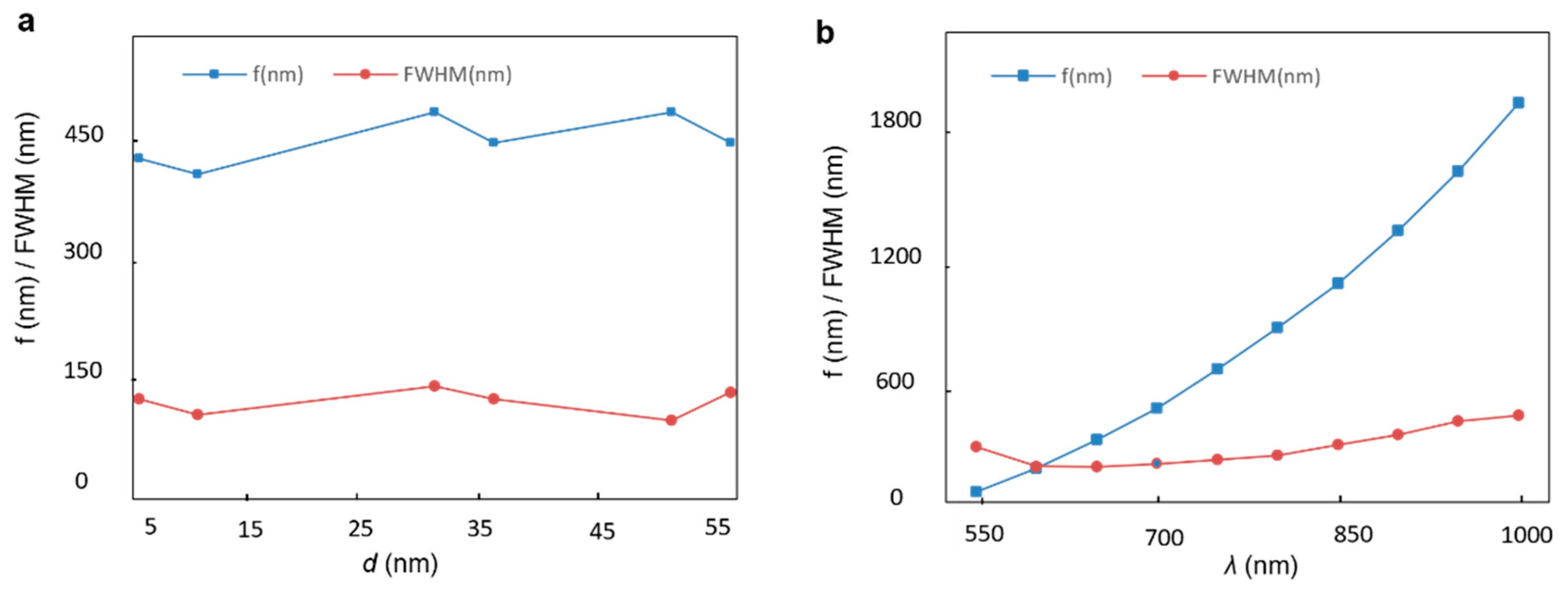
To obtain deep insight into this hyperbolic negative refraction, we separately discuss the aforementioned three effects. We first established simulation conditions where only the thickness of the MoOCl2 layer was varied, while the dipole source wavelength was fixed at 800 nm, and the orientation of the dielectric permittivity tensor in the right MoOCl2 layer was rotated 90° from that in the left side MoOCl2 layer. Simulations were performed for MoOCl2 thicknesses of 5 nm, 10 nm, 30 nm, 35 nm, 50 nm, and 55 nm across the entire heterostructure. The simulated results are presented in Figure 3a. As can be observed, for the simulated thicknesses mentioned above, both the focal length and the FWHM exhibit minor fluctuations within a small range, but the overall variations are relatively insignificant. From the analysis conducted, it is evident that thickness has an impact on the focusing of negative refraction as well as on the FWHM of the focused spot. However, this influence is not particularly pronounced.
Next, we exclusively varied the wavelength of the incident dipole while fixing the MoOCl2 thickness at 20 nm and maintaining a 90° orientation difference in the dielectric permittivity constants between the left and right MoOCl2 regions. Simulations were performed for dipole wavelengths ranging from 550 nm to 1000 nm, with the resulting focal length and FWHM trends shown in Figure 3b. As clearly illustrated, the focal length (blue line) increases monotonically with the dipole wavelength. Among the simulated data, the shortest focal length of 40 nm is achieved at a dipole wavelength of 550 nm, while the longest focal length of 1530 nm occurs at 1000 nm. This demonstrates a larger focal length with increasing dipole wavelength. For the FWHM (red line), the initial value at 550 nm is 212 nm. As the dipole wavelength increases, FWHM first decreases, reaching a minimum of 135 nm at 650 nm. Beyond this point, further increases in dipole wavelength led to a gradual rise in FWHM, culminating in a maximum value of 332 nm at 1000 nm. Therefore, the exciting wavelength plays a main role in both the focal length and FWHM of the in-plane superlens. More importantly, owing to the large wavevector and ray-like propagating properties of HPPs, the negative refraction-inspired superlens can reach into the deep subwavelength scale, with spatial confinement of 800 nm near-infrared wavelengths to below 150 nm focal spots.
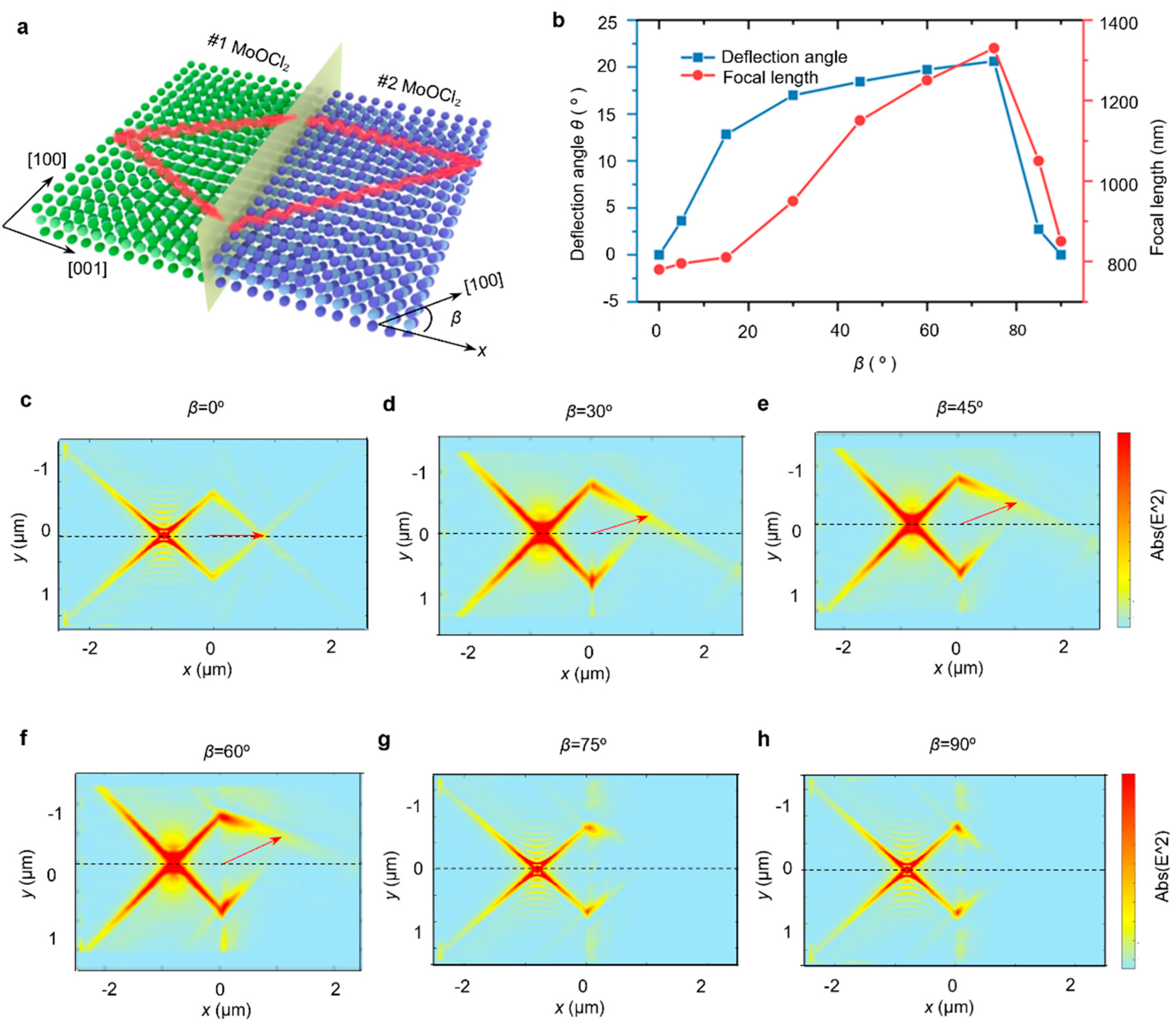
Finally, we varied only the orientation direction of the right MoOCl2 layer, the schematic of which is shown in Figure 4a, in which the MoOCl2’s permittivity is rotated by a specific orientation angle β relative to the x-direction. The thickness of both side MoOCl2 layers is set as 20 nm, and the incident dipole source wavelength is 800 nm. Due to the permittivity rotation, when HPPs are excited by the dipole and propagate to the interface, the negative refraction focus shifts off-center, which leads to tilted negative refraction. Simulation results for rotation angles (β) ranging from 0° to 90° are shown in Figure 4b. The blue curve describes the deflection angle variation. As β increases from 5° to 75°, the deflection angle continuously increases but at a decreasing rate. When β exceeds 75° and approaches 90°, the phase-matching condition cannot be achieved, therefore forbidding the occurrence of negative refraction. The red curve shows the variation of focal length as a function of the rotation angle. The focal length grows steadily as β increases from 5° to 75°. Figure 4c–h display the simulated electric field distributions at β = 0°, 30°, 45°, 60°, 75° and 90°, respectively. It is evident that both the deflection angle (i.e., the angle between the red arrow and the x-axis) and the focal length (i.e., the length of the red arrow) progressively increase with β from 0° to 60°. When β ranges from 75° to 90°, the negative refraction phenomenon cannot occur.

4. Conclusions

In summary, our research has achieved low-loss, ray-like deep subwavelength negative refraction highly confined HPPs within the visible and near-infrared light spectrum. By adjusting the incident dipole wavelength, as well as the orientation angle between two-sided hyperbolic MoOCl2 layers, we have realized tunable focal length and deflection of negative refraction. Moreover, the aforementioned focusing phenomena inherited the exceptional light-squeezing capability of HPPs, enabling the confinement of 800-nanometer near-infrared light wavelengths into focal spots smaller than 150 nanometers with low loss. Our findings open up new avenues for constructing more compact nanophotonic devices, facilitating sub-diffraction imaging, stealth technology, and nanoscale optical information transmission and processing.

Author Contributions

Conceptualization, Q.Z.; Methodology, Q.Z.; Software, S.Q., X.C. and J.Z.; Validation, S.Q., H.L. and J.Y.; Formal analysis, Q.Z.; Data curation, S.Q., Y.W. and Q.Z.; Writing—original draft, S.Q.; Writing—review & editing, X.C., H.L. and Q.Z.; Visualization, Q.Z.; Supervision, Q.Z.; Project administration, Q.Z.; Funding acquisition, Q.Z. All authors have read and agreed to the published version of the manuscript.

Funding

National Natural Science Foundation of China (Nos. 62375039, 12174047, and 62205049); National Key Research & Development Program (2024YFA0309200); Sichuan Province Science and Technology Support Program (Nos. 2025ZNSFSC0517 and 2025YFHZ0196); Tianfu Jiangxi achievement transformation funding program.

Data Availability Statement

Data that support the findings of this study are available within the article.

Acknowledgments

This work was supported by the Tianfu Jiangxi achievement transformation funding program.

Conflicts of Interest

The authors declare no conflicts of interest.

References

  1. Álvarez-Pérez, G.; Duan, J.; Taboada-Gutiérrez, J.; Ou, Q.; Nikulina, E.; Liu, S.; Edgar, J.H.; Bao, Q.; Giannini, V.; Hillenbrand, R.; et al. Negative reflection of nanoscale-confined polaritons in a low-loss natural medium. Sci. Adv. 2022, 8, eabp8486. [Google Scholar] [CrossRef]
  2. Hu, H.; Chen, N.; Teng, H.; Yu, R.; Xue, M.; Chen, K.; Xiao, Y.; Qu, Y.; Hu, D.; Chen, J.; et al. Gate-tunable negative refraction of mid-infrared polaritons. Science 2023, 379, 558–561. [Google Scholar] [CrossRef]
  3. Jiang, J.; Lin, X.; Zhang, B. Broadband Negative Refraction of Highly Squeezed Hyperbolic Polaritons in 2D Materials. Research 2018, 2018, 2532819. [Google Scholar] [CrossRef]
  4. Sternbach, A.J.; Moore, S.L.; Rikhter, A.; Zhang, S.; Jing, R.; Shao, Y.; Kim, B.S.Y.; Xu, S.; Liu, S.; Edgar, J.H.; et al. Negative refraction in hyperbolic hetero-bicrystals. Science 2023, 379, 555–557. [Google Scholar] [CrossRef] [PubMed]
  5. Zhang, Q.; Zhen, Z.; Yang, Y.; Gan, G.; Jariwala, D.; Cui, X. Negative refraction inspired polariton lens in van der Waals lateral heterojunctions. Appl. Phys. Lett. 2019, 114, 221101. [Google Scholar] [CrossRef]
  6. Zhang, T.; Zheng, C.; Chen, Z.N.; Qiu, C.-W. Negative Reflection and Negative Refraction in Biaxial van der Waals Materials. Nano Lett. 2022, 22, 5607–5614. [Google Scholar] [CrossRef] [PubMed]
  7. Poddubny, A.; Iorsh, I.; Belov, P.; Kivshar, Y. Hyperbolic metamaterials. Nat. Photonics 2013, 7, 948–957. [Google Scholar] [CrossRef]
  8. Staude, I.; Schilling, J. Metamaterial-inspired silicon nanophotonics. Nat. Photonics 2017, 11, 274–284. [Google Scholar] [CrossRef]
  9. Goban, A.; Hung, C.-L.; Yu, S.-P.; Hood, J.; Muniz, J.; Lee, J.; Martin, M.; McClung, A.; Choi, K.; Chang, D.; et al. Atom–light interactions in photonic crystals. Nat. Commun. 2014, 5, 3808. [Google Scholar] [CrossRef]
  10. Sekoguchi, H.; Takahashi, Y.; Asano, T.; Noda, S. Photonic crystal nanocavity with a Q-factor of ~9 million. Opt. Express 2014, 22, 916–924. [Google Scholar] [CrossRef]
  11. Lundeberg Mark, B.; Gao, Y.; Woessner, A.; Tan, C.; Alonso-González, P.; Watanabe, K.; Taniguchi, T.; Hone, J.; Hillenbrand, R.; Koppens, F.H. Thermoelectric detection and imaging of propagating graphene plasmons. Nat. Mater. 2017, 16, 204–207. [Google Scholar] [CrossRef]
  12. Thongrattanasiri, S.; Manjavacas, A.; de Abajo, F.J.G. Quantum Finite-Size Effects in Graphene Plasmons. ACS Nano 2012, 6, 1766–1775. [Google Scholar] [CrossRef]
  13. Jacob, Z. Hyperbolic phonon–polaritons. Nat. Mater. 2014, 13, 1081–1083. [Google Scholar] [CrossRef]
  14. Zhang, Q.; Ou, Q.; Hu, G.; Liu, J.; Dai, Z.; Fuhrer, M.S.; Bao, Q.; Qiu, C.-W. Hybridized Hyperbolic Surface Phonon Polaritons at α-MoO3 and Polar Dielectric Interfaces. Nano Lett. 2021, 21, 3112–3119. [Google Scholar] [CrossRef]
  15. Chakraborty, S.; Marshall, O.P.; Folland, T.G.; Kim, Y.-J.; Grigorenko, A.N.; Novoselov, K.S. Gain modulation by graphene plasmons in aperiodic lattice lasers. Science 2016, 351, 246–248. [Google Scholar] [CrossRef] [PubMed]
  16. Dai, S.; Fei, Z.; Ma, Q.; Rodin, A.S.; Wagner, M.; McLeod, A.S.; Liu, M.K.; Gannett, W.; Regan, W.; Watanabe, K.; et al. Tunable Phonon Polaritons in Atomically Thin van der Waals Crystals of Boron Nitride. Science 2014, 343, 1125–1129. [Google Scholar] [CrossRef] [PubMed]
  17. Dai, S.; Ma, Q.; Andersen, T.; Mcleod, A.S.; Fei, Z.; Liu, M.K.; Wagner, M.; Watanabe, K.; Taniguchi, T.; Thiemens, M.; et al. Subdiffractional focusing and guiding of polaritonic rays in a natural hyperbolic material. Nat. Commun. 2015, 6, 6963. [Google Scholar] [CrossRef] [PubMed]
  18. Ni, G.X.; Wang, L.; Goldflam, M.D.; Wagner, M.; Fei, Z.; McLeod, A.S.; Liu, M.K.; Keilmann, F.; Ozyilmaz, B.; Neto, A.H.C.; et al. Ultrafast optical switching of infrared plasmon polaritons in high-mobility graphene. Nat. Photonics 2016, 10, 244–247. [Google Scholar] [CrossRef]
  19. Qian, C.; Lin, X.; Yang, Y.; Gao, F.; Shen, Y.; Lopez, J.; Kaminer, I.; Zhang, B.; Li, E.; Soljačić, M.; et al. Multifrequency Superscattering from Subwavelength Hyperbolic Structures. ACS Photonics 2018, 5, 1506–1511. [Google Scholar] [CrossRef]
  20. Vakil, A.; Engheta, N. Transformation Optics Using Graphene. Science 2011, 332, 1291–1294. [Google Scholar] [CrossRef]
  21. Yoxall, E.; Schnell, M.; Nikitin, A.Y.; Txoperena, O.; Woessner, A.; Lundeberg, M.B.; Casanova, F.; Hueso, L.E.; Koppens, F.H.L.; Hillenbrand, R. Direct observation of ultraslow hyperbolic polariton propagation with negative phase velocity. Nat. Photonics 2015, 9, 674–678. [Google Scholar] [CrossRef]
  22. Cohen, K.; Dolev, S.; Bartal, G. Deep-Subwavelength Focusing and Reflectionless Negative Refraction in Visible-Light Hyperbolic Metasurface. Adv. Opt. Mater. 2025, 13, 2402591. [Google Scholar] [CrossRef]
  23. Shin, H.; Fan, S. All-Angle Negative Refraction for Surface Plasmon Waves Using a Metal-Dielectric-Metal Structure. Phys. Rev. Lett. 2006, 96, 073907. [Google Scholar] [CrossRef]
  24. Lezec, H.J.; Dionne, J.A.; Atwater, H.A. Negative Refraction at Visible Frequencies. Science 2007, 316, 430–432. [Google Scholar] [CrossRef]
  25. Zhao, J.; Wu, W.; Zhu, J.; Lu, Y.; Xiang, B.; Yang, S.A. Highly anisotropic two-dimensional metal in monolayer MoOCl2. Phys. Rev. B 2020, 102, 245419. [Google Scholar] [CrossRef]
  26. Ruta, F.L.; Shao, Y.; Acharya, S.; Mu, A.; Jo, N.H.; Ryu, S.H.; Balatsky, D.; Su, Y.; Pashov, D.; Kim, B.S.Y.; et al. Good plasmons in a bad metal. Science 2025, 387, 786–791. [Google Scholar] [CrossRef]
  27. Zhang, Y.; Lin, L.-F.; Moreo, A.; Dagotto, E. Orbital-selective Peierls phase in the metallic dimerized chain MoOCl2. Phys. Rev. B 2021, 104, L060102. [Google Scholar] [CrossRef]
  28. Wang, Z.; Huang, M.; Zhao, J.; Chen, C.; Huang, H.; Wang, X.; Liu, P.; Wang, J.; Xiang, J.; Feng, C.; et al. Fermi liquid behavior and colossal magnetoresistance in layered MoOCl2. Phys. Rev. Mater. 2020, 4, 041001. [Google Scholar] [CrossRef]
  29. Venturi, G.; Mancini, A.; Melchioni, N.; Chiodini, S.; Ambrosio, A. Visible-frequency hyperbolic plasmon polaritons in a natural van der Waals crystal. Nat. Commun. 2024, 15, 9727. [Google Scholar] [CrossRef]
  30. Li, Y.; Zhang, Y.; Zhang, W.; Li, X.; Tang, J.; Xiao, J.; Zhang, G.; Liao, X.; Jiang, P.; Liu, Q.; et al. Broadband near-infrared hyperbolic polaritons in MoOCl2. Nat. Commun. 2025, 16, 6172. [Google Scholar] [CrossRef]
  31. Gao, H.; Ding, C.; Sun, L.; Ma, X.; Zhao, M. Robust broadband directional plasmons in a MoOCl2 monolayer. Phys. Rev. B 2021, 104, 205424. [Google Scholar] [CrossRef]
  32. Barreda, Á.; Vitale, F.; Minovich, A.E.; Ronning, C.; Staude, I. Applications of Hybrid Metal-Dielectric Nanostructures: State of the Art. Adv. Photonics Res. 2022, 3, 2100286. [Google Scholar] [CrossRef]
  33. Louis, B.; Huang, C.-H.; Melendez, M.; Sánchez-Iglesias, A.; Olmos-Trigo, J.; Seth, S.; Rocha, S.; Delgado-Buscalioni, R.; Liz-Marzán, L.M.; Marqués, M.I.; et al. Unconventional Optical Matter of Hybrid Metal–Dielectric Nanoparticles at Interfaces. ACS Nano 2024, 18, 32746–32758. [Google Scholar] [CrossRef]
  34. Dou, L.; Xu, J.; Zhou, Z.; Li, S.; Wei, Z.; Jiang, T.; Wang, Z.; Cheng, X. Two-dimensional negative refraction steering of hybrid polaritons in graphene/twisted bilayer α-MoO3 heterostructures. Opt. Express 2025, 33, 3881–3889. [Google Scholar] [CrossRef]
  35. Teng, H.; Chen, N.; Hu, H.; de Abajo, F.J.G.; Dai, Q. Steering and cloaking of hyperbolic polaritons at deep-subwavelength scales. Nat. Commun. 2024, 15, 4463. [Google Scholar] [CrossRef]
  36. Chen, N.; Teng, H.; Hu, H.; Liu, M.; Jiang, C.; Xue, Z.; Zhu, H.; Gui, J.; Li, P.; Alù, A.; et al. Flatland wakes based on leaky hyperbolic polaritons. Nat. Mater. 2025, 24, 1569–1575. [Google Scholar] [CrossRef]
  37. Duan, J.; Álvarez-Pérez, G.; Lanza, C.; Voronin, K.; Tresguerres-Mata, A.I.F.; Capote-Robayna, N.; Álvarez-Cuervo, J.; Martín-Luengo, A.T.; Martín-Sánchez, J.; Volkov, V.S.; et al. Multiple and spectrally robust photonic magic angles in reconfigurable α-MoO3 trilayers. Nat. Mater. 2023, 22, 867–872. [Google Scholar] [CrossRef]
  38. Passler, N.C.; Paarmann, A. Generalized 4 × 4 matrix formalism for light propagation in anisotropic stratified media: Study of surface phonon polaritons in polar dielectric heterostructures. J. Opt. Soc. Am. B 2017, 34, 2128–2139. [Google Scholar] [CrossRef]
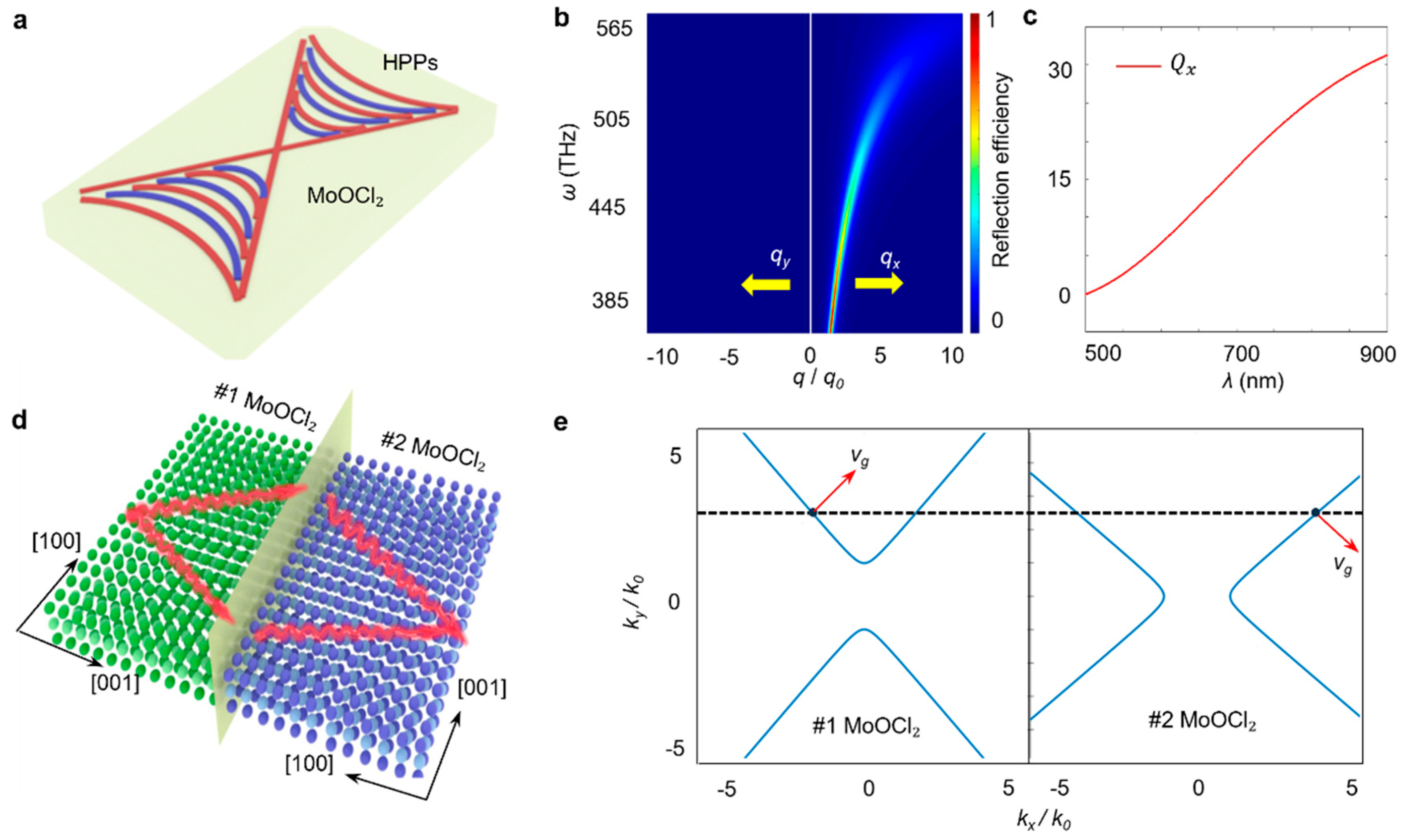
Figure 1. Mechanism of negative refraction in MoOCl2-based heterojunction. (a) Schematic of HPPs excited in MoOCl2. (b) The calculated dispersion diagram for 10 nm-thick MoOCl2 in the visible frequency range. In this dispersion diagram, the positive half of the horizontal axis represents qx, which denotes the component of the wavevector q along the x-direction; the negative half of the horizontal axis represents qy, denoting the component of the wavevector q in the y-direction. (c) Quality factor of MoOCl2. The wavelength range of the dipole light source varies from 500 nm to 900 nm. (d) The schematic illustration of negative refraction in a MoOCl2 heterojunction. The heterojunction is formed by horizontally juxtaposing two MoOCl2 layers with different crystal orientations. A dipole light source excites the HPPs on the left side. These polaritons propagate along the in-plane direction and undergo negative refraction at the interface, converging at a single point on the left side. (e) A schematic diagram illustrating the principle of negative refraction. Owing to the anisotropy of the dielectric constant, the dispersion of HPPs exhibits a hyperbolic shape. The left/right regions depict the iso-frequency contours of the HPPs supported by the left/right MoOCl2 layer, respectively. The two side HPPs satisfy the wavevector matching condition, in which the dipole source excited HPPs on the left region converge to a single point on the right region, thereby achieving negative refraction.
Photonics 13 00146 g001
Figure 2. Negative refraction in the assembled MoOCl2 heterojunction. (a,b) Schematics of heterojunctions with different thicknesses. (c,d) Numerical simulations of negative refraction. Simulation details for (c): MoOCl2 thickness = 20 nm; dipole wavelengths of 800 nm (top panel) and 950 nm (bottom panel). Simulation details for (d): MoOCl2 thickness = 30 nm; dipole wavelengths of 800 nm (top panel) and 950 nm (bottom panel). The line plots on the right of (c,d) show the electric field (E-field) distribution along the line perpendicular to the x-axis at the focal spot. The full width at half maximum (FWHM) can be extracted from these plots. (e,f) Numerical simulation results of negative refraction in the x-z view obtained from FDTD simulations. The thickness of MoOCl2 is 20 nm, and the wavelengths of the dipole light sources are 800 nm (e) and 950 nm (f), respectively.
Photonics 13 00146 g002
Figure 3. MoOCl2 thickness and incident dipole wavelength-dependent negative refraction. (a) Variation of focal length (f, vertical distance from focus to interface) and FWHM as a function of MoOCl2 thickness. The dipole wavelength is fixed at 800 nm, and the source-interface distance is set to 800 nm. (b) Variation of f and FWHM as a function of dipole wavelength for fixed MoOCl2 layers with a thickness of 20 nm.
Photonics 13 00146 g003
Figure 4. Rotation angle-dependent negative refraction. (a) Schematic of rotation angle-dependent negative refraction. The heterostructure is still composed of two MoOCl2 layers. The dielectric permittivity constant of the left-side MoOCl2 layer is fixed with [100] crystal direction along the y-direction, while the right-side MoOCl2 layer’s permittivity is rotated by a specific orientation angle β relative to the x-direction. (b) Line plots of deflection angle and focal length vs. rotation angle. The dipole source wavelength was fixed at 800 nm, and the MoOCl2 thickness was 20 nm. (ch) Numerical simulation results of tunable negative refraction. Electric field distributions for rotation angles of 0°, 30°, 45°, 60°, 75°, and 90°. The horizontal dashed line indicates the mirror-symmetric line of the incident dipole source, with red arrows indicating the tilted negative refraction focus. The deflection angle is defined as the angle between the arrow and the horizontal dashed line, while the focal length corresponds to the arrow’s length.
Photonics 13 00146 g004
Disclaimer/Publisher’s Note: The statements, opinions and data contained in all publications are solely those of the individual author(s) and contributor(s) and not of MDPI and/or the editor(s). MDPI and/or the editor(s) disclaim responsibility for any injury to people or property resulting from any ideas, methods, instructions or products referred to in the content.