Article

Water-Stable Perovskite Quantum Dots for Wide-Color-Gamut White-Light-Emitting Diodes

1
School of Optoelectronic Science and Engineering, Collaborative Innovation Center of Suzhou Nano Science and Technology, Soochow University, Suzhou 215006, China
2
National University of Singapore Suzhou Research Institute, Dushu Lake Science and Education Innovation District, Suzhou 215123, China
*
Authors to whom correspondence should be addressed.
These authors contributed equally to this work.
Photonics 2026, 13(2), 108; https://doi.org/10.3390/photonics13020108
Submission received: 17 December 2025 / Revised: 19 January 2026 / Accepted: 23 January 2026 / Published: 25 January 2026
(This article belongs to the Special Issue Quantum Dot Light-Emitting Diodes: Innovations and Applications)

Abstract

Perovskite quantum dots (PQDs) based on CsPbX3 (X = Cl, Br, I) have attracted extensive attention due to their outstanding optoelectronic properties; however, their practical applications are hindered by poor environmental stability. In this work, a sequential surface-modification strategy is developed to address these limitations. First, CsPbBr3 PQDs are passivated with (3-aminopropyl) triethoxysilane (APTES), which reduces surface defects and enhances the photoluminescence quantum yield (PLQY) from 38.5% to 74.4%. Subsequently, a dense silica shell is constructed via in situ hydrolysis of tetramethyl orthosilicate (TMOS), further improving the PLQY to 95.6% and significantly boosting environmental stability. Structural and optical characterizations confirm effective defect passivation and suppress non-radiative recombination, with carrier lifetimes extended from 2.5 ns to 36.9 ns. Remarkably, the silica-coated PQDs retain over 50% of their initial emission intensity after 100 min of water immersion, far exceeding the stability of uncoated counterparts. Furthermore, when integrated with a commercial K2SiF6: Mn4+ red phosphor and a blue light-emitting diode (LED) chip, the resulting white LED (WLED) exhibits a wide color gamut covering 104% of the National Television System Committee (NTSC) standard and Commission Internationale de l’Éclairage (CIE) coordinates of (0.323, 0.331), closely matching standard white light. Importantly, only the silica-coated PQDs maintain a stable electrically driven device emission spectrum after water exposure.

1. Introduction

Perovskite quantum dots (PQDs), particularly those based on the CsPbX3 (X = Cl, Br, I) system, have attracted considerable research interest due to their exceptional optoelectronic properties [1,2,3,4]. These include high photoluminescence quantum yields (PLQYs), narrow emission linewidths, and tunable bandgaps, making them highly promising for applications in light-emitting diodes (LEDs) [5], photovoltaics [6], and photodetectors [7]. Notably, their efficient and color-pure emission positions PQDs as excellent candidates for color-conversion phosphors in display and lighting technologies [8]. Specifically, when combined with blue LED chips, PQDs can be employed to fabricate high-performance white LEDs, offering advantages in color gamut and luminous efficiency [9].
However, the practical deployment of PQDs, especially in such optoelectronic devices, is significantly hindered by their inherent environmental instability [10]. This instability originates from the ionic nature of the perovskite crystal lattice. Under ambient conditions, moisture ingress can trigger ion migration and lattice degradation, leading to rapid photoluminescence quenching [11]. Concurrently, external stressors such as thermal and photoexcitation can induce the desorption of surface ligands (e.g., oleic acid and oleylamine) [1,12,13,14,15,16], further exposing surface defects and accelerating non-radiative recombination pathways [17]. These degradation mechanisms collectively compromise the long-term operational stability and luminescent performance of PQDs, posing a critical challenge for their use in white LED applications where consistent color quality and longevity are essential [18]. Recent in situ studies have provided atomic-scale insights into water-induced degradation of perovskite nanocrystals, highlighting the need for robust encapsulation strategies [19].
To address these stability issues, several strategies have been explored, including surface passivation [20], ligand engineering [21], and matrix encapsulation [22,23,24]. Among these, encapsulation within an inorganic silica (SiO2) shell to form a core–shell architecture has emerged as a particularly effective approach [25]. The silica shell acts as a physical barrier, impeding the penetration of moisture and oxygen into the PQD core. Nevertheless, conventional silica-coating methodologies often result in incomplete or porous shells [26]. Residual micropores and interfacial imperfections can serve as pathways for environmental species, thereby limiting the protective efficacy under practical operating conditions [27,28,29]. Consequently, the development of a rationally designed silica coating—characterized by high density, structural continuity, and strong adhesion—that can simultaneously provide effective environmental sealing, lattice stabilization, and optical performance preservation remains a pivotal scientific and technological objective for advancing the commercialization of PQD-based white LEDs [12,23,30,31,32,33]. In addition, multi-stacked color-conversion architectures have been reported to suppress interparticle energy transfer and improve the spectral quality of WLEDs [34].
Despite the substantial progress in PQD stabilization, creating an ideal protective shell remains a challenge. For instance, Wang et al. [29] synthesized CsPbBr3@mSiO2 composites within mesoporous silica, yet the confinement often induces QD aggregation and subsequent fluorescence quenching. Alternatively, Sun et al. [35] employed the hydrolysis of (3-aminopropyl) triethoxysilane (APTES) with ambient moisture to form silica shells; however, the slow hydrolysis kinetics result in prolonged exposure of the perovskite core to water molecules, causing structural degradation. While Zhao et al. [36] and Meng et al. [37] optimized the hydrolysis rate to achieve uniform morphologies, the resulting silica shells were typically too thin (1–2.7 nm) to provide robust protection against harsh aqueous environments. These limitations, combined with recent atomic-scale insights into water-induced degradation pathways, highlight that an effective encapsulation strategy must simultaneously minimize the exposure time of QDs to water during synthesis and ensure the formation of a dense, sufficiently thick barrier. Building on this foundation, we employ a stepwise surface-engineering strategy (APTES-mediated defect passivation followed by TMOS-derived silica encapsulation) to concurrently enhance PLQY/TRPL and water-immersion stability.
In this work, we report a sequential surface-modification strategy to fabricate highly efficient and stable CsPbBr3 perovskite quantum dots (PQDs). Initially, APTES-based surface passivation was employed to effectively saturate lead/bromine vacancy defects, resulting in significantly improved crystallinity and an enhanced photoluminescence quantum yield (PLQY) from 38.5% (pristine PQDs) to 74.4%. Subsequently, a dense, cross-linked silica coating was constructed via in situ hydrolysis of TMOS, which further increased the PLQY to 95.6% while substantially improving environmental stability. Structural characterizations (TEM, XRD, FTIR) confirmed the successful formation of the silica shell and the improved lattice integrity. Photophysical studies revealed that this approach extended the carrier lifetime from 2.5 ns to 36.9 ns and effectively suppressed non-radiative recombination. Stability tests demonstrated that the coated PQDs retained over 50% of their initial emission intensity after 100 min of continuous water immersion, far outperforming uncoated samples. Furthermore, the CsPbBr3-APTES@SiO2 PQDs were integrated with commercial K2SiF6:Mn4+ red phosphor and a blue LED chip to fabricate a white-light-emitting diode (WLED). The resulting device exhibited excellent color performance, covering 104% of the National Television System Committee (NTSC) color gamut, with CIE coordinates of (0.323, 0.331) close to standard white light. Notably, only the silica-coated PQDs maintained stable color-conversion functionality after water treatment. This work thus provides an effective materials design and engineering pathway for developing perovskite quantum dots that combine high efficiency, superior stability, and practical application potential.

2. Materials and Methods

2.1. Reagents

All chemicals were used as received without further purification. Lead (II) bromide (PbBr2, 98%), didodecyldimethylammonium bromide (DDAB, 98%), ethyl acetate (≥98%), hexane (≥99.9%), toluene (≥99.9%), tetraoctylammonium bromide (TOAB, 98%), cesium carbonate (Cs2CO3, 98%), octanoic acid (OTAc, 99.9%), 3-aminopropyltriethoxysilane (APTES, 99%), and tetramethoxysilane (TMOS, 98%) were purchased from Aladdin Reagent Co., Ltd. (Shanghai, China).

2.2. Sample Preparation

Unless otherwise specified, all synthesis and purification steps were performed at room temperature (25 °C) under ambient conditions.

2.2.1. Preparation of Cs Precursor

A Cs+ precursor solution was prepared by dissolving 0.5 mmol of Cs2CO3 in 5 mL of OTAc, followed by stirring at room temperature until a clear and homogeneous solution was obtained.

2.2.2. Preparation of PbBr2 Precursor

The PbBr2 precursor was prepared by dissolving 1 mmol of PbBr2 and 2 mmol of TOAB in 10 mL of toluene. The mixture was stirred continuously at room temperature until complete dissolution, yielding a clear solution.

2.2.3. Synthesis of CsPbBr3 PQDs

To synthesize CsPbBr3 PQDs, 1 mL of the as-prepared Cs+ precursor solution was rapidly injected into the PbBr2 precursor solution under continuous stirring. After stirring for 5 min, 3 mL of a DDAB solution was introduced, and stirring continued for an additional 3 min to obtain a translucent green dispersion. The crude PQD solution was purified by adding ethyl acetate at a volume ratio of 1:2, which induced precipitation. The precipitate was collected by centrifugation, redispersed in 3 mL of hexane, and then mixed with 6 mL of ethyl acetate. Finally, the purified CsPbBr3 PQDs were dispersed in 4 mL of hexane and stored under refrigeration for further use.

2.2.4. Preparation of CsPbBr3-APTES@SiO2 Core–Shell Nanoparticles

For surface modification and silica encapsulation, 40 μL of APTES was added to the DDAB-treated CsPbBr3 PQD solution under stirring. After 10 min, 40 μL of TMOS was introduced dropwise, and the reaction was allowed to proceed under continuous stirring for 5 h. The resulting mixture was purified by adding an equal volume of ethyl acetate, followed by centrifugation at 10,000 rpm for 5 min to remove the supernatant. The collected precipitate was redispersed in 2 mL of toluene, mixed with 4 mL of ethyl acetate, and centrifuged again under the same conditions. The final solid product, corresponding to core–shell CsPbBr3-APTES@SiO2 nanoparticles, was obtained and stored in a dry environment. For the TMOS-based silica encapsulation, TMOS was hydrolyzed using ambient water vapor as the sole water source (laboratory air) under vigorous stirring; the reaction was carried out in an open vessel at room temperature without adding extra water or any acid/base catalyst.

2.3. Characterization

The crystal structure of the samples was analyzed by X-ray diffraction (XRD) using a Bruker D8 Advance diffractometer (Bruker, Karlsruhe, Germany) with Cu Kα radiation (λ = 1.54 Å). Steady-state photoluminescence (PL) spectra, time-resolved photoluminescence (TRPL) decay curves and photoluminescence quantum yields (PLQYs) were acquired on an Edinburgh FS5 spectrofluorometer (Edinburgh Instruments, Livingston, UK) equipped with an integrating sphere. Fourier transform infrared (FTIR) spectroscopy was performed on a Thermo Scientific Nicolet iS50 spectrometer (Thermo Fisher Scientific, Waltham, MA, USA) in transmission mode with KBr pellets.

2.4. WLED Fabrication and Optical Characterization

For WLED fabrication, the green-emitting CsPbBr3–APTES@SiO2 PQDs, commercial K2SiF6:Mn4+ (KSF) red phosphor (Aladdin Reagent Co., Ltd., Shanghai, China), and a UV-curable adhesive were mixed at a mass ratio of 1.3:1.2:3, coated onto a commercial blue LED chip, and cured under a 365 nm UV lamp. The emission spectra were collected using a fiber-optic spectrometer (QE Pro, Ocean Insight, Orlando, FL, USA), and the CIE 1931 chromaticity coordinates, CCT, and CRI were calculated from the measured spectra.

3. Results

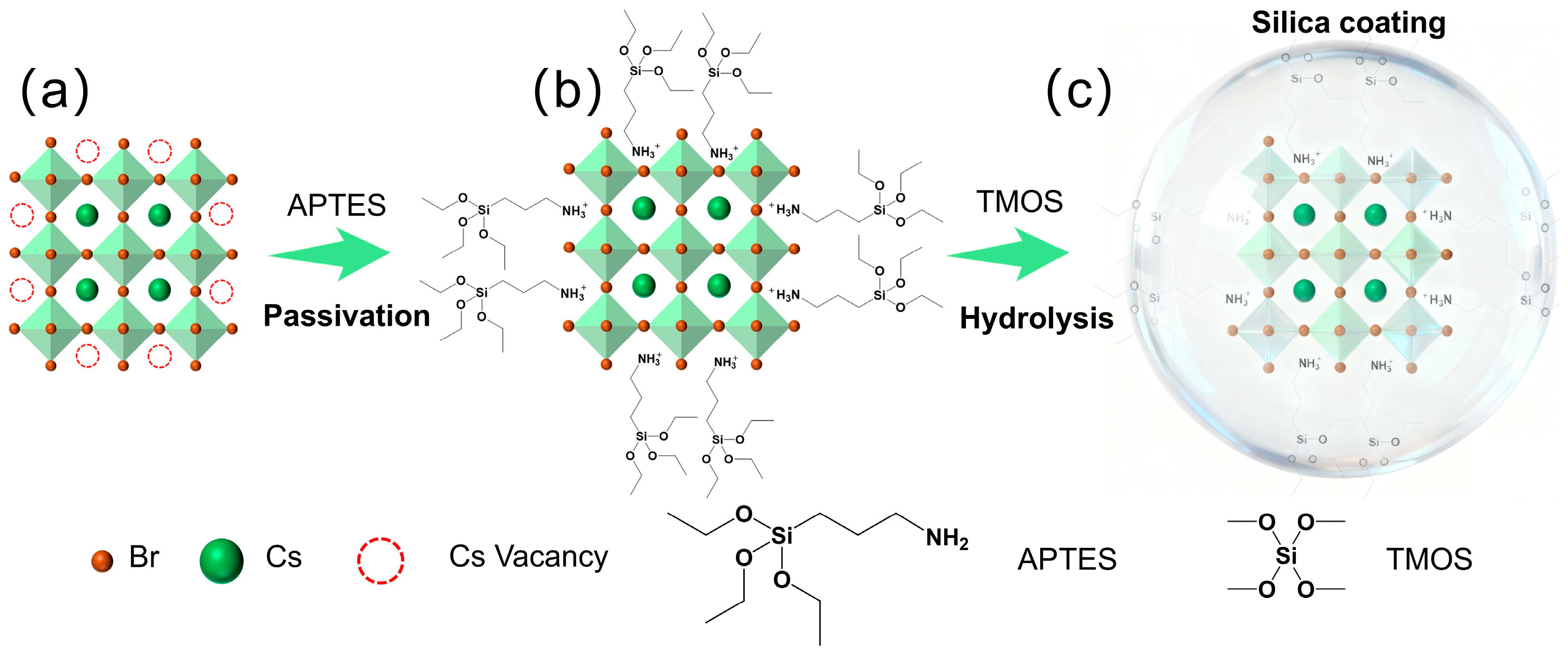
Figure 1 illustrates the sequential preparation process involving APTES defect passivation followed by TMOS in situ hydrolysis coating, yielding pristine CsPbBr3 PQDs (denoted as CsPbBr3), APTES-passivated samples (denoted as CsPbBr3-APTES), and the final silica-coated product (denoted as CsPbBr3-APTES @SiO2).
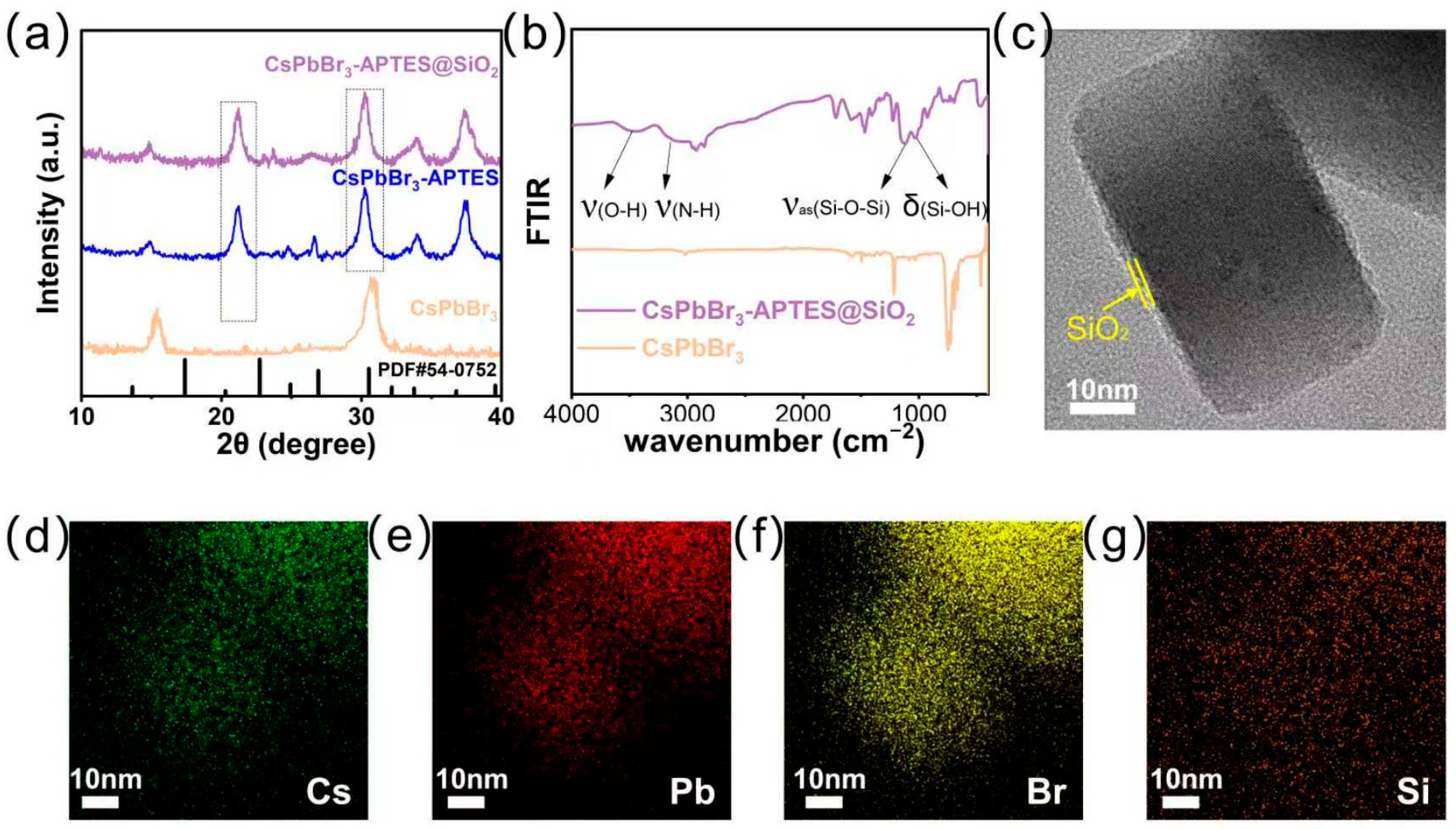
X-ray diffraction (XRD) analysis further elucidates the structural evolution: compared to CsPbBr3, the diffraction peaks of CsPbBr3-APTES corresponding to the (110) and (200) crystal planes at approximately 22° and 31°, respectively, shift toward lower angles. This shift can be attributed to lattice strain accumulation and localized interplanar expansion induced by the coordination of APTES with surface lead/bromine vacancies. Concurrently, the diffraction peaks show significantly enhanced intensity and reduced full width at half maximum (FWHM), directly confirming that APTES modification not only effectively saturates surface dangling bonds and suppresses non-radiative recombination centers but also promotes long-range ordering within the crystal lattice. Subsequently, Fourier transform infrared (FTIR) spectroscopy analysis demonstrates that CsPbBr3-APTES @SiO2 exhibit a distinct asymmetric stretching vibration band νas (Si-O-Si) at around 1100 cm−1, along with a bending vibration peak δ(Si–OH) at approximately 950 cm−1 attributed to Si–OH groups. These results confirm the sufficient hydrolysis of TMOS and the formation of a cross-linked silica coating layer on the quantum dot surface. Transmission electron microscopy (TEM) characterization (Figure 2c) reveals that the obtained PQDs exhibit well-defined square-like morphology with uniform particle size distribution, indicating a well-controlled nucleation and growth process during synthesis. To further verify the core–shell architecture, energy-dispersive X-ray spectroscopy (EDS) elemental mapping was performed. As shown in Figure 2d–g, the distinct signals of Cs, Pb, and Br (originating from the perovskite core) coincide with the Si signal, providing direct evidence of the external silica shell successfully encapsulates the quantum dots. Collectively, these characterizations demonstrate that this stepwise modification strategy optimizes the perovskite lattice integrity at the atomic scale and constructs an inorganic protective shell at the nanoscale, providing an effective pathway for the design and preparation of PQDs with both high luminescence efficiency and enhanced stability.
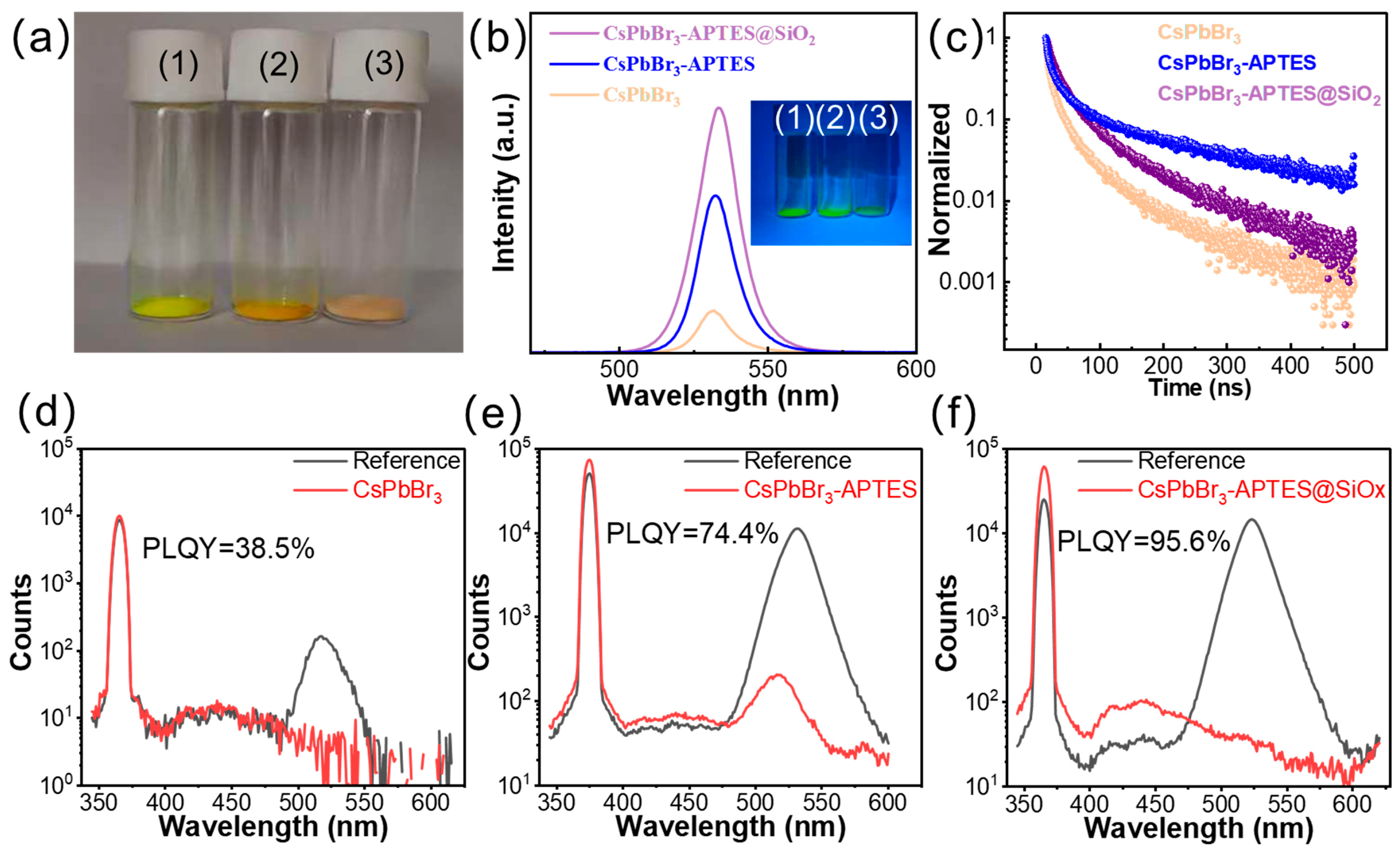
Figure 3a presents photographs of (1) CsPbBr3-APTES@SiO2, (2) CsPbBr3-APTES, and (3) pristine CsPbBr3 PQDs in powder form. Visually, the CsPbBr3-APTES@SiO2 powder displays a more intense and uniform green color compared to the other samples. This enhanced coloration suggests a higher concentration of emissive centers and reduced defect-related light scattering, indicating improved optical quality and enhanced radiative recombination efficiency following silica encapsulation. Figure 3b shows the steady-state photoluminescence (PL) spectra of the three samples. The PL intensity increases markedly after APTES passivation and is further enhanced upon silica coating. The emission peak exhibits a slight red-shift from 531.2 nm (CsPbBr3) to 533.3 nm (CsPbBr3-APTES@SiO2). This red-shift may originate from minor lattice strain or changes in the surface dielectric environment induced during silica shell formation. The silica shell further provides chemical isolation against environmental quenchers, collectively contributing to the enhancement of PL intensity and spectral purity.
To investigate the carrier recombination dynamics, time-resolved photoluminescence (TRPL) measurements were carried out. The decay curves were fitted with a tri-exponential function:
A t = A 1 e x p t τ 1 + A 2 e x p t τ 2 + A 3 e x p t τ 3
where τ1 (fast component) corresponds to trap-assisted non-radiative recombination at surface defects, τ2 (intermediate component) is associated with exciton recombination influenced by shallow traps, and τ3 (slow component) represents radiative recombination from intrinsic band-edge states. A1, A2 and A3 denote the relative amplitudes of each decay channel. The amplitude-weighted average lifetime τ avg was calculated as
τ a v g = A 1 τ 1 2 + A 2 τ 2 2 + A 3 τ 3 2 A 1 τ 1 + A 2 τ 2 + A 3 τ 3
The fitting results show a progressive increase in τavg from 2.5 ns (CsPbBr3) to 22.8 ns (CsPbBr3-APTES) and further to 36.9 ns (CsPbBr3-APTES@SiO2) (Table 1). This substantial extension of carrier lifetime, together with a systematic decrease in the amplitude ratio A1/(A1 + A2 + A3) from 0.99 to 0.02, confirms the effective suppression of non-radiative decay channels through sequential surface engineering. The improvement in radiative recombination efficiency, which scales with η P L τ r a d 1 , correlates well with the observed enhancement in PL intensity, demonstrating that the combined strategy of APTES passivation and silica coating significantly improves both the optical performance and photophysical stability of CsPbBr3 PQDs.
To further quantify the emission efficiency, photoluminescence quantum yield (PLQY) was measured. The untreated CsPbBr3 PQDs showed a PLQY of 38.5%, indicating dominant non-radiative losses. After APTES passivation, the PLQY increased to 74.4%, confirming effective defect passivation. The silica-coated sample (CsPbBr3-APTES@SiO2) achieved a near-unity PLQY of 95.6%. This result aligns with the extended carrier lifetime and suppresses the fast decay component from TRPL analysis, demonstrating that the silica shell effectively isolates the PQDs from environmental quenchers and stabilizes the passivated surface. The sequential modification strategy thus enables highly efficient and photostable PQDs.
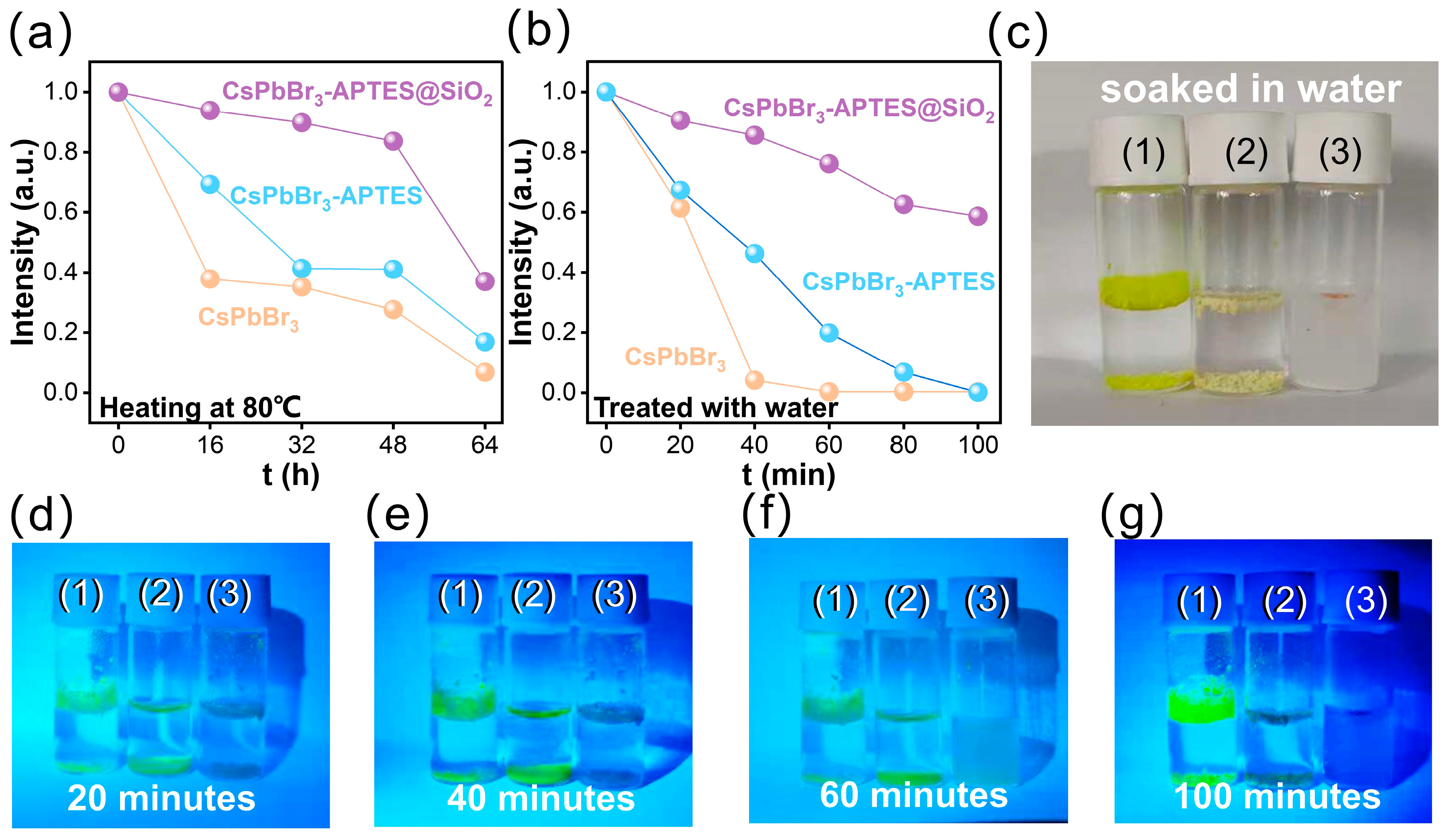
To systematically evaluate the environmental stability of the samples, we investigated their thermal tolerance and water resistance. As shown in Figure 4a, the silica-coated CsPbBr3–APTES@SiO2 shows the most stable normalized PL intensity under continuous heating at 80 °C, indicating effective suppression of thermally activated non-radiative losses. Steady-state photoluminescence (PL) measurements (Figure 4b) further demonstrate that pristine CsPbBr3 PQDs exhibit poor stability in aqueous environments—their PL intensity is nearly completely quenched within minutes of water exposure, accompanied by visible precipitation and color fading. This behavior is attributed to the intrinsic ionic nature of the perovskite crystal structure and the high-water sensitivity of its unprotected surface, leading to rapid lattice degradation in the presence of water molecules. Notably, the silica-coated CsPbBr3-APTES@SiO2 sample shows significantly enhanced water stability. After continuous immersion for 100 min, it retains over 50% of its initial PL intensity, far exceeding the performance of uncoated samples. This improvement is due to the dense, cross-linked silica shell that fully encapsulates the PQDs, forming an effective physical barrier against water penetration. These spectral observations are consistent with the macroscopic luminescence behavior of the samples. Optical photographs taken under UV illumination at different immersion times (Figure 4g) clearly show that after 100 min, the fluorescence of both pristine CsPbBr3 and APTES-only passivated PQDs is almost completely quenched. In contrast, the CsPbBr3-APTES@SiO2 sample continues to emit bright green luminescence. This visual comparison further confirms that the silica coating not only preserves the optical properties of the PQDs but also substantially enhances their structural integrity and luminescence stability in aqueous environments. These results provide important support for the practical application of perovskite quantum dots in humid or water-involved scenarios. The consistent peak position and narrow FWHM in the PL spectra explain the preserved macroscopic luminescence observed in the corresponding photographs during water immersion. For completeness, the PL spectrum of the intermediate CsPbBr3–APTES sample is also shown in Figure 4b.
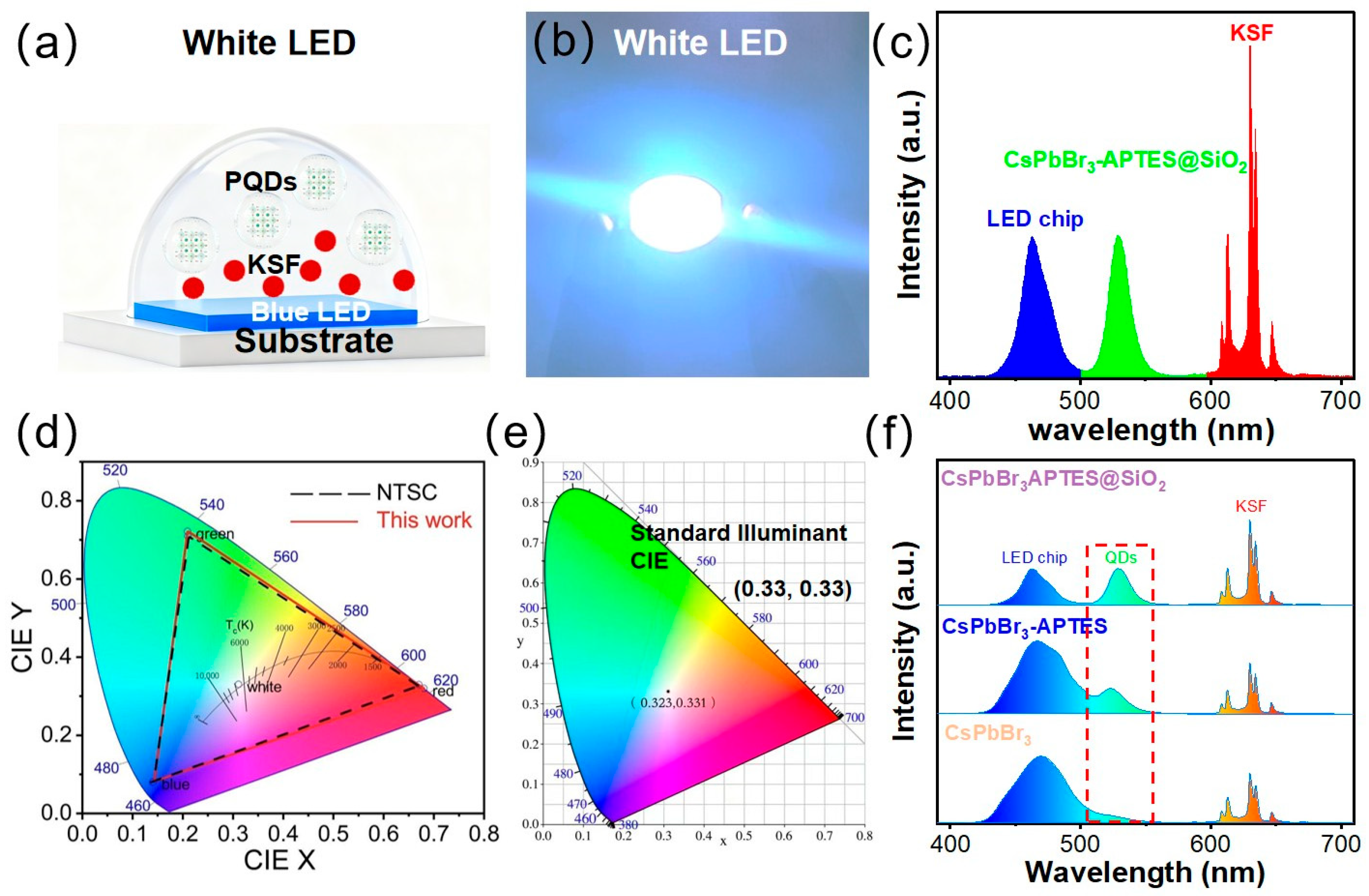
To evaluate their potential for practical optoelectronic and display applications, CsPbBr3–APTES@SiO2 PQDs were integrated with commercially available K2SiF6:Mn4+ (KSF) red phosphor and a 463 nm blue LED chip to fabricate a white-light-emitting diode (WLED). The device adopts a conventional color-conversion architecture, comprising green-emitting PQDs, red-emitting KSF, and the blue LED chip (Figure 5a). Under a driving voltage of 6 V, the assembled WLED emits bright and homogeneous white light (Figure 5b). The electrically driven device emission spectrum (Figure 5c) exhibits three characteristic peaks centered at 463 nm (blue chip), 533 nm (PQDs), and 630 nm (KSF), indicating that the blue-chip emission effectively excites the PQDs and KSF to produce down-converted photoluminescence within the device. The WLED demonstrates excellent color performance, achieving a color gamut covering 104% of the National Television System Committee (NTSC) standard (red triangle in Figure 5d) relative to the reference NTSC gamut (black dashed triangle). Moreover, the device exhibits a Commission Internationale de l’Éclairage (CIE) chromaticity coordinate of (0.323, 0.331) (Figure 5e), which is close to the standard white-light coordinate (0.33, 0.33), indicating good white balance. The correlated color temperature (CCT) and color rendering index (CRI) of the WLED are 6362 K and 60, respectively.
To further verify the impact of environmental stability on device performance, WLEDs fabricated with water-treated PQDs—CsPbBr3, CsPbBr3–APTES, and CsPbBr3–APTES@SiO2—were comparatively examined. Spectral analysis shows that only the device incorporating CsPbBr3–APTES@SiO2 retains a distinct PQD emission peak at 533 nm without an obvious spectral shift after water exposure, whereas the PQD-related emission nearly vanishes in devices based on the other two PQDs. This result provides direct evidence that the silica-derived stability enables CsPbBr3–APTES@SiO2 PQDs to maintain reliable color-conversion functionality under humid or demanding conditions, highlighting the material’s promise for display backlight applications.
Fabrication and measurement details. The WLED device was prepared by mixing the green-emitting PQDs, KSF red phosphor, and a UV-curable adhesive at a mass ratio of 1.3:1.2:3, depositing the mixture onto a commercial blue LED chip, and curing under a 365 nm UV lamp. After electrical powering of the LED, the device emission spectra were collected using an in situ PL spectroscopy setup, and the CIE coordinates, CCT, and CRI were calculated from the measured spectra.

4. Discussion

The significantly enhanced photoluminescence quantum yield (95.6%) and prolonged carrier lifetime (36.9 ns) of CsPbBr3-APTES@SiO2 PQDs can be attributed to the synergistic effect of APTES-mediated defect passivation and the dense silica encapsulation. APTES effectively saturates surface lead/bromine vacancies, reducing non-radiative recombination centers, while the in situ-formed silica shell provides a robust physical barrier against moisture and oxygen ingress. This dual protection mechanism is further confirmed by the exceptional water stability—the coated PQDs retain over 50% of their initial emission after 100 min of immersion, whereas uncoated samples undergo rapid quenching. When integrated into a white LED, the optimized PQDs enable a device achieving 104% NTSC color gamut with stable white-light coordinates (0.323, 0.331), and critically, maintain performance after water exposure. These results demonstrate that rational surface engineering can simultaneously address the efficiency and stability challenges of perovskite PQDs, establishing a viable pathway toward their practical implementation in demanding optoelectronic applications. Mechanistically, water exposure can trigger ligand desorption, ion solvation, and facet-dependent dissolution of perovskite nanocrystals; the APTES anchoring and the SiO2 shell act as a physical diffusion barrier and reinforce surface passivation, thereby suppressing these pathways [19].

5. Conclusions

In summary, this study demonstrates that a synergistic strategy combining APTES molecular passivation with in situ silica encapsulation enables the fabrication of CsPbBr3 perovskite quantum dots (PQDs) with simultaneously enhanced efficiency and stability. This approach not only improved the photoluminescence quantum yield from 38.5% to 95.6% and extended the carrier lifetime from 2.5 ns to 36.9 ns, but also endowed the material with exceptional environmental robustness—retaining over 50% of its initial emission intensity after 100 min of water immersion. Structural analysis confirmed that the silica coating serves as a dense physical barrier, working in concert with APTES passivation to effectively suppress non-radiative recombination pathways. When integrated into a white-light-emitting diode (WLED), the optimized PQDs enabled a device achieving 104% NTSC color gamut coverage and CIE coordinates of (0.323, 0.331), closely matching standard white light, while maintaining stable electrically driven device emission spectrum performance even after water exposure. This surface engineering strategy provides a generalizable pathway for performance optimization of perovskite QDs and establishes a solid foundation for their practical implementation in displays, solid-state lighting, and other optoelectronic applications. We note that the current direct-immersion test (100 min) primarily demonstrates short-term water resistance; longer-term damp-heat storage and operational aging tests will be investigated in future work.

Author Contributions

Conceptualization, C.L., C.F. and Y.C.; methodology, C.L., Y.X. and Y.D.; validation, Y.D. and Y.C.; investigation, C.L. and S.X.; resources, C.L. and Y.C.; data curation, C.L., J.W. and C.F.; writing—original draft preparation, C.L. and C.F.; writing—review and editing, C.L. and Y.C.; project administration, C.F. and C.L. and Y.C.; funding acquisition, C.L. and Y.C. All authors have read and agreed to the published version of the manuscript.

Funding

This research was supported by the National Key R&D Program of China (grant no. 2022YFB3608200 and 2021YFB2802200), the National Natural Science Foundation of China (Grant Nos. 62275183, 62105231 and 62405207), the Natural Science Foundation of Jiangsu Province of China (Grant No. BK20210712 and BK20240779), the Natural Science Foundation of the Jiangsu Higher Education Institutions of China (23KJA430013 and 24KJB140017), the Key Lab of Modern Optical Technologies of Education Ministry of China, the Key Lab of Advanced Optical Manufacturing Technologies of Jiangsu Province, the Engineering Research Center of Digital Imaging and Display of Education Ministry of China, the Engineering Research Center of Digital Graphic and Next-generation Printing of Jiangsu Province, the Priority Academic Program Development (PAPD) of Jiangsu Higher Education Institutions, and the Jiangsu Shuang Chuang Plan.

Data Availability Statement

The original contributions presented in this study are included in the article. Further inquiries can be directed to the corresponding authors.

Conflicts of Interest

The authors declare no conflicts of interest. The funders had no role in the design of the study; in the collection, analyses, or interpretation of data; in the writing of the manuscript; or in the decision to publish the results.

Abbreviations

The following abbreviations are used in this manuscript:
PQDsPerovskite quantum dots
APTES(3-aminopropyl) triethoxysilane
WLEDWhite-light-emitting diode
NTSCNational Television System Committee
CIECommission Internationale de l’Éclairage
PLQYPhotoluminescence quantum yield

References

  1. Tsai, H.; Shrestha, S.; Vilá, R.A.; Huang, W.; Liu, C.; Hou, C.; Huang, H.; Wen, X.; Li, M.; Wiederrecht, G.; et al. Bright and stable light-emitting diodes made with perovskite nanocrystals stabilized in metal–organic frameworks. Nat. Photonics 2021, 15, 843–849. [Google Scholar] [CrossRef]
  2. Wang, Y.K.; Jia, F.; Li, X.; Teale, S.; Xia, P.; Liu, Y.; Chan, P.T.; Wan, H.; Hassan, Y.; Imran, M.; et al. Self-assembled monolayer-based blue perovskite LEDs. Sci. Adv. 2023, 9, eadh2140. [Google Scholar] [CrossRef]
  3. Dai, X.; Zhang, Z.; Jin, Y.; Niu, Y.; Cao, H.; Liang, X.; Chen, L.; Wang, J.; Peng, X. Solution-processed, high-performance light-emitting diodes based on quantum dots. Nature 2014, 515, 96–99. [Google Scholar] [CrossRef] [PubMed]
  4. Lee, D.H.; Jeong, W.H.; Choung, S.; Jang, J.W.; Lee, G.; Song, H.; Han, S.; Seok, G.E.; Kim, J.; Han, M.; et al. Surface Defect Recovery in Perovskite Nanocrystals with Excess Halide for Core–Shell Structure. ACS Energy Lett. 2024, 9, 5413–5420. [Google Scholar] [CrossRef]
  5. Kong, L.; Sun, Y.; Zhao, B.; Ji, K.; Feng, J.; Dong, J.; Wang, Y.; Liu, Z.; Maqbool, S.; Li, Y.; et al. Fabrication of red-emitting perovskite LEDs by stabilizing their octahedral structure. Nature 2024, 631, 73–79. [Google Scholar] [CrossRef]
  6. Kim, J.; Roh, J.; Park, M.; Lee, C. Recent Advances and Challenges of Colloidal Quantum Dot Light-Emitting Diodes for Display Applications. Adv. Mater. 2023, 35, e2212220. [Google Scholar] [CrossRef]
  7. Lin, Q.; Zhu, Y.; Wang, Y.; Li, D.; Zhao, Y.; Liu, Y.; Li, F.; Huang, W. Flexible Quantum Dot Light-Emitting Device for Emerging Multifunctional and Smart Applications. Adv. Mater. 2023, 35, 2210385. [Google Scholar] [CrossRef]
  8. Wang, Y.; Wan, H.; Teale, S.; Grater, L.; Zhao, F.; Zhang, Z.; Duan, H.; Imran, M.; Wang, S.; Hoogland, S.; et al. Long-range order enabled stability in quantum dot light-emitting diodes. Nature 2024, 629, 586–591. [Google Scholar] [CrossRef]
  9. Yang, X.; Valenzuela, C.; Zhang, X.; Chen, Y.; Yang, Y.; Wang, L.; Feng, W. Robust integration of polymerizable perovskite quantum dots with responsive polymers enables 4D-printed self-deployable information display. Matter 2023, 6, 1278–1294. [Google Scholar] [CrossRef]
  10. Li, S.; Tian, R.; Yan, T.; Guo, Y.; Liu, Y.; Zhou, T.; Wang, L.; Xie, R. Small-sized nitride phosphors achieving mini-LED backlights with superhigh brightness and ultralong durability. Mater. Today 2023, 70, 82–92. [Google Scholar] [CrossRef]
  11. Zhang, D.; Xiao, W.; Liu, C.; Liu, X.; Ren, J.; Xu, B.; Qiu, J. Highly efficient phosphor-glass composites by pressureless sintering. Nat. Commun. 2020, 11, 2805. [Google Scholar] [CrossRef]
  12. Liu, Y.; Chen, T.; Jin, Z.; Li, M.; Zhang, D.; Duan, L.; Zhao, Z.; Wang, C. Tough, stable and self-healing luminescent perovskite-polymer matrix applicable to all harsh aquatic environments. Nat. Commun. 2022, 13, 1339. [Google Scholar] [CrossRef]
  13. Hassan, Y.; Park, J.H.; Crawford, M.L.; Sadhanala, A.; Lee, J.; Sadighian, J.C.; Mosconi, E.; Shivanna, R.; Radicchi, E.; Jeong, M.; et al. Ligand-engineered bandgap stability in mixed-halide perovskite LEDs. Nature 2021, 591, 72–77. [Google Scholar] [CrossRef]
  14. Zhang, C.; Wang, B.; Li, W.; Huang, S.; Kong, L.; Li, Z.; Li, L. Conversion of invisible metal-organic frameworks to luminescent perovskite nanocrystals for confidential information encryption and decryption. Nat. Commun. 2017, 8, 1138. [Google Scholar] [CrossRef]
  15. Xiao, P.; Zhang, Z.; Ge, J.; Deng, Y.; Chen, X.; Zhang, J.; Deng, Z.; Kambe, Y.; Talapin, D.V.; Wang, Y. Surface passivation of intensely luminescent all-inorganic nanocrystals and their direct optical patterning. Nat. Commun. 2023, 14, 49. [Google Scholar] [CrossRef] [PubMed]
  16. Gao, Y.; Li, B.; Liu, X.; Shen, H.; Song, Y.; Song, J.; Yan, Z.; Yan, X.; Chong, Y.; Yao, R.; et al. Minimizing heat generation in quantum dot light-emitting diodes by increasing quasi-Fermi-level splitting. Nat. Nanotechnol. 2023, 18, 1168–1174. [Google Scholar] [CrossRef] [PubMed]
  17. Bao, C.; Yuan, Z.; Niu, W.; Yang, J.; Wang, Z.; Yu, T.; Wang, J.; Gao, F. A multifunctional display based on photo-responsive perovskite light-emitting diodes. Nat. Electron. 2024, 7, 375–382. [Google Scholar] [CrossRef]
  18. Gong, T.; Yang, Y.; Xuan, T.; Bai, W.; Dong, H.; Zhou, T.; Xie, R. Local Light Field Control Enables Efficient Quantum Dot Color Conversion Films for Mini-LED Backlit Displays. Laser Photon. Rev. 2024, 18, 2301097. [Google Scholar] [CrossRef]
  19. Ma, H.; Ahn, E.; Lee, D.; Kim, H.; Lee, K.; Lee, H.C.; Lee, S.; Ji, S.; Kim, K.; Ahn, H.; et al. Water-induced degradation mechanism of metal halide perovskite nanocrystals. Matter 2025, 8, 102083. [Google Scholar] [CrossRef]
  20. Wang, S.; Chen, D.; Xu, K.; Hu, J.; Liang, S.; He, K.; Zhu, H.; Hong, M. Boosting Stability and Inkjet Printability of Pure-Red CsPb(Br/I)3 Quantum Dots through Dual-Shell Encapsulation for Micro-LED Displays. ACS Energy Lett. 2024, 9, 2517–2526. [Google Scholar] [CrossRef]
  21. Chen, K.; Du, Q.; Cao, Q.; Du, C.; Feng, S.; Pan, Y.; Liang, Y.; Wang, L.; Chen, J.; Ma, D. Ligand Engineering Achieves Suppression of Temperature Quenching in Pure Green Perovskite Nanocrystals for Efficient and Thermostable Electroluminescence. Nano-Micro Lett. 2024, 17, 77. [Google Scholar] [CrossRef]
  22. Li, X.; Wang, Y.; Sun, H.; Zeng, H. Amino-Mediated Anchoring Perovskite Quantum Dots for Stable and Low-Threshold Random Lasing. Adv. Mater. 2017, 29, 1701185. [Google Scholar] [CrossRef]
  23. Chen, S.; Lin, J.; Zheng, S.; Zheng, Y.; Chen, D. Efficient and Stable Perovskite White Light-Emitting Diodes for Backlit Display. Adv. Funct. Mater. 2023, 33, 2213442. [Google Scholar] [CrossRef]
  24. Ma, C.; Zhang, M.; Zhang, J.; Liao, J.; Sun, H.; Ji, D.; Pang, R.; Zhang, H.; Liu, J.; Liu, S.F. Highly Luminescent and Stable Perovskite Quantum Dots Films for Light-Emitting Devices and Information Encryption. Adv. Funct. Mater. 2024, 34, 2316717. [Google Scholar] [CrossRef]
  25. Zhang, X.; Li, L.; Chen, Y.; Valenzuela, C.; Liu, Y.; Yang, Y.; Feng, Y.; Wang, L.; Feng, W. Mechanically Tunable Circularly Polarized Luminescence of Liquid Crystal-Templated Chiral Perovskite Quantum Dots. Angew. Chem.-Int. Edit. 2024, 63, e202404202. [Google Scholar] [CrossRef]
  26. Jang, G.; Jo, D.Y.; Ma, S.; Lee, J.; Son, J.; Lee, C.U.; Jeong, W.; Yang, S.; Park, J.H.; Yang, H.; et al. Core–Shell Perovskite Quantum Dots for Highly Selective Room-Temperature Spin Light-Emitting Diodes. Adv. Mater. 2023, 36, 2309335. [Google Scholar] [CrossRef]
  27. Zhang, K.; Fan, W.; Yao, T.; Wang, S.; Yang, Z.; Yao, J.; Xu, L.; Song, J. Polymer-Surface-Mediated Mechanochemical Reaction for Rapid and Scalable Manufacture of Perovskite QD Phosphors. Adv. Mater. 2024, 36, 2310521. [Google Scholar] [CrossRef] [PubMed]
  28. Zhao, D.; Zheng, Y.; Meng, T.; Zhu, Y.; Jing, J.; Chen, X.; Gao, H.; Mao, C.; Zheng, W.; Hu, H.; et al. Efficient quantum dot light-emitting diodes with ultra-homogeneous and highly ordered quantum dot monolayer. Sci. China Mater. 2022, 65, 757–763. [Google Scholar] [CrossRef]
  29. Wang, H.C.; Lin, S.Y.; Tang, A.C.; Singh, B.P.; Tong, H.C.; Chen, C.Y.; Lee, Y.C.; Tsai, T.L.; Liu, R.S. Mesoporous silica particles integrated with all-inorganic CsPbBr3 perovskite quantum-dot nanocomposites (MP-PQDs) with high stability and wide color gamut used for backlight display. Angew. Chem. Int. Ed. 2016, 55, 7924–7929. [Google Scholar] [CrossRef]
  30. Song, W.; Wang, D.; Tian, J.; Qi, G.; Wu, M.; Liu, S.; Wang, T.; Wang, B.; Yao, Y.; Zou, Z.; et al. Encapsulation of Dual-Passivated Perovskite Quantum Dots for Bio-Imaging. Small 2022, 18, 2204763. [Google Scholar] [CrossRef] [PubMed]
  31. Lin, J.; Chen, S.; Ye, W.; Zeng, Y.; Xiao, H.; Pang, T.; Zheng, Y.; Zhuang, B.; Huang, F.; Chen, D. Ultra-Stable Yellow Monolithic Perovskite Quantum Dots Film for Backlit Display. Adv. Funct. Mater. 2024, 34, 2314795. [Google Scholar] [CrossRef]
  32. Wang, P.; Hu, Z.; Cong, P.; Zhou, F.; Yue, Q.; Xue, Z.; Lin, C.; Jiang, Y.; Du, J.; Pan, A.; et al. Spatial and Chemical Dual Nano-Confined Ultrastable Perovskite Quantum Dots Glass Manifesting Exciton Modulation. Adv. Opt. Mater. 2024, 12, 2400630. [Google Scholar] [CrossRef]
  33. Du, A.; Xie, H.; Zheng, X.; Gao, J.; Lin, X.; Ye, Y.; Chen, E.; Xu, S.; Guo, T. Exploring potential of quantum dots for high power solid-state lighting protected by transparent ceramics. Ceram. Int. 2024, 50, 20275–20284. [Google Scholar] [CrossRef]
  34. Lee, J.; Kim, Y.; Lee, K.; Yoo, J.; Kim, K.; Kim, J.W.; Lee, S.; Kim, C.; Choi, M.K.; Yang, J. Transfer-printed multi-stacked quantum dot color conversion layers for white light-emitting diodes. Appl. Surf. Sci. 2025, 687, 162196. [Google Scholar] [CrossRef]
  35. Sun, C.; Zhang, Y.; Ruan, C.; Yin, C.; Wang, X.; Wang, Y.; Yu, W.W. Efficient and stable white LEDs with silica-coated inorganic perovskite quantum dots. Adv. Mater. 2016, 28, 10088–10094. [Google Scholar] [CrossRef]
  36. Zhao, H.; Wei, L.; Zeng, P.; Liu, M. Formation of highly uniform thinly-wrapped CsPbX3@silicone nanocrystals via self-hydrolysis: Suppressed anion exchange and superior stability in polar solvents. J. Mater. Chem. C 2019, 7, 9813–9819. [Google Scholar] [CrossRef]
  37. Meng, C.; Yang, D.; Wu, Y.; Zhang, X.; Zeng, H.; Li, X. Synthesis of single CsPbBr3@SiO2 core-shell particles via surface activation. J. Mater. Chem. C 2020, 8, 17403–17409. [Google Scholar] [CrossRef]
Figure 1. Schematic illustration of the synthesis strategy and characterization of CsPbBr3-APTES@SiO2 PQDs. (ac) Schematic diagram of the step-wise modification: defect passivation by APTES followed by TMOS hydrolysis to form CsPbBr3-APTES@SiO2.
Photonics 13 00108 g001
Figure 2. (a) XRD patterns of pristine CsPbBr3, CsPbBr3-APTES, and CsPbBr3-APTES@SiO2, highlighting the peak shifts and intensity variations and the boxed section indicates that the synthesis of the silicon shell on the quantum dot surface was successful and the original crystal phase remained intact. (b) FTIR spectra comparing pristine CsPbBr3 and CsPbBr3-APTES@SiO2, confirming the presence of the silica network. (c) TEM image of the final CsPbBr3-APTES@SiO2 PQDs showing uniform cubic morphology. (dg) mapping images including the elements of Cs, Pb, Br and Si in sequence.
Photonics 13 00108 g002
Figure 3. (a) Photographs of the PQD powders under ambient light: (1) CsPbBr3-APTES@SiO2, (2) CsPbBr3-APTES, and (3) pristine CsPbBr3, showing the enhanced color vibrancy after modification. (b) Steady-state PL spectra of the three samples. The inset displays the corresponding colloidal solutions under UV light (365 nm). (c) Time-resolved photoluminescence (TRPL) decay curves showing the extended carrier lifetime upon surface passivation and coating. (df) PLQY measurement spectra (reference vs. sample) for (d) pristine CsPbBr3, (e) CsPbBr3-APTES, and (f) CsPbBr3-APTES@SiO2, with calculated quantum yields of 38.5%, 74.4%, and 95.6%, respectively.
Photonics 13 00108 g003
Figure 4. (a) Normalized PL intensity curves of CsPbBr3, CsPbBr3-APTES, and CsPbBr3-APTES@SiO2 measured during heating at 80 °C to evaluate PL thermal stability. (b) Time-dependent normalized PL intensity of three samples during water immersion. (c) Photograph of the PQD powders immersed in deionized water under ambient light: (1) CsPbBr3-APTES@SiO2, (2) CsPbBr3-APTES, and (3) pristine CsPbBr3. (dg) Fluorescence photographs of the samples under UV light (365 nm) taken at different immersion times: (d) 20 min, (e) 40 min, (f) 60 min, and (g) 100 min. The visual comparison highlights the superior water resistance of the silica-coated sample (1) compared to the rapid quenching observed in samples (2) and (3).
Photonics 13 00108 g004
Figure 5. (a) Schematic structure of the WLED fabricated by integrating a blue LED chip, red KSF phosphor, and green CsPbBr3-APTES@SiO2 PQDs. (b) Photograph of the WLED operating under a driving voltage of 6 V, exhibiting bright white light emission. (c) The EL spectrum of the optimal WLED showing three distinct peaks. (d) CIE 1931 chromaticity diagram comparing the color gamut of the WLED (red solid line, 104% NTSC) with the NTSC standard (black dashed line). The correlated CCT and CRI of the WLED are 6362 K and 60, respectively. (e) Enlarged CIE diagram showing the color coordinates (0.323, 0.331) close to the standard white point (0.33, 0.33). (f) Comparison of electrically driven device emission spectrum for WLEDs fabricated using water-treated CsPbBr3, CsPbBr3-APTES, and CsPbBr3-APTES@SiO2 PQDs. The dashed box highlights that only the silica-coated sample retains distinct green emission, confirming its superior stability in device applications.
Photonics 13 00108 g005
Table 1. Summary of time-resolved photoluminescence (TRPL) fitting parameters for the CsPbBr3, CsPbBr3-APTES, and CsPbBr3-APTES@SiO2 PQD samples.
A1τ1 (ns)A2τ2 (ns)A3τ3 (ns)τavg (ns)
CsPbBr3700.1802.1291.69611.3080.15155.3052.539
CsPbBr3-APTES0.76820.80245.8403.4290.157151.48822.786
CsPbBr3-APTES@SiO23.0108.4860.74428.4780.123106.17436.930
Disclaimer/Publisher’s Note: The statements, opinions and data contained in all publications are solely those of the individual author(s) and contributor(s) and not of MDPI and/or the editor(s). MDPI and/or the editor(s) disclaim responsibility for any injury to people or property resulting from any ideas, methods, instructions or products referred to in the content.