Article

Simulation Study on Parameter Optimization of Laser Acupuncture Based on a Human Acupoint Skin Model


1
School of Electrical Engineering, Henan University of Technology, Zhengzhou 450001, China
2
Institute for Complexity Science, Henan University of Technology, Zhengzhou 450001, China
*
Author to whom correspondence should be addressed.
Photonics 2026, 13(1), 85; https://doi.org/10.3390/photonics13010085
Submission received: 16 November 2025 / Revised: 12 January 2026 / Accepted: 17 January 2026 / Published: 19 January 2026
(This article belongs to the Section Biophotonics and Biomedical Optics)

Abstract

To achieve precise and safe laser acupuncture treatment, a computational model of the skin acupoint was constructed utilizing COMSOL Multiphysics (Version 6.1). This model incorporates its multilayer anatomical structure: the epidermis, papillary dermis, reticular dermis, hypodermis, and muscle layer. A coupled multiphysics approach integrating geometric optics, radiation beams, and bioheat transfer was employed to investigate the effects of light source parameters and cooling layers on the photothermal response and thermal damage of acupoints. Under optimized parameters (808 nm, 3 mm beam waist, 50 mW) with a 0.5 mm glycerol layer, 600 s irradiation achieved a stable dermal temperature (40.86–42.04 °C) and a negligible epidermal thermal damage factor (0.0063), significantly below the subclinical injury threshold of 0.15; under identical parameters, the dermal temperature for the Gaussian periodic pulsed source was maintained between 38.85 and 40.35 °C, with a corresponding epidermal thermal damage factor of merely 0.0010. The model exhibited good robustness, tolerating variations of ±5% in laser power and ±40% in glycerol layer thickness. The resultant temperature deviations in the epidermis and dermis were well within the safe range, and the thermal damage factor remained below the injury threshold. This work serves as a guideline for selecting laser acupuncture parameters according to acupoint depth.

1. Introduction

Acupuncture is a traditional invasive medical technique [1]. Relevant studies have shown that acupuncture produces favorable therapeutic effects in treating diseases such as promoting blood circulation, removing blood stasis, and analgesia [2]. However, traditional acupuncture requires skin puncture, which limits the wider application of traditional acupuncture. Laser acupuncture, as a non-puncture simulation of traditional acupuncture, utilizes the penetration and heat transfer of specific wavelength lasers in the skin [3], inducing thermal effects in the skin tissue at the irradiated acupoint, stimulating mast cells at the acupoint to secrete active substances [4], thereby achieving therapeutic effects equivalent to traditional acupuncture.
Cell activity is susceptible to temperature influence. According to relevant clinical data research, maintaining an environment at 43 °C for 2–16 min may cause skin tissue cell damage, and temperatures above 45 °C carry a risk of tissue cell necrosis [5]. Therefore, skin temperature must be strictly controlled during photothermal therapy. Singh S et al. [6] established a three-layer skin model to investigate the photothermal interactions of low-power laser irradiation. They systematically analyzed the effects of laser power and irradiation time on tissue temperature, laying a foundation for the development of complex multilayer models and informing the selection of operational laser parameters. Joensen J et al. [7] controlled the output energy of 810 nm and 904 nm wavelength lasers, using a thermal imager to measure temperature changes in irradiated and non-irradiated skin areas of 40 healthy volunteers, verifying differences in laser tolerance among different individuals and the influence of melanin content in the skin on the photothermal effect. Zhang D et al. [8] provided direct evidence for the mechanistic basis of acupuncture analgesia by quantifying mast cell degranulation at acupoints versus non-acupoints. Their results demonstrated a significantly higher increase in degranulation at acupoints following stimulation, thereby confirming the crucial role of localized mast cell activation in mediating analgesic effects. In a study designed to evaluate the efficacy of acupuncture, Devi KG et al. [9] randomized 100 iron-deficiency anemia patients to receive either genuine or placebo acupuncture for 30 min daily over two weeks. The results showed a marked elevation in hemoglobin concentration in the acupuncture group compared to the control, providing evidence for the use of acupuncture as a treatment for iron-deficiency anemia. Jonasson H et al. [10] characterized the optical properties of skin in a cohort of 3809 volunteers. By applying an inverse Monte Carlo method to analyze diffuse reflectance spectra from the epidermis, papillary dermis, and reticular dermis, they derived the absorption and scattering coefficients of human skin for laser wavelengths ranging from 475 nm to 850 nm, thereby providing a reliable set of optical parameters for simulation studies. Yu Shimojo et al. [11] addressed the paucity of optical property data for Asian skin by employing a combined double-integrating sphere and inverse Monte Carlo methodology. This approach enabled the measurement and subsequent derivation of optical coefficients, including absorption and scattering, across the wavelength range of 400–1100 nm for Asian skin tissue.
In summary, previous studies have compiled key optical parameters of human skin and validated the efficacy of laser-based therapies for dermatological conditions. However, a paucity of research exists regarding the dynamic opto-thermal interactions within the layered structure of acupoints. Therefore, this investigation aims to examine the photothermal effects of laser acupuncture on human skin by evaluating the influence of various laser parameters on a directional opto-thermal model of acupoints; the findings are expected to yield safe and effective parameter sets, thereby providing a reference for the clinical application of laser acupuncture.

2. Materials and Methods

2.1. Establishment of Model Parameters

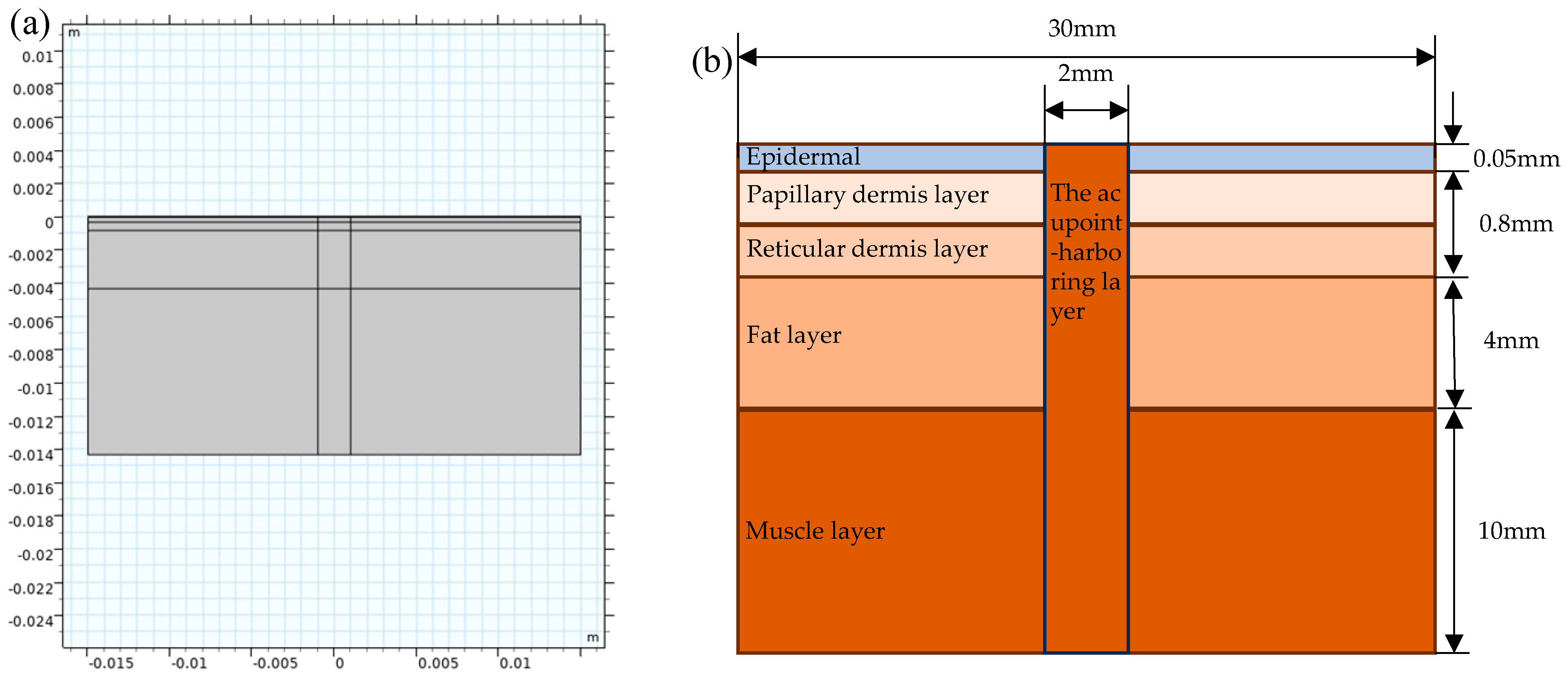
The simulation of coupled opto-thermal effects in laser acupuncture entails complex physical processes, including photo-thermal coupling, photon absorption and scattering, biological tissue interactions, and heat radiation transfer, which collectively pose significant computational challenges. To address this, the present study constructed a two-dimensional, five-layer model [12,13] based on established data of human skin tissue distribution. This model, aligned with the “functional equivalence” principle in biomedical simulation, comprises the following layers from top to bottom: the epidermis (0.05 mm), papillary dermis (0.3 mm), reticular dermis (0.5 mm), hypodermis (4 mm), and muscle layer (10 mm), yielding a total thickness of 14.85 mm. Based on existing anatomical studies demonstrating distinct [14] connective tissue and neurovascular distributions at acupoints within the dermal layer, a cylindrical acupoint target (2 mm in diameter, 14.8 mm in depth) was integrated at the model center, initiating from the papillary dermis, in order to align the model with these anatomical findings. The domain was discretized using a free triangular mesh. To justify the final selection and ensure result reliability, a mesh independence study was performed. The simulated peak temperatures in the epidermis for fine (100 μm), medium (300 μm), and coarse (500 μm) elements were 44.33 °C, 44.54 °C, and 44.58 °C, respectively. The medium mesh introduced a maximal error of only 0.21 °C relative to the fine mesh but halved the computational time, thus being selected for all subsequent simulations. The geometry and mesh are presented in Figure 1.
Absorption coefficient μa(cm−1) and scattering coefficient μs(cm−1) are core parameters for light propagation [15]. The fat layer primarily consists of triglycerides, which have very low light absorption (0.01 cm−1). The muscle layer lacks substances like collagen fibers, keratin, and hemoglobin that effectively absorb light and contains a large amount of water; thus, its absorption coefficient is approximated as that of water (0.05 cm−1) [16]. Within the 500–900 nm wavelength range, the absorption coefficients for the epidermis and dermis can be described as:
μa(λ) = ρ.εm(λ) + 0.05 cm−1
μa2(λ) = CHbo2. εHbo2(λ) + CHb. εHb(λ) + 0.05 cm−1
In the equations, ρ represents the epidermal melanin density, with a typical value of 0.01 mol/L. The term Ɛm(λ) = 103.8 − 0.0025λ denotes the molar extinction coefficient of melanin, while CHbo2·ƐHbo2 and CHb·ƐHb correspond to the wavelength-dependent absorption contributions from oxyhemoglobin and deoxyhemoglobin, respectively, in units of cm−1. Biophysically, acupoints within the dermal layer exhibit a higher density of mast cells and capillaries [17], accompanied by an approximately 20% greater hemoglobin concentration compared to non-acupoint skin tissue [18]. The scattering coefficient μs quantifies the probability of photon scattering events per unit path length, critically influencing the spatial distribution of light energy deposition within the skin. The layer-specific scattering coefficients [19] are described as follows:
μs,epidermis = 200.λ−1.5; μs,genuine leather = 150
μs,fat = 50.λ−1.0; μs,muscle = 120.λ−1.3
In the equations, λ is defined as the laser wavelength (nm). The thermophysical properties of biological tissues, including thermal conductivity, specific heat capacity, and blood perfusion rate, are independent of the laser wavelength. These properties are predominantly determined by the intrinsic structural composition of the tissue, such as cell density and fibrous matrix organization [20]. The corresponding thermal parameters for each histological layer are provided in Table 1. Compared to normal dermal tissue layers, the papillary and reticular dermis layers at acupoints exhibit an approximate 20% increase in blood perfusion rate. This physiological variation is closely associated with the elevated capillary density and specific structural characteristics of the tissue, both of which collectively contribute to this observed difference [21].
Conventional simulations of photothermal effects in biological tissues often rely on a single method, such as the Monte Carlo technique or the radiation transfer equation [22]. In contrast, this study introduces a novel triple-field coupling framework integrating geometric optics, radiation beams, and bioheat transfer. This approach not only preserves the computational accuracy of light energy deposition but also significantly reduces the required computational time. Furthermore, the behavior of photons from the light source is characterized using Mie scattering theory to quantify the extinction, absorption, and scattering efficiencies:
Qext = Qabs + Qsca
In the equations, Qext, Qabs, and Qsca denote the extinction, absorption, and scattering efficiency factors, respectively. coupling the geometric cross-section of the skin tissue with these efficiency factors to determine the spatial distribution of light energy deposition:
σext = ΠR2Qext; σsca = ΠR2 Qsca; σabs = ΠR2 Qabs
where σext is the total effective cross-sectional area for optical interaction, σsca is the effective cross-sectional area for scattering, σabs is the effective cross-sectional area for absorption. R denotes the radius of the light particles (μm). The heat transfer process within the biological tissue was modeled using the Pennes bioheat equation, which incorporates the coupled effects of blood perfusion, metabolic heat generation, and laser energy deposition:
ρc T/t + ρcu.▽T + ▽.q = Q + Qbio
In the equations, ρ (density), c (specific heat), k (thermal conductivity), and q (heat flux) are defined. The source terms Q and Qbio account for metabolic heat and deposited energy, respectively. The system was initialized with tissue and blood temperatures of 36.5 °C and 37.0 °C. The q0 characterizes the laser-induced heat distribution:
H.gauss.μa
where H represents the actual energy of the input power per unit area (W/m2), and gauss indicates the light source type is a Gaussian collimated laser source. Based on the Arrhenius Kinetic Model, the thermal damage process of cells is quantified, describing the dynamic accumulation of the thermal damage factor α:
∂α/∂t = (1 − αn)Ae△E/RT
where A is the frequency factor (s−1), ΔE is the activation energy (J/mol), R is the universal gas constant (J/(mol·K)), n is the reaction order set to 1, and T is the absolute temperature (K). The thermal damage factor, α is a dimensionless quantity that progressively increases from 0 to 1, representing the extent of irreversible tissue injury.
To replicate the intermittent nature of the “lifting-thrusting and twisting” technique in traditional acupuncture, the periodic pulsed source was driven by a rectangular wave function (2 s irradiation, 1 s cessation). This design, alongside a Gaussian-collimated source, was incident normally to the skin, thereby introducing essential temporal dynamics into the thermal stimulation:
I(r,t) = I0exp(−2r2/w02).f(t)
T = if((tt0(t/3)·3) ≤ 2,1,0)
where w0 is the beam waist radius (mm), r is the radial distance within the laser spot (m), f(t) is the time logic function, and t0 is the built-in rounding function. By correlating Equations (10) and (11), a periodic pulsed output light source with 2 s irradiation, 1 s off is achieved. The total heat source Q0 for the Gaussian light source:
H·gauss(x [1/m]).μa0.exp(μt)
where x represents the spatial coordinate (1/m). μa0 is the absorption coefficient of each tissue layer for the light source of different wavelengths, and exp(μt) is the attenuation factor of each tissue layer for the light source of different wavelengths. The boundary condition equation for the skin tissue model is
n·q = q0
q0 = h(TextT)
where n is the unit surface normal, q is the internal heat flux (W/m2), h is the convective heat transfer coefficient (W/(m2·K)), Text is the external temperature (°C), and T is the model temperature. The convective coefficient h is a function of the dimensionless Nusselt (Nu), Reynolds (Re), and Prandtl (Pr) numbers, with the specific correlation depending on the flow regime (laminar or turbulent). The correlation for laminar flow was applied in the present study:
h = 2k0.3387Pr1/3ReL1/2/L(1 + (0.0468/Pr)2/3)1/4
if ReL 5·105i
where L is the characteristic length of the model interface with the external environment (m), 0.3387 and 0.0468 are empirical constants used to relate Nu, Re, and Pr.

2.2. Realization of the Coupled Physical Fields

The study implements a coupled multiphysics model integrating Geometrical Optics, Radiation in Participating Media, and Heat Transfer in Solids. User-defined analytic functions are employed to simulate various Gaussian beam profiles. The Geometrical Optics module was used to define the initial laser beam, calculate the reflection and refraction of the laser beam at the skin–air interface, and determine the spatial distribution of the incident energy on the tissue surface. Subsequently, the Radiation in Participating Media module simulates the propagation, scattering, and attenuation of photons within the internal tissue layers based on their respective absorption μa and scattering μs coefficients. Finally, the Heat Transfer in Solids module is used to define the biological tissue properties. The spatially distributed heat source derived from the radiative transfer is coupled with the Pennes bioheat equation and the Arrhenius damage integral equation within this module. A finite element-based transient solver was employed, with the time-step size automatically adjusted using the backward differentiation formula to ensure numerical stability. This coupled system enables the computation of the transient temperature field and the distribution of the thermal damage factor throughout the biological tissue. The settings of partial optical parameters are presented in Table 2.

2.3. Comparative Analysis with MCML Simulations

To validate the applicability of the proposed model in strongly scattering media, a comparative analysis was conducted between our model and a light transport model based on the Monte Carlo method. Under an 808 nm wavelength and using identical laser parameters and a five-layer skin tissue structure, the radial relative energy distributions predicted by the two models within the tissue demonstrated strong concordance. Taking the dermal layer as an example, at the same coordinate position, the radial energy deposition values calculated by our model and the Monte Carlo model were 585.3 W/cm3 and 596.6 W/cm3, respectively, resulting in a relative error of less than 3%. These findings indicate that the coupled model employed in this study possesses reliable predictive capability and is suitable for simulating light transport in strongly scattering biological tissues.

2.4. Benchmark Verification of the Model

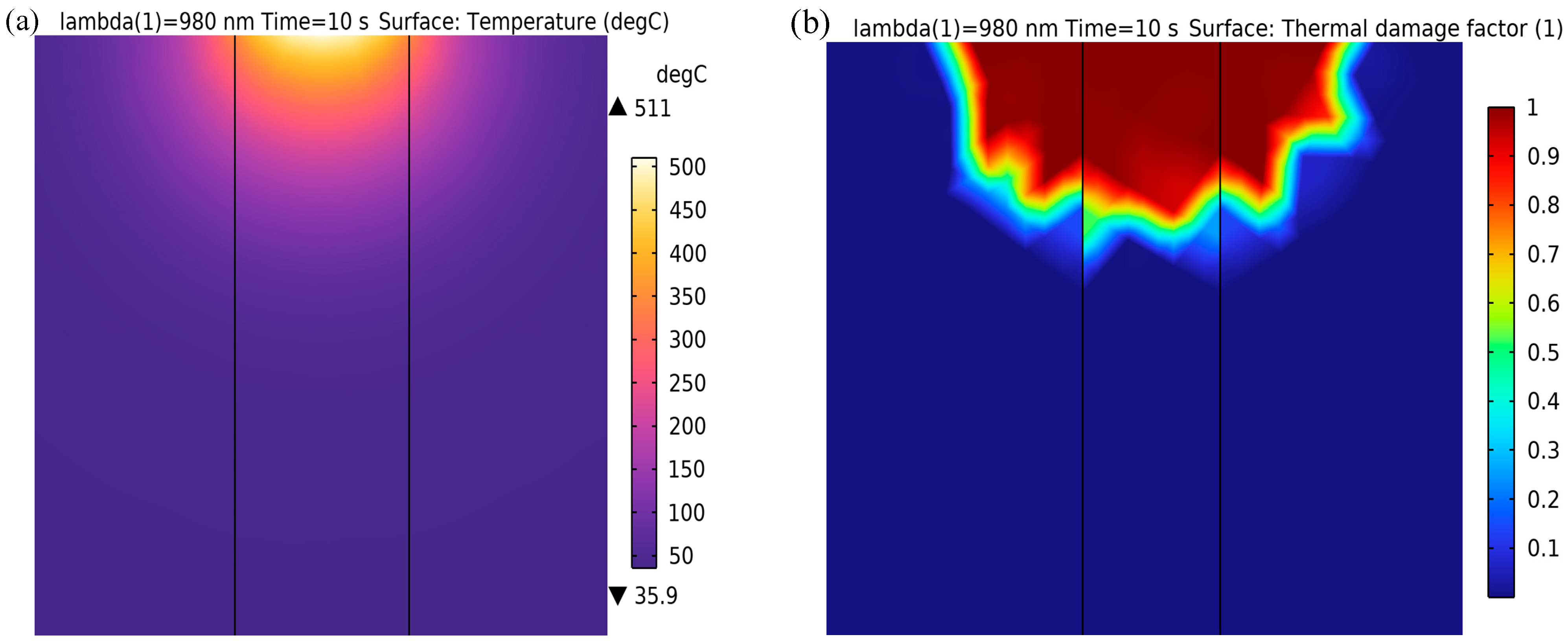
To verify the correctness of the photothermal coupling algorithm of this model, we conducted a benchmark test. While retaining the original physical field and optical parameters of our model, we strictly [23] adhered to the ex vivo porcine liver thermophysical parameters and laser settings (10 W power, without vaporization latent heat, i.e., α = 0 kJ/kg, 10 s irradiation time) provided in the literature. An identical geometric model was established and simulated accordingly. Under the same conditions, the peak temperature calculated by our model was 510.56 °C, which aligns closely with the peak temperature of 506 °C reported in the corresponding model from the literature. The relative error between the two is approximately 0.90%. This close agreement provides indirect validation for the reliability of the model developed in this study. The results of the benchmark simulation experiments are presented in Figure 2.

3. Results

3.1. Factors Influencing Photothermal Effects

Impact of Beam Waist Radius on Photothermal Efficiency

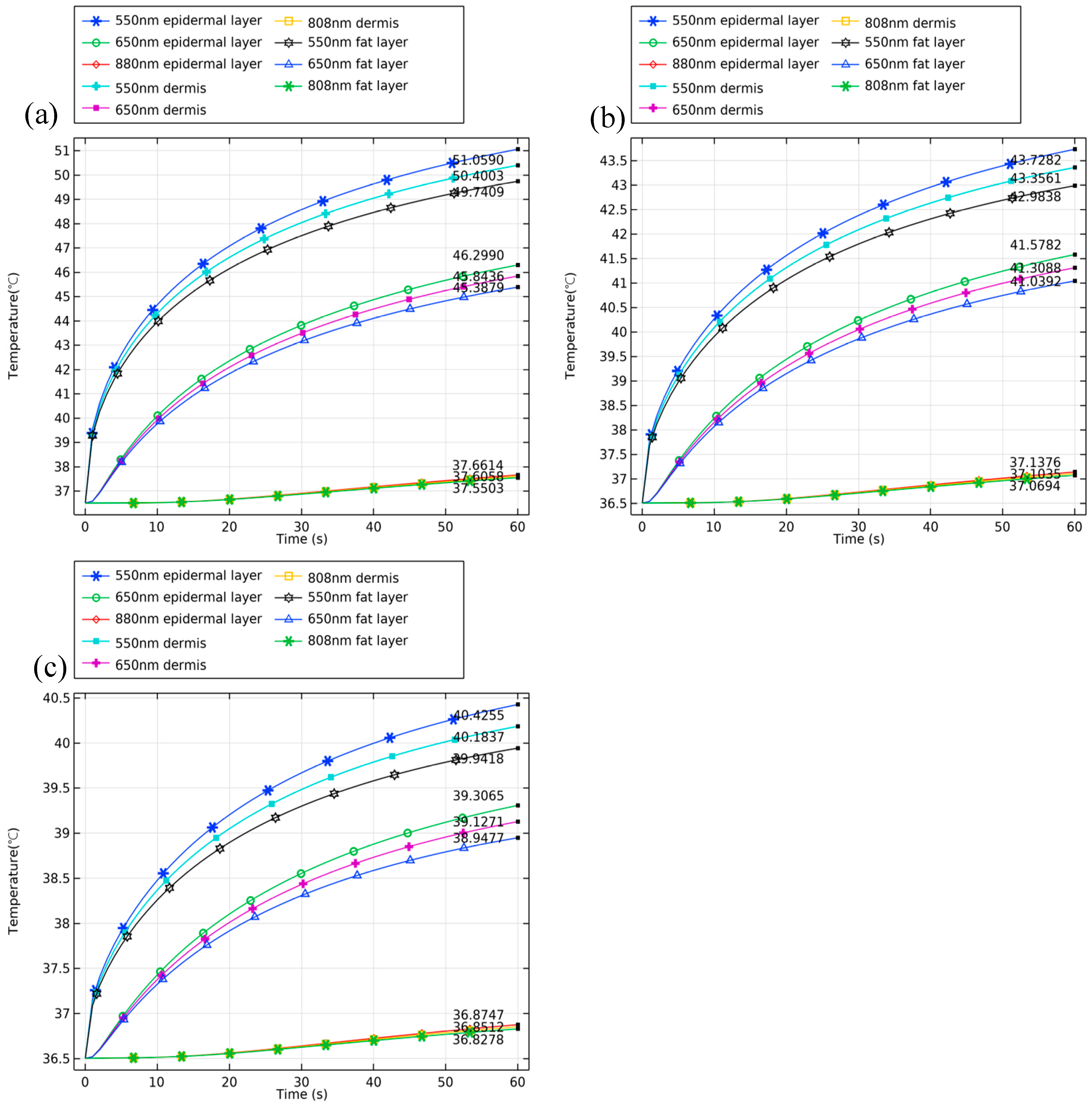
To ensure treatment safety, the input power was fixed at 50 mW [24]. The laser beam waist radii were configured to 2 mm, 3 mm, and 4 mm [25], corresponding to the stimulation ranges of traditional needle types like filiform needles and plum-blossom needles. The dynamic temperature distribution of the model irradiated for 60 s at wavelengths of 550 nm, 650 nm, and 808 nm was compared. The tissue temperature change curves are shown in Figure 3.
As shown in Figure 3, under the 2 mm waist radius, the peak epidermal temperature at the acupoint reached 51.05 °C, far exceeding the 45 °C thermal damage threshold temperature; it decreased to 50.40 °C in the 3 mm group and to 49.74 °C in the 4 mm group. This phenomenon indicates that as the beam waist radius increases, the spatial distribution of laser energy on the epidermis becomes more dispersed, reducing the energy density per unit area and consequently leading to a significant decrease in epidermal temperature accumulation. The peak epidermal temperature induced by the 808 nm laser with a 2 mm beam waist was observed to be 49.74 °C, which is marginally lower than the 51.05 °C and 50.40 °C generated by the 550 nm and 650 nm sources, respectively. This discrepancy is attributed to the higher absorption coefficients of epidermal tissue for 550 nm and 650 nm wavelengths, leading to more pronounced energy deposition and consequent heat accumulation within the epidermis. The temperature in the fat layer slightly decreased from 37.66 °C to 37.55 °C as the beam waist radius increased, indicating that the beam waist radius has a limited regulatory effect on deep tissue temperature, with the main influence concentrated in the epidermis and dermis. In summary, the epidermal temperature generated with the 2 mm beam waist radius significantly exceeded the 45 °C threshold, posing a significant risk of cellular thermal necrosis. Consequently, this parameter was excluded, and the subsequent analysis was focused on the tissue temperature distributions and thermal damage factors associated with the 3 mm and 4 mm beam waist radii.
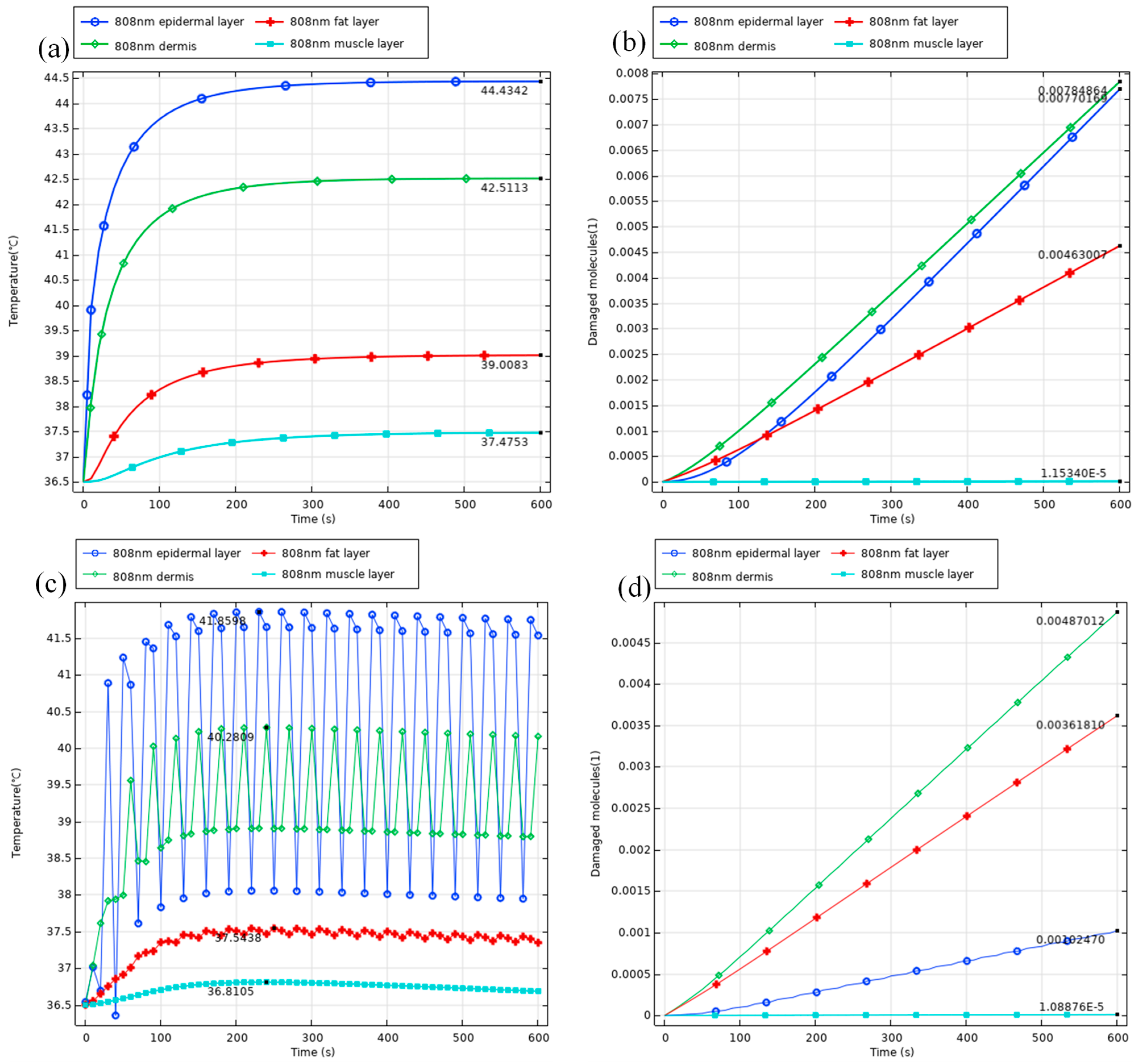
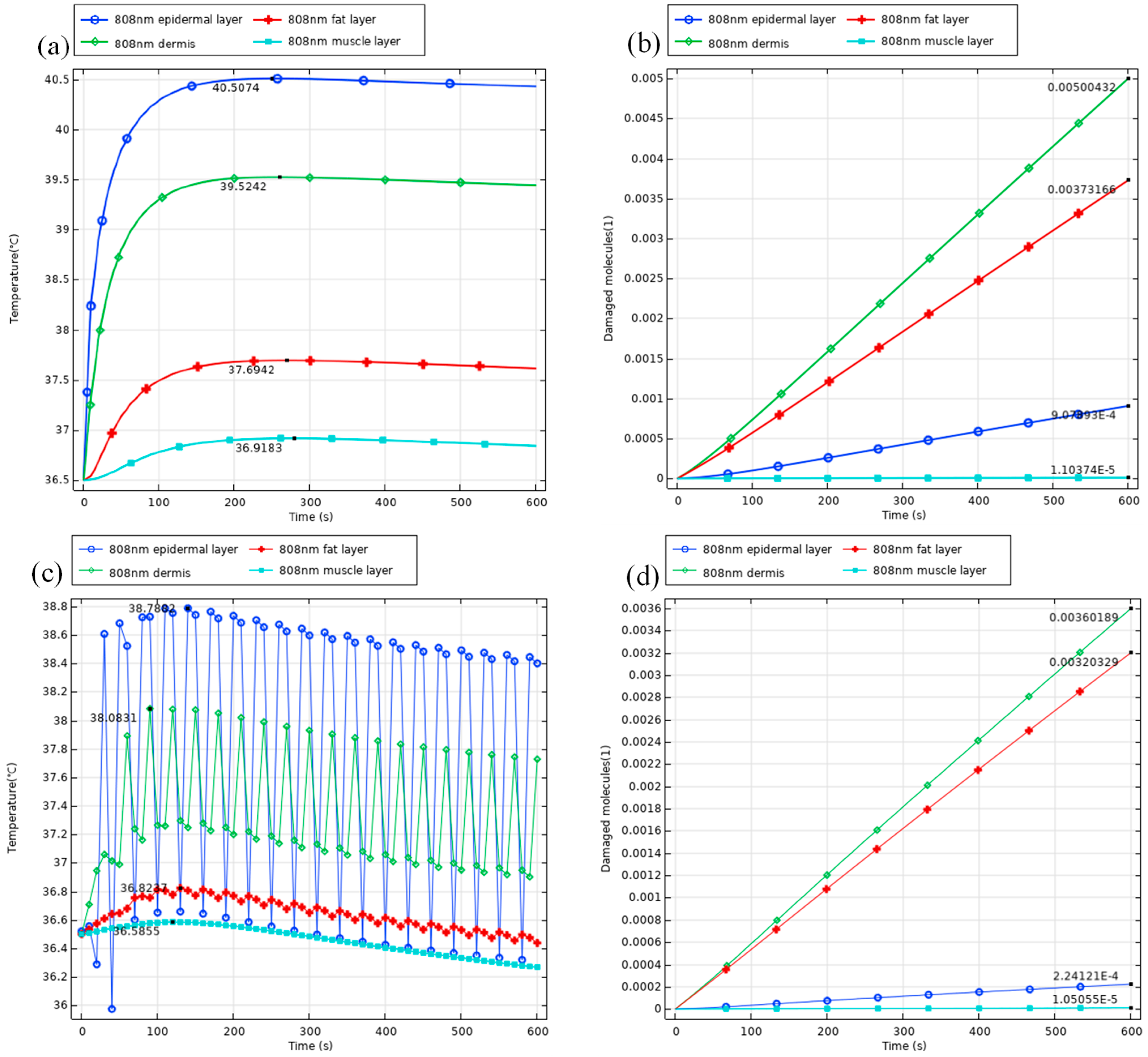
Using an 808 nm wavelength, 3 mm beam waist radius, and 50 mW input power as core parameters, the irradiation time was extended to 600 s to evaluate the “safe and effective” treatment window for different light source types under the 3 mm waist radius. The temperature distribution and thermal damage factor at the acupoint are shown in Figure 4.
Prolonged irradiation (600 s) with the Gaussian-collimated source led to a dynamic thermal equilibrium, as depicted in Figure 4a,b. This thermal profile presents a dual outcome: while the epidermal thermal damage factor remained low (0.0078), the temperature approached a level that risks latent keratin denaturation. Conversely, the stabilized dermal temperature of 42.51 °C is efficacious for stimulating vascular and neural activity [26], and the deep tissue temperature of 39.00 °C aligns closely with therapeutically optimal ranges (40–42 °C) [27,28].
The thermal response to the Gaussian periodic pulsed source Figure 4c,d was characterized by dynamic oscillations and a steep thermal gradient, mediated by its intermittent on-off duty cycle. The rapid energy deposition during laser pulses and convective cooling during off periods generated a confined therapeutic window of 40–42 °C in the epidermal and dermal layers. In deeper tissues, the combined effects of exponential energy attenuation and persistent heat dissipation resulted in minimal temperature elevation, thereby preventing significant thermal accumulation.
Using an 808 nm wavelength, 4 mm beam waist radius, and 50 mW input power as core parameters, the safe and effective treatment window for Gaussian collimated and periodic pulsed light sources under 600 s irradiation was investigated. The trends in acupoint temperature distribution and thermal damage factor are shown in Figure 5.
When the Gaussian-collimated source was employed, a slight temperature decrease was observed at 300 s. This can be attributed to the larger beam waist radius, which resulted in a weaker driver for tissue heat accumulation, allowing the heat dissipation rate to exceed the rate of heat generation. At this point, both the temperature and thermal damage factor across all tissue layers remained within safe thresholds. However, the temperature in the hypodermis was 36.91 °C, falling below the minimum effective therapeutic window of 40 °C. For the Gaussian periodic pulsed source, the combination of an increased beam area and the presence of irradiation off-periods led to lower overall temperature rise and a subsequent declining trend over time, with a maximum temperature of only 38.78 °C. In summary, the 4 mm beam waist criterion was excluded due to its inability to maintain temperatures within the effective therapeutic range, and only the 3 mm beam waist was adopted for subsequent investigation.

3.2. Photothermal Effects and Thermal Damage Mechanisms of Different Laser Types

The Role of Directed Heat Dissipation Layers in Thermal Management

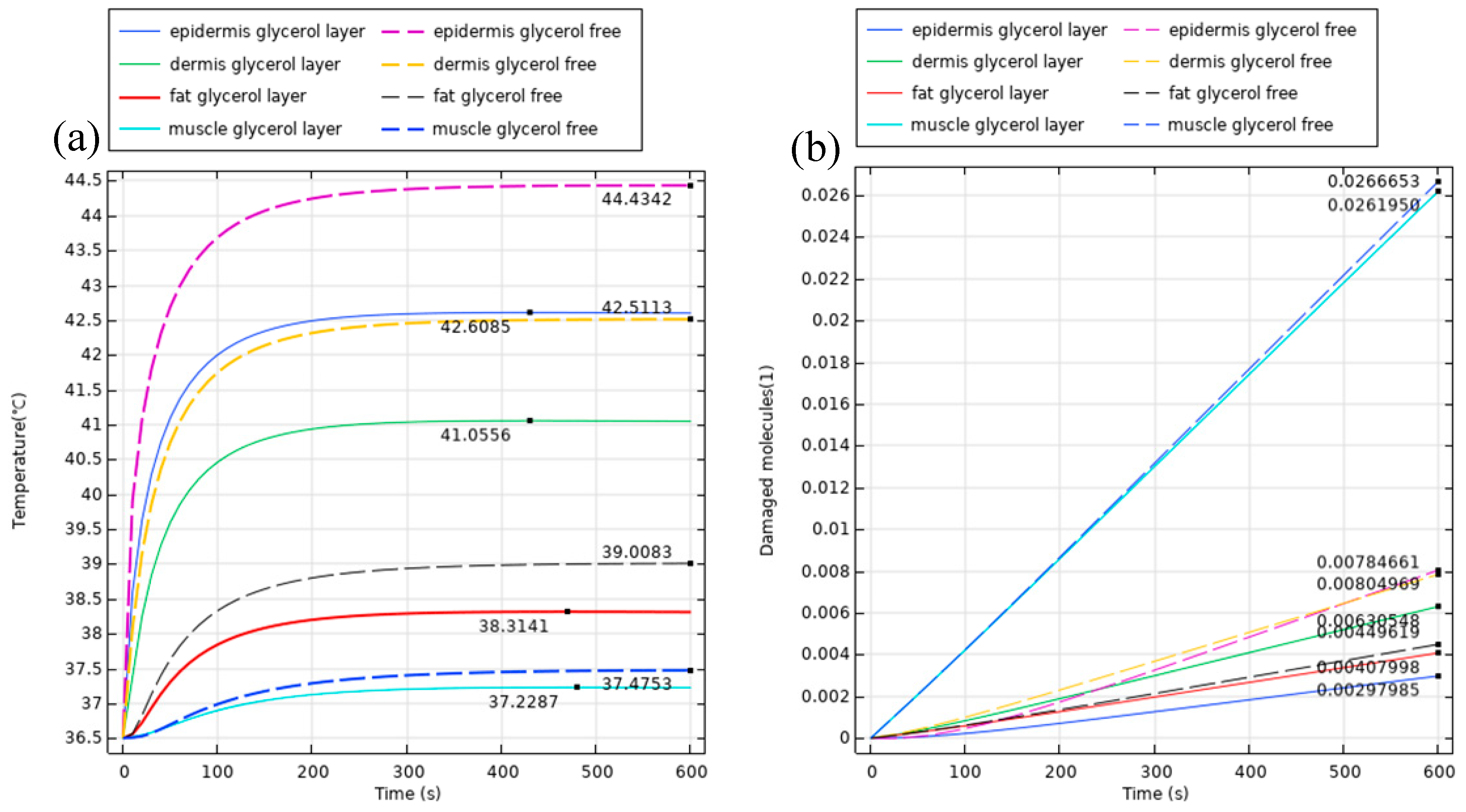
To mitigate the risk of epidermal critical temperature under the 3 mm waist radius with the Gaussian collimated light source, a 0.5 mm thick glycerol layer was introduced outside the epidermis as a directional thermal buffer medium for the acupoint. The thermal conductivity of glycerol (k = 0.28 W/(m·K)) is significantly higher than that of air (k = 0.026 W/(m·K)), and its optical absorption coefficient (μa,glycerol = 0.05 cm−1) is low, making laser energy attenuation in the glycerol layer negligible. The glycerol layer was defined as a stationary fluid domain (pure glycerol has very high viscosity at room temperature, no macroscopic flow). Heat exchange with air was simulated via “external forced convection,” with the external environment temperature set to 25 °C, wind speed 0.5 m/s, and convective side length 0.03 m. Taking the Gaussian collimated light source with 808 nm wavelength and 50 mW input power as an example, the tissue layer temperature distribution and thermal damage factor are shown in Figure 6.
As shown in Figure 6, the introduction of the glycerol layer resulted in a significant reduction of the peak epidermal temperature from 44.43 °C to 42.51 °C. Concurrently, the temperature in the hypodermis decreased only marginally from 39.00 °C to 38.31 °C. This phenomenon is attributed to a shift in the heat exchange modality from “natural air convection” to a “composite mechanism of glycerol-layer thermal conduction coupled with air convection.” This enhanced configuration increased the effective convective heat transfer coefficient by several-fold, thereby promoting efficient heat dissipation from the epidermis while exerting a minimal influence on the temperature of deeper tissues.

3.3. Model Stability Analysis

Effects of Power and Heat Dissipation Fluctuations on Photothermal Response and Thermal Damage

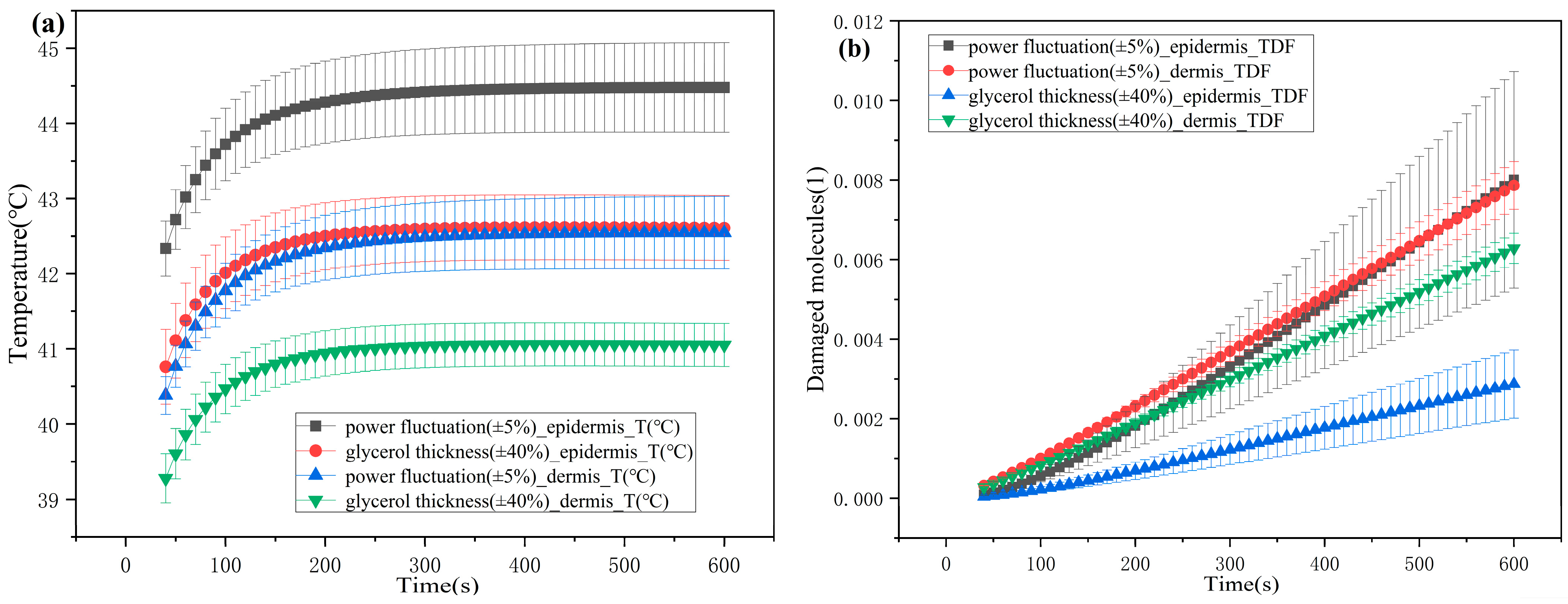
The model’s stability was verified by systematically perturbing key parameters—laser power (±5% from 50 mW) and glycerol layer thickness (±40% from 0.5 mm)—under the standard 808 nm, 3 mm beam waist, 600 s irradiation protocol. Using a one-factor-at-a-time approach, each parameter set was simulated with three independent replicates (n = 3). The statistical dispersion of the results was quantified by calculating the mean and standard deviation, presented with error bars in Figure 7.
As illustrated in Figure 7, fluctuations in laser power (±5%) resulted in epidermal temperatures ranging from 43.90 to 45.09 °C, slightly exceeding the 45 °C safety threshold in the simulation. The steady-state dermal temperature remained within a range of 42.08–43.04 °C. It is noteworthy that in the actual therapeutic scenario employing the Gaussian-collimated source with an external glycerol layer, the epidermal temperature is expected to reside within a safe margin. Variations in glycerol layer thickness (±40%) produced epidermal and dermal temperature ranges of 43.04–42.18 °C and 41.34–40.76 °C, respectively. Under both parametric perturbations, the Thermal Damage Factor (TDF) remained substantially below the subclinical injury threshold of α ≥ 0.15.

4. Discussion

The laser parameters established in this study—wavelength of 808 nm, beam waist radius of 3 mm, and power of 50 mW—were optimized through simulation to achieve an optimal balance between efficacy and thermal safety. The 808 nm wavelength lies within the near-infrared spectrum, which is characterized by a lower absorption coefficient and greater penetration depth in skin tissue. This spectral property helps to reduce energy accumulation in the epidermis while ensuring sufficient laser energy reaches the target regions in the dermis and subcutaneous tissue.
The choice of a 3 mm beam waist radius proved particularly critical. Simulation results indicated that a smaller radius (<2 mm) led to epidermal temperatures exceeding the 45 °C necrosis threshold, whereas a larger radius (>4 mm) resulted in deep-tissue temperatures below the intended 40 °C therapeutic window. The 3 mm radius provided the best compromise in the simulations, enabling adequate energy deposition in deeper layers while avoiding epidermal overheating.
A low power of 50 mW was selected in line with the “safe, low-power” principle often cited in laser acupuncture research. Under continuous irradiation for 600 s, this power level generated a stable thermal deposition profile in the simulated tissue model. A key innovation introduced in this study is the application of a glycerol layer. Owing to its substantially higher thermal conductivity compared to air and minimal optical absorption, the glycerol layer effectively dissipated excess heat from the epidermis. Simulation results demonstrated that the glycerol layer significantly reduced peak epidermal temperatures without substantially attenuating laser energy delivery to deeper tissues. This approach offers a novel thermal-management strategy for laser-based interventions.

5. Conclusions

To address the therapeutic requirements for acupoints at different depths, this study delineates differentiated optimal parameter schemes: (1) For superficial acupoints, a Gaussian periodic pulsed source with a 3 mm beam waist radius is identified as optimal, as it facilitates the establishment of an effective thermal stimulation window while concurrently avoiding epidermal damage. (2) For deep acupoints, an integrated approach utilizing a Gaussian-collimated source (3 mm beam waist) coupled with a glycerol layer is recommended. This configuration effectively mitigates the risk of superficial thermal damage while ensuring that the temperature within the dermal layer of the acupoint is maintained within the effective therapeutic range. This strategy allows for the flexible adjustment of both laser parameters and the cooling layer configuration in response to the requirements of different acupoint types, thereby enhancing the adaptability of laser acupuncture treatments. Furthermore, parameter stability analysis confirms that the model sustains a safe and effective thermal state even with permissible fluctuations in laser power and glycerol layer thickness.

Author Contributions

Conceptualization, Z.Z.; methodology, Z.Z. and S.H.; software, S.H.; validation, Z.Z. and S.H.; formal analysis, S.H. and R.X.; investigation, S.H. and S.X.; resources, S.H.; data curation, S.H. and W.X.; writing—original draft preparation, S.H. and Z.Z.; writing—review and editing, S.H. and Z.Z.; visualization, S.H. and H.D.; supervision, Z.Z.; project administration, Z.Z.; funding acquisition, Z.Z. and P.L. All authors have read and agreed to the published version of the manuscript.

Funding

This work was supported by the Fund of the Institute of Complexity Science, Henan University of Technology (Grant No. CSKFJJ-2026-6), the Henan Province Science and Technology Research Program, China (Grant No. 252102310444), and the Innovation Training Program for College Students of Henan University of Technology (Grant No. 202510463068).

Data Availability Statement

Data are contained within the article.

Conflicts of Interest

The authors declare no conflicts of interest.

Abbreviations

The following abbreviations are used in this manuscript:
TDFThermal Damage Factor
mWMilliwatt

References

  1. Wu, X.D.; Zhao, N.Q.; Ding, N.; Yuan, J.; Zhao, J.; Liu, Y.; Yang, Y.; Liu, B. Development and Interpretation of the World Federation of Acupuncture-Moxibustion Societies Standard “Guidelines for the Development and Evaluation of Clinical Practice Guidelines for Acupuncture”. Chin. J. Evid.-Based Med. 2025, 25, 460–466. [Google Scholar]
  2. Li, Y.; Wu, F.; Cheng, K.; Deng, H.; Zhao, L.; Zhang, H.; Shen, X.; Lao, L. Research Progress on the Mechanism of Analgesic Effect of Laser Acupuncture. China J. Tradit. Chin. Med. Pharm. 2018, 33, 2125–2131. [Google Scholar]
  3. Gong, W. Selective Photothermolysis Effect of Skin and Evaluation Methods and Techniques of Phototherapy and Thermal Damage. Ph.D. Thesis, Fujian Normal University, Fuzhou, China, 2010; pp. 25–42. [Google Scholar]
  4. Li, Y.; Yu, Y.; Liu, Y.; Yao, W. Mast Cells and Acupuncture Analgesia. Cells 2022, 11, 860. [Google Scholar] [CrossRef] [PubMed]
  5. Kim, M.; Kim, G.; Kim, D.; Yoo, J.; Kim, D.K.; Kim, H. Numerical Study on Effective Conditions for the Induction of Apoptotic Temperatures for Various Tumor Aspect Ratios Using a Single Continuous-Wave Laser in Photothermal Therapy Using Gold Nanorods. Cancers 2019, 11, 764. [Google Scholar] [CrossRef]
  6. Singh, S.; Escobar, A.; Wang, Z.; Zhang, Z.; Ramful, C.; Xu, C.Q. Numerical Modeling and Simulation of Non-Invasive Acupuncture Therapy Utilizing Near-Infrared Light-Emitting Diode. Bioengineering 2023, 10, 837. [Google Scholar] [CrossRef]
  7. Joensen, J.; Demmink, J.H.; Johnson, M.I.; Iversen, V.V.; Lopes-Martins, R.A.; Bjordal, J.M. The Thermal Effects of Therapeutic Lasers with 810 and 904 nm Wavelengths on Human Skin. Photomed. Laser Surg. 2011, 29, 145–153. [Google Scholar] [CrossRef]
  8. Zhang, D.; Ding, G.; Shen, X.; Yao, W.; Zhang, Z.; Zhang, Y.; Lin, J.; Gu, Q. Role of Mast Cells in Acupuncture Effect: A Pilot Study. Explore 2008, 4, 170–177. [Google Scholar] [CrossRef]
  9. Devi, K.G.; Mooventhan, A.; Mangaiarkarasi, N.; Manavalan, N. Effect of Needling at Selected Acupuncture Points (GB39, BL17, LR13) on Hemoglobin Levels in Anemia: A Randomized Placebo Controlled Study. J. Acupunct. Meridian Stud. 2023, 16, 263–267. [Google Scholar] [CrossRef]
  10. Jonasson, H.; Fredriksson, I.; Bergstrand, S.; Östgren, C.J.; Larsson, M.; Strömberg, T. Absorption and Reduced Scattering Coefficients in Epidermis and Dermis from a Swedish Cohort Study. J. Biomed. Opt. 2023, 28, 115001. [Google Scholar] [CrossRef]
  11. Shimojo, Y.; Nishimura, T.; Hazama, H.; Ozawa, T.; Awazu, K. Measurement of Absorption and Reduced Scattering Coefficients in Asian Human Epidermis, Dermis, and Subcutaneous Fat Tissues in the 400- to 1100-nm Wavelength Range for Optical Penetration Depth and Energy Deposition Analysis. J. Biomed. Opt. 2020, 25, 1–14. [Google Scholar] [CrossRef]
  12. Xu, F.; Li, G.Y.; Ramier, A.; Eltony, A.M. In Vivo Stiffness Measurement of Epidermis, Dermis, and Hypodermis Using Broadband Rayleigh-Wave Optical Coherence Elastography. Acta Biomater. 2022, 146, 295–305. [Google Scholar] [CrossRef]
  13. Chen, A.I.; Balter, M.L.; Chen, M.I.; Gross, D.; Alam, S.K.; Maguire, T.J.; Yarmush, M.L. Multilayered Tissue Mimicking Skin and Vessel Phantoms with Tunable Mechanical, Optical, and Acoustic Properties. Med. Phys. 2016, 43, 3117–3131. [Google Scholar] [CrossRef]
  14. Dimitrov, N.; Atanasova, D.; Tomov, N.; Georgieva, A.; Ivanova, I.; Dinkova, K.; Ganeva, I.; Staykova-Pirovska, Y.; Sivrev, D. Morphological basis of the therapeutic effect of acupuncture in ST36 acupoint. Scr. Sci. Medica 2016, 48, 66. [Google Scholar]
  15. Lister, T.; Wright, P.A.; Chappell, P.H. Optical Properties of Human Skin. J. Biomed. Opt. 2012, 17, 090901. [Google Scholar] [CrossRef] [PubMed]
  16. Bashkatov, A.N.; Genina, E.A.; Tuchin, V.V. Optical Properties of Human Skin, Subcutaneous and Mucous Tissues in the Wavelength Range from 400 to 2000 nm. J. Phys. D Appl. Phys. 2005, 38, 2543–2555. [Google Scholar] [CrossRef]
  17. Li, N.; Guo, Y.; Gong, Y.; Zhang, Y.; Fan, W.; Yao, K.; Chen, Z.; Dou, B.; Lin, X.; Chen, B.; et al. The Anti-Inflammatory Actions and Mechanisms of Acupuncture from Acupoint to Target Organs via Neuro-Immune Regulation. J. Inflamm. Res. 2021, 14, 7191–7224. [Google Scholar] [CrossRef]
  18. Zhang, Z.D.; Guo, Z.Y.; Wei, H.J.; Liu, H.P.; Zhong, H.Q.; Yang, H.Q.; Xie, S.S. Comparative Study of Reflectance Spectroscopy of Human Laogong Acupoint and Non-Acupoint Tissues Irradiated by Near-Infrared Laser. Spectrosc. Spect. Anal. 2009, 29, 2930–2933. [Google Scholar]
  19. Cheong, W.F.; Prahl, S.A.; Welch, A.J. A Review of the Optical Properties of Biological Tissues. IEEE J. Quantum Electron. 1990, 26, 2166–2185. [Google Scholar] [CrossRef]
  20. Webb, R.C.; Pielak, R.M.; Bastien, P.; Ayers, J.; Niittynen, J.; Kurniawan, J.; Manco, M.; Lin, A.; Cho, N.H.; Malyrchuk, V.; et al. Thermal Transport Characteristics of Human Skin Measured in Vivo Using Ultrathin Conformal Arrays of Thermal Sensors and Actuators. PLoS ONE 2015, 10, e0118131. [Google Scholar] [CrossRef]
  21. Hu, W.; Chen, J.; Sun, C.; Tong, X.; Lu, W.; Ju, Z.; Xia, Y.; Pei, Z.; Xu, M.; Xu, X.; et al. Spatial topological analysis of sympathetic neurovascular characteristic of acupoints in Ren meridian using advanced tissue-clearing and near infrared II imaging. Comput. Struct. Biotechnol. J. 2021, 19, 2236–2245. [Google Scholar] [CrossRef]
  22. Wang, L.; Jacques, S.L.; Zheng, L. MCML-Monte Carlo Modeling of Light Transport in Multi-Layered Tissues. Comput. Methods Programs Biomed. 1995, 47, 131–146. [Google Scholar] [CrossRef]
  23. Cheng, Y.; Shen, Y.; Gao, Y.; Wen, Y.; Lv, Z.; Wang, E.; Wang, M.; Zhang, S.; Bo, Y.; Peng, Q. Theoretical and Experimental Analysis of the Effect of Vaporization Heat on the Interaction between Laser and Biological Tissue. Appl. Sci. 2024, 14, 4333. [Google Scholar] [CrossRef]
  24. Litscher, G. History of Laser Acupuncture: A Narrative Review of Scientific Literature. Med. Acupunct. 2020, 32, 201–208. [Google Scholar] [CrossRef]
  25. Lin, M.L.; Wu, H.C.; Hsieh, Y.H.; Su, C.T.; Shih, Y.S.; Lin, C.W.; Wu, J.H. Evaluation of the Effect of Laser Acupuncture and Cupping with Ryodoraku and Visual Analog Scale on Low Back Pain. Evid. Based Complement. Altern. Med. 2012, 2012, 521612. [Google Scholar] [CrossRef]
  26. Mao, X.; He, H.; Ding, J. Efficacy of Laser Acupuncture for Treatment of Chronic Low Back Pain: A Systematic Review and Meta-Analysis. Pain Manag. Nurs. 2024, 25, 529–537. [Google Scholar] [CrossRef]
  27. Dewhirst, M.W.; Viglianti, B.L.; Lora-Michiels, M.; Hanson, M.; Hoopes, P.J. Basic Principles of Thermal Dosimetry and Thermal Thresholds for Tissue Damage from Hyperthermia. Int. J. Hyperth. 2003, 19, 267–294. [Google Scholar] [CrossRef]
  28. Fu, Q.; Jiang, H.; Yang, J.; Li, Y.; Fei, H.; Huang, J.; Li, Y.; Liu, M. Bypassing the Heat Risk and Efficacy Limitations of Pulsed 630 nm LED Photobiomodulation Therapy for Anti-Primary Dysmenorrhea: A Prospective Randomized Cross-Over Trial. Photonics 2024, 11, 136. [Google Scholar] [CrossRef]
Figure 1. Results of skin tissue model establishment. (a) Geometric dimensions of the model; (b) Layer stratification of the model.
Photonics 13 00085 g001
Figure 2. Schematic overview of key simulation outcomes. (a) Spatial distribution of temperature; (b) Distribution map of the thermal damage factor.
Photonics 13 00085 g002
Figure 3. Temperature distribution curves of acupoint tissue under different beam waist radii. (a) 2 mm waist radius; (b) 3 mm waist radius; (c) 4 mm waist radius.
Photonics 13 00085 g003
Figure 4. Simulation results of temperature and thermal damage factor (TDF) for two types of light sources. (a) Temperature of Gaussian collimated light source; (b) TDF of Gaussian collimated light source; (c) Temperature of Gaussian periodic pulsed light source; (d) TDF of Gaussian periodic pulsed light source.
Photonics 13 00085 g004
Figure 5. Simulation results of temperature and TDF for two types of light sources. (a) Temperature of Gaussian collimated light source; (b) TDF of Gaussian collimated light source; (c) Temperature of Gaussian periodic pulsed light source; (d) TDF of Gaussian periodic pulsed collimated light source.
Photonics 13 00085 g005
Figure 6. Simulation results of the effect of the glycerol layer on heat transfer. (a) Dynamic temperature distribution curves of model tissue with and without a glycerol layer; (b) Dynamic curve of TDF.
Photonics 13 00085 g006
Figure 7. Effects of laser power and glycerol layer thickness fluctuations on temperature and TDF of epidermis and dermis. (a) Error bars for temperature influence; (b) Error bars for TDF influence.
Photonics 13 00085 g007
Table 1. Thermal parameters of each layer in the skin model.
Tissue Typeρ(kg/m3)C(J/(kg⋅K))k(W/(m⋅K))Ꞷb(1/s)
Epidermis110933910.450.0005
Dermal Papillary Layer100933000.520.0005
Dermal Reticular Layer110933910.480.0005
Fat Layer91123480.190.0005
Muscle Layer109034210.580.0005
Acupoint Papillary Derm100933000.520.0006
Acupoint Reticular Derm110933910.480.0006
Note: ρ is density, C is specific heat capacity, k is thermal conductivity, Ꞷb is blood perfusion rate.
Table 2. Parameters of Each Component in the Optical Module.
ParameterSymbolValueUnit
Beam TypeIgauss——
Beam Powerp50mW
Vacuum Wavelengthλ880nm
Refractive Index of Airμ1.0——
Radius of Scattering Particlesr1.0um
Beam Waist Radiusw02–4mm
Disclaimer/Publisher’s Note: The statements, opinions and data contained in all publications are solely those of the individual author(s) and contributor(s) and not of MDPI and/or the editor(s). MDPI and/or the editor(s) disclaim responsibility for any injury to people or property resulting from any ideas, methods, instructions or products referred to in the content.