Article

Interpretation of Mode-Coupled Localized Plasmon Resonance and Sensing Properties


1
Department of Electrical and Electronic Engineering, National Institute of Technology (NIT), Oita College, 1666 Maki, Oita 870-0152, Japan
2
Faculty of Advanced Technology and Engineering, VNU Vietnam–Japan University, Vietnam National University, Luu Huu Phuoc Street, Tu Liem Ward, Hanoi 12016, Vietnam
*
Authors to whom correspondence should be addressed.
Photonics 2026, 13(1), 68; https://doi.org/10.3390/photonics13010068

Submission received: 25 November 2025 / Revised: 23 December 2025 / Accepted: 7 January 2026 / Published: 12 January 2026
(This article belongs to the Special Issue Optical Metasurface: Applications in Sensing and Imaging)

Abstract

Plasmonic nanostructures support localized surface plasmon resonances (LSPRs) which exhibit intense light–matter interactions, producing unique optical features such as high near-field enhancements and sharp spectral signatures. Among these, plasmon hybridization (PH) and Fano resonance (FR) are two key phenomena that enable tunable spectral responses, yet their classification is often ambiguous when based only on geometry or extinction spectra. In this study, we systematically investigate four representative nanostructures: a simple nanogap dimer (i-type structure), a dolmen structure, a heptamer nanodisk cluster, and a nanoshell particle. We utilize discrete dipole approximation (DDA) to analyze these structures. By separating scattering and absorption spectra and introducing quantitative spectral metrics together with near-field electric-field vector mapping, we provide a unified procedure to interpret resonance origins beyond intensity-only near-field plots. The results show that PH-like behavior can emerge in a dolmen structure commonly regarded as a Fano resonator, while FR-like characteristics can appear in the i-type structure under specific conditions, underscoring the importance of scattering/absorption decomposition and vector-field symmetry. We further evaluate refractive-index sensitivities and discuss implications for plasmonic sensing design.

1. Introduction

Localized surface plasmon resonance (LSPR) is a phenomenon arising from the collective oscillation of free electrons in metal and semiconductor nanostructures, enabling strong scattering and absorption from the ultraviolet to the near-infrared spectral region [1,2,3]. In plasmonic architectures supporting multiple modes within a narrow spectral range—such as oligomers, multimers, and asymmetric hybrid nanostructures—mode coupling often yields complex resonance responses that are commonly interpreted either as plasmon hybridization (PH) or as Fano-type interference between radiative (bright) and subradiant (dark) modes [4,5,6,7,8,9]. These coupled-mode phenomena are central to the design of plasmonic sensors, metasurfaces, and optical antennas.
Fano resonance (FR) is a representative interference effect in plasmonics, where the interaction between a broad bright mode (typically dipolar and radiative) and a narrow dark mode (typically higher-order and weakly radiative) produces an asymmetric scattering spectrum [5,6,10,11,12]. Such asymmetric line shapes and sharp spectral features have motivated applications in optical filtering and refractive-index sensing [6,13,14,15]. Related mode-coupling concepts have also been used to tailor optical responses in emission-related devices [12,16,17]. In parallel, PH provides a useful physical picture for understanding resonance splitting and mode evolution as a function of geometry and coupling strength [4,8,9].
Despite extensive prior work, distinguishing whether a particular spectral feature is dominated by PH or by Fano-type interference is not always straightforward. For example, i-type dimer systems have been discussed using both frameworks depending on the coupling scenario and the modes involved [18,19]. Dolmen-type systems are often presented as prototypical Fano resonators [20,21,22]; however, Misawa and colleagues reported that the optical response of dolmen nanostructures can be more consistent with hybridization-dominated behavior based on photoemission electron microscopy observations combined with numerical simulations [23]. These studies indicate that assigning a resonance mechanism solely from a structural label may oversimplify the underlying physics.
A methodological limitation contributes to this ambiguity. Many studies infer resonance mechanisms mainly from extinction spectra and near-field intensity maps. Extinction merges scattering and absorption contributions, which can obscure whether a resonance is predominantly radiative or absorptive. Moreover, intensity maps do not capture the vectorial nature of multipolar fields and are therefore insufficient, by themselves, to identify mode order or to separate interference-induced cancelation from hybridization-induced splitting. Accordingly, an analysis framework that explicitly separates scattering and absorption and connects spectral signatures to mode character is valuable for consistent interpretation across different plasmonic architectures.
In this study, we investigate four representative plasmonic nanostructures—an i-type dimer, dolmen structures, a heptamer nanodisk cluster, and a nanoshell particle—using the discrete dipole approximation (DDA) method [24,25,26] with established optical constants [27]. We introduce a unified evaluation framework that combines (i) scattering–absorption separation, including the scattering-to-absorption ratio, (ii) quantitative measures of spectral asymmetry and dip characteristics, and (iii) mode-order identification based on electric-field vector maps (and the corresponding charge pattern). Applying this framework, we show that structural motifs alone are insufficient to uniquely determine resonance origin, and we provide a consistent interpretation of PH-like and Fano-like responses across the canonical geometries considered. Finally, using refractive-index sensing as an example application, we compare sensitivities and discuss how they relate to resonance wavelength and mode character.

2. Method and Conditions of the DDA Simulation

Numerical electromagnetic simulations were performed using the DDA method, employing the DDSCAT 7.3 [24,25,26] software to investigate the optical spectra of the absorption efficiency Qabs, scattering efficiency Qsca, and the extinction efficiency Qext, which is the sum of these, and the vector of electric field E, in target structures. In this paper, E denotes the complex electric-field vector obtained from the frequency-domain DDA calculation at each wavelength. The i-type dimer, dolmen, and heptamer structures, which were composed of gold, and a nanoshell structure, which was composed of gold and silica, were targeted in this study. In all cases, linearly polarized light was incident. The dipole element spacing of each simulated model was fixed to 2 nm. The surrounding medium is vacuum or a dielectric material with refractive index n < 1.8 without attenuation, ignoring dispersion. In Section 3.1, Section 3.2, Section 3.3 and Section 3.4, the surrounding medium is set to vacuum (n = 1.0) unless otherwise stated. In the refractive-index sensing analysis (Section 3.5), the surrounding refractive index n is varied to evaluate the peak shift and sensitivity. The value of the dielectric function of gold is taken from the study by Johnson and Christy [27], neglecting size dependence. The refractive index of the silica core is fixed at 1.45 without attenuation, ignoring dispersion.
In all subsequent two-dimensional distribution maps of the electric-field vector E and the electric field intensity (squared magnitude of the complex field) |E|2, the observed planes were the cross-section to the EB direction through the center of each structure. The arrows show the instantaneous in-plane electric-field vectors Einst (ϕ0) defined as
E inst ϕ 0 = E exp ( i ϕ 0 )
where ϕ0 is a fixed phase reference used for visualization. In this work, ϕ0 is set to π/4, which corresponds (up to a constant factor) to a weighted combination of the real and imaginary parts and provides a clear visualization of the vectorial field symmetry. Importantly, the multipole symmetry inferred from the charge-lobe pattern is invariant under a global phase shift. The induced charge pattern is inferred from the normal component on the metal boundary as σinst (R; ϕ0) ∝ n·Einst (R; ϕ0). The multipole order is assigned from the number and symmetry of sign-alternating charge lobes inferred from σinst. Near-field/charge analyses are used to identify the multipole order and to validate physical consistency, while the PH/FR classification is primarily based on the spectral metrics.
The resonance type is primarily classified using “spectral metrics (i.e., quantitative spectral descriptors extracted from the scattering/absorption spectra)”, including the separation between scattering and absorption, the depth of the dip, and the asymmetry. The scattering asymmetry parameter α is defined as Equation (2):
α = Q sca , long Q sca , short Q sca , long + Q sca , short
where Qsca,long and Qsca,short denote the scattering efficiencies at the local maxima corresponding to the long- and short-wavelength peaks, respectively. The dip-depth parameter δdip,long is defined as Equation (3):
δ dip , long = 1 Q sca , dip Q sca , long
and the scattering-to-absorption ratio RSA = Qsca/Qabs evaluated at the extracted peak/dip wavelengths. Here, Qsca,dip denotes the scattering efficiency at the local minimum (dip) wavelength between the two peaks.

3. Results and Discussions

3.1. i-Type Dimer

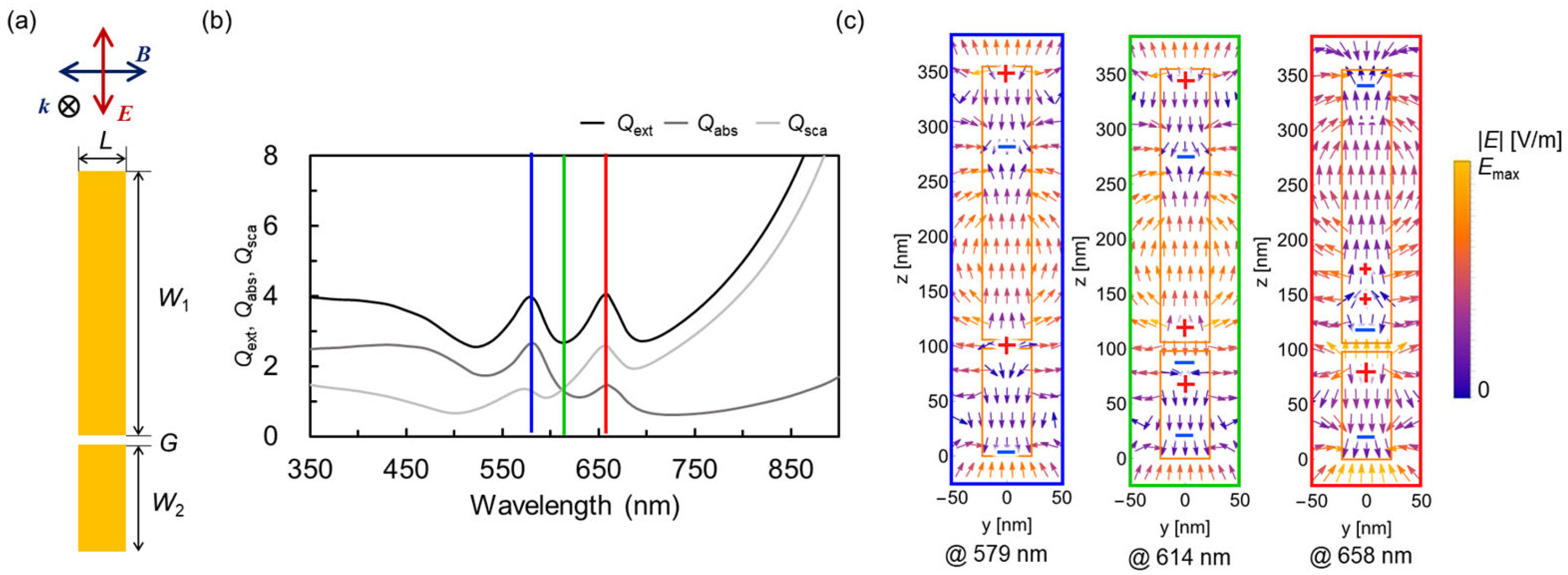
As illustrated in Figure 1a, the geometry of the i-type structure used in the numerical simulation is shown. The effective radius and uniform thickness are set to 50.0 nm and 45.0 nm, respectively. Here, the effective radius is defined as the radius of a sphere having the same volume as the target structure (i.e., the volume-equivalent sphere radius), which is used as a compact descriptor of the target size in DDA/DDSCAT. The remaining structural parameters are provided in the figure caption. Figure 1b shows the absorption (dark gray line), scattering (light gray line), and extinction (black line) spectra, and Figure 1c presents the electric vector distributions at two peak wavelengths and one dip wavelength. As shown in Figure 1b, the spectra of the i-type dimer exhibit two resonances corresponding to the bonding (red-shifted) dipolar mode and antibonding (blue-shifted) multipolar mode. The bonding mode is diminished by scattering, reflecting its bright character, whereas the antibonding mode is dominated by absorption, consistent with its subradiant nature. The electric-field vector distributions in Figure 1c further support this interpretation: the bonding mode displays an extended dipolar field across the dimer. In contrast, the antibonding mode generates a strong hotspot confined within the nanogap. In general, metal nano-dimers are known to exhibit typical PH behavior [18]. However, when the complete spectral response is considered, pronounced asymmetries in scattering and absorption appear, indicating that the optical properties are strongly influenced by the Fano resonance. This observation is consistent with the findings of Yang et al. [19]. Analysis of near-field vector distributions shows that, at the wavelength of the red-shifted side, the charge configuration is inferred from the appearance of a hexapole-like structure. Nevertheless, analysis of the vector directions and magnitudes reveals that the dipole mode between the gaps is predominant, while the other components exhibit only minor amplitudes. It is therefore reasonable to infer that the dipole mode dominates, a conclusion supported by both the spectral features and the electric field distributions (shown in Figure S1a). The overall optical response can be described as a hybrid type arising from both Fano resonance and PH, though it is concluded that the contribution from Fano resonance is dominant.

3.2. Dolmen Structure

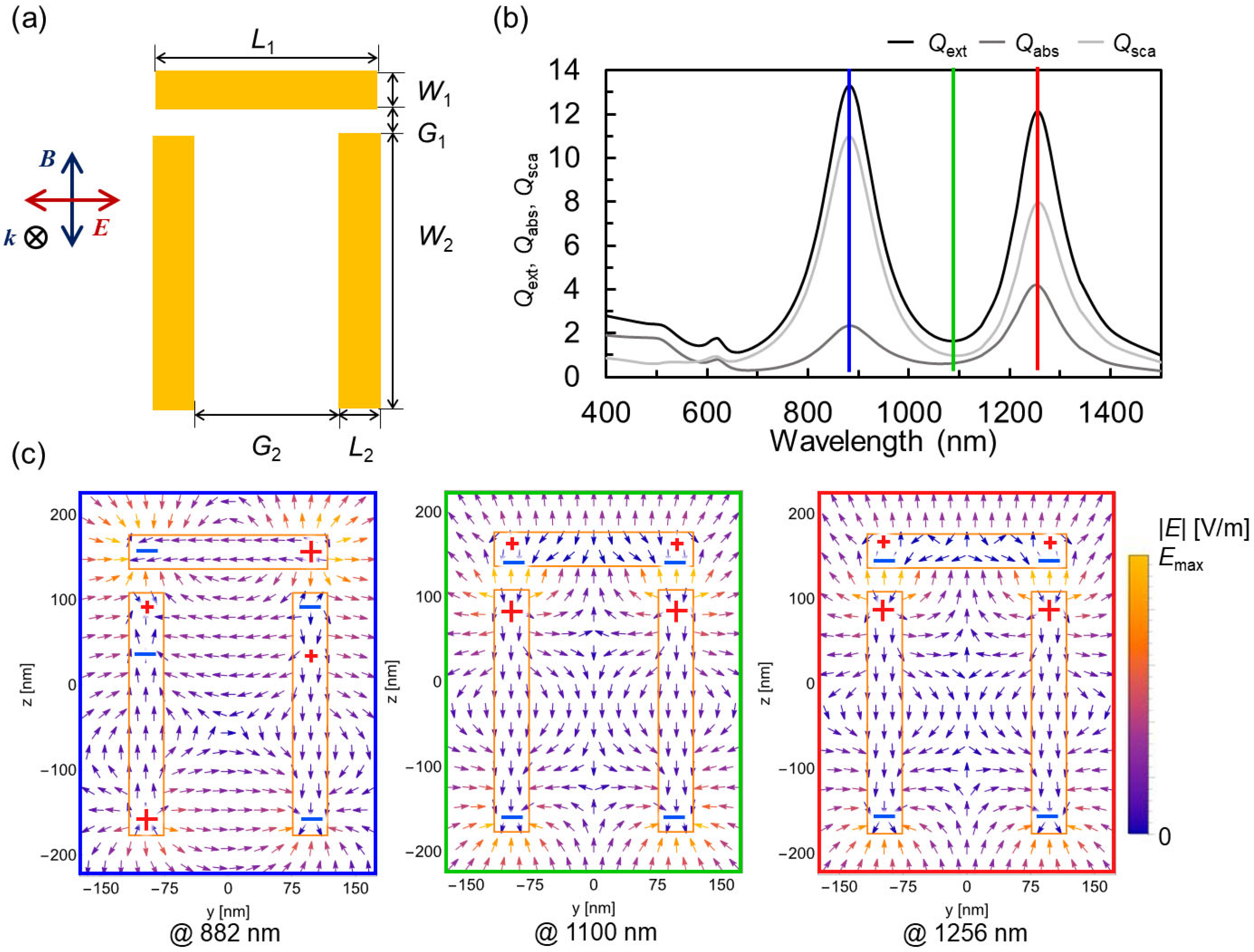
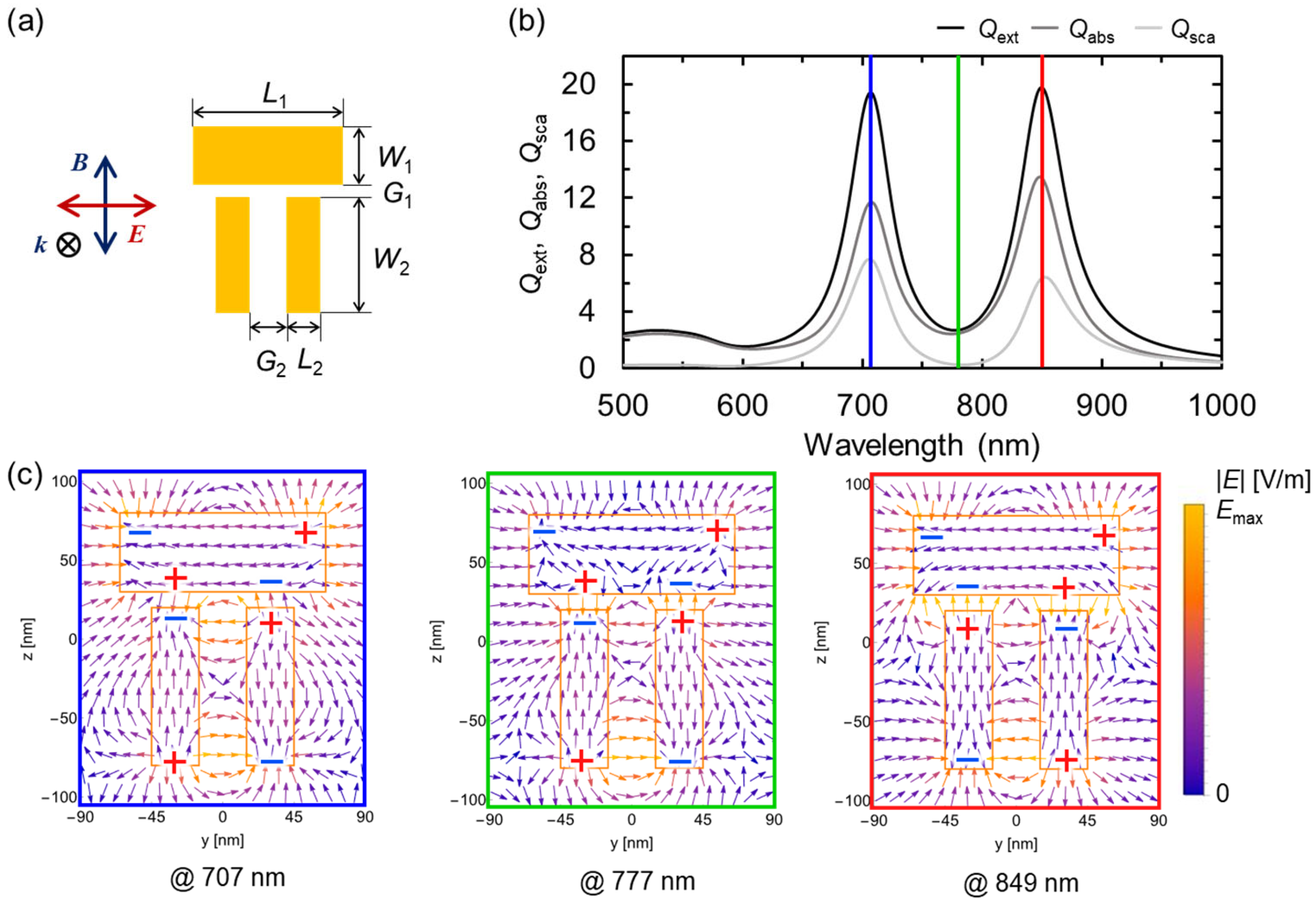
Dolmen structures are often reported to exhibit optical properties derived from Fano resonance and are considered typical examples of such behavior [20,21,22]. Figure 2 and Figure 3 show the following: (a) the calculation models for dolmen structures with different structural parameters, (b) their optical spectra, and (c) their electric-field vector diagrams. The effective radii of the dolmen structures shown in Figure 2 and Figure 3 are set to 39.0 nm and 85.6 nm, respectively. The remaining structural parameters are provided in the figure captions.
In Figure 2b, the peak on the short-wavelength side (shown in blue) is dominated primarily by scattering. In contrast, the peak on the long-wavelength side (shown in red) is affected by both scattering and absorption to similar degrees. This asymmetry in the scattering spectrum indicates that the observed behavior originated from Fano resonance. On the other hand, the spectrum in Figure 3b shows that absorption and scattering are comparable for both the short- and long-wavelength peaks, with absorption being slightly larger in each case. Furthermore, no asymmetry is observed in the scattering spectrum. Therefore, the optical properties in Figure 3 cannot be attributed to Fano resonance, but rather to PH mode coupling among multipoles.
When the electric-field vector diagrams in Figure 2c and Figure 3c are compared with the expected charge distributions, the short-wavelength peak in Figure 2 appears to exhibit an octupole-like excitation. However, considering the field intensity, the dominant contribution is attributed to the dipole-type (bright-mode) excitation, while the contribution from the two parallel blocks is minor. The resonant mode corresponding to the long-wavelength peak also appears, at first glance, to show an octupole-like pattern. However, unlike the short-wavelength case, the quadrupole-type (dark-mode) excitation formed by the two parallel blocks becomes dominant. In Figure 3c, the electric-field intensities at each pole are comparable for both peaks, indicating that hexapole or octupole modes are excited. Consequently, the observed optical characteristics are likely due to PH. These results support the interpretation proposed by Misawa et al.
This indicates that the origin of the optical properties cannot be uniquely determined based solely on the structural scheme of the dolmen configuration. Instead, a comprehensive examination of various factors, including the ratio between scattering and absorption spectra, the asymmetry of the spectral shape, the intensity of the electric-field vector, and the charge distribution inferred from it, allows for a clearer understanding of the observed optical characteristics. Therefore, detailed spectral analysis and investigation of the electric-field vectors are shown to be highly effective. The electric-field distribution presented in Figure S1 supports the conclusions described above.

Gap-Dependence Study of the Dolmen Structures

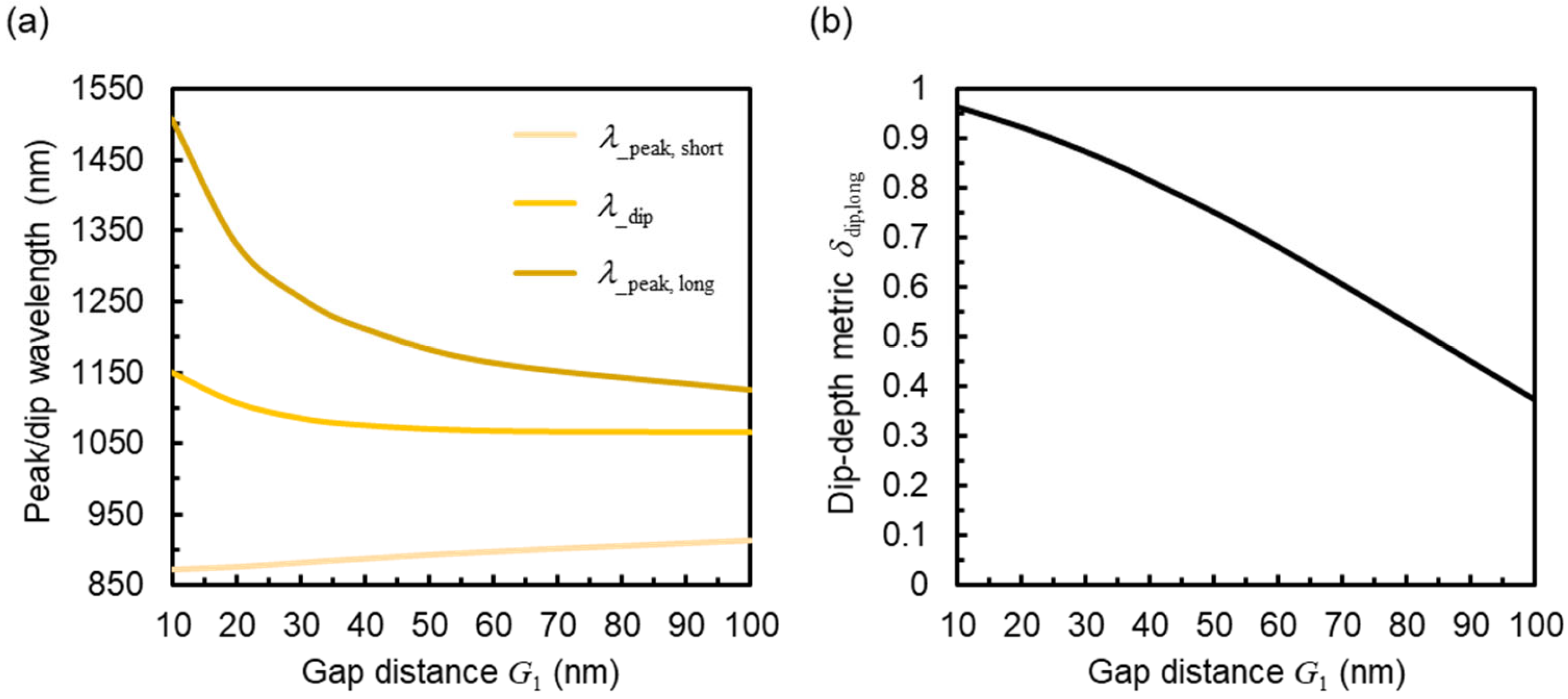
To provide a systematic view of how the coupling strength affects the resonance characteristics, we performed a parameter sweep of the gap distance G1 in dolmen structure 1 while keeping all other geometrical parameters fixed. Figure 4 summarizes the extracted short-peak, dip, and long-peak wavelengths, together with the quantitative metrics δdip,long. Table 1 lists extracted peak/dip wavelengths and quantitative spectral metrics for the gap-dependence of dolmen structure 1. The short-peak, dip, and long-peak wavelengths (λ_peak,short, λ_dip, λ_peak,long) are determined from the extinction spectrum. Full extracted values (Qext, Qabs, Qsca and RSA,dip) are provided in Supplementary Table S1.
As G1 increases from 10 to 100 nm, λ_peak,long exhibits a pronounced blueshift from 1508 to 1126 nm, whereas λ_dip remains nearly constant around 1070 nm for G1 ≥ 40 nm. Importantly, the dip-depth metric δdip,long decreases monotonically from 0.965 to 0.377, indicating that scattering cancelation becomes progressively weaker as the coupling gap increases, even when the overall spectral profiles appear qualitatively similar. In addition, the scattering-to-absorption ratios RSA,short and RSA,long increase with G1, suggesting a systematic evolution of the radiative character of the resonant response. These results provide an objective basis for evaluating the continuous variation in interference strength and radiative contributions in dolmen-type structures.
The physical meaning of this evolution is further supported by the gap-dependent decomposition of Qsca and Qabs shown in Figure S2. With increasing G1, the long-wavelength scattering peak decreases markedly and shifts to shorter wavelengths, while the corresponding absorption peak remains clearly observable. This behavior is consistent with a gradual weakening of the destructive-interference condition responsible for the pronounced scattering dip and a reduced contrast between the long-wavelength scattering maximum and the intermediate minimum, in agreement with the monotonic decrease in δdip,long. Taken together, the spectral metrics (Table 1) and the direct scattering/absorption decomposition (Figure S2 and Table S1) support the interpretation that dolmen structure 1 evolves continuously from an interference-dominated (FR-like) regime at small gaps to a weak-interference regime with increased hybridization character at larger gaps, with intermediate cases naturally treated as mixed.
Using the same spectral-metric definitions, we also evaluated dolmen structure 2, which exhibits a clear two-peak scattering spectrum with an intermediate dip. For dolmen2, α = −0.098 and δdip,long = 0.959. Together with the mode-order identification from the near-field/charge symmetry presented above, these results support a PH-like interpretation for dolmen2. This confirms that the proposed metrics are not limited to dolmen1 and can be consistently applied to both dolmen geometries.

3.3. Heptermer Structure

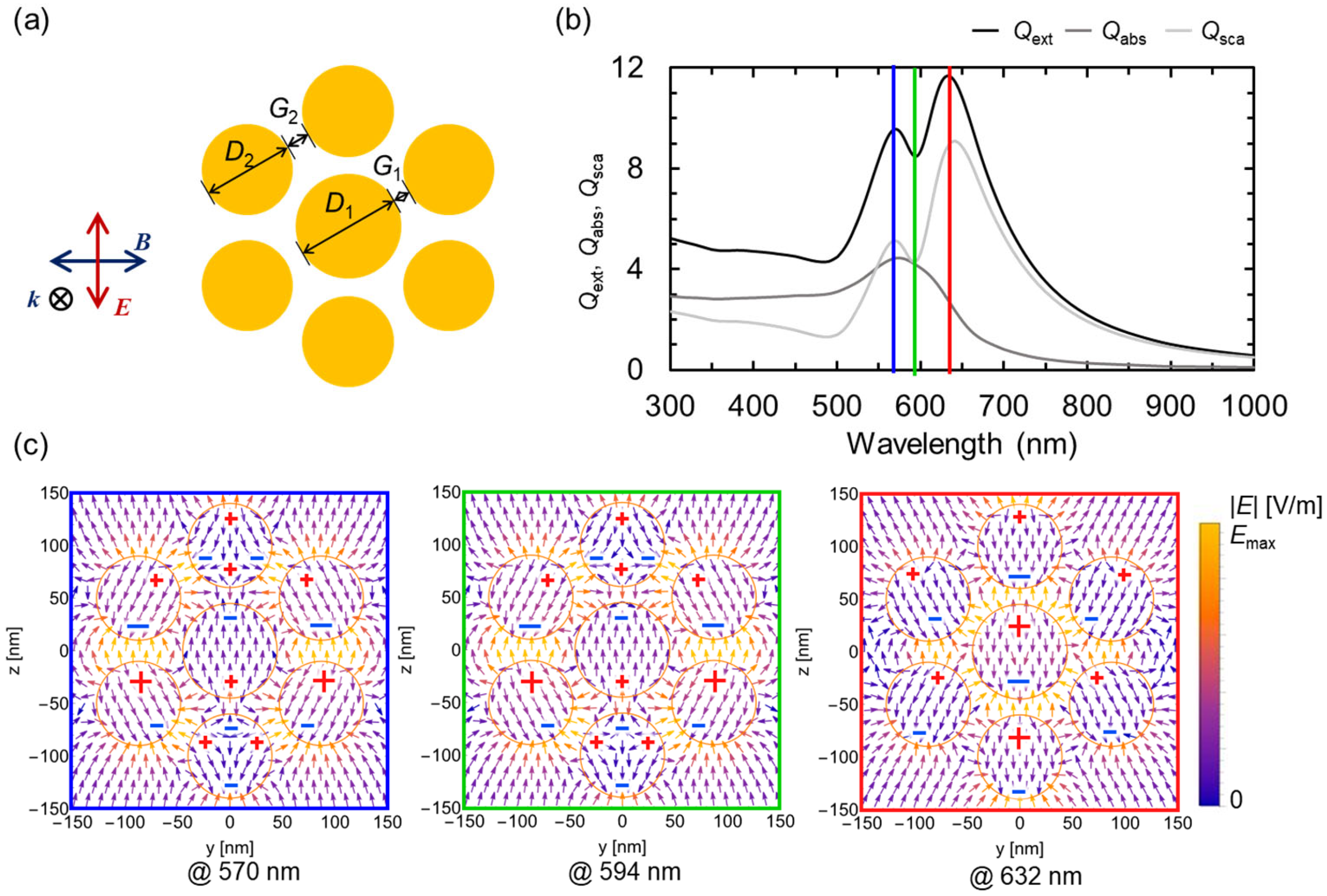
Figure 5 illustrates the computational model of the heptamer structure, along with the optical spectra, electric-field vector maps, and predicted charge distributions obtained from the DDA simulations. The structural parameters, such as disk sizes, gaps, and film thickness, are provided in the figure caption. This structure is known to exhibit a typical Fano resonance [28,29], as shown in Figure 5a.
In Figure 5b, a pronounced asymmetry in the scattering spectrum is revealed. Notably, on the short-wavelength side, both the scattering and absorption peaks have comparable magnitudes, whereas on the long-wavelength side, the scattering peak dominates while absorption is negligible. In the absorption–scattering separation, the characteristic behavior was confirmed in which scattering is significantly suppressed near the Fano dip, while absorption remains. Specifically, although the intensities of the scattering and absorption peaks are comparable on the short-wavelength side, the scattering peak dominates on the long-wavelength side, with absorption being negligible.
The resonant modes indicated by the electric-field vectors in Figure 5c are complex. However, based on the vector intensity, the short-wavelength resonance arises primarily from interactions between the adjacent small disks aligned parallel to the incident electric field, resulting in an overall quadrupole-type mode for the entire system. In contrast, the long-wavelength resonance is dominated by the central large disk, corresponding to a dipole-type mode. The electric-field distributions shown in Figure S1d also confirm that the short-wavelength resonance corresponds to a multipole-type mode, whereas the long-wavelength resonance corresponds to a dipole-type mode, consistent with the asymmetry in the spectra and the predicted charge distributions.
For the heptamer structure, it is imperative to consider both the scattering and the absorption spectra, rather than relying on the extinction spectrum alone. Although the two peaks that appear in the extinction spectrum, their physical origin cannot be unambiguously determined from extinction data only. A more reliable interpretation is obtained by treating the scattering and absorption spectra as the primary analytical basis, while using the charge distribution maps as shown in Figure 5c to confirm the underlying resonance mechanism.

3.4. Nanoshell Structure

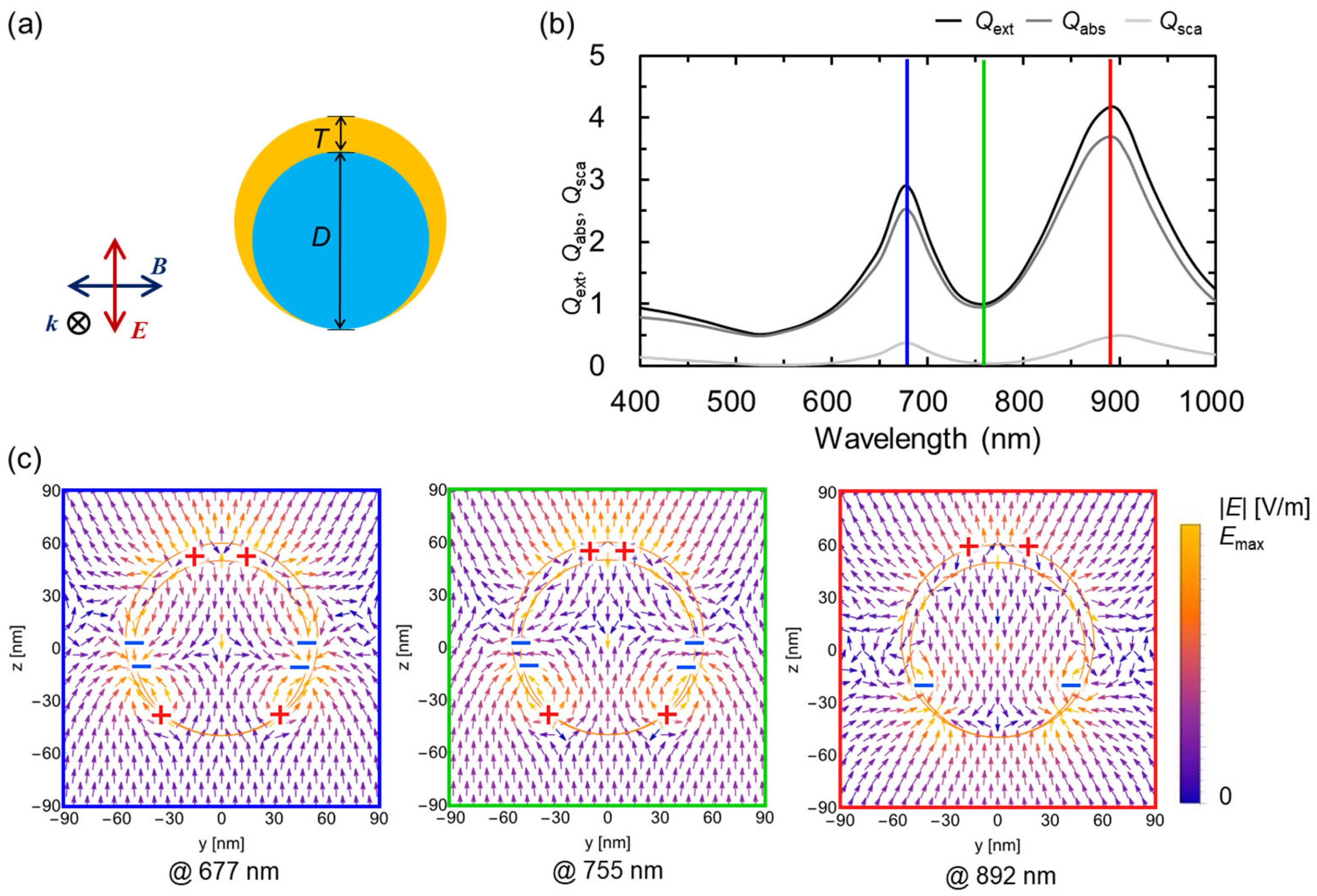
Figure 6 illustrates the calculation model of the nanoshell structure, along with the corresponding spectra, electric-field vectors, and predicted charge distributions. The diameter of the inner silica core and the thickness of the outer gold shell are provided in the figure caption. Nanoshell structures are known to exhibit optical properties originating from the typical PH mechanism [30,31].
For the present nanoshell structure, the electric-field intensity distribution shown in Figure S1e is localized at the edge of the shell, and both the short-wavelength and the long-wavelength peaks appear to exhibit dipole-type resonant modes. However, the optical spectra in Figure 6b shows that both peaks are dominated by absorption, suggesting that they correspond to multipole-type modes. The charge distribution estimated from the near-field vectors displayed in Figure 6c, provides further indication that the two peaks are excited octupole-type and quadrupole-type modes, respectively.
Numerous previous reports have indicated that the optical properties of nanoshell structures originate from PH, and our results are consistent with these. Nevertheless, the origin of the optical properties can only be logically identified by comprehensively considering the scattering and absorption spectra and the electric-field vector. Considerations based solely on extinction spectra and electric field distribution maps, as in many previous reports, are insufficient.

3.5. Sensing Potential to Refractive Index of Ambient

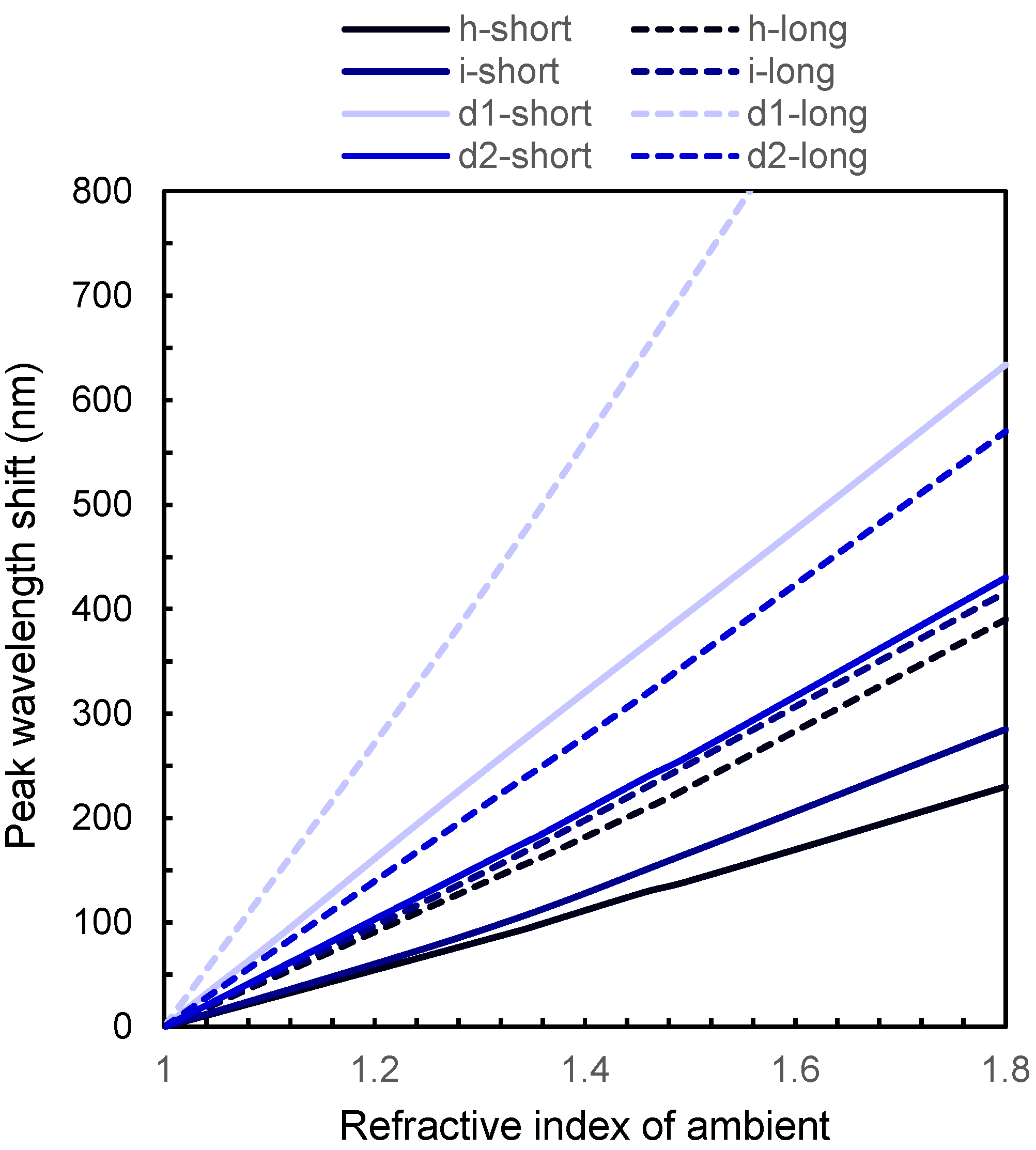
Figure 7 summarizes the peak-wavelength shifts in the short- and long-wavelength resonances of the i-type dimer (i-), dolmen structure 1 (d1-), dolmen structure 2 (d2-), and the heptamer (h-) as a function of the surrounding refractive index. The peak shift Δλ is defined as the difference between the peak wavelength at a given refractive index n and that in vacuum (n = 1.0). All structural parameters are kept fixed, and the ambient medium is assumed to be lossless and dispersionless.
To quantify refractive-index sensitivity, we define the sensitivity S as the slope of the peak shift with respect to the refractive index (nm/RIU), Δλ = S × (n − 1). The fitted sensitivities are summarized in Table 2 together with the resonance wavelengths and the mode order identified at n = 1.0.
In refractive-index sensing, peak assignment can become ambiguous as n varies, particularly in coupled systems with multiple nearby resonances. To ensure that the sensitivity is evaluated for the same physical resonance across different refractive indices, we track each resonance branch using the workflow established in Section 3.1, Section 3.2, Section 3.3 and Section 3.4, i.e., separation of scattering and absorption spectra with spectral metrics, complemented by mode-order identification based on near-field vector/charge symmetry as a consistency check. This combined approach reduces the risk of peak misassignment and provides a reproducible basis for sensitivity evaluation.
As shown in Figure 7 and Table 2, the long-wavelength resonances generally exhibit higher sensitivities than the short-wavelength resonances. For example, i-long (S = 520 nm/RIU) is more sensitive than i-short (S = 356 nm/RIU), and d1-long (S = 713 nm/RIU) exceeds d1-short (S = 538 nm/RIU). The largest sensitivity is obtained for d2-long (S = 1443 nm/RIU) within the available data points, whereas the smallest sensitivity is observed for h-short (S = 288 nm/RIU). Notably, similar sensitivities can occur for resonances with different mode orders, suggesting that the PH-like versus FR-like label and the mode order do not uniquely determine sensitivity within the investigated parameter range. Instead, the overall trend indicates that sensitivity is primarily governed by the resonance wavelength and the associated field penetration into the surrounding medium, with longer-wavelength resonances exhibiting larger S.
These results demonstrate that the proposed spectral-metric and mode-tracking framework supports sensing analysis by enabling consistent identification and tracking of resonance features under refractive-index variations. Furthermore, the dolmen structures exhibit high sensitivities, which may be further enhanced through systematic geometric optimization (e.g., coupling/gap parameters), for which the present framework can serve as a quantitative design guideline.

4. Conclusions

In this study, we investigated the origin of the optical properties of a metallic dimer, dolmen structures, a heptamer nanodisk cluster and a nanoshell, which have been reported to exhibit FRs and PH, by analyzing the scattering and absorption spectra, as well as the electric-field vector, obtained from DDA simulations. We showed that the origin of a given resonance can be evaluated more reliably by combining (i) the scattering-to-absorption ratio evaluated at the characteristic peak/dip wavelengths, (ii) quantitative descriptors of spectral asymmetry and dip depth, and (iii) mode-order identification supported by the near-field vector/charge symmetry. The results further indicate that the distinction between Fano-type interference and PH-like coupling cannot be uniquely inferred from structural geometry alone. Rather, plasmonic resonances should be viewed on a continuous landscape governed by multiple intertwined factors, including coupling strength (interparticle distance), symmetry/asymmetry, and material response. In this sense, the present analysis provides a unified, quantitative framework that goes beyond a geometry-based dichotomy and enables physically consistent interpretation across different canonical architectures.
We also assessed the refractive-index sensing potential of these structures by tracking peak shifts under variations in the surrounding refractive index. The comparison indicates that the dolmen structure exhibits the highest sensitivity among the investigated systems and, more generally, that longer resonance wavelengths in vacuum tend to yield larger sensitivities. Importantly, within the parameter range studied here, the sensitivity is primarily governed by the resonance wavelength (and the associated field penetration into the surrounding medium), rather than by whether the resonance is labeled as Fano-like or PH-like. These findings provide practical design guidance for plasmonic sensors and suggest broader applicability to the rational engineering of plasmonic nanostructures and metasurfaces.
Finally, the proposed framework clarifies the physical origin of plasmonic resonances in complex systems by jointly considering scattering, absorption, and vector-field information, which is often obscured when only extinction spectra or geometry-based labels are used. This integrated viewpoint, together with the quantitative spectral metrics introduced in this work, constitutes the central methodological contribution of the present study.

Supplementary Materials

The following supporting information can be downloaded at https://www.mdpi.com/article/10.3390/photonics13010068/s1, Figure S1: Distributions of the electric field intensity of (a) i-type dimer, (b,c) dolmen structures, (d) heptamer structure, and (e) nanoshell structure at the wavelengths corresponding to the two peaks and one dip in the optical spectra. Figure S2: Gap-dependent (a) scattering and (b) absorption spectra of dolmen structure 1 (G1 sweep). Table S1: Extracted spectral quantities for the gap dependence of dolmen structure 1.

Author Contributions

D.T. planned and designed the study. D.T., Y.K. and A.I. obtained the simulated data. D.T., Y.K. and T.T.P. performed data analysis. D.T. and T.T.P. wrote the manuscript. All authors have read and agreed to the published version of the manuscript.

Funding

This work was partially supported by JSPS KAKENHI Grant Number 22K04975, JSPS Core-to-Core Program (grant number JPJSCCB20220006), and the Iketani Science and Technology Foundation.

Data Availability Statement

The original contributions presented in this study are included in the article/Supplementary Material. Further inquiries can be directed to the corresponding authors.

Conflicts of Interest

The authors declare no conflicts of interest.

References

  1. Genzel, L.; Martin, T.P.; Kreibig, U. Dielectric function and plasma resonances of small metal particles. Z. Phys. B Condens. Matter 1975, 21, 339–346. [Google Scholar] [CrossRef]
  2. Willets, K.A.; Van Duyne, R.P. Localized Surface Plasmon Resonance Spectroscopy and Sensing. Annu. Rev. Phys. Chem. 2007, 58, 267–297. [Google Scholar] [CrossRef] [PubMed]
  3. Agrawal, A.; Cho, S.H.; Zandi, O.; Ghosh, S.; Johns, R.W.; Milliron, D.J. Localized Surface Plasmon Resonance in Semiconductor Nanocrystals. Chem. Rev. 2018, 118, 3121–3207. [Google Scholar] [CrossRef] [PubMed]
  4. Prodan, E.; Radloff, C.; Halas, N.J.; Nordlander, P. A hybridization model for the plasmon response of complex nanostructures. Science 2003, 302, 419–422. [Google Scholar] [CrossRef]
  5. Luk’yanchuk, B.; Zheludev, N.I.; Maier, S.A.; Halas, N.J.; Nordlander, P.; Giessen, H.; Chong, C.T. The Fano resonance in plasmonic nanostructures and metamaterials. Nat. Mater. 2010, 9, 707–715. [Google Scholar] [CrossRef]
  6. Miroshnichenko, A.E.; Flach, S.; Kivshar, Y.S. Fano resonances in nanoscale structures. Rev. Mod. Phys. 2010, 82, 2257–2298. [Google Scholar] [CrossRef]
  7. Fang, Z.; Cai, J.; Yan, Z.; Nordlander, P.; Halas, N.J.; Zhu, X. Removing a Wedge from a Metallic Nanodisk Reveals a Fano Resonance. Nano Lett. 2011, 11, 4475–4479. [Google Scholar] [CrossRef]
  8. Nordlander, P.; Oubre, C.; Li, K.; Stockman, M.I. Plasmon Hybridization in Nanoparticle dimers. Nano Lett. 2004, 4, 899–903. [Google Scholar] [CrossRef]
  9. Funston, A.M.; Novo, C.; Davis, T.J.; Mulvaney, P. Plasmon Coupling of Gold Nanorods at Short Distances and in Different Geometries. Nano Lett. 2009, 9, 1651–1658. [Google Scholar] [CrossRef]
  10. Fano, U. Effects of configuration interaction on intensities and phase shifts. Phys. Rev. 1961, 124, 1866–1878. [Google Scholar] [CrossRef]
  11. Limonov, M.F.; Rybin, M.V.; Poddubny, A.N.; Kivshar, Y.S. Fano resonances in photonics. Nat. Photonics 2017, 11, 543–554. [Google Scholar] [CrossRef]
  12. Limonov, M.F. Fano resonance for applications. Adv. Opt. Photonics 2021, 13, 703–771. [Google Scholar] [CrossRef]
  13. Chen, J.; Gan, F.; Wang, Y.; Li, G. Plasmonic Sensing and Modulation Based on Fano Resonances. Adv. Opt. Mater. 2018, 6, 1701152. [Google Scholar] [CrossRef]
  14. Huang, T.; Zeng, S.; Zhao, X.; Cheng, Z.; Shum, P.P. Fano resonance enhanced surface plasmon resonance sensors operating in near-infrared. Photonics 2018, 5, 23. [Google Scholar] [CrossRef]
  15. Wang, B.; Yu, P.; Wang, W.; Zhang, X.; Kuo, H.-C.; Xu, H. High-Q Plasmonic Resonances: Fundamentals and Applications. Adv. Opt. Mater. 2021, 9, 2001520. [Google Scholar] [CrossRef]
  16. Vardi, Y.; Cohen-Hoshen, E.; Shalem, G.; Bar-Joseph, I. Fano resonance in an electrically driven plasmonic device. Nano Lett. 2016, 16, 748–752. [Google Scholar] [CrossRef]
  17. Moritake, Y.; Kanamori, Y.; Hane, K. Emission wavelength tuning of fluorescence by fine structural control of optical metamaterials with Fano resonance. Sci. Rep. 2016, 6, 33208. [Google Scholar] [CrossRef]
  18. Basyooni, M.A.; Ahmed, A.M.; Shaban, M. Plasmonic hybridization between two metallic nanorods. Optik 2018, 172, 1069–1078. [Google Scholar] [CrossRef]
  19. Yang, Z.-J.; Zhang, Z.-S.; Zhang, L.-H.; Li, Q.-Q.; Hao, Z.-H.; Wang, Q.-Q. Fano resonances in dipole-quadrupole plasmon coupling nanorod dimers. Opt. Lett. 2011, 36, 1542–1544. [Google Scholar] [CrossRef]
  20. Verellen, N.; Sonnefraud, Y.; Sobhani, H.; Hao, F.; Moshchalkov, V.V.; Van Dorpe, P.; Nordlander, P.; Maier, S.A. Fano resonances in individual coherent plasmonic nanocavities. Nano Lett. 2009, 9, 1663–1667. [Google Scholar] [CrossRef]
  21. Zhang, S.; Genov, D.A.; Wang, Y.; Liu, M.; Zhang, X. Plasmon-Induced Transparency in Metamaterials. Phys. Rev. Lett. 2008, 101, 047401. [Google Scholar] [CrossRef] [PubMed]
  22. Sugita, A.; Muroi, K.; Nakatsuka, Y.; Tamotsu, S. Surface plasmon enhanced second harmonic behavior of a noncentrosymmetric dolmen-type Au nanostructure. Phys. Rev. B 2023, 108, 125112. [Google Scholar] [CrossRef]
  23. Yu, H.; Sun, Q.; Ueno, K.; Oshikiri, T.; Kubo, A.; Matsuo, Y.; Misawa, H. Exploring Coupled Plasmonic Nanostructures in the Near Field by Photoemission Electron Microscopy. ACS Nano 2016, 10, 10373–10381. [Google Scholar] [CrossRef] [PubMed]
  24. Draine, B.T.; Flatau, P.J. Discrete-dipole approximation for scattering calculations. J. Opt. Soc. Am. A 1994, 11, 1491–1499. [Google Scholar] [CrossRef]
  25. Draine, B.T.; Flatau, P.J. Discrete-dipole approximation for periodic targets: Theory and tests. J. Opt. Soc. Am. A 2008, 25, 2693–2703. [Google Scholar] [CrossRef]
  26. Flatau, P.J.; Draine, B.T. Fast near field calculations in the discrete dipole approximation for regular rectilinear grids. Opt. Express 2012, 20, 1247–1252. [Google Scholar] [CrossRef]
  27. Johnson, P.B.; Christy, R.W. Optical Constants of the Noble Metals. Phys. Rev. B 1972, 6, 4370–4379. [Google Scholar] [CrossRef]
  28. Fan, J.A.; Wu, C.; Bao, K.; Bao, J.; Bardhan, R.; Halas, N.J.; Manoharan, V.N.; Nordlander, P.; Shvets, G.; Capasso, F. Self-assembled plasmonic nanoparticle clusters. Science 2010, 328, 1135–1138. [Google Scholar] [CrossRef]
  29. Hentschel, M.; Saliba, M.; Vogelgesang, R.; Giessen, H.; Alivisatos, A.P.; Liu, N. Transition from Isolated to Collective Modes in Plasmonic Oligomers. Nano Lett. 2010, 10, 2721–2726. [Google Scholar] [CrossRef]
  30. Wu, Y.; Nordlander, P. Plasmon hybridization in nanoshells with a nonconcentric core. J. Chem. Phys. 2006, 125, 124708. [Google Scholar] [CrossRef]
  31. Pham, T.T.; Pham, D.D.; Nguyen, T.A.H.; Vu, M.T.; Nghiem, L.H.T.; Nguyen, T.V.; Tanaka, D.; Nguyen, D.C. Synthesis and optical characterization of asymmetric multilayer metal-insulator nanocrescent in aqueous solutions. Appl. Phys. Express 2020, 13, 122004. [Google Scholar] [CrossRef]
Figure 1. (a) Geometry of the calculation model of the i-type dimer. Linearly polarized light is incident on each structure in the direction shown. The uniform thickness is set to 45 nm. The lengths of the short side L and the long sides W1 and W2 are set to 45 nm, 250 nm, and 100 nm, respectively. The gap distance G is set to 10 nm. (b) Scattering, absorption, and extinction spectra. The vertical colored lines indicate the wavelengths corresponding to the electric field distributions shown in (c). (c) Electric vector distribution map of two resonance peaks and one dip wavelengths of the optical spectra. The color frames of each panel correspond to the vertical colored lines in (b). The arrows indicate the direction of the instantaneous electric field vectors, the “+” and “−” symbols denote the polarity of the induced surface charges, and the color scale represents the magnitude of the electric field |E| normalized by the incident field.
Photonics 13 00068 g001
Figure 2. (a) Geometry of dolmen structure 1. The geometric parameters L1, L2, W1, and W2, are set to 240 nm, 40 nm, 40 nm, and 290 nm, respectively. The two gaps G1 and G2 are set to 50 nm and 160 nm, respectively. The uniform thickness is fixed at 80 nm. (b) Scattering, absorption, and extinction spectra. (c) Electric-field vector distributions at the wavelengths corresponding to the two peaks and one dip in the optical spectra. The meanings of the vertical colored lines, arrows, color scale, and “+”/“−” symbols are identical to those described in Figure 1.
Photonics 13 00068 g002
Figure 3. (a) Geometry of the other dolmen structure, dolmen structure 2. The geometric parameters L1, L2, W1, and W2 are set to 128 nm, 30 nm, 50 nm, and 100 nm, respectively. The two gaps G1 and G2 are set to 10 nm and 30 nm, respectively. The uniform thickness is fixed at 20 nm. (b) Scattering, absorption, and extinction spectra. (c) Electric-field vector distributions at the wavelengths corresponding to the two peaks and one dip in the optical spectra. The meanings of the vertical colored lines, arrows, color scale, and “+”/“−” symbols are identical to those described in Figure 1.
Photonics 13 00068 g003
Figure 4. Gap-dependence of dolmen structure 1. (a) Extracted wavelengths of the short-peak, dip, and long-peak features from the extinction spectrum as a function of the gap distance G1. (b) Dip-depth metric ddip,long, quantifying the degree of scattering cancelation, as a function of G1.
Photonics 13 00068 g004
Figure 5. (a) Geometry of the heptamer structure. The diameters of the central circular disk D1 and the surrounding circular disks D2 are set to 90 nm and 80 nm, respectively. The two gaps G1 and G2 are set to 15 nm and 20 nm, respectively. The uniform thickness is fixed at 30 nm. (b) Scattering, absorption, and extinction spectra. (c) Electric-field vector distribution map at the wavelengths corresponding to the two peaks and one dip in the optical spectra. The meanings of the vertical colored lines, arrows, color scale, and “+”/“−” symbols are identical to those described in Figure 1.
Photonics 13 00068 g005
Figure 6. (a) Geometry of the nanoshell. The diameter of the inner silica core D and the maximum film thickness of the outer gold shell T are set to 100 nm and 10 nm, respectively. (b) Scattering, absorption, and extinction spectra. (c) Electric-field vector distribution map at the wavelengths corresponding to the two peaks and one dip in the optical spectra. The meanings of the vertical colored lines, arrows, color scale, and “+”/“−” symbols are identical to those described in Figure 1.
Photonics 13 00068 g006
Figure 7. Peak wavelength shift on the short-wavelength side and long-wavelength side of i-type dimer (i-), dolmen structures shown in Figure 2a (d1-), Figure 3a (d2-), and heptamer structure (h-) relative to the refractive index of the ambient medium.
Photonics 13 00068 g007
Table 1. Peak/dip wavelengths and spectral metrics for the gap-dependence of dolmen structure 1.
G1 (nm)λ_peak,shortλ_dipλ_peak,longαδdip,longRSA,shortRSA,long
10872115115080.1170.9654.1081.474
2087611081332−0.0420.9244.4641.787
3088210861256−0.1590.8744.6971.912
4088810761212−0.2470.8164.8862.002
6089810681164−0.3740.6825.1322.168
10091410661126−0.5290.3745.3842.477
Table 2. Resonance wavelengths of the short- and long-wavelength peaks, identified mode order, and refractive index sensitivity S (nm/RIU) of each structure.
Peak (Short/Long)i-DimerDolmen 1Dolmen 2HeptamerNanoshell
shortQuadrupole
579 nm
356
Octupole
882 nm
793
Octupole
707 nm
538
Octupole
570 nm
288
Octupole
677 nm
-
longDipole
658 nm
520
Octupole
1256 nm
1443
Octupole
849 nm
713
Dipole
632 nm
488
Quadrupole
892 nm
-
Disclaimer/Publisher’s Note: The statements, opinions and data contained in all publications are solely those of the individual author(s) and contributor(s) and not of MDPI and/or the editor(s). MDPI and/or the editor(s) disclaim responsibility for any injury to people or property resulting from any ideas, methods, instructions or products referred to in the content.