1. Introduction
As internet traffic over optical fibers continues to grow rapidly, enhancing the spectral efficiency (SE) of optical fiber transmission systems has become increasingly important [
1,
2,
3,
4]. Recently, a new kind of optical multiplexing using optical receiver modes (ORMs) has been reported to increase the SE [
5,
6,
7,
8], called the ORM division multiplexing (ORMDM) [
7,
8], where the conventional optical signal is replaced by a linear sum of ORMs. The ORMs are optical modes of an optical receiver [
9,
10,
11,
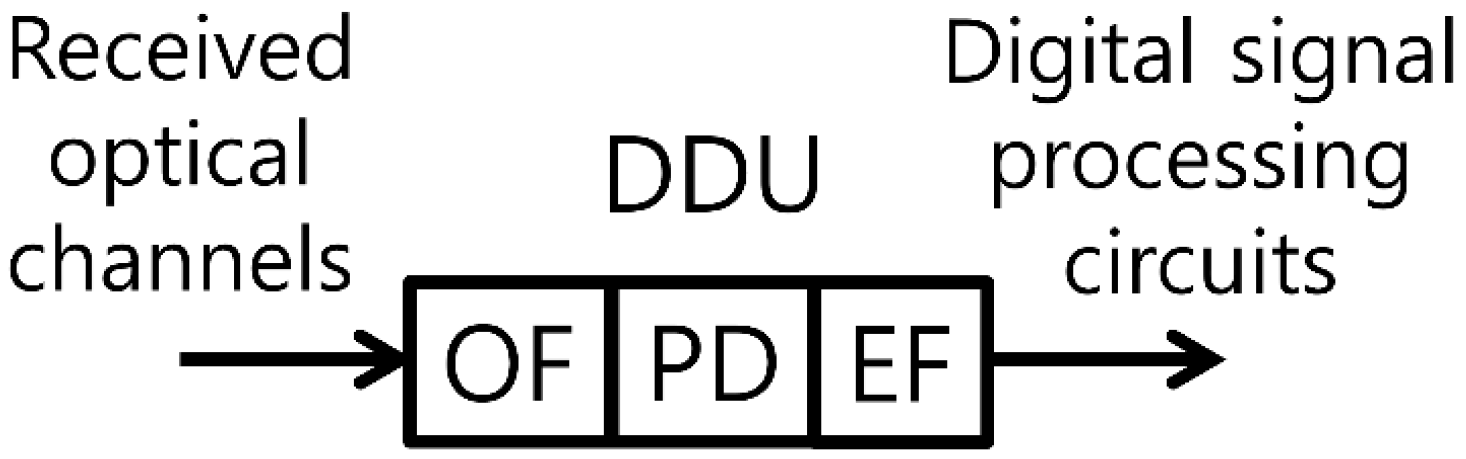
12]. There are three key elements of the optical receiver that determine the ORM set, an optical filter (OF), a photodetector (PD), and an electrical filter (EF) in series. We will call them briefly a direct-detection (DD) unit or DDU [
7].
Since the ORM mode functions are complete, the SE of the ORMDM system increases as more ORMs are used similar to the orthogonal frequency division multiplexing (OFDM) [
13,
14,
15]. For DD optical receivers, however, the coefficients of ORMs are found from the shape of the electrical signal at the EF output [
5,
6]. Thus, the number of ORMs used in the ORMDM is limited to just a few. By adopting the coherent detection technique [
16,
17], the ORMDM can be extended to the coherent optical (CO) ORMDM or CO-ORMDM [
7,
8]. The ORMs remain unchanged after this extension as long as the same DDUs are used within the CO receiver. A single ORM component can be selected and demodulated instantly at one CO receiver whose local oscillator is modulated by that ORM periodically. As a result, several tens of ORMs can be used in the CO-ORMDM, yielding high SEs.
For the development of ORMDM, including CO-ORMDM, optical communication systems, it is important to evaluate the mode functions and the eigenvalues of ORMs accurately. In order to find them, we need to solve an integral equation [
12] called the ORM integral equation hereafter. The only analytical solution of the ORM integral equation to date is the one derived for a Gaussian optical receiver having a Gaussian OF and a Gaussian EF [
12]. In all other cases, the ORM integral equation has to be solved numerically.
In this paper, we show that, when the OF is an optical Fabry–Perot (FP) filter [
18], the ORM integral equation can be solved using a one-dimensional Schrödinger equation, which has been investigated over a century in quantum physics [
19]. The ORMs are bound states of the Schrödinger equation. The time-reversed EF’s impulse response is proportional to the potential of the Schrödinger equation. We show two potential cases that have exact solutions. One is the square-well potential case and the other is the exponential-well potential case.
2. ORM Integral Equation
We show a schematic of DDU in
Figure 1. The OF selects an optical channel from the received optical channels. The PD is assumed to be very fast, with its actual electrical response absorbed to the EF. The EF suppresses the beat noises caused by the amplified spontaneous emission generated by optical amplifiers.
For this DDU, the ORM integral equation for the
n-th ORM (
n = 0, 1, 2, …) is as follows [
12]:
where
is the
n-th order ORM mode function in the optical frequency domain and
is its eigenvalue.
is the angular frequency deviation from the center angular frequency of the received optical channel. The kernel
is given as:
where
is the transfer function of the OF for the complex electric field amplitude of the received optical channels [
7]. The asterisk means the complex conjugation.
is the transfer function of the EF for the electrical signal from the PD. Note that
is Hermitian,
. Thus, the eigenvalues are real and the mode functions are complete with the orthogonality relation:
where
is the Kronecker delta function.
3. Proposed Method
Inserting (2) into (1), we obtain:
Let us introduce a new function
defined by:
Then,
satisfies the following integral equation from (4):
When
is Lorentzian,
[
18], or
(6) becomes:
where
is the 3 dB bandwidth of
. Hereafter, we use the notations,
and
. From the inverse Fourier transform of (8), we find a one-dimensional Schrödinger equation in the time domain:
where
and
are given as:
The potential of the Schrödinger equation, (9), is proportional to
. If we regard (9) as the Schrödinger equation for a particle [
19], the particle energy is negative, −
times a positive constant. Thus, the potential acts as a potential well and the ORM is one of the bound-states of (9). Note that the particle energy is fixed and the potential is proportional to
.
The Lorentzian condition (7) can be satisfied exactly if the OF is a one-pole bandpass filter:
In real systems, we often use an optical FP filter [
18] having two optical mirrors as the OF with the transfer function:
where
is the mirror reflectivity and
.
is
times the free-spectral range. From (13), we have [
18]:
where
is the finesse of the optical FP filter. When
, (14) becomes Lorentzian. This is because
F is large in this case and
is non-negligible only when
is small. Thus, we may approximate
which gives:
This is just (7) with . Note that for a given r, the error in (15) increases as increases from zero. Thus, higher-order ORMs evaluated from (9) have larger errors, since higher-order ORMs occupy wider spectral ranges. In the limit of , (13) becomes (12).
After finding
from (9), we obtain from (5):
where
and
is the
n-th order ORM mode function in the time domain:
4. Square-Well Potential
As a first example, we assume
for 0 <
t <
and
otherwise. This is the well-known square-well potential. Note that
in this case. The bound-state solution of (9) can be written as [
19]:
where
and
. We have omitted the subscript
n for
,
A,
B,
C1, and
C2. For ORMs with even
n,
satisfies
and
B = 0. For ORMs with odd
n,
satisfies
and
A = 0. The coefficients
A,
B,
C1, and
C2 are determined from the fact that
and its derivative are continuous at
t = 0 and −
w and the fact that
.
We assume that the optical FP filter’s 3 dB bandwidth or
is 100 GHz with
(
F = 61.2). This is similar to [
8] where a Gaussian optical filter is used with the 3 dB bandwidth of 100 GHz. Also, as in [
8], the 3 dB bandwidth of
is chosen as 10 GHz, which is achieved when
is 60.3 ps. The center wavelength of the received optical channel is at 1550 nm.
We also perform a numerical analysis for the ORM integral Equation (1). The integration range in (1) is chosen from −10
to 10
Equation (13) is used for
. The Gauss–Legendre numerical integration technique [
20] is used with 1200 points, which leads to a Hermitian matrix eigenvalue problem [
20]. To find these parameters, we have to run the program multiple times until we find accurate results. It takes about one hour using a personal computer for a single run.
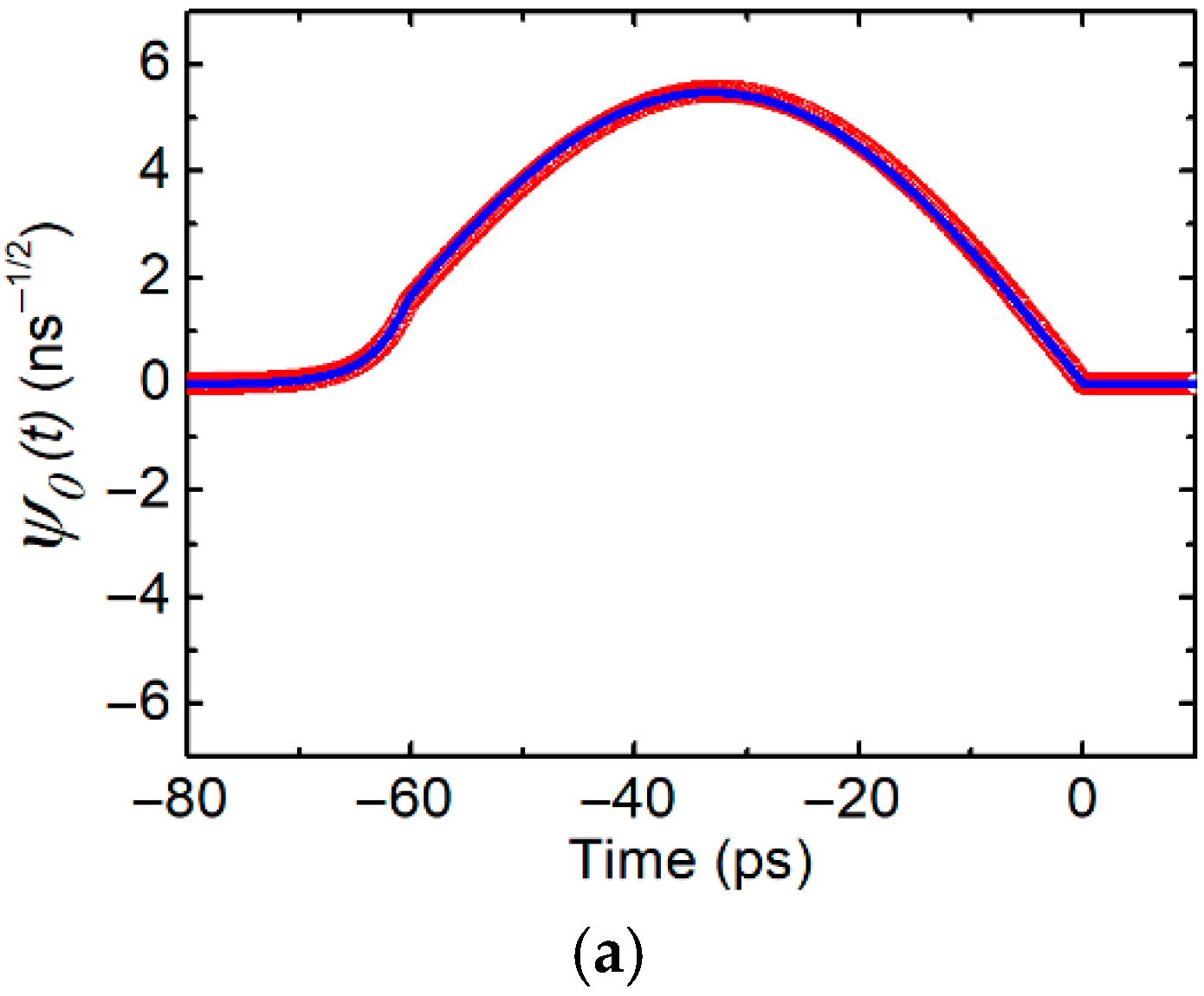
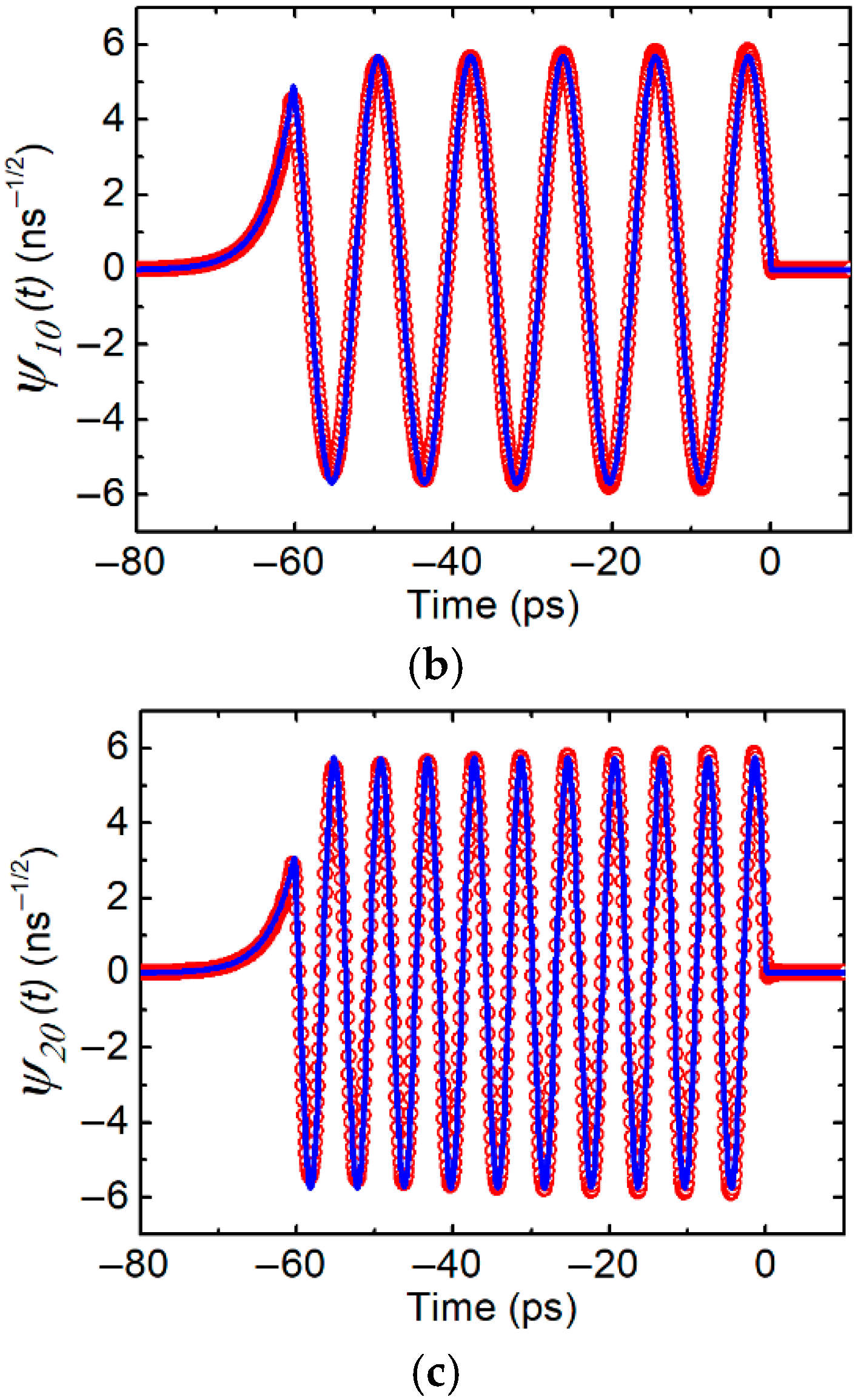
In
Figure 2, we plot
for
n = 0, 10, and 20. The ORM mode functions are sinusoidal for the most part. Both of our analyses using the Schrödinger equation and the numerical analysis give almost the same curves. The eigenvalues in both analyses agree within 1%.
5. Exponential-Well Potential
Next, we assume
for 0 <
t and
otherwise. This corresponds to a single-pole low-pass filter with
, where
is the cutoff frequency and
. The Schrödinger equation for the exponential-well potential can be solved exactly using the Bessel function [
21,
22]. With
, the Bessel function
satisfies:
where
a and
b are constants. Comparing (21) with (9), we find:
where
,
, and
.
A and
B are constants to be determined from the fact that
and its derivative are continuous at
and the fact that
. Using the continuity condition of
and its derivative at
, we have
and
, where we have used the recurrence equation
.
As in the square-well potential case, the optical FP filter’s 3 dB bandwidth is 100 GHz with
(
F = 61.2). The cutoff frequency of the EF is 10 GHz. Thus, we have ν = 10. We use the following expression to evaluate the Bessel function having an integer order of
m:
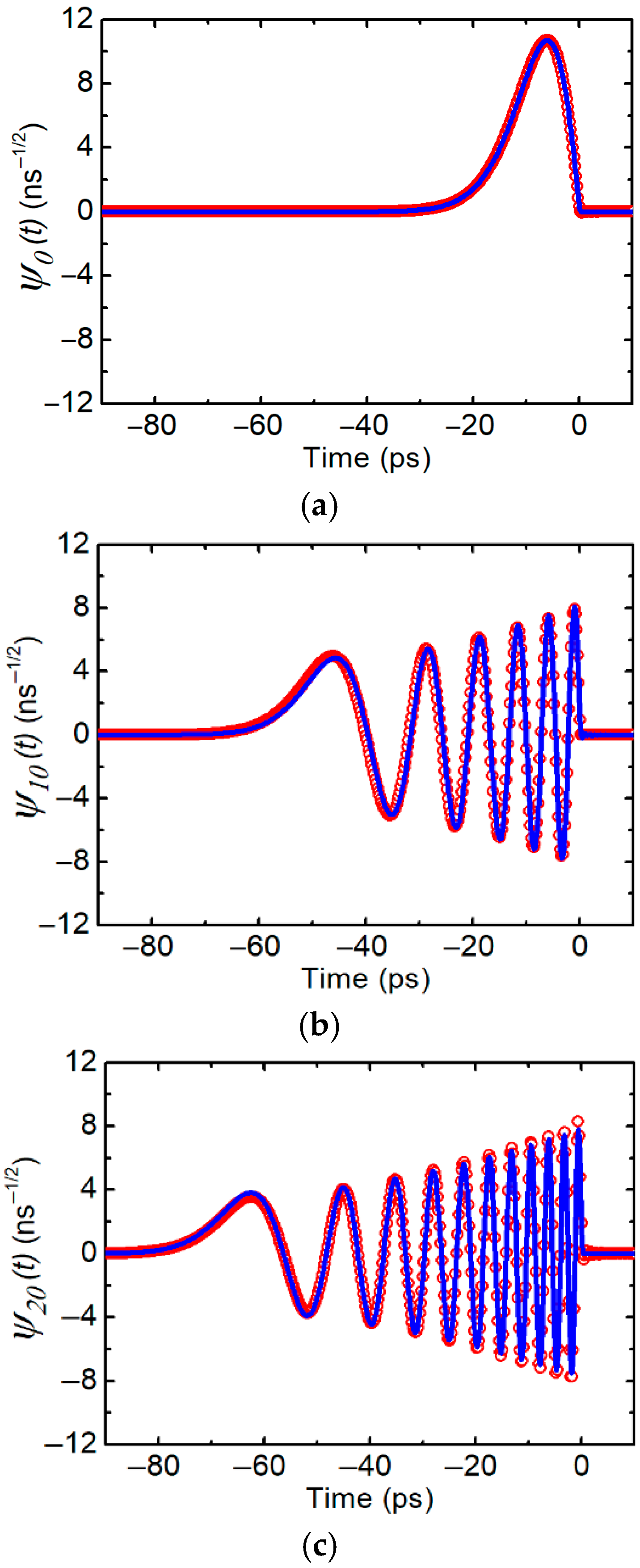
The numerical analysis of the ORM integral Equation (1) is also performed in the same way as the square-well potential case. In
Figure 3, we plot
for
n = 0, 10, and 30. The exponential-well potential case also gives sinusoidal ORM mode functions but with chirping. Both our analyses using the Schrödinger equation and the numerical analysis give almost the same curves. The eigenvalues in both analyses also agree within 1%.
6. Discussion
The Schrödinger equation has been also used to analyze optical slab waveguides [
21,
22]. The Schrödinger equation can be solved exactly for various potential cases. Even if there are no analytical solutions available, the numerical analysis for the Schrödinger equation can be conducted very quickly and accurately by approximating the potential as a piecewise linear function [
23] or a piecewise parabolic function [
24].
The two potentials presented here provide closed-form solutions. Although the in the actual system may be different from our examples, we may guess roughly the behavior of solutions from the solutions presented here, which will be very helpful.
If the finesse F is too low, the validity of using the Schrödinger equation is weakened. It depends on the spectral range of the ORM mode functions. For example, if the error in needs to be less than 2%, the Schrödinger Equation (9) can be used for F greater than 20 (r = 0.855) for the square-well potential case and greater than 30 (r = 0.901) for the exponential-well potential case. The difference in F values here results from the spectral range of being wider in the exponential-well potential case. For lower-order modes, their spectral ranges are narrower than that of . Thus, their eigenvalues have errors less than that of for the same F.
The ORM integral equation belongs to the homogeneous Fredholm equation of the second kind [
25], which cannot be transformed into a differential equation in general. One of the interesting points of this paper is that the ORM integral equation can be transformed into a differential equation when the OF is an optical FP filter.
In our two examples, the square-well potential and the exponential-well potential cases,
is non-negative for all
t. Thus, from (9), we can see that
is positive and increases indefinitely as
n increases [
9,
12]. Since the electrical signals generated by the
n-th ORM are proportional to 1/
for both DD optical receivers [
5] and CO receivers [
7], it is important to reduce the increase rate of
to use as many ORMs as possible. This can be achieved by decreasing the bandwidth of the EF with the
fixed. Then,
becomes broader and the bound state energies become closer. This is why the 3 dB bandwidth of the EF is chosen as 1/10 of
as in [
8].
As n increases, increases more steeply in the exponential-well potential case than in the square-well potential case. For example, the eigenvalue ratios are 3.85 for and 11.9 for in the square-well potential case. In the exponential-well potential case, the ratios of the eigenvalues are 12.4 for and 34.8 for . All these ratios are evaluated from our analysis using the Schrödinger equation. Therefore, it may be necessary to reduce the bandwidth of the EF further in the exponential-well potential case to increase the SE. This will also reduce high-frequency components in the exponential-well potential case owing to the chirping in the ORM mode functions.
For future works, it will be interesting to find other differential equations equivalent to the ORM integral equation when the OF is not Lorentzian.