Review

Rydberg Atom-Based Sensors: Principles, Recent Advances, and Applications


by
Dinelka Somaweera
1,*,
Amer Abdulghani
1,*,
Ambali Alade Odebowale
1,
Andergachew Mekonnen Berhe
1,
Muthugalage I. U. Weerasinghe
1,
Khalil As’ham
1,
Ibrahim A. M. Al Ani
2,
Morphy C. Dumlao
3,
Andrey E. Miroshnichenko
1 and
Haroldo T. Hattori
1
1
School of Engineering and Technology, University of New South Wales at Australian Defence Force Academy, Canberra, ACT 2610, Australia
2
Wentworth Institute of Higher Education, Canberra Campus, Canberra, ACT 2601, Australia
3
School of Science, University of New South Wales at Australian Defence Force Academy, Canberra, ACT 2610, Australia
*
Authors to whom correspondence should be addressed.
Photonics 2025, 12(12), 1228; https://doi.org/10.3390/photonics12121228
Submission received: 3 November 2025 / Revised: 29 November 2025 / Accepted: 11 December 2025 / Published: 12 December 2025
(This article belongs to the Section Lasers, Light Sources and Sensors)

Abstract

Rydberg atoms are neutral atoms excited to high principal quantum number states, which endows them with exaggerated properties such as large electric dipole moments, long lifetimes, and extreme sensitivity to external electromagnetic fields. These characteristics form the foundation of Rydberg atom-based sensors, an emerging class of quantum devices capable of optically detecting electric fields across frequencies from DC to the terahertz regime. Rydberg-based electrometry operates through both Autler–Townes (AT) splitting of resonant Rydberg transitions and Stark-shift measurements for high-frequency or far-detuned fields, enabling broadband field sensing from DC to the THz regime. Using ladder-type electromagnetically induced transparency (EIT) and AT splitting, these sensors enable non-invasive, SI-traceable measurements of field amplitude, frequency, phase, and polarization. Recent developments have demonstrated broadband electric field probes, voltage calibration standards, and compact RF receivers based on thermal vapor cells and integrated photonic architectures. Furthermore, innovations in multi-photon EIT, superheterodyne readout, and multi wave mixing have expanded the dynamic range and bandwidth of Rydberg-based electrometry. Despite challenges related to environmental perturbations, linewidth broadening, and laser stabilization, ongoing advances in atomic control, hybrid photonic integration, and EIT-based readout promise scalable, chip-compatible sensors. This review summarizes the physical principles, experimental progress, and emerging applications of Rydberg atom-based sensing, emphasizing their potential for next generation quantum metrology, wireless communication, and precision field mapping.

1. Introduction

Advances in quantum sensing are enabling the development of platforms that surpass the performance of classical measurement technologies. Among the emerging modalities, Rydberg atom-based sensors offer powerful capabilities for precision electric field measurements, leveraging the remarkable properties of atoms excited to high principal quantum numbers. Rydberg atoms feature exaggerated electric dipole moments, large polarizability, and long lifetimes, which make them highly sensitive to external electromagnetic fields. This makes them particularly well-suited for applications in metrology, communication, and sensing [1]. The basic concept of a Rydberg sensor is to use a vapor of alkali atoms (commonly rubidium or cesium) that are optically excited to a Rydberg state. An external target field (e.g., a radio-frequency or microwave electric field) interacts with these highly excited atoms and perturbs their energy levels. When an external radio frequency (RF), microwave, or electromagnetic field interacts with the Rydberg energy levels, it induces a Stark shift or AT splitting that can be detected via changes in the optical transparency of the medium. By probing the atoms’ optical response via a laser-induced EIT resonance we can infer the strength, frequency, phase, and polarization of the external field [2,3,4].
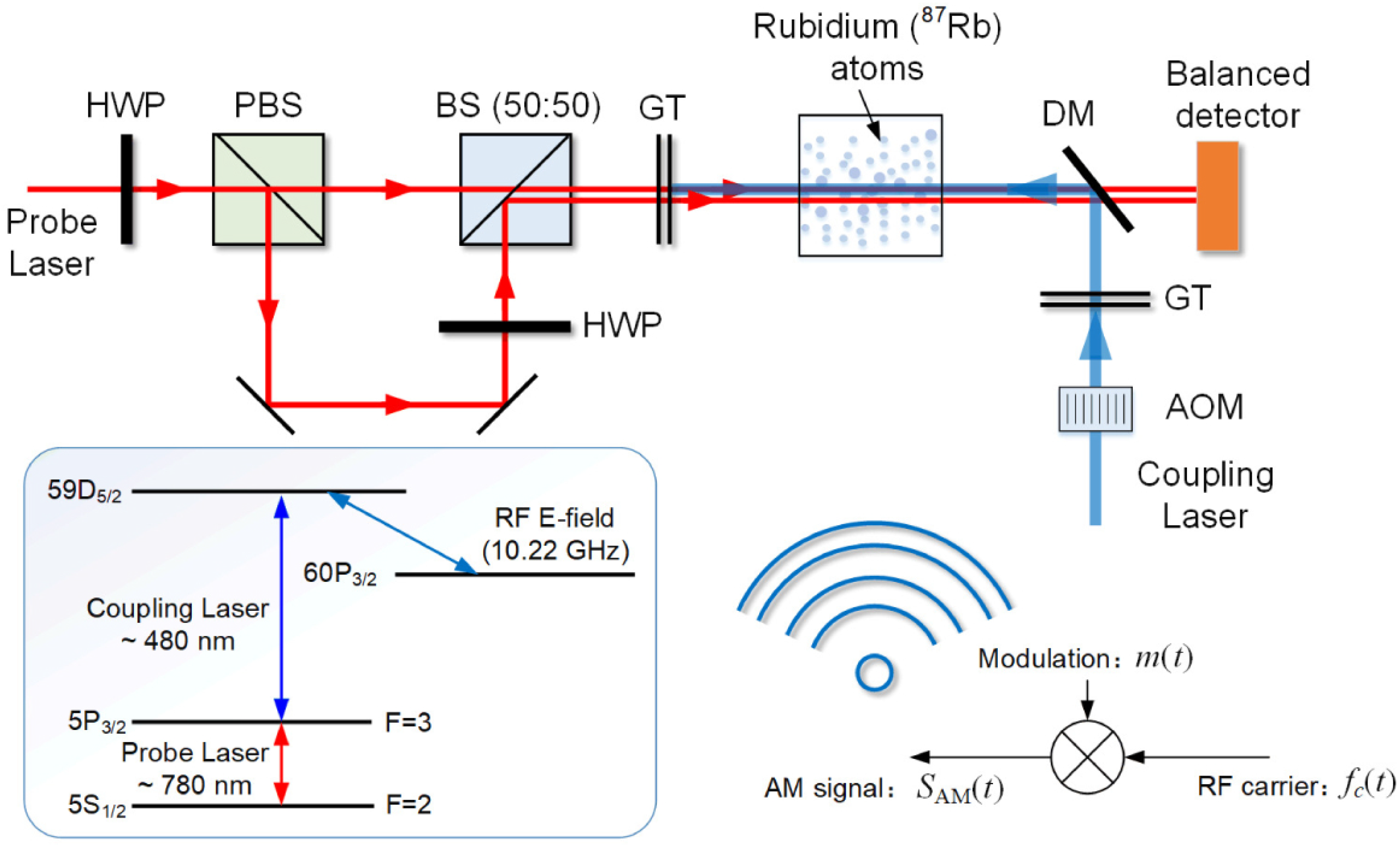
As shown in Figure 1, the interaction of the coupling and probe beams with the external RF field in a vapor cell produces measurable shifts or splittings in the EIT transmission profile, enabling non-invasive, SI-traceable electric field sensing. These unique properties have enabled a wide range of Rydberg atom-based sensing demonstrations. For instance, self-calibrated, broadband electric field probes have been realized using thermal vapor cells, capable of measuring field strengths across the GHz to THz spectrum, highlighting their potential as compact and wideband detectors [5]. In addition, Rydberg sensors have been employed for voltage calibration and metrology, where Stark-shift measurements in rubidium Rydberg states provide a pathway to atomic voltmeters capable of measuring both DC and AC voltages up to 12 V, offering a promising alternative to conventional standards such as the Josephson voltage standard [6]. Rydberg sensors minimally perturb the incident electromagnetic field because the vapor cell is dielectric and does not contain conductive elements that would absorb or distort the field. Furthermore, their non absorptive nature allows Rydberg sensors to be used for field deployable, real-time RF power sensing, enabling in situ monitoring of RF power without perturbing the field, in contrast to calorimeters or diode probes that necessarily absorb energy during measurement [7]. Furthermore, Rydberg-atom sensors present promising applications in communication systems, offering capabilities such as pulsed RF detection, phase sensing, and RF signal reception with compact, antenna-free detectors [8]. They are also being developed for emerging remote sensing and electrically small field measurement scenarios where classical antennas are inefficient [9]. Despite these advances, significant technical challenges remain. These include atomic decoherence, line broadening from Doppler and collisional effects, laser power stability, cell field distortions, and sensor integration into real-world platforms. Studies have begun to address these uncertainties and artifacts systematically [1,10]. Meanwhile, recent work has spotlighted improved sensitivity designs, multi-photon EIT schemes, superheterodyne architectures, and multi wave mixing strategies, opening pathways to enhanced bandwidth, dynamic range, and directional detection [11].
Moreover, the plethora of Rydberg levels (spanning GHz to THz transitions) allows for broadband field sensitivity across a wide spectrum [12]. Unlike conventional antennas, the vapor of Rydberg atoms contains no electronic noise sources, so thermal noise is absent and measurement sensitivity can approach fundamental quantum limits. A further key advantage is SI-traceability: the interactions are governed by well-known atomic constants, enabling calibration-free field measurements [13]. In short, Rydberg sensors provide ultrasensitive, wideband detection of electric fields with inherent accuracy set by atomic physics [12,13]. The operation of a Rydberg sensor relies fundamentally on the Stark effect and on optical readout via EIT [14]. External electric fields induce shifts or splittings in the Rydberg atom’s energy levels (a Stark effect), which can be probed optically. In a typical Rydberg EIT setup, a weak probe laser and a strong coupling laser create a quantum interference condition that makes the medium transparent on a narrow resonance (a dark-state resonance). The presence of an external field (DC or RF) interacting with the Rydberg state alters this dark state and thus modifies the EIT resonance [14]. For example, a resonant microwave field coupling two Rydberg levels will produce an AT splitting of the EIT transmission peak, with the splitting magnitude proportional to the microwave electric field amplitude (via the dipole Rabi frequency) [13]. By measuring the splitting between EIT peaks, one can absolutely determine the field strength, since the Rabi frequency Ω satisfies ω = d · E for dipole moment d and field E [13]. For weaker fields that do not fully split the resonance, the field-induced Stark shift or line broadening can still be extracted from changes in the EIT spectrum or dispersion signal. In either case, the all-optical EIT readout allows the Rydberg sensor to transduce electric field effects into measurable changes in laser transmission, avoiding the need for direct electrical contacts [14].
Figure 1. Schematic of a Rydberg atom-based sensor using ladder-type EIT in a thermal vapor cell. A weak probe laser and strong coupling laser excite the atom to a Rydberg state, while an external RF field induces AT splitting or Stark shifts in the Rydberg level. The resulting change in probe transmission is monitored as an all-optical readout of the electric field. (HWP—half-wave plate, PBS—polarizing beam splitter, GT—Glan–Taylor polarizer, AOM—Acousto-optic modulator) [15].
Photonics 12 01228 g001
Early demonstrations already achieved detection of microwave fields on the order of a few μ V / cm with Rydberg EIT in room-temperature vapors [13]. The fundamental sensitivity is often limited by the EIT linewidth and quantum projection noise. To push towards the quantum limit, researchers have developed advanced detection schemes. One powerful approach is the Rydberg superheterodyne receiver, which introduces a strong local oscillator field to mix with the signal field in the atoms. Using a microwave-dressed Rydberg LO, Jing et al. created an atomic receiver with sensitivity down to 10 8 V/m/Hz1/2 (tens of nV/cm/Hz1/2) and the ability to detect fields as small as 10 10 V/m (pV/cm) by frequency down-conversion within the Rydberg medium [16]. Another approach leverages quantum measurement techniques: for instance, applying a weak measurement protocol can amplify the sensor’s response to tiny perturbations. Jiang et al. recently showed that weak value amplification of the Rydberg EIT dispersion signal can enhance the detection of extremely weak fields, effectively boosting the signal-to-noise beyond the conventional limit [17]. These innovations, along with techniques like multi-photon demodulation and optical homodyne readout, continue to improve the precision and bandwidth of Rydberg sensors [14,16]. While most Rydberg sensing efforts focus on electric fields, the same principles extend to magnetic field sensing with Rydberg atoms. In highly excited states, atoms can possess large magnetic dipole moments and long coherence times, making them attractive as magnetometers. A striking example is the use of circular Rydberg states (maximal orbital angular momentum states) in a single-atom magnetometer. By preparing a rubidium atom in a quantum superposition of two circular Rydberg levels, Dietsche et al. achieved high-sensitivity magnetometry that surpassed the projection noise limit of an equivalent ensemble of thousands of atoms [18]. The large magnetic-field-induced phase shift between the two circular states allowed for detection of minute DC magnetic field changes with EIT-based sensitivity [18,19]. This result highlights a broader point: Rydberg sensors, as quantum sensors, can leverage nonclassical states (e.g., entangled or superposition states) to attain sensitivity beyond classical limits. In general, the fundamental principles of Rydberg sensors, enormous dipolar responses, coherent optical readout, and quantum-noise-limited detection, open up a versatile platform for precision electrometry and other field sensing applications.
While several reviews on Rydberg physics and Rydberg-based electrometry have been published in recent years, these works typically focus on single subtopics such as cold-atom physics, superheterodyne detection, Rydberg microwave metrology, or fundamental many-body interactions. In contrast, this review provides a unified and cross-disciplinary perspective that spans electric-field, magnetic-field, temperature and pressure sensing, THz imaging, hybrid atom–superconductor devices, and emerging biomedical and radar applications. We also include developments from 2022 to 2024 that are not covered in earlier reviews, such as multi-band GHz–THz receivers, cavity-assisted atom-based electrometry, chip-scale photonic integration, and coherent microwave-to-optical transduction. By integrating these diverse advances into a single framework, this review aims to serve as an updated reference that highlights both the unifying principles and the expanding technological landscape of Rydberg-atom sensors. Finally, we outline promising future directions, including strategies to overcome current limitations, device miniaturization, and expanded applications.

2. Fundamental Principles of Rydberg Sensors

2.1. What Are Rydberg Atoms?

Rydberg atoms are atoms in which one or more electrons have been excited to states with very high principal quantum numbers n, often exceeding 10, and in many experimental setups reaching values above 50 or even 100 [20]. In such highly excited states, the outermost electron resides far from the atomic nucleus, resulting in extremely weak binding and a near-hydrogen-like energy structure [20]. Because the electron is so loosely bound, it experiences only a weak Coulomb attraction to the nucleus and exhibits behavior that closely resembles that of the hydrogen atom, making Rydberg atoms excellent systems for studying both classical and quantum phenomena in atomic physics [20].
In the simplest hydrogenic model, the energy levels of an electron are described by the Rydberg formula:
E n = h c R n 2
where h is Planck’s constant, c is the speed of light, R is the Rydberg constant ( 1.097 × 10 7 m 1 ), and n is the principal quantum number [20]. Equation (1) reveals that as n increases, the energy levels become increasingly closely spaced, approaching the ionization limit asymptotically. As a result, transitions between adjacent Rydberg states require very small amounts of energy, often in the microwave or millimeter wave regions, making Rydberg atoms naturally sensitive to these frequencies.
For alkali atoms (e.g., rubidium or cesium), which are commonly used in experiments, the inner electrons shield the nuclear charge, and thus the outer electron does not experience a purely Coulomb potential. This deviation introduces the concept of a quantum defect ( δ ), which modifies the energy levels based on the orbital angular momentum of the Rydberg states [21]. The corrected expression becomes the following:
E n = E ion h c R M ( n δ ) 2
Here, E i o n is the ionization energy, and R M is the Rydberg constant modified for the reduced mass of the atom. The quantum defect δ depends strongly on . It is large for low-angular-momentum states (e.g., s or p states) and becomes negligible for high states. This means that high Rydberg states behave almost exactly like hydrogenic states, while low states retain significant deviations due to core penetration effects [21].
For alkali atoms such as rubidium and cesium, the outer electron does not experience a purely Coulombic potential because inner electrons partially shield the nuclear charge. This deviation is captured using the quantum defect δ , which corrects the effective principal quantum number in Equation (2). The value of δ depends strongly on the orbital angular momentum , it is large for low states (such as s and p) due to core penetration, but becomes negligible for high states, where the electron remains far from the nucleus and the levels become nearly hydrogenic [21]. The Rydberg series of hydrogen molecules converge toward their respective ionization limits. The near-parallel structure of the n p and n f series demonstrates how different angular momenta lead to different quantum defects, resulting in visibly distinct convergence behavior. Although alkali atoms exhibit the same qualitative behavior as molecular hydrogen, high Rydberg states approach the idealized hydrogenic limit, while low states exhibit noticeable shifts due to their larger quantum defects [22].
The physical size of a Rydberg atom is also dramatically larger than that of a ground state atom. The average radius r of the electron’s orbit scale is
r n 2 a 0
where a 0 is the Bohr radius (∼0.053 nm) [23]. For example, a rubidium atom in a Rydberg state with n = 60 can have an atomic radius exceeding 1000 times that of the ground state, making it effectively mesoscopic. This immense spatial extent allows Rydberg atoms to be extremely sensitive to weak external fields, including electric and magnetic fields, since even slight perturbations can influence the large electron cloud [24]. These unique hydrogen-like characteristics, combined with practical advantages such as well understood excitation schemes and long radiative lifetimes, make Rydberg atoms not only a cornerstone of atomic physics research but also highly promising candidates for quantum sensing applications.
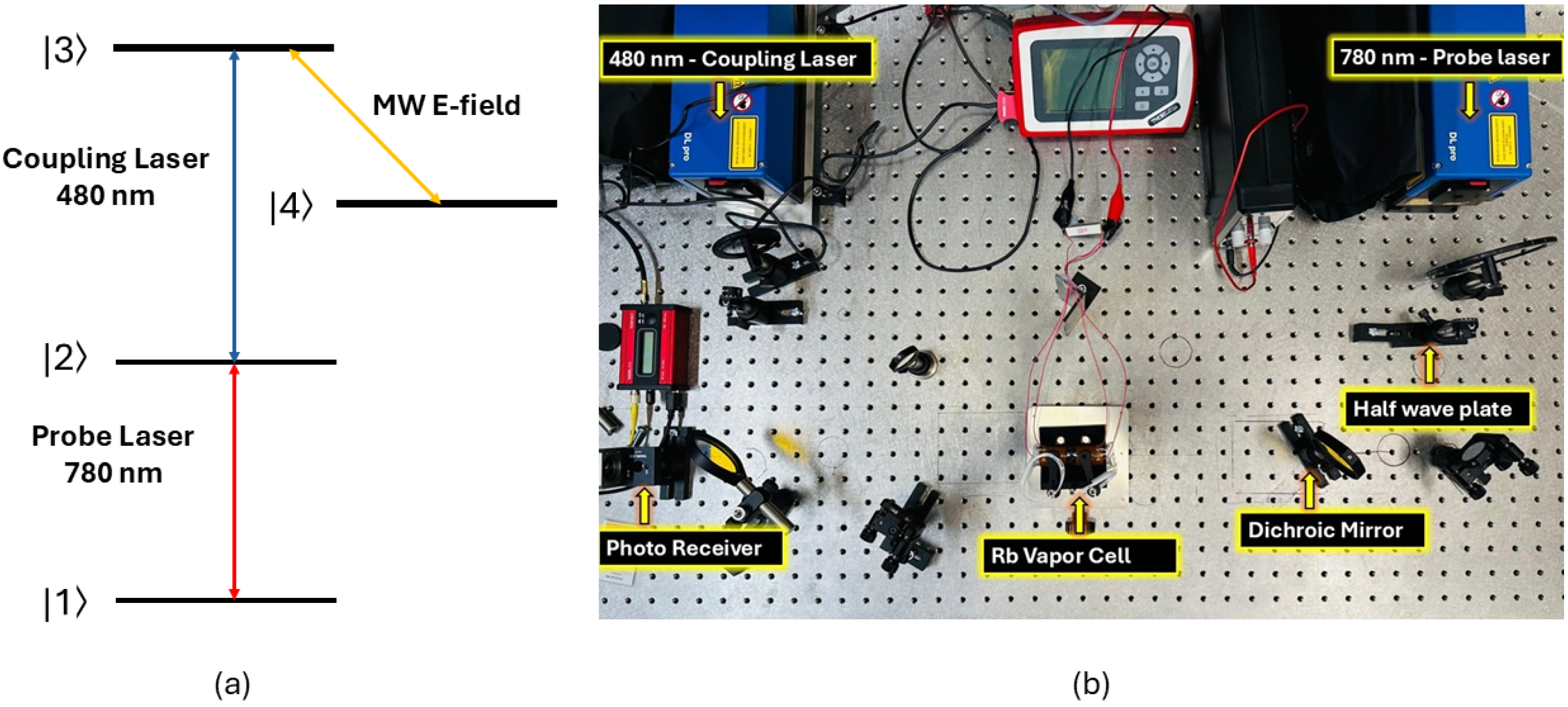
Figure 2 shows our constructed setup for the Rydberg system. In our practical implementation of Rydberg EIT, the system requires only three essential components: two frequency-stabilized lasers to address the probe and coupling transitions, a thermal vapor cell containing the alkali atoms, and an external RF or microwave field to perturb the Rydberg levels. The probe laser (typically 780 nm in rubidium) interrogates the ground-to-intermediate transition, while the coupling laser (blue or near-IR depending on the transition) excites atoms into the desired Rydberg level. When both beams are co-aligned through the cell, the medium becomes transparent at two-photon resonance due to quantum interference. The presence of a resonant microwave or RF field that couples two Rydberg states induces a measurable AT splitting or Stark shift in the EIT resonance. These spectral changes are detected optically and form the basis of atom-based field measurements. Only the essential elements are shown in the revised diagrams to avoid introducing laboratory-specific components that do not affect the physical mechanism [25].
Figure 2. (a) A conventional four-level atomic scheme used for microwave electric-field sensing consists of two lower states, 1 and 2 , that are connected by a probe laser. The upper state 2 is then resonantly coupled to a Rydberg level 3 by a coupling laser. A microwave field subsequently drives the transition between the two Rydberg states 3 and 4 [12]. (b) Constructed Rydberg system [25].
Photonics 12 01228 g002

2.2. Scaling Laws and Exaggerated Properties

One of the most remarkable features of Rydberg atoms is the way their physical properties scale with the principal quantum number n. As n increases, these atoms exhibit extreme, or “exaggerated,” characteristics that make them highly sensitive to external fields and uniquely suited for quantum sensing applications. This behavior stems from the fact that a Rydberg electron resides far from the nucleus, leading to strong nonlinearities in properties such as size, polarizability, interaction strength, and lifetime [23]. A foundational example is the orbital radius of the Rydberg electron, which scales as r n 2 a 0 , where a 0 is the Bohr radius [23]. For instance, a rubidium atom in a Rydberg state with n = 60 has an atomic radius on the order of ≈1 μ m, more than 1000 times larger than its ground state. This significant spatial extent increases the electron’s exposure to perturbations from external electric or magnetic fields, enhancing the atom’s utility in field sensing technologies. As reviewed by Gallagher (1994), this scaling law is a direct consequence of solving the radial Schrödinger equation under a Coulombic potential for high n states [23].
Perhaps most importantly for sensing, the electric polarizability of Rydberg atoms increases dramatically with n, scaling as α n 7 [26]. This means that even modest electric fields can induce large Stark shifts in the energy levels of high n states. Mohapatra et al. (2007) demonstrated this in their pioneering work on Rydberg EIT, showing that the optical transmission of a medium can be strongly modulated by external radio frequency (RF) or microwave (MW) fields through the Stark effect [26]. This scaling makes Rydberg atoms ideal for non-invasive electric field sensors with high dynamic range. Additionally, radiative lifetimes of Rydberg states scale approximately as τ n 3 for low-l states and as τ n 5 for high-angular-momentum states due to reduced core penetration. Also it allows the excited electron to remain in the Rydberg state for extended durations, typically in the range of tens to hundreds of microseconds for n ≈ 50–100 [27]. This prolongs the interaction time between the atom and external fields, improving signal-to-noise ratios in sensing. Beterov et al. (2009) calculated effective lifetimes for rubidium and cesium Rydberg states, taking into account blackbody radiation effects, and confirmed the expected τ n 3 behavior [27].
Another key exaggerated property is the electric dipole moment between neighboring Rydberg states, which scales as d n 2 [28]. This large dipole moment underpins the strong coupling of Rydberg atoms to external oscillating fields, such as microwave or terahertz radiation. Moreover, it leads to pronounced dipole–dipole and van der Waals interactions between atoms, which scale as V d d n 4 / R 3 and V v d W n 11 / R 6 , respectively [28]. These long-range interactions are crucial for phenomena like Rydberg blockade, where the excitation of one atom prevents the excitation of nearby atoms within a certain radius. This effect has been widely studied and experimentally confirmed, including in work by Urban et al. (2009), who demonstrated coherent blockade of multiple rubidium atoms [28].

2.3. Excitation Schemes and Rydberg–EIT Configuration

A central technique enabling the practical use of Rydberg atoms in sensing is EIT in a ladder-type three-level atomic system. This configuration uses two coherent laser fields to create a narrow transparency window within an otherwise absorbing medium, allowing Rydberg excitation to be probed optically, even at room temperature [13]. The excitation pathway typically begins with atoms in the ground state g , which are coupled to an intermediate excited state e using a probe laser (typically around 780 nm for rubidium or 852 nm for cesium) [13]. A second, coupling laser (in the 480–510 nm range) then connects e to a high-lying Rydberg state r , as shown schematically in Figure 1. Also, Λ -type EIT involves two long-lived ground states coupled to a single excited state, forming a Λ -shaped three-level system. It is commonly used in slow light, quantum memories, and coherent population trapping, but is not part of ladder-type Rydberg EIT used for Rydberg- based electrometry [29].
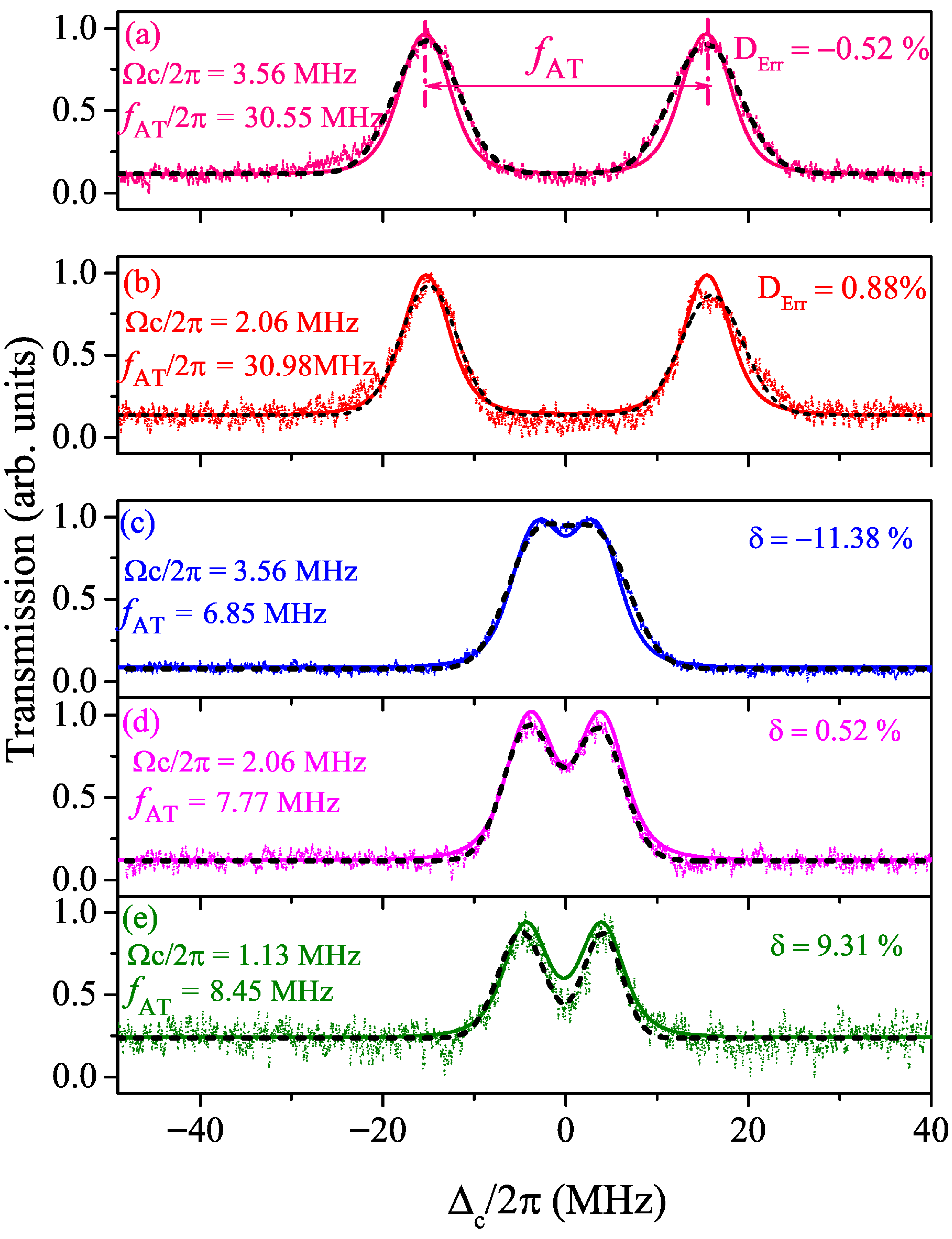
EIT arises from the formation of a dark state, which is a coherent superposition of the ground and Rydberg states. In this dark state, atoms do not absorb probe photons, resulting in a narrow transparency window. The effect does not originate from interference between multiple excitation pathways but rather from destructive interference between probability amplitudes within the dressed-state basis. This EIT window is highly sensitive to changes in the energy of the Rydberg state, and therefore serves as an optical transduction channel for detecting electromagnetic fields. Moreover, when an external RF or microwave field is applied that couples two neighboring Rydberg states (e.g., r r ), the atomic system undergoes AT splitting, as shown in Figure 3. This results in a doublet feature in the EIT transmission spectrum, with the splitting proportional to the amplitude of the RF field. This forms the basis of optical heterodyne detection of microwave electric fields without any need for metallic antennas.
When an RF or microwave field resonantly couples two Rydberg states, the EIT resonance splits into an AT doublet. The splitting is directly proportional to the electric field amplitude. The field can be expressed as
E = Ω d = 2 π f A T d
where f A T is the measured AT peak separation, d is the dipole matrix element between the two Rydberg states, and Ω is the Rabi frequency induced by the RF field. This expression forms the basis of SI-traceable electric field measurements using Rydberg atoms [30].
The choice of excitation scheme depends on the atomic species, the desired Rydberg state (i.e., the principal quantum number n), and the sensing modality. Recent work by Ma et al. further advances this concept by combining Stark shifts, heterodyne EIT, and Rabi resonances to achieve a large dynamic range and improved linearity in atomic electrometry. This strengthens the connection between AT splitting and broadband RF sensing within the Rydberg EIT configuration [31]. In many experiments, two-photon resonant excitation is used for thermal vapors of rubidium, as demonstrated in the pioneering work by Mohapatra et al. (2007) [26], which showed that EIT could be used to resolve Rydberg transitions optically and with sub-MHz resolution [26]. Subsequent work extended this concept to RF detection [13] and broadband electrometry [30]. Notably, room-temperature vapor cells are commonly used in these experiments, enabling simple and scalable sensing platforms. Although Rydberg EIT experiments can operate without magnetic shielding, most precision sensors incorporate mu-metal or Helmholtz-compensated fields to suppress Zeeman broadening and ensure stable spectral conditions.
Figure 3. Measurements (Color lines) and calculations (symbols) of Rydberg EIT-AT (AT) spectra (solid lines) as a function of the coupling laser detuning Δ c and indicated coupling Rabi frequencies for fixed probe Ω p = 2 π × 4.00 MHz and two microwave fields Ω M W = 2 π × 30.71 MHz (a,b) and 2 π × 7.73 MHz (ce). The black dashed lines display multipeak Lorentz fittings to the EIT-AT spectra for extracting f A T (AT splitting). The deviation D E r r is defined as the ratio ( f A T Ω M W )/ Ω M W . In (a,b), f A T locates in the linear region, where the measured microwave electric field is independent from the coupling laser; corresponding D E r r is smaller than 1%. In (ce), f A T is in the nonlinear region, where the measured microwave electric field is strongly dependent on the coupling laser Ω c [32].
Photonics 12 01228 g003

2.4. Sensitivity to External Fields and the Stark Effect

Rydberg atoms are extraordinarily sensitive to external electric (and to some extent magnetic) fields, a feature that underpins their utility as field sensors. When an external static electric field E is applied, the energy levels of a Rydberg state are shifted via the Stark effect. To first order (for hydrogenic states with degeneracy broken), the shift is often quadratic in the field [33]:
Δ E 1 2 α E 2
where α is the electric polarizability of the state [33]. For high n Rydberg states, the polarizability itself scales steeply with n (e.g., roughly as n 7 for alkali atoms), so that even weak external fields yield large energy shifts [34].
A representative example is shown in a Stark-map measurement of cesium Rydberg states: as the external field increases, the manifold of high n levels fans out significantly, illustrating the strong field dependence [35]. Such sensitivity enables the detection of weak RF or microwave fields via optical readout; the shift modifies resonance conditions in ladder-type EIT or AT splittings, thereby converting field information into an optical signal [10]. Importantly, for sensing applications the tuning of n offers a handle on dynamic range and sensitivity. Higher n gives larger polarizability but also increases susceptibility to external perturbations (including stray fields, collisions, blackbody radiation). Thus, careful balance of state choice, environment, and interrogation scheme is required [10].

2.5. Interactions and Collective Phenomena: Blockade, Dipole–Dipole, and van der Waals Couplings

Beyond single atom sensitivity, Rydberg atoms exhibit strong interatomic interactions, which give rise to collective phenomena—crucial both for sensing and prospective quantum technology functions. Two atoms excited to Rydberg states separated by distance R interact via dipole–dipole or van der Waals potentials. In the non resonant regime, the interaction can often be approximated as follows [36]:
V vdW C 6 R 6
where the coefficient C 6 scales strongly with n [36]. Similarly, resonant dipole–dipole interactions may scale as C 3 / R 3 under certain conditions [37]. The upshot is that two nearby atoms cannot both be excited to Rydberg states if their interaction-induced shift exceeds the excitation bandwidth; this is the so-called Rydberg blockade phenomenon [37].
The blockade radius R b is often defined by the equality of the interaction strength and the Rabi coupling Ω :
C 6 R b 6 Ω
Within a sphere of radius R b around an excited atom, other excitations are suppressed [37]. This collective effect has implications for sensor design. On the one hand, interactions may degrade a simple one-atom response by shifting or broadening the resonance; on the other hand, controlled collective excitation can enhance signal, modulate response bandwidth, or enable mapping of field distributions through interaction-mediated effects [37]. In the context of metrology, understanding and controlling these many-body interactions is vital, especially in thermal vapor cells or dense atomic ensembles where Rydberg atoms are used. Recent work highlights microwave-dressed interactions, enhanced blockade control, and engineered couplings tailored for sensing [37].

3. Types of Rydberg Sensors

Rydberg atoms offer a versatile platform for quantum sensing owing to their exaggerated electromagnetic response and long-lived coherent states. In this section, we review the major categories of Rydberg-based sensors, namely electric field sensors, magnetic field sensors, temperature/pressure sensors, and hybrid sensor systems. Each type exploits a different physical interaction (e.g., Stark effect, Zeeman effect) to transduce an environmental quantity into a measurable optical or RF signal. Below, the detailed sensing mechanisms, notable experimental demonstrations, practical applications, and comparative performance metrics of each category are presented.

3.1. Electric Field Sensors (Microwave, RF, THz Detection)

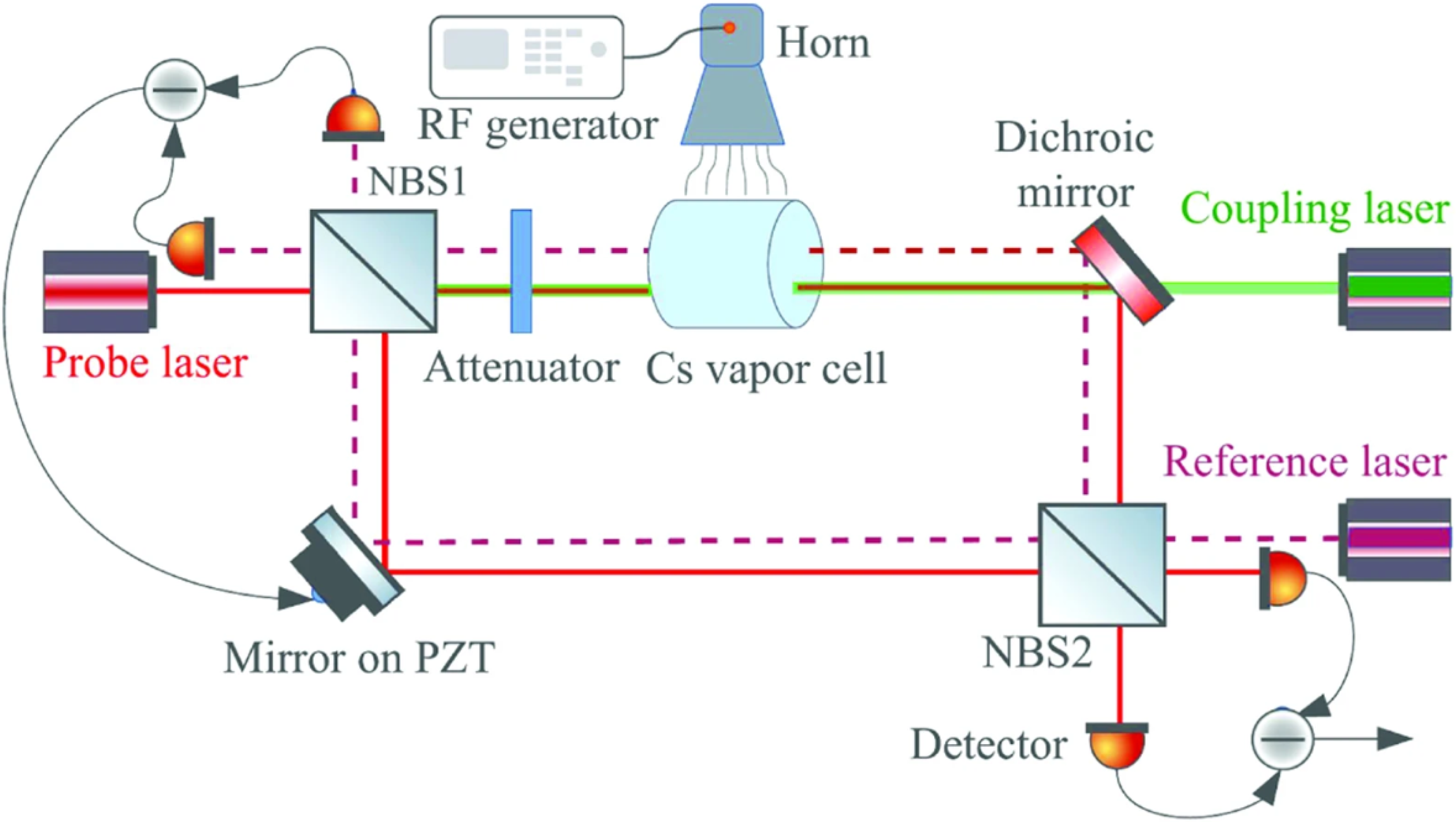
Electric field sensing is the most well-known application of Rydberg atoms. The basic mechanism leverages the extreme polarizability and large electric dipole moments of Rydberg states: an external RF or microwave field induces Stark shifts or resonant transitions between Rydberg levels, which can be optically read out. A common approach is Rydberg EIT in a thermal vapor cell, wherein a weak probe laser and a strong coupling laser create a ladder EIT resonance that is sensitive to a target RF field, as shown in Figure 4. When an RF or microwave field is applied on resonance with a Rydberg transition, it causes an AT splitting of the EIT transmission peak. The splitting Δ f is directly proportional to the field amplitude E RF via the Rabi frequency, allowing for absolute field calibration tied to atomic constants [14]. By measuring the optical spectrum, one can infer the incident field strength without prior device calibration, establishing an SI-traceable electrometry method. Off-resonant fields can also be sensed via induced Stark shifts in the Rydberg levels.
Figure 4. A probe laser and a coupling laser are co-propagated through a cesium vapor cell to excite atoms to Rydberg states. The RF electric field from a horn antenna perturbs the Rydberg levels, enabling detection via EIT. The setup incorporates a reference laser, dichroic mirrors, neutral beam splitters (NBS1 and NBS2), and a piezo-mounted mirror for active stabilization. This compact architecture supports sensitive, wideband electric field detection suitable for integration in miniaturized sensing platforms [38].
Photonics 12 01228 g004
Early demonstrations achieved ∼ 10 1 V/m sensitivity in the microwave regime using room-temperature Rb vapor cells, and highlighted the broadband nature of the sensor: a single Rydberg atom species has a manifold of transitions covering frequencies from ∼MHz up to THz [13,14,39]. For example, Rydberg sensors have been used to detect fields from VHF (tens of MHz) through X-band (10 GHz) and into the sub-THz regime by appropriate choice of atomic transitions and/or multi-photon schemes [2,14]. Indeed, Rydberg Cs atoms have recently enabled a wireless communication receiver at 0.3 THz, converting phase-modulated THz signals to optical readouts for digital data transfer [2]. In principle, coverage extends even to DC fields via Stark shifts, and up to infrared frequencies, making Rydberg sensors “DC-to-daylight” electric field probes.
Several advantages over traditional antenna-based sensors have been documented, including the following:
Sensitivity: Rydberg sensors are not limited by Johnson–Nyquist thermal noise because they have no free electrons; instead, noise is quantum-projection- or photonic-shot-noise-limited, which can be far lower than the thermal noise floor of a classical antenna [14,40]. This means that in the long run, Rydberg receivers can surpass conventional antennas in a minimum detectable field. In practice, the best Rydberg electrometers today achieve sensitivities in the 10 4 V/m range (tens of nV/cm in field units) for narrow-band signals, although this remains about 2–3 orders of magnitude above the quantum noise limit [14]. By contrast, a small classical dipole antenna at room temperature can typically detect on the order of 0.1 V/m at microwave frequencies [12]. The accuracy of field extraction also depends critically on the precision of the transition dipole matrix elements used to convert the measured AT splitting into electric field amplitude. Modern numerical methods compute these matrix elements using model potentials and radial wavefunctions; however, uncertainties at the few-percent level remain, particularly for high-n or high-l states. These uncertainties directly propagate into the inferred electric field values. Therefore, accurate quantum defect parameters and precise matrix element calculations are essential for high-accuracy Rydberg electrometry, especially in regimes where SI-traceable field measurements are required [12].
Bandwidth: Additionally, Rydberg sensors inherently offer an ultra-wide bandwidth response, since different Rydberg transitions can be accessed for different frequency bands. Vapor cells can thus replace multiple antennas, enabling flexible wideband receivers from MHz to THz with a single device [13,14,41].
Calibration: Because the sensor’s response is derived from fundamental atomic parameters (e.g., known dipole matrix elements and transition frequencies), Rydberg E-field probes are self-calibrated. The measured field values are directly linked to Planck’s constant and atomic structure, providing a traceable standard with no need for an external calibrated antenna [2]. This is particularly crucial at high frequencies (e.g., > 100 GHz), where conventional antenna calibration is very challenging [12].
Minimal field perturbation and size: Rydberg sensors use a thin vapor cell (often millimeter-scale glass cells or even micro-cells) that is mostly dielectric and can be made sub-wavelength in size [42,43,44,45]. Thus, they minimally perturb the field being measured (unlike a metallic antenna that can disturb the local field) and can be inserted into confined or sensitive environments (e.g., inside microwave cavities or plasma chambers) without significant field distortion or absorption [46,47]. The absence of large conductive structures also confers stealthiness and compatibility with measurements in high-field or noisy electromagnetic environments where a traditional sensor would overload [45,48,49].
Rydberg-atom sensors are capable not only of measuring field amplitude, but also the phase of an RF field. In the landmark demonstration by Simons et al. (2019), a 20 GHz RF carrier was used as a local oscillator (LO), while a weaker signal field at nearly the same frequency was applied simultaneously; the atomic vapor down-converted the beat between LO and signal to a low-frequency optical modulation detectable on a photodiode [50]. The phase of the intermediate-frequency (IF) optical signal tracked the phase of the RF signal with sub-period precision, enabling atom-based reception of phase-modulated signals (BPSK—Binary Phase Shift Keying, QPSK—Quadrature Phase Shift Keying, QAM—Quadrature Amplitude Modulation) on a 19.626 GHz carrier [51]. This converts the atomic ensemble into a coherent phase-sensitive RF mixer, functioning much like a classical heterodyne receiver but at the atomic level, enabling full vector field readout (amplitude + phase) without metallic antennas.
Rydberg sensors can also determine the polarization state of an RF field through the polarization-selective coupling of RF transitions between Rydberg states. In alkali vapor cell experiments, linearly polarized RF drives π -type transitions ( Δ m = 0 ), whereas circularly polarized RF drives σ ± transitions ( Δ m = ± 1 ), producing distinct AT splitting patterns or contrast ratios in the EIT/AT spectrum [52]. By analyzing the relative strengths or splitting asymmetries of the σ + , σ , and π components or by rotating the probe or coupling beam polarization and monitoring the atomic response, the full polarization state (linear, circular, or elliptical) of the incident RF field can be reconstructed [53]. This allows for complete vector electrometry (amplitude, phase, and polarization) without the need for metal antennas or traditional polarization sensitive RF hardware.

3.2. Magnetic Field Sensors (via Zeeman Shifts)

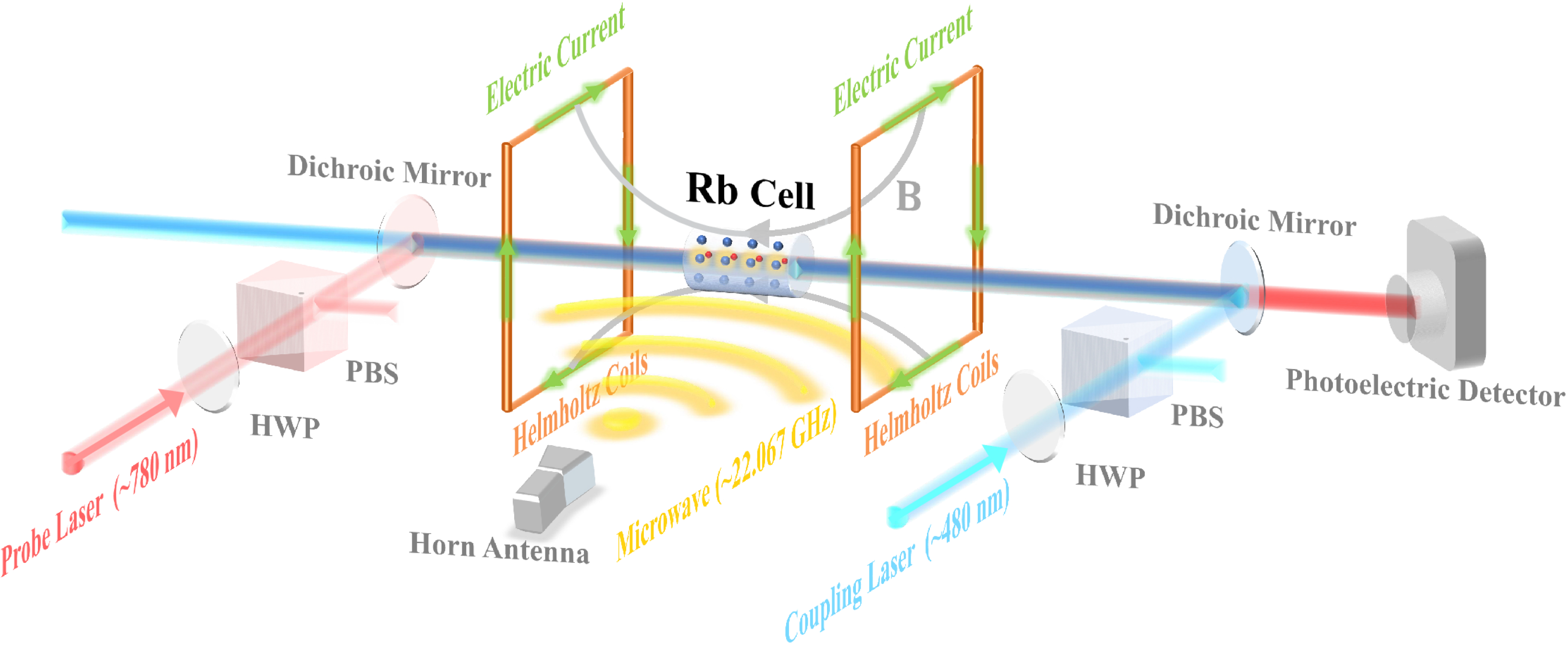
Magnetic field sensing with Rydberg atoms exploits the Zeeman effect; external magnetic fields lift the degeneracy of magnetic sublevels and shift Rydberg transition frequencies. Because certain Rydberg states (especially high-angular-momentum “circular” states or states with large m J ) have large magnetic dipole moments, even modest magnetic fields can produce measurable Zeeman splittings in their spectra, as shown in Figure 5. Circular Rydberg states, which have the maximum orbital angular momentum for a given principal quantum number, exhibit long lifetimes and hydrogenic behavior. However, they cannot be prepared in thermal vapor cells. Their generation requires laser-cooled atoms, precise microwave control, and often cryogenic conditions to prevent blackbody-driven decay. For this reason, circular states are used mainly in ultracold-atom and cavity-QED experiments and are not applicable to vapor-cell Rydberg sensors [54]. The general principle is to prepare atoms in a sensitive superposition or resonance condition and detect the magnetic-field-induced energy shifts. One approach is to use Rydberg EIT again; in the presence of a DC or low-frequency magnetic field, the Rydberg EIT resonance (which involves specific m J or m F sublevels) will split into multiple components or shift in frequency. By measuring the splitting between Zeeman components of the Rydberg optical resonance, one can deduce the magnitude of the magnetic field. The splitting Δ f Z is related to the field B by Δ E = g J μ B B (for linear Zeeman shifts in low fields), with the detailed line shapes and selection rules set by polarization and the Breit–Rabi regime [55,56,57]. In practice, resolving Zeeman-structured Rydberg EIT/AT spectra in room-temperature cells provides a straightforward, self-calibrated magnetometer response [55,57].
Dietsche et al. realized a single-atom Rydberg magnetometer by preparing a rubidium atom in a superposition of circular states ( m = ± 50 ); the field-dependent phase between the components (energy splitting 2 μ B B ) enabled single-shot detection of 13 nT in 20 μ s, with sensitivity comparable to 1800 conventional atoms [18]. Zou and Hogan used helium atoms in circular Rydberg states with high-resolution microwave/RF spectroscopy to realize absolute magnetometry, gradiometry, and vector electrometry, achieving μ T -level absolute precision and gradient sensitivity of tens of nT mm 1 over mm–cm baselines; because the Zeeman structure is analytically tractable, the measurements are intrinsically self-calibrated [58].
Complementing low-field EIT magnetometry, operation in strong magnetic fields can simplify the spectrum and improve robustness by defining a single quantization axis and isolating a single transition dipole. Schlossberger et al. showed that applying a large B field “Zeeman-resolves” AT features in Rydberg EIT and yields clean, polarization-independent signals with a single participating dipole moment useful for precision field metrology and stable line pulling [59]. For instrumentation, Zeeman-split EIT lines can serve as tunable frequency references: Vylegzhanin et al. locked a coupling laser to Zeeman-resolved Rydberg EIT peaks and achieved continuous tuning of ∼0.6 GHz via the applied magnetic field, directly leveraging the linear Zeeman response of the Rydberg ladder [60]. Such techniques both exploit and validate the Zeeman response used for magnetometry.
Another route often is to sense B via microwave-transition magnetometry in ground-state hyperfine manifolds augmented by Rydberg spectroscopy (or dressing) to read out detunings and polarizations, though most purely Rydberg-based magnetic sensing still focuses on the Zeeman splitting of the Rydberg levels themselves [14]. Experiments in hot vapors have systematically mapped magnetic-field-induced asymmetry and splitting in Rydberg EIT/AT spectra of 87Rb and used those splittings to calibrate B in the few-gauss to tens-of-gauss range with MHz-scale spectroscopic resolution [55,57]. Together, these approaches from single atom circular-state interferometers to vapor-cell Zeeman-resolved EIT establish Rydberg atoms as versatile, self-calibrating magnetometers.
Figure 5. Experimental setup. The 780 nm probe lights and 480 nm coupling lights were set linearly polarized and collinearly counterpropagated through the Rb vapor cell. The static magnetic field was generated by a pair of rectangular Helmholtz coils (50 cm × 50 cm) placed perpendicular to the axis of the Rb cell, and the microwave electric field was provided by a signal source (8340 B, HP Corporation) connected to a Horn Antenna placed by the side of the Rb cell. HWP: half wave plate; PBS: polarizing beam splitter [57].
Photonics 12 01228 g005

3.3. Temperature and Pressure Sensing

While Rydberg-atom sensors are primarily used for detecting electromagnetic fields, recent work has begun to probe their response to environmental conditions such as temperature and gas pressure. The underlying idea is that Rydberg atoms are exceptionally sensitive to thermal radiation and collisions, and these couplings can be harnessed for quantum thermometry and quantum barometry.
For temperature sensing, the key mechanism is interaction with blackbody radiation (BBR). Because transitions between neighboring Rydberg levels fall in the microwave-to-THz range, ambient BBR can resonantly drive population transfer among Rydberg states, with rates fixed by Planck’s spectrum and known dipole matrix elements [61]. As the environment warms or cools, the BBR spectral energy density changes, altering state populations in a way that can be read out optically. Using this principle, a primary, calibration-free Rydberg thermometer was recently demonstrated with laser-cooled Rb: time-resolved monitoring of BBR-induced state transfer yielded an absolute temperature with sub-percent uncertainty and no contact with the sample [62]. Independent measurements of BBR-driven transition rates across S / P / D manifolds in Rb provide quantitative validation of the temperature dependence used in these thermometry models [63]. In practice, such an atomic thermometer—traceable to fundamental constants via Planck’s law—offers a route to non-invasive temperature control in precision experiments and distributed sensing with fiber-coupled optics.
Pressure sensing with Rydberg atoms is conceptually similar, but the information comes from collisions rather than photons. In a vapor cell with background or buffer gas, collisions broaden and shift Rydberg EIT/AT resonances; the resulting linewidths and frequency shifts are functions of gas species and density, and thus can be used to infer pressure. Early Doppler-free spectroscopy quantified pressure shifts and broadenings of Rb Rydberg levels in rare gases, establishing key cross sections and linear-in-density coefficients [64]. More recently, controlled buffer-gas studies in Rb vapor have mapped Ne-induced shifts and broadenings of Rydberg-EIT features and shown how these coefficients can support in situ diagnostics [47], with complementary work extending to Ar and N2 and discussing metrological implications for vapor-cell manufacture and quality assurance [65,66]. In practice, monitoring a Rydberg linewidth during routine E-field sensing can flag slow changes in buffer-gas composition or pressure, while an intentional spectral scan can provide a quantitative barometric readout using the same optical hardware.
Temperature and pressure are not independent in hot alkali vapor cells because vapor density is temperature-dependent. Careful experimental design is therefore required to separate T and P. One strategy is to use cold-atom implementations to isolate BBR-only thermometry [62]; another is to employ paired reference/measurement cells (or multi-parameter line-shape fits) in hot-cell platforms, aided by species-specific collisional coefficients from buffer-gas studies [47,65,66].
In summary, temperature and pressure sensing with Rydberg atoms is an emerging frontier. While not yet widely used, these techniques illustrate the versatility of Rydberg quantum sensors beyond electromagnetic fields, potentially offering self-calibrating measurements of thermodynamic quantities.

3.4. Hybrid Sensing (e.g., Rydberg Atoms + Optical Cavities, Chip-Scale Vapor Cells)

The performance of Rydberg sensors can be markedly improved by integrating them with photonic and resonant structures, yielding “hybrid” architectures that trade optical, microwave, or geometric enhancement for sensitivity, size, and stability.
Optical and microwave cavities: Cavities boost light–atom interaction and can sharpen or amplify the EIT response to weak RF fields. Models and experiments show that placing the vapor in an optical resonator compresses EIT linewidths and lowers the minimum detectable microwave field, with analyses indicating sub 10 4 V/m thresholds in cavity-QED regimes [67,68]. Practical receiver implementations exploit the cavity slope (side-of-fringe locking) to convert tiny RF-induced phase/absorption changes into large intensity signals; a cavity-enhanced Rydberg superheterodyne receiver demonstrated this strategy, improving signal-to-noise and bandwidth for coherent RF demodulation [69]. In the microwave domain, embedding the atoms in a resonant cavity concentrates the local RF field at the Rydberg transition and yields an all-optical, cavity-enhanced microwave receiver [46]. More generally, cavity-based nonlinear optics with Rydberg media (e.g., cavity-enhanced optical bistability) provide additional handles to engineer steeper transfer functions for electrometry [70].
Photonic structures and slow-wave cells: Engineering the vapor cell can passively “pre-amplify” incident RF. In a recent study, photonic-crystal integration was demonstrated by incorporating slot-waveguide/photonic-crystal geometry into an all-dielectric cell, adiabatically slowing and concentrating the RF mode through the atomic volume; the passive structure provides ∼24 dB RF power gain at the atoms and measurably boosts EIT-based detection without adding electronic noise [71]. Earlier work embedding alkali vapor in hollow-core photonic-crystal fibers established a robust path to photonic integration with strong, guided light–atom coupling suitable for compact Rydberg devices [72].
Chip-scale vapor cells: Wafer-level fabrication now delivers mm-scale, glass–Si–glass vapor cells with low residual gas pressure and high yield, directly compatible with Rydberg EIT sensors and on-chip heaters/photodiodes [42]. Such MEMS cells enable sub-wavelength sensor heads and fiber-delivered optics, pointing toward deployable modules while maintaining the all-dielectric, minimally perturbative footprint that is a hallmark of Rydberg sensing [45].
Hybrid readout with antennas and electronics: Rydberg media can be combined with classical RF hardware to form “atomic antennas” and metrology tools. For example, heterodyne bichromatic excitation has been used to determine microwave antenna gain directly from the atomic response, linking classical antenna performance to an atomic reference [73]. More broadly, superheterodyne schemes in vapor leverage an optical readout and a local oscillator to perform continuous-frequency microwave detection (amplitude/phase) over GHz-scale spans, eliminating semiconductor mixers while preserving high sensitivity and dynamic range [74]. Together, these hybrids bridge quantum-optical readout with cavity/antenna field enhancement, accelerating progress toward portable, broadband, and quantum-noise-limited Rydberg receivers.
While most Rydberg-based electrometry uses thermal vapor cells, recent work has explored techniques enhancing spectral resolution and sensitivity through EIT and advanced coherence schemes. High-precision microwave sensing has been demonstrated using narrow EIT resonances and AT splitting in vapor cell systems, forming the basis for SI-traceable electric-field measurements [13] and broadband RF field detection up to microwave frequencies [75,76]. Recently, multi-photon coherence schemes using Rydberg atoms have been proposed and experimentally investigated, offering improved sensitivity and potentially lower detection thresholds compared to standard two-photon EIT [11]. These advances underline the increasing maturity and versatility of Rydberg-atom electrometry as a competitive technique for precise and broadband RF field measurements.

3.5. Emerging Advanced Techniques in Rydberg Sensing (2023–2025)

Recent developments have expanded Rydberg-atom sensing into new operational regimes, many of which were not covered in earlier reviews. A rapidly growing direction is the use of multi-photon excitation schemes that combine optical and RF fields to access high-l and high-angular-momentum Rydberg states. Such schemes enable strong dipole couplings, enhanced polarizabilities, and increased control over selection rules, providing improved electrometry and state preparation [77,78,79]. Multi-photon driving further allows experimental access to circular and elliptical Rydberg states, relevant for high-field atomic sensors. Another major development is the expansion of the operational bandwidth of Rydberg superheterodyne receivers, which now employ microwave dressing, multi-tone readout, and optimized Rabi coupling to achieve wider IF bandwidths and enhanced sensitivity [80,81]. These advances allow for simultaneous demodulation of multiple carriers and picowatt-level detection, pushing Rydberg devices closer to practical RF receiver architectures.
Rydberg atoms have also been used to probe strongly inhomogeneous DC and AC electric fields, including fields generated by plasmas, space-charge regions, and surface charging of vapor-cell walls. These phenomena alter EIT line shapes and induce measurable Stark-map distortions, enabling Rydberg-based diagnostics of ionized environments and surface electric fields [82,83,84]. Finally, integrating Rydberg media with optical or RF resonators offers strong field enhancement, improved signal-to-noise ratios, and controlled mode structures for hybrid sensing [85,86]. Dielectric resonators, slot-waveguide resonators, and superconducting microwave cavities have each demonstrated enhanced sensitivity and broader frequency tunability through local field intensification around the atomic ensemble. These developments greatly expand the capabilities of Rydberg-based sensors and demonstrate the rapid technological acceleration in the field.

4. Performance Metrics

The performance of Rydberg-atom sensors spans a diverse range of operating regimes, reflecting rapid advances such as sensitivity, bandwidth, spatial resolution, dynamic range, and dominant noise sources, which reveal trade-offs between weak field detectability, high frequency operability, spatial precision, and system-level robustness. In particular, state-of-the-art implementations demonstrate sensitivities down to the sub regime, video-rate THz imaging with near-diffraction-limited resolution, and conversion bandwidths exceeding tens of MHz, thereby underscoring both the fundamental versatility and the application-specific constraints of Rydberg-based sensing platforms.
The measurement bandwidth is typically limited by the EIT linewidth, the Rydberg-state lifetime, and the response time of the optical detection system. For ladder-type Rydberg EIT in thermal vapor cells, bandwidths of a few hundred kilohertz to several megahertz are possible, while superheterodyne configurations enable tens to hundreds of megahertz of intermediate-frequency (IF) bandwidth.
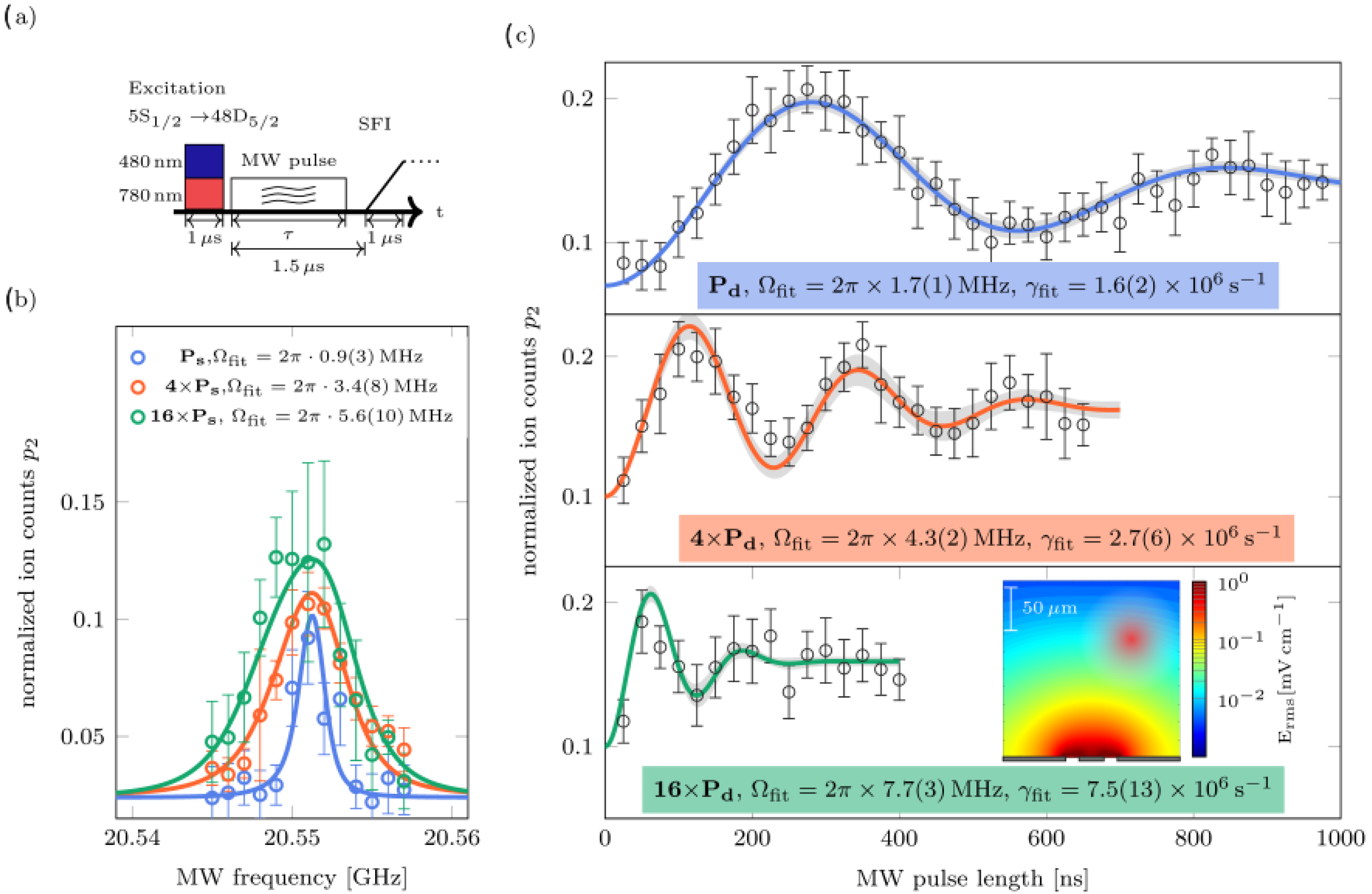
The dynamic range is defined as the ratio between the largest measurable field before power broadening or AT saturation and the smallest detectable field limited by noise:
DR = 20 log 10 E max E min
Thermal-vapor sensors typically demonstrate 40–80 dB of dynamic range, while optimized atomic receivers can exceed 90 dB.
The smallest resolvable electric field amplitude is determined by the minimal detectable perturbation of the EIT or AT spectrum. Following the analysis of Fancher et al. [87], the minimum detectable field is expressed as
E min = Δ f EIT d SNR
where Δ f EIT is the full width at half maximum (FWHM) of the EIT resonance, d is the transition dipole matrix element between the two Rydberg states, and SNR is the optical signal-to-noise ratio [87].
The noise-equivalent electric field (NEEF), which represents the electric-field noise spectral density, is given by
E NEEF = Δ f EIT d S n
where S n is the noise spectral density within the detection bandwidth [87].
In the photon-shot-noise-limited regime, the fundamental sensitivity approaches
E PSN = h 2 π d Γ P det
where Γ is the optical decay rate and P det is the detected optical power [87]. These expressions show that sensitivity improves for larger transition dipole moments ( d n 2 ), narrower EIT linewidths, stronger optical readout, and low technical noise. Modern vapor-cell Rydberg sensors routinely achieve sensitivities in the 10 6 V/m/Hz1/2 range, while cavity-enhanced cold-atom platforms can approach the sub- 10 6 V/m/Hz1/2 level [87].
Table 1 summarizes the key performance metrics of representative Rydberg-atom sensors. The bandwidth refers to the maximum modulation or signal frequency that can be detected within a single carrier configuration, typically limited by the EIT linewidth or atomic relaxation rates. The dynamic range denotes the span between the minimum detectable field and the maximum field that can be measured before saturation or power broadening sets in. For atom-based superheterodyne receivers, this range can exceed 60–80 dB. We also clarify how spatial resolution relates to the probe-beam waist and how noise sources (photon shot noise, LO phase noise, transit-time broadening) affect practical detection thresholds. This expanded discussion aids the interpretation of Table 1 and highlights trade-offs among different sensor architectures.
Table 1. Summary of performance metrics reported for Rydberg-atom sensors, illustrating their trade-offs across diverse architectures.
Type of the
Rydberg Sensor
Sensitivity
(V/m or Limit)
BandwidthSpatial ResolutionDynamic RangeNoise SourcesRefs.
Vapor-cell EIT microwave electrometer (Autler–Townes/Stark) 10 100 × 10 4  V/m/Hz1/2, weak-field detection down to a few  10 4 V/mSet by EIT linewidth (∼1–5 MHz)mm-scale
(beam waist;
sub- λ possible)
tens of dB (typically)Photon shot noise; laser intensity/
frequency noise; transit-time and technical drift
[13]
Amplitude-modulated vapor-cell electrometry (weak-field extension) 5.6 × 10 3  V m−1 detection threshold at 9.2 GHz (reported)EIT-regime (MHz-class) with AM sidebandsmm-scaleImproved weak-field linearity windowSame as EIT; added AM/mixer
phase noise
[88]
Atomic superheterodyne (microwave-dressed Rydberg LO)Sub- 10 4 V m−1 Hz1/2 regime (reported)Baseband/IF to ∼MHz;
carrier from
GHz bands
mm-scale (vapor/cold-atom volume)High (heterodyne chain; mixer-like)Atomic and photon shot noise; LO phase noise; PD/electronics[16]
Simultaneous multiband demodulation (GHz–mmWave) 10 4 V m−1-class for practical demodMultiple carriers ∼1.7–116 GHz (simultaneous)mm-scale point probe; sub- λ insertionLarge (multi-channel)Laser/electronic technical noise; cross-talk management[89]
Room-temperature THz Rydberg receiver (0.3 THz)— (phase-sensitive demodulation demonstrated)THz carrier; baseband kHz–MHz (experiment-specific) λ / 2 at 0.3 THz (∼0.5 mm)Moderate (proof-of-principle)Optical/technical noise; THz coupling efficiency limits[90]
Full-field THz
imager (vapor
fluorescence readout)
fW-equivalent optical powers; fields ∼0.1 V m−1 (order)Video-rate up to kHz frame rates∼0.3 mm at 0.55 THz (near diffraction limit)Video-rate operation range; scene-dependentPhoton shot; fluorescence collection; laser noise[91]
Microwave-to-optical converter
(six-wave mixing)
Thermal/single-photon microwave regime
(room T); nV cm−1
equivalent (order)
∼16 MHz optical/microwave conversion BWmm-scale interaction region∼57 dB reportedAtomic/photon shot; conversion efficiency;
detector noise
[92]
mmWave radar-chip benchmarking
(near-field probe)
mV m−1-level field mapping (77 GHz DUT)60–80 GHz DUT range (device under test)mm-scale near-field samplingDevice/test-setup limitedMeasurement technical noise; DUT phase noise[93]
Phase/AoA sensing (atom-based mixer and AoA extraction)— (phase
metrology focus)
GHz carriers; baseband readoutPositioned probe(s); effective angular resolution deg-levelMixer/electronic noise; laser
technical noise
[50,94]
Digital comms (tunable RF carrier; AM/PSK)— (error-rate driven; demo at practical SNR)Carrier ∼10 GHz; data ∼0.5 Mb/s (demo)Point probe; device-levelLaser/electronic technical noise[15]
Industrial arc/RF discharge monitoring (broadband pickup)mV m−1-class
(sparking events)
MHz–GHz broadband spectral signaturesStandoff probe; cm–m
scene scale
Ambient EMI; optical/electronics noise[95]
Environmental remote sensing (signals
of opportunity)
— (remote
reflectometry focus)
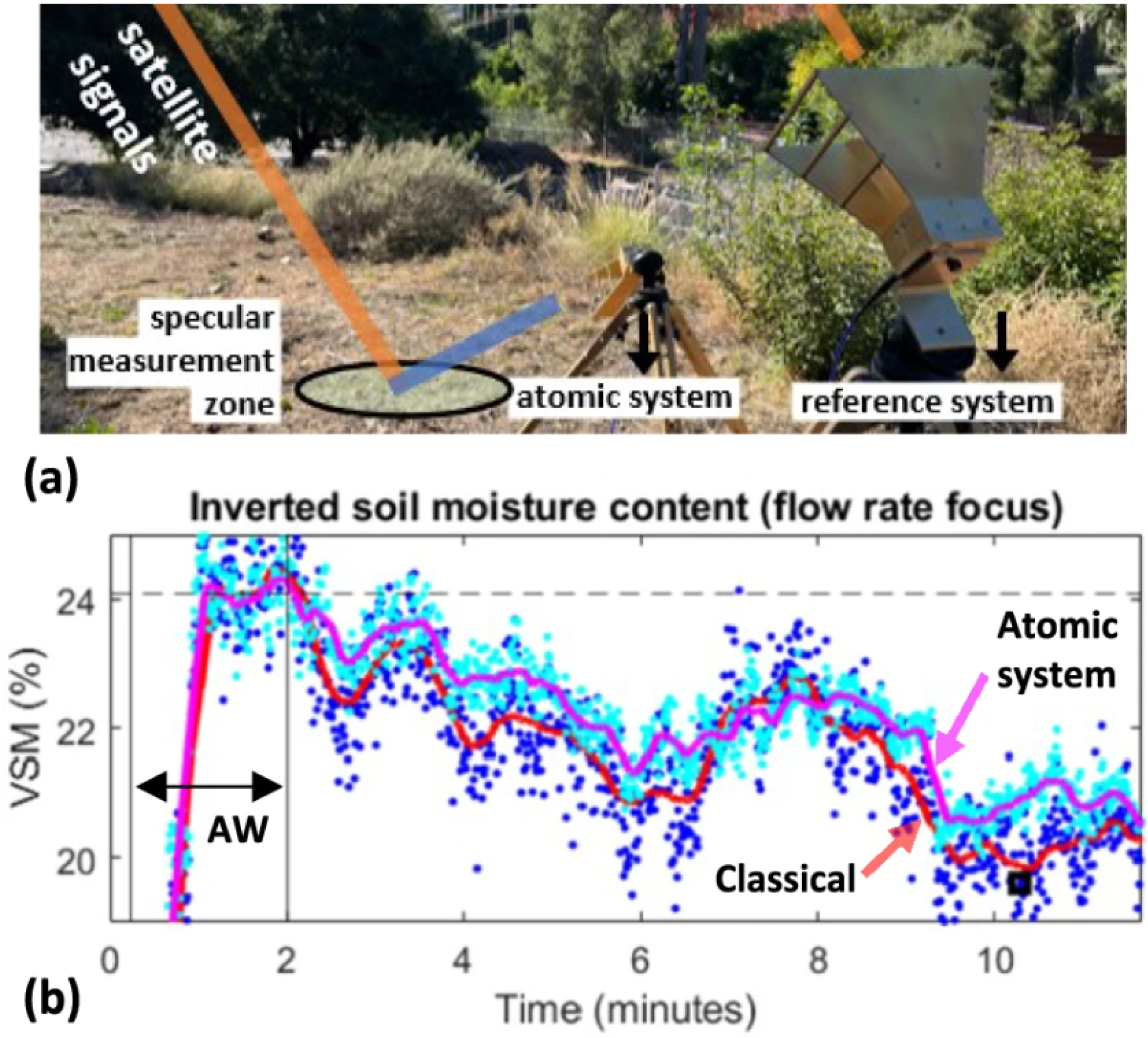
L/S-band satellite links (e.g., 1–3 GHz)Scene-scale (soil patch footprints)Propagation or multipath,
technical noise
[96]

5. Applications

5.1. Wireless Communications

Rydberg-atom sensors are emerging as a new paradigm for wireless receivers, acting as “quantum antennas” that directly convert radio-frequency (RF) fields into optical signals via atomic spectroscopy. This enables the reception of communication signals without traditional antennas or electronic mixers. Early demonstrations showed that thermal Rydberg vapors can demodulate AM and FM audio broadcasts using EIT readout; even playing music and video over an “atomic radio” receiver with subsequent experiments extended this concept to digital communications. For example, Rydberg receivers have reliably decoded binary phase-shift keyed data at 0.5 Mbps on a 10.2 GHz carrier, with ∼200 MHz of tunability [15]. By leveraging multi-level atomic resonances, a single Rydberg sensor can cover a vast frequency range: one system simultaneously demodulated five signals from 1.7 GHz to 116 GHz, recovering each channel’s amplitude and phase in real-time [89]. Such broadband capability—nearly six octaves in one device—would be impossible with conventional antennas of fixed size. The Rydberg sensor’s optical output also facilitates immediate fiber-optic routing of the received data, forming an effective wireless-to-optical link. Notably, researchers demonstrated a cesium Rydberg receiver for THz-band communication around 0.3 THz, achieving phase-sensitive detection of both amplitude- and frequency-modulated signals and pointing toward long-distance THz links free of electronic converters [90]. Key performance metrics of Rydberg communication receivers are continually improving. The intrinsic atomic bandwidth (tens of MHz) can be extended by clever schemes like off-resonant dressing and heterodyne detection, allowing Rydberg receivers to handle broadband modulation and fast data streams [16].
In the microwave domain, Rydberg radios have demodulated multi-band on-off keyed signals across decade-wide spans while maintaining bit-error rates comparable to conventional receivers [89]. The best sensitivities are now on the order of 10 7 10 6 V/m/Hz1/2, approaching the quantum noise limit for detection [14]. Moreover, Sedlacek et al. demonstrated microwave electrometry in a rubidium vapor cell using an EIT scheme [13]. They achieved a sensitivity of 30 ×  10 4 V/m/Hz1/2 and could detect fields as small as ≈8 ×  10 4 V/m, establishing that Rydberg-based sensing could serve as a traceable, atom-based standard for microwave field measurement [13]. Additionally, Hao et al. showed that modulating the microwave field can reveal new spectral features (a “shoulder interval”) that extend the weak-field limit. Using this amplitude-modulation technique, they detected a minimum field of only 0.0056 V / m at 9.2 GHz —about 30 × lower than the previous EIT-splitting limit [88].
Although today’s atomic receivers have higher noise floors than optimized classical receivers in narrow bands, they offer competitive performance over ultrawide spectral ranges without any antenna resizing or low-noise amplification. This quantum antenna approach also inherently provides absolute field calibration (via atomic constants) and avoids front-end saturation in high-field environments by virtue of the atoms’ large dynamic range. Together, these traits make Rydberg sensors attractive for next-generation wireless communications such as 6G, where extremely broadband, reconfigurable, and miniaturized receivers are desired [97].

5.2. Electromagnetic Metrology and Standards

One of the most transformative roles for Rydberg sensors is in metrology. National metrology institutes are actively developing Rydberg-based standard instruments. Recent designs integrate vapor cells with optical frequency combs and calibrate the RF field against optical frequency differences, tying field strength to the SI definition of the second and the Hertz [14]. Researchers realize an in situ, SI-traceable standard for electric-field measurements across frequencies. Because the atomic response (e.g., Rydberg-level shifts and splittings) is fundamentally linked to Planck’s constant and atomic structure, the measured field amplitude in V/m can be obtained directly from spectroscopic observables without external calibration [52]. For instance, the presence of an RF field produces an AT splitting in the Rydberg EIT spectrum; the splitting magnitude yields the absolute field strength based on known dipole matrix elements. This has enabled calibration of field probes and antennas by referencing atomic transitions, part of a broader push toward quantum SI units in electromagnetics [14]. Beyond amplitude calibration, Rydberg sensors provide vector-resolved field measurements. Because the atoms’ response depends on the polarization and phase of the RF field, one can extract these parameters with high precision. Sedlacek et al. demonstrated vector microwave electrometry in a Rb vapor cell, determining the polarization orientation of a 15 GHz field to within 0.5° by analyzing the differential EIT line strengths for various laser polarizations [52].
Similarly, Rydberg atoms can function as RF mixers to measure the phase of incoming fields relative to a reference. Simons et al. realized an atom-based mixer that locks to an RF carrier and yields the phase of a test signal with sub-degree resolution, enabling direct phase and impedance measurements in antenna characterization [50]. Such atomic phase referencing has also been extended to determine the angle-of-arrival of RF waves: by introducing a known spatial phase gradient (e.g., with a planar mirror or dual vapor cells), the incident wave’s direction can be inferred from the phase shift observed in the Rydberg sensor’s output [94]. This novel approach achieves direction finding with a single sensor element instead of an array, highlighting the unique metrological tools offered by atomic probes.

5.3. Defense and Surveillance

The unique attributes of Rydberg sensors—broadband sensitivity, passive operation, and self-calibration—make them appealing for defense and surveillance applications. Military and security systems often require detection of a wide variety of electromagnetic signals (communications, radar, electronic warfare emissions) across the spectrum. A single Rydberg receiver can sweep from kHz frequencies up through millimeter waves by tuning its lasers, acting as a universal RF sensor for spectrum monitoring and signals intelligence [14]. This ultra-wideband coverage was exemplified by Meyer et al., who showed that one atomic sensor could simultaneously monitor multiple frequency bands (L, S, Ku, and W-band) and decode information from each [89]. Such capability could allow, for instance, a compact Rydberg-based device to scan for threat communications or radar pulses over an extremely broad range without switching hardware. Additionally, the absence of traditional antennas or metal circuits means the Rydberg sensor has a very small electromagnetic footprint—useful for covert or resilient operations. The sensor itself can be physically tiny (mm-scale cell) and could be concealed or used in environments where metallic antennas would be impractical or detectable [30,45,89,98,99].
Another advantage for defense applications is the ability of Rydberg sensors to provide detailed information about incoming signals—including simultaneous multiband reception and full vector characterization—without conventional RF front ends [89,100,101]. For example, in conventional RF engineering, angle-of-arrival (AoA) measurement typically relies on antenna arrays that sample the spatial phase differences in the incoming wave. A similar principle applies to Rydberg-atom AoA sensing; although the atoms themselves are point-like, multiple optical beams can be used to create an effective atomic sensor array inside a single vapor cell. Dual-beam or multi-beam interrogation schemes, as demonstrated in Refs. [94,102], generate spatially separated sampling points of the RF field within the same cell, enabling phase- or amplitude-based AoA extraction without physical antenna elements. This concept has recently been extended further. Yan et al. demonstrated full three-dimensional field localization and velocity measurement using spatially distributed EIT sampling volumes. These results show that Rydberg AoA sensing is not strictly a “single-sensor” operation, but instead leverages the ability to generate multiple concurrent optical readout points, creating a compact atomic equivalent of a phased-array receiver [103,104,105]. Such approaches lend themselves to passive drone detection or battlefield signal triangulation with a very small form-factor, as shown by fiber-coupled mm-scale cells and wafer-level, all-dielectric vapor-cell platforms [45,98,106], and even proof-of-concept Rydberg imaging radar [107]. Furthermore, Rydberg receivers inherently access the polarization state—different polarizations couple different transitions—enabling classification of emission types and enhanced electromagnetic situational awareness, with demonstrations ranging from early vector electrometry and Floquet-based polarization calibration to complete 3D vector polarimetry [52,53,100,101].
Rydberg sensors have also been explored for EIT-based radar and sensing [50,108]. In a proof-of-concept “quantum radar” receiver, a Rydberg vapor cell directly down-converted FMCW radar returns without electronic mixers, forming the core of an imaging radar system [50,107]. This atomic radar detected and ranged targets with a single transceiver antenna and a Rydberg receiver, achieving centimeter-scale range resolution at meter-scale standoff by mixing the transmitted and reflected signals within the atoms; a related homodyne architecture likewise demonstrated cm-level ranging accuracy [107,109]. These results indicate that Rydberg receivers can handle the high dynamic range and fast chirps of radar waveforms while eliminating bulky microwave front-end components [50,107].
In electronic-warfare scenarios, Rydberg sensors can detect and analyze frequency-hopping or ultrawideband signals thanks to their broad spectral response and agile tuning, with demonstrations of simultaneous multiband reception over 1.7–116 GHz and frequency-hopping reception in a single device [89,110,111]. Finally, robustness to electromagnetic stress is a key advantage: because readout is optical and no conventional RF front end is required, Rydberg receivers have been argued to be inherently resistant to front-end burnout under very strong fields [112], suggesting roles from EMP-tolerant detectors to low-profile surveillance receivers.

5.4. Biomedical Imaging and Sensing

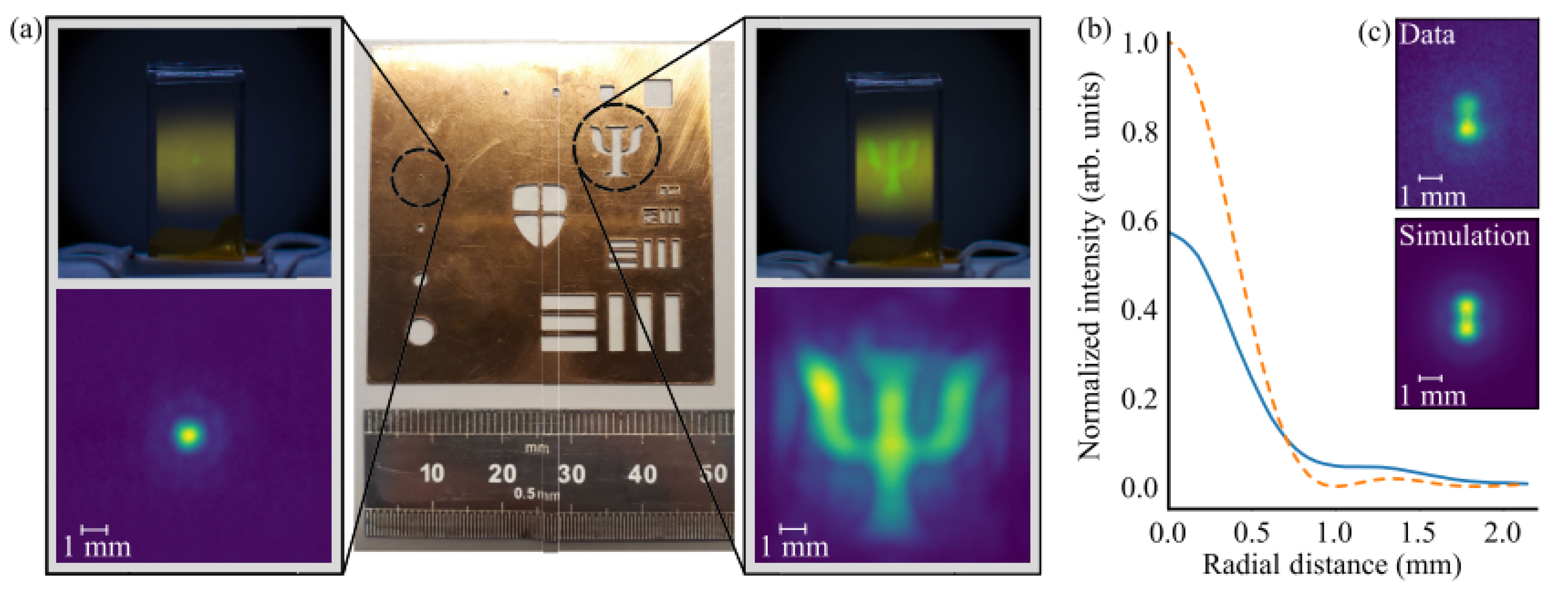
In biomedical contexts, Rydberg sensors open avenues for noninvasive imaging and field sensing in frequency bands (notably terahertz, THz) that are informative for tissue composition. THz contrast often tracks water content and related biochemistry, enabling differentiation between healthy and malignant tissue, but many conventional THz detectors are either slow or require cryogenic operation [113,114]. By upconverting THz radiation to the optical domain via resonant Rydberg transitions, atomic vapors enable fast, room-temperature THz cameras that leverage standard optics [91,115]. For example (refer Figure 6), Downes et al. mapped a 0.55 THz field over a ∼cm2 field of view with near-diffraction-limited resolution (∼0.3 mm) and video-rate acquisition at up to 3 kHz; the per-pixel noise-equivalent power was in the few-hundred-fW / Hz range for ∼40 μ m pixels [91]. Because response times are set by microsecond-scale atomic lifetimes, the approach is not fundamentally camera-limited, implying substantial headroom for higher frame rates as optics and readout improve [91,116]. Recent THz receivers further report room-temperature, phase-sensitive detection and heterodyne sensitivities at the tens-of-mV m−1 / Hz level in the 0.1–0.6 THz band, reinforcing feasibility for low-dose imaging [90,117].
Beyond imaging, atomic electrometry can support biomedical sensing and safety metrology. GHz–THz Rydberg receivers have been used to characterize and benchmark compact radar front ends and on-chip emitters with high precision, offering polarization and phase access that are valuable for calibrating vital-sign (Doppler) radars and other medical RF devices [93,100]. On the sensitivity front, pulse-sequence techniques continue to push noise-equivalent field levels; for instance, time-separated-field electrometry has reported ∼10 nV cm 1 / Hz at 10 GHz in hot vapors, illustrating the direction of travel for weak-signal biosensing [118]. Closer in, Rydberg receivers in the GHz range can directly verify emissions from implants and RF identification tags with traceable field calibration, supporting electromagnetic safety assessments [14,108].
Figure 6. Demonstration of spatial resolution. (a) A metal mask (center) placed in the object plane of the system. To the left and right are true-color images taken with camera A (above) and false-color images taken with camera B (below) for a 0.50 mm diameter pinhole (left) and a Ψ -shaped aperture (right). (b) Radially averaged intensity profiles of the measured point spread function (PSF) (solid blue line) and the simulated ideal PSF (dashed orange line). Both PSFs were scaled such that the total power in each image was equal. The ratio of peak heights gives a Strehl ratio of 0.57. (c) Real (top panel) and simulated (bottom panel) images of two 0.50 mm diameter pinholes separated by 1.00 mm [91].
Photonics 12 01228 g006
Hybrid and in situ concepts are also attractive. Fiber-delivered, all-dielectric probe heads and wafer-scale micromachined vapor cells minimize metal at the sensing tip—useful in constrained or electromagnetically sensitive environments—and have been demonstrated at millimeter scales [45,98]. While in-bore MRI deployments remain a topic for future study, the dielectric probe head and purely optical readout reduce conductive loading, and engineered low-scatter cells have been explored to limit field perturbations [108,119]. Recent demonstrations of real-time THz imaging of dynamic processes (e.g., fluid mixing) underscore the potential for live biomedical contrast mechanisms once appropriate safety budgets and optics are in place [120].

5.5. Quantum Information and Hybrid Quantum Systems

Rydberg-atom sensors are increasingly used at the interface of quantum information and sensing, particularly as transducers between microwave quantum hardware and optical links. Because many quantum processors (e.g., superconducting qubits) emit and process microwave photons that suffer from thermal noise and loss over distance, an atom–based transducer that continuously and coherently up-converts microwaves to light can enable hybrid quantum networks. Along these lines, Borówka et al. demonstrated a room-temperature Rydberg vapor converter that coherently up-converts a 13.9 GHz field to the near-infrared via six-wave mixing, with ∼16 MHz bandwidth and ∼57 dB dynamic range; by time-tagging the optical output with single-photon counters, they resolved thermal microwave photons at 300 K and observed Hanbury Brown and Twiss (HBT) intensity correlations in the microwave field [92]. Closely related cold-atom platforms have shown coherent microwave to optical transduction and efficient frequency mixing, establishing phase-preserving conversion and multi-percent conversion efficiencies [121,122]. Moreover, a cryogenic, cavity-assisted transducer coupled Rydberg atoms simultaneously to a 3D superconducting resonator and an optical cavity, achieving internal conversion efficiency near 60% and directly measuring thermal microwave photon statistics on chip [123]. Together, these results indicate that Rydberg media can realize continuous, quantum-compatible transduction at or near the standard quantum limit.
Beyond transduction, Rydberg ensembles can function as quantum microwave detectors that surpass classical amplifier paradigms. In the context of dark-matter axion haloscopes, theoretical analyses show that an atom-based single-photon counter could absorb an individual 10–50 GHz cavity photon on a Rydberg transition and up-convert it to an optical photon for near-noise-free readout, enabling order-of-magnitude faster scans [124]. Experimentally, quantum statistical signatures of thermal microwave radiation (e.g., second-order correlations) have been resolved with both hot-vapor and cold-atom Rydberg receivers via photon counting on the optical output, highlighting sensitivity to few-photon microwave fields at or below ambient noise levels [92,123].
Rydberg sensors also integrate naturally with superconducting circuits as readout probes or field monitors. Hybrid quantum architectures combining Rydberg atoms with superconducting resonators have attracted considerable interest because they offer a path toward coherent microwave to optical conversion at or near room temperature. In such systems, the superconducting circuit generates a well-defined microwave field that couples to a selected Rydberg transition, while the atoms provide a strongly nonlinear medium capable of frequency up-conversion through four-wave or six-wave mixing. Figure 7 illustrates a representative configuration, showing how a superconducting cavity mode interacts with a Rydberg ensemble to generate an optical sideband that carries the microwave information. This approach enables coherent transduction across otherwise incompatible frequency regimes and is promising for quantum information networks, where microwave-domain qubits must be interfaced with low-loss optical channels [125]. Coherent coupling of Rydberg atoms to microwave coplanar resonators has been demonstrated in several architectures, ultracold atoms magnetically trapped above a superconducting CPW resonator (dispersive AC-Zeeman sensing and on-resonance Rabi dynamics) [126], cavity-driven Rabi oscillations of trapped Rydberg atoms on a superconducting atom chip as shown in Figure 7 [125], Ramsey spectroscopy at a Rydberg-superconducting-circuit interface [127], and Rydberg–CPW coupling with time-domain coherence in cryogenic NbN resonators [128]. On the theory side, concrete designs detail microwave ↔ optical conversion using a single cesium atom coupled to a superconducting resonator [129], an ensemble on a superconducting chip [130], and four-wave mixing with ytterbium to telecom wavelengths [131]. Owing to their large electric-dipole matrix elements and field-tunable level structure, Rydberg probes can be rapidly tuned across qubit and cavity frequencies while adding minimal noise, suggesting roles as programmable quantum interconnects and non-perturbative monitors of cross-talk, leakage, and mode structure within microwave quantum processors [14]. In summary, Rydberg sensors provide a versatile bridge between circuit-QED and optical quantum networks, and enable microwave detection down to the few-photon regime—capabilities that are essential for scalable, distributed quantum information processing.
Figure 7. Coupling Rydberg transition to pumped MW cavity mode. (a) Conceptual sequence of a hybrid Rydberg–microwave cavity experiment. Atoms are first excited to a Rydberg state using a short two-photon optical pulse. A microwave pulse of adjustable power and duration is then injected into the superconducting cavity, driving a transition between two neighboring Rydberg levels. After the interaction, the atomic populations are read out using selective field ionization (SFI). (b) Normalized population of the upper Rydberg state as a function of microwave frequency for different input powers. The resonant coupling between r 1 and r 2 produces characteristic excitation spectra, from which the Rabi frequency of the cavity field can be extracted. (c) Time-resolved Rydberg-state population dynamics for several microwave powers, illustrating coherent Rabi oscillations and decoherence behavior. The inset shows a simulated microwave field distribution of the coplanar waveguide cavity, with the atomic cloud positioned above the surface. These measurements demonstrate coherent coupling between Rydberg atoms and a chip-integrated microwave cavity mode, a key step toward hybrid atom superconductor quantum devices [125].
Photonics 12 01228 g007

5.6. Industrial and Environmental Monitoring

Rydberg sensors are also poised to impact industrial sensing and environmental monitoring, offering a novel way to measure electromagnetic phenomena in situations where conventional sensors face challenges. One such application is in high-voltage power systems: detecting incipient electrical arcing and partial discharges that can lead to equipment failures or fires. Traditional arc detectors either rely on direct electrical connections or metal antennas that can disturb the circuit. In contrast, a Rydberg atomic sensor can wirelessly pick up the broadband RF signatures of an arc with minimal perturbation. Wang et al. demonstrated arc fault detection using a Rydberg vapor cell placed near a live electrical bus [95]. The atomic sensor captured the MHz-frequency radiation from small electrostatic discharges (a cigarette-lighter spark source) and produced a spectrum nearly identical to that obtained by a calibrated antenna [95]. This verifies that the Rydberg sensor can serve as a non-intrusive RF monitor in electrically noisy environments; related studies have shown robust performance of Rydberg EIT/AT readout under band-limited noise [49] and accurate field measurements even in strong-field regimes [48]. Moreover, the atomic probe’s all-dielectric measurement head and SI-traceable power/field metrology demonstrated in waveguides support industrial calibration workflows without conventional antennas [132]. Another industrial use case is the characterization and calibration of mm-wave devices, such as automotive radar sensors or 5G/6G millimeter-wave transmitters. Conventional near-field scans of antenna chips require delicate probes and can suffer from scattering by the probe itself. Rydberg sensors, on the other hand, can map the field emitted by a device under test with sub-wavelength spatial resolution and without metal perturbation. A recent study by Bor’owka et al. showcased a Rydberg-atom system for benchmarking 60–80 GHz automotive radar chips [93]. Earlier Rydberg imaging work established sub-wavelength microwave field mapping and agreement with full-wave simulations, providing a foundation for chip-scale near-field diagnostics [43,44]. Beyond amplitude mapping, Rydberg sensors can retrieve vector information (phase/polarization) important for beam characterization and compliance tests [52,100]. The same platform supports wide tunability—from sub-GHz to sub-THz—facilitating multi-band production testing with a single probe [75,99,133]. In environmental monitoring, Rydberg sensors open up new possibilities for remote sensing using ambient electromagnetic “signals of opportunity.” A striking example is the use of atomic sensors in ground-based receivers to passively sense environmental parameters via satellite broadcasts. Arumugam et al. demonstrated how a Rydberg receiver can intercept satellite radio signals reflected off the ground to measure soil moisture (See Figure 8) [96]. By tuning the Rydberg vapor to detect the phase and amplitude of these reflected signals, they inferred the moisture content of the soil, since wetter ground alters the reflection coefficient and thus the signal seen by the atomic sensor [96]. More generally, the broadband, calibration-free tuning of Rydberg electrometry indicates that the same hardware can be retuned across widely separated bands for passive environmental EM sensing with consistent, SI-linked readout [1,99,132].
Figure 8. Soil moisture (SM) sensing in an outdoor natural terrain. (a) Experimental setup and (b) response to a rapid flow of water (duration ≤ 2 min) with comparison to a classical SM retrieval system [96].
Photonics 12 01228 g008
Looking ahead, Rydberg sensors could be deployed in sensor networks for comprehensive environmental EMF monitoring. They could track background radiation levels in urban areas (to ensure compliance with RF exposure limits), monitor the spectrum usage in wilderness preserves (for interference or illegal transmitter detection), or even serve as calibration references for meteorological radars and radiotelescopes. Because they are reference-free and self-calibrating, any two properly configured Rydberg sensors will agree on field strength within atomic-defined uncertainties—an attractive property for large-scale monitoring [1,132]. Additionally, the atomic sensors can operate in extreme conditions—the vapor cell can be heated or buffered for stability, and the lasers can be delivered via fiber—making them robust for outdoor and industrial environments. Whether it is detecting a lightning strike’s electromagnetic pulse, mapping an inhomogeneous RF field in a semiconductor fab, or using broadcast signals to measure environmental changes, Rydberg sensors bring EIT-based sensitivity and flexibility to many industrial and environmental sensing challenges.

6. Challenges and Future Work

Despite significant progress, the Rydberg sensor performance metrics (Table 1) reveal both their versatility and their current limitations. Sub- μ V, cm−1 sensitivities achieved with atomic superheterodyne receivers [16], video-rate THz imaging at near-diffraction-limited resolution [91], and microwave-to-optical conversion with high reported dynamic range [92] demonstrate the breadth of achievable operating regimes. However, no single architecture simultaneously optimizes sensitivity, bandwidth, spatial resolution, and dynamic range. Vapor-cell EIT electrometers, for instance, provide excellent weak-field detection [13,52] but are bandwidth-limited and prone to technical noise, while multiband receivers extend frequency coverage up to 116 GHz [89] yet introduce cross-talk and phase-noise challenges. Similarly, THz receivers and radar probe applications illustrate promising niche capabilities [90,93] but face constraints in coupling efficiency, device compatibility, and environmental robustness. One major concern lies in the sensitivity to environmental perturbations, particularly stray electric fields and blackbody radiation. High principal quantum number states are inherently fragile; their exaggerated polarizabilities (scaling as n) make them susceptible to uncontrolled field fluctuations, leading to spectral broadening, line shifts, and decoherence [13]. In addition, collisional dephasing and thermal motion in room-temperature vapor cells contribute to linewidth broadening and reduced EIT contrast, thereby affecting sensitivity and signal-to-noise ratio (SNR). Techniques like buffer gases, anti-relaxation coatings, or microfabricated vapor cells are being developed to mitigate these issues, but often involve trade-offs between lifetime and signal fidelity [48].
Another persistent challenge is laser system complexity. Most schemes require a narrow-linewidth coupling laser in the blue (e.g., 480 nm for Rb), which is not only expensive but also difficult to stabilize. Furthermore, maintaining Doppler-free or Doppler-narrowed conditions in thermal vapors adds experimental complexity, particularly when moving toward portable or miniaturized sensor designs. Finally, while SI traceability and self-calibration are attractive theoretical features of Rydberg sensors, experimental validations across broad dynamic ranges and comparison with national metrology standards (like the Josephson voltage or the watt balance) are still limited. Metrological consensus on how to benchmark these sensors under international standards is still under development [30].
The practical deployment of Rydberg-atom sensors still faces several fundamental and engineering challenges. In thermal vapor cells, Doppler broadening and transit-time decoherence set a lower bound on the EIT linewidth, limiting the minimum detectable field. For example, Doppler widths of 500–600 MHz for alkali atoms at room temperature significantly broaden the two-photon resonance unless velocity-selective detection or Doppler-compensation schemes are used [44]. Reliable operation further requires highly stable lasers, since laser frequency and phase noise map directly onto the EIT signal, causing excess noise in electrometry measurements [13]. At higher atomic densities, Rydberg–Rydberg interactions (van der Waals shifts ∝ n 11 ) lead to density-dependent line shifts and broadening, degrading linearity and complicating absolute calibration. Additional errors arise from stray electric fields generated by adsorbates or patch potentials on vapor-cell walls, which distort the measured Stark maps and introduce systematic offsets in DC and low-frequency field sensing [43]. The accuracy of Rydberg electrometry also depends on precise transition dipole matrix elements, typically calculated using model potentials; uncertainties of even 2–5% propagate directly into the inferred electric-field amplitude. Environmental effects such as blackbody-radiation-induced transitions, collisional broadening, and optical power broadening further modify the EIT line shape and must be carefully controlled for high-accuracy, SI-traceable measurements [13,61].
In our practical implementation, the EIT coherence requires approximately 0.1 μ s to reach steady-state. This sets an upper limit of 10 MHz on the carrier bandwidth for reliable demodulation. Consequently, Rydberg-based sensors face intrinsic constraints when detecting highly broadband or spread-spectrum signals. Improving the atomic coherence response time remains an open challenge for advancing Rydberg receivers toward high-speed applications. Recent work has proposed mitigation strategies such as surface charge compensation, cryogenic vapor cell operation, dual-probe differential detection, and optimized atomic state selection, but these challenges remain central to ongoing efforts to advance Rydberg-based quantum sensing.
Despite the challenges, the field of Rydberg atom-based sensing is rapidly evolving, and several emerging trends are poised to overcome current bottlenecks and unlock new applications. These aspects represent important directions for future research, where continued developments in atomic control, faster coherence dynamics, and advanced readout techniques are expected to further expand the capabilities of Rydberg-based sensing systems. Below are some possible future directions that may guide the continued development and advancement of Rydberg-based sensing technologies.
  • Integrated photonic–atomic systems: Advances in hybrid integration may soon enable chip-scale Rydberg sensors using hollow-core fibers, waveguides, or integrated optics, dramatically reducing size and power consumption while improving robustness [58].
  • Quantum-enhanced sensing: The use of entangled Rydberg ensembles, spin squeezing, or quantum non-demolition (QND) readout could push sensitivities below the standard quantum limit, especially for time-varying fields or magnetometry [134].
  • Cryogenic and ultracold Rydberg platforms: While vapor cells dominate current sensor implementations, laser-cooled or BEC-based Rydberg systems offer superior coherence and interaction control. These may allow for ultra-high-precision RF and THz spectroscopy in the future.
  • Novel field modalities: Beyond electric fields, Rydberg-based sensors are being explored for magnetic fields, temperature, terahertz imaging, and even quantum field detection, thanks to the atom’s broadband and multi-level structure [43].
  • Commercialization and standards: Projects at NIST and other national labs aim to develop commercial-grade Rydberg sensors with defined calibration protocols, robust packaging, and plug and play operation, bringing quantum sensing closer to industrial markets [2].
These studies also highlight the gap between current laboratory demonstrations and the level of robustness required for deployable field sensing platforms, underscoring several engineering challenges that must be addressed. Therefore, progress toward practical implementation will require advances in noise mitigation, environmental stability, calibration standards, and device miniaturization, alongside strategies for integrating Rydberg sensors with existing RF and optical infrastructures.

7. Conclusions

Rydberg atom-based sensors have emerged as a revolutionary platform for precision electromagnetic field measurements, bridging the gap between fundamental atomic physics and real-world sensing applications. Their exceptional sensitivity arises from the exaggerated properties of Rydberg states, namely, large electric dipole moments, strong polarizability, and extended lifetimes. Through all-optical readout techniques such as EIT, these sensors offer SI-traceable, non-invasive, and ultra-broadband detection of electric and magnetic fields across GHz to THz frequencies.
This review has presented the theoretical foundations, scaling laws, and experimental implementations that underpin Rydberg sensing. Various excitation schemes, particularly ladder-EIT configurations, were discussed, alongside their applications in serving as atomic standards for electromagnetic field calibration. Rydberg sensors are already being deployed in areas such as EIT-based communications, RF diagnostics, and hybrid photonic platforms for remote field imaging.
Despite remarkable progress, several challenges remain. These include Doppler and transit time broadening, laser power and frequency instability, field inhomogeneities in vapor cells, and environmental decoherence. Recent innovations—such as Rydberg superheterodyne detection, weak-value amplification, multi-photon mixing, and miniaturized sensor architectures—are addressing these limitations, steadily pushing the sensitivity toward quantum-noise-limited performance.
Looking forward, several promising directions are evident:
  • Miniaturization and Integration: The development of chip-scale vapor cells, integrated photonics, and fiber-coupled modules is enabling the deployment of portable, field-deployable Rydberg sensors.
  • Quantum Enhancement: Nonclassical states such as entangled or squeezed Rydberg ensembles could surpass classical sensitivity limits, with direct implications for quantum metrology.
  • Multimodal Sensing: Co-integration with optical cavities, magnetometers, and pressure transducers could enable comprehensive atomic-scale diagnostics.
  • Emerging Applications: Unique attributes make Rydberg sensors attractive for use in biomedical environments, high-voltage infrastructure monitoring, and cryogenic field sensing, where conventional sensors are inadequate.
Ultimately, Rydberg atom-based sensors represent a paradigm shift in the field of sensing rooted in the reproducibility of atomic constants and powered by quantum optics. As this field matures, it is likely to form a cornerstone of next generation technologies in quantum communication, precision metrology, and advanced sensor networks.

Author Contributions

Conceptualization, D.S., A.A., A.E.M. and H.T.H.; Methodology, D.S., A.A. and A.A.O.; Formal analysis, D.S. and A.A.; Writing—original draft, D.S., A.A., A.A.O., A.M.B. and H.T.H.; Writing—review & editing, D.S., A.A., A.A.O., A.M.B., M.I.U.W., K.A., I.A.M.A.A., M.C.D., A.E.M. and H.T.H.; Supervision, K.A., I.A.M.A.A., M.C.D., A.E.M. and H.T.H.; Project administration, A.E.M. and H.T.H. All authors have read and agreed to the published version of the manuscript.

Funding

This research was funded by Australian NSW Defence Innovation network through the SII23.01.02 research grant and the UNSW RIS 2025 on Rydberg atoms-based facility.

Data Availability Statement

No new data were created or analyzed in this study.

Acknowledgments

The authors would like to thank the Australian Defence Innovation network through the SII23.01.02 research grant and the UNSW RIS 2025 on Rydberg atoms-based facility. We also extend our gratitude to the UNSW Canberra academics and supporting staff.

Conflicts of Interest

The authors declare that they have no known competing financial interests or personal relationships that could have appeared to influence the work reported in this paper.

Abbreviations

The following abbreviations are used in this manuscript:
ACAlternating current
AMAmplitude modulation
AoAAngle of arrival
AOMAcousto-optic modulator
ATAutler–Townes (splitting)
BBRBlackbody radiation
BPSKBinary Phase Shift Keying
BWBandwidth
CCDCharge-coupled device
CPWCoplanar waveguide
DCDirect current
DUTDevice under test
EITElectromagnetically induced transparency
EMF        Electromagnetic field
EMIElectromagnetic interference
FMFrequency modulation
GHzGigahertz
GTGlan–Taylor polarizer
HBTHanbury Brown and Twiss
HWPHalf-wave plate
IFintermediate-frequency
kHzKilohertz
LOLocal oscillator
Mb/sMegabits per second
MEMSMicro-electro-mechanical systems
MHzMegahertz
mmWaveMillimeter wave
MRIMagnetic resonance imaging
PBSPolarizing beam splitter
PDPhotodiode
PSKPhase-shift keying
QAMQuadrature Amplitude Modulation
QEDQuantum electrodynamics
QPSKQuadrature Phase Shift Keying
RbRubidium
RFRadio-frequency
SiSilicon
SNRSignal-to-noise ratio
THzTerahertz

References

  1. Schlossberger, N.; Prajapati, N.; Berweger, S.; Rotunno, A.P.; Artusio-Glimpse, A.B.; Simons, M.T.; Sheikh, A.A.; Norrgard, E.B.; Eckel, S.P.; Holloway, C.L. Rydberg states of alkali atoms in atomic vapour as SI-traceable field probes and communications receivers. Nat. Rev. Phys. 2024, 6, 606–620. [Google Scholar] [CrossRef]
  2. Simons, M.T.; Artusio-Glimpse, A.B.; Robinson, A.K.; Prajapati, N.; Holloway, C.L. Rydberg atom-based sensors for radio-frequency electric field metrology, sensing, and communications. Meas. Sens. 2021, 18, 100273. [Google Scholar] [CrossRef]
  3. Brown, J.M.; Walker, T.G. Perspective: Practical atom-based quantum sensors. Phys. Rev. A 2025, 112, 040102. [Google Scholar] [CrossRef]
  4. Ryabtsev, I.; Entin, V.; Tretyakov, D.; Yakshina, E.; Beterov, I.; Pechersky, Y.Y. Quantum Sensors of Electric Fields Based on Highly Excited Rydberg Atoms. Radiophys. Quantum Electron. 2024, 67, 1–12. [Google Scholar] [CrossRef]
  5. Holloway, C.L.; Gordon, J.A.; Simons, M.T.; Anderson, D.A.; Schwarzkopf, A.; Miller, S.A.; Thaicharoen, N.; Raithel, G. Atom-based RF field probe: From self-calibrated measurements to sub-wavelength imaging. In Proceedings of the 2015 IEEE 15th International Conference on Nanotechnology (IEEE-NANO), Rome, Italy, 27–30 July 2015; pp. 789–791. [Google Scholar]
  6. Holloway, C.L.; Prajapati, N.; Sherman, J.A.; Rüfenacht, A.; Artusio-Glimpse, A.B.; Simons, M.T.; Robinson, A.K.; La Mantia, D.S.; Norrgard, E.B. Electromagnetically induced transparency based Rydberg-atom sensor for traceable voltage measurements. AVS Quantum Sci. 2022, 4, 034401. [Google Scholar] [CrossRef]
  7. Artusio-Glimpse, A.; Simons, M.; Prajapati, N.; Holloway, C.L. Modern RF Measurements with Hot Atoms: A Technology Review of Rydberg Atom-Based Radio Frequency Field Sensors. IEEE Microw. Mag. 2022, 23, 44–56. [Google Scholar] [CrossRef]
  8. Anderson, D.A.; Sapiro, R.E.; Raithel, G. Rydberg atoms for radio-frequency communications and sensing: Atomic receivers for pulsed rf field and phase detection. IEEE Aerosp. Electron. Syst. Mag. 2020, 35, 48–56. [Google Scholar] [CrossRef]
  9. Yu, H.; Li, G.; Hao, H.; Ma, J. Advanced Techniques for Microwave Field Measurement Using Rydberg Atoms. In Proceedings of the International Conference on Information Processing and Network Provisioning, Qingdao, China, 8–10 November 2024; Springer: Berlin/Heidelberg, Germany, 2024; pp. 349–362. [Google Scholar]
  10. Chen, Y.C.; Fang, S.C.; Su, H.J.; Chen, Y.H. Electric field sensing via Rydberg electromagnetically induced transparency using Zeeman and Stark effects. J. Appl. Phys. 2025, 138, 094501. [Google Scholar] [CrossRef]
  11. Yin, Z.; Li, Q.; Song, X.; Jia, Z.; Parniak, M.; Lu, X.; Peng, Y. Microwave electrometry with multi-photon coherence in Rydberg atoms. Sensors 2023, 23, 7269. [Google Scholar] [CrossRef]
  12. Yuan, J.; Yang, W.; Jing, M.; Zhang, H.; Jiao, Y.; Li, W.; Zhang, L.; Xiao, L.; Jia, S. Quantum sensing of microwave electric fields based on Rydberg atoms. Rep. Prog. Phys. 2023, 86, 106001. [Google Scholar] [CrossRef]
  13. Sedlacek, J.A.; Schwettmann, A.; Kübler, H.; Löw, R.; Pfau, T.; Shaffer, J.P. Microwave electrometry with Rydberg atoms in a vapour cell using bright atomic resonances. Nat. Phys. 2012, 8, 819–824. [Google Scholar] [CrossRef]
  14. Zhang, H.; Ma, Y.; Liao, K.; Yang, W.; Liu, Z.; Ding, D.; Yan, H.; Li, W.; Zhang, L. Rydberg atom electric field sensing for metrology, communication and hybrid quantum systems. Sci. Bull. 2024, 69, 1515–1535. [Google Scholar] [CrossRef]
  15. Song, Z.; Liu, H.P.; Liu, X.C.; Zhang, W.F.; Zou, H.Y.; Zhang, J.; Qu, J.F. Rydberg-atom-based digital communication using a continuously tunable radio-frequency carrier. Opt. Express 2019, 27, 8848–8857. [Google Scholar] [CrossRef] [PubMed]
  16. Jing, M.; Hu, Y.; Ma, J.; Zhang, H.; Zhang, L.; Xiao, L.; Jia, S. Atomic superheterodyne receiver based on microwave-dressed Rydberg spectroscopy. Nat. Phys. 2020, 16, 911–915. [Google Scholar] [CrossRef]
  17. Jiang, Y.; Wu, J.; Shi, M.; Zheng, H.; Guo, F.; Xiao, Z.; Zhang, Z. Quantum weak measurement amplifies dispersion signal of Rydberg atomic system. Commun. Phys. 2025, 8, 144. [Google Scholar] [CrossRef]
  18. Dietsche, E.; Larrouy, A.; Haroche, S.; Raimond, J.; Brune, M.; Gleyzes, S. High-sensitivity magnetometry with a single atom in a superposition of two circular Rydberg states. Nat. Phys. 2019, 15, 326–329. [Google Scholar] [CrossRef]
  19. Feng, Z.; Liu, X.; Zhang, Y.; Ruan, W.; Song, Z.; Qu, J. Atom-based sensing technique of microwave electric and magnetic fields via a single rubidium vapor cell. Opt. Express 2023, 31, 1692–1704. [Google Scholar] [CrossRef]
  20. Arfken, G.B.; Griffing, D.F.; Kelly, D.C.; Priest, J. Chapter 42—Quantum Physics, Lasers, and Squids. In International Edition University Physics; Arfken, G.B., Griffing, D.F., Kelly, D.C., Priest, J., Eds.; Academic Press: Cambridge, MA, USA, 1984; pp. 818–840. [Google Scholar]
  21. Read, F.H. A modified Rydberg formula. J. Phys. B At. Mol. Phys. 1977, 10, 449. [Google Scholar] [CrossRef]
  22. Haase, C.; Beyer, M.; Jungen, C.; Merkt, F. The fundamental rotational interval of para-H2+ by MQDT-assisted Rydberg spectroscopy of H2. J. Chem. Phys. 2015, 142, 064310. [Google Scholar] [CrossRef]
  23. Gallagher, T. Rydberg Atoms; Cambridge Monographs on Atomic, Molecular and Chemical Physics; Cambridge University Press: Cambridge, UK, 1994. [Google Scholar]
  24. Cao, Y.; Yang, W.; Zhang, H.; Jing, M.; Li, W.; Zhang, L.; Xiao, L.; Jia, S. Dephasing effect of Rydberg states on trap loss spectroscopy of cold atoms. J. Opt. Soc. Am. B 2022, 39, 2032–2036. [Google Scholar] [CrossRef]
  25. Hattori, H.T.; Somaweera, D.; Akter, S.; As’Ham, K.; Lei, W. From carbide-based components to quantum Rydberg sensors. In Proceedings of the 2025 25th Anniversary International Conference on Transparent Optical Networks (ICTON), Barcelona, Spain, 6–10 July 2025; pp. 1–4. [Google Scholar]
  26. Mohapatra, A.K.; Jackson, T.R.; Adams, C.S. Coherent Optical Detection of Highly Excited Rydberg States Using Electromagnetically Induced Transparency. Phys. Rev. Lett. 2007, 98, 113003. [Google Scholar] [CrossRef] [PubMed]
  27. Beterov, I.I.; Ryabtsev, I.I.; Tretyakov, D.B.; Entin, V.M. Quasiclassical calculations of blackbody-radiation-induced depopulation rates and effective lifetimes of Rydberg nS, nP, and nD alkali-metal atoms with n < 80. Phys. Rev. A 2009, 79, 052504. [Google Scholar] [CrossRef]
  28. Urban, E.; Johnson, T.A.; Henage, T.; Isenhower, L.; Yavuz, D.; Walker, T.; Saffman, M. Observation of Rydberg blockade between two atoms. Nat. Phys. 2009, 5, 110–114. [Google Scholar] [CrossRef]
  29. Yan, M.; Rickey, E.G.; Zhu, Y. Electromagnetically induced transparency in cold rubidium atoms. J. Opt. Soc. Am. B 2001, 18, 1057–1062. [Google Scholar] [CrossRef]
  30. Holloway, C.L.; Gordon, J.A.; Jefferts, S.; Schwarzkopf, A.; Anderson, D.A.; Miller, S.A.; Thaicharoen, N.; Raithel, G. Broadband Rydberg atom-based electric-field probe for SI-traceable, self-calibrated measurements. IEEE Trans. Antennas Propag. 2014, 62, 6169–6182. [Google Scholar] [CrossRef]
  31. You, S.; Cai, M.; Zhang, S.; Xu, Z.; Liu, H. Microwave-field sensing via electromagnetically induced absorption of Rb irradiated by three-color infrared lasers. Opt. Express 2022, 30, 16619–16629. [Google Scholar] [CrossRef]
  32. Hao, L.; Xue, Y.; Fan, J.; Jiao, Y.; Zhao, J.; Jia, S. Nonlinearity of microwave electric field coupled Rydberg electromagnetically induced transparency and Autler-Townes splitting. Appl. Sci. 2019, 9, 1720. [Google Scholar] [CrossRef]
  33. Yerokhin, V.; Buhmann, S.; Fritzsche, S.; Surzhykov, A. Electric dipole polarizabilities of Rydberg states of alkali-metal atoms. Phys. Rev. A 2016, 94, 032503. [Google Scholar] [CrossRef]
  34. Lai, Z.; Zhang, S.; Gou, Q.; Li, Y. Polarizabilities of Rydberg states of Rb atoms with n up to 140. Phys. Rev. A 2018, 98, 052503. [Google Scholar] [CrossRef]
  35. Song, H.; Xiao, Y.; Hu, S.; Xiao, D.; Wang, B.; Shi, Z.; Zhang, H. Theoretical study on Stark effect of Rydberg atom in super low frequency electric field measurement. IET Energy Syst. Integr. 2024, 6, 174–181. [Google Scholar] [CrossRef]
  36. Beguin, L.; Vernier, A.; Chicireanu, R.; Lahaye, T.; Browaeys, A. Direct measurement of the van der Waals interaction between two Rydberg atoms. Phys. Rev. Lett. 2013, 110, 263201. [Google Scholar] [CrossRef] [PubMed]
  37. Kurdak, D.; Banner, P.R.; Li, Y.; Muleady, S.R.; Gorshkov, A.V.; Rolston, S.; Porto, J. Enhancement of Rydberg Blockade via Microwave Dressing. Phys. Rev. Lett. 2025, 134, 123404. [Google Scholar] [CrossRef] [PubMed]
  38. Kumar, S.; Fan, H.; Kübler, H.; Sheng, J.; Shaffer, J.P. Atom-based sensing of weak radio frequency electric fields using homodyne readout. Sci. Rep. 2017, 7, 42981. [Google Scholar] [CrossRef] [PubMed]
  39. Liu, B.; Zhang, L.; Liu, Z.; Deng, Z.; Ding, D.; Shi, B.; Guo, G. Electric field measurement and application based on Rydberg atoms. Electromagn. Sci. 2023, 1, 1–16. [Google Scholar] [CrossRef]
  40. Kübler, H.; Keaveney, J.; Lui, C.; Ramirez-Serrano, J.; Amarloo, H.; Erskine, J.; Gillet, G.; Shaffer, J.P. Atom-based sensing of microwave electric fields using highly excited atoms: Mechanisms affecting sensitivity. Proc. Opt. Opto At. Entanglement Enhanc. Precis. Metrol. 2019, 10934, 1093406. [Google Scholar]
  41. Meyer, D.H.; Castillo, Z.A.; Cox, K.C.; Kunz, P.D. Assessment of Rydberg atoms for wideband electric field sensing. J. Phys. B At. Mol. Opt. Phys. 2020, 53, 034001. [Google Scholar] [CrossRef]
  42. Li, Y.; Sohn, D.B.; Hummon, M.T.; Schima, S.; Kitching, J. Wafer-scale fabrication of evacuated alkali vapor cells. Opt. Lett. 2024, 49, 4963–4966. [Google Scholar] [CrossRef]
  43. Fan, H.Q.; Kumar, S.; Daschner, R.; Kübler, H.; Shaffer, J.P. Subwavelength microwave electric-field imaging using Rydberg atoms inside atomic vapor cells. Opt. Lett. 2014, 39, 3030–3033. [Google Scholar] [CrossRef]
  44. Holloway, C.L.; Gordon, J.A.; Schwarzkopf, A.; Anderson, D.A.; Miller, S.A.; Thaicharoen, N.; Raithel, G. Sub-wavelength imaging and field mapping via electromagnetically induced transparency and Autler–Townes splitting in Rydberg atoms. Appl. Phys. Lett. 2014, 104, 244102. [Google Scholar] [CrossRef]
  45. Simons, M.T.; Gordon, J.A.; Holloway, C.L. Fiber-coupled vapor cell for a portable Rydberg atom-based radio frequency electric field sensor. Appl. Opt. 2018, 57, 6456–6460. [Google Scholar] [CrossRef]
  46. Liu, B.; Zhang, L.H.; Wang, Q.F.; Ma, Y.; Han, T.Y.; Liu, Z.K.; Zhang, Z.Y.; Shao, S.Y.; Zhang, J.; Li, Q.; et al. Cavity-Enhanced Rydberg Atom Microwave Receiver. Chin. Phys. Lett. 2025, 42, 053201. [Google Scholar] [CrossRef]
  47. Thaicharoen, N.; Cardman, R.; Raithel, G. Rydberg electromagnetically induced transparency of vapor in a cell with Ne buffer gas. Phys. Rev. Appl. 2024, 21, 064004. [Google Scholar] [CrossRef]
  48. Anderson, D.A.; Miller, S.A.; Raithel, G.; Gordon, J.A.; Butler, M.L.; Holloway, C.L. Optical Measurements of Strong Microwave Fields with Rydberg Atoms in a Vapor Cell. Phys. Rev. Appl. 2016, 5, 034003. [Google Scholar] [CrossRef]
  49. Simons, M.T.; Haddab, A.H.; Gordon, J.A.; Holloway, C.L. Electromagnetically Induced Transparency (EIT) and Autler–Townes (AT) splitting in the presence of band-limited white Gaussian noise. J. Appl. Phys. 2018, 123, 203105. [Google Scholar] [CrossRef]
  50. Simons, M.T.; Haddab, A.H.; Gordon, J.A.; Holloway, C.L. A Rydberg atom-based mixer: Measuring the phase of a radio frequency wave. Appl. Phys. Lett. 2019, 114, 114101. [Google Scholar] [CrossRef]
  51. Holloway, C.L.; Simons, M.T.; Gordon, J.A.; Novotny, D. Detecting and receiving phase-modulated signals with a Rydberg atom-based receiver. IEEE Antennas Wirel. Propag. Lett. 2019, 18, 1853–1857. [Google Scholar] [CrossRef]
  52. Sedlacek, J.; Schwettmann, A.; Kübler, H.; Shaffer, J. Atom-based vector microwave electrometry using rubidium Rydberg atoms in a vapor cell. Phys. Rev. Lett. 2013, 111, 063001. [Google Scholar] [CrossRef]
  53. Jiao, Y.; Hao, L.; Han, X.; Bai, S.; Raithel, G.; Zhao, J.; Jia, S. Atom-based radio-frequency field calibration and polarization measurement using cesium nDJ Floquet states. Phys. Rev. Appl. 2017, 8, 014028. [Google Scholar] [CrossRef]
  54. Hulet, R.G.; Kleppner, D. Rydberg atoms in “circular” states. Phys. Rev. Lett. 1983, 51, 1430. [Google Scholar] [CrossRef]
  55. Bao, S.; Zhang, H.; Zhou, J.; Zhang, L.; Zhao, J.; Xiao, L.; Jia, S. Polarization spectra of Zeeman sublevels in Rydberg electromagnetically induced transparency. Phys. Rev. A 2016, 94, 043822. [Google Scholar] [CrossRef]
  56. Naber, J.B.; Tauschinsky, A.; van Linden van den Heuvell, H.B.; Spreeuw, R.J.C. Electromagnetically induced transparency with Rydberg atoms across the Breit–Rabi regime. SciPost Phys. 2017, 2, 015. [Google Scholar] [CrossRef]
  57. Li, X.; Cui, Y.; Hao, J.H.; Zhou, F.; Wang, Y.; Jia, F.; Zhang, J.; Xie, F.; Zhong, Z. Magnetic-field-induced splitting of Rydberg electromagnetically induced transparency and Autler–Townes spectra in 87Rb vapor cell. Opt. Express 2023, 31, 38165–38178. [Google Scholar] [CrossRef] [PubMed]
  58. Zou, J.; Hogan, S.D. Absolute static-field magnetometry, magnetic gradiometry, and vector electrometry with circular Rydberg atoms. Phys. Rev. A 2023, 107, 062820. [Google Scholar] [CrossRef]
  59. Schlossberger, N.; Rotunno, A.P.; Artusio-Glimpse, A.B.; Prajapati, N.; Berweger, S.; Shylla, D.; Simons, M.T.; Holloway, C.L. Zeeman-resolved Autler–Townes splitting in Rydberg atoms with tunable resonances and a single transition dipole moment. Phys. Rev. A 2024, 109, L021702. [Google Scholar] [CrossRef]
  60. Vylegzhanin, A.; Nic Chormaic, S.; Brown, D.J. Rydberg electromagnetically induced transparency based laser lock to Zeeman sublevel transitions with 0.6 GHz scanning range. Rev. Sci. Instruments 2024, 95, 113001. [Google Scholar] [CrossRef]
  61. Beterov, I.; Tretyakov, D.; Ryabtsev, I.; Entin, V.; Ekers, A.; Bezuglov, N. Ionization of Rydberg atoms by blackbody radiation. New J. Phys. 2009, 11, 013052. [Google Scholar] [CrossRef]
  62. Schlossberger, N.; Rotunno, A.P.; Eckel, S.P.; Norrgard, E.B.; Manchaiah, D.; Prajapati, N.; Artusio-Glimpse, A.B.; Berweger, S.; Simons, M.T.; Shylla, D.; et al. Primary quantum thermometry of mm-wave blackbody radiation via induced state transfer in Rydberg states of cold atoms. Phys. Rev. Res. 2025, 7, L012020. [Google Scholar] [CrossRef]
  63. Archimi, M.; Ceccanti, M.; Distefano, M.; Di Virgilio, L.; Franco, R.; Greco, A.; Simonelli, C.; Arimondo, E.; Ciampini, D.; Morsch, O. Measurements of blackbody-radiation-induced transition rates between high-lying S, P, and D Rydberg levels of rubidium. Phys. Rev. A 2022, 105, 063104. [Google Scholar] [CrossRef]
  64. Thompson, D.C.; Kammermayer, E.; Stoicheff, B.P.; Weinberger, E. Pressure shifts and broadenings of Rb Rydberg states by Ne, Kr, and H2. Phys. Rev. A 1987, 36, 2134–2143. [Google Scholar] [CrossRef]
  65. Dash, B.; Thaicharoen, N.; Paradis, E.; Duspayev, A.; Raithel, G. Rydberg electromagnetically induced transparency of 85Rb vapor in Ar, Ne, and N2 gases. APL Quantum 2025, 2, 016132. [Google Scholar] [CrossRef]
  66. Lei, M.; Eckel, S.P.; Norrgard, E.B.; Prajapati, N.; Artusio-Glimpse, A.B.; Simons, M.T.; Holloway, C.L. Collisional broadening of Rydberg levels: Conclusions for vapor-cell manufacture. Phys. Rev. Appl. 2025, 23, 034028. [Google Scholar] [CrossRef]
  67. Peng, Y.; Wang, J.; Yang, A.; Jia, Z.; Li, D.; Chen, B. Cavity-enhanced microwave electric field measurement using Rydberg atoms. J. Opt. Soc. Am. B 2018, 35, 2272–2277. [Google Scholar] [CrossRef]
  68. Wang, Y.; Jia, Z.; Yu, Y.; Chen, B.; Peng, Y. Rydberg-atom-based measurements of microwave electric fields with cavity quantum electrodynamics. J. Opt. Soc. Am. B 2023, 40, 2604–2611. [Google Scholar] [CrossRef]
  69. Liang, S.; Lin, Y.; Zhang, W.; Liu, Q.; Zhang, Y.; Huang, W.; Yan, H.; Liao, K. Cavity-enhanced Rydberg atomic superheterodyne receiver. Opt. Express 2025, 33, 33310–33325. [Google Scholar] [CrossRef] [PubMed]
  70. Tang, Y.Y.; Zhang, P.C.; Wei, B.Y.; Xu, J.P.; Sheng, J.; Fan, H.Q. Cavity-enhanced optical bistability of Rydberg atoms. Opt. Lett. 2023, 48, 4869–4872. [Google Scholar] [CrossRef]
  71. Amarloo, H.; Noaman, M.; Yu, S.P.; Booth, D.; Mirzaee, S.; Pandiyan, R.; Christaller, F.; Shaffer, J.P. A photonic crystal receiver for Rydberg atom-based sensing. Commun. Eng. 2025, 4, 32. [Google Scholar] [CrossRef]
  72. Epple, G.; Kleinbach, K.S.; Euser, T.G.; Joly, N.Y.; Pfau, T.; Russell, P.S.J.; Löw, R. Rydberg atoms in hollow-core photonic crystal fibres. Nat. Commun. 2014, 5, 4132. [Google Scholar] [CrossRef]
  73. Ge, S.; Ren, G.; Wang, W.; You, Y.; Jia, Z.; Chen, B.; Maassen van den Brink, A.; Peng, Y. Gain measurement of microwave antenna with heterodyne bichromatic excitation in Rydberg atoms. Opt. Express 2024, 32, 22615–22624. [Google Scholar] [CrossRef]
  74. Liu, X.H.; Liao, K.Y.; Zhang, Z.X.; Tu, H.T.; Bian, W.; Li, Z.Q.; Zheng, S.Y.; Li, H.H.; Huang, W.; Yan, H.; et al. Continuous-Frequency Microwave Heterodyne Detection in an Atomic Vapor Cell. Phys. Rev. Appl. 2022, 18, 054003. [Google Scholar] [CrossRef]
  75. Kumar, S.; Fan, H.; Kübler, H.; Jahangiri, A.J.; Shaffer, J.P. Rydberg-atom based radio-frequency electrometry using frequency modulation spectroscopy in room temperature vapor cells. Opt. Express 2017, 25, 8625–8637. [Google Scholar] [CrossRef]
  76. Liao, K.Y.; Tu, H.T.; Yang, S.Z.; Chen, C.J.; Liu, X.H.; Liang, J.; Zhang, X.D.; Yan, H.; Zhu, S.L. Microwave electrometry via electromagnetically induced absorption in cold Rydberg atoms. Phys. Rev. A 2020, 101, 053432. [Google Scholar] [CrossRef]
  77. Thaicharoen, N.; Moore, K.; Anderson, D.; Powel, R.; Peterson, E.; Raithel, G. Electromagnetically induced transparency, absorption, and microwave-field sensing in a Rb vapor cell with a three-color all-infrared laser system. Phys. Rev. A 2019, 100, 063427. [Google Scholar] [CrossRef]
  78. Bohaichuk, S.M.; Ripka, F.; Venu, V.; Christaller, F.; Liu, C.; Schmidt, M.; Kübler, H.; Shaffer, J.P. Three-photon Rydberg-atom-based radio-frequency sensing scheme with narrow linewidth. Phys. Rev. Appl. 2023, 20, L061004. [Google Scholar] [CrossRef]
  79. Prajapati, N.; Kunzler, J.W.; Artusio-Glimpse, A.B.; Rotunno, A.P.; Berweger, S.; Simons, M.T.; Holloway, C.L.; Gardner, C.M.; Mcbeth, M.S.; Younts, R.A. High angular momentum coupling for enhanced Rydberg-atom sensing in the very-high frequency band. J. Appl. Phys. 2024, 135, 074402. [Google Scholar] [CrossRef]
  80. Yang, B.; Yan, Y.; Li, X.; Xiao, L.; Li, X.; Chen, L.; Deng, J.; Cheng, H. Highly sensitive microwave electrometry with enhanced instantaneous bandwidth. Phys. Rev. Appl. 2024, 21, L031003. [Google Scholar] [CrossRef]
  81. Hu, J.; Jiao, Y.; He, Y.; Zhang, H.; Zhang, L.; Zhao, J.; Jia, S. Improvement of response bandwidth and sensitivity of Rydberg receiver using multi-channel excitations. EPJ Quantum Technol. 2023, 10, 51. [Google Scholar] [CrossRef]
  82. Schlossberger, N.; McDonald, T.; Su, K.; Talashila, R.; Behary, R.; Patrick, C.L.; Hammerland, D.; Mikhailov, T.E.E.; Aubin, S.; Novikova, I.; et al. Two-dimensional imaging of electromagnetic fields via light-sheet fluorescence imaging with Rydberg atoms. Opt. Lett. 2025, 50, 7312–7315. [Google Scholar] [CrossRef]
  83. Rotunno, A.P.; Holloway, C.L.; Prajapati, N.; Berweger, S.; Artusio-Glimpse, A.B.; Brown, R.; Simons, M.; Robinson, A.K.; Kayim, B.N.; Viray, M.A.; et al. Investigating electromagnetically induced transparency spectral lineshape distortion due to non-uniform fields in Rydberg-atom electrometry. J. Appl. Phys. 2023, 134, 084401. [Google Scholar] [CrossRef]
  84. Han, Y.; He, C.; Weng, Z.; Xu, P.; Zhao, Y.; Wang, T. Voltage and power-frequency electric field measurements with Rydberg-atom interferometry. arXiv 2025, arXiv:2504.09531. [Google Scholar]
  85. Anderson, D.A.; Paradis, E.G.; Raithel, G. A vapor-cell atomic sensor for radio-frequency field detection using a polarization-selective field enhancement resonator. Appl. Phys. Lett. 2018, 113, 073501. [Google Scholar] [CrossRef]
  86. Yang, K.; Chen, X.; Mao, R.; Li, J.; Fu, Y. PCB-based electrically tunable resonator for VHF band Rydberg atomic enhancement sensing. IEEE Trans. Antennas Propag. 2024, 72, 6060–6068. [Google Scholar] [CrossRef]
  87. Fancher, C.T.; Scherer, D.R.; John, M.C.S.; Marlow, B.L.S. Rydberg atom electric field sensors for communications and sensing. IEEE Trans. Quantum Eng. 2021, 2, 35013133. [Google Scholar] [CrossRef]
  88. Hao, J.H.; Jia, F.D.; Cui, Y.; Wang, Y.H.; Zhou, F.; Liu, X.B.; Zhang, J.; Xie, F.; Bai, J.H.; You, J.Q.; et al. Microwave electrometry with Rydberg atoms in a vapor cell using microwave amplitude modulation. Chin. Phys. B 2024, 33, 050702. [Google Scholar] [CrossRef]
  89. Meyer, D.H.; Hill, J.C.; Kunz, P.D.; Cox, K.C. Simultaneous multiband demodulation using a Rydberg atomic sensor. Phys. Rev. Appl. 2023, 19, 014025. [Google Scholar] [CrossRef]
  90. Lin, Y.Y.; She, Z.Y.; Chen, Z.W.; Li, X.Z.; Zhang, C.X.; Liao, K.Y.; Zhang, X.D.; Chen, J.H.; Huang, W.; Yan, H.; et al. Terahertz receiver based on room-temperature Rydberg atoms. Fundam. Res. 2023, 5, 970–974. [Google Scholar] [CrossRef]
  91. Downes, L.A.; MacKellar, A.R.; Whiting, D.J.; Bourgenot, C.; Adams, C.S.; Weatherill, K.J. Full-field terahertz imaging at kilohertz frame rates using atomic vapor. Phys. Rev. X 2020, 10, 011027. [Google Scholar] [CrossRef]
  92. Borówka, S.; Pylypenko, U.; Mazelanik, M.; Wasilewski, W.; Parniak, M. Continuous wideband microwave-to-optical converter based on room-temperature Rydberg atoms. Nat. Photonics 2024, 18, 32–38. [Google Scholar] [CrossRef]
  93. Borówka, S.; Krokosz, W.; Mazelanik, M.; Wasilewski, W.; Parniak, M. Rydberg-atom-based system for benchmarking millimeter-wave automotive radar chips. Phys. Rev. Appl. 2024, 22, 034067. [Google Scholar] [CrossRef]
  94. Robinson, A.K.; Prajapati, N.; Senic, D.; Simons, M.T.; Holloway, C.L. Determining the angle-of-arrival of a radio-frequency source with a Rydberg atom-based sensor. Appl. Phys. Lett. 2021, 118, 114001. [Google Scholar] [CrossRef]
  95. Wang, Q.F.; Zhang, L.; Liu, B.; Ma, Y.; Han, T.; Wang, E.; Zhang, Z.; Shao, S.; Zhang, J.; Li, Q.; et al. Measurement of arc RF signals based on Rydberg atoms. Phys. Rev. Appl. 2025, 24, 014006. [Google Scholar] [CrossRef]
  96. Arumugam, D.; Park, J.H.; Feyissa, B.; Bush, J.; Nagaraja, S.P.M. Remote sensing of soil moisture using Rydberg atoms and satellite signals of opportunity. Sci. Rep. 2024, 14, 18025. [Google Scholar] [CrossRef] [PubMed]
  97. Zhang, Y.; Zhang, J.; Xu, B.; Chen, Y.; Liu, Z.; Zheng, J.; Shi, E.; Liu, Z.; Gong, T.; Sha, W.E.; et al. Rydberg Atomic Receivers for Wireless Communications: Fundamentals, Potential, Applications, and Challenges. arXiv 2025, arXiv:2507.22909. [Google Scholar]
  98. Giat, A.; Levi, K.; Nefesh, O.; Stern, L. Subwavelength Micromachined Vapor-Cell Based Rydberg Sensing. arXiv 2025, arXiv:2504.09559. [Google Scholar] [CrossRef]
  99. Jiang, H.; Li, L.; Cui, C.; Liu, X.; Xiao, L.; Jia, S. Continuously tunable radio frequency electrometry with Rydberg atoms. Appl. Phys. Lett. 2022, 121, 014002. [Google Scholar] [CrossRef]
  100. Elgee, P.K.; Cox, K.C.; Hill, J.C.; Kunz, P.D.; Meyer, D.H. Complete three-dimensional vector polarimetry with a Rydberg-atom rf electrometer. Phys. Rev. Appl. 2024, 22, 064012. [Google Scholar] [CrossRef]
  101. Cloutman, M.; Chilcott, M.; Elliott, A.; Otto, J.S.; Deb, A.B.; Kjærgaard, N. Polarization-insensitive microwave electrometry using Rydberg atoms. Phys. Rev. Appl. 2024, 21, 044025. [Google Scholar] [CrossRef]
  102. Talashila, R.; Watterson, W.J.; Moser, B.L.; Gordon, J.A.; Artusio-Glimpse, A.B.; Prajapati, N.; Schlossberger, N.; Simons, M.T.; Holloway, C.L. Determining angle of arrival of radio frequency fields using subwavelength, amplitude-only measurements of standing waves in a Rydberg atom sensor. arXiv 2025, arXiv:2502.09835. [Google Scholar] [CrossRef]
  103. Yan, Y.; Yuan, J.; Zhang, L.; Xiao, L.; Jia, S.; Wang, L. Three-dimensional location system based on an L-shaped array of Rydberg atomic receivers. Opt. Lett. 2023, 48, 3945–3948. [Google Scholar] [CrossRef]
  104. Yuan, J.; Zhang, H.; Wu, C.; Chen, G.; Wang, L.; Xiao, L.; Jia, S. Creation and Control of Vortex-Beam Arrays in Atomic Vapor. Laser Photonics Rev. 2023, 17, 2200667. [Google Scholar] [CrossRef]
  105. Yuan, J.; Wang, X.; Chen, G.; Wang, L.; Xiao, L.; Jia, S. High-Fidelity Frequency Converter in High-Dimensional Spaces. Laser Photonics Rev. 2024, 18, 2400368. [Google Scholar] [CrossRef]
  106. Artusio-Glimpse, A.B.; Meraki, A.; Shillingburg, H.; Lavallee, G.; Liu, M.; Eichfeld, C.; Simons, M.T.; Holland, G.; Holloway, C.L.; Aksyuk, V.A.; et al. Wafer-level fabrication of fully-dielectric vapor cells for Rydberg atom electrometry. arXiv 2025, arXiv:2503.15433. [Google Scholar]
  107. Watterson, W.J.; Prajapati, N.; Castillo-Garza, R.; Berweger, S.; Schlossberger, N.; Artusio-Glimpse, A.; Holloway, C.L.; Simons, M.T. An Imaging Radar Using a Rydberg Atom Receiver. arXiv 2025, arXiv:2506.20862. [Google Scholar] [CrossRef]
  108. Holloway, C.L.; Simons, M.T.; Artusio-Glimpse, A.B.; Gordon, J.A. Overview of Rydberg Atom-Based Sensors/Receivers for the Measurement of Electric Fields, Power, Voltage, and Modulated Signals. In Antenna and Array Technologies for Future Wireless Ecosystems; Wiley-IEEE Press: Hoboken, NJ, USA, 2022; pp. 393–417. [Google Scholar]
  109. Chen, M.; Mao, T.; Zhu, Z.; Feng, H.; Gao, G.; Wu, Z.; Xiao, W.; Li, Z.; Zheng, D. Radar Ranging Using a Rydberg Atomic Homodyne Receiver. arXiv 2025, arXiv:2506.11833. [Google Scholar] [CrossRef]
  110. Allinson, G.; Jamieson, M.J.; Mackellar, A.R.; Downes, L.; Adams, C.S.; Weatherill, K.J. Simultaneous multiband radio-frequency detection using high-orbital-angular-momentum states in a Rydberg-atom receiver. Phys. Rev. Res. 2024, 6, 023317. [Google Scholar] [CrossRef]
  111. Wen, W.; Yan, S.; Wang, R.; Li, X.; Tan, J.; Pang, X.; Zhai, W.; Cui, W.; Gao, Y. Rydberg-atom-based multiband frequency-hopping communication receiver using five-level atomic system. Opt. Express 2024, 32, 42872–42884. [Google Scholar] [CrossRef]
  112. Borówka, S.; Mazelanik, M.; Wasilewski, W.; Parniak, M. Optically-biased Rydberg microwave receiver enabled by hybrid nonlinear interferometry. arXiv 2025, arXiv:2403.05310. [Google Scholar] [CrossRef]
  113. Gezimati, M.; Singh, G. Terahertz imaging technology for localization of cancer tumours: A technical review. Multimed. Tools Appl. 2024, 83, 33675–33711. [Google Scholar] [CrossRef]
  114. Sadeghi, A.; Naghavi, S.M.H.; Mozafari, M.; Afshari, E. Nanoscale biomaterials for terahertz imaging: A non-invasive approach for early cancer detection. Transl. Oncol. 2023, 27, 101565. [Google Scholar] [CrossRef]
  115. Wade, C.G.; Šibalić, N.; de Melo, N.R.; Kondo, J.M.; Adams, C.S.; Weatherill, K.J. Real-time near-field terahertz imaging with atomic optical fluorescence. Nat. Photonics 2017, 11, 40–43. [Google Scholar] [CrossRef]
  116. Wilson, R.M. Terahertz imaging using atomic vapor. Physics Today, 28 February 2020. [Google Scholar] [CrossRef]
  117. She, Z.; Zhu, X.; Lin, Y.; Li, X.; Yang, X.; Shang, Y.; Teng, Y.; Tu, H.; Liao, K.; Zhang, C.; et al. Rydberg-Atom Terahertz Heterodyne Receiver with Ultrahigh Spectral Resolution. Chin. Phys. Lett. 2024, 41, 084201. [Google Scholar] [CrossRef]
  118. Romalis, M.V.; Wiedemann, J.; Zhang, S.; Dural, N. Vapor cell Rydberg atom electrometry with time-separated fields. arXiv 2024, arXiv:2406.05106. [Google Scholar] [CrossRef]
  119. Noaman, M.; Amarloo, H.; Pandiyan, R.; Bobbara, S.; Mirzaee, S.; Nickerson, K.; Liu, C.; Booth, D.; Shaffer, J.P. Vapor cell characterization and optimization for applications in Rydberg atom-based radio frequency sensing. In Proceedings of the Quantum Sensing, Imaging, and Precision Metrology (SPIE Quantum West 2023), Proceedings of SPIE, San Francisco, CA, USA, 28 January–2 February 2023; Volume 12447, p. 124470V. [Google Scholar]
  120. Li, X.; Wan, J.; Wu, Y.; Zhang, B.; Zhao, H.; Wang, J.; Zhang, K.; Deng, H. Rydberg Atom-Based Terahertz Imaging for Liquid Observation. In Proceedings of the 2025 China National Conference on Terahertz Biophysics (CTB 2025), Beijing, China, 21–23 February 2025; Springer Proceedings in Physics. Springer: Berlin/Heidelberg, Germany, 2025; Volume 423, pp. 507–513. [Google Scholar]
  121. Han, J.; Vogt, T.; Gross, C.; Jaksch, D.; Kiffner, M.; Li, W. Coherent Microwave-to-Optical Conversion via Six-Wave Mixing in Rydberg Atoms. Phys. Rev. Lett. 2018, 120, 093201. [Google Scholar] [CrossRef] [PubMed]
  122. Vogt, T.; Gross, C.; Han, J.; Pal, S.B.; Lam, M.; Kiffner, M.; Li, W. Efficient Microwave-to-Optical Conversion Using Rydberg Atoms. Phys. Rev. A 2019, 99, 023832. [Google Scholar] [CrossRef]
  123. Kumar, A.; Suleymanzade, A.; Stone, M.; Taneja, L.; Anferov, A.; Schuster, D.I.; Simon, J. Quantum-enabled millimetre wave to optical transduction using neutral atoms. Nature 2023, 615, 614–619. [Google Scholar] [CrossRef]
  124. Graham, E.; Ghosh, S.; Zhu, Y.Q.; Bai, X.R.; Cahn, S.B.; Durcan, E.; Jewell, M.J.; Speller, D.H.; Zacarias, S.M.; Zhou, L.T.; et al. Rydberg-atom-based single-photon detection for haloscope axion searches. Phys. Rev. D 2024, 109, 032009. [Google Scholar] [CrossRef]
  125. Kaiser, M.; Glaser, C.; Ley, L.Y.; Grimmel, J.; Hattermann, H.; Bothner, D.; Koelle, D.; Kleiner, R.; Petrosyan, D. Cavity-driven Rabi oscillations between Rydberg states of atoms trapped on a superconducting atom chip. Phys. Rev. Res. 2022, 4, 013207. [Google Scholar] [CrossRef]
  126. Hattermann, H.; Bothner, D.; Ley, L.Y.; Ferdinand, B.; Wiedmaier, D.; Sárkány, L.; Kleiner, R.; Koelle, D.; Fortágh, J. Coupling ultracold atoms to a superconducting coplanar waveguide resonator. Nat. Commun. 2017, 8, 2254. [Google Scholar] [CrossRef]
  127. Walker, D.M.; Morgan, A.A.; Hogan, S.D. Cavity-enhanced Ramsey spectroscopy at a Rydberg-atom–superconducting-circuit interface. Appl. Phys. Lett. 2020, 117, 204001. [Google Scholar] [CrossRef]
  128. Morgan, A.A.; Hogan, S.D. Coupling Rydberg Atoms to Microwave Fields in a Superconducting Coplanar Waveguide Resonator. Phys. Rev. Lett. 2020, 124, 193604. [Google Scholar] [CrossRef]
  129. Gard, B.T.; Jacobs, K.; McDermott, R.; Saffman, M. Microwave-to-optical frequency conversion using a cesium atom coupled to a superconducting resonator. Phys. Rev. A 2017, 96, 013833. [Google Scholar] [CrossRef]
  130. Petrosyan, D.; Mølmer, K.; Fortágh, J.; Saffman, M. Microwave to optical conversion with atoms on a superconducting chip. New J. Phys. 2019, 21, 073033. [Google Scholar] [CrossRef]
  131. Covey, J.P.; Sipahigil, A.; Saffman, M. Microwave-to-optical conversion via four-wave mixing in a cold ytterbium ensemble. Phys. Rev. A 2019, 100, 012307. [Google Scholar] [CrossRef]
  132. Holloway, C.L.; Gordon, J.A.; Simons, M.T.; Wilson, P.F.; Cooke, C.M.; Anderson, D.A.; Raithel, G. A quantum-based power standard: Using Rydberg atoms for a SI-traceable radio-frequency power measurement technique in rectangular waveguides. Appl. Phys. Lett. 2018, 113, 094101. [Google Scholar] [CrossRef]
  133. Gordon, J.A.; Holloway, C.L.; Schwarzkopf, A.; Anderson, D.A.; Miller, S.A.; Thaicharoen, N.; Raithel, G. Millimeter wave detection via Autler–Townes splitting in rubidium Rydberg atoms. Appl. Phys. Lett. 2014, 105, 024104. [Google Scholar] [CrossRef]
  134. Facon, A.; Dietsche, E.K.; Grosso, D.; Haroche, S.; Raimond, J.M.; Brune, M.; Gleyzes, S. A sensitive electrometer based on a Rydberg atom in a Schrödinger-cat state. Nature 2016, 535, 262–265. [Google Scholar] [CrossRef]
Disclaimer/Publisher’s Note: The statements, opinions and data contained in all publications are solely those of the individual author(s) and contributor(s) and not of MDPI and/or the editor(s). MDPI and/or the editor(s) disclaim responsibility for any injury to people or property resulting from any ideas, methods, instructions or products referred to in the content.