Review

High-Quality Laser-Accelerated Ion Beams from Structured Targets


1
Extreme Light Infrastructure ERIC, ELI Beamlines Facility, Za Radnici 835, 252 41 Dolni Brezany, Czech Republic
2
Faculty of Nuclear Sciences and Physical Engineering, Czech Technical University in Prague, Brehova 7, 11519 Prague, Czech Republic
3
Institute of Laser Engineering, Osaka University, Suita 565-0871, Osaka, Japan
4
Kansai Photon Science Institute, National Institutes for Quantum Science and Technology, 8-1-7 Umemidai, Kizugawa-shi 619-0215, Kyoto, Japan
*
Author to whom correspondence should be addressed.
Photonics 2023, 10(1), 61; https://doi.org/10.3390/photonics10010061

Submission received: 2 June 2022 / Revised: 7 December 2022 / Accepted: 28 December 2022 / Published: 6 January 2023
(This article belongs to the Special Issue Progress in Laser Accelerator and Future Prospects)

Abstract

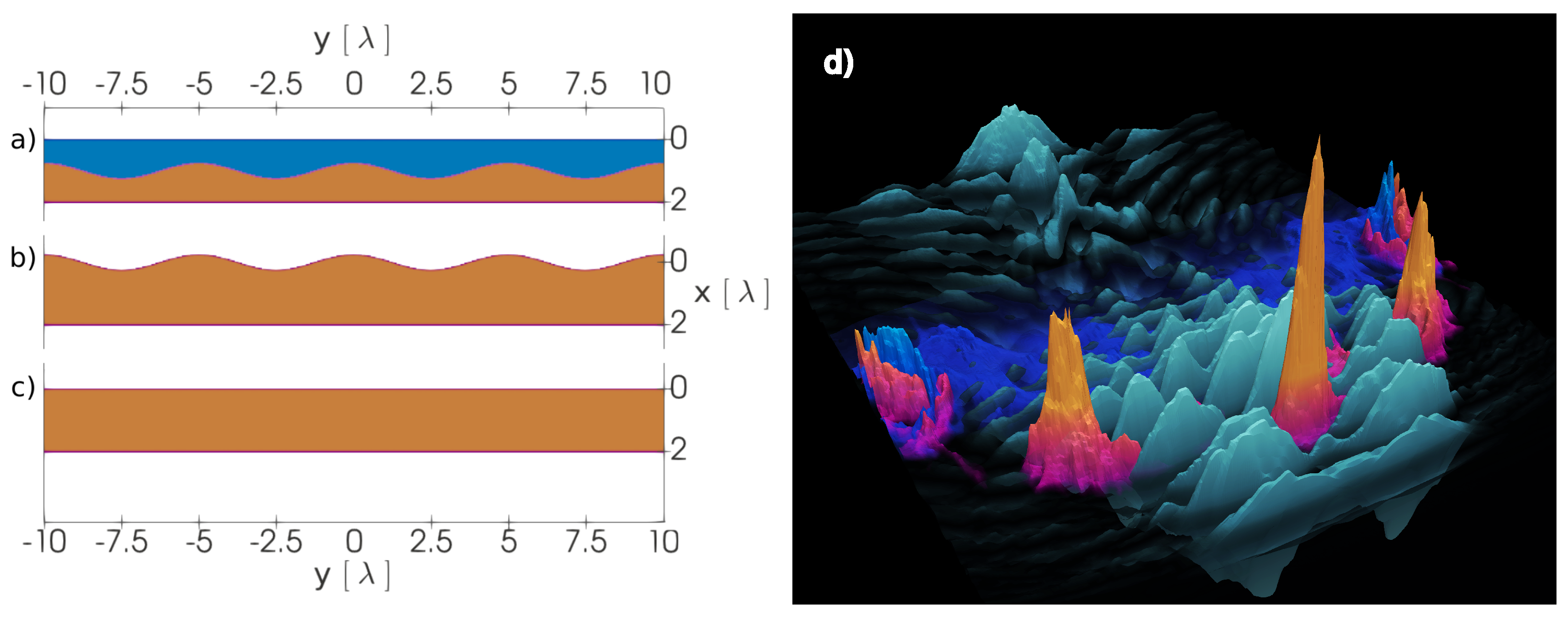
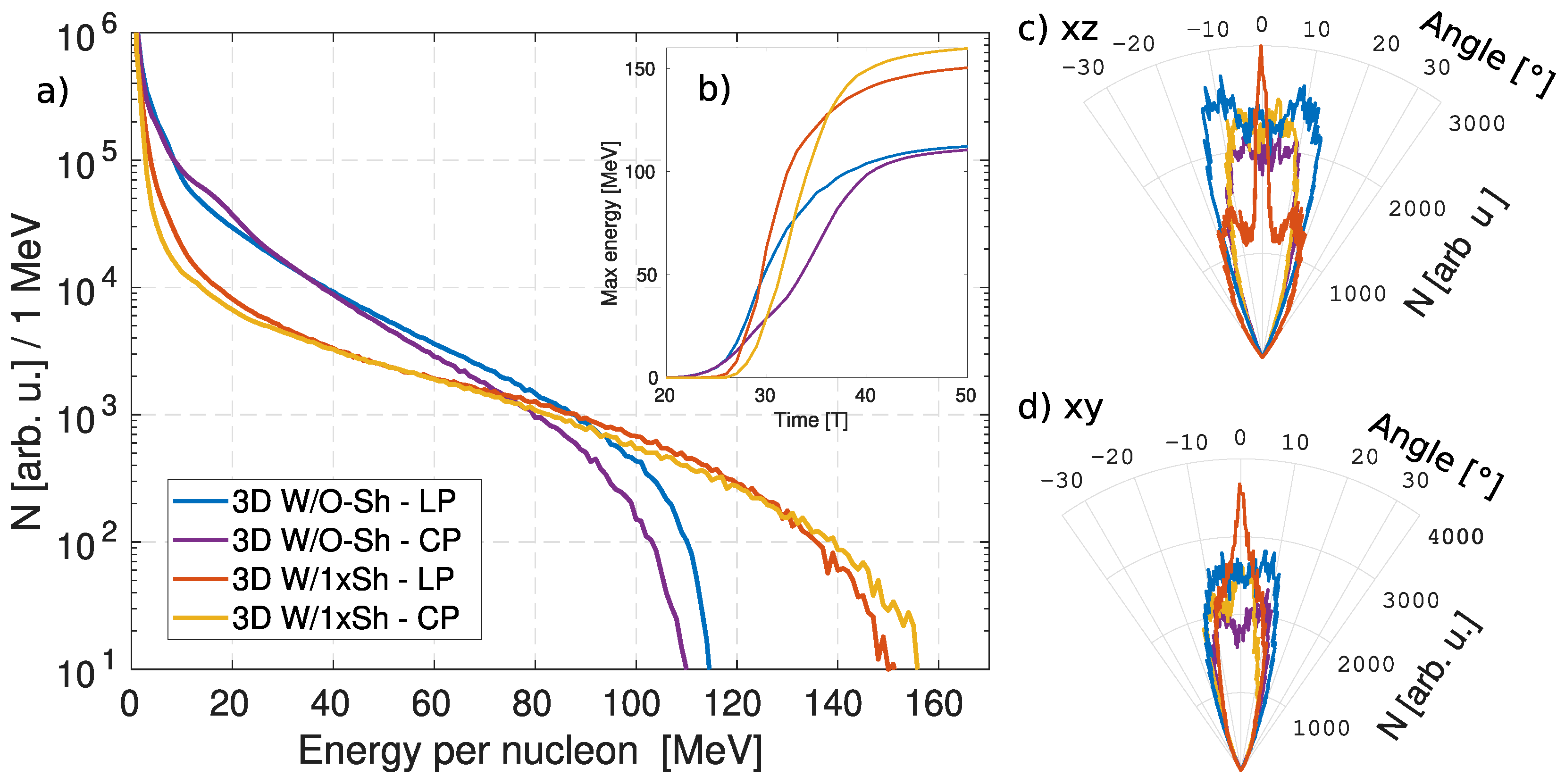
In this work, we reviewed our results on the prospect of increasing the quality of ion acceleration driven by high-intensity laser pulses using low-Z structured targets. It is shown that the radiation pressure acceleration mechanism dominates over target normal sheath acceleration for assumed laser target parameters when the laser intensity is high enough. The target thickness is optimized for this regime and double-layer structure is investigated. When a corrugation is fabricated on the interface of such a target, a relativistic instability with Rayleigh–Taylor and Richtmyer–Meshkov like features can be driven by the target interaction with a high intensity laser pulse. The proper development of this instability leads to the generation of a collimated quasi-monoenergetic ion beam with lower emittance, divergence, and energy spread compared to a single and double-layer target with planar interface. A steep-front laser pulse is used in our simulations to mitigate other type of instabilities arising at the target surface from the laser–target interaction. We discuss the use of a plasma shutter to generate the required pulse profile, which also locally increases intensity. The obtained shape improves the ion acceleration, including higher maximal energy and lower beam divergence, in our simulation of a high-Z target.
Keywords: high quality; monoenergetic; ion acceleration; laser-driven; plasma; low divergence; particle-in-cell; instability; steep front; plasma shutter high quality; monoenergetic; ion acceleration; laser-driven; plasma; low divergence; particle-in-cell; instability; steep front; plasma shutter