Review

Towards Sustainability and Development in the Complex South African Water Supply and Distribution System: A Systematic Review and Impact of Predictive Analytics


by
Ann Maria Najjuma
and
Gbeminiyi John Oyewole
*
School of Mechanical, Industrial and Aeronautical Engineering, University of Witwatersrand, Johannesburg 2017, South Africa
*
Author to whom correspondence should be addressed.
Limnol. Rev. 2026, 26(2), 23; https://doi.org/10.3390/limnolrev26020023 (registering DOI)

Submission received: 23 December 2025 / Revised: 1 March 2026 / Accepted: 2 March 2026 / Published: 5 June 2026

Abstract

Although South Africa has an extensive water infrastructure, it continues to face significant water scarcity due to its semi-arid climate, increasing urbanisation, ageing infrastructure, and pollution. These challenges, coupled with climate change and increasing water demand, have led to inefficiencies across the water value chain, particularly in rural areas. This review paper evaluates the current adoption of predictive analytics in South Africa’s water management system through a systematic literature review. It identifies the current applications, implementation gaps, and key system components that are suitable candidates to enhance efficiency, resource planning, and long-term sustainability in the sector. The findings show that while predictive models are being applied in urban systems for demand forecasting and proactive maintenance, only 15% of the reviewed studies address their actual adoption in rural or under-resourced contexts. This underscores the need for more inclusive development strategies to ensure equitable water service delivery. Although strides have been made in research and innovation, a major barrier is the slow transition from research to operational deployment, which hinders the full realisation of these technologies’ benefits that are essential for water supply sustainability and availability.

1. Introduction

The water supply and distribution system in South Africa is complex and comprises key players, including the policy-framing body for the country (the Department of Water and Sanitation), Water Management Institutions, Bulk water utilities, and Water distribution systems (Municipalities) [1]. Currently, the municipal water distribution system operates through a combination of diverse manual, semi-automated, and fully automated processes for delivering water services. South Africa’s water mix primarily relies on surface water, with the major drainage systems dominated by the Orange and Limpopo river basins [2]. This is supplemented by groundwater, return flows/re-use, and rainwater harvesting to augment the conventional surface water supply systems. Recently, there has also been a drive towards utilising desalination and treated acid mine drainage as an alternative where feasible [1,2].
Despite South Africa’s vast network of rivers, dams, and bulk water infrastructure, the country is generally water-scarce due to the limited water resources [3,4]. Furthermore, South Africa is naturally prone to drought conditions due to its semi-arid climate, which poses a significant risk to the country’s water security [1]. As a result, there is increasing pressure for the management of water resources in a more sustainable and efficient manner to meet the increasing demand [5]. Recently, complaints of poor water quality [6] and inadequate water distribution have also arisen, and various solutions have been proposed to address this challenge. However, ensuring water equity, especially in rural communities, remains a significant challenge, just as it does in urban communities. There is a need to keep track of the changing demand for water access [7]. This can be achieved by utilizing data analytics, Machine Learning (ML), and Artificial Intelligence (AI) for water demand forecasting and water use feedback [8]. Moreover, the gap between water supply and demand in South Africa is likely to increase over the years [9]. This is due to several factors, including climate change, population growth, increasing urbanization rates, and industrial development, which have had a significant impact on water consumption [10]. The situation is further exacerbated by the ageing infrastructure and cost of infrastructure development, water scarcity, stress, and pollution and water quality deterioration. This hinders water service delivery and necessitates the urgent implementation of water conservation and water demand management strategies [2]. Therefore, identifying the rudimentary and inconsistent processes in this value-creating chain and deploying solution methods, such as predictive analytics, could significantly reduce inefficiencies in South Africa’s water sector.
The National Water Resource Strategy (NWRS), which is the blueprint for water resource management in South Africa, aims to ensure the protection and management of water resources to enable equitable and sustainable access to water and sanitation services, following the National Water Act 36 of 1998 [2]. Successfully implementing the National Water Resource Strategy-3 (NWRS-3) relies on effectively addressing key enabling factors. These include data collection, analysis, and information management for improved monitoring, evaluation, and reporting [1]. Additionally, the strategy highlights the importance of advancing research and its deployment, with a strong focus on development and innovation, to enhance water resource management [1]. Some research has been conducted in this field, but there have not been enough studies that sufficiently prioritise the requirement of sufficient digitalisation intervention and implementation of state-of-the-art predictive analytics techniques in the South African water utilities [11,12,13]. Water utilities have to adopt technically efficient water management technologies to achieve developmental socio-economic objectives in alignment with the United Nations’ Sustainable Development Goal (SDG) 6—Ensure availability and sustainable management of water and sanitation for all [14].
The growing advancement in digitalisation and the use of predictive analytics has recently proven to reduce waste and increase efficiency in different resource-constrained environments with a mismatch in supply and demand [8,15,16]. Given these benefits, there is the possibility of leveraging these technologies to improve selected sections in the water production and distribution systems in South Africa. This will be essential to meet future water demand requirements and largely reduce the water challenges cascading into water shedding and outright unavailability issues. This review paper, therefore, aims to evaluate the implementation of predictive analytics models in South Africa’s water management systems while examining the current challenges and highlighting the associated benefits.
The paper seeks to (i) Assess the role of the legislative framework and water governance in the digital transformation of South Africa’s water sector (ii) Evaluate existing challenges within the water sector that hinder efficiency; (iii) Identify the gaps in the adoption of digitalisation and predictive analytics in South Africa’s water supply and distribution system across both urban and rural contexts; (iv) Identify the different key players/components that are candidates for digitalisation and predictive analytics; and (v) Assess the potential of leveraging predictive analytics to improve the selected sections, thus streamlining processes, reducing excessive manual/monotonous interventions, increasing overall operational efficiency, and supporting more equitable water service delivery. The outcomes of the research aim to develop an ongoing research field that could be further investigated in collaboration with other researchers, regarding the assessment of predictive analytics within the South African water production and distribution system. Additionally, the research seeks to provide useful insights regarding digitalised solutions for both Provincial and National water utilities of South Africa. In addition, other water utilities within the Southern African region and in Africa could also benefit from the study due to the strategic and economic importance of South Africa within the African continent.
This paper is structured as follows: Section 2 outlines the research chronology and the method used for article selection in this review. It also discusses the key players in South Africa’s water sector, the legal framework governing water resource management, and the components of the water supply and distribution system. Section 3 provides a review of predictive analysis descriptions and components, delving into its current adoption in South Africa’s water sector. This also involves identifying areas where predictive analytics are underutilized, but where investment may be needed in the current water supply and distribution system of South Africa. Section 4 highlights the existing challenges in South Africa’s water system, and Section 5 discusses how predictive analytics can be introduced as a solution to the identified challenges and the barriers to its implementation. The review is then concluded with recommendations for the future integration of digital technologies into water management.

2. Components of the System

The article selection for this research followed a systematic literature review approach using the PRISMA methodology as suggested by several authors [8,17,18,19]. First, a literature search was conducted using Google Scholar as the primary search engine due to its extensive and rapid search capabilities, and databases such as ScienceDirect, IEEE Xplore, Scopus, and Web of Science, to ensure that in-depth article retrieval was made. For a targeted search, keywords derived from the research topic were entered into these databases to ensure that all relevant literature was retrieved. The keywords included: “predictive analytics”, “machine learning”, “Artificial intelligence (AI)”, “digitalisation”, “automation”, “usage”, “implementation”, “adoption”, “water supply”, “water distribution”, “water management systems”, “water utilities”, “complex systems” “South Africa”, and “challenges”. These terms were searched in the title and abstract of the journal articles. Furthermore, the search was defined to ensure that the most current and relevant research within the last ten years was considered.
The returned records included journal articles, conference papers, systematic reviews, books, book chapters and technical reports. Studies were included if they focused on the application of predictive analytics, machine learning (ML), or artificial intelligence (AI) within water supply, distribution, or water utility management systems, with specific relevance to South Africa or comparable developing-country contexts. To ensure analytical depth, eligible studies were required to provide empirical evidence, case studies, implementation analyses, or clearly defined application results. Studies were excluded if they did not meet the selection criteria, lacked the specified keywords, or were not relevant to the study’s aims and objectives. Studies that were unrelated to water supply or water management systems application were also excluded to ensure a focused search and sector-specific applicability. Additionally, only peer-reviewed literature was included in this review to ensure the quality and reliability of the findings. Journal articles published in accredited South African higher education and training journals were prioritised. Only a few conference papers from academic conferences such as IEEE were included.
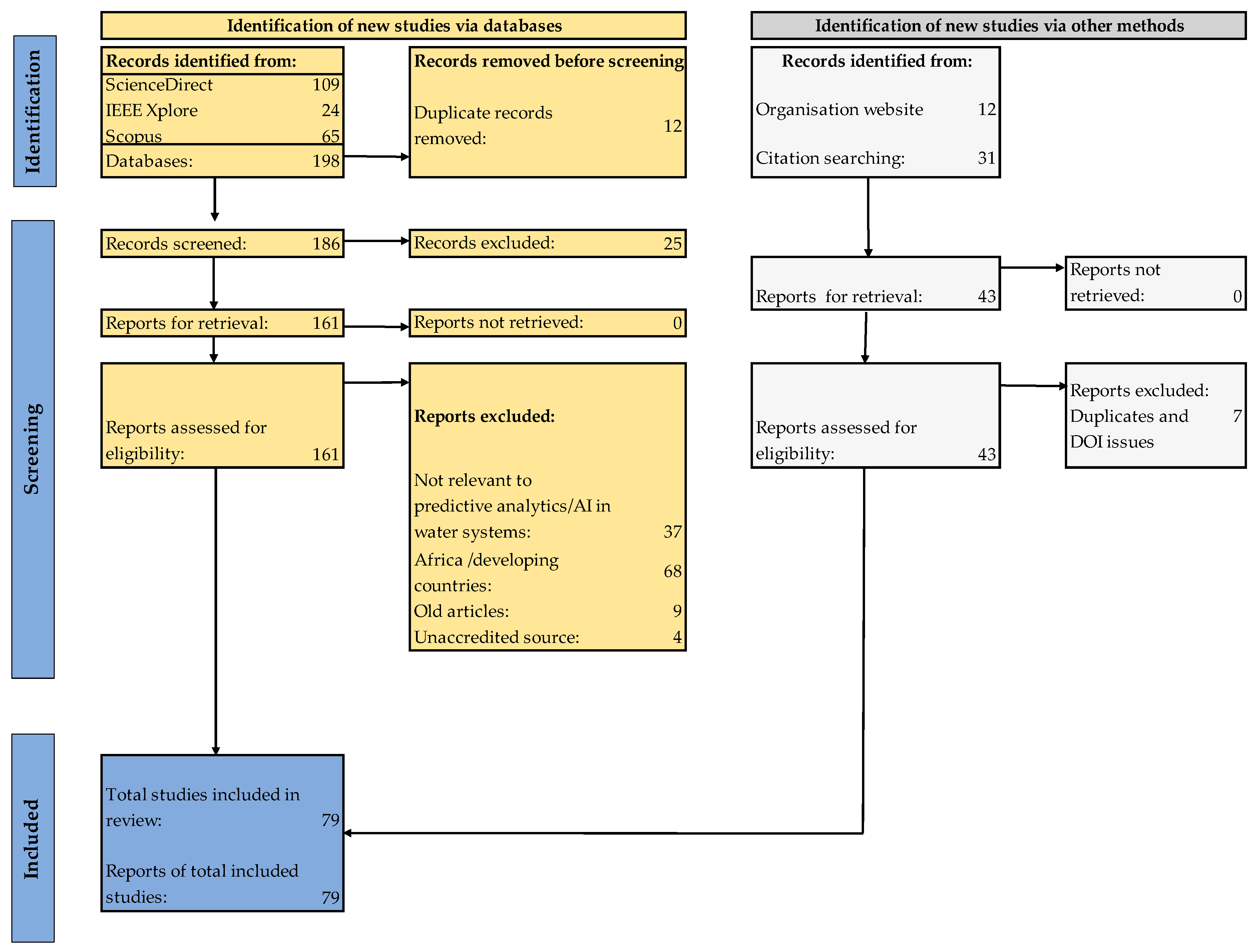
The initial database search yielded 198 records. All records were imported into Zotero for organization, de-duplication, and citation management. After removing duplicate entries, 186 unique records remained. These records were screened through a title and abstract macro review, reducing the dataset to 161 records eligible for full-text assessment. In addition to database searching, 43 records were identified through other sources, including organisational websites such as the Department of Water and Sanitation and citation searching. Following the screening and exclusion rationale, a total of 79 studies were ultimately included in this study. Figure 1, which illustrates the PRISMA flow diagram summarising the identification, screening, and inclusion process for the review.
Both urban and rural implementation contexts were considered due to the systemic inefficiencies and water scarcity challenges manifesting across South Africa’s water sector. This also enabled a comprehensive evaluation of the adoption of predictive analytics and digitalisation technologies across diverse institutional and operational conditions within South Africa. The included studies were analyzed and categorized according to their application domain within the water value chain. Table 1 presents the dominant categories and the corresponding number of studies from each application domain. This thematic grouping enabled the identification of application gaps and key intervention areas where predictive analytics remains underutilised within South Africa’s water sector.

2.1. Legislative Framework for South Africa’s Water Sector

The legislative framework provides the regulatory foundation for data-driven transformation within South Africa’s water sector by mandating monitoring, reporting, and information management systems aimed at ensuring equitable access to water [20]. Its primary objective is to ensure the provision of quality water and sanitation services to all, thereby upholding Section 27 of the Bill of Rights in the Constitution, which guarantees everyone’s right to access water [3,4]. This goal is supported by the National Water Act 36 of 1998 and the Water Services Act 108 of 1997, which provide the legislative framework required for effective water supply and sanitation services, and water resource management and use [3].
The National Water Act 36 of 1998 legislates and establishes the framework for protecting, using, developing, conserving, managing, and controlling water resources in an efficient, sustainable, and equitable manner in South Africa [1]. It is binding on all the authorities and institutions responsible for executing the provisions of the Act by outlining the strategic objectives, plans, guidelines and procedures of the Minister of Water and Sanitation, and the institutional arrangements required to achieve this mandate [2]. On the other hand, the Water Services Act 108 of 1997 regulates the provision of water and sanitation services by supporting municipalities, water service providers, and water boards in fulfilling their role as water services authorities and protecting the interests of consumers. The Act promotes equity and sustainability by requiring water services to be provided in a manner that is efficient, affordable, and economically viable while also safeguarding the water resources. These principles can support digital transformation; for example, efficiency justifies the use of predictive analytics to sustainably reduce non-revenue water, and equity aligns with the use of smart metering to ensure fair and accountable water distribution [21].
In addition, the Water Research Act 34 of 1971 promotes research in water affairs of South Africa in terms of occurrence, preservation, conservation, utilisation, control, supply distribution, purification, pollution or reclamation of water supplies and water. The Water Research Act outlines the functions of the Water Research Commission (WRC) in conducting water research in collaboration with other research institutions and taking necessary steps to achieve its objectives [22].

2.2. Water Governance and Its Role in Digital Transformation

Water governance structures play a key decisive role in shaping the conditions under which digital transformation initiatives are implemented [23]. Studies on digital innovation in public infrastructure systems emphasize that technological adoption is not solely a technical process, but is mediated by institutional mandates, decision-making authority, funding mechanisms, and data governance arrangements [24]. In South Africa, water governance and management is distributed across national and regional catchment levels. Each of the following key players operates within a structured legal framework that ensures the sustainable management, distribution, and protection of water resources. This framework is essential in guiding the responsibilities, governance, and actions of these institutions in the water sector.

2.2.1. Department of Water and Sanitation (DWS)

At a national level, the Department of Water and Sanitation (DWS) is the custodian of South Africa’s water resources and is mandated by the National Water Act 36 of 1998 to establish monitoring networks and information systems, and to provide reports on the status of the country’s water resources [1]. This reporting function enables continuous monitoring and data collection, providing reliable datasets necessary for emerging data-driven technologies such as predictive analytics, research advancement, and digital decision-support applications within the water sector [25]. However, centralized governance at the National DWS level is often perceived as distant from the communities and slow to grasp local issues, leading to delays in infrastructure investment [26]. These constraints have reinforced the rationale for decentralised governance arrangements, whereby water management and service institutions are distributed across regional and local levels with closer proximity to end users. This enhances government responsiveness, improves operational effectiveness, and supports more equitable service delivery across diverse geographic and socio-economic settings.

2.2.2. Water Management Institutions

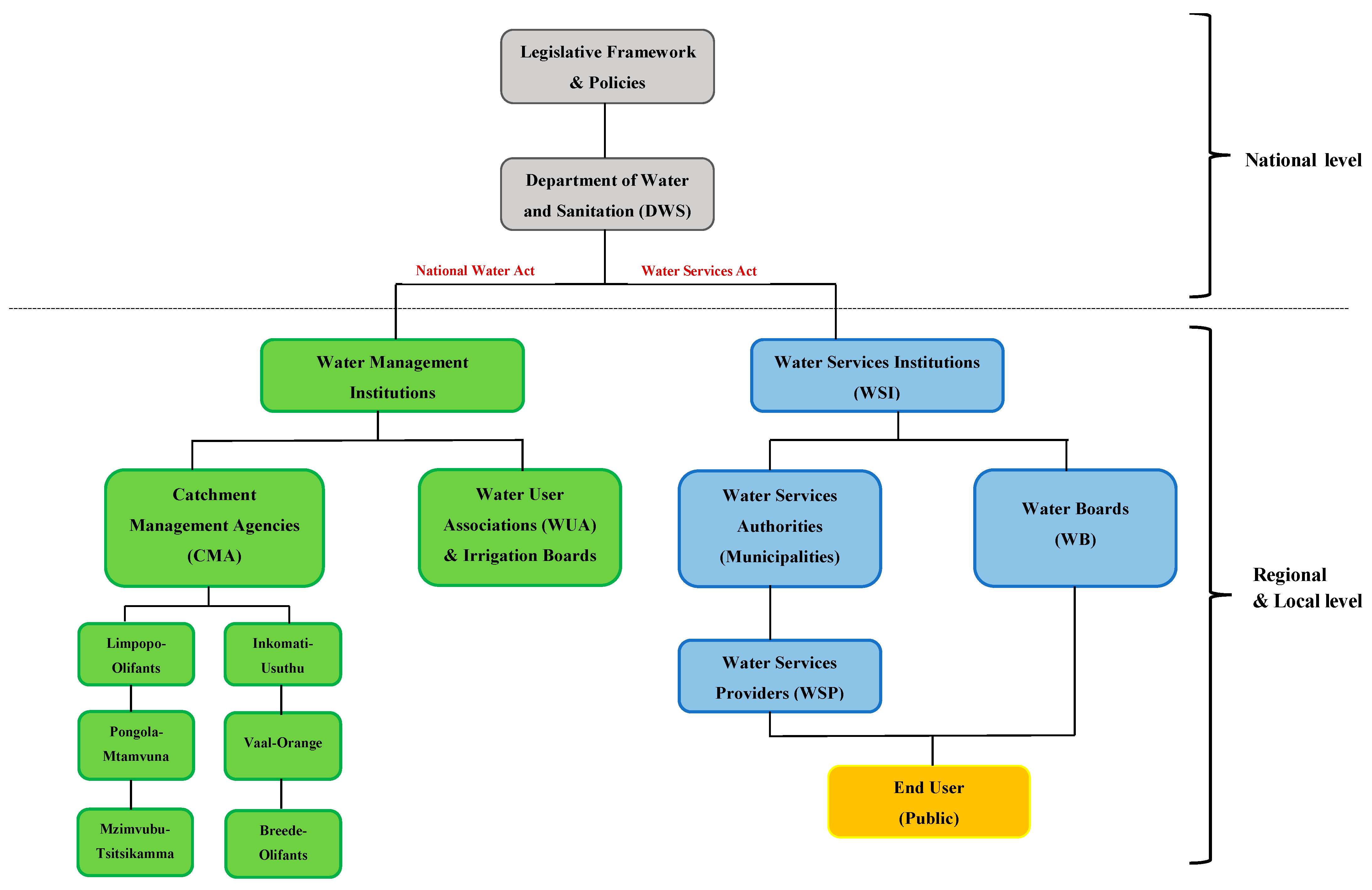
The Water Management Institutions support the Department of Water and Sanitation in fulfilling its core mandate related to the use, allocation, access and protection of water resources at a regional level [2]. These institutions include Catchment Management Agencies (CMAs) and the Water User Associations (WUAs) and Irrigation Boards.
(a)
Catchment Management Agencies (CMAs):
The Catchment Management Agency is responsible for water resource management at the regional (catchment level), while involving local communities in water governance. The CMA coordinates the activities of water users and water management institutions in its Water Management Areas (WMAs) [3,21]. South Africa is currently divided into six WMAs: Limpopo-Olifants, Inkomati-Usuthu, Pongola-Mtamvuna, Vaal-Orange, Mzimvubu-Tsitsikamma, and Breede-Olifants [1,2]. However, governance at this level is often uncoordinated and fragmented, with high levels of competition for leadership and data control, which prevents integrated data management across the WMAs [27]. Digitalisation in the water sector, therefore, offers significant potential to enhance integrated water resource management by aggregating data across multiple users and sectors within a WMA to strengthen evidence-based decision-making and improve transparency in water allocation [23].
(b)
Water User Associations (WUAs) and Irrigation Boards:
Water User Associations (WUAs) are cooperative associations of local farmers or individual water users who collaborate to undertake water-related activities for their mutual benefit, typically for agricultural purposes. They operate at a localized level and are particularly tailored for the management of local water resources and associated infrastructure. Their core function is usually to ensure a fair and reliable water supply to its members, mostly irrigation or livestock farmers, whose livelihoods depend directly on a predictable and reliable water supply [3]. Conversely, WUA and Irrigation Boards are reportedly more efficient and responsive to address water user needs because they focus on the specific interests of their members [26].

2.2.3. Water Services Institutions (WSI)

The Water Services Act 108 of 1997 stipulates that WSIs are responsible for providing water supply and sanitation services to all consumers within their area of jurisdiction [5]. The water service institutions include Water Services Authorities (WSA) or Municipalities, Water Services Providers (WSPs) and Water Boards. Municipalities are in charge of monitoring water and sanitation services, interventions and gathering of information in a national information system to ensure that all data on the state of water and sanitation in the country is recorded [4]. A municipality may provide water services itself or outsource them to private Water Service Providers (WSPs) [1,3]. The municipalities play a central role in supporting the rollout of digital monitoring and data-driven technologies, such as smart water meters and supervisory control and data acquisition (SCADA) systems [28]. However, several studies indicate that their implementation capacity remains constrained by financial limitations, ageing infrastructure, and critical technical skills gaps, particularly in under-resourced and rural municipalities [11,12,13,20]. These capacity constraints significantly affect the large-scale deployment and maintenance of predictive analytics and other digital transformation initiatives within the sector. Many municipalities, therefore, continue to rely heavily on reactive maintenance approaches, where leaks and pipe failures of aging infrastructure are often addressed after visible surface leaks or consumer complaints [20]. The persistent municipal leaks lead to approximately 40% reported losses of treated water before it reaches end users [29]. This magnitude of water loss is particularly concerning given South Africa’s water scarcity and limited freshwater availability.
Water boards, on the other hand, are the entities responsible for the bulk water supply established in terms of the Water Services Act (No. 108 of 1997). Their core business is to provide bulk water services to municipalities and industries, and to assist municipalities in fulfilling their primary mandate for water and sanitation services [2]. Water boards provide both bulk potable and untreated water, and wastewater treatment, drought interventions, and other related services for the benefit of the public [2]. The water boards in South Africa include Rand Water, Umgeni Water, Magalies Water, Lepelle Northern Water, Amatola Water, Mhlathuze Water, Bloem Water, and Overberg Water [4]. Water Boards can support the implementation of advanced operational technologies, including automated leak detection, water balancing systems, and data-driven asset management tools. In some cases, these innovations are facilitated through partnerships with research institutions, technology firms, and small and medium-sized enterprises (SMEs) [5].
Figure 2, adapted from DWS [2], illustrates interrelationships among the key institutions within South Africa’s water sector, at national, regional, and local levels.
While South Africa’s governance framework promotes a participatory water management framework, studies highlight that institutional fragmentation and overlapping mandates complicate the digital integration efforts [28]. Decentralised authority across national, regional, and municipal bodies often results in disjointed data governance structures, inconsistent reporting standards, and uneven technical capacity. Such fragmentation makes it difficult for the central government to address deteriorating assets or implement unified digital monitoring systems and interoperable information infrastructures.

2.3. Components of the Water Supply and Distribution System of South Africa

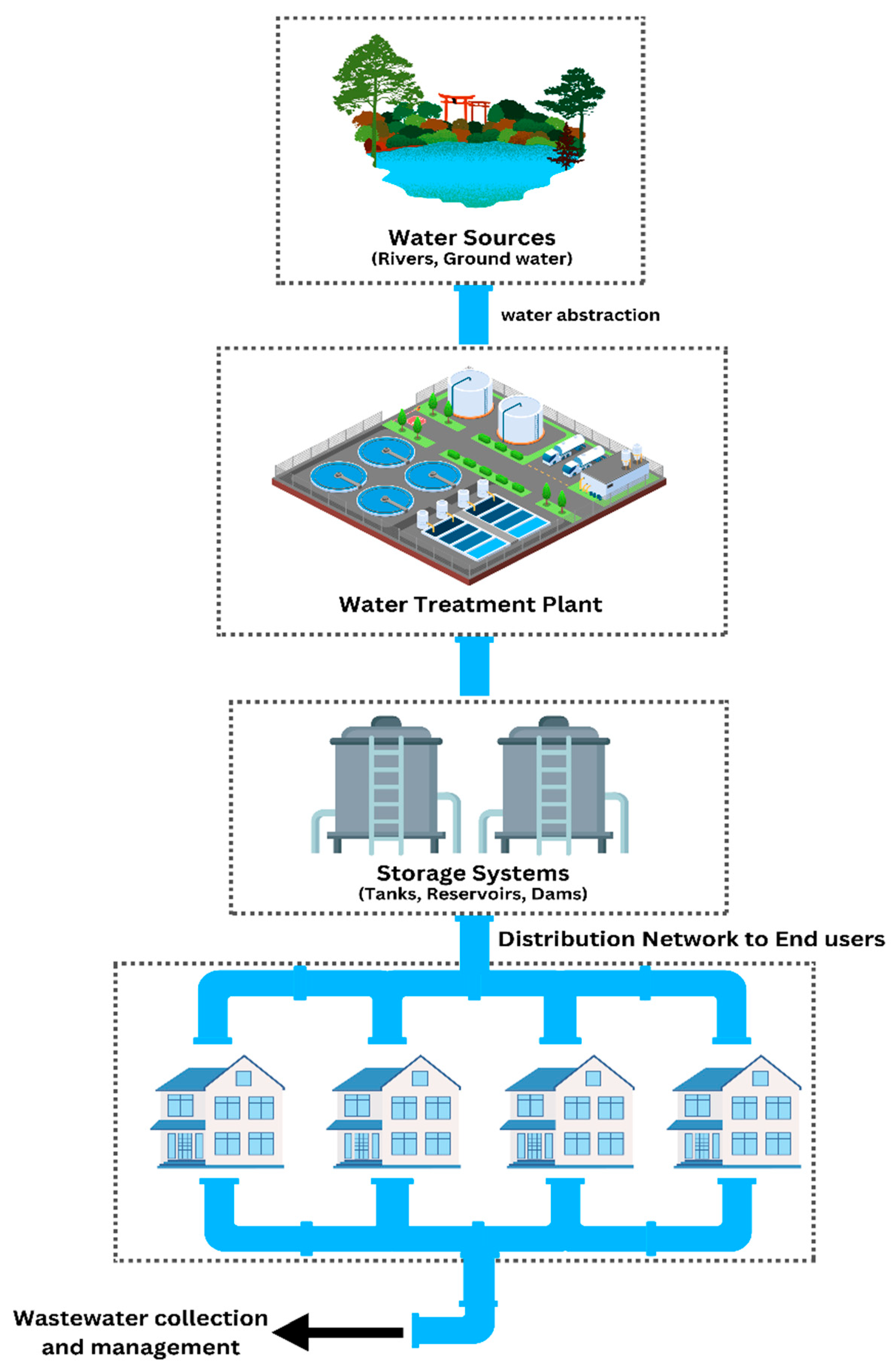
The water supply and distribution system in South Africa comprises various interconnected components that ensure that water is abstracted, treated, distributed, and managed effectively. The key components of the water supply and distribution system include water sources and abstraction, storage systems, water treatment and wastewater management plants, distribution networks, monitoring and control systems, and end-users/public. Figure 3 illustrates a water supply and distribution network.

2.3.1. Water Source and Abstraction

South Africa’s water supply originates from multiple sources, including surface water, groundwater, desalination, and sometimes even rainwater harvesting. Surface water, which includes rivers, lakes, and reservoirs, is the primary water source in South Africa, with the Orange and Limpopo River basins being among the most significant contributors. Groundwater from aquifers has seen increasing usage over the years, particularly in rural areas, where it has proven to be a reliable supply during droughts and periods of high-water demand. Desalinated water is also becoming a viable option, especially in the coastal areas of South Africa. A study by [30], also highlights the potential of rainwater harvesting and greywater reuse as available household water sources for residential consumers. However, the authors caution that untreated greywater may pose health and environmental risks due to variable water quality. Water abstraction from these various sources requires infrastructure such as weirs, intakes, and pumping stations, which facilitate the transfer of raw water to storage or treatment facilities.

2.3.2. Water Treatment and Storage Facilities

Water is treated through filtration systems, chemical processes, and advanced methods to ensure that water quality meets the standards for safe domestic consumption. This stage involves removing sediments and debris and disinfecting the water to produce high-quality potable water. Storage systems, on the other hand, play a crucial role in regulating water availability, particularly during periods of potential drought risk [31]. These systems include tanks, reservoirs and dams. Dams and reservoirs store raw water from surface water sources. They help to manage seasonal fluctuations and provide a buffer during drought periods. Storage tanks, on the other hand, store treated water for distribution, ensuring a continuous supply during peak demand.

2.3.3. Distribution Networks and End Users

The distribution network transports treated water from the storage facilities to the end users through a network of pipelines, controlled by pumps, meters, and valves. The water end users include the general public, encompassing residential, industrial, agricultural, and irrigation applications. However, much of the existing infrastructure, including pipes and treatment plants, is aged and deteriorating. This leads to increased cases of leakages, burst pipes, and inefficiencies, resulting in significant water losses [20]. In addition to the system leaks, a significant portion of treated water is lost due to illegal connections and metering inaccuracies [8]. There is also the challenge of an inequitable water supply, particularly in rural areas and informal settlements, where inadequate water distribution infrastructure leads to supply shortages. This results in increased pressure on existing resources, affecting livelihoods and public health [32]. This necessitates the implementation of predictive analytics and advanced digitalization of water distribution networks to enhance efficiency, optimize resource allocation, and improve service delivery. Additionally, these technologies enable proactive maintenance, allowing for early detection of faults, leakages, and system inefficiencies, ultimately ensuring a more reliable and sustainable water supply.

2.3.4. Wastewater Management

Wastewater management in South Africa encompasses the collection, treatment, and disposal or reuse of domestic, industrial, and agricultural wastewater. Municipalities are largely responsible for wastewater treatment, and thus the country relies on municipal wastewater treatment plants to process domestic and industrial effluents before discharge or reuse. Wastewater is now seen as a valuable resource rather than mere waste and plays a crucial role in the hydrological cycle [21]. Reclaimed wastewater is increasingly considered a valuable alternative water source, especially in drought-prone regions, for applications like agriculture, industrial processes, and groundwater recharge. However, monitoring water quality (WQ) parameters in wastewater treatment can be challenging. To overcome this, it is important to develop better and more advanced modeling approaches [33], such as intelligence-based monitoring systems, which are being explored to ensure sustainable and efficient wastewater management [34].

2.3.5. Monitoring and Control Systems

Monitoring and control systems are essential for efficient operation, maintenance, and management of the water supply and distribution network [35]. These systems enable real-time data collection, analysis, and decision-making, ensuring optimal water service delivery. The system consists of a network of control devices, measuring instruments, and sensors that are usually connected to the system components and continuously collect data from the system. Supervisory Control and Data Acquisition (SCADA) systems play a central role in real-time monitoring, allowing operators to track pressures and flow rates within the water distribution network while remotely managing control elements like pumps and valves [35]. Sensors are crucial for water quality monitoring and pressure regulation, enabling early detection of leaks, contamination, and inefficiencies. Leak detection and repair systems also help reduce water losses and improve distribution reliability.
The monitoring process essentially involves:
  (i)
Data Collection—Gathering relevant real-time data from sensors such as flow meters, pressure gauges, and temperature sensors, and measurements, observations, or reports.
 (ii)
Data Processing & Analysis—The collected data is analyzed to identify trends, patterns, and deviations from expected values, enabling the detection of anomalies, prediction of failures, and optimization of operations.
(iii)
Alarms & Alerts—The system sends notifications when thresholds (e.g., low water levels, high pressure, or contamination risks) are exceeded or anomalies are detected.
Predictive models thus play a significant role in enhancing the performance of these components [10]. By integrating machine learning and advanced data analytics, predictive models aid in water resource management, enabling water demand forecasting, quality monitoring, anomaly detection, leakage control, pump optimization, and overall system efficiency. These insights support data-driven decision-making, ensuring the sustainable and effective planning of water supply services.
The following section explores the concept of predictive analytics and its application to South Africa’s water supply and distribution system.

3. Predictive Analytics & South Africa’s Water System

3.1. The Predictive Analytics Process

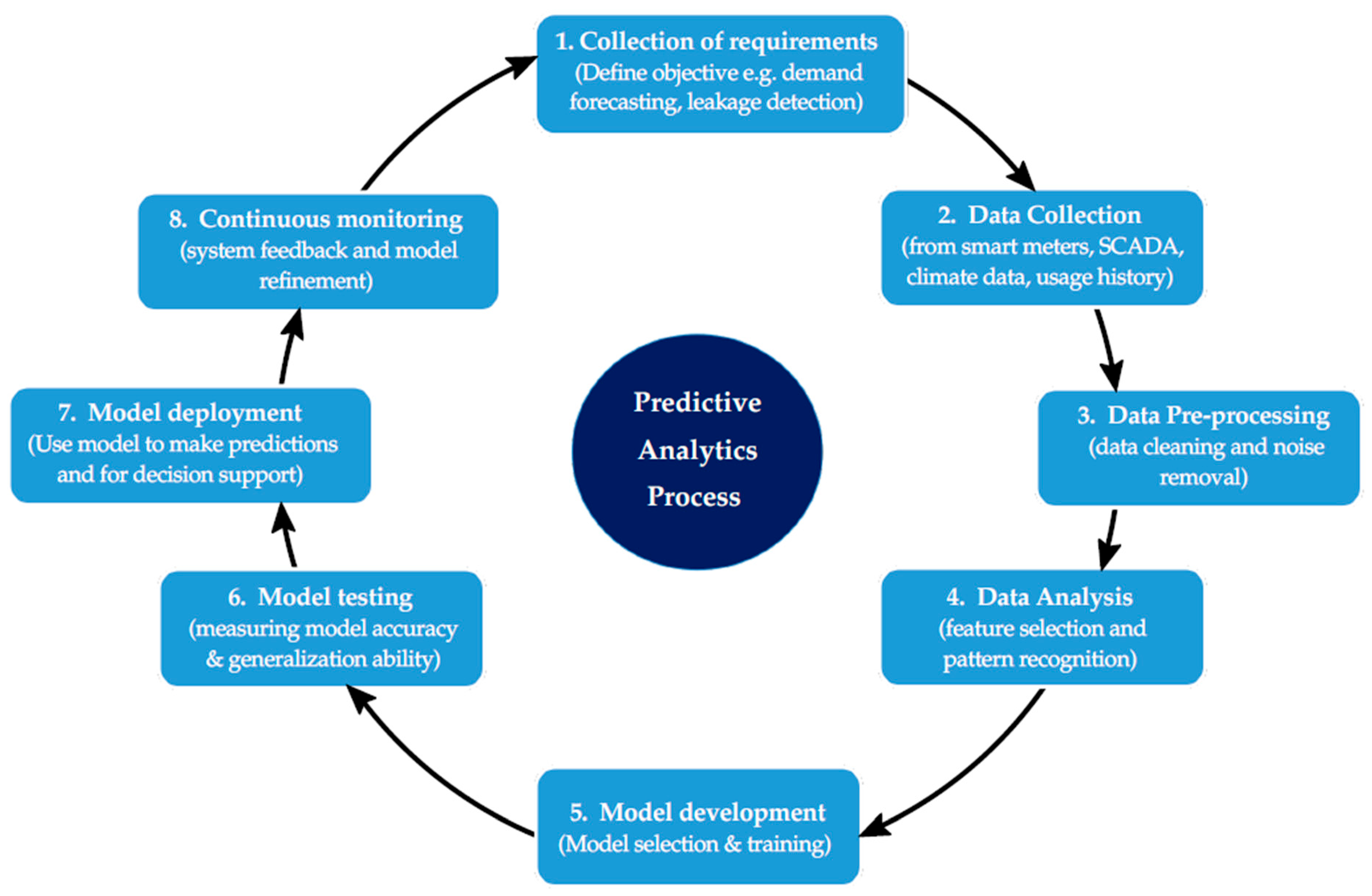
Predictive analytics is a subset of data analytics that identifies patterns and relationships within data to make forecasts for the future [36]. It uses advanced mathematical formulas, statistical algorithms, machine learning techniques and AI tools to analyse historical and real-time data to identify patterns and trends, and then uses those insights to forecast what might happen in the future [15,37,38]. Predictive analytics relies heavily on historical data; the more comprehensive the data, the more reliable and accurate the predictions [39]. Predictive analytics not only addresses questions such as “What’s the status now?” or “What happened?” or “Why did it happen?”, but also answers “What is likely to happen in the future?”, “Why will it happen?” and “What actions can be done to prevent this?” [40]. The predictive analytics process is deconstructed into the following steps, as illustrated in Figure 4.
(1)
Collection of requirements:
This is a conceptual step, focusing on defining the problem and establishing the objective of the analysis. For example, this may involve predicting water demand, usage, availability, anomaly detection, quality monitoring, or assessing the impact of climate change [10]. Clearly defining the objective ensures that the developed model is well-suited to the specific goal and aligns with the challenges and decision-making needs of the water sector.
(2)
Data collection:
Data collection involves gathering relevant datasets, which may consist of both raw and processed data. Sources of data include sensors and smart meters embedded in water system equipment, providing real-time information on key parameters such as flow rate, pressure, water quality, temperature, and vibration across various points within the system. Additionally, historical records, such as past water usage data, weather patterns, and maintenance reports, and external factors such as weather forecasts and population growth trends, also serve as valuable data sources.
(3)
Data cleaning & preprocessing:
The next step is the data massaging, which is crucial as it directly impacts model performance and enhances the quality of the data before developing the prediction model [9,41]. It essentially involves tasks such as data cleaning, handling missing values, and transforming data through scaling, normalization, or encoding. These steps ensure the dataset is in a suitable format for the classification model and that the datasets are harmonized [42].
(4)
Data Analysis and Feature selection:
After preparing the data, it is analyzed using statistical methods, visualization tools and machine learning techniques to uncover patterns, relationships, and trends. At this stage, features are also extracted from the data. This process typically involves selecting and transforming input data into a new format or set of variables that are more useful for prediction or classification tasks.
(5)
Model selection and Training:
It is important to choose an appropriate algorithm or model for the task at hand [42]. Recently, the common models used in water systems include regression-based models [13], time series models [12], classification models [43], clustering [44], deep learning [45], and reinforced learning [44], and hybrid models. These are covered in detail in the following section. Prediction accuracy typically depends on two key factors: the type of model selected and the quality of the training dataset [46]. As a result, a critical question for researchers is determining the most suitable method to use. After cleaning and feature extraction, the dataset is split into training and testing subsets. This step is also critical because it ensures that the model is evaluated on data it has not seen during training, providing an unbiased estimate of its performance [42]. Thus, the training set is used to train the model, while the testing set is used to evaluate the model’s performance and generalization ability.
(6)
Model Testing and Validation:
Once the model is built and trained, it must be evaluated for performance and reliability in making accurate predictions. This involves testing the model on a separate set of data (test data) and measuring its accuracy and precision. Common evaluation metrics include Mean Absolute Error, Root Mean Squared Error (RMSE), Accuracy, Precision, Recall, and F1-Score. The cross-validation technique can also be used to further enhance model evaluation, where the dataset is split into multiple subsets (folds), and the model is trained and tested on different combinations of these folds [41].
(7)
Model Deployment and Prediction:
This is the final stage in the machine learning process, where the trained model is integrated into a real-world system to make predictions or decisions based on new, unseen data. In the context of water supply and distribution systems, for example, a deployed model might predict water demand, detect anomalies, or assess water quality. The deployment involves ensuring the model is scalable, reliable, and can handle incoming data from real-time sources, such as sensors, smart meters, or other IoT devices. It also requires creating interfaces through which stakeholders (e.g., water utilities, operators, or decision-makers) can interact with the model, review its outputs, and act based on them. Model prediction involves using the deployed model to continuously receive input data, process it, and output relevant predictions or classifications. These predictions could inform decisions such as adjusting water supply based on demand forecasts, detecting leaks, or predicting future water quality. It is essential that the deployed model is monitored for performance, accuracy, and drift, as over time, data may evolve or change, potentially requiring re-training or fine-tuning of the model to maintain its effectiveness. Therefore, continuous monitoring and updating are key components of model deployment to ensure long-term success and accuracy in prediction.

3.2. Machine Learning (ML) and Artificial Intelligence (AI)

Many predictive analytics models utilise machine learning to identify complex hidden patterns in data and make decisions based on the data analysis [38]. Machine learning is a field of artificial intelligence that aims to learn patterns and relationships in data automatically through observations and experience [41]. Where artificial intelligence aims to automate intellectual tasks ordinarily performed by humans, machine learning is one of the specific methods used to do this. Therefore, Machine Learning is a field that focuses on the learning aspect of AI by developing algorithms that best represent a set of data [47]. It differs from classical programming in that classical programming requires a dataset and an algorithm to create outputs, whereas machine learning requires a dataset and the associated algorithm to create outputs. It then creates an algorithm that describes the relationship between inputs and outputs through the learning process, and this algorithm can be applied to future datasets [47]. In the context of water resource management (WRM), machine learning algorithms can analyse data from water quality sensors, infrastructure, and other sources to identify changes in water quality, forecast water consumption patterns, and enhance decision-making processes [48,49].

3.2.1. Machine Learning Techniques

There are three types of machine learning techniques, namely Supervised learning, Unsupervised learning, and Reinforcement learning [50].
(a)
Supervised learning
In a supervised machine learning model, a dataset is trained on labelled data, covering examples of the inputs and target values or designated answers for the output [50]. Through a process of iterative learning, the model can develop predictive and classification models [42].
Supervised learning is categorized into two types: classification and regression.
(i)
Classification:
In classification, input data is assigned to predefined categories or classes based on their specific features [51]. The model learns from labelled examples and makes predictions about the class of new, unseen data. Classification models can be used to categorize different aspects of the water system, including water quality and consumer demand patterns.
(ii)
Regression:
Regression is a supervised learning technique used to predict continuous numerical values. The model learns from historical data and aims to establish a relationship between independent variables (the input) and dependent variables (a continuous output) [42]. Regression methods are most appropriate when the output variable is a real value, whereas classification methods are suitable when the output variable falls into a class or category [41].
(b)
Unsupervised learning
An unsupervised learning model detects patterns without any predefined labels or specifications for the data. While supervised learning relies on labelled data for training, unsupervised learning models detect hidden patterns and relationships in unlabelled data. This approach allows the algorithms to autonomously discover insights and extract meaningful information from the data without human involvement [42].
There are two methods of unsupervised learning:
(i)
Clustering:
Clustering is used in unsupervised learning to group similar data points together in clusters based on shared characteristics. The primary objective of clustering is to maximize similarity within each group (cluster) while ensuring that data points in different clusters are as distinct as possible. This technique is widely used in various domains, including customer segmentation, image recognition, anomaly detection, and genomic data analysis [42]. Clustering is a powerful tool for discovering hidden patterns in large datasets, enabling better decision-making, data organization, and predictive analysis.
(ii)
Association:
Association is a data mining and machine learning technique used to discover relationships or correlations between variables in large datasets. It is primarily used in association rule learning, where patterns and dependencies between different items are identified to generate meaningful rules that describe how certain items are related. Association techniques are widely applied in various industries, including retail, healthcare, web usage analysis, and fraud detection. Association rule mining is also a valuable technique in water resource management, as it helps uncover hidden relationships between different environmental, climatic, and operational factors that influence water availability, quality, and consumption [42]. By analysing large datasets, association techniques can assist in making data-driven decisions for efficient water distribution, conservation, and sustainability efforts, thus improving the overall customer experience.
(c)
Reinforced learning
In reinforcement learning, systems are not provided with inputs and outputs but are instead given a description of the current state of the system, a goal, a list of allowable or permitted actions, and their environmental constraints [50]. Reinforced learning systems interact with the environment, receiving feedback that enables them to improve performance over time [41]. However, the authors emphasize supervised learning applications for predictive systems in water supply networks due to their easier integration with decision support tools.
These models can be integrated into key aspects of the water supply and distribution system, including water quality assessment, water demand forecasting, detecting pipe leaks and anomalies, predicting system failures, with the overall goal of improving the quality of service for water distribution [35,41,43,52].

3.2.2. Machine Learning Algorithms

There are various types of machine learning algorithms, including Artificial Neural Networks (ANN), Decision Trees (DT), Support Vector Machines (SVM), Naïve Bayes (NB), Logistic Regression (LR), K-Nearest Neighbors (KNN), and Random Forest (RF) [46,51].
(a)
Artificial Neural Networks (ANNs)
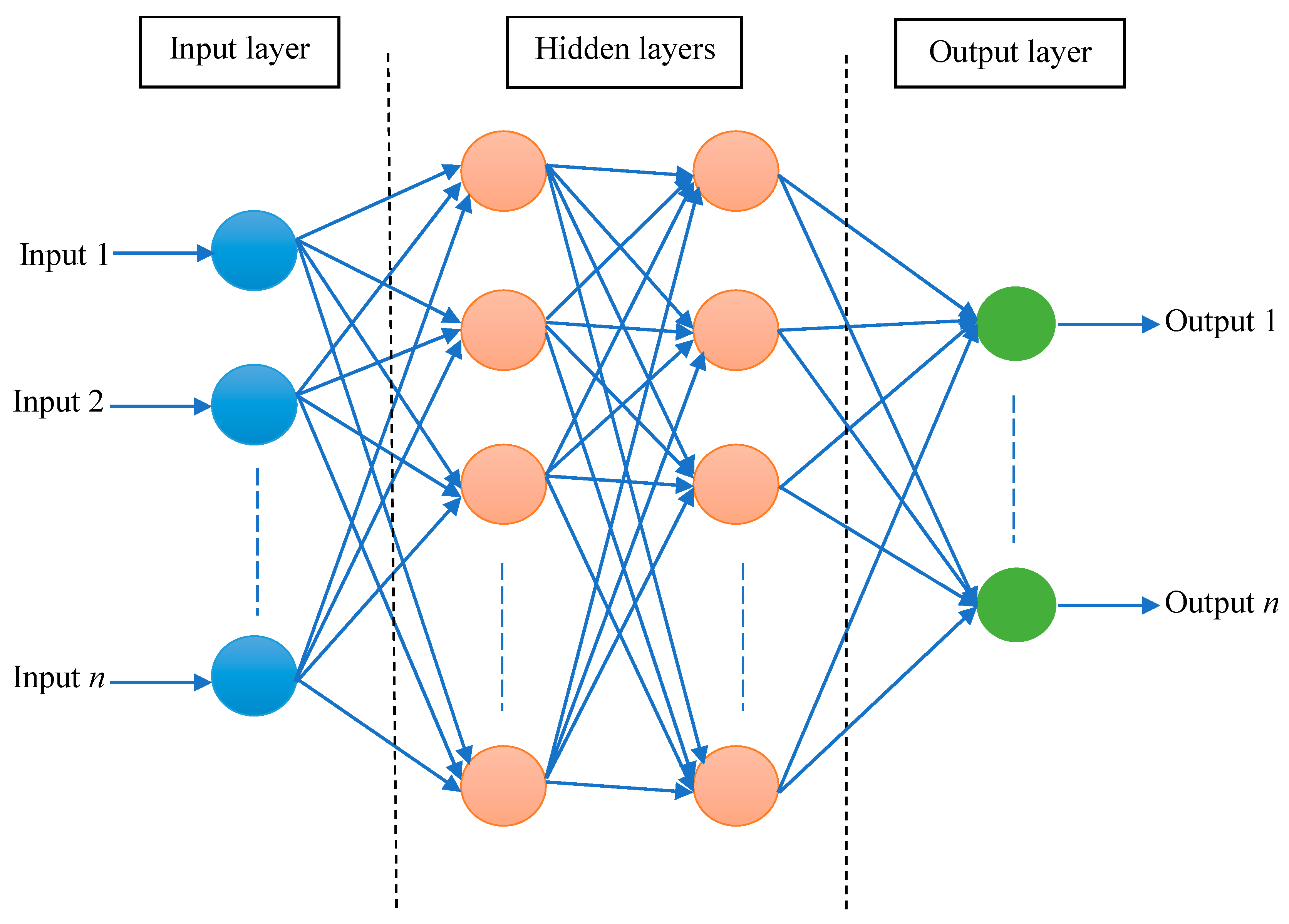
Artificial neural network (ANN) models are developed to function like neural networks in the human brain. An ANN as a network of interconnected artificial neurons, arranged into a series of multiple layers, where each neuron in one layer is connected to neurons in the next layer through weighted connections [10]. As illustrated in Figure 5 below, the structure of an ANN consists of an input layer, hidden layers with weights, summation functions, activation functions, and an output layer [53]. Inputs 1, 2, …, n are fed into the ANN at the input layer. This data may include water usage patterns, drought indices (e.g., Standardized Precipitation Index (SPI), Standardized Precipitation–Evapotranspiration Index (SPEI)), water quality parameters (e.g., Ph, turbidity, conductivity), pressure level, and other system indicators. This dataset is then transmitted to the hidden layers, where it is processed, and finally forwarded to the output layer to generate an outcome, such as the prediction of water demand, water quality assessment, or system performance risk. ANNs are used for classification, clustering, and predictive modelling. They are one of the most widely used predictive methods due to their high performance and accuracy. However, they often require large amounts of data training and validation, and are prone to overfitting [10].
(b)
Support Vector Machines (SVM)
SVM is a supervised machine learning algorithm used for classification and regression tasks [33]. It is particularly effective in handling high-dimensional data and solving complex classification problems by finding the optimal decision boundary (hyperplane) that best separates different classes, ensuring better generalisation. This method maps the variables using non-linear structures into a high-dimensional space, where an optimal hyperplane is then constructed to fit the data or separate the classes effectively [41]. SVMs utilise kernel functions, enabling them to perform at a level of accuracy that is comparable to ANNs in classification and regression [10].
(c)
Decision Trees (DT)
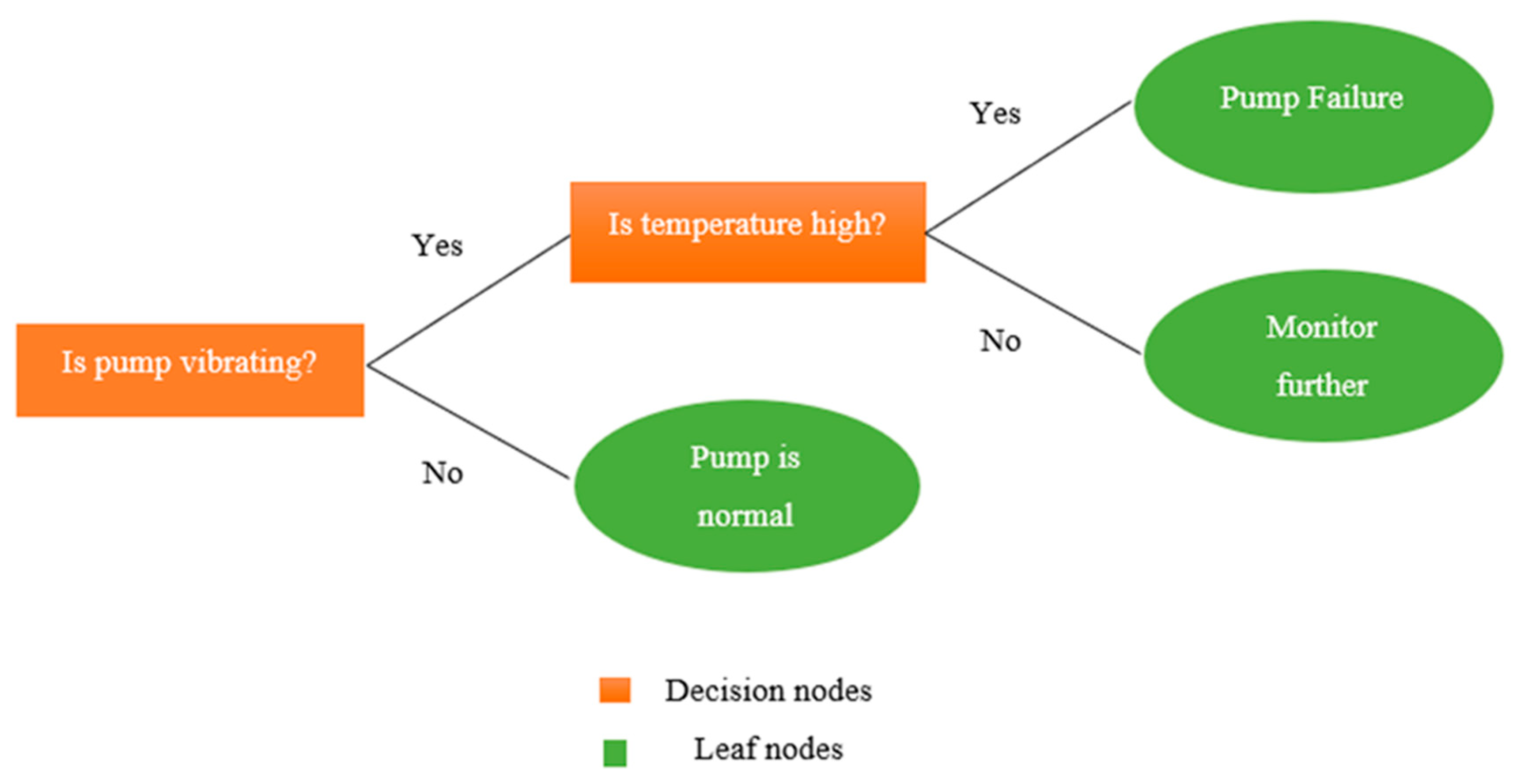
Decision trees learn by progressively splitting large datasets into smaller subsets through simple decision-making steps. With each successful split, the elements within the final groups become increasingly similar to one another [51]. It is a tree-like model, like a flowchart that makes decisions by hierarchically applying splitting rules based on feature values [41]. The Decision Tree consists of a root node, decision nodes and leaf nodes. The root node is the starting point of the tree, representing the dataset before any splitting occurs. Decision nodes are the intermediate points at which the data is split based on a specific condition. Finally, leaf nodes represent the outcome or prediction, which can be a class label in classification or a numerical value in regression. Figure 6 is a simple illustration of how a decision tree works, for example, to predict a water pump failure. The structure of a decision tree is determined by questions and their answers, which in turn generate rules based on the responses [51]. The major advantage of Decision Trees is their ability to visually represent relationships between variables, making it easier to identify the most vulnerable points in water networks [41]. However, Decision Trees easily lead to overfitting of data, which may result in poor generalisation of new data [41].
(d)
Random Forest (RF)
Random Forest (RF) is an ensemble learning algorithm that constructs multiple Decision Trees and combines their outputs to enhance predictive performance. Unlike a Decision Tree, which is prone to overfitting, Random Forest reduces variance by aggregating predictions from multiple trees [41,54]. It prevents overfitting by randomly selecting a subset of attributes instead of using all available attributes when constructing each tree. Additionally, RF employs bootstrap sampling (bagging), where each tree in the forest is trained on a random subset of the training data, reducing the reliance on specific data points. To further enhance model diversity, Random Forest introduces feature randomness by selecting a random subset of features at each node split, reducing the risk of overfitting to particular attributes [41].
(e)
Naïve Bayes (NB)
Naïve Bayes is a probabilistic machine learning approach used for classification tasks. It is based on Bayes’ Theorem, which describes the probability of an event occurring given prior knowledge of related conditions. It is called “naïve” because it assumes that all features in the dataset are independent of each other [55]. This assumption is often considered unrealistic in many practical scenarios; however, these classifiers perform surprisingly well and simplify calculations [56]. NB calculates the probability of a given data point belonging to a particular class by considering the probabilities of each feature contributing to that class. This method uses statistical methods to label data, and it aims to calculate and assign probability values for making predictions [51].
(f)
Logistic Regression (LR)
Logistic regression is a classification method that models the relationship between multiple independent variables and dependent variables [51]. While linear regression predicts continuous values [57], LR is employed when there are categorical dependent variables [58]. LR estimates the probability that a given input belongs to a particular class using the logistic (sigmoid) function. While it performs well with linearly separable datasets, it can overfit high-dimensional data. Another drawback of LR is the assumption of linearity between the dependent and independent variables. LR is applicable to both classification and regression problems, though it is primarily used for classification tasks [57].
(g)
k-Nearest Neighbours (k-NN)
It is a non-parametric machine learning algorithm used in classification and regression tasks [58]. The k-NN technique is based on the premise that variables with similar features are likely to belong to the same class [51]. To make a prediction for a new data point, the algorithm identifies the ‘k’ closest data points (neighbours) from the training dataset based on a distance metric, such as Euclidean distance [57]. For classification, the algorithm assigns the new data point to the class that is most common among its ‘k’ nearest neighbours [57]. For regression, it predicts the value of the new data point by averaging the values of its ‘k’ nearest neighbours. The choice of ‘k’ is crucial and can significantly impact the algorithm’s performance [59]; a small ‘k’ can lead to noisy predictions, while a large ‘k’ can smooth out decision boundaries but may overlook local patterns.

3.3. Adoption of Predictive Analytics in the South African Water System

3.3.1. Current State of South Africa’s Water System

Both the National Water Act 36 of 1998 and the Water Services Act 108 of 1997 mandate the Department of Water and Sanitation to establish national monitoring and information systems on water resources and related services. Currently, several data collection, archiving, and information system initiatives in major national water and sanitation monitoring programs are in progress [2]. However, the government usually has challenges dealing with the large data sets [37], which usually comprise dispersed and disintegrated data of different quality and consistency. Several challenges related to the current state of the information systems, including limited data analysis means to aid in decision-making. This limitation arises from the rigidity of information, which is usually in standard or customized formats that are neither user-defined nor user-controlled. Additionally, information from various sources is stored in different formats, which further hinders comprehensive analysis, making it difficult to derive reliable and meaningful insights [2]. One of the strategic objectives of [2] is to utilise Decision Support Systems (DSS) that are based on historical data, and to establish real-time operating systems in the water supply systems. Data analytics provides decision support tools based on real-time data, thus enabling effective water resource management, which is a critical aspect of municipal water production and distribution [5]. Machine learning techniques are being utilized in the domain of water distribution networks to extract relevant information from the large data sets generated by smart meters and human observations [35]. According to the author, the high-level analytical tasks can be delegated to ML models for enhanced data processing capabilities by extracting relevant information from vast amounts of data.
Additionally, the increasing water demand makes restoring the balance between limited supply and demand necessary to prevent a severe global water crisis [39]. Moreover, water supply systems are dynamic in nature due to the effects of climate change, changing consumer demands, and other factors [60]. This instigates the need to incorporate systems that can adapt to these changes and provide robust solutions for managing supply and demand effectively. Moreover, the complexity of water demand analysis has necessitated a search for more sophisticated tools to accurately predict water demand [39]. Water utilities currently rely on a conventional demand forecasting approach, which tends to overestimate the actual water demand, leading to high operation and maintenance costs and thus overall increased water prices [39].
The integration of predictive analytics in supply chains is an effective solution to counter the mismatch between supply and demand by providing accurate predictions for short-term, mid-term, and long-term demand trends [15]. Ref. [8] also emphasize that Digital or intelligent water meters are being implemented globally as a crucial component in improving water management. Therefore, leveraging predictive analytics and advanced digitalisation in South Africa’s water supply and distribution system could improve the performance of water pricing, monitoring, billing, and metering, which could potentially lead to water savings and more efficient demand management [8]. Ref. [2] also acknowledges that one of the strategic actions to counter the challenges in the water sector is to ensure the digitisation of all monitoring networks and information systems across the entire water and sanitation value chain. The shift from conventional approaches to Industry 4.0, including the integration of artificial intelligence and data analytics within water networks, has become inevitable [5].

3.3.2. Studies on Leveraging Predictive Analytics in South Africa’s Water Sector

Recently, various studies have been conducted to investigate the relevance of predictive analytics and digitalization, and these have found applications in several industrial and business sectors. Ref. [61] highlights the recent growth in research on digital water innovations, emphasizing the need for more contextualized research. A study by [33] reveals the potential application of adaptive and machine learning (ML) models as soft sensors to predict wastewater quality parameters at one of the largest Municipal Wastewater Treatment Plants in KwaZulu-Natal, South Africa. The authors recommend the application of ML-based predictive models in water plants to enhance their performance and effectiveness. Refs. [62,63] emphasize the importance of predictive models in crop growth and water use, respectively, and in estimating water values across different sectors. Ref. [64] highlights the use of hydrometeorological research to assess climatic and hydrometeorological conditions, which impact water resource sustainability. Refs. [10,65] both review methods for short-term water demand forecasting, with traditional time series methods and artificial neural networks being the most widely used. Ref. [66] focus on groundwater recharge estimation, recommending methods based on mass balance and relationships between rainfall, water-level fluctuation, and abstraction. Studies by [13,64] present the application of predictive analytics and machine learning for groundwater monitoring and forecasting groundwater levels. Ref. [20] present specific digital solutions, such as a web and mobile application for managing pipe leaks and Ref. [67] developed a software tool called Swift for analysing water meter data, respectively, demonstrating the potential for these solutions to capture real-time data. In a study by [9], a novel methodology was applied that combines data pre-processing with an Artificial Neural Network (ANN) optimized by the Backtracking Search Algorithm (BSA-ANN). This approach was employed to estimate monthly water demand in Gauteng Province, South Africa, using previous water consumption data.

3.3.3. Limited Use of Predictive Analytics in the Water Sector

Despite the advancement of digital technologies and predictive analytics in recent years, a considerable gap remains in their large-scale implementation within South African municipalities [11,12,13]. One of the challenges is the limited capacity of the current groundwater governance regime [28] to assure effective and sustainable resource regulation and allocation, which includes the adoption of predictive analytics in water management strategies [12]. Moreover, while South African scientists have been significant contributors to new knowledge creation in the water innovation domain, especially in water treatment technologies, the translation of this innovation dynamism into practical solutions to prevent water shortages has been slow [2]. This is partly due to financial constraints [28], technical validation difficulties, and adoption costs, which limit the scaling up of inventions for commercialization and the ability of low-income rural households to adopt water innovations [68]. Additionally, the move towards sustainable urban water management requires not just the measurement of performance but also an integrated analysis to enable a deeper understanding of sustainability. Predictive analytics could potentially strengthen this approach through more accurate demand forecasting models and decision support tools [8]. Predictive analytics models also enable the analysis of time-series data received from sensors embedded in machines and equipment by analysing machine parameters to identify patterns and predict breakdowns beforehand [34].
Conclusively, the need for digital solutions in municipal water production and distribution in South Africa is underscored by the country’s water crisis and the potential for these solutions to capture real-time data for predictive analytics. These studies collectively underscore the potential of predictive analytics in municipal water production and distribution in South Africa, while also highlighting the need for further research and improvement in the practical application of these models. The integration of predictive analytics has the potential to transform South Africa’s water supply and distribution system to become more sustainable and reliable by enabling real-time monitoring, predicting future water demand, identifying system inefficiencies, and proactively addressing challenges such as droughts and ageing infrastructure.

4. Current/Existing Challenges in South Africa’s Water System

Although the South African government has made considerable progress in providing water and sanitation services, notable challenges still hinder municipalities’ ability to deliver these services efficiently and sustainably [28,69]. These include:

4.1. Climate Impacts

South Africa has an arid to semi-arid climate [2] and faces an uneven spatial distribution and seasonality of rainfall [3]. The country receives an average rainfall of approximately 465 mm [2], which is significantly below the global average [3]. Notably, some areas in South Africa, particularly the eastern regions, experience heavier rainfall compared to the semi-arid western parts, which receive relatively low rainfall [1]. This uneven distribution affects water availability and poses challenges for water management and agricultural practices. Furthermore, certain regions of the country, including the provinces of Limpopo, Northern Cape, Western Cape, and Eastern Cape, continue to experience severe drought conditions, and therefore, the provision of quality water remains a challenge [4]. On the other hand, areas such as KwaZulu-Natal and Mpumalanga, which experience heavy rainfall, are prone to flooding. These destructive floods not only claim people’s lives and property but also cause extensive damage to the water supply infrastructure. The flood disasters, therefore, have a significant impact on water resource quality and service delivery [4,32]. Recent studies on climate change indicate that it has a significant impact on freshwater resources, particularly due to potential decreases in rainfall, which exacerbates water scarcity issues [9]. Additionally, sudden changes in weather patterns, which might not be captured, could impact the management of water availability. By analysing historical weather patterns, rainfall data, and current water levels, predictive analytics models can anticipate future extreme conditions and their effects on water supply [70,71]. Decision-makers can then use this information to develop proactive strategies for responding to drought and flood events, allowing for timely interventions to mitigate the impacts of water scarcity.

4.2. Limited Water Resources

South Africa has limited water resources, and ensuring an adequate water supply remains a significant challenge [6]. In addition to South Africa being a water-scarce country, a situation exacerbated by frequent drought conditions, the country also shares its limited water resources with neighboring countries. According to [2], South Africa has four internationally shared river basins that contribute 45% of the country’s total river flow. These include the Orange-Senqu River, which is shared with Lesotho, Botswana and Namibia; the Limpopo River with Botswana, Mozambique and Zimbabwe; and the Inkomati River and the Maputo River shared with Mozambique and Eswatini. These resources must be shared equitably with the neighbouring states, which also face increasing water demands due to growing populations and economies. As a result, the volume of water available for South Africa from the shared rivers is impacted, which may lead to international conflicts to gain control of water resources [10]. In addition to this, South Africa’s major urban and industrial developments are located remote from the country’s larger watercourses, which necessitates large-scale transfers of water across catchments [3]. Moreover, most municipalities lack accurate water balance data and consumption records which affects water demand management. These water stress scenarios instigate the need for accurate tools for the sustainable management of the balance between the demand and water supply [10].

4.3. Water Quality

Recently, complaints of poor water quality have also arisen, and different solutions have been proposed to overcome this challenge [6]. The deteriorating water quality is caused by pollution from mines, industries, dysfunctional wastewater treatment systems [33], and runoff from agricultural lands and settlements that lack sanitation or proper waste management [4]. DWS [3] emphasises that water quality is a fundamental concern in water resource management and that, in addition to making enough water available for use at specific locations and times as required, reconciliation strategies must ensure that water is of appropriate quality for the intended uses. It is therefore necessary to continuously monitor the quality of water to ensure public health and safety [6,33].

4.4. Population and Economic Impact on Water Resources

As the population increases and industrial activities expand, the strain on the limited water resources increases, potentially leading to competition and conflict among sectors. There are different water use sectors, including: irrigation, urban use, rural use, mining and bulk industrial, power generation, and afforestation [3]. Sustainably and efficiently distributing water resources among the different sectors becomes even more challenging with climate change exacerbating water scarcity through more frequent droughts and unpredictable rainfall patterns [4]. In addition to the increase in water demand resulting from industrialisation and population growth, the drive to introduce alternative green energy sources such as hydrogen, which essentially requires a lot of water, puts more pressure on the limited water supply system, as South Africa is a water-scarce country. This underscores the need for improved water management strategies to prioritise and ensure sustainable water availability across all sectors, especially considering the ongoing economic growth. By leveraging predictive analytics, management agencies can more accurately forecast demand, anticipate potential shortages, and make informed, real-time data-driven analyses and decisions to manage and allocate water resources more effectively.

4.5. Social Factors

Ref. [7] presents an analysis of the significant inequality in water access, water use, and water stress across towns, municipalities, districts, and provinces in South Africa. This study found that social factors, including access to water and income, have a greater influence on per capita water use than natural factors, such as rainfall or runoff. In the past years of the apartheid regime, racial discrimination was rampant in the country, which led to the segregation of services and infrastructural provision, especially in rural communities. Improving and sustaining service delivery, thus, became the responsibility of the government after independence [32]. However, despite efforts to bridge gaps in the provision of basic services, implementation remains ineffective. The quality and reliability of water supply systems continue to decline in small towns and rural areas that lack access to service delivery [32]. Moreover, in some urban areas, the water supply systems have been operated at full capacity and will not be able to meet growing demands unless proactive measures are taken [4]. Hence, ensuring water equity in rural communities, as in urban communities, is still a huge challenge. In addition to municipal water supply, affluent communities can sink boreholes and provide themselves with water during inadequate water supply, while the rural and poor neighbourhoods often have no alternatives and often resort to unhygienic surface waters [32]. This often results in waterborne diseases [6], tensions, possible protests, and vandalism of water infrastructure by the frustrated rural communities [32,69]. Ref. [30] highlights that households are increasingly turning to supplementary water sources to augment the unreliable municipal supply.

4.6. Aging Infrastructure

The significant water losses due to water system leaks and illegal usage, are exacerbated by technical ineptitude, poor maintenance and management, and ageing infrastructure [20]. Additional challenges arise from water losses in the system, including high water pumping costs, as more energy is required to maintain the desired level of service when leaks occur in water supply networks [60]. Other challenges that arise include potential adverse effects on water quality, increased contamination, and higher maintenance costs associated with repairing leaking pipes.
There is a need for infrastructure development, improved governance, and tracking of water losses in all municipalities, given the country’s limited water resources and uneven rainfall distribution [28]. In addition, recent reports of persistent water supply disruptions in South Africa further underscore the practical consequences of ageing infrastructure, maintenance backlogs, and strain on the water supply system [72]. The prolonged outages, water pressure instability, and increased public dissatisfaction reinforce the need to shift from reactive maintenance of infrastructure to proactive and predictive maintenance, which avoids expensive emergency repairs by identifying faults before breakdowns [40].

4.7. Limitations of Existing Models

Another major challenge in South Africa’s water supply and distribution sector is the dependence on traditional modelling and statistical approaches that struggle to accurately capture the inherent complexity and non-linear dynamics of water systems, hindering effective management and decision-making. Traditional models also face difficulties in real-time data acquisition, effective data analysis, and intelligent decision-making. Water systems are complex and involve interdependent factors, such as climate variability, infrastructure constraints, and human usage patterns, which traditional models may oversimplify. To overcome these challenges, innovative solutions such as advanced data analytics, machine learning, and AI are required [46,48].

4.8. Limited Stakeholder Engagement

Limited stakeholder engagement heightens the challenges in delivering water and sanitation services, especially in maintaining and investing in water infrastructure. This is further intensified by the growing number of municipalities that fail to manage their water infrastructure assets strategically. The municipalities at the local level have largely struggled to provide water and basic sanitation services sustainably, particularly in low-income and informal settlements [32].
The above-mentioned factors have negatively impacted the reliability of South Africa’s water supply and distribution system, which is deteriorating particularly in rural areas and certain urban regions.

5. Discussion

Globally, predictive analytics, machine learning (ML), and artificial intelligence (AI) have been increasingly integrated into water supply and distribution systems to optimize operations, improve decision-making, and manage resources efficiently. However, in South Africa, the adoption of these technologies has been relatively limited. Several trends can be observed in the literature, indicating that while there is growing interest in AI and ML for water management in South Africa, the actual implementation is still in its early stages compared to other regions. Many studies focus on theoretical frameworks, pilot projects, and small-scale implementations, with limited full-scale deployment due to several challenges.

5.1. How Predictive Analytics Can Address These Challenges

Despite these challenges, predictive analytics presents a promising solution for enhancing the efficiency and sustainability of water supply and distribution systems in South Africa. The key areas where predictive analytics can make a significant impact in the water systems include:
(1)
Improved Water Demand Forecasting:
Accurate forecasting of water demand is essential, particularly in regions facing water scarcity. Traditional forecasting methods often rely on historical data and static models, which may not effectively capture real-time changes in consumption patterns influenced by factors such as population growth, climate variability, and economic activities. Predictive analytics, powered by machine learning and AI, can analyse large datasets from various sources, including weather patterns, socio-economic trends, and sensor data from smart meters, to generate more precise and dynamic demand predictions. Furthermore, predictive analytics enables customer segmentation and demand analysis by identifying distinct usage patterns among residential, commercial, and industrial consumers. This allows utilities to tailor strategies for each customer group, optimize tariff structures, and design targeted conservation programs. This enables water utilities to proactively manage supply, reduce wastage, and optimise resource allocation. By anticipating peak demand periods and identifying potential shortages in advance, predictive analytics can help mitigate the risk of water crises and improve the overall efficiency of water distribution networks.
(2)
Optimized Reservoir Management:
Predictive analytic models can play a vital role in improving reservoir management by enabling data-driven decision-making for water storage, distribution, and flood prevention. By forecasting water levels and weather conditions, predictive models can support flood management efforts. Advanced predictive models can integrate data from multiple sources, including hydrological sensors, rainfall forecasts, satellite imagery, and climate models, to anticipate fluctuations in water levels. These models can help water authorities optimize storage capacity by predicting periods of drought or heavy rainfall, ensuring a balance between water conservation and flood prevention.
(3)
Leakage Detection and Pipe Failure Prediction:
One of the most critical challenges in water distribution systems is pipeline failure, which can result in significant water loss and increased operational costs. Predictive Analytics can play a vital role in mitigating these issues by leveraging historical data, sensor readings, and real-time monitoring to predict potential pipe bursts and detect leaks at an early stage. By analysing parameters such as water pressure fluctuations, changes in flow rate, soil moisture levels, and acoustic signals, predictive analytics models can identify patterns that indicate potential failures. Machine learning algorithms, combined with sensor-based monitoring systems, can enhance leak detection accuracy, thereby reducing response times and enabling proactive maintenance. Additionally, predictive models can help utilities optimize pipe replacement schedules, prioritize high-risk areas, and extend the lifespan of water infrastructure, ultimately enhancing the efficiency and sustainability of water distribution networks.
(4)
Water Quality Monitoring:
Machine Learning (ML) algorithms play a crucial role in real-time water quality monitoring by analysing vast amounts of data collected from various sensors placed throughout the water supply and distribution system. These sensors measure key parameters, including pH, turbidity, dissolved oxygen, temperature, conductivity, and contamination levels from pollutants such as heavy metals. ML models can classify water quality based on predefined standards, detect anomalies, and predict potential water quality issues before they become critical. By leveraging historical and real-time data, these algorithms enhance decision-making in water treatment processes, enabling timely interventions, optimizing chemical dosing, and reducing operational costs. Additionally, advanced ML techniques such as deep learning and anomaly detection models help identify emerging contaminants and changing water conditions, improving overall public health and environmental protection.
(5)
System Monitoring and Disaster Forecasting:
Predictive analytics enhances system monitoring and disaster forecasting by analysing meteorological and hydrological data. This enables proactive measures such as optimizing reservoir management, improving water conservation, and strengthening flood defences. Real-time monitoring of extreme weather events enables rapid response planning, thereby minimizing the impact of disasters on water supply systems. Integrating predictive analytics with IoT and remote sensing enhances decision-making, reduces resource wastage, and optimizes the water supply and distribution operations.
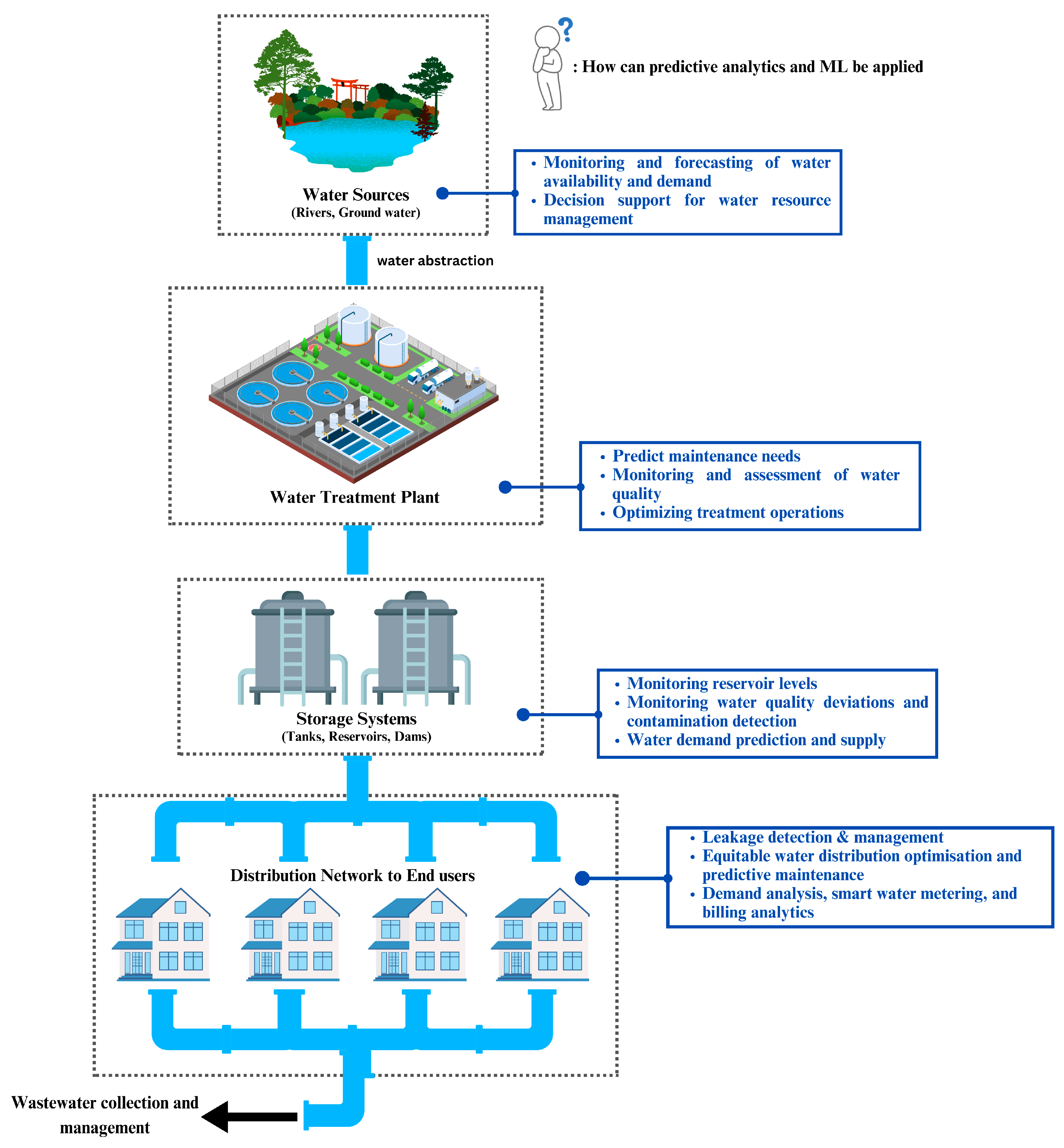
Figure 7 below provides a visual representation of the potential areas for deploying predictive analytics in South Africa’s water supply systems.
Thus, deploying predictive analytics models in South Africa’s water supply and distribution system could yield significant benefits across multiple areas. By enabling proactive decision-making, predictive analytics allows authorities to anticipate fluctuations in water demand and supply, leading to improved resource allocation and planning. This, in turn, enhances efficiency and cost reduction by optimising water usage, minimising waste, and lowering operational expenses through predictive maintenance, such as early detection of pipe failures and leakages. Additionally, predictive analytics can contribute to improved water quality and accessibility by facilitating real-time monitoring and early identification of contamination or system malfunctions, ensuring safer and more reliable water distribution. Furthermore, better resource management can be achieved by optimising reservoir operations and reducing unnecessary water losses, ultimately enhancing the long-term sustainability of South Africa’s water resources.

5.2. Technical and Resource Barriers to Adoption of Predictive Analytics

Several barriers hinder the widespread adoption of predictive analytics, ML, and AI in South Africa’s water systems:
(1)
Data Availability and Quality:
Effective predictive models require high-quality and consistent data [46,53]. However, the heterogeneous nature of datasets from different water authorities in South Africa presents significant challenges in data collection, standardization, and integration, hindering the effectiveness of ML applications [42]. Consequently, predictive analytics initiatives may be more readily implemented in high-capacity/revenue municipalities with data integration capabilities, potentially excluding rural settlements with fragmented or no data. This increases the risk of biased algorithms and unequitable deployment of predictive analytics across different regions in South Africa. Ref. [26] also highlights that fragmented data systems significantly undermine municipal water service delivery and emphasises the need for integrated municipal databases that link asset management systems, customer records, and revenue collection. Such integrated data environments are a foundational requirement for the effective deployment of predictive analytics and artificial intelligence (AI) technologies, enabling advanced functions such as demand forecasting, predictive maintenance, and revenue optimisation. This would support effective planning, maintenance, and financial sustainability, and help the municipalities to accurately determine categories of non-paying consumers, such as the indigent versus affording defaulters. Furthermore, data confidentiality concerns also make it difficult to implement predictive analytics in some municipalities. This can be mitigated by ensuring that all digital transformations and deployments comply with data privacy legislation, such as the Protection of Personal Information Act (POPIA). This also requires community engagement strategies aimed at building trust and raising awareness of new digitalisation technologies, while proactively addressing concerns related to cost, privacy, and accessibility.
(2)
Skills Gap:
There is a significant need for specialized skills in data science, ML, and AI within the water management sector. Without such capacity, predictive analytics initiatives risk underutilisation or abandonment, limiting their long-term impact. The complexity of these technologies requires interdisciplinary expertise, which is currently lacking and thus limits their widespread adoption and long-term use [48]. This skills deficit is particularly pronounced in low-revenue and under-resourced municipalities, where limited access to training opportunities further exacerbates capacity challenges to digitalization technologies. This position is supported by [26], who also argued for skilled human capacity development and training opportunities that are inclusive of education in low-revenue municipalities. Addressing this barrier requires targeted capacity-building programmes that establish clear training pipelines and enhance institutional readiness for emerging technologies. Structured training initiatives, partnerships with academic institutions and technology providers, and continuous professional development programmes can help equip municipal staff with essential skills in data analysis and AI system management [23,73]. In addition, actively involving operational staff and local communities in digital transformation processes can support knowledge transfer, improve system acceptance, and align predictive analytics solutions with practical service delivery needs.
(3)
Technology and Infrastructure Limitations:
The Majority of the existing technology infrastructure cannot easily support the integration of advanced digitalization systems. Many water utilities rely on outdated systems that lack the necessary interoperability to connect with modern data-driven technologies [48,74]. Moreover, the current systems also often suffer from limited processing power, slow data transfer speeds, and inadequate storage capabilities. The lack of adequate technological infrastructure and the high costs associated with upgrading existing systems are key barriers to the successful integration of predictive analytics into South Africa’s water supply and distribution systems. Overcoming these technological limitations will require both significant investment in modernising infrastructure and the development of more adaptable, scalable technologies that can support the integration of predictive analytics. In practice, these technological limitations extend to the operational sustainability of the predictive analytics systems. Scaling AI-enabled applications beyond pilot implementations requires reliable data pipelines, sufficient computational capacity, and interoperable system architectures [75], which remain inconsistent across municipalities. In addition, predictive analytics systems require continuous maintenance, including data validation, software updates, and periodic model retraining, placing further demands on already limited technical resources [76]. Without adequate operational capacity and maintenance planning, predictive analytics initiatives risk failing to progress beyond pilot-scale applications rather than achieving sustained, system-wide impact.
(4)
Financial and Resource Constraints:
Further to this, water authorities often face budget limitations that hinder the adoption of advanced technologies [74]. The substantial costs associated with implementing AI and ML systems can be a major barrier to their adoption, especially in resource-constrained regions. These constraints not only affect the acquisition of cutting-edge software and hardware but also the necessary infrastructure upgrades and operational costs to support such systems. Public–private relationships offer a viable mechanism for addressing these financial and resource constraints by enabling municipalities to partner with the private sector in overcoming the financial limitations that often delay infrastructure upgrades. Through structured partnerships, municipalities can collaborate with technology providers, private firms, or regional and international partners to share implementation risks and reduce upfront investment burdens, thereby accelerating the deployment of predictive analytics systems [23,26,73,77].
(5)
Governance, Institutional Power and Hydropolitical Dynamics
Beyond technical and financial constraints, governance and institutional structures are a key determinant of digital transformation trajectories and equity outcomes in South Africa’s water sector. Fragmented decision-making across national, provincial, and municipal levels, unclear accountability structures, and limited administrative capacity hinder the integration and sustained operation of advanced digital technologies. This is because political and institutional processes within governance structures shape funding priorities, influence where digital investments are directed, and determine whether technological expansions are implemented equitably. Evidence from hydropolitical analyses in South Africa indicates that water insecurity and service delivery failures are primarily rooted in governance shortcomings, institutional fragility, and ineffective management of water infrastructure, rather than in absolute physical water scarcity [7,24]. In such contexts, technical and regulatory interventions may inadvertently reinforce existing inequalities in technol-ogy adoption if not supported by strong institutional capacity and oversight.
Similar dynamics have been observed in other water governance contexts. A study by [78] on rural-to-urban groundwater reallocation in Jordan examined the political and technical challenges associated with redirecting water resources from unproductive rural agricultural uses to higher-value urban consumption, which were considered more economically viable. This resulted in the closure of rural farms to free up water for the cities. This initiative faced resistance from the rural stakeholders, highlighting how political economy, power dynamics, and social resistance often determine whether water interventions actually succeed. Newer technologies, such as remote sensing, which were also introduced to accurately track water use, were reportedly negotiated away from billing systems because accurate data retrieval would have triggered significant social instability. This indicates that interest group coalitions, including powerful political families and rural-based parliamentarians, can influence or derail technical solutions. Similarly, South Africa’s digital interventions may face similar hurdles from shadow state interests or local political structures that benefit from the status quo of manual monitoring and informal water use.
To mitigate these risks, the deployment of predictive analytics must be aligned with robust governance frameworks that align technological innovation with institutional capacity, funding mechanisms, and long-term infrastructure planning. Such frameworks must also account for political economy dynamics and potential social resistance that may arise from the implementation of new technologies. Strengthening governance structures and models can help overcome implementation barriers by ensuring that digital investments are strategically coordinated and equitably distributed. For instance, an integrated water resource management strategy promotes coordinated, inclusive, and decentralized governance involving all stakeholders to manage the complexities of water resources and emerging technologies [23]. Additionally, policy interventions within governance frameworks play a critical enabling role in enforcing the equitable adoption of these technologies, especially in under-resourced rural municipalities. Ref. [79], in their methodological framework addressing water insecurity, also support this position and further emphasize the connections of water supply equity to governance and social power dynamics. They noted that, in terms of water security, wealthy neighbourhoods often benefit more due to their greater technological capacity and interventions than low-income neighbourhoods. The National Water Policy principles state that water resources should be developed, allocated, and managed in a manner that ensures equitable access across all user sectors [2]. This is also supported by the Indigent Policy, which seeks to ensure that historically disadvantaged and low-income households have access to basic water supply and sanitation services, and water for productive economic activities that support social and economic development [26]. Thus, these governance and policy principles collectively provide a foundation for guiding the deployment of predictive analytics, ensuring that technological investments do not disproportionately benefit high-capacity urban municipalities at the expense of rural or low-income communities. By introducing predictive analytics into South Africa’s water systems through a phased approach, this goal can be achieved. Initially, pilot projects should target specific components, such as leakage detection or demand forecasting, to demonstrate the effectiveness of predictive analytics and build stakeholder confidence. Simultaneously, significant investment in data infrastructure is necessary to address data constraints, ensuring the collection, standardization, and availability of high-quality data for accurate analysis. To support this, capacity building efforts, including training and development programs for data scientists, engineers, and water management professionals, must be prioritized to bridge the skills gap. Additionally, fostering collaboration with research institutions, such as the Water Research Commission (WRC) and universities, will be essential to advance research and scale up predictive analytics solutions across the water sector. Therefore, future research should also focus on key areas such as real-time data processing and exploring hybrid models that combine AI and ML with traditional hydrological techniques.

6. Conclusions

This review article has discussed the current trends, patterns, and gaps in the literature related to the application of predictive analytics, machine learning (ML), and artificial intelligence (AI) in South Africa’s water supply and distribution systems. The potential of these technologies to address key challenges within the water sector has been explored, along with their practical implementation and impact in the local context. Research has shown that predictive models are being increasingly adopted in urban water management operations, offering a glimpse into their potential for improving system efficiency and addressing challenges such as water loss, demand forecasting, and infrastructure maintenance. However, the application of these technologies remains limited in rural areas, presenting a substantial opportunity for further research and development aimed at improving equitable water service delivery across all regions. Also, digitalisation interventions may reproduce or exacerbate existing inequalities by prioritising urban areas, which are considered more economically viable than over- or under-resourced rural areas. The “implementation gap” in South Africa is not merely a lack of hardware or skills, but a result of complex hydropolitical realities. There is a growing body of literature underscoring the need to address the existing gaps in the integration of predictive analytics, ML, and AI into South Africa’s water utilities. Despite significant strides in research and innovation, the gap between technological solutions and their actual implementation remains a considerable challenge. One of the key hurdles identified is the lack of effective transition of solutions and technologies within the system of innovation, resulting in a prolonged journey from research to actual deployment.
In light of these challenges, there is an urgent need for projects that investigate, identify, and prioritise areas within South Africa’s complex water production and distribution value chains that are suitable for digitalisation. Prioritising these areas through phased approaches will ensure that implementations are both realistic and effective. This strategy will provide clarity on which sections of the system can benefit from predictive analytics, ML, and AI, laying the foundation for a more systematic and integrated adoption of these technologies. Furthermore, the successful integration of predictive analytics into South Africa’s water supply and distribution systems requires addressing critical barriers such as data quality and availability, technological infrastructure, hydropolitical dynamics, and the skills gap within the sector. Bridging these gaps is paramount to accelerating the adoption of these advanced technologies and ensuring their successful implementation in water utilities. The ultimate goal is to ensure a sustainable and equitable water supply that can meet the growing demands of both urban and rural communities. While progress is being made, the full potential of these technologies is yet to be realized in South Africa’s water supply and distribution systems. This review paper provides insights that will culminate in recommendations for stakeholders in the municipal water systems and government agencies. These recommendations are expected to inform decision-making and enhance policy interventions in addressing the challenges identified in the water supply and distribution system. This is to ensure that South Africa’s water availability is well managed using state-of-the-art techniques to further increase the overall efficiency of the water production and distribution system. Implementation of the findings from this systematic review could position South African water utilities in light of current technological/digitalisation capabilities.
Future work could explore other branches of AI, such as speech recognition, computer vision, and natural language processing, which may offer complementary solutions in water resource management. For instance, speech recognition and Natural Language Processing (NLP) could enhance real-time feedback collection from end-users through virtual assistants, call centres, or voice-command systems, improving customer engagement and enabling faster responses to service issues. Similarly, computer vision techniques could be used in infrastructure monitoring, such as detecting pipeline leaks or assessing dam conditions using drone or satellite imagery. By incorporating these AI branches, future research could support a more holistic, intelligent, and user-focused water management system. Additionally, further research that expands on detailed policy frameworks and effective governance models for this implementation would present a valuable extension of this study. This could help close the current implementation gap by aligning technological advancements with the operational realities and data environments of South African water utilities.

Author Contributions

Conceptualization, G.J.O.; methodology, G.J.O.; software, A.M.N.; formal analysis, A.M.N.; investigation, A.M.N.; resources, G.J.O.; writing—original draft preparation, A.M.N.; writing—review and editing, G.J.O. and A.M.N.; visualization, A.M.N.; supervision, G.J.O.; project administration, G.J.O.; funding acquisition, G.J.O. All authors have read and agreed to the published version of the manuscript.

Funding

This research was funded by the NATIONAL RESEARCH FOUNDATION (NRF) South Africa, grant number TTK240314209104.

Data Availability Statement

No new data were created. The data that support the findings of this study are available as indicated in the references and upon request.

Conflicts of Interest

The authors declare no conflicts of interest. The funders had no role in the design of the study; in the collection, analyses, or interpretation of data; in the writing of the manuscript; or in the decision to publish the results.

Abbreviations

The following abbreviations are used in this manuscript:
MLMachine Learning
AIArtificial Intelligence
NWRS National Water Resource Strategy
WRCWater Research Commission
ANNArtificial neural network
KNNK Nearest Neighbours
SVMSupport Vector Machine
RFRandom Forest
DTDecision Trees
NBNaïve Bayes
DWSDepartment of Water and Sanitation
CMAsCatchment Management Agencies
WMAWater Management Areas
WUAWater User Associations
WSIWater Services Institutions
WSA Water Services Authority
WSPWater Services Providers

References

  1. DWS. National State of Water Report 2023_Finalver3.0 (No. WII/IWRS/NSoW 2023). 2024; 245p. Available online: https://www.dws.gov.za/Projects/National%20State%20of%20Water%20Report/Documents/National%20State%20of%20Water%20Report%202023_FinalVer3.0.pdf (accessed on 21 October 2025).
  2. DWS. Approved National Water Resource Strategy, 3rd ed.; The Department of Water and Sanitation: Pretoria, South Africa, 2023. Available online: https://www.dws.gov.za/documents/Other/Strategic%20Plan/2023/Approved%20National%20Water%20Resource%20Strategy%20Third%20Edition%20(NWRS3)%202023.pdf (accessed on 16 December 2024).
  3. DWS. Overview of the South African Water Sector. 2011; 35p. Available online: https://www.dws.gov.za/IO/Docs/CMA/CMA%20GB%20Training%20Manuals/gbtrainingmanualchapter1.pdf (accessed on 8 October 2024).
  4. DWS. Annual Report 2022-23_25 August 2023@29 Sept 12–16. 2023; 430p. Available online: https://www.dws.gov.za/Documents/AnnualReports/AR%202022-23_25%20August%202023@29%20Sept%2012-16.pdf (accessed on 2 October 2024).
  5. Nthutang, P.; Telukdarie, A. Integration of small and medium enterprises for industry 4.0 in the South African Water Services Sector: A Case Study for Johannesburg Water. In Proceedings of the 2018 IEEE International Conference on Industrial Engineering and Engineering Management (IEEM), Bangkok, Thailand, 16–19 December 2018; IEEE: New York, NY, USA, 2018; pp. 1206–1210. [Google Scholar] [CrossRef]
  6. Edokpayi, J.; Rogawski, E.; Kahler, D.; Hill, C.; Reynolds, C.; Nyathi, E.; Smith, J.; Odiyo, J.; Samie, A.; Bessong, P.; et al. Challenges to sustainable safe drinking water: A case study of water quality and use across seasons in rural communities in limpopo province, South Africa. Water 2018, 10, 159. [Google Scholar] [CrossRef] [PubMed]
  7. Cole, M.J.; Bailey, R.M.; Cullis, J.D.S.; New, M.G. Spatial inequality in water access and water use in South Africa. Water Policy 2018, 20, 37–52. [Google Scholar] [CrossRef]
  8. Rahim, M.S.; Nguyen, K.A.; Stewart, R.A.; Giurco, D.; Blumenstein, M. Machine learning and data analytics techniques in digital water metering: A review. Water 2020, 12, 294. [Google Scholar] [CrossRef]
  9. Zubaidi, S.L.; Ortega-Martorell, S.; Al-Bugharbee, H.; Olier, I.; Hashim, K.S.; Gharghan, S.K.; Kot, P.; Al-Khaddar, R. Urban water demand prediction for a city that suffers from climate change and population growth: Gauteng province case study. Water 2020, 12, 1885. [Google Scholar] [CrossRef]
  10. Niknam, A.; Zare, H.K.; Hosseininasab, H.; Mostafaeipour, A.; Herrera, M. A critical review of short-term water demand forecasting tools—What method should i use? Sustainability 2022, 14, 5412. [Google Scholar] [CrossRef]
  11. Aderemi, B.A.; Olwal, T.O.; Ndambuki, J.M.; Rwanga, S.S. Groundwater levels forecasting using machine learning models: A case study of the groundwater region 10 at karst belt, South Africa. Syst. Soft Comput. 2023, 5, 200049. [Google Scholar] [CrossRef]
  12. Igwebuike, N.; Ajayi, M.; Okolie, C.; Kanyerere, T.; Halihan, T. Application of machine learning and deep learning for predicting groundwater levels in the west coast aquifer system, South Africa. Earth Sci. Inform. 2025, 18, 6. [Google Scholar] [CrossRef]
  13. Kanyama, Y.; Ajoodha, R.; Seyler, H.; Makondo, N.; Tutu, H. Application of machine learning techniques in forecasting groundwater levels in the grootfontein aquifer. In Proceedings of the 2020 2nd International Multidisciplinary Information Technology and Engineering Conference (IMITEC), Kimberley, South Africa, 25–27 November 2020; IEEE: New York, NY, USA, 2020; pp. 1–8. [Google Scholar] [CrossRef]
  14. Ngobeni, V.; Breitenbach, M.C. Production and scale efficiency of South African water utilities: The case of water boards. Water Policy 2021, 23, 862–879. [Google Scholar] [CrossRef]
  15. Seyedan, M.; Mafakheri, F. Predictive big data analytics for supply chain demand forecasting: Methods, applications, and research opportunities. J. Big Data 2020, 7, 53. [Google Scholar] [CrossRef]
  16. Zhao, T.; Song, C.; Yu, J.; Xing, L.; Xu, F.; Li, W.; Wang, Z. Leveraging immersive digital twins and ai-driven decision support systems for sustainable water reserves management: A conceptual framework. Sustainability 2025, 17, 3754. [Google Scholar] [CrossRef]
  17. Oyewole, G.J.; Thopil, G.A. Data clustering: Application and trends. Artif. Intell. Rev. 2023, 56, 6439–6475. [Google Scholar] [CrossRef]
  18. Page, M.J.; McKenzie, J.E.; Bossuyt, P.M.; Boutron, I.; Hoffmann, T.C.; Mulrow, C.D.; Shamseer, L.; Tetzlaff, J.M.; Akl, E.A.; Brennan, S.E.; et al. The prisma 2020 statement: An updated guideline for reporting systematic reviews. BMJ 2021, 372, n71. [Google Scholar] [CrossRef] [PubMed]
  19. Pickering, C.; Byrne, J. The benefits of publishing systematic quantitative literature reviews for phd candidates and other early-career researchers. High. Educ. Res. Dev. 2014, 33, 534–548. [Google Scholar] [CrossRef]
  20. Mokoena, M.; Lukumwena, N. Managing city pipe leaks through community participation using a web and mobile application in South Africa. Int. J. Earth Energy Environ. Sci. 2019, 13, 402–408. [Google Scholar] [CrossRef]
  21. Edokpayi, J.N.; Enitan-Folami, A.M.; Adeeyo, A.O.; Durowoju, O.S.; Jegede, A.O.; Odiyo, J.O. Recent trends and national policies for water provision and wastewater treatment in South Africa. In Water Conservation and Wastewater Treatment in BRICS Nations; Elsevier: Amsterdam, The Netherlands, 2020; pp. 187–211. [Google Scholar] [CrossRef]
  22. WRC. Water Research Commission Annual Performance Plan 2024/25; Water Research Commission: Pretoria, South Africa, 2024.
  23. Daudu, B.O.; Amodu, S.A.; Yakubu, P.O.; Anaiye, E.B. Leveraging Data-Driven Approaches: A Case Study on Enhanc-ing Water Governance in Africa. In The Handbook of AI for Clean Water; CRC Press: Boca Raton, FL, USA, 2025; pp. 293–306. [Google Scholar]
  24. Jankielsohn, R. Hydropolitical-based fragility in the Free State Province: A case study for South Africa within social contract and actor-network theories. ISRG J. Arts Humanit. Soc. Sci. 2024, 2, 279–291. [Google Scholar]
  25. Du Plessis, A. Necessity of making water smart for proactive informed decisive actions: A case study of the Upper Vaal Catchment, South Africa. Environ. Chall. 2021, 4, 100100. [Google Scholar] [CrossRef]
  26. Twalo, T. Water sector value chain challenges: The case of Chris Hani District Municipality. Afr. Public Serv. Deliv. Perform. Rev. 2025, 13, 870. [Google Scholar] [CrossRef]
  27. Dube, R.; Dube, B.; Managa, R.; Malan, A.; Ramulondi, D.; Ramathuba, T. Integrated Catchment Management: From Source to Receptor; Water Research Commission: Pretoria, South Africa, 2021.
  28. Dithebe, K.; Aigbavboa, C.O.; Thwala, W.D.; Oke, A.E. Analysis on the perceived occurrence of challenges delaying the delivery of water infrastructure assets in South Africa. J. Eng. Des. Technol. 2019, 17, 554–571. [Google Scholar] [CrossRef]
  29. Netshitanini, M.; Adeeyo, A.O.; Edokpayi, J.N. Determinants and Evaluation of Onsite Water Loss Due to Leakages in a Selected Institution in South Africa. Water 2023, 15, 217. [Google Scholar] [CrossRef]
  30. Nel, N.; Jacobs, H.E.; Loubser, C.; Du Plessis, K.A. Supplementary household water sources to augment potable municipal supply in South Africa. Water SA 2017, 43, 553. [Google Scholar] [CrossRef]
  31. Ward, P.J.; De Ruiter, M.C.; Mård, J.; Schröter, K.; Van Loon, A.; Veldkamp, T.; Von Uexkull, N.; Wanders, N.; AghaKouchak, A.; Arnbjerg-Nielsen, K.; et al. The need to integrate flood and drought disaster risk reduction strategies. Water Secur. 2020, 11, 100070. [Google Scholar] [CrossRef]
  32. Bazaanah, P.; Mothapo, R.A. Sustainability of drinking water and sanitation delivery systems in rural communities of the lepelle nkumpi local municipality, South Africa. Environ. Dev. Sustain. 2023, 26, 14223–14255. [Google Scholar] [CrossRef]
  33. Sheik, A.G.; Malla, M.A.; Srungavarapu, C.S.; Patan, A.K.; Kumari, S.; Bux, F. Prediction of wastewater quality parameters using adaptive and machine learning models: A South African case study. J. Water Process Eng. 2024, 67, 106185. [Google Scholar] [CrossRef]
  34. Arismendy, L.; Cárdenas, C.; Gómez, D.; Maturana, A.; Mejía, R.; Quintero, M.C.G. Intelligent system for the predictive analysis of an industrial wastewater treatment process. Sustainability 2020, 12, 6348. [Google Scholar] [CrossRef]
  35. Predescu, A.; Truică, C.-O.; Apostol, E.-S.; Mocanu, M.; Lupu, C. An advanced learning-based multiple model control supervisor for pumping stations in a smart water distribution system. Mathematics 2020, 8, 887. [Google Scholar] [CrossRef]
  36. Rustagi, M.; Goel, N. Predictive analytics: A study of its advantages and applications. IARS Int. Res. J. 2022, 12, 60–63. [Google Scholar] [CrossRef]
  37. Jamarani, A.; Haddadi, S.; Sarvizadeh, R.; Haghi Kashani, M.; Akbari, M.; Moradi, S. Big data and predictive analytics: A systematic review of applications. Artif. Intell. Rev. 2024, 57, 176. [Google Scholar] [CrossRef]
  38. Wach, M.; Chomiak-Orsa, I. The application of predictive analysis in decision-making processes on the example of mining company’s investment projects. Procedia Comput. Sci. 2021, 192, 5058–5066. [Google Scholar] [CrossRef]
  39. Oyebode, O.; Babatunde, D.E.; Monyei, C.G.; Babatunde, O.M. Water demand modelling using evolutionary computation techniques: Integrating water equity and justice for realization of the sustainable development goals. Heliyon 2019, 5, e02796. [Google Scholar] [CrossRef] [PubMed]
  40. Lepenioti, K.; Bousdekis, A.; Apostolou, D.; Mentzas, G. Prescriptive analytics: Literature review and research challenges. Int. J. Inf. Manag. 2020, 50, 57–70. [Google Scholar] [CrossRef]
  41. Robles Velasco, A.; Muñuzuri, J.; Onieva, L.; Rodríguez Palero, M. Trends and applications of machine learning in water supply networks management. J. Ind. Eng. Manag. 2021, 14, 45. [Google Scholar] [CrossRef]
  42. Drogkoula, M.; Kokkinos, K.; Samaras, N. A comprehensive survey of machine learning methodologies with emphasis in water resources management. Appl. Sci. 2023, 13, 12147. [Google Scholar] [CrossRef]
  43. Nasir, N.; Kansal, A.; Alshaltone, O.; Barneih, F.; Sameer, M.; Shanableh, A.; Al-Shamma’a, A. Water quality classification using machine learning algorithms. J. Water Process Eng. 2022, 48, 102920. [Google Scholar] [CrossRef]
  44. Ghobadi, F.; Kang, D. Application of machine learning in water resources management: A systematic literature review. Water 2023, 15, 620. [Google Scholar] [CrossRef]
  45. Fu, G.; Jin, Y.; Sun, S.; Yuan, Z.; Butler, D. The role of deep learning in urban water management: A critical review. Water Res. 2022, 223, 118973. [Google Scholar] [CrossRef] [PubMed]
  46. Zhu, M.; Wang, J.; Yang, X.; Zhang, Y.; Zhang, L.; Ren, H.; Wu, B.; Ye, L. A review of the application of machine learning in water quality evaluation. Eco-Environ. Health 2022, 1, 107–116. [Google Scholar] [CrossRef]
  47. Choi, R.Y.; Coyner, A.S.; Kalpathy-Cramer, J.; Chiang, M.F.; Campbell, J.P. Introduction to Machine Learning, Neural Networks, and Deep Learning. Transl. Vis. Sci. Technol. 2020, 9, 14. [Google Scholar]
  48. Kamyab, H.; Khademi, T.; Chelliapan, S.; SaberiKamarposhti, M.; Rezania, S.; Yusuf, M.; Farajnezhad, M.; Abbas, M.; Hun Jeon, B.; Ahn, Y. The latest innovative avenues for the utilization of artificial intelligence and big data analytics in water resource management. Results Eng. 2023, 20, 101566. [Google Scholar] [CrossRef]
  49. Lowe, M.; Qin, R.; Mao, X. A review on machine learning, artificial intelligence, and smart technology in water treatment and monitoring. Water 2022, 14, 1384. [Google Scholar] [CrossRef]
  50. Janiesch, C.; Zschech, P.; Heinrich, K. Machine learning and deep learning. Electron. Mark. 2021, 31, 685–695. [Google Scholar] [CrossRef]
  51. Çelik, Ö. A research on machine learning methods and its applications. J. Educ. Technol. Online Learn. 2018, 1, 25–40. [Google Scholar] [CrossRef]
  52. Ahmed, U.; Mumtaz, R.; Anwar, H.; Shah, A.A.; Irfan, R.; García-Nieto, J. Efficient water quality prediction using supervised machine learning. Water 2019, 11, 2210. [Google Scholar] [CrossRef]
  53. Chen, R.; Wang, Q.; Javanmardi, A. A Review of the Application of Machine Learning for Pipeline Integrity Predictive Analysis in Water Distribution Networks. Arch. Comput. Methods Eng. 2025, 32, 3821–3849. [Google Scholar] [CrossRef]
  54. Bejarano, G.; Jain, M.; Ramesh, A.; Seetharam, A.; Mishra, A. Predictive analytics for smart water management in developing regions. In Proceedings of the 2018 IEEE International Conference on Smart Computing (SMARTCOMP), Taormina, Italy, 18–20 June 2018; IEEE: New York, NY, USA, 2018; pp. 464–469. [Google Scholar] [CrossRef]
  55. Ilić, M.; Srdjević, Z.; Srdjević, B. Water quality prediction based on naïve bayes algorithm. Water Sci. Technol. 2022, 85, 1027–1039. [Google Scholar] [CrossRef] [PubMed]
  56. Pham, B.T.; Jaafari, A.; Phong, T.V.; Mafi-Gholami, D.; Amiri, M.; Van Tao, N.; Duong, V.-H.; Prakash, I. Naïve bayes ensemble models for groundwater potential mapping. Ecol. Inform. 2021, 64, 101389. [Google Scholar] [CrossRef]
  57. Sarker, I.H. Machine learning: Algorithms, real-world applications and research directions. SN Comput. Sci. 2021, 2, 160. [Google Scholar] [CrossRef] [PubMed]
  58. Kumar, V.; Garg, M. Predictive analytics: A review of trends and techniques. Int. J. Comput. Appl. 2018, 182, 31–37. [Google Scholar] [CrossRef]
  59. Zhang, S. Challenges in knn classification. IEEE Trans. Knowl. Data Eng. 2022, 34, 4663–4675. [Google Scholar] [CrossRef]
  60. Adedeji, K.B.; Hamam, Y. Cyber-physical systems for water supply network management: Basics, challenges, and roadmap. Sustainability 2020, 12, 9555. [Google Scholar] [CrossRef]
  61. Amankwaa, G.; Heeks, R.; Browne, A.L. Digital innovations and water services in cities of the global south: A systematic literature review. Water Altern. 2021, 14, 619–644. [Google Scholar]
  62. Singels, A.; Annandale, J.G.; Jager, J.M.D.; Schulze, R.E.; Inman-Bamber, N.G.; Durand, W.; Rensburg, L.D.V.; Heerden, P.S.V.; Crosby, C.T.; Green, G.C.; et al. Modelling crop growth and crop water relations in South Africa: Past achievements and lessons for the future. S. Afr. J. Plant Soil 2010, 27, 49–65. [Google Scholar] [CrossRef]
  63. Nieuwoudt, W.; Backeberg, G. A review of the modelling of water values in different use sectors in South Africa. Water SA 2011, 37, 703–710. [Google Scholar] [CrossRef]
  64. De Souza Groppo, G.; Costa, M.A.; Libânio, M. Predicting water demand: A review of the methods employed and future possibilities. Water Supply 2019, 19, 2179–2198. [Google Scholar] [CrossRef]
  65. Xu, Y.; Beekman, H.E. Review: Groundwater recharge estimation in arid and semi-arid southern africa. Hydrogeol. J. 2019, 27, 929–943. [Google Scholar] [CrossRef]
  66. Achiro, D.; Alowo, R.; Nkhonjera, G. Implementing a groundwater monitoring system in the jukskei river catchment: A typescript and mysql approach. In Proceedings of the 2023 International Conference on Electrical, Computer and Energy Technologies (ICECET), Cape Town, South Africa, 16–17 November 2023; IEEE: New York, NY, USA, 2023; pp. 1–6. [Google Scholar] [CrossRef]
  67. Jacobs, H.E.; Fair, K.A. A tool to increase information-processing capacity for consumer water meter data. SA J. Inf. Manag. 2012, 14, a500. [Google Scholar] [CrossRef][Green Version]
  68. Habiyaremye, A. Water innovation in South Africa: Mapping innovation successes and diffusion constraints. Environ. Sci. Policy 2020, 114, 217–229. [Google Scholar] [CrossRef]
  69. Makaudze, E.M.; Gelles, G.M. The challenges of providing water and sanitation to urban slum settlements in South Africa. In Understanding and Managing Urban Water in Transition; Springer: Berlin/Heidelberg, Germany, 2015; pp. 121–133. Available online: https://link.springer.com/chapter/10.1007/978-94-017-9801-3_5 (accessed on 9 October 2024).
  70. Balti, H.; Ben Abbes, A.; Mellouli, N.; Farah, I.R.; Sang, Y.; Lamolle, M. A review of drought monitoring with big data: Issues, methods, challenges and research directions. Ecol. Inform. 2020, 60, 101136. [Google Scholar] [CrossRef]
  71. Jawaharlal, N.; Reddy, P.; Sureshbabu, A.; JNTUA College of Engineering. An adaptive model for forecasting seasonal rainfall using predictive analytics. Int. J. Intell. Eng. Syst. 2019, 12, 22–32. [Google Scholar] [CrossRef]
  72. Sidimba, L. Johannesburg’s Water Crisis Exposes Infrastructure Failures; IOL: Bucharest, Romania, 2026; Available online: https://iol.co.za/news/2026-02-07-johannesburgs-water-crisis-exposes-infrastructure-failures/ (accessed on 22 February 2026).
  73. Thenga, D.M.; Nzama, L. The impact of technology in addressing the water crisis within local government. EDPACS 2025, 70, 185–208. [Google Scholar] [CrossRef]
  74. Seema, T.C.; Molepo, J.N.; Maleka, C.M. Water service delivery challenges in Modimolle-Mookgophong Local Mu-nicipality, Limpopo, South Africa. J. Local Gov. Res. Innov. 2025, 6, 217. [Google Scholar] [CrossRef]
  75. Pushpakumara, T.D.C.; Jameel Ahsan, F. Artificial Intelligence Adoption in Service Industries: A Systematic Literature Review of key Drives, Barriers, Challenges, and Strategies. Int. J. Innov. Sci. Res. Technol. 2025, 10, 2240–2256. [Google Scholar] [CrossRef]
  76. Essien, N.A.; Idowu, A.T.; Lawani, R.I.; Okereke, M.; Sofoluwe, O.; Olugbemi, G.I.T. Framework for AI-driven predic-tive maintenance in IoT-enabled water treatment plants to minimize downtime and improve efficiency. Int. J. Sci. Res. Comput. Sci. Eng. Inf. Technol. 2024, 10, 797–806. [Google Scholar]
  77. Agarwal, S.; Garg, M.C. The Handbook of AI for Clean Water: Innovations in Treatment and Monitoring, 1st ed.; CRC Press: Boca Raton, FL, USA, 2025. [Google Scholar] [CrossRef]
  78. Liptrot, T.; Hussein, H. Between Regulation and Targeted Expropriation: Rural-to-Urban Groundwater Reallocation in Jordan; University of Oxford: Oxford, UK, 2020; p. 13. [Google Scholar]
  79. Charilaou, M.; Hussein, H. Measuring household water insecurity in intermittent supply systems: A context-sensitive index from urban Jordan. Urban Water J. 2026, 1–25. [Google Scholar] [CrossRef]
Figure 1. The PRISMA flow diagram for the article selection process.
Limnolrev 26 00023 g001
Figure 2. Institutional framework for South Africa’s water sector (adapted from DWS [2]). Grey boxes represent the key players at the national level. Green boxes represent the Water Management Institutions responsible for water resource management within Water Management Areas. Blue boxes represent Water Services Institutions. The dashed horizontal line separates national-level governance structures from regional and local-level institutions.
Limnolrev 26 00023 g002
Figure 3. Water supply and distribution system components.
Limnolrev 26 00023 g003
Figure 4. Steps of the predictive analytics process.
Limnolrev 26 00023 g004
Figure 5. Artificial Neural Network (ANN) structure [49]. The network consists of an input layer (blue nodes), hidden layers (orange nodes), and an output layer (green nodes). The arrows represent weighted connections between the neurons.
Limnolrev 26 00023 g005
Figure 6. Illustration of a decision tree to predict pump failure.
Limnolrev 26 00023 g006
Figure 7. Candidates for predictive analytics in South Africa’s water supply and distribution network.
Limnolrev 26 00023 g007
Table 1. Categorization of included studies across application domains within the water sector.
Application DomainNumber of Studies
1.Groundwater monitoring7
2.Hydrological forecasting6
3.Water demand forecasting10
4.Leakage detection9
5.Smart metering, billing optimization, and consumer analytics6
6.Wastewater treatment and quality modelling12
7.Water governance studies 17
8.Conceptual and theoretical studies on AI, ML and predictive analytics12
79
Disclaimer/Publisher’s Note: The statements, opinions and data contained in all publications are solely those of the individual author(s) and contributor(s) and not of MDPI and/or the editor(s). MDPI and/or the editor(s) disclaim responsibility for any injury to people or property resulting from any ideas, methods, instructions or products referred to in the content.