Article

Allelopathic Interference of the Cyanobacterium Raphidiopsis raciborskii Exudates on Photosynthetic Traits of Photosynthesizing Microorganisms


by
Camila Nader
,
Maria Cecília Miotto
,
Carlos Yure B. Oliveira
* and
Leonardo R. Rörig
Laboratório de Ficologia, Departamento de Botânica, Centro de Ciências Biológicas, Universidade Federal de Santa Catarina, Florianópolis 88040-900, SC, Brazil
*
Author to whom correspondence should be addressed.
Limnol. Rev. 2026, 26(1), 9; https://doi.org/10.3390/limnolrev26010009
Submission received: 12 February 2026 / Revised: 9 March 2026 / Accepted: 11 March 2026 / Published: 13 March 2026

Abstract

Raphidiopsis raciborskii (formerly Cylindrospermopsis raciborskii) is a bloom-forming cyanobacterium that employs the production of toxins and other secondary metabolites as a competitive and allelopathic strategy. This study evaluated the effects of exudates from R. raciborskii cultivated under three nitrogen-to-phosphorus (N:P) ratios on the photosynthetic performance of Limnothrix sp. (cyanobacterium), Chlorella sp. (green algae), and Raphidocelis subcapitata (green algae), using pulse-amplitude-modulated (PAM) fluorometry. Rapid light curves (rETR) obtained under different N:P ratios and across the three target species exhibited similar response patterns. Likewise, effective quantum yield (ΦPSII), regulated (Y(NPQ)) and non-regulated (Y(NO)) energy dissipation showed comparable profiles among treatments after 24 h of exposure. Overall, the results of the present study indicate that, within the 24 h exposure period and based on the fluorescence parameters measured, exudates produced by R. raciborskii under the tested nutrient conditions did not cause measurable alterations in the photosynthetic performance of the three evaluated species.

1. Introduction

Cyanobacteria are a diverse group of photosynthesizing, prokaryotic and aerobic microorganisms found in the most diverse environments that present a remarkable ecological diversity [1]. This group exhibits a wide variety of secondary metabolites that are not essential for primary metabolism (i.e., growth and division of cells) but they can contribute to successfully compete with other photosynthesizing organisms [2]. Moreover, several cyanobacteria species can form blooms (CyanoHABs) when they find favorable conditions for their growth, such as light, nutrients, physical factors, turbulence, temperature, salinity, pH and others such as competition [3,4,5].
Raphidiopsis raciborskii (Wołoszyńska) Aguilera & al. (formerly known as Cylindrospermopsis raciborskii) is recognized as an invasive species [6], and blooms of this cyanobacterium have been increasingly reported in a wide range of freshwater environments worldwide [7,8,9]. Its expansion has been associated with both natural and anthropogenic factors, including climate change, eutrophication, and hydrological alterations, which favor its establishment and proliferation in diverse aquatic systems. This species is capable of dominating phytoplanktonic biomass for extended periods [6,10], often leading to significant changes in community structure and ecosystem functioning. Such dominance reflects its high competitive capacity, which may be attributed to physiological plasticity, efficient nutrient uptake, and tolerance to environmental stress. In addition, the production of toxins and allelochemicals has been suggested as an important ecological strategy contributing to its competitive advantage over co-occurring phytoplankton species [11].
The allelopathy phenomenon is described as the direct or indirect (most often negative) effect of one species on another through the production and release of chemical compounds into the environment [12,13]. Figueredo et al. [14] propose that allelopathy can facilitate species invasion, increasing its geographic distribution. Allelochemicals can inhibit photosynthesis [11], the central physiological process of primary producers, and this is the most widespread allelopathic mode of action among cyanobacteria [15]. Most of the allelochemicals interfere with electron transport in photosystem II (PSII), decreasing the evolution of oxygen and the incorporation of carbon by cells, leading to a decrease in the growth rate [16]. Legrand et al. [17] reported that both the history of organisms in the environment and the physiological state of the cells in question can affect the production and action of the allelochemical. Thus, there are several factors, biotic or abiotic, that can influence allelopathic interactions.
According to Mulderij et al. [18] and Leflaive et al. [19], increased production and enhanced allelopathic effects are commonly observed under stress conditions, indicating that abiotic factors can strongly influence the synthesis and release of allelochemical compounds. Environmental stressors such as nutrient limitation, light fluctuations, and temperature variability may induce physiological and metabolic adjustments that favor the allocation of resources toward secondary metabolite production. Among these factors, nutrient availability, particularly phosphorus (P) and nitrogen (N), plays a central role in regulating phytoplankton growth, cellular stoichiometry, and biochemical composition [20,21]. Variations in N and P supply can alter metabolic pathways and nutrient allocation strategies, often resulting in the increased synthesis of secondary metabolites, including allelopathic compounds [22,23]. Consequently, changes in nutrient regimes may indirectly modulate species interactions and competitive dynamics in aquatic ecosystems through their effects on allelochemical production.
The fluorescence of chlorophyll-a is a widely used and reliable indicator of the primary biophysical processes of photosynthesis [24,25,26], particularly those associated with the efficiency and regulation of photosystem II (PSII) [27]. When measured using pulse-amplitude-modulated (PAM) fluorometry, this approach enables the rapid and non-invasive assessment of multiple fluorescence-derived parameters, providing sensitive indicators of physiological status, stress responses, and metabolic alterations in photosynthetic organisms [28]. As such, PAM fluorescence represents a powerful tool for detecting subtle changes in photosynthetic performance induced by environmental factors or biotic interactions, including allelopathic interference.
In this context, we hypothesized that exudates derived from R. raciborskii grown under nitrogen-deficient conditions would exert a negative effect on the photosynthetic parameters of the target microalgae, reflected by alterations in PSII efficiency and related fluorescence parameters. This expectation is based on the premise that nitrogen limitation may enhance the allocation of resources to secondary metabolite production, thereby intensifying allelopathic interactions. Thus, the present study aimed to evaluate the short-term allelopathic effects of exudates produced by an isolate of Raphidiopsis raciborskii cultivated under different nutritional regimes on the photosynthetic parameters of Limnothrix sp., Chlorella sp., and Raphidocelis subcapitata (Korshikov) Nygaard et al. By integrating controlled nutrient manipulation with fluorescence-based physiological measurements, this study seeks to elucidate how nutrient-driven variations in exudate composition may influence interspecific interactions and photosynthetic functioning in freshwater phytoplankton communities.

2. Materials and Methods

2.1. Cyanobacterium Strain and Inoculum Maintenance

Raphidiopsis raciborskii LP2 strain used in the present study was isolated from Peri Lagoon, Florianópolis, Santa Catarina, Brazil and kept in the strain bank of the Laboratório de Ficologia (LAFIC) at the Universidade Federal de Santa Catarina (UFSC), Florianópolis, Brazil. It was kept in 500 mL flat-bottomed flasks containing ASM-1 medium [29] under constant aeration, temperature of 23 ± 1 °C, 40 µmol photons m−2 s−1 irradiance with photoperiod of 12 h.

2.2. Experimental Design

The allelopathic activity of metabolites produced and released by R. raciborskii was evaluated using exudate-based bioassays, in which only the culture medium containing extracellular compounds was tested, without the presence of cyanobacterial cells. This approach was adopted in order to isolate the effects of dissolved secondary metabolites from potential physical interactions, shading effects, or nutrient competition that could occur in co-culture experiments. To assess the influence of nutrient availability on growth performance and the production of allelopathic compounds by R. raciborskii, cultures were grown under controlled laboratory conditions using media with different nitrogen-to-phosphorus (N:P) ratios. Three molar N:P ratios were established: 4.5:1, 10:1, and 40:1, representing low, intermediate, and high nitrogen availability relative to phosphorus, respectively. These different N:P ratios were used with the intention of generating possible stresses in the isolate to stimulate the production of allelopathic compounds [30]. Therefore, the selected nutrient regimes were designed to promote potential shifts in metabolic pathways associated with allelopathy.

2.3. Allelopathic Activity Trials

Raphidiopsis raciborskii cultures were harvested during the exponential growth phase and filtered to obtain cell-free exudates, which were subsequently used in the bioassays. Filtration was performed to remove cyanobacterial cells and ensure that only dissolved extracellular metabolites were present in the experimental medium. Three phytoplankton taxa were selected as target organisms, including two chlorophytes (Chlorella sp. and Raphidocelis subcapitata) and one cyanobacterium (Limnothrix sp.). Prior to the experiments, all strains were acclimated under laboratory conditions in ASM-1 medium and maintained in the exponential growth phase to ensure physiological homogeneity.
The experiments were conducted in 250 mL sterile conical flasks containing 100 mL of R. raciborskii exudate obtained from cultures grown under the three different N:P ratios. Each flask was inoculated with 10 mL of actively growing cultures of Limnothrix sp., Chlorella sp., or R. subcapitata. Initial cell densities were standardized by using cultures in similar exponential growth phases to minimize variability associated with physiological status. Control treatments consisted of ASM-1 medium diluted to 10%, which was used to simulate nutrient depletion and to distinguish allelopathic effects from those associated with nutrient limitation. All experimental units were incubated for 24 h at 23 ± 1 °C under a light intensity of 40 µmol photons m−2 s−1 and a 12 h light:12 h dark photoperiod and continuous aeration to ensure adequate mixing and gas exchange throughout the incubation period. The 24 h exposure period was selected to evaluate short-term physiological responses, focusing specifically on acute alterations in photosynthetic performance as detected by chlorophyll-a fluorescence parameters.

2.4. Analytical Procedures

The variation in the chlorophyll-a fluorescence signals were evaluated using a Water-PAM fluorometer (Heinz Walz GmbH, Effeltrich, Germany).
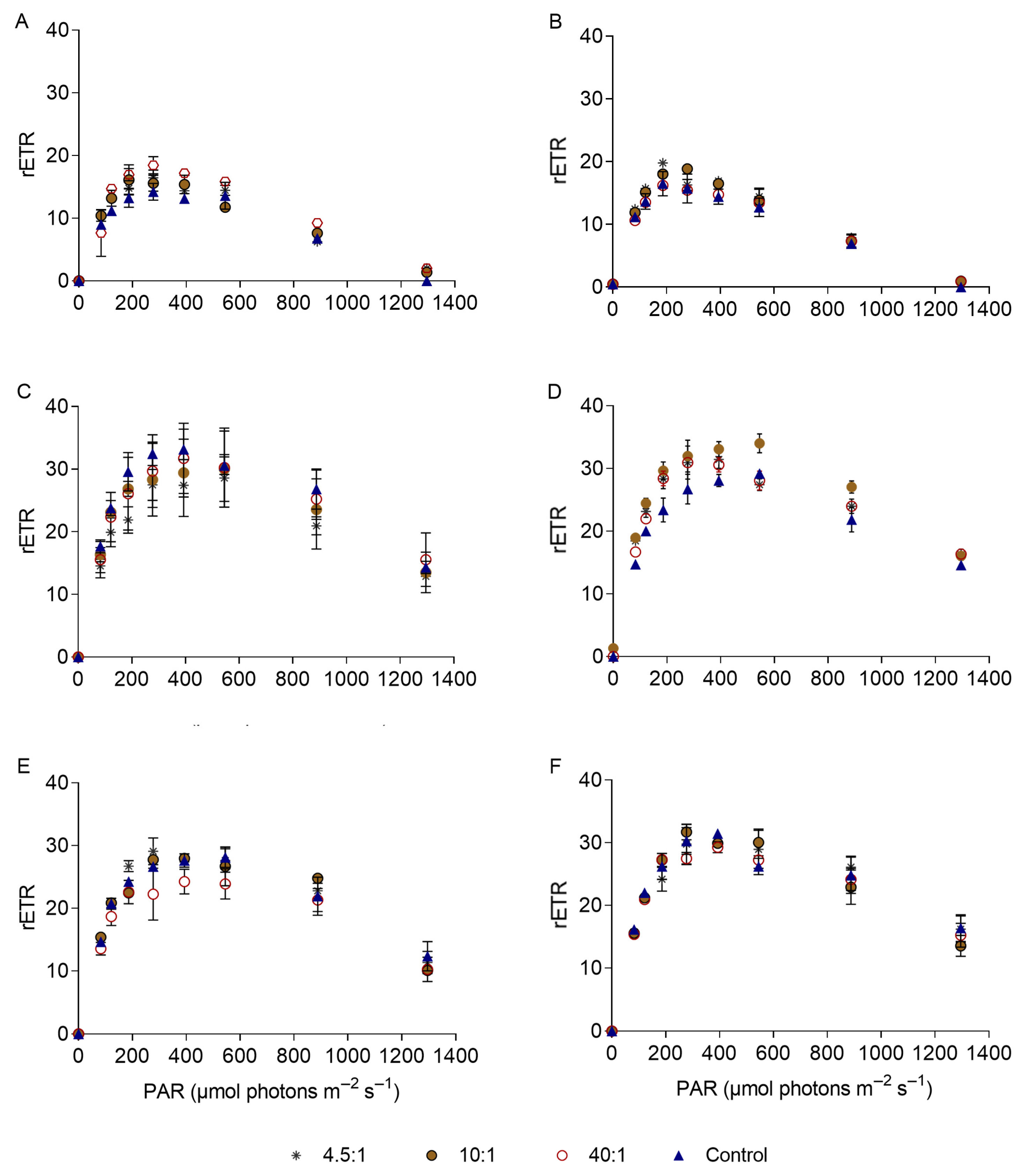
After 24 h of incubation of the three species, the samples were subjected to an actinic light of 480 µmol photons m−2 s−1, and saturation pulses were applied to obtain the maximum fluorescence values in the light (Fm). The samples were then acclimated in the dark for 10 min and exposed to a saturation light to estimate fluorescence (Fm) and the maximum quantum yield of the conversion of photosynthetic energy to PSII (Fv/Fm) was calculated. After 10 min of acclimatization in the dark, fast light curves (RLCs) were performed, with irradiance ranging from 0 to 1295 (0, 83, 122, 186, 277, 393, 545, 888, 1295) µmol photons m−2 s−1, the data being expressed in relative electron transport rate (rETR) by irradiance [31].
The effective quantum yield (YII) and the effective quantum yield of regulated (YNO) and unregulated energy dissipation (YNPQ) were calculated from the parameters F′, Fm, and Fm′ using the equations obtained from Schreiber et al. [32] and from the expressions of Kramer et al. [33] according to simplifications proposed by Klughammer and Scheriber [34]. Additionally, to optimize comparisons regarding treatments, Y (II), Y (NPQ) and Y (NO) were expressed as to their defined integrals

2.5. Statistical Analysis

All data were tested for Gaussian distribution and homogeneity of variances (Cochran’s test) before performing the analysis of variance (ANOVA). The two-way ANOVA analysis was performed to verify the influence of the factors: time of exudate exposure and nutritional variations in which the R. raciborskii LP2 strain was grown. When significant differences were verified, considering 5% of significance, Tukey’s HSD post hoc test was used. The software used was Statistica 6.0 (StatSoft).

3. Results

The effect of exudate from R. raciborskii cultures was evaluated using the relative electron transport rate (rETR), the effective quantum yield (YII) and the quantum yield of regulated and unregulated energy dissipation, Y (NO) and Y (NPQ) and their area calculated using defined integrals.

3.1. Relative Electron Transport Rate (rETR)

The rETR curves exhibited highly similar response patterns among the three tested species and across the different N:P ratios (Figure 1). In all treatments, rETR increased with irradiance and reached comparable maximum values, indicating similar photosynthetic performance under the evaluated conditions. After 24 h of exposure to the exudates, a slight decrease in rETR was observed in some treatments. However, this reduction was subtle and did not result in statistically significant differences between the control and the exudate treatments derived from the different nutrient regimes. These results suggest that, within the experimental period, exposure to R. raciborskii exudates did not markedly affect the photosynthetic electron transport capacity of the target species.

3.2. Quantum Yield (Y)

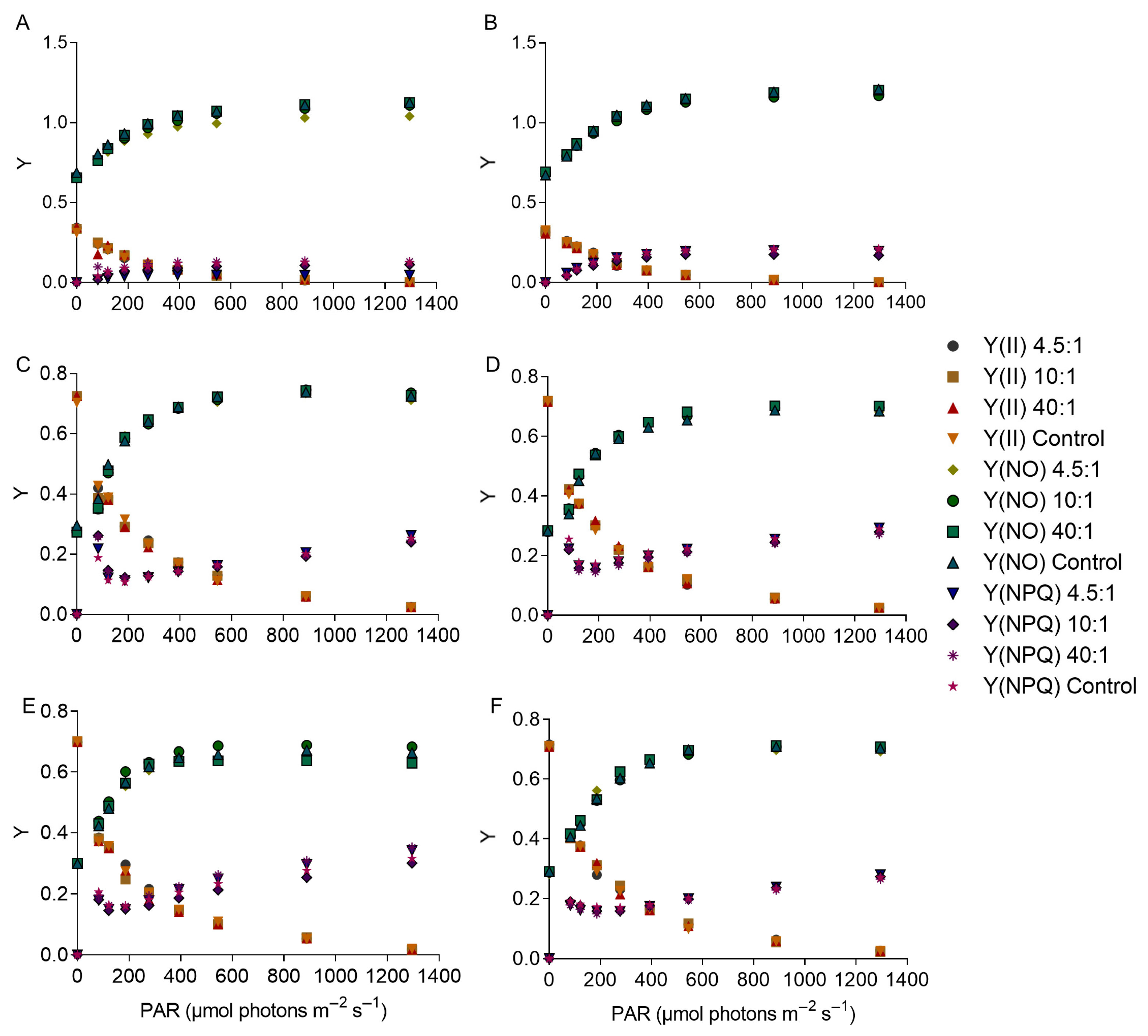
Overall, increasing photosynthetically active radiation (PAR) resulted in a pronounced initial decrease in the effective quantum yield of PSII (Y(II)) in all tested species, followed by a more gradual decline at higher irradiance levels (Figure 2). This response pattern was consistently maintained after 24 h of exposure, indicating similar photosynthetic adjustment dynamics among treatments. In contrast to Y(II), the non-regulated energy dissipation parameter (Y(NO)) exhibited a rapid initial increase with increasing PAR, followed by stabilization at higher light intensities. This pattern suggests a progressive limitation in photochemical energy utilization under elevated irradiance conditions, which remained stable over the experimental period.
Distinct response patterns were observed for the regulated non-photochemical quenching parameter (Y(NPQ)) among the tested taxa. Limnothrix sp. (Figure 2A,B) displayed a slightly different profile compared to the other species, characterized by a marked initial increase, followed by a minor decrease at the initial exposure time and a subsequent increase after 24 h. This behavior indicates a dynamic regulation of photoprotective mechanisms in response to both irradiance and exudate exposure. In contrast, Chlorella sp. (Figure 2C,D) and R. subcapitata (Figure 2E,F) exhibited similar Y(NPQ) patterns, with an initial decrease followed by a slight increase at higher PAR levels. These comparable responses suggest analogous photoprotective adjustment strategies in these chlorophytes under the tested conditions.

3.3. Quantum Yield Area

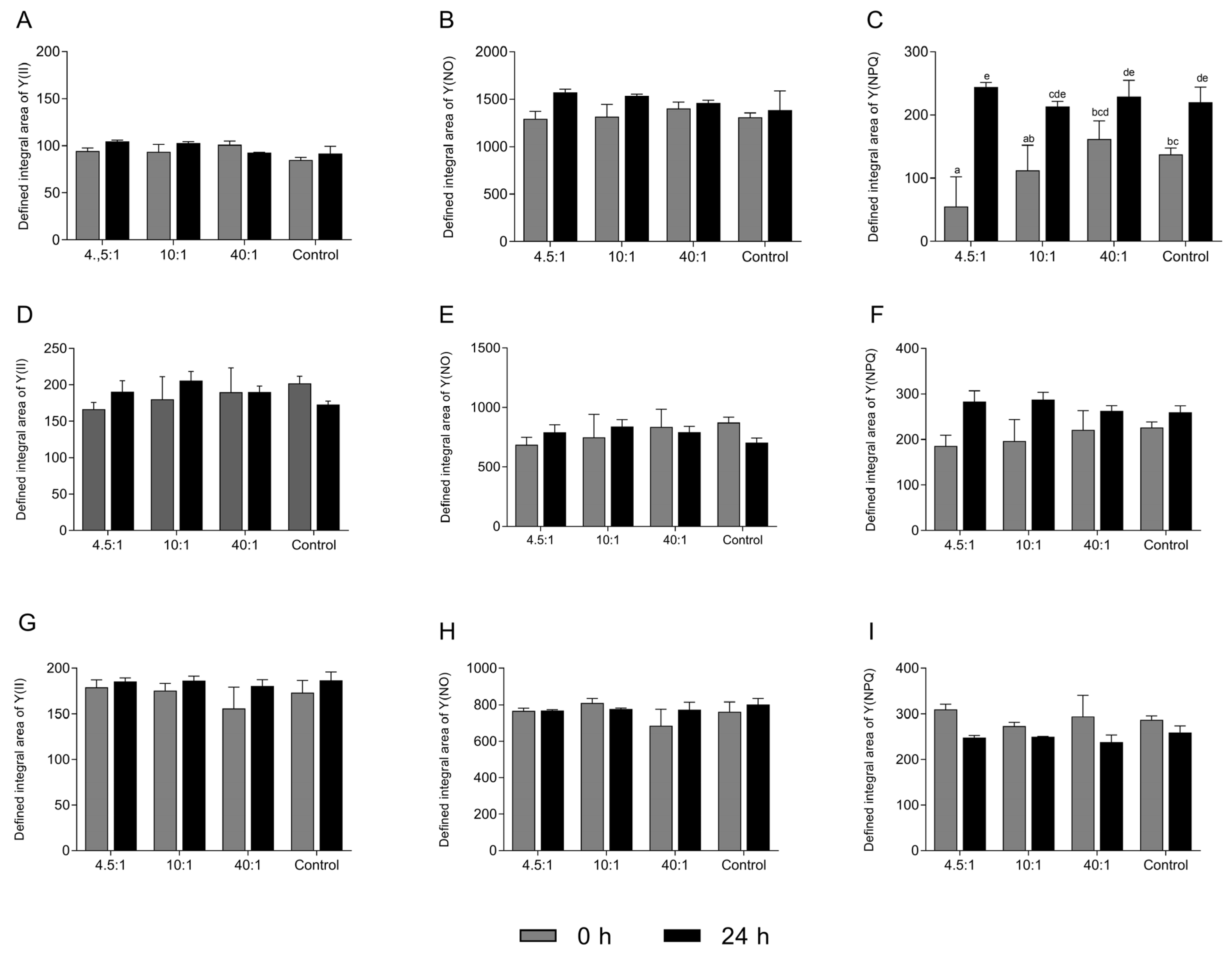
The defined integrals of Y(II), Y(NO) and Y(NPQ) for the three species are shown in Figure 3. A significant effect of time was detected for the defined integrals of Y(II) (two-way ANOVA, p = 0.008), whereas no significant effect of the N:P ratios (p = 0.168) or the interaction between time and N:P ratio (p = 0.554) was observed. While Y(II) corresponds to the fraction of energy used in photochemistry in PSII, the remaining fraction represents the total quantum yield of energy dissipation processes, which are partitioned into Y(NO) and Y(NPQ). For Y(NO), no significant effects were observed for time (p = 0.182), N:P ratio (p = 0.086) or the interaction between these factors (p = 0.120). For Limnothrix sp., some differences were observed in the defined integrals of Y(NPQ) at N:P ratios of 4.5:1 and 10:1. However, as similar differences were also detected in the control treatment, these variations are unlikely to be associated with the presence of exudates from R. raciborskii.
Although significant differences have been observed in the defined integrals of Y (II), Y (NO) and Y (NPQ) for Chlorella sp. (Figure 3C,D) and R. subcapitata (Figure 3E,F), these differences were only in relation to time (0 and 24 h of exposure), independently, without interaction with the N:P ratios. The defined integrals showed significant differences that were barely perceptible by the curves, allowing them to be accurately identified. For the three species analyzed, a similar proportion of available energy was lost as internal heat, since high values of Y (NO) in relation to Y (II) and Y (NPQ) were reported. After 24 h, similar responses were also observed for the cultivated species in medium without exudates.

4. Discussion

Several studies have reported that allelochemicals produced by phytoplankton can affect other organisms through chemical interactions, often targeting the photosynthetic apparatus [35,36,37,38,39,40,41]. Cyanobacteria, for example, may produce compounds capable of interfering with photosystem II (PSII), potentially reducing primary production and growth in competing organisms [15]. Environmental conditions and the physiological state of phytoplankton can influence the production and release of these compounds [17], and nutrient limitation has often been suggested as a factor capable of increasing the production of secondary metabolites such as toxins and allelochemicals [42,43,44]. However, evidence for this relationship remains inconsistent across species, strains, and experimental conditions. In some cases, for instance, phosphorus limitation has been shown to regulate the extracellular release of allelopathic compounds in cyanobacteria such as Trichormus doliolum [45].
In the present study, exposure to exudates produced by Raphidiopsis raciborskii under different N:P ratios did not result in significant changes in the PSII fluorescence parameters of Limnothrix sp., Chlorella sp., or Raphidocelis subcapitata under the experimental conditions evaluated. This outcome suggests that, within the temporal scale and environmental conditions tested, the exudates generated under nutrient-imbalanced conditions were not sufficient to induce detectable alterations in the photosynthetic performance of the target species. Several factors may contribute to this pattern, including the possibility that allelochemicals were produced at concentrations below physiological thresholds, that the compounds present do not directly target the photosynthetic apparatus, or that the short exposure period limited the manifestation of measurable physiological responses. Additionally, it is important to recognize that the experimental design focused specifically on PSII fluorescence parameters as indicators of photosynthetic performance. Therefore, potential allelopathic interactions affecting other physiological or metabolic processes cannot be excluded and would require complementary approaches for detection.
According to Legrand et al. [17], studies suggest that both the environmental history and the physiological state of the phytoplankton organisms can affect the production of allelochemicals, but few studies have examined environmental factors (e.g., light, pH and nutrient limitation) in the production of these compounds and in the allelopathic activity against phytoplankton species. Johansson and Graneli [42] cite that the limitation in nutrients can increase the content of toxins in some marine groups such as dinoflagellates and cyanobacteria [43,44]. As toxins are considered secondary metabolites, it can be assumed that the limitation in nutrients will also affect the production of allelochemicals. As an example, it can be mentioned the limitation of P that controls the extracellular release of allelochemicals in the cyanobacterium Trichormus doliolum [45]. Likewise, Fistarol et al. [46] reported that the allelopathic effect of the cell filtrate of the haptophyte Prymnesium parvum on the diatom Thalasiossira weissflogii is intensified when it is grown in a medium with limited nitrogen and phosphorus. However, no effects on PSII-related parameters were detected within the exposure period evaluated in this study. This may indicate that the duration of exposure was not sufficient to produce detectable physiological responses, or that the algal species tested here are less sensitive to potential allelochemicals than diatoms such as T. weissflogii reported in previously.
It has already been shown that R. raciborskii coexists with Microcystis aeruginosa in some aquatic environments, occurring in situations of dominance [47,48] and that the competition between them seems to depend on environmental conditions, including light and availability of P [49]. In a study conducted by Rzymski et al. [50] these two species were grown under the same conditions, without limitations, and they reported that R. raciborskii, by increasing its contribution to the total biovolume, was successfully able to compete with M. aeruginosa. In addition, in another experiment carried out in the same study previously cited, R. raciborskii had an allelopathic effect on the other species, which corroborates with the study carried out by Mello et al. [51] in which R. raciborskii, in addition to inhibiting the growth of M. aeruginosa, also delayed the formation of its colonies during 192 h of incubation. Therefore, the 24 h of incubation used in the present study may have been insufficient to determine allelopathic effects of R. raciborskii.
Antunes et al. [52] demonstrated broad allelopathic activity during the first growth phases of R. raciborskii and point out that the beginning of the exponential growth phase seems to be related to an increase in the production of allelopathic compounds. These same authors also observed that the allelopathic activity of the filtrates of this isolate of R. raciborskii, under a temperature of 30 °C and high irradiance, exhibited the highest inhibitory activity in relation to the microalga Ankistrodesmus falcatus. In addition, Figueredo et al. [14] showed that not all species are susceptible to the exudate effect, and that not all strains of R. raciboskii have the same effect, which may also justify the results found in this study.
Photosystem II is considered one of the most sensitive components of the photosynthetic apparatus to environmental stress [53,54,55], and PAM fluorometry has been widely used to detect physiological changes associated with such stress. Parameters such as the effective quantum yield of PSII provide useful indicators of alterations in photosynthetic performance in phytoplankton exposed to different environmental conditions or chemical compounds [31,56]. In this context, the lack of significant changes detected in the PSII fluorescence parameters measured in this study indicates that, under the experimental conditions evaluated, exudates produced by R. raciborskii under the tested nutrient conditions did not cause measurable alterations in the photosynthetic performance of the evaluated species.
Previous works have shown that PAM fluorimetry can be an adequate methodology for studying allelopathic interactions between R. raciborskii and other species. Juneau et al. [56], for example, consider the effective quantum yield of PSII, one of the parameters used in this study, as a useful parameter for tests with plants and phytoplankton, which highlights the importance of choosing the best parameter to describe the response of the phytoplankton to experimental conditions. Based on this information, it is suggested to carry out other trials in which the exudates are obtained in different growth stages of R. raciborskii, changing the time of exposure of the species, as well as testing other stress factors, such as different irradiances and temperatures, even associated.
Considering the complexity of allelopathic interactions in aquatic ecosystems, further studies may help to better understand the conditions under which such effects occur. Future experiments could evaluate exudates obtained at different growth phases of R. raciborskii, as well as test different exposure times and environmental stressors, such as variations in irradiance and temperature.

5. Conclusions

In conclusion, exudates from the R. raciborskii LP2 strain obtained from culturing cells in three N:P ratios (4.5:1, 10:1 and 40:1) did not produce detectable changes in the PSII fluorescence parameters Limnothrix sp., Chlorella sp. and R. subcaitata under the experimental conditions evaluated. Relative electron transport rate (rETR), as well as quantum yield (Y (II), Y (NO) and Y (NPQ)), obtained from chlorophyll fluorescence analyses, showed no significant differences when compared with the same strains growing in medium without exudates. These results indicate that, within the 24 h exposure period and based on the fluorescence parameters measured, exudates produced by R. raciborskii under the tested nutrient conditions did not cause measurable alterations in the photosynthetic performance of the evaluated species.

Author Contributions

C.N.: conceptualization, data curation, formal analysis and writing—original draft. M.C.M.: conceptualization, formal analysis, and writing—review and editing. C.Y.B.O.: writing—review and editing. L.R.R.: supervision, resources, and writing—review and editing. All authors have read and agreed to the published version of the manuscript.

Funding

This work was partially supported by the Conselho Nacional de Desenvolvimento Científico e Tecnológico (CNPq/Brazil) (409352/2023–3) and the Coordenação de Aperfeiçoamento de Formação de Pessoal (CAPES/Brazil) (Finance code—001). L.R.R. thanks to CNPq for the productivity scholarship (310430/2023-2).

Data Availability Statement

The data are available upon request from the corresponding author of this article.

Acknowledgments

This study was made possible in part thanks to the support of the Biotech Network—UFSC. Readers interested in learning more about this initiative are invited to consult Oliveira et al. [57].

Conflicts of Interest

The authors declare no conflicts of interest.

References

  1. Richmond, A.; Hu, Q. Handbook of Microalgal Culture: Applied Phycology and Biotechnology; John Wiley & Sons: Hoboken, NJ, USA, 2013. [Google Scholar]
  2. He, Y.; Chen, Y.; Tao, H.; Zhou, X.; Liu, J.; Liu, Y.; Yang, B. Secondary metabolites from cyanobacteria: Source, chemistry, bioactivities, biosynthesis and total synthesis. Phytochem. Rev. 2025, 24, 483–525. [Google Scholar] [CrossRef]
  3. Reynolds, C.S. Ecology of Phytoplankton: Ecology, Biodiversity and Conservation; Cambridge University Press: Cambridge, UK, 2006. [Google Scholar]
  4. Oliveira, C.Y.; Oliveira, C.D.; Almeida, A.J.; Gálvez, A.O.; Dantas, D.M. Phytoplankton responses to an extreme drought season: A case study at two reservoirs from a semiarid region, Northeastern Brazil. J. Limnol. 2019, 78, 176–184. [Google Scholar] [CrossRef]
  5. Amorim, C.A.; Nascimento Moura, A. Ecological impacts of freshwater algal blooms on water quality, plankton biodiversity, structure, and ecosystem functioning. Sci. Total Environ. 2021, 758, 143605. [Google Scholar]
  6. Padisák, J. Cylindrospermopsis raciborskii (Woloszynska) Seenaya and Subba Raju, an expanding, highly adaptive cyanobacterium: Worldwide distribution and review of ecology. Arch. Hydrobiol. 1997, 107, 563–593. [Google Scholar]
  7. dos Santos-Silva, R.D.; dos Santos Severiano, J.; Chia, M.A.; Queiroz, T.M.; Cordeiro-Araújo, M.K.; de Lucena Barbosa, J.E. Unveiling the link between Raphidiopsis raciborskii blooms and saxitoxin levels: Evaluating water quality in tropical reservoirs, Brazil. Environ. Pollut. 2024, 344, 123401. [Google Scholar] [CrossRef] [PubMed]
  8. Burford, M.A.; Beardall, J.; Willis, A.; Orr, P.T.; Magalhães, V.F.; Rangel, L.M.; Neilan, B.A. Understanding the winning strategies used by the bloom-forming cyanobacterium Cylindrospermopsis raciborskii. Harmful Algae 2016, 54, 44–53. [Google Scholar] [CrossRef]
  9. Ballot, A.; Swe, T.; Mjelde, M.; Cerasino, L.; Hostyeva, V.; Miles, C.O. Cylindrospermopsin- and deoxycylindrospermopsin-producing Raphidiopsis raciborskii and microcystin-producing Microcystis spp. in Meiktila Lake, Myanmar. Toxins 2020, 12, 232. [Google Scholar] [CrossRef]
  10. McGregor, G.B.; Fabbro, L.D. Dominance of Cylindrospermopsis raciborskii in Queensland tropical and subtropical reservoirs: Implications for monitoring and management. Lakes Reserv. Res. Manag. 2000, 5, 195–205. [Google Scholar]
  11. Reigosa, M.J.; Sánchez-Moreiras, A.; González, L. Ecophysiological approach in allelopathy. Crit. Rev. Plant Sci. 1999, 18, 577–608. [Google Scholar] [CrossRef]
  12. Rice, E.R. Allelopathy; Academic Press: New York, NY, USA, 1984. [Google Scholar]
  13. Lampert, W.; Sommer, U. Limnoecology: The Ecology of Lakes and Streams; Oxford University Press: Oxford, UK, 1997. [Google Scholar]
  14. Figueredo, C.C.; Giani, A.; Bird, D.F. Does allelopathy contribute to Cylindrospermopsis raciborskii bloom occurrence and geographic expansion? J. Phycol. 2007, 43, 256–265. [Google Scholar] [CrossRef]
  15. Polyak, Y.M.; Sukharevich, V.I. Allelopathic properties of cyanobacteria. Inland Water Biol. 2025, 18, 565–574. [Google Scholar] [CrossRef]
  16. Tan, K.; Huang, Z.; Ji, R.; Qiu, Y.; Wang, Z.; Liu, J. A review of allelopathy on microalgae. Microbiology 2019, 165, 587–592. [Google Scholar] [CrossRef] [PubMed]
  17. Legrand, C.; Rengefors, K.; Fistarol, G.O.; Granéli, E. Allelopathy in phytoplankton: Biochemical, ecological and evolutionary aspects. Phycologia 2003, 42, 406–419. [Google Scholar] [CrossRef]
  18. Mulderij, G.; Mooij, W.M.; Smolders, A.J.P.; van Donk, E. Allelopathic inhibition of phytoplankton by exudates from Stratiotes aloides. Aquat. Bot. 2005, 82, 284–296. [Google Scholar] [CrossRef]
  19. Leflaive, J.; Danger, M.; Lacroix, G.; Lyautey, E.; Oumarou, C.; Ten-Hage, L. Nutrient effects on genetic and functional diversity of bacterial communities. FEMS Microbiol. Ecol. 2008, 66, 379–390. [Google Scholar] [CrossRef]
  20. Oliveira, C.Y.B.; Jacob, A.; Nader, C.; Oliveira, C.D.L.; Matos, Â.P.; Araújo, E.S.; Gálvez, A.O. An overview on microalgae as renewable resources for meeting sustainable development goals. J. Environ. Manag. 2022, 320, 115897. [Google Scholar] [CrossRef]
  21. Oliveira, C.Y.B.; Brandão, B.C.S.; Jannuzzi, L.G.S.; Oliveira, D.W.S.; Yogui, G.T.; Müller, M.N.; Gálvez, A.O. New insights on the role of nitrogen in the resistance to environmental stress in an endosymbiotic dinoflagellate. Environ. Sci. Pollut. Res. 2023, 30, 82142–82151. [Google Scholar] [CrossRef]
  22. Zhila, N.O.; Kiselev, E.G.; Shishatskaya, E.I.; Ghorabe, F.D.; Kazachenko, A.S.; Volova, T.G. Comparative study of the synthesis of polyhydroxyalkanoates by cyanobacteria Spirulina platensis and green microalga Chlorella vulgaris. Algal Res. 2025, 85, 103826. [Google Scholar] [CrossRef]
  23. Markou, G.; Nerantzis, E. Microalgae for high-value compounds and biofuels production: A review with focus on cultivation under stress conditions. Biotechnol. Adv. 2013, 31, 1532–1542. [Google Scholar] [CrossRef]
  24. Falkowski, P.; Wyman, K.; Ley, A.; Mauzerall, D. Relationship of steady-state photosynthesis to fluorescence in eukaryotic algae. Biochim. Biophys. Acta 1986, 849, 183–192. [Google Scholar] [CrossRef]
  25. Hill, R.; Ralph, P.J. Diel and seasonal changes in fluorescence rise kinetics of three scleractinian corals. Funct. Plant Biol. 2005, 32, 549–559. [Google Scholar] [CrossRef] [PubMed]
  26. Solovchenko, A.; Lukyanov, A.; Vasilieva, S.; Lobakova, E. Chlorophyll fluorescence as a valuable multitool for microalgal biotechnology. Biophys. Rev. 2022, 14, 973–983. [Google Scholar] [CrossRef] [PubMed]
  27. Beardall, J.; Young, E.B.; Roberts, S. Approaches for determining phytoplankton nutrient limitation. Aquat. Sci. 2001, 63, 44–69. [Google Scholar] [CrossRef]
  28. Baker, N.R.; Rosenqvist, E. Applications of chlorophyll fluorescence can improve crop production strategies: An examination of future possibilities. J. Exp. Bot. 2004, 55, 1607–1621. [Google Scholar] [CrossRef] [PubMed]
  29. Gorham, P.; McLachlan, J.; Hammer, U.T.; Kim, W.K. Isolation and culture of toxic strains of Anabaena flos-aquae (Lyngb.) de Bréb: With Plate 7, 1 figure and 3 tables in the text. Verh. Int. Ver. Theor. Angew. Limnol. 1964, 15, 796–804. [Google Scholar] [CrossRef]
  30. Silva Oliveira, D.W.; Oliveira, C.Y.B.; Brandão, B.C.S.; Campos, C.V.F.S.; Moraes, L.B.S.; Abreu, J.L.; Gálvez, A.O. Nitrogen concentration influences growth performance and biochemical composition of the endosymbiotic dinoflagellate Durusdinium glynnii. Arch. Microbiol. 2025, 207, 210. [Google Scholar] [CrossRef]
  31. Cella, H.; Nader, C.; Bastolla, C.L.V.; Bonomi-Barufi, J.; Oliveira, C.Y.B.; Lopes, R.G.; Derner, R.B. PAR regulation of photoprotection in Phaeodactylum tricornutum (Bacillariophyceae): Roles of doses and irradiances. J. Appl. Phycol. 2023, 35, 2177–2191. [Google Scholar] [CrossRef]
  32. Schreiber, U.; Hormann, H.; Neubauer, C.; Klughammer, C. Assessment of photosystem II photochemical quantum yield by chlorophyll fluorescence quenching analysis. Aust. J. Plant Physiol. 1995, 22, 209–220. [Google Scholar] [CrossRef]
  33. Kramer, D.M.; Johnson, G.; Kiirats, O.; Edwards, G.E. New fluorescence parameters for the determination of QA redox state and excitation energy fluxes. Photosynth. Res. 2004, 79, 209–218. [Google Scholar] [CrossRef]
  34. Klughammer, C.; Schreiber, U. Complementary PS II quantum yields calculated from simple fluorescence parameters measured by PAM fluorometry and the saturation pulse method. PAM Appl. Notes 2008, 1, 27–35. [Google Scholar]
  35. Abdo, H.; Tan, L.; Wang, S.; Xu, H.; Wang, B.; Wang, J. Characterization of allelochemicals from Nitzschia closterium and their allelopathic effects on Prorocentrum donghaiense. Algal Res. 2025, 89, 104085. [Google Scholar] [CrossRef]
  36. Pratt, R.; Daniels, T.C.; Eiler, J.J.; Gunnison, J.B.; Kumler, W.D.; Oneto, J.F.; Spoehr, H.A.; Hardin, G.J.; Milner, H.W.; Smith, J.H.C.; et al. Chlorellin, an antibacterial substance from Chlorella. Science 1944, 99, 351–352. [Google Scholar] [CrossRef] [PubMed]
  37. Lefevre, M.; Nisbet, M.; Jakob, H. Action des substances excrétées en culture, par certaines espèces d’algues, sur le métabolisme d’autres espèces d’algues. Proc. Int. Assoc. Limnol. 1948, 10, 259–264. [Google Scholar]
  38. Sieburth, J.M. Acrylic acid, an “antibiotic” principle in Phaeocystis blooms in Antarctic waters. Science 1960, 132, 676–677. [Google Scholar] [CrossRef]
  39. Körner, S.; Nicklisch, A. Allelopathic growth inhibition of selected phytoplankton species by submerged macrophytes. J. Phycol. 2002, 38, 862–877. [Google Scholar] [CrossRef]
  40. Leu, E.; Krieger-Liszkay, A.; Goussias, C.; Gross, E.M. Polyphenolic allelochemicals from the aquatic angiosperm Myriophyllum spicatum inhibit photosystem II. Plant Physiol. 2002, 130, 2011–2018. [Google Scholar] [CrossRef]
  41. Sukenik, A.; Eshkol, R.; Livne, A.; Hadas, O.; Rom, M.; Tchernov, D.; Vardi, A.; Kaplan, A. Inhibition of growth and photosynthesis of the dinoflagellate Peridinium gatunense by Microcystis sp. (cyanobacteria): A novel allelopathic mechanism. Limnol. Oceanogr. 2002, 47, 1656–1663. [Google Scholar] [CrossRef]
  42. Johansson, N.; Granéli, E. Cell density, chemical composition and toxicity of Chrysochromulina polylepis (Haptophyta) in relation to different N:P supply ratios. Mar. Biol. 1999, 134, 209–217. [Google Scholar] [CrossRef]
  43. Orr, P.T.; Jones, G.J. Relationship between microcystin production and cell division rates in nitrogen-limited Microcystis aeruginosa cultures. Limnol. Oceanogr. 1998, 43, 1604–1614. [Google Scholar]
  44. Song, S.; Li, J.; Lin, Z. Structure of holo-glyceraldehyde-3-phosphate dehydrogenase from Palinurus versicolor refined at 2 Å resolution. Acta Crystallogr. D Biol. Crystallogr. 1998, 54, 558–569. [Google Scholar] [CrossRef]
  45. von Elert, E.; Jüttner, F. Phosphorus limitation and not light controls the extracellular release of allelopathic compounds by Trichormus doliolum (Cyanobacteria). Limnol. Oceanogr. 1997, 42, 1796–1802. [Google Scholar] [CrossRef]
  46. Fistarol, G.O.; Legrand, C.; Granéli, E. Allelopathic effect of Prymnesium parvum on a natural plankton community. Mar. Ecol. Prog. Ser. 2003, 255, 115–125. [Google Scholar] [CrossRef]
  47. Soares, M.C.S.; Rocha, M.I.A.; Marinho, M.M.; Azevedo, S.M.F.O.; Branco, C.W.C.; Huszar, V.L.M. Changes in species composition during annual cyanobacterial dominance in a tropical reservoir: Physical factors, nutrients and grazing effects. Aquat. Microb. Ecol. 2009, 57, 137–144. [Google Scholar] [CrossRef]
  48. Karadzic, V.; Simic, G.S.; Natic, D.; Rzanicanin, A.; Ciric, M.; Gacic, Z. Changes in the phytoplankton community and dominance of Cylindrospermopsis raciborskii (Wolosz.) Subba Raju in a temperate lowland river (Ponjavica, Serbia). Hydrobiologia 2013, 771, 43–60. [Google Scholar] [CrossRef]
  49. Marinho, M.M.; Souza, M.B.G.; Lürling, M. Light and phosphate competition between Cylindrospermopsis raciborskii and Microcystis aeruginosa is strain dependent. Microb. Ecol. 2013, 66, 479–488. [Google Scholar] [CrossRef]
  50. Rzymski, P.; Poniedziałek, B.; Kokocinski, M.; Jurczak, T.; Lipski, D.; Wiktorowicz, K. Interspecific allelopathy in cyanobacteria: Cylindrospermopsin and Cylindrospermopsis raciborskii effect on the growth and metabolism of Microcystis aeruginosa. Harmful Algae 2014, 35, 1–8. [Google Scholar] [CrossRef]
  51. Mello, M.M.E.; Soares, M.C.S.; Roland, F.; Lürling, M. Growth inhibition and colony formation in the cyanobacterium Microcystis aeruginosa induced by the cyanobacterium Cylindrospermopsis raciborskii. J. Plankton Res. 2012, 34, 987–994. [Google Scholar] [CrossRef]
  52. Antunes, J.T.; Leão, P.N.; Vasconcelos, V.M. Influence of biotic and abiotic factors on the allelopathic activity of the cyanobacterium Cylindrospermopsis raciborskii strain LEGE 99043. Microb. Ecol. 2012, 64, 584–592. [Google Scholar] [CrossRef]
  53. Wang, S.; Zhang, D.; Pan, X. Effects of cadmium on the activities of photosystems of Chlorella pyrenoidosa and the protective role of cyclic electron flow. Chemosphere 2013, 93, 230–237. [Google Scholar] [CrossRef]
  54. Liu, J.; Lu, Y.; Hua, W.; Last, R.L. A new light on photosystem II maintenance in oxygenic photosynthesis. Front. Plant Sci. 2019, 10, 975. [Google Scholar] [CrossRef]
  55. Ma, J.; Wang, P.; Wang, X.; Xu, Y.; Paerl, H.W. Cyanobacteria in eutrophic waters benefit from rising atmospheric CO2 concentrations. Sci. Total Environ. 2019, 691, 1144–1154. [Google Scholar] [CrossRef]
  56. Juneau, P.; Le Lay, P.; Böddi, B.; Samson, G.; Popovic, R. Relationship between the structural and functional changes of the photosynthetic apparatus during chloroplast–chromoplast transition in flower bud of Lilium longiflorum. Photochem. Photobiol. 2002, 75, 377–381. [Google Scholar] [CrossRef]
  57. Oliveira, C.Y.B.; Zielinski, A.A.F.; Bainy, A.C.D.; Pinto, A.R.; Fritz, A.R.M.; Boemo, A.P.S.I.; da Cruz, A.C.C.; Michels, C.; Vildoso, C.I.A.; Sayer, C.; et al. UFSC Biotech Network: A transdisciplinary platform for biotechnology innovation in Brazil. Trends Biotechnol. 2025, 43, 1813–1816. [Google Scholar] [CrossRef]
Figure 1. Relative electron transport rate (rETR) of Limnothrix sp. (A,B), Chlorella sp. (C,D) and Raphidocelis subcapitata (E,F) exposed to the different exudates from cultures of Raphidiopsis raciborskii. Right (A,C,E) and left (B,D,F) side refers to time 0 h and 24 h of exposure, respectively, for each species.
Limnolrev 26 00009 g001
Figure 2. Effective quantum yield (YII), effective quantum yield of regulated (YNO) and unregulated energy dissipation (YNPQ) of Limnothrix sp. (A,B), Chlorella sp. (C,D) and Raphidocelis subcapitata (E,F) exposed to the different exudates from cultures of Raphidiopsis raciborskii. Right (A,C,E) and left (B,D,F) side refers to time 0 h and 24 h of exposure, respectively, for each species.
Limnolrev 26 00009 g002
Figure 3. Area of the quantum yields (YII, YNO and YNQP) curves of Limnothrix sp. (AC), Chlorella sp. (DF) and Raphidocelis subcapitata (GI) exposed to the different exudates from cultures of Raphidiopsis raciborskii. Different letters indicate significant differences at a 5% significance level based on one-way ANOVA followed by Tukey’s HSD post hoc test.
Limnolrev 26 00009 g003
Disclaimer/Publisher’s Note: The statements, opinions and data contained in all publications are solely those of the individual author(s) and contributor(s) and not of MDPI and/or the editor(s). MDPI and/or the editor(s) disclaim responsibility for any injury to people or property resulting from any ideas, methods, instructions or products referred to in the content.