
Public Health Risks of Pathogenic Bacteria in Freshwater Bodies: A Review of Quantitative Microbial Risk Assessment Approaches and Applications



Abstract
1. Introduction
Methodology
2. Pathogenic Bacteria in Freshwater Bodies
2.1. Major Bacterial Pathogens in Freshwater
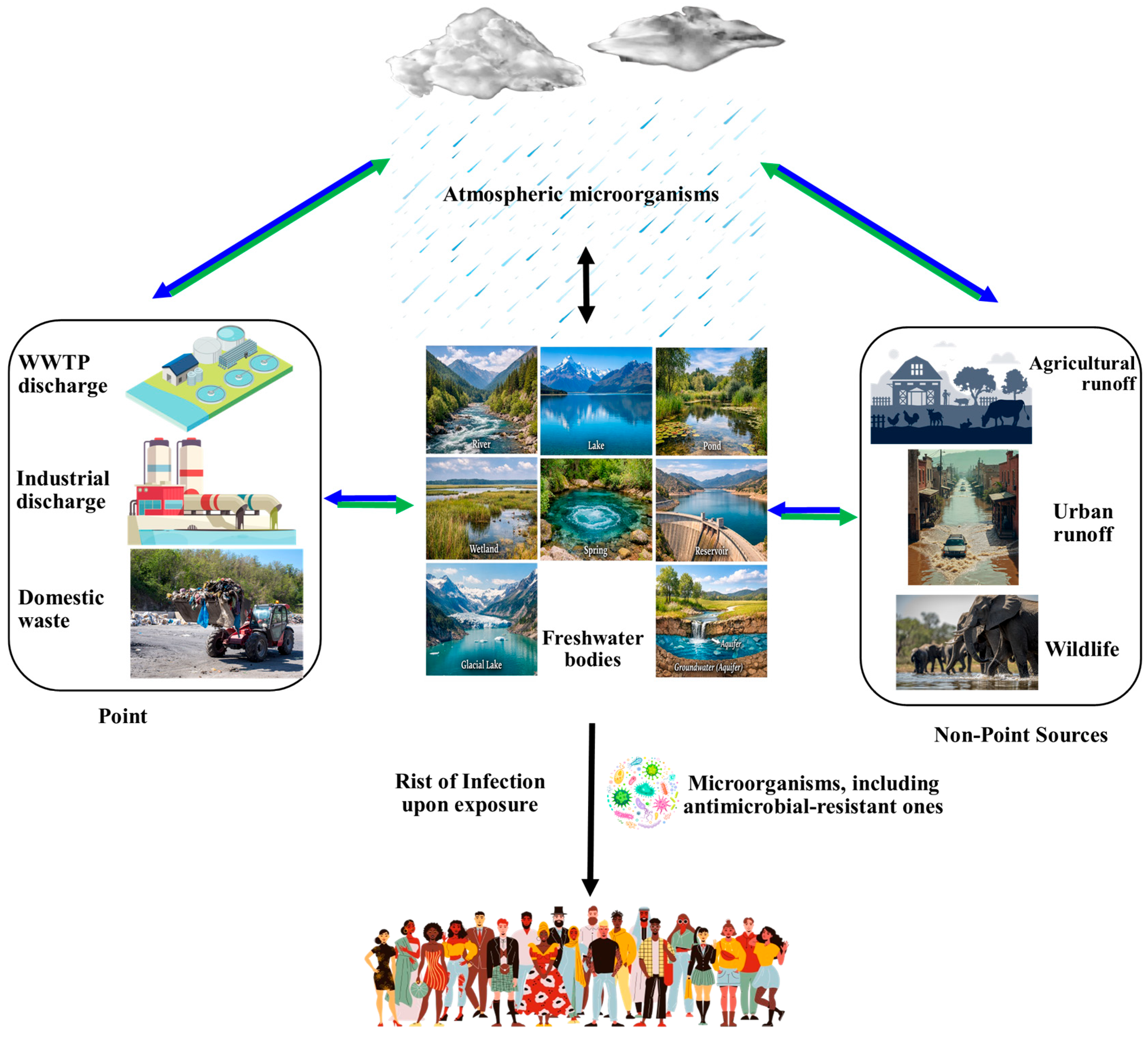
2.2. Sources and Transmission Routes
2.2.1. Point Sources
Wastewater Treatment Plants (Sewage Effluents)
Industrial and Domestic Discharge
2.2.2. Non-Point Sources
Agricultural Runoff
Stormwater and Overland Flow
Wildlife and Birds
Urban Runoff and Mixed Watersheds
3. Epidemiological Approaches Versus QMRA
4. Methodological Approaches in QMRA
4.1. Hazard Identification
4.2. Exposure Assessment
4.3. Dose–Response
4.3.1. Exponential Model
4.3.2. Beta-Poisson Dose Response Model
4.4. Risk Characterisation
5. Public Health Benefits of Using QMRA for Freshwater Ecosystems
5.1. Translating Environmental Contamination into Quantitative Health Risk
5.2. Supporting Preventive and Risk-Based Water Safety Management
5.3. Informing Standards and Regulatory Targets
5.4. Prioritising Public Health Interventions
5.5. Enabling Resource-Efficient Decision Making
5.6. Enhancing Public Health Communication
6. Conclusions and Future Directions
Author Contributions
Funding
Data Availability Statement
Conflicts of Interest
References
- Birnie-Gauvin, K.; Lynch, A.J.; Franklin, P.A.; Reid, A.J.; Landsman, S.J.; Tickner, D.; Dalton, J.; Aarestrup, K.; Cooke, S.J. The RACE for Freshwater Biodiversity: Essential Actions to Create the Social Context for Meaningful Conservation. Conserv. Sci. Pract. 2023, 5, e12911. [Google Scholar] [CrossRef]
- Ozochi, C.A.; Okonkwo, C.C.; Adukwu, E.C.; Ujor, V.C.; Enebe, M.C.; Chigor, V.N. Detection and Quantitative Microbial Risk Assessment of Pathogenic Vibrio cholerae in a River Used for Drinking, Domestic, Fresh Produce Irrigation and Recreational Purposes. Discov. Water 2024, 4, 7. [Google Scholar] [CrossRef]
- Mushtaq, N.; Singh, D.V.; Bhat, R.A.; Dervash, M.A.; Hameed, O. Freshwater Contamination: Sources and Hazards to Aquatic Biota. In Fresh Water Pollution Dynamics and Remediation; Springer Singapore: Singapore, 2020; pp. 27–50. [Google Scholar]
- WWAP (United Nations World Water Assessment Programme). Wastewater: The Untapped Resource: The United Nations World Water Development Report 2017; United Nations Educational, Scientific and Cultural Organization: Paris, France, 2017; ISBN 9789231002014. [Google Scholar]
- Babuji, P.; Thirumalaisamy, S.; Duraisamy, K.; Periyasamy, G. Human Health Risks Due to Exposure to Water Pollution: A Review. Water 2023, 15, 2532. [Google Scholar] [CrossRef]
- Krishan, A.; Yadav, S.; Srivastava, A. Water Pollution’s Global Threat to Public Health: A Mini-Review. Int. J. Sci. Res. Sci. Eng. Technol. 2023, 10, 321–334. [Google Scholar] [CrossRef]
- Lin, L.; Yang, H.; Xu, X. Effects of Water Pollution on Human Health and Disease Heterogeneity: A Review. Front. Environ. Sci. 2022, 10, 880246. [Google Scholar] [CrossRef]
- UN-Water. Summary Progress Update 2021—SDG 6—Water and Sanitation for All; UN-Water: Geneva, Switzerland, 2021. [Google Scholar]
- Katukiza, A.Y.; Ronteltap, M.; van der Steen, P.; Foppen, J.W.A.; Lens, P.N.L. Quantification of Microbial Risks to Human Health Caused by Waterborne Viruses and Bacteria in an Urban Slum. J. Appl. Microbiol. 2013, 116, 447–463. [Google Scholar] [CrossRef]
- Petterson, S.R.; Ashbolt, N.J. QMRA and Water Safety Management: Review of Application in Drinking Water Systems. J. Water Health 2016, 14, 571–589. [Google Scholar] [CrossRef]
- United Nations. United Nations Sustainable Development Goal 6 Synthesis Report 2018 on Water and Sanitation; United Nations: New York, NY, USA, 2018. [Google Scholar]
- Mraz, A.L.; Tumwebaze, I.K.; McLoughlin, S.R.; McCarthy, M.E.; Verbyla, M.E.; Hofstra, N.; Rose, J.B.; Murphy, H.M. Why Pathogens Matter for Meeting the United Nations’ Sustainable Development Goal 6 on Safely Managed Water and Sanitation. Water Res. 2021, 189, 116591. [Google Scholar] [CrossRef]
- Cabral, J.P.S.J. Water Microbiology. Bacterial Pathogens and Water. Int. J. Environ. Res. Public Health 2010, 7, 3657–3703. [Google Scholar] [CrossRef]
- Alfred, P.N.; Mbachu, I.A.C.; Uba, B.O.; Iweriolor, S.N.; Okemadu, O.C. Bacterial Pathogen Community Profiling of Three Freshwater Bodies in Akwa North and South Local Government Areas, Anambra State, Nigeria. IPS J. Public Health 2025, 5, 302–309. [Google Scholar] [CrossRef]
- Urban, L.; Holzer, A.; Baronas, J.J.; Hall, M.; Braeuninger-Weimer, P.; Scherm, M.J.; Kunz, D.J.; Perera, S.N.; Martin-Herranz, D.E.; Tipper, E.T.; et al. Freshwater Monitoring by Nanopore Sequencing. eLife 2020, 10, e61504. [Google Scholar] [CrossRef] [PubMed]
- Yang, J.; Bhassu, S.; Ali, G.; Govindasamy, T.; Aziz, M.A.; Rajamanikam, A. Ecological Health and Freshwater Pathogen Using EDNA Metabarcoding: A Preliminary Assessment for Environmental Surveillance Development in Malaysia. Microorganisms 2025, 13, 2055. [Google Scholar] [CrossRef] [PubMed]
- Pandey, P.K.; Kass, P.H.; Soupir, M.L.; Biswas, S.; Singh, V.P. Contamination of Water Resources by Pathogenic Bacteria. AMB Express 2014, 4, 51. [Google Scholar] [CrossRef]
- Adhikary, R.K.; Mahfuj, M.S.-E.; Starrs, D.; Croke, B.; Glass, K.; Lal, A. Risk of Human Illness from Recreational Exposure to Microbial Pathogens in Freshwater Bodies: A Systematic Review. Expo. Health 2022, 14, 325–343. [Google Scholar] [CrossRef]
- Blasco, M.D.; Esteve, C.; Alcaide, E. Multiresistant Waterborne Pathogens Isolated from Water Reservoirs and Cooling Systems. J. Appl. Microbiol. 2008, 105, 469–475. [Google Scholar] [CrossRef]
- Ali, S.; Babali; Singh, S.; Singh, R.; Tyagi, M.; Pandey, R.P. Influence of Multidrug Resistance Bacteria in River Ganges in the Stretch of Rishikesh to Haridwar. Environ. Chall. 2021, 3, 100068. [Google Scholar] [CrossRef]
- Caprioli, A.; Scavia, G.; Morabito, S. Public Health Microbiology of Shiga Toxin-Producing Escherichia coli. Microbiol. Spectr. 2014, 2, 245–259. [Google Scholar] [CrossRef] [PubMed]
- Niknejad, H.; Hoseinvandtabar, S.; Panahandeh, M.; Gholami-Borujeni, F.; Janipoor, R.; Sarvestani, R.A.; Saeedi, R.; Arani, M.H.; Abtahi, M.; Rafiee, M. Quantitative Microbial Risk Assessment of Gastrointestinal Illness Due to Recreational Exposure to E. coli and Enterococci on the Southern Coasts of the Caspian Sea. Heliyon 2024, 10, e29974. [Google Scholar] [CrossRef]
- Liu, H.; Whitehouse, C.A.; Li, B. Presence and Persistence of Salmonella in Water: The Impact on Microbial Quality of Water and Food Safety. Front. Public Health 2018, 6, 159. [Google Scholar] [CrossRef]
- Rafique, R.; Rashid, M.; Monira, S.; Rahman, Z.; Mahmud, M.T.; Mustafiz, M.; Saif-Ur-Rahman, K.M.; Johura, F.-T.; Islam, S.; Parvin, T.; et al. Transmission of Infectious Vibrio cholerae through Drinking Water among the Household Contacts of Cholera Patients (CHoBI7 Trial). Front. Microbiol. 2016, 7, 1635. [Google Scholar] [CrossRef]
- Percival, S.L.; Williams, D.W. Shigella. In Microbiology of Waterborne Diseases; Elsevier: Amsterdam, The Netherlands, 2014; pp. 223–236. [Google Scholar]
- Chibwe, M.; Odume, O.N.; Nnadozie, C.F. A Review of Antibiotic Resistance among Campylobacter Species in Human, Animal, and Water Sources in South Africa: A One Health Approach. J. Water Health 2023, 21, 9–26. [Google Scholar] [CrossRef] [PubMed]
- Mena, K.D.; Gerba, C.P. Risk Assessment of Pseudomonas Aeruginosa in Water. Rev. Environ. Contam. Toxicol. 2009, 21, 71–115. [Google Scholar]
- Ullah, A.; Durrani, R.; Ali, G.; Ahmed, S. Prevalence of Antimicrobial Resistant Pseudomonas Aeruginosa in Fresh Water Spring Contaminated with Domestic Sewage. Sci. Int. 2012, 1, 31–35. [Google Scholar]
- Seidel, M.; Jurzik, L.; Brettar, I.; Höfle, M.G.; Griebler, C. Microbial and Viral Pathogens in Freshwater: Current Research Aspects Studied in Germany. Environ. Earth Sci. 2016, 75, 1384. [Google Scholar] [CrossRef]
- Mentula, S.; Miller, T.; Ikonen, J.; Airaksinen, P.; Savonen, E.; Niittynen, M. Detection, Relatedness and Environmental Sources of Emerging Legionella Longbeachae Infections in Finland, 1989–2024. Diagn. Microbiol. Infect. Dis. 2025, 112, 116788. [Google Scholar] [CrossRef]
- Ullah Bhat, S.; Qayoom, U. Implications of Sewage Discharge on Freshwater Ecosystems. In Sewage—Recent Advances, New Perspectives and Applications; IntechOpen: London, UK, 2022. [Google Scholar]
- Xie, Y.; Liu, X.; Wei, H.; Chen, X.; Gong, N.; Ahmad, S.; Lee, T.; Ismail, S.; Ni, S.-Q. Insight into Impact of Sewage Discharge on Microbial Dynamics and Pathogenicity in River Ecosystem. Sci. Rep. 2022, 12, 6894. [Google Scholar] [CrossRef]
- Taylor, N.G.H.; Verner-Jeffreys, D.W.; Baker-Austin, C. Aquatic Systems: Maintaining, Mixing and Mobilising Antimicrobial Resistance? Trends Ecol. Evol. 2011, 26, 278–284. [Google Scholar] [CrossRef]
- Pellegrinetti, T.A.; Cotta, S.R.; Sarmento, H.; Costa, J.S.; Delbaje, E.; Montes, C.R.; Camargo, P.B.; Barbiero, L.; Rezende-Filho, A.T.; Fiore, M.F. Bacterial Communities Along Environmental Gradients in Tropical Soda Lakes. Microb. Ecol. 2023, 85, 892–903. [Google Scholar] [CrossRef]
- Jamieson, R.; Gordon, R.; Joy, D.; Lee, H. Assessing Microbial Pollution of Rural Surface Waters A Review of Current Watershed Scale Modeling Approaches. Agric. Water Manag. 2004, 70, 1–17. [Google Scholar] [CrossRef]
- Burdon, F.J.; Bai, Y.; Reyes, M.; Tamminen, M.; Staudacher, P.; Mangold, S.; Singer, H.; Räsänen, K.; Joss, A.; Tiegs, S.D.; et al. Stream Microbial Communities and Ecosystem Functioning Show Complex Responses to Multiple Stressors in Wastewater. Glob. Chang. Biol. 2020, 26, 6363–6382. [Google Scholar] [CrossRef] [PubMed]
- Czekalski, N.; Gascón Díez, E.; Bürgmann, H. Wastewater as a Point Source of Antibiotic-Resistance Genes in the Sediment of a Freshwater Lake. ISME J. 2014, 8, 1381–1390. [Google Scholar] [CrossRef]
- Bhatt, P.; Mathur, N.; Singh, A.; Pareek, H.; Bhatnagar, P. Evaluation of Factors Influencing the Environmental Spread of Pathogens by Wastewater Treatment Plants. Water Air Soil Pollut. 2020, 231, 440. [Google Scholar] [CrossRef]
- Okoh, A.I.; Odjadjare, E.E.; Igbinosa, E.O.; Osode, A.N. Wastewater Treatment Plants as a Source of Microbial Pathogens in Receiving Watersheds. Afr. J. Biotechnol. 2007, 6, 2932–2944. [Google Scholar] [CrossRef]
- Abraham, W.-R. Megacities as Sources for Pathogenic Bacteria in Rivers and Their Fate Downstream. Int. J. Microbiol. 2011, 2011, 1–13. [Google Scholar] [CrossRef] [PubMed]
- Hamner, S.; Tripathi, A.; Mishra, R.K.; Bouskill, N.; Broadaway, S.C.; Pyle, B.H.; Ford, T.E. The Role of Water Use Patterns and Sewage Pollution in Incidence of Water-Borne/Enteric Diseases along the Ganges River in Varanasi, India. Int. J. Env. Health Res. 2006, 16, 113–132. [Google Scholar] [CrossRef]
- Hubeny, J.; Harnisz, M.; Korzeniewska, E.; Buta, M.; Zieliński, W.; Rolbiecki, D.; Giebułtowicz, J.; Nałęcz-Jawecki, G.; Płaza, G. Industrialization as a Source of Heavy Metals and Antibiotics Which Can Enhance the Antibiotic Resistance in Wastewater, Sewage Sludge and River Water. PLoS ONE 2021, 16, e0252691. [Google Scholar] [CrossRef]
- Daud, M.K.; Nafees, M.; Ali, S.; Rizwan, M.; Bajwa, R.A.; Shakoor, M.B.; Arshad, M.U.; Chatha, S.A.S.; Deeba, F.; Murad, W.; et al. Drinking Water Quality Status and Contamination in Pakistan. Biomed. Res. Int. 2017, 2017, 7908183. [Google Scholar] [CrossRef] [PubMed]
- Gao, Y.; Wang, C.; Zhang, W.; Di, P.; Yi, N.; Chen, C. Vertical and Horizontal Assemblage Patterns of Bacterial Communities in a Eutrophic River Receiving Domestic Wastewater in Southeast China. Environ. Pollut. 2017, 230, 469–478. [Google Scholar] [CrossRef] [PubMed]
- Cui, Q.; Huang, Y.; Wang, H.; Fang, T. Diversity and Abundance of Bacterial Pathogens in Urban Rivers Impacted by Domestic Sewage. Environ. Pollut. 2019, 249, 24–35. [Google Scholar] [CrossRef]
- Ummalyma, S.B.; Sirohi, R.; Udayan, A.; Yadav, P.; Raj, A.; Sim, S.J.; Pandey, A. Sustainable Microalgal Biomass Production in Food Industry Wastewater for Low-Cost Biorefinery Products: A Review. Phytochem. Rev. 2023, 22, 969–991. [Google Scholar] [CrossRef]
- Winkworth-Lawrence, C.; Lange, K. Antibiotic Resistance Genes in Freshwater Biofilms May Reflect Influences from High-Intensity Agriculture. Microb. Ecol. 2016, 72, 763–772. [Google Scholar] [CrossRef] [PubMed]
- Xu, H.; Tan, X.; Liang, J.; Cui, Y.; Gao, Q. Impact of Agricultural Non-Point Source Pollution on River Water Quality: Evidence from China. Front. Ecol. Evol. 2022, 10, 858822. [Google Scholar] [CrossRef]
- Costa, C.W.; Lorandi, R.; de Lollo, J.A.; Imani, M.; Dupas, F.A. Surface Runoff and Accelerated Erosion in a Peri-Urban Wellhead Area in Southeastern Brazil. Environ. Earth Sci. 2018, 77, 160. [Google Scholar] [CrossRef]
- Aleruchi, O. Impact of Agricultural and Urban Runoff on Waterborne Pathogen Contamination. Eur. J. Sci. Res. Rev. 2025, 2, 104. [Google Scholar] [CrossRef]
- Wittman, J.; Weckwerth, A.; Weiss, C.; Heyer, S.; Seibert, J.; Kuennen, B.; Ingels, C.; Seigley, L.; Larsen, K.; Enos-Berlage, J. Evaluation of Land Use and Water Quality in an Agricultural Watershed in the USA Indicates Multiple Sources of Bacterial Impairment. Environ. Monit. Assess. 2013, 185, 10395–10420. [Google Scholar] [CrossRef]
- Zhang, S.; Pang, S.; Wang, P.; Wang, C.; Han, N.; Liu, B.; Han, B.; Li, Y.; Anim-Larbi, K. Antibiotic Concentration and Antibiotic-Resistant Bacteria in Two Shallow Urban Lakes after Stormwater Event. Environ. Sci. Pollut. Res. 2016, 23, 9984–9992. [Google Scholar] [CrossRef]
- Hathaway, J.M.; Hunt, W.F.; Jadlocki, S. Indicator Bacteria Removal in Storm-Water Best Management Practices in Charlotte, North Carolina. J. Environ. Eng. 2009, 135, 1275–1285. [Google Scholar] [CrossRef]
- Hubálek, Z. An Annotated Checklist of Pathogenic Microorganisms Associated with Migratory Birds. J. Wildl. Dis. 2004, 40, 639–659. [Google Scholar] [CrossRef]
- Olvera-Ramírez, A.M.; McEwan, N.R.; Stanley, K.; Nava-Diaz, R.; Aguilar-Tipacamú, G. A Systematic Review on the Role of Wildlife as Carriers and Spreaders of Campylobacter Spp. Animals 2023, 13, 1334. [Google Scholar] [CrossRef] [PubMed]
- Gambino, D.; Vicari, D.; Vitale, M.; Schirò, G.; Mira, F.; La Giglia, M.; Riccardi, A.; Gentile, A.; Giardina, S.; Carrozzo, A.; et al. Study on Bacteria Isolates and Antimicrobial Resistance in Wildlife in Sicily, Southern Italy. Microorganisms 2021, 9, 203. [Google Scholar] [CrossRef]
- Siembieda, J.L.; Miller, W.A.; Byrne, B.A.; Ziccardi, M.H.; Anderson, N.; Chouicha, N.; Sandrock, C.E.; Johnson, C.K. Zoonotic Pathogens Isolated from Wild Animals and Environmental Samples at Two California Wildlife Hospitals. J. Am. Vet. Med. Assoc. 2011, 238, 773–783. [Google Scholar] [CrossRef] [PubMed]
- Khalefa, H.S.; Ahmed, Z.S.; Abdel-Kader, F.; Ismail, E.M.; Elshafiee, E.A. Sequencing and Phylogenetic Analysis of the Stn Gene of Salmonella Species Isolated from Different Environmental Sources at Lake Qarun Protectorate: The Role of Migratory Birds and Public Health Importance. Vet. World 2021, 14, 2764–2772. [Google Scholar] [CrossRef] [PubMed]
- Mohapatra, B.R.; Broersma, K.; Mazumder, A. Differentiation of Fecal Escherichia coli from Poultry and Free-Living Birds by (GTG)5-PCR Genomic Fingerprinting. Int. J. Med. Microbiol. 2008, 298, 245–252. [Google Scholar] [CrossRef] [PubMed]
- Bonetta, S.; Di Cesare, A.; Pignata, C.; Sabatino, R.; Macrì, M.; Corno, G.; Panizzolo, M.; Bonetta, S.; Carraro, E. Occurrence of Antibiotic-Resistant Bacteria and Resistance Genes in the Urban Water Cycle. Environ. Sci. Pollut. Res. 2022, 30, 35294–35306. [Google Scholar] [CrossRef]
- Ibekwe, A.M.; Leddy, M.; Murinda, S.E. Potential Human Pathogenic Bacteria in a Mixed Urban Watershed as Revealed by Pyrosequencing. PLoS ONE 2013, 8, e79490. [Google Scholar] [CrossRef]
- Brachman, P.S.; Plotkin, S.A.; Bumford, F.H.; Atchison, M.M. An Epidemic of Inhalation Anthrax: The First in the Twentieth Century. II. Epidemiology. Am. J. Epidemiol. 1960, 72, 6–23. [Google Scholar] [CrossRef]
- Lilienfeld, A.M. Practical Limitations of Epidemiologic Methods. Environ. Health Perspect. 1983, 52, 3–8. [Google Scholar] [CrossRef]
- Capone, D.; Bivins, A.; Brown, J. Producing Ratio Measures of Effect with Quantitative Microbial Risk Assessment. Risk Anal. 2023, 43, 917–927. [Google Scholar] [CrossRef]
- Kim, Y.-E.; Jung, Y.-S.; Ock, M.; Yoon, S.-J. DALY Estimation Approaches: Understanding and Using the Incidence-Based Approach and the Prevalence-Based Approach. J. Prev. Med. Public Health 2022, 55, 10–18. [Google Scholar] [CrossRef]
- Wafa, H.A.; Wolfe, C.D.A.; Emmett, E.; Roth, G.A.; Johnson, C.O.; Wang, Y. Burden of Stroke in Europe. Stroke 2020, 51, 2418–2427. [Google Scholar] [CrossRef]
- Lesko, C.R.; Fox, M.P.; Edwards, J.K. A Framework for Descriptive Epidemiology. Am. J. Epidemiol. 2022, 191, 2063–2070. [Google Scholar] [CrossRef] [PubMed]
- Fox, M.P.; Murray, E.J.; Lesko, C.R.; Sealy-Jefferson, S. On the Need to Revitalize Descriptive Epidemiology. Am. J. Epidemiol. 2022, 191, 1174–1179. [Google Scholar] [CrossRef]
- de Sousa, A.I.A.; Duarte, E.C. Case-Control and Case-Cohort Study Designs: Methodological Considerations. SciELO Preprints 2023. [Google Scholar] [CrossRef]
- Song, J.W.; Chung, K.C. Observational Studies: Cohort and Case-Control Studies. Plast. Reconstr. Surg. 2010, 126, 2234–2242. [Google Scholar] [CrossRef]
- Colditz, G.A. Overview of the Epidemiology Methods and Applications: Strengths and Limitations of Observational Study Designs. Crit. Rev. Food Sci. Nutr. 2010, 50, 10–12. [Google Scholar] [CrossRef]
- Camargo, L.M.A.; Silva, R.P.M.; Meneguetti, D.U.d.O. Research Methodology Topics: Cohort Studies or Prospective and Retrospective Cohort Studies. J. Hum. Growth Dev. 2019, 29, 433–436. [Google Scholar] [CrossRef]
- Kholmatova, K.K.; Kharkova, O.A.; Grjibovski, A.M. Cohort Studies in Medicine and Public Health. Hum. Ecol. 2016, 23, 56–64. [Google Scholar] [CrossRef]
- Soedamah-Muthu, S.S.; Ding, E.L.; Al-Delaimy, W.K.; Hu, F.B.; Engberink, M.F.; Willett, W.C.; Geleijnse, J.M. Milk and Dairy Consumption and Incidence of Cardiovascular Diseases and All-Cause Mortality: Dose-Response Meta-Analysis of Prospective Cohort Studies. Am. J. Clin. Nutr. 2011, 93, 158–171. [Google Scholar] [CrossRef] [PubMed]
- Ahmad, I.; Taimur, H.; Poduri, G.V.; Nawaz, A.; Shiriyama, Y.; Shabbir, S.; Rahman, M.S.; Uzakova, A.; Ahmad, H.S.; Okamoto, M.; et al. A Systematic Review and Meta-Analysis of RCTs Assessing Efficacy of Lifestyle Interventions on Glycemic Control in South Asian Adults with Type 2 Diabetes. Med. Sci. 2026, 14, 48. [Google Scholar] [CrossRef]
- Koechli, C.; Dennstädt, F.; Schröder, C.; Aebersold, D.M.; Förster, R.; Zwahlen, D.R.; Windisch, P. Large Language Models for Supporting Clear Writing and Detecting Spin in Randomized Controlled Trials in Oncology: Comparative Analysis of GPT Models and Prompts. JMIR Cancer 2026, 12, e78221. [Google Scholar] [CrossRef]
- Thiese, M.S. Observational and Interventional Study Design Types; an Overview. Biochem. Med. 2014, 24, 199–210. [Google Scholar] [CrossRef] [PubMed]
- Lawson, A.B. Statistical Methods in Spatial Epidemiology; John Wiley & Sons: Hoboken, NJ, USA, 2013; ISBN 9780470014844. [Google Scholar]
- Qiu, J.; Li, X.; Zhu, H.; Xiao, F. Spatial Epidemiology and Its Role in Prevention and Control of Swine Viral Disease. Animals 2024, 14, 2814. [Google Scholar] [CrossRef]
- Doshi-Velez, F.; Ge, Y.; Kohane, I. Comorbidity Clusters in Autism Spectrum Disorders: An Electronic Health Record Time-Series Analysis. Pediatrics 2014, 133, e54–e63. [Google Scholar] [CrossRef]
- Sundermann, A.; Griffith, M.; Waggle, K.; Rangachar Srinivasa, V.; Raabe, N.; Ereifej, D.; Coyle, H.; Patrick, R.; Ayres, A.; Van Tyne, D.; et al. Real-Time Whole Genome Sequencing Surveillance as an Effective Outbreak Detection and Mitigation Tool. Antimicrob. Steward. Healthc. Epidemiol. 2024, 4, s113–s114. [Google Scholar] [CrossRef]
- Popovich, K.J.; Snitkin, E.S. Whole Genome Sequencing—Implications for Infection Prevention and Outbreak Investigations. Curr. Infect. Dis. Rep. 2017, 19, 15. [Google Scholar] [CrossRef]
- Sintchenko, V.; Holmes, E.C. The Role of Pathogen Genomics in Assessing Disease Transmission. BMJ 2015, 350, h1314. [Google Scholar] [CrossRef] [PubMed]
- Agbakwuru, C.O. AI-Driven Predictive Analytics for Syndromic Surveillance: Enhancing Early Detection of Emerging Infectious Diseases in the United States. Int. J. Innov. Sci. Res. Technol. 2025, 10, 1194–1201. [Google Scholar] [CrossRef]
- Fulcher, I.R.; Boley, E.J.; Gopaluni, A.; Varney, P.F.; Barnhart, D.A.; Kulikowski, N.; Mugunga, J.-C.; Murray, M.; Law, M.R.; Hedt-Gauthier, B. Syndromic Surveillance Using Monthly Aggregate Health Systems Information Data: Methods with Application to COVID-19 in Liberia. Int. J. Epidemiol. 2021, 50, 1091–1102. [Google Scholar] [CrossRef]
- Sabat, A.J.; Budimir, A.; Nashev, D.; Sá-Leão, R.; van Dijl, J.M.; Laurent, F.; Grundmann, H.; Friedrich, A.W.; on behalf of the ESCMID Study Group. Overview of Molecular Typing Methods for Outbreak Detection and Epidemiological Surveillance. Eurosurveillance 2013, 18, 20380–20430. [Google Scholar] [CrossRef]
- Chishtie, F.A.; Drozd, J.; Li, X.; Benterki, A.; Valluri, S.R. A Robust Compartmental Modeling Framework for Infectious Disease Monitoring and Analysis via Fractional Differential Equations. Epidemics 2026, 54, 100887. [Google Scholar] [CrossRef] [PubMed]
- Chowell, G.; Brauer, F. The Basic Reproduction Number of Infectious Diseases: Computation and Estimation Using Compartmental Epidemic Models. In Mathematical and Statistical Estimation Approaches in Epidemiology; Springer Netherlands: Dordrecht, The Netherlands, 2009; pp. 1–30. [Google Scholar]
- Bu, Q.; Qiang, R.; Cheng, H.; Wang, A.; Chen, H.; Pan, Z. Analysis of the Global Disease Burden of Down Syndrome Using YLDs, YLLs, and DALYs Based on the Global Burden of Disease 2019 Data. Front. Pediatr. 2022, 10, 882722. [Google Scholar] [CrossRef] [PubMed]
- Hilderink, H.B.M.; Plasmans, M.H.D.; Poos, M.J.J.C.; Eysink, P.E.D.; Gijsen, R. Dutch DALYs, Current and Future Burden of Disease in the Netherlands. Arch. Public Health 2020, 78, 85. [Google Scholar] [CrossRef]
- Murray, C.J.L.; Barber, R.M.; Foreman, K.J.; Ozgoren, A.A.; Abd-Allah, F.; Abera, S.F.; Aboyans, V.; Abraham, J.P.; Abubakar, I.; Abu-Raddad, L.J.; et al. Global, Regional, and National Disability-Adjusted Life Years (DALYs) for 306 Diseases and Injuries and Healthy Life Expectancy (HALE) for 188 Countries, 1990–2013: Quantifying the Epidemiological Transition. Lancet 2015, 386, 2145–2191. [Google Scholar] [CrossRef]
- Waziri, M.I.; Yunusa, K.B. The Concept and Methods of Community Participation in Animal and Human Disease Surveillance; Research Square: Durham, NC, USA, 2020. [Google Scholar]
- Haas, C.N.; Rose, J.B.; Gerba, C.P. Quantitative Microbial Risk Assessment; John Wiley & Sons: Hoboken, NJ, USA, 2014; ISBN 9781118910030. [Google Scholar]
- Ngo, H.; Parmley, E.J.; Ricker, N.; Winder, C.; Murphy, H.M. Quantitative Microbial Risk Assessment of Acute Gastrointestinal Illness Attributable to Freshwater Recreation in Ontario. Can. J. Public Health 2025, 116, 582–597. [Google Scholar] [CrossRef]
- Schijven, J.F.; Maria de Roda Husman, A. Applications of Quantitative Microbial Source Tracking (QMST) and Quantitative Microbial Risk Assessment (QMRA). In Microbial Source Tracking: Methods, Applications, and Case Studies; Springer New York: New York, NY, USA, 2011; pp. 559–583. [Google Scholar]
- Theron, J.; Cloete, T.E. Emerging Waterborne Infections: Contributing Factors, Agents, and Detection Tools. Crit. Rev. Microbiol. 2002, 28, 1–26. [Google Scholar] [CrossRef] [PubMed]
- WHO. Guidelines for Drinking-Water Quality: Fourth Edition Incorporating the First and Second Addenda; World Health Organization: Geneva, Switzerland, 2022; ISBN 978-92-4-004507-1. [Google Scholar]
- Paustenbach, D.J.; Madl, A.K.; Massarsky, A. Exposure Assessment. In Human and Ecological Risk Assessment; John Wiley & Sons: Hoboken, NJ, USA, 2024; pp. 157–261. [Google Scholar]
- Kouamé, P.K.; Nguyen-Viet, H.; Dongo, K.; Zurbrügg, C.; Biémi, J.; Bonfoh, B. Microbiological Risk Infection Assessment Using QMRA in Agriculture Systems in Côte d’Ivoire, West Africa. Environ. Monit. Assess. 2017, 189, 587. [Google Scholar] [CrossRef] [PubMed]
- Islam, M.M.M.; Islam, M.A. Quantifying Public Health Risks from Exposure to Waterborne Pathogens during River Bathing as a Basis for Reduction of Disease Burden. J. Water Health 2020, 18, 292–305. [Google Scholar] [CrossRef] [PubMed]
- Ahmed, J.; Wong, L.P.; Chua, Y.P.; Channa, N.; Mahar, R.B.; Yasmin, A.; VanDerslice, J.A.; Garn, J.V. Quantitative Microbial Risk Assessment of Drinking Water Quality to Predict the Risk of Waterborne Diseases in Primary-School Children. Int. J. Environ. Res. Public Health 2020, 17, 2774. [Google Scholar] [CrossRef]
- Haas, C.N. Estimation of Risk Due to Low Doses of Microorganisms: A Comparison of Alternative Methodologies. Am. J. Epidemiol. 1983, 118, 573–582. [Google Scholar] [CrossRef]
- Teunis, P.F.M.; Havelaar, A.H. The Beta Poisson Dose-Response Model Is Not a Single-Hit Model. Risk Anal. 2000, 20, 513–520. [Google Scholar] [CrossRef]
- Chen, Y.; Yan, C.; Yang, Y.; Ma, J. Quantitative Microbial Risk Assessment and Sensitivity Analysis for Workers Exposed to Pathogenic Bacterial Bioaerosols under Various Aeration Modes in Two Wastewater Treatment Plants. Sci. Total Environ. 2021, 755, 142615. [Google Scholar] [CrossRef]
- Ranjdoost, S.M.; Owrang, M. Quantitative Microbial Risk Assessment of Legionella pneumophila in a Drinking Water Distribution System: A Case Study. New Microbes New Infect. 2025, 65, 101584. [Google Scholar] [CrossRef]
- Denissen, J.; Reyneke, B.; Barnard, T.; Khan, S.; Khan, W. Risk Assessment of Enterococcus Faecium, Klebsiella Pneumoniae, and Pseudomonas Aeruginosa in Environmental Water Sources: Development of Surrogate Models for Antibiotic Resistance Genes. Sci. Total Environ. 2023, 901, 166217. [Google Scholar] [CrossRef]
- Xie, G.; Roiko, A.; Stratton, H.; Lemckert, C.; Dunn, P.K.; Mengersen, K. Guidelines for Use of the Approximate Beta-Poisson Dose–Response Model. Risk Anal. 2017, 37, 1388–1402. [Google Scholar] [CrossRef] [PubMed]
- Xie, G.; Roiko, A.; Stratton, H.; Lemckert, C.; Dunn, P.K.; Mengersen, K. A Generalized QMRA Beta-Poisson Dose-Response Model. Risk Anal. 2016, 36, 1948–1958. [Google Scholar] [CrossRef] [PubMed]
- Rose, J.B.; Haas, C.N.; Gerba, C.P. Linking Microbiological Criteria for Foods with Quantitative Risk Assessment. J. Food Saf. 1995, 15, 121–132. [Google Scholar] [CrossRef]
- Abia, A.L.K.; Ubomba-Jaswa, E.; Genthe, B.; Momba, M.N.B. Quantitative Microbial Risk Assessment (QMRA) Shows Increased Public Health Risk Associated with Exposure to River Water under Conditions of Riverbed Sediment Resuspension. Sci. Total Environ. 2016, 566–567, 1143–1151. [Google Scholar] [CrossRef]
- Meynell, G.G.; Meynell, E.W. The Growth of Micro-Organisms in Vivo with Particular Reference to the Relation between Dose and Latent Period. J. Hyg. 1958, 56, 323–346. [Google Scholar] [CrossRef]
- DuPont, H.L.; Hornick, R.B.; Snyder, M.J.; Libonati, J.P.; Formal, S.B.; Gangarosa, E.J. Immunity in Shigellosis. I. Response of Man to Attenuated Strains of Shigella. J. Infect. Dis. 1972, 125, 5–11. [Google Scholar] [CrossRef]
- Reyneke, B.; Hamilton, K.A.; Fernández-Ibáñez, P.; Polo-López, M.I.; McGuigan, K.G.; Khan, S.; Khan, W. EMA-Amplicon-Based Sequencing Informs Risk Assessment Analysis of Water Treatment Systems. Sci. Total Environ. 2020, 743, 140717. [Google Scholar] [CrossRef]
- Strachan, N.J.C.; Doyle, M.P.; Kasuga, F.; Rotariu, O.; Ogden, I.D. Dose Response Modelling of Escherichia coli O157 Incorporating Data from Foodborne and Environmental Outbreaks. Int. J. Food Microbiol. 2005, 103, 35–47. [Google Scholar] [CrossRef]
- Howard, G.; Pedley, S.; Tibatemwa, S. Quantitative Microbial Risk Assessment to Estimate Health Risks Attributable to Water Supply: Can the Technique Be Applied in Developing Countries with Limited Data? J. Water Health 2006, 4, 49–65. [Google Scholar] [CrossRef]
- Mok, H.-F.; Barker, S.F.; Hamilton, A.J. A Probabilistic Quantitative Microbial Risk Assessment Model of Norovirus Disease Burden from Wastewater Irrigation of Vegetables in Shepparton, Australia. Water Res. 2014, 54, 347–362. [Google Scholar] [CrossRef]
- Medema, G.J.; Teunis, P.F.M.; Havelaar, A.H.; Haas, C.N. Assessment of the Dose-Response Relationship of Campylobacter jejuni. Int. J. Food Microbiol. 1996, 30, 101–111. [Google Scholar] [CrossRef]
- Al-Jassim, N.; Ansari, M.I.; Harb, M.; Hong, P.-Y. Removal of Bacterial Contaminants and Antibiotic Resistance Genes by Conventional Wastewater Treatment Processes in Saudi Arabia: Is the Treated Wastewater Safe to Reuse for Agricultural Irrigation? Water Res. 2015, 73, 277–290. [Google Scholar] [CrossRef]
- Alsalah, D.; Al-Jassim, N.; Timraz, K.; Hong, P.-Y. Assessing the Groundwater Quality at a Saudi Arabian Agricultural Site and the Occurrence of Opportunistic Pathogens on Irrigated Food Produce. Int. J. Environ. Res. Public Health 2015, 12, 12391–12411. [Google Scholar] [CrossRef]
- Ottoson, J.; Stenström, T.A. Faecal Contamination of Greywater and Associated Microbial Risks. Water Res. 2003, 37, 645–655. [Google Scholar] [CrossRef] [PubMed]
- Petterson, S.; Bradford-Hartke, Z.; Leask, S.; Jarvis, L.; Wall, K.; Byleveld, P. Application of QMRA to Prioritise Water Supplies for Cryptosporidium Risk in New South Wales, Australia. Sci. Total Environ. 2021, 784, 147107. [Google Scholar] [CrossRef]
- Deere, D.; Ryan, U. Current Assumptions for Quantitative Microbial Risk Assessment (QMRA) of Norovirus Contamination of Drinking Water Catchments Due to Recreational Activities: An Update. J. Water Health 2022, 20, 1543–1557. [Google Scholar] [CrossRef] [PubMed]
- Pasalari, H.; Akbari, H.; Ataei-Pirkooh, A.; Adibzadeh, A.; Akbari, H. Assessment of Rotavirus and Norovirus Emitted from Water Spray Park: QMRA, Diseases Burden and Sensitivity Analysis. Heliyon 2022, 8, e10957. [Google Scholar] [CrossRef]
- Ashbolt, N.J.; Schoen, M.E.; Soller, J.A.; Roser, D.J. Predicting Pathogen Risks to Aid Beach Management: The Real Value of Quantitative Microbial Risk Assessment (QMRA). Water Res. 2010, 44, 4692–4703. [Google Scholar] [CrossRef] [PubMed]
- Carducci, A.; Donzelli, G.; Cioni, L.; Federigi, I.; Lombardi, R.; Verani, M. Quantitative Microbial Risk Assessment for Workers Exposed to Bioaerosol in Wastewater Treatment Plants Aimed at the Choice and Setup of Safety Measures. Int. J. Environ. Res. Public Health 2018, 15, 1490. [Google Scholar] [CrossRef] [PubMed]
- Mbanga, J.; Abia, A.L.K.; Amoako, D.G.; Essack, S.Y. Quantitative Microbial Risk Assessment for Waterborne Pathogens in a Wastewater Treatment Plant and Its Receiving Surface Water Body. BMC Microbiol. 2020, 20, 346. [Google Scholar] [CrossRef] [PubMed]
- Ngubane, Z.; Bergion, V.; Dzwairo, B.; Troell, K.; Amoah, I.D.; Stenström, T.A.; Sokolova, E. Water Quality Modelling and Quantitative Microbial Risk Assessment for UMsunduzi River in South Africa. J. Water Health 2022, 20, 641–656. [Google Scholar] [CrossRef]
- McGinnis, S.M.; Burch, T.; Murphy, H.M. Assessing the Risk of Acute Gastrointestinal Illness (AGI) Acquired through Recreational Exposure to Combined Sewer Overflow-Impacted Waters in Philadelphia: A Quantitative Microbial Risk Assessment. Microb. Risk Anal. 2022, 20, 100189. [Google Scholar] [CrossRef]
- Amatobi, D.A.; Umezuruike, G.O. Quantitative Microbial Risk Assessment (QMRA) of Major Drinking Water Sources at Household Level Incorporating Boiling Treatment Effect. World J. Adv. Res. Rev. 2023, 19, 638–649. [Google Scholar] [CrossRef]
- Carpio Vallejo, E.; Düker, U.; Meyer, F.; Berding, U.; Nogueira, R. Microbiological Water Quality and Derived Health Risks from Exposure to Ornamental Water Fountains in the City of Hannover. Risk Anal. 2024, 44, 24–39. [Google Scholar] [CrossRef]
- Ravenscroft, J.; Eftim, S.; Soller, J.; Jones, K.; Ichida, A.; Marion, J.; Lee, J. Applying Epidemiology and Quantitative Microbial Risk Assessment to Ambient Water Quality Evaluation: Case Study of Fecal Contaminated Water in a US Inland Lake. Hum. Ecol. Risk Assess. Int. J. 2025, 31, 459–488. [Google Scholar] [CrossRef]
- Hajare, R.; Labhasetwar, P.; Nagarnaik, P. Evaluation of pathogen risks using QMRA to explore wastewater reuse options: A case study from New Delhi in India. Water Sci. Technol. 2021, 83, 543–555. [Google Scholar] [CrossRef]
- Nguyen, T.T.H.; Yasui, M.; Zeng, J.; Nakanishi, T.; Itoh, S. QMRA for Assessing Treatment Needs of Surface Water for Drinking: Trends and Challenges in Fecal Pathogen Quantification. J. Water Health 2025, 23, 1269–1285. [Google Scholar] [CrossRef]
- Lane, T.; Wardani, I.; Koelmans, A.A. Exposure Scenarios for Human Health Risk Assessment of Nano- and Microplastic Particles. Microplastics Nanoplastics 2025, 5, 28. [Google Scholar] [CrossRef]
- Buchanan, R.L.; Smith, J.L.; Long, W. Microbial Risk Assessment: Dose-Response Relations and Risk Characterization. Int. J. Food Microbiol. 2000, 58, 159–172. [Google Scholar] [CrossRef] [PubMed]
- Coleman, M.; Marks, H. Topics in Dose-Response Modeling. J. Food Prot. 1998, 61, 1550–1559. [Google Scholar] [CrossRef] [PubMed]
- Jones, R.M.; Su, Y.M. Dose-Response Models for Selected Respiratory Infectious Agents: Group a, Rhinovirus and Respiratory Syncytial Virus. BMC Infect. Dis. 2015, 15, 90. [Google Scholar] [CrossRef] [PubMed]
- Tang, J.W. The Effect of Environmental Parameters on the Survival of Airborne Infectious Agents. J. R. Soc. Interface 2009, 6, S737–S746. [Google Scholar] [CrossRef]
- Warren, B.G.; Barrett, A.; Fils-Aime, G.; Graves, A.M.; Anderson, D.J. Culture-Based Viability PCR: Strategies to Harness Sensitivity and Minimize False Positives. Antimicrob. Steward. Healthc. Epidemiol. 2025, 5, e158. [Google Scholar] [CrossRef]
- Brouwer, A.F.; Masters, N.B.; Eisenberg, J.N.S. Quantitative Microbial Risk Assessment and Infectious Disease Transmission Modeling of Waterborne Enteric Pathogens. Curr. Environ. Health Rep. 2018, 5, 293–304. [Google Scholar] [CrossRef]
- Byrne, D.M.; Hamilton, K.A.; Houser, S.A.; Mubasira, M.; Katende, D.; Lohman, H.A.; Trimmer, J.T.; Banadda, N.; Zerai, A.; Guest, J.S. Navigating data uncertainty and modeling assumptions in quantitative microbial risk assess-ment in an informal settlement in Kampala, Uganda. Environ. Sci. Technol. 2021, 55, 5463–5474. [Google Scholar] [CrossRef]
- Nauta, M.J. Separation of Uncertainty and Variability in Quantitative Microbial Risk Assessment Models. Int. J. Food Microbiol. 2000, 57, 9–18. [Google Scholar] [CrossRef]
- National Research Council (US) Committee on Risk Assessment of Hazardous Air Pollutants. Science and Judgment in Risk Assessment; National Academy Press: Washington, DC, USA, 1994; ISBN 0309556228. [Google Scholar]
- Ott, A.; O’Donnell, G.; Tran, N.H.; Mohd Haniffah, M.R.; Su, J.Q.; Zealand, A.M.; Gin, K.Y.H.; Goodson, M.L.; Zhu, Y.G.; Graham, D.W. Developing Surrogate Markers for Predicting Antibiotic Resistance “Hot Spots” in Rivers Where Limited Data Are Available. Environ. Sci. Technol. 2021, 55, 7466–7478. [Google Scholar] [CrossRef]
- Jones, C.H.; Wylie, V.; Ford, H.; Fawell, J.; Holmer, M.; Bell, K. A Robust Scenario Analysis Approach to Water Recycling Quantitative Microbial Risk Assessment. J. Appl. Microbiol. 2023, 134, lxad029. [Google Scholar] [CrossRef]
- Hamouda, M.A.; Anderson, W.B.; Van Dyke, M.I.; Douglas, I.P.; McFadyen, S.D.; Huck, P.M. Scenario-Based Quantitative Microbial Risk Assessment to Evaluate the Robustness of a Drinking Water Treatment Plant. Water Qual. Res. J. Can. 2016, 51, 81–96. [Google Scholar] [CrossRef]
- Smeets, P.W.M.H.; Rietveld, L.C.; van Dijk, J.C.; Medema, G.J. Practical Applications of Quantitative Microbial Risk Assessment (QMRA) for Water Safety Plans. Water Sci. Technol. 2010, 61, 1561–1568. [Google Scholar] [CrossRef] [PubMed]
- Ramírez-Castillo, F.; Loera-Muro, A.; Jacques, M.; Garneau, P.; Avelar-González, F.; Harel, J.; Guerrero-Barrera, A. Waterborne Pathogens: Detection Methods and Challenges. Pathogens 2015, 4, 307–334. [Google Scholar] [CrossRef] [PubMed]
- Federigi, I.; Verani, M.; Donzelli, G.; Cioni, L.; Carducci, A. The Application of Quantitative Microbial Risk Assessment to Natural Recreational Waters: A Review. Mar. Pollut. Bull. 2019, 144, 334–350. [Google Scholar] [CrossRef] [PubMed]
- WHO. Quantitative Microbial Risk Assessment: Application for Water Safety Management; World Health Organization: Geneva, Switzerland, 2016; ISBN 9789241565370. [Google Scholar]
- de Brito Cruz, D.; Schmidt, P.J.; Emelko, M.B. Drinking Water QMRA and Decision-Making: Sensitivity of Risk to Common Independence Assumptions about Model Inputs. Water Res. 2024, 259, 121877. [Google Scholar] [CrossRef]
- van der Vossen-Wijmenga, W.P.; Serra-Castelló, C.; den Besten, H.M.; Zwietering, M.H. Analysing Quantitative Microbiological Risk Assessments: From Modelling Approaches to Informed Decision-Making and Risk Communication. Curr. Opin. Food Sci. 2025, 64, 101326. [Google Scholar] [CrossRef]
- Hamilton, K.A.; Ciol Harrison, J.; Mitchell, J.; Weir, M.; Verhougstraete, M.; Haas, C.N.; Nejadhashemi, A.P.; Libarkin, J.; Gim Aw, T.; Bibby, K.; et al. Research Gaps and Priorities for Quantitative Microbial Risk Assessment (QMRA). Risk Anal. 2024, 44, 2521–2536. [Google Scholar] [CrossRef]
- Goh, S.G.; Haller, L.; Ng, C.; Charles, F.R.; Jitxin, L.; Chen, H.; He, Y.; Gin, K.Y.-H. Assessing the Additional Health Burden of Antibiotic Resistant Enterobacteriaceae in Surface Waters through an Integrated QMRA and DALY Approach. J. Hazard. Mater. 2023, 458, 132058. [Google Scholar] [CrossRef]
- Yajima, A.; Kurokura, H. Microbial Risk Assessment of Livestock-Integrated Aquaculture and Fish Handling in Vietnam. Fish. Sci. 2008, 74, 1062–1068. [Google Scholar] [CrossRef]


| Bacteria | Primary Source | Transmission Route | Associated Disease | References |
|---|---|---|---|---|
| E. coli | Human and animal faecal contamination, sewage effluents | Ingestion of contaminated water, direct contact, and recreational exposure | Diarrhoea, gastrointestinal illness, haemolytic uremic syndrome | [14,21,22] |
| Salmonella enterica | Sewage, Animal waste | Ingestion of contaminated water | Typhoid, fever, gastroenteritis | [13,14,23] |
| V. cholerae | Warm freshwater, sewage, Human faeces | Ingestion of contaminated water | Cholera, food poisoning | [24] |
| Shigella spp. | Human faecal waste | Ingestion of contaminated water | Bacillary dysentery | [13,14,24,25] |
| C. jejuni | Animal faeces (poultry), surface water, agricultural runoff | Ingestion of contaminated water | Campylobacteriosis/gastroenteritis | [26] |
| P. aeruginosa | Natural waters, Hospital effluents, biofilms | Dermal contact | Endocarditis, osteomyelitis, pneumonia, urinary tract infections, gastrointestinal infections, meningitis, septicaemia, folliculitis and ear infection | [27,28,29] |
| L. pneumophila | Engineered water systems (biofilms), natural freshwater | Inhalation of aerosols from contaminated water | Legionnaires disease | [29,30] |
| Approach | Primary Focus | Typical Data Used | Main Output | Strengths | Limitations | References |
|---|---|---|---|---|---|---|
| Descriptive epidemiology | Distribution of disease by person, place, time | Surveillance, routine reporting, surveys | Incidence, prevalence, trends | Simple; identifies hotspots and trends; hypothesis-generating | No causal inference; underreporting is common; weak exposure attribution | [65,66,67,68] |
| Case–control studies | Association between exposure and disease | Retrospective exposure histories | Odds ratios | Efficient for rare diseases; outbreak investigations | Recall and selection bias; poor exposure quantification | [69,70,71] |
| Cohort studies | Risk of disease following exposure | Longitudinal exposure and outcome data | Relative risk, incidence | Stronger causal inference; temporal clarity | Expensive; long follow-up; often impractical in LMICs | [72,73,74] |
| Randomised controlled trials (RCTs) | Effect of interventions | Experimentally assigned exposures/interventions | Risk reduction, efficacy | Gold standard for causality; policy-relevant | Ethical, costly, and logistically difficult; limited environmental applicability | [75,76,77] |
| Ecological studies | Population-level exposure–outcome patterns | Aggregated regional or national data | Correlations | Low cost; useful for policy-level signals | Ecological fallacy; confounding | [78,79,80] |
| Time-series & spatial epidemiology | Temporal and spatial disease dynamics | Longitudinal health and environmental data | Trends, clusters, associations | Early warning; integrates climate/environment | Correlational; exposure often indirect | [78,79,80] |
| Molecular epidemiology | Pathogen or AMR transmission pathways | Genomics, WGS, molecular typing | Lineages, transmission links | High resolution; strong for outbreak tracing | Resource-intensive; no direct risk quantification | [81,82,83] |
| Syndromic surveillance | Early outbreak detection | Symptom reports, pharmacy data | Alerts, signals | Rapid; useful where labs are limited | Low specificity; no agent identification | [84,85,86] |
| Transmission modelling | Pathogen spread dynamics | Epidemiological parameters | R0, epidemic curves | Predictive; intervention testing | Parameter uncertainty; weak exposure detail | [87,88] |
| Burden of disease modelling | Population health impact | Multi-source epidemiological data | DALYs, YLLs, YLDs | Policy-relevant comparisons | Heavy assumptions; sparse LMIC data | [89,90,91] |
| Participatory epidemiology | Community-reported disease patterns | Local knowledge, reports | Qualitative/quantitative trends | Context-sensitive; improves surveillance | Standardisation and bias issues | [92] |
| Organism | Dose–Response Model | Values | Reference |
|---|---|---|---|
| Salmonella spp. | Exponential model | r = 0.00752 | [94,109] |
| Salmonella spp. | Beta-Poisson model | α = 0.21 β = 49.78 | [101,110,111] |
| Shigella dysenteriae | Beta-Poisson model | α = 0.265 β = 1480 | [101,110,112] |
| V. cholerae | Beta-Poisson model | α = 0.250 β = 243 | [93,101,110] |
| E. coli | Exponential model | r = 9.7 × 10⁻⁹ | [106,113] |
| E. coli E. coli O157:H7 | Beta-Poisson model Beta-Poisson model | α = 0.395 β = 2.473 α = 0.0571, β = 2.2183 | [110,114] [115,116] |
| C. jejuni | Beta-Poisson model | α = 0.145 β = 7.59 | [117] |
| P. aeruginosa Enterococcus faecium | Exponential model Exponential model | r = 1.87 × 10⁻⁸ r = 2.19 × 10⁻¹¹ | [106,118,119] [106,119,120] |
| Country | Type of Water Sample | Pathogen Studied | Model Used to Estimate the Probability of Infection | Results | Reference |
|---|---|---|---|---|---|
| South Africa | River water | E. coli and enterococci | Beta-Poisson dose response model | Pathogenic E. coli and enterococci were detected at high concentrations, indicating substantial faecal contamination across sites. QMRA showed a significantly higher infection risk from upstream water use and repeated exposures, particularly for workers and recreational users. | [126] |
| Bangladesh | River water | E. coli O157:H7, Cryptosporidium spp., norovirus and rotavirus | Exponential and Beta-Poisson models (pathogen-specific) | The QMRA revealed unacceptably high illness risks from accidental ingestion of sewage-impacted river water, exceeding USEPA guideline levels. Children faced higher infection probabilities (9–19%) than adults (7–16%), emphasising the need for improved risk management interventions. | [100] |
| Pakistan | Groundwater and surface water | E. coli, Salmonella spp., Shigella spp., V. cholerae | Beta-Poisson dose response model | The QMRA showed widespread microbial contamination of school drinking water, with around half the samples positive for E. coli (49%), Shigella (63%), Salmonella (53%), and Vibrio cholerae (49%), leading to high predicted risks of illness in school children. Southern Sindh, particularly Karachi, had the highest annual illness probabilities, with school children facing about 70% risk from Campylobacter and 22.6% from Rotavirus, indicating an urgent need for school water safety and management interventions. | [101] |
| South Africa | River water | E. coli, Cryptosporidium | Exponential model (approximating Beta-Poisson model) with Beta parameters. | QMRA showed high Cryptosporidium and pathogenic E. coli infection risks in the uMsunduzi River exceeding South African/WHO guidelines for drinking, swimming, and canoeing. SWAT identified pollution hotspots from wastewater, mines, and farming for targeted management. | [127] |
| USA | Creek water and river water | Cryptosporidium, Giardia, Norovirus, E. coli O157:H7, and Salmonella | Exact Beta-Poisson model (for E. coli and Norovirus), and Exponential model (for Salmonella, Giardia, and Cryptosporidium) | QMRA showed recreation during Combined Sewer Overflow (CSO) events (<24 h) increased Acute Gastrointestinal Illness (AGI) risk by 39–75% compared to non-CSO conditions (>24 h), with high risks persisting for some activities. CSO-impacted sites may contribute 1–8% of Philadelphia’s salmonellosis, cryptosporidiosis, and giardiasis cases, supporting targeted CSO reduction strategies. | [128] |
| Nigeria | Drinking water (boreholes, spring water source, sachet water) | E. coli, Salmonella, Giardia | Comprehensive susceptibility dose–response model | The modified QMRA model predicted high daily infection risk (mean 0.236 ± 0.056) and diarrhoea risk (mean 0.039 ± 0.016) from contaminated borehole water in Nigeria. Predicted diarrhoea rates correlated strongly (r = 0.74) with observed prevalence, validating the model against existing QMRA approaches for developing country contexts. | [129] |
| Germany | Ornamental water fountains | E. coli, Enterococci, and Salmonella, P. aeruginosa | Exponential model (P. aeruginosa) and Beta-poisson (E. coli, Enterococci, and Salmonella) | High microbial contamination occurred in ornamental fountains (E. coli: 1.6 × 101–6.1 × 10² MPN/100mL; Enterococci: 1.2 × 10–1.2 × 103 MPN/100mL; Salmonella: 8.6 × 10³–3.1 × 10⁵ CFU/100mL). QMRA revealed that children’s gastrointestinal and dermal infection risks exceeded USEPA benchmarks (36 illnesses/1000) at multiple fountains, particularly for Enterococci, Salmonella, and P. aeruginosa. | [130] |
| Canada | Creek water and river water | Giardia, Cryptosporidium, Campylobacter, E. coli O157:H7, Norovirus, Salmonella | Probabilistic model using pathogen-specific dose–response (mostly Beta-Poisson) | QMRA estimated AGI risk from freshwater recreation at 0.8–36.7 cases per 1000 swimmers (5th–95th: 0–226.3), aligning with Lake Ontario studies. Upper estimates exceeded Health Canada guidelines (<20 cases/1000), demonstrating QMRA’s utility for risk assessment without large epidemiological data. | [94] |
| USA | Lake water | Rotavirus, norovirus, adenovirus, Cryptosporidium spp., Giardia lamblia, Campylobacter jejuni, E. coli O157:H7, and Salmonella enterica | Exponential model, Beta-poisson and Hypergeometric | QMRA predicted 49 AGI cases per 1000 swimmers at East Fork Lake, with human enteric viruses as primary contributors, exceeding U.S. EPA Recreational Water Quality Criteria. Illnesses occurred even at low E. coli levels. | [131] |
| Iran | Tap water | Legionella pneumophila | Exponential model | Legionella counts were highest in warm water during summer, with positive correlation to pH and negative correlations to chlorine and temperature. QMRA showed the annual infection risk exceeded the WHO/USEPA acceptable limits, indicating inadequate hospital water management practices and a need for enhanced seasonal control strategies. | [105] |
| India | Treated wastewater samples from 11 Effluent Treatment Plants (ETPs) | E. coli, Salmonella spp., Cryptosporidium spp. and Giardia spp. | Exponential model (Cryptosporidium spp. and Giardia spp.) and Beta-Poisson (E. coli, Salmonella spp.) | QMRA revealed high infection risks from treated wastewater reuse in Delhi, with pathogenic E. coli (100%), Salmonella (63%), and Cryptosporidium (81%) persisting post-chlorination for irrigation, toilet flushing, and industrial uses. Adults faced 1.24 × higher annual infection probability than children. | [132] |
| Type of Uncertainty in QMRA | Main Sources | Approaches to Address/Reduce Uncertainty |
|---|---|---|
| Pathogen occurrence and concentration | Limited spatial and temporal environmental sampling; variability due to rainfall, temperature, and sewage discharges; detection limits and recovery inefficiencies in analytical methods [133] | Increase monitoring frequency and spatial coverage; use standardised sampling protocols; apply improved detection and quantification methods; incorporate probabilistic distributions in models |
| Exposure assessment | Uncertainty in ingestion rates, exposure frequency and duration, and human behavioural patterns; reliance on assumptions or data from other regions [134]. | Conduct local behavioural studies; use observational or survey data; apply sensitivity analysis and probabilistic exposure modelling |
| Dose–response relationships | Models derived from limited laboratory or clinical studies; differences in pathogen strains and host susceptibility [135,136,137]. | Use updated or pathogen-specific dose–response models; incorporate uncertainty ranges in parameters; compare multiple models where possible |
| Pathogen viability and infectivity | Detection of genetic material rather than viable organisms; environmental factors affecting pathogen survival (e.g., UV radiation, salinity, temperature) [138,139] | Use viability-based detection methods (e.g., culture-based or viability PCR); incorporate pathogen decay models and environmental survival data |
| Model structure and parameter uncertainty | Simplified assumptions in modelling environmental transport, decay, and exposure pathways; limited or uncertain parameter values [140,141] | Apply sensitivity and uncertainty analysis; refine models with empirical data; validate models using field or epidemiological data |
| Variability vs. uncertainty | Difficulty distinguishing natural variability in environmental conditions and human behaviour from a lack of knowledge about parameters [142,143] | Use probabilistic modelling (e.g., Monte Carlo simulation) to separate variability from uncertainty; collect additional data to reduce knowledge gaps |
| Data scarcity (especially in LMICs) | Limited environmental monitoring, pathogen surveillance, and exposure data; reliance on surrogate data from other regions [144] | Strengthen surveillance and environmental monitoring systems; conduct local studies; use adaptive modelling approaches with region-specific data where possible |
| Scenario and assumption uncertainty | Assumptions regarding exposure scenarios, treatment efficiencies, and environmental conditions [145,146] | Develop realistic exposure scenarios; test multiple scenarios; perform scenario and sensitivity analyses to evaluate their influence on risk estimates |
| SN | Application Area | Purpose | Pathogens Considered | Exposure Pathway | Population at Risk | References |
|---|---|---|---|---|---|---|
| 1 | Drinking water security | Evaluating microbial pathogen risks | E. coli, Salmonella spp., Shigella spp., Campylobacter, Giardia lamblia and C. parvum | Ingestion | General population, children | [129] |
| 2 | Emerging pathogens and antimicrobial resistance | Risks from antibiotic-resistant pathogens | Antibiotic-resistant E. coli, Klebsiella pneumoniae | Ingestion rate in swimming events | Community users | [154] |
| 3 | Aquaculture | Identified direct use of animal manure as a major contributor to the faecal contamination of pond water, as well as the skin of cultured fish | E. coli | Ingestion, contact | Aquaculture workers, consumers | [155] |
| 4. | Wastewater effluent management | Helps in evaluating bacterial contamination that affects wastewater treatment plant (WWTP) workers and communities after exposure to waterborne pathogenic bacteria in a WWTP and its associated surface water. | E. coli and Enterococci | Ingestion, occupational | WWTP workers and communities | [126] |
| 5. | Recreational Waters | used to estimate illness risks from recreational activities and to evaluate indicator performance to assign source-attributed risk for management responses | Giardia, Cryptosporidium, Campylobacter, E. coli O157:H7, norovirus, and Salmonella | primary water-contact activities (swimming and wading) and secondary contact activity (fishing) | Recreators | [94] |
Disclaimer/Publisher’s Note: The statements, opinions and data contained in all publications are solely those of the individual author(s) and contributor(s) and not of MDPI and/or the editor(s). MDPI and/or the editor(s) disclaim responsibility for any injury to people or property resulting from any ideas, methods, instructions or products referred to in the content. |
© 2026 by the authors. Licensee MDPI, Basel, Switzerland. This article is an open access article distributed under the terms and conditions of the Creative Commons Attribution (CC BY) license.
Share and Cite
Priya, M.; Jasrotia, S.; Abia, A.L.K. Public Health Risks of Pathogenic Bacteria in Freshwater Bodies: A Review of Quantitative Microbial Risk Assessment Approaches and Applications. Limnol. Rev. 2026, 26, 10. https://doi.org/10.3390/limnolrev26010010
Priya M, Jasrotia S, Abia ALK. Public Health Risks of Pathogenic Bacteria in Freshwater Bodies: A Review of Quantitative Microbial Risk Assessment Approaches and Applications. Limnological Review. 2026; 26(1):10. https://doi.org/10.3390/limnolrev26010010
Chicago/Turabian StylePriya, Manu, Shvetambri Jasrotia, and Akebe Luther King Abia. 2026. "Public Health Risks of Pathogenic Bacteria in Freshwater Bodies: A Review of Quantitative Microbial Risk Assessment Approaches and Applications" Limnological Review 26, no. 1: 10. https://doi.org/10.3390/limnolrev26010010
APA StylePriya, M., Jasrotia, S., & Abia, A. L. K. (2026). Public Health Risks of Pathogenic Bacteria in Freshwater Bodies: A Review of Quantitative Microbial Risk Assessment Approaches and Applications. Limnological Review, 26(1), 10. https://doi.org/10.3390/limnolrev26010010