


Abstract
The designation of 2026 as the World Economic Forum’s Year of Water underscores the growing recognition of freshwater systems as critical to climate resilience, biodiversity conservation, and socio-economic stability. Coinciding with this global initiative, the Polish Limnological Society (PLS) marks its 25th anniversary, offering an opportunity to reflect on the evolving role of limnology in addressing contemporary environmental challenges. Founded in 2001, PLS has advanced integrative research on inland waters, fostered international scientific cooperation, supported scholarly publishing, and promoted societal engagement with freshwater issues. This Perspective highlights society’s contributions to understanding the natural and anthropogenic transformations of lakes and reservoirs, its commitment to open science and education, and its engagement in climate advocacy to address global water security. We argue that the experience of PLS illustrates how sustained, community-driven limnological science can inform policy, management, and public discourse, reinforcing the imperative to safeguard inland waters in an era of accelerating global change.
The designation of 2026 as the World Economic Forum’s Year of Water underscores the growing recognition of freshwater systems as critical to climate resilience, biodiversity conservation, and socio-economic stability [1]. Freshwater ecosystems occupy less than 1% of the Earth’s surface, yet they support a disproportionate share of global biodiversity and provide essential ecosystem services, including drinking water supply, food production, climate regulation, nutrient cycling, and cultural value. At the same time, surface waters are among the most vulnerable components of the Earth system, responding rapidly and often nonlinearly to climatic forcing and human pressure. Coinciding with this global initiative, the Polish Limnological Society (PLS) marks its 25th anniversary, offering an opportunity to reflect on the evolving role of limnology in addressing contemporary environmental challenges.
The global water crisis is increasingly recognized as a complex phenomenon, driven by climate change, altered hydrological regimes, land-use change, pollution, and the overexploitation of water resources [2,3,4,5]. Rising air temperatures intensify lake stratification, reduce oxygen availability in deep waters, and promote harmful algal blooms [6,7,8], while changes in precipitation patterns alter runoff, nutrient loading, and water residence times [9,10,11]. These processes directly affect ecosystem functioning, water quality, and the reliability of ecosystem services provided by lakes and reservoirs. In this context, limnology has emerged not only as the study of the structural and functional interrelationships of organisms in inland waters, as frequently portrayed in the past [11], but also as a key integrative science, bridging climate research, ecology, hydrology, and water management [12].
The PLS was established during the Fifth National Limnological Conference in Poland, on the initiative of Prof. Włodzimierz Marszelewski (Nicolaus Copernicus University in Torun, Torun, Poland), who later became the PLS President in 2012 (Table 1). From the outset, PLS was conceived as a non-profit scientific and educational organization, independent of commercial activity and sustained through membership fees, donations, and project-based support. Its core mission has remained consistent for a quarter of a century: to support scientific, technical, engineering, monitoring, and educational activities across all domains of limnology, with particular emphasis on lakes and anthropogenic water bodies. This continuity has been possible solely through the sustained, largely voluntary engagement of its members, whose collective effort constitutes the society’s most valuable resource.
Table 1.
The authorities of the Polish Limnological Society since the beginning of the society’s establishment.
The society promotes limnology as a key discipline within Earth and environmental sciences, integrating physical, chemical, biological, and geological perspectives [12]. From its inception, the society has addressed questions central to understanding how lakes and reservoirs respond to both natural variability and accelerating anthropogenic stress, including eutrophication, thermal alteration, hydromorphological change, and contaminant accumulation. These issues are now recognized as global-scale challenges, with inland waters acting both as sentinels of climate change and as active components of biogeochemical cycles, particularly carbon and nutrient fluxes [13,14,15,16]. Research represented within PLS addresses, among others, the physical and chemical transformations of inland waters, biological responses to environmental change, lake evolution and morphometric dynamics, the role of lakes in catchment-scale water cycling, and interactions between surface waters and groundwater. These themes reflect central questions of contemporary limnology, which are widely discussed in the literature on freshwater ecosystem functioning, ecohydrology, and global change [17,18,19]. Through coordinated research activity, peer exchange, and mentoring of early-career scientists, PLS has contributed to maintaining high scientific standards and intellectual continuity within the Polish limnological community.
Over the past 25 years, PLS has grown into a vibrant scientific community of more than 100 active members, cooperating closely with limnological societies across Europe and beyond. A distinguishing feature of the Polish Limnological Society is the long-standing integration of expertise spanning hydrology, geography, hydrobiology, environmental chemistry, ecotoxicology, and public health. This interdisciplinary composition enables addressing freshwater systems from an integrated perspective, linking physical, chemical, biological, and human health dimensions. Such a holistic approach is essential for tackling complex environmental challenges, supporting evidence-based water management, and advancing sustainability goals related to clean water, ecosystem resilience, and biodiversity protection. Moreover, it aligns with the One Health framework, recognizing the interconnected health of aquatic ecosystems, wildlife, and human populations in a rapidly changing world [20].
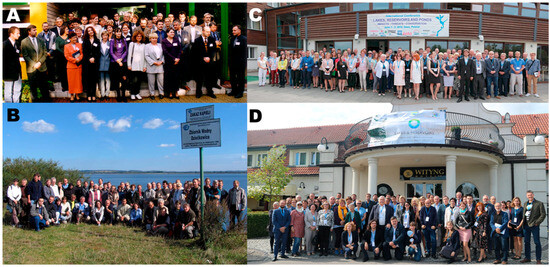
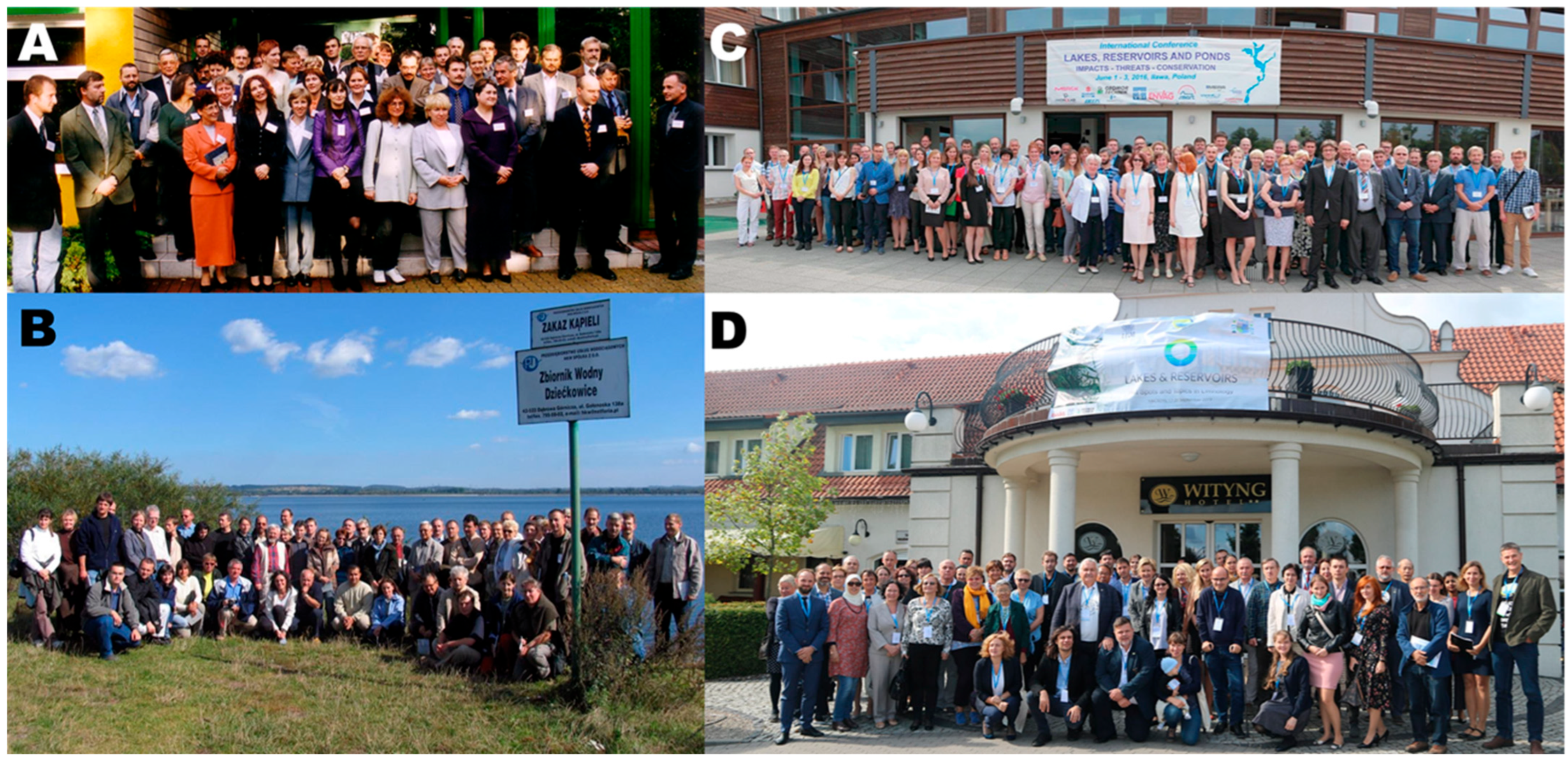
The society regularly organizes various meetings (Figure 1), including national conferences under the banner of Natural and Anthropogenic Transformations of Lakes and Water Reservoirs, which provide a forum for integrating observational studies, experimental research, and applied approaches to water management. Equally important are the international conferences initiated and co-organized by PLS, notably the Lakes & Reservoirs: Hot Topics in Limnology series, which has attracted participants from across Europe, Asia, and the Americas. These meetings, three so far (organized in 2016, 2019, and 2024), fostered scientific exchange on issues such as eutrophication, climate-driven thermal alterations, harmful algal blooms, sediment–water interactions, and the socio-ecological consequences of freshwater degradation, i.e., topics that dominate current limnological and environmental discourse. Through integration of diverse disciplinary perspectives and chemical, biological, and geographic experiences, these conferences have strengthened international networks and reinforced the role of PLS and its members as active partners in global limnological research. The successful organization of these meetings—sometimes undertaken with limited institutional support—reflects the commitment, organizational skills, and collegial spirit of members who contribute their time and expertise to sustaining scientific dialogue.
Figure 1.
The numerous national and international limnology conferences organized by the Polish Limnological Society: (A) national conference in Górzno (2001, Poland), during which, the Polish Limnological Society was founded. (B) national conference in Sosnowiec (2004, Poland); (C) international conference “Lakes, Reservoirs and Ponds: Impacts—Threats—Conservation”, Iława (2016, Poland); (D) international conference “Lakes & Reservoirs—Hot Spots and Topics in Limnology”, Mikorzyn (2019, Poland).
PLS has also played an active role in organizing international scientific expeditions, including research campaigns to Lake Baikal and the Aral Sea basin. Studies conducted during these expeditions addressed not only physicochemical and biological properties of water bodies, but also the broader environmental and health impacts of large-scale ecosystem degradation, particularly in the context of the North Aral Sea [21,22,23]. Collaboration with partners in Kazakhstan and other countries exemplifies PLS’s commitment to transboundary science and to understanding surface waters as coupled human–natural systems. Such initiatives would not have been possible without the personal engagement of Society members willing to extend their research beyond conventional academic frameworks.
A cornerstone of PLS’s contribution to the limnological community has been its long-standing engagement in scientific publishing. The society established and, for many years, published Limnological Review (ISSN 2300-7575), a journal founded in 2001 at Nicolaus Copernicus University in Torun, with Prof. Włodzimierz Marszelewski becoming its first Editor-in-Chief [24]. The journal served as a platform for disseminating field-based, experimental, and theoretical research on inland water ecosystems, covering hydrology, paleolimnology, aquatic biology, hydrochemistry, sedimentology, ecohydrology, and related disciplines. Its development relied and continues to rely heavily on the dedication of editors, reviewers, and authors working in the spirit of scholarly service.
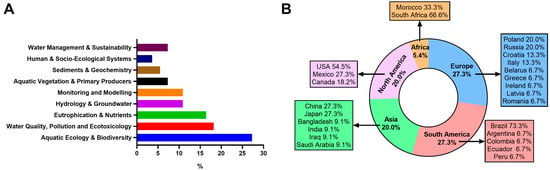
Maintaining an independent scientific journal became increasingly challenging amid limited external funding and structural changes in academic publishing, compounded by the passing of the long-term Editor-in-Chief, Prof. Dariusz Borowiak (University of Gdańsk, Poland), whose dedication to limnology profoundly shaped the journal. The transition of Limnological Review to an open-access publishing model under MDPI ensures continuity of its mission and broader accessibility of limnological knowledge—an essential step in an era when open science is increasingly recognized as a prerequisite for effective environmental decision-making. The PLS remains a partner of Limnological Review, with selected Society members serving as editors, and Prof. Piotr Rzymski (Poznan University of Medical Sciences, Poland), Secretary of the PLS, serving as Editor-in-Chief. In 2025, the journal published 55 peer-reviewed Scopus-indexed papers (among which 85% were original research studies), constituting a 53% increase from 36 papers published in 2024 and 358% increase from 12 papers in 2023. As shown in Figure 2, the portfolio of articles published in 2025 was dominated by Europe and South America (with Brazilian researchers accounting for approximately two-thirds of the output). In addition to Limnological Review, PLS maintains close ties with other international journals, including Water (ISSN 2073-4441), further strengthening its presence in global scientific communication networks.
Figure 2.
Distribution of articles published in Limnological Review in 2025 by (A) thematic subject category and by (B) geographic origin.
Beyond academia, PLS actively fosters societal understanding of limnology. Educational initiatives include lecture series for school students organized with the support of the Polish Ministry of Science and Higher Education, open online seminars, limnological exhibitions, and, most recently, the Bliżej Jezior (Closer to Lakes) initiative pursued in collaboration with the Institute of Meteorology and Water Management National Research Institute in Poland. It brings together limnologists and water specialists to discuss current environmental challenges, the ecological and socio-economic importance of lakes, and strategies for their conservation. By making recorded lectures freely available via social media and online platforms, including the Society’s YouTube channel, PLS contributes to science communication and environmental awareness. In 2026, the PLS also signed an agreement with the Poznan University of Medical Sciences in Poland to promote public understanding of science in the areas of water quality and public health. These outreach activities are especially important in the current social media–dominated information landscape, where misinformation is widespread and can undermine public trust in science [25,26].
The society’s engagement also extends to global environmental advocacy. PLS is among the signatories of the World Climate Statement, which addresses the impacts of anthropogenic climate change on marine and freshwater ecosystems [27]. This statement, also translated into Polish [26], underscores the dramatic scale of surface water degradation, highlights alarming trends, such as the sharp decline in freshwater biodiversity since the 1970s, and calls for immediate action to mitigate further losses [28]. These warnings echo a growing body of scientific evidence documenting the vulnerability of freshwater ecosystems to warming, altered hydrological regimes, and cumulative human pressures.
Today, under the leadership of its current President, Prof. Piotr Klimaszyk (Adam Mickiewicz University, Poland), the PLS stands at the intersection of tradition and urgency. Its 25-year history reflects the evolution of limnology itself: from discipline-focused lake studies to an integrative science essential for understanding climate feedbacks, biodiversity loss, environmental health, and sustainable development. The society exists and thrives because of the collective engagement, shared responsibility, and collegial ethos of its members, whose continued support remains indispensable.
As the Year of Water reminds us, freshwater systems are among the most threatened components of the Earth system. Yet, they are also among the most powerful levers for resilience and adaptation. In this context, the role of limnological science is no longer confined to description and diagnosis; it must actively inform policy, management, and societal choices. Looking toward the remainder of the 21st century, lake ecosystems in Poland are projected to experience substantial climate-driven changes, including increased water temperatures, stronger and longer thermal stratification, reduced oxygen availability in deep layers, altered ice phenology, and more frequent harmful algal blooms [29,30]. Within this context, the PLS can play, as in the past, a role by integrating scientific findings into national water management and adaptation strategies [5,31,32]. By focusing on Polish lakes as representative systems, PLS not only strengthens our understanding of regional freshwater responses but also generates insights transferable to broader European assessments of freshwater ecosystem vulnerability and resilience.
The first 25 years of PLS demonstrate how a committed scientific community can contribute to this task—through rigorous research, international cooperation, open communication, and public engagement. The next quarter-century will demand even greater integration of science and action. If there is a lesson to be drawn from society’s history, it is this: safeguarding lakes and inland waters is not only a scientific challenge but also a civilizational imperative.
Author Contributions
Conceptualization, P.R.; resources, W.M. and P.K.; writing—original draft preparation, W.M., P.R. and P.K.; writing—review and editing, W.M., P.R. and P.K. All authors have read and agreed to the published version of the manuscript.
Funding
This research received no external funding.
Acknowledgments
We express our sincere gratitude to all members of the Polish Limnological Society who, through their sustained scientific, organizational, and educational engagement, have actively supported the society over the past 25 years. We also warmly invite anyone interested in freshwater research, conservation, or collaboration to get in touch with our society (ptlim@ptlim.pl).
Conflicts of Interest
The authors declare no financial conflicts of interest. All authors are members of the Polish Limnological Society, which is the subject of this paper.
References
- Whiting, K. What Is Blue Davos and Why Is 2026 the “Year of Water”? Available online: https://www.weforum.org/stories/2026/01/what-is-blue-davos-everything-you-need-to-know/ (accessed on 24 January 2026).
- Leijnse, M.; Bierkens, M.F.P.; Gommans, K.H.M.; Lin, D.; Tait, A.; Wanders, N. Key Drivers and Pressures of Global Water Scarcity Hotspots. Environ. Res. Lett. 2024, 19, 054035. [Google Scholar] [CrossRef] [Scilit]
- Huang, Z.; Yuan, X.; Liu, X. The Key Drivers for the Changes in Global Water Scarcity: Water Withdrawal versus Water Availability. J. Hydrol. 2021, 601, 126658. [Google Scholar] [CrossRef] [Scilit]
- Wang, M.; Bodirsky, B.L.; Rijneveld, R.; Beier, F.; Bak, M.P.; Batool, M.; Droppers, B.; Popp, A.; van Vliet, M.T.H.; Strokal, M. A Triple Increase in Global River Basins with Water Scarcity Due to Future Pollution. Nat. Commun. 2024, 15, 880. [Google Scholar] [CrossRef] [Scilit]
- Klimaszyk, P.; Gołdyn, R. Water Quality of Freshwater Ecosystems in a Temperate Climate. Water 2020, 12, 2643. [Google Scholar] [CrossRef] [Scilit]
- Jane, S.F.; Hansen, G.J.A.; Kraemer, B.M.; Leavitt, P.R.; Mincer, J.L.; North, R.L.; Pilla, R.M.; Stetler, J.T.; Williamson, C.E.; Woolway, R.I.; et al. Widespread Deoxygenation of Temperate Lakes. Nature 2021, 594, 66–70. [Google Scholar] [CrossRef] [Scilit]
- Ho, J.C.; Michalak, A.M. Exploring Temperature and Precipitation Impacts on Harmful Algal Blooms across Continental U.S. Lakes. Limnol. Oceanogr. 2020, 65, 992–1009. [Google Scholar] [CrossRef] [Scilit]
- Jane, S.F.; Mincer, J.L.; Lau, M.P.; Lewis, A.S.L.; Stetler, J.T.; Rose, K.C. Longer Duration of Seasonal Stratification Contributes to Widespread Increases in Lake Hypoxia and Anoxia. Glob. Change Biol. 2023, 29, 1009–1023. [Google Scholar] [CrossRef] [Scilit] [PubMed]
- Catalan, J.; Monteoliva, A.P.; Vega, J.C.; Domínguez, A.; Negro, A.I.; Alonso, R.; Garcés, B.V.; Batalla, M.; García-Gómez, H.; Leira, M.; et al. Reduced Precipitation Can Induce Ecosystem Regime Shifts in Lakes by Increasing Internal Nutrient Recycling. Sci. Rep. 2024, 14, 12408. [Google Scholar] [CrossRef] [Scilit]
- Yin, Y.; Yang, K.; Gao, M.; Wei, J.; Zhong, X.; Jiang, K.; Gao, J.; Cai, Y. Declined Nutrients Stability Shaped by Water Residence Times in Lakes and Reservoirs under Climate Change. Sci. Total Environ. 2024, 953, 176098. [Google Scholar] [CrossRef] [Scilit]
- Costa, D.; Sutter, C.; Shepherd, A.; Jarvie, H.; Wilson, H.; Elliott, J.; Liu, J.; Macrae, M. Impact of Climate Change on Catchment Nutrient Dynamics: Insights from around the World. Environ. Rev. 2023, 31, 4–25. [Google Scholar] [CrossRef] [Scilit]
- Liu, Z.; Su, Y.; Yang, L. Limnology Is a Multidisciplinary and Integrative Science for Studying Inland Waters: With Special Reference to the Challenges and Opportunities for the Development of Limnology in China. Hu Po Ke Xue 2020, 32, 1244–1253. [Google Scholar]
- Heino, J.; Alahuhta, J.; Bini, L.M.; Cai, Y.; Heiskanen, A.-S.; Hellsten, S.; Kortelainen, P.; Kotamäki, N.; Tolonen, K.T.; Vihervaara, P.; et al. Lakes in the Era of Global Change: Moving beyond Single-Lake Thinking in Maintaining Biodiversity and Ecosystem Services. Biol. Rev. Camb. Philos. Soc. 2021, 96, 89–106. [Google Scholar] [CrossRef] [Scilit]
- Pilla, R.M.; Griffiths, N.A.; Gu, L.; Kao, S.-C.; McManamay, R.; Ricciuto, D.M.; Shi, X. Anthropogenically Driven Climate and Landscape Change Effects on Inland Water Carbon Dynamics: What Have We Learned and Where Are We Going? Glob. Change Biol. 2022, 28, 5601–5629. [Google Scholar] [CrossRef] [Scilit]
- Politi, E.; Cutler, M.E.J.; Carvalho, L.; Rowan, J.S. A Global Typological Approach to Classify Lakes Based on Their Eutrophication Risk. Aquat. Sci. 2024, 86, 52. [Google Scholar] [CrossRef] [Scilit]
- Krishnan, A.; Devarajan, Y.; Nagappan, B.; Kumar, D.; Upadhye, V.J. Inland Waterways Symphony: Understanding Transformation Mechanisms of Carbon and Nitrogen Emissions. Environ. Monit. Assess. 2025, 197, 885. [Google Scholar] [CrossRef] [Scilit]
- Williamson, C.E.; Saros, J.E.; Vincent, W.F.; Smol, J.P. Lakes and Reservoirs as Sentinels, Integrators, and Regulators of Climate Change. Limnol. Oceanogr. 2009, 54, 2273–2282. [Google Scholar] [CrossRef] [Scilit]
- Woolway, R.I.; Kraemer, B.M.; Lenters, J.D.; Merchant, C.J.; O’Reilly, C.M.; Sharma, S. Global Lake Responses to Climate Change. Nat. Rev. Earth Environ. 2020, 1, 388–403. [Google Scholar] [CrossRef] [Scilit]
- Inácio, M.; Barceló, D.; Zhao, W.; Pereira, P. Mapping Lake Ecosystem Services: A Systematic Review. Sci. Total Environ. 2022, 847, 157561. [Google Scholar] [CrossRef] [Scilit] [PubMed]
- Rose, J.B.; Örmeci, B.; Aw, T.G. Water Quality and Health: An Ecological Perspective. Water Ecol. 2025, 1, 100007. [Google Scholar] [CrossRef] [Scilit]
- Aladin, N.V.; Gontar, V.I.; Zhakova, L.V.; Plotnikov, I.S.; Smurov, A.O.; Rzymski, P.; Klimaszyk, P. The Zoocenosis of the Aral Sea: Six Decades of Fast-Paced Change. Environ. Sci. Pollut. Res. Int. 2019, 26, 2228–2237. [Google Scholar] [CrossRef] [Scilit] [PubMed]
- Rzymski, P.; Klimaszyk, P.; Niedzielski, P.; Marszelewski, W.; Borowiak, D.; Nowiński, K.; Baikenzheyeva, A.; Kurmanbayev, R.; Aladin, N. Pollution with Trace Elements and Rare-Earth Metals in the Lower Course of Syr Darya River and Small Aral Sea, Kazakhstan. Chemosphere 2019, 234, 81–88. [Google Scholar] [CrossRef] [Scilit] [PubMed]
- Klimaszyk, P.; Kuczyńska-Kippen, N.; Szeląg-Wasielewska, E.; Marszelewski, W.; Borowiak, D.; Niedzielski, P.; Nowiński, K.; Kurmanbayev, R.; Baikenzheyeva, A.; Rzymski, P. Spatial Heterogeneity of Chemistry of the Small Aral Sea and the Syr Darya River and Its Impact on Plankton Communities. Chemosphere 2022, 307, 135788. [Google Scholar] [CrossRef] [Scilit] [PubMed]
- Limnological Review. Available online: https://www.mdpi.com/journal/limnolrev/ (accessed on 9 April 2023).
- Essien, E.O. Climate Change Disinformation on Social Media: A Meta-Synthesis on Epistemic Welfare in the Post-Truth Era. Soc. Sci. 2025, 14, 304. [Google Scholar] [CrossRef] [Scilit]
- Oliveira, T.; Cardoso, N.d.O.; Machado, W.d.L.; Aragon Gonçalves, R.; Quinan, R.; Zorgi Salvador, E.; Almeida, C.; Paes, A. Confronting Misinformation Related to Health and the Environment: A Systematic Review. J. Sci. Commun. 2024, 23, V01. [Google Scholar] [CrossRef] [Scilit]
- World Climate Statement. World Climate Statement—Climate Change and Fisheries. Available online: https://climate.fisheries.org/world-climate-statement/ (accessed on 20 July 2023).
- Bonar, S.A.; Avery, J.; Camacho, A.; Douglas, M.E.; Gillanders, B.M.; Grottoli, A.G.; Murphy, B.R.; Ramirez, A.; Rzymski, P. More than 100 Aquatic-Science Societies Sound Climate Alarm. Nature 2021, 589, 352. [Google Scholar] [CrossRef] [Scilit]
- Piccolroaz, S.; Zhu, S.; Ptak, M.; Sojka, M.; Du, X. Warming of Lowland Polish Lakes under Future Climate Change Scenarios and Consequences for Ice Cover and Mixing Dynamics. J. Hydrol. Reg. Stud. 2021, 34, 100780. [Google Scholar] [CrossRef] [Scilit]
- Ptak, M.; Choiński, A.; Sojka, M.; Zhu, S. Changes in the Water Resources of Selected Lakes in Poland in the Period 1916–2020 as Information to Increase Their Availability. Sustainability 2021, 13, 7298. [Google Scholar] [CrossRef] [Scilit]
- Kolada, A.; Piotrowicz, R.; Wilk-Woźniak, E.; Dynowski, P.; Klimaszyk, P. Conservation Status of the Natura 2000 Habitat 3110 in Poland: Monitoring, Classification and Trends. Limnol. Rev. 2017, 17, 215–222. [Google Scholar] [CrossRef] [Scilit]
- Marszelewski, M.; Piasecki, A. Legal and Water Management Policy during Climate Warming in Poland. Bull. Geogr. Socio-Econ. Ser. 2021, 54, 63–75. [Google Scholar] [CrossRef] [Scilit]

Disclaimer/Publisher’s Note: The statements, opinions and data contained in all publications are solely those of the individual author(s) and contributor(s) and not of MDPI and/or the editor(s). MDPI and/or the editor(s) disclaim responsibility for any injury to people or property resulting from any ideas, methods, instructions or products referred to in the content. |
© 2026 by the authors. Licensee MDPI, Basel, Switzerland. This article is an open access article distributed under the terms and conditions of the Creative Commons Attribution (CC BY) license.