Communication

Long-Term Eutrophication in Mesotrophic–Eutrophic Lake Kawaguchi, Japan, Based on Observations of the Horizontal Distribution of Profundal Chironomid Larvae and Oligochaetes

by
Kimio Hirabayashi
1,* and
Masaaki Takeda
2
1
Institute of Textile Science and Technology, School of Science and Technology, Academic Assembly, Shinshu University, 3-15-1, Tokida, Ueda 386-8567, Japan
2
Faculty of Textile Science and Technology, Shinshu University, 3-15-1, Tokida, Ueda 386-8567, Japan
*
Author to whom correspondence should be addressed.
Limnol. Rev. 2025, 25(4), 53; https://doi.org/10.3390/limnolrev25040053

Submission received: 31 August 2025 / Revised: 13 October 2025 / Accepted: 21 October 2025 / Published: 1 November 2025
(This article belongs to the Special Issue Trends in the Trophic State of Freshwater Ecosystems)

Abstract

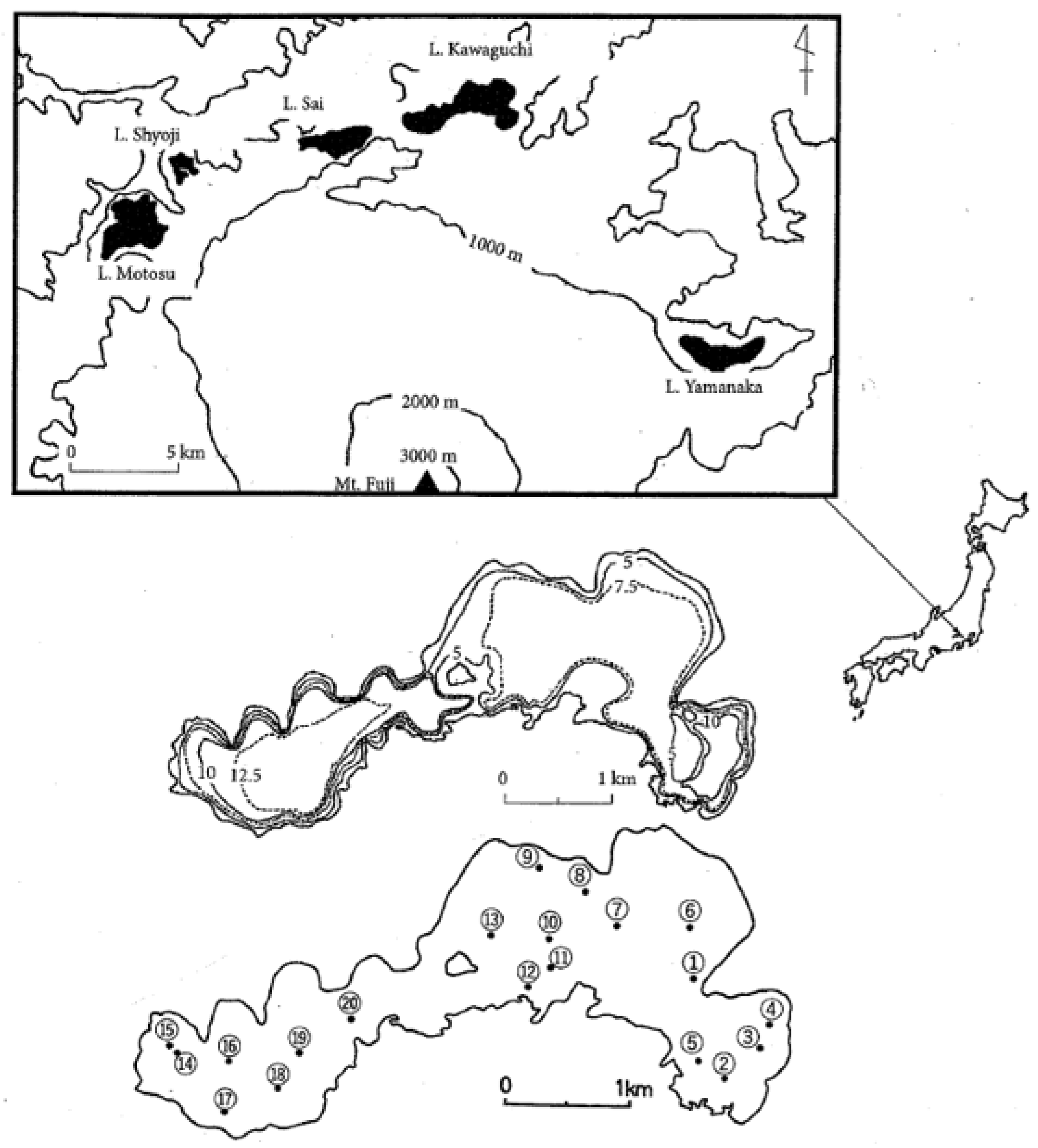
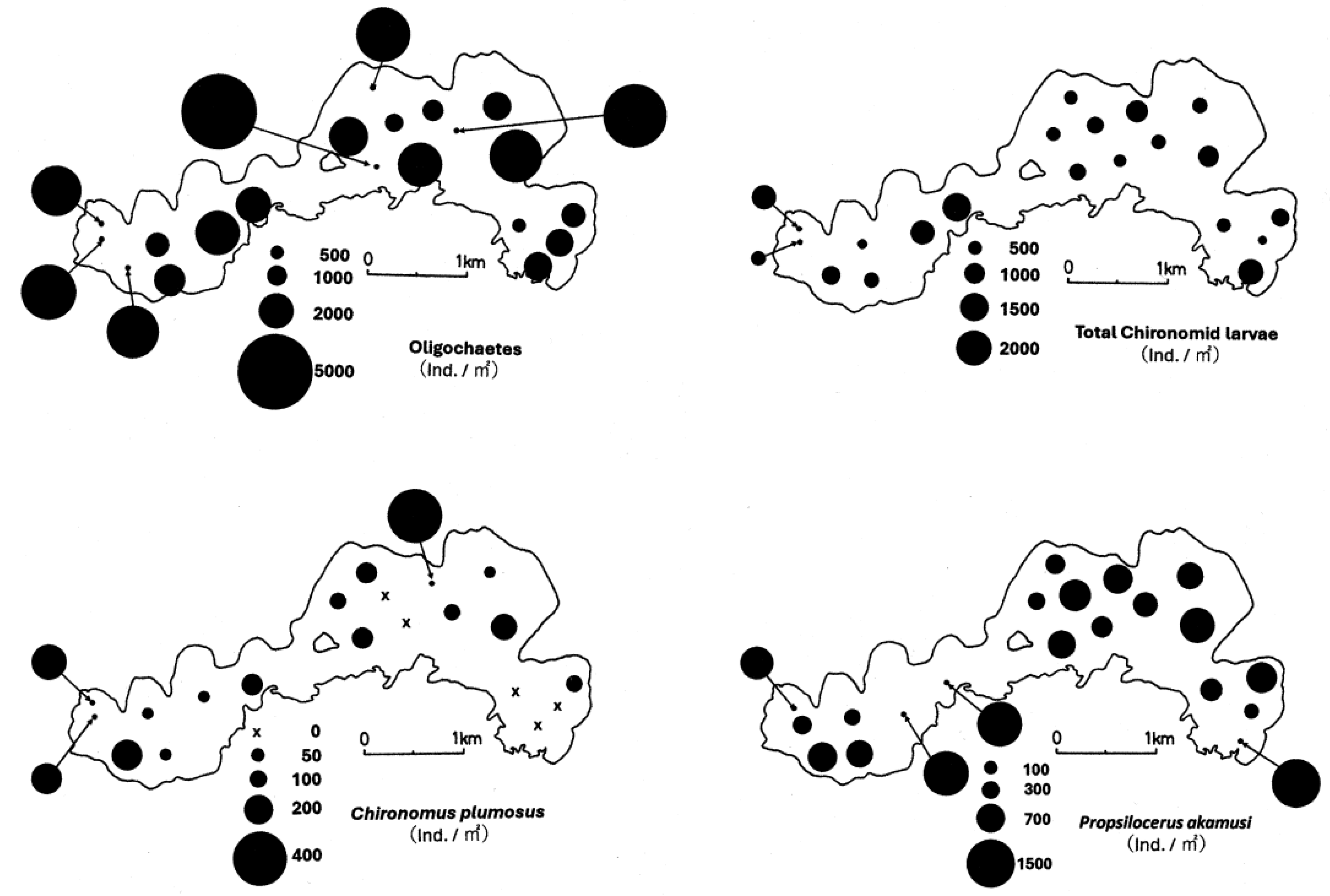
Many researchers have used the species composition, relative abundance and distribution pattern of profundal benthic macroinvertebrate communities in particular, especially chironomid fauna, as indicators of the trophic state and pollution of lakes. In addition, compared with previous benthic macroinvertebrate data, it is expected that the process of eutrophication/oligotrophication of lakes can also be traced. Benthic macroinvertebrate distribution was studied in Lake Kawaguchi, Japan (maximum depth 16.1 m; mean depth 9.3 m), on 7 March 2025. The benthic animals identified were aquatic oligochaetes, chironomid larvae, shellfish and others. Differences among environmental factors and zoobenthos densities and rank correlation were analyzed using a non-parametric test. The mean density of oligochaetes, which was the dominant group, was 2457 ± 1247 individuals/m2, followed by chironomid larvae at 816 ± 391 individuals/m2. The larvae of Propsilocerus akamusi were the most abundant species at 669 ± 358 individuals/m2, followed by Chironomus plumosus at 109 ± 114 individuals/m2. Other chironomids (38 ± 75 individuals/m2) were also captured. Benthic communities were collected at all sites, but each taxa had its own characteristics. Oligochaetes and C. plumosus were widely distributed throughout the lake, whereas the distribution of P. akamusi was skewed toward the western part of the lake. In comparison with previous studies, P. akamusi larvae were now found to be the most abundant chironomid species in this lake, accounting for an increased percentage of the chironomid community, while C. plumosus larvae had decreased in recent years. In addition, the higher levels of organic matter in the upper sediment layer of the lake suggest ongoing eutrophication. Previous studies classified Lake Kawaguchi as mesotrophic–eutrophic, but reconsideration of this classification is warranted given the above findings. We suggest that this lake be ranked as a eutrophic lake (chlorophyll-a concentration; ca. 0.05 mg/L) based on a long-term investigation of the changes in chironomid fauna.
Keywords: bathymetric distribution; benthic macroinvertebrate; benthos; Chironomidae; Chironomus plumosus; Oligochaeta; Propsilocerus akamusi bathymetric distribution; benthic macroinvertebrate; benthos; Chironomidae; Chironomus plumosus; Oligochaeta; Propsilocerus akamusi