Systematic Review

Techniques Applied to Autonomous Liquid Pouring: A Scoping Review

by
Jeeangh Jennessi Reyes-Montiel
,
Ericka Janet Rechy-Ramirez
and
Antonio Marin-Hernandez
*
Artificial Intelligence Research Institute, Universidad Veracruzana, Campus Sur, Col. Nueva Xalapa, Xalapa C.P. 91097, Mexico
*
Author to whom correspondence should be addressed.
Math. Comput. Appl. 2026, 31(1), 30; https://doi.org/10.3390/mca31010030
Submission received: 19 December 2025 / Revised: 28 January 2026 / Accepted: 12 February 2026 / Published: 14 February 2026
(This article belongs to the Special Issue New Trends in Computational Intelligence and Applications 2025)

Abstract

In recent years, autonomous liquid pouring systems have gained more relevance, with applications from daily service tasks to complex industrial operations. While seemingly simple for humans, this task poses major challenges for automated systems, as it requires precise control and adaptation to varying container geometries, liquid properties, and environmental conditions. This review examines the state-of-the-art on liquid pouring through five research questions: (1) What are the characteristics of the liquids used in the experiments? (2) What are the characteristics of the containers used in the experiments and how do they affect the performance of the pouring tasks? (3) What techniques are used to control liquid pouring (i.e., to control the robotic arm or device)? (4) What metrics are used to assess the methods for pouring liquid? (5) What devices are used to measure poured volume? This scoping review follows the Arksey and O’Malley framework, and uses the PRISMA-ScR protocol to filter the articles. A total of 285 studies published between 2018 and 2025 were screened from IEEE Xplore, SpringerLink, ScienceDirect, Web of Science, and EBSCOhost, of which 23 met the inclusion criteria. Results showed that the most widely used methods for autonomous liquid pouring were classical control methods—PID, PD (30.4% of the studies). Conversely, the least widely used methods for autonomous liquid pouring were learning, imitation learning, and probabilistic models (15% of the studies).

1. Introduction

Liquids pouring is a very important task in different sectors, such as: chemical engineering, metallurgical processes, and beverage production. Although pouring liquids seems to be a very simple and natural task for humans, this action involves multiple challenges for autonomous systems, including pouring several types of liquids, using various container shapes, and achieving specific volume targets.
The development of automated systems to pour liquids accurately is making significant changes in industry and services. For example, in beverage preparation, such systems improve efficiency and reduce manual effort [1,2,3]. In industrial contexts such as chemical synthesis and metal casting, advanced robotic pouring could increase precision, safety, and process reliability [4,5,6,7,8,9,10].
The challenge of pouring liquids involves a variety of physical factors that affect the accuracy and stability of the process, such as the viscosity, density, and transparency of the liquids. These properties vary significantly according to the type of liquid [11,12].
In terms of the liquid’s viscosity, the control strategy for pouring the liquid should analyze whether the liquid has high-viscosity (e.g., syrup, yogurt, and honey) or low-viscosity (e.g., water, milk, and juice) to adjust the velocity—to perform the pouring. Consequently, excessive buildup in the container or risk of spills might be preventable [13]. Furthermore, liquid transparency introduces challenges for vision-based approaches. Specifically, detecting flow or measuring fill levels requires an accurate real-time computation of the pouring angle and the liquid surface [14].
The pouring of liquids requires a set of actions performed with precision to ensure a successful and safe execution. Although humans often perform this task intuitively [15], for machines and robots, each step must be carefully specified to ensure proper coordination and avoid spills or accidents [11]. Finally, the pouring control process requires the incorporation of sensors to provide feedback.
Research on liquid pouring has incorporated a variety of sensing modalities (e.g., vision, audio, and haptics) to implement efficient solutions for robotic pouring. Additionally, studies have tested their solutions for robotic pouring in real-world scenarios using opaque containers, as well as variations in liquid color, lighting conditions, and camera positioning [16,17]. Audio modalities have also been used to estimate fill levels by analyzing sounds produced when liquid falls onto the container, offering a complementary strategy in scenarios where visual feedback is limited [18,19]. In the case of haptics, this modality can allow the robot to modulate pouring force and speed through tactile feedback, increasing accuracy when other sensory inputs might be less accurate [20,21].
It is important to note that traditional control approaches such as PID [22] and PD [23] are also used for controlling the pouring process. Moreover, computational fluid modeling has been employed to simulate how liquids behave under diverse conditions [24]. Container modeling [25,26], meanwhile, emphasizes the role of geometry and physical properties in optimizing pouring accuracy and minimizing spillage. Together, these complementary techniques contribute to the development of pouring systems capable of performing across diverse environments and tasks.
To select works related to liquid pouring techniques, the following three keywords were defined: pouring, liquid, and control. Those keywords are related to: the action, the element, and the way the task is carried out, respectively. Pouring is the process of transferring liquid from one container to another. Liquid refers to intrinsic properties, such as viscosity, density, and transparency, which influence the flow behavior. And finally, control encompasses the algorithms, sensory feedback, and adaptive strategies that regulate the process.
To include the latest and more relevant advances in techniques and technologies applied to pouring liquid, the period from 2018 to 2025 was selected. Throughout the search, no previous reviews were found that focused specifically on techniques used to pour liquids. Although there are reviews associated with object manipulation, these often focus on the grasping [27,28,29,30,31,32,33,34], transporting [35], and positioning of solid objects [36,37] (see Table 1), thus leaving a significant gap in the literature about the challenges and approaches of pouring liquid. The gap highlights the need for a review that analyzes and compares existing techniques, identifies current limitations, and proposes future lines for research in this field.
Despite recent advances in robotic manipulation, liquid pouring remains a complex task due to the nonlinear behavior of fluids and the interplay between perception and control. As robots are increasingly deployed in real-world applications, such as service robotics and industrial environments, interest in autonomous liquid pouring continues to grow. Therefore, it is essential to systematically map the different methodologies, clarify how control and perception are integrated, and identify critical gaps in real-world implementation.

Contribution

The main contribution of this review is the identification and synthesis of methods and techniques employed for autonomous liquid pouring. Furthermore, it considers complementary aspects such as: liquids’ characteristics, devices used for volume measurement, containers’ features, and the metrics applied to evaluate the pouring performance. A further relevant aspect is the variety of container types used across studies, including cups, mugs, bottles, bowls, and industrial ladle robots, as container geometry directly impacts on pouring dynamics and control design. Analyzing these elements is crucial for identifying research gaps and ensuring comparability across studies. The insights obtained provide information for advancing robotic pouring systems. Moreover, this review helps establish standardized benchmarks and supports the design of reliable and generalizable solutions.
The areas identified for future research are diverse. It is crucial to develop algorithms that improve the ability of robotic systems to detect and adjust to changes in the liquid properties. Moreover, it is necessary to have innovation in dynamic control algorithms that can manage with high precision the pouring angle and speed in response to real-time conditions. In addition, applications of robotic pouring to new environments, such as automated plant care or handling of dangerous substances, will expand the scope of robotic applications.

2. Methodology

This review follows the methodological framework proposed by Arksey and O’Malley [38], consisting of the following five stages: (1) identification of the research question; (2) identification of relevant studies; (3) selection of studies; (4) plotting of data; and (5) collation, summarizing, and communication of results. Being a structured approach, it improves the transparency and reproducibility of the review process, providing a mapping of the literature related to the pouring liquid control process.
The initial search was conducted from January 2018 to April 2025. An update was performed in August 2025 to include the most recent studies. No additional papers were identified during the update.

2.1. Protocol and Registration

This scoping review was conducted in accordance with the PRISMA-ScR guidelines [39].

2.2. Identification of Research Questions

This work was conducted to map the research done in this field and identify any existing gaps in knowledge. For that purpose, the following research questions were formulated: (1) What are the liquid characteristics considered in the experiments? (2) What are the container characteristics considered in the experiments, and how do their properties affect the performance of the pouring tasks? (3) What techniques are used to control liquid pouring (i.e., to control the robotic arm or device)? (4) What metrics have been used to assess the methods for pouring liquid? (5) What devices are used to measure the volume poured?
Those questions are fundamental, as they address key issues of pouring liquid control. The first question, focused on the characteristics of liquids used in the experiments, provides an insight into how the physical properties of different liquids, such as viscosity, density and transparency, influence the results of pouring tasks. The second question addresses the characteristics of the container used in the experiments, examining how their geometry and material properties influence the pouring tasks. The third question examines the techniques employed to control liquid pouring, enabling the comparison and evaluation of methodologies in terms of their adaptation and robustness in different scenarios. The fourth question explores the accuracy of various pouring methods, enabling the identification of the most effective approaches for pouring control. Finally, the fifth question, regarding the methods for measuring the volume poured, is fundamental to understanding how the results are measured and evaluated.

2.3. Identification of Relevant Works

The quest for relevant studies was conducted using the following keywords: pouring, liquid, control. Five major academic databases were used, namely IEEE, SpringerLink, Web of Science (WoS), ScienceDirect and EBCOhost. These databases were selected due to a broad coverage of engineering, technology and applied sciences literature, which ensures access to a wide range of studies relevant to the control of pouring liquid processes.

2.4. Study Selection

2.4.1. Inclusion Criteria

The eligibility criteria were designed to focus on studies associated with the objectives of controlling liquid pouring processes. Specifically, articles were included if they satisfied the following criteria: (1) use of an open-mouth container instead of dispensers—the study must involve transferring liquid from an open-top source container (e.g., beakers, bottles, or cups), in which the flow is dependent on the tilting angle; (2) consideration of geometric and dynamic variables of the container to model the pouring process; (3) written in English; and (4) published between 2018 and 2025.

2.4.2. Exclusion Criteria

Following the application of the inclusion criteria, the final set of studies was refined by excluding those that: (1) did not involve a rigid container, (2) focused primarily on fluid modeling and not in the pouring process, and (3) were based on teleoperation to control pouring.
For example, study [35] was excluded because it did not focus mainly on the autonomous control of the pouring phase, as defined in Research Question 3. Instead, it focused on the design of a deformable robotic gripper for simultaneously transporting liquids and solids.

2.5. Chart the Data

There are three key items involved in the pouring liquid task, i.e., (i) the liquid, (ii) the container, and (iii) the robotic arm or device control. The latter specifically relates to the method used for pouring liquid. Based on these aspects, this scoping review aims to answer the following five questions:
  • RQ1: What are the liquid characteristics considered in the experiments?
  • RQ2: What are the container characteristics considered in the experiments and how do they affect the performance of the pouring tasks?
  • RQ3: What techniques are used to control liquid pouring (i.e., to control the robotic arm or device)?
  • RQ4: What metrics have been used to assess the methods for pouring liquid?
  • RQ5: What devices are used to measure the volume poured?
Parameters proposed to evaluate each of the research questions are given below.

2.5.1. RQ1: What Are the Liquid Characteristics Considered in the Experiments?

As noted in [14,40], previous research has emphasized the importance of considering liquid properties when selecting appropriate pouring strategies.
  • Density;
  • Color;
  • Transparency;
  • Viscosity.

2.5.2. RQ2: What Are the Container Characteristics Considered in the Experiments and How Do They Affect the Performance of the Pouring Tasks?

Containers have a central role in the pouring process, as their geometry and material properties directly influence the liquid’s flow and task performance. As described in [11,25,41,42], key parameters include shape, height, spout diameter, and transparency. These factors, essential for both modeling and control, determine how liquids accumulate, flow, and are perceived by vision-systems.
  • Container shape;
  • Container transparency;
  • Opening diameter of the container’s spout;
  • Container height.

2.5.3. RQ3: What Techniques Are Used to Control Liquid Pouring (i.e., to Control the Robotic Arm or Device)?

Successful pouring depends on control strategies that guide the robotic arm and regulate the liquid flow. As highlighted in [43,44], these techniques range from classical controllers to adaptive and learning-based approaches, each with its own advantages and limitations. Based on this, the following parameters were selected to analyze control strategies:
  • Algorithm type.
  • System robustness: Is the approach able to dynamically adjust the pouring process in response to unexpected changes?
  • Experimental adaptability: Was the methodology tested under different initial volumes or filling levels? (Yes/No).
  • Computational requirements: What type of hardware or software is necessary to implement the methodology?

2.5.4. RQ4: What Metrics Are Used to Assess the Methods for Pouring Liquid?

As described by [45,46], standardized measures are essential to evaluate and compare the accuracy, efficiency, and robustness of liquid pouring systems. In line with this view, the following parameters were selected to address RQ4.
  • Average pouring error;
  • Success rate: The percentage of attempts in which the spilled volume falls within a margin of error of ± 5 %;
  • Spill: Volume of liquid spilled out of the target container during the process (in milliliters or as a percentage of the total volume);
  • Pouring run time: The time required to complete the pouring process.

2.5.5. RQ5: What Devices Are Used to Measure the Volume Poured?

Reliable performance assessment relies on appropriate measurement instruments [26]. Therefore, the following parameter was included to address RQ5:
  • Measurement instrument: Type of instrument used to measure the poured volume.

2.6. Information Sources

To identify relevant studies, the following bibliographic databases were searched: IEEE Xplore, WoS, SpringerLink, ScienceDirect and EBCOhost. To ensure the inclusion of recent advances, the search strategy was limited to publications from 2018 to 2025.

2.7. Search

The authors designed and executed the search strategy. For instance, in IEEE Xplore, an advanced search was conducted using the keywords Pouring, Liquid, and Control, restricted to metadata fields. The search was limited to articles published between 2018 and 2025. Filters were applied by publication year and content type, limiting the results to journal articles and conference proceedings. The same strategy and filters were consistently applied across all databases.
As an example, the following is the detailed search query used for IEEE Xplore: (“All metadata”: Pouring) AND (“All metadata”: Liquid) AND (“All metadata”: Control). This query returned 45 results: 36 from conference proceedings, 7 from journals, 1 from a book, and 1 from a magazine article.
The search results across selected databases yielded to 285 publications before applying the inclusion and exclusion criteria. Gray literature was not included, and studies not focused on open-mouth containers or involving teleoperated pouring systems were excluded, as these were not relevant to the scope of this review.

2.8. Synthesis of Results

To ensure consistency, authors of this work screened the same set of 285 publications, discussed the results, and reviewed the data extraction protocol before beginning the full review. The team of reviewers sequentially evaluated the titles, abstracts, and then the full texts of all articles identified in our searches as potentially relevant. Disagreements about study selection and data extraction were resolved by consensus. This process ensured a standardized approach and minimized bias during the selection and extraction steps.

3. Results

3.1. Selection of the Sources of Evidence

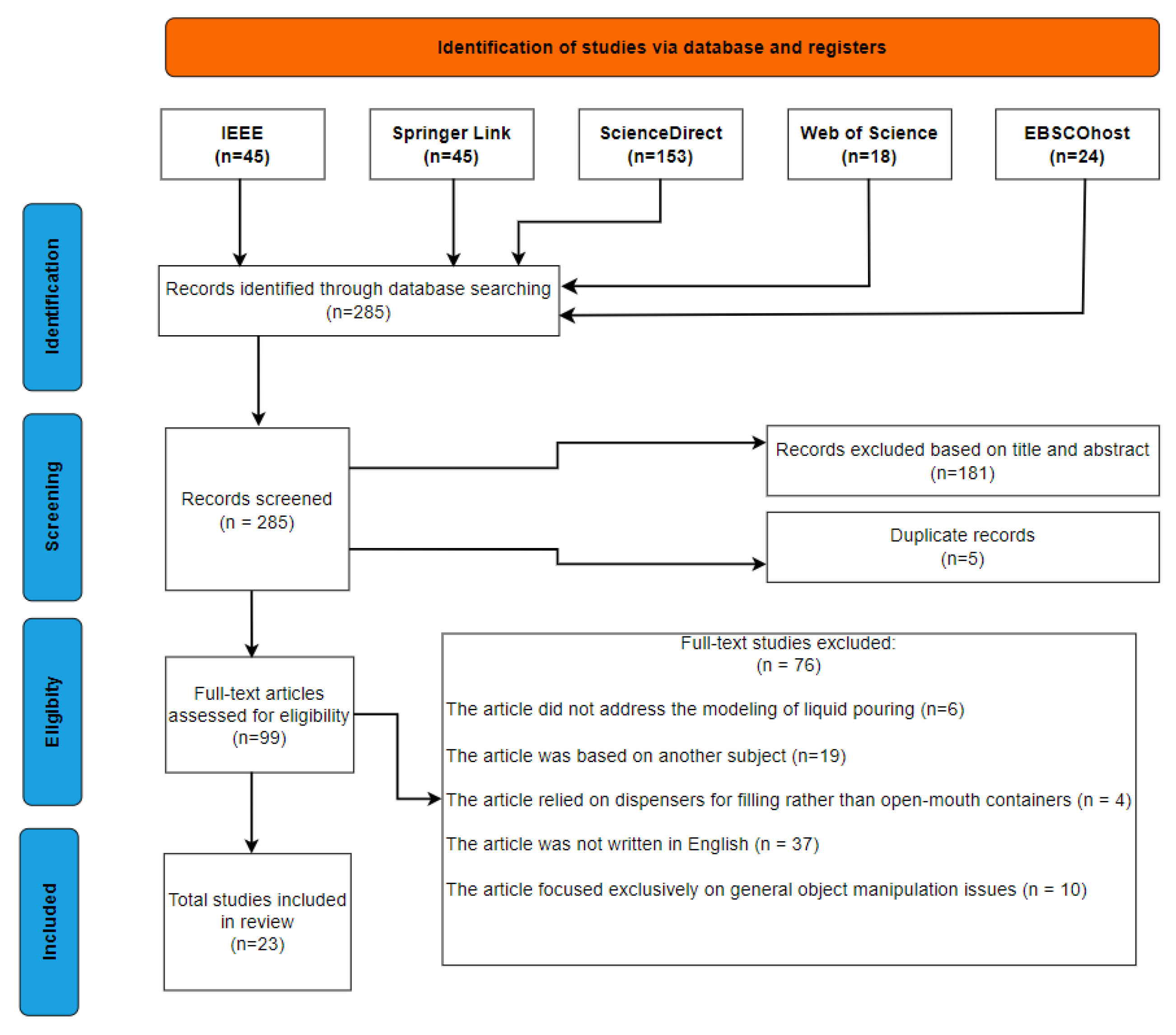
Collected articles were distributed as follows: IEEE Xplore: 45, SpringerLink: 45, Web of Science (WoS): 18, ScienceDirect: 153, and EBSCOhost: 24. After applying inclusion and exclusion criteria, and removing duplicates, articles selection per database remained as follows: IEEE Xplore: 12/45, SpringerLink: 2/45, Web of Science (WoS): 7/18, ScienceDirect: 2/153 (with 1 duplicate), and EBSCOhost: 0/24 (with 4 duplicates). A total of 23 articles were included for further analysis, as depicted in Figure 1.
Articles excluded from the review were removed at different stages of the screening process ( n = 285 ). At the title and abstract level, 181 records were excluded for being unrelated to liquid pouring, and five duplicate entries were identified. During the full-text eligibility assessment, 6 articles did not address the modeling of liquid pouring, 19 were based on another subject, 4 relied on dispensers rather than open-mouth containers, 37 were not written in English, and 10 focused exclusively on general object manipulation issues.
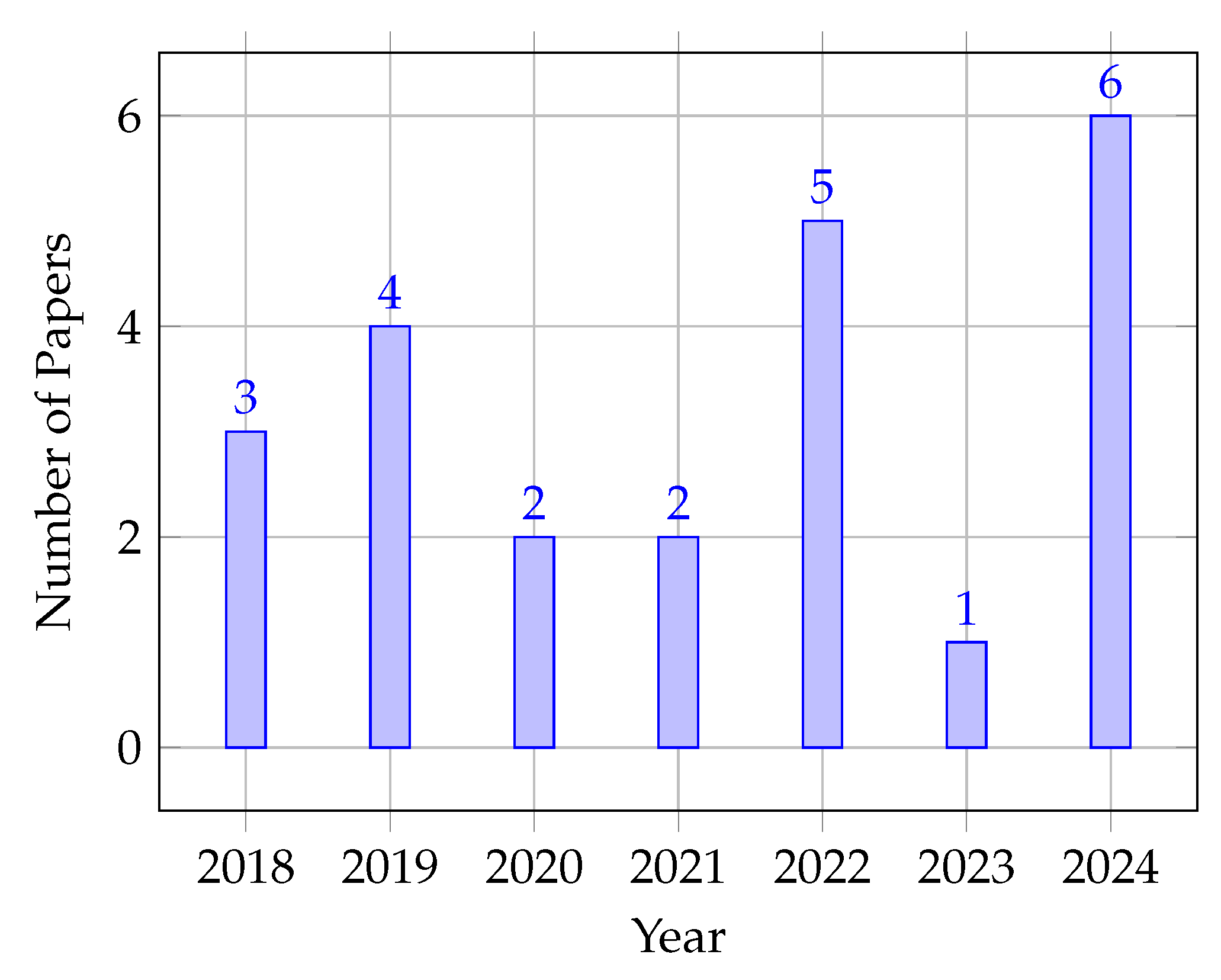
The temporal distribution of the included studies is shown in Figure 2. Research on liquid pouring has gradually expanded since 2018, with variations across years and a significant increase in 2024, reflecting the growing interest in this topic.

3.1.1. RQ1: What Are the Liquid Characteristics Considered in the Experiments?

Based on the analysis of the articles included in this review, five liquid properties were considered for pouring.
  • Density:
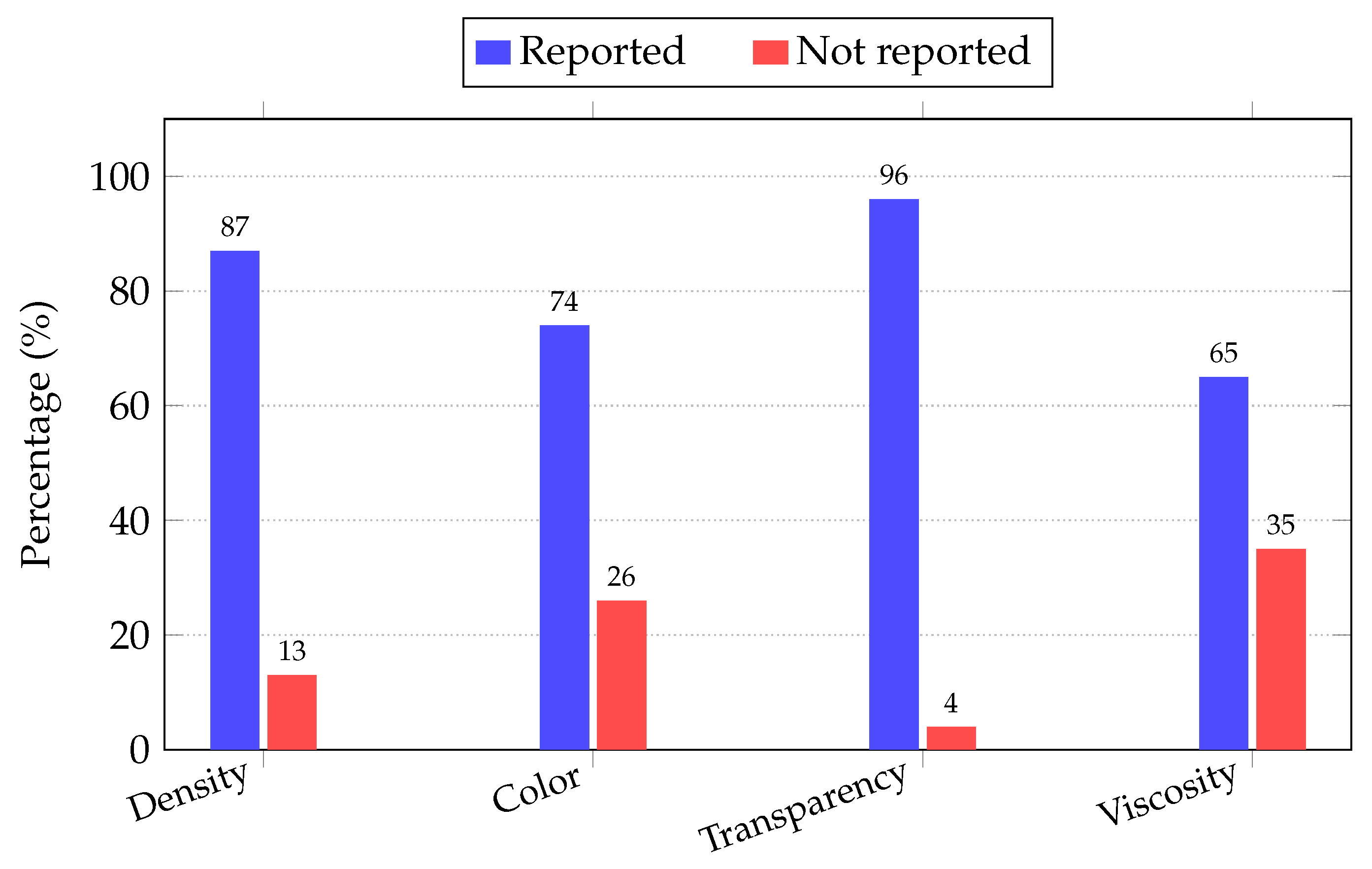
    Most of the studies (i.e., 87%: [9,14,16,26,45,46,47,48,49,50,51,52,53,54,55,56,57,58,59,60]) explicitly named the liquid density used in their experiments. Several density water values have been used in the experiments: 997.6 kg/m3 in [60], 1.000 g/cm3 in [45], and 1.000 kg/m3 in [45]. Furthermore, milk tea with a density of 1.0276 g/cm3 was used in the study [26]. Another work [47] used pancake batter in their experiments, with density values between 1.1 and 1.3 g/cm3. Finally, Wang et al. [49] used three liquids in their experiments with the following densities: mineral water (1000 kg/m3), cola (1030 kg/m3), and milk tea (1040 kg/m3).
    In contrast, three articles (13%: [18,42,61]) did not explicitly report liquid density values used in the experiments. These studies only indicated the liquids used in their experiments, such as: water, milk, oil, and ketchup [18]. Nevertheless, density values can be assumed based on the liquid type.
  • Color:
    A total of 74% of the articles explicitly reported the color of the liquids used in their experiments. The most widely used color was the color of water [26,42,45,51,53], followed by carbonated water [14,49], and milk tea (light brown) [26,49]. Other studies have used colors for the following liquids in their experiments: olive oil (golden) [14], pancake batter of a light cream to yellow color [47], coffee, tea, milk, grape juice, melon juice [51], cola (dark brown) [49], black liquid used for visibility [45], tea (black, green), juice [50], and liquids of varying color depending on the type of beverage [61].
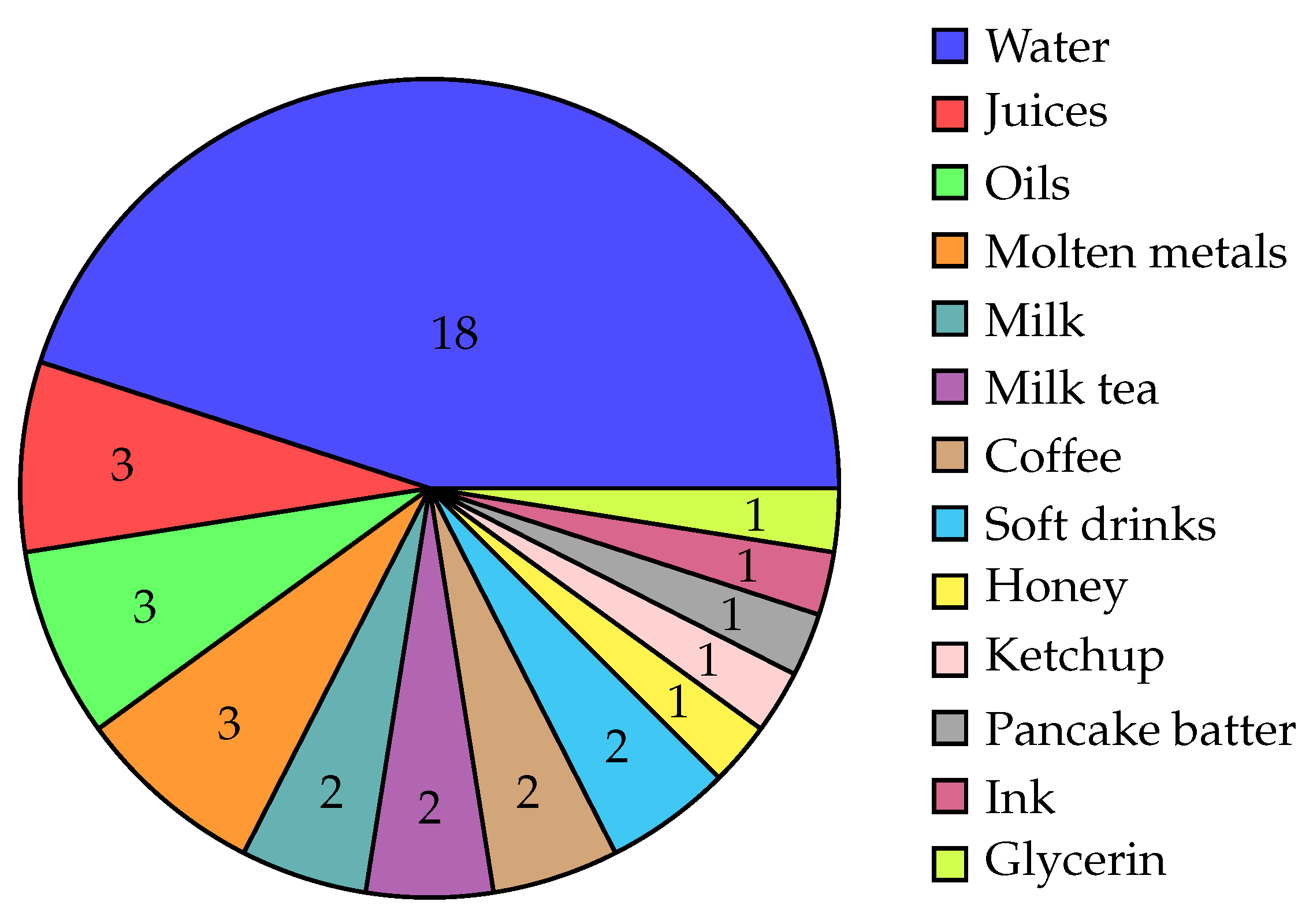
    It is important to note that one study [18] simulated the following liquids for their experiments: water, ink, oil, glycerin, honey, and ketchup.
    In contrast, six articles (26%: [9,16,52,55,57,58]) did not explicitly report the color of the liquid. These studies focused on system performance or technical aspects rather than providing details on the appearance of the liquid.
  • Transparency:
    A significant proportion of the reviewed literature, 22 articles (i.e., 96%), provided explicit information regarding the transparency of the liquids used. For example, ref. [47] described pancake batter as opaque, whereas ref. [51] included liquids such as water (transparent), coffee (opaque), tea (translucent), milk (opaque), and juices (opaque to translucent). In addition, ref. [18] simulated liquids with different transparencies, including water (transparent), ketchup (opaque), and honey (translucent). Similarly, ref. [26] specified the transparency of liquids like milk tea (opaque) and water (transparent), while ref. [49] reported mineral water (transparent), cola (opaque), and milk tea (opaque).
    Moreover, one paper (i.e., 4%) did not explicitly report on the transparency of the liquids [16].
  • Viscosity:
    From the total number of records, 15 papers (65%) provided explicit reports of the viscosity of the liquids utilized in their experiments. For instance, ref. [18] reported simulated liquids with varying viscosities: water ( 0.01 mPa·s), ink ( 0.05 mPa·s), oil ( 6.5 mPa·s), glycerin (50 mPa·s), honey (65 mPa·s), and ketchup (80 mPa·s). Similarly, ref. [26] provided indirect viscosity information by mentioning liquids such as milk tea (moderate viscosity) and water (low viscosity). Also, ref. [60] reported the viscosity of water as approximately 0.889 mPa·s. Other papers like [14,45] referred to viscosity indirectly through liquid types such as water, oil, milk, and juice. Industrial-scale applications also included molten metals like aluminum and iron, characterized by high viscosity [55,57,58].
    In contrast, eight papers (35%) did not explicitly report the viscosity of the liquids used. These include [9,16,18,46,51,54,56,59]. Instead of focusing on the physical properties of the liquids, these studies prioritized aspects such as control performance, learning algorithms, or perception models.
The reporting of liquid properties across the 23 studies is summarized in Figure 3, while the distribution of the most frequently used liquids is presented in Figure 4.

3.1.2. RQ2: What Are the Container Characteristics Considered in the Experimentation and How Do Their Properties Affect the Performance of the Pouring Tasks?

As a result of the analysis of 23 studies, four characteristics were extracted: container shape, container transparency, opening diameter of the container’s spout, and container height.
  • Container shape:
    All studies described at least one container type, either as the source (pouring) or the target (receiving) container. Considering that some experiments involved multiple configurations, the classification is described below:
    Source containers.
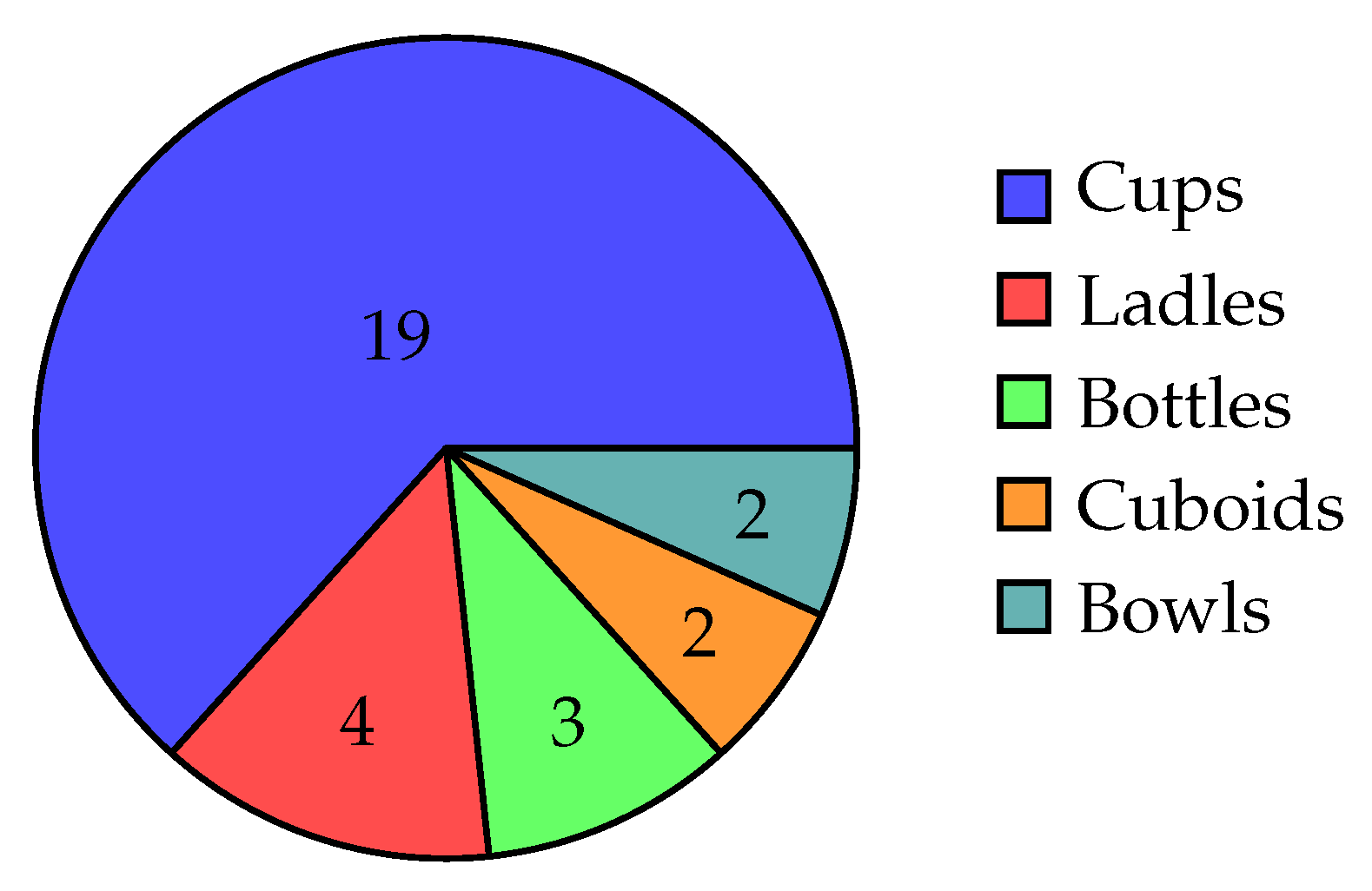
    The most frequently used source containers were cups or mugs (82%), typically with cylindrical glass cups as the standard cup. These containers were widely adopted due to their simple geometry and predictable pouring behavior [9,14,16,26,45,46,47,48,49,50,51,53,54,55,56,57,58,59,60].
    In industrial studies, ladles were used in 17% of the studies as source containers [55,56,57,58]. These were generally metallic and operated through tilting mechanisms to control molten materials or heavy liquids.
    Bottles were employed in 13% of the studies as source containers. These included wine and water bottles [59], pancake batter bottles [47], and cola bottles [49].
    Finally, cuboid or box-shaped containers were the least common (4.3%) and appeared exclusively in simulation-based studies using Smoothed Particle Hydrodynamics (SPH) [46], where a rotating cuboid was employed as the source container.
    Target containers.
    Only three studies explicitly described the target container geometry, which mainly included bowls and cuboid containers. Bowls were used in two works (9%) as target containers, mainly for viscous materials such as pancake batter or for visual–tactile experiments [45,47]. Cuboids (4.3%) were reported only in simulation-based work using the Smoothed Particle Hydrodynamics (SPH) method [46].
    The distribution of container shaped documented in the literature is presented in Figure 5.
  • Container transparency:
    Based on the results, the container transparency can be classified into transparent containers and opaque containers.
    Most studies have used transparent containers (i.e., 17 studies: 74%) such as glass cups [18,26,45,47,49,50,51,52,53,59,61] and a beer mug [9]. Conversely, few studies employed opaque containers, including opaque plastic cups [16] and an opaque aluminum beverage [60]. In industrial contexts, opaque metallic ladles were reported in [56,57], while a transparent ladle was used in [55]. The remaining studies (26%: [42,46,48,50,53,54]) did not explicitly specify the transparency of the containers.
  • Opening diameter of the container’s spout:
    A total of 10 studies (43%) reported opening diameter measurements. For instance, diameters of 64 mm (standard cup), 56 mm (thin glass), and 79 mm (beer mug) were reported in [9]. Another study [16] indicated three measures for the diameters of the containers’ spout (50–80 mm, 55–73 mm, and 70 mm). Similarly, Nishio et al. [60] described the beverage can with a 1.3 mm rim. Industrial ladles were modeled with upper and lower radii of r 1 = 195 mm and r 2 = 212 mm [58]. Additional examples include cylindrical or frustum cups with openings from 80 to 85 mm [52], as well as measuring cups or beakers with calibrated spouts [45,47,49,59].
    In contrast, 13 studies (57%: [18,26,46,48,50,51,53,55,56,57,61]) did not provide explicit diameter measurements.
  • Container height:
    Twelve articles (52%) explicitly reported container’s height. For instance, cups and glasses measured 110, 150, and 167 mm in [9], and 85, 82, and 100 mm in [16]. Other examples include a 110 mm beverage can [60], an acrylic ladle of 200 mm [55], and a cuboid container of 159 mm [46].
    Additional studies incorporated container height as a geometric or learning feature rather than a measured parameter. For example, ref. [59] used container height as an input feature in a neural network to generalize pouring behavior across containers of different sizes, while [52] implicitly modeled container height to calibrate the source–target trajectory. Bottles with variable fill levels ranging from 20 to 70 mm were reported in [47]. Moreover, industrial ladles ranged from 350 to 490 mm in height were used in [56,58].
    In contrast, almost half of the studies (48%: [16,18,26,47,48,49,50,51,53,57,61]) did not report the container’s height. In these cases, container geometry was described qualitatively or mentioned implicitly; nevertheless, specific height values were not provided.
    Table 2 shows a summary of the container properties documented in the literature, including shape, transparency, opening diameter, and height.

3.1.3. RQ3: What Are the Techniques Applied to Control Liquid Pouring?

The analysis of the selected papers based on RQ3 is summarized below, describing the type of algorithm, system robustness, experimental adaptability, and computational requirements.
In this review, control techniques are categorized according to the key control approach used to regulate the pouring process. In other words, this classification focuses on the control layer responsible for modulating the pouring behavior, rather than low-level motor or joint controllers. In this sense, autonomy processes or controls outside this scope are not considered, i.e., navigation, grasping nor transporting task control, are outside.
  • Algorithm type:
    Out of the 23 reviewed articles, 18 explicitly reported a computational algorithm designed to control or regulate the pouring process, representing approximately 78% of the studies. The remaining five studies (22%) did not implement autonomous pouring controllers. However, they examined complementary aspects such as augmented reality for human-in-the-loop adjustment [48], multimodal monitoring of pouring success and failure [54], computational fluid dynamics (CFD) simulations of beverage pouring [60], kinematic and dynamic modeling of heavy-load ladle robots [58], and human motor control experiments involving both visual and tactile feedback [45]. The algorithms reported in the studies of this review can be classified into nine categories: (1) Classical control (PID/PD/P/on–off), (2) Predictive control (MPC/NMPC), (3) Reinforcement learning (RL), (4) Imitation and end-to-end learning, (5) Probabilistic models (Gaussian Mixture Models), (6) Multimodal fusion (Vision and Audio), (7) Mechatronic pipelines with MLP and haptic/visual feedback, (8) State observers and estimation (Kalman Filters), and (9) Feedforward model-based control with online identification.
    (1)
    Classical control (PID/PD/P/on–off)
    Almost a third of the studies (30.4%) applied closed-loop control using simple regulators, occasionally integrated with vision-based perception. In the context of PID controllers, Do and Burgard [14] implemented PID controllers on a PR2 robot using an RGB-D perception system, while Wang et al. [56] implemented a three-loop PID scheme for foundry pouring processes. Similarly, Camporredondo et al. [46] applied PID control for slosh stabilization through SPH simulations.
    In terms of PD controllers, studies have implemented them in visual-based pouring scenarios as follows: (i) combining high-speed vision with PD control [9]; (ii) implementing P/PD strategies grounded on geometric container models [26]; (iii) introducing an on–off (bang–bang) control approach supported by self-supervised segmentation of transparent liquids [53]; and (iv) integrating weakly supervised perception with PID control in the PourIt! framework [51].
    (2)
    Predictive control (MPC/NMPC)
    A few studies (8.7%) have used predictive control to pour the liquid. Specifically, a study [42] employed Model Predictive Control (MPC) enabled by RNN predictions. A study [18] combined NMPC and reinforcement learning framework; however, the authors focused mainly on NMPC.
    (3)
    Reinforcement learning (RL)
    Reinforcement learning was applied in only two studies (8.7%). Zhang et al. [50] developed an offline RL method using a TD3+BC variant, while Babaians et al. [18] combined deep RL with PPO and an Intrinsic Curiosity Module (ICM), in conjunction with NMPC.
    (4)
    Imitation and end-to-end learning.
    Only three studies (13.0%) explored imitation and end-to-end learning. Zhang et al. [61] developed Explainable Hierarchical Imitation Learning (EHIL), Huang et al. [53] applied self-supervised segmentation using an LSTM, and Saito et al. [52] proposed end-to-end sensorimotor coordination using a Convolutional Autoencoder and LSTM.
    (5)
    Probabilistic models (Gaussian Mixture Models)
    Probabilistic motion planning was explored in a single study (4.3%). In this work, Wang et al. [49] combined a Gaussian Mixture Model (GMM) with a multimodal fusion network (MMFNet) to perform trajectory planning.
    (6)
    Multimodal fusion (Vision and Audio)
    Only one article (4.3%) employed multimodal fusion of visual and auditory inputs. Wang et al. [16] integrated ResNet-based visual features with LSTM-based audio features to design a three-stage pouring controller.
    (7)
    Mechatronic pipelines with MLP and haptic/visual feedback
    One study (4.3%) introduced a hybrid perception–control pipeline. Luo et al. [47] applied multilayer perceptrons (MLPs) to estimate pouring speed and time, while combining haptic and visual perception modules.
    (8)
    State observers and estimation (Kalman Filters)
    Another study (4.3%) employed decentralized Kalman Filters (DKFs) to estimate flow rate in real time for an automatic tilting-ladle pouring machine. Sueki and Noda [55] implemented both SSKF and EKF variants. It is worth noting that Do and Burgard [14] also applied a Kalman filter for liquid-level tracking; however, their primary control strategy was PID, so this work was categorized as classical controllers.
    (9)
    Feedforward model-based control with online identification
    Finally, one article (4.3%) implemented feedforward control with online parameter identification. Kabasawa and Noda [57] proposed inverse motor and process models combined with optimization to adaptively tune parameters such as angle, density, and flow coefficient.
The techniques applied to control liquid pouring in the reviewed studies are summarized in Table 3.
While Table 3 summarizes the distribution of control approaches in the literature, Table 4 and Table 5 provides a complementary analysis explaining why each technique is employed, its limitations, and how performance is evaluated.
  • System robustness:
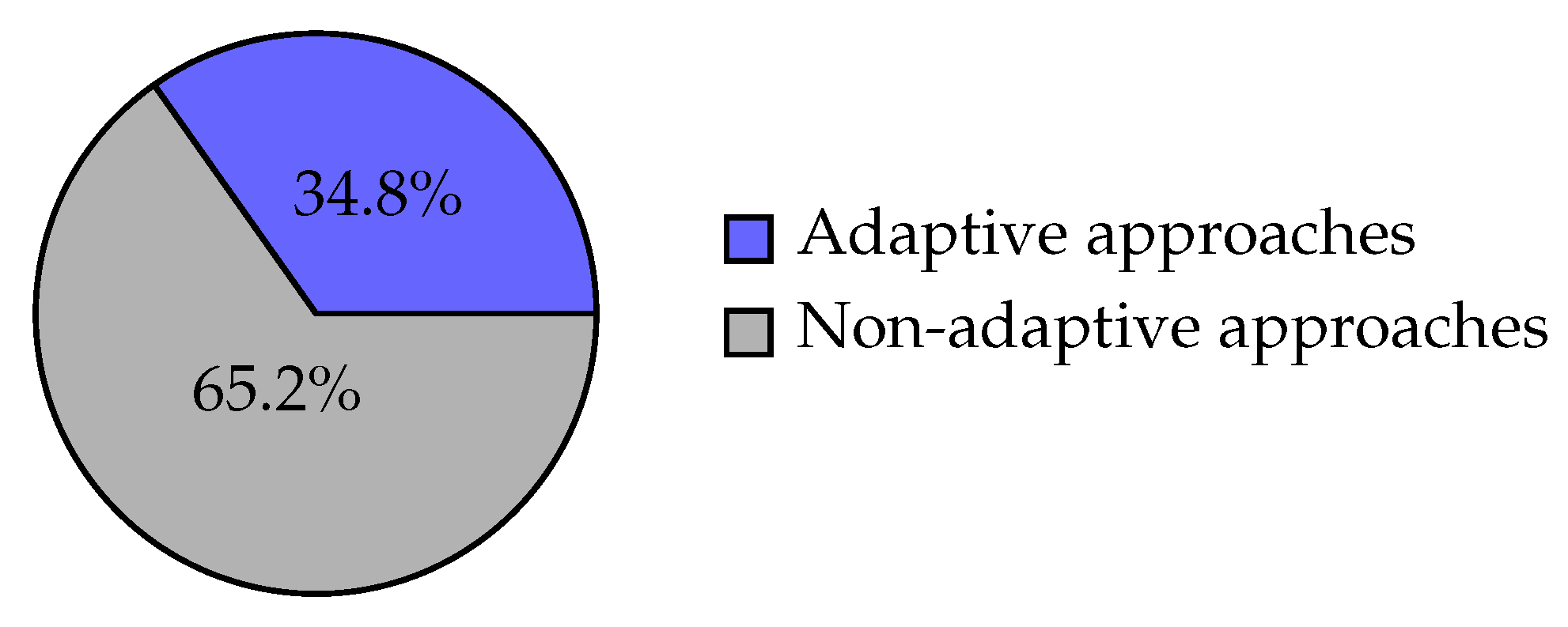
    System robustness was assessed in terms of whether the proposed approaches demonstrated the capacity to dynamically adjust the pouring process in response to unexpected changes. Of the 23 studies, eight papers (34.8%) explicitly reported adaptive mechanisms (i.e., adaptive approaches), while the remaining 15 papers (65.2%) relied on fixed parameters without real-time adjustment (i.e., non-adaptive approaches).
    Adaptive approaches (34.8%)
    The following eight studies have implemented approaches that adapted to changes:
    Zhu and Yamakawa [9] integrated high-speed vision with PD control to modify pouring in real time based on liquid dynamics;
    Narasimhan et al. [53] applied self-supervised segmentation to detect transparent liquid flow, enabling on–off control adjustments;
    Lin et al. [51] combined weakly supervised perception with PID in the PourIt! framework to adapt trajectories under variable conditions.;
    Zhang et al. [50] proposed an offline reinforcement learning approach that transferred liquid under previously unseen pouring conditions;
    Babaians et al. [18] integrated deep RL with NMPC, explicitly addressing changes in liquid behavior;
    Wang et al. [16] combined ResNet-based vision with LSTM-based audio features, where multimodal fusion supported robust detection of flow states;
    Wang et al. [49] incorporated probabilistic motion planning with GMM and MMFNet to adapt trajectories under multimodal uncertainties;
    Luo et al. [47] proposed a hybrid perception–control framework (MLPs with haptic and vision), adapting the pour speed and duration to external feedback.
    Non-adaptive approaches (65.2%)
    The remaining studies employed fixed controllers or modeling techniques without explicit mechanisms to handle unexpected variability:
    Do and Burgard [54], Camporredondo et al. [46], and Wang et al. [56] applied PID schemes with no adaptive mechanisms.
    Dong et al. [26] and Li et al. [58] relied on geometric or dynamic models with pre-set parameters;
    Sueki and Noda [55] implemented Kalman filters for flow estimation but not for adaptive control;
    Nishio et al. [60], Cleaver et al. [48], and Lin et al. [45] explored CFD, augmented reality, and motor control experiments, respectively, without autonomous adjustments;
    Huang et al. [53] and Saito et al. [52] focused on imitation and end-to-end learning, but did not demonstrate real-time adaptation;
    Wu et al. [54] concentrated on multimodal monitoring without adaptation mechanisms.
Figure 6 summarizes the distribution between adaptive and non-adaptive control strategies identified across the reviewed studies. As shown, only 34.8% of the studies employed adaptive mechanisms, whereas most (65.2%) were based on fixed, non-adaptive control environments, showing a dependence on predefined parameters rather than real-time adaptation.
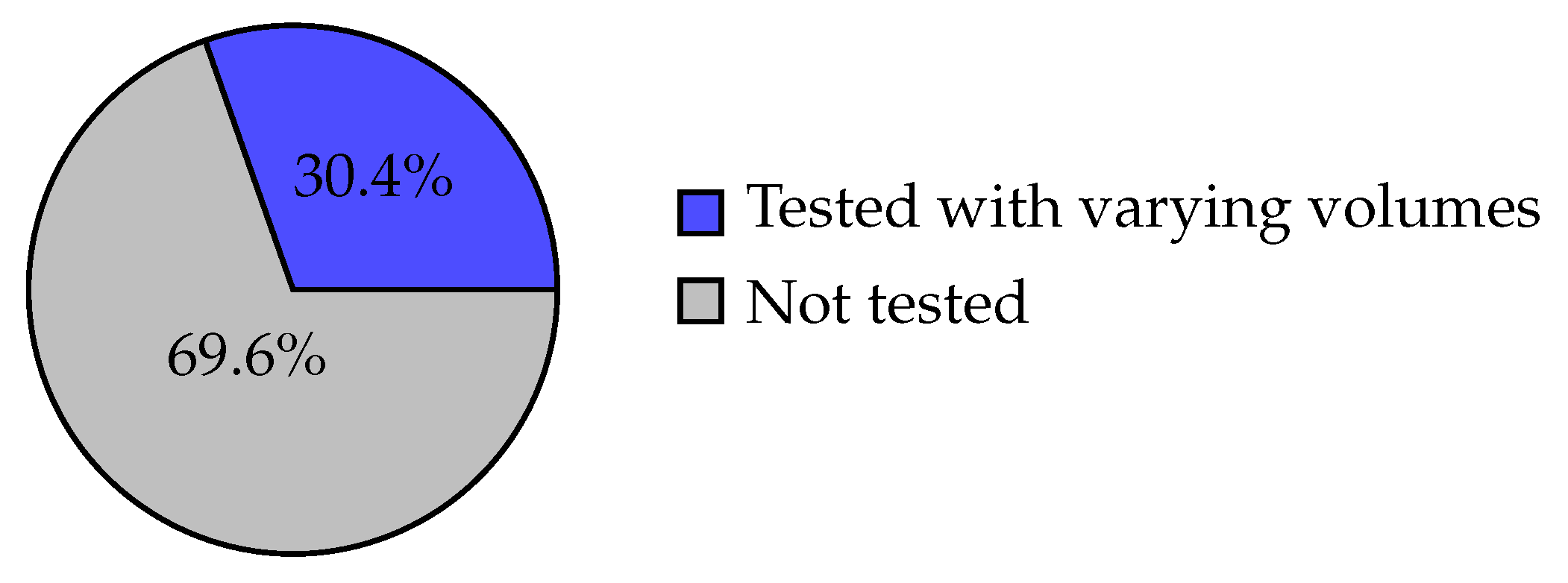
  • Experimental adaptability: Experimental adaptability was evaluated according to whether the methodology was tested under different initial volumes or filling levels. Out of the 23 studies, seven works (30.4%) reported explicit validation under multiple starting conditions, while the remaining 16 papers (69.6%) did not include such variations.
    Tested under different volumes/levels (30.4%)
    The following seven studies conducted experiments using several volumes/levels of liquid:
    Zhu and Yamakawa [9] evaluated PD control with high-speed vision under varying liquid amounts;
    Narasimhan et al. [53] tested on–off control with transparent liquids at different filling levels;
    Lin et al. [51] validated the PourIt! system using PID across multiple initial volumes;
    Babaians et al. [18] applied reinforcement learning to different container fill levels;
    Zhang et al. [50] assessed offline RL with TD3 and BC for generalization to new starting volumes;
    Wang et al. [16] examined multimodal fusion robustness under variable initial fills;
    Luo et al. [47] tested the hybrid perception–control pipeline across different liquid amounts.
    Not tested under different volumes/levels (69.6%)
    The remaining 16 studies operated with fixed experimental setups and did not explicitly assess performance across varying filling levels:
    Do and Burgard [54] applied PID schemes with constant initial volumes;
    Camporredondo et al. [46] and Wang et al. [56] applied PID schemes with constant initial volumes;
    Dong et al. [26] and Li et al. [58] conducted experiments using predefined static volumes only;
    Sueki and Noda [55] estimated flow rate with Kalman filters but did not test different liquid levels;
    Nishio et al. [60], Cleaver et al. [48], and Lin et al. [45] explored CFD, augmented reality, and motor control experiments without varying initial conditions;
    Huang et al. [53] and Saito et al. [52] applied imitation and end-to-end learning at single fixed levels;
    Wu et al. [54] analyzed multimodal monitoring of pour success and failure under constant setups;
    Wang et al. [49] evaluated trajectory generation under fixed initial states.
As shown in Figure 7, only 30.4% of the reviewed studies tested their methods under varying initial liquid volumes, while 69.6% relied on fixed setups. This highlights a limited experimental adaptability across most works, where pouring control is typically evaluated under static rather than dynamic conditions.
  • Computational Requirements:
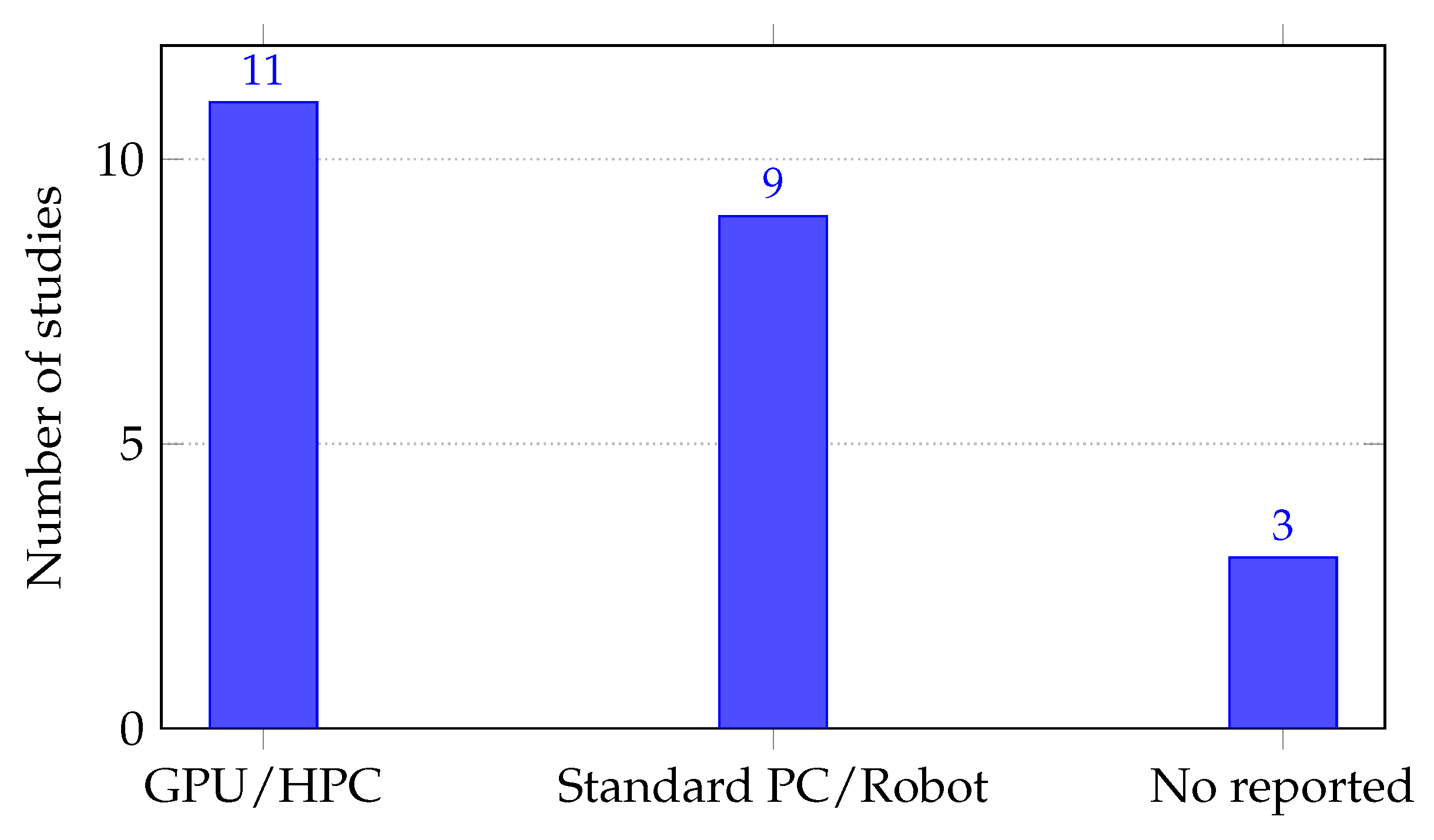
    Computational requirements were analyzed in terms of the hardware and software resources necessary to implement each methodology. Among the 23 studies, eleven articles (47.8%) required GPU-based or high-performance computing (HPC) environments, nine articles (39.1%) operated on standard robotic or PC hardware, and the remaining three papers (13%) were conducted in simulation without explicit hardware deployment.
    GPU/HPC
    Eleven studies (47.8%) required GPU or HPC resources for deep learning, reinforcement learning, or high-fidelity simulation. These include end-to-end CAE + LSTM control [52], self-supervised transparent liquid segmentation [53], self-supervised LSTM training for accurate pouring [59], explainable imitation learning [61], offline RL with TD3 + BC [50], multimodal audio–vision fusion [16], multimodal GMM/MMFNet planning [49], RL with PPO + ICM and NMPC integration [18], SPH-based simulations [46], CFD with Volume of Fluid Method (VOF) [60], and hybrid haptic–vision MLP frameworks [47].
    Standard PC/robot hardware.
    Approximately 39.1% of the studies operated on conventional computing platforms such as PCs, PLCs, or industrial robot controllers, typically using ROS, MATLAB/Simulink (https://www.mathworks.com/products/simulink.html (accessed on 19 December 2025)), OpenCV, or vendor-specific toolchains, without dedicated GPU or HPC requirements. Representative cases include RGB-D pouring with PID on a PR2 robot [14], P/PD control on industrial manipulators [26], on–off control with self-supervised segmentation on a UR5 arm [53], decentralized Kalman filtering and feedforward model-based control in tilting-ladle machines [55,57], hybrid foundry pouring with a three-loop PID implemented on PLC hardware [56], high-speed vision with PD control [9], and kinematic/dynamic modeling of heavy-load ladle robots in MATLAB/Simulink [58].
    Not reported.
    The remaining three studies (13%) implemented simulations; nevertheless, the authors did not report the hardware deployment used in the research. These included augmented reality guidance with HoloLens/Unity [48], human sensorimotor experiments without robotic computation [45], and multimodal monitoring on PR2 that reported only a basic ROS/Kinect setup [54].
As shown in Figure 8, nearly half of the reviewed studies relied on GPU/HPC resources, while the remainder operated on standard PC/robotic hardware or did not specify computational requirements.

3.1.4. RQ4: What Metrics Have Been Used to Assess the Methods for Pouring Liquid?

It is essential to note that the studies employed different metrics to evaluate their proposals. Specifically, they employed the following five metrics:
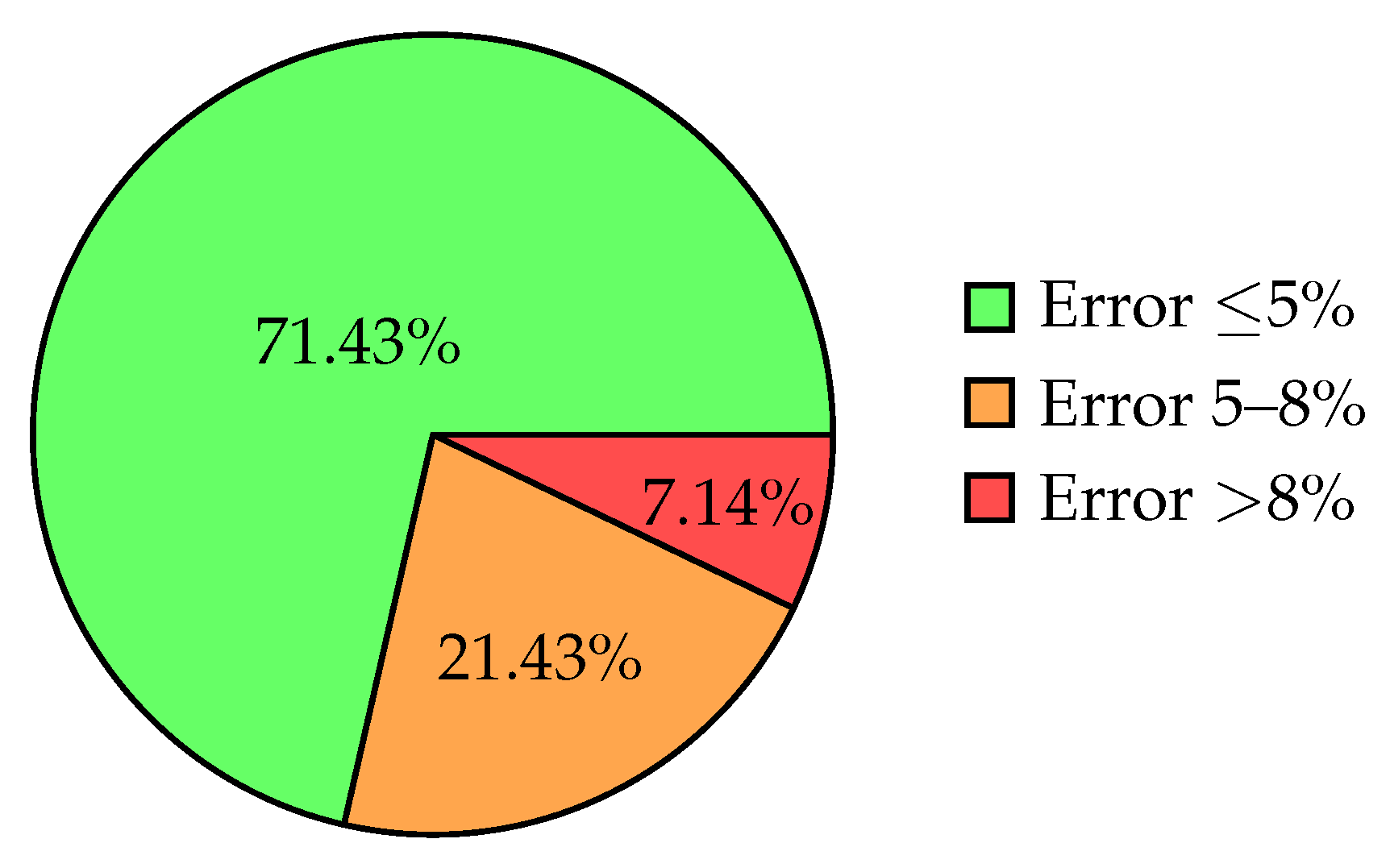
  • Average pour error: Over half of the studies (i.e., 61%: [9,14,16,18,26,42,49,52,53,54,55,57,59,60]) used the average pour error as a metric to evaluate the performance of robotic pouring systems. Specifically, three types of units have been used to report this error: percentage, milliliters, and grams.
    At least six studies reported the error in percentage terms, including ref. [52], who reported deviations between 6.0 % and 7.8 % , ref. [53], with a 0.94% relative error in fluid level estimation, and ref. [9], who achieved a steady-state error of less than 5% in beer foam control. Similarly, refs. [57,60] reported relative deviations under 5%, while ref. [54] defined successful pours as those within a ± 5 % tolerance.
    Regarding the error measured in milliliters, at least six studies, including [14,16,26,42,49,59], reported values ranging from approximately 3.7 mL to 30.5 mL, depending on the fluid, container, and level of generalization. These studies often used volumetric error to compare learning-based and classical controllers.
    Lastly, two studies reported the error in grams [18] and achieved errors between 3.8 and 8.66 g across different liquids, and ref. [57] showed improvement from 0.1346 kg to 0.0498 kg after parameter tuning, reinforcing the robustness of their model-based control strategy.
    Of these, 14 papers are distributed as shown in Figure 9.
  • Success rate:
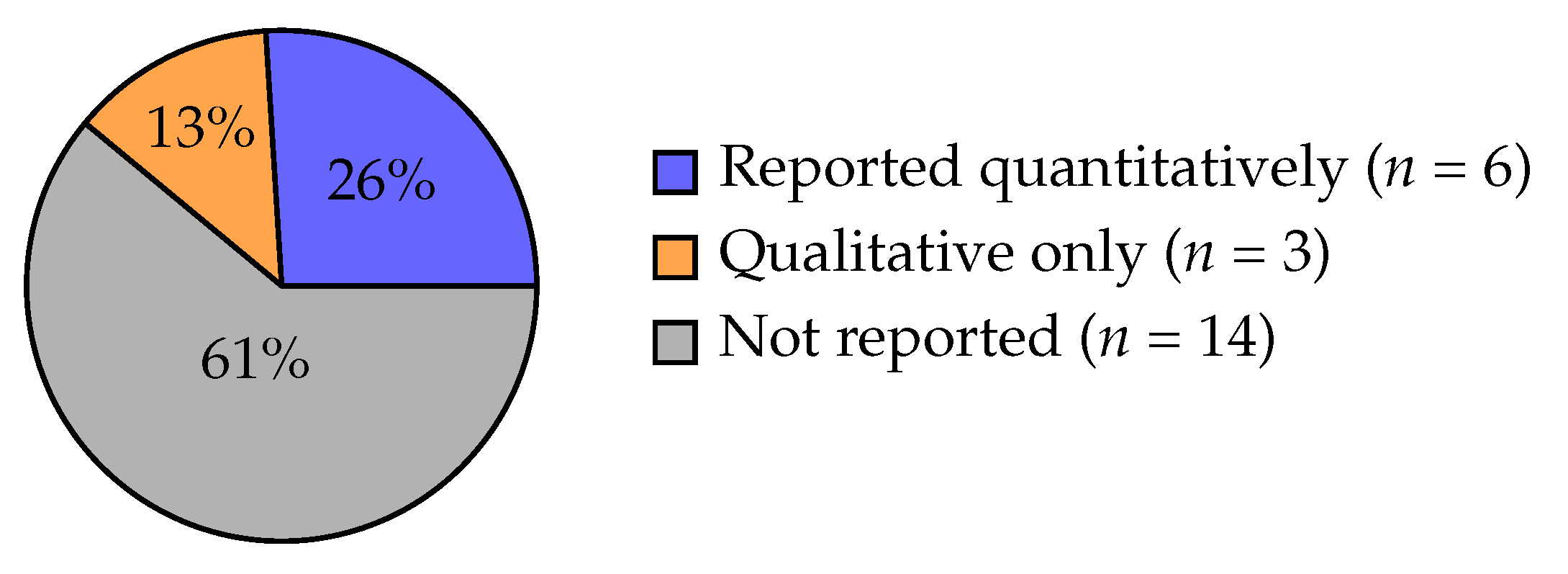
    Among the 23 reviewed papers, only six explicitly report the success rate of the poured liquid in terms of percentage, representing 26% of the total number of articles. These include: [61] with 92%, [50] with 95.25%, [51] with 93.3%, [54] with a classification success rate within ± 5 % error, [48] with 53.8%, and [16] with a completion rate of 73–85%, depending on container and liquid.
    In addition to the studies that explicitly reported success rates as percentages, three papers (13%) evaluated pouring success using qualitative or binary criteria rather than numerical values. For example, ref. [59] assessed success using binary labels (success/failure), based on tasks completed and the minimal trajectory deviation, without providing quantitative accuracy. Another case is ref. [56], who evaluated pouring performance qualitatively, comparing poured and target masses without reporting explicit percentages. Similarly, ref. [14] reported stable performance with low error margins over 290 trials but did not specify a numerical success rate. These studies provide indirect insights into system performance, but lack standardized metrics for quantitative comparison.
    A considerable proportion of the reviewed literature, comprising over half of the papers (61%), did not explicitly report or assess the success rate of the poured liquid (i.e., [9,18,26,42,45,46,47,49,52,53,55,57,58,60]). The overall distribution of papers according to success rate reporting is illustrated in Table 6.
  • Spill volume:
    Only five articles explicitly reported spill volume measurements or provided indirect estimations. For instance, ref. [18] reported deviations of approximately 2.3 g for soap and 5.5 g for water, indirectly indicating spill volumes. Similarly, ref. [60] quantified spill through overflow measurements, reporting average errors of approximately 4.6 mL and 2.6 mL. Ref. [56] provided measurements of external dripping in cm3 as a spill metric, while ref. [14] reported pour errors between 11.88 ± 4.63 mL and 4.96 ± 2.57 mL, which can be interpreted as spill volume under certain conditions. Only one article [54] provided binary or qualitative evaluations of spill volume without explicit values, while the remaining 18 papers, comprising approximately 78% of the total (i.e., [9,16,26,42,45,46,47,48,49,50,51,52,53,55,57,58,59,61]), did not quantify spill volume in their experiments.
  • Pouring run time:
    A total of 11 papers (48%) reported explicit measurements of the pouring run time, that is, the duration required to complete the liquid pouring process. For instance, ref. [49] reported an average pouring time of 8 s; ref. [52] reported a typical duration of 38 s; ref. [45] measured times through phase-based segmentation without providing a total duration; ref. [16] reported a duration of 10 s; ref. [9] reported around 11 s; ref. [55] detailed extremely short durations of less than 0.02   s , reflecting high-speed industrial processes; ref. [56] derived the time indirectly from control parameters; ref. [58] provided modeled durations using mathematical formulas; ref. [57] reported pouring durations of less than 4 s; [59] presented a range of 2.8 to 7.6 s; and ref. [60] provided dynamic measurements across trials, reporting durations ranging from 3.2 to 8.7 s depending on container and fluid properties. These reports illustrate the diversity of approaches to measuring pouring performance, highlighting variability in completion times between different robotic systems, experimental setups, and evaluation conditions.
    Conversely, 12 papers (52%) did not report explicit measurements of pouring run time, nor did they provide indirect or qualitative evaluations of this variable, thereby limiting the assessment of temporal performance in their studies. These papers include [14,18,26,42,47,48,49,50,51,53,59,61], which focused on other performance metrics such as accuracy, trajectory planning, or liquid detection, without explicitly quantifying the duration of the pouring process.
Figure 9. Distribution of average pour error (APE) ranges among the 14 studies that reported this metric.
Mca 31 00030 g009
Table 6. Success rate reporting across the reviewed literature, aligned with Figure 10 (1–6).
IDReferenceReporting TypeSuccess Metric/Notes
Explicit quantitative reporting (6 papers; 26%)
1Zhang et al. [61]Percentage (%)92%
2Zhang et al. [50]Percentage (%)95.25%
3Lin et al. [51]Percentage (%)93.3%
4Wu et al. [54]Percentage (%)Classification success within ±5% error (shown as ∼95% in Figure 9)
5Cleaver et al. [48]Percentage (%)53.8%
6Wang et al. [16]Percentage (%)73–85% (depends on container/liquid)
Qualitative/binary reporting (3 papers; 13%)
Huang et al. [59]Qualitative/binaryComparable to human performance; consistent trajectories and reduced errors (no explicit %)
Wang et al. [56]Qualitative/binarySuccess assessed via qualitative observations and mass transfer; no explicit percentage
Do and Burgard [14]Qualitative/binaryStable/low error across 290 trials; no explicit success rate
Not reported (14 papers; 61%)
Chen et al. [42]; Luo et al. [47]; Wang et al. [49]; Babaians et al. [18]; Dong et al. [26]; Saito et al. [52]; Narasimhan et al. [53]; Lin et al. [45]; Zhu and Yamakawa [9]; Camporredondo et al. [46]; Sueki and Noda [55]; Li et al. [58]; Kabasawa and Noda [57]; Nishio et al. [60]Not reportedNo explicit success rate provided.
Percentages are relative to the total number of reviewed studies (n = 23).
Figure 10. Success rate reporting across the 23 reviewed studies.
Mca 31 00030 g010

3.1.5. RQ5: What Devices Are Used to Measure the Volume Poured?

Across the 23 reviewed studies, different strategies were adopted to measure or estimate the poured liquid volume. These can be grouped into four main categories: weight/force sensors, vision-based methods, multimodal fusion, and simulation-based estimation. A minority of works did not include any explicit measurement device.
  • Weight and force sensors
    A subset of studies (21.7%) employed load cells or force/torque (F/T) sensors as their primary modality. These works used six-axis F/T sensors and integrated load cells in automatic pouring systems [42,52,55,57,59]. These devices directly measure transferred mass, enabling closed-loop regulation.
  • Vision-based estimation.
    A total of 30.4% of the studies relied primarily on vision-based approaches to estimate the poured volume, using RGB cameras and their depth-extended variant (RGB-D). For instance, ref. [14] applied an RGB-D sensor with refraction correction, ref. [26] used depth data from a calibrated camera, and ref. [51] integrated depth and monocular RGB information. In addition, vision techniques were employed for transparent liquid segmentation [53], foam/liquid differentiation [9], RGB-based state inference [61], and hardware-in-the-loop feedback [49].
  • Multimodal Fusion.
    Two papers (8.7%) integrated multimodal inputs, mainly combining vision and audio. refs. [16,49] integrated depth vision with a microphone and validated results using an external electronic scale. In both cases, multimodal signals drove the controller, while the scale served only as a ground-truth reference.
  • Simulation-based estimation.
    Three studies (13.0%) relied solely on computational modeling without physical devices. ref. [46] simulated pouring with SPH, ref. [60] used CFD with the VOF method, and ref. [58] derived kinematic/dynamic models of ladle pouring.
  • No explicit measurement.
    Finally, six studies (26.1%) did not employ explicit devices to quantify poured volume. These include work on augmented reality [48], multimodal monitoring [54], human motor control [45], and reinforcement learning approaches that relied on fixed targets or classifiers rather than in-loop measurement [18,50].
Table 7 summarizes the devices and strategies used to measure poured volume, showing a predominance of vision- and sensor-based approaches over simulation or qualitative methods.

4. Discussion

The following section presents a detailed analysis of the results for each of the five research questions (RQs).

4.1. Discussion for Research Question 1

As shown in Figure 3, transparency was the most frequently reported liquid property across the reviewed works, followed by density, color, and viscosity. The following sections analyze the relationships between density and viscosity, as well as between color and transparency, to better understand these differences.

4.2. Density vs. Viscosity

Although both density and viscosity are fundamental to fluid dynamics, studies indicate that they are utilized differently during the pouring process. Only a subset of articles quantified both properties simultaneously. The majority reported either density or viscosity, depending on their experimental objective.
Studies using common low-viscosity liquids, such as water, milk, or tea, typically report only density, as this directly influences mass-based control and simplifies model parameterization for feedback systems (e.g., those using load cells or F/T sensors). Density is therefore used in models that approximate fluid behavior through simplified physical priors, where flow dynamics are not explicitly simulated.
In contrast, research on non-Newtonian or high-viscosity substances, such as honey, syrup, ketchup, and molten metals, tends to emphasize viscosity, as it regulates the flow resistance, strain rate, and time constant of the pouring flow. Viscosity becomes particularly relevant for adaptive or trajectory-based control, where precise flow modulation depends on the fluid’s response to motion and container geometry.
Despite their close physical relationship, few studies have examined density and viscosity together. However, their combined influence determines flow regime transitions, such as laminar or turbulent flow.

4.3. Color vs. Transparency

Even though color and transparency are both optical properties of liquids, they are reported with different purposes across the studies. Most studies (74%) explicitly described color, whereas transparency was reported in 96% of the studies. This contrast reflects that color is typically treated as a perceptual or dataset attribute, while transparency directly influences how robotic systems perceive and measure liquids through vision-based sensors.
Most studies using common beverages such as water, milk, tea, or juice reported color mainly to distinguish experimental conditions or support visual learning tasks (e.g., water or milk-tea segmentation). In contrast, works focused on control performance or industrial applications rarely mentioned color, as visual appearance was irrelevant to their objectives. As shown in Figure 4, water was the most frequently used liquid due to its stability and well-known physical properties. However, this strong dependence on water limits the exploration of more complex optical and flow behaviors.
Transparency was reported in almost all studies because it determines the optical interaction between the liquid surface and the sensing modality. Transparent and translucent liquids present refraction and depth estimation problems in RGB-D or stereo systems. Conversely, opaque liquids facilitate segmentation because their boundaries are visually defined. However, they interfere with real-time surface monitoring, since light cannot pass through to indicate flow or level variations.

4.4. Discussion for Research Question 2

As discussed in Section 4.1, the physical and optical properties of liquids have a significant influence on pouring performance. However, the container that holds or receives the liquid is equally important, as its geometry, size, and material determine how the liquid flows, is sensed by sensors, and can be controlled during the pouring process. As shown in Table 2, container shape was reported in all reviewed studies, highlighting its central role in both experimental setup and task performance.

4.4.1. Source vs. Target Containers

There is a distinction between the source and target containers, which perform complementary functions during the pouring process. Its symmetrical and regular geometry allows for liquid flow to be predicted using simple equations, without the need to model turbulence or irregular shapes. This symmetry also facilitates the estimation of liquid transfer and the change in the container’s center of gravity. These characteristics, in combination with the physical simplifications described in Research Question 1 (RQ1), enable dynamic modeling and control.
Conversely, target containers were mentioned in just three studies, usually as bowls or cuboid containers. This limited consideration suggests that target containers are often regarded as elements that simply receive the liquid, rather than influencing the pouring dynamics.

4.4.2. Material Transparency vs. Geometric Constraints

Transparent glass containers are used in most laboratory experiments because they allow vision-based systems to monitor liquid levels and flow continuity. In contrast, opaque or metallic containers are common in industrial settings. However, opaque materials hinder visual tracking and require force or torque sensors to compensate for the lack of visual feedback.
Additional constraints on pouring dynamics are caused by geometric parameters such as spout width and container height. A wider spout enables faster flow but reduces precision, while narrower openings improve control. Some studies did not directly measure the height of the container, but instead used it as an input variable in their models. This suggests a trend toward data-driven approaches, where the system learns how geometry affects the pouring process rather than relying solely on predefined geometric measurements.

4.5. Discussion for Research Question 3

As previously shown in Table 3, the majority of studies implemented algorithm-based approaches to regulate the pouring process, while a smaller portion focused on aspects such as simulation or experiments with human intervention.
Classical controllers (PID, PD, and on/off) remain the most widely used for liquid pouring. As reported by authors, the prevalence is based on their computational efficiency, ease of implementation, and stable behavior in real-time robotic systems. These controllers can regulate the pouring angle or rate without explicitly modeling nonlinear fluid dynamics. Furthermore, their control parameters (e.g., proportional and derivative gains, threshold values, or fixed pouring angles) can be manually modified, allowing the system’s behavior to be tuned based on empirical observations. This quality makes classical control particularly suitable for scenarios with limited training data, limited hardware resources, or critical safety requirements.
In contrast, learning-based methods, such as reinforcement learning, imitation learning, and probabilistic models, are used less frequently. While these approaches can be adapted to complex nonlinear fluid behaviors, they typically require large datasets, extensive training, or accurate fluid dynamics simulators, which are often unavailable or computationally expensive. Furthermore, issues related to stability guarantees, convergence, and transfer from simulation to reality remain significant challenges that limit their adoption in real-world pouring systems.
A critical factor in the efficacy of a control system is robustness. The majority of conventional controllers operated with fixed parameters, constraining their adaptability to unexpected changes in liquid behavior. Adaptive approaches, particularly those incorporating reinforcement learning, multimodal fusion, or hybrid perception and control frameworks, demonstrated greater flexibility, allowing for real-time adjustments under varying conditions. These findings underscore the importance of prioritizing robustness as a central criterion for future evaluations.
Although multimodal fusion offers robustness advantages, technical implementation introduces significant challenges regarding fusion architectures and control loop latency. The reviewed literature reveals three primary strategies for integrating sensory inputs.
1.
Deep Learning-based Fusion: For example, in [16], the authors employ a “late fusion” architecture, where visual features (from attention-based ResNets) and audio features (processed via FFT and LSTMs) are concatenated. While effective for opaque liquids, this approach relies on high GPUs and introduces latency due to the signal processing window required for FFT and the inference time of deep models.
2.
State estimation and Kalman filtering: In contrast, industry-oriented studies such as [55] use decentralized Kalman filters (DKFs) to fuse data from motor encoders and flow sensors. This architecture is computationally lightweight and is optimized for real-time execution, although it is less adaptable to complex dynamics.
3.
Haptic integration: ref. [47] describes a specialized architecture, in which haptic feedback from a force/torque sensor is used to estimate the properties of the fluid, during the agitation phase. In this work, the authors propose a parameter-level fusion in which the output of a multilayer perceptron (MLP) is used to adjust the pour controller’s speed. Although this approach improves robustness for variable viscosities (e.g., non-Newtonian fluids, such as pancake batter), the system requires calibration before execution. While using haptics reduces reliance on visual feedback, sequential task execution is required to maintain state estimation accuracy.
There is a significant gap concerning experimental adaptability and computational requirements. Few studies validated their methods using different initial volumes or fill levels, even though real-world applications rarely involve identical fill levels. Approximately half of the studies relied on GPU or HPC resources, particularly to support computationally intensive components such as learning-based controllers, perception modules, or simulation environments. However, real-world robotic platforms operate on standard PCs or embedded hardware.

4.6. Discussion for Research Question 4

As established in Section 3.1.4 and Figure 9, the most frequently used metric was the average pour error (APE), which was reported in 61% of the studies. Most errors were under 5%, indicating high precision in controlled settings. However, some studies reported higher deviations, reflecting variability across tasks and liquids.
Success rates were reported less frequently. While a minority of works quantified it explicitly (Table 6), others relied on qualitative or binary labels. More than half of the literature did not assess this metric (Figure 10), which limits comparability. A standardized definition of “success” is needed to assess robustness across different systems.
Spill volume was the least considered metric, mentioned only in five studies. Its omission reduces its real-world applicability because it directly reflects efficiency and safety. The pouring run time was documented in about half of the papers. Reported values ranged from fractions of a second in industrial contexts to over 30 s in laboratory experiments, thus demonstrating differences across the diverse scenarios.
The diversity of these metrics highlights a significant lack of standardization in this field. To better understand these findings, the identified metrics can be organized into a taxonomy based on four dimensions: accuracy (pour error), safety (spills), efficiency (runtime), and reliability (success rate). Currently, the lack of the parameters makes it difficult to compare the effectiveness of different control techniques. For example, measuring only the final volume does not capture for flow quality, such as whether splashing occurs. Since this is a new area of research, it is important to establish standardized evaluation protocols.

4.7. Discussion for Research Question 5

Based on the data detailed in Section 3.1.5 and Table 7, four main strategies were used to measure poured volume: vision-based estimation (30.4%), weight or force sensors (21.7%), multimodal fusion (8.7%), and simulation approaches (13.0%). More than a quarter of the studies (26.1%) did not employ explicit measurement devices.
There are two types of volume measurement approaches: direct and indirect. Direct measurement using weight and force sensors provides an accurate value of mass transfer, facilitating closed-loop control systems. However, its use was limited, as not all containers, particularly scoops, can be placed on instrumented stands. Indirect approaches rely on perceptual inference, primarily using vision-based systems that estimate liquid levels from visual signals. Although camera-based solutions are easier to integrate into robotic platforms, they are highly sensitive to transparency and lighting conditions.
Multimodal fusion attempted to address these limitations by combining complementary signals, such as visual and audio, to estimate flow. However, environmental noise limits its real-world applicability. Simulation-based methods provide useful data for algorithm validation. Nevertheless, they could not compare physical evaluation under varying conditions.

4.8. Limitations

This scoping review presents the following limitation:
Terminology-and-scope boundary. The search terms were selected based on the most commonly used and recognized terminology in is field. Based on this, “pouring”, “liquid”, and “control” were included as main search terms. However, it is important to note that studies using related or synonymous terms, such as “dispensing” or “decanting”, are excluded. These terms were excluded in accordance with our inclusion criteria, which prioritize liquid transfer via tilting open-mouthed containers over internal mechanical valves or pressurized systems, which are typically described as “dispensers”. Similarly, while the review focuses on pouring control, studies referring to “liquid transport” or “spill control” during locomotion were excluded.

5. Future Directions

Based on the results of question 1, future research in terms of this RQ should focus on indicating the liquid properties. Most studies used qualitative labels to report density, viscosity, transparency, and color. Consequently, the experiments could not be reproduced. In order to ensure the reproducibility of the research, it is necessary to at least provide quantitative values for the following liquid characteristics: density, viscosity, transparency, and color. Moreover, the majority of the studies have employed water in the experiments. Nevertheless, several types of liquid are manipulated in daily human activities and industry applications. Consequently, experiments should expand the range of liquids analyzed, including viscous, opaque, carbonated, or non-Newtonian fluids that might provide conditions closed to real-world situations. Additionally, the algorithms for controlling pouring liquid might be more robust and fault-tolerant when they are tested using more types of liquid.
Focusing on RQ2, opportunity areas for further research could expand the range of container shapes beyond cups, jugs, and cuboids to incorporate bottles, ladles, and irregular geometries. Additionally, transparency should be addressed in greater detail. Transparency should be reported with degrees of opacity rather than as a binary property (transparency or opaque), since this directly influences detection algorithms. Studies must report precise numerical values for container characteristics, such as spout height and diameter, as these parameters determine the flow rate and pouring accuracy. Therefore, combining a variety of containers could improve adaptability, enabling systems to handle unconventional containers common in industrial and service environments.
Regarding RQ3, and the prevalence of classical controllers in the current literature, future research should emphasize adaptive and learning-based approaches. Reinforcement learning, imitation learning, and multimodal fusion are promising for handling nonlinear fluid dynamics and diverse container geometries. Effective validation of these approaches requires testing across varied experimental conditions encompassing multiple liquid quantities, container fill levels, and pouring rates to demonstrate generalizability and robustness. Moreover, the balance between system accuracy and latency is rarely addressed in the literature. For example, audio sensors are very useful in low-light environments, but processing these signals in real time requires significant computational effort. At the same time, algorithms must be optimized for deployment on resource-constrained hardware. Developing lightweight architectures that minimize dependence on GPUs or HPCs will prove essential for practical implementation on robotic platforms operating in real-world environments.
According to RQ4, the average pour error was the most frequently reported metric, but it remains inconsistent across studies. Some studies expressed this measurement as a percentage, others in milliliters or grams, without a standardized definition. Conversely, researchers rarely quantified spill volume, despite its direct relevance to precision assessment. Pouring run time was largely ignored in most studies, even though it is crucial for assessing performance in service environments. Future research should evaluate the trade-off between speed and accuracy, exploring how adaptive controllers can optimize both speed and accuracy without compromising safety.
Finally, based on RQ5, future research should focus on combining the advantages of direct and indirect measurement methodologies. For instance, combining vision with weight or haptic sensors could provide both the accuracy of physical measurements and the adaptability of perception-based control. Additionally, multimodal fusion should extend beyond vision and audio setups to incorporate more robust combinations capable of processing noise and variable lighting. Furthermore, simulation studies should always be supported by physical validation to ensure reproducible and transferable results.

6. Conclusions

This work highlights several methods and techniques from the literature on robotic liquid pouring. Most studies rely on qualitative descriptors of liquid properties and use water as the default test substance, which limits the ability to generalize. Container shape was consistently reported, but other characteristics such as transparency, height, and spout diameter were less frequently addressed, even though they directly affect pouring dynamics.
Classical control strategies, such as PID and PD, remain predominant, while adaptive and learning-based methods, despite their potential to handle nonlinear dynamics and diverse container conditions, remain unexplored. The average pour error is the most common metric for evaluating pouring performance; however, other relevant measures, such as spill volume, have not been explored. Devices used to measure poured volume reveal a gap between direct methods, such as force sensors, and indirect perception-based techniques. Furthermore, many studies do not report any measurements.
The state of research on robotic liquid pouring is limited by the use of simplified liquids, containers, and metrics. This results in limited robustness and comparability across studies. Advancing the state of the art will require broader experimental conditions and standardized reporting. Integrating adaptive and multimodal approaches is also essential for improving accuracy and real-world applicability.


Author Contributions

Conceptualization, J.J.R.-M. and A.M.-H.; data curation, J.J.R.-M.; methodology, J.J.R.-M. and E.J.R.-R.; formal analysis, J.J.R.-M.; writing—original draft preparation, J.J.R.-M.; writing—review and editing, J.J.R.-M., A.M.-H. and E.J.R.-R.; supervision, A.M.-H. and E.J.R.-R. All authors have read and agreed to the published version of the manuscript.

Funding

This research received no external funding, and the APC was funded by Universidad Veracruzana.

Data Availability Statement

No new data were created or analyzed in this study.

Acknowledgments

J.J.R.-M. thanks Mexican National Secretariat of Science, Humanities, Technology, and Innovation Secihti (Secretaría de Ciencia, Humanidades, Tecnología e Innovación) for funding his PhD studies (CVU number: 1142861).

Conflicts of Interest

The authors declare no conflicts of interest.

References

  1. Si, W.; Guan, Y.; Wang, N. Adaptive Compliant Skill Learning for Contact-Rich Manipulation With Human in the Loop. IEEE Robot. Autom. Lett. 2022, 7, 5834–5841. [Google Scholar] [CrossRef]
  2. Paulius, D.; Huang, Y.; Meloncon, J.; Sun, Y. Manipulation Motion Taxonomy and Coding for Robots. In Proceedings of the 2019 IEEE/RSJ International Conference on Intelligent Robots and Systems (IROS), Macau, China, 3–8 November 2019; pp. 5596–5601. [Google Scholar]
  3. Sakib, M.S.; Paulius, D.; Sun, Y. Approximate Task Tree Retrieval in a Knowledge Network for Robotic Cooking. IEEE Robot. Autom. Lett. 2022, 7, 11492–11499. [Google Scholar] [CrossRef]
  4. Castilla, R.; Gamez-Montero, P.; Raush, G.; Khamashta, M.; Codina, E. Numerical Study of Impingement Location of Liquid Jet Poured from a Tilting Ladle with Lip Spout. Metall. Mater. Trans. B 2017, 48, 1390–1399. [Google Scholar] [CrossRef]
  5. Noda, Y.; Terashima, K. Nonlinear Modeling with Hydrodynamics and Flow Control Using Inverse Pouring Dynamics of Tilting-Ladle-Type Automatic Pouring Process. In Proceedings of the 67th World Foundry Congress, Harrogate, UK, 5–7 June 2006. [Google Scholar]
  6. Sueki, Y.; Noda, Y. Development of Flow Rate Feedback Control in Tilting-ladle-type Pouring Robot with Direct Manipulation of Pouring Flow Rate. In Proceedings of the International Conference on Informatics in Control, Automation and Robotics, Prague, Czech Republic, 29–31 July 2019. [Google Scholar]
  7. Tsuji, T.; Noda, Y. High-precision pouring control using online model parameters identification in automatic pouring robot with cylindrical ladle. In Proceedings of the 2014 IEEE International Conference on Systems, Man, and Cybernetics (SMC), San Diego, CA, USA, 5–8 October 2014; pp. 2563–2568. [Google Scholar] [CrossRef]
  8. Noda, Y.; Terashima, K. Falling Position Control of Outflow Liquid for Automatic Pouring System with Tilting-Type Ladle. IFAC Proc. 2007, 40, 53–58. [Google Scholar] [CrossRef]
  9. Zhu, H.; Yamakawa, Y. Robotic Pouring Based on Real-Time Observation and Visual Feedback by a High-Speed Vision System. J. Robot. Mechatronics 2022, 34, 965–974. [Google Scholar] [CrossRef]
  10. Zhu, Y.; Fusano, K.; Aoyama, T.; Hasegawa, Y. Intention-reflected predictive display for operability improvement of time-delayed teleoperation system. ROBOMECH J. 2023, 10, 17. [Google Scholar] [CrossRef]
  11. Pan, Z.; Manocha, D. Motion planning for fluid manipulation using simplified dynamics. In Proceedings of the 2016 IEEE/RSJ International Conference on Intelligent Robots and Systems (IROS), Daejeon, Republic of Korea, 7–14 October 2016; pp. 4224–4231. [Google Scholar]
  12. Pan, Z.; Park, C.; Manocha, D. Robot Motion Planning for Pouring Liquids. In Proceedings of the International Conference on Automated Planning and Scheduling, London, UK, 12–17 June 2016. [Google Scholar]
  13. Zhu, F.; Hu, S.; Leng, L.; Bartsch, A.; George, A.; Farimani, A.B. Pour me a drink: Robotic Precision Pouring Carbonated Beverages into Transparent Containers. arXiv 2023, arXiv:2309.08892. [Google Scholar] [CrossRef]
  14. Do, C.; Burgard, W. Accurate Pouring with an Autonomous Robot Using an RGB-D Camera. In Intelligent Autonomous Systems 15; Strand, M., Dillmann, R., Menegatti, E., Ghidoni, S., Eds.; Springer: Cham, Switzerland, 2019; pp. 210–221. [Google Scholar]
  15. Cleaver, A.; Aronson, R.M.; Sinapov, J. Helping People Predict the Outcome of Robotic Pouring Behaviors with Augmented Reality. In Proceedings of the 7th International Workshop on Virtual, Augmented, and Mixed-Reality for Human-Robot Interactions, Boulder, CO, USA, 11–14 March 2024. [Google Scholar]
  16. Wang, Z.; Tian, G.; Pan, H. Robot gaining robust pouring skills through fusing vision and audio. ISA Trans. 2023, 135, 428–437. [Google Scholar] [CrossRef]
  17. Do, C.; Schubert, T.; Burgard, W. A probabilistic approach to liquid level detection in cups using an RGB-D camera. In Proceedings of the 2016 IEEE/RSJ International Conference on Intelligent Robots and Systems, IROS 2016, Daejeon, Republic of Korea, 9–14 October 2016; IEEE: Piscataway, NJ, USA, 2016; pp. 2075–2080. [Google Scholar] [CrossRef]
  18. Babaians, E.; Sharma, T.; Karimi, M.; Sharifzadeh, S.; Steinbach, E. PourNet: Robust Robotic Pouring Through Curriculum and Curiosity-based Reinforcement Learning. In Proceedings of the 2022 IEEE/RSJ International Conference on Intelligent Robots and Systems (IROS), Kyoto, Japan, 23–27 October 2022; pp. 9332–9339. [Google Scholar] [CrossRef]
  19. Wilson, J.; Sterling, A.; Lin, M.C. Analyzing Liquid Pouring Sequences via Audio-Visual Neural Networks. In Proceedings of the 2019 IEEE/RSJ International Conference on Intelligent Robots and Systems (IROS), Macau, China, 3–8 November 2019; pp. 7702–7709. [Google Scholar] [CrossRef]
  20. Matl, C.; Matthew, R.; Bajcsy, R. Haptic Perception of Liquids Enclosed in Containers. In Proceedings of the 2019 IEEE/RSJ International Conference on Intelligent Robots and Systems (IROS), Macau, China, 3–8 November 2019; pp. 7142–7149. [Google Scholar] [CrossRef]
  21. Xu, Y.; Ma, Y.; Lin, W.; Sun, Z.; Zhang, T.; Wang, Z. Robot Embodied Dynamic Tactile Perception of Liquid in Containers. In Proceedings of the 2024 IEEE-RAS 23rd International Conference on Humanoid Robots (Humanoids), Nancy, France, 22–24 November 2024; pp. 1034–1039. [Google Scholar] [CrossRef]
  22. Piacenza, P.; Lee, D.; Isler, V. Pouring by Feel: An Analysis of Tactile and Proprioceptive Sensing for Accurate Pouring. In Proceedings of the 2022 International Conference on Robotics and Automation (ICRA), Philadelphia, PA, USA, 23–27 May 2022; pp. 10248–10254. [Google Scholar] [CrossRef]
  23. Kouvaritakis, B.; Cannon, M. Model Predictive Control: Classical, Robust and Stochastic; Advanced Textbooks in Control and Signal Processing; Springer: Cham, Switzerland, 2016. [Google Scholar] [CrossRef]
  24. Lopez-Guevara, T.; Taylor, N.K.; Gutmann, M.U.; Ramamoorthy, S.; Subr, K. Adaptable Pouring: Teaching Robots Not to Spill using Fast but Approximate Fluid Simulation. In Proceedings of the 1st Annual Conference on Robot Learning, Mountain View, CA, USA, 13–15 November 2017; Levine, S., Vanhoucke, V., Goldberg, K., Eds.; Proceedings of Machine Learning Research (PMLR); PMLR: Mountain View, CA, USA, 2017; Volume 78, pp. 77–86. [Google Scholar]
  25. Reyes-Montiel, J.; Marin-Hernandez, A.; Hernandez Mendez, S. A Geometric Approach for Partial Liquids’ Pouring from a Regular Container by a Robotic Manipulator. In Proceedings of the 19th International Conference on Informatics in Control, Automation and Robotics (ICINCO), Lisbon, Portugal, 14–16 July 2022; pp. 688–694. [Google Scholar] [CrossRef]
  26. Dong, C.; Takizawa, M.; Kudoh, S.; Suehiro, T. Precision Pouring into Unknown Containers by Service Robots. In Proceedings of the 2019 IEEE/RSJ International Conference on Intelligent Robots and Systems (IROS), Macau, China, 3–8 November 2019; pp. 5875–5882. [Google Scholar] [CrossRef]
  27. Sieusankar, T.; Chandrasekaran, B. A Review of Current Techniques for Robotic Arm Manipulation and Mobile Navigation. In Proceedings of the 2023 IEEE 13th Annual Computing and Communication Workshop and Conference (CCWC), Las Vegas, NV, USA, 8–11 March 2023; pp. 1070–1075. [Google Scholar] [CrossRef]
  28. Meattini, R.; Suárez, R.; Palli, G.; Melchiorri, C. Human to Robot Hand Motion Mapping Methods: Review and Classification. IEEE Trans. Robot. 2023, 39, 842–861. [Google Scholar] [CrossRef]
  29. Freschi, C.; Ferrari, V.; Melfi, F.; Ferrari, M.; Mosca, F.; Cuschieri, A. Technical review of the da Vinci surgical telemanipulator. Int. J. Med Robot. Comput. Assist. Surg. 2013, 9, 396–406. [Google Scholar] [CrossRef]
  30. Gentile, C.; Gruppioni, E. A Perspective on Prosthetic Hands Control: From the Brain to the Hand. Prosthesis 2023, 5, 1184–1205. [Google Scholar] [CrossRef]
  31. Yamanobe, N.; Wan, W.; Ramirez-Alpizar, I.G.; Petit, D.; Tsuji, T.; Akizuki, S.; Hashimoto, M.; Nagata, K.; Harada, K. A brief review of affordance in robotic manipulation research. Adv. Robot. 2017, 31, 1086–1101. [Google Scholar] [CrossRef]
  32. Elguea-Aguinaco, Í.; Serrano-Muñoz, A.; Chrysostomou, D.; Inziarte-Hidalgo, I.; Bøgh, S.; Arana-Arexolaleiba, N. A review on reinforcement learning for contact-rich robotic manipulation tasks. Robot. Comput.-Integr. Manuf. 2023, 81, 102517. [Google Scholar] [CrossRef]
  33. Paulius, D.; Sun, Y. A Survey of Knowledge Representation in Service Robotics. Robot. Auton. Syst. 2019, 118, 13–30. [Google Scholar] [CrossRef]
  34. Nahavandi, S.; Alizadehsani, R.; Nahavandi, D.; Lim, C.P.; Kelly, K.; Bello, F. Machine learning meets advanced robotic manipulation. Inf. Fusion 2024, 105, 102221. [Google Scholar] [CrossRef]
  35. Nate, I.; Wang, Z.; Hirai, S. Origami-Based Robotic Gripper for Transporting Solids with Liquids. In Proceedings of the 2024 IEEE/SICE International Symposium on System Integration (SII), Ha Long, Vietnam, 8–11 January 2024; pp. 251–256. [Google Scholar] [CrossRef]
  36. Nguyen, H.; La, H. Review of Deep Reinforcement Learning for Robot Manipulation. In Proceedings of the 2019 Third IEEE International Conference on Robotic Computing (IRC), Naples, Italy, 25–27 February 2019; pp. 590–595. [Google Scholar] [CrossRef]
  37. Paulius, D.; Huang, Y.; Milton, R.; Buchanan, W.D.; Sam, J.; Sun, Y. Functional object-oriented network for manipulation learning. In Proceedings of the 2016 IEEE/RSJ International Conference on Intelligent Robots and Systems (IROS), Daejeon, Republic of Korea, 9–14 October 2016; pp. 2655–2662. [Google Scholar]
  38. Arksey, H.; O’Malley, L. Scoping studies: Towards a methodological framework. Int. J. Soc. Res. Methodol. 2005, 8, 19–32. [Google Scholar] [CrossRef]
  39. Tricco, A.C.; Lillie, E.; Zarin, W.; O’Brien, K.K.; Colquhoun, H.; Levac, D.; Moher, D.; Peters, M.D.; Horsley, T.; Weeks, L.; et al. PRISMA Extension for Scoping Reviews (PRISMA-ScR): Checklist and Explanation. Ann. Intern. Med. 2018, 169, 467–473. [Google Scholar] [CrossRef]
  40. Xian, Z.; Zhu, B.; Xu, Z.; Tung, H.Y.F.; Torralba, A.; Fragkiadaki, K.; Gan, C. FluidLab: A Differentiable Environment for Benchmarking Complex Fluid Manipulation. arXiv 2023, arXiv:2303.02346. [Google Scholar] [CrossRef]
  41. Pareigis, S.; Hermosilla-Diaz, J.; Reyes-Montiel, J.; Maaß, F.; Marin-Hernandez, A.; Haase, H.; Mang, M. Offline Feature-Based Reinforcement Learning with Preprocessed Image Inputs for Liquid Pouring Control. In Proceedings of the 20th International Conference on Informatics in Control, Automation and Robotics (ICINCO), Rome, Italy, 13–15 November 2023. [Google Scholar] [CrossRef]
  42. Chen, T.; Huang, Y.; Sun, Y. Accurate Pouring using Model Predictive Control Enabled by Recurrent Neural Network. In Proceedings of the 2019 IEEE/RSJ International Conference on Intelligent Robots and Systems (IROS), Macau, China, 3–8 November 2019; pp. 7688–7694. [Google Scholar] [CrossRef]
  43. Kennedy, M.; Queen, K.; Thakur, D.; Daniilidis, K.; Kumar, V. Precise dispensing of liquids using visual feedback. In Proceedings of the 2017 IEEE/RSJ International Conference on Intelligent Robots and Systems (IROS), Vancouver, BC, Canada, 24–28 September 2017; pp. 1260–1266. [Google Scholar] [CrossRef]
  44. Do, C.; Gordillo, C.; Burgard, W. Learning to Pour using Deep Deterministic Policy Gradients. In Proceedings of the 2018 IEEE/RSJ International Conference on Intelligent Robots and Systems (IROS), Madrid, Spain, 1–5 October 2018; pp. 3074–3079. [Google Scholar]
  45. Lin, L.; Li, K.; Yue, S.; Tian, X.; Wei, N. Sensorimotor Control for Manipulating A Glass of Water Effects of Visual and Tactile Feedbacks. In Proceedings of the 2018 14th IEEE International Conference on Signal Processing (ICSP), Beijing, China, 12–16 August 2018; pp. 1015–1018. [Google Scholar] [CrossRef]
  46. Camporredondo, G.; Barber, R.; Legrand, M.; Muñoz, L. A Kinematic Controller for Liquid Pouring between Vessels Modelled with Smoothed Particle Hydrodynamics. Appl. Sci. 2019, 9, 5007. [Google Scholar] [CrossRef]
  47. Luo, X.; Jin, S.; Huang, H.J.; Yuan, W. An Intelligent Robotic System for Perceptive Pancake Batter Stirring and Precise Pouring. In Proceedings of the 2024 IEEE/RSJ International Conference on Intelligent Robots and Systems (IROS), Abu Dhabi, United Arab Emirates, 14–18 October 2024; pp. 5970–5977. [Google Scholar] [CrossRef]
  48. Cleaver, A.; Aronson, R.M.; Sinapov, J. Enhancing Users’ Predictions of Robotic Pouring Behaviors Using Augmented Reality: A Case Study. In Proceedings of the 2024 33rd IEEE International Conference on Robot and Human Interactive Communication (ROMAN), Pasadena, CA, USA, 26–30 August 2024; pp. 1886–1891. [Google Scholar] [CrossRef]
  49. Wang, Z.; Tian, G.; Guo, S. GMM Enabled by Multimodal Information Fusion Network for Detection and Motion Planning of Robotic Liquid Pouring. IEEE Trans. Neural Netw. Learn. Syst. 2024, 36, 11943–11952. [Google Scholar] [CrossRef] [PubMed]
  50. Zhang, X.; Liu, J.; Zhang, W. Multi-Level Robotic Pouring Using Offline Reinforcement Learning. In Proceedings of the 2024 IEEE International Conference on Robotics and Biomimetics (ROBIO), Bangkok, Thailand, 10–14 December 2024; pp. 1850–1855. [Google Scholar] [CrossRef]
  51. Lin, H.; Fu, Y.; Xue, X. PourIt!: Weakly-supervised Liquid Perception from a Single Image for Visual Closed-Loop Robotic Pouring. In Proceedings of the 2023 IEEE/CVF International Conference on Computer Vision (ICCV), Paris, France, 2–3 October 2023; pp. 241–251. [Google Scholar] [CrossRef]
  52. Saito, N.; Dai, N.B.; Ogata, T.; Mori, H.; Sugano, S. Real-time Liquid Pouring Motion Generation: End-to-End Sensorimotor Coordination for Unknown Liquid Dynamics Trained with Deep Neural Networks. In Proceedings of the 2019 IEEE International Conference on Robotics and Biomimetics (ROBIO), Dali, China, 6–8 December 2019; pp. 1077–1082. [Google Scholar] [CrossRef]
  53. Narasimhan, G.; Zhang, K.; Eisner, B.; Lin, X.; Held, D. Self-supervised Transparent Liquid Segmentation for Robotic Pouring. In Proceedings of the 2022 International Conference on Robotics and Automation (ICRA), Philadelphia, PA, USA, 23–27 May 2022; pp. 4555–4561. [Google Scholar] [CrossRef]
  54. Wu, T.Y.; Lin, J.T.; Wang, T.H.; Hu, C.W.; Niebles, J.C.; Sun, M. Liquid Pouring Monitoring via Rich Sensory Inputs. In Proceedings of the Computer Vision—ECCV 2018, Munich, Germany, 8–14 September 2018; Ferrari, V., Hebert, M., Sminchisescu, C., Weiss, Y., Eds.; Springer: Cham, Switzerland, 2018; pp. 352–369. [Google Scholar]
  55. Sueki, Y.; Noda, Y. Experimental Verification of Real-Time Flow-Rate Estimations in a Tilting-Ladle-Type Automatic Pouring Machine. Appl. Sci. 2021, 11, 6701. [Google Scholar] [CrossRef]
  56. Wang, C.; Hao, D.; Long, L. Design, simulation, control of a hybrid pouring robot: Enhancing automation level in the foundry industry. Robotica 2024, 42, 1018–1038. [Google Scholar] [CrossRef]
  57. Kabasawa, N.; Noda, Y. Model-Based Flow Rate Control with Online Model Parameters Identification in Automatic Pouring Machine. Robotics 2021, 10, 39. [Google Scholar] [CrossRef]
  58. Li, L.; Wang, C.; Wu, H. Research on Kinematics and Pouring Law of a Mobile Heavy Load Pouring Robot. Math. Probl. Eng. 2018, 2018, 8790575. [Google Scholar] [CrossRef]
  59. Huang, Y.; Wilches, J.; Sun, Y. Robot Gaining Accurate Pouring Skills through Self-Supervised Learning and Generalization. arXiv 2020, arXiv:2011.10150. [Google Scholar] [CrossRef]
  60. Nishio, Y.; Ogawa, T.; Niwa, K.; Chiba, H. Experimental and numerical study on liquid pouring from a beverage can. J. Food Eng. 2021, 291, 110237. [Google Scholar] [CrossRef]
  61. Zhang, D.; Li, Q.; Zheng, Y.; Wei, L.; Zhang, D.; Zhang, Z. Explainable Hierarchical Imitation Learning for Robotic Drink Pouring. IEEE Trans. Autom. Sci. Eng. 2022, 19, 3871–3887. [Google Scholar] [CrossRef]
Figure 1. Flow chart of the PRISMA-ScR protocol.
Mca 31 00030 g001
Figure 2. Temporal distribution of studies on autonomous liquid pouring published between 2018 and 2024.
Mca 31 00030 g002
Figure 3. Summary of reported liquid properties across the 23 studies analyzed.
Mca 31 00030 g003
Figure 4. Types of liquids used in pouring experiments across the 23 studies.
Mca 31 00030 g004
Figure 5. Distribution of container types reported across the studies.
Mca 31 00030 g005
Figure 6. Proportion of adaptive and non-adaptive control approaches in the reviewed studies.
Mca 31 00030 g006
Figure 7. Experimental adaptability across studies: proportion tested under multiple starting volumes vs. fixed setups.
Mca 31 00030 g007
Figure 8. Computational requirements across the 23 studies: GPU/HPC (11), standard PC/robotic hardware (9), and unspecified/not reported (3). Each paper is assigned to its primary requirement to avoid double counting.
Mca 31 00030 g008
Table 1. Summary of reviews on methods for liquid pouring.
Reviews on Methods for Liquid Pouring
ReviewYearTypeKeywords Used for the SearchAimComment
Khan et al. [27]2023Literature“degrees-of-freedom”, “end-effector”, “kinematics”, “manipulator”, “pick-and-place”, “robotic arm”, “trajectory planning”.It focuses on robotic arm manipulation and mobile navigation techniques.Does not address liquid manipulation or pouring tasks.
Meattini et al. [28]2023Literature“human-hand”, “robot-hand”, “motion-mapping”.It proposes a classification of human-to-robot hand motion-mapping methods for teleoperation and learning by demonstration.Does not address liquid manipulation or pouring tasks.
Freschi et al. [29]2012Literature“da Vinci”, “surgical robotics”, “laparoscopy”.It describes a technical analysis of the da Vinci surgical telemanipulator.Does not address liquid manipulation or pouring tasks.
Gentile et al. [30]2023Literature“prostheses”, “prosthetic hand”; “control strategy”, “human hand”, “human brain”.It addresses the neuroscientific and engineering principles underlying hand and grasp control.Does not address liquid manipulation or pouring.
Yamanobe et al. [31]2017Survey“affordance”, “grasping”, “manipulation.”This study examines affordance-based approaches for robotic object recognition, grasping, and manipulation.Does not address liquid manipulation or pouring.
Elguea-Aguinaco et al. [32]2023Scoping“reinforcement learning”, “contact-rich manipulation”, “industrial manipulators”, “rigid object manipulation”, “deformable object manipulation”.This work analyzes recent advances of reinforcement learning applied to contact-rich robotic manipulation tasks, including rigid and deformable objects.Does not address liquid manipulation or pouring.
Paulius and Sun [33]2019SurveyIt revises how knowledge is represented, acquired, and reused in service robotics, focusing on its role in perception, learning, and manipulation tasks.Does not address liquid manipulation or pouring.
Nahavandi et al. [34]2024Survey“machine-learning”, “deep-learning”, “reinforcement-learning”, “manipulator”.It presents recent trends of machine learning methods applied to real-world robotic manipulation tasks.Does not address liquid manipulation or pouring.
Nate et al. [35]2024LiteratureIt proposes an origami-based robotic gripper capable of transporting solids together with liquids using a deformable cylindrical structure.It focuses on grasping and transporting liquids rather than controlled liquid pouring; pouring is discussed only as a related challenge.
Nguyen and La [36]2019Literature“deep-reinforcement-learning”, “robot-manipulation”, “reinforcement-learning”.It analyzes the state-of-the-art of reinforcement learning methods applied to robotic manipulation.It focuses on general robotic manipulation learned from pixels.
Paulius et al. [37]2016LiteratureIt proposes the Functional Object-Oriented Network (FOON) as a knowledge representation for learning and generating robotic manipulation actions.It focuses on general manipulation learning; liquid pouring is not considered a specific manipulation task.
Table 2. Summary of container properties documented in the literature on robotic pouring.
Container PropertyReportedNot Reported% Reported
Shape23/230/23100%
Transparency17/236/2374%
Opening diameter10/2313/2343%
Height12/2311/2352%
Table 3. Techniques employed to control liquid pouring across the reviewed literature.
TechniqueFrequency of Studies%References
Classical control (PID, PD, P, on–off)730.4Do and Burgard [14]; Camporredondo et al. [46]; Wang et al. [56]; Zhu and Yamakawa [9]; Dong et al. [26]; Narasimhan et al. [53]; Lin et al. [51]
Predictive control (MPC/NMPC)28.7Chen et al. [42]; Babaians et al. [18] (hybrid)
Reinforcement learning (RL)28.7Zhang et al. [50]; Babaians et al. [18]
Imitation and end-to-end learning313.0Zhang et al. [61]; Huang et al. [53]; Saito et al. [52]
Probabilistic models (GMM)14.3Wang et al. [49]
Multimodal fusion (vision + audio)14.3Wang et al. [16]
Hybrid pipeline (MLP + haptics/vision)14.3Luo et al. [47]
State observers (Kalman filters)14.3Sueki and Noda [55]
Feedforward model-based control14.3Kabasawa and Noda [57]
No autonomous controller (complementary methods)522.0Cleaver et al. [48]; Wu et al. [54]; Nishio et al. [60]; Li et al. [58]; Lin et al. [45]
Percentages are relative to the total number of reviewed studies (n = 23). Techniques are classified based on their primary control approach for pouring.
Table 4. Comparative analysis of control strategies for robotic liquid pouring: technical foundations, constraints, and performance assessment (Part I).
Control TechniqueRepresentative StudiesKey AdvantagesTechnical ConstraintsAssessment Metrics Reported
Classical control (PID, PD, P, on–off)[9,14,26,46,51,53,56]Selected for their computational efficiency and straightforward implementation. Enables real-time regulation of pouring velocity without requiring complex fluid dynamics models.Limited adaptability to dynamic changes in liquid viscosity or container geometry. Performance often relies on fixed parameters and manual tuning.Final volume error, flow stability, spill occurrence, and success rate. Statistical validation is frequently omitted.
Predictive control (MPC/NMPC)[18,42]Predicts pouring dynamics through approximate models or learned predictors. Optimizes trajectories under dynamic constraints while compensating for flow-response latency.Highly dependent on model fidelity and prediction accuracy. Requires significant computational resources and is sensitive to modeling errors.Volumetric error, task success rate, and comparison against baseline controllers.
Reinforcement learning (RL)[18,50]Used to model nonlinear fluid dynamics by learning control policies directly from interaction data, without the need for explicit physical models.High data dependency and computational overhead. Discrepancies between the simulated and actual conditions are often encountered, and formal guarantees of stability are lacking.Success rate, average pouring error, and generalization to novel containers or volumes.
Imitation and end-to-end learning[52,53,61]Leverages human demonstrations to map sensor inputs directly to control actions, eliminating the need for complex fluid–structure interaction models.Lacks formal interpretability and stability guarantees. Performance is constrained by the quality and diversity of training demonstrations.Pouring accuracy, qualitative success analysis, and cross-trial consistency.
Table 5. Comparative analysis of control strategies for robotic liquid pouring (Part II): Technical foundations, constraints, and metrics.
StrategyStudiesKey AdvantagesTechnical ConstraintsAssessment Metrics
Probabilistic (GMM)[49]Captures trajectory variability and learns patterns under uncertainty. Enables adaptive planning via sensory feedback.Requires extensive demonstration data; sensitive to container/liquid diversity.Volumetric error, height estimation, and task completion rate.
Multimodal Fusion[16]Augments vision in opaque/low-light scenarios. Provides redundant flow-state cues via acoustic feedback.High complexity; sensitive to environmental noise and FFT-induced latencies.State classification accuracy, robustness, and height estimation.
Hybrid Pipelines[47]Integrates perception and learning for viscous or non-Newtonian fluids. Enables adaptive speed and duration time.High computational cost due to multi-sensor integration and learning overhead.Pouring accuracy, distribution consistency, and qualitative quality.
State Observers[55]Used when direct flow measurement is not possible (e.g., molten metal). Kalman filters allow for real-time estimation by industrial sensors with low computational cost.Focused on estimation rather than control; limited disturbance rejection.Flow estimation error, noise reduction, and parameter robustness.
Feedforward Model-based[57]Leverages physical models for real-time regulation. Suitable for resource-constrained industrial platforms.Constrained by model fidelity; lacks adaptability to unmodeled fluid dynamics.Volumetric MAE, trial adaptation, and sensitivity analysis.
Complementary Methods[45,48,54,58,60]Simplifies the analysis of sensing and fluid dynamics by evaluating them independently, avoiding the complexities of full-system integration.Open-loop execution only; lacks real-time flow regulation or adaptive control.Perception accuracy, simulation results, or human-performance metrics.
Table 7. Categories of devices and strategies used to measure poured liquid volume across the reviewed studies.
CategoryFrequency of StudiesProportionReferences
Sensor-based approaches
Weight/Force sensors521.7%[42,52,55,57,59]
Vision-based estimation (RGB-D)730.4%[9,14,26,49,51,53,61]
Multimodal fusion (vision + audio)28.7%[16,49]
Non-sensor approaches
Simulation-based estimation313.0%[46,58,60]
No explicit measurement626.1%[18,45,48,50,54]
Disclaimer/Publisher’s Note: The statements, opinions and data contained in all publications are solely those of the individual author(s) and contributor(s) and not of MDPI and/or the editor(s). MDPI and/or the editor(s) disclaim responsibility for any injury to people or property resulting from any ideas, methods, instructions or products referred to in the content.