1. Introduction
Biopharmaceuticals, also known as biologics, are complex therapeutic drugs that include monoclonal antibodies, recombinant proteins, cytokines, and vaccines produced using living organisms or biological processes [
1]. These drugs have revolutionized treatment for many conditions, particularly autoimmune diseases like rheumatoid arthritis, psoriasis, and inflammatory bowel disease, where they often provide targeted immune modulation with greater efficacy and fewer broad side effects compared to traditional small-molecule chemical drugs [
2]. The approval and commercialization of recombinant human insulin by Genentech in 1982 marked the beginning of the modern biopharmaceutical era [
1]. Since then, the industry has experienced explosive growth, driven by rising demand for advanced therapies targeting cancer, rare diseases, and chronic conditions. As of recent estimates (2024–2025), the global biopharmaceutical market is valued at approximately USD 450–550 billion, representing around 30% or more of the total pharmaceutical market (estimated at around USD 1.5–1.8 trillion), with strong projected growth due to innovations in monoclonal antibodies, cell/gene therapies, and biosimilars [
3,
4,
5].
Developing biopharmaceuticals remains a highly complex, resource-intensive process. From initial discovery and target identification through to preclinical testing (in vitro and animal models), clinical trials (Phases I–III in humans), regulatory review, and final approval, the timeline typically spans 10–15 years [
6]. Success rates are low, with only a small fraction of candidates reaching the market, contributing to high development costs. Even after regulatory approval, achieving widespread global availability poses significant hurdles. Biopharmaceuticals have intricate molecular structures, requiring sophisticated, biologically based manufacturing processes (e.g., cell culture in bioreactors) that are far more sensitive to variations than chemical synthesis [
7]. This complexity affects scalability, industrial-scale production consistency, supply chain reliability (including cold-chain logistics for temperature-sensitive products), and costs [
8].
Mathematical optimization constitutes a fundamental pillar of contemporary industrial engineering and operations research. It provides a mathematically sound and systematic framework for significantly improving the efficiency, productivity, sustainability, and economic viability of manufacturing systems, production processes, and complex resource allocation problems. Through formulating suitable mathematical models combined with state-of-the-art solution algorithms, optimization enables the identification of optimal or near-optimal decisions under diverse and often conflicting objectives [
9,
10], including cost minimization, throughput maximization, energy consumption reduction, and advanced scheduling. Broadly speaking, two main classes of techniques are employed in practice: (i) exact deterministic approaches, most notably mixed-integer linear programming (MILP), which ensure global optimality when computationally tractable, and (ii) metaheuristic and evolutionary algorithms [
11,
12,
13], which are particularly effective for non-convex, and/or multi-objective optimization problems. In the present work, we revised a deterministic MILP model and implemented it in the conventional optimization language General Algebraic Modeling System (GAMS).
Interest in long-term scheduling/midterm planning received attention when Lakhdar et al. [
14] developed a discrete-time MILP model for long-term scheduling in a multiproduct biopharmaceutical production facility, catering to multi-period demand. They validated their model with two motivational examples, emphasizing continuous production for the batch processes. Kabra et al. [
15] introduced a continuous-time, unit-specific-event-based MILP model with the state-task network to address the shortcomings in the literature [
14]. Resources were optimized by enforcing penalties for the unwarranted activation of binary variables related to production and storage [
15]. Liu et al. [
16] developed a discrete-time MILP framework designed to model maintenance scheduling dynamics under conditions of performance degradation. Vieira et al. [
17] introduced a global-event-based continuous-time MILP framework for biopharmaceuticals, validated through multiple illustrative case studies. Furthermore, Vieira et al. [
18] expanded their earlier work by introducing a global-event-based MILP model that accounts for chromatography resin performance decay in DSP.
Among the evolutionary methods, Jankauskas et al. [
19] introduced a continuous-time heuristic model leveraging a genetic algorithm (GA) for long-term scheduling. The algorithm was validated by solving an industrial example adopted from the published literature [
14]. The algorithm was also implemented to address two additional case studies, which involved increased demands and expanded time horizons, thereby asserting the robustness of their algorithm. Nonetheless, certain limitations in their work [
19] were observed by Kumar et al. [
20], including real-time storage violation, early product deliveries, inaccuracies in downstream processing times, and overestimated profit. Subsequently, Jankauskas et al. [
21] developed another GA based on a discrete-time framework, validated through multiple case studies adopted from published literature. The first example [
14] involved the production of three biopharmaceutical products through a multi-stage process.
Kumar et al. [
20] have built upon the model by Kabra et al. [
15], incorporating examples from earlier literature [
14,
19]. They conducted a comparative analysis of the deterministic models [
14,
15,
17,
18], suggesting enhancements in their improved models [
20,
22]. Kumar and Shaik [
22] improved their previous model [
20] by contrasting deterministic and evolutionary methods across four distinct examples. Finally, Kumar and Shaik [
23] extended their previous work to include a reliable early delivery model and solved four examples of literature.
Motivation for Current Work
Kumar et al. [
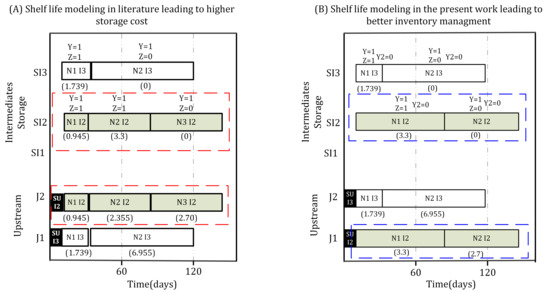
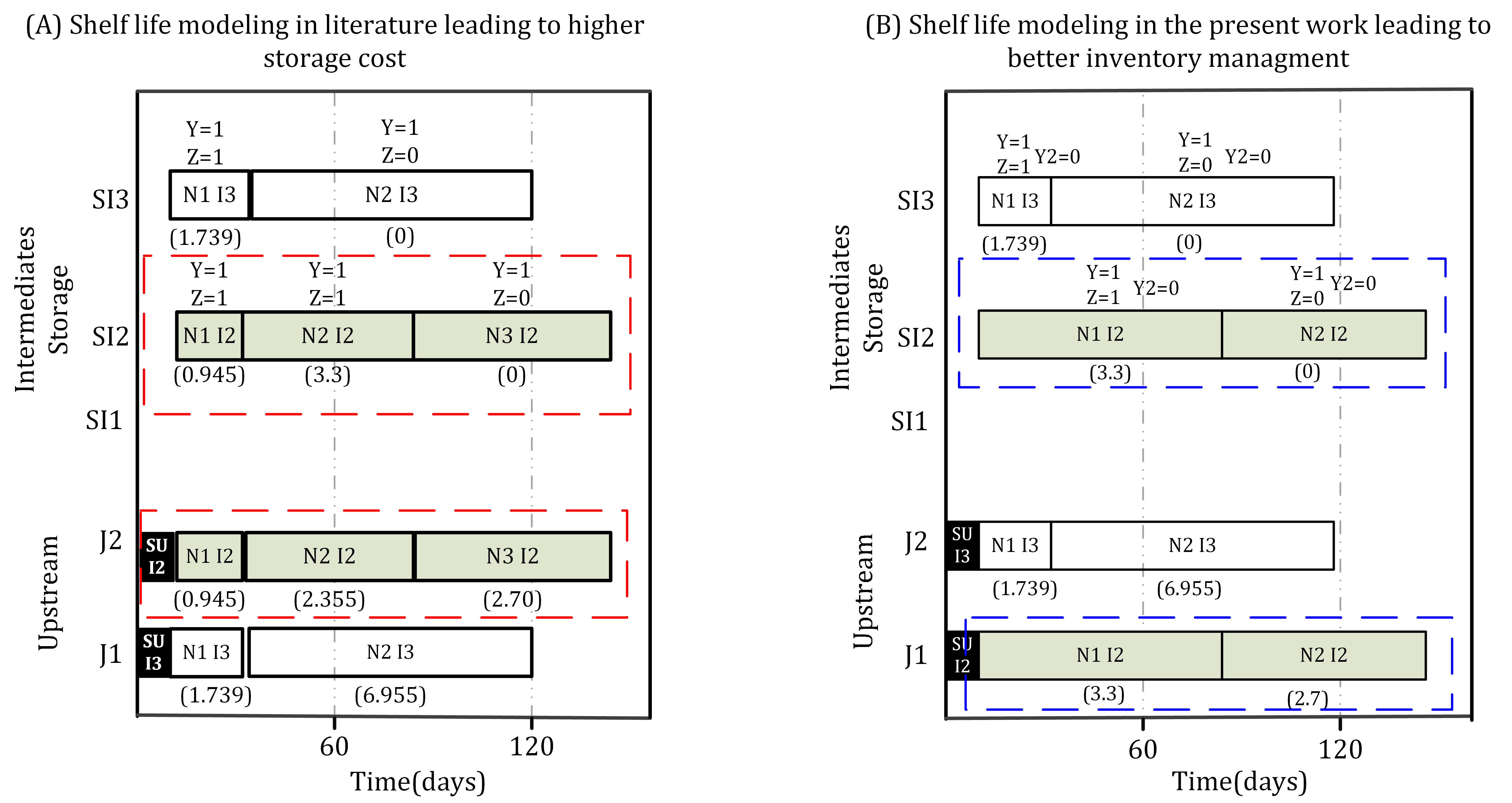
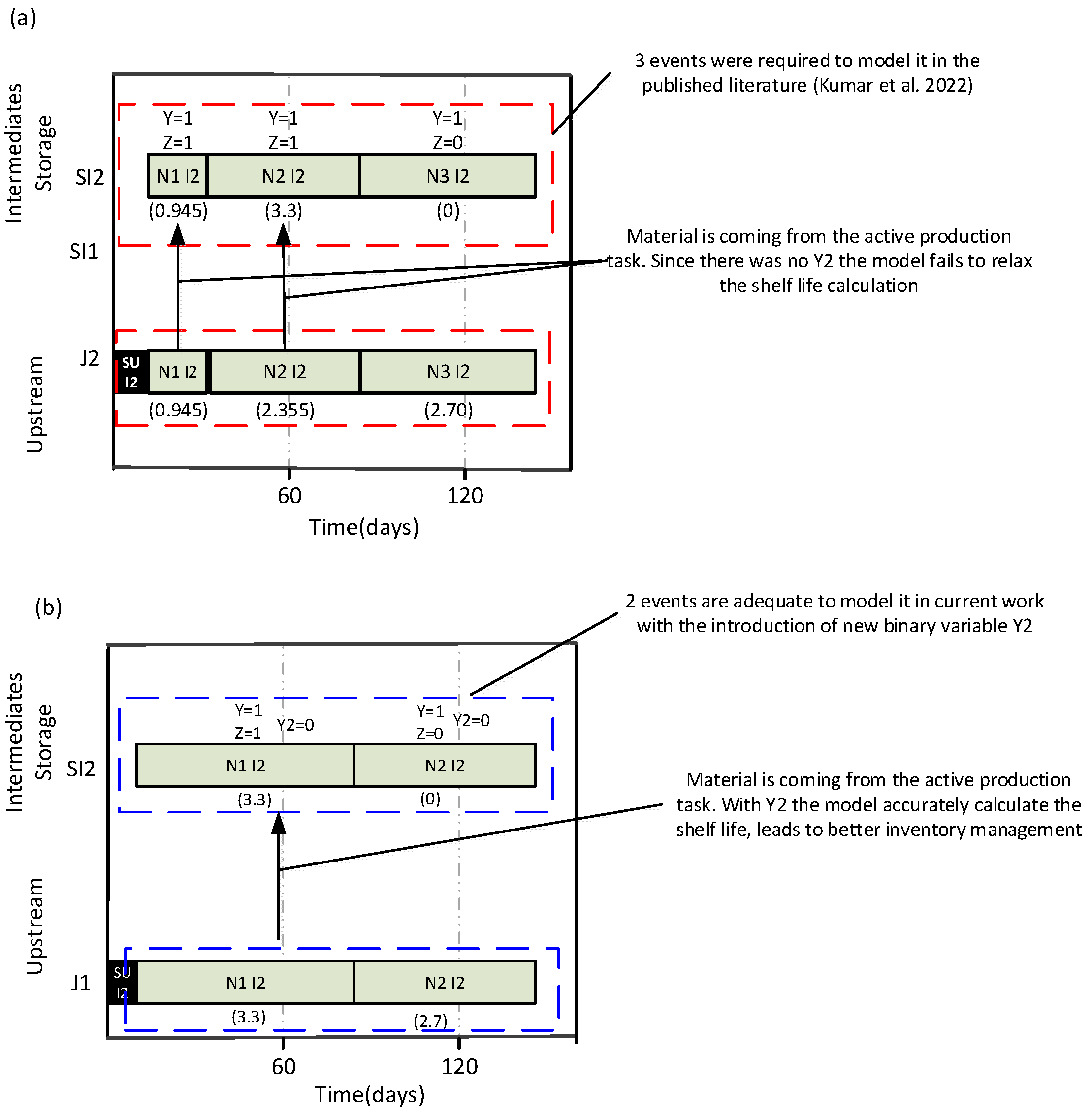
20] assumed that material arrivals from active production tasks would renew shelf-life in their model. Although they relaxed the shelf-life calculation to account for active production, the approach lacked sufficient rigor, as shown in
Figure 1. We introduce new constraints to accurately capture this assumption, with a detailed formulation provided in
Section 3. This short communication revisits the above assumption in our previously published model [
20]. We present a corrected/rectified model by introducing a new binary variable, which additionally reduces the minimum number of events required to solve the problem. As shown in Table 1 in
Section 4, this refinement decreases the number of events by two to three in the illustrative examples, while improving the net profit. Later, we compare the results with our previously published models, as all other comparative analyses have already been reported in Kumar et al. [
20] and Kumar and Shaik [
22] in a comprehensive manner.
The article is organized as follows:
Section 2 outlines the problem statement, including assumptions and operational requirements;
Section 3 presents the revised mathematical model;
Section 4 reports the results;
Section 5 discusses findings, limitations, and future directions; and
Section 6 concludes the study.
2. Problem Statement
In the present work, we address a long-term scheduling problem adopted from Lakhdar et al. [
14] over a 360-day horizon divided into multiple delivery dates spaced 60 days apart, starting from day 120 and requiring the delivery of three products (P1, P2, and P3) across a total of five delivery dates. The objective is to maximize net profit, which is the difference between revenue and all associated costs.
Facility: Multi-stage process (USP and DSP) with multiple units.
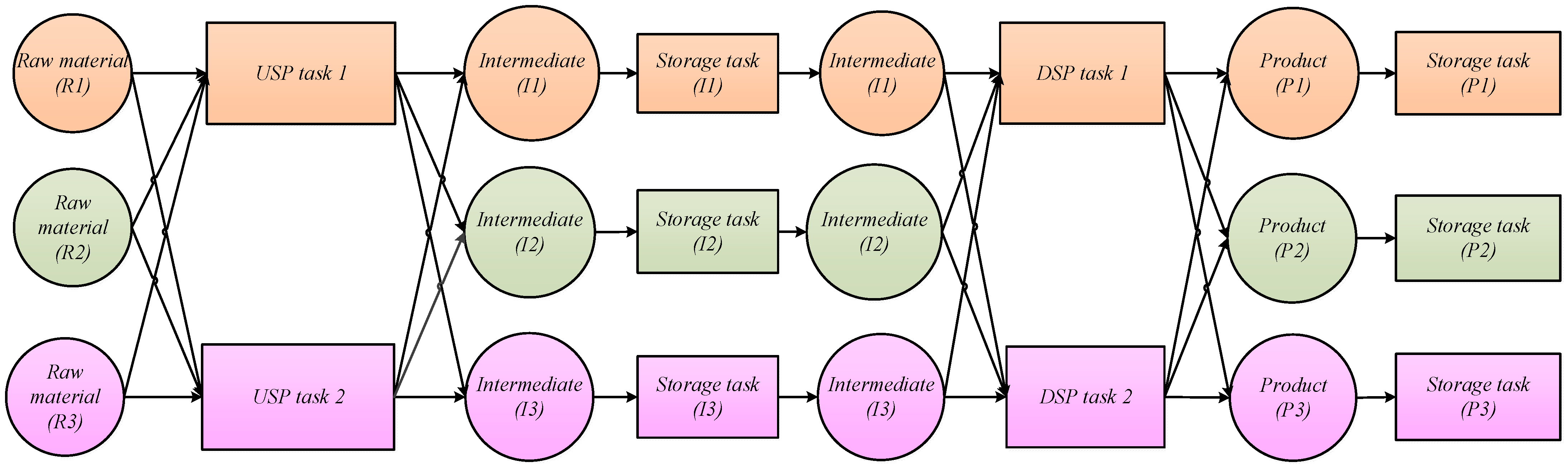
Production Recipe: State-task network (STN) defining tasks as shown in
Figure 2, processing rates, and conversions.
Demand: Multi-period demand for final products at specific due dates (.
Constraints: Shelf-life, storage capacity, minimum campaign length (MCL), and setup/changeover.
Costs/Prices: Sales prices (), inventory holding costs (), waste costs (, and penalty costs for backlog/lateness ( and initial setup ()/changeover ( costs.
Schedule: Start and end times for all processing and storage tasks.
Resource Allocation: Assignment of tasks to specific units.
Inventory Profile: Exact quantity of intermediates and products stored over time.
Sales and Waste: Quantities sold (on-time or late) and quantities wasted due to shelf-life expiry.
As mentioned in the previous works, the following assumptions define the scope and boundaries of the manufacturing environment.
Demand and Production:
No Overproduction: Overproduction is not allowed and is constrained by total production over the time horizon.
Unfulfilled Demand: Failure to meet demand on time is allowed but incurs a lateness/backlog penalty cost.
No Initial Inventory: The facility starts with zero inventory for raw material, intermediate, and final products.
Continuous Operation: The process is treated as a continuous train of batch units (e.g., fermentation), meaning multiple batches function like a continuous flow rather than discrete, isolated batches.
Delivery Policy: Products can only be sold on or after the specified due dates. Early delivery is not allowed in the sense that products produced early cannot be removed from inventory; they must be stored (incurring costs) until the due date. However, it should be noted that Kumar and Shaik [
23] developed a separate model (M2) for early delivery.
Unknown Finite Delivery Rates: A realistic assumption where delivery takes time, requiring storage to remain active during the transfer.
Shelf Life: Both intermediate and final products are perishable. Shelf-life must be checked before processing or selling. Material stored beyond its shelf-life is treated as waste and incurs a disposal cost.
Problem Context and Model Simplification
Biopharmaceutical facilities are complex, with series and parallel units in both upstream (USP) and downstream (DSP) sections. Software tools such as SuperPro and BioSolve, which are used for process simulation and economic evaluation, are primarily scenario-based modeling environments that focus on mass balance calculations, cost analysis, and process flowsheet development, rather than providing detailed, user-definable mathematical programming formulations for production scheduling, inventory management, or delivery-policy optimization over a finite horizon. While SchedulePro can be used for bioprocess scheduling, it is based on heuristics, which do not guarantee optimality.
In contrast, detailed mathematical modeling offers deeper insight into finding optimal solutions beyond heuristic-based short-term scheduling offered by conventional software. While detailed modeling is feasible for short-term scheduling (24 h to a few days), mid-term and long-term scheduling (360–720 days) requires simplification to ensure computational tractability. To address this, we aggregate multiple units into single facilities, creating a continuous train of batch units. In this approach, assigning a task to a USP unit designates it to an aggregated facility with a consolidated production rate (batches per day), treating multiple batches as continuous flow. This aggregation is necessary because the extended time horizon makes the optimization of full-scale flowsheets prohibitively difficult.
Operational Requirements: Based on the original problem description [
14] and prior work by Kumar et al. [
20,
22,
23], the following constraints must be enforced regardless of the time representation used.
Storage Synchronization: Downstream units and intermediate storage timing must synchronize with upstream units. Storage bypassing is permitted; only excess intermediates are stored.
Final Product Storage: Storage bypassing is not permitted for final products due to finite delivery rates. All products finished before the deadline must enter storage, meaning storage timing must align with downstream processing.
Real-Time Storage Integrity: If a production task is active while the consuming task is idle or setting up, storage must be utilized to avoid real-time storage violations.
3. Revised Mathematical Model
A new binary variable
is introduced to model the storage duration. This duration is determined by multiplying the binary variable
by the difference between the end time and the start time of the storage task
at the given event
:
However, since Equation (1) is nonlinear, in order to keep the model linear, we propose the following Equations (2)–(4):
In the context of the active production task, the shelf-life calculation should be relaxed according to the assumption as stated in Equation (5):
The binary variables,
, related to shelf-life are penalized in the objective function to prevent unnecessary activation:
The revised model incorporates equations from Kumar et al. [
20], complemented by the
Supplementary Material from the same authors, and includes the following equations: Equation (2)–(6), (S1), (S2), (S3), (S5a), (S5b), (S6a), (S6b), (S7a), (S7b), (S8a), (S8b), (S9a), (S9b), (S10a), (S10b), (S11), (S12), (S13a), (S13b), (S14a), (S14d), (S15a), (S15b), (S16a), (S16b), (S17), (S18a)–(S18f), (S19a), (S19b), (S20a), (S20b), (S21a)–(S21c), (S22a), (S22b), (S23a), (S23b), (S24), (S25), (S26a)–(S26e), and (S27a).
4. Results
We adopted two examples from the literature [
14,
19] to analyze the performance of the revised model for a biopharmaceutical manufacturing facility. We compare the performance of the proposed revised model with the results of the deterministic model [
20] and the stochastic methods/algorithms [
19].
The penalty coefficients (C1 to C5) used in Equation (6) require fine-tuning until no binary variables in the solution get activated unnecessarily. It should be noted that excessively increasing these penalties relative to profit terms may reduce the profit value while optimizing the objective function, which is undesirable. The model aims to maximize profit while minimizing unnecessary activation of binary variables. Using this approach, we solved the benchmark examples presented in this study. We used values in the range of 0.001–1 for the penalty coefficients in the revised model. We solved the revised model using CPLEX/GAMS 24.0.1 software on a 12th Gen Intel (R) CoreTM i7-12700H with 64 GB of RAM.
Similar to the earlier work of Kumar et al. [
20,
22,
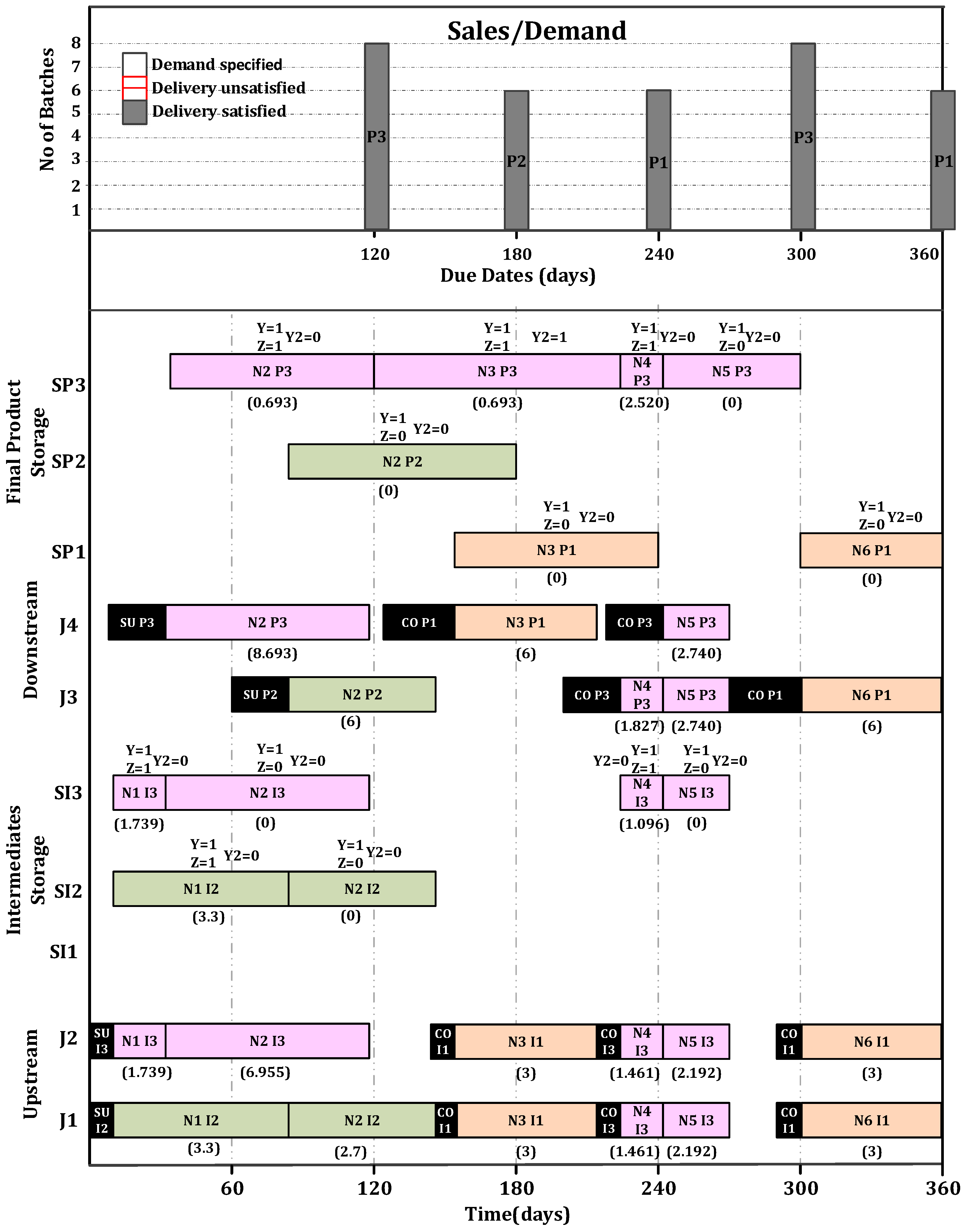
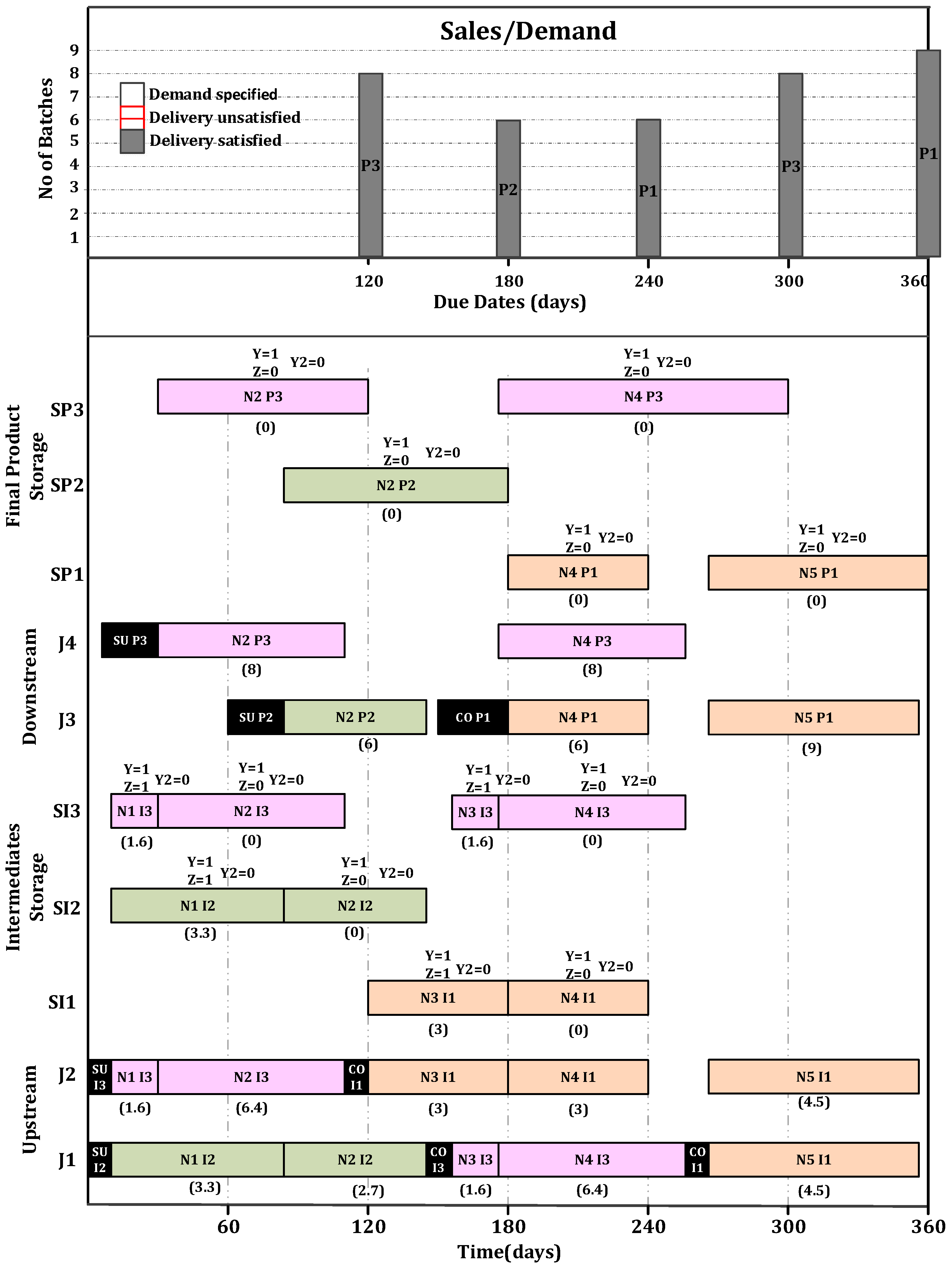
24], the symbols used in the Gantt charts (
Figure 2 and
Figure 3) are defined as follows: each task is represented by a colored horizontal solid block with length proportional to its duration; the number of batches are indicated in parentheses beneath the block; events (N
1, N
2, …) and processing or storage states in the respective units are shown inside the block; black horizontal blocks denote setup and changeover times, prefixed with “SU” for setup and “CO” for changeover; storage units for intermediate or final product states are prefixed with “S”; for example, “SI1” represents the storage tank for intermediate state I1.
4.1. Example 1
Numerous researchers [
15,
16,
17,
18,
19,
20,
21,
22,
24] have utilized the first example from the published literature [
14] to test their models [
14,
15,
16,
17,
18,
20,
22] and algorithms [
19,
21]. We exclusively compare our results with Kumar et al. [
20,
23], as their published works [
20,
22] provide details on all other comparisons. The revised model yielded a profit of 495.42 rmu solved using six events, which is better than the published result (491.22 rmu) of Kumar et al. [
20]. Model statistics and profit breakdown for Examples 1 and 2 are presented in
Table 1 and
Table 2, respectively. The proposed Gantt chart is reported in
Figure 3.
4.2. Example 2
The second example is also adapted from published literature [
19]. Kumar and Shaik [
22] reported the discrepancies in their work by analyzing their reported Gantt chart. All input parameters are the same as in example 1, except for the demand profile of the final products, as shown in
Table S4 in the Supporting Information. A profit value of 536.5 rmu is achieved using five events, which is a 7% improvement over the profit of Kumar and Shaik [
23], and a 2% improvement over the reported profit (523.983 rmu) of Kumar and Shaik [
22]. The reported profit of Jankauskas et al. [
19] is higher; however, due to some inconsistencies in their work [
22], their calculated profit is lower, as reported in Kumar and Shaik [
22]. The proposed Gantt chart is reported in
Figure 4. As shown in
Table 1, the revised model achieves faster computation by requiring fewer events, and it reduces binary and continuous variables. Although Kumar and Shaik [
23] reported a profit of 536.5 rmu for their early-delivery model M2 in Example 2, the present study considers only on-time or late delivery with an unknown finite delivery rate.
5. Discussion, Future Directions, and Limitations
Kumar et al. [
20,
22] explored and reviewed various deterministic MILP models [
14,
15,
16,
17,
18] and evolutionary algorithms [
19,
21] for the mid-term planning and long-term scheduling of biopharmaceuticals. Unit-specific event-based models facilitate rigorous modeling and sequencing of storage operations, which is critical for accommodating the different processing rates of upstream and downstream units. Literature models [
14,
16,
17,
18] and algorithms [
19,
21] do not adequately address the required intermediate storage, resulting in real-time storage violations. Vieira et al. [
17,
18] concluded that their global event-based model requires fewer events (for instance, six events for example 1). However, Kumar et al. [
20] have shown that accurate modeling of intermediate storage in real-time requires more events using global events. The proposed revised model uses six events to solve example 1 and suggests improvements in shelf-life modeling to avoid suboptimal results.
Future directions: Across our prior and current work, we have observed and shown that evolutionary algorithms based on discrete-time and global-event formulations have consistently proven inadequate for accurately modeling storage demands in multi-stage, multiproduct facilities. Extending a genetic algorithm within the unit-specific event-based framework, integrated with MILP modeling, offers a viable path to compare these approaches and to better assess their computational feasibility and performance. The models can be extended to multi-facility networks with real-world data or to scenarios with uncertainty.
Limitations of the work: In this work, we employ a unit-specific event-based MILP formulation; however, shelf-life and minimum campaign length are modeled over a single event. This simplification reduces the number of required events and improves computational efficiency but may occasionally lead to suboptimal solutions. This model is therefore best suited for smaller multiproduct scheduling problems.