1. Introduction
Natural pigments derived from plant-based sources have attracted considerable attention in recent decades as industries increasingly seek safer, sustainable, and environmentally benign alternatives to synthetic colourants. This trend is particularly evident in the food, pharmaceutical, and cosmetic sectors, where growing consumer awareness and increasingly stringent regulations have encouraged the replacement of synthetic dyes with naturally derived materials [
1,
2,
3]. Among the available natural colourants, annatto (
Bixa orellana) is one of the most extensively utilised worldwide. The characteristic yellow-to-orange-red colour of annatto is primarily attributed to the carotenoid compounds bixin and norbixin, which are present in high concentrations within the seed aril [
4,
5,
6,
7]. Annatto is widely valued because of its high colouring efficiency, low toxicity, and broad applicability across numerous industrial sectors [
4,
6]. It has been reported that annatto accounts for a significant proportion of the global natural colourant market, highlighting its commercial importance [
8,
9]. Furthermore, annatto is particularly attractive in tropical regions because of its availability, relatively low cost, and adaptability to local agricultural conditions [
5,
10].
The increasing demand for natural pigments is closely linked to concerns regarding the potential health and environmental impacts associated with synthetic colourants. Several studies have reported associations between artificial dyes and adverse effects, including allergic reactions, toxicity, and long-term health concerns [
11,
12]. Such concerns are especially relevant to cosmetic products, including lipsticks, because of their direct application to the lips and the possibility of incidental ingestion during use [
13,
14,
15]. Consequently, there has been growing interest in the development of natural cosmetic formulations based on plant-derived colourants and naturally sourced ingredients [
14,
16]. Numerous studies have demonstrated the feasibility of incorporating natural pigments into lipstick formulations using ingredients such as beeswax, vegetable oils, antioxidants, and natural flavouring agents, while maintaining acceptable texture, colour transfer, and stability [
13,
17,
18,
19,
20]. Despite these advances, achieving an optimal balance among pigment intensity, stability, performance, and production cost remains a significant challenge [
15,
21].
A variety of techniques have been employed to extract pigments from annatto seeds, including solvent extraction, distillation, microwave-assisted extraction, and ultrasound-assisted extraction [
22,
23,
24]. Although these methods can provide satisfactory recoveries, they may suffer from limitations such as thermal degradation of sensitive compounds, solvent residues in the final product, and limited extraction selectivity [
23,
25]. Supercritical fluid extraction (SFE), particularly using carbon dioxide (CO
2), has emerged as an attractive alternative because of its low critical temperature and pressure, non-toxic nature, and ability to produce solvent-free extracts [
26,
27,
28,
29]. The addition of polar co-solvents such as ethanol has been shown to improve extraction performance through enhanced solubility and mass transfer of carotenoid compounds [
30,
31,
32]. Previous investigations of annatto extraction using supercritical carbon dioxide have demonstrated that extraction yield and composition are strongly influenced by operating pressure, temperature, and co-solvent concentration [
31,
32,
33]. More recent studies continue to highlight the effectiveness of supercritical fluid extraction for the recovery of high-value compounds from plant materials intended for food, cosmetic, pharmaceutical, and nutraceutical applications [
34,
35,
36,
37,
38]. However, differing conclusions have been reported concerning the optimum operating conditions required to maximise pigment recovery while maintaining economic viability [
28,
32,
33].
Although significant progress has been made in both annatto extraction and cosmetic product formulation, relatively few studies have integrated extraction process development, cosmetic product formulation and colour evaluation within a single framework [
20,
32]. In addition, limited information is available regarding the influence of supercritical extraction conditions on the colour characteristics and practical performance of annatto-based cosmetic products. This knowledge gap is particularly relevant in countries such as Trinidad and Tobago, where annatto is locally cultivated and presents opportunities for the development of value-added products based on locally sourced renewable raw materials [
5,
38]. Therefore, the present study investigates the extraction of pigments from annatto (
Bixa orellana) seeds using supercritical carbon dioxide with ethanol as a co-solvent, evaluates the effects of operating conditions on extraction performance and colour characteristics, and examines the suitability of the resulting extracts for application in a natural lipstick formulation. This integrated approach contributes to the development of sustainable extraction technologies and natural cosmetic products while providing a practical link between extraction, formulation, and product application.
2. Materials and Methods
2.1. Materials
Annatto (Bixa orellana) seeds were sourced from a local supplier in Trinidad and Tobago. Carbon dioxide (CO2) (food-grade) (99.9% purity) was supplied by Massy Gas Products Ltd. (Pt. Lisas, Trinidad and Tobago) and used as the primary extraction solvent. Ethanol (≥99.8%, analytical grade), supplied by Sigma-Aldrich (St. Louis, MO, USA), was employed as a co-solvent. Toluene was used for moisture content determination via the Dean–Stark method. For cosmetic formulation, beeswax, coconut oil, olive oil, castor oil, rose essence, and lemon juice were obtained from commercial suppliers. Distilled water was used where necessary. All ingredients used in the lipstick formulation, including waxes, oils and additives, were cosmetic-grade materials obtained from local cosmetic suppliers and were used as received.
2.2. Preparation of Raw Materials
The annatto seeds were manually separated from the pods, cleaned, and air-dried under ambient conditions for seven days to reduce moisture content. The seeds were periodically turned to ensure uniform drying and to minimise microbial growth. Moisture content was subsequently determined using the Dean–Stark azeotropic distillation method in accordance with ISO 939:2021 [
39]. Approximately 10 g of seed sample was placed in a 500 mL round-bottomed distillation flask, immersed in 75 mL of toluene, and heated under reflux. Water entrained with the solvent vapour was collected in a graduated receiver until no additional water was recovered. Moisture content was calculated from the mass of water collected and expressed on a wet basis. The dried seeds, with moisture content below 10%, were stored in airtight containers prior to extraction. Moisture determination was conducted as a preliminary suitability assessment prior to extraction. Owing to limited seed availability and the screening nature of the study, only the average moisture content value was retained for subsequent analysis.
2.3. Supercritical Fluid Extraction Procedure
Extraction experiments were conducted using a bench-scale supercritical fluid extraction (SFE) unit operating in batch mode. Approximately 30 g of prepared whole annatto seeds were loaded into a 100 mL stainless-steel extraction vessel, without prior crushing or grinding. The seeds exhibited a characteristic size of approximately 2–3 mm. For experiments involving a co-solvent, 1.5 mL of ethanol was introduced directly into the extraction vessel and distributed over the 30 g seed charge immediately prior to pressurisation. The use of ethanol as a co-solvent was selected based on previous annatto supercritical extraction studies, which reported improved pigment recovery relative to extraction with pure carbon dioxide because of enhanced solubility and mass transfer of carotenoid compounds [
25,
26,
27]. A fixed co-solvent dosage of 1.5 mL of ethanol per 30 g seed charge (0.05 mL g
−1 seed) was maintained throughout the study to ensure consistent comparison of the effects of temperature, pressure, and flow rate. Polypropylene wool was used to secure the sample bed within the vessel.
The system was pressurised with CO2 and operated under varying conditions of temperature (40–60 °C), pressure (200–300 bar), and CO2 flow rate (1.5–2.0 L min−1). Once the desired operating conditions were reached, extraction was initiated and continued for a total duration of 240 min. The extract was collected in a glass vial following depressurisation of the effluent stream.
To obtain extraction curves, the extraction process was interrupted at 15 min intervals, and the mass of extract collected was recorded. Each experimental condition was performed in duplicate to ensure reproducibility. The yield of extract was calculated as the percentage by mass of extract relative to the initial mass of seeds.
2.4. Experimental Design and Statistical Analysis
A full factorial design of experiments (DOE) was implemented using Design-Expert® software Version 13 (Stat-Ease Inc., Minneapolis, MN, USA) to investigate the effects of temperature, pressure, and flow rate on extraction yield and colour characteristics. The experimental design consisted of 11 runs, including three centre-point replicates, which were incorporated to estimate experimental error and assess process reproducibility.
The factorial screening design was selected to identify the main factors and interaction effects influencing the response variables within the investigated experimental region. Analysis of variance (ANOVA) was performed to evaluate the statistical significance of individual factors and their interactions. The relative importance of factor effects was further assessed using graphical tools generated by Design-Expert®, including half-normal plots.
Model adequacy was evaluated using statistical parameters, including the F-value, p-value, coefficient of determination (R2), adjusted R2, predicted R2, standard deviation, coefficient of variation, and adequate precision. Regression equations were generated in coded and actual factor forms to describe the relationships between operating conditions and response variables. Owing to the limited experimental space associated with the screening design, the statistical models were used primarily to identify influential factors and interactions rather than to establish optimal operating conditions.
2.5. Cosmetic Product Formulation
The extracted annatto pigment was used as a colouring agent in the formulation of a natural cosmetic product. The formulation consisted of beeswax (1.5 g), coconut oil (2 mL), olive oil (1.5 mL), castor oil (1 mL), and annatto extract (0.3 mL). The wax and oils were heated in a water bath until fully melted and homogenised. The annatto extract was pre-mixed with castor oil and added to the molten mixture under continuous stirring.
Following homogenisation, the heat source was removed, and small quantities of rose essence and lemon juice were added as fragrance and antioxidant agents, respectively. The mixture was then poured into a silicone mould and cooled under refrigeration until solidified. The solidified product was removed from the mould and stored in appropriate containers.
2.6. Colour Analysis
Colour measurements of the formulated products were conducted using a Minolta chromameter (Konica Minolta, Tokyo, Japan) operating in the Commission Internationale de l’Éclairage Lab* (CIELAB) colour space. Prior to measurement, the instrument was calibrated using a standard white tile. Each sample was applied uniformly onto a white substrate, and three measurements were taken at different locations to ensure consistency.
The colour parameters recorded were L* (lightness), a* (red–green coordinate), and b* (yellow–blue coordinate). The average of the three readings was reported for each sample. These values were used to assess the influence of extraction conditions on the colour properties of the formulated products.
3. Results
3.1. Moisture Content of Annatto Seeds
The annatto (
Bixa orellana) seeds used in this study were air-dried prior to extraction and analysed using the Dean–Stark method. The average moisture content was determined to be 8.30% (
w/
w), seen in
Table 1 below, which was below the target value of 10% and therefore considered suitable for supercritical fluid extraction. Low moisture content is desirable because excess water can interfere with mass transfer during extraction and reduce the solubility of target compounds in supercritical carbon dioxide.
3.2. Extraction Kinetics and Extraction Yield
Extraction experiments were performed using supercritical carbon dioxide with 5% ethanol as a co-solvent over a temperature range of 40 to 60 °C, a pressure range of 200 to 300 bar, and a flow rate range of 1.5 to 2.0 L min−1.
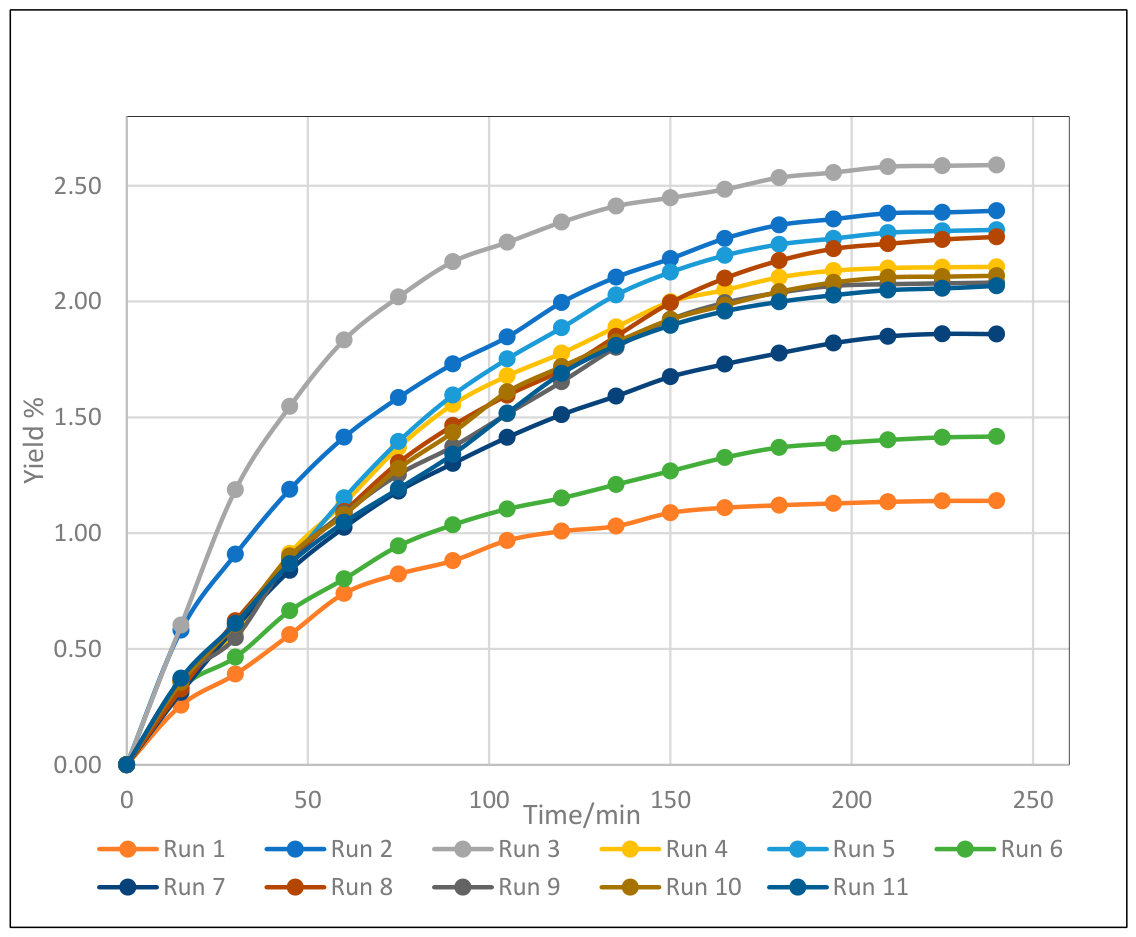
The extraction curves obtained for the eleven experimental conditions are presented in
Figure 1. All extraction profiles exhibited a similar trend characterised by an initial period of rapid extraction followed by a gradual reduction in extraction rate until equilibrium was approached. More than 80% of the final extract was recovered within the first 120 min of operation, after which the extraction rate decreased substantially.
The initial steep slope of the extraction curves suggests that the easily accessible pigment located on or near the seed surface was rapidly solubilised and removed by the supercritical solvent. The subsequent plateau region is indicative of a diffusion-controlled extraction stage where pigment transport from the interior of the seed matrix becomes the controlling mechanism.
The extraction yields obtained under the different process conditions are summarised in
Table 2.
The highest extraction yield (2.59%) was obtained at 60 °C, 200 bar, and 2.0 L min−1 (Run 3). Conversely, the lowest yield (1.14%) was obtained at 40 °C, 300 bar, and 2.0 L min−1 (Run 1).
Although Run 3 produced the maximum yield, Run 5 (40 °C, 200 bar, 1.5 L min−1) yielded 2.31% extract while operating under substantially less energy-intensive conditions. Consequently, Run 5 was identified as the preferred operating condition because it produced a comparable extraction yield under less energy-intensive operating conditions.
3.3. Statistical Analysis and Screening Design Evaluation
3.3.1. Analysis of Variance
A full factorial screening design was employed to investigate the effects of temperature, flow rate, and pressure on the extraction yield of annatto. The design was selected to identify the most influential process variables and interactions while minimising experimental runs and resource consumption.
The analysis of variance (ANOVA) generated by Design-Expert
® is summarised in
Table 3.
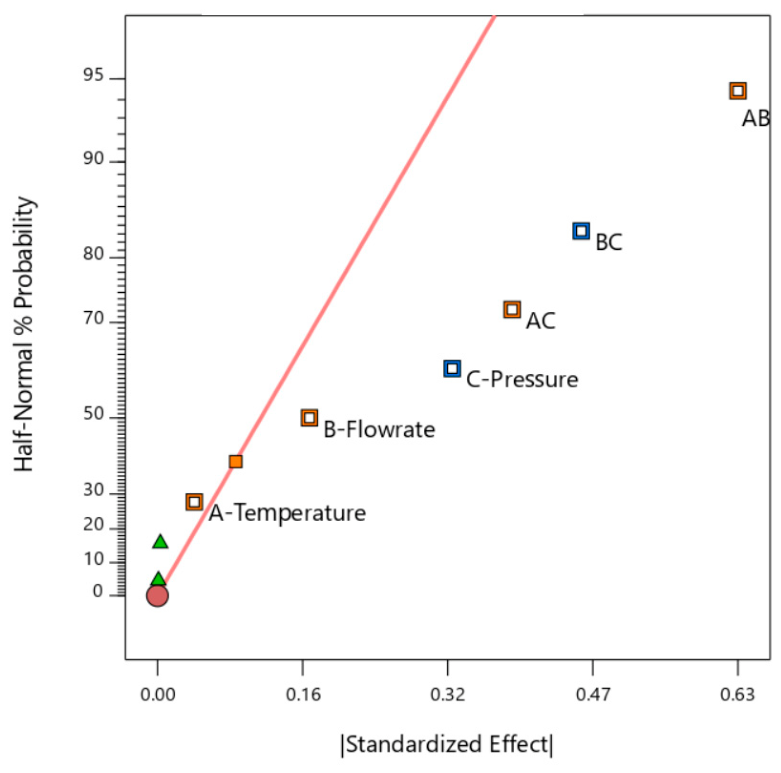
To further visualise the relative magnitude of factor effects, a half-normal plot was generated (
Figure 2). The AB interaction was positioned furthest from the reference line, confirming that the interaction between temperature and flow rate exerted the strongest influence on extraction yield among the investigated factors.
The statistical indicators generated by Design-Expert
® are presented in
Table 4.
The model produced high R2, adjusted R2, and predicted R2 values. However, because the study utilised a relatively small screening design, these parameters should be interpreted with caution, as high R2 values are commonly observed in highly constrained experimental spaces. Consequently, the model is most appropriately viewed as a screening tool for identifying influential factors rather than as a definitive predictive or optimisation model.
The coded regression equation generated by Design-Expert
® was:
where
A = Temperature;
B = Flow Rate;
C = Pressure.
The coded equation is useful for comparing the relative magnitude and direction of factor effects, with larger coefficients indicating stronger influences on extraction yield.
The corresponding regression equation in actual factors was:
where
T = Temperature (°C);
F = Flow Rate (mL min−1);
P = Pressure (bar).
This equation may be used to estimate extraction yields within the investigated experimental region. However, because the model was developed from a limited screening design, further validation using a larger response surface methodology (RSM) design is required before it can be applied confidently to process optimisation or broader prediction purposes.
3.3.2. Factor Interaction Analysis
The factorial screening study revealed that interaction effects exerted a greater influence on extraction yield than the individual process variables alone. The temperature–flow rate interaction (AB) exhibited the largest effect, followed by the pressure-dependent interactions AC and BC.
These findings indicate that extraction yield was governed by the combined influence of operating conditions rather than by a single process parameter. Such behaviour is consistent with supercritical fluid extraction systems, where temperature, pressure, and solvent flow simultaneously affect solvent properties, mass transfer behaviour, and solute recovery.
The results therefore demonstrate that all three investigated factors contributed to extraction performance and warrant further investigation in a subsequent response surface methodology study designed specifically for optimisation and process modelling.
3.4. Cosmetic Product Formulation
Following extraction, the annatto-derived pigment was incorporated into a natural cosmetic formulation containing beeswax, coconut oil, olive oil, castor oil, rose essence, and lemon juice.
Initial formulations produced products that were either excessively soft or excessively hard. Optimisation of the formulation yielded a final product possessing acceptable texture, pigment transfer, and physical stability. The final formulation is shown in
Table 5.
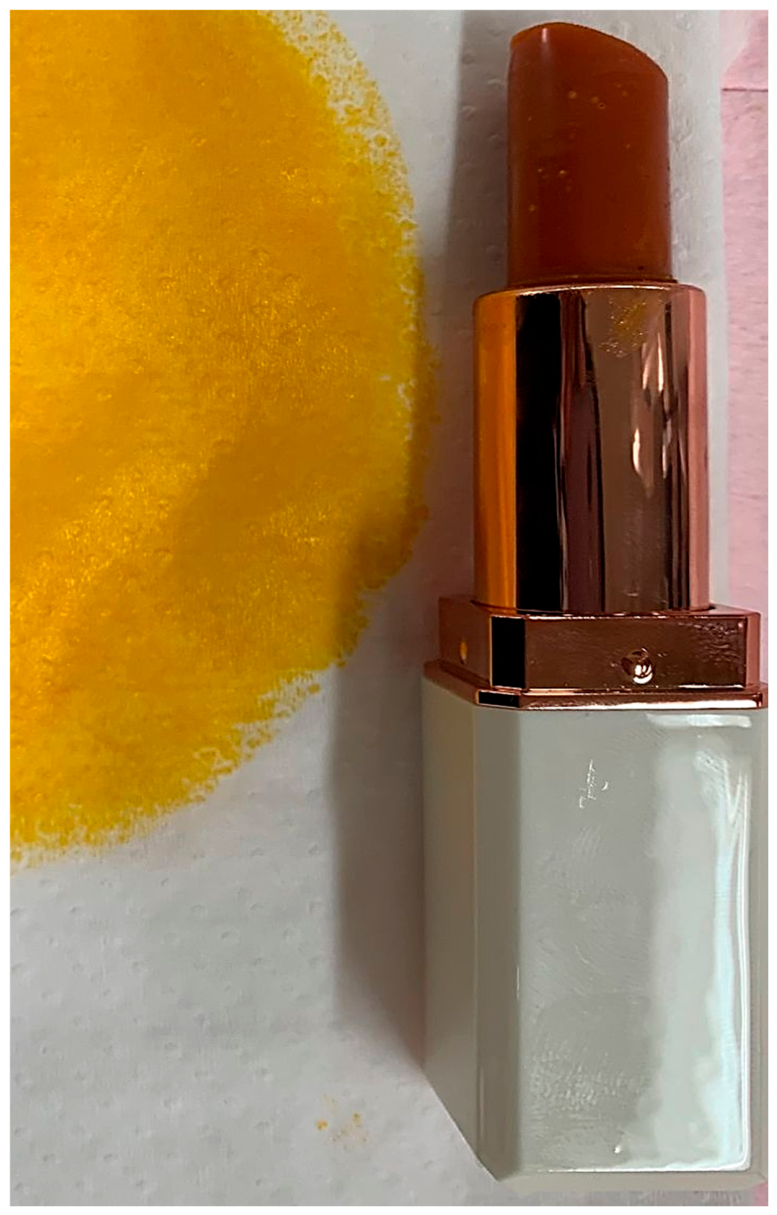
The resulting formulation exhibited a smooth texture, uniform colour distribution, and satisfactory colour transfer during application.
Figure 3 shows the annatto-based cosmetic product produced using the final formulation. The product exhibited a uniform yellow–red colour distribution with no obvious surface defects or phase separation. Application onto a white substrate demonstrated satisfactory colour transfer and visual consistency.
3.5. Colour Analysis
The colour characteristics of each cosmetic formulation were evaluated using a Minolta chromameter operating in the CIELAB colour space.
Average values obtained for the formulations were within the following ranges:
The relatively narrow variation in colour coordinates, as seen in
Table 6, indicated that extraction conditions had only a minor influence on the colour properties of the pigment and final product.
All formulations produced positive a* values, confirming the presence of red colour components, and positive b* values, indicating substantial yellow colour contributions. These observations are consistent with the known carotenoid composition of annatto pigment.
Interestingly, while extraction conditions significantly influenced extraction yield, they did not result in substantial colour variation among the products. This finding suggests that the visual colour properties of the extracted material remained relatively consistent under the investigated extraction conditions. However, colour measurements alone do not provide direct information regarding the chemical composition or relative concentrations of individual carotenoid compounds.
Additional formulations prepared using increasing quantities of pigment extract (0.75 mL and 1.50 mL) demonstrated a noticeable increase in colour intensity.
The formulation containing 1.50 mL of extract exhibited:
lower L* (77.97),
higher a* (16.96),
comparable b* (86.05),
indicating greater opacity and stronger red pigmentation.
3.6. Development of Colour Prediction Models
Mathematical models were developed to describe the influence of extraction variables on L*, a*, and b* values, seen in
Table 7 below.
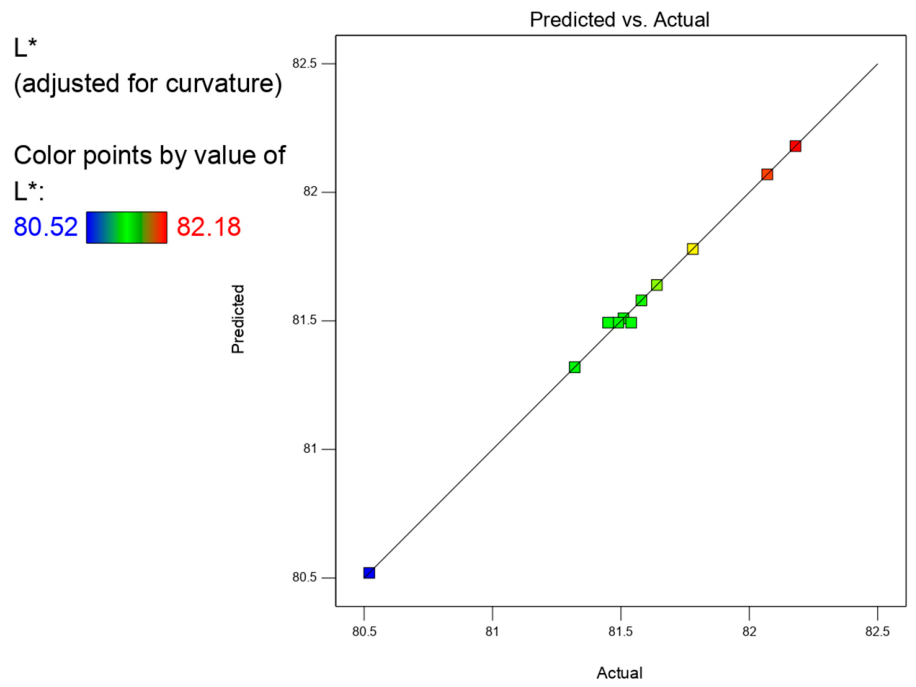
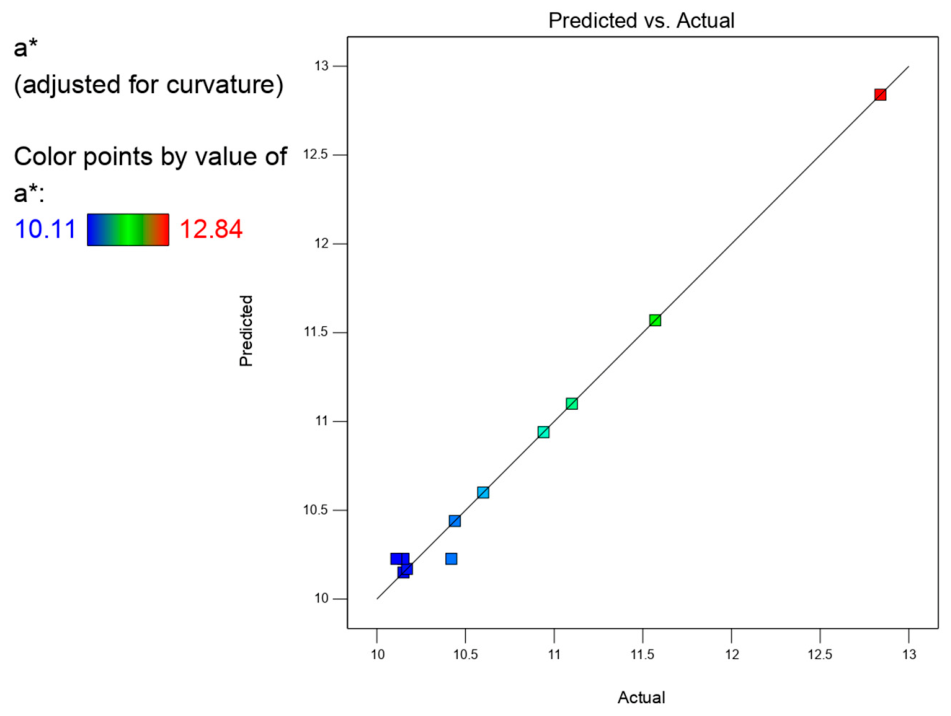
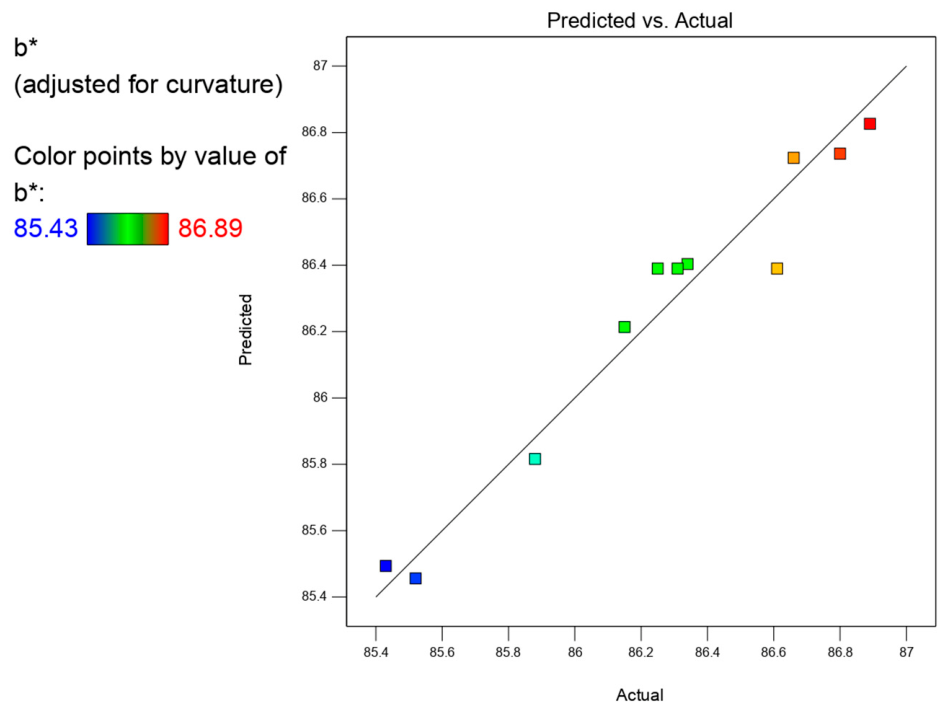
Predicted-versus-actual plots demonstrated excellent agreement between experimental observations and model predictions.
The strong predictive capability of the models, seen in
Figure 4,
Figure 5 and
Figure 6, suggests that extraction conditions can be used to estimate colour characteristics, although the practical differences in colour among formulations were relatively small.
4. Discussion
4.1. Moisture Content of Annatto Seeds
The moisture content of the annatto (Bixa orellana) seeds was determined to be 8.30%, which was below the generally recommended maximum value of 10% for supercritical fluid extraction processes. This relatively low moisture content was beneficial because excessive moisture can reduce extraction efficiency by limiting the penetration of supercritical carbon dioxide into the seed matrix and by creating additional mass transfer resistance. Water may also alter the solubility behaviour of target compounds and compete with the extraction solvent for interaction with the plant matrix.
The moisture level obtained in this study therefore ensured favourable extraction conditions and minimised feedstock-related variability. As a result, the observed differences in extraction performance can be attributed primarily to changes in process variables rather than to variations in the physical properties of the raw material.
4.2. Extraction Kinetics and Extraction Yield
The extraction curves exhibited the characteristic behaviour commonly observed in supercritical fluid extraction systems, consisting of an initial rapid extraction phase followed by a slower diffusion-controlled period. During the early stages of extraction, pigment located on or near the surface of the annatto seeds was rapidly solubilised and transported by the supercritical carbon dioxide–ethanol mixture. As extraction progressed, pigment recovery became increasingly dependent on internal mass transfer from the seed matrix, resulting in a gradual decline in extraction rate.
The maximum extraction yield of 2.59% was achieved at 60 °C, 200 bar, and 2.0 L min−1. Increasing temperature generally enhanced yield through improved solute vapour pressure and increased diffusivity of the pigment molecules. However, the relationship between pressure and extraction yield was more complex. Although higher pressures generally increase solvent density and solubility, increasing pressure to 300 bar did not consistently improve extraction performance. This suggests that solvent density was not the sole controlling factor and that interactions between pressure, temperature, and flow rate played a significant role in determining extraction efficiency. The extraction yields obtained in the present study are lower than those frequently reported for conventional organic solvent extraction processes. However, comparisons should be interpreted cautiously because extraction yield depends strongly on solvent selection, operating conditions, extraction duration, and the basis used for yield calculation. Although organic solvent extraction may provide higher overall recoveries, supercritical fluid extraction offers advantages including reduced solvent residues, simplified downstream purification, and improved environmental performance.
While the highest yield was obtained under the conditions of Run 3, the operating conditions of 40 °C, 200 bar, and 1.5 L min−1 produced a comparable extraction yield of 2.31% while requiring lower energy input and lower carbon dioxide consumption. Consequently, these conditions were considered more suitable from a practical and operational perspective.
The extraction yields obtained in this study are within the range reported for carotenoid extraction using supercritical carbon dioxide and demonstrate the effectiveness of ethanol as a co-solvent in improving pigment recovery. The results also indicate that efficient extraction can be achieved without operating at excessively high pressures, which has important implications for industrial implementation.
4.3. Statistical Analysis and Screening Design Evaluation
The factorial design of experiments (DOE) approach provided a systematic means of identifying the process variables that most strongly influenced the extraction yield of Annatto. As a screening design, its primary purpose was to determine important main effects and interactions rather than to establish an optimised operating condition.
The ANOVA results demonstrated statistically significant model terms within the experimental region investigated. In particular, the interaction between temperature and flow rate (AB) exhibited the strongest effect on extraction yield, as confirmed by both the ANOVA results and the half-normal plot. Significant AC and BC interactions were also observed, highlighting the importance of considering variable interactions when evaluating supercritical extraction processes.
The magnitude of the interaction coefficients suggests that extraction performance cannot be explained adequately by examining individual variables independently. Instead, extraction yield appears to be governed primarily by the combined influence of temperature, pressure, and flow rate. This observation is consistent with the complex thermodynamic behaviour of supercritical carbon dioxide systems, where changes in operating conditions simultaneously affect fluid density, diffusivity, solvent power, and mass transfer characteristics.
Although the model produced very high R2, adjusted R2, and predicted R2 values, caution is required when interpreting these statistics. The relatively small experimental design space used in this screening study can inherently produce high coefficients of determination. Therefore, these values alone should not be regarded as definitive evidence of model robustness or predictive capability.
Similarly, while the generated regression equation provides useful insight into factor effects and can estimate responses within the investigated range, the limited number of experimental runs restricts its applicability for optimisation purposes. Consequently, the present work should be considered an initial screening investigation that successfully identified influential factors and interactions affecting extraction yield.
The results indicate that temperature, flow rate, and pressure all contributed to extraction performance, with interaction effects exerting the greatest influence. Future work should therefore employ a response surface methodology (RSM) design incorporating additional experimental runs to develop a more comprehensive predictive model and to determine true optimum operating conditions for supercritical carbon dioxide extraction of annatto constituents.
4.4. Cosmetic Product Formulation
The annatto extract was successfully incorporated into a natural cosmetic formulation using commonly available natural ingredients. The final product exhibited acceptable texture, uniform colour distribution, smooth application, and satisfactory physical integrity during formulation, handling, and short-term storage.
The successful formulation demonstrates that annatto pigment possesses suitable colouring properties for cosmetic applications. Moreover, the formulation was generally comparable in appearance to commercially available products based on qualitative visual assessment. The ability to produce a natural cosmetic product using annatto-derived pigment supports the growing trend towards sustainable and naturally sourced cosmetic ingredients.
A key novelty of this work lies in the integration of sustainable extraction technology with cosmetic product development and colour evaluation. Unlike many studies that focus solely on pigment extraction or cosmetic formulation, the present research demonstrates the complete pathway from raw material to final product. It should be noted that texture assessment was qualitative and based on visual inspection, spreadability, hardness during handling, and colour transfer characteristics. Instrumental texture analysis was beyond the scope of the present study and should be included in future investigations.
4.5. Colour Analysis
The colour analysis revealed relatively small variations in L*, a*, and b* values among the formulations produced from extracts obtained under different extraction conditions. Although significant differences were observed in extraction yield, the colour properties remained relatively consistent.
These findings suggest that variations in extraction conditions primarily affected the quantity of pigment recovered rather than the visual colour characteristics of the extract. However, the composition of the extracted carotenoids was not determined experimentally and therefore cannot be confirmed from colour measurements alone. Consequently, all extraction conditions produced pigment capable of generating the characteristic orange-red colour associated with annatto.
The consistently positive values of a* and b* confirmed the presence of strong red and yellow colour components, respectively. This observation is consistent with the known carotenoid composition of annatto pigment, particularly bixin and norbixin. While the observed CIELAB colour coordinates are consistent with the characteristic visual appearance of annatto pigment reported in the literature, colour measurements alone do not provide direct information regarding the chemical composition, concentration, or stability of individual carotenoid compounds such as bixin and norbixin. Therefore, the colour data obtained in this study should be interpreted as an assessment of visual colour characteristics rather than definitive evidence of pigment composition. Detailed chemical characterisation using techniques such as HPLC, LC-MS, or UV-Vis spectroscopy would be required to confirm the composition of the extracted pigments.
From a practical perspective, the limited variation in colour characteristics is advantageous because it provides greater operational flexibility. Manufacturers can therefore optimise extraction conditions based on yield and operational conditions without substantially affecting the appearance of the final cosmetic product.
Previous studies have shown annatto seed extracts to contain predominantly bixin, norbixin and related carotenoid derivatives, which are principally responsible for the characteristic orange-red colour of annatto products. Future work should include chromatographic characterisation of extracts obtained under the operating conditions examined in the present study to establish possible relationships between extraction conditions, pigment composition and cosmetic performance [
40].
4.6. Development of Colour Prediction Models
The predictive models developed for L*, a*, and b* values demonstrated strong statistical performance, with R2 values exceeding 0.95 for all responses. The close agreement between predicted and experimental values indicates that the models successfully captured the effects of extraction variables on colour characteristics.
Despite the statistical significance of the models, the practical variation in colour among the formulations was relatively small. This observation reinforces the conclusion that extraction conditions had a limited influence on pigment colour when compared with their substantial effect on extraction yield.
Nevertheless, the developed models provide useful tools for process design and optimisation. They allow colour characteristics to be estimated from extraction parameters and could facilitate future scale-up studies by reducing the number of experimental trials required.
4.7. Commercialization Potential
The successful extraction of annatto pigment using supercritical carbon dioxide and its subsequent incorporation into a cosmetic formulation demonstrate the technical feasibility of producing value-added products from annatto seeds. The availability of annatto as an agricultural resource in Trinidad and Tobago may provide opportunities for local product development and reduce dependence on imported colourants and cosmetic ingredients.
A detailed techno-economic evaluation was beyond the scope of the present study. Future investigations should include comprehensive capital and operating cost estimation, scale-up analysis, market assessment, and sensitivity analysis in order to evaluate commercial viability under industrial operating conditions.
4.8. Study Limitations
Several limitations should be considered when interpreting the findings of this study. The experimental design was intended primarily as a factorial screening investigation rather than a comprehensive optimisation study. Furthermore, chemical characterisation of individual carotenoids was not performed, and therefore pigment composition was inferred from the literature rather than from direct analytical measurements. Long-term formulation stability and consumer acceptance testing were also beyond the scope of the work. Future studies should address these limitations through expanded experimental design, chromatographic characterisation, stability assessment, economic assessment, and pilot-scale evaluation.
5. Conclusions and Recommendations
Pigments were successfully extracted from annatto (Bixa orellana) seeds using supercritical carbon dioxide with ethanol as a co-solvent and subsequently applied in the formulation of a natural cosmetic product. The extraction process was strongly influenced by the operating conditions, particularly the interactions between temperature, pressure, and flow rate. The highest extraction yield obtained was 2.59% at 60 °C, 200 bar, and 2.0 L min−1; however, operation at 40 °C, 200 bar, and 1.5 L min−1 produced a comparable yield of 2.31% under less energy-intensive conditions. Consequently, these conditions were identified as the preferred operating conditions within the investigated design space because they achieved comparable extraction performance under less energy-intensive conditions.
The annatto extract was successfully incorporated into a cosmetic formulation composed of naturally derived ingredients. The resulting product exhibited acceptable colour transfer and appearance based on qualitative laboratory observations. Colour analysis demonstrated only minor variations in L*, a*, and b* values among formulations prepared from extracts obtained under different extraction conditions. These findings indicate that extraction conditions influenced pigment recovery to a greater extent than the visual colour characteristics of the final product. Although statistically significant predictive models were developed for both extraction yield and colour responses, these models should be regarded as screening tools because of the limited experimental design employed.
The successful extraction and formulation results obtained in this study demonstrate the technical feasibility of producing annatto-based cosmetic products using supercritical fluid extraction. Future work should focus on process optimisation, chromatographic characterisation of pigment composition, product stability testing, consumer evaluation, pilot-scale operation, and detailed techno-economic assessment.



 ,
,