
Article

Selective Adsorption and Dynamic Fractionated Separation of Mixed Rare Earth Elements by a Silane-Grafted Aminophosphonate D152 Resin
1
School of Resources, Environment and Materials, Guangxi University, Nanning 530004, China
2
Guangxi Key Laboratory of Processing for Non-Ferrous Metals and Featured Materials, Guangxi University, Nanning 530004, China
3
Guangxi Guosheng Rare Earth New Materials Co., Ltd., Chongzuo 542201, China
*
Author to whom correspondence should be addressed.
Separations 2026, 13(5), 142; https://doi.org/10.3390/separations13050142
Submission received: 15 April 2026 / Revised: 28 April 2026 / Accepted: 30 April 2026 / Published: 7 May 2026
(This article belongs to the Section Separation Engineering)

Abstract

Heavy rare earth elements (HREEs) are widely used in permanent magnets, phosphors, catalysts, and advanced electronic devices because of their unique optical, electrical, and magnetic properties. However, their efficient separation remains a major challenge in hydrometallurgy because neighboring rare earths have highly similar ionic radii and chemical behavior. In this work, a silane-grafted aminophosphonate resin, D152-AMPA, was used to systematically investigate the adsorption behavior, adjacent-pair separation, impurity effects, and dynamic column performance of a mixed rare-earth system under different pH conditions. In the presence of Al, Fe, Ca, and Mg, the Er/Ho separation factor increased from 1.031 at pH 2 to 2.298 at pH 4, indicating that the partitioning advantage of Er over Ho was retained and further strengthened despite the presence of impurities. During elution, the purities of the Er-rich and Ho-rich fractions reached 92.79% and 94.34%, with cumulative recoveries of 88.32% and 83.05%, respectively. XPS and FT-IR analyses further indicated that Lu(III) adsorption mainly involved the oxygen donor sites of the aminophosphonate groups. These results demonstrate that D152-AMPA is capable of selective adsorption and dynamic fractionated separation in mixed and impurity-containing rare-earth systems, providing an experimental basis for greener separation and enrichment of complex rare-earth solutions.

1. Introduction

Rare earth elements (REEs) are indispensable strategic resources in modern high-tech industries and are widely used in new energy technologies, advanced functional materials, electronic information, national defense, and high-end manufacturing [1,2]. Heavy rare earth elements, in particular, are of considerable importance in high-performance permanent magnets, phosphors, catalysts, and precision electronic devices because of their unique optical, electrical, and magnetic properties [3,4]. With the continuously increasing demand for high-purity rare-earth products, the development of efficient, greener, and more continuous separation processes has become a key scientific and engineering issue in rare-earth hydrometallurgy [2,5].
At present, solvent extraction remains the dominant industrial route for rare-earth separation [5]. Although this method is effective, it is usually associated with long process flowsheets, a large number of separation stages, strict acid-base control, and substantial organic-phase consumption, together with potential secondary pollution risks [2,5]. Therefore, the development of alternative separation approaches with simpler operation, more compact process design, and lower environmental burden is of considerable importance. In recent years, adsorption and ion-exchange methods have attracted increasing attention because of their operational simplicity, easy solid–liquid separation, and suitability for fixed-bed continuous processes [6,7]. Among the various functional materials, chelating resins containing phosphonate or aminophosphonate groups are particularly attractive because they provide hard oxygen donor sites that match well with trivalent rare-earth ions and can therefore exhibit favorable adsorption capacity and selectivity in acidic or weakly acidic media [6,8,9,10].
Previous studies have shown that phosphorus-containing functional materials possess considerable potential for rare-earth adsorption and separation [6,8,9]. However, most of the reported work has focused on single rare-earth ions, binary systems, or a limited number of neighboring heavy rare-earth pairs [8,9]. In practical leachates and intermediate process solutions, by contrast, multiple rare-earth ions and impurity ions usually coexist [10,11]. In such complex multicomponent systems, competitive adsorption among coexisting ions can significantly alter the apparent selectivity sequence of the material, making the actual separation behavior markedly different from that observed in single- or simple binary-component systems [10,12]. Therefore, evaluating the adsorption and separation behavior of adsorbent materials in mixed rare-earth systems under different pH conditions is more directly relevant to their practical engineering potential [11,12].
On this basis, the present study employed the previously developed silane-grafted aminophosphonate resin D152-AMPA to systematically investigate its adsorption and separation behavior toward a mixed rare-earth system under different pH conditions. The work first examined the adsorption percentages, distribution coefficients, and adjacent-pair separation factors of the mixed rare-earth system at different pH values in order to establish a separation-behavior map of the material. The competitive effects of impurity ions on the Er/Ho system were then evaluated, followed by fixed-bed dynamic column experiments to assess the breakthrough and fractionated elution behavior of the target neighboring heavy rare-earth pair under continuous-flow conditions. Finally, the interaction sites of the material were analyzed by XPS and FT-IR in order to clarify the adsorption and separation mechanism. The aim of this study is to evaluate the application potential of D152-AMPA for the preliminary separation and enrichment of complex mixed rare-earth solutions from both static and dynamic perspectives and from both impurity-free and impurity-containing systems, thereby providing guidance for the development of greener rare-earth separation processes.

2. Materials and Methods

2.1. Materials

The macroporous acrylic weak-acid cation-exchange resin D152 was sourced from Macklin Reagent Company, Shanghai, China. N-(2-Aminoethyl)-3-aminopropyltrimethoxysilane (AEAPTMS, CAS 1760-24-3, ≥98%), disodium phosphite pentahydrate (Na2HPO3·5H2O), ammonium ethylenediaminetetraacetate (NH4EDTA), aqueous formaldehyde solution (HCHO (aq)), rare-earth oxides (>99.9%), rare earth standard solutions (1000 mg/L), and all other analytical grade reagents (including solvents, acids, and bases) were purchased from Aladdin Reagent Company, Shanghai, China.
Stock solutions of rare-earth chlorides were prepared by dissolving the corresponding rare-earth oxides in concentrated hydrochloric acid, followed by dilution with deionized water to the desired concentrations. The solution pH was adjusted as required using dilute HCl and NaOH.

2.2. Synthesis of D152-AMPA Resin

The preparation of D152-AMPA involved three sequential steps: pretreatment, silane grafting, and aminophosphonate functionalization. The commercial D152 resin was used as the starting material, while the subsequent silane-grafting and aminophosphonate-functionalization steps were carried out in the laboratory as part of the present work. First, the D152 resin was soaked in 1.0 mol/L hydrochloric acid for 24 h to convert it into the hydrogen form. The resin was then washed with deionized water until the washings became neutral and dried at 80 °C to constant mass. For the silane-grafting step, 8.0 g of N-(2-aminoethyl)-3-aminopropyltrimethoxysilane (AEAPTMS) was added to a mixture of 160 mL ethanol and 16 mL ultrapure water, and the solution was stirred at room temperature for 4 h to allow hydrolysis of the methoxy groups. Subsequently, 40 g of the pretreated D152 resin was added to the hydrolyzed silane solution, and the suspension was stirred for another 4 h and then left to stand overnight. During this process, the hydrolyzed silane species underwent condensation/coupling on the resin surface to form an AEAPTMS-derived aminoalkylsilane layer. The solid product was then recovered by filtration and dried at low temperature to yield the intermediate material D152-AEAPTMS. In the final step, 50 mL of aqueous formaldehyde solution was mixed with 3.82 g of disodium phosphite pentahydrate (Na2HPO3·5H2O), and the pH was adjusted to 5.0 with dilute hydrochloric acid. Then, 5.0 g of D152-AEAPTMS was added, and the reaction was carried out in a three-necked flask at 80 °C under reflux with magnetic stirring for 6 h. In this step, the terminal amine groups introduced by silane grafting served as anchoring sites for phosphonomethylation, thereby forming aminophosphonate functionality on the resin surface. After the reaction, the solid product was isolated by filtration, washed sequentially with deionized water and acetone, and dried at room temperature to obtain the target resin D152-AMPA.

2.3. Characterization

The concentrations of rare earth ions in the aqueous phase before and after adsorption were determined by inductively coupled plasma optical emission spectrometry (ICP–OES, ICAP 7000, Thermo Fisher Scientific, Waltham, MA, USA). The morphology and surface elemental distribution of the pristine D152 resin and the modified D152-AMPA resin were examined by scanning electron microscopy coupled with energy dispersive X-ray spectroscopy (SEM–EDS, Sigma 360, ZEISS, Oberkochen, Germany), and the thermal stability of the resins and the successful introduction of functional groups were evaluated by simultaneous thermogravimetric analysis and differential scanning calorimetry (TG–DSC, STA 200, Hitachi, Tokyo, Japan). Fourier transform infrared spectroscopy (FT–IR, iN10, Thermo Fisher Scientific, Waltham, MA, USA) was used to analyze changes in surface functional groups, and X-ray photoelectron spectroscopy (XPS, K Alpha, Thermo Fisher Scientific, Waltham, MA, USA) was employed to investigate the chemical states of surface elements. To further examine the alterations in surface functional groups and elemental chemical states induced by Lu(III) adsorption, FT–IR and XPS analyses were also carried out on Lu-loaded D152-AMPA, which was prepared by contacting the D152-AMPA resin with a Lu(III) solution under the selected adsorption conditions, followed by filtration, washing with deionized water, and drying. This Lu-loaded sample allowed direct comparison of changes in phosphorus–oxygen related sites and Lu–O binding characteristics relative to the unloaded D152-AMPA resin.

2.4. Batch Adsorption Experiments

Batch adsorption experiments were conducted in 50 mL conical flasks. A total of 0.10 g of dried D152-AMPA resin was contacted with 20.0 mL of a mixed rare-earth chloride solution containing each rare-earth element at an initial concentration of 0.15 mmol/L. The chloride system was used as the model solution. The rare-earth stock solutions were prepared as chlorides by dissolving the corresponding oxides in HCl, and the chloride medium served as a relatively simple and internally consistent baseline for evaluating the adsorption and separation behavior of D152-AMPA. Sulfate media can interact more strongly with rare-earth ions and may substantially affect adsorption and selectivity. The initial pH of the solution was adjusted over the range of 1.0–6.0 using dilute HCl and NaOH. After pH adjustment, an aliquot of the solution was withdrawn for the determination of the initial rare-earth concentration, and the resin was then added. The flasks were shaken at 298 K and 120 rpm for 12 h. These conditions were selected as fixed batch-adsorption conditions rather than as optimization variables. The present work involved a mixed rare-earth system and subsequent impurity-containing systems with more complex competitive adsorption behavior. A conservative contact time of 12 h was therefore used to ensure full equilibration before analysis and to allow the separation behavior to be evaluated under sufficiently stabilized conditions. Upon reaching equilibrium, the liquid phase was separated by filtration through a 0.45 μm membrane filter, and the equilibrium concentrations of all rare-earth elements were subsequently determined by ICP–OES.

2.5. Impurity Effects Adsorption

For the impurity-effect adsorption experiments, 0.10 g of dried D152-AMPA resin was contacted with 20.0 mL of a mixed solution containing Er(III), Ho(III), and selected impurity ions. The initial concentrations of Er(III) and Ho(III) were both fixed at 0.30 mmol/L. To examine competitive adsorption in a representative impurity-containing system, Al(III) was introduced at 0.30 mmol/L as a comparable trivalent competitor, Fe(III) was set at 0.15 mmol/L in consideration of its strong hydrolysis tendency and strong competition for oxygen-donor sites, and Ca(II) and Mg(II) were each set at 1.50 mmol/L to represent abundant alkaline-earth background ions. The initial pH of each solution was adjusted to 2.0, 3.0, or 4.0 using dilute HCl and NaOH. The flasks were then shaken at 298 K and 120 rpm for 12 h. The same temperature, shaking speed, and contact time were retained to maintain direct comparability with the mixed rare-earth batch adsorption experiments. Because the impurity-containing system involved multicomponent competitive adsorption and potentially more complex equilibration behavior, the 12 h contact time was maintained to ensure sufficient equilibration before analysis. Following equilibration, the liquid phase was separated by filtration through a 0.45 μm membrane filter, and the equilibrium concentrations of Er, Ho, Al, Fe, Ca, and Mg were subsequently determined individually by ICP–OES.

2.6. Column Separation

Fixed-bed column experiments were conducted to evaluate the continuous separation performance of D152-AMPA toward the Er/Ho pair in the presence of impurity ions. A glass column with an inner diameter of 10 mm was packed with 0.5 g of D152-AMPA resin, yielding a wet bed height of 10 mm and a corresponding packed bed volume (BV) of 0.785 mL; the column was equilibrated with deionized water prior to use. The feed solution consisted of a mixed chloride solution containing Er(III), Ho(III), Al(III), Fe(III), Ca(II), and Mg(II) at concentrations identical to those employed in the static impurity containing adsorption experiments, namely 0.30 mmol/L for Er(III) and Ho(III), 0.30 mmol/L for Al, 0.15 mmol/L for Fe, and 1.50 mmol/L for both Ca and Mg, and the initial feed pH was adjusted to 4.0. During the loading stage, the feed solution was continuously introduced at a constant flow rate of 0.5 mL/min, and the effluent was collected in 5 mL fractions for the determination of Er, Ho, and impurity concentrations and the subsequent construction of breakthrough curves. After the predetermined breakthrough point was reached, the loaded column was eluted directly with 0.02 mol/L NH4EDTA at pH 8.5 at a reduced flow rate of 0.04 mL/min, and the eluate was collected in 0.4 mL fractions; the concentrations of Er, Ho, Fe, and Al in each fraction were then used to construct elution curves and to calculate the target fraction purity, impurity carryover, and cumulative recovery, thereby enabling the evaluation of the dynamic fractionation performance of D152-AMPA in an impurity containing continuous system.

2.7. Data Analysis

The adsorption and separation performance of D152-AMPA toward the mixed rare-earth system was evaluated in static experiments by means of the adsorption capacity, adsorption percentage, distribution coefficient, and adjacent-pair separation factor, the latter being uniformly defined throughout the entire rare-earth series as the ratio of the distribution coefficient of the heavier element to that of the immediately preceding lighter element (i.e., Ce/La, Pr/Ce, Nd/Pr, Sm/Nd, Eu/Sm, Gd/Eu, Tb/Gd, Dy/Tb, Ho/Dy, Er/Ho, Tm/Er, Yb/Tm, and Lu/Yb). For the multicomponent dynamic column system, the Thomas model parameters were employed primarily to describe the relative breakthrough behavior of different ionic species rather than to provide a rigorous physical comparison of apparent capacities among the various components; accordingly, the dynamic column experiments were assessed in terms of the breakthrough ratio, dynamic adsorption capacity, and Thomas model parameters for the breakthrough stage, and by the target-fraction purity, impurity carryover, and cumulative recovery for the elution stage. All relevant parameters were calculated according to Equations (1)–(12).
Q = ( C 0 C 1 ) V m
A = C 0 C 1 C 0 × 100 %
K d = ( C 0 C 1 ) V C 1 m
S F A / B = K d , A K d , B
C C 0 = C t C 0
q d y n = ( C 0 C i ) V i m
C C 0 = 1 1 + e x p K T h q 0 m Q K T h C 0 V Q
l n C 0 C 1 = K T h q 0 m Q K T h C 0 V Q
P E r = m E r m E r + m H o + m F e + m A l × 100 %
P H o = m H o m E r + m H o + m F e + m A l × 100 %
I F e + A l = m F e + m A l m E r + m H o + m F e + m A l × 100 %
R i = m i m i , l o a d e d × 100 %
In these equations, C0 is the initial concentration or influent concentration, C1 is the equilibrium liquid-phase concentration after static adsorption, Ct or C is the effluent concentration, V is the solution volume or cumulative effluent volume, Vi is the volume of the ith collected fraction, m is the mass of resin, Q is the volumetric flow rate, Kd is the distribution coefficient, SF is the adjacent-pair separation factor, qdyn is the dynamic adsorption capacity, KTh is the Thomas rate constant, q0 is the apparent maximum dynamic adsorption capacity in the Thomas model, mEr, mHo, mFe, and mAl are the masses of the corresponding elements within a selected fraction window, PEr and PHo are the target purities of the Er-rich and Ho-rich fractions, IFe+Al is the combined carryover ratio of Fe and Al, and Ri is the cumulative recovery of element i. For the dynamic column experiments, the bed volume (BV) was defined as the actual packed wet-bed volume of the resin in the column, which was 0.785 mL in this study.

3. Results

3.1. Characterization of D152-AMPA

3.1.1. SEM-EDS

As shown in Figure 1a,c, both D152-AMPA and the pristine D152 resin retained relatively regular spherical particle morphologies, and the overall particle size and external shape changed only slightly after modification. These observations indicate that the silane grafting and subsequent aminophosphonate functionalization mainly altered the surface chemistry of the resin while largely preserving the original bead framework, which is consistent with the behavior reported for other silica- or phosphonate-functionalized porous adsorbents and chelating resins [13,14,15]. By contrast, the high-magnification SEM images (Figure 1b,d) disclosed a distinct difference in surface texture: the surface of D152-AMPA appeared noticeably rougher and exhibited a more wrinkled and aggregated microstructure, whereas the pristine D152 resin displayed a comparatively smoother surface [8,16]. Such surface roughening is commonly associated with the introduction of a functional overlayer and is therefore consistent, from a morphological perspective, with the occurrence of silane grafting followed by aminophosphonate functionalization; analogous surface roughening features have been documented for other phosphonate or aminophosphonate functionalized adsorbents and are frequently invoked as auxiliary evidence for successful surface modification [16,17]. The EDS results provided further corroboration for the incorporation of silicon and phosphorus-containing species onto the resin surface.
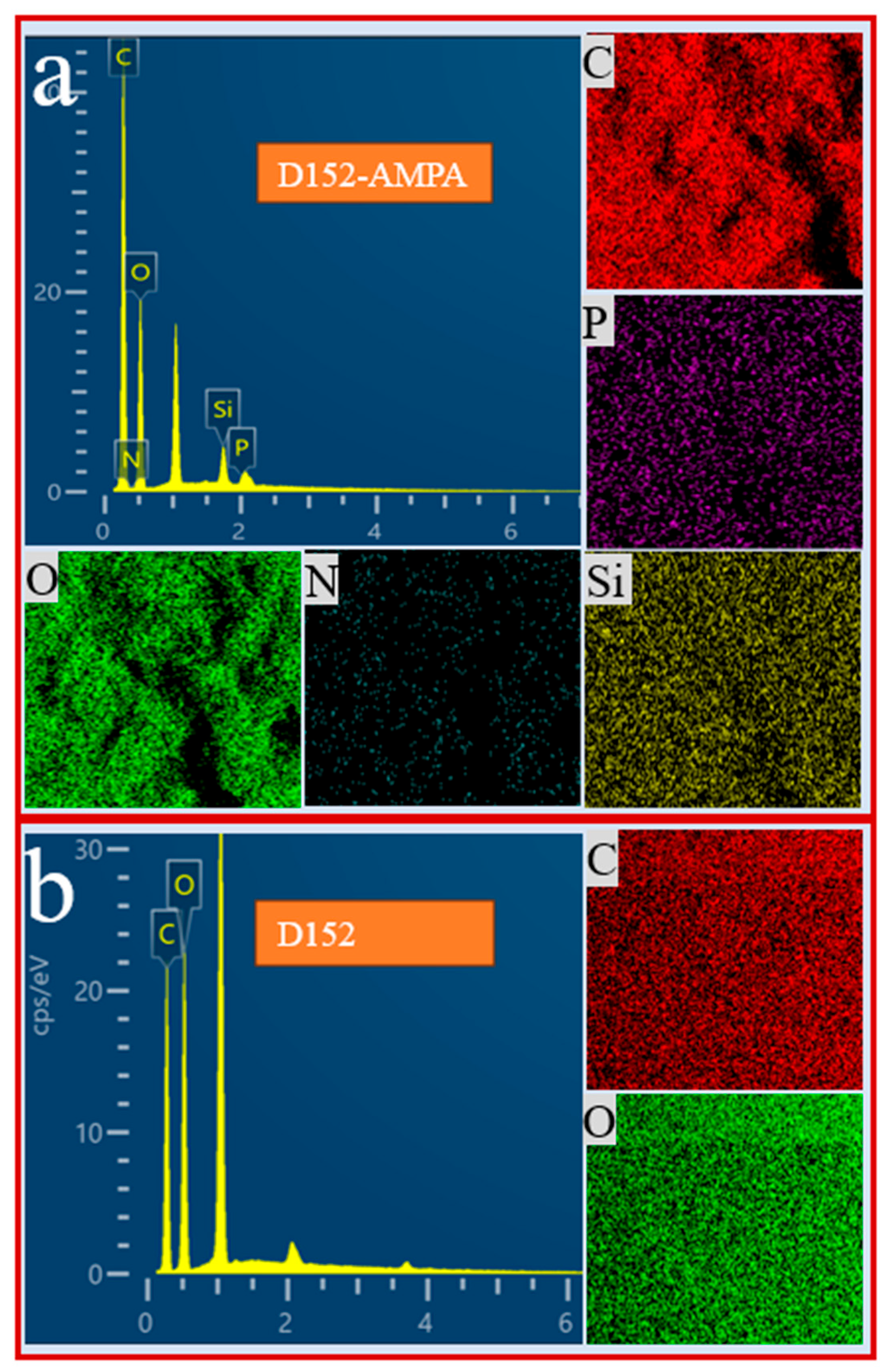
As illustrated in Figure 2a, the EDS spectrum of D152-AMPA exhibited distinct P and Si signals alongside C, N, and O, whereas the spectrum of the pristine D152 resin (Figure 2b) was dominated by C and O, with no discernible P or Si related peaks, thereby substantiating the presence of silicon and phosphorus containing moieties on the modified surface, which is a characteristic observation in phosphonate- or phosphate-functionalized silica/polymer adsorbents [16,18]. The Si signal is most plausibly attributed to the silane coupling layer, while the P signal is consistent with the introduction of aminophosphonate groups [18,19]. Elemental mapping results corroborated this trend: in Figure 2a, the signals corresponding to C, N, O, P, and Si were distributed relatively uniformly across the surface of D152-AMPA, implying that the silicon and phosphorus containing species were well dispersed over the bead surface rather than locally concentrated, whereas the elemental distribution of the pristine D152 resin (Figure 2b) consisted predominantly of the matrix elements C and O [17,18]. It should be noted that the red areas in the elemental mapping images reflect only the original signal color scale used by the instrument and do not indicate any separately defined region of special significance. Collectively, the morphological and elemental distribution evidence presented in Figure 1 and Figure 2 is consistent with the formation of a relatively uniform Si- and P-containing functional layer on the resin surface and provides structural support for the subsequent adsorption and separation of mixed rare earth elements.

3.1.2. TG-DSC

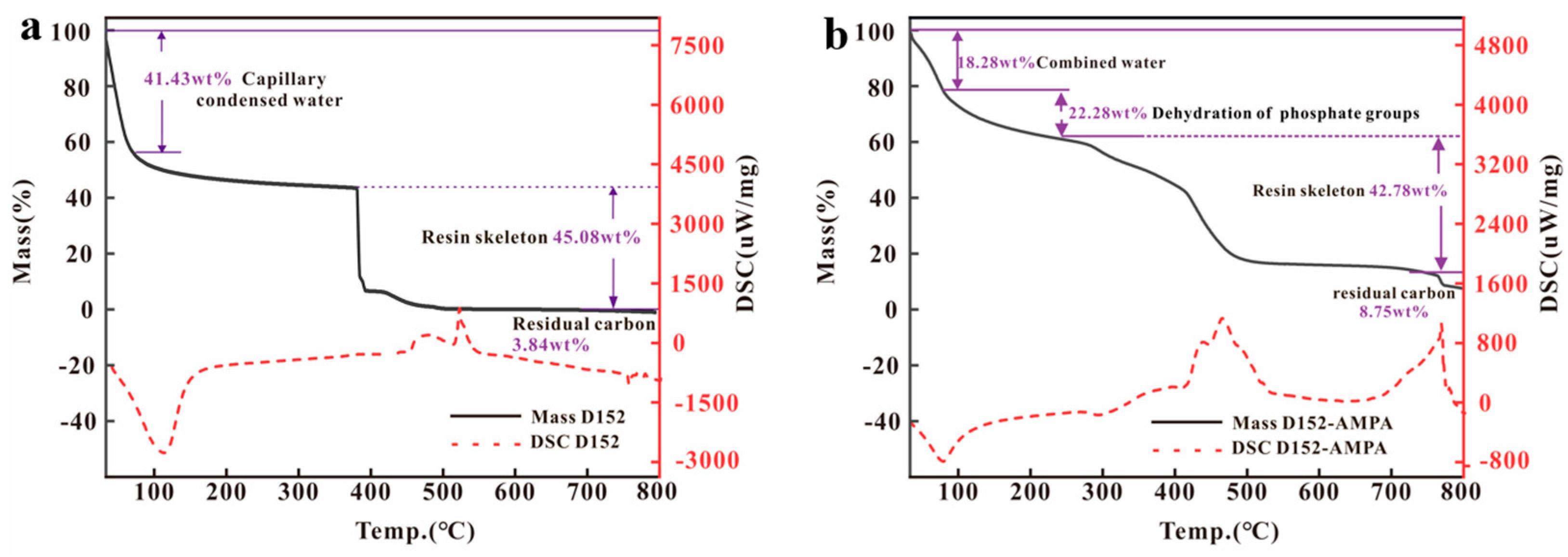
As shown in Figure 3, the TG–DSC curves of pristine D152 and D152-AMPA exhibited different thermal weight-loss behaviors, indicating that the thermal decomposition pattern of the resin changed after functionalization [19,20,21]. For pristine D152 (Figure 3a), a pronounced initial weight loss of about 41.43 wt% was observed in the low-temperature region, followed by the main decomposition stage of the resin framework at higher temperature, leaving a final residue of about 3.84 wt% [21]. In contrast, D152-AMPA (Figure 3b) showed a more stepwise decomposition profile. The initial low-temperature weight loss decreased to about 18.28 wt%, and an additional intermediate-temperature weight-loss stage of approximately 22.28 wt% appeared, which is consistent with the presence of newly introduced surface functional groups [19,21]. More importantly, the final residue of D152-AMPA increased to about 8.75 wt%, compared with 3.84 wt% for pristine D152, suggesting that the introduction of the Si- and P-containing functional layer improved the thermal stability of the resin to some extent and enhanced its residual char-forming ability at elevated temperature [19,22,23].
Although both materials still underwent major backbone decomposition in the high-temperature region, the relatively close skeleton-related mass fractions indicate that the modification mainly altered the surface functionality while preserving the basic resin framework [19,20,21].

3.2. Effect of pH

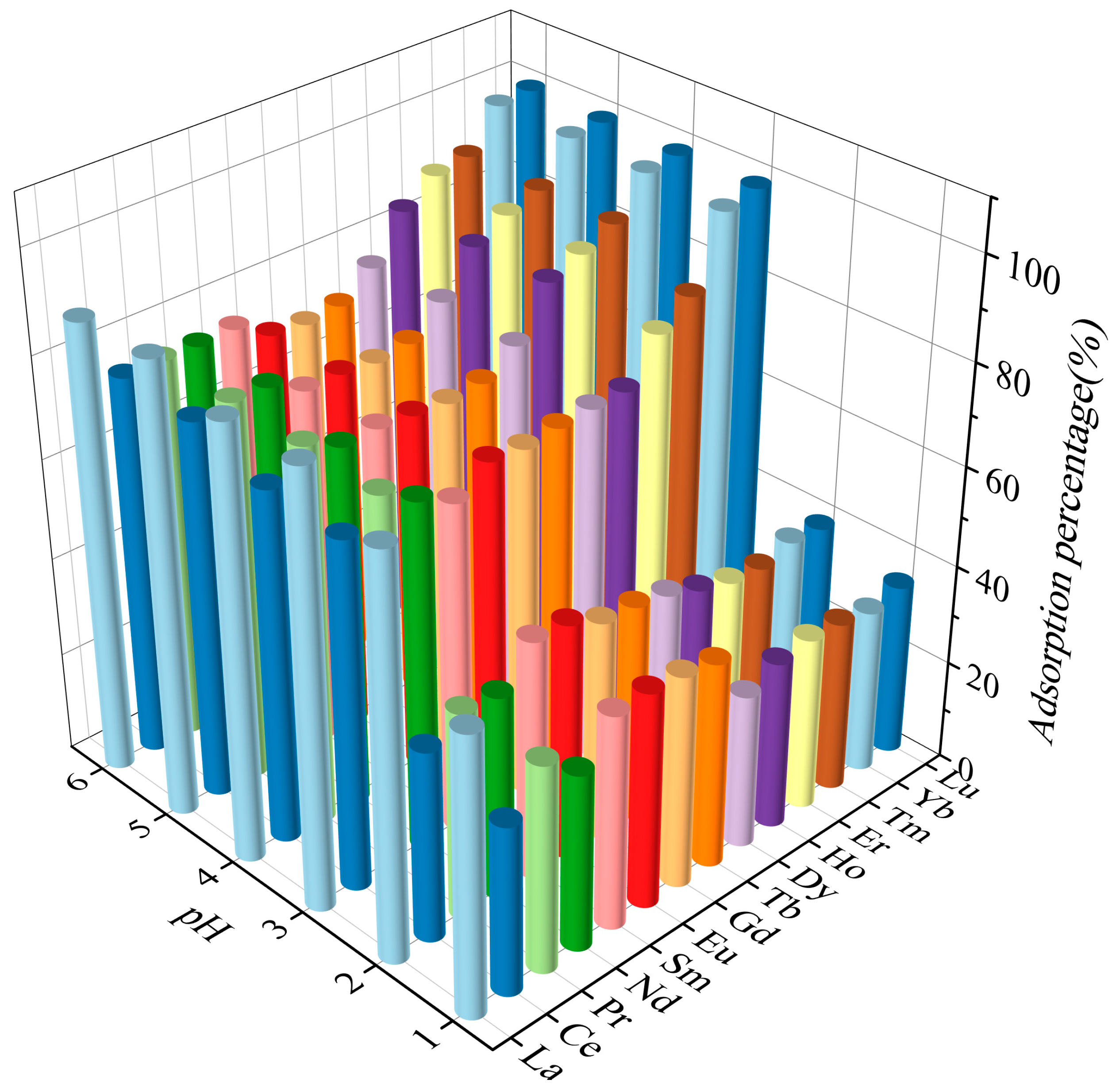
As shown in Figure 4, the adsorption of mixed rare-earth elements on D152-AMPA exhibited a pronounced dependence on pH, with the adsorption percentages of most rare-earth elements generally increasing as the pH was raised from 1 to 6, although the extent of this increase varied among the individual elements [6,8,24]. Under low-pH conditions, measurable uptake was observed for all elements, yet the overall adsorption level remained relatively suppressed, whereas a progressive increase in pH led to a gradual enhancement of adsorption, indicating that solution acidity constitutes an important factor governing the adsorption behavior of this system [8,25]. This trend is consistent with previous studies on phosphonate- and aminophosphonate-based rare-earth adsorbents, in which adsorption generally increases with pH because excess H+ competes for the active sites under strongly acidic conditions, whereas the progressive deprotonation of the functional groups increases the availability of oxygen donor sites for coordination and ion exchange within the effective working window.
From the perspective of elemental differences, the adsorption behavior depicted in Figure 4 is not strictly monotonic along the rare-earth series, and different elements and different sections of the series responded distinctly to variations in pH, reflecting that the adsorption behavior in the mixed system was governed not only by the intrinsic coordination ability of the resin but also by multicomponent competitive adsorption effects [11,26]. Overall, the middle and heavy rare-earth region, particularly the Ho–Lu section, maintained relatively high adsorption levels at elevated pH, whereas the light rare earths and certain middle rare earths displayed more pronounced variation in the low-to-intermediate pH range. Such a tendency is broadly consistent with coordination-chemistry expectations based on the lanthanide contraction, namely the progressive decrease in ionic radius and increase in charge density across the series; however, the final adsorption sequence in mixed systems is also strongly influenced by coexisting-ion competition, ligand environment, and solution speciation.
From the viewpoint of separation, increasing pH does not automatically define the optimum condition for evaluating inter-element discrimination. In many rare-earth adsorption systems, the practically useful separation window is often found in a moderate pH range, where uptake is sufficiently developed but not yet close to complete saturation; under such conditions, inter-element differences can be expressed more clearly than at very high uptake levels [10,11,26].

3.3. Separation Behavior

As shown in Table 1, the adjacent-pair separation factors of the mixed rare-earth system on D152-AMPA were strongly affected by pH, which is consistent with the general behavior of resin-based rare-earth separation systems, where even small differences in adjacent-element selectivity are highly sensitive to solution acidity and to the protonation/deprotonation state of the functional groups [10,27,28]. The separation factor was defined as the ratio of the distribution coefficient of the heavier element to that of the immediately preceding lighter element; values above and below unity indicate preferential adsorption of the heavier and lighter element, respectively [9,17]. For the light rare earths and part of the middle rare earths, most adjacent-pair separation factors were close to unity, suggesting only minor adsorption differences between neighboring elements [27,28]. Ce/La was an exception and remained below unity throughout the studied pH range. In contrast, the middle-to-heavy rare-earth transition region showed a much stronger pH response. Gd/Eu and Dy/Tb were above unity at low pH but fell below unity at higher pH, indicating selectivity reversal, whereas Ho/Dy increased from 0.72 to 1.23 with increasing pH. This behavior suggests that both the direction and extent of selectivity were governed by pH-dependent surface deprotonation and multicomponent competitive adsorption. The most pronounced local separation effects occurred in the heavy rare-earth region. Er/Ho remained above unity from pH 3 to 6 and increased from 1.59 to 2.71, indicating an increasingly favorable adsorption of Er over Ho. Tm/Er varied from 0.99 to 1.32, reflecting weak but distinguishable positive selectivity. Yb/Tm showed the strongest local separation behavior, increasing from 5.83 to 7.00 over pH 3-6. Lu/Yb also remained above unity throughout the investigated range, with a maximum value of 2.03 [12,26].

3.4. Segmental Fractionation

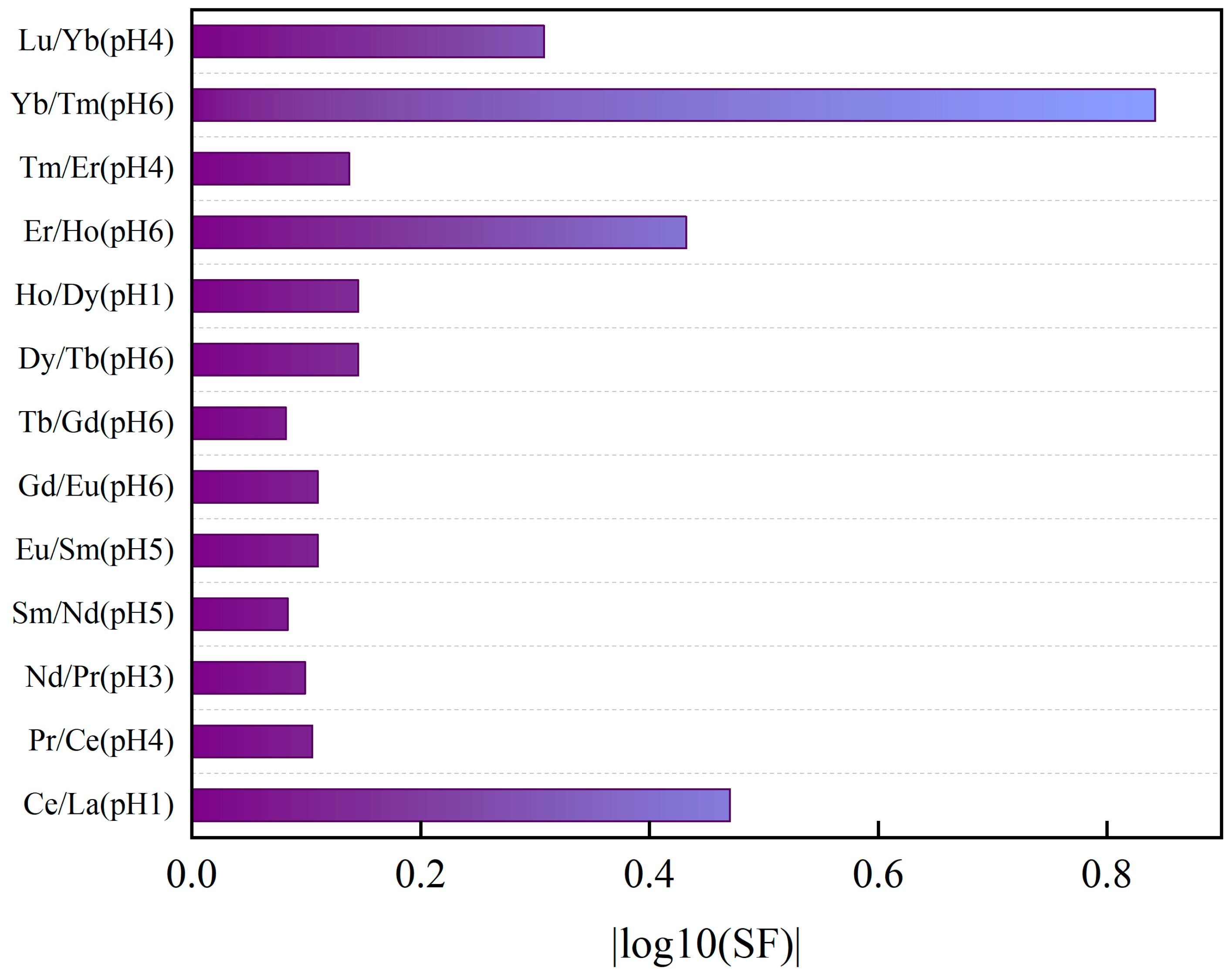
As shown in Figure 5, the maximum local separation strength differed markedly among the adjacent rare-earth pairs over the investigated pH range, which is consistent with the general understanding that adjacent rare-earth elements remain intrinsically difficult to separate and that even small selectivity differences can become strongly system- and condition-dependent in ion-exchange or adsorption processes [20,28,29]. For comparative discussion, the absolute logarithm of the separation factor, |log10(SF)|, was adopted because this parameter directly reflects the extent to which the separation factor deviates from unity and is therefore convenient for comparing the magnitude of local discrimination among different adjacent pairs [20,28]. It is therefore useful for comparing the magnitude of local separation among different adjacent pairs, although |log10(SF)| describes only the strength of separation and does not convey its direction; accordingly, it should be regarded here as an auxiliary descriptor used together with the original separation factor. Among all adjacent pairs, Yb/Tm exhibited the highest |log10(SF)| value, reaching 0.84 at pH 6, and thus showed the strongest local separation effect in the present system; the corresponding maximum values for Ce/La and Er/Ho were 0.471 and 0.432, respectively, also indicating relatively strong adjacent-pair discrimination, whereas the maximum |log10(SF)| values for most of the remaining adjacent pairs were mainly within 0.08–0.15, suggesting that their local selectivity differences were generally modest. Such a distribution pattern agrees with the broader view that practically meaningful resin-based rare-earth discrimination is often concentrated in a limited number of specific adjacent pairs rather than being uniformly expressed across the whole series [17,26,28]. When these results are considered together with the data in Table 1, Er/Ho showed not only a relatively high maximum separation strength but also a stable preference for Er over Ho across a broader pH window, whereas the stronger Yb/Tm enhancement was concentrated mainly in the higher-pH region. Therefore, for subsequent validation in impurity-containing systems and dynamic column experiments, Er/Ho was selected as the representative adjacent pair because it provided a more balanced combination of separation strength and operational robustness [17,26,30].The comparison of maximum |log10(SF)| values further indicates that the separation advantage of D152-AMPA in the mixed rare-earth system was concentrated in several specific adjacent pairs. Among them, Yb/Tm represented the strongest local separation effect, whereas Er/Ho combined relatively strong separation with a broader effective pH range, making it the more practical representative pair for subsequent process validation [17,29].

3.5. Mechanism

3.5.1. XPS Analysis

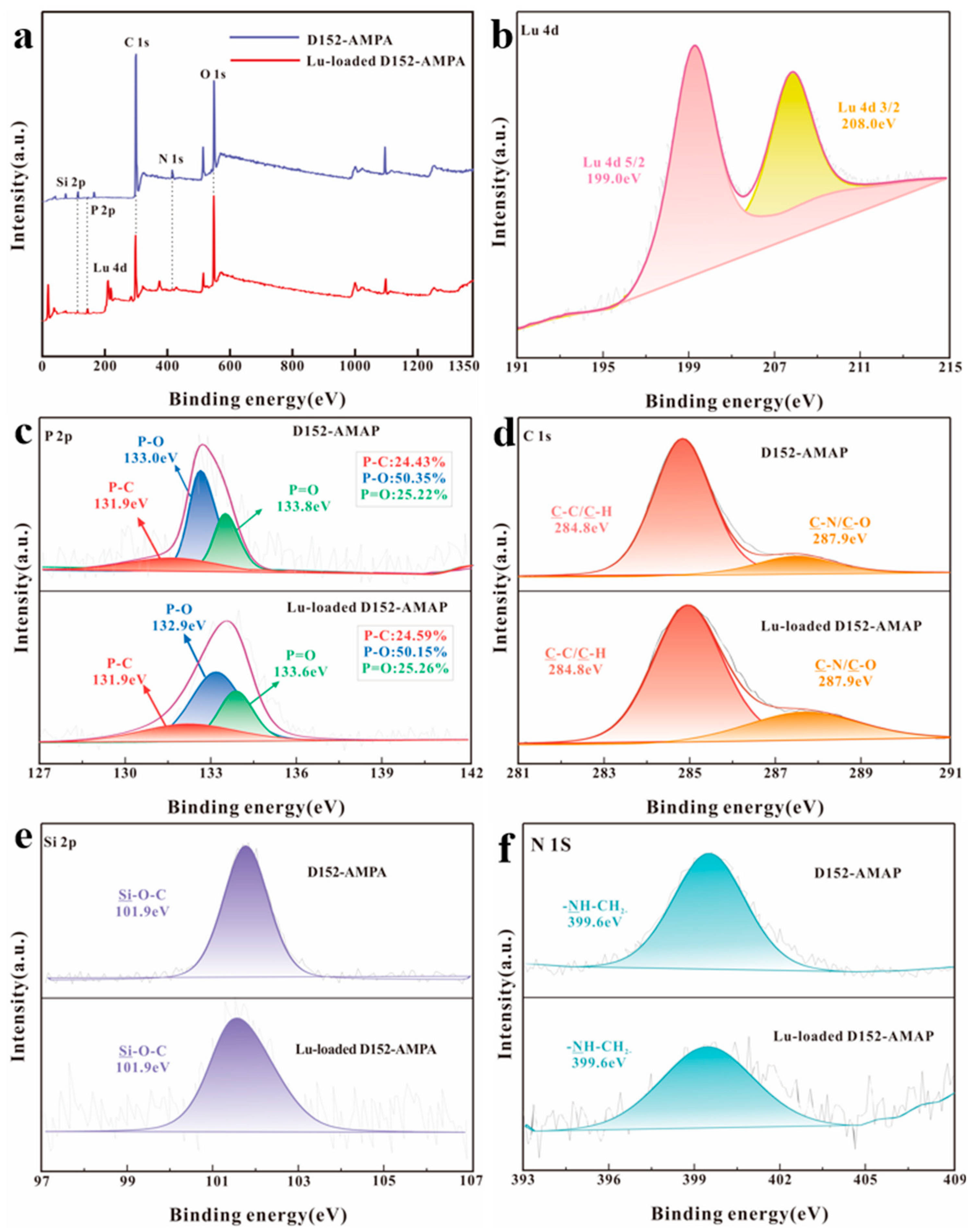
The XPS results further clarify the interaction between D152-AMPA and Lu(III). As shown in the survey spectra (Figure 6a), both D152-AMPA and Lu-loaded D152-AMPA display the characteristic signals of C 1s, O 1s, N 1s, P 2p, and Si 2p, while an additional Lu 4d signal appears after adsorption. This result confirms the presence of Lu on the resin after adsorption and, together with the retention of the main framework-related signals, suggests that the overall resin framework and grafted layer were largely preserved during the adsorption process [19,31]. In the high-resolution Lu 4d spectrum (Figure 6b), two characteristic peaks are observed at approximately 199.0 and 208.0 eV, corresponding to Lu 4d5/2 and Lu 4d3/2, respectively. The appearance of such Lu-related core-level signals, together with the concurrent response of the P 2p region, supports the presence of surface-bound Lu species and is consistent with a coordination interaction between Lu(III) and phosphonate-containing functional groups on the resin [17,19]. The most pronounced adsorption-induced response is observed in the P 2p region. For D152-AMPA, the P 2p envelope can be deconvoluted into three components located at about 131.9, 133.0, and 133.8 eV, which are assigned to P–C, P=O, and P–O environments, respectively. After Lu adsorption, the P–C component remains essentially unchanged, whereas the two oxygen-related components shift slightly from about 133.0 and 133.8 eV to about 132.9 and 133.6 eV (Figure 6c). These downward shifts indicate that Lu adsorption mainly affects the electronic environment of the oxygen-bearing sites in the phosphonate groups. Meanwhile, the relative area ratio of the three fitted components remains approximately 1:2:1 before and after adsorption, suggesting that the phosphonate framework itself was retained during adsorption. Therefore, the adsorption process is more reasonably interpreted as a coordination-induced electronic redistribution at the P=O- and P-O-related sites, rather than structural reconstruction of the phosphonate group. These results indicate that the phosphonate oxygen atoms were the principal active sites for Lu(III) binding.
By contrast, the C 1s spectra show only limited changes. The C 1s envelope can be resolved into two components (Figure 6d), namely C–C/C–H at about 284.8 eV and C–N/C–O at about 287.9 eV, and both components remain essentially unchanged after adsorption. This suggests that the organic framework of the resin was not fundamentally altered during adsorption and that the carbon skeleton was not the principal site responsible for Lu(III) binding. A similar trend is observed for Si 2p. The Si 2p peak remains at about 101.9 eV before and after adsorption (Figure 6e), with almost no obvious shift. This indicates that the silane-grafted layer remained chemically stable during adsorption and that the Si-containing structure mainly served as a linking and supporting unit rather than as a major active site for Lu(III) binding.
The N 1s spectrum also exhibits only a weak response, with the main peak remaining centered at about 399.6 eV before and after adsorption (Figure 6f), suggested that the nitrogen-containing site was less sensitive to Lu adsorption than the oxygen-related components in the P 2p region and was therefore unlikely to be the primary coordination center.
The adsorption of Lu(III) on D152-AMPA was mainly governed by coordination with the oxygen donor sites of the aminophosphonate groups. The most significant chemical response originated from the P=O- and P-O-related oxygen sites, whereas only limited changes were observed in the chemical environments of C, Si, and N. Lu(III) was therefore bound predominantly through phosphonate oxygen sites without disrupting the main resin framework or the grafted layer.

3.5.2. FT-IR Analysis

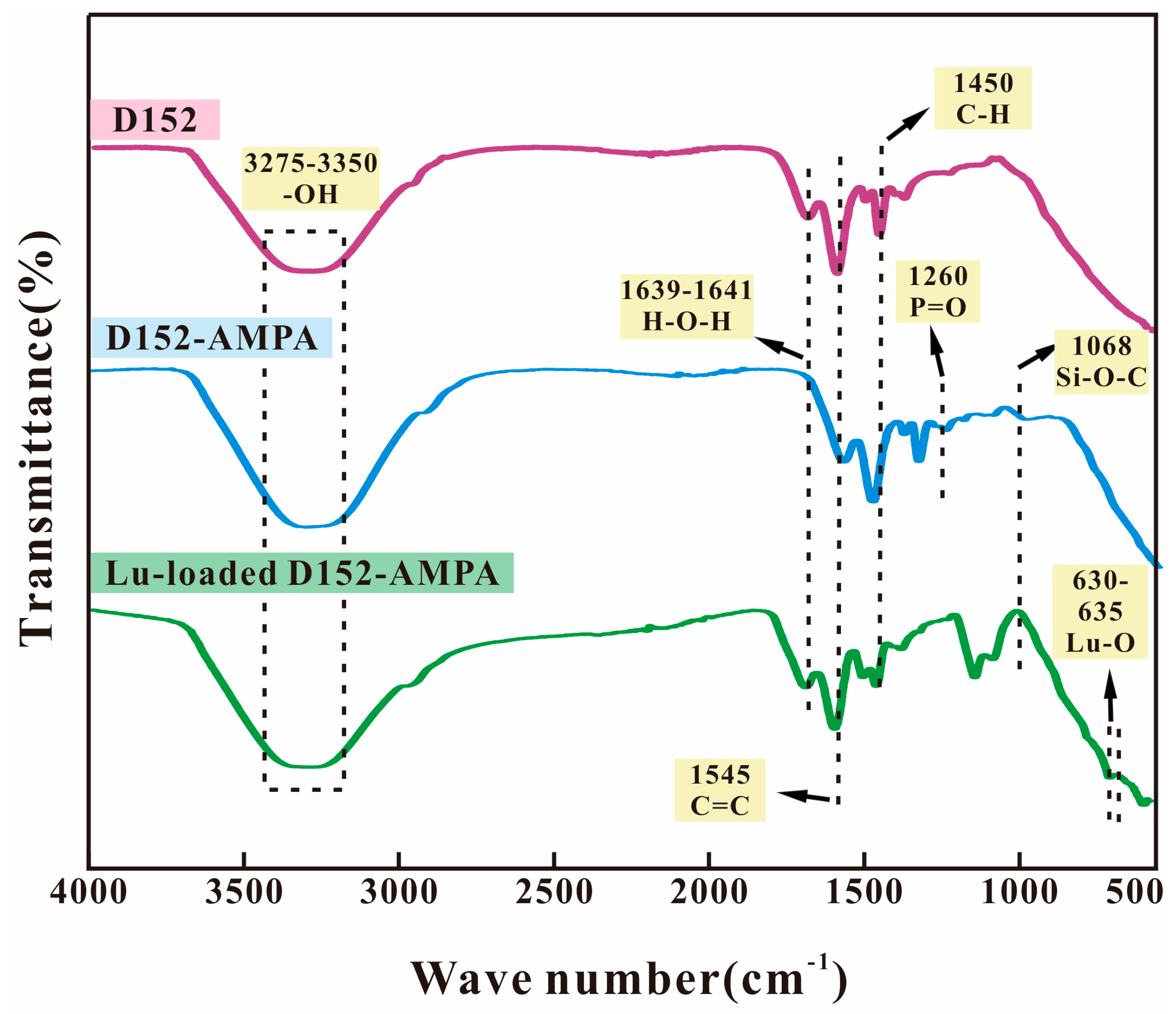
The FT-IR results (Figure 7) further support the successful construction of D152-AMPA and suggest that its interaction with Lu(III) mainly involved oxygen-containing phosphonate sites. D152, D152-AMPA, and Lu-loaded D152-AMPA all exhibit a broad absorption band in the 3275–3350 cm−1 region, which can be attributed to O–H stretching of adsorbed water, together with a band near 1639–1641 cm−1 corresponding to H–O–H bending. In addition, the framework-related bands at about 1545 cm−1 and 1450 cm−1 remain observable before and after modification and Lu loading, suggesting that the basic organic framework of the resin was largely retained throughout these treatments [19,20]. Compared with pristine D152, D152-AMPA exhibits two new characteristic bands at 1260 cm−1 and 1068 cm−1. The band at 1260 cm−1 can be reasonably assigned to a P=O-related vibration of the aminophosphonate group, whereas the band at 1068 cm−1 is more appropriately interpreted as an overlapping contribution involving Si–O and P–O-related vibrations. The appearance of these phosphorus/silicon-associated bands after modification is consistent with the successful grafting of an aminophosphonate-containing functional layer, which agrees with previous FT-IR characterizations of aminophosphonic or phosphonate-functionalized sorbents [19,20,32]. After Lu adsorption, the common framework-related bands at 3275–3350 cm−1, 1639–1641 cm−1, 1545 cm−1, and 1450 cm−1 are still preserved, indicating that the main resin structure was not significantly disrupted. By contrast, clearer spectral changes are observed in the phosphonate region and in the low-wavenumber region. In particular, the 1260 cm−1 band is markedly weakened after Lu loading, while the band near 1068 cm−1 is retained and becomes relatively more prominent. Such adsorption-induced intensity changes in P=O/P–O-related bands are consistent with previous rare-earth sorption studies on amino-phosphorylated or aminophosphonate sorbents, where shifts or attenuation of phosphorus-oxygen vibrations were interpreted as evidence that metal coordination altered the local vibrational environment of the oxygen donor sites [8,19,33]. A new band also appears at 630–635 cm−1 in Lu-loaded D152-AMPA. This band is consistent with Lu–O-related vibration, although the assignment should be made cautiously because metal–ligand vibrations in the low-wavenumber region may overlap. The emergence of this band suggests a direct interaction between Lu and oxygen donor sites on the resin surface [8,17]. In contrast, the bands associated with the resin backbone change only slightly, implying that the organic framework and siloxane network were not the primary responsive sites during Lu binding. The FT-IR results support the conclusion that Lu(III) adsorption on D152-AMPA was mainly driven by oxygen donor sites in the phosphonate groups, which is in line with previous mechanistic studies showing that phosphonate or aminophosphonic acid sorbents bind rare-earth or actinide species primarily through P=O/P–OH/P–O-related oxygen environments rather than through the support matrix itself [19,32].

3.6. Effect of Impurities

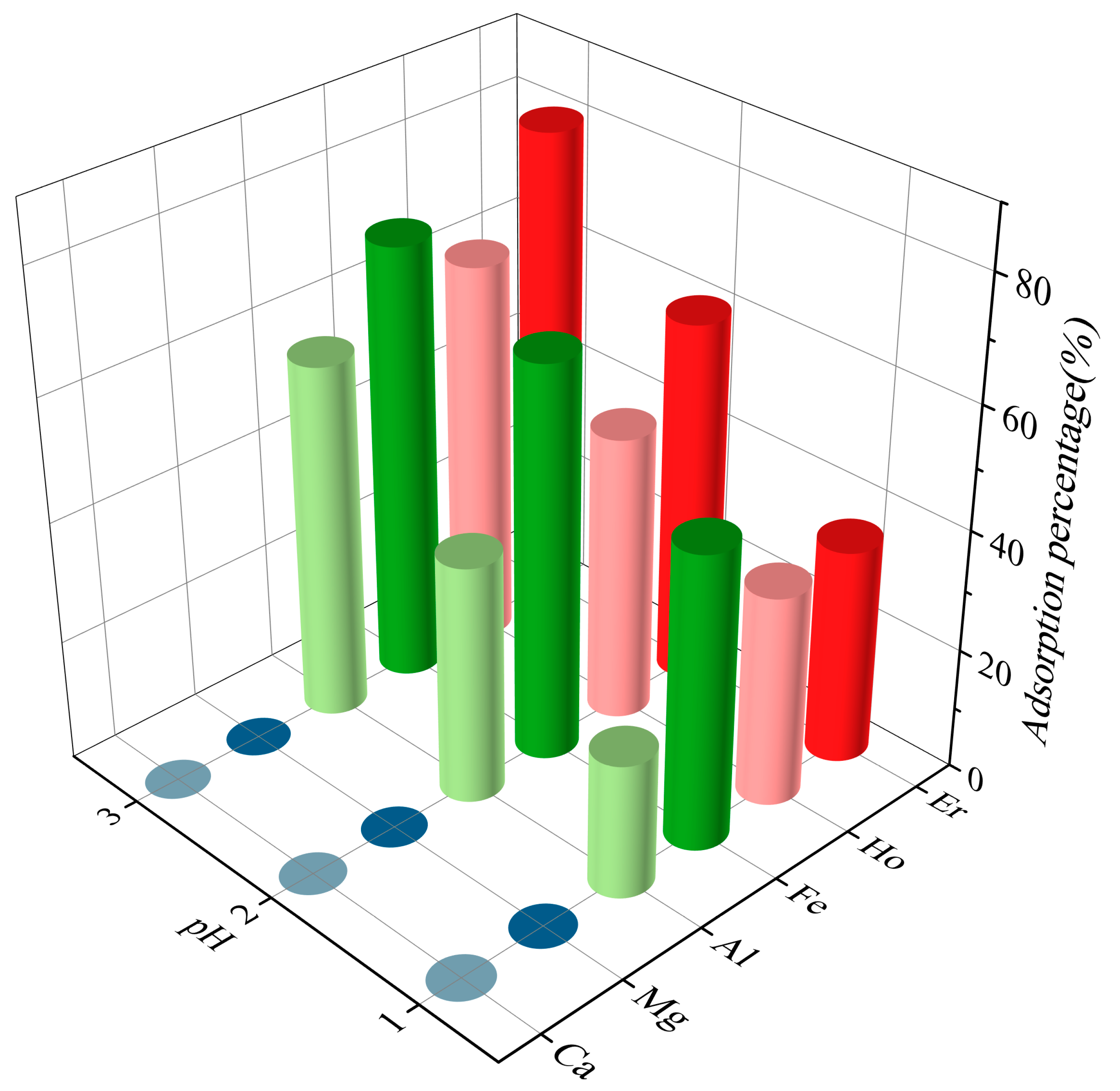
As shown in Figure 8 and Table 2, D152-AMPA exhibited clearly differentiated adsorption behaviors toward Er, Ho, Al, Fe, Ca, and Mg in the impurity-containing system. As the pH increased from 2 to 4, the adsorption percentages and distribution coefficients of Er, Ho, Al, and Fe all increased, whereas Ca and Mg remained at extremely low levels throughout the investigated range, a pattern that is consistent with the strong pH dependence generally observed for phosphonate-based rare-earth adsorption and with the weak retention of alkaline-earth ions on such sorbents [24,34]. This indicates that, under the present conditions, impurity competition mainly originated from Fe and Al rather than from Ca and Mg, which agrees with previous adsorption and ion-exchange studies showing that trivalent fouling metals are usually more problematic for selective REE recovery and often need to be removed or suppressed in advance [6,11,35]. For the target pair, Er was adsorbed slightly but consistently more strongly than Ho at all tested pH values, and the Er/Ho separation factor increased from 1.031 to 2.298 as the pH rose from 2 to 4. This result indicates that the preferential partitioning of Er over Ho was not suppressed by the coexisting impurities and in fact became more clearly expressed as the effective adsorption window opened with increasing pH [27,34,36].
The distribution-coefficient data further show that Fe was the strongest competing impurity at lower pH, whereas at pH 4 the distribution advantage of Er in the resin phase became more pronounced. This interpretation is consistent with earlier chelating-resin studies in which Fe(III) was adsorbed in preference to REEs under more acidic conditions, while practically useful rare-earth selectivity became clearer only after the acidity window was adjusted appropriately [6,35,36]. The separation behavior of Er/Ho in the impurity-containing system was governed jointly by the intrinsic difference in distribution behavior between the two target elements and by competition from coexisting ions. Fe and Al can more effectively compete for hard oxygen-donor coordination environments under acidic conditions, whereas Ca and Mg, as divalent alkaline-earth ions, interact much more weakly with phosphonate-type sorbents; consequently, the direct competitive pressure in the present system was concentrated mainly in the Fe/Al fraction rather than in the Ca/Mg fraction [11,19,27]. As the pH increased, the partitioning advantage of Er over Ho became progressively larger, which is broadly consistent with the general tendency for adsorption processes to favor the more strongly bound heavy-rare-earth side of the lanthanide series once the ligand environment becomes sufficiently available for coordination [27,37]. At the same time, the effective influence of Fe and Al on the adsorption window is also pH-dependent in impurity-rich rare-earth process liquors. Therefore, within the present impurity-containing system, the higher-pH condition was more favorable for the manifestation of Er/Ho selectivity, which is consistent with the broader adsorption literature showing that the practically useful separation window in multicomponent systems depends strongly on both pH and ligand architecture [34,35,38].

3.7. Dynamic Separation

3.7.1. Breakthrough Behavior

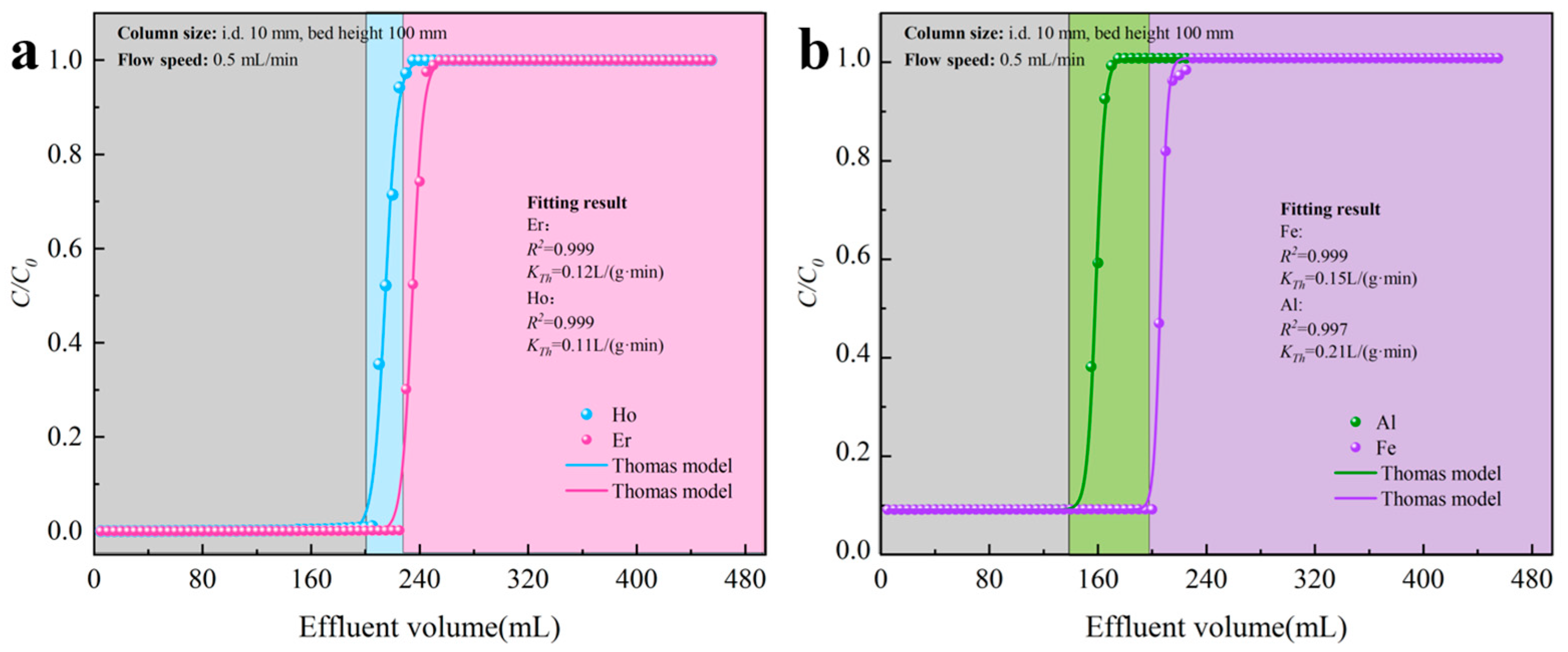
Figure 9 presents the dynamic breakthrough curves and Thomas-model fitting results for the target rare-earth pair Ho/Er in panel (a) and for the impurity ions Al/Fe in panel (b). Considering that the static experiments showed negligible adsorption of Ca and Mg, the present dynamic-column analysis focused mainly on Al, Fe, Ho, and Er, which is also consistent with the general practice in fixed-bed multicomponent studies of emphasizing the ions that make the dominant contribution to breakthrough competition and product contamination [39,40,41]. The breakthrough curves were fitted using the Thomas model, and the coefficients of determination for all four fits were higher than 0.997, indicating that the model adequately described the fixed-bed breakthrough behavior under the present conditions. Nevertheless, because the present system involved multicomponent competitive adsorption, the fitted parameters are more appropriately interpreted as descriptors of relative breakthrough behavior than as strictly intrinsic measures of ion-by-ion capacity, which is in line with recent discussions on the assumptions and limitations of Thomas-type modeling in complex fixed-bed systems [40,41,42,43,44]. In terms of breakthrough order, Al broke through first, followed by Fe, then Ho, whereas Er broke through last. The corresponding breakthrough-midpoint sequence indicates that, under dynamic competitive conditions, the resin retained the target heavy rare-earth pair more strongly than the major impurity ions and retained Er more strongly than Ho. Such a pattern is consistent with selective fixed-bed adsorption studies in which strongly preferred REE or target metals are delayed in the column relative to competing background ions, while heavier or more strongly coordinated species tend to exhibit longer effective retention intervals [2,39,41].
Accordingly, the dynamic retention sequence in the present system can be summarized as Er > Ho > Fe > Al, which is consistent with the partitioning advantage of Er and Ho over the major impurities observed in the static mixed-adsorption experiments. The Thomas model fitting results further reflected the differences in breakthrough behavior among the ions. The KTh values of Al and Fe were 0.21 and 0.15 L/(g·min), respectively, both higher than those of Er and Ho, which were 0.12 and 0.11 L/(g·min). When interpreted together with the breakthrough order, these results show that Al and Fe had smaller retention volumes and entered the effluent earlier, whereas Er and Ho, especially Er, exhibited longer effective retention intervals in the column. The key implication of this behavior lies in the earlier breakthrough of Al and Fe than that of the target rare-earth pair, which provides a dynamic basis for obtaining Er-rich and Ho-rich fractions with lower impurity contents in the subsequent elution stage. In other words, D152-AMPA not only delayed the breakthrough of the target heavy rare-earth pair under impurity-containing conditions, but also allowed the major impurity ions to leave the column earlier, thereby creating a more favorable starting point for subsequent complexing-agent elution and target-fraction purification. This interpretation is well aligned with earlier ion-exchange column studies in which selective loading, controlled residence time, and chelating-agent elution were jointly used to enhance REE fractionation and to separate REE from impurity metals under continuous-flow condition [39,41,45].

3.7.2. Elution Performance

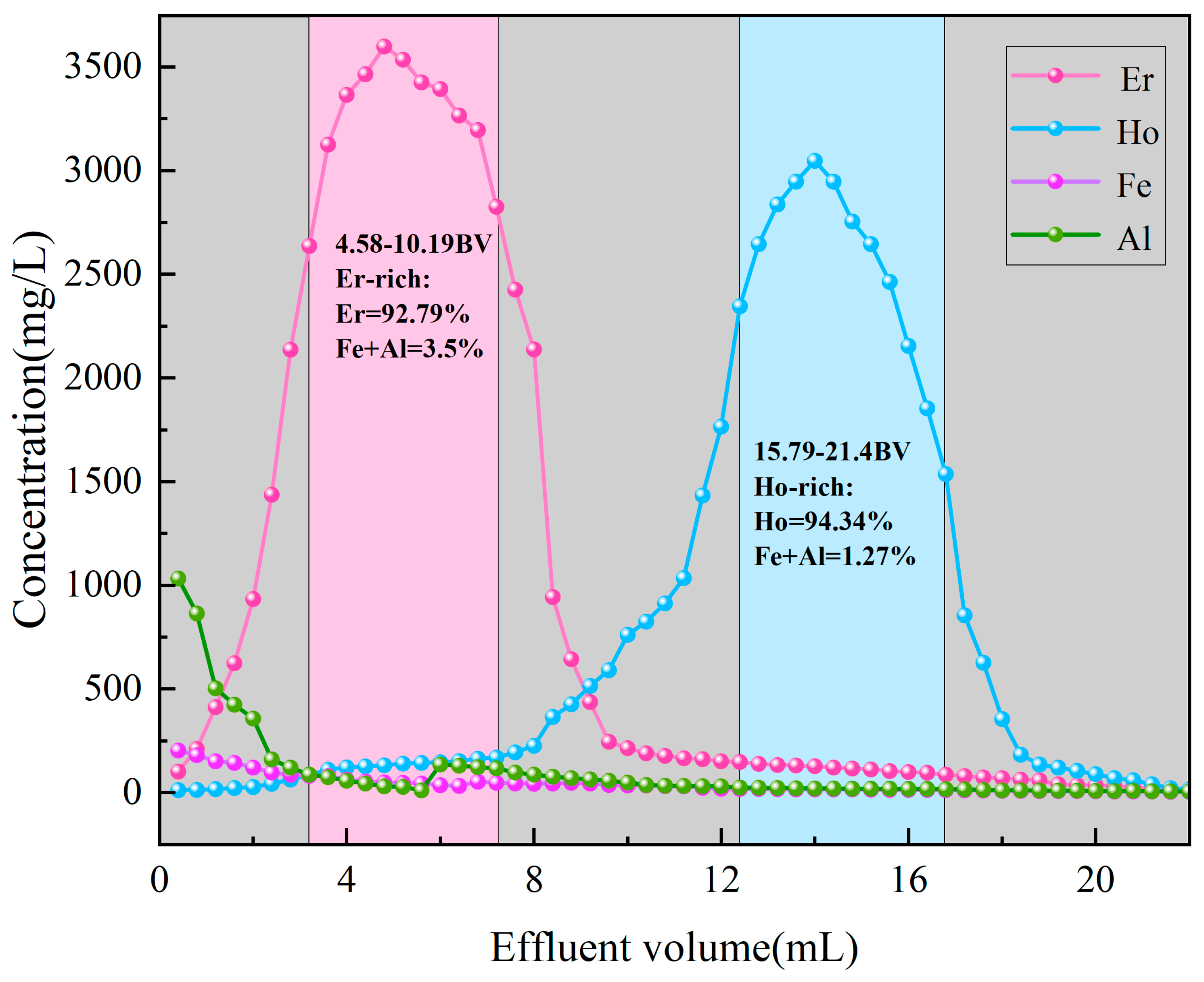
As shown in Figure 10 and Table 3, NH4EDTA elution after dynamic loading generated clearly differentiated elution zones for Er and Ho, while Fe and Al were concentrated mainly in the elution front and the main target-element bands shifted to later fractions. The earlier appearance of the Er peak relative to Ho indicates that the retention difference established during loading was successfully translated into collectable target fractions during elution, which is consistent with prior ion-exchange studies showing that NH4EDTA can produce narrower and better-resolved rare-earth elution bands and that additional fractionation control improves separation from impurities [45,46,47]. The Er-rich fraction was collected in the 4.58–10.19 BV range, where Er formed the dominant elution peak while Ho remained at a relatively low level and Fe/Al were present only as limited carryover. Within this window, the Er-rich product can be regarded as a relatively high-purity fraction generated after the impurity front had been displaced, which is in line with earlier column-elution studies where selective complexing-agent elution yielded an early target-rich window after the most weakly retained impurities had already left the bed [45,46,47]. Between the Er-rich and Ho-rich regions, the elution curves passed through a distinct transition zone in which the Er concentration gradually decreased while the Ho concentration continuously increased, indicating the formation of a mixed band between the two adjacent heavy rare earths. Such a mixed fraction is not unexpected in adjacent-rare-earth ion-exchange separation, because the overlap region between neighboring bands remains finite even when fractionation is effective; accordingly, this transition zone still retained substantial amounts of both target elements and constituted the principal factor limiting direct single-pass product recovery [47]. The Ho-rich fraction was obtained in the 15.79–21.40 BV range, where Ho formed the dominant elution peak after Er had already declined markedly and the Fe/Al contents had been further reduced. Compared with the Er-rich fraction, the Ho-rich product exhibited lower impurity carryover, indicating that the later collection window had become more effectively separated not only from the impurity front but also from the preceding Er band; similar improvements in target purity after better band development or additional fractionation control have also been reported in recent REE ion-exchange elution studies [48,49].
Considering the entire NH4EDTA elution stage, the cumulative recoveries of Er and Ho were relatively high, but a non-negligible portion of both elements still remained in the mixed transition fraction. This result highlights the usual trade-off between direct product purity and one-pass recovery in adjacent-rare-earth fractionation: the more conservatively the product windows are cut, the higher the purity can be, but the larger the amount of valuable material that remains in intermediate fractions requiring recycle or further fractionation [46,48].

4. Conclusions

In this study, the adsorption and separation behavior of a silane-grafted aminophosphonate resin, D152-AMPA, toward a mixed rare-earth system was systematically investigated. The results showed that, over the investigated pH range, the adsorption and separation behavior of D152-AMPA toward the mixed rare-earth system varied markedly with pH. As the pH increased from 1 to 6, the adsorption percentages and distribution coefficients of most rare-earth elements generally increased, whereas the responses of individual elements and adjacent pairs were not uniform, revealing distinct segmental and non-monotonic fractionation characteristics. Combined analysis of adjacent-pair separation factors and maximum separation intensity further showed that the separation advantage of D152-AMPA was concentrated in several specific neighboring pairs. Among them, Yb/Tm displayed the strongest local separation enhancement, whereas Er/Ho combined relatively high separation intensity with a broader effective pH range and was therefore more suitable as the representative pair for subsequent validation in complex systems and dynamic column experiments.
In the impurity-containing system with Al, Fe, Ca, and Mg, D152-AMPA still maintained effective separation capability toward Er/Ho. As the pH increased from 2 to 4, the Er/Ho separation factor increased from 1.031 to 2.298, indicating that the partitioning advantage of Er over Ho in the resin phase was retained and further strengthened even in the presence of impurities. At the same time, Fe and Al acted as the major competing impurities, whereas the direct competitive influence of Ca and Mg remained weak, suggesting that impurity competition in the present system mainly originated from the occupation of oxygen-containing sites by highly charged metal ions.
Dynamic column experiments further verified the potential of this system for continuous separation. During the breakthrough stage, Al broke through first, followed by Fe and Ho, whereas Er broke through last, indicating stronger dynamic retention of the target heavy rare-earth pair in the resin phase. During NH4EDTA elution, Er and Ho formed collectable fractionated elution zones, and the target-element purities of the Er-rich and Ho-rich fractions reached 92.79% and 94.34%, with cumulative recoveries of 88.32% and 83.05%, respectively. These results demonstrate that D152-AMPA was capable of dynamic fractionated separation of Er/Ho under impurity-containing conditions while producing target fractions of relatively high purity.
XPS and FT-IR analyses further indicated that Lu(III) adsorption was mainly associated with the oxygen donor sites of the aminophosphonate groups. In general, D152-AMPA exhibited favorable selective adsorption and dynamic separation performance in mixed and impurity-containing rare-earth systems, and provides an experimental basis for the preliminary separation, enrichment, and continuous green processing of complex rare-earth solutions.

Author Contributions

Conceptualization, M.H.; methodology, W.S.; software, M.L.; validation, M.F. and H.M.; formal analysis, X.P.; investigation, M.L.; resources, H.M.; data curation, X.P.; writing—original draft preparation, M.H.; writing—review and editing, W.S.; visualization, W.S.; supervision, C.H.; project administration, C.H.; funding acquisition, C.H. All authors have read and agreed to the published version of the manuscript.

Funding

This research was funded by the Guangxi Young Elite Scientist Sponsorship Program, grant number NO. GXYESS2025100.

Data Availability Statement

The data that support the findings of this study are available from the corresponding author upon reasonable request.

Acknowledgments

The authors would like to thank the Guangxi Science and Technology Major Project (NO. ZY24212006), Guangxi Key Research and Development Program (NO. AA24263044, NO. AB25069241), and Guangxi Key Laboratory of Advanced Rare Earth Materials.

Conflicts of Interest

Author Wenhan Sun and Chunlin He were employed by the company Guangxi Guosheng Rare Earth New Materials Co., Ltd. The remaining authors declare that the research was conducted in the absence of any commercial or financial relationships that could be construed as a potential conflict of interest.

References

  1. Chai, S.-S.; Zhang, W.-B.; Yang, J.-L.; Zhang, L.; Theint, M.M.; Zhang, X.-L.; Guo, S.-B.; Zhou, X.; Ma, X.-J. Sustainability applications of rare earths from metallurgy, magnetism, catalysis, luminescence to future electrochemical pseudocapacitance energy storage. RSC Sustain. 2023, 1, 38–71. [Google Scholar] [CrossRef]
  2. Jyothi, R.K.; Thenepalli, T.; Ahn, J.W.; Parhi, P.K.; Chung, K.W.; Lee, J.-Y. Review of rare earth elements recovery from secondary resources for clean energy technologies: Grand opportunities to create wealth from waste. J. Clean. Prod. 2020, 267, 122048. [Google Scholar] [CrossRef]
  3. Liu, T.; Chen, J. Extraction and separation of heavy rare earth elements: A review. Sep. Purif. Technol. 2021, 276, 119263. [Google Scholar] [CrossRef]
  4. Ningappa, N.G.; Vishweswariah, K.; Kumar, M.R.A.; Dawkins, J.I.; Selva, T.M.; Zaghib, K. Sustainable transformation of rare earth metals value chain for dual-use technologies. Energy Storage Mater. 2026, 84, 104799. [Google Scholar] [CrossRef]
  5. Xie, F.; Zhang, T.A.; Dreisinger, D.; Doyle, F. A critical review on solvent extraction of rare earths from aqueous solutions. Miner. Eng. 2014, 56, 10–28. [Google Scholar] [CrossRef]
  6. Page, M.J.; Soldenhoff, K.; Ogden, M.D. Comparative study of the application of chelating resins for rare earth recovery. Hydrometallurgy 2017, 169, 275–281. [Google Scholar] [CrossRef]
  7. Virtanen, E.J.; Kukkonen, E.; Yliharju, J.; Tuomisto, M.; Frimodig, J.; Kinnunen, K.; Lahtinen, E.; Hänninen, M.M.; Väisänen, A.; Haukka, M.; et al. Recovery of rare earth elements from mining wastewater with aminomethylphosphonic acid functionalized 3D-printed filters. Sep. Purif. Technol. 2025, 353, 128599. [Google Scholar] [CrossRef]
  8. Imam, E.A.; Hashem, A.I.; Lu, X.; Tolba, A.A.; Mahfouz, M.G.; Xin, J.; El-Sayed, I.E.-T.; Mohamady, S.I.; Ahmed, A.A.; Galhoum, A.A.; et al. Nd(III) sorption using aminophosphonate-based sorbents—Sorption properties and application to the treatment of REE concentrate. Colloids Surf. A Physicochem. Eng. Asp. 2024, 685, 133339. [Google Scholar] [CrossRef]
  9. Sraidi, A.; Hak, S.A.; Kounbach, S.; Khaless, K.; Benhida, R. Extraction of rare earth elements using a chelating amino methyl phosphonic acid resin. J. Mol. Liq. 2024, 402, 124758. [Google Scholar] [CrossRef]
  10. Hermassi, M.; Granados, M.; Valderrama, C.; Skoglund, N.; Ayora, C.; Cortina, J. Impact of functional group types in ion exchange resins on rare earth element recovery from treated acid mine waters. J. Clean. Prod. 2022, 379, 134742. [Google Scholar] [CrossRef]
  11. Hermassi, M.; Granados, M.; Valderrama, C.; Ayora, C.; Cortina, J. Recovery of Rare Earth Elements from acidic mine waters by integration of a selective chelating ion-exchanger and a solvent impregnated resin. J. Environ. Chem. Eng. 2021, 9, 105906. [Google Scholar] [CrossRef]
  12. Cao, W.; Huang, K.; Wang, X.; Liu, H. Grouping separation of mixed rare earths from their coexisting aqueous solutions by liquid-column elution. Chin. J. Chem. Eng. 2019, 27, 1828–1836. [Google Scholar] [CrossRef]
  13. Zhang, S.; Huang, Q.; Chen, L.; Zhong, Y.; Hu, F.; Wu, K.; Yin, X.; Hamza, M.F.; Wei, Y.; Ning, S. Phosphination of amino-modified mesoporous silica for the selective separation of strontium. J. Hazard. Mater. 2024, 467, 133741. [Google Scholar] [CrossRef] [PubMed]
  14. Zhong, Y.; Li, Z.; Qin, J.; Li, W.; He, C.; Chen, L.; Yin, X.; Hamza, M.F.; Wei, Y.; Ning, S. Ultrafast separation of Nd and Dy from Co by modified mesoporous silica with a novel phosphate group ligand. J. Water Process Eng. 2025, 71, 107340. [Google Scholar] [CrossRef]
  15. García-Elías, J.; Ochoa-Terán, A.; López-Maldonado, E.A.; Pérez-Sicairos, S.; Trujillo-Navarrete, B.; Rivero, I.A.; Zizumbo-López, A.; Martínez-Quiroz, M.; Ramírez-Zatarain, S.D. Adsorption properties of Merrifield-bCCA chelating resins: A new alternative for Pb2+ removal from water. RSC Adv. 2025, 15, 8999–9016. [Google Scholar] [CrossRef]
  16. Lupa, L.; Visa, A.; Popa, A.; Dinu, M.V.; Fringu, I.; Dragan, E.S. Adsorption of Zinc Ions from Aqueous Solutions on Polymeric Sorbents Based on Acrylonitrile-Divinylbenzene Networks Bearing Aminophosphonate Groups. Molecules 2025, 30, 4805. [Google Scholar] [CrossRef]
  17. Zhou, J.; Zhang, X.; Deng, B.; Huang, Y.; Liu, X.; Ning, S.; Kuang, S.; Liao, W. Separation and purification of heavy rare earth elements by a silica/polymer-based β-aminophosphonic acid resin from chloride media. Sep. Purif. Technol. 2025, 354, 129342. [Google Scholar] [CrossRef]
  18. Liakaki-Stavropoulou, S.; Moschona, A.; Grammatikakis, I.E.; Choquesillo-Lazarte, D.; Demadis, K.D. Profiling Novel, Multifunctional Silane-Phosphonate Consolidants for the Mitigation of Gypsum Stone Deterioration via Concerted Autocondensation/Surface Complexation Processes. Cryst. Growth Des. 2024, 24, 5959–5973. [Google Scholar] [CrossRef]
  19. Wei, Y.; Salih, K.A.M.; Hamza, M.F.; Fujita, T.; Rodríguez-Castellón, E.; Guibal, E. Synthesis of a New Phosphonate-Based Sorbent and Characterization of Its Interactions with Lanthanum (III) and Terbium (III). Polymers 2021, 13, 1513. [Google Scholar] [CrossRef]
  20. Chen, T.; Sun, N.; Zhao, Y.; Gao, J.; Hu, G.; Han, X.; Tian, Y.; Chen, L.; Huang, G.; Li, B. Removal of La(III) by amino-phosphonic acid functionalized polystyrene microspheres prepared via electron beam irradiation. J. Saudi Chem. Soc. 2022, 26, 101564. [Google Scholar] [CrossRef]
  21. Nichita, I.; Lupa, L.; Visa, A.; Dragan, E.-S.; Dinu, M.V.; Popa, A. Chemical Modification of Acrylonitrile-Divinylbenzene Polymer Supports with Aminophosphonate Groups and Their Antibacterial Activity Testing. Molecules 2024, 29, 6054. [Google Scholar] [CrossRef]
  22. Blake, N.; Turner, Z.R.; Buffet, J.-C.; O’Hare, D. Flame retardant phosphonate-functionalised polyethylenes. Polym. Chem. 2023, 14, 3175–3185. [Google Scholar] [CrossRef]
  23. Otto, R.; Ali, W.; Shin, E.-Y.; Preußner, A.M.; Phan, H.M.; Textor, T.; Gutmann, J.S.; Mayer-Gall, T. Exploring the impact of siloxane networks on the thermal behavior of P/N-enriched flame-retardant finishes for cotton fabric. Chem. Eng. J. 2025, 520, 165778. [Google Scholar] [CrossRef]
  24. Artiushenko, O.; Rojano, W.S.; Nazarkovsky, M.; Azevedo, M.F.M.; Saint’PIerre, T.D.; Kai, J.; Zaitsev, V. Recovery of rare earth elements from waste phosphors using phosphonic acid-functionalized silica adsorbent. Sep. Purif. Technol. 2024, 330, 125525. [Google Scholar] [CrossRef]
  25. Nogueira, M.; Bernardo, M.; Ventura, M.; Matos, I.; Pinto, F.; Lapa, N. Opportunities and Constraints of the Adsorption of Rare Earth Elements onto Pyrolytic Carbon-Based Materials: A Mini-Review. Processes 2024, 12, 2257. [Google Scholar] [CrossRef]
  26. Artiushenko, O.; da Silva, R.F.; Zaitsev, V. Recent advances in functional materials for rare earth recovery: A review. Sustain. Mater. Technol. 2023, 37, e00681. [Google Scholar] [CrossRef]
  27. Hovey, J.L.; Dittrich, T.M.; Allen, M.J. Coordination chemistry of surface-associated ligands for solid–liquid adsorption of rare-earth elements. J. Rare Earths 2023, 41, 1–18. [Google Scholar] [CrossRef]
  28. Sharifian, S.; Wang, N.-H.L. Resin-based approaches for selective extraction and purification of rare earth elements: A comprehensive review. J. Environ. Chem. Eng. 2024, 12, 112402. [Google Scholar] [CrossRef]
  29. El Ouardi, Y.; Virolainen, S.; Mouele, E.S.M.; Laatikainen, M.; Repo, E.; Laatikainen, K. The recent progress of ion exchange for the separation of rare earths from secondary resources—A review. Hydrometallurgy 2023, 218, 106047. [Google Scholar] [CrossRef]
  30. Chen, Z.; Li, Z.; Chen, J.; Kallem, P.; Banat, F.; Qiu, H. Recent advances in selective separation technologies of rare earth elements: A review. J. Environ. Chem. Eng. 2022, 10, 107104. [Google Scholar] [CrossRef]
  31. Zhao, M.; Fouda, A.; Salih, K.A.; Guibal, E.; Wei, Y.; Ning, S.; Hamza, M.F.; El Dakkony, S.R. Toward efficient and selective thorium recovery using stable ion-imprinting sorbent—Application to processed acidic ore leachate as a case study. Chem. Eng. J. 2024, 496, 154045. [Google Scholar] [CrossRef]
  32. Yang, B.; Zhang, X.; Tan, S.; Wang, H.; Kuang, S.; Liu, X.; Liao, W. Ultra-selective removal of thorium from rare earths by aminophosphonic acid-modified porous silica. Sep. Purif. Technol. 2024, 341, 126952. [Google Scholar] [CrossRef]
  33. Zhang, G.; Ma, W.; Feng, Y.; Yang, M.; Fang, Z.; Yang, Y.; Yin, W.; Li, Z. Recyclable Amino-Phosphorylated Polyacrylonitrile Fiber for Gd(III) Adsorption in Aqueous Solution. ACS Appl. Polym. Mater. 2022, 4, 8396–8406. [Google Scholar] [CrossRef]
  34. Huang, M.; Tan, J.; Xia, L.; Han, K.; Cai, H.; Ma, X.; Wang, S. A Comprehensive Review of Adsorbents for Rare Earth Separation: Design, Synthesis, Adsorption Performance, and Mechanisms. Rare Metals 2026, 45, e70056. [Google Scholar] [CrossRef]
  35. Wilfong, W.C.; Ji, T.; Duan, Y.; Shi, F.; Wang, Q.; Gray, M.L. Critical review of functionalized silica sorbent strategies for selective extraction of rare earth elements from acid mine drainage. J. Hazard. Mater. 2022, 424, 127625. [Google Scholar] [CrossRef]
  36. Felipe, E.C.B.; Batista, K.A.; Ladeira, A.C.Q. Recovery of rare earth elements from acid mine drainage by ion exchange. Environ. Technol. 2021, 42, 2721–2732. [Google Scholar] [CrossRef] [PubMed]
  37. Ding, L.; Azimi, G. Impact of particle size and associated minerals on rare earth desorption and incorporation mechanisms in a South American ion-adsorption clay. Sci. Rep. 2024, 14, 16216. [Google Scholar] [CrossRef] [PubMed]
  38. Zhao, L.; Duan, X.; Azhar, M.R.; Sun, H.; Fang, X.; Wang, S. Selective adsorption of rare earth ions from aqueous solution on metal-organic framework HKUST-1. Chem. Eng. J. Adv. 2020, 1, 100009. [Google Scholar] [CrossRef]
  39. Callura, J.C.; Shi, Q.; Dzombak, D.A.; Karamalidis, A.K. Selective recovery of rare earth elements with ligand-functionalized polymers in fixed-bed adsorption columns. Sep. Purif. Technol. 2021, 265, 118472. [Google Scholar] [CrossRef]
  40. Hu, Q.; Yang, X.; Huang, L.; Li, Y.; Hao, L.; Pei, Q.; Pei, X. A critical review of breakthrough models with analytical solutions in a fixed-bed column. J. Water Process Eng. 2024, 59, 105065. [Google Scholar] [CrossRef]
  41. Napol’skikh, J.; Shoppert, A.; Loginova, I.; Kirillov, S.; Valeev, D. Selective Recovery of Scandium (Sc) from Sulfate Solution of Bauxite Residue Leaching Using Puromet MTS9580 Ion-Exchange Sorption. Metals 2024, 14, 234. [Google Scholar] [CrossRef]
  42. Xiong, C.; Zheng, Z. Evaluation of D113 cation exchange resin for the removal of Eu(III) from aqueous solution. J. Rare Earths 2010, 28, 862–867. [Google Scholar] [CrossRef]
  43. Xiong, C.; Meng, Y.; Yao, C.; Shen, C. Adsorption of erbium(III) on D113-III resin from aqueous solutions: Batch and column studies. J. Rare Earths 2009, 27, 923–931. [Google Scholar] [CrossRef]
  44. Xiong, C.; Chen, X.; Yao, C. Enhanced adsorption behavior of Nd(III) onto D113-III resin from aqueous solution. J. Rare Earths 2011, 29, 979–985. [Google Scholar] [CrossRef]
  45. José, L.B.; Ladeira, A.C.Q. Recovery and separation of rare earth elements from an acid mine drainage-like solution using a strong acid resin. J. Water Process Eng. 2021, 41, 102052. [Google Scholar] [CrossRef]
  46. José, L.B.; Silva, G.C.; Ladeira, A.C.Q. Evaluation of Chelating Resins Efficiency in Recovering Rare Earth Elements from Sulphate-Rich Acid Solutions. Environ. Prot. Res. 2023, 3, 78–91. [Google Scholar] [CrossRef]
  47. Silva, G.C.; Souza, C.; Ferreira, P.A.P.V.S.; Nazareth, L.P.T.; Ladeira, A.C.Q. Effect of Fractionation Columns on the Elution of Rare Earth Elements Recovered from Acid Mine Drainage. Minerals 2024, 14, 451. [Google Scholar] [CrossRef]
  48. Souza, C.; Ferreira, P.A.P.V.S.; Ladeira, A.C.Q. Separation of Rare Earth Elements by Ion Exchange Resin: pH Effect and the Use of Fractionation Column. Minerals 2025, 15, 821. [Google Scholar] [CrossRef]
  49. Roa, A.; López, J.; Cortina, J.L. Recovery of Rare Earth Elements from Acidic Mine Waters: A circular treatment scheme utilizing selective precipitation and ion exchange. Sep. Purif. Technol. 2024, 338, 126525. [Google Scholar] [CrossRef]
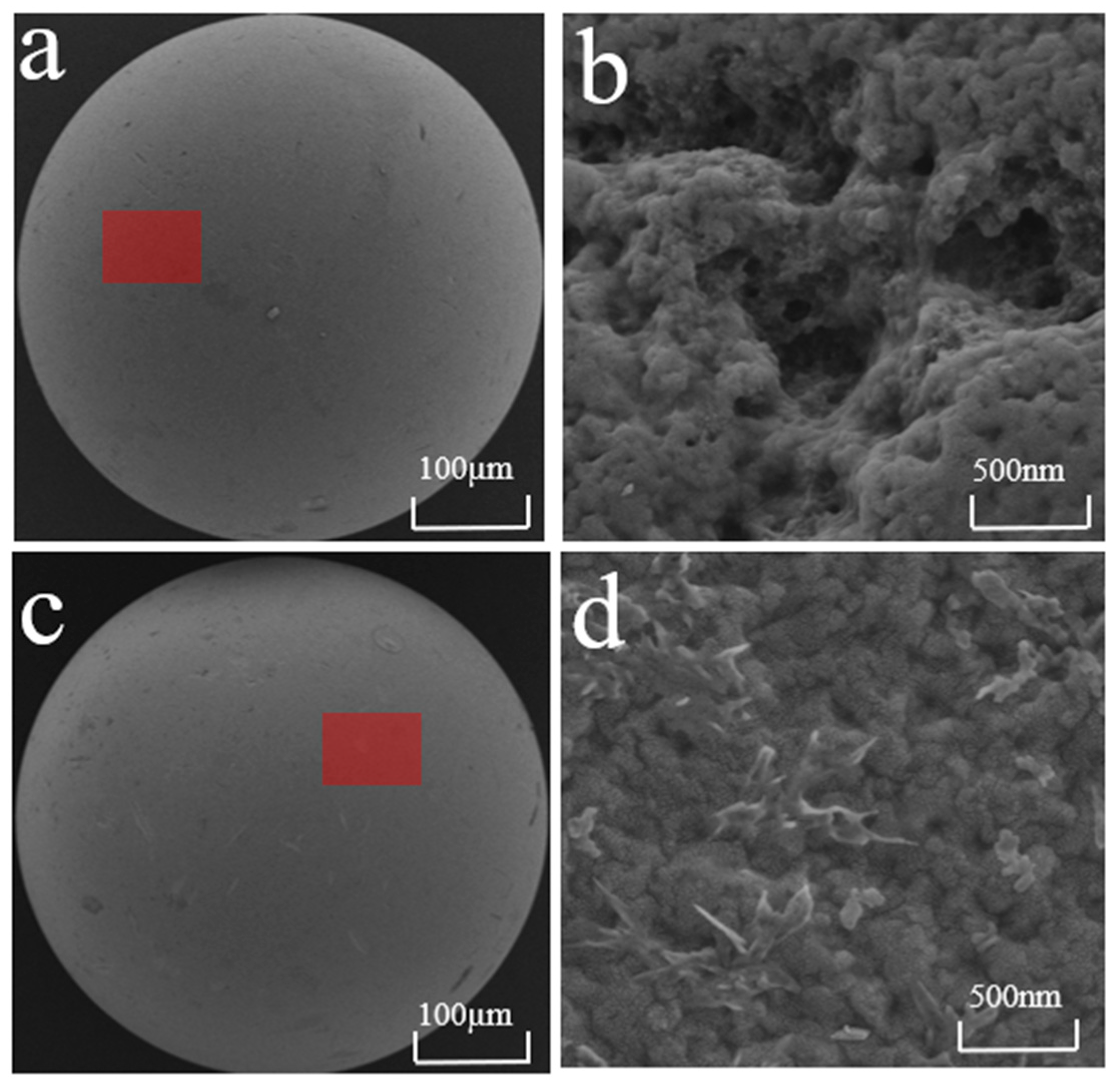
Figure 1. SEM images of D152-AMPA resin (a,b) and pristine D152 resin (c,d).
Separations 13 00142 g001
Figure 2. EDS spectra and elemental mapping images of D152-AMPA resin (a) and pristine D152 resin (b).
Separations 13 00142 g002
Figure 3. TG-DSC curves of D152 resin (a) and D152-AMPA resin (b).
Separations 13 00142 g003
Figure 4. Static adsorption of mixed REEs as a function of pH (each REE = 0.15 mmol/L, m = 0.10 g, V = 20.0 mL, 120 rpm, t = 12 h, T = 298 K).
Separations 13 00142 g004
Figure 5. Maximum separation intensity of adjacent pairs in the mixed rare-earth system.
Separations 13 00142 g005
Figure 6. XPS survey spectrum (a) and high-resolution spectra of Lu 4d (b), P 2p (c), C 1s (d), Si 2p (e), and N 1s (f) for D152-AMPA and Lu-loaded D152-AMPA.
Separations 13 00142 g006
Figure 7. FT-IR spectra of pristine D152, D152-AMPA, and Lu-loaded D152-AMPA.
Separations 13 00142 g007
Figure 8. Adsorption percentages of Er (0.30 mmol/L), Ho (0.30 mmol/L), Al (0.30 mmol/L), Fe (0.15 mmol/L), Ca (1.5 mmol/L), and Mg (1.5 mmol/L) on D152-AMPA at different pH values (m = 0.10 g, V = 20.0 mL, 120 rpm, t = 12 h, T = 298 K).
Separations 13 00142 g008
Figure 9. Breakthrough curves and Thomas model fitting of Ho and Er (a), Al and Fe (b) in the impurity-containing system.
Separations 13 00142 g009
Figure 10. Dynamic elution curves of Er, Ho, Fe, and Al on D152-AMPA using NH4EDTA (elution flow rate = 0.04 mL/min; fraction volume = 0.4 mL).
Separations 13 00142 g010
Table 1. Adjacent-pair REE separation factors (SF) in the D152-AMPA-RECl3 system.
pHinitalSFCe/LaSFPr/CeSFNd/PrSFSm/NdSFEu/SmSFGd/EuSFTb/GdSFDy/TbSFHo/DySFEr/HoSFTm/ErSFYb/TmSFLu/Yb
10.571.190.961.070.951.070.931.140.721.021.000.981.07
20.481.070.981.190.861.080.921.160.790.940.991.071.22
30.371.270.790.841.210.971.021.050.971.591.325.832.02
40.381.270.841.011.000.921.080.981.022.641.374.422.03
50.341.030.980.821.230.781.280.831.222.411.265.901.12
60.371.020.981.020.990.771.290.831.232.711.157.001.68
Table 2. Kd of Er, Ho, Al, Fe, Ca, and Mg on D152-AMPA at different pH values.
pHinitalKd(Ho)Kd(Er)Kd(Al)Kd(Fe)Kd(Ca)Kd(Mg)
2107.58110.9457.11190.400.030.03
3180.29301.48130.25378.070.030.03
4349.20802.51284.72516.850.030.03
Table 3. Purity and recovery of the fractionated products obtained during NH4EDTA elution.
FractionBVTarget Purity (%)Fe + Al (%)Er Recovery (%)Ho Recovery (%)
Er-rich4.58–10.1992.79 (Er)3.5056.572.51
Mixed10.19–15.7950.60 (Er), 43.53 (Ho)5.8718.3617.56
Ho-rich15.79–21.494.34 (Ho)1.272.4157.52
Total---88.3283.05
Disclaimer/Publisher’s Note: The statements, opinions and data contained in all publications are solely those of the individual author(s) and contributor(s) and not of MDPI and/or the editor(s). MDPI and/or the editor(s) disclaim responsibility for any injury to people or property resulting from any ideas, methods, instructions or products referred to in the content.