1. Introduction
Flavonoids are one of the most abundant and structurally diverse classes of plant secondary metabolites, with more than 9000 compounds sharing a common diphenylpropane (C6–C3–C6) skeleton [
1]. These polyphenolic compounds exhibit a broad range of biological activities, including antioxidant, anti-inflammatory, antimicrobial, and anticancer effects, which has driven strong interest in their separation from complex botanical matrices [
2]. However, crude plant extracts usually contain co-occurring sugars, proteins, organic acids, tannins, and other phenolics, making selective purification difficult.
Macroporous adsorption resins (MARs) have become one of the most widely used technologies for preparative-scale flavonoid enrichment because they combine relatively simple operation, low solvent consumption, convenient regeneration, acceptable loading capacity, and good scalability [
3]. In contrast to silica gel chromatography or liquid–liquid extraction, MARs rely on a combination of physical adsorption, molecular partitioning, and pore-mediated diffusion, which allows selective enrichment of target flavonoids together with removal of highly polar or weakly adsorbed impurities [
4]. The performance of a resin is controlled not only by nominal polarity, but also by surface chemistry, crosslink density, pore-size distribution, swelling behavior in aqueous–ethanol systems, and accessible internal surface area. At the molecular level, flavonoid retention may involve hydrophobic interactions, hydrogen bonding, π–π stacking, and, in some systems, electrostatic effects [
5].
Recent reviews have discussed resin-based purification of plant flavonoids and related natural products. Aljawarneh et al. summarized the use of macroporous polymeric resins for flavonoid purification from medicinal plants [
6]. Other recent studies and reviews have broadened the discussion toward source-specific extraction–purification integration, separation-oriented process optimization, and emerging green extraction systems [
7,
8]. However, the available literature still lacks a sufficiently cautious, structure-guided synthesis that clearly distinguishes observations supported by explicit compound-level adsorption evidence from conclusions inferred from total flavonoid or mixed extract systems.
The aim of this review is therefore not to claim a universally predictive resin-selection model, but to reduce arbitrariness in first-stage screening by organizing the published evidence into a transparent selection framework. Specifically, this review (i) compiles the MAR literature relevant to flavonoid purification, (ii) identifies the subset of studies that provide sufficiently explicit adsorption information for cautious comparative interpretation, (iii) examines how flavonoid descriptors relate to adsorption behavior, (iv) translates those observations into an operational resin-selection framework, and (v) discusses the scope and limitations of that framework through retrospective comparison with independent literature cases. The framework is intended to prioritize experiments, not replace them.
2. Data Sources and Analytical Methods
2.1. Literature Search and Selection Criteria
A systematic literature search was conducted in Web of Science, Scopus, PubMed, and CNKI for studies published between January 2000 and February 2026. Search terms included combinations of “flavonoid”, “macroporous resin”, “adsorption resin”, “purification”, “separation”, “flavone”, “flavonol”, and representative compound names such as quercetin, rutin, baicalin, hesperidin, naringin, and luteolin. Inclusion criteria were: (1) original research reporting MAR-based purification of flavonoids from plant or botanical sources; (2) identification of target flavonoids, total flavonoids, or a clearly described flavonoid-rich fraction; (3) reporting of adsorption-related outcomes or sufficient information for comparative interpretation; and (4) specification of resin type and at least the main experimental conditions. Exclusion criteria were: (1) studies using only non-MAR methods; (2) insufficient methodological detail for interpretation; and (3) publications without accessible full text.
A total of 55 studies met the inclusion criteria and were used for qualitative synthesis, including the discussion of mechanisms, operating windows, and emerging trends. Because many reports focused on total flavonoids or mixed extracts without explicit single-compound adsorption capacities, only the subset with sufficiently clear compound-level or narrowly interpretable adsorption information was used for cautious comparative analysis. This distinction is important because the literature is substantially richer for practical process optimization than for rigorous compound-by-compound quantitative modeling.
2.2. Data Extraction and Normalization
From the 55 included studies, the following information was extracted where available: plant source, target flavonoids or flavonoid-rich fraction, flavonoid structural class, resin type and manufacturer, experimental conditions (pH, temperature, concentration, contact time, loading and elution conditions), adsorption and desorption metrics, and any compositional information reported for mixed extracts.
For single-compound targets, compound identity and the reported adsorption metric were recorded directly. For total flavonoid or mixed extract studies, the compositional description was retained for qualitative interpretation and, where appropriate, retrospective assessment, but those studies were not treated as equivalent to fully explicit single-compound adsorption datasets.
Where multiple adsorption capacity values were reported, the maximum static-equilibrium adsorption capacity under the authors’ optimized conditions was extracted. Values reported in units such as mmol·g−1 were converted to mg·g−1 using molecular weight where appropriate. Dynamic breakthrough or preparative-column outcomes were not pooled numerically with static adsorption capacities because those metrics depend strongly on bed geometry, flow rate, loading protocol, and breakthrough criteria. This approach improves comparability but does not eliminate heterogeneity arising from differences in extract composition, initial concentration, resin dosage, and competing solutes; the resulting relationships should therefore be interpreted as trend-level rather than as strictly standardized estimates.
Log p values were retrieved from PubChem where available. For compounds lacking a directly retrievable entry, log p was estimated using the default structure-based property prediction workflow in ACD/Labs Percepta Platform (version 2024). Hydrogen-bond donor (HBD) and acceptor (HBA) counts were obtained from PubChem or calculated from reported structures. Resin polarity classification was based on manufacturer specifications together with published descriptions and was grouped operationally into non-polar, medium-polar, and polar classes.
2.3. Statistical Analysis
Statistical analyses were performed using SPSS version 26.0. Where the literature provided sufficiently explicit and internally comparable values, simple correlation analysis and descriptive trend comparison were used to explore relationships between adsorption behavior and selected molecular descriptors. Given the modest size and heterogeneity of the explicit compound-level subset, the present analysis is intentionally univariate and operational rather than a full multivariate predictive model. SPSS was therefore used only for descriptive and simple correlation analyses, and no multivariate model-selection workflow was implemented. Because descriptors such as hydrophobicity, glycosylation state, hydrogen-bonding capacity, and molecular size are partially interdependent, a robust multivariate predictive model was considered premature for the present review.
2.4. Framework Validation Approach
The proposed framework was retrospectively compared with independent literature cases that were not used in framework construction. For each study, the predicted resin polarity was assigned from the reported target flavonoid type or, in mixed extracts, from the predominant reported flavonoid subclass based on the largest reported HPLC peaks, composition tables, or major named constituents. When these sources were inconsistent, semi-quantitative, or insufficiently resolved, classification was treated as approximate and the corresponding result was interpreted cautiously.
3. Flavonoid Structural Characteristics and Relevant Molecular Descriptors
3.1. Core Structures and Key Subclasses
Flavonoids share a common C6–C3–C6 skeleton composed of two aromatic rings (A and B) connected by a heterocyclic C ring. Based on differences in the C ring, flavonoids are commonly classified into flavones, flavonols, flavanones, isoflavones, chalcones, anthocyanidins, and related subclasses [
9]. Flavones and flavonols, characterized by a C2=C3 double bond and a C4 carbonyl group, are among the most common subclasses. Flavonols additionally possess a 3-hydroxyl group, which influences both planarity and hydrogen-bonding behavior. Flavanones lack the C2=C3 double bond and are therefore less planar. Isoflavones differ by the position of B-ring attachment, whereas chalcones possess an open-chain C-ring equivalent [
10].
Substitution patterns further diversify flavonoid properties. Hydroxylation increases polarity and hydrogen-bonding capacity; methoxylation reduces polarity and often enhances hydrophobic interactions; and glycosylation substantially alters molecular size, hydrophilicity, and three-dimensional shape [
11]. These structural features are directly relevant to adsorption on MARs because they influence both resin–solute interaction strength and access to internal pore structure.
3.2. Molecular Descriptors Governing Adsorption Behavior
Based on the reviewed literature, five molecular descriptors are especially useful for interpreting flavonoid–MAR interactions. They are discussed here as mechanistically informative variables rather than as independently weighted predictors in a validated multivariate model.
Log
p (octanol–water partition coefficient). Log
p is the most operationally useful single descriptor for initial resin selection because it captures the hydrophobic contribution that often dominates adsorption on non-polar resins. Across the available literature, increasing hydrophobicity is generally associated with stronger retention on non-polar matrices, although this relationship should be interpreted qualitatively because the explicit compound-level dataset is limited and not fully harmonized [
12,
13].
Hydrogen-bond donor and acceptor counts. Phenolic hydroxyl groups act mainly as hydrogen-bond donors, whereas carbonyl and glycosidic oxygen atoms contribute acceptor sites. These descriptors help explain why some hydroxyl-rich flavonoids interact strongly with medium-polar or polar resins even when their hydrophobicity alone would not predict that outcome [
14].
Molecular volume and effective diameter. These descriptors influence pore accessibility. Larger flavonoid glycosides often require larger average pore diameters for efficient intraparticle diffusion and full access to internal adsorption sites [
15].
Molecular planarity. Planar flavones and flavonols generally display more favorable π–π interactions with aromatic resin matrices than non-planar analogues such as many flavanones [
16].
Ionizable groups and pH dependence. Phenolic hydroxyl groups can become deprotonated at elevated pH, changing both apparent polarity and electrostatic behavior. Although many flavonoid adsorption processes are carried out under acidic to mildly acidic conditions, pH can materially influence both adsorption and desorption in selected systems [
17].
Additional descriptors such as polar surface area or aromatic surface area may also prove useful in future work, but the available literature does not yet support a robust comparative analysis of those descriptors across a sufficiently harmonized dataset.
3.3. Operational Classification Based on Adsorption Behavior
Based on the reviewed literature, the flavonoids discussed here can be grouped into four operational classes for practical resin-selection purposes. These are pragmatic categories based on glycosylation state, hydrophobicity range, and hydrogen-bonding profile; they are not intended to replace formal flavonoid taxonomy.
Class I: Highly polar glycosides. These compounds typically contain two or more sugar units and often show low or negative log
p values. Representative examples include rutin, hesperidin, and naringin [
18].
Class II: Moderately polar glycosides. These compounds are typically mono-glycosides or related glycosylated flavonoids with intermediate hydrophobicity. Representative examples include baicalin, hyperoside, and isoquercitrin [
19].
Class III: Hydroxylated aglycones. These flavonoids contain several hydroxyl groups but no sugar moieties. Representative examples include quercetin, luteolin, and apigenin [
20].
Class IV: Methoxylated aglycones. These compounds contain multiple methoxy substituents and generally exhibit the strongest hydrophobicity among the classes considered here. Tangeretin and nobiletin are representative examples [
21].
4. Macroporous Adsorption Resins: Properties and Selection Parameters
4.1. Resin Types and Physicochemical Characteristics
Macroporous adsorption resins are synthetic polymeric materials characterized by a permanent porous structure even in the dry state. Their adsorption behavior arises from the interplay of matrix chemistry, crosslink density, porogen-controlled pore architecture, accessible surface area, and any post-synthetic functionalization. As a result, two resins based on broadly similar polymer backbones may still exhibit different adsorption behavior because accessible pore structure, local surface polarity, and solvent-dependent swelling jointly determine the interaction environment experienced by the flavonoid.
Non-polar resins such as D101, HPD100, HPD300, and XAD-4 are typically based on styrene–divinylbenzene matrices with aromatic surfaces and limited polar functionality, and they adsorb mainly through hydrophobic interactions and van der Waals forces [
3,
22]. Medium-polar resins such as AB-8, HPD400, HPD500, XAD-7, and XDA-8 can provide a balance between hydrophobic and polar interactions [
23,
24]. Polar resins such as NKA-9 possess more polar surface environments that can favor adsorption of hydrophilic glycosides through hydrogen bonding and dipolar interactions [
14,
25]. Thus, resins based on broadly similar styrene–divinylbenzene matrices may still differ operationally in apparent polarity because accessible pore environment, residual or introduced surface functionalities, crosslink density, and solvent-dependent swelling collectively alter the interaction field experienced by the solute.
Table 1 summarizes the key properties of commonly used MARs for flavonoid purification, compiled from manufacturer specifications and published literature.
4.2. Critical Parameters Governing Adsorption Performance
Surface area. Surface area determines the number of accessible adsorption sites and often correlates with adsorption capacity, provided that the internal surface is accessible to the target molecule [
31].
Pore diameter and pore-size distribution. These govern the extent to which molecules can diffuse into internal adsorption domains. For larger flavonoid glycosides, insufficient pore accessibility may become more important than nominal polarity matching [
15,
32].
Polarity matching. The operational principle of “like interacts with like” remains useful for first-stage selection. Hydrophobic aglycones generally display stronger affinity for non-polar resins, whereas more hydrophilic glycosides more often perform well on medium-polar or polar materials [
33].
Particle size and hydrodynamics. Smaller particles shorten diffusion paths and can accelerate adsorption, but they also increase backpressure in dynamic systems. Most practical applications therefore use an intermediate particle-size range [
34].
5. Mechanisms of Flavonoid Adsorption on Macroporous Resins
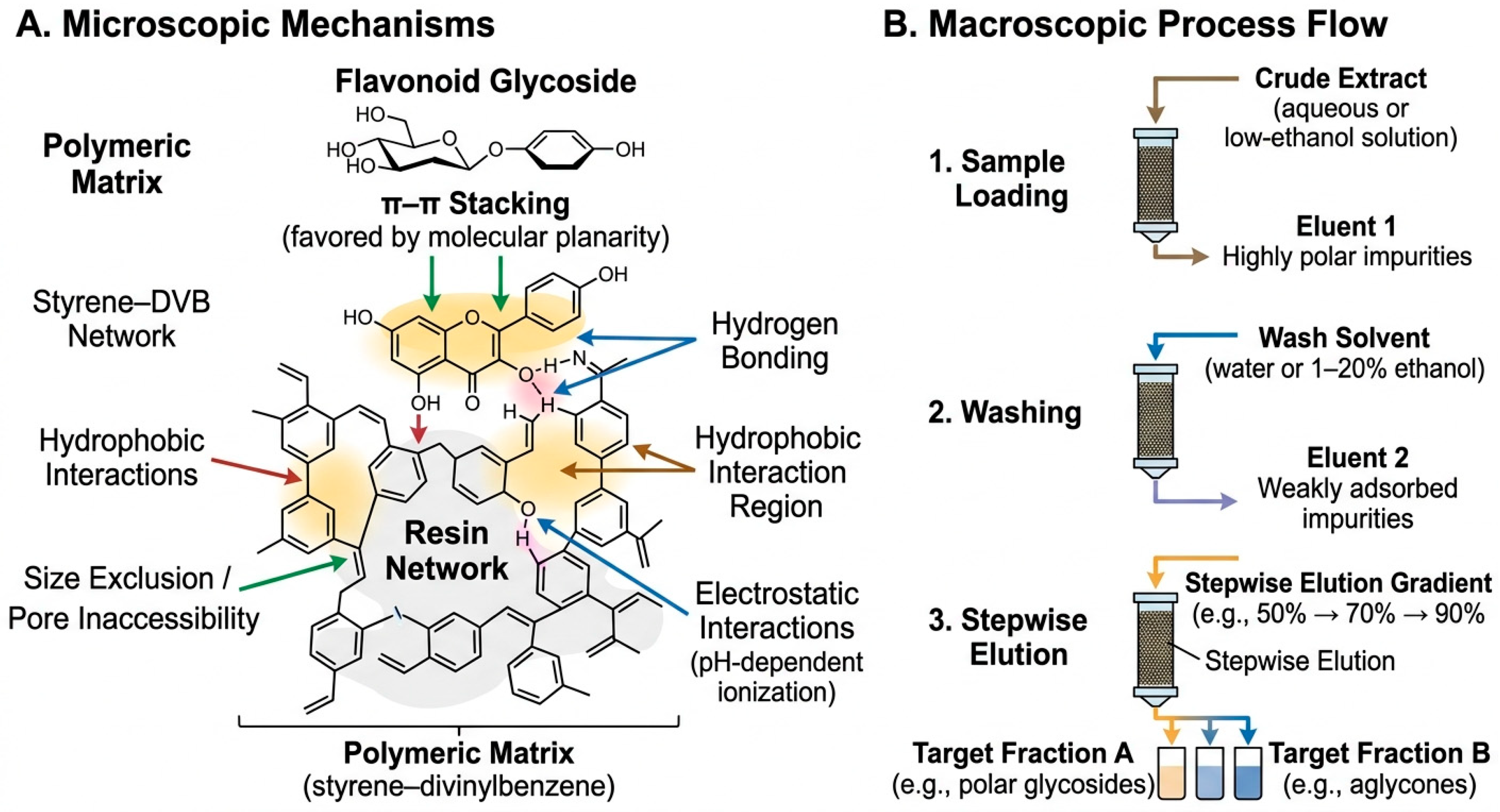
Figure 1 schematically summarizes the principal adsorption and desorption processes discussed in this section. The diagram is intended as a mechanism-oriented visual aid rather than a quantitative model and highlights how polarity matching, pore accessibility, hydrophobic interactions, hydrogen bonding, π–π stacking, and pH-dependent ionization jointly influence resin selection and elution behavior.
The figure summarizes the main interaction modes governing adsorption, including polarity matching, pore accessibility, hydrophobic interactions, hydrogen bonding, π–π stacking, and pH-dependent electrostatic effects. It also illustrates generalized process conditions commonly used in MAR purification, including aqueous or low-ethanol loading, impurity washing with water or low-concentration ethanol, and stepwise desorption with increasing ethanol concentration. The schematic is conceptual and was created by the authors based on the literature discussed in this review.
5.1. Thermodynamic Driving Forces
The adsorption of flavonoids onto MARs results from a combination of physical interactions whose relative contributions depend on both adsorbate and adsorbent properties.
Hydrophobic interactions are often the dominant driving force on non-polar and many medium-polar resins. In aqueous systems, aromatic rings and methoxy-rich regions of flavonoids tend to partition toward hydrophobic resin surfaces, and this tendency generally increases with hydrophobicity [
35].
Hydrogen bonding becomes increasingly important when the flavonoid contains multiple hydroxyl groups and the resin provides complementary surface functionalities. This interaction is particularly relevant for glycosylated or strongly hydroxylated flavonoids adsorbing on medium-polar or polar resins [
5,
14,
36].
π–π stacking may occur between aromatic flavonoid systems and aromatic resin matrices such as styrene–divinylbenzene copolymers. This interaction is favored for relatively planar flavonoids, especially flavones and flavonols [
37].
Electrostatic interactions may contribute under conditions where the flavonoid or resin carries net charge. These effects are highly pH dependent and may become relevant in adsorption–desorption switching strategies [
17].
Several of these mechanisms can operate simultaneously. Accordingly, the interaction patterns discussed here should be interpreted as mechanism-consistent explanations supported by the cited literature rather than as independently verified outcomes for every dataset included in this review.
5.2. Adsorption Isotherms and Equilibrium Modeling
Adsorption isotherms describe the equilibrium distribution of flavonoids between liquid and resin phases at constant temperature and provide insight into adsorption behavior and apparent capacity.
The Langmuir isotherm assumes monolayer adsorption on a comparatively homogeneous surface with equivalent adsorption sites and no lateral interactions among adsorbed species:
where Ce is equilibrium concentration, Qe is equilibrium adsorption capacity, Qm is maximum adsorption capacity, and KL is the Langmuir constant. Langmuir-type behavior is often reported when adsorption is studied for comparatively simple or narrowly defined systems [
25].
The Freundlich isotherm describes adsorption on heterogeneous surfaces and is commonly used as an empirical model for systems in which adsorption energy varies across sites or effective multilayer behavior is observed:
where KF and n are Freundlich constants related to adsorption capacity and intensity, respectively [
38].
In practice, systems closer to single-solute adsorption on comparatively uniform resin environments are often described adequately by Langmuir-type behavior, whereas mixed extracts, broader site-energy distributions, or concentration-dependent interaction energies more often yield better empirical fits to Freundlich-type behavior. Accordingly, the choice between Langmuir and Freundlich models in the reviewed literature should be interpreted as reflecting differences in system complexity and surface heterogeneity rather than as a strict mechanistic dichotomy.
5.3. Adsorption Kinetics
The rate of flavonoid adsorption is controlled by several mass-transfer steps, including external film diffusion, intraparticle diffusion, and interaction with available adsorption sites [
39]. The pseudo-second-order model is frequently reported to fit flavonoid–MAR systems well and is commonly interpreted as consistent with surface-interaction-controlled uptake [
25,
40]. Weber–Morris intraparticle diffusion plots in many studies show multilinear behavior, suggesting that adsorption commonly proceeds through a combination of external mass transfer and diffusion within the resin pore network.
5.4. Desorption Mechanisms
Desorption requires disruption of the interactions that retain flavonoids on the resin surface or within the pore network. For hydrophobic interactions, increasing ethanol concentration decreases the polarity contrast between solute and mobile phase, thereby weakening hydrophobic retention. For hydrogen-bond-mediated systems, acidic modifiers or changes in solvent composition can weaken donor–acceptor interactions. In systems where electrostatic effects are important, pH adjustment can change charge state and facilitate release [
17,
41]. In practice, ethanol–water mixtures remain the most common desorption solvents for flavonoid-rich systems, with optimal ethanol concentration usually increasing as target hydrophobicity increases [
42].
6. Structure–Adsorption Relationships
6.1. Impact of Hydrophobicity on Adsorption Capacity
The retrievable explicit compound-level data support the practical importance of hydrophobicity for first-stage resin selection, especially on non-polar matrices such as D101, HPD100, and XAD-4. Because many source papers report total flavonoids or mixed extracts rather than matched single-compound equilibrium capacities, this review deliberately avoids presenting a visually precise compound-by-compound regression figure. Instead, the available evidence is interpreted as showing a directional trend: adsorption on non-polar resins generally strengthens as flavonoids become less polar, whereas more polar resins often perform best within an intermediate hydrophobicity range where both hydrophobic and hydrogen-bonding contributions remain relevant.
Accordingly, the proposed structure–adsorption relationships should be understood primarily as practical trends and heuristic guidance for initial resin screening, rather than as a strictly predictive quantitative model.
This pattern is chemically reasonable. Non-polar resins tend to favor aglycones and methoxylated flavonoids, while glycosylated and hydroxyl-rich flavonoids are often better accommodated by medium-polar or polar resins if steric constraints do not become dominant.
6.2. Influence of Hydrogen Bonding Capacity
Hydrogen-bond donor and acceptor counts help explain deviations from a hydrophobicity-only picture. Flavonoids with multiple hydroxyl groups or glycosidic oxygen atoms often display stronger adsorption on medium-polar or polar resins than would be predicted from log
p alone [
14,
37]. Accordingly, HBD and HBA counts are best treated as complementary descriptors that refine resin choice, especially for glycosides and borderline cases.
6.3. Effects of Molecular Volume and Planarity
Molecular size and planarity further refine resin selection because adsorption depends on both interaction strength and access to the internal pore network. Large glycosides are more sensitive to pore accessibility constraints, while planar flavones and flavonols can benefit from stronger π–π interactions with aromatic matrices than less planar analogues of comparable hydrophobicity [
16,
38]. These descriptors are especially useful for interpreting contradictory or borderline cases.
6.4. Operational Selection Framework
Table 2 synthesizes the structure-adsorption relationships discussed above into a practical and explicitly provisional selection framework that relates flavonoid structural class to recommended resin polarity and indicative operating windows. The numerical ranges shown in
Table 2 are presented as literature-derived empirical envelopes for first-stage screening, rather than as exact transferable values from any single publication or from a fully standardized cross-study dataset.
7. Framework Validation and Limitations
7.1. Retrospective Validation
The proposed framework was retrospectively compared with independent literature cases that were not used in framework construction. For each study, the predicted resin polarity was assigned from the reported target flavonoid type or, in mixed extracts, from the predominant reported flavonoid subclass based on the largest reported HPLC peaks, composition tables, or major named constituents. When these sources were inconsistent or only semi-quantitative, classification was treated as approximate and the corresponding result was interpreted cautiously. Representative case-level comparisons included white tea flavonoids, Artemisia selengensis, buckwheat husk flavonoids, and the resin-based enrichment of rutin/quercetin-containing Euonymus alatus extracts [
40,
43,
44,
45].
Table 3 synthesizes these independent literature cases into a retrospective validation dataset that relates the framework-predicted resin polarity to the experimentally reported optimal resin types and their corresponding agreement status.
Across three broad polarity categories, random assignment would correspond to a nominal chance level of roughly one third, although this comparison is heuristic rather than a formal benchmark because the class distribution is not perfectly balanced. The observed agreement is therefore better than chance and suggests practical value for initial resin prioritization, but the validation set remains limited and includes mixed extracts rather than only rigorously standardized single-compound systems. Therefore, this retrospective comparison should be regarded as preliminary external support for the utility of the framework, not as definitive proof of predictive accuracy across different extraction matrices and operating conditions.
7.2. Interpretation of Apparent Contradictions
Several apparently contradictory cases remain mechanistically understandable. In particular, some highly polar or mixed flavonoid systems performed well on non-polar resins even though a polarity-first framework would favor more polar materials. At least three non-exclusive explanations are plausible.
Competitive adsorption effects. In multi-component extracts, non-polar resins may retain flavonoids while allowing strongly hydrophilic impurities such as sugars, salts, and organic acids to remain in the liquid phase. In such cases, the experimentally “optimal” resin may reflect overall purification performance rather than the maximum intrinsic equilibrium capacity for an isolated target compound.
Pore structure dominance. For some glycosides and complex mixtures, accessible surface area and pore-size distribution can outweigh nominal polarity matching. Resins such as HPD100 and D101 may remain competitive when their pore architecture provides favorable access to the relevant size range of the target molecules.
π–π stacking contributions. For sufficiently planar C-glycosides and related compounds, aromatic interactions with styrene–divinylbenzene matrices may partially compensate for the increased polarity introduced by sugar moieties. These effects should be regarded as mechanism-consistent interpretations rather than as outcomes independently demonstrated by the present review dataset.
A related mixed-target case was reported for Euonymus alatus extracts containing rutin and quercetin, further indicating that resin choice in multi-flavonoid systems may reflect a compromise between glycosidic and aglycone behavior rather than a single-compound optimum [
43].
In addition, solvent-dependent swelling and differences in effective pore accessibility under aqueous/ethanol loading conditions may shift the apparent interaction environment experienced by the solute, contributing to cases in which nominal polarity classification alone is insufficient.
7.3. Framework Limitations and Applicability
Several limitations should be acknowledged. Most importantly, because the literature summarized here spans heterogeneous extract compositions, solvent systems, adsorption protocols, and reporting formats, the proposed framework should be interpreted as a practical decision-support tool for early-stage screening rather than as a universally predictive model.
Evidence heterogeneity. The available literature mixes single-compound systems, total flavonoid fractions, and complex extracts; reported performance metrics also vary across studies.
Structural similarity challenges. For flavonoids with closely related structures, such as positional isomers or analogues differing only in hydroxyl substitution pattern, the framework provides only first-stage guidance. High-resolution separation may still require MAR coupled with preparative HPLC or countercurrent chromatography [
48].
Complex mixture effects. The framework is most reliable for initial screening of target-enriched or partially characterized systems. For highly complex extracts, competitive adsorption can materially alter the preferred resin.
Resin variability and product verification. Commercial MARs may differ in surface area, pore-size distribution, and effective polarity across suppliers or product batches. Users should therefore verify current product specifications with vendor datasheets and include confirmatory screening experiments where possible.
Metric dependence on operating conditions. Adsorption capacity depends on concentration, solvent composition, temperature, dosage, and whether the system is static or dynamic. Absolute values should therefore be interpreted with caution.
Its value lies mainly in reducing arbitrariness in preliminary resin selection and in helping prioritize confirmatory experiments under case-specific conditions.
8. Process Optimization: A Generalized Parameter Window
8.1. Sample Preparation
Extraction solvent selection strongly influences both yield and the composition of the crude extract. Ethanol–water mixtures are the most common extraction solvents for flavonoid-rich botanical materials because they provide a practical balance among extraction efficiency, safety, and cost [
49]. For subsequent MAR purification, aqueous or low-ethanol loading conditions are usually preferred because they maintain sufficient solubility while preserving an adequate adsorption driving force.
pH also influences both flavonoid stability and adsorption behavior. Many flavonoids are stable and well adsorbed under mildly acidic conditions, where phenolic groups remain largely protonated [
28,
46]. However, exceptions exist, and case-specific optimization remains necessary, especially for pH-sensitive compounds such as anthocyanins.
8.2. Dynamic Column Parameters
Loading flow rate. Slower loading generally improves adsorption by allowing more time for mass transfer and intraparticle diffusion, especially for larger glycosides [
50].
Breakthrough control. Dynamic operation should remain below the breakthrough point of the target compounds to avoid early loss [
51].
Washing conditions. Washing with water or low-concentration ethanol can remove highly polar impurities while retaining more strongly adsorbed flavonoids [
52].
Elution conditions. Elution is commonly achieved with progressively stronger ethanol–water mixtures. Slower elution can improve recovery, whereas faster elution may increase throughput at the cost of broader peaks [
41,
42].
8.3. Generalized Parameter Window
Based on the qualitative synthesis of the reviewed studies, a generalized and explicitly empirical operating window can be proposed as a literature-derived reference range for initial process design:
Adsorption pH: 2–5 for many flavonoid systems
Sample concentration: 0.3–2.0 mg·mL−1 total flavonoids
Loading flow rate: 1–3 BV·h−1 in preparative laboratory columns
Washing step: 2–5 BV water or 5–20% ethanol
Elution solvent: 50–95% ethanol, increasing with hydrophobicity
Elution flow rate: 1–2 BV·h−1
This operating window should be treated as an empirical envelope rather than a guaranteed optimum. It applies primarily to aqueous or low-ethanol loading conditions and to conventional laboratory or pilot columns. Meaningful deviations are expected when crude extracts contain large amounts of sugars, tannins, phenolic acids, or residual organic solvent, or when diffusion limitations become important because the target approaches the effective pore-size cutoff of the resin. Consistent with the retrospective comparison, this generalized parameter window is least reliable for highly mixed extracts, borderline polarity classes, and targets near the effective pore-size cutoff, where competitive adsorption, diffusion limitations, and matrix-dependent effects are most likely to override simple polarity matching. It should therefore be used as an author-compiled empirical operating reference derived from the reviewed literature, not as a substitute for case-specific optimization.
9. Emerging Trends and Future Directions
9.1. Functionalized Resins for Enhanced Selectivity
Chemical modification of base resins can substantially enhance selectivity for certain flavonoid targets. Lou and co-workers showed that chloromethyl, amino, and N-methylimidazole modifications of styrene–divinylbenzene resins changed adsorption behavior for sea buckthorn flavonoids by altering hydrogen-bonding, π–π, and dispersion interactions [
5,
36]. More selective concepts, such as boronate-affinity materials and molecularly imprinted polymers, may offer complementary selectivity for selected flavonoid subclasses [
53,
54].
9.2. Green Extraction–Purification Integration
Deep eutectic solvents (DESs) and ultrasound-assisted extraction are increasingly combined with MAR purification in order to improve overall process sustainability. Recent work on buckwheat husk flavonoids and
Eucommia ulmoides leaves illustrates the growing interest in integrating greener extraction with practical resin-based cleanup [
30,
45].
9.3. Data-Driven and Computational Approaches
Although structure-based prediction of adsorption behavior is an attractive goal, the presently available flavonoid–MAR literature remains too heterogeneous to justify strong claims of externally validated predictive modeling. Near-term progress is more likely to come from better harmonized datasets, explicit reporting of compound-level adsorption metrics, and controlled comparative studies across multiple resins under standardized conditions.
9.4. Hyphenated and Mixed-Mode Purification Strategies
For structurally similar flavonoids or difficult mixtures, mixed-mode MAR systems and hyphenated workflows remain promising. MAR can serve as a robust enrichment step before higher-resolution techniques such as preparative HPLC or countercurrent chromatography, thereby reducing matrix complexity prior to fine separation [
42,
55].
10. Conclusions
This review organizes the MAR-based purification literature for flavonoids into a structure-guided selection framework that links hydrophobicity, hydrogen-bonding profile, molecular size, and planarity to resin polarity and likely operating windows. The available evidence supports polarity as a useful first-stage screening variable, while also showing that pore accessibility, matrix complexity, and aromatic interactions can materially shift the outcome.
Based on these relationships, a preliminarily validated selection framework is proposed that correlates flavonoid operational classes (Classes I–IV) with recommended resin polarity, indicative adsorption capacity ranges, and ethanol-elution windows. Retrospective comparison with independent literature cases suggests practical value for initial resin prioritization, but the framework should be interpreted primarily as a heuristic, trend-based guide rather than as a strictly predictive model. Apparent contradictions—particularly highly polar or mixed systems performing well on non-polar resins—can often be rationalized by competitive adsorption, pore accessibility effects, and aromatic interaction contributions.
A generalized operating window is also identified: mildly acidic adsorption conditions for many systems, moderate sample concentrations, conservative loading flow rates, and progressively stronger ethanol for elution as hydrophobicity increases, but these ranges should be interpreted as empirical literature-derived operating envelopes rather than universally transferable optima. At the same time, recent work on functionalized resins, greener extraction-purification integration, and hyphenated MAR-preparative HPLC or MAR-countercurrent chromatography strategies indicates that future resin selection will likely become more selective and more sustainable as better harmonized datasets emerge.
By integrating mechanistic understanding with cautious comparative analysis and retrospective validation, this review provides a more transparent and evidence-based starting point for resin screening. Numerical operating ranges summarized in this review are intended as literature-derived empirical references for preliminary screening and process design, and should not be interpreted as directly interchangeable optimum values across all flavonoid-resin systems.
Author Contributions
Conceptualization, G.T. (Corresponding Author); methodology, C.Y.; software, Y.T.; validation, Y.T., G.T. and S.C.; formal analysis, C.Y.; investigation, Y.T.; resources, S.C.; data curation, C.Y.; writing—original draft preparation, Y.T.; writing—review and editing, G.T. and G.H.; visualization, S.C.; supervision, G.H.; project administration, G.T.; funding acquisition, G.T. All authors have read and agreed to the published version of the manuscript.
Funding
This work was financially supported by the 2024 Henan Provincial Higher Education Teaching Reform Research and Practice Project (Undergraduate Education Category) “Construction and Practice of Project-Based + Tutoring System Talent Cultivation Model” (No. 2024SJGLX0492); Postgraduate Education Reform and Quality Improvement Project of Henan Province, An Engineering Practice-Oriented Teaching Case for the Green-Low-Carbon Transition of Core Nylon Chemical Materials under China’s Dual-Carbon Goals (No.: YJS2026AL145).
Data Availability Statement
No new data were created or analyzed in this study. Data sharing is not applicable to this article.
Conflicts of Interest
The authors declare no conflicts of interest.
References
- Feng, W.; Hao, Z.; Li, M. Isolation and structure identification of flavonoids. In Flavonoids: From Biosynthesis to Human Health; Justino, G.C., Ed.; IntechOpen: London, UK, 2017; pp. 17–43. [Google Scholar] [CrossRef][Green Version]
- Robak, J.; Gryglewski, R.J. Bioactivity of flavonoids. Pol. J. Pharmacol. 1996, 48, 555–564. [Google Scholar]
- Li, J.; Chase, H.A. Development of adsorptive (non-ionic) macroporous resins and their uses in the purification of pharmacologically active natural products from plant sources. Nat. Prod. Rep. 2010, 27, 1493–1510. [Google Scholar] [CrossRef] [PubMed]
- Wang, X.; Su, J.; Chu, X.; Zhang, X.; Kan, Q.; Liu, R.; Fu, X. Adsorption and Desorption Characteristics of Total Flavonoids from Acanthopanax senticosus on Macroporous Adsorption Resins. Molecules 2021, 26, 4162. [Google Scholar] [CrossRef] [PubMed]
- Lou, S.; Di, D. New way to analyze the adsorption behavior of flavonoids on macroporous adsorption resins functionalized with chloromethyl and amino groups. Langmuir 2011, 27, 9314–9326. [Google Scholar] [CrossRef] [PubMed]
- Aljawarneh, R.Y.A.; Md Zain, M.Z.; Zakaria, F. Macroporous polymeric resin for the purification of flavonoids from medicinal plants: A review. J. Sep. Sci. 2024, 47, e2400372. [Google Scholar] [CrossRef]
- Mottaghipisheh, J.; Iriti, M. Sephadex® LH-20, isolation, and purification of flavonoids from plant species: A comprehensive review. Molecules 2020, 25, 4146. [Google Scholar] [CrossRef]
- Tian, W.; Zhang, M.; Zhang, T.; Li, X.; Zhang, H.; Li, X. Artemisia frigida Willd.: Advances in traditional uses, phytochemical constituents, extraction and separation methods, and pharmacological activities. Separations 2025, 12, 280. [Google Scholar] [CrossRef]
- Lin, L.J.; Huang, X.B.; Lv, Z.C. Isolation and identification of flavonoid components from Pteris vittata L. SpringerPlus 2016, 5, 1649. [Google Scholar] [CrossRef]
- Xiao, J.; Capanoglu, E.; Jassbi, A.R.; Miron, A. Advance on the flavonoid C-glycosides and health benefits. Crit. Rev. Food Sci. Nutr. 2016, 56, S29–S45. [Google Scholar] [CrossRef]
- Xiao, J.; Muzashvili, T.S.; Georgiev, M.I. Advances in the biotechnological glycosylation of valuable flavonoids. Biotechnol. Adv. 2014, 32, 1145–1156. [Google Scholar] [CrossRef]
- Heim, K.E.; Tagliaferro, A.R.; Bobilya, D.J. Flavonoid antioxidants: Chemistry, metabolism and structure-activity relationships. J. Nutr. Biochem. 2002, 13, 572–584. [Google Scholar] [CrossRef] [PubMed]
- PubChem. National Center for Biotechnology Information, U.S. National Library of Medicine. Available online: https://pubchem.ncbi.nlm.nih.gov/ (accessed on 10 February 2026).
- Limwachiranon, J.; Huang, H.; Li, L.; Duan, Z.; Luo, Z. Recovery of lotus (Nelumbo nucifera Gaertn.) seedpod flavonoids using polar macroporous resins: Updated understanding of adsorption/desorption mechanisms and intermolecular attractions and bonding. Food Chem. 2019, 299, 125108. [Google Scholar] [CrossRef] [PubMed]
- Wu, S.H.; Wang, Y.Y.; Gong, G.L.; Li, F.; Ren, H.T.; Liu, Y. Adsorption and desorption properties of macroporous resins for flavonoids from the extract of Chinese wolfberry (Lycium barbarum L.). Food Bioprod. Process. 2015, 93, 148–155. [Google Scholar] [CrossRef]
- van Acker, S.A.; de Groot, M.J.; van den Berg, D.J.; Tromp, M.N.; Donné-Op den Kelder, G.; van der Vijgh, W.J.; Bast, A. A quantum chemical explanation of the antioxidant activity of flavonoids. Chem. Res. Toxicol. 1996, 9, 1305–1312. [Google Scholar] [CrossRef]
- Kumar, S.; Pandey, A.K. Chemistry and biological activities of flavonoids: An overview. Sci. World J. 2013, 2013, 162750. [Google Scholar] [CrossRef] [PubMed]
- Scordino, M.; Di Mauro, A.; Passerini, A.; Maccarone, E. Adsorption of flavonoids on resins: Hesperidin. J. Agric. Food Chem. 2003, 51, 6998–7004. [Google Scholar] [CrossRef]
- Li, X.M.; Wu, X.; Xiong, Z.L.; Ma, J.H.; Zhu, Z.F. Study on the technics of adsorption and purification of baicalin by different macroporous resins. J. Chin. Med. Mater. 2009, 32, 1613–1615. [Google Scholar]
- Fu, Y.; Zu, Y.; Liu, W.; Efferth, T.; Zhang, N.; Liu, X.; Kong, Y. Optimization of luteolin separation from pigeonpea leaves by macroporous resins. J. Chromatogr. A 2006, 1137, 145–152. [Google Scholar] [CrossRef]
- Li, S.; Lo, C.Y.; Ho, C.T. Hydroxylated polymethoxyflavones and methylated flavonoids in sweet orange (Citrus sinensis) peel. J. Agric. Food Chem. 2006, 54, 4176–4185. [Google Scholar] [CrossRef]
- Zhou, Q.; Tang, K.; Zhang, O.; Yao, Y.; Yang, Y.; Liu, Z. Separation and Purification of Total Flavonoids from Perilla frutescens Leaves by Macroporous Resin. China Food Saf. Mag. 2023, 10, 136–139. [Google Scholar]
- Dong, Y.; Zhao, M.; Sun-Waterhouse, D.; Zhuang, M.; Chen, H.; Feng, M.; Lin, L. Adsorption and desorption behaviour of flavonoids from Glycyrrhiza glabra L. leaf on macroporous adsorption resins. Food Chem. 2015, 168, 538–545. [Google Scholar] [CrossRef]
- Du, H.; Wang, H.; Yu, J.; Liang, C.; Ye, W.; Li, P. Enrichment and purification of total flavonoid C-glycosides from Abrus mollis extracts with macroporous resins. Ind. Eng. Chem. Res. 2012, 51, 7349–7354. [Google Scholar] [CrossRef]
- Luo, L.; Ji, Q.; Ma, L.; Fan, J.; Zhu, W.; Guan, N.; Xue, Y. Purification of flavonoids from mung bean hulls by NKA-9 macroporous resin. J. Chin. Inst. Food Sci. Technol. 2019, 19, 157–167. [Google Scholar] [CrossRef]
- Kammerer, D.; Gajdos Kljusuric, J.; Carle, R.; Schieber, A. Recovery of anthocyanins from grape pomace extracts (Vitis vinifera L. cv. Cabernet Mitos) using a polymeric adsorber resin. Eur. Food Res. Technol. 2005, 220, 431–437. [Google Scholar] [CrossRef]
- Yu, J.S.; Yu, J.P. Separation and purification of flavonoids from Chrysanthemum indicum with macroporous resin. Zhongguo Zhong Yao Za Zhi 2007, 32, 2123–2127. [Google Scholar]
- Zhang, J.; Liu, C.; Cao, Y.; Xu, X.; Shu, Y.; Zhang, J.; Zhang, X.; Xia, Q. Optimization of macroporous resin purification process and in vitro activity study of total flavonoids from Citrus reticulata cv. Ponkan peel. Sci. Technol. Food Ind. 2026, 47, 239–248. [Google Scholar] [CrossRef]
- Scordino, M.; Di Mauro, A.; Passerini, A.; Maccarone, E. Adsorption of flavonoids on resins: Cyanidin 3-glucoside. J. Agric. Food Chem. 2004, 52, 1965–1972. [Google Scholar] [CrossRef]
- Li, J.; Tang, L.; Wang, J. Process optimization of ultrasonic-assisted extraction and resin purification of flavonoids from Eucommia ulmoides leaves and their antioxidant properties in vitro. Processes 2025, 13, 1905. [Google Scholar] [CrossRef]
- Liu, W.; Zhang, S.; Zu, Y.G.; Fu, Y.J.; Ma, W.; Zhang, D.Y.; Kong, Y.; Li, X.J. Preliminary enrichment and separation of genistein and apigenin from pigeon pea roots by macroporous resins. Bioresour. Technol. 2010, 101, 4667–4675. [Google Scholar] [CrossRef]
- Zhang, Y.; Li, S.; Wu, X.; Zhao, X. Macroporous resin adsorption for purification of flavonoids in Houttuynia cordata Thunb. Chin. J. Chem. Eng. 2007, 15, 872–876. [Google Scholar] [CrossRef]
- Sun, L.; Guo, Y.; Fu, C.; Li, J.; Li, Z. Simultaneous separation and purification of total polyphenols, chlorogenic acid and phlorizin from thinned young apples. Food Chem. 2013, 136, 1022–1029. [Google Scholar] [CrossRef]
- Yang, Q.; Zhao, M.; Lin, L. Adsorption and desorption characteristics of adlay bran free phenolics on macroporous resins. Food Chem. 2016, 194, 900–907. [Google Scholar] [CrossRef] [PubMed]
- Wan, P.; Sheng, Z.; Han, Q.; Zhao, Y.; Cheng, G.; Li, Y. Enrichment and purification of total flavonoids from Flos Populi extracts with macroporous resins and evaluation of antioxidant activities in vitro. J. Chromatogr. B 2014, 945, 68–74. [Google Scholar] [CrossRef] [PubMed]
- Lou, S.; Liu, Y.; Bai, Q.; Di, D. Adsorption mechanism of macroporous adsorption resins. Prog. Chem. 2012, 24, 1427–1436. [Google Scholar]
- Fu, Y.; Zu, Y.; Liu, W.; Zhang, L.; Tong, M.; Efferth, T.; Kong, Y.; Hou, C.; Chen, L. Preparative separation of vitexin and isovitexin from pigeonpea extracts with macroporous resins. J. Chromatogr. A 2007, 1139, 206–213. [Google Scholar] [CrossRef]
- Xi, L.; Mu, T.; Sun, H. Preparative purification of polyphenols from sweet potato (Ipomoea batatas L.) leaves by AB-8 macroporous resins. Food Chem. 2015, 172, 166–174. [Google Scholar] [CrossRef]
- Lv, C.; Yang, J.; Liu, R.; Lu, Q.; Ding, Y.; Zhang, J.; Deng, J. A comparative study on the adsorption and desorption characteristics of flavonoids from honey by six resins. Food Chem. 2018, 268, 424–430. [Google Scholar] [CrossRef]
- Yang, Y.; Liang, Q.; Zhang, B.; Zhang, J.; Li, F.; Kang, J.; Lin, Y.; Huang, Y.; Tan, T.C.; Ho, L.H. Adsorption and desorption characteristics of flavonoids from white tea using macroporous adsorption resin. J. Chromatogr. A 2023, 1717, 464621. [Google Scholar] [CrossRef]
- Ma, C.; Tao, G.; Tang, J.; Lou, Z.; Wang, H.; Gu, X.; Hu, L.; Yin, M. Preparative separation and purification of rosavin in Rhodiola rosea by macroporous adsorption resins. Sep. Purif. Technol. 2009, 69, 22–28. [Google Scholar] [CrossRef]
- Xu, H.; Zheng, L.; Qiu, Z.; Xu, L.; Xu, Y.; Qi, Y.; Diao, Y.; Peng, J.; Liu, K. Efficient Protocol for Large-Scale Purification of Naringin with High Recovery from Fructus aurantii by Macroporous Resin Column Chromatography and HSCCC. Chromatographia 2008, 68, 319–326. [Google Scholar] [CrossRef]
- Zhao, Z.; Dong, L.; Wu, Y.; Lin, F. Preliminary separation and purification of rutin and quercetin from Euonymus alatus (Thunb.) Siebold extracts by macroporous resins. Food Bioprod. Process. 2011, 89, 266–272. [Google Scholar] [CrossRef]
- Wang, T.; Wang, W.M.; Shi, Z.; Wang, D.; Li, J.; Sun, L.; Zhao, M. Enrichment, antioxidant and enzyme inhibition activities of flavonoids from Artemisia selengensis Turcz. Chem. Biodivers. 2025, 22, e202401835. [Google Scholar] [CrossRef] [PubMed]
- An, Y.X.; Lei, Y.W.; Su, J.Y.; Han, Y.; Zhang, J.; Li, L.L.; Zhao, Y. Purification of flavonoids from buckwheat husk extracted by deep eutectic solvent and their antioxidant activities. Food Sci. Biotechnol. 2026, 35, 501–510. [Google Scholar] [CrossRef] [PubMed]
- Chen, J.; Chen, J.H.; Liu, L.P.; Fan, Y.L. Purification and structural analysis of flavonoids from Lycium barbarum leaves. Sci. Technol. Food Ind. 2019, 40, 28–34. [Google Scholar] [CrossRef]
- Zhu, Y.; Meng, L.; Zhao, Y.; Zhang, C.; Shen, J.; Qin, K. Adsorption and desorption of lignans, flavonoids, phenolic acids by macroporous adsorbent resins during extraction of Astragali radix and stir-fried Arctii fructus. Chem. Pap. 2025, 79, 5125–5138. [Google Scholar] [CrossRef]
- Wu, Z.; Wang, W.; He, F.; Li, D.; Wang, D. Simultaneous enrichment and separation of four flavonoids from Zanthoxylum bungeanum leaves by ultrasound-assisted extraction and macroporous resins with evaluation of antioxidant activities. J. Food Sci. 2018, 83, 2109–2118. [Google Scholar] [CrossRef]
- Wang, X.Y.; Wang, S.S.; Huang, S.S.; Zhang, L.H.; Ge, Z.Z.; Sun, L.P.; Zong, W. Purification of polyphenols from distiller’s grains by macroporous resin and analysis of the polyphenolic components. Molecules 2019, 24, 1284. [Google Scholar] [CrossRef]
- Zhang, B.; Yang, R.; Zhao, Y.; Liu, C.Z. Separation of chlorogenic acid from honeysuckle crude extracts by macroporous resins. J. Chromatogr. B 2008, 867, 253–258. [Google Scholar] [CrossRef]
- Li, C.; Zheng, Y.; Wang, X.; Feng, S.; Di, D. Simultaneous separation and purification of flavonoids and oleuropein from Olea europaea L. (olive) leaves using macroporous resin. J. Sci. Food Agric. 2011, 91, 2826–2834. [Google Scholar] [CrossRef]
- Beeler, N.; Hühn, T.; Rohn, S.; Colombi, R. Purification of flavonoids from an aqueous cocoa (Theobroma cocoa L.) extract using macroporous adsorption resins. Molecules 2025, 30, 2336. [Google Scholar] [CrossRef]
- Li, H.; He, H.; Liu, Z. Recent progress and application of boronate affinity materials in bioanalysis. Trends Anal. Chem. 2021, 140, 116271. [Google Scholar] [CrossRef]
- Chen, L.; Wang, X.; Lu, W.; Wu, X.; Li, J. Molecular imprinting: Perspectives and applications. Chem. Soc. Rev. 2016, 45, 2137–2211. [Google Scholar] [CrossRef] [PubMed]
- Liu, R.; Xu, L.; Li, A.; Sun, A. Preparative isolation of flavonoid compounds from Oroxylum indicum by high-speed counter-current chromatography by using ionic liquids as the modifier of two-phase solvent system. J. Sep. Sci. 2010, 33, 1058–1063. [Google Scholar] [CrossRef] [PubMed]
| Disclaimer/Publisher’s Note: The statements, opinions and data contained in all publications are solely those of the individual author(s) and contributor(s) and not of MDPI and/or the editor(s). MDPI and/or the editor(s) disclaim responsibility for any injury to people or property resulting from any ideas, methods, instructions or products referred to in the content. |