1. Introduction
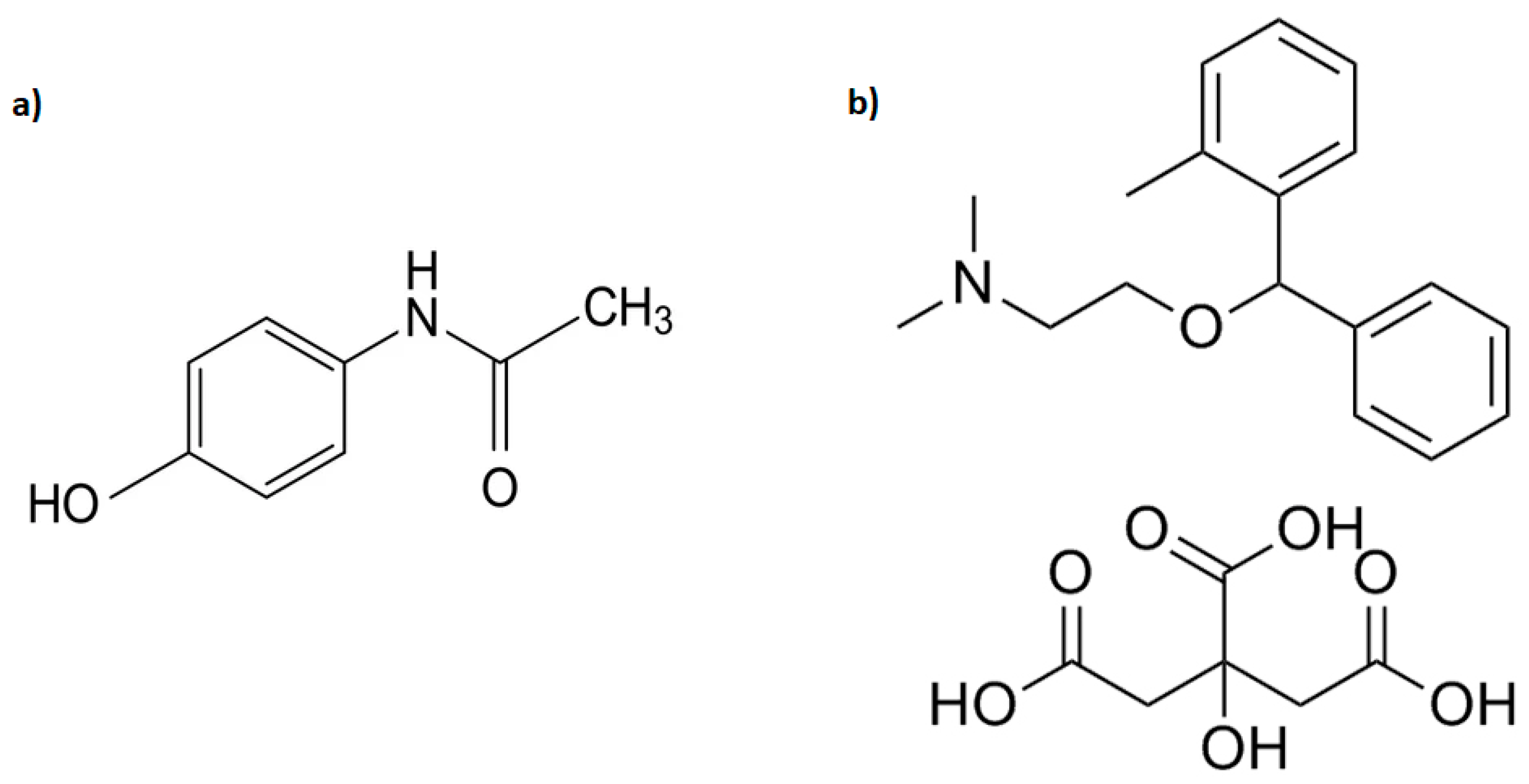
Paracetamol (PAR) or acetaminophen (
N-(4-hydroxyphenyl)acetamide) (
Figure 1a) is a non-opioid analgesic and antipyretic medication in various formulations prescribed or taken over-the-counter (OTC) for the relief of many symptoms like headache, fever, muscle pain and migraine [
1,
2]. For the purpose of achieving a synergistic effect it is often combined in the same formulation with one or more active pharmaceutical ingredients (APIs). The combination of PAR and orphenadrine citrate (ORPH) in tablets is a common one and is marketed globally under various brand names [
3]. Orphenadrine (
N,
N-dimethyl-2-[(2-methylphenyl)phenylmethoxy]ethanamine) (
Figure 1b) is an anticholinergic drug used as a muscle relaxant. Their combination exhibits a supra-additive pharmacological effect aiming to treat mild to moderate acute musculoskeletal pain [
4].
The literature survey reveals several studies focused on the development of analytical methods for the simultaneous determination of paracetamol (PAR), orphenadrine (ORPH), and other active pharmaceutical ingredients (APIs) in single-dosage tablet formulations; however, no relevant pharmacopeial monograph is currently available. One study reports the simultaneous determination of PAR, ORPH, and caffeine in the presence of p-aminophenol using an RP-HPLC method [
5], while another describes the quantification of PAR, ORPH, and ibuprofen employing gradient elution [
6]. In addition to chromatographic approaches, electroanalytical methods have been reported for the determination of PAR, ORPH, and caffeine [
7], and capillary electrophoresis has also been applied to the simultaneous analysis of PAR, ORPH, and other APIs [
8]. Fewer studies address the simultaneous determination of only PAR and ORPH in tablet formulations. One study involves derivatization followed by spectrophotometric determination of the resulting colored derivatives [
9], while another applies partial least-squares modeling to spectrophotometric data [
10]. With respect to HPLC techniques, only one study has reported an HPLC–UV method for the quantification of PAR and ORPH in tablets [
11].
Although the published method provided a useful starting point, its performance could not be successfully replicated in our laboratory, despite close adherence to the reported experimental conditions. The main challenge was the elution of PAR close to the dead time (t
0), which resulted in inadequate capacity factor values and unreliable peak integration. The novelty of this work lies in the development and full validation of an alternative HPLC method for the simultaneous determination of PAR and ORPH that overcomes the limitations of previously reported methods, specifically the elution of PAR near the dead time. The method uniquely integrates Response Surface Methodology (Box–Behnken design) for systematic chromatographic optimization [
12,
13,
14]. The Box–Behnken design was selected for the RSM because it enables efficient identification and optimization of significant factors, both individually and in combination, and has been widely applied in the optimization of analytical methods [
15,
16,
17]. Finally, in accordance with the principles of green chemistry [
18], an objective greenness evaluation was conducted using the AGREE metric, which has not been reported previously for this analytical combination [
19].
Overall, the development of a robust, accurate, and reproducible HPLC method for the simultaneous determination of PAR and ORPH is of significant relevance in the pharmaceutical industry, supporting routine quality control of tablet formulations. Furthermore, by incorporating green chemistry principles, the method contributes to environmentally sustainable analytical practices, which is increasingly important in modern laboratory settings.
2. Materials and Methods
2.1. Reagents and Solvents
Paracetamol (PAR) and orphenadrine citrate (ORPH) secondary reference standards were obtained from Sigma-Aldrich (St. Louis, MO, USA), with certified purities of 99.7% and 99.4%, respectively. In addition, HPLC-gradient-grade acetonitrile (ACN) and sodium dihydrogen phosphate monohydrate (NaH2PO4·H2O) were obtained from Merck, while ortho-phosphoric acid was obtained from Sigma-Adrich and HPLC-grade water was obtained from a Merck Millipore Milli-Q device (Merck S.A. Hellas, Athens, Greece). Nylon syringe filters were purchased from Sun SRI (Rockwood, TN, USA). Paracetamol 450 mg and orphenadrine citrate 35 mg tablets were kindly donated from the Greek Military Pharmaceutical Laboratories (Athens, Greece) along with Ph. Eur. quality excipients used for the preparation of the placebo mixture.
2.2. Instrumentation and Chromatographic Conditions
A Merck–Hitachi L-7000 Series chromatographic system was employed, comprising a pump, a UV detector, an autosampler equipped with a 200 μL injection loop, and an external column oven. Chromatographic separations were carried out using an Allure Biphenyl HPLC column (5 μm, 250 × 4.6 mm; Restek Corporation, Bellefonte, PA, USA). Data acquisition and processing were performed using Clarity VA chromatographic software, version 15.9.0 (DataApex®, Prague, Czech Republic), while Response Surface Methodology (RSM) was conducted using Design-Expert® version 10 (trial version) (Stat-Ease Inc., Minneapolis, MN, USA).
2.3. Chromatographic Conditions
The mobile phase consisted of acetonitrile (ACN) and a 29 mM (4 g/L) aqueous solution of NaH2PO4·H2O in a 37:63 v/v ratio. The pH of the aqueous component was adjusted to 2.5 using orthophosphoric acid. Chromatographic separation was performed under isocratic conditions, keeping the mobile phase composition constant throughout the analysis. The flow rate was maintained at 1.5 mL/min, with detection at 215 nm. The injection volume was 10 μL, and the column temperature was controlled at 25 °C using a column oven.
2.4. Preparation of Stock Standard Solutions and Working Standard Solutions
An amount of 50.0 mg of accurately weighed PAR reference standard was transferred into a 20 mL volumetric flask, dissolved, and diluted to volume with solvent (ACN: 29 mM NaH2PO4·H2O aqueous solution, 50:50 v/v), while 38.9 mg of ORPH was accurately weighed into a 100 mL volumetric flask, dissolved, and diluted to volume with the same solvent. These procedures yielded stock standard solutions of 2500 μg/mL for PAR and 389 μg/mL for ORPH.
For the working standard solution, 4.0 mL of the PAR stock and 2.0 mL of the ORPH stock were each diluted to 20 mL with solvent, resulting in final concentrations of 500 μg/mL of PAR and 38.9 μg/mL of ORPH. Appropriate dilutions from the stock solutions were used to prepare all other required working standards. The solutions were stored at 5 °C in a refrigerator and were employed both in the initial experiments and for the experimental design.
2.5. Sample Preparation
An accurately weighed portion of the finely powdered and homogeneous mixture obtained from 20 tablets, corresponding to 500 mg PAR and 38.9 mg ORPH, was transferred into a 100 mL volumetric flask. The mixture was dissolved using 30 min of sonication and diluted to volume with solvent. The resulting solution was filtered through a 0.45 μm Nylon filter, and a 2 mL aliquot was further diluted to 20 mL with solvent to yield a final solution containing 500 μg/mL of PAR and 38.9 μg/mL of ORPH.
2.6. Solutions for Validation Study
For selectivity assessment, a placebo mixture containing all excipients in the same concentration ratios as found in the tablets was prepared. Linearity was evaluated using five solutions prepared from the two stock standard solutions, covering a concentration range of 50–150% of the nominal concentrations for PAR (500 μg/mL) and ORPH (39 μg/mL), specifically 50%, 75%, 100%, 125%, and 150%. The resulting concentrations were 250, 375, 500, 625, and 750 μg/mL for PAR, and 19.5, 29.3, 39, 48.8, and 58.5 μg/mL for ORPH.
Accuracy was determined using a series of synthetic (spiked) mixtures at three concentration levels: 75% (375 μg/mL PAR, 29.3 μg/mL ORPH), 100% (500 μg/mL PAR, 39 μg/mL ORPH), and 125% (625 μg/mL PAR, 48.8 μg/mL ORPH). Precision was evaluated by preparing six sample solutions according to the sample preparation procedure. Finally, robustness studies were conducted using the working standard solutions.
3. Results and Discussion
3.1. Preliminary Experiments
Prior to analytical method development, the physicochemical properties of the two analytes were examined. PAR is a polar, hydrophilic compound (LogP 0.5) that behaves as a weak acid (pKa 9.2–9.5), whereas ORPH is lipophilic, non-polar (LogP 3.8), and basic (pKa 8.8) [
20,
21,
22]. These contrasting properties posed the primary challenge for reversed-phase chromatography: weak retention for PAR and excessively strong retention for ORPH.
Based on literature reports, preliminary experiments tested C18 columns of various dimensions, organic modifiers such as methanol and ACN, salt concentrations and pH of the aqueous phase, and different mobile phase compositions. Although different stationary phases were evaluated, all resulted in poor retention of PAR, which eluted close to the dead time with unacceptable peak asymmetry, while ORPH either did not elute or appeared as a broad peak.
Given these results, a biphenyl column was selected, as both analytes contain aromatic ring structures. The rationale was that biphenyl columns provide stronger retention for hydrophilic aromatics, improving selectivity for PAR, while simultaneously allowing ORPH to elute at a reasonable retention time [
23]. Implementation of the biphenyl column yielded acceptable capacity factor (k) values for both analytes and improved peak asymmetry for PAR, making it the column of choice for method development.
3.2. Optimization of the Chromatographic Conditions
To optimize the chromatographic conditions, a Box–Behnken design (BBD) was implemented. Three numeric factors were evaluated at three levels: (A) acetonitrile (ACN) content in the mobile phase (35.0, 39.0, and 43.0%), (B) pH (2.5, 2.8, and 3.1), and (C) salt concentration (2.0, 3.0, and 4.0 g/L) of the aqueous buffer (C
salt). The selected responses for the design were the capacity factor of ORPH (k_ORPH) and the asymmetry of the PAR peak (Asym_PAR), reflecting the primary challenges observed in preliminary experiments: the delayed elution of ORPH and the asymmetry of the PAR peak. The software proposed 15 experiments, including 3 center points, as summarized in
Table 1.
After completing the experiments, the response factor data were entered into the software and analyzed using Analysis of Variance (ANOVA). The model F-values of 152.58 and 35.78 for k_ORPH and Asym_PAR, respectively, indicate that both models are statistically significant, with only a 0.01% probability that such F-values could occur due to random variation. Polynomial model fitting revealed that a quadratic (second-order) model was significant for k_ORPH, while a linear model was significant for Asym_PAR. For both responses, only the ACN percentage was statistically significant, as indicated by p-values below 0.05.
The final step of the experimental design was the optimization of the chromatographic conditions.
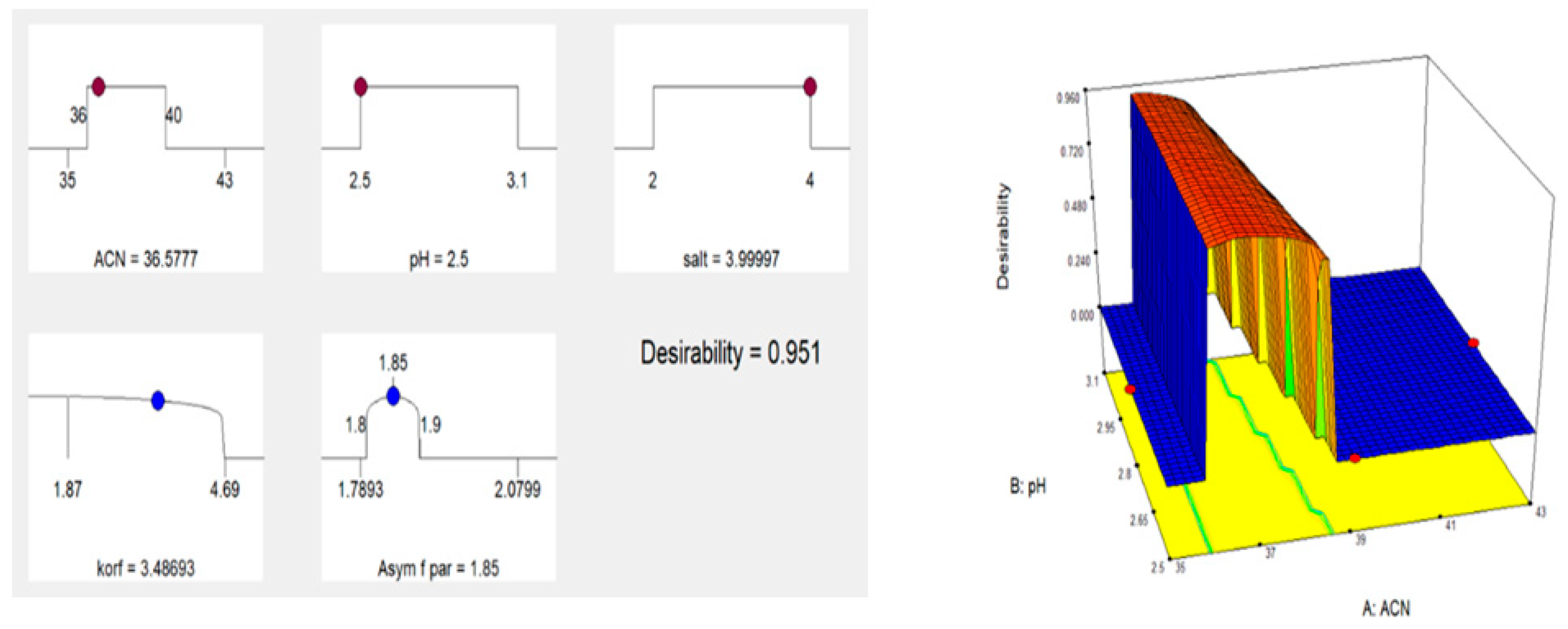
Table 2 summarizes all optimization parameters for the factors and responses set in the software. The factor ranges were maintained as in the BBD, with weights set to 1 and significance to 3. For the responses, the goal for k_ORPH was to minimize its value, assigning a higher weight (1) to the lower limit and a lower weight (0.1) to the upper limit to emphasize minimization. Asym_PAR was targeted at 1.85, representing a desirable and acceptable peak shape observed during the experiments. The optimization was executed, producing 18 solutions. The solution with the highest desirability (0.951) and the corresponding 3D desirability plot for pH and %ACN are presented in
Figure 2.
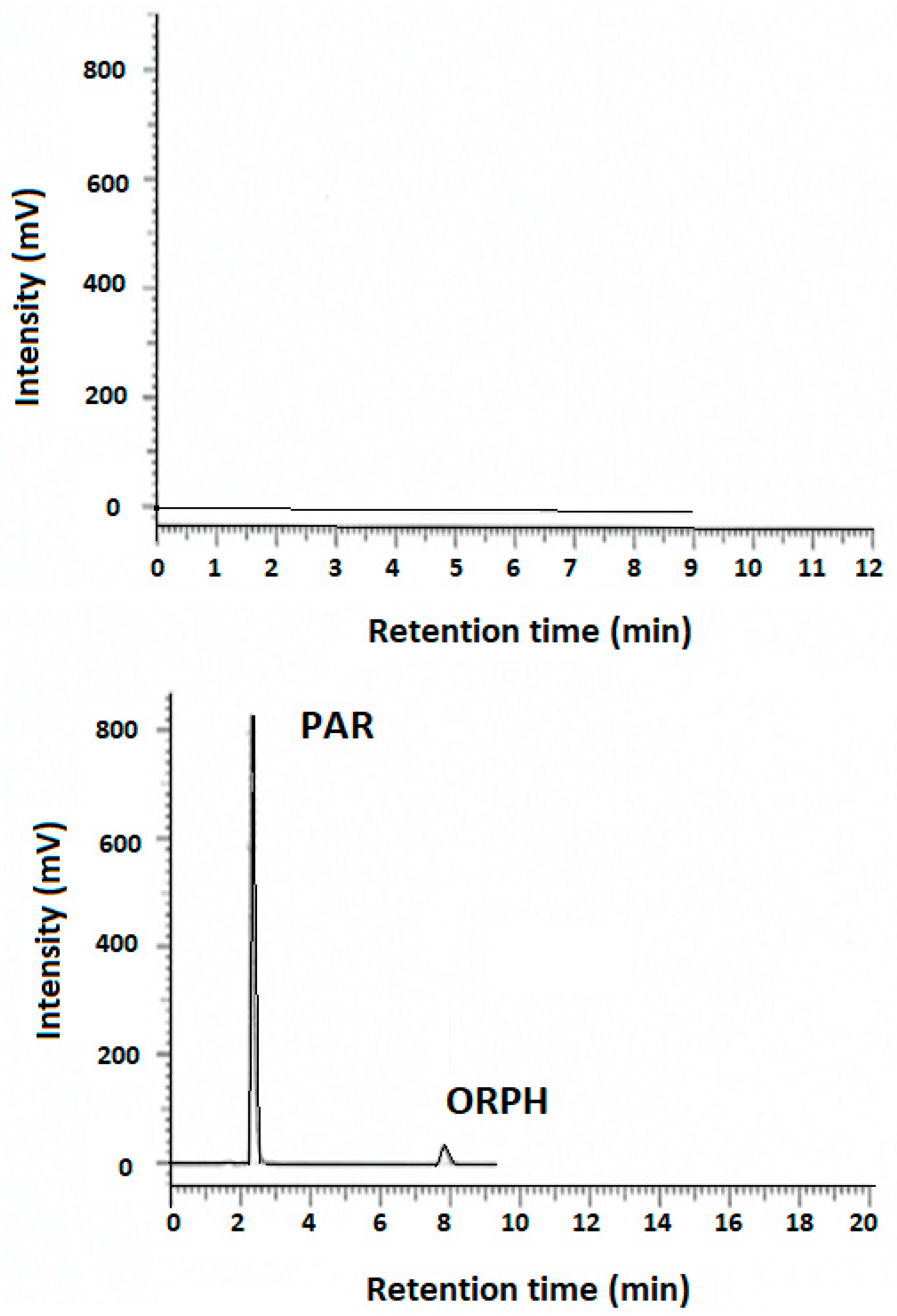
After identifying the optimal chromatographic conditions predicted by the software, these conditions were implemented in the laboratory. The experimentally observed responses closely matched the theoretical predictions, demonstrating the reliability of the model, as illustrated in the chromatogram of the standard (
Figure 3). Specifically, the asymmetry of the PAR peak (Asym_PAR) was measured at 1.87, and the capacity factor for ORPH (k_ORPH) was 3.70, both values falling within the predicted 95% confidence intervals. These results confirm that the optimization successfully addressed the main chromatographic challenges, achieving well-resolved peaks with acceptable retention times and peak symmetry for both analytes.
3.3. Method Validation
To ensure that the developed HPLC method is reliable and suitable for its intended purpose, a comprehensive method validation was performed. Following the International Council for Harmonisation (ICH) guidelines [
24], several critical parameters were systematically evaluated, including system suitability, specificity, linearity, accuracy, precision, and robustness. This approach ensures that the method consistently produces accurate, precise, and reproducible results under varied conditions, confirming its suitability for routine quantitative analysis of PAR and ORPH in tablet formulations.
3.3.1. System Suitability
A System Suitability Test (SST) was conducted to verify the proper functioning of the chromatographic system. For this purpose, five replicate injections of the same working standard solution were performed under the optimized chromatographic conditions. The acceptance criteria for the SST were set as follows, %RSD ≤ 2% for both analyte peaks and Asym_PAR ≤ 1.9, ensuring consistent performance and reliable analysis.
3.3.2. Specificity
Specificity refers to the ability of an analytical method to accurately and unequivocally measure the target analyte in the presence of other components. This was confirmed by demonstrating the absence of interference at the retention times of the analytes of interest. The evaluation was carried out by comparing chromatograms of the placebo solution, the working standard solution, the placebo spiked with the analytes (500 μg/mL of PAR and 39 μg/mL of ORPH), and the solvent. No interfering peaks were observed, and both analytes were clearly resolved and distinguishable (
Figure 3).
3.3.3. Linearity
Linearity was assessed by analyzing, in triplicate, the five standard solutions described in
Section 2.6, followed by regression analysis. The resulting linear regression equations were
Both equations exhibited a coefficient of determination (R2) of 1.00, indicating excellent linearity over the examined concentration ranges (250–750 μg/mL for PAR, and 19.5–58.5 μg/mL for ORPH, respectively). These results confirm that the analytical method produces responses directly proportional to the true concentrations of the analytes.
Based on the SD values of the first calibrators and the slope, the following Limit of Detection (LOD) and Limit of Quantitation (LOQ) values were estimated: 1.65 and 4.99 μg/mL for PAR and 0.081 and 0.246 μg/mL for ORPH, respectively.
3.3.4. Precision
The precision of the analytical method, defined as the closeness of agreement among a series of measurements, was evaluated at two levels. Repeatability reflects the analytical variability under identical operating conditions over a short period. It was assessed by calculating the %RSD of peak areas from six spiked solutions. The acceptance criterion was %RSD ≤ 2, and the obtained values were 0.30% for PAR and 0.42% for ORPH.
Intermediate precision assesses the impact of additional random factors relevant to routine laboratory use. This was investigated by conducting repeatability studies over two days with six determinations per day, performed by two different operators. The %RSD was calculated for each set of measurements (day 1, day 2, and different analysts). Using one-way ANOVA (single factor), the within-group variance (MSwithin) and between-group variance (MSbetween) were determined. These values were then used to calculate the repeatability within measurement groups (%RSDr), repeatability between measurement groups (%RSDb), and overall intermediate precision (%RSDI). In all cases, the repeatability and intermediate precision values were ≤2%.
3.3.5. Accuracy
Accuracy reflects the degree of closeness between the measured value and the true value, indicating the presence of any uncorrected bias (systematic error) in the analysis. It was assessed across the reportable range (75–125%) using %Recovery (%R). Synthetic mixtures (spiked samples) were analyzed in triplicate and compared against a standard solution at 100% concentration. The acceptance criterion for mean recovery was 98% ≤ %R ≤ 102%. The observed recoveries for PAR were 101.22%, 100.96%, and 100.12%, and for ORPH were 101.22%, 100.96%, and 100.12%, at the 75%, 100%, and 125% levels, respectively.
3.3.6. Robustness
Robustness of an analytical method refers to its ability to remain unaffected by small, deliberate variations in procedural parameters while still meeting the expected performance criteria under normal operating conditions. In this study, robustness was evaluated by introducing deliberate changes in the mobile phase flow rate, UV detector wavelength, pH, salt concentration (Csalt), and mobile phase composition (%ACN), as summarized in
Table 3.
For each variation, six sequential injections of the reference working solution were performed. The %RSD and recovery of the peak areas for both analytes were calculated relative to six injections under optimized conditions (
Table 3). The acceptance criteria were set as recovery between 98 and 102% and %RSD ≤ 2%, indicating that a variation does not affect the method’s performance.
As shown in
Table 3, the method was sensitive to small changes in flow rate and detector wavelength, indicating a lack of robustness in these parameters. In contrast, the method remained robust when small variations were applied to pH, salt concentration, and the percentage of ACN in the mobile phase.
3.4. Greenness Assessment
Following the development and validation of the current analytical method, an important objective was to assess its greenness, reflecting its environmental sustainability and alignment with Green Analytical Chemistry (GAC) principles [
25,
26]. Among various available tools, the AGREE metric tool was employed using the relevant software. This evaluation system, introduced in 2020 [
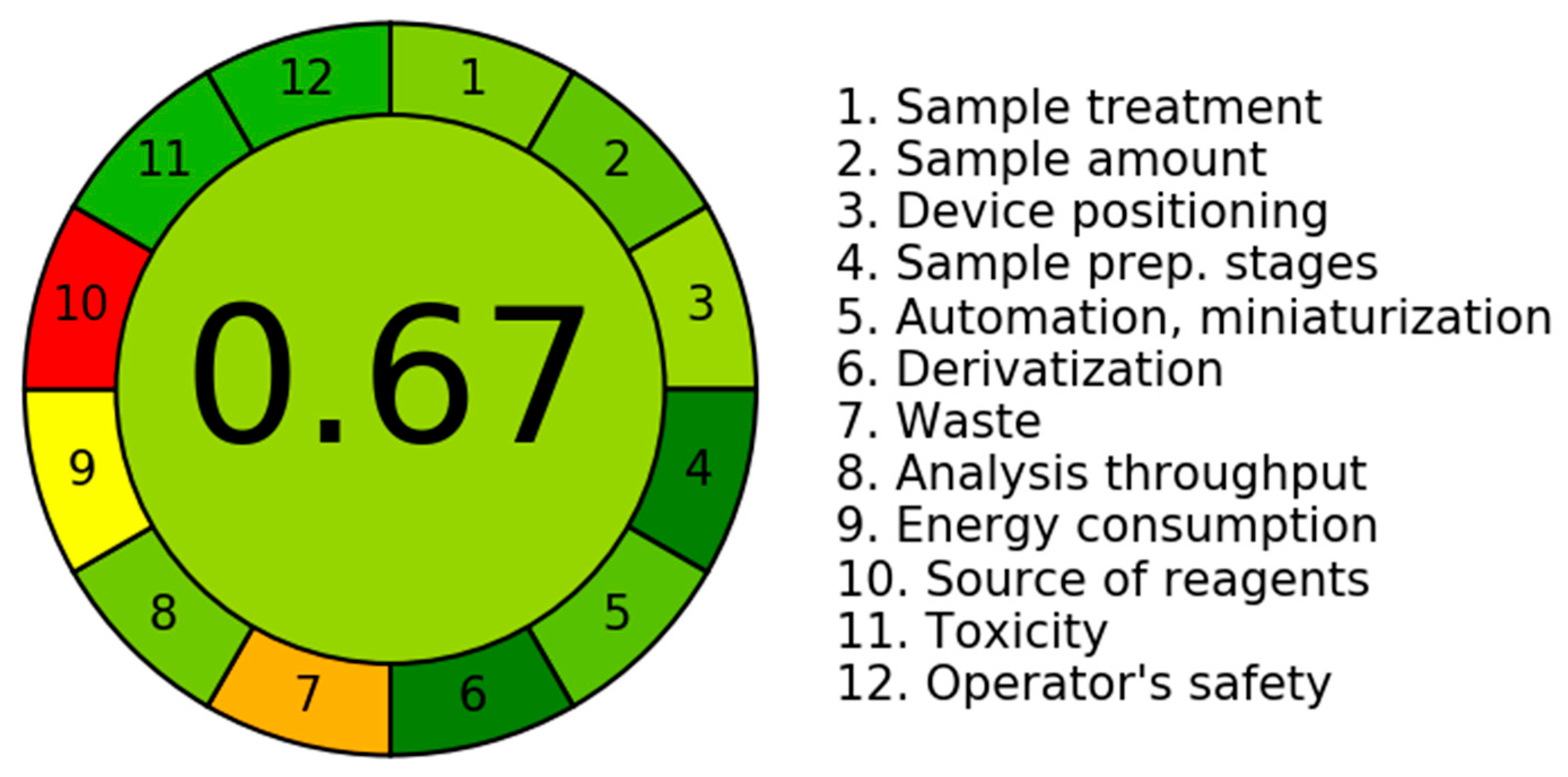
19], is based on the 12 fundamental principles of Green Analytical Chemistry and presents results in a clock-like diagram. Each of the 12 segments is color-coded according to the score obtained, and the performance of the method for each principle is indicated using an intuitive red–yellow–green color scale, while the importance of each principle is represented by the width of its corresponding segment. The overall score, which ranges from 0 to 1, indicates the degree of greenness, with values closer to 1 representing a greener method.
In the current study, the proposed method achieved an overall AGREE score of 0.67, as illustrated in
Figure 4 (center of the pictogram), indicating that the method can be considered environmentally friendly. This favorable score is primarily attributed to the low content of acetonitrile, the absence of other toxic products, the simultaneous determination of two analytes, the absence of an intense sample preparation step, and the short run time, all of which reduce chemical consumption and waste generation.
A closer look at individual GAC principles reveals that the method performed excellently in principles 4 and 6, while only principle 10 received a low score. These results collectively demonstrate that the method is not only analytically robust but also generally aligned with sustainable and environmentally conscious laboratory practices.
4. Conclusions
A simple, rapid, and low-cost RP-HPLC method for the simultaneous determination of PAR and ORPH was successfully developed. Using Box–Behnken Design (BBD), the method achieved optimized performance and demonstrated robustness. The method was fully validated according to ICH guidelines, with comprehensive evaluation of selectivity, sensitivity, linearity, accuracy, and precision, confirming its reliability and suitability for routine pharmaceutical analysis.
In addition to its analytical performance, the method was assessed for environmental sustainability using the AGREE metric tool. The proposed method achieved an overall AGREE score of 0.67, indicating a good level of greenness.
Overall, the developed RP-HPLC method is not only analytically robust, reliable, and suitable for routine use but also demonstrates excellent environmental performance, making it a sustainable option for pharmaceutical analysis.