Article

Comparison of Dynamic Controllability of Extractive Distillation and Pressure-Swing Distillation for the Separation of Dimethyl Carbonate/Methanol Azeotrope

1
Shandong Energy Group Co., Ltd., Jinan 250101, China
2
National Engineering Research Center of Coal Gasification and Coal-Based Advanced Materials, Jinan 250101, China
3
State Key Laboratory of Materials-Oriented Chemical Engineering, College of Chemical Engineering, Nanjing Tech University, Nanjing 211816, China
4
School of Chemistry and Molecular Engineering, Nanjing Tech University, Nanjing 211816, China
5
Jiangsu National Synergetic Innovation Center for Advanced Materials (SICAM), Nanjing 211800, China
*
Authors to whom correspondence should be addressed.
Separations 2026, 13(2), 48; https://doi.org/10.3390/separations13020048
Submission received: 25 December 2025 / Revised: 21 January 2026 / Accepted: 22 January 2026 / Published: 27 January 2026
(This article belongs to the Special Issue Separation Technology in Chemical Engineering)

Abstract

Dimethyl carbonate (DMC) and methanol (MeOH) form a binary minimum-boiling homogeneous azeotrope, and thus conventional distillation cannot achieve complete separation. The extractive distillation (ED) with o-xylene as a heavy entrainer in our recent work possesses significant energy saving and achieves a high purity of 99.9% DMC compared with the pressure-swing distillation (PSD). For a fair comparison, both ED and PSD were evaluated against the same minimum product specifications (DMC ≥ 99.5 wt% and MeOH ≥ 98.0 wt%), noting that the recovered MeOH stream was recycled to the reactive distillation column rather than treated as a final product. However, the dynamic performance of this ED is still unclear, and all the benefits of the ED are reasonable only under good dynamic controllability. In this work, the dynamic controllability of the ED process was compared with that of the PSD one. Both processes were evaluated under a unified temperature-control philosophy, including conventional fixed R. Closed-loop dynamic simulations were performed under ±10% step disturbances in feed flowrate and composition. It was revealed that under the tested disturbances, DMC purity was maintained close to the high-purity target (≈99.9 wt%) in the ED process, whereas larger deviations and a lower attainable DMC purity were obtained in PSD. The results provide a control-oriented basis for the selection and further development of special distillation schemes for MeOH/DMC azeotropic separation.

1. Introduction

Dimethyl carbonate (DMC) is a green and environmentally benign organic chemical [1,2,3]. DMC is widely used in the production of chemical substitutes, pharmaceutical intermediates, coatings, and lithium battery electrolytes, among others [4,5,6]. DMC can also be used as a safer alternative to highly toxic reagents such as phosgene, methyl chloroformate, and dimethyl sulfate [7]. In particular, the rising demand for high-purity DMC in lithium-ion battery electrolytes has increased research interest and driven sustained efforts toward more efficient production processes [8].
DMC can be synthesized via various routes, including phosgenation, oxidative carbonylation of methanol (MeOH), direct synthesis from carbon dioxide, and transesterification [9,10]. All of these processes face the challenge of separating the MeOH/DMC azeotrope, which is typically a near-azeotrope with a composition of 70/30 wt% MeOH/DMC at atmospheric pressure [11]. As conventional distillation methods cannot achieve complete separation, extractive distillation (ED) [12,13,14] and pressure-swing distillation (PSD) [15,16,17] have been widely investigated and applied.
The extractive distillation with o-xylene (OX) as a heavy entrainer in our recent work [18] possesses significant energy saving and achieved a high purity of 99.9% DMC compared with the pressure-swing distillation. However, these benefits are meaningful in practice only if the process can maintain product specifications under typical disturbances. In the ED column, a pinch region exists between MeOH and the heavy entrainer OX [18], the design requirements of the rectifying and extractive sections may become mutually constrained or even conflicting. As a result, an excessively large number of theoretical stages or a very high reflux ratio is often required. Both an increased stage count and a high reflux ratio increase capital costs. In addition, a high reflux ratio dilutes the entrainer, thereby reducing extraction efficiency and potentially degrading the dynamic controllability and stable operation of the ED column. Therefore, the dynamic control performance of the ED process must be investigated and validated to evaluate and mitigate interactions between the rectifying and extractive sections. Such studies can help identify potential risks before startup and help support stable product purity during operation.
Dynamic controllability is a critical consideration in the development of special distillation processes. For ED processes, typical control structures include reflux-to-feed ratio (R/F) control [19,20], fixed reflux ratio control [21,22], and control structures incorporating vapor split ratios [23,24,25,26]. Hsu et al. [27] reported that a simple temperature-control strategy can maintain product purity for an ED-based DMC/MeOH separation with recycle. Wang et al. [5] and Peng [23] further demonstrated that temperature-based control, when combined with appropriate tray selection, can achieve acceptable dynamic performance for ED and related intensified configurations. In addition to ED, PSD is also regarded as an industrially viable candidate process for separating the MeOH/DMC azeotrope. The two processes address the azeotropic separation via different mechanisms; ED relies on altering the vapor-liquid equilibrium by introducing suitable entrainer [28,29,30], whereas PSD requires significant shift in azeotropic composition by varying pressure [31,32,33]. Consequently, the two schemes differ in energy consumption, process complexity, and sensitivity to disturbances in feed flowrate and composition. These differences underscore the need to evaluate not only steady-state performance but also dynamic controllability, which is critical for industrial implementation.
Our previous steady-state revealed that this ED process offers significant advantages in terms of operating cost, total annual cost, and CO2 emissions compared with PSD [18]. Specifically, simulations indicate a markedly lower specific steam consumption for ED than for PSD (6.64 vs. 11.62 tonnes of steam per tonne of DMC). Nevertheless, comparisons based solely on steady-state performance are insufficient for process selection and scale-up. Moreover, the pinch-related coupling between the rectifying and extractive sections in OX-based ED, as well as material recycle streams and strong inter-column interactions in both ED and PSD, can increase control difficulty.
Therefore, the objective of this work is to investigate and compare the dynamic controllability of OX-based ED and PSD for DMC/MeOH azeotrope separation using a consistent temperature-control philosophy and identical disturbance tests. The results are expected to provide a basis for the design and development of control schemes for the superior process in future industrial applications.

2. Steady-State Design Statement

In this work, the DMC product is required to meet a minimum purity of ≥99.5 wt%. The recovered methanol stream is specified at ≥98.0 wt%, because at this concentration it can be recycled to the reactive distillation column to participate in the reaction again. These specifications are adopted consistently for both the ED and PSD designs and for all dynamic evaluations.
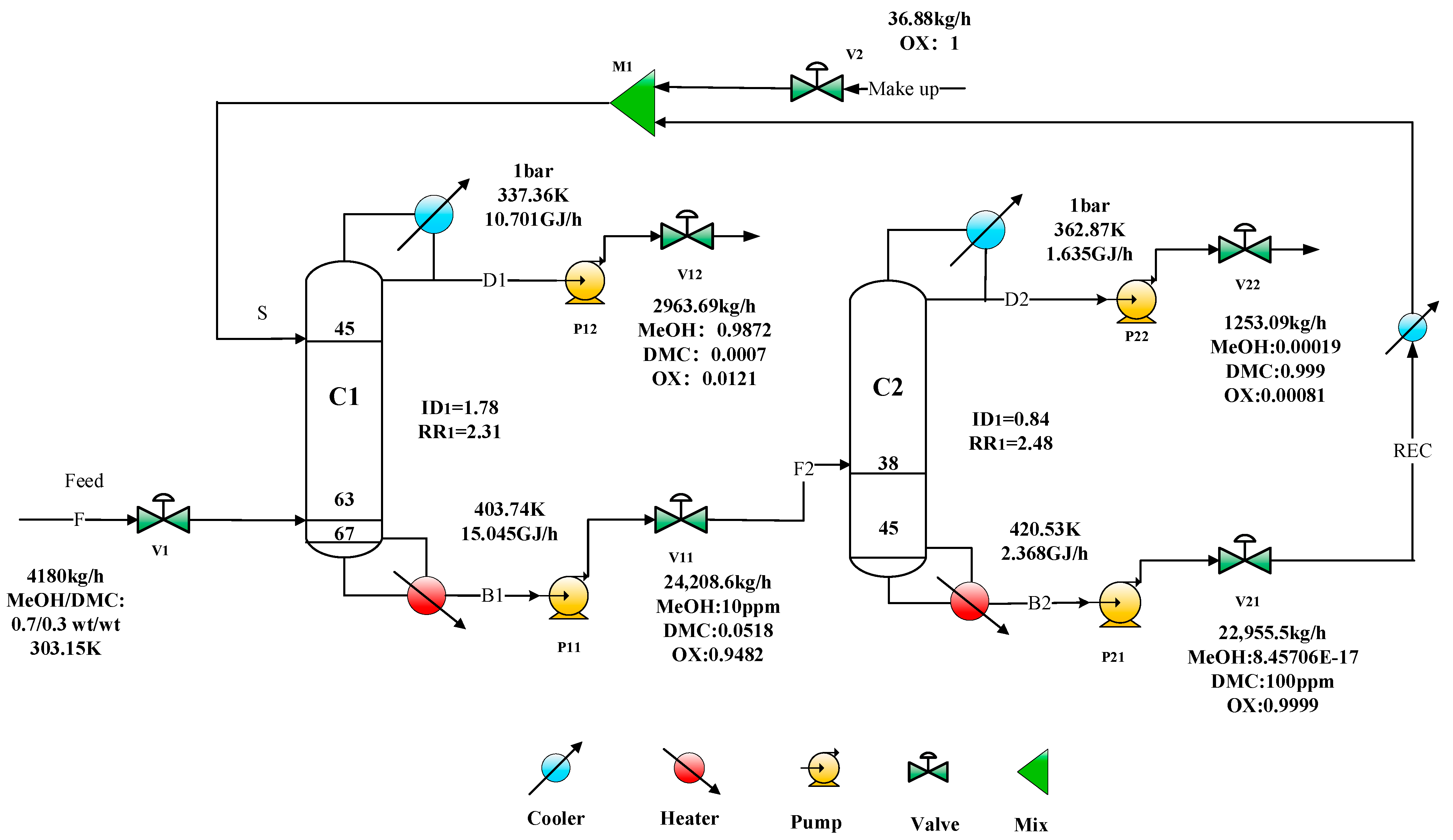
Figure 1 shows the optimal steady-state ED process for separating MeOH/DMC reported in our previous work [18]. The vapor–liquid equilibrium (VLE) data were correlated using the Wilson model, and OX was selected as the entrainer. The process comprises an extractive column with 68 theoretical stages and an entrainer recovery column with 46 theoretical stages; both columns are operated at 1 bar. The fresh feed comprises a mixture of MeOH/DMC (70/30 wt%) and a flowrate of F = 4180 kg/h with a temperature of 303.15 K and the annual operating time of 8000 h.
Fresh MeOH/DMC feed and entrainer (mainly recycled OX from the ERD bottoms mixed with a small makeup stream) are introduced into the extractive column (ED) at stages 63 and 45, respectively. The distillate from ED is 98.72 wt% MeOH. The bottoms of ED, containing a large amount of entrainer, a small amount of DMC, and a trace amount of MeOH, was fed to the tray 38 of entrainer recovery column (ERD). The distillate from ERD is 99.9 wt% DMC, while the bottoms stream is 99.99 wt% OX, which is recycled to ED as entrainer. A small makeup stream of OX compensates for entrainer losses.
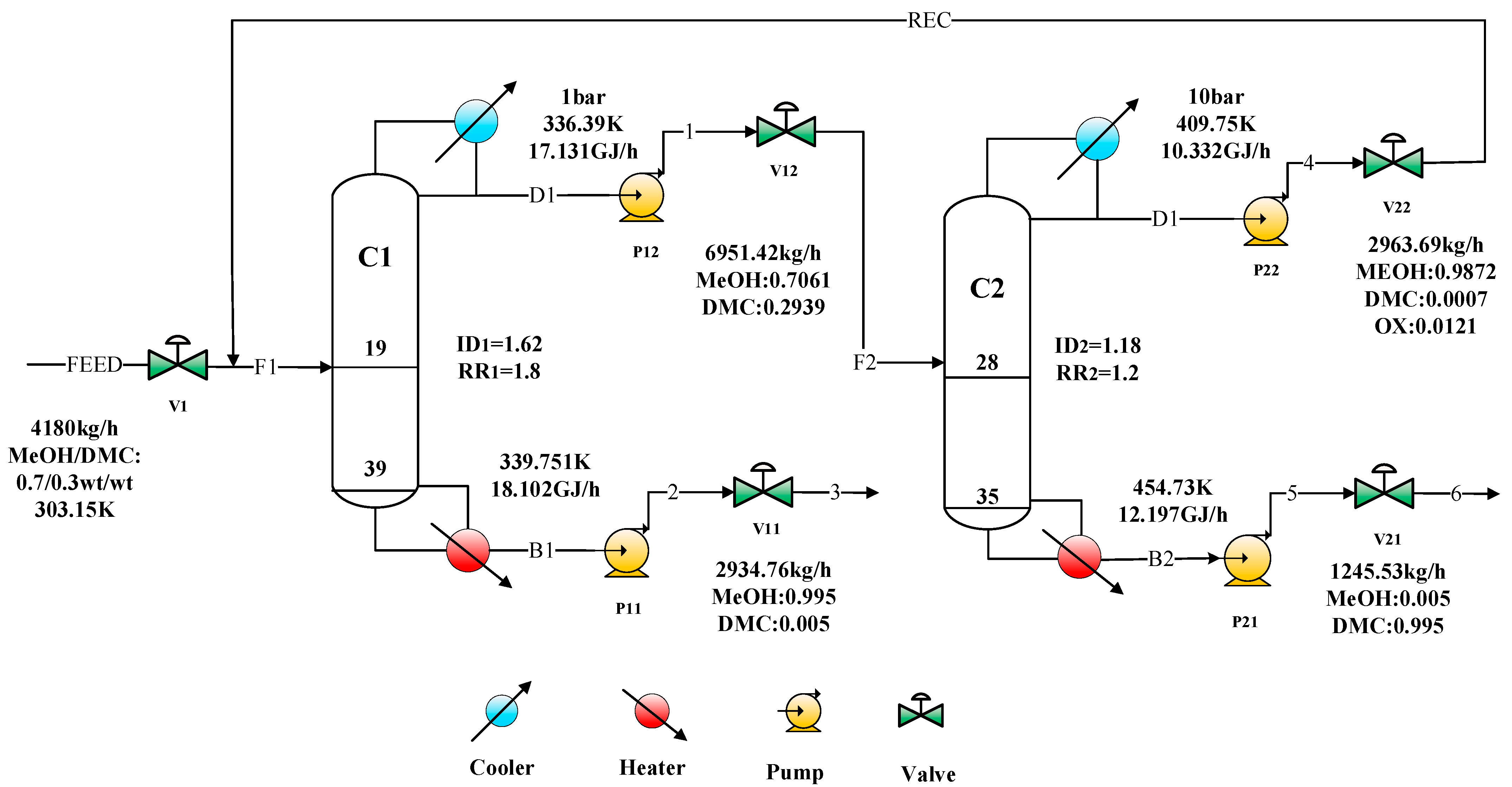
In our previous study on PSD [18], the low-pressure and high-pressure columns were operated at 1 and 10 bar, respectively. Two VLE data sets were used to regress the binary interaction parameters for the Wilson-1 model and the Wilson-2 model. Owing to a pinch region, the MeOH VLE curve approached the diagonal, thereby increasing the separation difficulty in PSD and limiting the attainable DMC purity to 99.5 wt%. Using sequential optimization, the optimal design variables were obtained as NT1 = 40, NF1 = 36, NT2 = 19, NF2 = 28, R1 = 1.8, and R2 = 1.2.
In the PSD configuration, the recycle stream is premixed with the fresh feed and introduced at the same feed stage for simplicity in this conceptual design and control feasibility study. Similar premixing configurations have been adopted in conceptual PSD studies [33,34]. The optimal steady-state PSD flowsheet for separating the MeOH/DMC azeotrope is shown in Figure 2.

3. Dynamic Control of the Extractive Distillation Process

3.1. Selection of Temperature-Sensitive Trays

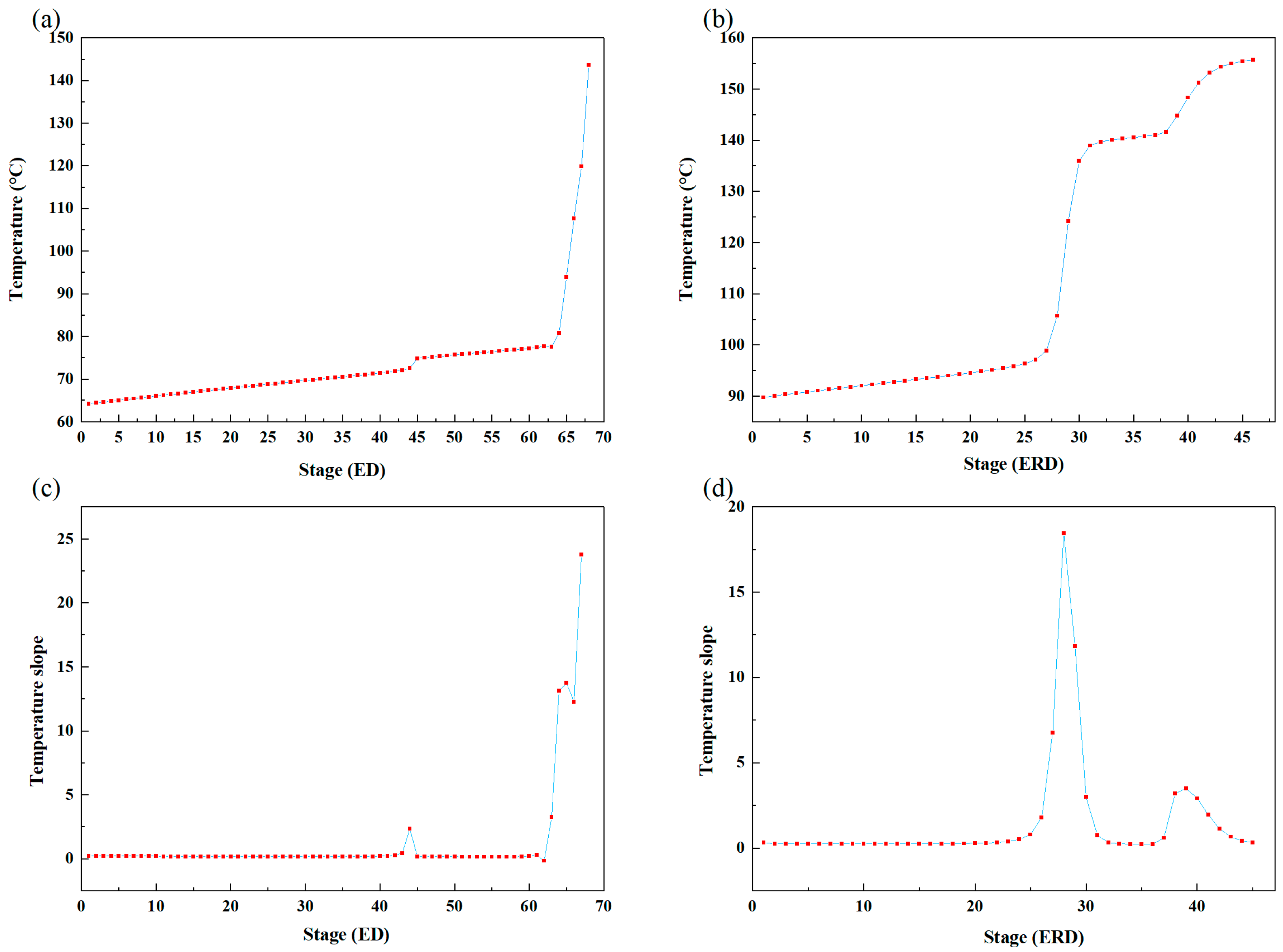
For dynamic control, appropriate selection of temperature-sensitive trays is crucial to avoid unnecessarily complex control schemes. The slope criterion, one of the most widely used approaches, was adopted in this work [35]. The slope-criterion results for the ED process are shown in Figure 3.
Although the ED column contains many trays in the rectifying section, the most temperature-sensitive location was identified in the stripping section. This selection was attributed to the fact that the stripping section directly governs the bottoms DMC purity (target: 99.9 wt%) and that DMC is prone to thermal decomposition at elevated temperatures. Consequently, temperature variations in the stripping section are more sensitive to changes in product concentration. Therefore, tray 67 in the ED column and tray 29 in the ERD were selected for temperature control.

3.2. Fixed-Reflux-Ratio Control Structure for the ED Process

The single-temperature control structure was preferred because of its low cost. For the ED process, fixed reflux ratios were maintained in both the ED and ERD columns. A ratio controller was implemented to maintain R = L/D, adjusting the reflux flowrate L in proportion to the distillate flowrate D. Before dynamic simulations were performed, the dimensions of piping and major equipment were specified. The equipment parameters are summarized in Supplementary Materials Table S1.
For the reflux drum and reboiler, a common heuristic was that the liquid holdup corresponds to approximately 5 min of liquid residence time at half-full level. The pressure drop across all control valves was set to about 3 bar, and valves were half open at the design flowrate.
Figure 4 gives the temperature control structure with a fixed reflux ratio (R). The controllers added in the control structure were summarized as follows:
(1)
The feed flowrate FC1 was controlled by adjusting the opening of the feed valve.
(2)
The pressures of the ED and ERD columns were controlled by manipulating the heat removal in the overhead condensers.
(3)
The liquid levels in the reflux drums of the ED and ERD columns were controlled by adjusting the distillate flowrates.
(4)
The bottom level of the ED column was controlled by adjusting the bottoms flowrate.
(5)
The bottom level of the ERD column was controlled by adjusting the entrainer (OX) makeup flow.
(6)
The temperature of tray 67 in the ED column was controlled by manipulating the reboiler duty of the ED column.
(7)
The temperature of tray 29 in the ERD column was controlled by manipulating the reboiler duty of the ERD column.
(8)
The total entrainer flowrate (S) was kept proportional to the feed flowrate (F), with S/F = 5.5.
(9)
For both columns, the overhead reflux flowrate was kept at a fixed R.
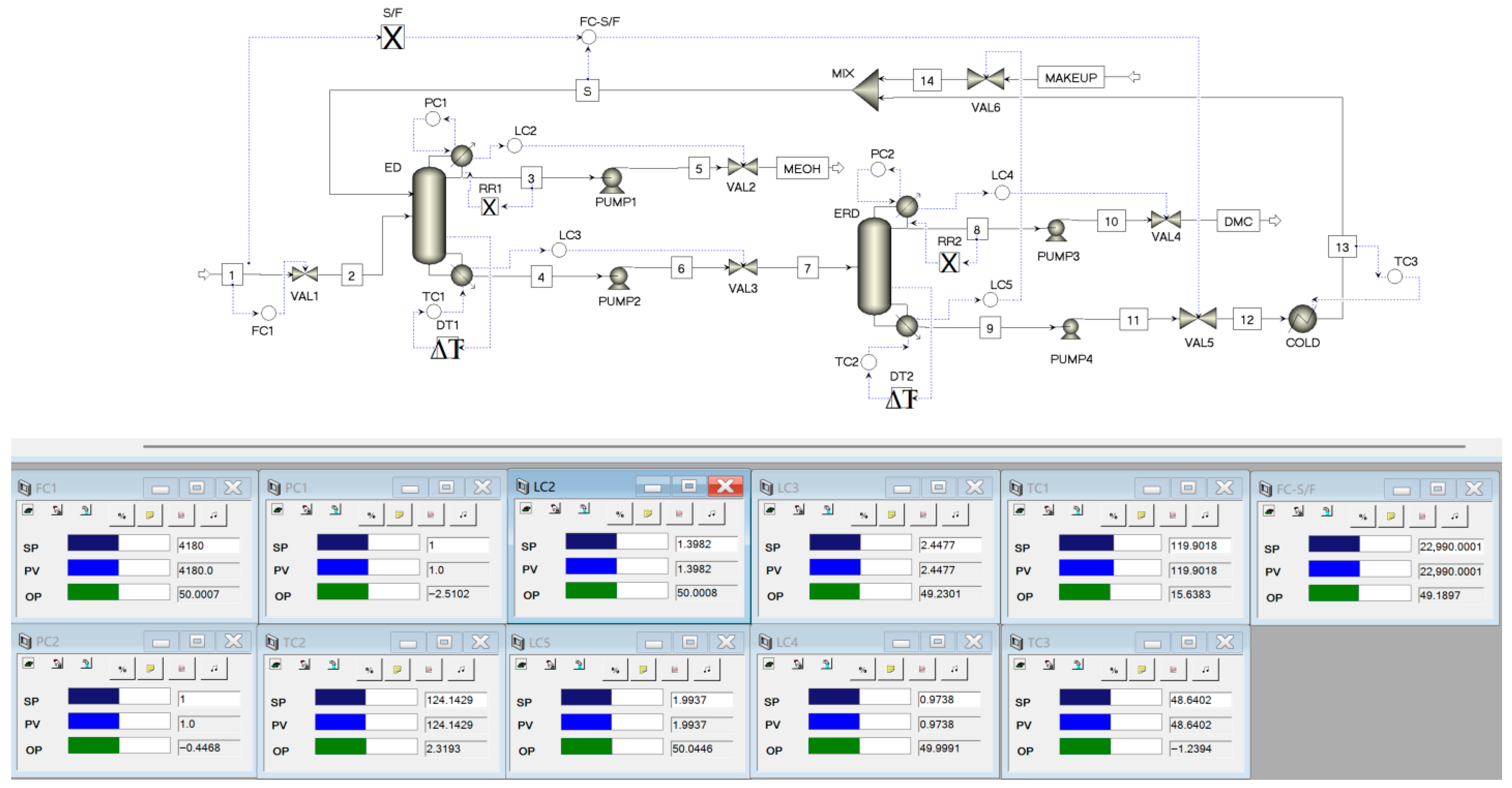
Figure 4. Control structure of extractive distillation with a fixed reflux ratio.
Separations 13 00048 g004
The level controllers for the reflux drums and column bottoms of both columns were implemented as proportional–integral (PI) controllers with proportional gain Kc = 2 and an integral time approaching infinity (τi = 9999 min). The feed flow controller adopts a PI scheme with Kc = 0.5 and τi = 0.3 min. The overhead pressure loops were implemented as PI controllers with default parameters Kc = 20 and τi = 12 min. A dead time of 1 min was introduced into both temperature control loops to represent measurement and transmission delay.
Relay-feedback tests were performed and the Tyreus–Luyben method was used to obtain the proportional gain and integral time of the temperature controllers. The tuning parameters are summarized in Table 1.
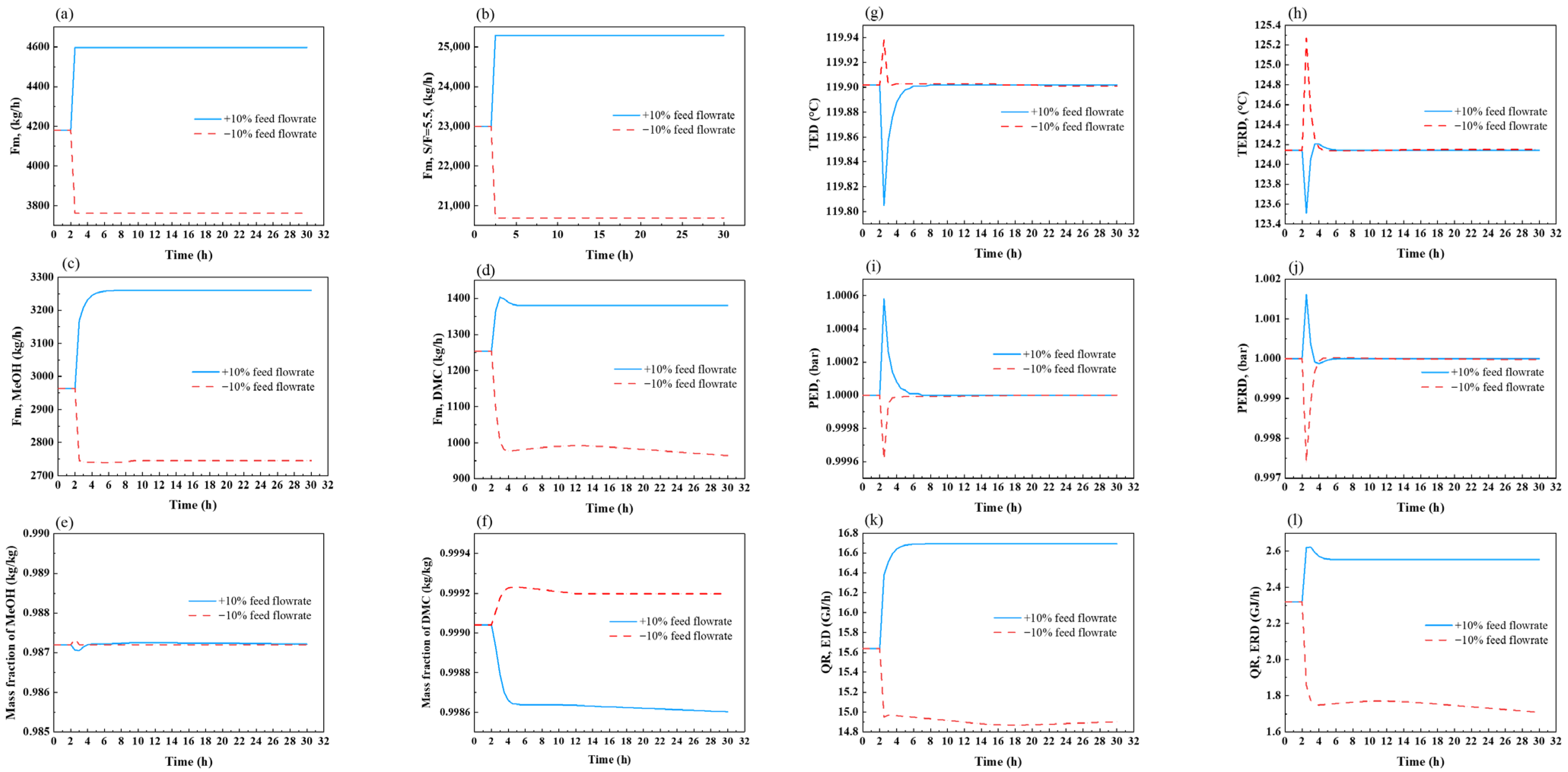
The control performance of the ED strategy was evaluated by introducing ±10% disturbances in the feed flowrate. All disturbances are introduced at 2 h and removed at 30 h. The corresponding closed-loop responses are shown in Figure 5.
As seen in Figure 5g–j, the selected tray temperatures and column pressures were returned to their setpoints within 5 h. Figure 5c,d,k,l show that the product flowrates and reboiler duties in both columns were automatically adjusted to accommodate changes in feed flowrate. In Figure 5e, the mass fraction of MeOH in the ED distillate was maintained at 0.9872 within 5 h, which is above the MeOH specification (≥0.98) and therefore sufficient for recycling to the reactive distillation column. In Figure 5f, the DMC mass fraction in the ERD distillate reached 0.9986 under a +10% feed flow disturbance, which is slightly lower than its nominal steady-state value (~0.999) but still meets the DMC specification (≥0.995). Overall, the ED process with fixed-reflux-ratio control showed satisfactory performance under ±10% feed-flow disturbances.
It should be noted that the pinch behavior in extractive distillation is primarily thermodynamic in nature and therefore cannot be eliminated by control alone. However, the proposed control structure mitigates the operational impact of the pinch by maintaining solvent-to-feed ratio (S/F) and key tray temperatures/compositions within a stable, non-pinch operating window, thereby improving controllability and product robustness under disturbances.
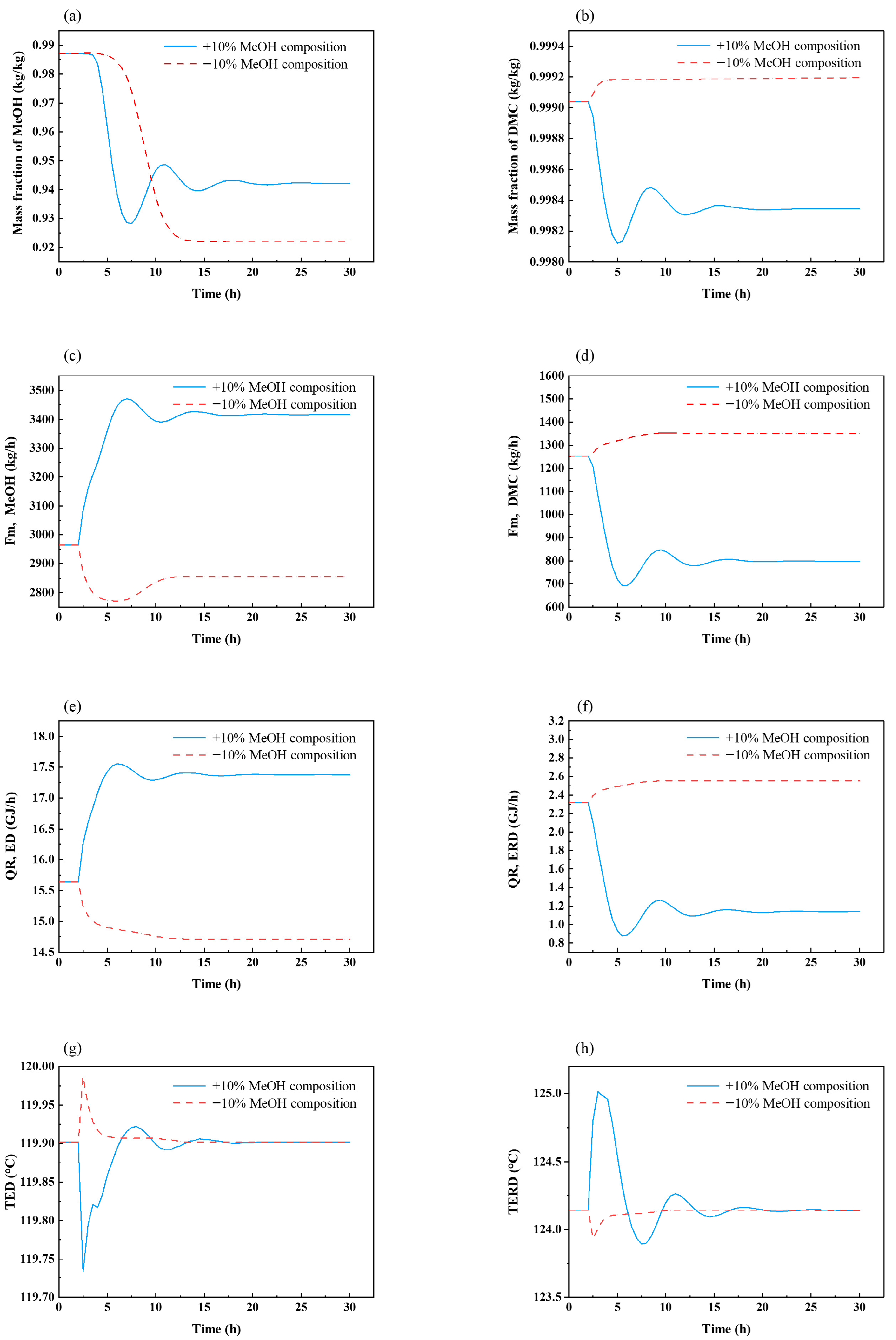
Figure 6 presents the dynamic responses of the ED process to ±10% disturbances in feed MeOH concentration. As shown in Figure 6g,h, the sensitive-tray temperatures in both columns were returned to their setpoints after several oscillations. Figure 6c–f indicates that product flowrates and reboiler duties reached new steady states within a finite time. In Figure 6a, the MeOH mass fraction in the distillate stabilized within 20 h, whereas in Figure 6b the DMC product mass fraction was maintained at ~0.998 under a +10% MeOH concentration disturbance.

4. Dynamic Control of the Pressure-Swing Distillation Process

4.1. Selection of Temperature-Sensitive Trays

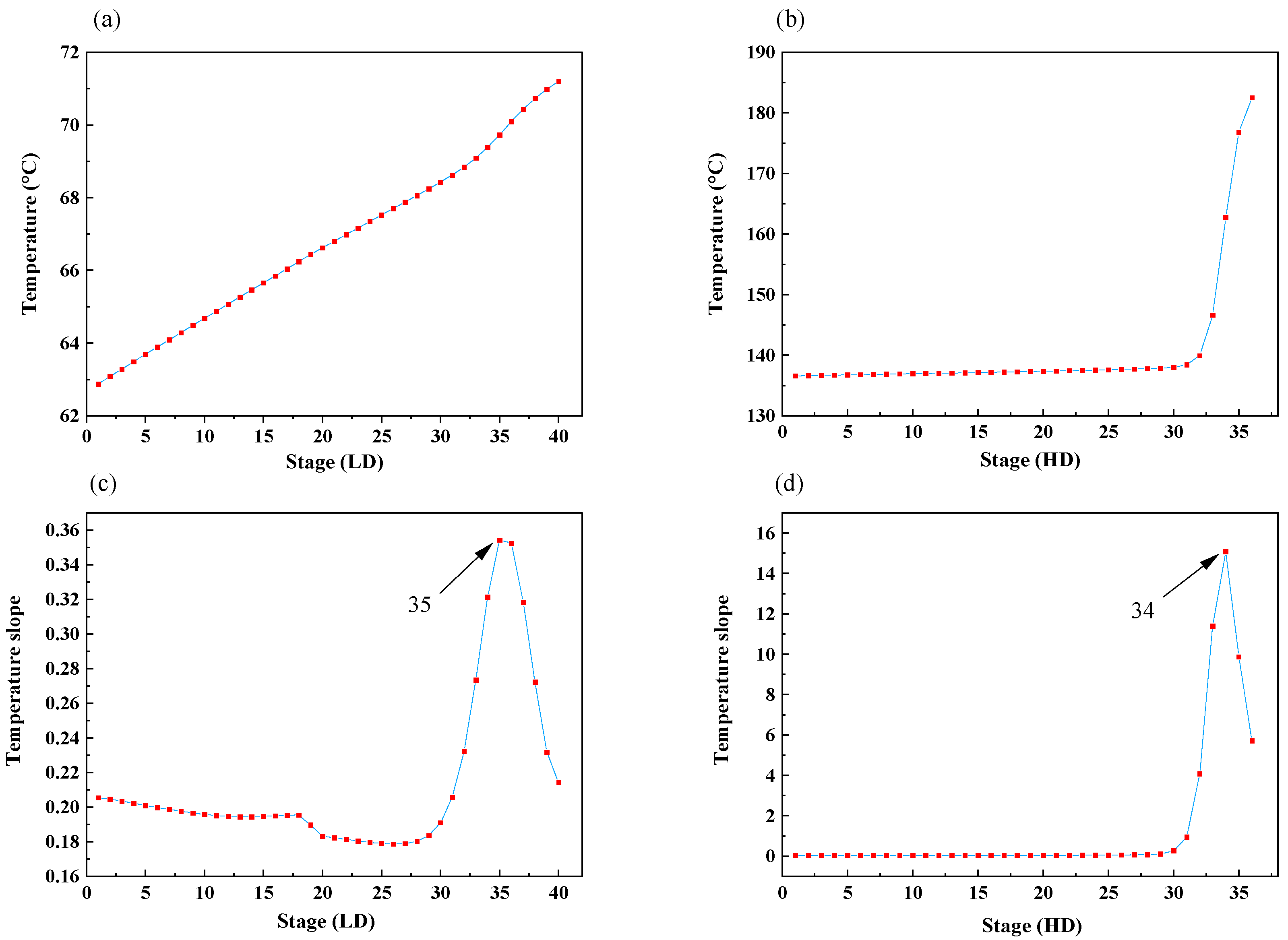
Figure 7a shows the temperature profiles of the two columns in the PSD process, while Figure 7b presents the corresponding slopes of the temperature profiles. The tray with the largest temperature slope was selected as the temperature-sensitive tray, and its temperature was used as the controlled variable [33]. The temperature-sensitive tray was identified as tray 35 in the low-pressure column and tray 34 in the high-pressure column.

4.2. Fixed-Reflux-Ratio Control Structure for the PSD Process

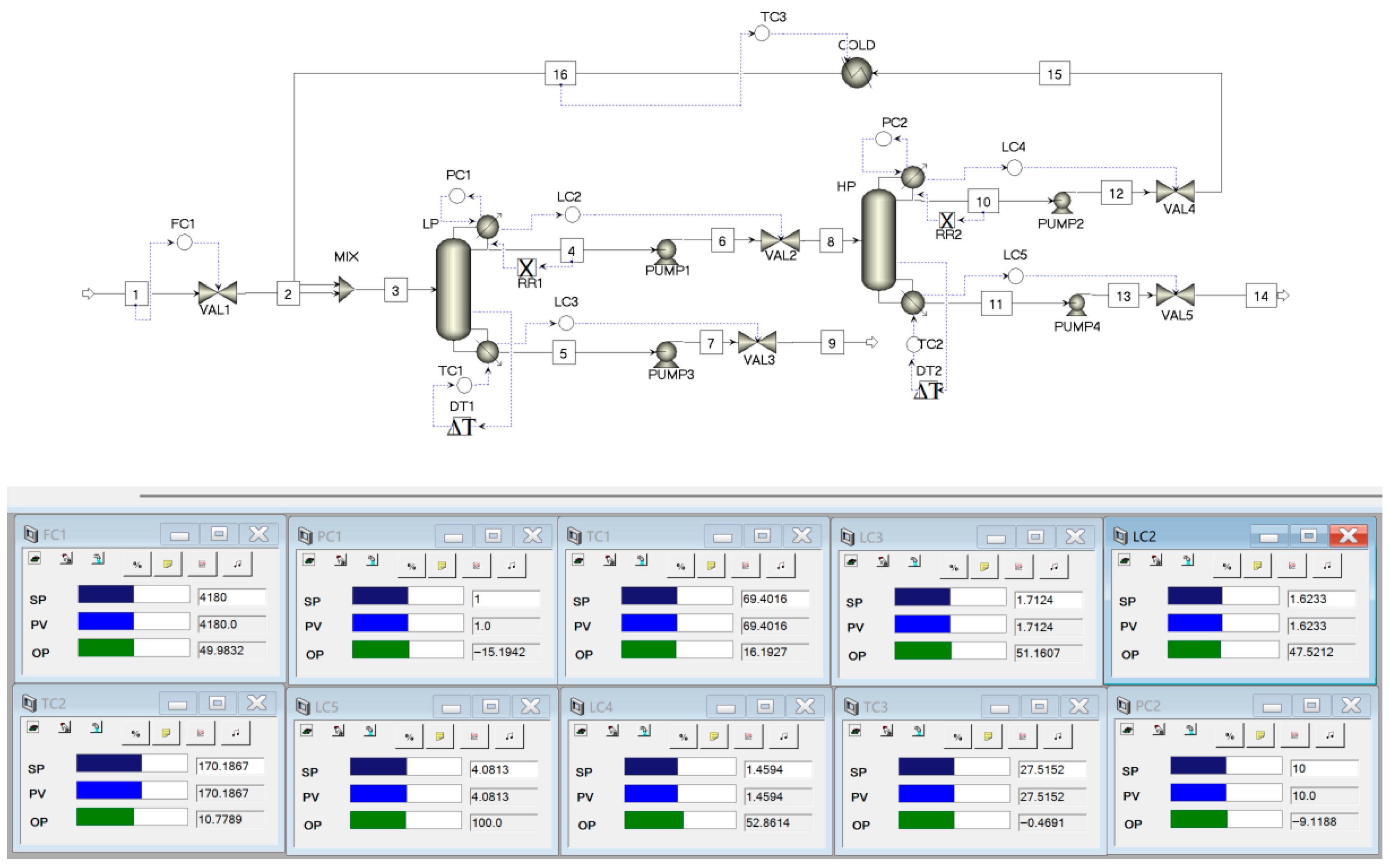
Figure 8 shows the control structure of PSD process. The controllers added in the control structure were summarized as follows:
(1)
The feed flowrate FC1 was controlled by adjusting the feed valve opening.
(2)
The pressures of the low-pressure and high-pressure columns were controlled via heat removal in their overhead condensers.
(3)
The liquid levels in the reflux drums of both columns were controlled by adjusting the distillate flowrates.
(4)
The bottom levels of both columns were controlled by manipulating the bottoms flowrates.
(5)
The temperature of tray 35 in the low-pressure column was controlled by adjusting the reboiler duty of that column.
(6)
The temperature of tray 34 in the high-pressure column was controlled by adjusting the reboiler duty of that column.
(7)
For both columns, the reflux flowrate was kept at a fixed R.
Figure 8. Control structure of pressure-swing distillation with a fixed reflux ratio.
Separations 13 00048 g008
The proportional gains and integral times of all controllers in the PSD process were set equal to those used in the ED process. After all loops were implemented, closed-loop relay-feedback tests were performed for the temperature controllers of both columns. The resulting tuning parameters are listed in Table 2.
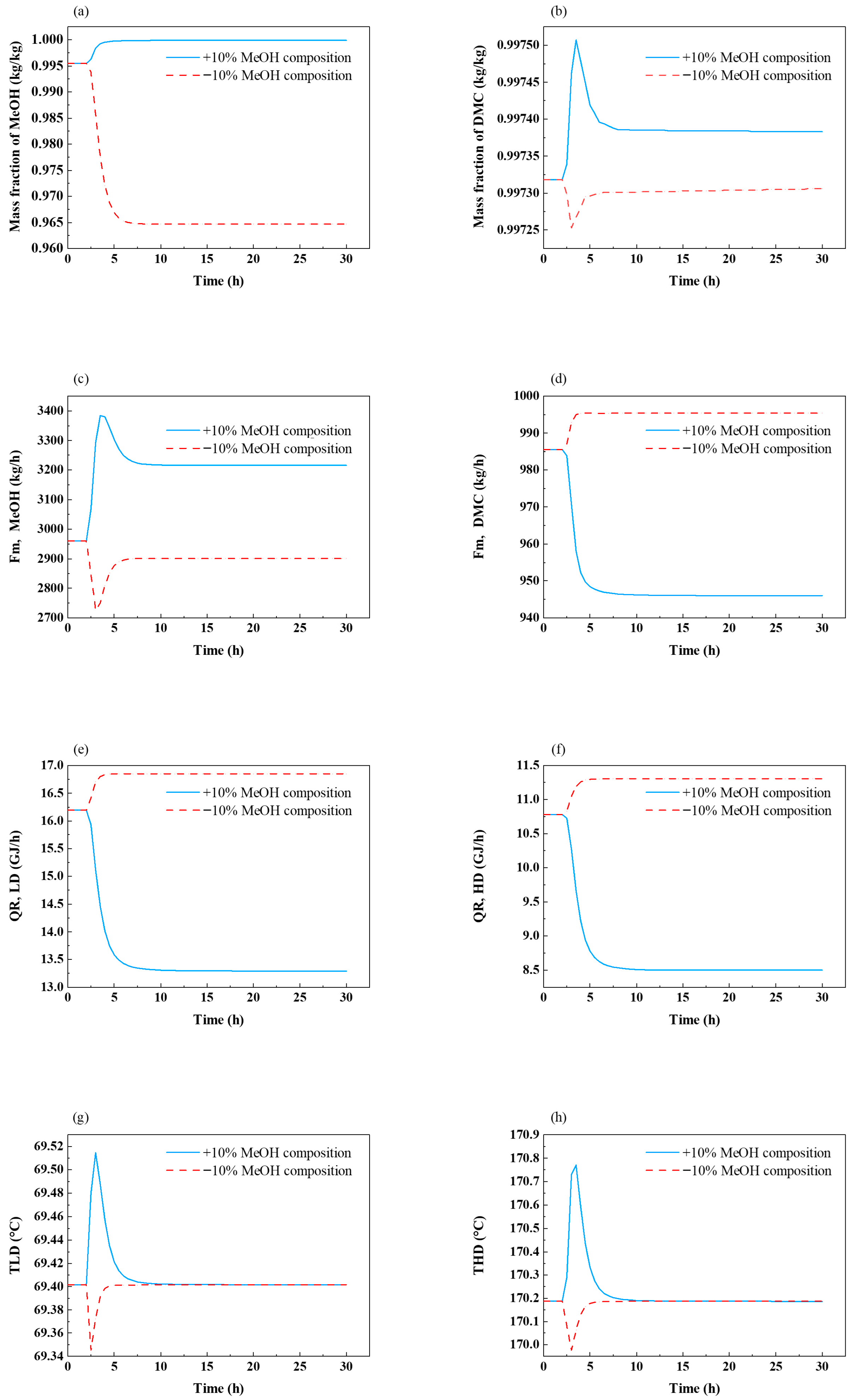
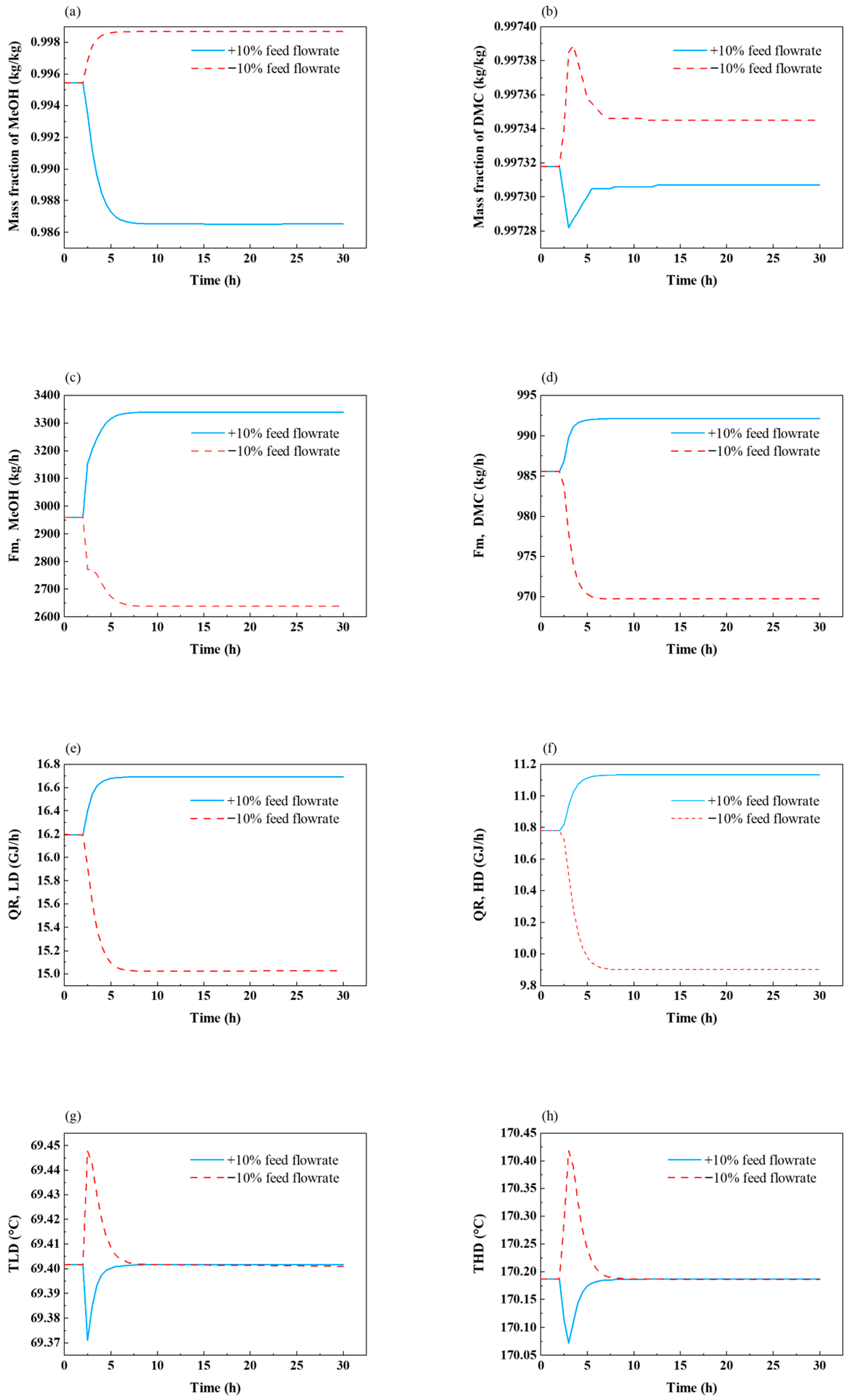
When ±10% disturbances in the feed flowrate are introduced, the corresponding dynamic responses are shown in Figure 9. After 2 h of steady operation, all variables can adapt to the new operating point within 10 h without multiple oscillations. For a fair comparison, the PSD case is evaluated using the same product specifications (DMC ≥ 99.5 wt%, MeOH ≥ 98.0 wt%). Under a −10% disturbance, the methanol mass fraction reaches 0.995, whereas under a +10% disturbance it stabilizes at about 0.9865, which still satisfies the MeOH specification (≥0.98). The DMC mass fraction in the main product remains above the specified minimum purity of 0.995 in both cases and stabilizes at approximately 0.997. These results indicate that, under the given control structure and disturbance magnitude, the PSD process exhibits acceptable dynamic controllability with respect to feed flowrate changes. Nevertheless, compared with the ED process under the same disturbances, PSD shows a lower steady-state methanol purity margin and a lower final DMC purity (~0.999).
Figure 10 shows the dynamic responses to ±10% disturbances in feed MeOH concentration. All variables reached steady state within 10 h. The MeOH product purity was higher and exhibited smaller fluctuations than that in the ED process. The DMC product mass fraction stabilized above 0.997, exceeding its steady-state design specification (0.995). However, it remained slightly lower than the DMC purity obtained with ED under the same disturbances (~0.999). Therefore, relative to its design target, PSD met (and slightly exceeded) the DMC purity requirement under feed-composition disturbances while maintaining acceptable MeOH purity control. When a stricter absolute-purity basis was used for comparison, the dynamic separation performance of PSD was lower than that of ED.

5. Conclusions

A control-oriented comparison between o-xylene-based ED and PSD was conducted for MeOH/DMC azeotropic separation using consistent control structures and evaluation criteria. Temperature-sensitive trays identified by the slope criterion enabled simplified temperature–composition control in both flowsheets when combined with fixed R and conventional pressure/level control loops. Under ±10% disturbances in feed flowrate and feed MeOH concentration, stable operation was recovered and new steady states were reached for both ED and PSD, demonstrating feasible closed-loop operability for each scheme. Although the achieved methanol purities differ between ED and PSD due to their different separation characteristics, both processes are designed to satisfy the same specifications (DMC ≥ 99.5 wt%, MeOH ≥ 98.0 wt%). The methanol stream is considered acceptable because it is recycled to the reactive distillation column rather than treated as a final product. Compared with PSD under the same disturbance magnitudes and control philosophy, ED exhibited tighter product-quality regulation, particularly for DMC product, with smaller purity excursions and closer tracking of the high-purity target (0.999). Overall, when stringent DMC purity specifications and robust dynamic quality control are required, ED appears more suitable than PSD for this azeotropic system, and the present results may guide subsequent control-structure refinement and scale-up.

Supplementary Materials

The following supporting information can be downloaded at: https://www.mdpi.com/article/10.3390/separations13020048/s1, Figure S1: Liquid composition profiles in the ED: (a) Liquid composition profiles in extractive distillation column (b) Liquid composition profiles in entrainer recovery column; Figure S2: Liquid composition profiles in the PSD: (a) Liquid composition profiles in low-pressure column (b) Liquid composition profiles in high-pressure column; Table S1: Size of extractive distillation process equipment; Table S2: Size of pressure-swing distillation process equipment.

Author Contributions

J.S.: writing—review and editing, supervision, Y.L.: writing—original draft, software, validation, methodology, investigation. Z.W.: writing—review and editing, supervision. T.L.: writing—review and editing, supervision. K.-Y.G.: writing—review and editing, supervision, visualization. J.-K.C.: writing—review and editing, visualization. Y.-G.Z.: writing—review and editing, supervision, visualization. H.S.: investigation, validation, writing—review and editing. J.T.: funding acquisition, writing—review and editing. M.X.: writing—review and editing, methodology, supervision, funding acquisition, conceptualization. All authors have read and agreed to the published version of the manuscript.

Funding

The work was funded by Open Research Grant of National Engineering Research Center for Coal Gasification and Coal-based Advanced Materials (SDEGIF-MQH202505); Innovation Project of Shandong Energy Group.

Data Availability Statement

The original contributions presented in this study are included in the article/Supplementary Materials. Further inquiries can be directed to the corresponding authors.

Conflicts of Interest

Author Jiancai Sui was employed by the Shandong Energy Group Co., Ltd. The remaining authors declare that the research was conducted in the absence of any commercial or financial relationships that could be construed as a potential conflict of interest. The authors declare that this study received funding from Shandong Energy Group. The funder was not involved in the study design, collection, analysis, interpretation of data, the writing of this article, or the decision to submit it for publication.

Nomenclature

MeOHMethanol
OXO-xylene
EDExtractive distillation
LPCLow-pressure column
NFiFeeding location for the feed to column
VLEVapor–liquid equilibrium
FCiFeed flowrate controller
FFeed flowrate
PSDPressure-swing distillation
VLEVapor-liquid equilibrium
HPCHigh-pressure column
DMCDimethyl carbonate
RReflux ratio
ERDEntrainer recovery Column
SEntrainer
PIProportional–integral
PIDProportional–integral–derivative
S/FEntrainer-to-feed ratio
TCiTemperature controller
LCiLiquid controller
NTTotal number of trays

References

  1. Pacheco, M.A.; Marshall, C.L. Review of dimethyl carbonate (DMC) manufacture and its characteristics as a fuel additive. Energy Fuels 1997, 11, 2–29. [Google Scholar] [CrossRef]
  2. Liu, Z.; Lin, W.; Li, Q.; Rong, Q.; Zu, H.; Sang, M. Separation of dimethyl carbonate/methanol azeotropic mixture by pervaporation with dealcoholized room temperature-vulcanized silicone rubber/nanosilica hybrid active layer. Sep. Purif. Technol. 2020, 248, 116926. [Google Scholar] [CrossRef]
  3. Pyo, S.-H.; Park, J.H.; Chang, T.-S.; Hatti-Kaul, R. Dimethyl carbonate as a green chemical. Curr. Opin. Green Sustain. Chem. 2017, 5, 61–66. [Google Scholar] [CrossRef]
  4. Ono, Y. Catalysis in the production and reactions of dimethyl carbonate, an environmentally benign building block. Appl. Catal. A Gen. 1997, 155, 133–166. [Google Scholar] [CrossRef]
  5. Wang, S.-J.; Yu, C.-C.; Huang, H.-P. Plant-wide design and control of DMC synthesis process via reactive distillation and thermally coupled extractive distillation. Comput. Chem. Eng. 2010, 34, 361–373. [Google Scholar] [CrossRef]
  6. Matsuta, S.; Kato, Y.; Ota, T.; Kurokawa, H.; Yoshimura, S.; Fujitani, S. Electron-spin-resonance study of the reaction of electrolytic solutions on the positive electrode for lithium-ion secondary batteries. J. Electrochem. Soc. 2001, 148, A7–A10. [Google Scholar] [CrossRef]
  7. Tundo, P.; Selva, M. The chemistry of dimethyl carbonate. Acc. Chem. Res. 2002, 35, 706–716. [Google Scholar] [CrossRef]
  8. Aurbach, D.; Markovsky, B.; Shechter, A.; Ein-Eli, Y.; Cohen, H. A comparative study of synthetic graphite and Li electrodes in electrolyte solutions based on ethylene carbonate-dimethyl carbonate mixtures. J. Electrochem. Soc. 1996, 143, 3809. [Google Scholar] [CrossRef]
  9. Deng, W.; Shi, L.; Yao, J.; Zhang, Z. A review on transesterification of propylene carbonate and methanol for dimethyl carbonate synthesis. Carbon Resour. Convers. 2019, 2, 198–212. [Google Scholar] [CrossRef]
  10. Kumar, P.; Srivastava, V.C.; Mishra, I.M. Dimethyl carbonate synthesis by transesterification of propylene carbonate with methanol: Comparative assessment of Ce-M (M = Co, Fe, Cu and Zn) catalysts. Renew. Energy 2016, 88, 457–464. [Google Scholar] [CrossRef]
  11. Liu, Y.; Zhang, Y.-G.; Shi, H.; You, C.-X.; Tang, J.; Cui, M.; Qiao, X.; Xia, M. Energy-saving heterogeneous azeotropic distillation process for the high-purity separation of dimethyl carbonate/methanol azeotrope with cyclohexane as a light entrainer. Sep. Purif. Technol. 2025, 382, 135789. [Google Scholar] [CrossRef]
  12. Gerbaud, V.; Rodriguez-Donis, I.; Hegely, L.; Lang, P.; Denes, F.; You, X. Review of extractive distillation. Process design, operation, optimization and control. Chem. Eng. Res. Des. 2019, 141, 229–271. [Google Scholar] [CrossRef]
  13. Lei, Z.; Li, C.; Chen, B. Extractive distillation: A review. Sep. Purif. Rev. 2003, 32, 121–213. [Google Scholar] [CrossRef]
  14. Muñoz, R.; Montón, J.; Burguet, M.; De la Torre, J. Separation of isobutyl alcohol and isobutyl acetate by extractive distillation and pressure-swing distillation: Simulation and optimization. Sep. Purif. Technol. 2006, 50, 175–183. [Google Scholar] [CrossRef]
  15. Luyben, W.L. Comparison of extractive distillation and pressure-swing distillation for acetone–methanol separation. Ind. Eng. Chem. Res. 2008, 47, 2696–2707. [Google Scholar] [CrossRef]
  16. Luyben, W.L. Comparison of pressure-swing and extractive-distillation methods for methanol-recovery systems in the TAME reactive-distillation process. Ind. Eng. Chem. Res. 2005, 44, 5715–5725. [Google Scholar] [CrossRef]
  17. Liang, S.; Cao, Y.; Liu, X.; Li, X.; Zhao, Y.; Wang, Y.; Wang, Y. Insight into pressure-swing distillation from azeotropic phenomenon to dynamic control. Chem. Eng. Res. Des. 2017, 117, 318–335. [Google Scholar] [CrossRef]
  18. You, C.-X.; Zhou, C.; Shi, H.; Tang, J.; Cui, M.; Qiao, X.; Xia, M. Energy-saving extractive distillation system using o-xylene as an entrainer for the high-purity separation of dimethyl carbonate/methanol azeotrope. Sep. Purif. Technol. 2024, 350, 127893. [Google Scholar] [CrossRef]
  19. Ma, K.; Pan, X.; Zhao, T.; Yang, J.; Zhu, Z.; Xu, D.; Wang, Y. Dynamic control of hybrid processes with liquid–liquid extraction for propylene glycol methyl ether dehydration. Ind. Eng. Chem. Res. 2018, 57, 13811–13820. [Google Scholar] [CrossRef]
  20. Cao, Y.; Hu, J.; Jia, H.; Bu, G.; Zhu, Z.; Wang, Y. Comparison of pressure-swing distillation and extractive distillation with varied-diameter column in economics and dynamic control. J. Process Control 2017, 49, 9–25. [Google Scholar] [CrossRef]
  21. Wang, Q.; Yu, B.; Xu, C. Design and control of distillation system for methylal/methanol separation. Part 1: Extractive distillation using DMF as an entrainer. Ind. Eng. Chem. Res. 2012, 51, 1281–1292. [Google Scholar] [CrossRef]
  22. Wang, X.; Xie, L.; Tian, P.; Tian, G. Design and control of extractive dividing wall column and pressure-swing distillation for separating azeotropic mixture of acetonitrile/N-propanol. Chem. Eng. Process. Process Intensif. 2016, 110, 172–187. [Google Scholar] [CrossRef]
  23. Peng, J.-Y. Process Optimization and Control Strategy for Special Distillation Separation of the Dimethyl Carbonate–Methanol Azeotrope. Master’s Thesis, Qingdao University of Science and Technology, Qingdao, China, 2017. (In Chinese) [Google Scholar]
  24. Zhang, H.; Ye, Q.; Qin, J.; Xu, H.; Li, N. Design and control of extractive dividing-wall column for separating ethyl acetate–isopropyl alcohol mixture. Ind. Eng. Chem. Res. 2014, 53, 1189–1205. [Google Scholar] [CrossRef]
  25. Sun, L.; Wang, Q.; Li, L.; Zhai, J.; Liu, Y. Design and control of extractive dividing wall column for separating benzene/cyclohexane mixtures. Ind. Eng. Chem. Res. 2014, 53, 8120–8131. [Google Scholar] [CrossRef]
  26. Xia, M.; Xin, Y.; Luo, J.; Li, W.; Shi, L.; Min, Y.; Xu, C. Temperature control for extractive dividing-wall column with an adjustable vapor split: Methylal/methanol azeotrope separation. Ind. Eng. Chem. Res. 2013, 52, 17996–18013. [Google Scholar] [CrossRef]
  27. Hsu, K.-Y.; Hsiao, Y.-C.; Chien, I.-L. Design and control of dimethyl carbonate–methanol separation via extractive distillation in the dimethyl carbonate reactive-distillation process. Ind. Eng. Chem. Res. 2010, 49, 735–749. [Google Scholar] [CrossRef]
  28. Yang, A.; Zou, H.; Chien, I.L.; Wang, D.; Wei, S.A.; Ren, J.; Shen, W. Optimal Design and Effective Control of Triple-Column Extractive Distillation for Separating Ethyl Acetate/Ethanol/Water with Multiazeotrope. Ind. Eng. Chem. Res. 2019, 58, 7265–7283. [Google Scholar] [CrossRef]
  29. Yang, A.; Wei, R.; Sun, S.; Wei, S.A.; Shen, W.; Chien, I.L. Energy-Saving Optimal Design and Effective Control of Heat Integration-Extractive Dividing Wall Column for Separating Heterogeneous Mixture Methanol/Toluene/Water with Multiazeotropes. Ind. Eng. Chem. Res. 2018, 57, 8036–8056. [Google Scholar] [CrossRef]
  30. Shi, T.; Chun, W.; Yang, A.; Su, Y.; Jin, S.; Ren, J.; Shen, W. Optimization and control of energy saving side-stream extractive distillation with heat integration for separating ethyl acetate-ethanol azeotrope. Chem. Eng. Sci. 2020, 215, 115373. [Google Scholar] [CrossRef]
  31. Yang, A.; Shen, W.; Wei, S.A.; Dong, L.; Li, J.; Gerbaud, V. Design and control of pressure-swing distillation for separating ternary systems with three binary minimum azeotropes. AIChE J. 2019, 65, 1281–1293. [Google Scholar] [CrossRef]
  32. Zhu, Z.; Xu, D.; Liu, X.; Zhang, Z.; Wang, Y. Separation of acetonitrile/methanol/benzene ternary azeotrope via triple column pressure-swing distillation. Sep. Purif. Technol. 2016, 169, 66–77. [Google Scholar] [CrossRef]
  33. Wei, H.-M.; Wang, F.; Zhang, J.-L.; Liao, B.; Zhao, N.; Xiao, F.-k.; Wei, W.; Sun, Y.-H. Design and control of dimethyl carbonate–methanol separation via pressure-swing distillation. Ind. Eng. Chem. Res. 2013, 52, 11463–11478. [Google Scholar] [CrossRef]
  34. Luyben, W.L.; Chien, I.-L. Design and Control of Distillation Systems for Separating Azeotropes; John Wiley & Sons: Hoboken, NJ, USA, 2011. [Google Scholar]
  35. Luyben, W.L. Distillation Design and Control Using Aspen Simulation; John Wiley & Sons: Hoboken, NJ, USA, 2013. [Google Scholar]
Figure 1. Optimal extractive distillation flowsheet.
Separations 13 00048 g001
Figure 2. Optimal pressure-swing distillation flowsheet.
Separations 13 00048 g002
Figure 3. Slope criterion analysis for the ED process: (a,b) steady-state temperature profiles of the ED and ERD, respectively; (c,d) corresponding slope-criterion distributions.
Separations 13 00048 g003
Figure 5. Dynamic responses of the ED process to ±10% feed flow disturbances: (a) Feed flow rate response to feed flow disturbance; (b) Stream 9 flow rate response to feed flow disturbance; (c) MeOH production response to feed flow disturbance; (d) DMC production response to feed flow disturbance; (e) MeOH purity response to feed flow disturbance; (f) DMC purity response to feed flow disturbance; (g) ED sensitive tray temperature response to feed flow disturbance; (h) ERD sensitive tray temperature response to feed flow disturbance. (i) ED top pressure response to feed flow disturbance; (j) ERD top pressure response to feed flow disturbance; (k) ED reboiler duty response to feed flow disturbance; (l) ERD reboiler duty response to feed flow disturbance.
Separations 13 00048 g005
Figure 6. Dynamic responses of the ED process to ±10% disturbances in feed MeOH concentration: (a) MeOH purity response to feed MeOH concentration; (b) DMC purity response to feed MeOH concentration; (c) MeOH production response to feed MeOH concentration; (d) DMC production response to feed MeOH concentration; (e) ED reboiler duty response to feed MeOH concentration; (f) ERD reboiler duty response to feed MeOH concentration; (g) ED sensitive tray temperature response to feed MeOH concentration; (h) ERD sensitive tray temperature response to feed MeOH concentration.
Separations 13 00048 g006
Figure 7. Slope criterion decomposition analysis for the PSD process: (a,b) steady-state temperature profiles of the LD and HD, respectively. (c,d) Corresponding slope-criterion distributions.
Separations 13 00048 g007
Figure 9. Dynamic responses of the PSD process to ±10% feed flow disturbances: (a) MeOH purity response to feed flow disturbance; (b) DMC purity response to feed flow disturbance; (c) MeOH production response to feed flow disturbance; (d) DMC production response to feed flow disturbance; (e) LD reboiler duty response to feed flow disturbance; (f) HD reboiler duty response to feed flow disturbance; (g) LD sensitive tray temperature response to feed flow disturbance; (h) HD sensitive tray temperature response to feed flow disturbance.
Separations 13 00048 g009
Figure 10. Dynamic responses of the PSD process to ±10% disturbances in feed MeOH concentration: (a) MeOH purity response to feed MeOH concentration; (b) DMC purity response to feed MeOH concentration; (c) MeOH production response to feed MeOH concentration; (d) DMC production response to feed MeOH concentration; (e) LD reboiler duty response to feed MeOH concentration; (f) HD reboiler duty response to feed MeOH concentration; (g) LD sensitive tray temperature response to feed MeOH concentration; (h) HD sensitive tray temperature response to feed MeOH concentration.
Separations 13 00048 g010
Table 1. Tuning parameters of temperature controllers in ED process.
ControllerControl VariableManipulated
Variable
Gain (%/%)Integral Time
(min)
TC167th tray temperatureReboiler duty2.616.60
TC229th tray temperatureReboiler duty5.5415.84
Table 2. Tuning parameters of temperature controllers in PSD process.
ControllerControl VariableManipulated
Variable
Gain (%/%)Integral Time
(min)
TC135th tray temperatureReboiler duty6.526.6
TC234th tray temperatureReboiler duty1.507.92
Disclaimer/Publisher’s Note: The statements, opinions and data contained in all publications are solely those of the individual author(s) and contributor(s) and not of MDPI and/or the editor(s). MDPI and/or the editor(s) disclaim responsibility for any injury to people or property resulting from any ideas, methods, instructions or products referred to in the content.