Article

Selective Chloride Removal by a NiFe LDH/BiOCl Composite Film via Electrically Switched Ion Exchange

1
Lvliang Ecological and Environmental Monitoring Center of Shanxi Province, Lvliang 033000, China
2
College of Environment and Ecology, Taiyuan University of Technology, Taiyuan 030024, China
*
Author to whom correspondence should be addressed.
Separations 2026, 13(2), 47; https://doi.org/10.3390/separations13020047
Submission received: 29 December 2025 / Revised: 21 January 2026 / Accepted: 23 January 2026 / Published: 27 January 2026
(This article belongs to the Topic Sustainable Technologies for Water Purification)

Abstract

The development of electrode materials that combine high capacity with high anion selectivity is critical for chloride separation from complex aqueous matrices. Here, a NiFe LDH/BiOCl composite film electrode was fabricated on carbon paper via sequential electrodeposition and employed for electrically switched ion exchange (ESIX) of chloride. The composite delivers higher reversible chloride uptake than either NiFe LDH or BiOCl alone under identical electrochemical conditions, together with enhanced selectivity in mixed−anion solutions. Mechanistically, the synergy originates from the combination of (i) the high anion−exchange capacity and redox−tunable layer charge of NiFe LDH and (ii) halide−affinitive BiOCl domains that facilitate voltage−gated uptake/release; the heterointerface further improves charge/ion transport, enabling more effective electrochemical utilization. The electrode maintains stable cycling performance with high regeneration efficiency over repeated ESIX operation. Compared with representative LDH− or BiOX−based ESIX electrodes reported for halide capture, the proposed composite shows competitive chloride selectivity and reversible cycling, supporting its potential for electrochemical separations and water treatment.

1. Introduction

Chloride ion (Cl) is one of the most common anions in wastewater originating from papermaking, tanning, landfill leachate treatment, and chemical manufacturing industries [1]. High chloride concentrations can cause severe corrosion of pipelines, concrete, and instruments, and also deteriorate groundwater quality and crop productivity [2,3]. Consequently, developing efficient and selective chloride−removal technologies is of significant environmental and industrial importance.
Traditional chloride−removal approaches such as ion exchange [4], chemical precipitation [5], capacitive deionization [6], and electrodialysis [7] are effective for bulk desalination but often lack ion−specific control. In particular, ion exchange and adsorption show low efficiency for diluting chloride wastewater and require chemical−intensive regeneration, which can cause secondary pollution. Recent studies have highlighted that conventional electrochemical desalination methods are generally non−selective, underscoring the need for controllable, chloride−targeted systems [8].
Electrically switched ion exchange (ESIX) combines ion exchange with electrochemical control, enabling reversible ion uptake and release through redox modulation of electroactive materials. ESIX exhibits high selectivity, low energy consumption, and negligible secondary contamination [9]. It has been successfully applied for various ions such as Li+, Cs+, F, Br [10], and I [11]. The performance of ESIX largely depends on the electroactive ion−exchange material (EIXM), motivating exploration of materials with high conductivity and tailored ion selectivity.
Layered double hydroxides (LDHs) are two−dimensional materials with positively charged metal hydroxide layers and interlayer anions [12]. They exhibit large surface areas, good structural stability, and strong anion−exchange capacity [13]. However, their typical selectivity order (I < NO3 < Br < Cl < F < SO42− < CO32−) [14] indicates limited affinity for chloride, restricting their application in chloride−selective ESIX systems. Thus, coupling LDHs with chloride−affinitive materials is a promising route to enhance selectivity and adsorption capacity.
Bismuth oxyhalides (BiOX, X = Cl, Br, I) have emerged as layered materials with good electrical conductivity, structural stability, and halide−vacancy−driven anion selectivity [15,16,17,18]. Their [Bi2O2]–X layers are linked via weak van der Waals forces, allowing reversible halide exchange. These vacancies act as active sites for selective halide adsorption, and BiOCl has demonstrated superior chloride capture and electronic coupling performance in electrochemical systems [19,20,21].
In this work, NiFe LDH is selected as the base material due to its favorable Ni2+/Ni3+ and Fe2+/Fe3+ redox couples, which provide a suitable potential window for voltage−programmed ion exchange, robust electrodeposition on carbon substrates, and compatibility with BiOCl during co−deposition and operation [22].
Despite previous successes, most reported LDH/BiOX ESIX systems lack quantitative analysis of the synergy between capacity, selectivity, and charge utilization. Here, a NiFe LDH/BiOCl composite film was fabricated via electrochemical deposition, and its microstructure, composition, and electrochemical behavior were systematically investigated. The study aims to elucidate the interfacial charge/ion transport and provide quantitative evidence of synergistic chloride selectivity and capacity enhancement, addressing the existing gap in ESIX−based selective dechlorination.

2. Materials and Methods

2.1. Reagents

All reagents were of analytical grade and used without further purification. Nickel(II) nitrate hexahydrate (Ni(NO3)2·6H2O), iron(III) nitrate nonahydrate (Fe(NO3)3·9H2O), ethylene glycol (EG), bismuth(III) nitrate pentahydrate (Bi(NO3)3·5H2O), potassium fluoride (KF), potassium chloride (KCl), potassium bromide (KBr), and potassium nitrate (KNO3) were purchased from Sinopharm Chemical Reagent Co., Ltd. (Taiyuan, China). Carbon paper (CP) was supplied by Shanghai Hesen Electric Co., Ltd. (Shanghai, China) All solutions were prepared using deionized water (18.25 MΩ·cm, Millipore, Taiyuan, China).

2.2. Material Synthesis

Pretreatment of carbon paper (CP). Carbon paper with an area of 2 cm × 3 cm was successively immersed in 1 M H2SO4 solution and anhydrous ethanol for 1 day each to improve its hydrophilicity. This pretreatment step is intended to ensure sufficient wettability and surface cleanliness of the carbon paper and does not induce any chemical modification of the substrate. The pretreated CP was then thoroughly rinsed with deionized water and dried for further use.
Preparation of BiOCl film. Bi films were first electrodeposited from 50 mL of EG solution containing 2 mmol Bi (NO3) 3·5H2O at −1.5 V for 0.5 h. The working and counter electrodes were pretreated CP, and the reference electrode was a saturated calomel electrode (SCE). After deposition, the Bi films were rinsed with ethanol followed by deionized water. Subsequently, the Bi films were oxidized to BiOCl films in 0.1 M KCl solution at an oxidation potential of 1.5 V for 1 h, using the Bi film as the working electrode, CP as the counter electrode and SCE as the reference electrode. The obtained BiOCl films were rinsed with deionized water and dried in air.
Preparation of NiFe LDH/BiOCl composite film. NiFe LDH/BiOCl composite films were prepared in a three−electrode cell at −1.0 V. The BiOCl film on CP served as the working electrode, CP as the counter electrode, and SCE as the reference electrode. The electrolyte was an aqueous mixture of 0.015 M Ni (NO3) 2 and 0.015 M Fe(NO3)3. The LDH deposition times were set to 100, 300, and 600 s, respectively, to optimize the microstructure and electrochemical performance of the composite films. The Ni2+/Fe3+ concentrations and molar ratio were selected according to commonly reported electrodeposition conditions for NiFe LDHs to ensure uniform growth and good reproducibility [23].

2.3. Electrochemical Performance and Adsorption Performance Experiments

The electrochemical behavior and adsorption performance of the NiFe LDH/BiOCl composite film were evaluated in a three−electrode configuration with the composite film as the working electrode, CP as the counter electrode and SCE as the reference electrode. Cyclic voltammetry (CV) and electrochemical impedance spectroscopy (EIS) were carried out in 50 mL of 0.1 M KCl solution. The Cl desorption performance of the composite film was investigated in deionized water at different desorption potentials (−0.4, −0.6, and −0.8 V). The Cl adsorption performance was examined at different adsorption potentials (0.4, 0.6, 0.8, and 1.0 V) in aqueous solutions containing 100 ppm Cl. In addition, the Cl adsorption performances of NiFe LDH, BiOCl, and the NiFe LDH/BiOCl composite film were compared at the optimum adsorption potential of 0.8 V. All experiments were conducted at a controlled pH to isolate the effect of applied potential; the influence of solution pH will be addressed in future studies.
Qd = (C − C0) × V/M
Qa = (C0 − C) × V/M
where C0 (mg·L−1) and C (mg·L−1) are the Cl concentrations at the initial and equilibrium states, respectively; V (L) is the volume of the solution; and M (g) is the mass of the NiFe LDH/BiOCl composite film.
The selectivity of the NiFe LDH/BiOCl composite film for Cl against other anions was investigated by competitive adsorption at 0.8 V in a mixed solution containing 0.6 mM of F, Cl, Br, and NO3. The distribution coefficient KD (mL·g−1) and the separation factor α of Cl relative to co−existing ions were calculated according to Equations (3) and (4), respectively.
KD = [(C0 − C)/C] × (V/M)
α = KD(M1)/KD(M2)
where KD(M1) and KD(M2) represent the distribution coefficients of M1 and M2 ions, respectively.

2.4. Characterizations

The crystal structures of the films were analyzed by X−Ray diffraction (XRD, Aeris, Almelo, The Netherlands). The microstructures were observed by scanning electron microscopy (SEM, ZEISS Gemini 300, Carl Zeiss AG, Oberkochen, Germany). The elemental composition and valence states of the elements were examined by X−Ray photoelectron spectroscopy (XPS, Thermo Scientific K−Alpha, Thermo Fisher Scientific, Waltham, MA, USA). Electrochemical measurements were performed using a CHI760E electrochemical workstation (Shanghai CH Instruments, Shanghai, China). The concentrations of target ions in solution were determined by ion chromatography (IC, ECO, Metrohm AG, Herisau, Switzerland).

3. Results and Discussion

3.1. Morphology and Structure

The microstructures of NiFe LDH, BiOCl, and the NiFe LDH/BiOCl composite films were observed by SEM. Figure 1A shows the SEM image of the NiFe LDH film. NiFe LDH exhibits a typical two−dimensional nanosheet−like lamellar structure with uniform dispersion, and the lateral size of the nanosheets is about 100–300 nm. Figure 1B shows the SEM image of BiOCl, which presents a uniformly distributed nanosheet structure with a size of about 500 nm–1 μm. Figure 1C–E show SEM images of the NiFe LDH/BiOCl composite films prepared with LDH deposition times of 100, 300, and 600 s, respectively. As shown in Figure 1C, no obvious LDH nanosheets are observed at a deposition time of 100 s because the LDH loading is relatively low. When the LDH deposition time is extended to 300 s, uniformly grown NiFe LDH nanosheets can be clearly observed on the lamellar surface of BiOCl (Figure 1D). Such a uniformly dispersed nanosheet–lamellar structure is favorable for the uptake and release of Cl. However, when the LDH deposition time is further increased to 600 s, excessive LDH deposition leads to aggregation on the surface of the composite film (Figure 1E). This aggregation can partially cover the active sites and is unfavorable for ion and electron transport, thereby reducing the Cl adsorption ability of the composite film. Therefore, the LDH deposition time was set to 300 s.
The elemental distribution of the NiFe LDH/BiOCl composite film prepared with a deposition time of 300 s was examined by energy−dispersive spectroscopy (EDS). Figure 1F–K show the EDS mapping images of Bi, Ni, Fe, Cl, and O, respectively. All these elements are uniformly distributed on the surface of the composite film, confirming the successful preparation of the NiFe LDH/BiOCl composite.
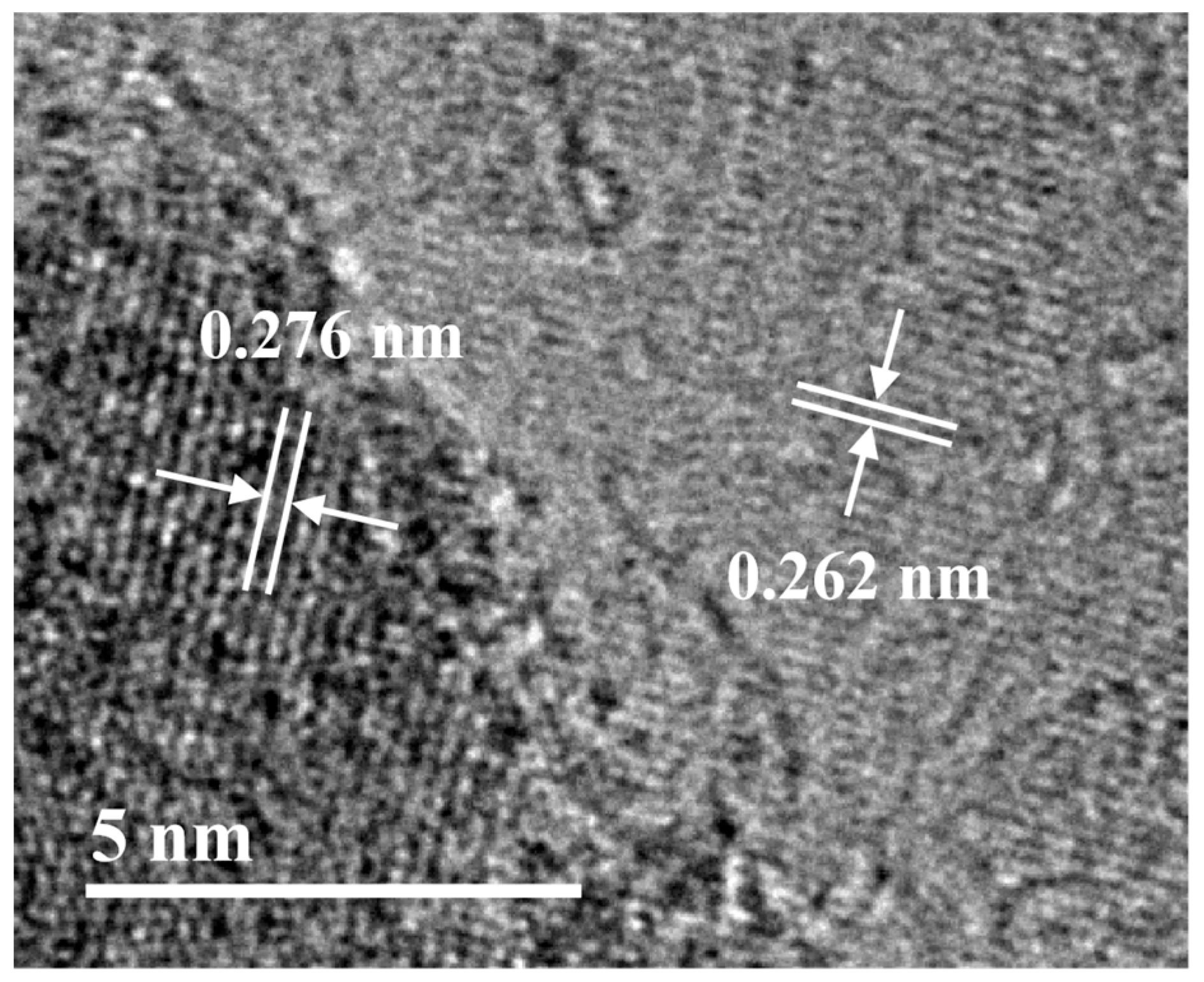
The microstructure of the NiFe LDH/BiOCl composite film was further characterized by transmission electron microscopy (TEM). Figure 2 shows a TEM image of the NiFe LDH/BiOCl composite, highlighting the interface between NiFe LDH and BiOCl. The lattice spacing of NiFe LDH is 0.262 nm, corresponding to the (012) crystal plane of LDH in the XRD pattern (Figure 3). The lattice spacing of BiOCl is 0.276 nm, corresponding to the (110) crystal planes of BiOCl in the XRD pattern (Figure 3). These observations further confirm the successful formation of the NiFe LDH/BiOCl composite film. TEM observations are used here to qualitatively confirm the interfacial structure and lattice characteristics of the composite, while the overall morphology uniformity is evaluated by SEM.
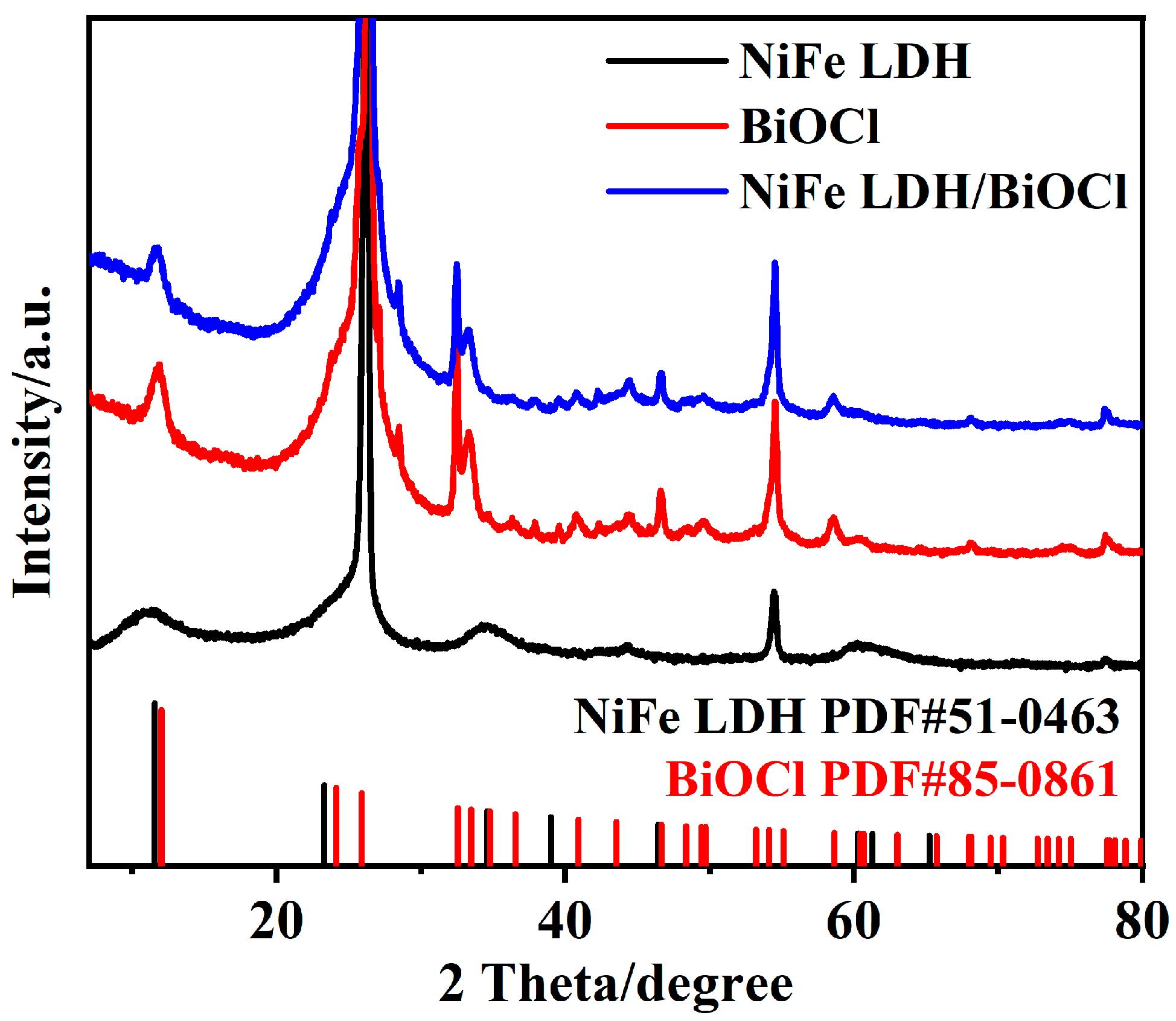
The crystal structures of NiFe LDH, BiOCl, and NiFe LDH/BiOCl films were analyzed by XRD to further determine the compounding of the composite material. Figure 3 shows the XRD patterns of NiFe LDH, BiOCl, and NiFe LDH/BiOCl composite films. For all samples, the two strong diffraction peaks located at 26.6° and 55° corresponded to the CP substrate. For the NiFe LDH, the peaks at 10.74°, 34.06°, and 60.08° corresponded to (003), (012), and (110) planes, respectively. For the BiOCl, the peaks at 11.74°, 32.48°, 33.42°, 46.64°, and 58.69° corresponded to (001), (110), (102), (200), and (212) planes, respectively. In addition, it can be observed that the peaks of NiFe LDH/BiOCl composite film remained basically the same as that of BiOCl, which was because the characteristic diffraction peaks of NiFe LDH are weak and located in similar 2θ regions to those of BiOCl, and may therefore be masked by the dominant BiOCl reflections in the composite film.

3.2. Composition and Adsorption Mechanism Analysis

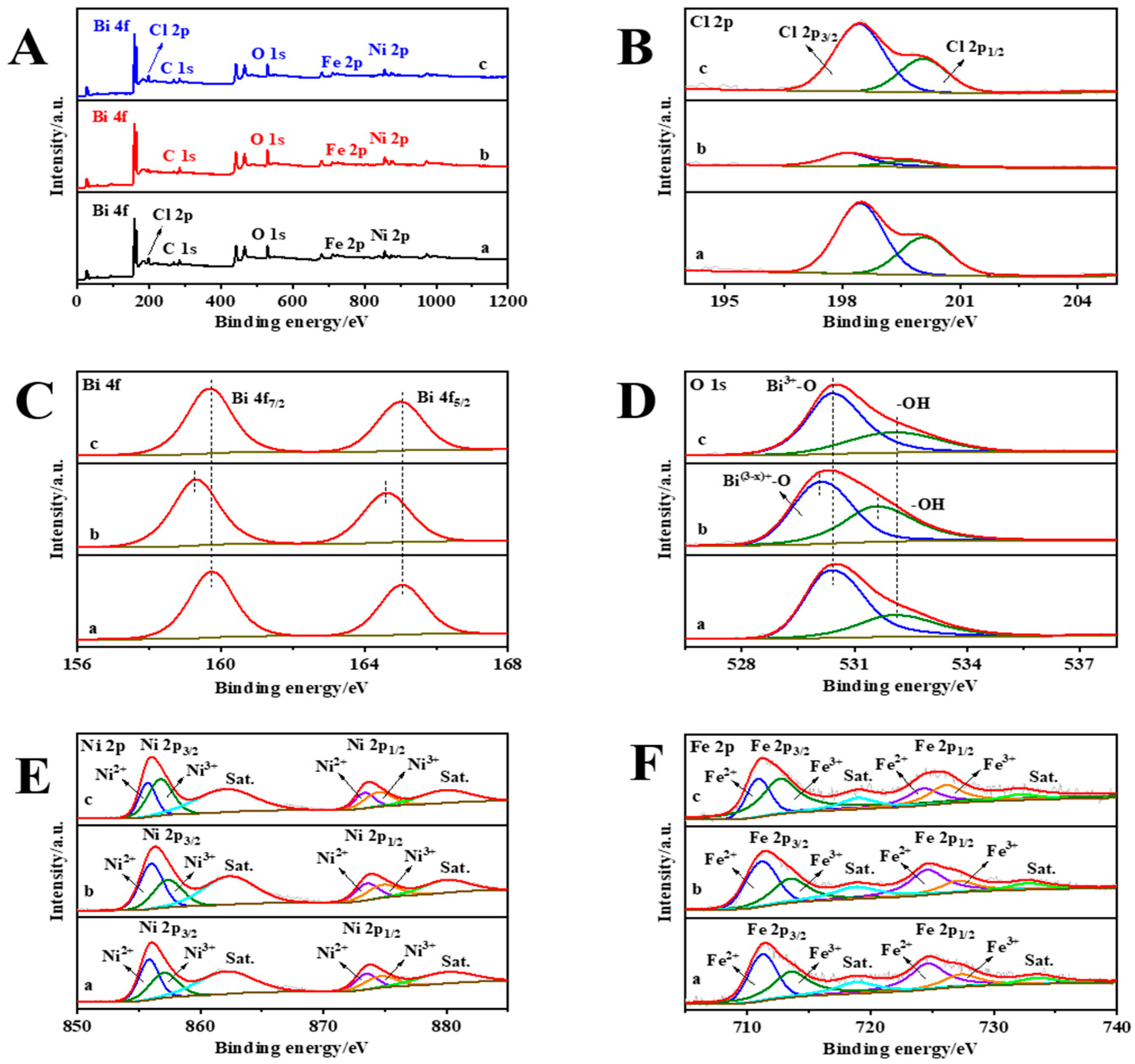
The elemental composition and valence states of the NiFe LDH/BiOCl composite film in the initial, reduced, and oxidized states were analyzed by XPS (Figure 4). As shown in the survey spectrum (Figure 4A), Bi, Ni, Fe, Cl, and O are detected, further confirming the successful preparation of the NiFe LDH/BiOCl composite film.
Figure 4B shows the high−resolution XPS spectrum of Cl 2p. Two peaks located at 198.5 eV and 200.15 eV correspond to Cl 2p3/2 and Cl 2p1/2, respectively [24]. Pronounced Cl signals are observed in the initial (a) and oxidized (c) states, whereas the Cl signal is barely detectable in the reduced state (b), indicating that the composite film can reversibly uptake and release Cl upon switching between oxidation and reduction.
Figure 4C shows the high−resolution XPS spectrum of Bi 4f. In the initial state (a), the two peaks at 159.76 eV and 165.08 eV correspond to Bi 4f7/2 and Bi 4f5/2 of Bi3+, respectively [19]. The energy difference of 5.3 eV between Bi 4f7/2 and Bi 4f5/2 also confirms the presence of Bi3+. In the reduced state (b), the peaks shift to 159.36 eV and 164.68 eV, corresponding to Bi 4f7/2 and Bi 4f5/2 of Bi(3−x)+ [19,20]. This shift indicates that Bi3+ is partially reduced to Bi(3−x)+, accompanied by the release of Cl from the film. In the oxidized state (c), the Bi 4f peaks revert to their initial positions, indicating that Bi(3−x)+ is reoxidized to Bi3+ and Cl is re−incorporated into the film. These results demonstrate the reversibility of electrochemical reactions.
Figure 4D presents the high−resolution XPS spectrum of O 1s. The peaks at 530.48 eV and 530.08 eV correspond to Bi3+–O and Bi(3−x)+–O bonds, respectively [19,20]. The peaks at 532.18 eV and 531.68 eV are attributed to surface –OH groups. These results indicate that, upon application of a suitable reduction potential, Bi3+ is reduced to Bi(3−x)+ and Cl is released from the film; conversely, under an oxidation potential, Bi(3−x)+ is oxidized back to Bi3+ and Cl is re−adsorbed by the film.
Figure 4E,F show the high−resolution XPS spectra of Ni 2p and Fe 2p, respectively. The peaks at 856.3 eV and 873.9 eV are assigned to Ni 2p3/2 and Ni 2p1/2 of Ni2+, while the peaks at 857.1 eV and 875.2 eV correspond to Ni 2p3/2 and Ni 2p1/2 of Ni3+. The peaks at 711.6 eV and 725.1 eV are attributed to Fe 2p3/2 and Fe 2p1/2 of Fe2+, and those at 714.1 eV and 727.4 eV to Fe 2p3/2 and Fe 2p1/2 of Fe3+ [25]. After applying a reduction potential, the contents of Ni2+ and Fe2+ increase, whereas the contents of Ni3+ and Fe3+ decrease. Partial reduction in trivalent metal ions to divalent ones requires charge compensation, leading to the release of Cl from NiFe LDH. In contrast, upon oxidation, the contents of Ni2+ and Fe2+ decrease and those of Ni3+ and Fe3+ increase; divalent metal ions are oxidized to trivalent ones, and charge balance is maintained by the insertion of Cl into the interlayers of NiFe LDH. These observations confirm that the uptake and release of Cl are reversible. Overall, the redox reactions of BiOCl and NiFe LDH cooperatively enable the reversible uptake/release of Cl. The relative intensity evolution of the Cl 2p and metal core−level spectra, together with systematic binding energy shifts, indicates a reversible change in charge state that is compensated by chloride insertion and release [26]. Vacancy−related coordination chemistry has been widely recognized as an effective route to activate BiOCl for reversible adsorption/reaction behavior, where defect formation can modulate the local electronic structure and ion−binding affinity [27].
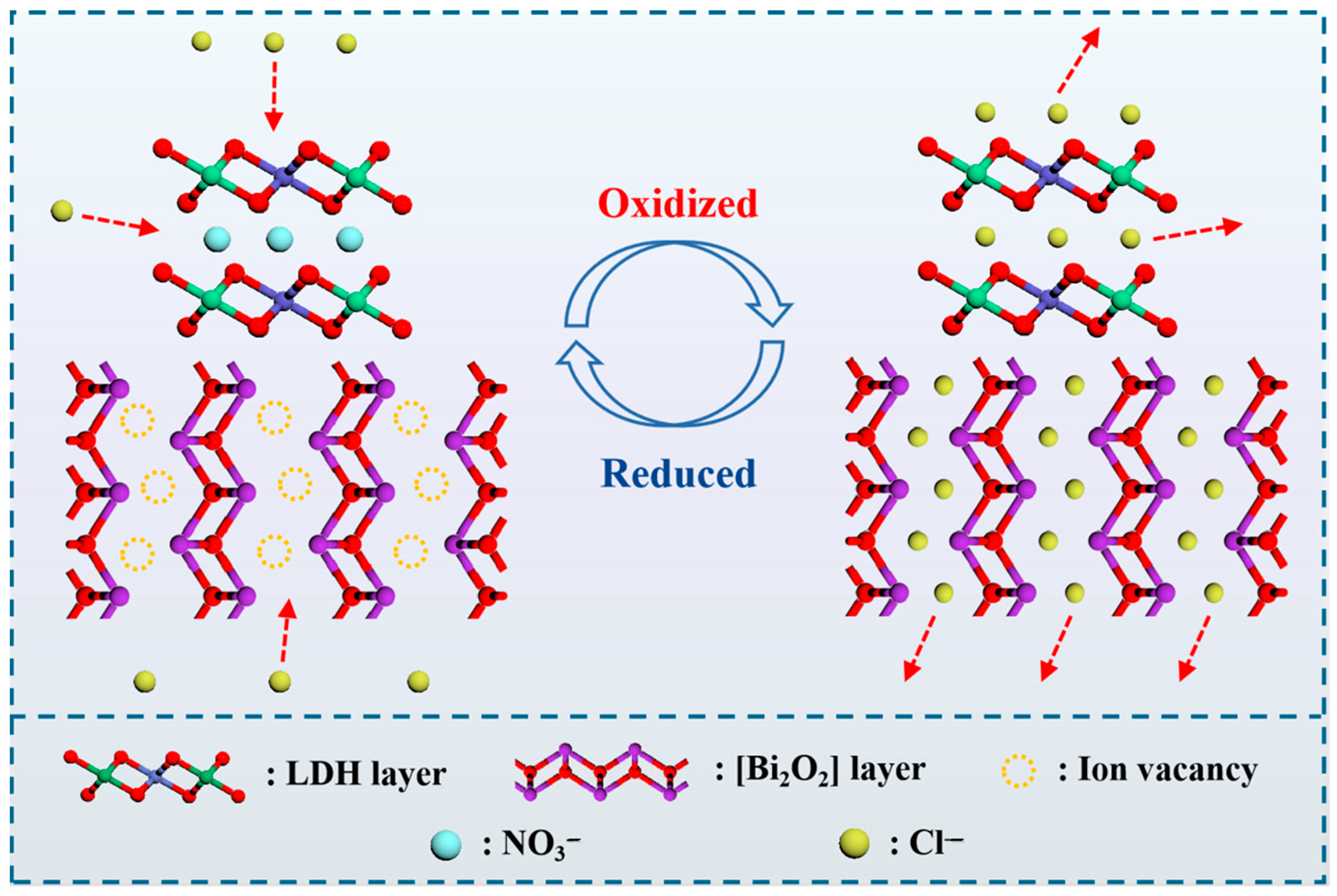
Based on the above analysis, a schematic of the adsorption/desorption mechanism of the NiFe LDH/BiOCl composite film for Cl is proposed in Figure 5. When a reduction potential is applied, Ni3+, Fe3+, and Bi3+ are reduced to Ni2+, Fe2+, and Bi(3−x)+, respectively, and Cl is released from the film to maintain charge neutrality, generating Cl vacancies between the [Bi2O2] layers. Conversely, when an oxidation potential is applied, Ni2+, Fe2+, and Bi(3−x)+ are oxidized back to Ni3+, Fe3+, and Bi3+, and Cl is re−adsorbed into the film. It should be noted that the proposed mechanism represents a simplified working model based on the dominant experimental trends, rather than an exclusive description of all possible processes.

3.3. Electrochemical Performance

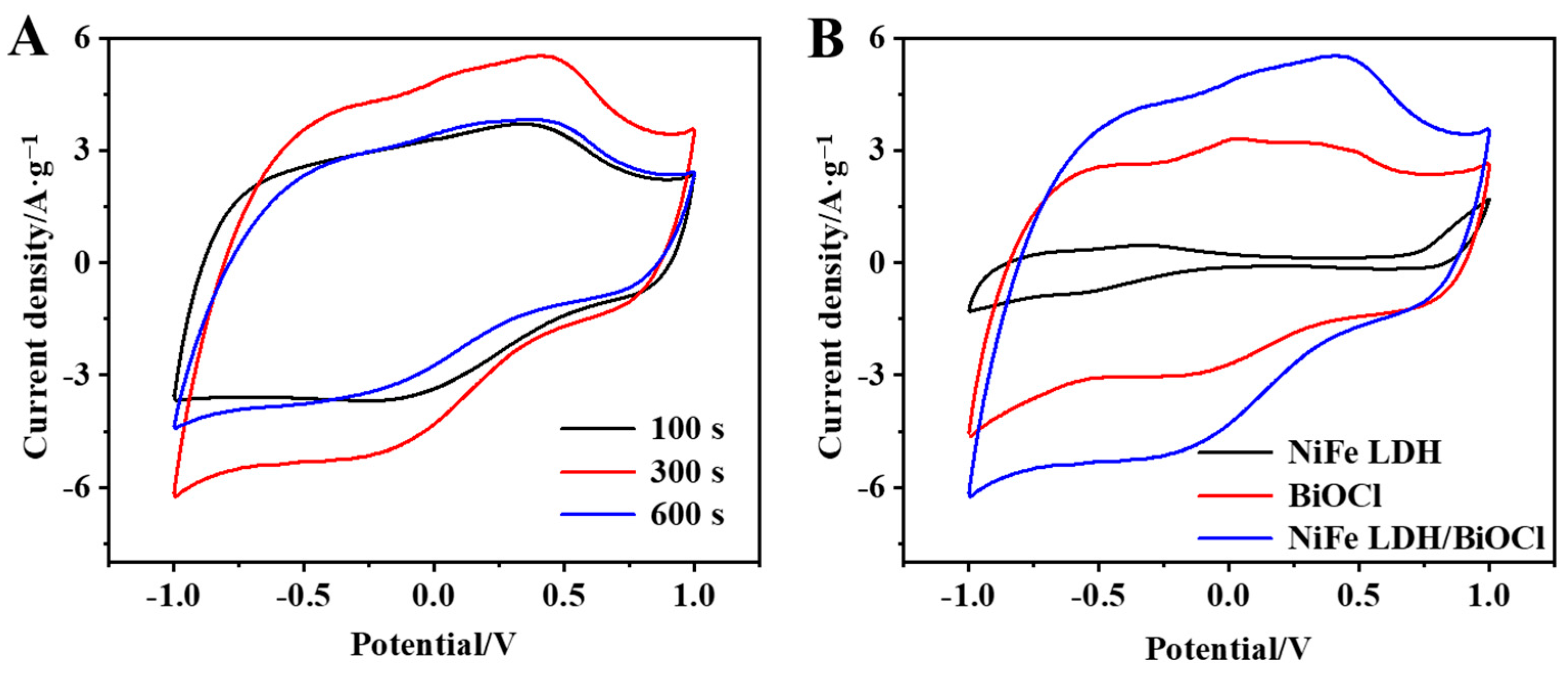
Figure 6A shows the CV curves of NiFe LDH/BiOCl composite film prepared at different LDH deposition times in 0.1 M KCl solution. It can be seen that the area of CV curve was the largest when the LDH deposition time was 300 s, which indicated that the LDH/BiOCl composite film prepared under this condition had better electrochemical activity. However, when the LDH deposition time was further extended to 600 s, the area of the CV curve decreased. Combined with the above SEM results, too long deposition time of LDH caused the material to accumulate, which was not conducive to the electron and ion transport, thus reducing the electrochemical activity of the NiFe LDH/BiOCl composite film. Therefore, the LDH deposition time was set as 300 s. The influence of electrodeposition time on the thickness, accessible surface area and electrochemical activity of NiFe LDH films has been systematically analyzed in our previous work [11], and the present study follows a similar optimization rationale. Figure 6B shows the CV curves of NiFe LDH, BiOCl, and NiFe LDH/BiOCl composite films. It can be found that the area of the CV curve increased significantly after NiFe LDH was compounded with BiOCl, which meant that the NiFe LDH/BiOCl composite film had the better electrochemical activity. It should be noted that the CV analysis is used here to probe the reversible electrochemical behavior relevant to ESIX operation, rather than to quantify capacitive charge storage.
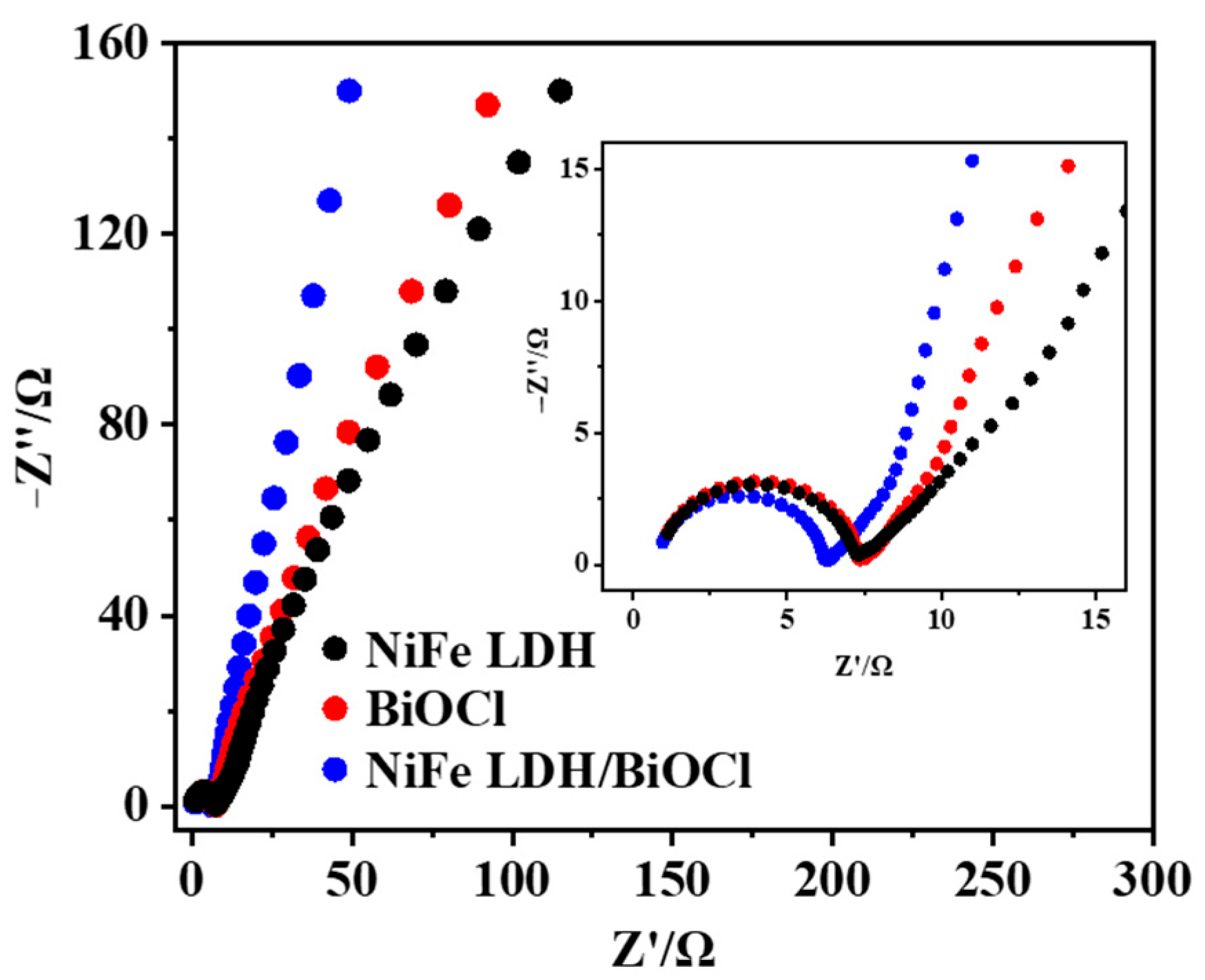
Figure 7 shows the EIS of NiFe LDH, BiOCl, and NiFe LDH/BiOCl films in 0.1 M KCl solution. Herein, the semicircle in the high frequency region represents the charge transfer resistance, and the straight line in the low frequency region represents the ion diffusion resistance. In the high frequency region, the semicircle diameter of NiFe LDH/BiOCl composite film was smaller than that of NiFe LDH and BiOCl, which indicated that the NiFe LDH/BiOCl composite film had lower charge transfer resistance and better conductivity. Meanwhile, in the low frequency region, the linear slope of the NiFe LDH/BiOCl composite film was larger than that of the NiFe LDH and BiOCl, which indicated that the composite film had a lower ion diffusion resistance. In summary, the diffusion resistance of electrons and ions was reduced after the compounding of NiFe LDH and BiOCl, which was more favorable to the uptake and release of Cl. Given the complexity of the composite electrode and the ion exchange process, EIS is used here to compare relative impedance trends rather than to derive absolute kinetic parameters via equivalent−circuit fitting. Such impedance improvements are consistent with prior reports showing that layered (oxy)hydroxide architectures can provide ion−accessible transport pathways and reduce diffusion resistance in electrochemical ion storage/separation electrodes [28].

3.4. Cl Adsorption Performance

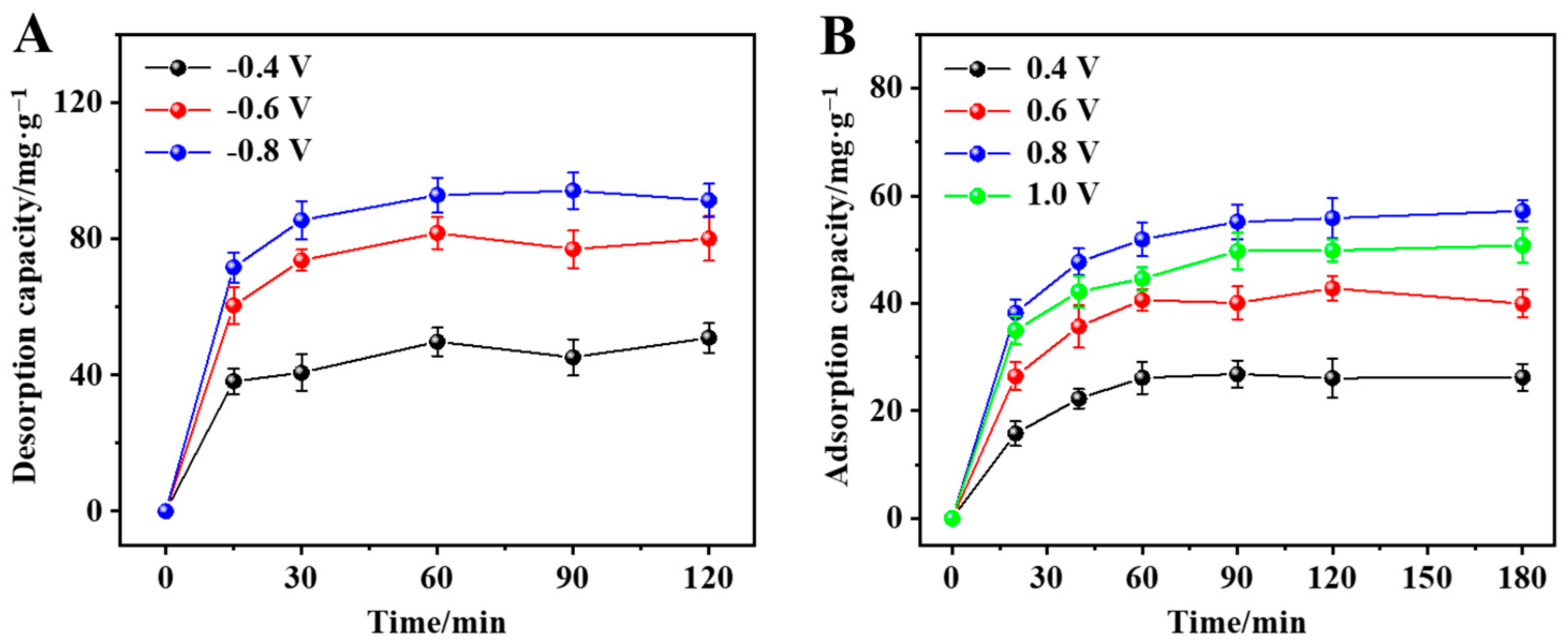
During the ESIX process, the applied potential has a significant influence on the adsorption and desorption behavior of the film. Figure 8A shows the desorption curves of Cl from the NiFe LDH/BiOCl composite film in deionized water at different desorption potentials. The desorption capacity increases with increasing negative potential. However, when the desorption potential reaches −0.8 V, the composite film turns black, indicating the reduction of BiOCl to metallic Bi. Therefore, −0.6 V was selected as the optimal desorption potential.
Figure 8B shows the Cl adsorption curves of the NiFe LDH/BiOCl composite film in 100 ppm Cl solution at different adsorption potentials. The Cl adsorption capacity increases rapidly within the first 20 min and approaches equilibrium after about 90 min. As the adsorption potential increases from 0.4 V to 0.8 V, the Cl adsorption capacity increases accordingly, reaching a maximum of 59.1 mg·g−1 at 0.8 V. When the potential is further increased to 1.0 V, the adsorption capacity decreases. This decrease may be associated with enhanced side reactions and increased polarization at the applied potential, which can reduce the effective driving force for reversible Cl uptake and hinder ion transport within the film. Therefore, 0.8 V was chosen as the optimum adsorption potential in this work.
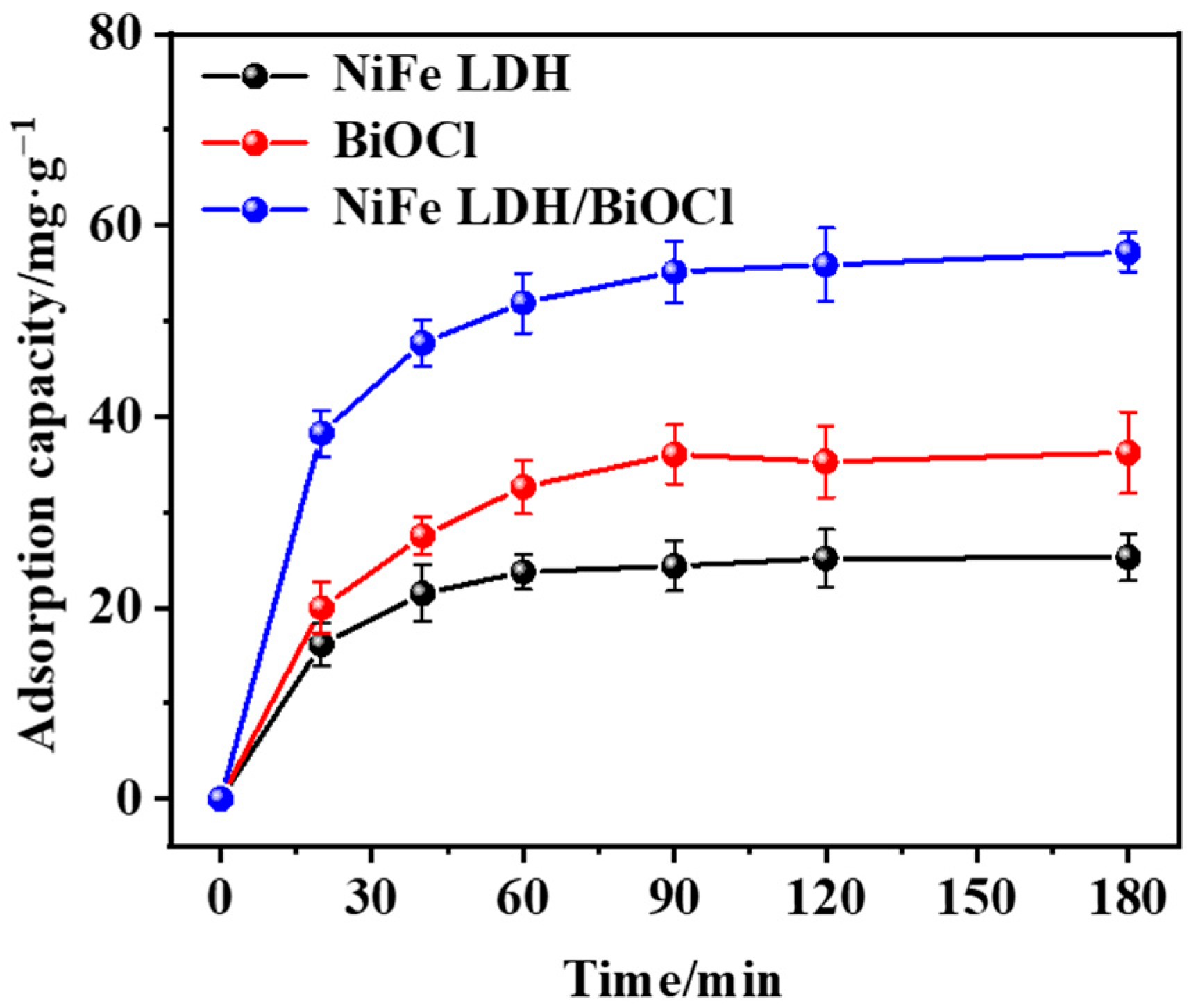
The Cl adsorption capacities of NiFe LDH, BiOCl, and the NiFe LDH/BiOCl composite film were compared at 0.8 V (vs. SCE) in 100 ppm Cl solution (Figure 9). The Cl adsorption capacities of NiFe LDH, BiOCl, and NiFe LDH/BiOCl are 25.3, 36.2, and 59.1 mg·g−1, respectively. The composite film exhibits a significantly higher Cl adsorption capacity than either NiFe LDH or BiOCl alone, confirming the beneficial synergistic effect between the two components.

3.5. Adsorption Kinetics

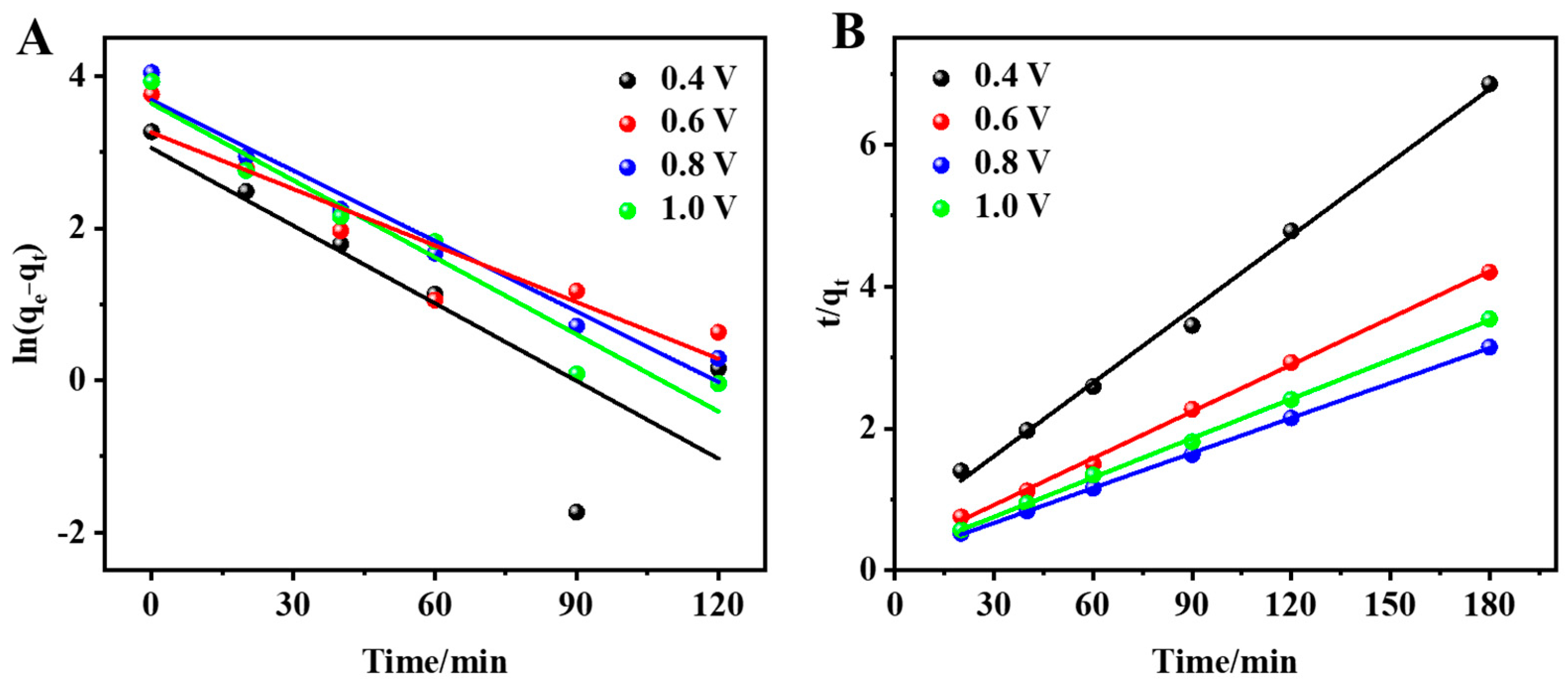
To further investigate the rate−controlling step during the adsorption process, the adsorption kinetics of Cl at different applied potentials were analyzed using pseudo−first−order and pseudo−second−order kinetic models. The corresponding equations are as follows:
ln(qe − qt) = lnqe − k1t
t/qt = t/qe + 1/(k2qe2)
where qe (mg·g−1) is the Cl adsorption capacity at equilibrium, qₜ (mg·g−1) is the Cl adsorption capacity at time t (min), and k1 (min−1) and k2 (g·mg−1·min−1) are the rate constants of the pseudo−first−order and pseudo−second−order models, respectively.
Figure 10 and Table 1 show the kinetic fitting results. The linear regression coefficients R2 obtained from the pseudo−second−order model are all higher than 0.99, significantly larger than those of the pseudo−first−order model. This indicates that the adsorption of Cl on the NiFe LDH/BiOCl composite film is better described by the pseudo−second−order kinetic model, suggesting that the rate−controlling step is chemisorption. It should be noted that classical kinetic models are used here in an empirical sense for comparative purposes. In electrochemically controlled systems, ion uptake kinetics are governed by a coupled effect of applied potential, charge transfer, and mass transport, and therefore cannot be strictly described by concentration−based models.

3.6. Selectivity and Stability

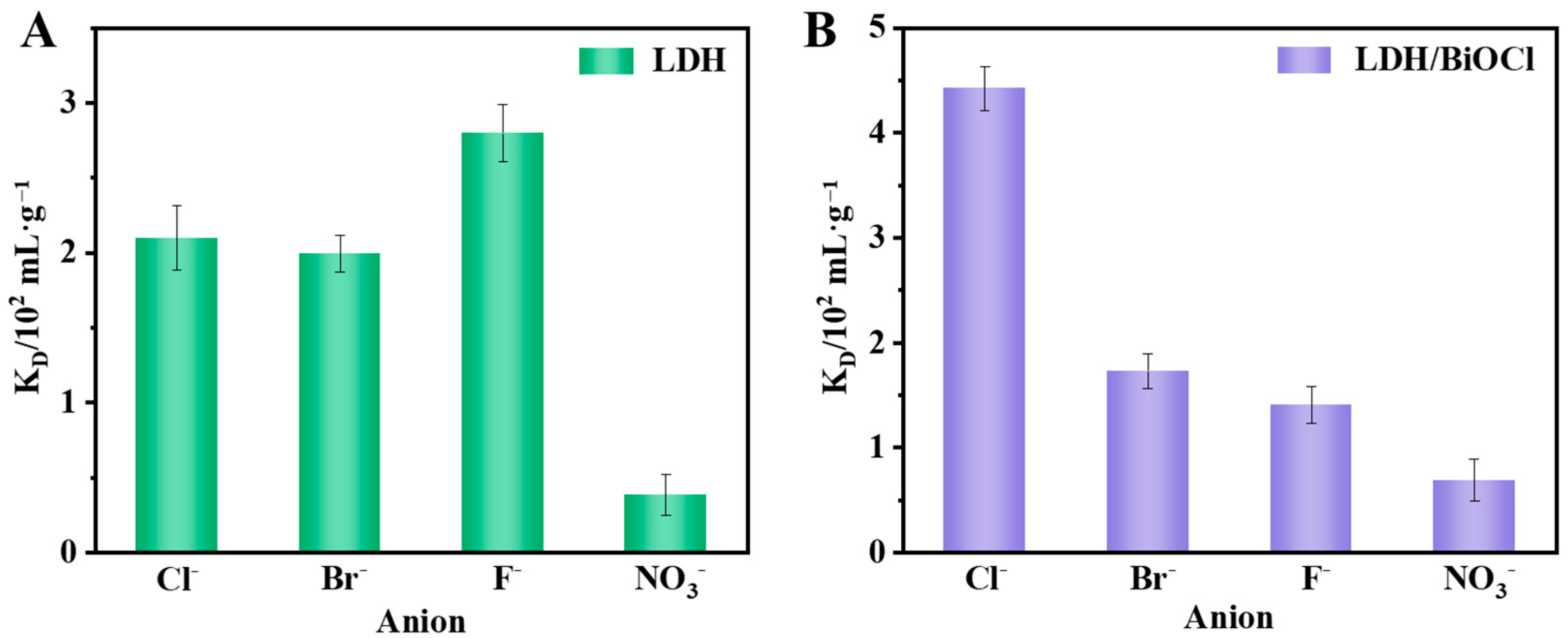
The selectivity of the NiFe LDH/BiOCl composite film for Cl was evaluated by competitive adsorption experiments in a mixed solution containing equal molar concentrations of Cl, Br, F, and NO3. Figure 11 and Table 2 summarize the selectivity results for NiFe LDH and the NiFe LDH/BiOCl composite film.
For NiFe LDH (Figure 11A, Table 2), the distribution coefficients for Cl, Br, F, and NO3 are 0.21, 0.20, 0.28, and 0.04 L·g−1, respectively, and the separation factors for Cl/Br, Cl/F, and Cl/NO3 are 1.05, 0.75, and 5.25, respectively. These results show that the selectivity order of NiFe LDH toward these anions is F > Cl > Br > NO3, which is consistent with the typical interlayer anion−exchange sequence of LDHs.
For the NiFe LDH/BiOCl composite film (Figure 11B, Table 2), the distribution coefficients for Cl, Br, F, and NO3 are 0.44, 0.17, 0.14, and 0.07 L·g−1, respectively, and the corresponding separation factors for Cl/Br, Cl/F, and Cl/NO3 are 2.59, 3.14, and 6.29, respectively. These values clearly demonstrate that the composite film has markedly improved selectivity toward Cl, indicating that the introduction of BiOCl significantly enhances the Cl selectivity of NiFe LDH. The effects of common background cations (e.g., Na+/K+ and Ca2+/Mg2+), multivalent anions, and ionic strength, while highly relevant to real water matrices, are beyond the scope of the present mechanistic study and will be systematically investigated in future work.
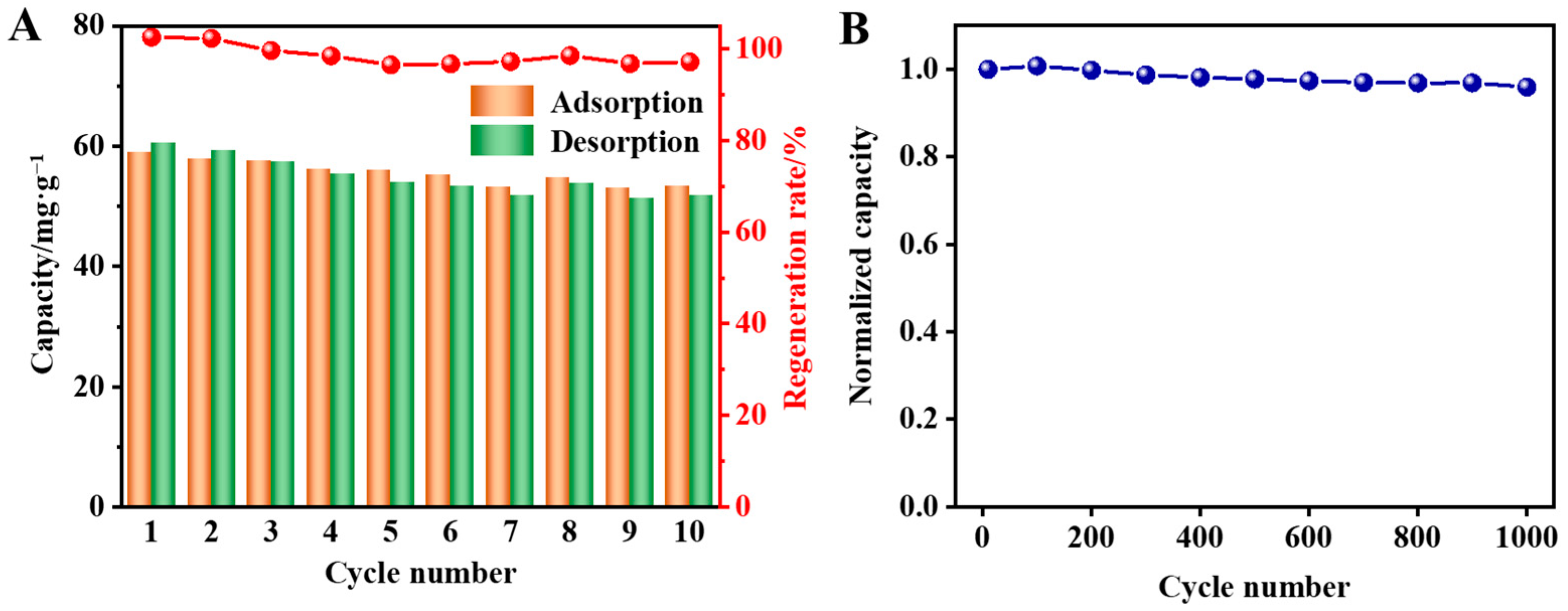
The recyclability of the NiFe LDH/BiOCl composite film was investigated by ten successive adsorption–desorption cycles in 100 ppm Cl solution and deionized water. As shown in Figure 12A, after ten cycles, the Cl adsorption capacity of the composite film remains at 53 mg·g−1, about 90% of the initial capacity. Meanwhile, the Cl regeneration ratio remains above 95% in each cycle, indicating that most of the adsorbed Cl can be released into the regeneration solution. These results show that the NiFe LDH/BiOCl composite film has excellent recyclability.
In addition, the long−term electrochemical stability of the composite film was evaluated by 1000 consecutive CV cycles in 0.1 M KCl solution (Figure 12B). The charge−storage capacity of the composite film increases during the first 100 cycles, likely due to gradual activation of redox−active centers and ion−binding sites and then starts to decrease slightly. Importantly, after 1000 cycles, the charge−storage capacity is still more than 95% of the initial value, demonstrating outstanding long−term electrochemical stability.

4. Conclusions

A NiFe LDH/BiOCl composite film electrode was fabricated on carbon paper via electrochemical deposition and demonstrated effective, selective Cl removal using ESIX. Structural and electrochemical evidence supports that the reversible uptake/release of Cl is driven by potential−controlled redox switching involving both BiOCl and NiFe LDH, enabling efficient adsorption–desorption cycling. Compared with the individual components, the composite architecture delivers a clear synergy, achieving higher chloride uptake and substantially improved selectivity against competing anions under the optimized potential. The electrode also shows robust reusability and electrochemical durability over repeated adsorption–desorption and long−term cycling, indicating its promise as an electroactive ion−exchange material for selective dechlorination.
Despite these encouraging results, several limitations remain. First, the selectivity and stability were evaluated under simplified electrolyte conditions; real wastewaters contain complex matrices (e.g., high ionic strength, organic matter, and multivalent ions) that may alter vacancy chemistry, interlayer exchange, and transport kinetics. Second, the current study focuses on batch−mode ESIX, and the performance under continuous−flow operation and practical areal loading needs further validation. Third, the long−term evolution of active sites (e.g., halide vacancies and LDH interlayer chemistry) during extended cycling requires deeper mechanistic quantification.
Future work will therefore emphasize (i) testing in representative real wastewater streams and under higher salinity/organic backgrounds, (ii) scaling the electrode to higher mass loading and evaluating performance in flow−through or cell−stack configurations, and (iii) operando/quantitative characterization to track vacancy/interlayer evolution and to optimize the composition–structure relationship for even higher selectivity and capacity.

Author Contributions

Conceptualization, X.L. and X.A.; methodology, X.L. and X.D.; software, X.L.; validation, X.L., X.M., X.R. and P.W.; formal analysis, X.L.; investigation, X.L., P.W., X.R. and X.D.; resources, X.A., X.W. and X.M.; data curation, X.L., X.G., P.W. and X.D.; writing—original draft preparation, X.L.; writing—review and editing, X.L., X.A., X.G., X.R., X.W., P.W., X.M. and X.D.; visualization, X.L. and P.W.; supervision, X.A.; project administration, X.A.; funding acquisition, X.A. and X.W. All authors have read and agreed to the published version of the manuscript.

Funding

This research was funded by the Lvliang Ecological and Environmental Monitoring Center of Shanxi Province, grant number 14110025131T200000155.

Data Availability Statement

The original contributions presented in this study are included in the article. Further inquiries can be directed to the corresponding author.

Acknowledgments

The authors would like to express their sincere gratitude to the laboratory of Taiyuan University of Technology for providing experimental facilities, technical support, and valuable assistance throughout this study.

Conflicts of Interest

The authors declare no conflicts of interest.

References

  1. Du, Z.; Tian, W.; Qiao, K.; Zhao, J.; Wang, L.; Xie, W.; Chu, M.; Song, T. Improved chlorine and chromium ion removal from leather processing wastewater by biocharcoal−based capacitive deionization. Sep. Purif. Technol. 2020, 233, 116024. [Google Scholar] [CrossRef]
  2. Huang, S.; Li, L.; Zhu, N.; Lou, Z.; Liu, W.; Cheng, J.; Wang, H.; Luo, P.; Wang, H. Removal and recovery of chloride ions in concentrated leachate by Bi(III) containing oxides quantum dots/two−dimensional flakes. J. Hazard. Mater. 2020, 382, 121041. [Google Scholar] [CrossRef]
  3. Cao, K.F.; Chen, Z.; Wu, Y.H.; Mao, Y.; Shi, Q.; Chen, X.W.; Bai, Y.; Li, K.; Hu, H.Y. The noteworthy chloride ions in reclaimed water: Harmful effects, concentration levels and control strategies. Water Res. 2022, 215, 118271. [Google Scholar] [CrossRef] [PubMed]
  4. Li, H.; Chen, Y.; Long, J.; Jiang, D.; Liu, J.; Li, S.; Qi, J.; Zhang, P.; Wang, J.; Gong, J.; et al. Simultaneous removal of thallium and chloride from a highly saline industrial wastewater using modified anion exchange resins. J. Hazard. Mater. 2017, 333, 179–185. [Google Scholar] [CrossRef]
  5. Zhang, L.; Lv, P.; He, Y.; Li, S.; Peng, J.; Zhang, L.; Chen, K.; Yin, S. Ultrasound−assisted cleaning chloride from wastewater using friedel’s salt precipitation. J. Hazard. Mater. 2021, 403, 123545. [Google Scholar] [CrossRef]
  6. Lei, J.; Xiong, Y.; Yu, F.; Ma, J. Flexible self−supporting cofe−ldh/mxene film as a chloride ions storage electrode in capacitive deionization. Chem. Eng. J. 2022, 437, 135381. [Google Scholar] [CrossRef]
  7. Wang, X.; Du, Y.; Yang, H.; Tian, S.; Ge, Q.; Huang, S.; Wang, M. Removal of chloride ions from acidic solution with antimony oxides. J. Ind. Eng. Chem. 2021, 93, 170–175. [Google Scholar] [CrossRef]
  8. Chai, S.; Xi, J.; Chen, L.; He, W.; Shen, J.; Gong, H. Selective ion removal by capacitive deionization (CDI)−based technologies. Processes 2022, 10, 1075. [Google Scholar] [CrossRef]
  9. Du, X.; Zhang, Q.; Qiao, W.; Sun, X.; Ma, X.; Hao, X.; Wang, Z.; Abudula, A.; Guan, G. Controlled self−assembly of oligomers−grafted fibrous polyaniline/single zirconium phosphate nanosheet hybrids with potential−responsive ion exchange properties. Chem. Eng. J. 2016, 302, 516–525. [Google Scholar] [CrossRef]
  10. Song, X.; Niu, J.; Yan, W.; Li, X.; Hao, X.; Guan, G.; Wang, Z. An electroactive BiOBr@ppy hybrid film with synergistic effect for electrochemically switched capture of bromine ions from aqueous solutions. Sep. Purif. Technol. 2022, 290, 120845. [Google Scholar] [CrossRef]
  11. Luo, J.; Du, X.; Gao, F.; Yang, Y.; Hao, X.; Li, S.; Hao, X.; Tang, K.; Guan, G. Iodide ion trapping polypyrrole film: Selective capture of iodide ions by electrochemically switched ion extraction (ESIE) process. Chem. Eng. J. 2020, 380, 122529. [Google Scholar] [CrossRef]
  12. Zhao, X.J.; Zhu, Y.Q.; Xu, S.M.; Liu, H.M.; Yin, P.; Feng, Y.L.; Yan, H. Anion exchange behavior of miial layered double hydroxides: A molecular dynamics and dft study. Phys. Chem. Chem. Phys. 2020, 22, 19758–19768. [Google Scholar] [CrossRef]
  13. Wang, X.; Li, H.; Li, H.; Lin, S.; Bai, J.; Dai, J.; Liang, C.; Zhu, X.; Sun, Y.; Dou, S. Heterostructures of Ni–Co–Al layered double hydroxide assembled on V4C3mxene for high−energy hybrid supercapacitors. J. Mater. Chem. A 2019, 7, 2291–2300. [Google Scholar] [CrossRef]
  14. Liu, H.M.; Zhao, X.J.; Zhu, Y.Q.; Yan, H. Dft study on mgal−layered double hydroxides with different interlayer anions: Structure, anion exchange, host−guest interaction and basic sites. Phys. Chem. Chem. Phys. 2020, 22, 2521–2529. [Google Scholar] [CrossRef]
  15. Li, H.; Zhang, L. Photocatalytic performance of different exposed crystal facets of BiOCl. Curr. Opin. Green Sustain. Chem. 2017, 6, 48–56. [Google Scholar] [CrossRef]
  16. Liu, Q.; Ma, J.; Wang, K.; Feng, T.; Peng, M.; Yao, Z.; Fan, C.; Komarneni, S. BiOCl and TiO2 deposited on exfoliated ZnCr−LDH to enhance visible−light photocatalytic decolorization of Rhodamine B. Ceram. Int. 2017, 43, 5751–5758. [Google Scholar] [CrossRef]
  17. Ma, J.; Ding, J.; Yu, L.; Li, L.; Kong, Y.; Komarneni, S. BiOCl dispersed on NiFe–LDH leads to enhanced photo−degradation of Rhodamine B dye. Appl. Clay Sci. 2015, 109−110, 76−82. [Google Scholar] [CrossRef]
  18. Ye, L.; Wang, L.; Xie, H.; Su, Y.; Jin, X.; Zhang, C. Two−dimensional layered BiOX (X = Cl, Br) compounds as anode materials for lithium−ion batteries. Energy Technol. 2015, 3, 1115–1120. [Google Scholar] [CrossRef]
  19. Luo, J.; Du, X.; Gao, F.; Ma, P.; Hao, X.; Guan, G.; Scialdone, O.; Li, J. Electrochemically triggered iodide−vacancy BiOI film for selective extraction of iodide ion from aqueous solutions. Sep. Purif. Technol. 2021, 259, 118120. [Google Scholar] [CrossRef]
  20. Wang, J.; Du, X.; Hao, X.; Luo, J.; Hao, X.; Cao, Q.; Guan, G.; Li, J.; Liu, Z.; Li, Y.; et al. A novel photo−assisted electrochemically switched ion exchange technology for selective recovery of bromide ions. Chem. Eng. J. 2022, 427, 131693. [Google Scholar] [CrossRef]
  21. Zhao, L.; Wang, J.; Yan, R.; Wang, S.; Liao, Z.; Yang, H.; Yang, D.; Hou, H.; Yang, W. Creating cation vacancies in BiOCl nanosheets toward exceptional visible−light−driven photocatalytic CO2 reduction. Small 2025, 21, 2406109. [Google Scholar] [CrossRef] [PubMed]
  22. Liang, M.; Wang, L.; Presser, V.; Dai, X.; Yu, F.; Ma, J. Combining battery−type and pseudocapacitive charge storage in Ag/Ti3C2Tx mxene electrode for capturing chloride ions with high capacitance and fast ion transport. Adv. Sci. 2020, 7, 2000621. [Google Scholar] [CrossRef]
  23. Guo, X.; An, X.; Wang, P.; Wang, T.; Li, Z.; Ma, X.; Du, X.; Hao, X. Electroactivity variable valence nife layered double hydroxyde for Cl removal through electrically switched ion exchange. ChemistrySelect 2023, 8, e202301114. [Google Scholar] [CrossRef]
  24. Shinde, N.M.; Ghule, B.G.; Raut, S.D.; Narwade, S.H.; Pak, J.J.; Mane, R.S. Hopping electrochemical supercapacitor performance of ultrathin BiOCl petals grown by a room−temperature soft−chemical process. Energy Fuels 2021, 35, 6892–6897. [Google Scholar] [CrossRef]
  25. Wang, Z.; Xue, J.; Li, Y.; Shen, Q.; Li, Q.; Zhang, X.; Liu, X.; Jia, H. Robust Fe2+−doped nickel−iron layered double hydroxide electrode for electrocatalytic reduction of hexavalent chromium by pulsed potential method. J. Mater. Sci. Technol. 2022, 110, 73–83. [Google Scholar] [CrossRef]
  26. Fu, H.Q.; Liu, J.; Bedford, N.M.; Wang, Y.; Wright, J.; Liu, P.F.; Wen, C.F.; Wang, L.; Yin, H.; Qi, D. Operando converting BiOCl into Bi2O2 (CO3)xCly for efficient electrocatalytic reduction of carbon dioxide to formate. Nano−Micro Lett. 2022, 14, 121. [Google Scholar] [CrossRef] [PubMed]
  27. Hou, J.; Wang, H.; Qin, R.; Zhang, Q.; Wu, D.; Hou, Z.; Yang, W.; Hussain, A.; Tahir, M.; Yin, W. Grinding preparation of 2D/2D g−C3N4/BiOCl with oxygen vacancy heterostructure for improved visible−light−driven photocatalysis. Carbon Res. 2024, 3, 1. [Google Scholar] [CrossRef]
  28. Wang, P.; Zhang, K.; Li, H.; Hu, J.; Zheng, M. Enhanced ion transport through mesopores engineered with additional adsorption of layered double hydroxides array in alkaline flow batteries. Small 2024, 20, 2308791. [Google Scholar] [CrossRef]
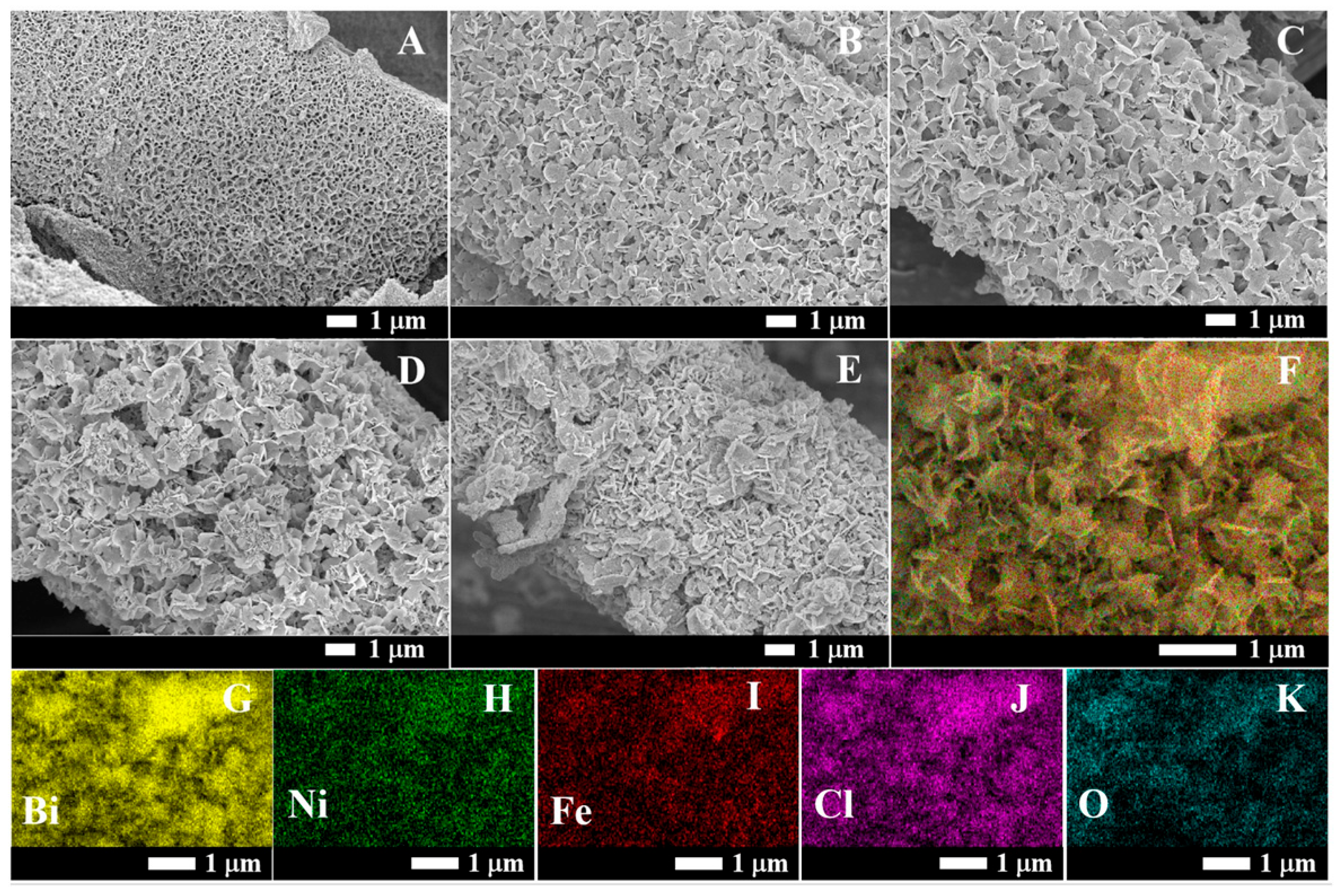
Figure 1. SEM images of (A) NiFe LDH, (B) BiOCl, and (CE) NiFe LDH/BiOCl films prepared at different LDH deposition times ((C), 100 s; (D), 300 s; (E), 600 s); (FK) EDS mapping images of the NiFe LDH/BiOCl film prepared with an LDH deposition time of 300 s.
Separations 13 00047 g001
Figure 2. TEM image of the NiFe LDH/BiOCl composite film.
Separations 13 00047 g002
Figure 3. XRD patterns of NiFe LDH, BiOCl, and NiFe LDH/BiOCl films.
Separations 13 00047 g003
Figure 4. (A) XPS spectra of NiFe LDH/BiOCl film; XPS spectra of (B) Cl 2p, (C) Bi 4f, (D) O 1s, (E) Ni 2p, and (F) Fe 2p. Note: a: initial state; b: oxidized state; c: reduced state.
Separations 13 00047 g004
Figure 5. Schematic illustration of the adsorption/desorption mechanism of Cl on the NiFe LDH/BiOCl composite film.
Separations 13 00047 g005
Figure 6. (A) CV curves of NiFe LDH/BiOCl film prepared at different LDH deposition times in 0.1 M KCl solution (50 mV·s−1); (B) CV curves of NiFe LDH, BiOCl and NiFe LDH/BiOCl films in 0.1 M KCl solution (50 mV·s−1).
Separations 13 00047 g006
Figure 7. EIS of NiFe LDH, BiOCl, and NiFe LDH/BiOCl films in 0.1 M KCl solution.
Separations 13 00047 g007
Figure 8. (A) Cl desorption curves of the NiFe LDH/BiOCl film at different desorption potentials; (B) Cl adsorption curves of the NiFe LDH/BiOCl film at different adsorption potentials.
Separations 13 00047 g008
Figure 9. Cl adsorption capacities of NiFe LDH, BiOCl, and NiFe LDH/BiOCl films at 0.8 V (vs. SCE) in 100 ppm Cl solution.
Separations 13 00047 g009
Figure 10. (A) Pseudo−first−order adsorption kinetics fitting and (B) pseudo−second−order adsorption kinetics fitting of NiFe LDH/BiOCl film at different initial voltage.
Separations 13 00047 g010
Figure 11. Selectivity of (A) NiFe LDH and (B) NiFe LDH/BiOCl films for Cl in a mixed solution containing Cl, Br, F, and NO3.
Separations 13 00047 g011
Figure 12. (A) Recyclability of the NiFe LDH/BiOCl film for Cl; (B) electrochemical stability of the NiFe LDH/BiOCl film in 0.1 M KCl solution over 1000 CV cycles.
Separations 13 00047 g012
Table 1. Kinetic model parameters and correlation coefficients of NiFe LDH/BiOCl films for Cl at different voltages.
Adsorption Voltage/VPseudo−First KineticPseudo−Second Kinetic
k1/min−1R2k2/g·mg·min−1R2
0.43.402 × 10−20.6512.50 × 10−30.995
0.62.478 × 10−20.8252.05 × 10−30.998
0.83.088 × 10−20.9561.72 × 10−30.999
1.03.373 × 10−20.9381.91 × 10−30.999
Notes: Model applicability was evaluated mainly based on the coefficient of determination (R2), which reflects the overall agreement between experimental and fitted kinetic profiles.
Table 2. Separation factors of NiFe LDH and NiFe LDH/BiOCl films for Cl, Br, F, and NO3.
AnionSeparation Factor (NiFe LDH)Separation Factor (NiFe LDH/BiOCl)
Cl11
Cl/Br1.052.59
Cl/F0.753.14
Cl/NO35.256.29
Disclaimer/Publisher’s Note: The statements, opinions and data contained in all publications are solely those of the individual author(s) and contributor(s) and not of MDPI and/or the editor(s). MDPI and/or the editor(s) disclaim responsibility for any injury to people or property resulting from any ideas, methods, instructions or products referred to in the content.