Article

Comparison of Methods for the Extraction of Saponins from Sechium spp. Genotypes and Their Spectrophotometric Quantification


by
Fátima Azucena Rasgado-Bonilla
1,
Ramón Marcos Soto-Hernández
1,*,
Luis Francisco Salomé-Abarca
2,
Jorge Cadena-Íñiguez
3,
Víctor A. González-Hernández
1,
Lucero del Mar Ruiz-Posadas
1 and
Sara Elisa Herrera-Rodríguez
4
1
Posgrado en Recursos Genéticos y Productividad-Fisiología Vegetal, Colegio de Postgraduados, Campus Montecillo, Texcoco 56264, Estado de México, Mexico
2
Posgrado en Recursos Genéticos y Productividad-Fruticultura, Colegio de Postgraduados, Campus Montecillo, Texcoco 56264, Estado de México, Mexico
3
Posgrado en Innovación en Manejo de Recursos Naturales, Colegio de Postgraduados, Campus San Luis Potosí, Salinas de Hidalgo 78600, San Luis Potosí, Mexico
4
Centro de Investigación y Asistencia en Tecnología y Diseño del Estado de Jalisco, A. C., Subsede Yucatán, Tablaje Catastral 31264, Km 5.5, Carretera Sierra Papacal-Chuburná Puerto, Parque Científico Tecnológico de Yucatán, Mérida 97302, Yucatán, Mexico
*
Author to whom correspondence should be addressed.
Separations 2026, 13(1), 29; https://doi.org/10.3390/separations13010029
Submission received: 8 December 2025 / Revised: 7 January 2026 / Accepted: 9 January 2026 / Published: 14 January 2026
(This article belongs to the Section Analysis of Food and Beverages)

Abstract

Saponins are valuable health-promoting metabolites. The genus Sechium spp. is a valuable source of such metabolites. Unfortunately, there is no established method for the extraction of saponins from the fruits of this species. Therefore, this research aimed to compare three gravimetric extraction methods for saponins in two Sechium genotypes. The analysis included FT-MIR and HPTLC fingerprinting, as well as spectrophotometric quantification. Independent of the extraction method, bagasse produced higher extraction yields than juice. Among the gravimetric methods, M3 produced the highest yields, while M1 captured the most remarkable diversity and abundance of saponins. The spectrophotometric quantification corroborated the higher total saponin content in bagasse extracts. This data highlights the use of fruit bagasse as the primary source of saponin extraction in Sechium. In addition, we recommend extracting bagasse through M3 for scalable pre-enrichment, while M1 extraction must be used when preserving chemical diversity is critical.

1. Introduction

Saponins are specialized metabolites widely present in higher plants, particularly in angiosperms and some gymnosperms [1,2,3,4,5,6,7,8,9]. In the case of angiosperms, saponins occur in both dicotyledonous and monocotyledonous lineages [10]. Based on their aglycone structures, two major saponin classes are recognized: triterpenoid and steroidal saponins. Triterpenoid saponins typically contain 30 carbon atoms, whereas steroidal saponins possess 27 C units [10]. Nonetheless, both classes are glycosylated with at least one sugar unit [11]. Steroidal saponins are distributed across several plant families, including Solanaceae, Agavaceae, Asparagaceae, Alliaceae, Dioscoreaceae, Liliaceae, Bromeliaceae, and Amaryllidaceae, among others [10]. On the other hand, triterpenoid saponins are associated with Amaranthaceae, Apiaceae, Araliaceae, Asparagaceae, Asteraceae, Berberidaceae, Buddlejaceae, Cactaceae, Campanulaceae, Caryophyllaceae, Chenopodiaceae, and Cucurbitaceae [12]. In the former, triterpenoid saponins include cucurbitane- and damarane-like backbones, as well as the oleanane core. In addition, Microsechium helleri and Momordica charantia contain momordicosides, kuguaglycosides, and the corresponding sapogenins [13,14,15,16,17].
Biologically, saponins are often associated with plant defense because they exhibit antimicrobial, allelopathic, insecticidal, and even molluscicidal activities. Additionally, their distribution varies among organs and tissues, and they are influenced by environmental factors such as water availability, light, and nutrient status [18]. Some of these biological features are exploited in diverse fields. For instance, their amphipathic character has several uses in the food industry as natural emulsifiers, foaming agents, and stabilizers. In the field of pharmacy, saponins are effective immunological adjuvants that enhance vaccine-induced immune responses [19]. Another distinctive feature of saponins is their bitterness. Recent findings indicate that bitter-tasting compounds activate specific TAS2R (taste receptor, type 2)-receptors [20,21]. These chemosensory receptors influence hormone release, metabolism, microbiota, immunity, and gut–brain communication [22].
Paradoxically, bitter flavors are often associated with health-promoting phytochemicals that many consumers avoid because of their unpleasant taste [23]. Even if more research is needed on bitter principles, some examples include saponins [19], cucurbitacins, and isothiocyanates [24,25]. In this context, fruits of the chayote plant (Sechium edule (Jacq.) Sw.), which originated and have been cultivated in Mexico since pre-Columbian times [26,27,28], exhibit remarkable variation in bitterness and phytochemical content among genotypes.
Some wild Sechium species, such as S. compositum and S. chinantlense, display a pronounced bitter taste [29]. Interestingly, vigorous cytotoxic activity has been documented in those bitter varietal types within Sechium spp. and their hybrids [30,31,32]. This bitterness is associated with high levels of cucurbitacins [29] and probably with saponins (Cadena-Iñiguez, personal communication). This taste diminishes the palatability of chayote fruits and limits their suitability for consumption and commercialization. Consequently, breeding efforts have focused on reducing or eliminating bitterness to generate edible chayote varieties. However, genotypes with high saponin content possess pharmacological value and may contribute to biodiversity conservation within this genus. Unfortunately, the knowledge about saponins in Sechium remains scarce. Regarding this, a few recent studies on Sechium pittieri, S. talamacense, and S. mexicanum have elucidated saponins and linked them to antiproliferative effects [33,34,35]. In addition, knowledge of the methods used for saponin extraction is limited. Moreover, a formal comparison between those methods to determine saponin recovery or matrix effects has not been performed. This might affect not only the saponin recovery yield but also the diversity of saponins recovered from different tissues, thereby limiting the likelihood of discovering new saponins.
Therefore, this study aimed to compare three gravimetric extraction methods for saponins, focusing on yield and phytochemical profiles of aqueous and methanolic extracts from the fruits of two Sechium genotypes. The chemical characterization employed FT-MIR and HPTLC as fingerprinting tools and spectrophotometry for saponin quantification. In addition, a profiling of co-extracted metabolites and the phytochemical value of fruit bagasse was described.

2. Materials and Methods

2.1. Plant Material

The plant material consisted of two Sechium genotypes, named 633-M11 (Figure S1, Supplementary Materials) and 387-M16 (Figure S2, Supplementary Materials). Both genotypes are derived as stabilized segregants asexually propagated from hybrids 633 and H387, obtained by crossing Sechium compositum Mal Paso × Sechium edule var. nigrum maxima and S. edule var. amarus sylvestris × S. edule var. virens levis 290, respectively [36].
Fruits were obtained from the National Germplasm Bank of Sechium edule (BANGeSe) in México (19°05′ N; 97°00′ W). Sampling was conducted in December 2021. Fruits were harvested at horticultural maturity (18 ± 2 days after anthesis) [37] and stored at −20 °C until processing. Both genotypes were grown under the same agronomic management at the BANGeSe experimental orchard; the cultivation environment and soil characteristics are described in Appendix A [37].
Leaves of Agave lechuguilla Torr. (Asparagaceae, Agavoidae) were used as reference material for steroidal saponins in the spectrophotometric quantification stage, as detailed in Appendix B.

2.2. Chemicals

The solvents used for plant material processing included dichloromethane, methanol, ethanol, acetone, n-butanol, n-hexane, petroleum ether, and chloroform, which were purchased from J. T. BAKER (Phillipsburg, NJ, USA). Eluents and derivatization reagents for high-performance thin-layer chromatography (HPTLC) were obtained from Merck (Darmstadt, Germany). Anhydrous sodium sulfate (≥99%, CAS 7757-82-6) was acquired from J. T. BAKER; p-anisaldehyde (≥98%, CAS 123-11-5) was from Sigma-Aldrich (St. Louis, MO, USA). Protodioscin (Phyproof® reference substance; ≥90%, CAS 55056-80-9) and escin (Phyproof® reference substance; ≥95%, CAS 6805-41-0) were purchased from PhytoLab GmbH & Co., KG (Vestenbergsgreuth, Germany).

2.3. Juice Extraction

A total of 5.7 kg of fruits from genotype 633-M11 and 5.2 kg from 387-M16 were thawed, washed, dried, and cut into pieces of approximately 4–5 cm3. For aqueous extraction, 75 mL of distilled water was added to 100 g of plant material, and the mixture was homogenized in an industrial food grinder. The resulting mixture was then filtered through a stainless-steel sieve and a cotton cloth to separate the juice from the pulp. The filtrates were stored at −80 °C and subsequently lyophilized using a FreeZone 4.5-liter Benchtop Cascade Freeze Dry System (Labconco Corp., Kansas City, MO, USA).

2.4. Maceration of Fruit Bagasse

The solid residue obtained after juice extraction (bagasse) was macerated with 80% methanol for 30 days at room temperature in the dark. The macerates were filtered, and extracts were concentrated under reduced pressure using a Büchi R-114 rotary evaporator (Büchi Labortechnik AG, Flawil, Switzerland), then lyophilized using a FreeZone 4.5-liter Benchtop Cascade Freeze Dry System, Labconco Corp. (Kansas City, MO, USA), and stored at 4 °C in a desiccator until analysis.
The percentage yield of the lyophilized juice and bagasse extracts (R%, w/w) was calculated based on the weight proportion between the initial extraction material weight and the weight of the final extracts.

2.5. Foam Formation and Persistence Test

To confirm the presence of saponins in the lyophilized extracts of Sechium 633-M11 and 387-M16, a froth (foam) test was performed. Extracts were mixed with water and vigorously shaken for 5 min; foam persistence was then recorded.

2.6. Fourier Transform Mid-Infrared Spectroscopy (FT-MIR) Spectroscopic Analysis and Sample Preparation

FT-MIR profiled juice and fruit bagasse extracts from both Sechium genotypes. Spectra were acquired on a Cary 600 FT-IR spectrometer (Agilent Technologies, Santa Clara, CA, USA) equipped with an attenuated total reflectance (ATR) accessory fitted with a diamond/GE crystal. For each measurement, 50 mg of lyophilized extract was placed on the ATR crystal, and 32 scans were recorded over 4000–600 cm−1 at a nominal resolution of 4 cm−1 in transmittance (T%) mode. Single-beam spectra were collected using air as the background. Each sample was analyzed in triplicate, and spectra were averaged. A reference saponin mixture (escin) was run as a positive control to aid in the assignment of saponin-related bands in the MIR region.

2.7. High-Performance Thin-Layer Chromatography (HPTLC)

To profile metabolites in the juice and bagasse extracts of Sechium genotypes, samples were dissolved in 80% ethanol at 5 mg mL−1. Analyses were performed on a CAMAG system equipped with an Automatic TLC Sampler (ATS 4, CAMAG, Muttenz, Switzerland). Seven microliters of each sample were applied as 6 mm bands onto 10 × 10 cm chromatographic plates. The application dimensions were 20 mm from the right edge, 10 mm from the bottom of the plate, and 10 mm between bands.
For glycosylated compounds, the mobile phase was ethyl acetate–formic acid–acetic acid–: water (100:11:11:27, v/v/v/v). For less polar compounds, the mobile phase was chloroform–acetone–formic acid (75:16.5:8.5, v/v/v). Plates were developed manually in a twin-trough glass chamber saturated for 20 min in an automatic developer (ADC2, CAMAG, Muttenz, Switzerland); the development distance was 85 mm. Plates were dried and derivatized with Natural Products (NP) reagent for flavonoids and with p-anisaldehyde-sulfuric acid for saponin detection. For the p-anisaldehyde reaction, plates were heated at 100 °C for 3 min. Images were captured with a CAMAG TLC Visualizer (CAMAG, Muttenz, Switzerland) at 366 nm UV for NP-sprayed plates and under visible light for p-anisaldehyde-sulfuric acid derivatized plates. The system was controlled with Vision CATS software (V4), and images were processed with rTLC [38]. The same chromatographic conditions and sulfuric anisaldehyde derivatization were later used to confirm and compare saponin profiles in extracts obtained by different extraction methods.

2.8. Gravimetric Methods for Saponin Extraction from Sechium

Saponins were extracted from the lyophilized juice and bagasse of both Sechium genotypes using three gravimetric extraction methods. The methods were compared based on the extraction saponin yield (%) and the phytochemical profiles of the extracts, as characterized by HPTLC.

2.8.1. Method 1 (M1)

This method was adapted from El (Aziz et al. [39]). For each extract, 1 g of material was processed. Briefly, the samples were defatted with 100 mL of n-hexane under reflux at 60 °C for four h with constant stirring. After cooling, the mixture was filtered, and the solid residue was mixed with distilled water and subjected to liquid–liquid partitioning with n-butanol (BuOH; 3 × 40 mL). The BuOH fractions were pooled, dried over anhydrous sodium sulfate (Na2SO4), filtered, and concentrated under reduced pressure on a rotary evaporator. The resulting saponin-rich fraction was weighed, and the extraction yield was calculated based on the percentage proportion of the saponin-rich extract weight with respect to the initial material weight.

2.8.2. Method 2 (M2)

This method was performed as described by Le Bot et al. [40] with minor modifications. Briefly, 1 g of lyophilized juice or bagasse was dissolved in 125 mL of distilled water. The solution was transferred to a separatory funnel and defatted with ethyl acetate (3 × 37.5 mL). Saponins were recovered from the aqueous phase by liquid–liquid partitioning with BuOH (3 × 50 mL). The BuOH fractions were pooled, dried over anhydrous Na2SO4, filtered, and concentrated under reduced pressure on a rotatory evaporator. The concentrate was frozen at −80 °C and lyophilized. The extraction yield (%) of the extract was calculated in the same way as described for M1.

2.8.3. Method 3 (M3)

This method was performed as described by Sukanya and Hiremath [41] with minor modifications. Briefly, saponins were extracted from 1 g of lyophilized juice or bagasse by reflux in 50 mL of 90% methanol for 90 min at 70–80 °C with constant stirring. The reflux extraction was repeated twice on the same sample using fresh solvent in each reflux process (3 × 50 mL). The methanolic extracts were combined, and the solvent was concentrated under reduced pressure on a rotary evaporator. Residual moisture was then removed by gentle heating on a hot plate.
The resulting dry extracts were defatted by sequential extractions with petroleum ether (25 mL), chloroform (25 mL), and 96% ethanol (25 mL). The defatted extracts were dissolved in 25 mL of 90% methanol and filtered. To precipitate saponins, the solution was added dropwise into 125 mL of acetone under constant stirring. Acetone was removed, and the precipitate was dried at room temperature. The extraction yield (%) was calculated for M1 and M2.

2.9. Quantification of Saponins by Spectrophotometry

Saponins were quantified using the method of Le Bot et al. [40], with minor adaptations. Mixtures of extracts from two plant species were prepared, containing steroidal saponins from the leaf extract of Agave lechuguilla and triterpenoid saponins from the juice and bagasse extract of Sechium 633-M11 and 387-M16, in the defined ratios. Calibration curves were generated by ordinary least-squares (OLS) regression of absorbance versus protodioscin concentration (external standard, 5 mg mL−1 stock). Working ranges were 0.20–0.50 mg mL−1 for total saponins (600 nm) and 0.20–0.60 mg mL−1 for steroidal saponins (425 nm). Triterpenoid saponins were estimated by subtracting the steroidal saponin content from the total saponin content. Further procedural details for the mixed-matrix workflow and reporting criteria are provided in Appendix B.
For clarity, the overall experimental workflow from sample processing to saponin extraction (M1–M3) and the supporting analytical steps (FT-MIR, HPTLC, and spectrophotometry) is summarized in Figure 1.

2.10. Data Processing and Analysis

2.10.1. Data Processing

Data were analyzed using a completely randomized 2 × 2 × 3 factorial design, considering genotype (633-M11 and 387-M16), matrix (juice and bagasse), and extraction method (M1–M3) as fixed factors. Three independent extractions were processed for each treatment combination (n = 3). Instrumental measurements were conducted in triplicate and averaged before statistical analysis. The response variables included extraction yield (%) and the mass of recovered crude extract (g).

2.10.2. Statistical Analysis

Normality and homoscedasticity were assessed using Shapiro–Wilk and Levene’s tests, respectively. Treatment effects were tested by three-way Analysis of Variance (ANOVA), followed by Tukey’s HSD for multiple comparisons (α = 0.05). Statistical computing and figure generation were conducted in R (R Core Team, 2025).

2.10.3. Analytical Greenness Assessment

The analytical greenness of the extraction methods was evaluated using the AGREEprep web application (Analytical GREEnness Metric Approach software version 0.5 beta, Analytical Chemistry 92, 2020) [42]. Individual method reports are provided in Figures S7–S9, and the main criteria inputs are summarized in Table S1.

3. Results and Discussion

3.1. Processing Yields of Sechium Juice and Bagasse

Processing 5.7 kg of fruits from genotype Sechium 633-M11 and 5.2 kg from S. 7-M16 yielded 2144.0 g and 3728.0 g of juice, respectively. Lyophilization of these juices produced 215.2 g for 633-M11 and 136.1 g for 387-M16, corresponding to 37.8 g and 26.2 g of juice solids per kg of fresh fruit, respectively. On a fresh-juice basis, these values represent yields of 10.03% and 3.65% relative to the mass of fresh juice.
From the bagasse stream, hydroalcoholic extracts amounted to 2573.2 g (633-M11) and 2457.9 g (387-M16). After lyophilization, 62.3 g and 176.9 g of bagasse-extract solids were recovered, equivalent to 10.9 and 34.0 g of solids per kg of fresh fruit and to extraction yields of 2.42% and 7.19%, respectively, calculated relative to the mass of the hydroalcoholic extract (Table 1). Residual dry bagasse weighed 695 g (633-M11) and 635 g (387-M16).
Overall, these data reveal genotype-dependent partitioning of solids. In 633-M11, a larger fraction of solids partitioned into the juice (215.2 g), whereas in 387-M16, a substantial fraction was recovered from the bagasse extract (176.9 g). When total solids recovered (lyophilized juice + lyophilized bagasse extract) were expressed per unit of fresh fruit, values reached 277.5 g in 633-M11 (~77.5% from juice vs. 22.5% from bagasse extract) and 313.0 g in 387-M16 (~43.5% from juice vs. 56.5% from bagasse extract), indicating that the latter genotype retained a greater proportion of extractable material in the bagasse. This pattern guides processing strategies: 633-M11 favors the juice stream, whereas 387-M16 favors the bagasse-extract stream. A detailed mass balance per stream is provided in Appendix C (Table A2).
Beyond expressing bagasse yields as a percentage of the hydroalcoholic extract mass, we also estimated the extractable fraction on an initial dry-bagasse basis, assuming that initial dry bagasse equals the sum of residual dry bagasse plus extracted dry solids. Under this assumption, 633-M11 showed ≈approximately 8.2% extractable solids (62.3/(62.3 + 695)), whereas 387-M16 reached ≈approximately 21.8% (176.9/(176.9 + 635)), consistent with a greater retention of extractable compounds in the 387-M16 bagasse. These genotype- and matrix-dependent partitions anticipate the analytical sections that follow, in which bagasse exhibits higher contents and richer profiles than juice.

3.2. Foam Test

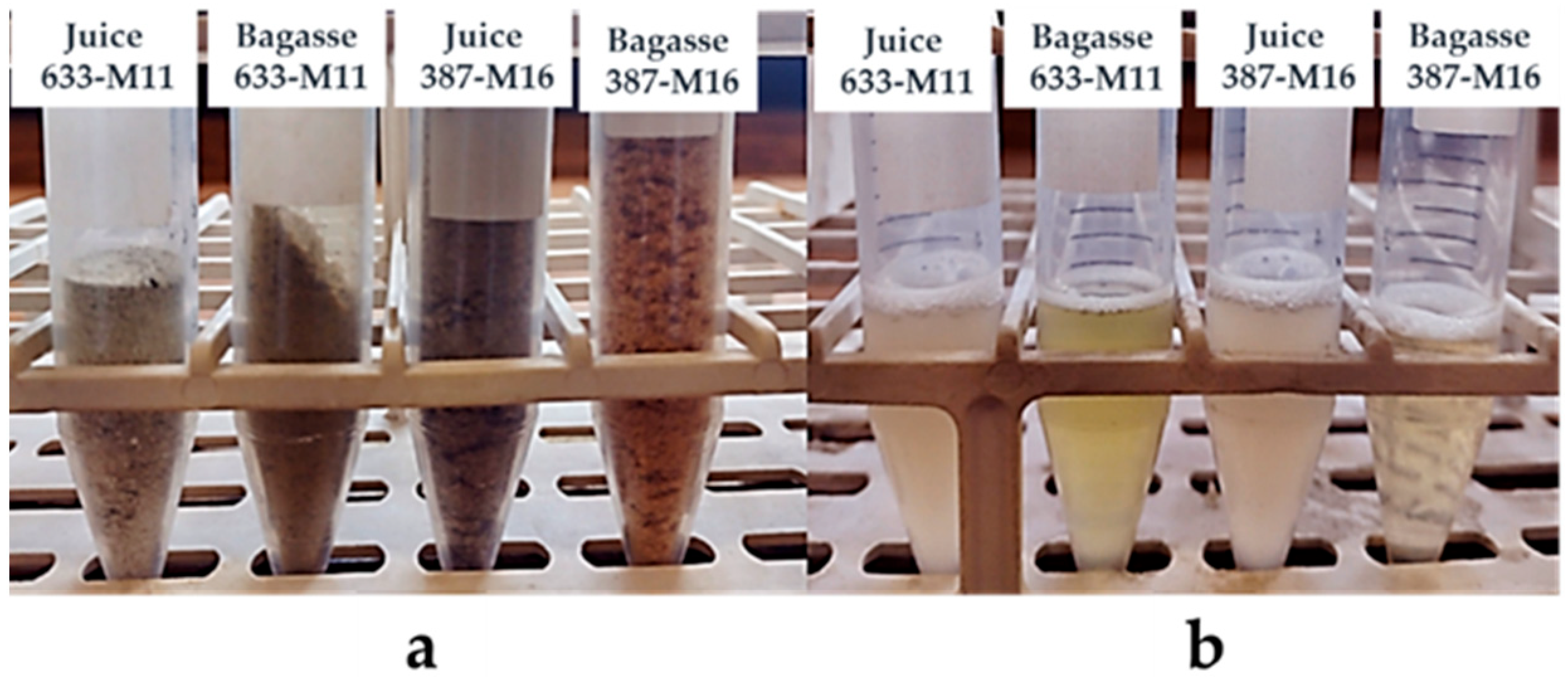
The foam test confirmed the presence of saponins in the juice and bagasse extracts of Sechium 633-M11 and 387-M16. The formation of persistent foam (>1 min) in the lyophilized extracts of both genotypes confirmed the presence of surface-active compounds consistent with saponins. This assay is widely used as a qualitative screening method: the appearance and stability of the foam are considered indicative of saponins in plant extracts [43]. Because the test responds to surfactants in general, its interpretation here is supported by the convergent evidence from HPTLC and FT-MIR latter shown in this work. Likewise, the persistence of foaming after lyophilization suggests that the process did not suppress the surface activity associated with saponins (Figure 2).

3.3. FT-MIR Profiling and Functional Group Identification

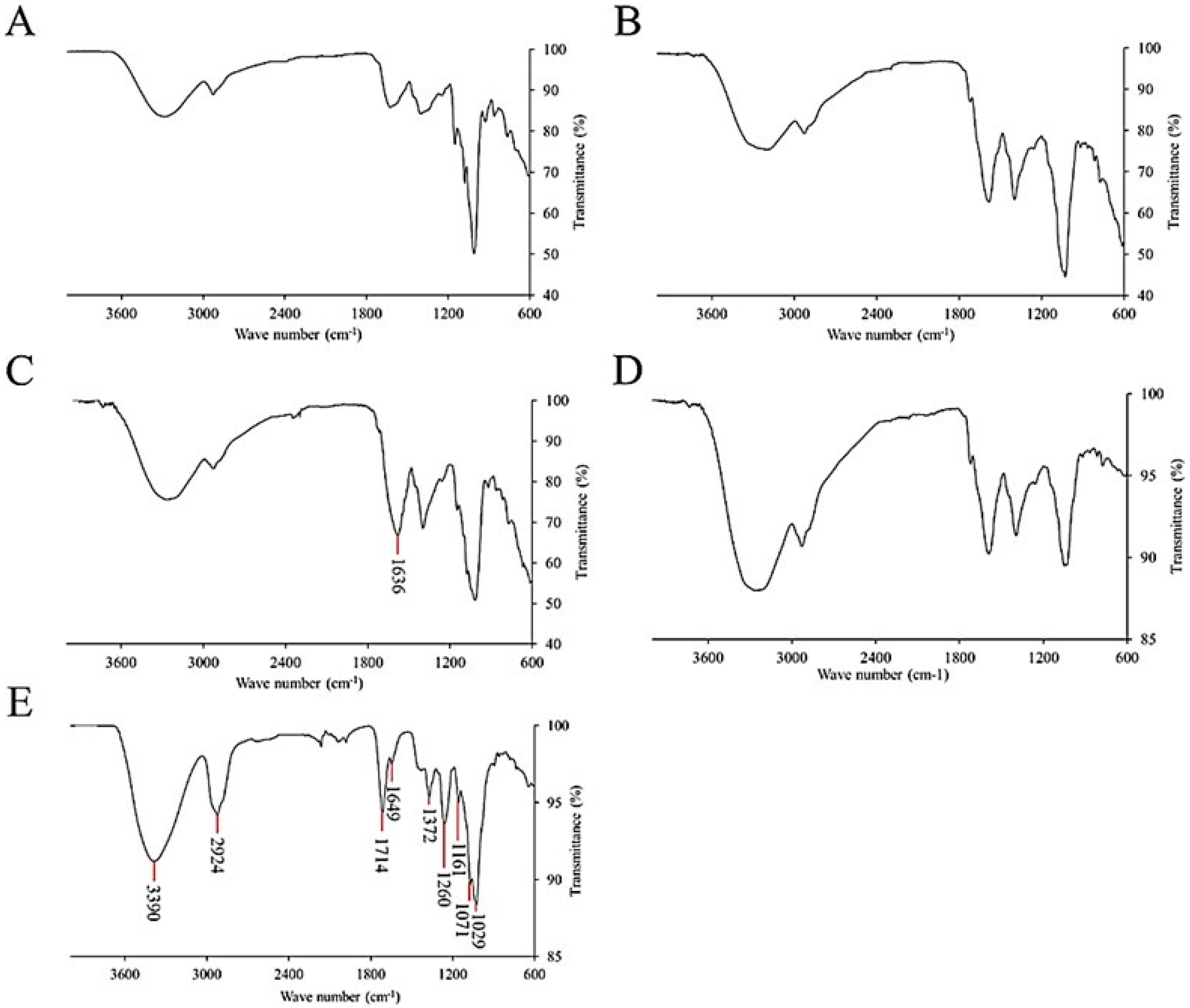
To support foam test results, the juices and methanolic bagasse extracts were subjected to FT-MIR profiling to identify major metabolite-related functional groups. All samples exhibited comparable band patterns, with differences mainly reflected in transmittance intensity (Figure 3). A broad band around 3390 cm−1 is consistent with O–H stretching vibrations from hydroxylated and/or glycosylated constituents, including saponin-containing matrices [44,45,46]. A band at 2924 cm−1 has been associated with C–H stretching vibrations of aliphatic CH3 groups, commonly reported in saponin-rich plant matrices [44,46]. The region around 1636 cm−1 (Figure 3C) has been linked to the C=C stretching of triterpenoid saponins, including bayogenin-type compounds [44,46]. Additionally, the fingerprint region displayed bands between 1029 and 1260 cm−1, corresponding to C–O–C stretching vibrations associated with glycosidic bonds and oligosaccharides [47]. Nonetheless, it is worth noting that IR signals must be interpreted cautiously, as those functional groups may be associated with other metabolites. For instance, free carbohydrates, hydroxylated flavonoids, or free sapogenins and cucurbitacin derivatives can produce such bands [34,47,48]. However, these signals were also detected in the spectrum of escin, a saponin standard reference. This strongly indicated the presence of saponins in the analyzed materials.

3.4. Metabolite Profiling by High Performance Thin Layer Chromatography (HPTLC)

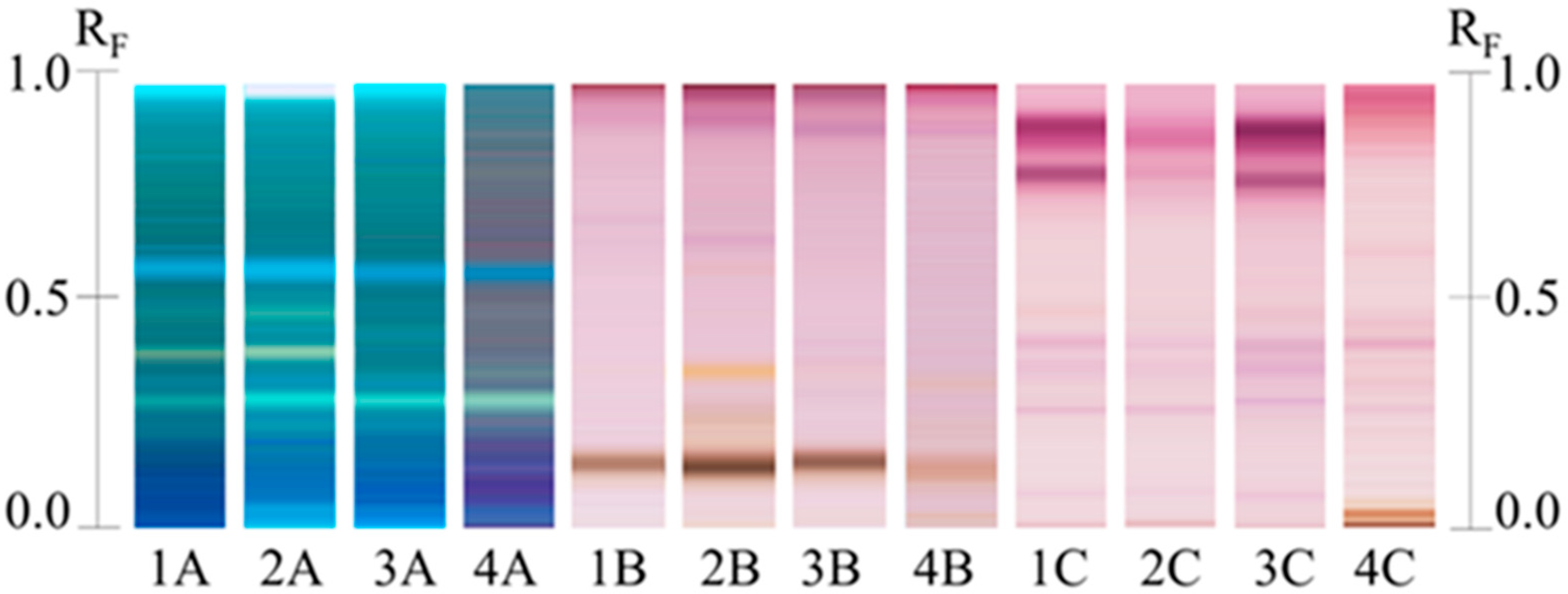
To assess the presence of metabolites associated with the FT-MIR signals, a targeted HPTLC analysis of phenolics and terpenoids was performed on the identical Sechium genotypes. Samples developed in a polar mobile phase and derivatized with natural product reagent (NPR) showed several bands with yellow-orange and yellow-greenish colors typical of glycosylated flavonoids. Orange and yellow-green bands corresponded to flavones and flavanols, respectively [49]. Additionally, phenolic acids were detected as light-blue spots, as seen for the band around Rf 0.57 (Figure 4). Some other blue bands remained close to the application point, suggesting a high degree of glycosylation. On the other hand, the same system, derivatized with sulfuric anisaldehyde, showed some green-brown bands at low Rf values, corresponding to free carbohydrates. Moreover, several violet-bluish and pink bands were observed in most of the chromatogram’s Rf range. These bands have been correlated with saponins and, in the case of the high-Rf bands, some sapogenins. This was confirmed when separating the samples using a less polar mobile phase. The analysis showed that the samples contained several sapogenins and other non-glycosylated terpenoids, including cucurbitacin and free triterpenoids. Finally, the HPTLC analysis showed that bagasse stills contain exploitable specialized metabolites, especially phenolic compounds (Figure 4).

3.5. Gravimetric Extraction Yields

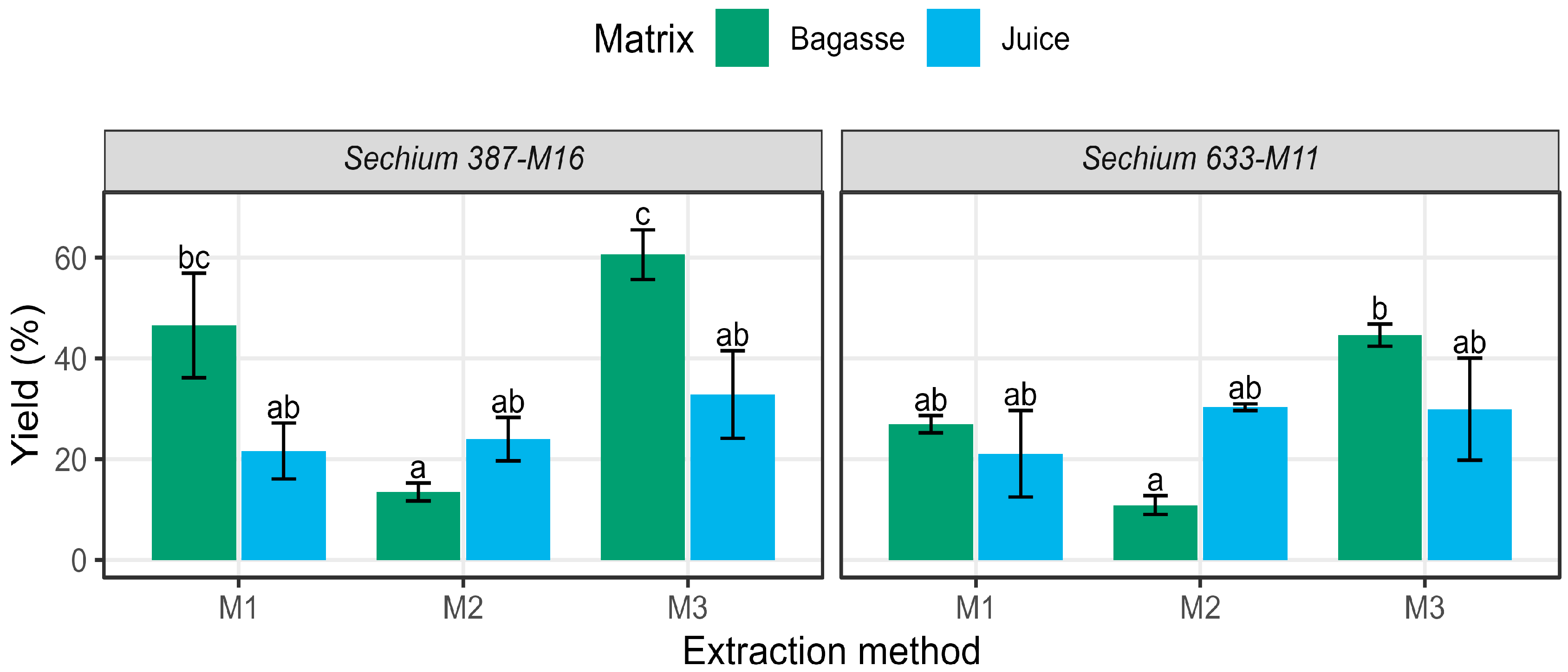
Once the presence of saponins in the juice and pulp was confirmed, each extraction method was applied to the juice and bagasse extracts. Overall, bagasse showed higher gravimetric yields than juice, and Method 3 (M3) produced the highest yields across matrices and genotypes (Table 2). In Sechium 387-M16 (bagasse), M3 reached 60.6% (0.606 g g−1), followed by Method 1 (M1) at 46.5% (0.465 g g−1) and Method 2 (M2) at 13.5% (0.135 g g−1). In 633-M11 (bagasse), M3 yielded 44.6% (0.446 g g−1), surpassing M1 at 26.9% (0.269 g g−1) and M2 at 10.9% (0.109 g g−1). For juice, the same pattern is observed in 387-M16: 32.8% (0.328 g g−1), 24.0% (0.240 g g−1), and 21.6% (0.216 g g−1) for M3, M2, and M1, respectively. In 633-M11 (juice), M2 and M3 were comparable at 30.3% (0.303 g g−1) and 29.9% (0.299 g g−1), both higher than M1 at 21.1% (0.211 g g−1). These differences were supported by the ANOVA/Tukey analysis (Figure 5), which showed a Matrix × Method interaction, indicating that the advantage of M3 was amplified in bagasse.
The performance of the three gravimetric methods was evaluated in a 2 × 2 × 3 factorial design (Genotype: 633-M11, 387-M16; Matrix: juice, bagasse; Method: M1–M3) with n = 3 independent extractions per combination. The assumptions of normality (Shapiro–Wilk test, p = 0.1659) and homogeneity of variances (Levene’s test, p = 0.5486) were verified; consequently, a three-way ANOVA with Tukey’s post hoc comparison (α = 0.05) was performed (Figure 5).
In summary, gravimetric yields were generally higher in bagasse than in juice, and M3 provided the highest values across genotypes. This trend is consistent with the notion that the tissue/cell wall architecture of solid matrices retains some of the recoverable constituents. Under more intensive processing conditions, mass transfer improves, leading to a larger extractable fraction [50,51]. Anatomical/histological differences between matrices further help explain why bagasse outperformed juice [52]. Nonetheless, gravimetric yield measures crude mass, which may include co-precipitated carbohydrates and other polar metabolites, thereby inflating the apparent percentage [53]. However, these methods have been widely used for the long-term extraction of saponins. Among them, M3 was the best for yield recovery, and bagasse showed the highest yield in both matrices. The yields obtained in this study ranged from 30 to 61%, which were much higher than those reported for H. indicus (0.76%) [41], highlighting species effects rather than non-specific extraction effects.

3.6. HPTLC Confirmation of Saponins Extraction

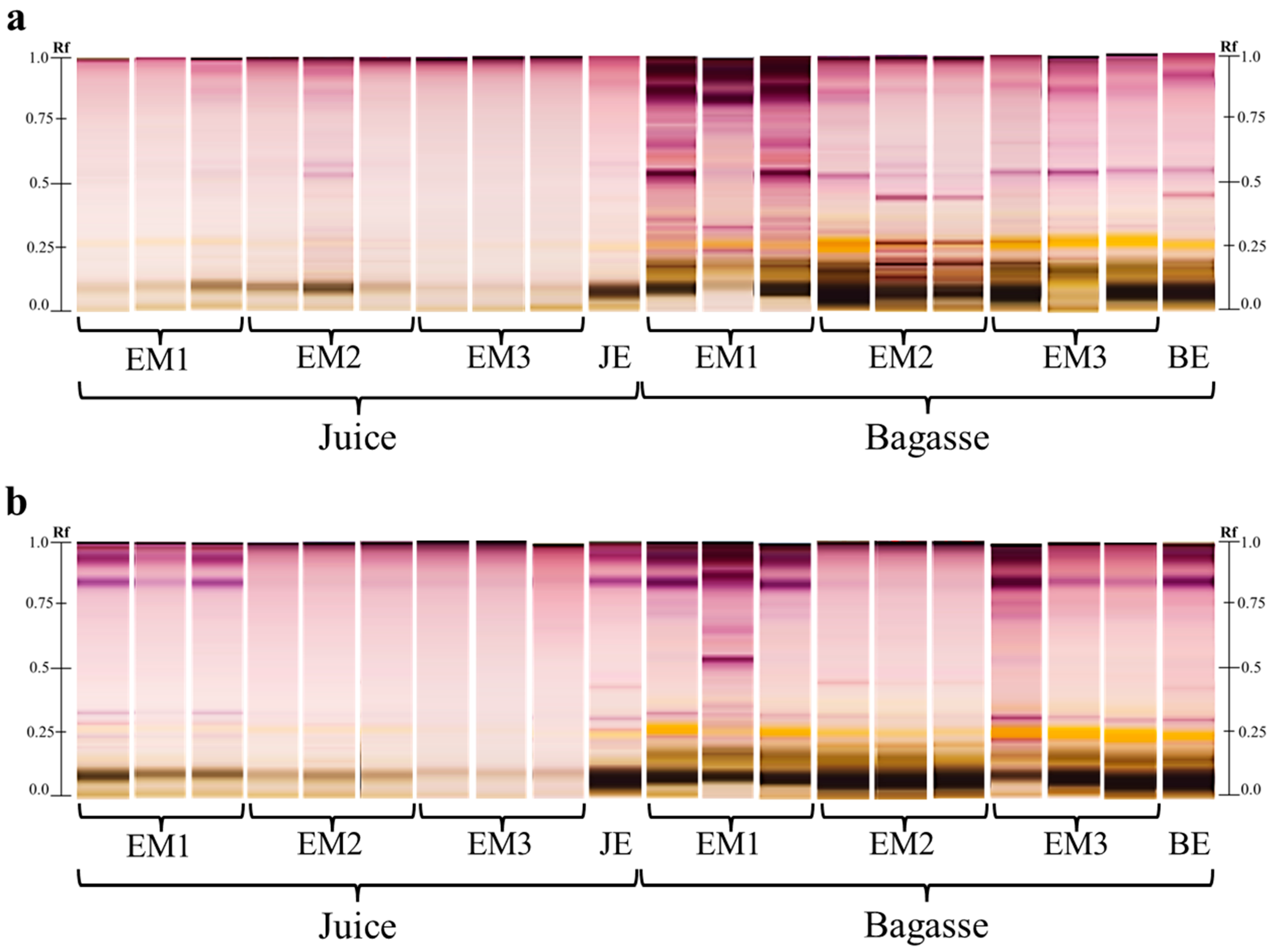
There must be a balance between yield and the specific content of saponins, including qualitative and quantitative features. Thus, to determine the best extraction method, the saponin profiles of the extracts obtained by each technique must be profiled. To do so, a target HPTLC analysis was used to confirm and profile the diversity of saponins and other metabolites. The study confirmed that bagasse contained more saponins than juice extracts (as bands at Rf 0.6). Moreover, M1 showed a higher abundance and diversity of saponin-like bands (Figure 6). That is, medium- to low-Rf violet spots [49,54,55]. Additionally, the chromatographic analysis showed greenish bands attributed to free carbohydrates and yellow bands associated with glycosylated flavonoids. It is worth highlighting that carbohydrate bands were less intense in M1 profiles, indicating less extraction of free carbohydrate than M2 and M3. Thus far, based on saponin diversity (number of spots) and abundance (spot intensity), M1 is the best method to obtain cleaner saponin-rich extracts.
Similar patterns have been reported in other saponin-rich plants, where HPTLC fingerprints are used as qualitative indicators of metabolite complexity and to compare extraction workflows. Taken as an example, the roots and aerial parts of Ophiopogon japonicus and Astragalus hamosus. In these species, their HPTLC profiles were employed to differentiate samples, monitor triterpenoid saponin enrichment, and guide the selection of extraction conditions for downstream applications [56,57,58]. It is also important to note that differences in band diversity may affect the biological activity of each extract. There is extensive literature emphasizing that saponins usually act as mixtures rather than single entities. Furthermore, the biological activity of saponins, such as cytotoxic, immunomodulatory, or adjuvant effects, can be modulated by the proportions of individual saponins and by their interactions with co-occurring metabolites, such as flavonoids [59,60]. However, despite their non-specific extraction, gravimetric workflows, including double-solvent extraction, n-butanol partition, and precipitation to constant mass, are used because of their low cost and scalability [40,53,61,62,63]. Thus, gravimetric workflows are considered low-cost pre-enrichment steps that generate reproducible saponin-enriched fractions for comparative screening across matrices, species, varieties, and genotypes.

3.7. Spectrophotometric Quantification of Saponins

Undoubtedly, HPTLC provided a good qualitative comparison among the extraction methods. However, the HPTLC quantitative comparison between genotypes and matrices was restricted to visual interpretation. Thus, a proper quantitative approach was needed to compare saponin content among plant materials. In this context, a validated spectrophotometric method was employed to compare saponin content across extracts [40]. Total saponins (600 nm), defined as the quantifiable spectrophotometric content of saponins regardless of their chemical class, and steroidal saponins (425 nm) were quantified using the p-anisaldehyde—H2SO4 reaction. The triterpenic saponin fraction was estimated as the difference between the concentrations obtained at 600 nm and 425 nm. Results are reported as mg of protodioscin equivalents gdw−1.
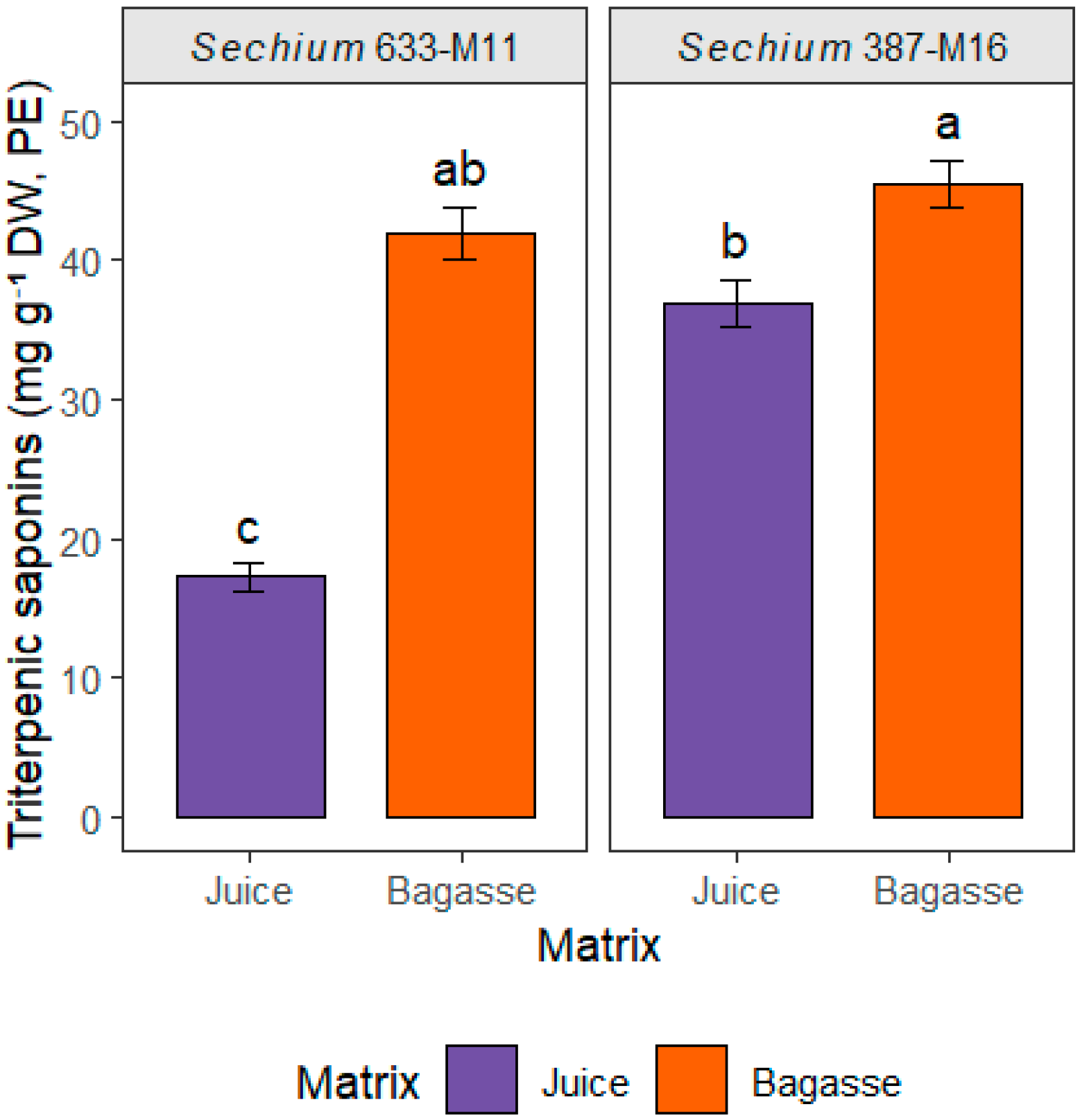
In both Sechium genotypes, bagasse contained higher levels of triterpenic saponins than juice. The highest proportion of Sechium corresponded to the 20:80 (Agave/Sechium) mixture, under which the triterpenic component was quantifiable in all matrices. For Sechium 387-M16, triterpenic values at 20:80 were 45.48 ± 1.74 mg g−1 in bagasse and 36.91 ± 1.67 mg g−1 in juice. For S. 633-M11, values were 41.95 ± 1.89 mg g−1 in bagasse and 17.24 ± 0.96 mg g−1 in juice (Table 3). When the Agave lechuguilla fraction increased (50:50 and 80:20 mixtures), the 425 nm signal matched or exceeded the 600 nm response in all samples from both genotypes. Therefore, the 600–425 nm difference was non-positive, and triterpenic saponins were consistently reported as ND (Supplementary Table S2).
For the 20:80 Agave/Sechium mixtures, a two-way ANOVA (Genotype × Matrix) performed on triterpenic saponins contents (mg g−1 DW, PE) revealed significant main effects of genotype (F1,8 = 52.28, p = 8.98 × 10⁻⁵) and matrix (F1,8 = 107.54, p = 6.47 × 10⁻⁶), as well as a significant interaction (F1,8 = 25.31, p = 0.0010). According to Tukey’s HSD test, triterpenic saponin contents were consistently higher in bagasse than in juice within each genotype, with the most significant contrast observed in 633-M11. Juice from 633-M11 formed the lowest group, whereas bagasse from 387-M16 exhibited the highest enrichment. On the other hand, 387-M16 juice and 633-M11 bagasse showed intermediate levels that were statistically overlapping (Figure 7).
For total saponin content at 600 nm, matrix- and mixture-dependent trends were determined (Supplementary Table S2). Overall, these data reinforce that bagasse contained more triterpenoid saponins than juice under the 20:80 condition. Furthermore, mixtures richer in Sechium favored the 600 nm response, whereas increasing Agave proportion increased the 425 nm contribution. Consequently, the 600–425 nm difference was not consistently positive across both genotypes and was conservatively reported as non-detectable (ND) when it did not exceed the blank-based threshold. This behavior is expected when applying the p-anisaldehyde-H2SO4 approach to complex plant mixtures, where matrix-dependent background contributions (particularly in the 425 nm assay) can influence the net difference readout, as discussed by Le Bot et al. [40]. The complete dataset across mixing ratios (20:80, 50:50, and 80:20) is provided as Supplementary Table S2.

4. Conclusions

Among the three evaluated gravimetric methods, regardless of genotype or matrix, M3 produced the highest extraction yields. However, its chromatographic characterization indicated that, irrespective of its mass yield, M3 recovered a lower amount of saponins and greater diversity. On the other hand, M1 recovered the broadest saponin diversity and showed more abundant saponin HPTLC spots. Thus, M1 was the best gravimetric method for extracting saponins from Sechium fruit. Regarding matrix effects, in general, bagasse yielded higher saponin extract yields than juice. The spectrophotometric analysis confirmed that bagasse extracts contain higher saponin contents than juice. We recommend extracting bagasse, the fruit material with higher triterpenoid saponin content, using M3 for scalable pre-enrichment, and prioritizing M1 when obtaining chemical diversity is the extraction goal.
Nonetheless, it is essential to acknowledge that a limitation of the gravimetric workflows used in this study is the potential co-precipitation of other metabolites. This could lead to an overestimation of the total saponin content if not corrected for spectrophotometric quantification. In addition, FT-MIR and HPTLC should be used as rapid fingerprinting tools to assess the chemical quality of the obtained extracts, especially when chemical diversity is a primary concern. Finally, while this study establishes a robust framework for saponin pre-enrichment and quantification, future work should move toward bioassay-guided fractionation coupled with deeper metabolite analysis. This will enable testing whether the higher chemical diversity observed in M1-derived extracts is associated with increased biological effectiveness. This could parallel propel the identification of individual saponins and the exploration of their structure-activity relationships in Sechium spp.

Supplementary Materials

The following supporting information can be downloaded at: https://www.mdpi.com/article/10.3390/separations13010029/s1, Figure S1: Segregant genotype Sechium 633-M11; Figure S2: Segregant genotype Sechium 387-M16; Figure S3: Calibration curve for steroidal saponins quantified by the p-anisaldehyde-sulfuric acid assay at 425 nm, expressed as protodioscin equivalents (mg mL−1); Figure S4: Calibration curve for total saponins quantified by the p-anisaldehyde-sulfuric acid assay at 600 nm, expressed as protodioscin equivalents (mg mL−1); Figure S5: Agave lechuguilla (reference material for steroidal saponins); Figure S6: Digital voucher and photographic record of Agave lechuguilla used as reference material for steroidal saponins; Figure S7: Analytical greenness report for the Gravimetric method of extraction of saponins in Sechium genotypes (M1) using the AGREEprep metric. Figure S8: Analytical greenness report for the Gravimetric method of extraction of saponins in Sechium genotypes (M2) using the AGREEprep metric; Figure S9: Analytical greenness report for the Gravimetric method of extraction of saponins in Sechium genotypes (M3) using the AGREEprep metric; Table S1: AGREEprep evaluation of the analytical greenness of the gravimetric saponin extraction methods (M1–M3) applied to Sechium genotypes, based on the 10 principles of green sample preparation; Table S2: Spectrophotometric saponin content (mg g−1, DW, protodioscin equivalents) in juice and bagasse of Sechium 633-M11 and 387-M16 across Agave lechuguilla/Sechium mixing ratios.

Author Contributions

Conceptualization, F.A.R.-B., R.M.S.-H., L.F.S.-A. and J.C.-Í.; methodology, F.A.R.-B., R.M.S.-H. and L.F.S.-A.; validation, F.A.R.-B., R.M.S.-H. and L.F.S.-A.; formal analysis, F.A.R.-B. and L.F.S.-A.; research, F.A.R.-B., R.M.S.-H., J.C.-Í. and L.F.S.-A.; resources, R.M.S.-H.; data curation, F.A.R.-B., R.M.S.-H., L.F.S.-A. and J.C.-Í.; writing—original draft preparation, F.A.R.-B.; writing—review and editing, F.A.R.-B., R.M.S.-H., J.C.-Í., L.d.M.R.-P., V.A.G.-H., L.F.S.-A. and S.E.H.-R.; supervision, R.M.S.-H.; project administration, R.M.S.-H.; funding acquisition, R.M.S.-H., F.A.R.-B., J.C.-Í., V.A.G.-H. and S.E.H.-R. All authors have read and agreed to the published version of the manuscript.

Funding

This research was funded by the Colegio de Postgraduados (COLPOS) and the Secretaría de Agricultura y Desarrollo Rural (SADER, México) through calls for proposals 2022-03, 2023-03, and 2024-03 calls for Research and Advocacy Projects Aimed at Strengthening Conservation, Preservation, and Sustainable Use of Genetic Resources for Food and Agriculture (RGAA), part of the project “Increasing the characterization of Sechium spp. genotypes for sustainable use and conservation”, with reference numbers CONV_RGAA_2022-26, CONV_RGAA_2023-26, and CONV_RGAA_2024-26. The authors are grateful for the financial support provided.

Data Availability Statement

The original contributions presented in this study are included in the article/Supplementary Materials. Further inquiries can be directed to the corresponding author.

Acknowledgments

This work was conducted at the Laboratorio de Fitoquímica (Colegio de Postgraduados) and Laboratorio de Química de Productos Naturales, Department of Biotechnology and Biochemistry, Centro de Investigación y de Estudios Avanzados del Instituto Politécnico Nacional, Irapuato Unit. We thank Mercedes G. López, from CINVESTAV-Unidad Irapuato, for kindly providing access to FT-MIR and HPTLC systems. We thank Juan Antonio Encina Domínguez from the Department of Natural Resources, Universidad Autónoma Agraria Antonio Narro, for providing the Agave lechuguilla collection material. F.A.R.B. thanks the Secretaría de Ciencia, Humanidades, Tecnología e Innovación (SECIHTI) of México for her PhD scholarship (No. 438860). We thank Juan Emanuel López Olivera for his valuable assistance during his social service internship. We also acknowledge Canva (Canva Pty Ltd., Sydney, Australia) for the design tools used to prepare the graphical material.

Conflicts of Interest

The authors declare no conflicts of interest.

Abbreviations

The following abbreviations are used in this manuscript:
ANOVAAnalysis of variance
BEBagasse extract
BuOHn-butanol
CVCoefficient of variation
DFDilution factor
DWDry Weight
FT-MIRFourier transform mid-infrared spectroscopy
H2SO4Sulfuric acid
HPLC-DADHigh-performance liquid chromatography with diode-array detection
HPTLCHigh-performance thin-layer chromatography
HSDTukey’s honestly significant difference
JEJuice extract
MeOHMethanol
NDNot detected
NPRNatural products reagent
OLSOrdinary least squares (regression)
PEProtodioscin equivalents
RfRetardation factor (TLC)
SDStandard Deviation
SEStandard Error
UHPLC-QTOF-MSUltra-high-performance liquid chromatography-quadrupole time-of-flight mass spectrometry
UVUltraviolet
WGS84World Geodetic System 1984
M1, M2, M3Gravimetric extraction methods 1–3

Appendix A. Cultivation Site and Soil Conditions

The BANGeSe experimental orchard is surrounded by montane cloud forest (mesophilic mountain forest) vegetation at 1344 m a.s.l., with a mean annual temperature of 19 °C, 85% relative humidity, and 2253 mm of annual precipitation. The soil is classified as a vitric Luvisol, rich in nutrients and moderately fertile, with a coarse texture and containing fragments of volcanic glass, with a slightly acidic to acidic pH (4.3–6.5), high organic matter, low calcium, and elevated iron, manganese, and zinc contents [37].

Appendix B. Detailed Spectrophotometric Workflow for Saponins Quantification (Le Bot et al., 2022 [40] Method Adapted)

  • Reference material (steroidal saponins)
Leaves of Agave lechuguilla Torr. (Asparagaceae, Agavoideae) were used as reference material for the quantification of steroidal saponins. Plant material was collected by Juan Antonio Encina Domínguez (Department of Natural Resources, Universidad Autónoma Agraria Antonio Narro) along the road to the experimental livestock ranch “Los Ángeles”, Coahuila, Mexico, at the collection point 25°08′37.48″ N, 101°03′55.67″ W (25.14374, −101.06546; WGS84). A digital voucher is provided in Figures S5 and S6 (Supplementary Materials).
2.
Preparation of Agave lechuguilla extract
A weight of 150 g of Agave lechuguilla leaves was washed, rinsed, and sectioned into small pieces. The tissue was dehydrated in a convection oven at 70 °C for 24 h until a constant weight was achieved. Following dehydration, the material was pulverized and sieved to remove lignocellulosic fibers, yielding a homogeneous powder for subsequent maceration. Extraction was performed in 80% methanol at room temperature for one week. The resulting extract was filtered and concentrated under reduced pressure using a rotary evaporator. The remaining aqueous fraction was subsequently lyophilized to obtain a stable dry extract. The final extraction yield from A. lechuguilla leaves was 23% (w/w).
3.
Preparation of Agave/Sechium extract mixtures (w/w)

Mass-based (w/w) mixtures of the combined Agave lechuguilla-Sechium extracts were prepared at 20:80, 50:50, and 80:20 ratios. In each mixture, the total extract mass was 500 mg (sum of both plant matrices), as described by Le Bot et al. [40]. For Sechium, juice and bagasse from genotypes 633-M11 and 387-M16 were used and evaluated separately. Table A1 details the w/w composition of the mixtures of A. lechuguilla leaf extract and Sechium extracts.
Table A1. Mass composition (w/w) of mixtures of Agave lechuguilla leaf extract and Sechium extracts (juice or bagasse; genotypes 633-M11 and 387-M16). In all mixtures, the total mass was 500 mg.
Agave/Sechium Proportion (w/w)Agave (mg)Sechium (mg)Total Mass (mg)
20:80100400500
50:50250250500
80:20400100500
4.
Extraction and Sample Preparation
According to the method of Le Bot et al. [40], for each Agave/Sechium mixture, 50 mL of dichloromethane (DCM) was added, and the mixture was subjected to an ultrasonic bath (5 min at 50 °C). The suspension was filtered, and the residue was treated with DCM under the same conditions (3× in total). The final residue from each mixture was then solubilized with 50 mL methanol (MeOH) and again exposed to ultrasound extraction (5 min at 50 °C), followed by filtration; the residue was further extracted with MeOH (3×). The methanolic extracts were combined, filtered, and concentrated to dryness under reduced pressure on a rotary evaporator.
From each Agave/Sechium extract fraction, 10 mg were weighed into 2 mL microcentrifuge tubes and dissolved in 1 mL methanol (MeOH). The suspensions were centrifuged (10 min at 10,000 rpm), and the supernatant was used for the spectrophotometric assays. Each ratio (20:80, 50:50, 80:20) × matrix (juice or bagasse) × genotype (633-M11 and 387-M16) was analyzed in triplicate.
5.
Total Saponin Sample assay (600 nm)
Following Le Bot et al.’s method [40], an aliquot of 100 µL of the supernatant was transferred to capped test tubes containing 100 µL of 50% p-anisaldehyde in methanol and 2 mL of 50% (w/v) aqueous sulfuric acid. Tubes were placed in a water bath at 60 °C for 20 min. The chromogenic reaction was quenched on ice for 10 min. Absorbance was measured on a split-beam spectrophotometer (Spectronic Genesys 5, Thermo/Milton Roy, Rochester, NY, USA) using 1.0 cm quartz cuvettes at 25 ± 1 °C. The p-anisaldehyde-H2SO4 chromophore was read at 600 nm against a methanol blank. Each calibration level was measured in triplicate. Protodioscin was used to construct the calibration curve for total saponins (600 nm).
6.
Steroidal Saponin assay (425 nm)
For steroidal saponins, 100 µL of the supernatant (from Agave/Sechium mixture preparations at each ratio) was transferred to capped test tubes pre-loaded with 100 µL of 10% p-anisaldehyde in ethanol and 2 mL of 12.5% (w/v) sulfuric acid in ethanol. Tubes were placed in a water bath at 60 °C for 20 min, then cooled on ice for 10 min to stop the chromogenic reaction. Ethanol served as the blank, and absorbance was recorded at 425 nm [40].
7.
Calibration curves and reporting criteria
Calibration curves were generated by ordinary least-squares (OLS) regression of absorbance versus protodioscin concentration (external standard, 5 mg mL−1 stock). Working ranges were 0.20–0.50 mg mL−1 for total saponins (600 nm) and 0.20–0.60 mg mL−1 for steroidal saponins (425 nm). Levels with responses ≤ mean reagent blank + 3 SD (Standard Deviation) were excluded a priori. Each level was measured in triplicate, and linearity was assessed by OLS (reporting slopes/intercepts ± SE (Standard Error), R2, and residual standard error). All concentrations are reported as protodioscin equivalents (PE), that is, responses calibrated against the protodioscin standard under identical conditions. Because the p-anisaldehyde-H2SO4 chromogenic yield and molar absorptivities can differ across saponin classes and structures, the reported values should be interpreted as protodioscin-equivalent concentrations, not as the absolute mass of individual saponins.
8.
Triterpenoid saponin determination and ND rule
Sample readings at 600 or 425 nm that were ≤ mean blank + 3 SD were recorded as non-detectable (ND). All quantities are expressed as protodioscin equivalents (PE).
T r i t e r p e n o i d   s a p o n i n s =   T o t a l   s a p o n i n s 600 S t e r o i d a l   s a p o n i n s 425
Negative or blank-level differences were also reported as ND (not set to zero). Results are presented as mean ± SE (n = 3 independent extractions).

Appendix C. Mass Balance of Recovered Solids

Table A2. Distribution of recovered solids by process stream (juice vs. bagasse extract) and extractable fraction of the initial dry bagasse in Sechium 633-M11 and 387-M16 (dry mass after lyophilization). a Share of total solids (%) = solids from each stream divided by the sum of juice solids and bagasse-extract solids, multiplied by 100. b Extractable fraction of initial dry bagasse (%) = bagasse-extract solids divided by the sum of bagasse-extract solids and residual dry bagasse, multiplied by 100.
Sechium GenotypeJuice Solids (g)Bagasse Extract Solids (g)Total Solids Recovered (g)Share of Total Solids, Juice (%) aShare of Total Solids, Bagasse Extract (%) aResidual Dry Bagasse (g)Extractable Fraction of Initial Dry Bagasse (%) b
633-M11215.262.3277.577.622.46958.2
387-M16136.1176.9313.043.556.563521.8
Notes: Values are dry mass after lyophilization. Percentages may differ by up to 0.1 due to rounding.

References

  1. Wang, P.; Wei, G.; Feng, L. Research advances in oxidosqualene cyclase in plants. Forests 2022, 13, 1382. [Google Scholar] [CrossRef]
  2. Anand, A.V.; Arinchedathu Surendran, V.; Sukumaran, S.T. Bioactive metabolites in gymnosperms. In Plant Metabolites: Methods, Applications and Prospects; Sukumaran, S.T., Sugathan, S., Abdulhameed, S., Eds.; Springer: Singapore, 2020. [Google Scholar] [CrossRef]
  3. De La Torre, A.R.; Piot, A.; Liu, B.; Wilhite, B.; Weiss, M.; Porth, I. Functional and morphological evolution in gymnosperms: A portrait of implicated gene families. Evol. Appl. 2020, 13, 210–227. [Google Scholar] [CrossRef] [PubMed]
  4. Sugita, P.; Ustati, M.N.; Kurniawanti; Syahbirin, G.; Dianhar, H.; Rahayu, D.U.C. Phytochemical analysis and antioxidant activity of Araucaria spp. from Taman Bunga Nusantara, Cianjur, West Java, Indonesia. Biodiversitas 2025, 26, 118–126. [Google Scholar] [CrossRef]
  5. Patial, P.K.; Sud, D. Bioactive phytosteroids from Araucaria columnaris (G. Forst.) Hook.: RP-HPLC-DAD analysis, in-vitro antioxidant potential, in-silico computational study and molecular docking against 3MNG and 1N3U. Steroids 2022, 188, 109116. [Google Scholar] [CrossRef]
  6. Kurniawanti; Agusta, D.D.; Dianhar, H.; Rahayu, D.U.C.; Sugita, P. Phytochemical screening and preliminary evaluation of antioxidant activity of three Indonesian Araucaria leaves extracts. Sci. Arch. 2021, 2, 250–254. [Google Scholar] [CrossRef]
  7. Jadav, K.M.; Ninge Gowda, K.N. Preliminary phytochemical analysis and in-vitro antioxidant activity of Araucaria columnaris bark peel and Cosmos sulphureus flowers. Int. J. Curr. Pharm. Res. 2017, 9, 96–99. [Google Scholar] [CrossRef][Green Version]
  8. Reddy, G.R.; Goud, D.R.; Ranjani, P.H.; Kirthi, P.S. Preliminary phytochemical screening of Araucaria heterophylla leaves. World J. Pharm. Pharm. Sci. 2017, 6, 1950–1956. [Google Scholar]
  9. Batiha, G.E.-S.; Teibo, J.O.; Shaheen, H.M.; Akinfe, O.A.; Awad, A.A.; Teibo, T.K.A.; Alexiou, A.; Papadakis, M. Bioactive compounds, pharmacological actions and pharmacokinetics of Cupressus sempervirens. Naunyn Schmiedebergs Arch. Pharmacol. 2023, 396, 389–403. [Google Scholar] [CrossRef] [PubMed]
  10. Moses, T.; Papadopoulou, K.K.; Osbourn, A. Metabolic and functional diversity of saponins, biosynthetic intermediates and semi-synthetic derivatives. Crit. Rev. Biochem. Mol. Biol. 2014, 49, 439–462. [Google Scholar] [CrossRef]
  11. Cui, X.; Ma, X.; Li, C.; Meng, H.; Han, C. A review: Structure–activity relationship between saponins and cellular immunity. Mol. Biol. Rep. 2023, 50, 2779–2793. [Google Scholar] [CrossRef]
  12. Sparg, S.G.; Light, M.E.; van Staden, J. Biological activities and distribution of plant saponins. J. Ethnopharmacol. 2004, 94, 219–243. [Google Scholar] [CrossRef]
  13. Morales-Vela, K.; Pérez-Sánchez, F.C.; Padrón, J.M.; Márquez-Fernández, O. Antiproliferative activity of Cucurbitaceae species extracts from southeast of Mexico. J. Med. Plants Stud. 2020, 8, 20–25. [Google Scholar]
  14. Hernández-Carlos, B.; González-Coloma, A.; Orozco-Valencia, A.U.; Ramírez-Mares, M.V.; Andrés-Yeves, M.F.; Joseph-Nathan, P. Bioactive saponins from Microsechium helleri and Sicyos bulbosus. Phytochemistry 2011, 72, 743–751. [Google Scholar] [CrossRef]
  15. León, I.; Enríquez, R.G.; McLean, S.; Reynolds, W.F.; Yu, M. Isolation and identification by 2D NMR of two new complex saponins from Microsechium helleri. Magn. Reson. Chem. 1998, 36, S111–S117. [Google Scholar] [CrossRef]
  16. Deng, Y.; Zhang, Y.; Liu, G.; Zhou, P.; Li, P.; Zhao, Z.; Zhang, R.; Tang, X.; Wang, Z.; Wei, Z.; et al. Saponins from Momordica charantia exert hypoglycemic effect in diabetic mice by multiple pathways. Food Sci. Nutr. 2023, 11, 7626–7637. [Google Scholar] [CrossRef] [PubMed]
  17. Ma, J.; Yang, H.; Chen, Y.; Feng, X.; Wu, C.; Long, F. Purified saponins in Momordica charantia treated with high hydrostatic pressure and ionic liquid-based aqueous biphasic systems. Foods 2022, 11, 1930. [Google Scholar] [CrossRef]
  18. Augustin, J.; Kuzina, V.; Andersen, S.B.; Bak, S. Molecular activities, biosynthesis and evolution of triterpenoid saponins. Phytochemistry 2011, 72, 435–457. [Google Scholar] [CrossRef]
  19. Timilsena, Y.P.; Phosanam, A.; Stockmann, R. Perspectives on saponins: Food functionality and applications. Int. J. Mol. Sci. 2023, 24, 13538. [Google Scholar] [CrossRef]
  20. Smail, H.O. The roles of genes in the bitter taste. AIMS Genet. 2019, 6, 88–97. [Google Scholar] [CrossRef]
  21. Wooding, S.P.; Ramirez, V.A. Global population genetics and diversity in the TAS2R bitter taste receptor family. Front. Genet. 2022, 13, 952299. [Google Scholar] [CrossRef]
  22. Morini, G. The taste for health: The role of taste receptors and their ligands in the complex food/health relationship. Front. Nutr. 2024, 11, 1396393. [Google Scholar] [CrossRef]
  23. Martin, L.T.P.; Nachtigal, M.W.; Selman, T.; Nguyen, E.; Salsman, J.; Dellaire, G.; Dupré, D.J. Bitter taste receptors are expressed in human epithelial ovarian and prostate cancer cells and noscapine stimulation impacts cell survival. Mol. Cell. Biochem. 2019, 454, 203–214. [Google Scholar] [CrossRef] [PubMed]
  24. Delgado-Tiburcio, E.E.; Cadena-Íñiguez, J.; Santiago-Osorio, E.; Ruiz-Posadas, L.d.M.; Castillo-Juárez, I.; Aguiñiga-Sánchez, I.; Soto-Hernández, M. Pharmacokinetics and biological activity of cucurbitacins. Pharmaceuticals 2022, 15, 1325. [Google Scholar] [CrossRef]
  25. Zhao, A.; Jeffery, E.H.; Miller, M.J. Is bitterness only a taste? The expanding area of health benefits of Brassica vegetables and potential for bitter taste receptors to support health benefits. Nutrients 2022, 14, 1434. [Google Scholar] [CrossRef] [PubMed]
  26. Newstrom, L.E. Evidence for the origin of chayote Sechium edule (Cucurbitaceae). Econ. Bot. 1991, 45, 410–428. [Google Scholar] [CrossRef]
  27. Lira, R.; Bye, R. Las cucurbitáceas en la alimentación de los dos mundos. In Conquista y Comida: Consecuencias del Encuentro de Dos Mundos, 3rd ed.; UNAM-IIH: Mexico City, Mexico, 2018; pp. 199–226. [Google Scholar]
  28. Bye, R.; Linares, E. Plantas medicinales del México prehispánico. Arqueol. Mex. 1999, 7, 4–13. [Google Scholar]
  29. Cadena-Íñiguez, J.; Arévalo-Galarza, M.d.L.C. Las Variedades del Chayote (Sechium Edule (Jacq.) Sw.) y su Comercio Mundial; Colegio de Postgraduados; Mundi-Prensa: Mexico City, Mexico, 2011. [Google Scholar]
  30. Cadena-Iñiguez, J.; Arévalo-Galarza, M.d.L.; Santiago-Osorio, E.; Aguiñiga-Sánchez, I.; Cadena-Zamudio, J.D.; Soto-Hernández, M.; Ramírez-Rodas, Y.C.; Ruiz-Posadas, L.M.; Salazar-Aguilar, S.; Cisneros-Solano, V.M. Genotypes of Sechium spp. as a source of natural products with biological activity. Life 2024, 15, 15. [Google Scholar] [CrossRef]
  31. Soto-Hernández, R.M.; Ruiz-Posadas, L.M.; Aguiñiga-Sánchez, I.; Santiago-Osorio, E.; Arévalo-Galarza, M.L.; Avendaño-Arrazate, C.H.; Cisneros-Solano, V.M.; Cadena-Iñiguez, J. Uso de chayotes mexicanos para tratamiento de enfermedades de interés público. Rev. Agroproductividad 2018, 9, 51–53. [Google Scholar] [CrossRef]
  32. Aguiñiga-Sánchez, I.; Soto-Hernández, R.M.; Cadena-Iñiguez, J.; Ruiz-Posadas, L.M.; Cadena-Zamudio, J.D.; González-Ugarte, A.K.; Steider, B.W.; Santiago-Osorio, E. Fruit extract from a Sechium edule hybrid induces apoptosis in leukemic cell lines but not in normal cells. Nutr. Cancer 2015, 67, 250–257. [Google Scholar] [CrossRef]
  33. Castro, V.H.; Ramirez, E.; Mora, G.A.; Iwase, Y.; Nagao, T.; Okabe, H.; Matsunaga, H.; Katano, M.; Mori, M. Structures and antiproliferative activity of saponins from Sechium pittieri and S. talamancense. Chem. Pharm. Bull. 1997, 45, 349–358. [Google Scholar] [CrossRef][Green Version]
  34. Hernández-Carlos, B.; Carmona-Pineda, M.; Villanueva-Cañongo, C.; López-Olguín, J.F.; Aragón-García, A.; Joseph-Nathan, P. New saponins from Sechium mexicanum. Magn. Reson. Chem. 2009, 47, 994–1003. [Google Scholar] [CrossRef]
  35. Fordos, S.; Amin, S.; Abid, N.; Pasha, I.; Khan, M.K.I.; Amin, A.; Gulzar, M.; Subtain, M.; Abdi, G. Saponins: Advances in extraction techniques, functional properties, and industrial applications. Appl. Food Res. 2025, 5, 101146. [Google Scholar] [CrossRef]
  36. Cadena-Iñiguez, J.; Avendaño-Arrazate, C.H.; Cisneros-Solano, V.M.; Ruiz-Posadas, L.M.; Arévalo-Galarza, M.L.; Aguirre-Medina, J.F. Protección de variedades criollas de uso común de chayotes mexicanos. Rev. Agroproductividad 2018, 9, 65–67. [Google Scholar] [CrossRef]
  37. Cadena-Iñiguez, J.; Arévalo-Galarza, M.d.L.; Aguirre-Medina, J.F.; Avendaño-Arrazate, C.H.; Cadena-Zamudio, D.A.; Cadena-Zamudio, J.D.; Soto-Hernández, R.M.; Cisneros-Solano, V.M.; Ruiz-Posadas, L.d.M.; Soto-Mendoza, C. Chayote [Sechium edule (Jacq.) Sw.] Fruit Quality Influenced by Plant Pruning. Horticulturae 2025, 11, 965. [Google Scholar] [CrossRef]
  38. Fichou, D.; Ristivojević, P.; Morlock, G.E. Proof-of-principle of rTLC, an open-source software developed for image evaluation and multivariate analysis of planar chromatograms. Anal. Chem. 2016, 88, 12494–12501. [Google Scholar] [CrossRef]
  39. El Aziz, M.M.A.; Said-Ashour, A.; Gomha-Melad, A.S. A review on saponins from medicinal plants: Chemistry, isolation, and determination. J. Nanomed. Res. 2019, 8, 282–288. [Google Scholar] [CrossRef]
  40. Le Bot, M.; Thibault, J.; Pottier, Q.; Boisard, S.; Guilet, D. An accurate, cost-effective and simple colorimetric method for the quantification of total triterpenoid and steroidal saponins from plant materials. Food Chem. 2022, 383, 132597. [Google Scholar] [CrossRef]
  41. Sukanya, P.; Hiremath, L. Qualitative and quantitative estimation of phyto-constituents in Hemidismus indicus roots by using advanced analytical tools. Int. J. Pharm. Clin. Res. 2019, 1, 40–50. [Google Scholar] [CrossRef]
  42. Wojnowski, W.; Tobiszewski, M.; Pena-Pereira, F.; Psillakis, E. AGREEprep—Analytical Greenness Metric for Sample Preparation. TrAC Trends Anal. Chem. 2022, 149, 116553. [Google Scholar] [CrossRef]
  43. Rai, S.; Acharya-Siwakoti, E.; Kafle, A.; Devkota, H.P.; Bhattarai, A. Plant-derived saponins: A review of their surfactant properties and applications. Sci 2021, 3, 44. [Google Scholar] [CrossRef]
  44. Aluola, E.E.; Ogbeide, S.E.; Obahiagbon, K.O. Detection and characterization of saponins in some indigenous plants using UV, FTIR, and XRD spectroscopy. Int. J. Eng. Adv. Technol. Stud. 2021, 9, 1–19. [Google Scholar]
  45. Velázquez-Martínez, J.R.; González-Cervantes, R.M.; Hernández-Gallegos, M.A.; Mendiola, R.C.; Aparicio, A.R.J.; Ocampo, M.L.A. Prebiotic potential of Agave angustifolia Haw fructans with different degrees of polymerization. Molecules 2014, 19, 12660–12675. [Google Scholar] [CrossRef] [PubMed]
  46. Kareru, P.G.; Keriko, J.M.; Gachanja, A.N.; Kenji, G. Direct detection of triterpenoid saponins in medicinal plants. Afr. J. Tradit. Complement. Altern. Med. 2007, 5, 56–60. [Google Scholar] [CrossRef] [PubMed]
  47. Bhajan, C.; Soulange, J.G.; Ranghoo-Sanmukhiya, V.M.; Olędzki, R.; Ociński, D.; Jacukowicz-Sobala, I.; Zając, A.; Howes, M.J.; Harasym, J. Nutraceutical potentital of Sideroxylon cinereum, an endemic Mauritian fruit of the Sapotaceae family, through the elucidation of its phytochemical composition and antioxidant activity. Molecules 2025, 30, 3041. [Google Scholar] [CrossRef] [PubMed]
  48. Iñiguez-Luna, M.I.; Cadena-Iñiguez, J.; Soto-Hernández, R.M.; Morales-Flores, F.J.; Cortes-Cruz, M.; Watanabe, K.N. Natural bioactive compounds of Sechium spp. for therapeutic and nutraceutical supplements. Front. Plant Sci. 2021, 12, 772389. [Google Scholar] [CrossRef]
  49. Wagner, H.; Bladt, S. Plant Drug Analysis: A Thin Layer Chromatography Atlas; Springer: Berlin/Heidelberg, Germany, 1996. [Google Scholar]
  50. Gavrila, A.I.; Rodica, T.; Seciu-Grama, A.M.; Tanase, C.; Tarcomnicu, I.; Negrea, C.; Calinescu, I.; Zalaru, C.; Moldovan, L.; Raiciu, A.D.; et al. Ultrasound-assisted extraction for saponins from Hedera helix L. and an in vitro biocompatibility evaluation of the extracts. Pharmaceuticals 2022, 15, 1197. [Google Scholar] [CrossRef]
  51. Wu, Y.; Zheng, H.; Zheng, T.; Jiang, J.; Xu, Y.; Jia, F.; He, K.; Yang, Y. Quantitative changes and transformation mechanisms of saponin components in Chinese herbal medicines during storage and processing: A review. Molecules 2024, 29, 4486. [Google Scholar] [CrossRef]
  52. Zannino, L.; Carelli, M.; Milanesi, G.; Croce, A.C.; Biggiogera, M.; Confalonieri, M. Histochemical and ultrastructural localization of triterpene saponins in Medicago truncatula. Microsc. Res. Tech. 2024, 87, 2143–2153. [Google Scholar] [CrossRef]
  53. Chua, L.S.; Goh, K.K.; Chew, L.Y.; Eng, C.M.; Tan, C.P.; Hena, S. Solvent fractionation and acetone precipitation for crude saponins from Eurycoma longifolia extract. Molecules 2019, 24, 1416. [Google Scholar] [CrossRef]
  54. Hajnos, A.; Oleszek, W. TLC of triterpenes (including saponins). In Thin-Layer Chromatography in Phytochemistry; CRC Press/Taylor & Francis: Boca Raton, FL, USA, 2007. [Google Scholar]
  55. Kowalska, T.; Sajewicz, M. Thin layer chromatography in the screening of botanicals—Its versatile potential and selected applications. Molecules 2022, 27, 6607. [Google Scholar] [CrossRef]
  56. Ge, Y.; Chen, X.; Gođevac, D.; Bueno, P.C.P.; Salomé Abarca, L.F.; Jang, Y.P.; Wang, M.; Choi, Y.H. Metabolic profiling of saponin-rich Ophiopogon japonicus roots based on 1H NMR and HPTLC platforms. Planta Med. 2019, 85, 917–924. [Google Scholar] [CrossRef]
  57. Nafti, K.; Giacinti, G.; Marghali, S.; Delgado Raynaud, C. Screening for Astragalus hamosus Triterpenoid Saponins Using HPTLC Methods: Prior Identification of Azukisaponin Isomers. Molecules 2022, 27, 5376. [Google Scholar] [CrossRef]
  58. Oleszek, W. Chromatographic determination of plant saponins. J. Chromatogr. A 2002, 967, 147–162. [Google Scholar] [CrossRef] [PubMed]
  59. Wang, X.; Ma, Y.; Xu, Q.; Shikov, A.N.; Pozharitskaya, O.N.; Flisyuk, E.V.; Liu, M.; Li, H.; Vargas-Murga, L.; Duez, P. Flavonoids and Saponins: What Have We got or Missed? Phytomedicine 2023, 109, 154580. [Google Scholar] [CrossRef] [PubMed]
  60. Podolak, I.; Grabowska, K.; Sobolewska, D.; Wróbel-Biedrawa, D.; Makowska-Wąs, J.; Galanty, A. Saponins as Cytotoxic Agents: AN Update (2010–2021). Part II—Triterpene Saponins. Phytochem. Rev. 2023, 22, 113–167. [Google Scholar] [CrossRef]
  61. Obadoni, B.O.; Ochuko, P.O. Phytochemical studies and comparative efficacy of the crude extracts of some haemostatic plants in Edo and Delta States of Nigeria. Glob. J. Pure Appl. Sci. 2001, 8, 203–208. [Google Scholar] [CrossRef]
  62. Zhu, L.; Wang, S.; Wan, F.; Zhou, Y.; Wang, Z.; Fan, G.; Wang, P.; Luo, H.; Liao, S.; He, L. Quantitative analysis of Camellia oleifera seed saponins and aqueous two-phase extraction and separation. Molecules 2023, 28, 2132. [Google Scholar] [CrossRef]
  63. Deshmukh, A.G.; Pawar, A.R.; Tapre, V.V.; Parmar, J.N.; Deshmukh, K.M. Comparison of gravimetric method with the colorimetric method for saponin content in Safed Musli (Chlorophytum borivilianum). Int. J. Hortic. Food Sci. 2019, 1, 17–19. [Google Scholar] [CrossRef]
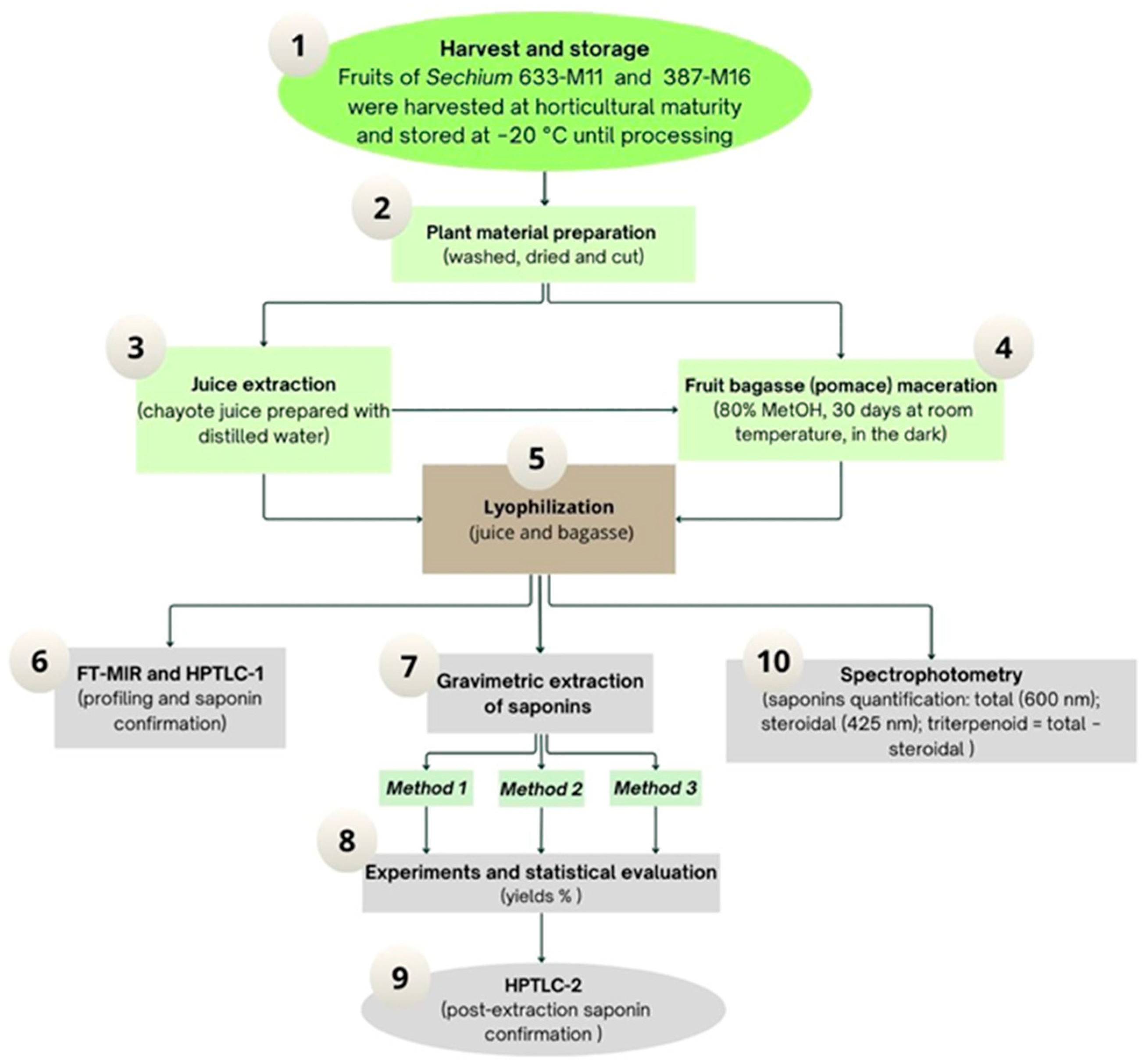
Figure 1. Flow chart of methods performed in the experimentation. Numbers indicate the chronological order of steps (1–10). Arrows indicate the direction of material flow; branching indicates parallel processing of juice and bagasse, and convergence indicates merging prior to downstream analyses. Color code: green = sample processing steps and the three gravimetric workflows compared (Methods 1–3); beige = shared lyophilization step; gray = analytical and evaluation modules (FT-MIR/HPTLC profiling, gravimetric extraction block, statistical evaluation, HPTLC post-extraction confirmation, and spectrophotometry).
Separations 13 00029 g001
Figure 2. Qualitative detection of saponins in lyophilized samples of juice and bagasse obtained from two Sechium 633-M11 and 387-M16. (a) Lyophilized samples of juice and bagasse. (b) Foam test on juice and bagasse samples.
Separations 13 00029 g002
Figure 3. Fourier Transform Mid-Infrared Spectroscopy (FT-MIR) analysis of juice and bagasse extracts from two genotypes of Sechium (633-M11 and 387-M16). FT-MIR spectra of lyophilized juice (A) and lyophilized bagasse extract (B) from Sechium 633-M11, and respective spectra (C,D) from S. 387-M16. (E) FT-MIR spectrum of escin, a reference saponin mixture.
Separations 13 00029 g003
Figure 4. High-Performance Thin-Layer Chromatography of lyophilized juices and bagasse extracts from Sechium spp. From 1A to 4A, the samples were developed with ethyl acetate–formic acid–acetic acid–water (100:11:11:26) and derivatized with the natural product reagent (NPR). From 1B to 4B, the samples were developed with ethyl acetate–formic acid–acetic acid–water (100:11:11:26) and derivatized with anisaldehyde-sulfuric acid. From 1C to 4C, the samples were developed with chloroform–ethyl acetate–acetone–formic acid (75:16.5:8.5) and derivatized with anisaldehyde-sulfuric acid. Samples 1 and 2 correspond to juice and biomass extract from 633-M11, and 3 and 4 correspond to juice and biomass extract from 387-M16. Color interpretation: For NPR-derivatized samples (1A–4A), yellow–orange/orange and yellow–greenish/yellow–green bands indicate glycosylate flavones and flavonols, respectively, while blue/light–blue bands represent phenolic acids. For anisaldehyde-sulfuric acid-derivatized samples (1B–4C), green–brown bands at low Rf indicate free carbohydrates, while violet–bluish and pink bands correspond to saponins and sapogenins.
Separations 13 00029 g004
Figure 5. Gravimetric yield (%) of saponin-enriched fractions—overall comparison by genotype. Facets show Sechium 387-M16 (left) and 633-M11 (right). Bars correspond to juice (blue) and bagasse (green) across extraction methods M1–M3. Different letters (a–c) above bars indicate statistically significant differences according to Tukey’s HSD test (α = 0.05) performed within each genotype across the six matrix × method combinations; bars sharing at least one letter are not significantly different. Values are mean ± SE; n = 3 independent extractions per genotype × matrix × method.
Separations 13 00029 g005
Figure 6. HPTLC profiles of saponin-enriched fractions from Sechium 633-M11 (a) and 387-M16 (b) obtained from juice and bagasse using gravimetric extraction methods (EM1–EM3). The samples were developed with ethyl acetate–formic acid–acetic acid–water (100:11:11:27) and derivatized with p-anisaldehyde-sulfuric acid. EM = Extraction methods (EM1–EM3); JE and BE = juice and bagasse extract controls, respectively. Color interpretation: violet–bluish spots (medium to low Rf) indicate saponins; greenish bands correspond to free carbohydrates; and yellow bands are associated with glycosylated flavonoids.
Separations 13 00029 g006
Figure 7. Triterpenic saponins in juice and bagasse extracts from Sechium 633-M11 and 387-M16, quantified by the p-anisaldehyde-sulfuric acid assay in 20:80 (Agave/Sechium) extract mixtures. Bars show mean ± SE (mg g−1 DW, protodioscin equivalents; n = 3 independent extractions). Different letters indicate significant differences according to Tukey’s HSD test (α = 0.05).
Separations 13 00029 g007
Table 1. Mass balance and extraction yield for lyophilized juice and hydroalcoholic bagasse extracts from two Sechium genotypes, 633-M11 and 387-M16. a Yield for juice is expressed on a fresh juice basis (FW%): lyophilized juice/fresh juice × 100. b Yield for bagasse is expressed relative to the hydroalcoholic extract mass: lyophilized bagasse/bagasse extract × 100. c Dry bagasse residue = remaining solid after extraction and drying.
SechiumFruit Mass (kg)Aqueous ExtractHydroalcoholic Extract
Juice (g)Lyophilized Juice (g)% Yield aBagasse Extract (g)Lyophilized Bagasse (g)% Yield bDry Bagasse Residue c (g)
633-M115.72144.0215.210.032573.262.32.42695
387-M165.23728.0136.13.652457.9176.97.19635
Table 2. Saponin extraction yields (%) in juice and bagasse extracts of Sechium 633-M11 and 387-M16, determined by three gravimetric methods (M1–M3).
SechiumMatrixMass of Crude Saponins (g g−1)Gravimetric Yield (%)
Method 1Method 2Method 3Method 1Method 2Method 3
633-M11Juice0.2110.3030.29921.1 ± 8.630.3 ± 0.729.9 ± 10.1
Bagasse0.2690.1090.44626.9 ± 1.710.9 ± 1.944.6 ± 2.2
387-M16Juice0.2160.2400.32821.6 ± 5.624.0 ± 4.332.8 ± 8.7
Bagasse0.4650.1060.60646.5 ± 10.413.5 ± 1.860.6 ± 4.9
n = 3 independent extractions per genotype × matrix × method. Percentages were computed from unrounded means; g g−1 and % correspond exactly.
Table 3. Summary of spectrophotometric saponins at 20:80 (Agave/Sechium). Units: mg g−1 (DW, PE). Values are mean ± SE (Standard Error, n = 3).
Sechium GenotypeMatrixSaponins (mg g−1)
Totals 600 nmSteroidal 425 nmTriterpenic 600–425 nm
387-M16Bagasse86.92 ± 0.8841.45 ± 2.5545.48 ± 1.74
Juice82.24 ± 1.2845.33 ± 0.4736.91 ± 1.67
633-M11Bagasse73.17 ± 2.3331.22 ± 0.4541.95 ± 1.89
Juice70.20 ± 3.7852.96 ± 2.8317.24 ± 0.96
Disclaimer/Publisher’s Note: The statements, opinions and data contained in all publications are solely those of the individual author(s) and contributor(s) and not of MDPI and/or the editor(s). MDPI and/or the editor(s) disclaim responsibility for any injury to people or property resulting from any ideas, methods, instructions or products referred to in the content.