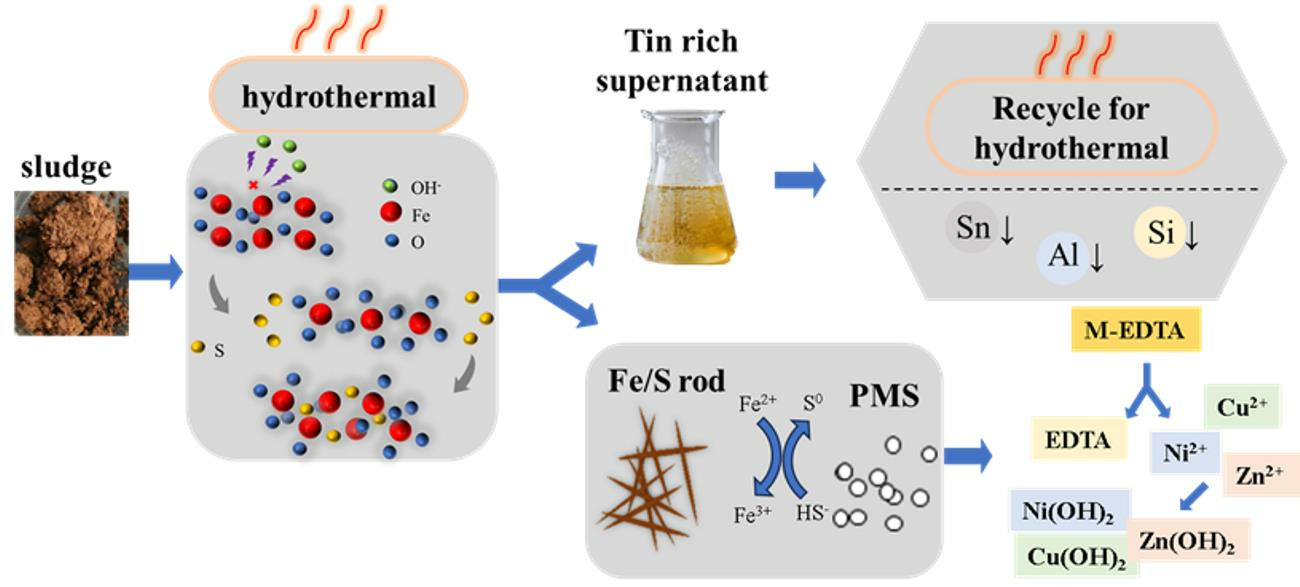

Hydrothermal Conversion of Sn-Bearing Sludge into Fe/S Rods for Efficient Heavy Metal Removal in Wastewater

Abstract
1. Introduction
2. Materials and Methods
2.1. Alkaline Hydrothermal Treatment of Sludge
2.2. Wastewater Treatment
2.3. Characterization
3. Results and Discussion
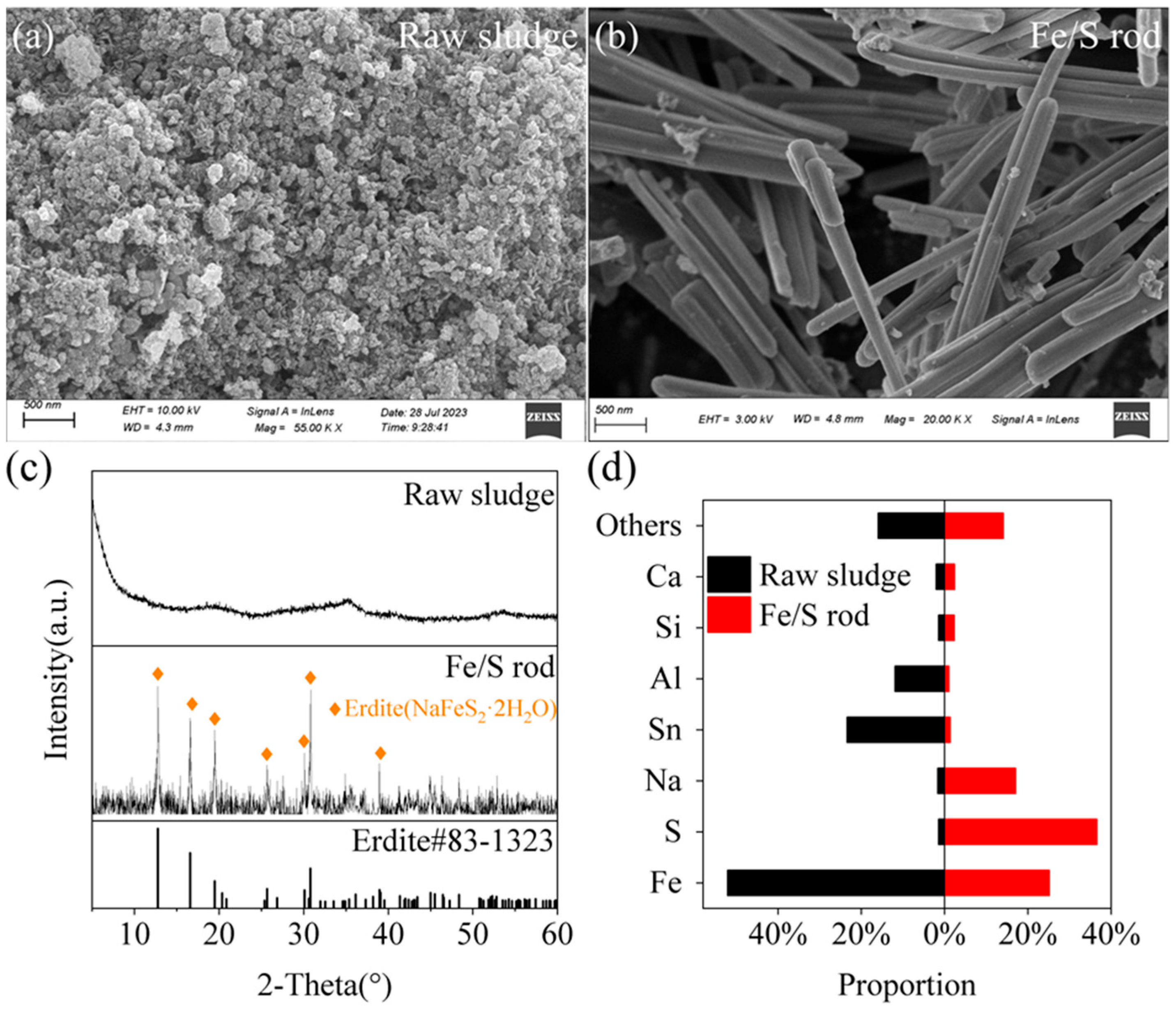
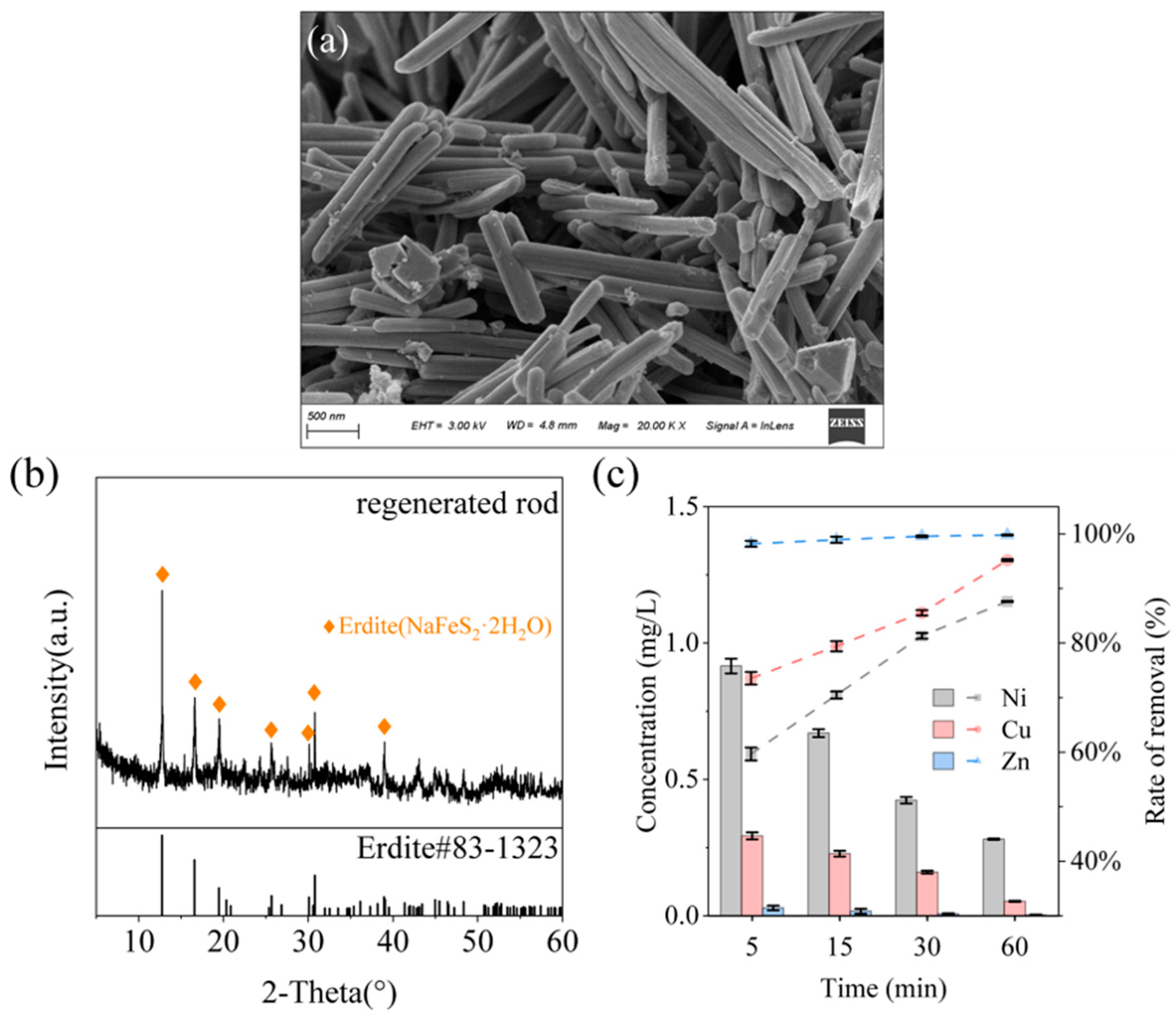
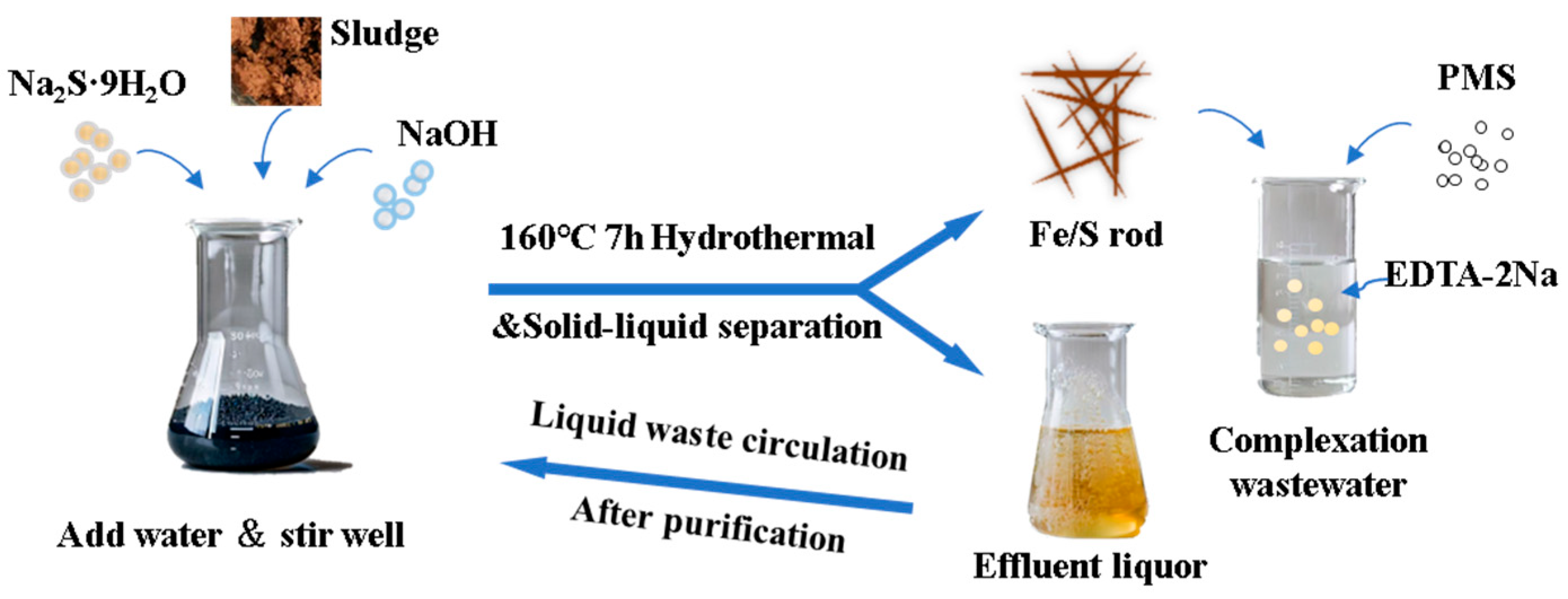
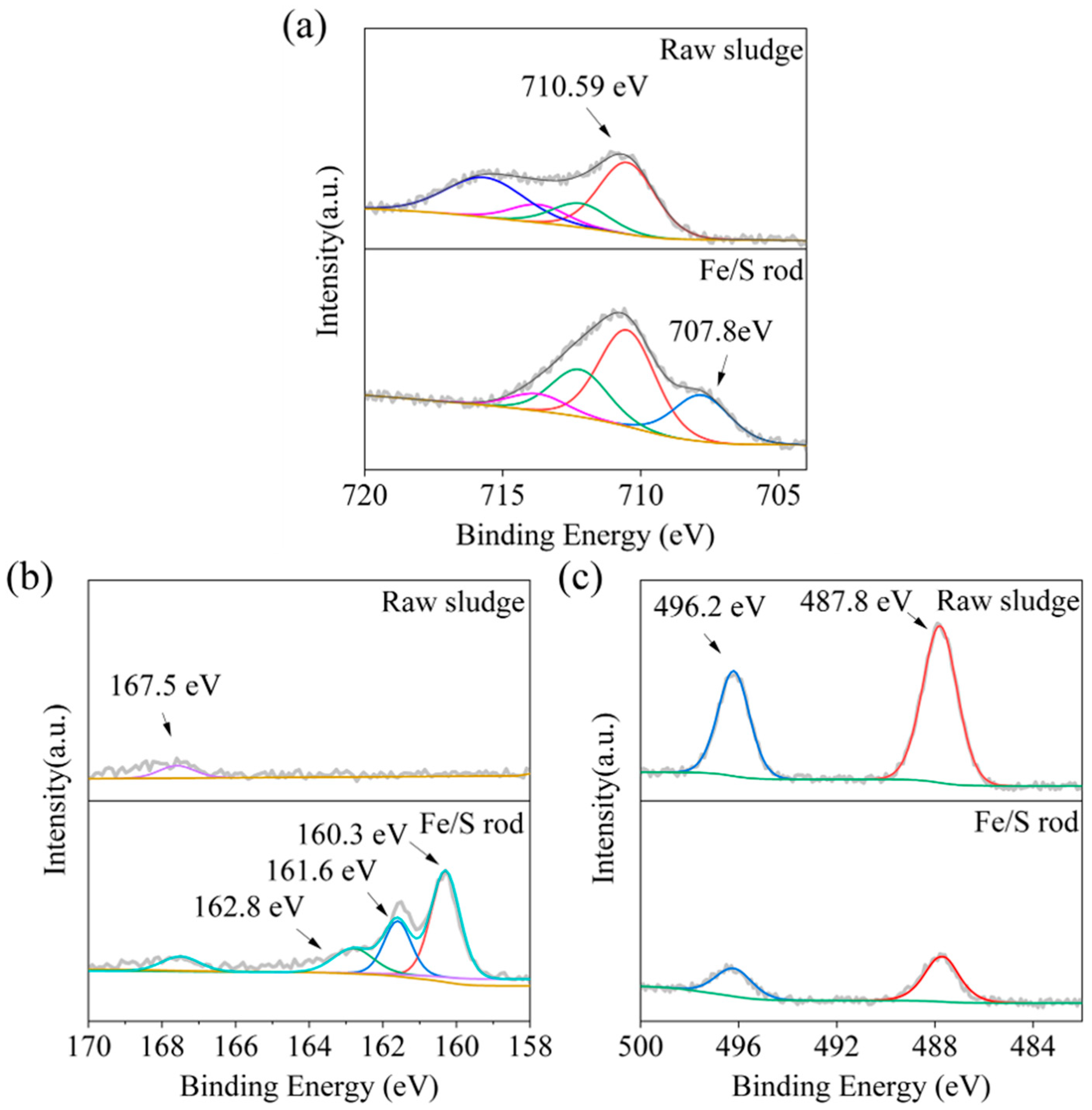
3.1. Conversion of Sludge into Fe/S Rods
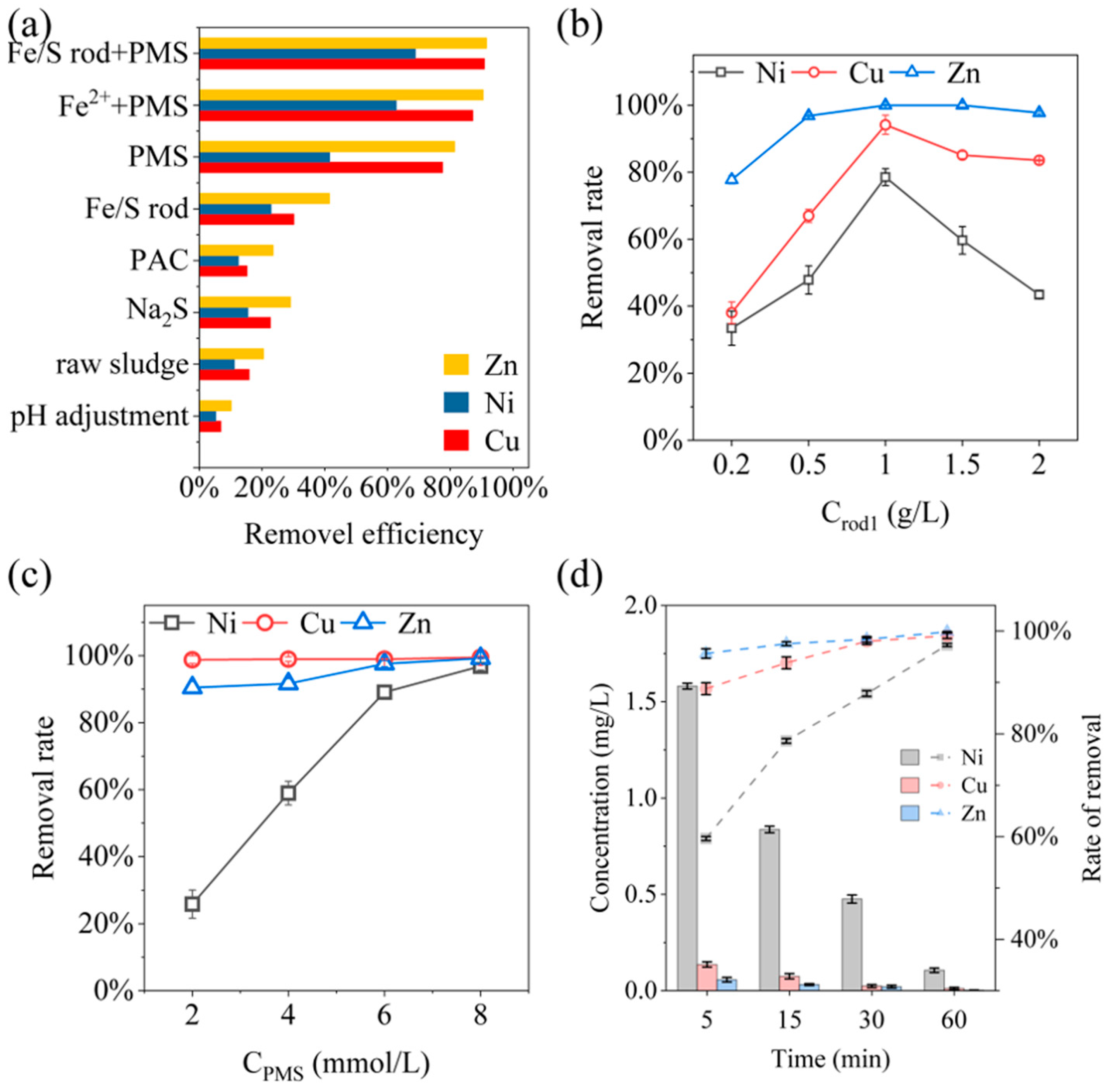
3.2. Application of Fe/S Rods in Wastewater Treatment
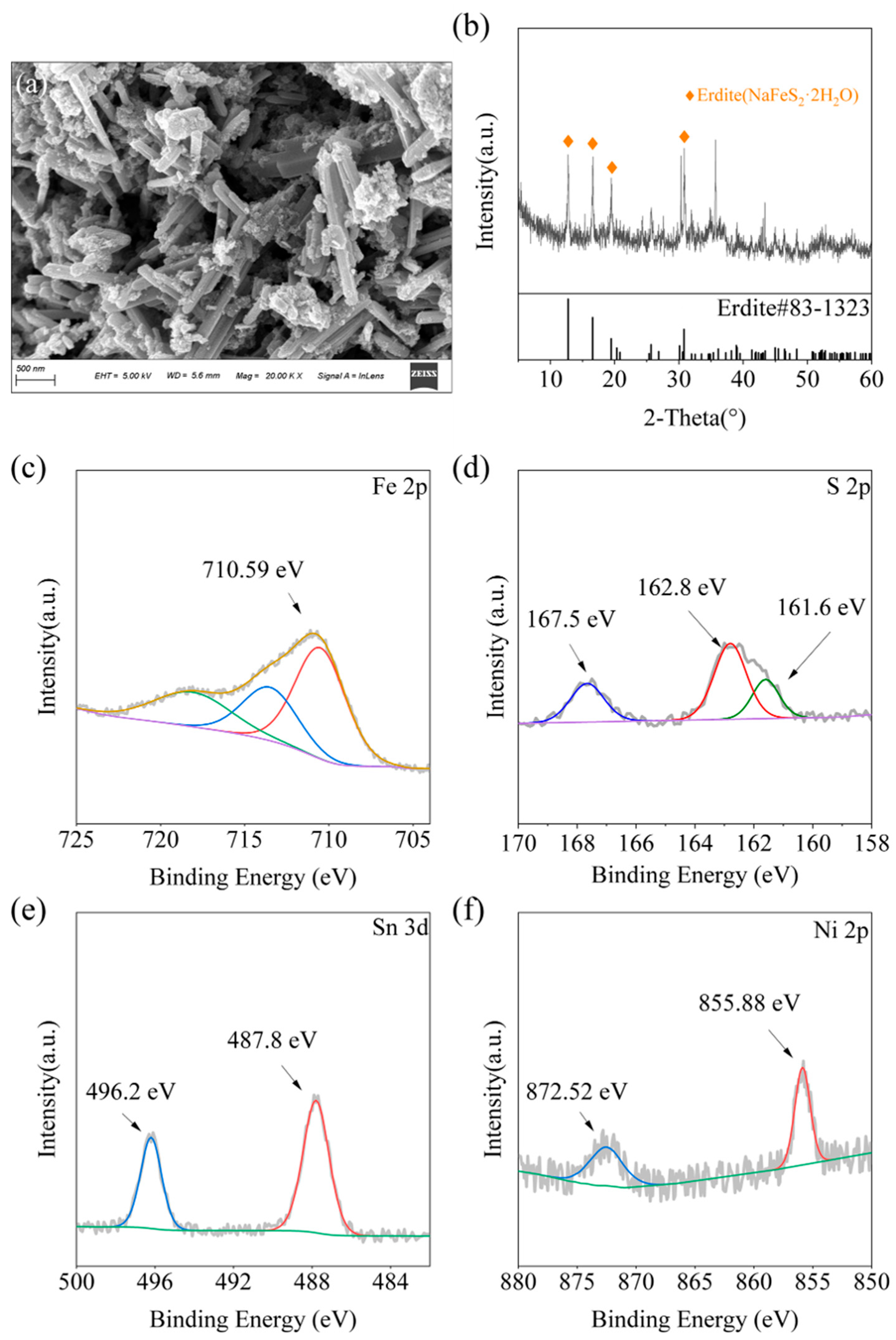
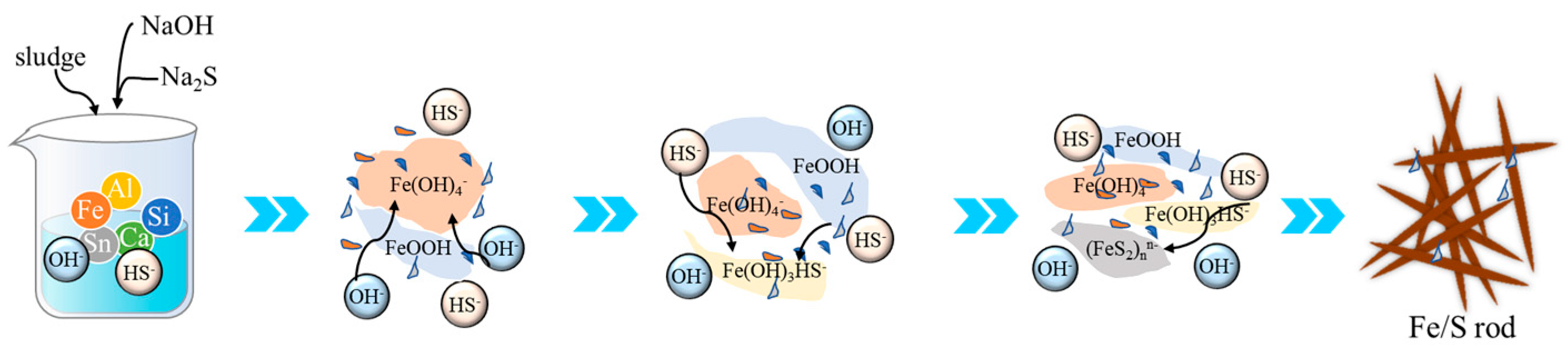
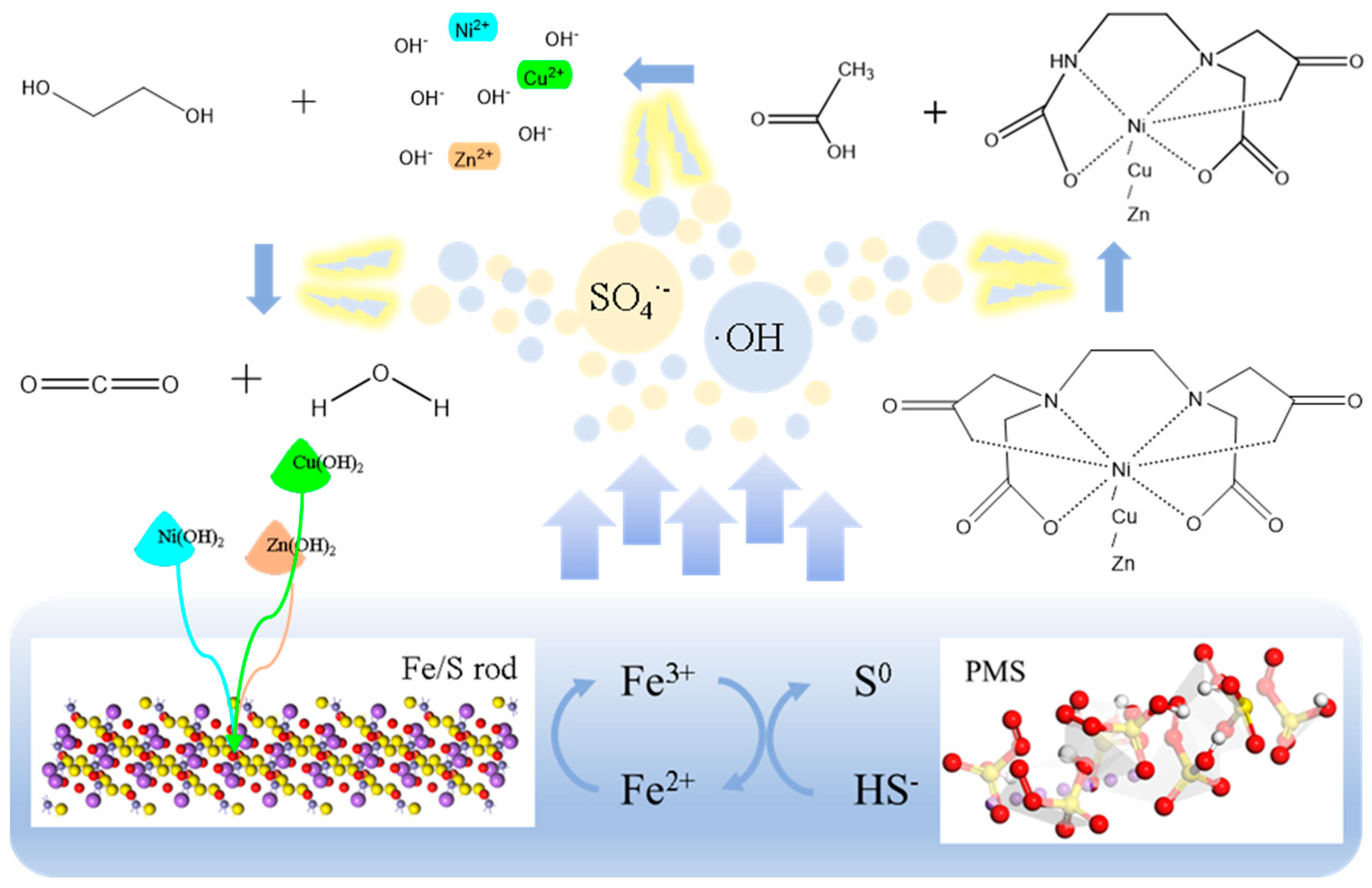
3.3. Mechanism of Fe/S Rod Formation and Application
3.4. Additional Applications
4. Conclusions
Author Contributions
Funding
Data Availability Statement
Conflicts of Interest
Abbreviations
| TLA | Three-letter acronym |
| LD | Linear dichroism |
| Fe/S rods | A rod-shaped material rich in iron and sulfur elements |
| PMS | Peroxymonosulfate |
| PAC | Polybasic aluminum chloride |
References
- Zhu, S.; Lan, X.; Zheng, M.; Lin, Y.; Li, S.; Htet, O.K.; Yang, W.; Qin, W.; Jadambaa, T.; Yu, Y.; et al. Hydrometallurgy recycling of heavy metals from electroplating sludge: Recent development and challenge. Chem. Eng. Res. Des. 2025, 214, 269–280. [Google Scholar] [CrossRef]
- Su, Z.; Zhang, Y.; Liu, B.; Lu, M.; Li, G.; Jiang, T. Extraction and Separation of Tin from Tin-Bearing Secondary Resources: A Review. Jom 2017, 69, 2364–2372. [Google Scholar] [CrossRef]
- Su, Z.J.; Zhang, Y.B.; Chen, J.; Liu, B.B.; Li, G.H.; Jiang, T. Selective separation and recovery of iron and tin from high calcium type tin- and iron-bearing tailings using magnetizing roasting followed by magnetic separation. Sep. Sci. Technol. 2016, 51, 1900–1912. [Google Scholar] [CrossRef]
- Yang, B.; Kong, L.X.; Xu, B.Q.; Liu, D.C.; Dai, Y.N. Recycling of metals from waste Sn-based alloys by vacuum separation. Trans. Nonferrous Met. Soc. China 2015, 25, 1315–1324. [Google Scholar] [CrossRef]
- Tian, Y.; Sun, B.; Tong, J.; Liu, H.; Jiang, J. Recovery and kinetic analysis of tin from halogen electroplating anode mud by alkali leaching. Environ. Prot. Chem. Ind. 2018, 38, 476–480. [Google Scholar]
- Sun, B.; Zhang, X.; Han, Y.; Bai, J.; Qin, Y.; Tang, Y.; Jiang, J. Kinetics of Zn powder displacement of tin in Sb3+-OH− system. Hydrometall. China 2019, 38, 385–390. [Google Scholar] [CrossRef]
- Long, Y.; Song, Y.; Huang, H.; Yang, Y.; Shen, D.; Geng, H.; Ruan, J.; Gu, F. Transformation behavior of heavy metal during Co-thermal treatment of hazardous waste incineration fly ash and slag/electroplating sludge. J. Environ. Manag. 2024, 351, 119730. [Google Scholar] [CrossRef]
- Chen, Y.; Liang, D.; Chen, H.; Zhu, S.; Wang, X.; Yang, J.; Xie, X.; Joseph, E.; Bian, D. Review of resource utilization of Fe-rich sludges: Purification, upcycling, and application in wastewater treatment. Environ. Rev. 2022, 30, 460–484. [Google Scholar] [CrossRef]
- Jiang, Y.; Tian, Q.; Zhang, H.; Yue, X.; Xue, S.; Qiu, F.; Zhang, T. One-step removal of anionic/cationic heavy metal ions from wastewater by magnetic amphoteric adsorbent. J. Water Process Eng. 2024, 65, 105847. [Google Scholar] [CrossRef]
- Zeng, H.; Yin, C.; Qiao, T.; Yu, Y.; Zhang, J.; Li, D. As(V) Removal from Water Using a Novel Magnetic Particle Adsorbent Prepared with Iron—Containing Water Treatment Residuals. ACS Sustain. Chem. Eng. 2018, 6, 14734–14742. [Google Scholar] [CrossRef]
- Tian, Q.; Zhu, Z.; Jiang, Y.; Zhao, B.; Yang, D.; Qiu, F.; Zhang, T. Upcycling of nickel from electroplating sludge as spinel/MnO2 nanowires membrane for durable emulsion separation in harsh environments. Chem. Eng. J. 2025, 507, 160508. [Google Scholar] [CrossRef]
- Chen, Y.; Zhang, Y.; Liu, Y.; Zhu, S.; Liang, D.; Sun, T.; Xie, X.; Wang, X. Resource utilization of hazardous Cr/Fe-rich sludge: Synthesis of erdite flocculant to treat real electroplating wastewater. J. Environ. Health Sci. Eng. 2022, 20, 509–519. [Google Scholar] [CrossRef]
- Kedara Shivasharma, T.; Sahu, R.; Rath, M.C.; Keny, S.J.; Sankapal, B.R. Exploring tin oxide based materials: A critical review on synthesis, characterizations and supercapacitive energy storage. Chem. Eng. J. 2023, 477, 147191. [Google Scholar] [CrossRef]
- Likosova, E.M.; Keller, J.; Poussade, Y.; Freguia, S. A novel electrochemical process for the recovery and recycling of ferric chloride from precipitation sludge. Water Res. 2014, 51, 96–103. [Google Scholar] [CrossRef]
- Jiang, Y.; Tian, Q.; Xu, J.; Qiu, F.; Zhang, T. Enhanced separation of dual pollutants from wastewater containing Cr (VI) and oil via Fe-doped sludge derived membrane. Chem. Eng. Sci. 2024, 292, 120020. [Google Scholar] [CrossRef]
- Zhu, S.; Song, X.; Chen, Y.; Dong, G.; Sun, T.; Yu, H.; Yu, Y.; Xie, X.; Huo, M. Upcycling of groundwater treatment sludge to an erdite nanorod as a highly effienct activation agent of peroxymonosulfate for wastewater treatment. Chemosphere 2020, 252, 126586. [Google Scholar] [CrossRef] [PubMed]
- Teng, R.; Shi, D.N.; Pan, Y.T.; Jiang, J.Y.; Song, H.Y.; Tan, W. Synthesis of mesoporous MIL-100(Fe) from acid mine drainage sludge for norfloxacin removal: Industrial sludge high value utilization, adsorbent performance and contaminant removal mechanisms. Colloids Surf. A-Physicochem. Eng. Asp. 2024, 684, 133032. [Google Scholar] [CrossRef]
- Zhu, Y.; Fan, W.; Feng, W.; Wang, Y.; Liu, S.; Dong, Z.; Li, X. A critical review on metal complexes removal from water using methods based on Fenton-like reactions: Analysis and comparison of methods and mechanisms. J. Hazard. Mater. 2021, 414, 125517. [Google Scholar] [CrossRef]
- Albuquerque, T.L.M.; Mattos, C.A.; Scur, G.; Kissimoto, K. Life cycle costing and externalities to analyze circular economy strategy: Comparison between aluminum packaging and tinplate. J. Clean. Prod. 2019, 234, 477–486. [Google Scholar] [CrossRef]
- Wang, L.; Jiang, J.; Pang, S.-Y.; Gao, Y.; Zhou, Y.; Li, J.; Yang, Y.; Ma, J.; Zhang, T. Further insights into the combination of permanganate and peroxymonosulfate as an advanced oxidation process for destruction of aqueous organic contaminants. Chemosphere 2019, 228, 602–610. [Google Scholar] [CrossRef]
- Zhao, W.; Wei, Z.; Zhang, X.; Ding, M.; Huang, S. PH-controlled MnFe2O4@ SnS2 nanocomposites for the visible-light photo—Fenton degradation. Mater. Res. Bull. 2020, 124, 110749. [Google Scholar] [CrossRef]
- Qu, M.; Xiong, J.; Zhou, J.; Wang, L.; Hu, T.; Liu, F.; Zhang, Q. Modified water treatment residual serves as an adsorbent for the removal of heavy metals from water: A review. J. Ind. Eng. Chem. 2025, 146, 122–135. [Google Scholar] [CrossRef]
- Essalmi, S.; Lotfi, S.; BaQais, A.; Saadi, M.; Arab, M.; Ait Ahsaine, H. Design and application of metal organic frameworks for heavy metals adsorption in water: A review. RSC Adv. 2024, 14, 9365–9390. [Google Scholar] [CrossRef] [PubMed]
- Sun, T.; Chen, Y.; Zhu, S.; Wang, Z.; Liu, J.; Xie, X.; Yu, H. Synthesis of novel erdite nanorods for the activation of peroxymonosulfate during p-nitrophenol wastewater treatment. Environ. Sci. Pollut. Res. 2021, 28, 44408–44419. [Google Scholar] [CrossRef]
- Liu, Z.; Li, H.; Yao, H.; Zhuang, Y.; Gao, R.; Wang, Z.; Zhu, Z.; Lan, H.; Li, Z.; Cai, W. A PEGylated deep eutectic solvent for “bubbling” synthesis of SnO2/SnS heterostructure for the stable lithium-ion storage. J. Colloid Interface Sci. 2024, 682, 995–1005. [Google Scholar] [CrossRef] [PubMed]
- Wang, X.; Feng, Z.; Xiao, B.; Zhao, J.; Ma, H.; Tian, Y.; Pang, H.; Tan, L. Polyoxometalate-based metal-organic framework-derived bimetallic hybrid materials for upgraded electrochemical reduction of nitrogen. Green Chem. 2020, 22, 6157–6169. [Google Scholar] [CrossRef]
- Hu, T.; Wang, H.; Ning, R.; Qiao, X.; Liu, Y.; Dong, W.; Zhu, S. Upcycling of Fe-bearing sludge: Preparation of erdite-bearing particles for treating pharmaceutical manufacture wastewater. Sci. Rep. 2020, 10, 12999. [Google Scholar] [CrossRef]
- Ghahremaninezhad, A.; Dixon, D.G.; Asselin, E. Electrochemical and XPS analysis of chalcopyrite (CuFeS2) dissolution in sulfuric acid solution. Electrochim. Acta 2013, 87, 97–112. [Google Scholar] [CrossRef]
- Piché, S.; Larachi, F. Dynamics of pH on the oxidation of HS—With iron (III) chelates in anoxic conditions. Chem. Eng. Sci. 2006, 61, 7673–7683. [Google Scholar] [CrossRef]
- Spuhler, D.; Andrés Rengifo-Herrera, J.; Pulgarin, C. The effect of Fe2+, Fe3+, H2O2 and the photo—Fenton reagent at near neutral pH on the solar disinfection (SODIS) at low temperatures of water containing Escherichia coli K12. Appl. Catal. B Environ. 2010, 96, 126–141. [Google Scholar] [CrossRef]
- Wu, D.; Han, J.; Liu, W.; Jiao, F.; Qin, W. Preparation of Calcium Stannate from Lead Refining Dross by Roast–Leach–Precipitation Process. Minerals 2019, 9, 283. [Google Scholar] [CrossRef]



Disclaimer/Publisher’s Note: The statements, opinions and data contained in all publications are solely those of the individual author(s) and contributor(s) and not of MDPI and/or the editor(s). MDPI and/or the editor(s) disclaim responsibility for any injury to people or property resulting from any ideas, methods, instructions or products referred to in the content. |
© 2025 by the authors. Licensee MDPI, Basel, Switzerland. This article is an open access article distributed under the terms and conditions of the Creative Commons Attribution (CC BY) license (https://creativecommons.org/licenses/by/4.0/).
Share and Cite
Ma, S.; Yang, W.; Yang, W.; Chen, Y. Hydrothermal Conversion of Sn-Bearing Sludge into Fe/S Rods for Efficient Heavy Metal Removal in Wastewater. Separations 2025, 12, 153. https://doi.org/10.3390/separations12060153
Ma S, Yang W, Yang W, Chen Y. Hydrothermal Conversion of Sn-Bearing Sludge into Fe/S Rods for Efficient Heavy Metal Removal in Wastewater. Separations. 2025; 12(6):153. https://doi.org/10.3390/separations12060153
Chicago/Turabian StyleMa, Shengyao, Wu Yang, Weilu Yang, and Yu Chen. 2025. "Hydrothermal Conversion of Sn-Bearing Sludge into Fe/S Rods for Efficient Heavy Metal Removal in Wastewater" Separations 12, no. 6: 153. https://doi.org/10.3390/separations12060153
APA StyleMa, S., Yang, W., Yang, W., & Chen, Y. (2025). Hydrothermal Conversion of Sn-Bearing Sludge into Fe/S Rods for Efficient Heavy Metal Removal in Wastewater. Separations, 12(6), 153. https://doi.org/10.3390/separations12060153