All articles published by MDPI are made immediately available worldwide under an open access license. No special
permission is required to reuse all or part of the article published by MDPI, including figures and tables. For
articles published under an open access Creative Common CC BY license, any part of the article may be reused without
permission provided that the original article is clearly cited. For more information, please refer to
https://www.mdpi.com/openaccess.
Feature papers represent the most advanced research with significant potential for high impact in the field. A Feature
Paper should be a substantial original Article that involves several techniques or approaches, provides an outlook for
future research directions and describes possible research applications.
Feature papers are submitted upon individual invitation or recommendation by the scientific editors and must receive
positive feedback from the reviewers.
Editor’s Choice articles are based on recommendations by the scientific editors of MDPI journals from around the world.
Editors select a small number of articles recently published in the journal that they believe will be particularly
interesting to readers, or important in the respective research area. The aim is to provide a snapshot of some of the
most exciting work published in the various research areas of the journal.
State Key Laboratory of Chemical Resource Engineering, Beijing University of Chemical Technology, Beijing 100029, China
2
Engineering Research Center of Preparation Technology of Ultra-Pure Chemicals for Integrated Circuits, Ministry of Education, Beijing University of Chemical Technology, Beijing 100029, China
*
Author to whom correspondence should be addressed.
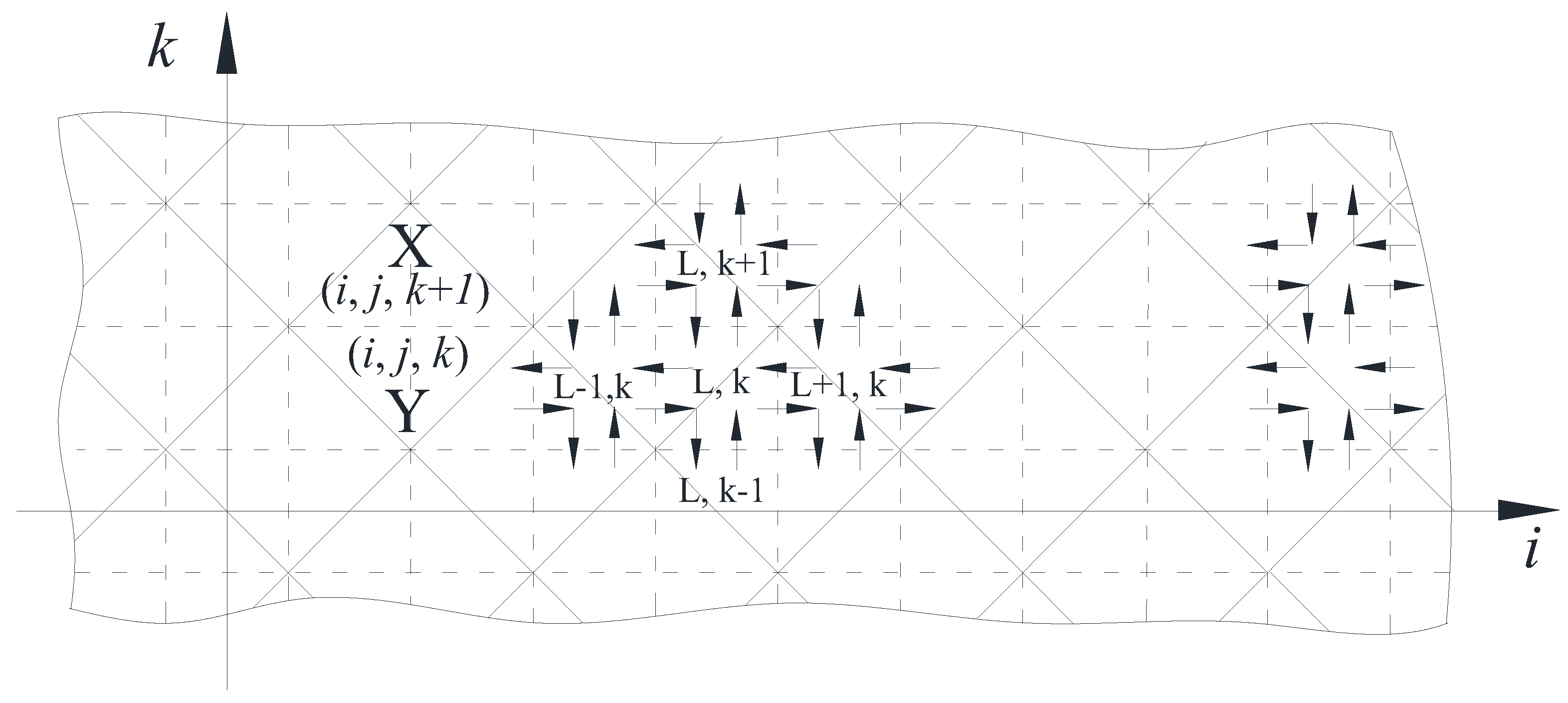
This study presents the development and comprehensive evaluation of a novel structured packing, termed ‘BH’ packing (derived from Beijing University of Chemical Technology), alongside the introduction of an innovative gas disturbance model and its successful industrial implementation. Addressing inherent limitations of traditional structured packings—such as liquid film aging and high mass transfer resistance in straight corrugated channels—the BH packing incorporates a uniquely designed alternating-angle corrugation (45°–30°–45°). This structural innovation actively disrupts the liquid film, intensifies gas–liquid interaction, and significantly enhances mass transfer efficiency. Experimental assessments demonstrate that the BH-250 packing outperforms conventional corrugated plate packings in gas distribution uniformity. Furthermore, the newly developed gas disturbance model can accurately capture the gas mixing dynamics within the packed bed. Its prediction results are more accurate than those of traditional mixing tank models, especially in regions near the tower wall. In industrial practice, the application of BH packing has led to remarkable improvements in product purity: methanol purity reached 99.95%, hexafluorobutene achieved 6N grade, and dichlorosilane impurities were reduced to parts per trillion (ppt) levels. These outcomes underscore the substantial contribution of BH packing to advancing separation efficiency and product quality in high-purity chemical production.
Distillation is one of the most widely used operations for separating liquid mixtures in the chemical and petroleum industries [1]. Packed columns are essential distillation equipment due to their high capacity, low pressure drop, small liquid holdup, and high mass transfer efficiency [2]. Consequently, the rational design of packed columns and the development and application of novel high-efficiency packings and column internals have been a focal point of research.
Packings are primarily classified into random packings and structured packings. In comparison, structured packings exhibit lower pressure drops due to their regular geometric structure, which constrains the flow pathways of the gas–liquid phases. As a result, structured packings are highly favored in applications requiring high separation efficiency, as well as in vacuum distillation and the separation of heat-sensitive materials [3]. Continuous improvements to the structure of packings are expected to enhance their performance. Over several decades of exploration and research, a variety of novel structured packings have emerged, such as the Mellapak series of linear corrugated packings, Montz-pak packings, Mellapak Plus packings, and wire gauze packings. The main differences among these packings lie in the corrugation angle, material, and perforation structure. Currently, the most widely used packing corrugation angle is 45°, which ensures sufficient gas–liquid contact and relatively high mass transfer efficiency [4]. However, when the corrugation angle of the packing sheet is 60° to the horizontal, the column pressure drop is reduced and the flux limit increases, whereas the mass transfer efficiency significantly decreases. The internal structure of the packing influences the fluid flow behavior, which in turn impacts the mass transfer and mixing efficiencies.
Early researchers focused on random packings to describe the flow distribution within packings. Tour and Lerman [5,6,7] applied the normal distribution law to predict liquid distribution in random packings, fitting distribution constants through experimental data. However, this model was only applicable under point-source feed conditions. Cihla and Schmidt [8,9] derived a diffusion model based on the randomness of liquid flow, which required solving under different boundary conditions. Subsequent studies introduced a series of modifications to this model [10,11,12]. Gunn [13] combined the fluid continuity equation with the concept of the stream function Ψ, deriving a liquid flow distribution equation for packed columns expressed in terms of the stream function. Onda [14] modified the liquid diffusion factor D, making it a function of packing size, operating parameters, and liquid properties. Porter [15] integrated the diffusion model with Lespinasse’s [16] preferred path model to propose the rivulet model. Jameson et al. [17] adopted a finite difference approach to introduce the contact point model, which avoided the analysis of wall flow boundary conditions and thus aligned more closely with practical scenarios.
The development of liquid distribution models for structured packings emerged relatively later. Olujic [18] proposed the LDESP (Liquid Distribution Estimation for Structured Packings) model, which divides the packed column into numerous small computational units, with liquid distributed according to specific flow allocation rules within each unit. Chuang et al. [19,20] also introduced a similar model, achieving satisfactory results in predicting liquid distribution for both random and structured packings. Aroonwilas [21,22] established a stochastic liquid distribution model for perforated packing surfaces based on the structural characteristics of the intersection points network of packing sheets.
In addition to model development, numerous studies have investigated the mechanisms of liquid distribution in structured packings. Alekseenko et al. [23] employed fiber optic sensors to measure the liquid film thickness distribution on corrugated sheets, revealing that the liquid film thickness is maximized near the contact points of the packing sheets, forming a distinct meniscus where liquid redistribution occurs. This finding was subsequently corroborated by Kumar et al. [24] through CFD simulations. Pavlenko et al. [25] explored the hydrodynamic characteristics of liquid nitrogen film flow on complex geometric surfaces, demonstrating that micro-textures alter liquid distribution and flow patterns on corrugated sheets. Janzen et al. [26] quantitatively described the liquid film distribution in structured packings using X-ray tomography and evaluated the mass transfer efficiency of the packing layers. Liu et al. [27] utilized a CFD multiscale approach to study liquid distribution in perforated structured packings, introducing new parameters to account for the influence of surface perforations on liquid film distribution. Ambekar et al. [28] investigated the impact of perforations on local hydrodynamics of gas–liquid flow in structured packings, concluding that the number of perforations predominantly governs liquid distribution.
Compared to studies on liquid distribution, research on gas distribution in packed columns is relatively limited. Bernard and Wilhelm [29] conducted early investigations into the radial diffusion of gas flow in random packings within small columns. They utilized the Peclet number (Per) to characterize the degree of radial gas mixing, observing that the Per number decreases with increasing surface roughness of the packing. Subsequently, Fahien and Smith [30] examined radial gas diffusion under turbulent flow conditions in columns of varying sizes and with spherical particles. Their results indicated that larger column diameters and particle sizes adversely affect radial gas mixing. In 1959, Fahien and Dorweiler [31] further explored mass transfer and radial gas diffusion at low gas velocities (i.e., in the laminar or transitional flow regimes), proposing a semi-empirical numerical method to calculate Per values at different radial positions.
Our research team previously proposed a structured packing (BH packing) [32,33], featuring a zigzag flow channel design aimed at enhancing gas flow and liquid film disturbance, thereby promoting gas–liquid mixing and mass transfer. In this study, the gas distribution performance of BH packing was tested, and compared with Mellapak 250Y packing, its distribution performance was better than that of Mellapak 250Y packing. The mathematical model for gas flow in BH packing is developed (referred to as the “gas disturbance” model) and validated this model through cold-mode experiments. The aim is to address the limitations of traditional packings by introducing a novel BH packing with a zigzag corrugation structure and developing a corresponding “gas disturbance model” to accurately describe gas mixing behavior. The work contributes to both the fundamental understanding of gas–liquid flow in structured packings and the practical design of high-efficiency separation processes for ultra-pure chemical production.
2. Development and Experimental Investigation of BH Packing
2.1. Development of BH Packing
The most widely used structured packing is the metal perforated corrugated packing represented by Mellapak, where the flow channels of the packing are inclined at a certain angle (30° to 60°). When the gas and liquid phases flow counter currently through the packing channels, a “Z”-shaped flow is formed, facilitating mass transfer. Additionally, for systems with low surface tension, a very thin liquid film can be evenly formed on the packing surface through the capillary action of mesh, allowing even a small amount of liquid to cover the entire column cross-section effectively. However, for systems with high surface tension, such as water and glycerol, the capillary action of mesh or the surface roughness of the packing alone cannot form a uniform and effective liquid film. Therefore, traditional packings can meet the separation efficiency requirements for products with lower purity demands. However, for high-purity product production, high-efficiency distillation and absorption processes, it is difficult to meet the needs of chemical industries by relying on the mass transfer performance of conventional packings alone. Therefore, BH packing has been developed. BH packing has enhanced mass transfer and gas distribution capabilities, and its application potential can be extended to harsh separation processes in fields such as petroleum refining and natural gas processing. For example, in the vacuum distillation column of petroleum refining, its low pressure drop characteristics and high efficiency are crucial for the separation of heavy fractions. Similarly, in natural gas processing, the improved surface utilization and liquid distribution performance of this packing may optimize the performance of gas desulfurization (such as amine-based removal of CO2 and H2S) and dehydration units. Its unique corrugation-induced turbulence not only maintains active mass transfer but also reduces the risk of channeling and fouling—both common challenges in the handling of complex hydrocarbon streams.
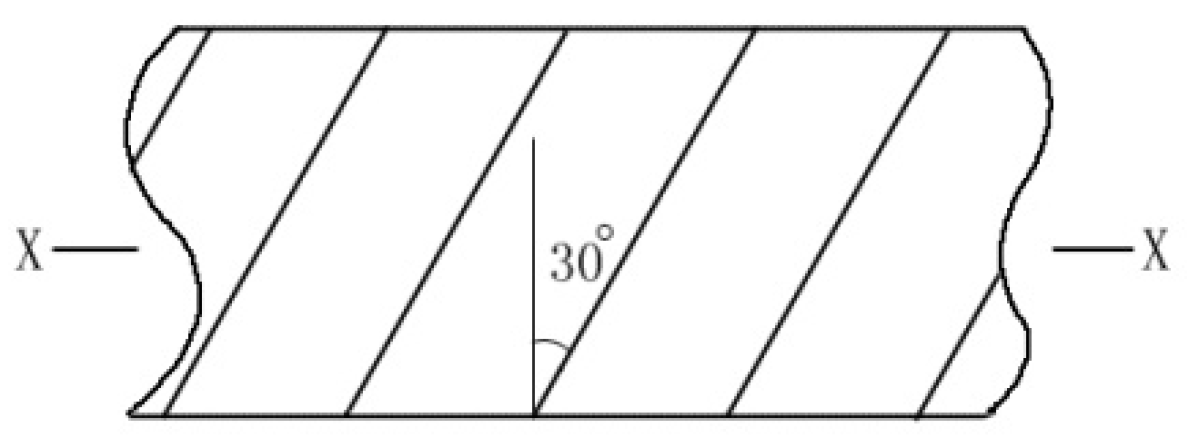
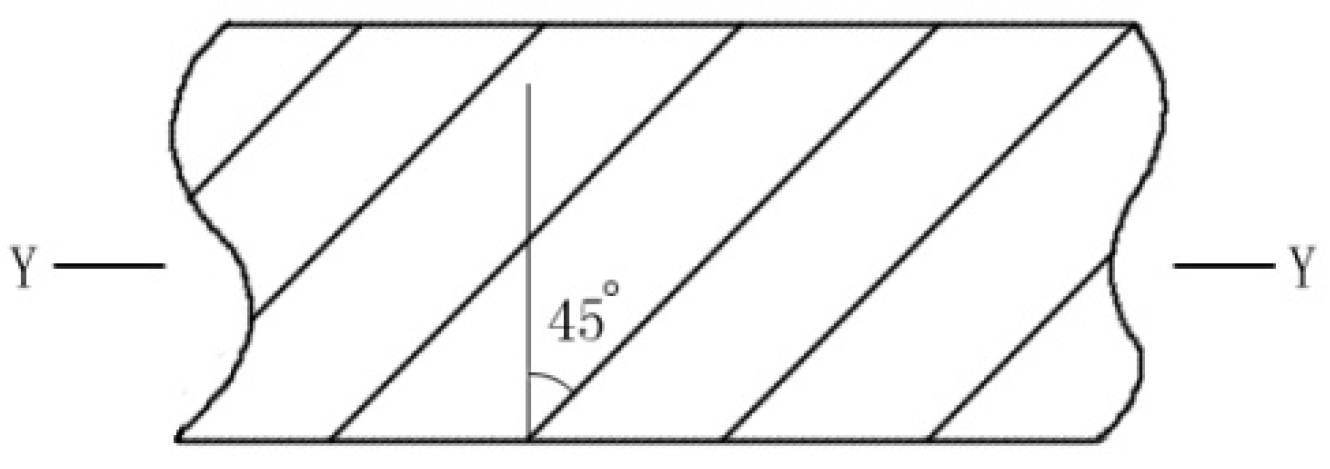
The fluid dynamics and mass transfer characteristics of the gas–liquid two-phase flow within the packing tower were investigated: In each layer of the packing, due to the straight line of the traditional corrugated packing (Figure 1 and Figure 2), when the liquid flows on the packing surface, the liquid flow flows directly down along the corrugated line of the packing, and the liquid flow direction is difficult to change. During the downward flow with the progress of the mass transfer process, the light components on the surface of the liquid film enter the gas phase, which causes the concentration of the liquid phase to gradually decrease, thus reducing the mass transfer driving force and causing gradual aging of the liquid film. Furthermore, for systems with high surface tension, such as glycerol and water, it is difficult for the liquid to form an even film on the packing surface. Instead, the liquid often exists as droplets, which quickly roll off from the packing surface, reducing the effective gas–liquid contact area and lowering the mass transfer efficiency. The main reason for the problem is that in traditional linear-type packing layers, the gas and liquid flows are separated into strands, which are difficult to sufficiently mix and contact, especially for systems with high surface tension.
To address the above issues, our research team proposed a structured packing, named ‘BH’ packing (an acronym derived from the initials of the pinyin of Beijing University of Chemical Technology), with the development idea being: (1) Special physical and chemical treatments are applied to the surface of the packing to enhance its wettability towards the liquid films, thereby increasing the effective mass transfer area; (2) The corrugation lines of the packing are designed to have a zigzag variation, which causes changes in the flow direction of the liquid film at the intersection points of the corrugation lines, resulting in disturbances in the flowing liquid film and intensifying the gas–liquid mass transfer process.
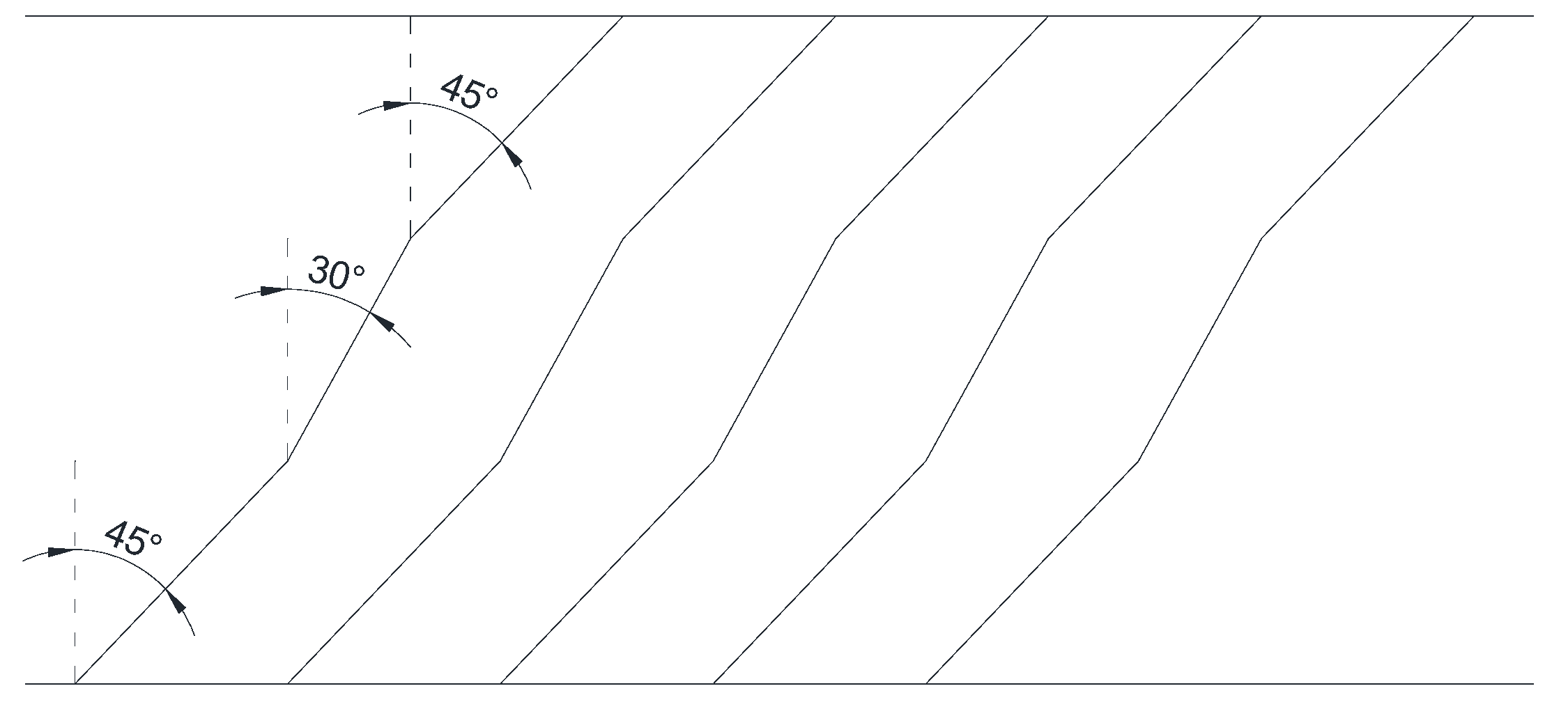
Since the corrugated structure of BH packing with alternating angles (45°–30°–45°) (Figure 3), which differs from the straight corrugated flow channels of traditional Mellapak type packing. Therefore, when the liquid film flows down the packing surface to the turning point, the flow direction changes, causing significant disturbances in the flowing liquid film. Similarly, when gas flows upward, it experiences the same situation. This disturbance not only reduces the thickness of the laminar sublayer but also promotes surface renewal of the liquid film, thereby effectively lowering mass transfer resistance and improving efficiency. Additionally, the increased specific surface area and improved surface utilization further enhance mass transfer performance. Since mass transfer efficiency is proportional to the square root of the surface renewal rate, these combined optimizations significantly boost the overall mass transfer efficiency of the structured packing.
2.2. Gas Mixing Experimental Systemand Process
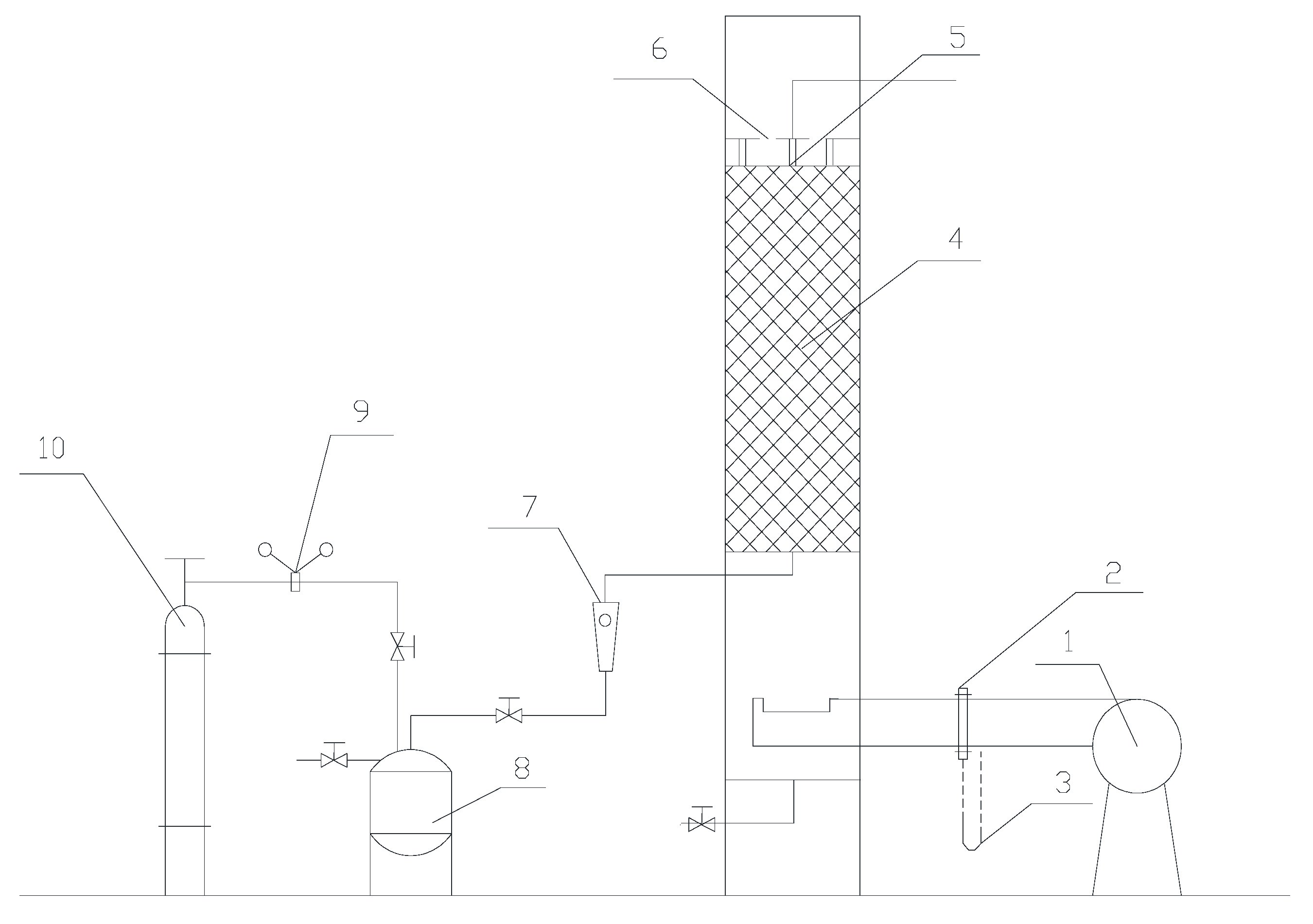
Detailed hydrodynamic and mass transfer performance experiments were performed on the BH packing before the gas distribution performance tests. Within the experimental range, the mass transfer efficiency of BH packing improved by up to 15.6% compared to Mellapak, as detailed in reference [32]. The HETP values of BH packing and Mellapak 250Y packing are listed in Table 1. The gas mixing experimental setup and procedure are shown in Figure 4. A CO2 gas stream from a cylinder, used as a tracer, passes through a pressure-reducing valve and a buffer tank, is metered by a rotor flowmeter, and is injected into the tower via a small injection tube located at the center of the tower bottom. The flow rate of the tracer gas varied with the air flow rate in the column, maintaining a volume ratio of approximately 1.0%. The concentration of the tracer gas was measured at different radial distances. The mixing performance of the gas flow within the packing layer was determined based on the concentration distribution of the tracer gas in the gas stream. A CYES-II CO2 gas analyzer (Producer: NANBEI Instruments; Town: Zhengzhou; Country: China) was used to measure the CO2 concentration in the gas. The CYES-II CO2 gas analyzer used in the experiment was calibrated at multiple points using CO2 standard gases of known concentration strictly in accordance with the manufacturer’s operating procedures before the experiment to ensure the accuracy of the measurement data.
Sampling Method: To overcome the limitations of existing samplers (such as airflow interference from cover-type samplers and the inability of single-point mobile samplers to perform multi-point sampling simultaneously), we developed a novel cross-shaped sampler assembly. The assembly’s support frame consists of two crossbar strips intersecting to form a cross shape. Each strip has axisymmetric holes, with each hole having a diameter of Φ30 mm. The holes are positioned at 0.50 and 0.94 along the longitudinal axis, and at 0.20 and 0.80 along the transverse axis, totaling 9 holes. The sampler has a cylindrical shape (Φ30 mm) with a radially conical inner bore. The bottom opening diameter is 20 mm, the total length is 75 mm, the cone angle is 25°, and the top is connected to a Φ8 mm tube, which is mounted on the cross-shaped sampler support frame.
The BH-250 type packing used in the experiment (where ‘250’ indicates its specific surface area is 250 m2/m3), its geometric parameters are shown in Table 2. The packed column had a diameter of 500 mm, and the experiments were conducted at room temperature and atmospheric pressure, with superficial gas velocities ranging from 0.2 to 3.0 m·s−1.
3. Results and Discussion
In random packing columns, the diffusion model describes the distribution state ideally. However, for the single-layer structured corrugated packing, the diffusion model is less suitable. This is because the diffusion model equations require that the gas flow mixing state within the packing layer generally satisfies symmetry conditions, whereas the mixing of gas flow in different directions within a single packing layer is asymmetric. Nevertheless, by rotating adjacent single-layer packings by 90° relative to each other, the gas flow can be considered to approximately meet the axisymmetric condition after passing through multiple layers. Therefore, this study still employs the diffusion model to describe gas mixing within the corrugated packing. At the same time, while the convection term of the model primarily involves axial flow, the radial tracer movement is explained by the diffusion term (Er) and concentrations (Ci) that explicitly consider different radial positions.
where C represents the concentration of the tracer in the gas stream; Er and Ez denote the radial and axial diffusion coefficients; r indicates the radial position; t represents time; u is the superficial gas velocity, computed as the volumetric air flow rate divided by the empty column’s cross-sectional area; and Z signifies the height of the packing layer.
Roemer [34] studied the effect of axial diffusion Ez in small diameter packing towers (e.g., Φ200 mm), demonstrated that the effect of axial mixing on the degree of airflow mixing at different N = Ez/Er is negligible—ignoring Ez introduces only a 10% error in Per’s calculations. Xu et al. [35] confirmed this and calculated this aspect in a packing tower with a tower diameter of Φ287, and the calculation error caused by ignoring axial diffusion was only about 6%.
Whereas in our study, the experimental tower diameter is different from the previous one (Φ500 mm). Thus, we retain Ez in the diffusion equation (Equation (2)) and use Roemer’s method to focus on its relative contribution through the dimensionless ratio N = Ez/Er rather than explicitly quantifying Ez. This approach allows us to account for axial effects without overcomplicating the model.
When the experiment reaches a steady state, Equation (1) can be simplified as
Boundary Conditions:
At z = 0 and 0 < r < r0, for C = Cf;
At z = 0 andr0 < r < R, for C = 0;
At z > 0 and r = 0, for ;
At z > 0 and r = R, for ;
Where Cf represents the tracer in the injection tube; r0 is the radius of the injection tube.
The differential equations of diffusion were solved by Dorweiler’s method [31]. The analytic formula is
where Ci represents the tracer concentration at different radial positions; J0 and J1 are Bessel functions. KjR satisfies the j-th positive root aj of the equation J1(KjR) = 0.
Since the series composed of Bessel functions and negative exponentials converges rapidly [3], it is common to take only the first term and simplify Equation (3) to
The general form of the first-kind Bessel function is
By replacing the average tracer concentration C0 in the packing layer with the calculated average concentration Cm, Equation (4) is transformed into
Defined:
Thus, Equation (6) becomes
By correlating the measured concentration distribution data Ci/Cm at each ri/R point as a function of J0(K1ri), the value of B can be determined. In the expression for B all terms except Er are known. The average concentration Cm is calculated by integrating the experimentally measured radial CO2 concentrations Ci across the column’s cross-section, accounting for annular area weighting. Therefore, Equation (9) represents a nonlinear equation. The Newton-Raphson method can be employed to solve this nonlinear equation, the value of Er can be obtained.
In the study of gas diffusion performance within packed beds, the Peclet number is commonly used for quantitative description. The Peclet number characterizes the relationship between convective diffusion and molecular diffusion in mixing processes and reflects the degree of gas flow mixing. For ease of comparison, this study also employs the Peclet number to describe the radial mixing state of the gas flow. The Peclet number is defined as
where de represents the equivalent diameter of the packing.
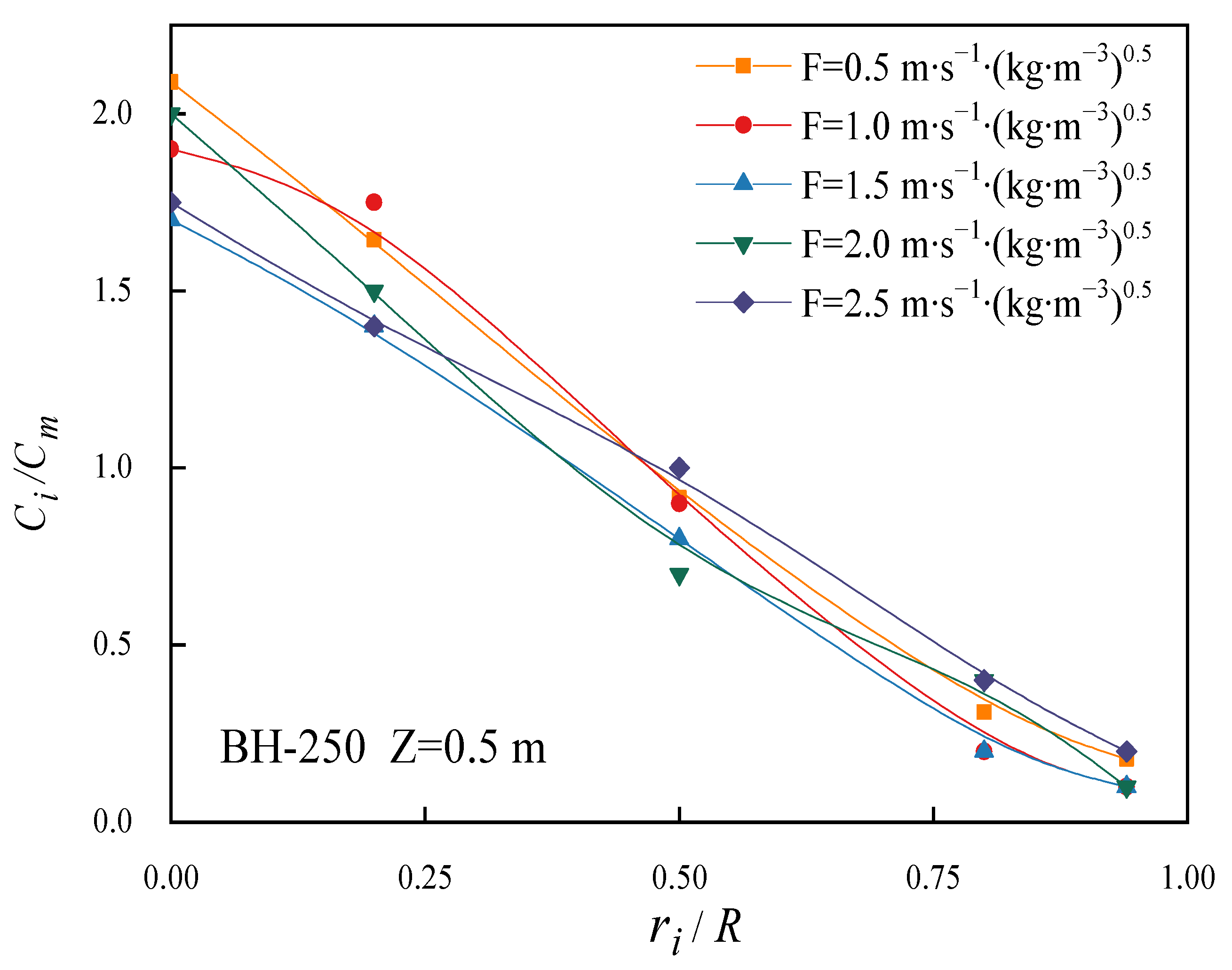
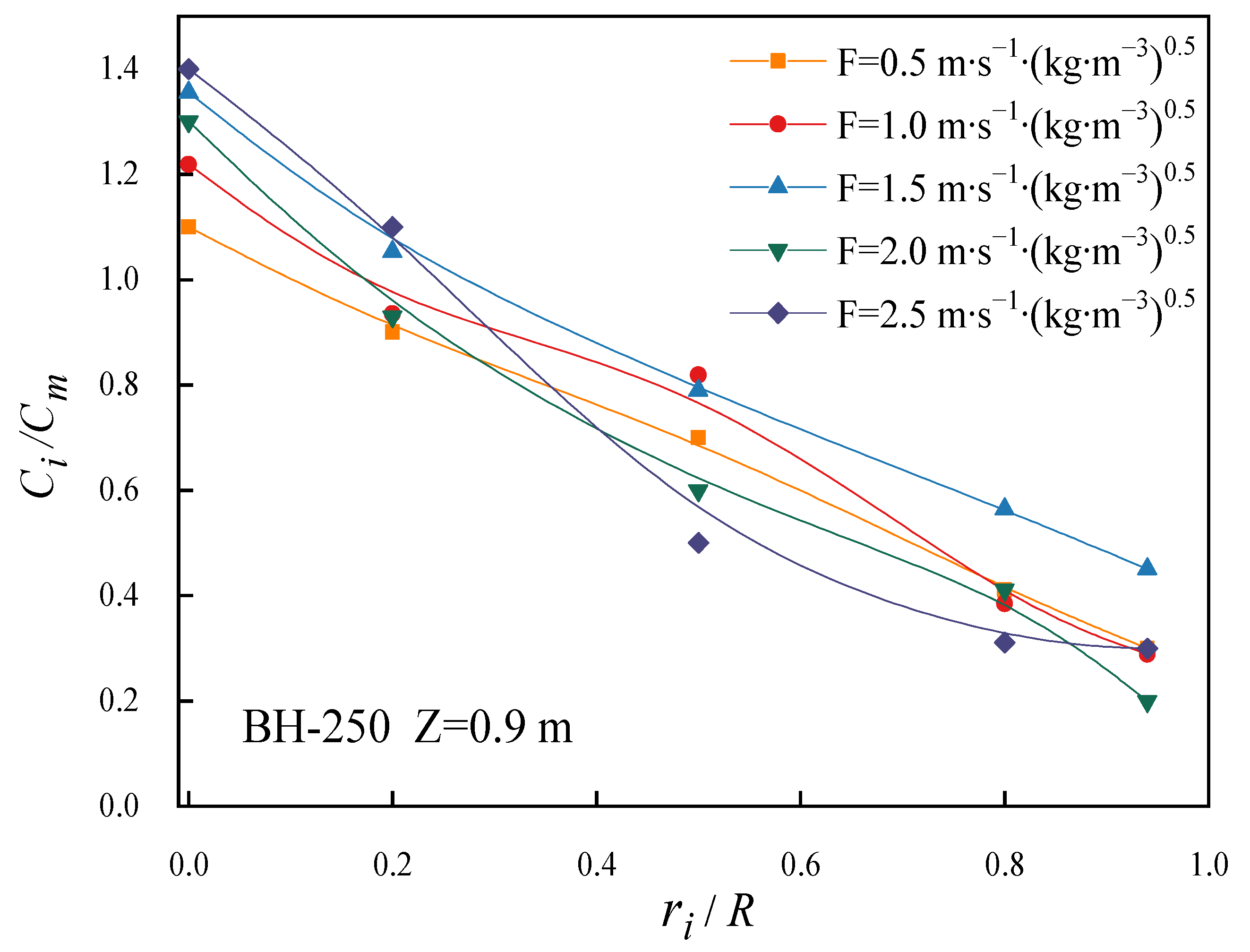
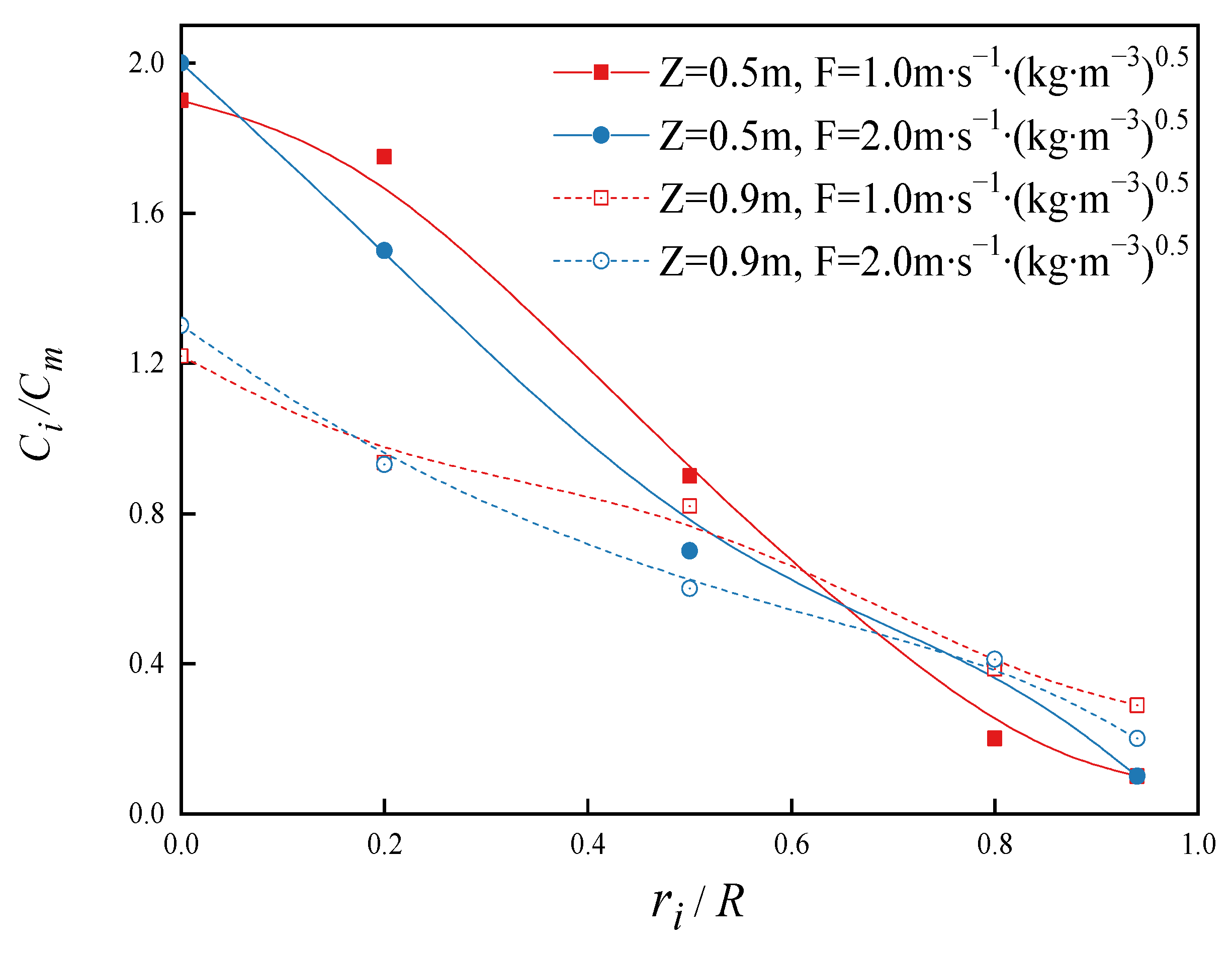
The gas distribution of gas kinetic energy factor F from 0.5 to 2.5 was tested at packing heights of Z = 0.5 m and Z = 0.9 m for BH-250 packing, as shown in Figure 5 and Figure 6, respectively. Ci represents the tracer concentration (%) at different radial positions, and Cm denotes the calculated average tracer concentration in the packing layer. It can be observed that the CO2 concentration is highest at the center of the packed column and decreases toward the column wall.
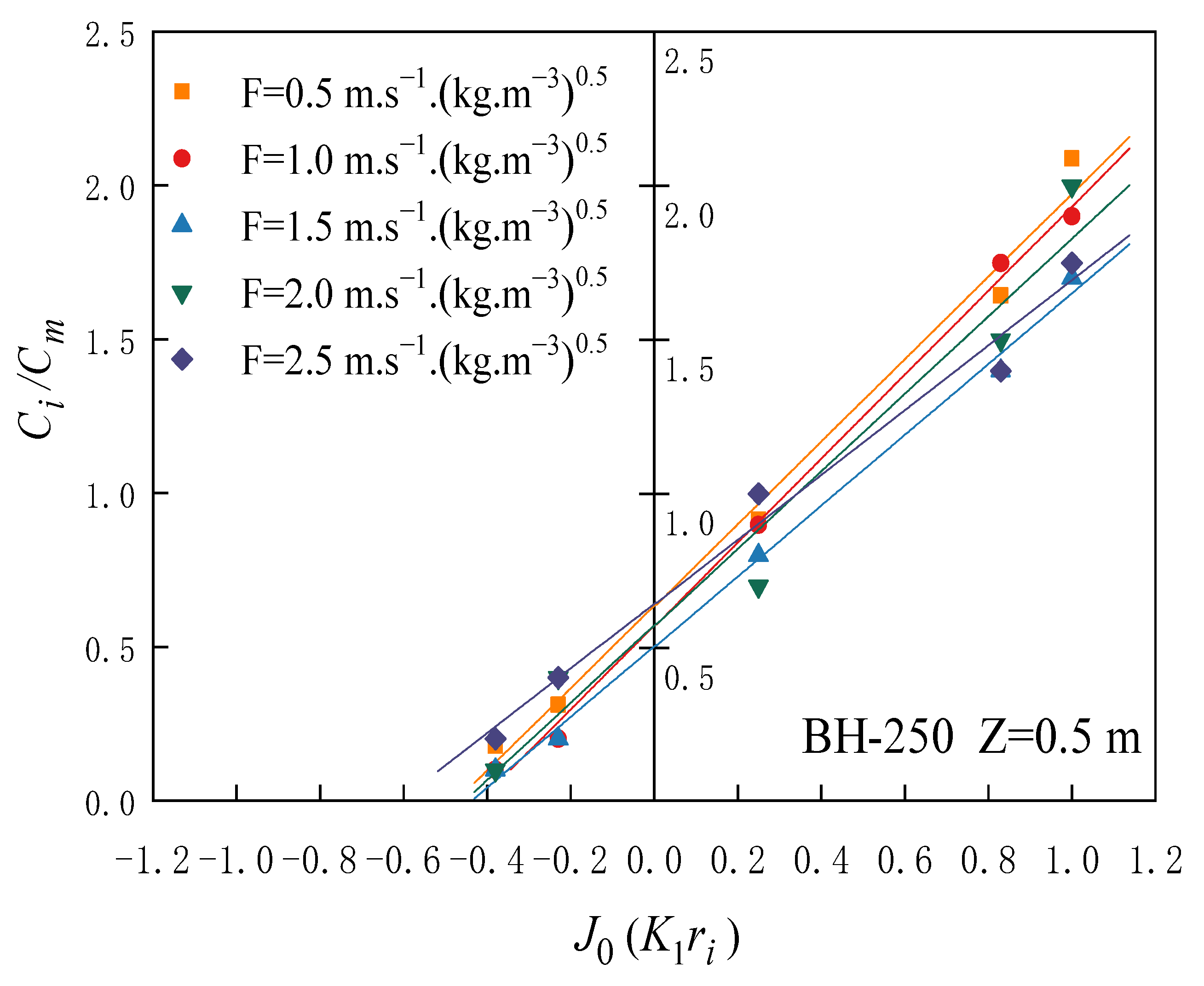
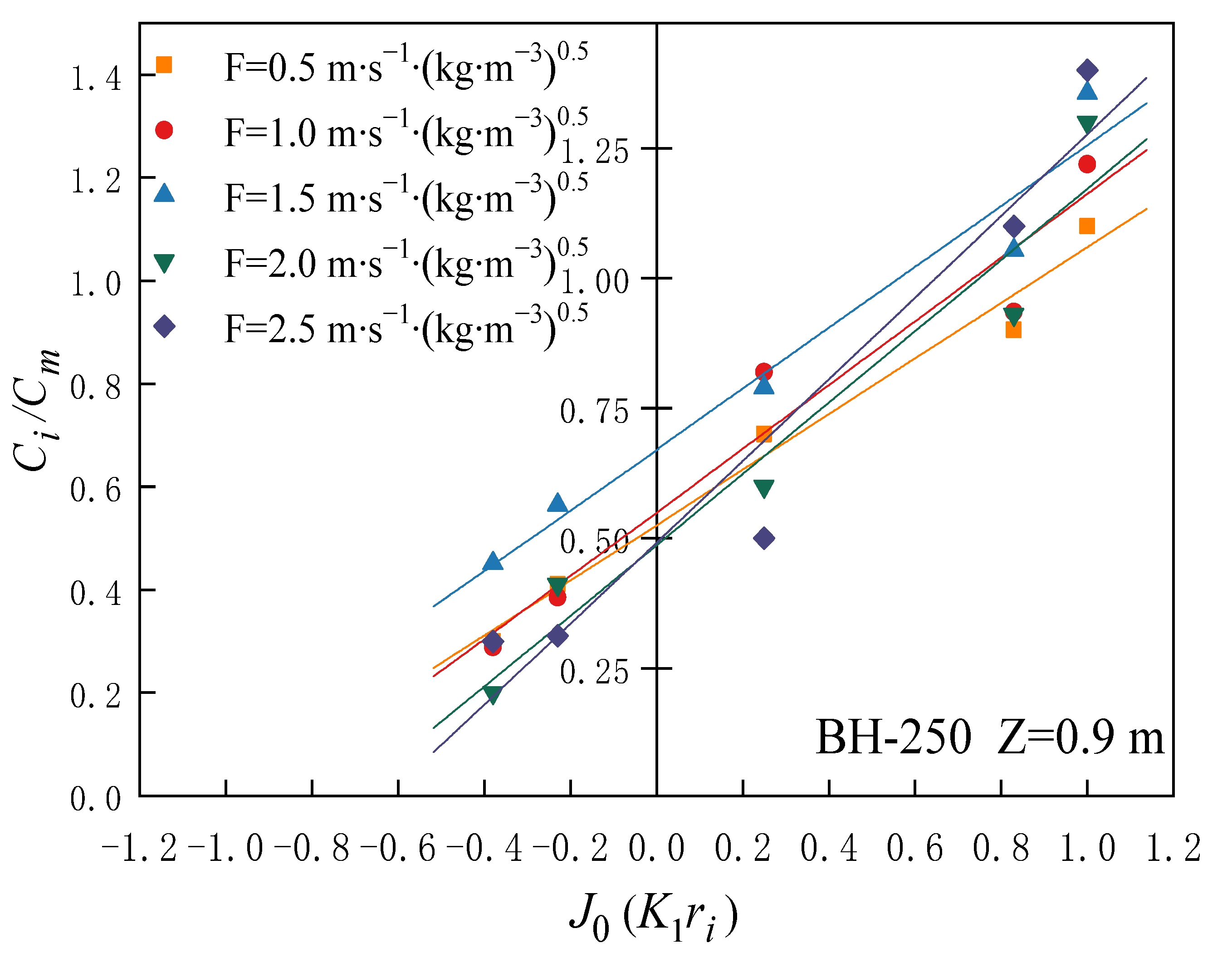
The measured concentration distribution data Ci/Cm at each ri/R point were plotted against the calculated J0(K1ri), as shown in Figure 7 and Figure 8. The regression results exhibit good agreement with the experimental data, indicating that the diffusion model can effectively describe the radial gas distribution within metal sheet corrugated packings.
The gas distribution performance of the BH-250 packing was modeled using regression analysis, and the resulting equation coefficients are presented in Table 3. The linear correlation shown in the table is high (R ≈ 0.98) which indicates that this model can effectively predict gas distribution in practical applications of corrugated sheet packings.
As illustrated in Figure 9, when the packing height Z is 0.9 m, the curve is flatter and the value of Ci/Cm is closer to 1, indicating that the gas distribution when the packing height Z is 0.9 m is better than that when Z is 0.5 m. Therefore, increasing the packing height can improve the gas distribution performance within the packing. However, when ri/R is greater than 0.8, the differences in Ci/Cm values for different packing heights are not significant, suggesting that increasing the packing height near the tower wall does not effectively enhance the distribution performance.
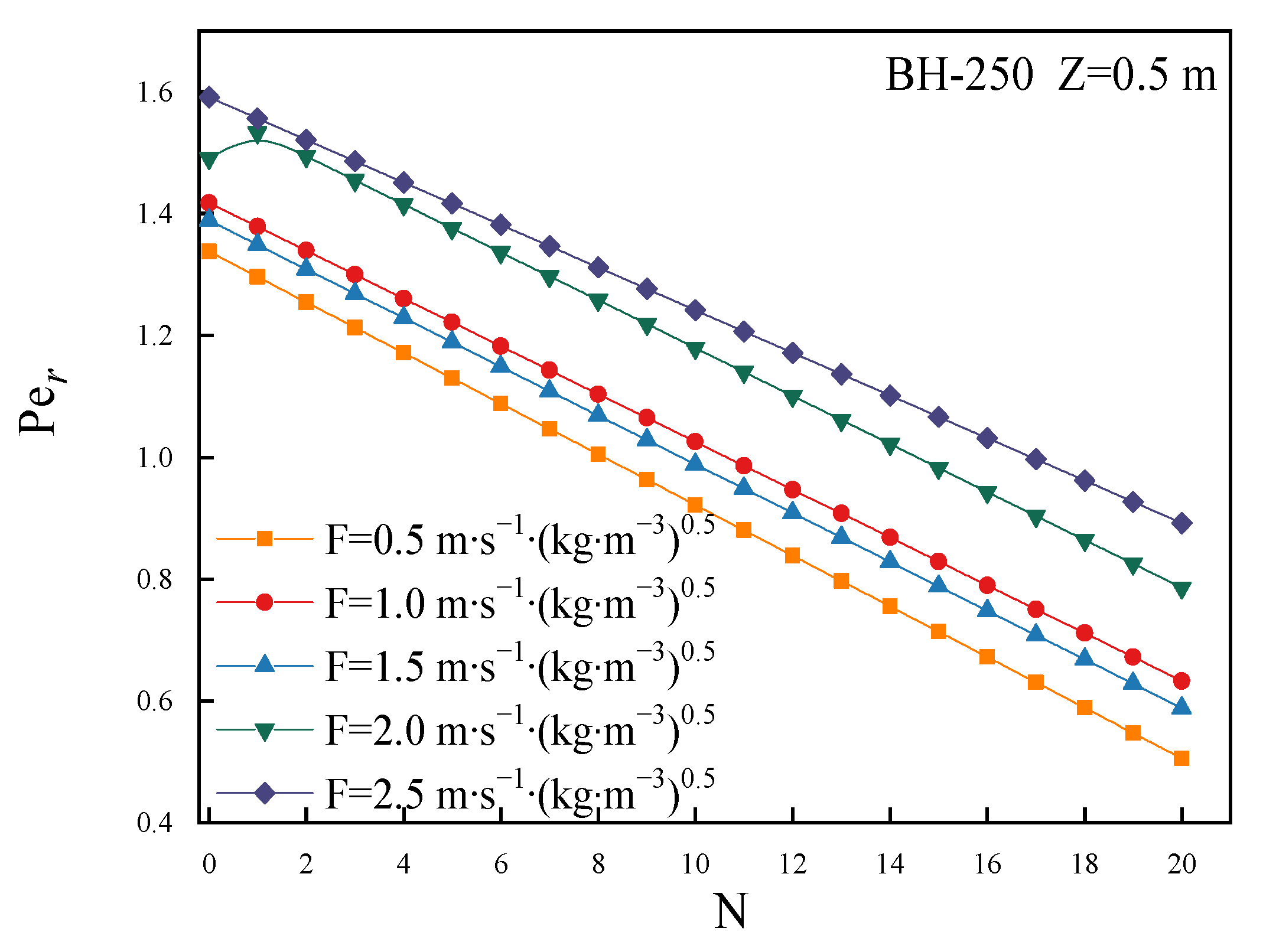
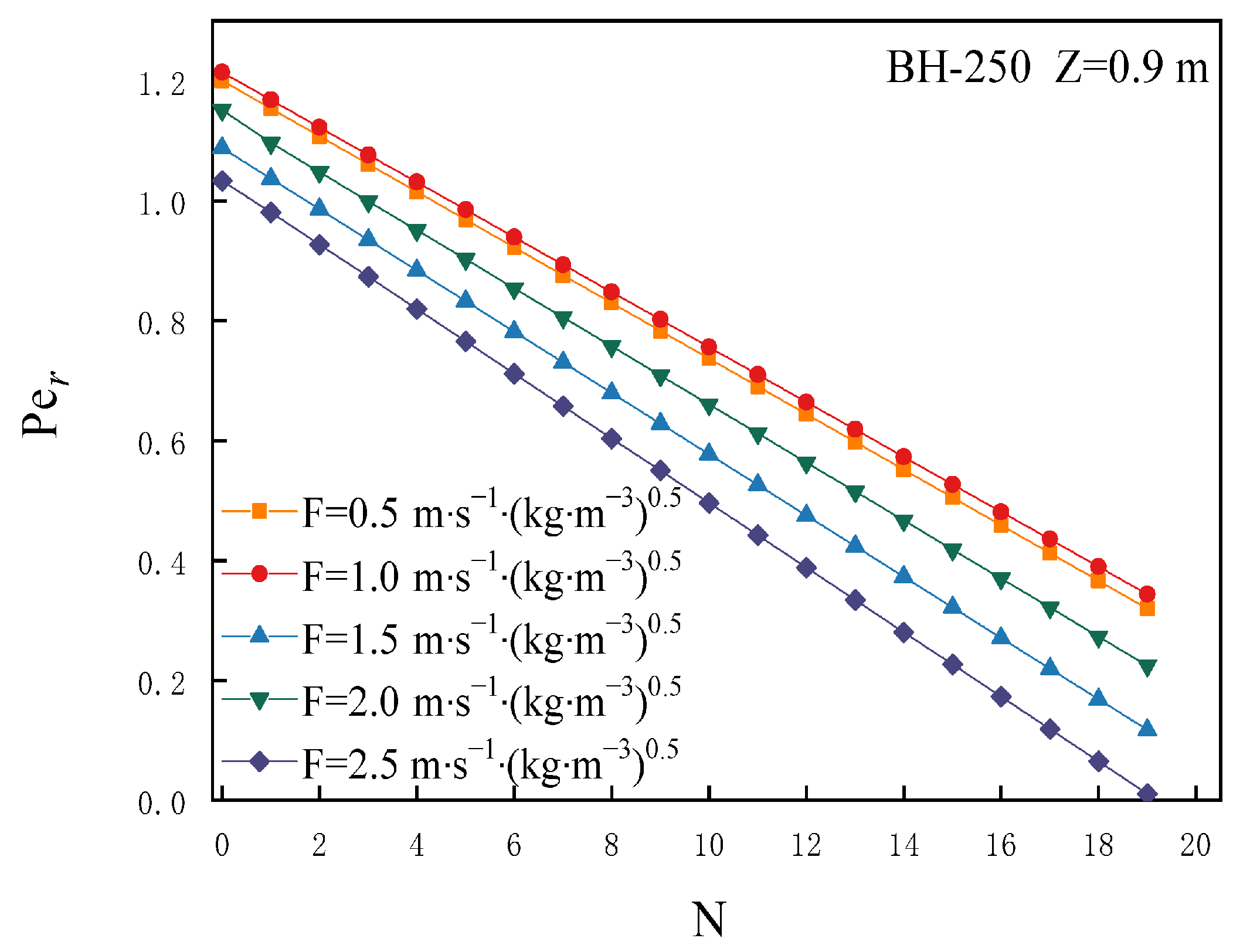
The parameter N (N = Ez/Er) which was adopted from the references [35,36] is used to reflect the degree of axial diffusion. As shown in Figure 10 and Figure 11, the Peclet number (Per) gradually decreases as N increases. At Z = 0.5 m, Per decreases by 3% for every 1 increase in N; at Z = 0.9 m, Per decreases by 4% for every 1 increase in N. Therefore, the influence of axial diffusion (Ez) must be considered in practical production.
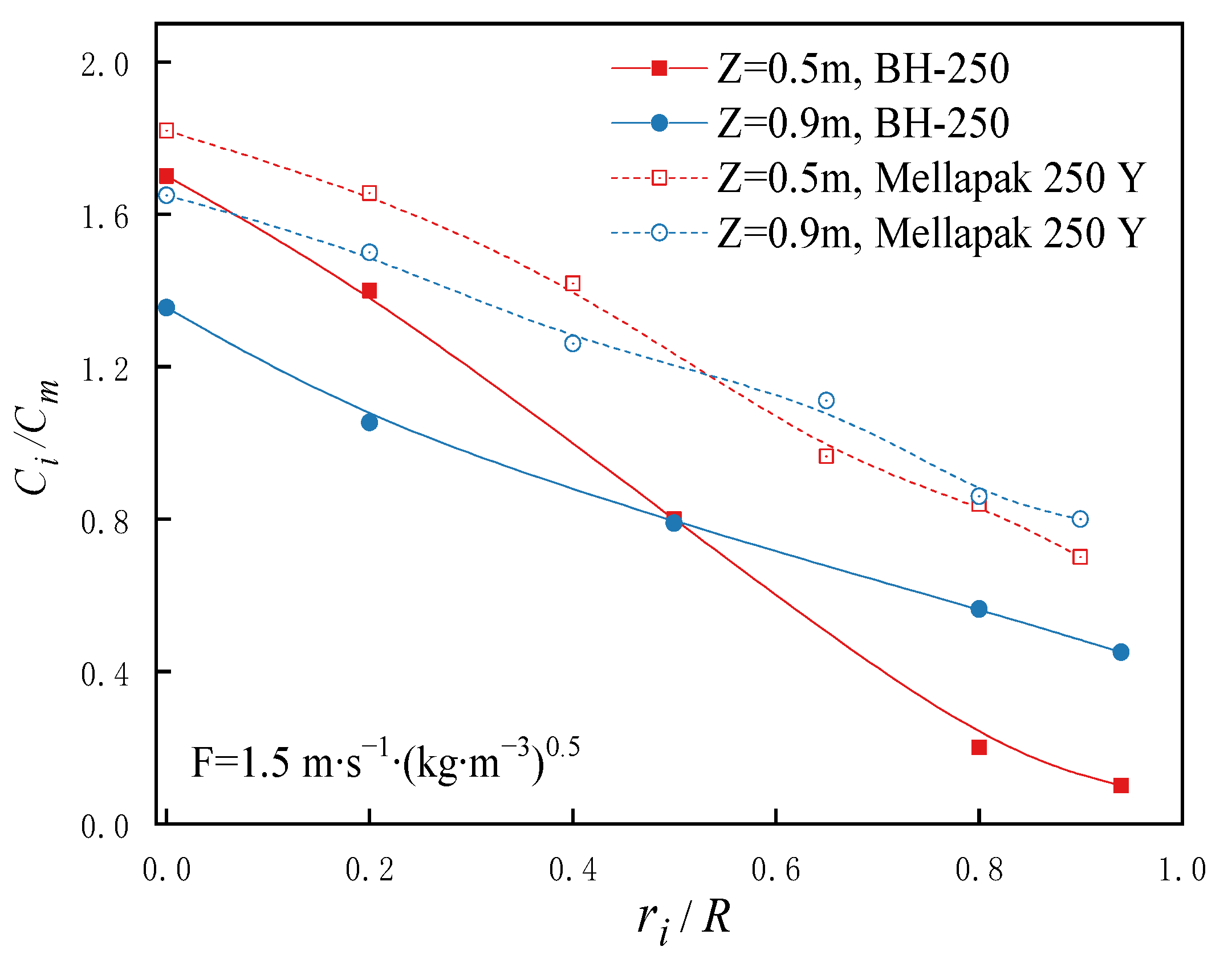
The experimental data for the BH-250 packing corrugated sheet packing are com-pared with those of the Mellapak 250Y packing, as plotted in Figure 12.
Calculations reveal that the Mellapak 250Y packing exhibits Per = 1.9 at Z = 0.5 m and Per = 1.5 at Z = 0.9 m. In contrast, the BH-250 packing demonstrates Per = 1.4 at Z = 0.5 m and Per = 1.1 at Z = 0.9 m. These results indicate that the distribution performance of the BH-250 packing, as measured in this study, is superior to that of the Mellapak 250Y packing.
4. Gas Disturbance Model
The study of gas mixing within the packing layer, in addition to the commonly used diffusion models, there are also several mathematical models proposed based on the flow characteristics of the fluid in the packing layer, such as the mixing pool model, differential weir model, and others. Xu et al. [35] derived the mixing pool model for corrugated plate packings, but during the model derivation process, they neglected the impact of small holes and did not account for the effect of variations in the corrugated flow channels. Xu et al. [37] proposed a nodal distribution model based on the liquid-phase flow patterns within structured packed columns. Building upon this model, numerous researchers have introduced improved nodal models [38,39]. It is important to note that these models primarily focus on calculating liquid distribution and do not encompass the quantitative prediction of wetted area or liquid holdup distribution. The Liquid Distribution Estimation for Structured Packings (LDESP) model proposed by Olujić et al. [18] is similar to a nodal distribution model; however, it assumes the packing element walls are fully wetted, which still shows some discrepancy from actual conditions. The model proposed by Aroonwilas et al. [21,22] integrates the geometric structure of the packing with liquid distribution characteristics and introduces randomness to account for the irregular distribution arising from the perforation features of the packing sheets during assembly. This enables the model to more realistically simulate the complex liquid flow paths in industrial packings, making it a typical representative of “stochastic liquid distribution models.” The LDESP model and similar liquid distribution models primarily focus on describing and predicting the distribution of liquid over the packing surface, with their core mechanism based on allocation rules for liquid at the intersections of packing channels.
This study is based on the mixing pool model for corrugated sheet packing, the effect of variations in the corrugation angle on the gas flow mixing within the column was considered. The mixing pool model was modified to describe the mixing state of the gas flow within the novel corrugated sheet packing. Based on this, a “gas disturbance” mathematical model was introduced. The “gas disturbance” model still utilizes the concept of the mixing pool to describe the fluid flow behavior within the packing layer, dividing the packing space into small individual mixing pool. Unlike traditional models that neglect the impact of corrugation angle variations and perforations, the proposed “gas disturbance model” incorporates these factors to more accurately represent the complex gas flow behavior in structured packings with non-uniform channels. The detailed derivation and validation of the model are presented below.
4.1. Factors Affecting Gas Flow Mixing Within the Packing Layer
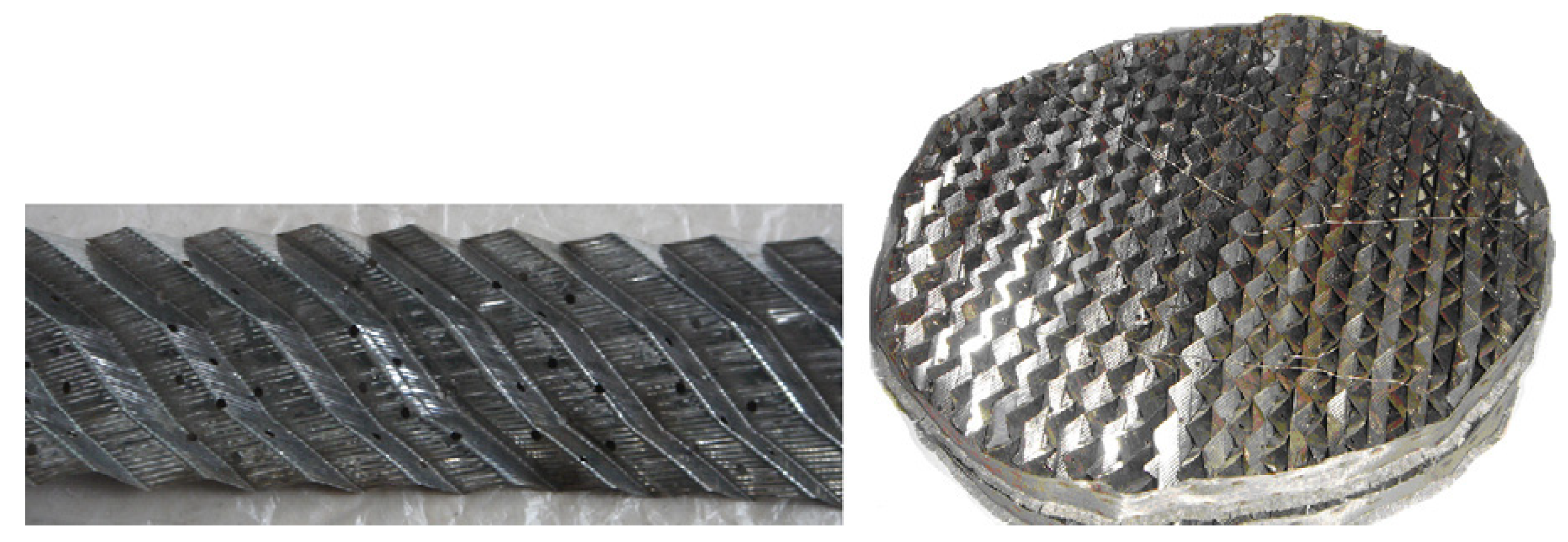
There are many factors that influence the gas flow within the packing layers, such as the size of the mixing pool space, layer height, corrugation angle, hole diameter, and the flow conditions of the gas. In Figure 13 photographs are given to show the currents, hole and so on of the BH-250 packing.
(1) Effect of mixing pool size
The size of the mixing pool space is determined by factors such as the peak-to-peak distance, peak height, and corrugation angle. As the peak height and peak-to-peak distance decrease, the number of gas flow layers and flow streams increases, leading to a higher probability of gas flow mixing within the packing layer, thereby enhancing the degree of mixing. In practice, the values of peak height and peak-to-peak distance are within a specific range, primarily due to considerations of fluid resistance. Gas flows from two different direction channels mix within the mixing pool, and after mixing, they flow into the next mixing pool along the respective channel directions for further mixing. In this way, each gas flow stream undergoes mixing with gas flows from many other channels during one passage through a channel, resulting in continuous changes in gas concentration, a gradual reduction in radial concentration gradients, and a tendency toward more uniform concentration distribution. Additionally, the two gas flows entering the mixing pool are generally not fully mixed, with each providing a portion of the gas flow to participate in the mixing process.
(2) Effect of Corrugation Angle Variation
The variation in the corrugation angle on the plates causes disturbances of the gas flow at the corners as it enters the mixing pool, resulting in different degrees of mixing in regions with varying angles. Consequently, the gas exchange coefficient differs in mixing pools with different structures.
(3) Effect of small holes on the plates
The small holes on the plates facilitate some degree of gas exchange between the mixing pools on either side of the plate. Therefore, when performing a material balance for the mixing pool, this gas flow exchange should be taken into account.
(4) Effect of packing end faces
The packing between the tray is arranged in a 90° staggered pattern. Due to the angle between the corrugated channels and the tower axis, the gas flow exiting the end face mixes with the gas flows from several adjacent channels. After mixing, the flow enters the packing layer in the direction of the upper tray’s corrugated channels, resulting in a 90° rotation of the gas flow direction (in the tower cross-sectional projection).
(5) Effect of column wall
When the gas flow enters the packing layer and flows through the channels towards the tower wall, it changes direction at the wall and enters another channel, then flows toward the central region. In practice, for ease of installation, the diameter of the packing tray is often slightly smaller than the tower diameter, therefore creating a gap between the packing and the tower wall. When the gas flow from each channel reaches the tower wall and changes direction, it is influenced not only by the wall flow moving upward but also by the fact that, due to the lack of channel constraints, the gas streams will mix with each other during the change in direction.
(6) Effect of gas velocity and other factors
The gas velocity is one of the key factors that determine how the air flow is mixed. At lower gas velocities, molecular diffusion of the gas flow dominates the mixing process, whereas at higher gas velocities, the mixing induced by the packing structure and the turbulence diffusion of the gas flow take a dominant role.
4.2. Development of a Multi-Parameter Model for Gas Mixing
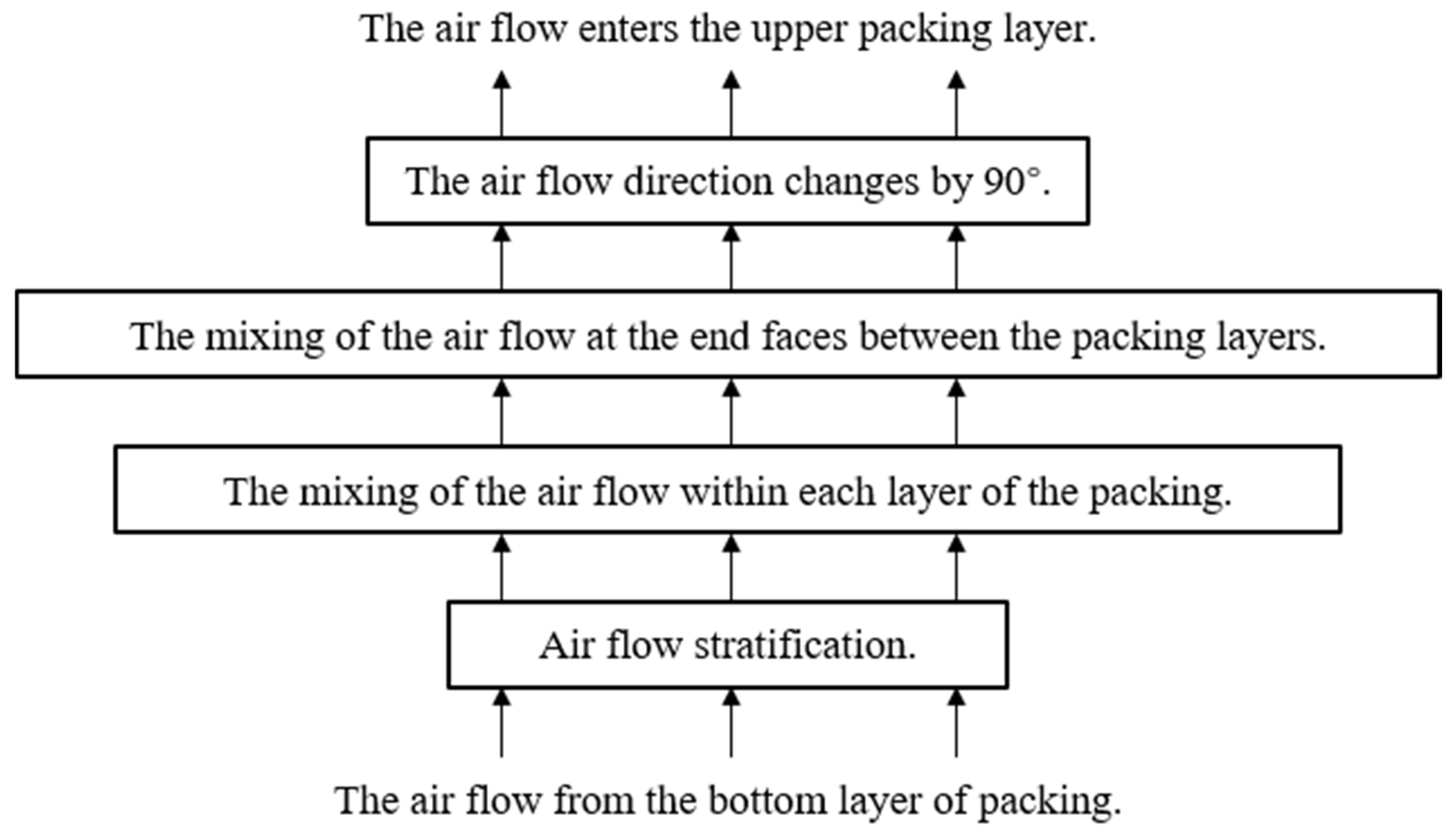
Based on the flow behavior of gas within the packing layer, the mixing of gas can be divided into four processes as it passes through each packing layer, shown in Figure 14. By separately calculating each process, the mixed state of the gas flow within the packing layer can be determined from its initial conditions.
Model assumptions: (1) The manufacturing dimensions of the metal corrugated sheet packing are uniform. (2) The number of small holes on each mixing pool is equal and evenly distributed on all four sides. (3) Adjacent corrugated plates are installed without gaps. (4) The main gas flow is evenly distributed across the channels. (5) The flow rate ratio between the main gas flow and the tracer gas is constant.
4.2.1. Arrangement and Positioning of Mixing Pools
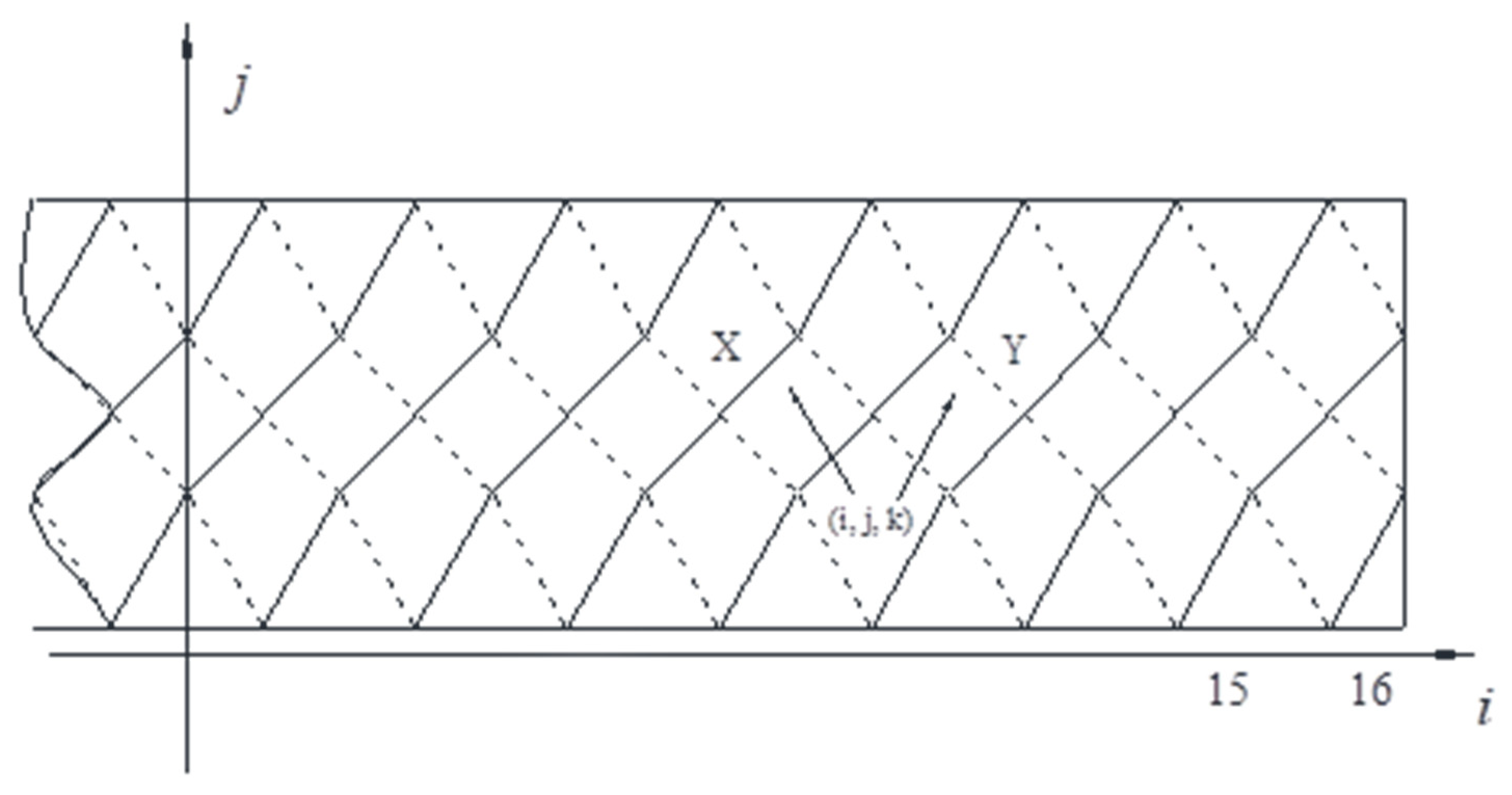
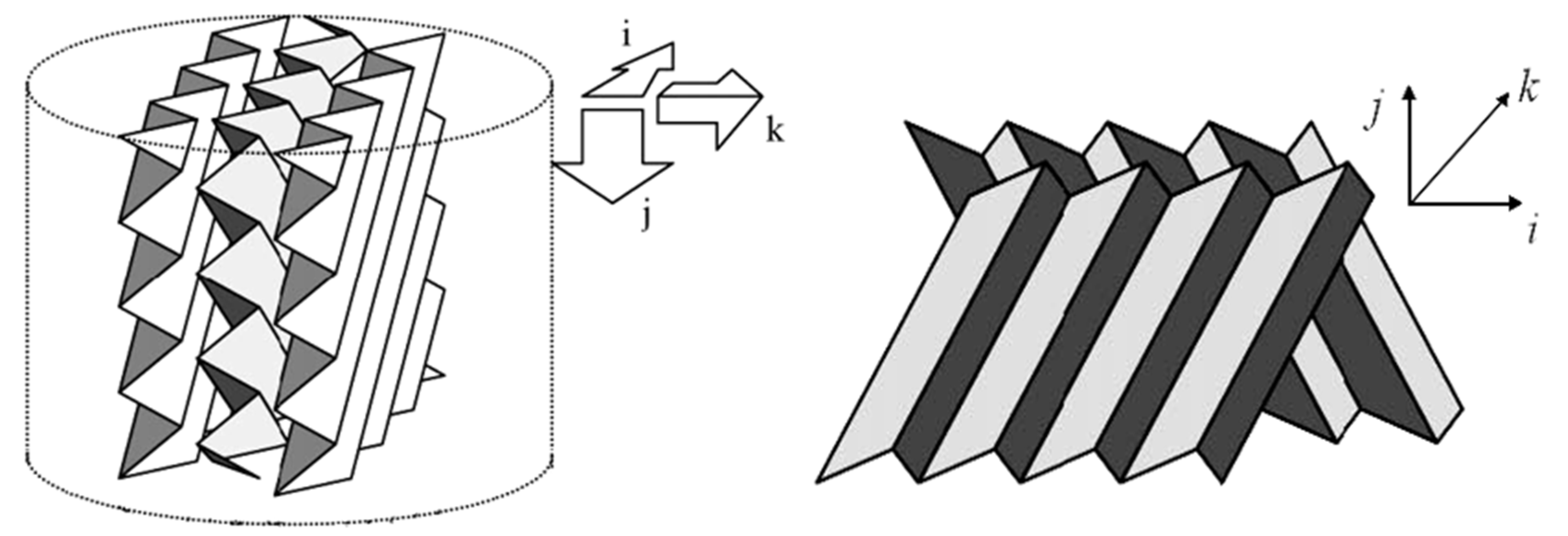
The location of the mixing pools is represented by three-dimensional coordinates inside the packing layer. The number of gas flow layers is denoted by “K”. In each gas flow layer, the position of the mixing pool along the length of the packing plate is denoted by “I”, and along the height direction by “J” (as shown in Figure 15). Since the gas flow direction between adjacent packing plates is different, it is defined as the “X” and “Y” directions. The concentration (C) at each position is indexed by (i, j, k), and the directions “X” or “Y” are used as superscripts. Therefore, the gas concentration in the mixing pool can be expressed as or .
When the gas flow enters the packing, it is divided into corresponding layers by the packing plates, i.e., K layers. In each layer, the gas flow is further divided into smaller streams in different directions, denoted as I stream. During the calculation, a series of mixing pools formed by the intersections of the channels between two corrugated plates can be plotted based on the corrugated channel’s tilt angle, the packing disc height, and the pitch of the corrugations. Taking the novel perforated corrugated packing as an example, the arrangement is shown in Figure 15 and Figure 16. Since the packing has a circular cross-section and the lengths of the corrugated plates forming the packing vary, the number of mixing pools within each gas flow layer also varies. The plates shown in the figure are located on the diameter of the packing.
4.2.2. Mixing of Gas Flow in Each Layer
(1) Mixing between corrugated channels
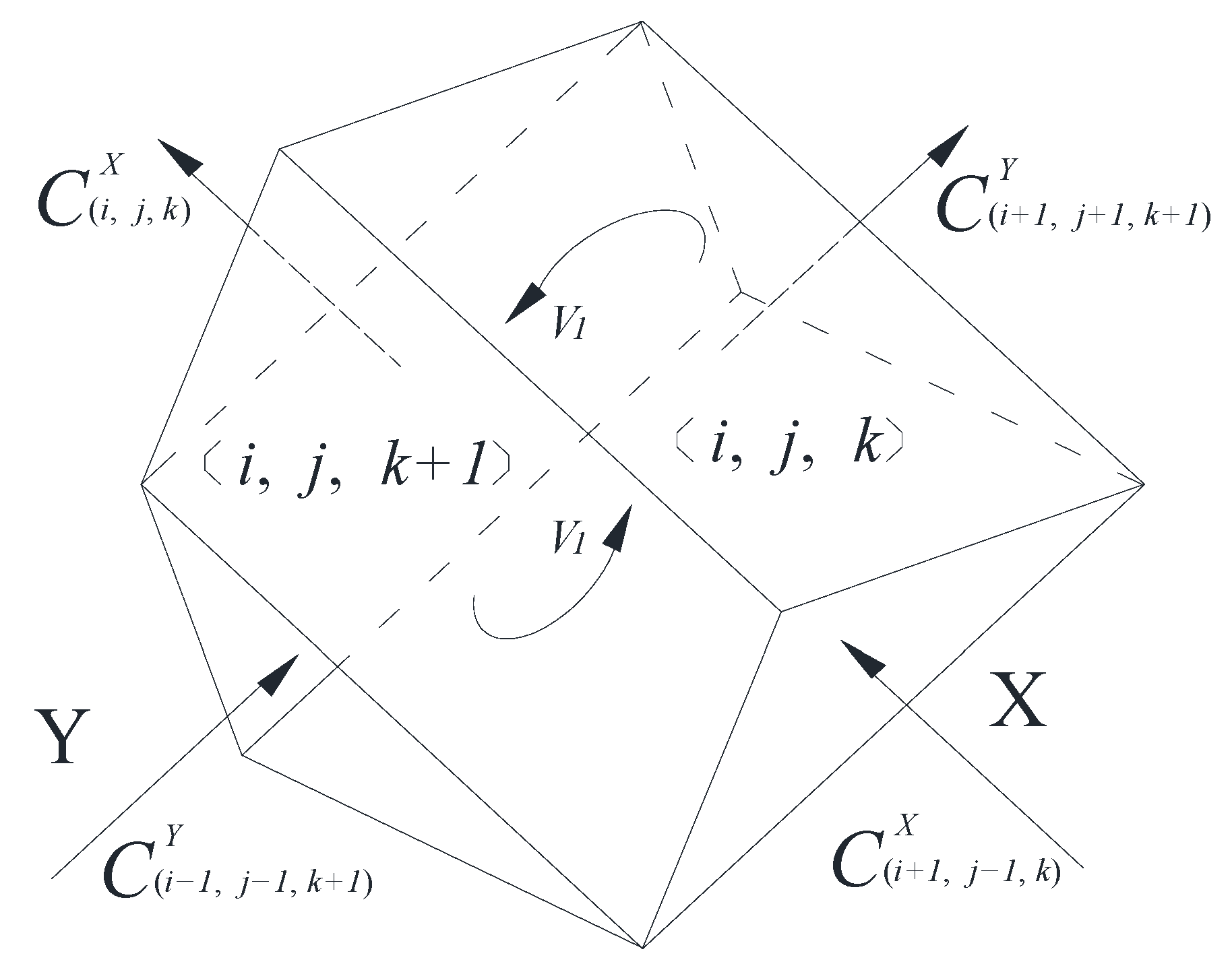
This type of mixing refers to the mixing of gas flow within the mixing pools, as shown in Figure 17. The mixing of gas flow in the mixing pool is reflected by a gas exchange coefficient. By performing material balances on each mixing pool, the relationship between the concentrations at different points can be derived.
Material balance for the X concentration gas flow layer:
Defined:
V: Flow rate of the two main gas flows in the X and Y directions, m3·s−1
V1: Flow rate of the gas exchanged between the two gas streams in the X and Y directions within the mixing pool, m3·s−1
V2: Flow rate of the gas passing through the small holes of the corrugated plates, m3·s−1
Flow rate of CO2 entering the mixing pool:
Flow rate of CO2 exiting the mixing pool:
Based on the assumed conditions, for steady-state operation, the flow rate of CO2 entering the mixing pool is equal to the flow rate of CO2 exiting the mixing pool.
α is the gas exchange coefficient for the main gas flow, ;
β is the exchange coefficient for the gas flow passing through the small holes, ;
Similarly, for the Y concentration gas flow layer, a material balance is performed within the mixing pool:
To clearly solve for the concentrations of the gas flow in the X and Y directions within each mixing pool, the calculation formulas of the gas flow in the adjacent mixing pools are derived. So that the simultaneous equation for solving the concentration of any gas flow layer can be obtained as follows:
For the X-direction gas flow layer:
For the Y-direction gas flow layer:
where α ≥ 0, β ≥ 0, 0 ≤ 1 – α − 3β ≤ 1.
Due to the corrugated inclination angle of the packing varying in a 45°–30°–45° pattern, it is assumed that the mixing coefficient within each region remains constant:
In the 30° region, the gas exchange coefficient for the main gas flow, α = α1;
In the 45° region, the gas exchange coefficient for the main gas flow, α = α2.
The resulting system of equations can be represented in matrix form as follows:
D·X = E
D·Y = G
where
where m represents the number of unknown gas flow layers with concentrations to be determined. , , , refers to the gas flow concentration in the mixing pool near the tower wall.
The above system of equations reflects the relationship between the gas flow concentrations before and after mixing in each mixing pool within the packing layer. Furthermore, the expression forms a large linear system of equations. Since the concentration of the gas flow entering the packing is known, specifically the initial CO2 concentration is C0, .
The system can be solved once the boundary concentrations are determined. Therefore, the concentrations of the gas flow in the X and Y directions within the mixing pools can be obtained.
(2) Mixing at the edge of the packing surface
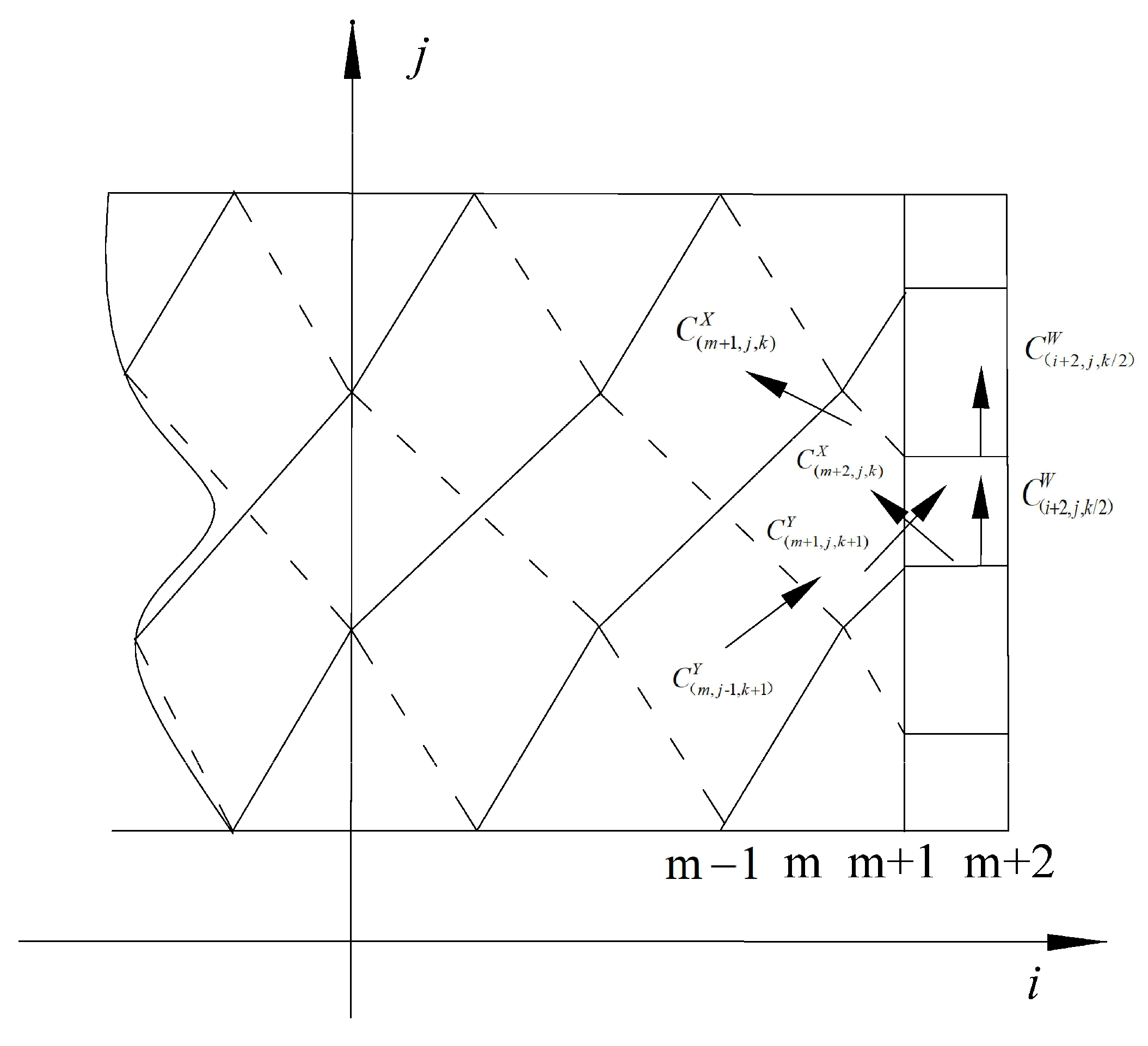
Due to the fact that the mixing pools near the packing wall are not necessarily complete, and the majority of the gas flow in the X direction originates from wall reflections, the mixing behavior in this region differs from that within the internal mixing pools of the packing, as shown in Figure 18.
Assumptions:
a
The mixing coefficients for the mixing pools at the packing edge are assumed to be equal;
b
The gas flow rate along the X direction remains constant at (V);
c
The influence of the small holes in the mixing pools at the packing edge is negligible.
Since the mixing pools in this region are incomplete, it is assumed that the mixing is relatively uniform. This implies that the concentrations of the gas flow in both the X and Y directions exiting the mixing pool are equal. Thus
4.2.3. Mixing at the Tower Wall
Since the diameter of the packing layer is smaller than that of the tower, a void space, referred to as the wall flow region, is formed at the tower wall. The gas flow entering this region mixes within the wall flow region.
, represent the gas flow concentration at the boundary of the packing; , denotes the gas flow concentration near the tower wall. A material balance is performed on the mixing pool shown in Figure 18:
where .
4.2.4. Mixing at the End Faces Between Packing Layers
When gas exits each packing layer, the packing end face can be regarded as consisting of a series of mixing pools. The gas flowing out from each channel mixes with the gas exiting adjacent channels at the end face before entering the next packing layer. The arrangement of the end face mixing pools is shown in Figure 19. A mixing coefficient λ is used to represent the degree of mixing between the pools.
The region delineated by the dashed lines in the figure represents a virtual mixing pool, while the solid lines indicate the real mixing pools, which are divided into four sections by the dashed lines. Additionally, it can be observed that L = 2I.
For the real mixing pool, before the gas exits the packing layers, it passes through the last mixing pool, which is incomplete, meaning the mixing pool is relatively small. Therefore, it can be assumed that the mixing is relatively uniform. That is
The gas flow concentrations in the four sections divided by the dashed lines are equal. Taking the virtual mixing pool (L, k) as an example to analyze. Before the gas enters the upper packing layer, it can be assumed that
When the gas exits the packing layer, mixing occurs at the end face. Therefore, the gas flow concentration in the (L, k) mixing pool can be determined through material balance, as follows:
where represents the gas flow concentration in the virtual mixing pool, and .
4.2.5. Change in Gas Flow Direction upon Entering the Upper Packing Layer
When the gas flows from one packing layer to the layer above, its direction of movement changes by 90°. This phenomenon can be easily simulated by transposing the concentration matrix of the end face at each point.
4.2.6. Calculation Procedure
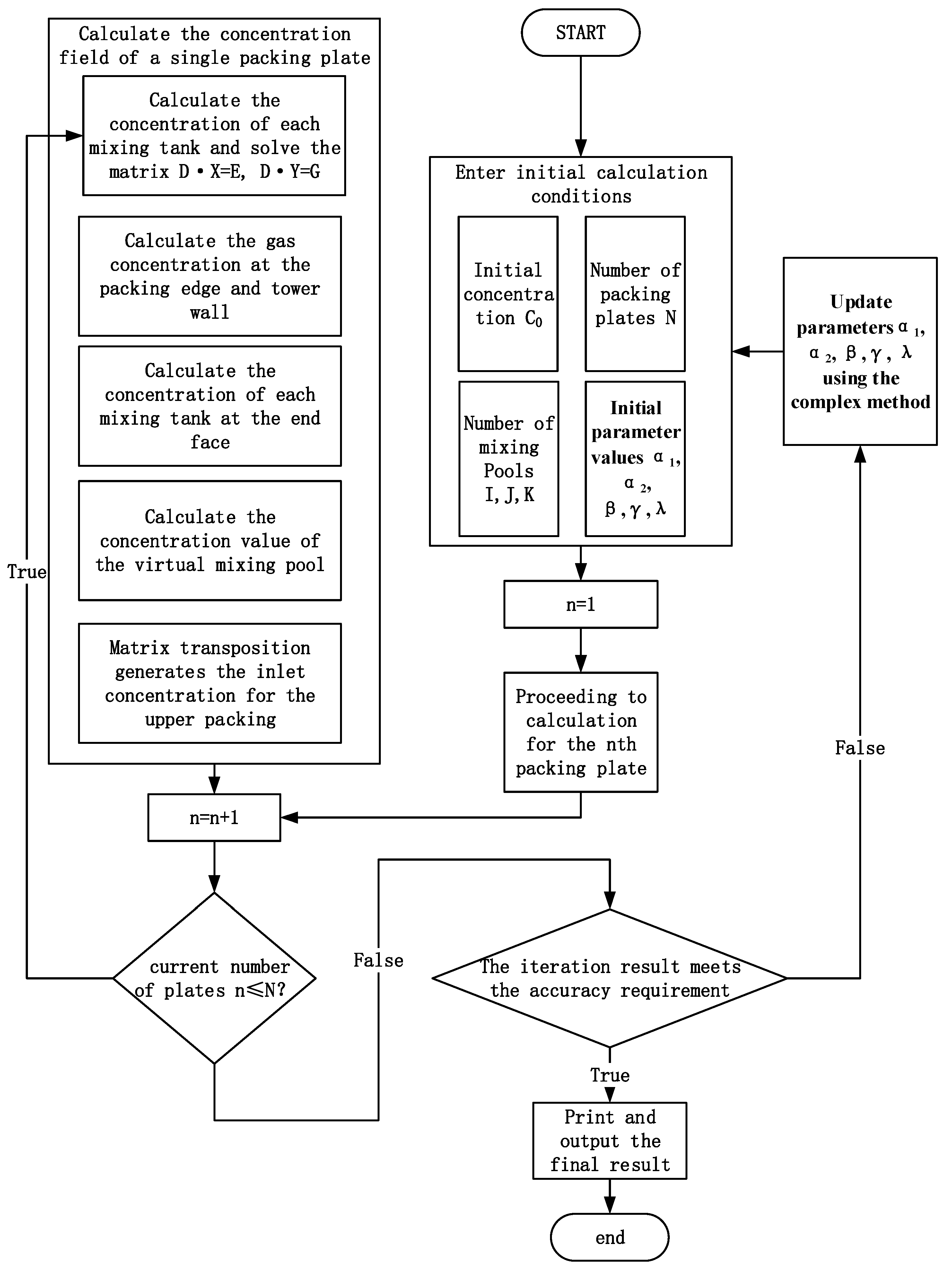
The above steps describe the calculation of the gas flow mixing process through a single packing layer. For other layers, the same steps can be repeated as long as the structure remains identical. Thus, under the condition of knowing the initial concentration distribution at the bottom end face of the packing layer, the concentration distribution of the gas after passing through the entire packing layer can be determined. The calculation process is shown in Figure 20.
(1). Input Initial Calculation Conditions.
Initial concentration before entering the packing layer: ;
Number of packing layers, (N);
Number of mixing pools in the radial direction per layer, (I = 16);
Number of mixing pools in the height direction, (J = 3);
Number of mixing pools in the gas flow direction, (K = 44);
Initial values for parameters α1, α2, β, γ and λ.
(2). Calculate the values of , in each mixing pool.
D·X = E;
D·Y = G.
(3). Calculate the gas concentration at the packing edge and tower wall.
(4). Calculate the concentration of each mixing pool at the end face.
(5). Calculate the concentration values of the virtual mixing pools.
(6). Transpose the matrix to calculate the mixing pool entering the upper packing layer.
(7). Iterate the parameters α1, α2, β, γ and λ using the composite method.
(8). Check if the iteration satisfies the precision requirements and print the results.
4.2.7. Regression of Model Parameters
The objective function f is introduced and defined as
where m is the number of tested points, CS is the gas concentration calculated by simulation, and CE is the gas concentration measured experimentally.
Constraints on the parameters:
The composite method can be employed to solve this nonlinear constrained optimization problem. Based on experimental data and the mixing pool model, the values of the parameters can be determined. The model was programmed and computed using Visual C++, and preliminary debugging yielded the simulation results.
4.3. Model Solution
4.3.1. Model Parameter Regression
The experimental data of the BH-250 corrugated plate packing is substituted into the aforementioned model for regression, and the regression results are presented in Table 4.
In the table, α1 and α2 represent the main exchange coefficients of the airflow in the 30° and 45° corrugated regions, respectively. β reflects the airflow exchange passing through the small holes of the packing sheets. γ and λ describe the mixing effects in the tower wall region and the end face of the packing layer, respectively. Analysis of the parameter regression results in Table 4 reveals that the main airflow exchange coefficients α and β, are significantly influenced by the F-factor. Since α and β are parameters related to the corrugation angle of the packing and the specific surface area of the packing, appropriately adjusting the corrugation angle and modifying the specific surface area of the packing can effectively enhance the mass transfer efficiency of the packing.
4.3.2. Comparison of Experimental Results and Regression Results
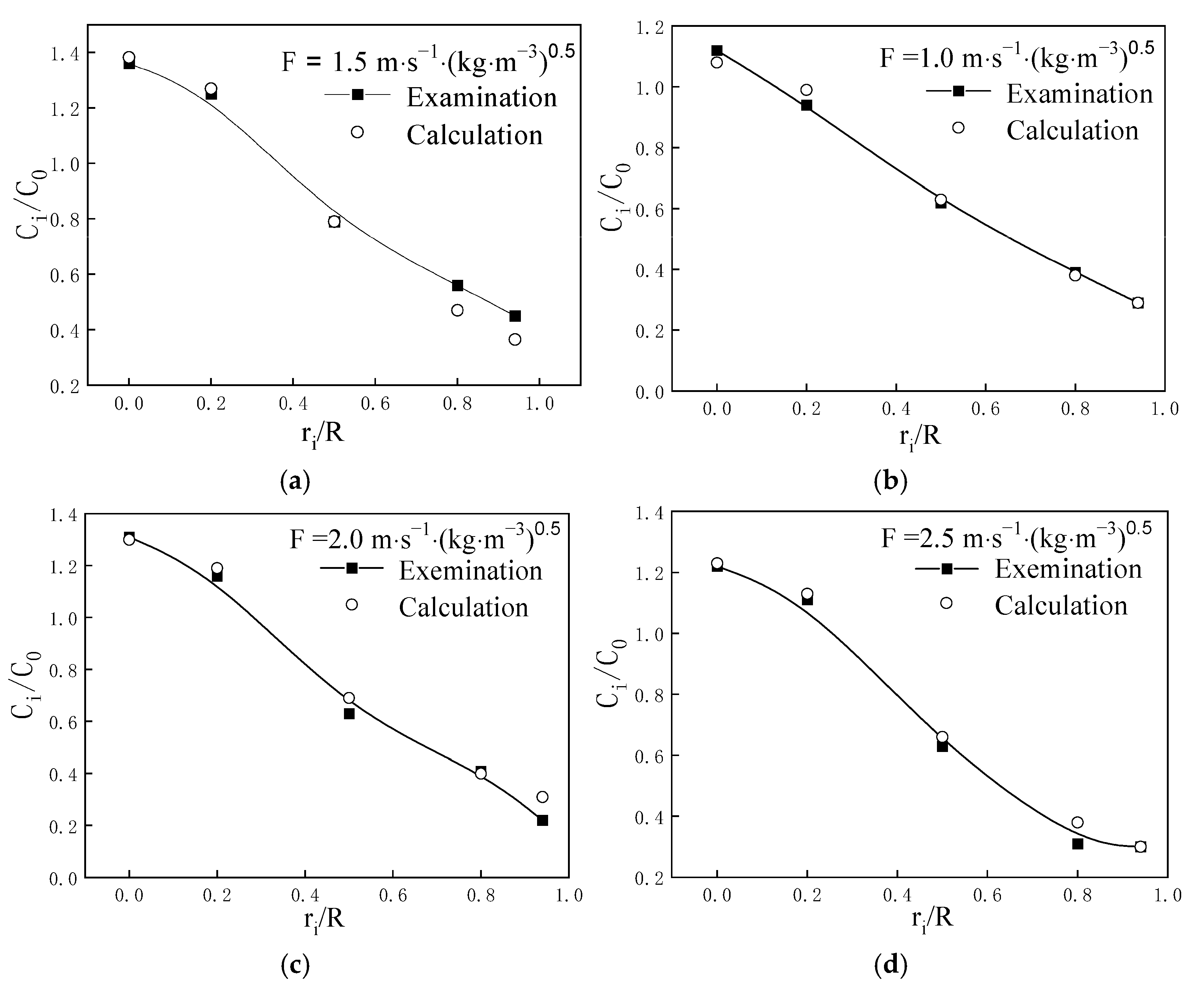
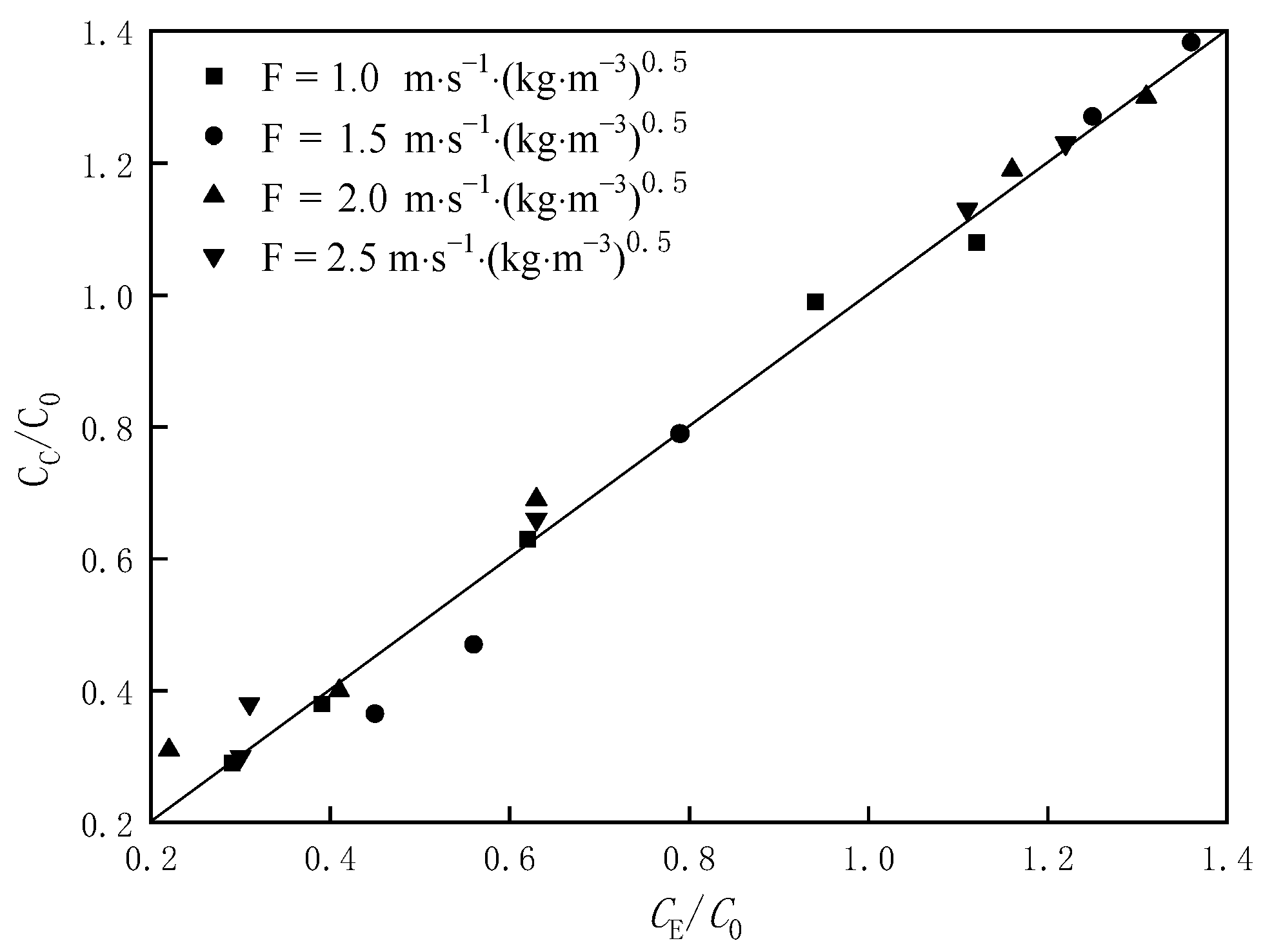
The simulation results of the “gas disturbance” mathematical model for the BH-250 corrugated plate packing was compared with the experimentally measured gas distribution data. The results are shown in Table 5 and Figure 21.
As shown in Table 5 and Figure 21, under atmospheric pressure conditions and the gas velocity kinetic energy factor within the range of 1.0 to 2.5 m·s−1·(kg·m−3)0.5, the regression results of the CO2 concentration model reflect the experimental results well. However, there is still a certain error at the tower wall. This is due to the large space near the tower wall, where the fluid flow is more complex. So further research is needed to improve the model’s accuracy near the tower wall.
From the error distribution curve (Figure 22), it can be observed that the “gas disturbance” mathematical model exhibits some prediction errors for the gas distribution of the corrugated plate packing near the tower wall when the F-factor is in the range of 1.0 to 2.5 m·s−1·(kg·m−3)0.5. However, the model provides relatively accurate predictions for experimental values at other radial positions.
In the tower wall region, there is a gap between the packing and the tower wall, leading to significant differences in fluid flow behavior compared to the main packing region. Specifically, gas near the tower wall is no longer strictly constrained by the channels of the structured packing, resulting in a change in flow direction and the formation of complex vortices and secondary flows. Additionally, the no-slip boundary condition at the tower wall creates a velocity boundary layer, which affects the radial diffusion and mixing of the gas. To more accurately describe the fluid behavior in the tower wall region, subsequent studies could consider establishing an independent sub-model for this region within the existing “gas disturbance mode” framework. This sub-model could account for the specific physical mechanisms of wall effects, such as introducing wall functions or empirical correlations to correct the mixing coefficient or diffusion coefficient in this region. Model parameters (e.g., gas exchange coefficients α, β) should be distinguished and calibrated separately for the tower wall region and the main region. By regressing parameters suitable for the tower wall region using experimental data specifically targeted at this area, and by employing computational fluid dynamics (CFD) methods to perform detailed simulations of the flow field in the tower wall region to gain an in-depth understanding of its flow characteristics, theoretical basis and key parameters can be provided for improving macroscopic mathematical models.
4.3.3. Comparison of Accuracy with Traditional Mixing Pool Model
The calculated values from the “gas disturbance” mathematical model proposed in this study were compared with the experimental values, and the relative errors were computed. The results are presented in Table 5. Except for a few points where the error exceeds 20%, the relative errors for the remaining data points are all less than 10%.
In reference [37], the “mixing pool” model was used to study the mixing behavior during radial gas flow, and a comparison was made between the calculated results of the “mixing pool” model and the experimental data. The relative errors for this comparison are shown in Table 6.
As can be seen from Table 6, when the “mixing pool” model describes the radial mixing performance of gas in the packing, the error between the calculated and experimental values is relatively small at the tower wall, with a fitting accuracy reaching 0.00%. However, the error increases as it gets closer to the tower center, and it even exceeds 10%.
From Table 5, it can be observed that the model proposed in this study experiences a large error at the tower wall. However, the errors generally remain within 10%. This model accounts for the effects of packing corrugation lines and specific surface area changes on gas distribution. By incorporating factors related to the packing corrugation lines and specific surface area, it provides a more accurate description of fluid flow within the packing layer. It is particularly advantageous when modeling the flow of gas through corrugated packing with a zigzag pattern.
Near the tower wall, a gap exists between the packing and the wall, resulting in more complex fluid flow and the influence of the “wall effect.” Using the same model for fluid flow fitting as in the tower center inevitably leads to larger errors. Further research is needed to better understand the fluid flow behavior in this region.
5. Application of BH Packing in the Production of High-Purity Chemicals
5.1. Methanol Production
Shanxi Sanwei Co., Ltd.’s (Linfen, China) methanol intermediate products are primarily used in the alcoholysis production process, and the purity of methanol is crucial for both the quality and consumption of the final polyvinyl alcohol (PVA) product. When the methanol purity is low and the water content is high, it can lead to a reaction between sodium hydroxide and free acetate ions in the alcoholysis process, forming sodium acetate, which remains in the PVA product. This not only reduces the quality of the PVA product but also results in increased consumption of sodium hydroxide raw materials. To address the issue of low product quality, we implemented the BH packing technology for a technical retrofit of this company’s methanol purification unit.
In the development and design of the methanol purification technology, we employed BH-type high-efficiency packing with a double-layer gauze structure. The original tower’s reflux ratio was reduced from 2 to 1.8 in the design, and during actual operation, the reflux ratio was maintained between 1.5 and 1.6. This reflux ratio is lower than the conventional 2. Reducing the reflux ratio directly leads to a significant decrease in steam consumption of the reboiler and cooling water usage of the condenser, which is the main approach for energy saving and consumption reduction in this project. During implementation, this technology increased the methanol content at the top of the column to 99.95%, while reducing the methanol content at the bottom of the column from 0.05% to between 0.005% and 0.01%, achieving a technological innovation and contributing to the advancement of the industry. Meanwhile, without increasing major mass transfer equipment, a 30% increase in production capacity has effectively spread the fixed costs per unit product (such as equipment depreciation, maintenance, etc.), bringing about significant economic benefits.
5.2. Production of Electronic-Grade Dichlorodihydrosilane
Electronic-grade dichlorodihydrosilane is an essential silicon precursor gas in the semiconductor industry. It is characterized by a fast deposition rate, uniform film deposition, and relatively low deposition temperature. This material is primarily used in epitaxial growth and chemical vapor deposition (CVD) of silicon dioxide and silicon nitride. At lower temperatures, the deposition time required for electronic-grade dichlorodihydrosilane is significantly shorter than that for silane, especially in advanced processes below 28 nm which demand higher quality for deposited silicon dioxide, silicon nitride, and epitaxial silicon thin films.
An electronic chemicals company has upgraded its dichlorodihydrosilane production facility by applying BH-type high-efficiency packing material. This modification significantly improved the product’s purity, resulting in the successful production of 3N-grade dichlorodihydrosilane. The impurity levels of boron, phosphorus, and arsenic were reduced to 4 ppt, 8 ppt, and 9 ppt, respectively, bringing substantial economic benefits.
5.3. Production of Electronic-Grade Hexafluorobutadiene
Electronic-grade hexafluorobutadiene is primarily used as a synthetic material and electronic specialty gas, serving in chemical synthesis and electronic etching applications. In electronic etching, hexafluorobutadiene is used as an etching gas, which has the advantages of high selectivity, high etching accuracy, high etching efficiency, low environmental pollution and has great development potential and broad market space.
A fluorine-containing electronic specialty gas production company has successfully applied BH-type high-efficiency packing material to upgrade its hexafluorobutadiene production process. This technological improvement has led to the successful production of electronic-grade hexafluorobutadiene with a purity of 99.9999% (6N).
For electronic-grade chemicals, product purity is a key factor determining their market value. Raising the purity of dichlorodihydrogen silicon and hexafluorobutadiene to 3N and 6N levels, respectively, represents a significant leap, resulting in an order-of-magnitude increase in market value and profit margin. This is precisely the fundamental source of core economic benefits created by this project for the enterprise.
6. Conclusions
In this paper, a novel BH packing material design approach is proposed in order to solve the issue of insufficient mass transfer efficiency in traditional packing materials used in distillation processes for high-purity product production, efficient distillation, and absorption. The advantages of the novel BH packing are verified through experimental studies and theoretical analysis. The main conclusions are as follows:
Design and Optimization of the Novel BH Packing Material: The packing material is subjected to special physical and chemical treatments to enhance the wettability of the packing surface and improve the uniform distribution of the liquid film on the packing surface. Additionally, the packing’s corrugated plates are designed with a 45°~30°~45° zigzag pattern, inducing disturbances in the liquid film flow and thus enhancing the mass transfer efficiency between the gas and liquid phases.
Performance of BH-250 Packing Material: Due to its zigzag corrugated structure design, the BH-250 packing material exhibits superior mass transfer efficiency and gas distribution compared to traditional linear packing materials. Furthermore, the gas distribution effect improves with increasing packing height.
Gas Disturbance Model established: A gas disturbance model is established to effectively describe the gas mixing behavior within the packing layer, especially under the flow conditions in the zigzag corrugated structure. The model regression results show good agreement with experimental data, confirming the model’s accuracy. Compared to the traditional mixing cell model, the proposed model demonstrates smaller errors when describing the gas distribution near the tower wall, offering higher accuracy. However, due to the influence of wall effects, the model still has a certain prediction bias near the wall, which requires further research.
The “gas disturbance” model, though involving multi-parameter iterative calculations, serves as a powerful design and analysis tool. It enables engineers to quantitatively assess the impact of key structural parameters (e.g., corrugation angle variations α1, α2, and hole-induced mixing β) on gas distribution, thereby guiding the optimization and scale-up of BH packing for industrial applications. This understanding is crucial for the targeted optimization and scale-up of BH packing for specific industrial services. For instance, the regressed parameters in Table 4 provide direct insight into which structural features most significantly enhance mixing, guiding the development of next-generation packings.
Significant Industrial Application Effect: The BH packing material has been successfully applied in the production of high-purity chemicals, such as high-purity methanol, electronic-grade dichlorodihydrosilane, and hexafluorobutadiene. Through technical modifications, the purity of methanol was increased to 99.95%, while the purity of dichlorodihydrosilane and hexafluorobutadiene reached 3N (impurity content reduced to 10−12 level) and 6N, respectively. This significantly improved product quality, reduced energy consumption, and resulted in substantial economic benefits.
The novel BH packing, through optimized surface treatment and corrugated structure design, significantly enhances mass transfer efficiency and is suitable for high-purity chemical production. This study provides a theoretical foundation and practical guidance for the development and application of efficient packing materials, offering important industrial application value. Given these advantages, BH packing shows great potential for application in more challenging separations, including those in petroleum refining (e.g., crude oil distillation, gas sweetening) and natural gas processing (e.g., dehydration). Future efforts will be dedicated to structural optimizations and tapping into these promising industrial applications. We should conduct systematic sensitivity analysis and global uncertainty analysis of model parameters to accurately quantify the influence weights of various structural factors on overall performance. We should verify the gas disturbance model using computational fluid dynamics (CFD). This will provide the most direct theoretical basis for the targeted optimization of next-generation fillers, focusing research efforts on further optimizing filler structures and gas distribution models, and exploring their application potential in the production of more high-purity chemicals.
Author Contributions
Conceptualization, Q.L.; methodology, Q.C.; investigation, H.Z.; data curation, K.W.; writing—original draft preparation, Y.Z.; writing—review and editing, Y.Z. All authors have read and agreed to the published version of the manuscript.
Funding
This research was funded by the National Natural Science Foundation of China, grant number U2267226.
Data Availability Statement
The raw data supporting the conclusions of this article will be made available by the authors on request.
Conflicts of Interest
The authors declare that they have no known competing financial interests or personal relationships that could have appeared to influence the work reported in this paper.
References
Stichlmair, J.; Klein, H.; Rehfeldt, S. Distillation: Principles and Practice; John Wiley & Sons: Hoboken, NJ, USA, 2021; pp. 146–147. [Google Scholar]
Mackowiak, J. Fluid Dynamics of Packed Columns; Chemische Technik/Verfahrenstechnik; Springer: Berlin/Heidelberg, Germany, 2010; pp. 11–12. [Google Scholar]
Spiegel, L.; Duss, M. Structured Packings. In Distillation; Academic Press: Cambridge, MA, USA, 2014; pp. 145–181. [Google Scholar]
Gu, C.; Hu, S.; Zhi, X.; Zhu, S.; Qiu, L. Numerical analysis of the influence of packing corrugation angle on the flow and mass transfer characteristics of cryogenic distillation. Appl. Therm. Eng.2022, 214, 118847. [Google Scholar] [CrossRef]
Tour, R.; Lerman, F. An improved device to demonstrate the laws of frequency distribution. With special reference to liquid flow in packed towers. Trans. Am. Inst. Chem. Eng.1939, 35, 709–718. [Google Scholar]
Tour, R.S.; Lerman, F. The unconfined distribution of liquid in tower packing. Trans. Am. Inst. Chem. Eng.1939, 35, 719–742. [Google Scholar]
Tour, R.S.; Lerman, F. Area source liquid distribution through unconfined tower packing. Trans. Am. Inst. Chem. Eng.1944, 40, 79–103. [Google Scholar]
Cihla, Z.; Schmidt, O. A study of the flow of liquid when freely trickling over the packing in a cylindrical tower. Collect. Czechoslov. Chem. Commun.1957, 22, 896–907. [Google Scholar] [CrossRef]
Cihla, Z.; Schmidt, O. Studies of the behaviour of liquids when freely trickling over the packing of a cylindrical tower. II. Collect. Czechoslov. Chem. Commun.1958, 23, 569–578. [Google Scholar] [CrossRef]
Kolář, V.; Staněk, V. Distribution of liquid over random packing. Collect. Czechoslov. Chem. Commun.1965, 30, 1054–1059. [Google Scholar] [CrossRef]
Porter, K.; Jones, M. A theoretical prediction of liquid distribution in a packed column with wall effects. Trans. Inst. Chem. Eng.1963, 41, 240–247. [Google Scholar]
Dutkai, E.; Ruckenstein, E. Liquid distribution in packed columns. Chem. Eng. Sci.1968, 23, 1365–1373. [Google Scholar] [CrossRef]
Gunn, D.J. Liquid distribution and redistribution in packed columns-I Theoretical. Chem. Eng. Sci.1978, 33, 1211–1219. [Google Scholar] [CrossRef]
Onda, K.; Takeuchi, H.; Maeda, Y.; Takeuchi, N. Liquid distribution in a packed column. Chem. Eng. Sci.1973, 28, 1677–1683. [Google Scholar] [CrossRef]
Porter, K.E. Liquid flow in packed columns. Part I: The rivulet model. Trans. Inst. Chem. Eng.1968, 46, T69–T73. [Google Scholar]
Lespinasse, B. Recherches sur le fonctionnement des colonnes à garnissage pour absorption gaz-liquide: Troisième partie: Quelques modèles de l’écoulement d’un liquide a travers un garnissage. Revuede l’Institut Francais du Petrole1962, 17, 41–61. [Google Scholar]
Jameson, G.J. A model for liquid distribution in packed columns and trickle-bed reactors. Trans. Am. Ins. Chem. Eng.1966, 44, T198–T206. [Google Scholar]
Olujic, Z. Development of a complete simulation model for predicting the hydraulic and separation performance of distillation columns equipped with structured packings. Chem. Biochem. Eng. Q.1997, 11, 31–46. [Google Scholar]
Nandakumar, K.; Shu, Y.; Chuang, K.T. Predicting geometrical properties of random packed beds from computer simulation. AIChE J.1999, 45, 2286–2297. [Google Scholar] [CrossRef]
Aroonwilas, A.; Tontiwachwuthikul, P. Mechanistic model for prediction of structured packing mass transfer performance in CO2 absorption with chemical reactions. Chem. Eng. Sci.2000, 55, 3651–3663. [Google Scholar] [CrossRef]
Aroonwilas, A.; Chakma, A.; Tontiwachwuthikul, P.; Veawab, A. Mathematical modelling of mass-transfer and hydrodynamics in CO2 absorbers packed with structured packings. Chem. Eng. Sci.2003, 58, 4037–4053. [Google Scholar] [CrossRef]
Alekseenko, S.V.; Markovich, D.M.; Evseev, A.R.; Bobylev, A.V.; Tarasov, B.V.; Karsten, V.M. Experimental investigation of liquid distribution over structured packing. AIChE J.2008, 54, 1424–1430. [Google Scholar] [CrossRef]
Subramanian, K.; Wozny, G. Analysis of Hydrodynamics of Fluid Flow on Corrugated Sheets of Packing. Int. J. Chem. Eng.2012, 2012, 1–13. [Google Scholar] [CrossRef]
Pavlenko, A.; Pecherkin, N.; Chekhovich, V.; Volodin, O. Hydrodynamics in Falling Liquid Films on Surfaces with Complex Geometry. Microgravity Sci. Technol.2009, 21, 207–213. [Google Scholar] [CrossRef]
Janzen, A.; Steube, J.; Aferka, S.; Kenig, E.Y.; Crine, M.; Marchot, P.; Toye, D. Investigation of liquid flow morphology inside a structured packing using X-ray tomography. Chem. Eng. Sci.2013, 102, 451–460. [Google Scholar] [CrossRef]
Liu, B.; Wen, Y.; Liu, C.; Sun, B.; Yuan, X. Multiscale Calculation on Perforated Sheet Structured Packing To Predict the Liquid Distribution Based on Computational Fluid Dynamics Simulation. Ind. Eng. Chem. Res.2016, 55, 7810–7818. [Google Scholar] [CrossRef]
Ambekar, A.S.; Peters, E.A.J.F.; Hinrichsen, O.; Buwa, V.V.; Kuipers, J.A.M. Understanding the role of perforations on the local hydrodynamics of gas–liquid flows through structured packings. Chem. Eng. J.2024, 486. [Google Scholar] [CrossRef]
Bernard, R.A.; Wilhelm, R.H. Turbulent diffusion in fixed beds of packed solids. Chem. Eng. Prog.1950, 46, 233–244. [Google Scholar]
Fahien, R.W.; Smith, J.M. Mass transfer in packed beds. AIChE J.1955, 1, 28–37. [Google Scholar] [CrossRef]
Dorweiler, V.P.; Fahien, R.W. Mass transfer at low flow rates in a packed column. AIChE J.1959, 5, 139–144. [Google Scholar] [CrossRef]
Li, Q.S.; Chang, Q.L.; Tian, Y.M.; Liu, H. Cold model test and industrial applications of high geometrical area packings for separation intensification. Chem. Eng. Process.2009, 48, 389–395. [Google Scholar] [CrossRef]
Dai, C.; Lei, Z.; Li, Q.; Chen, B. Pressure drop and mass transfer study in structured catalytic packings. Sep. Purif. Technol.2012, 98, 78–87. [Google Scholar] [CrossRef]
Xu, C.; Zhang, X.; Jiang, Q. Radial Mixing of Gas Flow in Plate-Wave Packing (II)—Mathematical Model. J. Chem. Eng.1986, 1, 98–105. [Google Scholar]
Bender, C.M.; Orszag, S.A. Advanced Mathematical Methods for Scientists and Engineers I: Asymptotic Methods and Perturbation Theory; Springer Science & Business Media: New York, NY, USA, 2013. [Google Scholar]
Xu, C.; Lou, J.; Jiang, Q. Study on the liquid distribution of metal corrugated sheet packing. CIESC J.1986, 402–411. [Google Scholar]
Ji, J.; Dong, Y.; Xu, C. A modified model of liquid distribution in mental corrugated sheet packing. J. Chem. Eng. Univ.1995, 1, 31–37. [Google Scholar]
Qiu, J.; Chen, G.; Xu, J. Liquid distribution in corrugated sheet structured packed column. J. Chem. Ind. Eng.2003, 54, 646–652. [Google Scholar]
Figure 1.
Corrugation structure of traditional Y-type packing.
Figure 1.
Corrugation structure of traditional Y-type packing.
Figure 2.
Corrugation structure of traditional X-type packing.
Figure 2.
Corrugation structure of traditional X-type packing.
Figure 3.
Corrugation structure of BH packing.
Figure 3.
Corrugation structure of BH packing.
Figure 4.
Schematic of the gas mixture experimental system: 1. Centrifugal blower; 2. Orifice flow meter; 3. U type differential pressure gauge; 4. Packing tower; 5. Sampler; 6. Slide; 7. Rotary flowmeter; 8. Buffer tank; 9. Pressure reducing valve; 10. Carbon dioxide steel cylinder.
Figure 4.
Schematic of the gas mixture experimental system: 1. Centrifugal blower; 2. Orifice flow meter; 3. U type differential pressure gauge; 4. Packing tower; 5. Sampler; 6. Slide; 7. Rotary flowmeter; 8. Buffer tank; 9. Pressure reducing valve; 10. Carbon dioxide steel cylinder.
Figure 5.
Gas distribution curve of BH-250 packing when Z = 0.5 m.
Figure 5.
Gas distribution curve of BH-250 packing when Z = 0.5 m.
Figure 6.
Gas distribution curves of BH-250 packing when Z = 0.9 m.
Figure 6.
Gas distribution curves of BH-250 packing when Z = 0.9 m.
Figure 7.
Regression curve of Ci/Cm~J0(K1ri) when Z = 0.5 m.
Figure 7.
Regression curve of Ci/Cm~J0(K1ri) when Z = 0.5 m.
Figure 8.
Regression curve of Ci/Cm~J0(K1ri) when Z = 0.9 m.
Figure 8.
Regression curve of Ci/Cm~J0(K1ri) when Z = 0.9 m.
Figure 9.
The comparison of gas separation in different packing height.
Figure 9.
The comparison of gas separation in different packing height.
Figure 10.
The relationship curve of N~ Per when Z = 0.5 m.
Figure 10.
The relationship curve of N~ Per when Z = 0.5 m.
Figure 11.
The relationship curve of N~ Per when Z = 0.9 m.
Figure 11.
The relationship curve of N~ Per when Z = 0.9 m.
Figure 12.
The comparison between BH-250 packing and Mellapak 250Y packing.
Figure 12.
The comparison between BH-250 packing and Mellapak 250Y packing.
Figure 13.
Partial photographs of the BH-250 packing.
Figure 13.
Partial photographs of the BH-250 packing.
Figure 14.
The gas mixing procedure of packing layers.
Figure 14.
The gas mixing procedure of packing layers.
Figure 15.
The three-dimensional coordinate of mixing pool.
Figure 15.
The three-dimensional coordinate of mixing pool.
Figure 16.
The arrangement of mixing pool.
Figure 16.
The arrangement of mixing pool.
Figure 17.
Equalization algorithms in mixing pool.
Figure 17.
Equalization algorithms in mixing pool.
Figure 18.
Equalization algorithms at tower wall.
Figure 18.
Equalization algorithms at tower wall.
Figure 19.
Arrangement of mixing pool in end-packing.
Figure 19.
Arrangement of mixing pool in end-packing.
Figure 20.
Calculation flow chart.
Figure 20.
Calculation flow chart.
Figure 21.
Comparison of calculated and experimentally obtained carbon dioxide concentrations.
Figure 21.
Comparison of calculated and experimentally obtained carbon dioxide concentrations.
Figure 22.
Comparison between simulative results and experimental results.
Figure 22.
Comparison between simulative results and experimental results.
Table 1.
Comparison of the HETP values of the BH packing with that of Mellapak 250Y packing.
Table 1.
Comparison of the HETP values of the BH packing with that of Mellapak 250Y packing.
F-Factor (m/s·(kg/m3)0.5)
Mellapak 250Y
BH-250
Liquid Loading, L (m3/(m2h))
HOL (m)
HETP (m)
Liquid Loading, L (m3/(m2h))
HOL (m)
HETP (m)
2.0
10
0.522
0.491
15.28
0.49
0.440
20
0.544
0.474
20.38
0.466
0.405
30
0.561
0.466
25.48
0.475
0.403
40
0.572
0.459
30.83
0.509
0.422
50
0.583
0.455
35.67
0.56
0.456
Table 2.
Geometrical features of the BH packings tested.
Table 2.
Geometrical features of the BH packings tested.
Packing Type
Corrugation Angle, (°)
Specific Geometrical Area, (m2·m−3)
Porosity, (m3·m−3)
Corrugation Height, mm
BH-250
30–45
250
0.97
12.0
Table 3.
The parameter table of regression curve.
Table 3.
The parameter table of regression curve.
BH-250
Z = 0.5 m
Z = 0.9 m
F m·s−1·(kg·m−3)0.5
Coefficients
Correlation Coefficient
Coefficients
Correlation Coefficient
A
B
R
A
B
R
0.5
0.63352
1.34042
0.9946
0.52505
0.53454
0.9902
1.0
0.56916
1.36338
0.9984
0.54926
0.61273
0.9721
1.5
0.50205
1.14947
0.9979
0.67048
0.58477
0.9794
2.0
0.57007
1.25828
0.9816
0.48664
0.68559
0.9712
2.5
0.64032
1.0534
0.9921
0.49134
0.78524
0.9676
Table 4.
Regressive results of model parameters.
Table 4.
Regressive results of model parameters.
F/(m·s−1·(kg·m−3)0.5)
α1
α2
β
γ
λ
σ
1.0
0.300
0.820
0.020
0.4
0.268
0.13
1.5
0.299
0.818
0.023
0.4
0.265
0.07
2.0
0.297
0.812
0.030
0.4
0.259
0.11
2.5
0.294
0.805
0.035
0.4
0.255
0.079
Table 5.
Comparison between simulation results (CS) and experimental results (CE).
Table 5.
Comparison between simulation results (CS) and experimental results (CE).
F/(m·s−1·(kg·m−3)0.5)
ri/R
0.00
0.20
0.50
0.80
0.94
1.5
CE/C0
1.36
1.25
0.79
0.56
0.45
CS/C0
1.38
1.27
0.79
0.47
0.36
Relative error/%
1.47
1.60
0.00
16.07
20.00
1.0
CE/C0
1.22
0.94
0.82
0.39
0.29
CS/C0
1.08
0.99
0.63
0.38
0.29
Relative error/%
11.48
5.32
23.17
2.56
0.00
2.0
CE/C0
1.31
1.16
0.63
0.41
0.22
CS/C0
1.30
1.19
0.69
0.40
0.31
Relative error/%
0.76
2.59
9.52
2.44
40.91
2.5
CE/C0
1.22
1.11
0.63
0.31
0.30
CS/C0
1.23
1.13
0.66
0.38
0.30
Relative error/%
0.82
1.80
4.76
22.58
0.00
Table 6.
Comparison of model calculations and experimental values in reference [37].
Table 6.
Comparison of model calculations and experimental values in reference [37].
Gas Velocity/m·s−1
ri/R
0.00
0.15
0.30
0.45
0.60
0.75
1.00
2.00
CE/C0
1.639
1.557
1.393
1.147
0.901
0.697
0.574
CC/C0
1.557
1.311
1.147
1.066
0.861
0.697
0.574
Relative error/%
5.00
16.80
17.66
7.06
4.44
0.00
0.00
Disclaimer/Publisher’s Note: The statements, opinions and data contained in all publications are solely those of the individual author(s) and contributor(s) and not of MDPI and/or the editor(s). MDPI and/or the editor(s) disclaim responsibility for any injury to people or property resulting from any ideas, methods, instructions or products referred to in the content.
Li, Q.; Zhang, H.; Chang, Q.; Wang, K.; Zhang, Y.
Gas Disturbance Model and Industrial Application of the BH Packing. Separations2025, 12, 325.
https://doi.org/10.3390/separations12120325
AMA Style
Li Q, Zhang H, Chang Q, Wang K, Zhang Y.
Gas Disturbance Model and Industrial Application of the BH Packing. Separations. 2025; 12(12):325.
https://doi.org/10.3390/separations12120325
Chicago/Turabian Style
Li, Qunsheng, Huifang Zhang, Qiulian Chang, Kehan Wang, and Yuxin Zhang.
2025. "Gas Disturbance Model and Industrial Application of the BH Packing" Separations 12, no. 12: 325.
https://doi.org/10.3390/separations12120325
APA Style
Li, Q., Zhang, H., Chang, Q., Wang, K., & Zhang, Y.
(2025). Gas Disturbance Model and Industrial Application of the BH Packing. Separations, 12(12), 325.
https://doi.org/10.3390/separations12120325
Note that from the first issue of 2016, this journal uses article numbers instead of page numbers. See further details here.
Article Metrics
No
No
Article Access Statistics
For more information on the journal statistics, click here.
Multiple requests from the same IP address are counted as one view.
Li, Q.; Zhang, H.; Chang, Q.; Wang, K.; Zhang, Y.
Gas Disturbance Model and Industrial Application of the BH Packing. Separations2025, 12, 325.
https://doi.org/10.3390/separations12120325
AMA Style
Li Q, Zhang H, Chang Q, Wang K, Zhang Y.
Gas Disturbance Model and Industrial Application of the BH Packing. Separations. 2025; 12(12):325.
https://doi.org/10.3390/separations12120325
Chicago/Turabian Style
Li, Qunsheng, Huifang Zhang, Qiulian Chang, Kehan Wang, and Yuxin Zhang.
2025. "Gas Disturbance Model and Industrial Application of the BH Packing" Separations 12, no. 12: 325.
https://doi.org/10.3390/separations12120325
APA Style
Li, Q., Zhang, H., Chang, Q., Wang, K., & Zhang, Y.
(2025). Gas Disturbance Model and Industrial Application of the BH Packing. Separations, 12(12), 325.
https://doi.org/10.3390/separations12120325
Note that from the first issue of 2016, this journal uses article numbers instead of page numbers. See further details here.