

Sense of Coherence in the Trauma–Fibromyalgia Relationship: Mediation and Moderation Findings from a 2099-Participant Cohort

 , , , , , , ,
  ,
,
Abstract
1. Introduction
2. Materials and Methods
2.1. Design Overview, Setting, and Participants
2.2. Recruitment, Inclusion, and Exclusion Criteria
2.3. Instruments and Assessment
2.4. Primary Outcome Measures (Dependent Variables)
2.4.1. Adversity and Psychosocial Measures (Primary Predictors)
- (i)
- major life events (e.g., loss of a loved one, marriage, job loss);
- (ii)
- verbal aggression causing ongoing distress;
- (iii)
- emotional aggression causing ongoing distress; and
- (iv)
- sexual abuse, including unwanted physical contact, coercive advances, verbal harassment, emotional pressure, or non-consensual sexual acts.
2.4.2. Psychosocial and Central Pain Processing Measures
2.4.3. Sociodemographic and Clinical Characteristics
2.5. Sense of Coherence (SOC) Composite and Indicator Variables
2.6. Covariates Included in Adjusted Models
2.7. Medication Constructs
2.8. Efforts to Address Potential Sources of Bias
2.9. Statistical Analysis
3. Results
3.1. Sample Baseline Characteristics
3.2. Fibromyalgia Severity and Psychological Burden
3.3. Validation and Distribution of SOC Surrogate
3.4. Association Between Cumulative Abuse and Clinical Outcomes
3.5. Sense of Coherence and Symptom Outcomes
3.5.1. Mediation Analysis: SOC as a Pathway Linking Adversity to Symptom Severity
3.5.2. Mediation Findings Across Clinical Domains
3.6. Moderation Analyses: SOC and Clinical Factors as Modifiers of Adversity Effects
3.6.1. Moderation by Sense of Coherence (SOC)
3.6.2. Medication Use and Clinical Factors as Moderators
3.7. Comorbidities and Medication Use as Moderators and Mediators of Adversity–Outcome Associations
4. Discussion
4.1. Main Findings
4.2. Construct Validity of the SOC Surrogate
4.3. SOC as a Psychosocial Pathway Linking Adversity and Symptoms
4.4. SOC as a Modifier of Vulnerability
4.5. Interpretation Relative to Biomedical Comorbidities
4.6. Clinical and Translational Implications
4.7. Limitations
4.8. Conclusions
Supplementary Materials
Author Contributions
Funding
Institutional Review Board Statement
Informed Consent Statement
Data Availability Statement
Conflicts of Interest
Abbreviations
| ACR | American College of Rheumatology |
| AUDIT-C | Alcohol Use Disorders Identification Test—Consumption |
| BMI | Body Mass Index |
| COPD | Chronic Obstructive Pulmonary Disease |
| CSI | Central Sensitization Inventory |
| FIQ | Fibromyalgia Impact Questionnaire |
| FM | Fibromyalgia |
| FS | Fibromyalgia Severity (WPI + SSS) |
| HCPA | Hospital de Clínicas de Porto Alegre |
| ICF | Informed Consent Form |
| IRB | Institutional Review Board |
| NPS | Numeric Pain Scale |
| NSAIDs | Non-Steroidal Anti-Inflammatory Drugs |
| PCS | Pain Catastrophizing Scale |
| PHQ-9 | Patient Health Questionnaire-9 |
| PTSD | Post-Traumatic Stress Disorder |
| REDCap | Research Electronic Data Capture |
| SOC | Sense of Coherence |
| SSRI | Selective Serotonin Reuptake Inhibitor |
| SSS | Symptom Severity Scale |
| STROBE | Strengthening the Reporting of Observational Studies in Epidemiology |
| TSK | Tampa Scale for Kinesiophobia |
| UFRGS | Universidade Federal do Rio Grande do Sul |
| WPI | Widespread Pain Index |
References
- Aguilar-Latorre, A., Asensio-Martínez, Á., Oliván-Blázquez, B., Álvarez-Bueno, C., Cavero-Redondo, I., Lionis, C., Symvoulakis, E. K., & Magallón-Botaya, R. (2023). Association between sense of coherence and depression in patients with chronic pain: A systematic review and meta-analysis. PLoS ONE, 18(1), e0279959. [Google Scholar] [CrossRef] [PubMed]
- Amris, K., Ibsen, R., Duhn, P. H., Olsen, J., Lolk, K., Kjellberg, J., & Kristensen, L. E. (2024). Health inequities and societal costs for patients with fibromyalgia and their spouses: A Danish cohort study. RMD Open, 10(1), e003904. [Google Scholar] [CrossRef] [PubMed] [PubMed Central]
- Antonovsky, A. (1987). Unraveling the mystery of health: How people manage stress and stay well. Jossey-Bass. [Google Scholar]
- Apkarian, A. V., Baliki, M. N., & Geha, P. Y. (2009). Towards a theory of chronic pain. Progress in Neurobiology, 87(2), 81–97. [Google Scholar] [CrossRef] [PubMed] [PubMed Central]
- Assumpção, A., Cavalcante, A. B., Capela, C. E., Sauer, J. F., Chalot, S. D., Pereira, C. A. B., & Marques, A. B. (2009). Prevalência de fibromialgia na população urbana de São Paulo. Revista Brasileira de Reumatologia, 49(4), 369–374. [Google Scholar]
- Bonanato, K., Bonanato, K., Branco, D. B. T., Mota, J. P. T., Ramos-Jorge, M. L., Paiva, S. M., Pordeus, I. A., & Kaepple, K. C. (2009). Adaptação transcultural e propriedades psicométricas da Escala de Senso de Coerência (SOC-13) em amostra brasileira. Interamerican Journal of Psychology, 43(1), 144–153. [Google Scholar]
- Carlén, K., Suominen, S., Lindmark, U., Saarinen, M. M., Aromaa, M., Rautava, P., & Sillanpää, M. (2020). Sense of coherence predicts adolescent mental health. Journal of Affective Disorders, 274, 1206–1210. [Google Scholar] [CrossRef]
- Caumo, W., Ruehlman, L. S., Karoly, P., Sehn, F., Vidor, L. P., Dall-Ágnol, L., Chassot, M., & Torres, I. L. (2013). Cross-cultural adaptation and validation of the profile of chronic pain: Screen for a Brazilian population. Pain Medicine, 14(1), 52–61. [Google Scholar] [CrossRef] [PubMed]
- Clauw, D. J. (2015). Fibromyalgia and related conditions. Mayo Clinic Proceedings, 90(5), 680–692. [Google Scholar] [CrossRef]
- Cohen-Biton, L., Buskila, D., & Nissanholtz-Gannot, R. (2024). Resilience and sense of coherence among female fibromyalgia patients living in a conflict zone who underwent Fibrotherapy intervention. Biomed, 4(2), 78–88. [Google Scholar] [CrossRef]
- Corradi-Webster, C. M., Minto, E. C., de Aquino, F. M. C., Abade, F., Yosetake, L. L., Gorayeb, R., Laprega, M. R., & Furtado, E. F. (2005). Capacitação de profissionais do programa de saúde da família em estratégias de diagnóstico e intervenções breves para o uso problemático de álcool. SMAD, Revista Electrónica en Salud Mental, Alcohol y Drogas, 1(1), 10. [Google Scholar] [CrossRef]
- Danese, A., & McEwen, B. S. (2012). Adverse childhood experiences, allostasis, allostatic load, and age-related disease. Physiology & Behavior, 106, 29–39. [Google Scholar] [CrossRef] [PubMed]
- Eccleston, C., & Crombez, G. (2017). Advancing psychological therapies for chronic pain. F1000Research, 6, 461. [Google Scholar] [CrossRef] [PubMed] [PubMed Central]
- Engel, G. L. (1977). The need for a new medical model: A challenge for biomedicine. Science, 196(4286), 129–136. [Google Scholar] [CrossRef] [PubMed]
- Eriksson, M., & Lindström, B. (2006). Antonovsky’s sense of coherence scale and the relation with health: A systematic review. Journal of Epidemiology and Community Health, 60(5), 376–381. [Google Scholar] [CrossRef]
- Ferrarese, D., Vecchione, M., Spagnolo, G., Mirijello, A., Di Vincenzo, F., Belella, D., Camardese, G., D’Onofrio, A. M., Mora, V., Napolitano, D., Cammarota, G., Scaldaferri, F., Chieffo, D. P. R., Gasbarrini, A., Dionisi, T., & Addolorato, G. (2025). The role of resilience in mitigating depression and anxiety in patients with inflammatory bowel diseases. Journal of Psychosomatic Research, 196, 112309. [Google Scholar] [CrossRef] [PubMed]
- Giglio, M., Corriero, A., Preziosa, A., Varrassi, G., & Puntillo, F. (2025). The putative role of immune-inflammatory mechanisms in nociplastic pain pathways: A narrative review. Exploration of Immunology, 5, 1003178. [Google Scholar] [CrossRef]
- Goldenberg, D. L., Clauw, D. J., Palmer, R. E., & Clair, A. G. (2016). Opioid use in fibromyalgia: A cautionary tale. Mayo Clinic Proceedings, 91(5), 640–648. [Google Scholar] [CrossRef] [PubMed]
- Goubert, L., & Trompetter, H. (2017). Towards a science and practice of resilience in the face of pain. European Journal of Pain, 21(8), 1301–1315. [Google Scholar] [CrossRef] [PubMed]
- Grol-Prokopczyk, H., Huang, R., Yu, C., Chen, Y. A., Kaur, S., Limani, M., Lin, T. H., Zajacova, A., Zimmer, Z., Cowan, P., Fillingim, R. B., Gewandter, J. S., Gilron, I., Hirsh, A. T., Macfarlane, G. J., Meghani, S. H., Patel, K. V., Poleshuck, E. L., Strain, E. C., … Turk, D. C. (2025). Over 50 years of research on social disparities in pain and pain treatment: A scoping review of reviews. Pain, 166(11), 2458–2472. [Google Scholar] [CrossRef] [PubMed] [PubMed Central]
- Häuser, W., Ablin, J., Fitzcharles, M. A., Littlejohn, G., Luciano, J. V., Usui, C., & Walitt, B. (2015). Fibromyalgia. Nature Reviews Disease Primers, 1, 15022. [Google Scholar] [CrossRef]
- Häuser, W., & Fitzcharles, M. A. (2018). Facts and myths pertaining to fibromyalgia. Dialogues in Clinical Neuroscience, 20(1), 53–62. [Google Scholar] [CrossRef] [PubMed] [PubMed Central]
- Häuser, W., Kosseva, M., Üceyler, N., Klose, P., & Sommer, C. (2011). Emotional, physical, and sexual abuse in fibromyalgia syndrome: A systematic review with meta-analysis. Arthritis Care & Research, 63(6), 808–820. [Google Scholar] [CrossRef]
- Häuser, W., Walitt, B., Fitzcharles, M. A., & Sommer, C. (2014). Review of pharmacological therapies in fibromyalgia syndrome. Arthritis Research & Therapy, 16(1), 201. [Google Scholar] [CrossRef]
- Iannuccelli, C., Favretti, M., Dolcini, G., Di Carlo, M., Pellegrino, G., Bazzichi, L., Atzeni, F., Lucini, D., Varrassi, G., Leoni, M. L. G., Fornasari, D. M. M., Conti, F., Salaffi, F., Sarzi-Puttini, P., & Di Franco, M. (2025). Fibromyalgia: One year in review 2025. Clinical and Experimental Rheumatology, 43(6), 957–969. [Google Scholar] [CrossRef]
- Jurado-Priego, L. N., Cueto-Ureña, C., Ramírez-Expósito, M. J., & Martínez-Martos, J. M. (2024). Fibromyalgia: A review of the pathophysiological mechanisms and multidisciplinary treatment strategies. Biomedicines, 12(7), 1543. [Google Scholar] [CrossRef] [PubMed] [PubMed Central]
- Kaleycheva, N., Cullen, A. E., Evans, R., Harris, T., Nicholson, T., & Chalder, T. (2021). The role of lifetime stressors in adult fibromyalgia: Systematic review and meta-analysis of case-control studies. Psychological Medicine, 51(2), 177–193. [Google Scholar] [CrossRef] [PubMed]
- Kapos, F. P., Craig, K. D., Anderson, S. R., Bernardes, S. F., Hirsh, A. T., Karos, K., Keogh, E., Losin, E. A. R., McParland, J. L., Moore, D. J., & Ashton-James, C. E. (2024). Social determinants and consequences of pain: Towards multilevel, intersectional, and life-course perspectives. The Journal of Pain, 25(10), 104608. [Google Scholar] [CrossRef]
- Kieraité, M., Novoselac, A., Bättig, J. J., Rühlmann, C., Bentz, D., Noboa, V., Seifritz, E., Egger, S. T., & Weidt, S. (2024). SOC and depression: Network analysis. Current Psychology, 43(27), 23295–23303. [Google Scholar] [CrossRef]
- La Rosa, V. L., & Commodari, E. (2025). Psychosocial resources and emotional support needs in women with vulvodynia: A lifespan developmental and biopsychosocial perspective. Behavioral Sciences, 15(12), 1600. [Google Scholar] [CrossRef] [PubMed] [PubMed Central]
- Li, W., Feng, H., & Ye, Q. (2025). Relationship between endometriosis and mental health. A systematic review and meta-analysis. Archives of Medical Science, 21(5), 1985–1996. [Google Scholar] [CrossRef] [PubMed] [PubMed Central]
- Macfarlane, G. J., Norrie, G., Atherton, K., Power, C., & Jones, G. T. (2009). The influence of socioeconomic status on the reporting of regional and widespread musculoskeletal pain: Results from the 1958 British birth cohort study. Annals of the Rheumatic Diseases, 68(10), 1591–1595. [Google Scholar] [CrossRef]
- Marques, A. P., Santos, A. M. B., Assumpção, A., Matsutani, L. A., Lage, L. V., & Pereira, C. A. B. (2006). Validation of the Brazilian Version of the Fibromyalgia Impact Questionnaire (FIQ. Revista Brasileira de Reumatologia, 46, 24–31. [Google Scholar] [CrossRef]
- Martinez-Calderon, J., Flores-Cortes, M., Morales-Asencio, J. M., & Luque-Suarez, A. (2021). Intervention therapies to reduce pain-related fear in fibromyalgia syndrome: A systematic review of randomized clinical trials. Pain Medicine, 22(2), 481–498. [Google Scholar] [CrossRef] [PubMed]
- Mayer, S., Spickschen, J., Stein, K. V., Crevenna, R., E Dorner, T., & Simon, J. (2019). The societal costs of chronic pain and its determinants: The case of Austria. PLoS ONE, 14(3), e0213889. [Google Scholar] [CrossRef] [PubMed] [PubMed Central]
- Mayerl, H., Stolz, E., Waxenegger, A., Rásky, É., & Freidl, W. (2016). The role of personal and job resources in the relationship between psychosocial job demands, mental strain, and health problems. Frontiers in Psychology, 7, 1214. [Google Scholar] [CrossRef] [PubMed] [PubMed Central]
- McEwen, B. S. (1998). Stress, adaptation, and disease. Allostasis and allostatic load. Annals of the New York Academy of Sciences, 840(1), 33–44. [Google Scholar] [CrossRef] [PubMed]
- McEwen, B. S., & Stellar, E. (1993). Stress and the individual: Mechanisms leading to disease Stress and disease mechanisms. Archives of Internal Medicine, 153, 2093–2101. [Google Scholar] [CrossRef] [PubMed]
- Mengshoel, A. M., Skarbø, Å., Hasselknippe, E., Petterson, T., Brandsar, N. L., Askmann, E., Ildstad, R., Løseth, L., & Sallinen, M. H. (2021). Enabling personal recovery from fibromyalgia—Theoretical rationale, content and meaning of a person-centred, recovery-oriented programme. BMC Health Services Research, 21(1), 339. [Google Scholar] [CrossRef] [PubMed]
- Nijs, J., Malfliet, A., & Nishigami, T. (2023). Nociplastic pain and central sensitization in patients with chronic pain conditions: A terminology update for clinicians. Brazilian Journal of Physical Therapy, 27(3), 100518. [Google Scholar] [CrossRef]
- Rönnegård, A. S., Nowak, C., Äng, B., & Ärnlöv, J. (2022). Chronic and widespread pain as risk factors for incident cardiovascular disease: Analysis of UK Biobank. European Journal of Preventive Cardiology, 29(15), 1994–2004. [Google Scholar] [CrossRef]
- Santos, I. S., Tavares, B. F., Munhoz, T. N., Almeida, L. S., Silva, N. T., Tams, B. D., Patella, A. M., & Matijasevich, A. (2013). Sensibilidade e especificidade do Patient Health Questionnaire-9 (PHQ-9) entre adultos da população geral [Sensitivity and specificity of the Patient Health Questionnaire-9 (PHQ-9) among adults from the general population]. Cadernos de Saude Publica, 29(8), 1533–1543. (In Portuguese) [Google Scholar] [CrossRef] [PubMed]
- Scalco, G. P., Abegg, C., & Celeste, R. K. (2020). Avaliação da adaptação transcultural da versão brasileira da Escala de Senso de Coerência: Uma revisão sistemática. Cadernos Saúde Coletiva, 28(2), 311–324. [Google Scholar] [CrossRef]
- Schnyder, U., Büchi, S., Sensky, T., & Klaghofer, R. (2000). SOC: Trait or state? Psychotherapy and Psychosomatics, 69(6), 296–302. [Google Scholar] [CrossRef]
- Sehn, F., Chachamovich, E., Vidor, L. P., Dall-Agnol, L., de Souza, I. C., Torres, I. L., Fregni, F., & Caumo, W. (2012). Cross-cultural adaptation and validation of the Brazilian Portuguese version of the pain catastrophizing scale. Pain Medicine, 13(11), 1425–1435. [Google Scholar] [CrossRef] [PubMed]
- Siqueira, F. B., Teixeira-Salmela, L. F., & Magalhães, L. C. (2007). Tampa scale for kinesiophobia—Brazil. Acta Ortopédica Brasileira, 15, 19–24. [Google Scholar] [CrossRef]
- Spadoti Dantas, R. A., Silva, F. S. E., & Ciol, M. A. (2014). Psychometric properties of the Brazilian Portuguese versions of the 29- and 13-item scales of Antonovsky’s Sense of Coherence (SOC-29 and SOC-13) evaluated in Brazilian cardiac patients. Journal of Clinical Nursing, 23(1–2), 156–165. [Google Scholar] [CrossRef]
- Super, S., Wagemakers, M. A. E., Picavet, H. S. J., Verkooijen, K. T., & Koelen, M. A. (2016). Strengthening sense of coherence: Opportunities for theory building in health promotion. Health Promotion International, 31(4), 869–878. [Google Scholar] [CrossRef]
- Surtees, P., & Wainwright, N. (2000). SOC as predictor under adversity. Psychological Medicine, 30, 735–745. [Google Scholar]
- Vlaeyen, J. W. S., Crombez, G., & Linton, S. J. (2016). The fear-avoidance model of pain. Pain, 157(8), 1588–1589. [Google Scholar] [CrossRef] [PubMed]
- Weir, P. T., Harlan, G. A., Nkoy, F. L., Jones, S. S., Hegmann, K. T., Gren, L. H., & Lyon, J. L. (2006). The incidence of fibromyalgia and its associated comorbidities: A population-based retrospective cohort study based on International Classification of Diseases, 9th Revision codes. CR: Journal of Clinical Rheumatology, 12(3), 124–128. [Google Scholar] [CrossRef]
- Wolfe, F., Clauw, D. J., Fitzcharles, M., Goldenberg, D. L., Häuser, W., Katz, R. L., Mease, P. J., Russell, A. S., Russell, I. J., & Walitt, B. (2016). Revisions to the 2010/2011 fibromyalgia diagnostic criteria. Semin Arthritis Rheum, 46(3), 319–329. [Google Scholar] [CrossRef] [PubMed]
- Yoo, Y. M., & Kim, K. H. (2024). Current understanding of nociplastic pain. The Korean Journal of Pain, 37(2), 107–118. [Google Scholar] [CrossRef]



| Cumulative Abuse Exposure | |||||
|---|---|---|---|---|---|
| Variables | No History of Abuse (n = 1149) | One Type of Abuse (n = 354) | Two or More Types of Abuse (n = 596) | p-Value | |
| Demographic, Educational, and Occupational Characteristics | |||||
| Age (ys) | 50.94 (10.50) | 49.91 (9.66) | 50.69 (10.01) | 0.25 | |
| Formal education (ys) | 10.8 (4.2) | 9.6 (4.1) | 8.9 (3.80) | <0.001 | |
| Alcohol Use Disorders Identification Test Consume (AUDIT-C) | 1.38 (1.82) | 1.63 (2.10) | 1.64 (2.19) | 0.01 | |
| Race/Ethnicity (Black/Brown) (Yes) | 196 (52.4%) | 65 (17.4%) | 113 (30.2%) | 0.59 | |
| Occupational status category | |||||
| Unemployed (Yes) | 144 (12.5%) | 46 (13.0%) | 100 (16.8%) | 0.04 | |
| Employed/Student/Caregiver/Self-employed (Yes) | 630 (54.8%) | 195 (55.1%) | 306 (51.3%) | 0.33 | |
| Retired (Yes) | 212 (18.5%) | 57 (16.1%) | 93 (15.6%) | 0.22 | |
| Disability Benefits (Yes) | 163 (14.2%) | 56 (15.8%) | 97 (16.3%) | 0.47 | |
| Body Mass Index (BMI) | |||||
| Underweight (BMI < 18.5) | 6 (0.5%) | 3 (0.9%) | 6 (1.0%) | 0.50 | |
| Normal weight (BMI 18.5–24.9 kg/m2) | 252 (22.1%) | 72 (20.5%) | 123 (20.7%) | 0.71 | |
| Overweight (BMI 25.0–29.9 kg/m2) | 389 (34.1%) | 129 (36.6%) | 220 (37.0%) | 0.41 | |
| Obesity (BMI ≥ 30 kg/m2) | 494 (43.3%) | 148 (42.0%) | 245 (41.2%) | 0.70 | |
| Clinical chronic disease (Yes) | |||||
| Hypertension (HAS) | 762 (66.3%) | 213 (60.2%) | 416 (69.8%) | 0.01 | |
| Diabetes | 356 (31.0%) | 96 (27.1%) | 172 (28.9%) | 0.32 | |
| Stroke | 129 (11.2%) | 32 (9.0%) | 57 (9.6%) | 0.36 | |
| Asthma | 18 (1.6%) | 1 (0.3%) | 8 (1.3%) | 0.17 | |
| Chronic Obstructive Pulmonary Disease (COPD) | 237 (20.6%) | 63 (17.8%) | 141 (23.7%) | 0.09 | |
| Medication Profile: Psychotropic and Analgesic Agents | |||||
| Psychotropic_medication_use (Yes) | |||||
| Use of anticonvulsants | 602 (52.4%) | 191 (54.0%) | 361 (60.6%) | 0.00 | |
| Use of tricyclic/dual antidepressants | 568 (49.4%) | 201 (56.8%) | 280 (47.0%) | 0.01 | |
| Use of benzodiazepines | 146 (12.7%) | 47 (13.3%) | 138 (23.2%) | <0.001 | |
| Use of zolpidem | 92 (8.0%) | 27 (7.6%) | 61 (10.2%) | 0.22 | |
| Analgesic use (Yes) | |||||
| Non-opioid analgesics (≥2 types) | 831 (72.3%) | 268 (75.7%) | 460 (77.2%) | 0.07 | |
| Opioid use (any) | 552 (48.0%) | 191 (54.0%) | 320 (53.7%) | 0.03 | |
| Tramadol use | 413 (35.9%) | 149 (42.1%) | 250 (41.9%) | 0.01 | |
| Morphine use | 58 (5.0%) | 13 (3.7%) | 35 (5.9%) | 0.32 | |
| ≥1 pain-related medications | 260 (22.6%) | 82 (23.2%) | 169 (28.4%) | 0.02 | |
| Assessment of care received (Yes) | |||||
| Fibromyalgia specialist wait time—consultation schedule (ys) | |||||
| Less than one | 628 (54.7%) | 194 (54.8%) | 331 (55.5%) | 0.94 | |
| One to three | 250 (21.8%) | 86 (24.3%) | 123 (20.6%) | 0.41 | |
| Four to five | 66 (5.7%) | 17 (4.8%) | 37 (6.2%) | 0.66 | |
| More than five reference | 204 (17.8%) | 57 (16.1%) | 105 (17.6%) | 0.76 | |
| Global treatment quality assessment (0 to 10) | 4.99 (3. 91) | 5.03 (3.11) | 5.06 (3.41) | 0.91 | |
| Treatment Engagement and Adherence | |||||
| Collaborative treatment decision-making | 892 (77.6%) | 285 (80.5%) | 472 (79.2%) | 0.46 | |
| Patient input on prescribed treatment | 882 (76.8%) | 276 (78.0%) | 470 (78.9%) | 0.59 | |
| Adherence to recommended treatment plan | 188 (16.4%) | 49 (13.8%) | 99 (16.6%) | 0.47 | |
| Self-initiated medication interruption | 221 (10.5%) | 45 (13.7%) | 82 (13.8%) | 0.11 | |
| Frequent medication forgetfulness | 134 (11.7%) | 46 (13.0%) | 88 (14.8%) | 0.18 | |
| Consistent medication uses as prescribed | 965 (84.0%) | 300 (84.7%) | 519 (87.1%) | 0.22 | |
| Exact adherence to prescribed dosage | 1028 (89.5%) | 309 (87.3%) | 514 (86.2%) | 0.11 | |
| Cumulative Abuse Exposure | |||||
|---|---|---|---|---|---|
| Variable | No History of Abuse (n = 1149) | One Type of Abuse (n = 354) | Two or More Types of Abuse (n = 596) | p-Value | |
| Fibromyalgia Symptom Severity and Diagnostic Criteria (ACR 2016) (Wolfe et al., 2016) | |||||
| Widespread pain index (WPI) | 10.75 (3.26) | 10.55 (3.29) | 10.72 (3.37) | 0.60 | |
| Symptom Severity Score (SSS) | 9.66 (1.62) | 9.73 (1.60) | 10.06 (1.43) | <0.001 | |
| Fibromyalgia Severity (FS)—(WPI score plus SSS) | 20.40 (3.92) | 20.27 (3.91) | 20.77 (4.03) | 0.09 | |
| Pain conditions and impact on daily life | |||||
| Diagnosis of other pain conditions | |||||
| Musculoskeletal (Yes) | 565 (49.2%) | 161 (45.5%) | 322 (54.0%) | 0.029 | |
| Neuropathic Pain (Yes) | 237 (20.6%) | 59 (16.7%) | 166 (27.9%) | <0.001 | |
| Pain intensity—last 7 days (NPS 0–10) | 7.94 (1.57) | 7.83 (1.58) | 8.02 (1.54) | 0.19 | |
| Pain interfered with enjoyment of life (NPS 0–10) | 7.81 (2.30) | 7.74 (2.36) | 8.16 (2.13) | 0.00 | |
| Pain interfered with activities (NPS 0–10) | 7.93 (2.09) | 7.94 (1.94) | 8.15 (1.93) | 0.08 | |
| During the past three months, disability due to pain in daily activities? | |||||
| Some days | 396 (34.50%) | 124 (35.1%) | 177 (29.7%) | 0.17 | |
| Most days | 752 (65.4%) | 229 (64.9%) | 418 (70.3%) | 0.18 | |
| Psychological, Kinesiphobia and Central Sensitization Domains | |||||
| Tampa Scale for Kinesiophobia (TSK) | 45.47 (8.21) | 45.12 (8.20) | 47.54 (7.83) | <0.001 | |
| Central Sensitization Inventory (CSI) | 67.39 (11.91) | 68.06 (10.86) | 72.50 (10.99) | <0.001 | |
| Pain Catastrophizing Scale (PCS) | |||||
| PCS—Magnification | 8.10 (3.02) | 8.22 (2.79) | 8.95 (2.76) | <0.001 | |
| PCS—Helplessness | 16.07 (5.10) | 16.25 (4.78) | 17.62 (4.59) | <0.001 | |
| PCS—Rumination | 11.93 (3.19) | 12.16 (3.07) | 12.68 (2.91) | <0.001 | |
| PCS—Total score | 36.11 (10.56) | 36.63 (9.91) | 39.26 (9.57) | <0.001 | |
| History of psychiatric diagnosis (Yes) | 509 (44.3%) | 156 (44.1%) | 364 (61.1%) | <0.001 | |
| Major depression disorders | 415 (36.1%) | 132 (37.3%) | 314 (52.7%) | <0.001 | |
| Anxiety disorder | 398 (34.6%) | 125 (35.3%) | 302 (50.7%) | <0.001 | |
| Bipolar disorder | 110 (9.6%) | 22 (6.2%) | 76 (12.8%) | 0.004 | |
| Panic disorder | 110 (9.6%) | 23 (6.5%) | 99 (16.6%) | <0.001 | |
| Post-traumatic stress disorder (PTSD) | 53 (4.6%) | 15 (4.2%) | 73 (12.2%) | <0.001 | |
| Number of psychiatric comorbidities (excluding depression) | 0.94 (1.22) | 0.89 (1.17) | 1.45 (1.41) | <0.001 | |
| Patient Health Questionnaire-9 (PHQ-9) | 16.75 (6.14) | 17.03 (5.92) | 18.84 (5.78) | <0.001 | |
| Life adverse events | |||||
| Persistent physical aggression (Yes) | 160 (13.9%) | 57 (16.1%) | 282 (47.3%) | <0.001 | |
| Persistent verbal aggression (Yes) | 131 (11.4%) | 4 (1.1%) | 596 (100.0%) | <0.001 | |
| Persistent emotional aggression (Yes) | 360 (31.3%) | 122 (34.5%) | 596 (100.0%) | <0.001 | |
| Sexual abuse (Yes) | 97 (8.4%) | 46 (13.0%) | 222 (37.2%) | <0.001 | |
| Fibromyalgia_onset_related_to_major_life_event (Yes) | 269 (23.4%) | 228 (64.4%) | 596 (100.0%) | <0.001 | |
| Duration of fibromyalgia (ys) | 15.15 (11.83) | 14.18 (11.49) | 15.86 (11.16) | 0.09 | |
| Age at onset of fibromyalgia (ys) | 34.56 (12.11) | 32.93 (11.37) | 31.76 (11.78) | <0.001 | |
| Age at onset of fibromyalgia categories (ys) | |||||
| Onset before 18 ys | 88 (7.9%) | 29 (8.5%) | 75 (13.4%) | 0.001 | |
| 19–25 ys | 164 (14.8%) | 71 (20.8%) | 101 (18.0%) | 0.021 | |
| 26–40 ys | 501 (45.2%) | 147 (43.1%) | 245 (43.7%) | 0.723 | |
| >40 ys | 355 (32.0%) | 94 (27.6%) | 140 (25.0%) | 0.008 | |
| Physical activities performed regularly | 572 (49.8%) | 178 (50.3%) | 309 (51.8%) | 0.42 | |
| Fatigue Symptoms | Β | SE | p-Value | |
|---|---|---|---|---|
| Cumulative abuse (range 0–4) | 0.02 | (0.01, 0.04) | 0.004 | Adjusted R2 = 0.06 |
| Age (ys) | 0.00 | (−0.00, 0.00) | 0.131 | |
| Education level (ys) | 0.20 | 0.12 to 0.29 | <0.001 | |
| Disability due to pain in daily activities | 0.00 | −0.00 to 0.00 | 0.689 | |
| Body mass index (BMI) | 0.20 | 0.12 to 0.29 | <0.001 | |
| Cognitive dysfunction symptoms | Adjusted R2 = 0.04 | |||
| Cumulative abuse (range 0–4) | 0.05 | (0.03, 0.07) | 0.000 | |
| Age (ys) | −0.00 | (−0.01, −0.00) | 0.006 | |
| Education level (ys) | 0.20 | 0.09 to 0.32 | <0.001 | |
| Disability due to pain in daily activities | 0.00 | (−0.02, 0.02) | 0.998 | |
| Body mass index (BMI) | 0.01 | (−0.02, 0.05) | 0.521 | |
| Waking unrefreshed | Adjusted R2 = 0.03 | |||
| Cumulative abuse (range 0–4) | 0.03 | (0.01, 0.05) | 0.001 | |
| Age (ys) | −0.00 | (−0.00, 0.00) | 0.755 | |
| Education level (ys) | 0.17 | 0.08 to 0.26 | <0.001 | |
| Disability due to pain in daily activities | 0.01 | (−0.01, 0.02) | 0.530 | |
| Body mass index (BMI) | 0.03 | (0.00, 0.06) | 0.038 | |
| Fibromyalgia Impact Questionnaire (FIQ) | Adjusted R2 = 0.14 | |||
| Cumulative abuse (range 0–4) | 1.33 | (0.92, 1.74) | 0.000 | |
| Age (ys) | −0.07 | (−0.13, −0.02) | 0.011 | |
| Education level (ys) | 7.99 | 5.98 to 10.01 | <0.001 | |
| Disability due to pain in daily activities | 0.99 | (0.56, 1.41) | 0.000 | |
| Body mass index (BMI) | 1.67 | (0.98, 2.36) | 0.000 | |
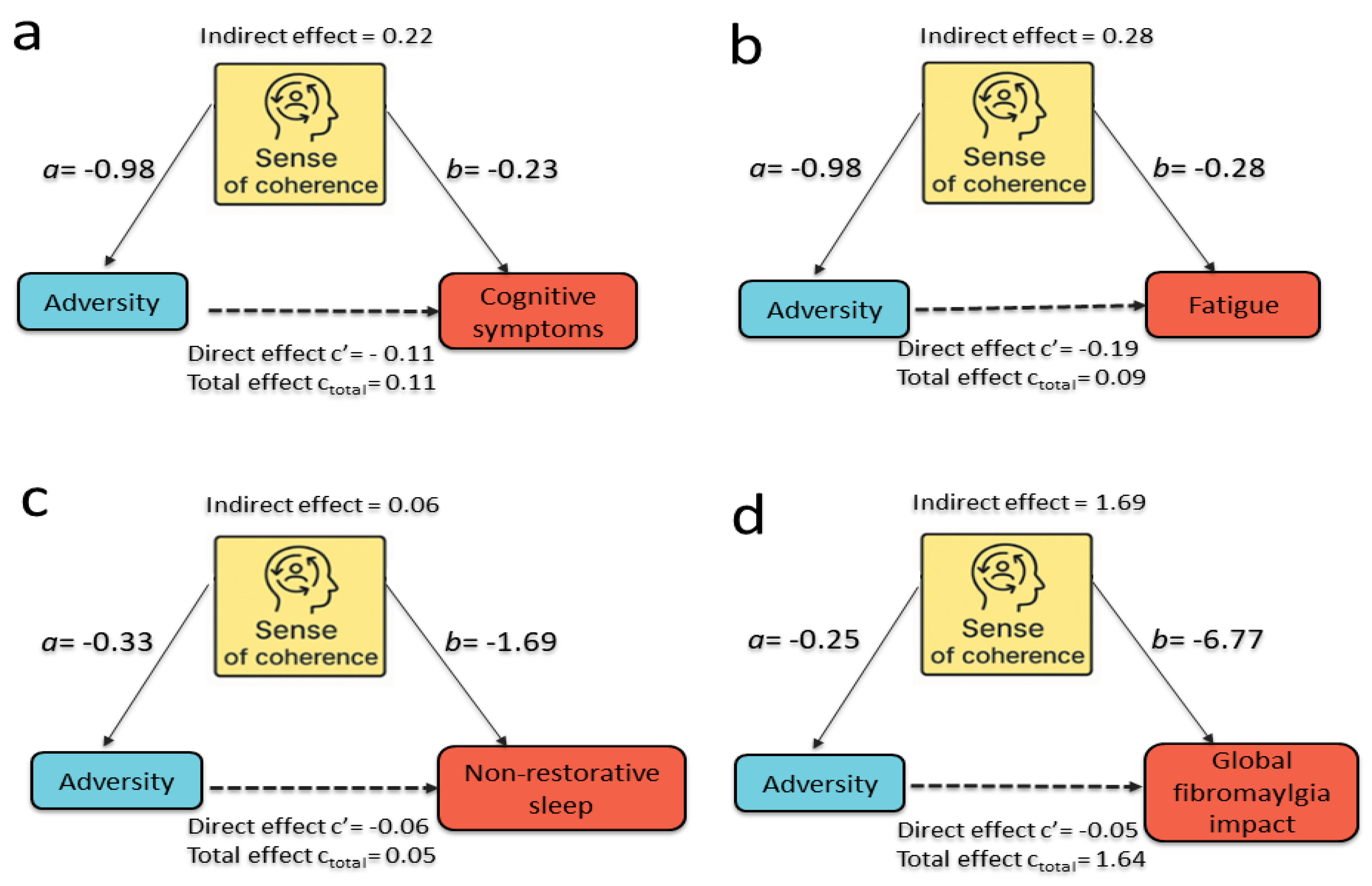
| a_coef | b_coef | c_total | c_prime | indirect_ab | Proportion Mediated | |
|---|---|---|---|---|---|---|
| Symptoms of cognitive dysfunction | ||||||
| Major life loss (Yes) | −0.325 | −0.207 | 0.101 | 0.033 | 0.067 | 0.667 |
| Persistent physical aggression (Yes) | −0.976 | −0.229 | 0.113 | −0.110 | 0.223 | 1.969 |
| Persistent verbal aggression (Yes) | −0.493 | −0.205 | 0.137 | 0.036 | 0.101 | 0.739 |
| Persistent emotional aggression (Yes) | −0.425 | −0.207 | 0.107 | 0.019 | 0.088 | 0.820 |
| Sexual abuse (Yes) | −0.565 | −0.211 | 0.097 | −0.022 | 0.119 | 1.228 |
| Two types of abuse | −0.273 | −0.212 | 0.053 | −0.005 | 0.058 | 1.090 |
| Three or more types of abuse | −0.250 | −0.204 | 0.081 | 0.030 | 0.051 | 0.630 |
| Fatigue | ||||||
| Major life loss (Yes) | −0.325 | −0.255 | 0.034 | −0.049 | 0.083 | 2.418 |
| Persistent physical aggression (Yes) | −0.976 | −0.284 | 0.087 | −0.190 | 0.277 | 3.182 |
| Persistent verbal aggression (Yes) | −0.493 | −0.260 | 0.046 | −0.082 | 0.128 | 2.806 |
| Persistent emotional aggression (Yes) | −0.425 | −0.258 | 0.036 | −0.074 | 0.110 | 3.067 |
| Sexual abuse (Yes) | −0.565 | −0.259 | 0.044 | −0.103 | 0.146 | 3.343 |
| Two types of abuse | −0.273 | −0.275 | 0.024 | −0.051 | 0.075 | 3.163 |
| Three or more types of abuse | −0.250 | −0.258 | 0.024 | −0.041 | 0.064 | 2.692 |
| Non-restorative sleep | ||||||
| Major life loss (Yes) | −0.325 | −0.169 | 0.048 | −0.006 | 0.055 | 1.133 |
| Persistent physical aggression (Yes) | −0.976 | −0.179 | 0.116 | −0.059 | 0.174 | 1.506 |
| Persistent verbal aggression (Yes) | −0.493 | −0.170 | 0.065 | −0.019 | 0.084 | 1.291 |
| Persistent emotional aggression (Yes) | −0.425 | −0.174 | 0.018 | −0.056 | 0.074 | 4.049 |
| Sexual abuse (Yes) | −0.565 | −0.169 | 0.081 | −0.015 | 0.096 | 1.187 |
| Two types of abuse | −0.273 | −0.177 | 0.030 | −0.019 | 0.048 | 1.624 |
| Three or more types of abuse | −0.250 | −0.169 | 0.037 | −0.005 | 0.042 | 1.130 |
| Fibromyalgia Impact Questionnaire (FIQ) | ||||||
| Major life loss (Yes) | −0.325 | −6.802 | 1.709 | −0.503 | 2.212 | 1.294 |
| Persistent physical aggression (Yes) | −0.976 | −7.542 | 2.948 | −4.416 | 7.364 | 2.498 |
| Persistent verbal aggression (Yes) | −0.493 | −6.810 | 2.919 | −0.440 | 3.359 | 1.151 |
| Persistent emotional aggression (Yes) | −0.425 | −6.803 | 2.500 | −0.392 | 2.893 | 1.157 |
| Sexual abuse (Yes) | −0.565 | −6.823 | 3.090 | −0.768 | 3.859 | 1.249 |
| Two types of abuse | −0.273 | −7.060 | 1.297 | −0.629 | 1.926 | 1.485 |
| Three or more types of abuse | −0.250 | −6.770 | 1.642 | −0.050 | 1.691 | 1.030 |
| Adversity Indicator | Beta-Interaction | p-Value | |
|---|---|---|---|
| Outcome: symptoms of cognitive dysfunction | |||
| Major life loss (Yes) | 0.023 | 0.401 | |
| Persistent physical aggression (Yes) | 0.003 | 0.940 | |
| Persistent verbal aggression (Yes) | 0.040 | 0.167 | |
| Persistent emotional aggression (Yes) | 0.035 | 0.215 | |
| Sexual abuse (Yes) | 0.035 | 0.334 | |
| Two types of abuse | 0.017 | 0.099 | |
| Three or more types of abuse | 0.017 | 0.282 | |
| Outcome: Fatigue | |||
| Major life loss (Yes) | 0.052 | 0.009 | |
| Persistent physical aggression (Yes) | 0.039 | 0.139 | |
| Persistent verbal aggression (Yes) | 0.060 | 0.004 | |
| Persistent emotional aggression (Yes) | 0.057 | 0.005 | |
| Sexual abuse (Yes) | 0.057 | 0.027 | |
| Two types of abuse | 0.024 | 0.001 | |
| Three or more types of abuse | 0.024 | 0.028 | |
| Outcome: Non-restorative sleep | |||
| Major life loss (Yes) | 0.027 | 0.228 | |
| Persistent physical aggression (Yes) | 0.050 | 0.087 | |
| Persistent verbal aggression (Yes) | 0.031 | 0.179 | |
| Persistent emotional aggression (Yes) | 0.015 | 0.496 | |
| Sexual abuse (Yes) | 0.044 | 0.121 | |
| Two types of abuse | 0.012 | 0.133 | |
| Three or more types of abuse | 0.014 | 0.265 | |
| Outcome: Fibromyalgia Impact Questionnaire (FIQ) | |||
| Major life loss (Yes) | 0.804 | 0.100 | |
| Persistent physical aggression (Yes) | 1.154 | 0.072 | |
| Persistent verbal aggression (Yes) | 1.583 | 0.002 | |
| Persistent emotional aggression (Yes) | 1.437 | 0.004 | |
| Sexual abuse (Yes) | 2.106 | 0.001 | |
| Two types of abuse | 0.751 | 0.000 | |
| Three or more types of abuse | 0.569 | 0.039 | |
Disclaimer/Publisher’s Note: The statements, opinions and data contained in all publications are solely those of the individual author(s) and contributor(s) and not of MDPI and/or the editor(s). MDPI and/or the editor(s) disclaim responsibility for any injury to people or property resulting from any ideas, methods, instructions or products referred to in the content. |
© 2026 by the authors. Published by MDPI on behalf of the University Association of Education and Psychology. Licensee MDPI, Basel, Switzerland. This article is an open access article distributed under the terms and conditions of the Creative Commons Attribution (CC BY) license.
Share and Cite
Caumo, W.; Bueno, G.B.; Freitas, G.M.D.; Lopes, G.T.; Coelho, M.L.; Gomes, J.; Venturini, C.L.; Louzada, M.E.; Peres, S.M.; Torres, I.L.S.; et al. Sense of Coherence in the Trauma–Fibromyalgia Relationship: Mediation and Moderation Findings from a 2099-Participant Cohort. Eur. J. Investig. Health Psychol. Educ. 2026, 16, 45. https://doi.org/10.3390/ejihpe16030045
Caumo W, Bueno GB, Freitas GMD, Lopes GT, Coelho ML, Gomes J, Venturini CL, Louzada ME, Peres SM, Torres ILS, et al. Sense of Coherence in the Trauma–Fibromyalgia Relationship: Mediation and Moderation Findings from a 2099-Participant Cohort. European Journal of Investigation in Health, Psychology and Education. 2026; 16(3):45. https://doi.org/10.3390/ejihpe16030045
Chicago/Turabian StyleCaumo, Wolnei, Graziele Borges Bueno, Giordano Mayer De Freitas, Guilherme Teixeira Lopes, Mariana Lentino Coelho, Julia Gomes, Caroline Leffa Venturini, Maria Eduarda Louzada, Sara Machado Peres, Iraci L. S. Torres, and et al. 2026. "Sense of Coherence in the Trauma–Fibromyalgia Relationship: Mediation and Moderation Findings from a 2099-Participant Cohort" European Journal of Investigation in Health, Psychology and Education 16, no. 3: 45. https://doi.org/10.3390/ejihpe16030045
APA StyleCaumo, W., Bueno, G. B., Freitas, G. M. D., Lopes, G. T., Coelho, M. L., Gomes, J., Venturini, C. L., Louzada, M. E., Peres, S. M., Torres, I. L. S., Janz Moreira, A. C., & Fregni, F. (2026). Sense of Coherence in the Trauma–Fibromyalgia Relationship: Mediation and Moderation Findings from a 2099-Participant Cohort. European Journal of Investigation in Health, Psychology and Education, 16(3), 45. https://doi.org/10.3390/ejihpe16030045